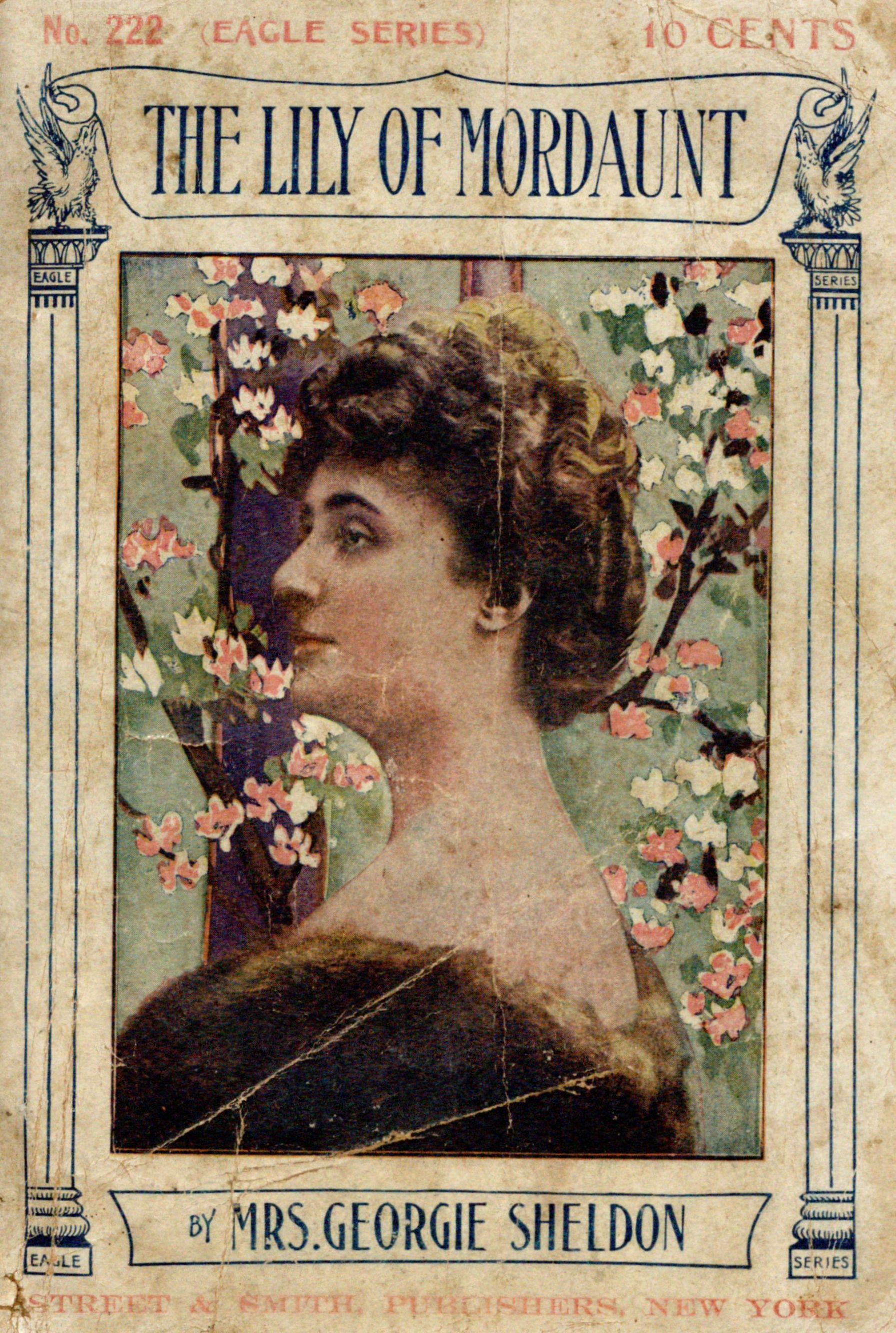
No. 222 (EAGLE SERIES) 10 CENTS
BY MRS. GEORGIE SHELDON
STREET & SMITH, PUBLISHERS, NEW YORK
STREET & SMITH, Publishers
The Pioneer Line of Ten-Cent Novels, and the Leader
RETAIL PRICE, 10c.
This famous line was the original series of ten-cent books. Its success was instantaneous. Millions of copies have been sold, and an increasing demand for the entire series continues. The following titles are in print, and can be supplied by all newsdealers:
224—A Wonderful Woman. By May Agnes Fleming.
223—Leola Dale’s Fortune. By Charles Garvice.
222—The Lily of Mordaunt. By Mrs. George Sheldon.
221—Wedded Yet No Wife. By May Agnes Fleming.
220—A Fatal Past. By Dora Russell.
219—Lost, A Pearle. By Mrs. George Sheldon.
218—A Life for a Love. By Mrs. L. T. Meade.
217—His Noble Wife. By George Manville Fenn.
216—The Lost Bride. By Clara Augusta.
215—Only a Girl’s Love. By Charles Garvice.
214—Olga’s Crime. By Frank Barrett.
213—The Heiress of Egremont. By Mrs. Harriet Lewis.
212—Doubly Wronged. By Adah M. Howard.
211—As We Forgive. By Lurana W. Sheldon.
210—Wild Oats. By Mrs. Georgie Sheldon.
209—She Loved but Left Him. By Julia Edwards.
208—A Chase for a Bride. By St. George Rathborne.
207—Little Golden’s Daughter. By Mrs. Alex. McVeigh Miller.
206—A Daughter of Maryland. By G. Waldo Browne.
205—If Love be Love. By D. Cecil Gibbs.
204—With Heart So True. By Effie Adelaide Rowlands.
203—Who Was the Heir. By Geraldine Fleming.
202—Marjorie. By Katharine S. MacQuoid.
201—Blind Elsie’s Crime. By Mary Grace Halpine.
200—In God’s Country. By D. Higbee.
199—Geoffrey’s Victory. By Mrs. Georgie Sheldon.
198—Guy Kenmore’s Wife, and The Rose and the Lily. By Mrs. Alex. McVeigh Miller.
197—A Woman Scorned. By Effie Adelaide Rowlands.
196—A Sailor’s Sweetheart. By the author of Dr. Jack.
195—Her Faithful Knight. By Gertrude Warden.
194—A Sinless Crime. By Geraldine Fleming.
193—A Vagabond’s Honor. By Ernest De Lancey Pierson.
192—An Old Man’s Darling, and Jacquelina. By Mrs. Alex. McVeigh Miller.
191—A Harvest of Thorns. By Mrs. H. C. Hoffman.
190—A Captain of the Kaiser. By St. George Rathborne.
189—Berris. By Katharine S. MacQuoid.
188—Dorothy Arnold’s Escape. By Mrs. Georgie Sheldon.
187—The Black Ball. By Ernest De Lancey Pierson.
186—Beneath a Spell. By Effie Adelaide Rowlands.
185—The Adventures of Miss Volney. By Ella Wheeler Wilcox.
184—Sunlight and Gloom. By Geraldine Fleming.
183—Quo Vadis. By Henryk Sienkiewicz.
182—A Legal Wreck. By William Gillette.
181—The Baronet’s Bride. By May Agnes Fleming.
180—A Lazy Man’s Work. By Frances Campbell Sparhawk.
179—One Man’s Evil. By Effie Adelaide Rowlands.
178—A Slave of Circumstances. By Ernest De Lancey Pierson.
177—A True Aristocrat. By Mrs. Georgie Sheldon.
176—Jack Gordon, Knight Errant. By William C. Hudson (Barclay North).
175—For Honor’s Sake. By Laura C. Ford.
174—Wild Margaret. By Geraldine Fleming.
173—A Bar Sinister. By the Author of Dr. Jack.
172—A King and a Coward. By Effie Adelaide Rowlands.
171—That Dakota Girl. By Stella Gilman.
170—A Little Radical. By Mrs. J. H. Walworth.
169—The Trials of an Actress. By Wenona Gilman.
168—Thrice Lost, Thrice Won. By May Agnes Fleming.
167—The Manhattaners. By Edward S. Van Zile.
166—The Masked Bridal. By Mrs. Georgie Sheldon.
165—The Road of the Rough. By Maurice M. Minton.
164—Couldn’t Say No. By the author of Helen’s Babies.
163—A Splendid Egotist. By Mrs. J. H. Walworth.
162—A Man of the Name of John. By Florence King.
161—Miss Fairfax of Virginia. By the author of Dr. Jack.
160—His Way and Her Will. By Frances Aymar Mathews.
159—A Fair Maid of Marblehead. By Kate Tannatt Woods.
158—Stella, the Star. By Wenona Gilman.
157—Who Wins? By May Agnes Fleming.
156—A Soldier Lover. By Edward S. Brooks.
155—Nameless Dell. By Mrs. Georgie Sheldon.
154—Husband and Foe. By Effie Adelaide Rowlands.
153—Her Son’s Wife. By Hazel Wood.
152—A Mute Confessor. By Will N. Harben.
151—The Heiress of Glen Gower. By May Agnes Fleming.
150—Sunset Pass. By General Charles King.
149—The Man She Loved. By Effie Adelaide Rowlands.
148—Will She Win? By Emma Garrison Jones.
147—Under Egyptian Skies. By the author of Dr. Jack.
146—Magdalen’s Vow. By May Agnes Fleming.
145—Country Lanes and City Pavements. By Maurice M. Minton.
144—Dorothy’s Jewels. By Mrs. Georgie Sheldon.
143—A Charity Girl. By Effie Adelaide Rowlands.
142—Her Rescue from the Turks. By the author of Dr. Jack.
141—Lady Evelyn. By May Agnes Fleming.
140—That Girl of Johnson’s. By Jean Kate Ludlum.
139—Little Lady Charles. By Effie Adelaide Rowlands.
138—A Fatal Wooing. By Laura Jean Libbey.
137—A Wedded Widow. By T. W. Hanshew.
136—The Unseen Bridegroom. By May Agnes Fleming.
135—Cast Up by the Tide. By the author of Half a Truth.
134—Squire John. By the author of Dr. Jack.
133—Max. By Mrs. Georgie Sheldon.
132—Whose Was the Crime? By Gertrude Warden.
131—Nerine’s Second Choice. By Adelaide Stirling.
130—A Bitter Bondage. By Bertha M. Clay.
129—In Sight of St Paul’s. By Sutton Vane.
128—The Scent of the Roses. By the author of Half a Truth.
127—Nobody’s Daughter. By Clara Augusta.
126—The Girl from Hong Kong. By the author of Dr. Jack.
125—Devil’s Island. By A. D. Hall.
124—Prettiest of All. By Julia Edwards.
123—Northern Lights. By A. D. Hall.
122—Grazia’s Mistake. By Mrs. Georgie Sheldon.
121—Cecile’s Marriage. By Lucy Randall Comfort.
120—The White Squadron. By T. C. Harbaugh.
119—An Ideal Love. By Bertha M. Clay.
118—Saved From the Sea. By Richard Duffy.
117—She Loved Him. By Charles Garvice.
116—The Daughter of the Regiment. By Mary A. Denison.
115—A Fair Revolutionist. By the author of Dr. Jack.
114—Half a Truth. By a popular author.
113—A Crushed Lily. By Mrs. Alex. McVeigh Miller.
112—The Cattle King. By A. D. Hall.
111—Faithful Shirley. By Mrs. Georgie Sheldon.
110—Whose Wife Is She? By Annie Lisle.
109—A Heart’s Bitterness. By Bertha M. Clay.
108—A Son of Mars. By the author of Dr. Jack.
107—Carla; or, Married at Sight. By Effie Adelaide Rowlands.
106—Lilian, My Lilian. By Mrs. Alex. McVeigh Miller.
105—When London Sleeps. By Chas. Darrell.
104—A Proud Dishonor. By Genie Holzmeyer.
103—The Span of Life. By Sutton Vane.
102—Fair But Faithless. By Bertha M. Clay.
101—A Goddess of Africa. By the author of Dr. Jack.
100—Alice Blake. By Francis S. Smith.
99—Audrey’s Recompense. By Mrs. Georgie Sheldon.
98—Claire. By Charles Garvice.
97—The War Reporter. By Warren Edwards.
96—The Little Minister. By J. M. Barrie.
95—’Twixt Love and Hate. By Bertha M. Clay.
94—Darkest Russia. By H. Grattan Donnelly.
93—A Queen of Treachery. By T. W. Hanshew.
92—Humanity. By Sutton Vane.
91—Sweet Violet. By Mrs. Alex. McVeigh Miller.
90—For Fair Virginia. By Russ Whytal.
89—A Gentleman From Gascony. By Bicknell Dudley.
88—Virgie’s Inheritance. By Mrs. Georgie Sheldon.
87—Shenandoah. By J. Perkins Tracy.
86—A Widowed Bride. By Lucy Randall Comfort.
85—Lorrie; or Hollow Gold. By Charles Garvice.
84—Between Two Hearts. By Bertha M. Clay.
83—The Locksmith of Lyons. By Prof. Wm. Henry Peck.
82—Captain Impudence. By Edwin Milton Royle.
81—Wedded For an Hour. By Emma Garrison Jones.
80—The Fair Maid of Fez. By the author of Dr. Jack.
79—Marjorie Deane. By Bertha M. Clay.
78—The Yankee Champion. By Sylvanus Cobb, Jr.
77—Tina. By Mrs. Georgie Sheldon.
76—Mavourneen. From the celebrated play.
75—Under Fire. By T. P. James.
74—The Cotton King. By Sutton Vane.
73—The Marquis. By Charles Garvice.
72—Wilful Winnie. By Harriet Sherburne.
71—The Spider’s Web. By the author of Dr. Jack.
70—In Love’s Crucible. By Bertha M. Clay.
69—His Perfect Trust. By a popular author.
68—The Little Cuban Rebel. By Edna Winfield.
67—Gismonda. By Victorien Sardou.
66—Witch Hazel. By Mrs. Georgie Sheldon.
65—Won By the Sword. By J. Perkins Tracy.
64—Dora Tenney. By Mrs. Alex. McVeigh Miller.
63—Lawyer Bell from Boston. By Robert Lee Tyler.
62—Stella Stirling. By Julia Edwards.
61—La Tosca. By Victorien Sardou.
60—The County Fair. By Neil Burgess.
59—Gladys Greye. By Bertha M. Clay.
58—Major Matterson of Kentucky. By the author of Dr. Jack.
57—Rosamond. By Mrs. Alex. McVeigh Miller.
56—The Dispatch Bearer. By Warren Edwards.
55—Thrice Wedded. By Mrs. Georgie Sheldon.
54—Cleopatra. By Victorien Sardou.
53—The Old Homestead. By Denman Thompson.
52—Woman Against Woman. By Effie Adelaide Rowlands.
51—The Price He Paid. By E. Werner.
50—Her Ransom. By Charles Garvice.
49—None But the Brave. By Robert Lee Tyler.
48—Another Man’s Wife. By Bertha M. Clay.
47—The Colonel By Brevet. By the author of Dr. Jack.
46—Off With the Old Love. By Mrs. M. V. Victor.
45—A Yale Man. By Robert Lee Tyler.
44—That Dowdy. By Mrs. Georgie Sheldon.
43—Little Coquette Bonnie. By Mrs. Alex. McVeigh Miller.
42—Another Woman’s Husband. By Bertha M. Clay.
41—Her Heart’s Desire. By Charles Garvice.
40—Monsieur Bob. By the author of Dr. Jack.
39—The Colonel’s Wife. By Warren Edwards.
38—The Nabob of Singapore. By the author of Dr. Jack.
37—The Heart of Virginia. By J. Perkins Tracy.
36—Fedora. By Victorien Sardou.
35—The Great Mogul. By the author of Dr. Jack.
34—Pretty Geraldine. By Mrs. Alex. McVeigh Miller.
33—Mrs. Bob. By the author of Dr. Jack.
32—The Blockade Runner. By J. Perkins Tracy.
31—A Siren’s Love. By Robert Lee Tyler.
30—Baron Sam. By the author of Dr. Jack.
29—Theodora. By Victorien Sardou.
28—Miss Caprice. By the author of Dr. Jack.
27—Estelle’s Millionaire Lover. By Julia Edwards.
26—Captain Tom. By the author of Dr. Jack.
25—Little Southern Beauty. By Mrs. Alex. McVeigh Miller.
24—A Wasted Love. By Charles Garvice.
23—Miss Pauline of New York. By the author of Dr. Jack.
22—Elaine. By Charles Garvice.
21—A Heart’s Idol. By Bertha M. Clay.
20—The Senator’s Bride. By Mrs. Alex. McVeigh Miller.
19—Mr. Lake of Chicago. By Harry DuBois Milman.
18—Dr. Jack’s Wife. By the author of Dr. Jack.
17—Leslie’s Loyalty. By Charles Garvice.
16—The Fatal Card. By Haddon Chambers and B. C. Stephenson.
15—Dr. Jack. By St. George Rathborne.
14—Violet Lisle. By Bertha M. Clay.
13—The Little Widow. By Julia Edwards.
12—Edrie’s Legacy. By Mrs. Georgie Sheldon.
11—The Gypsy’s Daughter. By Bertha M. Clay.
10—Little Sunshine. By Francis. S. Smith.
9—The Virginia Heiress. By May Agnes Fleming.
8—Beautiful but Poor. By Julia Edwards.
7—Two Keys. By Mrs. Georgie Sheldon.
6—The Midnight Marriage. By A. M. Douglas.
5—The Senator’s Favorite. Mrs. Alex. McVeigh Miller.
4—For a Woman’s Honor. By Bertha M. Clay.
3—He Loves Me, He Loves Me Not. By Julia Edwards.
2—Ruby’s Reward. By Mrs. Georgie Sheldon.
1—Queen Bess. By Mrs. Georgie Sheldon.
[Pg 2]
We trust that you will be thoroughly satisfied with this book. During the long period of time that the publications of Street & Smith have been familiar to the reading classes (somewhat more than half a century) it has always been our aim to give to the public the very best literary products, regardless of the expenditure involved. Our books and periodicals are today read and re-read in a majority of the homes of America, while but few of our original competitors are even known by name to the present generation. No special credit is due for antiquity, but we hold it to be a self-evident fact that long experience, coupled with enterprise and the ability to maintain the front rank for so many years, proves our right to the title of leaders. We solicit your further valued patronage.
STREET & SMITH.
[Pg 3]
A NOVEL
BY
MRS. GEORGIE SHELDON
AUTHOR OF
“FAITHFUL SHIRLEY,” “BROWNIE’S TRIUMPH,” “QUEEN BESS,”
“LOST, A PEARLE,” “MAX,” ETC.
NEW YORK
STREET & SMITH, Publishers
238 William Street
[Pg 4]
Copyright, 1884, 1899 and 1901,
By STREET & SMITH
[Pg 5]
CHAPTER I. A PERFECT BEAUTY.
CHAPTER II. “WHICH IS THE MORE LOVELY?”
CHAPTER III. A FRIEND IN NEED.
CHAPTER IV. I WILL WIN YOU YET.
CHAPTER V. UNHEEDED FLEW THE HOURS.
CHAPTER VI. DISAPPOINTMENT.
CHAPTER VII. “I DO NOT BELIEVE YOU.”
CHAPTER VIII. BETROTHED LOVERS.
CHAPTER IX. THE FIRST WEDDING.
CHAPTER X. ARLEY’S VISITOR.
CHAPTER XI. I CANNOT GIVE YOU UP.
CHAPTER XII. IT SEEMS INCREDIBLE.
CHAPTER XIII. THE PORTRAIT.
CHAPTER XIV. THE ENGAGEMENT RING.
CHAPTER XV. A TEARFUL FAREWELL.
CHAPTER XVI. THE DOOR LOCKED UPON HIM.
CHAPTER XVII. BAD NEWS.
CHAPTER XVIII. ARLEY’S RESOLVE.
CHAPTER XIX. JANE COLLINS’ STORY.
CHAPTER XX. ARLEY’S ILLNESS.
CHAPTER XXI. A WICKED DEED.
CHAPTER XXII. SAVED.
CHAPTER XXIII. THE LAST APPEAL.
CHAPTER XXIV. A FRIEND IN NEED.
CHAPTER XXV. PHILIP PAXTON’S RETURN.
CHAPTER XXVI. JANE COLLINS AT HOME.
CHAPTER XXVII. THE TRUTH TOLD.
CHAPTER XXVIII. ADDING INSULT TO INJURY.
CHAPTER XXIX. PHILIP PAXTON’S LETTER.
CHAPTER XXX. FORTUNE’S WHEEL.
CHAPTER XXXI. THE RING.
CHAPTER XXXII. MRS. BANCROFT’S NARRATIVE.
CHAPTER XXXIII. THE CRASH ON THE RAILROAD.
CHAPTER XXXIV. A “LADY BORN.”
CHAPTER XXXV. THE GOOD SAMARITAN.
CHAPTER XXXVI. THE STRANGE LETTER.
CHAPTER XXXVII. IN A DILEMMA.
CHAPTER XXXVIII. ARLEY’S AMAZEMENT.
CHAPTER XXXIX. LADY ALICE.
CHAPTER XL. ATONEMENT.
CHAPTER XLI. I AM HIS WIFE.
CHAPTER XLII. WHERE AM I?
CHAPTER XLIII. A NOBLE MANHOOD RESTORED.
CHAPTER XLIV. PERFECT FAITH.
CHAPTER XLV. WIL HAMILTON.
CHAPTER XLVI. MIMOSA.
CHAPTER XLVII. HOMEWARD BOUND.
CHAPTER XLVIII. CAN IT BE TRUE?
CHAPTER XLIX. LADY PAXTON.
Hazelmere, June 30, 18—.
Dear Phil—I promised when we were all at home that I would send for you. We are a gay party, I can tell you—five constitute our number, and we need only your own jolly self to complete the sextet. There is pretty Arley Wentworth, my sister’s especial friend and chum; Fred Vane, Annie’s fiancee, and last, but not least, aside from your humble servant, my father’s charming ward, the Lady Elaine Warburton. What shall I say of her?—how give you an idea of her surpassing loveliness? I will say nothing. I can only quote from our poet laureate: “Elaine the fair, Elaine the lovable! Elaine the lily-maid,” not of Astolat, but of the house of Mordaunt, and the daughter not “of a hundred earls,” like the “Lady Clare,” but of the Duke of Mordaunt, who died abroad about five years ago, having first committed his only child to the care of my respected paternal, who was his dearest and most trusted friend. She has been at a convent in France most of the time since her father’s death, and I have scarcely seen her since she was a little maid in short clothes; consequently, I was wholly unprepared for the vision of loveliness which burst upon my sight, when, on my return from Oxford, I was presented to the peerless Elaine.
You perceive, old fellow, how it is with me; I have “gone clean daft.” I see nothing, think of nothing, save a fair, creamy face, with the faintest flush, like that of a sea-shell, on its rounded cheeks, while shining bands of gold span the pure, white brow, beneath which eyes of purple-blue seem to be looking at one through a golden mist. Then those dainty lips! so sweet, so red, that they never part with smile or word but they set my heart on fire. She has a form of faultless symmetry, a hand like a piece of fairest sculptured marble, and a foot which a fairy might envy.
I said I would not say anything about her, but I’ve written all this nonsense almost before I knew it. I’m getting decidedly spooney, I’ll own, but you will not wonder when you see my “lily-maid.” Come down right away, and we will have gay times for the next month. You will like Arley Wentworth, who, by the way, is quite an heiress, and just your style—dark, brilliant, bewitching.
You shall be her cavalier on all occasions. You perceive [Pg 6]that I have done the pairing-off; for I warn you beforehand that I shall brook no rival for the affections of my peerless Lily of Mordaunt. I can imagine the curl of amusement, perhaps mingled with something of scorn, on your handsome lips as you read this, mon ami. You will remember how indifferent I have always been to the charms of the gentle sex—you will recall my rank skepticism regarding my ever losing my heart to any woman, however lovely; but I can’t help it—it’s all up with me now, though I doubt if the rack would ever have made me confess as much to any one else. Telegraph when you will be here, and I will meet you at the station.
Yours ever,
WIL.
Philip Paxton, Esq., a young and rising barrister, sat in his chamber, in Grey’s Inn, one hot, dusty day, when all London seemed gasping for breath, so to speak, and read the above effusion; while his lips did, indeed, curl, but with decided “scorn” rather than with “amusement.”
“I should say he was ‘clean daft,’” he muttered, “poor, foolish Wil!”
“And he will ‘brook no rival for the affections of the fair Elaine!’” he added, a flash of something like defiance for a moment lighting up his dark eyes.
“Bah!” he continued, “the name is enough for me—I never could endure that love-sick tale, where that poor little fool, Elaine, died for love of Lancelot, and the very sound of it is a synonym to me of a sort of milk-and-water beauty, and a weak-minded, silly little girl. Now Arley Wentworth,” he went on, referring to his friend’s letter again, “sounds something like—there is character in it, and, at all events, originality. Let me see, this is Wednesday; I imagine that I can arrange matters and things so that I can run down to Hazelmere on Saturday. I think I’ve earned a rest,” he concluded, with a sigh, while his eyes roved with something of pride over the piles of papers and documents filed so neatly away in the pigeonhole of his great desk, and telling of long days of hard work and well-earned gold.
He took up his pen, and, drawing a sheet of paper toward him, at once wrote a letter of acceptance to the invitation of his friend, and mentioned Saturday afternoon as the time set for his arrival at Hazelmere, the magnificent country seat of Sir Anthony Hamilton, a wealthy baronet, who owned half the township of Horsham, Sussex County, England.
Saturday afternoon, when the half-past four express from London stopped for a moment at the station of Horsham, a tall, well-proportioned young man of about twenty-five, [Pg 7]sprang upon the platform and looked about him as if expecting to see some one whom he knew awaiting him.
There was a stately air about him which at once attracted attention, a certain poise of the handsome head, a look of character and decision about his attractive face, a certain gravity and dignity of manner, and a fire in his dark blue eye which impressed the beholder at once with an idea of superiority and power.
And yet, a closer scrutiny of that face by those who were skillful in reading human nature, always engendered a feeling of distrust, as if underneath all that ability, power and culture there was an element which was liable, under certain circumstances, to work mischief for both himself and others.
His clothing was of the finest texture and most fashionable make, yet there was not the least suspicion of the dandy about him; everything was immaculate, yet in perfect taste.
“Aha! here you are, old boy, and now I am happy,” cried a genial voice near by, and the next moment his hand was eagerly taken and heartily shaken by a young man about his own height, but of slighter build, with a frank, laughing face, clear, honest blue eyes, waving auburn hair, and a voice whose heartiness and cordiality rang out like a rich strain of music on the summer air.
This was Wilton, or, as he was more familiarly called, Wil Hamilton, only son of Sir Anthony and heir to his title and large estates.
“If you had disappointed me,” he ran on, in a gay tone, and still shaking the hand that he held, “I should have given you the ‘cut direct’ the next time we met. We are all here after you—the three graces, attended by Fred and myself. Come this way and I’ll introduce you; but, beware!”—with a mock tragic air—“don’t you dare to lift covetous eyes to the fair Elaine, or I shall throw my gauntlet at your feet on the spot. Arley Wentworth, by the way, is on tiptoe to see you; thinks you must be something extra; rather above the common run, you know; for I’ve rung your praises unceasingly in her ears—of course I had an object in view—during the last few days.”
“Thank you,” returned Philip Paxton, in a slightly sarcastic tone, which caused his light-hearted friend to laugh outright.
“There! none of your grandiloquent airs, Phil, if you please. You know they never did disturb me in the least, so they will do no good now. We are all bound for a good time, and if your backbone gets too stiff, it will be uncomfortable, not only for yourself, but for the rest of us.
“Here we are,” he added, as they came around to one end [Pg 8]of the station, where there stood a handsome pair of bays attached to a wagonette, in which two ladies and a gentleman were seated.
“Annie,” he said, leading his friend toward them and addressing a pretty girl, with a fair complexion and hazel eyes, “you do not need to be introduced to Phil, but you shall give him a grip of welcome before I present the others. Mr. Vane, this is my friend, Mr. Paxton; Miss Wentworth, Mr. Paxton.”
Mr. Paxton, after greeting Annie Hamilton, shook hands with Mr. Vane and lifted his hat to Miss Wentworth and was instantly impressed that she was a “mighty pretty girl.”
Then he glanced about him in some curiosity, wondering where the “fair Elaine” could be.
Wil Hamilton noticed it, and colored slightly.
“Come this way a moment, Phil, and I’ll finish all the introductions at once,” he said; and slipping his arm within that of his friend, he turned him about and led him toward an elegant phaeton, to which two pretty, gray ponies were attached, and in which a slight, graceful girl was seated.
“I could not drive any nearer, for the ponies are a trifle skittish,” Wil explained, as he led him forward.
“Good Heavens! how beautiful she is!” the young man said to himself when at last they stood beside the phaeton; and he never could remember afterward how he conducted himself during the ceremony of introduction.
“The Lily of Mordaunt,” he repeated to himself, as he gazed upon her exquisite loveliness, and, for the moment, was oblivious of everything else.
He was conscious only of looking into eyes of liquid blue—eyes which seemed to him to have fathomless depths, and through which some sweet spirit was gazing up at him, thrilling his very soul with a strange delight.
He saw a fair, low brow, over which rings of sunny hair lay in careless grace; a delicate mouth, proud, yet sweet, sensitive, yet strong. He noticed the dainty fairness of her skin, upon which there was not the slightest blemish; the small ears, which seemed like molded wax, and the rich, heavy rolls of golden hair, which shone like bands of smoothed satin. He saw, too, the slight, perfect, yet stately figure, with its beautifully-fitting dress of russet brown; the small hand so daintily gloved; the soft ruching encircling her white throat, and which was fastened with some costly and curiously-carved stone.
He took in every detail of her toilet—all her exquisite [Pg 9]loveliness in those few, brief moments, during which he stood bowing before her, and exchanged polite greetings.
“She is like the matchless Calla lily,” he said to himself, “as pure, as stately, as perfect. I do not wonder now at Wil’s rhapsodies, or that he lost his heart when he saw her. But I wish her name was not Elaine—I never liked it; though if this lily-maid of Astolat was one-half so fair, I doubt if Queen Guinevere, even though she were called the ‘pearl of beauty,’ could ‘hold a candle to her’—to quote a common phrase; and Lancelot, that flower of bravery, made the greatest mistake of his life when he turned the cold shoulder to her pleading. Who could look upon such beauty unmoved? It is not in human nature.”
“Mr. Paxton will make our circle complete,” Lady Elaine said, turning with a smile, and a slight blush, from his admiring eyes to speak to Wil.
That smile disclosed the prettiest teeth—small, white, even; and in vivid contrast to the sweet, scarlet lips.
Philip Paxton bowed his appreciation of this compliment, and a deeper color tinged his own cheek.
“Yes,” Wil Hamilton answered, “we shall make a capital party, and now, Phil, if you’ll take a seat in the wagonette with Miss Wentworth, I’ll swing your portmanteau in forward under the driver’s seat, and then we’ll be off for Hazelmere, where we shall doubtless find dinner waiting.”
Philip lifted his hat to Lady Elaine, and turned away to comply with his friend’s request.
But he was loath to go; and his eye lingered enviously upon the vacant seat by her side.
How like a poem it would have been to be able to drive those spirited ponies over the two miles to Hazelmere, with that peerless face so near, and that sweet voice making music in his ears!
But he was, of course, obliged to submit to the arrangements already made; and, springing to his post by Miss Wentworth’s side, they were soon trotting along at a spanking rate over the beautiful moors, while, before they had accomplished half the distance to Hazelmere, his admiration was turned into a new channel, and he was compelled to confess that Wil had certainly given him no “milk-and-water” beauty for a companion, for Miss Arley Wentworth proved herself to be both brilliant and interesting.
Half an hour’s drive brought them to Hazelmere’s hospitable doors, where a cordial reception was accorded to the newcomers by Sir Anthony Hamilton and his genial, motherly wife, and the gay party separated to dress for dinner, which would soon be served.
[Pg 10]
“I will give you just twenty minutes, young ladies, so bestir yourselves,” Lady Hamilton said, playfully, as the three girls came trooping into the hall; “if you cannot make yourselves pretty enough in that time, you will have to suffer the consequences.”
“What do you think of my ‘Lily of Mordaunt?’” Wil asked of Philip, as he went to show him the room which had been prepared for him.
“Your Lily of Mordaunt!” he repeated, with a keen glance into the young man’s face; “do you claim possession already?”
Wil flushed.
“Well,” he said, with a laugh, “I suppose I have no right to do that, but, between you and me, I hope it will come to that before long. Is she not lovely?”
“Very; and your name for her is very appropriate; but Miss Wentworth is exceedingly beautiful, too,” Philip answered.
“Yes, Arley is very brilliant, and a fascinating little thing; besides, she has twenty thousand pounds in her own right.”
“That is a snug little sum, to be sure; but, I suppose Lady Elaine is very wealthy, also,” Philip remarked, with a side glance at his friend.
“Yes; the Duke of Mordaunt left an immense property—the income, I believe is about as much as Arley’s whole fortune.”
“Indeed!” Mr. Paxton said, with a peculiar emphasis. “You will be a lucky fellow, Wil, if you succeed in winning her peerless ladyship and her immense fortune, also.”
“I have scarcely thought of the money,” Wil Hamilton replied, eagerly, and flushing hotly. “She would be just the same to me if she hadn’t a penny.”
“Nevertheless, a plethoric purse is a very convenient thing to possess in the long run,” quoth Philip Paxton, dryly.
“Twenty thousand pounds a year!” he repeated, meditatively to himself, after Wil had gone below. “How would a man feel, I wonder, to have the handling of that amount, to say nothing of the privilege of sitting vis-a-vis three or four times a day with such a beauty as Lady Elaine Warburton.”
[Pg 11]
A few words more of introduction are necessary in order to make the reader understand more thoroughly what the main characters of our story are like.
Arley Wentworth, like the Lady Elaine, was an orphan. Her father had been a gallant captain in her majesty’s army, her mother the daughter of a wealthy London physician.
Both had died in the far East, the captain from a bullet wound received with his face to the enemy, his gentle, idolizing wife from grief over her husband’s untimely and tragic death.
The little Arley, then not quite two years old, was thus left desolate, save for the native nurse who had had the care of her ever since her birth—and the officers of her father’s company, not knowing what else to do, sent her home to England to her grandfather. The nurse, who loved her little charge most fondly, and could not endure the thought of separation, was only too glad to be commissioned to take care of her.
But the poor, little waif nearly lost her life also, for the vessel was wrecked during the voyage, the nurse was drowned, and the child was picked up, more dead than alive, by a kind-hearted sailor, who saw her drifting helplessly about, and could not leave her to the mercy of the cruel waves, even though his own chances for being rescued were small.
When he, with the few others who were saved, were transferred from the sinking wreck to another homeward-bound steamer, a good woman took the poor child and cared for her with all the tenderness of a mother until she saw her safe in the care of her grandfather, Dr. Hugh McAllister, of London.
He was nearly heart-broken over the sad tidings brought to him with his grandchild, but as she grew and developed, she gradually came to take the place of his lost daughter, and he bestowed the greatest care upon her education and training.
She was a great comfort to him as long as he lived, and at his death he left her all his property, and confided her to the guardianship of his sister, a maiden lady a number of years younger than himself.
So she was quite an heiress in her own right, besides having expectations of more, since Miss McAllister was also quite wealthy.
[Pg 12]
She was vivacious and beautiful, as well as very intelligent, consequently she was much sought after and became the life of the company wherever she went.
Her name, Arley, was simply a contraction of Arletta, which everybody seemed to dislike to speak, and wondered that her parents should have chosen such a strange cognomen for her.
Her features were regular, with a sort of rounded symmetry that made one long to kiss the smooth, bright cheeks and the full, ripe lips. Her eyes were large, very dark, almost black, and exceedingly expressive. Her hair, of glossy nut-brown, was always arranged in some becoming style, and her smile, so bright and witching, made others smile in sympathy.
She was not so tall or symmetrical in figure as the Lady Elaine, but it was a pretty form, nevertheless, and always clad in the most jaunty and tasteful of costumes.
Annie Hamilton was a sweet, gentle girl, very quiet and somewhat retiring, with no pretensions to beauty, but with a latent something about her—a certain charm which made everybody love her.
She was two years younger than her brother, who was twenty-one, and whom she loved with almost idolatrous affection. She appeared rather mature for her years, but this was owing to her quiet demeanor, and to the fact, perhaps, that she had been brought up almost alone, there being no companions of her own age in the neighborhood.
Fred Vane, her betrothed, had, like Philip, been educated for the bar, but having a handsome fortune in prospect, and being the only child of his parents, he had, at their request, remained at home to assist in the management of their large estate.
He, like Annie, was very quiet in his tastes, and they were a couple of matter-of-fact lovers, who bade fair to enjoy a life full of peace and comfort.
When dinner was over and the gentlemen had rejoined the ladies, Lady Hamilton called her son to arrange for the next day’s amusement, and Philip, seizing the opportunity, sought Lady Elaine and engaged her in conversation.
He was an entertaining talker, and soon succeeded in fastening her attention wholly upon himself, and when at length Wil returned to the drawing-room he found that his friend had coaxed his “lady fair” out through one of the long windows, and there the handsome couple were pacing back and forth on the ivy-covered porch, which ran along the end of the drawing-room and the library, and were apparently oblivious [Pg 13]to everything and everybody save themselves and the subject they were discussing.
A quick, hot flush mounted to the young man’s brow, and a pained, anxious look stole into his eyes, for he had surrendered himself entirely and with a devotion rarely equaled to his father’s young and beautiful ward, and he had begun to hope, from several little signs, that she was not indifferent to him.
“My peerless lily, I do not like this sudden monopoly at all,” he murmured, with unsteady lips. “I love you—how I love you! and unless I win you my whole life will be ruined.”
Fred Vane and his sister were sitting in a deep window having a cozy after-dinner chat, and had not even heeded his entrance. Sir Anthony was reading his newspaper, and Arley was nowhere visible.
Wil thought he would look her up, and stole softly out of the room, feeling very wretched, and with the first bitterness which he had ever experienced for his old chum rising in his heart.
He found Arley in the library writing a letter, and sitting just where she could see that distinguished-looking couple outside, pacing up and down in the shadow of the ivy vines.
Her eyes were unusually bright and her color considerably heightened, but she looked up with her own charming smile as Wil entered.
He begged pardon for intruding when he saw that she was writing, but she said:
“Come in, do; I am only just scribbling a little note to auntie. I am all through except writing the address; and then, if you are agreeable, we’ll take a stroll down to the lake; you know that is my favorite resort, for”—with a droll look—“I found myself decided detrop in the drawing-room. Perhaps, however, the others will like to come with us, if they are not too deeply engaged,” she concluded, with a slight shrug of her pretty shoulders and an inclination of her bright head toward the porch.
Wil assented to her proposal, and, having waited for her to address and seal her letter, they sauntered out.
As they passed through the hall Arley caught up a filmy white scarf and twisted it carefully about her head, and the contrast with her bright complexion and her rich dress made the loveliest picture imaginable.
“Come, Annie,” she sang out, gayly, peeping in at the drawing-room door; “we are going down to the lake for a row.” Then, with a glance at her companion, she added: [Pg 14]“Will you ask Mr. Paxton and Lady Elaine to come with us?”
Wil started and flushed hotly at the question, and she read his heart in an instant.
“He loves her, as I suspected, and he is afraid of losing her,” she thought.
She bent her head in reflection a moment, then lifting it with a haughty, resolute gesture, she said:
“I’ll ask them,” and darted away to suit the action to the word.
“I don’t care what Mr. Paxton thinks of me,” she murmured as she went; “he shall not spoil Wil’s life with his arts; he loves Lady Elaine, and he shall win her if I can help him to do it, for they were just made for each other.”
She stole softly up the steps of the porch, which at that end was beautifully arched above with massive carved pillars on each side.
Philip Paxton and his companion were pacing the other way, and their backs were toward her—they were not even conscious of the approach of any one.
“The Lily of Mordaunt is wanted,” she called out, gayly. “Come, Mr. Paxton—we are all going for a row on the lake, and if you have never seen that charming sheet of water, you do not know what a treat is in store for you.”
They turned at the sound of her voice, and Philip caught his breath as he looked down the length of the porch and saw the lovely vision standing in the arch; it was as if the young girl had been painted there by some master hand and then framed within that massive carving.
“Heavens! I never saw one so beautiful,” he thought; and the fairer beauty of the girl at his side seemed to pale before the bright vision before him.
Lady Elaine came forward at Arley’s call, as if glad to be released from her tete-a-tete.
“Please do not call me by that sentimental name, Arley,” she said, with a smile, but with a rising flush.
“Why not, dear? Wil gave you the name, and it just suits you,” she replied, linking her arms in hers and drawing her down the steps. “You always make me think of a lily whenever I look at you.”
“But you make me feel foolish, you bright Rose of Wentworth,” Lady Elaine returned, with an arch smile.
Arley’s laugh pealed out rich and clear.
“Now that is just delightful of you, my lady; nobody ever called me anything so pretty before. Do I make you think of a rose?”
“Indeed you do—the brightest rose that ever grew; isn’t [Pg 15]it true, Mr. Paxton?” Lady Elaine inquired, appealing to him.
“Yes, indeed; it was a happy inspiration, and I think we must adopt it in the future,” he replied, with a look in his handsome eyes that made Arley’s heart beat quickly in spite of her previous irritation, and the little piece of treachery which she had been plotting to thwart his plans regarding the great heiress and her fortune.
When they came up with the others, Wil appeared thoughtful, and his usually frank eyes were clouded with a look of pain.
“We have found a new name for Miss Wentworth,” Philip said, pretending not to notice the change in his friend, although his conscience gave him a twinge; “we are going to call her the ‘Wentworth Rose.’ What do you think of it?”
“That it is very appropriate,” Wil tried to say with his usual hearty manner.
“Then henceforth we will fight for the Wentworth Rose; her champions we will be,” Philip said, gayly, and making a low obeisance before Arley.
“Thank you, Mr. Paxton; but I am afraid I shall be spoiled, for I have not been in the habit of having such pretty things said to me,” she returned, demurely, but with very mischievous eyes. “However,” she added, “if you take such rash vows upon yourself you must abide by the consequences; I shall require you to wear my colors.”
She plucked a crimson rose from a bush near which they were standing and held it out to him.
“A serious requirement, indeed,” he answered, smiling; “but I shall be most happy to accede to it, if your own fair fingers will place it where it ought to go,” and he touched the left lapel of his coat.
Arley began to look for a pin; then, as if suddenly remembering the object of their stroll she shot a quick glance over her shoulder at Wil, saying:
“I suppose I must comply with Mr. Paxton’s request; go on, Wil, and get the boat ready, and we will be there by the time you want to start.”
Wil Hamilton’s eyes lighted, for he understood the manœuvre of the bright girl, and stepping to Lady Elaine’s side, they all passed on, somewhat to Philip Paxton’s chagrin, for he had intended to monopolize the heiress of Mordaunt during the remainder of the evening.
But there was no help for it, since he had bound his own hands, so to speak, and he was obliged to stand there and allow Miss Wentworth to amuse herself at his expense. She [Pg 16]appeared to be in no hurry either, and it took some time to settle that rose to suit her capricious fancy.
“I trust you have a generous supply of patience, Mr. Paxton,” she said, with provoking coolness, as, for the fourth time, she removed the refractory pin, to “try again.”
“There!” she added, “I think that will do this time; and now I’m afraid that we have kept the others waiting. But I always like to have everything just right,” she concluded, with a double meaning to her words, but looking so sweetly innocent that he never suspected how she had contrived to spoil his little game, although he inwardly rebelled against being separated from Lady Elaine.
When they arrived at the lake, they found the rest of the party seated in the boat, waiting for them.
Annie Hamilton was sitting in the prow, Wil and Lady Elaine in the next seat, looking as contented as possible with each other’s society, while Fred Vane was in the middle of the boat with an oar in each hand; thus the two seats at the stern were reserved for the two loiterers.
“I am going to row, Paxton, and you will oblige me if you will take the tiller,” Fred Vane said, and Philip, after assisting Arley to her seat, could only comply with his request.
But he did not have a very unsocial time of it, in spite of his disappointment, for the “Wentworth Rose” was in the best of spirits, for some reason, and kept his attention so perfectly occupied with her mirth and chatter, that he almost forgot that he had been balked in any of his designs, while Wil was as grateful to the quick-witted girl as ever a forlorn lover could be.
A week slipped by on magical wings.
Some delightful excursion, drive or entertainment was planned for every day, and the guests of Sir Anthony and Lady Hamilton were indeed a “gay party,” as Wil had prophesied they would be.
Had it not been for the two that were playing at cross purposes, there would have been nothing to mar the delight of any one.
If Arley Wentworth had only been Lady Elaine, with her title and twenty thousand a year, or if her position and fortune had been equal to hers, Philip Paxton would have [Pg 17]bowed on worshiping knees at her shrine before that week was over.
He was bewitched and fascinated by her—she acquired a power over him as no one had ever won before; he never heard her voice without a thrill—she never came near him without his pulses leaped; the very sound of her light laugh and step—the rustle even of her dress was music to him.
But, alas! he had decreed that it would be folly for him to pass by the greater prize for the sake of a little love; he was ambitious for a brilliant future, which fortune and position would at once secure for him, and he could not afford to sacrifice it for the sake of a foolish sentiment, which, at the most, could only give him a little more domestic happiness; and perhaps, after all, he might learn to love Lady Elaine just as well if he should marry her; and he had made up his mind to accomplish this if possible, notwithstanding the confidential confession of his friend, and the wrong that he would thus do him.
“Wil is certain to be a rich man anyway—he will inherit all his father’s large property, and it would not be fair for him to have two such fortunes, while it is only by my wits and the hardest work that I am making my way along in the world.”
Thus he reasoned the matter with himself, shutting his eyes to the fact that he was betraying the confidence of his friend, using him dishonorably, and doing violence to the nobler feeling of his own nature.
But he did not progress very rapidly in his undertaking for, just as he would succeed in getting Lady Elaine nicely to himself, and perhaps right in the middle of a fine speech, something would be sure to interrupt them and break up their tete-a-tete.
But he never suspected that there was any “malice prepense” about it, or that Arley Wentworth was thwarting him in every possible way—that she was employing all her arts, and making herself so delightfully agreeable to him whenever the opportunity offered, just for the sake of keeping him from poaching on forbidden ground, and thus giving Wil the desire of his heart.
But it was so, nevertheless; she watched them unceasingly, and if she saw Philip about to seek Lady Elaine, she would instantly dart up to him, in her bright, bewitching way, upon some pretense or other, claim his attention, and draw him into conversation or some playful controversy, until Wil could capture his lady-love; then, laughing in her sleeve over her success, yet with a strange pain gradually creeping into her heart, she would suddenly remember some engagement, [Pg 18]work, or errand, and slip away again, leaving him to his own devices.
“What is your opinion of Mr. Paxton?” she asked her one day, when, having dressed earlier than usual, she ran into Lady Elaine’s room to have a half-hour’s chat before dinner.
“I think he is very agreeable and intelligent,” Lady Elaine quietly replied.
“Yes—a trifle superior—a little above the generality of young men, isn’t he?” Arley asked, with a peculiar emphasis, and a covert glance at the fair face opposite her.
A delicate flush rose to the creamy cheek, and the lovely blue eyes were hidden beneath their white lids.
“Is he?” queried Lady Elaine, with an assumption of cool indifference that amused Arley exceedingly.
“I asked you to pass judgment upon him; but if you want my opinion of him I suppose I can give it, and of the other young gentlemen of our party, too,” she retorted, with a wicked gleam in her dark eyes. “I think he is very handsome. You seldom see such magnificent eyes in anybody; and he has such a finely-shaped head, so square and well-developed. Then look at the life and energy in his every movement. Why, if Fred Vane had one-half as much, what a man he would make with his opportunities. Then he—Mr. Paxton, I mean—is so cultivated and entertaining, he must have improved his time well while at Oxford; while as for Wil——”
She hesitated purposely, and the sly puss got just the reward she had been seeking.
“I’m sure, Arley, you are very unfair in your criticisms, especially when you are a guest in the home of Wil Hamilton. You should not draw odious comparisons,” Lady Elaine said, with a sudden flash of spirit, her eyes gleaming and darkening, until they looked like two purple, starry-hearted pansies, while a vivid spot of red burned on each cheek.
“Odious comparisons!” Arley repeated, drooping her lids to hide the dancing spirit in her own eyes. “I don’t think I’ve said anything very bad. I was merely expressing my admiration for the recent addition to our party, and—don’t you know? I was expected to admire him; for, if you remember Wil took special pains to impress his superiority upon me long before his arrival, and I’m sure I do not wish to be unappreciative or to disappoint anybody——”
“But you need not depreciate others for the sake of lauding him. Wil Hamilton, of all others, least deserves it,” interrupted Lady Elaine, with a heightening color.
“I depreciate Wil Hamilton!” cried mischievous Arley, with well-assumed astonishment. “My dear Elaine, you misunderstand [Pg 19]me entirely—indeed, you did not even allow me to finish what I was going to say about him.”
“What were you going to say?” the fair girl asked, with a searching look at her friend’s dimpling face, and then dropping her telltale eyes.
“I was going to remark that, as for Wil, there was no use drawing any comparisons, for—he is without a peer in my estimation.”
A little smile of pleasure flitted over Lady Elaine’s sweet lips, the waxen lids fluttered over her downcast eyes, while a vivid blush suffused her fair face, burning up into the waves of golden hair above her forehead, and creeping down among the folds of snowy lace about her white throat.
Arley, observing it, laughed outright and clapped her dimpled hands with glee at these signs of the state of her friend’s heart. Then, leaning suddenly forward, she kissed her on the forehead.
“My beautiful ‘Lily of Mordaunt,’ you are a darling,” she said. “You are pure and true to your heart’s core; you are loyal, you are brave, and if I am ever in need of a friend, I know that you will not fail me.”
How vividly she recalled that assertion two years later!
Lady Hamilton was to give a large dinner party that evening to a number of her friends in the county, and there were also several distinguished people from London invited.
Lady Elaine was very glad of the presence of these visitors, for they would serve to shield her somewhat from observation, and she was too conscious of her recently discovered secret to wish to be at all conspicuous.
She had chosen for the occasion a dress of pure white, of some soft, gauzy material, and unrelieved by an atom of color, save a cluster of dark, waxen-green leaves, which she had fastened at her throat with a single diamond, that glittered among them like a huge drop of dew.
“Mademoiselle is perfect,” her maid had cried, when her toilet was completed; “there will be no one below one-half so lovely.”
“Hush, Nanette! you must not flatter me,” her mistress said, with a reproving smile. “I know,” she added, “that you have taken a great deal of pains with my dress, and it is beautiful—it pleases me very much; but I have no doubt there will be far richer toilets here to-night than mine.”
“There will be no one so lovely,” persisted Nanette, while her admiring eyes rested affectionately upon that fair face and symmetrical figure reflected in the full-length mirror.
It was a little late when she entered the drawing-room; [Pg 20]she had waited purposely, hoping to be able to slip in among the crowd very quietly and thus escape observation.
But, as it happened, this brought upon her the very thing that she had wished to avoid.
As the curtains to one of the arches of the drawing-room parted to admit the peerless girl, there was a momentary hush, and almost every eye was fixed upon her with surprise and admiration, for she made an entrancing picture there in her white trailing robes against the warm, rich crimson of the curtains.
But after the first heart-throb of dismay, as she saw the sea of faces turned toward her, she passed to the side of Annie Hamilton, who was assisting her mother to do the honors of the occasion.
Wil, at the opposite side of the room, beholding her, felt his heart bound within him with mingled exultation and pain—exultation over her surpassing loveliness and pain lest something would cause him to fail to win her.
“She is like a stately Calla in her beauty; but her spirit, so sweet and pure, is like the fragrance of the water lily,” he breathed, while an almost unconquerable desire possessed him to clasp her to him and bear her away from the sight and sound of every one, and pour forth the burning love that was consuming him.
“Who is that beautiful girl?” everybody asked; and they were greatly surprised on being told that she was Sir Anthony’s ward and the daughter of the Duke of Mordaunt, and then eagerly pressed forward for introductions.
“Jer-i-co!” ejaculated a young sprig of nobility, who was honoring the occasion with his presence, “won’t she make a sensation when she comes out? Twenty thousand a year! Ah, won’t there be a fluttering among the birds of prey when that bit of news becomes known?” and he immediately began to flutter his own feathers, and to edge toward the object of his admiration, to be presented.
Philip Paxton flushed to his very brow as he too watched her enter the room.
“I never dreamed that any one could be so exquisitely lovely,” he said. “She is not so sprightly and entertaining as the Wentworth Rose,” he added, his eye wandering to where Arley stood, and who was also in white—simple white tulle, with dashes of scarlet verbenas in its graceful drapery, and a bunch of them in her white gloved hands.
She was as bright and cheery as some happy bird, and he sighed as he looked at her.
“I wish she had more of Arley’s spirit and wit,” he continued, his glance returning to Lady Elaine, “but,” as he [Pg 21]caught sight of that costly glittering gem among the green leaves—it was one of the Mordaunt diamonds, of which there were many and worth a fortune in themselves—“but I shall marry her if I can.”
As it happened, it fell to him to take her out to dinner, and owing to the excitement of the occasion, and something, perhaps, to the admiration which she had excited, and of which she could not fail to be conscious, she was unusually bright and animated. She chatted and laughed almost as freely and merrily as Arley herself, who was bewitching the son of an earl as fast as ever she could; though she had frowned threateningly and cast a look of commiseration at poor Wil when she saw Lady Elaine upon Philip Paxton’s arm, while he, Wil, had to take down a spinster of forty, who wore corkscrew curls and was otherwise frightful in a toilet of mulberry and green.
The dinner was, apparently, a brilliant success, and the guests in their happiest humor.
No one, save Arley, perhaps, suspected the pain and passion that were raging in the breast of Sir Anthony’s heir, while he covertly watched his love glow and brighten in the presence of her attendant, as he had never seen her do before.
“Shall I learn to hate my dearest friend?” he fiercely asked himself, as he saw him bend almost fondly toward his companion and whisper words which brought a more vivid color to her cheek, and made her droop her white lids in maidenly confusion.
He grew so furiously jealous and disturbed that, as soon as the ladies had withdrawn, he excused himself from the table and stole away out of the house, and out of the sound of the mirth and laughter of the gay company.
He wanted to be alone a while; he needed to calm his excited nerves and to try and exorcise, if possible, the spirit of evil that was rising up and taking possession of him.
He wandered down to the lake, his head bared to the cool evening breeze, for his brow was hot and feverish; and here loosing his wherry, he leaped into it and pushed off from the shore for a hard row in the moonlight.
An hour after, Wil returned comparatively calm and in a much more rational frame of mind. He had worked off a good deal of his internal wickedness at the oars, and the season of meditation had done him good. He saw how unreasonable [Pg 22]he had been to indulge in such passionate jealousy and anger; for if Lady Elaine preferred Philip Paxton’s society to his own and was attracted toward him, no power on earth could help it, and he must try to make the best of it.
The night was supremely beautiful, and, as he had glided over the smooth bosom of the lake, a sort of peace had fallen upon him; the soft light of the moon, as it glimmered through the network of foliage overhanging the waters, had seemed to quiet the tumult that was raging within him, and charm away those disagreeable sensations of hatred and revenge which for the time he had let take such violent possession of him.
“I love her, and I am going to try to win her,” he said, with a sudden resolute uplifting of his handsome head, as his boat went skimming over the waters and he had seriously thought the matter all over. “If I can do it fairly and honorably, I shall be the happiest man in the world; if I cannot win her—if she cannot love me and will not be my wife—if her heart turns to Paxton”—and his fine lips grew pale and unsteady at the thought—“I have no right to stand in his way, even though I feel that he is not treating me honestly after the confidence which I have given him.
“I will go back; I will not sulk and pout like an overgrown schoolboy, but I will go and meet my fate like a man.”
And as he reasoned in this sensible, straightforward fashion, he turned his wherry about and began to row back to put his resolution into execution.
As he did so the moonlight fell upon something white just at his side.
He bent to look. It was a water lily, its waxen face turned up to him, beaming at him from the dark waters like a star of hope and promise.
He uttered a cry of pleased surprise as he put out his hand and carefully plucked it.
“What strange freak of nature is this that I find a water lily in full bloom in the night?” he said.
He held it closely out into the light to examine it more closely, and, as far as he could see, it was a most perfect and beautiful flower.
“Shall I accept the finding of this as a good omen? Is it a blossom of promise to me?” he asked, his face brightening as he contemplated it. “I will hope so, at least, as long as there is anything to hope for. I will take it home to her, for she loves the lilies so, my peerless Lily of Mordaunt.”
He laid it carefully on the seat beside him, and rowing swiftly and with a lightened heart, he was soon back again at Hazelmere.
[Pg 23]
The lily was found to be without a blemish; every petal and stamen was as perfect as if it had been molded from wax.
His first thought as he re-entered the drawing-room was of Lady Elaine.
She was standing near a window which opened upon the porch where she had paced with Philip Paxton on the night of his arrival, and she was, for the moment, alone.
He approached her, and when she saw him she gave him a smile of welcome.
“Where have you been, truant, all this time?” she asked, playfully.
His heart leaped at the words.
She had missed him, then, consequently her attention could not have been very deeply absorbed by any one else.
“I did not feel quite right after dinner, and I went out upon the lake for a row,” he answered, frankly.
“Are you ill?” she inquired, a shade of anxiety creeping into her lovely eyes; and again his heart thrilled with a strange, sweet delight.
“No; I am quite well.” Then, not caring to pursue that subject, he said:
“But I have found something for you—something strange and beautiful. Will you come with me and let me show it to you?”
“‘Something strange and beautiful?’” she repeated, smiling. “Of course, I will come. I could not endure the curiosity which you have aroused in me.”
She laid her hand lightly on his arm, and he led her to a little ante-room where he had left his lily in water.
He had put it into a tall, slender vase of cut glass, and as he led her up to it, she exclaimed:
“Where did you get it? I never saw anything more perfect or beautiful.”
She took the vase in her white-gloved hands and bent over it, her face full of appreciation and delight.
“I found it on the lake,” Wil answered, thinking how like to the spotless flower she was herself, in her pure white robes, with that simple cluster of green leaves at her throat.
“What—to-night! I thought water lilies always closed at night,” she cried.
“So they do; but some strange freak of nature has kept this one open. Perhaps,” he added, with a smile, “some tiny, invisible fairy or water-nymph has crept into it and gone to sleep, and that is what keeps it open.”
“What a pretty fancy, Wil,” Lady Elaine began, and then stopped suddenly, while a beautiful blush suffused her face.
[Pg 24]
She had never spoken his name quite like this before, at least not in his presence, and again every nerve within him thrilled with joy.
“Do you know,” she added, quickly, as if to cover her confusion, “what I mean to do with it? The sisters at the convent taught me the art of preserving flowers, and I shall attend to this the first thing to-morrow morning. I shall keep it always,” she asserted; then fearing she had said too much, she added, with drooping lashes, “for it is too beautiful to be allowed to fade.”
Wil caught his breath; those shyly-drooping lids, the fluctuating color in that velvet cheek, were very enticing signs to him.
“Would you care enough about it to take all that trouble?” he asked, in a low, eager voice, his whole soul in his eyes.
Before she could reply, a voice behind them said:
“Oh, here you are, Wil. Your mother wants you a moment,” and Sir Anthony popped his head most inopportunely in upon the almost-declared lovers.
Then seeing the flower that Lady Elaine was holding in her hands, and being quite an enthusiastic botanist, he came forward to examine the night-blooming lily, while Wil, perceiving that his opportunity was lost for that time, went to ascertain what his mother wanted.
But his heart was lighter than it had been for many days; something in his darling’s manner, the involuntary speaking of his name in that familiar way, her assertion that she should always keep his lily, made him feel as if his cause was not altogether hopeless.
Sir Anthony stopped only a moment or two after his son left them, then he, too, went back to his guests, leaving his fair ward alone.
As he disappeared, she lifted the glittering vase which she still held, and laid her lips tenderly, caressingly, against that waxen flower, resting like a white dove upon its edge.
Could an artist have painted her as she looked then, his fame would have been established for all time, for a fairer picture mortal eye never gazed upon.
The little room with its rich crimson hangings, the walls paneled with embossed gold, and adorned with choice paintings, with here and there a gleaming statuette, the glittering chandelier above shedding its radiance over all, and the young girl, in her pure white dress, her face slightly flushed, her scarlet lips tremulous with some inward emotion, looking tenderly down upon the perfect flower in its crystal cup—ah, it was a vision which once seen would be stamped upon memory’s page forever.
[Pg 25]
Philip Paxton, standing unobserved in the doorway, saw it and held his breath, almost fearing that if he should move the spell would be dissolved and she would suddenly vanish like some sweet spirit from his sight.
He had seen Wil approach and lead her from the drawing-room while he was talking to Lady Mary Elgin, to whom he had just been introduced, and he instantly became alarmed lest something should occur to balk his plans.
As soon as he could do so, he excused himself from his companion and followed them from the room.
Passing through the hall he saw Wil emerge from the little ante-room alone, and instantly breathed freer. Surely no harm could have been done in so short a time.
A moment or two later Sir Anthony followed his son, and, believing that Lady Elaine was now there alone, Philip, with a feeling of exultation that he should find a clear field, stole forward, peeped within the room, and saw the picture that has been described.
“Now or never!” he said to himself, yet notwithstanding his anxiety to know his fate, he was loath to disturb that delightful vision.
But a slight movement on his part made Lady Elaine turn quickly, and then she blushed a vivid scarlet as she wondered if Mr. Paxton had seen the tender caress which she had bestowed upon her lily.
He had seen her bending over it, but not having witnessed Wil’s presentation, he had imagined her to be merely inhaling its fragrance, and now observing her blush, he fondly believed that his unexpected presence alone had caused it.
He instantly went forward to her side with a smile.
“You have something very pretty there,” he said.
“Yes,” she said, recovering her self-possession. “It is a lily which has bloomed, or remained in blossom, in the evening. Mr. Hamilton found it on the lake. Did you ever see anything so perfect and beautiful?”
She held the vase toward him as she spoke.
He took it from her and looked at the flower, but with a preoccupied air.
Then he put it down upon the table near which they were standing, and turning to her again, said, in a deep, intense tone, while an eager, passionate fire burned in his eyes:
“It is neither so perfect nor so beautiful as its namesake, the Lily of Mordaunt. Lady Elaine, you must know what I want to say to you. I love you with my whole soul, and I want to win you for my wife. I did not mean to speak to you of this so soon. I meant to woo you gradually; but when I saw you in here alone in your transcendent loveliness, I [Pg 26]was impelled to come and tell you of my love. I was afraid to wait. I was afraid that I should lose you, and my impatient heart would not brook delay. My darling, tell me that I may wear the Lily of Mordaunt forever on my heart. Tell me that you will love me, and give the right to call you by the sweetest of all names—my wife.”
He had spoken very rapidly—so rapidly that she could find no opportunity to interrupt him, though her very soul had shrank appalled as she listened to his passionate avowal, for such it seemed to her, since his voice shook, and he was trembling with emotion and suspense when he concluded.
She had grown suddenly scarlet at his confession, then as she realized the pain that she must inflict upon him, she became as white as her snowy dress.
“Mr. Paxton,” she began, sorrowfully, when he paused, “I am deeply pained that you should have said this to me. If I had once surmised that you were beginning to cherish feelings such as you have just confessed, I should have found some way to show you how impossible it would be for me ever to be your wife——”
“Oh, do not say that,” Philip Paxton interrupted, in a tone of passionate entreaty.
“I must, Mr. Paxton, or else be guilty of doing both you and myself an irreparable injury.”
She spoke with such positiveness, and so calmly, that it angered him.
“Perhaps the Lady Elaine Warburton would not condescend to marry a young barrister, however respectable he might be. Perhaps she desired to secure another title when she takes upon herself the bonds of matrimony,” he said, sarcastically, while a burning flush surged up and lost itself beneath the masses of dark hair which lay above his forehead.
She drew herself up with a slight gesture of haughtiness at this implication, but she answered as gently as before:
“If I had given my heart to a man whom I believed to be worthy, I should marry him without regard to his profession or position in life.”
“Am I not worthy, then? Wherein do I lack? Teach me how to be worthy of you, and I will move the world to accomplish my object,” he cried, assuming a humble tone.
She lifted her eyes to his face and they were full of pity.
“I beg your pardon,” she cried. “I had no intention of implying anything like that. I feel that you are worthy of the love of a true-hearted woman, and I esteem you very highly as—as a friend——”
He interrupted her with a gesture of repugnance.
[Pg 27]
“I do not want to be your friend,” he cried, impetuously.
“Do you not?” she questioned, in a tone of gentle surprise, a slight flush tinging her cheek.
“Oh, I do not mean that,” he answered, almost wildly, “but I want more—I want your love—your heart—I want you.”
“I can give you neither my love nor myself,” Lady Elaine replied, in a low voice, but there was no mistaking the decision in her tone.
He grew frightfully pale for a moment, and then a rush of anger and disappointment dyed all his face again.
“Tell me,” he said, abruptly, almost rudely, and searching her face with a burning glance, “have you given yourself to another? Do you love some one else?”
She turned upon him a cold, imperious look.
“You have no right to ask me such a question,” she said, icily; but her cheeks were vivid in their scarlet hue.
He saw his mistake instantly.
She was very proud and very sensitive, this peerless Lily of Mordaunt, and, if he hoped to retain her favor, he saw that he must conduct himself very circumspectly.
“Forgive me,” he returned, humbly—he could afford to be very humble, if by any means he could win that twenty thousand a year; “I had no right to ask it, but I am nearly wild with the pain of my disappointment. Tell me, please, that you forgive me.”
He held out his hand appealingly as he ceased speaking, and with her heart full of pity for him, and believing that he was sincere, she laid her own within it with a frank, forgiving smile.
“You are freely forgiven,” she said, sweetly.
His fingers closed over hers in an almost spasmodic clasp.
“Thank you,” he murmured, tenderly; then he added: “But I would give very much to know if this hand is pledged to another.”
She quickly withdrew it, a curl of scorn replacing the smile on her lips.
“Mr. Paxton forgets himself often to-night,” she said, haughtily; then added, with sudden impulse, “and yet if it can be of any consequence to him to know the fact of the case, I can tell him that—it is not.”
His face cleared in an instant; his heart leaped with exultation; the beautiful girl with her immense fortune might yet be his if this was true; at all events he would leave no stone unturned to accomplish his purpose.
He bent toward her with a brilliant smile, an eager look in his handsome eyes.
[Pg 28]
“Then I do not despair,” he said, softly; “I will win you yet.”
And without giving her an opportunity to reply, turned abruptly and left her.
Wilton Hamilton, after obeying his mother’s summons and attending to her request, went to seek Elaine again in the little room whither he had taken her to show her his lily.
Something seemed to whisper to him that she might be there waiting for him to return.
He had all at once become very hopeful that his suit would meet with just the response which he so ardently craved, for her manner, when he had given her the lily, had been encouraging, if not almost tender.
He hastened back, resolving that if he found her still in the ante-room, he would settle this question of his future without further delay.
As he drew near the still-open door he heard voices.
A moment more he stood upon the threshold and in an instant all the light and hope went out of his face, and a feeling of blank despair settled down upon his heart.
He had reached the spot just as Lady Elaine, in response to Philip’s plea “forgive me,” had looked up with that frank smile and placed a white gloved hand in his in token of her pardon, and the hopeless lover, standing behind them and beholding this, believed the simple act to be but the consummation of a betrothal—believed that, in his absence, his false friend Philip Paxton had stolen a march upon him and won away his love.
He did not hear Lady Elaine’s words, “you are freely forgiven,” for they had been spoken low, and there was a dreadful ringing in his ears, while all his faculties for the moment seemed to be paralyzed.
Then, with such a sense of misery and desolation as he never had dreamed a mortal could experience, he crept stealthily away, leaving, as he believed, a pair of happy lovers to their first moments of bliss.
When Lady Elaine returned to the drawing-room, after Philip had left her, she at once began to look around for Wil.
She hoped he would come to her and ask her to dance with him. She longed for his companionship, for she could not forget the look that he had bent upon her when he asked her [Pg 29]if she cared enough for his gift to preserve it, and the charm of his presence had been so great that she was impatient to be with him again.
But he was not there, nor did he make his appearance again during the evening, and the hours dragged heavily to her until the company separated.
She thought it strange that he should absent himself thus, but supposed that Lady Hamilton had sent him on some commission, and never once suspected that he was at that moment in his own room, prone upon his bed, battling with all his might against the misery that was mastering him, and the doom which he believed had been pronounced upon his hopes.
He felt as if he could never look upon his lost love again and bear the pain of it—could never meet the man who had betrayed his confidence and won the only woman he could ever love.
When, the next morning, he joined the family at breakfast, his face was white and sunken, his eyes heavy and dull, his manner unnatural and constrained, and he started violently whenever any one spoke; for he was in constant fear of hearing an engagement announced.
Lady Hamilton was alarmed and declared he was sick, and was for sending for a doctor at once.
He said he was not ill, though he confessed he had not slept well, but affirmed that he should be all right again soon.
He pleaded a headache as an excuse for not joining a party upon an excursion which had been planned for that day to visit some celebrated springs about five miles distant, and then felt as if he should go crazy listening to the regrets that poured upon him from all quarters.
Lady Elaine alone said nothing; but she looked troubled and anxious.
He had not once met her eye—had not spoken one word to her, beyond a brief “good-morning,” and she was quite sure that something very serious was the matter, both physically and mentally, and she quietly resolved to learn the nature of it before the day was ended.
Quite a large party were to visit the springs, many of the neighboring families having been invited to “picnic” with the Hamiltons, and when at length the gay company cantered down the avenue, their happy voices and laughter dying away in the distance, Wil Hamilton, in his room, with the curtains and blinds drawn close—for he could not even bear the light of the glad, bright day—heaved a sigh of relief at their departure.
“They are gone,” he said. “Now I will go where nobody can come near me—where nobody can see me.”
[Pg 30]
Rising hastily, he caught up his hat, crushed it down over his eyes, and stealing down a side stairway, he went out, and, with a quick, fierce stride, walked across the lawn toward the forest beyond, where he was soon lost to sight.
An hour later a slight, graceful figure, clad in a dress of crisp, delicate lavender lawn, made in the daintiest manner, a charming shade-hat of white chip, lined with blue, upon her golden head, and a pretty basket hanging on her arm, might have been seen flitting down the avenue, as if intent upon a solitary ramble.
Arriving at the gate, Lady Elaine—for, of course, it was she—stopped and looked right and left, as if somewhat in doubt which direction to take.
She finally decided upon turning to the left, moving with a free, brisk step, and all unconscious that she was walking straight to meet her fate, for the forest lay off in that direction.
As soon as Wil had announced his intention of remaining at home she mentally resolved that she would not accompany the party, either. It would not be pleasant to be in the presence of Mr. Paxton after what had occurred the previous evening, while she judged from his last words before leaving her, and his manner, that he did not take her refusal as final, and intended to prosecute his attentions still further.
It was with a feeling of relief that she, too, heard the gay party cantering down the avenue, and knew that she should have the day to dispose of at her own sweet will.
A sense of freedom and something of exhilaration seemed to possess her as she found herself walking alone along the highway, beneath the friendly shade of the huge overarching elms.
After walking a short distance, she turned into a cart-path leading into the woods, where she roamed about for an hour or more filling her pretty basket with sylvan treasures, then, feeling somewhat weary and warm, she resolved to make her way to a tiny brook, where there was a rustic seat, and where she and Annie often came with their books and work to spend a warm afternoon.
Softly and almost as light-footed as a fairy she glided along the mossy way, and ere long reached the spot. Parting a thick growth of foliage, she stepped instantly into a small open space, and the next instant started back suddenly with a smothered cry of terror, for there, prone upon the earth before her, was the stretched form of a man, his face to the ground.
He did not move, he scarcely seemed to breathe, and for a moment she stood irresolute whether to fly or go to his aid.
[Pg 31]
Then, as her quick eye marked and recognized his clothing, she became pale as death with a sudden fear.
It was Wil Hamilton, and so wretched and absorbed as he was in his sorrow, he had not been conscious of the approach of any one, and lay as motionless as if he were dead.
Lady Elaine’s first thought was that he had met with some accident, and was unconscious.
But with all her delicacy and gentle breeding, she was brave at heart, and possessed a latent energy and force which few gave her credit for.
Lightly and as fleet as a deer, she sped over the turf, and knelt beside the prostrate man, sweeping back the moist brown locks from his forehead as she did so.
“Wil, Wil—oh! is anything the matter? are you hurt?” she cried, her voice shaking with the great fear that had taken possession of her.
In an instant he had sprung to his feet, and stood looking down upon her, as if he thought her some thunderbolt which had just missed striking him dead; while she, startled by the suddenness of his act, sat staring up at him, every atom of strength and color forsaking her.
“I thought you had gone to the springs,” Wil said, abruptly, almost rudely, after a moment.
His voice was harsh and constrained, his face as white as her own, with great, deep circles beneath his eyes, which were bloodshot, and were so full of pain that Lady Elaine almost cried out as she looked at them.
“No. I—I did not care to go,” she returned, struggling to her feet and shrinking slightly from him.
She felt as if she had no right to be there—as if she had intruded upon him and his grief, whatever it might be. She would have given worlds to have been anywhere else at that moment.
He looked at her curiously.
“She did not care to go!” he thought, wonderingly.
But Philip had gone with the rest, and it seemed strange that he should leave his betrothed behind; and if they were happy lovers, it was even more strange that she “did not care to go” with him.
“Are you not well to-day?” he asked, less abruptly, and not knowing what else to say, but realizing the absurdity of the question instantly, for saving her momentary pallor, she had never looked better or more lovely in her life.
“Yes, I am well,” Lady Elaine replied, “but,” with a slight blush, “I preferred to stay at home.”
Her blush pierced him like a dagger.
She was shy then; she had wanted to get a little used to [Pg 32]her new happiness before she appeared in public with her lover.
The thought was nearly maddening, and before he was aware of it, a groan burst from him.
Lady Elaine advanced a step toward him at the sound, a wistful, troubled look in her lovely eyes.
“You are in trouble,” she said. “Won’t you tell me what it is?”
“It is nothing—at least nothing that you can help,” he answered, setting his teeth together with a snap.
“Let me share it, then. You know, ‘A burden lighter grows when shared,’” she said, but her red lips trembled even though she tried to smile. “Perhaps,” she added, trying to speak more lightly, “your little fairy or water-nymph, who went to sleep in the lily, has sent me here to exorcise the evil spirit that vexes you.”
He gave her a quick, startled glance, astonished that she should have remembered his words, when doubtless she must have far pleasanter things to think of now.
“Ah! if you could—if——” he began, passionately, and then suddenly checking himself.
“Try me, Wil, and see,” she returned, reaching out her white hand, and laying it gently, yet appealingly, on his arm, while her eyes seemed pleading for his confidence.
He seized her hand and lifted it to his burning lips.
“Shall I try you? Dare I try you? You cannot mean what you say. You do not even know what you are tempting me to,” he cried, wildly.
She regarded him with surprise, but she did not withdraw her hand. It lay perfectly passive in his.
“I do not understand you,” she said. “How am I tempting you? Why do you not dare to try me? You need not fear, Wil. I will not fail you.”
“You ‘will not fail’ me,” he repeated, with trembling lips. “You have failed me already. You are lost to me, and that is why I am so wretched.”
A dry sob broke from him as he said it.
She had driven him desperate with her innocent words and questions, and he poured forth his misery regardless of consequences.
For one moment she stood regarding him with wonder-wide eyes, too astonished to comprehend what he really meant.
Then it began to dawn on her, and a burning blush overspread her fair face; her white, golden-fringed lids drooped over her beautiful eyes, and she stood silent and covered with confusion before him.
[Pg 33]
She could not ask him how or why he regarded her as lost to him, because that would seem to imply that she was not—that she loved him before she was asked; so her lips were sealed and she was mute.
“Have I startled you by this confession?” he resumed, bitterly, as he marked how lovely she was in her maidenly modesty, and, having once given the rein to his misery, he could not stop. “Have you not seen, during all these weeks, how I have grown to love, to idolize you—how my heart has melted before you—how I have had no will but yours, no thought but for you? And now to lose you, to have you stolen from me before my very eyes, and just when I was beginning to hope that I might win you—oh, my darling; if I could but die here and now, at your feet, I should be comparatively happy.”
He wrung her hand in his vehemence so that at any other time she would have cried out with pain; but she hardly felt it now. Her heart beat with a strange new joy; he loved her—his wild words told her that plainly enough—and she saw that this same love was causing him great suffering, but just how and why she could not comprehend—she was puzzled by what he had said.
Her lids fluttered, she gave him one brief, bewailing glance, and murmured:
“I should not be happy—I do not want you to die, Wil; and—I do not know what you mean by—by my being stolen from you, and all that nonsense.”
He caught his breath; there was no mistaking the glance she had given him, nor the tender tone in which she had said she did not wish him to die.
Could it be possible that he had been deceiving himself after all?
“Elaine, my darling, have I been a fool?” he cried; “dare I hope that you——But tell me first, after I left you last night did not Philip Paxton come to you and ask you to be his wife?”
“Yes,” she answered, with downcast eyes and burning cheeks.
“Ah!” he began, almost fiercely, “and you——”
“I refused him, Wil,” holding out both her hands to him and looking shyly up into his face, “is it that which has been troubling you so?”
He caught her hands with a glad cry and drew her into his arms.
“Not the refusal, surely,” he said, a joyous note in his trembling, eager voice, “but the belief that you had accepted him.”
[Pg 34]
“How could I do that, when——” Lady Elaine began, and then stopped short in confusion.
“When what, my darling?”
“When I did not love him—when my heart has long belonged to some one else—to you—Wil.”
He bent and touched almost reverently the lips that had uttered this so sweetly.
“But,” she added, after a moment of silence, “what could have made you imagine that I had accepted him?”
Then he told her what he had seen—how, when having attended to his mother’s request, he went back to the ante-room, intending to tell her all the sweet story that was in his heart, he had seen her standing there with her hand in Philip Paxton’s, and looking up smilingly into his face, as if she had just granted him the favor for which he had been suing, and it had seemed as if the very fountain of his life had dried up in that moment, and all his future darkened.
“Poor, foolish, faithless boy!” she said, while she caressingly toyed with the rings of moist hair which lay upon his forehead, “where were your eyes, that you could not read me better?—where were your intuitions, that they did not tell you what others have learned all too readily? It is a pity that your fairy did not whisper something in your ear before you brought her to me in the lily.”
“How could she—she was asleep, you know,” Wil retorted, archly; but drawing the fair girl closer to him with a sort of exultant clasp, all the pain gone like magic from his face, all the misery from his eyes.
“True; I had forgotten that,” she replied, with a clear, sweet laugh.
She told him as briefly as she could all that had passed between Philip and herself, for she felt that he had a right to know it; and then—the moments slipped unheeded by, as they always do with all lovers, until warned by the blowing of a horn at a distant farmhouse that it was high noon, and they must return to Hazelmere, or a detachment would be sent out to search for them.
“I can scarcely believe that I am the same person that I was two hours ago,” Wil said, as they arose, and he drew Lady Elaine’s hand within his arm, though still retaining it in his own. “To think that I came out here the most miserable wretch on the face of the earth, and now I am returning the happiest mortal that walks, and with the Lily of Mordaunt all my own!”
[Pg 35]
Wil Hamilton went directly to his father upon his return with Lady Elaine from the forest, and told him that he had won her for his wife, asking, as a mere matter of form—for, of course, he knew that he could make no objections—his sanction to the engagement.
It is needless to say that Sir Anthony received the news with delight, and offered his heartiest congratulations.
“It it a fine thing for you, Wil, my boy, not only to have won so lovely a bride, but with her so magnificent a fortune. Lady Elaine’s twenty thousand a year, together with your own expectations, will enable you to do about as you like for the remainder of your life,” he remarked, rubbing his smooth, plump hands together, with a satisfied smile.
Wil looked up at him and flushed hotly.
“I give you my word of honor, sir, I never once thought of her money,” he said, earnestly.
Sir Anthony laughed.
“Young love forgets a good many things,” his father returned, indulgently. “Nevertheless that does not alter the convenience of the matter. A purse full of gold is something not to be despised at any time.”
“I shall settle every pound upon her,” Wil Hamilton answered, proudly, and looking somewhat disturbed. The subject of Lady Elaine’s money jarred upon him, somehow. “And it will make no difference with me—it will not change my plans for the future in the least. I am just as ambitious to make a name and position for myself as I have ever been.”
“I am glad to hear that, Wil,” Sir Anthony responded, gravely, and with a look of pride and fondness at the manly, self-reliant fellow, “for I am ambitious for you; you are my only boy, and I want you to be heard from in the future. I want the name of Hamilton to continue to be honored for all time. But aside from all pecuniary benefit, I am very much pleased at your prospective marriage with Lady Elaine. As my ward I have admired her excessively—as a daughter I shall love her tenderly.”
“Thank you, sir,” Wil said, with glowing eyes, and shook his father’s hand with a warmth that amused that gentleman greatly.
[Pg 36]
Thus the matter was settled most happily for all parties, and the next morning the engagement was announced.
Sir Anthony did it in his happiest manner.
Going up to Lady Elaine, as soon as breakfast was over, he took the blushing girl by the hand, and, turning toward the household, remarked:
“My friends, I am so proud and happy that I cannot refrain from asking you to congratulate me upon the prospect of having another daughter in my house.”
Of course the family and friends gathered around Lady Elaine immediately, to offer congratulations and express their approbation; and for a while there was a perfect babel of good wishes, and rejoicing over the happy young couple.
Philip Paxton alone held aloof from this gay group. He gave one look of blank astonishment at the lovely girl, when Sir Anthony made this announcement; then, his face crimson with anger and disappointment, he abruptly turned and left the room.
The next time he met her alone he faced her with a bitter sneer.
“My faith in womankind has had a severe blow,” he said; “you told me, Lady Elaine, that your hand was pledged to no one.”
“I simply told Mr. Paxton the truth—I was betrothed to no one at that time,” she replied, but lifting her bright head with a haughty gesture, as if to warn him that she was not accountable to him for her actions.
“You have made a bad man of me,” he retorted, fiercely, a dark look on his handsome face; “you have changed my whole nature—if I become a hardened wretch—if my career is marked by reckless deeds and hardened acts, you will know what has caused it. You could have molded me like wax—with you as the guiding spirit of my life I could have been everything that was good and noble; but now—I believe I shall go to the devil just as fast as ever I can!”
Lady Elaine flushed crimson at this mad and reckless speech, yet there was much of pity in her heart for him. If he really loved her, as he professed to, his sufferings must be akin to Wil’s when he believed her lost to him, but for all that she felt that he had no right to address her in the way he had done.
“Mr. Paxton,” she returned, gently, yet with a dignity that awed him, “for all the evil which you may do in the future no one save yourself will in any way be responsible. You alone will be held accountable. No one can regret more than I the unfortunate circumstances of night before last, and I would gladly have saved you all the pain of that occasion [Pg 37]had I been able to do so; but I hold myself guiltless of any wrong to you, for I never suspected, until that moment, that you entertained any other feelings save those of friendship toward me.”
“You must have been blind, then,” he muttered between his closely-shut teeth.
“I think more than I have been blind,” she answered, with a vivid flush, as she looked back and remembered in how many ways she must have betrayed her deep and growing attachment for Wil, and yet he, the most interested of all, had failed to read her heart.
“Perhaps,” she added, more gently than she had yet spoken, “we have all been so absorbed in our own feelings that we have been blind to those of others. Mr. Paxton, believe me, I would like to continue to regard you as a friend for the sake of Wil, and——”
“Wil Hamilton and I can never be friends after this!” he cried, excitedly.
Lady Elaine’s eyes flashed a dangerous light, her lips curled with scorn at this cowardly speech.
“What were you going to say?” he queried, remembering that he had interrupted her.
“It does not matter,” she returned, with cold dignity; “but I think it is hardly the part of a gentleman to address a lady as you have addressed me to-day. I am in no way accountable to you, nor is Mr. Hamilton, for the compact which exists between us, and for you to assume that we have injured you thereby is a presumption for which I have no toleration.”
With these words she turned quickly away and left him to his own uncomfortable reflections.
He ground his teeth savagely as he watched her graceful figure moving swiftly down the walk where they had met, and finally vanished into the house.
“I am a blundering idiot,” he cried, fiercely, “or I should have held my tongue and not aroused her contempt for me in this manner. I shall have to take a new tack, or I shall make enemies of the whole family, and that I cannot afford to do, for there is no telling how much I may need their influence in the future.”
That afternoon’s mail brought him a letter which made him grow white as death, and swear deep and terrible oaths, though his lips had never in his life before been guilty of such profanity.
It informed him that a speculation in which he had been engaged had burst like a bubble, and the large amount of money which he had put into it was lost—gone forever.
[Pg 38]
“There goes three of the best years of my life! Curse the luck!” he cried, with exceeding bitterness, as he crushed the letter in his hands and paced his chamber like a caged animal.
He fought a fierce battle with himself over this loss for more than an hour, and at the end of that time he exclaimed, with sudden resolution:
“I vow I’ll do it! I am ruined, but if I could only have gained my point with Lady Elaine it would have made no difference. I should not have minded my loss at all. Why in time couldn’t she have bestowed her favor upon me rather than upon that fool of a boy, who will have money enough of his own? But ‘half a loaf is better than no bread at all,’ as the saying has it. I’ll see what headway I can make with the other one. I believe the girl likes me, or could be made to, if I exerted myself a trifle to be agreeable to her, and I’m sure she’s an enchanting little witch, and my fallen fortunes must be mended in some way. I swear I cannot submit to such arbitrary impoverishment, and begin way down at the bottom of the ladder again.”
Evening found Philip Paxton as smiling and serene as if there were no such things as poverty and disappointment in the world.
There was not a trace of the storm and bitterness which had raged within him during the day, upon his smooth brow nor in his clear, smiling eyes.
He met Wil as cordially as if he had not been the instrument of his shattered hopes, and the demons of jealousy and hatred still raging in his own heart.
“You’re in luck, my boy,” he said, clapping him heartily on the shoulder, as he came upon him standing alone upon the porch.
Wil looked up in surprise, and searched his friend’s face with a keen glance.
“I couldn’t offer my congratulations with the crowd this morning,” Philip went on; “but I hope they are none the less acceptable coming at this hour.”
“No,” Wil replied, his face lighting up as he grasped his friend’s hand warmly. “I was only afraid I should not have them at all. I feared that this might—might make feeling between us, for—of course I knew—I could not help seeing that you were interested in the same quarter,” he concluded, with some embarrassment.
“I was—I confess it, Wil; but—but of course only one could win, and the loser must make the best of it, I suppose.”
Some one came out and joined them just then, and Wil [Pg 39]made no reply; but he was intensely relieved to find that there would be no rupture between them, and never suspected that the bitterness in Philip’s heart had been covered up from motives of policy.
Later in the evening he passed near where Lady Elaine was sitting, and stopping an instant before her, he said, in a low tone, intended only for her ear:
“My presumption was intolerable. I assure your ladyship I shall never cease to regret it.”
Without waiting for her to reply, he bowed and passed on, while Lady Elaine thought, with a glance of pity:
“Poor fellow! His disappointment made him forget himself.”
But a change had come over Arley Wentworth since the engagement of her friend had been announced.
Hitherto she had always been the first to notice and hail the appearance of Philip Paxton in the drawing-room, and nearly always managed by some pretty pretext or other, to claim his attention, and, by her light badinage and repartee, keep him chained to her side until Wil could secure Lady Elaine to himself.
When, however, the engagement was announced that morning, she had shot one furtive, triumphant glance at the discomfited suitor, and then heaved a sigh of relief, which had in it something of pain as well.
“Well, my strategic campaign is at an end, and I am glad of it. I don’t believe I could have kept it up much longer,” she said; and there was a worn, weary expression on her young face, which, had any one seen it, might have led to suspect that, perhaps, she had sustained some wounds in the battle herself.
But when Lady Elaine went upstairs, she ran into her room with a radiant face.
“You darling!” she cried, winding her arms about her waist, and giving her a delightful little hug. “So you’ve struck your colors at last! Here I have been manœuvring for this very thing for a long time, and mentally scolding you for your obstinacy all the while.”
“My obstinacy?” Lady Elaine cried, blushing with confusion, though a happy smile wreathed her red lips.
“Yes, your obstinacy. You persisted in keeping aloof from Wil unless he almost forced himself upon you; and then you would receive the attentions of Mr. Paxton, though it made Wil perfectly wretched, and, besides all that, when it was expressly understood that he was to be my especial cavalier. Where were your eyes, that you could not see that [Pg 40]your handsome lover was nearly distracted with envy and jealousy?”
“Arley, Arley, do stop that unruly tongue of yours, or I shall begin to think that some one else is nearly distracted with envy and jealousy,” Lady Elaine retorted, laughing.
Arley Wentworth blushed a fiery crimson.
“I don’t care what any one thinks now that it is all settled between you and Wil,” she said defiantly. “I knew from the first,” she ran on, “that he was over head and ears in love with you, and that his life would be ruined if he lost you, and besides——”
“Besides what, dear?” her companion asked, as she hesitated and looked up at her, archly.
“I knew that you loved him, and I thought it too bad that a lovely romance should be spoiled just for the want of a little manœuvring; yes, I will confess it now,” she continued, in reply to Lady Elaine’s look of surprise, “I have interposed in every way to help you and Wil along—I pounced upon your would-be knight whenever I saw him approaching you ‘with malice aforethought,’ and bore him away a captive, bound with invisible chains; I assure you, you have no idea what an accomplished strategist I have grown to be during the last three or four weeks. You were right the other day—I did set a little trap for you, and you fell into it charmingly. If I had found that you did not love Wil, I should, of course, have allowed matters to go on as they would, and Philip Paxton might have won you and welcome if he could. But it is a load off my mind to have the thing settled, and just as it should be, too. I know you will be delightfully happy, for Wil is a jewel, and you’re another; so take my blessing, and joy go with it forever.”
The gay girl had rattled this off with a nervous merriment which was very unnatural, and as soon as she had finished she gave her fair companion a hasty kiss, and then bounded out of the room without giving her any opportunity to reply.
But if Lady Elaine could have seen her five minutes later, stretched upon her bed, in an abandonment of passionate weeping, she would have wondered more than ever at her mood.
But the storm was not of long duration. Arley Wentworth was very proud, and she was not long in resenting the weakness that had made her weep.
She started suddenly up, her face one sheet of flame.
“I will not be a fool,” she cried, clenching her small hands, and lifting her head defiantly, “if I could steep my thoughts in oblivion I would do it. At all events I will not ‘wear my heart upon my sleeve for daws to peck at’—that [Pg 41]is a very new sentiment,” she added, with a bitter smile, “but it appears to be a very apt quotation for my case.”
She went to her basin and dashed the cold water over her flushed face, bathing it until she had removed all traces of her recent tears; then dressing herself with unusual care, she went gayly down to dinner, and was so charming and brilliant that she was the very life of the party throughout the evening.
Thus, for more than a week, this farce went on.
Philip Paxton was wretched from his losses and disappointment, yet, with the determination not to succumb, and with his new object in view, he strove to keep up an appearance of content and enjoyment which he was far from feeling.
The next day he resolved to meet strategy with strategy.
Several of the guests who remained at Hazelmere since the dinner party departed that morning, leaving the family and original guests by themselves.
On the south side of the house there was a little piazza shaded by a stately old beech, and where a hammock had been swung to tempt anybody who might be lazy, or wish to while away a quiet hour or two with an interesting book.
This was a favorite resort of Arley’s, and now, believing herself free and unwatched, she stole thither with book and pillow and snugly laid herself away to enjoy the supposed liberty.
I should not have used the word enjoy, for she was very miserable.
Nothing but her pride kept her from giving up the battle and running away from both her trouble and friends, for she had promised to remain several weeks longer at Hazelmere.
But if she went she would have to give some reason for breaking her promise, and her face burned and her blood boiled with shame and indignation as she thought of the true and only one that she could give.
“Was a woman ever such a fool before?” she would cry in scorn and rage day after day, as she took herself to task for her folly. “Am I so much weaker and lower than others that I should thus disgrace my sex?”
But it was of no use to upbraid herself thus; she knew [Pg 42]that she loved Philip Paxton with all the strength and passion of her young heart, and having given that love unasked, the knowledge brought her only wretchedness and shame.
Without warning, the man of whom she had been thinking appeared on the scene.
“You do not find your book very interesting, do you, Miss Wentworth?” he said, coming slowly up the steps, and standing directly before her, for he did not intend that she should circumvent him this time. His patience was at an end, and he was determined to settle an important question without further delay.
Arley started at the sound of his voice like a frightened fawn, the rich color, which she tried in vain to repress, surging to her temples.
“How do you know?” she demanded, with a pretty air of defiance, as she gracefully swung herself to a sitting posture in the hammock, the toes of her tiny slippers just touching the floor of the veranda.
If she had been caught napping, she meant to fight hard to preserve her secret intact.
“How do I know?” he repeated with a laugh that was very pleasant to her ears. “Because you have been lying here for the last half hour, and have not turned a single leaf.”
“And you have been watching me?” she flashed back, indignantly, but turning hot and cold as she remembered of what and whom she had been thinking during that half hour.
“Yes, I confess it. I could not help it, you made such an attractive picture, and since you would not allow me to come near you, I have been obliged to worship at a distance,” he returned, throwing a sort of sad tenderness into his tones.
“Mr. Paxton! I do not understand. You speak in enigmas,” Arley said, assuming a look of cool surprise, though her nerves tingled to her very finger tips at his words.
“Don’t you understand, Miss Wentworth?” he inquired, bending a scrutinizing glance upon her. “Do you suppose I can believe that your strange coldness and avoidance of me during the past fortnight have been wholly unstudied on your part? I think I owe it to myself, and to you as well, to inquire into the cause of your displeasure, and how I have given offense.”
“I am not displeased—you have not offended me,” stammered Arley, feeling miserably guilty for the way she had been treating him; then, conscious that she was making [Pg 43]a worse blunder, she would have bitten her tongue off for having admitted so much.
“Then why on earth have you treated me so, Arley?” he burst forth, with a show of passion. “Pardon me, Miss Wentworth,” he continued, more quietly, “I am forgetting myself; but I am in trouble, and I am going away from Hazelmere. But I could not go until I had made my peace with you; we were such good friends for a while that I could not endure the thought of leaving you offended with me.”
Arley had lost all her brilliant color during the latter part of this speech, and she forgot everything but that he was in trouble and going away, and she would be thrice wretched when she could see him no more.
“In trouble, Mr. Paxton?” she repeated, with gentle questioning, and raising her great dark eyes to his with a look which thrilled him in spite of the fact that he was playing a treacherous part. “I am very sorry.”
“Thank you; and will you miss me?—will you be sorry to have me go?” he asked, bending nearer to her.
But Arley was too proud and high-spirited to fall into his arms in such a way as this. She could not forget how eager he had been in his pursuit of Lady Elaine, and drawing back a trifle, she replied, somewhat coldly:
“It is always unpleasant to have an agreeable party broken up, and I am sure that Annie and Wil will be sorry to have any of their guests depart.”
Philip Paxton stood thinking a moment what it would be best to say next, and during that moment Arley arose.
She dare not trust herself longer alone with him; she had nearly betrayed herself once already, and she was anxious to get away to the solitude of her own room and out of all danger of a second yielding to such weakness.
“I shall have to ask you to excuse me, Mr. Paxton,” she said, looking at her tiny watch, and then holding it up to him with an arch look. “See how late it is getting to be. You know Annie is to have a lawn party this afternoon, and I must go and make myself as bewildering as possible for the occasion. You do not go to-day, I hope?” she added, as if that was a matter of secondary importance. “It would be a pity for you to lose all the fun.”
He bit his lips with vexation, for she was making the task he had set himself to accomplish abominably hard.
“Why will you be so obtuse?” he cried, growing crimson to his very brow—“you compel me to be very abrupt for—I came here to tell you—to ask you—to be my wife! Arley, I love you.”
It was very abrupt surely—very awkward, though there [Pg 44]was a ring of desperation in his words that suited Arley better than if it had been a more finished declaration.
Her pulses leaped and bounded within her with joy, with which, however, very much of pain was mingled.
But her reply was as abrupt as his avowal had been, and it amazed and confounded him with its independent frankness.
She lifted her face—very beautiful it was, too, with those crimson spots on her cheeks—and looking him straight in the eye, said:
“Mr. Paxton, I do not believe you.”
“Miss Wentworth! I—excuse me—did I understand you aright? What reason can you have for doubting my assertion?” Philip Paxton asked, looking exceedingly astonished and somewhat crestfallen at Arley’s startling statement.
“Shall I tell you my reason?” Arley asked, very white about the mouth, but meeting his flashing eye with a fearless, resolute look.
“Certainly. I think I have a right to an explanation. It is rather hard for a lady to tell a gentleman that she doubts his word, when he lays bare the secrets of his heart to her,” Philip replied, with an injured air.
“Very well, I shall tell you then, but it will not be pleasant for you to hear,” Arley replied, in a straightforward way. “I do not believe in your professed affection for me, because I know that ever since you came to Hazelmere, until quite recently, you have been trying to win Lady Elaine.
“No, let me go on,” she said, as he seemed about to interrupt her, “for I have a confession to make with this statement. You have sought her ladyship upon every occasion, appropriating her to yourself whenever you could do so, and knowing all the time, as all of us have known, that Wil Hamilton had given her the deepest devotion of his heart. I knew that Lady Elaine returned his affection, and, knowing this, I determined that, if possible, the course of true love should, for once, run smoothly. And so I—I have tried to thwart you whenever you attempted to force your attentions upon her. I do not wonder that you are surprised,” she continued, as she saw him start and change color, “but it was for this purpose that I sacrificed my maiden modesty, seeking your society, laughing and jesting [Pg 45]with you, and keeping you by my side by every art which I could call to my aid. Yes, I played this part for the sole purpose of thwarting your designs, and to allow the lovers all the enjoyment possible; and when my end was achieved—when they announced their engagement, I—I couldn’t keep up the farce any longer. I hated myself for having appeared—and I assure you it was all pretense—the bold and forward girl who had seemed to run after you and court your favor upon every occasion; and—and the reaction has perhaps made me treat you with more coldness and reserve than I ought to have done. So you perceive, knowing as I do that you were interested in Lady Elaine, it is not strange that I do not believe you when you say that you love me.
“But I cannot understand,” she went on, drawing herself up haughtily, “why you should make such an avowal to me, unless indeed you were driven to it from pique. I have heard of such things, but I think you might at least have spared me such a mortification.”
She would have passed him as she ceased speaking, for she had wrought herself up to the highest pitch of indignation, and was quivering in every nerve; but he placed himself directly in her path, and would not let her go.
“No! no! I swear that pique has nothing whatever to do with it!” he cried, eagerly. “Hear me! You have accused me, and now you must listen to my defense!”
Like a flash of light the thought came to him, that perhaps while she was spreading this net for his unsuspecting feet, she had been caught in its meshes herself—while she had sought to keep him from winning the love of Lady Elaine, she had learned to love him before she knew it.
During the moment or two that he stood looking down into her expressive face, and trying to think what to say to defend himself, he had grasped and analyzed her feelings, and resolved to govern himself accordingly.
“Arley,” he said, in a quick, earnest voice, “at any other time, under any other circumstances, I should have been mortified and angry at your frank confession; for a man does not like to be told that he has been outwitted by a girl, even though the one who has accomplished it may have twined herself about his heart in a way to make him love her very tenderly. But, forgive me, if I say that I am led to believe that your eyes must have been sharpened by something more than common observation to make you read me so well as you have done. Darling”—and as he uttered this word, in a low, thrilling tone, he reached down and took possession of her two trembling hands—“let me ‘confess’ [Pg 46]now. That first evening when I met Lady Elaine I thought I had never seen any one so lovely. I was bewildered, fascinated, and I said to myself: ‘This is love at first sight.’ I did seek her—I own it—for she seemed to possess a strange power which drew me almost irresistibly toward her. But when I was thrown, or ‘trapped,’ as you say, into your society, I began to feel that the spice and fire of your more ardent nature was more congenial to me; your vivacity, your wit and never-failing spirits, touched a chord in my heart that had never vibrated before, and I became an only too willing captive in the net which you say you spread for me. It is you whom I love, and you alone. Arley, I want you for my wife, and I should have told you this before but for the coldness and inexplicable neglect with which you have treated me since you began to hate yourself for making me love you. Dear, this is my trouble, or at least a portion of it—this was one reason why I was going away from Hazelmere. I could not remain and endure your aversion. Will you not bid me stay?—whisper but one word to tell me that I may hope, and I shall be happy. Do not tell me again that you do not believe me—try me, test me, and let me prove my sincerity to you.” He spoke earnestly and passionately, and his words were very sweet to the ears of the listening girl.
Her heart longed to believe him—to trust him and be happy, though the still, small voice of her better judgment bade her “wait and be careful.”
Still his words seemed so plausible and sincere; it looked reasonable, she thought, that he should be at once attracted by Lady Elaine, who was so much more beautiful—at least in her opinion—than any one else. Everybody was attracted to her, but it did not follow that everybody must fall hopelessly in love with her.
It looked reasonable, too—though, perhaps, not very flattering to her—that he should not fully realize the state of his feelings toward her—Arley—until the great heiress had been won by some one else, and he began to miss her society, which she had taken such pains to make so fascinating to him; and so reasoning thus—perhaps she was very weak, but she could not help it—she yearned to accept all that he offered her.
She stood with her face downcast, hesitating and trembling before him, not even withdrawing her hands from his clasp, so intent was she trying to analyze her own feelings and his professions of attachment.
Her hesitancy emboldened him, and enfolding those small hands still closer in his clasp, he pleaded:
[Pg 47]
“Arley, something makes me hope, in spite of all the hard things that you have said to me; tell me that you trust me.”
“Oh, if I might!” she cried, with an intensity that startled him, while at the same time it told him that she did love him—that his cause was won.
As she spoke she flashed an eager, searching glance into his face—a glance that sought to read his very soul.
“My darling!” Philip cried, joyfully, “if you did not have some love for me you never would have said that. You may—you must trust me, and I will prove so loyal and true, so fond and devoted, that, by and by, you will wonder how it was possible for you ever to doubt me.”
Looking down into that beautiful, blushing face, into those glorious dark eyes, Philip Paxton’s heart was stirred with tenderer feelings than it had ever experienced before, and he really meant at that moment all that he said; really believed that he should prove the loyal man and true that he had promised to be.
He did not know his own weakness—who does, in fact?—he had not a suspicion of the temptations which in the future were to try the material of which he was made. It is so easy to make resolutions and promises; it is so hard, in our own strength, to keep them.
And lovely, pure-hearted, generous Arley Wentworth, won by the pleadings of her own heart, and his persuasive voice, smiled shyly, and, still looking into his eyes, which seemed so frank and truthful, said tremulously:
“I would like to trust you—I will trust you, Philip,” and her fate was sealed.
He drew her to him with a glad cry, and touched his lips to her burning brow; and to his honor be it said, he knew then that, fortune or no fortune, she was dearer to him than any woman in the world.
At the same time he knew, also, that he never should have asked her to marry him had it not been for her twenty thousand pounds.
“You do love me, Arley?” he whispered.
“Haven’t I confessed it enough yet to satisfy you?” she asked, archly.
“No, I shall want to hear it again and again. Tell me, when did you first discover that you cared for me?”
“Must I go away down into the valley of humiliation, and own that I lost my heart during that first ride from Horsham station to Hazelmere?” Arley retorted, laughing, but with her face covered with blushes.
“Then I do not see how you needed to have treated me as [Pg 48]you have done during the last fortnight,” Philip replied, regarding her thoughtfully.
“I was obliged to in order to hide my secret,” Arley answered. “When Wil’s engagement was announced I began to be very much ashamed of the part I had been playing. I could not bear that you should think me forward and unmaidenly, while, for the world, I would not have you or any one else suspect that I had given you my love unsolicited, and so I concealed my feelings under an assumed coldness.”
“Well, I am bound to confess that you are an honest little body,” Philip said, laughing.
“Thank you; I never tried to be anything else,” replied truthful Arley.
Philip winced at this unconscious reproof, for he felt that however much he might be interested in her now, he had not been strictly honest in asking her to be his wife.
“I do not think I shall leave Hazelmere for a few days longer,” he said, smiling. “May I announce another engagement this evening?”
“If you wish,” Arley answered, frankly. “I have no desire to keep it secret.”
And so it was made known at dinner-time, to the surprise of every one, that Arley Wentworth and Philip Paxton were betrothed lovers.
“Do you love him, Arley?”
“Why, my darling Lily of Mordaunt! how can you ask such a question? Do you suppose I should have accepted him if I had not?”
“I hope not—I trust not; yet I—it is very unexpected to me—it seems very strange,” sighed the gentle Elaine, a perplexed expression clouding her lovely face.
She had been perfectly amazed when Philip Paxton made known the fact of his engagement to Arley, and as soon as she could catch her by herself, she assailed her with the above question, while her heart was filled with a strange foreboding on her account.
She had grown to feel a deep and abiding love for the bright and interesting girl, who, though nearly two years older than herself, appeared to be that much younger; and Arley seemed to reciprocate this affection, notwithstanding [Pg 49]that until very recently they had been utter strangers to each other.
One day she impulsively threw her arms around Lady Elaine’s neck, and exclaimed:
“How I wish you were my sister! You have no idea how I have always longed for a sister, and if the fates had only given you to me I should be supremely happy.”
“Why, how singular! I have often wished the same thing since I became acquainted with you,” returned the Lily of Mordaunt, with a look of surprise.
“Perhaps the fact that we are both orphans has caused it,” she added, after a moment; “but I must confess, Arley, that I have never seen any one who has won her way so securely into my heart as you have done.”
“That ought to make me very happy, and it does, dear,” Arley returned, kissing her with tears in her eyes.
“I should have had a sister if she had lived,” Lady Elaine resumed, “and she would have been just about your age, too. It has been a source of great sorrow to me that she could not have been spared.”
“How old was she when she died?” Arley asked.
“A mere baby, not two years old, and I never saw her, because she died before I was born; but I was never weary of hearing mamma talk about her. She was entirely different from me, too, resembling mamma, who had dark hair and eyes, while I am a thorough Mordaunt in form, and feature, and complexion.”
“What a strange world this is!” Arley remarked, reflectively; “some people have so many to love them and others so few. But, dear Elaine, I am happy to have won your affection, and I hope that this friendship, which amounts almost to sisterhood, will last throughout our whole life.”
“I know of nothing that would cause me greater pain than to have it broken,” Lady Elaine said, with a little sigh of apprehension, as she thought of Philip, and wondered how this marriage with Arley would affect it in the future.
“Let us put a seal upon it,” she added, eagerly, after a moment; “let us exchange rings, Arley. You have a queer twisted ring on your third finger that I have admired ever since I first saw it; let me have it, and I will give you this in return,” and she drew off a lovely emerald surrounded by tiny pearls as she spoke.
“No, indeed, Elaine; that would not be a fair exchange at all,” Arley opposed. “That is a very costly ring, while mine, though exceedingly odd, is a simple affair, which I bought as a guard to this diamond that grandpa gave me two years ago.”
[Pg 50]
“Never mind; I want it,” persisted Lady Elaine, “and I want you to have this; so, if there are no precious associations connected with it, put it here on this finger, and let me put mine upon yours.”
She held out her slender hand as she ceased speaking, and Arley obediently slipped the twisted ring upon the third finger.
Then taking Arley’s hand, she put the emerald above the diamond.
“With this ring I wed thee, dear,” she said, with a fond smile, but with a little tremulousness in her tones; “so remember that you are my especial friend for all time, in sickness or in health, for better or for worse, it will be all the same—be sure that you never forget it, Arley.”
Arley Wentworth kissed her with trembling lips.
“You would compel any one to love you almost against their will,” she said, “but I certainly never shall forget.”
The next two weeks passed so pleasantly and harmoniously, the three pairs of lovers were so devoted and apparently so happy in each other, that an observer would undoubtedly have augured a life of uninterrupted bliss for them all.
At the end of that time Philip Paxton said he must return to London, for his business required his attention, but at Wil’s request he promised to run down to Hazelmere every Saturday and spend the Sabbath as long as Arley should remain a guest there.
Annie Hamilton would not consent to spare her friend until after the wedding, which was to occur now in about a month.
The four weeks seemed actually to melt away, and were gone almost before they realized it, and the important day dawned bright and fair.
The bride was, of course, lovely in white satin, with the usual accompaniments—the mistlike veil and pure fragrant orange-blossoms; while the two bridesmaids—Lady Elaine, in her rich, cream-white silk, garnished with wreaths of forget-me-nots and pearls, and Arley, in pale pink, with great Marechal Neil roses drooping gracefully here and there amid folds of frostlike lace—were almost, if not quite, as attractive as the gentle bride herself.
Wil Hamilton and Philip Paxton were, of course, the “best men,” and both made a fine, manly appearance.
The wedding breakfast was pronounced “elegant,” and everything passed off in the smoothest and most approved manner.
[Pg 51]
The gifts were numerous and costly, and, altogether, pretty Annie Hamilton seemed to begin life with every prospect of future happiness and prosperity.
Then came the farewells and confusion of departure, and the happy pair left Hazelmere for a tour of a month, after which they were to take up their residence in their own home, which was not far from Sir Anthony’s estate.
Three days later Arley bade her friends “good-by” and returned to London, where she was to make immediate preparations for her own marriage, since Philip Paxton insisted that there was no reason why it should be delayed, and had fixed the event for the 24th of October.
Lady Elaine promised to go up to London to spend the last fortnight with her, and all the Hamiltons were to be present at the very quiet wedding.
Arley Wentworth’s wedding day was not a bright day. Thick clouds overcast the sky, while a heavy fog—London’s customary wet blanket—made everything dismal and gloomy enough.
As already intimated, the wedding was to be a very quiet affair, for the orphaned girl had no near relatives who were able to take the burden and care of a large merry-making.
There were only her aged aunt—a lady of between fifty and sixty—and two or three distant cousins on her father’s side whom she could claim as kindred, so only her intimate friends and a few of her acquaintances were bidden to the feast.
She was, however, to be married in St. George’s Church, Hanover Square, and with all the pretty paraphernalia which a young and lovely bride should have. This Miss McAllister, who herself was quite wealthy, had insisted upon, and it was also in accordance with Arley’s own ideas and wishes.
“What makes you so quiet and sad, Arley, dear?” Lady Elaine asked of her, as she was helping her dress for her marriage.
Arley had whimsically insisted that she would have no maid about her that morning; her own hands, with the assistance of her dearest friend, should perform all the necessary offices for the occasion.
[Pg 52]
“This is your bridal morn,” she continued, “and your face should be bright, even if the day is not.”
“Do I look sad, Elaine? I did not mean to,” Arley replied, with a forced smile, but Lady Elaine, looking into her eyes, saw that they were full of tears.
“What is it, dear—what troubles you?” she asked, twining her arms around her waist and drawing the troubled girl close to her.
“I don’t know; perhaps it is a sort of reaction after all the excitement and labor of preparation, but I feel strangely depressed this morning, instead of looking forward to this event, which should only bring me happiness and bright anticipations, I feel as if something dreadful was about to happen to me,” Arley responded, as, with a weary sigh, she dropped her head upon the shoulder of her friend.
A cloud passed over Lady Elaine’s face.
She had regarded her marriage with Philip Paxton, from the very first, with feelings akin to these.
She could not believe that he was true.
Soon after his engagement to Arley, she had learned through Wil, who heard of it while he was in London at one time, of his unfortunate speculations, and the thought had forced itself upon her that he had made his proposal to her merely to build up his fallen fortunes, and, failing in that, he had then turned to Arley, as offering the next most tempting bait with which to replenish his empty coffers.
But, of course, she could not breathe anything of this to her friend; she must not allow her to become any more despondent, so she said, as cheerfully as she could:
“These are nervous fears, I am afraid, darling, and you must not carry that pale, sad face to St. George’s. What would Mr. Paxton think to behold such a depressed-looking bride? If this is the way all brides feel on their wedding-day, I am afraid I shall be tempted to put off the evil hour as long as possible.”
“When are you to be married, Elaine?” Arley asked, her thoughts for the moment drawn away from herself.
“I do not know, dear; no time has been set as yet. Wil told me last evening that he had received his appointment.”
“What appointment?”
“Sure enough; I forgot that you did not know, but he did not wish to tell any one until the matter was settled. He has been appointed to go with Powell’s exploring expedition to Colorado, in the United States, and so, of course, we do not think of a wedding until he returns.”
“This is news, indeed,” Arley exclaimed, greatly surprised. “When did he apply for this appointment?”
[Pg 53]
“Sit down here and let me brush out your hair while I tell you about it; we must not waste any time, you know,” Lady Elaine said, pushing a low chair before a full-length mirror, and glad to find that any subject would interrupt her friend’s sad thoughts. “He made his application more than six months ago, and some time before my return from school, or,” she said, with a little, tremulous smile, “he would never have made it at all, since the thought of separation is very painful to us both.”
“I should think so,” Arley said, thoughtfully.
“But his sense of honor,” Lady Elaine resumed, “will not allow him to throw up the appointment, now that it has been awarded him. It is quite a ‘feather in his cap,’ so to speak, for the American Congress have authorized Professor Powell to explore the Colorado River and make a scientific survey of the region drained by it and its tributaries, together with a topographical survey by triangulation—its geology, zoology, botany and ethnology. I hope you understand it all, dear,” the young countess said, laughing at Arley’s puzzled expression. “I don’t, and had to get Wil to write it down for me, and then I had to study hard in order to be able to rattle off that much. But Wil is very anxious to become a professor of geology and botany, and this expedition offers a great deal in the way of instruction, as well as of reputation, and he really cannot afford to lose the opportunity.”
“Well, I should consider it a great trial to have him go,” Arley returned, “for there must be many dangers attending such an expedition. Just think of his going into that wilderness, with all its ravenous beasts and Indians, and then—those horrid Mormons are out there, somewhere, aren’t they?”
“Yes,” Lady Elaine said, with a clear, silvery laugh, “but I have no fear that the far-famed Brigham Young will ever make a convert of him. It is a great trial, however,” she added, tears springing to her eyes, “but if it is for the best, I am willing to submit to it.”
“When does he go?”
“Not until next April.”
“And how long will he be gone?”
“About six months, I believe; the weather will not admit of a longer tour than that.”
“You will be very lonely while he is gone, Elaine,” Arley said, in a sympathetic tone.
“Yes; but I must make the best of that, too,” was the smiling reply, though tears hung trembling on the long golden lashes.
[Pg 54]
“What is it, to ‘make the best of anything?’” Arley asked, thoughtfully.
“I believe it is to accept whatever is sent to us as sent by an All-wise Father for some good—to bear all ills patiently, and be reverently grateful for whatever joy may fall to our lot; three words, in fact, express it all—trust in God.”
“Can you live out your life like that, Elaine?” Arley demanded almost sharply, while she turned to look into those sweetly serious eyes behind her.
“I do not know what is before me, dear,” was the low, grave reply; “but I mean to try to live out my life like that. At all events, I know there is no real happiness in this world without faith in God.”
Arley sighed.
“I do not know much about it, I fear, and I have always felt that there was something in your life which I do not possess, for you are so happy, so lovable. But I will try to remember what you have said—how I wish you could be with me always,” Arley said, wistfully. “Elaine,” she added, “I believe the hardest part of to-day will be the parting from you—perhaps that is why I am so depressed. I wonder why it is that I love you so?”
“Because of my love for you, no doubt, for love is begotten of love, you know,” and Lady Elaine bent down and touched her lips to the fragrant hair that she was plaiting.
“When I return from my tour will you come and stay with me until Wil returns to claim you?” Arley asked.
“Yes, dear; I shall be very glad to come. It will help to pass the time away until he gets back, and then, I suppose, you will come to Hazelmere again to perform these bridal duties for me. There,” as she put the last pin into the heavy braids of nut-brown hair, “this is done, and I do not believe a French hair-dresser could have done any better; now let me help you on with your dress. How perfectly lovely it is!”
She lifted an exquisite robe of silk and lace from the bed as she spoke, and regarded it admiringly.
“As Annie says,” she replied, “your taste is simply perfect, and you will make a most charming bride.”
Arley shivered as she slipped the dress over her head, and began to help her fasten it.
“Are you cold?” Lady Elaine asked, observing it.
“No. I know the dress is lovely, but I do not like it. I believe I shall never put it on again, and I would not wear it to-day if I had anything else that would do,” Arley said, almost passionately.
[Pg 55]
“Why? What a strange freak!” the young countess said while she regarded the clouded face of the young bride-elect with a wistful glance.
Arley did not offer to explain it, but there was a reason for this sudden dislike of her wedding dress.
It had arrived from Worth’s only a day or two previous, and she had thought it the prettiest thing that she had ever seen, and when Philip came in the evening she had coaxed him into her boudoir to look at it.
It hung upon a form to keep it from being crushed, the lovely trail of rich lace and gleaming silk floating out behind in the most graceful folds. The corsage was cut low, and from this there extended a covering for the neck made of a network of seed pearls, a fringe of the same finishing it where it joined the body, and also the small, short sleeves.
“Do you care much for such pretty things?” she had asked him, with a shy, yet happy glance, as she remembered when she was to wear it: “It is all my own idea,” she added. “I planned and ordered it myself.”
He stood looking at it a moment, not a ray of pleasure lighting up his handsome face.
“It must have cost a great deal of money,” was all he said, then he had turned abruptly away from it, as if the sight annoyed him.
Arley’s face flushed a vivid, angry scarlet.
“Yes,” she answered, proudly lifting her pretty head, “one’s wedding dress is expected to cost a great deal of money.”
But it had been spoiled for her from that moment, and that was why she had shivered when she had put it on.
Her lover had thought more of the cost than of the beauty of the robe in which she was to wed him; all the thought of pleasing him, all the pleasure of happy fancies which she had woven in with it, for his sake alone, went for nothing with him. But she told no one of it; she kept it a secret in her own heart, and it had rankled there like a poisoned arrow.
She was as lovely as a dream, however, when she went down to meet him, and she saw his eyes brighten with a pride which half made up for the pain she had suffered over his former indifference.
She would not have a single orange blossom in her wreath.
“Let the poor things have a rest,” she had said, when discussing the subject. “There will be one bride who will not load the air with their perfume.”
And so she had chosen instead a beautiful garland of pure white heath with which to fasten her veil and delicate vines [Pg 56]depending from it trailed down the whole length of her lovely dress.
She wore no ornaments, save the network of pearls over her neck, and the fringe which finished it, and fell also over the tops of the long gloves, which came up on her arms to meet the tiny sleeves of her dress.
Save the delicate flush on her cheeks and her scarlet lips, with her dark brows and hair she was as “pure and chaste as snow” from the crown of her head to the sole of her white-slippered feet.
“I am very proud of my love to-day,” Philip said, as he met her at the foot of the stairs and led her out to the coach which was to convey her to the church.
Lady Elaine, who had followed her, heard the whispered words, and prayed most fervently that he might always love and be “very proud” of her.
Arley’s heart bounded and thrilled over the fond sentence, little dreaming how soon, alas! it was to be pierced with a cruel wound, the scar of which would never disappear.
Arriving at the church, they were rejoined by Philip and Wil, also Annie Vane and her husband, and the cortege swept up the aisle to the altar, where a few brief moments were all that was necessary for the words to be spoken which bound Arley Wentworth to Philip Paxton for life.
The wedding breakfast was much like other breakfasts on similar occasions; the congratulations, good wishes and toasts were numerous and hearty; the bridal presents were properly inspected and admired, and finally the fair bride stole away to prepare for her journey.
She was nearly ready to return to her guests when there came a tap upon her door and a servant entered, bearing a note upon a silver tray.
“What is this?” Arley asked, as she took it up and began to unfold it.
“A young person, madam, called a few moments ago and asked for you,” the servant replied. “I told her that you could not be disturbed to-day, but she insisted that she must see you, and finally asked me if I would bring you this note.”
Arley now gave her attention to the note and read these few words, very hastily written:
Will you please grant me just a few moments, as I have something of the greatest importance to tell you before you go away? I would not have troubled you only that it is exceedingly important.
There was no name signed to this strange request, which was written in a delicate, ladylike hand.
[Pg 57]
“How singular!” murmured Arley, while a nervous tremor ran over her like a hot flame.
“Where is the lady?” she asked, feeling instinctively that it was a lady who had written the note.
“In the crimson ante-room, and, there is a gentleman with her, miss—madam.”
Arley smiled at the girl’s correction in addressing her; then she said:
“You may ask her to come up here. I think I can spare her ten minutes as well as not,” she added to herself, “and I am really quite curious to know what her important communication is.”
The servant withdrew, and Arley stood looking out of the window, softly humming a little air to herself and tapping out the time to it with her pretty boot while she waited for her visitor.
Never, as long as she lived, did she forget those few moments while she tarried for the stranger.
Her attitude, the room, with all its rich appointments, the graceful sweep of the curtains near which she was standing, the foggy street without, the leaden sky above, were all indelibly stamped upon her mind.
She remembered, too, how happy she was—for her depression had all vanished as if by magic—with what joy she looked forward to her journey with her husband—her husband! How the words thrilled her as she said them over to herself, with not a thought of the misery that was rushing to overtake her like a swift destroyer.
Then the door opened, and she turned to see a fair, young girl of about her own age enter the room and come forward to meet her.
She was slight and graceful in form; she had a fair complexion, with great, dark-blue eyes, sunny-brown hair that waved prettily about her forehead, a delicate, clear-cut face, and small, beautifully-shaped hands and feet.
How quickly and keenly Arley noted and took in all these details of her person!
How rapidly her eyes ran over every article of her dress, marking everything, from the tasteful, becoming hat to the tiny, perfectly-fitting boot, and yet there was nothing about the engaging stranger to betray that she had come on an errand that was to dash the cup of happiness from her lips, and rob her of everything that she prized most in life.
[Pg 58]
The young stranger appeared to be “every inch” the lady, and Arley wondered more and more who she could be and what she could want, that she should thus come to her on her wedding day; while, as she gazed upon that refined and delicate face, there seemed to be some strangely familiar look about it that puzzled her.
She had been so intent upon reading her face that she had spoken no word, and the young girl, who had advanced half way across the room, suddenly stopped, as if ashamed at having intruded upon her.
This act recalled Lady Arley to herself, and she went forward to greet her, saying, with her usual cordial frankness:
“You wish to see me—you have something to tell me? Will you please tell me whom I have the pleasure of receiving?”
The girl flushed a painful crimson at this question.
“That, and that alone, is my errand here to-day—to tell you who I am, though I shrink from giving you what, I fear, will be a painful shock,” was the embarrassed and faltering reply. “My name is the counterpart of your own, or at least, what your own has been until to-day—Arley Wentworth!”
Arley gave her a startled look, and grew a trifle pale at this strange information.
“I can tell you nothing of my parentage,” the girl continued, “for I know nothing about it; that I have yet to learn from others. My earliest recollections are of a very simple life with rough, but kind-hearted people. The man whom I was taught to call and regard as my father was a fisherman.
“Upon one occasion a severe storm overtook him, and he was driven far out to sea—in fact, his vessel came very near being wrecked, and he, with his small crew, barely escaped with their lives. When the storm passed, they patched up their injured craft as well as they could, and then began their toilsome task of working back into port.
“While thus engaged, one of the sailors descried a small object which excited his curiosity, tossing about on the still angry waves, like thistle-down upon the wind. He pointed it out to his captain, who also became very curious about it, and immediately launched a boat for the purpose of securing it. To his great astonishment he found it to be a child, carefully wrapped in a rubber waterproof and lashed into the [Pg 59]tray of a trunk. At first they thought I was dead—for I was that child—I was so benumbed with the cold and wet; but after working over me for a while, they perceived signs of life, and persevering in their efforts, they finally had the satisfaction of restoring me completely. The captain took me home to his wife, and having no children of their own, they concluded to adopt me, and I was named Ina Corrillion.
“Their home was on the northern coast of Spain, not far from the city of Bayonne, in France. It was a rude little hut, containing only three small rooms, which were furnished, in the most meager manner, if, indeed, they could be said to be furnished at all.
“When I was twelve I was deprived, by accident, of even the care of these good fisher folk, and again thrown a waif upon the world. A heavy piece of timber, which was to be used in repairing the vessel belonging to Carlos Corrillion—my so-called father—was being hoisted to the deck, when the ropes gave way, and it came crashing down with tremendous force. Carlos was standing directly beneath it, and his wife, seeing his danger, sprang forward, thinking to ward off the fatal blow; she made a misstep and fell, and both husband and wife were crushed to death by the massive beam.
“I will not go into detail now regarding their burial and what followed, but simply state important facts. I was taken to Bayonne, after all was over, and put into a charity school.
“Carlos and Annette Corrillion were partly of French, partly Spanish descent, and spoke the language of Spain in an incoherent fashion. Of course this had become to me like my native tongue; but after I went to reside with the sisters at Bayonne, I was taught both French and English; and here, also, I began to experience a curiosity regarding my parentage. One of the sisters there was very kind to me, interesting herself in an unusual degree in my progress, and assisting me over many rough places, until I grew to love her dearly. One day I told her all that I knew of my story, and showed her my little bundle of clothes which Carlos had kept. She examined them very critically, and became quite excited over them. There was a little dress and skirt, made of the finest material, and beautifully embroidered; a tiny pair of lisle thread stockings, and shoes; a little chain of fine gold, which had been clasped around my neck, and marked on the catch with the letters ‘A. W.’ There was also a tiny ring, with the name ‘Arley’ traced in wee letters on the inside; and, while looking over the waterproof cloak, which had been wrapped around my bundle, she had found a [Pg 60]pocket, on the inside of which a piece of cloth had been sewed, bearing the name, ‘Evelyn Wentworth.’”
“My mother’s name!” exclaimed Arley, with white lips and dilating eyes.
Her companion did not reply to her interruption, except by a look of sorrowful compassion, and then resumed:
“The Sister folded everything with great care, and told me never to part with one of them. ‘You will find your friends some day, if you keep them,’ she said; and also remarked that she believed, from my appearance and the name upon the waterproof, that I was of English parentage. Greatly encouraged by her sympathy and interest, I redoubled my efforts to learn, and gave my attention almost exclusively to English branches.
“When I was fifteen, the matron of the school had an application from an English lady who was traveling, for a nurse. I need not tell you that I pleaded most eagerly for the place when the matron made the application known, and after an interview with the lady herself, I was at once installed as nurse over three unruly, but very pretty children. The family remained abroad a year, and then we all came to England. Mrs. Alden’s home is in Bristol, and there I have been with her during the last three years. She has been very kind to me, treating me more like a friend than a servant.
“Soon after our return, Mr. Alden began to institute inquiries regarding my parentage, but without success, until a month ago, or a little more, we came to London. A week after our arrival here, we read in one of the papers a notice of the approaching marriage of Miss Arley Wentworth with Mr. Philip Paxton. The name—your name—thrilled me at once, for I felt that at last we had found a clew. We thought the rest would be comparatively easy, but we found great difficulty in ascertaining your place of residence. Day after day Mr. Alden made inquiries, but it was only yesterday that he succeeded in finding Mr. Paxton’s office. He was out when Mr. Alden called, and he was somewhat dismayed to learn that he was to be married to-day, and go abroad immediately for several months. He then asked the clerk if he could give him the name of the guardian of the young lady whom he was to marry, and he immediately directed him to Mr. Holley, your lawyer. He hastened at once to his office, and laid the facts, which I have related to you, before him. He examined the articles of which I have spoken, and questioned Mr. Alden very closely, and then, not satisfied, he came to see me, and obliged me to repeat my story. He was very loath to admit my claim, for he is very fond of you; but at last he was obliged to confess that I am entitled to the [Pg 61]name of—of—Arley Wentworth. He was, however, so disturbed that he refused to come and acquaint you with the facts, although we all felt that it belonged to him to do so; Mr. Alden recoiled from the task, and at last I said that I would come and tell you my story, and that is how I happened to intrude upon you at this unfortunate hour.
“I know, Mrs. Paxton,” the girl concluded, rising her pleading eyes, which were full of tears, to Arley’s white face, “how hard this must be for you—and upon this day of all others I regret that you should have to learn it. I feel as if you must almost hate me for coming here in this way to steal your name from you, and to throw upon your shoulders the burden of mystery and doubt which for so many years I myself have borne. But it was necessary—I must establish my birthright, and learn something of the parents for whom my heart had been hungering all my life.
“Don’t look at me so, please,” she continued, as she looked up and met Arley’s burning, staring eyes. “I would gladly have spared you if I could; forgive me—pray forgive me—for the pain I am causing you.”
Arley put out her hand to stop her.
“Have you that package of clothing with you?” she asked, in a hollow tone.
“Yes, I brought it, but I left it outside the door; I did not like to bring it in until I had told you my story. I will get it for you.”
She arose and went to the door, and Arley, in spite of the conflicting emotions which were raging in her heart, could not help noticing how perfectly ladylike and graceful she was in every movement, and she found herself wondering how it could be possible for any one to become so refined and cultivated in the face of the difficulties which had beset her hard life from the very beginning.
She brought the package and laid it in Arley’s lap.
With icy, trembling fingers, she unfolded the waterproof, and there within it, wrapped in a fine towel, was a little flannel skirt, finished on the bottom with rich embroidery. The little dress, too, was of finest texture and most dainty make. The socks and shoes were soiled and defaced by the sea water, but were evidently the best that could be obtained.
There was a little box in the package; opening it, Arley found the chain and ring of which the stranger had told her; and she found, too, the name “Arley” on one, the initials “A. W.” on the other.
Turning the pocket of the waterproof inside out, she saw the name “Evelyn Wentworth” written upon a piece of cloth which was sewed to the garment.
[Pg 62]
As she saw this, she arose, without a word, but with a perfectly colorless face, and rang the bell for her maid.
The summons was answered almost immediately, for inquiries were beginning to be made for the absent bride, and the girl was loitering in the corridor without.
“Send Aunt Angelina here,” Arley said, authoritatively.
Very soon the door unclosed again to admit an elderly lady, who, after one startled glance at Arley, turned and regarded the stranger inquisitively.
With swift, eager steps, Arley glided to her side, and holding the little ring and chain (which she had retained in her hand) up before her, asked, in a low, breathless tone:
“Auntie, did you ever see these before?”
The old lady uttered a startled cry as she beheld them; then she grasped them in her trembling hands and examined them closely.
“Child,” she said, excitedly, “this ring I bought and had marked myself, and the chain your grandfather purchased at the same time. We sent them to Evelyn for you, when she wrote us that she had a little daughter and was going to call her Arley. Where on earth did you get them? I supposed they were at the bottom of the sea.”
Arley sank, weakly, into a chair at these words. She could not utter one word in reply, for it seemed as if her tongue was paralyzed and as if all her senses were slipping from her.
Her young visitor sprang forward and fell upon her knees by her side, and began to chafe her hands.
“Forgive me—forgive me,” she pleaded, while glittering tears rolled over her own pale face; “I would have spared you if I could.”
This called Miss McAllister’s attention again to her.
“Child, who are you, and what have you done that needs to be forgiven?”
She bent to scrutinize her more closely, and all at once started back with a low, frightened cry, her face growing gray and haggard.
“Who are you, I say?” she whispered, hoarsely. “Are you a spirit that you come here with the face and eyes of Evelyn, my lost niece? I could almost swear that she had come back to me as fresh and fair as she was when she left us almost twenty years ago. Child—child, what is your name?”
At these wild, startling words, poor Arley bowed her face upon her hands with a low, despairing cry, and knew now why the face of the young girl had seemed so strangely familiar to her when she had entered the room.
It was a counterpart of a picture which was even then hanging in the library below—the picture of the lovely [Pg 63]woman whom, until this hour, she had always believed to be her mother.
She knew, too, that the young stranger’s story was true—the identification of the ring and chain, together with Miss McAllister’s last words, had proved it beyond the shadow of a doubt.
The new Arley looked from the wretched bride to the perplexed and startled spinster in a helpless, appealing way.
It made her miserable to cause all this pain and confusion, and she did not know what to say in answer to Miss McAllister’s question.
But Arley came to her aid, and we are yet to learn that the strength and courage of heroes were in our fair young friend.
She sat suddenly erect, dropped her limp hands from her face, and, confronting Miss McAllister, said:
“Aunt Angeline, she is Evelyn Wentworth’s child. Her name is Arley Wentworth; she is your grandniece, and not I; I am an impostor, who all my life have been subsisting upon the bounty of strangers, while she has gone unloved and uncared for all her days. Tell her!” she concluded, turning to the girl at her side.
And, rising from her humble position, she repeated her story, in a few simple words, to the amazed woman who was her mother’s aunt. She showed her also the little clothes, and the waterproof, with the name written in Evelyn Wentworth’s own hand, and Miss McAllister was convinced of the truth of her statements.
“I never heard anything like it,” she said, in a bewildered way. “I feel as if I had been bewitched. But, my dear, you surely have Evelyn’s face; your voice makes me almost believe that she has come back and is speaking to me; and my heart is drawn toward you with great tenderness. But, my darling,” turning and fondly laying her trembling hand on Arley’s head, “how can I bear to think of any one else in the place you have occupied for so many years? I cannot give you up, my love, even though I were told a hundred times that you are not Evelyn’s child.”
The young stranger sprang forward and seized the woman’s hand, crying, as she pressed it to her lips:
“Oh, I don’t want you to give her up—I never thought of such a thing; I do not wish anybody to give up anything. I only wanted to be sure who I was—that I really belonged to somebody and need no longer live with such a mystery hanging over me. I thank you for saying such kind words regarding my resemblance to my mother, and that you feel tenderly toward me; I shall always love you for it. I am [Pg 64]so sorry to have made you so unhappy,” she went on, turning to Arley with touching humility; “but I will go away now and never trouble you again. I hope, when you get a little accustomed to thinking of this, it will not seem quite so hard to you; you have a kind husband, and, perhaps, in his love and care, you will forget by and by, how I have troubled you to-day. My only object in coming to you was to establish my identity, and I did not dare to let you go away, lest something should happen to you before I could tell you. I thank you very much for receiving me so kindly, and bearing with me so patiently. When you get back, since you have a new name, perhaps you will not object to my taking, in a very quiet way, the one that belongs to me. But I will not annoy you any further now. I pray that you may have a prosperous journey and be very happy.”
She bent down and just touched Arley’s fragrant hair with her lips, and then turned away as if to leave the room.
Both Arley and Miss McAllister regarded the retreating girl with amazement so profound that, for the moment, they were rendered speechless.
Could it be possible that the girl had only come to them, as she said, to establish her identity, and was now willing to return to the toil and obscurity of the life which she had been leading? Had she no thoughts of her rights or heritage? of the position she might occupy as the granddaughter of Dr. McAllister and the heiress to his property?
“Stop!” Arley cried, as soon as she could collect her scattered wits, and just as the young girl was going to pass out of the room.
Ina turned, with a half-frightened look, at the authoritative command.
“Where are you going?” Arley asked.
“Back to Mrs. Alden. They have been very kind to me, and I have been happier with them than I ever was in my life before; and they will be glad to keep me with them as long as I like to stay,” Ina answered.
“But—but—it seems incredible! Was your only object in coming here just to establish your identity? Had you nothing else in view?” And Arley studied the fair face earnestly as she put these questions.
“No, that was all; I could not rest until I was satisfied as to who I was. I wanted to be sure that there had been an [Pg 65]Evelyn Wentworth—to hear her friends acknowledge her and confess that I must be her child. At first,” she continued, her sweet lips trembling, “or until I saw Mr. Holley, I had a faint hope that one or both of my parents might be living and would gladly claim their long-lost child. Oh! how happy I should have been to have found them, and to have been sheltered by their care and love, but since that cannot be I am content with the knowledge that I have gained from you to-day. Perhaps——”
She hesitated and cast a wistful look at Miss McAllister, which touched her deeply.
“Perhaps what?” Arley questioned, still regarding her closely.
“Perhaps,” and her eyes were still fixed appealingly on the old lady’s face; “you might be willing, since you believe me to be the child of your niece, that I should come to see you once in a while to learn something about my father and mother. Oh! you can never know how meagre my life has been, and how I have yearned for love like theirs,” and a little sob choked her utterance.
Without giving her aunt time to reply to this appeal, Arley got up from her chair and crossed the room to where the girl stood, with her hand still resting upon the knob of the door.
She laid her two hands upon her shoulders and looked searchingly down into her clear, earnest eyes.
“Did you not expect to come here to live? This would have been your home—all these luxuries yours, you know, if you had been brought here, instead of me. Did you have no thought of the fortune which my grandfather—your grandfather—left to his grandchild? Tell me,” she added, almost fiercely, “you who have the face, and eyes, and voice of the woman whom I have always revered as my mother, did you not come here to wrest all these things from me, together with my name and birthright?”
The gentle girl shrank just a little from her questioner, with her intense gaze and tones, but she answered with exceeding sweetness, yet with a sort of impressive dignity:
“No; believe me, I did not; all that I wished for was the right to bear my father’s name—to be acknowledged as his child. I wish to take nothing from you of all the comforts that you have been led to believe your own. I have made you unhappy enough by proving my claim to the name which you have always borne, and I will not make an enemy of you. Now I have told you why I came; let me go, and I will never annoy you again.”
“But, child, I never heard of such a thing. All these things are yours—this beautiful home—alas! I believe I [Pg 66]never realized until this moment how very beautiful and dear it is!” Arley said, in trembling tones, looking around upon all the luxuries which lay about her, “and the fortune which Dr. McAllister left—a fortune of twenty thousand pounds. It is yours by right of heritage.”
“I know; Mr. Alden said something of this to me,” Ina returned, with a troubled, uneasy glance at her companion, “but I could not think of taking them away from you, who, all your life, have regarded them as belonging to you. Dr. McAllister always looked upon you as his grandchild; you grew up under his love and care; to you, the child of his affection, he gave this lovely home and his fortune, and not to me, of whose existence he was wholly ignorant.”
“But the law will give it all to you. It will decree that it all belongs to you, the real heiress,” Arley persisted.
“The law need have nothing to do about it,” Ina answered, quickly. “And, oh! I do not wish to deprive you of one single thing. I should feel mean, degraded to take from you what has become a necessity to you from the force of habit and expectation. You have been very tenderly reared, and led to believe that all your future would be like the past, since ample provision was made for you in Dr. McAllister’s will. It would be cruel for me to wrest it from you and consign you to such poverty as I have known. You could never work for your living, while I have been brought up to take care of, and depend upon myself.”
“You are the strangest, most unselfish girl that I ever met in my life!” Arley exclaimed, regarding her wonderingly, with a sort of reverence; and then, actuated by an impulse which she could not resist, she bent forward and kissed the fair, upturned forehead.
Ina caught her breath quickly at the act.
“I thought you would almost hate me,” she said, with a little sob; “and, oh! you never can know how I dreaded to come to you.”
“Hate you! It would be impossible to hate such a sweet spirit as you have shown yourself to be,” Arley answered, earnestly. “But you must not be allowed to wrong yourself; right is right. You are the child of this house. I am simply a usurper—an unintentional one, ’tis true, yet a usurper none the less. Good Heaven!” she cried, wildly, as if suddenly overpowered by the thought; “if you are the real Arley Wentworth, who and what am I? Where, in all this wide world, are my kindred, and how am I ever to find them?
“But wait,” she added, more calmly. “I must not think of that now; justice must be done first.”
[Pg 67]
She moved with a quick, firm step across the room and rang her bell again.
“Mary, send Mr. Paxton here immediately,” she commanded of the girl when she came.
“Yes’m; he were inquiring about you a minute ago,” she answered, gazing curiously from one agitated face to another, and then disappearing to do her mistress’ bidding.
Then, for a moment, Arley’s forced composure gave way.
“Oh, auntie, auntie!” she sobbed; “can it be possible that I do not belong to you at all?—that all your care and affection for so many years have been given to an impostor?”
“Hush, hush, my darling!” the old lady said, brokenly, while she fondly smoothed the bright head upon her shoulder with her trembling hand. “Do not call yourself such hard, such unnecessary names. Whoever you may prove to be, you will still be my dear child just the same. It cannot alter the fact that I have always loved you and shall love you just as long as I live.”
“But I must give up everything to her. I must go away and surrender all that has been so dear to me,” said stricken Arley.
With a sudden rain of tears, she turned to Miss McAllister and threw herself into her arms.
“You must, and will, of course, do what is right,” Miss McAllister returned, gravely; “but it does not follow that our affection for each other will ever be any the less. You were going away from me anyway. Your husband has claimed you; and so, perhaps, God has sent me this other child, so that I need not be quite so lonely in my old age without you.”
“What a comforter you are, auntie, and how selfish of me not to have thought of you in this connection. She will be a comfort to you, I know,” the young wife said, looking up, and trying to smile through her tears; and just then Philip Paxton entered the room.
“What does this mean?” he asked, stopping short as he observed his wife’s tear-stained face, and regarding the young stranger with questioning surprise.
“I have some strange news for you, Philip,” Arley said, going to him and laying her hand upon his shoulder.
“It must be both strange and sad to make you weep like this on your wedding day,” he replied, tenderly, as he encircled her slight waist with his arm and regarded her anxiously. “What is it, dear?”
She told him in as few words as possible all the strange story, and her heart sank within her as she noted how the tender, anxious light died out of his eyes as he listened; how [Pg 68]his face grew pale and stern, and a dogged, resolute expression settled about his lips. Instinctively she knew that he did not mean to acknowledge this stranger’s claim, that he meant to contend for the name, position and fortune which rightly belonged to her by the ties of consanguinity.
But she omitted no point of proof. She explained everything, showing him the pretty little garments, together with the chain and ring which Miss McAllister had recognized as the very ones which she and her brother had sent to Evelyn’s child in far-away India.
“You see, Philip,” she said, sadly, in conclusion, “that you have not married Arley Wentworth after all, but some poor, nameless waif who was cast up by the sea and brought here by mistake, to occupy the position and appropriate all the love and care which belonged to another. All my life I have been usurping this poor girl’s place and privileges, while she has endured only hardships and poverty.”
Had Philip Paxton been a man, loyal and true, he would at once have taken his wife in his arms, and told her that though he might not have married the “real Arley Wentworth,” yet having won the woman whom alone he loved, he would be content, and the stranger might have all else, and welcome.
But he appeared to pay no heed to the appeal contained in her words.
He turned, almost fiercely, upon Ina, and said, with scornfully curling lips, and in tones that were cold and stern:
“Surely you can expect no one to believe a trumped-up story like this—a mere fabrication, cunningly woven, I am bound to confess—which will not bear investigation, and must—let me assure you—fail of its object.”
“But, Philip,” Arley interposed, and shrinking to hear him speak so severely, “here are the very clothes that she wore when she was found, and this little chain and ring, which Aunt Angeline recognized at once.”
“Yes,” said Miss McAllister, “I bought that ring and had it marked, and I must confess I was a trifle hurt when Arley was brought to us and it was not upon her hand, while she wore, instead, a fine and costly emerald. It was, of course, a more expensive ornament, but whoever presented it could not have done so with more love than I experienced when I sent my simple offering to Evelyn’s child. I tried to think, however, that her finger might have outgrown my ring; but I see now that I was wrong, and its absence is fully explained.”
Philip scowled at the inoffensive little trinkets and the garments which his wife and Miss McAllister asserted, proved so much.
[Pg 69]
“They prove nothing,” he insisted; “they may have been washed ashore after the wreck, and picked up by some fisherman, who now sends his child forth with this story in order to secure your fortune and position.”
“But she was dressed in these things when she was found,” persisted Arley, while she flushed a deep crimson at his rude implication of falsehood and intrigue on the part of the stranger.
“How do you know that?” he demanded. “You have nothing but her word to prove it; it does not follow that it was really the fact, simply because she says so. Then just think, Arley, it is not at all likely that a sailor, who had been on the same vessel with you when he came from India, could have mistaken you for some other child; if he had not known who you were, he would never have sent you to Dr. McAllister.”
“I think the sailor might very easily have mistaken me in all the confusion and terror of that wreck, particularly if, as it now seems, there was another child about my own age on the same vessel,” Arley replied, gravely:
“Nonsense; it is all mere fiction—a plot to secure your money,” he retorted, irritably.
Ina, who had not yet spoken since his entrance, now advanced and stood before him. Her eyes glowed and her cheeks burned hotly at his words, while her graceful form was drawn proudly erect.
“I beg your pardon,” she said, with something of hauteur, “but the gentleman is mistaken; I have spoken only truth—everything is exactly as I have stated.”
“But, my dear young lady, that is merely an assertion, without anything to corroborate it, and you would find it very difficult to prove it before a jury,” Philip said, more politely than he had yet spoken, for her manner impressed him in spite of his skepticism.
“I shall never try to prove it before a jury,” she returned, with dignity. “I am satisfied in my own mind that I am the child of Captain and Mrs. Wentworth, and that is sufficient.”
“Then you do not intend to take any legal steps to secure your so-called rights?” Philip said, eagerly.
“No, sir,” she returned, but there was a little quiver of scorn in her voice which nettled him, and made him wonder, as Arley had done, how it was possible for any one brought up as she had been, to acquire so much refinement and self-possession; “no, sir; as I have already told Mrs. Paxton, I came here with no intention of depriving her of anything; I simply wish to assume my own name, and since she has to-day taken yours, that cannot possibly harm her in any way.”
[Pg 70]
He looked intensely relieved at this assurance, and remarked to his wife:
“Then you are all right, Arley, there will be no trouble.”
“I do not understand you,” she returned, with a troubled look.
“Why, if she takes no legal steps against you, you can still retain your fortune, and it would be a great pity, after having been led to expect it all your life, for you to be deprived of it in this way.”
She turned upon him with blazing eyes.
“Philip!” she cried, in indignant astonishment.
“Well?”
“I did not expect anything like this from you,” she said. “Would it be just—would it be honorable, to keep it?”
“Why not? Dr. McAllister left you twenty thousand pounds, and of course he expected that you would keep it and use it for your own benefit.”
“He left it to ‘Arley Wentworth, his beloved grandchild.’ I am not ‘Arley Wentworth;’ I am not his ‘grandchild,’ as has been proven to my satisfaction to-day, and, therefore, I have no right to a single pound of his money. Just think,” she went on, excitedly, “of all that I have spent since I came into possession of this wealth. I have appropriated all the income, year after year, spending it for my own selfish gratification, while she,” with a swift motion of her hand toward Ina, “the real Arley, and rightful heiress, has been in poverty and want! Think of all that I have flittered away upon this wedding finery to make myself attractive in your eyes! I feel condemned, guilty, like a thief! Look at her there, in her cheap, simple garments, and then at me, in my rich traveling attire, while all my life I have been sheltered by the tender care and love which should have been hers. It makes me almost hate myself to think that I have deprived her of all this, and yet I would not, willfully, have wronged her of a single shilling had I known of this before. No, Philip, if you would retain my respect, you must not so much as suggest to me that I keep this fortune; she must have it all, to the last farthing,” she concluded, with a positiveness which left him in no doubt as to her purpose.
He frowned darkly, and muttered something under his breath.
“What did you say?” she asked, while she searched his face anxiously.
“Nothing—never mind now,” he said, hastily, then added, more calmly: “You are too impulsive, Arley; it is not right that you should impoverish yourself so recklessly. If you are convinced, I am not, and I, with my better judgment regarding [Pg 71]worldly affairs, am not going to allow you to do yourself this wrong—at least without incontestable proof that this young woman is what she claims to be. But,” looking at his watch somewhat nervously, “it is almost time for us to leave, and our friends below will wonder what is detaining you so long. I presume you can be excused,” he added, sarcastically, and flashing a look at the stranger, “and this matter can be looked into further upon our return.”
But Arley sank down upon a chair and covered her face with her hands.
“Oh, I cannot meet any one now,” she said, in a voice of distress. “I cannot go away, Philip, until this matter is settled. Go down and tell our friends that I am ill—for, indeed, I feel wretchedly—tell them that our journey must be postponed for to-day, and ask them to excuse me.”
“Nonsense, Arley! this will never do at all,” Philip returned, impatiently; “you must come. Our tickets are purchased and everything arranged for the trip.”
But she shook her head resolutely and repeated:
“I cannot go until this question is proved and settled.”
“It will never be proved,” he cried, hotly; “for there is no truth in this story. We have not the slightest real proof that this girl is what she claims.”
Miss McAllister had listened to him throughout with a grave face; now she approached him, and said:
“Wait, Mr. Paxton, for a few moments. I want to go downstairs, and perhaps I can help you a little about this matter when I return.”
“Very well,” he answered, gloomily, and walking to a window, looked moodily out upon the street, while she quickly left the room.
Miss McAllister was not gone many minutes.
The door soon opened again and she entered, followed by a servant bearing a picture.
It was the portrait of Evelyn Wentworth.
“Place it here upon this table,” she said, in a low tone to the man, “and then you may go.”
He obeyed, and then quietly left the room.
As soon as the door closed after him, Miss McAllister turned to their visitor and said:
“I want you to come and stand beside this picture, dear, [Pg 72]and let Mr. Paxton compare your face with the one painted there.”
She took the young girl by the hand and led her forward.
She went tremblingly, a sort of mist coming over her eyes so that she could not see distinctly; but as she came close to it she bent forward and scanned it eagerly.
There was one moment of breathless silence, then a low cry of surprise and joy burst from her.
“Yes—yes, it is true—I know that she was my mother,” she said, looking tearfully up into Miss McAllister’s face, while her own glowed with a tender happiness which made her exceedingly lovely.
“Mr. Paxton,” said the old lady, “come here and look for yourself. I think this test cannot fail to put to flight all your doubts.”
She turned the girl and placed her side by side with the picture as she spoke.
Philip felt obliged to obey, but he came forward very reluctantly, while Arley also bent forward to look.
The face of the young maiden and that of the portrait were almost identical.
There were the same large, deep-blue eyes, the same soft, sunny-brown hair and broad, low forehead with its straight, shapely brows. The nose of the young girl was a trifle more delicate in outline than that of the portrait, but the mouth was the same—sweet and tender in expression, and with a sensitive droop at the corners that was somewhat peculiar—while the chin of each rounded and curved into the beautiful white throat precisely alike.
“Do you wish—can you ask any stronger proof than that before you?” Miss McAllister asked of Philip, a trifle sternly. “There cannot be the slightest doubt that you are looking upon the mother and child. It has always been a matter of regret to me that Arley did not bear more resemblance to her parents; I have thought at times that I could trace something of her father’s expression in her features, but it was never satisfactory; but it is all explained now, and from this moment I must own this child as Evelyn Wentworth’s daughter.”
“Oh, auntie, auntie!” wailed poor Arley, stretching out her hand with a despairing gesture to her, and feeling almost as if she had been driven forth into exile as she listened to these words; while Philip Paxton, convinced at last because he was obliged to be, clenched his teeth and ground his heel into the soft carpet in impotent rage.
Without warning or preparation, twenty thousand pounds [Pg 73]were swept beyond his reach, while he and his bride of but an hour or two were, comparatively speaking, beggars.
Miss McAllister went to Arley and drew her head upon her bosom.
“Be still, my child,” she said, brokenly, but with exceeding tenderness. “I do not love my darling one whit less. Surely you do not imagine that the affection of eighteen years’ growth can be transferred to another simply by a question of mistaken identity? No, dear, but I must be just—I must acknowledge the evidence of my own senses. While from this moment I must own this young girl as Evelyn’s child, you will ever be the same to me that you have been—a daughter in all but name. You two shall be like a pair of sisters, and I shall claim you both.”
She held out her hand, as she ceased speaking, to Ina, who came forward and raised it to her lips, while tears streamed over her cheeks.
She had never expected to be received so heartily and kindly into the bosom of a family where another had reigned so absolutely for so long.
“Oh! but who am I? to whom do I belong? who are my kin? I am stripped of everything—I have not even a name left,” Arley cried, despairingly.
She had been very brave to renounce everything when convinced that it did not belong to her, but she felt very desolate and unhappy now. She would not have minded it so much if Philip had been noble and manly regarding the matter; but it almost seemed as if he, too, had deserted her in this trying hour.
“She should not say that when she has her husband’s name,” Ina said, sorrowfully, and looking up with tears into Miss McAllister’s face, “and she must retain that of ‘Arley’ also; she has always been known by it, and it would be very awkward to change it now. All my life I have been called ‘Ina,’ and I do not believe I could answer to any other. She”—glancing at Arley—“will be known after this as Mrs. Paxton, and so I will assume the name of Wentworth; in nothing else need there be any change. You are very kind to receive me so cordially as your niece, and I shall always love you for it; if I had not made her so unhappy”—with a sympathetic look at the weeping bride—“I should be content.”
Miss McAllister looked greatly relieved as she listened to this, while she longed to take the sweet maiden into her arms and kiss her for trying to make the rough way so smooth for them all.
“Arley, do you hear?” she said, turning to her; “there is [Pg 74]to be no change; Ina wishes to retain her first name, and desires that you will keep yours.”
“Ah! but that does not explain who I am,” cried the poor child, who, weary and weak from the excitement of the day, and cut to the heart by her husband’s strange treatment, was fast losing self-control.
“You are Philip Paxton’s wife,” Miss McAllister said, with a glance of stern appeal at the newly-made husband, who still stood before the portrait of Evelyn Wentworth as if in a trance.
She felt that he ought to come and comfort the afflicted girl, and not stand there moodily brooding over what could not be helped.
He started at her words, as if a viper had stung him, muttered an angry oath, and without even so much as a glance at his unhappy bride, he abruptly turned and left the room.
This was the one bitter drop too much in Arley’s cup of woe, and with a moan of pain she lay back in Miss Angeline’s arms and fainted away.
Philip Paxton stalked downstairs, looking like anything rather than a happy bridegroom.
His face was startlingly pale, his eyes glowed with a fierce, lurid light, and his manner was wild and excited.
Meeting Wil Hamilton at the foot of the stairs—for he was going up to see what was detaining the young couple so long—he told him that Arley had been taken suddenly ill, and would be unable either to take leave of her friends or go on her journey at present, and he begged him to excuse them both to the company.
Then, without waiting to explain anything further, he dashed on into the library to hide himself, his rage and disappointment, from every eye.
But here he found another lion in his path, in the form of a strange gentleman, who was sitting quietly there, and apparently waiting for some one.
“I beg pardon,” Philip said, stiffly, and glaring at him almost savagely. “I was not aware that there was any one here.”
“My name is Alden, sir, and I am waiting for a young lady who has gone upstairs to see Mrs. Paxton,” the man returned, rising and bowing politely to Philip.
Philip bit his lip fiercely at this intelligence.
“I am Mr. Paxton,” he said, abruptly, “and I have just left my wife.”
“Indeed! then doubtless you have learned the nature of the business which brought Miss Corrillion and myself hither. I regret that we were obliged to come to-day, but it could not [Pg 75]be avoided, and, indeed, Miss Wentworth’s—your wife’s—lawyer advised us to see her, and you also, before you went away,” Mr. Alden explained.
“Don’t you think your errand a strange and rather doubtful one?” Philip asked, with curling lips.
“A ‘strange’ one it certainly is; a doubtful one, no. I had no doubt regarding the identity of the young lady, who, for three years past, has been a member of my family, even before I saw the portrait which a servant has just removed from this room. I asked whose picture it was, and was told that it was Miss Wentworth’s mother; but I certainly never saw a closer resemblance between mother and daughter than there is between my protege and that portrait.”
“And if you succeed in establishing the identity of your protege, as you call her, I suppose you expect to obtain for her the fortune which Dr. McAllister left,” Philip said, with a sneer.
The gentleman changed color slightly at this.
“If her identity is proved, there can be no doubt that it properly belongs to her,” Mr. Alden answered, with grave politeness. “It is Miss Corrillion’s wish not to make any trouble, or put forth any claim for this money; but it seems to me that full justice should be done, and the fortune which rightly belongs to her be made over to her.”
“She shall never have it if I can prevent it,” Philip retorted. “I am a lawyer, and I shall do my utmost to save my wife from being wronged in this way. Dr. McAllister left it to her, and no other. He brought her up from a little child, believing she belonged to him. He loved her as his own, and he meant that she alone should have this money.”
“Yes, that is doubtless all true,” replied his companion; “but if the revelation of to-day had been made while he was living—if he had learned that Mrs. Paxton was not the child of his daughter, as he had always supposed, and if it had been proved, on the other hand, that Ina Corrillion was, your common sense, sir, as well as my own, tells you that his will would have been very different, without regard to what his affection might have dictated.”
The man’s argument was very sensible and forcible, and Philip knew well enough, if the matter was pushed, that the law would give that coveted twenty thousand pounds to the new claimant, and the thought exasperated him beyond endurance, and he put an end to the debate by abruptly walking to the other end of the room.
He was bound to acknowledge to himself, in consideration of the proofs which the girl had presented, and her wonderful resemblance to the portrait, that she was indeed and in truth [Pg 76]the child of Evelyn Wentworth. He knew that any jury before whom the facts should be presented would so rule; but it was a most bitter pill for him to swallow.
What would now become of all the hopes and plans which had so depended upon the winning of Arley’s fortune?
He had not a hundred pounds of his own in the world, but the thought had not given him the slightest trouble until now. He had felt comfortably secure from all pecuniary anxiety with the snug income which he believed his wife would bring him. He knew that they could live in a very easy, happy manner upon it; while, with his talents and the reputation which he had been rapidly acquiring during the last two or three years, he believed it would not be long before he would be independent.
But now the loss of this money maddened him, and made him reckless of what he said or did, particularly when he remembered how he had stooped to win it.
“What on earth are we to do?” he muttered gloomily to himself. “Here I am, saddled with a wife poorer than I am—that is, if this fortune has to go, as I fear it must—and I see nothing but pinching poverty before us, at least for the present. I swear my pride will not stand it; I expected to live at my ease and in style—to go about in the same society in which Arley has always moved, and enjoy the luxuries of life. But now nothing remains to us but to hide ourselves in cheap lodgings, and live from hand to mouth. I vow I never will do it! I’ll turn Bohemian and live by my wits first. I haven’t the courage to face all London after this ignominious tumble from the pinnacle of my glory.”
While he was thus absorbed in his bitter musings, the door opened again, and the inoffensive object of his wrath entered.
She went up to Mr. Alden, and said, with a smile:
“I have kept you waiting for a long time, sir. I am sorry, but there seemed so much to explain and talk over.”
“And do they acknowledge your claim?” her companion asked, with a doubtful glance at Philip.
“Yes, sir, at least Mrs. Paxton and Miss McAllister have been very kind; they have received me very cordially, and I am henceforth to be known as Ina Wentworth. I am to keep my old first name, and Mrs. Paxton is to retain hers, as we both think it would be very awkward to change.”
“And the——” Mr. Alden began, eagerly, but she stopped him with a gesture, and a warning look to Philip.
“That is as far as we have been able to get as yet,” she said, with a significant glance. “Mrs. Paxton is, of course, greatly disturbed and excited over the revelations which I [Pg 77]have made, and the mystery with which they enshroud her own identity.”
“That, of course, is to be expected; but I am very glad to know that so few difficulties have been placed in your path,” Mr. Alden returned, evidently well pleased with the result of her interview.
“Miss McAllister insists,” Ina continued, “that I shall remain here with her; she says she will be left alone when Mrs. Paxton goes away, and she feels that this ought henceforth to be my home. I have consented to stay for a while at least, so you will be obliged to take my regrets to Mrs. Alden, and go home without me,” she concluded, with a smile that was not altogether tearless, as she thought of the three little ones whom she had learned to love so well.
“That is as it should be, and you will probably remain here permanently,” Mr. Alden remarked, with evident satisfaction, as he arose to go, then added, in a tone of genuine regret:
“We shall be loath to lose you, Miss Corril—Miss Wentworth,” he corrected, with a smile, “but, of course, we rejoice over your good fortune. You have been very faithful and kind to my children, who love you dearly, and will miss you sadly.”
“And I them,” Ina returned, in a husky voice, “while I shall always regard you and your wife as among my best friends.”
She held out her hand as she ceased speaking, and Mr. Alden shook it heartily, and then took his departure.
Ina Wentworth stood in deep thought for several moments after her friend had gone, then, with a resolute air, she walked directly across the room, and stood before Philip Paxton.
“Mr. Paxton,” she began, in a frank, straightforward way, “I do not wish you to regard me as an enemy who has stolen into your camp to plunder you. I tell you honestly, I do not want your wife’s fortune, I have never even thought of taking it from her; for,” she said, with a charming smile, which revealed two rows of white, even teeth, “having never known the convenience or luxury of possessing so much money, I can still be very happy without it.”
Philip lifted his head and looked at her in a skeptical way.
[Pg 78]
“You are very good to say so,” he said, coldly.
She flushed at his tone, which was almost insulting.
“It is evident that you do not intend to be friendly with me,” she said, with dignity, “but I do not know as that need to interfere with my plans and intentions; if, however, you will use your influence with your wife, and persuade her that I do not want this money, and make her keep it, I shall be very glad. I think from what Miss McAllister has said, that she desires me to make my home with her, as Mrs. Paxton is going away, and if I can get a few pupils I have no doubt that I can earn sufficient for my other needs.”
“Indeed! Perhaps you are fishing for the old lady’s fortune also,” Philip said, rudely.
Ina lifted a pair of surprised eyes to his gloomy face.
“I did not even know that she had a fortune,” she remarked, simply, but the crimson blood swept hotly up to her brow as she spoke.
She was very indignant at him for his impudence, but she was not lacking in spirit for all her gentleness. She drew herself up proudly, and said, looking straight into his eyes:
“I perceive that it is useless for me to attempt to conciliate you upon any point; but what I have said to you I have said in perfect good faith, and you can accept it and act upon it, or you can reject it, if you choose.”
With a graceful little bow, she turned and left him without another word, while he gazed wonderingly after her, and muttered:
“Who would ever believe that she was reared in a fisherman’s hut? She speaks and acts like a lady of culture and refinement, and she must have improved her later opportunities wonderfully well to appear so polished. However, I suppose it is one of those instances where ‘blood will tell.’ But—hang it!—if she really is Captain Wentworth’s daughter, who on earth is Arley? and why couldn’t this denouement have happened yesterday—last week—any time rather than to-day? I’m in a devil of a pickle, or shall be, if I cannot manage some way to keep this fortune. These disappointments and reverses, one after another, are making a veritable demon of me. I feel as if I should do something desperate if I am pushed much closer to the wall.”
He arose, and paced the room excitedly, muttering irritably to himself, while his face was deeply flushed and overcast.
Poor Arley, upstairs, meantime had come to herself, and was trying to look her fate as calmly and sensibly in the face as possible.
Her proud spirit utterly rebelled against appropriating, for even another day, that which rightfully belonged to another, [Pg 79]and she told Miss McAllister that everything must be made over to Ina at once.
“I honor you, dear, for your readiness to deal justly,” the old lady said, with a glow of pride in the girl’s rectitude. “It is but right, of course, according to the law of heritage, that she should come into possession of her grandfather’s fortune, and I know that the consciousness of having performed a noble deed will more than repay you for the loss of it.”
If she could have known of all that Arley was to suffer in consequence of it, she might not have spoken quite so confidently upon this point.
“Doubtless it will be a little uncomfortable at first,” she added, “not to receive your accustomed income, and it will probably be a disappointment to your husband to have you deprived of any of the independence which you have hitherto enjoyed, but, believe me, you will be no loser in the end.”
She did not tell her then of her own secret determination to bequeath to her the whole of her fortune, which would amount to nearly as much as her brother’s if she proved true to herself and the right, and cheerfully relinquished to Ina her inheritance.
Wil Hamilton, with great tact, made both Philip’s and Arley’s excuses, and the wedding guests politely retired, with many expressions of regret for the bride’s sudden illness.
Lady Elaine went up to see her before she left, and was told something of what had occurred, and was both shocked and grieved for her friend.
She wound her arms about her, and tried to whisper some words of comfort; but Arley could not bear them, even from her, just then.
“I am so confused and nervous, dear Elaine, that I cannot talk about it now; I will write you the whole story when I am more calm. I have not, however,” she added, with a wan smile, “forgotten what you said to me when we were at Hazelmore, and shall try to ‘make the best of it,’ although there does not seem to be any best about it to me just now.”
“He knows all about it, dear, and He will lead you in just the best way. Cast all your care upon Him, for He careth for you,” Lady Elaine answered, tenderly, and then left her, with a heart full of misgivings as to how Philip would bear this blow to his hopes.
She felt that he ought to have been by Arley’s side, for he could comfort her as no one else could; but he was nowhere to be seen, and his absence did not look well for her happiness.
“Philip, it is of no use for you to talk to me in any such [Pg 80]way; my mind is made up to do what is right, and nothing will turn me from my purpose.”
Thus Arley Paxton spoke, after an hour’s fruitless argument with her husband, on the contested point of that twenty thousand pounds.
As soon as she had felt equal to the ordeal, she had dismissed every one from her room, and sent for her husband to come to her.
“But I think I should have a voice in this matter. I am your husband, and I have rights now which should be considered,” he said, moodily.
“That is true; I have promised to ‘love, honor, and obey you,’ and I shall gladly do so in everything possible. But I cannot sacrifice principle, even to you.”
“Sacrifice fiddlesticks!” he retorted, impatiently. “Dr. McAllister gave this money to you—he meant you to have it, and no one else, and I am bound that you shall keep it.”
“We have gone over all that ground before,” Arley said, wearily; “but, Philip, reverse the position. Suppose that I had been the girl, and at the same time your wife, and the knowledge had come to us that a mistake had been made in our identity, and that I ought to be in her place and she in mine, would you have contended then that she ought to keep the fortune which Dr. McAllister left to his granddaughter, or would you have said that blood should inherit, and that it rightly belonged to me?”
Philip Paxton flushed hotly at this question, and felt very uncomfortable, with those clear eyes of his wife fixed so searchingly upon him.
“That alters the case, of course; still——” he stopped, and looked ashamed for having admitted so much.
“No, it does not alter the case at all,” Arley said, in a clear, firm tone. Then going up to him, and laying her hand upon his arm, she asked, with white, trembling lips:
“Philip, did you marry me for this money?”
He shook her hand off nervously.
“What an absurd question, Arley!” he exclaimed, irritably; yet the red blood flooded his whole face.
“Then, if you did not—if you married me for myself, and because you loved me as—I love you, how can you ask me to do this dishonorable thing and expect to retain your respect and affection for me? I am sorry that I must come to you penniless. I was glad to have this fortune for your sake, because I know that though you are talented in your profession, you have your own future to carve out, and I hoped that this money would be a help to you. But I will help you with every power that I have. I will give my whole life to [Pg 81]assist you to rise, and become all that you desire to be. I will try not to hamper you in any way, and believe we shall be very happy, far happier than if we committed a theft—for I can view the keeping of this money in no other light—to secure a foundation to build upon.”
Philip appeared to be absorbed in profound thought for several moments after she had ceased speaking.
But at last, looking up at her, he said, with an air of desperation:
“If you persist in this quixotic idea—in this piece of mad folly, we are nothing but a couple of beggars. I may as well tell you, first as last, that I have lost everything that I had—lost it in a foolish speculation, and I have not a hundred pounds in the world; so if you give up all your claims to this girl, we shall have no home and nothing to depend upon. Can you tamely give up all this?” he asked, looking around upon the luxurious furnishings of her room. “Can you bear to leave this beautiful home, where you have been accustomed to everything that heart could wish, and go into miserable lodgings, such as I, in my present circumstances, can afford to give you? Can you give up your fine clothes, your jewels, your ponies and carriage, and everything that has hitherto made life so attractive to you?”
“Yes, I can give them all up, Philip, because I know that it is right and just that I should. I would rather never have another dainty or pretty thing as long as I live, than to have it in a dishonorable way—my honor and a clear conscience are more to me than all the luxuries of the universe,” Arley replied, firmly and earnestly.
“Well, I shall not relinquish your claim without a struggle, I can assure you,” Philip returned, reddening with anger; “we cannot afford to be deprived of everything thus by a single blow.”
“We have each other left, Philip,” Arley said, gently.
“Yes, and poverty staring us in the face. We cannot very well eat each other, and how we are to live is more than I can tell,” he retorted, with bitter sarcasm.
“How much does your profession yield you annually?” the young wife asked, with a sigh, a look of keen pain in her eyes.
“I have no stated income—I have just what I work for,” he said.
“But about what has it averaged during the last two or three years?” she persisted.
“Perhaps three hundred pounds. But I have made a good deal by speculating outside, and if I had been successful in [Pg 82]this last venture, I should have been a rich man, comparatively, to-day.”
Three hundred pounds a year! It seemed very little to the inexperienced girl. She had spent more than twice that amount on her trousseau, and she had never in all her life known what it meant to be economical. Miss McAllister’s income was as large as her own, while her wants were comparatively few, and she had always been ready to fill the purse of her pretty niece, if it chanced to get empty before her quarterly allowance was due, and there she had never had a wish ungratified.
But, notwithstanding, the thought of poverty and self-denial did not daunt her, for she was a brave and honorable little woman at heart, as we shall see.
“It seems very little,” she said, thoughtfully, “but I suppose there are people who live upon much less than even that, and are quite happy, Philip,” with a little tremulous smile, that was exceedingly pitiful. “If you will not mind being burdened with a penniless wife, I shall be content. I shall not need anything new in the way of clothing for a long time. We can take a couple of comfortable, yet inexpensive rooms somewhere, and have our meals brought to us, and I am sure we shall do very well, and be very happy.”
He turned away from her impatiently, a sneer on his lip, and muttering something that she could not hear.
She looked to him sadly, an expression of bitter pain in her dark eyes. She was a bride of only a few hours, and this experience was different from the happiness and enjoyment which she had anticipated.
There was a fearful sinking at her heart, too, at this strange treatment from her husband, when he should have been tender and sympathetic regarding her trouble, when he should have soothed her with kind and loving words, he was harsh and unkind, appearing to think more of his own disappointment over the loss of her fortune than of the great trial in which she was suddenly involved regarding the mystery enshrouding her identity.
Suddenly she approached him, growing first red, then pale.
“Philip, when was it that you lost in this speculation of which you were telling me?” she asked, eagerly, and then waited almost breathlessly for his reply.
The question took him unawares, and he did not stop to consider his answer.
“I received news of it on the eighteenth of July,” he said.
Arley started and caught her breath, but before she spoke she drew off her engagement ring, and looked at the marking upon the inside of it.
[Pg 83]
It was dated the twenty-sixth of July, only a little more than a week after he had known of his loss.
This discovery made Arley heart-sick, and almost faint. He had not begun to pay her marked attention until after that, and she could not help thinking, from the fact of his having suddenly transferred his devotion from Lady Elaine to her, after the announcement of her ladyship’s engagement, that he had done so with the deliberate purpose of getting possession of her fortune, rather than from any deep feeling of love that he bore her.
But at all events, whether he loved her or not, it was not the part of an honorable gentleman to make proposals of marriage to any lady when he was involved in such serious embarrassments.
“Philip!” she cried, sharply, and holding out the ring to him, “you lost your money the eighteenth and you asked me to marry you the twenty-sixth!”
“The devil!” he muttered, with a great start, as he suddenly realized the awkward position in which he had placed himself.
“Well, I can’t help it,” he admitted, with averted eyes; “yes, I did.”
“Oh, Philip! then it was my money, after all—it was not me that you wanted; you did not really love me,” Arley said, in a despairing voice.
“Are you not assuming considerable?” he asked.
“Will you answer me one question, and answer it honestly?” she questioned, her eyes burning like coals of fire, and two very bright spots concentrated on her cheeks.
“I will endeavor to do so,” he replied, sarcastically.
“Well, then, if I had been a poor girl at that time, would you have asked me to become your wife?”
“Nonsense, Arley! why will you torture yourself and me with such useless questions?”
“Answer me; you said that you would; if I had then stood in the doubtful position in which I find myself to-day, would you have asked me to marry you? I will know.”
“No, I suppose I should not, if you are determined to be answered,” he said, recklessly; “I should not have felt justified in so doing, since I was not in circumstances to support a wife.”
Poor Arley sank down upon the floor in a heap, a cry of mortal pain escaping her.
[Pg 84]
Not a word passed between that wretched husband and wife for nearly fifteen minutes, then Arley wearily arose from her prostrate position and turned to leave the room.
Philip looked askance at her; his face was still clouded with mortification, disappointment, and anger, yet there was something like a gleam of pity in his eye for her.
“Arley,” he said, when she had nearly reached the door, and with a shamefacedness which was anything but comfortable, “where are you going?—what do you intend to do?”
She turned with a long-drawn sigh.
“I am going to my room; and I intend to do—the best I can.”
It was such a pathetic, heart-broken reply, and it cut him keenly.
“I do not understand you—what do you mean by that? Do you still mean to be obstinate about this money?”
“I am not ‘obstinate,’ Philip; but I shall do what I believe to be right. I shall relinquish everything to Ina Wentworth.”
That last name came hard to her, and with a sob, for she realized as she spoke how entirely another would henceforth occupy the place which hitherto had belonged to her alone.
“You are determined to do it, then?” he said, moodily.
“Yes, I must.”
“Will you give me up also, Arley?” Philip asked, in a cruel tone.
She grew so white at this that he was frightened, and regretted having asked the question.
Very slowly she went toward him, and, looking up into his face, she said, in a hushed, pained tone:
“When I spoke those words which made me your wife a few hours ago they were like solemn oaths taken in the presence of God. I promised to love and honor you—to cleave unto you until death should separate us. Do you think after such vows that I could easily give you up? My heart is nearly broken by what you have told me to-day—to be told, after giving you all that I had to give, without any reservation—my love, my confidence, myself—that instead of loving me in return, you have only been seeking my miserable money! nay”—as he opened his lips as if about to speak—“you need not try to palliate your act, for I know now that that was your principal object: I was simply a necessary incumbrance. It was a cruel—it was an ignoble thing, Philip [Pg 85]Paxton, for you to do, and I wonder that you should dare to profane your lips with those solemn words which you uttered to-day. How could you do it, Philip—how could you deceive me so?”
She wrung her hands in her misery, and her face was almost convulsed with pain.
“But,” she went on without waiting for him to reply even if he had desired to do so, “can it be possible that you would be willing, as you intimated a moment ago, to have the tie which unites us, dissolved? Do you wish to be rid of me, now that you have discovered that I shall bring you no money?”
“I—Arley—I wish you would not ask such absurd questions,” Philip replied, uneasily; but he did not offer her one word of comfort or love; he did not, as almost any other man would have done, take her tenderly into his arms, and tell her that she was more to him than a hundred fortunes, that he would work for her with all his might, and, cheered by her great love, he would surmount every obstacle and win wealth for her in the end.
“How can I help asking you, after all that you have acknowledged to me?” she cried, with a little burst of scorn; then added, with sudden dignity: “But no, I will say no more about that; I am your wife, and it belongs to you to take care of me to the best of your ability. You won me, and I gave myself to you in good faith, and now I will not be disgraced in the eyes of the world. I suppose I could do what others have done—refuse to receive so much as a crust from your hand, and go out into the world and battle for myself. But I will not; I will take whatever you can give me—and I can be content with very little, so that I am allowed to retain my self-respect. You have ruined my life, and I feel that, after what has passed between us during this hour, I can never be more to you than a wife in name—the tie that binds us is but a mockery; but to all outward appearance—for the sake of the proprieties of life and to save scandal—we must preserve the semblance of a happy husband and wife”—her lips curled scornfully as she said it—“who were this morning wedded in the presence of so many witnesses. Now tell me, Philip, what your plans for the future are,” she concluded, in a matter-of-fact tone.
He gazed at her in astonishment.
A few moments ago she was heart-broken and despairing; now she seemed to have cast aside all sentiment, and become suddenly aroused to the business and reality of life, and to the necessity of immediate action.
“I have made none,” he briefly replied.
[Pg 86]
“Then, will you make some now? We cannot remain here, of course, as we are situated.”
“Where will you go?” he asked, as if he were entirely passive in the matter.
Her eyes blazed.
How weakly he was trying to shirk the responsibility of their future upon her.
“I will go wherever it is proper that you should take me,” she said, with dignity; “you know best what you can afford to do.”
“Are you willing to go into obscurity with me—to give up the society in which you have been in the habit of mingling, and bear to have your friends pass you by as the wife of a poor man?”
“I have no choice in the matter,” she returned, coldly. “If”—and here her voice grew strained and hard—“if you had loved me, I could have gone to the ends of the earth with you, lived in a cabin and shared any hardship, deeming it no sacrifice; now, however, I can only try to make the best of my fate, and by striving to do my duty, winning thus the only compensation possible—that of an easy conscience. Now, if you will tell me what I am to do, I will go at once and prepare to accompany you wherever you say.”
Philip saw that she was resolute, and after thinking for a few moments, he said:
“As long as the tickets have been purchased, I think it will be as well to follow out our original plan, and at least start upon our journey; you know I have bought round-trip tickets for Paris, and we may as well have the benefit of that much travel, and thus avoid any unpleasant remarks which might be made if we should remain in London. Meantime we can arrange other plans for the future. Another train will leave for Northampton in a couple of hours,” he added, looking at his watch, “and if you can be ready by that time we will go on that.”
“Very well,” Arley returned, quietly, “if such is your decision, I will be ready when the time arrives.”
She turned away from him and disappeared within her chamber, while he, feeling relieved that this ordeal was over, even though he had been worsted in the conflict, descended once more to the library, as the place where he would be least likely to be disturbed.
Arley immediately sat down to her writing-desk, after he had gone, and dashed off a rapid note to Mr. Holley, her lawyer, asking him to come to her at once.
This she dispatched by a servant to his office, bidding him use all possible haste to deliver it.
[Pg 87]
Then, going to one of her trunks, which was packed and ready for her journey, she unlocked it, and took from it a massive ebony box, inlaid with pearl and gold.
Opening this, she laid out many little trinkets and some costly articles of jewelry, which had belonged to her supposed mother—trinkets which she had learned to love and value for that reason alone, and it was not without a pang of regret that she separated them from her own store of ornaments. But she knew that she ought not to keep them, and that Ina would doubtless prize them as highly as she had done, therefore she was going to give them to her.
When Mrs. Wentworth followed her husband to India she left all such things behind, feeling that they would be comparatively useless in the life she expected to lead, and knowing that the care of them would be burdensome. Thus they had been preserved and given to Arley when she was old enough to appreciate them.
While she was engaged in this work, Miss McAllister came in, and, observing her occupation, tears sprang to her eyes.
Still, she admired the heroism of the girl in thus being willing and even eager to render full justice to Ina.
“This is very hard for you, dear,” she said, in a trembling voice.
“Yes, hard, but right, auntie. I suppose I may still say ‘auntie,’ even though I have now no legal right to call you so?” she said, looking up appealingly into the old lady’s face.
“My child, I should feel deeply hurt if you did not continue to address me by the old familiar name, for this change in your circumstances cannot in the least change my affection for you—you will ever be the same dear Arley to me.”
“Thank you, auntie; as you have observed, I am selecting all the jewelry which belonged to mamma—I cannot help thinking of her as ‘mamma,’ even now—to give to Ina; the other things, I suppose, I may keep, since they were given to me personally, even though I was believed to be somebody whom I am not?”
“Certainly you should keep them—no one would expect you to resign them,” Miss McAllister replied.
“But there is something that troubles me greatly,” Arley pursued. “You know that I spent a great deal of money upon my bridal finery—money that I would not have touched had I dreamed of anything like this, and now I shall never be able to wear any of it without feeling very uncomfortable.”
“Do not let it cause you the least anxiety, dear. I will settle every bill when it becomes due, and make up to Ina what has already been spent; it will give me great pleasure [Pg 88]to do this for you, Arley, so wear your pretty things, and take all the comfort you can in them,” Miss McAllister said, tenderly.
“Thank you, dear Aunt Angeline; you are very good, and, believing that you are glad to help me out of this trouble, I cannot refuse to accept your kindness,” Arley replied, gratefully.
“I want to tell you,” the elder lady resumed, “that I approve of your course to-day very heartily, and if anything could have endeared you more to me, this would have served to do so.”
“I am only trying to do what I know to be right,” Arley said, simply.
“Yes; but every one is not always willing to do what he or she knows to be right, especially when it involves such a sacrifice as you are making. But I have come to you with a message from Ina, who is deeply troubled over this affair. She cannot endure the thought that you should give up everything, and she begs that you will at least share equally with her.”
“I cannot, auntie,” Arley said, firmly. “I have used too much of this money already. Just think of all the years during which I have been living upon and spending it, while she has had scarcely a comfort during her whole life! No; I will not touch a pound of it; and if I could do so, I would restore all that I have frittered away. It is very sweet and kind in Ina to wish it, but it would not be right.”
“You must not be morbidly sensitive over what is past and you could not help,” Miss McAllister said. “You are not responsible for the mistake of others, so I beg that you will not grieve over it any more. What does your—what does Philip say?” she asked, with a searching glance into the pale, sad face and heavy eyes of the young bride.
Arley flushed, but she would not have had her know Philip’s feelings for the world.
“Of course, he thinks it is rather hard that I should lose everything and be involved in such mystery all at once; but we shall no doubt do very well without the money; you know it is said that he is a very good lawyer. We are going to take the next train for Northampton, and go on our journey just as we planned to do at first. I am glad,” she added, with a pitiful attempt to smile, and to get Miss McAllister’s thoughts as far as possible from Philip, “that you will not be left quite so lonely as you expected to be.”
Before Miss McAllister could reply, a maid put her head inside the door, with the announcement that Mr. Holley had come.
[Pg 89]
“Ask him to come right upstairs,” Arley said; and, gathering up her trinkets, she and her aunt returned to the boudoir, where the lawyer soon made his appearance.
She entered at once upon the business before her, and explained why she had sent for him—because she wished the twenty thousand pounds which had hitherto been regarded as hers to be immediately transferred to the rightful heir, Ina Wentworth.
The kind-hearted lawyer expressed sorrow and sympathy for her loss, but admitted that she was right, and commended her warmly for the prompt action she had taken in the matter.
He asked a few questions, made a few remarks regarding the transfer, and then took his departure, promising to give the matter his immediate attention.
Then Arley made herself ready for her own departure; but it was with a very sad heart, for she felt that she was about to leave this dear home forever, to go out upon an untried world. She knew not what was before her; it was like going out into the dark with no trustworthy guide to lean upon. But not a word of this doubt and fear did she breathe to any one. She put a brave face up to Miss McAllister to be kissed ere she went out, for her pride kept stern guard over the secret of her husband’s unworthiness, and the bitter disappointment which the knowledge of it brought her.
As Miss McAllister bade her a tearful farewell, she slipped a folded paper into her hand.
“It is only a little pin-money, dear,” she whispered. “Your husband, no doubt, will keep your purse well supplied, but this is to remember auntie by.”
It proved to be a hundred-pound note, and seemed like a fated gift, for it brought her much after-suffering.
Ina Wentworth scanned the young bride’s face with sad inquiry as she made her adieus. Somehow she felt instinctively as if the loss of this fortune would cause unhappiness between the husband and wife, and she would have been so glad to have saved her from all trouble.
“I feel like a usurper,” she said, with starting tears, as Arley took her hand in farewell.
“You need not,” was the quick, earnest reply; “for I am very glad that auntie is to have a companion, and”—bending nearer, and speaking lower—“I know if I were going to remain with you, I should soon learn to love you very dearly.”
“Do you?” Ina exclaimed, her whole face glowing with sudden joy. “I think it is so lovely of you to say so, and I feel a great deal happier for it. Now, if you would——”
“But I will not,” Arley interrupted, playfully, knowing [Pg 90]well enough what she was about to say, and she sealed the sweet lips with a soft kiss, after which she followed Philip to the carriage, and was whirled away from the home of her childhood, which she was not to enter again for a long time.
Arriving in Paris, Arley engaged three very comfortable apartments, two sleeping-rooms and a parlor, in the Rue de Rivoli.
Philip was almost helpless in making arrangements, for his French was very poor; but Arley could speak it like a native, and chattered volubly while driving her close bargain with madam, yet doing it in such a gracious, winning way that she seemed to be conferring a favor to take the rooms at any price.
They remained in Paris three months, where, at first, they had not intended remaining as many weeks.
Arley often wondered when Philip was going to return to London and take up his work again, but she had resolved not to interfere, and so let matters take their course.
He grew tired at length of Paris, and they went from there to Tours for a month, thence to Toulouse for six weeks, after which they crossed the Pyrenees into Spain, and finally arrived at Madrid—that quaint, romantic old city, which seems to belong to some other world.
Once or twice Arley had asked, with wishful eyes, when they were going home, and he had invariably answered that “he did not know.”
“I have no heart to go home to begin at the foot of the ladder again and have everybody wagging their heads over my affairs,” he had once said, moodily.
“Where will you begin?” Arley quietly asked.
“I don’t know as I care to begin at all,” was the frowning reply.
“But can we live like this always?” she inquired, with a searching glance.
“Aren’t you comfortable? Is there anything that you want which you haven’t got?” he demanded, more harshly than she had ever heard him speak before.
Arley drew herself up haughtily.
“I believe I have made no complaint, Mr. Paxton,” she said, in a freezing tone. “I was simply wondering where the [Pg 91]money was coming from to permit of our leading this idle, useless kind of life much longer.”
“I don’t know as you need to worry about that if I do not,” he retorted, and abruptly left the room.
His keen-witted wife at once reasoned that he was very much worried—that if he had not been extremely short of funds her simple questions would not have irritated him thus, while at every change they had made of late he had taken cheaper lodgings and curtailed their expenses in a number of ways which seriously affected their comfort.
She became very much troubled by these things, for she felt that they would only go on from bad to worse if Philip did not soon form some definite plan of action.
She knew that he possessed splendid talents; that he was capable of going to the front in his profession if he would only “pocket his pride” and put forth a little energy; and she felt that it was very wrong of him thus to settle idly down and waste these precious months right in the prime of his manhood.
The place where they were living in Madrid was very dreary; the rooms were small, the windows high, and the streets narrow and dirty, while the food which she daily placed upon their table was anything but palatable.
Arley had never yet broken the hundred-pound note which Miss McAllister had given her at parting, nor did she mean to do so now. She had never even told Philip that she had it, and now she believed if he knew of it he would insist upon using it, and thus he would sink even lower in inanition; besides this, if he persisted in his present manner of living, she could, if necessity compelled, use it to return to England and Miss McAllister, who, no doubt, would be willing to give her a home.
But this, of course, would be her very last resort.
Still, her present position was anything but a comfortable one, for, while Philip could speak the language fluently, she could not understand it at all, and she was terribly lonely and homesick.
Two months had passed since they came to Spain, and, being so much alone, she had busied herself with drawing, and painting some in water colors, so that she had quite a collection of pictures and sketches.
These she brought out and looked at on this day, after her unpleasant interview with Philip.
She was wondering if she could sell some of them, or copy some of them for sale, and thus better their condition somewhat. She felt that it would be intolerable to remain in that place much longer.
[Pg 92]
Still, she had voluntarily become Philip Paxton’s wife, and she was determined to share his fortunes, good or bad—to be true to her plighted vows just as long as it was possible to be.
After looking her portfolio through she decided that she would make an effort—it could do no harm, and it might result in much good.
Selecting a few little sketches, she arranged her drawing materials and colors, and set diligently about her work.
For a week she labored unweariedly; then gathering up the result of her work, she tied them carefully together, dressed herself with great care, and, taking the package with her, went out.
She was exceedingly nervous over her undertaking, for everything was so strange in that—to her—half-barbarous city. She threaded her way through the narrow, and in many places dirty, streets, until she came out into the better portion of the city, and at length entering Montera street, one of the finest in Madrid, she stopped before an art store, where, after a moment of hesitation, she entered.
Approaching the counter, she inquired, in the sweetest of voices and purest of French, if that language was spoken by any one there.
A reply in the affirmative was immediately given, much to her relief, and then she laid her package down and asked that its contents might be examined.
The gentleman, who proved to be one of the proprietors, acceded to her request, examining drawing after drawing with a critical eye.
There were sketches of every variety—of places, people and scenes that she had observed during her travels; there were fancy pieces, fruit, flowers and figures; comic pictures, serious and sentimental, and all executed with a freshness and spirit that made them charming.
“They are very good—mademoiselle?” the gentleman said, uttering the last word with questioning inflection, and casting an admirable glance into the lovely face before him.
“No, monsieur—madam, if you please,” Arley replied, drawing herself up slightly. “Thank you for your praise,” she added, smiling. “And now, if you think they are worthy, I would like to dispose of them, and perhaps take orders for more.”
He bent a glance of surprise upon her, running his keen eye over her elegant attire, noticing its texture, its trimmings of rich lace, and the jewels that she wore.
“Ah! she is selling them for some one else,” he thought, [Pg 93]and turned his attention again to the pretty collection before him.
His practiced eye told him that there was considerable merit in them, and that, with a hint regarding certain points, the artist, whoever he or she might be, might fill with great satisfaction a demand in his line of business.
The proprietor told her what he would give for her drawings, naming a larger sum than she had hoped to receive, and requested her to supply him with more, at an advance in price, if she improved upon the hints which he wished to give her.
She consented only too gladly, while she received, with a wildly-beating heart, the money which he counted out to her, though outwardly her manner was as calm and elegant as it had ever been in a fashionable drawing-room in London; and then, with it clasped tightly in her hands, she went back to her rooms, with a sense of exultation in her heart such as she had never experienced before, and to thank God for the talents which He had given her, and which she believed, if necessity required, would insure her a future of independence and comfort.
“From this time, no matter what comes—excepting accident or ill-health—I am mistress of my own career,” Arley said to herself, as, with a firm, quick step, she wended her way home after leaving the art store. “If worst comes to worst I can earn my own living—I need be dependent upon no one. And why should I not toil for my bread?” she added, thoughtfully. “She—Ina—did, while I was living a petted, spoiled child upon her money; and now, perhaps, it is no more than right and just that I should take my turn and realize something of the trials and hardships that she endured.”
Philip wondered to see her bending over her drafting every time he came into their sitting-room, and one day remarked upon her industry.
“I did not know that you were so fond of your pencils and brushes, Arley,” he said, as he glanced at the pretty sketch which she was working upon.
“I must fill up the time in some way,” she answered, quietly. “I cannot go out here as freely as I have done elsewhere, for I cannot speak the language, and these swarthy, [Pg 94]fierce-looking people half frighten me. I am very, very lonely much of the time. When will you take me home?” and she looked up at him with tears of homesickness in her eyes.
He scowled at the question.
“I don’t know,” he said, and then muttered something else which she did not catch.
She regarded him questioningly, and saw that there was an anxious and angry look on his face, while he began to pace the floor with a nervous tread.
“Is there anything that troubles you particularly?” she asked.
“Yes, everything,” he answered, moodily; then asked: “Have you any money, Arley?”
She flushed a vivid crimson.
She felt humiliated that he, a strong, active, capable man, should be so lost to his sense of duty and manhood as to allow himself to become reduced to the necessity of coming to her for money to defray their needful expenses.
“Yes, I have a little in my purse,” she answered, coldly.
“How much?” he demanded, eagerly.
“Four or five pounds, perhaps,” she said, more determined than ever to keep the secret of her earnings from him.
“Let me have a part of it, will you?” he asked, turning his back upon her, while a blush of shame mantled his cheek as he made the request; then he added, deprecatingly: “I am in a deucedly unpleasant predicament just now, and—and a remittance which I was expecting has not arrived.”
“A remittance!” she repeated, with quick surprise. “I thought you told me that you had nothing? You gave me to understand when we left home that all you had you had with you—is it all gone?”
“Yes.”
“Then you have been trying to borrow,” she said, with abated breath.
“Well, suppose I have? A man must live somehow.”
“Somehow!” repeated Arley, scornfully.
Then, rising, she confronted him resolutely, and said:
“Philip Paxton, I will not live upon borrowed money; it is not honest.”
“There is an old saying, I believe, that ‘beggars cannot be choosers,’” he replied, with bitter sarcasm.
“We need not be ‘beggars’ while you have your health and a pair of hands to work with. You ought to go to work. Why will you not be a man?” she said, scorn and righteous indignation quivering in her tones.
“It is not exactly a comfortable feeling, when one has had [Pg 95]plenty, to be obliged to come down to such a level—to dig and delve like a common laborer. It is rather galling to one’s pride, to say the least,” Philip returned, with considerable heat.
“I would rather ‘dig and delve like a common laborer,’ as you express it, and get an honest living, than to exist as we have been doing for the last six or eight months,” Arley said, with grave dignity. Then she added:
“But if you should return to England and resume your profession you might do as well, if not better, than formerly, and we should, no doubt, be much more comfortable than we are now.”
“Do you suppose I am going back to England in this poverty-stricken condition and have people laughing in their sleeve over the failure of all my expectations?” Philip demanded, with a very red face.
Arley’s lip curled and her eye flashed a scornful fire.
“I should say that it would be at least more manly and honest than to live like this and borrow of friends, with no prospects of ever being able to repay,” she remarked, pithily. “But you need not go back. Why not resume your profession here? You speak the language so well you might make a beginning here. I will not murmur, though I am so homesick that I feel as if I cannot stay here another day.”
A sudden rush of tears blinded her as she said this, and her voice broke.
“I will do anything to help or encourage you if you will only give up this kind of life and do right; but it is beneath you—it is mean to impose upon the good-nature of one’s friends and then sit idly down with folded hands.”
Philip’s eyes fell and he flushed hotly. He felt the truth of her words and cringed beneath her well-merited scorn; but he was still too proud and obstinate to act upon her advice or his own convictions of duty and right.
Fate had, according to his way of thinking, used him very ill, and, like a silly boy, he had run into a corner to sulk, instead of manfully grappling with it and making himself master of the situation.
“We will not discuss the matter further,” he said, coldly; “but if you will let me have two or three pounds I will endeavor to satisfy our landlord’s demands for the present.”
Arley sighed heavily, but went to her room to get her purse, and when she returned and took from it some pieces of gold to give him, Philip watched her narrowly and noticed that there was more in it.
He received it with a muttered “thank you,” and then immediately [Pg 96]left the room; while Arley, with burning cheeks and quivering lips, sat down to her work again.
There was a bitter pain in her heart, together with an unaccountable consciousness that she was beginning to despise her husband for his cowardice and meanness.
The poor girl, however, was not conscious, happily, that her darkest days were yet to come.
She worked steadily on at her drawing, and in the course of another week carried a second collection to the art store.
Her employer was even better pleased with them than he had been with her first efforts—she had improved upon the hints which he had given her, and had really furnished him with some exquisite little things.
The money which she received for them was more precious to her than anything she had ever possessed, while a year ago she would have laughed to scorn the thought that she could have prized the paltry sum earned by her own hands.
On her return to her rooms she was feeling very cheerful; her face was brighter than it had been for some time, and Philip, who happened to be in, observing it, wondered what had caused the change, while for some time he had had an unpleasant consciousness that she was somehow getting beyond him—rising above his level.
He pointed to some letters which he had just brought in, and Arley’s eyes glistened with eagerness at sight of them.
Hastening to her room, she laid aside her hat and mantle, and then returned to read them.
One was from Miss McAllister—she recognized the cramped, old-fashioned hand instantly; the other was from Annie Vane, and post-marked Horsham.
Miss McAllister’s letter was, of course, seized upon first, for it was from her dear old home, and though hers now no longer, yet the tenderest memories clustered around it still. It was full of affection for her; full of pleasant, sunshiny news, mingled with longings for her speedy return.
Ina added a “postscript” of three or four pages, telling her many rambling yet harmless bits of gossip, which she knew would interest her, and writing so kindly, even tenderly, that Arley’s heart went out in her gratitude for her sweetness and goodness.
She lingered long over this dear home letter, her face full of a tremulous gladness, mingled with a wistful longing, which smote Philip, who was covertly watching her, with a momentary sense of shame and regret.
After reading it through the second time she folded and laid it down with a sigh of regret that there was no more of [Pg 97]it to read, and, taking up the other, broke the seal in an absent way.
But as she removed the closely-written sheet from the envelope a cry of startled surprise broke from her, for it was edged with black and blotted in many places with tears.
With a terrible feeling of foreboding, she hastily scanned the pages, and learned with grief and horror the fearful news which had blasted the pride and hopes of the household at Hazelmere.
The letter was dated June 30th, and told how Wil Hamilton—gentle, noble, promising Wil—had sailed for the United States at the appointed time to join Major Powell’s expedition for Colorado; how he had written home once after landing, in the best of spirits and so hopeful, so full of life and anticipation. Then there had come to them the dreadful news that, while the party were passing over a mountain, he had fallen over a precipice into a dark and gloomy ravine below. There had been an immediate search made for him, but when they reached the bottom of the chasm into which he had fallen his body was nowhere to be found—nothing but his hat and a handkerchief covered with blood remained as evidence of the terrible tragedy.
“It was possible,” Major Powell’s secretary wrote, “that some fierce animal had immediately seized upon the unfortunate young man, dragged him to his lair, and there devoured him.”
Such was the terrible blow which had fallen upon the hitherto happy household at Hazelmere.
Sir Anthony was absolutely crushed, Annie wrote, with a trembling pen; her mother nearly deranged over the loss of her boy, while as for herself, she said that life would never be the same to her again without her dear brother.
But Lady Elaine—their charming, beloved “Lily of Mordaunt”—it seemed at first as if the shock must certainly kill her.
She relapsed from one fit of unconsciousness to another, until their physician was almost in despair, fearing that she would never rally from them. But death had no intention of so mercifully releasing her from her misery, and she gradually recovered.
Arley wept bitterly over this letter; it was so sad to think of noble, promising Wil Hamilton meeting with such a fate! It seemed such a useless sacrifice to him to leave his home and country, all his bright hopes and prospects, and, taking his life in his hand, go into the wilds of a foreign land to die so tragically.
[Pg 98]
“Have you bad news, Arley?” Philip asked, surprised by her sudden and passionate sobbing.
For reply she merely held out the letter to him and then crept away to her own room to weep out, unrestrained, her grief for her friend, the Lady Elaine, and her ruined life.
Philip Paxton, meanwhile, sat outside, reading Annie Vane’s letter. When he began to take in the meaning of it he swore an oath; then, devouring the rest of it with eager eyes, he cast it angrily from him, and, springing to his feet, began pacing the floor with restless steps, his face deeply flushed, his eyes glowing with a sort of evil excitement and purpose.
Back and forth, back and forth, he went, his boots creaking ominously with every step, until Arley grew terribly nervous at the sound, and wondered if he would never stop; but, never dreaming of the treachery that he was plotting against her, nor of the evil purposes which had sprung into being and had taken root in his heart upon reading the fatal news which her letter had brought.
Surely his good angel must have been sleeping, or have deserted her post, or he never would have planned such fell wickedness against the brave, true woman whom he had already so injured.
After a time that wretched pacing ceased, for he also retired to his own chamber, and did not come forth again that day.
His first feeling upon reading of Wil Hamilton’s tragic end had been one of horror; the intelligence that the bright, cheery comrade, with whom he had spent such pleasant years at college, had been suddenly plunged into eternity in that fearful way, could not fail to unman him for a moment.
Then his heart had leaped with the startling thought that Lady Elaine Warburton—and her twenty thousand pounds a year—was free! No troth bound her now to another, and she might yet be won, with her immense fortune, by some fortunate schemer who was bold enough to dare what he meant to dare for her.
A few days later, as Philip was returning to his lodgings about four o’clock in the afternoon, he saw, just ahead of him, the figure of his wife, walking with quick, graceful steps down the fashionable street.
[Pg 99]
Wondering what could bring her there, for he knew that she had not been in the habit of going out much since they came to Madrid, he resolved to follow her and ascertain her errand.
He had not dogged her steps far before she turned into the art store where she had already been twice before.
Approaching nearer, Philip saw a fine-looking gentleman come forward as she entered, and, after shaking hands with her, he pointed toward the back of the store and seemed to be making some request of her. She nodded assent, and then followed into another room at the end of the shop.
For the first time since his marriage, a feeling of jealousy arose in his heart, and mingled with it there was a sense of shame and regret at his own unworthiness.
His better nature whispered that it was not yet too late to turn over a new leaf, act according to the promptings of his conscience, make the best of his talents and opportunities, as she had urged him to do, and thus compel her to respect and perhaps love him again.
But a terrible temptation had come to him a few days before, in the shape of Annie Vane’s letter, and the intelligence of Wil Hamilton’s death.
Had it not been for this, he might have yielded to these better feelings, but a demon was at hand to remind him that the Lily of Mordaunt was free, and to tempt him to turn his espionage upon his wife to his own selfish advantage in a way almost too vile for a human being to contemplate.
Before Arley came out of the inner office, where the proprietor had invited her to go with him and show her sketches to some friends who had been purchasing largely in the way of paintings and engravings, Philip had disappeared, and she had no suspicion that her visit to the art store had been observed.
She found him in their parlor on her return, reading an English periodical. He was very cool in his manner, but no more so than he had been ever since she had spoken so plainly to him; and, therefore, she could have no suspicion that he had resolved to institute a system of espionage over her, with the malicious intention of ruining her character.
For several days he watched her constantly, but she did not go out at all, seeming to be very much engrossed with her drawings.
One afternoon, as she left her work for a little while, he stole softly to her table, curiosity prompting him to see what she was so much interested in.
Two or three lovely, half-finished sketches lay there, and near them a portfolio.
[Pg 100]
Opening this, he found quite a collection of drawings, and some little gems in water colors, and was greatly surprised by their beauty of design and finished workmanship.
Then all at once it flashed upon him what her errand to the art store had been, and that this was how she had obtained those Spanish coins which he had seen in her purse.
“Ah!” he muttered, with a disagreeable smile, though a blush half of anger, half of shame, leaped to his cheek at the thought, “if I won’t work she is bound to, it seems, and to some purpose, too, or I am greatly mistaken.”
The next morning, while they were at breakfast, their landlord entered bearing a tray, upon which a neatly-folded paper lay.
He approached Philip and presented it, with his blandest smile and bow, but with a look in his eye which expressed a dogged determination.
Philip took up the paper, opened and read it, and then grew white with anger.
It was a bill for the past fortnight’s board, lodging and washing.
He instantly recovered himself, however, and, with a smile and bow equally affable as the landlord’s own, dropping the note again upon the tray, he gracefully waved his white, shapely hand toward Arley.
“Madam carries the purse—take it to her,” he said, in excellent Spanish.
The man flushed and glanced uneasily at “madam.” It was not according to his ideas of what was right or correct with such business matters; but, after a moment of hesitation, it flashed upon him that perhaps it was an English custom, and therefore all right, and so, turning with an even lower bow to Arley, he held out the salver to her.
She also took up the paper and examined it; but she could not read a word of it, although she saw at a glance that it was in the form of a bill.
“What is it?” she asked of Philip. “What does he want?”
“He requests that his bill be settled, and, since I have no money, I have referred him to you; perhaps you can accommodate him with the sum required,” Philip replied, with averted eyes and rising color.
Arley felt the blood rush back like a torrent upon her heart at this indignity, and knew that she was growing very pale; but she also knew that it would not do to allow the man, who was watching them closely, to suspect that there was anything wrong; so, biting her lips to keep the color in them, she quietly arose and went to get the money.
She had become familiar enough with Spanish figures to [Pg 101]see that the bill called for forty escudos and fifty reals, or between four and five pounds of English money.
This would take nearly all that she had earned—almost every peseta—and a bitter sob choked her as she counted it out and found her purse so nearly empty.
It was not so much on account of the loss of the money as the manner in which it had been demanded, and the humiliation of feeling that her husband was so lost to all sense of honor and responsibility regarding his duty toward her.
What would they come to if this continued?—where and how would it all end?
Surely it was a dark day for the petted and tenderly reared Arley Wentworth.
But she swept back into their sitting-room with the air of a queen, and, going to Philip, dropped the coins into his hand, while with a gesture she directed the man to go to her husband for his pay; he should at least have the credit of settling their bills, even if he could have the face to appropriate her own hard earnings for that purpose.
The man receipted the bill, and then, with a profusion of bows and thanks, retired, leaving the husband and wife once more alone.
When the door closed, their eyes, as if drawn by some magnetic influence, were lifted and met.
In Philip’s there was a look of sullen defiance, mingled with something of shame; in Arley’s, an expression of scorn and resolution born of despair.
She arose and stood before him, one white hand resting upon the table, the other hanging by her side.
“Philip Paxton, this kind of thing can go on no longer,” she said, in low but decided tones.
“Indeed! Won’t you tell me what you mean by ‘this kind of thing?’” he asked, with a sneer.
“This manner of living.”
“Oh! then won’t you be so good as to tell me how it is to be helped?—it is an enigma beyond my power to solve,” he replied, in the same tone as before.
“You know well enough how it can be helped,” Arley cried, with a quiver of passion in her tones. “Have you no shame?—have you no honor or manhood, that you keep me here in this strange country, where I am comparatively helpless, and subject me to such degradation? I will not bear it; I am your wife, and it is your duty to take care of me. I have not complained—I have uttered no word of reproach at being dragged from country to country, suffering increasing discomfort with every change; I have borne it patiently, hoping that your eyes would be opened and that your better [Pg 102]nature would triumph at last; but my patience is exhausted—I will not live like this another day.”
“How will you help it, Arley?” Philip asked, dryly.
“I will take care of myself,” she answered bravely.
“How independent you will be! Have you, like the fairies of old, a magic wand, by which you can summon the goddess of wealth to your feet? If so, please wave it for our mutual benefit,” he returned, with a laugh.
“Sneers and irony ill become you, Mr. Paxton,” Arley replied, with proud dignity, adding: “But what I have said I mean—I will not live like this another day.”
She turned and walked from the room with a step and bearing that excited his admiration.
“Whew! I had no idea that the little thing had so much spirit,” he muttered, as the door closed after her. “What will she do, I wonder? I know what I hope she will do and leave me free to carry out my scheme as I wish,” saying which he took his hat and went out.
When he returned to dinner he found Arley in her traveling-dress, as if ready for a journey.
She was very pale, but every line of her face expressed resolution.
She arose as he entered and asked, abruptly:
“Philip, will you go home?”
He started at the sound of his name, for it was the first and only time she had addressed him thus since leaving England, while the appeal in her tones touched him for the moment.
She looked very beautiful, very lovable, standing there with that appealing face, her wistful eyes fixed so earnestly on his, her small hands clasped and half extending to him.
But instead of being won, he was only angered by her words. To think of going back to England without a pound in his pocket galled him beyond endurance, especially as he realized that he alone was to blame for this disgraceful poverty.
“No, I will not!” he replied, almost fiercely.
“Then will you resume your profession here, or do something—anything, to earn an honest support for us?”
Her tone was very patient, but there was a gleam in her eye which told him that the question meant more than it appeared to mean.
“No. I will not be dictated to—I will not be told by a woman what I ought and what I ought not to do. And as for our going back, you know that is out of the question—we could not, even if I would consent.”
“I have a number of valuable jewels, and I would gladly [Pg 103]dispose of those to pay our passage,” Arley said, with downcast eyes and flushed cheeks, and determined to use every argument in her power.
Yet she would not tell him that she had money, lest he should demand it of her and thus leave her powerless to go back by herself if worse came to worst.
“I will not go back, I tell you,” he repeated, sullenly, then added, with a touch of malice: “Now you perceive the wisdom of my advice about keeping your money when you might have had it just as well as not, and we need not have been in this cursed plight. You feel the need of it now, as I meant you should, and it won’t hurt you in the least to experience some discomfort for being so obstinate.”
“No,” Arley said, with uplifted head, “it will not hurt me—it can never hurt me, for I have at least retained my self-respect.”
Her flashing eyes and curling lips told him as plainly as words could have done whom she could not respect.
“I hoped,” she resumed, in a tremulous voice, “that you would consent to what I have proposed, for I did not wish to take any radical measures; but, as I have said, I will not live thus. I have been out this morning to engage a less expensive room for myself, and I am going to occupy it this evening, unless you will give me your promise to change your mode of life—and as soon as I can I shall make arrangements to return to England.”
He started at this, and regarded her earnestly for a moment. He saw that it was no idle threat; she meant every word that she uttered.
“Do you know what usually follows when a woman leaves her husband’s care and protection?” he asked.
“Surely, you cannot accuse me of leaving my husband’s ‘care and protection?’” Arley retorted, with impulsive sarcasm.
The hot blood mounted in a flood to Philip’s brow, showing how keenly he felt this well-merited reproof.
“I have no choice,” she added, wearily, and half regretting that she had spoken so hotly; “we cannot remain here honorably, for you cannot meet our expenses, and we should only have the disgrace of being turned out of doors at the end of another two weeks or month, if our landlord was not paid. My address will be No. 4 —— street, if you should need me for anything especial, Philip. I should have been so glad if we could have been more united,” and here the tears welled up into her beautiful eyes. “I would have liked to be a true and faithful wife to you, in spite of the wrong which you did me in the beginning; but you have put such [Pg 104]obstacles in my way that it has been impossible. But even now, if you should be ill and need me before I go back to England, I will come to you and do what I can for you. Good-night, Philip.”
She left him and went to her own room, and Philip Paxton was in anything but a comfortable frame of mind.
An hour later Arley took her departure for No. 4 —— street, where she spent her first night as wretched, and lonely, and homesick as it was ever the lot of any one to be.
But she intended to go to the English consul the next day, and put herself under his care until she could hear of some one who would take charge of her back to England.
Arley awoke, weary and unrefreshed, the next morning. She had experienced a sense of protection and safety while abiding beneath the same roof with Philip, even though she saw so little of him; but now, alone in her new quarters, with no one to whom she could speak one word, a feeling of desolation, almost of despair, settled down upon her.
After eating her simple breakfast, which she had arranged to have brought to her room, she dressed herself with great care for her call upon the English consul.
When she arrived at the residence of the consul, she gave her card to an usher, and was shown into a reception-room, where she found several others, who, like herself, were seeking an interview with her majesty’s representative.
Arley sat down upon a vacant chair to wait her turn, and then glanced about her to see if she could find an English face among her visitors.
No; they were all foreign—German, French, Russian, and, for aught that she knew, Turk and Mohammedans, but not one regular John Bull among them all did she see. She heaved a sigh of regret, and a feeling of loneliness began to steal over her again.
Suddenly, however, every nerve in her body tingled with a strange delight, for, directly behind her, she heard an unmistakable English voice say, in a loud, eager whisper:
“John, John! do ye remember the beautiful lady that was picked up at sea, eighteen years ago, by the vessel that brought us from Bombay?”
A shock like electricity shot through Arley at these words, and turning her head a trifle, she saw, seated in the shadow [Pg 105]of a curtain a little back of her, a burly, red-faced Englishman and, as she supposed, his wife.
But she pretended not to hear what had been said, while, in fact, she was straining every nerve to catch what should come next.
“I’m not likely to forget the leddy, mother, when I helped to haul her aboard, and thought sure she were dead, when her purty white face dropped so heavy on my shoulder.”
“‘Sh, John! not so loud, man; but the first chance ye get, give a look at the purty girl sitting right afore ye, and tell me if she isn’t the very image of the leddy ye helped to haul aboard the Black Swan on her home’ard voyage? I tell ye, man, she has the very same pair of eyes and wavy brown hair, the same pretty red lips and baby chin.”
Arley felt all her strength suddenly leave her, as if all power to move even hand or foot had deserted her. She seemed like some frozen image planted there, without either life or motion, though she was filled with a nervous, inward trembling.
Had she come all the way to Spain—had it been needful for her to suffer all that she had suffered during the past year, to be led hither in this strange way, under such peculiar circumstances, in order to discover who she was, and to have the great enigma of her life revealed to her?
Arley could not endure the suspense another moment, and she moved her chair so as to face the couple.
“I beg your pardon,” she said, politely, but looking very white; “I could not help hearing what you both have said. Will you please tell me the name of the lady of whom you were speaking, and whom you say I so closely resemble?”
“Land alive, John! it’s her very voice, too, or my ears deceive me,” exclaimed the woman, in a startled tone, to her husband, and regarding Arley more curiously than before.
The young lady began to tremble visibly, and it was only by a strong effort that she kept her teeth from chattering audibly—was she about to learn the truth at last?
“I am so glad,” she said, after a moment and to give them an opportunity to recover somewhat from their surprise, “to have found some of my countrymen here, for you perceive that I am English like yourselves. I came here hoping to hear of some one who might be about returning to England, but it is very strange, I think, that I should have chanced to sit just here and overhear what you have said. Will you please tell me of whom you were speaking?”
The man and the woman looked at each other in perplexity; the resemblance of which they had spoken was growing upon them every moment, until it almost seemed that the lady [Pg 106]they had referred to stood again before them, and was addressing them.
“Well, well, miss, this are very queer,” the man said at last; “I don’t think I’m dreamin’, but if ye were not so young looking, I sh’d say ye were the very leddy herself.”
“Her name—please tell me her name.”
Arley could scarcely control her impatience.
But before the man could reply an attendant entered the room and announced that his excellency, the consul, had just received important dispatches calling him away, and he would therefore be unable to receive any visitors that day.
Upon hearing this, most of the people beat a hasty retreat, muttering their disappointment in no amiable mood, and Arley and her two strange companions were thus left the sole occupants of the room.
“Now we can converse undisturbed,” she said, eagerly, as the last one departed, “and I will tell you why I am so anxious to learn the name of the people of whom you have spoken. There is a mystery hanging over my parentage, and I was separated from my parents by an accident at sea, and have never seen them since; so you perceive that it is not strange that I should think from what you have said that you could perhaps throw some light on this dark subject for me.”
“Ah! miss,” the woman said, with a regretful shake of her head, as Arley paused and looked appealingly at her. “I’m sure no one could refuse to oblige a pleasant-spoken leddy like yourself if one could help it, but we don’t know the name of the beautiful leddy who looked enough like ye to be yer twin sister——”
“You don’t know the name?” Arley interrupted, in a tone of bitter disappointment, her heart sinking heavily at this intelligence.
“No, miss. Ye see this was the way of it: My man and I had been on a long voyage from Portsmouth, England, to Bombay, in the Black Swan, a sailin’ vessel under Captain Conway. We’ve been sailors together, miss, ever since we were married, he on the deck and I as stewardess; for, ye see, bein’ rather fond o’ one another”—and here the buxom dame blushed like a girl in her teens—“one didn’t like to leave t’other behind. Well, we’d hed a fine voyage most of the way till we entered the Bay o’ Biscay, when things began to look kind o’ threatenin’. Just about sunset one day a great steamer passed us, and everybody on board looked as gay and smilin’ as could be and gave us three hearty cheers with wavin’ kerchiefs, as if they’d had a good passage so far, and were in high feather over it. She, the steamer, soon [Pg 107]went out of sight though, and we thought that was the last of her for us, and I couldn’t help frettin’ to think how much faster she sailed than the Black Swan, and how much sooner she’d reach port. But I had reason to thank Heaven, miss, for the slow sailin’ vessel afore many days. A storm blew up that night—such a storm as I hope never to be out in again. Me nor my old man never expected to set foot on land, and for three days and nights we didn’t do much but pray. But the fourth day the wind went down some, and we knew the worst was over.
“Well, just as we were roundin’ Point St. Matthew we came upon signs of a wreck—floatin’ spars, boxes, kegs, stools, and such like, and later on durin’ the day, we saw a queer lookin’ object to the leeward of us, with something like a white flag flyin’ from it. Our captain thought it looked suspicious, and ordered his men to bear away toward it, and after a while he had a boat lowered and sent to see what it meant.
“It was well that we came upon it just as we did, for it proved to be a great chicken-coop, with a man and woman lashed to it, and both nearly dead from the cold, and bein’ dashed about in the wild waves. They were brought aboard the Black Swan, and given up to me to see if I could find any life in ’em.
“The man came round all right after a little, but it was a tough job fetchin’ the woman to, but she managed to weather it after a while, and then it was enough to break your heart to hear her take on.
“‘My baby—my Allie,’ were the first words she said when she came to herself, and her husband, who never left her a minute after he got her senses back, bent over her and said in a hoarse voice, and his face as white as a sheet, ‘Marg’ret don’t you remember? Darlin’, let us be thankful that we are spared to each other.’
“Upon that the leddy gave a scream and fainted dead away again. Well, it’s no use tellin’ you of the time I had with her, but she just about grieved herself to death, and couldn’t bear her husband out of her sight for a single minute. Day in and day out he sat in the captain’s stateroom—for he gave it up to them and bunked it like a common sailor—holdin’ her in his arms when she was awake, and talkin’ in a soothin’ way to her, but lookin’ as if he were just ready to die with grief himself when she was asleep and he was left to his own thoughts. I had to feed her like a baby, for she was too weak to help herself, and she was so pretty and gentle that I couldn’t help lovin’ her with all my heart; while I’m free to confess I never did so much blubberin’ in [Pg 108]all my life as I did in those two weeks that we were makin’ for Portsmouth, after we took them two castaways on board. But it was enough to break the stoutest heart to hear that poor mother grievin’ for her lost baby.
“La, miss!” as Arley buried her face in her handkerchief and sobbed over the sad story, “I didn’t mean to upset ye like that, though I can never tell about it without gettin’ soft myself, for all it’s more’n eighteen years ago. But as for her name, I were so bound up in takin’ care of the poor thing, that I never once thought to ask who she were, and I never heered the captain say. We sailed into Portsmouth harbor all right one fine morning, and after I had wrapped the leddy up in my warm shawl to be taken ashore—for the day was cold—she seized both my hands, and said with her white, tremblin’ lips:
“‘Oh, you good woman, I ought to bless these hands that have helped to bring me back to life, and I do—I do for my husband’s sake; but my heart is broken for my baby—my pretty angel, Allie!”
“The gentleman gave me a fifty-pound note, with a hearty ‘Heaven bless ye,’ just before he carried her up on deck, and I’ve never set eyes on either of ’em, nor heard one word about ’em since.”
“Do you know the name of the steamer that they were on when they were wrecked?” Arley asked, with almost breathless eagerness, when the woman ended her story.
“Yes, miss; it were the White Star, and she were bound from Calcutta, India, to England.”
Arley started, and a cry escaped her; it was the same vessel on which, it was supposed she had sailed with her nurse for England over some eighteen years ago; and thus it became evident that there had been two children of about the same age on board that ill-fated steamer. There might have been more—she did not know; but she was quite sure now that both Ina and herself had been among the passengers, and while Ina had drifted into the hands of those rude fishermen on the coast of Spain she had been rescued by one of the sailors of the White Star, mistaken for her, and thus sent to Dr. McAllister of London.
Something within her told her that she belonged to the beautiful woman, to whose sad story she had just listened—something aside from the strong resemblance to her of which this honest couple had spoken; and she felt that at last she held a clew, though a very faint one, to the mystery of her parentage.
It was very unsatisfactory, however, and would doubtless require diligent and patient search and inquiry in order to [Pg 109]make it of the least avail, while it was possible that she might never get beyond this point.
“I believe you have been telling me about my own father and mother,” she said, in a trembling voice to the woman.
“Land alive, miss, ye don’t mean it!” was the astonished rejoinder, while the burly John leaned forward, wonder depicted on his face.
“Yes, I feel quite sure of it,” Arley said; “but oh! if you could only have told me their name, the way out of this puzzle would be comparatively easy.”
Then she told them something of her own life, for she felt it was due to them after their courtesy to her.
“It are all like a story, miss, and it’ll all come out right at last, never fear,” said John; “and,” he added, “all ye’ve got to do when ye go back to England is to hunt up the captain of the White Star, if he’s livin’, and the rest’ll be easy enough.”
“If he’s living?” Yes, that was it; if the steamer had been wrecked it was more than probable that the captain had gone down with her, and thus the sequel to her secret remain forever buried in the deep waters of the ocean.
Arley heaved a sigh, but she looked into the faces before her with a smile, and asked:
“Will you kindly tell me your name? I am very thankful to you for telling me this story.”
“My name? Sartin, miss. It’s Jane Collins, and it’s one I’ve never had reason to be ashamed on either,” was the satisfied reply, while the honest creature bestowed an affectionate glance upon her husband.
“John here has been a good man to me,” she added; “and we’ve been middlin’ prosperous in this world’s goods, and we’ve roved the world pretty much over together, first and last.”
“Shall you go back to England soon?” Arley inquired, with a sudden heart-bound, and feeling that she could trust herself with these rough, but evidently honest people, more fully perhaps than she could with others who might be wiser in the ways of the world.
“Yes, miss. The Rocket—that’s the vessel John’s mate aboard, and I’m stewardess—starts on her homeward voyage next week, of a Wednesday.”
“Would you let me go with you? Could I obtain a passage in the vessel?” Arley asked, eagerly, while her voice trembled with the earnestness of her plea.
“A sailin’ vessel ain’t no kind of a place for a delicate young leddy like ye,” Jane Collins remarked, doubtfully, as she eyed Arley’s dainty figure, from top to toe.
[Pg 110]
“Oh, I would not mind the vessel, if I only might go home; and, somehow, I feel as if I should be very safe with you and your husband,” Arley said, while tears of entreaty actually gathered in her eyes.
Jane bestowed a grateful look on her as she said this; then she replied:
“Sure, miss, we’d do the best we could for ye if ye did go, but we are all in the Lord’s hands. What d’ye say, John?” and she turned a questioning glance upon her husband.
“Reckon we can fix it somehow,” he returned, laconically.
“Oh, thank you! thank you!” Arley murmured, and the sweet brown eyes brimmed over with the glittering drops which told how intense were her longings after England and home.
“I fear you will think me very foolish,” Arley said, trying to smile through her tears; “but indeed I am very anxious to go home.”
“No, dear heart, I’ve been homesick myself afore now,” Mrs. Collins responded, sympathetically.
“But how happens it that ye’r alone in this strange country—that you’ve no one to go with ye to take care of ye?” she added, with a keen glance into the fair, flushed face.
“I do not like to tell you about it here,” Arley replied, looking furtively around, as if she feared some one might be within hearing. “Could you come to my lodging some time to-morrow or next day? Then I will tell you more about how I am situated, and why I am so anxious to secure an escort back to England.”
Yes, Mrs. Collins said, she would come to-morrow, and Arley gave her the address; then, thanking her for her kindness, she took leave of them both and returned to her lodging quite content with her day’s work, even though she had failed to see the consul.
On entering the room, however, she was dismayed at the state in which she found it.
She knew she had left it in perfect order when she went out. Now her closet door stood wide open, and her clothing appeared to have been tossed about. Her writing-desk was also open and her papers scattered about in confusion. Her trunk, likewise, had been tampered with, for its contents had been roughly turned over and left in a disordered state.
[Pg 111]
But after a hasty glance at these things she turned to her dressing-case, a look of great anxiety on her face. The upper drawer was partially drawn out, but she knew that she had been careful to lock it and put the key in her purse before going out.
With a cry of dismay, she sprang forward, drew it further out, and looked into it.
Her face, and even her lips, turned ghastly pale as she did so; her eyes stared wildly at a vacant spot within it for a moment; then, with a despairing moan, she dropped upon her knees, leaned her head against the drawer, sobbing as if her heart were broken.
Her jewel-box was gone, and it contained all that she had except what she had worn that morning.
Her diamonds were, of course, more valuable than anything else, and she had saved them by wearing them; but there were many things which she had prized very highly in the casket, and it was very trying to have them stolen from her thus.
Still, she could have borne even this with fortitude, but for one thing; in one of the compartments pinned to the velvet cushion, there was the hundred-pound note which Miss McAllister had given her on her wedding day, and which she had carefully preserved through everything for a case of emergency.
Now all her hopes were blasted, for, without funds what could she do? She could not go home without money to pay her passage; she could not live there, or anywhere, without it. Her purse was nearly empty. She did not know how long she might find employment at the art store; and, besides, it would take her so long—such a weary while to earn enough to go home.
For a time she was nearly wild over her loss, and did not know what to do about it.
She dared not tell her landlady that she had been robbed, lest she might suspect her poverty and refuse to allow her to stay there. She could not inform the police, for she could not speak the language, and she had no faith to believe that she could recover her property if she made her case known, while it might involve her in doubt and deeper trouble.
Philip could not help her pecuniarily, and it was probable that he would not if he could, after the step which she had taken the previous day.
What made her start so suddenly at the thought of her husband, and the color flame hotly over her whole face?
Could it be possible that he would be guilty of so dastardly a deed as to creep into her room and rob her thus?
[Pg 112]
The thought came to her like a shock, and perhaps she would not have suspected him if she had not told him that she would sell her jewels to get money to go home. Remembering this made her feel that perhaps she had put a temptation in his way, which, in his embarrassing situation, he had not been able to resist. But after a moment she put the thought from her—she would not believe anything so dreadful of him, even though his treatment of her had been so unmanly.
But it was a terrible blow to her, whoever was the thief, for there was no going home now until she had earned the money, or unless—she could sell her diamonds.
She could not bear to do that, for they had been the last gift of Dr. McAllister to her before his death, and they seemed almost sacred to her.
Wretched as she was, she resolved to lose no time in taking care of them, lest they also should be stolen from her; so, struggling for calmness, she unclasped them from her ears and throat, and sewed them securely into the waist of a dress, stitched them in over the top of whalebones, thinking that no one would ever suspect such a hiding-place for them.
This done, she strove to busy herself over her drawings, for she must make the most of her time now; but she was so nervous and trembling that she grew hot and cold at every sound—she imagined that she heard steps creeping up the stairs and pausing at her door; she would listen with painful intentness until every nerve quaked with fear, then, bursting into a passion of tears, wept until she had no strength to cry more.
Thus the day and most of the night was spent, and morning found her a pitiable object indeed—burning with fever and wild with delirium.
When her landlady brought up her breakfast she knocked, but no one came to open the door, though she could hear Arley talking in a rapid, unnatural way within her room.
She listened a few moments, and, being convinced that something was wrong, she tried the door.
It was fastened, as she expected; but being of a resolute nature, she was not long in forcing an entrance, and found Arley in a high fever and in an almost uncontrollable state of excitement.
She did what she could for her temporary relief, and then sent for a physician.
When he came and made an examination of his patient he looked very grave and pronounced her very ill. He prescribed for her; waited an hour to see what effect his medicines [Pg 113]would have, and as she became somewhat more quiet he finally went away, promising, however, to come again later in the day.
Afternoon brought Jane Collins, who, by showing the address which Arley had given her, and by signs, managed to make her errand known.
The landlady saw at once that she was English, although belonging to an entirely different class from that of her lodger, and she was only too glad to conduct her upstairs to the sick girl’s room.
The good woman was dismayed upon finding her in such a condition, and saw at once that all hope of her returning to England with her in the Rocket was at an end; she knew that she was booked for a long and tedious illness.
She at once removed her bonnet and shawl and by signs made the woman of the house to understand that she wanted water and towels.
She was a kind-hearted creature, and comprehended at once that Jane wanted to give the sick girl a bath, and hastened to bring everything necessary.
Then with a gentleness which one would scarcely have thought she was capable, she sponged the sufferer, who, though she did not recognize her, seemed to be grateful for the attention, and grew gradually quieter under the soothing process, until, when she had finished and covered her with fresh linen, which she had asked to have brought for the bed, Arley dropped into a deep, quiet sleep.
Jane then donned her bonnet and shawl again and hastened back to her own humble lodgings to tell John about the sad state in which she had found the “beautiful young leddy,” and to get his consent for her to remain with her until she should be better, or as long as she could before the sailing of the Rocket.
Honest John Collins’ tender heart went out to the lovely girl lying so ill and desolate among strangers, and he bade his wife go back and stay with her if she wished.
She did wish, and, hastily putting together a few necessary articles in a bundle, she returned to her post in the sickroom.
There was much to try the good woman’s patience in assuming the responsibility, for, of course, she could not understand a word of the strange physician’s directions, although she liked his appearance and treatment of Arley.
The only way she could ascertain how to give his medicine was by making him point out on Arley’s watch—which she had found under her pillow and immediately taken possession of—the hours when they were to be administered.
[Pg 114]
For four days the poor girl was fearfully ill and utterly unconscious of everything that transpired about her.
But good Jane Collins was indefatigable, sparing herself in no way, while she was as tender and motherly as if she had been the mother of a dozen children, instead of a lone woman without one in the world to love.
On the fifth day Arley seemed somewhat more comfortable, and began to have lucid intervals.
The next day her mind was quite clear, and she recognized her attendant with evident pleasure.
“How came you here?” she asked.
“Ye were sick, and John said I might come to take care of ye,” Jane answered, her face beaming to hear her speak naturally once more.
“How good it is of you!” Arley said, grasping the woman’s rough hand and clinging to it with what strength she had.
“Have I been very ill?” she asked, after a minute.
“Yes, miss, very ill, and ye ain’t none too well now,” Jane returned, regarding her somewhat anxiously.
“Do you think I shall be sick long?” the young girl questioned, wistfully.
“I hope ye’re a trifle better this mornin’, but it’ll take quite a spell yet for ye to get up where ye was afore.”
Arley sighed heavily at this.
“What day is it?” she asked.
“Monday, miss.”
“Monday!” with a startled look. “It was Tuesday that I saw you at the consul’s. It must be nearly time to sail.”
Her eyes were growing very bright, and the fever flush began to mount hotly in her cheeks again.
“Yes; the Rocket sails Wednesday at noon.”
Jane did not know what else to say.
“And I can’t go,” Arley wailed, with a hysterical sob.
“Hush, dearie! ye’ll do yerself mischief if ye get to cryin’,” the woman said, soothingly, while she smoothed the pretty brown head as tenderly as a mother would have done.
“But I did so want to go home,” Arley replied, with quivering lips.
“I know—I know, and I wanted to have ye,” Dame Collins responded, while a huge lump rose in her throat; “but, after all, dearie, a sailin’ vessel ain’t no fit way for the like o’ ye to be travelin’ in; it’ll be much better for ye to take passage in some steamer and go as a leddy should go.”
“But I cannot go alone—I’m afraid,” and Arley clung to her companion almost in terror, while a feeling of desolation surged like a huge billow over her.
[Pg 115]
The woman hardly knew what to say to her.
She felt it might do her great injury if she should get excited, and yet she knew that some arrangements ought to be made for her future care. She longed to stay herself, for she felt a strange yearning for the beautiful but forlorn stranger; but she could not.
“Where do you sail from?” Arley asked, after a few moments, and struggling to be calm.
“Valencia, miss, where they are loadin’ the packet with fruits and nuts as fast as ever they can, and my old man and me will have to start early Wednesday mornin’, so’s to be on hand. It makes my old heart ache, dearie, to go and leave you behind, sick and alone, and—and—”
She wanted to ask how Arley happened to be there so friendless in that strange country, but a sort of rude delicacy prevented her from putting her curiosity into words.
But the sick girl understood her, and, though a vivid blush rose to her forehead, she finished the sentence for her.
“And you cannot understand how I happened to be in such a desolate condition. I will tell you; you have been so good to me that you have earned the right to know, and I am too miserable to care who knows it now,” she said, wearily.
She then gave a brief account of her life since leaving London, telling how she and her husband had wandered from place to place, their comforts growing less and less because of the lack of funds, and how, after coming to Madrid, their resources had failed entirely.
Her eyes drooped and her cheeks burned with shame as she told how she had begged her husband to get something to do to improve their condition, and that when he had refused she had sought employment and earned enough to keep out of debt.
“But I could not live so,” she said. “I felt that I must go home or my heart would break, and so I went that morning to the consul’s to see if he could tell me of any parties about to return to England with whom I could go. I felt so elated,” she added, “when you told me that I could return with you, even though it would be in a sailing vessel, and I knew that the voyage would be long and wearisome.”
Then she related how, on her return from the consul’s, she found that she had been robbed of her jewels and the money which she had been depending upon to pay her passage, and how she had been plunged into depths of despair upon making the discovery.
“It was this which made me ill,” she said; “it gave me such a shock, and I grew so nervous and excited over my loss [Pg 116]that it made me sick,” and Jane saw that excitement was fast hurrying toward the verge of delirium again.
“Never mind the loss of the money, dearie,” she said, soothingly; “it were a good deal to lose, I own, and the scamp who took it’ll get his pay yet I promise ye; but Jane Collins hasn’t the heart to see ye take on like this for the matter of a few pounds; ye shan’t want for anything that a little money can buy; John and me’ll let ye have whatever ye need, and when ye get back to the old country, and the good aunt that ye’ve been telling me about, ye can make it all right with me again, if ye like.”
Arley was greatly comforted by this, and began to grow calmer at once.
“What should I have done if it had not been for you?” she said, gratefully.
“The Lord always takes care of His helpless ones, and if He hadn’t sent me, ’twould have been some one else,” Jane responded, with simple faith.
“But where is this”—“villain,” she was going to ask, but changed her mind before the obnoxious word was spoken and substituted—“man who has used ye so badly?”
Arley gave the street and number where she and Philip had boarded; then, after thinking a moment, she asked:
“As you must go soon, and there will be no one but strangers to care for me, perhaps it will be best to send word to my husband regarding my condition, and it may be, when he sees how I am, he will be willing to exert himself to take care of me.”
Jane Collins’ face lighted at this proposal.
She thought it would be the best, the only thing to do, and offered to go at once in search of the recreant husband.
Arley thanked her and consented, and Jane immediately started out upon her errand.
She easily found the place to which she had been directed, and presented to the landlord, who answered her summons, Mr. Paxton’s name, which Arley had written upon a card for her.
She was made to understand that Mr. Paxton was not there—that the gentleman and his wife had both gone, and they did not know whither.
The fact of the case was that when Philip found that his wife was determined to go he, too, left on the same day, and their landlord believed that they had gone together to some other place.
It was with a heavy heart that Jane Collins returned to poor Arley with this intelligence, for she well knew how critical her condition was, and what a terrible thing it [Pg 117]would be to leave her in that strange city alone and so very ill.
“If it wasn’t for John I’d stay,” she murmured to herself, with a troubled face; “but I’ve only him in all the world, and I just can’t let him go without me.”
And the faithful creature was much distressed by her desire to act the part of the good Samaritan to the fair young invalid, while her strong affection for her husband could not endure a long separation from him.
Arley clung to her almost in terror upon learning how fruitless her errand had been.
“What shall I do? How can I bear to let you leave me?” she cried, in despair. “I can trust you—you are good and kind, I know, by your face, while I feel as if I was in a den of thieves. I believe I shall surely die if I am left here alone.”
She became so excited that Jane grew alarmed, but she had not one word of comfort to offer, for it was indeed a hard case, and she could only gather her in her arms and try to soothe her as she would have soothed a child.
The doctor came in during this scene and shook his head with great displeasure as he saw the condition which his patient was in, and he jabbered as fast as his tongue could fly, while of course neither of his hearers could understand a word he said.
At length, as if inspired by some happy thought, Arley raised her head from Jane Collins’ shoulder and addressed him in French.
To her delight he responded at once and with a very good accent, and the look of care and misery began to fade out somewhat from her face.
If she could make herself understood her situation would not be quite so uncomfortable, and when she explained it to Jane she also looked much relieved.
Arley told the doctor that her kind friend would be obliged to leave her in a day or two and that they were both much troubled on account of the separation.
But he spoke very kindly, telling her not to be troubled; he would make her his special charge, and she should have every care that she needed, and it was not long before he had the satisfaction of seeing her sink back upon her pillow with a sigh of relief and an actual smile—though a tremulous one—on her lips, at his assurance.
[Pg 118]
“Dearie, it breaks my heart to go and leave ye like this! If it wasn’t that my old man and me have never been parted for the thirty years we’ve lived together, and it turns me cold and sick to think of it at this late day, I’d never leave ye in this knavish country. But take heart, miss; it isn’t so bad, now that ye can talk with the doctor, and he’ll do everything he can for ye and get ye everything ye need. I’ve taken care of that, and I believe he’s half human, if he has got Spanish blood in him. And now, dearie, I must say good-by to ye. John is waitin’ below for me, and he’s that sorry for ye that he couldn’t sleep, but talked half the night about ye. He told me to give ye this—it’s twenty-five pounds—and he hopes it’ll do ye until ye can hear from the good aunt, and the doctor’s bill is paid up to now. Don’t fret, dearie, for the Lord will hold ye in the hollow of His hand.”
Thus spoke honest Jane Collins as she took leave of Arley late Tuesday evening, for she was to leave Madrid for Valencia early in the morning.
As she finished she crowded a roll of Spanish gold pieces into the sick girl’s feverish hand.
Poor Arley clung to her as if she could not let her go, while tears rained over her wan face.
“You have been such a kind friend to me,” she said, between her sobs. “I shall never forget it; I can never repay it—the kindness I mean. The money of course, you shall have back. But stay,” she added, with sudden thought; “I have some diamonds; I wore them the day I first met you. One of them is worth much more than the amount which you have given me, and you shall have it for security, and then, if anything happens that I do—not live to go home”—this with a little shiver—“you will lose nothing.”
“Tut, tut, miss; don’t talk like that. Ye’re young and ye’ll be all right in a little while, and I shall yet see ye back, hale and hearty, in ‘merrie England.’ But as for the di’monds, miss,” and the good woman’s face flushed a deep crimson, “Jane Collins isn’t that close that she’d wish to take the trinkets that were given to ye by some one who loved ye and who ye loved, maybe. But hush, dearie!” she added, in a whisper; “keep ’em close, keep ’em close, or somebody will be stealin’ ’em, as they did the other things.”
[Pg 119]
“But—but if anything happens to me, somebody else will get them away, I’m afraid, and it would be too cruel for you to lose all your hard-earned money,” Arley replied.
“Nothing ain’t goin’ to happen to ye, dearie; I tell ye ye’re goin’ to get well, and I couldn’t take the di’monds. When ye come back well and hearty and have plenty once more, then ye can pay me if ye want to, but if ye can’t—well, it’s only gone into the Lord’s treasury, and He’ll take care of it,” and the good woman’s look of trust was something wonderful to behold.
“I shall love you all my life,” Arley said, chokingly.
Jane Collins’ face flushed with pleasure, though tears rolled down her ruddy cheeks.
“Love is better than gold,” she remarked, sententiously; “anybody can earn money, but barrin’ my good man, ’tis a long day since any one told Jane Collins that she were loved. I don’t often get soft like this,” she added, swallowing a sob, “but if ye don’t mind, miss, I would just like to kiss ye once on the cheek and then say good-by.”
Arley put up her arms, and, drawing the woman’s face down to her, kissed her heartily.
At that moment, when she was so wretched and desolate, the homely, honest face of Jane Collins seemed the most beautiful and trustworthy countenance in the world to her.
But when at length the last word was said and she had gone with reluctant feet from the place, Arley felt as if she had not a friend left in the world.
She was worse that night, of course, after all this excitement, and the physician was much disturbed about her, while for more than a week afterward there was a doubt in his mind whether she would ever be any better.
She was delirious most of the time, babbling of home, grandpa, auntie, Lady Elaine and Hazelmere in the most confused manner imaginable.
But at length she began slowly to mend; the fever abated a little every day until she had none, and then there was a long struggle with weakness and languor.
As soon as she began to realize that she was really better, however—when the doctor told her that if she would only have courage and patience she would be all right again in time—she took heart and resolved that she would get well with all possible speed.
One night, some three weeks after this, the little physician trotted down the stairs after leaving her room, a satisfied smile on his dark face.
He had been called from the city early in the morning to a patient at some distance, and he had been unable to visit [Pg 120]her until evening; but he had been much pleased to find her greatly improved and actually sitting up with a pretty white wrapper on and the suspicion of coming color in her cheeks.
He laughingly told her that she would be regarding him as an intruder in a few days if she progressed at that rate, for his visits would be needless.
As he came out upon the street he almost ran against a man who appeared to be lounging about the door.
“What do you want?” he demanded, curtly, and eying him suspiciously.
“There is an English lady sick within?” the stranger said, questioningly.
“Yes,” was the brief response of the physician, who saw that his interlocutor was a foreigner and evidently English also, although he spoke the language of Spain very correctly.
“Is—is she better?”
“Yes,” again briefly.
“Will she get well?”
“Yes, she is very nearly well now, but still weak, of course.”
The stranger turned his head quickly, but not before the keen eyes of the doctor had caught the look of disappointment which flashed from his eyes.
“The lady is a stranger, perhaps—would it be proper for one of her own countrymen to offer sympathy and—assistance?”
This was asked with a sort of nervous hesitancy.
“Sympathy is well—assistance in a time of need is better; but thanks, señor—she has a friend who can do for her all that she needs at present,” and with a stiff little bow went his way.
Philip Paxton—for it was he—glared after him, a flash of hatred in his eyes.
He had heard of Arley’s illness almost immediately, and had been in the habit of prowling about her lodgings and interviewing the servants regarding her condition.
They had given very unfavorable accounts, enjoying, as their class always do, something exciting to talk about, and he had been led to believe that she would not recover.
It was a shock to him now, therefore, to be told that she was getting well, for, horrible as it seems, he had actually hoped that she would die, so that he could carry out a cunning scheme which of late had been developed in his brain.
He left his lodgings the same day that Arley went away, and had also gone into humbler quarters; while, a few days later, he might have been seen in a gambling den, watching, with wild eyes and haggard face, the turn of the wheel [Pg 121]which would either make him a beggar or fill his purse with gold.
He won, and with a hoarse cry of joy he swept the pile of glittering coins toward him, and then, in spite of the enticing invitation of the banker to “try his luck again,” cramming them into his pocket, he staggered from the place as if intoxicated with his good fortune.
The next day found him in another den of the same kind—he was too cunning to try twice in the same place—and again he won.
“That will do,” he muttered; “it’s enough to give me quite a start, and I’ll stop while I am safe,” and, buttoning his coat close over his hoard, he stalked from the place, wholly unmindful of the dark looks of the disappointed banker.
He had told Arley, on that morning when she had paid their board out of her own earnings, that he had no money.
Whence, then, came the gold that he had staked at the gaming-table, and that had enabled him to win more?
As soon as Arley was able to get out she went once more to the art store where she had sold pictures to ascertain if she could still continue to supply sketches there.
The proprietor was shocked at the change in her, and she did, indeed, look more like some frail, beautiful spirit than an earthly being; but he told her that he would take all the work that she could do.
Every day she grew stronger; every day she was able to draw a little more, though the doctor, coming in occasionally to see how she progressed and looking over her shoulder at her dainty work, muttered, with a scowl of disapprobation, that he should have her again on his hands if she did not take care.
Arley raised her lovely dark eyes to his face, and he saw the terrified expression in them.
“Will it make me ill again? Please don’t tell me so, for I must work—I must go home!”
He knew that she had been robbed—she had confided so much to him—and that she would have to earn money before she could return to her friends, and he had favored her all he could in his charges. He wished now, as he saw the desperate homesickness in her eyes, that he had taken nothing from her, and so he had not the heart to tell her that she must not work—indeed, he began to think that if deprived of employment she might be in even more danger of another illness.
[Pg 122]
“Well, well, be moderate, then, señora. Be careful and not apply yourself too closely,” he said, and so her work went on.
Arley wondered where Philip could be all this time. She wondered if he knew what she had been suffering during the last six weeks. If he had known and been there in the same city with her, he was certainly very unfeeling and cruel not to come to her and at least offer her a word of sympathy in her extremity.
A month passed, the passage-money was almost earned, and Arley had decided to sail on a certain steamer which would leave for England within the coming fortnight, when, one morning, a servant brought an official-looking document to her.
With a look of wonder upon her face, which was growing wondrously lovely every day now—sickness and sorrow had given it a sort of refined beauty, such as it had never possessed before—she took the strange-looking missive and broke the seals.
She saw at a glance it was written in French; therefore whoever had sent it knew that she was not familiar with Spanish.
She began to read it, though the formalities and legal terms puzzled her, but she kept on, until at last a low cry of horror burst from her. Her eyes dilated with pain, her cheeks faded to the hue of death, and she trembled so that the paper rattled in her hands.
A blur seemed to obscure her sight, so that the words ran together until she could not read them. She passed her hand across her eyes to dispel it, and read again those stiff, formal sentences which had agitated her so deeply.
Then, as she comprehended their full meaning a vivid crimson mounted to her brow, her nostrils dilated, her lips curled with mingled scorn and bitterness.
Philip Paxton had applied to the court of Madrid for a divorce from his wife Arletta Paxton, and the paper stated two reasons for this—an illegal marriage and subsequent desertion, and she was notified to appear on a certain day to defend her case.
Had it come to this, that with all her other troubles, she must be a divorced wife?
What was the man, who had won her with such fair, fond words—who had vowed fidelity and sworn to love, honor and care for her until death should part them—made of, that he could contemplate this fearful thing?
But why should he claim that their marriage was illegal?
This charge surprised her.
How could their marriage be illegal when it had been performed [Pg 123]in the presence of so many witnesses, and with all the necessary forms and ceremonies?
Then, like a flash, it came to her that she had been married under a name to which she had no right. She was not Arletta Wentworth, nor Arletta anything else. The name that she was known by was not hers; it was only retained for convenience, since she must be called something.
Arley cast that hateful document from her with a gesture of loathing.
“I have half a mind to appear against him,” she said; “it might be a blessed freedom to me as well; to have these galling ties severed, even though a divorce means nothing. I promised ‘until death should part us’—and I meant it. Shall I sit quietly down and allow him to have his way—allow the world to believe I deserted him and make no effort to vindicate myself.”
She mused a long time over these questions; but finally, with firmly compressed lips and uplifted head, she added:
“No; I will go and hear what he has to say for himself. I will face him, and let him know that I consider our marriage legal, if he does not. I will tell my story. I will tell how it happened that I deserted him. I will not tamely submit to this indignity.”
She sought a lawyer named Proquelin, who could speak French, but with whom she was unfavorably impressed, to say the least.
He was tall and straight as an Indian; his thin, lank hair, black as the shades of Erebus, hardly covered his ill-shapen head, which was tall and narrow like himself, a projecting forehead, wrinkled and tawny, with heavy brows, overhung a pair of small, piercing black eyes, which had a cunning gleam in them that actually made Arley shiver with apprehension. He had high cheekbones, a thin nose, and a vile mouth, within which there was a set of yellow, decaying, disgusting teeth—and altogether he was exceedingly repulsive.
Arley had more than half a mind to turn and fly from his presence, give up the battle and go home as fast as steam and sail could take her, for she was filled with distrust of the man the moment she beheld him.
But he came forward upon her entrance, and addressed her courteously in Spanish.
She shook her head and replied in French that she did not understand; whereupon he addressed her in that language, politely drew forward a chair, and asked her to be seated.
She complied, and then entered at once upon the object [Pg 124]of her call. She told him her story as briefly as possible, but all the while she was relating it, with drooping eyes and flushed cheeks, the wily lawyer was studying the fair face with a rude, inquisitive start, mingled with intense admiration.
“Yes, he would undertake the case for her,” he blandly told her, when she concluded, and he added, he thought the case of the señora a strong one.
“But, pardon,” he added, with a low obeisance and an unpleasant smirk, “if the señora is not fond of the señor still, why not let him go?—why not allow him to get a divorce if he wishes, and be free from so disagreeable a husband?”
Arley flushed crimson at the question, and, with uplifted head and flashing eyes, replied:
“Because he has accused me falsely; my good name is at stake—my character must be vindicated; he shall not take it before the public and blacken it, without an attempt on my part to thwart his base purpose.”
Señor Proquelin saw that he had a woman of spirit to deal with, that she was on the alert, was keen-witted, and not lacking in decision of character.
He saw, too, that she was comparatively helpless in this disagreeable predicament, and that, from the lack of witnesses in her favor, the case was likely to prove a hard battle.
But he was willing to undertake almost anything for money, while it was not often that he had to deal with so pretty and interesting a client, and he at once bestirred himself zealously in Arley’s case.
He was a popular, sharp-witted lawyer, though unscrupulous, as the sequel will show, and he was not long in discovering Philip Paxton’s motive for seeking the divorce.
He studied him, he watched him, he followed him constantly. There was nothing he did that escaped the crafty lawyer’s notice, and Philip knew it.
He also was very keen at reading character, and he was not long in taking the measure of his opponent. He saw that he was very clever—that a case in his hands would be made the most of, and that he was as persistent as a bulldog at carrying a point; but one glance at that ill-shapen head showed him that cupidity was the strongest element [Pg 125]of his character, and one morning he took the crafty man by surprise by paying him a visit in his office.
The two were closeted a long-time with doors locked, and curtains drawn close, and when at last Philip rose to go, there was a look of relief and satisfaction on his face, while Señor Proquelin followed him to the door with an obsequious bow, clinking a purse full of ruddy gold in his hands.
Alas! alas! for poor, persecuted Arley’s cause!
The day of the trial arrived, and the young husband and wife met for the first time since their separation.
Arley was thinner than when Philip last saw her, and her color was not as brilliant, but as he glanced up, upon her entrance to the court-room, he started, and actually held his breath, for never had he seen her so lovely before.
“Why on earth couldn’t she have been reasonable about that money?” he muttered, with a deep-drawn sigh, “it’s almost more than a fellow can stand to lose both her and her fortune.”
The judge looked surprised when he saw her, and as if wondering how any man could be willing to put away so beautiful a wife; and when Arley for a moment lifted her eyes to his face as if to read what manner of man was set there to pass judgment upon her, he saw in them a look of appeal which touched him deeply.
The court was opened, Philip’s case presented in all due form, and then the trial proceeded.
Of course, it was all like Greek to Arley; she could not understand one word, and was obliged to depend entirely upon her counsel for an interpretation of the proceedings, and, although whatever he told her appeared plausible, yet she had not been there long before a strange feeling of uneasiness and foreboding took possession of her.
The court-room was not large, but there were a number of people present who appeared to be interested in the case.
One in particular Arley noticed seated in the further corner of the room, and her heart throbbed, and her cheek burned when her glance first fell upon him, for she felt quite sure that he was an Englishman.
How could she bear to have him sit there and listen to her wretched story, and then go back to England, perhaps even to London, and proclaim it there?
Several times she found herself looking at him and wondering who he could be, as well as what motive could have induced him to come into that place, that morning of all others, and as often she found him intently regarding her.
He had a frank, noble face, a manly form, and such kind, [Pg 126]sympathetic blue eyes. She longed to go and speak to him; and once she had almost beckoned to him to come to her; then, with a sudden ringing in her ears, a sense of faintness at the boldness of the act, she thought perhaps he might be some one whom Philip knew, and whom he had enlisted in his service.
When Philip gave his evidence, she noticed that the stranger frequently glanced from him to her, while a puzzled expression began to settle over his face, and she found herself wondering with increasing uneasiness what was being said regarding her.
When she was called up to be questioned, she saw him lean eagerly forward and prepare to listen intently.
“Who can he be?” she asked herself, “and what possible interest can he have in this affair?” then she gave herself to the task before her.
The questions were put in Spanish to Señor Proquelin, who repeated them in French to her, and then translated her replies for the benefit of the court.
Philip told his story glibly enough, stating that he had married Arley believing her to be a Miss Wentworth, of London, with a fortune of twenty thousand pounds, but that he had since discovered that she had no right whatever to either name or fortune, and that a disagreeable mystery hung over her parentage. More than all this, he made it appear that throughout their travels she had conducted herself in an improper manner, and particularly so since coming to Madrid, where he could prove she had made appointments with a gentleman, receiving both attentions and money from him, which no true and loyal wife should do; and, finally, to cap all, she had deserted him entirely, and hidden herself away in an obscure portion of the city, yet all the time continuing to meet the gentleman referred to before.
It was a story calculated to blacken the fairest character, and Philip Paxton, with his fine face and figure, and with all his eloquence called into exercise, did not fail to enlist the sympathies of most of his listeners.
This cunning story, however, was very imperfectly translated to Arley by her treacherous counsel, and she could not understand the leers and peculiar suspicious looks which were cast upon her when what appeared to be her defense was repeated in turn before the court.
She could not know that all her testimony, every answer to the questions put to her, had been distorted and perverted in a way to blacken her fair name forever—until she [Pg 127]stood there before the court self-condemned, having been made to admit all that Philip claimed against her.
The evidence was all in at last, and having been summed up, it was evident to all that Philip Paxton would get his case, and poor Arley would be obliged to go back to England a divorced woman, and with a dark cloud hanging over her fair fame.
But just as the judge was about to deliver his charge to the jury, there was a stir in the back part of the room, and a stern, inflexible voice cried out, in excellent Spanish:
“Hold! I demand a hearing before this case goes into the hands of the jury!”
The next instant the gentleman whom Arley had noticed listening so eagerly strode forward and stood before the judge.
“May it please your honor,” he continued, in a clear, musical tone, “I speak four languages with ease—English, French, German and Spanish.”
Philip Paxton started violently at this, and exchanged an anxious glance with Señor Proquelin.
“I ask you to stay the proceedings of the court,” the stranger continued, “or you will be guilty of a terrible wrong to an innocent woman. Have I your honor’s permission to give evidence in favor of the defendant?”
Philip’s lawyer here interposed, objecting very strongly. The evidence had all been given and summed up, he said, and if the stranger had anything to offer he should have spoken before.
Señor Proquelin turned of a mahogany color and grew exceedingly restless; but of course he could offer no objections, since the revelations were to be in favor of his client.
The judge, however, was impressed by the manner of the stranger, and waving Philip’s lawyer back to his seat, courteously told him to go on.
“My name is Charles Herbert, and I am a baronet of Kent County, England,” the newcomer resumed. “The merest accident brought me hither this morning—I might say that I came out of idle curiosity, just to see how your courts are conducted; but I thank Heaven that by coming I shall be able to save an innocent woman from becoming the victim of deeply-dyed villains. Your honor and the gentlemen of the jury do not understand the French language, I perceive.”
He paused a moment and lifted his eyes with a questioning glance to the judge.
“No,” that dignitary said, “they do not.”
“Then”—and the scorn and indignation which rang out [Pg 128]in Sir Charles Herbert’s tones thrilled even Arley, though she did not know one word that he was saying—“you cannot know all that the evidence of the fair defendant yonder has been perverted and distorted in a way to make her appear the vilest of women—in a way to criminate herself, so that the jury could not possibly grant to her the least sympathy or consideration. Listen, and I will show you what has been done.”
Then, from a paper upon which he had taken notes, he read a brief summary of the case, presenting Arley’s defense as she had given it—her modest, straightforward replies having been worded in an entirely different way from what had been represented by her treacherous counsel—until both judge and jury looked grave and stern at the fraud which had been perpetrated upon them, and grew to regard the beautiful wronged woman before them in an entirely different light.
“Now,” continued the young Englishman, after he had read the notes he had taken, “I am myself a lawyer, and for the time being I will constitute myself this young lady’s counsel, although I have never exchanged a word with her, nor have I ever seen her before coming into this room. I perceive that she is ignorant of Spanish and she does not even know what I am saying before this court; but if your honor has a desire to cross-question her further, I pledge my word that every sentence shall be faithfully translated both to her and to you.”
The face of the judge was black with wrath.
His dignity had been insulted, his office outraged, by the shameless trick which had been played upon him and the court, not to mention the crime of attempting to ruin the character of a beautiful woman.
He turned to Arley, and his stern face softened almost to tenderness; but he proceeded to cross-question her again, as the young baronet had proposed, he acting as interpreter.
After one or two questions she began to look uneasy, and finally lifting her proud head haughtily demanded of her new interrogator:
“What does this mean?—why am I asked these questions twice over?”
A brilliant smile wreathed Sir Charles’ lips at this query, but without answering it, he turned directly to the judge, saying:
“The señora is indignant—she does not understand why she is subjected to this second cross-examination. Shall I explain to her?”
[Pg 129]
“No,” his honor replied; “tell her to exercise a little patience, and it shall be explained to her later.”
He had seen Arley’s gesture, and knew by her tone that she had said something of this kind, but he admired the honor of the Englishman for telling her nothing without his sanction; it proved to him that he was, as he had said, a stranger to her—that there was no conspiracy between them, and that the young man was simply espousing the cause of truth and right.
A half hour was spent in going over old ground, and every word which Arley uttered went to prove how she had been misrepresented; and at the end of that time, the jury, without retiring, gave a unanimous verdict against the plaintiff, who, with his counsel, felt as if they would like the earth to open and swallow them, while Señor Proquelin skulked out of sight, swearing vigorous Spanish oaths to himself—and then the case was dismissed.
Then Sir Charles Herbert went directly to Arley. Holding out his hand to her with a frank, genial smile, he said in English:
“I congratulate you, madam, upon the decision of the court, which is wholly in your favor. But,” he added, seeing the tears spring to her eyes, and that she was near losing her composure, “you came very nearly having to suffer a foul wrong.”
Then he explained to her how her evidence had been misconstrued and falsified and made to tell against her.
A crimson flush of shame and indignation shot up to the waves of brown hair that lay upon her forehead, and bitter tears rolled down her cheeks, as she listened, and understood something of the trap that had been set for her unconscious feet.
“I cannot be thankful enough,” Sir Charles said, in conclusion, “that I was impelled to come into this court-room this morning—it has saved you from becoming the victim of unprincipled men.”
“You are an entire stranger to me,” Arley said, lifting a pair of brimming, grateful eyes to his, “but I shall always feel that I owe you a debt which I can never repay.”
“Do not speak that way,” he returned, gently, “you owe me nothing; I rejoice that I was here and able, by my knowledge of different languages, to save you from a very unpleasant position. Allow me to introduce myself, however, and to ask if I can be of any further service to you?”
He handed her a card as he spoke, and Arley read the [Pg 130]name, Charles J. Herbert, Bart., Allendale, Kent Co., England.
“I am very glad to know you, Sir Charles,” Arley said, her eyes lingering on the pleasant-sounding English name, while her heart quickened its pulsations as she thought perhaps he might assist her about going home, “and,” with a wistful look into his kind face, “I should like to trespass upon your goodness still further, and ask if you will help me to find some one who is about returning to England, and who would be willing to grant me a little protection.”
Sir Charles’ face lighted with pleasure at this request. “Would you go with me?—with us, I should say, for my mother and I are traveling together.”
Arley’s heart bounded within her at this.
Nothing could be better than for her to be under the protection of an elderly lady, and this kind, noble young man who was her son.
“If you would not mind being troubled with me, I should be very grateful,” she returned, with quivering lips and tear-laden eyes.
She tried to be brave through all that dreadful trial, but now the prospect of going home, under safe protection, bade fair to unnerve her completely.
“Do not call it trouble,” he returned, gently, “it would give us great pleasure to have you with us. We shall travel for three or four months longer, and then return.”
Arley’s face fell, and the fond hope which had animated her but a moment before died within her.
“I am afraid I cannot go with you, then,” she said, a vivid blush dyeing all her face; “for I am obliged to be frank with you—I have not the means to travel. I have barely enough to—to take me home.”
Sir Charles looked embarrassed, even distressed at this acknowledgment.
He would gladly have offered to defray all her expenses, but, being such a stranger to her, he dare not; and he could see that she was very proud—a lady through and through, who would be offended by such a proposal.
He thought a moment, then asked:
“Would you object to the delay I have mentioned, if—if there were no other obstacles?”
[Pg 131]
“No,” Arley answered, with a sigh; “it does not matter much where I am now. I have friends in London who would welcome me with open arms, and though I long for them, yet I dread to meet them under the circumstances. But necessity compels me to go somewhere—to get away from this dreadful place, where I cannot understand anything that is said to me; for—in the future I shall be obliged to earn my own living.”
She said it frankly, and yet with a little air of pride, as if, despite her poverty, she was not ashamed to have him know it.
“I am very glad that you have told me this, Mrs. Paxton,” her companion said, eagerly, “for now I feel free to say that perhaps my mother can help you, and you can also help her out of a serious difficulty. Her companion—a fine young lady who accompanied us from England—was taken violently ill at Lille, France, and the physicians who attended her said that it would not do for her to resume travel with us—that just as soon as she was sufficiently recovered she must be sent home and have complete rest and freedom from excitement. It was a great trial to my mother to be obliged to part with her, and, having been unable to supply her place, she has been very lonely ever since. If—pardon me, I mean it with all respect to you, and with the desire to contribute to my mother’s comfort—if you could be persuaded to—to accept the vacant position——”
Poor Sir Charles! he knew he was talking to a refined and cultivated lady; it was very hard to offer her a paid position, and he stammered and stumbled dreadfully in his embarrassment.
But Arley came quickly to his aid, her face flushing with gladness, her eyes all alight with new hope, for here was a haven of refuge for her at last.
“Thank you, I should be only too glad to do so,” she said, eagerly; “that is, if madam, your mother, would be satisfied with the arrangement and my poor accomplishments.”
“There will be no trouble about that, I assure you,” Sir Charles replied, much relieved to find how sensibly she had received his proposition. “Now, if you will please give me your address, I will bring her to see you this afternoon, and you can arrange about our departure from Madrid to suit yourselves.”
Arley drew from her pocket a beautiful little card case of filigree gold, and, taking a card from it, wrote the street and number of her residence upon it, and gave it to him.
“Thanks,” he said, thinking that she wrote the prettiest [Pg 132]and most delicate hand he ever saw. “Now will you allow me to see you safely home?—for,” with a smile and a suspicious glance around, “I do not like to leave you go alone, while you have so many enemies around you.”
Arley gave him a quick, inquiring look.
“I did not mean to alarm you,” he added, quickly; “but I suppose you have heard that the Spaniards are exceedingly revengeful in their disposition.”
“Yes, I have heard it, but I had forgotten it,” Arley replied, looking a trifle anxious.
“I wish to make sure,” Sir Charles continued, “that you are not annoyed by any one, so by your leave, I will go with you.”
She was very glad to have him; but as they were passing out of the now almost deserted court-room she saw Philip sitting in a dim corner, looking moody and miserable.
A feeling of pity for him stole into her heart.
It seemed as if she could not leave him so—as if she must make one last appeal to him. She might never see him again—it was very probable that she would not—surely she might speak one word of entreaty and farewell before she went out of his life forever.
“Will you please excuse me one moment?” she asked, withdrawing her hand from Sir Charles’ arm just as they reached the door, “I do not like to go without one last word to Mr. Paxton—I will not keep you waiting long.”
“Certainly I will excuse you, and I shall not mind waiting as long as you like,” he returned, kindly, and wondering, from the wistful sadness of those lovely dark eyes, if she could still love the man who had that day shown himself such a traitor and wretch.
Philip had not seen her movements, he was so absorbed in his disagreeable musings that he was not aware of her approach until a gentle voice at his side said:
“Philip!”
Her lips had seldom spoken that name since their marriage, and the sound of it smote him with a keen pain.
But it was only for an instant—the next he turned upon her with a malignant scowl.
She shivered and shrank from him slightly, yet looking so gentle and lovely that his features involuntarily relaxed.
“Well?” he questioned briefly.
“I just wished to say to you,” Arley said, in a hesitating tone, “that I cannot understand why you should have taken this action against me—if you wish to be free I am sorry that you cannot be, but I could not remain silent and allow [Pg 133]my character to be defamed, else I should never have appeared against you. I am going away—back to England.”
He started, and flashed a strange look at her as she said this, but she did not appear to notice it.
“I shall go back to Aunt Angeline, and I shall have to tell her why I came back; but further than that I shall say nothing. I shall never seek to see you—I shall never meet you if I can help it, and then in time, if you wish, the law will free you and there need be no publicity about it. But,” and her sweet lips quivered painfully, “I wish our life could have been different—I would have been glad to share almost any lot with you, if you had met your reverses bravely and honorably—I would have been a faithful wife to you—you know that, for I told you so before—for, I did love you very dearly, Philip.
“I do not believe,” Arley went on, eagerly, “that you are acting your true nature. I do not believe that my heart would have been drawn toward you as it was at Hazelmere if there had not been something lovable and honorable in you to call forth my affection. I know you have been bitterly disappointed, and I have grieved more on your account than my own that I was obliged to come to you penniless; but the loss of money is such a little thing compared to that of one’s honor and self-respect. Oh, if I could only make you see how much nobler and better it would be to begin again ever so low socially, with the determination to rise—and with health and ability any one can rise, if he will—than to live as you have been living since our marriage! Do not waste your life thus; be the true-hearted man that I believed you when I first knew you, Philip, will you? Will you go back to England with me?”
How could he resist such a gentle, earnest pleading? How could he help yielding to that sweet-voiced entreaty?
Who can tell how he longed to do so—how, perhaps, he had all but surrendered, when the devil in his heart whispered: “The Lily of Mordaunt has twenty thousand pounds a year, and Wil Hamilton is dead?”
“No,” he said, briefly and sullenly, and turned restlessly away from those tenderly inviting eyes.
A deep sigh fell upon his ear, and it smote him like a blow; but he stubbornly crushed down every better feeling, though afterward he remembered that he was very near yielding as the hopeless sound struck him, and then, with bitter remorse, he cried out:
“Oh, why—why was I so blind and hardened that I would not heed her?”
“Good-by, then, Philip,” and there was a wistful sadness [Pg 134]in the sweet voice. “I suppose our paths will widely diverge after this, and we shall never meet again, save, perhaps as strangers meet. But I pray you—I beseech you,” she added, with passionate earnestness, “do not live out your whole life as you are living now; do not let your existence prove a failure; do not wreck the mind, do not ruin the soul which has been given you; for, some day, you know, they will be required of you again. I am a woman; I have lost everything—name and fortune—and now this added blight which you have cast upon me presses me down still more heavily; but”—and now the lovely girl lifted her head with an air of pride and resolution—“I am going to battle against these adverse circumstances with all my might. I am going to make the most and very best of myself. I will not be crushed—I do not believe God means me to be crushed; so, with His help, I shall rise above my troubles; and if, in the future, we should chance to meet again, Philip, I will show you what a woman, preserving her truth and self-respect, can accomplish.”
This was uttered with nothing of arrogance or self-assertion, but with a sort of earnest faith, as if a glimpse had been granted to her through the present darkness of a more hopeful beyond.
She paused a moment and drew off her glove; then added:
“I wish to return this to you. I do not feel that I can wear it any longer; but whenever you chance to look at it, I trust it will remind you that it once bound you to one who would have been glad to prove loyal to the vows to which it was a seal, had you not made it impossible.”
She had drawn off her wedding ring while she was speaking, and now laid it down upon the table by which he sat; then turning, she went slowly back to where Sir Charles Herbert stood waiting for her.
Sir Charles’ kind heart ached for the fair, beautiful woman who had just taken leave of the man who should have interposed himself between her and all evil, instead of trying to crush her and blast her reputation.
She was pale and very sad when she returned to him; her lovely mouth wore a grieved expression, and her eyes an almost hopeless look.
He refrained from speaking to her, but offering her his [Pg 135]arm, they passed out of the court-room in silence, nor did he leave her until he had conducted her safely to her own door.
“Mrs. Paxton,” he then said, “I am going directly for my mother, and we will take you under our protection immediately. These Spaniards are a treacherous, revengeful set, and you have already been the victim of such miserable plots, that I do not like to leave you alone another hour. Have you any business outside which needs attention?”
“No,” Arley said, “there is nothing to detain me.”
“Then may I ask you to pack your trunks, and be ready to go away with us when we come for you?”
She promised, and he went away with a quick, eager step.
He was back in an hour, and his mother with him.
Lady Herbert was a sweet-faced little woman of about fifty, with a fair, almost girlish complexion, dark, kind eyes, a low, rich voice, and a smile which won Arley’s heart at once.
“My dear, Charles has told me of your trouble,” was her greeting, as she took Arley warmly by the hand, then drawing her gently toward her, she kissed her softly on the cheek, for the girl’s loveliness took her heart by storm.
Arley’s lips trembled at the tender, compassionate tone, and if Sir Charles had not been present, she would have bowed her head upon that motherly shoulder and sobbed out all her sorrows to her sympathizing ear.
“I think with him,” Lady Herbert continued, seeing that Arley was near losing her composure, “that we must take you away immediately; will you come and travel with us for a few months before going back to England?”
“You are very kind, madam,” Arley replied, “and I will gladly do so if I can be useful to you—I could not consent to be a burden.”
The pretty matron laughed such a sweet, rare laugh at this.
“A burden, dear,” she said, “I should not allow you to be such—you have yet to learn what an exacting little body I am, and I promise you that I shall see that you are kept busy from dawn to twilight.”
“You are very kind,” said Arley.
But Lady Herbert interrupted her half-completed sentence.
“You overestimate the kindness, as you term it, my dear,” she said. “I cannot tell you how lonely I have been since Miss Preble left me. I believe I should have given up our trip and insisted upon going home if Charlie had not run across you. He is very nice and kind, and tries to see that I have every comfort”—this with a fond glance at her idolized son—“but he is a man, and cannot understand all the [Pg 136]little notions of a fussy old woman. Ah! I see you mean to come,” she continued, as her roving glance rested on Arley’s trunks, packed and ready to be strapped. “Charlie, won’t you attend to Mrs. Paxton’s luggage, while I call up her landlady to settle?”
Arley colored and laughed.
“There is no need for that,” she said, “for she is paid. Your son requested me to be ready to go away when he returned, and I have obeyed him literally. Please accept it as an omen of my future loyalty to yourself.”
“That is a good child,” madam remarked, more and more delighted with her acquisition, and she emphasized her words with an affectionate little pat upon her shoulder.
“Then I do not see, Charlie, but we are ready to go,” she added, to her son. “We will have the coach take us to our hotel, then carry Mrs. Paxton’s trunks to the station, while she helps me pack my own. We have thought best,” she explained to Arley, “to leave Madrid to-night.”
Arley felt like a different being as she took her seat beside Lady Herbert in the coach; a great burden rolled from her heart.
She drove with Sir Charles and his mother to their hotel, where she helped them pack their large trunks, and a busy time they had of it to get ready for the evening train.
Evening found the Herbert party en route for Toulouse, whence they were to go to spend the remainder of the summer among the Alps.
For a time we must leave our fair wanderer, and go back to our friends at Hazelmere.
Poor Lady Elaine!—sweet but heart-broken Lily of Mordaunt—to her, also, it seemed as if “hope was dead, and life was vain.”
She could not at first believe the terrible news that had come to them from across the broad Atlantic; she could not believe that Wil—tender, noble Wil Hamilton—was dead; was lying cold and mangled, upon the cruel rocks of some far-away abyss, or, worse yet, his crushed and bruised body devoured by some ravenous beast of the forest.
For many days she lay upon her bed, her head covered, her hands pressed tightly over her eyes, as if to shut out some horrible sight, or the fierce growling of the greedy [Pg 137]beast, which, gloating over its prey, had, she believed, dragged her loved one to its lair and devoured him, thus literally wiping out every trace of him from the face of the earth.
It seemed as if she could not live and bear it—as if she had neither strength nor inclination ever to rise again and battle with her misery.
But when she began to realize how crushed and broken poor Sir Anthony was, with all his fondest hopes blasted by the loss of his only son and heir; when she looked into that heart-broken mother’s agonized face, she felt as if a great duty lay before her, as if it belonged to her to put aside her own bitter grieving, and devote herself to them, and strive, in some measure, to fill the place of the dear one whom they had lost.
And so she meekly took up this cross—it was no light one either—and, little by little, she won those wretched parents from the hopeless despair that seemed likely to unsettle their reason.
She won them to listen to her while she read to them; she coaxed them to drive or walk with her; to play at chess or backgammon, and sought by every possible device to keep them occupied and interested, so that they need not continually brood over and rebel against the ways of One who gives, and who has a right also to take.
Thus the months went by until the anniversary of Arley’s marriage came around.
Lady Elaine had not heard from her for a long time—not since she had written her letter of condolence upon learning of their sad bereavement at Hazelmere, and was ignorant of her whereabouts at the present time. She had never felt very confident of Arley’s happiness, and less so during the last few months, for there had been a restraint wholly unnatural to her in her letters.
Arley had, indeed, been very reserved, never alluding in the slightest way to her troubles, nor referring to her straitened circumstances. Her epistles were mostly descriptive of the places which she visited and the interesting things she saw, while she always aimed to write in a cheerful strain, for she dreaded to have her friends even suspect that her marriage had been such a miserable failure.
But, in spite of her assumed cheerfulness, and the often humorous strain of her letters, Lady Elaine mistrusted that all was not well with her. She never mentioned her husband, and no happy wife would be guilty of such an omission as this, she thought, while she had no faith whatever in Philip Paxton.
[Pg 138]
Another reason for this fear and uneasiness, was in their protracted sojourn. They had intended at first being absent only three or four months, and now a year had elapsed, and nothing was said about their return; and taking into consideration Arley’s loss of fortune and Philip’s unfortunate speculations, which Wil had confided to her, she felt quite sure that something was very wrong.
Late in November it became necessary for Sir Anthony to go up to London for a month or so on business. He could not make up his mind to go alone; he clung to his wife now almost as a child clings to its mother, while Lady Elaine had become a sort of necessity to them both—so he insisted upon their going as a family.
They took rooms at the Langham, for they all shrank from occupying their town house, since every room contained so much to remind them of poor, lost Wil, and would only serve to open their wounds afresh.
One day Lady Hamilton and Lady Elaine drove out to Kew Garden, just for the ride, for they could not give up their customary exercise even though they were in that dense city.
On their return, Lady Hamilton passed into the hotel, while Lady Elaine remained behind to settle with their driver.
It took some little time to make the change and arrange for another drive the following day; but at length it was all settled, and Lady Elaine turned to follow her companion.
Just as she entered the vestibule she encountered a gentleman, but would have passed him unnoticed, if he had not raised his hat and bowed to her.
Then she raised her eyes, with an inquiring look, and saw Philip Paxton gazing down upon her.
“Mr. Paxton,” she cried, in surprise, while her face lighted with pleasure; for she thought as he had returned, Arley of course had come with him, and their former friendship would be renewed.
He, however, mistook her look and tone as indicating her pleasure at seeing him, and, holding out his hand, he greeted her most cordially.
She seemed more lovely than ever to him, though her face was very sad, and worn, and pale, while of course her deep mourning added to the delicacy of her complexion.
He had not thought of seeing her in black, and it gave him an uncomfortable sensation; it reminded him unpleasantly of Wil, and his treachery toward him, and it is never agreeable to be obliged to recall one’s own meanness.
[Pg 139]
“When did you return?” Lady Elaine inquired, reading his face with clear, keen eyes, and finding there something to dislike more than ever.
“Last week,” he answered.
“And Arley—your wife?”
“I have no wife,” he returned, briefly, and with darkening face.
“Mr. Paxton! Surely Arley has not died, and the sad news kept from me!” cried the fair girl, in a breathless tone, and putting out her hand to steady herself against the wall.
“No, she is living, and is well—or was, the last I knew,” Philip said, while his own lips were not quite steady, “but—Lady Elaine, there has been a—a separation.”
His companion gave him another glance of surprise, mingled with horror.
She was too deeply moved—too astounded to speak one word in reply to this dreadful intelligence.
“You look surprised,” Philip said, feeling very uncomfortable beneath those searching blue eyes, “and I do not wonder; we have had a sad time since leaving England, but—I do not like to speak of it here,” he added, glancing around as if he feared that some one might overhear them. “May I come and tell you about it this evening?”
“Yes, you may come,” Lady Elaine returned, and then with a dazed, wondering look on her fair face, she bowed, left him, and went up to her room.
“What can it mean, and where is my poor Arley?” she asked herself, over and over again.
Philip Paxton was well pleased with the permission she had given him. She had granted it unhesitatingly, and he accepted it as a good omen, while the expression of pleasure with which she had greeted him lingered in his memory all day.
He had learned almost immediately upon his return that the Hamiltons were at the Langham, and Lady Elaine with them, and he had haunted the place every day, hoping to encounter Sir Anthony, and get an invitation to call, as he had not quite courage sufficient to do so without one.
He presented himself at the door on this evening as early as etiquette would permit, and was delighted to find Lady Elaine alone.
“A great sorrow has come to you since I last saw you,” he said, as he greeted her, and holding her hand a moment longer than was necessary, while he looked down into her eyes with an expression of tender respect and sympathy.
She drew back from him, lines of pain settling about [Pg 140]her sweet mouth, her face growing almost ghastly with the effort she made for composure. She merely bowed her head in token of assent; her grief was still too fresh to admit of her speaking of Wil with any degree of calmness, while she felt that she could not discuss her sorrow with him under any circumstances.
She motioned him to a seat, and then sat down near him.
“Where did you leave Arley?” she asked, anxious to learn the fate of her friend.
“I did not leave her at all—she left me at Madrid, Spain, and I have not seen her since,” he answered, with compressed lips.
Lady Elaine lifted her bright head with a quick, almost impatient motion at this, and bent a keen, inquiring glance upon him, as if to warn him that she did not mean to believe anything wrong of her friend if she could help it.
“Arley and I were never suited to each other,” Philip resumed, with a regretful sigh, “and it was a great mistake that we were ever married. We both found that out before a month had passed.”
“Why did Arley leave you?” Lady Elaine asked, with those penetrating eyes still fixed upon his face.
It was exceeding uncomfortable; he wished she would not look at him so, it made it very difficult for him to tell his story in the way he had planned to.
“Because”—he hesitated as if pained and embarrassed to be obliged to speak of Arley in any such way, “because of my poverty. Perhaps you do not know that I lost very heavily about the time of our marriage, but such is the fact, and that misfortune, together with the loss of Arley’s money, made things very awkward for me. Of course, crippled as I was, I could not afford to give her all the luxuries to which she had been accustomed, nor gratify every extravagant whim. We had some words about it in Paris first, and matters grew worse and worse until they finally reached a climax in Madrid. There she utterly refused to live with me in the way we were living, and left me in a passion.”
Still Lady Elaine’s eyes rested upon his face, as if she doubted his false tongue and longed to read the hidden secrets of his heart.
“Pray how could such a step improve her condition, if she had no means of her own to live upon?” she asked.
“You are her friend. I do not like to pain you by talking against her, especially when she is absent, and cannot defend herself,” Philip returned, with an appearance of honor, though he averted his guilty eyes and a dark flush [Pg 141]mounted his brow. “Perhaps,” he added, after a pause, “I had better leave all explanations until she returns—if she ever does. I can only say that she conducted herself in such a manner that I felt justified in applying to the court of Madrid for a divorce.”
“Mr. Paxton! did you do that?” Lady Elaine asked, her eyes beginning to flash.
“I did,” he replied, firmly, “and Arley, I afterward discovered, left Madrid the very day that the court rendered its verdict, and in company with a young Englishman who had acted as her companion in the case, and with whom she was upon terms of intimacy.”
“But what did she do that you should feel justified in adopting such extreme measures?” Lady Elaine persisted in a constrained tone, while a small red spot began to burn upon either cheek.
“She deserted me in the first place, and then upon watching her I discovered that she made appointments with a person in Madrid, and received money from him—you asked how she procured means for her support—while her intimacy with this Englishman capped the climax.”
Lady Elaine arose; she would listen to nothing more.
“Mr. Paxton,” she began, coldly, “I believe I know Arley more intimately than almost any one else, for a very tender friendship sprang up between us while we were at Hazelmere; but, in spite of your apparently criminating facts, I cannot believe her to be guilty of the wrong of which you accuse her. I know that Arley was true to the core—that she was pure and honorable in every thought; I know, too, that she loved you, with a deep and tender love, at the time of your marriage—she confessed it to me when I questioned her, fearing for her happiness.”
“Fearing for her happiness!” interrupted Philip, with well-assumed surprise, though he knew well enough what she meant.
“Yes, after what had passed between you and me,” Lady Elaine went on, with burning cheeks, “and then learning of your pecuniary troubles, I could not help attributing an unworthy motive to you when you sought an engagement with Arley so soon. So I questioned her very earnestly, and had she not betrayed so deep and unmistakable an affection for you, I should have felt it my duty to tell her of your previous proposals to me, for I loved her too dearly to be willing that she should be won just for her money.”
“Lady Elaine! surely you cannot mean to imply that I——” Philip began in an indignant tone, but she stopped [Pg 142]him with a motion of her hand, while her lips curled slightly, as she continued:
“There is an old saying that ‘a man is supposed to be innocent until he is proven guilty.’ What you have told me about Arley is dreadful, but it is simply impossible for me to believe her to be anything save a good and noble woman, without more positive proof than you bring me. The very fact of the stand which she took regarding Ina Wentworth and the fortune which she had always believed to be hers, goes to show how sensitive she was about committing any wrong—how strictly conscientious she was upon every point, and I cannot think that she would prove false to her solemn vows to you. Mr. Paxton, I am afraid you have done Arley a great wrong by obtaining this divorce.”
Philip Paxton’s eyes flashed beneath his drooping lids.
He had intended to convey the impression, if he could do so, without telling a downright falsehood, that he had succeeded in obtaining a divorce, and it seemed that she had understood it so.
He had been fearfully disappointed and angry at failing in this scheme, and if ever a poor man was heartily cursed, Sir Charles Herbert had been for his interference, though Philip had no idea who he was.
He had not wished to bring the matter into English courts on account of the scandal which it would create, but there was no help for it now, if he desired to be free; and he had determined to set about it immediately, and while the suit was pending he meant to make the most of his time and win Lady Elaine if possible, although her attitude toward him, in this his first interview with her, was anything but encouraging.
“I suppose I must bear your mistrust and displeasure, my lady, as best I can, since I have no means beyond my simple word, of proving my assertions,” Philip replied, with an assumption of proud humility, to Lady Elaine’s warmly-avowed confidence in Arley.
“Perhaps,” he added, “you might not be quite so skeptical regarding what I have told you if you should write to the woman with whom Arley lodged, or the lawyer whom she employed; I could give you the addresses of both. It is a great grief for me, Lady Elaine, to forfeit, in any degree, your esteem; for—for you must bear in mind that although [Pg 143]I was attracted by Arley’s beauty and vivacity, yet it was not she who won the firm, warm passion of my heart.”
Lady Elaine made a gesture of displeasure at this artful insinuation, and the crimson surged hotly over her face.
“But she was your wife. You had promised to love, honor and protect her as long as you should live, and I cannot—cannot believe she could have been so false to her vows to you and to herself. Something which I do not understand must have occurred to work a radical change in her feelings in order to make her leave you. I believe you are mistaken regarding what you have told me about her unfaithfulness—a feeling of jealousy may have blinded you—Arley was so true and noble by nature,” Lady Elaine argued, very earnestly.
“No, I have not been mistaken,” Philip steadily replied. “She told me, out and out, that she would not live with me another day, and packed her trunks and went away to a lodging which she had hired without my knowledge. Then I witnessed a secret meeting between her and a man residing in Madrid, and I know that she took money from him; but that last act—leaving the place with that Englishman—was worst of all. Can you, even you, who love her so well, find any excuse for such a proceeding?”
Lady Elaine looked deeply troubled.
Surely Arley’s conduct did appear reprehensible, if things were just as he had stated them, of which she had grave doubts.
“Who was this Englishman?” she asked.
“I do not know. I never saw him until he suddenly appeared in court and argued her case for her; and when, after the decision was rendered, I commissioned her lawyer to go to her and ascertain if there was any service which I could perform for her, supposing her comparatively helpless as to the means of returning to England, he was told that she had left that afternoon with him, taking everything with her.”
“I do not like to do you injustice, Mr. Paxton,” Lady Elaine said, after a long and thoughtful pause, “but I cannot pass judgment upon her until I have seen and talked with her.”
“If,” she added to herself, “she did really leave Philip Paxton, I believe she had some good reason for doing so; my faith in her is stronger than it is in him, and I do not credit this story about the young Englishman at all. Arley would never dishonor herself.”
She showed so plainly that she wished the interview to [Pg 144]end that Philip arose to go, feeling, however, that he had not accomplished very much in this first meeting.
“Do you remain in town long?” he asked.
“About a month, I believe.”
“Then I shall hope to see more of you; I beg to be remembered to Sir Anthony and Lady Hamilton, and if there is any way in which I can serve either of you, I hope you will allow me to do so.”
Lady Elaine politely bowed her thanks, but did not promise to avail herself of his offer; then he bade her “good-night” and took his departure.
Lady Elaine sat down the moment the door closed after her visitor, and indulged in a flood of tears for her absent and unhappy friend—she knew she must be that under any circumstances.
She was greatly distressed, for everything looked very dark regarding Arley’s strange proceedings, at least as they had been related to her, and though she could not, and would not, believe all Philip Paxton’s statements, yet there was very much about the affair that seemed unaccountable.
She did not mention a word of this to Sir Anthony or his wife—did not even tell them of Mr. Paxton’s return, as she knew that disagreeable inquiries regarding his wife would follow; but the next day she went alone to call upon Miss McAllister and Ina Wentworth, hoping to learn something of her friend from them.
Both welcomed her very cordially and thought it exceedingly kind of her to come to them, when they knew of course that she went out so little.
In the course of their conversation, she inquired when they had heard last from Arley. She asked the question in a general way, for if they knew nothing of the poor girl’s trouble she had no intention of telling them what she had learned, believing that Arley herself was the proper one to do so.
They had received a letter from her only last week, Miss McAllister said, and she appeared to be in much better spirits than when she had last written. They had left Madrid, she wrote, and Philip had gone another way for a time, while she was to travel with some acquaintances whom she had made—a Lady Herbert and her son, Sir Charles. She spoke of them both in the highest terms, particularly of the former, who, she said, had shown her great kindness.
She had closed her letter by saying that they should probably travel four or five months longer before returning to England.
Miss McAllister remarked that she had felt very much [Pg 145]relieved upon receiving this letter, for she had imagined Arley as being very unhappy in Madrid, by a word which she now and then dropped; but she seemed to be enjoying so much now, and was visiting so many delightful places, of which her letter was full, that she felt quite comfortable about her, although she “did long to see the dear child more than she could express.”
Lady Elaine went away both relieved and disturbed—relieved to know where she was, her letter had been written at Turin, on the way to the southern part of Italy, where they were to remain during the cold months—and disturbed to find a portion, at least, of Philip Paxton’s story confirmed.
Although the Anthonys did not go into company at all, on account of their bereavement, yet Philip Paxton contrived to meet them a great many times during the next few weeks.
While Sir Anthony was occupied with business, his wife and Lady Elaine spent the time driving and visiting points of interest. Thus Philip, always on the watch, often ran across them, as if by chance, and managed to render them some little attention, which made them remember him.
The first time Lady Hamilton met him she had, after greeting him most cordially—for had he not been the friend of her dear son?—inquired most kindly after Arley.
Philip shot a quick glance at Lady Elaine, and knew that she had said nothing regarding their interview to her friends, and so he replied in an offhand manner that she was well the last he knew, but was still traveling with friends, and he was home again to look after his business interests.
“It does not do for a man to play all the time,” he concluded, with a genial smile which he knew so well how to assume; “he must look after the stern realities of life somewhat.”
“True,” Lady Hamilton returned, unsuspectingly; “but it must be quite lonely for you. When will Arley return?”
“Her return is indefinite; it will depend somewhat upon circumstances, I suppose,” he said, and then turned the subject, while Lady Elaine regarded him with more respect than she had ever entertained for him; for, as she believed, trying thus to shield Arley’s good name until she should return and be able to defend herself.
It became a thing of frequent occurrence after that for him to spend the evening at the Langham, in Sir Anthony’s handsome parlors, and he was thus thrown much into Lady Elaine’s society.
He conducted himself with the greatest decorum, however, [Pg 146]and though Lady Elaine still retained much of her former prejudice against him, yet she could find no fault with his manner and bearing whenever he was in her presence.
Thus three months slipped rapidly away, and Philip fondly imagined himself to be gaining ground, slowly but surely, with the beautiful heiress.
Sir Anthony had been detained in London far beyond the time he had expected by his business, which had proved more complicated and troublesome than he had anticipated; but being very comfortable at the Langham, and seeing that his wife appeared to brood less over her sorrow there in the busy city with so much to interest and entertain her, he thought it much better to be there than at Hazelmere, where during the cold weather they were shut indoors with little to occupy them.
One day Lady Elaine went out into the park for a quiet walk by herself.
Suddenly a shrill cry startled her, and, glancing back, she saw that a woman had been thrown down in the street by a passing wagon.
A crowd of curious men and boys immediately gathered around the unfortunate creature, but not one of her sex went near to speak a word of cheer or sympathy for her.
Lady Elaine looked in dismay at the rough crowd; she shrank from coming in contact with them, but her kind heart prompted her to at least manifest something of her compassion, and with a resolute air she went straight to the side of the sufferer, who proved to be a large, ruddy-faced woman, plainly but neatly clad.
The uncouth mob drew back somewhat at the appearance of a “real lady,” and, bending over the prostrate woman, Lady Elaine asked, in a gentle tone:
“Are you very badly hurt, my poor woman?”
The sufferer looked up gratefully at the sound of that sweet voice.
“Ah, leddy, I’m afraid my leg is broken,” she said, trying to speak bravely; but her white lips and the distressed look upon her face told that she was suffering extremely.
“Is it so bad as that?” Lady Elaine asked, regretfully. “What can I do for you?—do you live in the city, and would you like to be taken directly home, or sent to some good hospital?”
“No, not to the hospital,” was the quick, shrinking reply. “I live in Warwick street—number one forty-eight, leddy, and if you would kindly order a cab for me——”
“Go and get the roomiest carriage that you can find,” commanded [Pg 147]Lady Elaine, turning promptly to a man behind her, and not waiting to have the sentence finished.
“Yes, mum,” was the respectful reply, while the man pulled at the straggling forelock which stuck through the brim of his ragged hat, and then darted away to do her bidding.
Then our fair Lily of Mordaunt turned again to the sufferer, and with her own soft, perfumed handkerchief, wiped away the cold drops that stood on her forehead and about her mouth, showing something of the agony which she endured.
They had not long to wait for a carriage, and when it drew up beside them, Lady Elaine gave directions about the arrangement of the cushions to make her comfortable, and ordered that she be carefully lifted and laid upon them.
Then she entered the carriage and seated herself opposite the woman.
“I am going home with you,” she said, in reply to the look of inquiry which she turned upon her, and the satisfied expression which settled over the anxious face more than repaid her for the bold step which she was taking.
Before starting, however, Lady Elaine turned again to the man who had procured the carriage for her, and asked:
“Do you know where Sir John Seymour lives?”
“The great surgeon, yer leddyship?” he questioned.
“Yes.”
“Yes, leddy, I knows.”
“Very well; I want you to take this card to him from me.”
She wrote rapidly upon the back of one of her visiting cards the name and number of the street where she was going, asking the great man to come there immediately; then giving it to the man, with a piece of gold, told him to make all possible haste about his errand.
Then she bade the coachman drive to No. 148 Warwick street. It was a hard ride for that poor creature over the rough stones; but Warwick street was reached at last, and No. 148 proved to be a very respectable, though unpretentious abode.
A rough, though kind-visaged man made his appearance at the door as the grand carriage stopped before it, while his mouth—a capacious one, too—and eyes were extended wide with wonder and curiosity at the unusual circumstance.
“Is this your home?” Lady Elaine asked him, putting her head out of the window.
“Yes, mum; and if ’tis John Collins ye want, I’m yer man,” was the hearty, good-natured response.
“Yes, John, it’s you we want, and ye’ll have to lend a hand to help me out of this,” said Jane Collins—for it is our old friend—with an attempt at cheeriness, though there was a [Pg 148]ring of pain beneath it, which her husband’s quick ear detected at once.
“Jane!” he cried, in a startled voice, and, springing forward to the coach, into which he peered with a blanched and anxious face.
“Your wife has met with an accident,” Lady Elaine said, gently. “I hope, however, that it is nothing so serious but that time and patience will mend it.”
“Jane, what has happened to ye, my lass?” he demanded, never heeding the young countess in his anxiety, but speaking in a tone as tender and tremulous as a woman’s.
“I got run down by a team, John, and my leg is hurt; but”—as she saw his lips quiver—“never ye fear, man; time and patience will mend it, as the leddy says.”
She spoke bravely, but was obliged to clench her hands to keep back the groans that were almost forcing their way from her lips.
“Now help me in the best way ye can, and we’ll get ready for the doctor,” she added, after a moment, and drawing herself up as well as she could, though a cry burst from her in spite of her efforts to make no sign of pain.
“Oh, lass, lass! it’s a bad day when anything happens to ye,” pathetically cried her husband, as, assisted by the coachman, he lifted her from the carriage and bore her into the house and laid her upon her own bed in a room as daintily clean and as neatly arranged as any high-born lady’s could be.
Lady Elaine was surprised at the evidence of refinement in that little home, which contrasted so strangely with the rough exterior of its owners.
She assisted Jane in the removal of her clothing and the necessary preparations for the surgeon, and told her that she would remain until he came, since he was a friend of hers, while, besides, she could not think of leaving her with no woman to care for her comfort.
Jane was very grateful for this kindness, but her sufferings appeared to increase with every moment, while her injured limb was found to be frightfully bruised and swollen, as well as broken.
In less than half an hour after their own arrival Sir John Seymour made his appearance, and then there followed a season of terrible agony, during which strong, stout-hearted Jane Collins fainted for the first time in her life, while her husband, hanging over her in torturing suspense, was as helpless as a child.
Lady Elaine, her face like marble, alone rendered the surgeon what assistance he needed, waiting upon him quickly, [Pg 149]calmly, and quietly, uttering never a word, but with her keen perception often anticipating his wants.
But it was all over at last, the broken limb was nicely splintered and bandaged, and Jane (exhausted, but so thankful that it was over), made as comfortable as possible under the circumstances.
“Do you know of an efficient person who could be procured to take care of you while you are obliged to lie here?” Lady Elaine asked of Jane, as she was preparing to return to her hotel.
The surgeon had been gone some time, but she was reluctant to leave the patient until she was satisfied that she was perfectly comfortable.
“Yes, there’s a woman across the way—Maria Stevens, she’s called. She goes out nursin’, but I reckon John’ll do well enough—he’s ’mazin’ handy about the house,” Jane replied, with an affectionate glance at her burly husband.
“I’m ready to do the best I can, but p’raps that ain’t the best ye oughter have, Jane,” honest John answered, as he tenderly smoothed his wife’s hair with an unsteady hand.
The sight of her suffering had “taken more stock out of him than the stiffest gale that ever blowed around Cape Horn,” as he afterward said.
“I think it would be better to have a regular nurse,” Lady Elaine said, with quiet decision.
“That settles it, yer leddyship; I’ll hev Maria here inside half an hour,” was John’s quick rejoinder.
“I shall come and see you again to-morrow, and shall hope to find you at least as comfortable as you are now,” the young countess said, kindly, as she took her leave, and, with many thanks for her kindness, both Jane and John bade her good-night, wondering how a “great leddy could stop to show such favors to them.”
Their experience with the nobility, as a class, had been such as to lead them to regard them as selfish and devoid of all feeling for every one outside the pale of their own hallowed circle.
True to her promise, Lady Elaine went the next day to see her protegee, if such Jane Collins could be called; and she continued her visits to her as long as she was an invalid, always carrying her some little delicacy in the way of fruit, [Pg 150]flowers, jellies, etc., and was herself so gracious and winning and sympathetic that the woman came to long and watch eagerly for her coming.
One day she went to her a little earlier than usual, taking as her offering some great, luscious oranges. She had already carried her all kinds of fruit, but this afternoon she had seen these unusually fine ones, and their fair, golden beauty had tempted her to buy them more than anything else.
As she passed the basket to Jane, upon her entrance to her room, she took one, and, after looking at it a moment, said, with a sigh:
“I never see an orange, my leddy, but I think of a poor, young thing, sick and friendless, who I took care of in Madrid last summer.”
“Madrid?” exclaimed Lady Elaine, her heart leaping into her throat at the name. “Were you in Madrid last summer?”
“Yes, my leddy, and my heart aches every time I think of that poor dear, for I had to leave her before she began to mend in that heathen country, and she couldn’t speak a word of their gibberish. I’d give much to know that she got well, and is all right again.”
“Was she English?” Lady Elaine asked, much interested, and with a little nervous tremor.
“That she was, and just a sweet little body, too; but she were dreadful sick, and used to beg for oranges like a thirsty child for water. Many’s the one I’ve held to her mouth and squeezed the cool juice between her burnin’ lips. She was such a young thing, too, to be neglected by her wretch of a husband!”
“Husband! What! was she married?—and neglected when she was ill?” cried Lady Elaine, beginning to lose color at this point of the story.
“Yes, leddy. It’s a sad story. The pretty child left England a bride and went traveling from place to place with her husband, who seemed to have a grudge against her for something, and wouldn’t let her go home, though she often begged him to take her back. When they got to Madrid their money gave out entirely, and he couldn’t pay their bills. Then he got reckless, and didn’t care, and he wouldn’t work nor try to support her. She didn’t tell me all this, yer leddyship; I found out a good deal when she was ravin’ with the fever. When she found that his money was gone, she said she couldn’t live so, and if he wouldn’t work to take care of her, she must do something to support herself. So she went away from him into cheaper lodgings, and went to drawin’ and paintin’ pictures to earn the bread she ate. She had some [Pg 151]money that her aunt gave her for a weddin’ present, but she were savin’ it to pay her passage back to England as soon as she could find some one to go with; and one day, when she went to see the consul to get him to put her in somebody’s care, a thief broke into her room and stole all her jewels and money. The shock and a sudden cold that she took threw her into a dreadful fever, and she was at the sickest when I had to leave her.”
“That was hard. But how did you happen to be with her at all?” asked her listener.
“Well, ye see, John and I’ve been seafaring people all our lives. He’s worked up from a common sailor to mate, and I’ve always gone along with him as stewardess. This time we sailed aboard the Rocket, bound from London to Valencia for fruits, and just before we entered port at Valencia, on this voyage, John saved the cap’n’s life, and so, when we landed, he told us we should have a holiday, and go where we liked while the vessel was being loaded up. We thought we’d like to travel about a bit, and we went up to Madrid for a look at the city, and one day we thought we’d go and pay our respects to the English consul. While we were waitin’ to see him, this pretty young thing comes into the waitin’-room and sets right down in front of us. I was that startled when I see her that I thought my heart would jump out of my mouth, for she was the perfect image of a beautiful leddy that we picked up at sea once. She and her husband had been shipwrecked coming home from India, and they had lost their baby—‘Baby Allie,’ the poor mother called her, with such heart-breaking moans that they have rung in my ears ever since.”
“Oh! who were they?” Lady Elaine cried, with almost breathless eagerness.
“Ah! leddy, I can’t tell ye; but this young girl looked so exactly like the beautiful leddy that John and I fell to talking about it and she heard us. She turned as white as a ghost as she looked around at us and asked us would we please tell her who we were talking about, for she had been lost coming home from India during a shipwreck, and there was some puzzle about her parents and who she were.”
“It is Arley—she is telling me about Arley!” Lady Elaine cried to herself, her teeth almost chattering from nervous excitement. She had half suspected it before—now she was sure. But she restrained her impulse to speak of it, and listened eagerly while Jane went on with her story.
“We told her,” she said, “that we could not tell her who the leddy and gentleman were, for we were so busy tendin’ to their wants and needs we never thought to ask; but probably [Pg 152]the captain knew, and would tell her, if she could find him. She sighed and looked disappointed, but said it was ‘a clew,’ and might help her some time. She seemed ’mazin’ glad to find we were English, and asked were we goin’ back to England soon. We told her yes, in a little more’n a week. Then she said, ‘Would we let her go along with us?’
“John was mighty taken with her, for she were jest about the sweetest-spoken, prettiest little thing we’d ever seen, and he said he’d try to fix it, if she’d be willin’ to go in a sailin’ vessel. She told him, so eager and wistful, that she’d go any way to get home once more. Then we agreed that we’d go and talk more about it with her the next day, but when we got there, I found her ravin’ with the fever, and more likely to go into her coffin than back to England. I saw that the sickness would go hard with her, and there was no one to take care of her, save that jabberin’ woman who kept the house; so I took my things right straight off, and told John I should stay with her till the last minit before it was time to go back to the Rocket.”
“You good creature!” murmured Lady Elaine, with glistening eyes, while she was trembling from head to foot over this thrilling account of Arley’s strange misfortunes.
“Anybody with a heart o’ stone couldn’t have helped it, if they’d seen her lyin’ there so helpless and neglected; but I didn’t s’pose then that I was goin’ to get my pay back in the same way,” Jane returned, with a grateful look in the fair face opposite her. “I s’pose that is what the good Book means, where it tells ye to ‘cast your bread upon the waters, and ye shall get it again after many days.’ Well, that poor dear was dreadful bad for three or four days, but the fifth she seemed a little better, for she knew me, and told me about her troubles, or something about them. She didn’t say much about that scamp, she sort o’ shielded him, but I knew enough already from her ravin’s, and so, with what she told me, I had the whole story. But it would have broken your heart to see how she took on when she found that she couldn’t go home with us, and then it came out that almost all her money had been stolen, and she hadn’t anything to pay her bills with. But I fixed that all right for her, and then tried to comfort her as well as I could by tellin’ her that it wasn’t fit for the like of her to be goin’ back to England in a sailin’ vessel, and ’twould be ever so much better to wait and go like a lady in a steamer, and I finally left her a bit comforted.”
“But was there no one in all that city—no English person whom you could have hired to take care of her?” Lady Elaine asked, much distressed over Arley’s sad state.
“Not a soul, my leddy, though we asked our guide—we had [Pg 153]to hire one to go with us wherever we went, for, of course, we couldn’t understand a word of that gibberish, and he didn’t know of anybody; the consul was away, and so we had to leave her. I s’pose that wretch of a husband was somewhere about, but he couldn’t be found.”
“Did he never come to her while she was sick?”
“No, leddy, not while I were there; she sent for him once, but he’d gone from their other lodgin’s, and nobody knew where to find him. She said if she was only well she should not mind bein’ left so much, nor the loss of the money—though her heart did ache to get home—for she could draw, and paint, and sell her pictures and take care of herself, but to be sick and alone and without any money was fit to discourage anybody. The little chatterin’ doctor was good to her, though, and she could talk French with him, so it wasn’t quite so bad as it might have been; and I told her she needn’t worry over the money I’d let her have and the poor dear wanted me to take her di’monds—for it had gone into the Lord’s treasury, and He’d take care of it. And He has.”
“What! have you ever heard from her? Has she sent it back to you?” asked the young countess, not quite comprehending her meaning.
“Oh, dear, no marm. I don’t mean that, but you have been so much kinder to me than I was to her, that I’ve had my pay twice over already,” was the earnest reply.
Lady Elaine smiled.
“That is the way you reckon it, is it?” she said. Then, with a strange trembling of her lips and a queer feeling at her heart, she asked:
“Who was this lady? What was her name?”
“She told me it was Mrs.—Mrs. Paxton—I’m sure that was it; and I reckon that her scamp of a husband’s other name were Philip, for when she were ravin’ she would call out that name and beg him to go to work so that they could go home, and not stay there to starve or get into debt. I tell ye, my leddy, I don’t do much snivelin’ on my own account, but it made me cry like a baby to hear her; and then the day I had to leave her! I declare! for the first time in my life I was almost willin’ to let John go off alone, while I stayed and took care of her. Ah! my leddy, but ye have a tender heart yerself,” Jane concluded, as she heard a convulsive sob and saw that Lady Elaine was weeping bitterly.
“Oh, Jane, you do not know it, but you have been telling me about my dearest friend,” she said. “I was quite sure of it, even before you spoke her name, and it nearly breaks my heart to learn how she has suffered and been wronged. She was called Arley Wentworth when I first knew her, and she [Pg 154]was a lovely girl, and she never knew a care or sorrow until the day she married Philip Paxton. I have never seen her since, for she went away directly, but she has written to me several times, though she has never hinted at any trouble, and yet I have imagined that she was not happy. And now——”
She stopped short, her face all ablaze with indignation, as she thought of the wretch who, having refused to do anything to support the wife whom he had won under false pretenses, had taken her to a strange, almost barbarous country, and, when she was sick, destitute, and friendless, had left her to her fate and returned to his own country.
Her heart was in a perfect tumult of contempt and righteous anger, and she almost hated herself for having tolerated his presence for one moment. However, he stood unmasked before her now, and she would know how to deal with him in the future.
Jane Collins was greatly surprised by what Lady Elaine told her.
“Just to think of it!” she cried, her face a perfect picture of wonderment. “How queer things do come about?”
“How long were you with Arley?” her companion asked.
“Just about a week, yer leddyship—the day was set for the Rocket to sail, and go I must in her, for there was no one to take my place, and John couldn’t get along without me any more than a baby could without its mother.”
“And you are sure that no one came to see or to inquire after my friend during that time?” questioned the young countess, thoughtfully, and remembering what Philip had told her about Arley receiving attention and money from a gentleman in Madrid.
“No, leddy, not a soul came near her save the doctor, John and I,” Jane asserted, confidently.
“Did she at any time speak of any one whom she knew, or wished to call upon for assistance?”
“No, marm; she said she hadn’t a friend to help her, and she would be without a soul to do her a good turn when I was gone.”
“Strange!” murmured Lady Elaine, musingly. “No, it is not strange, either,” she added to herself; “it is all of a piece with his other treachery.”
Then she began to question Jane regarding the clew which Arley had gained, or thought she had gained, about her parentage. She made her go over every item of the story which she had told Arley, and which we know already; and as she listened to it she also became excited and nervous over it.
She drew out her pocket-tablet, writing down portions of [Pg 155]the tale, asking quick, eager questions, taking down the name of the captain of the Rocket, and the place of his residence when in port, and gleaning every item which seemed likely to be of use in sifting the mystery of her friend’s birth.
She was astonished when the little clock in Jane’s kitchen gave five short, sharp strokes.
“Why, it is five o’clock, and I have kept you talking much longer than I ought!” she exclaimed, ruefully. “I have been here more than two hours, and I should have gone home long ago.”
She took leave of Jane, and, hastening to her carriage, was driven back to her hotel.
Philip had consulted an eminent and not over-scrupulous brother lawyer—laid his case before him, and learned that it would not be a very difficult matter to obtain a divorce from Arley, and without any unpleasant publicity, too; meanwhile he intended to make the most of his opportunities and cultivate the favor of the beautiful and wealthy Countess of Mordaunt.
As soon after the dinner hour as he thought it would do, he presented himself at the Hamiltons’ parlor door.
Lady Hamilton was there alone, Sir Anthony having lingered in the smoking-room below, after dinner, and she received him with her usual gracious hospitality.
Ere long he succeeded in engaging her in her favorite game—chess—and prepared to make a long siege of it, for he was determined to have an interview with Lady Elaine before he left, if possible.
She had retired to her own chamber immediately after dinner to write some letters, and to record in her diary the important facts which she had that afternoon gleaned from Jane Collins. So she knew nothing of Philip’s visit, and was entirely unconscious of the uncomfortable state of unrest and nervous expectation in which he sat watching the door leading to her room, hoping every moment to see it open, and its fair occupant come forth.
He played with Lady Hamilton until she grew so sleepy that she nodded over the game, frequently making mistakes in her moves, but he prolonged it by every device he could think of, stubbornly resolved not to relinquish his purpose.
[Pg 156]
Lady Elaine at last made her appearance, and his face cleared instantly.
She stopped upon the threshold, and seemed half tempted to retreat when she saw him; then, appearing to change her mind, she came forward and seated herself before the glowing grate, but merely recognizing him by a grave bend of her fair head.
Now, with a few quick, decisive moves, Philip brought a knight, bishop and pawn to bear upon Lady Hamilton’s king, and an immediate “check-mate” was the result.
“I am very stupid to-night, I fear, Mr. Paxton,” his opponent smilingly affirmed, as she began to arrange the exquisite men in their beautiful, inlaid box. “I think we shall have to postpone the ‘rubber’ until another evening. I wonder,” she added, “where Sir Anthony is at this hour—he seldom goes out after dinner.” She arose, and, going to a window, looked out upon the street, but a moment after her maid came into the room to ask her some question, and then, excusing herself, she retired to her own apartment with her.
Philip heaved a sigh of relief as mistress and maid disappeared; he had seen nothing, scarcely been conscious of anything, save that quiet figure with its grave, sweet face, sitting in the firelight, ever since Lady Elaine entered; and now, as the door closed after Lady Hamilton, he arose abruptly, crossed the space between them, and stood before her on the rug.
“Lady Elaine,” Philip began, with that air of proud humility which he knew so well how to assume, while he bent his dark, magnetic eyes upon her, “the very atmosphere is heavy with censure, oppressing me with the conviction that I have done something, either to annoy or offend you; tell me of what I have been guilty that I may atone to the extent of my power.”
She turned her grave glance upon him—a clear, searching accusing glance, that, though he did not once mistrust her knowledge of his perfidy, made his heart throb with a strange, depressing heaviness.
“The question is whether you would be willing to atone if I should tell you,” she said, slowly, and with a seriousness that sent a chill of foreboding creeping along his nerves.
“Ah! then you have something against me!” he said, with a quick, long-drawn breath. It was strange how he seemed to dread incurring her displeasure.
“Yes, I have something against you,” she repeated, as slowly as before, and still keeping her grave, sweet eyes upon his face.
What a look it was! it filled him with a mysterious pain. [Pg 157]He felt something as a spirit of evil must feel in the presence of an angel of light.
“What have I done?” he demanded, in a thick, husky voice, “tell me! I cannot endure this suspense; no one could be more sorry than I am to offend you, though I am ignorant of any sin, and there is no atonement that I will not make; try me, and see—there is nothing that I would not do for you, Lady Elaine.”
Again a beautiful flush crimsoned her whole face, but she straightened herself slightly in her chair; there was something in his look and in the emphasis which he had employed that offended her.
But, aside from that slight change of position, she gave him no sign that his words had moved her in the least.
After a moment of thought, she replied:
“If I thought that you really would atone—if I could believe it, it would change my opinion of you greatly.”
“Can you not believe it?” he cried, a dark flush mounting to his brow at the lack of respect which her words seemed to imply, while he became greatly excited. “I told you to try me—no test will be too severe to prove my sincerity, I——”
He hesitated a moment, then with a gesture as if he was driven to desperation, as if he must leap every barrier and learn his fate, he took a step forward, and went on, passionately:
“I cannot keep silent any longer—I must speak—have you not seen, Lady Elaine, what a captive I have become? how I cannot keep away from you? Can you not see how all the old passion, which I once betrayed to you, has revived? No, that word I should not use, for it has never waned, though, when I found that you loved another, I strove to crush it out of my heart; but it was of no use, and now I love—I idolize you a hundredfold—you have become the one hope of my life, and though I may be premature in this declaration, yet the thought of your displeasure, the fear that I have offended you, has driven me to it, and forced it from my lips. Oh, my beautiful beloved, will you doubt now that I will stand any test? Try me and see; but pray give me a crumb of comfort to feed upon and I will try to be content with whatever probation you may see fit to put me on. Dearest, tell me that I may hope for your love, and you will give me an incentive that will make me courageous to scale the loftiest heights, or dig to the lowest depths for treasures to lay at your feet.”
Lady Elaine read him like a printed page, and she knew that instead of experiencing any real affection for her, he was now, as before, simply seeking to obtain a fortune to gratify [Pg 158]his ambition for position and his love of ease, while she was to be but the stepping-stone by which he hoped to secure it.
“How can you dare,” she said, “to come to me this evening and say what you have said to me? I wonder that the words did not paralyze your tongue as you uttered them. You ask with such an injured, innocent air what you have done to offend me. What have you not done? All your treachery of the past year has been revealed to me, and you seem so little, and mean, and ignoble to me that I could almost trample upon you. That is not right, I know, for you are one of God’s creatures, and if He sees fit to let you live among respectable people I have no right to question His wisdom; but my patience and charity have been sadly tried by what I have learned to-day of your treatment of my dearest friend. You won her, a noble, trusting girl—a girl so true and upright, so sensitively conscious by nature, that she preferred to endure any amount of personal humiliation and self-denial rather than be guilty of a wrong toward any one, or commit a mean or unworthy act. She became your wife, believing that you loved her, and would fulfill to the letter the vows which you spoke so solemnly when you stood by her side before the altar. But how have you kept those promises? You took her away from friends, from her home and country; you dragged her to a foreign city, where among those most barbarous people, she must have been more desolate than language can describe; while your treatment of her drove her to desperation—drove her to the necessity of working to pay for the bread which she ate, and for the roof which sheltered her! And then, when she had worn herself out; when heart and nature both failed her, and she lay sick, week after week—some of the time almost unto death—you never went to her assistance; you never exerted yourself to see that she had proper care or attendance, or the comforts which, in her helplessness, she needed.”
“Great Heavens! how do you know—who has told you this?” burst from Philip Paxton’s white lips, while he stood staring, almost wildly, at the girl before him, great drops of cold perspiration beading his forehead.
“It does not signify how I know it,” Lady Elaine returned, with curling lips; “you perceive that I do know it.”
“Has Arley written to you? Have you heard from her?” he interrupted, feeling sure that she could never have learned so much from any other source.
“No, Arley has not written one word—she has been heroically silent throughout all her trouble. I think not even Miss McAllister mistrusts the terrible ordeal to which you have subjected the dear child whom she loved so fondly, and [Pg 159]to whom she would have flown on the wings of love, had she even dreamed of what she was suffering. I would have gone to her—nothing should have kept me from her had I known. Philip Paxton, if Arley had died when she was so sick there in Madrid, you would have been—her murderer!”
“Don’t,” he cried, putting out his hand with an appealing gesture, while a shudder of repulsion ran over him at the sound of that startling word.
Standing there in Lady Elaine’s pure presence, while her scathing words rained like sharp hailstones fast and thick upon him, he began to see himself something as she saw him, while the scorn and contempt which pervaded her every word and gesture actually made him feel faint and sick.
“Don’t!” she repeated, with such stinging sarcasm that he cringed as if she had struck him a sharp blow. “Is it possible that after having used your wife so heartlessly—after realizing her wretchedness day after day, and looking unmoved upon her sufferings, you can shrink like this from the mere mention of them? The pitiful lies you have told me regarding Arley leaving you—of her appointments with another, and the money she received from him, are all explained, and I doubt not that the Englishman whom you, with such pretended righteous wrath, named as her ‘champion,’ was some noble man who, pitying her helplessness, offered her his protection, and will show her every respect which a pure woman should command. Why could you not have been a man, Philip Paxton, and worthy of a sweet, true woman like Arley Wentworth?”
He stood before her, abashed at last, his head bowed upon his chest, his arms folded so tightly across it that his every breath was labored, while his face, even to his lips, was as colorless as his shirt bosom.
“I have been mad!” he muttered, under his breath, but Lady Elaine heard him.
“You have been wicked,” she returned, relentlessly. “I did believe, when I first met you at Hazelmere, that there was a noble manhood within you, for the stamp of it seemed to rest upon your face; but how deceitful appearances are has been proved by your conduct since. Ah!” with a regretful sigh, “is it not a pity that a soul should become so warped and defiled? Why will mankind go so wrong, when the right way—even though difficulties seem to hedge us about—is always the better way?”
Philip lifted his head eagerly, and seemed about to reply as she ceased; then a deep flush suffused his whole face, and he dropped again into his former position.
Something in his look made Lady Elaine think that his [Pg 160]better nature had been aroused at last, and a feeling of pity began to crowd some of the bitterness out of her heart.
“Why cannot you do right, Mr. Paxton? why will you not try to atone?” she pleaded, in a softened tone; but he interrupted her with an almost despairing gesture.
“It is too late for that,” he said, bitterly.
“I fear it is,” she answered, sadly. “I believe, if I were in Arley’s place, I should feel that there could be no atonement, and of course, if you do not love her——”
“Who says I do not love her?” he interrupted again, and almost fiercely; and Lady Elaine was dumb from wonder at his words.
“I do not wonder that you look astonished,” he went on, half defiant, half ashamed; “but if an evil spirit had not possessed me, I never should have lived the life which I have during the past twelve months. But my game is up, and I might as well make a clean breast of it; all I have won for my folly and sin is your contempt and aversion, and the loss of my wife’s love and respect. It cannot add to my humiliation to tell you that I have been aroused by being told that I must not aspire to your hand, while I had sworn to myself that I would be a rich and prosperous man at any cost, and that I would marry the richest woman I could find to achieve my object.
“You may curl your lips, Lady Elaine,” he went on, flushing again at her involuntary act. “I deserve it, but I tell you I have been mad. I failed in my efforts to win you, and then I turned to Arley as the next most tempting prize. I was honest enough in telling her that I loved her, for she was bright and beautiful, and attracted me as no other woman had ever done, and, when I found that your fortune was beyond my reach, my whole heart was set upon winning her. Had she contested Ina Wentworth’s claim, and kept her fortune, we might have been happy in each other to this day. But she would not keep it, and my cursed avarice and willfulness, my intolerance of being thwarted, has been my ruin.”
He paused a moment, and Lady Elaine saw that his face was as fixed and stony as that of a statue.
Presently he resumed:
“I did not, however, expect to be brought up in my career with such a round turn as you have given me to-night. There was, I believe, and as you have said, something of manhood within me once; but whether the germ remains, and will ever thrive, I suppose only time will show. Certainly, in my present mood I can neither form resolutions nor make promises. Regarding my presumption and folly [Pg 161]to-night in renewing my offensive proposals to you, I fear it would only be adding insult to injury, and you would feel even more contempt for me than you have already manifested, if I should express regret and ask your pardon. The question would naturally arise whether I was most sorry for my sin, or for having been detected in it. But you have read me a bitter lesson; you have told me wholesome, though nauseous, truths, and have aroused my almost torpid conscience at last. Perhaps some time—for I know you have a tender heart—if I am able to prove to you that I am truly repentant, you will not then scorn to say that you forgive me. Till then, Lady Elaine, adieu.”
The next morning, Lady Elaine, pleading some excuse, went to Southampton.
She was in search of the captain of that vessel—the Black Swan, Jane Collins told her was the name of it—which had picked up that unhappy father and mother so many years ago, after being wrecked on their return from India, and who might prove—it was barely possible—to be Arley’s parents.
That her visit was successful may be gleaned from her exclamation as she sank back in the cushions of her carriage on her way home:
“Arley, Arley, my darling, if everything proves to be as I have reason to hope, and if I can only find you,” she murmured in such a tender, yearning voice, “you need be nameless no longer; and, oh! how glad I am that I can be the one to bring these blessed tidings to you.”
A day or two later the London Times contained a notice calling attention to the fact that “Philip Paxton, attorney-at-law, had returned from abroad, and was prepared to resume his business.”
That he had been a good lawyer was proved by his former patrons at once pouring in upon him, until, within a week, he was flooded with work, and the idle, dissolute man of six months previous was bending every energy to the task which he had imposed upon himself.
A month after this good beginning he might have been seen writing far into the night, while his pale face, compressed lips and troubled brow told that he was engaged upon no pleasant work; and when at last it was finished, he [Pg 162]threw down his pen and laid back in his chair, with a sigh that was almost a groan.
What he had written was a full confession of his wrong-doing. Among other things he wrote:
“Arley, I entered your room one day during your absence and stole the contents of your jewel-casket. Yes, I am a thief with all the rest. I meant to take your diamonds only and sell them; but, doubtless, you were wearing them, for they were not in the box.
“I found, however, to my intense surprise, a hundred-pound note, and no miser, coming suddenly upon unexpected treasure, ever gloated more than I over the sight of that English money. A portion of it I used to gamble with and doubled my stake. Thrice I did this in different places, and then came home.
“Your jewels are all safe; my gaming operations had been so successful that I decided to reserve them for a future emergency, and as that is not likely to occur, since I hope, like one of old, I ‘am come to myself,’ I am spared the additional shame of having pawned my wife’s jewels—the treasured mementoes of happier days.
“I shall inclose them in a package with this, also the hundred pounds, with interest, and leave them in my safe, directed to you, so that, in case anything happens to me before I can ascertain where you are to send them to you, you will be sure to get them upon your return.
“This is all the restitution that I am able to make you at present; but I have resumed my old business, and as I am prospered I will deposit a sum, from month to month, in the Bank of England to your account, so that in the future you need lack no comfort that money can buy.”
Then followed mention of his return to England with the hope of winning Elaine.
Finally he wrote:
“Only one thing more and I will weary you no longer. As soon as I came to myself I stopped all proceedings for a divorce—I had no right to obtain it; you had always been all that was patient, kind and true, and the perjury of the thing appalled me. It remains for you to take that step, and you have every right and reason to do so, and I assure you that whatever you may see fit to do in the future I will remain perfectly passive in the matter—I will never willfully cause you another pang, nor trouble of any kind, while I live. You shall be free if you desire; I will strive never to meet you nor offend you with my presence, and whatever sentence may be passed upon me, I will bear it patiently and in silence. But, oh! Arley! Arley!——”
[Pg 163]
A line had been drawn through those last few words, as if they had been unwittingly wrung from him in a moment of passionate pain and remorse, when, as if suddenly recollecting himself, he had stopped and tried to obliterate them; then he had closed with this almost despairing appeal:
“I have told you all now—my heart is laid bare before you, even as it is before the eye that searches every soul; you know all my folly, weakness and wickedness.
“I do not ask your forgiveness—I have no right to ask it; but some time—when, perhaps, long years have softened your sense of wrong and pain—if you should chance to learn that I am honestly striving to attain to better things—to regain my lost manhood—will you not let a little divine compassion into your heart and breathe one single prayer—I should know it and feel its influence, though the world divided us—for ‘Philip Paxton?’”
After sitting a while in sad musing, Philip Paxton aroused himself to fold the thickly-written sheets before him, though his hands shook visibly while doing it; then, taking a bank note from his pocketbook, he inclosed it with the letter in an envelope, and, drawing toward him a small box which lay upon the desk, he made the whole up into a neat package and addressed it to Mrs. Philip Paxton.
Opening a small drawer at his left hand, he laid it carefully within, shut and locked the drawer again, and the next moment his head dropped forward upon his hands, while great, deep sobs shook him from head to foot.
It was as if he had just buried forever from his sight the dearest object of his life—and he had. For, henceforth, he felt that Arley would be naught but a sweet memory to him; one whose beauty, gentleness and value he had, all too late, learned to appreciate, and who was as completely lost to him as if she were really dead and had been laid to rest in the bosom of the earth.
Many weeks went by, and one would scarcely have recognized in the quiet, hard-working lawyer, who toiled early and late with such persistence and energy, the idle, defiant, unprincipled man who had heartlessly dragged his wife away from home and friends, subjecting her to almost every kind of discomfort, and refusing to put forth a single effort for her support.
Philip had not yet ascertained where Arley was, and the [Pg 164]letter which he had written, with her jewels and money, were still in his keeping.
He could not make up his mind to call upon Miss McAllister to obtain her address, for he dreaded both her questions and her displeasure. He had heard that she was something of an invalid and did not go out at all, so he hoped she had not yet heard of his return.
She had not, and it was known but by very few outside those doing business with him, for he did not frequent his old haunts; he shunned his club and all society, devoting every hour not needed for rest to his business.
His business increased so rapidly that he was obliged to hire assistants, and the gold which he had so coveted began to pour in upon him from every quarter; but every pound over and above his actual needs he conscientiously deposited in the Bank of England to swell the account in Arley’s name.
And so six months went by in this busy way. At the end of that time he balanced his accounts, and was astonished with the result.
“This is not bad for a beginning,” he said as he looked at the generous figures. “A few years like this, and I could put Arley back where I found her.”
“Ah, no!” he added, in a tone sharp with pain. “I could give her twenty thousand pounds, perhaps, but I can never give her back her free, happy life—I can never blot from her memory the bitterness, the pain and disgrace which I have since inflicted upon her. Oh, Arley, my beloved! why did I not appreciate the prize I had won? If I had but heeded your counsels, I should now have you and happiness, together with my prosperity!
“Fool! fool!” he cried, leaping wildly to his feet, as if he could not bear the thought of it; “you are rightly punished! No fate, however wretched, no penance can be too severe for you; you have brought it all upon yourself, and you must bear it as best you can!”
There came a rap on his office door just then, but it took him more than a minute to compose himself sufficiently to go and answer the summons.
It was only the postman, who silently handed him an official-looking document, and then hastened away again.
In a listless way Philip broke the seals and proceeded to inspect its contents, supposing it to be something connected with his own business.
But, after he had read a page or two, he was seized with amazement, and perused the remainder of the communication with breathless interest.
That old adage, “It never rains but it pours,” seemed destined [Pg 165]to prove true for Philip Paxton, for he learned that a widowed aunt and her whole family, consisting of a son and two daughters, who lived in Wales, had been suddenly swept out of life by that dread disease, diphtheria. The children had first fallen victims to it, and then the worn-out, heart-broken mother had lain down to follow them.
She was the widow of the late Sir Frederick Sharpley, Baronet, who had been Philip’s mother’s only brother, and the paper which he held in his trembling hands told him that he, being the nearest living relative, was heir to the estate and title of his uncle.
He could not realize it; it had come upon him so suddenly, so wholly unexpected that he actually could not comprehend it, and sat staring at the document in a way that would have been ludicrous under any other circumstances.
Twice he was obliged to read it through before he could realize that it was not all a vision of his own imagination. But it was all there in black and white; the family lawyer had made it very plain, and had written him immediately after Lady Sharpley’s funeral, at her request.
She would allow no notice to be sent him of her children’s death, on account of the fear of contagion, and when she found that she also could not live, she exacted a promise that he should be told nothing for the same reason, until she should be lain in the family vault, and the house thoroughly purified, lest he, too, contract the fatal disease, and the estate, for the lack of an heir, fall to the crown.
“Tell him,” were her last words, “to be a good, an honorable man, and keep the title unspotted. There has never yet been a stain upon the fair escutcheon of the family, and my personal legacy to him is, its purity—let him maintain it as long as he shall live.”
It was with a very white face that Philip at length folded up that startling communication and fell to musing upon its contents.
The estate of the late Sir Frederick, the lawyer wrote, was a remarkably fine one, wholly unencumbered, and with a rent roll of nearly fifteen thousand pounds, while there was a bank account yielding nearly as much more.
How strangely fortune’s wheel turns round!
Coming just at this time, Philip felt as if he could not bear these new honors which had been heaped so unexpectedly upon him, and, bowing his head upon his desk, he groaned aloud, feeling humiliated and crushed as he had never felt before.
What were houses, lands, rent rolls or bank accounts to [Pg 166]him now? They were like the “apples of Sodom that turn to ashes in the grasp.”
His new position would bring him no happiness; it could not restore to him either his own self-respect or Arley’s love—the only two things which seemed really worth anything just now to him.
But with new honors came new cares; his inheritance must be looked after, and as soon as he could arrange his business so as to leave it, he repaired to Elmsford, as Sir Frederick’s estate had been called.
He found it a beautiful place. The mansion itself was very old, but, having been built in a most substantial way and kept in thorough repair, with modern conveniences added from time to time, it was a house to love and be proud of. The grounds about it had been laid out with exquisite taste and judgment, and were considered the finest in the county. There was a deer park, abounding in deer, for Lady Sharpley had allowed no hunting since her husband’s death, five years previously; while the wide-spreading upland and meadow on every hand were rich with grain and herbage.
There was a fine picture-gallery in the mansion, containing works of some of the best artists—both of sculptors and painters—of several centuries, and there was a wealth of plate, of solid silver, that was fairly dazzling to the eyes.
As Philip Paxton roamed over his new possessions, visiting room after room, noting the beauty and elegance of everything about him, no smile came to his lips, no gladness to his heart, for it all seemed to mock at him, to jeer at the emptiness of his soul.
Mr. Farley, the steward, appeared to be a competent, trustworthy young man, and he was much pleased with him.
He had received the young baronet with great courtesy and friendliness, conducting him over the estate with evident pride in its fine appearance, while his books, upon examination, showed excellent business capacity; and Philip resolved to leave the management of it still in his hands—at least for the present—while he returned to his own labors in London.
There was no longer any need of this, pecuniarily, but work had become a mental necessity; it would not do to stop; he must not have time to brood over his past, lest his remorse and misery drive him to desperation.
So, giving Mr. Farley full control, Sir Philip Paxton went back to his close chambers in Grey’s Inn, leaving all this beauty and luxury behind him, and plunged more assiduously than ever into his business.
But one thing he had resolved upon, and now carried it [Pg 167]into action. He paid a visit to Arley’s old lawyer and had the twenty thousand pounds which he had deposited in the bank written up to Arley’s account.
“Miss McAllister, do you know the name of the vessel in which Arley was sent home from India?”
This question was asked by Lady Elaine, who called to see that lady the day following her visit to Captain Conway at Portsmouth.
She had been telling her something of Jane Collins, and her meeting with Arley in Madrid, and of the story which had been elicited by Arley’s resemblance to the beautiful lady who had been rescued by the Black Swan.
She did not, however, say anything about her troubles. She thought that if Arley had written nothing about them herself, it was because she still wished to conceal them; though with Philip in London, she did not see how it was possible for her to remain in ignorance much longer.
“Yes,” Miss McAllister returned to her question, “it was the White Star.”
“No—I mean the name of the vessel by which she was rescued, not the one that was wrecked.”
“Oh, that was the Vulcan.”
Lady Elaine wrote the name down on her tablet.
“What was the name of the captain of the Vulcan?” she asked.
“That I do not remember—it has gone from me; but it will be in my brother’s diary. Ina, dear please hand it to me from the upper drawer in his desk; there are three volumes; bring me the second,” the old lady said to Ina Wentworth, who, under the influence of happiness, and surrounded by every luxury, had grown a hundredfold more beautiful than when we saw her for the first time on Arley’s wedding day.
“But why are you so very eager about these particulars?” Miss McAllister continued to Lady Elaine, as Ina rose to do her bidding.
“Because,” she answered, with heightening color, “I believe if I follow this clew closely, I shall discover who Arley’s parents were. I cannot help thinking that she is this lost baby, Allie, for whom that poor mother mourned so, and if I can but find the captain of the Vulcan, I believe he [Pg 168]will be able to give me valuable information. Have you any of the clothing that she wore home at that time?”
“Nothing but her little shoes and stockings and a tiny ring set with an emerald. Her clothing was so soiled and defaced by the sea water that we did not preserve it.”
“A little ring set with an emerald,” repeated Lady Elaine, quickly, not heeding the rest of Miss McAllister’s sentence, while a quick, eager flush mounted to her forehead—“a ring, or a jewel of any kind is often the key to such mysteries; may I see it?”
“Of course you may see it,” the old lady returned, with an indulgent smile, “but I hardly think it will prove anything unless you first find the parents to identify it, for there might be a hundred such rings in the world. When it got too tight for Arley’s little fingers I put it away with the shoes and stockings, and have always regarded them as sacred relics, since they were all that remained of her parents’ loving care for her.
“Now, dear,” she added, as Ina came forward and laid Dr. McAllister’s diary in her lap, “in the second drawer of my escritoire you will find a small box tied with a blue ribbon; will you please bring that to me also,” and the beautiful girl, always attentive to her slightest wish, hastened to get it, and at a gesture from her aunt handed it to Lady Elaine.
But her fingers trembled so with excitement and eagerness that she could not unfasten the knot in which the ribbon was tied.
Miss McAllister reached out her hand and gently took it from her.
“My dear, how excited you are over a trifle,” she said. “There is nothing here which can possibly prove anything, unless, as I said before, you can find the parents themselves.”
She untied the knot, lifted the cover, and then laid the box back in her visitor’s lap.
There were two little packages in it, wrapped about with tissue paper, showing that a loving hand had cared for the contents.
Lady Elaine lifted one and took the paper from it. Two tiny shoes fell out. They were wrinkled and worn, stained and defaced with sea water, while their little buttons were blackened and tarnished with time.
“May I take these things for a little while, Miss McAllister?” Lady Elaine asked. “I will guard them as I would a priceless treasure, and see that nothing happens to them,” she added appealingly.
“Certainly; you can take them and keep them as long as you think you may need them. I never attached any importance [Pg 169]to anything but the ring until we discovered that our dear Arley did not really belong to us—I merely kept them because I thought she would prize them as being the last things that her mother had provided for her.
“But we had nearly forgotten about the captain of the Vulcan,” she continued, taking up and opening the diary which Ina had brought her.
She turned the leaves until she found the date of Arley’s return, and, after reading a few pages, she looked up, saying:
“It was Captain Simons, dear; but that is all I can find about him.”
“Who brought Arley to you?” Lady Elaine asked, as if inspired by some sudden thought.
“A poor woman who was flying from poverty and pestilence in France, and who hoped to find friends and help here in London. She had lost a little one just before leaving home, and gladly took charge of Arley during the remainder of the voyage after she was rescued.”
“But there were others rescued at the same time, were there not?” asked Lady Elaine, anxiously.
“Oh, yes; several.”
“And did no one know anything about the child? Oh, it seems so strange that there should be all this mystery, when others were saved from the same vessel!” and Lady Elaine was greatly agitated.
“Yes, it is strange; but you know that every one is for himself at such a time; the sailor told the captain that she was the child who was to be sent to Dr. McAllister, of London, and he immediately gave her to the first one who was willing to assume the care of her. This woman—Mary Nelson was her name—yearned for the little one, cared most tenderly for her until the vessel reached port, when he ordered a carriage for her and sent her to us with the child.”
“God bless her, and the sailor also who saved her!” cried Lady Elaine, with streaming eyes.
“My dear, I am afraid you are getting very nervous and excited over this matter,” Miss McAllister said, gravely, as she looked into the flushed, beautiful face.
“What became of this woman afterward?” Lady Elaine asked, struggling for composure.
“She died——”
“Died?” interrupted her listener.
“Yes. My brother was so grateful to her for the services which she had rendered Arley, and she appeared to be so fond of her, that he at once took her into the family as her [Pg 170]nurse. But she only lived three months. She took the typhus fever, and died very suddenly.”
Lady Elaine sighed heavily and arose to go. She had not learned much to help her in her quest, but she was just as resolute to pursue it, in spite of the difficulties which seemed to hedge her about.
She repaired immediately to one of the steamship lines and made inquiries regarding the White Star, which had been wrecked in 18— on her homeward voyage from Calcutta.
The names of its owners were easily found, and, with their addresses written out, Lady Elaine hastened away to seek an interview with them.
Yes, they remembered the captain of the White Star well, they told her, when she made her inquiry. He had managed, with his wife—who had been with him on that fatal voyage—and three or four of the crew, to make his way to land; but it was not without untold suffering and hardship, nor until every hope of saving the battered steamship was past. He had afterward been given the command of another vessel, which he sailed successfully for a dozen years. After that he had been attacked with rheumatic troubles and the company did not know whether he was living or not at the present time. The last they had heard of him he was residing at Harrow; a town about fifteen miles from London. His name was Bancroft, and he had been a gallant, faithful, captain.
To Harrow, Lady Elaine hastened, hope reviving in her heart; but her first inquiry met with a most disappointing reply. Captain Bancroft had died three years previously.
What should she do? she asked herself, appalled. Must she relinquish her search? She felt sure that this man could have solved the whole mystery, and there seemed no other way under heaven to have it explained. She could not feel reconciled to this disappointment.
“Did he leave no family?” she asked, in a weak voice, of her informant.
“Only a wife,” was the reply. “His two sons—one the captain, the other the mate of a vessel—were both drowned at sea three months before their father’s death, and the shock killed him.”
“Does his wife reside here?” Lady Elaine questioned, her face lighting a trifle, for she remembered having been told that the captain’s wife had been with him at the time of the wreck of the White Star.
“Yes, in yonder cottage, poor thing! in poverty and loneliness.”
[Pg 171]
“Poor thing, indeed!” Lady Elaine murmured, as she turned toward the forsaken-looking place pointed out to her.
It could not have contained more than three rooms, and was unpainted and weather-beaten and fast falling to decay. The weeds grew rank about the door; many of the windows were broken and the apertures either pasted over with papers or stopped with rags. A kitten lay asleep upon the door-step in the sun, while two or three hens strutted lazily about in the yard, and were the only signs of life about the place.
Having but very little hope of having her mystery solved in that miserable place, yet feeling that it could do no harm to ask a few questions, Lady Elaine hesitatingly approached the door and knocked lightly upon it. After a moment or two of delay it was opened, and she stood face to face with a majestic-looking woman of about sixty years.
She was very tall and large of frame, straight as an arrow, despite her life of toil and hardship, and with the bearing of one born to command.
Her hair was white as snow; her face was wrinkled and bronzed, wearing a stern expression, though a not unkindly gleam lighted her large, blue eyes as they rested questioningly upon the fair young girl who stood before her.
Her garb was poor, but spotlessly clean, as was also the floor of the room within which she stood.
“I am in search of the wife of the late Captain Bancroft,” Lady Elaine began, hardly knowing how to open the subject of her errand.
“She stands before you,” was the curt yet civil reply.
“May I come in and talk with you a little while, then, Mrs. Bancroft?” the fair girl asked, adding: “I want to ask you something about the White Star, which was wrecked so many years ago.”
A spasm of pain shot across the woman’s face at this request.
“Yes, yes, you can come in,” she said, with a long-drawn sigh, and, throwing the door wide for her visitor to enter, she brought forward the only rocking-chair the room contained, for her to sit upon.
“I should not have intruded upon you,” Lady Elaine said, when they were both seated, “but it is of vital importance to me and a very dear friend, that we learn everything possible about the loss of that steamer.”
“Ah, miss! ah, miss! that was a sad, sad day! I never saw the like of it before—I have never seen the like of it since!” wailed the old woman, rocking back and forth in her chair and covering her face with her apron, as if to shut out even the memory of it.
[Pg 172]
At this outburst from Captain Bancroft’s widow, Lady Elaine flushed and looked troubled.
It pained her to arouse the woman’s sorrows like this, and yet she felt that if she could throw any light upon the mystery which she was seeking to unravel, it was no more than right for her to ask her to do so.
But Mrs. Bancroft soon recovered herself, and, sitting erect, she looked even more stern than before, while she said, with the stateliness that would have become a queen:
“Pardon me, young lady; but I never can recall that time of horror without a terrible shrinking. If there is anything that I can tell you, however, or any way that I can serve you, I am very willing to do so.”
Lady Elaine thanked her, and then said:
“I was told that you accompanied your husband upon this voyage of which I have spoken, and after learning that he was not living, I thought perhaps you might be able to tell me what I want to know.”
“I will, miss, anything that I can.”
“Were there any children on board?” asked Lady Elaine.
“Yes, there were five—two boys of ten and twelve, brothers; and three little girls—one five, the other two mere babies, about a year and a half old.”
Lady Elaine caught her breath at those last words.
“Ah! do you remember those babies distinctly?” she asked, eagerly.
“Perfectly,” returned the ancient dame, whose memory appeared to be in as fine a state of preservation as her body. “One was a poor little waif—an orphan—whose parents had both died in India, and who was being sent to its grandfather in England, in the care of its nurse, an Ayah, who couldn’t speak a word except in her own language.”
“Describe the child, please,” Lady Elaine said, with paling lips, while her chest rose and fell with excitement; “was she dark, with large, black eyes and curling hair?—was she anything like this?” and she drew from her pocket a picture of Arley, which Miss McAllister had taken off soon after her return, and Lady Elaine had begged leave to take for awhile.
Mrs. Bancroft adjusted her glasses and looked at it intently for a moment.
[Pg 173]
“No, this is a picture of the other one; but the one I was telling you about had great, blue-gray eyes and sunny, brown hair, that did not curl, but hung in soft, little waves over her shoulders. She was white and plump and as pretty as a little wax doll, and the nurse called her a queer name—Ar—Arley, I think it was; yes, I am sure that was it, for I remember how strangely she used to pronounce it, and it was the only word any one could understand, though she would chatter away most fondly to her little charge, in her own language, and always took the best of care of her. But you seem to be getting excited, young lady,” she added, seeing how very pale Lady Elaine was, and that she trembled violently.
“It does not matter,” was the low, eager reply; “please go on; can you remember how this little one was dressed?”
“No; only that she had a great many dainty little dresses, and her nurse seemed to take great pride in making her look as fine as possible; but one thing that she wore—a pretty little chain—I do remember, for she would persist in putting it into her mouth and biting it with her little, white teeth, and one day when I took it out and told her she must not do so, I saw the letters ‘A. W.’ marked on the catch.”
Lady Elaine sat listening, with wide, eager eyes, and hands almost convulsively clasped on her lap.
How exactly all this agreed with the story which Ina had told to prove her identity!
“I shall never forget,” Mrs. Bancroft went on, “how frantic that nurse was when she found out that the vessel must go to pieces. I remember seeing her walking the saloon from end to end like a wild woman, hugging and kissing the child, and sobbing as if her heart would break. The next thing I knew, she brought her up on deck, wrapped securely in a waterproof, and tied her with a strong rope into a trunk-tray and that is all that I can tell you about her.”
“That is all that I need to know about her, madam,” Lady Elaine returned, leaning back in her chair, and feeling almost faint, for she was sure that she should learn all that she wished to know now—the “mystery” would all be solved at last, and she could hardly wait until it should be told.
“It is about the other child that I wish particularly to hear,” she resumed; “she is the one whose identity I wish to prove, though what you have already told me confirms a great deal. But this black-eyed child was taken by mistake to the place where the other one should have gone, and it is only recently that she has discovered she is an entirely different person from the one she has been brought up to believe herself.”
[Pg 174]
“Is that so?” demanded Mrs. Bancroft, actually startled out of her almost stoical calmness into something like interest by this statement.
“Yes,” Lady Elaine returned; and then she gave her a brief account of Arley’s life, and the appearance and developments of Ina Wentworth upon the wedding day of the former.
“Well, child, this has been a puzzle indeed,” the widow said; “but you have hit upon the right one at last to work it out for you; though it is the strangest thing in the world that both of those babies should have been saved from that wreck! I tell you it was a fearful time!”
“I do not doubt it,” Lady Elaine said, with a shudder. “Now will you please tell me about the dark-eyed child?”
“With the greatest pleasure, miss. She was the brightest little darling in the world; she had such great, beautiful eyes, rosy cheeks, and such cunning little white teeth, and just the cutest ways. Her mother called her ‘Allie’—‘Baby Allie,’ and both she and her husband seemed to worship her. She was never allowed to go out of their sight, and they hung over her as if they thought there never had been another child like her in the world. They were young people, too, and more like a pair of lovers than like husband and wife.”
“What were their names?” Lady Elaine interrupted, with such breathless eagerness that her voice sounded weak and faint.
Mrs. Bancroft paused to think a moment.
“Well, miss,” she then said, as if surprised at herself, “I thought I could speak it on the instant, but it has gone from me just at this moment. But I have it somewhere, and I’ll find it for you before you go.”
Lady Elaine opened her lips to beg her to find it at once; but, thinking better of it, she controlled her impatience, and waited anxiously for the rest of her story.
“They were Lord and Lady somebody, anyhow,” the widow said, still looking annoyed at having forgotten, “and her first name was Margaret—that much I do remember—and she was so sick that I waited upon her a great deal, while the child’s nurse couldn’t raise her head from her pillow, and so the little one fell into my hands almost altogether, when her papa did not feel able to take care of her. I told you the baby was a cute little thing, and I shall never forget one caper that she cut up. She wore a little ring on one of her fingers, and it had a bright green stone in it.”
Lady Elaine drew a little box from her pocket, and taking from it the tiny emerald ring which Miss McAllister had [Pg 175]loaned her, she held it out with a trembling hand to her companion.
“Was it anything like this?” she asked.
Again the spectacles were adjusted over those aged eyes, and the dame bent to examine the trinket.
“I should say that it is the very same. I should know it anywhere,” she said.
“Arley! Arley! it is proved at last,” Lady Elaine cried, in a low, exultant voice, and covering her face she wept such happy, happy tears, while the old woman, sitting opposite, regarded her with wonder, and thought that she must love this friend, for whom she was laboring so earnestly, very dearly.
“And here, also are a pair of shoes and stockings that she wore at the time of her rescue,” the young girl continued, after a few moments, and, drawing them forth, she laid them upon the woman’s lap.
“Aha!” she cried, eagerly seizing upon the tiny stockings, “her ladyship knit those herself.”
“How do you know?” Lady Elaine asked, astonished.
“Because she told me so. One day when she was feeling a little better than usual, I found her bolstered up in her berth trying to finish off a pair just like them, and that were almost done.
“‘I am so tired lying here doing nothing,’ she said, when I told her she was not able.
“‘What pretty little socks,’ I told her; ‘the prettiest I had ever seen,’ for I had never set eyes on silk stockings before.
“Well, just as she had finished them she gave them to me, and in the toe of each was a gold eagle.
“‘Ah, lady,’ I said, ‘you are very kind, but it is too bad to give me these socks that you have knit for the little one.’
“‘I can make some more,’ she said, ‘keep them for your own little girl, if you should ever have one; if not, give them to your first grandbaby.’
“But, miss, God never gave me one, for both my boys were lost at sea.”
The poor woman broke down entirely here, and covering her face with her apron, wept bitterly.
But she soon checked herself again, and rising, went to an old chest that stood in one corner of the room.
She came back after a minute or two, and laid a small package in Lady Elaine’s lap.
“There they are,” she said, “take them and give them to your friend—the one for whom they were knit—with an old woman’s blessing.”
Lady Elaine unfolded the package with reverent fingers, [Pg 176]and saw there a tiny pair of light-blue silk stockings, the exact counterpart of the ones already in her possession, except for the holes and stains.
“Oh!” she cried, clasping her hands, and heaving a sigh of delight, “I cannot tell you how much I thank you; and madam, what you have told me proves beyond a doubt just what I wanted to know; and now, after more than nineteen years, my dear Arley will be restored to her proper position in life.”
“Ah, but she cannot be restored to her father and mother,” said Mrs. Bancroft, sadly.
Lady Elaine lifted her eyes with a quick, questioning, look, and the widow added:
“For they are dead; I read a notice of their death several years ago.”
“Did you?” asked her companion, then she added, musingly: “It seems strange that Arley should have been separated from them at the time of the wreck.”
“It was through no fault of theirs, dear,” the captain’s wife answered. “His lordship clung to his child with one arm, and to his wife with the other; and I heard him say, as they stood waiting for a lifeboat to be made ready: ‘My treasures, if death comes we shall all go together; I will never give either of you up.’ But he did not know. They were safely seated in the boat ready to push off, when a great wave dashed over it and swamped it. Another was quickly lowered, and as many rescued as could be found. My lord and lady were among the number, but the baby could not be found, and I have always supposed, until to-day, that she was lost.”
Lady Elaine’s eyes were full of tears.
“Now will you please find their names for me?” she asked, in a low but trembling tone.
“Yes, yes; the captain always kept a copy of the passenger list of every voyage, and it will be easy enough to find them,” the woman replied, and rising again, she brought from another room a wooden box about a foot square.
It was full of nothing but passenger lists—a curious assortment of all shapes and sizes.
It was something of a task to find the one she wanted, but they were placed according to their dates, and at last Mrs. Bancroft drew one from a package which she had been looking over, and handing it to Lady Elaine, pointed to three names about midway of the list.
The young girl bent eagerly forward, but her tears were falling like rain, and she could not see.
[Pg 177]
She wiped her eyes, and then with bated breath and throbbing heart, read what she had so longed to know.
A minute after, she looked up into Mrs. Bancroft’s face, her own all aglow with emotion, her eyes full of deep delight.
“It is just as I have suspected,” she said, in a low, tremulous tone; “I have known something of these people before, but I did not think—oh! I never dreamed until very recently that Arley belonged to them. How strange—how wonderful it is!”
Then bidding her farewell, she went away.
Lady Elaine had obtained Arley’s address from Miss McAllister and she immediately wrote her an imperative summons to “come home.”
“I have such glorious news for you,” she wrote. “I have discovered your parentage. You are no longer a stray waif; you are no longer ‘nameless.’ It is such a long and complicated story that I cannot write it.”
Such was a portion of the young countess’ letter to the friend whom, during those happy days at Hazelmere, she had claimed as hers for all time, and then sealed the compact with that beautiful ring.
“In sickness or in health, for better or for worse, it will be all the same. Be sure that you never forget it, Arley,” she had said, with solemn sweetness, and how nobly she was proving her sincerity now!
But long weeks went by and Arley did not come, nor any reply to her urgent letter, and she grew troubled and anxious over the delay.
She wrote again and again, with the same result; and Miss McAllister was also in much distress now, for it had been a long time since she had received a letter from her absent dear one, and she was beginning to imagine all sorts of evil things as happening to her.
“She is either sick or unhappy,” she said, one day, when Lady Elaine called to see if there was any word from her. “If she is sick, Philip ought to write; if she is unhappy, of course I know very well that neither of them would let it be known. I do not like it. I am very uneasy.”
“Ah, you might well be troubled and anxious if you knew all!” thought Lady Elaine.
Meanwhile strange things were happening to Philip Paxton.
He had occasion one day to go to Greenwich upon important [Pg 178]business for a client, and as he was anxious to get back just as soon as possible, he resolved to go by the underground railway and return the other way.
As he entered and took his seat in the coach at the station, he found three others in the compartment—a man and woman of very respectable appearance, and with them an exceedingly bright boy of perhaps twelve or thirteen years.
The man was evidently a mechanic of some sort, with an honest, open face, a frank, clear eye, and—what particularly attracted Philip’s attention—was most politely attentive to his wife, who was a delicate, pretty little woman, wearing the happiest smile that he had ever seen.
The boy was full of life and eagerness, intelligent beyond his years, and kept asking questions regarding their trip, which, apparently was one of pleasure, that both interested and amused Philip.
He appeared to take no notice of them, but nothing escaped his observation; he saw everything—the kind little attentions of the husband to his wife, her happy smile as she raised her eyes in mute thanks to his, and the patient, tender replies of both to their son’s eager questioning.
Thus the time passed until they had nearly reached Greenwich, where he found his companions were also going, when there suddenly smote the air, a short, sharp, terrible whistle, then followed a crash which made him feel as if he was being crushed between a couple of thunderbolts, and he knew no more until he felt himself lifted and carried quite a distance, and then laid down upon a board or floor.
Opening his eyes, he found he was stretched upon the platform near the station where they were about to stop, and where the accident had occurred; and as the mist cleared still farther from his brain and sight, he saw a crowd of people, with anxious, scared faces, running to and fro, carrying lanterns, buckets of water and implements for removing the debris.
A little way back he could see a great mass lying upon the track, and though but dimly discerning it in the gloom of that underground passage, he knew it was a portion of the train which had brought him hither.
A man came up to him just then and peered curiously into his face.
“Hump!” he said, with an accent of surprise, “yer cum to, be ye? I didn’t think ye ever would when we hauled ye up here—thought ye had kicked the bucket, sure.”
“What has happened?” Philip asked, faintly, and trying to raise his hand to his aching head.
“Switch wor wrong, and there’s ben a smashup.”
[Pg 179]
“Are there many injured?”
“Thank Heaven, no sir!—though it’s a wonder there weren’t a hundred or more killed. But it’s bad enough at best, sir—a man and woman wor killed outright, and a little boy most done for—that wor all, beside yerself, sir.”
“A man and woman and little boy,” Philip repeated, his mind reverting instantly to his companions in whom he had been so interested. “They must have been in the coach with me.”
“They wor, sir; ye were all snarled in together; we thought ye wor all dead but the boy, and we took care o’ him fust; poor little shaver! It wor a pitiful sight, and he tried to be brave when they pulled him from under the cruel wheel that had crushed his leg to a jelly; the look in his eyes and his bitter moans went through me like a knife, sir, for I’ve a boy at home just his size,” and the man’s voice was tremulous and husky as he told his sorrowful tale.
“Poor little fellow!—where is he now?” Philip asked, striving to lift himself to a sitting posture; but the effort made him faint and sick, while a shower of stars appeared to be hurled directly into his eyes.
“Where is the boy now?” he asked after a moment, his mind still upon the little sufferer.
“In the station yonder, sir.”
“Help me to my feet; I want to go to him,” Philip commanded, and his good-natured attendant assisted him to rise.
Slowly, and not without much pain, he made his way to the station, where on a settee they had laid the poor little fellow, whom accident had made an orphan in a moment of time, and probably, also, a cripple for life.
A crowd was gathered about him, gazing awestruck and pityingly upon him, while they waited for a surgeon, whom some one had gone to summon.
As Philip drew near him, a look of recognition came into his eyes, and he made a spasmodic gesture with his hand as if to beckon him to his side.
He went close to him, and bending over him, took his handkerchief and wiped the moisture from his face.
“My poor boy, I am sorry to see you so badly hurt,” he said.
“Water!” gasped the child.
“Water!” Philip repeated, authoritatively, turning to those behind him.
A glass was instantly handed to him, and raising the sufferer’s head with as much gentleness as an experienced nurse would have done, he held it to his mouth while he drank greedily.
[Pg 180]
But the effort cost him untold pain, and he moaned pitifully as he was laid back upon the pile of coats, which had been hastily formed into a pillow for him.
At that moment a brisk, wiry man pushed up to him.
“Go out—go out, every one of you!” he said, turning around and facing the crowd and speaking with quiet decision.
They began to scatter obediently, though reluctantly, for a sort of fascination seemed to possess them to stay and view the ghastly horror.
Philip also would have withdrawn from his position, but the boy clung to his hand, which he had grasped in a sort of terror when the surgeon made his appearance.
“Stay—please stay!” he cried, in a feeble voice.
“Does he belong to you?” the surgeon asked of Philip.
“No,” he returned, “but I was in the same carriage at the time of the accident, and he seems to cling to me.”
“Very well, stay then. Ah, you were hurt, too, eh?” he queried, with a keen glance into his colorless face.
“A trifle; but never mind me—see what you can do for him,” Philip answered, with a feeling of impatience.
But the surgeon had begun his examination almost before he ceased speaking.
With nimble fingers and a pair of sharp, glittering scissors, he cut away the clothing from that injured limb, and nothing but the convulsive clasp of that small hand upon his kept Philip from fainting dead away at the ghastly sight thus revealed.
The surgeon’s own face grew stern and resolute as he looked upon the work before him, though his eye was calm and his hand steady, nor did he make a single false movement as he examined the cruel hurt to ascertain the extent of the injury.
But gentle as was his touch, the ordeal was a fearful one, and the child cringed and screamed with pain, but still clinging through it all to Philip, whom he seemed instinctively to trust.
“I shall have to give him ether—I can never take those arteries up properly with him in this state,” the surgeon said, in a low tone to him.
“It would be a mercy, I think,” Philip answered, with colorless lips.
“You will stay?” pleaded the boy, with a closer grip.
“Yes, I will stay—I will not leave you until you are comfortable,” was the reassuring reply.
He looked relieved, and made no resistance when the surgeon applied the sponge to his nostrils, and he knew nothing [Pg 181]more until all was over; which means a great deal, for the bones of his foot and ankle had been so broken and crushed that it was found necessary to remove it just above the joint, while the taking up of the arteries, the placing and sewing of the bruised and torn flesh was in itself no trifling operation.
But is was very quickly and neatly done, and when the poor little fellow recovered consciousness, he was ready to be removed to more comfortable quarters.
“He must go to a hospital immediately,” the surgeon said to Philip, as he held a strengthening mixture to his lips and told him to drink it.
“No—not there,” he cried, feebly, but with a shudder of repulsion.
“But you will be much better cared for there than anywhere else, my boy,” returned the doctor, kindly.
“No, no! Father—mother—home!” he gasped, wildly.
The surgeon looked grave; he had been told the whole story on his way hither.
“But, my child,” he said, after a few moments’ hesitation, “they are both injured, too”—he had not the heart to tell him that they were dead—“and they could not take care of you, if you should go home.”
“Is there any one else in your house?” Philip asked.
He shook his head wearily, a despairing look in his face.
“Is hospital treatment absolutely necessary?” Philip asked, thoughtfully.
“No; not if he had a good home and some one to give him proper care.”
“Then I can supply the first, if you can recommend a good, reliable nurse for him,” Philip returned, adding, after a moment, in a lower tone:
“I feel deeply interested in the boy, and I will be answerable for him until some other provision can be made.”
He took a card from his pocket, wrote his address upon it, and gave it to the surgeon.
“All right, Mr. Paxton,” he said, as he read it. “You are very good, I am sure, to take this upon yourself, and I will see that you have a first-rate nurse. But”—suddenly remembering that he, too, had been injured, and remarking his pallor—“what can I do for you? Where were you hurt?”
“Nowhere particularly. I had an ugly knock on my head which stunned me, but I seem to be getting better of it, and I hope it will not amount to anything.”
“Don’t be too sure,” replied the doctor. “You must look out for yourself. Give your head plenty of water for the [Pg 182]next fortnight, and live light. These knocks on the head sometimes prove more harmful than one would imagine.”
Philip said nothing to this, though his head still felt very strangely; but turning to his new charge, who had been watching the two men anxiously, said:
“You cannot go home, my boy, just now, because there is no one there to take care of you, and you do not wish to go to the hospital. Will you go with me, and be taken care of until you are able to go home?”
“Where are father and mother?” the boy asked, raising his wistful eyes to Philip’s, with a look that made him shrink with pain.
“I told you that they were hurt, you know. Some people outside are caring for them,” he answered, evasively.
“Are they much hurt?” the child asked, with a sob.
“I have not seen them. I came directly to you as soon as I was able. But what will you do?”
Philip did not dare to tell him the truth, and he longed to get him away as quickly as possible, lest he should overhear something.
“I will go with—you,” he answered, feebly; and they saw he was growing faint from excitement and the exertion of talking.
The surgeon gave him a stimulating draught; then, a carriage having been obtained, he was borne out and laid upon the cushions and driven to Philip’s lodgings, which were in a pleasant street and a quiet locality.
His landlady was very willing to rent an empty room next to Philip’s, and her sympathy being aroused she did her utmost to make the little stranger comfortable in it.
The nurse arrived by noon, and Philip was relieved of his charge and began to think of himself a little, and to wonder if those sharp, shooting pains which made him blind and sick every few moments would never stop.
He showered his head thoroughly with cold water, then binding wet bandages about it, he threw himself upon his bed and was soon in a profound slumber.
When he awoke he felt better, though there was still a queer sensation in his head, and he was yet weak from the shock which his system had sustained at the time of the accident.
He went into the adjoining room to ascertain how his protege was progressing, and found him more comfortable than he had anticipated, and sleeping quietly under the influence of an anodyne.
As he stood looking down upon his pale face, he could not help remarking what a fine little countenance it was. Every [Pg 183]feature was clearly cut, and wonderful intelligence was stamped upon it for one so young. It was such a pure, innocent face, too, with its fair, open forehead and straight, symmetrical brows; and Philip sighed as he remembered his own boyhood, with its careless freedom and untrammeled conscience.
Many weeks went by, and the boy still lay upon his bed, too weak and ill to heed much save the administering of medicines and the dressing of his mutilated limb.
But he always greeted Philip when he entered his room with a light in his eyes which told him more plainly than words how welcome he was, while his thin hand would creep languidly into his strong clasp, and he would lie quiet and contented as long as he would sit beside him thus.
His appetite, too, once more asserted itself, and he partook eagerly of the many delicacies with which Philip kept him supplied. He became interested in what was transpiring about him, and then came numerous and difficult questions.
This was the one thing of all others which Philip dreaded most, and he never performed a more difficult task in his life than when he was compelled at last to tell Eddie Winthrope—for that, he learned, was his name—that he was an orphan.
But there was no violent outburst of grief when he made this sad disclosure. The poor boy gave him one wild look of horror, while his face blanched to the hue of death, when he was told of his parents’ sad fate, then he covered his eyes with his hands and shrank beneath the bedclothes, where he lay so long and so still that Philip became alarmed.
“Eddie,” he said, at length, in a husky voice, while he gently uncovered the white face, “it is very, very sad for you, I know, and I have suffered more than I can tell you, knowing that I must relate the circumstances to you; but you must try to bear it as bravely as possible, and try to feel that it was so much better for them to be taken in a moment of time, instead of having to linger, mangled, bruised, and torn, for an indefinite period, and perhaps be rendered useless for the remainder of their lives. They could not have suffered much, for death must have been almost instantaneous, and clasped in each other’s arms, they looked as if they were asleep.”
Then he went on to tell how kind hands had prepared them for their last resting-place—a pleasant spot in a quiet cemetery out of the city, and where the broad branches of a venerable beech tree shaded the new-made graves.
He did not tell him then, that he had attended to all this—purchased this lovely spot, and followed the friendless couple to their last home, and borne all the attendant expenses. [Pg 184]But such was the case, and it was one of the grand acts with which he commenced this new era of his life—one of the first fruits testifying to the strength and sincerity of the new purpose within him.
Poor Eddie listened in helpless silence to the sad tale, and when Philip at length concluded, he lifted a pair of pitiful, appealing eyes to his face, and moaned:
“Oh, I know they cannot come back, and heaven must be beautiful to them, to go there together; but what will become of me, without my father or mother, and only one foot to go through the world with?”
“Have you no relatives anywhere?” Philip asked, when his little charge had grown more calm.
“No, sir,” he answered, “I do not know of anybody in the world who belongs to either father or mother who would care anything for me.”
Philip’s face lighted; if he took the boy to rear and educate he would prefer not to be hampered by relatives—it would be much better and pleasanter for both of them to have no one to interfere with their plans or to criticise their movements.
“I am sure, sir, I don’t know what I am going to do,” pursued the boy, plaintively. “I suppose I could work when I get well, if I only knew what to do; but it will be rather hard to get around with only one foot; and—it will take me a long time to pay up all I shall owe for the doctor, and the nurse, and——”
“Eddie,” Philip interrupted, moved almost to tears by this evidence of his instinctive honor, “how would you like to give yourself to me and be my boy? I, too,” he added, with a keen pain at his heart, “have no one in the world who care anything for me. I, too, am all alone. Would you be willing to let me adopt you?”
“What, sir! would you be willing to take a boy like me? Why, I shall be nothing but a cripple all my life, and not good for very much!” the boy exclaimed, raising himself on his elbow, and staring in amazement at his companion, while his pale face flushed crimson, and he was actually panting with excitement.
“Yes, I would not only be ‘willing,’ but very glad if you would consent to such an arrangement; and don’t be too [Pg 185]sure about not being ‘good for much,’” Philip returned, with a smile.
“But, sir, I am afraid that you pity me now, and you might be sorry by and by,” Eddie returned, the flush still on his face, and his eyes bright with gathering tears.
Philip reached out and took the thin, trembling hand that lay near him.
“Will you be my boy until you see that I am beginning to be ‘sorry’?” he asked, smiling still.
“You are very good, sir,” Eddie replied, looking up again, and trying to speak steadily. “I think I should like to stay with you very much; but——”
“But what?” Philip asked, encouragingly.
“You said that you wanted to ‘adopt’ me—that means to make me the same as your own child, doesn’t it?”
“Yes.”
“I know that is very kind,” he pursued, with evident embarrassment, “but—I don’t think I could quite make up my mind to—to call you ‘father,’ at least, not just yet,” and his lips trembled painfully.
“I could not ask you to do that,” Philip returned, gently. “You may call me ‘Uncle Philip,’ if you like; that will suit me better than any other name, and I will try to make you forget as soon as possible that I am not really and truly your uncle. Will this arrangement please you?”
“Yes, indeed, sir. I never expected to feel so happy again over anything,” the child answered, with a very earnest little face, though his lips trembled. “It seems strange, though, that anybody should be so good to me, just when I need it the most. But I will try to be a good boy and do just as you want me to.”
And so the weeks lapsed into months, Eddie Winthrope growing better all the while, under kind and judicious treatment. His pale cheeks filled out round and full, and grew rosy with health; his injured limb healed as only healthful childish flesh can heal, and he was not long in learning how to help himself, and make his well foot do the work of two, for the other was still very sensitive, and it would be a long time yet before he could bear to have a false one attached.
Philip had bought him a strong, but light crutch, and he soon grew very expert with it, being able to walk as fast as even Philip himself cared to go.
And the man was changed, also, in many respects; his nature seemed to expand, his sympathies were enlarged, his affection broadened and deepened with the thought and care which he was obliged to exercise over his young charge, while Eddie, thinking that no one was ever so grand and [Pg 186]noble as “Uncle Philip,” grew to admire and love him more and more every day.
As soon as he was able, Philip thought it best for him to resume his lessons which had been so cruelly interrupted; but until he was thoroughly strong and well he was unwilling to have him attend any regular school, and so a competent teacher was secured to come to him for a few hours each day.
The boy displayed quite a talent for drawing, and begged that he might receive instruction in that also.
“You told me to ask for what I would like, Uncle Philip,” he said, somewhat timidly, when he preferred this, his first request of any moment.
“You shall learn to draw to your heart’s content,” was the ready response; and a master was forthwith engaged.
About this time Arley returned.
She had traveled eight months with Lady Herbert and her son, instead of four or five, as they had originally intended.
Nominally, she was the companion of Lady Herbert, but she was really regarded more as a friend and equal by them both, while every day of her stay with them seemed to strengthen their friendship and admiration for her.
As soon as they discovered how deftly she handled pencil and brush, both mother and son advised her to put herself under first-class instruction.
It was what she had longed to do ever since she became conscious of the genius burning within her; but she had lacked the means, besides not feeling quite sure that her talent was of an order high enough to make art a profession and give her name to the public unless she could excel and her standard was high.
But Lady Herbert said so much, and Sir Charles, in his quiet but conclusive way, having remarked that it would not be right for her to slight her gift, she yielded, and during the two months of their stay in Florence, and the three they were in Rome, she went every day to paint under the teaching of the best masters that could be found.
She did not know that these opportunities were made purposely for her, or that Sir Charles, in arranging with the artists with whom she was to study, gave them to understand that their terms must be very reasonable to the young lady, while he would make up the deficiency, if there should be any.
This was Lady Herbert’s idea, for she was greatly interested in her charming protegee; but had Arley suspected [Pg 187]it, nothing would have induced her to accept such costly favors.
So our young artist gave herself enthusiastically to her work, making such rapid progress that her teachers promised her that some day she would do something famous; but she did not feel quite easy in her mind, and often cut her days short to devote herself to Lady Herbert.
She had told Lady Herbert all her sad story, and found in her a true sympathizer and counselor; but after it was once related she strove to hide all her unhappiness within her own heart, and to be always calm, and even cheerful, in the presence of her friends.
After leaving Rome, where Arley completed her last picture—and “a great success for so young an artist,” her master told her—they roamed from place to place, stopping a few days here, a few days there—never more than a week anywhere, for Lady Herbert thought her charge looked thin and not quite as well as she might, and needed change of scene—and thus Arley missed Elaine’s important communications.
It was not until they got back to Paris (where Sir Charles had of late ordered all mail matter to be forwarded) that she received her first letter relating to her discoveries. The others she never received.
Sir Charles handed it to her the morning after their arrival, while they were sitting over their breakfast in Lady Herbert’s parlor.
She recognized the writing on the envelope at once, and, taking a little penknife from her pocket, she cut it across the end with an eager face, but little dreaming how important its contents were.
But she had not read more than a page or two before the sheets dropped from her nerveless fingers, and she turned a pale, startled face upon Lady Herbert.
“I must go home immediately,” she said, in tremulous tones.
They had intended remaining a couple of weeks longer in Paris, so that Arley might have an opportunity to study some paintings in the Louvre, which her master in Rome had recommended.
“Dear child, have you bad news in your letter?” Lady Herbert asked, anxiously, while Sir Charles looked the concern he felt as he observed her emotion.
“No, good news,” Arley replied, more steadily; “but it has taken me so by surprise that I am wholly unprepared for it. You have heard me speak of my friend, Lady Elaine Warburton; she writes me that she has had quite [Pg 188]an adventure, meeting that woman—Jane Collins, of whom I have also told you—and through her she has gained the same clew to my parentage which I learned when I met her in Madrid. It excited a suspicion in her mind, and she resolved to take the tangled thread in hand and unravel it, if it was a possible thing. She has succeeded—at last she has discovered who I am,” and Arley’s cheeks were a flaming scarlet as she made this announcement.
“That is as far as I was able to get in my letter,” she resumed. “I was so startled that I could not go on; but if you will excuse me, I will go away and finish it, and then come and tell you the result.”
Lady Herbert gave the desired permission, and Arley left the room.
But when she reached her own chamber she could not resume her letter at once; she could only hug it to her throbbing heart, and weep tears of joy that at last she would know her own place in the world.
She knew that it would be an honorable place, too, for in one eager, joyful sentence, Lady Elaine had written:
“Arley, my darling, rejoice! rejoice! for you are a ‘lady born.’ But come home quickly, for I must guard this grand secret until I can whisper it directly into your own ear.”
“When would you like to go home?” Lady Herbert asked, after Lady Elaine’s letter had been discussed upon all its points, and seeing that Arley appeared restless and eager.
“At once—to-morrow; for see!” pointing to the date, “this letter has been more than three months coming to me.”
“True; I am very sorry it should have been so delayed; but we will make all possible haste now,” Lady Herbert returned, with the utmost kindness.
“Oh, do not let me disarrange your plans!” Arley exclaimed, quickly. “I can go alone—the journey from Paris to Calais is so direct; while it will not be very much to cross the Channel to Dover, and then go up to London. You have been so kind and have done so much for me that I do not feel right to trespass upon you any more.”
“Hush, dear,” said her companion, reprovingly, “do not ever use that word to me again; you have never ‘trespassed;’ but I am, too, ready to go home—I am weary of roving; besides,” she added, with a playful smile, “my curiosity [Pg 189]is on the qui vive—I want to learn this precious secret, too, so that I may rejoice with you. Those words, ‘lady born,’ look very nice on paper, but I am so glad that you have that assurance, although I have been confident of it from the hour that I first saw you, and you have proved yourself a lady, in every sense of the word, during the time that you have been with me, and I have grown to love you very dearly.”
Lady Herbert bent forward as she concluded, and kissed Arley tenderly upon her lips; while she, with something of her old impulsiveness, threw her arms around her neck and heartily returned the caress.
Sir Charles appeared as delighted with the news as his mother had been, and eagerly seconded her proposal to return immediately to England; and it was therefore arranged that they should leave Paris the next morning.
Miss McAllister received the wanderer with open arms.
Arley had telegraphed, as soon as she reached Dover, that she should be home in a few hours, therefore they were looking for her.
“My darling, how we have missed you!” the old lady said, tenderly, as she folded her close in her arms, and tried not to notice the sad change in the originally bright face, while she did not express the least surprise that she had come back to her alone.
But her keen glance had detected trouble the moment she had looked into her eyes. Besides, her telegram had read: “I shall be home this evening,” and she had seemed to realize instinctively that something was very much amiss.
Nothing could have been sweeter or more winning and affectionate than Ina Wentworth’s greeting.
“We are so glad to have you back once more,” she had said, taking both Arley’s hands, and kissing her fondly, as if “having her back” meant as much to her as it did to her aunt, and treating her more like a loved sister rather than like an acquaintance of a few hours.
Arley felt a glow of affection for her instantly, while she thought the gentle girl was just as lovely as she could be.
It seemed as if she had been undergoing some refining process during the last two years, which had rendered her beauty more delicate and her manners more winning.
She had been charmed with her from the first moment of their meeting, and there was not the slightest feeling of envy or bitterness in her heart toward her for having so unceremoniously stepped into the home and fortune which for so many years she had regarded as hers; instead, she [Pg 190]began immediately to love her with an affection almost equal to that which she had entertained for Miss McAllister.
After they had taken tea they led her upstairs.
“You must rest,” Miss McAllister said, with an anxious look at the face, which was fast losing the color which excitement had for a time lent it; “it is a hard journey from Paris to London direct, and I know you are weary.”
And Arley was glad to obey; but her heart quickened its pulsations as they passed down the long corridor and finally stopped at the door of her old room.
Ina threw it open, and Arley uttered an exclamation as she saw that everything within was exactly as she had left it—all the little knickknacks and treasures which she had gathered there as a girl were in their accustomed places, while it seemed as if not even the fold of a curtain had been disturbed, it was all so unchanged.
There was even an old dressing-gown which had been left behind because a newer and more dainty one had been provided for the bride, hanging over the back of a chair, and a pair of her very own slippers, with tiny red velvet bows on the toes, which she remembered so well, were set before the fire in the grate to warm her feet.
It was all so natural and homelike that a sense of content and delight filled her heart; but the next moment she turned to Ina, a vivid flush on her cheek, a questioning look in her eyes.
The young girl broke into a low, sweet laugh, and there was a peculiar charm in it to the returned wanderer.
“You did not suppose I would ever occupy these rooms, did you?” she asked, reading Arley’s thought at once. “No, indeed; I begged auntie to let me have the ones opposite hers, and reserve these just as you had left them, so that whenever you could spare us time for a little visit you would feel as if you had got into your own corner in the home-nest again. We have done nothing to them except to freshen them up for you; besides,” she added, as she saw that Arley looked troubled and the tears were gathering in her eyes, “these windows have a southern prospect, while I am particularly fond of a western view, where I can have a glorious sunset once in a while, as you know I can have from those in the blue room.
“Now, auntie,” she continued, with ready tact, seeing that Arley was almost ready to break down, and unable to utter a word of appreciation or thanks, “I am going to run down and send Sarah up to wait upon Arley just as she used to, and you can come when you are ready. Good-night, [Pg 191]dear,” and bending forward, she kissed Arley, and then quickly left the room.
But she did not mean to send Sarah, nor allow any one else to go up into that chamber for a good while to come.
She meant to let Arley weep out her full heart uninterrupted, and unburden all her sorrow to kind, sympathetic Miss McAllister; she knew that it would have to come sooner or later, and that it would do her good, so the quicker the better.
And the door had scarcely closed after her, when the poor child’s self-possession forsook her entirely, and, throwing herself into Miss McAllister’s arms in a perfect abandonment of grief, she cried out:
“Auntie! auntie! I see by your kind, sorry eyes that you almost know what I have to tell you—my story of sorrow and shame, of my ruined life, my miserable, wretched mistake.”
“Hush, dear,” the old lady whispered, soothingly, while she folded her close to her; “you must not excite yourself thus or you will be ill. Yes, I knew that something was wrong with you, but just what I could not imagine. Where is Philip—your husband—Arley?”
“Oh, auntie, I don’t know,” and the sob that followed these words was pitiful to hear.
“You don’t know!” repeated Miss McAllister, in a sort of stupid amaze.
“No. I have not seen him for almost a year.”
“Arley!” was the astonished, almost stern ejaculation, in reply to this dreadful statement.
“No, auntie; and what is more I never wish to see him again,” Arley returned, somewhat spiritedly.
“My child, tell me all about it,” Miss McAllister commanded, when at length she could get her breath after the shock which Arley’s revelation had given her.
And she obeyed, beginning with what had transpired upon her wedding day, and giving a truthful account of all that she had suffered from the man who should have been a faithful provider and a tender protector.
The old lady’s face grew pale and stern as she listened, and she thanked the fates that she had not made known her intentions regarding the future disposition of her property before the pair left home.
She had resolved to settle a handsome income on Arley, after seeing how nobly she had borne herself upon learning that she was not Captain Wentworth’s child; she had been almost tempted to do it when she had sent for Mr. Holley to make over her fortune to Ina; but she rejoiced [Pg 192]now that she had not done so, for she believed that Philip would have continued to live in idleness, and perhaps ill-treated Arley until this day.
Miss McAllister then told Arley how Lady Elaine had come to her to learn the name of the vessel in which she had been sent home from India; how she had asked for something that she had worn at that time, and then taken away the little shoes and stockings, and emerald ring, hoping that they might aid her in her search.
“I am afraid that I have no father and mother living. I am afraid there will be no one to own and love me in my new position, whatever that may be; for if there had been she would never have kept this secret to herself. She would have been in duty bound to tell my relatives, and they would naturally have come to you to learn more about me,” Arley said, somewhat dejectedly.
“You will have just as many to love you as you have always had, even if you find no new relatives,” Miss McAllister replied, kissing her tenderly. “You still belong to me, and will always be bound to me by the deep love which we have for each other, and your home shall henceforth be here, just the same as it used to be, and we will try to make you forget these last two years that have been so fraught with unhappiness to you. We will be as happy as possible while we are spared to each other; and when I am gone, perhaps you and Ina will love each other well enough to keep on in the old home together——”
Arley stopped those aged lips, which were tremulous with emotion, with a soft touch of her fingers.
“Auntie,” she said, appealingly, “don’t speak of anything like that to-night. I have but just got home to you, and I do not want to think of another parting.”
“Oh!” she continued, with a fond look, while she leaned against Miss McAllister’s shoulder, “I believe I never loved you half as well in the old days as I do now—at least, I did not realize it then as now. And how kind it was of you and Ina to keep my rooms for me! It gives me such a restful, peaceful feeling to be here once more. I am like a tired child who has been lost for a long time and then found and carried back to its father’s house.”
“Dear child! and we are so glad to have you here!” murmured Miss McAllister, with fast-falling tears.
“I believe you are,” was the contented response, “and Ina, too. How lovely she is!”
“She is, indeed in both form and spirit; she has done everything since you went away to fill your place; she learned from the servants all that you were accustomed to [Pg 193]do for me, and it has been really touching to see how faithful she has been in the performance of every duty.”
“I am so glad; if she had been disagreeable or unlovely I am afraid I should have found it hard to forgive her for stepping so unceremoniously into my place,” Arley said, with a little flash of her old spirit.
“But,” she added, a moment later, “I believe I am very impatient. I can hardly wait for morning to come, I am so anxious to learn the mysterious secret of my identity. Where is Elaine stopping?”
“At the Langham. Sir Anthony came to London intending to remain only a short time, or until his business was completed; but Lady Hamilton has enjoyed the excitement of the city and seems to dread going back to Hazelmere, where she misses her son so much, so they have remained here until now. I will send William to tell Lady Elaine of your arrival the first thing in the morning, for you shall not be kept in suspense a moment longer than is absolutely necessary.”
“Thank you, auntie. Poor Elaine! what trouble she has had since I went away,” Arley sighed, “how much sorrow there is in the world.”
“That is true, dear,” gravely returned Miss McAllister, “but sometimes our greatest blessings grow out of our heaviest sorrows.”
True to her promise, Miss McAllister sent a messenger early the next morning to inform Lady Elaine of Arley’s return; but to the great disappointment of the whole family, he brought back word that Lady Hamilton, accompanied by Lady Elaine, had gone to Hazelmere for a couple of days, to give directions regarding the refurnishing of the rooms.
But Sir Anthony was delighted to hear of her arrival, and sent a message, saying that he should come to see her as soon as he had finished his breakfast; and he was as good as his word, for in less than an hour he was in Miss McAllister’s parlor, and his face betrayed genuine pleasure as he greeted Arley, for she had been quite a favorite with him at Hazelmere.
“Well, well, Miss Arley—excuse me—Mrs. Paxton,” he said, shaking her warmly by the hand, “it really does me good to see you again. But how you have changed! For the better, if you will allow me to say it.”
[Pg 194]
And his eyes roved admiringly from her flushed, smiling face over her fine, graceful figure.
“And so you have concluded to let your husband come home and extend your travels—these husbands have to attend to business in order to make money for their wives to spend, eh?” he continued, jocosely. “Ah! you needn’t blush about it, child; it was all right enough for you to see more of the world, if you could stand it to be separated from that handsome chap. Philip told me all about it—said you had met some friends who were going to take you about more. He—Philip—was quite neighborly for a while after his return; he used to come down to spend an evening with us, and play chess with mother, but I haven’t seen him at all lately; some one told me, though, that he was overrun with business, so I suppose he hasn’t had time to visit. However, I suppose you know all about it, and he must be glad enough to have you at home once more.”
Arley was amazed.
She had grown hot and cold by turns as Sir Anthony rattled off this long speech, and she was thankful enough that he was inclined to do all the talking, for if he had asked her a direct question she could not have answered it to save her life.
Philip back in London and hard at work—overrun with business!
She could scarcely credit it. She did not know what it could mean.
He had been a visitor, too, it seemed, at the Langham, calling freely upon the Hamiltons and Lady Elaine, while, strangest of all, he had allowed them to believe—so she gathered from Sir Anthony’s words—that everything was all right between him and his wife—that he had merely returned on account of business, while she had remained abroad for the sake of seeing more of the world.
She was actually stricken dumb for the time, when, happening to glance at Miss McAllister, she saw she was as astonished as herself, for a perfectly blank expression had settled upon her face.
This warned her that she must make some effort to reply to Sir Anthony, or he would see that something was amiss, and be making uncomfortable inquiries, which would necessitate disagreeable explanations.
Giving her aunt a significant glance, she turned with a smile to her visitor, and said:
“Yes, Sir Anthony, I have done considerable traveling since I saw you last, and have seen a good deal of the [Pg 195]Continent. I met Sir Charles Herbert and his mother when I was in Madrid, and they kindly offered to take care of me if I would travel with them for a few months longer.”
“Sir Charles Herbert! I know him—or at least I used to know his father well. Lady Herbert is a splendid woman, and her son, as I remember him—a fine lad—gave promise of being a noble man.”
Sir Anthony sighed heavily as he concluded, and his face grew very sad.
Arley knew that he was thinking of Wil, who would have compared favorably with any young man in the kingdom; but she was glad to have the subject changed, and returned:
“Yes, they are very pleasant people, and I enjoyed their society exceedingly; but tell me something about yourselves; Lady Hamilton is well, I trust.”
“Yes, she is in good health, but she is not like herself yet; our hearts have been almost broken since you went away,” and the bereaved father broke down entirely as he said this.
“I know,” Arley murmured, the tears starting quickly to her eyes; “Annie wrote me about your sad trouble. Dear Sir Anthony,” she added tremulously, “if Wil had been my own brother I could not have grieved more for him; and poor Elaine! what a blow it must be to her!”
“Ah! yes; but she is a pure-hearted saint, if there ever was one,” Sir Anthony returned, patiently, wiping the tears which would roll down his furrowed cheeks. “I’m sure I don’t know what we ever should have done without her—she has been almost son and daughter both to us. Lady Hamilton feels as if she cannot bear to have her out of sight, though sometimes I’m afraid we are selfish and trespass upon her goodness more than we ought. She will be delighted to learn of your return, I expect,” he added, forcing a smile to his still trembling lips; “when we hear the wonderful secret which she has been keeping for you, we shall all be greatly astonished.”
“Do you know anything about it?” questioned Arley, eagerly.
“Not a word more than the fact that she has succeeded in establishing your identity beyond dispute; she affirms that no one shall know anything about it until after she has told you.”
“I must confess that I am very impatient,” said Arley, with a long-drawn sigh.
“Well, your patience won’t be taxed so very long; they will return to-morrow, and then we must all make up our minds to be astonished. We know this much,” Sir Anthony [Pg 196]added, with a twinkle in his eyes, “that you are a ‘lady born’—who knows but what you may prove to be a princess?”
“Now, Sir Anthony, you are laughing at me! that is an absurd idea,” Arley retorted, with something like an old-time pout.
“Well, whoever you are, I hope you will not be beyond the reach of your old friends, for we all have been very fond of you,” he answered, kindly.
“Never fear that; my old friends have proved themselves too true for me to ever wish to get beyond them; there are not many who would have been so steadfast as you all have been in my adversity,” she returned, feelingly.
“Tut, tut, my child; your friends were very proud of you, after the noble renunciation which you made. I know of no one of whom I am so fond, after my own two dear girls, as I am of you, my fair ‘Rose of Wentworth.’”
Arley smiled and blushed, then sighed at the sound of that old familiar name.
“You forget,” she said, “that I am not entitled to that name any more.”
“Yes, I did forget,” Sir Anthony replied, “but no matter; doubtless you have not forgotten that old couplet, which, by the way, fits in exactly here:
But I must go,” he added, rising. “I have an appointment in Piccadilly at twelve, and it is half-past eleven now. I shall send Lady Elaine around just as soon as she returns, and you must tell Philip to bring you up to the Langham as often as possible. We do not go down to Hazelmere for another month yet; when we do we shall want you to come for a long visit.”
“Thanks,” Arley said, with rising color at the mention of Philip’s name; “you may be sure that I shall come to see Lady Hamilton very soon; give my love to her, and come again yourself, Sir Anthony, to see me.”
She had hard work not to look guilty, while her heart was beating like a trip hammer in her bosom.
But Sir Anthony did not appear to mistrust that anything was wrong, and, after shaking hands all around, and inviting both Miss McAllister and Ina to visit them, he took his leave.
“Auntie, what does it all mean?” Arley exclaimed, losing all her brilliant color and sinking weakly into a chair the moment the door closed after him. “Philip back in London and at work! while no one mistrusts the truth regarding us; [Pg 197]but, according to Sir Anthony’s account, every one believes that I have been traveling merely for my own pleasure, and with his knowledge and consent.”
“It is pretty evident to me what it means,” Miss McAllister replied, severely. “He has probably managed to learn what the rest of us know—that the mystery of your birth has been solved, and that you are a ‘lady born,’ as your friend has chosen to put it. Perhaps he hopes that you will come into an independent fortune with your new position, and expects that you will forgive him and allow him to share it.”
“I don’t know,” Arley answered, musingly.
“I hope, however,” her aunt resumed, with an uneasy glance at the grave, thoughtful face, “that you will not be so foolish as to do anything of the kind. You have suffered enough already at his hands.”
“Auntie, I must confess that I don’t feel very much like forgiving him,” and she shivered slightly; “but I don’t imagine that I am going to be very much of an heiress,” she added, with a smile. “I fear I shall be ‘Poor Arley’ still; but if you will let me stay with you—that is, if no peremptory duties call me elsewhere—I shall feel very grateful and content.”
“Child!” and Miss McAllister choked over the word, and winked hard to keep the tears back; “you ought not to talk to me like that. Do you not know that I love you dearly, and nothing could make me happier than to keep you with us?—eh, Ina?” and she turned almost sharply to the young girl, to hide her emotion.
Ina arose, without a word, and, crossing the room, knelt by Arley’s side.
“How I wish that you were my sister!” she said, lifting her grave, sweet eyes to the troubled face. “Just think what my life has been—how few I have had to love me! I am so glad that you wish to stay with us! Let us imagine ourselves auntie’s girls, and forget, if we can, that you ever went away from the home that you loved so well.”
Arley bent down and kissed the fair, upturned forehead.
“One could not help loving you if one should try ever so hard,” she said, smiling through her tears. But before she could say more a servant entered, bearing a package, which she gave to Arley and then withdrew.
One glance at the address drove every particle of color from her face; for there, in Philip’s clear, bold hand, was written her full name, “Mrs. Philip Paxton.”
Her first thought was that it contained legal papers dissolving the bonds which united her to him. She thought [Pg 198]that he had doubtless been employing his time since his return to England in securing the divorce which he failed to obtain in Madrid, and now, having heard of her arrival, had sent to notify her of the fact.
“Auntie! it is from him!” she gasped, lifting a frightened glance to Miss McAllister’s face, while the package slipped from her nerveless fingers into her lap, and she leaned weakly back in her chair.
“Throw it into the fire, child, if you do not wish to open it,” was her grim response.
That morning’s paper had given a list of the passengers who had crossed the Channel from Calais to Dover the day before, and he read the names of Sir Charles and Lady Herbert, and Mrs. Philip Paxton, among them.
He knew instantly that the time for his confession had come, and, with a very white, set face, he took that package from his safe, and, giving it into the hands of a trusty messenger, dispatched it to Miss McAllister’s residence, where he felt quite sure Arley would be found.
“I wonder what this is; it feels like a box,” Arley said, gathering courage to lift it from her lap, and fingering it curiously.
Miss McAllister, fearing that she might be betrayed into further indiscretions of speech, arose and left the room without making any reply.
“I am going, too, dear,” Ina said, rising to follow, “so take your own time to examine your package, and I will see that you are not disturbed.”
“What a dear she is—so kind and thoughtful for others, and yet so unassuming,” Arley murmured, as the door closed after the lovely girl.
With trembling fingers she removed the wrapper from her package and found a small box, with quite a bulky letter within.
She opened the letter first, and as she did so two bank-notes, one for a hundred, the other for twenty pounds, fluttered into her lap.
A startled cry broke from her at the sight of them, and all the blood in her body seemed for a moment to rush into her face, making her ears ring and her head dizzy.
Then a look of horror came into her eyes as Miss McAllister’s excited assertion: “He stole it—I know he did,” flashed into her mind.
With a wildly beating heart and panting breath she broke asunder the ribbon which bound the box, lifted the cover, and lo! her own lost jewels lay before her.
It was true, then—he had been the thief, after all; and, [Pg 199]with a low, shuddering cry, she dashed them down, covered her face with her hands and broke into nervous weeping.
She would almost rather never have recovered those keepsakes, precious though they were, than to have learned this bitter, humiliating truth—to have discovered that the man to whom she had surrendered her fondest affections was no better than a common thief.
She then unfolded those closely-written sheets—her face as colorless as the paper itself, her lips set in a tight, livid line, a cold, steely glitter in her eyes—and commenced to read.
But by and by her brow began to relax its rigid lines; a softer light shone in her dark eyes, and—reading still further on—her inflexible lips seemed slightly less stern and even grew tremulous, and when at length she came to those last appealing lines, where Philip begged her to “let a little divine compassion into her heart and breathe one single prayer for him,” she broke down again and sobbed like a grieved and wounded child.
It was like a warm spring rain, after the frost, and ice, and snow of the dismal winter, mellowing and enriching her hardened heart, as the earth is mellowed and enriched, and made once again to yield forth the treasures so long hidden within its bosom.
“It is a strange, strange letter,” Arley sighed, as she folded and returned it to the envelope, “and it makes me feel very strangely—it arouses anew all my former bitterness, anger and scorn, while at the same time I am moved to the deepest pity.”
“I am glad, at all events, to get my jewels back,” she added, as she eyed them fondly, lifting each piece with tender, caressing fingers, and recalling the friends who had given them to her. “But this money, what shall I do with it? The hundred pounds rightly belongs to me, and I shall keep it; but the other—the ‘interest,’ as he calls it—I believe—I do not want; and as for that which he has deposited in the Bank of England in my name, I could never touch a penny of it.”
Her eyes blazed at the thought of it, her head was thrown proudly back, and her lips curled with derision.
The hundred-pound note she put away in her purse, the [Pg 200]other she returned to the envelope containing Philip’s letter, and then she fell to musing sorrowfully, and was only aroused when Miss McAllister returned after a long absence, during which she had been in a continual ferment of anxiety and curiosity regarding the contents of Philip Paxton’s package.
Arley arose as she entered, and, putting her letter into her hands, begged her to read it.
Scarcely a sound, save the rattling of the paper, as Miss McAllister turned the pages of Philip’s letter was heard in the room during the next half-hour.
Miss McAllister sat bolt upright by a window, with lowering brow, stern, relentless eyes, and firmly compressed lips.
Arley lay wearily back in her low rocker by the fire, her hands clasped patiently in her lap, but looking very pale and sorrowful.
“Well, auntie, what do you think of it?” she questioned, when that lady at last refolded Philip’s confession, and handed it back to her.
“That he is even a greater rascal than I believed him to be—and that was bad enough, goodness knows!” was the grim reply.
Arley flushed.
She could think all manner of hard things of him herself, but it seemed very harsh when put into such severe language by another.
“But he seems sorry,” she said, hesitatingly.
Miss McAllister eyed the pretty figure opposite her uneasily.
“I hope,” she said, coldly, “that you are not meditating anything so foolish as to forgive him and take him back to your favor? I should suppose that once having released yourself from the lion’s power, you would not be very eager to put your head between his jaws again.”
“No; I’m afraid that I can’t forgive him, auntie——”
“Afraid!” was the startled interruption.
“Yes. You know we are commanded to ‘forgive, as we hope to be forgiven,’” Arley murmured, in a low tone.
“Of course—of course; no Christian should cherish malice, or wish evil to any one; but this is a peculiar case. You are not obliged to wish for any special judgment to overtake Philip—you can simply drop him altogether out of your life.”
“Yes; those wretched months are still too fresh in my mind to admit of my wishing him to have any part in my future,” and Arley shivered slightly. “But if he really feels [Pg 201]as remorseful as his letter seems to indicate, I would at least like to render him all the credit that is his due.”
“Precious little due him, in my opinion,” was the severe retort, and there the matter dropped.
Events crowded thick and fast upon the returned wanderer, for during the next forenoon Mr. Holley, Arley’s former lawyer, was announced.
“Well, well, Mrs. Arley,” he said, jovially, as he warmly grasped her hand, “it does my old eyes good to see you home once more. Mr. Paxton sent me up word last night that you had returned, and as I promised to transact a little business for him when you came, I thought I’d settle it at once; and you may be sure I was very glad of the opportunity to come and welcome you home.”
What could be coming now? Arley wondered, clasping her hands so tightly that the nails left deep, purple marks upon them for long afterward.
“Mr. Paxton waited upon me some time ago,” the lawyer resumed, “and told me that he had settled a sum upon you—twenty thousand pounds—depositing the money in the Bank of England, and he desired that I would take charge of it, as I had done of your money in the past, and pay you the interest quarterly, as before. He said that he had made this arrangement, so that you might have the same feeling of independence that you used to have, while he wished you to be provided for in case of any accident occurring to him. I need not tell you that I am very proud to be restored to my old position as your man of business, or that it is with great pleasure that I pay over this first quarterly installment to you—Mr. Paxton notified me of your return last night—and you may be sure that I shall make prompt payments every quarter-day.”
Mr. Holley reached forward and slipped a roll of bills into Arley’s hands as he ceased speaking.
She felt as if she should sink through the floor, as he crowded that money upon her.
Her first impulse was to dash it angrily back into the man’s face and bid him carry it back to its donor.
But, as she reasoned, he was in total ignorance of the truth of her relations to Philip—everything that he had said went to prove it—and if she rejected the money she would be obliged to explain why, and reveal the whole of her dreadful story.
It was evident that Mr. Holley believed, as Sir Anthony had appeared to do, that she and her husband were upon the most amiable terms with each other; and it was also evident that Philip was rigidly concealing everything which [Pg 202]would tend to create any scandal, thus leaving her, as he had told her in his letter that he should do, to take whatever steps against him she might see fit.
What should she do?
That money seemed like a live coal in her hands; and she knew, with her present feelings, that she could never use so much as a farthing of it; and yet, if she gave it back to Mr. Holley, she must give him a reason, and she recoiled from rehearsing her troubles to any one outside the family.
Miss McAllister’s face had grown black with wrath over this strange proceeding; but she was obliged to hold her tongue, knowing that any interference on her part would be unseemly, at least in the presence of a third person.
But the lawyer was waiting for Arley to say something, his face all smiles and aglow with heartiest sympathy for her good fortune, as he regarded it, and she knew that she must make him some reply.
“Really, Mr. Holley,” she began, with a crimson face, “this is a surprise to me——”
“What! Has not your husband told you anything about it? Has he left me to enlighten you upon the subject?” interrupted the lawyer, astonished.
Arley’s heart leaped into her throat. It was very hard to know just what it was best to say.
“He did mention that he had deposited some money in the Bank of England for me; but I had no idea that I was to receive such a sum as you mention, and really,” she added, with a nervous, almost hysterical, laugh, “I have regarded myself as portionless for so long that I fear I shall not know how to behave, with all this wealth at my command.”
“I do not believe you will have any difficulty regarding the disposal of it,” Miss McAllister interposed, in a dry tone.
“I am sure you deserve it all, my dear,” Mr. Holley replied, never once suspecting the point of the venerable spinster’s remark. “There has been a sore spot in my heart ever since your marriage that you were obliged to relinquish that snug little income to which you had always been accustomed, though I admire Miss Wentworth exceedingly, and I am very happy to serve her. But I was always fond of you, Mrs. Arley, and I am heartily glad that you are to be independent once more, while I admire your husband for having done this thing.”
And after a few more words, Mr. Holley took his departure.
“About this money,” said Miss McAllister, quietly, “if you don’t like to refuse to take it from Mr. Holley, you [Pg 203]can inclose it in an envelope and return it to Philip every quarter.”
“Yes, I could do that—at least for the present,” Arley said, with a look of relief. “Of course, after a while, when people come to see that we are never together, the truth will leak out, and then I can stop the payments.”
She went at once to act upon Miss McAllister’s suggestion, and with a hand that was far from steady, she inclosed the sum Mr. Holley had paid her, together with the twenty-pound note Philip had already sent her as interest on her hundred pounds, in an envelope, directed it to him at his chambers, and sent it off at once.
That evening Sir Charles and his mother called, and were most cordially received by Miss McAllister.
After introducing her aunt, Arley led Ina to Lady Herbert, saying smilingly:
“This is the real Arley Wentworth, of whom I have told you, and whose golden slippers I wore so long.”
Her ladyship studied the fair face a moment, then said, as she took the gentle girl by the hand:
“Well, dear, since you had to give them up, I am sure you must have been glad to resign them to one so worthy.”
“Indeed I was,” Arley replied, heartily, and then she presented Ina to Sir Charles.
As she did so she noted the eager, admiring glance which the young baronet bestowed upon her, and also the faint flush which stole into the beautiful girl’s cheek, and the shy drooping of her white lids after her first glance into his noble face.
“They will love each other,” she said to herself, with sudden conviction; “and, oh, how well fitted they are for each other—he so grand and true, she so gentle and lovable.”
It did, indeed, seem as if her prophecy was likely to come true, for Sir Charles had neither eyes nor ears for any one else throughout his call.
He hardy noticed Arley after their first greeting, until his mother arose to go; then he seemed to suddenly remember his errand there.
“Mrs. Paxton,” he said, “I have succeeded in securing a place for your pictures at the exhibition.”
“So soon?” cried Arley, astonished; but her face lighted with genuine pleasure.
“It must be ‘soon’ or not at all, you know,” he returned, “for it opens to-morrow.”
“True. I had forgotten. How do they look? Have they a good light?”
“The best that they could possibly have. I was very fortunate, [Pg 204]and they present a fine appearance, I assure you. An artist,” he explained, “was expected to bring two very fine pictures from Paris, but a telegram was received last night stating that they had been destroyed by fire, so the places reserved for them could be given to others. I was the first applicant this morning, and so secured the vacant space.”
“You must come and stay a month with me, dear, just as soon as your friends can spare you,” her ladyship whispered in Arley’s ear, as she kissed her at parting. “You have been with me so long, and I have learned to love you so well, I miss you sadly.”
“Thank you,” Arley returned, with trembling lips. “I do not know what would ever have become of me but for you.”
“Some other fortunate individual would have secured your companionship, and I should have missed a great deal out of my life,” responded Lady Herbert, cheerfully; and then, with another kiss, followed her son to their carriage.
A great disappointment came to Arley soon after Sir Charles and Lady Herbert’s departure.
A note was brought to her from Sir Anthony Hamilton saying that he had just received a letter from Lady Hamilton containing the intelligence that the housekeeper at Hazelmere was ill, consequently everything was going wrong, and she and Lady Elaine would be obliged to remain a week longer at least.
Sir Anthony wrote that he was very sorry, and if Arley felt that she could not wait that time to learn the precious secret, he would telegraph Lady Elaine of her return, and she could come immediately up to London, and leave his wife to attend to the home difficulties.
At first Arley thought that she could not wait a whole week, and perhaps longer, before having the tantalizing mystery solved.
But remembering how Lady Hamilton clung to Lady Elaine, she said:
“I will not be so childish—‘good news will keep;’ I will be patient and wait until they see fit to return.”
Accordingly she sat down and replied to Sir Anthony’s note to that effect, telling him to do nothing to disarrange his wife’s plans—to let them take their own time, and she would try to be content.
[Pg 205]
Three days later she went to the art gallery to see her pictures.
She had chosen an hour when she thought the fewest people of her acquaintance would be abroad, and she saw no one anywhere whom she knew. She wandered about for an hour or more, visiting the different rooms, and examining the pictures, and finally came back to take one more look at her own before going home.
The room just then was almost deserted; there was only a young lad there, and he was standing before one of her pictures, pencil and paper in hand, trying to sketch its outlines to take away with him.
Arley was attracted by his bright and intelligent, though rather pale, face, at once; and she noticed, with a thrill of sympathy, that he had one foot, and walked, or rather leaned upon a crutch.
Of course it was none other than Eddie Winthrope.
Dearly loving everything connected with art, he had asked Philip if he might attend the exhibition, and he had replied by presenting him with a season ticket, greatly to his delight, and after that he was scarcely visible all day long, disappearing about nine in the morning, and hurrying away to the art gallery, where he would remain absorbed in its treasures until it grew too dark to see.
He always went provided with pencil and sketchbook, and if anything particularly struck his fancy, he would make an attempt to copy it, and then amused himself during the evening after his return, by trying to fill in and do the shading, and thus try to describe to Philip what he had seen during the day.
Thus Arley found him on the third day of the exhibition intent upon trying to make an outline sketch of one of her pictures.
She pretended not to notice him, but in passing him she glanced over his shoulder, with a smile of amusement, expecting to see a shapeless contortion of her work, but she was surprised to find his copy assuming quite a correct likeness to the original.
Actuated by an irresistible impulse, she stopped and said, kindly:
“My boy, you use your pencil very deftly; will you allow me to look at what you are doing?”
Arley had put up her veil when she saw how nearly empty the room was, and Eddie, turning quickly at the sound of her voice, looked up into what he thought was the most beautiful face that he had ever seen in his life.
[Pg 206]
He flushed with both pleasure and shyness at her request, and clung to his drawing hesitatingly.
“It is nothing,” he stammered; “of course, I cannot do it nicely, but it is so pretty,” with a longing glance at Arley’s picture, “that I wanted something to remember it by.”
“Please let me see,” Arley said.
And he reluctantly yielded it up into her outstretched hand.
“Who taught you to draw?” she asked, seeing native talent in every stroke of his pencil.
“I began to learn at school,” Eddie replied, “then father bought me a ‘guide to art,’ and that helped me a great deal; but since I have been sick and could not go about much,” with a sigh and a glance at where his missing foot should have been, “Uncle Philip has let me have a teacher at home.”
Arley caught her breath; the familiar name was like a stab, even though she had no suspicion that it belonged to any one whom she knew.
“Do you love to draw?” she asked.
“Oh, yes’m,” he replied, with an enthusiastic emphasis that made her smile.
“So do I. Would you like me to help you a little on this, so that you can carry it home more complete?”
Again a vivid flush swept over the boy’s pale face, and this time it was one of pleasure.
“Yes’m, I should like it, if—if it would not be too much trouble.”
“No; I should like to do it for you. You perceive,” she added, taking his pencil and book from him, “that you have made the lines here too heavy, while here in the foreground this figure is not prominent enough—here you want the shading dark, and here a little lighter; see?”
She worked rapidly while she pointed out these defects to him, and the boy’s face glowed as he watched her, and saw the picture grow beneath her graceful touch.
“Oh, how different you have made it look already!” he said, delightedly; then he added, with a sigh: “I’m afraid I shall never make an artist, I am so clumsy.”
“Indeed, you are not clumsy at all,” Arley returned, heartily. “I think you do remarkably well. I have seen a good many people, older than you, too, and imagining themselves quite proficient, who could not make so true a copy of a picture as you have done. Should you like to be an artist?”
“That is what I mean to be; and if I ever am able to paint a picture as pretty as that, I believe I shall be perfectly happy,” he returned, earnestly.
[Pg 207]
Arley smiled somewhat bitterly, and replied, almost before she knew what she was saying:
“That is a pretty strong statement, my boy; for I painted that picture; but I am not perfectly happy by any means.”
“You? Oh, did you do that?” Eddie cried, his face almost radiant. “I am so glad that you have told me; I have wished that I might know who painted it, and there is no card anywhere to tell.”
Arley colored with vexation, and then laughed. She had spoken out unconsciously.
“It was rather foolish in me to tell you of it, since I wished to remain incognito; however, as you do not know my name, it will not matter much.”
Eddie looked as if he would like to ask her name, but dare not after what she had said; so he watched her pretty hand as it glided over his sketch, and said nothing.
She worked away in silence for a few moments longer, and then handed it to him, greatly improved; in fact, she had made a charming little picture of it.
“There, perhaps that will help you to remember my painting, since you like it so much,” she said, smiling, as she gave it to him.
“Thank you very much,” he said, earnestly, and so delighted that the tears actually sprang to his eyes.
“Do you come here often?” she asked, as she drew on her glove.
“Yes, every day, and I stay almost all day, too,” the boy replied. “When Uncle Philip found that I wanted to come, he gave me a season ticket, and,” with a smile, “I mean to make the most of it.”
“That is right,” Arley said, smiling back into his eager face, and thinking what an interesting lad he was; “it will do you good to study the pictures here. Now, good-by, and perhaps I shall see you again, for I may come some other day myself.”
“I hope you will,” Eddie returned, wistfully; and he stood looking after her until she disappeared from sight.
“How proud that child is of his ‘Uncle Philip,’” Arley thought, as she made her way out of the building, “for every other sentence was full of him and his virtues. Why could not Philip Paxton have been such a man,” her despairing heart cried out, “when almost every other whom it has been my privilege to know has been so noble and true? Sir Charles, Sir Anthony, Wil, and now this boy’s uncle, who bears the same name, is held up before me as a model of perfection.”
[Pg 208]
A bitter sigh escaped her, and she felt as if her lot was very hard.
The next day she went to see Jane Collins—Miss McAllister having learned where she lived from Lady Elaine—and the woman appeared as glad to see her as if she had been a long-absent child of her own.
After chatting a while, Arley arose to go, and as she said good-by, she laid an envelope on the woman’s lap.
“I have not forgotten your generous loan, Mrs. Collins, with all the rest of your kindness, and you will find the sum, with interest, in this; and, believe me, I shall never cease to be grateful to you,” she said, with tears in her eyes.
“Lor’, miss, I couldn’t take no interest,” Jane began, growing painfully crimson, and looking suspiciously at the envelope.
“Well, call it a little gift of remembrance, then,” Arley said, smiling, “and if you do not wish to use it for yourself, get your husband something nice with it. Good-by again. I shall come often to see you now,” and without waiting for any reply, she went away.
Mrs. Collins examined the contents of the envelope after she had gone, and found fifty pounds—just double the amount she had lent Arley in her necessity.
A day or two after her visit to Jane Collins, Arley was impelled to go to the art exhibition.
She had thought much about the pale, intellectual boy, and she felt herself growing unaccountably interested in the poor little cripple.
Perhaps it was because of his condition, and the fact that he was an orphan, which appealed to her sympathies; or it might be on account of his evident love for art; at all events, she hoped she would meet him again, and she found herself looking eagerly about for him in every room that she entered.
She spent two or three hours in the galleries, but without catching sight of her new little friend, and she had at length come to the conclusion that he was not there at all, and, with a feeling of disappointment, was about to take her own departure, when she suddenly espied him in a small room, sitting upon a box behind a huge easel, as if he desired to escape observation, and working away in his sketchbook most diligently.
[Pg 209]
“Ah! I have found you at last,” Arley said, in a low, eager tone, as she bent over his shoulder to see what he was engaged upon. “I have been looking for you this long time.”
“Have you?” Eddie cried, lifting a bright, flushed face to her, while he might have told her that he had anxiously scanned every face there for several days in the hope of seeing her again.
“Yes, I have; and, do you know, I went away the other day without asking your name, and so I’ve been obliged to think of you as ‘that boy’ ever since,” Arley said, with a musical laugh.
“My name is Eddie Winthrope.”
“Thank you, Eddie,” she returned, “and your uncle?”
“Oh, he isn’t my uncle really, you know.”
“Not your uncle!” Arley cried, with a sudden thrill.
“No, but you are almost a stranger to me, and perhaps you wouldn’t care anything about it,” Eddie said, beginning to feel as if he was thrusting his story upon her.
“Oh, yes I do care; please tell me. I always love to know about people who are kind and good,” Arley returned.
Then the boy told of the accident and of how he had been adopted.
Arley felt very strangely while listening to the boy’s story, and the thought had flashed upon her, “what if he should prove to be Philip Paxton?”
Then she scorned the idea, for there was not the least similarity of character between him and this good man of whom she had just been told; it could not be possible that it was Philip.
“I tried to have him come here with me to-day,” Eddie resumed, “for he was not able to go to his office; he had an ill turn a few days ago, and does not seem to get over it.”
“An ill turn!” Arley repeated, absently.
“Yes; the other night we were sitting together, and the postman brought him a letter—it was a very thick one and his face lighted up all over when he saw the writing on the back of it. But when he opened it he grew so white and looked so pained that I was frightened, and ran to get him some water to drink. I asked him what was the matter, and he said his head ached very badly—he has had the headache ever since he got hurt, and the surgeon said he mustn’t work hard or he would have trouble. He went into his room after a little while, but I don’t believe that he slept much, for I heard him ever so many times in the night, and he has looked pale and sick ever since.”
For a moment Arley thought she should surely fall to the floor, for all her strength forsook her.
[Pg 210]
Eddied talk about that thick letter, and his uncle’s emotion upon receiving it, was beginning to open her eyes to the truth.
“He must have had bad news,” she said, in a low tone, and struggling for self-command; “but I thought you told me that he had no friends.”
“He said he had nobody to care for him, and I’m sure I don’t know who his letter could have been from; I thought the writing was in a lady’s hand, and I don’t think he read it, for he put it right away in his desk, and I’m sure I heard him groan as he locked the drawer.”
Arley made a slight noise, and Eddie looked up at her in a startled way.
“Are you faint?” he asked, for she was deathly white.
“No, but I’m not feeling very well; I think I will go home now,” she replied. “But, Eddie,” she added, hesitatingly, “before I go won’t you tell me—what your Uncle Philip’s other—name is?”
“Why, yes, of course I will; he is Philip Paxton, Esq., attorney-at-law,” the boy said, proudly.
For an instant every sense seemed to be leaving Arley; her heart bounded into her throat, and then sank like lead in her bosom; a mist came before her eyes and a feeling of numbness stole over her.
Then, calling all her will to her aid, she thanked her unsuspicious companion, bade him a hasty good-by, and escaped from the place as quickly as she could.
Wednesday morning, long before it was time for fashionable callers to make their appearance, Miss McAllister’s door-bell rang. There was a low, sweet-voiced inquiry of the maid who answered it; then the swift rush of footsteps up the stairs, a rustle of soft garments along the corridor, and a black-robed figure stopped before the door of Arley’s boudoir. Then there was a soft tap, and in answer to a low “come in,” Lady Elaine turned the handle, and, almost before Arley had time to realize her presence, she had glided to her side, and a pair of arms encircled her neck, a pair of tremulous, dewy lips met hers, and those sweet, well-remembered blue eyes were looking an unutterable love into hers.
“My darling! oh, my darling! how impatiently I have waited and longed for this moment!” Lady Elaine said, in a fond, eager tone. “What shall I say to you? How shall I tell you the blessed news in store for you? I asked Nannie, at the door, if you were in, and alone. I wanted to come to you and tell you when no one else was by; and when she told me you [Pg 211]were up here, I came without waiting to be announced—I knew you would not mind, and I could not wait a moment longer.”
Arley regarded her friend in surprise while she returned her tender greeting; she had never seen the fair, calm Lady Elaine so excited and disconcerted before.
The arms which encircled her trembled, the lips that kissed her quivered, and her voice shook with emotion.
Was it because this meeting brought back sad memories of poor, lost Wil, and opened her wounds afresh?
She could not think so, for there seemed to be no sadness or thought of self in her greeting—only joy, and love, and eagerness.
A feeling of restful content suddenly settled upon Arley as she nestled closer into her clinging arms, and clasped her own about Lady Elaine’s slight waist.
“I, too, have been very impatient to see you,” she said, “I can never tell you how I have longed for you during the two years that we have been separated. I have often thought if I could only have poured my sorrows and trials into your sympathizing ear, and had you to guide and counsel me with your calm, wise judgment, I should have suffered much less; but that was a selfish feeling, wasn’t it, dear? when you have had your own sorrows, and such heavy ones, too, to bear.”
“We will not talk of ‘sorrow’ now, Arley,” Lady Elaine replied, but growing white with sudden pain, “we both have had peculiar trials to bear, I know, but we have so much to be thankful for that we must put our grief out of sight—and, perhaps, but for these very sorrows the present joys would never have been granted to us. Oh! Arley—you know what I am here for—you know that I have solved all the mystery of your birth, and the result is wonderful! you could never—never imagine the truth! and you will be rich, my dear, far richer than you have ever been before; you have a fortune of nearly five hundred thousand pounds coming to you.”
“Elaine! you cannot mean it!” Arley cried, in astonishment, “but,” she added, flushing, and tears starting to her eyes, “I do not care for riches if I can only have some one to own and love me.”
“Ah, my dear—my dear! I have not told you the best of my tidings,” responded her companion, tremulously, “let me clasp you closely; let me look full into your dear eyes while I tell it; my own Arley, you must never call me Lady Elaine again, for you are a ladyship your own sweet self. My dearest, I will not keep you in suspense a moment longer—you are Lady Alice, eldest daughter of his grace, the Duke of Mordaunt, and, therefore, my own—my very own sister!”
[Pg 212]
Arley was literally stricken dumb by this wonderful intelligence. She could only rest in those clinging arms and stare helplessly up into Lady Elaine’s face, her own as white as snow; while all her strength forsook her, leaving her weak and almost fainting.
From the hour when she had first met the young countess in the home of their mutual friend, Annie Hamilton, she had experienced an affection, as deep and strong as it was strange, for her. It had been reciprocated by Lady Elaine, and both had often wondered why they should feel such peculiar tenderness for each other.
Now they understood it; the same blood flowed in their veins; they owed their being to the same father and mother, and nature and instinct had both asserted themselves long before it was possible for them to comprehend the reason for it.
“It is no wonder that we have loved each other if this is true,” Arley breathed at last, while she twined her arms more closely about the form beside her. “My sister! Can it be possible?”
“Not only possible, but an absolute, indisputable fact,” Lady Elaine returned, kissing her again and again.
The tears rained over Arley’s face, and sobs shook her.
“I have so longed for some one who was my very own to love, and who would love me. I have been so lonely all my life, yearning for some congenial companion; and now, just when it has seemed as if life was wearisome and unsatisfying—hardly worth the living—this great blessing comes to me. Oh, Elaine, I am greatly comforted; I am very thankful!”
“Yes, we have found each other just when we most need each other. Our Father knows best just when to send His good gifts to His children,” reverently replied the young countess. “I know all your trouble, dear,” she went on, tenderly, “or, at least, enough of it to guess at the rest, and my heart has been very sore on your account; but we will be all in all to each other now; we will live together, and do good together, and try to forget our sorrows; or, if we cannot forget them, we can soften them by our love, and by doing for others.”
But the words, submissive as they were, seemed to unseal the fountain of the fair girl’s grief, and the two strangely-united [Pg 213]sisters abandoned themselves for the moment to its sway.
Arley was the first to recover herself, and, wiping first her own and then Lady Elaine’s tears, she said:
“Now, dear, tell me all about this strange discovery. I can scarcely realize it even yet, though my heart tells me that your words are truth—that I am of one blood with you.”
“It is like a romance,” was the reply; “though there has always been something about you that has moved me strangely—something almost familiar in your looks and movements, although I never mentioned it to you.”
“I presume I should have regarded it merely as a fancy if you had,” Arley returned.
“Well, it was not a mere fancy, and now I am going to prove it to you;” and, as she spoke, Lady Elaine drew from her pocket a small package.
“Ah, such treasures as I have here!” she continued, smiling; “for without them it would have been almost impossible to prove your identity.”
She removed the papers from it, and revealed a small, black velvet case in a box.
Opening the case, she disclosed a picture painted upon porcelain.
“Look, dear,” she said, putting it into Arley’s hand. “This is a portrait of our mother, taken just before her marriage. Now tell me if your face did not remind me of some one I had known?”
Arley gazed upon it wonderingly.
There was, indeed, a striking resemblance, though nothing like that of Ina Wentworth to her mother.
The shape of the face in the picture was much like Arley’s. The shapely brows, the curve of the dark, sweeping lashes, the large, liquid, brown eyes, the piquant mouth and rounded chin were strangely like the happy, spirited girl whom Lady Elaine had first met and loved at Hazelmere.
She gazed upon it breathlessly, holding it in her hand with a reverent clasp, her heart fluttering, like a restless bird, in her bosom.
“Was this my mother?” she whispered.
“Yes, our mother, dear; do not leave me out, please, for I am very jealous of my rights now that I have found my sister,” Lady Elaine said, dropping her golden head upon Arley’s shoulder. “Is it not strange that I could never think whom you resembled? Do you not think that you are very like her?”
“Yes,” Arley answered, with tremulous lips, “and I am so glad; while I believed myself to be Arley Wentworth, it was [Pg 214]always a great grief to me that I could trace no resemblance in my features to those of my supposed father and mother. I remember that you told me when we were at Hazelmere that your little sister Alice was dark and very like your mother, while you were a thorough Mordaunt in form and feature. How happy I am to have this picture! but, oh, if she could have lived to own me her daughter, and hold me for one moment to her heart! Oh, Elaine, how I have wanted a mother all my life.”
“Don’t, dear,” Lady Elaine cried, in a voice of pain, “do not let us begin to long for the impossible, for if we do our hearts will surely break,” and Arley knew that she was thinking of Wil as she spoke.
She touched her lips softly to the white cheeks resting on her shoulder, and whispered with her eyes still on the beautiful picture:
“Tell me about her.”
“There is not much to tell,” Lady Elaine said, “for I was only ten years old when she died, but I remember her as gentle and sweet, very affectionate, but with a sadness about her which was extremely pathetic. This was caused, as I was afterward told, by the loss of my little sister Alice, while returning from India, where my father had been obliged to go upon political business soon after his marriage, and by the subsequent death of my only brother, who was the last of the Mordaunts. You have heard of that dreadful voyage from India from Jane Collins, so I will not repeat it; but you were supposed to be drowned, and were always spoken of as being dead. You are two years older than I, for I was not born until some time after our mother’s return to England. She devoted herself to me, but she could not get over the loss of her first-born, and almost the first thing I remember was her teaching me to say Alice, and telling me about my little dark-eyed sister. When I was three years old an heir was born to the house of Mordaunt, and my father’s heart was filled with joy and pride, for now he believed that his name and title would be perpetuated. But Arthur only lived to pass his fifth birthday, and our mother never recovered from the shock occasioned by his death; she grieved until she undermined her health and gradually faded out of life. She died, as I have told you, when I was ten years old, and five years later my father was taken from me, leaving me to the guardianship of Sir Anthony Hamilton, only stipulating that I was to remain at the convent where he had placed me, except during the annual vacation, until my education was completed. So, you perceive, Arley, that my life has been as lonely as your own, even more so, indeed, for you had Dr. [Pg 215]and Miss McAllister, who, believing you to be the child of their dear one, loved you as their own. Oh, if we could only have known years ago that we belonged to each other, how happy we might have been!”
Lady Elaine paused to bestow another caress upon the lips so near her own, and then resumed:
“Now, I will tell you how I worked out this intricate puzzle. I told you in my letter how accident brought me into contact with good Jane Collins, and that I learned from her what transpired in connection with you at Madrid. She related how she had been startled upon seeing you, for you resembled so strangely the ‘beautiful lady’ who had been shipwrecked. I made her go over every item of that story for my benefit, and, remembering the date of that terrible ordeal through which my own father and mother had passed, and knowing that you were a poor little waif cast up by the sea, and your birth still shrouded with mystery, I became suddenly impressed that you might be the little Alice for whom our mother grieved as long as she lived. I went immediately to Miss McAllister and asked her if she had retained any articles of clothing which you had worn at the time of your return. She had nothing save a pair of little shoes and stockings, and a tiny ring set with an emerald. The shoes and socks did not, at first, appear to me to be of much value, but the moment that my eyes fell upon the ring, my heart sprang into my throat.
“Mamma had a very dear friend who married a nobleman and went to live in France. When she was notified of the birth of little Alice she immediately sent congratulations, and with them a very plain, but rich ring set with an emerald. ‘If it had only been a son,’ she wrote, ‘the stone should have been a diamond, and remember, whenever the heir does make his appearance, he is to have it.’ When the news of my birth reached her, she sent another ring, the exact counterpart of the first, saying that she should serve the daughters of the house of Mordaunt all alike, and again spoke of a diamond being reserved for the heir; and lo! when Arthur came, true to her promise, there came still another circlet, exactly like the others, only set with a pure, beautiful white stone.
“The moment that Miss McAllister gave me the ring that had been taken from your finger I recognized it, and in my heart I knew well enough that you were my sister; but I knew that you and others would not, like me, feel satisfied without further proof, so I resolved to say nothing about my suspicions until I could establish the fact beyond a doubt. I have the three rings which mamma’s friend sent her; I [Pg 216]brought them to show to you—they are the first link in my chain of evidence.”
Lady Elaine opened the box upon her lap, and, taking from it another smaller one, lifted the lid and revealed the three rings lying within upon a bed of snow-white cotton—tiny little things, fit only for baby fingers, but fraught with an interest and sacredness which would render them priceless to those two lovely women so long as they should live.
“See, my darling,” she said, putting the box into Arley’s hand, “if you can pick out your own.”
Arley bent over them with quivering lips and tear-laden eyes, wondering how it was possible that so much vital importance could be connected with such tiny trifles.
“They are exactly alike,” she said, at length. “I can see no difference in them, excepting, perhaps, that the stone in this one is a trifle larger than in the other; but whether it belongs to you or me I cannot tell.”
“We will assume that it is yours, since you are the eldest daughter of the house of Mordaunt,” Lady Elaine answered, smiling, “and,” she added, taking it from her, “we will make a charm of each, and always wear them as the precious mementoes of our restoration to each other.”
She fastened it, as she ceased speaking, upon Arley’s watch chain, and then attached the other to her own.
“The diamond,” she continued, tenderly, “we will lay away among our treasures as a sacred keepsake, to remind us of our only brother.”
She then took from the box upon her lap the little socks which Miss McAllister had given her, and also the pair which she had received from Captain Bancroft’s widow, and told Arley of her visit to the old lady, and of the long and conclusive story which she had related to her.
“I knew,” she said, “before she had half finished, that all mystery and doubt were solved, but when she brought me the passenger list, and I read there the names of our own father and mother—‘Lord Arthur Warburton, Duke of Mordaunt, Lady Warburton, Miss Alice Warburton and nurse’—the fact was established, and I knew that the girl whom I had learned to love so dearly at Hazelmere was my own sister.”
“It is wonderful! I do not know how to comprehend it,” Arley murmured, when Lady Elaine concluded.
“It is wonderful,” she assented, “and I am so thankful, so content, so blest in the knowledge—just think! you are no longer ‘Arley the nameless,’ as you have so often and bitterly styled yourself, but Lady Alice Warburton, eldest daughter [Pg 217]of the Duke of Mordaunt, and heiress to half of his immense property.”
Arley flushed a sudden crimson.
“The property—that has always been yours—I cannot take it,” she said, quickly.
Lady Elaine laughed such a low, sweet laugh at this.
“Have you forgotten,” she asked, “how two years ago, when poor Ina Wentworth tremblingly made her appearance, claiming naught but a name and kindred, the ‘usurper,’ Arley, not only relinquished her name, but all right and title to fortune, home and everything?”
“I know,” Arley returned, with a flush still on her cheek, “but I had been using the poor girl’s fortune as freely as if it had been water, while she had barely existed, with no home, no love, or anything else to make life endurable.”
“Out of your own mouth will I condemn you,” Lady Elaine retorted, smiling. “All these long years I have been spending your fortune as freely as if it was water, while during the last two you have lived—how have you lived, Arley?
“You shall tell me about it by and by,” she resumed, hastily, seeing how flushed and pained Arley’s face had grown at the question; “but you must not allow any false scruples to trouble you; remember that you are the eldest daughter of the Duke of Mordaunt, and your rights are paramount to mine—you are to share equally with me from this time forth—that I am resolved upon, and from this day you are to consider that you have ten thousand pounds annually at your disposal.”
Arley knew from her manner that it would be useless to argue the matter further, and so she did not refer to it again.
“It all seems like a dream,” she said, musingly.
“But it is not a dream—it is a blessed, glorious reality; and how much we may both yet enjoy in spite of the sad past,” her sister returned. “Our father’s house here in the city stands closed and gloomy; we will go back to it—it shall be our home, if you consent—I could not live in it alone, but with you to help me enjoy it, it would be a pleasure to go back into its familiar halls and rooms. Then Mordaunt Hall, at Eversham, shall be opened once more in summer time, and we will do what we can for the glory of the old house, and we will be happy in each other, and in doing all the good we can.”
In spite of her hopeful words and her attempt at cheerfulness, Lady Elaine broke down here and threw herself sobbing into Arley’s arms.
All the tender memories of those happy months at Hazelmere came rushing over her with all that she had lost and [Pg 218]suffered since, and, in spite of the happiness which she experienced in her new relations with Arley, a feeling of desolateness and misery completely unnerved her for the moment.
Arley soothed her with exceeding tenderness, and when, after a time, she grew more calm, they began to talk over the past more minutely, and to lay plans for the future.
Arley questioned Lady Elaine very closely regarding what she knew of Philip since his return from Spain, and was at length convinced that he had told her all the truth—that he had indeed not “spared himself.”
Then she showed her the letter which he had written to her, and related all that she had learned from Eddie Winthrope regarding his more recent doings.
Lady Elaine was greatly astonished.
“There is good in him, after all,” she said. “He is atoning most nobly.”
“Do you believe that any one can redeem the past?” Arley asked, wearily.
“Perhaps not in one sense, and yet I know that there are many men who have lived the latter years of their lives so nobly that they have blotted out, at least from the minds of others, all remembrance of the sins of their youth, and, in fact, atoned for much of the evil which they have previously done. I must say,” the lovely girl continued, gently, “that my heart yearns a little after that recreant husband of yours, Arley; do you suppose that he could ever atone to you?”
Arley gave her a startled glance, and grew deathly pale at the question.
She did not answer for some time; then, looking up with a sort of hopeless misery in her eyes, she said, in a hollow tone:
“I have said that I can never forgive him, and I do not believe that I ever can; I am afraid I do not even want to.”
After consulting a while longer the two sisters went down to tell their glad news to Miss McAllister and Ina.
To say that they were surprised would be but a tame statement of the fact.
They had imagined every possible solution to the mystery as they now thought, but all fell far short of the right one; and now Miss McAllister seemed almost to feel as if Arley had been raised almost entirely out of her atmosphere.
[Pg 219]
“To think of your being a countess in your own right!” she said, wonderingly, and gazing at her as if to see if the title of “Lady” had not caused a change in her appearance.
“Well, auntie, I feel a very humble personage in spite of it all,” was the rather sad reply, “and, though I am unspeakably thankful to know just where and to whom I belong in the world, yet the knowledge can never change the love I bear to those who have been my kindest and best friends.”
She bent and kissed the old lady on the forehead most tenderly as she ceased speaking.
“I suppose you will want to take her away from me now,” Miss McAllister said, with wistful sadness, to Lady Elaine.
“Yes, auntie,” Arley hastened to say, “we two sisters, the last of our race, cannot be separated, but we shall be so near you, for we are going to live at Mordaunt House, that we can come to see you every day.”
“Well, I suppose it is right and best so; but you have belonged to me for so long that it is rather hard to relinquish my claim,” the old lady answered, with a sigh.
Sweet Ina Wentworth heard the announcement with tears in her lovely eyes.
“I had hoped that Arley was henceforth to be my sister,” she said to Lady Elaine, “but, of course, the ties of blood are strongest, and perhaps my loss in this way may prove my gain in another—in securing your friendship thereby.”
“Indeed, I shall be very proud to be considered your friend,” Lady Elaine answered, heartily.
And thus it was settled that Mordaunt House should be reopened and occupied once more.
Lady Elaine persuaded Arley to drive back to the Langham with her and be presented in her new character to the friends waiting so impatiently there to learn the secret of her birth; and there during a tempting dinner served in their own apartments they talked over their plans with Sir Anthony and Lady Hamilton, who sympathized most heartily with them in their new happiness.
“Assist you in reopening Mordaunt House? Of course I will, with the greatest of pleasure,” Lady Hamilton said, in reply to Lady Elaine’s request to do so, “and thank you most cordially for the invitation. You know, dear, you are just the same to me as an own daughter, and if Wil had lived you would probably have made this old home your town residence, and, of course, in that case I should have spent my time there when we came up to London, and why not now, if you both desire it? It will be much pleasanter than the bustle and confusion of a grand hotel like this. Then when [Pg 220]you want a change you can come to us at Hazelmere; I think you have arranged it very nicely for us all.”
Lady Hamilton was evidently much pleased at being so confidentially consulted.
But when told that Arley wished to keep her identity a secret she demurred.
“She ought to assume her title, and take her proper position in society,” she said, gravely.
“But, dear Lady Hamilton, it would not matter for a while, would it? The future will shape itself after we are settled, and you must know that neither of us have much heart for society at present,” Lady Elaine returned, sadly, and her friend did not press the matter any further.
So Mordaunt House was opened, and the two sisters seemed suddenly to have acquired a new interest in life, in refurnishing and making a pleasant, habitable house of it.
There was plenty to be done, for, having been shut up for so many years, everything had become defaced, moth-eaten, and dilapidated, and it took fully two months to put it in order.
Meantime Arley kept herself very close; she saw no one, went out very little, and hardly any one outside of her immediate circle of friends knew of her return. She left all shopping and ordering to Lady Elaine and Lady Hamilton to do, but devoted all her energies to the disposing and arranging of their purchases when they arrived at their house.
She had heard nothing, seen nothing, of Philip; he might have been dead and forgotten by everybody for all the knowledge she had of him; but, strange to say, he was in her thoughts almost constantly, and she often found herself wondering if he was still plodding along at his business during the day.
She had not gone again to the Art Exhibition. She dare not trust herself with the boy again lest she betray herself, and, besides, she was fearful of meeting people whom she knew, and thus subjecting herself to painful inquiries.
Sir Charles Herbert and his mother had been informed of the happy change in her circumstances, and were greatly pleased, while they willingly consented to regard the communication as strictly confidential.
The day arrived when everything was completed, and Mordaunt House was formally taken possession of, and Arley—she still insisted upon being called by her old name, and saying that she should never recognize herself if addressed as Lady Alice—and Lady Elaine gave a dinner in honor of the occasion to their intimate friends—Sir Anthony and [Pg 221]Lady Hamilton, Sir Charles Herbert and his mother, Miss McAllister and Ina, and Fred Vane and his wife.
There were only ten in all, but they were all dear friends, and every one was deeply interested in the re-establishment of this beautiful home, and the lovely girls who were to occupy it.
Sir Charles Herbert had availed himself several times of the permission which he had obtained at the first visit which he had made at Miss McAllister’s, to call as often as he liked, and each call had served to impress the charms of fair Ina Wentworth more deeply upon his heart, and to-day, while at Mordaunt House, there was that in his manner and bearing toward her which told more than one observant eye that Miss McAllister would not be able to keep the gentle girl all to herself much longer.
The dinner passed off very pleasantly and socially, notwithstanding that the thoughts of most of the company would revert from time to time to one whom they had so dearly loved and now missed so sadly.
Sir Charles and his mother both exerted themselves to make the evening agreeable, by relating many charming and amusing incidents connected with their recent travels.
Lady Elaine bravely tried to conceal the grief which this reunion could not fail to excite, and her consciousness of that one vacant chair, and was really very cheerful and entertaining, while Arley, too, strove to perform the part of a hospitable hostess, though her heart was very sore.
Sir Charles contrived to secure a few moments alone with Ina before the company separated, and something in his look and in the tone in which he addressed her made the tell-tale blushes leap into her cheeks, and her lovely blue-gray eyes droop shyly before his.
“Will you ride with me in Rotten Row to-morrow, Miss Ina?” he asked, in a low voice. “I have recently purchased a fine horse, which, I think, is superior under the saddle, and I would like to ask you to do me the favor to try her.”
There is an object beneath the request, Ina feels—an object which thrills her heart with a deep joy and makes her pulse leap with a strange excitement.
But she assents with a shy, tremulous smile, and Sir Charles takes his leave, feeling much elated and quite sure that the question which he intends to ask on the morrow will receive a favorable reply.
When their guests were all gone, Arley somehow felt strangely depressed.
It was very late, but she did not feel at all like sleeping, and, taking the evening paper, she retired to her own room [Pg 222]to read until she could coax the “drowsy god” to bring her repose.
Suddenly her eyes lighted in a startled way upon this item:
Sad and Probably Fatal Accident.—As Philip Paxton, Esq., a promising barrister of this city, was driving this afternoon, in company with a young lad whom he has recently adopted, his horse suddenly took fright at some object in the street, became unmanageable, and both occupants of the carriage were thrown, the boy escaping unhurt, while Mr. Paxton, being hurled violently against the curbing, was taken up senseless. As the affair occurred near Hyde Park Corner, the injured man was taken to St. George’s Hospital, where an examination showed him to have been very seriously hurt, and this casualty, combined with a former injury received in a railway accident, renders Mr. Paxton’s condition an extremely critical one.
Every particle of color receded from Arley’s face as she read the above; her eyes grew almost wild with terror, her breath seemed to stop, and she felt as if she were suffocating.
“Oh, Arley, Arley!” She seemed almost to hear him calling out those words, which only a short time before he had so impulsively written and then crossed out, “let a little of divine compassion into your heart and offer one single prayer—I should feel its influence though the world divided us.”
How those words had burned themselves into her brain!
She had never realized until this moment how fearfully she had been impressed by them, and yet she had never offered that one prayer for him—she had hardened her heart against him, and now it might be too late.
She had told herself that she could not ask God to pardon him, when she could not forgive him herself, when she even had no wish to forgive him; but now a sudden revulsion of feeling overpowered her—she threw herself upon her knees, clutching the paper convulsively in her hands, trembling in every limb, and cried out, wildly:
“Save him—oh, save him, and I will forgive! I do not wish him to die, and now I know that in spite of everything I have never ceased to love him, and—I love him still.”
With this full and free confession every barrier seemed swept away; she wept a perfect rain of tears—tears that softened her proud heart, and washed away every trace of anger and bitterness.
Half an hour later she stole to Lady Elaine’s door and tapped softly for permission to enter.
“Come in, Arley dear,” the sweet voice from within answered, and she entered, the evening paper still in her hand.
“Darling, what is it?” her sister cried, in a startled tone, as soon as she caught sight of Arley’s colorless face and wild eyes.
[Pg 223]
She spread the paper before her, pointing to the paragraph which had so unnerved her, then dropping upon her knees by her side she buried her face in her lap with a gesture of despair.
Lady Elaine read the account of the accident, and a look of deep pity swept over her lovely face.
“Poor Philip!” she murmured, in a low tone.
Arley moaned, and Lady Elaine, laying her hand softly upon the dark head in her lap, added, tenderly:
“Poor Arley, too; can she forgive him now?”
“I have forgiven him; but, oh! I am afraid that it is too late for him ever to know it!” she cried, with another paroxysm of grief.
Lady Elaine bent forward and kissed her with great tenderness.
“I knew that it would eventually come to this,” she said; “when I learned how nobly he was striving to atone for the past, I knew that the old love was not quite dead, Arley, dear, and I am glad that you have found it out, even at this late hour, for you will be far happier in the future to have all bitterness eradicated from your heart.”
“I have been very hard and relentless,” wailed poor Arley. “I had no right to cherish such a cruel disposition, and in my heart I did long to send him some comforting word when little Eddie Winthrope was telling how good and kind he had been to him, only my pride would not let me yield enough to do so; but I must go,” she concluded, starting up from her kneeling posture.
“Go! Go where?” cried Lady Elaine, in surprise.
“To St. George’s Hospital—to him.”
“But they will not allow you there, and you could do him no good.”
“They must let me in,” Arley cried, excitedly. “I am his wife. I have a right to be with him. I must—I will go, and if he should come to himself, if only for a moment, I could tell him that I forgive him, and he would be comforted; oh, I did not want him to die like this!”
Lady Elaine drew her close into her arms and tried to soothe her, for she was greatly excited.
“Dear Arley,” she said, “you cannot go to-night—no one would be admitted at such an hour; go to rest—gather all the strength that you can before morning, then we will both go to St. George’s Hospital, and if anything can avail to give you access to Philip you shall have it.”
Arley saw the wisdom of this advice and allowed herself to be persuaded to retire, provided that she might remain with [Pg 224]her sister, and so locked in each other’s arms the remainder of the night was passed and another day dawned.
At an early hour the next morning two sad-faced, anxious women presented themselves at St. George’s Hospital, and, with quaking hearts, inquired regarding the condition of Philip Paxton.
After some delay Arley was admitted to the room where Philip now lay prostrate and helpless, perhaps dying.
She went close up to him and bent down to study his face. His features were very peaceful in their unconscious repose, and those evil lines which she remembered so well had all seemed to have faded out from it, leaving him, save for his exceeding pallor, more like her handsome, attractive Philip whom she had learned to love so well at Hazelmere.
The tears rained over her cheeks as she gazed at him, but she made no sound, only silently wiping them away as they fell, while the surgeon, watching her, felt a tender pity and sympathy for the sad-hearted young wife.
Presently she stayed her weeping, and, moving up to him, signified by a gesture that she wished to confer with him, and, opening the door for her, they both passed noiselessly out of the room.
“You will let me stay with him?” she said, appealingly, the moment the door was shut again.
He hesitated, scanning her face closely for a moment.
“I know what you are thinking,” she continued, as she noticed his look, while a quick sob escaped her. “You are wondering if I am strong enough to stay here and see him die. But whether he lives or dies, I must stay,” she added, resolutely. “I am his wife, and my place is at his bedside. I do not know,” she went on, hurriedly, “whether I could be of any use or not, but, at least, I will not make any disturbance; I will be perfectly quiet and calm; but, you know, if he should have one lucid moment, it will belong to me. Say that you will let me stay, doctor,” and involuntarily she clasped her hands in a way he could not resist, as she made this last appeal.
“Yes, you shall remain,” he replied, in an unsteady voice.
He did not really believe that the man would ever come out of the stupor in which he was lying, but if he did, and should [Pg 225]have a lucid moment, he felt that it ought, as she had said, to belong to her—his wife.
Of course, he could not have any idea with what agony Arley was longing for consciousness to be restored to him, even momentarily, that she might breathe into his ear the forgiveness which she knew he craved. He did not dream that there had ever been a shadow between them—he simply regarded her as a fond and faithful wife, who could not endure the thought of being separated from her husband while there should be any sign of life in him, and so he had given the desired permission.
Arley went back to Lady Elaine and told her her decision.
“I do not think he will live,” she said, with a quiver of pain in her voice, while she twined her arms about her sister’s waist and dropped her head for a moment on her shoulder; “but the surgeon says I may stay, and, oh! darling, pray that he may have but one single moment of consciousness in which to know me and to let me make my peace with him. He looks noble and good now—like the man I believed him to be when we first met at Hazelmere—as he lays there so still and pale, and those cruel, evil lines which came into his face after we were married are all gone.”
“I am glad that you are going to stay, Arley, dear,” Lady Elaine said; “I think it is right you should; the conviction has been growing upon me of late that Philip was really changed. I believe he has sincerely repented of his wrong-doing, and if he should come to himself and find you beside him, and ready to forgive him, it would be of the greatest comfort to him. But do not overtax yourself, dear,” she added, tenderly; “remember that I have only just found my sister, and I could not bear that ill should befall her. I shall be very lonely without you, but I know it is right for you to be here, and I shall come every day, as long as you stay, to see you and to inquire for Philip.”
She kissed her fondly, and then went away, and Arley, removing her hat and wraps, went back to that silent sickroom to watch and—wait.
Day after day she remained at her post, and there was no change.
No change, apparently, in Philip, but in the heart of the young wife a very radical one. In place of the hard and unforgiving feelings which for so long she had been cherishing against him, a tender yearning, a deep and absorbing love—akin to that of maidenhood—was taking possession of her, while every hour that first agonized prayer—save him, oh, save him! was whispered by her pale lips.
For a week Philip Paxton lay there but a mere breathing [Pg 226]form, and though the surgeon considered it impossible for him to recover, each succeeding day seemed to find him the same—no better, no worse.
At last, on the eighth day, there was a copious discharge from his head through one of his ears, and then the patient appeared as if about to awake to life once more.
“There had been a fearful abscess in his head,” the surgeon said, with a puzzled look, “but it is impossible that such a gathering could have been the result of this recent injury—it may have aggravated it, but it never could have caused it in so short a time.”
Arley started, and then, remembering what Eddie Winthrope had told her, she said:
“He was severely injured about the head several months ago in a railway accident.”
“Aha!” ejaculated the surgeon, looking enlightened. “Has he complained since of any trouble there?” he asked.
Arley colored a vivid red.
Very little, indeed, did she know regarding Philip’s complaints during the last year, but, of course, she was not going to confess this to the doctor, so, quoting again from Eddie Winthrope, she said:
“Yes, he has complained of headache a good deal.”
The surgeon nodded many times, as if answering to himself what had all along been perplexing queries in his mind.
“I see—I see,” he said at length to her. “This abscess has been a great while forming, and it would have taken a good while longer for it to have reached a crisis had it not been for this recent injury, that has aggravated and hastened it to a termination. If”—and here he bent a penetrating look upon Arley—“if it does not gather again, I think there is hope that your husband may recover, madam.”
Arley started and looked at him with a frightened glance as he made this announcement.
She had never for a moment believed that Philip would get well. She had looked for his death daily, almost hourly, ever since she had entered the hospital.
Her first impulse was to fly back to Mordaunt House and hide herself again within its friendly walls; but she had presented herself at St. George’s Hospital and demanded admittance as Philip Paxton’s wife, and now she could not go away, she could not desert the post she had assumed, without exciting remark and scandal.
When Lady Elaine came she went down and told her.
“What shall I do?” she asked, helplessly. “How shall I meet this unexpected turn of affairs?”
“Question your own heart, Arley,” her sister answered, [Pg 227]gravely. “You were ready to forgive him when you thought him about to die—will he be any less worthy if he lives? You have borne much, I know—you have a great deal to forgive; but——”
“Well?” questioned Arley, quickly.
“But if there is no love—no real love in your heart for him, it will be better for you to come away with me at once, before he realizes that you have been here.”
Arley burst into a torrent of tears at this.
“I do love him, Elaine; it has all come back to me while I have been watching and tending him here; and if—oh, if I only knew that he would prove to be the noble man that we have hoped he was striving to be of late, I could forget all the dreadful past.”
Lady Elaine kissed her with trembling lips.
“Try him, dear. He does not know anything about our recent discoveries; he has not a suspicion that you are a Mordaunt—no one knows it save the few who love you, and will keep the secret as long as you wish. Give Philip a trial. If he is really honest, and is earnest, if he truly loves you, he will only be too eager to win you back to him as the poor Arley he affected to despise. That will be a test of his sincerity which I think even you cannot doubt.”
The next day, as Arley was sitting beside Philip, calm and tranquil, now that she had decided upon the course that she was to pursue, he moved, and spoke for the first time in ten days.
“Where am I?” he asked.
He had been sleeping for several hours, a natural, healthful sleep, and his general appearance had indicated a marked improvement.
Arley was alone with him, the nurse having gone for a rest, and her heart flew into her throat as she heard his words, and knew that he was awake, and in another moment would doubtless recognize her.
She saw that his eyes were open and wandering with a bewildered look about the room.
Presently they rested upon her; but the light was dim, and at first he did not seem to know her. Then all at once a look of wonder shot into his eyes, which finally grew into a frightened stare.
His lips moved, forming her name, but no sound came from them; then a violent trembling seized him, and he cried out:
“Arley! Heavens! Where am I?”
“You are sick, Philip, and I am taking care of you,” she answered, in an even, gentle tone, as if it were a matter of course.
[Pg 228]
The sound of her voice seemed to strike him dumb again, and he lay regarding her with a vacant expression.
“You!” at length he whispered, and his lips seemed to grow stiff over the word.
Arley reached out for a bowl which stood near her, and put a spoonful of its contents to his mouth.
“You must drink this,” she said, with quiet authority, “and you must not talk any more now.”
He obeyed her, because he had not strength to do otherwise, but as he hungrily sipped the liquid with which she fed him his eyes never left her face, and the wondering, eager, questioning look in them she never forgot as long as she lived.
He lay very quiet after he had taken all that she thought best to give him, and soon the surgeon came in to see him.
“Aha!” he said, after one comprehensive glance at his patient, and in a tone of intense satisfaction; “I thought so! Well, sir!”—to Philip—“how do you find yourself to-day?”
“I am not sure that I have found myself at all,” Philip replied, weakly, and casting perplexed glances from him to Arley.
“Well, never mind; you’ll pick yourself up by degrees, I imagine,” was the smiling reply. “I am satisfied to find you as you are, for you’ve had quite a serious time of it, my friend.”
“I begin to remember something—I was thrown from my carriage—and Eddie—where is Eddie?” Philip questioned, consciousness beginning to assert itself.
The doctor now turned a puzzled look upon Arley, for this was the first he had heard about Eddie.
“Eddie is well; he escaped unhurt, and has been well cared for ever since the accident.”
It should have been mentioned before that Lady Elaine, at Arley’s request, had gone to Philip’s chambers to make inquiries regarding the lad, and had found him well, but greatly distressed upon his uncle’s account.
“Oh, I cannot have him die, too!” he cried, when he had told her all about the unmanageable horse and their great danger, and how people told him they feared Mr. Paxton could not live.
“We will pray that he may not,” she had answered, soothingly, and then she told him that she was the sister of the lady whom he had met in the art gallery and who had sent her to take him home to stay with her until his Uncle Philip should be better.
She did not tell him anything about Arley’s relations to Philip, thinking it best to wait for further developments; but she took him every day with her when she went to inquire [Pg 229]about the sick man, though he sat in the carriage while she went into the hospital, and tried to be patient and content with the limited intelligence which she brought him. But he was very anxious, and his anxiety wore upon him sadly.
And this was how Arley could speak so confidently of the boy’s welfare when Philip asked for him.
Then, turning to the surgeon, she exclaimed:
“Eddie is a little boy whom Mr. Paxton has befriended, and who was riding with him at the time of his accident.”
The surgeon nodded, and then asked:
“Has he been talking much?”
“No, sir; I thought it best for him not to talk much at present,” she returned, a slight flush rising to her cheeks.
He smiled.
“A little moderate conversation will do him no harm,” he said, “and doubtless there are some things that he would like some help about recalling. It will take him some little time to recover his strength, but I think he is going to do very well.”
He made some little change in Philip’s medicines, and then went about other duties, leaving this strangely-reunited husband and wife once more alone.
A long silence ensued in that sickroom after the departure of the surgeon, a silence of painful heart-throbs on Arley’s part, of grave wondering on Philip’s.
His mind was beginning to recover its wonted balance and activity, and he was striving to recall the past.
He remembered events up to the time of his fall, but since then everything was, of course, an utter blank to him.
“Where am I? You have not told me yet,” he said at length, in a low, constrained tone, and without looking at Arley.
“In St. George’s Hospital—you were brought here directly after your accident.”
“How long have I been here?”
“Ten days.”
“How long have you been here?” and now he turned an anxious look of inquiry upon her.
“I came the next morning after you were injured.”
“Why did you come, Arley?”
She flushed; it was a hard question to answer.
[Pg 230]
“Because—the paper stated that your injuries were probably fatal, and——”
“And?” he repeated, in a breathless whisper.
“And I could not bear that you should die, and I not see you once more,” she returned, with drooping eyes, in which there were tears.
“Have you been here ever since?”
“Yes.”
There was an oppressive silence for a few moments, then:
“Arley, I have not deserved this from you,” Philip said, in a tremulous tone, “it would have been but just if you had left me to die without a thought.”
“No, I could not do that,” she replied, in an earnest tone, and bending a little nearer to him. “I thought that—if you must go into eternity—and it were possible—I wanted to be at peace with you.”
“You wanted to be at peace with me?” he repeated, with an astonished look. “I do not see how that could be possible, after——”
“Never mind how,” she said, gently, “the fact remains the same—I do wish it.”
“But—I am going to get well now,” Philip said, after another short silence, and lifting a sorrowful yet half-appealing look to her.
“Yes.”
“Would you have come to me all the same, if you had known it?”
“I—I prayed that you might be allowed to live,” she murmured. She could not tell him that she would have come, for she did not know her own heart well enough to tell whether she would or not.
A flush mounted to his brow, and his eye kindled for a moment; then he continued in a hopeless tone, and with a weary sigh:
“Yes, I might have known you would never wish ill to any one—you were always kind and noble, Arley, but no one could have blamed you if you had been relieved at the prospect of being permanently released from all ties that bound you to me, who has treated you as I have done.”
Arley flushed now. His words jarred upon her. It was very evident that he did not expect that her desire to be at peace with him would continue to be extended to him now that he had a new lease of life.
“It was very good of you,” he went on, in the same tone, after a moment of evidently painful thought, “to remain here and care for me. Maybe you felt it a sort of duty, since you bear my name, but, no matter what the motive was, it [Pg 231]was very kind, and I shall always remember it with gratitude; it will be very pleasant to think of in the future, that you were by my side to do for me even though I was unconscious of the fact and could not appreciate it. I suppose I shall not need so much attention now that I am getting better, and a nurse can relieve you from this confinement; but while we are talking of this, I do want to tell you, face to face, that I can never forgive myself for the wrong that I have done you, and it will never cease to haunt me while I live. But nothing that I can say of myself—nothing that any one could say of me would be too severe. I feel that no sentence, however austere, would be unjust, and I would most gladly perform the harshest penance if I could but wipe out the remembrance of the past two years from your heart and my own. If I could put you back, Arley, where you were when I first met you at Hazelmere, I would gladly forfeit every future earthly prospect, were it required of me to do so. Words are weak to make you understand what I feel, but if you could look into my heart you would see that I am sincere. I cannot ask you to forgive me, for I know that I do not deserve it; but—I wish you would allow me to work for you, Arley—pray do not refuse me this boon, and you shall henceforth know no earthly care; I will devote all my energies to making your path through life as smooth as it may be after the ruin which I have wrought; and, if I am spared, all my future shall prove how I repent of the unhappiness which I have caused you.”
He glanced up at her with an appealing look, but she sat like a statue, only her cheeks were a burning crimson, and her eyes were cast down so that he could not see their expression.
“Why,” he asked, hesitatingly, “would you not use the income which I authorized Mr. Holley to pay you?”
“Did you expect that I would use it?” Arley asked, a touch of her old spirit in her tone.
“I hoped that you would, for, of course, I knew your circumstances, and how hard it would be for you to take care of yourself; still I knew, too, that you were very proud, and I had a fear that you might reject it—but it would have comforted me greatly to feel that I could do ever so little toward atonement for the past.”
“I could not understand how you were able to settle such a sum upon me,” Arley replied, lifting her eyes and looking at him searchingly.
“Ah!” he cried, in a startled tone, and instantly comprehending her thought, “did you think that I had come by it dishonestly? that I had gambled for it? I see,” he continued, with a sigh, “you have no reason to think anything good of [Pg 232]me, and if you thought that, it is no wonder that you would not use the money; but such an idea never occurred to me before, and I tell you the truth, Arley, all the gambling I ever did in my life was done in Madrid, and I look back upon the frenzy of that time with deepest shame.”
“But you could never have earned twenty thousand pounds since your return,” Arley returned, wondering more and more where the money had come from.
“No,” he said, flushing violently; “I have made a great mistake—I should have explained to you how I came by it—though after your refusal to appropriate it, I should hesitate to do so, except to clear myself from your suspicion that I had gambled for it. It was a legacy, Arley, left me recently by an aunt.”
“And you settled it all upon me,” she cried, astonished at this evidence of the radical change in him.
Only two years previous he had forfeited his honor and truth, and had sacrificed her upon the altar of his ambition for the sake of winning her twenty thousand pounds; money had been his whole aim and object, and now he had deprived himself of a recent legacy, to place her in a position of independence and comfort; besides this, he had burdened himself with the care and support of Eddie Winthrope, the maimed and friendless orphan.
A feeling of respect, almost of reverence, was beginning to take possession of her heart, for there were surely noble deeds and evidence of a goodness which she had believed was wholly foreign to him.
Tears sprang into her eyes, and a song of thanksgiving arose within her for a noble manhood restored.
“I was very glad to settle it upon you,” he answered, evasively; he wondered what she would say if she knew that it was but a very small portion of his legacy. “But,” he continued, humbly, “now that you know I came by it honestly, if you would accept it, it would take such a load from my mind—it has driven me nearly mad, since I came to my senses, to think of you, who, until that fatal day two years ago, never knew a care, toiling for your own living. I know I have no right to sue to you for favors, but there are two that I beg you in mercy to grant me, if I must indeed take up the burden of life again; one is to keep this money—let me have the comfort of knowing that I have thrown that much of care and protection about you; the other—oh! Arley, be pitiful—enough of forgiveness to cause you to regard me with something of compassion instead of hatred.”
His voice broke in the appeal. It was like the cry of a drowning man—agonizing, beseeching, yet almost hopeless.
[Pg 233]
Arley’s heart melted within her. She could never doubt his sincerity after that.
She got up from her chair, and, going to the door, locked it. She wished no intruders to encroach upon that interview. Then she went back and sat down beside him again.
“Philip,” she began in a trembling voice, as she bent toward him—and, with a great heart-throb he saw that the tears were rolling swiftly over her cheeks—“when I read in the paper that you were injured and would probably die, the fountains of my heart seemed to be instantly unsealed, and my first act was to cry to Heaven to save you, and—I would forgive all. Philip, I—I have forgiven.
“Don’t do that, please,” she continued, as a great sob burst from him at those blessed words. “I cannot bear to see you weep; and I must tell you that I returned to England with very hard and bitter feelings against you. I said that I would never forgive you—that I would never even look upon your face again if I could help it. But, at the very first, your letter staggered me. I felt, even though I did not like to acknowledge it, that the ring of true repentance was in it, even though it revealed depths of evil and wrong of which I had never dreamed. Then I was even more amazed at receiving the quarterly allowance from Mr. Holley, and to learn that you had settled a fortune upon me. But this hardened me somewhat again, for I believed, as you surmise, that you had not come by it honestly. I felt sure that you could not have earned it, with business ever so flourishing, and I reasoned that only a successful handling of cards or dice could have put you in possession of it, and a freak of some kind had prompted you to settle it upon me. But, one day, I met Eddie Winthrope in the art gallery. He was looking at my pictures——”
Philip uttered a low exclamation of surprise at this.
“Were you that lady? He came home full of enthusiasm over a lady whom he had met—an artiste, he said she was—and who had told him so much about painting, and was very kind to him.”
“Yes, it was I,” Arley returned; “and from him I learned of all that you had done and were still doing for him—how sad you were, how hard you were working, and how ill you seemed to be. From that hour my feelings toward you began to change, though I fought against it. I had been unhappy enough before—I was doubly wretched then; for I knew that if you were aiming at a better life—if you were truly repentant and striving to become again the noble man I once believed you to be, I was wrong to cherish such a bitter and [Pg 234]unforgiving spirit toward you. I tried, at all events, to think so; for, in my pride and anger, I said that no woman could love a man who had used her so—no one could overlook and forgive what I had suffered. But when I read that item in the paper, there came a sudden revulsion—hush! you must not do so,” she interposed, for the strong man had broken down utterly, and was sobbing like a child, while the tears rained over his cheeks.
It was no shame for him to weep thus—it was an honor, rather, to his manhood; and very tenderly Arley wiped those tears away, feeling that every one was a precious pledge of future happiness, and of the love, and care, and tenderness with which he would surround her henceforth.
“Oh, say it again—that you have forgiven?” he pleaded, when he could command himself sufficiently to speak.
“Yes, all—everything; and”—she bent closer over him, her cheeks a rich crimson, a look in her beautiful dark eyes which set all his pulses bounding and his heart throbbing with a wild, sweet hope—“and it is not merely from a sense of duty, either, Philip; it is because I—still love you as in those first beautiful days at Hazelmere.”
“Oh, my darling!”
It was a cry of wonder, almost of awe, at this evidence of a full, free, and absolute pardon.
His voice was weak and thick; he trembled with excitement, and he reached forth, grasping her hands in a clasp that was almost painful.
She smiled as she tried to soothe him.
“I shall have to stop if you excite yourself thus,” she said; “but I find that my heart has been a traitor all along; my love has never died, it has only been benumbed, and the change in you has aroused it to new life, in spite of every effort to the contrary.”
“I do not see how there can be an atom of love in it for me, Arley,” Philip said, in a wondering tone.
“Had I been a maiden, I never could have confessed this to you, Philip; but, being your wife, I suppose I have a right to do so,” Arley said, softly; but her face was averted and covered with blushes as she spoke.
“It is the most blessed confession ever granted to an erring man; say it again, Arley,” he pleaded, as if even now he doubted the evidence of his own senses.
Lower and lower bent the beautiful flushed face, until her lips almost touched his ear.
“I love you, Philip,” she whispered.
There was a moment of utter silence; then he broke it.
“Oh, my wife! I never, never dared to hope for this; I [Pg 235]never dared to believe that you could do more than say, ‘I forgive; go and sin no more;’ and I should have tried to live out my life apart from you, content even to have gained so much.”
He wound his arms about her and held her in his trembling clasp.
“My darling,” he went on, “can it be true? Is it possible that after all my vileness and cruelty I am to be so blessed as this? How I have treated you! and yet I have always loved you, Arley, strange as it may seem. It was a selfish love at first, I own, but genuine, as far as I was able to love any one besides myself and my ambition. Do you remember that evening at Hazelmere, when you fastened that flower upon my coat, and I called you the Wentworth Rose? No one had ever quickened my pulse as you did then, with your pretty, piquant ways, and even afterward, when I had won you—chiefly for your money—I own it with shame, dear—there was a feeling of tenderness for you which I had never experienced for any other during all my life. But I began to awake to a deeper, nobler love that day in the court-room at Madrid. My whole soul was thrilled as I looked into your pure face, and listened to your noble, appealing words. But the demons of avarice and self-will were in full possession of me then, and I seemed to have no power to tear myself from their influence, though for a moment I was almost upon the point of yielding to you. It was only when I had brought my evil game to an abrupt end, by making audacious proposals to Lady Elaine, and she had hurled her scorn and contempt with crushing force at me, and then, pitying the weak dolt who had been so imbecile, had appealed to me, something as you had done, to turn my course and become a man, that I came to my senses and realized the depth to which I had sunk. Then I realized all I had lost; looking back over the past, and remembering your patience, your forbearance, your unvarying kindness, a wild and hopeless love took possession of me, and I vowed that I would make myself the man you believed me to be when you met me at Hazelmere. It was the only hope of comfort I had for the future, that I might eventually come up to your ideal of a noble man. At times I have nearly gone mad with thinking what happiness might have been mine but for my own folly; and when I learned of your return I prayed that I might die, for I felt that it would be continual torture to live here in London with you, and never be permitted to see you. When you sent back that money to me, it was like a dagger plunged into my heart, for it told me that even the comfort of providing for your needs was to be denied me. But, oh! you have told me that you love [Pg 236]me still; you have acknowledged yourself as my wife; my cup of happiness is almost too full.”
Arley thought that it was time for this exciting talk to end.
It was very sweet to be thus infolded in his arms and to feel that at last her burdens were all removed, and she could henceforth trust in his love and feel it to be the most precious thing in life.
But he was spent with the excitement of the past half hour and needed rest.
Gently releasing herself from his clinging arms, she said:
“You must be quiet for a while now; it will not do for you to talk any more at present. I fear you are too weary already. Will you try to sleep?”
“Yes, my darling, if you will promise not to leave me; for if I wake and find you gone I shall fear that all this blessededness has been but a dream.”
“I will not leave you,” Arley said; “drink this, and then I will sit by you until you wake.”
She held a nourishing drink to his lips, and he took it with relish.
“Now sleep, dear,” she said, and bending, with a shy smile on her lips, she touched them to his with the first, the only kiss she had ever given him since their marriage morn.
Philip’s convalescence was quite rapid after the events related in the last chapter; happiness is a great restorer, and he began to gain strength so fast that the surgeon told him he would not be obliged to remain in the hospital more than a fortnight longer at that rate.
“And, Mrs. Paxton,” he said to Arley, whose face seemed to gain new beauty and brightness in proportion to Philip’s progress, “one would almost imagine that you also had been suddenly restored from a severe illness, for I never saw such a change in any one before, as there has been in you since your husband began to recover.”
“It is not strange, is it, that I should rejoice to have my husband restored to me?” she asked, somewhat tremulously, but he did not dream how much of significance her question contained, although Philip understood it well.
“No—no indeed,” he returned, “but, really, you seem like [Pg 237]an entirely different person from what you were when you came here.”
And he was right; for she seemed suddenly to have been transformed from the sad-faced, unhappy woman who had come there expecting to see her husband die into the bright and beautiful Arley whom we first knew at Hazelmere.
She was somewhat more mature and dignified in her bearing, but with love and happiness blossoming anew in her heart, with every trace of the old bitterness and despair wiped out, the lines of pain faded from her face like magic, her beautiful dark eyes grew bright and sparkling, a lovely flush tinged her cheeks, and her mournful lips were wreathed with smiles once more.
The first time that Lady Elaine saw her after her reconciliation with Philip she exclaimed:
“Ah! you have good news for me—Philip is better.”
“Yes, darling,” Arley said, joyfully, “going to get well, and—we are both better in body and soul.”
Lady Elaine understood at once, and kissed her with tremulous lips.
“I am so thankful,” she murmured, “my own sister, may God grant that all your future be bright—that no other shadow ever fall upon it.”
Tears sprang to Arley’s eyes, and she mentally cried:
“Oh, if I could only bring back happiness to her sorrowful heart.”
“Have you told him who you are?” Lady Elaine asked later.
“No, not yet—I want to enjoy the luxury of being loved for myself—a poor, nameless waif, who has not a bit of dower with which to enrich her lord—for a while,” Arley returned, with shining eyes, adding: “There will be time enough for disclosures by and by.”
“Have you been with Miss McAllister ever since your return to London?” Philip asked her one day, when she had been telling him of her travels with Lady Herbert and her son.
“No, not all the time,” Arley answered, a slight flush rising in her cheek. “I was with her for a while until Lady Elaine decided to open Mordaunt House once more, and I have been with her, as a sort of companion, since then.”
“Ah! then Mordaunt House has been reopened!” said Philip, somewhat surprised, “how does Lady Hamilton get along without her?”
“She does not get along without—she has consented to make Mordaunt House her home whenever she is in London, and Elaine will spend a good deal of time, as before, at Hazelmere.”
[Pg 238]
“What does Lady Elaine think of me?” Philip asked, a deep flush rising to his brow, and a troubled look in his eyes.
“She thinks she will be very proud to own you as a ‘brother,’” Arley had almost said, but she hastily substituted the word “friend.” “She knows of all that you have been doing during the past year—she honors you for it, and—she helped make your peace with me.”
“God bless her!” he said, heartily, “I believe the Lily of Mordaunt is almost an angel. Poor Wil!” he added, with a heavy sigh.
“Yes, Elaine is the most lovely character I have ever known. Her sorrow is the only bitter drop in my cup now,” Arley answered, echoing his sigh.
“Where would you like to live, Arley, when I am able to go away from here?” he asked, at another time.
“Almost anywhere within our means, dear,” she returned, with downcast looks. “You know,” she added, with a mischievous glance out of the corner of her eye, “to quote a homely adage, ‘beggars mustn’t be choosers.’”
“Don’t, darling, speak in that way of yourself,” Philip said, really pained; “but,” he added, after a moment, “I am glad that you are ‘poor and nameless,’ as you used to say, for now I can prove to you that I really love you for yourself alone.”
“Do you dare to call the wife of Philip Paxton ‘nameless?’ Do you consider me ‘poor’ when I have twenty thousand pounds in my own right in the Bank of England?” she demanded, shyly.
“I have the best of the argument, notwithstanding,” he retorted, smiling, “for you are indebted to me for both name and fortune. I cannot help glorying in the fact, after all my cruelty in the past, and my whole future life shall be devoted to you, my beloved. But you have not yet told me where you would like to live. How would you enjoy spending a portion of the year in the country?”
“I should enjoy it exceedingly; but that would interfere with your business, would it not? Besides, it would be very expensive.”
“But my business has been in a flourishing condition of late, and will, doubtless, continue to be when I can get at it again, and I think it will warrant our consulting our taste and inclination regarding a home.”
“Will you still keep Eddie?” Arley asked.
“I should like to, if you do not object,” Philip answered, regarding her somewhat anxiously.
“I should object to his being sent away from you,” she said, earnestly. “I think he is a very promising boy; and [Pg 239]since he is so interested in art, he will make a most agreeable companion for me. Perhaps it would be wise for us to take rooms in the city for a while, and not be too hasty about deciding upon a permanent home.”
She said this merely to test him, and never once suspected that he had been trying her in the same way.
“Very well, Arley,” he said, quietly; “I shall be governed by your wishes in all things. I perceive that you are rather fearful regarding the cost, but you need not be, for I shall never trouble you hereafter by living beyond my means,” he concluded, with a peculiar smile.
She smiled, too, thinking of the fortune which had recently come to her, and how ample their income would be for almost any kind of life which they might choose to live; while, on the other hand, his plans were all matured, and he knew just what he would do.
Arley had said that she should enjoy the country exceedingly, and, with a thrill of joy, he had said to himself: “We will go to Elmsford to live. That grand old place will, after all, become my home. I can assume the duties of my new position, and—Arley will be Lady Paxton! I will go there, have everything made ready for her, and then surprise her with her new home and the secret which I have been keeping from every one.”
Eddie was admitted to see Philip as soon as it was thought that he was able to receive visitors, and his surprise and delight upon learning that Arley was his Uncle Philip’s wife can be better imagined than described.
“There has been a misunderstanding between Mrs. Paxton and myself, for which I was wholly to blame,” Philip explained to him while Arley was out of the room. “I do not want the subject ever referred to hereafter, but I wished you to understand that it was entirely my fault that we were separated.”
“Yes, sir,” Eddie said, with a wistful look at him, as if loath to believe that he could do anything very wrong. “I thought,” he added, “that she wasn’t very happy when I saw her at the exhibition; but I’m sure she’s all right now, for she has grown—oh, so much more beautiful than she was then! May I call her auntie?”
“If she likes you to do so, yes,” and it is needless to add that Arley cheerfully granted him the privilege he desired.
At the end of a fortnight from the time that he began to improve, Philip was pronounced well enough to leave the hospital.
“My first work shall be to make a home for my wife,” he said on the evening before he was to go, “but I shall be [Pg 240]obliged to go out of town on business for a little while first, and it is impossible to take you with me, much as I dislike being separated from you just now. Will you go and take possession of my rooms until I return, or would you prefer to go back to Lady Elaine until I come for you?”
“I will go to her until you are ready for me, Philip, if you will allow Eddie to remain with me. I shall be very lonely without you in a strange place. But,” she added, a shadow flitting over her face, “is it absolutely necessary that you go? Cannot you send some one to attend to this business for you? I fear you are not able to travel yet; besides——”
“Besides what, my beloved?” he questioned, fondly but gravely, as she hesitated, and fearing that she was still doubting him somewhat.
“I cannot bear to let you go away from me, now that I have you back once more,” she confessed, blushing like a shy girl, and hiding her face upon his shoulder.
“Oh! Arley!” he cried, in a voice in which pain and joy were blended, “I do not deserve that you should love me like this. Oh! if I could only wipe out from your memory and mine the past two years.”
“Hush,” she said, gently, “I do not believe that such a wish is right. Perhaps we both needed just that discipline to fit us for the future.”
“And is there no root of bitterness left in your heart? Way down in its deepest recesses is there no scorn or contempt for me?”
“None, Philip,” she answered, with a grave sweetness; “the remembrance of the past will gradually grow to be like a dream to me; and now I can only rejoice to find that the man whom I have loved is not a myth, an ideal, but a reality. Perhaps, Philip, if you had never been subjected to the temptations which have so beset you during these two years, you never would have known the strength of character which you possess.”
“The weakness you should have said,” he interrupted, bitterly.
“Nay, you are strong,” she persisted, “for you have come forth from the battle a conqueror—you are like a hero who has fallen time after time before his assailing foes, but who has bravely struggled up again to oppose them; who has been desperately wounded, and will carry the scars of the conflict to the end of his life, but which go to show that victory crowned him at last.”
“Your words are very comforting—you are very lenient in your judgment of me,” he replied, sorrowfully, “but if [Pg 241]I had not dragged you down with me—if I had not wounded you also, I could bear it better. Do you know,” he added, earnestly, “that I would like the marriage service to be repeated over us? That other seems like a mockery—it was a mockery on my part, though Heaven knows that the vows which I have registered in my heart, since you have given yourself back to me, are as solemn and sincere as love and true repentance can make them.”
Arley lifted her face, all shining with tenderness and joy, and kissed him.
“Let us never refer to the past again, please,” she said; “let us, though we have been husband and wife in the eyes of the world for two years, date our real marriage from now, and never again go back of it. I give myself to you without reservation; I love you wholly, perhaps with even more of depth and tenderness than I did when you asked me, at Hazelmere, to be your wife. I have perfect faith in you, too, Philip, so do not let us mar our life with vain regrets or morbid repining. The only thing that troubles me now is that you must leave me, but—you will not be long away,” she pleaded, in conclusion.
“No longer than I can possibly help, dearest. I do not know just how much of an undertaking I have before me, but you may rest assured that I shall not remain away from my newly-recovered treasure a day longer than I can possibly help.”
The following morning Arley saw him start away on his trip, and then went back to Mordaunt House, to wait with what patience she could for his return.
Lady Elaine welcomed her back with delight.
“But,” she said, between smiles and tears, “‘there is always a thorn with a rose,’ and I cannot bear to think that you will, perhaps, have to leave me again. I am glad and thankful for your happiness, Arley, but I shall miss my sister.”
“We will not be separated more than is absolutely necessary,” Arley returned. “I suppose that Lady Hamilton will claim you a portion of the time, but I shall insist upon having you the rest.”
“I expect I shall be between two fires all the time,” Lady Elaine responded, smiling. “But when are you going to tell Philip of our discovery, my Lady Alice?”
“When he returns; we are then to decide about our future home, and I cannot delay the revelation longer, for, of course, a daughter of the house of Mordaunt will have a fitting residence in which to entertain her beloved sister and friends,” Arley said, smiling, and not having the slightest suspicion that Philip had taken those matters into his [Pg 242]own hands, and was even then discussing with his steward the elegant furnishings which were to embellish Elmsford in honor of the home-coming of his wife.
Sir Charles Herbert and Ina Wentworth rode nearly an hour in Rotten Row among the elite, who gathered there to display their elegant costumes and thoroughbreds, when they turned their horses’ heads for a smart canter out on the ride to Windsor, where, far from the noise and confusion of the city, with only the birds and whispering boughs of the over-arching trees for witnesses, Sir Charles told the gentle girl of his love for her, and won her promise to be his wife.
“I have been a doomed man,” he said, with a fond smile, when at length they turned their faces homeward, “ever since that day when I made my first call upon Mrs. Paxton, after her return. It is strange how much has hinged upon the mere chance of my being in that court-room in Madrid, and espousing her cause.”
“Chance?” Ina repeated, lifting her beautiful eyes to his face with a look of inquiry. “Do you think that anything in the world happens by ‘chance’?”
“What else would you call it, dear? The fact of my having wandered aimlessly into that court just at that particular time? I had not the least object, beyond idle curiosity to see how they conducted legal affairs in Spain.”
“I believe that you were sent to save Arley, just as you did save her. I think people are too apt to attribute many events of life to ‘chance,’ simply because they do not realize what power it is that impels and governs them—they imagine them to be merely ‘happenings,’ but nothing ‘happens.’ God rules,” Ina concluded, reverently.
“And always for the best, I suppose you would say, since you seem to trust Him so implicitly,” Sir Charles returned, regarding her gravely.
“Yes, always for the best,” she answered, with sweet seriousness.
“Then, according to your theory, God has given you to me. I bless Him for his gift,” Sir Charles said, drawing nearer to look down into those wonderful blue-gray eyes, and speaking with thrilling earnestness.
“Yes, he has given us to each other,” Ina replied, with a [Pg 243]slight trembling of her red lips. “How happy I am!” she added, naively, a moment after. “Who would ever have believed when I was a poor little waif in that fisherman’s hut, that so much blessedness was laid up for me in the future!”
Sir Charles reached out and took possession of the small, prettily-gloved hand that rested upon the pommel of the saddle.
“My darling, what blessedness I have secured for the remainder of my life, since I am to have so sweet and gentle a monitor ever by my side. But,” with a searching glance into her blushing face, “how will your theory hold good in connection with Mrs. Paxton’s sad experience, and the cruel bereavement which has fallen upon Lady Elaine Warburton?”
“It is not ‘my theory,’ it is not a ‘theory,’ at all,” Ina returned, earnestly. “It is a living truth. God’s ways are always right and best. He can see beyond and over all. He is like an experienced gardener who knows just how to prune, and graft, and train the plants under his care; He sometimes cuts off the most brilliant buds, the most promising shoots, in a way which, to those not understanding his motive, would seem like the most wanton destruction, when in reality the future life and beauty of the plant depended upon just that kind of treatment.”
“But Arley Paxton would tell you that her life was ruined. Lady Elaine would say that she does not expect any real happiness this side of heaven,” Sir Charles said, thoughtfully.
“I hardly think that either of them would say just that,” Ina returned, smiling, “although they both believe that much of sorrow will be mingled with all their future; but Arley is a better, a stronger woman already, for the trouble which she has had to bear, and she may live to see the wisdom of it; if she does not she will surely realize it hereafter; while Lady Elaine carries nothing but blessing with her wherever she goes. I have been told that some one has named her the ‘Lily of Mordaunt,’ and most fittingly, I think, for her life is as full of beauty and fragrance as a lily.”
“But it is very sad that her prospects should have been so destroyed.”
“Yes, it is sad,” Ina said, with a wistful look up into the handsome face by her side. “I fear I could not bear such a trial with the patience and sweetness which she has manifested.”
“We will not allow such a fear to mar this day,” Sir Charles said, with a fond pressure of the hand which he still [Pg 244]held. “And now, with your permission, I am going home with you to tell Miss McAllister that I have won her treasure. Will she be very severe upon me, do you think?”
Ina broke into a low, musical laugh, though the beautiful color swept over her whole face at the words.
“Auntie would never do or say anything to make any one unhappy,” she said.
“Would she not?” returned Sir Charles, with a mischievous glance; “then I shall tell her that two months is all the time I shall allow my bride-elect for necessary preparations.”
“Oh, Sir Charles——” Ina began, in a startled tone.
“Why should I not have you, my darling, just as soon as possible?” asked the fond lover, and she could not tell “why not.”
Miss McAllister did not say him nay, either; she most heartily approved of Sir Charles Herbert in every way, and would oppose no obstacles to his wishes.
“I am old, my dear,” she said to Ina, when the young girl said that “two months” seemed “so soon,” and “we cannot tell what the coming winter may have in store for us, so I should like to see you a happy wife while I can enjoy and share in your happiness.”
So the day was set, and preparations immediately begun for the approaching wedding, though Ina, after learning of Philip’s serious accident and subsequent illness, and that Arley had gone to him, stipulated that if additional sorrow came to the girl whom she had learned to love so fondly, the marriage should be delayed a while out of sympathy for her.
But it was to be happiness, instead of sorrow for her, as we have already learned, and as soon as Philip left the hospital and went away to transact his “important business,” she threw herself into all Ina’s plans in the heartiest manner.
“You have won a treasure,” she said to her, the first time she saw her after the engagement; “Sir Charles is one of the best men the world ever contained, and I believe he is going to have one of the sweetest wives, too.”
One day after Philip’s departure, she went to see Miss McAllister, and found Ina surrounded by a host of dainty things pertaining to her trousseau, and her face lighted with interest.
“You must let me help you about everything,” she said. “Philip will probably be away some time, and I must have something to occupy my time to keep me from feeling my loneliness.”
“There is plenty of work to be done,” Miss McAllister [Pg 245]answered, fondly regarding the smiling, happy face, while a little song of thanksgiving thrilled her heart for the joy that had returned to her, “and we will engage you to keep you just as busy as you desire to be; so you may pull off your gloves and begin at once.”
Laughing softly, she wheeled up before her a table which was covered with piles of invitations waiting to be folded and put into their envelopes and directed; and Arley, throwing aside her hat and mantle, sat down and copied names until her fingers ached.
Every day after that she was there at her post to help, sometimes bringing Lady Elaine with her though not very often, for the duties which she had assumed since coming to London, such as looking up and befriending the poor and sick, interfered with her spending much time upon wedding finery, although she was often tempted to spend the day with those two eager, happy girls.
It often caused her a pang as she looked upon them and thought how bright the future looked to them; but it was only momentary, for every day the sweet spirit seemed to become more sweet and pure, like fine gold from the refiner’s fire, until she was able to reflect and partake of the happiness of those around her.
One day, as the wedding drew near, Arley stayed a little later than usual at Miss McAllister’s.
She did not realize in the bright, cheerful rooms, while her busy fingers helped to fashion “pretty nothings” for the fair bride-elect, that it could be so dark and dismal outside; but it was quite unpleasant, and as she stepped into her carriage to return to Mordaunt House she shivered with a sudden chill.
She would have been glad to go straight home, but she had promised to do an errand for Lady Hamilton at a drug store, and so she gave her orders to the driver and was whirled away to Oxford street.
Here, instead of getting out herself, she gave her prescription to the coachman, asking him to get it put up for her, which he was very willing to do, and she sat in the carriage, waiting somewhat impatiently, while he was gone.
During this time a gentleman passed the carriage, and, looking up, saw the beautiful face at the window looking forth into the brilliantly-lighted store.
Arley, however, had not heeded him; she had not heard the low exclamation which he had uttered upon seeing her, or noticed that after passing he had turned again and came up close to the carriage, where he stood somewhat in the shadow of it.
[Pg 246]
Her thoughts were full of Philip, from whom she had received a long letter that day, and she was wondering what the nature of his business could be to detain him from her so long.
Suddenly a voice attested her attention—a voice which sent her heart leaping into her throat, and strange prickling pains flying over her whole body; turning her face as white as death itself could have made it, and making her head reel dizzily.
“Arley—Mrs. Paxton,” it said out of the chill darkness. “I do not wish to startle you, for I know what you believe; but I thought if I could speak to you and you should recognize my voice, it might prepare you for the rest.”
Arley clutched at the side of the carriage; she felt as if ten thousand thunders were crashing in her ears, her voice refused to come at her bidding, her tongue seemed paralyzed and powerless to speak.
Apparently the man outside could see her face, and realized how greatly she was agitated, for he continued gently:
“Don’t be frightened. I would not have startled you for anything; but I long for the sound of a familiar voice; speak, Arley, and tell me that you recognize me—that you are glad to see me.”
Then, indeed, Arley found voice and sense.
Leaning forward from the carriage window, she extended both her hands and cried in trembling tones:
“Where are you? Come here and let me look into your face. Oh, Wil! can it be possible, or am I asleep and dreaming that you have come back?”
Before she had half completed her eager sentence, she felt her hands grasped in a strong, warm clasp—a figure tall and manly stood at the window, and the face of Wil Hamilton, brave, noble Wil, was looking down into hers, yet quivering in every muscle with mingled gladness and emotion.
“No, you are not dreaming, Arley, though I do not wonder that you should fear it, after believing me dead for so long; but I am really and truly Wil—no myth, no spirit, but present in the body, though it is almost a miracle that I am. I have just arrived from Glasgow via the Grand Midland, and as it was too late to go down to Hazelmere, I was on my way to the Langham—walking, for I was too nervous and excited to be cooped up in a carriage—when, passing you, the light from the store struck full upon your face, and I recognized you instantly. I did not dare to present myself to you too suddenly, for I feared to startle [Pg 247]you, and it seems that I frightened you sufficiently as it was.”
“Oh, Wil, I cannot believe it even yet,” Arley said, in scarcely articulate tones, and still clinging to his hands. “Get in here,” she continued, excitedly, while she moved to make room for him, “and I will take you home with me. Your father and mother are here in London—Elaine, too; how shall we ever break this glad news to them? and, oh! we have so much to tell you, too.”
The excited girl hardly knew what she was saying, and laughed nervously, almost hysterically, as she concluded.
Wil Hamilton, scarcely less agitated, availed himself of her invitation and entered the carriage, seating himself opposite her.
“My father and mother here! Elaine, too!” he repeated, in trembling tones. “Are they well? Oh! shall I see them to-night?”
“Yes, all well, and you shall see them in less than an hour; but oh! Wil, they have been heartbroken for you,” and Arley here broke down, sobbing for very joy.
“I know,” he answered, huskily; “but I am very thankful that they are here—it seemed an age to wait until to-morrow. I am afraid, however, that it will never do for me to go in upon them suddenly; I have upset you completely, and I fear it would be even worse with them. Arley, you must go home to them first, and break the news to them as gently as possible, then I will come later,” Wil concluded, anxiously.
“It is said that joy never kills,” Arley replied, smiling through her tears; “but if you could give me such a shock, I should really fear for them, especially for your mother.”
“Yes—yes, they must be prepared first; but where are they?”
“At Mordaunt House.”
“At Mordaunt House!” he repeated, astonished; “how is that?”
“Elaine thought it would be pleasanter to be there by themselves in London than to be in a hotel.”
Arley thought this explanation would be sufficient for the present.
“Have they grieved for me very sorely?” he asked, brokenly.
“Oh, it has been too sad for anything, Wil,” Arley replied, weeping afresh; “it has nearly killed Sir Anthony and Lady Hamilton, and Elaine was crushed at first, but at the sight of their grief she seemed to lay away herself entirely, and [Pg 248]has been like a pale, sweet saint whose mission it was to comfort them.”
“Oh, it has been hard—hard!” Wil groaned, as the vision of their grief and the remembrance of his own experience rose up before him.
“Yes, I do not know how any of them have borne it; but I am nearly wild to learn all that has happened to you, Wil. I will not question you now, though; I will restrain my curiosity until you have seen them,” Arley said; then she added: “I have some strange news for you, too. You remember the discoveries that were made upon my wedding day?”
“Yes.”
“You know I was bereft of name and fortune at one fell blow; but wonderful things have happened since. Elaine obtained a clew, and, following it up, has unraveled all the tangled skein of my life by her perseverance and patience; and just think, Wil, I have turned out to be a ‘lady of high degree.’”
“Indeed! That is a discovery worth making,” he said, greatly interested.
“Yes; and—you would never guess it, so I may as well tell you—she has proved that I am her own sister—the poor little Alice who was supposed to have been lost at sea.”
“Arley! It cannot be possible!” Wil exclaimed, in astonishment.
“Oh, but it is, my dear brother that is to be; and,” she added, with something of her old sauciness—“and your fair bride-elect has lost half her fortune by the means.”
“Only give me my bride, and I care nothing for the fortune,” he returned, eagerly; then continued: “But really, Arley, though astonished, I am delighted. No arrangement could have suited me better. But shall you assume, or have you assumed, the name of Lady Alice?”
“No; every one knows me by the name of Arley, and it would be very awkward to change; besides, the name is not essential. But here comes Robert,” she added, as the coachman made his appearance.
As he handed her the parcel which he had purchased, he apologized for having kept her waiting so long, saying there were several to be waited upon before him; but Arley replied pleasantly:
“Never mind. I have met a friend who will go home with me, and I want you to drive us there as quickly as possible.”
“Oh,” she continued to Wil, as Robert sprang to his seat [Pg 249]to obey, “if Philip was only here to-night, what a happy party we should make! He is out of town upon business.”
On their way to Mordaunt House they planned that Arley should enter as if nothing unusual had occurred, while Robert should drive Wil around to the stable, where he should remain in the coachman’s room until she should ring his bell, which was connected with the house and was used to summon him when wanted, when he was to come to a side door, where she would admit him and conduct him to his loved ones.
But when the carriage stopped and she alighted and went up the steps her heart beat so rapidly and she trembled so she feared that she would break down and frighten everybody nearly to death by her weakness before she could prepare them to receive the wanderer.
Lady Elaine was just coming downstairs as she entered, and cried out when she saw her:
“How pale you are, Arley! Are you ill? And what made you so late?”
Arley was so glad of that last question as a loophole.
“Oh, you know, there is no end to bridal finery,” she said, with a nervous laugh, and trying hard to conquer her trembling; “and it was later than usual when I started to come home.”
“Yes, I know; and you have worked over said bridal finery until you are tired out. That is why you are so pale. Come up to my room, and let me help you off with your things, and brush your hair for you. You are damp, and shivering, and cold, and I fear you will be ill.”
Lady Elaine regarded her anxiously, and, winding an arm about her, gently forced her upstairs, and led her into her own bright boudoir.
When Wil Hamilton, in all the strength of his young manhood, started out with Major Powell’s expedition, he was full of enthusiasm over his anticipated adventures.
Not a thought of danger or a suspicion of the terrible ordeal which lay before him entered his mind or cast a shadow over the bright hopes which animated him.
He believed that the experiences which were to come would be of inestimable value to him in his future career, and to be permitted to make one of the great explorer’s company was an honor which he could not forego.
[Pg 250]
His voyage from Glasgow to New York was delightful, for the weather was all to be desired, and he found many a pleasant compagnon de voyage.
He proceeded to Chicago, where the major and the remainder of his company were awaiting him, and they started out at once for the unexplored region of the Colorado.
All went well until that fatal evening, just as the sun was going down, the party passed along the brow of a precipice toward an open space a little beyond, which they had seen with their glasses, and which they had fixed upon as their halting-place for the night.
No one thought of any especial danger—they had been in many places even more perilous than that, and not a fear for their safety had disturbed them—and no one dreamed of the fearful calamity about to overtake one of their number.
Wil had dismounted from his pony and was leading it along the narrow path, having more care for the animal than for himself.
He never knew how it happened that he came to be so near the edge of the precipice, nor how he could have become so heedless; but he suddenly stepped upon a rolling stone, lost his hold upon the bridle of his horse, felt himself plunging down—down with frightful velocity through the deepening gloom—and knew no more until long afterward he awoke to find himself in a strange, wild place and surrounded by strange, wild faces.
He learned afterward that his fearful fall had been broken midway by a tree which grew almost at right angles out of the rocks, and whose dense foliage had probably been the means of saving his life.
For one terrible moment he had hung suspended among its branches, then his form had slipped from among them and dropped into the chasm below.
Two Indians were lurking there among the brakes and brambles which grew there rank and green.
They had been tracking the exploring party all day, whether from motives of plunder or curiosity was never ascertained, but they had known of a path which wound about the base of the precipice—an easier and less dangerous one—and thus it was that day they were hiding there at the moment he shot over the summit, yet they made no sound, no effort to save him. They saw him as he hung so helplessly among the branches of that tree, and were as motionless as statues until, in less time than it could possibly be told, he dropped limp and senseless among the brakes at their feet.
[Pg 251]
Then they bent forward, expecting to find him dead. But there were signs of life about the unfortunate man, though he was badly scratched and bruised, and, without doubt, very seriously, if not fatally injured.
A few swift gestures, a few brief sentences, spoken with Indian caution, and they stooped, gathered up their helpless captive and bore him swiftly and noiselessly from the spot.
His hat had fallen almost where he had lain; a little farther on his handkerchief, which was in the lower side-pocket of his coat, caught upon some bushes as they bore him away, and these two articles were all that remained to tell the story of his awful plunge, thus giving rise to the conjecture that some wild animal had dragged him to its lair and there devoured him.
The path at the base of the precipice was a winding one, and the Indians, with their burden, had long been out of sight when the horrified party above recovered themselves sufficiently to seek for their comrade.
They could see nothing from the brow of the precipice, for daylight was fast departing and everything in those mysterious depths was shrouded in gloom.
But once aroused to a sense of their duty, they made their way with all possible dispatch down the other side of the mountain and forced their way into the cañon to search for Wil’s body. They had no hope that they should find him living, but they hoped at least to find his remains and give them Christian burial.
They found the spot where he had fallen among the brakes and brambles, for they were broken and displaced, and there were marks of blood. His hat was found, and at some distance from it, as they searched with blanched and anxious faces, they picked up his handkerchief, but the body of their comrade had most mysteriously disappeared.
In that wilderness, where they supposed there was not a human being besides themselves, it was but natural that they should arrive at the conclusion which they did, and after a long and fruitless search for the lair of the supposed despoiler, they were obliged to leave the place, though it was with sorrowful faces and heavy hearts that they did so.
But less than five miles away there was an Indian camp, and thither poor Wil was borne as rapidly as the roughness of the ground and the state of his helplessness would permit.
Great astonishment and curiosity were manifested by the tribe when their scouts returned, not laden with deer and game, as they had expected, but bearing instead a human body, and that of a paleface.
[Pg 252]
The “medicine-man” was immediately called to attend to him; an examination was made into the white man’s injuries, and an arm and leg were found to be broken, while his body was badly bruised, and it was feared that there might be internal injuries which would prove fatal.
He was taken to a wigwam, where his broken bones were not unskillfully set and bandaged, and his bruised body anointed with some compound known only to those rude people; and then he was laid upon a comfortable couch of skins, a watcher was placed beside him, and then nothing more could be done for him but to wait until consciousness should resume its sway, or death should extinguish the spark of life which still remained in him.
It was several days before he came to himself sufficiently to realize anything of what had happened to him, and then he was greatly surprised to hear all about him strange voices speaking an unknown tongue, and to find himself guarded by a stately, grave-visaged red man.
He questioned him regarding his situation, but the Indian could not, or pretended he could not, understand anything that he said.
All his wants and needs, however, were most kindly attended to; he was nourished with delicious broths, made from venison and wild game; cooling drinks, prepared from some kind of fruit, were always on hand, and some one constantly near to wait upon him, while the doctor of the tribe paid him daily visits, examining into the state of his injuries, rubbing and anointing him in a most thorough manner, and then departing, uttering a series of grunts, satisfactory or otherwise, as the case might be.
Thus several weeks passed by, and Wil was chained to that couch of skins by weakness and his broken limbs.
It was very tedious, very trying, to be thus bound, not only hand and foot, for a weight had been attached to his foot to keep his limb in a proper position, but to be tongue-tied, also. He was anxious, of course, to communicate with his party, for he knew that they must be in great distress on his account, but it was impossible, for not a word or a gesture which did not pertain to his bodily comfort was apparently comprehended, and there, in the heart of the wilderness, miles and miles away from any signs of civilization, he was obliged to bear his helplessness with what patience he could.
He was sore and lame from the crown of his head to the soles of his feet; the condition of his broken leg would not admit of any but a reclining position, and with nothing to pass away the time, or no one to speak a word to him, it [Pg 253]is not to be wondered at that he grew heartsick and almost discouraged.
One day he lay in his wigwam alone, thinking sadly of home and home friends, longing for the sound of his father’s hearty voice, for the touch of his mother’s hand upon his fevered forehead, and a smile of affection from his beloved one, and feeling very rebellious over his hard lot, when he suddenly became conscious that a pair of sharp, black eyes were peering in upon him from between the curtains of his wigwam, and evidently watching him with the keenest interest.
He made a gesture of impatience and turned his face away, for he was in a mood to have the slightest thing irritate him, and it was unpleasant to be thus spied upon and examined as if he were some natural curiosity.
But the object of his aversion, instead of disappearing upon being discovered, parted the curtains and stepped boldly within his tent.
It was a young Indian, of perhaps twenty-five years, tall, straight as an arrow, and graceful in every movement of his lithe body as a young forest tree.
His face was bright and intelligent, and beamed with a kindly expression as he gazed down upon the helpless man before him, while the profusion of wampum which he bore proclaimed him to be a person of considerable importance in the tribe.
Wil did not attempt to speak to him, for he believed that it would be as useless as his previous efforts to make himself understood, but to his surprise the young man addressed him in very good English.
“Is the paleface better? Are his wounds healing?” he asked.
Wil was so delighted to hear his mother-tongue once more that his face brightened like magic, and he answered with all the courtesy of which he was master:
“Yes, thank you, I am better, though, of course, I am still helpless on account of my broken bones.”
The young Indian bowed gravely, while his keen eyes seemed to be studying the worn, though still handsome countenance of the stranger.
“The paleface may be thankful that he is here, even with broken bones,” he said, briefly.
“That is so,” Wil answered, heartily, “and though I would much prefer to be with my own friends, yet your people have given me very kind care, and I am very grateful.”
The young brave’s face relaxed a trifle, as if the appreciative words had pleased him.
[Pg 254]
“I have been very lonely,” Wil continued, “for I could talk with none. I am glad to find some one who speaks the English language.”
Again the brave merely bowed in reply.
“How far are we from a white settlement?” Wil inquired, anxious to learn something regarding his situation.
The Indian frowned slightly.
“Ten days’ march for the red man, fifteen days’ march for the paleface,” he replied, tersely.
Wil sighed heavily. That meant many, very many miles from civilization. There was no help for him, except from some such quarter, and he might be in the hands of a band of hostile savages.
“Would one of your braves carry a letter to the nearest post office for me?” he asked, after a moment of thought.
“Ugh? Isn’t the paleface comfortable?” the Indian demanded, with a quick flash of his eye.
“Oh, yes, as comfortable as possible under the circumstances; but my friends will be very anxious about me, and I wish to relieve them of their suspense.”
“Paleface use big words; poor Indian no see,” was the somewhat scornful rejoinder. “But,” pointing to the bandaged arm, “how can he make a letter?”
“Oh, I could manage with my other hand to let them know that I am not dead, as I know they must believe me,” Wil said.
The brave shrugged his shoulders.
“Ugh, too warm for Indian to go to village, and the chief goes north as the sun gets higher.”
“North? Does that mean farther away?” Wil asked, with a sinking heart.
“It means to the heart of the cool forest, where the hot sun does not burn, where the trees are greenest and the wild bird’s songs are sweetest,” assented the Indian, with kindling eyes; then turning abruptly he left the tent.
Wil saw nothing of him again for more than a week, and he began to fear that he had offended him by his request; but one morning he appeared to him as suddenly as before, bearing in his strong hand a quaint little basket, made from the bark of the white birch, and filled with delicious strawberries, which he silently presented to him.
Wil thanked him with his brightest smile, then with tact lured him to talk for half an hour or more, while he ate his berries.
He said not a word this time about sending letters to his friends, for he feared to drive him away as before, and instinctively [Pg 255]feeling that it was a subject which would have to be handled with great delicacy.
“Perhaps they expect to obtain a large ransom by detaining me thus,” he thought, and resolved that he would do all that he could to hasten his recovery and regain the use of his limbs, for in his present crippled state he could not hope to escape from his captors, even if a favorable opportunity should offer.
In conversing with the young Indian, who, he learned, was the only son of the chief of the tribe, he told him what the object of the party with which he was traveling at the time of the accident had been; he told him that they were studying the formation of rocks and minerals, together with flowers and plants, and he was surprised to see with how much interest he listened to him.
But he was even more surprised by the practical use which he made of what he had heard, for one morning shortly after he brought him a hunting-pouch filled with a variety of stones, some of them quite valuable specimens of different kinds of ore.
He was delighted with them, pointing out their peculiarities and explaining something of their formation in a way that interested the young brave greatly; and after that he had an abundance of specimens, both mineral and botanical, and the next month or two passed comparatively rapid.
By the end of that time he was able to get about a little with the aid of a rude crutch which had been fashioned for him and some one to steady his feeble steps; and thus he began to mingle with the tribe whose captive he had become.
He found every one kindly disposed toward him and willing to wait upon him or run at his lightest bidding, but he was conscious that he was constantly watched.
He was never left alone, and as he grew stronger and better able to help himself some member of the tribe always accompanied him wherever he went, and it was evident that they did not intend to allow him even the smallest chance to elude them.
He finally asked Arrow—for that was the name of the chief’s son—why he was not allowed to communicate with his friends.
The face of the young man at once grew dark.
“Indian very poor,” he said, sullenly; “white man drive, drive him away from his hunting-grounds until nothing left; a little corn, little venison, and no gold to buy. He take care of paleface now more than three moons; give him [Pg 256]back arm, leg, strength, and when the white man’s friends send gold, he can go.”
“Is that all?” Wil exclaimed, eagerly. “Why did you not tell me this before? You shall have gold; you deserve to be paid for all your care and kindness, and I should never have thought of going away without paying you handsomely for what your people have done.”
“Ugh,” Arrow grunted, but there was a strange look in his keen eyes.
“How much gold do you want?” Wil asked, vainly imagining that perhaps he might have enough by him to purchase his freedom and a guide to some town.
“When the paleface is ready to pay one thousand American dollars to the chief, my father, then perhaps Arrow may get leave to take him back to his people,” was the wary answer.
Wil flushed hotly.
A thousand dollars was a large sum, a very unjust amount to demand. A hundred would have been liberal remuneration for the care and attention he had received.
He had a letter of credit for three times the sum Arrow mentioned, but unless he could take it to a bank in some large city it was as useless as so much blank paper to him.
Perhaps, however, if he could make his captors understand this they might allow him to go with an attendant to draw the money, and then, once under the protection of his own people, he would feel at liberty to name the sum which he should pay them.
He tried to explain the matter to Arrow, and to persuade him to go with him to draw the money.
“Why not send Indian alone?” the young man asked, cautiously, and viewing the, to him, meaningless characters of the letter contemptuously.
“Because the banks will not pay money to any one but me, and not then until I write my name in their books.”
A cunning gleam shot into the red man’s eyes.
“That is not gold or silver!” he cried, scornfully. “White man never pay poor Indian anything. He say ‘pay,’ but when he enters the wigwam of his own people—they strong, Indian weak—and they drive him back into the forest empty and hungry.”
Again the hot blood mounted in Wil’s face at being thus suspected.
“But I tell you I want to pay you handsomely. I should be glad to give you money now if I had it, and if you will go with me I will promise that no harm shall come to you, and you shall not be driven back empty and hungry. I know [Pg 257]this is not gold,” he added, touching his letter, “but it will bring me gold when I take it to a bank.”
But Arrow shrugged his shoulders, a derisive smile still curling his lips.
“White men all cheats,” he said, laconically and with sullen obstinacy, and Wil saw that some other plan would have to be devised for his liberation, but he was nearly heartsick and discouraged.
Shortly afterward, as he lay upon his couch of robes, thinking dismally upon his situation, and wondering what would be the end of it, he was disturbed by a slight noise at the entrance of his wigwam.
Glancing up somewhat impatiently he saw to his surprise a delicate, oval face, the face of a young and beautiful girl, looking wistfully in upon him.
He could see nothing but her face, with its coal-black eyes, with their straight, smooth brows, its rosy cheeks and scarlet lips.
Glad of anything to break the monotony of his life, he beckoned to her with his hand, saying in a gentle tone:
“Come in if you like.”
The curtains parted at his invitation, and an Indian maiden of seventeen entered and stood before him.
She was slender and graceful as a young sapling, her form was perfect and fully developed, and she had hands and feet such as a London belle might have envied. Her complexion was not nearly as swarthy as the majority of her tribe; her features were delicate and regular, and Wil, as he looked upon her, wondered at her beauty.
Her hair, instead of hanging straight and limp about her cheeks, as the Indians usually wore it, had been gathered back and tied with bright ribbons, thus showing her small, well-shaped head to advantage.
She wore a short robe of some light skin, elaborately embroidered with wampum; the moccasins upon her little feet were made to match it, and—wonderful departure!—her lithe limbs were actually incased in stockings, a thing unheard of before among that savage tribe.
She was a bright, dainty creature, and in her hands she held a bunch of brilliant flowers, trophies of a long and diligent search.
“The paleface is lonely,” she said, in a low, musical voice, and bending a glance of compassion upon his sad countenance.
“Yes, I am lonely,” Wil sighed. “But who are you?”
“Mimosa—Arrow’s sister,” she answered, simply.
[Pg 258]
“I have never seen you before,” Wil said, wondering where she had been all the time.
She shook her head and showed her white teeth in a dazzling smile; then drawing herself up with a proud gesture, she returned:
“The daughter of the chief was told she must not see the paleface.”
“Then how does it happen that you are here now?” he asked, in surprise, and wondering at her correct language.
Again that dazzling smile, and the color deepened in her cheek.
“The chief has gone toward the rising sun. Arrow hunts the deer in the forest, and the squaw sleeps in the wigwam,” she said, in a tone of veiled defiance.
“You mean that you have stolen away to see me while no one can know it?” Wil said, looking amused, and admiring this graceful little savage more and more.
She nodded an assent; then taking a step forward, she half knelt before him and held out her beautiful flowers to him.
“You are very kind,” he said, sitting up and taking them from her. “Where did you gather such lovely blossoms?”
“Yonder where the eagles make their nests,” she replied, with a gesture to indicate the mountains above them.
“Did you climb those crags?” he cried, astonished.
She shrugged her pretty shoulders, while her lips curled a trifle.
“The chamois is not more sure-footed than Mimosa,” she said, briefly.
“Do you love flowers?” Wil asked, with a growing interest in her.
The quick color flashed over her face like a glow of light.
“They are the smiles of the Great Spirit,” she said, reverentially, while her eyes rested fondly upon the gay colors in his hand.
“You do love them, or you never would have said that,” Wil returned, earnestly, and deeply touched by the pretty smile; “and so do I. I am very thankful to you for thinking of me in my loneliness. But I have nothing to give you in return, unless you will let me choose one of these for you to wear as a token of my gratitude.”
[Pg 259]
“To wear?” she repeated, blankly, not comprehending his meaning at all.
“Yes. In my country, when a gentleman gives a lady a flower, if she cares anything for it, she pins it at her throat, or wears it in her belt. Here is this beautiful scarlet bell, which I will choose for you, as my thank-offering for the bouquet.”
He held it out to her as he spoke and she advanced shyly to take it, her eyes glowing, and the rich color sweeping up to her forehead as her fingers touched his in the act.
“I should be glad if you could come and see me again, Mimosa,” Wil said, as she was turning, without a word, to leave him.
“Mimosa has seen the paleface often, but he knew it not; he was sleeping, and the braves were on the trail,” she returned, thus indicating that it was only by stealth that she dared to approach his wigwam.
Then turning, she disappeared, like some bright bird, and the place seemed even more gloomy than before to its sad-hearted occupant.
Every day after Mimosa’s brief visit to him Wil received a lovely bouquet of flowers. Sometimes they were thrust just inside his curtains by a small, delicately-formed hand, which quickly disappeared again like a frightened bird; sometimes they were laid upon his pillow, where he would find them on his return from a walk, or they would be dropped in the very path at his feet from some invisible source above.
But he was at no loss to know to whom he was indebted for these choice floral offerings, although it was long before he had another opportunity to converse with the chieftain’s beautiful daughter.
Now and then he caught a glimpse of her as she passed to and fro about her duties or mingled with the other maidens of the camp; and once or twice, when he ventured near a group of which she formed the center, and met the glance of her dark, bright eyes, he marked the sudden flash which leaped into them, and the vivid flush which burned upon her cheeks.
Not having any opportunity to thank her for her thoughtful attentions, he could think of no other way to evince his appreciation than to wear her colors, so he would often tuck one of her bright flowers in his buttonhole, and wear it until it drooped and faded.
Now and then he would find a small basket of fruit in his tent—berries of various kinds; and one day he discovered upon his couch an exquisite belt of wampum, which, he did [Pg 260]not doubt, had been wrought by the dainty fingers of the chieftain’s daughter.
Four months had passed since his captivity began, and he was able now to walk without a crutch, using only a stout stick to favor his weaker limb. He was well and strong in every other respect, and he began to have some desperate idea of taking matters into his own hands and strive to get away from the wilderness and his uncongenial companions.
With this in view, he often went out to sit with the braves around the council fires; and though he could not understand a word of their language, he could sometimes gather something of their meaning from their glance and gestures.
In this way he was now brought in frequent contact with Mimosa, as the maidens were often called to wait upon the braves, and she was always eager to be among them.
Occasionally she would stop in an off-hand manner near Wil, and speak a low word or two with him, and he could not fail to see that she entertained the kindest of feelings toward him.
“Perhaps,” he thought, after one of those brief interviews with her, “I may be able to persuade her to assist me to escape.”
One evening, after an excessively warm and sultry day, the men, instead of gathering in their usual circle, threw themselves about anywhere, where they could find the coolest spot of ground, while beneath a stately forest tree a knot of gay maidens had gathered to chat in the growing dusk.
Wil was very restless, and oh! so bitterly homesick. He could neither sit nor lie anywhere quietly, but paced back and forth in the open space before the wigwams, extending his walk a little farther every time he turned.
He had put a bright cardinal flower in his buttonhole before leaving his tent, hoping thus to attract Mimosa’s attention; for he had resolved to obtain an interview with her before he slept, if possible, and put her regard for him to a test.
It was not long before he espied her sitting by herself just a little apart from the group of girls before mentioned.
Little by little he extended his pacings in that direction, until he passed the spot where she sat twice, and without appearing to notice that she was there.
He turned the third time, and just as he came opposite her the cardinal flower that he had worn dropped just at her feet. He stooped to pick it up, and said, in a low, appealing tone:
“Will Mimosa come to the back of the tent by and by? I have a few words to say to her.”
[Pg 261]
She did not even look up at him as she briefly answered:
“Yes, paleface, she will come.”
The closest observer would not have mistrusted that they had spoken to each other. He had, to all appearance, dropped a flower, stooped an instant to recover it, and then passed on.
Once or twice he paced back and forth again, then, yawning wearily, he leisurely sauntered away to his tent.
Mimosa watched him from beneath her dusky lashes, but not a movement betrayed that she was in any way interested in his action, and, after he had disappeared, her head gradually sank forward until it almost rested upon her bosom, while her body swayed back and forth as if overcome with sleep.
A burst of merriment appeared suddenly to awake her, making her look up, to find several pairs of eyes mirthfully regarding her, and the young girls, gathering about her, began to banter her upon her drowsiness at that early hour of the evening.
This, as she had intended, gave her an excuse for retiring, and, rising, she made some laughing rejoinder, and then ran lightly away to her own wigwam.
Half an hour later Wil heard a gentle scratching on the cloth of his tent just by his pillow.
“Mimosa,” he whispered.
“Let the paleface speak; Mimosa will listen,” came in a low, sweet tone to him.
“Mimosa, why do your people hold me a captive here?” he asked.
“Is not the paleface kindly treated?”
“Yes, but I long for my own land and my own people.”
Wil thought he heard a gentle sigh at this, but the next moment she answered, though her voice did not sound quite natural.
“The paleface would make a brave warrior. If he could be content, he might become a great chief by and by.”
“No, no, that would be impossible,” he returned, with an unseen gesture of disgust.
“Tell Mimosa why.”
“Because—because—listen, Mimosa: You have always been a child of the forest; you have been free and unfettered as a bird, and no other life would be possible for you; that is, you could not enjoy any other. How would you like it if some one should carry you away to a large city and shut you up in small, close rooms, never allowing you to go out, and where you could never get a breath of your native air, or see one of your own people?”
[Pg 262]
“Mimosa would die,” she said, briefly; “her heart would break.”
“Yes, that is it. I am in a strange, wild country, my liberty is taken from me, and my heart is breaking to go back to my friends and my country.”
“The paleface is a man, and the hearts of the brave do not break,” the girl replied, with an accent of scorn.
“Perhaps not,” he assented, with a flush at the implied weakness; “I might not die, but I am very unhappy to be detained here against my will.”
Again he heard that sigh, then:
“Ah! if only the paleface could be happy here, Mimosa would live but to serve him, and—he should be a great chief.”
There was a sadness and an earnestness in the sweet voice that thrilled her listener.
He started, as a thought flashed upon him.
Could it be possible that this beautiful Indian girl was learning to love him? and was that the secret of her past attentions to him and of her wish for him to remain and become one of her people?
He hoped that such was not the case; at all events, he resolved to nip any such sentiment in the bud.
“That could never be,” he said, gravely. “My heart is with my own people, and I must go back to them. Will you help me, Mimosa?”
Surely a sob smote his ear at this. He was not quite sure, but it was very like it. Then the girl said, in a passionate voice:
“When the paleface goes home, far across the sea, Mimosa—dies!”
Her voice died away to a hoarse whisper at the last word.
It was as he had feared, after all. The mischief was done—the Indian maiden loved him; and for a moment he was speechless—appalled.
“Hush!” he said, at length; “you must not say that, for by and by some noble brave will ask to take you to his wigwam, and you will be very happy, while I—listen now, for this is a secret which I could not tell to every one—I must go back to England, for I love a beautiful, golden-haired maiden there, who, I fear, is even now mourning me as dead. Now you see why I could not remain willingly with your people, even were not this kind of life distasteful to me. But, Mimosa, if you will assist me to get away, so that I can go back to those I love I shall always remember you as a kind friend.”
He listened and waited for some reply to this, but none came. At last he arose and looked out. There was no one there—the spot where Mimosa had knelt to talk with him [Pg 263]was empty; she had stolen away as quietly as she had come, and he knew not what would be the result of his petition to her. So, with a sigh of disappointment and something of apprehension, he threw himself again upon his pile of robes, and was ere long asleep.
He scanned the faces of the warriors somewhat anxiously the next morning as he went among them, and for several days after, but no one appeared any different to him; he was not more closely watched, and he began to think that if Mimosa did not mean to help him, she at least intended to keep his desire for escape a secret.
However, he was every day becoming more desperate, and resolved that he would improve the first opportunity that offered for his escape—take his life in his hand, and try to make his way to some white settlement.
But one morning he arose with a strange feeling of lassitude upon him, while sharp, stinging pains went shooting throughout his whole body. His tongue was parched and dry, his head dizzy, and a fear began to taunt him that he was going to be very ill.
Every moment he seemed to grow worse, and before he had finished dressing himself, he was obliged to crawl back to his bed, where a messenger, sent to inquire into his absence from the morning meal, found him, groaning with pain.
The doctor was summoned, and, upon seeing his patient, gave vent to a perfect torrent of dissatisfied grunts, and proceeded to put him through a thorough steaming process; but it was all of no avail, for every hour only added to poor Wil’s torments, and before night he was unable to move, for he was bound hand and foot by the chains of that relentless demon—rheumatism.
It would be tedious to follow him through the long season of pain and wretchedness, of loneliness and almost despair. The disease seemed loath to relinquish its hold upon its victim, but his strong constitution at length conquered, and he began slowly to mend.
He had received the most devoted care, however, during this illness; for when the fever had passed and his wandering mind returned to its normal condition, he found Mimosa established beside him as his nurse, and a very efficient one she proved, too, for every want and need were attended to almost before he was conscious of them himself, and with a gentleness and deftness that were very grateful to his weakened nerves.
But she was greatly changed; she was no longer the bright, happy maiden that she had been when she had come so shyly to bring him her flowers.
[Pg 264]
Her cheeks had lost their roundness; her sparkling eyes had grown dull and sunken; her form seemed to have shrunk away, all its graceful lines had disappeared, while she had a dry, hard cough, which racked her whole body with every paroxysm.
But she never complained—never spoke of herself, though there was a hopeless tenderness in her eyes which smote Wil every time she looked at him, while she was so attractive and gentle that he began to feel a real affection for her.
But as his strength returned and his convalescence progressed rapidly, she did not come so often, while she seemed to have grown suddenly weak and spiritless herself.
Once she was absent several days, and upon inquiring of Arrow where she was, he replied in a tone that was almost fierce, and with a despairing look:
“Mimosa droops; she says the Great Spirit has called her.”
“Surely she cannot be so ill as that!” Wil cried, greatly startled.
The Indian bowed his head upon his breast and did not answer, but Wil could see that his teeth had almost bitten through his lip in his effort to restrain all feeling, while his hands were clinched so tightly that they had become livid.
Tears actually started to the invalid’s eyes; he could hardly believe that the beautiful girl was fatally ill; yet he remembered how hollow her cough had sounded the last time he saw her, and how, several times, she had involuntarily put her hand to her side as if a sharp pain had suddenly pierced her.
Arrow soon recovered his composure, and then told him that Mimosa had been out in a storm and taken a sudden cold; that during his illness she had several slight hemorrhages, and only a day or two previous she had been attacked with one more violent than the others, and was now confined to her couch.
This made Wil very sad, for he had been greatly interested in the bright, intelligent maiden, and it seemed almost cruel that she must die so young.
Another week passed, and then she came again to see him, and he was shocked at the change which the past fortnight had wrought in her, though she did not appear nearly so sad as she had done the last time he saw her.
“I am sorry you have been sick, Mimosa,” he said, holding out his hand in greeting to her.
She laid hers for a moment within it, and it almost burned him with its fever heat.
“Mimosa will be better soon,” she answered, quietly, as she sat down beside him.
[Pg 265]
Then, fixing her dark eyes with a mournful look on his face, she asked, significantly:
“Can the paleface be patient a little longer?”
Wil’s heart bounded into his throat at the question, for something told him she had devised a way for him to escape from his captors.
“How?—patient for what?” he asked, trying to speak calmly.
She held up her hand between him and the sunlight that poured in between the parted curtains of his tent, and he saw that it was almost transparent, and trembling from weakness.
“See!” she said, with a sad smile, “the life is almost gone; two moons will not wax and wane before it will be cold and still. When Mimosa’s heart ceases to beat, the paleface shall be free!”
“Mimosa! surely you do not think you are going to die!” Wil said, startled by her words, and in his anxiety for her heedless for the moment of their full import.
She smiled again, a trifle bitterly.
“Does the paleface care?”
“Truly I do,” he said, earnestly; “I should grieve sorely.”
“Will he remember the poor Indian girl when he goes back to the golden-haired squaw?”
“Indeed I shall. I shall never forget how kind you have been to me; nor that perhaps I owe my life to your faithful care.”
Her lips trembled and her eyes were dazzlingly bright as she leaned nearer to him, the hectic burning on her cheek.
“Mimosa has loved the paleface well,” she whispered—“so well that she will find a way to send him back to his people and the beautiful maiden who is grieving for him. But her heart is broken; there is no beauty in the hills or valleys any more for her—no joy in the flowers, in the whispering boughs and running waters; she longs for the happy hunting-grounds of the Great Spirit, who will make her well and lift the pain from her heart.”
Wil Hamilton sighed heavily.
“You make me very unhappy, Mimosa,” he said, in a husky voice. “I never intended you any wrong, my poor girl.”
She lifted her head with a proud gesture at those last words.
“Pomanda’s daughter can do without the paleface’s pity!” she said, haughtily.
Then a painful crimson swept over her wan face, and she added, sadly and humbly:
“I know he meant no wrong; it is only poor, foolish Mimosa [Pg 266]who has been wrong. There was no one among her father’s people who had power to touch her heart, no brave to whose wigwam she was willing to go; but when the paleface came, with a brighter light in his eyes, with wisdom in his speech, with gracious words and gentle courtesy—so different from the rude ways of the men of the forest, the poor Indian girl was foolish enough to look up to him, to linger for his smile and the sound of his voice, and to tremble when he spoke pleasant words to her. She forgot that the eagle never mates with the sparrow, until the paleface told her of the beautiful golden-haired squaw over the sea, and how his heart was full of bitterness because he could not return to her. But now he shall go back to her and his own people. Mimosa has sworn it and she will perform her vow.”
Wil was deeply moved as he listened to the dying girl; there was infinite tenderness in her low, sad tones, and every word was full of a pathos that was very touching.
“I shall be very grateful to you, Mimosa, but I should be much happier if you could get well and be happy yourself, after I am gone. I will hope that you may, at all events; but will you not tell me,” he added, anxious to change the subject, “how you learned to speak my language so correctly?”
The girl flushed again, and with evident pleasure, while a glow of pride came into her eyes.
“Three summers ago Mimosa went to visit the tribe of Pomanda’s brother, beyond the Red River of the North, and a pale sister with a voice like the nightingale’s and eyes like the meadow violet, came to teach the poor red men. Mimosa’s heart was hungry to learn, she had always wanted more than her own people could give her, and she sat often at the feet of the pale sister who taught her the language of her fathers, and,” hesitating and casting a furtive glance at her companion, “and about the Great Father, and the good Christ who died for the white man, the red man, all people. Does the paleface know Him?”
“Yes, Mimosa, I know that Christ died for every one,” Wil answered, with a strange tension about his heartstrings.
“Does the paleface love Him?” she asked, with almost breathless eagerness.
His eyes drooped and a flush slowly mounted to his brow. He knew that he did not love Him in the way that she meant, and he was speechless before her. Had he come into the wilderness to be taught the truths of the gospel by this simple girl?
A wistful look swept over her face; then she said:
“Mimosa will search for the paleface in the happy hunting-grounds [Pg 267]by and by; she hopes that he will come to them, for she loves the good Christ, and she will not be afraid to go away to them when He calls her; for she knows that there her heart will never be heavy any more.”
She arose, her face all alight with hope, but it soon faded, and she continued in a weak voice:
“Mimosa cannot come again to look upon the paleface, for her spirit is weary and her feet are slow; but let him not lose his courage, for, when Mimosa’s spirit is free, he shall be free also.”
She stooped, and, with a suddenness for which he was wholly unprepared, pressed her burning lips to his for one instant, and then was gone.
He never saw her again, but he often inquired for her, and was told that she was failing and far too ill to leave her own wigwam.
Six weeks after the last sad interview, Arrow came one morning, a little after sunrise, to his tent, his face gray and stern, his brow gloomy and overcast.
“Let the paleface make ready for the trail,” he briefly commanded.
Wil looked at him inquiringly, but his heart was beating heavily with mingled hope and fear.
“The Great Spirit has called the flower of Pomanda’s tribe to his happy hunting-grounds, and she will never make glad the heart of her people any more. But the chief, my father, made a vow that when Mimosa ceased to breathe the paleface should be free. When the sun rose my sister was gone, and the chains of the captive broken. Come!”
He turned abruptly and went out of the tent, while Wil, trembling in every limb at the glad tidings of his freedom, yet with tears of sadness gathering in his eyes at the untimely end of the gentle Indian girl, made haste to equip himself for a long march.
As he passed out of his tent he found Arrow waiting for him. He made a gesture indicating that Wil was to follow him, and immediately plunged into a narrow path leading through the forest.
There was not a sound about the Indian camp, an ominous stillness seemed to hang like a pall over every wigwam, and not a person was visible anywhere.
As they passed a little open glade a short distance from the camp, Wil saw a new-made grave.
Mimosa had been buried at sunrise.
Arrow covered his face with his blanket and moved on, but Wil, breaking a bough from an acacia tree, moved forward and laid it reverently upon the narrow mound; then, with a [Pg 268]sigh of regret for the dead, but with courage and hope once more animating both heart and body, he turned from the place forever and followed his guide.
For many days they marched eastward, the Indian sad and silent, for his heart was heavy; Wil growing every hour more hopeful and eager.
They paused upon their journey only long enough to eat their simple meals and take needful rest, and at last, just as the sun was setting after a glorious day, Arrow halted upon a slight rise of ground and pointed toward a dusky vapor which was curling over the tops of some trees not far distant.
“There the paleface will find friends,” he said, briefly.
“Is there a white settlement there?” Wil asked.
The Indian nodded assent.
Joy shone in Wil Hamilton’s eyes, and he trembled visibly.
It was very sweet, after the long, weary months of his captivity, to find himself so near to civilization and friends again.
“You will come with me and rest a while, before you resume your long march back, will you not?” he begged of Arrow, for he had grown thin and pale during their trying journey, eating but very little, and looking so sad that Wil’s heart ached for him.
The Indian’s lips grew tremulous, in spite of his forced stoicism, at the words of sympathy.
“The heart of Arrow is heavy,” he said, sadly; “he will not rest until he comes again to the bed where Mimosa sleeps.”
“But it is a long distance; you will be ill if you do not take proper rest and food,” Wil returned.
His companion merely shrugged his shoulders in reply and folded his blanket more closely about him, as if impatient to be gone, and Wil saw that it would be useless to urge him, so all that remained for him to do was to take his leave of him.
“I thank you, Arrow,” he said, “for your guidance during our hard journey, and I shall always remember your kindness to me. Of course, it has not been pleasant to be detained against my will among your people, but, perhaps, that was no fault of yours.”
Again Arrow shrugged his shoulders.
“Pomanda knew that this daughter loved the paleface, and he hoped to make a great warrior of him, that she might live and be happy,” he answered.
“Was that the reason you have kept me so long?” Wil cried.
“Not at first,” Arrow answered; “Pomanda loves the gleam of yellow gold, and he hoped to get it by keeping the paleface; but when that hope was dead, he began to see that Mimosa’s [Pg 269]face shone when the white man was near, and grew sad when he was away; then he said: ‘The child of a great chief must be happy; we will make a brave of the paleface and he shall take her to his wigwam, for she shall not droop and fade like a flower before the hoar frost.’ But Mimosa’s face grew white, her spirit faint; the Great Spirit had whispered to her; she commanded that the paleface be set free, and—the dying never sue in vain.”
Wil was deeply moved, but the day was fast waning, and he was anxious to reach the settlement before night, and he knew he must hasten.
He took his purse from his pocket; there was considerable coin, both gold and silver, in it, and held it out to his companion.
“Take this to Pomanda,” he said; “there is gold in it, enough, I hope, to make him feel that I am not ungrateful.”
But Arrow’s eyes lighted with a sudden flash.
“Pomanda shall not have the white man’s gold,” he said, proudly; “he whom Mimosa loved shall not pay for the care her people gave him.”
“Then take this for yourself, Arrow,” Wil exclaimed, with an unsteady lip, while he drew a heavy gold ring from his finger, “and keep it as a token of my gratitude to you and your sister for all your kindness to me.”
The Indian did not refuse, and allowed Wil to put it upon his finger, then drawing a small pouch from beneath his blanket, he thrust it hastily into the young man’s hand, turned quickly away, dashed into the woods and disappeared from sight.
Opening the pouch, Wil discovered, to his amazement, gems of various kinds.
They were all in the rough, of course, but he knew enough of their formation to perceive that they bade fair to be of great value.
But there was no time to examine them closely, and, concealing them about his person, he set off at a brisk pace toward the settlement which Arrow had pointed out to him.
He found it without difficulty, and it proved to be merely a rude Western village; but he succeeded in obtaining a night’s lodging, and the next morning, procuring a conveyance, proceeded to the nearest railway station, which was many miles distant, whence he started at once for New York.
Arriving there he secured a passage upon the first steamer bound for England, and ere long was plowing the seas toward his native land, as fast as steam and sail could take him.
[Pg 270]
We left Arley, after her meeting with Wil before the druggist’s store, in Lady Elaine’s boudoir, whither she had been led by the gentle girl, agitated and almost unnerved in view of the astonishing news which she was about to communicate.
But with a resolute effort of her will, she suddenly rallied her sinking heart and bent herself to her task.
She would not allow Elaine to wait upon her, even though she appeared anxious to do so.
“I am perfectly able to take care of myself,” she said, gayly, as she threw aside her wraps and took off her hat; “you must not make yourself too useful to me, for you know I do not expect I can have you all the time, now that my liege lord has claimed me. But, dear, I have a particular request to make of you to-night.”
“A request,” Lady Elaine repeated, smiling, and relieved to see Arley’s color coming back, “surely you would ask nothing amiss, and I may safely promise to grant it even before I know what it is.”
“That is a dear—now mind, you have promised, and I shall not allow you to retreat,” Arley returned, archly.
“Well, I met a very dear friend, a gentleman, to-day, and he said that he should call at Mordaunt House to-night——”
“Philip?” interrupted Lady Elaine, with a merry glance at Arley’s cheeks, which were fast becoming crimson with excitement.
“I am not going to tell you who just yet,” Arley answered, with a wise look; “but I want you to let me turn dressing-maid just for once, and to array you as I like, then I will go and put on something bright and pretty to keep you company.”
Lady Elaine grew pale, and a quiver ran through her whole body.
“Arley,” she cried, in a voice of pain, “you are asking something very hard of me, for—I have worn nothing but this,” with a pathetic glance down at the black dress, “since—since——”
“Yes, darling, I know; ever since those dreadful tidings of Wil came to you,” Arley said, tenderly. “But,” she continued, “do you suppose he would like to see you in such sombre robes all the time?”
[Pg 271]
“No,” was the low reply, made with tremulous lips, “but——”
Arley would not allow her to go on.
“Neither do I, and as I am going to assume gay attire to-night, in honor of our visitor, I ask, as an especial favor, that you will do the same.”
“But will it not appear very strange?” objected Lady Elaine, regarding Arley wonderingly.
“You will not think so when you know who is coming; and never mind if it does just for once, and it will please me so much. Do you remember the ball at Hazelmere, and have you the dress that you wore then?”
“Yes.”
“Where is it?”
“In a trunk in my wardrobe; but, Arley, I cannot wear that,” Lady Elaine said, looking like a statue of snow, for the thought of it brought a flood of tender memories surging over her.
“Please, dear,” Arley pleaded, earnestly, “I would not be cruel or wound you for the world, but I feel as if I must see you in it just once more—I will never ask you again to do anything of this kind, only grant me my request to-night.”
Lady Elaine sighed, but she made no further objection, for she was always ready to sacrifice her own feelings for the sake of others. She thought it a strange caprice of Arley’s, but she imagined that Philip must be the visitor whom she expected, and that in her joy at his home-coming she wished everybody to be gay.
Without further words Arley found and brought the lovely dress, and, with nervous fingers, helped her sister to put it on. Then she brought some soft, creamy lace from her own treasures and arranged it just as she remembered she had worn it about her neck at Hazelmere. She brought a cluster of small, pure lilies to fasten at her throat, when Lady Elaine started, and put them from her with a bitter sob.
“Lilies!” she cried, sharply; “Wil’s own flowers, which you know are so sacred to me! Surely, Arley, this is not kind.”
Arley bent and kissed her with trembling lips—her task was growing harder every moment; but Wil must not see her in black.
“Dear,” she whispered, “would it not be a joy to you to dress thus for him, if you could only imagine for once that you are dressing for Wil——”
“How could that be possible when I know he is dead; how can you have the heart to ask me to imagine anything like that?” she cried, in a voice of agony.
“I know that they wrote that he was dead,” Arley returned, [Pg 272]with brilliant eyes, “but, you know, they never found him; and I have sometimes thought that there was a possibility that they were mistaken, after all.”
“Oh, Arley! what strange spirit possesses you to-night? Are you so happy in the prospect of Philip’s arrival that you forget how bruised, and sore and desolate my poor heart is?” Lady Elaine cried, with something of passion in her voice.
“It is not like you,” she went on, reproachfully. “I know that they never found his body,” and an icy chill seemed to seize her here as she remembered how they had explained that; “but, do you suppose, if he had been living, he would have remained away from me so long, without one word to relieve my suspense?”
“Not if he could have helped it, dear,” said Arley, gently.
“What would have hindered him?”
“I can imagine several things.”
“Such as what?”
“He might have been ill.”
“He would have written then; illness might have kept him from me, but it would never have kept him silent so long,” muttered Lady Elaine, with unwavering faith.
“No, it would not if he could have got a letter to you, but I can imagine circumstances which might render that impossible. I can imagine—shall I tell you what?” Arley asked, with a strangely earnest face.
“Yes, tell me if you wish; but get through with your freak as soon as possible for my sake; you are in a very unaccountable mood to-night, Arley,” was the weary reply.
Arley began, determined now to finish her story.
“Well, then, I can imagine that when Wil fell over that horrible precipice, he might not have been killed—that a tree or something might have broken his fall, and that instead of being dragged by some wild beast to his lair, some Indians—for we have read that portions of the United States are still inhabited by Indians—might have seen him fall, and, picking him up in their stealthy way, carried him away to their camp, where he might have been retained as a captive, in the hope of securing a reward or ransom for him——”
“Arley, Arley!” the sweet voice rang out very sharply. “You have heard something—you are trying to prepare me for something——”
She gasped for breath and could not go on, for the suddenness of the thought almost paralyzed her.
Arley gathered her close in her trembling arms, drew the golden head down upon her bosom, and, with her lips against her cheek, whispered:
“And if I were, could you bear it? Could you bear to [Pg 273]have me tell you that good news has come to us from over the sea to-night and that some one is coming here to tell us all about it, and—and——
“Arley,” Lady Elaine said, a strange calm settling upon her, and lifting her white face to look at her sister. “You are going to tell me that Wil himself is here! That is why you have dressed me as you knew he would like to see me; that is why you wanted to put those lilies on my breast.”
“And if it were all true, could you bear it?” Arley interrupted, with shining eyes, yet trembling like a leaf; and the beautiful “Lily of Mordaunt” knew that it was true.
Without a word she fell back in her sister’s arms, limp and white, and Arley was dismayed.
She put out her hand toward the bellrope to summon aid, but Lady Elaine stopped her with a gesture.
“I shall not faint,” she whispered. “I shall be stronger soon, but, oh! tell me, can it be true?”
“That Wil was not killed; that he had a dreadful fall, but a blessed tree saved him; that Indians, instead of a wild beast, picked him up, bruised and broken, and carried him far away into the wilderness, where they have held him as a captive ever since? Yes, dear, it is all true, only I cannot stop to tell you half, for he is waiting to do that. But I am so glad that I was chosen to bring you these blessed tidings, for you have given me back so much of happiness, and I am nearly wild with joy to think that the shadows are about to be lifted from your life.”
“Wil here! my own noble-hearted Wil, safe, and waiting to see me! Oh, Arley, I feel almost as if earth and sense were slipping away from me! Hold me close, dear; let me feel your arms clasped tight about me, to assure me that it is not a vision of my imagination. Oh, thank Heaven!”
The gentle girl was utterly helpless for the time being; she could not move, she could scarcely think; yet she was conscious of the one transporting fact that her dear one was not dead, that he lived and loved her still, that he had returned, and was even then waiting to clasp her to his fond heart once more.
Arley was very much disturbed by her helplessness, and, laying her gently down upon the couch where they had been sitting, she brought a flask of eau de cologne and bathed her face and hands, after which she went for a glass of wine, and made her drink it.
This treatment seemed to have the desired effect, for Lady Elaine began immediately to recover her dormant energies. A realizing sense of the great joy that had come to her began to assert itself; impatience to see the returned loved one [Pg 274]seized her; the pathetic look which had overwhelmed her beautiful face began to fade away; the light of a great happiness came back to her eyes, and her lips, though still tremulous, regained something of their usual brightness.
“I am better,” she said, sitting up; but she seized the flask of cologne which Arley still held, and, drenching her handkerchief, bathed her face and head, and eagerly inhaled its pleasant perfume; but she was still trembling in every limb.
“I am afraid that I have told you too suddenly,” Arley said, regarding her anxiously. “I know I made a bungle of it, and it was the hardest thing I ever did in my life; but Wil is waiting, and I was so eager for you to know. Darling, now you will forgive me for being so cruel as to ask you to dress so gayly; but I could not bear that Wil should see you in mourning for him.”
Lady Elaine caught her about the neck and gave her a little hug; then she laughed aloud—such a happy, though somewhat nervous laugh, as had not escaped her lips for many a long month.
“Bring me a glass, please,” she said, a beautiful color coming into her cheeks, “for I cannot trust to even your perfect taste now; no, indeed, I would not have had him see me in those dismal robes for anything. Ah!” she continued, looking into the hand-mirror which Arley had brought her. “I cannot improve upon your work, and I might have known it, for your taste is faultless.”
“My taste faultless?” Arley cried, gayly. “I have but made you look as nearly as possible like the ‘Lily of Mordaunt,’ who was the cynosure of all eyes at the ball at Hazelmere. Now, dear,” she added, more gently, “are you ready? Shall I go and bring Wil here to you, and then go to break the news to Sir Anthony and Lady Hamilton?”
“Yes; but—oh, Arley, can it be true?” Lady Elaine cried, brokenly, growing white again as the lilies upon her bosom.
“You must be calm or I shall not go for him,” Arley returned, almost sternly; “and just think of the suspense that he is enduring all this time.”
“True,” was the more composed response; “I was selfish not to think of that myself.”
Arley bent to kiss her sister, and then went to call the waiting lover.
Swiftly along the corridor, she ran down a side staircase to an entrance facing the stables.
Here she rang the coachmen’s bell, and then, opening the door, stood waiting for Wil.
Presently she saw him coming, but he staggered almost like a man intoxicated. He was deathly pale, and she saw [Pg 275]that he was almost as unnerved as Lady Elaine had been in prospect of this reunion.
“Stop!” she said, firmly, as he would have rushed past her without even asking where he should find his loved one. “You must not go to her like this—it has been a fearful shock to her already, and if you are not calm she will be ill.”
“I know, but I thought you would never come,” Wil answered, putting his hand to his head in a dazed way; “and I can hardly believe that I am home after all—I am almost afraid that I am asleep and dreaming, and shall wake up to find myself in that wretched wigwam in that Western wilderness. But I will not be so weak,” he added, straightening himself resolutely; and Arley turned without another word and noiselessly led him up the stairs and toward her sister’s boudoir.
She softly turned the silver handle and opened the door, and there, standing in the middle of the floor in an eager, listening attitude, her scarlet lips parted, her blue eyes shining like stars, her spotless dress trailing about her, and the lilies on her breast quivering with every pulsation of her heart, was the loveliest vision that she had ever seen.
Pushing Wil gently within the room, she closed the door, the happy tears raining over her face and her heart full of wondrous joy.
She went to her own room, and, while dressing herself in festal robes for this glad occasion, gathered something of more composure, and then went to break the news to Sir Anthony and Lady Hamilton, which she succeeded in doing with less excitement and abruptness than when she had told her sister.
Who can describe the joy that reigned at Mordaunt House that night? No one could do justice to it, for the reunion was one of those blessed and perfect events which weak words are far too feeble to portray effectually.
When all had grown somewhat composed after the exciting meeting, Sir Anthony, in a broken and trembling voice, said:
“My boy, you know I used to say that I did not believe in a God—a personal being, who loved and cared for human beings as His children. I said and believed, or at least tried to satisfy myself that I believed, that the laws of nature were all the God there was, and that religion and the worship of a Supreme Being was but a mere sentiment. But the life of this dear girl,” taking the hand of Lady Elaine, who was sitting beside him, “during the past year, and now your wonderful preservation, with all the attending circumstances, and your return to us, have convinced me to the contrary. Henceforth,” he continued, reverently, “I shall confess my belief [Pg 276]and trust in an All-Wise Ruler, and my future shall be spent in His service, to prove my gratitude for this supreme hour of my life.”
Lady Elaine lifted his trembling hand to her lips.
“Dear Sir Anthony,” she said, while grateful tears stood in her lovely eyes, for he had often grieved and wounded her by this skepticism, “this is the crowning joy of all!”
Before Arley slept that glad night, she wrote a full account of what had transpired to Philip, and begged him to return to her just as soon as possible.
“We are all so happy that we want you here to share it with us,” she said, “and when you do come, the reunion will be complete—perfect.”
A few days brought a reply, as fond and tender as the most exacting heart could wish; but Philip said he could not return just yet. He hoped it would not take him much longer to complete his business. He supposed he could run up to London for a few hours, but that it would be better for him to remain until he had settled everything to his mind.
Arley, though disappointed, strove to be content and to make the best of it. She was so sure of her happiness and his truth, that she could afford to be patient for a little longer, she thought.
Annie Vane and her husband were telegraphed for at the earliest possible hour the next morning after Wil’s return, and not many hours elapsed before they were on to the spot to greet him.
Miss McAllister and Ina were also sent for to come and rejoice with the happy household; and it did not seem as if there could be a more blessed family on earth than that which gathered around the hospitable board in Mordaunt House upon that day.
Lady Hamilton sat by the hour and feasted her eyes upon the face of her idolized son. Sir Anthony got up a dozen times during the day to go and take him by the hand.
“I cannot feel quite sure, even yet, that it is true, unless I touch you, to assure myself that you are really flesh and blood,” he would say, tremulously, and as if to apologize for the act.
Lady Elaine was content to simply sit by her lover’s side, [Pg 277]where she could look at him and listen to his voice; but her face was once more the radiant face of the Lily of Mordaunt.
Arley, growing every moment more buoyant and like the bright girl that she was when we first knew her, flitted about like a lightsome fairy, performing little offices of love for the dear ones about her, and attending to the comfort of the family generally, for no one else seemed capable of doing it, so absorbed were they in the returned wanderer; while Eddie Winthrope followed her from room to room, feeling almost as if she was an odd one and left out in the cold, and he wished to make it up to her by showing her all the attention in his power.
Once, when they were passing through the hall together, Arley put her arm about his shoulders and gave him an ecstatic hug.
“Isn’t it beautiful, Eddie, to have everybody so happy once more? And when Uncle Philip comes——”
A soft kiss dropped from tremulous lips upon his forehead told him better than words could have done what that coming would be to her.
“Yes,” he assented, with a little sigh, half of content, half of sadness, as he thought of those two lonely graves in the distant churchyard; “it seems almost like heaven.”
“But,” he added, with a flush and a fond glance up into her face, “I never thought anybody could grow so lovely as you do.”
“Thank you, little flatterer,” she returned, laughing; “it is all because I am so happy. Happiness is a great beautifier, it is said. But, Eddie,” she asked, suddenly, “how is that invalid limb?”
“Oh, it is ever so much better; there is no soreness at all now. That last wash that the surgeon gave me has done it a great deal of good.”
“I was thinking,” Arley said, speaking very tenderly, for the boy was exceedingly sensitive about his lameness, “that I would like to take you to Monsieur Roulins and have that new foot fitted to you, so that you can get used to it a little before Uncle Philip comes, and give him a pleasant surprise. Besides, there is to be a grand wedding very soon, to which we are invited, and I shall want my boy to make as fine an appearance as possible.”
The boy wound his arm about her waist with an impulsive movement.
“How good you were to say that I might always stay with you and Uncle Philip—how I love you!” he said, earnestly.
“Why, Eddie!” Arley cried, deeply touched by this manifestation of feeling, “it wasn’t because I was ‘good’ at all, I [Pg 278]shall even have to confess to being a little selfish about it, I wanted you, for I began to love you that day when I first met you in the art gallery. But come, I want you to go to the conservatory with me, to help me cut and arrange some flowers—we must deck the whole house to-day in honor of our guest, and then, by and by, we will steal away for an hour or so, and go to see Monsieur Roulins.”
Ina Wentworth’s wedding day drew near, and when Wil heard of it, and that Lady Elaine, Arley, and Annie had been chosen to act as bridesmaids—for Ina said she would have only those whom she loved about her, when she took her marriage vows upon her—he declared that if Sir Charles and his fair bride-elect did not object, they would make a double wedding of it, for he did not intend to stand upon ceremony, but claimed his wife at once.
All seemed to be pleased with this arrangement; even Lady Elaine did not demur, though it gave her very little time, and so it was decided that there should be two brides instead of one upon the ninth of December, the day set for the ceremony.
Philip was notified of this decision, and wrote that he thought he should be able to get through with his business so as to return the day before the wedding, and though Arley was growing very impatient, she was still very happy, and so busy and interested in the happiness of others around her, that the days slipped very quickly by.
Eddie was provided with his new foot, and found that he was not nearly so awkward with it as he had expected to be at first. Arley was greatly astonished and no less delighted, when, on the day that they went by appointment to get it, he walked a little way down Oxford street with her and scarcely limped.
She had an errand at her lawyer’s office—which was only a short distance from Monsieur Roulins’ rooms—which was no other than to commission the good man to settle an annuity of a hundred pounds upon good Jane Collins, and Captain Bancroft’s destitute widow.
Lady Elaine had already made the same provision for them, and thus those humble, but whole-hearted people, were made comfortable for the remainder of their lives.
The day before the double wedding—the day set for Philip’s return—arrived, and all through its long hours Arley watched for her husband with almost feverish impatience and anxiety.
But he did not come.
Late in the afternoon there came a telegram to her, saying [Pg 279]that, to his great disappointment, he had missed his train, but he would surely be with her early in the morning.
This was a great and unforeseen trial to the young wife, and for a while made her sad and depressed.
“It is too bad, Aunt Arley; I am so sorry,” Eddie said, glancing ruefully at her overcast face, and slipping his hand within hers to show his sympathy.
She heaved a deep sigh; then she turned to him with a smile.
“I was so sure that he would come that it seemed very hard to get this,” she said, touching the telegram; “but I will try not to cloud the happiness of any one else, and the few hours that must intervene will soon slip away.”
“I will imagine,” she said to herself, “that to-morrow will be my own—my real wedding day, also, and that Philip will then come to claim his bride,” and she exerted herself all the evening to make everything bright and pleasant for those around her.
Just as the family were about to separate for the night Arley and Lady Elaine were standing together with their arms twined about each other, and Sir Anthony went up to them and laid a hand upon the shoulder of each.
“The ‘Lily’ and the ‘Rose’ of Mordaunt,” he said, smiling fondly upon them, “two of the sweetest flowers that ever bloomed in this world of ours; Heaven bless you both! I love you both almost as if you were my own daughters.”
Morning came—a beautiful, cloudless morning—a perfect day such as gloomy London rarely knew; and there were sweet voices, radiant faces, and busy hands and feet in Mordaunt House.
At nine o’clock a carriage drove rapidly down the street, stopped before the door, and Philip Paxton, strong, well, and never handsomer, sprang lightly to the ground.
A figure that moment suddenly disappeared from the window above the hall, and when he entered the vestibule below, a lovely vision came gliding down the stairs to greet him.
It was Arley, in a dainty white wrapper, with simply a bunch of roses in her belt.
Philip’s heart gave a great bound at the sight of her, and his eyes were as tender as a lover’s as he bent to look into hers.
“My darling!” he said, gathering her close in his arms, “at last I have you; we will never be separated again while we live; and you are wearing the roses that I love best in the world! Do you know why I love them?” he asked, touching them tenderly.
“Perhaps for the very same reason that I wear them,” [Pg 280]Arley answered, with shining eyes, as she laid her soft cheek against his and nestled closer to him.
“What is that?” he asked.
“Once, when we were at Hazelmere, I gave you a crimson rose, and you called me the ‘Rose of Wentworth.’ Do you remember?”
“Yes,” he answered, “and I never see a crimson rose without thinking of it, and I have always loved it, because these dear hands fastened one above my heart that evening. But,” he added, with a glad light in his eyes, “I shall give you a new name to-day.”
Arley looked up with smiling inquiry.
“Wait,” he said, “until after the wedding, and then I will tell you what it is; but, whatever it may be, to me you will ever be the brightest and sweetest rose that blooms.”
“And I have a little secret for you also, when all this confusion is over,” Arley replied, archly. “But come and have your breakfast. I ordered it prepared for you, for I was sure that you would be here about this time. I will pour your coffee with my own hands, and then I must run away to dress. I ought not to have waited until now.”
“Why did you, dear?” Philip asked, with mock gravity.
“Because, you know,” she returned, with a shy glance and a bewitching blush, “I did not think it would quite do to have all my bridal finery crushed by such a ruthless pair of arms.”
Philip laughed such a glad, hearty laugh, and folded her still closer in his fond embrace.
At eleven o’clock the aristocratic bridal party from Mordaunt House passed, with “stately step and slow,” up to the altar of St. George’s Church, Hanover square.
Annie Vane and her husband led the train, and took their station at the right. Philip and Arley came next, and passed to the left, while the two brides arrayed themselves in front.
A brilliant throng had assembled to witness this double marriage, with which so much of interest and romance was connected, and it was really an occasion long to be remembered.
The two maidens about to plight their troth wore the conventional white satin, with exquisite veils of rare old point—one the gift of Lady Hamilton, the other of Lady Herbert—and fairer brides the “sun ne’er shone on.” The ever-appropriate orange blossoms graced fair Ina Wentworth, but Lady Elaine wore nothing but white lilies upon her bosom and gracefully drooping among the folds of her veil.
It was Arley’s idea; and Wil, when he saw his gentle bride-elect [Pg 281]come forth from her hands, thanked her with shining eyes.
Annie Vane’s dress was of corded silk—a very delicate shade of pink, the effect of which was enhanced by an exquisite set of diamonds, her father’s gift to her upon her own marriage—while she carried in her hands a basket of pink and white azaleas.
Arley was especially lovely in cream-white silk, with rich crimson roses at her throat and in her belt, and a basket of beautiful blush roses in her hand.
When the rector came forward in his robes to perform the ceremony, requesting the parties to join their right hands, Philip quietly reached down and took Arley’s in a strong, yet tender clasp; and when Wil and Sir Charles repeated the solemn marriage service, she saw his lips moving also, and knew, with a quick heart throb, that he was renewing his own vows, while the solemn look upon his face told her that never again, while life should last, would he swerve from his allegiance to her.
She felt doubly sure of it when, after they had entered their carriage, its curtains drawn close, to return to Mordaunt House, he drew her again into his arms, and murmured:
“My darling, I feel as if to-day were our real wedding day.”
And then she told him how the same thought had come to her the night before, when she had received his telegram.
“It was the handsomest bridal party that I ever saw,” the Duchess of Bladesboro said to Sir Charles’ mother, when, after the grand breakfast was over, she went to congratulate her upon the acquisition of so sweet a daughter; and many of the other guests were heard to echo the same sentiment.
When at last it was all over, and the happy couples had departed upon their journey, Philip led Arley away to the little room over the hall, where he had seen her when he alighted from his carriage that morning.
“I want you to myself for a little while,” he said; “and,” he added, “I told you that I should give you a new name to-day—shall I tell you now what it is?”
“If you wish, Philip,” she answered, thinking it was perhaps some foolish pet name that he had thought of.
“Well, then, you are no longer simple Arley Paxton, wife of a humble barrister; henceforth you will be known as Lady Paxton, Baroness of Elmsford.”
“What do you mean?” she asked, with wonder-wide eyes.
And then he told her of the death of his three cousins and his aunt, and that he was thus left the only heir of the large estate of his uncle, with an income which would enable them to live about as they liked during the remainder of their life.
[Pg 282]
He said that he should give up his business in the city to his clerk, for his estate would be all the care he should wish for, and thus they could reside in the country during all the pleasantest portion of the year. He told her that he had been to Elmsford during all the past weeks, attending to having the house and grounds put in thorough repair, and having some refurnishing done which he thought a certain dark-eyed lady would like—this had been the “business” which had required his immediate attention upon leaving the hospital.
“Now I have confessed, and will proceed to take your deposition—you said you had one to make,” he concluded, smiling.
“Yes, Philip,” Arley said, regarding him earnestly. “It is the secret of my birth.”
He gave her a startled look.
“You have discovered—you have learned who you are?” he said, astonished.
“Yes, and”—growing a trifle pale, while she watched him closely, for she meant to test him a little further—“could you bear to learn that, though I have been educated to fill a high position, and perhaps am fitted to fill one, that my parentage was not such as would entitle me to it?”
He never hesitated an instant, but drew her close to his heart.
“My darling!” he said, and there was a note of passion in his voice; “every one has a sort of pride in his or her antecedents, but I believe I should rejoice to learn that you were of the humblest origin, so that I might prove to you how I love my wife, and how proud I am to give her a position which she is so worthy to fill. Dearest, I do not care who you are, or to whom you owe your being, since I have won what I most care for—your love and trust.”
She lifted her head from his breast and stood proudly before him then. She was almost regal in her beauty.
“Philip! Philip!” she cried, and there was an exultant ring in her sweet tones, “I am Lady Alice Warburton, eldest daughter of the Duke of Mordaunt, and Elaine is my own sister; but, oh! I am far more proud to be the wife of Philip Paxton, and to know that he loves me for myself, than I am of my noble birth!”
He did not speak for a full minute. Her tidings had amazed him, stricken him dumb, and, if the truth had been known, he was more sorry than glad to learn of her exalted station in life.
“How can that be possible?” he asked at last, in a very grave tone.
[Pg 283]
Of course, the story had to be all told over to him, but we know it, and will not linger upon it.
“How wonderful it all is!” he said, when she had related everything; “and,” with a blush of shame mantling his cheek, “how I schemed and plotted for the Mordaunt fortune! I made gold my idol, and lost everything—sacrificing even my good name and self-respect to achieve my ignoble purpose. But when I came to my senses and realized my sin, how strangely I have been dealt with! I have not only regained your love, the most precious of all things to me now, but fate has seemed to hurl me into the very lap of luxury and heap honors upon me. How I bless that sweet sister of yours for the rough kindness, which, like a mirror, reflected my moral deformity and vileness, and led me to draw back from the precipice over which I was about to plunge, and recover the honor and manhood which I had so nearly lost. My beloved, how much we both owe to the lovely ‘Lily of Mordaunt!’”
THE END.
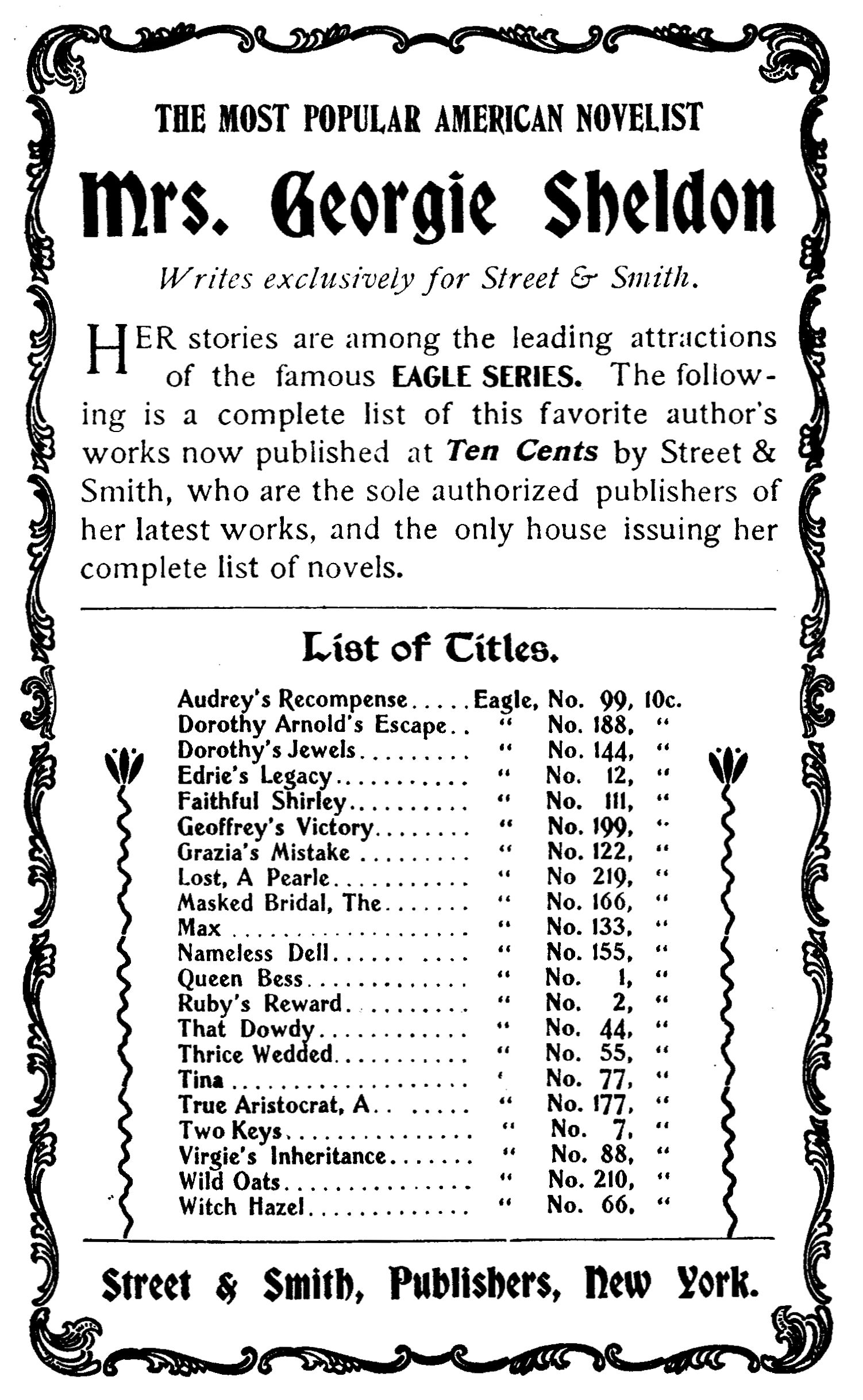
Her stories are among the leading attractions of the famous EAGLE SERIES. The following is a complete list of this favorite author’s works now published at Ten Cents by Street & Smith, who are the sole authorized publishers of her latest works, and the only house issuing her complete list of novels.
| Audrey’s Recompense | Eagle, | No. 99, | 10c. |
| Dorothy Arnold’s Escape | ” | No. 188, | ” |
| Dorothy’s Jewels | ” | No. 144, | ” |
| Edrie’s Legacy | ” | No. 12, | ” |
| Faithful Shirley | ” | No. 111, | ” |
| Geoffrey’s Victory | ” | No. 199, | ” |
| Grazia’s Mistake | ” | No. 122, | ” |
| Lost, A Pearle | ” | No. 219, | ” |
| Masked Bridal, The | ” | No. 166, | ” |
| Max | ” | No. 133, | ” |
| Nameless Dell | ” | No. 155, | ” |
| Queen Bess | ” | No. 1, | ” |
| Ruby’s Reward | ” | No. 2, | ” |
| That Dowdy | ” | No. 44, | ” |
| Thrice Wedded | ” | No. 55, | ” |
| Tina | ” | No. 77, | ” |
| True Aristocrat, A | ” | No. 177, | ” |
| Two Keys | ” | No. 7, | ” |
| Virgie’s Inheritance | ” | No. 88, | ” |
| Wild Oats | ” | No. 210, | ” |
| Witch Hazel | ” | No. 66, | ” |
Street & Smith, Publishers, New York.
| EAGLE SERIES |
A weekly publication devoted to good literature. By subscription $5 per year. May 27, 1901. Entered as second-class matter at N. Y. post-office. |
NO. 222 |
Ainslee’s Magazine
Awarded Grand Prize
at the Paris Exposition
United States Commission
to the
Paris Exposition
of 1900
PARIS
20 AVENUE RAPP
Aug. 31, 1900.
Ainslee’s Magazine,
STREET & SMITH,
New York City, U. S. A.I have the honor to inform you that, in accordance with the official announcement of awards at the Paris Exposition of 1900, * * * you are entitled to the award of Grand Prize.
A. S. CAPEHART,
Director of Liberal Arts and Chemical Industries.
Ainslee’s is the only 10-cent magazine in the Gold Medal Class. This splendid compliment speaks volumes for the literary and artistic excellence of the magazine.
STREET & SMITH, Publishers, New York
This novel was serialized in Street and Smith’s New York Weekly from June 9, 1884 to December 8, 1884. This book edition differs from the serial in some minor ways, most notably that the original chapters XXXV and XXXVI have been combined and condensed into a single chapter.
Obvious typographical errors have been silently corrected.
Table of contents has been added and placed into the public domain by the transcriber.
The name “Corrillion” was frequently spelled “Corrillon” in the book edition. The spelling has been normalized to match the original serial appearance of the novel.
Inconsistent hyphenation (e.g. heartbroken vs. heart-broken) has been retained from the original.