[1]
BY
BENJAMIN CLARKE
AUTHOR OF “MY FIRST AND LAST VOYAGE,” ETC. ETC.

EDINBURGH
W. P. NIMMO, HAY, & MITCHELL
[2]
[3]
| PAGE | |
| THE TOLL-KEEPERS, | 5 |
| CHIPS FROM A NAVAL OFFICER’S LOG, | 11 |
| A SHORT ACCOUNT OF GIBRALTAR, | 15 |
| A GENEROUS ENEMY, | 21 |
| THIRSTY JACK, | 25 |
| A VISIT TO MALTA, | 29 |
| THE FAT CAPTAIN, | 33 |
| A CONVICT STORY, | 37 |
| THE LITTER OF PUPS, | 43 |
| ABOUT FISHING, | 49 |
| AN ANIMAL THAT HAS SEEN BETTER DAYS, | 55 |
| CHARLEY FORDER AND HIS SISTERS, | 61 |
| MY GRANDFATHER, | 69[4] |
| THE CHILDREN’S HOSPITAL, | 76 |
| MY FIRST BEAR, | 84 |
| THE PLOT DISCOVERED, | 90 |
The “Chips from a Naval Officer’s Log” are all strictly true, having been related to the Writer by officers who bore witness to the truth of their statements.

[5]


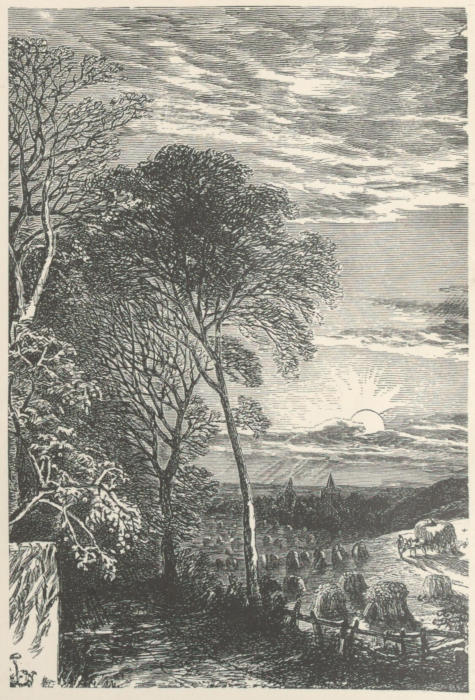
Bushgrove farm-house was a right snug homestead, and the farm-yard, and the rick-yard, and the out-buildings said very plainly that Farmer Cousens was a well-to-do man. To spend one fine summer’s day at Bushgrove would furnish you children with enough to talk about for a month. There would be something to suit the tastes of all of you. Some of the boys would make for the stable at once, and very likely would get a chance of a ride in one of the carts to some part of the farm; others would venture up in the loft above, and perform some daring somersaults on the soft hay; some of the girls would get [6]permission to feed the poultry, and be delighted when the different sorts came half running, half flying at the sight of the well-known bowl; others would only be too glad to help Mrs Cousens in the house, especially if they were entrusted with the important duty of going up to the apple room and selecting the nicest, rosiest apples for the pie. But none, either of the boys or girls, would be far away when the cows were milked just before tea, for a draught of new milk warm from the cow is a treat that Londoners do not easily forget.
I will undertake, however, to say that not one of you when thinking over your day’s pleasure, but would decide that the most enjoyable part of your visit was your introduction to little Sophy and Nelly Cousens.
Oh! their father would not think much of his farm or his ricks if he had not these little rogues about him, and their mother would consider Bushgrove a very dismal home without these little feet trotting about it: it was hard to say who was the farmer’s favourite. Sophy was the elder and the [7]prettier, so strangers said, but “Bless you,” he would say, “folks may talk, but they won’t persuade me which is the prettier, for I don’t want to know: ’tis just like this with cows—some like ’em all roan, others like ’em spotted, but Betty doesn’t care which way ’tis as long as they are quiet and well-behaved when she milks ’em; so I say, as long as the dear children are good, what’s the use of comparing ’em feature by feature?” But friends could not help comparing their manner. Nelly, though only four,—more than a year younger than her sister—was by far the sturdier child, and far less shy and bashful. She would hold up her dear honest face for any one to kiss that spoke kindly to her, while Sophy needed to be persuaded that you loved her before she would raise her drooping eyes, much less her plump cheeks.
Now Farmer Cousens used to grumble—all farmers have some cause, they say; and his was, that he could not take his corn, or his hay, or his vegetables to market without paying a heavy toll. But when most inclined to complain, he would think of the other [8]toll gate nearer home, and then his face would lighten up with a smile.
I wonder who kept that other gate, and what the toll was for passing through.
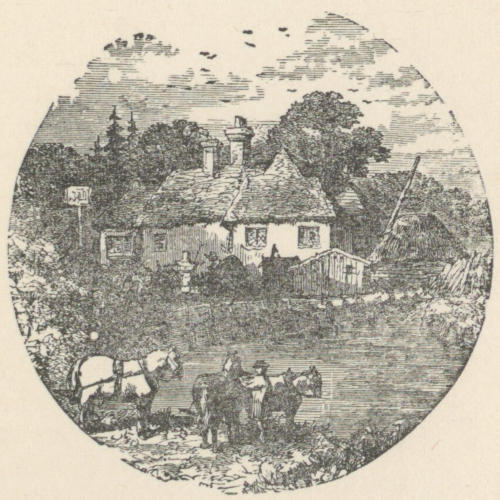
It was very strictly kept by two little keepers, who were very partial indeed in deciding who were to pay, and who were to go free; and, strange to say, those they loved best had to pay the most. Why, they let their toll gate take care of itself till just as they knew their father would be coming home; then they would take up their places—Sophy on her feet, ready to catch him if he should try to run through; and Nelly sitting up on the bars, to get a ride when the gate was opened, as well as her toll. Sometimes her father pretended he could not open it with such a great heavy weight on it, but she was not to be done in that way. If anything delayed him longer than usual, Sophy would soon begin to get anxious and fear he would not come before it was time for her to go to bed, but little Nelly rested her heels on the bar, and planted her hands so firmly, as much as to say, “Here I sit till he does come.”
[9]
All right, Sophy; cheer up, little woman; I hear old Bob’s steady trot, your father is coming, and you won’t care about our society just now; so good-bye both of you, and save some kisses for us when we next go through—we shall want lots of change for our money.
[10]
[11]


I hardly know whether I ought to call the short story I am going to tell you “a chip” from my log, or not; for this reason, that it did not occur in my own experience, but was related to me. However, like all my other chips, you may rely on its truth. I can vouch for the fact that I am going to mention, and you may rely on whatever you find in my log, for old sailors have seen too many wonderful things that have really happened to go out of their way to take in their listeners by trying to impose upon them.
If you want wonderful things that never [12]happened; if you want frightful scenes that never could have occurred; if you want battles written by people that scarcely know the stem from the stern of a ship; that know nothing of the Queen’s service, and precious little of the Queen’s English, then you must go to “Admiral Dick; or, the Death Calm;” or, “Stick-at-nothing Tom; or, the Gory Capstan,” or some such rubbish as you see advertised, and alas! see read. Now, I won’t say more about this now, except that the boys and girls who care for my chips, and take any interest in them, will find them truthful and harmless, neither of which qualities do those exciting and absurd tales possess.
Well, when I was serving in the “Conqueror” frigate, there was a midshipman who was a Turk by birth. He was the only Turk I ever knew in Her Majesty’s service; but this youngster was not a bad sort of a fellow in his way. ’Twas from him I heard this short story, with which he was personally familiar. In a former ship in which he sailed, there was a passenger who had made some money as a milkman at Constantinople, [13]which he kept in a bag in his cabin, and was very fond of retiring there and counting it over. Now, the captain had a pet monkey that used to watch this man, and seeing him so often going to this bag, he thought there must be something in it worth examining; so one day he watched his opportunity, ran into the man’s cabin, seized the bag, and climbed with it up to the mainsail-yard. The man soon missed his bag, and soon found out where it was gone, for the monkey began taking out the gold coins, and throwing them alternately on the deck and into the sea.
Those that fell on the deck the poor man greedily picked up, but the half of them that went overboard, of course, were lost. He did not intend putting up with his loss so quietly, for he held the captain responsible, as it was his monkey that had robbed him.
Nothing could be done until the vessel got into port, when the man had the captain brought before the Kadi, or magistrate, to recover the value of the coins lost.
“You were a milkman?” said the Kadi.
“I was, sir,” replied the man.
[14]
“And, pray, will you tell me how much water you used to put with your milk?”
The man was much confused, and replied, he would rather not tell; but as he saw the magistrate was determined to know, he at last confessed he used to mix one-half.
“Very well, then,” said the Kadi, “it appears to me that only one-half of what you earned was honestly yours. You have got, therefore, all that was your due, and this monkey has only thrown into the water the amount of profit you dishonestly got out of the water.”
Thus, judgment was given against the man, and every one but he felt how just it was.
[15]

The rock, the town, the bay, and the strait of Gibraltar lie, as you know, at the southern extremity of Spain, but I dare say if you have been at all interested in the place, you have fallen into the same mistake that many have who are older than you. They have thought the town was near the mouth of the strait which its artillery is supposed to command.
But this is not the case, the town is more than twenty miles from the Atlantic, and its guns, instead of pointing southward to the straits, which are here no less than fifteen miles across, point towards the bay on the west, where alone it is accessible, and to the Spanish mainland on the north.
[16]
Looking at Gibraltar from the sea, it is indeed a grand sight. The rock is formed of marble and limestone, and rises to three points, the loftiest of which, Sugar Loaf Point, is 1439 feet from the sea. Europa Point is on the south, and here, on an oval platform, stands the governor’s cottage.
One of the most dreadful tragedies I ever heard of in the way of duelling came off at Europa Point. One evening an American officer was going through the guard-room—where were a number of English officers—on the way to his ship, when as he passed he overheard the Englishmen mention, in no insulting manner, the word “Yankee.” He returned, boiling over with rage, and told them they should repent the insult, which they declared was never intended. However, the American returned next day with a challenge from as many officers of his ship as there were English officers of our army in the guard-room, to fight duels.
The English took up the challenge, but stipulated that they would none of them fight with Americans of inferior rank. This threw out some of the Americans, so that then there [17]were more English than necessary, and they arranged amongst themselves that no married men, but only single ones, should go forth to this mad encounter. The morning came, and at Europa Point there stood up in deadly combat four English against four American officers, of whom two were killed and three or four wounded. Now I cannot be quite exact as to the number; I know however I am rather under the mark than over—but the main incident I had from most reliable authority at Gibraltar.
On landing, one is disappointed with the town itself, which is situated at the base of the rock. It is a miserable place, with small dirty-looking houses and straggling irregular streets. The inhabitants themselves—some 20,000 of them—are not very attractive, such a mixture of English, Spanish, Moors, and Turks, with but little in the fair sex to warrant their being called so. But if you are not struck with the beauty of the people, you will be with the strength of the place. All the descriptions you may have read will not prepare you for the reality, so that I do not expect my account of it will bring you much [18]nearer. I will merely say, therefore, that there are four or five tiers of galleries rising one above another on one side of the rock, in which are placed guns of immense power and weight. Smaller batteries are placed in every possible direction, and altogether there can be stowed away ammunition and provisions sufficient for a very long siege. Ordinarily, there are about seven thousand soldiers on the rock, of whom about three thousand belong to the artillery, but these are not enough to work all the guns, so that in case of war many more would be sent out.
Ah! in case of war; that reminds us that it has often been the scene of warfare, and perhaps a short sketch of its past history would not be uninteresting to our young readers.
When William III. assisted Charles III. of Spain against Philip V. it was agreed that Gibraltar was to be given to England, but as the agreement was not kept, and Gibraltar was not handed over to us, Sir G. Rooke took forcible possession of it in the year 1704. An attempt was made by the Spaniards to recover it, but it was formally ceded to us in July 1713.
[19]
In the year 1779, during the war with America, Gibraltar was blockaded by the French and Spanish squadrons. The garrison, under Governor-General Elliott, made a brave resistance, but was subject to great privations by reason of the provisions running scarce through the long siege. At last a vessel hove in sight which proved to be the forerunner of Admiral Rodney’s squadron of twenty ships, who, having defeated the enemy, came to the relief of the garrison.
Since then the Spaniards have often desired to be again in possession of Gibraltar, and have made some attempts, but always unsuccessful. They now see the value and importance of it, and so do we. It is the key to the Mediterranean, and though England has a good many keys on her bunch, she is not likely to give up this one.
And now with an anecdote nearer our own time, I must close. You know that William IV. was in the navy when young, and once, when he was a midshipman, he served under Admiral Digby in the Prince George.
When the Spanish Admiral Langara was a prisoner of the English, he visited Admiral [20]Digby, and was introduced to His Royal Highness, who retired during the conference, but reappeared at its conclusion as the midshipman on duty, respectfully informing the Spanish Admiral that the boat was manned ready for him. “Well does Great Britain merit the empire of the sea,” exclaimed the Spaniard, “when the humblest stations in her navy are occupied by princes of the blood.”

[21]

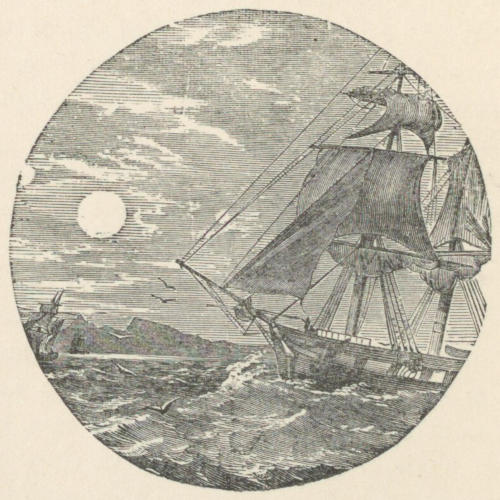
In 1815 I was a “younker,” or midshipman, on board His Majesty’s ship “Swinger,” a twelve-gun brig.
I remember one day, soon after we left Surinam, our captain hobbled upon deck—for he had a wooden leg—and as his custom was, he stood up near one of the guns, and looked over the ship’s side.
“Beat to quarters,” shouted the captain; and sure enough ’twas no false alarm, for bearing right down upon us was a ship much larger than our own, which we soon made out to be an American. Nothing daunted by her size or her superior armament, and consequently larger ship’s company, we prepared for action, and soon gave the enemy a [22]taste of our metal. Nothing could have been better than the manner in which our guns were served, for although we had but sixty men and boys, and twelve guns, whilst the enemy had 145 men and boys, and fifteen guns, we kept up a galling fire for two hours and a-half, until the American, finding she had had as much as she cared for, and not wanting a closer acquaintance, made off and left us.
We gave chase for the remainder of the day, but as she was a much faster ship than ours she made good her escape.
Soon after, we returned to Surinam; but on the way we painted our ports, so that we were not at first recognised.
I had better explain that when we left we were painted entirely black, but on our return we were black and white, something like a chess-board.
When we asked “what news,” we were told that a little black brig, that had recently left, had been licked by an American. We had a good laugh, of course, and we were able to give a much better account of the little black brig than that.
[23]
Well, six years after, in 1821, a friend of mine was in the West Indies, and was thrown into contact with the captain of the American vessel that encountered the “Swinger.” He often spoke of the engagement, and declared “he would give anything to see her captain, for he was the smartest man he’d ever came across.”
“Why,” said my friend, “the officer who commanded the ‘Swinger’ is now here, and is an old friend of mine. I shall be delighted to introduce you.”
Accordingly it was arranged, and a friendly meeting took place between the two former enemies. The American rushed up to his old opponent, and shook him by the hand in such a hearty manner, that it was some minutes before he relinquished his grasp. “I’m delighted to see you, sir,” he said; “you’re the cleverest man I ever saw, by a long chalk. Why, I expected to chaw you up in about half-an-hour, and instead of that, in about two you gave me such a walloping that I ran into port and didn’t venture out again. We had nine killed and fifteen wounded; how many had you?”
[24]
“Only five killed and wounded.”
“Well done! give us your hand again, captain!”
[25]

This little story I am going to tell you is a very small chip, so small, indeed, that it might be almost called a shaving, but it comes into my mind just now, and is such a trifling occurrence, that unless I tell you now I may forget it at another time. It will just do to fill up a spare moment or two while your candle is being got ready for bed, or after you have finished your dinner, and have a minute to spare, or while you are waiting to be attended to in a shop.
It is about Jack Fraser, one of our lieutenants in the ——. Well, on second thoughts, I won’t tell you the name of the ship, or some of my fair young friends may be [26]ingenious enough to look through old Navy Lists, and by seeing when my ship was at the station I am going to mention, may discover that I must be getting very old, whereas I want you all to fancy I’m very young. At all events, though my timbers are creaking, and my skylights getting dim, and my figure-head rather grey, I am still fond of boys and girls, and like to have them about me.
Well, about Jack Fraser. We were at Jamaica, which is, as you know, rather a warm climate. Fraser was what they call “a thirsty soul,” that is, one very fond of his glass; not his spyglass for looking abroad, or his looking-glass for looking at home, but his wine glass and grog-tumbler. He had always some excuse, though I can’t call it a reason. When here, he used to say it was so hot we could only keep cool by drinking; when farther north in colder climates, he declared the only way to keep warm was by drinking; and when on any home station on half-pay, he used to say that this was such a wretched climate that he could only keep off “the blues” by his glass regular. I always think when I hear any one finding excuses like this [27]for drinking, that he is rather ashamed of it himself, and that he indulges far more than is generally supposed.
Well, one afternoon he went ashore at Port Royal, and had not returned when we all turned in, and when all lights were turned out. By and by Jack came on board and began fumbling about for something to drink. The steward had retired, so he knew he could not get supplied. My cabin opened in the mess-room, so I heard him talking to himself about his misfortune in being so thirsty and in not getting anything to drink. Presently I found out he had discovered some, which he soon drank off, for in a few seconds I heard such a spitting and spluttering that I laughed right out, for I at once guessed what had happened. He had got hold of the jug which contained a decoction for enticing mosquitoes and other insects to it, and which had done its work pretty well that day. It was this liquid Fraser had drunk, and it was these mosquitoes that he had spit out, except such as had been swallowed past recovery.
I wish this had taught him a lesson; but this bad habit, even more than others, though [28]it may receive many checks, is with the greatest difficulty given up.
Take care, young friends, that you do not form them.
[29]
The view of Malta did not quite equal my expectations, though the I harbour certainly is very fine, and the number of gay and picturesque-looking boats makes it a lively scene. The fortifications are of great extent, but so different from Gibraltar, being all artificial. I need hardly say that Malta is an island in the Mediterranean, between Africa and Sicily, but perhaps it may be necessary to mention that it is about 20 miles long by 12 broad.
By the way, Malta is not unlike some human beings—naturally barren and of no use, but by culture and application and diligence, and with help from others, how very fertile they become?
[30]
This reflection occupies us whilst we row to land—there to see for ourselves the places of note. The streets are very curious, being large flights of steps leading up from the sea into the town. The church of St John and the governor’s house are well worth seeing; but one of the finest modern buildings is the Hospital, on the left hand side of the entrance to the town. The hotels and shops are very good, that is, you can get what you require, but then you have to pay rather dearly; perhaps the people think that persons going to the East must make all their purchases here, as it is the last European place at which the steamers stop, and that persons coming from the East are only too glad to prepare here for the colder climate they will encounter before they finish their journey, and so do not much mind what they pay for things. The population is somewhat over 125,000, and as most of the inhabitants are Roman Catholics, there is a great deal of church-going. But the bell-ringing is enough to summon ten times the number of people to matins and vespers;—clang, clang, ding, dong,—the noise is incessant. I am talking, [31]of course, of the time when I was there, but I hear that much of the nuisance has been done away with. Then, besides the churches, there are many monasteries, one of which I visited, and of which I will tell you, as a very singular custom is in force there, that of baking the deceased friars.
The monastery is one of the Capuchin order, and as soon as one of the monks dies, his body is exposed to a dry heat; whereby the softer parts become hardened; then he is propped up in a niche set apart for him, and his name and history are written above. The catacombs, where all these bodies are placed, consist of a long narrow room dimly lighted, and filled with a faint sickly odour; on either side is a row of corpses attired in the robes of their order, with ropes fastened round them as waistbands. Over each niche branches of the bay tree were wreathed, and among them the monks, with horrible ingenuity, had intertwined garlands and festoons of skulls, thigh bones, legs, and arms. The monk who accompanied me appeared intensely gratified and exultant over these disgusting things, and when he pointed out [32]one old fellow who had been baked about a hundred years, he was in raptures.
Rather an unpleasant order to belong to! Fancy seeing your niche in the wall that your body will fill up some day! almost as bad as the custom in Iceland of standing the minister’s coffin in the church near the pulpit, or as the man who bought a job lot of coffins, thinking they would be sure to come in useful some day.
An officer of ours accompanied me, who two years ago knew one of the monks, and on his asking for him, he was taken to a newly-filled niche, and there shown his old friend in a state of mummyism, as he had been dead some months.
Instead of being an order of friars, they should be called an order of bakers.

[33]


One of the queerest men I ever knew was Captain ——. Well, there, you won’t be any wiser if I tell you his name. He has been dead some time, but many of his friends are still living, so I will merely call him the fat captain.
He was an immensely stout man, and if he wasn’t a port admiral, he was a portly captain.
Once when his ship was in the Piræus, he gave an entertainment to some of the principal residents at Athens, among whom were many ladies. They spent a merry evening on board the ship, and when it was time for the party to break up, the captain called aside the first lieutenant, who was a very [34]small man indeed, by the way, and told him that when the boats were putting off from the ship he would fall into the water, and asked the lieutenant if he would mind jumping in after him. The latter, quite appreciating the joke, readily consented, for both could swim; and they waited to carry out their intention.
But the gunner had overheard the conversation, and knew what was going to take place.
Now this man was a great favourite on board, especially with the captain, with whom he had sailed six years. He was the handiest man imaginable, and could do anything, even to repairing any watches that might be out of order. His readiness and willingness gave him a certain position which made him rather saucy.
When he heard of the captain’s intended joke, he thought some fun might be made out of it, and so he went below and told all the men of it.
At length the party was ready to go. It was a lovely night; the moon shone on the still blue water, and the ladies were looking forward to a pleasant row to land.
[35]
Just as the boats had got clear of the ship there was a sudden splash as a body fell heavily into the water, and a cry was instantly raised, “The captain overboard.”
Another splash! as over went the lieutenant, the ladies screaming, greatly terrified.
No sooner was the lieutenant in the water, when splash! splash! splash! as from every port-hole on that side of the ship plunged sailor after sailor, who had been waiting, undressed, for the captain’s joke.
Then followed quite a scrimmage as to who should save the captain, until the unfortunate man was being rather roughly handled in the very laudable and extraordinarily prompt efforts, as he thought, to save his life. When the ladies got over the fright of the supposed accident, and the proximity of so many naked tars, they entered into the fun and enjoyed it with the others.
I don’t know if the captain ever knew of the part the gunner had taken in the affair, but he always continued to be a favourite with him, although the captain frequently declared he was the greatest blackguard in the ship.
[36]
Some time after, when the captain’s vessel was ordered home, he sent for the gunner and told him he was going home, but wouldn’t disgrace himself by taking such a blackguard back to England. He said he was transferred to another ship, and handed him two letters. When he got out of the cabin the man found that one letter contained his discharge to the admiral’s ship, and the other a ten-pound note.
They quite understood one another, and I dare say the gunner would rather have had his captain’s abuse than his praise. Queer fellow, wasn’t he?
[37]

It was soon after landing at Sydney from my second voyage that I fell in with an old friend, who was then a magistrate of the town.
After comparing notes since we had last met, he asked me to go out and visit his family who lived in the bush, about seven miles from Sydney. The captain of the “Tartar,” the vessel I had come out in, was to go with me; and so we hired a gig, and drove out.
It was a wild, dreary country, sure enough, that we went over, and a most dismal locality to reside in. Why, the nearest house was the police-station, and that was three miles off; but, as we shall see, the police are not at all bad neighbours in that part of the world.
[38]
We got to our journey’s end, and the first sight we saw was four gibbets erected near the gate. We thought, perhaps, that they were the sign that a magistrate lived there, or that they were put up, just like the old stocks one sometimes sees on a village green, to be ready when wanted, and to be a terror to people always; but the account that my friend gave showed that they were erected for some real criminals.
About six weeks before this, a gentleman and his son were spending Sunday here; and in the afternoon the young man, with my friend’s son, were strolling about the yard, when they fancied they heard a strange noise in an out-house.
They listened for some time, till, feeling sure they heard footsteps, they went near, and opened the door, when immediately they found themselves attacked by four convicts.
A desperate struggle took place, for the young men were strong, and were not to be easily beaten; but the odds were too great, and it might have gone very hard with them, had not the scuffle been heard in-doors.
My friend said he was sitting with his [39]daughter in the back parlour, when he heard a noise of heavy footfalls, with loud and laboured breathing. They went out into the yard, the father taking his gun with him; but, as it was getting dusk, they could see nothing.
“Who’s there?” shouted he. No answer; but he could just make out the form of a man scrambling from the ditch, and retreating over the wall. He fired; and then three other men retreated in like manner. The young men quickly appeared and related how they had been attacked, and how narrowly they had escaped strangulation, for it was their hard breathing that had been heard in-doors.
They soon informed the police, who quickly caught the four men, and they were hung near the scene of their crime.
I had been left with the ladies for some time, wondering where my friend and the captain had gone; but when I came to inquire, I was rather annoyed to find that they had gone to Sydney in the gig, as the magistrate was sent for in a hurry, and had left word for me to remain there for the night. I must say I did not like the idea at all.
[40]
I knew something of these convicts, what desperate fellows they were, and thought it not unlikely that they might resent the punishment so lately inflicted on some of their order, particularly as the gibbets reminded them of the event, and were likely to keep alive any ill-feeling that might exist. Besides, I knew I was the only male in the house, and that great things would be expected of me in case of an alarm.
When I got up to my room, my first care was to fasten the door; but, alas! there was no lock; and I could only discover a small button. I then searched the room for some weapon, and found a gun; but this, like the door, was without a lock. I got hold of a whaddy, a short, club-like stick, heavier at one end than the other; so, placing this with the gun near me, I jumped into bed. Then I was rather ashamed of myself for getting at all alarmed, and so I soon went asleep. I was awoke shortly after by the sound of heavy breathing, such as my friend had described; and at once all the circumstances of his account came into my mind. I sat up in bed, and heard the breathing—now [41]dying away, now getting louder—and also footsteps in like manner. I got out of bed, seized my weapons, and was close to the door, feeling that a desperate encounter was at hand. I should not care to see a sketch of myself as I then appeared. My lower limbs were altogether unprotected, and were not very steady; but I hope you will charitably put down any shaking there may have been to cold rather than fear.
The footsteps were again drawing near, the breathing was more plainly heard, and the door was gently shaken. I opened it, sprang out—shouted “Who’s there?”—got no answer—saw no one—listened—heard the footsteps retreating, and felt sure there were several. I then returned to my room, and soon heard the footsteps again approaching so this time prepared for the worst; and when I imagined they had got up to the door, I rushed out, and confronted two as strongly-built, savage-looking bloodhounds as I ever saw, which, after giving a good sniff at my legs—I, of course, expected a bite—turned round, and kept their watch as before. [42]My friend had got them since the night of the attack as a protection.
Ah! it’s all very well to laugh now, but it was no laughing matter at the time, my young friends.

[43]
“Oh! my! what beauties!” exclaimed Jessie Barton, on coming down one morning and finding that their dear old “Floss” had become a joyful mother. The household was soon informed of the fact and hastened to welcome the little strangers. Tom, who was Jessie’s brother, and two years older, immediately had ideas of appropriation, and wanted to know which he might have. But his father said they would not decide yet, but had better select two that were to live, and destroy the rest. In vain Tom urged, in vain Jessie pleaded for the innocents; Mr Barton said it was kindness to the mother, who could not possibly do justice [44]to the whole litter—seven in number; and to the pups themselves, who could not be all kept by them, but would be given away, and might fall into cruel hands.
So five of the number were quickly immersed in a bucket, and were kept under water by a mop until, in a few seconds, their very young life was extinguished.
The two that were spared, were by general consent the prettiest; and when in the course of nine days they looked out upon the world into which they had been born, it was then considered the time had come for their appropriation. This was a rather important matter to Tom and Jessie, to whom they were to belong. One pup was black and tan, with rather a sharp nose; and the other was brown with a shorter nose and more amiable look.
It so happened that the one each had fixed on was just the one the other did not want, so that both were well pleased.
As soon as they could leave their mother the young people took the pups under their especial charge, whilst “Floss” exercised a parental watchfulness over them both.
[45]
Jessie had, after great deliberation, and asking the advice of all her young friends, called her pet “Gyp,” and it must be acknowledged that she took great care of him, and appeared very fond of him. But Gyp was ungrateful from his earliest puppyhood; he never thought of his poor mother when any food was going, but gobbled up as much as he possibly could; and when he had done would even try to take a bone from his mother’s mouth, which was perhaps all she had had. He soon resented any interference with his freedom and liberty, and showed his mother he did not want her to be following him about, licking his back, or trying to keep him in any way clean. You will judge from this that “Gyp” was rather a strong-minded and self-willed dog. He was also of a reflective turn of mind, and as he had plenty of time hanging on his paws, he would sit and puzzle over things that did not concern him, and try to find out the reason for things which had puzzled older and wiser dogs than he.
There was one thing that troubled him much; he saw “Pincher” Tom’s dog, go out [46]with him continually, and always on half-holidays, and heard from him what fun they had had; whilst he seldom went out, and even then was dragged along by his mistress with a piece of red window-blind cord; so that if he wanted to investigate anything for himself, or if he met with other dogs whose acquaintance he might like to form, he found himself suddenly jerked along by the neck, in a most humiliating, and sometimes painful manner.
One afternoon, the two brothers met, and, of course, stopped and had a chat. “Pincher” was off to the country with Tom and a number of his school-fellows, but “Gyp” had been out with Jessie on an errand, and was going home. He complained to his brother of his confinement, when he suggested he should slip the cord, and make a bolt of it; but he was unable to do it; he was nearly choked, both by the cord and with indignation, and he returned home in a desperate frame of mind.
The next day “Gyp” was gone, and was nowhere to be found, nor did he ever return to his native place, for soon after, the family [47]changed houses. Of course, Jessie missed her pet for some time; but long after she had ceased to think much of him, he thought with sorrowful regret of the comfortable home and kind mistress he had lost.
He soon got tired of his wandering, roving life, and found it very unsatisfying to his appetite. Then he followed some little boys for a day or two, who gave him some crusts, but who soon ceased to care for him, and gave him the slip. He then attached himself to a cat’s-meat woman, from whom he now and then got a stray piece; but some stronger dog witnessed his good fortune and usurped his place, when the woman, finding herself surrounded by quite a pack of hounds of various sorts, sternly drove them all off, and never gave them as much as a skewer to pick.
One day in his hungry wanderings, “Gyp” found himself in the street in which he had formerly lived, and seeing a board up in the garden of his old home, he trotted up, hoping to find a notice of a reward offered for his restoration; but it was only to the effect that the house was to let, and the family had gone, he knew not whither.
[48]
However, they had not moved very far off; and so tired was “Gyp” of his roving life, that he determined to hang about the neighbourhood with the hope of getting some one to recognise him. He came across the milkman, and wagged his weary tail against his can to attract his notice, but he only drove him away. He loitered outside the butcher’s, hoping to be remembered, but he was thought to have designs upon the meat on the boards, and was driven off with a whip. At last one day he met “Pincher,” and great was the delight of both, for Tom had gone to boarding-school, and his dog was very dull. Of course he took “Gyp” with him to the house, and soon brought Jessie to the door, who at once recognised her dear old “Gyp,” in spite of his hungry and dirty condition; and what was far more important to poor “Gyp,” received him with open arms.
He has now grown up a faithful, steady dog, and has learned the lesson that he and others did not think necessary—that it is well when young to be subject to control and discipline, and that at that period we do not know what is best for ourselves.
[49]


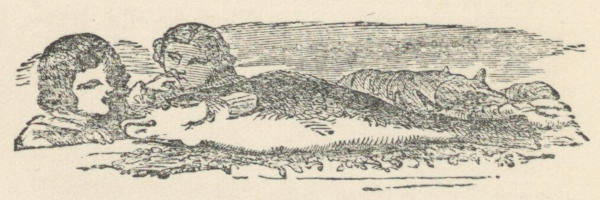
How many recollections do these fishing-boats, now hauled up and lying idle on the beach, revive!
They tell of long hours of toil, of longer hours still of weary watching and waiting; they tell of dangers braved, of storms endured, of exposure to cold winds and drenching spray. They suggest all the dangers of the deep to which some of their number have succumbed, leaving widows and orphans to mourn for—
But just now we do not want so much to dwell on the hardships and dangers of the [50]fisherman’s lot, as the produce of his toil and the result of his fishing.
Those of you who have been to seaport towns have sometimes watched the fleet of fishing-boats going out to sea.
If there is a smart breeze blowing, and the sun is shining, it is as pretty a sight as you are likely to see; the strong heavy boats running before the wind, and the sun lighting up their dull brown sails. They will remain out perhaps for a day or two if the fish are scarce, but if plentiful, they will bring in their hauls, and dispose of them at fair prices.
Now, perhaps some of you who are fond of fish are disposed to ask why fish is so dear, as you so seldom get any on that account. Well, the principal fault lies with the retailer or shopkeeper: the fisherman only receives from 3d. to 4d. a lb. for his prime fish, but those who buy it, or the consumers, pay from 1s. to 1s. 6d. a lb. When at a watering-place last year, we paid 2s. a lb. for soles that were caught off the coast.
Of course some allowance is to be made for the perishable nature of the commodity, [51]but when that has been done, it does seem that we have to pay far too dearly for that which is so plentiful.
Besides, the facilities of conveyance are so much greater than they were formerly. Then the trade was carried on from Yarmouth to London by light four-horse vans, and in that way some 2000 tons were conveyed every year; but now that quantity is sent to London by rail every fortnight.
In the fishing-grounds on the south and south-east coasts, steamers go out to the fleets and bring up the fish very quickly to Billingsgate every day.
The largest traffic is with fish that are taken in shoals. Off Scarborough from seven to eight hundred tons of herrings have been taken and sent away at one time; and on the Suffolk coast £14,000 worth of fish were taken in a single day.
Then mackerel has its seasons, when the hauls are enormous; this fish is much liked for its solidity, and also for its delicacy. You boys and girls can get a good mouthful without fear of bones if you are ordinarily careful; and you may imagine they are relished [52]when you are told that the consumption in London alone, every year, is 25,000,000. There is quite a numeration sum for many of you, and very few will at all realise what an enormous quantity those figures convey?
But perhaps of all fish, pilchards are taken in the largest quantities. They are caught chiefly off the coast of Devon and Cornwall, and when marinated or potted are much liked. Many a nice jar of potted pilchards do the mothers in the west of England prepare and send to different parts; and if some of you who never tasted them, once had a jar sent you, you would think them a fine “institution.”
The shoals are often of enormous extent; one was computed to extend over a hundred miles, and no doubt many millions were captured. Besides the home consumption, they are packed in oil and shipped to Italy and different parts in the Mediterranean.
Now we wonder if the thought has entered the minds of any of you, that with so many taken they will become by and by very scarce; and this refers not only to pilchards, but to fish generally.
[53]
If so, you are by no means singular, for lately a Royal Commission has considered the subject, and we believe that the supply of fish is inexhaustible. It has been ascertained that far more fish are destroyed by creatures of their own race than by man, that by far greater slaughter goes on under the water than above it.
We have counted as many as fifteen or twenty small fish inside a cod, and often as many herrings have been discovered to have been swallowed by one of the same species. A calculation then has been made: allowing a cod two herrings a day for seven months of the year, it was found that if “the cod and ling caught on the Scotch coast in 1861 had been left in the water, they would have devoured as many herrings as were caught by all the fishermen of Scotland, and 6000 more, in the same year.”
So that you see, instead of making fish scarce by catching them, there are actually more because of all the fishing that goes on. There is no fear, therefore, that we shall ever exhaust the stock; and besides, the rate of increase is so enormous. Little have you [54]thought, perhaps, when you were eating the roe of a herring, that you were crunching up thousands and thousands of eggs. A single herring has been found to contain 36,000; a mackerel half-a-million; a sole a million; a flounder a million and a quarter; whilst a cod has been known to possess 3,400,000 eggs.
Truly these may be said to be some of the wonders of the sea, and glad shall we be if this hurried paper leads any of our readers to study the wisdom and goodness of God in the great deep.
[55]

I wish some one would write a book about the ass, and show us how he became so degenerated, and when he first got into disfavour.
Everybody knows he was an animal of great importance once, and in the East, at the present day, he is ridden by nobles, and is well cared for. Ah! you say, he is a very different animal from our poor ass. Of course he is; there, he is really an elegant animal, full of spirit and of good action; his coat is smooth, and his pace is rapid. But this only proves our point. It is not because he is first dull and stupid that he is ill cared [56]for; but because he is badly treated, that he is the poor, slow, heavy brute we find him.
Even now, we do see some first-rate animals in the shafts of costermongers’ carts, and sometimes of gigs and other vehicles; in these cases, their owners take an interest in them, feed them well, groom them carefully, and oftener use the corn measure than the cudgel.
At recent donkey exhibitions there have been some fine specimens, showing what the race is capable of; but, alas! these are only exceptions, and only make their less fortunate fellows appear more stupid than ever. We see what can be done with kindness with our existing stock; but if some good specimens were brought from the East, might we not have a much better race of donkeys? At one time in this country no doubt we had; but then the ass was an object of religious interest; people remembered how honoured his race had been; he was the only animal on which our Saviour rode, the only one that ever relieved Him of any bodily fatigue and weariness; and so he became celebrated in the early church.
[57]
The Feast of the Ass was held on the 14th January, in commemoration of the flight into Egypt. The Holy Family was represented, the ass was led round the town, and then taken into the church, where at the end of the service the priest brayed three times, and the whole congregation “hee-hawed.” A hymn was sung, and in the chorus the braying was imitated:
There! was not he a lucky ass?
Some of you boys are quite irreverent enough to think they were all a set of asses together.
Well, it was certainly a queer proceeding, and one that should never have taken place inside a church.
Why, the priest must have been the original “Vicar of Bray.”
[58]
They carried their reverence so far as to declare—and the superstition has been handed down to our time—that the cross that we see on the back of every ass, near the shoulders, is there because of our Saviour’s riding on one into Jerusalem. The fact is, however, that the stripe on the ass shows that it belongs to the same class as the zebra, which has several of them.
This much to show that the ass was treated well at one time; and I remember a friend drawing attention to a verse in the Bible, which proved how different was his nature then from now.
In Proverbs xxvi. 3, it says, “A whip for the horse, a bridle for the ass,” as if in those days it was the horse who wanted urging, and the ass that required to be held in. How different now! not only does the ass feel the whip, but the cudgel, rope-end, or anything that comes to hand, and often the foot too.
His body is a mark for stones to be aimed at, if he is grazing by the roadside, or if he meets any one on the road he is considered fair game to whack, in passing. With some men and boys, it is impossible to have a [59]stick without bringing it down upon every donkey they meet with. Some look upon them as animated drums, made on purpose to be beaten; they do not think there is any feeling below that rough hide.
Why, in one stage, an ass’s skin retains the impression of a black lead pencil; and be sure that in its roughest and toughest state it is painfully affected by a cudgel.
The fact is, the poor donkey is not well able to defend himself, as if it were never contemplated he would be so ill-used. It was natural for him to expect the stings of insects and the pricks of brambles, and so he is covered with a thick coating of hair; it was likely he would come across nettles and such things in his quest for food, and so his mouth has been made nettle-proof; but it was never to be expected that a patient, useful, willing, hard-working brute, should be an Ishmael among animals, with every man’s hand against him, and so he is not furnished with any formidable qualities. He does not even run away very rapidly from his enemies; and as to his kicking, he does not often do that, and, when he does, it is not a [60]very sudden affair; but he has always credit given him for being about to kick, and so he gets walloped in anticipation.
Men have found out that he is rather sensitive about his ears, and so the only object of his having them, that they can see, is to furnish them with opportunities to annoy him.
I had one once—there, now, the mere mention of the circumstance makes some of you smile, as if it were a more ridiculous animal than a goat or pig.
The poor donkey is looked upon as a joke; but he would not mind if jokes were the only things cracked upon him—it is the whip and stick that he minds most.
Some have asked, “Why a donkey prefers thistles to grass?”—“Because he’s an ass.” But these playful attacks he doesn’t mind at all; he would only like to put in a word, that he could do with more of them and fewer kicks and blows; but that he would even prefer corn to thistles.
[61]

Now, there are some of you boys that don’t care very much about your sisters. You may not like to own it, and would not, perhaps, confess it if you were asked, yet it is so; for I know you, though I have not seen you. You don’t care to kiss them night and morning; but if they are loth to go without this affectionate salute, then you merely put up your cheek to be operated on, and look quite like a martyr while it is being done. You are too grand to play with them, although they are quite willing to let you have your own way; they would always be the horses, and let you [62]drive, or let you have first “turn” at any game you like to suggest. But no; girls are such “muffs” at any sensible games; all very well for tea-parties and skipping-ropes. They can’t give backs for leap-frog, they have no idea of throwing a ball, and they could no more spin a top than make one.
You don’t care to take baby out in your arms, though your sister, perhaps, has had her all the afternoon, and is really very tired; for though they call her “Toddles,” she has no idea of walking at present.
You don’t like even to go out to walk with your sisters, ever since the day when you were prevented going out walking with Tom Hawkins and Harry Wilkins, having promised your mother you would take the girls. I knew how ashamed you felt when you met your school-fellows, and they shouted out, “There’s a big girl! Take care of the baby, Dick!”
Now, young gentleman, I advise you to get out of these ways as soon as possible. You are now at a very disagreeable age, and when you are a little older you will wonder you could ever have been so “uppish.” I [63]don’t doubt you will get over all this nonsense when you go out in life, and have to leave home; then you will miss the many little acts that your eldest sister, just about your own age, used to perform.
Dressing hurriedly of a dark winter’s morning, there goes a button! Never mind, let’s pin the shirt. Not long after, stooping down, or lifting a heavy parcel, or something else, gives you a hint about your substitute for a button, by a sudden prick, that makes you think of dear old Susy and her nimble fingers.
Going errands in the snow and wet, you feel your toes uncommonly cold; you put them up close to the fire in the shop while you are waiting to be served, or you do the “double shuffle” with your feet over a railing or on the pavement; but something better might be done if only Susy had your stockings, and darned these great holes through which your toes project.
Sooner or later, boys, you would think you had been very foolish in not having valued your sisters more. Well, never mind; they will soon forget any little want of attention, [64]and we will cease to remind you what awkward customers you once were—that is, if you try and make up for it.
Ah! Charley Forder cared for his sister, I can tell you. “But who was Charley Forder!” Well, listen.
He was the eldest child of his parents, who lived at Lingford, a small town on the sea-coast.
His father was a sailor in the navy, and was now away on a four-years’ voyage to the Pacific. Mrs Forder had enough to do to look after her family, and help support them, by taking in plain needle-work; but Margaret, who was now ten years old, and a big girl for her age, was able to help her mother in minding her younger sisters. Charley, who was sixteen, had been a sailor boy for some two years; but his father, wishing him to be nearer home than he was likely to be, had entered him in the merchant service; and he was apprenticed to a firm whose vessels called in at Lingford.
His mother was very sorry to part with Charley, as he was a real comfort to her. He was always willing to rock the cradle, or [65]look after little “Puss,” as he called his second sister; and then, when all the work was done, he would go out for a run with them on the down, or else stroll down to the beach, and watch what was going on. He and Margaret used to talk like grown-up people in their plans for helping their mother, for they knew that there was only what she earned and father’s half-pay to maintain them all.
“I tell you what ’tis, Madge, I shall leave here, and be doing something for myself, and for you all,” said Charley, one day, on the beach.
“And so shall I, Charley; why, I’m bigger than Susan Carter, and she’s in a place, and gets a shilling a week, and does not cost her mother anything, ’cos her missus gives her her old clothes.”
“No, that won’t do; you must stay at home and look after the little ones, so that mother will have more time for her work, and I’ll be off; that will be one less to keep.”
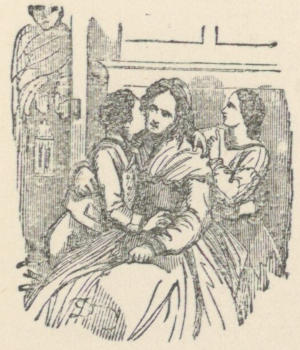
And the matter was talked over, and a letter written to the father; and when his consent was gained, after several months’ [66]interval, Charley joined a schooner that was engaged in the fruit trade, and went between Valencia and London. The vessel was just going out for a cargo, and it was expected she would call in at Lingford. It would be a good opportunity for Mrs Forder to get up some clean linen for Charley, and also something out of the way of junks of salt pork and biscuit for him to eat. The children had the bundle of clothes and the tin of good things in readiness on the beach, and waited for the “Stirling Castle” as she came round the point. It was a windy day, so Margaret thoughtfully set baby on a rock, with her back to the sea, not minding how she herself was blown about; and little “Puss” was too intent on seeing Charley to think of herself at all.
At last a vessel hove in sight, and neared the land, a boat put off for the shore, with Charley in her, bearing a letter to one of the partners, which he was to deliver, to wait an answer, and then return at once.
The lad had just time to run in to his mother and thank her for her kindness, after embracing his sisters on the beach. Poor [67]boy! he was obliged to tear himself away. He tried to be merry, and told Madge she had given him a smack when she kissed him, but perhaps he should have a schooner some day; but it was with a heavy heart he left them.
That evening the fresh meat was taken with salt tears trickling down his face, yet he felt happy when he rose from his knees and turned into his hammock.
Good-bye, Charley—God bless you!
[68]
[69]

Among the pleasantest recollections of my youth are the memories of my dear grandfather.
I have a very distinct remembrance of the satisfaction I felt when I presented myself at church for the first time in jacket and trousers; and a much clearer one of having discovered in the depths of the pocket of the latter garment a fourpenny bit, than of anything the minister said that day.
I recall my feelings on breaking up at the end of my first half, away from heme at boarding-school. That was very jolly; and if I stopped to relate them, I could jot down several occasions, the remembrance of which [70]I have never lost; but, as I said, the pleasantest recollections of my youth are concerning my grandfather.
He lived at no great distance from us, and so we often saw him; in fact, he made it his duty, and I am sure it was his pleasure, to come and see us once every fortnight. If he had lived at a distance, and had only come to us once a year, say at Christmas time, we should, of course, have been very glad to see him; but then we should not have learned to respect or love him as we did.
It is no very difficult thing to make one’s-self popular with youngsters, if one brings them presents; and especially at Christmas, when most people’s hearts are more than usual kindly disposed; so that if a person could not make himself agreeable then, he must be a bear. Had grandfather only paid us these annual visits he might, by an effort, have impressed us very favourably even had he not been particularly fond of children; but these frequent visits, when we saw him under varied circumstances, sometimes under trial, sometimes in bodily pain, sometimes anxious about some of his children or grandchildren, [71]gave us so many opportunities of observing that he was always the same to us youngsters. The rattle of his stick on the railings would bring us down to the door at once, however interestedly we were engaged; and though we were always delighted to see him, I must say that our hearts beat with a throb of curious joy when we noticed, as we were sure to do in a moment, that his pockets looked at all bulky. The contents were never disclosed until after dinner; the delay kept up our interest, and I think also it was a little generalship on his part, as it gave him an opportunity of having forty winks whilst we were engaged with our presents, either eating them, if they were for consumption, or amusing ourselves with them, if they were for recreation. After the real nap would come an assumed one. We could always tell where the one ended and the other began by the smile that played round his mouth as he opened one eye, and then shut it up quickly, if we were looking. Then he was supposed to be a sleeping giant, or a grizzly bear, and we tried to get near him and touch him, and fly off before he could reach us. How angry [72]he would pretend to get at our impudence; how severely he appeared to feel our tiny slaps; what dreadful threats he uttered, the severest of which, “seeing our noses above our chins,” was always received by us with defiant laughter.
I need not say we ran some terrible risks until success making us very bold, we put ourselves entirely within reach of the enemy, were fairly caught, and were mercilessly tickled.
Then would come a more vigorous romp sometimes in the hall, at his suggestion, lest we should disarrange the parlour too much. He was always more than a match for us, both with his arms and legs; but in our desperate struggles, when I would try to trip him up, and my sister to pull him down, he would pretend to be almost conquered. This gave great zest to the fun, and made it much more enjoyable than if he had, as he might have done, turned us over on our backs like sailors do the turtle on the sands; and at tea time, when we related the encounters, he took good care to break in with some such remark as—“Ah! I must look out when [73]you get a little bigger,” or else rubbed his shoulder, as if by our gigantic efforts we had nearly pulled his arm out of the socket. Though defeated, we were never humiliated; and his sweet, amiable disposition was seen in all his conduct. He always tried to make the most of every one; he would always encourage, or draw out whatever was in them, unless he met with any one very forward or conceited.
Then, after tea, before we went to bed, we gathered round him. I used to sit on his knee until my mother declared I was too big to be nursed; but my sister had that privilege long after she had outgrown the size at which I had to give it up. There were some old stories and jokes that we insisted on having every time he came; and so well did we know them that, when, for fun, he would vary them, or omit portions, we at once detected him, and would have the “full, true, and particular account.”
Always before he left us he would gradually get us sober; not suddenly repressing our laughter, or jerking his face into a solemn expression, but generally leading round the [74]last story or subject in the direction of religion. I can never forget the Bible stories as he told them; he made the characters so real and lifelike by telling us of them in a plain, simple way, and by looking at them from a child’s stand-point. We never tired of hearing of the Good Shepherd; he made Jesus appear to us as especially the Saviour of little children; and as he unfolded to us the tender, pitying, gentle love of Christ, we nestled close into him, and fancied we were indeed His lambs, and that His very arms were folding us to His bosom.
Since then, Ethel has been welcomed into the heavenly fold by Jesus himself; and I—well, trust I am not wandering away from Him; at all events, I know I am nearer than I should have been had I not been blessed with such a grandfather.
I often think of him, but especially when Christmas comes round. It was on Christmas Day that he last visited us. We were sitting round the fire, before the lights were lit for tea, and as usual, Ethel and I were close to him. He was holding each of us by the hand, and, raising us, we stood at his side. He [75]was speaking about the Babe of Bethlehem; he said he felt, soon, very soon, he too, like the shepherds, should see Him, though not as they saw Him. Presently I felt a tear fall on my hand, and then another; at length the tears fell fast, and the words stopped. Looking up in his face, Ethel said, “Are you ill, grandpa?” “No, my child,” he replied, “I was thinking how long I should have to wait in heaven until the Shepherd fetched my darlings and His.”
He died before the New Year, and he had not long to wait for little Ethel.
[76]


Many places there surely are in London that it would do one good to visit—many places to which you have never been, and many more to which we have never been together. I don’t mean peepshows, or waxworks, or places of amusement at all; but places that are set apart for some wise, and good, and holy objects, places where something, at all events, is done to lessen the misery and wretchedness that everywhere surround us. One such place is the Hospital for Sick Children, in Great Ormond Street, and if you have never been there—I trust you never have been as an inmate—you will be interested in tracing my steps.
[77]
My visit was a very recent one, and I may say I had you, my young readers, in my mind as I went.
Waiting a short time in a large reception-room, I had time to observe that the house formerly was a mansion, and I found out that a hundred years ago men of literature and science assembled here. Here Addison and Pope and Swift met and talked, sometimes gravely and sometimes gaily; but now the present little inhabitants forbid one’s gaiety, at all events. Then children’s feet ran up and down those broad oak stairs; but now the children that pass up are borne, helpless and afflicted. Then the rich paintings on the walls, the gilding on the ceiling, the cornices and figures, were objects of no wonder to those who saw them so frequently; but now they are looked upon with childish admiration, and even delight.
Ah! but the children are not left to be pleased with things they cannot handle; for, look! did you ever see so many toys in one room, that was not a shop? This used to be the drawing-room; but it is now hung round with pictures of child life, and is filled with [78]little beds, in each of which is a poor suffering little girl.
Here they lie so patiently, so uncomplainingly—not because a stranger is visiting them, but this is the character the nurses give them. Who shall say how much is owing to the gratitude they bear for the comforts they have, which they never had at home, and for the kindness with which they are supplied? I did not hear one cry, or moan, or complaint, except from a little fellow suffering from fits, which seemed to have confused his mind as to the ownership of a two-horse omnibus with which another boy was playing. The fact was, his own had been placed on one side by the nurse as a little act of discipline.
Over each bed there is a little platform, on which are placed the child’s toys. Some were sitting up playing with theirs. One little girl had fallen asleep, placing the greatest confidence in a number of wild animals that lay upon the pillow beside her; another, a tiny little thing of three years of age, who was suffering from skin disease, sat up in her bed looking very sad, which even [79]the presence of three rag dolls at her feet could not remove. Ah! perhaps had it been some of you, there would have been something worse than a sad look—even cries or tears.
Others were sleeping sweetly, forgetful of their pain and suffering, dreaming, perhaps, of the time when they ran and frisked about, which some of them would never do again. For instance, here is a child, only six years old, that has lost her leg—cut off up to the thigh, for hip disease. Poor child, she does not even know that it is gone; but sad as this may appear, it really shows how skillfully the doctor did his part, and how tenderly the nurse did hers, and also how mercifully her heavenly Father provided the chloroform that prevented her feeling any pain.
I said they all had their toys—that is, each child its own. There are some large toys, such as a beautiful doll in a glass case and a musical-box which shows a number of funny old figures playing various instruments, that belong to the room. The Queen sent this last one; but the smaller toys, that she herself bought when in Germany, and sent here, were given to the [80]children to play with, and to take away when they left. Most of those who had them had gone away; still I saw two of Her Majesty’s toys, and was glad to find they were just ordinary ones, that would amuse any child. There was a man on a stand driving three sheep to market, with a dog behind him. The white leather invited me to press the bottom, but the squeak was gone; but had it been there I could not have told you whether it was intended to be the man, or the dog, or the sheep, making the noise. I was more successful with a bird in a cage, for here the cage decidedly squeaked, and saved the bird the trouble.
At Christmas time there was a large Christmas tree provided, when several former patients were invited, and the presents from the Queen and from others were distributed.
I noticed also that Prince Alfred had sent a large lion with a woolly mane—not so ample as it might have been, but perhaps it had been deprived of its wool by little people who wanted a memento of this royal present.
I hear that lately the youngest prince was much pleased at having to select a number [81]of toys for the children; whilst two of the Princesses have on more than one occasion sent little garments for the children made by themselves.
But we must go upstairs to the boys’ ward, where the same order and cleanliness and comfort are seen. The first thing that strikes me is a rocking horse, in a worse state than any inmate, for he has lost his head. Ah! I am glad to see that, for it tells me that the dear boys have had many a ride on him.
But here are many poor little fellows who will not be able to ride for a long while—some never again. Here is one that has had his leg cut off above the knee, only a fortnight ago, and yet he is cheerful and happy, and, I am glad to say, is getting on favourably. I asked him if he was in pain, and he said, “Not now; but I often feel great pain in my toes at night.” Strange as it may seem, this is borne out by others, for I have heard of many cases of persons complaining of pains in their feet, or of suffering from corns years after their feet, and corns too, have been removed.
[82]
Another boy cannot move his chin from his chest, through contraction of the muscles, caused by being burnt. Poor boy, he looks very sad and wretched, but he, too, has his toys, and he, too, murmurs not.
I hope all these—both boys and girls—will soon get into the convalescent ward, where there is plenty to interest them.
There are plenty of toys and plenty of books; and then two doves in a cage, and gold fish swimming in an aquarium, and last of all a shaggy dog—all alive. This last inmate was asleep, and so I asked the nurse if he was convalescent too, and she told me that he liked being in that ward. I dare say he does; he prefers the company of children who can move about and play with him rather than of those who are in bed.
I have been over the house. I am nearly at the end of my paper. But you would like to hear a word about the institution, and how it is supported. About twenty years ago the first little girl was admitted, and since then they have been able to increase their number of beds as their means have allowed them. Now there are many more; but how few [83]when there are so many poor children who should be here. If my young readers would reflect that more than 21,000 children under ten years of age die in London every year, they would wish to do something for the hospital. Can you do anything? Why, yes. I saw a beautiful scrap-book that had been made and sent by a lady; some of you boys and girls could make some plainer ones. In India, when some Hindoo girls heard about the Hospital, they sent over several dolls dressed in Hindoo costume.
Your contributions might not be large, but you would help to cheer the afflicted and the suffering, and you would draw down a blessing into your own hearts while you thus ministered unto your Saviour, by ministering to his little ones.
[84]

[Extracted from a Letter from a Gentleman in the Civil Service of India to a friend in England.]
In my last letter I told you I had gone to the hills for a holiday for the benefit of my health; and you will now be glad to hear that I am all the better for the change. After the heat of Calcutta, the freshness of the atmosphere here is most exhilarating, and out-of-door exercise, instead of being irksome or fatiguing, is positively most refreshing. I often wish you and Bessie and Fred were here, for I know you would enjoy it immensely. We are very quiet up here; there are some nice families resident here; then there are some of our [85]men and a few army officers; and though we are not gay as society is in our cities, we are not without opportunities of recreation and pleasure.
“But I must tell you of a most amusing adventure that befel me here shortly after my arrival, which I do all the more readily, as it was considered quite an event for this place.
“Wanting to see if there was any shooting in the neighbourhood, I got four natives to accompany me to a rocky and mountainous district some few miles from here. I selected this spot, as I had heard that some time before a bear had been seen in the woods. I furnished my guides with guns and ammunition; and with a good stock of provender we started. The way was enlivened by the recital, by the natives, of the daring exploits they would perform, and of the unflinching courage which each of them possessed. They spoke of bears and even lions with the greatest contempt, and assured me that their experiences in shooting these wild beasts was most extensive.
“To tell you the truth, though I had [86]heard about the bear, I was not very sanguine about meeting one, but I fortunately provided myself and companions with shot suited to his capacity. I might just as well have supplied my companions with peas—but there, I am anticipating. To come to the point, then, at once. We really did come across the bear, or, rather, he came across us; for whilst we were on some high rocks, one of the natives espied Master Bruin in the woods, trotting towards us. They all shouted at the top of their voices, in the hope of driving him off, but seeing that he was not to be so easily diverted, they then begged me to fire, as they very considerately said they should like me to have the honour of killing him.
“I knew if I did not, they would not, and that perhaps Bruin might kill some of us; so waiting till he came clear of the trees, so that I could get a good shot at him, I fired one barrel, and struck him somewhere in the head without killing him. It arrested his progress, however, and he stood still.
“He was now not more than a few yards from me; between us there was a deep [87]ravine, which the bear could have easily cleared at a bound, but he thought better of it; and whilst he was reflecting on what course to take, I discharged my second barrel into his shoulder. This was enough for him; he turned round and retired into the woods.
“Where were my companions all this time?” you ask. They were behaving themselves in the most gallant manner. At the near approach of the bear they showed signs of fear; and when he came to the edge of the cliff, and seemed as if he would be on us with a bound, they all fell back in the greatest fright. One let his gun fall from his hand, and it fell down the ravine; two of them fairly, or, as I should say, unfairly, turned tail and ran off; and the fourth, running backwards, fell over a bush and performed an involuntary summersault. When they satisfied themselves that the bear had made off, and was not likely to be seen again, they plucked up courage to return, not at all ashamed of their cowardice. In fact, two of them had the effrontery to say that they were running off to get a shot at him from a point higher up on the rocks.
[88]
“However, even then they were too much afraid to show me the way up through the valley into the wood, as the ravine was rather wider than I cared to jump; and as it was getting late, and I was somewhat tired (not being quite so much up to work on my legs as I used to be in the Highlands), and I had to walk home, I was obliged to leave the issue of my shots doubtful.
“Next morning, however, there was some excitement near the Residency, occasioned by the bringing in of the carcass of a bear, which a party of natives declared they had that morning killed. They hoped to get a reward from the Resident for the destruction of an animal which might have done so much mischief but for their timely slaughter of him; but when I made my appearance, one of the valiant huntsmen, who was one of my brave comrades on the day previously, was slow to prefer his claim any longer.
“The fact was, he had thought I might have killed or severely wounded the bear, and so had gone into the woods to reconnoitre; and finding the dead body, had brought it in with his companions rejoicing. [89]On examining the body I found it almost cold; so that Bruin must have retired to die after my second shot.”

[90]

Now boys and girls, I am no spiritualist; I do not believe in table-turning, except when some one lays a very clever snare and falls into it, then the tables are turned on him; nor do I believe in table-rapping, except in the method your fathers may adopt, when you are making so much noise that they can’t hear themselves speak; then they may sometimes rap the table with advantage. Nor do I take much notice of dreams generally: of course, if folks will make hearty suppers of indigestible food, they must expect to fall off the church tower, or be pursued by a mad bull (especially if [91]beef-steaks figured at supper), or come into contact with robbers, once or twice in the night. But if we are careful of ourselves, and if we are in good health we shall not be troubled with dreams much! the mind will be active when the body is still, but when we awake to the duties of the day, it finds scope enough there, and soon forgets its exercise in the night.
Nevertheless there are occasions when dreams are important, when they so vividly impress the mind as to lead to definite action from which important results follow.
I believe, occasionally, but very rarely perhaps, that some persons are “warned of God in a dream,” and I will give you an instance which has never yet been made public so far as I know, but for the truth of which I can vouch.
I have often heard the story from the mother of the master of the first boarding-school I was at.
She was too good a woman to deceive us, and besides, the circumstances happened to her own uncle, and were in this wise.
He was a minister in Cornwall, surrounded [92]by wicked neighbours, who hated him because he so constantly reproved them by his voice and example. And so they determined to get rid of him. It was the time of the French war, and they had him arrested for supplying the enemy with gunpowder.
He was in gaol at Launceston, and on the night before the assizes, a gentleman at Stonehouse, in Devonshire, who knew nothing of these circumstances, dreamed that he must go to Launceston: he awoke his wife and told her, but she sensibly advised him to go to sleep again. He did so, but soon awoke, having again dreamed that he must go there. And on his informing his wife, she suggested his going to sleep again, saying that if there were anything in the dream, it would be repeated the third time.
He went to sleep again; and again did he awake with the impulse, stronger than ever, that he must go to Launceston.
While he was dressing, the thought occurred to him that he would not be able to catch his horse, which was in a field near the house. In broad daylight it was a matter of difficulty, and the animal was only [93]captured by the sight of the corn measure, and the promise of some oats at the bottom, and not then until he had indulged in a canter or two round the field. You may imagine that the gentleman was much surprised to find his horse standing at the gate, waiting for him, as it were, and allowing himself to be saddled and bridled at once. On his master rode through Devonport, wondering to himself how at that time of night he should cross the Tamar that separates Devon from Cornwall. The ferry had stopped for hours; but as he was riding down to the water’s edge, he was shouted to by a man, “Come on, sir.” The voice came from the ferryman, who was waiting with his boat, and who asked the gentleman where his companions were. He replied he had none. “Oh, then,” said the man, “it must have been some drunken men who shouted to us—several of them—to bring over the ferry. But it appears we have not come on a wild-goose chase after all; so step in, sir.”
Once on the other side, there was no further difficulty in the way, so that the gentleman trotted on to Launceston full of the importance [94]of his errand, but quite in the dark as to its purport. Nearing the town, he overtook numbers of people, and hearing they were on their way to the assizes, he decided on going there too.
Squeezing his way into court, he remained there for some little time an obscure and unobserved individual; but he was soon destined to play a very important part in a trial that had just begun. He was startled at hearing his own name called out loudly by the crier of the court, from which he knew he was required as a witness. He pushed forward into the witness-box, when a number of men standing near appeared much confused, and hurriedly left the court. On being sworn he was asked his name, residence, and business, and then the counsel said,—
“I believe on the —— (mentioning the date) you had a large order for gunpowder. Will you please to inform the court of the transaction.”
“I never had such an order, nor do I at all know to what these proceedings relate,” said the gentleman in an astonished manner.
“What!” said the judge, “do you mean to say you know nothing of the prisoner at the [95]bar, nor of the crime with which he is charged.”
“Absolutely nothing, my lord,” was the reply.
“Then, why are you here?”
The gentleman then, in as few words as possible, related the circumstances with which you are already familiar, when it became apparent to all, that the prisoner had been the victim of a base and murderous plot.
Inquiries were made for those who had instigated the trial, but they were nowhere to be found. Doubtless they had arranged for some one to palm himself off as a gentleman of whom the powder was bought, but the arrival at the right moment of the real individual, frustrated all their deeply laid plans, and saved the life of an innocent and godly man.
There, now, boys and girls, there is my tale; it is strictly true, as I remember it told to me by the niece of the accused, except that, for the filling up of the story, I have not given the exact words used at the trial, as they have not been preserved, but a conversation similar to the one that took place, when the truth was elicited.
[96]
You may make what you like of it, but I shall always hold that the dream was no delusion, that the arrival in the court was not an accident, but that it was the last link in the chain of God’s providence with which He encompassed His faithful servant.
PRINTED BY
MORRISON AND GIBB LIMITED, EDINBURGH