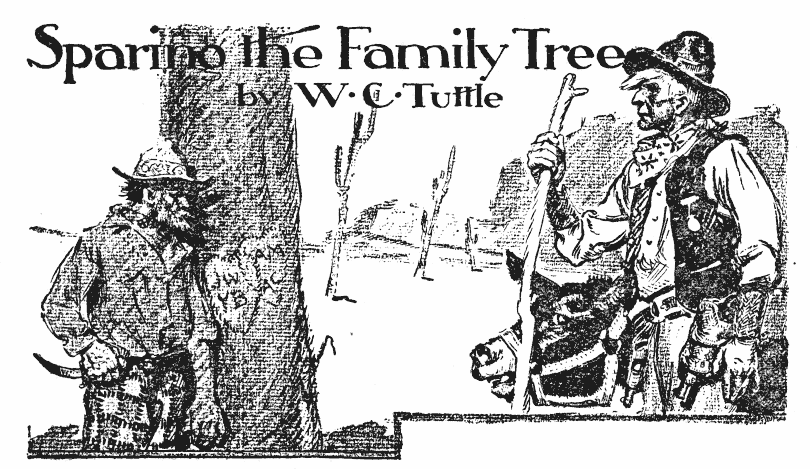
SPARING THE FAMILY TREE
“Taos” Thompson says he didn’t come from no place, and ain’t got no definite place to go. There ain’t no doubt in my mind but what he’s got ancestors, but whether the name of Thompson covers the family or not is problematical, but that don’t matter.
Probably my family would wonder how I can spell my name B-r-o-w-n, but as I said before, that don’t matter.
Down here in the cactus we don’t care what a man calls himself. It’s what he calls others that makes his visit pleasant or unpleasant, and anyway, why drag the family tree around with you when you ain’t doing nothing to make it flourish?
One day me and Amarilly—Amarilly is a melodious beast of burden, which is anti everything except sleep—was plodding across a particularly torrid stretch of desert when I happens to see a human being trying to gather itself into the shade of a two-foot snag of mesquite.
We pilgrims over and finds this here shade-hunter just about to cash in from drouth. I offers him my canteen, and says—
“Have a little water, old trailer?”
He looks up at me and sort of grins out of his cracked face, and reaches slowly for the canteen, as he mumbles out of split lips—
“If that’s—that’s the best you’ve got.”
That’s how I met Taos Thompson, the only prospector I ever knowed who didn’t care whether he found gold or not. He didn’t dream of finding a fortune, but he did love to prospect. I met him early in the Springtime, and for three months we pesticated around the devil’s griddle trying to find gold where it ain’t.
Taos is about five feet six inches from his heels to his red top-knot, and he’s got all the points and angles that human bones are heir to. He could be thirty years old or three hundred, but I’d make a bet that Taos hits plumb close to the fifty-mile post.
His hair and whiskers are his crowning beauty. Each and every hair seems to want to grow in a different direction, and the only way he can comb it is to soak it in axle-grease. He’s got long, skinny wrists, and a pair of freckled hands that ain’t got a match no place in the world. Man, them hands defy comparison, and the way they can hop a gun out of a holster is a caution. They just seems to envelop the butt of a big Colt, and it looks plumb like the smoke was coming out of the end on his index-finger. Taos sure pays his way and don’t ask favors of no man.
I ain’t saying much about me, except that Taos’ head just comes to the top button of my vest, and I weighs a hundred and thirty-five. I’m kind of a bleached blond and ordinarily I packs two guns. One gun makes me one-sided, so I has to ballast with the other.
Seems like every place we go they finds new names for us, but when we leave they usually sticks their heads out of the cellar and calls us Mr. Brown and Mr. Thompson. Taos can lick anybody that I’ve got the nerve to tackle, so we fits together well.
We’re poking along through the sand, giving oral support to Amarilly, and finally stops at some vile-smelling pot-hole, which has got a name ’cause it’s wet. If you ain’t never poked into the desert country and had your dry tongue scrape all the enamel off your teeth, you don’t know why men take off their hats to a moist spot and give it a name. This was known as Poison Springs.
Taos is educated. I never knowed a fellow what hankered for reading like he does. One day he found an old newspaper, and he tied up the outfit right there for over an hour. You’d ’a’ thought he had enough reading to satisfy himself for a while, but it ain’t more than two weeks before he’s wishing for something to read.
We pokes into Poison Springs and stops. I see Taos cock his neck like a sage-hen, and then he starts sneaking ahead, slow-like. I yanks loose one of my guns and sneaks right behind him. We sneaks along through the greasewood, me with my gun held high and handsome for anything that hops, and all to once Taos drops on his knees, and grunts—
“Glory!”
Then he stands up with a piece of newspaper in his hand.
“Saw it sticking on that little bush,” says he, happy-like.
“——!” says I. “I thought you saw something.” And then I went back and took the plunder off Amarilly.
I know that Taos ain’t going to mean nothing to me for a long time so I builds a fire and starts a feed. A newspaper to Taos is like alcohol to a Injun. A feller like him ought to own a book.
I tried to pry him loose when supper is ready, but he just grunts and goes on reading. It’s like trying to wake up a hop-head, so I eats in silence and watches that humped-up figure spell out news. Pretty soon he gets up and walks over to the fire, still reading, and stumbles over the coffeepot. Then he sets down in a frying-pan, puts a slice of bacon in his cup, and sweetens it with a dash of beans. Then he says—
“‘Yallerstone’, have you ever felt the call of love?”
I looks at him and shakes my head.
After a while he fills his pipe, lights it, flips the pipe out on the sand, and puts the match in his mouth. I wipes out the dishes with sand and rolls up in my blanket, while he still digs into them pages.
I’m just dropping off to sleep, when he says—
“Yallerstone, what do you know about me?”
“Enough to keep my opinions to myself,” says I. “There ain’t no use of me and you quarreling, so we’ll pass the reply.”
He nods, solemn-like, and then says—
“Yallerstone, if the right girl came along would you consider matrimony?”
“Why speak of tender emotions, Taos?” I inquires. “Kick off your boots and go to sleep. You need a shot of calomel, if you asks me.”
“Love is a great thing, Yallerstone. I’m slipping into the sere and yaller leaf, old-timer, but you ain’t so ancient. You ought to settle down before it’s too late. I might ’a’ stood a chance once, Yallerstone. She sure was a dingbuster. I gave her back her watch and locket.”
I sets up in my blanket and gawps at Taos. The idea of a old desert-rat like him receiving presents from a lady seemed wicked thoughts.
“Taos,” says I, “what was you doing with her jewelry?”
“Two year ago it happens;” says he, reflective-like. “I’m a knight of the road, as the poeting fellers call it, and I’ve halted the Cinnibar stage. I’ve got ’em all chinning themselves on a cloud, with the driver assaying their pockets for dinero, when I gazes upon her face. She was a passenger, Yallerstone—a passenger.” Taos sighs deep into his whiskers. “A passenger.”
“And you gave her back her ante?” I asks.
“Uh-huh,” he sighs. “And down deep in the valves of my heart lies a spark of love that only needs to be blowed upon a little to break into conflagration. Yallerstone Brown, after I gazed into her eyes I hears a different song coming from the birds, and even the buzzards has took upon themselves a sort of beauty. I ain’t seen her since, so I’ve sort of vegetated since she left me.”
“Did you quit knighting on the highways then?” I asks, and he nods.
“What did you pe-ruse that seems to bring back memories of yore?” I asks.
“This here paper, Yallerstone. It appears to be full of matrimonial chances. There’s a lot of females which seems to have trouble in getting mated up, and they ask for what they want. In one certain location there appears a item that sounds attractive. Here she is:
Lady about twenty-seven years of age, blonde, affectionate, educated and refined, would like to meet a real Western man. Must be sober and industrious, and of good appearance. Object matrimony. Address Box 1234, Hillsdale, Ill.
“Now,” continues Taos, “you qualify, Yallerstone.”
“Westerner,” says I. “Sober right now, and if following a burro is industry I’m there like a he-buzzard.”
Taos nods, solemn-like.
“I reckon we’re both tired of living alone. Maybe a woman could make something out of both of us if they had a chance.”
“Maybe,” says I, “but I doubt it. Was this a blonde lady what you held up?”
“Uh-huh. Yaller as a canary.”
“Go to bed, Taos,” I advises, but he sets there perusing the paper and nodding to himself. All to once he casts the paper aside and says:
“Yallerstone, will you go to Hillsdale with me? Will you?”
“Too far. Amarilly is getting sore-footed, and I’ve got a corn.”
“Only to Rawhide, Yallerstone,” he pleads. “I’ve got some money in the bank there, and I’ll split a thousand with you, and we’ll pasture Amarilly. Will you, Yallerstone?”
“No!” says I, flat-footed. “Nix, not and no time, Taos. Me and you have been partners since the Springtime sprung, and I like you—dang your frowsy old face—and I’d help you rob a train or a bank, but when you asks me to be an accessory to matrimonial plans I rears on to my hind legs and balks exceedingly.
“In the first place, Taos, the town is too far away. Maybe said female is already married. If me and you got out of sight of the Funeral Hills we’d get lost. No, Taos, we’re better off here. Far be it from me to chide you if love has penetrated your internal organs, but to a pilgrimage into the East as part and parcel to your connubial scheme, Taos—never! I will not, and that is finality in all its phases. Sabe?”
Well, we kissed Amarilly good-by at the pasture gate. Before the ticket-agent would sell us a ticket he finds out from the sheriff if we’re leaving of our own free will, and his, and then he hands us forty feet of green paper and wishes us adios.
We mounts that train at midnight, and I hope to die if I ever seen such a bunk-house. I paid for a bed, and that porter feller made me climb a ladder and get into a bird’s nest. I reckon I got some of my clothes off, but I didn’t have room enough to find out what it was. I hooked one arm over a baby’s hammock, and prayed all night for a pair of spurs. The next morning is awful. I’m so kinked up that I can’t get my pants on. The sheet is so slippery that I can’t even inch into them, and when I peeks out the place is full of folks.
“Taos, are you still there?” I yelps.
“I am!” he yells back. “Are you dressed?”
“I don’t think so,” says I. “I ain’t got room to see higher than my knees, but I think I’m still outside of my pants. Are you dressed?”
“No!” he yelps, and I hears him bump his head. “Gol blast the gol blasted—” and then he whoops, “Ex-cuse me, folks, but the ladies better retire, ’cause Taos Thompson is coming out into the open to dress!”
Man, I’d say that they retired. I fell out on my hands and knees, and we both dressed in the privacy of the middle of the car. That trip was one succession of kinky nights. I tried to sleep on the back porch, but the conductor got peeved, and I went back to my perch. Taos finds something to read, which makes him unfit as a companion, and I sure longs for Amarilly and the desert.
One morning I’m setting there in a seat, looking at the scenery, when a lady gets on the train. She stops beside my seat and looks down at me.
“I beg your pardon,” says she, “is this your seat?”
“You’re welcome, ma’am,” says I. “I don’t think so. I reckon I just sort of squatted here, being as it ain’t got no location notice nor nothing to show ownership.”
“Thanks,” says she, and sets right down beside me.
I looks out the window for a spell, and when I turns my head she’s looking right at me.
“Pardon me,” says she, “but you’re from the West?”
“Yes’m,” I admits. “I wish I wasn’t.”
“Why?” she asks, elevating her eyebrows.
“Well,” says I, “if I wasn’t, ma’am, I’d be there now. See how it is?”
She don’t say nothing for a while, and then—
“Going very far?”
“Ma’am,” says I, “I don’t know. I’ve come far, but you’ve got to ask Taos how much farther we’re going. Taos is matrimonial bent, and I’m sort of a bodyguard.”
“Are you a cattleman?” she asks.
“You might say I am, ma’am,” says I. “There is some cows back home.”
“Do you know you remind me of William S. Hart?” she says. “You are just the type.”
“Is William a printer?” I asks, but she shakes her head, and I notices for the first time that she’s a blonde.
“No, he’s an actor. A Western actor. Are you married?”
“No, ma’am. Nope, I’m still single-rigged. What’s your name?”
She pauses for a minute, and then says—
“Aurora Metcalf.”
“That’s a huh—peculiar name,” says I. “Mine’s Brown—Yallerstone Brown.”
“And you are single,” says she, low-like. “Haven’t you ever felt the call of love? The primal call of your heart for some one to share your life? Haven’t you ever felt the need of a mate?”
“What does William Hart look like?” I asks.
“Like you. He makes love so wonderful, he’s so daring. You really do resemble him in lots of ways. You should see him make love.”
“Uh-huh,” says I. “He likely gets paid a lot for it. You’ve got to take that into consideration.”
“Would you make love for a consideration?”
“Well,” says I, “every man has his price, ma’am.”
“Would you—would you marry me—for a consideration?”
Of all the danged fool propositions I ever had handed to me she had the worst. She says to me—
“In the first place I don’t want to get married.”
So I says:
“Keno. Neither do I.”
I meant it, too. She ain’t the kind of a clinging vine that I wants around my cabin door, ’cause I can just see that she’d make a man miserable. Well, she sort of settles in her seat, and this is her proposition—
“Do you know what an exclusive set is?” she asks.
“I do,” says I, “‘Dice’ Davidson had one. Roll seven all night.”
“My uncle, James Alexander Carter, thinks that Western men are the only real male human beings on earth,” says she. “I have never seen my uncle. He is my father’s brother, and when father died Uncle James inherited me and Aunt Mary. We own a home, and uncle has paid all the expenses for years. He owns some valuable mines out West—where I don’t know. The money comes every month, through a lawyer, and Uncle James is almost a myth.
“Now he says that I must marry a Western man or lose my inheritance when he dies, and it must be before the first of the year, as he is going to make us a visit. In case I don’t marry a man from the West, and one that he approves of, the money will all go to a home for indigent prospectors. Do you understand?”
“I begin to see a glimmer of light,” says I. “Suppose he didn’t like me—where do I get off?”
“No one could be more of a type than you are,” says she. “He will be delighted.”
“I don’t want no wife,” says I.
But she says:
“You won’t have one—except in name. I’ll send for him to come right out to visit us, and as soon as he is gone I will pay you one thousand dollars, let you go back West, and get a divorce as soon as possible. Why, you won’t even have to marry me under your real name. Will you do it? You see, Uncle says he won’t stand for a husband from my set. Will you marry me?”
Just then Taos drifts into the door, reading a prospectus of some railroad, and I taps him on the shoulder.
“Taos,” says I, “meet the future Mrs. Yallerstone Brown.”
The cigaret falls out of his mouth, and he shakes hands with the lady’s elbow.
“Nice day, ma’am,” says he, and drags me into the next car. “Yallerstone,” says he, “are you crazy?”
“Maybe.”
“You going to marry her?”
“Uh-huh.”
“——! You just met her!”
“She just met me, too, Taos.”
“Well,” says he, weak-like, “you’re the suddenest son-of-a-gun I ever met. I’m sorry, old trailer.”
“Maybe I will be too,” says I. “Remains to be seen, as the feller said when he dug into the Injun’s grave. She’s likely as good as I am, and she’s old enough to know better if she thinks she’s doing wrong.”
Taos grunts and rolls a smoke.
“How soon?”
“Chicago,” says I, and he puffs away for a while before saying anything. Then he sort of shrugs his shoulders and says:
“Well, Yallerstone, I hate to hear about it, but I reckon it’s fate. I’ll be back in Chicago in about a week, and I’ll meet you.”
“Bring Box 1234 with you, Taos. My wife will be glad to meet her.”
I can’t imagine Taos with a wife, but—well, look at me.
Taos changes trains at Chicago, and he shakes hands with me and Aurora. He tells us where to meet him in a week, and then leaves. Aurora is some sudden herself. She rushed me to a place where you send telegrams, and from there to—I reckon it was the court-house or the city hall, and then shoved me into a taxi cab and we went to the preacher’s house.
It took that sad-faced jasper about a minute to put hobbles on my freedom, and we didn’t no more than get out of that place before she starts educating Yallerstone Brown. I never knowed that I was so ignorant. She starts in on eating with a knife, and ends the first lesson with a sermon on putting my feet on the table.
She orates that I’m to be sober, shaved and sanitary all the time. She chases me into a store and slides me into a suit of clothes that looks like I was dressed for a funeral, and then I has to trade my perfectly good boots for a pair of shiny shoes with buttons on. Then she bought me a cane.
“I ain’t crippled—yet,” says I.
“You carry that cane!” says she. “One doesn’t have to be crippled to carry a cane.”
“One end or the other,” says I. “Can I keep my gun?”
“Gun? Certainly not! You’ll put it in the bag.”
“Bag?” I asks. “If I’ve got to pack a cane I ain’t going to have no bag. Folks might think I was a chicken thief.”
Right there I found out what a bag is. We got into a cab, and when we got out we’re at the depot.
“Two tickets to Hillsdale,” says she to the ticket-man.
“Hillsdale?” I croaks.
“Where we will live,” says she.
“Amarilly would enjoy this,” says I, after she got through telling me how to act when I got off the train.
“Amarilly?” she asks. “Who is she?”
“Friend of mine. Been with me over a year.”
“Relative?” she asks.
“Nope, no relative.”
“You—you haven’t been really with her, have you?” she wails. “Not all that time?”
“Yes’m. Me and her has taken some goshawful trips together.”
She sort of shudders deep into her seat, and then—
“We’ll speak of her later, and I will demand an explanation of your associations with her, Mr. Wardner.”
“Wardner?” says I. “My name’s Brown!”
“The name on the license is Jack Wardner. I don’t like the name of Brown, and I told you I’d marry you under an assumed name.”
“Oh!” says I. “Nice name; where did you find it?”
“I read it in a Sunday paper once. It was an article about a Jack Wardner, who was a famous rustler in Montana. It must have been a typographical error, or the word rustler is a derivation of our word hustler. Don’t you think so, Jack?”
“Yes, I don’t. You might as well have said Harry Tracy or Jesse James. Suppose I get slammed into jail, and languish in durance vile.”
“Jail?” says she, and then she climbed my morals and language, rode me wild and free and slapped me with her hat.
She raked me from headstall to flank, and when she quit I’m gentled aplenty. Also we’re pulling into Hillsdale.
That platform is one mass of colored clothes, and I can feel that Yallerstone Brown is getting sex-shy. The train jars to a stop, and a committee of females sure invades that car. They don’t see nobody but my wife. I hears the word “telegram” and I know they’ve been notified. While the turmoil is in progress I opines to myself that I know I’m going to get embarrassed, so I shoves one leg out of the open window and hit the gravel on the other side.
I figure to go around that train and meet my wife on the other side, but there don’t seem to be no other side. I walked about a mile with that bag and cane but there ain’t no end to the cars. Then I takes my gun out of my bag, shoves it inside the band of my pants, and ditches both bag and cane.
Then all to once I finds an opening in the trains and I pilgrims right down a street. I sees a familiar sign over a door, so in I goes.
There at the bar stands a figure, dressed in a checkerboard suit, with his back turned toward me, talking to the bartender. On top of his head sets a green hard hat, with red hair sticking up around the edge like grass around a fence post. One freckled bunch of fingers holds a half-unwrapped cigar with which he gestures widely, as he says:
“Yessir, he was a hy-iu pard but he fell for a female charmer. I’m all to blame, ’cause I was the one what got him to travel, and I shall have it on my conscience for many a day and night. Well, Bartender, fill ’em up and we’ll drink to the best old ——”
“Old what?” I asks, and Taos turns so quick that his hat falls off, and he sets down hard on the rail.
I looks him over, picks up that miscolored hat and blows the dust off the top.
“You married yet, Taos?” I asks.
He looks up at the bartender and motions toward me:
“Bartender, do you see the same thing that I do? Tell me your impression.”
“Seven feet high, horse face and——”
“That’s aplenty,” says Taos, getting up. “Yallerstone Brown, have a drink. Are you married?”
I takes about what would fill one of Amarilly’s ears, and nods:
“I am. Are you?”
“I begs pardon, gentlemen, but I’m looking for a Mr. Wardner,” says a voice at the door, and we turns around to see a little feller in knee panties, and wearing the most dignified face we ever seen. We looks at him and then at each other.
“I repeats,” says he, “I am looking for Mr. Wardner.”
“Does you know this frozen-faced tip-up, Bartender?” asks Taos, but the hooch-handler shakes his head.
“I was sent to direct ’im ’ome,” says the little one, dignified-like.
Dog-gone him, he ain’t changed expression since he came in.
“He’s a director,” grins Taos. “Have a drink?”
“Beg pardon, sir, but Mrs. Wardner wishes——”
“Sounds like a fairy tale,” says Taos. “They used to have three wishes.”
“Beg pardon, sir, but she’s frantic, sir.”
“Taos,” says I, “shall we kill it outright or put it in pickle?”
“I begs pardon, sir—” begins the little one, when Taos grabs him by the shoulder.
“What’s your name, feller?”
“Hicks, sir.”
“Have a drink, Hicks?”
“No, sir. Not any, if you please——”
“Whisky or something stronger?” asks Taos.
I’ve seen teetotalers who were as big as a house cave right in and drink themselves under the table when Taos asked them that question in just his own way.
“Mostly anything, sir,” says Hicks, after one look at Taos’ eyes.
I can say right here that all Hicks needed was a start.
“Never ’ad so much fun in all me bloomin’ life,” says Hicks, tearful-like, after about the seventh. “I never ’ad any fun in me blawsted life before. I got the limersine outside if you wants to go some place.”
“Where can we see the most, Hicks?” asks Taos.
“Whitehalls, sir. Like to go? I ain’t never ’ad no fun in me——”
“Maybe I better find my wife,” says I. “You fellers don’t know Aurora like I do.”
“Gol dang, I plumb forgot her,” says Taos. “Where is she, Yallerstone? Leave her in Chicago?”
“Aurora ain’t the kind you can leave places, Taos,” says I. “When I married Aurora Metcalf I got a cross between a range-boss and a first mate, if you asks me.”
Hicks is leaning against the bar, with tears of sympathy for himself running down his face. Now he stops sobbing and says—
“Wha’ did you shay your wife’s name wash?”
“Aurora Metcalf.”
“The one you lately married?” he asks.
“I never married but one lately, and she’s it, Hicks.”
“Blyme!” says Hicks, staggering toward the door. “Blyme, I’ve woozled the whole bloomin’ mess! Picked the wrong pershon. Now I’ll get —— from the missus.” And Hicks weaved out of the door.
“Wardner!” exclaims Taos. “Wonder who he is?”
Just then I remembers, and I starts to laugh.
“I’m him,” says I. “My wife married me under an alias, Taos. She don’t like the name of Brown so she changed it to Jack Wardner.”
“Jack Wardner? Does she know anything about Jack Wardner?”
“Read about him in a paper, Taos. Didn’t she pick some name?”
“Beyond the shadder of a doubt. Jack Wardner lifted half the cows in Mescal County, and had the sheriffs in that country setting on cactus for a year or two. I’d ’a’ sure picked some other name.”
“Me too,” says I. “But when Aurora starts picking—well, I got it.”
“Do you know where you live?” he asks.
“I do not. I’ve got to find her or get thunder.”
We had a few more drinks, and then we starts down the street. Taos suggests that we ask a policeman, which we do.
“No,” says he. “Never heard of the name around here.”
The next one has the same answer.
“Reckon we’ll have to make a house to house canvass, Yallerstone,” says Taos, and just then a feller comes up to us and says—
“Are either of you gents Jack Wardner, the Montana cowman?”
“One of us must be,” admits Taos. “We’re looking for the wickiup of one named Aurora Metcalf. Ever heard of her?”
“Aurora?” he asks.
“Same as Northern Lights,” says I. “Last name is Metcalf.”
“Never heard of her,” says he. “Live around here?”
“This is Hillsdale, ain’t it?” I asks, and he nods.
“You ain’t a officer of the law, are you?” asks Taos, and the feller laughs.
“No, I am a society reporter. We have the story of the wedding in the paper this afternoon, but I want to get an interview with Mr. Wardner on the vast herds he controls and all that.”
“Vast herds!” snorts Taos. “Did you ever have vast herds, Yal—Jack?”
“One unit,” says I. “Bought and paid for, and killed to make a Dawson County barbecue.”
“Your wife said that you were the greatest hustler that the State of Montana ever knew, and that you were strong enough to lift any cow in the State.”
Me and Taos looks foolish-like at each other, and then Taos takes me by the arm.
“Somebody’s crazy, Yallerstone,” says he. “Let’s me and you get away from here.”
We left him gawping at us and went around a corner, where we sat down on the sidewalk and rolled a smoke.
“Strangers in a stranger land,” sighs Taos.
“Did you write to Box 1234?” I asks, and he nods.
“Yep, but I ain’t heard from it yet.”
“Keep away from the post-office,” says I. “Shun anything that might lead your feetsteps toward the altar, Taos. Look at the mess I’m in.”
Just then a shiny automobile rolls up to where we’re setting and we looks up at the driver. It’s Hicks.
“I’m still ’untin’,” says he, sad-like. “I don’t believe Miss Carter ever ’ad a ’usband. Blyme, if I does.”
“——!” says Taos. “This must be a matrimonial mill. Has she got a husband?”
“She thinks she ’as,” says Hicks, confidential-like. “I ain’t been ’ome since I left you. I’ve ’unted and ’unted.”
“Maybe he’s out at Whitehalls, Hicks,” I suggests.
“Want to ride out and see, sir?”
“Of course not,” says Taos. “We’re busy, Hicks. We’ve got a lot of work to do today. How do you get into this gas greenhouse?”
Whitehalls was some place for to see. The king of spades let us in the door, and the jack of the same suit led us to a table. He didn’t want to serve drinks to Hicks, but Taos spoke softly to the waiter, and Hicks got served ahead of us.
We’ve been there about two quarts when a fat feller comes to the side of our table, and stares at Hicks. I figured he must be the boss of the place, so I asked him to have a drink.
“Hello, shour face,” whoops Hicks.
“Hicks, you are discharged,” says he, and then he looks at us. “If either of you gentlemen is Mr. Wardner I can say that your wife is waiting for you.”
“Which one of us is him?” asks Taos, and Hicks shakes his head.
“Please,” says fatty. “She’s prostrated.”
“Slipped?” asked Taos. “Gosh A’mighty, Yallerstone, she’s accidented!”
“Hicks,” says I, “we’re going home.”
“Never ’ad no fun in my bloomin’ life,” weeps Hicks. “Never ’ad——”
“Please,” says fatty, “let the rest stay, and I’ll take you home.”
“Who in —— do you think is running this here party?” I asks. “Who are you?”
“Butler,” says he, dignified-like.
“Good!” says Taos. “Butler, you drive the hack.” And he took fatty by the arm and hustled him outside.
“Get up on that seat and show us speed,” orders Taos. “You do some driving, old-timer, or I’ll shoot the pockets out of your panties.”
“Haw!” whoops Hicks, when the hack started with a jerk. “Goo’ joke! Shour face never drove limershine——”
Just then the front end of that million-dollar hack went up in the air, and we rattled around like three dice in a box. Then comes the first total eclipse I ever seen, and I ain’t got no smoked glass. I woke up after a while and finds that I’ve got my feet up a tree. Taos’ feet are sticking out of one of the hack windows.
“Blyme,” wails a familiar voice on the other side of the fence, “the missus will be sore as a bloomin’ boil! Limersheen all ’ammered to ——!”
I pulled Taos out of the hack and spread him out on the ground. He shudders after a while and looks up at us.
“Yallerstone,” says he, soft and sweet, “she was only a passenger.” And then he sort of shakes his head and says, “Yallerstone, did we meet Aurora?”
“Not so bad as that,” says I. “Butler must have been a hurdle-rider in his youth. Are you hurt, Hicks?”
“Hurt ——!” wails Hicks. “I’m heart-sick.”
I hunted around in the busted hack until I finds a bottle of silver lining, which I passes around to those assembled. When we got lined a little, we all locks arms and started down the road. We don’t see nothing of Butler, so we figures that he ain’t come down yet.
“Hicks,” says Taos, “do you know any good songs?”
“‘Bringing in the Sheaves,’ sir.”
“This ain’t no farmers’ convention, Hicks,” says I. “Let’s all sing ‘Old Man Lute was a gol darn brute and he couldn’t get his cattle up the gol darned chute.’”
“What was the matter with the cow—scared?” asks Hicks, and then he says, “Right around the next corner is ’ome, so we better act dignified.”
“This ain’t home is it?” asks Taos, peeking over the fence. “This here is a hotel, Hicks.”
“The Wardner residence, sir,” says Hicks. “This is the ’ome of Miss Agnes Carter, daughter of the minin’-man, Mr. James Alexander Carter.”
Me and Taos looks foolish-like at each other, and then all takes the last drink out of the bottle.
“Wrong again, Hicks,” says I. “I never married her. I married Aurora Metcalf, Hicks. Know any Metcalfs around here?”
“No, sir. No Metcalfs in Miss Carter’s set, sir.”
“My gosh!” grunts Taos. “They come in sets here, Yallerstone.”
Taos is gazing toward the house, and we all looks. Up the walk staggers Butler, and right into the midst of a herd of females. They seem to hang on to him while he pours out his soul. He still retains one coat sleeve and one pant leg, but his nerve is all gone.
Then a couple of males breaks from the herd, lopes away to where an automobile is standing, and away they goes up the road. The rest help Butler into the house.
“S’whelp me, he told ’er about the limerseen!” wails Hicks. “Now I ain’t got no more job than a bloomin’ canary bird.”
“That’s hard lines,” says Taos. “Our fault too, Hicks. Let’s go up and square things for Hicks, Yallerstone.”
We went up and sat down on the porch.
“You do the talking, Yallerstone, and me and Hicks will back you up; eh, Hicks?”
“Jack! You!”
We turns around quick-like, and there stands Aurora, backed up by a whole swarm of females.
“Hicks,” says I, “you’ll never regret what you’ve done for me. You sure are some guide, I’d tell a man.”
“Brought ’im ’ome, ma’am,” says Hicks, foolish-like.
“Jack, where have you been?” wails Aurora.
“Ask Hicks,” says Taos. “Hicksie knows, eh, Hicks?”
“You!” Aurora looks just like a panther that I cornered in a blind cañon once over on the Tillicum River. She sure shows displeasure toward Taos. “You—er—thing!”
“Yes’m,” says Taos, “I don’t blame you, ma’am, but you ought to go out West and learn to cuss.”
“West!” she snorts. “I hate it! Jack, what will people think? I’ve even had the police looking for you.”
“That’s nothing,” says I. “You might introduce me to the ladies.”
“This is Jack Wardner, of Montana,” says Taos, “owner of vast herds. I am Taos Thompson. I was born in a cane-brake and rocked in a bark cradle, and I’m the pizenest old pelican that ever made a track in the sand. Whale-bone warp and bob-cat filling. Let me make you used to Hicks who never had any fun in his blooming life. Me and Jack has done the best we can toward him.”
“Jack,” snaps Aurora, “take that person away, will you? Hicks, take them up to Mr. Wardner’s rooms. Jack, I should think you’d be ashamed. Change your clothes at once.”
“Amarilly would love to see you now, old-timer,” grins Taos. “I can just see her broken ear stand straight up.”
“Broken ear?” asks a lady. “Broken ear?”
“Yes’m,” nods Taos. “She loves Jack, and he loves her, but one day she got too rambunctious and Jack hit her over the head with a pick-handle. But she don’t show no grudge—Amarilly don’t. She kissed us both good-by. You go on up and sluice off a little, Jack. I’ll wait here.”
“Come on,” says I. “There’s two basins, ain’t there?”
“Bawth, sir?” asks Hicks, after he takes us to a room that has got the New York hotel in Rawhide beat a mile for looks.
“No,” says I. “Not before Saturday.”
Taos is examining some clothes which are laid out on the bed, and then he turns.
“Hicks, who owns them duds?”
“Mr. Wardner, sir. Mrs. Wardner ’ad me get them. I ’opes they fits, sir.”
“Got any more like ’em, Hicks?”
“No, sir. No more, sir—unless I might be so bold as to offer you a suit of mine, sir.”
“Hicks, I’d love you as a brother,” grins Taos, and does a bear dance around Hicks.
Hicks comes back in a few minutes with his arms full of clothes.
“May I dress you now, sir?” he says.
“Hicks,” says I, “I was wearing suspenders and dressing myself when you was keeping yours up with a safety-pin. Vamoose!”
Then me and Taos sets down on that bed and whoops a few lines.
“Yallerstone, I want a diagram of the whole situation,” says Taos.
“Well,” says I, “you can blame yourself. You dragged me out of a comfortable desert and away from a friendly jackass, and flung me into this proposition. She’s got a uncle out West some place who proclaims that she’s got to marry a Western man or lose her inheritance. Sabe? Otherwise his dinero goes to a home for indignant prospectors.
“You can see for yourself, Taos, that she ain’t no Adonis to look upon. Aurora can’t pick and choose, so she slams her pick into me, ’cause I’m a type. Sabe? She orates that all I’ve got to do is to marry her, be her hubby in appearance only, and hang around until James Alexander Carter shows up and departs, and then I get one thousand dollars, a safe passage back to the sage, while she sues me for dessert. She don’t want a husband no more than I do, but she sure does covet her uncle’s roll. According to her he must be a locoed old jigger.”
“I wish we’d ’a’ stayed back on the desert, Yallerstone,” says he. “I ain’t heard a word from Box 1234, and now I reckon I’ve got to go back to Rawhide alone.”
“Stick around, Taos. Her uncle has been sent for, and after he’s gone I’ll slip you half that thousand. We’re making expenses.”
“Do you love her, Yallerstone?”
“No, I can’t say that I do, Taos.”
“Could you learn to love her?”
“Not at that price.”
“I can’t blame you, Yallerstone. Love comes from the heart. Wish I hadn’t held up that stage. That sure was one angel, old-timer. She told me she hoped to see me hanged, and when I gave her back her watch and locket she commuted it to life imprisonment. Wish I knowed how to get into these clothes, Yallerstone.”
I looks mine over and has the same feelings. A blue-print might help a lot, but there ain’t even a recipe in sight.
In the first place the person who made them pants didn’t have me in mind. They’re all right, except that they don’t come all the way down the leg, and the top button laps plumb around to my hip where I has to pin it. Taos says I looks twisted, but they covers me plenty. I manages to get that shirt fastened at the top. There’s button-holes all the way down the front but no buttons, and every time I bend over I open up like an envelope. I tries the coat and finds it guilty. She don’t meet in front by twelve inches. There’s a medicine-show actor’s hat there, and a cane, but I ain’t got no drugs to sell, and I ain’t got no sprained ankle, so I passes both.
I admires myself in a glass and then looks at Taos. He never considered Hicks when he borrowed that suit. That suit fits Taos like a bandage on a Christmas tree. The pants are too tight to go outside of his boots, so he wears them inside. The sleeves are about six inches too short, which gives a hy-iu view of Taos’ wrists and hands. I found a pocket in the tail of that coat which will just hold a Colt .45. It hauls the collar away from my neck quite a lot, but don’t interfere none to speak of.
“Yallerstone,” says he, “all I need is some cologne to make me a regular honka-tonk actor. You look like ——, Yallerstone Brown.”
“You don’t favor Venus none to speak about,” says I. “If anybody asks me I’d say you was something to scare kids with.”
We sneaked out in the hall, and I peeks over the railing of the stairs. I seen a lot of folks standing around down there, so I back right into Taos. Just then Hicks came along, and I says to him—
“Ain’t it awful, Hicks?”
Hicks looks us over and says:
“Yes, sir. You should ’ave let me dress you.”
I peeks down again, and here comes my wife. She’s dressed like Summer at the Equator. She hustles us around the corner and says—
“Jack Wardner, I want to tell—my Heavens, who dressed you?”
“Who undressed you?” I asked.
She looks me over for a moment, and then: “Oh, what tangled webs we weave. Jack, my name is not Aurora Metcalf. I am Agnes Carter. I just gave you the first name that came into my head, because I never thought it would lead to this. It wasn’t much worse than marrying you under the name of Jack Wardner. Thank the Lord, it won’t be for long.”
“Amen,” says Taos.
Aurora gives him a hard look and says to me:
“Jack, you must get rid of your friend. I will have to stand for one Westerner, but not for two. This is not a hotel.”
“Yes’m,” says Taos, sad-like. “The more I see of the gentle sex around here the more I love Amarilly.”
Then we went down-stairs. The bunch stands up to greet us, and I met more folks right there than there is in the town of Rawhide, if you count greasers and dogs. My wife smiles with her mouth, and we all hits the trail for the feed-room.
A big, tall female hooks on to Taos, and he acts like he enjoyed it. Him and her sets down across from me and Aurora, and on my other side is a fat little female with a lot of yaller hair on top of her head, and not much clothes on above the table top.
We got soup without ordering it, and I immediate and soon digs into the stuff. I love soup, and I’m some hungry. That yaller-haired person sets there like a statue, and I’m just about to tell her that if she don’t want her soup I’ll take it, when I glances across at Taos. He’s staring at the lady and pouring sugar into his soup. He puts every lump in sight into that soup and then starts stirring it with his finger.
I leans across the table and says, low-like:
“Taos! You ain’t at ‘Enchilada’ Charley’s place now, remember.”
He sort of gives me a queer look and fusses with the napkin in his lap. He stares back at the lady and then shoves back his chair.
“Ex-cuse me!” he sort of gasps. “I—I don’t feel well.” And then he starts away from the table.
Something rattled, somebody squeaks, and the dishes start crashing on the floor. Taos has made a misdeal with the napkin and has tucked the tablecloth into the waistband of his pants.
Did he stop to unhitch? He did not. I heard a door slam, and we all set there looking like a lot of Digger Indians.
“Heavens above!” exclaims my wife. “What happened?”
“That was he!” screeches the fat little blonde, throwing up both hands.
“I knew it! I—I——” And she slid down under the table.
I hauled her out and braces her into a chair, while everybody tries to pour water on her. Several used soup.
Just then Hicks comes in and whispers to my wife:
“Pardon, ma’am, but there is somebody on the telephone who insists that they must talk with you. They insists, ma’am.”
Just then the yaller-haired lady comes out of it, and my wife beats it out of the room.
Everybody is fanning the lady and asking questions, and she just sets there and gulps and makes fool motions with her hands.
I just slides my old coat-tail around to where I can hook the butt of that .45, and waits for what is to happen next.
Then my wife comes over to me and says:
“Very queer. The call was from somebody who wanted to know if you were really the original Jack Wardner, of Montana. He said he wanted you—I don’t know what for. I—I told him I was the maid, and he said, ‘Well, you keep this under your hat.’ Isn’t it awful what a mess has been made of this dinner?”
“Did he say he was coming up here?” I asks. She says:
“Yes, I guess he wants to surprize you, Jack. Who do you suppose it is?”
“I know,” says I. “It’s a secret. I’ll go an’ meet him. Ex-cuse me.”
I grabbed a hat off the hat-rack, and I traveled half-way to the depot before I finds that I’ve got one of them high, shiny ones.
There is a train just leaving, and I hooks the last coach as it pulls out. I turns around, tips my hat to Hillsdale, and sails that hat as far as I can. I walks inside and meets the conductor.
“I ain’t got no ticket for my ride or sleep,” says I, “but I’ve got the dinero. Do I get along?”
“You do.” He hauls out a slip of paper, and says, “I’ve got one upper left, but maybe tomorrow I can do better.”
“I don’t mind being a bird for one more night,” says I and lets the porter send me up the ladder.
The next morning I shoves my face out of the curtains to see what the chances are to come out and dress, when I happens to look down into a familiar face.
“Honeymoon?” he asks.
“Honey ——! What did you stampede for? Was that Box 1234?”
“Nope. That was the lady I held up, Yallerstone. She never forgot me, I reckon, and I saw life imprisonment in her eyes. Things might have been different. You married Box 1234.”
I hauls myself half-way out of the bunk and stares at him—
“Box 1234!” I yelps.
He nods.
“I seen it in that paper, Yallerstone. I took you back there to try and marry you off to her, ’cause I knowed you was honest, and—well, I didn’t want her to marry a heart and hand Westerner. I wish I hadn’t held up that stage.”
“Why did you?” I asks.
“Well, I told the owners of the line that my clean-ups wasn’t protected enough, and they laughed at me, so I held her up to prove that I was right.”
“And your right name is?”
“James Alexander Carter, Yallerstone, but I prefers Taos Thompson.”
I looks down at him for a while and then relapses in my bunk.
Pretty soon I hears him say:
“I kind o’ wish you had stuck, Yallerstone. She didn’t play square with me, but—well, you’d ’a’ made her a honest husband, and you wouldn’t ’a’ had to work no more. Why didn’t you stick a while?”
“Well,” says I, sticking my head down close to his curtain, “just after you left, Taos, somebody—a officer, I reckon, called my wife on the telephone and asked her if I was the original Jack Wardner from Montana. She said I was, and he told her to keep it under her hat ’cause he was coming up to surprize me.”
“Shucks, Yallerstone! You could ’a’ stuck for all that. You could easy prove you ain’t.”
“Not if they took me back to Mescal County,” says I.
“Mescal County!” he snorts, clawing at the curtains. “What do you mean, Yallerstone?”
“I’m Jack Wardner,” says I.
Transcriber’s Note: This story appeared in the August 18, 1920 issue of Adventure magazine.