
Transcriber's note: Unusual and inconsistent spelling is as printed.
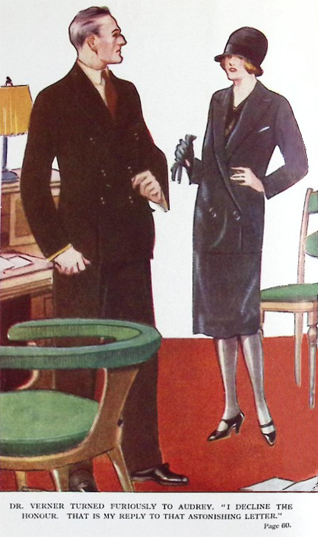
DR. VERNER TURNED FURIOUSLY TO AUDREY. "I DECLINE THE
HONOUR. THAT IS MY REPLY TO THAT ASTONISHING LETTER."
"...On the north three gates; on the south
three gates; and on the west three gates."
THE DIFFERENT OUTLOOK ON
LIFE OF FOUR YOUNG WOMEN
BY
AMY LE FEUVRE
Author of "Probable Sons," "Herself and Her Boy," etc.

PICKERING & INGLIS
LONDON GLASGOW EDINBURGH
       LONDON  •  • 14 PATERNOSTER ROW, E.C.4
       GLASGOW •  • 229 BOTHWELL STREET, C.2
       EDINBURGH  • 29 GEORGE IV BRIDGE, 1
       NEW YORK   • LOIZEAUX BROS., 19 WEST 21ST ST.


                                GOLDEN CROWN LIBRARY

                        OF STORIES BY AUTHORS OF HIGH REPUTE

                   1 HERSELF AND HER BOY           AMY LE FEUVRE
                   3 HER HUSBAND'S HOME            E. EVERETT GREEN
                   4 PEPPER & CO                   ESTHER E. ENOCK
                   5 ELDWYTH'S CHOICE              L. A. BARTER SNOW
                   6 MARTYRLAND                    ROBERT SIMPSON
                   7 ANDY MAN                      AMY LE FEUVRE
                   9 FOUR GATES                    AMY LE FEUVRE
                  11 A MADCAP FAMILY               AMY LE FEUVRE
                  12 NORAH'S VICTORY               L. A. BARTER SNOW
                  13 JOAN'S HANDFUL                AMY LE FEUVRE
                  14 CORAL                         CHARLOTTE MURRAY
                  15 SOME BUILDERS                 AMY LE FEUVRE
                  16 AGNES DEWSBURY                L. A. BARTER SNOW
                  17 MARGARET'S STORY              MARJORIE DOUGLAS
                  18 'TWIXT ALTAR AND PLOUGH       L. A. BARTER SNOW
                  19 TRUE TO THE LAST              E. EVERETT GREEN
                  20 MY LADY'S GOLDEN FOOTPRINTS   E. E. ENOCK
                  21 NORAH: A GIRL OF GRIT         BETH J. C. HARRIS
                  22 HER LITTLE KINGDOM            L. A. BARTER SNOW
                  23 BRAVE BROTHERS                E. M. STOOKE
                  24 A COUNTRY CORNER              AMY LE FEUVRE
                  25 THE HOME OF THE AYLMERS       MARJORIE DOUGLAS
                  26 O CARRY ME BACK!              E. A. BLAND
                  27 MONICA'S CHOICE               FLORA E. BERRY
                  28 A STUDY IN GOLD               GRACE PETTMAN


                          Made and Printed in Great Britain
CONTENTS
CHAPTER
XIV. BATTLING TOWARDS THE SHORE
ILLUSTRATIONS
DR. VERNON TURNED FURIOUSLY TO AUDREY. Frontispiece
PAULINE'S TONE WAS DESPERATE. "WE THINK MOTHER IS GETTING
WORSE. IS SHE?"
THE DOCTOR SHOUTED, AND AUDREY AND HE STOPPED TO LISTEN.
"BUT YOU WON'T LIVE ALONE," SAID MR. DANBY.
"WHY NOT?" REPLIED PAULINE.
Four Gates
FOUR LIVES
"Who would be planted chooseth not the soil,
Or here or there,
Or loam or peat,
Wherein he best may grow,
And bring forth guerdon of the planter's toil.
"Lord, even so
I ask one prayer,
The which if it be granted—
It skills not where
Thou plantest me—
Only—I would be planted."
T. E. BROWN.
"PAULINE, do you honestly like being in a backwater?"
"Backwaters have their uses."
"That is not an answer."
"I think I regard it as a halting-place—a wayside station on life's railroad."
"But that is just what it isn't. It comes from nowhere, and leads to nowhere. And I stamp and I fume at the stagnation!"
"You are an impetuous spirit! Perhaps, later on, you will look back to these quiet sweet days, and long to experience them again."
"I don't say that I shouldn't enjoy it at the end of my life, when I have been in all the stir and rush; when I have had my good time and can sit in an easy-chair and look back at it all."
"Then you should have sympathy with your father."
"Oh, I have. From his point of view, his lines have fallen to him in pleasant places. But I am at the beginning of my life. I think everyone ought to be in towns when they are young, and retire into the country when they are old. Of course, it is delightful when you have money; then you can have both in your life. But with a small purse, if you live the first half of your life in the country, and only get release from it when you are old, then you are too old to enjoy your liberty. Opportunities are gone; your talents are rusted, your ignorance of the world is ridiculous!"
"Why, Audrey, dear, you are getting quite excited!"
"I am—I feel so. Do say you agree with me. You must if you think it out. Look at us in this village. Here are four young women, not poor enough to earn their living, but not rich enough to satisfy their mental needs. One, Pauline Erskine, devotes herself to an invalid mother, and never leaves home for a single night. Don't interrupt me. She might, as your old Mary would say, 'grace a castle,' with her dignity and beauty. She once had a longing for an artistic life, but it has been stifled. She did go to London for three weeks when she was quite young, and she has lived on the memory of it ever since. She pretends her life satisfies her, but I know it doesn't.
"Then there is Honor Broughton, who is nursery governess to her three small stepsisters. Her whole world is centred in this backwater. She can never talk of anyone but her immediate neighbours, and the iniquities of her mother's servants.
"Amabel Osborne is a most dutiful daughter, of course, and is always the picture of happy content. But she confesses that reading a newspaper to her father is the most uninteresting part of her day's work. She has never worked her brains, and never will. Picking flowers in the garden, and listening to a lark's song, and roaming across buttercup meadows are her highest pleasures."
"And Audrey Hume—"
"Oh, she's just another, with a passion for reading, but can get no books worth the name of books, and a passion for novelty and change, and has never been twelve miles out of this backwater all her life. Talk about the revolt of women, and the era of independent women—what do we understand by such terms? There are no stronger chains than those of affection and blood, and we are all tied to those who are old and weak and helpless, and who are our beloved belongings!"
Quick tears sprang to the young girl's eyes as she turned to her friend for sympathy.
Pauline looked at her, then gazed over the peaceful landscape in front of them with a wistful smile.
They were both leaning over a gate as they talked. It was a buttercup meadow in front of them, and young lambs were at play in it. The soft spring air, with the thrill of youth and expectancy in it, had got into Audrey's veins. She was quivering all over with excitement and feeling, and her dark grey eyes were flashing with a thousand lights and sparkles. Slim and of the average height, with a broad low brow, and soft dusky hair, and a face that owed all its beauty to its variety of expression, she was a marked contrast to the tall fair girl beside her.
Pauline was a woman who attracted all who knew her, and yet was utterly unconscious of her power. Her dignified serenity, the deep earnest vibration in her tone, and her slow, bewildering smile that seemed to caress the one upon whom she smiled—all helped to add to her charms. But her power was in her wide outlook, and deep love and sympathy for everyone who came across her path. Audrey often called her a "Viking's daughter." Her deep blue eyes, fair complexion, and coils of golden hair, with her tall and beautifully proportioned figure, certainly claimed a Northern ancestry.
Audrey glanced at her now, and Pauline met her gaze with the words:
"We must be going on, or we shall be late for tea, and Mrs. Daventry will be disappointed."
"Oh!" exclaimed Audrey, with a quick sigh, which she turned to laughter. "We always have to be doing things we do not like for fear of disappointing people. I can so rarely get you to myself, and I am bubbling over with thoughts that I want to pass on to you."
"We can walk and talk at the same time, can't we?"
"Yes, but the house is already in sight. Walk very slowly, Pauline, there's a dear. I've been thinking out this question about single women, and I find it infinitely pathetic. They are the least considered and the most heroic—now, don't laugh at me! But isn't it true that by devoting themselves to the old people, they lose the chance of ever getting, in their turn, the devotion of the young? In broad plain language, they are prevented from meeting men whom they might marry by attending to their home ties and duties. I'm not thinking of myself at all—it isn't a personal grievance; I am looking out from this small village upon the world at large—the world I hear about, and read about, and think about. Why should the generation of daughters be more self-sacrificing than the parents? The single daughters look forward to a lonely old age, to poverty perhaps, to a time when they will be in the way of their friends, only tolerated as far as they can prove themselves useful, and spoken of with contemptuous pity by the young. And some of them are the noblest and best in creation!"
"They will have their reward," said Pauline gently.
"Oh, you are so good, and I am so wicked!"
Then Audrey laughed, and her laugh was an infectious one.
"I won't moralise any more. I am going to enjoy myself this afternoon. I love Mrs. Daventry. I wish she were my aunt or grandmother."
They had reached a small lodge, and went through some handsome iron gates up the drive that led to Barford Towers.
The park stretched away on either side of them; the chestnut avenue brought a sense of refreshment and peace after their rather hot and dusty walk along the high road.
Just in front of the old Tudor house was a green lawn, and under a cluster of beech trees was a group of people about to enjoy their afternoon tea together. Mrs. Daventry was the centre of the group, and she rose to receive the two girls with her usual smiling welcome. She was a very handsome old lady, with snow-white hair that was rolled back in French fashion under a filmy handkerchief of Mechlin lace. Her figure was still as erect, her eyes still as bright, as when, fifty years before, she had come to her beautiful home a happy bride.
The group around her were only young girls, but they all adored her; she was their queen, and they her court, as they often laughingly told her. And Mrs. Daventry loved every one of them.
The childless widow had taken to her heart the young maidens who lived outside her gates; she had seen the world as they had not. She remembered her own youth, and had boundless sympathy for any of them in a difficulty.
"Come along, Pauline, sit by me," the old lady said, drawing a lounge chair a little nearer her own; "and Audrey, sit where I can see your bright face. Here is Honor declaring you would not be coming. Now, I really think the Tabby's Tea-party has commenced."
Four girls and an old lady can keep the art of conversation up to the mark. There was no shyness amongst any of them. Pauline was perhaps the most silent, and Audrey the most talkative; Amabel laughed most; Honor was the most appreciative, though she had a most melancholy cast of countenance.
When tea was over, Audrey said:
"Now, Mrs. Daventry, let us talk about life—our lives; that's the most interesting thing in the world to us. Make us feel that a good time is coming to us. Inspire us with some of your thoughts. We are all more or less discontented, though I'm the only honest one who owns up."
Mrs. Daventry shook her head at Audrey, with her silvery laugh.
"I see no signs of discontent upon your faces," she said.
"No," said Honor quickly, "but that is because we are so close to our sun that we must reflect her rays!"
"I've never heard that the sun was a female before," said Mrs. Daventry, smiling. "Do you know what I always think when I look upon your young, fresh faces? I thank God that His works are always beautiful to start with. And then I muse upon the bundle of charms that you each possess, and which, if properly used, will make your world fair and beautiful."
"I have no charms," murmured Honor.
And, certainly, as far as outward charm went, she had not, for no one could call her anything but plain to look at. She had a broad mouth, snub nose, and small, short-sighted, blue eyes; yet when she talked, no one could call her uninteresting.
"Tell us our charms," said Audrey. "It's very nice to hear of our graces."
"I won't put beauty first, though it is one of them, and when I speak of beauty, I mean more than faultless features and good complexions. You have youth, health, strength, a boundless hope, enthusiasm, good spirits, and vivacity. You have innocence and freshness, and unembittered views of life."
"And we are all stagnating in a backwater," said Audrey mischievously.
"There is no such thing as stagnation in a human life. We either deteriorate or improve."
The old lady's voice was grave.
"Do you know," she went on cheerfully, "that I had a good deal of thought to-day over my lodges? You know the names of them?"
"Yes," said Amabel. "They are called North, South, East, and West Lodges, because you have one on each of the four sides of the Park."
"And do you know this about the City we all hope to enter one day:
"'On the East three gates; on the North three gates; on the South
three gates; and on the West three gates'?"
The four girls looked at her expectantly.
"I have a fancy—" and here Mrs. Daventry's dark eyes became soft and dreamy as she looked away to some distant hills on the horizon—"that each one of us may be entering that City through different gates; we may be journeying out to it with our faces towards the North, South, East, or West. Think it out, will you? It may explain the different winds we face through life. When once we get inside, we shall acknowledge that whatever road led us to our destination was the right one for us, and thank our Guide for having enabled us to face our wind."
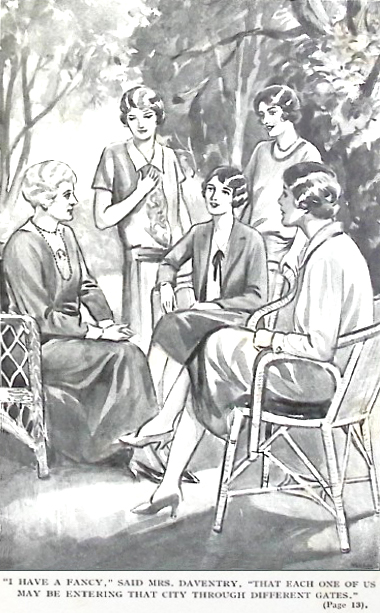
"I HAVE A FANCY," SAID MRS. DAVENTRY, "THAT EACH ONE OF US
MAY BE ENTERING THAT CITY THROUGH DIFFERENT GATES."
Audrey's eyes sparkled.
"I like that," she said. "I'll find out which is my gate before to-morrow."
"I know which is mine," said Honor. "I have faced East all my life. My wind is always sharp and cutting, and I have to be for ever bracing up myself to meet it without a whimper."
No one answered. Each girl was reflecting, and when Mrs. Daventry rose from her seat and took all of them into the house to see some wonderful needlework of hers, the subject was dropped.
An hour later, the four girls left the house together, and chatted gaily as they walked along.
"Do you know, we are really going up to London for a month soon," said Amabel. "I have an aunt who has lived in Paris most of her life, but since my uncle's death, she has taken a house in town, and she has invited my parents and me. Won't it be delicious? She has a motor and any amount of money, so we shall be in the lap of luxury."
"What a lucky girl you are!" sighed Honor. "It was only a short time ago that you went a lovely driving tour. Things like that never come to me. It's just as I said. I shall face the East always, and hardly ever see the sun."
"Yes," said Audrey, laughing; "and all of us know that Amabel's road faces due South. She will go through life in the blazing sunshine of prosperity."
"Then my soul will get very parched."
Amabel's tone was light, but there was a glimmer of seriousness in her eyes.
Audrey glanced at her reflectively.
She was a pretty, childish little creature, with soft, playful ways and a ringing laugh that could not easily be suppressed.
"I dare say facing South always would be very enervating," Audrey said slowly.
"Yes, of course it will be, and you must make allowances accordingly for a Southerner. Pray, what gate is your destination, Audrey?"
"I think it must be West, because such storms crop up in a moment. Pauline, can your gate be the Northern one? I pity you if it is, for not a gleam of sunshine will you get as you go along. But it will suit you, for you will step along serenely, and in your eyes will be steadfast purpose. I believe your hidden fires will keep your Northern outlook from freezing you."
Pauline looked at her friend with her sweet, grave smile, then her blue eyes kindled with deep feeling as she said:
"Remember, if my face is towards the North, my back will be towards the sun. I may not see it, but I shall feel it, and I shall be kept warm."
Honor linked her arm in Pauline's.
"And what hope do you give me if I am to be perpetually meeting the most cutting and cruel wind of all?"
"There's a rush of thought over facing East, but don't you like this, 'And they journeyed towards the sunrising'? Can you wish for anything better than that?"
"It wants thinking out," said Honor slowly.
"We shall all get some sunshine," said Audrey, with knitted brow. "I really think it will be very interesting making out our different ways and fitting all our circumstances into them. I vote we meet each other in a year's time to mark progress and note past events."
"Perhaps," said Amabel gaily, "we may not all be here. Sometimes a year brings great changes."
"I feel in my bones it will bring no change to me," said Audrey. "'As it was in the beginning, is now and ever shall be—' don't look shocked, Pauline! I don't mean to be frivolous, but things come into my head so! And now here we part, for this is my turning."
They parted, but each took with them the thought that had been given them by their old friend that day, and shaped it into their lives.
FACING WEST
"For the work to God the dearest
Is the duty lying nearest."
"WELL, 'I' think summer very depressing—given a small house, a treeless garden, and an incompetent domestic. What is there in it to please? All the morning I have been stripping gooseberry bushes in the blazing sun, scratching and tearing the flesh off my hands; and all the afternoon I've been topping and tailing these same gooseberries and standing over a scorching fire seeing them bubble and squeal and subside into sticky jam. And now you want me to pelt along the high road in the dust and heat, carrying your heavy parcel to the tailor's; and it is a good mile and a half each way. Of course, I'll do it. Fanny says she's feeling the heat too much. I'm sure I am. But as I'm not in service, I can't object. You mustn't mind this grumble. It cools me to discharge my feeling."
"I wish, my dear Audrey, you would curb your tongue a little. It is most unpleasant and disturbing. I think I must have my chair moved into the porch; it will be cooler, and I may be able to have a nap when you are gone, for there will be quiet in the house. You keep it in a perpetual ferment when you are in it."
"Oh," said Audrey, with an impatient laugh, "I must let myself go sometimes, father! It will take years to extricate all the gas inside me. There—now I have arranged your chair in the coolest corner. Here are your specs and your newspaper. Anything else? Oh, your hat! You must have left it in the garden. You had it when you were weeding the gooseberries. I'll fetch it."
With a half-smothered sigh, Audrey sped along the neat gravel path that surrounded their small back garden. Her father's failing memory and aptitude for losing his belongings took up a good deal of her time. Mr. Hume was a tall, fine-looking old man, but was stiff and crippled with rheumatism. He had held a Civil appointment in India for many years, and was now living on his pension. He was a man without a hobby, and was consequently very dependent on his daughter for interest and occupation. He read a little, but beyond his daily newspaper, only the works of the lightest fiction did he care about. He wrote occasional letters, and every now and then, when much stirred by any topical subject, would write a letter to the Press. He gardened, but that was more superintendence than actual work, and the rest of the day he spent dozing and sleeping in his arm-chair, varied by short walks along the high road.
The house was one of three in a terrace. On one side of them lived a doctor and his wife, both rather sleepy, middle-aged people; on the other, a solicitor, with his two sisters. No other houses were near, and it was unfortunate that Audrey was not a favourite with her neighbours. They liked to give advice, she disliked receiving it. They invariably took her father's views of life and strongly disapproved of emancipated young women. Audrey loved shocking them, and was intolerant of their narrow views of life. Especially was this the case with the Misses Blunt, who were thin, angular women, with a humble adoration for their only brother, and a rigid primness of conduct and speech.
Mr. Hume was not particularly fond of these good ladies, but he quoted them when annoyed by his daughter, and occasionally made appeal to them when Audrey rebelled against his authority. To do her justice, she was a very dutiful daughter, though from her speech one would hardly credit it. Mr. Hume was irritable and impulsive; periodically, he would have storms of sudden passion which swept through his small household like a tornado. His will was law, and he would never stand the slightest opposition. Audrey had not learnt to bear these storms with serenity; too often she would add fuel to the flames by inopportune remarks. But she struggled to be patient and calm, and sometimes succeeded in pacifying him before he lost entire control of himself.
As she sped along the road to the small country town, with aching head and weary feet, she felt tired of it all.
"Oh!" she said impatiently to herself. "I am just a beast of burden, and have no other outlook. I shall get old and grey cooking jam, carrying parcels, and making talk for old people. But—" here a flash of humour lightened up her depression—"never will I screw my hair into a tight little knot or my mouth into a creasy button, like Miss Julia and Miss Grace Blunt!"
Then she raised her eyes, and over the range of sloping meadows in front of her was the setting sun in all its splendour. The radiant colouring and beautiful cloud effect appealed to her artistic soul.
She watched it in breathless delight.
"Ah!" she said. "I hope I shall enter my West gate through such a sunset."
And then deep, serious thought settled down upon her—thought that stamped itself upon eyes and brow, and made the remaining distance but nothing to her unconscious feet.
She left her parcel and returned home with a bright and smiling face.
Her father looked at her as she helped him back to his sitting-room and lit the lamp to disperse the gathering dusk.
"Did you enjoy your walk?"
"I think I did—the return part of it, at any rate."
She stood at the window, looking up into the sky, her hand raised to pull down the blind. Then she turned quickly to her father.
"Oh, don't you think—don't you wish sometimes that the earth would give itself a little shake and begin to go round the other way? It would be such a revolutionary change. The very thought of it is delicious!"
"You talk a great deal of nonsense," said Mr. Hume testily. "Change! Change! Who wants change? Let well alone. It comes too fast for most of us."
"Not for me," said Audrey, lowering the blind, and sitting down in an easy-chair opposite her father. "I feel I am becoming petrified. What kind of an old age shall I have, father? Your pension will die with you. I shall be left penniless, and there is not a craft or trade that I can work at."
Mr. Hume moved uneasily in his chair.
"You are talking very strangely, Audrey. We are a long-lived race, and I may outlive you. In any case, I am putting by a little every year for you. It will be a nice little nest-egg one day. There is no occasion for you to be discussing your future after my death—"
"No," said Audrey, with a funny little smile, as her thoughts went to her father's bank-book, which he often showed her, and the five pounds at the most that he saved out of his income every year. "One must live like the grasshoppers—that is the best way."
Then she fetched her work-basket, with her mending in it, and hummed under her breath:
"Say what shall be our sport to-day?
There's nothing on earth, in sea or air,
Too bright, too bold, too high, too gay
For spirits like mine to dare!"
Her father fidgeted his paper.
"And if you do outlive me," he said abruptly, "you will marry as your mother did before you."
Audrey laughed deliciously. Her friends always said that the sound of her laugh was intoxicating.
"Whom shall I marry, father? Will a prince come driving up in a coach and four? He will have to fall from the skies, for a young man in our village is an unheard-of article. I don't believe—" here Audrey dropped her mending and leant forward, nursing her chin in her hands—"I don't believe that I have ever spoken to a young man since I was a girl of fourteen at school and one of the boarders' brothers came to see her. Mr. Broughton is strong enough and wise enough to have no curates—there are too many single young women about to make such a venture. No, father, marriage for penniless, commonplace girls is an impossibility."
Her father made no reply, but seemed absorbed in thought. After a time, he said in a slow, musing tone:
"We do not know for certain about Bernard."
Audrey sat up with a little start. It was years since her father had mentioned that name.
Fifteen years had passed since a hot, passionate quarrel had taken place between father and son. There had been a hasty departure, and, beyond a letter to his mother announcing his arrival at Sydney, no other news had come of the absent one. For years, they had tried to trace his whereabouts, but had failed. And for a long time now, they had looked upon him as dead.
"Of course," said Audrey, a little pity stealing into her voice, "you are always hoping that the prodigal will return with bags of gold, having made his fortune. But I rather fancy the Bible version is truer to life, and though I have still a sisterly affection for him, I do not know that I would welcome rapturously a broken-down, needy man who, failing to support himself, has returned to be supported by those who can ill afford to do so."
"Your mother had faith in him to the last."
Sudden tears filled Audrey's eyes. Her heart was softer than her tongue, and the deeper she felt about things, the more she tried to hide it. She could never forget, as a girl of fifteen, her gentle mother's death-bed and her pathetic yearning for her absent son.
"Bernard is not bad, only hot-tempered. He will make a good man—my heart tells me that he will," she had said to her husband over and over again.
Silence fell between father and daughter. Audrey took up her mending rather fiercely, whilst she brushed away her tears with an impatient hand.
And then in a few minutes her father spoke again.
"Do you remember Everard Vernon? I have lost sight of him for many years, but I consider he is deeply in my debt."
"What! Does he owe you money? I don't remember him. He was the man that lived with you out in India, wasn't he? Mother used to talk about him."
"Money is not the one and only thing you can owe," Mr. Hume said testily. "Of course you don't remember him."
He took up his newspaper, and did not speak again until he retired to his room for the night. Then, as Audrey accompanied him upstairs, candle in hand, and stooped to give him her usual good-night kiss, he murmured almost under his breath:
"Deeply in my debt! I shall not forget it."
Audrey sped downstairs, going into the kitchen first to have a few words with their young maidservant, and then going the round of the house to see that all locks and bolts were securely fastened for the night. When she came to the front door, she opened it and stood in the porch, delighting in the cool, fresh evening air.
And then, raising her face to the starlit sky, she murmured to herself:
"It is easy to portion out our roads and gates, but am I perfectly certain that Heaven is my goal and destination? Pauline is; she is as sure and steadfast as a rock. But I seem tossed about, sometimes with such high ideals, sometimes with such carnal, earthly ones, and then something whirls up inside me and carries me off my feet, until I do not know where I am. I suppose this hot temper is our hereditary curse. Why did I not take after my mother, who was an angel of sweetness? Father, I, and poor Bernard, spitting and spluttering out words best forgotten, and never learning wisdom with age. Ah, poor Bernard! I don't believe he is in this world at all."
A heavy sigh escaped her.
"Well, after all, am I doing better with my life than he? What will my record be of these quiet years? Impatience of control, rebellion against circumstances, distrust of God or of His dealings with us? I keep a house going, I have a Sunday class, and I grumble and chafe incessantly at my narrow life. Unlovable, unsympathetic, and bad tempered—that is my character. I wonder if I was born to be different? Perhaps I was meant to do small things all my life. But if I was, who am I panting so for a wider sphere and for greater knowledge? I am so ignorant, and yet I want to learn; I want to have my mind expanded, to be for a time in the rush of life! Why should what I consider my best longings be thwarted and denied?"
Looking into the still infinity above her, Audrey breathed this prayer:
"Oh, God, shape me into something that will bring Thee credit,
something that will leave its mark for good upon the world before I
die!"
And then she locked the door in front of her and went to bed.
The following morning she was shopping in the village when she met Pauline.
Audrey greeted her enthusiastically.
"I must talk to you. Can you wait till I have been to the butcher's, and let me walk home with you?"
"Yes. I am going to the post office."
They parted, then met again a few minutes later, and turned up a lane at the end of the village which led to Pauline's cottage home.
"You are looking tired, Pauline. What have you been doing?" Audrey asked affectionately, as she linked her arm in that of her friend and insisted on carrying her basket.
"Mother had a bad night; I was up with her."
"I wonder how often you get a good night's rest?"
"I am very strong," said Pauline, smiling. "Now, tell me how you are yourself."
"Still fermenting inside. I would give anything for your splendid calm. You're like a ship sailing in smooth waters—no, that simile is not good, for I know your waters are rough."
"Some people say I am stoical," said Pauline. "Sometimes I wonder if I am."
"Never. But you've got the secret of happy living, and I haven't. And do you know, Pauline, the worst of it is, I don't want to have it. I don't want to settle down and be content with my life. It doesn't satisfy my soul, and it never will; it's too small, and I can't cut myself small enough to fit it."
"Yes; I understand, dear," said Pauline cheerfully. "I have felt like it myself. But fretting against the inevitable is very wearing to other people as well as to oneself. Don't kick the dust and stones up as you walk, but tread them under. You really will find that the best plan."
"Ah, that is one of your nice sayings. I'll remember it. The fact is, you are really good, and I am not. And at home, if I am not in a bad humour, father is; it is a kind of see-saw arrangement with us. Last night, I went to bed in quite a religious frame of mind. This morning, nothing would please father. He had one of his letters returned him from the 'Times,' and that put him out; then he wanted Mr. Blunt to call and see him upon business. I know he can have no business to transact, and I told him it was wasting his money to pay for a gossiping visit from the old man. Then he flew into one of his passions, and blew me up sky high, and said if I was a pauper after he died, without a roof to cover me, it would be my own fault. Now, what can he mean by that? I know I shall be a pauper—unless some unknown rich relation dies and leaves me some money, I shall have absolutely nothing to live upon when I am left alone. And I puzzle my head again and again trying to solve the problem. I feel I ought to be fitting myself for such an emergency. But what can I do? I have a certain amount of time, but no talent to cultivate. Now, you have talents and no time. I am only half educated, and can get no books to educate myself."
"Earn some money, and subscribe to a London library."
"Oh, Pauline! How can I earn anything? And if I did, we want every penny we can get to help us to live."
"Well," said Pauline slowly, "I have known people in very difficult circumstances earn something. It wants originality—I suppose that is the battle."
"Father wouldn't hear of my raising flowers or fruit for sale," said Audrey meditatively; "and really, between attending to his wants and those of the house, it takes me all my time. Ah, well! Don't let us talk of me any more! Here we are! I wish I lived in such a picturesque setting as you do. I think it would help me to take the ruffles of life with calmness."
Pauline's home was certainly picturesque. A low, thatched cottage in an old-fashioned garden, opening into the lane by a tiny white gate. Yet, as they stood and looked at it, the thick foliage of the overhanging trees and shrubs seemed to cast a gloom over it. And though it was a sunny morning, the cottage was entirely in the shade.
"We face North," said Pauline, smiling. "I suppose you thought of that when you suggested that my journey was Northwards."
"Perhaps I did," said Audrey lightly, "but I know it won't hurt you. No kind of life would. My life is hurting me, and I am getting more and more bitter and irritable and hopeless. If I am in the refining-pot, I shall melt away gradually in the process, for there nothing in me but dross—no gold at on. You see, I can't keep off myself. And now I must hurry home. Do you want me to come in? I would rather not to-day, but if you'll have me to tea to-morrow, I think I can manage it."
"Do come, then! And cheer up! Life is pretty well what we make it, after all."
Pauline kissed her affectionately, then for a moment let her hand rest lightly on her shoulder.
"You are made to be a joyous creature, Audrey. Cultivate gladness, if you can. Do you remember it says: 'Because thou servedst not the Lord thy God with joyfulness, and with gladness of heart for the abundance of all things, therefore shalt thou serve thine enemies'?"
"I don't think I have abundance. None of us have."
"Yet Mrs. Daventry seemed to envy us for our possessions."
"Yes. Oh I know I am all wrong. I really sometimes doubt if I am serving God at all. I fancy it is only head knowledge of Him that I have, and not heart."
She turned away with a little laugh and wave of her hand.
Pauline's eyes followed her retreating figure rather sadly; and then she opened the small gate and went into the cottage.
FACING NORTH AND EAST
"God help us through the common days,
The level stretches white with dust,
When thought is tired, and hands upraise
Their burden feebly, since they must.
In days of overwhelming care
Then most we need the strength of prayer."
"OH, miss, I'm glad to see you back! I could do nothing with the mistress. She insisted on getting up, and is now turning out her writing-table. She's looking like death, and hasn't touched her beef-tea!"
It was the usual formula that greeted Pauline when she returned from any errand or outing.
She smiled into her old servant's anxious face.
"I will go up at once. She must have taken a turn for the better."
Pauline stepped lightly up the narrow stairs, and opened the door of her mother's room.
Mrs. Erskine turned round from her davenport at the sound of her footsteps, and hastily pushed some papers into it and locked it.
"Oh, mother dear, ought you to be up? You had such a bad night."
Mrs. Erskine sat down rather heavily in a chair, and spoke irritably:
"I told you that it was that soup last night which disagreed with me. If you will go out when I am wanting you to write my letters, you need not be surprised to see me making the effort to do it myself."
Mrs. Erskine was a tall, imposing-looking woman; and though illness had brought a stoop to her shoulders and hollows under her eyes, she was still a very striking personality. She had always ruled her household with a firm and masterful hand. People said she had ruled her husband with the same rigid hand as she now exercised over her daughter.
Pauline was not her mother's confidante. Mrs. Erskine still kept all their money affairs in her own hands, and her daughter had little idea of the amount of their income. She was never allowed to draw a cheque or see her mother's bank-book. For over two years, Mrs. Erskine had been confined to her room, and it was against her doctor's orders that she ever left her bed. Pauline noted the trembling of her hands and the shortness of her breath. She wasted no time in remonstrance, but gently helped her back to bed, and then persuaded her to take the discarded beef-tea which Mary again presented.
"I will write for you at once, mother, if you like," she said, when Mrs. Erskine seemed composed again.
"I do not want you to. I have done what I wished myself. The letter is there. See that it goes by this afternoon's post. It is to tell Doctor Mann that I do not require his services any longer."
"Oh, mother! Why?"
"It is not my habit to give you my reasons for doing things. He does not suit me. His medicines do me no good."
"But whom can we have instead of him? You have left Dr. Arbuthnot, and Mr. Thorne—"
"I will have no doctor. They all tell me I shall never get any better. I dislike these country practitioners extremely."
Pauline stood by the bedside with a perplexed look in her eyes, then she spoke very gently:
"Won't you let this letter wait till to-morrow? You may have one of your sharp attacks of pain again, and then you must have something to relieve it. I was going to send to the surgery this evening for some more of your medicine. The bottle is nearly empty."
"I will have no more of it. Leave me now; I want to try to sleep. And see that my letter goes this afternoon."
Pauline withdrew, but downstairs she held counsel with Mary.
"She has tried every doctor in the neighbourhood, Mary, and now she will not have Dr. Mann any more. I do not know what to do."
"Let it be, miss, till the pain comes on, and then she'll be tractable again. Can't you explain to the doctor. He'll understand an invalid's whims and fancies."
"Yes, Mary, I think he will. I will send a little note to him myself and enclose my mother's in it."
Pauline's face was serene again.
That afternoon, she was seated with some needlework in her mother's room. Mrs. Erskine had dropped off into a troubled sleep. Pauline's thoughts, as her needle flew backwards and forwards, were soon far away. The scent of some mignonette that came in through the open window from the little flower-bed below, took her back to a summer morning ten years previously. It was in London. She had left her father and mother to attend the School of Art in Kensington. They had just settled down in this quiet cottage, and her father, who had always believed in her talent, had persuaded his wife to let her go up to town and lodge with an old cousin of his.
Pauline had gone; her future to her was full of golden promise and sunshine. She plunged into her work with enthusiasm. And then in London at her cousin's house, she met a clever, cultured man—Justin Pembroke. He was a relation of her cousin, and had just returned from some researches in Egypt in connection with the Royal Geographical Society, of which he was a member. Both of them were busy during the day, but not an evening passed without their being together. He took her to places of amusement and interest, or talked to her in her cousin's drawing-room as no man had ever talked to her before.
The last morning before the summons home had come was now as fresh as ever in her memory. He brought her a bunch of mignonette, and paid her the first compliment that had passed his lips.
"It is as cool and sweet and refreshing as your presence has been," he said. "Mignonette to me is associated with country gardens and Nature in all its purity and freshness. It is my favourite flower. Will you wear some when you come to the R.G.S.'s soirée this evening?"
And with a smile, she had assented.
Alas! She did wear it on her breast—in an express train, answering the urgent summons of her mother:
"Come at once. Your father died this morning from heart failure."
A dark time ensued then for Pauline. Her mother's health suddenly failed; she became a querulous, self-centred invalid, and required her daughter's services night and day. With the loss of her father, Pauline lost the only one who had shown her love and sympathy. But from a little child, her faith and trust in God had influenced her life; and she took her place by her mother's bedside with calm and cheerful courage. Sometimes she would wonder why Justin Pembroke had passed so suddenly out of her life. Her heart had told her that he was not one to trifle with women. And though in those three weeks he had said nothing definite, she knew that he had cared for her.
It was a long time before she could think calmly of him. But ten years softens memories, and it was only, as now, when the sudden scent of the mignonette was wafted in the air that she felt again the pain of that broken time of happiness.
"It is a good thing it came to nothing," she said resolutely to herself. "I could never have left my mother."
Then she, too, like Audrey, began to dwell on her old friend's words.
"I am quite content to journey North, even though my path is to be a sunless one. Thank God for the sunshine that He gives within. I pray that I may always reflect a little of it on others."
She was startled by someone calling her from the garden below. Looking out, she saw Honor Broughton.
"Pauline, do come down to me."
"Hush! I will come if you wait."
She gave a glance towards her mother's sleeping form, then softly slipped down the narrow cottage stairs and greeted her friend in the porch.
"I want you to advise me," began Honor breathlessly. "Oh, dear! I have been so worried to-day! I've brought the children out, and they're picking bluebells in the copse close by. Can you leave your mother for a little?"
"I think so—if I tell Mary. Wait a moment."
She disappeared, then returned with a chair and some cushions.
"You look so warm, Honor dear. Let us sit in this shady nook under the medlar tree. Now we can tall, without being disturbed. I have told Mary to ring for me if I am wanted. Would you like a glass of lemonade or milk?"
"Oh, no! It is merely temper, my stepmother would tell you. Oh, Pauline, I feel as if I cannot stand my life! I must break away from it, and my chance has come at last."
Honor's sallow cheeks were flushed, and her eyes had lost their usual rather melancholy look.
"Tell me about it," said Pauline.
"Father had a letter this morning from an old friend of his. Do you remember her? A widow? Mrs. Bulwer, her name is. She stayed with us for a week about four years ago. She wrote asking father if he knew of any nice, useful girl who would act as a companion to a friend of hers. She would have a good salary and a comfortable home, and then Mrs. Bulwer said she wrote because she had thought of me. She said her friend didn't want any of these pretty, flighty girls whose heads were only filled with dress and lovers!"
"But, Honor dear, you could never be spared from home?"
"Couldn't I? Can't you see my stepmother?
"Her eyes glistened at once. 'My dear Edward, if Honor's salary would be sufficient to pay a resident governess for the children, the change would be advantageous for us all!'
"Then I boiled over. Why should I be her goods and chattel? I said, 'Perhaps I might not find it convenient to spare any of my salary!'
"And then—well, we said some biting things to each other, and father slipped away to his study, and I felt ashamed of myself, and the subject was dropped. What shall I do, Pauline? Tell me."
"It does not sound attractive," said Pauline musingly. "Your home duties are, after all, a labour of love. I don't see the advantage of looking after a stranger when your own people need you so much."
"Do they? I think my stepmother is right when she says a governess for the children would suit her better if I could provide the money for it. She and I will never get on together, Pauline; we are too near each other in age. You know how sharp and stinging her tongue is! Well, mine is getting quite as bad. I jog along every day feeling so hopeless over it all! I am not like Audrey. I should never have the energy to get out of my groove unless I was poked out of it. But this has seemed to come at a time when my patience is almost at an end. Everything I do is wrong, and this hot weather makes me very slack. The boys will be coming home from school soon, and I haven't the energy for all that falls upon me."
Pauline was silent for a moment. Honor Broughton was the daughter of the Rector. She had lost her own mother when her two young brothers were still in the nursery and she was a girl of sixteen. She came home from school at once, and for two years managed the household and helped her father in the parish in a thoroughly happy and capable manner. Then a widow and her daughter came to reside in the village. The daughter was delicate; she attended every church service, and was continually appealing to the Rector for help and counsel. Mr. Broughton was a gentle and kindly disposed man, not very strong-minded, and susceptible to a woman's influence.
But it was a tremendous shock to Honor when her father announced to her his intention of marrying Emily Fenton. And when Emily came as a bride to the Rectory, she revealed herself as a very irritable and selfish young woman with a great many fancied ailments. She spent her time in reading novels and in dressing herself in the latest fashion. From the very first, Honor and she had mutually disliked each other. But for the sake of her father, and from a certain pride of her own, Honor had quietly taken the second place, and supplied the deficiencies of her stepmother's rule.
Emily was no housekeeper; she soon handed over that province to Honor. She did not love parish work; she never sewed. And when little ones began to appear, she adopted a semi-invalid life.
Honor was nurse, lady's maid, and housekeeper in one. But she loved the babies, and they learnt to love her. As time went on, Emily's irritability increased. She vented it entirely on the quiet girl who was the drudge of the family. Nothing that she did was right, and when the countless little difficulties of a poor clergyman's household occurred, Honor was made responsible for them all. It brought wrinkles to her brow and a hopeless look into her blue eyes. She was always tired in body and in soul, and lately had felt that her patience and forbearance were waning. Only her friends realised what her life was, and Pauline's heart ached for her.
"Don't take a fresh step in life rashly, dear. Do you know at all what kind of person this lady is who wants you? A companion is very often a mere drudge. No governess would be to the children what you are, and then there is your father. He said to me the other day when I met him:
"'Ah! I am not getting younger. I wish I could afford a curate, but with a daughter like Honor, I ought not to want one.'"
"Did he say that? Dear old father! I should hate leaving home; and, after all, as you say, I might be quite as miserable away. But Emily has set her heart on my going. And she expects that every penny of my salary will come to her. What does she expect me to dress upon, or how are my thousand and one little expenses to be paid if I am away from home? It is this that has annoyed me so. I only exist to ease her circumstances. If it were not for father, I would leave home to-morrow and keep every penny I receive for myself."
A defiant light shot into her eyes as she spoke. Then her shoulders drooped a little, and she sighed.
"But I haven't the spirit. It is only to you that I talk like this. East wind is meant to be invigorating and bracing, is it not? It depresses me to death. I have been thinking over my Eastern outlook, and I'm tired, quite tired, of meeting nothing but bitter blasts."
"'They journeyed towards the sunrising,'" quoted Pauline softly, whilst a bright smile came to her lips. "Oh, Honor dear, your path leads to the sun. Look on and up, and you will see it rise—"
"Well," said Honor, rising from her seat, "I must be off, for I have to take the choir practice at four. I shall let Emily settle my fate. It is the only thing to be done. You have done me good, Pauline. I will look up. Good-bye."
She hastened away, calling to her three little sisters.
And Pauline once again mounted the stairs to her mother's room.
"I don't know that the complete change would not be good for her," she mused. "Honor has never left home for a day for the last three or four years. When her father and stepmother go for a holiday, she has always to stay at home. It is an unnatural life for a girl; she is too old for her age—too careworn."
Honor did not look very careworn as she joined her small sisters. They were three flaxen-headed mites of five, six, and seven years respectively—too small to require much teaching at present, though for two hours every morning Honor sat in the old schoolroom with them, and mingled reading and writing with the joys of various kindergarten studies. Daisy, the eldest, could read; Minnie was still struggling with words of one syllable; and the baby, Chatty, as she was called, barely knew her alphabet.
Now they were running and dancing through the field path to the Rectory, Honor apparently as lighthearted and gay as the little ones.
"Quick!" she cried. "It is nearly four o'clock, and I must be in the church sharp at four."
"Let's purtend it isn't four," suggested Minnie with guile.
But her suggestion was set aside with scorn by Daisy.
"You can't purtend anything about father's church. It's wicked."
As they reached the Rectory door, they were met by the young housemaid, who looked rather perturbed.
"Oh, Miss Honor, we've a lot of company. Lady Marion, with some ladies from London. And me and cook has to hurry in tea as fast as ever we can. And missis says will you send the children into the drawin'-room in their best frocks, as Lady Marion has asked to see them."
Honor looked at the hot, dirty little hands and faces and untidy heads with dismay.
"Oh, dear! I shall be late. We ought not to have stayed out so long. Come along, chicks!"
She flew upstairs, and the next ten minutes was a wild fight with time. As she was ushering the three white-frocked little damsels downstairs, Mr. Broughton came out into the hall. He was on his way to the drawing-room.
"Why, Honor, I thought you were at the practice! It is late."
"Yes. I am sorry. I stayed out too long. Take the children in, father, will you? I hope they will be good."
She ran out along the path that led to the church, feeling tired and heated. The choir boys were chasing each other round the churchyard, and the two or three young women who also helped with their voices were gossiping together in the porch.
"I am so sorry I am late," Honor said, producing her key and unlocking the church door. "Now, boys, quietly, please!"
The church was cool and still. Honor loved music, and the singing of the psalms and hymns for the following Sunday brought peace and comfort to her heart. When she returned to the house an hour later, her mind was rested—if her body was not.
She went into the drawing-room, which was now a scene of confusion. The visitors had gone, but the children were still there with their mother. Chatty was crying; she had overturned some milk upon the carpet, and Mrs. Broughton was scolding her sharply as she tried to wipe up the spilt milk with her handkerchief. Minnie was jumping up and down on the sofa, and Daisy was helping herself to some cake on the table. The untidy tea-table, chairs pulled about in all directions, and the fretful tones of her stepmother did much to dispel Honor's peace of mind.
"Oh, there you are! What a time you have been! Do, for goodness' sake, take these children away. They have had their tea with us, but I will never let them do it again. Get off that sofa at once, Minnie, you naughty child! And here's a mess on our new carpet! I have rung the bell three times for Ellen to come."
"I expect she is at her tea. I will get a cloth from the pantry."
By the time Honor had effaced the milk-stains and tidied the room, the children had sobered down. Mrs. Broughton lay down upon the sofa as if quite exhausted.
"I am completely worn out," she said. "Lady Marion paid such a long visit, and I thought Ellen would never bring the tea in! She is so dreadfully slow! Do take the children away at once, and let me have a little peace."
"I want some tea myself, if there is any," said Honor, going to the tea-tray.
The tea was cold and bitter, but she poured herself out a cup and drank it standing. No one would ever think of keeping hot tea for her, she said to herself a little bitterly. She was never supposed to be tired or thirsty. She collected the cups and saucers, which were scattered all over the room, put them upon the tea-tray ready for Ellen to take away, and then mounted the stairs again, the children keeping up a vociferous chatter as they accompanied her. She did not leave them again till they were all in bed. Then she changed her dress and went down to supper with her father and mother.
"Well," Mr. Broughton said a little nervously, as he looked at his wife, "I—we have written to Mrs. Bulwer in answer to her letter this morning, and I have told her that if this lady can give you £100 a year, we will do our best to spare you, but not otherwise."
"My dear father," said Honor, opening her eyes, "what an extraordinary way to write! I should never expect such a salary as that; I—I am not worth it. You write as if we are doing her a favour; she will look at it in quite another light. I did not know you were going to answer so quickly. We have not had time to talk it over."
"Your father and I have had plenty of time," said Mrs. Broughton sharply. "I could get a friend of mine to come and look after the children if we could give her a small salary. And the extra amount would be a godsend to us, when every penny has to be thought of."
"If anyone would give me that handsome salary," said Honor thoughtfully, "they would expect me to dress accordingly. You couldn't expect to receive much from my first quarter's pay. At present, I have not a dress fit to wear, and there are a thousand difficulties in the way. Would your friend, Emily, be able and willing to do the things that I do? It is not only the children to be thought about. There are the Sunday-school, the club accounts, the choir practices, the visiting in the village, the housekeeping. Most nursery governesses would not be willing to do all this—and it must be done."
"You have a wonderful faculty for extolling all your good deeds," said Emily with a little sneer, "but I fail to discover them. You are proverbially slow and stupid over everything you undertake, and take twice the time in doing it that anyone else would do. If I were stronger, I would make nothing of what you are always making such a hue and cry about. I assure you, though you may not believe it, we should get on just as well without you as with you—not to say better!"
"We need not say any more now," her father said gently. "I dare say, as Emily says, the change would be good for you, Honor. Of course, we should miss you, but if it is for your good, I shall not try to keep you. We will wait and hear what this lady says."
Honor said no more. After supper, she went into her father's study, and with him conned over some parish accounts.
Then they went back to the drawing-room, and for the rest of the evening she was busy with her mending-basket. Her thoughts were in a tumult. Was her life going to be shaped differently so soon? She evidently was to have no choice in it herself. She was a shy, diffident girl, and had not Audrey's longing to see fresh scenes and be in a wider sphere of action. Her life was full of her home duties and interests, and her little sisters were her heart's joy and delight. Though she had sometimes murmured and bewailed her lot, now that there seemed a chance of altering it, she shrank from the unknown possibilities before her.
When she put her tired head down upon her pillow that night, she murmured to herself:
"I must not worry. No one would think of giving me £100 a year. I am not worth it."
FACING SOUTH
"Am I wrong to be always so happy? This world is full of grief;
Yet there is laughter of sunshine, to see the crisp green in the leaf.
Daylight is ringing with song birds, and brooklets are crooning by
night,
And why should I make a shadow where God makes all so bright?
Earth may be wicked and weary, yet cannot I help being glad;
There is sunshine without and within me, and how should I mope
or be sad?
God would not flood me with blessings, meaning me only to pine
Amid all the bounties and beauties He pours upon me and mine;
Therefore will I be grateful, and therefore will I rejoice;
My heart is singing within me! Sing on, O heart and voice!"
WALTER SMITH.
"OH, mother, isn't it delicious to be home again!"
"I am sure, darling, you enjoyed London. You never seemed tired of going about. I envied you your spirits. Towns always tire me."
"And yet I could not drag you away from the shops," said Colonel Osborne, laughing good-humouredly at his wife.
They were sitting out on their lawn under the trees. Amabel presided at the tea-table, and made a pretty picture in her white gown, with her golden curls and radiant face. The Manor Cottage was half-way between the town of Gadsborough and the village of Criscombe.
Colonel Osborne had only his pension to live upon, and suffered a good deal from his eyes, but was always cheery. His wife was a gentle, placid woman whose one thought was how she could add to her husband's and daughter's happiness, and Amabel was the sunshine of the house. Everyone said that it was the happiest household in the neighbourhood.
Naughty Audrey would sometimes impatiently exclaim:
"I believe if they were in an earthquake the colonel would say, 'A pleasant break to our monotony!'"
And certainly, if catastrophes did come, the Osbornes took them very lightly. The visit to London had lengthened from one month into two, and had been a great success.
Amabel had been taken everywhere by her aunt, and had made a great many fresh friends. Amongst them was a Captain Rutland, who had hardly ever left her side, and who had almost invited himself to spend a week-end with them very soon. Her father had assured him he would always be welcome, and perhaps it was the thought of this impending visit that had brought an added softness to Amabel's blue eyes and a deeper flush to her cheeks. As she lay back now in her lounge wicker chair and watched the shadows cross the bright flower-beds and dance across the lawn, as she glanced at the creeper-covered cottage with its casement windows and old-fashioned porch, the thought that rose uppermost in her heart and almost shaped itself into speech by her lips was:
"Oh, I hope he will like it, I hope he will like it!"
"I met Hume in the town to-day; he had driven in to get his hair cut," said Colonel Osborne, who had been into Gadsborough for the same purpose that morning. "What rages that fellow does put himself into! He was fighting old Greene like an angry bull, and only because he had sent him in a bill after it had been paid. A matter of nine shillings and a penny, I believe."
"Well, father," said Amabel, "you wouldn't have wanted to pay that again, would you? I shouldn't."
"No, but I think I should have taken old Greene's abject apology like a gentleman. But Hume wasn't himself to-day. He tried to fight me over this Licence Bill, but I wouldn't rise."
"I think he is nearly always in pain, poor man," said Mrs. Osborne. "You must make allowances. And he never sleeps well. Audrey has told me that she hears him moving about in his room half the night."
"I don't know which I pity most—Audrey or Pauline," said Amabel softly. "Perhaps Pauline, because Mr. Hume's fits of temper are soon over; Mrs. Erskine is always disagreeable. Audrey told me—"
"Talk of the—hum—angel, and here she is!" said Colonel Osborne, turning round in his seat as he heard the click of the gate.
It was Audrey.
"Welcome home!" she called out gaily. "Did you only arrive yesterday?"
"Yesterday morning," said Amabel, jumping up and embracing her friend warmly.
Colonel Osborne got up from his seat and offered it to Audrey, whilst Mrs. Osborne peeped into the teapot.
"Amabel, you must make some fresh tea."
"Yes," said Amabel, seizing hold of the teapot and running into the house; "the kettle is sure to be boiling in the kitchen."
"There!" she said when she returned. "That is one of the charms of home! I couldn't have done that at Aunt Margaret's; we should have had to ring the bell and wait the butler's pleasure."
"And I suppose you want to know the latest fashion in gowns, Miss Audrey?" questioned the colonel with twinkling eyes.
"Of course I do. What else would have brought me to see you so soon?" retorted Audrey. "I think you all have a London air about you. I'm sure that is a Bond Street gown that Amabel is wearing, and Mrs. Osborne is sitting on her chair as they do in the park."
"How?" asked Mrs. Osborne, starting rather self-consciously.
"Oh, a kind of 'I am beyond your criticism myself, so I am going to criticise you.'"
They all laughed.
"And what about me?" said the colonel.
"I am sure you are smoking a London cigar and wearing a London tie."
"I plead guilty to both those charges."
"Well," said Audrey, taking her tea from Amabel's hand, "I'm sure we have all missed you tremendously, and we're awfully glad to see you back. I am on my way home from the town, and when I saw the smoke coming out of your chimneys, I couldn't resist coming in."
"Have you been in town all day?" asked Colonel Osborne. "I saw your father this morning, but you were not with him."
"No, I came in later with Honor Broughton; we have been shopping together. Father drove home two hours ago, so I mustn't stop long, for he will be expecting me. I knew you would give me one of your delicious cups of tea, Mrs. Osborne. I do feel so much better for it. Was it very hot in town? We are having a spell of hot weather here."
"You don't feel the heat much in town," said Amabel, "not when you are in the lap of luxury, and drive everywhere and have ice at every meal, and servants on all sides to fetch and carry for you."
"You make me green with envy!"
Amabel laughed merrily at Audrey's comical grimace. "Ah, well, I like this best," she said.
"You have set the ball rolling," said Audrey. "Do you know who will be the next to go up to town?"
"No; who?"
"Honor."
"Never! How can she be spared? Who is going to take her?"
Amabel looked genuinely astonished at the news.
"She is going away from home for a time—to a Mrs. Montmorency. I believe she is very well off, and has a country house in Scotland."
"How delightful for Honor! Oh, I am so glad her good time is coming! Is this lady a great friend of theirs? I have never heard of her."
"She is a friend of that Mrs. Bulwer who stayed at the Rectory some time ago and took such a fancy to Honor. But Honor is going as a paid companion; she makes no secret of it, so I don't see why I shouldn't tell you. I believe it is entirely her stepmother's doing."
"But what a shame!"
Amabel was righteously indignant.
"Oh, well, I think it is a very good step. They'll find out Honor's worth when she is gone, and Honor will see a little more of life, and get some money into the bargain. I wish myself in her shoes many times a day."
"But you wouldn't leave your father?"
Audrey laughed.
"I suppose I wouldn't, when it came to the point. But I like to think I should, sometimes."
"I really don't know how they can possibly get on without Honor at the Rectory," said Mrs. Osborne, with a perplexed face. "She manages everything in her quiet way—the parish as well as her home."
Audrey made a little grimace.
"She has shifted some of her duties on my shoulders. I have promised to be organist, and that means choir practice and a good deal of practising on my own account, I know. Pauline has been induced to take the club accounts over—"
"And what is going to be my share?" questioned Amabel. "I am the drone amongst you. I haven't even a Sunday class."
"I believe you're going to be asked to take charge of the village library. Will you accept it?"
"I really think I might. What do you say, mother?"
"If it won't take you out in the evening, dear. You know that we always like you home then."
Audrey rose to go, and Amabel, linking her arm affectionately into hers, walked down to the gate with her.
"You don't know how nice it is to be home again. I sometimes longed for you in London, Audrey. I knew you would enjoy it so."
"Oh, shouldn't I! I could shake Honor! Here she is, with a big change in her life, and she seems to have no spirit or hope for the future at all. Why, I tell her anything may happen to her now! She may find a husband, or the old lady may get so fond of her that she may make her her heiress, or she may meet with the most charming of friends, and at all events, she will get her mind enlarged by contact with the world. That is what I want to do."
"One does meet with fresh people," said Amabel softly.
Audrey looked at her and smiled mischievously.
"Have you met your fate?"
The pink flush that rose in Amabel's cheeks, and the haste with which she said good-bye to her friend, sent Audrey home with certain conviction that her stray shot had told.
Meanwhile, Honor was very busy getting ready for her departure. From the time when the letter came saying that her salary would be what her father suggested, Honor knew that her fate was sealed. She had only three weeks before she was to go up to London and enter upon her new duties. And the subject of dress perplexed her not a little. Her father presented her with a £10 note, but told her she must expect no more. And Honor, in company with the little village dressmaker, spent most of her days in the old schoolroom stitching and machining, making new dresses and renovating old ones.
Audrey, being very clever with her ideas as well as her fingers, was called into counsel. Honor told her laughingly one day that she could not understand whence she got all her knowledge of the fashionable world.
"But, my dear Honor, there are some things one knows by instinct. You can't go into society without a proper evening dress, however simple it may be."
"But what I can't make you understand is that paid companions don't go into society. They stay at home."
"Yes, but they may have to appear at dinner any night, or every night," retorted Audrey. "Dress in sober grey or black, if you like, but it must be made properly."
She spent a good deal of time in the schoolroom with Honor, and the two girls learnt to know each other and like each other even better than they had before.
Honor's wardrobe, when finished, was a very simple one. A blue serge skirt and coat for everyday wear, a grey suit for best, a black voile for evening use, and a mauve one for grander occasions. White skirts and three hats—a felt for rainy weather, a dark blue straw for common use, and a grey straw to match her dress for best. With these, Honor felt quite able to satisfy the most critical employer, and she told Audrey that the sense of being properly dressed would give her more confidence in herself.
"Wait till you see the London gowns," said Audrey, with a wise nod of her head. But she added hastily: "There is one thing, Honor: you look what you are—a lady, and nothing can make you anything else! Hold yourself up and step as if you own the whole world, and Mrs. Montmorency will be congratulated upon her 'distinguée' companion!"
The last days were painful ones. The children clung to their stepsister as if they could not bear her out of their sight. Miss Paton came and was initiated by Honor into her future duties. She was a sharp-featured, chatty young woman, who was very demonstrative with Mrs. Broughton, and was quite ready to humour and sympathise with her as the occasion required. The children did not take to her, nor apparently did she to them, and this was the chief anxiety in Honor's mind. But she hoped that when once she was away, things would be better.
Her father drove her to the station, and the poor girl found it difficult to control her tears when the last moment came.
"God bless you, my child. You will be a comfort to Mrs. Montmorency, I know. But if you are not happy, write us word, and we will have you back again."
"And tell me about the children when you write, father. And remember, if you want me badly, I will come."
The train steamed off, leaving a very dismal-hearted father behind, and taking with it a shrinking, fearful girl.
But the last words that Pauline whispered to her brought a smile to her quivering lips:
"Remember,—'They journeyed towards the sun-rising.'"
Mrs. Daventry had been away from home for a couple of months, so knew nothing of Honor's departure till she returned. When Amabel informed her of it, expecting some word of disapproval or regret, she was surprised by the brightness of the old lady's face.
"I am charmed—delighted. It will be a most delightful change in her life. She was becoming too anxious and careworn, too deeply rooted in her narrow groove. And she was the one who said that, whatever change came into other people's lives, none would come into her own. How much better God is to us than either we expect or deserve."
Then Mrs. Daventry added slowly:
"I have sometimes wished to launch you all out in your little boats away from this narrow creek down into the wider river of life, but I always dread a human hand pushing before the Divine one. Disaster so often follows in consequence."
"But Honor has been sent away by her stepmother," said Amabel, with a puzzled face. "Isn't that a human hand?"
"It isn't mine," said Mrs. Daventry, smiling.
And Amabel said no more.
One evening, Pauline sat in her garden alone. She had been in her mother's room all day, and had had rather a trying time. She stretched herself out in a lounge chair with a delicious sense of rest and peace. And soon, her eyelids closed and sleep came to her. She awoke with a start to find Amabel standing in front of her.
"Oh, I am sorry; I have disturbed you. We have all been having tea with the Humes. Mr. Hume invited us himself, to celebrate his seventy-seventh birthday, and he has been quite genial. Father and mother are strolling home, but I felt I wanted to tell you something. May I?"
Pauline stood up and drew her to her with an almost motherly embrace.
"I can guess it, dear. I saw Captain Rutland in church with you on Sunday."
"Then I need not tell you. I'm such a happy girl. He left us yesterday evening. His leave is up, and he goes back to Woolwich. He has a staff appointment there. I don't believe, Pauline, there is another man like him in the world! And father and mother are so pleased. They like him awfully. It all seems like a dream to me. But this makes me know it is real."
She held out her little white finger, on which glistened one solitary diamond in a circle of gold. "It isn't a new ring. It is a family one. His mother gave it to him when she knew he was coming down to see me. He said it looked as if he were presuming too quickly that I would say 'Yes' to him. But you see, Pauline, we knew each other very well in London, and I think it doesn't always want words, does it? Oh, I hope—I hope I shall be worthy of him; he is so true, so straight, so good!"
"My dear little Amabel, I am very glad for you; so thankful that it has all run so smooth and easy for you, and that he has—has not left you long in doubt."
Amabel looked into Pauline's face inquiringly.
And the elder girl, meeting that look, prayed passionately in her heart that this young lover should never disappoint her or play her false.
"I—I didn't say anything to Audrey about it," said Amabel. "I put my ring into my pocket so that she should not see it. I wanted to tell you first, because I knew you would be glad."
"And so will Audrey be glad, dear. She is very warm-hearted."
"Yes, but sometimes she laughs at me. I felt she would say something about my Southern aspect. And when she talks, I feel I have no business to be so much happier than other people."
"How do you know you are?" asked Pauline, laughing.
"I ought to be. I have no disagreeables or difficulties in my life. Everything is delightful, and I love every hour of my days."
"Some people can be happy with difficulties."
"Yes, 'you' are. You don't know how I 'adore' you, Pauline. When you stroke my hair as you do now you send a little thrill through me! And I wonder—I wonder no one has swooped down and carried you off before this. But he would have to be very princely and clever—a king amongst men; and I suppose there isn't anyone good enough for you!"
"Oh, you little duffer! Your head is full of lovers now. But life can be very sweet and good without that kind of love, Amabel. I am sure I find it so."
Something in the proud poise of Pauline's head stopped Amabel from pursuing the subject. She put up her face for a good-bye kiss.
"I must run. There is one thing, I shall soon overtake the parents. They are sauntering home arm-in-arm, like a regular Darby and Joan. Good-bye, Pauline; and will you tell Audrey my news? I would rather she heard it from you."
Amabel's light footsteps died away, but Pauline sat on, looking up at the fast-darkening sky and smiling to herself:
"I am so glad for her, dear child! I wonder if there's any money on his side? Her parents are so unworldly that they would never think of future prospects. But Amabel would make a very good wife for a poor man; she is happy with so little. It would be different with Audrey, who is always stretching out her arms to the unattainable. What a good thing it is that we are not all made alike!"
AN UNFORTUNATE INTERVIEW
"Scorn is more grievous than the pains of death;
Reproach more piercing than the pointed sword."
Howe.
AN autumn morning, grey and dreary; storms of hail lash against the window panes; the wind howls round the houses and shrieks down the chimneys. And Audrey stands looking out of the window with dazed eyes, wondering if the events of the past two days are just a series of nightmares from which she will wake, or whether they are hard, sad facts.
Only two days ago, her father and she were in this very room, Mr. Hume apparently in his usual health. Now she was fatherless, and he lay upstairs a still, silent form.
He had wished her good-night, and retired to his room. The next morning, he did not respond to her call. And when she had gone in, she found him breathing heavily, but quite unconscious. The doctor came in at once. He told her it was some sort of stroke.
All that day and the following night she had watched by his bedside. And then in the early hours, his eyes slowly opened, and he recognised her. She had to bend her head to hear his dying words:
"Mr. Blunt knows—Vernon—tell you—about—about—your future."
That was all. A little sigh, and eternity received the spirit of Audrey's father.
A rush of tears came to her eyes now as she remembered afresh that his last thought had been of her. Only two days; yet two years would seem short to gather in their embrace all the agony, suspense, and the tumult of thoughts that had passed through the girl's heart and soul.
She seemed stupefied and benumbed, and when someone addressed her by name, she turned and stared for a moment into Mr. Blunt's rugged face with an expression of utter bewilderment.
"I am sorry to intrude, my dear young lady, but there are things that must be done. May I act for you?"
"Do anything—everything—but leave me alone. What does anything matter now? My world has stopped." She looked at him in a dazed fashion as she spoke.
He cleared his throat, then produced an envelope from his pocket and held it out to her.
"It is early to talk over business matters, but I promised your father to give this to you directly—er—um—he was called away. I will leave it with you. And as your father asked me to act as executor to his will in union with this Dr. Vernon, there will be no difficulty in my relieving you of a great deal of sad work."
He bowed himself out of the room, and Audrey, with trembling hands, broke the seal of the letter addressed to herself in her father's handwriting.
It was as follows:—
"MY DEAR AUDREY,
"I have asked Mr. Blunt to give you this after my death. It may be many
years before it will be necessary for him to do so, but I do not think
it will be. Though we have been a long-lived race, I am less strong
than those who have gone before me. I am not so utterly indifferent to
your future as you consider me, and I have at last made what I feel to
be a thoroughly satisfactory arrangement with my friend Everard Vernon
concerning you.
"He will tell you what this arrangement is. But I wish you to deliver
personally into his hands the enclosure which I have written, and
abide by his counsel as to the steps you take about your future. And I
should like you to go to him without delay; Mr. Blunt will give you his
address. I feel relieved from all anxiety about you.
"Your affectionate—
"FATHER."
Audrey read and reread this strange letter with puzzled bewilderment. It seemed like a voice from the dead, and in her present state of mind, only one sentence impressed itself upon her:
"I am not so utterly indifferent to your future as you
consider me."
Tears sprang to her eyes; the first she had shed since her father's death.
"Oh," she moaned, "I didn't mean it. I didn't mean to upbraid him! I was so hasty, so unkind, so full of myself, so impatient, and now he is gone—so quickly and silently! How awful it is! I can never bring him back. It is too late to ask his forgiveness! He has gone! How can I bear it?"
She thrust the letter into her pocket. At that juncture she could not take in its contents. She had a morbid feeling that her craving for change in her life had brought about her father's death. Yet her practical common sense saved her from giving away to this grief for long.
And when later in the day, Pauline came round to comfort her, she found her calm and self-controlled, arranging with Mr. Blunt all the sad details that a death always brings. But when she saw her friend, she held out her hands to her with agony in her eyes.
"My wicked wish has been granted, Pauline, and my life has been turned topsy-turvy. I wished for freedom and independence, and I have got it, and I would cut off my right hand to have father sitting in his chair as usual, and the old life back again!"
"You poor child! Do you think God alters His plans for us to suit every passing wish of ours? Why, Audrey, look up and trust."
"I don't think I can. I am so miserable, and so bewildered. Do you know that we have not a relation living to come to his funeral, except Bernard?—And I expect he is dead, and I am the last of our family. I haven't a soul belonging to me now."
"But you have friends," said Pauline softly.
And Audrey turned her face towards her with a smile flashing through her tears.
"Yes, I have. I always feel I have you—a strong tower of refuge. But it's father, my dear father, who is always in my thoughts. Where is he now, Pauline? We have never opened our hearts to each other, but do you know that he read my mother's pocket Bible regularly every morning? He never would have it moved from his dressing-table. He was not an irreligious man—I do believe. I can't help thinking that he has joined her. But it seems such sudden, awful silence. Oh! I must not stay talking to you. I have a lot to do. There's our dreadful little dressmaker waiting for me."
Pauline went, but her short visit did Audrey good. And as her time was much occupied for the next few days, she spent no more of it in useless repining and regret.
When the funeral was over, she went back to her empty home, and began for the first time to think of her future. She took out her father's letter and reread it many times, and then she held consultation with Pauline.
"I am bound to carry out his wishes," she said slowly.
"Dr. Vernon is an old friend of father's, a clergyman, I believe he is—D.D., I suppose, as he calls himself a doctor. You see, Pauline, it is as I supposed. I am a pauper. Father insured his life for one thousand pounds. That will bring me in about forty pounds a year. Can I live on that? Will it keep me from starvation?"
"It is better than nothing. But, Audrey dear—forgive me for asking—but I thought you told me your father was putting by for you? He said something of the sort to me once."
Audrey smiled.
"Poor father! He would put by one month, and draw it out the next. There was exactly twenty pounds balance at his bank when he died."
"Well, of course, you must go to this Dr. Vernon. Your father wrote that it will be a thoroughly satisfactory arrangement for you. He must have known. Dr. Vernon is one of your father's executors, is he not?"
"Yes, but Mr. Blunt is the acting one. I wish it had been anyone but he; his sisters are so curious. And I do dislike them so! Yet they have done me a good turn. A married Miss Blunt, who is home from Australia with her husband, wants to come down near them, and they say they think her husband would like to take this house off my hands at once. If I could let it, that would bring me in a little ready money. I don't feel a bit frightened at present about my future. I am young and strong; I have backbone, I know, and there must be some way in which I can add to my income. And this Dr. Vernon may have concocted a plan with my father about getting me employment. I don't know, but I am going to 'trust and not be afraid.' I think I have prayed more this last week, Pauline, than I have ever done in my life."
"I am so glad, because that means that you will be helped. I am certain of it. But is it your intention to stay with this Dr. Vernon? Is he a very old man? Has he a family? Do tell me what you know about him."
"I know nothing—absolutely nothing—except that he lives in Sussex, about two hours' journey from London. No, I shall go and see him and return here, I suppose. I must take him father's enclosure; and the sooner I go, the better."
She started two days after she had held this conversation, and when she was actually in the train, her naturally buoyant spirits rose to the occasion. She took herself to task for her heartless elation at the novelty and change of her position.
"If father were alive, how I should enjoy this! Going into an unknown country—passing through London. What a sense of freedom and emancipation it gives one! But how can I enjoy it under the circumstances? I ought to be bowed down with grief and woe. But I'm not! I'll be honest with myself. The thorough change in my circumstances is the only comfort I have. It is all most mysterious and interesting—this visit to a stranger—and the unknown plan about my future."
She looked out of her train with bright eyes and a hopeful heart. Every fresh sweep of country was delightful to her: the large stations attracted her more than the small. Audrey was very fond of her fellow-creatures, and she loved to note the variety of passengers by the way. But when she arrived in London, the rush and crush around her almost frightened her.
"This is being in the stream with a vengeance!" she muttered to herself. "I wonder what Honor thought of it when she came up? I little knew how soon I would follow her!"
She got a cab, and drove across to Victoria. And the drive itself was a wonderful one to her.
Her heart throbbed with excitement.
"This is London. I have seen it at last. How I wish I could live in the midst of it! Perhaps I may some day. I feel I have Dick Whittington blood in my veins."
The journey of two hours to her destination sobered her a little. She took out her father's letter, which was much worn by constant reading, and for the hundredth time she began to conjecture about the contents of the enclosure she was taking to Dr. Vernon. It was getting dusk when she left the train. The station was a quiet one, and when she asked the way to Horsborough, she was told it was a good two miles away. At first, she thought of walking. Then a porter suggested her getting a conveyance from an inn close by, and to this, she agreed.
"Is Horsborough a village?" she asked the driver. "I suppose Dr. Vernon is the rector or vicar, is he not?"
"Bless you, no, miss! Horsborough be the name of the young gentlemen's college. It be quite half a mile from the town and that be called Bulton."
Audrey began to feel a little uncomfortable. She had imagined Dr. Vernon as an elderly clergyman in a quiet country village. She did not like to show the driver her ignorance of her friend's surroundings, so for the rest of the drive she sat in silence. They drove along wooded roads, then climbed a long hill, and turned in at some imposing iron gates, and up a broad drive to a block of buildings, now shrouded in dusky mist, but with rows of twinkling lights brightening the gloom.
When Audrey was landed before a massive stone porch, she stood for a moment irresolute before she raised the brass knocker of the oak door.
"Shall I wait?" the driver inquired, eyeing Audrey's small brown bag.
A few moments ago Audrey would have said "No," but now sudden fear assailed her.
"Yes," she said briefly. "Wait; I may not be long."
And, leaving her bag in the trap, she knocked and rang with no uncertain hand.
A manservant appeared, and led her through a broad, brightly lighted hall. Once he turned.
"It is Dr. Vernon you wish to see?"
"Yes."
In another moment, she was ushered into a spacious, comfortable study lined with books, and with a large writing-table drawn across a bow window. There was a cheerful fire burning.
Suddenly Audrey began to laugh.
"I declare it is every bit like a doctor's consulting-room! I wonder if he is a clergyman, after all? I am getting quite nervous. I do wish he would appear!"
In another moment, the door was very briskly opened, and Dr. Vernon stood before her.
Audrey drew her breath in very sharply as she rose from her seat and held out her hand.
This was no elderly clergyman. A tall, broad-shouldered man who seemed to make the room small by his presence; one whose massive forehead and finely cut, intellectual face betokened power of brain as well as of body. Keen, dark eyes, with thick eyebrows, so clean-shaven that the determined curves in lips and chin were plainly discernible, dark hair streaked slightly with grey, but crisply curling at the edges. As he stood before her in the firelight, Audrey saw all this in a lightning flash, and she saw, too, that this was a man to be feared as well as liked.
"You know who I am?" she said. "Mr. Blunt has written to you, I believe."
For a moment he looked at her uncomprehendingly, but when she mentioned her name, he said, with a slight smile that seemed to transfigure his face:
"Yes, of course—you are the daughter of my old friend. Mr. Blunt said you might be coming to see me, but I did not expect you to-day."
"I asked him to mention the day," said Audrey a little stiffly.
"Ah, well, perhaps he did. I am a busy man, Miss Hume, and have a very large correspondence. Do sit down. My sister is out at present. Can I offer you some tea?"
He rang the bell without waiting for an answer, gave the order for tea, and then looked expectantly at Audrey.
She wasted no time in coming to the point.
"I have brought you an enclosure from my father which he wished me to deliver to you personally."
He took it from her, saying:
"I can only say again, as I wrote, that I sympathise very much with you in your loss. I can never forget what I owe to your father. I have told him so, many times, and your loss is to a great extent mine—"
Then there was silence. Audrey sat back in her chair and waited, feeling a tightening of her heart-strings as she watched him open the envelope and begin to read her dead father's epistle. But she was utterly unprepared for the effect it had upon the doctor.
A dull red mounted to his cheeks, even to his forehead. His eyes flashed, the very veins in his forehead seemed to swell out like whipcords, and then sharp and stinging came the words:
"Utterly preposterous! The man must have been mad!"
Audrey rose from her chair.
The passion of the moment overcame all Dr. Vernon's usual self-restraint. He dashed the letter to the ground, and turned furiously to Audrey:
"I decline the honour. That is my reply to that astonishing and impertinent letter. Your father's mind must have been failing. Fathers do not generally sell their daughters in this time of refinement and civilisation."
It was Audrey's turn to flush now. She stooped and picked the letter up, indignant at such discourteous language.
"As I am utterly unaware of the contents of this letter, I must read it to understand you," she said.
But the words swam before her eyes. She doubted if she saw aright:
"DEAR VERNON,
"When you get this I shall be gone, and my daughter left pretty well
penniless. I have tried to save, but have been unsuccessful. She
sometimes upbraids me because I have not fitted her to earn her living.
I tell her she must marry, that will be her salvation. I have not
corresponded much with you, but Blunt tells me you are still unmarried.
I have several letters in which you assure me that you wish to prove
your gratitude to me for the past. I did not do much, and won't refer
to it, except to say this. If you wish to do me a favour, marry my
daughter, and I'll venture to say you won't regret it.
"I am sending her with this for you to see her. She is a handsome girl,
and a good one, and will make any man a capable wife. Her future will
be assured if you will grant this request of mine. And remember that it
is a dead man who claims this favour from you.—Yours,—
"ARTHUR HUME."
The storm of anger that rushed through Audrey's soul blotted out for the moment the humiliation of her position. She had been so utterly unprepared for such a scene, so entirely innocent of what kind of a missive she was presenting.
And her anger was not directed against the author of the outrage, but against the man who dared to let her see his detestation of such an outrage, and who dared to speak of her dead father in such bitter, scathing terms.
When she spoke, her lips were white with passion, her grey eyes like burning coals of fire.
"You need not waste your energy in such denunciation, for I assure you I am not a party to this—extraordinary proposition. It is a greater insult to me than it is to you. And I would hardly be likely to wish to expose myself to such a reception as you have given me. I have carried out my father's wish, and that is where the matter ends. You will never see or hear of me again. Nothing will induce me to have any communication with you in future. We have been strangers up to now; we shall continue to be so, though I shall not soon forget your insolence in showing such temper before one who is entirely innocent of offence towards you!"
She dashed the crumpled letter into the fire, and made a hurried and undignified exit, almost knocking over the servant who met her in the doorway with the tea-tray in his hands. She sped along the hall, and in another moment was driving back to the station, feeling nothing and realising nothing but one tumult of bitter anger and hatred against the man whom she had been to see.
UNSUCCESSFUL EFFORT
"A bitter and perplexed 'What shall I do?'
Is worse to man than worse necessity."
COLERIDGE.
AUDREY reached the station to find that there would not be a train back to London for another hour. She went into the small waiting-room, which was empty, then drawing a chair up to the table, rested her elbows upon it, and with her hands over her eyes, tried to steady her throbbing pulses and formulate in some way plans for her future. She did not know till now how much she had been building upon that disastrous letter. She had pictured returning to her home with employment of some sort in connection with her father's friend. His very personality, the extreme contrast he presented to what she had depicted him, was in itself a shock to her.
"Abide by his counsel," had been her father's advice to her. And she gave a short laugh in the bitterness of her heart at the absurdity of such a suggestion. No gentle dignitary of the Church with grey hairs, who would introduce her to a like-minded wife—a motherly, capable woman—ready to take a lonely girl into her home and heart. But a strong, able man in the prime of life—and an unmarried man—had stood before her. A man whom she earnestly and hotly prayed she might never set eyes on again.
"And now," she kept repeating to herself, "what am I to do? How shall I live? And how shall I have the courage to go back and tell them all that it was a mare's nest, and worse than that? How can I tell them the truth? I will die rather than do it. Why, in the folly of my heart, I thought my ideal clergyman and his wife would ask me to stay the night! And here I am, with no bed in prospect at all. It is certain I cannot reach home to-night!"
She sat and thought. A less strong-minded girl might have succumbed to her unfortunate circumstances. Not so Audrey. Now that her passion was burning itself out, the pressing need of employment of some sort for the future began to fill her brain.
"I 'must' earn money. I am in London, or will be very soon. Why should I go back, away from all the opportunities it may offer me? I won't do it. I have ten pounds in my pocket untouched. I will get some quiet lodgings, and hunt up some registries or employment bureaux, and I will—I must—find work."
Such a resolution fired her with hope and energy. When her train came in, she sat back in her third-class carriage, weaving all kinds of possible adventures, and buoying herself up with the certain prospect of success.
When Victoria was reached, she began to have qualms. She knew she could not afford to go to an hotel. She also knew that there were many pitfalls for ignorant country girls, and unknown lodging filled her with dread. Was it by chance that her eyes fell on a card headed "Travellers' Aid Society" hung up in the waiting-room in which she found herself? Audrey put it down afterwards to Pauline's earnest prayers for her that very evening.
She was not long in making her way to the address at the foot of the card, but found a very tired and uninterested woman in the office.
"Very sorry. We have a boarding-house in connection with the society, but it is full at this time. I can recommend you some respectable lodgings, I think. How long will you be in town?"
"Not long, I hope. I am looking for employment."
The woman gave a weary smile.
"It may be longer than you think. There—these rooms are over a greengrocer's, but we know the woman to be honest and industrious, and the street is a fairly quiet one. It turns out of King's Road, Chelsea. A 'bus will put you down at the corner."
Audrey thanked her gratefully and departed.
A little later, she was standing in a small dingy bed-sitting-room overlooking a paved yard and chimney-stacks, and a careworn, anxious little woman with one baby in her arms and another clinging to her skirt, was explaining her terms to her.
"My young ladies generally feed out, except what they buy and bring in themselves. I had a young lady who was a post office clerk for four months—very quiet and respectable she were. But she were very delicate—got a cold on her lungs, and died in Brompton 'Orspital two weeks ago come this Thursday. I only arsks five shillin's for the room, and it is nicely furnished, as you see."
"It will do very nicely," said Audrey cheerfully, "but couldn't you just this first night give me a cup of tea and cook me a chop? I will mind your babies up here while you do it. I'm strange to London. To-morrow, I shall learn its ways."
A faint smile flickered across Mrs. Dutton's face.
"Ah!" she said. "I see you're strange to town ways. You're so fresh and 'appy lookin'. I'll get you a bit o' supper. My man be in the shop now. Thank you kindly. I've only these two children as yet, but they be quite enough; the second one come so quick on top of the first."
Audrey took the baby, which was clean, though poorly clad. She smiled at herself as she lighted the one gas-jet the room contained, and wondered if she could rise to the expense of a fire.
She saw there was a grate, but no sign of coals or wood, and, sighing a little, she turned her attention to the two children, sat down on a low wooden chair, and took both of them in her lap.
When Mrs. Dutton reappeared, Audrey was softly singing to the two sleepy children:
"Sleep and rest, sleep and rest,
Father will come to thee soon.
Rest, rest on mother's breast,
Father will come to thee soon.
Father will come to his babe in the nest,
Silver sails all out of the west
Under the silver moon.
Sleep, my little one; sleep, my pretty one, sleep."
Mrs. Dutton put down her tray on the table very quietly, and when Audrey looked up at her, she saw tears in her eyes.
"Ah, miss, your voice do go right through me. We haven't no time for that sort o' thing here, but I dearly loves music—always did. To think of you a-sittin' there and rockin' my children to your breast, just as if you were a mother!"
"Ah, well," said Audrey, with a strange smile, "I'm trying to lull myself as well as them to sleep!"
She gave the babies back to their mother.
"I suppose I couldn't have a fire?" she asked doubtfully.
Mrs. Dutton looked surprised.
"My last young lady had an oil-stove; she never had naught but that all the winter through. She bought it herself, and her sister, what come when she died, took it off with her other things."
"Never mind; I'll have my supper and go to bed."
"The sheets be clean and nicely aired. I always keep the room ready. And you give me a call, if you want anything more." She left the room.
And Audrey gazed at her blackened, smoky chop and chipped crockery with disgust.
Then she shook herself.
"What with the dead young lady, and the oil-stove, and the extreme drabbiness and poverty of it all, I am getting quite depressed. How I shall laugh over my first night in London in a short time! Now I am hungry; I shall shut my eyes and eat every bit that she has brought me. And I'm thankful to be safely sheltered under an honest roof this night!"
But when her scanty meal was over, Audrey did not turn into her uninviting-looking bed. She sat huddled up at the table, her waterproof over her shoulders and her chin in her hands. Very slowly she was going back over every detail of her past day, dwelling with hot and crimson cheeks upon her short and passionate interview with Dr. Vernon, and upon every word that escaped his angry lips.
"He spoke to me abominably, as if I had come to request him to marry me! I shall never forgive him for humiliating me so—'never!' And father—poor father—how could he place me in such a disgraceful position! How could he calmly try to dispose of me like a bundle of goods! And sent me up all that way to be confronted with such rudeness! I feel I shall never get back my self-respect. Oh, I won't think of it. It makes me miserable! Let me turn my thoughts to what I must do with myself. I will not return home yet. I couldn't. Mr. Blunt and his curious sisters would soon get to the bottom of my story. I will die rather than let them know the contents of that letter. I could never hold up my head again if they got hold of the facts. I have enough money to last me several weeks, I am sure. By that time, I shall have found something to do. How often I have dreamed of such an opportunity as I have now! They say you sink or swim in London. I don't think I have it in me to sink very easily!"
With such thoughts as these, she whiled away another hour, and then turned into bed. For a very brief space of time, she bent her knees in prayer.
"Pauline felt so sure that I would be helped. I wonder if my experience would shake her faith? And yet nothing would do that, and so far I have certainly met with no disaster.
"'O God, I ask Thee to strengthen my faith in Thee, to trust Thee for
my daily bread, and to give me the powers of mind and body to enable me
to get it!'"
So Audrey prayed. As yet, God above was her Creator and Preserver—nothing more.
"It is a pity you are not a clergyman's daughter, miss."
"Why?" asked Audrey, amused.
She was having her first interview with the principal, of a large registry recommended to her by the Travellers' Aid Society.
"It seems to give you a position at once," said the disposer of her fate. "Nor an officer's daughter?"
"My father was a retired Indian civil servant," said Audrey. "What possible business is that of any employer? I don't care what I do, as I tell you, only I have not received a very good education."
"Ah, miss, that's the pity of it in these days. I will do what I can for you, but my books are very full of such young ladies as you, and unless you have a 'speciality' of some sort, it is difficult to get work. You can give good references, I presume?"
"Yes," said Audrey, a little doubtfully; "of course I shall be able to do that."
"Have you none with you?"
"Dear me, no."
Audrey's heart began to sink within her. Then she plucked up courage.
"Look here, Mrs. Hart, I should be a very good companion. I wouldn't mind teaching very small children. I have a smattering of Latin and French, and could manage music as well. I am a good needlewoman. I am a careful and economical housekeeper. Why, lots and lots of people would find me quite a treasure!"
She broke into a little laugh at the impressive stolidity of Mrs. Hart's expression.
"Will you call again? I will see what I can do for you?"
Audrey left the office with renewed hope. And then, yielding to the fascination of London, she spent the rest of the day in sight-seeing. But she managed to write to Pauline the following letter:
"52 Nottingham Street,
Chelsea, S.W.
"MY DEAR PAULINE,
"Here I am, and this is my address for the present. I will let you
know when my future plans are definitely settled. I had my interview
yesterday with Dr. Vernon, but I would rather not tell you yet the
exact result of it. I am very well, bubbling over with energy and with
delight at being in the heart of this golden city! I am so glad I left
our house in good order for the Maypoles to take it over, for there is
no need for me to return yet awhile. You will hear from me before long.
I have been to the Tower, to the British Museum, and to Westminster
Abbey to-day, so I feel rather tired, but by no means satiated. I find
the omnibus a very cheap means of getting about, but I also find that
the pennies mount up, so I shall soon be content with my own legs. God
bless you, Pauline. Remember me in your prayers, and tell Mr. Blunt
everything is going well with me.
"Yours affectionately,
"AUDREY.
"P.S.—A breeze or two is sure to come to one walking westward, but she
has had no gale to beat her down as yet."
By the same post went a small note to Mr. Broughton:
"DEAR MR. BROUGHTON,
"I wonder if you would be so very kind as to write a little note, just
as a reference for me to show to someone? Only to say that you know me
to be respectable and so forth. It is a mere form, and I would ask you
to treat this in confidence. I will soon let you know what I am doing.
"With kind regards,
"Yours very sincerely,
"AUDREY HUME."
She got the necessary reference by return of post, and a very affectionate letter from Pauline, which cheered and comforted her, for before many days had passed, Audrey was in need of cheer. The formula was the same wherever she went:
"We have nothing this morning for you. Will you call again?"
She began to haunt the registries: from a companion and governess she came down to mother's help, and eventually had an interview with a harassed little woman, the wife of a small tradesman, who nervously told the registry woman that Audrey was too grand in manner for her.
At last, after ten days of effort, Audrey began to grow rather desperate.
"Look here," she said to Mrs. Hart, going back to her, "I must get something to do. My money is dwindling away. There's a great dearth of servants; I'll go into service if you can get me nothing else."
"Lady servants are not much in demand," was the reply. "They don't seem to answer."
"Then leave out the 'lady,' and get me a place as house-parlourmaid somewhere."
Mrs. Hart smiled.
"You are like so many of them. They think they can dispense with the training of a lifetime, and know instinctively how to do things they have never practically put their hand to before. The general verdict of lady servants is that they have no order, or method, or punctuality, or knowledge of the small details of a servant's life."
"That may be the case with those who have lived a life of luxury," said Audrey, "but not with me, for I have done the work of a small house single-handed when we have been without a servant."
"Everyone will say that you are too grand for them," said Mrs. Hart, looking at her with disfavour. "Ladies in big houses would not take you; they prefer the experienced class. And you would not be appreciated by the small houses."
"Well, all this means that you can get me no work," said Audrey.
And Mrs. Hart replied reluctantly:
"I am afraid it will be difficult, but I will do my best."
Audrey went straight away, and bought some daily papers, which she took back to her dingy bedroom. Then she began to answer the various advertisements she thought might suit her. At first, she enclosed stamped envelopes, but experience soon taught her to dispense with those. After getting rid of nearly eight shillings' worth of stamps with no result, she sat down with wrinkled brow to consider her next step.
"It's perfectly ridiculous!" she said to herself, stamping up and down her room. "Someone must want me. I am healthy and able to work. I must find some thing somewhere. I will not give in."
Her little store of money was diminishing rapidly. She began to reduce her food, until her health began to suffer. Then the climax came one morning when she had her pocket picked in an omnibus and her purse, with four pounds in it, stolen from her.
"It is really like the story-books," she said, with a grim, set smile. "I shall now slowly starve, or creep back to my native village a mere bag of bones. Happy thought! I will go and see Honor. Why have I not thought of looking her up before? What a fool I have been! She might help me to get something, if I swear her to secrecy. I only hope she is still in town."
To think was to act with Audrey. She went straight off then and there to Berkeley Square, and was told that Honor was in, but engaged with Mrs. Montmorency.
"When can I see her?" demanded Audrey peremptorily.
The butler looked at her with impertinent curiosity.
"Miss Broughton is at liberty between six and seven. You can call then if you like."
"Take her my card, and say I will see her at six." Audrey strode down the steps with flaming cheeks. Then she laughed at herself.
"If I were in Honor's shoes how happy I should be! I should not mind a butler's insolent criticism. How I was hoping to get a nice cup of tea! I shan't do that now, and I really must do without it this afternoon. I will walk about in the Park, I think; only it makes one so hungry!"
She did not go far, for she found herself in a very busy street, and amused herself by watching the passers-by.
"How I envy the working-girl with her shabby gloves and untidy hair! I do not see any drone like myself; they are all in such a hurry. I wish I could be an errand boy. I wonder if any milliner would engage me to carry round her hat boxes? But I suppose the apprentices do it, or else these swell porters."
A sudden inspiration seized her to stop a young girl carrying a large parcel under her arm.
"Excuse me, but do tell me—are you in work—earning your living?"
The girl stopped, and glanced at Audrey a little contemptuously.
"Yes, I am," she snapped; "and sick enough I am of it."
"Do you mind telling me what it is?"
"I'm 'prenticed to a Court dressmaker. 'Tisn't often I get out. But as I'm the youngest hand, and shopping has to be done sometimes, it's generally me that does it. They all put on me. Are you out of a job? What's your line?"
"Oh," groaned Audrey, "I have none. I'm dying to work, and no one will engage me. How did you get apprenticed? I wonder if I could begin from the bottom? I'm a good needlewoman."
"Our firm is full up; my sister took me in. She's a skirt hand. No amatoor would do. You're a lady; I can tell that."
"I shall soon be starving," said Audrey, with her happy laugh.
The girl stared at her.
"I guess you won't be the first one who finds looking for work a hungry business. Go home to your friends, miss. You're doing no good to yourself or any one else here!"
"Thank you for such sage advice," said Audrey with a little nod.
But the girl's last words had a depressing effect.
"I'm not beaten yet, but I almost think I shall be," Audrey said to herself as she retraced her steps to Berkeley Square.
At six o'clock, she gained an entrance, and was shown into a small ante-room at the end of the hall. And then in another moment, Honor stood before her with a radiant face and outstretched hands.
"Oh, Audrey! How delicious to see you! I heard you were up in town, but no one gave me your address. Oh! You do bring a whiff of country air with you. Do give me the latest news of all at home!"
"I feel as if I have been away for twenty years," said Audrey, with a little laugh. Then, with a graver face, she added: "I have been in trouble, Honor, as you know, and have seen very little of any one lately. I have been entirely engrossed with my own affairs, and am so still. How are you? Happy?"
"Oh, no—no, indeed! I'm desperately homesick. Mrs. Montmorency is hard to please. I am really little more than a superior lady's maid. She goes out a great deal, but never takes me with her."
"Then you must have a lot of leisure time."
"No; I mend, and even make many of her clothes. I am sewing away at nightdresses now—most elaborate concerns. Oh, Audrey, you don't know what it is to see you. I could hug you. But have you been ill? You look so—so—"
"Hideous. Don't mind saying it. I am quite well. A little worried, that is all."
"What brings you to town? Are you staying for long? I must see you. I have oceans to talk about. Mrs. Montmorency is going out to lunch to-morrow. I wonder if she would let me ask you to lunch with me here?—Or we could go out together."
"Better have me here," suggested Audrey, who knew how ill she could afford a restaurant lunch.
"Wait a moment. I think I must venture to ask Mrs. Montmorency. She is resting in her room. I go to dress her at seven o'clock. She is going out to dinner. Why, Audrey, could you stay with me to-night?"
She ran out of the room. Audrey said, half aloud:
"She is waking up. I never saw her so animated. The idea of a thorough good dinner makes my mouth water. I only wish I could have it!"
BEATEN
"Hast thou o'er the clear heaven of thy soul
Seen tempests roll?
Hast thou watched all the hopes thou wouldst have won
Fade one by one?
Wait till the clouds are past, then raise thine eyes
To bluer skies!
"Hast thou gone sadly through a dreary night,
And found no light,
No guide, no star, to cheer thee through the plain,
No friend, save pain?
Wait, and thy soul shall see, when most forlorn,
Rise a new morn."
A. PROCTOR.
IN a few minutes, Honor returned, followed by Mrs. Montmorency herself.
"I have come to see you," that lady announced, with great good humour, "because I like to know Miss Broughton's friends. You come from her part of the world, I hear."
Mrs. Montmorency was a stout, handsome-looking woman, whose one object in life was to preserve her good looks and have a good time. She was very lavish over her personal expenditure, but very economical with her staff of servants, and had dismissed her maid soon after Honor's arrival, when she found that Honor could dress her hair and use her needle as well as that expensive individual. Honor did not know how to stand up for herself. She meekly acquiesced in every extra burden laid upon her shoulders, though in private, she chafed against it.
Audrey replied pleasantly; she was anxious to obtain friends, and hoped that Mrs. Montmorency might do something for her.
"Well, you must spend the evening, I suppose, with your friend. I shall be in about eleven. Are you staying in London long?"
"Only till I find some work," said Audrey, taking the bull by the horns. "If you hear of any of your friends wanting a companion, Mrs. Montmorency, will you kindly remember me? I should be very grateful for a recommendation from you."
"But I know nothing of you," said Mrs. Montmorency, eyeing her with a certain amount of interest. "You look ladylike, and perhaps capable."
"I am sure I am both," said Audrey, with a flickering smile.
"Audrey is really very clever," said Honor eagerly, "much cleverer than I am—"
"That does not say much," said Mrs. Montmorency, with a smile that seemed to wither Honor up at once. "I must be going. Good-night, Miss Hume. I shall not see you again. You must amuse yourself whilst Miss Broughton is attending to me."
She disappeared. Honor came over to Audrey and kissed her in a warm-hearted fashion.
"She likes you. I can see she does. Every one does. What a delightful evening we shall have together!"
"I don't think she is a bad sort," said Audrey, looking at Honor reflectively; "only why do you grovel to her so? No lady should do it!"
"Do I grovel?" The pink colour came into Honor Broughton's cheeks. "I am sometimes afraid I do. I am losing my self-respect, and that's a fact, Audrey. I am in an anomalous position. I am not a servant, but I am treated like one. And they even look upon me with contempt. I hate the butler. I feel I should like to crush him under my feet for his quiet insolence. You are quite right. I can't stand up for myself. When you're unhappy, you can't; it doesn't seem worth while."
"But, Honor, why should you be unhappy? And I should not sink to the level of a servant if I were you. She gives you a handsome salary, and yet makes you her maid. I can't understand it. She must be a mass of contradictions."
"So she is. She was constantly changing her maids, and then Mrs. Bulwer suggested to her to get a companion. She made her give me £100 a year. She told her I was worth it, and Mrs. Montmorency soon found I was not, so she is determined to get as much as she can out of me. I hate the life, Audrey! I hate London! I hate being treated like an inferior being because I work for my living. Mrs. Montmorency dislikes everything that I like, and likes everything that I despise. She hates children and old people, and animals and the country; and she loves rich, vulgar people and a show, and everything with push and brag."
"She looks good-natured."
"So she is, unless her will is crossed, but I think her vain and childish. I suppose I have no tolerance with people of her sort. There is her bell going! I must run. I never expected to be happy, you know, so I am not disappointed."
Honor disappeared. Audrey shook her head as she left the room.
"Honor is not fit to fight her own battles; she goes to the wall at once of her own accord. It's a great pity. But I'm afraid I should not like being a paid companion any better than she does."
A little later, the two girls were sitting down to a comfortable little dinner together. Audrey never enjoyed a meal so much in her whole life as she did that one. She was really hungry, for she was gradually reducing her amount of food day by day, and to enjoy nicely cooked food and plenty of it, without having to pay for it, was a great luxury. After it was over, Honor took her into the drawing-room, and, drawing up two easy-chairs before a blazing fire, they prepared to enjoy themselves.
"The comforts of life are something," said Audrey thoughtfully. "At present, I feel I would change shoes with you with the greatest pleasure."
"I would rather beg my meal in the streets or sweep a crossing," said Honor hotly, "than be dependent on another person's whims and fancies for a livelihood!"
"Ah! You would have to try a beggar's life first," said Audrey with feeling. "You never know what it is to be hungry or cold, or disgusted with sordid surroundings."
"Why, you ridiculous girl, you talk as if you do!"
"I am getting a taste of it," said Audrey. "Only what I say to you must be kept to yourself. I am determined to stay in London till I can find work to do, and I am beginning to be afraid of the consequences of this determination."
Honor looked at her wonderingly.
"Is it really so necessary, Audrey? Oh, I'm sorry, very sorry for you. You won't bear the yoke as easily as I can."
"The yoke! Stuff and nonsense! I glory in my independence. If I was earning money now, I should be in the seventh heaven of delight! But I'd no idea there was such competition in every branch of trade or profession. You don't know what I've tried! The shops will have none of me; they are all provided for. I've thought of laundries, hairdressers and libraries, and all kinds of professions. I drew a line at hospitals; I can't bear sickness. I'm not a proper woman at all. But the long and short of it is that London won't employ me, and I'm determined that it shall. Do you think I shall win?"
"I wish I could help you," said Honor wistfully. Then she leant forward with flushed cheeks and bright eyes:
"Would you like to take my place? I believe Mrs. Montmorency would welcome any change. I'm sure she is getting tired of me already. I'm not amusing. I'm a dull, commonplace, ugly girl, and my heart is with my darlings. I can't live without them, Audrey, and that's a fact. I shall never marry; I shall never have children of my own. But they fill up the blank, and are my joy in life. If you think you would like my billet, I can easily throw it up and go home."
"Ah, no!" cried Audrey. "Don't be a failure. I won't encourage you to be that. Rouse yourself, Honor, and put more heart into your duties. Don't go through your days like an automatic figure. Make Mrs. Montmorency like you. Have more ambition. Don't you like anything in your life?"
"I dare say it will be different when we go up to Scotland," said Honor dolefully. "It may be better than this, but I don't feel it will be. We are going next week."
"Are you, indeed? You must keep me in mind, and if you hear of any companion or help of any sort being wanted, think of me—"
"But, Audrey—forgive me for seeming curious—you are not really in dire need of earning something, are you? I must tell you. I heard from one of the Miss Blunts the other day. It rather surprised me, as we are not correspondents."
"Do tell me what she said. I am sure it was to discover my whereabouts, was it not?"
"I will get you the letter. I don't see why you shouldn't see it."
Honor left the room, and returning with the letter, handed it to Audrey.
It was as follows:—
"DEAR HONOR,
"We shall be so interested to hear from you when you have time to
write to us. Our quiet village seems to be going through a great many
changes. You will have heard of Amabel Osborne's engagement. She is
very happy, of course, but the sudden death of dear Mr. Hume has
saddened us all. I wonder if you have seen anything of Audrey? We
believe that she is in London. She left us to go to an old friend of
her father's, who, 'entre nous,' was going to do something for her. I
am afraid she is left very badly off. But my brother does not doubt
that something has been arranged with this rich friend, only we have
heard nothing definite as yet. Do give her our love if you see her,
and if she is in any difficulty, my brother will only be too glad to
help her. We hope that you are happy and comfortable in your new home.
Your stepmother is much more active now than she has been. She and her
friend go about a great deal together.
"With love from us all,
"Yours very sincerely,
"GRACE BLUNT."
Audrey gave a little sniff as she finished reading.
"No, Honor; I will not apply to Mr. Blunt for help. My father's friend has been a dead failure, and I will not go home and let those good ladies' tongues clack over my misfortunes. I will die first!"
"How I wish I could help you! But you would never stand a life like mine, I know."
"Oh, I shall find work soon," Audrey said trying to speak cheerfully, "but I had no idea it was so difficult. You must have education, and certificates, or interest, I find. And I have neither. I feel my westerly gales are giving me rather a buffeting at present!"
"Ah!" said Honor. "But a life with gales and sunshine alternately, is better than a dead biting east wind for ever blowing full in your face. I knew, as far as happiness went, that I should not make an exchange for the better when I left home. I am fated to have people dead against me all my life. I suppose there is something in me that disgusts and irritates them."
"I think you always take too gloomy views of things," said Audrey reflectively; "you want to cultivate gladness. That was Pauline's advice to me once. And I started to do it. I won't say I've done it ever since. And take my advice and don't make yourself too cheap. It doesn't pay!"
So they talked on over the fire. Audrey was loath to go away from the luxuries around her, but left Honor in a more cheerful mood, and in seeking to cheer another, she had cheered herself.
A few days after this, Audrey had a summons to Mrs. Hart's registry. She started full of hope. It was a rainy morning, and not wishing to spend any money she walked, with the result that she became wet through.
"It is a lady who wishes to take someone to travel with herself and daughter. She wants someone capable and reliable, and well bred. She is going to call here very shortly to see you. I told her how you were situated. Your duties would be to look after their comforts on the journey, make all travelling arrangements, and relieve them of all responsibility."
"I'm not afraid of a post like that," said Audrey brightly. Her heart beat fast in hopeful anticipation of the interview.
But alas, when the lady arrived, one of the first questions she asked Audrey was whether she was a good French and German scholar. And when Audrey confessed that she was not, she would have nothing further to say to her.
"I ought to have told Mrs. Hart that that was essential. I want an experienced traveller and a thoroughly good linguist."
Audrey had had some miserable moments since she had been in London, but she had never had quite such a bad time as she had that morning when she dragged herself back to her lodgings in wet clothes, feeling that hope was killed within her.
"I believe God has forsaken me," she said to herself. "I shall give up praying. It is all a farce. Pauline was wrong when she told me she knew that I should be helped."
She shivered as she sat down in her dreary little room and surveyed her dinner—some boiled rice and onions, a piece of bread, and a glass of water.
Audrey had become a vegetarian some time ago; she found it much cheaper. She tried to dry her feet in front of her small oil-stove, then, having disposed of her unappetising meal, she pulled out her purse and looked at its contents.
"Five shillings for my rent to-morrow, and two shillings and ninepence halfpenny over. Well, I can't sink much lower. I shall be able to buy no more oil, and so good-bye to any more cooking. One day more will see me literally at my last penny. Now the question is, what am I going to do? My pride has had a disastrous fall. I must write to Mr. Blunt for more money. His sister-in-law has paid me a month's rent in advance, so he has that in the bank. I must have it at once. No, Audrey Hume, you had a very good opinion of your abilities, and thought you would be able to go great things in London by your own unaided efforts; now you will soon be creeping home to your native place, failure stamped on every feature! Oh, dear! I wish I didn't feel so seedy; it's the cold and damp. I'll get right into bed. Of course, I ought to have got into dry clothes long ago. I'll write to Mr. Blunt to-morrow. That will be quite time enough."
But when the next day came, Audrey was so poorly that she could not get out of bed, and for a week, her little landlady nursed and fed her with the warm-hearted generosity of her class. Audrey had taken a violent chill, and when she at last began to get about again, she was so weak that tears would come into her eyes at the least thing.
She was sitting at her table one afternoon trying to write to Mr. Blunt, when Mrs. Dutton came hurriedly into the room.
"A gentleman has called to see you, miss. He will give no name. I took the liberty of asking him into my back parlour. There's the shop bell! I must go." She disappeared.
Audrey stood up and felt her legs trembling beneath her.
"It is Mr. Blunt! Come to spy out my poverty, and take back to his sisters a detailed account of my position."
A red spot burned in either cheek. But she gave herself no time for thought. She swept down the stairs and into the little back parlour behind the greengrocer's shop, with the air of a tragedy queen.
And then she stopped short, for her visitor was not Mr. Blunt, but—Dr. Vernon.
Her first instinct was to leave the room instantly, but something in his demeanour made her hesitate.
He held out his hand.
"I have come to ask your forgiveness," he said, and the smile that lit up his face was a singularly sweet one.
Audrey steeled her heart immediately. She was intensely angry that he should have dared to discover her retreat, and follow her. Yet she could not but put out her hand in response to his overture.
"I can't forgive or forget," she said shortly.
"I hope you will try. But I have a quick temper, I am ashamed to say, and I treated you abominably."
There was silence for a moment. The smile faded from his face, leaving him grave and quiet.
"I have been a long time finding you out," he continued, "but now I am successful, I hope I may be able to retrieve the past."
Then Audrey flashed out:
"I never want to see you or speak to you again! I resent this intrusion extremely!"
"I do not doubt that, but you are your father's daughter, and I mean, with your permission, to take you back with me to Horsborough this afternoon. Please, don't let me keep you standing. Your landlady tells me that you have been ill; and you look so now."
Audrey was so overcome with his surprising audacity that she was glad enough to seat herself in the chair he drew forward. She wondered if she were dreaming. Twice she tried to speak, but, to her extreme mortification, she felt the tears again rising to her eyes. At last she gulped out:
"I will never pass a night underneath your roof. It is an insult to ask me."
"Let me explain. Do you know—I suppose you do—that Horsborough College is a large private school for boys? I have two or three houses in connection with it in the grounds. One of these is for quite small boys. I have several whose parents are in India and who want a woman's care. So, for the last fifteen years, a widow lady and her daughter have managed this house for me. There are about fourteen children in it. Their ages are from six to nine. It is, in fact, a preparatory school for the others.
"Now, two months ago, Miss Bonar got married. Her mother is such an old friend of mine that I want her to stay on, only she is getting old, and needs a younger woman with her. That young woman I hope will be you. Stop—let me speak. You do not have to teach, only help the little fellows prepare their lessons in the afternoon. A very rudimentary knowledge of Latin, arithmetic, and French will suffice for this. I think, by the way, there are three youngsters who do not yet know how to read. If so, they would fall to your share. You would have to undertake the housekeeping, and do more or less a matron's duties. Now wouldn't a billet of this sort suit you? Or have you already found employment?"
Audrey's head was in a whirl.
Was this an answer to all her fervent prayers for help? She put her hand up to her head.
"I am not very well," she said, trying to speak with dignity, "so I think I hardly take in what you say. You don't think I would wish to come to 'you' for employment, do you?"
"Now, look here, Miss Hume; listen to me. The other day we both very unnecessarily lost our tempers, and said hard things to one another. We were both placed in a very awkward position, but we'll wipe that away as if it had never been. Your father has left me one of his executors. He was a very old and valued friend of mine. Did you ever hear the particulars of my obligation to him? May I tell you?"
Audrey murmured an assent.
"I was a very young fellow at the time, and had lost my billet out in India through ill-health. I was not only down on my luck, but I was desperate, and would have been destroyed body and soul if your father had not stepped in, gripped me by the hand, and taken me right into his house and home. He treated me like a son. Your mother—who was a saint on earth—nursed me back to health, and was the means of bringing back my lost ideals, and faith in God above. Your father got me a temporary billet till I had cleared off my debts, and was able to hold up my head again. Then I came home, for my widowed mother died and I had to provide a home for my sister. Eventually, money came to us. I went to college, entered the Church, and now am trying to be a trainer as well as a schoolmaster. I want every boy to leave me with sounder and more robust principles than I had myself at his age. I want to save them from an experience like mine. Can you wonder that I revere your father's memory, and am sorry that I failed in receiving his daughter with the courtesy she deserved?"
Audrey was moved by his recital, yet her hot pride rose at once at the thought of assenting to Dr. Vernon's proposition.
"I don't wish to be dependent upon 'you' for a living," she said shortly.
"There is no question of dependence, but of mutual obligation, in such a proposal as I have made," said Dr. Vernon. "It would be affectation if I were to pretend I did not know the state of your finances. But our need of a lady like yourself is quite as great as your need of the salary our school committee will give. We won't waste any more time in talking. You can but give it a trial. If you do not like the post, you are free to give it up. Do you think you could pack your things and be ready to come off with me in an hour's time? Then we shall catch the six o'clock train from Victoria."
Audrey gave a little gasp. This man took her breath away. And yet his magnetic personality seemed to dominate her.
"I cannot possibly rush away in such a fashion," she said. "I have had no time to think over your proposal."
"But that is just what I do not want you to do," said Dr. Vernon, smiling again. "Miss Hume, you must let me treat you in somewhat the same fashion as your father treated me. I don't mean to say that your experience is a bit what mine was, but—"
"But?" interrupted Audrey, with flashing eyes. "You mean to take me in out of charity and befriend me, in order to pay the debt you consider you owed to my father. I am afraid I cannot bring myself to agree to that."
"That is an ungenerous way of stating things."
"It is a true one."
Audrey had risen from her chair and was facing him somewhat defiantly.
Her nerves were on edge. She felt terribly afraid of losing her self-control and bursting into tears.
And Dr. Vernon, who was a keen student of human nature, saw and understood.
"Come, Miss Hume," he said, "you are a reasonable, sensible girl. Don't act hysterically, but take my offer as it stands. I don't mean to leave this house until you have promised to come with me. If we miss that six o'clock train, there is not another till ten o'clock. I shall lose my dinner, and my sister will be anxious. You see, I'm determined to have my way in this matter—determined that you shall test the vacancy I want you to fill before you refuse it. Come as my guest."
"Never!" snapped Audrey.
"Well, we will leave that. I don't care how you come, as long as you accompany me to-night. Mrs. Bonar or my sister will look after you, and make you comfortable."
Then Audrey experienced a peculiar sensation, as if the room were rising up to meet her. There was a buzzing in her ears, and she remembered no more.
A FRESH SPHERE
"A kindly word and a kindly deed,
A helpful hand in time of need."
WHEN she opened her eyes, she found herself upon the sofa, and Mrs. Dutton was hovering over her with wet handkerchiefs and a glass of brandy and water.
Audrey began to laugh.
"I'm all right. Don't look so scared, Mrs. Dutton!"
Then her eyes fell on Dr. Vernon, who stood in the doorway, and seemed to her to fill the room.
"Oh! Are you waiting still?" she said.
"I think you want to be in a doctor's hands," he said gravely.
"Not at all," Audrey replied with haste, the blood rushing back quickly to her white cheeks; "you have naturally rather upset me, and I'm only just getting over a bad cold, am I not, Mrs. Dutton? I have never fainted before in my life, and it isn't my fault that I did so this time."
"I'm sure, miss, I'm thankful your friends has found you out," said Mrs. Dutton. "I says to my 'usband this morning that I'd a mind to fetch the doctor myself, for you were just going the way the other young lady did, and she were buried six weeks after she took to bed. And she fed herself much better than you've a-done lately!"
"Go away, please, Mrs. Dutton," said Audrey, with another weak laugh. "I haven't taken to my bed, nor do I mean to be buried just yet."
Mrs. Dutton departed, but cast an imploring glance at Dr. Vernon as she did so.
"Can that woman help you to pack?" he said.
"How pertinacious you are! You have no consideration or pity. I have hardly got my breath back yet. I suppose I shall have to go with you. You have taken advantage of my weakness. I haven't the strength to resist, and you know it. If you will leave me, I shall be ready in about half an hour. I can meet you at Victoria Station."
She hesitated, not seeing the gleam of relief that crossed his face, then said, despairingly:
"I was in the act of writing to Mr. Blunt when you arrived to ask him to forward me a cheque. My father's affairs, as you know, are not properly settled yet. I owe Mrs. Dutton something, and must pay her before I go."
"I will settle that. I will return in half an hour."
He left the room, and Audrey, feeling as if she were in a dream, dragged herself upstairs.
As she glanced at her half-written letter which had cost her so much to write, she murmured to herself:
"At any rate, I am saved from the Miss Blunts' merciless criticism. I am too downhearted to hold out against probable employment. But if it is not a bona fide situation, I shall come back to London. I will not be beholden to him for one single penny!"
She packed her one trunk which she had had forwarded to her from home, and then sat down, wishing her limbs would not tremble beneath her so. Mrs. Dutton very soon came up to her.
"The gentleman is waiting downstairs, miss. I'm right down sorry to lose you, but you're not the sort of young lady to battle by yourself in London."
"Oh, Mrs. Dutton, don't crush me utterly! I used to feel myself such a tower of strength and energy! But London is a horrid place for an empty purse, and I shouldn't care if I never saw it again. I shan't forget you and your babies. You've been awfully good to me. I told Dr. Vernon to settle up my account. Has he done it?"
"Yes, and very handsome, too. I don't know what my 'usband will say. Tom is very particular about fairness and such like."
Audrey left her lodgings with a mixture of regret and relief. She was very silent till she was comfortably settled in a first-class carriage at Victoria Station. Dr. Vernon arranged everything, and just before the train started ordered a basin of hot soup to be brought to her.
Audrey at first objected, but he said, very quietly:
"You have missed your tea, and I think this will do you more good than a glass of wine. Railway tea is often atrocious."
He wrapped his travelling rug round her knees, and saw that she was thoroughly comfortable, then settled himself in the opposite corner to her with his evening papers.
Audrey felt a delicious sense of repose and rest stealing over her. The soup had stimulated and warmed her. The sense of being taken in hand and managed, which would have been so utterly repugnant to her a few months ago, now brought real relief to her strained nerves. She took herself to task for liking creature comforts so much. The very thought of sufficient nourishing food, and good fires to warm her, brought a glow to her heart. And then, as the sense of thankfulness deepened, she put up a silent prayer for forgiveness for all her doubts or want of faith.
"I have not been forsaken," she thought; "perhaps this was to be my work, and I had to be brought down very low to make me accept it."
She closed her eyes, and soon sleep came to her.
Dr. Vernon read his paper steadily. Presently, as he was conscious of Audrey's deeper breathing, he lowered his paper and regarded her with quiet interest. He wondered if his hasty and quixotic proposal would be beneficial to her and all concerned. He noted the dark lines under her eyes, those clear grey eyes which had flashed and mocked him and then filled with sudden tears. He marked the pallor and sharpness of cheekbone showing through her transparent skin. He had a pretty clear knowledge of what she had been experiencing from Mrs. Dutton's garrulous revelations, and his heart swelled with pity for the proud, lonely girl.
"She has character," was his inward comment; "she has a little of her mother's sweetness in her face, with her father's determination about her mouth and chin. It remains to be seen how she will get on with the youngsters."
And then, taking up his papers again, he was soon engrossed in them.
Shortly before their destination was reached, Audrey woke.
"You have been asleep. Are you cold?"
Audrey gave a little rippling laugh.
"Excuse me. I can't help being amused. Here are we, who felt like tearing each other's eyes out a short time ago, sitting up together trying to do the polite! I am not at all cold, thank you. I have abandoned myself to your care, as you know, but may I ask where I am to sleep to-night? Am I expected by this Mrs. Bonar?"
"Are you afraid I shall ask you to sleep under my roof?" he asked, smiling.
"Yes," said Audrey, looking at him steadily. "I shall prefer to live as far away as possible. I shall want to forget that you have anything to do with me."
"I think your circumstances will make that very easy," he replied with careless indifference. "Only I would remind you that if we work together in the same community, there must be no bitterness of feeling between us. And if occasion should demand instant loyalty to the principal, I shall expect you to give it."
Something in the stern gravity of his last words made Audrey look at him reflectively. After a moment of silence, she said slowly:
"I suppose I am placing myself in a kind of way under your rule and government?"
"Most assuredly you are."
There was silence between them, then Audrey asked rather irrelevantly:
"May I ask how you came to find me out?"
"I applied to Mr. Blunt, of course. He gave me your address."
"Oh," groaned Audrey, "what delight you have given to his sisters!"
"Why?"
She shook her head.
"I can't tell you, except that I find their interest in me and my doings rather trying sometimes."
The train stopped.
"Are you afraid of an open car?" Dr. Vernon asked. "We can hire, but it will mean delay."
"I'm not at all afraid of the car," was the reply.
And so in a few minutes, Audrey was well wrapped up, and was being whirled along the dark roads towards Horsborough College. She was very silent.
When they stopped at the imposing-looking entrance hall of the college, she looked up quickly.
"This is not my destination, is it?"
"No, but I want you to come in and see my sister first. It is late, and I am sure you must want some food. We will dine together, and then my sister will take you across to Mrs. Bonar."
Audrey stiffened a little, but she made no further objection. She was taken into a very pretty, home-like drawing-room. An elderly lady was reading over the fire. She came forward at once, and Audrey was conscious of a very cheery voice and manner.
Miss Vernon wore her grey hair in the old-fashioned way; it was rolled back under a dainty lace cap; her figure was still erect, and she was in evening dress.
"Ah!" she said, taking Audrey by the hand. "My brother's wire prepared me. Come and sit down. Why, my dear, how ill you look!"
"I have only just recovered from a very bad chill," said Audrey, sinking into an easy-chair with great relief.
Dr. Vernon had gone back into the hall to give some directions to a servant. She felt a sense of freedom from his absence.
"I really feel only fit for bed," she said. "I'm sure I don't impress you favourably, Miss Vernon, but I am naturally very strong, and it is most unusual for me to be ill. If you would excuse me, I really would rather go straight to bed. I shall be all right in the morning. Dr. Vernon said perhaps you would—take me to Mrs. Sonar."
"I shall do nothing of the sort," said Miss Vernon sharply. "I am not going to let you commence work over there till you are fit for it. And I shall not let Mrs. Bonar set eyes on you until you look stronger than you are at present. She would think we were sending her an invalid instead of a strong and capable helpmate."
"I ought not to have come, then," said Audrey, rising from her chair, "but I assure you I was given no choice in the matter."
"And you will have no choice now," said Miss Vernon, with a little friendly pat on her shoulder. "Come straight upstairs with me, we will waste no time in talking, for we have put off dinner for an hour, and I am sure the doctor is ravenous."
She took hold of Audrey's arm and led her up a broad staircase to a large comfortable bedroom with a blazing fire.
"Yes," she said, "I made up my mind I should not let you go to the Junior House to-night. I will send your dinner up to you, and take my advice—get right into bed. There's nothing like that for exhaustion and strained nerves."
"You are most kind," murmured Audrey, feeling utterly unable to resist any longer.
Miss Vernon gave her a cheerful little nod, and departed, saying:
"I will send my maid to you. Make yourself thoroughly comfortable."
Audrey's nerves were indeed strained by the events of the afternoon. Her feeling of antagonism to Dr. Vernon was overcome by the sense of comfort and relief her present surroundings gave her.
"I'm thankful not to sit up and dine with him. I'm a very poor-spirited creature after all. I told him nothing would induce me to sleep under his roof, but here I am, and here I shall have to stay, for I'm too dead tired to protest. Oh, dear! How delicious it all is! And if I were well, how I should enjoy these fresh experiences! As it is, I feel as if I should like to crawl into bed and stay there for a year!"
It was not long before a dainty little dinner was sent up to her. Audrey sat in her easy-chair by the fire and enjoyed it, as she had not enjoyed anything for a long time. She felt grateful to Miss Vernon for leaving her alone. And very soon after, she was lying back on her pillows watching the flickering firelight dancing over the room. She was too tired to think much, but did not forget to express her thanks in prayer to God for having sent help to her in her extremity.
Presently a gentle knock came at her door, and Miss Vernon appeared.
"I've just come to say good-night, and to see that you are comfortable," she said.
"I'm deliciously comfortable," said Audrey, looking up and almost startling Miss Vernon by the brilliancy of her smile. "I don't know how to thank you. I shall be quite myself to-morrow. I really feel as if I shall be beginning life over again. Yesterday at this time, I felt as if it were almost finished!"
Miss Vernon walked straight down to her brother's study.
"She is all right. Really, Everard, I quite like the look of her. I don't get on with young girls as a rule, but I am taken with her appearance. I will have a thorough good talk with her to-morrow."
"Don't overdo it," said Dr. Vernon with a smile. "Remember she will be rather difficult when she is stronger. And leave my name out of your talk if you wish to win her confidence."
Audrey slept till late the next morning. A message was brought to her by Miss Vernon's maid that breakfast would be sent to her. So she lay lazily in bed. She heard a great school bell, and outside her window shrill boys' voices. But she was too tired to satisfy her curiosity by getting up to look out of the window.
Miss Vernon paid her a flying visit about eleven o'clock.
"Stay in bed till luncheon. You and I will have it alone. The doctor always lunches in the hall with the boys. I am busy all this morning with Mrs. Bonar."
"Then you are doing my duties," said Audrey quickly. "Nothing will please me better than setting to work. May I start on them to-day?"
"No," said Miss Vernon, looking at her critically. "To-morrow is Sunday. On Monday morning, I shall initiate you, or, rather, Mrs. Bonar will. I am rather a useless person myself—as far as the school goes. I entertain the masters and some of the elder boys, but I take no part in the school itself."
When Audrey was dressed, she surveyed the scene from her window with interest. It overlooked the playing fields, and now they were full of boyish figures. Football and hockey were going on. She noticed in the distance a red-brick house amongst trees, and some much smaller boys playing in the garden. She wondered if this was to be her sphere of work. When she sat down to luncheon with Miss Vernon, she was told that her surmise was correct.
"I hope you like boys, Miss Hume? If you don't, you had better pack your trunk again and leave to-morrow, for I assure you we see and talk of nobody and nothing else!"
"I have always been fond of them," Audrey said warmly; "I teach a class of them every Sunday at home."
"You will have to make up your mind to enter a boy's kingdom and stay in it. We look at everything from a boy's standpoint. If there is great rejoicing amongst us, it is not over any national victory, but because Jones Major has passed first into Woolwich, or Smith Major has won a scholarship, or the first eleven has beaten St. Olave's School in the town. Our chief pleasures this coming winter will be attending football matches and school concerts. If we have an 'at home,' the parents of our boys are our first consideration, and our conversation is on the relative merits of our different masters, and the programme of sports and games. If we read our newspapers, it is the educational problems that interest us. Our library books are chiefly biographies of learned schoolmasters and historical accounts of famous schools. In fact, if you are going to live amongst us, you must become a loyal Horsburgian."
"Please tell me more. I love to hear it."
"And, of course, it goes without saying," said Miss Vernon, looking at Audrey very sharply, "that we consider the principal to be the very best man on the face of the earth. He is the king of our kingdom. Before him the oldest of us trembles, the youngest of us worships! He is our sun round which we revolve!"
"I have never been given to hero worship in any shape or form," said Audrey rather coldly.
"Then your education has not been completed. We will soon teach you hero worship here!"
Audrey wondered if she were in fun, or sober earnest.
"And," went on Miss Vernon cheerfully, "we all lead a very busy life. We have three other houses besides yours. The doctor has hardly any leisure time, and I have not much. I am occupied in special work of my own—literary work it is. I will tell you about it one day, but it keeps me very busy."
"I shall be glad to be busy," said Audrey with a little sigh. Her last few weeks of enforced idleness had made her wish to have no more of it. "Have you always had this school, Miss Vernon? My father did not know of it."
"My brother has had it now for eight years. His whole soul is wrapped up in it, and he has spent a tremendous lot of his private income upon improvements. I don't believe he would leave it if he were offered a bishopric. He has already refused a deanery. You see he is such a clever and able man that many think his talents wasted in such a sphere as this, but he says that the training of young minds is work that an archangel would covet. And he has wonderful power with boys. He is a second Dr. Arnold, I consider. Ah! You may smile and regard this as a fond sister's ravings, but I regard myself as an impartial judge. You wait till you hear what other folk say!"
It was in this way that Audrey received all the information she wished to have. She was told that there were two married masters, each of whom managed one of the houses. Dr. Vernon himself only housed fifteen of the elder lads, and they did not board with him, but took their meals in the big dining-hall. As she listened to Miss Vernon, she wondered at the intense admiration she showed for her brother.
"He is a masterful man," said Audrey to herself, "and is satiated with homage, I should think. But I do not see anything at all remarkable in him, except, perhaps, when he smiles. And then it is like a rift in a cloud."
AN INVALID'S WHIM
"God sets some souls in shade alone;
They have no daylight of their own.
Only in lives of happier ones
They see the shine of distant suns."
"MY DEAREST PAULINE,
"How can I begin my letter to you? I want to write sheets, and sheets,
and sheets to make up for my long silence! And there is much that I
could tell you, but which I cannot write. I have sent you one or two
scraps before. My visit to Dr. Vernon seemed a failure. I tell you
this now, though I kept it from you at first. I left him and tried to
get work in London, and I utterly failed. Then he made a proposal,
which I think will suit me. And I came back here to try it. He is an
unmarried man with one sister, a good deal older than himself, who is
rather a character in her way. What do you think she is doing? Writing
an account of the Vernon family. They go back before the Conquest. She
has been working at their pedigree for about five years. They have had
pretty much the usual antecedents, I should think. A few have been
great politicians and soldiers, but not many of very great note. But
she is devoting all her life to their biographies, and Dr. Vernon, I
can see, regards it as a harmless hobby.
"Did I tell you this is a big private school; and I am a kind of lady
matron over the small boys' part of it? An elderly widow lady is the
real head, but she does not do very much. She has what she calls her
surgery, where she doctors the boys, and anoints their bruises and
plasters their cuts. Someone is always in the wars, and it is a very
useful role. I find plenty to do. I have the store cupboards and linen
room in my charge; I am doing housekeeping, and I teach three tiny boys
for two hours every morning, and help about twelve others with their
preparation from six to seven every evening. I go out for walks with
them, and I love them all, especially a very naughty scapegrace called
Wriggles—his real name is Martin Price. His first act was to fill my
boots with live snails!
"I never thought I could be so happy as I am. Everyone here seems to
have the hearty, fresh cheerfulness of the boys with whom we have to
do. I hardly ever set eyes on Dr. Vernon. But, oh, Pauline, how he
preaches! I never shall forget my first Sunday. He takes the morning
service in the boys' chapel, and a curate from the parish church
conducts the evening one. It seemed such a strange congregation to me,
rows and rows of fresh smiling boys' faces. He took for his text:
"'Without Me ye can do nothing!'
"I wish you had heard it. Of course, he spoke straight to the boys,
and said that this would be a hard saying to them, as they all felt so
sure of themselves and their future, so confident that they could get
along by themselves, so angry at being managed by anyone, so eager and
anxious to prove their independence. I tell you, Pauline, his words cut
into 'me.' And then he went on to show how weak is our strength at its
best, and what the real life of each of us ought to be, a life linked
to Christ, like the links of a chain, impossible to be broken. It has
given me such deep thought, for my life is not joined on to Christ's.
It never has been, I'm afraid. Oh, how I wish I could talk to you
instead of this dreadful pen and paper business! His eyes seemed to
glow, and his whole face was burning with eloquence. The boys listened
with open mouth and eyes. This is his style, very simple, but so
wonderfully clear—
"'Without Me you cannot get your sins forgiven. Without Me you cannot
enter heaven. Without Me you cannot be saved. Without Me you cannot
resist temptation. Without Me you cannot please God. Without Me you
cannot live straight, speak straight, and walk straight. "Without Me ye
can do 'nothing.'"'
"And he took up every one of these points and dwelt on it, and my mind
is in a tumult, Pauline, for the Second Person of the Trinity has never
so entered into my calculations. I have tried to serve God afar off.
The Son of God has not touched my lite or soul, or brought me into
contact with Himself. So the whole of my twenty-five years of life has
been wasted. I have lived away from Him Who said: 'Without Me ye can do
nothing!'
"I always felt in my inner being that I was a fraud, and now I know
I am one.
"Well, what else can I tell you? Life is very full to me here. And
my one desire has been gratified. There is the most splendid school
library here. And I am allowed to take any book and change it as often
as I like, so I am imbibing book lore voraciously. And I am cramming
myself with all the necessary knowledge for helping on my small boys.
I am rubbing up my Latin and French and history dates. I am dipping
into the most entrancing biographies of men and women of whom I frankly
confess I had never heard. I am beginning a course of philosophy, and
want to grasp political economy.
"At eight o'clock, all our small boys are in bed. Mrs. Bonar writes
letters and works. I devour my books over the fire. I feel, Pauline, I
can say in the language of the Psalmist:
"'Then are they glad because they be quiet; so He bringeth them unto
their desired haven.'
"I really felt battered to pieces in London with a genuine storm from
my West gate, and it is indeed a haven here.
"Do you think me very heartless, I wonder, to be so quickly pleased,
when it is such a short time since dear father died? But that trouble
lies too deep for me to touch upon often. It is there still. If only I
had known he was going to be taken from me so soon, how differently I
should have behaved!
"Now, after this selfish outpouring, how are you, and your mother?
Do you miss me? I am sure you must. My passionate outbursts always tried
you, though you pretended you liked them. Oh, Pauline, shall I ever go
through life with that wonderful radiant serenity of spirit which you
possess? You're always shining and glowing with happiness, and you've
nothing on earth to make you so. I wish, I wish I could have a talk
with you. Don't wear yourself to death, and do try to get undisturbed
nights sometimes. I don't believe you ever stay in your bed for a whole
night, and you ought to do so. Good-bye. Write to me. And if you see
those inquisitive spinsters, tell them what I am doing.
"Yours very lovingly,
"AUDREY HUME."
Pauline read this letter over her solitary breakfast one frosty morning in October.
She was intensely relieved to hear from Audrey, for she had been very anxious about her. She had a letter from Honor a short time before, in which she mentioned having seen her.
"I am afraid Audrey is not finding it easy to get what she wants,"
she wrote. "She looked dreadfully thin and ill when I saw her. I suppose
you know about her affairs better than I do. She only told me her
father's friend had been a failure, and I don't think she wanted this
mentioned. Between you and me, I'm afraid she is starving herself. It
seems a dreadful thing to say, but she dined with me and I fancied she
was really hungry—painfully so."
On the top of this, one of the Miss Blunts met Pauline in the village one morning.
"My dear, have you heard from Audrey Hume lately? Such an extraordinary thing! You know she went to that great friend of her father's, a Dr. Vernon. He wrote to my brother yesterday asking for her address! We have quite believed her to be either staying with him in London or doing work in connection with him. We have often said to our brother that it was very curious her going to London directly, but she has made a mystery of the whole thing. Of course, we all know how she panted to go to London! She was so very restless and excitable, and so extremely independent! But it is a terrible thing to think of her in London alone, and with no one to guide or advise her. Do you think she ever went to Dr. Vernon at all? One does not know what she might have done. He evidently knows nothing of her."
"I know she went to him," said Pauline quietly, "and I know she is in quiet, respectable lodgings. Audrey is old enough to take care of herself. And she has such energy and strength of character that she is bound to make her way."
Miss Blunt shook her head doubtfully as she walked away.
And Pauline had been uneasy ever since, though she did not show her anxiety to outsiders. Audrey's letter brought a bright smile to her lips.
"I knew she would find her feet. It seems the very thing for her. She never could have stayed on here. And I am so thankful she is busy and happy. Dr. Vernon has not failed her after all."
Here she was called upstairs to her mother.
Mrs. Erskine was slowly and gradually getting worse, yet no one saw it but the doctor and Pauline. She herself was more restless and irritable in consequence, and her active brain was always planning impossible projects which Pauline was obliged to quench, for the doctor had told her that her mother could not be moved.
"Pauline," she began querulously, when she came into the bedroom, "I am quite certain it is the unhealthiness of this house that is telling on my health. Mary has been telling me how damp her kitchen is. We never get a glimpse of sun, and I really feel inclined to go right away. I happen to have heard from an old cousin of mine this morning. You don't know her—oh, yes, you do. You stayed with her just before your father's death. Do you remember her?"
Could Pauline ever forget that memorable visit? Her pulses throbbed as she answered:
"I remember her very well. Cousin Bertha, you mean. She has been living abroad, has she not?"
"Yes, at Cannes. I feel inclined to go to the Riviera for a part of this winter."
"But, mother dear, you could not travel; and think of the expense!"
"I have a small deposit account at the bank which I could draw from. I am quite as fit to travel as many invalids. I certainly do not get better here. I seem steadily getting worse. It is the damp climate. I am sure of it. Don't set yourself against everything for my benefit, Pauline. You are an extraordinary girl. Anyone would think the idea of travelling would fill you with delight. But you seem quite content to live on here in this mouldy, wretched cottage from year's end to year's end. I cannot stand another winter here. It will kill me. Do you want me to get worse instead of better? It seems like it."
"Mother dear, I would do anything in the world to make you better, but I know a long journey would be too much for you. I know the house is rather cheerless in the winter. I had thought of cutting some of the trees in front. The branches must be lopped."
"Don't be ridiculous. A branch more or less couldn't affect my health. I will speak to the doctor about it when he comes. Is this his day?"
"No, he came yesterday. He will not be here till next Saturday, unless you specially want him."
"I do want him—at once. Write a note and leave it at his surgery. He will have it when he comes in from his morning rounds. I wish to see him this afternoon."
"Very well."
Pauline moved across to her mother's writing-table. For the next few minutes, only the sound of her pen was heard.
"Would you like me to take this at once? As long as he gets it before one o'clock, it will be time enough."
"You can read the paper to me first."
"What does Cousin Bertha say for herself?"
"She is not going abroad this winter. She says she is so well that she does not need to do so. I dare say if I had done as she has, I should be well, too. She has gone back to her house in London, and asks me if we ever come to town. She says something about liking to see me again."
"I suppose," Pauline said slowly, "that you would not like to ask her to pay you a visit here?"
"It's quite out of the question. Bertha is accustomed to luxuries. I should be ashamed to offer her such poor hospitality."
"But don't you think, mother, that as one gets older, one values society more than bodily comforts? She and you would love to see each other again. I could make her comfortable, I am sure. And if I remember her rightly, her tastes are very simple!"
"I should not think of beginning to entertain after so many years of retirement. I am not strong enough to do it."
"But—"
"How you do argue, Pauline! My head cannot stand it. You always want to do differently from what I wish. Are you going to read the paper or not?"
Pauline took up the "Morning Post," and commenced reading.
When she went out later to take the note to the doctor's, her heart was full of loving pity for her mother. She felt herself that in sunnier, cheerier surroundings, her mother's spirits, if not her health, would improve. Yet she knew the doctor would not hear of a move.
"If only mother would see some of our neighbours," she thought, "it would do her a lot of good. But she will not do so, and we are shut up together, and I know I am very dull company."
Yet all the time she was out, Pauline was using her eyes and ears for the benefit of her mother. Mrs. Erskine was always ready to hear about her neighbours if she would not see them. And when Pauline returned from the shortest errand, it was always:
"Well, whom have you seen?"
This morning, she returned to her mother's room with more than her usual animation.
"I found the three little Rectory children at the post office. Poor mites! They were quite alone. They told me Miss Paton was altering a dress for 'mummy.' And they were full of importance, having just posted a letter to Honor, to beseech her to come back to them! Chatty's fingers were through her gloves, and Minnie's thick, curly hair looked as if it sadly wanted a good brushing. I am afraid Miss Paton is a better companion to their mother than a governess to them."
"They ought to have Honor back. I consider it was a most selfish thing of her to do—to leave them in such a manner. It seems the one desire of every girl nowadays to get away from home. Did you see the doctor?"
"No, he wasn't in. I took pity on the children, and we all went to the pine woods and gathered some fir cones. I have brought some back for your fire. I knew how you liked them. It was quite delicious in the wood; the sun came out, and the hoar-frost on the larches and pines made the place look like fairyland. A robin was singing as we left; I do wish you could have heard him. Coming home, I met Mrs. Daventry walking with one of the Miss Blunts. I was glad to give them news of Audrey. I did not tell you I had heard from her, did I?"
"You generally keep all your correspondence to yourself."
"Oh, mother! I haven't many letters, I assure you."
Pauline then told her mother the gist of Audrey's letter.
"Mrs. Daventry was very pleased. She said it was so good for Audrey to have her hands full, and, mother dear, Mrs. Daventry asked me if I would go to tea with her this afternoon. Do you think you could spare me? I should not be away more than an hour. She has a tea-party, and wants me to help her entertain."
"You seem perpetually going out to tea."
Pauline had been three weeks without going anywhere. Mrs. Daventry had urged her so much that she did not want to refuse.
"Well, we will see," she said cheerfully. "I cannot leave you till the doctor has been."
Dr. Mann came at half-past three, and, as Pauline had feared, would not hear of Mrs. Erskine travelling. She was at first indignant with him, and broadly hinted that it was to his advantage to keep her from leaving. Then she dismissed him abruptly, and vented her displeasure upon her daughter.
"I suppose you have been talking to him and persuading him to prevent the move. But I shall not submit to be managed by either of you, and if I do not go abroad, I shall go up to London. I have wanted to see a specialist for some time. I am convinced that Dr. Mann is treating me quite wrongly. These country practitioners have neither knowledge nor experience. I meant to have gone to him long ago, but you managed to prevent it. This quite decides me. Now I want you to write to Bertha for me. My talk with that obstinate, ignorant man has quite unnerved me. Ask her if she knows of any quiet lodgings near her, and tell her how we are situated here, and how my health is getting worse instead of better."
"I suppose I had better not go to Mrs. Daventry's?"
Pauline spoke a little reluctantly. She very much wished to go, as there were two people coming from a distance who were old friends of hers.
"It must be quite four o'clock now. It is too late. You can't possibly want to go. Tea parties in this part must be the dullest form of entertainment imaginable."
Pauline said no more, but sat down to write the letter, and though she wrote from her mother's standpoint, she managed to let her old cousin see that the move would be a great risk.
"You see, mother," she said, turning round, pen in hand, "personally, I should love to go to London, but I dread a return of that pain for you. And it is only whilst you lie absolutely quiet that you have relief from it."
"I never have relief from it night or day. But I know myself better than anyone else. I will not stay here to die by inches, and I am perfectly strong enough to go up to town in a reserved compartment. I cannot afford to have doctors down. And I am determined to have other advice. Dr. Mann will find he has made a great mistake in opposing my wishes."
Pauline hoped that her mother's restless mind would change from her present purpose. But to her dismay, it did not, and day after day she reiterated her determination to go, until at last Dr. Mann said she was doing herself more harm by her ceaseless fret about it than the actual journey would do.
They accordingly, after much thought and preparation, moved up to quiet rooms in town. The old cousin, Mrs. Repton, did all she could to help in the matter.
Mrs. Erskine bore the journey wonderfully. Her strong will kept her up, and she did not flag until the visit had been paid to the specialist.
That was a trying day to Pauline. She dreaded lest her mother's unusually buoyant hope should be dashed to the ground by the doctor's verdict. She spent a very bad half-hour in the waiting-room. Her mother would not let her accompany her into the specialist's presence.
But when she came out, as impassive and calm as when she entered, Pauline impulsively sprang forward—into the consulting-room.
"I want to know what you think of my mother," she said.
The doctor looked quietly at her.
"She must go on as she is doing. A quiet country life with no excitement will prolong her life. But you must treat her as an invalid and humour her."
"There is no immediate danger?"
"Not at present."
"Is this all that you can tell me?"
Pauline's tone was desperate. She added.
"We think—our doctor and I—that she is getting worse. Is she? Please tell me. I know she cannot be cured."
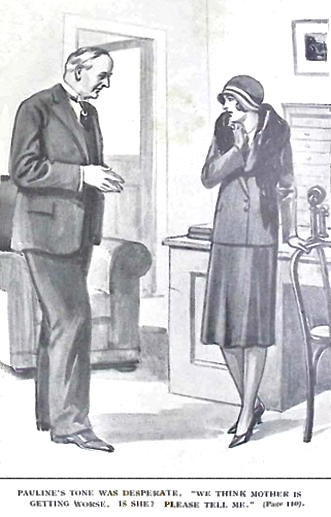
PAULINE'S TONE WAS DESPERATE. "WE THINK MOTHER IS
GETTING WORSE. IS SHE? PLEASE TELL ME."
"Her life may be prolonged by great care. I can say no more."
"And this is all we have got by coming to London and spending more money in a week than we should do in a month at home," thought Pauline, as she joined her mother.
Mrs. Erskine looked at her with a little laugh.
"Well, Pauline, did he say to you the same inanities that he said to me?"
"What did you expect him to say, mother?"
"That a little wholesome change would be good for me, that it was my circumstances which were to be blamed for my present state of health."
Pauline smiled.
"Instead of which he says that quiet is essential to you, and your present life your one hope."
"All doctors are humbugs," said Mrs. Erskine irritably. "I shall go home to-morrow."
That evening, Pauline went round to her cousin's house for an hour or two after her mother was comfortably settled in bed. It was the same house in which she had met Justin Pembroke ten years previously, and the memories that surged up in a flood almost overcame her.
"My dear," said Mrs. Repton, "you have grown into a grand woman. How proud your father would have been of you had he lived! He said to me once, 'My little Pauline will be an unusual woman, and I believe a very good one.'"
Sudden tears filled Pauline's eyes. It was not often that her father's name was mentioned to her.
"Can't you afford to get your mother a good maid?" Mrs. Repton went on. "It is wrong that you should be so tied to her sick-room. You are young yet, and youth soon slips away. You ought to be having your good time now!"
"I am," said Pauline, looking at her cousin with her clear, shining eyes. "I am having a good time every day."
"I can't follow you. Your mother has not changed. And I knew her very well in the old days."
"Oh," said Pauline, "I don't believe any of us ought to feel we are having a bad time if we are doing what we are meant to do. And in the country, Cousin Bertha, life is very full. There are so many that live round us, and whose lives we are bound to touch. I am very interested in my fellow-creatures. I always have been. And if my life is monotonous, some of their lives are not! Do I sound priggish?"
"Not at all. No one who leads the life you do, and who looks as you do, is a prig. Pauline, do you remember Mr. Pembroke? I once thought he was smitten by you, but you were taken away from me before it came to anything."
Pauline schooled herself to reply very steadily: "Yes, I remember him. Is he well?"
"He has been in the wilds of Australia for many years, and came home last week, and is in London now. You may come across him."
"We are going home to-morrow."
"What a pity! I might have had him to dinner, and asked you to meet him. You must marry, child. Have you any admirers down in the country?"
Pauline laughed and shook her head.
But when she returned to her rooms that night, she took herself to task for feeling her heart throb at the mention of one who had once been so much in her thoughts. The very fact of his being in London, of there being a possibility of a meeting, stirred her to the depths of her soul. She shook her head half-humorously at her reflection in the glass, as she stood before it plaiting her abundant golden hair that evening.
"Will nothing but the statement of his marriage with someone convince you that he has never had you in his thoughts?"
And then she went to bed and slept till she heard the usual restless call of her mother.
OLDER AND WISER
"For others' sake to make life sweet,
Though thorns may pierce your weary feet;
For others' sake to walk each day
As if joy helped you all the way—
While in the heart may be a grave
That makes it hard to be so brave,
Herein, I think, is love."
THEY returned home the next day. Mrs. Erskine's fictitious strength and spirits had deserted her.
"I am going home to die," she asserted to her daughter, "and I ought not to have been allowed to attempt this journey. It has sapped all the strength out of me—and the hope and courage, too." She added these last words in a breathless whisper to herself, but Pauline heard them, and she laid her hand affectionately on her mother's arm.
"We are going home together, mother dear, and I mean to take extra care of you. We will give you the quiet and rest you require, and you may feel much stronger soon."
"Stronger!" said Mrs. Erskine bitterly. "I am sinking into a helpless, whining invalid. I can't bear pain now as I used to do, and I am getting tired of the struggle."
Then she relapsed into silence, and would not permit Pauline to touch upon the subject of her health again.
It was a sad home-coming. Mary hovered over her mistress with anxious eyes, but when she was once more comfortably settled in her own bed, Mrs. Erskine looked up into her old servant's face.
"I shall never get out of this bed again," she said. "But I am given to understand that I shall have plenty of time to prepare for death. You won't get rid of me very soon, Mary."
"Eh, mistress dear, don't talk so! The journey has tired you. You'll feel quite fresh again after a few days' rest."
Pauline left the room quickly. She felt strangely unnerved and unfit to take up her daily burdens again. The verdict had not surprised her, but it had taken away her mother's restless hope of getting better, and she knew how hard the coming days would be to them both, and an overwhelming pity for her mother filled her heart.
"If only I could bear it for her!" was her passionate thought.
She went out into the little garden, which was looking dreary and forlorn. Dead leaves underfoot, bare leafless trees, sodden grass, and a few withered dahlias, all spoke to her of death and decay. For a moment, her spirit seemed weighed down by its depressing atmosphere. Then she raised her eyes to the sky above, and sunshine and steadfast hope were in her smile.
"'For we know that if our earthly house of this tabernacle were dissolved, we have a building of God, an house not made with hands, eternal in the heavens.' I must get mother to believe that."
She stayed a little longer, her lips moving in silent prayer; then she went back to her mother, and the old routine of her life began again.
One afternoon, Miss Paton called with some message from the Rector. Pauline had met her several times, and, in common with most people, Miss Paton had taken a violent fancy to this stately golden-haired girl, with her sympathetic eyes and smile.
"I am actually alone to-day. Mr. and Mrs. Broughton have driven into the town, and the children have been carried off to tea at the Osbornes'. Miss Osborne called for them at three o'clock. What a merry little thing she is—almost a child herself!"
"Will you stay and have tea with me?" asked Pauline. "My mother sleeps till five o'clock, so I shall be free."
"I should like to very much. What a cosy little room you have! Whenever I come to this house, it gives me the sense of rest. I suppose wherever there is sickness, there must be quiet. Now, at the Rectory we are in a scrimmage from morning to night, and I seem wanted in every place at once. To tell you the honest truth, I am getting rather tired of it. But I am fond of Emily, and she likes me, and I was at a loose end before I came here."
"Have you any home of your own?" Pauline asked, taking up her work and settling down for a talk.
Miss Paton laughed.
"No. Mother and I came to the conclusion that a home was a great mistake—it tires you so. At least, I felt pretty strongly that way, and she didn't want much persuasion to settle in a boarding-house at Folkestone. I couldn't live a life like you, Miss Erskine; it would drive me mad. I have two brothers who went out to the colonies and married there. And I have a married sister in Scotland. She—er—married my lover; so you have my biography in a nutshell!"
She gave a hard little laugh, then went on:
"Mother and I never could pull together. She is old and fidgety, and I cannot stand old people. I always think strangers get on much better with them than their daughters, because they can't tyrannise over them so much. I bore it for eight months, and then we were both dead sick of each other, so I suggested the boarding-house scheme. It has answered admirably. I go there whenever I want to, and mother and I, instead of snapping and snarling at each other all day, are now the greatest friends. She writes me most affectionate letters. And in this way, I am able to go about and earn a little on my own account. We are not well off."
For a moment, Pauline said nothing. It was not her way to censure people for what they said or did, but Miss Paton's selfish, callous views of life rather took her breath away.
"I think you must be a great comfort to Mrs. Broughton. She is not strong enough to manage the Rectory household single-handed."
"I hope I'm a comfort to her. But, between ourselves, she is rather a humbug. Mind you, I am fond of her—I always was, since we were girls at school together—but it's all take with her, and precious little giving."
"Well," said Pauline, smiling, "it's good to be the giver instead of the taker, isn't it? I am sure in the bottom of your heart you must feel it so."
"Perhaps I do," said Miss Paton hesitatingly. "But I don't think I rank amongst the givers in the world. I'm a pretty selfish lot myself. But one has only one life to live, and single women have to look out for themselves—no one else does it for them."
"Do you find the children difficult?"
"My dear Miss Erskine, they worry me to death! They ought to have a nurse, and I tell their mother so. They haven't the sense to look after themselves. At best, if they do, they get into some scrape, and I can't be at their heels all day. And they're for ever dinning into my ears the virtues of the absent Honor—'Honor did this,' or 'Honor did that'—till I feel I could slap them! Imagine! Mr. Broughton actually said to me one day that he thought it was a mistake girls leaving home when they had a parent dependent on them for help in their old age.
"'Well,' I said, 'your daughter has run away from her home duties as well as I—' And he shut up at once."
"Poor Honor!" said Pauline meditatively. "She was very fond of her home, but, like you, found it a good deal for one pair of shoulders. Still, she did not want to leave."
"Oh, I know all about it. It was another case of not pulling together. Emily wrote me all her woes before I came. Now, honestly, Miss Erskine, don't you think it wiser for people to take the easiest path in life? I do. I should never stay anywhere where I was miserable."
"I suppose you are very susceptible to your surroundings."
"Who isn't? And I love peace at any price. If I don't like a person, I can't help showing it, and then there are ructions. Isn't it far better to separate at once?"
"It just depends on what one's guiding principle is through life," said Pauline slowly.
"Oh, I have no guiding principle."
"Indeed you have, though you may not have discovered what it is."
Miss Paton stared at her.
"You rather interest me—go on."
"But I have done," said Pauline, laughing.
Miss Paton joined her in her laugh.
"I'm so glad you have. I was rather afraid you were going to deliver me a sermon."
Tea came in just then, and they drifted to other topics. When Miss Paton got up at last to go, she said:
"May I come to see you again? People are not over friendly to me here; I believe they consider I have ousted the immaculate Honor from her home, which is ridiculous. You are the only one who has regarded me with friendly eyes. Even that bright little Miss Osborne looked up into my face and said to-day,—
"'I'm afraid children bore you, do they not? These mites were a little spoiled by Honor—she adored them so—and they miss her dreadfully.'
"I am sure she thinks I neglect them, and perhaps I do; but I can't amuse them and their mother at the same time—and she is my friend."
"I shall be delighted to see you whenever you have a moment to spare," responded Pauline warmly.
Miss Paton turned to go, then she looked back.
"Of course I know my guiding principle, and you know it, too. It's to take the easiest way. But I'm not the only one who does it."
"I suppose we should all do it," said Pauline slowly, "if we all believed as you do—that we have but one life to live."
"Oh, well," said Miss Paton, a little shamefacedly, "that was a careless speech of mine—I am not a heathen exactly."
She gave Pauline a little nod, and departed. But Pauline's few words stuck to her, and gave her much matter for thought.
About a fortnight after this, Mrs. Daventry called early one afternoon, and insisted upon taking Pauline for a drive.
"I will not take 'No,'" she said, "for you are needing change of air badly. You are too young to lose your roses yet, and too valuable to us all to overstrain yourself and have a breakdown."
"I am very strong," said Pauline.
But as she spoke, there were tired lines round her eyes and a little droop to her tall, upright figure.
Mrs. Daventry leant back in her luxurious carriage with a sigh of relief, when she had Pauline by her side.
"You have no idea how I long for you when I am driving about. You know that you are my favourite, do you not? And yet I can hardly ever get hold of you. I want to take you to the Burkes' this afternoon. It is a social gathering, to welcome their son back from abroad, and Lady Marion asked me specially to bring you. She has never forgotten meeting you at my house last spring. She says she has seen no one like you in this neighbourhood for years."
"You flatter so," said Pauline, laughing, but casting rather a dismayed look at her plain dark blue cloth coat and skirt. "I am not in company attire, exactly, am I?"
"Quite nice," said Mrs. Daventry. "And now tell me first about yourself, and then about my other girls."
"There is nothing much to say about myself. Mother has had a much better week. Dr. Mann was quite pleased with her when he called yesterday. I heard from Honor yesterday. She always writes a little dismally, but she likes Scotland better than London, and says that Mrs. Montmorency seems to like her better than she did. Poor Honor always makes the worst of herself. I knew she would be appreciated before long."
"And Audrey?"
"Audrey is very busy and very happy. I heard from her this morning. She says, 'I really do believe my Western goal will be a bright path, after all—my storms seem over.'"
"Has she learnt so quickly?" said Mrs. Daventry, musingly.
The drive was a long one, but Pauline enjoyed every bit of the way. When they were ushered into a brightly lighted hall, and thence into a well-filled drawing-room, she was still girl enough to enjoy the gay scene.
Lady Marion Burke received her warmly.
"Let me introduce my son to you. He has been in Australia for many years. Some scientific society sent him out, and he has brought his great chum down from town with him. Leonard, let me introduce you to Miss Erskine."
A keen-looking young fellow, with the tanned skin that tells of an open air life, turned at his mother's words and bowed.
But Pauline went pale to the lips when his companion turned also, and she was face to face with Justin Pembroke.
For a moment their eyes met. Then he stepped forward gravely.
"We met many years ago, did we not, Miss Erskine?"
"Yes, I think we did," she replied with wonderful composure. "You have been abroad a good many years, have you not?"
"A good many, though time flies when one is occupied. Have you seen Mrs. Repton lately?"
"Yes; my mother and I were up in town a short time ago. She seems very well."
"I must go to see her. But, really, we have been so accustomed to our life away from civilisation that we feel a little shy at first when we get amongst our own people again. Burke and I have been in the Bush for the last five years."
They exchanged a few commonplace remarks, then he drifted away from her, and Pauline felt as if she were in a dream. He was very much the same, a trifle greyer than when she saw him last, and his voice not quite so keen and eager. But she felt as if a cold-water douche had descended upon her.
He greeted her perfectly courteously but indifferently. He evidently did not wish to recall the old days. Perhaps, she thought, he had never attached any importance to them, and now they had faded away from his memory. She thought hotly of the weeks and months that had been one long, dreary torture to her, of the hope that lived on, though suppressed and checked in every way, and which even now, though she had imagined it dead, was so ready to rise again with eager expectancy.
The woman had sat still, and waited and hoped. The man had continued his career and forgotten. She smiled a little bitterly to herself. And then, quick to hear anything from his lips, she listened to some bantering talk between his hostess and himself.
"I hope you are both tired of exploring the wilds and have come home to marry and settle down."
"Please be merciful. Why such a fate?"
"It is your duty as a good citizen."
"Then I am afraid that duty will remain undone by me. No, Lady Marion, my work is my companion and my creed. I want no other. There was a time when I thought differently, but I am older and wiser now."
"That is the way you all talk; and the next I hear is that you have fallen headlong into love. Your time has not come. 'Nous verrons.'"
Pauline moved away. She did not want to hear any more. If she had thought that time had wiped away the remembrance of a man's glowing eyes reading her very soul, the death-knell that was sounding within her now showed her the futility of such a misconception. But she resolutely turned her thoughts from the past to the present, and as she responded to her friends around her she was her usual sweet, gracious self.
She did not speak to Justin Pembroke again. And when she and Mrs. Daventry departed, she was unaware that Justin's eyes were following them.
She talked brightly to her old friend driving home, and went up to her mother's room to reproduce the events of the afternoon. But, though she told her of many who had been present, she never mentioned Justin Pembroke's name.
When she went up to her bedroom, she opened a drawer and carefully unlocked a carved ivory box. Taking from it a little packet in tissue paper, she opened it, and held for a moment or two some faded stalks of mignonette in her hand.
Then with a quick gesture she opened her window and flung them out.
"I also am older and wiser now," she said to herself.
And then she went to bed.
AN IDEAL TEACHER
"He who has the truth at his heart need never fear the want of
persuasion on his tongue."—RUSKIN.
"THE doctor wishes to see Miss Hume in his study at four o'clock this afternoon."
That was the message given to Audrey one morning, just a month after she had arrived at Horsborough College. She was looking a very different girl now from what she did when she left London.
Colour was in her cheeks, brightness in her eyes, and vigour and energy in every movement. With her characteristic thoroughness, she had thrown herself wholeheartedly into her work, and was adored by all the small boys, as well as by some of the big ones. Of Dr. Vernon she saw little, and if by chance she came across him, she had very few words to say to him. She found Miss Vernon's speech very true about the boys' world in which she would have to live. And she also found, if her outlook was very broad in some ways, it was very narrow in others. She grew a little impatient of hearing the doctor's praises sung. The two young married women vied with one another in entertaining him, and their pride when he dined or walked and talked with them seemed very small and childish to the independent Audrey.
Mrs. Ross was a pretty little gushing creature, who expected and received much admiration from her friends. Audrey and she did not take to each other from the first. Mrs. Tate, whose husband was the senior master, was stiff in her manner, and a little given to patronising Audrey, who, of course, resented such treatment, and kept away from her in consequence. Miss Vernon and Mrs. Bonar were her great friends, and she wanted no others.
Yet, before she had been there a fortnight, she was beset by much attention from two or three of the younger masters, especially one in particular—a young fellow from Oxford, who was the master in literature and a very able man. He would saunter up to her in the playground, accompany her sometimes when she was walking out with the boys, and hold long conversations with her in the library, of which he was custodian.
At first, Audrey had been very grateful to him for recommending her various books to read. She had enjoyed talking over with him English literature in general, and had thankfully learnt a great deal from him on several subjects. But she grew rather tired of him before long, and was more anxious than he was to cut short their interview.
A chance word from Mrs. Ross had brought the hot blood to her cheeks. They were looking on at a football match, and Mr. Oates had just left her side to obey a summons from the doctor. Mrs. Ross turned to one of the other masters with a little laugh.
"That effort will fail; it is like separating a needle from a magnet. If I were the doctor, I would not show my hand so soon, for I am sure it will die a natural death. Mr. Oates is such a very impressionable youth."
Audrey had moved away, controlling her indignation. Now, as she was crossing the square to the doctor's house, she wondered if she was to be rebuked for her intimacy with him.
Her lip curled in scorn at it.
"Life in a boys' school is petty," she said to herself.
And it was in this frame of mind that she greeted the doctor.
As he drew forward a chair for her close to the fire, she seemed to see herself in that same chair on the occasion of her first interview with him; the remembrance of her humiliation then brought an aggressive note into her tone.
"I was told you wished to see me," she said.
Dr. Vernon smiled as he seated himself opposite to her.
"I assure you it is not an unusual thing for me to wish to see any one of my staff. As a matter-of-fact, I always like the heads of the houses to come and report themselves once a month; it gives us an opportunity of talking over any difficulties that may have occurred. My sister tells me she did mention this to you."
"I believe she did," said Audrey, a little ashamed of herself. "But really, I have nothing to say. I have had no difficulties. Life seems almost too easy for me now."
He glanced at her, and could hardly believe that this bright, radiant girl was the same who had stood looking like a white wraith as she defied him in that shabby little back parlour in London.
"That was one of the things I wished to ask you," Dr. Vernon said, "whether you like your work and are happy with us. You were to give it a trial, you know."
Audrey's face sobered.
"Yes," she replied. "I like it. I suppose I ought to ask if I suit?"
"I hear you manage everything admirably. Perhaps, if anything, your reins are a little too slack?"
Audrey looked up quickly.
"Is that what Mrs. Bonar feels?"
"It is what 'I' feel."
The quick colour rushed into her cheeks.
He went on:
"Two of your small boys scaled the wall of my private garden yesterday in play hours, and they invaded Jenkins's forcing-house. He discovered them before they had abstracted any of his fruit, and let them off. How was it they were not in their own playground? I think you generally supervise their games?"
"Yes," said Audrey, looking up at him frankly. "It was my fault. I took a library book out into the playground. They were all kicking a football about, and I did not miss the absentees till we were going in. But I was told about it by the culprits themselves, and I think if you heard me lecture them, you wouldn't think me so slack. Have you any other instance of my loose reins?"
"I was told you let two of your small boys walk into Bulton. I have had to place it out of bounds—did you not know this?"
"I did not think our house was included in that order."
"You are included in every order. And in any case, your youngsters are too small to go off alone."
"I think," said Audrey meditatively, "that too much independence is better for boys than too little. If they are restricted too much, they will break out sooner or later."
"But," said Dr. Vernon quickly and sharply, "as you are not the principal of this college, your thoughts must not be put into action. It is your place to obey school orders implicitly and unhesitatingly."
"Oh, I know. Our little kingdom is absolutely an autocratic one."
Her brows were knitted as she spoke—and there was absolute silence for a moment. Then Dr. Vernon said in a different tone:
"What do you think of our library? You are a great reader, are you not? If I can be of any help to you about books, I shall be very glad. Perhaps I could lend you some?"
Audrey gave a quick glance at his well-stocked book-cases, and replied:
"No, thank you. I haven't come nearly to an end yet in the library."
Then she rose from her seat.
"I see," Dr. Vernon said with a little smile, "that you will have nothing to do with me at present. And perhaps you are acting wisely. Only, may I make this request—that you treat all my masters as you treat me? It will be best for all concerned if you do."
Audrey's hot blood rushed into her cheeks, and her eyes flashed angrily.
"Good afternoon," was all she said.
But she left the room with the air of an offended queen, and Dr. Vernon smiled again, and then sighed as the door closed upon her.
And Audrey walked back to her house in a tumult of indignation.
"I will not be dictated to by him! I am not a school-girl. His position does not give him absolute power over my movements! Oh, how proud and touchy I am! And, though I hate his rebukes, I have myself to thank for it. I can't be too careful with these wretched young men! I declare I feel inclined to cut and run from it all!"
Naturally impulsive, she burst into the drawing-room, and found Miss Vernon and Mrs. Bonar enjoying a chat together. Their sudden silence as she entered made her say, with an embarrassed laugh:
"I am sure you are talking about me."
"Yes," said Miss Vernon, "we are. Have you just left the doctor?"
"Yes. I have received his scolding and am trying to digest it."
"My dear," said Mrs. Bonar, "I am sure that is one thing that the doctor never does. He speaks out, of course, but the art of scolding is not his."
Miss Vernon immediately whipped out her pocketbook.
"That's very good, Mrs. Bonar, and very true. Everard cannot scold. You know, I am making notes about him now. I am coming to his biography. Of course, this is quite between ourselves. He would be angry if he knew, but the whole of my researches of the Vernon family is only leading up to him. I always think I shall see Everard an archbishop before I die. And any little characteristic that outsiders note in him will be valuable to me. If you come to think of it—" here Miss Vernon leant back in her chair, poising her pencil between her fingers and looking across at Audrey with a thoughtful smile—"scolding or nagging is a lack of concentration, and a sign of a weak nature. Women scold, men hardly ever. They use a few decided words to express their displeasure, and let the subject drop."
"Then," said Audrey, laughing, "the doctor has expressed his displeasure. And I came out of his room feeling very angry with him, but now I feel rather angry with myself."
"I never interfere with school matters," said Miss Vernon a little loftily, "but I want you to come to tea with me to-morrow afternoon, Miss Hume. I won't take a refusal, for I know you have no good excuse to get out of it."
"Why do you think I shall want to refuse?"
"Because you have been less in our house than any other member of our staff, and because you may be afraid of meeting my brother."
"That I shall 'never' be."
Audrey held her head high, and the light of battle was in her eyes.
Miss Vernon laughed.
"I used to have a hot temper when I was a girl, so I can sympathise with you. It is in our family. Everard has it still. You will come, then, to-morrow?"
"Thank you, I will."
Then Miss Vernon took her departure, and as she went out of the door, she patted Audrey affectionately on the shoulder.
"I am very fond of you, Miss Hume, so you must not mind my teasing. And I do think I was born without that very feminine trait of inquisitiveness, so I shall not want to know why the doctor offended you, or anything about your interview. And I give you my word for it that he will have forgotten all about it himself to-morrow. He interviews so many every day. You are only a unit, after all. Good-bye, my dear."
"Only a unit," Audrey repeated to herself as she stood at her bedroom window later that day, looking out upon a moonlit, frosty scene in the garden below. "How big I seem to myself! And how very small to everyone else! I'm just part of the school here—a bit of the machinery that makes the wheels go round. Oh, why do I feel so dissatisfied to-night? I will write to Pauline. That always makes me feel good."
Miss Vernon was entertaining some of the elder boys the next afternoon, and one or two friends from the neighbourhood. Dr. Vernon did not appear, but Miss Vernon kept Audrey after her guests had departed, and it was then that he walked into the room. He shook hands with Audrey rather absently, then turned to his sister:
"Was Archie Wren with you this afternoon?"
"Yes. He's a nice boy—one of my favourites."
"I am very glad. I was afraid he was elsewhere."
Miss Vernon did not ask him to explain himself, but Audrey knew that several of the elder boys had lately been giving their principal trouble by slipping off to Bulton, the neighbouring town. It had been put out of bounds, owing to the misconduct of an unruly set who had had friction with a grammar school there. But as the shops in it were a great attraction to the boys, they resented being kept away from it.
"You may be quite certain," said Miss Vernon, with one of her decided little nods, "that Archie will do nothing to cause you anxiety. I'm a pretty keen student of faces, and those particular grey eyes with dark eyelashes and eyebrows always belong to a frank, fine nature. The only other person with such eyes is Miss Hume, and if you look at them, you are perfectly certain that you can trust her, and that honour, frankness, and fearlessness are her chief characteristics."
"Oh, Miss Vernon, spare my blushes," exclaimed Audrey, laughing. "You quite take my breath away."
Dr. Vernon smiled.
"Your character won't suffer in my sister's hands."
And just for a moment, he glanced at Audrey's expressive grey eyes.
She rose to go, but Miss Vernon stopped her.
"I have promised Mrs. Bonar an old-fashioned recipe for open wounds. She would like it for her surgery. Wait a few minutes. It is in a book of my mother's, upstairs."
She left the room. Dr. Vernon stood on the hearth-rug warming himself at the fire. Then he suddenly turned to Audrey.
"I felt I had missed my opportunity yesterday. I am glad to have another given me. Will you listen to me for a minute or two?"
"Certainly," said Audrey gravely.
Dr. Vernon was silent for a moment, then he spoke in a low, intense tone.
"I do not know much about you, Miss Hume, but I want you to do for your small boys what your mother did for me. No one knows better than a schoolmaster how important it is to have a good influence brought to bear upon boys in their earliest years. You know the oft-repeated adage:
"'Give me a child till seven years, and I will make the man.'
"I don't doubt that your influence is on the side of right and honour. But Miss Hume, I want something more than this—I want their young lives to be brought into touch with God. Habits of prayer and faith and trust are a man's safeguards through life. He may leave them for a time, but they have a strong magnetic power, and will surely draw him back at a later period. I would not dare to say that you could give them the touch of life in their souls. This, we know, can only be done by God alone. But you have your opportunities of teaching them, and winning them, and—may I say?—of bringing them to the arms of the Saviour for the blessing they need. I want the foundations of their creed to be laid in the preparatory school before they come into the more public atmosphere of schoolboy life. It is a grand work for anyone to put their hand to, and I long that it should be thoroughly done. Will you co-operate with me in this?"
Audrey sat still with her hands clasped in her lap. She did not look up or move, but her soul was stirred within her.
And Miss Vernon's entrance kept her silent.
She took the recipe, said good-bye, and departed.
Dr. Vernon accompanied her to the hall door.
Then, for an instant before she went down the broad steps, she looked up at him.
"I will give you my answer later," was all she said.
She had little time for thinking till she went to bed that night. Mrs. Bonar had insisted upon her having a small fire, as the weather had set in very cold. So, wrapping her dressing-gown about her, she sat down to enjoy the firelight.
"What a shallow fool I am!" was her soliloquy. "What an ignorant, self-satisfied, conceited creature! I have actually plumed myself upon my capabilities as teacher and trainer to these children! I have thought myself quite adequate to my position, and am perfectly complacent and satisfied as to the way I work. And all the time I might have known that I could never reach Dr. Vernon's ideal. I am utterly unfit for the work he wishes me to do. I can't be a hypocrite. I can't teach them what I have not grasped myself. I can only teach them the form of religion, and what good will that do a boy? Yes, I can teach them habits of prayer, I suppose, but unless I go farther than that of what use am I? I always told Pauline I had not reached the kernel, only touched the husk. What is my own creed, I wonder? What do I believe with all my heart and soul?"
Her head sank into her hands. For a moment, she was grappling alone in the dark after the facts of eternity. And very soon a passionate, desperate prayer rose from her lips and soul:
"O God, teach me myself, that I may teach them. I know nothing of Thee
yet, and till to-night, I have known nothing of myself. Take me in
hand, and make me what I ought to be."
For in the depths of her despair came the words that she had heard in the doctor's sermon upon her first Sunday here:
"Without Me ye can do nothing!"
For the first time in her life, Audrey realised that she had been weighed in the balance and found wanting, and that not only by Dr. Vernon, but by her Creator and her God.
It was past midnight when she roused herself and crept into bed.
AN EMPTY SHRINE
"A humble knowledge of thyself is a surer way to God than a deep search
after learning."
"DEAR DR. VERNON,
"I have been thinking over what you said to me last night, and I have
come to the conclusion that I am unfit for my position, so will you
release me from it? I cannot do what you ask me. You must get someone
else who will be able to carry out your wishes. I cannot pretend to be
what I am not, nor teach what I do not practise myself.
"Yours truly,
"AUDREY HUME."
It was at luncheon time that Dr. Vernon received this note. He knitted his brows after reading it, slipped it into his pocket, and went through his daily routine of work as if he had not received it.
Audrey waited all that day for his reply, but did not get it. She was shy of a personal interview, and hoped he would write his answer. Her work also occupied her. The weather was stormy and cold. After evening preparation, the little boys were allowed half an hour's play before going to bed. They were clamorous this evening for Audrey to join them in a game of "blind man's buff," and, feeling restless and ill at ease, she threw herself into the game with unusual zest. The clamour was at its height, the schoolroom in darkness and confusion—and fourteen boys' throats can make no slight noise when raised in excitement—when the door suddenly opened and the doctor's voice was heard:
"Is Miss Hume here?"
The electric light was turned on, and Audrey, who was "blind man," tore her bandage off in consternation. Her hair was most dishevelled, her cheeks flaming, her skirt was tucked up high above her petticoat. Never had she been taken so by surprise.
"I am afraid I have interrupted some fun," said the doctor, smiling at the small boys, who stood mute and awed at the appearance of their headmaster.
"Our time is just up," said Audrey, with an effort to speak calmly. "Bobby and Frank, you must come to bed. Will you give me a few minutes' grace, doctor? For these little wretches have been pulling me to pieces."
She left the room with the two smallest boys.
Dr. Vernon sat down and began chatting in his easy, happy fashion to the boys who remained.
When Audrey returned five minutes later, she found a little group surrounding the doctor, listening with delighted faces to a stirring story of adventure and experience of the doctor's boyhood.
"Oh, Miss Hume, do listen!" exclaimed one of them. "You would love to hear this; he was almost as bad as you and your brother used to be."
"Shut up, you rotter!" was the whispered reproof of another. "The doctor isn't a he!"
Audrey and the doctor laughed in unison. Then he got up from his seat.
"Can you give me a little of your time, Miss Hume? I came over after dinner, as I thought these youngsters would be in bed, but I am a little early."
"I fancy we are a little late," said Audrey. "Will you come into the drawing-room?"
She led the way, feeling rather nervous of the prospect in front of her. The room was empty. Dr. Vernon wasted no time.
"I thought I would like to answer your note in person. It surprised me, though I quite understand your point of view. Shall we sit down and talk about it?"
"I am afraid that is just what I cannot do," said Audrey in a very subdued tone. "I only know that I cannot train your small boys in the way that you desire. I wish I had known before I came what your principles were. But you did not give me much chance of refusing."
"Perhaps I did not. But, Miss Hume, I do not want to lose you. You are not an irreligious girl, and I am sure you have thinking powers. Have you no ideals yourself? Don't you expect to do good and lasting work as you go through life? Are you one of those who are satisfied with second best? I want you to use your opportunities. If you do not, you will assuredly look back to this time with bitter remorse and regret. Half the world is reaching out or waiting for opportunities that will never come. The other half have the opportunities, but are not using them. Why can't you seize yours, and make the best of them?"
"Why?" said Audrey slowly. "Because you must know before you can teach."
"Is it faith that is lacking? Or disinclination to use the faith that is in you?"
"Oh, I don't know—that I have any at all," said Audrey, looking up sadly.
All her usual vivacity and sparkle had disappeared. There was a pathetic droop to her figure that reminded him of the time he saw her in London.
"May I ask you if you believe in the existence of the Trinity?"
Audrey was silent for a moment, then she said:
"Yes—with my head I believe in the Trinity. I believe my Bible. I read it every night, but it does not make any practical difference in my life. I asked myself last night whether I should live any differently if I were convinced there was no God—and I really am afraid I should not."
"You are so little concerned in One Who is so wonderfully concerned in you?"
"I am only a unit," said Audrey, remembering Miss Vernon's words and applying it to her case.
"But the whole teaching of the New Testament is to show that Christ deals with units."
There was a pause. Then Dr. Vernon suddenly pointed to a picture on the wall. It was called "The Empty Shrine," and depicted a little roadway scene in Brittany, where a group of disappointed peasant pilgrims are gathered round a shrine which is tenantless.
"I always think that that is a picture of ourselves before we realise our purpose in this world. We are not containing what we should, and are a bitter disappointment to those who look to us for help. We fail when others need us."
"Oh, I know—I know," said Audrey passionately. "I have thought it all out. I am a failure—a dead certain failure. And, being so, I will stay here no longer."
"But do you mean to continue one?" said Dr. Vernon. "Why should you not bring success into your life? Do you always wish to be an empty shrine?"
"What do you mean?"
"May I give you a simple illustration that I heard a clergyman use once? It just describes the work of the Trinity as far as we ourselves are concerned.
"Three men were walking up a street.
"The first one came to a corner house.
"'That is my house,' he said with a nod of possession."
"The second man passed the house.
"'That is "my" house,' he said.
"The third one came up to it.
"'That is "my" house,' he said emphatically—and he went into it."
"What a funny illustration! I don't understand it one bit," said Audrey.
"May I add the explanation?
"The first man said, 'That is "my" house, for I built it.'
"The second said, 'That is "my" house, for I bought it.'
"The third man said, 'That is "my" house, for I live in it.'
"God the Father says of your soul, 'That is My soul, for I made it.'
"God the Son says, 'That is My soul, for I redeemed it.'
"God the Holy Ghost says, 'That is My soul, for I have the right to
live in it.'"
Audrey made no response for a few moments, then she said slowly:
"You have hit the nail on the head, Dr. Vernon. I am an empty shrine, and I never knew or realised it so deeply as I do now."
"Well," said Dr. Vernon, rising and speaking more briskly, "you must forgive me if I don't accept your notice to leave me. In any case, you must stay out this term. By the time Christmas comes, you may think very differently from what you do now. Work the subject out with your Bible before you, and you will find light. Only don't be content with half measures. And look up, Miss Hume."
He left her. And for a moment, Audrey felt dazed.
"He takes my breath away!" she exclaimed to herself. "Oh, what an illustration! Made, and bought to live in, and yet I know I am tenantless. What a failure I am!"
She searched her Bible that night as she had never searched it before. Her whole soul was stirred and alive with passionate unrest and yearning. But light and comfort did not seem to come. Her perplexities and despondency rather increased, and as days went by, her voice lost a little of its merry ring, and her lighthearted gaiety and enthusiastic fervour seemed to be fading away.
Mr. Oates was still pertinacious in his attendance upon her, and at last, one afternoon, when he sauntered across the playing fields to her, she turned upon him.
"Look here, Mr. Oates, I am very sorry, but I would rather you kept away. It's very ridiculous, of course, but I find that even in a boys' school tongues will wag. I have my province, and you have yours. I have to walk very warily."
"It is indeed ridiculous," he said indignantly, "that we cannot have a little conversation together. I have brought you this new book. Have you read it? It is by a new author. It isn't a library book. The doctor is a little old-fashioned in his notions of books, but, of course, he has boys to consider. I saw this advertised, and bought it. You know what a temptation new books are to me."
Audrey took it into her hand and looked at it rather absently. The title, "Life from My Outlook," attracted her.
"Thank you," she said. "I shall like to look at it, and I will return it as soon as I have done with it. No, don't say you will come and fetch it, for that is just what you mustn't do."
"Neither you nor I need be in such bondage!" he said hotly. "Who has been talking? You don't care for women's spite, do you?"
Audrey shook her head at him.
"I am not my own mistress," she said, "and my work here demands my constant and undivided attention. Look at those imps! What are they doing?"
She darted forward to extricate the smallest boy from a medley of arms and legs in a writhing mass on the muddy ground. Six bigger boys were trying to wrest a football from him, and he was decidedly the worse for their efforts.
Mr. Oates shrugged his shoulders and walked away.
But he did not heed her warning, and Audrey soon began to dread the sight of him.
As time passed and the Christmas holidays drew near, she began to wonder where she could go. The school was virtually going to be closed. Dr. Vernon and his sister were going up to Scotland to spend Christmas with some relations. The Tates were going to London. Mr. and Mrs. Ross were the only ones left, and they had one or two Indian boarders who wanted a home. Mrs. Bonar was going to her married daughter.
Audrey asked what would become of two of their small boys who had no home to which they could go.
"Well," said Mrs. Bonar, "the doctor was speaking to me about them the other day. He said, of course, you would be wanting to go to your friends. But he will arrange for Mrs. Ross to take them into her house and look after them."
"Hadn't I better stay?"
"Oh, no, my dear. Why should you? I don't think the doctor would like to leave you alone here. You are very young, you know."
"I don't feel so," said Audrey, laughing.
But she was perplexed and troubled at the prospect in front of her. Her old home was still let. Lodgings in London did not sound attractive after her recent experience there. She was too proud to hint to Pauline in her frequent letters to her that she was wanting a home.
And then one morning came a letter from Mrs. Daventry.
"MY DEAR AUDREY,
"I am sure it is nearly holiday time. Now, will you come to me and
cheer me up this Christmastide? All your old friends are wanting to see
you. I shall be very quiet, for I have no guests coming to me. But I
don't want to lose touch with you, and letters are a poor substitute
for your fresh young voice and eager personality.
"Tell me what day to expect you, and I shall give you a warm
welcome.—Your affectionate old friend,—
"MYRA DAVENTRY."
Audrey thankfully and gratefully accepted this invitation. She had an intense longing to revisit her old "backwater," and the prospect of long talks with Pauline filled her heart with content. She went about with such a bright air that Dr. Vernon, meeting her in the quadrangle one day, said, smiling:
"Your school time will soon be over now. I suppose you, like the rest of us, are going to enjoy your time of leisure?"
"I don't think I am very fond of leisure at present," said Audrey, sobering at once. "Of course, I am glad to see old friends again. But I love a busy life. I hate idleness."
Then she added, with a world of wistfulness in her grey eyes:
"I may not come back, you know. I have not forgotten our talk."
"But you must not fail me if you can help it," Dr. Vernon said earnestly. "Be what you are meant to be, and what you profess to be. I only want sincerity in my workers. You are a Christian by profession; don't rest till you are a genuine one."
"But," said Audrey impatiently, "you might as well tell one of your boys to be the Prime Minister. I can't make myself a genuine Christian."
"No, but you know that simple little verse I often repeat to the boys:
"'Without Me ye can do nothing.'
"That is the locked gate. The key that opens it is:
"'I can do all things through Christ which strengtheneth me.'"
He said no more, but Audrey sighed deeply when he left her.
"I can't get hold of it," she said mournfully.
And it was in this spirit that she left the college and went to Mrs. Daventry.
CONFIDENCES
"Souls that carry on a blest exchange
Of joys they meet with in their heavenly range,
And, with a fearless confidence, make known
The sorrows Sympathy esteems its own—
Daily derive increasing light and force
From such communion in their pleasant course."
COWPER.
"AND now, dear Mrs. Daventry, tell me all the news."
Audrey was sitting with her old friend in the drawing-room after dinner. It was a cosy, comfortable room, with an ingle nook by the fire, and it was a delicious experience to Audrey to be in such luxurious surroundings.
She laughingly said as much to her hostess.
"I'm not accustomed to laze. I never could do it when dear father was alive, and since then, I have been tossed up and down, and buffeted by thorough westerly gales. Do you remember our gates? I never have forgotten them. I'm sure I shall have squalls all my life."
"But, my dear, you are happy and comfortable at Horsborough College, are you not?"
"Yes, but I do not think I am going to stay there, and it is a very busy life, Mrs. Daventry. I have no chance to be lazy."
"Then you will appreciate this resting time all the more."
"I do."
And then Audrey asked for the news of the neighbourhood.
"There is not much to tell you. Amabel is away visiting her 'fiancé's' people. She is to be married in January, and go to India with her husband."
"The poor Osbornes! How will they bear the parting?"
"As cheerfully as they do everything else. Then Mr. Broughton has imported an organist who is a gentleman. He is somewhat of a character. He has private means of his own, and has furnished two rooms over the village post office in rather a sumptuous way. He lectures on a variety of topics, and is a very good speaker. He goes about the country a good deal, delivering parish lectures on astronomy, hygiene, health, temperance, and Church history. He is quite a nice man, about forty, and very wiry and keen over his lectures. He reads the lessons in the church sometimes, besides playing the organ, and we all enjoy his music immensely."
"He will be an amateur curate, perhaps," said Audrey. "I shall like to know him. His advent must have fluttered the whole district. How is Pauline?"
"Dear Pauline. I won't pity her—somehow one cannot. She is so sweetly cheerful and contented with her lot, and yet what a monotonous, trying life it is! I know you will be off to her the first thing to-morrow morning, won't you?"
"I have missed Pauline more than anyone else," said Audrey earnestly. "And has Honor been heard of? Is she never coming home?"
"Yes; she is coming back for ten days. She will spend Christmas here. It will be pleasant for you girls to meet again and compare experiences."
"I have learnt that I am a failure in life," said Audrey quickly.
Mrs. Daventry looked at her keenly.
"I was thinking that a little bit of the old Audrey is lacking."
"Which bit?"
"The bright, audacious bit."
"The self-satisfied, bragging, self-opinionated bit, I hope. But it's underneath, ready to pop up again, Mrs. Daventry, only it has been terribly battered about and crushed."
Audrey smiled, but it was a rather a sad smile, and then she sat back in her chair and was silent.
Mrs. Daventry did not press for her confidence. She knew she would have it before long. And when she began to question her about her daily life at the college, Audrey grew quite animated again over her small charges.
The next morning, after breakfast was over, Mrs. Daventry said:
"Now I have a good many letters to write this morning, so will leave you to your own devices. If you would like to walk over to Pauline, will you take her some grapes for her mother?"
"You know I shall be delighted," was the quick response.
And soon Audrey was swinging along the road at a good pace. It was a frosty morning, the hedges and trees were still covered with hoar-frost, and the road hard and dry as iron underfoot.
Audrey felt exhilarated. And when Pauline met her at the cottage porch, she thought she had never seen her look happier.
"Oh, Pauline, how delicious to see you! May I pour out? I'm aching to tell you all about myself. But first, how is your mother? And you're looking fagged and white, except your eyes. Do you know, they always seem to me as if they must set light to whatever they rest upon!"
Pauline laughed, and linked her arm in hers affectionately. "Come along in. Mother is sleeping. The morning is my free time at present. We have all missed you, Audrey dear. Our backwater is very smooth and still when you are away."
"But, do you know, I am actually glad to get back to it again? There is nothing like the place in which one has grown-up and lived, after all. I feel no one cares about me or takes any interest in me elsewhere. I have made no real heart-to-heart friends since I have been away, Pauline. And now may I tell you all from the very beginning since I left here? I couldn't write it, but I can tell you everything, because I know you are safe to keep it to yourself. Now, first I will tell you about my father's letter."
Audrey sat down by the small fire in Pauline's sitting-room and plunged headlong into her recital. Not a detail did she miss. Pauline had all the terrible time in London, and as she listened, work in hand, her work dropped from her fingers in the interest which she felt. Audrey hid nothing from her, and concluded by repeating her recent conversation with the doctor when she was asked to do what she felt was impossible. And then, with a little unhappy sigh, Audrey continued:
"So, you see, Pauline, as I said to Mrs. Daventry last night, I am a failure. I have been crushed and humiliated in every way, and I begin to feel that I needed it. I started away from home with too big ideas of myself and my capacities for work. I was full of enthusiasm and energy. And then my time in London showed me my deficiencies as nothing else could have done. Yet when I got a fresh start at the college, and seemed to be doing so well, I patted myself on the head again, and said:
"'They are finding out your worth. They have never had anyone so thoroughly capable as yourself, or so popular with the small boys.'
"And I felt that Dr. Vernon must be thankful for my services. Then, you see, I had to be suppressed again, and this time the deep things of life were touched upon. It seems to me now as if God's hand has been on it all. The westerly gales have beaten me flat, and I cannot rise up again. I am a humbug at religion, Pauline; and, somehow or other, I can't put myself right, or, as Dr. Vernon said, let God do it for me. You see, I have been reading a great deal, and I'm a little unsettled in my own mind about these things. The last book I read seemed to open up fields of thought and conjecture which I have never touched before. I am miserable—it all seems doubt and confusion, and no light comes. And the worst of it all is that unless I can get right spiritually, I won't go back to the college—and that's a noble incentive to get right with God! I despise myself when I think that I must become truly religious in order to keep my situation, which means my daily bread! And yet this is the fact, and the knowledge of it stings me and prevents me from making such a mockery of it."
"But, Audrey dear, apart from your school life, don't you feel a craving after the real truth? God may be causing your circumstances to make you draw near to Him. If He has shown you that you are not as infallible as you once thought yourself, does not that pave the way to come to Him for His strength?"
"It ought to. But I have so many doubts. I am beginning to disbelieve in everything, even—even God Himself."
Pauline did not look shocked. She had a wisdom beyond her years, and she knew the intoxication of new knowledge to a girl of Audrey's calibre.
"You have been reading a great deal, have you not? And in your reading you have imbibed the doubts and scepticism of other minds. You have been drinking subtle poison without an antidote."
"That sounds narrow, Pauline, and it is not only other minds—it is my own mind. I am working things out—mentally, I mean. I am seeing how many sides of truth there are, and what diversities of opinions, and how everyone thinks that they must be right and others wrong. Yet when I hear Dr. Vernon preach, everything seems swept away, and I come home with a fresh, firm grip upon the things I was brought up to believe, until I remind myself that this is only the result of eloquence and a strong personality. I am in a very gulf of raging doubt and unbelief. Help me! I want to be helped."
"Tell me some of the books you have been reading."
"There are so many—Emerson, Carlyle, Richter, Strauss, Swedenborg, Huxley, Herbert Spencer, and a multitude of others."
"And you have not been able to sift the good from the bad?"
"I don't think I have."
"You see, you have been reading and believing men rather than reading and believing God."
"Oh, I have been reading my Bible, too, but I'm in a muddle."
"If you're fond of reading—and I know you are—you must read thinkers who are quite as clever as those you mention, but who take their stand on the Word of God and never move from it. Paley is an old-fashioned writer, but he is a very good one, and I could give you half a dozen more—or Mr. Broughton would, if you asked him. Long ago, I did have a bad time myself with some books that were lent me. But, Audrey, dear, if you read attacks against our faith, you must read the defence."
"But these don't attack; they are most of them very good men. I haven't been reading infidel works, Pauline—I have only been dipping into philosophy."
"You have been reading men's explanation of God. It is best to read God's explanation of Himself."
"You mean the Bible? I do read it, but I feel rather astray in it."
"What part have you been reading?"
"The Psalms, chiefly."
"I think," said Pauline slowly, "that if you want to realise God's omnipotence and power you should read the prophets; if you want to realise His love, you should read the gospels; and if you want to know His doctrines, and the practical outcome of them in our daily life, read the epistles. I am quite certain that no book convinces like the Bible, and the more you study it, the stronger your faith will become."
Audrey was silent for a moment.
"Honestly, I don't know which I want most, Pauline—to go on with my work at the college or to be a sincere Christian. I wish one did not depend upon the other. Don't you think it is very difficult for me?"
"Yes, I think it is."
"And I cannot get that illustration Dr. Vernon gave me out of my head. I told you about it—the house and the three owners. If it is all true, what a failure I must be in the sight of God! And I think, in the bottom of my heart, I am not a doubter; it is like going across stepping-stones in the dark. I believe they are there, but I can't place my foot on them. Well, I've had a delicious time with you, and now I must be going back, or I shall be late for lunch."
She got up to go, then kissed Pauline warmly.
"You're a proof of the genuineness of Christianity. Tell me, are you 'always' happy?"
"No," said Pauline promptly. "I shan't be happy now till you are."
"But is your happiness made up entirely of other people's concerns?"
"Chiefly, I think. My own are so very commonplace. Good-bye, dear. Let me see you again soon. Put the college out of your head. 'Seek ye first the kingdom of God, and all these things shall be added unto you.'"
Pauline stood in the porch watching her friend go.
And as Audrey turned at the gate, a gleam of winter sunshine slanted down and caught the golden coils of Pauline's hair, crowning her with a halo of light.
"Ah!" said Audrey, with a long-drawn breath. "If she were in my place, what a trainer she would make for the doctor's small boys! That is the kind of woman he wants—not somebody like me!"
That afternoon, she drove out with Mrs. Daventry. They paid some calls, and met the new organist—a Mr. Danby.
Mrs. Daventry asked him to dinner that same evening, and he accepted the invitation.
He was a thin, keen, grey-haired man, with a boyish way of speaking that attracted Audrey at once.
"He must be quite an acquisition," she said. "How can he be content to be down here if he is clever? There must be some mystery about him, because he strikes one as being a gentleman."
"I don't think there is a mystery," said Mrs. Daventry. "He told me he had no belongings. He was an only son, and was brought up in India, where his parents died. His father was a judge in the Civil Service. I think he tries to use his talents; he says country people want more knowledge than town ones, as their opportunities of hearing are so much fewer."
"I should like to hear him speak. I do enjoy lectures don't you? We have some at the college—for outsiders as well as the boys. There is a Mr. Oates there—he is a very clever lecturer. He has been giving some English literature lectures, and I have been enjoying them quite as much as the elder boys. I knew I was very ignorant, but never realised I was quite so bad until I saw how much the boys were taught. I wish you knew Dr. Vernon, Mrs. Daventry; you would like him."
"Schoolmasters frighten me," said Mrs. Daventry, smiling. "They look at life in such a scholastic way that I always fight shy of them. But I have heard that Dr. Vernon is an exceptionally nice man, as well as an able one."
When Mr. Danby arrived that evening, he was in very good spirits.
"I've had a ripping practice this afternoon. We're going to astonish you with an anthem on Christmas Day, Mrs. Daventry. Hope you don't object. Believe some people in the country do."
"You have very raw material to work upon, have you not?" said Audrey. "When Miss Broughton went away, I was organist 'pro tem.' But I found it very hard work."
"Perhaps you were lacking in enthusiasm," Mr. Danby said. "That carries you a long way. I hope I shan't lose mine. Most people do before they come to my age."
"I think I'm just beginning to lose mine," said Audrey meditatively.
"Ah! Don't you do it. Hope is the forerunner of enthusiasm, and you're too young to lose that."
"She is not going to, I am sure," said Mrs. Daventry quickly. "Are you going to give us another lecture soon, Mr. Danby?"
"I have promised to give one on Boxing night. The Rector wants me to keep some of the men out of the public-house that night. Now, if you revelled in strong drink, Miss Hume, what subject would be strong enough to keep you from it for a couple of hours?"
"It requires thinking out," said Audrey. "I don't think a temperance lecture would."
"Quite right! Just what I said to the Rector. My bait must be gilded. I had thoughts of 'Wives and How to Manage Them.' What do you think of that? Being a bachelor is a disadvantage, to be sure. But I don't think it would tell against me in their eyes. 'My Pocket' is another title. Do you know Miss Erskine?"
He turned to Audrey with a sudden change of tone.
"She is my greatest friend," said Audrey warmly.
"Of course she is, if you know her. She's an awfully good sort, and what a regal grace she has! She and I are getting chummy; she told me of one or two points I missed in my last lecture. A clever woman—very—and a real good one—not the sort you would expect to find hidden away in a rural village."
Mrs. Daventry laughed.
"We're not all aborigines, Mr. Danby. The country holds a good many such, I hope."
"Oh, no, Mrs. Daventry," said Audrey eagerly. "There can be only one Pauline."
She enjoyed Mr. Danby's lighthearted conversation. He played to them after dinner, and, once at the piano, his vivacity left him—his music was exquisite—and his mood changed from gay to grave immediately. From rather a solemn prelude, he grew more and more pensive and sad, and at last, Audrey felt the tears creep into her eyes against her will.
When his last note died away, he jumped up and said good-night.
"I can't talk," he said. "I'm possessed with my tyrannical muse."
He was off and out of the house before Audrey could exclaim:
"Is he a genius or a crank, Mrs. Daventry?" she said, laughing.
"A little of both, perhaps. I told you he was a character."
"He is a real musician. How fortunate Mr. Broughton is to have got hold of him! Does Pauline like him as much as he likes her?"
"I think she likes him," said Mrs. Daventry, smiling. "We all do. He is almost a Mark Tapley."
"I don't like people who are always cheerful," said Audrey. "It is so monotonous. Of course, Pauline is; but she gets grave and sympathetic in a moment. Now, this Mr. Danby has a set smile. I don't care for men who smile."
"You are graver than you used to be," said Mrs. Daventry.
"I feel grave. Life has different turns in it from what I thought it would have. At least, my life has. And at present, Mrs. Daventry, I can't detach myself from my own life as Pauline does. I'm quite absorbed in it."
"You haven't got to Pauline's stage yet:
"'A heart at leisure from itself
To soothe and sympathise.'"
"No, indeed, I haven't. I'm a seething sea of unrest and riot. Mrs. Daventry, have you been good all your life?"
"Good? I can't claim to be that, but I know what you mean. I have had a great many ups and downs, Audrey, dear—more than I hope you will ever have."
"Have you ever had a time when you doubted everything, when everything seemed going from you?"
"Yes," said Mrs. Daventry slowly and gravely. "I have had that."
"And how did you come through? Get past it?" Audrey's tone was eager.
Mrs. Daventry was silent for a moment, then she said slowly: "I think we get like that when we follow afar off. You must remember the spiritual part of us must be kept supplied with its rightful food, or it withers and dies."
"Yes—but I've—I've never got the real thing yet, and it seems impossible to believe about it all."
"Tell me a little more."
Audrey told her old friend pretty much what she had told Pauline, adding when she had done:
"I'm sure I ought not to be an unbeliever, as all the people I admire and like best in the world are real saints, and live like them. I suppose it is the books I have been reading, but knowledge can't be wrong. I have a dreadful feeling that religion may be only for fools and weak people who have little intellect or understanding. And yet I know that this is utterly wrong."
"My dear child, everyone has their turn at that. Don't think your thoughts peculiar, for they are not, and many before you have trodden the path you are treading. But believe an old woman when I say to you that Christianity satisfies the cleverest and clearest brains in creation, as well as the most ignorant. And don't be afraid that God's laws and truths won't bear testing or examining, as far as our poor finite intellects can test them. We cannot understand everything, I own, and faith is not faith unless it is stretched to breaking-point and doesn't break. But men's objections in the present day to God's revelation are so paltry and small, and so inefficient—if I may use such a word—that there is no fear at all to any cultured and earnest student that he will not be able to refute such attacks."
"Please go on—I love to hear you."
"I don't think it always answers to treat the difficulties that may occur, and do occur to many of us, as being too presumptuous to be discussed. It is much better to recognise the doubts that assail one, and by prayer and by study overcome them. What works have you been reading lately?"
"A Mr. Oates has been lending me a good many; and the last one, by a modern writer and thinker, has, I confess, unsettled me. It is called 'Life from My Outlook,' and is very cleverly written."
"The Bible gives us God's outlook," said Mrs. Daventry. "It is rather different from man's."
"Yes; that is what Pauline says."
And then Audrey determinedly changed the subject.
She knew she would have to wrestle out these questions with herself.
And as she sat, Bible in hand, over her fire that night, the verse again rang in her ears:
"Without Me ye can do nothing."
Looking up, she cried in the fullness of her heart:
"Come to me, Lord, into my heart, and do it all. Make a clearance of my
doubts, fill me with faith in Thee."
BATTLING TOWARDS THE SHORE
"I see but cannot reach, the height
That lies for ever in the light;
And yet for ever, and for ever
When seeming just within my grasp,
I feel my feeble hands unclasp
And sink discouraged into night!"
LONGFELLOW.
HONOR'S return was the next event. She came, feeling a rush of affection for everyone and everything that made her home, and was disappointed to receive several small checks. In the first place, she found that Miss Paton, who had gone to visit her mother, had taken her old bedroom, preferring it to the one allotted to her. If there was anything that Honor loved and prized in the way of possessions, it was her books and the various knick-knacks that were scattered about in her room, most of which were mementoes of friends and places. These were no longer there, but distributed promiscuously through the house, and some of her childish books had been given to the village library.
"I feel as if I had died and come to life again," she said passionately to her stepmother. "Do you never expect me to step into my place again at home?"
"You are making a fuss about nothing," said Mrs. Broughton indifferently. "Anna took your room as she found it nearest to the children, and more convenient in many ways. You are not leaving Mrs. Montmorency, are you? And for the time you are here, you can collect all your own things round you and be happy. I thought we had managed it all beautifully, but nothing that I ever do pleases you. I miss Anna dreadfully, and only let her go because we thought that you and she might clash together. You are so very difficult to deal with."
So Honor said no more, and the warm, clinging grasp of her little sisters, and their enthusiastic reception of her, more than compensated for the momentary bitterness. Her father, too, brightened up, and showed his quiet appreciation of her in many ways.
"But, oh, Pauline," Honor confided, as she was sitting with her one afternoon, "if you only saw the state of the linen cupboard and the children's clothes! Miss Paton hates mending, and it is all given to our poor little housemaid, who has no time for sewing, and so it goes undone. The drawers and cupboards in the house are in chaos. But no one seems to mind, and life goes on just the same. They get on just as well without me."
"Would you like to come home again?" Pauline asked.
Honor's eyes filled with tears.
"It is the children. I miss then every day of my life. And I have a horrid jealous feeling about this Anna Paton who is usurping my place. My stepmother quotes her on every occasion against me. And she said this morning that you were very fond of her, and that she adores you."
Pauline laughed.
"Oh, Honor, dear, don't make yourself out a smaller nature than you are. You are not vexed because I am friendly with her?"
"No, I don't think I am."
Honor spoke reluctantly.
"She is a girl I pity very much," Pauline said seriously. "She has had hard bits in her life, and she has got soured in consequence. But she told me the other day she was going to tackle disagreeables instead of edging round them, so let us hope that she may tackle the mending before your next visit home."
"You make everyone want to be better," said Honor with a wistful smile. "I wish, I wish I had a sunshiny temperament like yours; or even like Audrey, who has no home now, and is working for her living. She is bubbling over with life and spirits. I haven't laughed so much for a long time as I did yesterday when she was telling me about her small boys."
"Audrey has her grey days as well as you," said Pauline. "Tell me about your life in Scotland."
"I like it better than London. Mrs. Montmorency is not coming to England till the spring. It is a very quiet, monotonous life, but I like some of the people about. There is an old lady who is blind living close to us, and she has three brothers all living with her; one is lame, the other is deaf, and there is only one with his faculties sound. But they are all quite happy and cheerful; the deaf one is a great fisherman, and the lame one drives a motor; and the strong one is a great gardener and sportsman. I go and read to the old lady sometimes when I can be spared. Then I like the young clergyman and his wife, though they are quite of the farming class. But they are simple and good. Isn't it strange? There isn't a child in the neighbourhood. Everyone is very old, or else they have no family."
"I suppose if you found a child to befriend, you would be quite happy."
"No child could be like my own small sisters." And then eagerly she began to repeat some of their quaint sayings.
And Pauline wondered when she left her, if she would ever taste the joys of motherhood, or if her natural shyness and unattractiveness would be bars in the way.
When the two boys came home from school, Honor's time was fully occupied. She threw herself into church matters with a heartiness that was not usual, and talked with such animation and pleasure to Mr. Danby that Audrey laughingly remarked to Mrs. Daventry that a match might come off between them.
"It would be the making of Honor; she really would make any man's home comfortable; she has all the qualities for it. And he would be such a nice, cheerful little husband."
"You seemed to think the other day that he liked Pauline too well."
"But he isn't half good enough for her. Now Honor is quite different."
"Poor Honor!" said Mrs. Daventry, with pity in her tone. "She is not one of the world's favourites, but I can't help thinking that she may astonish us all one day."
"Would you like to see us all married?" Audrey asked a little mischievously.
"I think I am old-fashioned enough to do so," was the response, "if I could be assured that your marriages would be happy ones. But a disastrous marriage is worse than death, to my mind."
"I am nearly certain that I shall never marry," said Audrey decidedly. "As one gets older, one has higher ideals for a husband. Most men would bore me after a few months of them."
"Don't lower your ideals," said Mrs. Daventry earnestly, "and never think of a man who will not help you heavenwards."
Something in her tone kept Audrey silent.
It was a quiet Christmas, but a happy one. And on Christmas Day, Pauline, at her mother's request, accepted Mrs. Daventry's invitation to dinner.
Mr. Danby dined with them, too, and Mrs. Daventry did not know which of the girls she admired most—Pauline in an old brown velvet gown, which, with some real lace and some violets at her breast, gave her a regal appearance, or Audrey in her black gown and Christmas roses, which formed such an admirable background to her sparkling, animated face.
For the time being, Audrey had laid aside her anxious thoughts, and was the life of the party. A nephew of Mrs. Daventry's, a London barrister, had unexpectedly turned up, and being a music lover, and possessing a very mellow tenor voice, the piano was in great requisition after dinner. He asked his aunt afterwards how she had managed to produce two such charming women.
"I'm in love with them both," he said. "I only wish I had not to return to town to-morrow. The golden-haired one is superb—she inspires one! And the grey-eyed, bewitching Audrey makes me long to carry her off to church and marry her straight away!"
"They are both too good for you," responded his aunt. "Life is not the playtime to either of them that it is to you."
Her nephew laughed and shrugged his shoulders.
"At all events, they cloak their earnestness with a good bit of sweetness and gaiety. And I am getting old and grey, aunt. I shall soon be wanting an arm-chair by a fireside, and a home and a wife."
As Pauline and Audrey separated that night, Pauline said:
"Are things going better with you, Audrey, dear?"
"They are, and they aren't," said Audrey, looking into Pauline's shining eyes with steady frankness. "I'm slowly getting a firmer hold of God's reality and omnipotence, and a surer belief in the Bible itself, but at the same time a sinking conviction of my own worthlessness, which is not exhilarating. Have I been very frivolous to-night? It is so pleasant to be able to be oneself, and not to have a consciousness that one is a teacher and trainer, and must be always minding the proprieties! Oh, dear! Pauline, I wish the time was not flying so fast! I feel I would like this visit of mine to last for ever."
Pauline went home to brighten her mother's sick-room with an account of her evening.
Mr. Danby walked home with her, and Mrs. Erskine, hearing it, said rather sharply:
"I hope you are not getting to care for that little man, Pauline. He seems to be always hovering about you."
"Why, mother, dear, he is not at all that sort, I assure you. We are simply acquaintances. I don't think he has a thought beyond his music and his lectures."
"Well, don't take too much interest in his hobbies, for he is only an organist, and ought to be kept in his place."
"He is a gentleman, mother. You would know that at once if you were to speak to him."
"That I shall never do," said Mrs. Erskine, a little bitterly; "my society now is entirely limited to doctors, whom, as a race, I despise."
Pauline did not see Audrey again for some time. Mrs. Erskine was not so well, and Pauline was confined to the house altogether.
The New Year came in; Honor went back to Scotland, and Audrey at last came to Pauline in desperation as the holidays were nearly over.
"What am I to do? I lie awake at night wondering what will happen. I can't go back as I am, Pauline. I won't be there training and teaching those boys when I am so unsettled in my own mind."
"Write to Dr. Vernon; tell him exactly what you feel, and let him decide."
And this is what Audrey did. She received a reply by return of post.
"MY DEAR MISS HUME,
"You must come back to us. I am quite sure that you will do as well for
the small boys this term as you did last. I did not mean to frighten
you. I'm only covetous that my teachers should be one and all able to
train for eternity as well as for this life. You say you are anxious
for more light. It will be given you. Some of us grow slowly, and it is
generally deeper and surer work when such is the case. Let me know your
train on Thursday.—Yours truly,—
"E. VERNON."
"I said I wouldn't come back," mused Audrey. "But he always gets his way. It is easiest for me to return. I wish—I wish I was more like him. He is so strong and so sure!"
She left Mrs. Daventry with mixed feelings of regret and content.
The "backwater," as she still called it, was very dear to her in many ways. But the still, quiet days chafed her active spirit.
And when she returned to the busy, cheery work of school life, she realised afresh how much she loved it. The beginning of a term was always an extra busy time for the doctor, and Audrey did not see him to speak to alone for some weeks.
Then one day, she was getting a book out of the library when he came in. He did not notice her for some minutes as he was too much engrossed in looking up a book of reference himself. But when he did, he said pleasantly:
"You are a great reader, Miss Hume, are you not?"
"Yes; I love it," said Audrey quickly. "I have always longed for books more than anything else, and I have been kept so short of them all my life."
"Do you read without discrimination?"
"I hope not."
"I try," said Dr. Vernon slowly, gazing round at the book-lined walls, "to give my pupils information of the right sort. I suppose you realise you can have the other? There are many minds in the world and many books. As the man thinks and lives, so he writes, and some books have caused more misery in young lives than the worst of companions could do. I found a book on the cricket ground the other day that I would be sorry to see in my library. I fancy you know it. 'Life from My Outlook.'"
"How did you know it was I who left it there?" asked Audrey, astonished. "It was lent to me, but it was very careless of me to leave it about."
"Very careless," said the doctor gravely. "Unlabelled poison is always dangerous."
"It's rather clever," said Audrey dubiously.
"To the would-be sceptic, perhaps. I happen to know the man who wrote it, and his life had been in accordance with his teaching. Once grant that the ego within us is as powerful as God Himself—nay, that it is God—then any form of vice or selfish gratification can be indulged in with impunity."
"I don't like the book," said Audrey thoughtfully, "but it is humorous and discerning, and the writer expresses what one thinks, and yet what one cannot put into words."
"It's clever trash," said the doctor shortly.
Then he turned to Audrey earnestly.
"Don't feed your soul on such stuff as that. And if you have imbibed the poison, let me recommend an antidote—"
"Is it poison?"
"Well, we will call it a dangerous drug. I dabbled once with medicine, and there are certain drugs that first soothe, then partially paralyse if continued in. Have you read many such books?"
"No, frankly, I have not. I read that last term, but turned up a passage in it again. I don't like it; but I love knowledge of all sorts. It is fascinating."
"Does such reading feed the spiritual part of you?"
"It perplexes me. I was very troubled last term, but I see things clearer now, only when I think I am getting a clearer grasp of things, a torrent of doubts assails me. I am, as the Bible puts it, like 'a wave of the sea driven with the wind and tossed.'"
"If you want an intellectual grasp of Christianity, I have a good many books in my private library that might suit you. I believe in both head and heart being satisfied. Come across now, and I will lend you a few."
Audrey followed him.
"I wish," he said abruptly, "that when people take to reading all the objections against our faith, they would, with all fairness, read the defence of it. They never get as far as that. I have some very good little volumes of the recent Bampton lectures. Have you ever read any of them?"
"No," said Audrey, "I am afraid I am so ignorant that I do not know what they are. They are lectures delivered at Oxford, are they not?"
"Yes. John Bampton endowed them for the purpose, in the words of his will, 'of confirming and establishing the Christian Faith.' Eight lectures are delivered every year, and printed afterwards, and some of them are splendid."
He took her into his study.
"These will strengthen your faith intellectually," he said. "But you will find that the satisfaction of your intellect is not sufficient."
He gave her half a dozen books written by modern exponents of the doctrine and truth of Christianity. And Audrey took them gratefully and departed.
For the next week or two she read and digested them; and her uneasy questionings were answered and satisfied. When she eventually took them back to him, she said:
"It has been cold, hard conviction, Dr. Vernon, but I suppose it is good to have a firm foundation. It has left me where I was. I love the thought that is brought out in nearly all the books, the knowledge of a personal God, and the union with Him. But I cannot seem to get into touch with God. I worship Him, I pray to Him, but He is to me my Creator and the Sovereign Ruler of the World."
Audrey spoke earnestly, and for one moment Dr. Vernon looked at her without speaking. Then he opened a small, well-worn Bible which always lay on the corner of his writing-table.
He opened it and asked her to read a certain verse to which he pointed her.
Audrey read it:
"'As many as received Him to them gave He power to become the sons
of God.'"
"That is what you need," he said. "Leave all your doubtful points of doctrine and theology, and open your heart simply and unreservedly to the One—the only One—who has the power to give you what you need. He will explain Himself and His love. You want to take your place as a child—a daughter of God. The reception of the Saviour is the condition. That will give you the power to become one, and when you are in His family, the knowledge of your Father, and your Father's will, will grow deeper and stronger every day. Remember! 'Without Me ye can do nothing.' The death of Christ was necessary for your redemption and forgiveness, it was also necessary for perfect union. It is an invisible union, but ask those who have walked longest with God whether it is not a very real and a happy one."
Audrey said nothing, but as she walked across the quadrangle by herself, she determined that she would not rest till she had satisfied her heart as well as her head. And as she mused upon Pauline's advice, and then Mrs. Daventry's, and now Dr. Vernon's, she wondered at the similarity of it all. They all urged her to take the Bible as her standpoint, and to seek to know God herself without taking men's views, or men's doctrines.
"God must be a personal God to me," was her inward cry, and she went back to study her Bible afresh. She took the verse which Dr. Vernon pointed out, and with the help of her Concordance, she looked out all the passages about receiving Christ. When she came to the third chapter of Revelation and the twentieth verse,—
"'Behold, I stand at the door, and knock,'"
she went down on her knees, and this was how she prayed:
"O Lord, I am an utter failure; I have doubted Thee and Thy Word.
I want the peace of forgiven sin. I want Thy death on the cross to mean
all the world to me. Come into my heart and cleanse it, and abide with
me, and teach me how to know Thee better, and believe in Thy love."
In after years, Audrey looked back to that prayer as the turning-point in her life. But at the time, she hardly realised any difference in her feelings. It was very slow and gradual work with her, here a little and there a little, but unconsciously, she began to grip hold, and keep hold of some of the facts of eternity.
She tried not to be continually dissecting herself. And Pauline was delighted to receive the following letter from her:
"MY DEAREST PAULINE,
"I know you are longing for a letter, and I have no excuse, for my
evenings are practically my own. But I have been spending them lately
with books, books, books. Dr. Vernon has lent me some, and they have
done me real, solid, and I hope lasting good, for they are replies
to the scepticism of the present day. I like them because they are
all modern, and deal with modern topics, and they are not too heavy
and long, like 'Paley.' I read them and believe what they say; their
evidence is so strong, but—religion wants heart knowledge as well
as head. You have all told me so. And this I am trying to get. A
Christian's life is an anomaly without Christ within. I have come to
see this. That simple verse still rings on in my ears, 'Without Me ye
can do nothing.'
"I feel as if I am preaching a sermon—but I'm so interested and anxious
about it all, that I must write it to you. From one point to another
I got led to, 'Behold, I stand at the door, and knock.' And then,
Pauline, I felt He was still outside my life, but not so far away as I
had thought. He was on the very edge of it, and it was He who wanted to
come to me. He was not waiting for me to come to Him. It was a tense
moment. And I think, I hope I opened the door of my heart.
"I have a few rare moments of bliss now, when I almost realise the
house is tenanted at last by its rightful Owner. But then, again, the
feeling goes. And I am still being more or less tossed by the waves,
or, as the Bible puts it, 'a wave of the sea driven with the wind and
tossed.' Yet I have a firm conviction that my tossing is not taking me
out to sea, but to a certain, sure harbour, and when I land and 'know'
I am safe, I will be sure to let you know. Until then, pray for me.
"My small boys still engross much of my time. I have lost two of my
favourites this term. They have gone into the junior school. You would
laugh to see their embarrassment when they pass me in the playing
fields in company with their new chums. They get scarlet, either cap
me abruptly, and go on talking fast and furiously—or they pretend they
don't see me. It's almost as if I were a family nurse, which is a being
that is, of course, beneath contempt in a schoolboy's eyes!
"How is your mother? And your dear self?
"Write to me soon.
"Your loving,
"AUDREY."
A FATHER AND CHILD
"My soul blesses the Great Father every day that He has gladdened the
earth with little children."—MARY HOWITT.
IT was a wonderfully mild and bright day towards the end of February. Mrs. Montmorency had gone away to dine and sleep with a friend in Edinburgh. Honor was left alone. She had plenty to do, and was not dull. All the morning, she had been busy doing little things for Mrs. Montmorency; they had had an early lunch, and Honor had accompanied her to the station directly afterwards in the brougham. Now on her way back, a sudden longing seized her, as she passed a wild bit of moor, to get out and walk. She stopped the coachman and told him to drive on without her, and then she found herself treading the dead heather and bracken underfoot, and inhaling the sweet fresh air with a keen sense of enjoyment.
Presently, she came to a little hollow surrounded by gorse bushes. It was a very desolate spot, so that she was startled to hear a small child's voice proceeding from it.
"And so you see, my dear, this is little England, a tiny weeny, little island in a big world!"
She bent forward eagerly. A child's voice was music in her ears; and this voice was a lisping, babyish one, but perfectly refined in tone.
A small girl was busily scooping out the sand in the bottom, entirely engrossed in her game. She was dressed in a little rough blue serge coat and cap. Her flaxen curls were flying in the breeze.
"Hallo!" Honor called out. "May I come down and play with you? I thought you must be a fairy at first, all away from everybody."
The child looked up at her with big blue eyes. Honor might be shy and unattractive to grown-up people. She was never so to children. There seemed a kind of understanding between them at once.
"That's exactly what I am—a fairy, only I'm called Fay by daddy. Do you know what this place is called?"
Honor slipped down the side of the hollow and sat down by the child's side.
"I should think it is Fairy's Hollow."
"You're wrong. It's the world, and I'm just making it fresh like God did once upon a time, and I'm making tiny little England first. It's got to have water round it, you know, to make it an island. Do you know if there is any sea round the corner, where I can get some?"
"I'm afraid we have no sea here. Where do you come from? Have you dropped from the clouds? Who told you that England was a tiny little place?"
"Daddy. He maked it in the sand once, but I'm going to make the whole big, big world, just wherever daddy goes his journeys."
"Where is daddy?"
"I specs he's smoking his pipe, and saying, 'Thank goodness that child is off my hands!'"
She burst into a merry peal of laughter as she mimicked her father's bass voice.
"But, darling, it will soon be getting dark. Where is your home? Do you live alone with your father?"
"I lives over there somewhere," she said, waving her small hand in an airy fashion over the part of the moor which Honor was going to cross. "I forgets exactly where it is; we only comed yesterday, and I found this lovely sand all by myself."
Then, sitting down by her sand heap, she clasped her hands together and looked up at Honor with grave sweetness.
"I had a muvver once—I really did."
"Did you? How nice! Has she gone to heaven?"
"Yes; she wented when I was a very little girl. She was just like you."
Here she solemnly studied Honor's face with her two big eyes.
"She had a mouf, and chin, and nose, and two eyes, and kontities of curls, just like you."
Honor's brown hair was flying round her face. She put her hand instinctively to it.
"Will you walk back with me? I think I must be going rather near your home."
"I must make France first—that's where frogs live, you know; it's bigger than England, but it isn't so good."
She set to work with her sand again, and Honor racked her brains to think where her house could possibly be. She knew most of the houses round, and was only about a mile from Mrs. Montmorency's house. She felt that she could not leave this child by herself, and yet was doubtful if she could move her at present.
At last, she said with a smile:
"Can you smell tea and hot buttered toast? Is it yours or mine, I wonder? It's very near tea-time."
Fay jumped up and tore out of the hollow as fast as her legs could carry her.
"Mrs. Maciver did promise me a hot apple for my tea."
She had given Honor the clue. Mrs. Maciver kept the village inn, and very often let some of her rooms to lodgers. She was a very quiet, respectable woman, had been a cook in one of the big houses in the neighbourhood, and had, as often is the case, married the butler, who had taken possession of the inn and drunk himself to death in three years' time.
"I know Mrs. Maciver. Wait for me. I can't run as fast as you can, and you're going the wrong way."
Fay stopped irresolutely.
"I rather like getting losted. I'm always doing it. Isn't it funny that I can't never remember in a new country where I comed from? Daddy says dogs is much cleverer than me. I s'pose you know this isn't England. It's Scotland, where men wear frocks and socks, and everybody eats porridge. I saw a man with socks yesterday, but only some of them are dressed like that." She took hold of Honor's hand and chatted on.
The tiny, hot, grubby little hand brought a lump to Honor's throat. She could have thought she was walking with one of her little sisters.
Presently a tall, thin man came striding towards them. Fay at once hid herself behind Honor.
"Don't tell him nothing!" she whispered shrilly. "We'll purtend I isn't here."
As the father came near, Honor saw that he had a thin, nervous face, very dark eyes, and closely cut brown hair. He was dressed in a tweed suit and knickerbockers, and had a pipe in his mouth, which he removed as he took off his cap and accosted Honor.
"I am so much obliged. I have just come out to hunt for my vagabond. She has been absent for two hours."
Fay peeped out mischievously, then sprang with a gleeful laugh into her father's arms.
"I've just been making the world," she said, "and I haven't got it nearly done. But we thought we smelted my hot apple for tea, so I comed along; and this is Madam Pilgrim, for she was pilgriming along the grass when she found me, just like you do, daddy, with your head in the air and your eyes away."
Honor smiled shyly as the man's gaze for one second stayed upon her.
"I am fond of children," she said; "and I thought she might be lost, so I brought her along with me."
"A thousand thanks. What a God-forsaken place this is in winter! I haven't seen it for twenty years, and I can't conceive how educated people can exist in such surroundings."
"I haven't been here many months," said Honor quietly, "but I like it better than London."
He shrugged his shoulders.
"Know Knockaburn? That was my home for twenty-five years."
Honor looked at him with interest. Knockaburn was an old Scottish property, only two miles away from Mrs. Montmorency's. At present, there was a Sir Thomas Dodd living there, but his wife found it too lonely, and they were for the most part of the year away from it.
"It is a dear old house," she said.
"A dear old grave," he said sharply; "it buries all who live in it. Think of it! I spent my boyhood and youth there without one single day's change. I beat my wings against my cage for twenty-five years. I look back with amazement now to my powers of endurance and self-control, but when my chains were snapped, I walked out of it into freedom and liberty, and became from choice one of the world's wanderers."
"You let it, I suppose?"
"Good heavens, no! I sold it outright. I have no association with it but of ceaseless gnawing discontent and misery."
"And yet you come to see it again?"
Honor spoke her thought involuntarily.
"I came—" He paused, then glanced down at his child. "Run on, Fay, and tell Mrs. Maciver you're found. I left her wringing her hands."
The child instantly obeyed.
Honor was too interested in this man and his little daughter to heed conventionality. Though she was a perfect stranger to him, he was already laying bare his heart, and it did not seem to her in the least peculiar that he should do so.
"That's what brought me," he said with a nod at the little figure in front of them.
"It was just my luck to be obliged to drag a woman child after me everywhere! She's the plague of my life, and sticks to me like a limpet. I gave her the slip once in London, and thought I'd fixed her up with a decent sort of woman. I was called over by a cablegram from America, and found her at the point of death. She had fretted herself into a fever, and I just arrived in time to prevent her being sent to the workhouse. The woman couldn't be bothered with her, and thought I had left her for good and all on her hands."
"She's a darling child!" said Honor enthusiastically.
"So," he continued dryly, "I bethought me of an old family nurse, and came up here to find her, and yesterday I was told she had died five years ago."
Honor was silent. She hardly knew what to say.
"And now you know my history," he said with a little bitter laugh. "Why wasn't I given a boy, who could have been shipped off to sea?"
"But not at such an age," said Honor. "Your little girl is a mere baby. Surely there must be some school or home where she would be received?"
He stopped still, took off his hat, and raised his head as if to inhale the fresh, breezy air around them.
"I'm not a good man," he said slowly, "but I have vowed that I shall never curb and restrain a nature in the criminal fashion that they restrained mine. She shall not be caged anywhere, least of all in any school. I'm not bad enough to wish my child a fate like mine. And she would die in a month if she were confined in any way. She inherits my love of freedom to her finger-tips. Is this your road? Many thanks for your kindness."
He raised his hat, and strode away into the village inn, and Honor went on home as if in a dream. If her body were in Mrs. Montmorency's well-ordered house for the rest of that day, her heart was with the wandering father and his charming child.
When she slept that night, they mingled in her dreams, and were present in her waking thoughts.
The next afternoon, she was sitting with Mrs. Montmorency in the drawing-room. The latter had just returned from her visit, and was in an unusually good temper. She had learned to like the quiet, useful girl, who had so little regard for her own comfort and convenience, and was so extremely conscientious in the discharge of her duties. Honor was now busy making a lace cap and listening to the account of the visit.
"I assure you, she weighs two stone more than I do, and looks twice my age. We were girls together, and she is two years younger than myself. But she has given way to sloth and self-indulgence, and now her body is an unwieldy encumbrance. I told her that if she had led the active life that I have, she would now be a graceful woman."
"I am always sorry for stout people," said Honor, "but I would rather see a woman stout than a man. Mrs. Montmorency, do you know Knockaburn well? Who used to live there?"
"The Selkirks. Of course, I know the family. We were boys and girls together. Who has been gossiping to you about them?"
"I don't know whether he wishes it known, but I came across a little child yesterday away on the moor playing, and I was bringing her back to the village inn when I met father. He told me Knockaburn used to be his home, and spoke rather bitterly about it."
"That must be Alick. How extraordinary! What is he doing in this part of the world? A thorough ne'er-do-weel, I am afraid. His sister Margaret was my playfellow. He was much younger. I remember we nearly drowned him in a water-butt once."
Mrs. Montmorency smiled at her childish reminiscences. Then she questioned Honor rather closely upon her experience, and finally told her the history of the man.
"His mother was left a widow early in life. She had five daughters, and then this boy, and she ruled her household with a rod of iron. I have heard my father say she was soulless and heartless, and a steel machine in her interior sent the blood with mechanical regularity through her veins! Three of her daughters—high-spirited girls they were—rebelled against her and eloped with the husbands of their choice. Susy, the gentlest of them all, was hurried into her grave by her mother's severity, and Margaret—well, she had grit and purpose, and a will like her mother, and a self-control everyone envied. She was the only one who lived to comfort and care for her mother in her old age.
"Alick was simply villainously brought up. She would never let him go to school—was afraid of trusting him out of her sight. She had tutors for him, and kept him tight to his lessons and her apron-strings till he came of age. He made a desperate struggle to escape from home then, but she circumvented him. She got rid of the bailiff, and forced him to steep himself in the business of the estate. She separated him from the girl he loved, because she foresaw that she would never bend to her rule. She kept the purse. Her husband had left everything to her for life—a most extraordinary will, and, of course, it was her doing—so that Alick was absolutely under her thumb. She died when he was about five-and-twenty, and then he broke loose with a vengeance.
"The place was not entailed, and the next thing we heard was that he had put it up for sale. I know he hated it. He turned his sister adrift—I believe it nearly broke her heart, but her mother had settled a certain income upon her—and then he went off to foreign lands, and we have never seen or heard of him since. I was told he had married. Dear me! I wonder if he has qualms now? Is his child a boy or a girl, do you say? A girl? That's a pity. She will be no incentive to him. I wonder whom he married. He was a dreamy boy—with smouldering fires, we always said, but he kept them well out of sight. I should like to see him again."
"I don't know," said Honor hesitatingly, "whether he would like me to have told you."
"Tuts! Who are you to be made his confidante? And his old friends all around him! I shall walk over to the inn to-morrow. I want to get some honey from Mrs. Maciver. She is always so successful with her bees."
WANTED
"Kindness in women, not their beauteous looks,
Shall win my love."
SHAKESPEARE.
MRS. MONTMORENCY went to see Mr. Selkirk, and found him perfectly courteous, but quite emphatic in his refusal to accept her hospitality.
"I am here 'incog.,'" he said. "Don't give me away to the neighbourhood. I shall be off to America very soon. I'm going to have a little duck-shooting with old MacDuff. He recognised me yesterday. If you would have my small girl up to your house while I am shooting, it would be a kindness."
Mrs. Montmorency stiffened at once, till she remembered Honor. She very much disliked children herself, but now she smiled, and graciously turned to Fay.
"You shall come and spend a long day with us to-morrow."
But Fay shook her curly head.
"I shan't do nuffin' like that," she said. "I spends my days myself. I'm going to look for Madam Pilgrim, and we'll have some new games I've just made up."
"Who does she mean?" asked Mrs. Montmorency with a little frown upon her brow.
"Oh, it's some young lady who brought her home to me the other day when she had strayed away. A nice sort of girl—lives about here, I believe."
"It must be Miss Broughton, who lives with me. She is my companion."
Her tone was dignity itself.
"Ah, well!" said Mr. Selkirk indifferently. "If you send her over to fetch my small daughter, she'll go fast enough. Otherwise, nothing will move her. She is not fond of strangers—seen too many fresh faces, poor little beggar!"
"I will see if I can spare Miss Broughton," said Mrs. Montmorency, and then she departed.
When she came home, she was in irritable spirits.
"I can't think what possessed me to say I would have the child," she said to Honor. "You must just keep her out of my way. I am going to lunch with Miss Buchanan, so will be out most of the day."
Honor could not hide her delight. She went to fetch Fay directly she had had her breakfast, and the child—who was trying to climb on a cart-horse's back outside the inn door—flew into her arms with a scream of delight.
She dragged her into her sitting-room, where Mr. Selkirk was cleaning his gun.
"She's come, daddy! She's come!"
Mr. Selkirk shook hands with Honor.
"Hope you'll enjoy her company all day," he said. "It's more than I do sometimes."
"Daddy is so tarsome," said Fay, clinging hold of Honor's hand and jumping up and down in sheer exuberance of spirits. "He won't b'lieve that I saw a fairy walk on my window-ledge when I was in bed last night. It was a little teeny lady, and she was dressed in green moss and a little red hat, and she told me if I'd find a hollow tree, she'd take me through to fairyland."
"We have a lovely hollow tree in our garden," said Honor, "and there's a walnut tree with lovely seats up in it."
Fay clasped her hands in ecstasy.
"I'll come at once. 'Do' you think we could make a nest up there just for you and me? I always fought I'd like to live in a nest—it would be so warm and comfy. And I'd 'love' to make it."
"We'll see," said Honor.
Mr. Selkirk laughed.
"Wise woman! Don't commit yourself. Fay's demands are no light matter. So you live with Mrs. Montmorency? Why did you not tell me so?"
"Why should I?" said Honor simply. "It would not strike me as interesting information."
She felt his eyes searching her through and through, and disliked this trait of his.
"Are you in bondage?" he asked suddenly.
Honor's cheeks grew hot as she replied steadily:
"I am earning my living. That is not bondage." Then something induced her to add: "I have a home of my own in England."
"That's a pity," he said slowly, withdrawing his gaze from her and bending over his gun again.
Fay broke in impetuously: "Come on, Madam Pilgrim. I don't like daddy with his gun. It's wicked to kill the dear ducks, and I shall cry if I think about it."
So Honor retreated with her, and they spent a blissful day together. Fay astonished her with the vast and varied information she possessed. And Honor rightly concluded that it was the constant companionship of her father that gave her it.
"Daddy and I like pilgriming, and so does you," she asserted in the course of the day. They had just finished a journey round the garden, in which by turns they had represented Arabs, brigands, and slaves.
"I think when we go pilgriming again, you must come with us."
"I'm afraid I can't do that. Where are you going?"
"Well, you see, we haven't made up our minds. I say I'd like the jungle in India, on the back of a effelunt you know, because we shouldn't be cold there, and I don't like to be cold. My knees was quite blue yesterday. I tored my stocking, and so the cold came through, and Mrs. Maciver said she'd no time to mend me. So daddy and me sewed it up, but it's very lumpy!"
She pulled up her frock, and the mend in the knee was indeed what she said.
"You poor little soul!" said Honor. "I should like to mend your clothes."
"So you shall, then," said Fay cheerfully. "I'll take you to my drawers; they're in a shockin' mess. Daddy will be so glad. He always says: 'Oh, the burden of children! Why has it been cast upon me?'"
In the days that ensued, Honor saw a great deal of Fay and of her father. Mrs. Montmorency was very fond of going about, and was constantly going to Edinburgh, sometimes staying for three or four days. She made no objection to Honor's taking the child for walks; and somehow or other, Mr. Selkirk generally met them, and, in his lazy, humorous fashion, talked a good deal to Honor.
She had been so little accustomed in her busy life at home to receive attentions from anyone that it did not enter her head that Mr. Selkirk was not a man to spend so much of his time walking about the lanes and moor with his child.
Honor had a very humble opinion of herself, and had no idea how bright her eyes and smile were when with children. Mr. Selkirk saw her at her best, and strangely enough, Honor never felt shy of him. She was quiet, but perfectly natural, and was really interested in the things he talked about. Perhaps her life of constant repression with Mrs. Montmorency and the realisation that she was never supposed to speak unless she were spoken to in the society of that lady's friends, made her appreciate more the perfectly frank and confidential way in which Mr. Selkirk spoke to her. And, woman-like, she felt sorry for him. He was a restless wanderer on the face of the earth, and his child was a heavy clog to his movements. Yet he did not seem in a hurry to part with her. The affection between father and child was very touching and real. And Fay herself was perfectly oblivious that her father at times would rather be without her.
"Have you never been abroad?" Mr. Selkirk asked Honor one day.
"Never. Till this last year, I have never lived outside our village at home."
"What stagnation!"
"So Audrey Hume used to say."
"Who was she?"
"A friend of mine. She's so clever and bright, too clever to lead that quiet life for long. Now she has gone away."
"I detest clever women."
"Do you? I wonder why?"
"Women," said Mr. Selkirk, puffing moodily at his pipe, "ought to bring an atmosphere of rest and peace with them wherever they go. Chattering women are as bad as monkeys—you long to throw a brick at their heads. Ah! You've never seen a grove of trees alive with monkeys. You'd understand how they get on your nerves if you had!"
"But clever people are not necessarily chatterers."
"Woman," said Mr. Selkirk solemnly, taking his pipe out of his mouth and looking straight at Honor, "ought to be man's companion and comforter; she ought to have a fount of ready sympathy and patience, and 'never' lose her temper. That child's mother was a woman of that sort, and I only had her for four years!"
If Audrey had been there, she would have reminded this antiquated man that woman had a life and a soul of her own, and was not meant to have the monopoly of all the virtues. But Honor only turned her soft, pitying eyes upon the speaker and murmured:
"I am so sorry for you."
"And that is the woman I want Fay to grow up into," Mr. Selkirk resumed. Then with a little laugh, he added:
"But for the life of me, I can't train her in that direction. I'm afraid she has more of her father's nature than her mother's. I wish you'd try your hand at her, Miss Broughton."
"But it is too short a time to influence her. You say you are leaving in another fortnight."
"I suppose we are."
Shadows gathered upon his face.
"I want to take a trip over to the States. I have a little business there that I put money into; but I dread the voyage with the child, and still more so, when I arrive out there."
"I am sure," Honor said earnestly, "that you could leave her with someone who would be kind to her."
"I should like to leave her with you."
He laughed at Honor's astonished look.
"Oh!" she said breathlessly. "If I could only have her. But it's quite, quite impossible."
"I suppose so."
Silence fell between them.
Then Honor said, a little timidly:
"Haven't you a sister?"
He turned upon her fiercely.
"Never, so help me God, shall my child be left to her tender mercies! Her training would be the same as—as was meted out to me; I would rather see Fay dead in her coffin than live and endure what I endured as a boy."
Honor knew then how deeply he felt and remembered his own childhood.
Another day he said to her:
"Aren't you pretty tired of your life here? Are you going to be tacked on to Mrs. Montmorency for the rest of your life?"
"I hope not," said Honor quietly. "I am always hoping they will want me home again."
"I thought your stepmother didn't make it over-pleasant for you?"
"I have my father and two brothers at school, and three darling little sisters—children like Fay here."
"Oh, they don't want you," he said impatiently.
"So Mrs. Montmorency says. She is convinced that she wants me more."
He laughed contemptuously.
"She ought to wait upon herself," he said; "and I would like to see her doing it! What would she say if someone stepped in and married you?"
"Oh, that would never happen," said Honor with a little laugh. "I know I shall be a single woman to the end of my life. So many girls are nowadays," she added seriously. "It is only the rich and beautiful or very attractive ones who marry."
He relapsed into silence, and Fay broke it.
"I'm going to marry a sailor," she said, "and we'll live on ships always. We'll just go out to dinner one day to little England, and we'll have tea in Scotland, and then we'll have supper in 'Merica, and go to bed in India. Our ship will always be rushing round and round the world. It will be lovely!"
And then one day, when there was talk of their going away, Mr. Selkirk suddenly turned to Honor and electrified her. She had just brought Fay back from a ramble over the moor, and Mr. Selkirk came out from the inn to meet them. He sent Fay into the house, and asked Honor if he might walk back with her.
She agreed quite simply, for she felt it relieved him of the strain of bitterness in his heart to talk things over with anyone.
"I don't expect I shall see you again," Honor said. "Fay has promised to come over and wish me good-bye to-morrow afternoon. Mrs. Montmorency said I could have her to tea. But you won't come to the house?"
"No; I never was fond of Kate Montmorency. I am hoping to see a great deal of you."
Honor stared at him.
And then it was that he whirled round upon her and spoke sharply and abruptly:
"I want you to leave your old woman and come off to the States with Fay and me."
"As—as governess?" stammered Honor.
"As wife. I hate the whole crew of governesses."
Honor was literally dumbfounded. The suddenness and the abruptness of the proposal almost seemed to stun her. She had never contemplated such a result of her acquaintance; and she almost felt inclined to laugh at the absurdity of the notion. And yet the next moment, the blood rushed to her cheeks and her heart throbbed quickly, for the idea was not repugnant to her.
"How can you ask me such a thing?" she ventured to say. "When you have only known me for the inside of a month?"
"It doesn't take me long to make up my mind," he replied gravely, still standing in front of her with a kindly light in his dark eyes. "I'm a pretty keen observer of human nature, and so is Fay. We are agreed upon this point: we both want you."
"Oh!" said Honor, speaking in a distressed voice. "I don't know; it is so unexpected, so sudden. I think—I know I could make Fay happy, but I don't know about you."
It was characteristic of her that there was no question of her own happiness. She gave much and took little. His voice was very courteous and tender as he returned:
"I have no doubt about that. You are the kind of woman that makes a restless man want a quiet home. I haven't much to offer you as far as worldly wealth goes, but I have enough to keep us all in comfort. I have little bits of property in various parts of the world, which will grow more valuable in time. And I'm getting pretty tired of wandering. I want to settle down."
"Where?" asked Honor dreamily.
"Not here," he said with his short laugh. "But if you want an English home, you shall have it; only we must take our trip to the States first."
Silence fell between them.
"Well?" he asked at last.
"I should like time to think about it. I can't—I really can't decide to-day."
"Why not? I offer you a happier life than that old woman does. You told me the other day your place was filled up at home. You have a chance of seeing life with me. You're made for a wife, though you may not think it. You have all the qualities that a man looks for; and I would—I know I could—make you happy!"
So he pleaded, without one word of love or sentiment, and, strangely enough, Honor liked him the better for it.
"I will give you an answer to-morrow."
"Then I will try to be patient. Let Fay bring me the answer I want."
He walked on with her, then came to a standstill at her gate.
"You are not going abroad as soon as you intended?" Honor asked.
"I will postpone it till a week later. But I must leave this place at the end of this week. I want you to come over the moor with me, and we'll get ourselves married at a little church I know of. The parson is a friend of mine. Then we'll go straight off to Liverpool and catch the first liner sailing for the States."
"But," gasped Honor, "you don't expect me to marry you straight off like this, without telling my parents or anyone? Oh, I couldn't do it. It would be so underhand! You take my breath away!"
"Think it out," he said coolly. "It's the only way and the best way. Do you think I could stand a village wedding with gaping rustics, and orange flowers and rice and all the rest of it? A man never wants that twice in his life. I know it is asking a good deal of you. You will have to take me on trust and put up with the unconventionality of a quiet marriage. My business won't let me wait beyond a week later than this. It must be either at once or never with me. But if you have any liking or pity for me and my child, decide quickly, and we'll have no trouble or fuss about it."
Honor was white to the lips as she held out her hand to him.
"You are asking a great deal of me," she said. "Good-bye. I will send an answer to-morrow."
Mr. Selkirk grasped her hand tightly, and for just a moment his voice was husky with emotion. "If you fail me," he said, "I will never put my trust in a woman again."
Honor passed through the gate and up the drive without another word.
A TURN FROM THE EAST
"I said, 'These painful shoes, I cannot see
Why any longer they should cumber me.'
So left I them behind, and for a while
The change seemed pleasant, and did me beguile."
ROSE'S DIARY.
SHE sat huddled up in a shawl over the dying embers of her fire. It was past midnight, but Honor did not attempt to go to bed. For over two hours she had been revolving things in her mind, and she was unsettled and doubtful still. All the instincts of her early training warned her against taking this sudden and precipitate step. She was a deeply religious girl at heart, and through all her troubles and difficulties had had an unswerving trust in God. But life had been becoming more difficult to her of late. She never could get over the bitterness of her short time at home, when she realised how quickly her place had been filled up. Even her father seemed too delighted and engrossed with the new organist to take much notice of his eldest daughter. His farewell words still rang in her ears:
"Well, good-bye, my dear. It is wonderful how well everything has turned out, hasn't it? The money you send home is a real help; and now we have Mr. Danby, I really feel as if I have a curate. He is so willing and capable in all parish matters, and his music is actually bringing strangers to the church. He manages the choir so well; and, of course, a man has a great advantage over a woman for that kind of thing."
"Yes," said Honor bravely; "I don't think you have missed me at all."
"Oh, well, we did at first, when Miss Paton was new to everything; but now she is my wife's right hand, and the children are getting accustomed to her. Write and tell us how you are getting on. It is a matter of thankfulness to me that you are in such comfortable surroundings."
"They don't want me back," she thought; "no one wants me or cares about me. Mrs. Montmorency could get fifty girls to do for her as well and better than I do. And now my chance seems to have come, and I know if I miss it, I shall not have another. I shall be a paid companion to the end of my days, and every day will be greyer and more miserable than the one before it. I am not the kind of girl that men would like to marry. And this makes it all the more wonderful that Mr. Selkirk should want me. He does, or he would have gone away and said nothing. And I should love to have a home of my own and feel I had people depending on me for comfort and help. Fay is simply a darling! I would go anywhere—to the other end of the world—for her sake alone! And if I had a home, I could have the children by turn to stay with me. Emily would be delighted, I know; and how they would love it! It is a great temptation. I like him, too, quite as much as I have ever liked any man; and it is wonderful that he should like me."
Then Honor's conscience began to speak.
"The real reason against it is the way he wants to do it. It is underhand, as if we were ashamed of doing it; it wouldn't be acting rightly towards Mrs. Montmorency to leave her so suddenly in the lurch. Then what will father say? And I'm very much afraid that Mr. Selkirk does not care for religious things. He told me he did not often go to church, and I know—the Bible tells me—that it is wrong to be joined to an unbeliever. Yet he isn't that. He must talk to Fay about good things, as she knows such a lot about them, and he told me his first wife was deeply religious. More than once he has spoken of woman's influence, and what a lot it can do for a man. And if I could help him in that way, how splendid it would be! I partly understand how he shrinks from the publicity of the usual wedding. I should hate it myself. It is so much more simple and real to walk quietly into a little empty church, and with ourselves only be married in the sight of God.
"How I wish I knew what to do! I have to decide so quickly. If I had Pauline here, I would get her to advise me. But as it is, I can consult no one. I feel it is my one chance of being married; I know I shall never get another. It is the secrecy of it and the quickness of it that makes it seem wrong."
She got up from her chair and paced the room. She felt it was a crisis in her life. Yet when she knelt to pray, no words would come. Until at last she cried out:
"O God, I want to do it! I want to do it! Make it right for me to do
it!"
And that was all the prayer she made before going to bed.
Through her half-waking hours, the words rang in her ears:
"How can two walk together, except they be agreed?"
And when she arose the next morning, her heart was still in a troubled turmoil. She thought of her Eastern outlook through life, for her mind perpetually dwelt upon Mrs. Daventry's quaint fancy, and she seemed to see before her more sunshine than she had ever experienced in her life, and a cessation of the bitter cutting blasts which had been her portion for so long.
Perhaps that day, if Mrs. Montmorency had been in one of her cheerful, good-tempered moods, the course of Honor's life would have been changed. But she was unusually irritable and exacting, and Honor's absence of mind in one or two small matters drew from her scathing reproof.
"I really never saw anyone so stupid, Miss Broughton! I ought to have the patience of Job to live with you! I am not feeling well to-day, and you seem to do your utmost to try my nerves! I wish sometimes that I had never engaged you. You are a most depressing companion, and so awkward and clumsy in your movements."
She had often been as angry and unjust before, but Honor knew her captious moods never lasted. To-day, however, her words seemed to burn and sting with unusual force.
"I never shall please her; she will be glad to get rid of me." And Honor moved about with compressed lips and flashing eyes.
When she reminded Mrs. Montmorency of Fay's invitation to tea, she said:
"I am thankful they are leaving to-morrow. I believe half the cause of your inattention to your duties has arisen through your infatuation for that tiresome child. And as for her father, he is a thorough ne'er-do-weel, and ought to be ashamed of himself to shake off his responsibilities and wander round the world in the fashion he does! It is ruination to the child!"
Not a word did Honor say. Every speech that Mrs. Montmorency made seemed to strengthen her resolve. She steadily shut her eyes to all the unadvisabilities of the step she proposed to take.
When Fay flung her arms round her neck in her impulsive, childish fashion, Honor felt she could not live without her. She chatted to her brightly, but Fay seemed ill at ease. Every now and then she stopped in the midst of her play and heaved a deep sigh. At last, Honor asked her if she was not feeling well.
"I've got somefin' heavy on my chest," the child replied, "and I want it to go."
"Is it a pain?"
"No. I'm not to tell you till it's time to go. There! Now you know! What a stupid I am! It's a secret, and I can't keep secrets; and I promised daddy I would. It's dreffully heavy on me."
"We won't talk about it," said Honor, a little flush coming to her cheeks as she guessed what that secret might be.
And then an hour later, Fay crept into her arms, and with her soft little cheek laid against hers and her lips against her ear she whispered:
"Madam Pilgrim is coming across the sea with daddy and me, and I knewed she would, and I'm so happy. And that's why I calls her Madam Pilgrim, 'cause daddy is the big pilgrim and I'm the little one, and you come atween us!"
And a rush of tears came to Honor's eyes as she whispered back:
"Yes, I'm coming darling; I can't stay here when you're gone. And I'm going to give you a little note to give to your father."
So Fay went away and put into her father's hand the words he wanted, though he frowned a little at the way they were written:
"DEAR MR. SELKIRK,
"I will come if you let me know your arrangements. I seem as if I
cannot help myself, and I feel as if I'm sinning against my conscience
to agree to what you propose. But having given my word, I will not go
back from it. If my own mother had lived, I would not have acted so.
But no one seems to want me, and you say you do. I hope neither you nor
I will live to regret the step we have taken in such a hurry.
"Yours truly,
"HONOR BROUGHTON."
It was a strange note for any girl to write to the man she was about to marry.
But there was no mention of the word "love" in their intercourse.
And that night, Honor sobbed herself to sleep.
"I shall be disgraced in everybody's eyes by what I am going to do, and yet I can't go back!"
It was a grey still morning. The promise of spring seemed in the air, though on that bleak Scotch upland the black bare trees and hedges showed no signs of awakening from their winter sleep. But the air brought a subtle scent of life and freshness; lambs bleated in the distance, and yellow catkins were bursting into feathery foliage in the sheltered ditches that bordered the moor. Honor walked steadily and firmly across the moor in the early hours of that March morning. Though, she was unaware of it at the time, everything she passed was being photographed on her brain to the very smallest minutiæ. Years afterwards, she saw again the fain yellow streaks across the horizon, she felt the keen moor breeze play upon her hair and face, and heard the crisp crackle of the dead bracken and heather under her feet.
As she faced the sunrising, she said to herself:
"Surely this ought to augur well. My path to this church is due east. Oh, I wonder, I wonder, if Pauline were to see me now, whether she would try to draw me back?"
She had arranged everything with methodical simplicity, even to packing her trunk and labelling it for the Liverpool docks. She had left a note for Mrs. Montmorency on her dressing-table, and she had written a letter to her father.
The note to Mrs. Montmorency was a short one:
"DEAR MRS. MONTMORENCY,
"I fear you will be angry when I tell you that I left your house this
morning to be married to Mr. Selkirk at St. Anthony's Church on the
moor. Please forgive me for the inconvenience I may cause. He wished me
to be married to him quietly, without anyone's knowing, or I would have
told you. We are sailing for America immediately. May I trouble you to
send my box to the address on the label? I have only taken a hand-bag
with me.
"Yours sincerely,
"HONOR BROUGHTON.
"P.S.—I am sure you will get someone who will suit you much better
than I did. Thank you for all your kindness. I am not ungrateful, but Mr.
Selkirk seems to want me more than anyone else does."
Now, as she walked on to her destination, a sudden wild panic seized her, and the quiet, matter-of-fact girl stood for one moment with palpitating heart, ready to fly back in terror to the conventional groove into which she had been fitted.
And then, as if he had suddenly risen from the moor, Mr. Selkirk stood by her side and took her hand in his.
"You look quite frightened. Did you think I would fail you? We are close to the church now. This way. Take my arm."
Honor was trembling visibly, but the frightened look died out of her eyes.
"I believe I was going to run away back," she said; "I wonder if it is as much to you as it is to me?"
He soothed her.
"It is a shame of me to ask you to do anything so unconventional. But you are a plucky, unselfish girl, and you will go through with it for my sake, won't you—and for Fay's? Poor mite! She is eagerly waiting for us at the station. Mrs. Maciver has driven her there with our luggage, and has lent me a trap to take you straight away to the station directly the service is over."
Honor could not speak, but in the little stone porch, before she entered the church, she turned and confronted her future husband with tragic eyes.
"Mr. Selkirk, promise me now that this will not be the last time that you will enter a church door. You know what my faith is. Promise me that you will not try to shake it, that you will help me in all good ways and not hinder me."
"We will help each other," he said very gently. "I know you are a good woman, and I'm far from being what I ought; but you'll improve me, and I'm willing to meet you in the church way. You must remember I have led a roving life, and had no god influence since my child's mother died. You'll have your opportunities of making me a better man, I assure you."
Honor heaved a sigh, but said no more. And the quiet little service that followed, the signing in the registry book afterwards, and the drive to the station in a farmer's trap, all seemed to be so many pictures in a dream which flashed past her, but in which she herself took no part.
But when, a little later, she was comfortably established in a railway carriage with Fay in her lap and the child's clinging arms round her neck, she turned towards her husband with an apologetic, quivering smile.
"Forgive me for being so stupid. I can't realise at all what we have done."
He smiled back at her.
"You make me feel a brute; but I'll leave Fay to entertain you."
He opened out a newspaper and wisely left her to herself till she was able to talk in her usual quiet, happy way.
And so Honor tried to take a turn in her Eastern path, and for the time she felt nothing but sunshine, for her blighting wind had disappeared. Once, as the trio stood on the great American liner watching the shores of England recede and vanish from their sight, Mr. Selkirk looked at her and saw that the tears were running down her face.
Fay noticed it too.
"Look, daddy, Madam Pilgrim is crying! Quick, get your hanky and wipe it all away!"
She produced a grimy little ball out of her pocket and pushed it into her father's hand.
"You can reach her better, 'cause you're taller than me. It isn't very clean, 'cause I wiped that lovely dog's dirty paws with it over there. Don't cry, Madam Pilgrim. Why do you cry?"
Honor smiled bravely through her tears.
"It's because I've never been out of England before," she said. "I feel as if I shall be lost myself now I have lost my country. And new, strange things and places always frighten me."
"But we are not new or strange," said her husband; "and you are with us."
"And we're very happy peoples, daddy and me," said Fay, nodding wisely. "We never cries much at all—not when we're pilgriming; it's only when we stay still, and it rains, and we mustn't go out, nor touch the norny-ments on the mantelshelf, that we cries."
And then Honor put her arms round her and kissed her passionately, whilst her husband looked on, half touched and half amused.
Presently, he strolled away to smoke his pipe with other men, and the little child—not the father—was Honor's comforter.
THE HELPER
"Those who bring sunshine into the lives of others cannot
keep it from themselves."
"IT is so exceedingly selfish of her. As if her mother could want her more than I do! And I more than half believe that it is Pauline Erskine's doing. I have noticed that ever since Anna and she have been such thick friends, there has been this crank in Anna's mind about her mother wanting her. If Mrs. Paton is ill, she is surrounded by people who can wait upon her. Mother and daughter never could get on together, and I am sure Anna is not wanted."
Mrs. Broughton was in her husband's study nearly crying with annoyance and worry because Miss Paton was at last packing up her boxes to go to her mother.
Mrs. Paton had been ailing for some time, and Anna Paton had told her friend plainly that unless she got better, she must go to the boarding-house and nurse her.
"I'm not going to have strangers do for her when she has a daughter living. Mother well and mother ill are two very different people. My conscience has been pricking me a long time about her. When I see Miss Erskine so happy and bright, and contrast her mother with mine, I'm ashamed of myself. And I've come to the conclusion with her that we're not made to leave the stony paths untrodden."
Mrs. Broughton had flounced away from her friend in pettish fury at this. And she was now pouring her griefs into her husband's ears.
"It is most inconsiderate and—and hateful of Anna. I have given her such a good time here, and introduced her to all my friends and treated her as a sister. And all her gratitude comes to this! I don't believe she cares twopence about me. Cook gave me warning this morning, and Chatty is in bed with a heavy cold. I am feeling bad myself and ought to be in bed—I know I ought."
"We must have Honor back," said Mr. Broughton, with relief and decision in his tone, as he thought of the one way of escape from all his wife's complaints. "I will write to her at once, my dear. Mrs. Montmorency will quite understand that the claims of her own family must come first."
"Oh, I am sick of that expression," said Mrs. Broughton impatiently; "that's what Anna keeps saying. I suppose we must have Honor back. I only hope her stay away has improved her temper. Tell her she must come at once. I'm feeling very far from well, and when Anna leaves, I know I shall collapse. It is too much for anyone's nerves!"
So Mr. Broughton wrote an affectionate letter to Honor, which was returned to him in two days' time with a very angry one from Mrs. Montmorency.
And Honor's letter to her father arrived by the same post.
"MY DEAREST FATHER,
"I hardly know how to write to you, but since I have been up here,
I have met with someone who wishes to marry me. He is a widower, of good
Scotch birth, and has one darling little girl who has no one to care
for her or look after her. He is bound to go back almost immediately to
America, and has persuaded me to marry him at once and accompany him
out there. I would not do it if I thought you wanted me home. But Emily
told me very distinctly at Christmas time that you had all been very
much happier without me. I am sorry that she and I do not pull better
together. But I am comforted by feeling that my place has been filled
up by someone who suits you all better than I do. I am afraid you will
miss the part of my salary which I send home. But I have no doubt
that Mrs. Montmorency will send you my last quarter's money, which is
due now. Please tell her that I wish it. And from what I gather Mr.
Selkirk—the one I am going to marry—has plenty of means of his own, and
I may be able to help you better as a married woman than I did before.
"Dear father, wish me happiness and pray for me, and tell the little
ones that I shall never forget them, and when I have a home in England
I shall hope to see them again.—Your loving daughter.
"HONOR."
Pauline also received that morning a hasty note from the runaway, and she sat gazing at it in perfect bewilderment until the sudden entrance of Amabel Osborne roused her.
"My dear Pauline, have you heard the news? The whole village is full of it. There have been awful scenes at the Rectory, I believe, and Mrs. Broughton has retired to bed in hysterics. I had to go to the church with the flowers, and I met Mr. Broughton looking quite aged. As you know, they were expecting to have Honor back this week. Miss Paton has left them, and Honor is married and on her way to America."
"I have heard," said Pauline slowly. "Poor Honor! I only hope she has not taken the step too hastily."
She looked again at the pathetic little note lying in her lap.
"DEAREST PAULINE,
"You will be the only one who will really care. The others don't want
me. I am already frightened and dazed, and if you were here with me, I
would go away with you anywhere, till I was sure what would be best.
Now I have to think it out and decide alone. And it is now or never,
for he says so, and he means what he says. And, Pauline, I am tired of
doing for people who don't like me. Is it wicked? I never include my
father or the children in this; but you don't know what a temptation
a home is to me. And I am wanted, really wanted, to mother a darling
child who loves me, and to be a real help to an embittered, restless
man. He has said that he wants the companionship of a good woman. I
am not good—even now I am planning and deceiving and acting like an
unprincipled girl would do—but he thinks I am, and he wants me, and so
I am going to marry him. It can't be wrong, Pauline; tell me it can't.
It seems as if it is the only thing I can do. I know you will want to
know if he is the right man for a Christian girl to marry. You were
always so strong on that point when you talked about such things. But
he wants help, and no one has given it to him for many years. And I
think—I am praying that I can. Good-bye. And when I am sure of our next
address, will you write me an answer to this? You will hear from me
again.—Yours very affectionately,
"HONOR BROUGHTON.
"P.S.—Is it wrong to try to alter one's path a little? I have been
meeting East winds so long that I have been tempted to escape them for
a time. I am going to enjoy warmth and sunshine now. Ask Mrs. Daventry
what happens to the pilgrims of the Eastern gate when they do as I am
doing."
"I am sorry for the Rector," Pauline said, folding her letter up.
"Do say you're not sorry for Mrs. Broughton. I am not; I can imagine how angry she is. Well, Honor is the last girl on earth who I should have thought would have married on the quiet and gone away without a word to her people. Why, Pauline, if I had done such a thing, I should have broken my parents' hearts!"
"Ah! It is different for you. Poor Honor had a miserable time when she came home at Christmas, and I think she is essentially a woman who needs a home to make her happy. I wish we knew about Mr. Selkirk. I hope he will make her happy. That side never seems to strike her. She is one of the unselfish ones in the world."
"Yes," said Amabel, her sunny eyes shadowing a little; "and I'm one of the selfish ones. I always seem to get what I want without any trouble. Did I tell you, Pauline? I heard from Frank yesterday that he is going out to India next month, and he wants to take me with him. I never thought father would let me go, but he and mother say of course I must do so, and they're making everything so easy for me. I think I am the happiest girl alive. And yet it came across me this morning when I was in bed that really good, unselfish daughters would refuse to marry and leave their parents in their old age."
"Not in your case," said Pauline, sniffing, "because it is your parents' desire and delight to see you happily married, not because they want to get rid of you, but because they want you to have the same happiness that they have had themselves."
"Oh, yes," said Amabel, laughing; "you don't think I would leave them if they did not want me to? I couldn't! I simply couldn't! But now to come back to Honor: do you think Mrs. Broughton would like the children, or one of them, taken off her hands for a few days? I'm sure mother would let me have one, though I shall be dreadfully busy. A month is so soon to get my Indian outfit, and we must make most of it at home. We can't afford to buy."
"I think I will go up to the Rectory this afternoon and see what I can do," said Pauline. "I wish Miss Paton's mother had not been ill, but it was clearly her duty to go to her."
She went. And Mrs. Broughton received her with such a storm of reproaches for having persuaded Anna Paton to leave her, and such abuse of her stepdaughter, that Pauline needed all her patience and self-control to keep civil. But her natural sympathy for people in trouble came at once to the surface. And with her wonderful tact and magnetic personality, she soothed the distracted little woman.
"It must be dreadful for you—dreadful! But now, do let us see what we can do. I heard of a girl the other day through my cousin Bertha in London, who would thankfully accept any work in exchange for a comfortable home. May I write to her? She is a clergyman's daughter, left absolutely alone in the world. She would understand parish work, and might soon be quite as capable as Miss Paton. I am so glad I have thought of her. I believe she would suit you admirably."
Mrs. Broughton looked up hopefully through her tears.
"We can but try her. Do write at once. I suppose you don't know of a cook? I feel quite distracted between the servants and the children, who are quite beyond me."
"No. I should advertise at once in the local paper."
"It is so abominably wicked of Honor. How shall we get on without her money? 'She' to marry, of all people, with her ugly face and awkward manners! I suppose he is some Scotch tradesman. She is sure to disgrace her family if she can! I always knew she would!"
Pauline departed, but had the satisfaction before many days were over, of establishing another nursery governess or mother's help at the Rectory.
She felt unhappy about Honor. As she read her letter again, she realised that it was force of circumstances, and not real love, that drove her into this hasty marriage, and she dreaded her awakening.
On the day of Amabel's wedding, Pauline received a post card only from Honor, giving her the name of the small hotel at which she was staying.
And after all the festivities were over, and Amabel had departed—a happy, blushing bride—to spend her honeymoon at a country house on the Lakes lent for the occasion, Pauline came back, and in her mother's sick-room sat down in the window and by the waning light wrote Honor one of her warm, loving letters.
That same evening Mr. Danby came to lend her a book, and stayed chatting to her downstairs over the events of the day.
"I'm sick of the conventional Wedding March," he began. "I'll write a new one myself before long. There's plenty in the theme to make it worth one's while. But people are such slaves to habit and custom that they would refuse to receive it."
"I like the old one best—I suppose from association."
"Now, come, Miss Erskine, you can't have many associations with it. In this rural village, weddings are scarce—at least, amongst the upper class. And I'm sure you don't attend the villagers' weddings."
"Sometimes I do. I have not lived here all my life, Mr. Danby."
"You have lived here a great deal too long for your own good," he responded quickly. "And yet I don't know," he added. "You seem a bit of the soil. I don't know what we should do without you. Have you ever thought over the execrable unevenness of fate? Here is one, hurried and bustled through his years, joy, despair, affluence, poverty, changes of homes, friends, possessions—all one continuous stream dashing him up, dashing him down, until he feels he has lived a hundred lives in perhaps half a century. And another—the years creep on, and he never moves from the round or square hole in which he was placed at first. He seems to have grown to a certain point and then come to a standstill. Summer, winter, spring, and autumn find him just the same, and he always seems waiting for what will never come."
"I hope this last is not a description of me," said Pauline, laughing. "If I have learnt anything, I think I have learnt to rest and not wait. Waiting is a depressing, disheartening, wearing occupation, because you are always expecting your waiting time to come to an end. If you have learnt to be content with your life, you lose the sense of waiting expectancy. Don't you think you do?"
"I have never learnt anything in life," said Mr. Danby. "I'm just a fritterer; you're a philosopher. I expect you do a lot of thinking, don't you?"
"There's such a lot to think about. But I have more time than most to do it."
Pauline's eyes kindled as she spoke. Then they began to talk over the wedding again.
"Marriage is mostly a failure," said Mr. Danby; "people can't get mated suitably nowadays. We English are on the down grade. Everyone is made after the same pattern. Look at the girls and the boys. Instead of bringing them up utterly different, you can't tell which sex they are, as far as education and tastes go! A man likes to find his wife a fresh thing of surprises; that is what holds her in his heart. But now women are built so on the pattern of the men that they're deadly monotonous, and so their husbands weary of their company and seek entertainment elsewhere. It's like being married to a double self. Good heavens, what torture!"
"Oh! Don't belittle marriage," said Pauline, smiling. "The one we have seen to-day will be a happy one, I venture to say. Amabel is very feminine, and her husband a thoroughly manly young fellow. So they will not prove monotonous to each other."
"I'm tired of life to-day," said Mr. Danby abruptly. "It is all tedious and unedifying, waiting to see one's powers decay and one's body become a burden to one."
Pauline looked at him sympathetically. She guessed that the wedding had aroused some of his bitter memories which were best left in oblivion.
"You are not near the end of your powers," she said; "tell me about your lecture next week. What is the subject?"
Mr. Danby rose to the bait. He plunged into his subject of infectious complaints and how to keep them from spreading, and talked himself back into his usual cheerful mood.
But when he left the house, he said:
"Tell me I am not wasting my years, Miss Erskine; I feel sometimes my pursuits are toys. What do you think?"
"You have a tremendous chance of influencing others for good," said Pauline seriously. "People will listen to a layman sometimes when they become restive under a sermon. I should see to it, if I were you, that your lectures contain some grains of the pure, genuine wheat which will spring up and bear a hundredfold later on. Then your time and talents will not be wasted, will they?"
"I believe if I talked much to you, you would end by sending me bang into the Church. Do you know what keeps me out of it?"
"What?"
"The black cloth suit! Couldn't fit myself into it. Would as soon go about in grave-clothes. Gives me the shudders. Good-night. Good-night."
Pauline smiled and sighed as he left her. She knew underneath his flippancy, there was real feeling, and she had a genuine regard for him. But she also knew at heart, he was a dissatisfied man and cloaked himself with extra cheerfulness to hide it.
NEGLECTED DUTY
"It is often very profitable, to keep us more humble, that others
know and rebuke our faults."
"CAN I see the doctor, Miss Vernon?"
"My dear, what is the matter? Is your house on fire?"
"No; I want to speak to him quickly about one of the boys."
"One of your lambs?"
"It is Roland Gibbons; he was moved away from me last term."
"Then you have nothing on earth to do with him now."
Miss Vernon spoke sharply.
"Everard has been at it all day; there is some rumpus, but I never ask any questions. He has had no lunch; one of the masters kept him closeted in his study for nearly two hours. He went off to his classes after a hasty gulp of soup, and has this minute come in for a quiet cup of tea and, I hope, a little rest. Do for pity's sake leave him in peace."
"I must see him, I am afraid."
Audrey looked anxious and rather agitated. She was in Miss Vernon's drawing-room, and that good lady gave a little pitying smile as she looked at her.
"Oh, you are like all the rest. I am the only one in our community who can keep detached from the school affairs. No boy is worth making yourself so hot and eager over him. But I suppose I must let you have your way. Do you think you can get your business over in ten minutes?"
"It depends upon the doctor," said Audrey with relief in her tones as she followed Miss Vernon into the doctor's study.
He was leaning back in his chair shielding his eyes with his hand. Audrey saw him for the first time looking tired and dispirited. He looked up in surprise when he saw her, but he rose immediately and offered her a chair.
"Are you in difficulties of any sort?" he said.
"I have just heard of the raid on White's shop," said Audrey quickly. "I hear you are going to cane the six, Roland Gibbons amongst them, and I came to tell you—to ask you to let him off. I am positive he is not in the affair; he is shielding somebody else."
Dr. Vernon smiled.
"I am afraid you must trust your boys to me when they come into my school. Roland has left you for nearly two terms."
"But I know the boy better than you do," Audrey persisted. "In the first place, he has never been struck in his life, except on one occasion. He is a peculiar child, with a most violent, uncontrolled temper. A nurse once boxed his ears—his mother told me this—and though he was only five years old, he nearly killed her. He simply goes mad if anyone lays a hand upon him."
"I don't think that would deter me from acting as I thought right," said Dr. Vernon sternly.
"But he is so small. He is only just ten, and I am quite sure he is not one of the genuine culprits."
"Do you bring me any proofs?"
"I met the boy just now and spoke to him. I asked him to tell me the truth, and he said, 'Honour bright, I wasn't in it!' And I believed him. He never tells lies."
Dr. Vernon knitted his brows. He had some lawless spirits in the junior school, and a small pastrycook's close to the school gates had been raided in the dusk of an afternoon. It was kept by an old man, and at the time, he was suffering from a sharp attack of rheumatism.
Six of the boys were identified by old Tom White, and Roland Gibbons was amongst them. None of them denied it, and they were now awaiting their summons to the doctor's study.
"I will give him another chance," he said, "to acquit himself. If he does not take it, he must bear his punishment with the rest."
"I wish you would let him off and not press the point."
"That I cannot do."
"Oh, how hard a man can be!"
Audrey spoke with flashing eyes and scarlet cheeks.
Dr. Vernon rose and very courteously opened his door.
"Thank you for your information," he said with cold dignity. "Good afternoon."
"I hate him!" Audrey muttered passionately to herself. "He is an autocrat! The class of schoolmaster is most objectionable!"
Miss Vernon put her hand on her shoulder as she left the house.
"Don't you interfere with the doctor, my dear. Shut your eyes and ears, as I do, to anything outside your special province."
"I hate injustice!" said Audrey hotly.
She was appeased when she heard that a more searching inquiry had discovered the real culprit, and for the time Roland escaped. But he was a daring spirit, and a few weeks later met with the chastisement that was due to him.
Audrey could not lose interest in her boys; she dreaded the effect of corporal punishment on a boy of Roland's calibre. But to her astonishment, she found that from that date Roland almost worshipped the doctor. She never knew exactly what took place in that private interview, but she saw the good results of it, and marvelled, as she often did, at the doctor's personal influence over his boys.
One spring day, the whole school had an outing. It was a yearly visit to the patron of the school, an old general who lived in his big, lonely country house about fifteen miles away. He had a liking for all boys, and the whole school turned out to spend his birthday with him. There was fishing for the bigger lads, with impromptu sports and a hockey match in one of his fields, and his woods and grounds were thrown open to all.
They started in brakes at nine o'clock, and did not generally return till dark.
Audrey and Mrs. Bonar had a brake to themselves and their boys. It was a typical spring day, with hot sun and a fresh breeze, and the drive along the primrosed lanes delighted Audrey's soul. She had her hands full when she got there, for Mrs. Bonar was not actively inclined, and the small boys were in riotous spirits. Later in the day, she was in a wood with them, when Mr. Oates once more followed her and pertinaciously attached himself to her.
"This is my last term," he said. "I've had enough of boys. I'm trying to get a post as lecturer; meanwhile, I'm going to America to widen my mind."
"I heard that you were leaving," Audrey said quietly.
She had heard through Mrs. Ross that Dr. Vernon was parting with him owing to his slackness in his work. But she never believed the whole of that little lady's statements.
"Yes," Mr. Oates went on. "This is too narrow a sphere for me; and the doctor—if it is not treason to say so—is old-fashioned and behind the age. Miss Hume, I want to say something to you before I go. May I say it now?"
"Oh, please," said Audrey, nervously anticipating what was coming, "I think you had better not."
"But I must. You have fought shy of me all this term. I know you have thought it right to do so, and I respect you for it. But—but you must know what my feelings are towards you. I believe we are kindred souls. You, like myself, are chafing at our proscribed circle here. Together we could live our lives in freedom and happiness. We—"
"Are you asking me to marry you?" asked Audrey very quickly.
"I'm afraid marriage at present is a long way off, but if you will wait."
"I am very, very sorry," said Audrey, "but neither now nor at any other time could I do what you wish. I had no idea you felt anything more towards me than a mere friendly interest. Please forgive me for speaking quite frankly, but it is best for us both. And thank you very much."
Then, rather nervously, she added:
"I'm sure it is time I was collecting my boys. We were to start at six from the house, and it is now half-past five."
Mr. Oates would not be dismissed so quickly. He began to plead his cause again. And even when Audrey was marching her boys back, he still kept close to her side.
When they came to the house, one of the boys was missing. The doctor was marshalling the brakes off. He looked up a little impatiently as Mr. Oates and Audrey came into sight together. Mrs. Bonar was already seated in the brake, and the boys were clambering in.
"Oates, your boys are waiting for you over there." Dr. Vernon's voice was sharp and peremptory.
"Miss Hume has missed one of her boys," said Mr. Oates.
"That is her affair—not yours. Miss Hume is responsible for her boys."
Never had Audrey heard the doctor speak more sharply. Her cheeks burned. She dashed back into the path that led to the wood, and determined she would never speak to Mr. Oates again. And she began to reproach herself for her carelessness. Little Herbert Renton was one of the smallest of her flock; she had thought that he had run on in front. And if Mr. Oates had not been worrying her so, she would have discovered before that he was not with the others.
"I am not fit to be a schoolmistress," she said, as she began to call for the missing boy. "If I stay here all night, I won't venture back without him."
It was already beginning to get dusk. She made the wood echo with her shouts, and once she thought she heard a muffled cry. But there seemed no sight or sound of the child.
"Someone else might have turned back to help me," she thought bitterly. "Sometimes I dislike the doctor; he is such a disciplinarian—all head, no heart, and not an atom of softness or sympathy in his composition. It is a shame to leave me alone! It would be just like him to drive off and take all the others with him, and leave me to find my way home alone. It's not like a gentleman to behave so!"
A step behind her made her start. She hardly knew whether she was vexed or relieved to find it was the doctor.
"Well, can't you find him?"
His tone was still curt, but Audrey was meekness itself. "I'm very sorry. I thought he was on in front of me, but he could never have followed us."
"Are you sure he was here?"
"Yes; they were all having a game of hide-and-seek."
The doctor shouted, and then stopped to listen. He had sharper ears than Audrey, for he heard a faint answering shout.
"He is here somewhere," he said. "It sounds as if he were hurt. This is the direction."
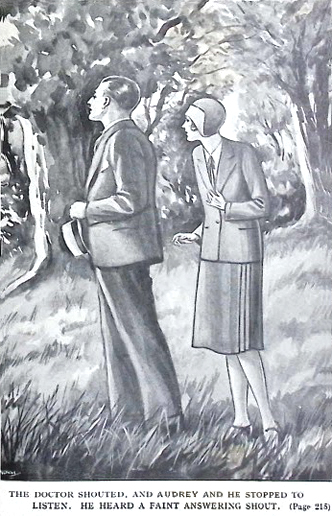
THE DOCTOR SHOUTED, AND AUDREY AND HE STOPPED TO
LISTEN. HE HEARD A FAINT ANSWERING SHOUT.
Audrey followed him along a path which was much overgrown with brambles and briers. They presently came to a clearance, where there was a group of old oaks, and now distinctly from one of these they heard the muffled cry for help.
"Where are you?" called the doctor. "Up a tree?"
"Inside, and I'm dying. Help!—Help!"
"It's hollow; he has fallen into it!" cried Audrey.
And her conjecture proved right. Dr. Vernon threw off his coat and climbed the old tree like a schoolboy. Herbert was at first too low down to be reached, until the doctor lowered his coat and told him to catch hold of the sleeve of it. Then he drew him up carefully, and in another moment, Audrey had her arms around the breathless, dishevelled, frightened child. He clung hold of her and sobbed aloud.
"I cried and cried and cried, and I thought I was going to be starved and buried there!"
Then Audrey saw the soft side of Dr. Vernon. He hoisted the boy into his arms and carried him along, talking to him more like a tender father than a schoolmaster. She followed them in silence. In the drive that led to the house, they met some gardeners coming off to help them in their search.
General Tennant was pacing the terrace in some perturbation of mind. He was greatly relieved when he saw them.
"Now you really must stay to dinner," he said, laying his hand on Dr. Vernon's arm. "All your flock are safely driving home, and this young lady can make herself comfortable in my housekeeper's room, if she likes, with the boy. Mrs. Green is a good soul and a most superior woman. Then you can drive them home later; or send them off in your dogcart now, and I'll have the brougham out to take you home."
Audrey's head was raised and a heightened colour was in her cheeks as she passed the old general. She knew that in his old-fashioned eyes, she was just a governess, to be ranked with his upper servants, and her pride rose in arms at once. But she did not say a word. Herbert was scratched and bruised with his fall, and sadly wanted a good wash and tidying up. So she went up to the housekeeper's room with him, and for the next quarter of an hour occupied herself with his toilet.
Then a message came up to her from the doctor, asking her if she were ready to start, and going downstairs she found the doctor's dogcart at the door.
He had declined to stay to dinner, and Audrey was thankful to feel that they were returning home at once.
He wrapped his thick rug round her carefully; Herbert snuggled in between them, and was so tired that he fell fast asleep with Audrey's arm around him before they had driven a mile.
"Are you cold?" Dr. Vernon asked presently.
"Not at all, thank you."
"What did the general say as he wished you good-bye?"
Audrey gave her low laugh as she answered, with a bit of mimicry in her tone:
"'Let me advise you, young woman, to look after your pupils in a more trustworthy manner. The doctor is sadly inconvenienced by the delay you have caused.'
"And I nearly made him a curtsy and said, 'Yes, sir; I'm sorry, sir.'"
"I think his advice was good," said the doctor quietly.
"I know it was," said Audrey, checking her mirth, "but I never can remember my position in life, and I don't like being treated like an inferior being."
"Your work is the same as mine," said the doctor. "I don't feel that teaching is a degrading position."
"Ah! The general would make a distinction between us," said Audrey; "and, of course, there is one. I think I am too big for my shoes. I am always being told so by Mrs. Bonar. I keep reminding myself that I am nearly penniless and am earning my living, but I cannot be servile to my superiors. I think I feel that anyone who earns their living is on the same level. There are officers in the army and navy who only live on their pay, and judges and ministers of state, and bishops, and all the big government officials simply earn their living as I do. I say that we are quits!"
Audrey was talking at random. She was feeling nervous of the long drive and "tête-à-tête" conversation with the doctor, and she dreaded that he should allude to her being in Mr. Oates' company.
But Dr. Vernon talked very pleasantly to her on various topics outside the school, and then suddenly said:
"You have returned me all the books I have lent you. Have they helped you?"
"Yes, they have."
Audrey spoke gravely now. She was always rather shy of talking about her spiritual difficulties.
"Do you want any more?"
"No, thank you. They have led me to my Bible. I am finding out my ignorance of it. And there is such a warmth and life in it! The other books are cold, and hard, though convincing, but the Bible is—well, I can't explain; it gives life and it sustains it, and I hope I shall never get away from it."
"You have learnt a good deal if you have learnt that," said Dr. Vernon. Then his voice grew tense and earnest as he added:
"Be real and sincere, Miss Hume; never put up with the second best. Don't forget the empty shrine. Let the glory of your womanhood circle round the One Who owns you. And with Him in your heart and life, you will be a burning power for good amongst those small boys who are in your charge."
Audrey bent over Herbert's curly head resting contentedly on her shoulder.
"I feel I'm only the smoking flax at present," she said. "I hope the flame will come."
And then for the rest of the drive they were silent. When she and Herbert were deposited at her door, she looked up at the doctor with penitent eyes.
"Please forgive me for my carelessness, and thank you for coming back to help me. I shudder when I think what the plight of this poor child might have been had we left him."
His tone was inscrutable as he replied:
"Let the charge of your boys be your first consideration."
"There spoke the schoolmaster," said Audrey to herself as she turned away. "I like him best when he forgets his vocation."
And Dr. Vernon, as he sat eating his belated dinner that evening, was haunted by a pair of grey eyes looking up into his—the grey eyes of which his sister had said: "If you look at them, you are perfectly certain that you can trust her, and that honour, frankness, and fearlessness are her chief characteristics."
The result of his cogitations was the emphatic comment to himself:
"I am glad this is Oates' last term."
In which he showed himself a man as well as a schoolmaster.
THE HOLIDAYS
"Oh Gift of God, a perfect day,
Whereon let no man work, but play
Whereon it is enough for me,
Not to be doing, but to be."
LONGFELLOW.
THE Easter holidays found Audrey still at Horsborough College. Neither she nor Mrs. Bonar left their post, as they had several small boys spending their holidays with them. But as the summer came on, Audrey again began to wonder where she should go when school broke up. A letter from Mr. Blunt saying that his sister-in-law was going abroad with her husband again, and so leaving her house, and also reminding her that her lease of her old home would be up on Michaelmas Day, decided her to take lodgings in the village. And she wrote to Pauline about finding her cheap rooms near her. She had just posted her letter when Miss Vernon called upon her.
"Well," she remarked in her abrupt way, "are you, like the rest of us, going to shake off this scholastic veneer which is making us so objectionably priggish? What are your plans? Every term I am hoping that Everard, may be offered some deanery. He has been here too long."
"Oh!" cried Audrey. "He is not old enough or feeble enough to retire into a deanery."
"Stuff, my dear! He ought to be a dean or a bishop before long, and I'm expecting to end my days in an ecclesiastical palace: I am hinting at it already in my biography of him. We don't want decrepit bishops, and I think the authorities are waking up to that fact. But we won't talk about Everard. I have to come to ask you if you would care to join me in a small tour through Switzerland? I should like to have you with me, and I ask you as my guest."
Audrey's eyes sparkled.
"How good of you! I have never been abroad in my life. But I should prefer it if you would let me share expenses. Would it be a very expensive trip?"
"My dear, the expense will be mine. I want a companion. Everard may be with us for a part of the time, but he is going to Germany first, and I have declined to accompany him there. I don't like the Germans. I never did. You and I will try to imagine for the first time, whilst we are away, that there is no such thing as a boy, or football, or exam., in the world! I am getting heartily sick of the whole crew!"
"The only thing is," said Audrey hesitatingly, "that I must go down and make arrangements for the sale of the furniture of my old home. When do you start?"
"I shall be a fortnight in London first. Will that give you time?"
"I think so. Oh, Miss Vernon, how can I thank you? I've never had such a treat! I can hardly believe I am going."
Miss Vernon laughed.
"Ah, well, I'm more selfish than you think. All my life I have dreaded getting old and prosy, and I want someone to keep me young, or make me feel so, at all events. You will be very good company. I am assured of that."
So Audrey wrote a second letter to Pauline, telling her of her good fortune, and a shadow fell across Pauline's sunny eyes as she read. She was fonder of Audrey than of anyone else, and the thought of having her near her for the summer holidays had been real and keen delight. But, as usual, she suppressed her own feelings and wrote back a warm, loving letter.
"It will be splendid for you in every way," she wrote. "I shall look
forward to your letters, for if you write as descriptively as you do
about the school, I shall imagine myself with you in it all. And your
fortnight here first will be a real joy to me."
"Poor Pauline!" mused Audrey. "Why should the good things of life always pass her by? I used to think myself the most ill-used of human beings, but I can't say that now. And yet, compared with Pauline, I am not nearly so happy as she is. What a wonderful nature she must have, to live year in and year out in a sick-room and yet keep that glad, joyous nature of hers! She finds as much pleasure in a sunny day, and in the flowers and the birds, as I would in a foreign tour. She faces north, and never flinches from it."
Pauline found her rooms in the village. It was an empty time. No tourists came to stay at Criscombe, for there was nothing to draw them—neither sea nor moor, and no good fishing within reach.
Mr. Broughton and family had just gone for a month to the seaside. A locum tenens from the neighbouring town rode over every Sunday to take the services.
Mrs. Daventry was abroad. Even the Blunts had gone away for their summer outing, and Mr. Danby was the only one who still came and went in his erratic fashion. Just now, he had started a caravan to take him about the country for his lectures. Pauline had asked him why he preferred such a slow mode of locomotion to that of a motor. His answer was characteristic of himself:
"Miss Erskine, pace is the curse of our age! If I give out, I must take in; and food does you no good if gobbled. Can I lecture on the beauties and lessons of Nature, which is my next subject, if I rush through the air, besmattering and befouling the sweet country lanes with fumes of petrol and clouds of dust? I am going to learn before I teach, and my caravan will aid me to do so."
Pauline met Audrey at the station upon a sweet evening towards the end of July.
Audrey was shocked at her looks.
"Pauline, how thin you are! What have you been doing to yourself? Oh! My dear, you're killing yourself, and no one can help you."
"Not at all. I am very well. I have felt the heat this summer, and my mother has not been so well this last month or so. You are looking radiant, Audrey. Now tell me your plans."
"About my furniture? I am going to sell it. I shall pack up a few treasured possessions and get Sands, in Gadsborough, to store them for me. The rest, he must sell. Then I shall be homeless indeed. But I have not the money to keep a room going when I should be in it so seldom."
"I wish our cottage was a little bigger," said Pauline wistfully.
"My dear Pauline, your house, if you had a mansion, would never be big enough for your heart."
Audrey made arrangements for her luggage to be sent up after her, and, linking her arm in Pauline's, she walked to the village, talking hard as she went.
"Can't you have a change, Pauline? Tell me when you left your mother last."
"Oh, I never leave her. We went up to town, you know, not so very long ago."
"But you really ought to have a thorough rest. I shall speak to Mrs. Erskine about it. Don't shake your head at me. Outsiders can do what insiders can't!"
"I am afraid my mother will not be well enough to see you. Now I must leave you, Audrey dear. Do you think you could run in and see me this evening after eight o'clock? I have settled mother for the night by that time, and I have two hours before I go up to her."
"I shall love to. Of course I'll come."
In the dusky summer evening, they sat and talked together.
Pauline said, after a time:
"Audrey, there's a happy ring in your voice that used not to be there. I think you have come through your difficulties, haven't you?"
Audrey's bright face softened at once.
She clasped her hands round her knees and looked up at her friend a little wistfully.
"Oh, I hope—I hope I'm settled; but I'm such a slow, such a stupid learner! I'm happy, Pauline; I know I'm on firm ground, and when I compare myself now with myself a year ago, I really do thank God for teaching me to know and love Him. I can't talk well about myself, but as I came to you with my difficulties, it is only fair I should tell you when they're gone. I realise now what it is to be in personal touch with Christ. Dr. Vernon's favourite verse, 'Without Me ye can do nothing,' is my continual reminder and comfort. And I long now to get my small boys to see what a power and what a delight the truth of that verse is.
"I think when you see your need and open your heart, all the rest follows, does it not?—forgiveness, justification, and sanctification; I'm only on the threshold of this last. But it comforts me to think of Nature, which is so slow—so much growth underground—before the result is seen. When I wake every morning, I think: A fresh day to test my faith and prove the faithfulness of my Redeemer."
Pauline's eyes shone, but she was silent for some minutes. Then she said emphatically:
"'If we believe not, yet He abideth faithful.'"
"Yes, that's it; that's the comfort. We may waver and fall and fail, but He never changes; and I believe in Him and love Him with all my heart and soul."
They talked on till the dusk deepened into night.
And then when the clock struck ten, Audrey slipped away to her lodgings.
But she was determined to speak to Mrs. Erskine if she could, for her landlady told her that the "village" considered that Pauline's long confinement to her mother's sick-room was wearing her to death. They all loved Pauline.
"She have such a royal way of walkin' with her head up and her eyes so shinin', but many's passed the remark that her body be not half so strong as her sperrit, and her cheeks be fallin' in wonderful!"
So when, a day or two later, Mrs. Erskine of her own accord said she would like to see Audrey, the latter responded willingly, and told Pauline that she was to make herself scarce during her visit.
Mrs. Erskine had taken some interest in Audrey since her father's death. Now she looked at the girl critically.
"Well, your work seems to suit you," she said. "You are fortunate in being with friends. It must make a difference."
"I don't know that it does much," said Audrey, smiling. "The doctor is always official, you know. I keep my distance, and look up to him with the necessary deference and awe. And he regards me as one of his staff—a young woman who must be kept in her place."
"Have you seen Mr. Danby yet?" Mrs. Erskine asked impatiently.
"No; he is away for a fortnight, so I shall miss him."
"I am glad he is away."
Mrs. Erskine moved her hands restlessly, then continued with a little catch in her breath:
"I wish you would find out—you and Pauline are such friends—whether there is anything between them; he is always here."
Audrey looked genuinely astonished.
"My dear Mrs. Erskine, you don't think Pauline would look at a little, erratic man like that! He isn't fit to tie her shoe-strings."
"I don't know what she might not do," said Mrs. Erskine fretfully. "Girls will do anything to get a home, but I don't mean to die yet. I have wonderful vitality—all the doctors tell me that. I wish Mr. Danby had never come to the village. He must be an odious little creature, from all accounts!"
"Oh, he isn't that. He is a character, of course. But he isn't fit for Pauline. I'm sure she wouldn't dream of such a thing. Don't you want her to marry, Mrs. Erskine?"
"And leave me?"
Such a frightened, anxious look came over the invalid that Audrey hastened to soothe her.
"No; I don't believe Pauline would ever do that, and there is no one marriageable in these parts, Mrs. Erskine. Marriage would never take Pauline from you, the only thing that might—"
"Well? Speak out."
"Illness might," said Audrey firmly. "Pauline is looking very ill. Haven't you noticed it? She ought to have a change of air and scene. You would not like her to break down, would you?"
"Pauline break down!"
Mrs. Erskine gave a little sceptical laugh. "Pauline is as strong as a horse. She has a most wonderful constitution, but then her quiet life has not tried it in any way. I wish I had had half her strength to fight this disease which is killing me by inches. I don't think you need be at all troubled about Pauline."
"But I am; and so is everybody who cares for her," said Audrey warmly. Then on the impulse of the moment she said: "Wouldn't you let me do things for you and allow Pauline to go away for a week? If it was only for a week, it would do her good."
"Has she suggested such a thing?"
Angry spots of colour showed on Mrs. Erskine's cheeks.
"No, indeed! Would she be likely to? You know Pauline. The last thing she thinks of is herself."
"I did not know waiting upon a sick mother was such a hardship," said Mrs. Erskine bitterly. "She won't have me much longer. If she chooses to leave me, she can. But I will go on with Mary. I will not be dependent on outside friends to do what a daughter is weary of doing."
Audrey bit her lips to keep back the impatient words that were on her tongue.
"I am so glad you think you could manage with Mary for a little. I am sure you will be able to persuade Pauline to go. And I will come in every morning and see how you are getting on. I have ten days longer here before I leave for Switzerland. But Pauline will need your persuasion. She does not realise how badly she wants the change. I will tell her what we have arranged together."
Audrey sped downstairs, determined to strike while the iron was hot. She told Pauline of the conversation, and got angry when Pauline shook her head.
"My dear Audrey! You do not understand my mother in the least."
"Oh, don't be so obstinate! Go up at once, 'at once,' whilst I am here, and keep her to her word. Pauline, I will never try to help you again if you won't lift your little finger to help yourself."
Pauline did not reply, but went upstairs.
Audrey waited in the sitting-room below, and was rather dismayed to hear Mrs. Erskine's voice raised in shrill, hysterical cries and sobs.
"What an awfully selfish, hard-hearted brute of a woman!" she exclaimed hotly. "She wouldn't care if Pauline were dying before her eyes!"
It was a long time before Pauline came down, and when she did so, she looked white and weary.
"Audrey dear, it is of no use. You did it with the best intentions, but my mother has had a very bad half-hour in consequence. I can never, never leave her. She is half frantic at the very idea."
"I don't see why she should try to kill you," said Audrey impatiently. "I think she ought to be made to do without you. What would she have done if you had married?"
Pauline smiled.
"Don't you see that this is my life's work, the only natural course for any single daughter to take?"
"I am not objecting to your nursing your mother, but to your never getting a rest from it."
"I am very strong. Every back is suited to its burden."
"I don't believe that. Numbers are done to death by overwork."
"Can you and I not trust ourselves to God? I have left my life in His hand, and He arranges for me. Of this I am positively certain. Don't let us spoil your visit by over-anxiety about my concerns. I will try and get out a little more whilst you are here. That will do me more good than anything. One of my biggest mercies is living in the country. Imagine our life in a town, mother and I, where it would be simply impossible to enjoy pure air and all the delights of the country! Do you know that I have two tame linnets who visit me regularly? They have their dining-parlour under the old medlar tree, and they wait for me twice every day. You don't know what dainties I take them."
"Oh, I don't care a rap for linnets; I only care for you!" cried Audrey, and tears of vexation and disappointment filled her eyes. "No wonder we gave you the Northern gate. I was wanting to turn you from it for a little."
"Ah! Don't try to do that. I fear poor Honor turned away from hers, and I'm dreading the result."
"Have you heard from her?"
"Such short, unsatisfactory letters! She seems moving about so much that it is difficult to write to her."
They began to talk of Honor, and then of the Rectory household; and for the time Pauline's affairs were forgotten.
But Audrey's visit did her good; and though she had failed in getting her to go away, she did manage to get her out for a whole day just before she left.
They hired a village trap and drove to a famous hill about nine miles away. And on the way there, they met Mr. Danby jogging along in his caravan. He was delighted to see them, and wanted them to drive on with him. He showed them over his caravan, and informed them that he had had a most successful audience the night before on the village green.
"My lecture was 'Country or Town?' I showed them a thing or two, and was in the midst of politics before I knew it! Miss Erskine, do try my lounge chair on my 'upper deck,' as I call it. I can sit under my awning, smoke a pipe, and read a book whilst I am driving."
"What a lot of the country you must see!" said Pauline, laughing.
"I want company to enjoy the country with me," said Mr. Danby dolefully. "I do wish conventionality wouldn't prevent you from coming with me."
"It would be rather slow," said Audrey meditatively, then corrected herself with a laugh. "I don't mean your society, but the progress."
"Miss Erskine and I like the slow, sweet march of time," said Mr. Danby; "and, by the by, I met a man the other day who knew you, Miss Erskine. He's going to do a small tour with me in the west of England for the benefit of some charity in which he is interested. We are going to sandwich 'Bush Aborigines' and 'Man's Highest Development.' He's a traveller; do you remember him—Justin Pembroke?"
"Yes," said Pauline very quietly. "I met him not so very long ago."
"A nice chap—fond of music, too. He thinks me somewhat of a freak. I got into a church, and he was blower. Told me that if he could play as I did, he wouldn't tack so many other things on to it. He's a man of one idea. I'm a man of many."
They chatted on, and then separated.
For a time they drove on in silence.
Then Audrey said:
"Who is Justin Pembroke? Don't tell me if you would rather not."
Her quick eyes had seen that Pauline's extreme quietness and attention when his name was mentioned showed that he was no chance acquaintance to her.
"I met him some years ago," said Pauline; "and then he came down to this part, and I saw him again. Don't look so interested, Audrey. There is nothing remarkable about our acquaintance."
"I wish someone would meet you and carry you off."
"Not from my mother?"
Audrey was silent; then she said abruptly:
"Pauline, do you ever look forward to the time when—when you will not have your mother?"
"I try not to do so."
"But if the doctors are right, it may come soon. Have you any plans?"
"How can I? I do not even know what my mother's income is. And she may be spared for several years yet, Audrey. She has been wonderfully better this year on the whole. Last year she seemed rapidly getting worse. One can never tell. I hope she may live longer than the doctors think."
"I don't believe you care what becomes of you," said Audrey. "You're a marvel!"
"I cannot imagine life for me without my mother," said Pauline; and then they dropped the subject.
The rest of the day was spent in enjoying Nature at its best.
As Audrey parted with Pauline at her gate that evening, the latter said, with much feeling:
"How small the petty trials of life seem after a day in the open air! I feel so much stronger, mentally and physically, for my day out, as if nothing will ever trouble me again."
Audrey kissed her warmly.
"You're a dear! And if Nature has done you good, you have done me good. I will write long letters to cheer you up when I'm abroad. Not that you will want that, but I know you like letters. Oh, how I wish you were going with me!"
And in her heart, Pauline echoed that wish.
Audrey departed, and soon wrote glowing descriptions of her first sight of Swiss mountains. Miss Vernon was a good traveller. She took her to Grindelwald for a fortnight, then to Interlaken and Thun, and then across the Simmenthal by railway down to the Lake of Geneva, where they met Dr. Vernon. And then all three went to Zermatt, where Audrey had her first experience of glacier climbing.
The last fortnight there was a dream of delight to her. Dr. Vernon laid aside his stern gravity and showed himself a genial spirit.
He and Audrey were the best of friends, and learnt to know each other in a very different way from what they would have done at Horsborough College. And Miss Vernon, with her private notebooks and humorous views of human nature, was a general favourite in the hotel.
"I never thought," wrote Audrey to Pauline, "that I should ever get
to like Dr. Vernon as I do now. I almost hated him at first, then I got
to respect and admire him, now I have learnt to like him for himself.
He is very masterful, and, of course, gets a little spoilt by his
position, but underneath all his determination and iron will, there is
wonderful tenderness and consideration. One of the guides got hurt the
other day, and had to be taken to hospital. He went to break the news
to his wife, and Miss Vernon and I found him with her youngest baby on
his knee, talking to her and comforting her like a woman. And though he
is full of fun and humour, there is always the streak of real goodness
running side by side with it. He is never ashamed of his religion; it
comes out spontaneously; it is his very life. Yesterday, he preached
for the chaplain here, and I never heard him preach better. He took for
his text:
"'I am come that they might have life, and that they might have it more
abundantly.'
"And when he spoke of the 'more abundant' life each Christian was meant
to have on earth, he thrilled one through and through. Life is getting
fuller and deeper to me, Pauline. I feel I am walking through Ezekiel's
river, but I think I am not much more than ankle deep at present."
As she read this letter, Pauline lifted her blue eyes in all their shining serenity to the sky above her and murmured:
"'Him that is able to do exceeding abundantly above all that we ask or
think.'"
HOMELESS
"For the way is often dreary,
And the feet are often weary,
And the heart is very sad.
There is heavy burden bearing,
When it seems that none are caring,
And we half forget that ever we were glad."
IT was a year later. Spring was on its way; but in London, fog reigned supreme, blotting out all light and sunshine, and filling people's lungs with its stinging, choking fumes.
In a dingy private hotel in Bloomsbury, a little face was pressed against the panes of the shabby drawing-room window eagerly watching for someone. At last, with a joyful cry, the child sprang from her post and flung herself into the arms of the woman who entered.
"Oh, mummie, I thought you was lost. Do you think it's the Judgment Day coming? I'm getting so frightened."
"No, darling, it's only a London fog."
Honor sat down heavily on a chair and Fay crept to her side.
"I'm sorry you're so tired. I don't like London. Where are we going to live?"
Honor gave a little bitter laugh.
"'How' are we going to live is the question, Fay. I heard from your father this morning; he did not send the money he promised. He can't do it at present."
"But, mummie, you said weeks ago we were going into the country when father's letter came. Aren't we going?"
"Don't worry me, child! I must write a letter."
Then, ashamed of her momentary petulance, Honor caught the child to her.
"Oh, Fay, darling, I don't want to be cross, but I'm feeling ill, and very, 'very' anxious about you!"
Poor Honor! Step by step of her way had been clouded and bestrewn with thorns. Perhaps the happiest time had been on the big liner, when her husband was cheery and optimistic, and the little home they would eventually have together was discussed and planned.
When they landed at New York and he was met by several old friends, she discovered that her husband had a side to his character with which she was not acquainted. He established her and Fay in a boarding-house, and gradually was more and more away from them. Honor took his absence very quietly. She never expected that she would have sufficient attraction in herself to keep a man perpetually by her side. All she wanted was to be useful and helpful to him. And Fay was her daily and hourly delight. She mended and made her clothes, she taught her and she played with her, and she was happy and content.
Then Alick took them both with him for a trip to the West Indies, where he had a share in a sugar plantation. And Honor had a few happy months there. The strange, new scenes in which she found herself drew out all her powers. She grew more self-assured, and lost her shy shrinking manner. Alick and she, if not a demonstrative couple, were content with each other's society. And if he found it unnecessary to give much, Honor gave abundantly, and required very little from him. But when they again accompanied him back to the States, Alick grew a little restive. His money seemed to be failing him; he told Honor she must economise and live in a cheaper way. And when she found a couple of rooms in a poor part of Philadelphia, he told her he must take a trip down to Chili to look after a bit of property he had there.
"I can't take a woman and child with me," he said; "you'll stay here like a good little woman till I return, and then we'll think about going back to England and settling down."
He left her with a little money, and from time to time sent her additional small sums. But if Honor had not bestirred herself, and managed to earn something by plain needlework, she and Fay would have fared badly. As it was, her straitened means brought an anxious pucker to her brows and hollows under her eyes. They were always hoping, always expecting, the wanderer's return. And at last, one day he came—but only to tell Honor that she had better return to England with Fay.
"You will do better in your own country, near your own people, get some quiet country lodgings somewhere. I have been offered a post with a surveying party going up towards Alaska, and I shall be gone some months. I'll manage to scrape up enough money for your return passage, and will send you what I can. You're such a clever little woman in making both ends meet that I'm sure you will help me. I am in low water at present, but the tide is bound to turn."
"I cannot go to my own people," said Honor quietly, a heavy weight descending on her spirits at the prospect before her and of her coming motherhood. "Alick, are you regretting your marriage?"
"Never," he assented emphatically. "Look how you have relieved me of the care of Fay. Cheer up! We shall have happy days yet when my ship comes in. And I dare say, I shall make a good deal by this trip. We are going to be in touch with the goldfields, and who knows what may befall us there? You had better take the steamer the end of this week, wait in London till you get my next remittance, and then settle yourself in a quiet country cottage somewhere."
So Honor had acquiesced. She had waited in London for three weeks for the expected remittance, and had now received the following letter from her husband:
"MY DEAREST HONOR,
"I'm afraid I can't send you anything this mail. In fact, until I get
my quarter's salary from this railway company, I have hardly a shilling
to call my own. You had better go to your people. Surely, as you have
a home, they will be delighted to receive you. If you can't do this,
you could try my sister, if you like. She lives near Exeter. I enclose
address. I wouldn't leave Fay alone to her tender mercies, but with
you, it is a different matter. Margaret is comfortably off, but is a
hard nut to crack. Still, I think you and Fay would be equal to it. My
love to my darling. You are so sensible and clever that you will get
along all right, I feel sure. And I will send you money as soon as ever
I can.
"Your affectionate husband,
"ALICK."
As Honor read this letter and thought of the one five-pound note left in her purse, and most of that due for their rooms, a wave of despair seemed to overwhelm her. It was true she had even in London found a woman who could supply her with needlework, but it was not sufficient to support her. She knew how impossible it would be for her to go to her stepmother with an empty purse and an anxious time in front of her. So she steadily put her feelings into the background and sat down to write to Miss Selkirk. Presently, she tossed her pen away.
"Fay, I can't do it! I can't stay here waiting for an answer to my letter which may never come. We'll go down to Exeter to-morrow."
Fay clapped her hands.
"To the country, out of this black London? And, mummie, we'll picnic in the woods. You know there's so much to eat in the country without paying—nuts and blackberries and mushrooms. We'll begin to be happy again, won't we?"
"My darling, I ought to be able to make you happy now. I'm afraid I'm getting grumpy."
Her mind once made up, Honor lost no time in action. She settled accounts with her landlady, and early the next morning had started from Waterloo for the west country. Looking out at the English country again, Honor felt strangely stirred. The lambs in the meadows, the hedges of white hawthorn, and the early primroses in the sheltered nooks and dells, all spoke to her of peace and rest. She lifted her heart up in passionate prayer that she and the child by her side might find favour in the sight of her husband's sister. Her pride rebelled against the step she was taking. She felt that it was unfair upon any single woman to appear in such a manner without any previous warning. And yet she felt she could plead her own cause better by word of mouth than by letter.
It was between two and three o'clock in the afternoon when they reached Exeter, and then upon inquiry Honor found she would have a drive of about three miles to Miss Selkirk's house. She hired a cab at the station, and as they jogged along through the lower part of the town and then up a steep hill into the fresh, green country Honor felt a sudden panic seize her.
"How little I thought that I would be reduced to begging from a stranger! If it wasn't for Fay, nothing would drag me here. And if she won't have anything to say to us, I shall have to go to the workhouse infirmary."
With such thoughts as these, she gazed out of the window, whilst Fay was ecstatic at all she saw. The road wound downhill again, passing a little hamlet of cottages and then a stretch of fir plantation on rising ground. Presently they passed two small cottages, and then drew up at a pretty-looking rustic lodge and a big iron gate. A tidy-looking woman opened it for them, the drive wound uphill with sloping pasture-land on either side, then they took a sharp turn and came in sight of a low, quaint, yellow-washed house, overshadowed by a group of old elms.
In another moment, they were at the hall door, and Honor felt sick and faint with dread of the coming interview.
The door was opened by an old-fashioned, elderly maid.
"Is Miss Selkirk at home?"
Honor's white lips framed the words with difficulty.
"Yes, ma'am. What name, please?"
"Mrs. Alick Selkirk."
Well trained as she was, the maid gave a furtive glance at Honor, then opened the drawing-room door. It was a quaint, prettily furnished room, the open fireplace with its iron basket of blazing logs gave a look of cosy warmth, on a low window-sill were pots of hyacinths and freesias. And Honor sank into an old-fashioned chintz chair with a feeling of envy towards the owner.
Then the door opened, and a tall, angular woman entered, dressed in a severely made black gown with a gold watch chain hanging from a large pebble brooch. Her dark hair, streaked with grey, was parted in the middle and drawn down smoothly on each side of her face. She had rather fine brown eyes, but a wide and grimly set mouth gave an expression of great severity to her rugged face. She stood gazing at Honor for a moment in silence. Then as she shook hands in a limp fashion, she said, abruptly:
"I was told that Alick's wife was dead."
"I married him about eighteen months ago," said Honor quietly, and with a certain amount of dignity.
"Unfortunate young woman!"
The tone of pity, almost contempt, brought the blood with a rush into Honor's cheeks.
But she could not contradict the statement, under her circumstances.
She drew Fay forward.
"This is his little girl."
Then, glancing into the garden, which was lying bathed in the yellow afternoon sunshine, she said:
"May she run out into the garden whilst I tell you why I have come to see you?"
Fay had advanced, putting up her face to be kissed, but Miss Selkirk did not kiss her.
"I'll be most dreffully good," she assured her, "but I'd like to smell the little daisies coming up on the grass."
She was dismissed.
And then Honor plucked up courage, and Miss Selkirk sat down on a chair opposite her on the other side of the fireplace.
"My husband has been obliged to go to Alaska for some months. We have been out in America a good deal, and he has sent us home till he can come to us."
"Well?"
The word was uttered sternly.
For a moment Honor paused, then she moistened her dry lips and continued:
"We have been waiting in London for money, which he hoped to send us, but he is unfortunately unable to send it yet. He suggested my coming down to you. I thought of getting some cheap lodging in the country, if—if you could advise—or recommend me one."
There was dead silence. Then Miss Selkirk said: "And what money have you to pay for it?"
Honor drew out her purse impulsively and placed it in Miss Selkirk's hand.
"I am too desperate to be anything else but truthful," she said. "You will find I have exactly nine shillings and fivepence there. The cab here was more than I thought it would be."
"Have you sent it away?"
"Yes. If you cannot help us, I shall walk back to Exeter."
"Go on with Alick's plans for you. You were to come here and ask me to get you lodgings, knowing that the expense of it must fall upon me. What else?"
Honor's eyes filled with tears, but she made a brave effort to hide them.
"Miss Selkirk," she said, "I know how it must look to you, but Alick will send money later—he must, he is bound to do so. I would repay you every penny you lend me. Or if you knew any farmhouse where they would take us in and trust us for a month, I think I should be able to earn some money. I have done so in London. I came across such a nice woman keeping a baby-linen shop—I am good at plain sewing, and before I came away, she told me she thought she could supply me with some by post. I don't come to you as an unprincipled beggar—"
"It's a pity you did not stay in London if you could get work there."
"I should have done so, but the rooms were so expensive, and Fay is never well in town."
"You look like a lady and speak like one," said Miss Selkirk in the dry, severe tone she was adopting. "If you are an Englishwoman by birth, I conclude you have some relations of your own. They are the ones who should receive and advise you—not I."
"Oh! I know how it must seem. I don't know what to do. May I tell you about myself?"
Miss Selkirk gave a stiff little bow, and Honor slowly began.
"My father is Rector of a small country living. I have two young brothers, a stepmother, and three little stepsisters. I left home partly to help them by my salary, partly because my stepmother and I do not hit it off together. But it was not my wish to leave. I loved the parish and my father and all the children. I went to be a companion to a Mrs. Montmorency, and we were staying in Scotland—"
For the first time, a flicker of light flashed into Miss Selkirk's sombre brown eyes.
"Kate Montmorency—I have not heard of her for years. Then you were staying close to Knockaburn?"
"Yes," said Honor softly, as she recalled what Mrs. Montmorency had told her about Margaret Selkirk; "and Alick came up to see his old nurse. He wanted her to take charge of Fay; but she was dead, and—"
"Oh, I can guess the rest," said Miss Selkirk grimly; "he came across you, and thought you would answer his purpose instead."
"He was lonely and bitter and miserable," said Honor in her calm, even voice, "and he asked me to take pity on him and his child. And I felt I could be a help and comfort to them, and so we married and went over to the States."
"And now he finds you a greater incubus than he bargained for, and ships you and the child off to me. Oh, I know Alick well; he has not altered with time!"
"He wanted me to go to my people, but I cannot. My stepmother would never receive me, and my poor old father would be ill with the worry of it. I mean to be independent. It is only just now—just for a short time—that I hoped you might see your way to advance me a little for lodgings."
"You would rather beg from a stranger than from your own father."
Despair filled Honor's heart. She was past resenting Miss Selkirk's tone. Wearily, she rose from her seat.
"I am sorry," she said. "I thought I could but try to see you; I know I have no claim upon you. Thank you for listening to me. We will go back to Exeter."
"And what will you do there?" demanded Miss Selkirk indignantly. "Disgrace our name by begging from some other strangers?"
A little flash of spirit shot into Honor's tired eyes.
"No," she said; "what my husband's sister has refused to lend me, I will take from no one else."
The two women stood facing each other, and then the critical situation was interrupted by the drawing-room door opening and Fay's rosy face appearing.
"Please, mummie, may I speak to my Aunt Marget?" Then, catching hold of Miss Selkirk's dress, Fay lifted an excited little face to her.
"Do you know, it's a most 'strordinally thing? Out there, under a tree, is an old blind mole, quite dead, poor thing! And by his side is a little dead mouse. Do you fink they was friends? And which died of the broken heart last? Do you fink the mole did? I wish you'd come and see them, Aunt Marget. Or do you really fink it would be from fighting each other that they died? I do wish daddy was here to tell me."
Not a muscle moved in the rigid, determined face looking down upon the eager child. But drawing her gown out of the little clasp, she turned to Honor:
"Sit down, Mrs.—Mrs. Selkirk. I have not doubted your story; this child is too like her father for that. I will come back in a few minutes."
She left the room.
Honor took Fay's hand in hers.
"Fay, we must walk back into Exeter. My head feels so tired that I am not sure what we shall do when we get there. But perhaps, after all, I must write or wire to my father. I don't know how he'll manage, but he may be able to send me something—I must do something—I wish I did not feel so faint. It is this room—the warmth—I shall be better in the open air."
She leant back against the cushion behind her, and turned so white that Fay looked frightened. But she had seen Honor faint more than once lately, and was strangely old in some ways.
"Never mind, mummie, you'll be better soon; I'll fan you with this newspaper. It's becorse you made me eat all your sandwiches! There! Don't you feel better? Shall I get some water?"
Honor pulled herself together with considerable effort.
"I think I shall be better in a minute, darling. Don't fan quite so quickly. You make me giddy."
"It's a most lovely garden, mummie. And there's a big room the other side of a yard, and I looked inside, and it was full of boxes of straw, and then there's a door in a wall, and if you peep frough the crack, you see a most beautiful big garden with great walls all round it."
She stopped short, for Miss Selkirk had returned.
"Look here, Mrs. Selkirk. I have been talking with my old servant. I live here in a very quiet way, and at present have no visitors coming to stay with me. I have quite made up my mind that I will not lend you any money. That I would never do on principle, but for the present, I will take you in as a guest, you and the child."
Honor could hardly believe her ears. "But do you realise," she said, "what a burden I may be? I never—believe me, thought that you would—"
Again, a deadly faintness seized her.
Fay sprang forward.
"Sit down, mummie dear. I'm sure it's your sandwiches which I ate. You always do die away when you won't eat!"
Honor reseated herself and looked appealingly up at Miss Selkirk.
"I realise everything," that lady said a little bitterly, "more than you do yourself, I expect. Christine is lighting the fire in the spare room, and I think you had better come straight away to bed. There is a little dressing-room where the child can sleep. Have you no luggage?"
"I left it all in the cloakroom at the station," said poor Honor, feeling hardly sure whether this was a dream or not.
"I will send my groom for it. Come this way. The child had better stay here."
"Or in the garden?" suggested Fay cheerfully. "I'm so 'strordinally int'ested in that little mole and mouse. May I bury them? And I promise you I won't make a noise about it, or beat a drum for the 'Dead March' like daddy and me does sometimes when I bury blackbeetles."
"You can run out into the garden for the present," said Miss Selkirk, leading the way upstairs.
"I am only a little tired," said Honor apologetically.
But Miss Selkirk made no reply, only ushered her into a comfortable room with a fire beginning to burn, and Christine busy putting clean sheets into a big four-post bed.
She left her there.
And when Honor turned to the old servant, saying, "I'm afraid I am giving you a lot of trouble," Christine suddenly turned and stood very upright before her.
"I kenned Mr. Alick, mem, when he were a boy. I'm proud to wait on his lady. And if bairns' voices ring about this hoos, it'll be a glad day for the mistress and us a'."
A sob came into Honor's voice.
"Oh, it is good of you!"
She could say no more. She was worn out by the strain of the last twenty-four hours. A short time after, she was lying between the lavender-scented sheets, and Christine was holding a basin of strong soup upon a tray before her. Miss Selkirk did not do things by halves, and she had seen with her keen eyes that Honor's exhaustion was chiefly owing to lack of food as well as fatigue.
As Honor lay sipping her soup, she felt new strength and life come back to her. The flickering of the fire, the cooing of some wood-pigeons outside, and the distant bleating of young lambs in the meadows soothed and comforted her. She felt no anxiety about Fay, because she knew she would win her way with anyone, and soon, tired and almost happy, she fell asleep.
MOTHERHOOD
"'Lo! At the couch where infant beauty sleeps,
Her silent watch the mournful mother keeps;
She, while the lovely babe unconscious lies,
Smiles on her slumbering child with pensive eyes,
And weaves a song of melancholy joy—
'Sleep, image of thy father, sleep, my boy;
No lingering hour of sorrow shall be thine;
No sigh that rends thy father's heart and mine;
Bright as his manly sire the son shall be
In form and soul; but ah! more blest than he!
Thy fame, thy worth, thy filial love at last
Shall soothe this aching heart for all the past—
With many a smile my solitude repay,
And chase the world's ungenerous scorn away.'"
CAMPBELL.
MEANWHILE, downstairs Fay was having tea in the drawing-room with her aunt. She came in from the garden when she was called, rubbing her wet little red hands with her handkerchief.
"I'm quite tidy still," she informed Miss Selkirk in her cheerful little voice; "I muddied my hands over the grave, and then, I washed them in a lovely tank of water outside the stable. Is mummie better?"
"Your mother is in bed. You must sit still on that chair and not make any crumbs."
Fay was most anxious to oblige. She handled her bread and butter most carefully, but her tongue could not keep silent.
"I do like this house very much," she said. "Are we going to sleep here many nights? I was finking I could show you how to play cat's-cradle after tea—if you was dull, I mean. Would you like to try? It's very easy. Daddy and me does it wonderful."
"How long has your father left you?"
"He put us on the ship, you know. He didn't leave us. We lefted him. Poor daddy! It's a drefful sad fing for him to be left without his little girl! And mummie too—that's a dreffuller thing. I used to live alone with him once upon a time, you know, before we knowed mummie. It was rather uncomfable, 'cause daddy couldn't mend my stockings, and my curls was so tangly him and me used to give up the comb and take to the brush, and that mummie says is very bad for a child's head. Poor mummie! She does miss daddy so much, and so do I. But, you see, I've got her, and she's got nobody."
A pause, then:
"Do you know, Aunt Marget, I fink if you was to ask me, I could say 'Yes' to that nice currant cake."
It says much for Miss Selkirk's imperturbability of spirits that never a smile came to her lips as her small niece chatted on. Fay was perfectly oblivious of the gravity of her aunt. She enjoyed her tea thoroughly. And then getting off her chair, remarked:
"I fink I had better go to mummie. I know she's rather troubled about us. And I'll tell her to go to sleep, and I'll say 'God bless you,' like she does me. You're quite sure we shan't have to go away before to-morrow?"
"If you are a very good little girl," said Miss Selkirk, "you shall stay some weeks with me, and your mother too."
"I fink I'm good nearly always," said Fay, balancing on one foot and looking up into her aunt's face thoughtfully, "but the devil seeks me pretty often, you know. The Bible says so, and when he roars at me to run and hide when I'm out of doors, and mummie calls me—well then I do it! He's so tarsome when he roars!"
She pattered out of the room after this speech.
And Miss Selkirk sat and looked into her fire, for she knew that she had undertaken no light charge when she had offered Honor and Fay a home, and she could not yet get accustomed to the ways of such a child as Fay.
After a long night's rest, Honor was wonderfully refreshed and rested. Old Christine's kindness had comforted her much.
And when she came downstairs the next morning, and Miss Selkirk expressed surprise at seeing her down to breakfast, she said:
"I do not give way as a rule. It is not often I feel so done for as I did yesterday."
After breakfast, as it was a bright morning, Fay was turned loose in the garden again. She was already the greatest friends with all the servants. She had invaded the kitchen and shaken hands with the old cook and the young housemaid, informing them that she meant to have a kitchen of her own when she grew up and cook all day long. She had been taken by Isaacs the groom to see the fat grey pony in the stable, and the Irish terrier, who loved the pony better than anyone else in the world. And now that she was well out of the way, and Honor employed with the needlework that was seldom out of her hand, Miss Selkirk began to talk about her brother.
She pointed to the picture of Knockaburn which hung on the drawing-room wall over her davenport.
"He sold the old place," she said bitterly, "which had been ours for eight generations, and he sold it as he might an old coat—glad to get rid of it at any price."
"He was not happy there," said Honor; "he had had an unhappy boyhood, and that is a thing that one never forgets. He said it had been a prison to him."
"He was not a true Selkirk; he had some of the flighty blood of our father's mother, who was French. My mother tried so hard to train him up into a sober, stolid Scotsman. But she felt, poor thing! before she died, what a failure she had made of it. Alick will never do anything all his life but please himself. Easy, happy-go-lucky, and thriftless he will always be. He killed his first wife by neglect. I heard that much from people who knew them. When he wanted to get rid of Fay, he married you to look after her. Now that you are not able to go round with him and wait on him hand and foot, he ships you off for someone else to look after. By and by, if it suits him, he will come back to you again. If it does not, he will stay away. And if you are not able to support yourself independently of him, it will be a bad outlook for you."
"Oh," cried Honor, "you are hard—hard! He has never said one unkind word to me. He and his child are devoted to each other. I own he is thoughtless. He seems to have no idea of money, or of what it costs to live; but he is a good father, and he has been a good husband to me. If he did choose me to be a mother to his child, rather than to be a wife to himself, I do not complain. I feel the time will come when he will want a home, and will come back to me for it. He is absolutely faithful to me. He never looks or cares for the friendship of women. He is bitten with the mania for speculating in a variety of investments all over the world, and he loves travelling and men's society. You may have seen his worst side as an impatient, restless young man, but I have seen his better side, and I know that as time goes on, he will want a woman's sympathy and tenderness to help him through life."
"And his child will grow up like him," said Miss Selkirk bitterly. "She has his flighty, restless ways."
"No, no," cried Honor hotly. "Fay is a darling. I will not give her the training her father had. That was his ruin—suppression on every side. I shall train Fay up in fearless freedom if I can. She is a warm, tenderhearted child, unselfish, and clever and original. I have studied her, and I know her, for I love children. She is the joy of her father's heart, and I am sure she is of mine. Wait a little, Miss Selkirk, and you will find yourself losing your heart to her before long."
"I never understand children, and never shall."
Miss Selkirk set her lips grimly as she spoke. If she did not care for Fay, she certainly began to like Honor.
Honor's extreme quietness and unselfishness could not but be appreciated by the rugged Scotswoman. Though Miss Selkirk rarely smiled, her tone became milder and more sympathetic when she addressed her sister-in-law, and Honor learnt to understand that her severe demeanour sometimes hid a kind heart.
That day Honor wrote to her father and to Pauline. Pride had prevented her from doing this before when her purse was empty and she was homeless.
And on the following day, her baby was born. The quiet household of Miss Selkirk was much excited over the event.
Fay wondered much over the strange nurse and doctor who came to the house, and when eventually Miss Selkirk told her the news, the child stared at her with open mouth and eyes.
"A little baby brother! Who gived him to me?"
"God has given him to your mother. You must be a good girl, and give no trouble. No, you cannot go up to your mother. She must not be disturbed."
"Is he a tiny little baby? Do tell me. How did he come? I finked last night I heard a baby cry outside the windows, only Christine telled me it was owls. I 'spect it was him, poor little fing, flying round and tapping at the windows to get in, and then mummie opened hers. He did come down from heaven, didn't he? Oh, I want to see him dreffully."
"You will see him to-morrow, if you are good."
Poor Fay found it hard to be patient. She missed Honor intensely; and Miss Selkirk did not know how to talk to children. But she did her best, even to going to visit Fay after she was in bed, which Honor invariably did.
"Are you asleep, Fay?" Miss Selkirk asked, seeing only the top of a curly golden head above the bedclothes.
With a wriggle and a sigh, Fay raised herself in bed.
"Come here, Aunt Marget. Put your finger on my pillow here—just here—now what do you feel?"
Fay's tone was solemn and mysterious.
"I feel nothing," said Miss Selkirk; "it is a hot little pillow, and a trifle damp."
"Yes," said Fay, nodding her head with an important, rather pleased smile on her face; "it's a tear place. I've been dropping kontities of tears, Aunt Marget, quite quietly, but they comed out of me because I can't see mummie and I feel so alone."
"You must learn to do without your mother," said Miss Selkirk gravely. "You are not a baby, and she will not be able to give you so much attention now as she has done. Your little brother will take up all her time."
"But she might let me see her just to say good-night and God bless you."
A little sob was rising in Fay's throat.
"I'll send Christine to you," said Miss Selkirk hastily, dreading a scene, and she left the room.
Christine came and took the child in her arms.
"There, my bonny bairn, go ye to sleep. Your mither will be seein' ye in the morn. She's verra weak and ill, dearie; that's why she canna see ye the night. But 'tis a mercy she came through so weel. An' the baby is healthy tho' sma'."
"Is mummie ill? Nobody telled me that. I'll go to sleep, Christine. I wouldn't disturb her for all the world."
And Fay turned over and laid her head upon her pillow, relieved to find that it was not neglect but illness which kept Honor away from her.
She crept into Honor's room on tiptoe the next morning.
"Are you really better, mummie dear? You're sure I didn't make you ill by eating your sandwiches in the train?"
Honor smiled, and put her hand on Fay's curls.
"No, darling," she whispered. "I shall soon be well, I hope. Be a good girl, and now look at baby."
She pulled down a bit of the sheet, and Fay looked in awe at the tiny, red, puckered face of the new arrival.
"He's like a doll. Oh, mummie, I really fink I can take care of him for you—may I? I should like to carry him."
But the nurse came forward and told her she must go out of the room, and Fay obediently went. The event was so unexpected and so strange that it quite bewildered her.
And Honor lay weak and happy and grateful beyond words to Miss Selkirk for taking her in at such a time.
In a few days, she was able to talk about the future, which began to press heavily upon her.
"I must write to Alick," she said.
"You need not," was Miss Selkirk's quick reply. "I have done so myself. I want him clearly to understand that I will not relieve him of his responsibilities towards wife and children. So I have told him that I am only keeping you till you get strong again."
"Yes," assented Honor quietly. "I quite understand that. But, Miss Selkirk—"
"You had better call me Margaret."
"I will. I am wondering if you would mind finding me cheap country lodgings near here. Of course, if you would rather I was not in your neighbourhood, I can go elsewhere. But I have always heard that Devonshire is cheap for living, and I should not then have the expense of travelling. I will get some work from that woman in town. It seemed so strange the way I went in. I saw a baby's nightdress in the window, and I was making mine. I saw that my waist was too low down, and I just stepped in to ask the woman if she would let me measure mine by it. That was the beginning. She admired my work, and then told me that a sister of hers who had always helped her with her orders had just married and left her. And somehow or other I told her how I was circumstanced. She gave me some work at once, and I believe she would always keep me busy, for she has continual orders for layettes. Don't you think I may be able to support myself and the children till I hear from Alick?"
Honor looked so white and frail, and yet so eager, that Miss Selkirk was touched.
"You needn't worry over lodgings or work at present."
"But I cannot let you have the expense of the nurse and the doctor. It is very good of you to do as much as you are doing. I really mean to repay you if I can."
"We will let Alick do that."
The news of Honor's return and the birth of her boy came with startling force to the Rectory. Pauline met the Rector in the afternoon of the same day in which he had received the account.
"My poor girl!" he said. "We ought to have had her home, but my wife's nerves are so bad that it would have been difficult. And, as she says, we really have not room. Dear me! To think of me being a grandfather! It is nice for Honor being with her husband's sister. She is no doubt very comfortable there."
Pauline wondered if Honor was so comfortable. Her little note to her had been blotted and tear-stained.
"Pray for me, Pauline. I may not live through it. I can't come home.
And I am grateful to Miss Selkirk for receiving me. The future looks
dull and hopeless, and my outlook is east, east, east! I can't bear up
against it. But God has not forsaken me. I don't deserve His care, but
He raised up help for me in London, and now again here—so I will trust
Him. If it was not for Fay, I think the best thing would be for me to
die."
Pauline answered this lovingly and tenderly. She was rejoiced when she heard again a fortnight later.
"I am sitting up and so comfortable and happy. Oh, Pauline! How can I
describe my boy? I feel as if I have never lived till now. I have never
thought that I should ever have a little child of my own. I feel strung
up to do and dare and endure, for I have him to live for. Miss Selkirk
is a good, true friend, but of the rigid Scotch school, and cannot
understand our little Fay. I have a dream of a workman's cottage, and
of having the two children by myself. How happy I should be! But it is
a question of money. Oh, Pauline, do you ever wish for the superfluous
gold of the rich in our land? If only—But I won't complain. I wish
travelling were cheaper—I should like to see you so. But I have quite
come to the conclusion that I could not take a cottage near my home.
"And, Pauline, I know you can keep a secret. I must earn money. If
you know of any way, tell it to me. But I cannot leave the children.
Needlework seems the only thing that I can do. How I should like to
show you my baby! They say he is small, but he is healthy, and has such
deep blue eyes, and a sweet, solemn little smile. As he lies in my lap
and looks up at me, he seems to say, 'I'm sorry for you, but it will be
my turn to help you by and by,' and I know and believe he will."
So Pauline knew that Honor was happy in her baby, and though she felt anxious at the apparent lack of money, she did not know the exact circumstances, and had no idea that Honor was absolutely penniless. It was well she did not know, for it was out of her power to help.
A BABY'S LIFEWORK
"And was it meet, thou tender flower, on thy young life to lay
Such burden, pledging thee to vows thou never canst unsay?
What if thou bear the Cross within, all aching and decay?
And 'twas I that laid it on thee—what if thou fall away?
Such is Love's deep misgiving when, stronger far than Faith,
She brings her earthly darlings to the Cross for Life and Death."
KEBLE.
IT was a sweet morning in early June.
Honor sat in Miss Selkirk's drawing-room by the open window. Her baby was in her lap, but she was stitching busily. Miss Selkirk was gardening outside, and Fay was pretending to help her by carrying away the weeds that she was rooting up from her rose beds.
Honor heard their voices, and smiled at Miss Selkirk's grave, matter-of-fact replies to Fay's erratic remarks.
"I'm not putting the weedses on the bonfire, you know. I'm poking them down a deep hole with their heads topsy-turvy, 'acause I don't want to hurt the poor fings, and they will grow down to New Zealand, perhaps, and then they'll come out the right way up, and I dessay there's many poor children will be glad of some weeds in their gardings where they haven't any grass. Do you know, Aunt Marget, there's places where daddy has been that never grows no weeds nor nuffin'? It's all sand and sand and sand."
"That is desert," announced Miss Selkirk. "New Zealand has quite as much grass as England."
"Has it? I like sand better than earth, don't you? 'Acause it never muddies you. And in Heaven, you know, the paths are made of sugar, no sand or muddy earth at all. At least, I fink it is Heaven, or else it's Fairyland. And now I'll go and help dear Isaacs to clean his harness. Garding is tarsome when I feels so hot."
She was off in a minute. Miss Selkirk looked in at the drawing-room window.
"There speaks her father," she said with her little bitter smile. "Alick would never continue doing anything that was irksome to him."
"Fay is very young yet," said Honor apologetically.
"Not too young to be trained in habits of steadfastness of purpose and self-denial."
Honor made no answer.
Then Miss Selkirk continued at her rose beds. And when her task was finished, she came into the drawing-room and stood looking down upon the sleeping baby in silence.
"Do you mean him to be a second Alick?" she asked.
"I shall not train him as Alick was trained," said Honor firmly. "Will you never make allowances for him, Margaret?"
"I know you think me hard, but he made my mother suffer, and I can never forget that our old home is in the hands of strangers. There was no need to sell it. Mother saved all her life, and denied herself and us many pleasures, so that Alick should come into his inheritance unencumbered by debt. And that is how he repaid her! Sold every bit of it, with some of our priceless pictures and china, and has squandered the money away on himself and his pleasures."
Honor looked down upon her boy very thoughtfully. Then a pink flush came into her cheeks, making her look almost pretty. She looked up at Miss Selkirk with a sudden inspiration.
"And his son, Margaret, shall buy that inheritance back. I mean it. God willing, I will train him and teach him towards that end. It will be his lifework. He shall bring back the old home to the Selkirks, and you and I shall live to see it. I was thinking over his name—I want to call him Victor. There is so much in a name; it will give him hope from the beginning. And that is everything. If a child is taught from his infancy that with God's help he can overcome, if he feels that he is meant to be a victor over adverse circumstances, over trials, over temptations, he will have courage and energy and hope, which is half the battle."
Miss Selkirk was astonished at the enthusiasm in the quiet Honor's voice, but she was touched to the depths of her soul. She placed her hand gently on the baby's head.
"If he succeeds in righting what his father has done, he will have my blessing now. Name him Victor, if you like. His father will not object, I know. There was one Victor in our family many years ago."
"I know. It is the name of one of the miniatures over the mantelpiece," said Honor, pointing to them. "That is what made me think of it. I think of so much as I sit and work here. I have all my life been so fond of children that I can hardly believe I have now actually one of my own. I want to make no mistakes in his training. I shall give him to God, and I believe God will take him. His dedication will be no light matter to me. I shall surround him with love, but from the first, I shall make a strong point of self-denial, even self-sacrifice; only I shall hope that love to God and love for his fellow-creatures will be his motive power. He is a boy—not a girl. I want him to grow up an upright, steadfast, courteous gentleman, in the true sense of the word. And he shall reclaim his inheritance, if he works hard all his life to do it."
Honor spoke as if she were inspired, and Miss Selkirk's cold face kindled and quickened at her words.
"I shall hold you to your vow," she said; "and I will do all in my power to help you in such a purpose."
The two women looked down upon the child then in silence. The first gleam of hope dawned in the rugged Scotswoman's eyes. Both she and the mother let their thoughts run on to the future, when this atom of humanity would be a power for good in the world. Miss Selkirk saw her old home redeemed. Farther than that her thoughts did not go. Honor saw a strong, honourable man influencing many for good, and using his hardly earned inheritance as a trust from God.
And the baby boy slept on, unconscious of the part which he was ordained to play.
As the spring deepened into summer, Honor regained her health and strength. She insisted upon taking the needlework with which her friend in London supplied her. When Alick's remittance came at last, it was only twenty pounds, and he did not say when he could send her any more.
She wrote and told him of the birth of her boy. But he was not a good correspondent, and it was a long time before she heard. Then his letter was affectionate but vague.
"I am glad you are near Margaret. She will look after you, but I quite
see with you that you ought to be in a home of your own. Get a cheap
furnished cottage. There are plenty of them; and then, when I can, I'll
join you. Don't expect too much from me. Several of my speculations
have failed. I'm an unfortunate beggar. Hope your son has been born
under a lucky star; his father wasn't. Kiss my girlie for me, and tell
her that I had a sledge ride yesterday drawn by six Eskimo dogs. I'll
send you a ten-pound note next time I write, but don't know when that
will be."
Honor read this with a smile and a sigh. Miss Selkirk did not ask to see it, but when Honor handed her the twenty pounds, she refused to take a penny.
"It will just clothe you and the children. What a foolish girl you were to marry him!"
She would not hear of her leaving her.
"No; we have fitted in together very well. I was getting morose and selfish. I like to have you with me. I know it is bad for Alick, but I cannot help that. I don't think he would send you any more if you were starving."
It was in June that Honor received a letter from her father, saying that his wife was going away for three weeks to visit a cousin, and she had suggested that Honor should come to the Rectory and look after things while she was away. He told her that Mrs. Broughton would arrange for the nursery governess to have her holiday at the same time. Honor's eyes brightened. The thought of seeing her father and small sisters in such a way filled her with delight.
Miss Selkirk marvelled at her. She had heard a good deal about the Rectory household.
"Do you realise," she said, "that you have now two children of your own to look after? How can you take charge of that household without the governess or your stepmother to help you?"
Honor laughed.
"I shall find it nothing—nothing at all! Love makes all things easy, Margaret."
"They only ask you when they want to make use of you," said Miss Selkirk.
But she made no further objections, and saw Honor comfortably off in the train from Exeter.
It was a very happy home-going to Honor, as happy as her former visit had been miserable. Her three little sisters welcomed Fay warmly, but insisted upon her prefixing "Aunt" to their respective names. They adored the baby, and clung round Honor's skirts as of old. Fay was at first a little jealous.
"She's my mother, and belongs to me. You talk me down, and I don't like it."
"She belongs to us; we knewed her before you was born," argued Chatty.
"She's our sister," said Minnie; "that's much more close than a stepmother."
"Hush! Hush!" cried Honor. "I won't have quarrelling. We all belong to each other."
It was not long before Pauline came round to see her. She found her in the Rectory garden, surrounded by the children.
"Why, Honor, this is like old times!" said Pauline as she kissed her affectionately.
"Yes, isn't it? We are going to have tea out here. Father will be in directly. He is visiting a sick parishioner. Now, Pauline, look at my boy."
The young mother held out her baby, and Pauline took it into her arms with tender, adoring eyes. As she stood there in the sunlight in her white linen gown, looking down upon the infant, Honor said earnestly:
"Oh, Pauline! If an artist could paint you! You look—well, almost like the Virgin and Child. Oh! You ought to be a mother! You are more fit for it than I!"
"The same Honor as ever!" said Pauline, smiling at her. "Always underrating yourself. Has your marriage not taught you differently?"
Victor began to whimper. Honor took him back, then reseated herself under an old chestnut tree, and pulled forward a chair for Pauline.
"Talk to me," she said. "I seem to have had no one to whom I could confide for years. I have longed for you so much, Pauline! No; I'm not fit to be a mother. When my boy grows up, he'll think nothing of me—no one does. I don't often think of myself, but I've been doing it to-day. Even father said this morning, when Lady Marion Burke wrote a note saying she was coming to see him to-morrow to talk over the school treat and prizes:
"'Dear, dear! I wish Emily was at home. I don't know how we shall manage. She generally stays to tea, and I'm always glad of a woman to discuss things with her.'
"I suggested I should be here, and he said:
"'Yes, yes, I know, my dear; but you never could entertain like Emily—you haven't the manner.'
"I suppose it is manner that I want. But all my life I have been so accustomed to be considered a nonentity that I shall never be anything else."
"You are a married woman now," said Pauline brightly.
"I know, but I don't feel I have the position of one—no home, my husband away, and no money. There, Pauline! I'm telling you what I can tell no one else! I'm simply a dependent on Miss Selkirk at present. Alick is very badly off. It is very strange, but when I married him I never thought I should have money troubles again. I took it for granted that he had plenty. He hasn't enough to give us a home; and it is not only myself that has to be provided for, but two children. Sometimes my heart sinks within me. Why are things so different from what we expect?"
Pauline was silent, and Honor continued:
"I look back now and see the mistake I made. God moved too slowly for me, and I thought I would manage better. Wasn't it strange? But at the very time I was making up my mind that they had filled up my place at home, and would never want me any more, Miss Paton was just leaving, and father was writing me a letter to tell me they wanted me back again. Pauline, if I had got that letter a day sooner, I should not have married."
"You told me you were trying to alter your eastern path a little," said Pauline slowly. "I did feel for you so much, but I think if you had waited, you would have had more sunshine."
"I have been waiting for sunshine all my life," said Honor, a hint of passion in her tone. "I know now that I shall never get it—only gleams—and it is always, 'always' tempered with east wind."
Then, after a pause, she added:
"I must speak out to you, Pauline; you don't know the infinite relief of it. I am so bitterly disappointed that I can influence my husband so little. It was my one hope. He really did want me, and I thought that perhaps I could lead him to value heavenly things more and earthly things less. Instead of which, I seem to have lost a good deal of my own faith and trust in God, and he has not changed in the least. I have not the personal or spiritual power to influence a man for good. I see it now. It's all so different—so very different—from what I thought."
"Well, Honor dear, remember Christian in the 'Pilgrim's Progress.' He took a by-path, and got into the clutches of Giant Despair, but he found his way back to the right path again, and you can follow his example."
"Yes," said Honor, softly; "I have come back, but there are some things that one cannot undo. There is my baby, Pauline. How will he grow up? Why should I think he will be different from his father? Why should I hope that I can train him for heaven when his father may wish to train him for earth? It is true I have prayed—I have dedicated him to God—but I have had terrible doubts lately that perhaps God will use him to be my punishment.
"And now, when I am with you, I begin to feel that perhaps the vow I made about making him win back the inheritance which his father has sold may be wrong. I ought to be training him for his heavenly inheritance instead. May I tell you about it, and about Miss Selkirk?"
Poor Honor! Always naturally morbid and over-conscientious, she was pouring out to Pauline now all the doubts and fears of her timid heart. Pauline listened to the story of Knockaburn, of Alick's youth and manhood, and she did not know which she pitied most—the sister or the brother. When Honor had finished speaking, she said gently:
"Honor, dear, you say you have learnt not to go in front of God. Leave the future—even the matter of Knockaburn. Personally, I feel that it would give a boy an impetus for work and self-denial that would be good for him; but he is a baby at present. Train him to serve and love God first of all—that is all you have to think about at present. If your life is right with God, I think you are bound unconsciously to influence your husband and children for good. Why should God use your child to punish you?"
"Oh!" cried Honor. "God used Absalom to punish David, and Jacob's sons to punish him. I went against God like Balaam when I married—I know I did."
"But if you did, walk humbly now, and trust God as your loving Father, remembering that—
"'All things work together for good to them that love God.'
"Whatever comes to you will come from a Father's hand. And I don't think that hand will be ever too heavily laid upon you."
Tears welled up in Honor's eyes.
"Oh! I like to think of a parent's love now I have a child of my own. You have done me a lot of good, Pauline. I have a great deal to thank God for. And don't think that my husband is unkind or neglectful of me. He is not that. He has never said one cross word since we have been married. I think I can bear the separation better than most women could. You see, a child is all in all to me—more than fifty husbands. I am not the girl to attract and keep men's attentions and affections. I mean, they like me more for what I do than what I am. You understand the difference, don't you? I know my husband has a sincere regard for me, and he is faithful to me. He never would be otherwise. But, as I told his sister, men's society is more to him than women's, and I know his Bohemian love of wandering will keep him away from me the greater part of our lives. If I had a little home of my own, I should be content and happy, but then that would be too much of a southern aspect for me—wouldn't it?"
She ended up with a little laugh, but Pauline felt near to tears, the pathos of it touched her so.
"I'm sure," Honor persisted, "I thrive best in a cutting wind, and, as you say, I do get the sun with it. Now tell me about our southern pilgrim. Where is she?"
"Amabel? She had her baby a month or two ago. She writes very happily, but her husband tells her mother that the doctor advises her coming home for a year, and he is going to try and send her with the child this coming autumn."
"I should like to see her again. She is such a sunny-hearted creature that I wonder how she will bear the separation from her husband."
"She will feel it, but the joy of being with her parents will be compensation. I'm afraid I must be going, Honor, dear. Will you come round and see me if you can? Perhaps it is selfish to ask it, for you must have your hands full."
"I love managing a house," said Honor. "Of course I will. There does not seem half so much to do as there used to be. This Mr. Danby seems to do all the outside work. I hear he has started a village cricket club."
"Yes; he is very keen about it. It is the thin edge of the wedge to establish a workmen's club before next winter sets in. He is a great favourite with the villagers."
"I should think so. Old Mary White came up to see me this morning. I gave her some of baby's clothes to wash, and she said: 'We do be hopin' Mr. Danby will be getting a wife soon. There be only one woman good enough for him hereabouts, and he do see her pretty constant.' I thought I must tell you."
Pauline laughed merrily.
"He is a pleasant acquaintance," she said. "He has brightened up some of my dull days for me."
"I should have thought from your face that you never could have a dull day," said Honor.
"Ah! This is one of my brightest days. Good-bye, dear. I haven't seen your little stepdaughter. She is so engrossed in her play."
Honor called Fay, who was busy at the other end of the lawn with her little sisters, having a dolls' tea-party in a very earwiggy, tumbledown summer-house.
She came flying across the grass.
"Yes, mummie, do tell me what you fink. Won't black tea make my children see ghosteses? Daddy always says it will."
"Shake hands with this lady, darling. She is my greatest friend, and loves little children."
Fay put out her hand and looked up a little shyly through her tangle of golden curls into Pauline's smiling face. She was kissed at once.
"Will you be friends with me?" asked Pauline.
"Oh, yes; I isn't not friends with no one except the devil, and God tells me to have nuffin' to do with him at all."
"Then you must come and see me in my little house one day when mother has time to bring you."
Fay lifted up her face and spoke in a penetrating whisper.
"And we'll leave those chillen behind," pointing to Honor's little sisters. "They rather crowd me about, you know. I feel too full of them when they're round me. And fancy! Isn't it 'strordinally? They don't know anything 'bout the world. I telled them little England was just a speck outside the land on the water. That's what it looks like to God or to anybody standing at the top o' the world. Daddy 'splained it to me, and Minnie said that England was the biggest country on earth. It's rubbis' and nonsense, and so we kicked each other, but we're very dear friends now."
As she bounded away, Pauline looked at Honor with sparkling eyes.
"There's a streak of sunshine you have with you perpetually, Honor!"
"Yes, indeed; but, Pauline, she was my temptation. I would never have married if it had not been for her."
Pauline walked home wondering if Honor's rash step was going to cost her dear, or whether it would ennoble and strengthen her character. She saw a great deal of her during her visit home.
And when the last days came, and Honor was bidding her good-bye, she said to her:
"Keep up your heart, Honor. I believe, if you will trust and not be afraid, God has some good things in store for you."
"When I look at you and realise what your life is and yet how happy and courageous you are, I determine to follow your example," said Honor. "I am going back to Miss Selkirk's stronger in every way for seeing you. But, oh, Pauline I—don't laugh—you must marry and have children of your own!"
AN UNEXPECTED ARRIVAL
"This fond attachment to the well-known place
Whence first we started into life's long race
Maintains its hold with such unfailing sway,
We feel it e'en in age, and at our latest day."
COWPER.
THE little boys were in bed. Audrey was alone in the drawing-room reading. Mrs. Bonar was dining with the Tates.
It was about nine o'clock, and the long summer evening was only now beginning to draw in. Audrey was just laying down her book, and was leaning out of the window to inhale the scent of some climbing heliotrope outside, when the maid appeared at the door.
"A gentleman to see you, ma'am."
Audrey rose, looking a little scared at seeing a tall, rather feeble-looking man in a long overcoat standing on the threshold of the door and staring at her in perfect silence.
"I don't think I know who it is," she said, holding out her hand.
"I suppose not. I should not have known you. Have you any recollection of a brother?"
"Bernard! Surely it cannot be Bernard?"
"It is."
Audrey darted forward impulsively, and held out both her hands.
"How did you find me out? When did you come home? Why have you never written to us? We thought you were dead."
"I have been down home. I hoped I might find my mother alive; it was rather a shock to find both the parents gone. I got your address from old Blunt. I'm afraid you have been left badly off."
"Very, but I am earning my own living, and very happy in the doing of it. Tell me about yourself. Why did you never write us?"
"I determined I would not till I had made my fortune. Foolish, perhaps, but you get out of the way of writing after a bit. I always meant to come home a millionaire, but I am not one yet, and am driven back by illness. I have had rheumatic fever and am crippled in my limbs. They say a course of baths will put me right again, but I don't know."
"You are not married?"
"Good heavens, no! I've been working too hard for that."
"And you have been successful? Mother always said you would be. She always believed in you."
Her brother smiled, and his smile quite transformed him.
"It was the thought of that and of her that kept me straight as a youngster. No, I've kept clear of womankind, but I've a fancy to be with them now. I've got a comfortable income. You will have to come and keep house for me, Audrey."
Audrey drew a long breath. Could she? She wondered, and then was dismayed at her hesitation.
"You're a stranger to me," she said at length, looking up into the big, brown-bearded man's face, striving to reconcile him with the boy she had quarrelled and played with in former years. "Suppose that we do not pull together? I am my own mistress now, and accustomed to act freely and independently."
"Are you?" he said, a little sceptically. "I was told you were a governess in a boys' school. I thought the sooner you were out of such bondage the better."
"Yes," said Audrey, half laughing; "I am a governess, but rather an independent one, I consider. Oh, Bernard dear, forgive me for my hesitation. You don't know how gladly I welcome you. But to have one's whole life upset in a moment is rather a blow. Where are you staying? Can I offer you some refreshment?"
"No, none. I'm at the hotel in the neighbouring town. I'm walking back. It's good for me, though I feel a veritable cripple. Well, we'll talk over things to-morrow. You must get a day off and come over to me. I have a lot of questions to ask, but it's getting late. I only arrived about two hours ago, had some food and walked straight over."
"I will come to you, then, to-morrow. There is much I want to say to you. I'll walk a bit of the way with you now."
A few minutes afterwards, Audrey was walking along the lane that ran outside the schoolhouse, her arm linked affectionately in his. But her heart was in a tumult. She did not want to go and live with this strange brother. She loved her work and was happy in it. Why should she be dragged away to another life which might not be a pleasant one? Wives were bound to live with their husbands, but sisters were not bound to brothers. And if he had lived all these years without her, why should he demand her now? But she did not let him see her thoughts. As they walked on in the dusk, Mrs. Ross met and passed them, and one or two of the masters. They all said good-night, and looked with curiosity at the tall figure beside her.
At last, she turned.
"I must go back, Bernard. I will come and see you to-morrow. What a lot I shall have to tell you!"
"And make arrangements to come to town with me as soon as you can. I'm going to buy a small place somewhere in the country and settle down. I've done my share of work, I consider, and am entitled to a bit of a rest, and I shall never be an active man again, I fear."
Audrey returned to the house feeling as if she were in a dream.
"If Bernard had come home just after father's death, how thankful I should have been! And, of course, his need of me is just the same, though mine is not."
She was so full of perplexity and doubt about it all that she felt disinclined to talk it over with Mrs. Bonar, and retired to bed before she came in.
The next morning, she told her of her brother's arrival, and Mrs. Bonar promised to take her place and let her have a free day.
So Audrey set off for the town, and spent a very pleasant day with her brother, talking over old times and hearing his account of himself abroad.
They settled that Bernard should go to town and see a specialist about himself. Then, if he was advised to do so, he was either to go to Harrogate or some of the baths abroad, and Audrey was to join him as soon as she could.
"The summer holidays will be here in another six weeks. I will come with you anywhere then. And that will be time enough to discuss our future plans and whether I am to break with my work. Who knows? You may pick up with a wife somewhere, and then you will not want me."
This was Audrey's final word. And she returned to her work feeling that for the present no definite decision need be made.
The next morning, she was in the playing-field with her small boys, when Dr. Vernon came striding across to her.
"I should like a few minutes' conversation with you, Miss Hume," he said.
Audrey looked up. She saw he was ruffled and wondered at the cause.
"Come into the pavilion," he added peremptorily; "it is empty at present."
Audrey followed him in silence.
Then he turned to her and spoke hotly.
"I must ask you again, Miss Hume, to be more discreet in your behaviour. I cannot bear, and will not have, the paltry, ill-natured gossip that travels round in our community. This is not the first time I have had to speak to you. I wish every member of my working staff to be above and beyond reproach. You have a certain position here, and a certain dignity to maintain. And when I hear it said that you wander about in the lane after ten o'clock with your arm linked in an unknown man's, I can only rejoin that you must be exceedingly careless and thoughtless about appearances, or else quite unfit to be one of the heads of my houses."
Audrey's passionate temper rose at once. Dr. Vernon was quick-tempered, and so was she.
"I consider," she said, "that you have grossly insulted me. I suppose I have to thank Mrs. Ross for this outburst. If you choose to ask Mrs. Bonar about it, she will tell you who the unknown man was. I shall not do so. But this has quite decided me to tell you now that I shall not be returning here after the summer holidays. It is indeed bondage, and bondage which I shall be glad to break. If you cannot trust me, and are ready to believe the worst at once of everything you hear about me, then the sooner I leave you, the better. I will say no more."
She marched out of the pavilion with hot cheeks and angry eyes, feeling she was leaving a crestfallen and discomfited man behind her. And yet, when she got into the house, and was in the privacy of her bedroom, she burst into a passion of tears.
"I hate him! I don't want to go! It's a shame! But I have burnt my boats. And I shall never alter my mind."
It was not long before a written apology was brought her from the doctor:
"MY DEAR MISS HUME,
"I ask your pardon, but why on earth didn't you tell me that it was
your brother? I had been vexed beyond measure by the way people were
talking of you, but I did not believe that you were in the wrong. I
hoped you would justify yourself at once. My hot temper prevented that,
I see. Please let us have a quiet talk together before you decide to
leave me. Can you come in this afternoon after four?—Yours sincerely,
"E. VERNON."
Then Audrey did what she regretted afterwards. She felt hurt and angry still, and perhaps had a presentiment that a personal interview would shake her present determination. So she wrote as follows:
"DEAR DR. VERNON,
"I accept your apology, but my decision still remains the same, and I
do not think we can better matters by discussion. The fact is that my
brother wishes me to make my home with him, and I have promised him
that I will do so. I join him directly school breaks up. I hope my
successor will be more discreet than I have been.—Yours sincerely,
"AUDREY HUME."
The next thing was that Miss Vernon came over to see her.
"Now, you wicked young woman, why have you been wrangling with the doctor? Have you not got over your fit of temper yet? This is the first time I have ever interfered in school matters, but your note was a distinctly nasty one to him, and unworthy of you. If you accepted his apology, why did you twit him with your 'indiscretion'? Was not that what he apologised for?"
Audrey looked ashamed of herself.
"He spoke to me as no gentleman ought to speak. I can't forget it."
"Tuts! He has apologised. Both of you have fiery tempers, and yours is the worst."
"I believe it is," said Audrey; "for it lasts longer. I am very sorry, Miss Vernon. I hate to leave for many reasons, but my brother wants me, and I must go to him."
"You will regret leaving us. Though I talk against our scholastic atmosphere, it is a bright and breezy one, and you are too active by nature to settle down contentedly with an invalid brother. Hasn't he a wife? Is he too much of a crock to get one?"
"He hopes to be cured by treatment, but it will take time. I dare say I shall wish myself back, but for all that I am going, and I don't think the doctor will be sorry. He doesn't trust me."
Miss Vernon adjusted her glasses and looked keenly into Audrey's flushed, quivering face.
"That's the sting, is it? 'Faithful are the wounds of a friend.' You are very fond of my brother."
With which astounding statement, Miss Vernon marched out of the room, and left Audrey feeling decidedly the worse for the encounter.
She did not meet the doctor for some time after that. And when she did, he said a few coldly pleasant words and passed by.
She wrote very often to her brother, who was now going through a course of electric massage in town, and as the days began to slip by, Audrey felt more and more unhappy. She loved her small boys, she loved her work.
And when the last day came, and she was packing up for good and all and dismantling her pretty bedroom of its knick-knacks and pictures, she was strongly inclined to sit down and cry.
In the afternoon, in fear and trembling she went over to wish Miss Vernon good-bye. And then came her final interview with the doctor in his study.
He was very grave and quiet, and Audrey diffident and nervous.
"I wish you well in your new life," he said, after they had discussed various business matters; "and I hope you will not find you have made a mistake. Not that I am the one to keep you from your brother, for I don't know what I should do without my sister. But after many years in the Colonies, a man does not easily settle down to a quiet English life. May I thank you now for the good services you have rendered to the college? I venture to hope that up to recent events you have been very happy with us?"
"I have learnt as well as taught," said Audrey in a low voice, feeling indignant with herself because tears would spring to her eyes. "Yes, I have been very happy."
"And we are parting friends?"
Audrey looked up and met the doctor's wonderful smile.
"Oh, yes! I was hasty—I own it—and I ought not to have shown such temper, but that did not affect my resolve."
"No; we must let you go your own way. But one day you will come back to us."
He said it with steady assurance.
Audrey's eyes fell. "I don't think that is likely," she said.
Dr. Vernon smiled again, then he gripped her hand.
"God bless you, Miss Hume. Never get out of touch with One Who is guiding you. 'Without Me ye can do nothing.' Good-bye."
Audrey murmured the conventional words.
But when she was driving to the station, her tears fell fast and unrestrainedly.
She joined her brother in a quiet family hotel in London, and strove that first evening to be her lighthearted self.
"I have had two experiences of London now," she said, after the first day was over. "My first one was so dreadful that I never wanted to be in London again. Now I really think I shall enjoy it. Oh, Bernard, what a blessing money is! As I walk through the streets, and see so many pale, anxious faces, all engaged in the struggle to live, I wish I was a millionaire so that I could place them beyond all trouble and worry."
"They're a poor lot, as a rule—those millionaires," said Bernard thoughtfully. "I've knocked up against a few. They're as hard as nails, suspicious, and in many cases unprincipled. I've seen men work on till they drop, when they have already enough to keep them in comfort, but their ambitions were stronger than their bodies, and their aim was to bank millions instead of thousands."
"Money brings care, I suppose."
"Rather! Women are really best off—if they only knew it—when they have not the fingering of it."
"Like myself," laughed Audrey. "But I loved quarter-day at Horsborough College."
They stayed in London for a couple of months. And then Bernard felt so much better that he began to talk of buying his country house. After a great deal of discussion over climate and soil, he fixed upon a sandy, bracing part of Hampshire, and then house-hunting began. Audrey, with her usual keenness, threw herself into the subject with whole-hearted vigour and energy. She interviewed agents, builders, and architects. Finally, Bernard decided upon an old-fashioned farmhouse residence with modern improvements. Audrey had at first imagined they would live in a humble cottage on a comparatively small income. But when he informed her he meant to get a motor, and after a good deal of inspection chose a most powerful and luxurious one, she remonstrated.
"Can you afford it, Bernard?"
He laughed.
"Yes, I mean to be comfortable. I always cut my coat according to my cloth. You need not be afraid."
"I am delighted. You will be able to take me down to see my friends—Pauline and Honor and others."
Audrey was only a young girl still. This phase of life gripped her and held her. She had all her life had to go without pretty things, and without the comforts of the wealthy. She began to ask herself soon whether she would be growing lazy and self-indulgent, and she said something of this sort to her brother one evening after dinner.
"You see, Bernard, I have been seeing life so differently lately. I will be quite frank with you. I was in religious doubt and difficulty for a long time, and now I have been brought through it. I want to be a true follower of Christ, and I have a horror of sitting down and enjoying life in a selfish fashion."
"You are like our mother."
Mrs. Hume was still enshrined in her son's heart as the ideal Christian woman.
"Oh, I wish I was! But I must try to do some good wherever we go. I won't use that expression, for I don't like it. I want to help others to be truly happy."
"Well, I give you leave to do that," said Bernard, with a laugh—"beginning with me. And if you have conscientious scruples about anything, speak out, and I'll respect them. Perhaps, like mother, you will be demanding a tenth of my income for missions and charity. Do you remember how she would set aside her tenth of the housekeeping, as she could not get my father to see with her?"
"How well you remember things!" exclaimed Audrey. "I think it would be splendid if you did! There is such a lot of misery in the world to relieve."
She was touched to find how her mother's saintly life had influenced her brother and impressed him all through his wanderings. And she began to find, after several talks, that Bernard was not only interested in the religious questions of the day, but deep down in his heart had a reverence and love for his mother's God.
The busy time of house-furnishing that followed filled her time and thoughts. But on Sunday, Bernard kept to the old-fashioned way of spending it at home quietly, going to church, and refusing even to use his motor. Audrey was very thankful for this, and began to see that her energy and strength and talents could all be employed for good in her new life. She would be required to do nothing by her brother that would be against her principles. But, in spite of her busy, pleasant life, her thoughts and heart were still in Horsborough College. The very sight of a schoolboy brought a lump to her throat.
"Happy I am, and happy I mean to be," she said to herself. "I can't think why I hanker so to be back. I must try to forget it all, as a bit of my life that is over and done with."
Yet that bit of her life remained with her and haunted her day and night.
TWO LETTERS
"One last long sigh to love and thee,
Then back to busy life again."
BYRON.
VERY gradually, but surely, Mrs. Erskine grew worse, so gradually that Pauline hardly realised the decline day by day. She left her mother less and less, for Mrs. Erskine became restless and irritable, and never seemed comfortable if Pauline were out of the room. The doctor strongly advised a nurse, but this Mrs. Erskine resisted as long as she had strength to do so.
"You are killing your daughter," the doctor said to her one day. "It is against human nature to go without sleep. She gets no rest by day or night."
"If you come up to my room to fight me, I will not have you visit me at all," said the sick woman.
But as her strength waned, she grew gentler, and when the nurse was at last established, she hardly noticed her. She became unconscious, and only had short intervals when she knew her daughter. One of these—the last one—was a very precious one to Pauline.
"Pauline," she murmured, "are you there?"
In an instant, Pauline was bending over her.
"I thought I saw your father in the room."
"Did you, mother dear?"
"I think—I feel—very ill. You have been a good daughter. There's one thing I'm sorry for—but I can't remember what it is. It comes to me in the night. You are in it—but I only know I'm sorry."
Pauline had never heard the expression "I'm sorry" on her mother's lips before.
She bent and kissed her tenderly.
"It is all right, mother dear; don't think about it. Are you comfortable? Shall I read you a few verses from the Bible?"
"Yes, at once."
Mrs. Erskine's eyes looked up pathetically into her daughter's. She was fast slipping away into the silent land, and seemed to know it.
Pauline took her mother's Bible which usually lay on the little table near the bed.
Mrs. Erskine's religion had always been a silent, reserved one, but she never failed to have a portion from her Bible read to her when she could not read it herself. Pauline began to read the hundred and third Psalm. When she came to the verse,—
"He hath not dealt with us after our sins,—"
Mrs. Erskine put up her hand.
"That's enough," she said. "Ask Him to make that true."
Her voice was so low that Pauline bent her ear to catch the words. She lay partly sleeping after that, and was never conscious again.
For three days and nights Pauline and the nurse took it in turn to watch by her bed.
And then, the end came quietly and peacefully about five o'clock in the morning. She just slept away, and Pauline could hardly realise that it was all over. The tending and nursing and watching had been so continuous for so many years that now she looked up into the nurse's face and said blankly:
"But can I do nothing? What can I do with myself?"
"Go to bed and to sleep," said the nurse; "and you will find there is plenty to do when you wake. I will see to everything at present. You look worn out."
Pauline went to her bed with a stunned feeling in her head. But sleep came to her, and though she only slept for three or four hours, she woke feeling ready for all that was before her.
Her mother's lawyer came down from London, and practically did all business matters for her. Everyone was very kind. Mrs. Daventry tried to take her away from the cottage, but she would not go. The Rector called several times, and Mr. Danby sent her a characteristic note:
"MY DEAR MISS ERSKINE,
"Well, the silver cord is loosed, and the golden bowl is broken, and
your head is bowed over the doing of it. What can I say? As well may
an oil lamp tell the sun how to shine as I try to comfort you with
the platitudes of consolation! I will not make the attempt; you are
high enough up from our earthly atmosphere to be in touch with the
heavenly, and you will get your comfort from above, not below. Why
should I assure you of my sympathy? What good can it do you? But if I
can do anything practically to show my friendship for you, give me the
pleasure of doing it.
"Yours to command in sorrow as well as in joy,
"FRANK DANBY."
Just a few of Pauline's friends gathered with her round her mother's grave. Audrey and her brother, Mr. Danby, Mrs. Daventry, the doctor and lawyer; but there were many of the village people there, for little as they had known Mrs. Erskine, her daughter had won their respect and love.
And after it was over, Pauline went back to the empty house, there to talk over money matters with the lawyer, who was her mother's executor, and face her future.
"You will be able to count upon having about three hundred a year," he told her.
And Pauline gave a sigh of relief. At least she would be saved from want.
"Have you no relations?" he asked her presently.
"Only a cousin in London. She was unable to come to the funeral, but she asks me to go up to her and stay with her for a little."
"I should if I were you, and then take my advice—get rid of the cottage. It is in a damp, cheerless spot. You have been tied here so long, why not go abroad for a bit? It would do you a world of good. Get some bright companion to go with you."
"I cannot decide anything in a hurry," Pauline told him. "I feel like a rudderless boat adrift in the open sea."
"You have my address. Let me know if I can do anything for you. Meanwhile, let us tackle some of your mother's business papers. I think you will find them all in order."
They had a busy couple of hours together. Then he left her, and Pauline went up to her mother's room to look through her private davenport that always stood in the window. It was sad work.
As she sat down, she started more than once, expecting to hear the usual call from the bed behind her. She unearthed many little treasures—a miniature of her father when a boy, a photograph of herself as a baby in long clothes, a packet of letters when her father was courting her mother, some faded flowers, and two or three old ball programmes belonging to her mother as a girl. Then, in a little locked drawer, she came upon two letters which drove every vestige of blood from her face and made her heart almost stand still.
The envelope that first stared her in the face was addressed to herself. And when she opened it, with fear and trembling, she found it was a proposal of marriage, to herself from Justin Pembroke. The ink was yellow and faded; it was dated about twelve years previously, almost directly after that eventful visit of hers to London, and immediately after her father's death.
Mechanically, she unfolded the other letter. It was in the same handwriting and addressed to her mother, but dated about a fortnight later. This was the letter:
"DEAR MRS. ERSKINE,
"I feel I must write a line to you, as from what you told me, your
daughter does not wish me to communicate with her at all. I am sorry
for her ill-health, but I hoped—oh, how I hoped!—she would have let me
try to comfort her. I sail for South Africa next week. If before that
time, you see any signs of her change of mind—girls do not always know
their own minds at once—may I beg you to let me have a line?
"It was a bitter disappointment to me not to see her when I came down
the other day. But I could do no other than accept the explanation
you gave me and respect her wish. I feel, if she would only see me
personally, I should perhaps be able to persuade her to listen to me.
I know it is soon to worry her after her father's death. I would not
have obtruded myself so soon into her presence, but I have such a short
time left before I leave England, and I did think in town that I had a
chance of winning her. I am not one who changes with time. She has made
such a deep impression upon me that I am convinced no other woman will
ever take her place in my heart.—Believe me, yours sincerely,
"JUSTIN PEMBROKE."
Pauline bowed her face in her hands. It was a bitter, crushing revelation to her.
The mother, now cold in the grave, had cruelly deceived and defrauded her of the most precious thing in a woman's life. Her lover had spoken, had written to her, and she had purposely been kept in ignorance of it. She looked back to that dreary time after her father's death. She remembered a sick headache confining her to bed one whole day, and she could only conclude that Justin had arrived on that day, determining to follow his letter, and discover why she had not answered it. Her mother always had the letters taken to her room the first thing in the morning. She must have abstracted his first letter, perhaps from curiosity, perhaps from suspicion, and deliberately read it and kept it from her daughter.
"Oh, mother! How could you? How could you treat me so?"
It was a heart-breaking cry—not so much because it had spoilt her life, as because her mother's character had suffered so much by the transaction.
Pauline was the soul of honour herself. She had known her mother do many unkind, selfish acts, but never a dishonourable one. Then she tried to make excuses for her.
"I suppose she was desperate at the thought of my being taken away from her as well as my father. Her mind must have been unhinged by his death. She never could bear to be alone. A lonely life—the very thought of it would be terrible to her. She could not have meant to spoil my whole life by such an act; she did not realise what she was doing. Yet why has she kept this from me all these years? She might have told me afterwards. I wonder if she remembered what she had done? I wish she had not kept these letters. If only I had been kept in ignorance, it would have been better. And yet—and yet—oh, Justin, you stole my heart, and I thought you had played with it! What injustice I have done you!"
Passionate tears fell; the serene, courageous Pauline for once lost her self-control. The very depth of her feelings about most things proved in this matter to overwhelm her. Twelve years had slipped away since her first dream of love had visited her, for fully half that time, she had striven to crush what she considered immodest thoughts, and suppress the love that had risen in her heart for one who had not returned or claimed it. Gradually, time had helped her to be resigned, but never entirely to forget. And the sudden and fleeting glimpse she had of him at Lady Marion Burke's "at home" had roused and quickened again the old pain.
"Of course," she argued with herself, "it has been all for the best. I could not have left my mother, and it would not have been fair to keep him waiting all this time. But it does seem bitterly hard that I should have been kept in ignorance of his letter and visit all these years."
Pauline was no stoic. She suffered acutely as she sat in her mother's room, and for a moment rebelled against her fate. Then her strong faith and trust in the One Who had her in His loving keeping sent her to her knees, and brought her out of that room an hour later with shining eyes.
She had a great deal to do and arrange, but every now and then, from the habit of long years, would find herself starting and listening for her mother's call to her. Old Mary added her persuasions to that of the lawyer.
"You must get out of this cottage, miss. I'll come with you anywhere if you'll have me. I know I'm not so young as I was, but there's work left in me yet."
"I couldn't live without you, Mary," said Pauline tenderly. "And I think I may be able to have a small girl to help you in the housework. But where to settle I know not. I think I must run up to town and talk over things with Cousin Bertha."
Mary put her hand on her arm.
"Miss Pauline, take care! She'll be wanting you to live with her, and then it will be all the nursing and tending over again. You have had too much of it. You must have a bit of ease and pleasantness in your life now. You aren't very old, the youth has been quenched out of you. Don't you go near Mrs. Repton. Who wouldn't want to have you and keep you, I'd like to know?"
"Oh, you ridiculous old woman! I'm not so valuable a treasure as that. Mrs. Repton has her own circle of friends and relatives independent of me. She is only a distant cousin, remember!"
Mary shook her head and said no more.
A fortnight afterwards, Pauline left her in charge of the cottage, and went to London. There she stayed three weeks, feeling rather like a recluse would do were she suddenly plunged into the gay world. Her cousin was very good to her, but was a little intolerant of her deep mourning. Mrs. Repton's house was full of visitors from morning to night, as she was both hospitable and popular. She was disappointed that Pauline would not go out into society, for she was proud of her beautiful young cousin, but no word was said about prolonging her visit when the three weeks were over.
"You must come to me again, my dear, when you are out of mourning. People do not stay in for very long now. And then I will take you out and about. And we will brighten you up a little, and give you a wee bit more style. Oh! You have perfect manners and movements and all that, but you bear the stamp of the country. You cannot help it. I only marvel that you can hold your own amongst us as you do. Your life for the last ten years must have been spent in a prison. Where are you going to live? Why not come up to town and have a tiny flat? There are some to be had quite cheap. You were fond of art once. Why not go in for painting again? A woman with a hobby is quite the fashion nowadays."
"No," said Pauline, with firm conviction; "a town life will not suit me. I must have my small home in the country."
"But not in the winter, surely? Come to town for this winter. If you do not like to be too gay, there is plenty of quiet amusement for you in town."
"I believe," said Pauline, laughing, "I am too old for this present age. I feel I don't want to be amused. I have got past it."
She returned home one fine autumn afternoon. The glowing tints of trees and hedgerows delighted her as she walked from the station, and meeting Mr. Danby, she cried exultantly:
"Oh! Isn't nature rich and sweet after town? It gives me quite a throb of joy to be in it again!"
"You are not in love with town?"
"No," she said gravely; "I have seen, of course, only the light side of life. My cousin is what people call a thorough little 'society woman,' and her society makes me feel a prig. I am not comfortable in it. I told her I was too old for it. It all seems to me so empty, so mundane, so childish. The fault is in myself, I expect. I am like a fish out of water."
"My dear Miss Hume, it's like a swallow being condemned to live the life of a snail—your soul is up and beyond it all."
"That sounds like one of their speeches," said Pauline, with twinkling eyes. "Everyone pays compliments, but it isn't like you, Mr. Danby. I hope my soul will never be above my surroundings unless they are sinful ones. I have a horror of people who are up in the clouds all day."
"I am rebuked. But the country will have you and not the town? For that I give hearty thanks! And now, where are you going to settle? We are all determined that you shall not leave this neighbourhood, if we have to build you a house here."
"Oh, I don't like new houses. Mrs. Daventry wrote to me the other day telling me of a small farmhouse that was empty. I don't know, of course, whether the rent would be within my means."
"I know it. John Dodds died the other day. It belongs to Mrs. Daventry."
"Yes; she says the farmer close by would take over some of the farm buildings and the land, as he wants to enlarge his farm. I am going over to look at it with Mrs. Daventry to-morrow."
"But you won't live there alone?"
"Why not? I am alone in life. I must have a home."
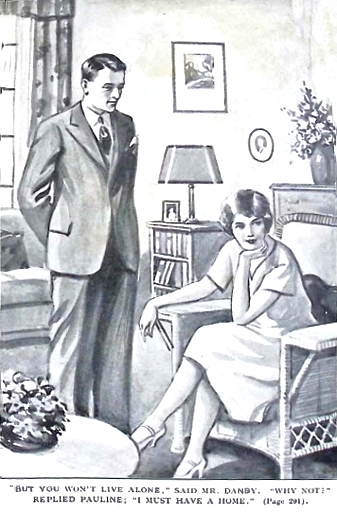
"BUT YOU WON'T LIVE ALONE," SAID MR. DANBY. "WHY NOT?"
REPLIED PAULINE; "I MUST HAVE A HOME."
"Oh!" said Mr. Danby, wheeling round upon her with intense, earnest gaze. "Have a home with me. Don't recoil with horror from me! I know I'm not fit to black your shoes. You have been my queen, my lady with the starry eyes, my divinity, since the first day I saw you! I went into church this morning and played my heart out on the organ. I knew you were returning this evening. Will you—could you—be content with the passionate devotion of an eccentric musician and a Jack-of-all-trades?"
Pauline was utterly dumbfounded. She was tired, and tears rose to her eyes.
"Dear Mr. Danby, I am so very, very sorry, but it can never be. I grieve to pain you. I thought our friendship was so sure and steadfast that nothing like this would spoil it. Be my friend still. I have so few of them. Let us treat your words as unsaid. I would not make you happy—you want a younger, brighter wife. You think too well of me; I am only a commonplace young woman, not fit to be the wife of a genius, but very proud to be his friend."
Mr. Danby's whole figure drooped with disappointment.
"Forgive me. I ought to have known it would be impossible. It was the sons of God that mated with the daughters of men—was it not?—not the daughters of God with the sons of men. Well, Miss Erskine, I can bear blows like a man—and this is a heavy one, for I'm always a hopeful fool. I will say no more. Good-night. God bless you."
He wheeled round and was gone.
Pauline walked into her cottage, depressed and weary.
"I shall have lost him now. It is very well to talk of being friends still. It will never be the same again. He is so genuine, so good, and yet so utterly apart from me myself. I shall live and die a single woman. I know I shall."
COME BACK
"She is so conjunctive to my life and soul
That as the star moves not but in his sphere
I could not, but by her."
SHAKESPEARE.
PAULINE took the small farmhouse and moved her furniture into it.
When Audrey motored down and stayed a couple of nights with her, she was delighted with it. There was an oak staircase, and the rooms were large, with quaint window seats and corners.
"But," said Audrey, "it seems too big for you, Pauline. I don't like to think of you upon the dreary winter days wandering about here in the dusk alone."
"Do you know what I want to do?"
"Something philanthropic, I am sure."
"Not at all. I want to have Honor and her children here for a part of the winter. I have even planned out their rooms."
"That would be delightful, but are you sure you can afford it?"
"I think so. We shall live very simply. And the small girl I have to help Mary is as strong as a pony and very willing. We shall want no extra help. Honor tells me she takes entire charge of her baby; she has no nurse."
"But perhaps her sister-in-law won't let her come."
"That is the very point. Miss Selkirk has been accustomed to spend two or three months away at Torquay in the winter-time. Honor told me privately she would like to get a little cottage somewhere for that time. But I know at present she cannot afford it. You see, Audrey dear, you cannot expect me to sit down and do nothing in this house. I cannot tell you what a blank there is in my life. I have not become accustomed to my leisure. I have taken the house, as I must have a home and a place for my furniture, and I thought about Honor when I did it. I want to have guests, and she will be my first one."
"Oh!" cried Audrey impulsively. "What a dear you are! And if I were the poor governess again, I should come here for all my holidays—shouldn't I? I lose a lot by Bernard's money."
"You can do a lot of good with it."
"I am getting tired of my leisure," said Audrey, with a sigh. "Like you, I don't care for it. I love a busy life, and I haven't got it. Bernard isn't well enough to lead anything but a quiet life. We are too peaceful. I can hardly believe I am marching westward. My storms have disappeared. I think—if I may say so under my breath—I rather enjoyed them. The whole time I was at the college, there were continual breezes of some sort or another. There was always something happening to call forth one's powers. I declare, if I were over sixty, with a flagging step and fading sight, I would suit Bernard just as well. I could still look after his comforts and mend his socks and read the papers to him."
"I am afraid you are discontented."
If Pauline's words were a rebuke, her smile was not.
"Yes; I have a discontented nature unless I am filled to the brim with work, and then I am happy. I think I am at present like a lamp nearly empty of oil—I have the capacity for being filled and consequently giving more light. Oh, I am a conceited wretch! Don't make me talk any more about myself. Every day I pray to be kept humble. I do rise up so aggressively whenever I get a chance! I shall come down and see Honor when you get her here. What a happy little party you will be! Don't laugh at me—but living alone with one man is very dull!"
"Oh, Audrey, for shame! What would you do if you were married?"
"Help my husband with his work. I would never marry an idle man like Bernard, though he is a dear, and I am simply longing for him to get a nice wife."
When Pauline's invitation arrived for Honor, Miss Selkirk looked rather glum. She was vexed at the lighting of Honor's face and the eagerness with which she told her about it.
"Isn't it good of Pauline? And it will be so convenient for you. I was dreading lest we should prevent you going to Torquay. I know you always shut up your house, do you not?"
"Oh, I dare say it will work in very well," said Miss Selkirk, in her short, abrupt fashion.
Honor's face fell. She did not know why the plan was distasteful to her sister-in-law.
Christine enlightened her.
"Ye see, mem, the mistress likes you and the bairns so well, she's in muckle fear lest your friends should tak' ye awa' from her."
"But, Christine, it is very good of her; I always felt we must be a burden. Fay's chatter and noise are a constant irritation to her."
"Aye, so the mistress would say. But I ken her the best, and I ken that she hasna been so blithe or so content in her life as she is at present. She loves the lot of ye, though she wadna say so for the whole world!"
Honor's face flushed with pleasure. She had not been accustomed to affection or even appreciation, and could not even now get over her girlish diffidence.
"It's very nice of you to tell me this, Christine; it makes it easier for me to stay here. I love being here myself, but this visit will be good for all of us. I shall come back if Miss Selkirk will have me."
Not a word of regret at their departure did Miss Selkirk make. She wished them good-bye with a stolid, expressionless face. Not even Fay's parting words brought a glimmer of a smile to her lips:
"Please, Aunt Marget, be kind to those two very nice snails I tolded you about yest'day. And if you could make a little sand wall round them like I begun, I should fink they wouldn't run away till I comes back. One of them is so sweet, and makes such lovely slime wherever she goes."
So Honor and her children came to bring brightness into Pauline's life, and the farmhouse rang with children's voices and laughter.
Audrey longed to be with them, and was not long before she brought her brother down for a day to see them. He was delighted with the household.
And when Audrey returned home, she wrote as follows to Pauline:
"Tell Honor she has made a conquest of Bernard. What a pity she is married! He told me if I could find a facsimile of her anywhere, he would marry at once. Isn't it strange? Because she is not exactly pretty. He said she was such a thoroughly feminine woman and the kind to make a man happy all his life. What a selfish outlook even the best of men can have! If she had still been living at the Rectory, I am sure she would have become my sister-in-law."
Pauline read some of this out to Honor. First she laughed, then she looked up into Pauline's face rather sadly.
"And if I had not taken my way instead of God's way, perhaps that was what was in store for me. How little we know! And my baby might have had comfort and ease, instead of poverty and struggle in front of him."
Then she smiled through misty eyes.
"But then I shouldn't have had Fay—and she has brought such brightness into my life. And Alick and I will be happy together one day, I hope."
********
It was a gloomy November afternoon, a drizzling rain was falling, and Audrey in macintosh and umbrella was splashing along Regent Street engaged in shopping. She had motored up to town without her brother, but under the care of their chauffeur, and was hastening along to the hotel in Hanover Square at which they usually put up.
Just as she turned a corner, she collided rather violently with another foot passenger, and looking up full of apologies found herself face to face with Dr. Vernon.
Their greeting was a warm one.
"It isn't a fit afternoon for you to be out," he said. "May I walk with you to your hotel?"
"If it is not taking you out of your way. Do tell me about everyone—and my dear boys. Oh, how long it seems since I was with you!"
He gave her all the school news he could think of.
"And now about yourself. How is your brother? Is he in town?"
"No, I am thankful he is not, for this wet weather always tries him. He is very much better. He and I are leading a fat, lazy life, and I'm aching to my very finger-tips for work."
"But I always thought work could be had 'ad libitum' wherever one is."
"I can't get hold of any, except visiting a few poor people, and making warm garments to give them at Christmas."
"Get him married, and come back to us," said the doctor in a firm, decided tone. "We want you."
"I believe," said Audrey meditatively, "he means to marry. There is someone abroad he has mentioned to me lately. He is so delighted at his health coming back that he even talks of returning to Australia. Men are very strange."
"I told you he was too young a man to settle down to a quiet English life," said the doctor, a hint of triumph in his tone.
"Oh! Well, there is nothing settled. He would be angry at my mentioning such a possibility. He has only been hinting at it now and then."
"Are you returning to-night? Surely you will have a most unpleasant journey. Is your car a closed one?"
"It has a hood." A fierce onslaught of wind and rain beat in their faces. Audrey gave a little shudder. "I don't altogether like motors. I should be much more comfortable in the train, but of course I shouldn't use that."
They had come to the hotel. He accompanied her up the steps, and the porter handed Audrey a telegram.
She opened it as Dr. Vernon stood waiting to wish her good-bye.
"This is from my brother," she said. "He tells me to stop the night in town. Very thoughtful of him."
Dr. Vernon's face brightened.
"Will you come round and dine with my sister and myself? We came up yesterday to say good-bye to some old friends returning to India. We are at the Grosvenor. My sister would be so pleased to see you."
"Thank you very much. I shall be delighted, but you must take me as I am. I really don't know how I shall manage as it is. Men never think of ladies' requirements for a night."
"My sister may be able to help you. Shall we hire a taxi, and go straight back to her?"
"I must see our chauffeur. Perhaps you had better not wait."
But Dr. Vernon did wait, and presently they were both driving along together.
"This rather reminds me," said Audrey impulsively, "of the way you drove me off to Victoria Station that time when you took possession of me. How terrified I was of you, and how impotently angry!"
Then Dr. Vernon leaned towards her.
"I want to take possession of you again," he said in a low, vibrating voice. "Will you come?"
Audrey gave a little start.
"What do you mean?" she asked in confusion.
"I want you to come back to Horsborough College as my wife," he said. "I want you with all my heart and soul. Will you come?"
Now, long ago Audrey had girlishly imagined this possibility, and she had determinedly vowed within herself that then would be the opportunity to make him suffer as he had made her suffer in that first interview. But now, her breath came quick and fast; she felt that she was an utterly different girl in thoughts and feelings and purposes from that hot-headed, passionate young creature who plunged into the heart of London seeking to forget the one who had so humiliated her, and resolving never to come into his life again.
She was absolutely silent. The roar of the London streets was around them, but as far as she was concerned, she was only conscious of herself and him in the universe.
"Audrey, you know what I am—a quick-tempered, faulty man, but my heart is yours, and has been for a long time. I have waited, because I felt that you ought to have a chance of trying another atmosphere. I cannot give you ease and luxury; it will be a strenuous life of work for both of us, but if I can make it a happy life, I will. Dear, look up; only one word—'Yes' or 'No.' Don't keep me in suspense."
Still silence, and then Audrey's head drooped, but not before the whispered word caught the doctor's ear, and it was "Yes."
When they joined Miss Vernon later, there was nothing in their manner to tell her what had happened. She was unfeignedly glad to see Audrey again.
"Your successor is such an estimable woman," she said with the merry twinkle in her eyes that came there so often. "She is so fitted for her sphere that I am certain she was a teacher in another life.
"'Imparting knowledge,' she said to me, 'is the cream of life; and though I have not as much teaching as I could wish, I can do a great deal in a tactful way during the hours of recreation.'
"She is supremely tactful. I am perfectly certain there will be no breezes now between her and her chief."
"What a blessing!" murmured Audrey.
They chatted upon different subjects through dinner, but Audrey was quieter and gentler than usual, and though she showed no self-consciousness, she was aware that Dr. Vernon's eyes hardly ever left her face. She was looking her very best that evening; the outlines of her face had softened wonderfully, and a pink colour was in her cheeks.
Before long, Miss Vernon's sharp eyes began to suspect, and when dinner was over and they were in a cosy corner of the big drawing-room, she came to the point.
"Did you two settle to meet each other to-day?" she asked.
"Dear Miss Vernon!" exclaimed Audrey. "I should think not. It was just a coincidence."
"A very remarkable one. Am I to be given any information?"
Dr. Vernon smiled.
"Shall I tell her, Audrey?" he asked.
The use of her Christian name deepened her blushes.
Miss Vernon drew a breath.
"No need to," she said abruptly. "I always knew this moment would come, and I'm not sure that it is a very pleasant one to me."
"Oh, please," said Audrey, putting her hand out and laying it affectionately on Miss Vernon's arm, "please say something nice to me. I feel quite frightened. I cannot hope you will approve, for I am not fit in any way to be his wife. But if he thinks I am—"
She stopped.
Miss Vernon gave her a little reassuring nod.
"You're the only one I could tolerate at all," she said; "I always felt that. Do you think I should have taken you to Switzerland, and let you and him be so much together, if I hadn't wanted to bring this about? I wondered it didn't come off then. Well, my dear, joking apart, make him a good wife; that is my one desire."
"And have you nothing to say to me?" asked Dr. Vernon. "Am I not to try to make her a good husband? I am getting an old fogy, and have nothing but hard work to offer her. Don't you think my luck is wonderful?"
"You always get what you want," said Miss Vernon coolly, "and I won't tell her how long you wanted her. I knew it before you knew it yourself. Now, to be selfish, what will become of me?"
"You must still live with us!" cried Audrey, and Dr. Vernon reiterated the statement.
"I shall please myself about that, but I will stipulate that you always keep a room for me, whether in a college or in a deanery or in a bishop's palace; and it is not to be the spare room. Then I can come and go as I like. How thankful I am I have had the breadth and strength of mind to resist incorporating myself with the school. I shall not be missed. I shall have time to visit my friends and gather gleanings for my lifework."
She was reassured at once about her room. Then, rising from her seat, she said:
"Of course, I'm 'de trop.' I'll leave you together, but I must speak to you alone, my dear Audrey, before you leave."
"Certainly. I must not be late," said Audrey.
She felt almost nervous when Miss Vernon had left them, but that feeling soon disappeared. And though they were not alone, and it was in a public drawing-room, the doctor and she found plenty to say to each other. Perhaps of the two the doctor was the greater talker. Audrey was content to be the listener.
When she at length went to Miss Vernon, the old lady drew her into her bedroom, and, laying her hand on her shoulder, said in a mysterious voice:
"My dear, you must kindly supply me with a few notes about your family and pedigree. Are you the same family as the Humes or Homes of Scotland? And are you any relative of Hume the historian? And may I ask who your mother was? You must excuse me asking these questions, but of course, I must have a page about your origin."
Audrey could not help it. She burst into a rippling peal of laughter.
"Oh, Miss Vernon, it takes a brave woman to be your brother's wife! The honour of it is too much for me!"
Miss Vernon joined her in her laugh.
"Ah, well, you know what I think of him! And he knows what I think of you! And now go along. It's getting late. I suppose the wedding day is not fixed yet?"
"That may not be for years," said Audrey seriously. "I have told your brother that I cannot leave Bernard at present."
She went back to her hotel, and hardly closed her eyes all night, for the suddenness of it almost overwhelmed her.
And then the next day, she motored home and told her brother all about it.
SUMMONED TO PART
"What matter if I stand alone?
I wait with joy the coming years;
My heart shall reap where it has sown
And garner up its fruit of tears.
"The stars come nightly to the sky;
The tidal wave into the sea.
Nor time, nor space, nor deep, nor high,
Can keep my own away from me."
JOHN BURROUGHS.
HONOR had not been with Pauline very long before Amabel came over to see them with her baby. She had arrived from India with an ayah, who was the cause of much awe and interest to the villagers. Amabel herself looked white and frail, but was as happy and lighthearted as ever.
Of course, as mothers, she and Honor compared notes about their babies, and Pauline listened to them with much amusement.
"I do love India so," said Amabel, "but I am afraid it does not love me. I seem to get so much fever. You see, I have some shadows, Honor; I know you think I have none."
"Oh, I don't say that," said Honor; "the separation from your husband must be a big one."
"Yes; and he feels it so much that he wants to get an exchange, but I won't have that. I am a soldier's wife, and don't want him or myself to shirk the hardships that come to us. I don't want him ever to be able to say, 'I could have got my promotion quicker if I had been an unmarried man.'"
"I quite agree," said Pauline, with kindling eyes.
"So, you see," went on Amabel in her cheerful voice, "I must be separated from him for a little. When I get quite strong again, I shall go back to him. And meanwhile, baby and ayah and I are turning our house topsy-turvy, but mother and father say they enjoy it, and I am sure I do."
She chatted away, telling them of her first experiences of native servants, and making them laugh at her blunders.
When she had left them, Honor said:
"It isn't only Amabel's circumstances that make her so sunny; it is her nature. She will go through life taking everything the same way."
"Yes, I think she will. Even big sorrows that may come to her will fall upon her softly. She will see the Love behind them."
"She will have no big sorrows—she travels south."
"Oh, well," said Pauline, laughing, "that is only a fancy of ours. And, remember, storms come from every quarter."
It was only the next morning that Pauline came to breakfast and found Honor, who had come down before her, reading a foreign letter, with a stunned, despairing face.
To herself Pauline thought, "That wretched husband again!"
Then she asked if she had had good news. Honor sat down at the table, and, putting her face down into her hands, began to cry.
"What is the matter, dear? Is your husband not well?"
"Oh, I can't believe it! It's the most awful news! Alick has had the most dreadful accident. I can't understand particulars. He was jammed between some logs near a rapid; he was in a canoe, and it was caught between them and crushed to pieces. That's what this man says—it isn't Alick himself. And they've had to amputate one of his legs above the knee. He'll be a cripple for life; he will never be able to ride. And this man says one of his arms is also injured."
"But his life is not in danger?"
"No, he says not. But he says he is coming home."
"Oh, Honor, are you not glad?"
"How can I be glad when I know how he will hate it? He is a restless man, and loves an open air life, and walking or riding is essential to him. Oh, Pauline, it has just come to me! I have been praying that he may be brought to England and settle down here; I have been praying so earnestly, and now my prayer is answered in this terrible way!"
"My dear Honor, do you know that you make out God to be a hard and cruel tyrant?"
"Oh, no; don't say that. But it will be such an awful return! And if he cannot travel any more, how can I hope to make him content and happy? And how shall we be able to live? Oh, Pauline, forgive me! Here comes Fay. Give her her breakfast; I will run upstairs to baby. I feel as if food will choke me."
Honor disappeared. It did seem as if she had one trouble upon the top of another, and for the time, the shock had utterly unnerved her.
Yet later in the day, she was able to break the news to Fay with brave, smiling lips.
To the child the thought of her father's return was more than his hurt.
And Honor began to plan in her own mind how she could make life still bearable to him. This news made her leave Pauline sooner than she would otherwise have done, for Miss Selkirk hastened home and asked her to join her.
"Do you think Miss Selkirk will want your husband to make his home with her?" Pauline asked.
"Why, no! I should think not! Alick would rather be in a hovel, I believe, than go to her! I don't know what we shall do. Perhaps I shall hear his plans next mail, unless he has started for England already?"
And the next mail did bring her a letter from her husband.
"MY DEAREST WIFE,
"You have heard of my smash up! With good luck, for once, only one leg
has suffered, and my left arm will be useless for a time. But as I am
such a crock, I am coming home to be nursed. What will Fay say to a
one-legged father? You must meet me in London, and then we'll settle
what we shall do. Meantime, you can be hunting up any small place in
the country. I've been jotting up my investments this morning, and
find that I can be sure of about £400 a year, so you must get a house
in proportion to our means. Shall we buy a caravan and live in it? I'm
sure that would suit our requirements. No more for now. It does my
heart good to think I have a wife and child ready to welcome me. I'm
afraid I've kept you on short commons, but it hasn't hurt Margaret to
dispose of some of her hoarded wealth. I forget I have a boy. How is
he? Expect me by the Star Line. I'll wire name of boat.
"Your affectionate husband,—
"ALICK."
Honor did not read the whole of this letter to Miss Selkirk, but she did tell her of the income her husband had.
And she was bitterly indignant with him in consequence.
"He has been spending all that upon himself, and keeping you and his children without a penny! How on earth can he do it?"
"He is very generous," faltered Honor; "he helps his friends a lot. Men don't think. It is an immense relief to me, for I was wondering how we should live. We shall be kept from want, and shall be able to live on that in comfort."
Miss Selkirk gave an angry snort.
"Alick will be Alick still to the end of his life. Can't I see your household? He living on the fat of the land, and having the best of everything; you and the children suffering from absence of actual necessaries."
"I see myself happy, if I can make him so," said Honor.
And Miss Selkirk walked away silenced, but marvelling at her.
The next morning to this came a letter from Pauline. And as Honor read, she again took herself to task for her want of trust and faith in God.
"I am going to ask you," Pauline wrote, "if you would like the loan
of my farmhouse for a time? It would be a kindness to me if you kept
it aired. And if Mr. Selkirk likes to pay me rent for it, I will let
it for fifteen shillings a week during the winter-time. The fact is,
I want to pay some visits. And I am thinking of doing a little parish
work in a small village about twenty miles from here. I find, Honor,
that I have too much idle time on my hands. I must do something, as I
do not want to rust. Mr. Danby mentioned this village to me long ago.
He went there to lecture, and what he told me interested me greatly.
The living is only worth about £130 a year. The old clergyman and his
wife are real old saints, who stint themselves of their last penny if
any of their parishioners need help. But they are getting feeble; their
village population is increasing, as a paper mill has been set up about
a mile away, and they are not equal to the demands made upon them.
"Mr. Danby told me he would like to have helped them, but there was
much that, as a man, he could not do. And it has struck me that I could
take rooms in the village and do what little I could to help them. He
gave me a most pathetic account of their efforts at hospitality when he
stayed a night with them. They seem like an old Darby and Joan—and real
old gentle-people. I have written to them, and have had a most kind
letter in return, and, if I can let my farmhouse, I will go to them at
once. It all seems to fit in, doesn't it? You would be near your home
and within touch of your father and little sisters, and it would be
a quiet country spot for a convalescent. Write and tell me what you
think. I do hope you will take it, if only for a time—and Mary would
be a great comfort to you. I would not take her with me, not unless I
settled down there eventually and had my furniture with me."
"It's just the place for us," said Honor to Miss Selkirk. "If I had gone all over England, I could not have found any other place I should have liked so well."
She wrote and accepted Pauline's offer gratefully.
Pauline did not let the grass grow beneath her feet. She packed up what she intended to take with her. The rest she had had since her mother's death had given her back much of her former strength and vigour, and she was almost feverishly eager to be at work again.
Mrs. Daventry at first tried to dissuade her from the step she was about to take:
"We can't afford to lose you. You will only be overworking yourself. I can't tell you how I long that someone should take care of you. You have always been taking care of others. Will you not come to me for a long visit?"
But Pauline shook her head.
"I have done so little all my life in the way of helping my outside neighbours that I am longing to begin now. If I want a rest, may I come to you? That would be so delightful!"
Just two days before her departure, she was packing up some books in her sitting-room when Mr. Danby was announced.
She turned round, feeling rather relieved to think that he was perhaps going to be on the old friendly terms with her again. But when she saw his face, she was struck by its extreme gravity.
He shook hands with her in silence, then Pauline said gently:
"I am afraid you are in trouble, are you not?"
"Yes, I am," he said abruptly; "and I have come to drag you into it, too. At least, I am presuming that you will do what I want."
"If I can help you at all, I shall be glad."
He paused. Then as she asked him to sit down, he did so.
"You know I can't beat about the bush. There's someone—a friend of mine—who is ill. He can't get better, and he wants to see you. Will you come?"
"Who is it?"
Pauline's lips whitened as she asked the question.
"He's been murmuring your name—there aren't many Paulines in the world. I never knew he was a friend of yours, though he was always keen on hearing me talk about you, but I expect he is—"
"Is it Mr. Pembroke?"
"Ah, then my surmise is true! You know, I've seen a lot of him lately, and last week in protecting a child, he was knocked down by a motor in town. They took him to the hospital, and thought he was doing well, but there are internal complications. He is in a nursing home now in Harley Street. I've been with him. He seems rather a lonely chap, though he has plenty of acquaintances. I asked him last night if he would like to see you, and his look made me rush down the first thing this morning."
"I will come," said Pauline steadily. "Can we catch a train this afternoon?"
"Yes, if you are quick. I have a cab outside. I would have wired, only I did not know—I wasn't sure whether you would understand."
Pauline had disappeared. In five minutes, she was back again. Her very quietness and absence of fussiness and the tragic look in her sweet blue eyes told Mr. Danby that he had been right in summoning her.
She asked for a few details during the journey to town, but they did not speak much. As Pauline sat back, resting her throbbing head against the hard railway carriage cushions, one sentence was burning itself into her brain:
"He can't get better."
It was late in the evening when they reached Harley Street. A nurse came into the sitting-room and greeted Pauline very kindly.
"I am so glad you could come. He is quite conscious now, though very weak. It will not be very long, the doctor thinks. But you must have a cup of tea or coffee before you go up to him."
"I would rather not."
"Then I will have one ready for you when you leave him. This way. I think, Mr. Danby, it would be best for you not to see him again to-night if this lady does."
Mr. Danby bowed assent meekly, quite willing to relinquish his place to Pauline.
"I will be here the first thing in the morning," he said.
And then Pauline, always ready to consider everyone before herself, turned to him and held out her hand with a sweet smile:
"Good-night, Mr. Danby. I will thank you later for your goodness in fetching me. Please say if you specially want to see him again to-night. I do not want to usurp your place."
"I am glad you can see him," said Mr. Danby gruffly. And then he went, for the sorrow of Pauline and Justin seemed greater than his own.
Every detail of that little house in Harley Street stamped itself upon Pauline's brain: the red felt stair carpets as she trod upon them, the photographs on the staircase of groups of nurses and doctors, the landing with the inevitable table outside the sick-rooms, and the quiet bustle that there seemed everywhere—nurses passing to and fro, a sound of whisking of eggs, the slight rattle of crockery, and a smell of disinfectants throughout the whole.
And as she stood outside the door, she said to herself, with a mixture of joy and pain in her heart:
"He wants me. He has not forgotten me."
Then, a moment after, she stood looking down upon the narrow bed. Suffering had already left its mark on Justin; his face looked wan and pale, his eyes seemed sunken, and there were blue lines about them and his lips.
It was no time to stand on ceremony. Pauline sank on her knees by the bedside and took his hand in hers. The nurse slipped out of the room.
"I am here—Pauline is here," she said softly but distinctly.
Justin opened his eyes, and then a slow, bright smile spread over his face.
"Pauline," he whispered, "how did you know?"
"Mr. Danby has brought me."
"I was hoping—hoping to come down to you. Would you have listened to me?"
He spoke with difficulty.
Pauline choked down a little sob.
"Justin, dear, there is so little time—I should like you to know—I have always loved you. My mother never gave me your letter. I did not know you had called. That is many years ago, and I thought you had forgotten me. Don't look sorrowful, dear. In any case, I could not have left my mother."
"Take off your hat. Put your head down on the pillow beside me. I am a dying man. They say I can't last long."
Quietly, Pauline did as he wished. If her lips were quivering and her heart nearly breaking, she did not let her feelings get the better of her.
Justin took her face between his two hands, then kissed her slowly upon her lips.
"My heart has always held you," he said simply.
They were silent for a moment. With death hovering so near, there seemed no need for any explanations or protestations of love.
Again he spoke.
"I am so glad you always cared. I wish I had known. The years seem wasted."
"No," said Pauline, with a serene light in her eyes; "doing and bearing God's will is never waste of time."
He smiled.
"We shall have eternity together in any case; we have been kept apart for some wise purpose. Will you read to me? Your voice is such music."
It was too dark to read, but from memory Pauline began to repeat:
"'Let not your heart be troubled. Ye believe in God, believe also in
Me.'"
Verse after verse of that beautiful chapter did she say, and her lover lay there smiling, waiting for the messenger who still delayed.
Presently the nurse returned, and Pauline was told she must go.
For a moment her spirit rebelled. And the nurse, after a searching look at the patient, called her out of the room.
"If he is dying," said Pauline to her, "why should not I stay to the end?"
"He seems to have rallied wonderfully," the nurse said thoughtfully. "If we can give him nourishment and get him to sleep, he may linger longer than we thought this morning."
"And you think he has a better chance if I am away from him?"
"There will be less temptation for him to make an effort to speak."
Pauline went back to the bed.
"Justin," she said in her low, clear voice, "I am leaving you now. Rest and sleep, and I will see you, I hope, in the morning."
She bent and kissed him on the forehead. He seemed already to be slipping into unconsciousness.
And then, in a sitting-room below, Pauline spent the night pacing up and down, her lips moving in prayer. The anguish of that night brought silver threads amongst her golden hair. She seemed, like David of old, to say,—
"'Who can tell whether God will be gracious to me?'"
And she had the realisation that death itself was stayed, whilst the ear of God was bent in love to listen to one of His children.
She had acquiesced the day before in patient submission to what she believed was God's will. Now, she was earnestly pleading and wrestling for the life that seemed to be slipping away, and yet through it all she cried:
"Not against Thy will, O God, but let it be Thy will."
When morning dawned, the nurse came to her.
"I hardly dare give you hope, but the doctor has been and is astonished. We thought last night it was the last rally, but the improvement and strength are maintained."
And so it was continued all day. Pauline took a room at the nearest hotel.
Before a week was over, the doctors were able to state that recovery was more than possible, it was probable. And Pauline lived day by day hugging the new-born hope to her heart and thanking God for His mercy.
When she eventually returned home, her life seemed to be a strange confusion.
Justin's recovery would be slow, and the doctors had told him that there would be no more travelling or exploring for him. He would have to lead a very quiet life, though not necessarily that of an invalid. If they married soon, Pauline would be more of a nurse than a wife, and Justin was not a rich man.
The outlook would not have been rosy to any but Pauline.
Yet she confided to Mrs. Daventry that her cup was so full that she could hardly bear it.
"Do you think," she said, "my path has taken a twist and is facing south at last?"
"I think," said Mrs. Daventry slowly, "that your northern journey will be shared by one who, with yourself, has enough sunshine within to compensate for the lack of it without."
"You mean we shall have to contend with small means? But I have never had much of this world's wealth. And I am afraid I am like any romantic girl—with Justin by my side, I fear nothing."
"What about your farmhouse? Will you not want it for yourself?"
"Not at present. Justin and I want to go together to my village and help the old clergyman and his wife. We mean to start in rooms first, and if we can find a small cottage later on, we may take it. Justin will be able to help in many ways, and it will give him interest outside himself. Don't shake your head, dear Mrs. Daventry. I know what is in front of me, and I am glorying in it all."
What could Mrs. Daventry say?
She only kissed Pauline affectionately, and rejoiced in her happiness. She knew that no clouds would ever bow her head, no troubles, however great, would crush her spirit; and this gleam of sunlight upon her path was surely the reward of much patient waiting.
But when others heard her news, they were much more ecstatic than Mrs. Daventry. Audrey and Honor were too delighted for words.
"Oh!" said Audrey, hugging her. "What a wife you will make! Fortunate man! Is he worthy of you? Oh, Pauline, Pauline! To think that you should be like the rest of us! And isn't it extraordinary that we four shall all marry? A year or two ago and we thought we should live and die old maids."
"I knew something good would come to you one day," said Honor. "And you richly deserve the very best man who walks the face of the earth!"
Mrs. Daventry was seated once again upon her lawn with her four young friends around her. It was the last opportunity they had of gathering together, as upon the following day Amabel was returning to her husband in India. Honor and her husband were comfortably settled in Pauline's farmhouse. She had left Fay to entertain her father for this afternoon. Audrey had motored down from her brother's for the occasion. And Pauline was Mrs. Daventry's guest. She had insisted upon having her, and was going to keep her till she married. Justin was fast recovering in the nursing home, and directly he was convalescent, he was also coming to stay with Mrs. Daventry.
The girls had been talking over old times. A little shadow seemed to lie on Honor's face. Perhaps her experience gave her voice a tinge of melancholy as she said:
"Well, it is strange that none of us should remain single women, but I don't think marriage changes one's aspect. It isn't as it is in story-books; and it does not follow that Pauline's path will turn from the north because she is going to marry. I used to believe that a marriage was the beginning of living happily ever after, but it seems to me that it is just the beginning of responsibilities and difficulties, and of experiencing the depths in life, instead of the rippling surface."
Audrey looked sober; but not a shadow came into Pauline's beautiful eyes.
"Life is good at all times," she said simply; "and deep water is better than shallow for swimmers, Honor. We don't want to stagnate."
"Do you remember when you first talked to us about our gates?" said Audrey, turning to Mrs. Daventry. "We said something about meeting in a year's time and comparing notes. We never did. How we have scattered in these few years! It has been a general break-up. And I used to think that nothing would ever change!"
"We always think that when we are young," said Mrs. Daventry, with rather a wistful smile.
"Let us compare notes at once," cried Amabel enthusiastically. "May I begin?"
Assent was upon everyone's lips, but a shadow of gravity stole over the sunshiny face of the girl as she said:
"I suppose I am still treading south. I know I have a happy southern aspect, and life, as yet, has brought me no heavy troubles. But I pray God every day to make me what He wants me to be, and that is where I fail. A gardener expects so much more from a plant that is grown in a sunny, sheltered position. And though one faces south, it isn't always free from breezes—is it Mrs. Daventry? May I tell you all a lovely little thing that I discovered in my Bible quite lately? It is in Joshua, where Caleb's daughter comes to her father, and says, when he asks her what she wants:
"'Give me a blessing; for thou hast given me a south land; give me also
springs of water.'
"That is my prayer every day now. I don't want to get parched by easy circumstances."
Amabel was sitting next to Mrs. Daventry, and the old lady put her withered hand gently over her young one.
"Your south gate will not spoil you," she said softly, and tears were in her eyes as she spoke.
"Now, Honor," said Audrey, "what is your experience?"
Honor was silent for a moment. Then she said:
"I have learnt this:
"'He stayeth His rough wind in the day of the east wind' (Isaiah xxvii.
8).
"It is never too strong for me."
She bore the impress upon her face that her words were true. The old fretful, discontented lines had disappeared. Great quietness and peace had settled upon her; the storm and stress of life which still buffeted and cut her was rounding her corners and shaping her into patient, steadfast womanhood.
"Ah!" said Audrey with a quick-caught sigh. "I am far behind you all. I don't believe these years have taught me anything except to discover how little I know. But—" here her grey eyes kindled and flashed with sudden feeling—"I came across a verse the other day which fits me:
"'The Lord turned a mighty strong west wind, which took away the
locusts' (Exod. x. 19).
"And I need a strong wind to take away all my locusts. So I daren't complain. Storms are good for me—and I have got far more sunshine than I deserve."
"And now, Pauline?"
Mrs. Daventry looked tenderly at the beautiful girl, with her quiet, glad face and shining eyes.
"What can I say?" said Pauline, with a smile. "Audrey has just given us a quaint text. May I give another? It is in Zechariah vi., and is speaking about the chariots and horses driving northwards:
"'Behold, these that go toward the north country have quieted my spirit
in the north country.'
"And I feel that I am not journeying alone, and so my spirit is quieted."
"The horses and chariots of the Lord," murmured Mrs. Daventry. "After all, girls, what does it matter about your aspect, north or south, east or west, so long as your goal is the right one? The beginning and the middle of our journey is not worth consideration in comparison to the end of it. Shall I repeat the promise that always brings a little thrill to my heart as I read it?
"'And the ransomed of the Lord shall return, and come to Zion with
songs and everlasting joy upon their heads: they shall obtain joy and
gladness, and sorrow and sighing shall flee away.'" (Isaiah xxxv. 10).