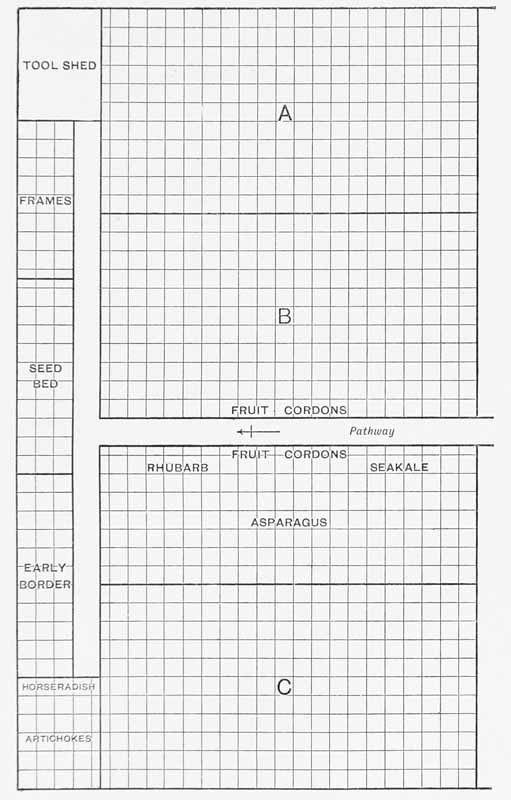
Plan I.—A small Kitchen Garden of about 1/10 Acre
(From “The Small Garden Useful”)
Scale.—The ground divided into 2-foot squares
An Alphabetical Guide to the Cultivation
of Vegetables
With Recipes for Cooking Them
COLLECTED AND ARRANGED BY
CECILIA MARIA PEARSE
AUTHOR OF “THE ROMANCE OF A GREAT SINGER”
LONDON
SMITH, ELDER & CO., 15 WATERLOO PLACE
1913
[All rights reserved]
Printed by Ballantyne, Hanson & Co.
at the Ballantyne Press, Edinburgh
My thanks are due to all those who have allowed me to quote from them in compiling this book. For permission to use some of their recipes I am indebted to Mrs. C. W. Earle; George Savage & Sons, The Garden City, Letchworth; Dr. Josiah Oldfield’s Fruitarian Diet; Olive Green’s How to Cook Vegetables; Mr. C. Herman Senn’s How to Cook Vegetables; Mrs. Ross’s Tuscan Kitchen; and Mr. Sydney Beard’s Order of the Golden Age; while the extracts from the lecture by Mr. W. F. Giles are given by permission of Messrs. Sutton & Sons.
Most of all, however, I owe thanks to Mr. A. C. Curtis, author of The Small Garden Beautiful and The Small Garden Useful, for cultural directions and for his great help in general revision of the whole book.
CECILIA MARIA PEARSE.
November 1913.
| PAGE | |
|---|---|
| The Kitchen Garden and the Cook—Culture and Recipes | 1 |
| Salad Plants and Salads | 189 |
| Miscellaneous Sauces | 207 |
| Miscellaneous Soups | 213 |
| Miscellaneous Dishes | 225 |
| Cheese Dishes | 248 |
| Cakes and Puddings without Eggs | 249 |
| Cool Drinks | 255 |
| Successional Cropping in Small Gardens | 259 |
| Little Known Vegetables | 274 |
| Hints on Vegetable Cooking in Bags | 284 |
[Pg 1]
In preparing vegetables care should be given to cleanse them by washing them in cold salted water, but they should not be made sodden by long immersion. Fresh vegetables should be cooked the day of gathering, and one cannot be too careful about all tinned vegetables, especially tomatoes, mushrooms, and lentils. All green vegetables should be removed from the water as soon as cooked, and well drained. To avoid any offensive smell caused by cabbage or other greens, put a piece of bread or toast with them while cooking; this will absorb the odour. All vegetables should be served very hot.
This is a perennial plant, but is apt to deteriorate under cultivation; therefore, if possible, a third of the plantation should be renewed yearly. It does not always stand our cold and damp winters, though it may be considered hardy in the south of England.
The Globe Artichoke does not always come true to seed, so that it is better to renew or start a plantation by means of rooted suckers, which the plant [Pg 2]freely throws off. If seed be selected it should be sown in a mild hotbed in March and planted in its permanent bed in May.
A light, rich loam is preferred, heavy soils holding too much damp for this somewhat delicate plant, which requires perfect drainage yet plenty of water during the growing season. A sunny position should be chosen for the bed, the ground should be trenched and well manured, and the plants be put out in April about three feet apart according to the variety.
Keep the soil stirred with the hoe, and give plenty of water during drought, with occasional doses of weak liquid manure. In giving manure water to this, as to all other subjects, it should be extremely dilute, and should be applied during showery weather, or, if in dry weather, should be preceded and followed by copious watering with plain water.
In the autumn the plants must be trimmed up, and winter protection given in the shape of straw or fern covering.
The crop comes in over a longish period, beginning in late June with the older plants and going on into the Autumn with the plants put out in the spring. The flowering heads should be gathered when they are about three-parts grown, and well before they open.
This perennial sunflower gives, perhaps, the heaviest yield per square yard of any garden crop. It is of [Pg 3]the easiest culture, and may be grown in the same plot of ground year after year, an advantage in its case, as once in the ground it is very difficult to get rid of it. The ground should be prepared in late winter by trenching in a moderate quantity of manure. The tubers may be planted any open day in February or March in rows three feet apart, the sets eighteen inches in the rows. The rest of the culture simply consists in hoeing up weeds; the crop may be left in the ground and dug as required from September onwards, but it should be all cleared up before the tubers start to grow in March.
These require exactly similar treatment to Jerusalem Artichokes, except that the plants need be only a foot to fifteen inches apart. They withstand frost well, and may stay in the ground and be dug as wanted.
Boiled Artichoke (Jerusalem).—Wash well, as many artichokes as will be required, then put them in plenty of fresh clean water to cover and peel them rapidly, keeping them under water during the process, and then plunging them in a bowl of cold water till all are finished.
This is very important, as artichokes turn black if exposed to the air without their skins, even after they are cooked. Every one knows the disgusting appearance [Pg 4]a dish of black artichokes floating in their milk and water presents. This can be avoided by carefully following these directions.
Put them in a saucepan of cold water, sufficient to cover them well, add one tablespoonful of salt, allow twenty minutes to half an hour after they reach boiling point. Drain, and arrange on a drainer in a very hot vegetable dish, pour over a good white sauce (see White Sauce) immediately, being careful to mask each artichoke with the sauce, thus protecting it from the air. If properly cooked the sauce will cling to the vegetable and not drop to the bottom of the dish. If the artichokes have to wait, draw the saucepan to one side and keep them in the water till wanted.
Purée of Jerusalem Artichokes.—Melt a heaped tablespoonful of butter, add a sliced onion, one bay leaf, three pounds of Jerusalem artichokes washed, pared, and cut into slices. Cook slowly for ten minutes, add gradually one cupful of milk. When the vegetables are thoroughly cooked, add another cupful of milk, salt and pepper to season. Serve on toast or boil until tender in milk to cover, drain and press through a colander, and reheat, seasoning with salt and pepper.
Baked Artichokes.—Peel and trim one dozen artichokes, and season with salt and pepper. Put into a buttered baking dish and bake for half an hour. Baste frequently with butter, and serve in the same dish.
Another Method.—Wash and pare the artichokes, [Pg 5]put into cold water, with one tablespoonful of salt, boil till tender, cut into slices and put into a baking dish. Sprinkle with grated Parmesan cheese. Cover with white or cream sauce, sprinkle with crumbs, dot with butter, and bake until the crumbs are brown.
Braised Artichokes.—Peel, wash, and parboil the artichokes. Drain and put into a baking dish with enough water to moisten, add a small bunch of parsley, a few slices of carrot, and a small onion. Cover and bake slowly for an hour, add a little more liquid if required, remove the carrot, onion, and parsley, and serve in a vegetable dish with the strained liquid thickened, seasoned, and poured over.
Mashed Artichokes.—Wash and peel fifteen artichokes, cover with cold, salted water, bring to the boil, and cook until tender, drain, rub through a sieve, season with salt and pepper, add a piece of butter, and serve very hot. Brown sauce may be added if liked.
Brown Sauce.—Two onions, one tablespoonful of flour, three-quarters of a pint of salted water; seasoning, one ounce of butter or a tablespoonful of oil; chop the onion, fry brown in the butter, add the flour, which must be browned, pour in the water and stir until the mixture thickens, then season it to taste. Any kind of vegetable stock is preferable to water.
Another Method.—One onion, half a carrot, half a turnip, parsley, herbs, one bay leaf, one ounce of butter, one pint of water, one dessertspoonful of vinegar, one lump of sugar, spice, one tablespoonful [Pg 6]of ketchup or other condiment sauce. Fry the chopped vegetables in the butter until they are a good brown, add the flour, stir well, and add the water and stir until the mixture boils, then put in the parsley, herbs, vinegar, sugar, spice, and seasoning to taste, simmer by the side of the fire for about one hour, strain, and add the ketchup.
Jerusalem Artichokes with Brown Sauce.—Peel the artichokes, cut into dice, cook them till tender in salted water. Drain and reheat in brown sauce.
Artichokes à la Crême.—Prepare according to directions given for above recipe. Sprinkle with crumbs and grated cheese. Dot with butter, and brown in the oven, using the dish in which it is to be served.
Jerusalem Artichoke Balls.—Take eight boiled artichokes, rub through a sieve, and put into a saucepan with a little milk, one ounce butter, and one ounce Parmesan cheese. Stir over the fire until smooth, then add pepper and salt to taste, and the yolks of two eggs. Mix well and let it cool. Make balls of equal size, brush over with the white of egg, dip in bread-crumbs, and fry in hot nuttage or butter. Serve in pyramids with fried parsley scattered over.
Jerusalem Artichokes with Hollandaise Sauce.—Take twelve artichokes, trim them to the shape of pears, boil in water till tender, then drain well, and arrange them in the shape of a pyramid, pour over them some sauce Hollandaise, and serve.
Jerusalem Artichokes with White Sauce and Parmesan [Pg 7]Cheese.—They must have been previously cooked and cut up in small pieces.
Fried Chinese Artichokes.—Boil the artichokes until tender, drain them, egg and bread-crumb them, fry until crisp, and serve with parsley sauce and slices of lemons.
Artichokes à la Provençale.—Clean and cut two dozen Jerusalem artichokes in pieces about half an inch in length. Wash and put them into a stewpan with half an ounce of fresh butter and half an ounce of white castor sugar. Put them on a slow fire for a few minutes, add four tablespoonfuls of white sauce, eight tablespoonfuls of milk, and simmer until the artichokes are soft, then skim. Mix the yolk of an egg with two tablespoonfuls of milk, pour it into the stewpan and stir quickly, and serve hot. Jerusalem artichokes must be well cooked, but not reduced to a pulp.
Artichoke Purée.—Wash well and peel twelve artichokes, boil them in three pints of water and one tablespoonful of salt; when soft take them up, probably in twenty minutes. Meanwhile cook slowly in a stewpan one sliced onion, a little celery, one turnip, two ounces of butter, one bay leaf, and a little grated nutmeg. Stir and add one tablespoonful of flour and one pint or less of milk to form a proper thickness. Put in the artichokes. When boiled pass through a fine hair sieve and serve hot. Put two tablespoonfuls of cream or two yolks of eggs in the tureen and stir while adding the purée.
Boiled Globe Artichokes.—Cut off the tips of the [Pg 8]leaves and round off the bottoms. Remove the stalks and trim away the outer leaves. Soak for half an hour in salt water, washing thoroughly. Boil until tender in a large quantity of salted water, put into a serving dish, dot with butter, and heat till the butter is melted, and serve. Hollandaise sauce can be served with them.
Boiled Italian Artichokes.—Cut off the stems and boil till tender in salted water. Cut in half from top to bottom and serve to each person. Pass with them Hollandaise sauce. The scales must be stripped off and the soft end dipped into the sauce and eaten. The fuzzy part should be scraped off and the bottom eaten with a fork.
Artichokes à la Babette.—Put green artichokes into water and remove the choke. Trim the leaves neatly, parboil five minutes in salt water, and drain. Put into a buttered casserole, season with salt and pepper, and add a little butter. Cover and cook in a moderate oven for twenty-five minutes. This can be served with Hollandaise sauce.
Fried Artichokes.—Cut off the leaves and trim away the choke part. Chill on ice. Make a batter of half a cupful of flour, a pinch of salt, and baking powder, mix with a cupful of milk and a beaten egg. Cut each artichoke into pieces, season with salt and pepper, dip in the batter, and fry in deep fat, drain, and serve with any kind of sauce.
Stuffed Artichokes.—Clean and trim the artichokes, boil in salted water until tender, drain, scoop out the soft part with a spoon, season with a cupful of [Pg 9]chopped nuts, salt, pepper, melted butter, and lemon juice. Put the artichokes into a buttered baking dish, fill with nuts, tie into shape with string, add two cupfuls of stewed and drained tomatoes, a sliced onion, a pinch of salt, and a tablespoonful of butter. Bake slowly for an hour, basting frequently with the liquid. Take off the strings and strain the sauce, and serve.
Stuffed Fonds of Artichokes.—Cook eight artichoke bottoms in boiling water, drain, season with salt and pepper, fill with nuts, sprinkle with crumbs, dot with butter, and bake for ten minutes, basting with butter, and serve in the same dish.
Artichokes à la Crême.—Trim the artichokes and soak for half an hour in cold water and a little vinegar water to cover, rinse in fresh water and cook in salted water until tender. Drain and reheat in a cream sauce. An egg beaten and the juice of a lemon or a few drops of vinegar may be added.
Artichokes à la Mode.—Prepare and trim four or more artichokes, put into a saucepan with two tablespoonfuls of butter, the juice of a lemon, a pinch each of salt and pepper. Simmer until tender, drain, and brown in the oven. Put into the pan in which they were cooked two tablespoonfuls of butter, one heaped tablespoonful of flour, stir well, add half a cupful of milk, and half a cupful of water. Let it boil four minutes, stirring continually. Add one wineglassful of white wine, and serve in a sauce-boat.
Artichokes à l’Italien.—Wash, quarter, and trim [Pg 10]the artichokes, and boil in salt water until tender. Drain, remove and discard the chokes, arrange the artichokes on a dish with the leaves outwards, pour over a white sauce flavoured with mushrooms, and garnish with watercress.
Artichokes à la Lyonnaise.—Prepare and clean the artichokes, boil till tender in salt water, drain, wipe dry, fry in equal parts of butter and oil, when brown add two tablespoonfuls of flour, stir well, then half a cupful of water, and boil for three minutes, season with salt, pepper, minced parsley, and lemon juice, and serve.
Second Method.—Pull off the leaves and cut the artichokes into quarters, parboil in salt water for five minutes, drain and arrange in a thickly buttered baking dish, sprinkle with sugar, salt, and white pepper, add one wineglassful of white wine and one tablespoonful of water. Simmer slowly for three-quarters of an hour. Add one tablespoonful of butter and a little lemon juice poured over the artichokes before serving.
Artichokes à la Pompadour.—Cover eight artichoke bottoms with cream sauce, lay on each one a large floweret of boiled cauliflower previously boiled for a quarter of an hour, cover with more of the sauce, sprinkle with crumbs and grated cheese, dot with butter. Bake brown in a buttered pan, basting with the sauce as needed.
Artichokes à la Provence.—Peel the artichokes and boil in salt water until tender. Drain and serve with a cupful of brown butter sauce to which has [Pg 11]been added the yolks of two eggs well beaten, with a teaspoonful of lemon juice. The sauce must not be allowed to boil after the eggs are added.
Artichokes à la Tartare.—Cut the artichoke stalks close, cut the sharp points from the leaves, removing not more than half an inch from each. Wash in cold water to which a little vinegar has been added. Drain and cook gently in salt water, drain upside down until dry, fill the hollow left by the choke with Tartare sauce or with a sauce made as follows:—Beat together half a cupful of melted butter, one tablespoonful each of lemon juice and olive oil, a little salt, finely chopped parsley, French mustard, and grated onion to season. Bring to the boil, take from the fire and pour it very slowly upon one beaten egg, stirring all the time. Pour over the artichokes and serve.
(French mustard is mustard mixed with vinegar instead of water.)
Purée of Artichokes.—Clean some artichoke bottoms and cook in salted water. Drain, rinse, and cut into small pieces. Reheat in a saucepan with an equal quantity of Béchamel sauce, and cook until slightly reduced. Rub through a fine sieve, season, add butter and cream, and serve.
Another Method.—Put two tablespoonfuls of butter and two tablespoonfuls of flour in a saucepan and stir for five minutes. Pour one and a half pints of boiling milk in gradually, beat well with a wooden spoon and flavour with herbs, a quarter of a teaspoonful of grated nutmeg, twelve peppercorns, a [Pg 12]pinch of salt, and three ounces of chopped mushrooms. Cook for a quarter of an hour and rub through a fine sieve.
Italian Dishes.—Clean and cut the under leaves of three large globe artichokes. Boil them sufficiently to be able to pick out the chokes and put them in cold water for five minutes. Drain thoroughly, then fill the hole in the artichoke with a forcemeat made of two shallots well chopped, six mushrooms minced, a tablespoonful of chopped parsley, a little butter and grated nutmeg, mix well together, tie up the artichokes with string. Heat three tablespoonfuls of good olive oil in a pan, and brown them well on both sides and then place the artichokes in a fireproof dish and put a bit of butter on the top of each, bake for forty minutes in the oven, and serve. Pour any kind of sauce over them.
Artichokes and Eggs.—Cut off the sharp tops of young artichokes and slice them into four pieces, flour them and put them into a fireproof dish with boiling, pure olive oil. Beat up two or three eggs with some salt, pour over the artichokes, and cook till the eggs are set. Serve hot in the dish in which they were cooked.
Fried Artichokes.—Cut off the sharp ends of the leaves of quite young artichokes and any hard leaves off the stalks, which must be peeled. Cut the artichokes into four pieces, put them in a saucepan with butter, salt and pepper. Shake the saucepan occasionally, and when they have absorbed all the butter pour over them a cup of water to finish the [Pg 13]cooking. Take them out, dry them, and put into a saucepan some chopped parsley, a tablespoonful of finely grated bread, and the juice of a lemon. Boil the sauce for a few minutes, then take it off the fire and add a little more water, heat again over the fire, pour over the artichokes, and serve hot.
As asparagus is a perennial plant of long life it is of great importance that the bed in which it is to spend fifteen years or more should be well prepared and suitable for it. A light sandy loam is the very best of soil for this purpose. If, however, the gardener has only heavy soil at his command, he can still grow good asparagus by providing ample drainage and by raising his asparagus beds a few inches above the level of the surrounding garden.
Ground should be prepared for asparagus in the early winter, when it must be thoroughly trenched, and left in a rough condition for the winter frosts to pulverise and open it. A good dressing of manure should be dug into the second spit.
Asparagus is generally planted far too closely, with the result that only very second-rate sticks are grown. Now a mature asparagus plant will be from three to four feet across the roots if properly grown, and this definitely points to the fact that the plants should be at least three feet apart. There is no doubt whatever that plants four feet apart will give the finest heads, and the ideal width for the beds would be three feet, [Pg 14]with two-foot alleys between, the plants being put four feet apart down the middle of the beds. Unfortunately few gardeners (except nurserymen growing for the market) will afford this ample space, therefore we lay down as the absolute minimum distances two and a half feet between the rows, the plants the same distance in the row. By placing the plants alternately and not opposite each other in the adjoining row a little more distance apart is given.
No asparagus bed should contain more than three rows—two are plenty—as it injures the heads if the gardeners are tramping about over them gathering the crop. The edge of the bed should be at least eighteen inches distant from the nearest row of plants, and between the beds eighteen-inch alleyways should be left for traffic and cultural purposes.
Since asparagus is four years coming to bearing size from seed, many people prefer to start a plantation with two or three year old plants, but it is difficult to transplant safely, and certainly the best plantations come from seed. This should be sown in March or April. At each point where it is wished to establish a crown three seeds should be planted an inch apart and two inches deep. When the seedlings are well up the strongest should be left and the two others pulled away.
If, however, plants are to be put out the utmost care is necessary. In the first place it is no use planting in autumn or winter. The only safe time is just when the plants are beginning to make their spring growth. If moved when they are dormant [Pg 15]the plants will lie quietly rotting in the ground, and the gardener will be lucky if ten per cent. of autumn-moved plants survive.
March and April are the months in which to plant; February is generally too early and May is sometimes too late, though we have this year made a small plantation at the end of April every plant of which has survived. The ground is prepared for the plants by opening it out to a depth of four inches, and by means of the garden line and a rake or hoe ridges should be formed along the line the plants are to be placed. When the plants arrive from the nursery they should be at once unpacked, a few at a time, and planted forthwith, as drying winds are most injurious to the roots. The roots should be laid on and over the ridges and earth at once drawn over them. Repeat the operation, half a dozen plants at a time, until the whole is finished. Earth should be returned from the alleys till the beds stand some four inches above them, and all raked level and tidy. The crowns should not be more than four inches beneath the surface of the finished bed.
The after culture of asparagus is not difficult. The beds should be kept weeded; the hand fork and hand weeding are preferable to using a hoe to cut the plants as well as the weeds. In the autumn the beds should be cleaned up and the stems cut down to within six inches of the soil, the top two inches of earth should be removed to the alleys, and a good mulch of fat manure spread over the bed.
In February the long straw and debris of this [Pg 16]mulch should be raked off, and the earth returned from the alleys; at the same time a top-dressing of two ounces superphosphate of lime and of four ounces of kainit per square yard should be applied. About mid-March give a top-dressing of half an ounce of nitrate of soda per square yard, and repeat this dose every fortnight till the end of May, always selecting showery days, or if these are not to be found, give a thorough watering with the hose after the application.
The bed should not be cut from for two seasons; thereafter it maybe cut until mid-June. It is better not to allow the plants to develop seed, as it will weaken the plants, and it is important not to disturb the earth in the alleyways too deeply, as the plants will send their roots right out into them. For the first two years radishes, lettuce, or even spinach may be grown in them, but for the first two years only.
Forcing Asparagus.—Where there is sufficient space and labour it is not difficult to obtain a winter supply of this delicious vegetable. But as the plants can only be forced once, and then must be thrown away, it is necessary to devote a special bed to growing forcing plants. A quarter of the area of the bed must be sown yearly, thus providing for one, two, three, and four-year-old plants. Seed should be sown in early April, in rows two feet apart, and the plants should be left two feet in the rows. The general treatment is much as given above, except that the spring top-dressing of nitrate of soda must be limited to two applications, one in April, one in May.
[Pg 17]
Beginning in November, prepare a hotbed as for cucumbers with about three feet of fermenting material; when the heat is mild and even, spread three inches of light soil on top, lift the four-year-old plants, a few at a time, very carefully, and pack them into the frame as close as possible. Cover with four inches of light soil, and give a good watering with tepid water. Admit some air on mild days by lifting the back of the light; if there be frost, cover with mats. Do not over-water the frame, but do not let it get really dry. If the heat dies away too soon, line with hot manure round the frame. Extra care will have to be exercised in cutting the heads; in fact the best way is to remove the soil and break them off with the fingers. A frame so treated will yield asparagus for about four weeks, and when the asparagus is out of the way will grow early radishes, lettuce, and carrots.
Plain Asparagus.—Take a bundle of asparagus, scrape the white of each stalk lightly, put them in cold water. Then tie them in bundles of twenty-five, or, if very large, of twelve or fifteen, keep the heads together, and keep the ends of one length. Cook them quickly for fifteen minutes in two quarts of boiling water, in which one ounce of salt has been put. Dish up on a piece of toast and serve very hot with oiled fresh butter (not sauce) or Dutch sauce.
Dutch Sauce.—Rub four ounces of butter to a cream [Pg 18]in a saucepan or bowl, add four yolks of eggs, beat well together and put in half a teaspoonful of salt, the juice of half a lemon, a pinch of Cayenne, and a cupful of hot water, poured in by degrees, mix well, and put in a “bain-marie.” Stir until the sauce becomes of the consistency of thick cream. Be careful it does not boil, or it will curdle. Take it off the fire and stir for some minutes. Dutch sauce ought to be quite smooth and creamy. Half these quantities of butter and eggs would make an excellent dish.
Asparagus à l’Espagnolle.—Cut off the green heads of a bunch of asparagus and wash well, boil for fifteen minutes in salted boiling water, strain carefully. Put in a saucepan two ounces of butter, stir in one good tablespoonful of flour, add half a pint of cream or milk, and a little pepper and salt. Stir carefully, let it boil for three minutes, add the asparagus heads and serve very hot.
Asparagus à la Suprême.—Choose asparagus of about the same size, break off the tenderest part with your finger and cut into small bits, cooking the tips last. Put them into salted boiling water, boil for fifteen minutes, then drain, and place in a baking pan with a little melted fresh butter. Put on the fire for a few minutes, add some salt and lemon juice. Serve hot.
Asparagus à la Pompadour.—Cut cleaned asparagus into two-inch lengths, boil until tender in salted water, and drain. Bring to the boil two tablespoonfuls of vinegar and one tablespoonful of butter, salt and pepper to season. When boiling, take from the fire, [Pg 19]add the well-beaten yolk of an egg, pour over the asparagus, and serve.
Asparagus Soufflé.—Take some asparagus (previously boiled) and rub it through a sieve. Add the yolks of three well-beaten eggs and three tablespoonfuls of milk, with pepper and salt to taste. Beat the whites to a stiff froth, mix in, add the asparagus purée, and put in buttered soufflé dishes and bake for ten minutes. This makes a tasty course for a luncheon or dinner.
Asparagus Omelette.—Beat six eggs, whites and yolks separately, add three tablespoonfuls of cream or milk, cut the green part of thirty-six heads of asparagus (which have been previously boiled) in small pieces, mix with the eggs, add a spoonful of grated Parmesan cheese, pepper, and cook in an omelette pan in which an ounce of butter has been dissolved. Serve very hot.
Asparagus Omelette (2).—Break four eggs into a bowl and beat until light and foamy without separating whites and yolks. Add four tablespoonfuls of cream or rich milk, a saltspoonful of salt, and a dash of pepper. Have a smooth, clean omelette pan ready, and melt a tablespoonful of butter or vegetable oil in it, tilting it so that it will run all over the pan to grease the sides as well as the bottom. When hissing hot pour in the egg mixture. As it cools, prick in several places with a fork until the whole is of a creamy consistency. Have in readiness several spoonfuls of cooked asparagus points, mixed with a little melted butter, a few drops of lemon juice, and a tablespoonful of chopped parsley. Slip the [Pg 20]omelette on to a sheet of kitchen paper on a hot dish, put on one half the asparagus tips, fold over, and slip off the paper on to a hot dish and send to table quickly; nothing spoils so quickly as an omelette. Three minutes waste of time makes it as tough as leather. If liked, the edges of the omelette may be garnished with more asparagus tips.
Asparagus Mould.—Well butter a pudding mould, put in a layer of the tender part of cooked asparagus cut up small, next a layer of cooked green peas, then two hard-boiled eggs cut in slices, another layer of asparagus, and lastly of peas. Beat up three eggs, stir in two ounces of flour rolled in one ounce of butter, add a cupful of milk, stirring all the time, and salt and pepper to taste. Pour the mixture into the mould, cover with buttered paper, steam for two hours, turn out on to a hot dish, and serve with white sauce round it.
Aspérge à la Mousseline.—Place cooked and well-drained asparagus on square or diamond slices of toast; keep hot. Prepare a sauce beforehand by heating two ounces of butter with the yolks of four eggs, and two tablespoonfuls of lemon juice, salt and pepper to taste. Cook in a double pan until it thickens, then add two tablespoonfuls of butter in small pieces, and two tablespoonfuls of cream or a little more. Pour very hot over the asparagus and toast. Serve immediately.
Baked Asparagus.—Cook the asparagus in boiling salted water until tender, drain, and put into a buttered baking dish with a little grated Parmesan [Pg 21]cheese between the layers. Chop a small onion finely and fry in butter, and spread over the asparagus, and sprinkle with cheese and crumbs, and brown in a hot oven.
Asparagus Baked with Cheese.—Prepare according to directions given for boiled asparagus. Make a sauce of three tablespoonfuls each of butter and flour, one cupful of water and half a cupful of cream or milk, let it boil for three minutes, add the yolks of two eggs, and two tablespoonfuls of grated cheese. Heat thoroughly but do not boil. Lay the asparagus full length into an oval buttered baking dish, cover with the sauce, and sprinkle with cheese. Repeat until the dish is full, having sauce on the top. Sprinkle with crumbs and cheese, dot with butter, and bake for half an hour.
Asparagus Tips à la Polonaise.—Clean and cut some asparagus three or four inches long, season with salt and pepper, and put them in a buttered paper bag with a teaspoonful of fried bread-crumbs and a little melted butter. Close the bag and cook in a moderate oven for half an hour.—Newark News.
Asparagus “Alla Casalinga.”—Take fifty heads of asparagus and cook the green part in boiling salted water, then drain and put the asparagus into a baking dish with four ounces of butter (or two ounces would suffice). Sprinkle with grated cheese, salt and pepper to taste, brown slightly, garnish with eggs fried in butter. Serve hot.—Mrs. Ross, Leaves from a Tuscan Kitchen.
[Pg 22]
Asparagus “Alla Crema.”—Take the heads only of the asparagus, as many as are required; put them into boiling water with a little salt; boil for fifteen minutes. Prepare meanwhile some thick squares of roll or white bread without the crust, scoop out the centre of each piece without breaking through, and put in a piece of butter, then fry or bake until the bread turns a golden-yellow colour. After draining the heads of the asparagus, place them in the holes in the bread. Take care to keep them hot. Then heat half a pint of milk and two or three yolks of eggs, and stir until it thickens to a smooth custard, but it must not boil. Take off the fire, and add a little butter and a sprinkling of salt and pepper. Pour over the asparagus and croûtons, and serve very hot.—Mrs. Ross, Leaves from a Tuscan Kitchen.
Baked Asparagus with Eggs.—Cut the tender parts of the asparagus into half-inch lengths, boil until tender in salted water. Drain, and mix with a drawn-butter sauce, seasoning with salt and pepper, and pour into a buttered baking dish. Break five or six eggs carefully on the surface, sprinkle with salt and pepper, and put into the oven until the eggs have set.
Asparagus Tips Sauté.—Boil the tips until cooked, about fifteen minutes, in salted water, then drain them thoroughly. Sauté in melted butter, season with salt and pepper, grated nutmeg, and a little sugar.
Creamed Asparagus.—Boil the green parts of the asparagus until tender in salted water with a tiny bit of soda, drain and chop. Reheat in cream sauce. [Pg 23]Season with salt and pepper, and cool; stir into it three eggs, well beaten, with two tablespoonfuls of cream. Pour into a buttered baking dish, cover, and bake for twenty minutes, but do not let it boil; then uncover and brown.
Crême Asparagus.—Cut the heads of the asparagus into two-inch lengths. Parboil for ten minutes in salted water and drain. Put a heaped tablespoonful of butter in a saucepan, when hot sprinkle with a tablespoonful of flour, add a cupful of boiling milk, salt and pepper to season; cook until thick, stirring all the time.
Asparagus with Egg Sauce.—Cook three cupfuls of asparagus tips until tender, and drain. Reheat one cupful of cream sauce, put the rest into a well-buttered baking dish, pour over the asparagus, and set the dish in a pan of boiling water, and put into the oven for fifteen minutes. Sprinkle with parsley, and serve with egg sauce.
Escalloped Asparagus.—Wash and cut up a bunch of asparagus, discarding the tough ends. Boil in salted water about twenty minutes until tender, and drain. Boil three eggs hard, throw into cold water, remove the shells, and chop finely. Butter a shallow baking dish, and put in a layer of asparagus, covered with chopped eggs, sprinkle with grated cheese, repeat until the dish is full, having asparagus on the top. Pour over four tablespoonfuls of drawn butter or half a pint of cream sauce, cover with crumbs, dot with butter, sprinkle with grated cheese, and bake until brown.
[Pg 24]
Asparagus Fricassée.—Clean and cut up twenty-five stalks of asparagus, discarding the tough ends, drain and chop one head of lettuce, half a head of endive, and a small onion. Put a heaped tablespoonful of butter into a saucepan and cook in it a tablespoonful of flour, add one cupful of milk or water, and stir until it thickens. Stir constantly, add the chopped vegetables, with salt and pepper to season; simmer over a slow fire for half an hour, and serve very hot.
Ragout of Asparagus.—Chop finely a little parsley, two or three young onions, and a few leaves of lettuce, fry them brown in butter, dredge with flour, add a cupful of water, and salt and pepper to season. Reheat the cooked asparagus in this sauce, sprinkle with grated nutmeg, and serve very hot.
Asparagus (American Recipe).—Take thick slices of bread about two inches thick, and stamp them out into neat rounds with a biscuit cutter; with a smaller cutter mark a circle in the centre of each, round and scoop out the crumbs to the depth of an inch, taking care to leave the sides and bottom quite firm; arrange these in a shallow dish and pour over them half a pint of milk to which a beaten egg has been added. Then take up carefully and fry in a frying basket in a pan of boiling fat. They will brown immediately, and must be removed when a pale golden brown; drain on kitchen paper. Cut the tender part of the asparagus into pieces of an equal size, rejecting that which is woody. Wash, and simmer in salted water until tender, and drain. Put [Pg 25]a heaped tablespoonful of butter into a saucepan with a heaped tablespoonful of flour, then add a quarter of a pint of the water in which the asparagus was cooked; let it come to the boil and add the asparagus, the juice of a lemon, and one teaspoonful of finely chopped parsley. Fill the canapes with this mixture and arrange on a dish and garnish with cress or parsley and sliced lemon.
Asparagus à la Tartare.—Cool cooked asparagus on ice, and serve very cold with mayonnaise or Tartare sauce.
Tartare Sauce.—Mix six tablespoonfuls of olive oil, two of vinegar, two teaspoonfuls of French mustard, salt and pepper to taste, and a pinch of sugar. Bring to the boil and pour hot over boiled and drained asparagus. Cover, stand on ice, and serve very cold.
Asparagus à la Tyson.—Boil the asparagus in salted water, drain, cut the strings, and arrange on buttered toast. Cook together a tablespoonful each of butter and flour, add a cupful of the water in which the asparagus was boiled, and cook until thick, stirring constantly. Season with salt, red and black pepper, and pour over the asparagus and serve.
Sow in pans in a hotbed in April. Transplant in May into a light, rich border, setting the plants nine inches apart. The flower stems should be cut as soon as ready and dried for winter use, in the way of lavender. They are used for seasoning, as [Pg 26]also are the young leaves, which the plants will continue to grow until the frosts.
Broad beans may be grown in any good garden soil, but they prefer a rich, well-drained loam. A sandy loam will produce early and mid-season crops, but will be found to be too hot for late crops; while a heavy soil is more suited to mid-season and late crops than to early ones.
The ground for beans should be prepared early in the autumn, and in light soils plenty of manure trenched in will keep the plants growing through a dry season. In a light soil a sowing may be made during open weather in mid-December. This early sowing gives the beans time to get their roots well down, out of the reach of drought, and will yield in June, but about once in five years frost and damp will destroy the whole sowing.
In normal soils February is perhaps early enough to make the first sowing, and in heavier ground, March. Where there is plenty of space, if late beans are in great request, sowings may be made till mid-June in heavy soils, but in moderately light ground it is not worth while to sow after April. March and April are the best months, however, in the generality of gardens for successional sowings.
Where an extra early supply is needed, sow in boxes in gentle heat, early in February; grow on in cold frames as soon as up; harden off and plant [Pg 27]out early in March. A sheltered and warm border must be chosen for this planting, and the plants should be set in rows two feet apart, the plants six inches in the row. This procedure should provide broad beans about the 14th of June.
Some gardeners plant beans with a dibber, but it is much better practice to open out a trench six inches wide with the hoe, and place the beans in this trench in two rows, the beans nine inches apart in the row, and set W fashion. This method ensures the seed being planted at an even depth, and obviates any poaching of the soil by the dibber, which always tends to leave a cylindrical hole with compressed sides. The double rows of beans should be thirty inches apart.
In June, when the beans are well in flower, they are too often attacked by the black aphis. This may be washed off and killed by syringing with an emulsion of soft soap and paraffin. It is good practice to break off the infected tops and burn them. Topping the plants will be no detriment, but will throw the strength back into the pods already forming. Finally, gather the beans as soon as they are at all large enough to cook; old beans are good, but young beans are far better.
Boiled Broad Beans are best when gathered young, about two-thirds grown; the flavour is then very delicate. Some consider this plan wasteful, but it is not so, really, as if one waits for the crop to attain [Pg 28]its full size, an enormous quantity of beans are ready at once. By beginning early one can keep pace with nature.
Shell the beans, and put them into boiling water with one tablespoonful of salt and a very small piece of soda. Boil for ten minutes if very young, increasing the length of time as they grow older. Drain and heap up on a drainer, pour over parsley sauce, and serve very hot.
Parsley Sauce.—Pick and wash some fresh parsley, dip into boiling water for a minute, place in the corner of a towel, and wring out. This process eliminates some of the bitter flavour, and saves the trouble of boiling the parsley. Chop with a Lightning Mince Cutter. Make a good white sauce (see Sauces), put in the chopped parsley, stir well, and pour over the beans.
Polenta Beans.—Boil two cupfuls of haricot or butter beans, which have soaked overnight, until soft, drain, add two tablespoonfuls of molasses, a teaspoonful each of salt, mustard, and olive oil, pepper to taste, and a little vinegar. Cook in a baking dish in the oven for twenty minutes and serve very hot.
Cream Beans.—Soak one pint of haricot or butter beans overnight in cold water, drain and boil until soft in salted water. Haricots will take two or three hours, butter beans about one and a half hours. Press through a sieve, and mix with a sufficient quantity of cream sauce to make very soft, season with salt and pepper, add two eggs well beaten, turn into a [Pg 29]buttered baking dish, sprinkle with crumbs, dot with butter, and bake brown.
Broad Bean Pudding.—-When broad beans get too old for eating plain, boil them and rub them through a sieve, pound smoothly with a little pepper and salt, some cream, and the yolk of one egg, boil one hour in a buttered basin that will just hold the mixture, and serve with parsley sauce.
French Bean Curry.—Cook your beans and drain, and when cold add other cold vegetables that may be left over, carrots, peas, &c., mix them with butter and onions, previously cooked together, add a teaspoonful of curry powder and a little flour, let them simmer a long time, adding a little stock as the moisture dries up, then serve as a curry, with well-boiled rice separately.
Haricot Beans.—Soak twelve hours, boil three hours, and serve with piquant sauce.
Broad Beans (South American Dish).—Take one pint of shelled beans, and put them into boiling water. Boil rapidly for six or seven minutes, then drain and skin them. Put into a stewpan one ounce of butter and a small onion finely chopped, let them sweat for five minutes. Add six button mushrooms finely chopped and a teaspoonful of chopped parsley, stir in an ounce of flour and a little salt and pepper, a teaspoonful of lemon juice and a teacupful of boiling water; add the beans, and simmer gently for fifteen minutes; just before serving add a wineglassful of sherry.
Bean Soufflé (Haricot).—Soak two cupfuls of dry [Pg 30]haricot beans overnight, and boil until soft in water to cover, about three hours, changing the water once. Drain, press through a sieve, season with salt and pepper, add a little butter, and four tablespoonfuls of hot milk, and mix well. Fold in the stiffly beaten whites of two eggs, turn into a buttered baking dish, bake for twenty minutes.
Bean Croquettes (Haricot).—Boil two cupfuls of butter or haricot beans until soft, two or three hours, drain, press through a sieve, season with salt and red pepper, and add one tablespoonful each of molasses and vinegar, mix thoroughly, cool and shape into croquettes, dip in egg and bread-crumbs, fry in butter, and serve with tomato sauce.
French or kidney beans may be sown in April if an early sort be chosen and a sunny bed selected. The rows should be thirty inches apart, and the plants thinned to nine inches in the rows; as they will transplant well, gaps can be made up where there have been failures. For later sorts the plants should be at least a foot apart. The main sowings should be made from about the 20th of April till the end of May in light soils, in heavy ground they may be sown right through June; for later sowings choose quick-growing, forcing varieties. If climbing varieties be used the rows must be four or five feet apart, and sticks provided for the plants to climb over. Catch crops of early lettuce may be planted between the [Pg 31]rows at the time of sowing (or the beans may be set between rows of established lettuce plants). Radishes and mustard and cress are other crops which may be grown between rows of kidney beans with advantage.
Flageolet and Haricot Beans need the same treatment as kidney beans. All these subjects are tender and will not stand frost.
Forcing Kidney Beans.—The dwarf forcing varieties may be sown on hotbeds, with six inches of good soil on top, beginning in February. They must have plenty of air on mild days, and not be over-watered; at the same time they must not be allowed to dry out; the plants may stand a foot apart. Gathering should begin in such a frame about the end of April.
If there be an orchard-house available the beans may be sown in heat in boxes in February, and transplanted to the orchard-house. Or beans sown in this way in March may be transplanted to a warm border sheltered from slight frosts, with the possibility of giving ample protection from sharp frost by means of mats or litter overhead. But after all, forcing kidney beans is a job that requires a good deal of time or of labour, and is hardly for the single-handed gardener.
This noble bean gives the most reliable crop of late summer and early autumn vegetables. It is easy [Pg 32]to grow, and cottage and hall alike enjoy its succulent fruit. There are many new and improved varieties, and it is now possible to grow beans a foot long, an inch deep, and as tender as possible.
The best runners are grown in soil trenched and manured some months in advance, but where space is a consideration we find that they follow spring cabbage well. By clearing the middle row of three in a bed of cabbage, room will be found to open a trench fifteen inches wide and two spits deep; this should be done late in April. Into the bottom of this trench a heavy dressing of very old, buttery manure (such as comes from the heart of an exhausted hotbed) should be dug deeply. The soil should then be returned and trodden firm, until the trench is four inches deep; rake the surface level and place the beans on it in two rows, the beans nine inches apart in the row, or even a foot will be none too far apart. Then return most of the rest of the earth, leaving a trench one inch below the general level of the garden. This leaves a useful depression for watering.
By the time the beans are well up and are ready for staking, the cabbage will be mostly cleared away, and will have taken no harm from their neighbours; indeed there need be no hurry to clear the last of the cabbages, which may prove useful to the end of June. A long, strong stake should be placed by each bean, and thrust a good foot into the ground. These stakes should incline inwards from each side of the double row, and be tied together at their intersection. [Pg 33]These ties should be at a uniform height, and in the V-shaped crossing of the stakes other stakes should be laid lengthways, and also tied to the uprights. By these means a rigid hedge is provided, which will carry the great weight of haulm in safety. A second sowing may be made about the end of May, but if the beans are kept rigorously picked the plants will go on bearing right up to the early frosts. As the haulm reaches the tops of the stakes it must be pinched, in order to make it break from joints lower down. Weeds should be pulled up, and in dry weather a good soaking of water every three days will be a great help in promoting the setting of the beans.
Make a practice of gathering all the beans as fast as they come to perfection; it is important that none should be allowed to mature seed; one pod with ripe seed on a plant will certainly check the further growth of fresh beans.
French Beans en Fricassé.—Cut off the ends and strings of some young French beans. Cook them in salted water, then drain them well. Put them into a saucepan with two ounces butter and chopped onion, or if liked, garlic and parsley chopped very fine, with a little salt. Be careful to add some sauce if the beans dry up before they are completely cooked. Toss them in the pan for a few minutes, and before taking them off the fire add the yolks of one or two eggs (according to the quantity of beans) well beaten up, with a [Pg 34]little water, the juice of a lemon, and some grated Parmesan cheese. Stir from time to time, never allowing them to boil, or the eggs will set. To keep the beans a good colour, put a pinch of salt, with a pinch of soda, in the water when boiling them.
French Beans al Pomodoro.—Take your French beans, cut off the ends and string. Wash in cold water, boil till tender, and drain. While still wet, put them into a baking dish with some good olive oil, some chopped onion and parsley, salt and pepper to taste. Put the dish on the fire with the cover on, and cook slowly. As the beans dry add the juice of some tomatoes or some good tomato conserve. Take care they do not burn.
Beans with Cream.—Cut off the ends, remove the strings, and cut into two or three pieces. Wash in cold water, drain, and boil until tender in salted water. Beat the yolks of three eggs, add half a cupful of cream, and a tablespoonful of melted butter. Heat thoroughly and add gradually a tablespoonful of vinegar; when smooth and thick pour over the beans, keep hot a few minutes, and serve.
Beans with Parsley.—String the beans, cut in strips, and cook until tender, then put them in melted butter. Sprinkle with minced parsley, keep warm for ten minutes, and serve.
Beans à la Bretonne.—Prepare according to directions given for beans with cream, using one quart of beans, drain and reheat with a tablespoonful each of butter and chopped onion; brown slightly. Season with minced parsley, pepper, and [Pg 35]salt, add the juice of a lemon and a cupful of white stock or hot milk. Serve immediately.
How to Preserve French Beans.—The strings should be pulled off. Wash them, then cook them for ten minutes in boiling water. Take them out, and pour cold water over them, dry them, and put them into jars, and fill to the brim with salted water; cover, and tie up the tops, put the jars into hot water for an hour and a half without ever letting them actually boil or the jars might be cracked. They should be placed in a deep enough pan, so as to cover the jars to the necks.
French Beans Boiled.—String, and cut in crossway slices two pounds of French beans, put into abundance of boiling water, to which one tablespoonful of salt and a piece of soda the size of a pea have been added; this preserves the fresh green. If there is not plenty of water the beans will not cook properly. Boil for twenty minutes to half an hour. Drain through a colander and serve on a drainer.
French Beans Sauté.—Boil as above; after draining, return to the saucepan. Add a sprinkle of pepper and a tablespoonful of butter; shake well for three minutes and serve very hot.
As with all root crops, a soil fairly free from stones is preferred; a stony ground will produce malformed roots. A light sandy loam will grow the [Pg 36]best beet, but any good garden soil will answer excellently. There should be no recent manure in the two upper spits, but a slight dressing of old manure beneath the second spit will work wonders.
A giant beet is far from desirable for cooking, as it requires such a monstrous great pan, since, if the taproot be broken, the beet will bleed and lose all its colour, and the cook will send anæmic-looking slabs of garnishing on the salads. Probably there is no better beet for private growing than Nutting’s dwarf red. The turnip-rooted beets are compact, it is true, but we do not think they can compare with this for flavour or tender texture.
Sow beet during April in shallow drills a foot apart, single the seedlings in May, and thin out three weeks later to eight inches distance. Keep the ground free from weeds by means of frequent use of the Dutch hoe. The roots may be used as soon as large enough, and the whole crop must be lifted in September, or early October. Choosing a bright dry day, lift them with a long tined fork most carefully, trim the leaves off two inches from the crown, and store in sand in a cool, frost-proof cellar. The utmost care must be taken not to bruise or break the roots.
Swiss Chard or Leaf Beet.—Three hundred years ago, before the introduction of beetroot, beets were grown for their foliage only, and Gerarde, who wrote in 1597, tells us that “the leaves were eaten as salad with oil and vinegar.”
The cultivation is much the same as for root beet, [Pg 37]except that it can stand more manure, as it is the foliage which is required, and the ground does not need much preparation. At the end of the summer the leaves can be gathered, and, with a little protection from frost, the plants will bear for a long time.
The leaves can be eaten for salad or cooked like spinach with a little sorrel, and the midribs are treated as sea kale or cardoons. It will thus be seen it is a very useful plant.—W. F. Giles, Sutton and Sons, Reading.
Beet Leaves Boiled.—Take the young leaves of white beetroot, tie them in bunches, and put them into salted boiling water. They can be cooked in butter like Spinach, or served on buttered toast with Sauce Hollandaise.
Beet “Gnocchi.”—Wash well and remove the midribs of a bundle of beet leaves, boil, and then throw them into cold water, dry, and mince them very finely, put them into an earthenware pot with four ounces of freshly grated cheese, four fresh eggs, four ounces of curds or fresh milk cheese, a little grated nutmeg, and some salt. When thick, put it on a well-floured table and make a long roll the size of a finger, cut into pieces about two inches long, flour them well, and throw them into an earthen pot of boiling water.
As they come to the surface take them out, drain well, season with butter, a little grated nutmeg, cinnamon, and cheese. These must be cooked over a hot fire.—Leaves from a Tuscan Kitchen.
[Pg 38]
Boiled Beetroot.—Select small, smooth beets and clean without cutting or scraping them. Boil for an hour or two, and cool. Remove the skins, cut them into slices, and serve either cold, or reheat in melted butter with salt, pepper, vinegar, chopped parsley and a little chopped, boiled onion added to season it.
Stewed Beetroot.—Prepare according to the direction given for boiled beets, and cut into thin slices. Cook together a tablespoonful each of butter and flour, add a cupful of water and a tablespoonful of vinegar. Cook until thick, stirring constantly. Season with salt and pepper, heat the beets in the sauce, and serve with small button onions parboiled, and fried brown in butter and sugar.
Another method.—Prepare according to directions given for boiled beets. When peeled and sliced reheat, with salt, pepper and vinegar to taste, a boiled onion chopped fine, and a little minced parsley; add a little flour cooked in butter and simmer slowly for fifteen minutes, stirring frequently.
Cream Beets.—Cook small white beets in salted water until tender. Rinse in cold water, rub off the skins, and reheat in cream sauce, or cut boiled beet into dice and mix with the sauce, adding more butter.
Crême Sauce.—A mixture of Béchamel Sauce. (See Sauce, p. 208.) Let it cool and then add two tablespoonfuls of cream and the yolk of one egg.
Baked Beets.—Wash without peeling, and bake slowly until done. Remove the skin, cut into slices, and season with melted butter, salt, and pepper. [Pg 39]Serve very hot, with a little vinegar or sugar added to the seasoning, or serve whole with seasoned, melted butter.
Beets with Sour Sauce.—Prepare according to directions given for boiled beets, blend a heaped teaspoonful of cornflour with a little cold water, mix with a scant cupful of vinegar, bring to the boil, and cook till thick, stirring constantly. Add a teaspoonful each of butter and sugar to the sauce, and season with salt and pepper. Pour over the beets, and serve very hot in a covered dish. Less vinegar may be used, adding water as needed, and the sugar can be omitted also.
Pickled Beets.—(1) Wash small beets, but do not cut or scrape them. Cover with boiling water and boil until tender. Drain, rinse in cold water. Rub off the peel with your fingers, cut into slices, sprinkle with salt and pepper, cover with vinegar and let them stand for several hours before using. Serve cold.
(2) Boil two cupfuls of vinegar with a few cloves and peppercorns, a blade of mace, a tiny bit of ginger root. Take from the fire and add two cupfuls more of vinegar, and cool. Two tablespoonfuls of grated horse-radish and sugar to taste may be added. Prepare the beets according to directions given for boiled beets, and when peeled and sliced cover with the spiced vinegar. Let these stand for several hours before using.
Beets with Pink Sauce.—Prepare according to directions given for boiled beets. Peel and cut into dice, saving the juice. Make a drawn-butter sauce, [Pg 40]seasoning with salt, pepper, and lemon juice. Reheat the beets in the sauce until the sauce is coloured.
Beet Sauté.—Prepare according to directions given for boiled beets. When peeled and sliced fry in butter, seasoning with pepper and sugar, serve hot.
Beets Green.—Use young beets, no larger than a walnut. Don’t cut off the tops. Wash thoroughly in several waters, using salt water first. Cook quickly in salted water until tender, drain, cut off the tops, and skin the beets by plunging into cold water and rubbing off the skins. Drain the greens, cut them up, and mix with the beets, season with salt and pepper, add melted butter and vinegar or lemon juice. Garnish with slices of hard-boiled eggs. Serve cold.
Beets à la Barbette.—Wash the beets and cook in boiling salted water until tender, leaving on a portion of the stalk. Rub off the peel, slice, season with salt, pepper, and brown sugar, and a little caraway seed. Pour over vinegar to taste, and let them stand several hours before using. For a relish beets may be chopped fine and mixed with an equal quantity of grated horse-radish.
Beets à la Béchamel.—Prepare according to directions given for boiled beets, and reheat in Béchamel sauce.
Beets à la Chartreuse.—Prepare according to directions for boiled beets. Cut a very thin slice of onion for every two slices of beet, and sandwich a slice of onion between each two, pressing together gently. Season with salt, pepper and vinegar, dip in butter, and fry slowly in deep fat, or butter, or oil.
[Pg 41]
Beets à la St. Laurence.—Previously prepare according to boiled beets. Fry a chopped onion in butter, dredge with flour, add two cupfuls of vegetable stock or milk, and cook until thick, stirring constantly. Add the beets, salt and pepper to taste, and cook for ten minutes; add two tablespoonfuls of butter and one of vinegar, bring to the boil, and serve.
Beet-greens or Tops à l’Anglaise.—Wash thoroughly and pick apart tender young beet tops. Cook until tender in a covered saucepan, using only enough melted butter to keep from burning. When tender, season with pepper and salt, add melted butter. Garnish with sliced hard-boiled eggs.
Sow in March and April in any ordinary garden soil in shallow drills a foot apart. Thin out the seedlings to a foot apart and keep the ground hoed between. The young leaves are used for claret, champagne, ginger ale cups, and as flavouring and garnishing for salads.
Boiled Broccoli.—To each half gallon of water allow one tablespoonful of salt and a tiny bit of soda; strip off the outside leaves, cut off the inside ones level with the flower; cut off the stalks close to [Pg 42]the bottoms, and put the broccoli into cold salted water or vinegar and water, heads downwards, let them remain for about three-quarters of an hour, then put them into a saucepan of boiling water salted in the above proportion, and keep them boiling gently with the stalks upwards and the saucepan uncovered. Take up with a slice the moment they are done, drain well, and serve with a tureen of melted butter, a little of which should be poured over the broccoli. If left in the water after it is done the broccoli will break, its colour will be spoilt, and its crispness lost. If boiled too fast it will break.
Note.—It is a good plan to place a small piece of toast or bread in the saucepan in which green vegetables are boiled, as this absorbs the unpleasant odour generated during the cooking.
Broccoli au Gratin.—Boil the broccoli according to directions, put in a tureen, and sprinkle over a little pepper and quarter of a pound of grated Parmesan cheese, put in the oven for five minutes until the cheese is melted.
Mould of Broccoli.—Butter a mould, and put in the parboiled flower broken in smallish pieces, pour in a good white sauce in which two ounces of grated Parmesan cheese have been dissolved, a squeeze of lemon juice, and two hard-boiled eggs chopped up; the eggs should be placed among the broccoli; pour in the sauce, cover with buttered paper, and steam for one hour or bake for half an hour.
[Pg 43]
Boiled Brussels Sprouts.—Wash and pick over the sprouts and boil until tender (about twenty minutes to half an hour), in water to which a little salt and a pinch of soda have been added. Drain, and reheat with an ounce of butter with a little salt and pepper, but do not fry them.
Brussels Sprouts with Cream Sauce.—Trim off the loose leaves and soak for half an hour in cold salted water. Boil in sufficient water to cover them, add a little salt and a piece of soda the size of a pea, season with pepper, and pour over a cupful of cream sauce. Simmer for five or ten minutes and serve, or reheat in Béchamel sauce, or in melted butter.
Brussels Sprouts Sauté.—(1) Boil the cleaned sprouts for twenty minutes in salted water with a pinch of soda, drain, fry in butter. Season with minced parsley and pepper, and serve. Grated nutmeg may be added or one or two spoonfuls of white wine vinegar.
(2) Clean and trim one quart of sprouts and soak in cold water for half an hour. Then cook for half an hour in salted boiling water with a little soda; drain, and add three tablespoonfuls of sugar. Sprinkle with pepper, and shake the pan over the fire until they are slightly coloured. Serve at once.
Brussels Sprouts with Cream.—Prepare the sprouts according to directions given for boiled sprouts, drain and reheat with a little Béchamel sauce, season with salt, pepper, and nutmeg; heat thoroughly, add a little cream, bring slowly to the boil, and serve.
[Pg 44]
Brussels Sprouts au Gratin.—Prepare according to directions given for Brussels sprouts with cream sauce. Put in a buttered baking dish. Sprinkle with crumbs, dot with butter, and brown in the oven.
Brussels Sprouts alla Parmesan.—Boil the sprouts until tender in salted water, and drain. Arrange in a baking dish with alternate layers of grated Parmesan cheese. Season with salt, pepper, and melted butter, and serve very hot.
Brussels Sprouts alla Chipolata.—Wash and trim one quart of Brussels sprouts, cook for five minutes in boiling salted water with a pinch of soda. Drain and rinse in cold water. Drain and recook in boiling water to cover. Cook for twelve minutes and drain very dry. Serve with melted butter poured over.
It seems better to deal with the culture of the generality of Brassicas together, and to first speak of the conditions under which all flourish, noting any special requirement of a subject under its own heading.
Cabbage-kind without any exception are greedy feeders, they like holding soil; stiffish loam, even if it verges on clay, will suit them all. Waterlogged ground of course will not do for them; heavy soil must be well drained to be of use. But they are none of them over particular; given space, nourishment, and firm ground they will do well in any good garden soil.
It is unwise to crop ground continuously with Brassicas, in which class turnips are included, as the disease called clubroot is apt to infest cabbage-stale [Pg 45]soil, and is difficult to overcome. Dressings of lime are a preventive of this, and in many soils should be applied every third winter, four pounds to a rod of land. Lime, indeed, is a most valuable aid to culture; it sets free the nitrogenous constituents of the earth, and almost every kitchen crop is the better for its generous use.
Speaking generally, ground should be prepared for cabbages by trenching in a good supply of fairly fresh manure some two or three months before planting, as the earth should have time to settle and consolidate, since a light open condition of the soil tends to produce lank, long-jointed greens, while firm ground will grow compact and well-shaped cabbage or sprout.
Cabbage-kind is in season for every month of the year, though in July and August it is apt to be infested with green caterpillars, offspring of the common white butterfly, yet in these months there is such an abundance of other vegetables that then it is in least request.
There are two chief sowing months for cabbage, April and August, but the latter is far the most important from the point of view of the cook, as it provides those exquisite spring cabbage, which, properly served, are among the very best of vegetables.
At the end of March or the beginning of April, sow in the open a good compact variety of medium-sized cabbage. When the plants are large enough to [Pg 46]handle, prick them out six inches apart in nursery beds, and plant in their permanent quarters in June and July. They should stand eighteen inches to two feet apart, according to the vigour of the variety selected. This comparatively early sowing will give early autumn cabbage. A late April sowing will provide plants which will heart in November and December. Cabbage follows peas or broad beans well, but we think that in the small garden it is wasteful to give too much room to autumn cabbage and so stint space for Brussels sprouts and autumn broccoli.
In cold soils and in the north of England a sowing of Flower of Spring cabbage should be made about the twentieth of July, in southern England the seventh of August is a better date. These cabbage should be pricked out as soon as large enough, and planted in their permanent quarters in September, though even November is sometimes not too late. It is good practice to put these spring cabbage in rows fifteen inches apart in light soil, eighteen inches in heavier ground, and to crowd them in the row even as near as six inches apart. In this case two out of every three plants can be drawn to serve as winter greens, leaving the rest spaced eighteen inches distant to heart in April, May, and even June.
After cutting cabbage, if there is no immediate need to pull up the stumps, a second crop of very delicious sprouts will in open weather quickly appear.
Red Pickling Cabbage should be sown in April and treated as ordinary autumn cabbage. They must be put out quite thirty inches apart.
[Pg 47]
Chow-Chow or Chinese Cabbage.—It is cultivated in the same way as turnips. It succeeds best when sown about August in drills, with a space from twelve to eighteen inches between the rows, and the drills thinned out to about nine inches or one foot apart. The leaves can be eaten boiled like ordinary borecole, or the midribs can be sent to table like asparagus or chard or seakale beet.
This valuable subject is, in its hearting varieties, almost indistinguishable from cauliflower, from which it is probably derived, but it has the great added merit of hardiness. It requires similar soil and treatment to the rest of the cabbages, but a few special points about its culture should be noted.
The first sowing of autumn and winter cropping varieties should be made in March in a cold frame. The plants must be pricked out and hardened off, and finally be planted in May in their permanent quarters. We find it good practice, in a small garden, to set them between the rows of early potatoes on the day they are finally earthed up. For this purpose the potato rows should be thirty inches apart, and the broccoli should be two feet apart in the row. When the potatoes are dug in July the earth is laid level round the stems of the broccoli, an ounce to the square yard of nitrate of soda is sprinkled round the plants, and the earth trodden firm. From this planting [Pg 48]fine heads may be cut in late September and sometimes on to December.
The main sowing of Broccoli is made out of doors in April, when early and late spring flowering sorts should be sown, as well as purple sprouting broccoli. As soon as large enough rather more than sufficient plants should be pricked out into a nursery bed six inches apart, and these will follow green peas, or broad beans about mid-July, without any digging of the ground beyond a slight surface forking and levelling. They should be put out two feet apart in every way and be well watered in. Dwarf cabbage lettuce may be put out between at the same time; they will be quickly cleared away.
When the plants are starting growth in the spring, a sprinkling of nitrate of soda will help in the production of fine heads. It is also a good thing to give them a mulch of manure in early February.
Cauliflower does not differ botanically from broccoli, but it is more tender and difficult. The heads have, perhaps, a more delicate quality, but we confess that in the small garden we now only grow the Autumn Giant Cauliflower, which comes in earlier than the broccoli, and we depend on the latter for the rest of the year.
Cauliflower that are to be cut in the following summer should be sown about mid-August; they must be well watered and weeded, and cold frames must be made ready for them, by placing six inches of good light soil over a layer of rubble or ash. In October, or early in November, set the plants four [Pg 49]inches apart in these frames, and give a good watering; if necessary keep shaded from excessive sun for a few days. Admit plenty of air, and do not let them dry out, but be sparing with the water-pot after the plants are once established. On fine warm days take the lights off altogether, keep closed during frost, and do not let fog have too free an entry; pick any yellow leaves as they show. If frost is severe, cover with mats. Plant out at the end of March, two feet apart, in really rich soil in a warm border; keep watered if necessary, and after they are well settled in give a dose of nitrate, half an ounce to the square yard, and repeat this a fortnight later during a shower if possible.
For autumn use sow Autumn Giant in a frame and treat as prescribed for Brussels sprouts. A sowing of a quick variety in heat in February will give heads in summer; they need to be kept growing all the time, and never to be checked by drought or cold or allowed to flag for want of water.
Brussels Sprouts.—In the judgment of many this is the finest all round winter vegetable, and it is worth while going to considerable trouble to grow it well. It needs good soil, plenty of nourishment, and a long growing season to bring it to perfection. Ground which has been trenched and heavily manured in the late winter will grow the best sprouts, and in large gardens it is well worth while to reserve a plot for them, off which possibly spinach, or some quick crop such as lettuce or radishes, may be gathered before May. But well consolidated rich soil is necessary to the growth of sprouts.
[Pg 50]
Where there is space and it is desired to have Brussels sprouts as early as September, a sowing should be made in mild heat at the end of January. The plants should be pricked out in a cold frame early in March and planted in their permanent position by the end of the month, choosing a well sheltered sunny bed.
There is no doubt, however, that Brussels sprouts should have a frost on them before they are really fit to eat, and the vegetable cannot, normally, be had in perfection before the middle of October. For this crop and the main crop generally sow in a frame about the second week of March, prick out four inches apart into boxes which have an inch layer of old manure at bottom and three or four inches of light rich compost on top. Harden these off gradually, keep them growing on in the open, never letting them get dry, and plant out at the end of April or the beginning of May, thirty inches apart in every direction. Beyond keeping them free from weeds, nothing more is needed, and this sowing will keep the gardener going until February, for short-jointed, well-ripened Brussels sprout plants are among the very hardiest of our winter vegetables.
If late sprouts are required, a sowing out of doors early in April will give the necessary plants for a late succession, but it is a crop that cannot be hurried or forced; Brussels sprouts must have a long growing season.
In the small garden the March sowing will be sufficient, and the plants may be put out between the [Pg 51]rows of early potatoes. With care, we find this extremely good practice, especially if the potato ground has had a good preparation with kainit as well as manure. If the potato haulm gets too vigorous and shows signs of smothering the sprouts we lay it by hand along the ridge tops, and when the potatoes are lifted we give a dose of nitrate and tread the ground as recommended for broccoli. A further sprinkle of nitrate is given during showers in August.
This is a section of extremely hardy cabbages well calculated to withstand the hardest weather, and to provide winter greens in abundance, as well as the most delicious sprouts in spring. Indeed the side shoots which sprout forth in March are perhaps the most precious part of the yield of these subjects.
Cottagers, Scotch and Dwarf-curled Kale are perhaps the most useful varieties. The first two are taller and require more space than the last. The sowing time for all is in April; they should be sown out of doors, pricked out in a nursery bed as soon as large enough, and planted out as ground comes vacant from summer crops. The taller sorts should be put thirty inches apart, the dwarfer kinds may be in rows two feet apart and the plants twenty inches in the row, but in strong soils two feet should be a minimum distance.
The cabbage tops of the kale can be gathered at [Pg 52]any time during the winter, and if the stumps are left in the ground many dishes of side shoots will be gathered in March.
Couve Tronchuda or Portugal Cabbage.—This is a most delicious variety, and should be sown in early April, and planted in rich soil as soon as large enough; the plants should stand at least two feet apart. Much depends on continuous growth; the plants do not come to great perfection if they suffer an undue check. In the autumn the head makes a first-rate cabbage, and the thick midribs of the larger leaves make an unusual and excellent dish if thoroughly cooked (an hour at least) and served with white sauce in the manner of seakale. This subject does not stand frost well and should be cleared off the ground by Christmas.
Savoys should be sown out of doors in April and treated as autumn cabbage. They are nearly allied to the Brussels sprouts and require some frost to bring them to perfection; they may be considered early winter cabbage.
Baked Cabbage.—(1) Boil cabbage till tender in two waters. Drain and set aside until cool, then chop finely. Mix together two beaten eggs, two tablespoonfuls of cream, a saltspoonful of salt, and a dash of paprika. Stir this into the chopped cabbage [Pg 53]and put it into a buttered pudding dish, sprinkle bread-crumbs over the top, and bake until brown.
(2) Boil the cabbage until tender, changing the water once, drain, cut it finely, season with salt and pepper. Butter a baking dish, put in a layer of cabbage, and cover with cream or tomato sauce. Sprinkle with crumbs on the top, and bake for half an hour.
(3) Trim and quarter a head of cabbage, boil until tender in salted water to cover. Drain thoroughly, and put into a baking dish. Pour over a cupful of cream, a tablespoonful of butter. Sprinkle with salt and pepper. Make a hollow in the centre and break an egg into it. Bake in the oven until the cabbage is brown and the egg set.
Steamed Cabbage.—Wash and chop up a cabbage, put it in the boilerette with salt, pepper, and an ounce of nutter. Steam for two hours.
Fricassé of Cabbage.—Boil and chop, as in the last recipe, and keep hot while you cook together in a saucepan a tablespoonful of butter and a tablespoonful of flour, stir in a cupful of hot milk, stir to a smooth sauce, when it bubbles turn into this the chopped cabbage, cook for a minute, season and serve.
Shredded Cabbage.—Cut a cabbage into shreds and put it into boiling salted water until tender, drain, and stand in a heated colander on the side of the range. Cook together two tablespoonfuls of butter and two heaped tablespoonfuls of flour, season with salt and pepper, and stir in three heaped tablespoonfuls of grated cheese, and cook, stirring constantly for just [Pg 54]one minute. Turn the cabbage into a deep vegetable dish and pour the cheese sauce over it.
Cabbage Cream Salad.—Prepare as in the preceding recipe; after boiling cut the shreds into lengths before dropping them into cold water. Beat half a pint of cream very stiff, drain the cabbage, sprinkle lightly with salt, and stir it into the whipped cream, turning and tossing until it is thoroughly coated with the white foam. Serve at once with crackers. The cabbage should be tender and crisp for this dish.
Cabbage Soup.—Take a small onion and a little parsley and a sprig of rosemary, chop all very fine and put in a saucepan to brown, with one ounce of butter. Have ready a cabbage washed and cut finely, put the cabbage into a saucepan, add three pints of water or vegetable stock, and season with pepper and salt, and let all stew together for an hour. Boil for a quarter of an hour before serving, add one ounce of grated Parmesan cheese. Serve with croûtons of bread.
Hot Cabbage Slaw.—(1) Chop half a cabbage finely; after boiling pour over a tablespoonful of melted butter, and put into the oven. Beat together one teaspoonful of mustard and one tablespoonful of olive oil, one tablespoonful of sugar and one egg well beaten with three-quarters of a cupful of cream. Bring to the boil, season with salt and pepper, pour over the hot cabbage, and serve.
(2) Bring a cupful of vinegar to the boil, add a teaspoonful each of butter and sugar, half a teaspoonful of made mustard, salt and black pepper to taste. Pour over the cabbage which has been [Pg 55]shredded very finely after being boiled; heat thoroughly, and serve.
(3) Boil a shredded cabbage until tender in salted water to cover. Drain thoroughly, pressing out all the liquid. Bring to the boil half a cupful of vinegar, half a tablespoonful of butter, salt and pepper to season highly. Pour over the cabbage, mix thoroughly, and serve.
(4) Mix together the beaten yolk of an egg, a saltspoonful of pepper, a cupful of cream, a tablespoonful of sugar, a teaspoonful of mustard, and one tablespoonful of lemon juice. Heat thoroughly, and when smooth and thick heat the shredded cabbage in the sauce, and serve.
Cold Slaw.—(1) Shred a white cabbage fine, and soak in ice water. Make a dressing of the whites of two hard-boiled eggs, one yolk of egg well beaten, half a cupful of olive oil, the juice of a lemon, and mustard, salt and pepper to taste. Drain the cabbage thoroughly, mix with the dressing, and serve very cold.
(2) Mix together one saltspoonful of salt and a teaspoonful of dry mustard, one tablespoonful sugar, one yolk of egg lightly beaten, three tablespoonfuls of melted butter, and three cupfuls of cream. Cook over boiling water, add gradually a quarter of a cupful of vinegar, stirring constantly, then put it by to cool. Soak the shredded cabbage in cold water until crisp, drain, dry thoroughly, mix with the dressing, and serve very cold.
(3) Soak a quart of shredded cabbage in cold water [Pg 56]for an hour. Cook a tablespoonful each of chopped onion and celery in four tablespoonfuls of vinegar for fifteen minutes. Thicken half a cupful of boiling milk with six tablespoonfuls of cornflour, rubbed smooth in a little cold milk. Take from the fire, add the yolks of two eggs well beaten. Strain the vinegar into the sauce, add a tablespoonful of butter broken into small bits, and cool. Drain the cabbage thoroughly, mix with the dressing, and serve.
(4) Shred a small cabbage, cover with cold water, and soak for an hour. Beat together two eggs and half a cupful of sour cream, add two tablespoonfuls of boiling vinegar, one tablespoonful of butter, and cook until thick. Take from the fire, season with salt and pepper, mix the drained cabbage, cool, and serve.
Cold Slaw à la Irving.—Shred a cabbage very fine. Beat three eggs, and add half a cupful of cream and milk, and a tablespoonful of melted butter. Bring to the boil four tablespoonfuls of vinegar, with half a teaspoonful of dry mustard, salt and pepper to taste. Add the egg mixture very slowly, stir constantly, pour over the cabbage, and serve very cold.
Cabbage Balls.—Make a stuffing of one cupful each of cooked rice, and lentils, and chopped boiled onion, and half a cupful of chopped nuts (peacons preferred), add salt and pepper to taste. Cover the shredded cabbage with boiling water and let stand until the leaves are soft. Cut out the midribs, and roll portions of the stuffing into the large soft pieces of the leaves. Put the rolls carefully into a buttered saucepan, add the juice of a lemon and a clove of [Pg 57]garlic. Cook slowly for thirty minutes, drain carefully, and strain the liquid. Thicken one and a half cupfuls of the liquid with a tablespoonful each of butter and flour, the butter to be made into a ball with the flour; take from the fire; add the well-beaten yolks of four eggs, and cook over hot water until thick and smooth. Season with salt and tarragon vinegar, strain over the rolls, and serve hot.
Cabbage Pudding.—Cut a cabbage very fine and put it into a baking dish with alternate layers of bread-crumbs. Season with salt and pepper. Fill the pan with milk, and bake slowly until done, forty minutes to one hour, serve in the baking dish.
Dutch Cabbage.—Shred a white cabbage and cook it slowly for three or four hours with enough water to keep from burning. Half an hour before serving season with salt and black pepper, add a cupful of sour cream, cook slowly until the liquid is nearly absorbed, add a tablespoonful of vinegar, and serve.
Swedish Cream Cabbage.—Cook shredded cabbage for fifteen minutes in boiling water to cover. Drain, cover with milk, and add a pinch of ground mace, season with salt and pepper. Cook until the milk is boiled away, so that it barely moistens the cabbage, add a lump of butter, and serve.
Cabbage à la Flamande.—Shave fine a large red or purple cabbage. Cook slowly for fifteen minutes in boiling water, drain, and chop fine. Reheat with a tablespoonful of butter, and chopped onion. Add salt and pepper to season, a dash of powdered cloves and a tablespoonful of butter, and serve hot at once.
[Pg 58]
Cabbage à la Française.—Chop cold boiled white cabbage finely and drain, pressing out the water. Season with salt, pepper, and melted butter. Moisten with cream and two well-beaten eggs. Turn into a buttered frying pan and cook slowly until brown on the under side, place on a hot dish, and turn out.
Cabbage à la Frankfort.—Shred a cabbage, cook until soft in a little butter, add an onion stuck with cloves. Cover with boiling water and simmer for an hour. Remove the onion, add a tablespoonful of vinegar, and serve.
Cabbage à la Mackenzie.—Shred a cabbage, fine soak in ice water and drain thoroughly, and mix with cream whipped solid. Season with salt only. Surround with crackers and toasted cheese.
Cabbage à la Russe.—Slice a firm cabbage very thin, soak for half an hour in cold water, and drain, pressing out all the liquid; cover with boiling water and cook uncovered for fifteen minutes. Drain thoroughly and reheat for ten minutes with a cupful of cream, salt and pepper to season, then add a tablespoonful of butter, and serve.
Sweet and Sour Cabbage.—Shred finely, enough cabbage to fill a quart measure, and add two sour apples peeled, cored, and sliced; put two tablespoonfuls of butter into a saucepan, and when it is hissing hot add the cabbage and apples. Pour over boiling water to cover, and cook until tender. Sprinkle two tablespoonfuls of flour, season with salt and pepper, add four tablespoonfuls of brown sugar and two tablespoonfuls of vinegar. If red cabbage is used, soak [Pg 59]it in boiling water for half an hour, changing the water two or three times.
Cabbage Hearts and Peas.—Chop finely two cabbage hearts, and cook until tender. Cook separately an equal quantity of shelled peas, add a teaspoonful of chopped mint. Drain, season with salt and black pepper, and serve the cabbage piled in the middle of the dish, with a border of peas.
Chouxbraisé (Mrs. C. W. Earle’s Recipe).—Take a nice spring cabbage, split it, and wash in salt and water; put it in a saucepan of boiling water for ten minutes. Take it up, drain well on a sieve, put it into a casserole for one hour to braise, with a little butter and pepper and salt, but no stock or water.
Cabbage à la Bourgeoise.—Clean and cut up a cabbage. Fry a tablespoonful of onion in butter, add the cabbage with salt and pepper and grated nutmeg. Cook over a slow fire, turning frequently to prevent burning.
Savoy Cabbage may be treated in the same way as the common cabbage.
This cabbage has a delicious flavour quite distinct from that of other cabbages.
Two dishes may be made from it: the first day, boil the heart and the outer leaves, after removing [Pg 60]the thick white midrib, which must be reserved. Cook as any other cabbage.
Midrib of Portugal Cabbage.—Take the midribs, wash in salted water, and boil for an hour in abundance of boiling water, with a tablespoonful of salt and a tiny piece of soda. Serve as you would salad fry, with rich white sauce poured over.
This is a subject requiring plenty of room, and unless particularly desired is not suited to the small garden. It is not often grown in this country, being susceptible to frost, and the taste for it being rather an acquired one.
Cardoons are best grown in the way of celery, trenches being opened in May, four or five feet distant from each other. Old manure should be dug into the bottom of the trench. The seeds may either be sown in gentle heat in pots, and the plants put out in the trenches, care being taken not to break the ball of earth, or seeds may be sown in the trenches. In the latter case they should be sown in groups of three or four, and when they are well up thinned to a single plant. On the whole we have found it better to raise the plants in a frame, but many growers prefer the other method. The plants should stand three feet apart in the trenches.
Watering must be attended to as carefully as with celery, and weeds must be kept down. Lettuces or other quick crops may be taken off the ground [Pg 61]between the trenches, but before the summer is over the great handsome leaves will hang over a wide area.
In September blanching may begin. It is wise not to blanch too many plants at a time, as they quickly rot after they have been tied up for four or five weeks. Therefore tie and earth up a few plants weekly until the end of October. The plants are prickly, and the gardener will do well to wear gloves while handling them. First draw the leaves together and tie them with string lightly. Then swathe straw or haybands round them and make all fast with string or bast, next earth them up at one operation in the way of celery. In four weeks the plants will be ready for use. On the approach of winter lift the entire crop and store in a cool, dark, frost-free house.
Plain Cardoons.—Clean and pare two or three pounds of cardoons, cut them lengthwise, and blanche them with boiling water, then throw them into cold water to make them retain their whiteness, and dry them on a clean cloth. Cut an onion and a carrot into slices, put them into a saucepan with two ounces of fresh butter, take out the carrot and onion. Mix a tablespoonful of flour into the butter, add some water to prevent it burning. As soon as the water is boiling throw in the cardoons. When done serve up hot.
Cardoons with Cheese and Sauce.—Prepare the cardoons as above, then put them one by one in a [Pg 62]saucepan with one ounce of fresh butter. Salt them a little and add about three-quarters of an ounce of parsley, and a little Béchamel sauce, lastly add an ounce of grated cheese. Cook them thoroughly, and serve hot.
Cardoons with Oil.—Wash and string the cardoons, half boil in salted water, then plunge them into cold water. Cut them into pieces about two inches long, flour well, and put them in a saucepan with boiling pure olive oil; salt and pepper to taste. Beat up two or more eggs according to the quantity of cardoons. When they are slightly brown on both sides drain and dish them, and pour the eggs over them. Put in the oven for a few minutes till the eggs are set. Serve hot.
The earliest carrots should be sown in frames on a good hotbed early in November. At least four inches of a good, light, sandy compost should be placed over the surface of the bed. Many sow broadcast, thinning the plants to half an inch distance when well up. We prefer to sow in rows four inches apart, and to sow forcing radishes between, but very thinly. The radishes will be a most welcome crop, and will come in and be cleared away long before the carrots. Plenty of air and plenty of moisture must be given; on warm days the lights may be quite off the frames for an hour or two, but frost must be excluded. Thin rigorously to half an inch or rather more, and [Pg 63]a delicious crop of young carrots will be harvested in February and March.
A second hotbed started in January will carry the cook on until the early outdoor varieties come in.
The first outdoor sowing should be of such a variety as French Horn on a warm well-drained border in February. The main crop sowings are made in April and May. The carrot does best in a sandy loam, with no recent manure in the top spit, but some good old stuff in the bottom of the trench is desirable. Sow in drills a foot apart; thin first to one inch, then draw the next lot just as they are, as thick as a finger; they will never be better; leave the rest four to six inches apart. Keep the Dutch hoe going between the rows and harvest in August or September. There is no object in keeping carrots in the ground after the tops have died down; in fact, if showery weather sets in the roots are likely to start into growth again and split and spoil. Store for winter use in sand in a cool cellar.
Carrot Pudding.—One pound of boiled carrots, half their bulk in bread-crumbs, two eggs, pepper and salt, two ounces of butter, and some white sauce. Boil the carrots till soft, chop them small, rub them through a sieve, add the bread-crumbs and butter and eggs sufficient to bind the whole together, with seasoning to taste. If eggs are not used, a couple of teaspoonfuls of flour and a little milk should be put in. Butter a pudding basin, put in the mixture, [Pg 64]steam for two hours according to size. Turn out the pudding, and serve with white sauce poured round it.
Carrot Soufflé.—Take a quarter of a pound of boiled carrots, rub through a sieve, add a tablespoonful of Parmesan cheese, two tablespoonfuls of tomato sauce, and some butter and seasoning, and mix well together. Place in soufflé dishes, sprinkle with butter and bread-crumbs and brown in the oven.
Carrots sauté à la Française.—Scrape and wash a dozen young carrots, cover with cold salted water, and boil until tender. Drain and fry brown in butter, adding a pinch of sugar. Season with salt and pepper, sprinkle with minced parsley and lemon juice if desired, and serve very hot.
Spring Carrots.—Trim and scrape two bunches of spring carrots. Parboil for ten minutes in salted water to cover. Drain and rinse in cold water. Put into a deep baking dish, with two tablespoonfuls each of butter and sugar, and two cupfuls of milk or vegetable stock. Cover and cook slowly, until tender. Drain, reduce the liquid by rapid boiling, and thicken with a little flour, and season; pour over the carrots, and serve.
Carrot Soup.—Put eight or ten finely sliced carrots, one onion, two heads of celery sliced, five ounces of fresh white haricot beans, four ounces of butter, and salt and pepper to taste, in a saucepan. Cook over a slow fire for one hour, and stir from time to time. Then add about three pints of good stock, boil one and a half hours, and rub through a sieve. Add [Pg 65]half an ounce of sugar, and serve with croûtons (fried bread). If too thick, add a little stock at intervals.
Boiled Carrots.—Cook peeled and sliced carrots in salted boiling water to cover, for one hour and a half or less, according to age and size of the carrots. Drain, and serve with melted butter.
Stewed Carrots.—(1) Cook a quart of very young carrots, cut into dice, in boiling salted water until tender, and drain. Thicken the cooking liquid with flour rolled in butter. Season with pepper and sugar, reheat the carrots in the sauce, and serve.
(2) Parboil a bunch of carrots, drain, and cut into dice. Put into a saucepan with two small onions chopped, pepper, salt, and minced parsley to season, and enough drawn butter to moisten. Simmer for half an hour, and serve.
(3) Wash and scrape whole carrots, and soak them for half an hour in cold water. Drain and cook for forty-five minutes in salted water to cover. Drain, cut into thin slices or dice, and cook for half an hour in stock to cover, season with pepper and salt. Add four tablespoonfuls of cream or milk and a tablespoonful of butter rolled in flour. Bring to the boil and serve. Water may be used instead of stock if another tablespoonful of butter is added.
Carrots Stewed in Cream.—Wash and slice enough carrots to make two cupfuls. Simmer until nearly tender in stock to cover. Add a cupful of cream, thicken with a tablespoonful of butter rolled in flour, season with salt and pepper, and serve.
Carrots Sauté.—Cut scraped spring carrots into [Pg 66]thin slices, and cook until tender in water to cover. Drain and reheat in butter, seasoning with sugar, pepper, and salt. Do not allow the carrots to fry. Sprinkle with minced parsley and powdered chervil before serving. The chervil may be omitted.
Barley Soup and Carrots.—Take half a cup of pearl barley, three tomatoes, three small carrots, three small onions, one potato, one teaspoonful of brown sugar. Put three pints of water into a saucepan, add the barley, the sugar, and the tomatoes peeled and cut into small pieces. Stew gently for four hours, adding more water if necessary. Cut into small dice the three small carrots and the three small onions, fry with darlene or other vegetable fat to a golden brown, add to the soup one large potato cut into dice about half an hour before serving, also the fried vegetables.
Carrot Croquettes.—Boil some carrots till tender in two waters. Mash them smooth, add a beaten egg, a large spoonful of melted butter, pepper and salt to taste, and set the paste aside to become cool enough to handle. Form into croquettes with the hands; egg, and roll into fine crumbs, let them stand in a cool place half an hour, and fry in deep fat to a good brown.
Carrots and Peas.—Cook separately until tender, diced young carrots and green peas. Drain, mix, and season with salt and pepper, reheat in white, Béchamel, or cream sauce, or melted butter.
Compôte of Young Carrots and Green Peas.—Clean and cut into dice just enough carrots to make two [Pg 67]cupfuls. Cook until tender in salted water, drain, and reserve half a cupful of the carrot liquid; mix the carrots with an equal quantity of cooked green peas, sprinkle with two tablespoonfuls of flour, add two tablespoonfuls of butter, salt and pepper and sugar to season, add half a cupful of carrot liquid and half a cupful of stock, or use a cupful of either. Cook until smooth and thick, stirring constantly. Sprinkle with minced parsley, and serve. Carrots and peas may also be served with a sweet or sour sauce.
Carrots and Asparagus.—Reheat in milk, or white stock, equal quantities of sliced cooked carrot, and cooked asparagus cut into small pieces. Thicken with flour, and add the yolk of an egg well beaten. Season with salt, pepper, butter, and minced parsley.
Carrot Timbâles.—Cook four peeled and sliced carrots until tender in stock to cover. Drain and mash, add two eggs well-beaten, salt, pepper, and grated onion to season, and a tablespoonful of cream; mix thoroughly. Put into small buttered timbâle moulds, stand them in a baking pan half full of boiling water, cover with buttered paper, and bake for twenty minutes, and turn out carefully, and surround the border with cooked peas, and serve.
Stewed Carrots.—Take two dozen small carrots, wash and scrape them, and put into a saucepan with one ounce of loaf sugar, two onions, a bunch of sweet herbs, and a bay leaf, add a few spoonfuls of vegetable broth, and stew until the carrots are tender. Remove the carrots, strain the stock over them, add [Pg 68]two tablespoonfuls of cream, make it hot, and pour this over the carrots, and serve.
Carrots à la Flamande.—Trim a bunch of young carrots, cover with boiling water, and let them stand for five minutes. Drain, rub off the skins with a coarse cloth, cut them into thin slices, and cook until tender in a cupful of water, with a tablespoonful of butter, salt and pepper to season. Take from the fire and add the yolks of two eggs, well beaten, with a cupful of cream and a tablespoonful of minced parsley. Heat gradually until smooth and thick, stirring constantly, but do not let it boil. Serve as soon as the sauce is smooth. A little sugar and grated nutmeg may be added, and half a cupful of cream and milk used.
Carrots à la Lilloise.—Peel, and cut into very thin slices two bunches of spring carrots, put into a saucepan with salted boiling water to cover. Add a teaspoonful or more of sugar and a tablespoonful of butter, cover, and cook for half an hour. Add the yolks of three eggs beaten with half a cupful of cream, a tablespoonful of butter broken into small pieces, and heat slowly until the sauce is smooth and thick. Sprinkle with minced parsley before serving.
Carrots à la Majestic.—Cut, peel, and trim some carrots into fancy shapes with French vegetable cutters. Cook in butter without burning. Moisten from time to time with water seasoned with pepper and salt and powdered sugar. Before serving add a little melted butter and sprinkle with minced parsley.
[Pg 69]
Carrots in White Sauce.—Boil one dozen small French carrots in salted water until tender. Drain, cut into thin slices and sauté in butter, and heat in white sauce; season with mace and add a cupful of cooked green peas, and serve very hot.
Cauliflower Boiled.—Cauliflowers should be cut just before using, so that they may be quite crisp. All the leaves but the small ones close to the flower should be discarded, as the flavour of the coarser leaves would taint the delicacy of the flower.
Let them stand, head downwards, in strong salted water for half an hour before boiling; by this means caterpillars will be cleared out. Have a large saucepan of boiling water, with a tablespoonful of salt and a piece of soda the size of a pea. Put the cauliflowers in, and when the water boils up, draw to one side and partially remove the lid to let the fumes escape, otherwise the flavour will not be so delicate. Time required, twenty minutes to half an hour, according to the size of the cauliflower.
Lift out by thrusting a fork through the thick part of the stalk and place carefully on a hot drainer in a hot dish. The flower should be unbroken. Pour over a rich white sauce, and serve.
Cauliflower au Gratin.—Prepare and boil as above, then put the cauliflower in a hot baking dish and [Pg 70]cover with grated Parmesan cheese, put in the oven for a few minutes till the cheese is melted.
Cauliflower Salad.—Boil a cauliflower (having first removed the outside leaves), in salt water and let it get cold. Cut in pieces with a silver knife and place in a salad bowl. Take the yolks of two hard-boiled eggs, mix with salt and pepper to taste, and smooth with a wooden spoon, then add three tablespoonfuls of oil and three of vinegar, drop by drop, beating with the back of the spoon all the time. Mix well, and pour over the cauliflower. This salad requires more vinegar than others.
Baked Cauliflower.—(1) Take two cauliflowers, trim off the outer leaves, and wash thoroughly and boil in milk and water for twenty minutes, then drain. Mix two ounces of Parmesan cheese with two eggs and some bread-crumbs. Season well with pepper and salt, cut the cauliflower into four pieces, dip each piece into well-beaten egg and roll in the mixture of cheese and bread-crumbs, bake in a warm oven for ten minutes; a little white sauce may be poured over. Serve very hot.
Baked Cauliflower à la Béchamel.—Boil a cauliflower in salted water for half an hour. Drain and break into bits. Put a layer of cauliflower into a pie dish and cover with Béchamel or alla Panna sauce. Sprinkle with some grated cheese. Fill the dish with alternate layers of cauliflower and sauce, and cover the top with bread-crumbs. Spread with grated cheese and bits of butter. Bake in a moderate oven for half an hour. Serve hot.
[Pg 71]
Timbâle of Cauliflower.—After removing all the leaves, boil a large cauliflower in salted water to cover, adding a tablespoonful of salt to the water. Cook until soft, drain, and press through a sieve. Soak two cupfuls of fresh bread-crumbs in milk, squeeze dry, press the cauliflower through a sieve. Mix the crumbs with the cauliflower, add the yolks of three eggs well beaten, a tablespoonful of butter melted, salt and pepper to season, and the stiffly beaten whites of the eggs. Butter a mould, pour the purée into it, cover, and cook in boiling water nearly to the height of the mould for forty-five minutes. Turn out carefully on a serving dish, pour over it a rich cream sauce, and serve.
Mashed Cauliflower.—(1) Separate a cauliflower into florets and cook in boiling salted water until tender—not more than ten minutes. Drain, press through a sieve, season with salt, pepper, and butter, and a little cream or milk, reheat, and serve.
(2) Boil and separate two heads of cauliflower. Fry a teaspoonful of chopped onion in butter and press through a sieve with the cauliflower. Moisten with cream sauce, season with salt and sugar, and reheat, adding a little cream if it is too thick.
Cauliflower à la Hongroise.—Prepare according to directions given for Boiled Cauliflower (1). Drain, separate into florets, and arrange in a buttered baking dish. Chop a small onion finely and fry it in butter with four tablespoonfuls of stale bread-crumbs. Cook until brown, spread over the cauliflower, and serve immediately.
[Pg 72]
Cauliflower à la Parisienne.—Boil a large cauliflower until tender, drain, chop, and press hard into a buttered mould. Turn out on to a dish that will stand the heat of the oven. Cook together a tablespoonful each of butter and flour, add two cupfuls of stewed and strained tomatoes, and cook until thick, stirring constantly. Season with salt, pepper, and grated onion. Add enough cracker-crumbs to make the sauce very thick. Spread over the cauliflower, put it into a hot oven for ten minutes, and serve.
Escalloped Cauliflower.—Boil until tender, separate into small pieces and pack stems downward in a buttered baking dish, or use the cauliflower unbroken. Mix with a cupful of bread-crumbs, two tablespoonfuls of melted butter, and enough cream or milk to moisten, pepper and salt to season, and one egg well beaten. Spread over the cauliflower, cover, and bake for six minutes, then uncover and brown. Serve in the same dish.
Cauliflower in Cheese Shell.—Use an Edam cheese shell from which the cheese has been scooped out. Fill with creamed cauliflower, sprinkle with cheese, and bake on a tin until thoroughly hot. Buttered crumbs may be spread over the top if desired.
Cauliflower in Crusts.—Cut the tops from stale rolls, scoop out the crumbs, and toast or fry the shells thus made. Fill with creamed cauliflower, and serve hot.
Baked Cauliflower.—(2) Boil a cauliflower, drain it, and put it in a baking pan. Put two ounces of butter and one ounce of flour into a saucepan, boil it, [Pg 73]add three-quarters of a pint of milk, stir it continually, add a bay leaf, a little chopped parsley, salt, and pepper, and stand it in a bain-marie for ten minutes; take out the bay leaf, pour the sauce over the cauliflower, sprinkle it with bread-crumbs, add some bits of fresh butter, and bake it in a very hot oven for a quarter of an hour.
Cauliflower with Mushroom Sauce.—Cook cauliflower (see Boiled Cauliflower) and dish on slices of toast. Have ready the following sauce: Six mushrooms finely chopped, a little pepper and salt. Put two ounces of butter in a saucepan, put in the mushrooms, draw to one side, and simmer slowly for ten minutes or till quite tender, stir in one tablespoonful of flour, add half a pint of milk or vegetable stock. Stir till smooth and until it bubbles free from the side of the pan, then if liked one tablespoonful of cream or one yolk of egg may be added, after the saucepan is off the fire. Pour over the cauliflower, and serve.
Celery is a subject worth much care and attention. We prefer the smaller, better-flavoured varieties such as Sulham prize pink or Clayworth prize pink. These are both excellent sorts; the second is rather larger and does not stand the winter quite so well, but they are both infinitely superior to the great gross sticks grown for the market. Further, we are of opinion that early celery is scarcely worth eating, [Pg 74]the plant needing the effect of frost to develop its clean crispness to the uttermost.
Nevertheless, as folk will have early celery the gardener must sow an early variety in heat in February. The seedlings need tender handling, and must be pricked into rich compost four inches distant as soon as they are large enough to handle. Move them into a cold frame and keep them growing on with plenty of air and moisture, and gradually harden them off, plant them in their trenches early as possible in May, keep them well watered, begin to earth up in July and complete the operation about the middle of August, and dig in September as required.
The main crop should be sown in the frame late in March, the plants put out and hardened off as above, and planted in the trenches in June and July. The latest crop of all may be sown in April, treated in the same way, and pricked out in the open six inches apart on a rich, not too sunny bed, and finally transferred to the trench quite late in July.
For large varieties the trenches should be quite five feet from centre to centre; for smaller sorts four feet is a minimum distance. The trench should be eighteen inches wide at the top and about fifteen at the bottom. In a trench this width there will be two rows of plants a foot apart in the row, the plants being placed W fashion. Many prefer a single row, in which case the trench need be but a foot wide at the bottom. For the main crop the trenches should be two spades deep, for the smaller early sorts and for the late varieties half this depth will be better; [Pg 75]in the latter case the roots will stand well above the level between the trenches after earthing up, an important consideration, as dryness is thereby promoted and the plants will better withstand winter damp and frost. A liberal supply (quite three inches) of manure should be dug deeply into the bottom of the trench before planting; it should be well trodden, and a top-dressing of soot applied. The celery plants must be carefully lifted with a trowel, a few at a time, so as to avoid a check, any side shoots must be trimmed off, and any blotched leaves, and they must be carefully and firmly planted in the trench. A thorough soaking of water must be given immediately after planting, whether it is raining or not.
Celery must be kept well watered through dry weather, and water in which soot has been soaking must be sprinkled through a rose at least once a week, in order to check the celery fly. The attack of the celery fly will cause leaves to blister and turn brown in blotches; these blisters contain a maggot and must be picked off and burned.
The first earthing up of main crop celery is done in dry weather, late in August. The plants should be lightly tied together with bast; any side shoots must be removed and the trench weeded. With the spade chop down the sides of the trench and draw the earth up to the celery to the height of about six inches. This earthing up must be repeated two or three times at intervals of about ten days; the bast should be cut away as it will interfere with the growth of the plant if left tied. Great care must be exercised to prevent [Pg 76]any grains of earth trickling down into the heart of the plant.
When finished, the earth should come well up to the neck of the plant and the ridge be neatly finished off with rather sloping top in order to throw off the winter wet. During frost a covering of dry fern laid along the top of the ridge will very greatly help to prevent the plants from rotting.
Waldorf Salad.—Equal parts of apple and celery cubed, served on lettuce with walnuts peeled, and sliced cold hard-boiled eggs, with dressing poured over it.
Stewed Celery.—Cut into inch-lengths enough celery to make a quart. Cover with boiling salted water and cook slowly for half an hour. Drain the celery and strain the cooking liquid. Thicken one cupful of the liquid with a tablespoonful each of butter and flour cooked together, season with salt and pepper, reheat the drained celery in the sauce, and serve. Add a little cream to the sauce if desired.
Celery Sandwiches.—Very finely shredded celery. Cream, salt and pepper, thin slices of buttered white bread.
Moisten the celery slightly with the cream, season to taste. Place a thin layer between the slices of bread and butter, decorate with sprigs of parsley and serve.
Celery with Bread Sauce.—Boil four heads of [Pg 77]celery until tender, in salted water to cover, and drain. Boil a sliced onion until tender, in a pint of milk, strain the milk and cook in it enough soft bread-crumbs to make a smooth sauce. Cut the celery into short lengths and reheat in the sauce, seasoning with salt, pepper, and a heaped teaspoonful of butter.
Celery Fritters.—Make a batter of two eggs, one cupful of milk, a tablespoonful of melted butter, one cupful of flour, and a pinch of salt. Boil until tender in salted water stalks of celery cut into four-inch lengths, drain, cool, and dry. Dip in batter, fry in deep fat, drain, and serve with Hollandaise sauce.
Celery with Cream.—Cut some celery into small pieces about two inches long, wash them and dry them on a napkin, blanch them and drain. Stir two ounces of fresh butter, a tablespoonful of flour, and half a pint of good vegetable stock; add the celery and simmer for twenty minutes, beat up two yolks of eggs with half a teacupful of cream, and a pinch of grated nutmeg; stir this into the celery, being careful not to let it boil again; serve very hot with croûtons.
To Fry Celery.—Prepare the celery as above, boil in salted boiling water for a quarter of an hour, then dry on a napkin; beat a fresh egg, stir into it one tablespoonful of flour and one cupful of hot vegetable stock, add salt and pepper, put the pieces of celery into the batter, and then roll them in bread-crumbs and fry in butter.
Celery with Parmesan Cheese.—Cook some whole heads of celery as above, when drained lay them in a [Pg 78]dish, sprinkle with finely grated Parmesan cheese, pour melted fresh butter over them, put them into the oven till they have taken a good colour, add a little gravy, and serve.
Escalloped Celery.—Chop celery very fine, or cut in half-inch lengths, and cook until tender in boiling salted water to cover. Drain and reheat in a cream or white sauce. Put into a buttered baking dish in layers, sprinkling each layer with grated cheese or crumbs, or both crumbs and grated cheese. Have crumbs and cheese on the top, dot with butter, and brown in the oven.
Purée of Celery.—Cut into small pieces four heads of celery, and put into a saucepan with a sliced onion and half a cupful of butter, simmer slowly until tender, then add half a cupful of flour, made smooth with a little cold milk, and cook until smooth and thick, add two cupfuls of milk, stirring constantly. Press through a sieve, season with salt, pepper, a very little sugar, and butter, and moisten to the proper consistency with cream.
Celery Slaw.—Mix two cupfuls of finely-cut celery with the beaten yolk of an egg, a tablespoonful each of butter, cream, and vinegar, a teaspoonful of sugar, and salt and pepper to taste. Mix thoroughly, cover tightly, and keep hot, without cooking for twenty minutes. Serve either hot or cold.
Celeriac, or turnip-rooted celery, is an admirable vegetable not nearly enough grown in this country. [Pg 79]It requires exactly the same treatment as main-crop celery, except that it is planted on the flat two feet apart in every way. The ground should be richly prepared, and should be kept weeded by means of the Dutch hoe; the action of this admirable tool results in a most excellent friable state of the surface soil, admitting air and preventing evaporation; indeed a good Dutch hoeing is equivalent to a thorough soaking of water. The celery fly will attack the celeriac in exactly the same way as it does celery proper, and the same precautions must be used against it. Celeriac stands frost well, and may be dug as required through the autumn and winter.
Sow in shallow drills a foot apart and thin to a foot in the row. Early spring is a good time to sow; the seed will germinate all the year round; probably a couple of sowings four months apart will provide sufficient. The leaves are used rather sparingly in salads, and for various flavouring purposes.
This is one of the subjects whose seed must be sown as soon as ripe. There are expedients for keeping it unspoilt until spring, but it is better to sow in August, in drills a foot apart. Thin the plants [Pg 80]to three inches, and later thin again to nine inches apart.
The roots are perfectly hardy, and will be ready to use from September onwards the year after the seed is sown.
The roots are eaten boiled in the way of parsnips.
Herb Soup.—Sorrel, eschalot, chervil, a little mint and parsley. Boil all for a few minutes in a pint of milk. Add a good piece of butter and salt to season. Boil all together for a minute, then pour it over some crusts of bread in a soup tureen.
Vegetable and Cream Soup.—Boil three lettuce heads, four heads of celery, two onions, a handful of chervil, a little sorrel, tarragon, and thyme, in one quart of water till well stewed. Strain off the heads half an hour before dinner; let the soup cool, and add one pint of fresh cream, or quarter of a pint of cream and make up to a pint with milk, with the yolks of three eggs; stir well, put it on the fire to heat, and do not let it boil.
Chervil Summer Salad.—(1) Take two large cucumbers and one head of celery; peel and slice, add a bunch of red radishes, six cold boiled, young globe artichokes, cut into quarters, sprinkle with finely chopped chervil, mix, and pour mayonnaise sauce over just before serving.
(2) Take three heads of fresh lettuces, one of celery, a little chopped tarragon and chervil, and one [Pg 81]or two carrots. Dress with five tablespoonfuls of pure olive oil, two of white wine vinegar, one small teaspoonful of salt, and half a teaspoonful of pepper. Stir well before serving. Cold boiled haricot beans or green peas are a good addition.
Freshly chopped chervil can be added to any salad with advantage. It is especially good with small boiled potatoes cut in slices, served with either oil and vinegar or mayonnaise sauce.
The seeds are sown in June in shallow drills in pretty rich ground. The drills should be nine inches apart, and the plants thinned to three inches. When wanted in winter the roots are lifted, the leaves trimmed off an inch from the crown, and the roots stacked in dry earth or sand in a dark cellar or frost-free pit. A sprinkle of water will start them into growth, and with no other trouble the blanched leaves may be gathered in about four weeks’ time.
Witloef, or Brussels chicory, is grown in much the same way, except that the plants should stand six inches apart in the rows as they grow. From November onwards witloef may be blanched, and the blanching is done in the following fashion: A deep trench is got out as for celery, though no manure is put in it, the plants are lifted and trimmed to within an inch of the crowns, and are then replanted in this trench about two inches apart, and the crowns eight inches from the level of the garden. [Pg 82]The earth is then returned, filling the trench in level; over the trench a heap of hot manure three feet deep is piled, and the heads will be ready to dig in about three weeks, or rather longer.
Purée of Chicory.—Cut off the outside leaves and trim three or four heads of chicory, wash the inside of the leaves well, drain, cook them in boiling salted water, put them on a sieve and pour cold water on them. Press out all the water and then chop them finely. Season one and a half ounces of butter with salt and pepper and a little grated nutmeg. Stir the chicory and butter over a quick fire with a wooden spoon, until they are reduced to a purée. Add two or three tablespoonfuls of cream sauce and a little castor sugar. Any good sauce can be added to this after it has been dished up with fried bread. Chicory is good in salads with lettuce and other vegetables.
This perennial plant is best propagated by dividing old roots in spring, the plants may be put a foot apart, or may form a continuous edging to a kitchen-garden path.
The leaves are used as flavouring for soups, or instead of onions in salads.
This is best treated as a biennial. Sow in April in drills eighteen inches apart, and thin to the same [Pg 83]distance in the rows. Keep the Dutch hoe going through dry weather, and do not let the plants flag for want of water.
The leaves are used as a flavouring for soups, &c. They should be gathered in August, dried, rubbed through a sieve, and stored in bottles for use.
A sunny position should be selected, and the seed sown during April in shallow drills twelve inches apart; thin the plants out to six inches.
The seeds are harvested in August, dried, and stored in bottles. They are used as flavouring.
This native plant is well worth growing as a basis for winter salads. It may be sown in any odd corner during August, the plants thinned to four inches, and used as wanted from November to March.
As soon as there is a mild hotbed available, or a corner in a house, from January onwards, make successive sowings of this about every ten days. Spread the seed on a garden mat, water well, and cut in ten days; this avoids grittiness. If sown on [Pg 84]soil do not cover it, but simply press it down with the back of a dry spade. From March onwards it may be sown in the open as often as desired. In October again resort to cold frames, and later to heat.
This biennial plant may be sown from March to September, and the plants thinned to six inches. It is easier in ordinary gardens than watercress, but greatly inferior to it in quality—being much coarser and hotter in flavour.
Not worth growing unless there be a natural supply of water available. If this be the case beds should be trenched and manured, and cuttings (or seedling plants) put out six inches apart, and water allowed to flow over the bed. Or the plants may be set by the margin of a stream or pond.
To raise from seed sow in a shallow trench. Keep watered, and admit water gradually as the plants grow.
It is used in salads, and as a garnishing with poultry and game.
Cress Salad.—Wash carefully any kind of cress or lettuce, and dry without bruising; put them in a salad bowl with a whole raw onion; shake over them a little very finely chopped chervil. Then put [Pg 85]a pinch of salt and pepper in a tablespoon, fill the spoon with olive oil, stir very carefully with a fork till the salt and pepper are melted, pour over the cress, then add two tablespoonfuls of good salad oil, stir thoroughly, and add one tablespoonful of vinegar, remove the onion, and serve.
Though needing daily attention, the cucumber is well worth growing in the small garden if the gardener can give the necessary few minutes to its care morning and night.
Seed, both of a frame variety, such as “Telegraph,” and of a ridge variety suited to outdoor culture, should be sown in the hotbed in March. The seed should be sown in 3-inch pots, a single seed to a pot, well watered, and a sheet of glass laid over to keep the moisture in.
As the plants grow, they will soon need to be shifted into larger pots; they must be kept growing; warmth and moisture are essential. About the beginning of May the cucumbers must be planted out in the frame, one plant under each light. About four inches of earth should be laid on the surface of the hotbed, and the plants put out.
It is good practice to stop the top of the shoots when they are about eight inches long to induce the plants to throw back. Water should be given in abundance, and air must be admitted for some hours during the heat of the day. If the heat dies [Pg 86]out of the hotbed too soon, the frame must be protected from cold by mats at night, until the spring sunshine is sufficiently strong to fill the frame with a store of warmth to last the night.
It is as well to set the earlier fruit with a camel’s-hair brush, conveying by its means the pollen to the fruit-bearing flowers; later in the season this can be left to Nature and the bees. The whole history of successful cucumber growing lies in the three words, water, warmth, and air; by their aid first-rate fruit may be grown in a frame. The frames should not have the lights drawn off or even pushed back; this latter practice is one that gardeners are fond of pursuing, but it is fatally productive of cold draughts. Pieces of board should be prepared with step-like indentations, and by means of these the lights may be propped up to varying heights according to the weather.
Never should the frames be watered less than four times a week, and in hot weather water should be given both evening and morning. It is a good plan to keep a pot full of water in the frame in order to ensure that the water should be warmed to the exactly right temperature, as it is a most unscientific proceeding to throw cold water over these warmth-loving plants.
Ridge cucumbers will thrive under precisely the same treatment as above described, but they may need a second shift into larger pots. They must be kept in the frame, growing on, until the end of May, when they can be planted out in the open, in richly [Pg 87]made-up ground. It is a usual thing to provide southward sloping ridges to grow them on, but this is unnecessary if the gardener select some warm and sheltered spot, where full sunlight falls most of the day. They will need daily watering, and will throw, in a favourable season, an astonishing quantity of small, well-flavoured fruit.
Cucumber Timbâles.—Mix one cupful of cooked cucumber pulp, and half a cupful of bread-crumbs with half a cupful of very thick cream sauce, a tablespoonful of lemon juice, the yolks of two eggs beaten thoroughly, and a few drops of onion juice. Fold in the stiffly beaten whites of the eggs, fill small buttered timbâle moulds, and bake until firm in a pan of hot water.
Mashed Cucumbers.—Peel and cut up old cucumbers, and boil until soft in salted water to cover. Drain, mash, and season with butter, salt, and pepper.
Devilled Cucumbers.—Make a sauce of one cupful of stewed and strained tomato, half a teaspoonful each of salt and made mustard, a teaspoonful of sugar, cayenne, and grated onion to season, a tablespoonful of olive oil, and the juice of half a lemon. Bring to the boil, pour over fried cucumbers, and serve.
Cucumbers on Toast.—Peel and cut two or three large cucumbers into half-inch slices. Cover with [Pg 88]hot water and stew until tender but not broken. Bring a cupful of cream to the boil, add a tablespoonful of butter, and salt and pepper to season. Drain the cucumber, reheat in the cream, and serve on toast.
Ragout of Cucumbers and Onions.—Peel and slice three cucumbers and two onions. Fry brown in butter, dredging with a little flour, add enough water to cover, and cook for half an hour. Thicken with a teaspoonful each of butter and flour cooked together, add salt and pepper to season, and half a cupful of stewed and strained tomatoes. Heat thoroughly, and serve.
Stewed Cucumber.—Peel and quarter six cucumbers, remove the seeds, and fry in butter with a chopped onion. Take up the cucumbers and cook a tablespoonful of flour in the fat remaining in the pan. Add one cupful of stock or water and cook until thick, stirring constantly. Season to taste with salt or pepper and cook the cucumbers in the sauce for twenty minutes. Serve on small squares of buttered toast.
Stuffed Cucumbers.—Peel and split four cucumbers and scoop out the seeds. Make a stuffing of one cupful of stale bread-crumbs, half a cupful of chopped nuts, one boiled onion chopped, a tablespoonful each of minced parsley and Chutney sauce, and salt to season. Stuff the cucumbers, put the halves together, and tie into shape with strings. Brown in olive oil, add half a cupful of water, and bake for an hour and a half, basting frequently. Remove the strings and serve.
[Pg 89]
Cucumber Fritters.—Make some batter with an egg, a cupful of milk, and enough sifted flour to thicken it—about a tablespoonful—put some slices of peeled cucumbers into sufficient boiling water to cover them, let them stand for fifteen minutes, drain and wipe them dry, season the slices with salt and pepper, dip them into the batter, and fry in deep fat.
Escalloped Cucumbers.—Peel and cut into dice six large cucumbers. Butter a baking dish and put in a layer of the dice. Season with grated onion and lemon juice. Cover with crumbs, dot with butter, and season with paprika and celery salt. Repeat until the dish is full, having crumbs and butter on the top. Cover and bake for an hour, then remove the cover and brown. Serve with sauce piquante.
Cucumber Sliced.—Cut off the pointed end and discard, then peel as much as you are likely to require—probably half—but do not cut it off. Thinly slice with a cucumber knife as far as you have peeled. Put the piece that remains in a two-pound jam-pot with two inches of water in the bottom. Let the stalk end be in the water, and the cucumber will keep crisp for two days, but the ideal thing is to use it as soon as it is severed from the tine. Take the thin slices of cucumber and lay them on a flat dish, sprinkle with a little salt, and put another plate over and leave in a cool place for half an hour. Then drain off the brine, and slip the slices on to a glass dish, pepper them, and pour a little brown vinegar over them, and if liked, half a tablespoonful of olive [Pg 90]oil. Serve immediately. Treated in this way cucumber is more digestible.
Cucumber and Onion.—Peel and slice the cucumber and put in a glass dish; add a few thin slices of raw onion, pepper, and vinegar; oil if liked.
Cucumbers are much used to decorate salads.
Sow during March or April in shallow drills fifteen inches apart. Thin the plants to the same distance in the rows. When the plants are large enough to use they should be blanched by covering with flower-pots inserted over them with a piece of slate on top to exclude the light.
The young leaves, either green or blanched, are excellent for salads, generally in addition to lettuce or chicory.
Dandelions can be cooked in the same manner as chicory and spinach.
Dandelion Greens.—Boil until tender in salted water. Drain, chop and season with salt, pepper, butter, and vinegar, or lemon juice.
Dandelion Mixture.—Wash the dandelion leaves thoroughly, and put in salted water until tender, strain through a colander, pressing with a weight to extract all the moisture. Put into a saucepan with a little cream, the yolks of two eggs, salt and pepper as well as any other seasoning of herbs desired. [Pg 91]Heat through, spread the mixture on slices of stale bread, and fry quickly in hot butter or dripping. Garnish with chopped hard-boiled eggs. Season with oil, vinegar, salt, pepper, and finely chopped parsley.
Dandelion as a Vegetable.—Cut off the outer leaves and wash well, let them stand in cold water for an hour to crisp; drain and throw into a saucepan of boiling water which has been salted, and simmer for twenty minutes, or half an hour if full grown. Strain through a colander to extract the liquor, then chop. Place a good tablespoonful of butter in a stewpan, and when melted add a tablespoonful of flour. Add the greens, toss a little with a wooden spoon, and season with salt, pepper, and nutmeg, and moisten suitably with stock. Toss for ten minutes longer. Add, if you like, a tablespoonful of cream, sweet or sour, and serve hot with a garnish of toast cut into points, or croûtons. Other greens may be treated in the same way.
Sow during April in rows twelve inches apart, and thin the seedlings to nine inches in the row. Harvest, dry, and store the seeds when ripe.
The green leaves as well as the dried seeds may be used as seasoning.
The egg plant, or Aubergine, is very little cultivated in this country. Even under glass it is not raised [Pg 92]very successfully. It might be worth while trying it on the lines of vegetable marrow culture, or rather on that of outdoor tomatoes. In this case the seed should be sown in heat in March, the seedlings potted up in 48-sized pots and kept growing in the hotbed; as soon as the pots are full of roots repot into larger, and so on until the end of May, when the plants should be gradually hardened off and finally planted in rich soil in a sunny, sheltered position about 14th June. Copious watering must be given, the fruits thinned, and the plant should be pinched back in the way of tomatoes when sufficient are set.
The fruit is ready to gather when of a fair size, and the flavour is more delicious if gathered before too old. Generally speaking, the fruit is ready to use from August onwards. The French scoop out the seeds and stuff the interior with minced herbs, bread-crumbs, raw eggs, and lemon juice; then serve with butter. The white kind generally grown for ornament is not so well flavoured as the purple, known as the Aubergine.
Escalloped Egg Plant.—Boil a large egg plant until tender, peel and mash, season with butter, pepper, and salt; add two hard-boiled eggs chopped finely, and half an onion grated. Add two tablespoonfuls of cream; serve on croûtons very hot.
Caponata (A Sicilian Dish).—Peel eight aubergines, cut them into little pieces; sprinkle these pieces with salt to get rid of the bitterness, and fry them. Cut up [Pg 93]an onion, fry it lightly in oil, and when it is yellow-brown add to it a head of celery well cleaned, and also cut in pieces. When all this has cooked about three minutes, add capers and olives stoned and cut up in quarters. Then add the purée you have prepared from two pounds of tomatoes, with a little vinegar and a little sugar, enough to make an acid-sweet sauce, cook it all together for a short time, then add the fried egg plant to the mixture, and serve up on a hot dish.
Egg Plant Stuffed with Nuts.—Boil an egg plant fruit until tender. Split and scoop out the pulp. Add a cupful of chopped nuts to one tablespoonful each of butter and bread-crumbs, salt and pepper to season. Mix with two eggs well beaten, fill the shells, and bake for an hour.
Egg Plant Baked with Tomato Sauce.—Cut a slice from the top of an egg plant fruit and scoop out the pulp. Remove the seeds, and soak the pulp in salted water for half an hour. Squeeze dry, chop three boiled onions finely, and cook for twenty minutes with half the contents of a can of tomatoes, adding a bay leaf, a clove, and two sprigs of parsley, and a teaspoonful of sugar. Rub through a fine sieve. Soak a cupful of bread-crumbs in milk, squeeze dry, and mix with the egg plant pulp, and half of the tomato sauce. Add the yolks of two eggs, a tablespoonful of butter, and salt and pepper to season. Mix thoroughly, fill the shell of the egg plant, sprinkle with crumbs and bake for forty minutes, basting with olive oil. Reheat the remainder [Pg 94]of the purée; season with salt and pepper, and add a little butter, then serve separately as a sauce.
Egg Plant à la Provence.—Slice and soak two small egg plant fruits, drain, and dip in oil, and broil. Put them into a saucepan which has been rubbed with garlic, add a chopped onion, a tablespoonful of butter or oil, a teaspoonful each of minced parsley and anchovy paste, a cupful of stewed strained tomatoes, salt and pepper to season. Cook until tender, and serve on toast or with macaroni.
Stuffed Egg Plant.—Boil an egg plant fruit till tender; remove from the hull, being careful to save as many pieces of hull as you wish to serve. Mix with the pulp one or two tomatoes, chopped nuts, toasted rolled dry biscuit crumbs. Season with chopped onions, red and black pepper, and salt. Fry in hot butter, fill the pieces of hull with this mixture; sprinkle with dry biscuit crumbs and bits of butter, and bake brown.
Stuffed with Tomatoes.—Parboil an egg plant fruit for ten minutes, drain, cool, cut in two lengthwise. Scoop out the pulp and mix with a cupful of chopped tomatoes, and minced green pepper free from seeds, also a cupful of bread-crumbs. Season with salt, pepper, and melted butter. Fill the shells, bind them together with tape, and bake, basting frequently with melted butter and hot water. Take up on a hot plate; remove the strings, and pour a hot tomato sauce around the egg plant.
[Pg 95]
Though with care this excellent salad may be grown for a large part of the year, yet we find that it has an incurable tendency to bolt in hot weather, and, after all, if one has lettuce one can do without endive; therefore in the small garden we prefer to grow it as an autumn and winter crop, and it is this very lateness that makes endive so useful.
Endive should be sown in mid-July; this sowing may be followed by a second about the 7th of August. As soon as the plants are large enough to handle they must be pricked out nine inches apart, in a patch of well-prepared ground, well watered in, and kept watered through dry weather until rain shall have settled them in.
To be properly enjoyed, endive must be blanched for use; this is effected by either tying the leaves together, as certain lettuces are still treated, or flower-pots may be inverted over the plants, a piece of slate or other covering ensuring perfect darkness. As soon as blanched, endive must be used, as it soon rots after the process is complete; therefore but few plants should be tied at a time, and tying should be done weekly.
The first sowing may well be of curled endive, but the second should certainly be of the Batavian or broad-leaved kind; this is hardier, and stands winter cold and damp better.
In September, say about the 7th, the frame should [Pg 96]be filled with broad-leaved endive. The lights should be kept off as long as frosts will allow, and the plants kept perfectly hardy. When the lights go on the plants should be kept almost dry, little or no water being given. The plants in the frame may easily be blanched by shaking clean straw or hay over that part of the frame that is to be blanched. With this treatment endive should certainly be in use at the turn of the year.
Baked Endives.—After trimming and washing some heads of endive put them in salted water, with a few drops of lemon juice. Drain them, pour a little white sauce into a buttered fireproof dish, then add the endives with a little vegetable stock; the white sauce should be sufficient to cover the endive. Then add grated Gruyère and Parmesan cheese, bake, and serve.
Usually propagated by division of old plants in March. Plants should stand in rows fifteen inches apart, the plants one foot in the row. Any good rich garden soil will suit fennel, which is a perennial and long-lived subject. The flowering heads should be removed as they appear. Gather the youngest and freshest leaves for use as required.
It is a most delightful vegetable, very little known in this country. It can be had at Italian greengrocers if not procurable elsewhere. It can be cooked in stock, like celery and chicory, and served with any rich sauce.
[Pg 97]
Fennel Sauce.—Pick the leaves from the stalks, wash them well, then put them into boiling water, and boil until tender about three-quarters of an hour, drain off the water, and chop them finely. Stir them into half a pint of boiling white sauce, and simmer for ten minutes slowly.
This is a perennial plant of easy culture. Sow in a seed bed early in April, and as soon as large enough prick the seedlings out six inches apart. When well grown plant out in permanent bed fifteen inches apart. The leaves are used in the same way as spinach.
Sow in hotbed early in April, and keep on growing in pots until the end of May, when the plants may be hardened off and planted out in sunny positions. It is well to take out a hole two feet square and fill it with a rich compost for the roots to run in. The fruit should be thinned if good examples are required, and the plants must have plenty of water. Gourds may be trained over trellis or arbour.
Pumpkins with Cheese.—Cut twelve young pumpkins about the size of a small egg into four pieces, [Pg 98]and remove the seeds and pulp. Put them into a saucepan (earthenware for choice), add butter and salt, and cook over a hot fire, shaking from time to time. Place them in a dish and sprinkle with grated Parmesan cheese. Add a tablespoonful of stock to some tomato sauce. Pour it over the pumpkins, and serve hot.
Fried Pumpkin.—Dip pieces of squash into batter, and fry in deep fat, or mix two cupfuls of mashed, cooked squash with three well-beaten eggs, two tablespoonfuls of cream, one tablespoonful of melted butter, and flour enough to make a smooth batter. Fry by spoonfuls on a griddle or in a frying pan.
Pumpkins and Eggs.—Cut a small young pumpkin into rather thin slices, and fry in pure olive oil in a fireproof pan. Beat up two or three eggs, and pour them over the pumpkin. When the eggs are set serve in the pan.
Italian Dish of Pumpkins.—Cut twelve or more young pumpkins, about the size of an egg, into slices, removing the seeds and the pulp. Place them in an earthenware baking dish, and add some pure olive oil. Cook well over a brisk fire; add salt and pepper to taste, and some grated cheese, and serve hot.
Pumpkin Croquettes.—Mix one pint of mashed pumpkin or squash, half a cupful of bread-crumbs, one tablespoonful of butter, salt and pepper to season. Heat thoroughly, shape into croquettes, dip in egg and crumbs, and fry in deep fat.
Pumpkin Cake.—Boil, mash and cool two pumpkins, [Pg 99]season with salt and pepper. Add two tablespoonfuls of melted butter, two cupfuls of milk, two eggs well beaten, and enough flour sifted, with one tablespoonful of baking powder, to make a smooth batter. Fry by spoonfuls on a small griddle, and serve hot with white sauce.
Baked Squash or Pumpkins.—Cut into two-inch pieces, remove the seeds and strings, put into a baking pan, sprinkle with salt and pepper, and bake, basting with molasses and melted butter. Keep covered during the first half hour. Serve in the shells, or cut in halves and bake, covered, for two hours, remove from the shell, mash, and season with salt and pepper.
Pumpkin Custard.—Boil and mash a squash, season with salt, pepper and butter, and add two beaten eggs with half a cupful of milk. Mix thoroughly, put into a buttered baking dish, and bake in a moderate oven until puffed and brown; it must not boil, or the custard will crack and be watery.
Escalloped Pumpkin.—Cut crook-neck squashes into slices; peel and boil in salted water for fifteen minutes; drain and put into a buttered baking dish in layers, seasoning each layer with sugar, grated nutmeg, and bits of butter. Pour over half a cupful water and bake for one hour. Serve in a baking dish.
Baked Pumpkins.—Peel, boil and mash, two small squashes. Cool, add two tablespoonfuls of melted butter, two eggs well beaten, half a cupful of cream or milk, salt and pepper to season. Turn [Pg 100]into a buttered baking dish, sprinkle with crumbs, dot with butter, and bake for half an hour. Three squashes may be used, if a cupful of milk is added.
Stuffed Pumpkins.—Simmer two small summer squashes for ten minutes in boiling water to cover. Cut in halves, scrape out the pulp, remove the seeds, and press dry. Chop an onion finely, and add two cupfuls of shelled shrimps; fry in lard, with a chopped tomato, a bit of bay leaf and thyme, parsley and garlic to season. Add a cupful of crumbs, the squash-pulp, salt and pepper to season, and one egg well beaten. Mix to a smooth paste, fill the shells, cover with buttered crumbs, and bake until brown. Lobster may be used instead of the shrimps.
Once in the ground, there is no doubt about having this relish to the roast beef of old England. Indeed horse-radish is so much of a weed that, as with Jerusalem artichokes, it had better be grown in some otherwise waste corner of the garden where it will not interfere with other crops.
Slips of the roots should be planted in February or March in rows twenty inches apart, the plants eighteen inches in the row. The ground should be deeply dug and well manured. The plants will stand through two seasons without deterioration.
[Pg 101]
Scraped Horse-Radish.—Wash and scrape the root as you would a carrot, then with a sharp knife cut thin curling strips lengthwise from the thick end down to the point of the root. These are used as a decoration and adjunct of roast beef, served in heaps round the dish.
Horse-Radish Sauce.—Wash and scrape the horse-radish, then grate as much as is required, standing in a strong draught if possible that the pungent aroma may be drawn away, or the tears will flow freely. To two tablespoonfuls of grated horse-radish add an equal quantity of cream, a little pepper and salt, a teaspoonful of sugar, and one tablespoonful of vinegar, added slowly, lest it curdle.
If required with hot beef, the sauce may be made hot in a double saucepan, or in a bain-marie, but it must not boil.
This may either be sown where it is to stand, in rows fifteen inches apart, or better, in a seed bed in April and transplanted in May or June to its final home. Besides providing a turnip-like swelling of the stem, the greens treated in late winter, like turnip tops, are quite delicious.
Kohl-rabi is prepared and cooked in the same [Pg 102]way as turnips and carrots, and the recipes given for these may be adapted for the cooking of this vegetable.
Italian Dish.—Take four kohl-rabis, one head of white cabbage, one head of kale, and some beetroot leaves, cutting away the stalks and the ribs. Cut the kohl-rabi into small pieces, and tear the leaves into bits. Wash well and put them into a saucepanful of water, with a little minced parsley, and salt to taste. Boil for one hour, then pour away nearly all the water, leaving just enough to cover the vegetables. Add one pint of milk—cream is of course better—and boil for fifteen minutes. Meanwhile pound twenty leaves of basil and one clove of garlic in a mortar; mix with two ounces of grated cheese and three or four tablespoonfuls of pure olive oil. Put one half of this into the soup when it has boiled for fifteen minutes, and the rest just before serving.
Cream Kohl-Rabi.—Peel a kohl-rabi; slice and soak in cold water for half an hour. Drain, cover with cold water, and cook until tender. Drain, and pour over sauce to which has been added the well-beaten yolk of an egg.
Kohl-Rabi à l’Espagnol.—Trim and quarter a small kohl-rabi, and cook until tender in salted water to cover, adding a little butter. Drain, and reheat in a well-buttered espagnol sauce.
Stewed Kohl-Rabi.—(1) Put the tops in cold water. Peel and quarter the roots. Cover with cold salted [Pg 103]water and boil until tender. Chop the greens fine, fry in butter, and add the roots cut into dice. Season with salt and pepper, add a cupful of stock, and thicken with flour which has been browned in butter.
(2) Wash, peel, and cut into dice a quart of kohl-rabis, and cook in salted water until tender. Cook the tops in another pan of boiling water until tender. Drain and chop very finely. Cook two tablespoonfuls of flour in butter, add one cupful of soup or stock, and the chopped greens. When smooth and thick, add the cooked dice, reheat and serve.
The leek is useful in almost any size; even the smallest go well in soup; but to be enjoyed it should be well grown. A long growing season is indispensable to make good roots, and it is also of great importance that the leeks should be kept growing through dry weather, or they may prove tough and indigestible.
Sow, then, leeks in a box in the hotbed early in March, or they may be sown out of doors in a shallow drill as early in spring as genial weather gives opportunity, even in February, but we prefer the hotbed as being more certain. The plants are somewhat slow in their growth, but as soon as they are a moderate size they must go into the cold frame for a few nights to harden off, and in April they should be pricked out in rows, the rows four inches apart, and the plants two inches in the rows.
[Pg 104]
In May, when the late peas are sown, it is a good practice to put the rows at least four feet apart, even for peas of moderate height as “Continuity,” and between these rows to prepare a strip of ground for the leeks. This is done by digging in an eighteen-inch strip a heavy dressing of really fat manure. Down this strip draw two deep furrows with the hoe, nine inches apart, and in these furrows dib out the leeks, as deeply as their first leaf, nine inches apart in the row. These furrows are an aid to watering, and in September, say the fourteenth, the earth can be hoed over, levelling and filling in the furrows, and thus blanching a few further inches of the leeks.
This is a crop that may remain in the ground all the winter and be dug as needed. In showery weather it is advantageous to give dressings of nitrate, or waterings of weak liquid manure during the growing season.
To Boil Leeks.—Prepare the leeks by cutting off the roots, the green ends, and the outer leaves, cut the stalks into six-inch lengths, put a tablespoonful of vinegar and one dessertspoonful of salt into a saucepan of boiling water, tie the leeks into bundles and boil them gently till they are perfectly tender—three-quarters of an hour or longer if they are very large—drain them well, and serve on toast with white sauce poured over them.
Leeks with Parmesan Cheese.—Take fifteen leeks, [Pg 105]cut them into two-inch lengths, and put them into cold water, boil them in boiling salted water, when cooked put them into cold water again, drain and dry them, fry in butter over a hot fire, add five tablespoonfuls of white or cream sauce, sprinkle with Parmesan cheese and the yolk of a hard-boiled egg. Mix well together, and put into a baking dish, brown them in the oven, and serve hot.
Leek Omelette.—Make a cheese omelette in the usual way, and when ready to roll, put in two leeks previously trimmed, and cut up and stewed in brown sauce.
Though lentils are not grown in England I give a few dishes, as every grocer can supply them at a reasonable price.
To Boil Lentils.—Soak a breakfast-cupful of lentils overnight; pick out and throw away those that float, put into two quarts of boiling salted water, and simmer slowly for an hour and a half. Drain and serve on toast, putting a little butter on the top of the lentils. The water in which the lentils were boiled can be used as stock with the addition of onions, carrots, parsley, and celery.
Baked Lentils with Nuts.—Mix a cupful of boiled lentils with half a cupful of Brazil nuts chopped finely. Season with salt and grated onion.
Put into a buttered baking dish with half a cupful of water. Make a pastry of two cupfuls flour, and [Pg 106]two tablespoonfuls of peanut butter. Moisten with ice water and roll out into a crust to cover the baking dish.
Cover and bake for one hour. Serve in the same dish with cream sauce, drawn butter or tomato sauce.
Curried Lentils.—(1) Chop finely three large onions, three green peppers, one clove of garlic. Brown half a pound of washed lentils in butter; add the chopped mixture and cold salted water to cover; boil until tender. Drain and add two sliced onions fried brown, two tablespoonfuls of butter, and one tablespoonful of curry powder. Serve with a border of boiled rice.
Potted Lentil Savoury.—Take a half pint of cooked lentils, three ounces of mashed potatoes, two ounces of bread-crumbs, one beaten egg, a little chopped parsley, a little onion juice, salt and pepper, and one ounce of butter.
Put all in a pan, and mix well together, with two ounces of grated cheese, stirring all the time. When cooked turn into a mortar, pound well, and put into potting dishes, covering the tops with melted butter. This makes excellent sandwiches with a little mustard spread on.
Lentil Gruel.—A useful and highly nutritious food for invalids is lentil gruel or broth.
To make the gruel, take a dessertspoonful of lentil flour, mix smooth with some cold milk, and add nearly one pint of milk which has been brought to the boil. Boil for fifteen minutes and flavour with a little cinnamon or vanilla. Serve with toast, and sugar to taste.
[Pg 107]
Lentil flour costs threepence a pound and is similar to Revalenta Arabica.
Lentil Porridge.—Put three ounces of lentil flour, a little salt and pepper, into half a pint of cold water, stir, and add another half pint of boiling water, put it on the fire, and boil for twenty minutes, stir in an ounce of butter before serving, some may like a little barley meal; it is better for invalids.
Lentil Croquettes.—Soak overnight three cupfuls of lentils; drain, and cook slowly for an hour in boiling water to cover, drain, press through a sieve, season with salt and pepper, add a spoonful of minced parsley, two spoonfuls of cream, a teaspoonful of onion juice, and a dash of grated nutmeg, cool, shape into croquettes, dip in egg and crumbs, and fry in deep fat; serve with tomato sauce.
Lentil à l’Egyptien.—Soak two cupfuls of lentils overnight, drain and cook until soft in boiling water to cover, boil an equal quantity of rice. Cook together a can of tomatoes, a chopped onion, a bay leaf, and a blade of mace, simmer slowly until it has the consistency of a thick sauce, drain the lentils, mix with the rice and one or two pounded cardamom seeds. Press the tomatoes through a sieve, add a heaped tablespoonful of butter, pour over the lentils, and serve.
Lentil Omelette.—Make an omelette in the usual way; put on a tablespoonful of cooked and drained lentils, which have been tossed in butter; fold the omelette over; serve with tomato sauce.
An Italian Dish.—Soak a pint of lentils in cold [Pg 108]water for twelve hours, strain them, put them into hot water, bring to the boiling point quickly, then simmer slowly for an hour; after draining, cook them in boiling water till quite soft, pass them through a sieve, add two ounces of butter, a very little onion juice, salt and pepper, and stir the whole for a quarter of an hour over the fire, and add two tablespoonfuls of cream before serving.
Lentil Toast.—Thoroughly rinse five ounces of lentils, put into a small saucepan with enough water to well cover them, cook slowly till tender and the water is all absorbed—ten to twenty minutes—add butter, pepper, salt, spread the mixture thickly on hot buttered toast, and serve with mint sauce; suitable as a supper or breakfast dish.—Mrs. C. W. Earle’s recipe.
Lentil Soup.—Put a quarter of a pound of brown German lentils to soak in cold water the day before they are wanted; boil them over a hot fire, being careful to cover them, and only put enough water to soak them, draw to one side and simmer slowly, keep adding a little water, removing from the surface any scum or skins, fry an onion until brown in butter, add a tablespoonful of flour, and pour into the lentil soup gradually, stirring well all the time; add hot water if necessary and salt and pepper to taste. Serve with crusts of fried bread.—Mrs. C. W. Earle’s recipe.
[Pg 109]
The first sowing should be made early in March, some such early cabbage variety as “Tom Thumb” or “Commodore Nutt” being selected. This sowing should be made in a box in the hotbed, and at the same time a sowing both of early and later sorts may go into the cold frame or warm border for succession. As soon as the seedlings are up the box must go into the cold frame to harden the plants off, and early in April they may be pricked out in a warm bed, six inches apart. Any surplus seedlings here or in the cold frame should go into the salad bowl. Indeed these lettuce thinnings are so useful, that it is almost worth while to grow them like mustard and cress for cutting when the leaves are but three inches long.
Towards the middle of March sowings may be made out of doors of both cos and cabbage varieties. These sowings should be repeated about every three weeks through the spring and summer. As the plants come on they should be pricked out a foot apart in between other crops and in any odd corner. If lettuces be put out about May 14 between the third and fourth sowing of peas, it is a good way of ensuring succession to put out a main crop lettuce a foot apart and dib in the intervals a “Tom Thumb.” The latter will come to maturity and be off the ground well out of the way of the larger sort.
In hot, dry soils we find that the cos lettuce is very [Pg 110]apt to run to seed without forming heart. On this account some such sort of cabbage lettuce as “Standwell” is preferred for these soils. In a good garden soil the White Paris cos cannot be beaten for general use.
About mid-July it is well to sow a row of cabbage lettuce on the ridge between celery trenches. This sowing should be made very thinly indeed. When the plants are nicely up they may be thinned to nine inches, and the thinnings transplanted if there be room for them. It will be found that the plants grown from first to last in the same place will stand summer heat better than those that are transplanted, and will also come in before them.
Early in August a last outdoor sowing of “Tom Thumb” should give plants that will, some of them, provide outdoor salad in October, and some, put into a cold frame, will last well into November or even to Christmas.
Lettuces require an open, rich soil and plenty of moisture to grow them in perfection. A slight dressing of nitrate in showery weather, as soon as they are well established from planting out, will push them forward rapidly, and is specially important for autumn lettuces. During dry weather water must be freely given; in order to facilitate the application of water it is well to prick out the later plants into shallow trenches or drills.
[Pg 111]
Lettuce forms the foundation of most salads.
Cream of Lettuce Soup.—Separate four heads of lettuce, wash thoroughly, and place in boiling salted water. Boil, and cover for ten minutes. Drain, and throw into a dish of cold water; allow them to remain for a few minutes, then drain. Chop finely, then rub through a sieve. Have ready one quart of hot milk. Rub one tablespoonful of butter and flour to a paste; add to the hot milk, and stir until it is thickened; mix a half spoonful of this with the lettuce pulp; stir until well blended, then add to the soup. Season to taste with salt and pepper. Let it simmer for about five minutes, and serve with toast cut in dice.
An Italian Dish.—Cut off the roots, and wash clean, five or six lettuce heads. Put them into boiling salted water for five minutes. Take out, and fill the inside with meat of walnuts. Tie the tops together and put them in a saucepan. Add one quarter pint of Marsala wine, and some good vegetable broth; salt and pepper to taste. Cover the dish with buttered paper, and cook in the oven for fifteen minutes. Place the lettuces on a hot dish, having untied them, pour the sauce over and serve hot.
Though this may be sown in the open in May, it is better practice to raise it in pots in the hotbed, [Pg 112]sowing in April. The plants should be gradually hardened off and put out about the end of May or beginning of June in rows thirty inches apart. The plants eighteen inches in the row.
Corn Omelette.—Two eggs, a tin of sweet corn, pepper and salt, one ounce of butter. Beat the yolks of two eggs, add pepper and salt, and two tablespoonfuls of sweet corn. Beat the whites into a very stiff froth, and add to the yolks, and stir together. Put one ounce of butter in the omelette pan; when very hot put in the omelette. Stir round a few times until it begins to set. When brown at the bottom place under a grill or in front of a clear fire to brown the top. Sprinkle over some parsley which has been chopped; fold over in half, and serve quickly.
Corn Wafers.—Sift one pint of flour with a heaped teaspoonful of baking powder. Add one teaspoonful of salt, two well-beaten eggs, and one large cupful of milk. Beat the batter very lightly, then stir in one can of corn, and bake in waffle irons. Serve hot.
Boiled Corn Bread.—Mix together two cupfuls of corn meal, a cup of flour, two cups of sour milk, one cup of warm water, a tablespoonful of lard or butter, a tablespoonful of molasses, a teaspoonful of bicarbonate of soda, and one of salt. Dissolve the soda in warm water, and add it to the milk. Beat all together and turn into a well-greased brown bread [Pg 113]mould, with a tightly fitting top. Set this in a pan of boiling water and cook steadily for two hours, filling up the pan from the kettle as the water boils away. At the end of the time, take the mould from the water, turn out the bread, dip the tin for a moment in cold water if the bread is inclined to stick, and put in the oven for five minutes, so that the surface may be dry and a little crisp.
Raised Corn Bread.—Heat one pint of milk almost to boiling, and pour it on one and a half cupfuls of green meal. Let it stand until cool, then stir in half a yeast cake dissolved in half a cupful of warm water, with a tablespoonful of sugar, and half a cup of white flour. Let this rise overnight in a corner which is not too warm, for five or six hours in a kitchen of an ordinary temperature. It should rise to double its first size. Then stir, add one teaspoonful of salt and two beaten eggs, beat hard; turn into muffin tins, and set in a warm place to rise for fifteen minutes before baking. It will require about twenty minutes in a steady oven. To be eaten hot.
Corn Cakes.—Melt two tablespoonfuls of butter, and put with it three well-beaten eggs, beat lightly, add to this a teaspoonful of bicarbonate of soda dissolved in a tablespoonful of boiling water, and stirred in two cupfuls of sour milk. Sift two cups of corn meal with a teaspoonful of salt, and mix with the liquid ingredients. Beat all together and put into a shallow tin; bake in a steady oven. This should be a thin sheet when done, and rather crisp.
Plain Corn Muffins.—Two cupfuls of white corn [Pg 114]meal, one cup of white flour, two cupfuls of milk, three eggs, a tablespoonful each of melted butter and white sugar, a small teaspoonful of salt, two teaspoonfuls of baking powder.
Cream together the butter and sugar; mix in the eggs, milk, flour, meal, baking powder, and salt sifted with the meal and flour, and bake in muffin tins. This can also be baked in a loaf if preferred, as can also sweet corn muffins.
Boiled Corn.—Remove all the husks, except the inner layer. Strip the inner layer back far enough to remove the silk; then replace, and tie at the upper end. Boil steadily for fifteen or twenty minutes in boiling water to cover, or in equal parts of milk and water. Drain, remove the strings, and serve immediately in the husks.
Escalloped Corn.—Rub a can of corn through a sieve. Season it with salt, pepper, and sugar. Twelve tablespoonfuls of flour, blended with three tablespoonfuls of cream, and half a cupful of the liquid drained from the corn.
Put into a buttered baking dish; cover with crumbs, dot with butter, and bake for twenty minutes.
Broiled Corn.—Split the cobs, brush with melted butter and broil carefully, seasoning with salt and pepper, and serve.
Baked Corn.—Fill a baking dish with husked ears, pour over one pint of milk, sprinkle lightly with sugar; add water to cover, and bake for forty-five minutes.
Baked Canned Corn.—Put a can of corn into a [Pg 115]buttered baking dish, season with salt and pepper. Add one cupful of boiling milk, or half a cupful of cream, and dot with two tablespoonfuls of butter broken into small bits. Cook for forty-five minutes in a hot oven, and serve in the same dish.
Cream Corn.—Remove the husks, and score each row of kernels deeply with a sharp knife. Press out the pulp with the back of a knife. Cook for twenty minutes in a double boiler. Season with salt and pepper, add butter and cream, or use cooked corn mashed. A little sugar may be added to the seasoning.
Escalloped Corn.—Butter a baking dish, and put in a layer of cracker-crumbs, then a layer of canned corn. Season with salt and bits of butter. Cover with sweet corn, and repeat until the dish is full, having crumbs on the top. Pour in enough milk to fill the dish, and bake for forty-five minutes.
Corn Soufflé.—Score each row of kernels deeply and press out the pulp with the back of a knife, using enough corn to make one cupful of pulp. Add one cupful of cream or hot milk, one tablespoonful of butter, pepper and salt to season, and three yolks of eggs well beaten. Cook in a double boiler until smooth and creamy. Keep stirring constantly. Take from the fire, cool, fold in the stiffly beaten whites of four eggs, turn into a baking dish, and bake in a hot oven for twenty minutes.
Succotash.—Cut the corn from six cobs, string, and cut into short lengths two cupfuls of kidney beans; cook for half an hour in boiling salted water to cover. [Pg 116]Drain off nearly all the boiling water, and add one cupful of milk. Simmer for twenty minutes, stirring frequently. Season with pepper and salt. Add one tablespoonful of butter rolled in flour, and cook for ten minutes longer.
Creole Corn Chowder.—Slice three onions, and fry brown in butter. Add three peeled sliced tomatoes, three green peppers, seeded and chopped, and the corn cut from seven cobs. Cook for an hour, adding water as needed. Season with salt, sugar, and black pepper.
Corn Omelette.—Grate the corn from four ears, and cook in a boiler till tender, moistening as little as possible. Beat four eggs thoroughly, add three tablespoonfuls of cream, and bake in an omelette pan. When ready to fold, add the seasoned corn and turn out on a hot dish.
Sow in drills fifteen inches apart, early in April. Thin the plants out to a foot distant. The flowers of the pot marigold are gathered and dried and used as flavouring for soups, &c.
A perennial plant of easy culture. Sow almost anywhere during spring or summer, as an edging to a garden path. The leaves are used for flavouring various dishes.
[Pg 117]
Mint prefers cool, deep soil, and does not object to partial shade. It revels in moisture. The old stems should be cut down every autumn and a mulch of old hotbed laid on will improve the quality of the next season’s growth. It may be raised from seed sown in April, but is better propagated by division of old roots at the end of March.
Mint Jelly.—This can be made with the young, fresh leaves. Soak one ounce of gelatine in a pint of salted water until soft, when the water is discarded. Add one and a half cupfuls of granulated sugar. Crush one pint of green mint, and pour one quart of boiling water over it. Let it stand whilst you are doing the other things, then strain through a jelly-bag, and bring to the boil. Pour over the gelatine and sugar, and stir for a minute. Turn into jelly glasses, and when firm keep in a cold place. If sealed, these will keep some time, or they may be served as soon as cold.
Mint Sandwiches.—Put into a basin a tablespoonful of fresh mint leaves cut fine, and pour over them a tablespoonful of hot water, and let it infuse for ten minutes. Strain, add two cupfuls of heavy whipped cream, salt and pepper to season, and one tablespoonful of gelatine, softened in a little cold water; [Pg 118]dissolve over hot water. Turn into a square mould to cool. Cut in slices, and place between thin slices of brown bread.
Mint Sherbet.—Pour two cupfuls of boiling water over a bunch of bruised, fresh spearmint leaves. Cover, and let it stand on the back of the stove to infuse, then add one cupful of sugar. When the sugar is dissolved, strain, cool, add two-thirds of a cupful of grape juice, and one quarter of a cupful of lemon juice. Freeze to a much-liked consistency. Serve in sherbet glasses; ornament the top of each glass with crystallised jelly and a sprig of mint.
Mint Sauce.—Chop finely some mint—two or three tablespoonfuls; add to this an equal quantity of brown sugar; let it stand two hours, and just before using pour some brown vinegar over it, and dilute with a little cold water. This method will not affect people who suffer from indigestion.
For the growth of mushrooms it is almost indispensable that some pit or house protected from frost be available, though it is possible to make up successful beds out of doors during summer and early autumn. But an even temperature is necessary, and that never below 50°. It is not unusual to grow mushrooms under the staging of hothouses.
Fresh horse manure in quantity is the first requisite of a mushroom bed. This should be as free from straw as possible, and should be stacked in a heap [Pg 119]about three feet high, and be turned and restacked twice at weekly intervals, to take the fire out of it.
Mix the manure well with about one-fourth its bulk of earth, and make up the bed about eighteen inches deep, leaving all tidy and neat. The mixture should be homogeneous and well mingled, and the whole well trodden and compact. When the temperature is about 75° insert the spawn in pieces about 4 × 3 × 2 inches in size, a foot apart all over the bed, including the sides. The spawn should be put in by hand, two inches deep.
When the spawn has thoroughly permeated the bed the original pieces should be withdrawn, and all carefully made smooth again. An inch of soil should now be laid over the whole bed, and watered moderately with tepid water.
Watering in moderation must be attended to, and when the mushrooms appear they should be gathered, stem and all, as it is important not to leave the old stems rotting in the bed.
For an outdoor bed the same procedure is carried out, and the bed is protected by a six-inch layer of hay or straw. A sheltered position should be chosen—much the sort of spot where one usually places the garden frames. Indeed, it is by no means bad practice to make the bed in such a frame and cover the glass with mats.
Mushroom Croquettes.—Peel and trim half a pound of mushrooms, chop the stalks and trimmings [Pg 120]fine and rinse them in water. Simmer the chopped trimmings for twenty minutes in milk to cover. Strain and reserve the liquor; add cream or milk to make two cupfuls in all; season with salt and pepper. Cut the caps into small pieces, and fry in butter. Add two chopped hard-boiled eggs and a tablespoonful of the sauce. Heat thoroughly, take from the fire, and add the yolks of two raw eggs; cool, and shape into croquettes. Dip in the whites of two eggs and crumbs, and fry in deep fat. Serve with the sauce.
Stewed Mushrooms.—Pound in a mortar a few bits of onion. Put in a saucepan with two ounces of butter and two tablespoonfuls of oil. Brown to a light colour, then add twelve mushrooms cut in slices. Stew slowly for one hour; add a little salt and pepper and a good teaspoonful of flour mixed smooth with water; boil for three minutes, and serve very hot.
Mushroom Pie.—Take half a pound of butter beans, a quarter of a pound of mushrooms, one pound of chestnuts, two onions, one hard-boiled egg, one teacupful of tapioca (soaked overnight), some short-crust pastry.
Fill a dish with alternate layers of the above ingredients; add seasoning to taste. The onions and mushrooms to be fried, the chestnuts boiled and peeled, the butter beans cooked the day before until quite soft, and the egg cut into slices. Cover with the pastry made as follows:
Half a pound of flour, half a pound of nut butter, mix with cold water. Brush over with beaten egg, and bake.
[Pg 121]
Gravy with the Pie.—Melt one ounce of butter in a saucepan, stir in a tablespoonful of flour, and cook till a rich dark brown, stirring all the time. Add half a pint of vegetable stock, and bring to the boil. Before serving, add half a teaspoonful of marmite. Marmite is a pure vegetable extract, to be had from the Marmite Extract Company, 59 Eastcheap, London, E.C.
Mushroom Patties.—Dried or fresh mushrooms, light pastry, milk, seasoning, flour, and butter.
Put the mushrooms (if dried, they must be soaked overnight) with two ounces of butter into a saucepan; simmer slowly till they shrink and give out their juice; stir in an ounce of flour, add a cup of milk, stir gently for five minutes, let it remain for half an hour, and season with pepper and salt. Line patty-pans with pastry, fill with the mushroom mixture, and bake.
Mushrooms à la Provençale.—Slice off that part of the tomato that adheres to the stalk; scoop out the seeds without breaking the sides of the fruit, and place them in a circular order in a sauté pan containing about a gill of salad oil; next chop up half a bottle of mushrooms, a little parsley, and four shallots; put these into a stewpan, season with pepper and salt, and add a little chopped thyme; fry these for about five minutes, then mix in three yolks of eggs; fill the tomatoes with this preparation; shake some light-coloured raspings of bread over them, and place them over a brisk fire, holding a red-hot salamander over them for about ten minutes, [Pg 122]by which time they will be done; dish them up; pour some brown sauce round the base, and serve.
Cream Mushrooms.—Peel one pound of fresh mushrooms, cut off the stalks. Beat up two ounces of butter in a sauté pan or a stewpan; put in the mushrooms, season with salt and pepper, and cook over a moderate fire for ten minutes, then add half a pint of cream or milk and cream. Bake for about five minutes, and thicken with one ounce of butter kneaded with half an ounce of flour. Dish up, and serve hot.
Mushroom Omelette.—Take three large mushrooms chopped finely, fry lightly in three ounces of butter. Add three eggs, well beaten, yolks and whites separately, and two tablespoonfuls of milk; season with pepper and salt. Pour into the pan, and fry in hot butter. Fry well both sides.
Stuffed Mushrooms.—Wash and chop finely the trimmings and stalks of sixteen large fresh mushrooms, fry the trimmings in oil, and add half a cupful of tomato sauce, with salt and red pepper to season. Add equal parts of fresh bread-crumbs and grated Parmesan cheese until a smooth, thick paste is formed. Season with minced parsley. Fill the mushroom caps, and arrange on a baking dish. Sprinkle with crumbs and grated cheese, moisten with olive oil, and bake for fifteen minutes. Sprinkle with lemon juice and serve.
Mushroom Rolls.—Scoop out the crumb from small dinner rolls, cut in half, and fill the cavity with mushroom mixture as follows:
[Pg 123]
Clean a quarter of a pound of button mushrooms, cut them small, stew them in a small stewpan with one ounce of butter; season with pepper and salt, and when the mushrooms are tender, stir in one ounce of flour mixed to a smooth paste with a gill of cream or milk. Bring the mixture to the boil for a minute or two, and use it just before it is cold.
Curried Mushrooms.—Fry a small chopped onion in butter, with a teaspoonful each of flour and curry powder, add a cupful of stock, and cook until thick, stirring constantly. Take from the fire, season with salt and pepper and lemon juice, and strain over fried mushrooms arranged on a buttered dish.
Broiled Mushrooms.—(1) Peel some large mushrooms. Broil on a buttered gridiron, inside up. Season and serve on buttered toast. Melted butter, mixed with minced parsley and chives, and seasoned with salt and pepper, may be served separately if desired, or melted butter and lemon juice.
(2) Fry separately in melted butter large fresh mushrooms whole, and fresh mushrooms chopped. Add cream or milk to the minced mushrooms, using enough to cover, and simmer for ten minutes. Spread the minced mixture on buttered toast, and lay a large broiled mushroom on each piece. Season with salt and pepper, and if desired, a little grated nutmeg or lemon juice.
Baked Mushrooms.—Peel a dozen large mushrooms, put into a buttered dripping-pan, inside up, sprinkle with salt and pepper, dot with butter, and pour over two-thirds of a cupful of cream. Bake [Pg 124]for ten minutes in a hot oven and serve on toast, with some gravy poured over. The cream may be omitted and two tablespoonfuls of butter used instead.
Scalloped Mushroom.—Mince some mushrooms rather finely, peel and chop a shallot, melt an ounce of butter and fry it; then add half a gill of tomato sauce, two tablespoonfuls of cream, some bread-crumbs and chopped parsley, and a tablespoonful of sherry, with seasoning to taste. Butter some shells, when the mixture is thoroughly hot pour it into the shells, cover with bread-crumbs and sprinkle with chopped parsley; divide about an ounce and a half of butter into little bits, and put them on to the tops of the filled shells; bake in a very hot oven, so as to brown the surface; dish up in the shells.—Mrs. B. C. Stephenson’s recipe.
Exactly the same treatment is required for this as for cress. Mustard germinates more quickly than the latter, therefore sow it three days after the accompanying cress.
There is no vegetable, except the potato, more continually in demand in the kitchen than this admirable bulb. It is indispensable in soups, stews, sauces, salads, stuffing, while in its native simplicity, braised, boiled, or fried, it delights many a heart on a cold winter’s day.
[Pg 125]
The ground that is to carry onions must be deeply trenched and richly manured. This should be done as early in the winter as possible, as the onion must be sown early in the year, and the ground is all the better for being mellowed by frost. A moderate dressing of kainit may be dug into the top spit at the same time that the good stuff from the stable goes into the bottom of the trench.
The ground should be levelled down and a dressing of soot sprinkled over the surface and raked in, and in February or March, as early, indeed, as the season permits, the seed must go in. Choose a dry day when the soil is almost dusty, tread the ground firm, and draw shallow drills across it, a foot apart. The seed must be sown very thinly and evenly, and the drills covered over by means of the rake. This being done the gardener should perform a sort of step dance over the entire bed, treading the ground as firm as possible; indeed, some pass the garden roller over it, but this is an unsafe practice, as if the ground be the least bit damp, earth will stick to the roller, and with it the precious seeds. The bed should be lightly finished with the rake, and left as tidy and smooth as a billiard table.
With the growth of the onions will come an innumerable crop of weeds. In theory these should be hand-weeded, but there is no objection to using the Dutch hoe, once. The hoe must be carefully used, and must not drive deeply into the soil, for the onions must not be loosened. All subsequent weeding must be done by hand.
[Pg 126]
As soon as the onions are well up, a sprinkling of soot should be administered every two or three weeks. This not only serves as an invaluable manure, but helps to keep the onion grub at bay. One cannot blame the grub for being fond of onions, but one does not desire his presence, as he may easily ruin the entire crop. In showery weather occasional slight top-dressings of nitrate may be given with advantage, say about once a month.
The onions will need to be thinned in May and again during June, and very useful these thinnings are in the salad bowl. The second thinning need not be done all at once, but the bed may be systematically used from as onions are required; be this as it may, by the first week in July there should be a good four inches between each bulb.
About the beginning of September knock the stems down with a rake handle, to induce the bulbs to ripen off, and harvest them in a perfectly dry condition a fortnight later. They should lie on the tool-shed floor, spread out to thoroughly dry off, for a couple of days before being bunched and stored.
There are many good sorts of onions; for the spring sowing a sound, good-keeping bulb is required; Rousham Park Hero, Ailsa Craig, or James’s Long-keeping are all good sorts, but on the whole we prefer the first for the small garden; it yields a sound bulb of good size and quality.
At the same time as the main crop is sown in early spring, a small breadth of the onion bed may usefully be devoted to pickling onions. For this purpose [Pg 127]choose such a variety as Silverskin. The seed must be sown thickly and broadcast; the little bulbs should stand cheek by jowl. Hand-weeding alone should be their portion, and they will be ready to harvest in July.
In order to obtain early bulbs of large size, a sowing of a special variety of onion may be made in the open early in August. For this purpose the Tripoli onion or its like is preferred. There is none better than the Trebons onion; it is a most excellent, mild-flavoured bulb, and will keep far into the winter.
The bed chosen for this sowing should be open, dry, and exposed to air and sun. The plants will stand in it through an ordinary English winter, and in early March they should be planted with the trowel in the onion bed, in rows a foot apart, and six inches between each plant. Nitrate and soot should be their portion as for the spring-sown onions, and in July they will give a fine harvest.
If the autumn-sown onions are a failure, as sometimes happens, it is worth the gardener’s while to sow a box of seed of Trebons or of a main crop variety in the hotbed in March, or earlier if possible. These plants will be put out in April, as advised above, and should give an abundant reward to the careful gardener.
Boiled Onions.—Peel as many onions as are required, standing while doing them in a draught of air, or close to the fire, so that the acrid smell may [Pg 128]get away. The large Spanish onions are generally used for boiling, as their flavour is milder than that of the English onion. Boil in salted water for two hours or less. Serve on a drainer, with a little fresh butter put on, at the last minute, or cover with white sauce.
Baked Onions.—Proceed as for boiled onions, but boil for one hour, and then put them whole into a buttered baking dish, and bake for an hour, basting them occasionally with a little butter. They may have a brown sauce poured over when served.
Piccalilli (American Dish).—One peck of green tomatoes, one cupful of salt, six onions, four green peppers, allspice, clove, mustard seed, and vinegar. Wipe the fruit clean, cut into small pieces, sprinkle over them a cupful of salt, and let them stand overnight. In the morning drain off the liquor, add six onions, four green peppers sliced thin, one ounce each of allspice, cloves, and white mustard seed. Tie the spices in a muslin bag, cover with vinegar; cook slowly in an Agate kettle for an hour or more until very tender. The mixture should be sealed in glass jars.
Stuffed Onions.—Peel five white onions, boil them in salted water for one hour, changing the water once. Drain and scoop out the centre and fill with bread-crumbs, seasoned with salt, pepper, grated cheese, and ketchup. Mash a little of the onion with the stuffing, and moisten with cream or milk. Wrap the onions in buttered paper, twist the ends; put into a buttered pan and bake for an hour. Remove the paper, pour over melted butter, and serve.
[Pg 129]
Onions and Cheese.—Peel four large onions, cut into half-inch slices and put them into a large flat buttered baking dish in one layer. Season with pepper and salt, cover the dish, and bake until tender, then sprinkle thickly with grated cheese, and return to the oven until the cheese is dissolved. Take up carefully, and serve with mustard.
German Onion Pie.—Slice six onions, and fry until soft in a little butter or nutter. Add half a cupful of milk or cream, and thicken with a tablespoonful of flour rubbed smooth in a little cold milk. Take from the fire, and add the yolk of an egg well beaten. Line a small deep baking dish with good pastry, fill with the onion mixture, and bake brown. Serve in the same dish.
Onion Custard.—Cook six or eight onions until tender in boiling salted water, changing the water once. Drain and arrange them in a baking dish. Thicken a pint of hot milk with a tablespoonful of cornflour rubbed into two teaspoonfuls of butter, and gradually pour the sauce on two eggs well beaten. Season with salt and pepper; pour over the onions, and bake until the custard is set.
Onions with Eggs.—Peel and slice the onions, and fry until tender in butter, season with salt and pepper. Drain thoroughly, and put on a draining dish. Squeeze over the juice of a lemon, and serve with poached eggs arranged round.
Onion Soufflé.—Peel six or eight onions and boil until tender, changing the water once. Chop finely with a sprig of parsley, add salt and cayenne pepper [Pg 130]to season, and a tablespoonful each of butter and cream, and add one cupful of very thick cream sauce, the yolk of one egg well beaten, and enough soft bread-crumbs to make a smooth thick paste. Fold in the stiffly beaten whites of two or three eggs, and bake in a buttered soufflé dish. Serve with tomato or cream sauce.
Escalloped Onions.—Put a layer of thinly sliced onions in a buttered baking dish; salt, pepper, and butter to season. Cover with crumbs, and repeat until the dish is full, having crumbs on the top. Moisten with milk, and bake until brown, an hour or more.
Stuffed Onions.—Take the centres out of some large onions which have been boiled for an hour, peel off the outside of the onions, make a stuffing of grated bread, melted butter, a tablespoonful of cream, salt and pepper, make it into a paste, and fill the onions with it. Place in a baking dish, and cover them with melted butter and grated bread, and bake in an oven.
To Fry Onions.—Peel, and cut them up, dip them in flour and fry them for eight or ten minutes in very hot fat, strain them, and serve dry, with fried parsley.
Onion Soup. See Soups.
Frittelle (a Palermo Recipe).—Cut into small slices six onions, fry them lightly in oil, and when they are a golden brown add to them ten artichokes well cleaned, and cut into little pieces; add two pounds of green peas and four pounds of beans which have been previously cooked. Add salt and fry lightly, adding to them two tablespoonfuls of oil. When the [Pg 131]vegetables are cooked, sugar them, and add some vinegar to make a savoury, bitter-sweet mixture. Serve in a covered dish.
Parsley once acquired a bad name, from the misuse of a wild Sardinian kind. The Sardinians believed that they had absolutely no poisonous native plant, but this proved the exception to the rule, and the trusting natives who ate it died in such horrible fashion that the phrase “sardonic grin” arose from the contortions its effects produced upon their faces.
Seed of our ordinary variety, however, may be sown at any time in spring or summer, but for summer use it is generally sown in March. Good garden soil will grow parsley. As the seed is slow and rather uncertain in germinating, it may be sown rather thicker than is usual for some seeds. As soon as the plants are in their second leaf single them in the row, a fortnight later thin out to nine inches apart. Parsley is generally used as an edging to the kitchen garden.
A June sowing in a sheltered bed will provide plants for the winter, and the gardener must be prepared to give some protection of mats during severe weather if he wishes to always satisfy the cook. An August sowing will provide plants which in well-drained soil will usually stand the winter and carry the gardener well through the spring.
Dried parsley intended for winter use should be [Pg 132]gathered before it loses its tender shade of green. It is first blanched in boiling water for one minute, then put into the oven, which must not be too hot, and when dry rubbed through a sieve and stored in bottles for use.
Fried Parsley.—Wash some sprigs of fresh parsley in cold water, then dry them carefully; put the parsley into a wire basket, and fry in butter, oil, or lard for about a minute, when it ought to be crisp.
Chopped Parsley.—This is used to decorate new potatoes. Parsley is also used to flavour soups and sauces, and in sprigs to decorate savoury dishes.
Dried Parsley.—Gather the parsley, and spread out to dry in front of the fire or in the oven if not too hot. When dry the leaves should be reduced to a fine powder by rubbing through a hair sieve. Store in well-corked bottles or air-tight tins.
As parsley has a strong flavour, if used too freely it will spoil a soup or stuffing. It should be remembered that in use, dried parsley swells to twice its bulk.
To grow this useful root is a simple matter. Poorish, or partially exhausted, soil is no drawback, as there should be no recent manure in the top spit. But the ground should be deeply trenched and a slight dressing of manure buried deeply. The seed must be sown very thinly in March, in drills a foot apart. As soon as the plants are well in their second [Pg 133]leaf they should be singled, and a fortnight later thinned to six inches distance. A smallish root of good quality is “the Student” parsnip, suited in every way for the small garden. The crop will be ready for use in September, but it may remain in the ground and be dug throughout the winter as required.
To Boil Parsnips.—Wash and scrape the roots, put them in salted, boiling water to cover, and boil steadily for an hour to an hour and a half, or even longer if they are very large. They may be served plain, or covered with good white sauce. If very large, cut them in two or four lengthwise before boiling.
Parsnips Sauté.—Boil and mash six or seven parsnips, sprinkle with salt and pepper, and stir in one tablespoonful of flour and one egg. Make them into round, small cakes, and fry in dripping or nutter, turning occasionally until brown on both sides.
Baked Parsnips.—Boil until tender, peel, split, and put into a baking pan, flat side down; sprinkle with sugar and bake until brown, basting with melted butter and syrup.
Buttered Parsnips.—Scrape off the skins and boil the parsnips until tender, and cut lengthwise in thin slices. Put into a saucepan, with three or four tablespoonfuls of butter, pepper and salt and minced parsley to season. Shake over the fire until the [Pg 134]mixture boils, and serve with white sauce poured over. A little cream may be added to the sauce. Sprinkle the parsnips with minced parsley before serving.
Parsnip Balls.—Boil six large parsnips, cool, peel and grate; add two eggs well beaten, and enough flour to bind the mixture together; season to taste. Mould into small flat cakes and sauté in butter, or shape into balls, first rubbing the hands with flour, and fry in a deep fat.
Parsnip Cakes.—Peel and cut up three or four parsnips; cook until soft in salted water; drain, chop finely, rub through a sieve. Season with salt and pepper, and add the yolks of three eggs well beaten. Heat thoroughly, adding a little flour, and cook to a stiff paste. Cool, shape into small flat cakes, dip in egg and crumbs, and fry brown in fat to cover.
Escalloped Parsnips.—(1) Prepare three parsnips according to directions previously given, cutting the parsnips into dice. Put into a buttered baking dish in layers, sprinkling each layer with chopped onion. Cover with crumbs, dot with butter, and bake for half an hour.
(2) Mash enough boiled parsnips to make a pint, and add two tablespoonfuls each of butter and cream, one egg well beaten, and a pinch each of salt and pepper. Put into a buttered baking dish alternate layers of parsnip and crumbs, having crumbs on the top. Melt one tablespoonful of butter in a quarter of a cupful of milk. Season with salt and pepper, and [Pg 135]pour over the parsnips. Bake until brown, and serve in a baking dish. The layers of crumbs and the milk may be omitted if liked.
Fried Parsnips.—(1) Peel the parsnips, and boil until tender in salted water. Drain, and cut into half-inch slices lengthwise, or small strips. Season with salt, and cool. Dip in hot molasses, and fry in butter until brown, or dip in egg and crumbs and fry. Sprinkle with brown sugar, and put into the oven for ten minutes.
(2) Boil parsnips, peel and cut into strips; sauté in butter, and season with pepper, salt, and minced parsley and serve, or dip the strips in a batter, made of half a cupful of flour, two eggs, one tablespoonful of olive oil, salt, pepper, and grated nutmeg to season, and enough milk to make the batter of the proper consistency. Fry in deep fat.
As known to the gardener there are two main divisions of the green pea, the round-seeded and the wrinkled, the field pea and the marrow-fat. The first is hardier and earlier, may be sown in November, and with luck and a good situation may be gathered at the end of May. But the produce is distinctly second rate, and the small garden has room for the best alone.
The wrinkled or marrow-fat pea, while not quite so hardy as its humbler sister, is of a flavour that places it quite apart, and with equal soil and chances [Pg 136]it will probably be not more than ten days later than the round-seeded variety.
The soil whatever its nature must be richly treated, and well dug. In a light soil deep trenching and well-matured manure at the bottom of the trench will enable the roots to go well down, and give them welcome moisture and coolness in the heats of summer. It is this mechanical effect of manure that gardeners with rich, deep loam to deal with forget, when they recommend peas to be grown by use of artificial manures alone. If lime be wanting in the soil a dressing should be occasionally dug in, not as a yearly practice, as lime stays a long while about, but say once every three years. Basic slag and kainit are the chemical manures generally recommended for incorporating with the earth at the time of trenching, though we think that good garden soil can dispense with their frequent use. Certainly a slight sprinkling of nitrate when the plants first appear is invaluable in starting them into vigorous growth, and a fortnight or three weeks later a sprinkling of superphosphate helps to produce a first-rate crop.
It is impossible to lay down any hard-and-fast rule for the times of sowing, soil, situation, climate, and season are all factors that decide the matter, and as the last is a varying one, no gardener can say that every year his first sowing of peas shall go in on a certain day, or even in a particular month.
In a sandy Surrey loam marrow-fat peas are generally sown with good results about mid-February, giving good dishes about the 10th of June. But there [Pg 137]are seasons when it is impossible to hope for a sowing before March. One consolation the gardener has, the March sowing is not far behind the earlier; having more genial conditions from the very beginning, it grows right away, and will not be more than a week later than the earlier peas. Among the Yorkshire hills, where the subsoil is a cold clay, the gardener will not waste time and seed by sowing before the third week of March, and even then may prefer to begin with a hardy, round-seeded sort. These may be considered the extreme variations, and it must be a matter of yearly judgment when to begin sowing, and what variety to sow.
For hot soils the selection of sorts is more difficult than for rich, deep moisture-holding loams. The three varieties we have found best in Surrey, in a gravelly loam, are Sutton’s Little Marvel, Abundance, and Satisfaction. The Sherwood pea has also proved itself to be a most excellent second early variety, but it will be found even better where the soil is rather more retentive of moisture. In such a soil, it is a typical small garden pea, dwarf, an abundant cropper, and of excellent marrow-fat flavour. But when the gardener is not restricted to short varieties from reasons of space there are many splendid taller kinds, such as “Duke of Albany,” and best of all peas grown, “Ne plus ultra.”
The great object of the small gardener is to maintain a succession of peas over as long a period as possible, and for this purpose dwarf peas are to be preferred, as they take up much less room on the [Pg 138]ground, and enable the gardener to make many sowings for succession in his restricted space. The gardener is recommended to make a careful study from year to year of the varieties best suited to his special conditions, always bearing in mind the influence of the different seasons on his experiments. Thus a rainy summer will give excellent results with a seed to which a dry summer would prove fatal.
As far as experience goes, of all our garden produce the pea varies in its constitution more than any other, except perhaps the potato. Therefore a gardener beginning the study of vegetables in fresh ground and new conditions is recommended to sow quite small quantities of many sorts of pea from different growers, and to keep a note-book; flavour, abundance, and liability to mildew being points to be considered, as well as comparative earliness or lateness of cropping.
The first sowing of peas, in mid-February, should be of an early dwarf variety, and made on a sunny, well-protected border; the peas should be rolled in paraffin and red-lead as a matter of routine, in order to protect them from birds and mice, and sown in drills three inches deep, the drills as wide apart as the height the peas will grow to, but never less than two feet distant. The drills should be about four inches wide, and the peas set in double rows down each drill one and a half to three inches between each seed, according to the variety. Two strands of black cotton should be stretched an inch [Pg 139]or so above the rows of seed as a discouragement to the birds.
Gardeners habitually sow all seeds far too thickly, and peas especially so. The earliest sowings should be sown more thickly than the later, but two-thirds of a pint of seed should amply suffice for a row forty feet long. Soot occasionally dusted over the growing leaves as they push up will discourage the sparrows from utilising them as salad, and will also disappoint the slugs. If the garden holds many of the latter pests, soot should be thickly spread along each side of the rows.
Successive sowings are to be made; when the last sowing of seed shows above ground, it is time to put in the next. With the third sowing of earlies, a first sowing of second early peas should be made; the latter take a week longer to come into bearing, and so the succession is maintained. In hot soil it is not much use sowing after the second week in May, and for this late sowing the ground must be dug very deeply and an extra special dose of old manure buried. In favourable districts and soil, peas sown at the end of the month and well into June will give good results as late as September; a mildew-resisting variety should be chosen, and the rows spaced widely apart, to ensure full circulation of air round the plants.
Rows of peas should never be sown closer than the height they are expected to attain. Catch crops of lettuce, spinach, radish, and so forth may be grown between them, and even leeks may be put out between [Pg 140]the taller and more widely spaced sorts with advantage. Pea sticks are an irritating little expense, and it will be found an economy to grow peas up wire netting stretched along the centre of the row. This will last many years, and soon repay the extra first cost. We are decidedly of opinion that all peas, dwarf as well as tall varieties, should have the support of sticks or wire netting, preferably the latter. Peas grown on such supports do not lie about on the ground, but gain all the sunshine and air available; they will fruit earlier and more abundantly than if left to flop about on damp earth. Wire-netting can be purchased in fifty-yard rolls; a roll of three feet width costs about seven shillings, and one of half that width, quite tall enough for dwarf peas, about three and sixpence.
To Boil Peas (Green Peas).—The one way to cook an English marrow-fat pea in perfect condition is to boil it. Take one peck of peas, shell them, and without loss of time put them into a saucepan of boiling water with one tablespoonful of salt, a piece of soda no larger than a pea, and a sprig of mint, as soon as the water comes to the boiling point again, draw the pan back, so that the peas may not cook too fast or they will jump out of their jackets; this they will do if there is too much soda in the water.
Boil for twenty minutes to half an hour, pour into a hot colander, heap up on a drainer, put a piece of fresh butter on the top, cover the dish, and send [Pg 141]them to table perfect. This is if the peas are grown in your own garden.
If the peas are bought, and probably field grown, put two lumps of sugar in the water—this will improve their flavour; they will also require boiling a little longer.
Pease Pudding (Split Peas).—Soak half a pint of split peas, wash, and sort them over. Dip a pudding-cloth in boiling water, flour it well, put in the peas, and tie up loosely, allowing room for them to swell, and boil for three hours. Serve with piquant sauce.
Green Pea Salad.—Drain a small can of peas, or one pint fresh-boiled green peas; add a little pepper and salt, and one and a half cups of broken walnut meats, moisten with mayonnaise dressing, and serve on a bed of lettuce leaves.
Mashed Split Peas.—Soak a pint of split peas overnight, drain, cover with cold water, add a pinch of soda, and cook slowly for three hours or more. Strain and press the peas through a sieve, season with salt and pepper, moisten with boiling milk, and beat until smooth. Turn into a buttered baking dish and bake for one hour; serve in the same dish.
Pea Chowder.—Prepare according to the directions given for baked mashed peas. Add to the peas a can of corn, a cupful of milk, salt and pepper to season; cover, and cook slowly for thirty minutes, and then add a tablespoonful of butter, and serve.
Purée of Green Peas.—Shell four pounds of fresh green peas when they are getting old; put them in an earthenware pot, cover them with cold water, [Pg 142]and boil for half an hour or longer with a sprig of mint. Take out one cupful of peas, rub the rest through a sieve, and mix in an earthen pot, with one quart of milk, four ounces of butter, and two tablespoonfuls of flour. Stir until the soup is thick. Add a pinch of salt and grated nutmeg, and lastly the whole peas, and serve hot.
Peas en Croustâdes.—Boil a quart of green peas with a sprig of mint until tender twenty minutes to half an hour. Make a sauce of one cupful of milk, one tablespoonful of butter, the yolks of three eggs, well beaten, salt and pepper to season. Mix with the peas and fill timbâle shells or croustâdes. These are made by cutting stale bread in blocks, hollowing out the centres, and toasting or frying the shells thus made. Half a cupful of boiled carrots cut into dice, fried in butter, and seasoned with a few drops of lemon juice may be added to the peas.
Pea Cakes (Dried Peas).—Boil three cupfuls of peas in salted water until tender, and put through a sieve, seasoning with salt, pepper, and butter. Make a batter of one cupful of milk, two beaten eggs, and half a cupful of flour sifted with half a teaspoonful of baking powder. Stir the pulp into the batter, mixing thoroughly, and fry by spoonfuls in deep fat.
Curry of Green Peas and Potatoes.—Two or more parboiled potatoes, cut into dice, a pint of boiled green peas, an onion chopped very finely, an apple peeled and chopped in small dice, a teaspoonful of curry powder, a tablespoonful of mixed pickles chopped, and a tablespoonful of chutney. Put two ounces of [Pg 143]butter in a saucepan, add the chopped onion and curry powder, cook slowly, stirring frequently till the onion is quite tender; stir in a tablespoonful of flour, add a breakfast-cupful of vegetable stock, or water and milk in equal parts. Let all simmer together for five minutes, add the peas, potatoes, apples, pickles, and chutney, draw to one side, and simmer slowly for twenty minutes or longer. Serve on a very hot dish with a border of boiled rice.
Sauté Green Peas.—Boil a pint of shelled peas in a stewpan in a quart of boiling water; add a very little green mint, a teaspoonful of salt and a pinch of moist sugar, when the peas are tender, about twenty minutes, drain the water from them and add half an ounce of fresh butter, and a pinch of caster sugar and a little pepper, toss them over the fire for a few minutes and serve.
Petits Pois (Bottled Peas).—Put the peas into a saucepan, with a lump of butter and a little salt. Place on the fire, and stir with a wooden spoon; add ten or twelve very tiny onions and the small heart of a lettuce. Simmer for an hour without water, add a little sugar and more butter, and serve.
Boiled Dried Peas.—Wash the peas, and soak them in water for twelve hours; then drain off the water and put them into boiling water with a little salt and a pinch of soda; keep the pan on the side of the fire, and simmer for two hours; drain them, and put them in a clean saucepan, with one ounce of butter, and a little pepper and salt, scatter some finely chopped parsley over them, and serve very hot.
[Pg 144]
Green Pea Omelette.—Make an omelette in the usual way, adding two or three tablespoonfuls of milk and two or three drops of onion juice; put two tablespoonfuls of young boiled peas into the middle of the omelette when finished and fold over on a very hot dish garnished with young boiled peas.
Bottle Peas.—Fill large-mouthed glass bottles with young, freshly gathered shelled peas; add a good teaspoonful of salt and half a gill of water, cold; screw on the metal tops tightly, and tie a wisp of straw round each bottle to prevent them cracking each other before putting them in a stock pot filled up with hot water; boil fast for half an hour, then take them off the fire. When the bottles are cold, test them whether any of them leak; keep the bottles in a dry, cool place.
In the small garden the early potato is the only one worth finding room for. As a rule the main crop potato can be bought as cheaply as it can be grown, and as good. But a newly dug young potato from one’s own patch is incomparably better than the product of the Channel Islands as it reaches the table.
Good, wholesome, light, rich soil will grow a good early potato. Last year’s celery bed will make good ground for either peas or potatoes, but to grow potatoes well, the ground needs plenty of manure. We give it rather an extra dose in the small garden, [Pg 145]because our economy of space makes it necessary to grow the Brussels sprouts between the potato rows.
The gardener will learn by experiment what variety suits his soil best, but one with dwarf, compact haulm is to be preferred on account of the sprouts, which will have to fight for their share of light and air for a good month. Myatt’s Early Ashleaf is such a variety; but whatever the kind chosen, the tubers should be placed, early in February, in a light place exposed to full sun, but protected from frost. This will induce them to start into growth, and push up dark green or purple shoots that are plump and sturdy. A sprinkling with tepid water hastens the process, but they must not be kept watered. On no account must they be allowed to shoot forth in the dark, or lank anæmic growth will result that will be perfectly useless.
As Brussels sprouts may have to grow among the potatoes, the rows must be thirty inches asunder. Do not plant with a dibber—it results in uneven growth—but open trenches with the hoe across the ground. These should be four inches deep. The seed potatoes should be cut, the larger tubers making into two or more sets, each with a good shoot on it, or at least a plump and promising “eye,” but even the small ones should have a piece cut away in order to promote the rapid decay of the substance of the tuber, and its sending its goodness into root and top. The sets should be placed a foot apart in the trenches and the earth returned, either with the hoe, or merely scuffled in with the feet.
[Pg 146]
As soon as the green shoots show sufficiently above the ground to indicate the rows clearly, earth should be drawn up to them from either side, ridging up the rows, and covering the green shoots about an inch. No time is to be lost in performing this operation, as by this means the tender shoots will be protected from the spring frosts. A week or ten days later this will have to be repeated, and early in May, say about the 10th, it must be done a third and final time.
Nothing now remains but to wait for cropping time, and to hope no late frost may cut the tops down. The first dish of young potatoes should be dug in the second week of June, and by the 10th of July the crop should be ready for lifting. Do not wait for the haulm to die down before doing this, but as soon as the tubers have come to their full growth choose a fine, hot, dry day, and dig the whole crop up. Shake the potatoes free from adhering soil, and clear away the haulm, and leave them lying on the sun-baked ground for several hours for the tender skins to harden before removing them to the tool-shed floor, where they may lie not more than a couple of days, secure from dew or rain, to ripen off before storing.
The haulm should at once be burned with other rubbish, as we do not want it to lie about and rot, and form excellent harbourage for germs of the potato disease, which may linger in the ground for years.
Main crop potatoes are planted in the same way as early ones, the rows should never be less than [Pg 147]thirty inches apart, and the sets should be fifteen to eighteen inches in the row; when the stems are well up they should be earthed up, and this operation may be repeated. The crop will be ready for lifting in September or October, according to the variety. The potato disease, which has destroyed so many thousands of tons of tubers, can be almost certainly guarded against. The potato tops should be sprayed with Bordeaux mixture in mid-June, and again six weeks later, whether the disease has manifested itself or not. This is practically a specific, and in some of our colonies a farmer who neglected this precaution, and so allowed his crop to become infected and infectious, would have an exceedingly poor time when he met his brother growers; it ought to be so in England.
To Boil Potatoes.—Winter potatoes differ so much in quality and habit that different varieties require different treatment. If they turn black when cooked, or fall away outside before the heart is tender, try them steamed in their jackets, or steamed without.
In England boiling the peeled potato is the universal custom, but in Ireland they are wiser, and cook the tuber in the skin.
Wash the potatoes thoroughly, put into clean water, and peel with a sharp knife; let the peel be as thin as possible, as the best part of a potato lies near the outside; turn the tuber while peeling, this greatly facilitates the process; cut out the eyes with [Pg 148]a pointed knife; plunge into abundance of cold water to cover. Put into a saucepan of boiling water, a teaspoonful of salt to half a gallon of water, cook for half an hour or a little less; drain off the water, put on one side of the stove for five minutes, shaking constantly, dish very hot, and serve. If it is necessary to keep them hot for some time, do not let them remain in the water, but after draining draw to one side, and put a clean towel, folded up in the pan, so as to absorb the steam.
Steamed Potatoes.—Prepare as for boiling, steam for three-quarters of an hour; ten minutes before they are done, sprinkle a little salt over them. Arrange neatly on the dish, and send to table very hot.
Steamed Potatoes in their Jackets.—Wash thoroughly, and leave them to dry for a short time; then with a sharp knife make an incision round the middle, steam for three-quarters of an hour, and before sending to table remove the skins; these readily strip off in two parts. Be careful to keep the potatoes hot.
Baked Potatoes.—Wash thoroughly, and leave them to dry for an hour; then prick them and bake for an hour and a half in a moderate oven. A longer time may be required if the potatoes are very large. Choose tubers of equal size, and rather large. Up-to-Dates are the best bakers. Send to table, with a napkin folded in the dish, but on no account put a cover on; this would make them limp and dull.
Brown Potatoes.—Wash, peel, and dry the potatoes; cut to an equal size. Put them in a dripping-tin, containing [Pg 149]about an inch of melted butter, or nutter; let it boil before the potatoes are put in, baste occasionally, and when they have been in half an hour turn them over and brown the other side; they will take an hour or more, according to their size. Drain on kitchen paper, and serve in a hot tureen.
Mashed Potatoes.—Boil, and dry the potatoes according to directions above; then draw the saucepan to one side and beat the potatoes with a fork, or put them through a masher. Add half a cupful of hot milk, with a piece of butter dissolved in it, and a little white pepper. More or less milk may be used according to the quantity of potatoes; they should be smooth and creamy, but not sticky.
Browned Potatoes.—Proceed as for mashed potatoes; heap them up in the centre of a hot vegetable tureen, roughen them with a fork drawn across and across. Then put in the oven to brown for a quarter of an hour or ten minutes, or they may be browned in front of the fire or with a salamander.
New Potatoes.—Wash in two or three waters to remove the sand; then if they are freshly dug, the skin may be rubbed off with a gentle movement of your thumb. The eyes will need to be removed afterwards, but this method prepares the potatoes quickly, and with no waste; it also preserves their shape. Drop them into a bowl of cold water as they are finished. All potatoes turn brown if exposed to the air without their skin when raw.
Allow half an hour to cook them, and see that they are all of the same size as nearly as may be. Put [Pg 150]them in cold water, enough to quite cover, add a pinch of salt and a sprig of mint, and bring to the boiling point. When tender pour off the water and drain for a minute, then dish very hot, with a piece of fresh butter. Sometimes a sprinkling of chopped parsley is added, but this interferes with the delicate flavour of the potatoes, though it dresses the dish.
Cold New Potatoes.—(1) These may be used in various ways—none should ever be wasted; they make a charming addition to a salad, cut in slices, and put in the bottom of the bowl; cover with lettuce torn into shreds, dress with a tiny pinch of salt, a good tablespoonful of oil, toss well, then add half a teaspoonful of sugar, half a tablespoonful of vinegar; mix thoroughly, decorate with sliced tomatoes and hard-boiled eggs, cucumber, cold boiled peas, or young cold, boiled carrots.
Cold Boiled New Potatoes.—(2) They may also be sliced and fried in butter or nutter, with a sprinkle of pepper and salt, and a little chopped parsley sprinkled over them.
Children’s Pudding.—Beat two ounces of sugar and two ounces of butter together until smooth; beat two eggs together well, then stir into the butter, adding a little juice and the grated rind of a lemon, a little salt, and a little milk; pour this on to six tablespoonfuls of mashed potatoes. Mix the whole thoroughly well together; pour it into a greased pie-dish, and bake for about half an hour in a moderate oven.
Potato Omelette.—Press out the floury part of a [Pg 151]large baked potato; pass through a fine sieve; mix with it the yolks of three eggs, three tablespoonfuls of milk, a few drops of lemon juice, a pinch of nutmeg, a little salt and pepper; whisk the whites stiff, stir them lightly in, and fry the omelette in one ounce of hot butter, cook very lightly, and roll up very quickly.
Potato Pie.—Peel and slice two pounds of potatoes and one stick of celery, shred an onion, and fry it in butter; put the whole into a pie-dish, season with pepper and salt, add a little milk or water, cover with short-crust paste, and bake in a quick oven for an hour.
Potato Nüdelan.—Make your nüdelans as the Italian gnocchi (see Miscellaneous Dishes); only instead of flour make them with mashed potatoes. Boil them for six minutes, and sprinkle them with more grated Gruyère or Parmesan cheese, and pour over some brown melted butter flavoured with onion.
French Potato Pudding.—Cook and mash some floury potatoes, rub them through a sieve into a large dish, make into a paste by adding two ounces of fresh butter and half a tumbler of cream or milk; beat it into a smooth paste, season with salt and pepper, then add three well-beaten yolks of eggs; butter a mould, and pour in the potato mixture; make a hole in the centre, into which put some cooked and seasoned mushrooms; cover the top with a piece of the paste, and cook in the oven; when finished turn it into a dish, and serve hot.
Potato Rissoles.—Wash, peel, and boil ten potatoes, drain and rub them through a wire sieve. Place [Pg 152]them in a basin with salt, pepper, and grated nutmeg, and add two yolks of eggs, one tablespoonful of cream, and a dessertspoonful of chopped parsley. Beat up till smooth, make up into rissole shapes, egg and bread-crumb them, and fry in hot fat. Drain on kitchen paper, and dish up on a folded napkin or paper. Garnish with fried parsley, and serve.
Stuffed Potatoes.—(1) Cut the tops from each of six potatoes, boiled or baked in their jackets. Scoop out the pulp, and mash to a smooth paste with three tablespoonfuls of butter; add cream, and salt and pepper to season, and a quarter of a cupful of grated cheese, and cook to a smooth paste. Take from the fire, and stir in one well-beaten egg. Fill the skins, and bake.
Stuffed Potatoes.—(2) Peel some large potatoes, take out the inside, and put in each one a stuffing made as follows:—One cup of bread-crumbs, one cup of ground nuts, and a little chopped thyme and parsley. Put the potatoes, with two ounces of butter, in a baking tin to bake in a hot oven for an hour and a half. Baste frequently.
Italian Potato Omelette.—Mince up two cold boiled potatoes, sprinkle with pepper and salt, and put them into a frying pan in which two ounces of butter have been melted. Spread the potato one-third of an inch deep in the pan, and cook slowly over a moderate fire for a quarter of an hour, then turn over, as you would any other omelette, and cook the other side. Serve hot.
Stewed Potatoes in a Paper Bag.—Wash and peel [Pg 153]as many potatoes as are wanted. Cut each into four thick slices and put into a greased bag, with a finely chopped peeled onion, one tablespoonful of chopped parsley, half a cupful of dripping, salt and pepper to taste, and half a cupful of water. Bake in the oven for forty minutes or an hour. Turn out on to a hot dish, and serve at once.
Nut and Potato Croquettes.—Two cupfuls of hot mashed potatoes and three tablespoonfuls of cream, one teaspoonful of salt, one-eighth of a teaspoonful of pepper, a few grains of cayenne, and a few drops of onion juice. Beat thoroughly, and add the yolk of an egg. Mix with a quarter of a cupful of cream until of the consistency of a thick paste; then add another yolk of an egg, and leave it to cool. Make a mixture of ground nuts and a little cream, with the well-beaten white of an egg, and seasoning. Shape the potato mixture into small nests, fill the nests with nut mixture, cover with potato mixture, and roll into balls. Dip in egg and crumbs, and fry in deep fat, and drain on kitchen paper.
Potato Puff.—(1) Beat to a cream two cupfuls of cold mashed potatoes and two tablespoonfuls of melted butter. Add the yolks of two eggs beaten up with a cupful of cream or milk; salt and pepper to season. Fold in the stiffly beaten white of the eggs and pour into a buttered baking dish, and bake until well puffed and brown, about three-quarters of an hour.
Potato Puff.—(2) Beat with a fork three cold boiled potatoes; add a pinch of salt, half a cupful of milk, one tablespoonful of minced parsley, two eggs [Pg 154]well beaten, and enough flour to make a batter that will drop from a spoon; sift in half a teaspoonful of baking powder with the flour. Drop by spoonfuls into deep fat, and fry brown.
Escalloped Potatoes and Eggs.—Slice finely four cold boiled potatoes and six hard-boiled eggs. Put a layer of potatoes into a buttered baking dish, sprinkle with salt and pepper, cover with a layer of boiled eggs, and repeat until the dish is full, having potatoes on the top. Pour over two cupfuls of thin cream and some white sauce. Cover with buttered crumbs, and sprinkle with grated cheese if desired. Bake until the crumbs are brown, half to three-quarters of an hour. Freshly boiled potatoes may be used in the same way.
Potato Timbâles.—Cook, drain, and rub through a sieve enough boiled potatoes to make one pound. Put into a bowl with three ounces of butter melted, two whole eggs and the yolks of two. Season with salt, pepper, and grated nutmeg, and mix thoroughly. Butter some plain timbâle moulds, sprinkle with crumbs over the inside, fill with the potato mixture. Sprinkle with crumbs and dot with butter, and bake for one hour. Let the moulds stand for a few minutes before turning out.
Potato with Cheese Sauce.—Boil and mash one dozen peeled potatoes. Season with salt and pepper and melted butter; add enough milk to make very soft, and beat until very light. Heap into the centre of a baking dish and make a hole in the centre. Brush with the beaten white of egg, and brown in [Pg 155]the oven. Melt a cupful of butter, and stir in gradually five heaped tablespoonfuls of grated cheese and the beaten yolks of two eggs. Season with salt and cayenne. Stir until thick and smooth, and fill the hole in the potato mixture. Sprinkle with crumbs, and put into the oven for five minutes longer.
Deviled Stuffed Potatoes.—Split lengthways, remove the pulp from six baked potatoes. Mash smoothly, and add one hard-boiled egg chopped finely. Salt, cayenne, and onion juice to season, and a little made mustard. Fill the shells with the mixture, and brown in the oven.
A light soil and a sunny border are best for this plant, which is a half-hardy annual. Successional sowings may be made from May to the beginning of August, in shallow drills; the plants should stand six inches apart. Frequent waterings are necessary during dry weather.
The leaves are gathered as required, and either cooked or used in salads.
The season of this subject may be prolonged by means of successional sowings made in frames.
Salad.—Purslane is a kitchen-garden annual which has antiscorbutic properties. There are several varieties of it, the best known being the golden purslane, which, properly dressed, makes a tasty and much appreciated salad. It is prepared like an ordinary salad, with the addition of pimpernel, [Pg 156]chervil, and tarragon. The stalks of purslane can be pickled in vinegar, like gherkins.
The earliest radishes may be sown in a frame in January. A light, mellow soil is desirable, and if the slight bottom-heat of a nearly exhausted hotbed be available, the radishes will be all the earlier. For anything in the nature of forcing or framework it is important to select a quick-growing, forcing variety with a strong tendency to the formation of root rather than top, such as Early French Breakfast or Wood’s frame varieties. Plenty of moisture and plenty of air during non-frosty days are the secrets of growing radishes in a frame.
Later sowings of radish, beginning in March, may be made periodically, according to the demand, as catch crops beneath a warm wall or fence, then among early peas and in similar situations, and in summer in a cool spot, with plenty of moisture available.
A radish must grow quickly and evenly, or it will be worthless. Therefore they must have plenty of moisture, and not be crowded; half an inch apart is quite near enough to grow them, whether sown broadcast or in shallow drills.
Winter radishes may be sown in July or August in drills six inches apart, the plants thinned to three inches in the rows. These form a pleasant addition to winter salads, and are pulled as wanted, peeled and sliced, [Pg 157]much in the manner of cucumbers. The best variety for winter salads is perhaps Large White Winter Spanish; we have also grown the Chinese Rose Radish with success. Winter radishes are apt to be rather strong and pungent, and it is largely on account of its flavour we prefer the first named.
This biennial native plant is not much used in the kitchen. Two sowings may be made of it, one in May, the other six weeks later. Seed should be sown very thinly in drills nine inches apart, and the plants thinned to three inches distance in the rows. Rampion requires a plentiful supply of water, and a fairly rich soil.
The roots will stand in the ground all the winter, and may be dug for use as needed from October onwards.
The roots and leaves are used either raw in salads, or the roots may be boiled and used after the manner of beetroots, or cooked and served as a vegetable, like parsnips.
As this is a permanent crop the ground should be deeply trenched and well manured for its reception. It prefers moist, cool soil, and is extremely hardy. It is best propagated by division of the root, a good crown bud with each root division.
[Pg 158]
February is the best month to plant, just before the roots in the open would be naturally starting into growth. The distance between the plants will depend both upon the variety selected and the nature of the soil; they can be advantageously planted more closely in a dry, thin soil than in a deep, cool loam, where they will naturally attain a much larger size. For the small garden a small early red variety is recommended, as this is a garden product well worth growing for an early crop of well-flavoured produce: eighteen to thirty inches distance should be allowed between the plants, according to circumstances. A shady situation among fruit-trees will do well for rhubarb.
The plants must not be pulled from the first year, and should have a mulch given towards the end of May to tide them over the summer. Late in January, or in February, boxes or pots should be placed over some of the crowns; or a tripod of stakes may be placed over the crowns, and loose litter shaken over. We dislike rhubarb forced by means of hot manure, and think this method completely ruins the flavour.
Through the summer the plants will be none the worse for a very occasional watering with weak liquid manure during showery weather. As the leaves die down during autumn they should be cleared away, and all made tidy for the winter.
Rhubarb Jam.—Peel the sticks of rhubarb, cut into short lengths, and weigh one pound of preserving [Pg 159]sugar; put the rhubarb in a bowl and spread the sugar over, let it stand all night. Next day strain off the juice and put in the preserving pan with half a teaspoonful of ground ginger to each pound of rhubarb, adding the finely grated rind and juice of three lemons; put the pan by the side of the fire, stir as it comes to the boiling point, and then add the rhubarb. It should boil from thirty to forty minutes. Fill jam pots, and paper over while hot.
Rhubarb Fool is made like gooseberry fool, and tarts also are treated in the same way.
Rhubarb Wine.—Wipe twenty to twenty-five pounds of rhubarb with a damp cloth, but do not skin it; cut it into lengths, and crush it well in a wooden or earthenware vessel; pour over it three to five gallons of cold water, to each gallon of liquid add three ounces of good preserving sugar, and the finely peeled rind, and juice of a lemon. Let it remain for ten days covered, but stirring it a little every day. At the end of ten days strain the liquid into another vessel, stirring till all its contents are dissolved; then put it into a small cask, adding one ounce of isinglass dissolved previously in a little warm water, cover well the hole, and leave it for ten days; then cork it well, and do not disturb the cask for about a year, when it will be ready to bottle.
Stewed Rhubarb.—Take a dozen sticks of early red rhubarb, wash it and trim the ends; cut it with a sharp knife into two-inch or three-inch lengths; put it into a stew jar in which there is already a syrup made from a quarter of a pound of lump sugar, and half a pint [Pg 160]of water; let this syrup cook for a quarter of an hour, then drop the pieces of rhubarb into the boiling syrup, and cook slowly until tender, basting it, and being careful the pieces do not break; less sugar may be needed. A piece of thin lemon rind and a teaspoonful of lemon juice may be cooked with it. Serve in a glass dish, with whipped cream over, or Devonshire cream in a bowl, or custard in cups.
Sow in spring or early autumn in any good garden soil, either in the herb bed or as an edging to a pathway.
The leaves may be used fresh or dried as a seasoning.
Sometimes called “The Vegetable Oyster,” salsify is a delicacy not too often seen in English gardens, yet it is easy to grow, very hardy, and a welcome addition to our winter list of vegetables. It should be sown in April, in ground without a trace of manure in the top spit, but with some well-matured stuff buried deeply. The drills should be a foot apart, and the seed sown thinly, yet, as it sometimes comes up rather irregularly, not so thinly as for some root crops—parsnips, for instance. Early in May the plants may be singled in the rows, and three weeks later thinned to four inches distance. Through the summer [Pg 161]the Dutch hoe should be kept at work between the rows to kill weeds and prevent evaporation.
The roots may stay in the ground through the winter in a well-drained soil, and be dug as wanted.
Very early in spring the flowering shoots push up, and may be gathered and cooked in the way of asparagus; gloves should be used for gathering these shoots, as they exude a juice that stains. In the small garden, however, it is hardly worth while to sacrifice roots and space for this extra crop. It is said that, like raw tomatoes, the taste for salsify is an acquired one. It is worth acquiring.
Boiled Salsify.—Wash the salsify, put in clean water and scrape it, being very careful to keep it under water or it will be a bad colour, and immediately put into cold water to which two tablespoonfuls of vinegar have been added, this will blanch it; be sure the salsify is covered by the water. Put into a saucepan of boiling water with a tablespoonful of salt for one hour, more or less, according to the size of the roots. Place neatly on a drainer, and cover with good white sauce (see Sauces). Or it may be served with maitre d’hotel, Hollandaise, onion or Italian sauce. Be careful not to leave the salsify exposed to the air or it will blacken.
Stewed Salsify.—Scrape about twenty heads of salsify, and cut them into pieces about two inches long. Sprinkle them with salt, and steep in water and [Pg 162]milk. Cut a small onion, half a carrot, half a turnip, and half a head of celery into small pieces; put these in a stewpan, cook for twenty minutes. Mix one ounce of flour with a little milk and stir in, fill up with one quart of water, stir and bring to boil. Put in the salsify, and let it simmer gently until tender. Add one tablespoonful of cream, one of chopped parsley, and a little lemon juice. Season with pepper, grated nutmeg, and caster sugar. Reheat and arrange the salsify neatly on a dish. Garnish with fried button mushrooms, pour over the sauce, and serve hot.
Escalloped Salsify.—Press boiled salsify through a sieve, season with salt, cayenne, butter, and celery salt, and moisten with milk. Put into a buttered baking dish, cover with crumbs, dot with butter, and bake, standing the dish in a pan of hot water until the salsify is brown, or use sliced, boiled salsify alternately with cream, or drawn-butter sauce and seasoning, and buttered crumbs; have sauce on the top. Cover with crumbs wetted with cream, and bake brown.
Escalloped Salsify and Celery.—Put slices of cooked salsify in layers into a buttered baking dish, season each layer with chopped celery and cover with white sauce. Cover with butter and crumbs, and bake for twenty minutes.
Fried Salsify.—Prepare according to directions given for boiled salsify. Drain, press through a sieve, and add the yolks of three eggs well beaten, and salt and pepper to season. Drop by spoonfuls [Pg 163]on a buttered griddle, fry brown, and serve with tomato sauce, or ketchup.
Filleted Salsify.—Cook some salsify until tender, slice it into quarters, lengthways, and cut it into three-inch lengths. Dip in egg and bread-crumbs, and fry crisp. Serve with parsley sauce and garnish with slices of lemon and parsley.—Sidney H. Beard, Guide-book of The Golden Age.
Salsify Cakes.—Prepare according to directions given for boiled salsify; drain and mash, shape into small flat cakes, and fry brown in butter or dripping.
Salsify Fritters.—Make a batter of two eggs, half a cupful of milk, a pinch of salt, and enough sifted flour to make it of a proper consistency. Grate the roots of a bunch of salsify into the batter, and fry by spoonfuls in deep fat, or mix mashed, cooked salsify with milk, and add one or two beaten eggs; add flour if necessary to make a stiff paste, and shape into small flat cakes. Fry brown in fat to cover.
Salsify Sauté.—Prepare a bunch of salsify according to directions given for boiled salsify. Drain, cut into small pieces and sauté in butter, with one tablespoonful of chopped mushrooms. Season with salt, pepper, and minced chives, parsley, and a few drops of vinegar.
Salsify à la Poulette.—Prepare according to directions given for boiled salsify, adding one tablespoonful each of salt and vinegar to the water. Cook until tender. Drain, serve with poulette sauce. Béchamel sauce may be used instead, or saucette cream mixed with melted butter.
[Pg 164]
The culture of this vegetable is exactly the same as salsify; it has perhaps the advantage of being rather hardier than the latter, but it is not of such a fine flavour. Where one is grown the other is scarcely required, and we ourselves now only grow salsify. It might perhaps be used in Northern England if salsify does not do well.
Scorzonera is a Spanish variety of salsify, and the recipes under the heading of Salsify apply equally to it.
This is a most valuable permanent crop, and in the opinion of some ranks equal with asparagus on the table. In addition its magnificent foliage makes it an object of beauty through the summer, and a plantation of seakale may well mark the transition of the flower garden to the vegetable ground.
Seakale may be grown from seed, but it is more expeditious to obtain two-year-old plants from a nurseryman, or else early in March to propagate plants by means of root cuttings. By the latter method pieces of root four inches long are cut with a sharp knife. It is usual to cut the top end level, and the lower end slanting, to obviate the inconvenience of planting upside down. The root cuttings are then planted where they are to stand, and will [Pg 165]give a slight crop of kale the following spring, as the first, or flowering, shoots must be removed in any case.
The ground can hardly be too deeply dug or richly prepared for this fine permanent crop. In March the plants should be put out either in rows three feet apart, the plants six inches distant in the rows, or else in clumps of five plants, a plant at each corner of a nine-inch square, and one in the centre; the clumps should be thirty inches to two feet apart. By “doubling” them, that is, arranging the clumps W fashion, the rows thirty inches apart, and the clumps three feet in the rows, ground will be economised. These are the best arrangements for the small garden; but they are in the nature of a compromise, as eighteen inches distance between the crowns will give much heavier individual heads of seakale.
The after cultivation consists in keeping the ground clear of weeds, giving a mulch in summer, and occasional dressings of salt or nitrate in showery weather, say salt once, and nitrate three times in the summer, and salt again in November and nitrate early in the year, when the crowns are set to blanch. In the autumn the ground should be cleared up, and all rotten leaves removed.
If it be desired to bring on seakale quickly, manure may be used to force it into growth. This method does not improve the flavour, but it is not such utter ruin as in the case of rhubarb. Boxes or pots are laid over the crowns to be forced, and hot manure [Pg 166]heaped around and over to the depth of a good foot. But the cleanest and best way to blanch seakale is to cover the crowns with clean dry ash from the grates—not ash, be it understood, which has a careless cook’s admixture of all sorts of rotting fish bones and other filth. A large body of ashes will be required, so their accumulation must be set about a long time previously. At first the depth of ash must be slight, say six inches; then as the buds show signs of growth, it may be gradually increased to fifteen inches at least. Seakale grown in rows should be blanched in this way, or with a layer of ash six inches deep; then when this is beginning to crack with the growing shoots, earth laid on after the manner of earthing up celery. Whatever the method pursued, seakale must be blanched in absolute darkness, or it will be bitter and worthless for the table.
When the crop has been cut, a sprinkling of loose litter should be shaken over the stems, which should be cut level with the ground, in order to protect them from a too sudden acquaintance with our genial English spring. Conical, flower-bearing buds must be removed from the stocks, as the plants must not be allowed to flower. In May the shoots must be thinned, one or at the most two stout shoots left on each stem, all the rest rubbed out. This method will leave good fat buds in autumn, whence will come correspondingly stout growth to be cut for use next year.
[Pg 167]
Boiled Seakale.—Boil in salted water and vinegar for twenty minutes to half an hour, drain, and arrange neatly, lengthwise, on a drainer; pour over a good white sauce, and serve very hot.
Another Method of boiling Seakale.—Soak for half an hour in cold water, and cook for twenty-five minutes in boiling water. Drain, press out the liquid, chop finely, and reheat. Season with salt and pepper, and pour over good melted butter.
Cooked seakale can also be served as a salad. Cut it into short pieces, season with salt, pepper, oil, and vinegar, or lemon juice. Mix carefully. Dish up, garnish to taste, and serve.
Creamed Seakale.—Tie some seakale up in bundles, and put them in boiling salted water; boil till quite tender, about thirty minutes, drain well, take the string off. Put some slices of toast in a dish, arrange the seakale on them, and pour over a good Béchamel sauce, made with a little double cream.
For other ways of cooking seakale, adapt those recipes dealing with celery and asparagus.
Shallots enjoy a rich soil, somewhat similar to that given to onions; they follow celery well, the old manure and well-broken-up ground being exactly what they like. They are propagated by division of [Pg 168]the offsets. These cloves, as they are usually called, are planted in rows nine inches to a foot apart, the cloves four inches asunder in the row. Any good day in February these may be planted, and they should not be too deeply buried.
Keep the rows weeded with the Dutch hoe, and when the leaves wilt and give indications of ripening in July or August, pull the crop, let it dry for a couple of days, and store the bulbs for use in a dry place.
Shallots may also be raised from seed sown in March.
Shallots have a strong onion flavour, and are largely used for seasoning, and they make excellent pickle.
Sow seed in spring, and thin out to six inches, or propagate by division of established plants in March or the beginning of April.
These perennial plants last for several years, and the leaves should be gathered singly. There are several varieties, and probably the Broad-leaved French Sorrel is as good as any. Sorrel is not sufficiently appreciated in this country. A few leaves make an excellent addition to a spring salad. We find it better to strip the leaves from the midrib and use the fragments for salads, discarding the midrib.
Purée of Sorrel.—Pick over and wash the sorrel several times, add a good handful of chervil, squeeze [Pg 169]out any water, cook them for a moment in boiling water, take them out, and put them into cold water; drain again, then mince them up; put a piece of butter into a casserole with the sorrel, a good pinch of flour, salt, and pepper, pour over a little milk, and work in two or three eggs, well beaten, into the mixture little by little; put it in a dish, and garnish with hard-boiled eggs.
Stewed Sorrel.—After washing and cleaning some sorrel, boil till tender, then rub through a sieve, and put into a stewpan; add two tablespoonfuls of Béchamel sauce, with a little salt and sugar, and stew for a few minutes with one ounce of fresh butter, and serve.
Sorrel Salad.—Take the young leaves of sorrel, and after washing them, dry them, and treat them as other vegetables for salads.
Sorrel and Vermicelli Soups. See Soups.
In the small garden, spinach is chiefly of value as a late spring crop, coming in between the late broccoli and the early peas, and it may be treated as a catch-crop, sown from mid-February onwards till late March between successive rows of peas, or in similar situations. Sown at the same time as the peas, it will be well out of their way before they are in pod, or even full blossom.
For spring use, the round-seeded variety is usually sown, but its incurable habit of bolting into flower [Pg 170]in hot soil or season induces many good gardeners to grow the sturdier prickly seeded sort both for spring and winter use. The seed should go into shallow drills, and the plants be thinned to nine inches in the rows. Thin sowing is recommended.
As a winter crop, prickly seeded spinach may be sown from mid-July to the end of August. The rows should be in the open, and fifteen inches apart, the plants thinned to six inches in the row. The earlier July sowings will give spinach during the autumn; the later, early in the spring or late in winter. As a rule, unless there be special liking for this crop, the small garden will hardly accommodate it except to the exclusion of more profitable and worthy subjects.
Spinach beet is a plant which will give many dishes of green stuff through the winter, if the gardener care to find room for it. Sown in April or March, where it is to stand, it should be in rows fifteen inches apart, the plants thinned to three inches. The larger leaves are gathered as required throughout winter and early spring, a succession of leaves coming on to replace those removed. Here, again, is a subject we scarce care to trouble to grow, but it has the merit of yielding well over a long period, and may come in usefully if the winter frosts have cut our brassicas about too cruelly.
General Directions for Cooking Spinach.—Spinach is apt to be gritty, so that great care is needed in preparing it. The leaves should be lifted out of the water and piled in a colander; in this way [Pg 171]the sand is left at the bottom of the bowl. Repeat the process in several waters. Spinach shrinks very much in cooking, so that its bulk when cooked is very small compared to what it was when raw.
Spinach contains so much water that none should be used in cooking it. Take a gallon saucepan, and nearly fill it with well-washed spinach; put it at the side of the range, and stir very frequently with a wooden spoon. Soon the leaves will shrink, and enough liquid will have flowed from them to cover the greens. Add a small teaspoonful of salt and a piece of soda the size of a pea. Put on the lid, and let it simmer slowly for half an hour. Drain and press well before serving. It may be returned to the pan with a piece of butter and a sprinkle of pepper and well shaken for a minute.
Spinach Puff.—Chop some cooked spinach very fine, or rub it through a sieve, add a tablespoonful of butter melted, a little salt and pepper to taste, and to a pint of vegetable use a cupful of cream, the beaten yolks of two eggs, and the stiffly beaten whites of three eggs; mix in the latter carefully after all the other ingredients. Turn into a buttered dish, bake for twenty minutes in a hot oven. Serve in the dish in which it is cooked.
Creamy Spinach.—Cook the spinach, press it in a strainer, and then rub it through a wire sieve; put it into a saucepan, with a small piece of butter, one tablespoonful of milk, or preferably cream, stir while warming it up, add a little salt and pepper, and garnish with fried croûtons. Poached eggs may be served with it.
[Pg 172]
Sweet Spinach.—Clean your spinach and wash it several times; put in a good handful of chervil and a sprinkle of white pepper; let them drain dry, cook them for a few minutes in boiling water; take them out, and put them into cold water; drain them again dry, and chop them finely, and simmer in a casserole with a good piece of butter for a quarter of an hour. Add a very little salt and grated nutmeg and a little sugar, moisten with cream, stir. Serve very hot on a dish with fried croûtons and slices of hard-boiled eggs.
Spinach Fritters.—Chop finely or pass through a sieve one pound of cooked spinach, season with salt and pepper, and add the yolk of one egg, and sufficient bread-crumbs to make the mixture stiff. Form into flat round cakes, dip into frying batter, and cook in boiling fat. Serve with a garnish of scrambled eggs, or poached eggs.
Spinach Soufflé.—(1) Cook some spinach, rub it through a sieve, and add two or three well-beaten eggs, and a small quantity of milk with butter and salt. Mix it thoroughly, put it in a well-buttered soufflé dish, and bake for ten minutes. This makes a simple, yet tasty entrée.
(2) Mix a cupful of cooked chopped spinach with the well-beaten yolk of an egg, and stir over the fire until the egg is set. Cool, then fold in the stiffly beaten whites of three eggs. Fill a buttered baking dish, or individual soufflé dishes, and bake for a quarter of an hour. Serve immediately.
(3) Mix two tablespoonfuls of chopped cooked spinach with the beaten yolks of two eggs, a tablespoonful [Pg 173]of melted butter, and salt and pepper to season. Cool, mix with two or three tablespoonfuls of cream and the stiffly beaten whites of three eggs. Turn into a buttered baking dish and bake immediately. The cream may be omitted, and milk used instead.
(4) Cook and chop a peck of spinach, add a well-beaten egg, a tablespoonful of butter, salt, sugar, and pepper to season. Cool, add two tablespoonfuls of cream. Mix thoroughly, and fold in the stiffly beaten whites of two eggs. Put in a buttered baking dish, sprinkle with sugar, cover for ten minutes, then uncover for five minutes, and serve immediately.
The tomato, or love apple, is to be considered, for the small garden, mainly an outdoor subject. It is useless to attempt to grow it without glass in cold and backward districts, as it requires plenty of full sunshine to bring it to perfection. Even in such a district, however, a few plants put out by a south wall or fence may yield a good return; it may also be fruited well, trained under the lights of a cold frame.
It is important to have well-grown and forward plants of an early variety, ready to go out early in June. This is not difficult with the aid of a hotbed [Pg 174]and couple of frames; better still, add to these requirements a cool house or glass-roofed tool-shed.
Select then such a variety as Sutton’s Earliest of All, and sow in pots or pans, early in March, in the hotbed. Warmth and moisture will soon bring the young plants up, and as soon as they are in their second leaf, they must be potted off, into “sixty-four” size pots, with an inch of last year’s hotbed at the bottom of the pots, and a nice compost on top. The frame must be kept closed, or nearly so, until the plants have taken hold. It may be found well to spread a newspaper over the glass, to protect them from the effects of the full sun for a couple of days. Thereafter the ordinary frame management will suit them all right. In an astonishingly short time the pots will become full of roots, and late in April it will be necessary to give them a second shift. Without disturbing the roots, they must now go into four-inch pots at least. Again some good stuff must be put in the bottom of the pots, but the roots should not be placed directly upon it. They will scarcely feel that they have been moved if it be skilfully done, and they must be grown on with daily watering, as close to the glass as possible. A third move is advised, about the twentieth of May, into six-inch pots, and this time a slender stick must be placed to each plant, and tied with bast. At this time those plants for which room can be found in the greenhouse must go into the boxes they are to fruit in. These boxes should be about a foot deep, a good layer of old manure should be mixed in with the [Pg 175]lower layer of soil, and the boxes two-thirds filled with nice compost. As the season advances, this leaves room for fresh earth to be added, with perhaps a touch of guano, thus feeding the plants from above, and giving them fresh soil into which they will root freely.
At the time of the last repotting the plants will be some fifteen inches high, showing bud, and in many cases flower. They must still be kept warm o’ nights, grown near the glass, and kept well watered. Many gardeners put them out at the end of May without this third repotting, but we are convinced that far less check, and far better results follow, if the plants are kept growing on, until the 10th or 14th of June, when the nights have become warm and genial, and the plants have a bunch of fruit set.
When planting time comes, each plant should go out alongside fence or wall, or along the paths, dodged in among the other crops. To those in the open, where wall or fence does not afford support, stout five-foot stakes must be provided. There must be no mistake about this; the stakes are to be driven a good foot into the ground, as, if the tomatoes go on well, they will have to support many pounds’ weight of fruit. The tomatoes must be watered for a week or so after planting out, and until rain has relieved the gardener from this duty, and the plants have settled in.
As they grow the plants must be tied to the stakes, and the side shoots be rubbed out twice a week. The aim is to keep the plants to one stem carrying [Pg 176]three good bunches of fruit. To facilitate watering in dry weather, the plants should have been set in little cup-shaped depressions in the ground. Be careful only to remove the axillary side shoots, and not the flowering bunches, which are not axillary to a leaf. This dis-budding is a pleasant enough job, except that the tomato juice stains the fingers a deep orange; provide against this with gloves or abundant soap and water.
At the beginning of August, when three good trusses of fruit are set on each plant, nip out the top of the leader, and do not allow the plants to grow any more or throw more flower. Force them to concentrate their attention upon perfecting the fruit already set. Remove with caution any leaves that overhang the fruit, and so intercept the full sunlight, but do not by any means strip the leaves. It is unnecessary to allow the fruit to completely ripen on the plants, but as soon as they show colour they may be gathered and laid out in dryness and cleanliness, under the lights of a frame or near the glass roof of the tool-shed. This will save the plants a certain effort, and will promote the interests of the fruit still coming towards maturity. When the shorter days of September come in, and the sun perceptibly loses his power, the remaining fruit may be gathered and hung up in bunches on the stalks on which it grew, to come to what ripeness it may. At any rate these bunches will provide good store of tomatoes to fry with the morning bacon far into October.
[Pg 177]
If heat be available, seed sown in January and carried on in moderate heat will give fruit in May. The autumn crop may also be prolonged, but sun is needed to produce really ripe fruit, and it is questionable whether the amateur is well advised in striving to grow tomatoes after November has set in.
Broiled Tomatoes.—Cut the tomatoes in two, and leave the skins on. Place in a well-buttered frying pan, with the skin side down, dust with salt and pepper, and broil, without turning, over a moderate fire for ten minutes, or till tender. Lay them on a hot dish, and spread each piece over with melted butter. Or the tomatoes may be cut in thick slices, covered with olive oil, and then broiled, turning frequently.
Scalloped Tomatoes.—Season with salt and pepper some ripe tomatoes, that have been skinned and sliced. Put a layer of fine bread-crumbs in the bottom of a buttered pudding dish, then put a layer of the sliced tomatoes; sprinkle over them a little sugar and a few drops of onion juice, then a layer of bread-crumbs, and continue until the dish is full, having the last layer of bread-crumbs; put small pieces of butter here and there on the top, and bake in a hot oven for twenty minutes. Serve hot in the same dish.
Tomato Sandwiches.—(1) Cut slices of thin bread and butter, and spread them with tomato pulp, seasoning with a little mustard, pepper, and salt, put another slice of bread and butter on the top, press [Pg 178]the sandwich together, remove the crust, cut into neat fingers, and serve on a d’oyley, decorated with parsley.
(2) Slices of skinned ripe tomatoes, seasoned with a little vinegar, salt, and pepper, introduced instead of tomato pulp, make very good sandwiches.
Tomato Fritters.—(1) Cut peeled tomatoes into slices, season with pepper and salt. For the batter, beat up one egg, add a cupful of milk, a pinch of salt, one tablespoonful of olive oil, then sift in half a cupful of flour. Mix well till smooth and glossy. Allow to stand in a cool place for one hour; then add one teaspoonful of baking powder. Dip the slices of tomato into the batter, and place them gently in a frying basket, and fry in smoking-hot fat to a golden colour. Drain on white paper, dish, and garnish with fried parsley. Serve hot.
(2) Peel some fresh tomatoes—if they are very large, one for each person will be sufficient. Divide each tomato into thirds or quarters, and fry them slowly in butter, turning them as they brown. When nearly done, dust with salt and pepper, and sift a little flour over them—a trifle more than a heaped tablespoonful to four tomatoes. Finally, add a cupful of cream or rich milk, and simmer until the gravy thickens. Serve on slices of toasted bread.
Baked Tomatoes stuffed with Macaroni.—This dish is prepared from left-over macaroni, which has been baked with cheese in a white sauce. Remove the pulp from five large smooth tomatoes, chop finely, and mix with one cupful of macaroni. Season [Pg 179]well with salt and pepper. Fill the tomato cases, cover with buttered bread-crumbs and grated cheese, and bake until browned.
Tomato Omelette.—One cupful of bread-crumbs, with milk enough to barely cover; let them stand for half an hour. Brown a small onion and two cloves of garlic; when done, add half a pint of canned tomatoes, cook until smooth, seasoning with salt, pepper, and cayenne. Put a good-sized lump of butter in a large frying pan when hot, pour in five or six eggs, well beaten, and the soaked bread-crumbs, well beaten together and seasoned with pepper and salt. Cook until set, sprinkle with grated cheese, lay the tomato purée on the omelette, fold, and put in a quick oven for a minute. Serve at once.
Baked Stuffed Tomatoes.—Remove the insides from six tomatoes, mince, and add some chopped parsley, half a pint of grated nuts, two ounces of bread-crumbs, pepper and salt to taste, and one egg. Fill the tomatoes with this mixture, and bake for half an hour, first placing a small piece of butter on each tomato.
Tomatoes à la Noisette (Mrs. B. C. Stephenson’s Recipe).—Scald six ripe tomatoes in boiling water, skin them, and bake them in a buttered sauté pan; then pass them through a wire sieve; chop two shallots up finely, and fry them in an ounce of butter; add two ounces of peeled and chopped walnuts, a dessertspoonful of chopped parsley, an ounce of bread-crumbs, and an ounce of grated cheese, and the tomato purée. Stir this over a quick fire, season with [Pg 180]salt, pepper, and cayenne, beat two eggs well into the mixture, and keep stirring until set. Spread this on a round of hot buttered toast, cover with grated cheese, and serve hot.
Tomato Sauce. See Sauces.
Tomato Soup. See Soups.
Tomato Salads. See Salads.
Tomatoes au Gratin.—Blanch the tomatoes, skin them, and place in a well-buttered fireproof dish. Mix one cupful of tomato sauce with one dessertspoonful of curry powder or paste and one heaped tablespoonful of red currant jelly. Boil it up for eight minutes, season the tomatoes, and pour the prepared sauce over them. Sprinkle with grated cheese and fine bread-crumbs and a little melted butter, and bake in a hot oven for twenty minutes. Serve in a ring of plain boiled rice.
Panned Tomatoes.—To pan tomatoes, cut the tomatoes into halves, place them in a baking pan, skin side down, sprinkle lightly with salt and pepper, and put in the centre of each a tiny bit of butter. Bake slowly until soft. Take up, and add to the liquor in the pan one pint of milk. Moisten two level tablespoonfuls of flour with a little cold milk, add it to the pan, and stir constantly until boiling; add a teaspoonful of salt and a dash of pepper, and pour it over the tomatoes. Garnish with squares of toast, and serve.
Tomato Rarebit.—Put two tablespoonfuls of butter into the chafing dish, and, when melted, add two tablespoonfuls of flour, and stir until well blended; [Pg 181]then pour on gradually, while stirring constantly, three-fourths of a cupful of cream, and as soon as the mixture begins to thicken, add three-fourths of a cupful of stewed and strained tomatoes, mixed with one-eighth of a teaspoonful of soda; then add two cupfuls of soft mild cheese, cut in small pieces, and two eggs, slightly beaten. Season to taste.
Tomato Aspic Salad.—To one pint of strained tomatoes add one scant teaspoonful of salt, a few grains of cayenne pepper, half a teaspoonful of onion juice, and half an ounce of gelatine. Let it stand for half an hour, then bring to the boiling point; put into small moulds to harden. Serve on lettuce leaves with a spoonful of mayonnaise. This will serve six persons.
Creole Tomato Eggs.—Cook a can of tomatoes with one green pepper and a little salt until the tomatoes are reduced by half; then pour the tomatoes on to five rounds of buttered toast, and place on each of these one poached egg, and keep hot. Meanwhile melt a heaped tablespoonful of butter in a saucepan over the fire, and allow it to get brown; then add one tablespoonful of either lemon juice or vinegar. Let it just come to the boil, and pour it over the eggs, seasoning them with salt and pepper.
Tomato Relish.—To one peck of tomatoes, rather finely chopped, four cupfuls of chopped celery, eight onions, chopped rather finely, eight small peppers, cut into thin slices, two pounds of brown sugar, one cupful of salt, two ounces of white mustard seed, two quarts of vinegar, and one tablespoonful of grated horse-radish. Cook all together, and drain some of the [Pg 182]juice from the tomatoes. Mix thoroughly, and boil for a quarter of an hour; put in glass jars, and keep in a cool dark place.
For the small garden, this may be looked upon as one of the minor vegetables, for which there is no great demand. The smaller, quickly growing sorts are the varieties to select, as they occupy the ground for a shorter time, and are more tender and less coarse in flavour than the grosser kinds.
A sowing may be made in April of such turnip as Early Six Weeks in a drill alongside a row of peas or broad beans. The seed must be thinly sown, and black cotton must be stretched above to provide against the attentions of the chaffinch. As soon as the plants are in the second leaf they must be singled, and later thinned to four inches in the row.
The autumn sowing of main-crop turnips may be made about mid-July; also a quick-growing kind may be sown again. The gardener must be prepared to repeat this sowing if the turnip fly play havoc with his crop during dry weather, and on this account it is not well to thin too drastically until the plants have really started to grow. A second sowing about the 12th of August will give a good chance of partially grown plants to stand through the winter, and give in early spring a few dishes of that delicious green, turnip tops.
[Pg 183]
To Boil Turnips (Garden, White).—Wash thoroughly, put into clean water, peel, and throw into cold water. Put into a saucepan of boiling salted water for half an hour; if tender, drain and dish them on a drainer, pour over white sauce, or Béchamel sauce.
To Boil Turnips (Swedes, Field Grown).—Prepare as above, then cut in quarter and halve these, making the size uniform, boil in salted water for half an hour, drain, and mash them with a little butter and a very little hot milk, pepper, and salt. Pile up, and serve hot.
Turnip Entremets.—Having peeled your turnips, fry them in butter, and when they are coloured, add a good tablespoonful of flour, stir well, and then add some stock, and a very little sugar; cook them over a slow fire, dish them up, and cover them with the sauce.
Boiled Turnip Tops.—Wash the greens thoroughly, and boil for half an hour in salted water with a tiny piece of soda, drain, and season with salt and pepper, add a little butter; or, after draining, rub through a sieve and mix with a little brown sauce.
Baked Turnips.—Peel, parboil, and cut into slices, put into a buttered baking dish, sprinkle with seasoned crumbs, moisten with milk or stock, and bake until brown.
Cream Turnips.—Cut boiled turnips into dice, reheat in a cream or white sauce, season with salt, [Pg 184]pepper, and sugar, and serve on toast. Add a little grated nutmeg if desired. Brown sauce may be used instead of white.
Turnip Charlotte.—Boil white turnips until tender, drain and rub them through a sieve. To one cupful of pulp add a quarter of a cupful of thick cream, salt, pepper, and grated nutmeg to season, and the stiffly beaten whites of three eggs. Turn into a buttered mould, and bake in a pan of hot water, until the centre is firm. Turn out and serve with white or Béchamel sauce.
Turnip Croquettes.—Wash, peel, and slice turnips, boil them in salted water until very soft. Drain, press out the liquid, and wring dry in a cloth. Season with salt and pepper, mix to a smooth paste with the beaten yolk of an egg. Cool, shape into croquettes, dip in egg and then in crumbs, and fry in deep fat.
Turnips with Sweet Potatoes.—Boil and mash separately two yellow turnips and four large sweet potatoes, season with salt, pepper, and butter, mix, and beat until very light, put into a buttered baking dish with melted butter, and bake for twenty minutes.
Glazed Turnips.—(1) Boil small peeled turnips in rich stock to cover, for half an hour, add a pinch of sugar, drain, reduce the stock by rapid boiling. Brown the turnips in the oven, basting with the stock, and serve very hot.
(2) Peel small turnips, and boil for ten minutes in salted water to cover. Drain and sauté in butter, sprinkle with sugar, add a little stock and cook until tender. Season with salt, pepper, and a little cinnamon [Pg 185]and nutmeg (if liked). Thicken the gravy with flour browned with butter.
Purée of Turnips.—Peel, slice, and boil until soft in salted water, rub through a sieve, season with pepper and salt, and thicken with a tablespoonful of flour cooked in butter. Add half a cupful of hot cream, in which a bit of soda has been dissolved, bring to the boil, take from the fire and add a well beaten egg. Season with a little onion juice if desired.
Stuffed Turnips.—Boil five turnips until soft. Drain, cut a slice from the top of each and scoop out the pulp. Mash the pulp smoothly, season with salt, pepper, and butter, sprinkle with flour, moisten with cream and add the well beaten yolk of an egg. Fill the shells, and put on the tops. Brush with beaten egg, and brown in the oven.
Turnips au Gratin.—Prepare according to directions given for Cauliflower au gratin.
In its early stages the cultivation of marrows proceeds on the same lines as that of cucumbers. There are several varieties to select from, but the long green marrow is probably the best in flavour, and gives a large return.
The seed should be sown in pots in March or April, [Pg 186]and must be grown in the hotbed. The plants must be kept well watered and warm, and in May they should be put out on richly prepared ground under cold frames. Every precaution should be taken to protect them from late frosts.
The vegetable marrow is hardier than the cucumber, and in June, plants not put out earlier may be planted in well-prepared ground in the open. Water must be given freely during dry weather, both to the plants in frames and to those outside.
As the vines grow, the tops should be pinched out to induce them to break back. And this pinching out should be continued, the shoot being pinched above each set fruit. This results in short-jointed plants well crowded with fruit. The lights from the frames may be removed about the 14th of June.
It is a mistake to let the fruit attain its full size before cutting. Small half-grown marrows are more tender and of far better flavour than large, hard fruit, which are only suitable for pickling.
Boiled Vegetable Marrow.—Peel some marrows, quarter them, and remove the seeds, put them in boiling salted water for one hour, or even longer, and boil them till tender, serve with white buttered sauce. It is not easy to over-cook a marrow, they are often under-cooked, and are then very indigestible.
Stuffed Vegetable Marrow.—Peel a medium-sized [Pg 187]marrow, and remove the seeds, keeping the marrow whole. Prepare the following stuffing:
Two or three chopped and fried onions, six ounces blanched nuts or almonds (these should be ground, and also fried with the onions), six ounces of bread-crumbs, pepper and salt, one chopped hard-boiled egg, and one raw egg to bind the whole. Fill the marrow with this mixture, and steam for half an hour, to partly cook the marrow. Now place in a baking tin, cover with bread-crumbs, place some small pieces of butter on the top, and bake for another half hour, until the marrow is quite soft, and a nice rich brown. Serve with brown gravy.
Stuffed Vegetable Marrow No. 2.—Cut a marrow in half. Scoop out the pith and pips. Stuff with the following mixture:
One cupful of bread-crumbs, any ground nuts, a little sage, an ounce of boiled onions well chopped, one ounce of nutter, seasoned and mixed with a well-beaten egg. Tie the two halves with string, and bake for forty minutes in a well-greased tin. Baste frequently with nutter, and serve with brown gravy.
Stuffed Vegetable Marrow No. 3.—Having peeled the marrow, cut it in half, lengthways, and remove the seeds, fry some mushrooms lightly in butter, add bread-crumbs and seasoning to taste, fill the marrow with this force meat, tie the two halves together with a string, and steam them gently for about two hours over boiling water, and serve with white sauce.
Vegetable Marrow Fillets.—Cut the marrow into [Pg 188]fillets. Peel, cook, and allow to get quite cold. Dip into frying batter, and cook in boiling fat. Serve with any cheese dish.
Purée of Vegetable Marrow.—Take six small vegetable marrows, and peel, cut in slices and put in a stewpan, with two ounces of butter. Set over a quick fire for half an hour, stirring constantly. Add two and a half pints of stock, season with pepper and salt, and boil for twenty minutes. Pass through a sieve, return to the saucepan, add three tablespoonfuls of cream. Boil for a few minutes, and serve with croûtons.
Mashed Vegetable Marrow.—After boiling the marrows in salted water, rub them through a fine sieve, pour the purée into a stewpan, in which there is a little melted butter, add a little cream and a little pepper, stir it over the fire for five or six minutes, dredging in a little flour to thicken it slightly. It takes half an hour to cook.
Vegetable Marrow with Cheese.—Peel some green marrows, and cut them in quarters (after taking out the seeds), put them in a sauté pan, with an ounce of butter, pepper, salt, and a pinch of nutmeg, put the pan on the fire for a quarter of an hour, shaking it from time to time, pour a little cream over them, and a teaspoonful of grated Parmesan cheese, put the marrow into an oblong dish, cover with bread-crumbs and grated Parmesan cheese, put it for a few minutes into a hot oven, and serve with piquant sauce.
[Pg 189]
Salads just now are recommended by the medical profession, besides being a popular dish, and so I cannot do better than give Mr. Giles’s list of plants for this purpose, though practically nearly every vegetable grown can be used for cooked or uncooked salads, the composition of which depends on the taste of the consumer.
Australian or Golden Cress.—Belongs to the same class as the garden cress, but the leaves are broad and almost yellow in colour, and is cultivated in exactly the same way.
Belle Isle or American Land Cress.—It resembles somewhat the watercress; in flavour, however, it is more pungent, but it is a useful plant as a component of salads.
Cabbage Lettuce.—Often seen in many gardens in the spring.
Celeriac—Turnip-rooted Celery.—Is not much in request in this country, although in France and America it is largely grown. It is chiefly used for soup flavouring and served cooked, although it can of course be included in salad. There are white, golden, and green forms.
Chives—Chenopodium Amaranticolor.—This is a plant which has only recently been heard of in England. It grows to a height of five or six feet, and [Pg 190]produces a large quantity of succulent leaves, which are green in colour but marked with purple. In habit of growth it resembles the Orache or mountain spinach, but continues in use for a longer period. The seed can be sown in pots in the spring and transplanted, and the plants will continue to bear young leaves all through the summer and well into the autumn. A little of it can be added to the salad bowl, but it should be used sparingly.
Lettuce.—One of the most useful salad plants.
Mercury or Good King Henry.—Although usually cooked like spinach, it can be eaten in a mixed salad.
Orache or Mountain Spinach, of which there are the white and red varieties.—The leaves, which are large, can be used either boiled as spinach, or mixed with other ingredients as a salad.
Pimpinella or Salad Burnet.—Burnet is an old-fashioned herb, and is called by the French and Italians “Pimpinella.” In Italy it is so highly prized that they have a proverb which says:
It has a very distinct flavour, and is quite easily grown. The plant is perennial, very hardy, and will grow almost anywhere. It will, in fact, continue green during the greater part of the year, and may be used in the winter when little other salad is to be had. Seed is usually sown in spring and summer, and the leaves, which are produced in great abundance, are tender, and used as salad.
[Pg 191]
Poirée, Swiss Chard, or Leaf Beet.—I have now enumerated most of the cultivated plants which are used for salad purposes either in this country or on the Continent, but still the list is not complete. There are various wild ones which are sometimes used; in fact it is said that the poorer French and Italians gather almost anything green and tender and use them as salads. Such things as the tops of nettles, the leaves of the wood sorrel, sweet cicely, and of the cuckooflower or ladies’ smock, of scurvy grass, nasturtiums, and of salad rocket or wild cress, besides shoots of hops, of vines, and asparagus, are all used to a greater or lesser extent in the great salad-eating countries. In addition, the foliage of salsify, tansy, borage, and caraway, the shoots of sage, and the leaves of balm, and even the pods of young peas, are sometimes brought into use; in fact, there almost seems no end to the supply of tender material which can be eaten dressed with salt, vinegar, and oil, as a good salad should be.
The great art of preparing a salad from these lesser-known plants is to so judiciously mix them that the taste of one may not overpower the remainder. The more popular subjects, such as lettuce or endive, are used as a basis, and with the addition of a little of one or more of the other plants I have mentioned, an agreeable mixture may be obtained to suit all palates. One special point, however, which is often overlooked in this country, is the fact that a salad should always be served freshly made. It is a common experience in Continental hotels or restaurants to see the waiter [Pg 192]mixing the oil and vinegar and adding them to the salad immediately before placing it on the table. There are one or two points which are not seen to in this country. First, supposing the salad is to have lettuce for the foundation. The leaves should be torn, and not cut. If not very dirty they are simply wiped, but should it be necessary to wash them, they must be afterwards drained and tossed lightly on a soft cloth to get rid of every drop of water. In this country salading is often put to soak, thus making the leaves sodden, and being imperfectly dried, a good deal of the water goes into the salad bowl, which, according to the Continental idea, immediately spoils the mixture. Next the leaves are selected and put into the salad bowl whole, and not shredded up, as is usually done here. No steel knife should be allowed to touch them. They should then be turned about with a wooden fork whilst being sprinkled with good salad oil. Only sufficient oil should be added to moisten every leaf well. Vinegar must be added in very small quantities, the object being to give merely an appetising flavour, and not to make an acid mixture. The thing to avoid is too much dressing; if any liquid stands at the bottom of the bowl, it will cause the leaves to become sodden and discoloured. Any additional flavouring required can be obtained by adding to the lettuce small quantities of such things as finely chopped chives, tarragon, chervil, burnet, shallot, or almost any of the plants I have referred to, and a little salt and pepper to taste completes the salad.
[Pg 193]
Purslane—Tarragon—Curled Chervil.—Known as a herb rather than a salad plant, but is useful for the latter purpose.
Radishes—Winter Radishes—Tomatoes—Cucumbers—Celery—Beet—Endive—Onions—Mustard and Cress—Watercress—Chicory (or Barbe de capucin)—Witloef—Blanched Dandelion—Finnochio (or Florence Fennel)—Corn Salad or Mache—Rampion (rampions are eaten raw like radishes, or boiled and cut up into salads).
Canadian Potato Salad.—Slice some cold boiled potatoes, add a few almonds blanched and quartered, and a very small quantity of chopped onions. Pour over this any good salad dressing, and garnish with chopped parsley, beetroot, and slices of lemon.
Celery and Nut Salad.—Take two heads of celery, salad dressing (two parts of oil and one of vinegar, salt and pepper), eighteen to twenty walnuts, one tablespoonful of cream, mayonnaise dressing, and paprika pepper.
Trim and wash the celery clean, cut into two-inch slices, and shred finely, or if preferred, cut into dice. Put the cut celery into a bowl, and pour over enough salad dressing to season it well. Cover over, and let it stand for one or two hours. Shell and skin the walnuts; cut them into shreds, or julienne strips. Now add the cream and mayonnaise dressing to the celery. Mix the walnuts with this, and [Pg 194]dress neatly in a salad bowl. Sprinkle a little paprika over the surface, garnish to taste, and serve.
Cheese Salad.—For a small luncheon dish, cheese salad can be quickly made by putting thinly sliced or grated cheese in the middle of a dish, surrounding it with lettuce, endive, or cress, and covering all with a good salad dressing.—Helpful Hints, by Mrs. C. W. Earle.
Cherry and Banana Salad.—Take equal portions of bananas and double that quantity of strawberries. Mix a pint of strawberries when hulled with a teacupful of caster sugar, mash them well. Pick the cherries and stone them with a silver knife, slice the bananas, arrange them over the mashed strawberries and sprinkle with sugar. Let all stand together for an hour on ice if convenient.
Cherry and Strawberry Salad.—Stone half a pound of cherries and put them in a salad bowl with two ounces of caster sugar over them, put the same quantity of hulled strawberries over them, and another two ounces of sugar; squeeze the juice of half a lemon over all. Stand on ice for an hour before serving.
Cherry Salad.—Stone a quarter of a pound of cherries with a pointed silver knife, as steel would spoil their colour. Arrange crisp lettuce leaves, lightly turn with the fingers in a salad bowl, keeping the heart of the lettuce for the centre, where it will stand up with a cherry in the middle. Place the cherries at regular intervals among the leaves, add a few quarters of peeled tomatoes, pour over a good mayonnaise dressing, and serve at once.
[Pg 195]
Cleopatra Salad.—Take any cooked vegetables. Lima beans, corn, peas, beetroot, being especially eligible; have all the ingredients very cold. Cut into neat pieces, and dish on lettuce leaves, either the crimped or brown edge being decorative. Serve with a French dressing.
Cleveland Salad.—Four cupfuls of boiling water, three lemons, one ounce of gelatine, four cucumbers, one quarter of a can of red peppers, salt to taste, and paprika as desired.
Make a hot and sweet lemonade; add a pinch of salt and paprika. Dissolve the gelatine in a cupful of water. When it is dissolved mix it with the lemonade. Slice the cucumbers very thin, and add the peppers. Put both in a large mould, and pour the lemon gelatine over all. Set in the refrigerator overnight. Serve with mayonnaise on a bed of lettuce.
Clover-leaf Salad.—Cook one cupful of English walnut meat for ten minutes, with a sliced onion, three peppercorns, and a blade of mace, in slightly salted water. Drain and pour cold water through, then take off the thin skin. Cut enough celery into thin crossway slices to fill one cup, using the crisp white stalk. Mix the celery and nuts, and put a spoonful into the centre of three crisp lettuce leaves, put a spoonful of mayonnaise on the top, and serve.
Cold Potato Salad.—Cut four cold steamed potatoes into slices. Shred finely the tender parts of some celery. Chop very finely four sprigs of parsley and shallot; mix, and place in the salad bowl. Garnish with hard-boiled eggs and serve with dressing.
[Pg 196]
Cranberry and Nut Salad.—Pick over and wash one pint of cranberries, and cook them with one cupful of sugar and one cupful of water till tender; remove from the fire; press the juice through the sieve; soften one tablespoonful of leaf gelatine in one-fourth of a cupful of cold water, add the hot cranberry juice, and stir until the gelatine is dissolved. Pour a layer into a dish wet with cold water; add a layer of diced celery and chopped nut meats as soon as the jelly becomes firm enough to hold them, repeat, having the last layer of jelly. When cold, cut in squares, and serve with mayonnaise, garnishing with sprigs of parsley or with white celery tops.—Pictorial Review.
Cucumber Salad.—One cucumber, half a tablespoonful of finely chopped parsley, vinegar, salad oil, salt and pepper.
Peel the cucumber finely, cut it into very thin slices, and place them in a salad bowl or dish. Mix two parts of salad oil with one part of vinegar, add the parsley, with salt and pepper to taste. Stir well, and pour over the cucumber.
Egg Salad.—Boil six eggs for twelve minutes, put them in cold water at once to cool, then shell them and chop finely. Add two small boiled potatoes chopped equally fine, mix and sprinkle with Worcestershire sauce, toss them so that the sauce will get all through the mixture. Wash a head of lettuce, and arrange a few crisp leaves on separate plates. Divide the chopped mixture into six parts, and place them in the centre of separate plates. Make the French dressing by mixing six tablespoonfuls [Pg 197]of olive oil, three of vinegar, one saltspoonful of salt, and half a saltspoonful pepper, and serve with rye-bread sandwiches.
Green apples, uncooked, cut into thin slices may be served with a leaf or two of lettuce, or as a substitute for lettuce. They contain a large proportion of potash salts, and make a palatable salad.
Endive Salad.—Endive, cress, shredded celery, boiled beetroot, and salad dressing. Separate the endive into tufts. Toss these in the salad dressing, pile them high in a salad bowl, and garnish with celery, cress, and beetroot.
Everyman’s Salad.—Thoroughly wash and pick over the tender leaves of young spinach, dandelion, sorrel, nasturtium, wild thyme, oxalis, shepherd’s purse, &c., chop or shred; mix in a bowl with a dressing made by whisking up a little olive oil with the fresh juice of oranges, lemons, limes, or grape-fruit; add a little chopped celery; decorate with flowers of nasturtium. To give proteid value, add flaked walnuts, or ground hazelnuts, or home-made curd cheese.
Florida Salad.—Cut slices from the stem ends of green peppers, and remove the seeds. Refill with grape-fruit, peeled and cut into cubes; add the tenderest stalks of celery cut into small pieces, and finely chopped nut meats, allowing twice as much grape-fruit as celery and one-third as many nut meats as grape-fruit. Arrange in nests of endive, and serve with mayonnaise dressing.—Buffalo Commercial.
French Salad.—(1) Put the tender leaves of lettuce [Pg 198]into cold water and wash them carefully, wipe them dry, and stand them in a circle in a salad bowl. Sprinkle with half a teaspoonful of tarragon, the same of chervil, of parsley, and of chives, and pour the following sauce over them:
Mix in a cup, a tablespoonful of pure olive oil, one very small teaspoonful of salt, one saltspoonful of pepper, and stir well. Add two more tablespoonfuls of oil, and one of vinegar; if liked, add two drops of onion juice. The salad must not be mixed until wanted; it can be garnished with small radishes, or nasturtium flowers.
(2) Take equal parts of lettuce, shred celery, watercress, small salad, beetroot, and spring radishes. Thoroughly wash them for a few minutes, and when drained in a cloth gather up the four corners into the right hand, and shake out all the water. Next, put the salad in a bowl, season with equal proportions of oil and vinegar, two or three chopped green onions, pepper and salt; mix and serve.
(3) Cut two or three ripe tomatoes in slices, break in small pieces three heads of lettuce, and dish them up, in a circular row, in a salad bowl or dish; fill the centre with either small Windsor beans, French beans, garbanças or Spanish peas, pickled button onions, large green peas, or haricot beans; all or any of these, to suit the convenience and taste, should be gently mixed with some mayonnaise sauce.
Frozen Salad (Tomatoes).—Cook tomatoes in just enough water to cover the bottom of a pan, then press the vegetables through a sieve; add to the hot [Pg 199]pulp a little extract of onion or grated onion, half a teaspoonful of minced parsley, a teaspoonful of butter and celery salt, and paprika to taste; cool, then freeze as for ice-cream. Add a cupful of whipped cream to the mixture, then continue freezing. Spoon into lettuce cups, turning a tablespoonful of French dressing over each service. On each dish place wafers, and a ball of cheese rolled in salted nuts.
Fruit Salad.—Half a tin of pineapple chunks, four oranges, four bananas, the rind of two lemons, the juice of one small one, some crystallised cherries, almonds, and desiccated cocoanut. Cut up all the fruit into small dice, add the rind and juice of the lemon and chopped almonds, and three tablespoonfuls of sugar, or more; allow this to stand for an hour or two, for the flavours to amalgamate. Before serving, sprinkle over it the cocoanut, and garnish with cherries, and discard the lemon peal.
N.B.—Any sort of fruit that is in season may be used, but tinned pineapple always improves this salad.—Dr. Josiah Oldfield, Fruitarian Diet Recipes.
Green Salad.—Take two heads of lettuce, one pennyworth of cress, half a cucumber (finely sliced), one quarter of a Spanish onion (sliced), two hard-boiled eggs (chopped or sliced), vinegar, salt, pepper, sugar, salad dressing as recipe mentioned below. Wash, dry, and cut up lettuce and cress, add onion, and mix all thoroughly, then add seasoning; pour a little dressing at the bottom of the dish, and pile the salad high up in the centre; garnish with [Pg 200]the sliced egg and sliced cucumber, then pour the dressing over.
Hot Potato Salad.—Cut boiled potatoes in very thin slices. Cover the bottom of a baking dish with potatoes, season with salt and pepper, sprinkle with finely chopped celery, then with finely chopped parsley. Mix four tablespoonfuls of cider vinegar, and four tablespoonfuls of olive oil. Add a slice of lemon cut one-third of an inch thick. Bring to the boiling point, pour over the potatoes, cover, and let it stand in a moderate oven till thoroughly heated. If possible, serve in the same dish in which the salad is heated.
Lettuce Salad.—Use only the tender leaves; wash well in cold water, wipe them dry, then break with the fingers into small pieces. Take two or three yolks of hard-boiled eggs beaten up with one tablespoonful of pure olive oil, salt and pepper to taste. Two more tablespoonfuls of oil must be added gradually, and one of white wine vinegar. Mix well, and garnish the salad bowl with nasturtium flowers.
Lettuce Salad (2).—Take the hearts of two lettuces, wash well, and dry in a cloth. Place in a salad bowl with two hard-boiled eggs cut in quarters; salt and pepper to taste. Pour over two tablespoonfuls of oil and one of vinegar, mix well. The vinegar must never be put over the lettuce until it is wanted. It will spoil the salad if left standing, before it is used.
Mexican Salad.—Chop finely the meat of one dozen English walnuts. Wash, and place lettuce [Pg 201]leaves round the salad bowl, and over these in the bottom of the bowl arrange two peeled bananas cut into thin slices. Mix the chopped walnuts with mayonnaise dressing, and spread over the bananas with a few bits of the half leaves of lettuce. Make another layer of bananas and dressing. Serve a spoonful of the salad on two nice leaves of lettuce; put a dash of paprika over the whole.
Mixed Salad.—Take one small cooked cauliflower, one cooked beetroot, one small cucumber, two or three firm cooked potatoes, two ripe tomatoes, one crisp lettuce, half a pint mayonnaise sauce or salad dressing. Divide the cauliflower into small sprays, cut the beetroot and potatoes into fine strips, slice the cucumber and tomatoes. Place all these ingredients in layers in a salad bowl, piling somewhat high in the centre, and season each layer with salt and pepper. Pour over the salad dressing, and garnish with a border of lettuce previously well washed and dried.
Neufchâtel Cheese Salad.—Line a bowl with lettuce, and if you like the flavour of onion rub each leaf with a cut onion; put the cheese through a fruit-press or wire-strainer over the lettuce. When ready to serve, pour over one half cup of French dressing. If you have a few pieces of red beet, it is very attractive to garnish the edge of the dish with beets. This makes a very tasty salad.—Philadelphia, North American.
Normandy Salad.—Stew gently in their own liquor a small can of French peas. Season with a little salt and pepper, and add a pinch of sugar. When the peas have absorbed all the liquor allow them to cool. Chop [Pg 202]half a pound of English walnuts, and mix with the peas. Pour over them half a cup of mayonnaise. Serve with lettuce.
Orange and Lettuce Salad.—Two oranges peeled and freed from pith and pips and sliced in rounds to every three heads of well-washed lettuce (the latter should be torn, not cut into pieces of suitable size); allow half a small teaspoonful of finely minced shallot for every three heads of lettuce, and add a dressing composed of two tablespoonfuls of salad oil to one of tarragon or chilli vinegar; then add pepper and salt to taste, and serve.
Russian Orange and Cucumber Salad.—Allow a thinly sliced orange to each large cucumber, slice the latter; then mix, and use the dressing indicated in the foregoing recipe.
Orange and Pear Salad.—Take six sweet oranges and six pears, peel the oranges, free them from pith, quarter them, take out the pips without wasting the juice, and reserve any juice which has escaped; place them in a deep bowl; peel the pears thinly, cut each pear into six lengthwise pieces, core them, add them to the oranges; add the orange juice and a small sherry glassful of brandy, and leave in a cool place for an hour; then pour over them the contents of a sixpenny jar of orange syrup; cover the whole with whipped cream, but do not sweeten it; sprinkle the top thickly with chopped blanched almonds and pistachio-nuts, and serve at once. When pears are not to hand, grapes, or very ripe apples make a good substitute, but pears undoubtedly give the best result. [Pg 203]When not to be served immediately this salad should be placed upon ice, or, failing this, stand it in a bowl of cold water until it is required.
Picnic Salad.—Another popular combination for salads consists of oranges and bananas, apples and celery, cut in slices and dressed.
Pilgrim Salad.—Peel and cut tomatoes in half-inch slices, cut out rounds from the centre of each with a sharp-pointed knife, and insert four or five cooked asparagus tips. Lay them on crisp lettuce leaves. Cut the centres of the tomatoes into cubes, and put these with several stoned olives on one side of each plate. Put half a cupful of olive oil into a pitcher, the strained juice of half a lemon, the strained juice of half an orange, one teaspoonful of grated onion pulp, a quarter of a teaspoonful of paprika, one teaspoonful of Worcestershire sauce, a quarter of a teaspoonful of mustard, and one teaspoonful of finely chopped parsley. Shake until thick and creamy, and pour over the portions of salad.
Pineapple and Grape-fruit Salad.—Mix a cupful of chopped pineapple with a shredded grape-fruit, and half a cupful of nuts blanched and chopped, or celery. Add some preserved cherries, and serve on lettuce, with mayonnaise dressing.
Plum Salad.—Pare and stone some small plums, and fill the cavity in each with chopped nuts; arrange on a serving dish in circles of sliced bananas and on the top of each plum, and on each of the banana slices put a little whipped egg dressing. Serve immediately with a garnish of crisp cress.
[Pg 204]
Salad à la Monte Carlo.—Four ripe firm tomatoes, two truffles, half a pint of cooked asparagus points, six small artichoke bottoms cooked, two lettuces, mayonnaise dressing, krona pepper. Blanch and peel the tomatoes, and cut them into slices; cut the truffles into thin slices, and the artichoke bottoms into shreds; wash and trim the lettuces; mix all ingredients together in a basin, season with pepper and salt, and a very little vinegar and oil; dress the whole in a pyramidal form on a deep dish, or in a shallow salad bowl; garnish round the base with groups of asparagus points. Pour a little mayonnaise sauce seasoned with krona pepper over the whole, and serve a sauce-boat of this dressing with the salad.
Salad à la Princesse.—Make with green vegetables such as peas, asparagus tops, French beans, capers, and gherkins. The vegetables are mixed and seasoned with salt, pepper, oil, tarragon vinegar and chopped chervil, and served with a border of apple jelly, or of hard-boiled eggs cut into quarters. It can also be served in a salad bowl without any garnish.—C. Herman Seen, How to Cook Vegetables.
Salad Dressing.—Put the yolks of two hard-boiled eggs into a basin, add one teaspoonful of caster sugar, one teaspoonful of mustard, one quarter of a teaspoonful of salt and pepper; mix well, and add (slowly stirring all the time) one quarter of a pint of cream and one tablespoonful of vinegar.
Salads that Cost Nothing, made of dandelions, sorrel, and nettles. The latter are very pleasant to the taste, and if the young shoots are steamed or [Pg 205]boiled, can hardly be distinguished from spinach, also they have valuable medicinal qualities.
Then the young shoots of brambles form another constituent for a salad, as well as their fruit for jams and jellies, and with a small outlay of one penny and a little trouble you can grow a crop of nasturtiums. Not only will the flowers be useful for decorating your table, but you have an excellent vegetable. Nasturtium leaves will add a piquancy to your summer salads, and in the autumn you can pick some of the seeds and make a tasty pickle with them. Put them in salt and water for twenty-four hours, dry them, place them in a bottle, boil a teaspoonful of peppercorns in half a pint of vinegar, strain, and when cold pour on to the seeds and seal the bottle. The rest of the seeds you can leave to ripen in order to provide yourself with next year’s crop.
A salad bag is a good thing to keep lettuce crisp and fresh. Remove the outer leaves, spread the inner leaves and wash carefully, and hang to drip dry in a square of cheesecloth or white mosquito netting knotted together by its four corners. Suspend this from its own nail above a sink, or in the lower part of the refrigerator if preferred, though this adds little if anything to the crispness of the lettuce dried in a bag.
Sheldon Salad.—One can of pineapple, four oranges, two bananas, half a pound of Malaga grapes, and a quarter of a pound of candied cherries. Cut the pineapples into small squares, seed the oranges, and cut them up finely, seed the grapes, and cut them and [Pg 206]the cherries in halves; slice the bananas very thin. Serve on lettuce leaves, and pour over the following sauce—the juice of the pineapple, one cup of sugar, one tablespoonful of cornflour, one cup of walnuts cut up finely, and a cup and a half of water. Mix the cornflour with a little of the water, and add the pineapple juice, sugar, and the remainder of the water. Boil until thick, and after it is cold add the nuts and glacé cherries. This salad may be put together and frozen.
Stuffed Prunes, with Lettuce.—Let choice prunes soak overnight in cold water. Steam until tender. Slit down one side, and remove the stone from each; grate cheese; add a little finely chopped red pepper or a dash of paprika, and enough mayonnaise dressing to mix the cheese to a soft smooth consistency. Fill the open space in the centre of each prune with the cheese mixture. Serve with toasted crackers and lettuce salad, over which French dressing has been poured.
Tomato Salad.—Cut six good ripe tomatoes into rather thick slices, place them in a salad bowl with finely chopped parsley, and chervil sprinkled over them; put two saltspoonfuls of salt into a tablespoon, cover well over with white pepper, pour in sufficient tarragon vinegar, to fill the spoon. Stir carefully with the fork until the salt and pepper are dissolved, and sprinkle carefully over the tomatoes; then add two or three tablespoonfuls of the best salad oil.
Welsh Onion Salad.—Peel and slice two large Welsh onions, and two cucumbers; put them on ice [Pg 207]for twenty minutes, then drain and dry them on a cloth. Arrange the slices of onion and cucumber alternately on a dish, pour some mayonnaise over them, and serve.
Cucumbers should, if possible, always be kept on ice, and never be put into salted water.
Winter Salad.—Cut up three boiled potatoes, one head of celery, one boiled beetroot, add a few leaves of blanched chicory and one spoonful of chopped parsley. Prepare the following sauce and pour over it, mix well before serving:—
Take four tablespoonfuls of cream, one tablespoonful of vinegar, a little pepper, one teaspoonful of salt; stir all these ingredients well, and pour over the salad. The vinegar must be added drop by drop, or it will curdle the cream.
A Good White Sauce for serving over Vegetables.—Take one ounce of butter, two ounces of flour, a little pepper and salt, half a pint of milk, or milk mixed with water (not so good).
Melt the butter in a small saucepan, stir in the flour and the seasoning, then the liquid, stirring carefully all the time, allow it to boil for three minutes to thoroughly cook the flour; it should bubble with a thick sound, and break away from the side of the pan. When properly cooked this sauce will be as thick as rich cream, and will cling to the spoon. Time, ten minutes.
[Pg 208]
A little lemon juice may be added, if it is wanted to be slightly acid, or finely chopped parsley may be added, for serving with broad beans.
Sauce Béchamel Maigre.—Put in a small saucepan one pint of water and three eschalots, a carrot cut in slices, a little grated nutmeg, four whole peppercorns, bruised, a bunch of herbs, and a few mushrooms. Let them simmer for an hour or more. Put through a sieve.
Mix two tablespoonfuls of flour to a smooth paste with two tablespoonfuls of cream and one of butter, add a pint of boiling milk, put into a casserole, and stir carefully, adding the stock, previously prepared, and stirring all the time.
It may be kept hot in a bain-marie.
Note.—If there be no bain-marie, put the preparation in a jam-pot inside a saucepan full of boiling water.
Caper Sauce.—Take a tablespoonful of butter, two tablespoonfuls of flour, one cup and a half of hot water, half a teaspoonful of salt, a dash of pepper, and half a cupful of capers. Melt the butter, stir in the flour, and pour on the hot water gradually and season. Boil five minutes, and add the capers last of all.
Celery Sauce.—Wash the white part only of a head of celery, cut it up into rather large pieces; put it into a stewpan with just sufficient water to cover it, and simmer for thirty minutes, stir it occasionally, rub through a sieve; add three-quarters of a pint of melted butter, with pepper and salt; stir until it boils, and serve. Time, about an hour.
[Pg 209]
Cold Horse-radish Sauce.—Grate (but not scrape) the horse-radish; place it in a pickle bottle, with salt, pepper, and vinegar, and some thick cream, and a teaspoonful of sugar.
Cranberry Cream.—One pint of cream, one pound of sugar, one pint of water. Pick one pound of cranberries carefully, put them into a stewpan with the water and sugar, and cook slowly for about one hour until reduced nearly to a pulp. Stir from time to time during the process, and when sufficiently cooked turn into a dish to cool. Whip up the cream and mix with it, or heap on the top.
Green Sauce for Summer.—Chop up a few fine leaves of purslane, parsley, chive tops, a good deal of tarragon and borage. Prepare a white sauce which has been passed through a fine sieve; put the herbs in, and mix just before serving. It ought to look quite green when served.
(Both are recipes from Mrs. C. W. Earle and Mrs. H. Bryan, Diet Difficulties.)
Hammerfield Sauce (Lord Ronald Sutherland Gower’s Recipe).—Melt one dessertspoonful of red currant jelly in a basin, and add a tablespoonful of grated horse-radish, a little dry mustard, and the juice and the grated rind of one orange. Mix together thoroughly. If too hot, put less mustard.
Hollandaise Sauce (Dutch Sauce).—Beat half a cupful of butter to a cream, and add gradually the well-beaten yolks of two eggs, the juice of half a lemon, and pepper and salt to season; cook over boiling water until it begins to thicken, beating with [Pg 210]an egg-beater. Add a cupful of hot water very carefully. Serve as soon as it is of the proper consistency.
Hot Horse-radish Sauce.—Peel a stick of horse-radish, grate (not scrape it), make a thickening of equal parts of butter and flour, one ounce. Moisten with stock sufficient to make a smooth sauce, not too thick. Directly it boils add two tablespoonfuls of grated horse-radish; let it cook for three minutes.
Mayonnaise Sauce.—Put the yolk of one egg (quite free from any white), half a teaspoonful of salt, and a pinch of cayenne, into a bowl standing in ice. Stir constantly, and add one cupful of pure olive oil, drop by drop. The goodness of the sauce depends upon adding the oil slowly, and beating well with a wooden spoon. When it begins to get thick, alternate a few drops of vinegar with the oil till you have put in three and a half tablespoonfuls of vinegar (lemon juice may be used instead). In the summer it is a good plan to mix the yolk of a hard-boiled egg with the raw one; the sauce is made more quickly and is less likely to curdle. A little tarragon vinegar may be used, but many people dislike it. The sauce when made should be as thick as rich cream.
Omnibus Sauce.—Take a pint of good vegetable stock, add a small glass of white wine, a bay leaf, salt and pepper, the rind of a lemon cut very fine, and a very little of the juice; let it simmer together for six minutes. This sauce is good for almost any kind of dish.
Paprika Sauce.—Peel four onions and cut them up; put two ounces of butter into a saucepan, add the [Pg 211]onions, and stew them until a bright golden colour. Rub them through a fine sieve, with half a pint of sour cream, a little salt, and half a teaspoonful of paprika (to be bought at any good London grocer’s). Heat again. This sauce is good with any dish.
Piquant Sauce.—Take one pound of ripe tomatoes, pass them through a sieve, rub with a wooden spoon; add two ounces of butter, a small shallot, the juice of two lemons, one teaspoonful of sugar, one dessertspoonful of Worcester sauce, salt, and cayenne. Add a tablespoonful of flour mixed to a smooth paste with a little water; stir well over a gentle fire, and boil for ten minutes. Remove the shallot before serving.
Poor Man’s Sauce.—This sauce is made with five or six shallots, a little chopped parsley, some good vegetable stock, a small spoonful of vinegar, salt and pepper; boil the whole till the shallots are cooked.
Quick Béarnaise Sauce.—Beat the yolks of four eggs with four tablespoonfuls of oil, and four of water; add a cupful of boiling water, and cook slowly until thick and smooth. Take from the fire, and add minced onions, capers, olives, pickles, and parsley, and a little tarragon vinegar.
Thickening for Sauces.—When the thickening is made each time it is wanted a small piece of butter is melted in a stewpan, not boiled; then add the same quantity of flour, stir over a slow fire until it is a golden colour (if it is intended for a white sauce, it is stirred for an instant, but is not allowed to take colour); if the yolks of eggs are used in white sauces they must never be thrown suddenly into hot sauce [Pg 212]or gravy, but a little of the latter must be added by degrees to the basin containing the beaten yolks, whisking all the time; then throw all back into the saucepan to get hot, still stirring, but the sauce must not boil after the eggs have been added.
Tomato Sauce.—(1) Take one and a half tablespoonfuls each of chopped celery, onion, and carrots. Cook in a quarter of a cup of butter till well browned, add a quarter of a cup of flour, and stir till well blended; then pour on gradually, while stirring, one and a half cups of water, season with salt and pepper; two or three cups of cut, stewed, and strained tomatoes, in which one quarter of a teaspoonful of soda has been dissolved, add a sprig each of parsley and thyme; cook for twenty minutes. Rub through a sieve.
Tomato Sauce.—(2) Brown a tablespoonful of flour in butter, add a cupful of stewed tomatoes, and salt, pepper, grated onion, a very little powdered cloves, and mace to season; cook until smooth and thick, stirring constantly; rub through a sieve, and serve.
Tomato Sauce à L’Espagnolles.—Take three chopped shallots, put them into a stewpan with a tablespoonful of finest oil, salt and pepper, ground ginger, ground nutmeg (very little of the two latter). Let the shallots take a good colour, without burning, add five or six tomatoes skinned, and all the pips squeezed out. Let them cook very gently until all moisture has disappeared; they should take the consistency of jam. Naturally they will lose their bright colour, but the taste will be none the less excellent; they [Pg 213]should not be strained, but sent to table in a sauce-boat. This sauce is equally good hot or cold.
Note.—To skin tomatoes easily, place them for a few moments in the oven or on the stove, or plunge them into boiling water.
Walnut Gravy.—Melt one ounce of butter in a pan, and add three tablespoonfuls of ground walnuts, one onion sliced, and fry a dark brown; stir in slowly one tablespoonful of flour, then add one cup of hot water, a little gravy essence, pepper, and salt, and let it boil up; take off, strain, and serve.
A Good Vegetable Soup.—For a vegetable soup scrape and cut into dice a root of salsify, a turnip, and a carrot; mince enough cabbage very finely to make a tablespoonful, slice very thin two parboiled potatoes; cut two stalks of celery into small pieces; rub a cupful of canned tomatoes through a sieve, slice one onion in thin slices; measure out a half cupful of canned green peas, and the same quantity of canned Lima beans; chop fine, enough parsley to make two teaspoonfuls. Into a pot put the carrot, salsify, turnip, and cabbage, and cover with salted boiling water; bring again to the boil, add the beans and the peas, and cook slowly for half an hour. Drain the vegetables and set to one side. In the bottom of the soup-pot fry the sliced onion in three tablespoonfuls of butter, and when the onion is a light brown colour, stir all the other vegetables [Pg 214]and cover with a quart of cold water, or, if you have it, a quart of weak soup stock. Cover closely, and simmer for an hour steadily. At the end of an hour add the parsley and celery, pepper and salt to taste. Rub a large spoonful of butter into two tablespoonfuls of brown flour, and stir into the soup. Cook, stirring steadily, until smooth and thick, then serve.
Almond Soup.—Three ounces of ground almonds, one pint of new milk, three ounces of milk powder, one tablespoonful of flour, one onion, a good stick of celery, one ounce of butter, pepper, salt, and mace.
Place the milk in a pan, and when ready to boil, put in the milk powder, almonds, onion, and celery. Boil for one hour; then take out the onion and celery, mix in flour and butter, add seasoning, then let all come to the boil again, and serve with toast.
An Excellent Vegetable Soup (Mrs. C. W. Earle.)—Take two carrots, two onions, two turnips, a little spinach, lettuce, endive, and sorrel. Tie up a sprig of every sort of herb you have in the garden. Boil all in water. When the hard vegetables are cooked take out the sweet herbs, rub the whole through a fine sieve, make it not too thick by adding the water the vegetables were boiled in; add a little butter, pepper and salt, and serve hot.
Bouillon aux Herbes, for Invalids.—Take a good handful of chervil, add a lettuce and some sorrel. Chop up the whole, and boil it in a pint of water, add a piece of butter and a very little salt.
Bouillon Maigre.—Put in a saucepan ten carrots [Pg 215]and as many turnips and onions cut into squares, two lettuces, two heads of celery, a handful of chervil, half a cabbage and a parsnip cut into thin slices, add to the vegetables three ounces of butter and a pint of water, simmer slowly, stirring frequently until all the liquid is absorbed, then fill it up with water and add a quart of peas (green peas, if not in season dried peas previously soaked), two cloves, salt and pepper. Let it boil for three or four hours, then pass it through a sieve.
Brazil Nut Soup (Mrs. C. W. Earle’s “Third Pot-Pourri” Recipe).—One pound of ground nuts stewed for twelve hours in two quarts of water; flavour with celery and a few fried onions, add one quart of boiling milk. Pass through a strainer, season, and serve with fried bread dice.
Celery Soup (Mrs. C. W. Earle’s Recipe).—One head of celery, three potatoes, one tablespoonful of butter, or nutter, two tablespoonfuls of cornflour, one quart of water, one pint of milk. Boil the celery and potatoes (cut into pieces) in the water till soft, then add the milk, butter, and seasoning. Stir thoroughly. Mix the cornflour in a little water, stir it in; boil about twenty or thirty minutes, and serve. All soups should be eaten with bread or toast. Bread cut in slices and put in the oven to bake a pale brown is very good; odd pieces may be used in this way, and served broken up on a dish.
Cherry Soup.—Stem and wash one quart of morella cherries. Simmer slowly in a quart of water until tender. Rub through a sieve and return to the fire, [Pg 216]sweeten with half a cupful of sugar. When boiled, thicken slightly with a tablespoonful of arrowroot rubbed to a paste with a little cold water. As soon as the soup looks perfectly clear take it off the fire, add one tablespoonful of lemon juice, and put aside to cool. Serve in sherbet glasses.
Chestnut Soup.—Take one pound chestnuts, one or two onions, half a pint of vegetable stock, and one ounce of nut butter.
Boil the chestnuts for fifteen minutes, and peel them. Put these with the onions (sliced) into a roomy stewpan with the butter, and fry briskly for five minutes. Now add the stock, with seasoning to taste, and bring to the boil, simmer gently until the onions and chestnuts are quite soft. Pass through a hair sieve, dilute with milk until it is of the consistency of a thin cream. Serve with croûtons.
Chicory Soup.—Prepare the chicory as for a purée, bring a pint of vegetable stock up to boiling point, add the purée, and boil for about twenty minutes, then rub it through a sieve, heat it again, skim, and add some cream, a little salt, and a pinch of white sugar.
Fruit Soup (A Danish Recipe).—One cupful of pearl tapioca, half a pound of prunes (stoned), half a pound of stoned raisins, three large apples, chop three slices of lemon, add sugar, cinnamon, and whole cloves to taste.
Soak the tapioca until soft, mix all the other ingredients with this, and boil slowly in water enough to make it, when cooked, of the consistency of a thick [Pg 217]soup. This will require the addition of water from time to time. When the tapioca is thoroughly dissolved and the fruit is cooked, add the desired amount of sugar, and half a pint of water. This soup may be eaten hot or cold; if the latter, whipped cream is an agreeable addition in respect of both flavour and appearance.
Gruyère Cheese Soup.—To begin with, have ready your vegetable broth, half a pound of Gruyère cheese, grate half of it and the other half cut in very thin slices. Put at the bottom of the saucepan a little butter, then a thin layer of the grated cheese, cover this with more very thin slices of bread. Over this again put the thin slices of cheese, then another layer of bread, then again the grated cheese so that each layer is alternate bread and cheese, till you have used up the latter. The top layer should be of the slices of cheese, on which place some little pieces of butter, pour over a little of the broth and simmer until all is absorbed, then add the remainder of the broth very hot, and serve. This soup should be rather thick.
Leek and Potato Soup.—Cut in little pieces eight good leeks, put them in water in a casserole with some salt, pepper, and some potatoes cut in pieces, let them boil till well cooked, and the potatoes can easily be mashed; add a good piece of butter, mix all well, and pour the whole on some small slices of bread placed in a tureen.
Milk Soup (Another of Mrs. C. W. Earle’s Recipes).—Cut one onion into small pieces, put into a saucepan [Pg 218]with some butter, let it fry till it is chestnut colour, then add a pint of milk; let it boil for some minutes, then pass it through a strainer, season, and serve. Fry well in butter small pieces of bread, and serve separately.
Mock Turtle Soup.—Fry six good-sized onions in one ounce of butter till nicely browned, add two breakfast cups of German lentils, a good handful of spinach leaves, a few capers, about six chillis, and three pints of water. Let this simmer for two or three hours, then strain off. Return the soup to the pan and add two tablespoonfuls of small tapioca which has been soaked for an hour or two. Boil till perfectly clear, half an hour to three-quarters. When ready for serving add salt to taste, and one teaspoonful of “Odin.” Some small custard quenelles should be put in a tureen. These are made by beating one egg, adding two ounces of flour and half a pint of milk and a pinch of salt. Bake until firm, and cut into dice or circles.—Sidney Beard’s Guide Book, “Order of the Golden Age.”
Nettle Soup.—An excellent and nourishing soup can be made from young nettles by boiling them, putting them through a sieve, and adding a little grated cheese and milk or cream and salt and pepper to taste.
Onion and Potato Soup.—Slice two or three large onions. Fry them in a tablespoonful of butter, or nutter, until they are soft. Then add two tablespoonfuls of flour, and stir until it is absorbed in the onion juice. To this, add slowly a pint of boiling water, stirring all the time so that it will be smooth. [Pg 219]Boil and mash three good-sized potatoes. Add to them slowly a quart of scalded milk, stirring well. Add the potato mixture to the onion mixture. Season with salt and pepper. Let it get very hot and strain into a hot tureen. Sprinkle parsley over the top and serve with croûtons.
Onion Soup Maigre (French Recipe).—Take a dozen middle-sized onions, cut in slices, cook them over the fire with a good piece of butter, keep turning them till they are cooked and well coloured, add a tablespoonful of flour, let it boil up, add some slices of bread and one pint or more of water, let it simmer a little, and serve. Some may prefer to strain off the onions. A cupful of milk and a little cream added last thing would soften the flavour.
Onions with Rice.—Prepare your onions as above, add boiling water, pass your onions through a sieve, and then add some rice instead of the bread and let it boil for an hour or longer.
Peanut Soup.—One leek, half a teaspoonful of salt and pepper, two teaspoonfuls of flour, cold water to make a smooth paste, two teaspoonfuls of peanut butter. Scald the water in a double boiler, and add the peanut butter. Blend thoroughly, put seasoning with flour and water, mix, and add to the leek and peanut mixture. Stir until well cooked, about two hours.
Potage à la Crécy.—Choose good red carrots and make a purée with a few turnips, a leek, and an onion, a little salt and ten peppercorns, moistened with broth, pass them through a sieve and stir on the fire without [Pg 220]letting it boil. Skim and pour on to some bread fried in butter, which must be placed in the soup tureen.
Potage à la purée de Marrons.—Take a quarter of a pound of blanched chestnuts, and place them in water hot enough to enable you to peel the second skin easily. When peeled, place them with a piece of crumb of bread dipped in broth in a mortar. Dilute this paste with some hot bouillon maigre and pound well. When done, pass the whole through a tin strainer and with care add as much broth as is necessary to make a smooth purée, then boil about thirty minutes, season well, and pour over croûtons fried in butter.
Potage aux Herbes.—Take some chervil, white beet (poirée), lettuce, purslane, and sorrel, in equal quantities, wash them, cut them into moderate-sized pieces, then dip them in butter. When well soaked, add the water and a little salt, and boil for twenty minutes, then thicken it with four yolks of eggs (it must not boil after) and pour it over minced bread in the soup tureen, some may like to add more chervil. If preferred, the eggs can be omitted.
Potage Panada (French Recipe).—Put in a casserole some slices of bread very thinly cut, with some water, some salt and pepper. Cook on a slow fire without stirring, till the bread is well soaked, then add a good piece of fresh butter, and mix the whole well, serve without replacing on the fire. You can add, if preferred, two yolks of eggs, some cream or milk, at the same time as the butter. Some may dislike the crust [Pg 221]of bread, but the potage panada is more wholesome made with the crusts than only with crumbs.
Potage Printanier.—After having washed an equal quantity of white carrots, turnips, onions and leeks, cook them in good broth with white haricot, haricot verts, green peas, small beans, cucumber, lettuce, cos lettuce, the tips of asparagus, sorrel, and chervil. Add a very little sugar, let the whole be boiled down; add a purée of peas liquefied with vegetable stock, season with salt and pepper.
Potato Soup.—Cut two pounds of floury potatoes, put them in a saucepan with two ounces of butter, cook them for ten minutes, do not let them brown, then add a pint of milk and a quart of water, boil until the potatoes are soft enough to pass through a fine sieve, add a handful of sorrel cooked in butter. Boil up again, and add more milk if necessary. When finished boiling stir in a cupful of cream, serve with fried croûtons. A leek can be added if desired.
Instead of the sorrel, green peas or blanched beans can be added to this soup; if so, it is better to add the yolks of two eggs.
Prune Soup.—For this soup, soak a pound of prunes in water overnight, and add a pint of water in the morning, and let them gradually approach simmering point. Stir in a pinch of salt and cinnamon, three tablespoonfuls of fine sago, and let the whole gently simmer till the fruit is quite tender, and the sago clear, then add a wineglassful of claret, boil up, and serve immediately with small squares of toast.
Pumpkin Soup.—Take half a pumpkin, peel off the [Pg 222]skin and remove the pips, cut it in pieces the size of a nut, and put it in a saucepan on the fire with some water. When reduced to a pulp, about two hours is required, add a good lump of butter and a little salt, add also some vegetable broth. Have ready a pint, or a pint and a half of hot milk, adding to it some sugar, or a little salt if you prefer it, and mix it with the purée of the pumpkin. Put some bread-crumbs in the soup tureen, and pour into it the mixture of pumpkin and milk, with a small teaspoonful of orange-flower water.
Sorrel and Potato Soup.—Cook in some butter a good handful of sorrel, then add some bread and mealy potatoes cut in pieces, add salt and pepper, also, if you like, some small pieces of bread and some vegetable broth. Cook slowly for an hour or more and season well.
Sorrel Soup.—Wash and drain two bunches of sorrel. Chop it finely and cook with two ounces of butter until it becomes a pulp. Stir in one tablespoonful of flour, salt, and pepper to taste and one cupful of water. When it boils add two or more yolks of eggs and a cupful of cream. The soup must not be allowed to boil after the yolks of eggs are added. Serve with fried bread.
Soup aux Choux.—Put some dried cabbage in a saucepan of boiling water, with an onion stuck with three cloves, turnips, leeks, carrots, celery, some peeled potatoes, salt and pepper. Half and half of milk and water would make this a good milk soup. Simmer slowly for four hours, skimming carefully.
[Pg 223]
Soup with little White Onions.—Take a plate of small white onions, remove the outer skin, and put them in hot water for a few minutes, then sauté them with butter and a little sugar in a casserole, and some fried croûtons of bread, and pour the onion stock over it (the onion soup previously mentioned). You may add when serving, some grated Gruyère or Parmesan cheese which is served separately, or slices of Gruyère cheese on thin slices of toasted bread, browned in the oven, can be put in the soup.
Tomato Soup (French Recipe).—Cut up a dozen good tomatoes (unpeeled), put them in a stewpan with a sliced Spanish onion and a tablespoonful of the best olive oil. Cook gently until well reduced, pass through a wire sieve, add some good stock until of the proper consistency, return to the pan and reheat. At the moment of serving, flavour with lemon juice and cayenne pepper and salt.
Turnip and Potatoes.—Fry brown two onions, add enough water, and an equal number of turnips and potatoes, and some small slices of bread. When all is cooked, pass it through a sieve, and add to it some good vegetable broth, and thicken with a little flour or arrowroot mixed smoothly; and last thing, add half a cup of cream and a little milk, but do not let the soup boil after that. The yolks of eggs may be substituted for the cream.
Vegetable Clear Stock (One of Mrs. C. W. Earle’s Recipes).—Two onions, two carrots, two turnips, one bunch of sweet herbs, a few outer stalks of celery, peeling and leaves of any vegetable except potatoes [Pg 224]and cabbage. Cut it all up fine, and put it into three quarts of cold water. Let it boil gently for from six to eight hours, skimming now and then; it should boil down to one quart. Strain through a fine strainer. If the stock is too pale in colour (it should be the colour of pale sherry) a little burnt onion may be added. The stock pot should be put on the fire every day, and any scraps of vegetables put in, but it must be cleared out, and the cooked vegetables thrown away every evening. Water, that vegetables (except the cabbage family) have been cooked in, may be used.
Vegetable Marrow Soup.—Take six small marrows, or one large one, peel, and remove the seeds (if formed), cut into slices, and put into a saucepan with two ounces of butter and two onions finely chopped; let it simmer for a few minutes at the side of the stove, but do not let it boil. Stir in one tablespoonful of flour to absorb the butter, add one pint of vegetable stock or water, four peppercorns, and three cloves, a small teaspoonful of salt, and a sprig of parsley. A few celery leaves are a great addition. Simmer slowly for two hours; remove the celery leaves and parsley. Rub all through a sieve, return to the saucepan, add two tablespoonfuls of fine sago, and half a pint of milk. Simmer for twenty minutes, stirring frequently; taste to see if more seasoning is needed. Stir in two tablespoonfuls of cream, and serve; or two yolks of eggs may be put into the tureen and the soup poured on slowly, stirring all the time.
It should be smooth and bland. A little cayenne may be approved.
[Pg 225]
Green Marrow Soup.—Make as above, with the addition of one pound of spinach to the marrow; or vegetable green colouring may be purchased and added to the soup just before serving.
Or it may be coloured pink by cooking one peeled beetroot with the stock, removing the beet after the colour is extracted, and omitting the spinach.
Vegetable Pot-au-Feu (Mrs. C. W. Earle’s Recipes in “Helpful Hints”).—Cut up into small pieces as many vegetables as you have—carrots, celery, turnips, cauliflowers, onions, or any other vegetables. Fry them in butter till browned. Put in a saucepan with water, add a handful of tapioca, and let it simmer gently all day. Skim occasionally, season, strain, and serve with sippets of toast.
Vermicelli or Tagliatelle Soup with Sorrel.—Cook six sliced potatoes in three pints of stock, then rub them through a fine sieve. Cook an ounce of vermicelli or tagliatelle in hot water, drain it, wash and shred finely half a pound of sorrel, put it into the stewpan with two ounces of butter and fry for a few minutes, then add the soup to this, boil the whole up and stir in six eggs well beaten and a gill of cream, salt and pepper; add the cooked vermicelli or tagliatelle just before serving.
A Substitute for Cream.—Boil down a quart of milk nearly to a pint. Then mix smoothly a dessertspoonful of the finest rice flour with a little milk; [Pg 226]add by degrees a few spoonfuls of the hot milk to it. Put into a saucepan with one or two lumps of sugar; continue boiling till the flour is completely cooked and thick enough. A small quantity of yolk of egg, or saffron, may be added to give it a colour; stir until quite cold to prevent it skinning. This cream can be used for table, or put into tea or coffee, or substituted in dishes where cream is mentioned.
Banana and Almond Custard.—Blanch and pound finely two ounces of almonds, with one teaspoonful of rosewater; sweeten to taste. Cut up some bananas in thin round slices, beat up the yolks of two eggs, mix almonds, bananas, and eggs, with half a pint of cream. Put them in a saucepan over a slow fire, stirring one way until thick; pour this mixture into buttered china moulds, bake in a slow oven. It would be better to place them in a tin of hot water to prevent them curdling; cook about ten to twenty minutes. Decorate the moulds with two whites of eggs, whipped to a firm froth, and put in the oven for a minute to set them.
Banana Fluff.—Red bananas should be selected for this, as they have a richer flavour than those with yellow skins.
Peel and cut them into dice; squeeze over a little lemon juice, and cover with a small cupful of ginger syrup that has been drained from a jar of preserved ginger. Allow the fruit to remain covered for at least two hours, then mash to a paste with a wooden spoon; gradually fold in, half a pint of cream beaten solid, two teaspoonfuls of powdered sugar, and the stiffly whipped white of one egg. Serve immediately. [Pg 227]Heap in wide-rimmed glasses that have been lined with macaroons.
Fried Bananas.—Peel the bananas, slice lengthways, season with salt, dredge with flour and fry in oil or butter; or dip in egg and crumbs, or cut in two, crossways, dip in egg and seasoned crumbs. Put on ice for two hours and fry in deep fat. Sprinkle with lemon juice if desired.
Banana Fritters.—Make a batter of two cupfuls of milk, three well-beaten eggs and enough flour sifted, with a teaspoonful of baking powder to make a stiff batter. Dip the peeled and quartered bananas in the batter, and fry brown in deep nutter. Drain and serve with any sauce preferred.
Banana Omelette.—Peel four not over-ripe bananas, cut them into round slices, not too thin; melt one ounce of butter in an omelette pan. When hot put in the bananas and toss them over the fire for a few minutes. Then sweeten with caster sugar. Break four fresh eggs into a basin and beat well; add a tablespoonful of milk and a teaspoonful of sugar. Melt one ounce of butter in an omelette pan; pour in the egg mixture, and stir over a quick fire until the eggs begin to set, then shape into an omelette. Put the prepared bananas into the centre, fill in the sides of the omelette and let it take colour, and turn out on to a hot dish. Dredge with sugar, glaze, and serve.
Bean Relish.—Have ready a pint of cooked Lima beans. Mix together three or four tablespoonfuls of olive oil, two tablespoonfuls of vinegar, one tablespoonful of grated onion, half a teaspoonful of salt, [Pg 228]half a teaspoonful of paprika. Mix, and toss the beans in it. Arrange on a serving dish, outline with chopped pimento, and decorate with parsley. (Newark News.)
Bread Soufflé.—Soak two breakfastcupfuls of stale bread-crumbs in one pint of hot milk, add six ounces of grated Parmesan cheese, and beat thoroughly with the back of a wooden spoon. Beat three eggs until light, and add seasoning to taste. Put one ounce of butter in the pan and cook half of the mixture at a time, as this quantity will make two omelettes. Cook more slowly than for a plain omelette. When it is set, it will be as light as a soufflé; fold over the edges and serve immediately, or it may be baked in a well-buttered pie dish.
Buttermilk Bread.—Sift four cups of flour into a basin; add a quarter of a teaspoonful of salt, one tablespoonful of sugar, one small teaspoonful of bicarbonate of soda, two teaspoonfuls of cream of tartar (or one tablespoonful of baking powder instead of the two ingredients), one well beaten egg, and enough buttermilk to make a soft dough; knead lightly, lay on a buttered tin, and bake in a hot oven thirty-five minutes. This is sufficient for one loaf. (San Francisco Call.)
Buttermilk Cake.—Into one pound of flour rub five ounces of dripping (or half butter and half lard); add a pinch of salt, five ounces of moist sugar; flavour with a teaspoonful of caraway seeds, three ounces of sultanas, or three ounces of currants, and a teaspoonful of mixed spice, as liked. Mix all the ingredients thoroughly. Take half a pint of buttermilk into [Pg 229]which a small teaspoonful of bicarbonate of soda has been stirred, and mix into a light dough. Put into a buttered cake tin, and bake one hour in a moderate oven. Sour milk will do as well as buttermilk, or milk can be curdled by the addition of a teaspoonful of vinegar.
Chestnut Soufflé.—Boil one pound of chestnuts until they are quite soft, remove the skins and pass through a nut mill, moisten with a quart of milk and half an ounce of butter melted, add pepper and salt, and the yolks of three eggs, and lastly the whites beaten to a stiff froth. Pour into a greased soufflé dish and bake quickly.
Cocoanut Curry with Kidney Beans.—Cook in two tablespoonfuls of butter, two big peppers drained from a can, a cupful each of grated cocoanut and nut meats, and two cupfuls of strained tomatoes, for about three minutes. Then add a cupful of kidney beans that have been cooked until tender, and season with a teaspoonful of salt, and as much curry powder. Cook the mixture over hot water for about half an hour, and serve it in the centre of a border of hot boiled rice.
Dahl and Rice (An Indian Breakfast Dish).—Soak a cup of Egyptian lentils for twelve hours in cold water, then add to them an equal quantity of rice previously washed, and boil all together till tender (about twenty-five minutes), shred an onion very fine, and fry it in butter, and mix this butter with the dahl and rice, adding a small spoonful of curry powder. Serve hot with the fried onions as garnish.
[Pg 230]
Date and Nut Sandwich.—Take one cup of dates, one cup of English walnut meat, half a cup of cream, and wheat bread.
Wash the dates and remove the inside white lining. Chop them very finely, and add the walnut meat chopped very finely. Mix to a paste with the cream, and spread between thin slices of bread and butter (Franklin’s entire wheat bread). Remove the crust, and cut into fancy shapes.
Date Buns.—Roll light bread dough. Cut thin, spread it with soft butter and then chopped dates. Roll the bread up and cut it with a sharp knife into pieces half an inch thick; lay them in a buttered tin. Allow it to rise until double its bulk, and bake in a hot oven.
Date Muffins.—Two cups of pure white wheat flour, three teaspoonfuls of baking powder, one teaspoonful of salt, one cup of milk, two eggs, three tablespoonfuls of melted butter, three-quarters of a cup of dates (stoned and cut in small pieces).
Sift together the flour, baking powder, and salt; add the milk gradually, then the egg yolks beaten lightly, and the melted butter; mix in the dates and add the egg whites beaten stiffly. Beat well, and bake for twenty-five minutes in buttered gem pans.
Egg Curry.—Make the mixture as for a vegetable curry (see p. 246), and put into it some hard-boiled eggs cut in slices or chopped, and serve with boiled rice.
Galantine alla Bolognese.—Stew half a pint of rice previously soaked, and soak half a pint of bread-crumbs in cold water, fry six mushrooms and six small [Pg 231]onions separately. Strain the water from the bread-crumbs and put all through a sausage mill, add two well-beaten eggs, and pepper and salt Put the mixture into a buttered paper, and shape it like a bolster, fastening the ends with white of egg, tie in a cloth and boil for one and a half hours. Take off the fire, and leave it in the water for half an hour, then take it out, and put it between two plates with a weight on the top. Before serving take off the paper and glaze with aspic jelly. This is a good cold luncheon dish and can be served with tender lettuce, and salad dressing.—Sidney Beard’s Guide Book, “Order of the Golden Age.”
Graham Nut Bread.—Two cups of Graham flour, one cup of white flour, one cup of milk, one cup of broken walnuts or peanuts, one scant cup of molasses, one teaspoonful of bicarbonate of soda. Mix the dry ingredients together, then add the molasses and milk. Bake in a shallow pan, so that it can be cut in slices about one and a half inches in thickness.
Green Pea Galantine.—Pass one pint of green peas (cooked) through a sieve, add one small onion grated, some chopped mint, a quarter of a pound pine kernel nutmeat (first passing it through a mill), 2 ounces tapioca, which has been soaked overnight in cold water, pepper and salt, and a quarter of a pound of bread-crumbs. Mix well, and add one raw egg. Put into a greased mould or pie-dish, and bake in a slow oven three-quarters of an hour. Turn out when cold, and serve with salad.
Home-made Macaroni.—Take one pound best white [Pg 232]flour, put in a basin, and make a hole in the middle of the flour, in which put four whites of eggs and half a gill of cold water, and a pinch of salt. Beat the eggs with a fork, mix the flour gradually. When well mixed put the paste on a board and knead well, roll the paste into very thin sheets, place it on a clean cloth and dry. When rolling the paste for cutting (in long strips or any shape desired), sprinkle the sheets of paste with semolina, or better still with maize flour.
Hominy and Cheese.—Cook the hominy as for a breakfast cereal, season with salt and pepper, and a tablespoonful of butter. Pour it when tender into a buttered shallow baking dish. Spread thickly over the top stewed, seasoned tomatoes, and over these lay thinly sliced cheese. Bake until brown in a hot oven.
How to Boil Rice.—Wash the rice in cold water, boil it until tender in abundance of salted boiling water for twenty minutes, pour the water off, fold a clean cloth eight times, and put it on to the top of the rice; keep the saucepan sufficiently hot to draw the moisture up, without burning the rice. This method ought to make the rice dry and light.
One teacupful of rice will swell to a good half pint, when cooked—in fact it more than doubles its bulk.
Italian mixed Dish (Fried).—Cut one or two young green pumpkins into thin slices about as long as a finger, and half as wide, and lay them on a plate with a little salt. Mix three ounces of butter and three tablespoonfuls of flour in a saucepan and boil for two minutes. Add half a tumbler of cream, half [Pg 233]a tumbler of good stock. Boil until it is a stiff Béchamel. Then moisten a small truffle or some mushrooms (with which one large yellow pumpkin and potatoes may be sliced), mix with the Béchamel and roll into small balls, dip in egg and grated bread-crumbs, and put aside until wanted. Take the skin of pumpkin, flour some young artichokes, properly prepare and cut into squares (if not cut young and tender, they must be boiled first) some cauliflower and bits of cardoon. Dip them in egg and toss them with flour. Fry all together in pure olive oil, season with a sprinkling of salt and serve very hot.
Swiss Roll.—Four ounces of butter, four ounces of flour, two large eggs, a saltspoonful of baking powder, and three ounces of sugar. Beat the butter and sugar until light and creamy, then add the well-beaten eggs, and afterwards the sifted flour gradually, and the baking powder. Spread the batter on to a buttered tin and bake in a hot oven for fifteen minutes; turn carefully, trim the rough edges, and spread a little greengage or raspberry jam; roll, and sprinkle with sugar.
Lemon Swiss Roll.—Make a mixture as directed for Swiss roll, but add to the ingredients the finely grated rind of half a lemon. When baked, spread with a lemon filling, made as follows: one ounce of butter, ten lumps of sugar, the juice of half a lemon, two eggs. Rub off the yellow parts of the lemon rind with the lumps of sugar, crush them in a mortar. Melt the butter in a small stewpan, add the sugar, and [Pg 234]stir occasionally over a gentle heat until it is dissolved. Take it off the fire, and see that it is not boiling. Add very gradually to the beaten eggs, and stir over the stove until it is quite as thick as custard. When cool spread over the Swiss mixture and roll it carefully. (San Diego Union.)
Macaroni Alla Napolitana.—Put one pound of macaroni into a saucepan, half full of good broth and water. Boil fast for twenty minutes, then add two or more cups of broth, and a glass of sherry. Boil gently for twenty minutes; stir occasionally to prevent its sticking to the pan. Allow the broth to evaporate before serving. Pour over some grated Parmesan cheese and tomato sauce.
(2) Take as much macaroni or spaghetti as you require. Put it in a saucepan of boiling water, and cook for forty minutes. Strain, and serve with any good gravy you may have, and grated Parmesan cheese.
Macedoine of Vegetables.—(1) Cook together a carrot and two turnips, cut into dice, strain; mix with one can each, of peas and stringed beans. Reheat, mix with brown sauce, and serve hot.
(2) Cook separately a carrot, a turnip, well chopped, and half a cupful each of peas and stringed beans; add two tablespoonfuls of cooked butter beans, and a few pieces of cooked cauliflower. Reheat in Béchamel sauce, season with salt, pepper, and grated nutmeg.
(3) Use six or eight different sorts of vegetables, and cook them separately in salted water. Drain, rinse in cold water, and reheat with white or [Pg 235]Béchamel sauce. Carrots, turnips, stringed beans, green peas, cauliflower, asparagus, may all be used.
(4) Mix together one cupful each of cooked cauliflower and diced cooked carrots, and half a can of French beans. Reheat in Béchamel or cream sauce. Season with salt, pepper, sugar, grated onion, a bit of bay leaf, or a heaped can of mixed vegetables, with a tablespoonful of good stock, a teaspoonful each of salt and sugar, two tablespoonfuls of butter, half a cupful water, and pepper to season.
Margaret Plum Pudding (as used at the Lady Margaret Fruitarian Hospital).—One pound of grated bread-crumbs, one pound of stoned raisins, one pound of sultanas, half a pound of candied peel, half a pound of sweet almonds, a few bitter almonds, a quarter of a pound of butter, half a pound of pine kernels, a quarter of a pound of shelled Brazil nuts, half a pound of brown sugar, the grated rind of three lemons, six eggs. Finely cut up the peel and blanch all the nuts, except the pine kernels, pass through the nut mill; the latter are to be simply chopped. Rub the butter into the bread-crumbs; add the fruit, sugar, grated lemons, and lemon peel; then the eggs, well beaten and mixed together. Put into a basin and boil in the usual way for six hours. The eggs may be replaced by a cupful of milk, half a cup of syrup, and a teaspoon of baking powder. (Dr. Josiah Oldfield, Fruitarian Diet.)
Minestra of Vegetables (Spanish Recipe).—Prepare and cut up coarsely the following:—Two carrots, two turnips, two leeks, two onions, four small pumpkins, [Pg 236]half a tin of tomatoes, two sweet Spanish allspice, or a little cayenne pepper. Put ten tablespoonfuls of oil in a saucepan, add the onions and leeks, and let them simmer for ten minutes; add the other vegetables. Cut up and add a handful of Haricot Verts, and peel a handful of white Haricots, and the same amount of “petit pois.” Mix the whole together; cover with good white gravy or one pint of water, and cook for an hour on a slow fire till the liquid is reduced; season with salt, and serve hot. It is an improvement if two tablespoonfuls of rice or the same quantity of broken macaroni is added and cooked with the vegetables. This makes a very nourishing dish.
Nettle Soup.—Take quite young nettles, well washed, and treat them like spinach. Boil them; keep a little of the water in which they were boiled, and mix with it milk and a little cream. Season to taste, and thicken with a little cornflour mixed smooth in cold water.
Norwegian Bread.—One pint of barley meal, one half pint of Graham flour, one half pint of flour, one teaspoonful of salt, two teaspoonfuls of baking powder, one pint of milk. Bake in a moderate oven for forty minutes or longer.
Nut Bread.—Two cups of flour, one half teaspoonful of salt, one teaspoonful of baking powder, one cup of finely chopped peanuts, one cup of milk, one half cup of sugar, two eggs, one teaspoonful of butter. Sift the baking powder, flour and salt and sugar into a bowl, add the peanuts, which have been put through a meat [Pg 237]chopper. Beat the eggs, add the milk and stir into the flour, and mix well. Put in an earthenware dish, or a flat cake tin that has been brushed with melted butter; bake in a moderate oven thirty to thirty-five minutes. This is best when a day old, cut in thin slices. It makes very good sandwiches. (Philadelphia North American.)
Nut Omelette.—One egg, a tablespoonful of milk, a dessertspoonful of grated or flaked pine kernels or walnuts; heat the egg, add milk and nuts; put a piece of nutter lard, or butter made with nuts, into the omelette pan (or frying pan), and when the fat boils, pour the mixture in, and keep shaking until set. Roll up with a fish slice, and serve on a hot dish immediately.—Nu-Era Recipes, George Savage and Sons.
Nut Sandwiches.—Beat a quarter of a pound of butter to a cream with the back of a wooden spoon; add two ounces of caster sugar, three yolks of eggs, three ounces of blanched and grated nuts of any kind, and the well beaten whites of three eggs. Mix all thoroughly, and bake in a sandwich tin for twenty minutes.
Oat Cream.—Heat a pint of milk until nearly boiling, sift into it half a pint of rolled oats, keeping it well stirred; simmer for fifteen minutes, then strain. The oat cream should be sucked through straws. (Dr. Oldfield’s Recipe.)
Œufs à la Polignac.—Butter some cups well, next put in at the bottom of the cups a mince of finely chopped herbs, add a finely chopped shallot if liked. [Pg 238]Break one egg into each cup, add a little seasoning; steam till set, but not too hard. Be very careful not to break the eggs when turning them out on fried croûtons. Serve with savoury sauce round and under the crusts; tomato sauce is very good for this.
Orange Omelette.—Peel and slice in long strips three oranges, and dust a little sugar over them; beat the yolks of three eggs, and stir into them two tablespoonfuls of sugar, the same of orange juice, and the grated rind of two oranges; add to this mixture the well-whipped whites of the eggs, and place quickly in a hot buttered omelette pan. When the omelette is set and commencing to brown, lay the slices of orange on the top, fold over, and serve at once with caster sugar sprinkled over.
Pillau with Koftas (Indian Dish).—For the Pillau, a pound of rice boiled in three pints of water with two ounces of butter, one small onion, two heads of garlic, twelve cloves, and eight cardamom seeds, which give a spicy flavour; the rice is boiled until soft. Mix with the koftas two cupfuls of chopped onion, a head of garlic, and half a teaspoonful of mixed spices. The mixture is then formed into cutlets, dipped in bread-crumbs, and fried a golden brown. Sliced onions fried a pale brown, fried sultanas, fried almonds, and hard-boiled eggs cut into rings, are used to garnish this dish.
Potato Cake (French Recipe).—Put in a casserole a pound of mealy potatoes, peeled and cooked, add a little salt, some grated rind of lemon, a piece of fresh butter, a little cream, and three ounces of powdered [Pg 239]sugar, stirring continually, and beating the potatoes smooth with the back of a wooden spoon. Let it cool, put in a little orange-flower water, the whole of eight eggs well-beaten to a froth; mix all well, and form into a cake, cook it in a well-buttered pie-dish in a baking oven. The time depends on the heat of the oven, from half to three-quarters of an hour.
President’s Brownies.—One cupful of sugar, half a cupful of butter beaten to a cream, two eggs well beaten, half a cupful of walnuts chopped, two squares of chocolate grated, half a cupful of flour. Mix the butter and sugar in a bowl, add the eggs; sift in the flour, mixing carefully; add the walnuts and chocolate. Bake in a shallow tin, garnishing the top with the walnuts.
Prune Bread.—One heaped cupful of prunes, one quart of whole wheat flour, one pint of Graham flour (or self-raising flour), one teaspoonful of salt, one tablespoonful of sugar, one compressed yeast cake, or one ounce of yeast; of lukewarm milk and lukewarm water, about half a pint. Wash the prunes, and soak them overnight in water to cover. In the morning stone and chop finely. Mix flour, salt and sugar together in a basin. Add the yeast cake dissolved in a little lukewarm water. Allow to sponge for ten minutes in a warm place, out of a draught. Pour in the milk and mix quickly; knead for five minutes, and set it to rise for half an hour. Add the chopped prunes and make up into one large, or two small loaves; set them to rise again and bake in a moderate oven until done—one hour for a [Pg 240]large loaf, three-quarters if made into small loaves—probably; but this depends on the heat of the oven.
Pumpkin Brown Bread.—Two cups of pumpkin juice, three cups of yellow cornmeal, three cups of ryemeal, half a cupful of molasses, one teaspoonful of salt two cupfuls of milk, and one teaspoonful of baking soda. Mix these ingredients together, beat well, and turn into a buttered tin. Cover with buttered paper and steam for five hours. (San Francis Call.)
Purée of Vegetables.—Cook potatoes, carrots, onions, and turnips together in stock to cover; season with salt, pepper, spices, and sweet herbs. Press through a sieve, thicken with butter and flour. Cook together. Take from the fire, and add the yolks of two eggs beaten up with a little milk added.
Radish Salad.—A good radish salad calls for three bunches of round red radishes. Put them in cold water in a refrigerator for an hour. Ten minutes before serving wipe them dry, and cut them in fine slices. Slice also two small onions. Put them in layers in a salad bowl with minced parsley, and dress them with oil and vinegar. (Chicago Journal.)
Raspberry Omelette.—Beat the yolks of five eggs lightly with one teaspoonful of fine sugar; put in two teaspoonfuls of corn-starch mixed with four tablespoonfuls of cream. Then add the whites of the eggs whipped stiffly. Cook in a frying pan until set; spread with raspberry jam. Finally sprinkle with powdered sugar, and serve hot as a dessert.
Raviolles Milanaises.—Make a good nouille paste [Pg 241]with two ounces of flour and the yolks of four or five eggs and salt. Let it stand a little, and then roll out very thin. Chop up some mushrooms and fry slightly in butter; thicken with spinach or brown sauce only. When cold put the mixture in little heaps on half of the rolled-out paste, wet the paste with a brush between the heaps; double the paste over and press it to make it stick together; then cut out with a pastry cutter, cutting along the lines between the heaps into squares. Cook these in boiling water and then leave them to drain; add a good sauce—half brown, half tomato—and grated cheese. Serve.
Red Pottage (Danish Recipe).—Well boil the fruit (red currants, raspberries, plums, or rhubarb), sweeten it, and add a little grated lemon rind. Pour through a colander to obtain the juice only. Put back the juice into the pan, and directly it boils stir in cornflour previously dissolved in a little of the juice (one heaped dessertspoon of cornflour to half a pint of juice). Pour into a glass dish, lay on the top some blanched almonds cut into thin strips, and serve cold, with plenty of cream.
Rice with Tomatoes.—Boil one cupful of rice in boiling salted water for twenty minutes, shake now and then, but do not stir it. Drain, and add a little milk, in which a beaten egg has been mixed, one teaspoonful of butter, and a little pepper and salt. Simmer for five minutes, and if the rice has not absorbed all the milk, drain it again. Put the rice round a dish, smooth it into a wall, wash it over with the yolk of a beaten-up egg, and put it into the oven [Pg 242]till firm. Take half a bottle of tomato conserve, or the strained juice and pulp of seven tomatoes, season with a little salt and pepper, sugar, and half a chopped onion, stew for twenty minutes, then stir in one tablespoonful of butter and two tablespoonfuls of fine grated bread-crumbs. Stew for a few minutes to thicken, then pour the tomatoes into the dish in the middle of the rice, and serve very hot.
Risotto alla Milanese.—Put a small chopped onion into a saucepan, with four ounces of butter, and a little pulp of white bread. Fry a light brown, remove the onions, and add two cupfuls of cooked rice. Stir for five minutes, add a glass of white wine, and by degrees a little broth, and a teaspoonful of saffron. Boil for forty minutes, adding broth from time to time. Before serving mix with it three ounces of grated Parmesan cheese. Remove from the fire, stir well, and cover for a few minutes. Serve very hot.
Savoury Eggs with Spinach.—Lay a thick layer of well-cooked spinach in the bottom of a shallow buttered dish, and sprinkle with salt and pepper, on this lay a sprinkling of grated cheese, and place upon the top a few small pieces of butter. On this put a thick layer of hard-boiled eggs cut in slices; the eggs may be pounded instead of sliced. Place on this a few pieces of butter, and sprinkle with pepper and salt, finish with a thick coating of grated cheese, and more butter. Bake till it is a crisp brown, about fifteen minutes.
Strawberry and Tomato Salad.—Select about half a pound of medium ripe, freshly gathered, firm strawberries [Pg 243]not too ripe. Remove the stems, and cut each in four. Keep on ice till required. Steep in boiling water three or four medium-sized ripe tomatoes, for a few minutes, and skin them quickly. Cut each tomato into half, remove the seeds, and squeeze out carefully some of the pulp, then cut the tomatoes into fine strips, and season with a very little salt, paprika, and lemon juice. About five minutes before the salad is required mix the strawberries carefully with the tomatoes, put them neatly into the salad bowl, sprinkle over them a little freshly ground pepper, and pour over just enough mayonnaise to barely cover the fruit. Place a crisp lettuce heart in the centre, and garnish the base with thinly cut slices of cucumber.
Toasted Marshmallows.—One tablespoonful of granulated gelatine, one cup of boiling water, one cup of sugar, the whites of three eggs, one teaspoonful of vanilla, and some macaroons. Dissolve the gelatine in boiling water, add the sugar, and, as soon as dissolved, set the bowl containing the mixture in a pan of ice water; then add whites of eggs and vanilla, and beat until the mixture thickens. Turn into a shallow pan, first dipped in cold water, and let it stand until thoroughly chilled; remove from the pan, and cut into pieces of the size and shape of marshmallows, then roll in macaroons which have been dried and rolled. Serve with sugar and cream.
“Tout Ensemble” Salad.—Cream cheese, cherries (stoned), peanuts, currants, served on lettuce hearts with mayonnaise or French dressing.
[Pg 244]
Two Loaves of Bread.—Put three and a half pounds of flour (half a quartern) into an earthenware bowl, add half an ounce of salt; mix well with the flour. Make a hole in the middle, and set it in a warm place (if it is cold weather).
Take one ounce of yeast and one teaspoonful of sugar, and mix them in a small basin. If the yeast is good, it will soon become moist after the sugar is added. Put in two tablespoonfuls of flour, and mix to a smooth batter, with one quarter of a pint of warm water. Set it in a warm place, in front of the fire to rise; it will take about five minutes.
When risen, put it into the hole in the flour, and pour in one pint of milk, warmed by the addition of half a pint of hot water—it must be only new-milk warm; test it with your finger. If it is too hot, it will kill the ferment in the yeast. Stir with a knife or a wooden spoon. Then flour your hands and knead it for ten minutes till all the flour is absorbed, and the dough is smooth and elastic, and not sticky; some people prefer to knead it on a board. Cut three slashes across, and set the bowl in front of the fire on a stool, out of any draught. Cover it with a cloth, and let it rise till it has nearly doubled in bulk. Take the dough out of the bowl, scraping every bit off the sides, and cut it in half. Shape into loaves on the board, and put into greased loaf tins. The dough should half fill the tins, and touch the sides all round. Set them to rise in front of the fire for half an hour or three-quarters—the weather, and the temperature of the kitchen make such a difference, that there [Pg 245]cannot be a fixed time, but the dough should be nearly level with the top of the tins when they are ready for baking.
The oven should be of moderate heat; not so hot as for pastry, but by no means slack. If the loaves are small, they may be done in fifty minutes, but an hour is the usual time. Sometimes a little longer may be necessary, so much depends on the temperature of the oven and the size of the loaves. Only experience can teach the learner. Tap the loaf all round, and if the sound is sharp and clear, the loaf is done; but if it be dull and thick, put it back for a few minutes.
If the bread smells sour, when baking, the oven is not hot enough; it should have a sweet wholesome smell.
When the loaves are out of the oven, they should remain in a warm airy kitchen for five or six hours, till they are quite cool, before being put into the bread pan.
Unfermented Brown Bread.—One cupful of rye meal, two cupfuls of corn meal, one cupful of white flour, half a teacupful of molasses, or sugar, and a teaspoonful of salt. Stir all these thoroughly together, and mix with about half a pint of sour milk; in which a level teaspoonful of bicarbonate of soda has been dissolved. Stir the batter as stiff as it can be worked with a spoon, and bake in a well-greased pan. Sweet milk and baking powder may be used instead of buttermilk and soda. (Commoner.)
Vegetable au Gratin.—Cook separately in salted [Pg 246]water, shredded cabbage, green peas, asparagus, etc. Drain, season to taste, and arrange in alternate layers in a buttered baking dish, season each layer with bits of butter and grated cheese. Cover with buttered crumbs, and bake for about an hour.
Vegetable Curry (1).—Mix one cupful each, of cooked carrots and turnips cut into dice, half a can of peas, one cupful of cooked Lima or kidney beans, reheat in brown sauce, season with minced onion, curry powder, a pinch of sugar and a little vinegar. Add a cupful and a half of cooked potatoes, cut into dice, simmer for twenty minutes and serve in a border of boiled rice.
(2) Chop an onion finely, and peel and slice a sour apple. Cook for two minutes in butter, then add a pint each of carrot, turnips, celery cut finely, a heaped tablespoonful of curry powder, and a sauce made of two tablespoonfuls of flour, cooked in butter; mix with a pint of milk, and cook until thick. Simmer for an hour and serve in a border of rice.
Vegetable Galantine.—Slice finely two carrots, one small turnip, one medium-sized onion, and stew in just sufficient stock until tender. Then add half a pint of cooked green peas, two ounces of fine bread-crumbs, some pepper and salt, a pinch of cayenne, and a little ketchup or Gaffer sauce. Mix three ounces of semolina with a little milk, and when cooked add this, and mix well and press on to a dish in a shape, leaving a hole in the centre. Leave it to cool, then improve the shape, brush over with a glaze made from a teaspoonful of liquid aspic jelly, add two teaspoonfuls [Pg 247]of Gaffer sauce to darken it. Garnish with cold aspic, or the yolk of a hard-boiled egg, rubbed through a sieve, and the white chopped up with some parsley. Serve with lettuce and salad dressing.—Sidney Beard’s Guide Book, “Order of the Golden Age.”
Vegetable Hash.—Chop coarsely, cold cooked cabbage, parsnips and potatoes, and fry in butter, then moisten with hot water, and cook covered for five or ten minutes. Add salt and pepper.
Very Light Buns.—Take a quarter of a peck of the finest flour, rub lightly into it three-quarters of a pound of fresh butter till it is like grated bread, a little more than half a pound of sugar, half a nutmeg grated, a small quantity of ground ginger, three yolks of eggs, and the whites beaten separately. Add to the eggs half a pint of thick ale yeast, a little brandy, or red wine. Make a hole in the flour, pour in the yeast and eggs, and as much warm milk as will make it into a light dough. Set it before the fire to rise for half an hour. Grease some patty-pans, fill with the mixture; brush over the top of each wig with beaten egg. Put them into a quick oven for about thirty minutes.
Walnut Croquettes.—Take one pound of cold mashed potatoes, three-quarters of a pound of cold carrots, half a pound of cold mashed haricots, half a pound of ground walnuts, some chopped parsley, one egg, pepper and salt if liked. Mix potatoes, haricots, and carrots well; add one or two tablespoonfuls of water or good vegetable stock. Then add ground nuts and parsley. Bind with egg, form [Pg 248]into croquettes, and fry in nutter (the mixture holds together pretty well without the egg). This recipe is very good for using up any cold vegetables in order to make a savoury breakfast or dinner the following day.—Nu-Era Recipes.
Cheese and Oatmeal.—Two cupfuls of oatmeal, one cupful of grated cheese, one tablespoonful of butter, one teaspoonful of salt, and pepper. Cook the oatmeal as usual; shortly before serving stir in the butter, and add the cheese, and stir until the cheese is melted and thoroughly blended with the cereal. The cheese should be mild in flavour and soft in texture. The proportion of cheese used may be increased if a more pronounced flavour is desired.
Cheese Balls.—One and a half cupfuls of grated cheese, one tablespoonful of flour, the whites of three eggs, salt, and pepper, and cracker dust. Beat the whites of the eggs and the other ingredients. Make into balls and roll in cracker dust. If the amount of flour is doubled the mixture may be dropped from a spoon, and fried without being rolled in crumbs.
Cheese Croquettes.—Three tablespoonfuls of butter, half a cupful of flour, two cupfuls of milk, the yolks of two eggs, one cupful of grated cheese, and salt and pepper. Make some white sauce, using the flour, butter and milk; add the unbeaten yolks, and stir until well mixed, then add the grated cheese. As soon as the cheese melts remove from the fire, fold [Pg 249]in pieces of cheese, and add seasoning. Spread in a shallow pan and cool. Cut into squares or strips, cover with an egg and crumb mixture, and fry in deep butter.
Gnocchi Alla Romana.—Mix in a saucepan five eggs with three tablespoonfuls of flour, the rind of a lemon and two ounces of Parmesan cheese; and by degrees one pint of milk. Season with salt, and place the saucepan on the fire. Mix until the paste is cooked, then spread the paste on a dish which has been rubbed with butter. Let it cool, and then cut it into small squares. Boil them up in a French fireproof dish; spread a little butter and grated Parmesan cheese between each layer. Place in the oven for ten minutes and serve in the same dish.—Mrs. Ross, Leaves from a Tuscan Kitchen.
Another Gnocchi.—Melt a quarter of a cupful of butter, add a quarter of a cupful each of flour and corn-starch, a pinch of salt, two cupfuls of boiling milk. Cook until smooth and thick. Take from the fire. Add the yolks of two eggs and half a cupful of grated cheese. Pour into a buttered shallow pan. Cool, cut in strips, roll in grated cheese, and brown in the oven.
Apple Fruit Cake.—Take one cupful of sugar, half a cup of shortening, half a cup of raisins and dates, half a teaspoonful of cinnamon, a quarter teaspoonful [Pg 250]of cloves, half a nutmeg, one and three quarter cups of flour, one cup of apple sauce, with one tablespoonful of nutter. Stir in the sauce the last thing and bake.
Another Cake.—Take one cupful of sugar, one cupful of milk, two cupfuls of flour, five tablespoonfuls of nutter or butter, one heaped teaspoonful of baking powder; sift into the flour, and one tablespoonful of boiling water. Flavour to taste with sultanas, caraway seeds or currants, and bake about three-quarters of an hour.
Baked Bananas.—Peel and quarter four bananas, and put into a buttered baking dish with eight tablespoonfuls of water, four tablespoonfuls of sugar, four teaspoonfuls each of melted butter and lemon juice, and a sprinkling of salt. Bake slowly for half an hour or less, basting frequently. The lemon juice may be omitted.
Another Recipe.—Remove half the peel from each banana, cover and bake half an hour, open side up. Remove the rest of the skin and serve with melted butter, to which a little hot cream may be added, or serve in the skins.
Escalloped Bananas.—Peel and slice the bananas, and put into a buttered baking dish in layers. Season each layer with salt, pepper, butter, and a little nutmeg. Cover with buttered crumbs, moisten with cream and bake, covered for half an hour, then uncover and brown.
Chestnut Cream Sandwiches.—Peel, boil, drain, and mash some large French chestnuts; rub them through [Pg 251]a sieve and mix thoroughly with sweet cream, and a touch of salt or sugar, as is liked, and spread the paste on thin slices of fresh white bread, freed from crust and cut in round disks; then cover with another round. Use a biscuit cutter for shaping after the slices are cut.
Curd Cheese.—Take two pints of new milk, curdle it either by slow heat, or by rennet, lemon juice, fig juice, or bruised nettles. Turn the curd into a cheesecloth or butter muslin (coarse canvas will do) previously scalded, tie loosely and hang up to drain. After three or four hours tie again tighter. In twelve hours it is fit to eat, but if preferred it can be pressed and turned every day till as firm as ordinary cheese.—Mrs. C. W. Earle’s Recipe.
Curried Corn (Green).—(1) Open a tin of green corn, and drain off the liquid, and stand aside. Fry two large onions cut in rings in a pan with two ounces of butter. When nicely browned, add a dessertspoonful of curry powder and a pinch of salt. Fry, stirring all the time, for five minutes; then sprinkle in a dessertspoonful of flour, and fry for another five minutes. Great care must be taken not to burn the contents of the pan; add the corn, coarsely chopped, and the juice of a large lemon, and cook for ten minutes longer. Serve with boiled rice, heaped around the dish, or separately, as liked.
Dood Park (Indian).—Rice, milk, sultanas, blanched almonds, cinnamon. Cook the rice in a saucepan with the milk to the consistency of thin porridge, add the sultanas (previously soaked for some hours) and [Pg 252]almonds (chopped finely) and pieces of cinnamon ten minutes before serving.
Doughnuts without Eggs.—Take one and a quarter cups of sugar, one cup of sour milk, one teaspoonful of bicarbonate of soda, two teaspoonfuls of melted butter, a quarter of a teaspoonful of ginger, nutmeg to taste, and flour to make as soft as can be handled. Don’t make them too stiff; fry in boiling nutter in a frying basket, and dip each one in a basin of boiling water which you can keep boiling on a stove conveniently near. Prepare to dip it quickly just as soon as it is lifted from the hot nutter. It will not scale, and will keep moist much longer.
Gnocchi of Semolina.—Bring half a pint of milk to the boil, sprinkle in two ounces of semolina (coarse); when it is off the boil add an egg and a little cheese (the egg may be omitted). Spread it on a dish to get cold. Then cut it into rounds with a cutter or a wine glass; put the rounds into a fireproof dish with a little cream and some more grated cheese, and put a little butter on the top. Put in a hot oven for about five minutes, and serve immediately.
Both recipes are from Mrs. C. W. Earle, Diet Difficulties and Helpful Hints.
Good Plain Cake.—A cup of butter, a cup of molasses, a cup of brown sugar, a cup of sour milk, and a teaspoonful of bicarbonate of soda, a teaspoonful of cinnamon, a teaspoonful each of nutmeg and cloves, half a pound each of raisins and currants, a quart flour, and half a teaspoonful of salt. Bake in a slow oven.
Green Corn Savoury.—(2) Boil two ounces of [Pg 253]macaroni in salted water. Chop coarsely the contents of a tin of green corn, and toss it in a pan with an ounce of butter; care must be taken not to burn it; flavour very highly with cayenne pepper and salt. Place a layer of cooked macaroni in a deep dish that may be taken to table, and lay some of the corn on it; repeat the macaroni and corn. Make a good white sauce by frying an ounce of flour in the same quantity of butter, and pour over it a pint of milk with which two tablespoonfuls of cream have been mixed and salt and pepper. Stir in two ounces of grated cheese, and pour over the macaroni and corn in the dish. Grate a layer of brown bread-crumbs over the whole, finally stewing the whole with grated cheese. Bake in a good oven until a delicate brown. Serve very hot. The macaroni may be omitted if not liked, and a double quantity of corn used instead. In this case the white sauce should be made a little thicker.—1 and 2, Garden City Health Food Stores Recipes, Letchworth.
Ice Cream without Eggs.—Take one quart of new milk, set it in a kettle of hot water, and when it comes to the boiling point, add two large tablespoonfuls of arrowroot, smoothly mixed with cold milk, and two teacupfuls of caster sugar. Stir until smooth and thick. When cool add one pint of rich cream, and flavour to taste. Put in a freezer and churn rapidly.
Light “Wigs.”—Make into a dough one pound and a half of flour, with half a pint of milk made lukewarm, mixed with a quarter of a pint of good yeast; cover it up, and let it stay by the fire for half an hour. [Pg 254]Then add half a pound of sugar, half a pound of butter; work this into the dough. Grease some small patty-pans and half fill them with the mixture. Use as little flour as possible in making up, and set to rise in front of the fire for half an hour. The oven must be hot; the cakes will then rise very quickly to double their size.
Nut Meat Mould (practically no cooking required).—Take a quarter of a pound of ground hazel kernels, a quarter of a pound of ground walnuts, half a pound of bread-crumbs, one ounce of onion, three-quarters of an ounce of nutter, and a quarter of a pint of tomato sauce. Melt the nut butter in a stewpan, add the onion and fry for five minutes (if fresh tomatoes are in season, chop up a small tomato and fry with the onion), then add tomato sauce to fried onion; put in ground nuts and bread-crumbs, mix well; turn into a mould, and leave till cold. Serve with salad.—Nu-Era Recipes.
Plum Pudding without Eggs.—Take half a pound of raisins, half a pound of butter or nutter, half a pound of flour, two ounces of citron, or mixed peel finely chopped, two ounces of bread-crumbs, spice to taste; a teaspoonful of baking powder if liked. Mix with milk, and boil for six hours.
Stuffed Figs.—Remove the inside of steamed, or fresh figs, and mix the parts removed with chopped nuts moistened with a syrup of sugar and lemon juice, and stuff the figs with the mixture.
The Simplest Nut Roast.—One pound of pine kernels (ground), two medium-sized tomatoes. Skin [Pg 255]the tomatoes, pouring boiling water over them, which makes it easy to peel them; mash them, and thoroughly mix with the ground nuts. Put the mixture in a well-buttered pie dish, and bake in a rather hot oven until nicely browned. Turn out on to a hot dish, and serve with brown sauce or tomato sauce (a little sage or thyme may be included in the mixture).—Nu-Era Recipes.
Vegetables en Casserole.—Mix one half cupful each of cooked peas, carrots, button mushrooms, and very small white onions, with enough white sauce to moisten them. Line a buttered mould with boiled rice. Fill the centre with the vegetable mixture; cover with rice, and place in a steamer over hot water until heated through. Turn out on to a dish; pour over white sauce to which has been added some grated cheese and a pimento cut in small pieces.
Currant Shrub.—Extract the juice from two quarts of well-ripened red currants. Add one cup of granulated sugar to each pint of juice. Beat the mixture well, then dilute the juice with twice as much crushed ice and water as there is of currant juice. Grate a small amount of nutmeg into each glass.
Egg Lemonade.—Beat one egg well, and add to it one tablespoonful of lemon juice, one of crushed ice, three of ice water, and sweeten to taste. Shake well, [Pg 256]pour into glasses, fill with ice water, and sprinkle on the top nutmeg, or ground cinnamon.
Ginger Spice Punch.—Stick about two dozen cloves into each of four oranges. Let them remain for two hours, then remove the cloves. Rub the yellow part of the rind from three lemons (after having washed them clean) with several lumps of sugar, then extract the juice from the fruit. Put the lumps of sugar into the juice, and add one tablespoonful of strained honey, half a teaspoonful of powdered cinnamon, half a grated nutmeg, a pinch of ground allspice, and one cupful of flaked pineapple. Keep on ice until ready to serve, then turn into a punch bowl, or glass pitcher, adding the juice from the spiced oranges, a pint of ice water, and a pint and a half of ginger ale. While it is still effervescing, serve in small punch cups with straws.
Grape Punch.—Prepare one pint of strong lemonade, add two chopped oranges, four tablespoonfuls of cold tea, a bunch of fresh mint, and a quart of grape juice; mix thoroughly and place in the ice box until cooled; pour in, just previous to serving, a pint of finely chopped ice; serve from a large cut-glass pitcher into wide-rimmed glasses, decorating with tiny clusters of fresh grapes that have been dipped into a boiled fondant frosting.
Lime Sherbet.—Squeeze the juice from four limes, strain, and add a cupful of fruit vinegar, two cups of sugar, and a pinch of powdered cinnamon. Cover, and place on ice for two hours, then pour in gradually a cupful of iced tea. Add two sliced oranges [Pg 257]and the stiffly whipped whites of two eggs. Prepare a lime syrup, by boiling two quarts of water with one pound of sugar for fifteen minutes, adding the juice and grated rind of four limes. Remove from the stove and add to the other ingredients, pouring slowly over a block of ice that has been placed in a crystal punch bowl, and add small fruits.
Linseed Drink.—A delicious hot weather drink. It is best made in a double pan, for the beverage is one requiring long and slow cooking.
Take two tablespoonfuls of whole linseed, and put it into the cooker, with a quart of boiling water. Set it on the stove, and let it come to the boil. Then let it cook in the double pan for two to three hours, strain, and add to the liquid a quarter of a cupful of lemon juice, half a cupful of sugar, and a little grated lemon rind. Serve very cold. If drunk while hot it is an excellent remedy for a cold.—A recipe from the Chicago Journal.
Milk Flummery.—Break one egg into a large glass, beat well, add one tablespoonful of crushed ice, sugar to taste, and one-third of a pint of fresh milk. Whisk well (if you have no whisk, beat with a rotary egg-beater before putting in the ice), pour into small glasses, sprinkle with nutmeg, and serve.
Nut Fudge.—Mix four cupfuls of brown sugar with three-fourths of a cup of rich milk, add two tablespoonfuls of butter, and three ounces of unsweetened chocolate broken in small pieces. Set back on the stove until the chocolate is melted, then boil until it begins to thicken.
[Pg 258]
Take from the fire, beat until rather stiff, add two cupfuls of English walnut meat, or butternuts, and pour into a buttered shallow pan. When nearly cold mark into squares.
A cupful of chopped figs may be substituted for nut meats if desired. (Washington Herald.)
Pineapple Frappé.—Flake thoroughly with a silver fork a fine ripe pineapple. Sprinkle liberally with powdered sugar, and add one cucumber sliced very thin. Cut into small dice two limes or lemons and two large bananas, add half a pint of sweet cider; mix thoroughly and set in the refrigerator. When ready to serve, add the whites of two eggs stiffly beaten, and two quarts of Apollinaris water. Serve in glasses half-filled with shaved ice.
Raspberry Vinegar.—Put twelve quarts of juicy, ripe raspberries or Logan berries into a large stone jar, and pour over them enough pure cider vinegar (dilute if too strong) to barely cover the berries. Soak for thirty-six hours. Mash the berries a little, and strain off the liquid through a cheesecloth. To every pint of the liquid add a pound of loaf sugar, and boil for ten minutes. Then bottle and seal. Use two tablespoonfuls of the syrup to each glass of water, and put in two tablespoonfuls of crushed ice. This syrup can be used as the basis of a number of cooling drinks which the clever housewife may devise.
[Pg 259]
Comparatively few realise the continuity and quantity of good green vegetables that can be raised from a small plot of garden ground, therefore it seems well that a few pages should be devoted to a simple description of successions cropping, which is the basis of success for the small garden.
First the gardener must remember that if he propose to take crops continuously out of the earth that earth must be continuously supplied with soluble plant food. Therefore heavy dressings of fat, well-matured stable manure, must be dug in as often as possible, and lime must be applied freely every third year.
Lime is best given, after the ground has been trenched, at the rate of as much as half a pound to the square yard. It may either be in the form of ground chalk, or, better, slaked lime. We prefer to buy quicklime in sacks, and to make heaps of it over the ground, about a bushel of lime to a heap. Earth is turned over these heaps, and they are left to slake for a fortnight. At the end of that time the heaps are scattered evenly over the bed, and it is all forked in. A fortnight later it will be quite safe to sow.
Lime applied in this way destroys all sorts of insect and fungoid pests, including club. It acts chemically [Pg 260]on the constituents of the soil, releasing valuable plant food in a soluble form, and itself, though very slowly soluble, is invaluable for many crops, especially peas and beans.
Deep digging at every possible opportunity is absolutely essential to success where heavy cropping is pursued. And in dry weather the steady use of the Dutch hoe where possible is invaluable both in keeping weeds down and in preserving a friable moisture-holding top to the soil.
In making his plans for the year’s work the gardener will at first consider what vegetables are desired by his household, and in what probable quantities; he will not strive for unduly early, or late crops, especially if he employ but one man a day or two a week, but he will try to have a useable amount of vegetables in hand, the year round, not wasting his ground either by excess or undue thrift of any one crop.
Taking a small plot of ground of about one-tenth of an acre as our text, it will be the simplest way to describe one form of successions cropping which should freely supply a household of at least six people with vegetables the year through. But not with main crop potatoes, these are better and cheaper field grown, and it is a waste of ground and labour to grow them.
[Pg 261]
Plan I.—A small Kitchen Garden of about 1/10 Acre
(From “The Small Garden Useful”)
Scale.—The ground divided into 2-foot squares
Plan I describes itself, and it will be seen to be divided into three main plots for successions cropping, each forty-one by twenty-two feet, and lettered A, B, and C. The cropping of these plots should be so arranged that year by year the scheme for one plot [Pg 262]may be moved forward to the next, ensuring a different class of subject being grown on the ground in successive seasons, resulting in the least exhaustion of the ground. Of course in a garden of this size this is rather a counsel of perfection, difficult to reach, yet where the rule has to be broken, deep digging, manure and lime are used to minimise the evil.
This succession may be expressed in a formula:
| First year | A | B | C |
|
| Second year | C | A | B |
|
| Third year | B | C | A |
Supposing that our scheme of successions cropping has already been in operation, it must be remembered that the ground at the beginning of the year will be pretty fully occupied, and we shall point out the crops already in possession of the various plots as we discuss them month by month. Taking then Plan I as the text, we will proceed to briefly discuss the year’s routine, beginning with New Year’s day.
[Pg 263]Each plot 22 × 41 feet. The rows of plants = 41 feet.
| Plot | Crop | Planted or Sown | Gathered | Followed by Crop | Planted or Sown | Gathered | Followed Next Season by |
|---|---|---|---|---|---|---|---|
| A | Onions (6 rows) | 2–3 | 8–9 | Spring Cabbage (4 rows) | 8–9 | 4–7 | Runner Beans |
| Parsnip (1 row) | 3 | 10–3 | |||||
| Salsify (1 row) | 4 | 10–3 | Early Potatoes | ||||
| Carrots (2 rows) | 4 | 8–9 | Endive and Chicory | 8–9 | 11 |
||
| Beet (2 rows) | 4 | 8–9 | 11–2 | ||||
| Celery (2 double rows) | 6 | 10–3 | |||||
| Lettuce (between) | ... | ... | |||||
| B | Broad Beans (2 double rows) | 12–3 | 6–7 | Turnip | 7 | 8–9 | Onions |
| Dwarf Peas and | 2–3 | 6–7 | Couve Tronchuda | 7 | 11–1 | ||
| Spinach (between) 2 rows | Savoys | 7 | 11–12 | Parsnip | |||
| Broccoli | 7 | 3–4 | Salsify | ||||
| Kidney Beans and | 4 | 7 | Carrots | ||||
| Lettuce (1 row) | Chicory | 7–8 | 11–2 | Beet | |||
| Dwarf Peas and | 4 | 7 | Late Spring Broccoli | 7 | 4–5 | Celery | |
| Lettuce (2 rows) | Endive | 8 | 10–11 | ||||
| Peas (2 rows) | 5 | 7–8 | Leeks | 5 | 10–3 | ||
| Leeks between | Lettuce | 8 | 9 | ||||
| C | Runner Beans (1 row) | 4 | 7–10 | Broad Beans | |||
| Early Potatoes (7 rows) | 3 | 6–7 | Cauliflower (1 row) | 5 | 9 | ||
| Broccoli (1 row) | 5 | 9–10 | Peas | ||||
| Brussels Sprouts (5 rows) | 5 | 10–2 |
Plot A.—Contains kale, spring broccoli, and leeks, a six-foot breadth of ground where savoys and couve tronchuda stood must be cleared and trenched and heavily manured as early in the month as possible, as onions are to come here, a good dressing of lime and soot forked into the top spit will do good. Nothing more can be done in this plot during the month, beyond blanching chicory which still stands in it.
[Pg 265]Plot B.—Contains Brussels sprouts; if not already done during December, the ground from which runner beans and cauliflower and broccoli came last autumn, must now be trenched and manured, and a dressing of superphosphate of lime, two ounces to the square yard, should be forked into the top spit. If the weather be propitious two double rows of broad beans may be sown across this ground now.
Plot C.—Contains spring cabbage, parsnips, salsify, and celery, probably a row or two of chicory also, and may be conveniently left for a month or six weeks until all but the first are cleared away.
Permanent Crops.—Seakale and rhubarb should have a few crowns of each covered up with fern or clean straw for blanching and to induce early growth.
Plot A.—If the onion bed was made last month, no further digging can be done here, but the onion ground must be prepared now, if the weather was impossible in January.
Plot B.—This is a good month to plant broad beans if they are not already in, but if the weather is bad leave them till March, there is no sense in setting beans to rot in sodden soil. The Brussels sprouts must now go, and as they and the early potatoes have pretty well exhausted the ground, and have well paid for their manure, trench the ground well, and give [Pg 266]a good dose of manure and lime also; either as superphosphate, two ounces to the yard, or as lime pure and simple if it has not been given for a couple of years.
About the end of the month a sowing of dwarf peas may be made, if the weather be open. They should go thirty inches from the broad beans, and we know no better sort than the Little Marvel. Place eighteen-inch wire netting along the row at the time of sowing, and run a row of spinach fifteen inches on the hither side of the peas. Continue to blanch chicory.
Plot C.—By the middle of the month the crops still in this ground must be cleared away. The few roots of salsify and parsnip left should be stored in sand in a dry place, and the celery laid in in the open, where the cook can easily get to it. Immediately this is done the ground must be trenched and heavily manured, as it is to bear two exhausting crops without any further help. In addition we like to fork kainit into the top spit, an ounce to every square yard, and find that if done in February, this does not interfere with the early growth of the potatoes, but helps them and the Brussels sprouts very mightily later on.
Frames.—Make up the hotbed about the middle of the month.
Seed Bed.—Sow a little early lettuce, radishes, and if there be good conditions it may be worth while to sow early peas in the early border, besides spinach, at the beginning of the month.
Permanent Crops.—Cover more seakale, and finish putting pots or boxes over the rhubarb. Tidy up the [Pg 267]asparagus, and give a top-dressing of five pounds kainit and fifteen pounds of superphosphate to a bed the size of that in the plan.
Plot A.—Plant or sow the onions in rows a foot apart as early in the month as possible. As the kale and early spring broccoli are used clear them quickly off the ground, and trench a six-foot breadth of ground next the onions, one and a half spits deep only, being most careful not to bring any old manure up to the top spit. At the bottom of the trench put a small dressing of manure and a dusting of kainit, and fork it in before returning the earth. Towards the end of the month sow one row of parsnips next the onions; as parsnips are not in very great demand, this should be sufficient. Before sowing in this, and all, newly trenched ground, tread it well to consolidate it and make it firm, choosing a dry day for the purpose.
Plot B.—Two rows of early peas may be sown this month, one row sown as soon as the next earlier peeps through. The rows should be of Little Marvel or some similar dwarf and early kind, placed thirty inches asunder, and spinach should be sown between the rows.
If the broad beans are not in sow them at once.
Plot C.—Keep the ground hoed between the spring cabbage, and give them a slight sprinkle of nitrate of soda in showery weather.
Plant seven rows of early potatoes (such as May [Pg 268]Queen) about the 20th, the rows should be about thirty inches apart, the potatoes a foot in the row.
Permanent Crops.—Earth up the rest of the seakale. Dig a slight dressing of old manure into the artichoke ground and replant.
Frames.—Sow tomatoes, leeks, Brussels sprouts, Autumn Giant cauliflower, autumn broccoli, lettuce (both dwarf and main crop), cucumber, vegetable marrow, mustard and cress, and if there is a frame to spare, sow forcing carrot, radish, and a sprinkle of forcing lettuce.
Plot A.—Sow salsify, one row, and two rows each of beet and carrots; more can be sown of the last two if desired; these should all be a foot apart.
Plot B.—Sow one row of kidney beans about the middle of the month, sow dwarf second early peas (such as dwarf Marrow-fat) as soon as the previous sowing shows up, prick out lettuce between the rows, about thirty of a sort at a time.
Plot C.—Earth up the potatoes as they require it. Clear up the two middle rows of spring cabbage, and open out a trench in the way of a celery trench, fork in a handsome dressing of old manure and return the earth to within five inches of the level of the ground, in preparation for the Scarlet Runner beans.
Frames.—Sow celery early in the month. Sprouts, cauliflower, broccoli, and leeks should be pricked out into boxes and gradually hardened off. Plant out lettuce from the frames. Pot up tomatoes. Towards [Pg 269]the end of the month plant a couple of cucumber plants out, one under each light of the frame. Repot vegetable marrows.
Seed Bed.—Sow winter and spring brassicas about the 7th. Make successions sowings of lettuce and radishes.
Plot A.—Keep weeded; thin the parsnips to six inches, the other roots to single plants.
Plot B.—Sow the two last rows of peas (such varieties as “Ne plus ultra” or Continuity) five feet apart, about ten days between the sowings, plant leeks out, between these rows in a shallow trench, with some old manure forked in at the bottom. Plant out more lettuce.
Plot C.—Earth up the potatoes early in the month for the last time, and the same day put out one row each of cauliflower and autumn broccoli between the rows, and five rows of Brussels sprouts, the plants should be thirty inches apart.
Frames.—Prick out and harden off celery. Repot tomatoes and vegetable marrows. The tomatoes should be now moved to the glass-roofed tool-shed, keep them near the glass, and put the strongest out in large pots or boxes to remain there.
Seed Bed.—Prick out the winter and spring brassicas, just a few plants more than will be required. Sow radish and lettuce.
Permanent Crops.—Thin out the seakale shoots.
[Pg 270]
Plot A.—Finally thin carrots, salsify, and beet. The late Queen broccoli will now be done with, clear it off, and make two celery trenches eighteen inches wide at the top, and four feet apart, plant out double rows of celery in them and set lettuce between.
Plot B.—Clear spinach and lettuce away as they are done with.
Plot C.—Set stakes to the runner beans.
Frames.—Plant vegetable marrows out early in the month. Put the tomatoes out along fences or the edges of sunny paths about the 14th.
Seed Bed.—Sow chicory, lettuce, radish, and a pinch of endive.
Plot A.—Keep weeded, water celery, and look out for celery fly.
Plot B.—Clear off broad beans and early peas the moment they are done. Sow two rows of turnip, and put out couve tronchuda, savoy, kale, purple sprouting broccoli, early and late spring broccoli, as soon as room can be made for them. A row of chicory can either be sown or pricked out in this plot this month.
Plot C.—Dig the whole crop of potatoes without waiting for the haulm to die down, somewhere between the 10th and 20th, store the potatoes and tread the ground round the brassicas.
[Pg 271]
Seed Bed.—Plant out lettuce and sow more. Sow endive and chicory, and about the 24th sow flower of spring cabbage.
Plot A.—Towards the end of the month the onions may be ready to harvest; if so, get them up, also the carrots and beet, though the last may have to wait till September. Follow the onions with spring cabbage, and the carrots with chicory, planted out, and endive. The celery will probably be ready for a first slight earthing up.
Plot B.—Clear the latest peas away, and immediately follow them with endive, chicory, and lettuce from the seed bed. As soon as established give the lettuce a slight dressing of nitrate of soda, it makes all the difference to the quality of autumn lettuce; the endive also will be improved by similar treatment. If desired a sowing of turnips may be made here at this time.
Plot C.—Keep this plot and the rest of the ground clear of weeds; use the Dutch hoe.
Seed Bed.—Sow more spring cabbage, endive, and Tripoli onions.
Plot A.—Harvest onions, carrots, and beet, if not already done. Follow the onions with spring cabbage, the roots with endive and chicory. Continue to earth up the celery, in many seasons the final earthing may be done by the end of this month.
[Pg 272]
Plot B.—Earth up the leeks with the hoe.
Plot C.—Keep this and the other plots well weeded.
Frames.—Fill one frame with lettuce and endive.
Seed Bed.—Prick out a few more dwarf lettuce and a few endive. Blanch endive, a few at a time.
Plot A.—Finish earthing up all celery.
Plot B.—Keep weeded; blanch endive.
Plot C.—Keep weeded.
Frames.—Fill a second frame with endives.
Culture has now ceased for the growing crops, beyond keeping them weeded. Endive must be blanched, and the frames kept open as far as the weather will permit. Begin to blanch chicory, clean up rhubarb, seakale, and asparagus, and mulch the plants.
Plot B.—The turnips will be off the ground, so will the couve tronchuda and savoys before the end of the month, if possible trench the onion bed for next season. Clean up all weedy corners. Continue to blanch chicory and endive.
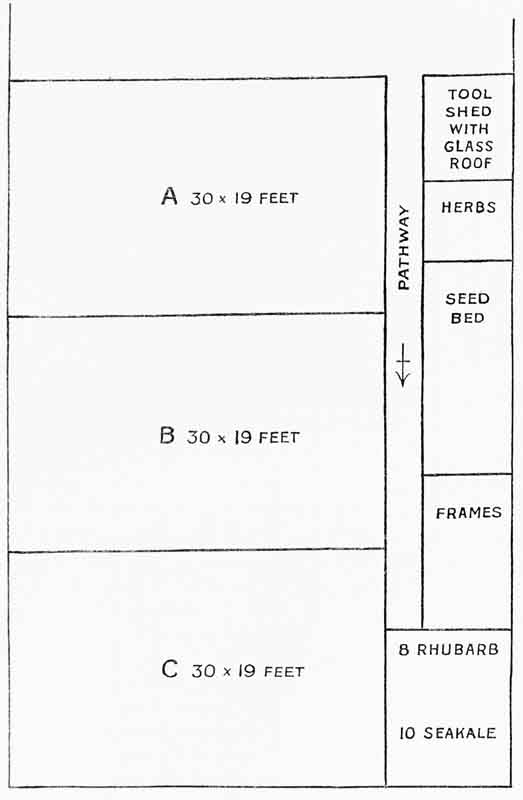
Plan II.—Small Kitchen Garden of about 1/20 Acre (57 × 40 feet)
This, or a slightly modified scheme, will be found to hold good for a smaller plot of ground, even in such a small plot as is sketched in Plan II the same [Pg 273]methods will obtain. In this plan the asparagus has been sacrificed, so have artichokes, but the latter could be substituted for seakale, if desired. Beyond some cramping of the ground the plots will carry nearly as many, though shorter, rows as in the larger scheme. Possibly in Plot A the same number of rows could be grown by slightly contracting the space between the celery trenches, and by allowing only nine inches between the rows of root crops. This is perfectly sound practice if only care is taken to thin the plants so that those in adjacent rows do not come opposite each other, but opposite the centre of the intervals between their neighbours.
In Plot B one row of peas would have to be sacrificed, and in Plot C one row of potatoes and one of Brussels sprouts must go, but there will be plenty of vegetables for a family of four, and probably enough potatoes to last till Christmas.
This scheme of successive cropping will be found to be sound roughly south of the Trent, but for northern and colder districts it would have to be modified. With some modification as to the time of sowing, Plots A and C would broadly stand as arranged, but Plot B would have its times of sowing much later, the peas would have to be at least three feet six inches apart, to make room for the winter and spring greens, which would have to go out between the rows before the peas were off the ground, and it is probable that all brassicas for winter and early spring would be better sown in a cold frame.
But when all is said, this is only one of several [Pg 274]possible schemes, and every gardener as he learns his subject will be able to adapt it to his special soil, climate, and household needs.
Although the English gardener could grow these vegetables as well as the French and German, many English cooks have probably never heard of some of these, for the simple reason that they are so seldom asked for, and therefore there is little opportunity of learning about them. Of course the first question usually asked is, “Can such be grown in England?” And we assure inquirers there is no difficulty at all in the cultivation. Many can be grown entirely in the open air, whilst those which require shelter do not need much heat. Vegetables now play a very important part in our everyday life, and during the past generation or two have been so much improved, that there is now a varied assortment at our disposal at all seasons of the year. It is somewhat remarkable however, that, considering the large number of different types which are suitable for cultivation in countries with a temperate climate, only a small proportion are commonly grown in all, some of the remainder being perhaps largely grown in one country, and practically unknown in another. Even in the commoner kinds of vegetables different nations [Pg 275]have their peculiar fancies. For instance, take potatoes. In this country we prefer white-fleshed sorts, which will cook floury, whilst in France yellow-fleshed kinds, which have a close, waxy texture, are more generally liked. Again, practically every Englishman prefers the delicious marrow-fat peas with wrinkled seeds, but on the Continent the small rounded sorts are still very largely grown for the “petits pois,” although where the marrow-fats have been introduced they are much appreciated. In this country also scarlet runner beans are very much liked, but they are seldom, if ever, used in France, although acres of dwarf beans are grown, the small pods of which are served up whole. Then in cabbages, whilst we most appreciate the tender, conical-headed kinds, in America the coarser Drumhead or flat-headed types are almost exclusively grown in some parts, and on the Continent it is rarely served up at all as a vegetable. The American specially enjoys sweet corn or maize, squashes, and wax-pod beans; the German, kohl-rabi and celeriac; the Italian, his finocchio or Florence fennel; the Spaniard, his capsicums; whilst in France large quantities of globe artichokes, aubergine or egg plant, chicory, salsify, and other varieties are used, which are, however, not generally popular in the other countries referred to. Even amongst what are usually looked upon as English vegetables there are many types which are almost unknown to the public in general, although of course they are familiar to the majority of gardeners. Such as yellow tomatoes, custard marrows, asparagus [Pg 276]kale, white sprouting broccoli, couve tronchuda, mercury (Good King Henry), spinach-beet, are a few examples, and I shall hope to include some of them in my remarks.
Aubergine or Egg Plant.—There are several types of fruit of the aubergine; some are quite white, and of the shape of an egg, but they are mostly only used for decoration or garnishing. The round and long fruited dark purple are those used for culinary purposes, and they may be cooked in several ways; the fruit may be stuffed with chopped meat, egg, mushroom, &c., and herbs, and baked.
Bush Marrows (Tender and True).—Generally speaking the majority of marrows are of a trailing habit, but there are several which are known as “Bush” marrows, and these throw out no runners at all. Where space is limited these Bush varieties are very useful, but naturally they will not keep up a supply like the trailing types, which produce fruit all along the vines. In some parts of Bedfordshire the long white and long green fruited Bush marrows are grown for market purposes, but the round fruited kind (Tender and True) are a newer introduction. This is a very prolific sort, producing several fruits at a joint, and if cut when young they make a very nice dish.
Capsicum.—This plant is closely allied to the chilli, and is grown in much the same way as the egg plant. There are various types of capsicums and chillis; the pods of some large kinds which are fleshy are used as vegetables in some countries, especially Spain and America. In the former country it is largely in [Pg 277]demand, and although it was introduced into Naples by the Spaniards in the sixteenth century, its use in Italy has not spread very much farther. When the fruits are used as a vegetable they are picked green, and after the seeds have been taken out they are filled with a stuffing made of meat, herbs, bread and crumbs, and are then baked. They can also be partly boiled, and afterwards baked. The long narrow fruits which one often sees in pickles are forms of chilli, and sometimes the dried pods are ground for cayenne pepper. The real cayenne pepper, however, appears to be made from Capsicum baccatum or bird pepper.
Celeriac is a form of celery in which the root has been developed instead of the leaf-stalk. It has been largely grown in Germany for a long time, and is there used both as salad and a cooked vegetable. It is grown in much the same way as celery, except it does not require to be put into trenches or earthed up. In the autumn the roots are ready for use; and abroad it is often the practice during growth to break off the lower leaves, which is supposed to induce better growth and size in the roots. To cook them the roots are peeled and quartered, and boiled till tender, and served up in the same way as beetroot, or they may be sliced raw, and fried in butter till nearly brown.
Chicory when blanched is largely used for salad, and is very wholesome; it is also cooked as a vegetable, in a similar manner to seakale.
Chow-Chow or Chinese Cabbage.—It has the appearance [Pg 278]of the Cos lettuce. This vegetable is in season in the autumn or early winter. It requires no heat.
Climbing French Beans.—This type of plant grows almost or quite as late as the ordinary scarlet runner, but it has foliage like that of the dwarf French bean, and with the same kind of smooth pod. They can supply tender pods after the dwarf beans are over. There are several varieties of this class; one called the Earliest of All can be gathered as early as July, but probably Tender and True is the most useful if only one is grown, as this bears so abundantly. The pods should be cooked in the same way as dwarf beans.
Couve Tronchuda or Portugal Cabbage belongs to the Cabbage tribe, and is a plant in which the large midribs have been much developed. It is a delicious vegetable, quite easy to cultivate, and comes into use in the autumn and early winter; this plant has been highly praised by those who have tried it.
Drumhead Kale.—This is another type of kale not much known; instead of producing leafage or shoots like most kales, this forms a head, and it has large midribs, which are delicious when boiled; it partakes of the flavour of seakale. The cultivation is the same as for ordinary kales; this variety comes into use late in the autumn.
Finocchio or Florence Fennel is one of the favourite dishes of the Italians, and around Naples it is grown by the acre. Generally speaking, the plant has a slight resemblance to celery, and is used in much [Pg 279]the same way; the flavour, however, is sweeter than celery; in fact it has a little taste of aniseed about it. This finocchio differs from the fennel largely used for fish sauce, &c., and is eaten raw as a salad, or cooked and served in the same way as is usual with celery.
Garden Swedes.—There are two forms, known as the white-fleshed garden swede and the yellow-fleshed garden swede, which are much superior for table purposes. They do not grow to so large a size as the field types, have no coarse neck at the top of the root, and the flavour is less strong. To those who like swedes I would strongly recommend these. They can be sown from April onwards, and should be grown in much the same way as turnips.
Globe Artichokes are grown plentifully in Italy, and can, with care, be grown in England. As I have noted in the following chapters, they can be blanched in the same way as the cardoon, which is closely allied to the artichoke; the stalks are blanched from October to March somewhat in the manner of celery, and when well cooked it makes an excellent dish. Abroad the cardoon is much in demand, and is served in a variety of ways.
Kohl-rabi belongs to the Cabbage family, in which the stem has been induced to form a bulb. For many years large coarse types have been grown in this country for cattle food, but the tender and fine leaved forms have, until recent times, been little cultivated on this side of the Channel. The bulbs should be used when they are about the size of an orange.
Mercury or Good King Henry is very well known [Pg 280]in some parts of England, especially in the Lincolnshire district, where it is sometimes called Lincolnshire asparagus. It is a perennial, and proves itself to be a very useful plant.
Orache or Mountain Spinach is another plant which produces much leaf, and which is used in the same way as the ordinary spinach. There are white and red leaved varieties, and these reach a height of several feet. The plant is easily cultivated.
Poirée or Swiss Chard.—This would be in season from late summer until the early frosts cut it down, or the season may be extended by lifting the plants and storing them.
Petits Pois.—The small-podded, round-seeded sorts such as Earliest Blue are those used, although there is no reason why the small seeds of almost any kind should not do equally well. The pods, however, of the fine English marrow-fats would have to be gathered very young indeed, or the seeds would be too large. There are several ways of preparing “Petits Pois” according to the flavour desired. (See Recipes.)
I am sure when these vegetables are more known, they will be as much liked as those with which we are more familiar, and we are much indebted to Messrs. Sutton & Sons for not only the information about them, but the fact that the plants have been fully tested by them as amenable to cultivation in England, and that the seeds can be obtained from this firm.
Salsify, or, as it is sometimes called, the vegetable oyster, is a plant producing a long fleshy taproot, [Pg 281]which is entirely buried in the ground. Salsify is cooked in various ways.
Scorzonera is a plant somewhat resembling salsify in character, but differs from it in the leaf and the colour of the skin, which is nearly or quite black. The cultivation and soil is the same for it as for salsify, and the roots should be cooked in the same way.
Spinach-Beet, another member of the beet family, is known as the “perpetual” or spinach-beet. It is a very useful plant, and if sown in the spring and summer, much in the same way as beet, continues to send up young foliage all through the autumn and winter. The foliage is used exactly like spinach, and can be had when ordinary spinach is not procurable. It is not necessary to deeply dig the ground, as it is only the foliage which is used. Those who are fond of spinach would do well to grow this for winter and spring supplies.
Stachys Tuberifera is a curious little vegetable, and has only been introduced into Europe from China or Japan during the past few years; its common name is Chinese artichoke; the tubers are used either boiled or fried, and they have a nutty flavour.
Sugar Corn or Maize.—This plant, a form of maize, is very easy to grow in this country; it makes a delicious dish, and I am surprised it is not more often used. Even when we have short, or poor, summers the earliest varieties seem to do very well here, and reach the stage at which they should be cooked, although they would not often ripen their seeds here, but they will not stand frost at all.
[Pg 282]
Sugar Peas (Mangetout).—These are cultivated in precisely the same way as the ordinary type. They have no tough membrane inside, consequently they are what is usually termed “stringless,” and as such are cooked whole. The pods of the best varieties are usually constricted, instead of being smooth and flat, and show the seeds through. The plants grow to various heights, but those attaining six feet or so give the best pods. The pods should be gathered when fairly young—that is before the seeds are much developed—boiled whole, and served up with melted butter.
Wax-pod Bean is another type of bean, known as Butter bean. The pods are usually yellow or whitish, and are tender, without strings, and if gathered fairly small and cooked whole are very nice. Should the pods be too large to cook whole, they should be broken across in two or three pieces—not slit with a knife. The culture is the same as for dwarf and runner beans.
White Sprouting Broccoli.—Although the purple sprouting broccoli is known to all, the white sprouting is not so familiar. It is cultivated in the same way, and during March produces a large quantity of small and tender white sprouts. The plant is hardy in most seasons, and the young sprouts have a very agreeable, mild flavour.
Winter Radish is a very useful plant. The ordinary kind of radish is of little use after it is full grown, but the class now referred to remains in condition for a long time. Probably the best type is [Pg 283]that known as the Chinese rose colour. The seeds are sown about August, and although the roots will be ready by October, they can be left in the ground till wanted, or dug up and stored in sand. They grow larger than the ordinary radishes, and are entirely buried in the ground, and even when full grown remain solid and juicy.
Witloef is largely grown around Brussels, and is preferred for cooking to chicory, although the smaller-leaved kinds do equally well for salading; this can be had in season from October to the following spring. It is this plant which is often served in Paris restaurants under the name of “endive,” but it is of course different from endive as we know it.
[Pg 284]
The following vegetables can be cooked with advantage in paper bags by those who like this mode of cooking:
Jerusalem artichokes, broad beans, sprouts, carrots, cauliflower, celeriac, celery, cucumber, endive, chicory, French beans, seakale, mushrooms, parsnips, potatoes, tomatoes, vegetable marrow.
These must in each case be washed, trimmed, and prepared in the same way as for ordinary cooking, duly seasoned and placed with a little water, and in some cases butter as well, in a grease-proof paper bag (sealed up), and put in a moderately-heated oven on an iron or wire grid, not a solid shelf, such as is usually found in coal-heated ovens. The heat thus reaches the contents of the bag from all sides and the top and bottom. From fifteen to thirty minutes should be allowed to cook any kind of vegetables; some will take even less time, and some take more. When paper bags are not available, use pure white paper, brush over with oiled butter on one side and wrap the vegetables in the paper, buttered side inwards. Care must be taken to see that the ends of the paper are carefully sealed up; for this reason, paper bags are more convenient, being easier to seal up.—C. Herman Senn, How to Cook Vegetables.
Printed by Ballantyne, Hanson & Co.
at Paul’s Work, Edinburgh
Obvious printing errors have been silently corrected. Species names have been changed to lower case when needed for consistency. Hyphenation, capitalization, and italics have been made more consistent.
The formatting of some headings has been changed for consistency and to more logically reflect the structure of the work.
Inconsistencies in the formatting of recipe attributions have been retained.
Illustrations have been moved to more logical places within the work.
It has been difficult in some instances to determine whether inconsistencies in spelling are deliberate. For example, “sauce piquante” occurs in the original in four variations. “Sauce piquante” and “piquant sauce” have been retained. In general, names of recipes have been allowed to stand, despite inconsistencies.
The use of both “shallot” and “eschalot” to refer to the same thing has been retained.
The spellings “peacons” and “cocoanut” have been retained.
The ending parenthesis has been moved in a sentence that originally stated, “...add a quart of peas (green peas, if not in season dried peas) previously soaked....”