*** START OF THE PROJECT GUTENBERG EBOOK 78968 ***
Transcriber’s Note
This book contains text in Greek (λεύκη), Coptic (ⲙⲁⲧ) and Egyptian
hieroglyphs (𓅐𓏏). You may need to install additional fonts to properly
render those languages. Noto Sans Egyptian Hieroglyphs is recommended.
Obvious typographical errors have been corrected. The Hebrew, Arabic,
Coptic, and Greek text has been corrected by comparison with the German
edition from which this work was translated.
Accents and diacritical marks have been standardised throughout, where
it was clear that the same word or name was intended; the original
typesetting appears not to have supported accented small capitals
consistently.
Inconsistencies between index entries and the main text have been silently
corrected where the intended reference was unmistakable.
[1]
Letters from Egypt, Ethiopia,
and the peninsula of Sinai
[2]
MOUNT BARKAL.
Hinchliff.
[3]
LETTERS FROM
EGYPT, ETHIOPIA, AND THE
PENINSULA OF SINAI.
BY
DR. RICHARD LEPSIUS.
WITH EXTRACTS FROM HIS
CHRONOLOGY OF THE EGYPTIANS, WITH REFERENCE TO THE EXODUS OF THE ISRAELITES.
REVISED BY THE AUTHOR.
TRANSLATED BY
LEONORA AND JOANNA B. HORNER.
LONDON:
HENRY G. BOHN, YORK STREET, COVENT GARDEN. MDCCCLIII.
[4]
[5]
TRANSLATORS’ PREFACE.
The first part of this volume consists of Letters from
Egypt, Ethiopia, and the Peninsula of Sinai, published in
1852. In addition to the Map of the Nile, published in
the German edition, and the view of Mount Barkal, we
have been enabled, through the kindness of Dr. Lepsius, to
give a Map of the Peninsula of Sinai, from an unpublished
pamphlet, printed at Berlin in 1846 (Reise des Prof.
Lepsius von Theben nach der Halbinsel des Sinai, vom 4 März
bis zum 14 April, 1845), which will be found to contribute
much to the elucidation of the interesting Letter on Mount
Sinai.
In the Appendix we have inserted a geological paper, by
Mr. Horner, from the “Edinburgh Philosophical Journal”
for July, 1850, in which some doubts are thrown upon
the theory of Dr. Lepsius concerning a supposed excavation
of the bed of the Nile within the historical period.
We have done this at the request of Dr. Lepsius, who is
desirous to call more particular attention to the subject.
The Letters are succeeded by extracts (chiefly relating to
the Hebrew Chronology) from Dr. Lepsius’s larger work (of
which only one volume has yet been published), Die Chronologie
der Ægypter, in which he states his conclusions
respecting the date of the Exodus. We have also obtained
permission from Chevalier Bunsen to add a note (p. 475),
pointing out how far he differs from Dr. Lepsius respecting
the period when the Israelites entered Egypt. It has been
[6]thought desirable to omit those sections which enter into
the subject more minutely than would interest the general
reader.
The whole of this portion of the translation has been
revised by the author, and throughout the volume, whatever
alterations or additions have been suggested by him,
are placed between brackets.
A Table of the Egyptian Dynasties, drawn up by Mr.
Horner, has been added, and, at his request, revised by
Dr. Lepsius, who has inserted the results of his latest investigations
concerning the dates of the different Dynasties.
Wherever measurements by feet are mentioned, French
feet are to be understood, unless it is otherwise specified.
August, 1853.
AUTHOR’S
PREFACE TO THE LETTERS.
The object of the Scientific Expedition which the King
of Prussia sent to Egypt in the year 1842, was to investigate
and collect, with an historical and antiquarian view,
the ancient Egyptian monuments in the Nile valley, and
upon the Peninsula of Sinai. It was fitted out and maintained
for more than three years by the munificence of the
King, and enjoyed uninterruptedly his gracious favour and
sympathy, as well as the most active and kind attention
from Alexander v. Humboldt, and by a rare union of fortunate
circumstances, it attained the purposes they had in
view, as completely as could be expected. A “Preliminary
Account of the Expedition, its Results, and their Publication”
(Berlin, 1849; 4to), was issued at the same time with
[7]the first portion of the great work upon the Monuments,
which will be published by desire of his Majesty, in a style
corresponding with the magnificence of the treasures we
brought away with us, and which will contain a concise survey
of the principal results of the Expedition.
In the work upon “the Monuments of Egypt and Ethiopia,”
here announced, which will comprise more than 800
folio plates, half of which are already completed, and 240
published, these results will be fully displayed, as far as
regards Sculpture, Topography, and Architecture, and they
will be considered more accurately in the accompanying text.
Independently, however, of our strictly scientific labours,
it appeared right to offer a picture to a larger circle of interested
readers of the external features of the Expedition, the
personal co-operation of the different members belonging to
it, the obstacles, or the fortunate circumstances of the journey,
the condition of the countries that we traversed, and the
influence they exercised on the immediate objects of our
undertaking; finally, a series of remarks on the individual
sites of the monuments in that most historical of all countries,
with all the meaning and completeness in which they
appear to those travellers who, by their study of that most
ancient history, are peculiarly prepared to understand them,
but which may also excite an increased sympathy in others
who have acknowledged the great importance of this newly-established
science. If it should directly further a correct
criticism of the scientific labours which have resulted from
this journey, and which are being gradually published, to
consult the circumstances under which the materials were
collected, I believe that no farther justification is necessary
for the publication of the following Letters, however little
pretension they may have on the one side to the completeness
and the literary charm of a regular account of travels, or, on
the other side, to the value of a strictly scientific work.
[8]
The Letters have remained almost throughout in their
original form; some are respectfully addressed to his Majesty
the King, some to his Excellency Eichhorn, at that
time Minister of Public Instruction, or to other distinguished
patrons and honoured men, such as A. v. Humboldt, Bunsen,
v. Olfers, Ehrenberg, and lastly, some to my father, who
constantly preserved the liveliest interest in all that concerned
me. Several letters, immediately upon their arrival
in Europe, were printed in the newspapers, especially in the
Prussian Gazette, and from that were received into other
papers. The immaterial alterations in some of the details
are, for the most part, only made for publication. All additions
or expansions are put in the form of notes. To this
class belong the more detailed notes and the proofs given
concerning the true position of Sinai, which, I believe, is
pointed out for the first time by me; this has since been
criticised from different quarters, and has been condemned
by some, while it has met with approbation from others.
The subject of the 36th Letter on the decoration of the
Egyptian Museum in Berlin is certainly very different from
the rest; but as an exception it may be justified, since the
point there considered is not only of local interest in Berlin,
but is valuable in all cases of observation, where there are
similar requirements, and where the subject treated about
is a method of adjustment between ancient Egyptian and
modern Art.
Berlin, 2nd June, 1852.
[9]
CONTENTS.
PAGE
Preliminary Account of the Expedition and its Results
Alexandria—Pompey’s Pillar—Cleopatra’s Needle—Werne’s Collection of
Natural History—Departure from Alexandria—Sais—Naharieh—Cairo—Heliopolis—The
Celebration of the King’s Birthday at the Pyramids—Panoramic
View from the Pyramid of Cheops.
Letter IV.—At the foot of the largest Pyramid, 2nd January, 1843
Prince Albert of Prussia—Festivities in Cairo—Entrance of Pilgrims—Mulid
e’ Nebbi—Doseh—Visit of the Prince to the Pyramids—Most
ancient Application of the Pointed Arch in Cairo—The most ancient
Round Arch in Egypt—Attack by Night in Saqâra—Day of Trial.
Voyage on the Nile to Upper Egypt—Rock-Grotto of Surarieh—Tombs of
the Sixth Dynasty, in Central Egypt; of the Twelfth, in Benihassan,
Siut, Berscheh—Arrival in Thebes—Climate—Journey onwards.[10]
Greek Inscriptions—Benihassan—Berscheh—Tombs of the Sixth Dynasty—El
Amarna—Siut—Alabaster Quarries of El Bosra—Echmim (Chemmis)—Thebes—El
Kab (Eileithyia)—Edfu—Ombos—Egyptian Canon
of Proportions—Assuan—Philæ—Hieroglyphic-Demotic Inscriptions—Succession
of the Ptolemies—Entrance into Lower Nubia—Debôt—Gertassi—Kalabscheh
(Talmis)—Dendûr—Dakkeh (Pselchis)—Korte—Hierasykaminos—Mehendi—Sebûa—Korusko—Nubian
Language.
The borders of a Tropical Climate—Kawass—Hagi Ibrahim—Meröe—Begerauîeh—Pyramids—Ferlini—The
Age of the Monuments—Schendi—Ben
Naga—Naga in the Desert—Mesaurât e’ Sofra—Tamaniât—Chartûm—Bahr
el Abiat (the White River)—Dinka and Schilluk—Soba—Kamlîn—Bauer—Inscription
on Marble—Baobab—Abu Harras—Rahad—Character
of the Country—Dender—Dilêb Palms—Sennâr—Abdîn—Româli—Sero—Return
towards the North—Wed Médineh—Sorîba—Sultâna
Nasr—Gabre Máriam—Rebâbi—Funeral Ceremony—The
Military—Emin Pascha—Tâiba—Messelemîeh—Kamlîn—Soba—Vase
with an Inscription.
Tamaniât—Qirre Mountain Range—Meröe—Return of the Turkish Army
from Taka—Osman Bey—Prisoners from Taka—Language of the Bischâri
from Taka—Customs in the South—Pyramids of Meröe—Ethiopian
Inscriptions—Name of Meröe.
The Desert of Gilif—Gôs Burri—Wadi Gaqedûl—Mágeqa—Trees of the
Desert—Wadi Abu Dôm—Wadi Gazâl—Coptic Churches—Greek Inscriptions—Pyramids
of Nuri—Arrival at Barkal.
Excursion into the Cataract Country—Bân—Departure from Barkal—Pyramids
of Tangassi, Kurru, and Zûma—Churches and Fortifications
of Bachît, Magal, Gebel Dêqa—Old Dongola—Nubian Language.
Fakir Fenti—Sêse—Soleb—Gebel Dosche—Sedeïnga—Amara—Island of
Sai—Sulphur Spring Of Okmeh—Semneh—Heights of the Nile in the
Reign of Amenemha-Mœris—Abu Simbel—Greek Inscription in the
Reign of Psammeticus I.—Ibrîm (Primis) Anîbe—Korusko.[11]
Description of Thebes—The Temple of Karnac, and its History—Luqsor—El
Asasif—Statue of Memnon—The Memnonium—Temple of
Ramses II.—Medînet Hâbu—The Royal Tombs—Tombs of Private
Individuals from the Time of Psammeticus—Imperial Time—Coptic
Convents and Churches—Copts of the present Day—Revenge for
bloodshed among the Arabs—Our dwelling in Abd-el-Qurna—Visit
from Travellers.
Change of abode from Qurna to Karnac—Departure to the Peninsula of
Sinai—Qenneh—Seïd Hussên—Stone-Quarries and Inscriptions of
Hamamât—Gebel Fatireh—Losing our Way—Porphyry Quarries at
Gebel Dochân—Gebel Zeït.
Departure from the Convent—Wadi e’ Scheikh—Ascent of Serbâl—Wadi
Firân—Wadi Mokatteb—Copper Mines of Wadi Maghâra—Rock-Inscriptions
of the Fourth Dynasty—Sarbut el Châdem—Mounds of
Dross—Wadi Nasb—Harbour of Abu Zelîmeh—The true Position of
Sinai—Tradition of the Monks—Local and Historical Conditions—Elim
at Abu Zelîmeh—Mara in Wadi Gharandel—The Desert of Sin—Sinai,
the Mount of Sin—The Mount of God—Subsistence of the Israelites—Raphidîm
at Pharan—Sinai-Choreb at Raphidîm—Review of the
Question upon Sinai.
Carmel—Libanon—Berut—Departure to Damascus—Zachleh—Tomb of
Noah—Bárada—Tomb of Abel—Inscriptions at Bárada—Tomb of Seth—Bâlbeck—Ibrahim—Cedars
of Libanon—Egyptian and Assyrian
Rock-Inscriptions at Nahr el Kelb.
[12]
PRELIMINARY ACCOUNT OF THE
EXPEDITION AND ITS RESULTS.
In the year 1842, in accordance with the proposal of
Eichhorn, at that time Minister of Instruction, and at the
recommendation of MM. Alexander v. Humboldt and Bunsen,
his Majesty King Frederic William IV. of Prussia determined
to send a scientific expedition to investigate the
remains of ancient Egyptian and Ethiopian civilisation still
in preservation in the Nile valley and the adjacent countries.
The direction of the undertaking was entrusted to me, after
the detailed plans of the proposed expedition had been minutely
examined by the Royal Academy of Sciences, and in
all points graciously approved by the King.
The land-surveyor, G. Erbkam, from Berlin, and the
draughtsmen and painters, Ernest and Max Weidenbach,
from Naumburg, and J. Frey, from Basle, were appointed
to make the drawings and coloured representations, as well
as those architectonic plans, which had to be executed on the
spot. When J. Frey was obliged to return to Europe from
Lower Egypt, on account of the injurious climate, he was
replaced by the painter O. Georgi, from Leipzig. Two
English artists, also, J. Bonomi, who, from the interest he
took in the journey, became attached to our party while we
were in London, and the architect J. Wild, who joined us of
his own accord, took an active part in the expedition as long
as it remained in Lower Egypt. Lastly, during nearly the
whole of the journey, we enjoyed the society of the present
Counsellor of Legation, H. Abeken, who accompanied us
voluntarily and on an independent footing, and who in
various ways promoted the antiquarian objects of the journey.
We were also provided with the means of obtaining plaster
casts of those representations that were best qualified for
the purpose, by the addition of Franke the moulder.
The different members of the expedition arriving by various
[13]roads, met in Alexandria, on the 18th September, 1842.
On the 9th November we encamped near the great Pyramids
of Gizeh. What we obtained on that spot, as well as from
the adjoining Pyramid fields of Abusir, Saqâra, and Daschûr,
which are situated to the south, occupied us exclusively
and uninterruptedly for more than six months. The inexhaustible
number of important and instructive monuments
and representations, which we met with in these Necropoli,
the most ancient that have existed in any country, surpassed
every expectation we had been entitled to hold concerning
them, and accounts for our long abode in this part of the
country, which is the first approached and visited, but
has, notwithstanding, been very little investigated. If we
except the celebrated and well-known examination of the
Pyramids in the year 1837, by Colonel Howard Vyse, assisted
by the accomplished architect Perring, little had been
done to promote a more minute investigation of this remarkable
spot; the French-Tuscan expedition, in particular,
did little more than pass through it. Nevertheless, the
innumerable tombs of private individuals grouped about
those royal Pyramids, partly constructed of massive square
blocks, partly hewn into the living rock, contain, almost exclusively,
representations belonging to the old Egyptian
Monarchy, which terminated between two and three thousand
years before Christ; indeed, most of them belong to the
fourth and fifth Manethonic Dynasties, therefore between
three and four thousand years before Christ. The wonderful
age of those Pyramids, and of the surrounding tombs, is no
longer generally denied by intelligent inquirers, and in the
first volume of my “Egyptian Chronology,”[1] which has lately
appeared, I have endeavoured to furnish a critical proof of
the certain foundations we possess for a more special determination
of time as far back as that period. But were any one
only to believe in the lowest acceptation of modern scholars
concerning the age of the first Egyptian Dynasties, he would
still be compelled to yield priority to those monuments before
any other Egyptian remains of art, and generally before all
artistic remains belonging to the whole race of man, to which
we can historically refer. It is only to this that we can attribute
the wonderful growth in the interest which we attach,
[14]partly to the monuments themselves, as proofs of the earliest
activity shown in art, partly to the various representations
of the manner of living in those primitive times.
On the western border of the Desert, which stretches
from the most northerly groups of Pyramids at Abu Roasch,
past the ruins of the old capital of Memphis, to the Oasis-peninsula
of the “Faiûm,” we discovered the remains of
sixty-seven Pyramids, which, with a few exceptions, were
only destined for kings, and in the neighbourhood of the
principal groups we investigated, still more minutely, 130
tombs of private individuals, which deserved to be more
particularly recorded. A great many of these sepulchral
chambers, richly adorned with representations and inscriptions,
could only be reached by excavations. Most of them
belonged to the highest functionaries of those flourishing
Dynasties, among whom there were also thirteen royal
princes and seven princesses.
After we had taken the most careful topographical plans
of all the fields of Pyramids, and had noted down the architectonic
ground plans, and sections of the most important
tombs, and after we had, in the most complete manner, drawn
or taken paper impressions of their pictures and inscriptions,
as far as they were accessible to us, we had accomplished
more completely than we ever hoped to do, the first and
most important task of our journey, since we had acquired
a basis for our knowledge concerning the monuments
of the oldest Egyptian monarchy.
On the 19th May, 1843, we proceeded still farther, and
encamped on the 23rd in the Faiûm, upon the ruins of the
Labyrinth. Its true position was long ago conjectured;
and our first view dissipated all our doubts concerning it.
The interesting discovery of the actual site of the ancient
Lake Mœris was made about the same time, by the distinguished
French architect Linant, which we had the opportunity
of confirming on the spot. This greatly facilitated
the means of comprehending the topographical and historical
conditions of this province, so remarkable in all its features.
The magnificent schemes which converted this originally desolate
Oasis into one of the most productive parts of Egypt,
were intimately connected with each other, and must have
belonged, if not to a single king, still to one epoch of time.
The most important result we obtained by our investigations
[15]of the Labyrinth and of the adjoining Pyramids, was the determination
of the historical position of the original founder;
this we obtained by excavations, which occupied a considerable
time. We discovered that the king, who was erroneously
called Mœris by the Greeks, from Lake Mere—i. e.
from the Lake of the Nile inundation—lived at the end of
the 12th Manethonic Dynasty, shortly before the invasion
of the Hyksos, and was called Amenemhe by Manetho
Ἀμενέμης, the third of his name. His predecessors in the
same Dynasty had already founded the town of Crocodilopolis,
in the centre of the Faiûm, which is proved by some ruins
that still exist belonging to that period; and they probably
conducted the Nile Canal, Bahr-Jusef, which branches off
from Derut-Scherif, into the basin of the Desert. That part
of the basin which is most advanced, and situated highest, terminated
in a lake formed by means of gigantic dams, many of
which still exist; and the connection of the canal was regulated
by sluices in such a manner, that in the dry season the
reserved water could flow back again into the valley of the
Nile, and irrigate the country round the capital long after
the Nile had retreated within its banks. Amenemhe built
his Pyramid on the shore of the lake, and a splendid temple
in front of it. It afterwards formed the centre of the
Labyrinth, whose many hundred chambers, forming three
regular masses of buildings, surrounded the oldest portion,
and, according to Herodotus, were destined by the Dodecarchs
for the general Diets. The ruins of the Labyrinth had
never yet been correctly represented, not even in their general
arrangement. An Arabian canal, which was carried through
it at a later period, had drawn away the attention of passing
travellers from that portion of the chambers which was in
best preservation. We have made the most exact ground
plan, accompanied by sections and views. A journey round
the province, as far as Birqet-el-Qorn, and beyond it, to
the ruins of Diméh and Qasr Qerûn, induced us to remain
several months in this neighbourhood.
On the 23rd August we embarked at Beni-suef, visited a
small rock-temple of King Sethôs I. at Surarieh, on the
eastern shore, and farther on, the remains of later monuments
in the neighbourhood of Tehneh. At Kûm-Ahmar, a
little to the south of Zauiet-el-meitîn, we examined a series of
nineteen rock-tombs belonging to the 6th Manethonic Dynasty.
[16]The groups of tombs which are scattered about a
few days’ journey to the south, at Schech-Said, El-Harib,
Wadi-Selin, and still farther on, at Qasr-e’-Saiât, also belonged
to this period, which, in point of age, was immediately
connected with the flourishing time of the great builder of the
Pyramids. If we judge by the remains now extant, it appears
that there were, at that early period especially, in this
portion of Central Egypt, a number of flourishing cities.
Royal kindred are frequently met with among the ancient
possessors of the tombs, but no sons or daughters of the king,
because there was no royal residence in that neighbourhood.
But we found the last flourishing period of the Old Monarchy—the
12th Manethonic Dynasty—represented in this part
of Egypt by the most beautiful and most considerable remains.
The rock-tombs of Beni Hassan, so remarkable for
their architecture, as well as for the various paintings on
their walls, peculiarly belong to this period. The town to
which they appertained, the residence of a governor of the
eastern province of the country, has entirely disappeared,
all except the name, which is preserved in the inscriptions.
It appears that it only flourished a short time during this
dynasty, and again declined at the invasion of the Hyksos.
In the neighbouring Berscheh also, and farther on, among
the Lybian rocks, behind the town of Siut, which was as important
4000 years ago as it is at present, we again found
the same plans of tombs on as magnificent a scale, whose
period of erection might be recognised even at a distance.
It is a singular fact, that in point of age the greater
proportion of the remains of the Egyptian monuments become
more modern the higher we ascend the Nile valley, the
reverse of what might have been expected from a large view
of the subject; according to which the Egyptian civilisation
of the Nile valley extended from south to north. While the
Pyramids of Lower Egypt, with the monuments around
them, had displayed the oldest civilisation of the 3rd, 4th,
and 5th Dynasties in such wonderful abundance, we found
the 6th Dynasty, and the most flourishing period of the 12th,
the last of the Old Monarchy, especially represented in
Central Egypt. Thebes was the brilliant capital of the New
Monarchy, especially of their first Dynasties, surpassing all
other places in the number of its wonderful monuments;
and even now it offers us a reflection of the splendour of
[17]Egypt in her greatest times. Art, which still created magnificent
things even in its decline, under the Ptolemies and
the Roman emperors, has left considerable monuments behind
it, consisting of a series of stately temples in Dendera,
Erment, Esneh, Edfu, Kûm-Ombo, Debôd, Kalabscheh, Dendûr,
Dakkeh, which are all, with the exception of Dendera,
in the southern part of the Thebaid, or in Lower Nubia.
Lastly, those monuments of the Nile valley which are situated
most to the south, especially those of the “Island” of
Meröe, are the latest of all, and most of them belong to the
centuries after the Christian era.
We hastened immediately from the monuments of the Old
Monarchy in Central Egypt to Thebes, and deferred till our
return the examination of the well-preserved, but modern
temple of Dendera, the ruins of Abydos, and several other
places. But of Thebes, also, we took but a preliminary
survey, for we only remained there twelve days, from the 6th
to the 18th of October.
We were impatient to commence immediately our second
fresh task, which consisted in the investigation of the Ethiopian
countries, situated higher up the river. The French-Tuscan
expedition did not go beyond Wadi Halfa; Wilkinson’s
careful description of the Nile land and its monuments,
which contains so much information, only extends a little
higher up, as far as Semneh. The most various conjectures
were still entertained concerning the monuments of Gebel
Barkal and Meröe, with reference to their age and their
signification. It was necessary to obtain a general view of
the true relation between the History and Civilisation of
Egypt and Ethiopia, founded upon a complete examination
of the remains which are still extant.
Therefore, after a cursory visit to the temple ruins, as far
up as Wadi Halfa, we returned to Korusko, from which place
we started on the 8th of January, 1844, through the Great
Desert to Abu-Hammed, and the Upper Nile countries.
On the 16th of January we arrived at Abu-Hammed, on the
other side of the desert; on the 28th, at Beg´erauîeh, near to
which the Pyramids of Meröe are situated. From Schendi,
which lies more to the south, we visited the temple ruins
of Naga and Wadi e’ Sofra, far on in the interior of the
[18]eastern desert. On the 5th of February we reached Chartûm,
at the confluence of the White and the Blue Nile. From
this place, accompanied by Abeken, I descended the Blue
River, passed the ruins of Soba and Sennâr, as far as the 13°
of N. lat.; whilst the other members of the expedition returned
from Chartûm to the Pyramids of Meröe. The tropical
countries of the Nile, when contrasted with those northern
ones, devoid of rain, extending south as far as the 17°; and
the plants and animals now almost exclusively confined to
South Ethiopia, when compared with individual representations
of the ancient Egyptian monuments, were rendered
still more interesting by the discovery of some monuments,
with inscriptions upon them, near Soba, by which we obtained
traces of the ancient vernacular language of those districts
in a written character resembling the Coptic.
I also made use of our residence in these districts to be
instructed by the natives of the adjacent countries in the
grammar and vocabulary of their languages.
On the 5th of April I returned with Abeken to the other
members of the expedition at Beg´erauîeh. After drawings
had been made of all that still existed which peculiarly represented
the state of civilisation in Ethiopia, and after we
had taken the most exact plans of the localities, we proceeded
in six days, by the desert Gilif, to Gebel Barkal, where we
arrived on the 6th of May. Here was the more northern,
the more ancient, and, to judge by the remains, also the
more important capital of the State of Meröe. At the foot of
this single mass of rock, which rises in an imposing manner,
and is called there, in the hieroglyphical inscriptions, “The
Sacred Mountains,” is situated Napata. The history of this
place, which we may still derive from its ruins, gives us at
once a key to the relations which subsisted in general between
Ethiopia and Egypt, as regards the history of their civilisation.
We find that the most ancient epoch of art in Ethiopia
was purely Egyptian. It is as early as the period of the
great Ramses, who, of all the Pharaohs, extended his power
farthest, not only towards the north, but also towards the
south, and testified this by monuments. At an early period
he built a great temple here. The second epoch begins with
King Tahraka, also known as the ruler of Egypt, the
Thirhaka of the Bible. This spot was adorned with several
[19]magnificent monuments by him and his immediate successors,
and though they were built in a style now employed by
native kings, it is, nevertheless, only a faithful copy of the
Egyptian style. Lastly, the third epoch is that of the kings
of Meröe, whose dominion extended as far as Philæ, and was
manifested also at Gebel Barkal by numerous monuments.
On an intermediate journey into the Cataract country,
situated farther up the river, which we had cut off by the
Desert journey, I found only Middle-Age, but no ancient,
Ethiopian remains of buildings.
The fertile and extensive province of Dongola, on the
northern frontier, which we traversed on the 4th of June,
after our departure from Barkal, afforded us but few remarkable
ancient remains; we may, however, mention among
these the island of Argo, with its monuments, from the
13th Manethonic Dynasty. They became still more numerous
in the northern borders of Dongola, from which a
nearly continuous Cataract country extends as far as Wadi
Halfa. Near Tombos we found traces of the Egyptian dominion
under the Pharaohs of the 17th and 18th Dynasties,
rock-tablets with the shields of the two first Thutmosis
and of the third Amenophis. Farther on, at Sesebi, there
were the remains of temples of the first Sethôs of the 19th
Dynasty. The great Temple of Soleb, built by Amenophis
III. and IV., detained us five days. The ruins of the Temple
of Sedeïnga, and those upon the island of Sai, belonged to
the 18th and 19th Dynasties. Opposite this island stood
the remarkable Temple of Amara, which was built by the
Kings of Meröe and Naga, and is still an important proof
of the extent of their dominion.
Semneh was the next point we reached. The Nile is
here compressed within a breadth of only about 1150 feet
between high rocky shores. On both sides there are ruins
of old temples of the 18th Dynasty. But these were not
the earliest buildings which were erected here. We found
a considerable number of inscriptions from the 12th and
13th Manethonic Dynasties, especially on the large foundations
of the Temple of Kummeh, situated lower down, opposite
Semneh on the eastern bank, as well as on the scattered
rocks on both banks in the neighbourhood of that temple.
Many of them were intended to indicate the highest risings
[20]of the Nile during a series of years, especially in the reigns
of the Kings Amenemhe III. and Sebekhotep I., and by
comparing them, we obtained the remarkable result, that
about 4000 years ago the Nile used to rise at that point, on
an average, twenty-two feet higher than it does at present.
This, therefore, which we saw before us was the most ancient
Nilometer; and the earliest statements of the heights, and
their greatest number, were recorded during the reign of
the same king, the Mœris of the Greeks, with whom we
had already become acquainted in the Faiûm, as the great
hydraulic architect. The strong fortifications on both banks
of that narrow part of the river convinced us at once that,
during the early times of the 12th Dynasty, this remarkable
point served as the boundary of the Egyptian dominion,
against the Ethiopian nations who dwelt more to the
south.
At Wadi Halfa, on the 30th of July, we again left the Cataract
country, remained from the 2nd to the 11th of August
in Abu Simbel, examined until the end of the month the
ruins of Ibrîm, Anîbe, Derr, Amada, Sebûa, Dakkeh, Kubán,
Gerf-Hussên, Sabagûra, Dendûr, Kalabscheh, Debôt, and
spent the whole of the following month in examining the
monuments of the Island of Philæ, and the islands of Bigeh,
Konosso, Sehêl, and Elephantine, surrounding it, and of the
stone quarries between Philæ and Assuan. October was
spent visiting Ombos, the two Silsilis, Edfu, the desert Temple
of Redesíeh, El-Kâb, Esneh, Tôd, and Erment.
On the 2nd of November we again arrived on Theban
ground, and first visited the rock-tombs of Qurnah, on the
west side, where we remained nearly four months, till the
20th of February, 1845, when we encamped for three more
months at Karnak. The number of monuments of all kinds,
both above and below ground, at Thebes, is so great that
they may be truly called inexhaustible, even for a combined
power like ours, and for the limited portion of time which
we were able to devote to their investigation. But the age
of the monuments at Thebes is almost exclusively limited to
the New Monarchy; and the most ancient we discovered,
such as one might generally expect to find, are not earlier
than the 11th Manethonic Dynasty, the last but one of the
Old Monarchy; for this simple reason, because it was in this
[21]Dynasty that Thebes first became a royal residence, and
hence the focus of Egyptian splendour. The great break in
the succession at the end of the 12th Dynasty, caused by
the invasion of the Hyksos, and their dominion, which lasted
many centuries, first drove the Egyptian power back into
Ethiopia, and at length entirely destroyed it, till the powerful
Pharaohs of the 17th, 18th, and 19th Dynasties again
advanced from the south, drove back the Semitic intruders,
and raised the power of the Egyptian empire to its
summit. The greater proportion of Theban monuments
date also from this period. As we may suppose they have
been the principal object of investigation to all travellers,
therefore our work here had been for the most part anticipated.
Nevertheless it was necessary to re-examine the whole
ground most carefully, partly to complete the deficiencies
left by our predecessors, partly to make a proper selection of
those monuments which were of most importance for our
particular purpose, and which we were anxious to insert
among our collections, either in the shape of a drawing, or
an impression upon paper, or even in the original itself.
We directed our principal attention during the whole journey,
and especially here, to taking the most exact architectonic
plans of all the buildings and other localities which
appeared to us to be of any consequence; and for this purpose
we did not hesitate to make extensive excavations. By
this means we succeeded, amongst other things, in discovering,
and recording for the first time, a perfect plan of
the most beautiful of all the temple buildings, namely, the
Ammon Temple, built by Ramses II., which is described
by Diodorus under the name of the sepulchre of Osymandyas.
We made several excavations also in the valleys of
the royal tombs, and opened, for instance, the rock-tomb of
the same Ramses II., one of the largest of those which have
hitherto been accessible. Unfortunately, the interior chambers
were so much destroyed by the dirt and rubbish that
had fallen in, that we could make out little more from the
representation upon the walls than the proprietor of the
tomb.
Accompanied by the artist Max Weidenbach, I made an
intermediate journey from Karnak to the peninsula of Sinai.
[22]We went thither by the old road from Koptos to Aennum
(Philotera), now leading from Qeneh to Kossêr, which conducted
us first to the remarkable stone quarries of Hammamât,
already worked out during the Old Monarchy. The
numerous rock-inscriptions, which date as far back as the
6th Dynasty, occupied us here for five whole days. From
this place we passed through the Arabian chain of mountains
to the north, as far as Gebel Zeït, where we embarked
for Tôr, situated opposite. We ascended through Wadi
Hebrân to the convent, and from thence through Wadi e’
Scheikh, Wadi Firân, W. Mokatteb, W. Maghâra, by Sarbut
el Châdem, down again to Abu Zelîmeh, where we got into
our vessel, to return to Kossêr and Thebes.
As early as the 4th Manethonic Dynasty, between three
and four thousand years before Christ, this Desert Peninsula
was subject to Egypt, and was principally colonised by
the Egyptians on account of the Copper mines, which are
there met with on the limits of the primitive mountain
range, and the surrounding sandstone mountains. Upon
several rock-tablets of Wadi Maghâra, the kings of those
oldest Dynasties were represented fighting with the Semitic
aborigines, and the inscriptions of Sarbut el Châdem were
at least as early as the 12th Dynasty. We did not, also,
lose sight of the great interest which is attached to these
localities of the peninsula in connection with the Old Testament.
More especially, I believe, that I have succeeded
for the first time (not excepting Burckhardt) in determining
the correct position of Sinai, since, contrary to the tradition
of the convent, hitherto accepted, I did not recognise it in one
of the southern mountains, but in Serbâl, which is situated
several days’ journey more to the north, at whose base
lies the only fertile oasis of the whole peninsula. This
opinion which has been already published in a preliminary
account of the journey, addressed to the King of Prussia,
has met with frequent oppositions, but has also latterly received
much approbation, I believe, in a special treatise upon
the question, by W. Hogg, printed in the last half of the
“Transactions for the Royal Society of Literature” (1848).
I have not hitherto been able to discover any material counter-arguments
in the discussions which have been held upon
the subject, but, on the other hand, much stronger evidence
[23]that, contrary to the later Byzantine tradition, the more
ancient Christian, and probably the Egyptian tradition itself,
considered Serbâl, at whose foot the oldest convent was
situated, to be the true Sinai.
On the 14th of April we returned to Thebes, and finally left
it on the 16th of May. On our way back to Lower Egypt, we
re-examined more minutely the monuments of Schenhur,
Dendera, Hou, Abydos, Echmim, El Bosra, Tel el Amarna,
and El Hibe, and on the 27th of June, our party, which had
been increased at the last stage by the addition of Dr. Bethmann,
again entered Cairo.
I was detained there myself some months longer than the
other members of the expedition, in order to direct the transportation
of several sepulchral chambers in the neighbourhood
of the Great Pyramids, and to superintend the embarkation
of the valuable blocks of stone, together with the
other monuments, which we brought with us from Upper
Egypt and Ethiopia, and which the Viceroy Mohammed Ali
sent as a present to his Majesty the King of Prussia. In
this troublesome as well as important affair, for the practical
performance of which four experienced workmen had been
expressly sent from Berlin to Egypt, I had only the kind
assistance of Dr. Bethmann, who accompanied me on an
independent footing during the remainder of the journey
back.
After a final visit to Alexandria, we embarked on the 25th
of September at Cairo for Damietta, but on the way visited
the ruins of Samanúd, Behbét, and the Ramses-Temple of San
(Tanis), and left Egypt on the 1st of October, in a vessel
which took us to Jaffa. After we had traversed the whole length
of Palestine, and from Jerusalem had visited the Dead Sea,
and from Beyrout, Damascus, and Baalbec, at the mouth of
the Nahr el Kelb, the ancient Lykos, we came upon the last
Egyptian monuments in the north, namely, those celebrated
memorial-tablets, which the great Ramses II. engraved beside
the old military road, as a recollection of his warlike
and victorious Asiatic campaigns in the fourteenth century
before Christ. After a period of more than 3000 years,
neither the form, nor even the Name-Shield of the powerful
Pharaoh, at whose court Moses was educated, had been
destroyed by the destructive sea-air. On one tablet, indeed,
[24]I was able to distinguish the date of the fourth, on another
that of the second year of his reign.
According to the testimony of Herodotus, similar monuments
of Sesostris are also found in Ionia, and some time
ago, one which he describes as being there, was re-discovered.
But an excursion from Smyrna to that spot soon convinced
us that the rock-picture of Karabel was produced by an
Asiatic and not by an Egyptian chisel.
Lastly, we saw in the Hippodrome, at Constantinople,
the obelisk of the third Tuthmosis, but, like others, sought
in vain for the second, which earlier travellers would have
us believe that they had seen. On the 24th December, I
left Constantinople, and landed on the 5th January, 1846,
in Trieste.
The whole journey, of which this is a very hasty sketch,
was one of the most fortunate expeditions which has ever
been undertaken for a similar purpose. None who participated
in it suffered from the climate or the accidental
casualties of a journey. We travelled under the powerful
and, in every way efficient protection of the Viceroy. We
had an explicit and written permission to make excavations,
wherever we should consider it desirable, and we employed
it, to acquire a number of interesting monuments for the
Royal Museum at Berlin, which would either have remained
in Egypt as rubbish under the sand-hills, or exposed, like so
many others, to be destroyed, for all kinds of material purposes.
The scientific results of the expedition have, in almost
all respects, surpassed our own expectations. In confirmation
of this it will be sufficient briefly to survey these
results, which I shall do in the following pages, according to
their principal objects, and by entering into some of the
details.
The plan of the journey, as a whole, and in its individual
parts, was founded principally with a Historical purpose in
view. The French-Tuscan expedition, compared with ours
was a Journey of Discovery, with all the advantages, but
also with all the disadvantages, connected with such an
undertaking. We were able from the commencement to
aspire after a certain completeness, within the wide limits
[25]that were assigned us, not however failing in making new
discoveries, which were as important as they were unexpected.
The investigation of the most ancient Egyptian times,
namely, the epoch of the first Pharaonic Monarchy, from about
3900 to 1700 before Christ, extending the history of the
world almost two thousand years farther back, was left
entirely unfathomed by Champollion. He only ascended the
Nile valley as far as the second Cataract, beyond which there
existed a great number of Egyptian monuments of all kinds,
wholly unexamined, in which we must seek for an explanation
of all those Ethiopian antiquities which are inseparable
from the Egyptian.
The most important results we obtained, therefore, were
in Chronology and History. The Pyramid-fields of Memphis
gave us a notion of the Civilisation of Egypt in those primitive
times, which is pictorially presented to us in 400 large
drawings, and will be considered in future as the first
section in that portion of the history of man, capable
of investigation, and must be regarded with the greatest
interest. Those earliest Dynasties of Egyptian dominion,
now afford us more than a barren series of empty, lost, and
doubtful names. They are not only free from every real doubt
and arranged in the Order and the Epochs of time, which have
been determined by a critical examination, but by showing us
the flourishing condition of the people in those times, both
in the affairs of the State, Civil affairs, and in the Arts, they
have received an intellectual and frequently a very individual
historical reality. We have already mentioned the discovery
of five different burial-places of the 6th Dynasty in Central
Egypt, and what we obtained from them. The prosperous
times of the New Monarchy, namely, the period of splendour
in the Thebaid, as well as the Dynasties which followed, were
necessarily more or less completed and verified. Even the
Ptolemies, with whom we appeared to be perfectly acquainted
in the clear narratives of Grecian history, have
come forward in a new light through the Egyptian representations
and inscriptions, and their deficiencies have been
filled up by persons who were hitherto considered doubtful,
and were hardly mentioned by the Greeks. Lastly, on the
Egyptian monuments we beheld the Roman emperors in still
[26]greater and almost unbroken series, in their capacity of
Egyptian governors, and they have been carried down since
Caracalla, who had hitherto been considered as the last name
written in hieroglyphics, through two additional later emperors,
as far as Decius, by which means the whole Egyptian
monumental history has been extended for a series of years
in the other direction.
Egyptian Philology has also made considerable progress
by this journey. The lexicon has been increased by our
becoming acquainted with several hundred signs, or groups,
and the grammar has received a great many corrections.
Such copious materials have also been acquired for these
purposes, especially by the numerous paper impressions of
the most important inscriptions, that Egyptian Philology
must be essentially furthered by their being gradually
adopted. For owing to the strict accuracy of these impressions,
they are almost as valuable, in many investigations,
as an equally large collection of original monuments. In
addition to this, the history of the Egyptian language, which
by the great age attributed to the earliest written monuments,
embraces a period of time between five or six thousand years,
becomes now of much greater importance in the universal
history of the human language and writing. Among the
individual discoveries we made, the one which attracted most
attention, was that of the two decrees on the Island of
Philæ, which were bilingual, namely, written in hieroglyphics,
and in the demotic character,—one of which contains
the decree belonging to the Rosetta inscription, referring to
the wife of Epiphanes.
In spite of numerous writings upon Egyptian Mythology,
it has nevertheless been hitherto deficient in a fixed monumental
basis. In the Temple at Thebes we beheld a series of
representations whose meaning had not hitherto been recognised,
and which seem to me to afford entirely new conclusions
for the correct comprehension and development of
Egyptian mythology. The series of the first arrangement of
the gods mentioned by Herodotus and Manetho, which in
modern investigations has been differently arranged in its
details by all scholars, is at length placed beyond all doubt,
and certainly differs in all essential points from what has
[27]been hitherto everywhere adopted. I will briefly allude here
to another fact, important both in the history of mythology
as well as in a purely historical point of view, and
which was elicited by an attentive investigation of the monuments.
The direct succession of the reigning royal family
was interrupted, towards the end of the 18th Dynasty.
Through the monuments we became acquainted with several
kings of this period, who were not afterwards admitted in
the legitimate lists, but were regarded as unauthorised cotemporary
or intermediate kings. Among these Amenophis
IV. is to be particularly noted, who, during a very
active reign of twelve years, endeavoured to accomplish a
complete reformation of all secular and spiritual institutions.
He built a royal capital for himself in Central Egypt, near
the present Tel-el-Amarna, introduced new offices and usages,
and aimed at no less a thing than to abolish the whole religious
system of the Egyptians, which had hitherto subsisted,
and to place in its stead the single worship of the Sun. In
all the inscriptions composed during his reign, there is not
one Egyptian god mentioned except the Sun; even in other
words the sacred symbols were avoided, e. g. the word mut,
mother, Coptic ⲙⲁⲧ, was no longer written as usual with the
hawk 𓅐𓏏, the symbol of the goddess Mut, but 𓐝𓏏, mt,
with the universal phonetic signs. Indeed, the former gods
and their worship were persecuted to such an extent by
this king, that he erased all the gods’ names, with the
single exception of the Sun-god Ra, from every monument
that was accessible throughout the country, and because his
own name, Amenophis, contained the name of Ammon, he
changed it into Bech-en-aten, “Worshipper of the Sun’s
disk.” Therefore the fact, which has often been previously
remarked, that at one particular period the name of Ammon
was intentionally destroyed, forms only part of an event which
had a much wider influence, and which unexpectedly reveals
to us the religious movements of those times.
The History of Art has never yet been considered in the
point of view from which Egypt, and all that concerns it, is
now regarded. This necessarily formed a particular object
[28]of our expedition, and most directly gained by the increased
chronological knowledge we obtained concerning
the monuments. For the first time we were able to pursue
all its branches during the old Egyptian Monarchy, previous
to the invasion of the Hyksos, and accordingly to
extend both it and the history of Egypt about sixteen
centuries farther back, and some tens of years lower down
in time. The different epochs of Egyptian art now first
appeared clear and distinct, each marked by its peculiar
character, intimately connected with the general development
of the people. They had so frequently been misunderstood,
that no one believed in their existence; they
were lost in the general uniformity. I must mention,
as one of the most important facts connected with this,
that we found innumerable instances on unfinished monuments
of three different canons of proportions of the human
body; one belonging to the most ancient Pharaonic Monarchy,
another later than the 12th Dynasty, when Thebes
first began to flourish; a third, which appears at first in
the time of the Psammetichi, with an entire alteration
in the Principle of the division, and which remained unaltered
till the time of the Roman emperors. The last is
the same which Diodorus expressly mentions in his first
book. Among the separate branches of Egyptian art, Architecture,
which was almost unnoticed by the French-Tuscan
expedition, was with us peculiarly attended to, by the extremely
careful and circumspect labours of our architect
Erbkam. This was befitting the important position occupied
by this particular branch, in which grandeur, that element of
art, peculiarly belonging to the Egyptian beyond all other
nations, was capable of being developed, and has developed
itself to the utmost. The study of the sculpture and paintings
devolved upon the other artists who accompanied us,
and the ability and fidelity with which they fulfilled their
task must be recognised by every one. The Egyptian style
associated with the limited views characteristic of the infancy
of art, nevertheless possesses a highly-cultivated ideal element,
which must be acknowledged by every one. The genius
of Greece could never have bestowed on art such a marked
character, indicative of a period of prosperous liberty, if it
[29]had not received it as a severe, chaste, and carefully nurtured
child from the Egyptians. The principal task of the
history of Egyptian art is to point out wherein consisted
this cultivation of art, peculiar to the Egyptians, above all
the primitive nations of Asia.
In the next place, Egyptian archæology, in the widest
sense of the word, claimed a large portion of our time and
attention: an extensive field, already examined, both successfully
and diligently, by Wilkinson and Rosellini, which
they were enabled to do by means of the inexhaustible
number of separate objects belonging to every-day life,
still in preservation, and by the representations of them,
which are found in all directions, far surpassing any other
ancient remains.
On that account it was still more necessary to make a
stricter investigation, and to regard it from a higher point of
view, rather than accumulate a greater number of individual
things, that notwithstanding obtruded themselves on all sides,
and which, besides, we collected in large quantities, as material
to work upon.
Lastly, Geography and Chorography, which travellers are
especially expected to promote, required to be more peculiarly
prosecuted. We must particularly mention here, that
besides the peculiar investigation of the Pyramid fields at
Memphis, and in the Faiûm, which have been already alluded
to, our records of the ruins of towns, and ancient monuments
in the Nile country, as far up as Sennâr, are more
perfect and exact than any hitherto made. With regard to
the modern geographical names, which must always be
viewed in comparison with the ancient, I have been most
particular in obtaining the Arabic names—at least, throughout
the district we traversed—in order to counteract, as far
as lay in my power, the insufferable confusion in the names
which are marked down. During the journey, I made special
maps for the individual portions of the eastern mountains
of Egypt and the peninsula of Sinai, and I collected geographical
accounts from travellers concerning some remote districts,
which we did not enter, and which are but little known;
and I had geographical drawings made of them. Our investigations
of the historical places in the peninsula of Sinai
[30]have been already alluded to. The discovery, mentioned
above, of the most ancient Nilometer at Semneh, has added,
in a remarkable degree, also to the history of the physical
condition of the Nile valley; since it is quite evident, from
the water just above the second Cataract, standing at that
time twenty-two feet higher than at present, and the height
of the water in the Thebaid being contemporaneously twelve
to fifteen feet lower, that the fall of the Nile in the intermediate
country was thirty-five feet greater in those times
than it is now. But this gradual levelling of the bed of the
river must have had the most decided influence on the history
of the cultivation of the valley, and of the whole population;
because the soil on the banks of the river in the
district of Nubia, more especially owing to the considerable
sinking of the water, being inaccessible to the natural overflowings,
was laid dry, and could only be irrigated with
great difficulty, and imperfectly, by means of artificial water-wheels.
Considerable progress was made in the knowledge of the
African languages, by the investigation which I was principally
enabled to make in the southern part of our journey.
I inquired into and noted down as much of the grammar
and vocabulary of three languages, as would enable me to
give a distinct idea of them. First, Kongára, spoken at
Dar-Fûr and the adjacent countries, a Central African-Negro
language. Secondly, the Nuba language, which is spoken
in two chief dialects, in one part of the Nubian-Nile valley
and in the neighbouring countries situated to the south-west,
and also appears to be derived from the interior of
Africa. It had hitherto never been a written language,
and I collected together for the first time a piece of written
Nubian literature, for I made a Nubian Sheikh, who was perfectly
familiar with the Arabic language and writing, translate
the Fables of Locman, a portion of the Thousand and
One Nights, and the Gospel of St. Mark, from the Arabian
into the Nubian tongue, and write down besides nineteen
Nubian songs, some of them in rhyme, some only rhythmical,
and translate them into Arabic. Unfortunately, these precious
packets, all but the Nubian gospel, were lost in
Europe, with little hope of recovery. The third language
[31]investigated by me was the Beg´a, which is spoken by the
Bischâri nation, who dwell between the Red Sea and the
Nubian Nile. This language occupies an important position
with reference to philology, since it seems to be a branch
of the original Asiatic stock, of which the African offsets
may be comprehended under the name of the Hamitic languages;
and is, besides, particularly interesting in our study
of the monuments, because, most probably, it was once the
key to decipher the ancient Ethiopian inscriptions, numbers
of which were discovered by us upon the Island of
Meröe, and from that place, in the Nile valley, as far down
as Philæ. These inscriptions are written in simple characters,
from right to left, and derive their origin from the
powerful nation of the Meröitic Ethiopians, whose direct
descendants we behold in the present Beg´a nations. By
comparing those languages with the other languages of
Africa, which are already better known, I think I shall be
able to separate, according to fixed principles, these “Hamitic
languages” of north and north-east Africa (which may
still be referred to their native home in Asia) from the
numerous other languages of this enigmatical continent; and
I am now engaged in preparing these philological investigations
for special publication.
I must finally mention, among the results of our journey,
two collections of inscriptions. In the first place, all the
Greek inscriptions in the countries we travelled through
were carefully sought out, and impressions of them were
taken upon paper; by which Græco-Egyptian archæology,
and more particularly the learned collections of inscriptions
which have lately excited such lively interest, will probably
be completed, confirmed, or justified in a satisfactory
manner. Secondly, in the peninsula of Sinai we made as
perfect a collection as was possible of the so-called Sinaitic
Inscriptions, which are found engraved on the rocks in different
districts of the peninsula, but principally in the neighbourhood
of the old town of Faran, at the foot of the mountain
range of Serbâl, and at a resting-place of the caravans
in Wadi Mokatteb, situated farther north, which is named
after them.
We were only able casually to turn our attention to
[32]objects of Natural Science; nevertheless, I did not however
neglect, especially during remote mountainous journeys, to
collect specimens of stone and earth from the more remarkable
localities. We not only visited the celebrated
stone quarries in the chalk mountains of Tura, in the sandstone
range of Selseleh, in the granite rocks of Assuan, and
others situated in the Nile valley, but also those alabaster
quarries of El Bosra, opposite Siut, which were discovered a
few years ago by the Bedouins, in which last we found a
rock-inscription from the commencement of the 17th Dynasty.
They resemble those quarries of granite and brecciaverde
at Hammamât, upon the road leading from Qeneh
to the Red Sea, which have been worked from the earliest
times, and also the porphyry and granite quarries at Gebel
Fatireh (Mons Claudianus), and at Gebel Dochân (Mons
Porphyrites), in the Arabian chain of mountains, celebrated
in the Roman period. I also had an opportunity of purchasing
an interesting Ethnographical and Natural History
collection in Alexandria, obtained by H. Werne during Mohammed
Ali’s second expedition up the Nile, which penetrated
as far as the 4° N. lat., of which an account was
published; and I received a valuable collection of Egyptian
fishes for the Anatomical Museum in Berlin, from the celebrated
French physician Clot Bey.
[33]
LETTERS FROM EGYPT AND ETHIOPIA. DEDICATED,
WITH THE PROFOUNDEST VENERATION AND GRATITUDE,
TO
ALEXANDER VON HUMBOLDT.
[34]
[35]
LETTER I.
On board the Oriental Steamer, the 5th of September, 1842.
All our efforts were taxed to enable us to depart on the
1st September; the delay of one day would have cost us a
whole month, so it was necessary to be doubly active. A
visit to Paris was indispensable, and I reached it in thirty-one
hours from London; but two days were all that could be
spared to procure what was requisite in the way of purchases,
letters, and notes. I returned richly laden from this
city, ever rich to me in interest, information, and various
proofs of kindness. In London, I acquired two additional
excellent travelling companions—Bonomi and Wild, who
had lately determined to share in the expedition on an independent
footing. The former, already well known as a
traveller in Egypt and Ethiopia, not only has a thorough practical
acquaintance with the mode of life in those parts, but
also possesses a critical knowledge of Egyptian art, and is a
master in Egyptian drawing; the latter, a young architect,
full of genius, seeks with enthusiasm in the East a new field
for the exercise of the rich and various gifts with which he
is endowed. At length, everything was purchased, provided,
and packed, and we had bid farewell to our friends. Bunsen
alone, with his usual kindness, and unwearied friendship,
accompanied us as far as Southampton, the place of our
embarkation, where we spent the evening together.
As at other times, when landing from a stormy sea after
days of rough tossing, we suddenly enjoy an almost inconceivable
degree of repose in the quiet harbour, although for
a long time we still feel the ground tottering beneath us,
and fancy we hear the sound of the breakers, so on this occasion
I experienced the same, though the case was reversed;
when, after the whirl of the last days and weeks, and coming
from the immense metropolis of the world, I reached the
harbour, and entered the narrow, quickly traversed and surveyed,
wooden house of the monotonous wilderness of the
ocean. All at once there was nothing more to provide and
[36]to hasten; the long row of more than thirty chests of our
baggage had vanished piece by piece into the dark hold of
the ship; our cabins required no arrangement, for they could
scarcely contain more than our own persons. The absence of
disturbance for some time caused a new and undefined kind of
disturbance: anxiety, without anything to be anxious about.
Among the passengers, I will only mention the missionary
Lieder, a German by birth, returning with his English wife
to Cairo. Commissioned by the English Missionary Society,
he has founded and conducted a boys’ and girls’ school
there, which is now to be restricted exclusively to the children
of the Coptic Christians. Lieder has introduced instruction
in the Coptic language into this school, and has
thus restored to an honourable position that remarkable and
most ancient language of the country, which, for many centuries
past, has been entirely supplanted among the people
by the Arabic tongue. It is true that the Holy Scriptures
still exist in the country in the Coptic tongue, and are even
used in public worship, but they are only chanted as psalms,
and are no longer understood.
We started from Southampton on the 1st September,
about ten o’clock in the morning. The wind was against
us, and therefore we did not reach Falmouth till twenty-four
hours afterwards, where our ship waited for the London
mail, to take in the letters. We remained several hours at
anchor there, in a charming bay; an old castle is situated
at the entrance on either side, while in the background the
town forms an extremely picturesque group. About three
o’clock we again put to sea, and as there was a side-wind, it
caused much sea-sickness among our party. I consider myself
fortunate, that even on the most stormy voyages I have
never been in this disagreeable condition, which nevertheless
has something comic in it for those who are not suffering.
It is a curious circumstance that the same motion
which rocks the child into a sweet slumber, or which invites
us to a pleasure-sail in the tossing boat, on shipboard owing
to the slower time of the wide-swinging pendulum, becomes
[37]intolerable suffering, and prostrates the strongest heroes,
without, however, being accompanied by any serious danger.
The following day we reached the Bay of Biscay, and
with difficulty cut through the long and deep waves, which
rolled out from the distant coast. On the morning of the
4th instant, Sunday, very few appeared at breakfast. About
eleven o’clock, in spite of the violent motion, we assembled
for divine service. The English flag, as the most sacred
cloth in the ship, was spread over the pulpit desk; Herr
Lieder preached, simply and well. About four o’clock we
saw the Spanish coast for the first time, in faint, misty outline.
The nearer we approached it, the waves gradually fell,
for the wind blew off shore. Air, sky, and sea were incomparably
beautiful. Cape Finisterre, and the adjoining head-lands,
became more clear. We descried several small sailing-vessels
along the coast; and all kinds of sea-fowl swarmed
round the ship. By degrees, the whole company, even the
ladies, collected on deck. The sea became as smooth as
the clearest mirror, and we kept the Spanish coast in sight
the whole afternoon. The sun descended magnificently into
the sea; the evening star was soon followed by the whole
host of the heavenly stars, and a glorious night wrapt
around us.
But now the most splendid spectacle presented itself that
I have ever seen at sea. The ocean began to lighten up, all the
crests of the breaking waves glowed with an emerald-green fire,
and a brilliant greenish-white waterfall fell from the paddle-wheels
of the vessel, which left in its long wake a broad,
light streak in the dark sea. The sides of the vessel, and our
downward gazing faces, were lighted up as bright as moonlight,
and I was able to read print without any difficulty by
this water-fire. When the illuminating matter, which, according
to Ehrenberg’s researches, proceeds from infusorial
animalculæ, was most intense, we saw flames dancing over
the sea, as far as the coast, so that it seemed as if we were
sailing through a more richly-starred sky than that which
was above us. I have frequently observed this illumination
[38]of the sea on the Mediterranean also, but never with such
extraordinary brilliancy as on this occasion. The spectacle
was quite like enchantment.
Suddenly I observed between the waves new living streaks
of fire, which radiated from the vessel like two gigantic serpents,
and, judging by the proportions of the ship, were
at least from sixty to eighty feet long; they moved in a
deceptive manner, in large windings beside the vessel, crossed
the waves, dipped into the foam of the paddle-wheels, reappeared,
retreated, hurried forward, and finally vanished in
the distance. For a long time I could not explain this phenomenon.
I thought of the old tales, so frequently repeated,
of the huge sea-serpents which have been seen from
time to time. Nothing could more closely resemble what
was here before us. At length it occurred to me that it
might however only be fishes running a race with the
vessel, and, by their rapid movements, brushing the surface
of the luminous sea, they might produce the long streaks
of light behind them. Nevertheless, the ocular demonstration
remained as deceptive as before; I could discover
nothing of the dark fishes, nor determine their size; but I
at length consoled myself by my own conjecture.
LETTER II.
Alexandria, the 23rd of September, 1842.
I put my last letter into the post in Gibraltar, on the 7th
September, where we employed the few hours which were
granted us in viewing the citadel. The African continent
lay before us, a light streak on the horizon. Beneath me,
apes were clambering on the rocks, the only ones in Europe
which live in a wild state, and on that account they are left
unmolested. In Malta, which we reached on the 11th September,
we found the painter Frey, from Basle, whom I had
known at Rome. He told me first, by word of mouth, that
he desired to join in the expedition, and had arrived some
days before from Naples. We were compelled to wait nearly
[39]three days for the post from Marseilles. This gave us at
least an opportunity to visit the wonders of the island;
namely, the gigantic buildings discovered, a few years back,
near La Valetta, and to make some purchases. Through
Lieder, I became acquainted with Gobat, who has hitherto
managed the Maltese station of the English Missionary
Society, but is now waiting for a new destination, as pecuniary
circumstances compel the society to give up this station
entirely. It gave me great pleasure to make the acquaintance
of this distinguished person.[2]
From Malta we were accompanied by the missionary
Isenberg, who, like Gobat, had lived for a long time in
Abyssinia, and is also well known to linguists by his grammar
of the Amharic language. A young girl from Basle was
under his protection—Rosina Dietrich, the bride of the missionary
Krapf, who has married her here, and is now going
to return with her and his colleagues, Isenberg and Mühleisen,
to the English missionary station in Schoa, by the
next Indian steamer. He was married in the English chapel,
and I was present as a witness at the ceremony, which was
performed with simplicity and feeling.
On our arrival, on the 18th September, we found Erbkam,
Ernest Weidenbach, and Franke, already here. They had
been waiting for us several days.
Mohammed Ali had put to sea with the fleet, as he was
impatiently expecting the arrival of Sami Bey, who was to
bring him intelligence of the desired reduction of tribute;
in place of which, he had received the appointment of Grand
Vizier.
The Swedish Consul-General, d’Anastasi, who as the
representative of our Consul-General Von Wagner, still
absent, manages the affairs of Prussia, and who enters with
zeal into all our interests, presented us to-day to the Viceroy,
[40]and we have just returned from the audience. He expressed
himself much pleased with the vases, which I delivered to
the Pascha in the name of our Sovereign, and he felt himself
still more honoured by the King’s letter, of which he immediately
ordered a written translation to be made, and perused
it with great attention in our presence, and desired that I
should be informed that he would give me the answer when
we should again leave the country. We were received, and
dismissed standing; coffee was handed to us, and he showed
us other attentions, some of which were afterwards carefully
explained to me by d’Anastasi. Boghos Bey, his confidential
minister, was the only one present, and remained
standing all the time. Mohammed Ali appeared to be
cheerful, and youthful in his actions and conversation; no
debility was visible in the features and flashing eye of the
old man of seventy-three. He spoke with interest of his
expeditions up the Nile, and assured us he intended to
repeat them, till he should have found the sources of the
White River. On my inquiring about his Museum in Cairo,
he replied, that it certainly had not hitherto been very successful,
but that frequently, when rapid progress was expected in
his enterprises, unjust claims were made on him relative to
these matters in Europe; since he was compelled first to
obtain a basis and foundation, which, with us, had long been
prepared. I only cursorily alluded to our excavations; and in
the course of conversation assumed that he had granted us permission
to make them; this I am soon to receive in due form.[3]
EGYPT, NUBIA AND THE UPPER NILE
to illustrate the LETTERS OF DR. LEPSIUS.
Transcriber’s Note: Click map for
larger version.
[41]
LETTER III.
Cairo, the 16th October, 1842.
We were detained almost fourteen days in Alexandria.
The whole time was spent in preparations for our farther
[42]journey. I saw the Pascha several times again, and found
him always favourably inclined towards our expedition. But
we had gained little in a scientific point of view. We visited
Pompey’s Pillar, which has nevertheless no connection with
Pompey, but, as we learn by the Greek inscription on the
base, was placed there by the Prefect Publius, in honour of
the Emperor Diocletian. The blocks of the foundation are
partly fragments of older buildings; the Royal Ring of the
second Psammeticus could still be recognised upon one of
them.
The two obelisks, of which the one still standing is called
Cleopatra’s Needle, are very much destroyed on the sides
which are exposed to the weather, and in part have become
totally illegible. They were erected by Thutmosis III.,
in the sixteenth century before Christ; at a later period
Ramses Miamun has inscribed his name, and still later, on
the outermost borders of the four sides, another king, who
proved to be hitherto wholly unknown, and was therefore
gladly greeted by me. I must also mention an interesting collection
of objects of every sort connected with ethnography
and natural history, which was made by Werne, a native of
Prussia, during the second expedition of the Pascha up the
Nile, as far as the White River, in lands till then unknown,
and which a few months previously had been conveyed to
Alexandria.[4] It appeared to me of such value, and to be so
unique in its kind, that I have purchased it for our Museums.
While we were still there, it was packed up, ready to be
despatched. I think it will be welcome in Berlin.
At length the Bujurldis (Firman) of the Pascha was ready,
and we hastened to quit Alexandria. We embarked the same
day that I received it (the 30th September), on the Mahmudieh
canal. Darkness surprised us before we had accomplished
this first difficult departure. It was nine o’clock before we
[43]drove off from our hotel, on the extensive and beautiful
Frank-square, in two carriages belonging to M. d’Anastasi,
preceded by the customary runners with torches. The gate
was opened at the watchword that had been given to us;
our baggage had already been conveyed to the boat some
hours previously on camels, so that we were able to depart
very soon after our entrance into the roomy vessel, which
I had hired in the morning. The Nile, which we entered
at Atfeh, had tolerably high waves, as the wind was strong
and unfavourable. The usual mode of navigation here, is
with two pointed sails, which rise upwards like the wings of
a bee; these are easily beaten down, by every violent gust of
wind, not without danger, especially in the dark. I therefore
granted the sailors permission to stop every stormy
night.
The following day, the 2nd of October, we landed at Sa
el Hager to visit the ruins of ancient Sais, the city of the
Psammetici, famous by its temple to Minerva. The circular
walls of the town, built of bricks of Nile earth, and the deserted
ruins of the houses, are alone extant; there are no remains
of stone buildings with inscriptions. We paced the
circumference of the city, and made a simple plan of the locality.
The Acropolis was situated to the north-west of the
town, which is even now marked by tolerably high mounds of
rubbish. We spent the night at Nekleh. I have got the
great maps of the “Description de l’Egypte” beside me, on
which we were able to trace almost every step of our excursions.
We have hitherto found it almost everywhere to be
depended upon.
The 3rd of October we landed on the western bank, to
inspect the remains of the old Rosetta canal, and spent
almost the whole afternoon till sunset in examining the ruins
of an old town near Naharieh. No walls are now visible,
only mounds of rubbish, yet we found in the houses of the
modern town several stones with inscriptions, chiefly built into
door-sills, which had originally belonged to a temple of King
Psammeticus I. and Apries (Hophre). The next night we
[44]stopped on the western bank at Teirieh, and landed there
the following morning to search for some ruins, an hour distant
from the bank, but from which we obtained nothing.
The Libyan desert here for the first time advances quite close
to the Nile, and presented us with a new and deeply impressive
sight.
On the following morning, we first saw the Great Pyramids
of Memphis, rising above the horizon; I could not for a long
time take my eyes off them. We still continued to sail on
the Rosetta arm; about mid-day we reached the so-called
Cowsbelly, where the Nile divides into its two principal
arms. Now for the first time we were able to survey the
noble, wonderful river in its whole magnitude, which with its
fertilising and sweet-tasting water, influences the life and
manners of the inhabitants on its banks like no other
river in the world. It usually attains its greatest height
about the beginning of October. But this year an inundation
has occurred, such as has not been remembered for generations
past. A breach in the dams is dreaded, which after the
great murrain, that is said to have carried off up to the last
week forty thousand head of cattle, would cause Egypt to
be afflicted a second time this year.
About five o’clock in the evening we arrived at Bulaq, the
harbour of Cairo. We rode at once from the harbour to the
town, and made arrangements for a considerable stay. By-the-by,
when we say Cairo, and the French La Caire, it proceeds
from a pure error in language. The town is never called
anything by the Arabs now, but Masr, and the country the
same; that is the old Semetic name, which is more easily pronounced
by us in the dual termination Mis’raim. It was
only in the tenth century, when the present city was founded,
that the modern Masr, by the addition El Qahireh, that
is “the victorious,” was distinguished from the earlier Masr
el Atiqeh, the present Old Cairo. The Italians then omitted
the h, which they could not pronounce, mistook the Arabic
article el for their masculine il, and thus by its termination
also, stamped the whole word as masculine.
[45]
It was just the commencement of the Musulmans’ holy
fasting month, the Ramadan, during which they neither
take food, nor “drink smoke or water” the whole day,
and receive no visits, but only begin the whole business
of life after sunset; thus completely changing day and
night, which, on account of our Arabian servants, causes us
much inconvenience. Our Kawass (the Pascha’s guard of
honour that had been given us), which had missed the time
of our departure from Alexandria, established itself here.
As our Prussian vice-consul is out of health, I applied to the
Austrian consul, M. Champion, to whom I had been warmly
recommended by Ehrenberg, with respect to our being presented
to the representatives of the Pascha at this place. He
received us with the greatest politeness and anxiety to serve
us, and has obtained for us everywhere a good reception. On
my official visits, which, on account of the Ramadan, were
necessarily made about eight o’clock in the evening, I was
usually accompanied by Erbkam and Bonomi. Our torch-bearers
ran before us, then followed on asses, first the Dragoman
of the consul, and our Pascha’s Kawass, then we ourselves,
in stately procession. We rode almost across the
whole town to the Citadel, through the narrow streets, which
were filled with Arabs, and picturesquely illuminated by our
torches, there we first paid a visit to Abbas Pascha,[5] a grandson
of Mehemet Ali. He is governor of Cairo, but rarely
there. From him we went to Scherif Pascha, his representative,
and then to the minister of war, Ahmet Pascha. We
were everywhere received with great courtesy.
On the day after our arrival, I received a diploma as honorary
member of the older Egyptian Society, from which the
younger one, which had already forwarded to London the
same invitation to me, has separated. Both held meetings
during the first days after our arrival, but I was only able to
attend one of them, in which an interesting paper was read
by Krapf, on certain nations in Central Africa. The accounts
[46]were given him by a native of the country of Enarea, who had
travelled into the country of the Doko on mercantile business,
and describes the people there very much as Herodotus describes
the Libyan dwarf nation, according to the account
of the Nasamonians, namely, as composed entirely of little
people, about the size of children from ten to twelve years
old. We might almost imagine that they were speaking of
apes. As the geographical notices of the hitherto wholly
unknown land of the Doko are also interesting, I had the
whole paper copied, in order to send it along with the small
map which belongs to it, to our venerated Ritter.[6]
On the 13th of October we made our first excursion from
this place to the ruins of Heliopolis, the biblical On,
whence Joseph took his wife Asnath, the daughter of a priest.
Nothing remains of this highly-praised city, which prided
itself in possessing, next to Thebes, the most learned body of
priests, but the walls, which now resemble great ramparts of
earth, and an obelisk still erect, and perhaps in its original
site. The peculiar interest of this obelisk is, that it was
erected by King Sesurtesen I. in the Old Monarchy, about
B.C. 2300, and is by far the most ancient of all known obelisks;
for the broken one in the Fayoum at Crocodilopolis, which bears
the name of the same king, is rather a lengthened stele, or
tablet, in the form of an obelisk. Boghos Bey has received
a present of the ground on which the obelisk stands, and has
laid out a garden round it. The flowers of the garden have
attracted a multitude of bees, and they have been unable to
find a more commodious habitation than in the deep and
sharply-cut hieroglyphics of the obelisk. Within the space
of a twelvemonth, they have covered the inscriptions of the
four sides to such a degree, that a great portion of them have
now become quite illegible. They had been, however, previously
[47]published, and we had little difficulty in our examination,
because three sides bear the same inscription, and
that on the fourth, also, differs but little.
Yesterday, the 15th October, was our king’s birthday, and
I had selected this day for the first visit to the Great Pyramids.
We would there, with a few friends, commemorate
our King and our Fatherland in a joyous festival. We invited
the Austrian consul, Champion; the Prussian consul, Bokty;
our learned countryman, Dr. Pruner, and Messrs. Lieder,
Isenberg, Mühleisen, and Krapf to join our party, some
of whom however, were to our regret, prevented from attending.
The morning was beautiful beyond description, fresh and
festive. We rode in a long procession through the yet quiet
city, and through the green avenues and gardens which are
now laid out before it. Wherever, almost, that we met with
new and well carried out works, Ibrahim Pascha was named
to us as their originator. He seems to be doing much in all
parts of Egypt for the embellishment and improvement of the
country.
It is impossible to describe the scene that met our view
when we emerged from the avenues of date-trees and acacias;
the sun rose on the left behind the Moqattam hills, and illuminated
the summits of the Pyramids in front, which lay
before us in the plain like gigantic rock crystals. All were
overpowered, and felt the solemn influence of the splendour
and grandeur of this morning scene. At Old Cairo we were
transported across the Nile to the village of Gizeh, from
which the largest Pyramids are called Haram el Gizeh.
From this spot, in the dry season, one may ride over to the
Pyramids, by a straight road, in an hour, or little more. But
as the inundation now stands at its highest point, we were
compelled to make a great circuit on long dams; we came
nearly as far up as Saqâra, and only reached the foot of the
greatest Pyramid at the end of five hours and a half.
The unexpected length of the ride gave us an appetite for
the simple breakfast which, in order to strengthen us for the
[48]ascent of the greatest Pyramid, we partook forthwith in one
of the old sepulchral chambers; these had been here hewn in
the rock, somewhere about five thousand years ago, and are
now inhabited by some Bedouins. Meantime, a spacious
tent, with decorations of various colours, which I hired in
Cairo, had arrived. I had it pitched on the northern side
of the Pyramid, and the great Prussian royal standard, the
black eagle with the golden sceptre, the crown and the blue
sword on a white ground, which our artists had themselves,
during the last few days, sketched, stitched, and fastened to a
high pole, was planted before the door of the tent.
About thirty Bedouins had, in the meanwhile, gathered
around us, and waited for the moment when we should ascend
the Pyramids, in order to raise us, with their strong brown
arms, up the steps, which are between three and four feet
high. Scarcely had the signal for departure been given, than
immediately each of us was surrounded by several Bedouins,
who dragged us up the rough, steep path to the summit, as
in a whirlwind. A few minutes later, and our flag was unfurled
on the summit of the oldest and highest of human
works that is known, and we greeted the Prussian eagle
with three joyous cheers to our king. Flying towards the
south, the eagle turned his crowned head towards our home
in the north, from which a refreshing wind blew, and diverted
the hot rays of the mid-day sun from off us. We also looked
homewards, and each one thought aloud, or silently in his
heart, of those who loving, and beloved, he had left behind.
The panoramic view of the landscape spread out at our
feet next riveted our attention. On the one side the Nile
valley, a wide sea of overflowed waters, intersected by long
serpentine dams; here and there broken by villages rising
above its surface like islands, and by cultivated promontories
filling the whole plain of the valley that extended to the opposite
Moqattam hills, on whose most northerly point the citadel
of Cairo rises above the town stretched out at their base.
On the other side, the Libyan desert, a still more wonderful
sea of sandy plains and barren rocky hills, boundless, colourless,
[49]noiseless, enlivened by no creature, no plants, no trace of the
presence of man, not even by tombs; and between both, the
ruined Necropolis, whose general position and simple outline
lay spread out clearly and distinctly as on a map.
What a spectacle, and what recollections did it call forth!
When Abraham came to Egypt for the first time, he saw
these very Pyramids, which had been already built many centuries
before his coming. In the plain before us lay ancient
Memphis, the residence of the kings on whose tombs we
were then standing; there dwelt Joseph, and ruled the land
under one of the most powerful and wisest Pharaohs of the
newly restored Monarchy. Farther away, to the left of the
Moqattam hills, where the fruitful low ground extends on
the eastern arm of the Nile, beyond Heliopolis, distinguished
by its Obelisk, begins the blest region of Goshen, out of
which Moses led his people to the Syrian desert. It would
not, indeed, be difficult from our position to recognise that
ancient fig-tree on the road to Heliopolis, at Matarîeh, under
whose shade, according to the tradition of the country, Mary
rested with the infant Christ. How many thousand pilgrims
of all nations have since visited these wonders of the
world down to ourselves, who, the youngest in time, are
yet but the predecessors of many other thousands who will
succeed us, ascend these Pyramids, and contemplate them
with astonishment. I will not describe any further the
thoughts and feelings which agitated me during these moments.
There, at the goal of the wishes of many years,
and at the same time at the commencement of our expedition;
there, at the summit of the Cheops-Pyramid, to which
the first link of our whole monumental historical inquiry—not
merely for the history of Egypt, but for that of the
world—is immoveably attached; there, where I looked down
upon the wonderful field of tombs, from which the Moses’-wand
of science now calls forth the shadows of the ancient
dead, and causes them to pass before the mirror of history,
in the order of their time and rank, with their names and
titles, and with all their peculiarities, customs, and surrounding
accompaniments.
[50]
After I had taken an exact survey of the neighbouring
tombs, with a view to select some points for future excavations,
we once more descended to the entrance of the Pyramid,
and, providing ourselves with lights, entered, like miners,
the steeply sloping shaft with some guides, and reached
the gallery, and so-called King’s Chamber, by paths already
familiar to me by drawings. We admired the infinitely fine
seams of the enormous blocks, and examined the quality of the
stones of the passages and chambers. In the spacious hall,
whose floor, walls, and ceiling, are entirely built of granite,
and, therefore, return a metallic-sounding echo, we sang our
Prussian hymn, which sounded so powerful and so solemn
that our guides afterwards told the remaining Bedouins that
we had selected the innermost part of the Pyramid to perform
divine service and utter a loud general prayer. We
now visited also the so-called Chamber of the Queen, and
then quitted the Pyramid, reserving the view of the chambers
which were more difficult of access for a future and longer
visit.
Meantime, our orientally-ornamented tent had been arranged,
and a dinner was prepared within it, seasoned by
the importance of the festival, of which only Prussians partook,
with the exception of our two English companions.
It need hardly be told that our first toast on this occasion,
also, was to the king and his household, and it required no
great eloquence to inspire all hearts.
The remainder of the day passed in cheerful, festive, and
tender reminiscences and conversation, till the time for our
departure had arrived. We were still obliged to wait a
quarter of an hour after sunset to give our servants, our
mule-drivers, and other Arabian attendants, time to eat their
frugal meal, as, on account of the Ramadan, in spite of the
heat and labours of the day, they had not yet tasted anything.
Then the clear, full moon guided us in the cool and
silent night across the sea of sand and waters, through villages
and palm-groves back to the city, which we did not
reach before midnight.
[51]
LETTER IV.
At the foot of the largest Pyramid, the 2nd Jan., 1843.
Still always here! in full activity since the 9th November,
and perhaps for several weeks longer in the new year.
But yet, how could I suspect from the accounts that have
hitherto been given by travellers what a harvest we had to
gather on this spot; here, on the oldest scene of all determinable
chronological human history. It is strange how
little this spot has been examined, though it has been the
most frequently visited in Egypt. I will not, however,
quarrel with our predecessors, as we reap the fruits of their
neglect. I have rather been compelled to restrain our desire
to see more of this land of wonders, as we shall perhaps
have to discharge half of our whole task on this spot. Two
tombs, besides the Pyramids, are conspicuously marked on
the best of the earlier maps. Rosellini has only accurately
examined one tomb; and Champollion says, in his letters:
“Il y a peu à faire ici, et lorsqu’on aura copié des scènes de
la vie domestique, sculptées dans un tombeau, je regagnerai
nos embarcations.” We have given forty-five tombs on our
accurate topographical plan of the whole necropolis, whose
occupants have become known to me by their inscriptions,
and altogether I have recorded eighty-two, which seemed
worthy of notice, by their inscriptions or by other peculiarities.[7]
Few of them belong to later times; almost all of
them were built during, or shortly after, the erection of the
great Pyramids, and therefore afford us an invaluable series
of dates for the knowledge of the oldest determinable civilisation
of the human race. The architecture of that period,
about which I formerly could only offer conjectures,[8] is now
clearly developed before me. We have thus early presented
[52]to us almost all the different component parts of architecture;
sculptures of entire figures, of all sizes, in alto-relievo
and basso-relievo, are presented in astonishing numbers.
The style is very marked, and beautifully executed, but it is
evident that the Egyptians of that time did not yet possess
that canon of proportions which we find prevailing at a later
period.[9]
The painting on a very fine coating of lime is often beautiful
beyond conception, and is sometimes preserved as fresh
and perfect as if it had been done yesterday. The representations
on the walls chiefly contain scenes from the life
of the deceased, and appear especially intended to place
before the eyes of the spectator his wealth in cattle, fish,
game, boats, domestics, &c. We thus become familiar with
all the details of his private life. The numerous inscriptions
describe or designate these scenes, or they exhibit the often
widely-branching family of the deceased, and all his titles
and offices, so that I could almost compose a court and state
calendar of King Cheops, or Chephren. The most splendid
tombs or rock-sepulchres belonged principally to the princes,
their relatives, or the highest official persons under the
kings beside whose Pyramids they are laid; and not unfrequently,
I have found the tombs of father, son, and grandson,
even great grandson, so that whole pedigrees of those
distinguished families, who, above 5000 years ago, formed
the nobility of the land, are brought to light. The most
beautiful of the tombs, which, with many others, I myself
discovered beneath the sand, which here buries all things,
belongs to a prince of the family of King Cheops.
I am now employing daily from forty to sixty people in
excavations and similar works. I have also made them dig
in front of the great Sphinx, to disclose the small temple
which is situated between its paws, and to expose the colossal
stele of a single block of granite, eleven feet high and seven
feet broad, which forms the back wall of the little temple,
and which is still covered up with sand to nearly its entire
[53]height. It is one of the few monuments here from the
times of the great Pharaohs of the New Monarchy, after the
expulsion of the Hyksos; I have had a plaster cast taken
of it.
The Egyptian winter is not always so spring-like as is
sometimes imagined in Europe. About sunrise, when all
hasten to their work, we have already had it +5° R. (43¼
Fahr.), so that the sketchers could hardly use their fingers.
The winter season began here with a scene which will
always be vividly remembered by me. I had ridden out to
the excavations, when seeing a large black cloud approaching,
I sent a servant to the tents, to take care of them, but
as it began to rain slightly, I soon rode after him myself.
Shortly after my arrival a storm of wind began; I therefore
ordered the cords of the tents to be secured, but soon a
violent shower of rain came in addition, which alarmed all
our Arabs, and drove them into the rock-tomb, in which is
our kitchen. Erbkam and Franke were the only ones of
our own party here. Suddenly the storm became a regular
hurricane, such as I had never witnessed in Europe, and a
hailstorm came down on us, which almost turned the day
into night. I had the greatest trouble to drive our Arabs
out of the grotto, that they might bring our things to the
rock-tombs, where it was dry, as every moment we might
expect the overthrow of the tents. And it was not long
before first our common tent fell down, and when I had
hastened from that into my own, in order to hold it from
the inside, this also broke down above me. After I had
crawled out, I found that my things were tolerably well
covered by the tent, so that for the present I might leave
them alone, to prevent a still greater danger. Our tents,
protected from the worst winds, the north and west, lay in
a depression of the valley, towards which the plateau of the
Pyramids inclines. From that place I suddenly saw a rapid
mountain torrent precipitating, like a gigantic serpent on
its certain prey, upon our encampment, already half destroyed
[54]and beaten into the sand. The principal stream
first dashed towards the great tent; another arm threatened
mine, but did not however quite reach it. Everything, however,
which had been floated out of our tents by the heavy
rain was carried off by both streams, which united below the
tents, and was borne a hundred steps farther into a deep
hollow behind the Sphinx, where a great lake, which fortunately
had no outlet, formed itself in a moment.
Now picture to yourself this scene! Our tents shattered
to the ground by the storms of rain and hail, between two
mountain torrents, which at once dug out a channel for
themselves in the sandy ground, in several places six feet
deep, and carried down with them into the muddy, foam-covered,
slimy lake, our books, drawings, sketches, linen,
instruments of all kinds, even our levers and iron crows, in
short everything they laid hold on. In addition to this, we
ourselves, with dripping clothes, without hats, securing the
heavier articles, pursuing the lighter ones, wading up to the
waist in the stream or lake, to fish out what the sand had
not yet swallowed, and all this the work of a quarter of an
hour, at whose expiration the sun forthwith shone again, and
proclaimed the end of this deluge scene by a splendid and
brilliant rainbow.
It was difficult to see at once what we had lost, and where
we had to begin, to bring things again into some order.
Both the Weidenbachs and Frey had gazed, from the tombs
where they were working, upon the whole scene, as a magnificent
natural spectacle, not suspecting what we had experienced
here, till I sent for them to assist us immediately
in preparing for the approaching night. For several days
we continued to fish and dig for our things. Many were
lost, much had become useless; the greater part of what was
not enclosed in chests and trunks bore more or less traces of
this flood. After all, however, nothing essential was destroyed.
I had first placed in safety the great portfolios,
with my manuscripts and books; in short, a few days afterwards,
[55]the whole affair only seemed to me a remarkable picture,
which I should be sorry to forget, without leaving any
disagreeable consequences behind it.
Since then, we have often had to suffer from violent winds,
which sometimes fill the air for several days together with
sand, to such a degree, as to be annoying to the lungs; it
entirely prevents painting with colours, and covers the
drawing and writing-paper incessantly with a most disagreeable
and constantly renewed coat of dust. This fine sand
penetrates all our clothes, enters every box, even those which
close most perfectly, fills nose, ears, and hair, and is the
unavoidable ingredient of all food, solid and liquid.
5th January.—On the evening of the first Christmas
holiday, I surprised my companions by a great fire, which I
had caused to be lighted on the summit of the highest Pyramid.
The flame illuminated both the other Pyramids splendidly,
as well as the whole field of tombs, and shone quite
across the valley as far as Cairo. That was indeed a
Christmas Pyramid! I only let Abeken into the secret,
who, with his constantly cheerful temper, and his intellectual
and instructive conversation, had happily joined us on the
10th December. With his assistance I then prepared a
special Christmas-tree for the following day, in the King’s
Chamber of the Great Pyramid. We planted a young palm-tree
in the sarcophagus of the ancient king, and adorned it
with lights, and small presents, which I had ordered from the
town for us children of the desert. St. Sylvester must have
his share of honours also. At twelve o’clock on New-year’s
Eve immense flames rose simultaneously at midnight from
the three great Pyramids, and proclaimed the changes of the
Christian year, far and wide, to the Islamite provinces at
their base.
I consider it to be a useful mental regimen to our party
that their tedious and monotonous labours, more especially
those of our artists, should be relieved not by the weekly
holiday of Sunday only, but also as often as there are opportunities,
by cheerful festivities and agreeable diversions. Nor
[56]has the slightest discord hitherto disturbed the happy disposition
and the good-humour of our confederation, which
daily acquires fresh elasticity, both from the abundance of
new impressions that we receive, and from the mutual reciprocation
of the different natures and talents, as by overcoming
the manifold difficulties and hardships of this Bedouin
life itself.
You may judge of the variety of the elements of which
our assembled party is composed, by the Babel of languages
in which we continually move; the English language is competently
represented by our companions, Wild and Bonomi;
French and Italian serve for our intercourse with the authorities,
with strangers and Levantine interpreters. We
give orders, eat, and travel, in Arabic, and we reflect, talk,
sing, and live, in good German. But during the day we
usually all live separate, and uninterruptedly each at his own
work. We take our coffee before sunrise, and our dinner
after sunset; and breakfast during work. Thus our draughtsmen
have already been enabled to supply our swelling portfolios
with a hundred great folio sheets, cleanly executed,
partly in pencil, partly in colours.
LETTER V.
The Pyramids of Gizeh, 17th January, 1843.
The inscription which was composed in celebration of the
king’s birthday has now become a stone monumental tablet,
in the fashion of the old steles and Proskynemata,[10] and its
contents are as follows; the nearer, indeed, it approaches
[57]the manner of the Egyptians, the less appropriate is it in
German:
“Thus speak the servants of the King, whose name is the
Sun and Rock of Prussia, Lepsius the scribe, Erbkam the
architect, the Brothers Weidenbach the painters, Frey the
painter, Franke the moulder, Bonomi the sculptor, Wild the
architect: All hail to the Eagle, The Protector of The
Cross, to the King the Sun and Rock of Prussia, to the
Son of the Sun,[11] who freed his Fatherland, Frederick William
the Fourth, the Philopator, the Father of his Country,
the Gracious One, the Favourite of Wisdom and History,
the Guardian of the Rhine, whom Germany has chosen, the
Dispenser of Life. May the Most high God grant the
King, and his Consort, the Queen Elizabeth, the Rich in
Life, the Philometor, the Mother of her Country, the Gracious
One, an ever new and long life on Earth, and a blessed
habitation in Heaven through all Eternity. In the year of
our Saviour, 1842, in the tenth month, on the fifteenth day,
on the forty-seventh Birthday of his Majesty, on the Pyramid
of King Cheops; in the third year, in the fifth month,
on the ninth day of the reign of his Majesty; in the year
3164 from the commencement of the Sothis period under the
King Menepthes.”
We left behind us the hieroglyphic inscription engraved
on stone and painted with oil colour, occupying a space five
feet broad and four feet high. The stone, specially polished
and prepared for the purpose, is placed at a considerable
height near the entrance into the Pyramid of Cheops.
It seemed to me fitting, that while the members of the Prussian
expedition dedicated this tablet to the much-honoured
Prince by whom they were sent hither, they should at the
same time, for the sake of future travellers, leave behind
them some traces of their activity on this field of Pyramids,
where it was reserved for them to gather together the rich
[58]materials for the first chapter of the Scientific History of
Nations.
Do not, however, believe that these are the important
works which detain us here so long. Our journey has this
advantage over previous ones—that spots like this are entitled
to occupy us until they have been thoroughly ransacked.
We already know that even the gigantic and magnificent
ruins of the Theban plain can reveal nothing which
can equal in interest the Memphitic times of the Old Monarchy.
We must, indeed, one day depart; but it will even then
be with the conviction that we leave an infinite amount of
interesting materials behind, which might still be obtained.
I had already resolved on our departure several days ago,
when suddenly a series of tombs, different in architecture,
and in the style of the figures and hieroglyphics, with other
titles, and besides, as was to be expected, with other kings’
names, again disclosed a new epoch.
It is still by no means conclusive how much has been
gained in an historical point of view, or, at any rate, it is
but dimly discerned, I was, however, in the right when,
even in Europe, I proposed to reconstruct the 3rd Dynasty
from the monuments. I have not yet found a single Shield
which could be safely placed before the 4th Dynasty. It
appears that the builders of the great Pyramids desired to
assert their rights, to having formed the commencement of
monumental history, although it is as clear as day that they
were not the first to build and to inscribe their monuments.
We have even now found many kings’ names hitherto unknown,
and variations of other names; thus:
𓍹𓂓𓂓𓇋𓍺 KEKA.
𓍹𓅃𓇋𓂓𓅱𓍺 HERAKU.
𓍹𓅱𓄊𓋴𓂓𓆑𓍺 USESKEF.
𓍹𓆛𓈖𓇋𓍺 ANA.
[59]
The name which I had hitherto read Amchura, in the
detailed and painted inscriptions, which throw no inconsiderable
light on the figurative meaning of the hieroglyphical
images, exhibits a decidedly different sign from the well-known
group 𓇋𓌳𓄪𓐍𓅱 Amchu, namely about the
pronunciation of which I am still in the dark.
There is nothing to alter with respect to the assignment
of the great Pyramids. It cannot be doubted, after our researches,
that the second Pyramid really belongs to Schafra
(more correctly Chafra, the Chephyren of Herodotus), as
the first does to Chufu (Cheops), and the third to Menkera
(Mykerinos, Mencherinos). I think I have now discovered
the pathway up from the valley to the second Pyramid; it
led directly to its temple, past the Sphinx, but it was probably
destroyed at an early period. The number also of
the Pyramids continues to increase. I have found three,
in Abu Roasch, in place of one hitherto known, and two
fields of tombs. Two Pyramids once stood also at Zauiet
el Arrian, a village which has now almost disappeared, and
there is a great field of ruins adjoining to it. The careful
researches, measurements, and notes of Perring, in his beautiful
work on the Pyramids, save us much time and trouble.
We are thus the more able to direct our attention to the
private tombs, and their hieroglyphical representations, such
as are wholly wanting in the Pyramids. But nothing is
yet determined, nothing is ripe for definitive arrangement,
though wide prospects open before us. Our portfolios swell;
many things have been cast in plaster, and among them the
great stele between the paws of the colossal Sphinx from the
first year of Tuthmosis IV.
LETTER VI.
The Pyramids of Gizeh, 17th January, 1843.
I have ordered ten camels to be here to-morrow evening,
that we may start for Cairo the day after to-morrow, before
sunrise, with the original monuments and plaster casts, of
[60]which we have already collected a considerable number, and
we shall deposit them there, till our return from the South.
This will be the commencement of our departure for Saqâra.
A series of tombs, only recently discovered, belonging to
the Dynasties which immediately succeed that of Cheops,
has already delayed our departure once. The 5th Dynasty,
which in Africanus appears as the Elephantine Collateral
Dynasty, and as such was not to be expected here, now lies
complete before us, and in substance such as I already had
constructed it in Europe. The gaps have been filled up with
three kings, whose names were hitherto unknown. At the
same time, several kings, who had hitherto been merely
visionary, were added to the 7th and 8th Dynasties, from
which we had hitherto obtained no monumental names.
The reference to the 5th Dynasty as the immediate successor
of the 4th, is of invaluable importance, and would in itself
alone richly repay us for our residence of many months in
this place. We are still always occupied with buildings,
sculptures, and inscriptions, which by the Royal Rings being
more exactly defined, will be placed in a flourishing epoch
of civilisation, between three and four thousand years before
Christ. These numbers, hitherto so incredible, cannot be too
frequently called to the remembrance of ourselves and others;
the more criticism is thereby challenged, and compelled to
make earnest researches on the subject, so much the better
for the cause. Conviction will immediately follow in the
steps of stimulated criticism, and we shall then at length
approach the results which are connected with it in all
branches of antiquarian research.
A roll of papers will be sent to you along with this letter,
which contains several drawings, that we have taken from
the sepulchral chambers in this place. They are excellent
samples of the oldest Architecture, Sculpture, and Painting
which the history of art can produce, and the most beautiful
and best preserved that we have found on the whole field of
tombs. I hope that we shall one day see these sepulchral
chambers arranged in perfect order in the New Museum in
[61]Berlin. That indeed would be the fairest trophy that we
could carry out of Egypt. Their transport will certainly be
attended with some difficulties, for you will easily see by
their dimensions that ordinary means would not in this case
be sufficient. I have, therefore, as a preliminary step, written
a letter direct to his Majesty the King, and inquired whether
it would not be possible to send a vessel here expressly for
this purpose, either next year, or at the conclusion of our expedition,
with workmen and implements, to take these monuments
to pieces in a more skilful manner than we are
capable of doing, and to bring them, with the other collections,
to Berlin.
Six of the subjoined sheets contain drawings of a sepulchral
chamber, which I myself discovered beneath the sand,
and whose colours are preserved almost as fresh and perfect
as you see them in the drawing.[12] It belongs to a Prince
Merhet, and as he was a priest of Chufu (Cheops), and as
he had called one of his sons Chufu-mer-nuteru, and possessed
eight villages, the names of which are combined with
that of Chufu, and as the situation of the tomb is on the
western side of the Pyramid of Chufu, and the style of the
representations are in perfect keeping with it, it is more
than probable that Merhet was a son of Chufu, from which
circumstance all the representations become still more interesting.
This prince was at the same time superintendent
of all the royal buildings, therefore he filled the office of
“Chief of the Board of Works” (Oberhofbaurath), a high
and important position at that period of most magnificent
buildings, which we have frequently seen occupied by princes
and royal relatives. We may therefore conjecture, that he
also himself superintended the building of the largest Pyramid.
[62]Is not this alone sufficient to justify the attempt to
transfer the beautifully-constructed sepulchral chamber of
this princely architect to Berlin, which otherwise will, sooner
or later, be destroyed by the Arabs, and be used to build
their ovens, or be burnt in their lime-kilns? There, it
would at least be preserved, and be accessible to the admiration
or the study of those who are eager after knowledge,
so long as European art and science teach us to value
such monuments. To reconstruct it, a space must be left
perfectly free of 6 m. 30, (19 feet 8 inches) in breadth, 4 m.
60, (15 feet) in height, and 3 m. 80, (12 feet 5½ inches) in
depth, and this might surely be reserved for it in the New
Museum.[13]
I observe, that such chambers form only a small portion
of the entire structure of the tomb, and were not intended
for the reception of the mummy. The tomb of Prince
Merhet is above 70 feet long, 45 broad, and 15 high. It is
solidly constructed of great square stones, with slanting
outer surfaces. The chamber is alone left vacant, and one,
or, as in this instance, two square shafts, leads from the flat
roof through the building down to the living rock; at the
bottom of which, about 60 feet deep, rock-chambers open at
the side, in which the sarcophagi were deposited. I have
carefully preserved the venerable remains of the skull of the
ancient prince of the house of Cheops, which I found in his
mummy chamber. We found, alas! little more, as this tomb
also, like most of the others, had been long ago broken open.
The entrance originally was closed by a slab of stone. The
chamber above ground alone remained accessible at all times,
and was therefore ornamented with representations and inscriptions.
Here the sacrifices offered to the dead were
brought to the occupant of the tomb. It was generally dedicated
to the worship of the deceased, and so far corresponded
to the temple that was erected before every pyramid belonging
[63]to a king, for his worship. Like those temples, these
chambers have also their entrance always from the east. The
shafts, like the Pyramids, lie behind, to the west, because
the deceased was believed to be in the west, whither he had
gone with the setting sun, to the Osiris of Amente.
The seventh sheet finally, contains two pillars, and their
architrave, from the tomb of a royal relative, who was at the
same time the prophet of four kings, and whose name was
Ptah-nefru-be-u. The tomb was constructed later than that
of Prince Merhet, in the fifth Manethonic Dynasty. It
belongs to an entire group of tombs, whose architectonic
plan and connection with one another is very remarkable,
and which I have, therefore, completely divested of sand, and
brought to the light of day, while previously neither the entrance,
nor anything but the extreme summit of the outermost
encircling walls, were visible.
I also send you the whole plan of this tomb, besides one
of those contiguous to it, but I think I shall only bring
away with me the architrave, and the beautifully painted
pillars of the most southern chamber, which can be easily
removed. On the architrave appears the name and titles
of the deceased, who is also represented at full length on
the four lateral faces of the pillars. Ami, the father of the
deceased, appears on the front sides of the northern pillars;
Aseskef-anch, his grandfather, on that of the southern.
The pillars are twelve feet high, slender, and as usual,
without capitals, but with the abacus.
I have entirely isolated the whole chamber at the tomb
of Prince Merhet; but for the present I have relinquished
the idea of taking it to pieces, as this is not the most
favourable season for its removal. I have therefore caused
this tomb, as well as the other, to be refilled with sand; and
when I arrive at Cairo to-morrow, I shall obtain an order,
to prevent any of the tombs that have been opened by us,
from being robbed of their stones. It is really revolting to
see how long lines of camels from the neighbouring villages
come here daily, and march off again, loaded with building
[64]stones. Fortunately—for is not everything for the best—the
accommodating Fellahs are more attracted by the Psammetic
tombs, than by those belonging to the most ancient
Dynasties, in which the great blocks are not sufficiently
manageable. I begin, however, to have more serious fears
for the tombs of the 5th and 7th Dynasties, which have
been built with stones of a more moderate size. Yesterday
a beautiful standing pillar, covered with inscriptions,
which was just going to be sketched, was overturned by the
robbers behind our backs. They do not seem to have succeeded
in breaking it to pieces. The people here are so
degenerate that their strength is quite insufficient, with all
their assiduity, to destroy what their great predecessors have
erected.
A few days ago, we found a small obelisk erect, in its
original position, in a tomb from the commencement of the
7th Dynasty. It is only a few feet high, but in good preservation,
and with the name of the occupant of the tomb
inscribed upon it. This form of monument, which is first
conspicuous in the New Monarchy, is thus removed several
Dynasties farther back in the Old Monarchy, even than the
Obelisk of Heliopolis.
LETTER VII.
Saqâra, the 18th March, 1843.
A short time ago, I made an excursion with Abeken and
Bonomi to the more distant Pyramids of Lischt and
Meidûm. The last especially interested me extremely, as it
has solved in a general manner some enigmas in the structure
of the Pyramids, which had long occupied my mind.[14]
As an exception to the general rule, it lies almost in the
lower plain, in the immediate neighbourhood of Bahr Jussuf,
[65]and is only just removed out of reach of the inundation;
but it rises up so high and stately from the flat surface of
the surrounding country, that it attracts notice even from a
great distance. Its square, sharp-angled tower-like centre,
which diminishes slightly at the summit, namely, at an
angle of 74°, rises from an envelopment of rubbish, which
surrounds it almost half-way up, to the height of 120 feet.
Another hundred feet higher, there succeeds a platform,
from which rises a more slender tower of moderate height,
in the same angle, which again, in the centre of its flat
upper surface, bears the remains of a third elevation. The
walls of the principal tower are for the most part smoothly
polished, but have stripes at intervals that have been left
rough, the cause of which are first appeared almost inexplicable;
but on more minute examination, I also found in
the interior of the half-destroyed building which surrounds
the base, some rising walls that were smooth, and having the
same angle as the tower; in front of these, again lay other
walls, which followed one upon another like scales. At
length it occurred to me that the whole building had proceeded
from a small Pyramid, which had been erected in
stages of about forty feet high, and then first increased and
heightened simultaneously on all sides, by superimposed
coverings of stone, from fifteen to twenty feet in breadth, till
at length the great steps were filled up so as to form one common
flat side, giving the usual pyramidal form to the whole.
This gradual growth explains the enormous magnitude of
particular Pyramids, beside so many other smaller ones.
Each king began the building of his Pyramid as soon as he
ascended the throne; he only designed a small one, to ensure
himself a complete tomb, even were he destined to be but a
few years upon the throne. But with the advancing years
of his reign, he increased it by successive layers, till he
thought that he was near the termination of his life. If he
died during the erection, then the external covering was
alone completed, and the monument of death finally remained
proportionate to the duration of the life of the king.
[66]If, in the course of centuries, all the other conditions which
determine our calculations had equally remained, then, as
by the rings of a tree, we might even now have been able to
calculate the years in the reigns of particular kings, by the
coatings of the Pyramids.
On the other hand, the great enigma of the bearded giant
Sphinx still remains unsolved! When, and by whom, was
the colossal statue erected, and what was its signification?
We must leave the reply to more fortunate successors.
It is almost half-covered up with sand, and the granite
stele, above eleven feet high, which stands between the paws,
and which in itself forms the back wall of a small temple,
which is here inserted, was totally invisible. Even the immense
excavations made by Caviglia, in the year 1818, had
long disappeared, so as not to leave a trace behind. By means
of between sixty to eighty persons labouring for whole days
together, we almost reached the base of the stele, a drawing of
which I caused immediately to be made, as well as an impression
on paper, and also a plaster cast, in order to set it up one
day in Berlin. This stele, on which the Sphinx is itself represented,
was erected by Tuthmosis IV., and dates from the first
year of his reign. Thus, he must have found the Colossus
already there. We are accustomed to regard the Sphinx, in
Egypt, as a portrait of the king, and generally indeed, for that
of a particular king, whose features it is said to represent;
therefore, with the single exception, as far as I am aware, of
one female sphinx, which represents the wife of King Horus,
they are always andro-sphinxes. In the hieroglyphic written
character, the Sphinx is called Neb (the Lord), and forms
e. g. the middle syllable in the name of the King Nectanebus.
But what king does our Colossus represent? He stands
in front of the second Pyramid, that of Schafra (Chephren),
not exactly in the axis, yet parallel with the sides of the temple,
which stands before it, and in such a manner, as if the rock
beside the Sphinx on the northern side was intended as its
counterpart. Sphinxes, rams, statues, and obelisks, used besides
[67]always to stand in former times in pairs before the entrances
of the temples. But what a powerful impression
would have been made on the approaching worshipper by
two such giant watchmen, between which the ancient pathway
led up to the Temple of Chephren. They would have
been worthy of that period of vast colossal monuments, and
in due proportion with the Pyramid which rises up behind.
I cannot deny that this connexion would be most satisfactory
to me. What other motive would have induced the Theban
kings of the 18th Dynasty, who are alone to be thought
of in the New Monarchy, to adorn the Memphitic Field of
Death with such a wonder of the world, if entirely unconnected
with what surrounds it. In addition to this, upon
the steles of Tuthmosis, the name of King Chephren is
inscribed in a line, which farther on is almost entirely broken
away; a portion of his Name-Shield, unfortunately quite
isolated, has been still preserved, therefore undoubtedly it
had some sort of reference to the builder of the Pyramid
which is situated behind it.
On the other hand, indeed, the question arises: If King
Chephren was represented here, why does not the image bear
his name? It is rather designated as Harem-chu (Horus
in the Horizon), that is, as the image of the Sun-god, the
emblem of all kings, and also Harmachis in one of the
Greek inscriptions which have been found in front of the
Sphinx. It does not appear to me altogether improbable
that Pliny’s fable is founded on this, who makes a King
Amasis (Armasis) be buried in the Sphinx;[15] for we surely
cannot suppose it was a real sepulchre. Another consideration
to be borne in mind is that I have not in general met
with the image of the Sphinx in that oldest period of the
builders of the Pyramids; yet too much stress need not be
laid on this; the form of the Sphinx is not often found, even
in inscriptions or representations, in the New Monarchy. In
short, the true Œdipus is still wanting for this king of all
[68]sphinxes. He who can clear away the inexhaustible sand-flood
which is again burying that very field of tombs, and who
can expose to view the base of the Sphinx, the ancient pathway
to the temple, and the surrounding hills, might soon
venture to decide this question.
The enigmas of history are in this land associated with
many enigmas and wonders in nature, which I must not
leave wholly unnoticed. I must at least describe to you the
most recent.
I had descended into a mummy-pit with Abeken, that
we might open some sarcophagi we had discovered, and I was
not a little astonished, on stepping out, to find myself in an
actual snow-storm of locusts, which almost darkening the
sky, moved above our heads in hundreds of thousands from
the desert in the south-west towards the valley. I fancied
it was a single flight, and in haste called the others out of
the tombs, that they might witness the Egyptian wonder
before it had passed away. But the flight continued, indeed
the workmen said, it had even begun an hour previously.
We now observed for the first time, that the whole country,
far and wide, was covered with locusts. I sent a servant
into the desert to find out the breadth of the flight. He
ran for about a quarter of an hour, then returned, and said
that still as far as he had been able to see, he could discover
no termination. I rode home, still in the midst of the
storm of locusts. They fell down in heaps on the border of
the fruitful plain; and so it lasted the whole day through,
till evening, and so on the next, from morning till night,
to the third, indeed to the sixth day, and even longer, but
in less numerous flights. The day before yesterday, a storm
of rain seems for the first time to have beaten down the
rear-guard, and destroyed them in the desert. The Arabs
make great smoking fires in their fields, they rattle and
scream all day long to protect their crops from the unexpected
invasion. But it will avail them little. These millions
of graminivorous winged insects cover even the adjacent
sandy plain like a new living vegetation, to such a
[69]degree, that scarcely anything is to be seen of the ground;
and when they swarm up from any point, they fall down
again on whatever is in the immediate neighbourhood; exhausted
by their long journey, in their eagerness they fill
their hollow stomachs, and, as if conscious of their enormous
numbers, they appear to have lost even all fear of their
natural enemies, man, animals, smoke, and noise. But what
is most wonderful to me, is their origin from the naked
desert, and the instinct which has led them from some oasis
across the inhospitable sandy sea, to the rich pastures of the
Nile valley. The last time that this land-plague of Egypt
exhibited itself to a similar extent was above fourteen years
ago. The people say that it is sent by the comet which we
have observed in the south-west for the last twelve days, and
which now, in the hours of evening, since it is no longer
outshone by the moon, again stretches its magnificent tail
of fire across the heavens. The zodiacal light, which is so
rarely seen in the north, has also been visible of late almost
every evening.
I have only now been enabled completely to conclude my
account with Gizeh, and to combine the historical results.
I have every reason to rejoice over it; the 4th and 5th
Dynasties are completed, with the exception of one king. I
have just received the somewhat illegible drawing of a stone
which has been built into a wall in the village of Abusir,
representing a series of kings of the 4th and 5th Dynasties
upon their thrones, and, as it appears, in chronological
order. I intend to ride there myself to see the original.
LETTER VIII.
Saqâra, the 13th April, 1843.
I hasten to communicate to you an event which I should
not like you to hear for the first time from other quarters,
perhaps with alterations and exaggerations. Our camp, a few
days ago, was attacked and plundered during the night by
[70]an armed band; yet none of our party were seriously injured,
and nothing that is irreparable was lost. The affair
therefore, is over, and the consequences may only prove a
useful lesson to us. But I must first go back several days
in my journal.
On the 3rd of April, his R.H. Prince Albert (of Prussia)
returned to Cairo from Upper Egypt. The following day I
visited the city, and laid before the prince a portion of our
labours, in which he especially took a lively interest as he had
already seen more of this land of wonders than we ourselves,
and the field of Pyramids alone he had still left unvisited.
On his first arrival in Cairo, I was absent on an excursion of
several days to the Faiûm, with Abeken and Bonomi. The
prince returned at the very time of the celebration of some
of the chief festivals of the Mahometans, which, had he
not been there, I should probably have neglected to attend.
On the 6th, the entrance of the returning caravan of pilgrims
from Mecca was welcomed by a solemn festival, and, some
days later, the birthday of the Prophet, “Mulid e’ Nebbi,”
was celebrated, one of the most original feasts of the entire
East. The principal actors in it are dervishes, who spend
the day in processions, and perform their horribly extatic
dances, called sikrs, in the evening, in tents illuminated
by coloured lamps, which are erected in the avenues of the
Ezbekîeh. Between thirty and forty of this religious sect
place themselves in a circle, and, keeping time, begin first
slowly, then gradually more vehemently, to throw the upper
part of their bodies, which are naked, backwards and forwards
into the most violent distortions, like people who are possessed.
At the same time, they ejaculate in a rhythm, with
a loud screaming voice, their Prophet’s saying, La ilaha
ill’ Allah (“There is no God but Allah”), which, gradually
stammered out lower and more feebly, is finally almost
rattled in the throat, till at length, their strength being entirely
exhausted, some fall down, others withdraw reeling, and
the broken circle is, after a short pause, replaced by another.
What a fearful, barbarous worship, which the astonished
[71]multitude, great and small, people of condition and those
of inferior rank, contemplate with seriousness or in stupid
veneration, and in which they themselves not unfrequently
take an active part. The god who is appealed to is evidently
much less the object of adoration than the appealing,
raptured saints themselves; for the crazy and the
simple, or men and women who are physically disordered in
other ways, are very generally held sacred by the Mahometans,
and are treated with great reverence. It is the demoniacal
force in nature, acting without being comprehended,
and therefore regarded with fear, which is worshipped by the
natural man wherever he perceives it, because he feels that
it is connected with, yet not under the control of his mental
faculties; first, in the mighty elements, then in the wonderful
instincts of animals—to us dark, yet subject to a law;
finally, in the still more exciting, extatic, or generally abnormal
psychological conditions of his own race. We must
indeed, regard the Egyptian worship of animals—in as far as
it was not merely a symbolic embodiment of deeper and
more refined ideas—as resting on the same basis of a universal
worship of nature; and the adoration paid to men with
disordered intellects, which appears occasionally in other
nations also, may be considered as a remarkable offset from
that tendency. Whether such conditions really exist at the
present time, or whether, as among the dervishes, it is produced
artificially, and is intentionally cherished, will not be
detected by the multitude; and besides, for the individual
case, it is indifferent. An uncomfortable feeling of fear
creeps over us in such a neighbourhood, and we feel it
necessary to avoid uttering any expressions, or even to give
a sign of disgust, or to betray that we see through it, lest
we should direct the brutal outbursts on ourselves.
The festival, which lasts nine days, closes with a peculiar
ceremony called Doseh, the Trampling, but which I could
not bear to look at. The sheikh of the Saadîeh dervishes
rides to the chief sheikh of all the dervishes in Egypt,
El Bekri. On the way thither, a great number of these
[72]holy people, and others who do not consider themselves inferior
to them in piety, throw themselves flat on the ground,
face downwards, and in such a manner that the feet of one
always lies close to the head of another. The sheikh
then rides over this living carpet of human bodies, and his
horse is obliged to be led on each side by a servant, to compel
it to make this march, unnatural even to the animal.
Each body receives two treads from the horse; the greater
number spring up again unhurt, but whoever comes away
seriously, or, as sometimes occurs, mortally injured, has, besides,
this disgrace, that it is believed that on the previous
day he had either misunderstood or neglected to say the
proper prayers and charm-formularies, which were alone able
to protect him.
On the 7th April, Erbkam and I accompanied the prince
to the Pyramids, first of all to those of Gizeh. The Pyramid
of Cheops was ascended, and the interior was visited. In
order to exhibit the beautiful tomb of Prince Merhet, I
caused it to be re-opened. We next proceeded to our camp
at Saqâra.
Here we heard that during the previous night a daring
robbery had been committed in Abeken’s tent. He was
sleeping in it, on his return from Cairo, beside a burning
light, when his full portmanteau, pistols, and other objects
lying near, were purloined. It was only while the thief was
making his retreat that a noise was heard by the slumbering
guards, composing the night-watch, immediately behind the
tent; the darkness, however, hindered all pursuit.
After the prince had also seen the most beautiful tomb of
Saqâra, we rode across the plain to Mitrahinneh, to visit the
mounds of ruins at Memphis, and the half-buried colossal granite
statue of Ramses Miamun (Sesostris)[16], the face of which
is still preserved almost without a blemish. It was late
in the evening before we again reached Cairo, after a
[73]day’s journey of sixteen hours, hardly interrupted even by
short pauses for repose; but the unusual exertion seemed
rather to heighten than to depress the prince’s cheerful
enjoyment in travelling.
The following day we visited the mosques of the city, which
are remarkable, partly by their splendour, and in part, also,
are peculiarly interesting for the history of architecture in
the middle ages, as the earliest general application of the
pointed arch is here visible. The questions which relate to
this most characteristic department of architecture, the so-called
gothic style, interested me so deeply a few years
ago, that even here I could not forbear following my old
pursuit. The pointed arch is found in the oldest mosques,
even as far back as the ninth century. Upon the conquest
of Sicily by the Arabs, the new form of arch was transported
to that island, where, in the eleventh century, it was found
by the Normans, the next conquerors, and was still more generally
adopted. Without entering into further details, it
seems to me scarcely possible to indicate any historical connexion
of the Norman pointed arch of Palermo with our
style of pointed arch of the twelfth and thirteenth centuries.
The acceptance of such a connexion would be still more difficult
for the explanation of the rows of pointed arches to be
found already much earlier in Germany, which are sporadic,
but still according to rule; those, for example, in the cathedral
of Naumburg as early as the eleventh century, and in
Memleben even in the tenth. Theorists do not indeed admit
this yet, but I am still waiting for a refutation of the argument
I have brought forward.[17]
The Nilometer on the island of Roda, which we visited
[74]after the mosques, also contains a series of pointed arches,
belonging to the original building, which dates as far back
as the ninth century, proved by the Cufic inscriptions, which
have been carefully examined by those who are learned in
these matters.
Egypt, however, does not only lay claim to the oldest
application, therefore, perhaps to the invention, of the
pointed arch, but also to that of the round arch. Near the
Pyramids there are a number of tombs having stone vaulted
roofs, whose single blocks exhibit the correct concentric
cut. These belong to the 26th Manethonic Dynasty of
the Psammetici, that is, to the seventh and sixth centuries
before Christ, and are therefore coeval with the Cloaca
Maxima and the Carcer Mamertinus in Rome. But we have
also found tombs with vaulted roofs made of Nile mud
bricks, which go back as far as the time of the Pyramids.
Now, contrary to the opinion of others, I deny that the
brick arch, whose single bricks with their parallel surfaces,
are only made concentric by the wedge of cement, presupposes
a more intimate acquaintance with the actual
principle of the arch, and more especially with its qualities
of support; and, as a proof of this, we never meet with a
concentric joined arch before the time of the Psammetici,
but frequently an apparently real arch, in like manner cut
out of horizontal layers of stone. But wherever the brick
arch was very ancient, we may there most naturally place
the development of the concentric stone arch, which is met
with at a later period at that very place, contemporaneous
at least with its appearance in other countries.
On the following morning I was intending to accompany
the prince into the interesting institute of M. Lieder, when
Erbkam arrived unexpectedly from our camp. He reported
that during the previous night, between two and three in
the morning, a number of shots had been suddenly fired in
the immediate neighbourhood of our tents, and that at the
same time a body of more than twenty people had broken
[75]into the camp. Our encampment is on a narrow flat space
in front of the rock-tombs, which are excavated about half-way
up the precipitous sides of the Libyan valley, and the
great accumulation of rubbish has formed a broad terrace
before them. It was only accessible on one side, by a cleft,
which passes our terrace from above, downwards. It was
from this point that the attack was made. They first fell
upon the tent in which we all take our meals, and which
also serves the purpose of a drawing-room, which soon fell
down. Then followed the other great tent, in which Erbkam,
Frey, Ernest Weidenbach, and Franke, were sleeping. This
was also torn down, and covered its inmates, who, in the
general confusion, extricated themselves with difficulty from
the ropes and canvas. Besides all this, the arms had been
taken the day before into one tent, for the reception of the
prince, and had been arranged and secured to the central
pole, so that no one had them at hand. The watchmen—cowardly
fellows—who knew that by the orders of the police
here, they would incur punishment, were anything of the
sort to befal us, even should they not be to blame, had immediately
run off on all sides, uttering loud cries, and have not
yet returned. The robbers now laid hold of the chests and
boxes which stood nearest to them, rolled whatever they
could seize down the hill, and soon disappeared across
the plain. Their muskets were evidently not loaded with
ball, for no one had been wounded by them; they had,
however, attained their object, which was to increase the
confusion. E. Weidenbach, and some of our servants, had
alone been wounded in the head and shoulders, though not
dangerously, by the butt-ends of their muskets, or by bludgeons.
The purloined articles must, however, have bitterly
disappointed the expectation of the robbers, for the great
trunks scarcely contained anything but European clothes,
and other things, which no Arab can use. A number of
coloured sketches are most to be regretted—the Sunday
studies, up to the present time, of the very able artist Frey.
[76]
We know besides, very well, from whence this attack has
proceeded. We dwell on the frontier of the territory of
Abusir, an Arab village which has been long under evil
report, situated between Kafr el Batran, at the foot of the
Pyramids of Gizeh, and Saqâra. By Arabs (Arab. pl. ʾUrbân)
I mean, according to the custom of this country, those inhabitants
who, as we are informed, only settled at a later period
in the Nile valley, and having obtained certain privileges,
founded some villages here. They are distinguished by their
free origin, and their more manly character, from the Fellahs
(Fellahʿ, pl. Fellahʿîn), the original peasants of the land,
who, enervated by their centuries of bondage, have reached
a low point of degradation, and who were not, besides,
able to withstand the encroachment of Islam. The name
of Bedouin (Bedaui, pl. Bedauîn) belongs alone to the
ever free son of the Desert, who only roves about the
borders of the inhabited country. In the vicinity of the
Pyramids there are now a number of Arab villages. To
these, also, belong the three places I have mentioned. Since
our place of encampment was within the territory of the
Sheikh of Abusir, a young, handsome, and enterprising man,
he had a certain claim to supply us with the necessary
number of well-paid watchmen. I, however, preferred to
place ourselves under the protection of the more trustworthy,
and more powerful Sheikh of Saqâra, whom I had
known before, and within whose district the principal field
of our labours is situated. This determination deprived
the people of Abusir of a reward, and us of their friendship,
as I had already observed for some time past, without vexing
myself any further about it. They had manifestly taken the
opportunity at the present time, when I was absent in Cairo
with several servants, to execute this prank. The footmarks
were traced through the plain to Abusir, and a little clever boy
probably served as a spy, the grandson of an old Turk from
the Mameluke times, the only friend in Abusir, with whom
we sometimes exchanged visits. It must have been also by
[77]means of this boy, who often came to our camp, that the
first theft was committed in Abeken’s tent, with which he
was well acquainted.
The attack was a serious affair, and its consequences might
be important, if it remained unpunished. I went immediately
with M. von Wagner to Scherif Pascha, the minister,
whose business it was to find out the offenders.
A few days afterwards the plain beneath our camp became
an animated scene. The mudhir (governor) of the province
arrived with a splendid cavalcade, and a great troop of under
officials, and servants, and pitched his gay camp at the foot
of the hill. We exchanged visits of ceremony, and discussed
what had happened. The mudhir told us beforehand that
the individual offenders would not be found out, at any rate
they would not be brought to confess, because each knew
that his throat stood a poor chance. However, on the second
day, the Sheikhs of Saqâra and of Abusir, and a number of
suspected persons were brought forward, in order to be put
upon their trial. As was to be expected, no decision was
come to, neither by personal interviews, nor examinations.
The punishment was therefore summarily executed. One
after the other they were tied to a post, their faces towards
the ground, and the soles of their feet upwards. They were
then unmercifully bastinadoed with a long whip of hippopotamus
hide, called kurbatsch, often till they fainted. It
was in vain that I urged that I saw no reason to punish
these particular persons, and I was still more astonished
when our old venerable friend, the Sheikh of Saqâra, for
whose innocence I would have accepted any surety, was also
led up, and, like the others, was laid in the dust. I expressed
my surprise to the mudhir, and protested earnestly
against it, but received for answer that he could not be exempted
from the punishment, as though, indeed, we had not
been on his ground and territory, we had however received
the watchmen from him, who had run off, and had not then
returned. With some difficulty I obtained, at least, a mitigation
of the punishment; but he had already become almost
[78]insensible, and it was necessary to have him carried to the tent,
where his feet were bound up. The whole affair ended with
a compensation in money for the value of the stolen articles,
which I purposely did not estimate at too low a price, as
every loss of money remains for years in the remembrance
of the Arab, while he forgets the bastinado, indeed boasts of
it, as soon as he no longer feels it. Nezel min e’ semma e’
nebút, bárakak min Allah, say the Arabs, i. e. “The rod
came from Heaven, a blessing from God.” But also in the
matter of the fine, the sum that we demanded was so distributed,
that the rich Sheikh of Saqâra was compelled to
pay a far greater share than the Sheikh of Abusir, a partiality
which was probably in some measure owing to the
intercession of the old distinguished Turk of Abusir with the
Turkish mudhir.
As soon as the money was paid down I went to our
Sheikh of Saqâra, whose unmerited adverse fate had seriously
vexed me, and I publicly gave him the half of his money
back again, promising in confidence that afterwards, when
the mudhir should have departed, I would restore to him
also the other half. This was such an unexpected thing to
the old sheikh, that he looked at me for a long time incredulously,
then kissed my hands and feet, and called me his best
friend on earth; I, who had just been, at all events, the indirect
occasion of his beautiful beard being soiled with dust, and
of his feet being so lacerated as to cause him weeks of pain.
His wondering joy, however, was not directed so much at me
as at the unhoped-for sight of the money, which never loses
its charm with the Arab.
There is a curious mixture of noble pride and vulgar
avarice to be found in the Arab, which is at first quite incomprehensible
to the European. Their free noble bearing,
and imperturbable repose, appear to express nothing but a
proud sense of honour; balanced, however, against the
smallest gain of money, it melts away like wax before the sun,
and the most contemptuous treatment is not taken into consideration,
but is borne with crouching servility where money
[79]is in question. We might at first imagine one of these
two natures to be hypocrisy, or dissimulation; but the contradiction
returns too often in all forms, both great and
small, not to lead to the conviction that it is characteristic of
the Arab, if not of the entire East. Even as early as in the
days of the Romans, the Egyptians had so far degenerated,
that Ammianus Marcellinus could say of them: Erubescit
apud eos, si quis non infitiando tributa plurimas in corpore
vibices ostendat,[18] and in the same manner the fellah to-day
points with a contented smile to his scars as soon as the tax-gatherer
has withdrawn, who, in spite of his instruments of
torture, has been curtailed of a few piastres.
LETTER IX.
Cairo, the 22nd April, 1843.
A violent cold, which for some time checked my usual
activity, has led me hither from our camp at Saqâra. The
worst is, that we are still obliged to postpone our further
journey. Certainly all which such a spot affords is of
the utmost interest, but the abundance of material this time
almost causes us embarrassment. The most important, but
most difficult works, and those which occupy the longest
time, are those of our architect Erbkam. To him belongs
the great task of making the most detailed plans of the
border of the desert, in nearly the central point of which we
lie encamped. This ground comprises the almost uninterrupted
field of tombs from the Pyramid of Rigah as far as
that of Daschûr. The separate plans of the northern fields
of Abu Roasch, Gizeh, Zauiet el Arrian are already completed.
However meritorious the sketches of Perring,
they cannot be compared in exactitude with ours. Entire
Necropoli, with the Pyramids belonging to them, have been
newly discovered, partly by myself, partly by Erbkam. Some
[80]of the Pyramids, hitherto unknown, are even now from eighty
to a hundred feet high; others are indeed almost wholly
demolished, but were originally of considerable extent, as is
manifested by their base. My return to Saqâra will, it is
to be hoped, give the signal for our departure.
We shall go by land to the Faiûm, the province which
branches off into the desert. The season is still incomparably
beautiful, and the desert-journey will undoubtedly
be far more conducive to our health than the voyage on the
Nile, which we before contemplated.
It is to be hoped that my state of health will not detain
me long here, for my impatience daily increases to return
from the living city of the Mamelukes into the solemn Death-city
of the old Pharaohs. And yet it would perhaps afford
you more pleasure if I were able to paint in colours, or in
words, what I here see before my windows.
I live in the extensive square of the Ezbekîeh, in the most
beautiful and most frequented part of the city. Formerly,
there was a great lake in the centre, which is now, however,
converted into gardens. Broad streets run round it, separated
for riders, and foot passengers, and shaded by lofty
trees. There all the East pass by, with their gaily-coloured,
various, yet always picturesque costumes; the poorer classes
with blue and white tucked up blouses, and the richer with
long garments of different materials, with silk kaftans,[19] or
fine cloth dresses of delicately contrasted colours, with white,
red, green, and black turbans, or with the more refined,
but less becoming, Turkish tarbusch;[20] amidst these some
Greeks, with their dandy tunics, or Arab Sheikhs, wrapped
up in their wide antique mantles, thrown around them; the
children wholly or half naked, also with shaven heads, on
which now and then a single tuft stands up from the crown,
as if ready to be laid hold of; the women with veiled faces,
but whose eyes painted round with black, peer forth ghost-like
hither and thither through peep-holes in the veil. All
[81]these, and a hundred other indescribable figures, walk, glide,
and rush past, on foot, on asses, mules, dromedaries, camels,
horses, only not in carriages; for these were more used even
in the time of the Pharaohs than they are at present. If I
look up from the street, my view is bounded on one side by
splendid mosques, with cupolas, and slender-springing minarets,
together with long rows of houses, most of them built
carelessly, yet some of a more distinguished class, richly
ornamented with artistically carved grated windows, and
elegant balconies; on the other side, by the green domes of
palm-trees, or by leafy sycamores and acacias. Finally, in
the distant background, beyond the flat roofs, and green
intervening masses, the far-shining sister-pair of the two
largest Pyramids stand out distinctly on the Libyan horizon
in sharp lines through the thin vapour. What a contrast
from that mongrel Alexandria, where innate Eastern habits
and feelings still struggle for mastery with the overpowering
high-pressure civilisation of Europe. It seems to me as if
we had already here penetrated into the innermost heart of
the East of the present day.
LETTER X.
On the Ruins of the Labyrinth, the 31st May, 1843.
After my return to the camp of Saqâra, I only required
three more days to finish our work there. I paid a last visit
to the ruins of ancient Memphis, the plan of which Erbkam
had meanwhile completed; some interesting discoveries terminated
our researches.
On the 19th of May we at length set out on our journey,
with twenty camels, two dromedaries, thirteen asses, and
one horse. When I speak of camels and dromedaries, it is
perhaps not superfluous to observe what is here understood
by these names, for in Europe an incorrect or rather arbitrary
distinction is made between them, which is unknown
here. We Germans call camel what the French call dromadaire,
[82]and dromedary (Trampelthier, Germ. a corruption of
dromedary), what they call chameau. The first is said to have
one hump, the other two. According to that, there can be
no question of dromedaries or chameaux in Egypt, for here
there are no two-humped creatures, although now and then
they appear in one-humped families. In Syria again, and
the central parts of Asia, there would be no camels or dromadaires;
at least the one-humped animals are very rare. In
truth, however, it is a very immaterial difference, and whether
the one hump of fat on the back be divided in two or
not, in itself alone would perhaps scarcely justify the distinction
of a different species. The people of the East, at
the present day at least, make no distinction between them;
neither did the ancients also, for the one-humped creatures
do not carry easier, nor move quicker, than the others. Nor
does the rider sit more conveniently between two humps, for
the saddle is equally raised over the two as over the one
hump. On the other hand a great distinction, although not
founded on natural history grounds, has been generally
established between the strong, dull camel, used as a beast
of burden, commonly called gémel, and the younger, more
tractable, broken-in, riding camel, which is called heggîn,
because the pilgrims to Mecca (hágg, pl.heggâg) set a great
value on good riding animals. An Arab takes it as much
amiss if his slim favourite camel is called a gémel, as if with
us, a well-broken horse was to be described as a plough or
draught-horse. Dromedarius, or camelus dromas, κάμηλος
δρομάς, does not appear to have meant more among the
ancients, as the name proves, than a courser of a slight
breed, suited for riding.
As these last are far more expensive, it is often difficult to
procure, even a few of the better animals from the Arabs
who furnish them; most of us are obliged to be contented
with ordinary beasts of burden. Mine was this time endurable,
and received, at least, the title of heggîn, from the
Arabs.
[83]
I did not wait for the decampment of the general party,
in which the Sheikhs of Saqâra and Mitrahinneh were included,
but rode on in front with Erbkam, always beside the
desert. On our way, the latter made one more plan of a
Pyramid, with the surrounding ground, which I had observed
on a former trip. We have now a list of, altogether,
sixty-seven Pyramids, almost twice as many as are to be
found in Perring. The topographical plans of Erbkam are
most invaluable.
Soon after sunset we arrived at the first Pyramid of Lischt,
where we found our tents already pitched. The following
morning I made the caravan depart early, and I remained
behind with Erbkam, that we might employ ourselves in
examining and noting down the two Pyramids, which stand
rather widely apart in this isolated field of death. We did
not follow till two o’clock, and arrived about seven in the
evening at our tents, which were pitched on the south
side of the stately Pyramid of Meidûm. It was again a
short day’s journey to the Pyramid of Illahûn, and thence
through the embouchure of the Faiûm to this spot, three
hours more.[21] It was late before we started. I left Erbkam
and E. Weidenbach behind, to put on paper the examination
of the ground; and I rode off with only two servants, half
an hour in advance of the caravan, in order to reach the
Labyrinth by a more interesting route, along the Bahr
Jussuf, and to fix upon the place of encampment.
Here we have been, on the southern side of the Pyramid
of Mœris, since the 23rd May, and are settled among the
ruins of the Labyrinth; for I was certain from the first,
after we had made but a hasty survey of the whole, that we
are perfectly entitled to designate them under this name: I
did not, however, imagine that it would have been so easy
for us to become convinced of this.
As soon as Erbkam had measured and noted down a small
[84]plan of what is extant, I caused some excavators to be levied
from the surrounding villages, through the Mudhir of Medînet
el Faiûm, the governor of the province, and ordered
them to make trenches through the ruins, and to dig at four
or five places at once. A hundred and eight people were
thus occupied to-day. With the exception of those belonging
to the nearest place, Howara, who return home every
evening, I allow these people to encamp on the northern side
of the Pyramid, and to spend their nights there. They have
their overseers, and bread is brought to them; every morning
they are counted, and they are paid every evening; each
man receives a piastre—about two silver groschens;[22] each
child, half a piastre, sometimes, when they have been particularly
diligent, as much as thirty paras (there are forty of
them in a piastre). Each of the men brings with him a
pickaxe, and a shallow, woven basket (maktaf). The children,
who form the greatest numbers, are only required to bring
baskets. The maktafs are filled by the men, and carried away
by the children on their heads. This is done in long processions,
which are kept in order and at work by special overseers.
Their chief pleasure, and a material assistance in their
daily work, is singing. They have some simple melodies,
which at a distance, owing to their great monotony, make
almost a melancholy impression. When near them, however,
the unmerciful persistence of the shrill voices, as they often
amuse themselves many hours together in the same manner,
is hardly to be borne. It is only the consideration that I
am helping so many to bear half their burden for the day,
and that I materially further the work, which has constantly
prevented me interfering when it reaches this point, till I
sometimes at length leave my tent in despair, in order, by
employing myself at a greater distance, to obtain some repose
for my ears. The only variety in the execution of the
stanza of two lines, is that the first line is sung by one
voice, the second by the whole chorus, while the hands are
clapped at every bar of common time. For example:
1. Om mi be-tá-kul má-ku-li U a-ná bagh-bágh-tét aʾ-léï (Dill)
2. Dill as-sa—ri mál u mal Bun yál dill ebánne ú aʾ-léï (Yâ)
Yâ-min sa-báhʾ u le-bén U sámneh sâih ʾá-le-ʾï &c.
i. e. 1. My mother eats my dates,
And I—anger overcomes me.
2. The shade of Asser (vesper-time) lowers itself and lowers itself.
The wall (bunyân).
3. (Oh) Happiness (when) the morning milk
And butter pour over me.
Makûl, in the first line, is really only “food,” but it has
become a general expression for dates, because, in the huts
of the Fellah, this is the chief, and, for many people, the only
food. Another rather more animated melody is this one:
in which the chorus, in exception to the general rule, separates
into two parts. I hardly think, however, that these
thirds are intentional, they slip in of themselves; for it
sometimes happens that single voices join in singing the
same cadence in a totally different strain without paying any
regard to whole hours of discord. The Arab—I might almost
say, the people of the East generally—are devoid of the
sense of making the simplest complications of several voices
into a harmony. The most artistic music of the best singers
and performers, which often inexpressibly delights the most
civilised Musulman in Cairo, and collects large masses of
people as an audience, consists only in a melody a hundred
times repeated, flourishing, restless, and whirling, whose
theme cannot be retained, and can scarcely be detected by
a European ear. Nor are the different instruments, when
[86]played together, employed for any harmonious united variety,
beyond what is suggested by the rhythm.
We have eight watchmen during the night, who really do
watch, as I often convince myself by making a nightly
round. One of them walks constantly up and down with
his gun on the ramparts surrounding our camp, for if any
where, we have to fear another attack here, not from the
Arabs, but from the still more dangerous Bedouins, who
inhabit the borders of the desert in many single hordes,
and are not under the control of great sheikhs, who we
might secure in our interests. From Illahûn to this place,
we passed through a Bedouin camp, whose sheikh must
have known of our arrival, as he rode out to meet me on
horseback, and offered his services, if we should require anything
here. Farther on, we met an old man and a girl in a
distracted state, uttering loud cries of despair. They threw
dust into the air, and heaped it on their heads. As we approached
nearer to them, they complained to us with inconsolable
expressions that two Bedouins had just robbed them
of their only buffalo. We actually saw the robbers still in
the distance, on horseback, driving the buffalo before them
into the desert. I was alone with my dragoman and my
little donkey-boy, Auad, a lively, dark-skinned Berber, and
I could be of no assistance to these poor people. Such thefts
are not unfrequent here. A short time ago, one tribe drove
a hundred and twenty camels away from another tribe, and
none of them have yet come back.
Nevertheless, we shall probably remain here unmolested;
for the sentence we passed at Saqâra is well known, and they
are aware that we are specially recommended to the authorities.
They have also now become convinced that we carry
no gold or silver with us in our heavy chests, which was formerly
very generally believed among the Arabs. Added to
this, we are ourselves well armed against any new attack. I
have collected the most valuable chests in my own tent, and
every night an English double-barrelled gun and two pistols
lie ready beside my bed. Besides, I clear out my tent every
evening, that we may be prepared for anything, especially
[87]for storms, from which we have had to suffer much latterly,
and of a degree of violence unknown in Europe. Abeken’s
tent fell three times over his head in one day, and the last
time roused him in a very disagreeable manner out of his
sleep. Thus we are often whole days and nights in constant
expectation that during the next gust of wind our airy house
may fall down upon our heads; under this apprehension, it
requires some habit to continue to work or to sleep quietly.
It appears that we are to have a taste of all the plagues of
Egypt. Our experience began with the inundation at the
Great Pyramids; then came the locusts, whose young fry
has now increased like sand upon the sea-shore, and is again
devouring the green fields and trees, which, combined with
the previous cattle disease, is indeed sufficient to cause a
famine; then occurred the hostile attack which was preceded
by a daring robbery. Nor has even a conflagration
been wholly wanting. By an incautious salute, Wild’s tent
was set on fire and partly burnt in Saqâra, while we stood
around in bright sunshine, which prevented the fire being
seen by us. Now comes, in addition to this, the annoyance
of mice, which we had not hitherto experienced; they gnaw,
play, and squeak away in my tent, as if they had always been
at home there, quite unconcerned whether I am within it or
not. During the night they run over my bed, and over my
face; and yesterday I started up frightened, out of my sleep,
because I suddenly felt the sharp little tooth of one of these
audacious guests upon my foot. I sprang up in a rage,
struck a light, and knocked against all the chests and pegs;
but on lying down once more, I was soon driven out of bed
again. In spite of all these annoyances, however, we continue
to keep up a good and cheerful spirit, and God be
thanked, they have hitherto only threatened us, and made
us heedful, not materially injured us.
The superintendence over the servants, and the management
of much extra business, has now been considerably
alleviated, by my having brought a well-qualified Kawass
with me from Cairo. These Kawass, who form a peculiar
band of sub-officers of the Pascha, are considered here, in the
[88]country, a peculiar and important class of persons. Only
Turks are appointed, and they possess, through their nationality
alone, an innate superiority over every Arab. There
are probably few nations who have so much natural ability
to rule as the Turks, who, nevertheless, we are often accustomed
to regard as rude, uncouth, and half barbarians. On
the contrary, as a nation, they have some degree of distinction.
Imperturbable repose, calmness, reserve, and energy of will,
appear to belong to every Turk, down to the common soldier,
and do not fail to make a certain impression upon the European
on first acquaintance. This external bearing with the
appearance of deliberate firmness, this reserved proud politeness
easily passing into nice shades of ceremonial, is met
with in a still higher degree among the upper rank of Turks,
who have all, from childhood upwards, passed through a school
of the strictest etiquette in their own families. They have
an innate contempt for everything which does not belong to
their own nation, and appear to have no feeling for the
natural superiority of higher mental culture and civilisation
which the ordinary European usually inspires among other
nations.
Nothing is to be gained from the Turk by kindness, considerate
attention, demonstration, or even by anger; these
he considers as proofs of weakness. The greatest reserve
alone, and the most careful distant politeness towards the
great, or the bearing of a person of some consequence, and
absolute commands to inferiors, answers the purpose here.
A Turkish Kawass drives a whole village of Fellahs, or Arabs,
before him, and makes a decided impression even on the still
prouder Bedouins. The Pascha employs the Kawass-corps
as special messengers, and on commissions, throughout the
whole country. They are the chief executive servants of the
Pascha, and of the governors of the provinces. Every foreign
consul has also a similar Kawass, without whom he hardly
takes a single step, since he is his guard of honour, the sign,
and the right hand of his indisputable authority. When he
rides out, the Kawass rides before him with a great silver
stick, and drives the people and animals with words or blows
[89]out of his path; and woe to him who should make a movement,
or even a gesture of disobedience. The Pascha sometimes
also gives such a guard of honour, with similar authority,
as an escort to strangers who are specially recommended
to him, and thus we also received a Kawass at the commencement
of our journey, who however, during our long period
of repose in Gizeh was only a burden, and at length, on
account of his making extravagant demands, was not very
graciously dismissed by me. On the occasion of the attack in
Saqâra, I caused another to be given me by Scherif Pascha;
but he still is not the sort of man that we want, so I have
now brought a third with me from Cairo, who hitherto has
proved an excellent one. He relieves me from the entire
superintendence over the servants, and manages admirably
all that I have to transact with the people and authorities of
the country. If I were in Europe I should have supposed
that I had more than sufficient strength for the whole external
guidance of the expedition, as well as for its more immediate
object, but in this climate one must measure by a different
scale. Patience and repose are here, just as necessary elements
of life, as meat and drink.
LETTER XI.
The Labyrinth, the 25th June, 1843.
These lines are written to you from the distinctly recognised
Labyrinth of Mœris and the Dodecarchs, not from the
doubtful spot whose identity is still contested, of which I
myself was unable to form any conception from the hitherto
more than deficient descriptions even of those who have
removed the Labyrinth hither. An immense cluster of
chambers still remains, and in the centre lies the great
square, where the courts once stood, covered with the remains
of large monolithic granite columns, and of others of
white hard limestone, shining almost like marble.
I approached the spot, fearing that we must only endeavour,
as others had done before us, to confirm the information
of the ancients on the geographical position of the place;
[90]that all form of the edifice itself had disappeared, and that an
unshapely heap of ruins might deter us from making any examinations.
Instead of this, at the first superficial survey of
the ground, a number of complicated spaces, of true labyrinthine
forms, immediately presented themselves, both above
and below ground, and the eye could easily detect the principal
buildings, more than a stadium (Strabo) in extent.
Where the French expedition had vainly sought for chambers,
we literally at once find hundreds of them, both next to,
and above one another, small, often diminutive ones, beside
greater ones, and large ones, supported by small columns,
with thresholds, and niches in the walls, with remains of
columns, and single casing-stones, connected by corridors,
without any regularity in the entrances and exits, so that the
descriptions of Herodotus and Strabo, in this respect, are
fully justified. But at the same time also, the opinion, which
was never adopted by me, and is irreconcileable with any
architectonic view, that there are serpentine, case-like windings,
in place of square rooms, is decidedly refuted.
The whole is so arranged, that three immense masses of
buildings, 300 feet broad, enclose a square place, which is
600 feet long and 500 feet wide. The fourth side, one of the
narrow ones, is bounded by the Pyramid, which lies behind
it; it is 300 feet square, and therefore does not quite reach
the side wings of the above-mentioned masses of buildings.
A canal of rather modern date, passing obliquely through
the ruins, and which one can almost leap over, at least at the
present season, cuts off exactly the best preserved portion of
the labyrinthian chambers, together with part of the great
central square, which at one time was divided into courts.
The travellers preferred not wetting their feet, and remained
on this side, where the continuation of the wings of the buildings
is certainly more concealed beneath the rubbish. But
the chambers lying on the farther side, especially their
southern point, where the walls rise nearly ten feet above the
rubbish, and about twenty feet above the base of the ruins,
are to be seen very well even from this, the eastern side; and
viewed from the summit of the Pyramid, the regular plan of
[91]the whole design lies before one as on a map. Erbkam has
been occupied ever since our arrival, in making the special
plan, on which every chamber or wall, however small, will be
noted down. The farther portion of the ruins is, therefore,
by far the most difficult to record. On this side it is an
easier task, but so much the more difficult to understand.
Here the labyrinth of chambers passes on southwards. The
courts were situated between this and the Pyramid lying
opposite on the northern side. But almost all of these have
disappeared. We have, therefore, nothing to guide us but the
dimensions of the square, which lead us to suppose that it
was divided into two halves, by a long wall, against which the
twelve courts (for we cannot, indeed, with any certainty,
make out that there were more) abutted on both sides, so
that their entrances turned towards opposite sides, and had
immediately facing them the extensive mass of innumerable
chambers.
But who was the Maros, Mendes, Imandes, who, by the
account of the Greeks, erected the Labyrinth, or rather the
Pyramid belonging to it, for his tomb? In the Manethonic
list of Kings, we find the builder of the Labyrinth introduced
towards the end of the 12th Dynasty, the last of the Old
Monarchy, shortly before the invasion of the Hyksos. The
fragments of the mighty columns and architraves which we
have dug up from the great square of the halls, exhibit the
name-shields of the sixth king of this same 12th Dynasty,
Amenemha III. Thus the important question of its place
in history is answered.[23] We have also made excavations on
the north side of the Pyramid, because it is here that we conjecture
the entrance must have been. But it has not been
hitherto discovered. We have only as yet penetrated into a
chamber which lay in front of the Pyramid, and which was
covered by a great quantity of rubbish, and we have several
times found the name of Amenemha here also. The builder
and occupier of the Pyramid is therefore determined. But
this does not refute the statement of Herodotus, that the
Dodecarchs, only 200 years before his time, had undertaken
[92]the building of the Labyrinth. We have found no inscriptions
in the ruins of the great masses of chambers which
surround the central space. It may be easily proved by
future excavations that this whole building, and probably
also the disposition of the twelve courts, belong only, in
fact, to the 26th Dynasty of Manetho, so that the original
temple of Amenemha formed merely part of this gigantic architectural
enclosure.
So much for the Labyrinth and its Pyramid. The exact
position which its builder occupies in history is by far the
most important result that we could altogether hope to
obtain here. I must now say a few words respecting the
other world’s wonder of this province, Lake Mœris.
The obscurity which has hitherto hung over it seems at
length to have been dispersed, by a beautiful discovery, which
was made a short time ago by the excellent Linant, the
director of the water-works of the Pascha. Hitherto there
was only one point of agreement, that the lake was situated
in the Faiûm. Now, as at the present day there is only one
single lake in this remarkable semi-oasis, the Birqet-el-Qorn,
which is situated in its most remote and lowest parts, this
must be the Lake Mœris; we have no other choice. Its
celebrity, however, rested principally upon this, that it was
an artificially designed (Herodotus says an excavated) and
extremely profitable lake, which was filled by the Nile when
it was high, and when the water was low, flowed off again by
the connecting canal; and irrigating on the one side the
grounds of the Faiûm, on the other, during its reflux, the
adjacent tracts of the Memphitic district, at the same time
yielded extremely rich fishing near the double sluices at the
mouth of the Faiûm. To the annoyance of Antiquarians
and Philologists, not one of all these peculiarities belonged to
the Birqet-el-Qorn. This is not an artificial, but a natural
lake, which is only in part fed by the water of the Jussuf
canal. One of its useful qualities can be hardly said to exist,
since no fishing-boat enlivens its surface, encircled by an
arid desert, because the brackish water contains scarcely any
fish, and is in no degree favourable to the vegetation on its
[93]shores. When the Nile is at its height, and there is a more
abundant supply of water, it certainly rises; but it is
situated at far too low a level to allow a drop of the water
with which it has been supplied, ever to flow back again.
The whole province must be buried beneath the flood before
the waters could find their way back into the valley, for the
artificially lowered rocky channel through which the Bahr
Jussuf is brought hither, branching off from the Nile about
forty miles south, lies higher than the whole oasis. The
surface of the Birqet-el-Qorn is now about seventy feet below
the point where the canal flows in, and can never have risen
to a much greater height,[24] which is proved by some remains
of a temple upon its shores. As little does it agree with the
statement, that the Labyrinth, and the capital Arsinoë, the
present Medînet-el-Faiûm, were situated on its shores.
Linant has now discovered huge dams, miles in length, of
the most ancient solid construction, which separates the
uppermost portion of the shell-like, convex-formed basin of
the Faiûm from those parts which are situated lower and
lie farther back, and, according to him, could only have been
intended to retain artificially a great lake, which now, however,
since the dams have been long broken through, lies
completely dry. This lake he holds to be that of Mœris. I
must confess that the whole thing, when he first communicated
it to me by word of mouth, impressed me with the idea
that it was an extremely happy discovery, which will also
spare us in future many fruitless researches. An inspection of
the ground has now removed all my doubts as to the correctness
of this view. I hold it to be an insubvertible fact.
[94]Linant’s treatise is now being printed, and I will send it to
you as soon as it is to be had.[25]
But finally, if you ask me what the name of Mœris has
to do with that of Amenemha, I can only answer, nothing.
The name Mœris neither appears on the monuments, nor in
Manetho. I rather think that here again we find one of the
numerous misunderstandings of the Greeks. The Egyptians
called the lake, Phiom en mere, the Lake of the Nile-inundation
(Copt. ⲙⲏⲣⲉ, inundatio). The Greeks made out of
mere, the water which formed the lake, a King Mœris who
designed the lake, and then troubled themselves no further
about the true originator, Amenemha. At a later period the
whole province received the name ⲫⲓⲟⲙ, Phiom, the Lake,
from which the present name Faiûm has been derived.
LETTER XII.
The Labyrinth, the 18th July, 1843.
We have accomplished our journey round that remarkable
province, the Faiûm, very rarely visited by Europeans, which,
on account of its fertility, may be named the Garden of
Egypt; and precisely because these parts are almost as unknown
as the distant oases of Libya, you will, perhaps, be
glad to hear some more details about them from me.
I started with Erbkam, E. Weidenbach, and Abeken, on
the 3rd of July. We went from the Labyrinth along the
Bahr Wardâni, which skirts the eastern border of the desert,
and forms the boundary, to which the shore of Lake Mœris
at one time extended towards the East. The canal is now
dry, and is replaced by the still more recent Bahr Scherkîeh,
which, as they say, was made by the Sultan Barquq, and is
conducted through the middle of the Labyrinth; it at first
crosses the Wardâni several times, but afterwards keeps more
[95]inland. In three hours we reached the point where the huge
dam of Mœris projects from the middle of the Faiûm into the
desert. It runs out in this spot for about one and a half geographical
miles as far as El Elâm. In the middle of this tract
it is intersected by Bahr-bela-mâ, a deep bed of a stream, which
now cuts through the old lake-bottom, and is usually dry, but
when there is a great supply of water, it is used as an outlet
for the superfluity towards Tamîeh, and into the Birqet-el-Qorn.
This enabled us to examine the dam itself from a
nearer point of view. The current, which at times is swollen
and rapid, has scooped out a passage for itself since the destruction
of the lake, not only through the alluvial soil that
formed the bottom of the lake, but also through several other
layers of earth, and even through the slightly indurated
limestone lying undermost; so that the water, at this season,
reduced certainly to a minimum, flows about sixty feet lower
than the present dry bottom of the lake. I measured accurately
the separate layers of earth, and carried away with me
a specimen of each. The breadth of the dam cannot be
determined with certainty, but may, perhaps, have amounted
to 150 feet. The height of the dam has probably become
somewhat lower with time. I found it to be 1 m. 90 (6 feet
3 inches English) above the present bottom of the lake, and
5 m. 60 (18 feet 4 inches English) above the opposite plain.
If we suppose this last to be on a similar level with the
original bottom of the lake (which was, however, probably
lower, because the external ground was irrigated, and consequently
became elevated), then the dam, apart from its
gradual levelling from above downwards, must have been
formerly as much as 5 m. 60, consequently 17 feet high, and
the ground in the inner part of the lake, during its existence
of more than two thousand years, must have risen by deposits
of earth about 11 feet. But if we admit that the black earth
also, from 11 to 12 feet thick, which is still to be found outside
of the dams, was deposited within the historical times, then
the above numbers would even require to be doubled. Thus
we have some idea how its utility must have been much
[96]diminished with time; for the lake (if we assume that its
circumference is what Linant asserts), by the filling up of the
11 feet of earth, must have lost 13,000 millions of square
feet of the water, which it might have formerly contained.
An elevation of the dams could in no possible manner have
prevented this, because they had been already placed in
exact relation to the point of the influx of the Bahr Jussuf
into the Faiûm. This may have been one of the most
substantial reasons why Lake Mœris was allowed at a later
period to fall into decay; and even Linant’s bold project to
restore the lake could not wholly repair this loss, even if he
were to make the Bahr Jussuf branch off from the Nile at a
much higher point than was thought necessary by the old
Pharaohs.
In two hours and a half from this intersection, following
the dam to El Elâm, where it ceases, we reached the remarkable
remains of the two monuments of Biahmu, which Linant
considers to be the Pyramids of Mœris and his consort, which
were seen by Herodotus in the lake. They were built out
of great massive blocks; the nucleus of each of them is still
standing, but not in the centre of the almost square rectangle,
which, by their appearance, they seem to have originally
occupied. They rose at an angle of 64°, therefore, with a
much steeper inclination than Pyramids usually do. Their
present height, which, however, seems to have been originally
the same as it is now, only amounts to twenty-three feet, to
which, nevertheless, must be added, a peculiar and somewhat
projecting base of seven feet. A small excavation convinced
me that the lowest layer of stone, which only reaches four
feet beneath the present ground, was founded neither on
sand nor on rock, but upon Nile mud, which more especially
render the great antiquity of these buildings very doubtful.
At least it is to be inferred from this that they did not
stand in the lake, which, if it encircled them, must have had
a remarkable curve outwards to the north-west.
We had been riding hitherto on the line of separation
between the ancient bottom of the lake and the adjacent
[97]district. The former is bare and sterile, since the land, at
the present day, lies so high that it cannot be overflowed.
On the other hand, the broad tract of land enclosing the
ancient lake, forms by far the most beautiful and most fertile
part of the Faiûm. We now traversed this district, while
we left the capital of the province, Medînet el Faiûm, with
the mounds of the ancient Crocodilopolis on our left,
and rode by Selajîn and Fidimîn, to Agamîeh, where we spent
the night. The next morning, near Bischeh, we reached
the limits of this continuous garden-land. Here we entered
a new region, forming a striking contrast to the former,
by its sterility and desolation, enriching it like a girdle, and
separating it from the crescent-shaped Birqet-el-Qorn,
situated in the lowest and most distant part. About mid-day
we reached the lake. The only boat which was to be
had, far and wide, conveyed us in an hour and a half across
the expanse of water, encircled all around by the desert, to
an island lying in the centre of the lake, called Gezîret-el-Qorn.
We, however, found nothing on it worthy of notice,
not even a trace of a building, so towards the evening we
returned.
The next morning we re-crossed the lake in a more northerly
direction, and landed on a small peninsula of the opposite
shore, which rises at once 150 feet, to a plateau of the
Libyan Desert, commanding the whole Oasis. We then
ascended, and about an hour distant from the shore, in the
midst of the inhospitable desert, devoid of water and vegetation,
we found the extensive ruins of an ancient town, which
on earlier maps is named Medînet Nimrud. They were
utterly unacquainted with this name here; the place was
only known by the designation of Diméh. On the following
day, the 7th July, the regular plan of these ruins, with the
remains of its temple, was noted down by Erbkam, who had
spent the night here with Abeken. There are no inscriptions
on the temple, and whatever sculptures we found, were
placed in this remarkable building at a late period. It was
[98]probably intended only as a military station, against invasions
from Lybia into the rich country of the Faiûm.
On the 8th July we went in our boat to Qasr Qerûn,
an old town on the southern end of the lake, with a temple
of late date, and in excellent preservation, but with no inscriptions,
the plan of which was taken on the following day.
From this place we followed the southern frontier of the
Oasis, by Neslet, as far as the ruins of Medînet Mâdi, on
Lake Gharaq, near which the ancient dams of Lake Mœris
projected from the north, and on the 11th July we again
arrived at our camp on the ruins of the Labyrinth. We
found all well, including Frey, whom we had left indisposed,
and whose repeated attacks of illness, probably produced by
the climate, cause me some anxiety.
To-morrow I am thinking of going to Cairo with Abeken
and Bonomi, to hire a boat for our journey south, and to
prepare everything that is requisite for our final departure
from the neighbourhood of the capital. We shall take four
camels with us for the transport of the monuments which
we have collected in the Faiûm, and strike into the shortest
road, namely, from here by Tamîeh, which we did not touch
at, on our journey round, and thence across the desert
heights which separate this part of the Faiûm from the
Nile valley; we shall then descend into it by the Pyramids
of Daschûr, and thus hope to reach Cairo in two days and
a half.
LETTER XIII.
Cairo, the 14th August, 1843.
I regret to say that I received such uncomfortable
accounts of the state of Frey’s health, soon after our arrival
in Cairo, that Abeken and Bonomi at length determined
to go to our camp, and to bring him in a litter which
they took with them, from the Labyrinth to Zani on the
Nile, and thence by water to this place. As soon as Dr.
[99]Pruner had seen him, he pronounced that the only advisable
course was to let him immediately return to Europe. The
liver complaint, under which he was found to be suffering,
is incurable in Egypt, and as it had already made great progress,
he left us yesterday at mid-day. May the climate of
home soon restore our friend’s strength, who is both amiable
and full of talent, and is a great loss to us all.
A few days ago, I purchased some Ethiopian Manuscripts
for the Library at Berlin, from a Basque, Domingo Lorda,
who has lived a long time in Abyssinia, and accompanied
D’Abadie on several journeys. He bought them, probably,
for a small sum, in a convent situated on the island of
Thâna, near Gorata, one day’s journey from the sources of
the Blue Nile, whose inhabitants were brought to a state of
great distress by locusts. The one contains the history of
Abyssinia, from Solomon to Christ, and is said to come from
Axum, and to be between five and six hundred years old.
This first part of the Abyssinian history, called Kebre
Negest, “the Fame of the Kings,” is said to be far more
rare than the second, Tarik Negest, “the History of the
Kings;” but this manuscript also contains at the end a list of
the Ethiopian kings since the time of Christ. The largest
manuscript, adorned with many great pictures in the Byzantine
style, and by what I learn about it from Lieder,
almost unique in its kind, contains chiefly the histories of
saints. The third contains the still valid Canones of the
Church, complete. I hope that it will be an acceptable purchase
for our Library.[26]
[100]
The purchases for our journey are also now completed; a
convenient boat is hired, which will save us from the great
difficulties of a land journey, since this, more especially during
the impending season of inundation, could scarcely be accomplished.
LETTER XIV.
Thebes, the 13th October, 1843.
On the 16th August I went from Cairo to the Faiûm,
from which our camp broke up on the 21st. Two days later
we sailed away from Beni-suef, and, sending the camels
back to Cairo, only took the asses with us in our boat, as, on
considering the matter more attentively, we found that the
land journey, originally contemplated by me along the range
of the hills some distance from the river on the western
side, was quite impracticable during the inundation, and on
the eastern bank would have been partly too fatiguing, and
partly devoid of objects of interest to us on account of the
proximity of the desert frontier on that side, beyond which
there is nothing for us to explore. We have, therefore, only
made excursions from the boat, sometimes on foot, sometimes
on asses, principally to the eastern hills, which are
easily reached; but on the western bank, also, we have
visited the most important points.
The very day after our departure from Beni-suef we found
a small rock-temple in the neighbourhood of the village of
Surarieh, unnoticed by earlier travellers, not even mentioned
by Wilkinson, which, as early as the 19th Dynasty,
was dedicated by Menephthes, the son of Ramses Miamun,
to the Egyptian Venus (Hathor). Farther on are several
groups of tombs, which had also hitherto received scarcely
any notice, although, from their extreme antiquity, they are
peculiarly interesting. The whole of Middle Egypt, judging
by the tombs which have been preserved, seems to have
principally flourished during the Old Monarchy, before the
[101]invasion of the Hyksos, not only during the 12th Dynasty,
to which the renowned tombs of Benihassan, Siut, and
Berscheh belong, but even as early as the 6th. We have found
groups of tombs, of considerable size, from this early period,
which belonged to towns whose names even are no longer
known in the later Egyptian geography, because they had
probably been destroyed by the Hyksos. We remained the
longest time in Benihassan, namely, sixteen days. Hence
the season has now arrived, which we must not lose for our
journey south. In the following places, therefore, notes
alone were taken, and paper impressions of a most important
kind; for instance, in El Amarna, in Siut, in the venerable
Abydos, and in the more recent, but not on that
account less magnificent, Temple of Dendera, which is
almost in perfect preservation. In Siut we visited the
Governor of Upper Egypt, Selîm Pascha, who for several
months past has been working an ancient alabaster quarry,
which had been re-discovered by the Bedouins, between
Berscheh and Gauâta.
The town of Siut is beautifully built and in a charming
situation, especially when viewed from the steep rock on the
western bank of the valley close behind it. The view of the
overflowed Nile valley from these heights is the most beautiful
which we have yet seen, and, at the same time, extremely
characteristic of the inundation season, in which we are now
travelling. From the foot of the steep rock, a small dam overgrown
with sont-trees,[27] and a bridge, leads across to the town,
which lies like an island in the boundless sea of inundation.
The gardens of Ibrahim Pascha, extending on the left, form
another island, green and fresh, covered with trees and brushwood.
The town, with its fifteen minarets, rises high above
the mounds of rubbish of the ancient Lycopolis. A still larger
dam leads from it to the Nile, and, towards the south, other
long dams may be seen, like floating threads drawn across the
mass of waters. On the other side the Arabian chain of mountains
[102]approach tolerably near, by which the valley becomes
closed in, forming a picture which can be easily surveyed.
We have been in the royal city of Thebes since the 6th
October. Our boat landed us first, under the walls of Luqsor,
at the most southern point of the Theban ruins. The strong
current of the river has here encroached to within such a
short distance of the old temple that it is itself even in
considerable danger. I endeavoured to obtain a view over
the ruins of Thebes, from the summit of the temple, in order
to compare it with the image that I had formed of it from
maps and descriptions. The distances, however, are too great
to make a good picture. You look upon a wide landscape,
in which the scattered groups of temples stand forth as single
points, and can only be recognised by one who has a previous
knowledge of the subject. Towards the north, at the distance
of a short hour, rise the mighty Pylones of Karnak,
which of itself formed a town of temples altogether gigantic
and astonishing. We spent the succeeding days in taking a
cursory survey of them. On the other side of the river, at
the foot of the Libyan range, are the Memnonia, once an
uninterrupted series of splendid buildings, unrivalled among
the monuments of antiquity. Even now the temples of
Medînet Hâbu, with their high mounds of rubbish, are
distinguishable in the distance, at the southern end of this
series, exactly opposite to Luqsor; and at the northern end,
an hour from that point down the river, the temple of
Qurnah, which is in good preservation; between them both
stands the temple of Ramses Miamun (Sesostris), already of
great celebrity, from its description by Diodorus. Thus the
four Arabian places, Karnak, and Luqsor on the eastern side
of the river, Qurnah, and Medînet Hâbu on the western,
form a great square, which measures on every side about
half a geographical mile, and gives us some notion of the
magnitude of the most splendid portion of ancient Thebes.
How far the remaining inhabited portion of the City of a
Hundred Gates extended towards the east, north, and south,
it is difficult to discover now, because all that in the lapse of
[103]time has not maintained its original position, has gradually
disappeared beneath the annually increasing rise of the soil
of the lower plain by the inundation.
No one ever inquires here about the weather, for one day
is exactly like the other, serene, clear, and hitherto not too
hot. We have no morning or evening red, as there are
neither clouds nor vapours; but the first ray of the morning
calls forth a world of colours in the bare and rugged limestone
mountains closing in around us, and in the brownish
glittering desert, contrasted with the black, or green-clothed
lower plain, such as is never seen in northern countries.
There is scarcely any twilight, as the sun sinks down at
once. The separation of night and day is just as sudden as
that between meadow and desert; one step, one moment,
divides the one from the other. The sombre brilliancy of
the moon and starlight nights is so much the more refreshing
to the eye which has been dazzled by the ocean light of day.
The air is so pure and dry, that except in the immediate
vicinity of the river, in spite of the sudden change at sunset,
there is no fall of dew. We have almost entirely forgotten
what rain is, for it is above six months since it last rained
with us in Saqâra. A few days ago we rejoiced, when, towards
evening, we discovered some light clouds in the sky to the
south-west, which reminded us of Europe. Nevertheless, we
do not want coolness even in the daytime, for a light wind is
almost always blowing, which does not allow the heat to
become too oppressive. Added to this, the Nile water is
pleasant to the taste, and maybe enjoyed in great abundance
without any detriment.
The clay water-bottles (Qulleh) are invaluable to us; they
are composed of fine, porous Nile mud, which allows the
water to ooze through them continually; the evaporation of
this, as soon as it appears on the warm surface, as is well
known, produces cold, and thus, by this simple process, the
bottles are constantly kept cool in the hottest period of
the day. The drinking-water, on that account, is usually
cooler than it is in Europe during the summer. We principally
[104]live upon poultry, and, as a change, we occasionally
kill a sheep. There are very few vegetables. Every meal
is concluded by a dish of rice. For dessert we have the
most beautiful yellow melons, or juicy red water-melons.
The dates also are excellent, but not to be had everywhere.
I have at length, to the great joy of my companions, learned
to smoke a Turkish pipe, which keeps me a quarter of an hour
in perfect kêf: by this word the Arabs designate their easy
repose, their comfort; for as long as one “drinks” the blue
smoke of the long pipe from the shallow bowl, so easily
overset, it is impossible to leave one’s position, or to undertake
anything else. We have a convenient costume—loose
trousers of light cotton stuff, and over them a wide long
tunic, with short wide sleeves. Besides this I wear a broad,
turned-up, grey felt hat, as a European badge, which keeps
the Arabs in proper respect. We eat, according to the
custom of the country, on a low round table, not a foot high,
sitting on cushions, with our legs folded under us. This
position has become so convenient to me, that I even write
in it, sitting on my couch, the letter portfolio on my knees,
as a support. Above me is spread out a canopy of gauze
to keep off the flies—this most shameless plague of Egypt
during the day—and the gnats during the night. In other
respects, we suffer far less from vermin here, than in Italy.
We have not yet been bit by scorpions and serpents, but in
return there are very malignant wasps, which have frequently
stung us.
We shall only remain here till the day after to-morrow,
and shall then travel towards the south without stopping.
We shall wait for our return to devote as much time and
labour as the treasures in this spot demand. At Assuan, on
the frontiers of Egypt, we shall, for the first time, change
our mode of transport, and send back our great boat, in
which we already feel quite at home. On the other side of
the cataracts we shall take two smaller boats for our journey
onwards.
Our journey from the Faiûm, through Egypt, was necessarily
very much hastened owing to the advanced season. We
have, therefore, rarely remained longer at a place than was
requisite for a hasty survey, and have chiefly confined ourselves,
during the past three months, to keeping an exact
register of what exists, and to increasing our important collection
of impressions upon paper of the most interesting
inscriptions.
On our rapid journey as far as Wadi Halfa, we have collected
from three to four hundred impressions, or exact
copies, of Greek inscriptions alone. They often confirm Letronne’s
acute conjectures, but also not unfrequently correct
the unavoidable mistakes of such a difficult work as his.
In the inscription from which, without any foundation, it
was proposed to settle the position of the town of Akoris, his
conjecture, ΙΣΙΔΙ ΛΟΧΙΑΔΙ, is not verified: L’Hôte had read
ΜΟΧΙΑΔΙ, but it is ΜΩΧΙΑΔΙ, and before ΕΡΩΕΩΣ, not
ΕΡΕΕΩΣ.
The dedicatory inscription of the Temple of Pselchis (as
it is given in the inscription, in accordance with Strabo, instead
of Pselcis) is almost as long again as Letronne assumes
it to be, and the first line does not end with ΚΛΕΟΠΑΤΡΑΣ,
but with ΑΔΕΛΦΗΣ, so that we must probably restore it
thus:
At the end of the second line ΤΩΙΚΑΙ, therefore, is confirmed.
The surname of Hermes, which follows in the third
line, however, has been ΠΑΟΤΠΝΟΥΦΙ (ΔΙ) differing from the
writing in other later inscriptions, where he is called
ΠΑΥΤΝΟΥΦΙΣ. The same surname is also not unfrequently
found in hieroglyphics, and then sounds Tut en Pnubs, that
is to say, Thoth of, or Lord of Πνούψ, a town, the site of
which is still uncertain. I have already met with this Thoth
in temples of earlier date, where he frequently appears beside
the Thoth of Schmun, i. e. Hermopolis Magna. In the popular
language it was called Pet-Pnubs; from this, it became
Paot-Pnuphis.
The interesting problem about the owner of the name,
Εὐπάτωρ, which Letronne endeavours to solve in a new
manner, by means of the inscriptions on the obelisk of Philæ,
appears to be decided by the hieroglyphic inscriptions, where
[107]the same circumstances recur, but lead to other conjectures.[31]
I have found several very perfect series of the
Ptolemies, the longest down to Neos Dionysos, and his consort
[108]Cleopatra, who, according to the hieroglyphic inscriptions,
was surnamed, by the Egyptians, Tryphæna.[32] A
fact worthy of consideration is connected with this, namely,
that in this Egyptian list of the Ptolemies, the first king
is never Ptolemy Soter I., but Philadelphus. In Qurna,
where Euergetes II. worships his predecessors, not alone
Philometor, the brother of Euergetes is wanting, which is
easily explained, but also Soter I., and Rosellini is mistaken
when he regards the king who is worshipped under the title
of Philadelphus, about whom Champollion was still doubtful,
as Soter I. instead of Euergetes I. It appears that the son
of Lagus, although he assumed the title of king from the year
305, was yet not acknowledged as such by the Egyptians, as
[109]his shields do not appear on a single monument which was
erected by him. So much the more do I rejoice that I have
nevertheless found his name mentioned once, in an inscription
of Philadelphus, as the father of Arsinoë II. But here,
we must observe, Soter has, indeed, the royal ring round his
name, and also a peculiar Throne-shield name, but quite contrary
to the usual Egyptian custom, no king’s title stands
before either of the shields, although his daughter is called
“royal daughter” and “royal lady.”[33]
[110]
It is astonishing how little Champollion seems to have
attended to the monuments of the Old Monarchy. During
his whole journey through Central Egypt, as far as Dendera,
he only found the rock-tombs of Benihassan worthy of
notice, and these also, he considered to be works of the 16th
and 17th Dynasties, therefore belonging to the New Monarchy.
He also mentions Zauiet el Meitîn and Siut, but
hardly notices them.
So little has been said by others, besides, on most of the
monuments of Central Egypt, that almost everything that
we here found was new to me. I, therefore, was not a little
astonished when we discovered in Zauiet el Meitîn a series
of nineteen rock-tombs, all of them bearing inscriptions, which
informed us who were their inhabitants, and belonging to the
old time of the 6th Dynasty, therefore extending almost to
the period of the great Pyramids. Five among them contain,
more than once, the Shield of Makrobioten Apappus
Pepi, who is said to have lived to the age of a hundred and
six years, and to have reigned a hundred years; in another,
Cheops is mentioned. Apart from these there is also a
single grave from the period of Ramses.
In Benihassan, I have had a complete drawing made of
an entire rock-tomb; it is to give a specimen of the magnificent
style of architecture and artistic skill, from the second
[111]flourishing period of the Old Monarchy, during the powerful
12th Dynasty.[34] I think it will excite some attention among
the Egyptologists, when they shortly learn from Bunsen’s
work, why I make a division in the tablet of Abydos, and
why I ventured to transfer Sesurtesen and Amenemha,
these well-known Pharaohs of Heliopolis, the Faiûm, Benihassan,
Thebes, and as far as Wadi Halfa, from the New,
to the Old Monarchy. It must have been a brilliant period
in Egypt at that time, which these magnificent halls for the
dead alone testify. At the same time, among the rich representations
on the walls, which exhibit a high standard
of the peaceful arts, as well as the refined luxury of the
great at that period, it is interesting even then to meet with
the prognostics of that great adverse destiny, which brought
Egypt for several centuries under the power of her northern
enemies. Gladiatorial games, which form a characteristic representation
of frequent recurrence, in many tombs occupy
entire walls, by which we may conclude they were extensively
practised at that period, but afterwards almost disappeared.
Among these we frequently find amidst the red or dark-brown
people of the Egyptian race, and of those races dwelling
more to the south, a very light-coloured people, standing
singly or in small divisions, who have usually a different
costume, and most of them have the hair of the head and
beard red, and have blue eyes. They also sometimes appear
among the domestics of persons of rank, and are manifestly
of northern, probably of Semetic, origin. We find victories
of the kings over the Ethiopians and Negroes mentioned on
the monuments of that period; therefore it is not surprising
to see black slaves and attendants. We learn nothing of
wars against the northern neighbours, but it appears that
the migrations of people from the north-east had already
begun at that time, and that many emigrants sought a home
in the fruitful land of Egypt, in exchange for service, or
other useful employments.
[112]
I here allude particularly to the remarkable scene in the
tomb of the royal relative Nehera-si-Numhotep, the
second tomb approaching from the north, which gives an
animated idea of the entrance of Jacob with his family, and
which might tempt us really to connect these circumstances,
if Jacob had not come at a much later period, and if we were
not compelled to acknowledge that such immigrations of single
families could never have been a rare event. These, however,
were the predecessors of the Hyksos, and assuredly in
many respects paved the way for them. As it is only painted,
and is still in very good preservation, I have traced through
the whole representation, which is about eight feet long, and
one and a half high. The royal scribe Nefruhotep, who
introduces the company before the high official, to whom the
tomb belongs, hands him a sheet of papyrus. Upon this, the
sixth year of King Sesurtesen II. is mentioned, when that
family of thirty-seven persons came to Egypt. Their chief,
and lord, was called Abscha, they themselves Aamu, a
popular name, which we meet with again associated with the
same light-coloured race; this, with three other races, is
frequently represented in the royal tombs of the 19th
Dynasty, and formed one of the four principal families of
the human race known to the Egyptians. Champollion,
when he was in Benihassan, regarded them as Greeks; he
was not then aware of the extreme age of the monuments
which were before him. Wilkinson considers them to be
prisoners; this is contradicted by their appearing with
weapons and lyres, with women, children, asses, and baggage.
I view them as a migrating Hyksos family, who pray to be
received into the blessed land, and whose descendants, perhaps,
opened the gates of Egypt to the Semetic conquerors,
allied to them by race.
The town, to which the rich rock-necropolis of Benihassan
belonged, and which is named in the hieroglyphic
inscriptions Nus, must have been of considerable size, and,
doubtless, lay opposite, on the left bank of the Nile, where
ancient mounds exist even at the present time, and are
[113]marked upon the French maps. That no more of this town
of NUS was known in the geography of the Greeks and
Romans than of many other towns of the Old Monarchy,
ought not to surprise us, if we consider that the dominion of
the Hyksos intervened, which lasted five hundred years. It
is thought that the sudden fall of the Monarchy, and of this
flourishing town, may be traced, even now, to have happened
at the end of the 12th Dynasty by this circumstance—that
only eleven of the numerous rock-tombs have inscriptions,
and that among these, three alone were quite completed.
Special roads of considerable width led to these last, ascending
direct from the bank of the river, which near the steep
upper part ended in steps cut out of the rock.
Benihassan, however, is not the only place where we
became acquainted with the works of the 12th Dynasty. At
Berscheh, a little to the south of the great plain, where
the Emperor Hadrian, in honour of his favourite, who was
there drowned, built the town of Antinoe, with its splendid
streets, even now partly passable, and encompassed with
hundreds of columns, a narrow valley opens to the east,
where we again found a series of splendidly executed rock-tombs
of the 12th Dynasty, most of which, unfortunately,
were mutilated by recent quarrying. In the tomb of Ki-si-Tuthotep
there is a representation of the transport of the
great Colossus, which has been already published by Rosellini,
but without the accompanying inscriptions; from these we
perceive that it was formed of limestone (here, for the first
time, I learned the hieroglyphic term for this), and that it was
13 Egyptian ells high, which is about 21 feet.[35] A series of
still older tombs are hewn into the face of the rock on the
southern side of the same valley, but with very few inscriptions;
to judge by the style of the hieroglyphics, and the
titles of the deceased, they belong to the 6th Dynasty.
Some hours farther to the south there is another group of
tombs, which also belong to the 6th Dynasty; here, likewise,
King Cheops is occasionally mentioned, whose name we
[114]several times met with before, in a hieratic inscription in
Benihassan. We found tombs from the 6th Dynasty, though
with few inscriptions, in two other places situated, between
the valley El Amarna, which contains the very remarkable
tomb-grottoes of King Bech-en-Aten, and Siut. Perring, the
measurer of the Pyramids, a short time ago seriously endeavoured,
in an essay, to maintain the strange opinion, which,
however, I also met with while in Cairo, that the monuments
of El Amarna were derived from the Hyksos; others, on account
of their striking, though not inexplicable peculiarities,
would even carry them back to the time before Menes.
While still in Europe I had recognised the builder of these
monuments, and some other allied kings, to be antagonistic
kings of the 18th Dynasty.
Rock-tombs of vast size open on the side of the valley
behind Siut, in which, even from a distance, we recognised
the imposing style of the 12th Dynasty. Here also, unfortunately,
many of these splendid remains have been destroyed
of late, as it was found more convenient to break
away the walls and columns of the grottoes, than to hew out
building stones from the rock itself.
I learned from Selîm Pascha, the Governor of Upper
Egypt, who received us in a most friendly manner in Siut,
that the Bedouins had a short time ago discovered some
alabaster quarries in the eastern range of mountains, between
two and three hours distant, the working of which had been
committed to him by Mohammed Ali; and I heard from his
dragoman, that in that place also there was an inscription on
the rock. I therefore determined to start the following day,
accompanied by the two Weidenbachs, our dragoman and
Kawass, on this hot ride, on the Pascha’s horses, which he
had sent to El Bosra for the purpose. We found there a
little colony of eighteen labourers, thirty-one souls altogether,
in the lonely, sultry, rocky defile, occupied in working the
quarries. On the side of the rock, behind the tent of the
overseer, the name and titles of the wife, so highly venerated
by the Egyptians of the first Amasis, the head of the 18th
[115]Dynasty which expelled the Hyksos, were preserved in distinct,
sharp-cut hieroglyphics, the remains of an inscription
that had been formerly longer. These are the first alabaster
quarries the age of which is proved by an inscription. Not
far from that place there have been others also, which, however,
had been worked out in ancient times. Above three
hundred blocks have been already obtained from the one now
re-opened during the last four months, the largest of which
are eight feet long and two feet thick. The Pascha informed
me, through his dragoman, that on our return I should find
a slab, whose size and form I might myself determine, of the
best quality in the quarry, and which I might accept, as a
token of the pleasure he had derived from our visit. The
alabaster quarries which have hitherto been discovered in
this neighbourhood, are all between Berscheh and Gauâta;
we might be inclined, therefore, to view El Bosra as the
ancient Alabastron, if the passage in Ptolemy could be reconciled
with it. At any rate, Alabastron has certainly nothing
to do with the ruins in the valley of El Amarna, for which it
has hitherto been taken, which does not either agree with
the statement of Ptolemy, and with which it appears to have
a totally different relation. The hieroglyphic name of these
ruins frequently appears in the inscriptions.
In the rocky chain of Gebel Selîn there are some more
very early tombs belonging to the Old Monarchy, probably
to the 6th Dynasty, but with few inscriptions.
Opposite to old Panopolis, or Chemmis, we climbed up to
the remarkable rock-grotto of Pan (Chem). It was founded
by another rival king of the 18th Dynasty, whose tomb we
have since visited in Thebes. The holy name of the city
frequently appears in the inscriptions here—“The Habitation
of Chem,” i. e. Panopolis. Whether the popular name
Chemmis, now Echmim, originated from this, is perhaps
doubtful. I have always found two different names for Siut,
Dendera, Abydos, and other towns; the holy and the popular
name. The first is taken from the chief god of the local
temple; the second has nothing to do with this. My hieroglyphic
[116]geography increases nearly with every new monumental
locality. In Abydos we came to the first of the
larger temple structures. The last interesting tombs of the
Old Monarchy we found at Qasr e’ Saiat; they go as far
back as the 6th Dynasty. In Dendera we visited the
imposing Temple of Hathor, perhaps the best preserved in
all Egypt.
We spent twelve overwhelming and astounding days in
Thebes, which were scarcely sufficient to enable us to thread
our way among the palaces, temples, and tombs, whose royal
gigantic splendour fills this wide plain. We celebrated the
birthday of our beloved king with a feu de joie, and waving
of banners, with chorus songs and heartfelt toasts, which we
pledged in a glass of genuine German Rhine wine, in the
jewel of all the splendid buildings of Egypt—the palace of
Ramses-Sesostris: it was erected by this greatest of the
Pharaohs to “Ammon-Ra, the King of the Gods,” the
tutelar patron of the royal city of Ammon, situated on a
terrace of gentle elevation, calculated to command the wide
plain on both sides of the majestic river, and was worthy of
himself and of the god. I need scarcely say that on such
an occasion we also thought of you with a full heart. When
night came, we kindled a kettle of pitch above the outer
entrance between the Pylones, on both sides of which our
banners were planted, and then made a great fire flame up
from the flat roof of the Pronaos (or vestibule), which exhibited
the beautiful proportions of the hall of columns in
splendid relief; for the first time since thousands of years
we again restored this to its original destination as a festive
hall—the saloon of “panegyrics.”[36] The two mighty Memnon
Colossi, calmly reposing on their thrones, were also magically
lighted up in the distance.
We have reserved all great undertakings for our return;
but it will be difficult to select from the inexhaustible materials
for our particular object, and with reference to what
[117]has been already communicated in other works. On the
10th of October we quitted Thebes. Hermonthis we saw
in passing. The great hall of Esneh was several years ago
excavated down to the foundation by order of the Pascha,
and afforded us a magnificent spectacle. We remained three
days in El Kab, the ancient Eileithyia. Still more wonderful
than the different temples of this once mighty place,
are its rock-tombs, most of which date from the commencement
of the Egyptian War of Freedom against the Hyksos,
and throw much light on the relations between the Dynasties
of that period. Several distinguished persons, buried there,
bear the strange title of Masculine Nurse of a Royal Prince,
by the well-known group mena, and the determinative of the
female breast, in the Coptic tongue expressed ⲙⲟⲡⲓ. The
deceased is represented with the prince upon his lap.
The Temple of Edfu is also among those which are in
best preservation; it was dedicated to Horus and to Hathor,
the Egyptian Venus, who is here in one place called “The
Queen of Men and Women.” Horus, as a child, is represented
naked, as are all children on the monuments, and
with his finger on his mouth. I had before explained the
name of Harpokrates from it, which now I have found
represented and written here complete, as Har-pe-chroti,
i. e. “Horus the child.” The Romans misunderstood the
Egyptian gesture of the finger, and out of the child who
cannot yet speak, they made the God of Silence who will
not speak. The most interesting inscription, hitherto neither
noticed nor mentioned by any one, is on the outer eastern
wall of the temple built by Ptolemy Alexander I. It
contains several dates, of the kings Darius, Nectanebus, and
of the falsely so-called Amyrtæus, and refers to the landed
estates which belonged to the temple. The intense heat of the
day we spent there caused me to postpone, till our return, a
closer examination, and taking the paper impression of this
wall.[37]Gebel Silsilis is one of the places most abundant
[118]in historical inscriptions, which are chiefly connected with
the vast workings of the sandstone quarries.
I was rejoiced to find a third canon of the proportions of
the human body, in Ombos, differing very distinctly from
both the older Egyptian canons which I had before met
with in many examples. The second canon is closely connected
with the first, and oldest, of the time of the Pyramids,
from which it differs only in being brought to greater
perfection, and being differently applied. The foot, as the
unit, is the foundation of both, this taken six times, corresponded
to the height of the body when upright; but it
must be observed, from the sole of the foot, not as far as the
crown of the head, but only to the top of the forehead. That
portion from where the hair begins to grow on the upper
part of the forehead, to the crown of the head, did not come
into the calculation at all, and occupies sometimes three-quarters,
sometimes the half, sometimes still less of a fresh
square. The difference between the first and the second
canon chiefly rests on the position of the knee. In the
Ptolemaic canon, however, the division has itself been
altered. The body was no longer divided into 18 parts,
as in the second canon, but into 21¼ parts, to the top
of the forehead, or into 23 parts, up to the crown of the
head. This is the division which Diodorus gives, in the
last chapter of his first book. In the lower part of the
body the proportions of the second and third canon remain
the same; on the other hand, those of the upper part of the
body are essentially altered, the contours become altogether
more extravagant, and the previous beautiful simplicity and
chasteness of the forms, in which consisted both its grand
and peculiarly Egyptian character, yielded to the imperfect
imitation of an uncomprehended foreign style of art. The
proportion of the foot to the length of the body remains
the same, but the foot is no longer placed for the basis as
unit.
At Assuan we were obliged to change our boat, on account
of the Cataracts, and for the first time for six months
[119]past, or longer, we had the home enjoyment of heavy rain,
and a violent thunderstorm, which gathered on the farther
side of the Cataracts, crossed with a mighty force the granite
girdle, and then, amidst the most violent explosions, rolled
down the valley as far as Cairo, and (as we have since heard)
covered it with floods of water, such as had been scarcely
remembered before. So we may say, with Strabo and
Champollion, “In our time it rained in Upper Egypt.”
Rain is, indeed, so rare here, that our guards never remembered
to have beheld such a spectacle, and our Turkish
Kawass, who is in all respects perfectly acquainted with the
country, continued to leave his own things untouched; while
we long before had been carrying our chests into the tents,
and having them better secured, he quietly repeated abaden
moie, “never rain,” a word which since then he has often
been compelled to hear, as he was thoroughly drenched, and
caught a violent, feverish cold, for which he was obliged to
wait patiently in Philæ.
The situation of Philæ is as charming as it is interesting
by its monuments. Some of the most delightful recollections
of our journey are associated with our eight days’ residence
on this holy island. We used to assemble before dinner,
after the scattered work of the day, on the elevated temple
terrace, which rises abruptly from the river, on the eastern
shore of the island; we there watched the shadow of the
temple (which is in good preservation, and built of sharply
cut, deep-coloured glowing blocks of sandstone) steal over
the river, and mingle with the black volcanic masses of
rock, towering above each other, between which the golden
yellow sand pours into the valley like streams of fire. The
island appears only to have become holy to the Egyptians
at a late period, for the first time under the Ptolemies.
Herodotus, who during the rule of the Persians ascended as
far as the Cataracts, does not mention Philæ at all; it was
at that time inhabited by the Ethiopians, who were also in
possession of half of the island of Elephantine. The oldest
buildings now to be found upon the island were erected on
[120]the southern point by Nectanebus, the last king but two
of Egyptian origin, almost a hundred years after the journey
of Herodotus. There are no traces of earlier remains, not
even of any that were destroyed or built up into other buildings.
Many older inscriptions are to be found upon the
large neighbouring island of Bigeh, named in hieroglyphics
Senmut. As early as the Old Monarchy, it was adorned
with Egyptian monuments; for we have found a granite
statue of King Sesurtesen III. from the 12th Dynasty. The
little rocky island Konosso, named in hieroglyphics Kenes,
also contains very old inscriptions, engraved upon the rock,
in which a new and hitherto wholly unknown King of the
Hyksos period is also named. Hitherto the hieroglyphic
name of the island of Philæ was read Manlak. I have found
the name undoubtedly more than once written Ilak; hence
with the article, Philak became in the mouth of the
Greeks Philai. The sign which Champollion read “man,”
in other groups changes into i, thence the expression I-lak,
P-i-lak, Memphitic Ph-i-lak, is now established.
We have made a valuable discovery in the court of the
great Temple of Isis, of two bilingual decrees of the Egyptian
priests, that is to say, drawn up in the Hieroglyphic
and Demotic characters; they are tolerably rich in words,
and one of them contains the same text as the decree of the
Rosetta stone. I have, at least, up to the present moment,
compared the last seven lines, which correspond with the
inscription of Rosetta, not only in their contents, but also
in the length of each single line; the inscription must be
copied before I can say more about it; at all events, it is no
inconsiderable advantage to Egyptian philology, if only a
portion of the fragmentary decree of Rosetta can, through
this, be completed. The whole of the first portion of the
Rosetta inscription which precedes the decree, is here wanting.
Instead of this, there is a second decree beside it,
which refers to the same Ptolemy Epiphanes; in the introduction,
the “Fortress of Alexander,” i. e. the town of
Alexandria, is mentioned for the first time, on the monuments
[121]which have hitherto become known. Both decrees
conclude, like the Rosetta inscription, with the intention to
set up the inscription in Hieroglyphic, Demotic, and Greek
characters. Nevertheless, the Greek is wanting here; unless,
perhaps, it was written down in red, and rubbed out
when Ptolemy Lathyrus cut his hieroglyphic inscriptions
over the earlier ones.[38]
The hieroglyphic succession of the Ptolemies, which appears
here, begins again with Philadelphus; whereas, in the
Greek text of the Rosetta inscription, it begins with Soter.
Another very remarkable fact is, that Epiphanes is here
called, the son of Ptolemy Philopator and Cleopatra, while,
by the historical accounts, the only wife of Philopator was
Arsinoë, and she is besides so named in the Rosetta inscription,
and on other monuments. She is also certainly called
Cleopatra in one passage of Pliny, but this might have been
considered a mistake of the author, or of the manuscript, if
a hieroglyphic, and, indeed, an official document did not
even now present the same change of names. There are
now, therefore, no longer any grounds to place the mission
by the Roman Senate of Marcus Atilius, and Marcus Acilius
to Egypt, to negotiate a new alliance on account of the
Queen Cleopatra, who is mentioned by Livy, under Ptolemy
Epiphanes, as is done by Champollion Figeac, instead of under
[122]Ptolemy Philopator as other authors relate. We must
rather assume now, either that the wife and sister of Philopator
bore both names, which, indeed, even then would not
quite remove the difficulties; or that the project mentioned
by Appian, of a marriage between Philopator and the Syrian
Cleopatra, who afterwards became the wife of Epiphanes,
was carried into effect after the murder of Arsinoë, though
the authors give us no account of it. Here, naturally, I
am without the means of making this point perfectly clear.[39]
The multitude of Greek inscriptions in Philæ is incalculable,
and it will interest Letronne to hear, that on the base of the
second obelisk, which still exists in its original place and position,
of which only a portion has travelled with the other obelisk
to England, I have found the remains of a Greek inscription,
written in red, difficult indeed to decipher, which, perhaps, was
at one time also gilt, similar to the two last discovered upon
the base in England. I have already written to Letronne, that
the hieroglyphic inscriptions of the obelisk, which, together
with the Greek one of the base, I myself copied in Dorsetshire,
and which I afterwards published in my “Egyptian
Atlas,” have nothing to do with the Greek inscription, and
were not even set up simultaneously; but it still remains a
question, whether the inscription of the second base was
not in connexion with that of the first; the correspondence
of the three known inscriptions certainly appears exclusively
confined to themselves.
The chief temple of the island was dedicated to Isis. She
is called by preference “The Lady of Philek.” Osiris was
only θεὸς σύνναος, which has its peculiar hieroglyphic expression,
and he is only sometimes exceptionally called “Lord of
Philek;” on the other hand, he was “Lord of Ph-i-uêb,” i. e.
Abaton, and Isis, who was there σύνναος, is only exceptionally
[123]called “The Lady of Ph-i-uêb.” Even from this, we may
infer, that the famous tomb of Osiris, on his own island of
Phiuêb, was not upon Philek. Both places were expressly
designated by their determinatives as Islands. There is,
therefore, no question that the Abaton of inscriptions and
authors was not a particular place upon the island of Philæ;
it was itself an island. Diodorus and Plutarch both say so,
in distinct terms, as they place it πρὸς Φιλαις. Diodorus expressly
designates the island with the tomb of Osiris, as a
peculiar island, which, on account of this tomb, was called
ἱερὸν πεδίον, “the sacred plain.” This is a translation of
Ph-i-ueb, or Ph-ih-ueb (for the h is also found in the
hieroglyphics), in the Coptic tongue ⲫ-ⲓⲁϩ-ⲟⲩⲏⲃ, Ph-iah-ueb,
“the sacred field.” This sacred plain was an Abaton,
inaccessible except to the priests.
On the 6th of November we left the enchanting island,
and began our Ethiopian journey. Even in Debôd, the next
temple we came to towards the south, in hieroglyphics called
Tabet (in Coptic, perhaps, ⲧⲁ ⲁⲃⲏⲧ), we found the sculptures
of an Ethiopian king, Arkamen the Ergamenes, of the
authors, who reigned at the same time as Ptolemy Philadelphus,
and probably was in very friendly relations with
Egypt. There is great confusion in the French work on
Champollion’s expedition (I have not got Rosellini at hand).
Many sheets which belong to Dakkeh are attributed to
Debôd, and vice versâ: we collected nearly sixty Greek inscriptions
in Gertassi. Letronne, who knew them, through
Gau, has perhaps already published them; I am eager to
learn what he has made out of γόμοι, whose priests play an
important part in these inscriptions, as also out of the new
gods, Σρούπτιχις and Πουρσεπμοῦνις.
The Inscriptions of Talmis offer a new instance how incorrectly
the Egyptian names were often comprehended by
the Greeks, who name the same god Mandulis, who in the
hieroglyphic language was distinctly called Meruli, and was
the local god of Talmis. It is striking that the name of
Talmis, which is frequently found in this temple, never appears
[124]in the rock-temple of Bet el Ualli, certainly of much
older date, which is situated in its immediate neighbourhood.
Dendûr also had a peculiar protecting patron, the god
Petisi, who never appears anywhere else, and has also the
surname of Peschir Tenthur; Champollion’s sheets are here,
also, in wonderful disorder, since the representations and inscriptions
are erroneously combined.
The Temples of Gerf Hussên and Sebûa are especially
worthy of notice, because Ramses Sesostris, by whom they
were built, appears here both as a contemplative divinity
and worshipping himself as such, with Phtha and Ammon,
the two chief divinities of this temple. In the first, he is
even one time called “Ruler of the Gods.”
Champollion has already remarked, with justice, that indeed
all the temples of the Ptolemies, and of the Roman
emperors in Nubia, were only restorations of former sanctuaries,
which, in more ancient times, had been erected by
the Pharaohs of the 18th and 19th Dynasties, and had been
destroyed by the Persians. Thus also the Temple of Pselchis
was first built by Tuthmosis III. Besides the scattered
fragments of stone belonging to this first building,
which, however, was not dedicated to Thoth, as Champollion
believes, but to Horus, and thus at a later period altered its
destination; we have found others, likewise, of Sethôs I.
and Menephthes. It also appears that the axis of the first
plan was not parallel with the river, like the later one, but
similar to almost all other temples, its entrance was towards
the river.
At the Temple of Korte the entrance door alone is inscribed
with hieroglyphics, and those of the worst style.
Yet even this small amount was sufficient to inform us that
the sanctuary was dedicated to Isis, who is named “The
Lady of Kerte.” Here also we discovered some blocks that
had been used in later buildings, which had escaped the
notice of former travellers; they belonged to an ancient
temple, erected by Tuthmosis III., and the foundation walls
may still be recognised.
[125]
In Hierasykaminos we reaped the last harvest of Greek
inscriptions. As far as this place Greek and Roman travellers
were protected by the garrison of Pselchis, and by
another strong position Mehendi, which is not given on the
maps, but was situated some hours to the south of Hierasykaminos.
Primis seems only to have had a temporary
garrison after the campaign of Petronius. Mehendi, whose
name, indeed, seems only to designate in Arabic the buildings,
the fortress, is the best preserved Roman camp that I
have ever seen. It lies upon a tolerably steep eminence,
and from that commands the river, and a small valley, which
passes upwards from the river, to the south side of the
fortress; the caravan road, also, here branches off into the
desert, and does not redescend to the river till near Medik.
The wall of the town encloses a square, which, towards the
east, passes down the hill a short way, and measures 175
paces from north to south, and 125 from east to west. Four
corner towers, and four central towers, spring up at regular
intervals from the walls; among the last, those lying to the
north and south were also the gates, which, for greater
security, did not lead straight into the town, but with a
bend. The southern gate, and all the southern portion of
the fortress, which encompassed about 120 houses, are in
excellent preservation. Immediately behind the gate you
enter a straight street, sixty-seven paces long, which, with
but little interruption, is still completely arched over; several
narrow side streets lead off on both sides, and are also, as
well as all the houses of that whole portion of the town,
covered over with arched roofs, made of Nile bricks. The
street leads to a somewhat large open place in the middle of
the town, near to which was situated, upon the highest point
of the ridge of the rock, the largest, and best built house,
doubtless that of the commander, with a semicircular niche
at the eastern end. The walls of the town are built out of
unhewn stones; the gate alone, which supports a well-constructed
Roman arch, is built of sharply-cut square
stones, amongst which several built into it, have sculptures
[126]of the genuine Egyptian style, although of late date; a
proof that before the erection of the fortress, there was an
Egyptian or Ethiopian sanctuary, probably a chapel to Isis.
We discovered a head of Osiris, and two heads of Isis, in one
of which we could still recognise the red-marked proportion
square of the third canon.
The last monument that we visited, before our arrival in
Korusko, was the Temple of Ammon in Wadi Sebûa (the
Lion Valley), so called from the row of Sphinxes, which are
now scarcely visible above the sea of sand which has buried
nearly the whole temple, as far as it stood out alone. Even
the western portion of the temple, hewn in the rock, is filled
up high with sand, and we were compelled to summon the
whole crew of our boat to open an entrance into this part
of it. We here encountered a new and very peculiar combination
of divine and human nature, in a group of four
divinities. The first of which was called “Phtha of Ramses,
in the house of Ammon;” the second, Phtha, with other
customary surnames; the third, Ramses, in the house of
Ammon; the fourth, Hathor. In another inscription,
“Ammon of Ramses, in the house of Ammon,” was named.
It is difficult to explain this combination.[40]
I was no less astonished to find a posterity of King
Ramses-Miamun in the outer court of this Temple of
[127]Ammon, consisting of a hundred and sixty-two children,
represented with their names and titles, most of which,
indeed, were scarcely legible, as they are very much destroyed;
others are covered with rubbish, and at present
could only be estimated by the distances of the spaces.
Hitherto, only twenty-five sons and ten daughters of this
great king were known. He did not take the two legitimate
wives which appear upon the monuments simultaneously,
but the one after the death of the other. To-day
we had a visit from the old, blind, but powerful and rich
Hassan Kaschef, of Derr, who formerly was independent
regent of Lower Nubia; he had no less than sixty-four
wives, of whom forty-two still remain; twenty-nine sons
and seventeen daughters are still living. He has, probably,
never taken the trouble to reckon how many of them he has
lost, but by the usual proportion here, he must have had
about four times the number of those living, therefore about
two hundred children.
Korusko is an Arabian place, in the centre of the land of
the Nubians, or Barâbra (plural of Bérberi), which includes
the Nile valley from Assuan to beyond Dongola. They are
an intelligent and honest race; peaceful, but of a disposition
anything but slavish, with well-formed bodies, and a skin of
a light, reddish-brown colour. The occupation of Korusko
by the Arabs of the race of the Ababde, who inhabit the
whole of the eastern desert from Assuan as far as Abu
Hammed, is explained by the important situation of the
place, being the commencement of the great caravan road,
which leads direct to the province of Berber, and cuts off
the great-western curvature of the Nile.
The Arabic tongue—in which we have now learnt, at
least to give orders and to ask questions, indeed, also to
carry on a little conversation of civilities, or on the news of
the day—had become so familiar to our ears in Egypt, that
the Nubian language attracted us, even by its novelty. It
is divided, as far as I have been hitherto able to learn, into
[128]a northern and a southern dialect, which meet near Korusko.[41]
The language has a distinct character from the
Arabic, even in its first elements in the system of consonants
and vowels. It is much more euphonous, as it has
hardly any accumulation of consonants, no hard guttural
sounds; it has little sibilance, and many simple vowels, differing
more distinctly from one another than in the Arabic,
and generally parted by a consonant, thus again avoiding an
effeminate accumulation of vowels. It has no accordance,
either with the Semitic languages or with the Egyptian, in
any part of the grammatical forms, or the radical words,
much less with our own, and therefore surely belongs to the
original African tongue, without any immediate connexion
with the present language of the Ethiopian-Egyptian race,
although the people may have been often comprehended by
the ancients under the name of Ethiopians, and were, perhaps,
less strangers to them by descent. They are not a
trading people, and therefore can only reckon up to twenty in
their own language; they borrow the higher decades from the
Arabic language, yet they use a peculiar word for one hundred—imil.
The grammatical distinction between the genders
exists almost solely throughout the language in the personal
pronouns when they stand alone; they make a distinction between
“he” and “she,” but not between “he gives” and “she
gives.” They conjugate more by additional actual flexions, as
in our languages, than by alteration of accent, and change of
vowel, as in the Semitic. They form the ordinals by the addition
of iti; the plural, by îgi; they do not possess a dual. The
connexion of the pronouns with the verb is both prefix and
affix, but it is simple and natural; they distinguish between
the present and the preterite; they express the future by a
particle; they have also a peculiar form for the passive
voice. The root of the negation is m, usually succeeded by
[129]an n; perhaps the only agreement more than accidental
with the roots of most other languages. Their original
wealth of ideas is very limited. They have, indeed, peculiar
words for the sun, the moon, and the stars; but they borrow
terms from the Arabic for time, year, month, day, and hour;
water, sea, and river, are all essi; but it is remarkable that
they designate the Nile by a particular word—Tossi. They
have peculiar words for all native animals, tame and wild;
Arabic words for everything connected with house-building,
and even navigation; it is only the boat they themselves call
kub, which, most likely, has nothing to do with the Arabic
mérkab. They have only one word—béti (fenti)—for the
date-fruit and the date-tree, which are expressed by different
terms in Arabic—bellah and nachele. The sycamore-tree they
call by an Arabic name: but it is remarkable, that they
designate the sont (acacia) tree by the same word as tree
generally—g’ôui. Spirit, God, slave, the ideas of relationship,
the different parts of the body, weapons, the produce
of the field, and all that belongs to the preparation of bread,
have Nubian names; on the other hand, servant, friend,
enemy, temple, to pray, believe, read, is Arabic. It is
striking that they have special words for writing, and book;
but not for style, ink, paper, letter. They call all the
metals by Arabic names, with the exception of iron. They
are rich, in the Berber tongue; poor, in Arabic; and, in
fact, they are all rich in their miserable home, which they
cling to like the Swiss, and, devoid of wants, they despise
the Arabic gold, which they might earn in Egypt, where
their services are much sought for, as house watchmen, and
in all confidential posts.
We are now waiting for the arrival of the camels, to commence
our desert journey. Till we reach Abu Hammed,
eight days hence, we shall only once find water fit to drink.
We shall travel four days longer on camels, as far as Berber;
there, by the arrangement of Achmed Pascha, we shall find
boats ready for us. We must go to Kartûm, to supply
ourselves again with provisions; if we may believe Linant, to
[130]go still higher up as far as Abu Haras, and thence to Mandera,
in the eastern desert, will scarcely repay us; but
Achmed Pascha has promised to send an officer to Mandera,
to test once more the statements of the natives.
I shall send this report, with other letters, by an express
messenger to Qeneh.
LETTER XVI.
Korusko, the 5th January, 1844.
It is with no small regret that I have to inform you that
we shall, perhaps, be compelled to give up our Ethiopian
journey, the second principal task of our expedition, and
return to the north from this spot. We have waited, in
vain, since the 17th November for the camels, always promised,
but never appearing, that were to take us to Berber,
and we have still no more prospect of seeing them than at
the beginning. I am sorry to say that what we heard on
our arrival is confirmed; the Arab tribes, who alone manage
the transport, are discontented with Mohammed Ali’s reduction
of the charge from eighty to sixty piastres for each
camel from hence to Berber; they have agreed among each
other to send no more camels here, and no Firman, no promises,
no threats, are of any avail. A great number of
chests, with ammunition, destined for Chartûm, have been
lying here these ten months past, and they are unable to
convey them any farther. We had hoped for the assistance
of Achmed Pascha Menekle, the new governor of the Southern
Provinces, as he had been most friendly and unbounded in
his promises. The officer, who remained behind here with
the ammunition, received a direct order from him to detain
the first camels that should arrive, for our use; nevertheless,
we are not at all nearer to our object. The Pascha himself
had scarcely means to pursue his journey onward, although
he required but few camels. He had brought some of them
[131]with him from the north, and he caused some to be forcibly
driven together here. Notwithstanding this, he was very
ill-provided on his departure, and it is said that half of his
beasts either died, or fell sick in the desert.
On the 3rd December, as no camels had yet come, though
the Pascha must have passed the province of Berber, from
whence he was to send us the requisite number, I sent our
own excellent and trustworthy Kawass, Ibrahim Aga, with
Mohammed Ali’s Firman, across the desert of nine days’
journey, to Berber. Meanwhile, we went up as far as Wadi
Halfa, to the second Cataract, and visited the numerous
monuments which are to be found in this region, returning
here, three weeks afterwards, with a rich harvest.
It is now thirty-one days since our Kawass set out on his
journey, and a few days ago I received a letter from the
Mudhir of Berber, by which I learn that he was still unable
to furnish me with camels, although, after the arrival of our
Kawass, and the reception of the letter of the Mudhir in this
place, he had immediately despatched soldiers, in order to
collect the necessary number of sixty camels. Thus they
are in the same situation there, as we here; the authorities
can do nothing in opposition to the ill-will of the Arabs.
Since the sudden death by poison, at Chartûm, of Achmed
Pascha, who had been placed at the head of the whole Sudan,
and who, as it is asserted, has for some time past been engaged
in a conspiracy, in order to make himself independent
of Mohammed Ali, the Southern Kingdom has been divided
into five provinces, and placed under five Paschas, who are
to be installed in their several offices by Achmed Pascha
Menekle. One of their number, Emir Pascha, has been
hitherto Bey at Chartûm, under Achmed Pascha, who, it
appears, he betrayed. Three others arrived at Korusko soon
after Achmed Pascha Menekle. The most powerful of them,
Hassan Pascha, went to his province of Dongola by water,
as far as Wadi Halfa; he had scarcely any attendants, and
wanted but few camels to proceed on his journey. The
second, Mustaffa Pascha, who is destined for Kordofan, has
[132]seized by force a mercantile caravan returning from Berber.
However, by the Arabs’ report, some of the wearied beasts
became unserviceable when they reached the well, which is
situated about four days’ journey in the desert; there he
found some merchants, whom he robbed of eight camels;
the rest of this caravan did not make its appearance here,
fearing probably that it would be again detained, it has
taken another route to Egypt. The third Pascha, Ferhât, is
still waiting here with us, and uses all the means in his
power to collect some camels from the north or the south
for himself. Hence our last hope has vanished with respect
to this province, as we are less capable than he to arouse the
small force of the authorities; and at this moment we have
neither Firman nor Kawass with us. Every one, and the
Paschas more than all, endeavour to console us in the most
friendly manner from day to day; but meanwhile the winter
is passing away, the only season when we can work in the
upper country. In addition to this, the Mudhir, till now of
Lower Nubia, with whom we were on friendly terms, has
been complained of by the Nubian Sheikh of his province to
Mohammed Ali, and has just been recalled by him. This
part of the country has, therefore, been temporarily placed
under the Mudhir of Esneh, whose deputy is a young, but
otherwise well-disposed man, not however yet acquainted
with the province, so we must expect still less from him.
I have, therefore, at length made up my mind for the last
course which remains open to me. I shall, myself, go to
Berber with Abeken, and a very few camels, and leave
Erbkam here, with the rest of our party, and all the baggage.
There I shall be better able to see the state of affairs on the
spot, and, by aid of the Firman and the Kawass, whose authority
I am much in want of here, I shall try what can be
done. We were received here, by Achmed Pascha Menekle,
with the greatest courtesy, and are already assured of his
most efficient support, through the interposition of his body-physician,
our countryman and personal friend, Dr. Koch.
Perhaps money and threats, even though late in the day,
[133]may carry our point. By mere chance I have myself been
able to procure six camels. Two more are still absolutely
necessary for the completion of our little caravan; but the
deputy of the Mudhir, with the best will towards us, cannot
even procure these two camels. We have already been
waiting three days for them, and still do not know whether
we shall receive them.
LETTER XVII.
E’ Dâmer, the 24th January, 1844.
Our difficulties, though at a late hour, are terminated.
I arrived here yesterday with Abeken, still two days’ journey
from the Pyramids of Meröe, and probably the whole of our
camp also arrived yesterday at the southern extremity of the
Great Desert at Abu Hammed. After my last discouraging
account from Berber, I set out on the 8th January, about
mid-day, with Abeken, the dragoman Jussuf Scherebîeh, a
cook, and our little Nubian boy Auad. We had eight
camels, two of them, however, scarcely in a fit state to make
the journey, and two asses. As the promised guide was not
at hand, I compelled the Sheikh of the camels, Achmed, to
accompany us himself, as he might be of service to us, on
account of his reputation among the tribes of the Ababde
Arabs dwelling here. We had besides these, another guide,
Adâr, who had been given us instead of the promised one,
and five camel-drivers; and soon after our departure several
other foot-passengers joined our party, besides two people
with asses, who availed themselves of this opportunity to
return to Berber. We took with us ten water-skins, some
stores of rice, macaroni, biscuit, and cold meat, besides a light
tent, our coverlets on which to ride and sleep, the requisite
changes of linen, and a few books; and, in addition, a proper
supply of good courage, of which I scarcely ever feel the want
[134]in starting on a journey. Our friends accompanied us a
short way into the rocky valley, which very soon entirely
concealed the neighbouring banks of the river, and its pleasant
palm-trees.
The valley was both wild and monotonous, nothing but
sandstone rock, the surface of which was burnt as black as
coal, but in every quarry, and every hollow, this changed into
a brilliant golden yellow; from these a multitude of streams
of sand, like streams of fire out of black dross, trickled down,
and filled the valleys. We were preceded by the guides; they
had simple folds of drapery round their shoulders and hips; in
their hands were either one or two spears, made of firm, but
light wood, provided with iron points and shafts; a round,
or lightly carved shield, with a very prominent boss made of
giraffe skin covered their naked backs; their other shields
were oblong in form, and usually made of hippopotamus
skin, or of the dorsal hide of the crocodile. During the
night, and often in the daytime also, they bound sandals
under their feet, the thongs of which, not unfrequently cut
out of one piece with the sole, are drawn between the great
toe and the second toe, and then surround the foot in the
manner of a skate.
Sheikh Achmed was a magnificent man, youthful, but tall
and noble in stature; he had extremely supple limbs, of a
brilliant brown-black colour, his features were very expressive
of emotion, a brilliant dark eye, which had both a gentle
and sly look, and his mode of speech was so incomparably
beautiful, with such harmonious expression, that I liked to
have him constantly beside me, although we had a continual
contest with him in Korusko, as he was bound to furnish the
camels and all appurtenances, and on account of circumstances
he neither would nor could procure them. He gave
us a proof in the desert of his agility and the elasticity of his
limbs, for taking a long run on the sandy ground, peculiarly
unfavourable for leaping, he made a bound of 14½ feet in
width; I measured the distance between the footmarks with
his lance, which was rather more than two metres long
[135](6 feet 7 inches English). Adâr, our second guide, alone
ventured to make the leap after him, but he did not nearly
reach the same distance.
The first day we had started early, about eleven o’clock in
the morning, and we rode on till about five; we then stopped
for an hour and a half, and went on again till about half-past
twelve. We then pitched our tents on the hard ground,
and laid down to sleep, after a march of twelve hours. The
most refreshing thing, after these hot and fatiguing days’
journeys, was our tea in the evening; we were, however,
obliged to habituate ourselves to the leathery taste of the
water, which we perceived even through the tea and coffee.
The second day we were fourteen hours on our camels;
starting about eight in the morning, we halted about four
o’clock in the afternoon to eat something, proceeded on our
journey about half-past five, and about half-past twelve we
struck our encampment for the night, having left the hills,
and about ten o’clock, with the rising moon, descended into
a vast plain. Hitherto we had not seen a tree, nor a blade
of grass, not even a creature, except some white eagles and
ravens, who fed upon the carrion of the camels which had
fallen. On the third day, after setting off early in the morning,
we met a troop of one hundred and fifty camels, which
had been purchased by the Government, to be sent into
Egypt. The Pascha is anxious to import several thousand
camels from Berber, that he may thereby, in some measure,
repair the consequences of the cattle-disease of last year. A
great number had already passed through Korusko, without
our venturing to make use of them, as they are the private
property of the Pascha; we could not have mounted them
besides, as they had no saddles.
The guide of the troop, whom we met to-day, brought us
at last the long desired intelligence that our Kawass, Ibrahim
Aga, had left Berber with sixty camels, and was already
marching quite close to us, but on another route, which led
across the desert a little more to the west. Sheikh Achmed
was sent after him, that he might bring us three good camels,
[136]in place of our feeble ones; and also to gain some further
intelligence about him. He said that he should overtake us
the following night, or at latest the second. I sent a couple
of lines to Erbkam, by the Chabîr (guide) of the troop. We
halted about half-past five, and remained all night, hoping
to see Sheikh Achmed arrive sooner. Towards evening we
saw the first scanty vegetation of the desert; the yellowish-grey
dry blades of grass, which were hardly visible when
near, in the distance gave a pale greenish-yellowish colour
to the ground, which alone called my attention to it.
We ought to have arrived the fourth day at the well of
brackish water, fit however for the camels to drink; but that
we might not hasten on too quickly before Sheikh Achmed,
we terminated our day’s journey as early as four o’clock,
about four hours distant from the well. At length, about
mid-day, we left the great plain Bahr bela Ma (the River
without Water), which unites with the mountain chain of
El Bab, two days’ journey in length, and which we had entered
coming out of Korusko, and we now approached other chains.
Hitherto we had seen nothing but sandstone rocks, both beneath
and around us; it was therefore really a joyful event,
when looking down from my tall camel upon the sand, I saw
the first Plutonic Rock. I immediately glided down from
my saddle, and broke off a fragment; it was a greyish green
stone of very fine grain, and undoubtedly of the nature of
granite. The preceding chains of mountains were also chiefly
composed of species of porphyry and granite of different colours,
not unfrequently associated with broad veins of red syenite, such
as appears so abundantly on the surface at Assuan, and which
was so extensively worked by the ancient Egyptians. Farther
in the mountains, quartz was sometimes very prevalent,
and the appearance was very singular when, here and there
at different heights, the snow-white silicious veins appeared
on the surface of the black mountains issuing like a spring
from a point in the mountain, and flowing into the valley,
where its white rolled fragments spread out like a lake. I
carried away with me some small specimens of the different
[137]kinds of rocks. After we had passed behind a low mountain
defile and a small valley, Bahr ʾHatab (the Wood River, on
account of the wood, which is said to grow somewhat farther
away on some neighbouring mountains), and another valley,
Wadi Delah, inclining to the northern side of the principal
mountain which succeeds it, we reached the rocky hollow,
E’ Sufr, where we expected to find rain water, and to re-fill
our shrunken water-skins (girbe, pl.geràb). During one
month of the year, about May, there is usually some rain in
this high mountain of primitive rock. The huge granite
basins in the hollow valleys are then filled, and retain the
water throughout the entire year. Some vegetation was to
be seen on this Plutonic Rock, resulting from the rain, and
because the granite itself seems to contain more fertilising
matter than the barren loose sand, almost wholly composed
of small grains of quartz. In Wadi Delah, which evidently
has water in the rainy season, we came to a long continuous
row of Doum Palms; the circular form of their leaves, and
their bushy growth, has a less bare appearance than the long
slender-leaved date palm; the latter cannot stand the rain,
and therefore cannot live in Berber, while the Doum Palm
appears in Upper Egypt for the first time, quite isolated, and
the farther we travel south, we see them in greater numbers,
larger in size, and of more luxuriant growth. If their fruit
drop off when unripe and dry, the small portion of pulp
round the stony kernel tastes like a coating of sugar; if they
ripen, the yellowish woody pulp may be chewed; it has a
good taste, and some of their fruit had an aroma almost similar
to the pine-apple. They are sometimes as large as the
largest apples.
About four o’clock we pitched our camp, the camels were
sent into the hollow, situated behind, to the rain water, and
Abeken and I got upon our asses, to accompany them to
these natural reservoirs. Riding over coarse gravel and sharp
stones we penetrated deeper and deeper into the ascending
defile; the first large basins were empty, we left our asses
and camels behind, clambered up the smooth granite sides of
[138]the rock, and stepped from one basin to another amidst these
huge masses of rock. All were empty; the guide said there
must be water in the fissure which lay farthest back, that
there it was never exhausted; but even in that spot not a
drop was to be found, so we were obliged to return without
any success, as dry as we came. The numerous herds of
cattle, which during the past year had been driven out of
the Sudan into Egypt, had consumed it all. Only three skins
of water had remained over for our party, and we were
therefore compelled to find out some means to procure
more. Other cisterns were said to exist higher up in the
mountains behind this defile. I was anxious to climb up
the rocks with the guide, but he considered it too dangerous
an undertaking. We turned round, rode back to the encampment,
and with the setting sun, the camels were forced
to start once more in search of water among the hills lying
to the north, about an hour distant from this spot. They
returned at a late hour with four skins full; the water was
good, and pleasant to the taste. Sheikh Achmed, however,
did not either return this night, and we now hoped to find
him at the well, whither he might have preceded us by the
southern road.
We started soon after sunrise, on the fifth day, and penetrated
deeper into the great mountain chain of Roft, which
always exhibited the same rock, at first slaty in texture, then
more in the form of blocks, afterwards abounding in quartz.
The heat of the day was more oppressive in the mountains
than in the plains, where the north wind blowing almost
continuously, produces greater coolness. With the exception
of the different kinds of rock, there was little around to attract
our notice. I met with a great ant-hill in the middle of the
barren desert, and I looked at it for a long time; there were
smaller and larger bright black ants, who were carrying all
the small pieces of earth which they were able to lift out of
their building, so that the coarser little stones alone remained,
and formed solid walls; the larger ants were distinguished
by their heads being in proportion to their size,
[139]twice as thick as the others, and they did not themselves
work, but led the regiment, and gave a push to each of the
smaller ants, who were carrying nothing, drove them forwards,
and kept them more diligently at work.
The difficulty to converse when riding on the hard-pacing
camel is so much the greater because it is not easy to make
them keep the step beside each other, as with the horse or
ass. When upon a good dromedary (Heggîn), and travelling
without, or with but very little baggage, the creature keeps
in a trot. This is an easy pace, and is not very fatiguing,
but it is difficult to get accustomed to the long step of the
ordinary baggage-camel, which throws the high load backwards
and forwards. Yet even this was alleviated by our
being sometimes able to dismount from our camels and get
upon our asses, and we often went on foot for a considerable
distance both early in the morning and in the evening.
I now return to the fifth day of our desert journey. We
started about eight o’clock in the morning from the little
valley of E’ Sufr, where we had encamped under some gum,
or sont-trees, and about half-past twelve, after turning to
our left into a flat valley for the distance of about half an
hour from our road among the hills, we reached the brackish
well in Wadi Murhad. Here we had accomplished about
half our desert journey. We saw some huts built of small
stones and reeds, and near them a couple of starved goats
were fruitlessly searching for some pasture; our black host
led us into a reed arbour, where we made ourselves as comfortable
as we could in the shade.
In this rocky valley we had been struck for some time by
the snow-white crust of Natron, frequently appearing above
the sand which makes the water of the well brackish.
Towards the end of the valley, where it divides into two
branches, the water is to be found between five and six feet
beneath the surface, and has been discovered by digging
eight wells. The water in the wells which lie farthest back,
is greenish, rather salt, and has a bad taste, which, however,
satisfies the camels; the three in front, on the contrary, yield
[140]clear water, which might very well have been drank by us in
a case of necessity. There is a government station here,
usually inhabited by six persons, but at the present moment
four of them had been sent out on an excursion, and only
two remained behind. From this spot there are two roads to
Korusko, a western and an eastern one. Ibrahim Aga had
chosen the former road, we the latter, and we had, therefore,
unfortunately missed each other. Sheikh Achmed was also
not to be found here; probably he had not overtaken our
camels before the second day, and we were compelled to proceed
on our journey without him.
The Ababde Arabs, with whom we have now everywhere
to deal, are an honest and trustworthy people, from whom
we have less to fear than from the crafty and thievish Fellahs
in Egypt. To the north-east of their territory, the races of
the Bischâri are spread over the country, who have a peculiar
language, and are now in bitter enmity with the Ababde
Arabs, because more than two years ago when they had attacked
and murdered some Turkish soldiers in the little valley
where we had spent the night, Hassan Chalif, the superior
Sheikh of the Ababdes, to whose protection the road of communication
between Berber and Korusko had been confided,
caused forty of the Bischâris to be put to death. Besides,
by aid of the Ababdes, more than four-and-twenty years ago,
Ismael Pascha succeeded in bringing his army across the
desert, and taking possession of the Sudan. It is only upon
the road that we are now pursuing that guides are maintained
by government; there are none on the longer road,
from Berber to Assuan, which is, however, better supplied
with water, though now but little used. About half-past
four we rode away from the well, after we had inspected
some hagr mektub (stones with inscriptions) for which we
inquire everywhere, viz., some rocks in the neighbourhood, on
which, in somewhat modern times, a number of horses, camels,
and other creatures have been roughly scratched, similar to
what we had already often seen in Nubia. About half-past
nine we halted for the night, after having quitted the high
[141]chain of mountains an hour and a half previously. On the
morning of the sixth day, we crossed the wide plain Mundera,
to which another lofty chain, Abu Sihha, is attached,
at the farther side; the southern frontier of this plain,
where it inclines towards that chain, is called Abdebab; the
southern portion of the large chain of Roft laying behind us
is called Abu Senejat.
About three o’clock we left the plain behind us, and again
entered the mountain range, which, like the others, is composed
of granite. Half an hour afterwards, we halted for
our mid-day’s repose. In a couple of hours we rode on
farther, and encamped towards midnight, after we had traversed
another small plain, and from the stony range Adar
Auîb which succeeds it, entered a new plain, comprehended
under the same appellation, which extends as far as the last
chain of mountains belonging to this desert of Gebel
Graibât.
On the following day, the seventh of our journey, we
started about half-past seven in the morning, and at length,
beyond Gebel Graibât, we reached the great boundless plain
of Adererât, which we did not quit again till we arrived at
Abu Hammed. To the south-west we now kept in view
the small hill El Farût and the larger range of Mograd; to
the east, far distant, another mountain chain, Abu Nugara,
joins that of Adar Auîb. Then to the south-east there were
other Bischâri chains of mountains, whose names were unknown
to our Ababde guides. The commencement of the
great plain of Adererât was covered for whole hours together
with beautiful, pure quartz, sometimes rising up out of the
sand in the form of solid rock, although the predominant
kind of rock continued to be black granite, which towards
the south was traversed by a broad vein of red granite.
Early in the day a small caravan of merchants passed us at
some little distance.
At a very early hour in the day we saw the most
beautiful mirages, both near us and at a distance, exhibiting
a very deceptive resemblance to lakes and rivers, in which
[142]the mountains, blocks of stone, and everything around is
reflected, as if in clear water. They form a strange contrast
with the hard arid desert, and, as it is related, must
have often bitterly deceived many a poor wanderer. When
we are not aware that no water can be there, it is often
totally impossible to distinguish the semblance from the
reality. Only a few days ago, in the neighbourhood of
El Mechêref, I felt perfectly certain that I saw either
Nile water which had overflowed, or a branch of the river,
and I rode up, but only found Bahr Scheitan, “The water
of Satan,” as it is called by the Arabs.
Even though the sand may have obliterated all traces of
the caravan road, it cannot easily be missed during the day, as
it is sufficiently marked by innumerable skeletons of camels,
several of which are always in view; yesterday I counted
forty-one, which we passed during the last half hour before
sunset. We did not lose one of our own camels, although
they had not rested long in Korusko, and had had scarcely
anything to eat or drink on the road. My own camel, into
whose mouth I had sometimes put a piece of biscuit, used to
look round in the middle of the march when it heard me
biting, or twist round its long neck, till it laid its head, with
its soft large eyes on my lap, to get something more.
About four o’clock in the afternoon we stopped for about
two hours, and then went on again till about eleven o’clock,
when we went in search of a place for our night’s encampment
in the great plain. The wind however blew so violently that
it was impossible to secure our tent. In spite of the ten iron
pegs which fasten it all the way round, it was three times
overthrown, before it was completely pitched; we allowed it
therefore to remain as it was, and laid ourselves down behind
a little wall, which the guide had made out of the saddles
of the camels, to protect us from the wind, and we slept à la
belle étoile.
On the eighth day we might have arrived at Abu Hammed
late that evening, but determined to halt for the night, one
hour sooner, that we might reach the Nile by daylight. The
[143]birds of prey increased in number as we approached the
river; we frightened away about thirty vultures from the
fresh carcase of a camel, and only the day before I had
shot a white eagle in the desert, as well as some desert partridges,
that were in search of stray grains of Durra[42] on
the caravan road. We only saw the footsteps of beasts of
prey, round the skeletons of the camels; they did not disturb
us in the night, as they did in the camp at Korusko, where
we killed a hyæna, besides several jackals. Towards mid-day
we met a caravan of slaves. The last encampment for
the night before we reached Abu Hammed was in a less windy
position, yet our supply of charcoal was exhausted, and our
people had forgotten to collect camels’ dung on the road for
fuel; therefore, to appease our thirst, we were obliged to be
contented to drink the last brown water of the skins unboiled.
We could give no more to the asses.
On the 16th January we mounted our camels about half-past
seven in the morning, and looked forth from our high thrones
towards the Nile. It was, however, only visible a very short
time before we reached it. The river does not cut through any
broad valley at this spot, but flows in a bare, rocky channel,
passing almost unperceived through the slightly elevated and
wide rocky plain. On the farther side of the river the ground
had more the character of a plain, and some Doum Palms
grew upon an island that had formed there. Shortly before we
reached the bank, we met a troop of 150 camels, which had just
started from Abu Hammed. A great circular embankment
of earth then became visible with some towers upon it like a
fortress, which had been erected by the great Arab Sheikh
Hassan Chalif, for the government stores. A small hollow contains
five huts, one made of stones and earth, another of trunks
of trees, two of mats, one of bus, or durra-straw; a more open
space then spread before us surrounded by several wretched
houses, one of which was prepared for our reception. A
brother of Hassan Chalif who lives here came out to meet
us; he led us into the house, and proffered his services.
[144]Some anqarebs (reed bedsteads), which on account of the
creeping vermin are much in use here, were brought within
doors, and we settled ourselves for the day, and the following
night, for we were obliged to allow the camels at least so much
time for repose.
We were surrounded by a great square space, thirty feet
wide on every side, the walls were made of stone and earth, two
thick trunks of trees, branching like a fork, supported a large
architrave, above which the other joists were placed, which
were covered and joined together by mats and wickerwork.
It strongly reminded me of some very ancient architecture
which we had seen represented in the rock-grottoes of Benihassan;
the columns, the network of the ceiling, through
which as in that instance the only light except what was admitted
by the door entered by a square opening in the centre,
there was no window. The door was composed of four short
trunks of trees, of which the uppermost one was exactly like
the ornamented door-posts in the tombs of the time of the
Pyramids. We hung a canvas curtain before the door to
protect us from the wind and dust; another door led at the
opposite corner into a side-room, which was arranged for
the kitchen. It was a windy day, and the wind was disagreeably
charged with sand, so that we went very little out
of doors. But we refreshed ourselves with some pure and
fresh Nile water, and a meal of well-dressed mutton. The
Great Desert lay behind us; and we were only four days’
journey from El Mechêref, the capital of Berber, during
which time we should follow the course of the river. We
learned that Achmed Pascha Menekle was in our neighbourhood,
or that he would soon arrive, in order to lead a military
expedition from Dâmer, a short day’s journey beyond El
Mechêref, up the Atbara to the province of Taka, where
some of the tribes of the Bischâris had revolted.
When we stepped out of doors the following morning, our
Arabs had all anointed themselves most beautifully, and had
put on clean clothes; but what most astonished us, was the
appearance of their magnificent white powdered wigs, which
[145]gave quite a venerable appearance to their faces. To make
their toilet complete, they are in the habit of combing up
their great heads of hair into a high toupie, which is
sprinkled over with fine, flaky, shining, white butter, like
powder, expressly prepared for this purpose. But in a
short time, when the sun rises higher, this greasy snow
melts, and the hair seems then as if it was covered with
innumerable pearls of dew, till even these gradually disappear,
and dripping over the neck and shoulders, spread a
gloss over the pliant dark brown skin, which gives their
well-built figures the appearance of antique bronze statues.
We started the next morning, about eight o’clock, with a
fresh camel, which we had had an opportunity of obtaining
in exchange for a tired one. The nearer we approach the
island of Meröe, the valley becomes so much the wider, and
more fertile, and the desert even becomes more like a steppe.
The first station was Geg, where we passed the night in an
open space of ground; the air is very warm; about half-past
five in the afternoon it was still 25° R. (87° Fahr.). The
second night we halted beyond Abu Haschin, close to a
village, which in fact is not really a station, as we were
anxious to get through the five ordinary stations in the
space of four days; the third night we halted in the open
air, near a cataract of the Nile. On the fourth day from
Abu Hammed we removed somewhat farther from the river
into the desert, yet we always remained on the soil of the
ancient valley, if I may so designate a yellowish earth which
is now no longer overflowed by the river, but which was
turned up by the inhabitants of the village directly from
beneath the sand; that they might improve their fields with
it. We stopped in the evening at the village of El Chôr,
one hour distant from El Mechêref, and the fifth day we
arrived at an early hour at the capital of the province of
Berber.
I sent the dragoman forward to announce our arrival, and
to ask for a house, which was given up to us, and we took
possession of it immediately. The Mudhir of Berber was in
[146]Dâmer, but his Wakil, or representative, visited us, and
soon after Hassan Chalif, the principal Arab Sheikh, who
promised us better camels to take us to Dâmer; he was rejoiced
to hear some tidings of his and our friends, Linant
and Bonomi, and was much pleased in looking over our
picture books, among which he found likenesses of some of
his own relations and ancestors. We had scarcely arrived,
before we received news that Hassan Pascha had arrived at
the same time as ourselves, from a different quarter. He
had travelled from Korusko to his province of Dongola, and
now came from Edabbe, on the southern frontier of Dongola,
right across the desert to El Mechêref, whither Emin, the
new Pascha of Chartûm, had gone to meet him. This meeting
caused us some inconvenience with respect to the
arrangements of our journey; nevertheless, we so far advanced
our object, that on the following morning, the 22nd
of January, soon after Hassan Pascha had again set out on
his journey, we were also enabled to depart for the south,
leaving two camels behind, which we did not require any
longer as water-carriers, and exchanging three others for
better ones.
We rode away about mid-day, and stopped in the evening
at the last village before reaching the river Mogrân, the
ancient Astaboras, which we had to cross before getting to
Dâmer. It is called on the maps Atbara, which is evidently
derived from Astaboras; yet this name does not
appear now to be used for the lower, but for the upper river,
beginning from the place of the same name. On the following
morning we crossed the river close to its mouth. Even
at this point it was now very narrow in its great bed, which
in the rainy season is entirely filled, and two months hence
it is only prevented from being wholly dried up by a little
stagnant water. On the farther side of the river we entered
the (Strabonic) island of Meröe, by which appellation the
land between the Nile and the Astaboras was designated.
Two hours more and we arrived at Dâmer.
The houses were too wretched to receive us. I despatched
[147]Jussuf to Emin Pascha, in whose province we now are, and
who has encamped in tents with Hassan Pascha on the bank
of the river. He sent a Kawass to meet us, and invited us
to dismount and to dine with them. I however preferred to
have our tent pitched at some little distance, and first of all
to change our travelling costume. The Mudhir of Berber
immediately visited us to ask what we might require, and
soon after Emin Pascha sent a sumptuous dinner for us to
our tent: four well cooked dishes, and, besides, a whole
sheep stuffed with rice and roasted on the spit, with a flat
cake of puff paste stuffed with meat.
About three o’clock in the afternoon, about the time of
Asser, we announced that we were going to pay our visit;
just as we were making our arrangements to set out we
heard some sailors’ songs, and saw two boats with red flags,
and the crescent, floating down the river; it was Achmed
Pascha Menekle, who was returning from Chartûm. The
Paschas and the Mudhir immediately repaired to his boat,
and it was late before they separated; our friend, Dr. Koch,
unfortunately, was not expected to arrive from Chartûm for
two days later. I had received a letter from Erbkam very
soon after our arrival, in which he announced to me, through
a passing Kawass, that he had left Korusko on the 15th
January with Ibrahim Aga; he wrote from their first night’s
encampment. The Kawass had ridden with incredible speed
in fourteen days from Cairo to Berber, and he brought
Achmed Pascha the permission which had been earnestly requested,
to raise the government charge for the camels between
Korusko and Berber from sixty to ninety piastres
above what it was before.
26th January.—The day before yesterday we paid an
early visit to Achmed Pascha, which he returned yesterday.
He will do all in his power to accelerate our journey onwards.
He communicated to us that, as he had before promised,
he had sent an officer from Abu Haras to Mandera,
three days into the desert, and had heard it reported by him
that some great ruins were still extant on that spot. A letter
[148]from Chartûm, which we received yesterday from Dr. Koch,
mentioned the same thing, and it was verbally confirmed by
himself this morning. After dinner he is going to introduce
us to Mûsa Bey, who has been on the spot. At the same
time he informed us that he had received some letters
addressed to us, and that they were left in Chartûm; also
that the draughtsman who had been engaged from Rome had
arrived in Cairo.
A boat is ready in El Mechêref for our travelling companions.
I myself, however, intend to ride on before with
Abeken. Achmed Pascha has sent me word that in an hour’s
time a courier departs for Cairo, who will take this letter
with him.
Postscript.—The glowing accounts about Mandera, upon
closer inquiry, seem to want confirmation. It will hardly be
worth our while to go there.
LETTER XVIII.
On the Blue River, Province of Sennâr, Lat. 13°, 2nd March, 1844.
To-day we reach the most southern limit of our African
journey. To-morrow we again turn towards the north and
homewards. We shall go as far as the neighbourhood of
Sero—a place on the boundary between the provinces of
Sennâr and Fasokl, for our time will not allow us to do
more. From Chartûm I have ascended the river as far as
this spot, with Abeken alone. We relinquished the desert
journey to Mandera, the rather as the eastern territories are
at present insecure from the war in Taka; and we now
employ the time, in travelling several days farther across
Sennâr, to gain some information about the character of the
river and the adjacent country. This journey is worth the
trouble, for, from Abu Haras, situated at the influx of the
Rahad, between Chartûm and Sennâr, the character of the
[149]whole country is completely altered in its soil, vegetation,
and animals. I then thought I should like to obtain a view
of the Nile valley itself, as far up the river as possible, as
the character of this narrow strip of country has had a
greater influence on the course of history than any other
spot in the whole world.
It is impossible, without incurring danger, or making peculiar
preparations, to travel up the White River beyond a
few days’ journey, as far as the boundaries of Mohamed Ali’s
conquests. After this, there are the Schilluks on the
western bank, the Dinkas on the eastern, both native
negro nations, who are not very friendly to Northern guests.
The Blue River is navigable still farther up, and in historical
times, as well as at the present day, was of much greater
importance than the White River, as it was the means of
communication between the North, and Abyssinia. I should
have liked to have penetrated as far as the province of
Fasokl, the last under Egyptian rule; but it cannot be combined
with the calculation of our time. This evening, therefore,
we shall terminate our southern journey.
But I must go back in my reports to Dâmer, where, on the
27th January, I embarked with Abeken upon a boat belonging
to Mûsa Bey, the first adjutant of Achmed Pascha, who
politely placed it at our disposal. About eight o’clock in
the evening we halted for the night at the island of Dal
Haui. We had received a Kawass from Emin Pascha, who
came here with Ismael Pascha at the time of the conquest of
the country, went with Defterdar Bey to Kordofan (or, as
he expresses it, Kordifal), then accompanied him on his
avenging march to Schendi, in consequence of the murder
of Ismael, and since that time has, for three-and-twenty
years, roamed over the whole of the Sudan in all directions.
He carries in his head the most complete map of these
countries, and has a marvellous memory for names, directions,
and distances; so that I have drawn two maps according
to his statements, particular parts of which may not be
without geographical interest. He has also been in Mecca,
[150]and therefore likes to be called Haggi Ibrahim (The Pilgrim
Ibrahim). He has great experience in other matters also,
and will be extremely useful to us from his long and extensive
knowledge of the country.
On the 28th January we halted about mid-day at an island
called Gomra, as we heard that there were some ruins in
the vicinity which we were anxious to see. We were obliged
to go through a shallow arm of the Nile, and to ride back an
hour northwards on the eastern bank. At length, after
passing the villages of Motmar and El Akarid, between a
third village, Sagadi, and a fourth, Genna, we found the insignificant
ruins of an ancient place, constructed of bricks
and strewed over with potsherds.
We returned in the mid-day heat, not in the very best
humour, and did not reach Beg´erauîeh in our boat before
sunset, near which the Pyramids of Meröe are situated. It
is singular that Cailliaud does not mention this spot; he only
speaks of the Pyramids of Assur, i. e.Sûr, or e’ Sûr.
This is the name of the whole plain in which the ruins of
the town and Pyramids are situated, and also a single portion
of Beg´erauîeh, which last, by wrong spelling, is called, in Hoskins,
Begromi.
Although it was already dark, I nevertheless rode to the
Pyramids with Abeken. They are situated a short hour
inland, on the first elevation of the low hills which run along
in an easterly direction. The moon, which was in its first
quarter, feebly illuminated the plain, covered with stones,
low bushes, and clumps of reeds. After a rapid ride, we at
length reached the foot of a row of Pyramids, closely
crowded together, which rose before us in a crescent, as the
form of the narrow elevation rendered necessary. To the
right, a little behind, another group of Pyramids joined these;
a third lies more to the south, and rather more forward in
the plain, but too distant to be seen by half moonlight. I
fastened the bridle of my donkey-steed to a block of stone,
and clambered up the first mound of ruins.
Although the individual Pyramids are not accurately
[151]placed according to the quarters of the heavens, as they are
in Egypt, nevertheless all the ante-chambers here attached to
the Pyramids themselves are turned away from the river,
towards the east, doubtless on the same religious grounds
which induced the Egyptians to place the unattached temples
standing in front of their Pyramids also towards the east;
therefore, in Gizeh and Sagâra, towards the river, while their
sepulchral chambers are towards the west.
Half looking, half feeling, I found some sculptures on the
outer walls of the small sepulchral temple, and I also felt
figures and writing on the inner walls. It occurred to me
that I had the end of a candle in my saddle-pocket; I lighted
this, and then examined several ante-chambers. There I
immediately encountered the Egyptian gods, Osiris, Isis,
Nephthys, Atmu, &c., with their names in the known hieroglyphic
character. I also found the name of a king in the
first chamber. One of the two Rings contained the emblems
of a great Pharaoh of the Old Monarchy, Sesurtesen I., the
same which had been adopted by two later Egyptian monarchs,
and I here found them, for the fourth time, as the
Throne-Name of an Ethiopian king. The sculptures on the
remaining sides were not completed. I found some Royal
Shields this evening also in another ante-chamber, but not
very legible. The inscriptions and representations had altogether
been much damaged. The Pyramids have also all of
them lost their summits, as in Egypt, and many have been
destroyed down to the ground.
Our new Kawass, who did not like to leave us alone in the
night time, had immediately followed us. He had a perfect
knowledge of the locality, as he had been here a long time
with Ferlini, and had assisted him in his researches among
the Pyramids. He showed us the spot in which Ferlini, in
1834, had found immured the rich treasure of gold and silver
rings.
I also discovered, the same evening, a cased Pyramid, according
to the principle of the Egyptian Pyramids, which
were afterwards enlarged by superimposed layers of stone.
[152]According to the inscriptions and representations of the
ante-chambers, these Pyramids were most of them built
solely for kings, some of them, perhaps, for their wives and
children. Therefore, their great number indicates a tolerably
long succession of kings, and a well-established Monarchy,
which probably must have remained in a state of tranquillity
for a series of centuries.
The event of most importance in this moon and torchlight
survey, was not, however, exactly the most cheering. I was
unavoidably convinced that on this most renowned spot of
ancient Ethiopia, I had nothing before me but the remains,
proportionately speaking, of a very late period of art. Even
earlier than this, the drawings of Ferlini’s monuments, which
I saw for the first time in Rome, and the monuments themselves,
which I had just seen in London, impressed me with
the opinion that they had been, indeed, sculptured in
Ethiopia, but certainly not previous to the first century
before the birth of Christ, therefore about the same period
to which certain genuine Greek and Roman works belong,
which were discovered simultaneously with the Ethiopian
treasure. I must now make the same remark upon the
monuments in general, which are found not only here but
throughout the whole island of Meröe, as well as of all the
Pyramids at Beg´erauîeh, and of the temples of Ben Naga, of
Naga, and in the Wadi e’ Sofra (the Mesaurât of Cailliaud),
which we have since then seen. The representations and
inscriptions do not leave the smallest doubt of this, and it
will in future be a fruitless task to endeavour to support the
favourite supposition of an ancient, brilliant, and renowned
Meröe, whose inhabitants were at one time the predecessors
and the instructors of the Egyptians in civilisation, by the
demonstration of monumental remains from that old period.
This conviction is besides of no small scientific value, and
seems even now to throw some light on the historical connection
between Egypt and Ethiopia, the importance of which
can be only thoroughly demonstrated by the monuments of
Barkal. There, I have no doubt, will be found the oldest
[153]Ethiopian monuments, although, perhaps, not earlier than
the period of Tahraka, who reigned simultaneously over
Egypt and Ethiopia in the seventh century before Christ.
The next morning at sunrise we rode back to the Pyramids,
and discovered fifteen different kings’ names, some of them,
however, in very bad preservation.
We had just completed our survey of the two groups of
Pyramids lying to the north-east, and were riding on to the
third, which is situated in the plain, not far from the ruins
of the town, and is, perhaps, the oldest Necropolis, when we
heard shots from the bank, and saw white sails fluttering over
the river. Soon afterwards Erbkam, the two Weidenbachs,
and Franke, came walking across the plain, and hailed us
from a great distance. We had not expected them to arrive
so soon, and, therefore, rejoiced still more to see them again.
We could now pursue our journey to Chartûm together.
We sailed away about two in the afternoon, and the next
morning about ten o’clock reached Schendi. We proceeded
in the afternoon, spent the night on the island of
Hobi, and the following morning arrived at Ben Naga.
Here, we first visited the ruins of two small temples; the
one lying towards the west, had Typhonic pillars, instead of
columns, but no inscription was to be found on the few
remains; in the other temple to the east, some sculptures
were preserved on the low remains of the walls of the temple;
and also some writing on several circular fragments of
columns, but too little to take away any connected ideas
from them. Had we made some excavations, we might probably
have discovered some kings’ names, but it was impossible
to make such an experiment till our return.
We procured some camels for the following day, and about
nine o’clock in the morning I started with Abeken, Erbkam,
and Max Weidenbach, for Naga. Such is the name given
to the ruins of a town and several temples, which are situated
in the eastern desert, between seven and eight hours distant
from the Nile. From our landing-place in the vicinity of the
only group of palm-trees in the surrounding country, it was
[154]only one half hour to the village of Ben Naga, which is in
Wadi Teresib. One hour eastward down the river (for it
here flows in a direction from west to east) are the above-mentioned
ruins, in Wadi el Kirbegân, near to which we
had disembarked the previous day; we left them now on
our left hand, and rode in a south-easterly direction into the
desert, having here and there some parched bushes; we traversed
the valley of El Kirbegân, which, as far as this point,
runs outwards from the river, in which we found an encampment
of the Ababde Arabs.
Four hours and a half from Ben Naga we came to a single
hill in the desert called Buêrib. It was on the water-shed
between the smaller south-western Wadis (so even the flattest
depressions of the ground are called, in which the water
runs off, and which we should scarcely call valleys) and the
great, broad Wadi Auatêb, which we were now descending,
after having left Buêrib at a short distance on our left. In
three hours and three-quarters from Buêrib we arrived at the
ruins of Naga.
It was not till we approached the temple that I solved the
enigma, which I had hitherto sought in vain to interpret, and
on which neither Cailliaud nor Hoskins could offer any explanation;
namely, how had it been possible to found and
to maintain a large city in the midst of the desert, so far removed
from the river. The whole valley of Auatêb is even
now cultivated land. We found it far and wide covered with
the stubble of Durra. The inhabitants of Schendi, Ben
Naga, Fadniê, Selama, Metamme, consequently of both banks
of the Nile, come as far as this to cultivate the land and to
gather in the Durra. The water of the tropical rains suffices
to fertilise this flat but extensive tract of low ground, and
in ancient times, when more care was bestowed upon it, a
still greater profit must have been derived from this region.
During the dry season of the year they must undoubtedly
have had large artificial reservoirs, such as we found even
now, though without water, near the more remote ruins to
the north-west of Naga.
[155]
The ruins stand on a projection of a mountain range
several hours long, which from them has taken the name of
Gebel e’ Naga, and stretches out from the south, northwards.
Wadi Auatêb passes along its western side towards
the river. We arrived about half-past five o’clock, after an
uninterrupted ride. On the road we saw the path covered
with the marks of gazelles, wild asses, foxes, jackals, ostriches.
Lions are also met with here, but we did not see any of their
tracks.
I visited the three principal temples before nightfall, all of
which belong to a very late period, and do not suggest the
ideas of very ancient art, as Cailliaud and Hoskins thought
they could recognise. There is, besides, a fourth temple by
the side of the three principal temples, of Egyptian architecture,
whose well-joined arches, not unpleasantly combined
with Egyptian ornaments, not only presupposes them to have
been erected when the Roman dominion extended over the
world, but even that Roman architects were on the spot.
This last temple has no inscriptions. With respect to the
three others, the two lying to the south were built by one
and the same king; in the representations in both temples
he is accompanied by the same queen. But a third royal personage
appears behind them having a different name in the
two temples. The Throne-Shield of Sesurtesen I. is again attached
to the name of the king, although he does not appear
to be the same as the King of the Pyramids of Sûr. Besides,
both those other personages have assumed old Egyptian
Throne-Shields, which might easily mislead us.
The third most northern temple has sustained much injury,
and very little writing remains upon it, yet a king is mentioned
on the door-posts who differs from the builder of both
the other temples.
The figures of the gods are almost wholly Egyptian, but on
the southern temple there is a figure unknown in Egypt,
with three lions’ heads (a fourth may perhaps be supposed
behind) and four arms. This may be the barbaric god specially
[156]mentioned by Strabo, whom the Meröites worshipped
besides Hercules, Pan, and Isis.
The next morning, the 2nd of February, we again visited
the three temples, took some impressions on paper, and then
started for the third group of monuments, named by Cailliaud
Mesaurât. This, however, is a term which is here employed
to designate all the three groups of ruins, and which only
means pictures, or walls furnished with pictures. The ruins
of Ben Naga are called Mesaurât el Kirbegân, because
they are situated in Wadi el Kirbegân; it appears that
the second group only has retained its old name of Naga,
or Mesaurât e’ Naga; the third group situated towards
Schendi is called Mesaurât e’ Sofra from the mountain
basin in which it lies, which is called e’ Sofra, the table.
We first pursued, for the space of two hours, in a northerly
direction the mountain chain of Gebel e’ Naga, in the
valley of Auatêb. Then, about half-past twelve, we ascended
through the first defile which opens to the right, into
a valley situated somewhat higher, e’ Seleha; it becomes
broader behind the first low fore-range, and is luxuriantly
overgrown with grass and shrubs; after extending for an
hour and a quarter in the direction of S.S.W. to N.N.E., it
opens on the left hand into the valley of Auatêb, and
straight on into another smaller valley, from which it is
separated by Gebel Lagâr. It is this small valley, which
from its circular form is called e’ Sofra; here are the ruins
which were also seen by Hoskins, who did not, however,
advance as far as Naga. We arrived about a quarter past
two, and had not, therefore, been quite four hours coming from
Naga to this spot. As we only wished to take a passing
hasty survey, we walked through the widely-scattered ruins
of the principal building, which Cailliaud held to be a great
school, and Hoskins an hospital; and we saw in the few
sculptures, which are unaccompanied by inscriptions, that
here also we had before us monuments of a late period, probably
still more recent than those in Sûr and Naga. We
[157]then went to a small temple in the neighbourhood, with
pillars on which are represented riders upon elephants, lions,
and other strange barbarous scenes. We looked at the
huge artificial cisterns, now called Wot Mahemût, which in
the dry season must have compensated the inhabitants for
the want of the river; and about four o’clock we returned to
Ben Naga.
As we emerged from the hills, we met great troops of wild
asses, which always kept at a little distance from us, as if they
would invite us to hunt them. They are of a grey or greyish-red
colour, with white bellies; they all have a black stripe
drawn distinctly across the back, and the tip of the tail is also
generally black. Many of them are caught when young, but
they cannot then even be used for riding or carrying burdens.
It is only the next generation which can be employed in that
manner. Almost all the tame asses in the south, which come
from the Ass Cataract (Schellâl homâr) in Berber, are got
from this wild breed, and have the same colour and similar
marks.
We encamped soon after sunset in a plain, overgrown with
bushes. The camel-drivers and our Kawass were in great
terror of lions in this desert till a large fire was kindled,
which they kept most carefully alive throughout the night.
If a lion only lets his voice be heard near a caravan, which
really does sound deep and awful across the wide desert, all
the camels run away on every side as if they were mad, and
it is difficult to catch them again, frequently not before they
have sustained and done much injury. Human beings are
not, however, easily attacked. A few days ago a camel was
strangled by a lion in our neighbourhood, but on the farther
side of the river. A man who was present saved himself on
the nearest tree.
On the 3rd of February we again set out about seven in
the morning; we left the two Buêribs, the great “blue” and
the little “red,” at a considerable distance on our left hand,
and shortly before nine o’clock arrived in the valley of El
Kirbegân, which we followed for half an hour in the direction
[158]of the river. We saw the Mesaurât el Kirbegân in its
whole extent on our right, but kept upon the hills till a little
after eleven, when we arrived at Ben Naga, and half an hour
afterwards once more at our landing-place.
Two hours afterwards we continued our journey in our
boat. We made, however, little progress with a strong
adverse wind, and saw nothing new, except for the first time
a hippopotamus swimming in the water. The next morning
we disembarked on the western bank, opposite the village of
Gôs Basabir, to see the ruins of the walls of an old fortress,
with towers of defence, which surrounded the summit of a
hill. The space enclosed was about 300 paces in diameter.
In the afternoon we approached the Schellâl (the Cataract) of
Geraschab, the higher mountain ranges lying before us,
closed in upon each other, and at length formed a mountain
hollow, seemingly without any outlet; this was, however, to
our surprise, near at hand, for we turned to our left into a narrow
defile, which widened into a high and wild rocky valley;
we followed it for nearly an hour before again emerging on
the other side into another plain. The eruptive granite
ranges of Qirre pass on the eastern side of the river into
Rauiân, “the thirsty quenched;” while to the west, some
distance from the river, there is Atschan “the thirsty,”
also rising up in a detached form.
The 5th February we landed about eleven in the morning
at Tamaniât. Mohammed Saïd, the former treasurer of
the late Achmed Pascha, whose acquaintance we had made
in Dâmer, had given us a letter to one of the sub-officials
there, which contained instructions to him to deliver to us
the fragment of an inscription which had been found in
Soba. It belonged to the centre of a marble table, which
was inscribed on both sides with Greek or Coptic letters of
a late period. The signs, which were not difficult to read,
neither contained Greek nor Coptic words; only the name
ⲅⲉⲱⲣⲅⲓⲟ.. could be deciphered. The same evening we
arrived in Chartûm. This name signifies an elephant’s
trunk, and probably was derived from the form of the narrow
[159]tongue of land on which the town is situated, between
the two Nile rivers which unite at this spot.
My first visit with Abeken was to Emin Pascha, who had
reached Chartûm before us. He received us in a very
friendly manner, and would not allow us to leave him the
whole morning.
A magnificent breakfast, consisting of thirty dishes, which
we partook of at his house, gave us a most curious insight
into the secrets of the Turkish culinary art; as I learned
from our highly-fed Pascha, it resembles the most accomplished
systems of the latest French kitchens, in obeying
the refined regulations of a fastidious taste in the preparation
and arrangement of food. Soon after the first dishes,
mutton, roasted on the spit, is brought in, which cannot be
dispensed with at any Turkish meal. Then follow various
courses of dishes of meats and vegetables, solid and liquid,
sour and sweet, and a certain repetition of changes is observed
in the successive dishes, in order to keep up the
keenness of the appetite. Pillau, boiled rice, always forms
the conclusion.
The external preparations for such an entertainment are
somewhat as follows. A great, round, metal tray, with a
flat border, about three feet in diameter, is placed on a low
frame, and serves as a table, round which five or six persons
seat themselves on cushions or coverlets; the legs vanish
beneath the body, in the ample folds of the dress; as to the
hands, the left must be invisible, it would be quite improper
to let it ever be seen during meals. The right hand must
alone be active. No such thing as a plate is to be seen, no
more than knives and forks. The table is covered with deeper
or shallower, covered or uncovered dishes, which are constantly
changed, so that but a very few morsels can be taken
from each. Particular dishes, however, such as roast meat,
cold milk with cucumbers, &c., remain longer on the table,
and one returns to them more frequently. Both before and
after dinner, the hands are of course washed. A servant, or
slave, kneeling, holds in one hand a metal basin, in the
[160]middle of which lies a piece of soap, in a little projecting
saucer, expressly used for the purpose; with the other he
pours water from a metal pitcher over the hands, and a fine,
ornamentally embroidered towel hangs over his arm for
drying them.
After dinner the pipe is immediately presented, coffee
handed round, and then one may retire. The Turks are
in the habit of making this the period of their mid-day
repose, till Asser. But before we parted from our host, a
number of weapons were brought, belonging to the savage
nations living farther up the country, lances, bows, arrows,
clubs, and a king’s sceptre, which he sent to the boat for me,
as a present to his guest.
We afterwards visited our countryman, Neubauer, the
apothecary of the province, who has been very unfortunate:
a short time since, he was removed from his post by the
late Achmed Pascha; but he has now been again appointed
apothecary by Achmed Pascha Menekle, through the intercession
of Dr. Koch. We then went to a Pole who has
settled here—Hermanovich, the head-physician of the
province, who, in consequence of an order from the Pascha,
offered us his house, to which we went the following day;
it had lately been newly fitted up; there was a garden beside
it, and a great court-yard, which was very useful for
unpacking and repairing our chests and tents.
The next day the Pascha returned our visit. He came on
horseback. We handed him coffee, pipes, sherbet, and
showed him some drawings and pictures from Egypt, in
which he was interested merely from curiosity. He is a
large, corpulent man, a Circassian by birth, and therefore,
like most of his countrymen, better informed than the Turks
in general. I saw a rich collection of all kinds of birds of
the Sudan, at the house of a Syrian, Ibrahim Chêr; there
were about 300 different species, and between twenty and
thirty choice specimens of each.
On one of the following days, I took a walk with Abeken
and Erbkam to the opposite bank of our tongue of land on
[161]the White River, which we then followed up to its junction
with the Blue; its waters are in fact whiter, and have
a less pleasant taste than those of the Blue, because at a
higher point it flows slowly through several lakes, the standing
water of which imparts an earthy and less pure taste to
it. I have filled some bottles with the water of the Blue,
and White Rivers, which I shall take away with me
sealed up.
On the occasion of a more recent and friendly visit of the
Pascha, we met the brother of the former Sultan of Kordofan
(who was himself also called Mak or Melek) and the
Vizier of the Sultan Nimr (Tiger) of Schendi. The latter
still lives in Abyssinia, whither he fled, after having, in the
year 1822, burned the conqueror of his country, Ismael
Pascha, a son of Mohammed Ali, and all his officers, after a
nocturnal banquet which he had prepared for him in a
somewhat lonely house.
On the 14th, we made an excursion up the White River,
but were soon obliged to turn back, because it has so little
current, that, on account of the north wind which of late has
constantly been blowing, our return threatened to be tedious.
The banks of the White River are barren, and the few trees
which formerly stood in the neighbourhood of Chartûm are
now cut down, and have been used for building or fuel.
There is a larger mass of water in the White River than in
the Blue, and even after its junction it preserves its course,
so that the Blue River must be viewed as the secondary river,
but the White as the true Nile. Their different waters can
be distinguished beside each other for a long time after their
junction.
On the 16th February, I sent for some Dinka slaves,
to interrogate them about their language. They were,
however, so dull of apprehension, that I could only with
difficulty get out of them the words for numbers up to a
hundred, and a few separate pronouns. The languages of
the Dinkas and the Schilluks, who dwell several days’ journey
distant up the White River, the former on the eastern bank,
[162]the latter on the western, are as little known grammatically
as most of the other languages of Central Africa; I therefore
requested the Pascha to procure me some intelligent persons
who were well acquainted with those languages. This was
impossible for the present, but we shall attend to it on our
return.
Meanwhile our purchases and repairs being completed, I
hurried on the departure as much as possible. The house of
Hermanovich will also be at our disposal on our return; it
is built in a convenient manner, and is very airy. I had a
prospect of the oldest house in the town from my window,
whose pointed straw roof peeped over our wall. These
pointed straw huts, called Tukele, are the characteristic
buildings of this country, and are found almost exclusively
in the south. But as Chartûm is a new town, the small
number of old huts have disappeared, with the exception
of this one, and all the houses are built of unburnt bricks.
About mid-day, on the 17th February, we embarked on
board our boats. I sailed to the south with Abeken up the
Blue River, partly to become acquainted with its natural
character, partly to view the ruins of Soba and Mandera;
our other travelling companions, who had nothing to occupy
them farther up, sailed northwards back to Meröe, in order
to sketch the monuments there.
The following day we landed on the eastern bank, where
great heaps of red bricks, destined for exportation, proclaimed
the vicinity of the ruins of Soba. At the present day, unburnt
bricks alone are made throughout the country, therefore
all the ruins of burnt stones must have belonged to an
earlier period. This material for building is transported in
great quantities from Soba as far as Chartûm, and beyond it.
We disembarked, and had scarcely got beyond the thorny
bushes nearest to the bank, when we perceived the overturned
mounds of bricks, covering a large plain, possibly an
hour in circumference. Some larger heaps might be the
remains of the Christian churches which are described by
Selîm of Assuan (in Macrizi), in the tenth century, as
[163]magnificently decorated with gold, when Soba was still the
capital of the kingdom of Aloa. We were shown the spot
where some time ago a stone lion is said to have been discovered,
which is now in the possession of Churshid Pascha,
in Cairo. Nowhere could walls, nor the form of buildings, be
recognised; it was only on the mound to the south, at a little
distance off, that we found some hewn yellow blocks of sandstone,
and a low wall; on another heap lay several rough
slabs of a black slaty stone.
The country round Soba, like this, is flat both far and wide
to the base of the hills in front of the Abyssinian range, and
the ground, especially at this season, is arid and black; the
denser vegetation is confined to the bank of the river; farther
off there are nothing but single trees, now in greater,
now in fewer numbers.
I promised the sailors a sheep, on condition that we should
reach Kamlîn betimes, for there was a strong wind, which
made us very slow in our progress; our boat, besides, is not
a fast one, the sailors are inexperienced, and from the low
state of the water, the boat easily sticks fast in the sand; we
sailed on almost the whole night through, and reached
Kamlîn about eight in the morning.
The ancient place of the same name lies one half-hour
farther up the river, and is composed of a few huts. The
houses near which we landed belong to a number of factories,
which Nureddin Effendi, a Coptic Catholic Egyptian, who
went over to Islam, established, in common with the late
Achmed Pascha, more than four years ago, and which yield a
rich profit. A simple, homely German, who has never given
way to the bad customs of the East, born in the neighbourhood
of Würzburg, by name Bauer, has established a Soap
and Brandy Manufactory, of which he takes the management
himself. A Sugar and Indigo Factory is conducted by an
Arab. Bauer has settled farther to the south than any
European we have ever met with in Mohammed Ali’s dominions,
and we were rejoiced to find such a good termination
to the long but not very agreeable chain of Europeans, most
[164]of them degenerated in civilisation, who have preferred the
Turkish government to that of their Fatherland.[43]
He has an old German housekeeper with him, Ursula, a
comical, good-natured soul, to whom it was no less a holiday
to receive German guests again, than it was to himself. With
joyful alacrity she rummaged out some European utensils,
and the only fork that was still in preservation, and served
up fried chickens, saurkraut, and some small sausages, with
excellent wheaten bread; at last actually a cherry cake,
of baked European cherries (for our fruits do not grow
in Egypt), in short, a home repast such as we never expected
to see in this Ultima Thule.
On a pedestal in front of Bauer’s house we found the
most southern Egyptian sculpture which we have met with:
a sitting statue of Osiris, with the usual attributes, carved
out of black granite; a portion of it is mutilated, and it is of
a late style, about 2½ feet high; it had been found in Soba,
and is not devoid of interest, being the only monument of
Egyptian art from this town.
The European arrangement of Bauer’s rooms made a
strange impression on us, here in the midst of the black
population in the south. A wooden Black Forest house-clock,
with weights, beat in regular time; some half-broken
European chairs stood round the fixed table, a small book-shelf
was placed behind it, with a selection of the German
classics and historical works; in the corner the Turkish
divan, which could not be dispensed with even here. Above
the great table, and beside the canopied bed in the opposite
corner, hung bell-pulls, which communicated with the kitchen.
An inquisitive Nesnas ape looked in at the grated window
next the door; and across the little court-yard we saw the
busy Ursula, in a crimson-flowered gown, tripping hither and
thither among little naked black slave-boys and girls, ordering
them to do this and that with a somewhat scolding voice,
[165]and peeping into the steaming-pots in the adjoining kitchen.
We saw nothing of her the whole morning; not even during
the excellent and savoury repast which she had prepared for
us; it was only after dinner that she presented herself, with
many curtseys, to receive our commendations. She lamented
over the insufficiency of her cooking apparatus, and vehemently
reproached Herr Bauer because he had no intentions
of leaving this detestable, dirty, hot country, although he
had promised her to do so from one year to the other. She
came hither with Bauer, and has been eleven years in the
country, and four years in Kamlîn. He intends to return
to Germany in another year, to settle in Styria or Thuringia
with his savings, and, like his father, to be a peasant again.
After rising from table, the son of Nureddin Effendi also
sent us a Turkish dinner, ready cooked, of twelve to fifteen
dishes, which however, after our European repast, we left to
the servants. We had also seen the factories that morning,
and had tasted the fine brandy (called Marienbad), which
Bauer prepares chiefly from sugar-cane and dates. The
business seemed to be in the best order, and even the cleanliness,
so unusual in this country, of the rooms, the vessels,
and utensils, were proofs of the solid basis upon which this
factory, worked by slaves alone, is conducted. The pleasant
impression made upon us by this visit was also considerably
increased by discovering that Bauer possessed a second piece
of the above-mentioned marble inscription, which had been
discovered in the ruins of Soba. He presented me with the
fragment, which was easily joined with the other piece,
though we had still not got the complete inscription. The
fragment shows the traces of twelve lines on the one side,
and of nine on the other. The characters can be distinctly
read here also; but the name ⲓⲁⲕⲱⲃ is alone intelligible.
It is either very barbarous Greek, or a peculiar language
formerly spoken in Soba. In fact, we know, through Selîm,
that the inhabitants of Soba had their sacred books in the
Greek language, but translated them also into their own.
After we had also paid a visit to the son of Nureddin
[166]Effendi, we started with the promise to call upon him again
on our return.
From Kamlîn the banks continue at an equal elevation.
The character of a river valley is lost. There is no longer a
deposit of black earth; the precipitous and high banks consist
of a primitive soil, and a calcareous conglomerate, which,
by Bauer’s account, can be easily burnt into plaster.
On the morning of the 21st we came to a considerable
bend of the river towards the east; the wind became, on that
account, so unfavourable, that our Kawass disembarked, to
press into our service people from the neighbourhood to
draw our boat along. I walked for several hours along the
western bank, as far as Arbagi, a deserted village, built of
black bricks, but on the remains of a still older place, as I
discovered from the walls of burnt bricks. This place was
formerly the chief centre of the commerce of the Sudan,
which, at a later period, was transferred to Messelemîeh.
Soon after this we saw the two most northerly growing
Baobabs, which here are called Hómara. These giant trees
of the creation (Adansonia digitata) become more and more
frequent, south of this spot, and at Sero they are among the
common trees of the country. One of the stems which I
paced round, measured above 60 feet in circumference, and
was certainly not one of the largest of its kind, as they
are still not numerous here. At this season they were
leafless, and stretched out their bare branches far above the
surrounding green trees, which looked like low bushes beside
them. I found their fruit, which is called Gungules,[44] here
and there among the Arabs; they resemble small gourds, in
the form of pears, and have a light hairy surface. If the
hard, tough shell is broken, a number of kernels are found
inside, which are surrounded by a dry, sweetish, sourish
pulp, which is nevertheless pleasant to the taste. The
leaves are digitate.
[167]
On the 22nd of February we arrived on the western bank,
at a small village, whose inhabitants, men, women, and
children, fled with terror at our approach across the sandy
plain to the wood, probably because they were afraid of
being pressed to draw the boat on farther. On the opposite
bank there was another village, and from it we saw a magnificent
procession of men, dressed out in the Arabian and
Turkish costume, march down to the river with some beautifully
bridled horses. It was the Kaschef, and the principal
Sheikh of Abu Haras, who had heard about us from Achmed
Pascha, as we had intended to go from this spot into the
desert to Mandera with camels and guides. The horses were
intended for us, and we therefore rode to the house of the
Kaschef, to make some more inquiries about the antiquities
of Mandera and Qala. As the desert road to the shore of
the Red Sea leads from here by that place, we found several
people who had passed near it. However, by what I gathered
from all the accounts, there seem to be only some hills in
the form of a kind of fortress at both these places, or, at
the most, some roughly-built walls, intended to protect the
caravans, but no ancient buildings or hieroglyphic inscriptions.
In Qala there might be some camels and horses, also,
scratched into the rock by Arabs or other people, such as
we have frequently seen in the Great Desert near the well of
Murhad, and in other places.
We therefore determined to relinquish this desert journey,
and to go farther up the river instead, that we might become
acquainted, as far as our time permitted, with the natural
character of the Nile river, its banks, and neighbouring inhabitants.
After a short quarter of an hour from Abu Haras, we
came to the mouth of the Rahad, which, in the rainy season,
conveys a considerable mass of water into the Nile, but
was now nearly dry, and had only a little stagnant water,
which next month may perhaps also disappear.
I left the boat as often as possible, to get acquainted with
the banks. To go farther inland was of itself interdicted
[168]chiefly by the wood, which clothes both sides of the river,
and is nearly impenetrable. There, in luxuriant splendour,
grow the shady, high-domed tamarind-tree, the tower-like
hómara (Baobab), the many-branched gemús (sycamore-tree),
and the various kinds of the brittle, gum-yielding sont-trees.
Creeping plants, often the thickness of a man’s body, climb
up their branches like gigantic serpents, in innumerable
windings, to their very summits, and down again to the
ground, where, along with the low shrubs, they fill up every
gap between the huge stems. In addition to this, scarcely
one of ten among the trees or shrubs has not thorns, which
renders any attempt to penetrate the close thicket not only
dangerous, but impossible. Several among them—for instance,
the sittere-tree—have thorns placed together in pairs,
and in such a manner, that one thorn bends forwards, the
other back; if any one, therefore, approaches the branches
carelessly, he may be sure that his clothes will carry away
with them some unavoidable signs, not to be obliterated here
without difficulty, and then imperfectly. Some other thorny
trees look extremely ornamental, and growing in more open
situations, they rise like slender young birches. We distinguished
two species which are usually joined together, and
can only be known from one another because the bark of the
one stem is of a brilliant red colour up to the outermost
little branches, like a growth of blood-vessels, while that of
the other is of a dark black colour. Both of them have
glistening long white thorns, which, with the little green
leaves, rise up with a sharp outline, as if they had been
painted with the brush.
Scarcely one of the birds, which frequently hovered around
us in large numbers, were known to me, even in Egypt. I
shot many of them, and had them stuffed by our cook,
Siriân. Among them were some beautiful silver-grey falcons
(suqr schikl), guinea-fowls (gedâd el wadi), with knobs of
horn on the nose, and blue lappets on both sides of the
head; black and white rhinoceros birds (abu tuko) with huge
beaks; some birds quite black, with a bright crimson breast
[169](abu labba); large brown and white eagles (abu tôk), one
of which, with outspread wings, measured six feet; smaller
brown eagles, the hedâja, and black and white ones, which
are called ráchama. These last, which are much more
numerous towards Egypt, are the same which we are in the
habit of seeing among the hieroglyphics. On the bank there
are also great numbers of black and white plovers, furnished
with black curved spines on their wing-joints, and the long-legged,
completely white, abu baqr (cow-birds), who are in
the habit of grazing on the backs of the buffaloes and cows.
We saw great bats frequently flying about in broad daylight;
their long golden-brown wings look bright through
the branches, and suddenly they hang head downwards on
the branches like great yellow pears, and can then easily be
shot. They have long ears, and a strange trumpet-like nose.
We also hunted the Monkeys, but from their agility they
were very difficult to reach. One day we found an immense
tree, quite full of monkeys; some of them hastily came down
on our approach, and fled to a distant thicket; others hid
themselves among the foliage, quite at the top; but some of
them who considered both methods of escape dangerous,
sprang with inconceivably bold leaps from the uppermost
branches of the tall tree, which might have been about 100
feet high, to the smaller trees standing near, whose thorny
branches bent down beneath their weight without letting
them fall; they thus gained their end, and escaped my gun.
The Crocodiles become more numerous the farther south
we go. The tongues of the sandy islands are often covered
with them. They generally lie in the sun, close to the edge
of the water, open their mouths, and seem to sleep, but do
not allow any one to approach them; but even if they are
hit by the shot they immediately dive into the river. It is
therefore very difficult to obtain one. Our Kawass only
once made such a good shot at a young crocodile, about three
feet long, that it was unable to get back to the water. It
was brought to the boat, where it lived for several days afterwards,
to the terror of our little Nesnas monkey, Bachît.
[170]
It is no less difficult to approach the Hippopotami, which
we have sometimes seen in great numbers, but with their heads
alone above the water. Once only a young hippopotamus stood
quite clear out of the water on a sandy island; it allowed us
to come unusually near. The Kawass shot, and hit it, naturally
without the ball penetrating the thick hide, whereupon
the clumsy creature, with its unshapely head, its fat belly, and
short elephant legs, galloped off in a most comical manner
to reach the water close beside him, and immediately disappeared.
They generally are in the habit of coming on land
only in the night, and they do much injury in the fields of
Durra and other plantations, by treading down and devouring.
It is not known that a hippopotamus was ever caught
alive here.
We saw no lions, but we heard their roaring in the distance
throughout the starlight night; there is something
very solemn in the deep and sonorous voice of this royal beast.
The 24th of February we came to a second tributary river
of the Nile, the Dender, which is larger than the Rahad. I
went up part of it to see (which was impossible at its mouth)
whether the water was still flowing, and farther up I discovered
that, where the still water had collected into small
canals, certainly a very feeble current yet existed; in the
rainy season the Dender must rise more than twenty feet, as
may be seen by its bed; I found its banks were cultivated
with cotton bushes, gourds, and other useful plants.
The heat is not excessive, in the morning about eight
o’clock it is usually 23° R.; about mid-day till about five
o’clock, 29°; and about eleven o’clock at night it is 22°
(83¾°, 97¼°, 81½° Fahr.).
We spend our evenings in our boat; here I make our Kawass,
Hagi Ibrahim, inform us about the geography; or I take
some Nubian sailors into my cabin to learn their language.
I have already made a long vocabulary in the Nubian language;
comparing it with other lists in Rüppell and Cailliaud,
I found many words in the Koldági language spoken in the
southern territories of Kordofan which agree with them;
[171]this proves there is an intimate connection between the two
languages. The Arabs are in the habit of calling the Nubian
language lisân rotâna, which I at first supposed to be its
actual name; but it only means a foreign tongue different
from the Arabic. They do not, therefore, only speak of a
Rotâna Kenûs, Mahass, Donqolaui, when they mean to
designate the three Nubian dialects, but also of a Rotâna
Dinkaui, Schilluk—even of a Rotâna turki and franki, thus
likewise of Turkish and French; i. e. of European gibberish.
The same error is the cause of the now received designation
of the Nubian as the Berber, and of their language as the
Berber language; for this is not the name of the people, nor
of their language, as is generally thought, but originally
means only the people speaking a foreign tongue, the Barbaros.
On the 25th of February we disembarked at Saba Doleb;
I searched for ruins, but only found high domes in the form
of bee-hives, built well and solidly of bricks, about 20 feet
high, and closely resembling the Greek Thesauri, constructed
of horizontal layers, lapping over inwardly. They are tombs
of holy Arab Sheikhs of a late period; the inhabitants of the
village could not tell us the date of their erection. Beneath
the cupola, and in the centre of the building, which is between
15 and 18 feet wide, there is the long narrow tomb of
the saint, surrounded with larger stones, and covered with a
number of small stones, which, according to a superstition,
must necessarily amount to a thousand; I found six domes
similar to these, most of them half, some wholly fallen to
pieces; two, however, in very good preservation, which are
even still visited; a seventh, probably the most recent, was
built of unburnt bricks.
At Wad Negudi, a village situated to the west of the
Nile, we found the first Dilêb Palms, with slender naked
stems and small bushy crowns, resembling, at a distance,
the Date Palm, but when near, from their leaves, like the
Doum Palm. Their fruit is round, like that of the Doum
Palm, but of a larger size. These trees are said to be very
[172]abundant on the tributary rivers towards the east; but here,
on the Nile, they are only to be found within a very small
tract of land. The leaves are regularly divided like a fan
into a great number of connected folds, and the leaf-stalk
has strong serrated notches. The Rais of our boat, who was
with me, sawed off another leaf with one of these leaf-stalks;
I had it brought to the boat, to take it away with us. It is
divided into sixty-nine points, and is five feet and a quarter
long, from that part of the stalk where the fan begins, although
it is still young, and therefore its fan is still completely
closed. Another larger one, which had just unfolded
itself, we set up in the boat as an umbrella, and sat beneath
its shade. We were obliged to make a path to those palm-trees
through gigantic woods of grass, which shoot up stiff
and thick like corn-fields, and cover large plains. The points
of the blades towered up five or six feet above our heads, and
even the tall camels, which are bred here, could hardly look
over it.
On the 26th February we arrived at the village of Abu
el Abas, on the eastern bank. It is a chief town of this
district, and the Kaschef who lives here is placed over
112 villages. I there purchased a dog-ape from a Turkish
Kawass for a few piastres. This is the holy ape of the
ancient Egyptians, the Cynocephalus, which was dedicated
to Thoth and the Moon, and appears as the second among
the four Gods of Death. It is interesting to me to have a
creature about me for some little time, which I have seen
innumerable times upon the monuments, and thereby to
observe the faithful apprehension and representation of its
essential and characteristic appearances in the ancient Egyptian
sculpture. It is remarkable that this ape, so peculiar
to Egypt in ancient times, is now only found in the south,
and even there, it is not very common. How many species
of animals and plants, even manners and customs of men,
with which we become acquainted through the monuments
of Egypt, can only now be found in the most southern parts
of ancient Ethiopia, so that now many representations, for
[173]instance in the tombs of Benihassan, seem to delineate scenes
in this country rather than in Egypt. There is no special
name here for the Cynocephalus, only the general one, qird
(large monkey). Its head, hair, and colour, are not unlike
those of a dog, and hence its Greek name. Sometimes also
it barks and snarls like a dog. It is still young, and very
good-natured, but far more intelligent than Abeken’s pretty
little Nesnas ape. It is extremely ludicrous when it wishes
to get something good to eat, which we have in our hands;
it then lays back its ears on its head, and knows how to
express the utmost delight, but remains sitting quiet like a
good child, only chattering with the lips, like an old wine-bibber.
At the sight of the crocodile, however, all the hair
of its body bristled up; it uttered piercing shrieks, and
could scarcely be held down from terror.
On the 27th February we reached Sennâr, the celebrated
ancient capital of the Sudan, whose king, before the conquest
of the country by Ismael Pascha, had dominion as far
as Wadi Halfa, and ruled over a number of smaller kings
who paid him tribute. One would not suspect, from the
present aspect of the place, that only a short time since it
was such a powerful royal residence. Between six and seven
hundred pointed straw huts, Tukele, surrounded the piles of
red-brick ruins, where formerly the royal mansion stood.
These bricks are now employed for building an abode for Solimân
Pascha, who is to reside in Sennâr; it was already so far
complete that the Wakil[45] of the absent Pascha was able to
hold his divan within it. We found him there, just as he
was sitting in judgment. Many other people, Sheikhs and
Turks, were present; among them the Sheikh Sandalôba,
the chief of the Arabian merchants, and a relative of the
Sultâna Nasr, whose acquaintance we afterwards made in
the village of Sorîba, which she makes her royal residence.
We paid a visit to this distinguished man in his own house,
with which honour he seemed much gratified. His principal
apartment is a dark, lofty hall, with a roof resting on two
[174]pillars and four pilasters, upon which we mounted to obtain
a view over the town.
Meanwhile an anqareb was prepared for us, to sit upon
in the court-yard; they brought us mead (honey with water),
and led a hyæna out of the stable, here called Marafil,
and two young lions, the largest of which, belonging to
Solimân Pascha, and two wethers, were taken to the boat, as
a present from his Wakil. I had the creature fastened down
in the hold, and as a welcome immediately received a violent
scratch on my hand from his sharp claws. His body is now
above two feet long, and his voice has already become a
strong tenor. There is a most tumultuous scene now every
morning on our, not very large, boat, when we drink our tea
at an early hour in front of the cabin; on each side of the
door, a monkey is making its merry leaps, and when the lion
is released from the hold of the vessel, and on the deck,
which is given to him during the day, we are obliged to
place our cups and pitchers in safety, as he endeavours to
reach them with his clumsy, but already strong claws.
On the 29th of February, about nine in the morning, we
arrived at Abdîn. The 1st of March the wind was unfavourable
to us, and we made very little progress, so that
we had plenty of time at our disposal for shooting birds.
Towards evening I came to a village romantically situated
in a creek formed by the river, spreading out at this point.
Many huts, built of straw, extended their pointed roofs upwards
between the branches and thick foliage of the trees.
Narrow crooked paths, forming a real labyrinth, led from
one hut to the other, between thorns and trunks of trees;
within the huts, and in front of them, the black families
were lying, the children playing by a feeble lamp-light. I
asked for some milk, but was told to apply at an Arab village
in the neighbourhood, to which I was led by a man armed
with a spear, the universal weapon of the country. Making
our way through thin shrubs and tall grass, we reached the
large troops of cattle belonging to the Arabs, who had raised
their mat huts round the pasture ground. The Fellahs who
[175]have settled here are much browner than the wandering
Arabs, though they are not negroes, but they appear by race
to be connected with the Nubian stock.
The 2nd of March we landed on an island close to the
eastern bank. At a short distance from the landing-place the
Rais discovered a broken crocodile egg, at a spot where there
was some newly turned up ground. He dug down with his
hands, and found forty-four eggs lying beside each other three
feet deep in the sand. They were still covered with a slimy
coat, as they had been only laid the previous day or during
the night. Crocodiles prefer coming out of the river on
a windy night, they bury their eggs in the ground, cover them
over, and the wind soon disperses all traces of the disturbed
earth. A few months afterwards the young ones creep out.
The eggs are like large goose’s eggs, but as much rounded off
at both ends as these are only at the blunt end. I had some
of them boiled, they are eatable, but have a disagreeable taste;
therefore I willingly left them to the sailors, who devoured
them with a hearty appetite.
We landed at the forsaken village of Dáhela on the eastern
bank, from which I proceeded alone a distance of about three-quarters
of an hour inland. The character of the vegetation
continues the same. The ground is dry and level, the small
hills and valleys which intersect it are not the original forms
of the ground, but seem only to have been produced by rain.
The farthest point I aimed at was a great tamarind-tree
which towered up splendidly from the lower trees and bushes,
and round which were fluttering a number of green and red
birds hitherto unknown to me.
On my road, I first came to a settlement, Kumr betá Dáhela,
where the inhabitants of the village I mentioned above are
accustomed to keep their villeggiatura. They only remain
here during the dry months, and wander back in the beginning
of the rainy season to their more solidly built village on
the bank of the river. The last village that I reached is
called Româli, a little above the place which is marked Sero[176]on the map, and which is situated at the 13° of north latitude.
On the hot and fatiguing road back, I was present at a burial;
silent and serious, without sound or lamentation, two corpses
wrapped in white cloths were borne by men on anqarebs, and
were laid in a grave several feet deep, in the wood, close to
the passing road. Perhaps they had died of the cholera-like
plague, which we hear has broken out with virulence in these
southern parts.
We would willingly have gone up, as far as Fazoql, into the
last province in Mohammed Ali’s dominions, to become acquainted
with the complete change in the character of the
country, which then again occurs, beginning at Rosêres, and
exhibiting so many phenomena, plants and animals, peculiar
to the tropics; but our time had come to an end.
The Rais received orders to lower the sails and masts; by
which the boat at once lost its dignified appearance, and it
floated down with the current of the river like a wreck.
Soon the agreeable silence in the vessel, which had hitherto
hastened on as if of its own accord, was interrupted by the
shrill and discordant singing of the rowers, struggling against
the wind.
On the 4th of March we again arrived at Sennâr, and
on the morning of the 8th reached Wed Médineh. This
place is almost as important as Sennâr. A regiment of soldiers
is here in garrison with the only band of music in the
Sudan, and with two cannons. We were immediately visited
by the chief clerk of the regiment, Seïd Haschim, one of the
most distinguished people of the place, with whom we had
formerly become acquainted in Chartûm.
We determined to go from this on a visit to the Sultâna
Nasr (Victoria) in Sorîba, which is about an hour and a half
inland, partly to learn something of the character of the
country farther removed from the river, partly to gain some
notion of the court of an Ethiopian princess. Seïd Haschim
offered his dromedaries and asses, and to accompany us himself
on this expedition. We therefore set out with him in
[177]the afternoon over the hot, black plain, where only a few
trees were scattered here and there, and soon got over the
uninteresting ground on our active animals.
Nasr is the sister of the most powerful and the richest
King (Melek) in the Sudan, the Idris Wed (i. e.Welled,
the son or descendant of) Adlân, who now indeed is under
the supremacy of Mohammed Ali, but yet rules over several
hundred villages in the province of El Fungi; his title is
Mak el Qulle, King of the Qulle Mountains. One of his
ancestors was called Adlân, and the whole family at present
is named after him; his father was the same Mohammed
(Wed) Adlân, who at the period of the victorious campaign
of Ismael Pascha, appropriated to himself the greater part of
the power belonging to the legitimate but feeble Bâdi, King
of Sennâr, but who afterwards, at the instigation of a second
Pretender, Reg´eb, was murdered. When Ismael approached,
and Reg´eb had fled with his adherents into the Abyssinian
mountains, King Bâdi joined the children and the party of
Mohammed Adlân, and submitted to the Pascha, who made
him a Sheikh over the country, had the murderers of Mohammed
Adlân empaled, and bestowed great power and
riches on his children Reg´eb and Idris Adlân. Their sister
Nasr was also treated with great respect, which was still
more increased because she was descended, on the mother’s
side, from the legitimate royal house itself. On that account
she is also called Sultâna, Queen. Her first husband
was Mohammed Sandalôba, a brother of Hassan Sandalôba,
whom we had visited in Sennâr. He died a long time ago,
but by him she had a daughter, Dauer (the Light), who
married a great Sheikh, Abd el Qader, but she was afterwards
separated from him, and now always resides with her
mother in Sorîba. The second husband of Nasr is Mohammed
Defalla, the son of one of her father’s viziers. He was just
then with Ahmed Pascha Menekle, on the campaign (Ghazua,
out of which the French have made Razzia) in Taka. But
even when he is at home, on account of her noble birth, she
continues mistress in the house.
[178]
A great preference for the female sex seems to have been a
very universal custom since ancient times in these southern
countries. We must recollect how frequently we find reigning
Queens of Ethiopia mentioned. In the campaigns of
Petronius, Candace is well known, a name which, according
to Pliny, was given to all the Ethiopian Queens; according
to others, only to the mother of the King. In the pictures
at Meröe, also, we sometimes see very warlike, and doubtless
reigning, Queens represented. According to Makrizi, the
genealogies of the Beg´as, who I consider to be the direct
descendants of the Meröitish Ethiopians, and the ancestors
of the present Bischâris, were not counted by the men, but by
the women; and the inheritance did not go to the son of the
deceased, but to the son of the sister, or of the daughter of
the deceased. In like manner, according to Abu-Sela, among
the Nubians, the sister’s son always had the preference of his
own son in the succession to the throne; and, according to
Ibn Batuta, the same custom existed among the Messofites,
a negro people lying to the west. Even now the household
and chief offices belonging to the courts of several southern
princes are wholly filled by women. Ladies of distinction
are in the habit of allowing their nails to grow an inch long,
as a sign that their duty consists in commanding, and not in
working; a custom we have lately seen in the representations
of the unshapely and corpulent Queens of Meröe.
When we arrived in Sorîba, we stepped through a peculiar
gate-house into the great square court-yard, which passes
round the principal building, and then into an open lofty
hall, the roof of which rested on four pillars, and four
pilasters. The narrow beams of the ceiling jut out several
feet above the simple architrave, and form the immediate
support of the flat roof; the whole entrance reminded
me much of the open façades of the tombs of Benihassan.
In the hall there stood some beautiful furniture of
Indian work in ebony, some broad anqarebs, with frames
for the fly-nets. Magnificent coverlets were immediately
brought in, and sherbet, coffee, and pipes handed round; the
[179]vessels were made of gold and silver. Black slave girls in
light white dresses, which are fastened round the hips, and
drawn over the bosom and shoulders, handed the refreshments,
and looked most strange with their half-braided, half-combed
wigs. The Queen did not however appear; perhaps
she shrank from showing herself to Christians; we were only
able to see some women who were standing behind a half-opened
door, which re-closed, and to whom we ourselves might
have been an object of curiosity. I therefore sent word to
the Sultâna, through Seïd Haschim, that we had come to pay
a visit to herself, and we now begged we might be permitted
to pay our respects to her. Upon which, soon afterwards, a
strong wooden door, cased with metal, which led from the
inner chambers to the hall, opened wide, and Nasr, with free
and dignified steps, walked in. She was wrapped in long,
finely-woven linen, with coloured borders, and underneath
she wore wide, party-coloured trousers of a darker hue.
The female household followed her, eight or ten girls in white
dresses, bordered with red, and ornamented sandals. Nasr
sat down before us in a friendly and natural manner; she
only sometimes drew her dress before her mouth and the
lower part of her face, an Oriental custom which is universal
in Egypt among women, but which is less practised in this
country. She replied to the salutations which I addressed to
her through the Dragoman, with an agreeable voice, but only
remained a short time with us, and then again retired through
the same door.
We were now permitted to see the interior of the house,
with the exception of her own apartments, which were in a
small adjoining house; and we got upon the roof to have a
view over the village. We afterwards took a walk through
the place, saw the well, which is lined with bricks to the
depth of 60 feet, and supplies a lukewarm water, which is
more insipid than that of the Nile, from which Nasr always
has her own drinking water fetched. We then turned back,
intending to start, but Nasr invited us to spend the night in
Sorîba, as it was already too late to return to Wed Médineh
[180]by daylight. We accepted the invitation, and immediately
a repast of cooked food was brought in, which was only a
preparation for the magnificent supper. The Sultâna, however,
did not allow herself to be seen again the whole evening.
We remained in the hall, and slept on the same cool cushions
which had served us during the day as a divan. The next
morning, however, we were invited to visit her in her own
rooms. She was more willing to talk to-day than yesterday,
had European chairs placed for us, while her attendants and
slave girls squatted down round us. We told her about her
name-sister, the Sultâna Nasr of England, and exhibited her
portrait to her on an English gold coin, which she regarded
with much curiosity. Nevertheless, she showed very little
desire to see with her own eyes that distant world beyond
the northern ocean.
About eight o’clock we rode back to Wed Médineh. Soon
after our arrival Seïd Haschim received a letter from Nasr,
in which she asked him confidentially whether I would
accept a little slave girl from her, as a gift to the stranger.
I sent a message to inform her that this was contrary to our
customs, but that there would be no difficulty if, instead of
a slave girl, she would select a slave boy; and, after the removal
of some scruples, as this seemed to her less becoming,
she really sent a little slave boy, who was brought to me in
our boat.
He had been the playmate of the Sultâna’s little grandson,
the son of her daughter Dauer, and was handed over to me
with the name of Rehân (the Arabic designation for the
sweet-scented basilicum). I was also informed that he was
born in the district of Makâdi, on the frontier of Abyssinia,
which generally furnishes the most intelligent and faithful
slaves. This district is under Christian domination, and is
inhabited both by Christians and Mohammedans, who are
separated into different villages. The former call themselves
Nazâra (Nazarenes), or Amhâra (Amharic Christians); the
latter Giberta. Amongst the latter, children of their own
race, or that of their neighbours, are frequently stolen and
[181]sold to Arabian slave-dealers; for in the central parts of
Abyssinia the slave trade is strictly interdicted. However,
this account of the boy has since proved incorrect, and perhaps
was only meant to remove the obstacle which some
might find in offering me a Christian boy, while on the other
hand it would appear still more doubtful to hand over to me
a native Mohammedan. The boy himself first communicated
to our Christian cook, and afterwards to myself, that he was
born of Christian parents, that he had here for the first time
received the name of Rehân, and that his real name was
Gabre Máriam, i. e. in Abyssinian, “the slave of Mary.”
He was born near Gondar, the capital of Amhâra. He appears
to have belonged to a family of some distinction, for
the place called Bamba, which is stated by Bruce to be in
the neighbourhood of Lake Tzana, by his accounts belonged
to his grandfather; and his father, who now is dead, possessed
many herds, which the boy often drove, with others,
to the pasture. One day, above three or four years ago,
when on such an expedition, at a considerable distance from
his dwelling-place, he was stolen by some mounted Bedouins,
carried off to the village of Waldakarel, and then sold to
King Idris Adlân; by him he was afterwards presented to his
sister Nasr. He is a pretty boy, very dark, and may be now
between eight and nine years old; but much more advanced
than a child of this age would be with us. The girls here
marry from eight years old upwards. He wears his hair in a
peculiar manner, in innumerable little braids; these must,
at least once every month, be re-braided and daubed with
grease, by a woman skilled in the art; and his body also
must from time to time be well rubbed with grease. His
entire clothing consists in a great white cloth, which he
binds round his hips, and throws upwards over the shoulders.
I call him now by his Christian name, and shall take him to
Europe with me.
Seïd Haschim did all in his power to keep us some days
longer in Wed Médineh. The first evening he invited us to
his house, with the Turks of most distinction, and had a
[182]number of dancing-girls to show us the national dances in
these parts; they chiefly consist in contortions of the upper
part of the body and the arms, similar to what are represented
on the Egyptian monuments; but differ from the
Egyptian dances of the present day, which are chiefly limited
to very ungraceful gestures.
A good-natured and very comical old man led on the
dances, while he at the same time sang some Arabic songs,
with a piercing but not disagreeable voice, which had reference
to the assembled company, or to persons of repute, such
as Nasr, Idris Adlân, Mak (i. e. Melek), Bâdi, &c.; and with
his left hand touched the chords of a five-stringed lyre,
passing the plectrum over them in time with his right. His
instrument only embraced six tones of the octave. The first
string on the right hand had the highest tone, C, to be
struck with the thumb, the string immediately succeeding, the
lowest tone, E; then followed the third, F; the fourth, A;
the fifth, B. The instrument is called Rababa, and the performer
on it Rebâbi. This man had been instructed by an
old celebrated Rebâbi in Schendi; he had made his instrument
himself, after the model of that belonging to his master,
and had also acquired from him his talent for making verses,
and thus became the favourite black bard of Wed Médineh.
All the poetry of his songs had been composed by himself;
they were sometimes improvised, and whoever disobliged
him or his patrons, would probably be made the object of his
satire.
I made him come to me the following morning, and,
through Jussuf, write down four of his poems in Arabic:
one on Mohammed, the son of Mak Mesâʾd, who resides in
Metammeh; one upon King Nimr, who burnt Ismael
Pascha, and is still living in Abyssinia; a third on Nasr;
and lastly, a song of homage to pretty girls.[46] It is impossible
to render these melodies in our notes. I have only
[183]written down a small portion of them, which in some measure
approaches our mode of singing. They are generally
half recited, half carried down, with quivering tones, from the
highest notes to a deep and long-sustained tone. These are
their most peculiar characteristics, but they are quite incapable
of being noted down. Each verse contains four rhymes; the
voice is retained lightly on each of them, on the second more
than on the first and third; but longest on the last rhyme.
The music always sinks at this point, and the same deep
tone recurs, which gives a certain character to the progressing
song. A particular recurrence of the melody may, indeed,
also be noticed, but this is impossible for a European
ear to remember. I purchased the instrument from the
good-natured old man. He gave it unwillingly, although I
let him name his own price; and several times after he had
taken the money, and had laid down his instrument for it, an
air of anxious sorrow came over his expressive countenance.
The following day I bid him come to me again. He was depressed,
and told me his wife had given him a sound beating
for having given his instrument away. Here it is no disgrace
for a man to be beaten by his wife, but it is so perhaps
in the reverse case. A woman who has been beaten goes at
once to the Cadi to complain; she then generally obtains
justice, and the husband is punished.
In Wed Médineh we were also present at a funeral ceremony,
which seemed a strange enough one to us. A woman
had died three days before; the day succeeding her death,
the third, the seventh, and several days afterwards are peculiarly
solemnised. In front of the house, an hour before sunset,
above a hundred women and children had collected, and
more were constantly coming in, and cowered down beside
the others. Two daughters of the deceased were present,
whose richly ornamented and grease-besmeared heads they
had already strewed with ashes, and had rubbed the whole of
the upper part of their bodies white with them, so that their
eyes and mouths alone shone forth clean, and, as it were, set
into the white mask. The women wore long cloths round
[184]their hips; the young girls and children the Ráhat, a girdle
composed of five strips of leather, hanging down close together;
this is usually bound round the loins by a cord,
prettily ornamented with shells and pearls, and it falls half-way
down the leg. There was a great wooden bowl with
ashes, which was repeatedly filled again with fresh ones.
Female musicians cowered down close on either side of the
door uttering shrill screams, which pierced our ears; they
now clapped their hands together in time; now struck the
sounding Dara-buka (a kind of hand kettle-drum, called
here in the Sudan Daluka); and now beat with sticks on
some hollow gourds floating in tubs of water. The two
daughters, about eighteen or twenty years of age, and the
nearest relations, began, two and two, to move at first
slowly towards the door in a narrow passage between the
constantly increasing crowds; then suddenly shrill screams,
clapping of hands, and loud shrieks burst from them all
at once; whereupon they turned round, and began their
fearfully contorted dancing. Bending the upper part of
their body in convulsive and strained twistings and turnings,
and slowly balancing themselves, they moved their feet forwards,
then suddenly threw their breasts upwards with violence
and their heads back on their shoulders, which they
stretched out in all directions, and thus, with half-closed
eyes, gradually glided forwards. In this manner they went
down a slight incline of fifteen and twenty paces, where they
threw themselves on the ground, covered themselves with
dust and earth, and turned back again to re-commence the
same dance. The younger of the two daughters had a beautiful
slight figure, with wonderful elasticity, and when she
stood quietly erect, or was lying on the ground with her
sunken head, her regular and gentle, though inanimate features,
even during the dance, and the classical form of her
body, was exactly like an antique statue. This dancing procession
was repeated over and over again. Each of the
mourners is compelled at least to go through this once, and
the nearer the relationship so much the more frequently is it
[185]repeated. Whoever cannot immediately force her way up
to the vessel of ashes, takes them from the head of her
neighbour to strew it on her own head. In front of this
squatting assembly some women are cowering, who understand
how to sob loudly and to shed profuse tears, which
leave long black streaks on their white-rubbed cheeks. The
most striking, and the most repelling, part of this spectacle
is, that nothing is done from unrestrained sorrow, but all
with deliberation, with a degree of pathos, and evidently
studied; children as young as four and five years old are
placed in the procession, and if they perform the difficult and
unnatural movements well, their mothers, who are cowering
behind, call out to them taib, taib—i. e. bravo! well done!
In the second act, however, of this ceremony, rendered peculiarly
stunning by its continual clapping, screaming, and
shrieking, all the dancers throw themselves into the dust,
and tumble down the hill; but this they also do slowly, and
with deliberation, carefully drawing up their knees to their
bodies, to hold their dresses with them, and also crossing
their arms; they then roll down, over knees and back. This
ceremony begins one hour before sunset, and lasts till night.
The unnatural feeling pervading the whole proceeding
makes an indescribable impression, which is rendered still
more disagreeable by seeing nothing in all of it but an inherited
and perverted custom, an empty spectacle; not a
trace of individual truth and natural sentiment can be perceived
in the persons who participate; and yet the comparison
between this and certain descriptions and representations
of similar festivals among the ancients, teaches us
to understand much, of which judging by our own manner of
life, we can never form a correct notion, till we have once
seen with our eyes such caricatures of metamorphoses as are
here and there exhibited in the East.
The following day we visited the hospital, which we found
very cleanly, and in good order; it holds a hundred patients,
but there were then only eight-and-twenty within it. We
then went to the barracks, in the large court-yard of which
[186]the men are exercised. The commanding officer ordered out
the band of music, and they played several pieces before us.
The first was the Parisienne, which sounded most strangely
in this country, as well as the succeeding pieces, most of them
French, and known to me; they were, however, tolerably
well executed. The musicians performed almost solely on
European instruments, and have also admitted the name of
our trumpet into their Arabic musical language, but have
transferred it to the drum, which they call trumbêta, while
for the trumpet they have a peculiar name of their own, nafir;
they call their great flute sumára, the small one sufára, and
the great drum tabli. There were only twelve hundred
soldiers present belonging to the regiment, which consists of
four thousand men, almost all negroes, whose black faces
staring out of their white linen uniform and red-tasselled
caps, made them look like dressed-up monkeys, only much
more unhappy and oppressed. The negroes are incapable of
any military discipline and regular exertion, and generally
sink beneath the imposed yoke. We did not, however,
suspect that these same people would two days afterwards
rebel in a body, and set off to their hills.
Emin Pascha was expected hourly. But on the 13th I
received in the morning a letter from him, from Messelemîeh,
between four and five hours distant from this place, in which
he wrote that he should not come to Wed Médineh before
the following day, and hoped to find us still there. He at
the same time informed me that the war in Taka was over,
and that all had submitted. Several hundred natives had
been killed in skirmishes; the morning before the chief battle,
all the Sheikhs of the tribes from Taka had come to the
Pascha to sue for pardon, which he had granted them, on
condition that no fugitive should venture to remain in the
great wood, which was their chief place of refuge. The
following morning he had the wood searched, and as nobody
was discovered in it, he had it set on fire, and entirely burnt
to the ground. On his journey back, he intends to pass
through the eastern districts to Katârif, on the Abyssinian
[187]frontier, and thence to go to the Blue River. We had
scarcely read this news from Taka, when we heard the sound
of cannon in front of the barracks announcing the victorious
message to the population round.
In another letter, which had gone to Emin Pascha instead
of me, Herr von Wagner gave me the pleasing intelligence
that our new companion, the painter Georgi, had arrived from
Italy, and had already started for Dongola, where he waits
for further orders. I shall write to him to come as far as
Barkal to meet us.
As we were certain by this letter of finding the Pascha
still in Messelemîeh, we started for that place about mid-day;
and as the town is situated an hour and a half distant from
the Nile, we made the journey by land.
The boat, meanwhile, was to follow us to the harbour of
Messelemîeh, that is to say, to the nearest landing-place of
this most important of the commercial towns of the whole
Sudan. Besides Jussuf, we took with us the Kawass and
Gabre Máriam, who sat behind me on the dromedary, where
there is always left a small place for a servant, like a coach-box
behind the carriage; he sits on the narrow hinder part
of the animal, and holds on to the saddle with both his hands.
It was hot, and the ground was parched up. The few birds
which I saw were different from those which habitually inhabit
the banks of the river.
Half-way we came to Tâiba, a village which is only inhabited
by Fukara (plur. of Fakir). These are the sages,
the holy men of the people, a kind of priest, without however
having priestly functions to perform; they can read and
write; they do not permit any music, dancing, or festivals
among them, and therefore have a great reputation for sanctity.
The chief of this village is the greatest Fakir of the
whole surrounding neighbourhood. Every one believes in
him like a prophet; whatever he predicts, happens. The
late Achmed Pascha, one month before his death, caused him
to be imprisoned. “God will punish you for this,” was his
answer to the order, and one month afterwards the Pascha
[188]died. He is a very rich man, and possesses several villages.
We went in quest of him, and found him in his house at
dinner; about twenty people were sitting round a colossal
wooden bowl, which was filled with a gruel of boiled Durra
and milk. The bowl was pushed in front of us, but we could
not eat any of this food. We amused ourselves with the
old Fakir, who joined in our conversation with easy, friendly,
and pleasing manners, and then inquired our names, and the
object of our journey. Every one who entered, our servants
among the number, approached him reverently, and touched
his hand with their mouth and forehead. The dignity of
Sheikh is hereditary in his family; his son is looked up to
almost as much as himself, and in this way we can understand
how a village like this, when the Sheikh has once been himself
a Fakir, can become altogether a priest-village. E’ Dâmer, on
the island of Meröe, was formerly a Fakir place similar to
this. The inhabitants of Tâiba, probably of Arabic race, call
themselves Arakin. There are a number of such local
names here, whose origin it is difficult to make out.
When we had smoked out our pipes, we left the congregation
of holy men, and rode away. One half hour before
we reached Messelemîeh, we came to a second village called
Hellet e’ Solimân, where we dismounted at a house which had
been built by the late Mak, or Melek Kambal, of Halfaï,
when he married the daughter of Defalla, to whom the village
belonged; it now belongs to his brother’s son, Mahmûd
welled Schauîsch, who has besides the title of Melek, but is
really only the guardian of Kambal’s little son, Melek Beshîr.
It is easy to see what is now thought here of the old reverential
title of Melek, or King. Mahmûd was not at home,
as he had accompanied Ahmed Pascha on his campaign.
Nevertheless, we were entertained in his house according to
the hospitable custom of this country. Coverlets were spread
out, milk and fresh baked Durra bread in thin slices,
which has by no means a bad taste, was brought in; added
to this, another simple, but refreshing beverage, abréq, fermented
sourish Durra water. Soon after Asser we reached
[189]Messelemîeh. Emin Pascha received us very kindly, and communicated
to us the intelligence that Mohammed Ali’s first
minister, Boghos Bey, whom I had visited in Alexandria, was
dead, and that Artim Bey, a man of elegant manners, and a
shrewd politician, had been appointed in his place.
We declined the Pascha’s invitation to supper, and offer of
a night’s lodging, and soon rode away towards the river,
where we hoped to find our boat. As it had not yet arrived,
we spent the night on anqarebs in the open air. We were
not able to start for Kamlîn till the following morning, the
15th March, and reached it towards evening. The next day
we spent agreeably with our countryman, Herr Bauer. On
the 17th, having paid a visit to Nureddin Effendi, in Wad
Eraue, several hours distant from Kamlîn, we arrived on the
following day at Soba, where I immediately sent for one of
the vases which had been found in the ruins of the ancient
city, and which was said to be kept by the brother of the
Sheikh. After waiting a long time, it was brought to us.
It was an ancient vessel for incense, made of bronze in
filigree work. The sides of the vessel, which was of a
roundish form, and about nine inches high, and of similar
width, consisted solely of open-work Arabesques; the swinging
chains had been fastened to the upper border by three
little hooks, one of which, however, has broken away, so that
the most interesting part of the whole, an inscription running
round beneath the border, and like the Arabesques carved
à jour, in rather large letters, thereby is unfortunately incomplete.
This is of peculiar importance, as the writing is
again in the Greek, or rather in the Coptic character, as on
the stone-tablet; but the language is neither of these, but
doubtless the ancient vernacular tongue of Soba, the capital
of the mighty Kingdom of Alŏa. Short as it is, it is distinguished
from the stone inscription by containing the Coptic
signs ϣ (sch) and ϯ (ti), which are not to be found in the
latter. I purchased the vessel for a few piastres. This is
now the third monument of Soba which we take away with
us, for I must mention, in addition, that at the house of Seïd
[190]Haschim, in Wed Médineh, we also saw a small Venus of
Greek workmanship, carved in pure style, and about a foot
high, which had likewise been found in Soba, and was presented
to me by its owner. At length, on the 19th March,
we again entered the house of Herr Hermanovich, in
Chartûm, later than our original calculations had led us to
expect, for which reason I had already communicated our
delay to Erbkam, in a letter from Wed Médineh.
LETTER XIX.
Chartûm, the 21st March, 1844.
Here, for the first time, we received more exact intelligence
of the military revolt in Wed Médineh, which was of
a most serious nature, and would have infallibly thrown us
into the greatest danger had we remained two days longer in
that town. All the black soldiers revolted while Emin Pascha
was residing there. The drill-sergeant and seven white
soldiers were killed immediately; the Pascha was besieged
in his own house, which was briskly fired into; his negotiators
were repelled, and the powder magazine seized. All the
arms and ammunition, with the two cannons, fell into the
hands of the negroes, who then selected six leaders for themselves,
and set out in six divisions on the road to Fazoql to
take refuge in their mountains. The regiment in this place,
which has about 1500 blacks in it, was at once disarmed, and
will be kept within the barracks. The most serious consequences
are dreaded, as Ahmed Pascha Menekle has been so
inconsiderate as to take almost all the white troops along
with him to Taka; otherwise I should rejoice at the desertion
of the blacks, as they are treated in the most revolting
manner by their Turkish masters. Yet the insurrection may
easily bring the whole country into a state of disorder, and
then, also, have an injurious influence on our expedition.
The blacks will undoubtedly endeavour on their road to
draw over to their own party whatever country people they
[191]meet, especially the troops of Solimân Pascha in Sennâr, and
of Selîm Pascha in Fazoql. The whites are far too few to offer
them effectual resistance. News has just arrived that between
five and six hundred slaves of the late Ahmed Pascha, belonging
to the indigo factory at Tamaniât, a little to the north of
this, have fled with their wives and children to the Sudan,
and intend to join the soldiers; the same is reported of the
factory at Kamlîn, so that we necessarily feel anxious about
our friend Bauer, who was not, indeed, cruel as the Turks
are, but yet was a strict master.
26th March.—The news is spread that the troops in
Sennâr and the people belonging to Melek Idris Adlân, have
put the negroes to the sword. It is also said, that the slaves
of Tamaniât have been overtaken by the Arnauts, and murdered
or dragged back, and that the revolt in Kamlîn has
been suppressed. Still we cannot build much on this, as the
intelligence reached me through our Kawass from the people
belonging to the Pascha, and the desire was also expressed
that I should spread the news still farther, and write about
it to Cairo.
Yesterday, as we were walking in the dusk of the evening,
in the large and beautiful garden belonging to Ibrahim Chêr,
in whose cheerful and pleasantly-situated house I write this
letter, we saw tall dark clouds of sand rise like a wall on the
horizon. A violent east wind has also been blowing to-night
ever since, and still blows, enveloping all the trees and buildings
in a disagreeable sandy atmosphere, which almost takes
away our breath. I have closed the window-shutters firmly,
and barricaded the door with stones, to be in some measure
secured from the first assault; nevertheless, I am constantly
obliged to cleanse the sheet of letter paper from the covering
of sand which is incessantly thrown down on it.
I returned in such a tattered condition from my hunting
excursion to Sennâr, that I was at length obliged to assume
the Turkish costume, which I cannot now soon exchange
again. It has its advantages for the customs of this
country, especially for sitting on coverlets, or low cushions;
[192]but the Tarbusch, which lies so flat upon the head, is very
ill-adapted to this sunny sky, and the fastening of the innumerable
buttons and hooks is daily a most wearisome trial
of patience.
30th March.—We intend to leave Chartûm as soon as this
packet of letters is handed over to the Pascha. The revolution
is now completely suppressed in all parts. It would
doubtless have had a far worse result had it not, from a
particular cause, broken out in Wed Médineh several days
too soon. It had been planned and secretly arranged for
a long time past in the whole of the south, and was
not to have broken out before the 19th of this month
simultaneously in Sennâr, Wed Médineh, Kamlîn, Chartûm,
and Tamaniât. The precipitate movement in Wed Médineh
had, however, disarranged the whole plan, and had especially
given time to Emin Pascha to send messengers to Chartûm,
by which means the negro soldiers here were consigned and
disarmed before news of the outbreak had reached their ears.
Emin Pascha, however, seems himself to have been totally
helpless. The victory is said to be solely due to the courage
and presence of mind of a certain Rustan Effendi, who with
150 devoted soldiers, chiefly whites, pursued the negroes, who
were 600 strong, overtook them beyond Sennâr, and after
attacking them three times, defeated them, with great loss of
life. Above a hundred of the fugitives have surrendered,
and have been taken to Sennâr in irons; the remaining
number were killed in the action, or leapt into the river and
were drowned there.
But the news arrived here at the same time, that an insurrection
had also broken out on account of the taxes in Lower
Nubia, in Kalabsche, and another village, that both villages
had on that account been immediately destroyed by Hassan
Pascha, who is to come to Chartûm in place of Emin Pascha,
and that the inhabitants had been killed or driven away.
[193]
LETTER XX.
The Pyramids of Meröe, 22nd April, 1844.
We quitted Chartûm on the 30th March, towards evening,
and proceeded half the night by moonlight.
The following day we arrived at Tamaniât. Almost the
whole of the large village had disappeared, and only one vast
burning plain was to be seen. The slaves in their revolt had
laid everything in ashes, the walls of the factory are alone
left standing. As I had quitted the boat and arrived on foot,
I was unexpectedly startled near the still smoking ruins by
a horrible spectacle, for I suddenly found myself in an open
piece of garden, which was completely covered by the mutilated
corpses of blacks. The greatest proportion of the slaves
who had been recaptured were here shot down in masses.
We stopped at sunset in Surîe Abu Ramle, before a cataract,
which we were unable to pass during the night.
The 1st of April we again started long before daybreak,
and thought we should make a good step in advance. But
the wind rose with the sun, and as the boat could not be
towed at this point on account of the rocky banks, a few
hours afterwards we were compelled to halt again, and to lie
quiet in the heavy, dense atmosphere of sand. In front of
us lay the insulated range of Qirre, detached from which,
Aschtân (the Thirsty) on our left hand, Rauiân (the Thirsty
assuaged) on our right, stand forth from the plain like watch-posts;
the former, however, at a greater distance from the
river.
Rauiân was only about three-quarters of an hour distant
from our boat. I set out with my gun, traversed the bare
stony plain, and climbed the mountain, during the inundation
season almost entirely surrounded by water, for
which reason we were always told that it stood upon an
island. The rock of which it is composed is granite, of a
mixed coarse and fine grain, with much quartz. On the road
back, I passed the village of Meláh, the huts of which lie
[194]hidden behind large mounds of upturned earth, formed by
the inhabitants when they dig for salt (malh). A great deal
of it is found in the surrounding country (thus Meláh is the
Arabic translation of salt-work, or Sulza). Towards evening
we sailed on a little farther, in the midst of the range, and
lay to, in a little rocky creek. The following day, also, we
made but little progress. We saw some black slaves wandering
about like chamois, on the eastern summits of the wild
granitic rocks, who have perhaps escaped from Tamaniât, but
their miserable life will not probably be much longer prolonged.
They disappeared immediately again behind the jagged summits,
our Kawass having indulged in the brutal jest of firing
at them in the air. I climbed up the western mountains with
Abeken; they rise precipitously for about 200 or 300 feet
from the bank. It is evident here, by the natural walls of
rock, to what height the river rises and deposits its mud at
high-water. I measured nearly 8 metres (26 feet English)
from that point to the surface of the water at the present
moment, and the river will continue to sink about 2 feet
more.
From the summit of the mountain we saw the wide desert
extending behind the farthest eminences, and soon after passing
Méraui, we shall be wandering across it. We quitted
the picturesque range of mountains with regret, which form
such an agreeable interruption to the flat banks of this far
and wide level country.
On the morning of the 4th April, we at length reached
our group of palm-trees at Ben Naga, and immediately
went to the ruins in the Wadi el Kirbegân, where we found
a portion of a pillar, and several altars in the south-eastern
temple which had been newly-excavated by Erbkam; the
same Royal Shields were upon them as upon the principal
temples of Naga in the desert, besides several others which
had not previously appeared. Of the three altars that had
been excavated, the central one, of very hard sandstone, was
in excellent preservation. On the western side there was a
representation of the King, on the eastern, of the Queen, with
[195]their names, and on both the other sides were two goddesses.
On the northern side the hieroglyphic group of the North
was also inscribed, and on the southern that of the South.
Both the other altars exhibited the same figures. All three
were still standing on their original site, and were let into a
smooth floor, which was composed of square slabs of stone
covered with plaster. Unfortunately I had not then the means
of carrying away the best of these altars, which weighed at
least 50 cwt., and I had, therefore, to plan a special excursion
from Meröe for the purpose.
On Good Friday, the 5th April, we arrived at Schendi.
We entered the widely-scattered but depopulated town,
saw the ruins of the palace of King Nimr, in which
he had burnt Ismael Pascha, after a nocturnal festival
which he had prepared for him, and many houses which
still bore traces of the balls of Defterdar Bey, who was
sent by Mohammed Ali to revenge the death of his son.
The dwelling of King Nimr, which now also lay in ruins,
used to stand in the centre of the town on an artificial eminence.
The suburb, built for the present military garrison,
is at a little distance up the river, and separated from the
town. We then returned to the boat, which had put in near
the fortress-like house of Churshid Pascha, where the military
commander now resides.
On the same day we arrived, shortly before sunset, at Beg´erauîeh,
and immediately rode to the Pyramids, where we once
more found Erbkam and the remainder of the party safe and
sound. They have been diligently drawing in Naga and Wadi
Sofra, and the rich costume of the kings and gods, as well as
the representations belonging to these Ethiopian temples in
general, devoid of style indeed, but ornamental, look very
well on paper, and will make a splendid show in our sketch-books.
Much had been done in this spot also, and many
new things had come to light in clearing out the ante-chambers,
which had been full of rubbish. Abeken thought,
even, during our first visit, that he had found the name of
[196]the Queen Kentaki (Candace). Now, indeed, we see that
the Shield is not written 𓍹𓎡𓈖𓍘𓇋𓎡𓇌𓏏𓆇𓍺
but 𓍹𓎡𓈖𓍘𓇋𓎱𓇌𓏏𓆇𓍺
which would read Kentahebi; nevertheless it seems to me
to have meant that famous name, and that the questionable
sign merely has been changed by the ignorant scribes.
The determinative signs 𓏏𓆇 prove, at least, that it is
the name of a Queen. The name of Candace was known
even at an earlier period as that of a private person. The
name of Ergamenes is likewise found, and this also written
sometimes correctly, sometimes with mistaken variation.
We kindled Easter bonfires on the evenings of the succeeding
holidays. Our tents are situated between two
groups of Pyramids in a small hollow of the valley, which is
everywhere covered with dry tufts of a woody grass. We
lighted this all about us; it blazed up high, and flung the
whirling flames upwards into the dark starry night. The
spectacle of fifty or sixty such fires burning at once in the
valley was beautiful; they threw a ghost-like light on the
half-crumbled Pyramids of the old kings ranged on the eminences
round, and on our airy tent-pyramids rising in the
foreground.
We were surprised on the 8th of April by seeing a magnificent
cavalcade of horses and camels, which appeared
within our camp. It was Osman Bey, who, as the chief in
command, is leading back the army of 5000 men from Taka.
The French military surgeon, Peney, was in his suite, besides
the Chief Sheikh Ahmed welled ʾAuad. The troops had
encamped near Gabuschié, one hour farther up the river, and
were to pass through Beg´erauîeh in the evening. The visit
[197]to our camp had, however, another object, which was soon
disclosed in the course of conversation. Osman Bey was
desirous of making treasure-diggers out of his pioneers, and
of ordering some battalions to come hither, to pull down a
number of Pyramids. The discovery of Ferlini is still remembered
by most people, and has since that time caused
the ruin of many Pyramids. They were also full of it at
Chartûm, and more than one European, besides the Pascha
himself, imagined they might still find treasures there. I
constantly endeavoured to prove to them all, that the discovery
of Ferlini was pure chance, that he had not found
the gold rings in the sepulchral chambers with the mummies,
where they alone might reasonably have been searched for
with any hope of success, but walled up in the stone, in which
place they had been concealed by a whim of the owner. I
endeavoured to convince Osman Bey of this also, who even
offered me the aid of his companies of soldiers to conduct
the work of destruction. I naturally declined this, though
perhaps I should have accepted it for the sake of laying
open to view the sepulchral chambers, which necessarily must
have their entrance in front of the Pyramids in the natural
rock, had I not feared that here also we might not arrive at
any brilliant result, and even if our own expectations were
not so, yet those of the credulous general might be bitterly
disappointed. I succeeded in diverting him from his idea,
and thus for the present, at least, the existing Pyramids have
been saved. The soldiers have departed without having
made war on the Pyramids.
I invited the three gentlemen to dine with us, which
placed the old Sheikh in some embarrassment, for he was
always trying to cut the meat with the back of his knife, till
at length I myself laid aside the European implements, and
began to eat in good Turkish fashion; my example was soon
followed willingly by the rest of the company, especially by
our excellent dark-skinned guest, who did not fail to observe
my polite attention. After dinner they again mounted
[198]their sumptuously-caparisoned animals, and the procession
hastened towards the river.
On the 9th of April, I sent Franke and Ibrahim Aga to
Ben Naga, with stone-saws, hammers, and ropes, to transport
the great altar to this spot. I myself rode with Jussuf
to Gabuschié, partly to return the visit of Osman Bey, who
had intended to give the soldiers a day of rest in our neighbourhood,
partly to take advantage of the presence of the distinguished
Sheikh Ahmed, through whose interest I hoped
to procure boats to carry us across the river, and camels for
the desert journey that we had in prospect. The army had,
however, already decamped, and had passed the first places
on the road. I therefore rode after them with Jussuf in a
brisk trot, and soon overtook the 400 Arnauts who formed
the rear. They were not, however, able to inform us how
far Osman Bey was in advance. The Arnauts are the
soldiers most dreaded in the whole country for brutality
and cruelty, who at the same time are treated with most
indulgence by their leaders, because they are the only
troops who serve voluntarily, and the only foreigners taken
into pay. It is but a few months ago since they were sent
to the late Ahmed Pascha by Mohammed Ali, under an
officer who was peculiarly feared, with the order, as it is
said, to bring the Pascha, dead or alive, to Cairo. The sudden
death of the Pascha at all events released him from his
commission. The name of that officer is Omar Aga, but he is
known through the whole country by the not very flattering
appellation of Tomus Aga (Commandant Cochon) which
was once given him by Ibrahim Pascha, and which, since
that time, he himself thinks it an honour to bear. His own
attendants, when we overtook his horses and baggage, and
inquired after their master, called him by this name. After
riding briskly for about five or six hours in the most oppressive
heat, we at length reached the camp at the village
of Bêida.
We had by degrees gone more than half-way to Schendi,
[199]and were rejoiced at the near prospect of finding some refreshment,
after the exhaustion of the hot ride; for we had
already made up our minds to fast, till our return in the
evening, as there was absolutely nothing that we could eat
in the villages between; there was not even milk to be had.
Osman Bey and Hakîm Peney were as much surprised as
delighted at my visit; some bowls of Suri were immediately
brought for our refreshment—a beverage which undergoes a
slow and troublesome process of preparation, from half-fermented
Durra; it is an agreeable acid, and, especially with
sugar, has a most excellent and refreshing taste. After our
breakfast, I went through the camp with Peney. The tents
were pitched along the river in the most picturesque variety
of groups, on a great space of ground here and there scattered
over with trees and thicket, and completely surrounded
by it. An Egyptian army, composed half of blacks
and half of whites, most of them in tatters, returning in
forced marches from a depredatory expedition against the
poor natives, presents, indeed, a very different aspect from
what we are accustomed to witness at home. Although the
intimidated population of Taka, for the most part innocent
of individual revolt, had already sent messengers to the
Pascha, to avert his vengeance, and moreover, on the approach
of the troops, had not offered the slightest resistance,
nevertheless, several hundred unarmed men and women, who
either would not, or could not fly, were murdered by that
notorious troop of Arnauts; and Ahmed Pascha caused a
number of other men, who were believed to have been concerned
in the insurrection, as they were each led before him,
to be beheaded in front of his tent. Then, after all the
conditions that were imposed had been fulfilled, and the
heavy contributions which had been required from them
under every variety of pretext had been also correctly paid,
the Pascha caused all the Sheikhs to assemble at once, as if
for a fresh conference, but forthwith had them all put in
fetters, together with 120 other people, and led away as
prisoners. The young and strong men were to be placed
[200]among the troops, the women handed over to the soldiers as
slaves; the Sheikhs were reserved for punishment till a later
day.
This was the glorious history of the Turkish campaign
against Taka, as it was related to me by the European eye-witnesses.
Already twelve among the forty-one Sheikhs
who were carried away, and were nearly sinking under the
fatigue of the marches, have been shot on the road. The
others were exhibited to me singly. Each of them carried
before him the stem of a tree as thick as a man’s arm, about
five or six feet long, which terminated in a fork, into which
the neck was fixed. The prongs of the fork were bound
together by a cross-piece of wood, fastened with a strap.
Some of their hands, also, were tied fast to the handle of the
fork, and in this condition they remain day and night.
During the march, the soldier who is specially appointed to
overlook the prisoner, carries the end of the pole: in the
night most of them have their feet also pinioned together.
All of them had had their black curls shaven off. The
Sheikhs alone still wore their large head-dress of braids or
curls. Most of them looked very depressed and miserable;
they had been the most distinguished of their nation, and
had been accustomed to be treated by those they commanded,
with the greatest reverence. They almost all spoke
Arabic, beside their own language, and mentioned to me the
tribes to which they severally belonged. But the most distinguished
of all of them was a Fakir, who was held sacred;
his word had been regarded like that of a prophet throughout
the whole land, and, by his oracular sayings and exhortations,
he had been chiefly instrumental in causing the
whole revolution. He was called Sheikh Mûsa el Fakir,
and was of the tribe of the Mitkenâbs. I found him an old,
blind, broken-down, hoary man, with a few snow-white
hairs; his body was already more like a skeleton; he was
obliged to be raised up by others, and was scarcely able to
hear and answer the questions which were addressed to him.
His little, shrivelled face, was incapable of any new expression
[201]corresponding to the present circumstances. He
looked forwards with a fixed and indifferent stare, and I was
surprised how such a shadow could have still exercised so
much influence on the minds of his fellow-countrymen as to
excite a revolution. Yet it is remarkable that, both in
Egypt and everywhere about here, blind people have an
especial reputation for sanctity, and are held in great respect
as Prophets.
After breakfast I had one of the captured Sheikhs, Mohammed
welled Hammed, brought to the tent of Osman,
that I might question him about his language, of which I
was still perfectly ignorant. He was an intelligent, well-spoken
man, who at once took advantage of the opportunity
which I readily granted him, to relate his history to Osman
Bey and Sheikh Ahmed, and to assure them of his innocence
of the revolutionary events. He belonged to the tribe of
the Halenka, from the village of Kassala. I made him give
me the lists of the forty-one Sheikhs and their tribes, and
had them written down. Six tribes had taken part in the
insurrection—the Mitkenâb, Halenka, Kelûli, Mohammedîn,
Sobeh, Sikulâb, and Hadenduwa (plur. from Henduwa).
All the tribes of Taka speak the same language; but only
a few of them also understand the Arabic. I suspect that it
is the same as that of the Bischâri tribes. It has many, and
well-distributed vowels, and is very euphonous, as it is without
the hard guttural sound of the Arabs. On the other
hand, it has a peculiar alphabetical letter, which to our ear
seems to stand between r, l, and d; a cerebral d, which, like
the Sanscrit, is pronounced by throwing back the point of
the tongue upwards.
After our examination of the Sheikh it had become too
late to set out again; night would have overtaken me, and
especially on camel-back, it is impossible to avoid the dangerous
branches of the thorny trees. I therefore complied
with the invitation to spend the night in the camp, till the
rising of the moon; Osman Bey would then at the same
time start in the opposite direction with the army. A
[202]whole sheep was roasted on the spit, which we ate with a
hearty appetite.
I learnt from Osman Bey about many interesting customs
of the most southern provinces, as for the last sixteen years
he has been living here in the south, and has an accurate
knowledge of the country, to the extreme limits of Mohammed
Ali’s government. It is still the custom in Fazoql
to hang a king who is no longer beloved, which occurred
only a few years ago to the father of the present reigning
monarch. His relatives and ministers assemble round him,
and announce to him that as he no longer pleases the men
and women of the country, the oxen, asses, and fowls, &c.,
&c., but is detested by all, it is better that he should die.
Once upon a time, when a king did not wish to submit to
this practice, his own wife and mother made the most pressing
remonstrances to him, not to load himself with still
greater disgrace, upon which he yielded to his fate. Diodorus
narrates exactly the same resignation to death in those
who in Ethiopia were to die by judicial verdict; a person
who had been condemned, and who had at first intended to
save himself by flight, had nevertheless allowed himself to
be strangled without resistance by his mother, who had
obstructed him in his design. Osman Bey has only lately,
he assures me himself, abolished the custom there of burying
old people alive, when they become feeble. A pit used to be
dug and a horizontal passage at the end of it, and the body
laid within, like that of a dead person, firmly swathed in
cloths; by his side they placed a bowl with merisa, fermented
Durra water, a pipe, and a hoe, to cultivate the land; also,
according to the wealth of the individual, one or two ounces
of gold, to pay the ferryman who must convey the deceased
across the great river which flows between heaven and hell.
The entrance is then filled up with rubbish. Indeed, according
to Osman, the whole legend of Charon, even with a
Cerberus, appears still to exist here.
This custom of burying old people alive also exists, as I
afterwards heard, among the negro tribes to the south of
[203]Kordofan. Invalids and cripples, those especially who have
an infectious malady, are there also put to death in a similar
manner. The family complains to the sick man, that because
of him, no one will come near them any longer; that
he himself is wretched, and death would be only a gain for
him; that he would again find his relations in the other
world, and would be in health and happiness there. They
charge him with kind messages to all the deceased, and then
bury him either as they do in Fazoql, or standing upright in
a pit. Besides merisa, bread, a hoe, and a pipe, he is there
given a sword and two pairs of sandals, for the deceased
live in the other world just as they do here on earth, only
in greater happiness.
The dead are buried with loud lamentations, while their
actions and good qualities are extolled. Nothing is there
known of a river and ferryman of the lower world, but they
are acquainted with the old Mohammedan legend of the
invisible angel Asrael, or as he was here called Osraîn. He
is commissioned by God, as they say, to receive the souls of
the dead, and to conduct the good to the place of reward,
the bad to that of punishment. He dwells upon a tree, el
Ségerat Mohàna (the Tree of Completion), which has as
many leaves as there are living men. There is a name upon
every leaf, and a new one grows whenever a child is born.
If any one sickens, his leaf fades, and should he die, Osraîn
breaks it off. In former times he used to come in a visible
form to those whom he was going to carry away from the
earth, and thereby put them in a great fright. Since the
days of the Prophet he has been invisible, for when he came
to fetch the soul of Mohammed, the latter told him that it
was not good that he should terrify mankind by his visible
appearance; they might then easily die of fright without
having previously prayed; for he himself, although very
courageous, and a man of enlarged mind, had been terrified
by his appearance. The Prophet, therefore, prayed to God
that he would make Osraîn invisible, and the prayer was
heard.
[204]
Osman Bey told me that among some other tribes in
Fazoql, the king was obliged to administer justice daily beneath
a certain tree. If on account of sickness, or from any
other mishap, which renders him unfit, he does not make his
appearance for three whole days, he is hung up. Two razors
are placed in the noose, and when this is drawn tight, they
cut the throat across.
The meaning of another of their customs is quite obscure.
At a certain time of the year they have a kind of carnival,
where every one does what he likes best. Four ministers
of the king then bear him on an anqareb out of his
house to an open space of ground; a dog is fastened by a long
cord to one of the feet of the anqareb. The whole population
collects round the place, streaming in on every side.
They then throw darts and stones at the dog, till he is killed,
after which the king is again borne into his house.
Amidst these and other tales and accounts of those tribes,
which were besides confirmed by the old Chief Sheikh Ahmed,
we feasted on the roasted sheep in the open air in front
of the tent. Night was somewhat advanced, and the near
and distant camp-fires, with the people busy around them,
either squatting about, or walking up and down between
groups of trees, had an extremely picturesque and unique
effect. Gradually they all became extinguished, with the
exception of the watch-fire; the poor prisoners scattered
here and there, had their legs fastened still more tightly
together, and it became quieter in the camp.
Osman Bey is a strong, cheerful man, with natural manners,
and at the same time a strict and valued officer. He
promised to give me a slight proof of the discipline and good
order among his soldiers, whose external appearance did not
prejudice me very much in their favour by an unexpected
reveillé. I was sleeping on an anqareb in the open tent,
covered with a soldier’s cloak. About three o’clock in the
morning I was awoke by a slight noise; Osman Bey, who lay
beside me on the ground, got up, and ordered the nearest
drummer of the chief watch to beat the reveillé. He made
[205]a few, short, interrupted beats of the drum, quickly sinking
again into silence. These were immediately repeated at the
post of the next regiment, then at the third, fourth, and fifth, in
various, always more distant, positions of the camp; and suddenly
the whole mass of 5000 men rose up and stood to their
arms. Nothing was to be heard but a soft whispering and rustling
of the soldiers, who were rousing each other, and the faint
clank of the weapons, which were cautiously separated from
one another. I went through the camp with Dr. Peney,
who came across to me from the adjoining tent, and in a very
few minutes we found the whole army under arms, arranged
in ranks, the officers marching up and down in front. On
our return, after we had related to Osman Bey the wonderfully
punctual execution of his commands, he allowed the
soldiers to separate again, and did not give the signal for
the breaking up of the camp before four o’clock. That produced
a very different effect: all were quickly in movement
and activity; the abominable gurgling and miserable roaring
of the camels was heard above everything during the
packing up; the tents were taken down, and in less than half
an hour the army marched southwards with pipe and drum.
I started in an opposite direction. The early morning
with the bright moonlight was very refreshing; the birds
awoke with the dawn of day, a cool wind rose, and we trotted
quickly through the thorny sont-trees. Soon after sunrise
we met a magnificent procession of well-dressed men, and
attendants, on camels and asses. It was the King Mahmûd
welled Schauîsch, whose father, the warlike Schauîsch, King
of the Schaiqies, is well known in the conquering expedition
of Ismael Pascha, to whom he did not submit for a long
time, and at whose house in Hellet e’ Solimân, near Messelemîeh,
we had stopped a few weeks ago. He had gone with
Ahmed Pascha Menekle to Taka, and followed the army to
Halfaï, where he now usually resides. About half-past nine
we again reached the Pyramids. My camel, a young one,
and very difficult to manage, shortly before, took fright in the
plain, and ran round in a circle with me as if it was mad; at
[206]length, stumbling over a tall bunch of grass, it fell on one
knee, and hurled me far over its head, happily without doing
me any serious injury.
On my return I occupied myself, without interruption,
with the Pyramids and their inscriptions. I had several
more chambers excavated, and made an exact description of
each individual Pyramid. Altogether, I have found about
thirty different names of Ethiopian kings and queens. I
have certainly not yet been able to bring them into any
chronological order, but from a comparison of the different
inscriptions, I have learnt much about the manner of the succession,
and form of government. The King of Meröe (whose
name in one of the most southern Pyramids is written Meru,
or Mérua,) was at the same time first Priest of Ammon; if
his consort survived him, she succeeded him in the government,
and the male heirs to the throne only took the second
place beside her; if the reverse happened, the son, as it
appears, succeeded, who, even in the lifetime of his father,
bore the royal shields and titles, and was second Priest of
Ammon. Thus we still see here the domination of the
priests, which is spoken of by Diodorus and Strabo, and the
pre-eminence of the worship of Ammon, which is even mentioned
by Herodotus.
The inscriptions on the Pyramids show that, at the period
of their erection, the hieroglyphic writing was no longer
perfectly understood, and that the hieroglyphic signs were
often only added as a customary ornament, without wishing to
express anything by them. Even the kings’ names are
thereby rendered uncertain, and this for a long time prevented
me from recognising the three royal personages who
built the chief temples in Naga, Ben Naga, and in Wadi
Temêd, and who undoubtedly belonged to one of the most
brilliant periods of the Meröitic Monarchy. I am now convinced
that the Pyramids with Roman arched ante-chambers,
in the brick-work of which Ferlini found the treasure concealed,
in spite of slight alterations in the name, belonged to
the same mighty and warlike queen who appears in Naga
[207]with her rich decorations, and her pointed nails almost an
inch long. By the circumstance of their having belonged to
a well-known, and, as it appears, the greatest of all the queens
of Meröe, who built almost all the temples still in tolerable
preservation on the island, Ferlini’s jewels become infinitely
more valuable for the history of Ethiopian art, in which
they now occupy a fixed position. The purchase of that
remarkable discovery is a most important acquisition to our
museum.
An Ethiopian-demotic writing was more in use at that
period, and more generally understood than hieroglyphics.
It was similar to the Egyptian-demotic in its characters,
although consisting of a very limited alphabet of between
twenty-five and thirty signs. The writing, like the latter, is
read from right to left, but is distinguished by a constant
separation of the words by two strongly-marked points. I
have already found six-and-twenty similar demotic inscriptions;
some of them on steles and libation-tablets; some of
them in the ante-chambers of the Pyramids, over the persons
belonging to the processions, who usually go to meet the
deceased king with palm-branches; some of them on the
smooth surfaces of the Pyramids; and indeed always in such
a state, that they are clearly proved to have belonged originally
to the representations, and not to have been added at
a later period. On a closer examination of this writing, it
will not perhaps be difficult to decipher, and we should then
obtain the first certain sounds of the Ethiopian language
spoken here at that period, and could decide on its true
relation to the Egyptian language, while the almost perfect
agreement between the Ethiopian and Egyptian hieroglyphics
have hitherto yielded no conclusive evidence that there
is an equal accordance between the two languages. It seems,
on the contrary, and with respect to the later Meröitic period
may be safely affirmed, that the hieroglyphics, as the sacred
monumental writing, were adopted from Egypt without alteration,
but also without being perfectly understood. The few
signs which constantly recur, prove that the Ethiopian-demotic
[208]writing is purely alphabetic, which must very much facilitate
the deciphering of it. The separation in the words has perhaps
been borrowed from the Roman writing. But its
analogy with the Egyptian development of writing went still
further; for next to this Ethiopian-demotic writing there is
an Ethiopian-Greek, at a later period, which may be perfectly
compared with the Coptic, and it has borrowed certain
letters directly from it. It is found in the inscriptions of
Soba, and in some others on the walls of the temple-ruins of
Wadi e’ Sofra. We have therefore now, as in the case in
Egypt, two modes of writing, which no doubt sprang up one
after the other, and really contain the actual Ethiopian dialect
of the country. It is now usual to call the ancient Abyssinian
Geez language the Ethiopian, which, with the characteristics
of a Semetic language that has immigrated from
Arabia, has only a local, but no ethnographic claim on our
attention. A Geez inscription, which I have found in the
chamber of a Pyramid, has evidently been written down at a
later period.
I hope that we shall obtain many important results from
studying the native inscriptions, as well as the present living
languages. The Ethiopian name comprehended much that
was dissimilar among the ancients. The ancient population
of the whole Nile valley as far as Chartûm, and perhaps,
also, along the Blue River, as well as the tribes of the desert
to the east of the Nile, and the Abyssinian nations, were in
former times probably more distinctly separated from the
Negroes than now, and belonged to the Caucasian race. The
Ethiopians of Meröe (according to Herodotus, the parent-state
of all Ethiopia) were a red-brown people, similar to the
Egyptians, but darker, as they are at the present day. The
monuments also prove this, on which I have more than once
found the red colour of the skin in the kings and queens preserved.
In Egypt, especially in the Old Monarchy, before
the mixture with the Ethiopian race, at the period of the
Hyksos, the women were always painted yellow; and the
Egyptian women even now, who are blanched in the harem,
[209]incline to the same colour. But red women appear even
after the 18th Dynasty, and the Ethiopian women were
always so represented. It appears that much Ethiopian
blood is mingled with the nation of the so-called Barâbras,
so widely distributed at the present day, and this perhaps
will also one day appear still more distinctly from their language.
This, no doubt, is the ancient Nubian, and has been
still retained in somewhat distant regions to the south-west
under this name; for the Nuba languages in and round
Kordofan, as can be proved, are partly related to the Berber
language. I have also found indications in the local names
that this last, which is only now spoken from Assuan to Dar
Schaiqîeh, south of Dongola, in the Nile valley, predominated
for a long while also in the province of Berber, and
still higher up.
Marûga, Danqeleh, and e’ Sûr, are close to the ruins of
the city of Meröe, and are situated along the river from
south to north; all three are comprehended under the name
of Begerauîeh, so that we scarcely ever hear anything but
this last name mentioned. Five minutes to the north of
e’ Sûr lies the village of Qala, and ten minutes farther on
El Guês, both of which are comprehended under the name of
Ghabîne. One hour down the river there are two other
villages, not far apart, called Marûga, which were deserted
even before the conquest of the country; and still more to
the north, close to the Omarâb Mountains, which project
towards the river on the eastern bank, there is a third village
called Gebel (mountain village) inhabited only by Fukaras.
Cailliaud knew only the most southern of the three Marugas,
situated near the largest temple-ruins. He was struck by
the name, on account of its similarity with that of Meröe.
The similarity becomes still more evident when it is known
that the real name is Maru, since -ga is only the universal
termination to names, and is always either added or omitted,
according to the grammatical combination, for it does not
belong to the root of the word. In the dialect of Kenûs and
Dongola this termination is -gi; in the dialect of Mahass
[210]and Sukkôt it is -ga. When I ran over the different local
names of the upper countries with one of our Berber servants,
I learnt that in one dialect maro or marôgi, in the other
maru or marûga, means “mounds of ruins,” “destroyed
temples;” thus, for example, the ruins of ancient Syene, or
those on the island of Philæ, are called marôgi. There is
another Berber word quite distinct from this, mérua, which
is also pronounced méraui, by which all white rocks, white
stones, are designated; as, for example, such a rock as occurs
in the neighbourhood of Assuan, on the eastern side of the
Nile, at the village of El Gezîret. By this it is evident that
the appellation Marûga has nothing to do with the name of
Meröe, as a town would not be called when first founded “ruin
city.” On the other hand, the name of Mérua, Méraui (in
German, Weissenfels, white rock), would be very appropriate
for a town, if its local position gave occasion to it, as at
Mount Barkal, but which, again, is not really the case here.
LETTER XXI.
Keli, opposite Meröe, the 29th April.
Franke did not return from his expedition to Ben Naga
before the 23rd instant. He brought the altar here, on a
boat, in sixteen blocks. All the stones taken together, which
we must carry along with us on the difficult journey of six
or seven days across the desert, form a load for about twenty
camels, so that our train will be considerably longer than
before. Unfortunately, on account of the difficulty of the
means of transport, we have been unable to take anything
away with us from Naga in the desert, except a Roman inscription,
mentioned above, and a great Clavis Nilotica,
peculiarly carved. Some very strange representations are to
be seen there; among others, a figure sitting frontways, a
crown of rays over the floating hair, the left arm raised at a
right angle, and the fore-finger and middle-finger of the hand
[211]stretching upwards, as is represented in the old Byzantine
figures of Christ. The right hand holds a long staff resting
on the ground, as John the Baptist usually holds it. This
figure is totally different from the Egyptian representations,
and no doubt is borrowed elsewhere, as well as another god
who frequently appears, also represented frontwise, with a
richly curling beard; he might at first sight be compared to
a Jupiter, or Serapis, in bearing and appearance. The mixture
of the religions had made great progress at that period, evidently
of very late date, and it would not surprise me if it
should be proved by later researches that the Ethiopian kings
had adopted Christ and Jupiter also, among their various
kinds of gods. The god with the three or four lions’ heads
is probably not a native invention, but obtained from some
other quarter.
On the 25th we crossed the Nile in boats, in order to set
out on the left bank, on our road across the desert to Gebel
Barkal. There seemed to be difficulties again about procuring
camels, but my threat, that if they would not come
to a private agreement I should, on the ground of my Firman,
settle the matter, not with the Sheikh but with the Government,
had such a rapid effect, that, even the following morning,
we were enabled to set out with eighty camels from Gôs
Burri in the immediate neighbourhood, across the desert.
Here, in Keli, I had again an opportunity of witnessing a
funeral ceremony—this time, for a deceased Fellah—for
which purpose about two hundred people had collected, the
men separate from the women. The men were seated, two
and two opposite, embracing each other; they laid their
heads on their shoulders, raised them up again, beat themselves,
clapped their hands, and wept as much as they were
able. The women moaned, sang songs of lamentation,
strewed themselves with ashes, walked about in procession,
and threw themselves on the ground; everything very
similar to what we saw in Wed Médineh, except that their
dance more resembled, in its violent movements, that of the
Dervishes. The remainder of the inhabitants of Keli sat
[212]round in groups under the shade of the trees, sighing and
lamenting, with their heads bent down.
As we were obliged to wait for the camels, I once more
crossed over to Beg´erauîeh, to search for certain ruins, which
were said to be situated somewhat more to the north. Starting
from El Guês, I arrived in three-quarters of an hour, upon
my ass, at the two villages of Marûga, not far removed from
each other. To the eastward of the first, on the low
eminences running along in that direction, there are a number
of mounds of tombs, which from a little distance looked
like a group of Pyramids standing out from the sky. The
elevation turns backwards, in the form of a crescent, towards
the south, and is covered with these circular-thrown-up
mounds, composed of black desert stone; standing on a large
mound in the centre I counted fifty-six of them.
Five minutes farther on in the desert there is a second
group of similar mounds, twenty-one in number; but many
others lie near it, scattered on single small pieces of ground.
Situated in a still lower position, and even within the limit of
the thicket, I discovered a third group, to the south of the
two former ones, containing about forty tombs, in some of
which we could still clearly recognise their original square
form. The tomb in best preservation was between 15 and
18 feet wide on every side; like many others, it had been
excavated in the centre, and had been filled up with mud
deposited by the rain, in which a tree was growing; a great
square wall of 24 paces enclosing it on every side, was still
remaining of another tomb, the lowest layers were built up
solidly of small black stones, and a mound seemed to have
been erected within, but not in the centre. Another still
stronger circumvallation, in good preservation, was not much
smaller in circumference, but appeared to have been completely
filled up with a Pyramid. Nothing was to be seen of
an actual casing. The mounds continued still more to the
south amidst the thicket, and altogether there might be
about two hundred which could be distinguished. Perhaps,
also, they continue still farther on the border of the desert,
[213]in the direction of Meröe, whither I would have ridden back
had I not sent the boat too far down the river, in quest of
which I now was obliged to hasten. It appears, therefore,
that this was the actual cemetery of Meröe, and that pyramidal,
or, in default of smooth sides, conical mounds of stones,
were the usual forms of the tombs, even of private individuals,
at that period.
LETTER XXII.
Barkal, the 9th May, 1844.
The desert of Gilif, which we traversed on our road
hither, to cut off the great eastern bend of the Nile, derives
its name from the principal mountain range which lies in the
centre of it. On the maps it is confounded with the desert
Bahiuda, which bounds it to the south-east, and across
which runs the road from Chartûm to Ambukôl and Barkal.
Our direction was first due east as far as a well, afterwards to
the north-west, and in the midst of the Gilif range to the
great Wadi Abu Dôm, which then led us across in the same
direction to the western bend of the Nile.
The general character of the country here, is not so much
that of a desert as between Korusko and Abu Hammed, but
more that of a sandy steppe. It is almost everywhere
covered with Gesch (tufts of reed-grass), and not unfrequently
with low trees, chiefly Sont-trees. The rains which
fall here at certain seasons of the year, have deposited considerable
masses of earth on the low grounds, which might be
profitably cultivated, and this is sometimes traversed, to the
depth of three or four feet, by torrents occasioned by the
rain. The soil is yellow, and composed of a clayey sand. The
rock forming the subsoil, and the whole of the mountains,
with the exception of the lofty Gilif range, is a sandstone.
The ground is covered to a considerable extent with hard,
black blocks of sandstone, the road is generally uneven, and
[214]undulating. Numerous gazelles, and large white antelopes
with only a brown stripe down their backs, are to be found
on these plains, which are also frequented in the rainy season
by herds of camels and of goats, on account of the plentiful
supply of pasture.
On the 29th April we left the river, but, as is very customary
in caravans of any considerable size, this was only a
first start—a trial of our travelling powers, such as birds of
passage make before their long migration. We had only
been two hours on the road when the guide allowed the
restless swarm to encamp again, just beyond Gôs Burri, at
a little distance from the river; the camel-drivers were without
their provisions; some single beasts were still procured,
others were exchanged. It was not before the following day
at twelve o’clock that we got into perfect order and in full
march. We spent the night in the Wadi Abu Hammed, at
which point Gebel Omarda was on our right hand.
The third day we started very early; passed Gebel Qermana,
and arrived at the well of Abu Tlêh, which took us far
to the east, and detained us several hours after mid-day.
From this point we were seven hours traversing a wide plain,
and encamped about ten at night near Gebel Sergen. The
2nd May, after proceeding four hours, we reached a district
well supplied with trees, to the right of Gebel Nusf, the
“Mountain of the Half,” which is situated half-way between
the well of Abu Tlêh and Gaqedûl, as on all these journeys
the wells are the real indicators of the hour in the desert-clock.
The Arabs from the district of Gôs Burri, who are our
guides, belong to the tribe of the ʾAuadîeh; they are not
nearly as respectable as the Ababde Arabs, have a rapid and
indistinct mode of speech, and altogether seem to have very
little capacity. They may have already intermingled much
with the Fellahîn of the country, who here call themselves
Qaleâb, Homerâb, Gaalîn. There are also some Schaiqîeh
Arabs here, probably only from the time of the conquest of
the country by the Egyptians; they carry shields and spears
[215]like the Ababde Arabs. The wealthy Sheikh, Emin, of Gôs
Burri, had given us his brother, the Fakir Fadl Allah, as our
guide, and his own son, Fadl Allah, as overseer to his camels;
but even the best among these people make but a miserable
and starved appearance in comparison with our desert companions
of Korusko. The order of the day here was as follows:
that in general we should start about six in the morning,
and keep moving till ten o’clock; after that, the caravan
rested during the mid-day heat till about three o’clock, and
we then proceeded again till about ten or eleven at night.
We rode across the large plain of El Gôs the whole afternoon,
so called, probably, from the great sand dunes, which
are characteristic of this part of the country, and which, more
especially towards the south, assume a peculiar form. They
are almost all in the shape of a crescent, which opens towards
the south-west, so that from the road on our right hand we
look into a number of tunnels, or semi-theatres, whose precipitous
walls of sand rise nearly ten feet from the ground,
while the north wind, passing over the field within, clears it
completely from the sand, which would gradually fill up the
cavity. But the rapidity with which this moveable sand-architecture
alters its position is manifested by the single
tracks on the caravan-road, which are frequently lost under
the very centre of the highest sand-hills. About eight o’clock
in the evening we left Gebel Barqugres on our left hand,
and halted for the night, about ten o’clock, at a short distance
from the Gilif range.
The 3rd May we marched through the Wadi Guah el
ʾalem, which is covered with a great many trees, into the heart
of the mountains, which are chiefly composed of porphyritic
rock, and like all primitive mountains, on account of their
longer retention of the precipitated humidity and the small
amount of rain, are more covered with vegetation than the
sandy plains. In three hours we reached the Wadi
Gaqedûl, thickly covered with Gesch and thorny trees of
every description, Sont, Somra, and Serha. We met some
herds of camels and goats grazing here, especially near the
[216]water, which had also attracted numerous birds, among others
ravens and pigeons. The water is said to be retained for the
space of three years, without any fresh accession in this broad,
low-situated grotto, about 300 feet in diameter, surrounded,
and for the most part covered in, by lofty walls of granite. It
was, however, so dirty, and had such an abominable smell,
that it was even despised by my thirsty ass. The drinkable
water is situated higher up in the mountains, and is difficult
of access.
We here quitted the northerly direction into which we had
been led by the well, since leaving Gebel Nusf, and continued
for several hours very much to the west along the Gilif range,
into the Wadi el Mehet, then traversing the perfectly dry
bed of the valley (Chôr) of El Ammer, from which the road
to Ambukôl diverges, we halted past ten o’clock at night in
the Wadi el Uer, which was named by others the Wadi
Abu Harod. From this point, the Gilif range retreated for
some distance farther towards the east, and only left a succession
of sandstone hills in the foreground, along which we rode
the following morning. In the W.N.W. we saw other mountain
ranges, which are no longer called Gilif; one single two-pointed
mountain among them, which stood out from the
rest, was called Miglik. The great inlet of the Gilif chain,
filled with sandstone rock, is two hours broad;[47] the road then
continues to lead in a more northerly direction, into the midst
of the range itself, which is here called Gebel el Mágeqa,
after the well of Mágeqa.
Before entering this mountain range, we came to a place
covered with heaps of stones, which might be supposed to be
barrows, though no one lies buried beneath them. Whenever
the date merchants come this road, many of whom we
met the following morning, with their large round plaited
straw baskets, their camel-drivers at this spot demand a trifle
from them. He who will give nothing, has a cenotaph such
as this erected to him, out of the surrounding stones, as a bad
omen for his hard-heartedness. We met with a similar assemblage
[217]of tombs in the desert of Korusko. We reached this
well soon after nine o’clock, but without halting ascended a
wild valley to a considerable height, where we encamped
about mid-day.
The whole road was amply supplied with trees, and thereby
offered an agreeable variety. The Sont, or gum-trees, were
rare here; the Somra appeared most frequently, which begins
to spread out directly from the ground in several strong
branches, and terminates with a flat covering of thinly-scattered
boughs and small green leaves, so that it often forms a
completely regular inverted cone, which at this spot sometimes
attains to about the height of fifteen feet. Near it
grows the Heglik, with irregular boughs round the stem,
and single tufts of leaves and twigs, like the pear-tree. The
thornless Serha, on the other hand, has all the branches surrounded
with quite small green leaves, like moss, and the
Tondub has no leaves at all, but in their place only small
green little twigs, growing zig-zag, and almost as close as
foliage, while the Sálame shrub consists of long flexible
twigs covered with green leaves and long green thorns.
About four o’clock we set out, and descended very gradually
from the heights. There are also a number of wells in
the Wadi Kalas, with very good rain water, about twenty
feet in depth; we pitched our encampment for the night
at this spot, although we arrived there soon after sunset.
The animals were watered, and the skins filled. The whole
of the plateau is well supplied with trees and shrubs, and inhabited
by men and animals.
Our road on the following day preserved the same character,
as long as we were wandering between the beautiful
and rugged escarpments of porphyry. After proceeding a
couple of hours farther, we came to two other wells, also
called Kalas, with little, but good water. From this spot,
a road diverged in a north-easterly direction to the well of
Meröe, in the Wadi Abu Dôm, probably so called also from
a white rock.
Three hours farther, having passed Gebel Abrak, we
[218]entered the great Wadi Abu Dôm, which we now pursued
in a west north-west direction. This remarkable valley passes
uninterruptedly by the side of a long mountain chain from
the Nile at El Mechêref to the village of Abu Dôm, which is
situated obliquely opposite Mount Barkal. When we consider
that the upper north-eastern opening of this valley,
which traverses the whole Peninsula and its mountain ranges,
lies nearly opposite the mouth of the Atbara, which flows
into the Nile in the same direction above Mechêref, we cannot
help suspecting that once, though perhaps not in historical
times, there must have been a connection by water,
which cut off the largest portion of the great eastern bend
of the Nile, now formed by the rocky elevated plateau at
Abu Hammed, driving back the stream above a degree and a
half towards the south, contrary to its common direction.
The name of the valley is derived from the single Dôm Palms,
which are here and there found in it. The mountain chain,
which passes along the north of the valley, is completely
separated from the range, through which we had hitherto
come. At the entrance of this valley we left the solid ground
of which the mountain is composed, and the loose sands again
prevailed, without however overpowering the still far from
scanty vegetation.
In the afternoon, after leaving on our left hand a side
valley, Om Schebak, which contains well-water, we encamped
for the night as early as nine o’clock. The following morning
we came to the deep well of Hanik, and halted about
mid-day at a second well, which was called Om Saiale, after
the tree of that name.
At this spot, I left the caravan with Jussuf, to reach
Barkal by a circuitous road by Nuri, situated on this side
of the river somewhat higher up. In an hour and a half we
arrived at some considerable ruins of a large Christian convent
in the Wadi Gazâl, so called from the gazelles, which
dig in great numbers for water here in the Chôr (bed of
the valley). The church was built as high as the windows
of white, well-hewn sandstone, and above that of unburnt
[219]bricks. The walls are covered with a strong coating of
plaster, and are painted in the interior. The vaulted apse
of the three-naved Basilica is situated, as usual, towards the
east, the entrances behind the western transept are towards
the north and south; all the arches of the doors, the windows,
and between the pillars, are round: above the doors,
Coptic crosses are frequently exhibited, more or less ornamented,
whose most simple form ✙ may be compared
with the ancient Egyptian symbol of Life. The whole
church is a genuine type of all the Coptic churches which I
have seen in ruins, and I therefore add the small ground
plan just as Erbkam took it down.
The building is above eighty feet long, and exactly half as
broad. The outer wall to the north has fallen in. The
church is surrounded by a great court, whose walls of enclosure,
as well as the numerous convent cells, some of which
have vaulted roofs, are built of rough blocks, and are in good
preservation; the largest of them, a dwelling forty-six feet
long, is situated in front of the western side of the church,
and is only separated from it by a small narrow court; no
doubt it belonged to the prior, and a special side-entrance
led from it into the church. Two churchyards are situated
on the southern side of the convent; that to the west, about
forty paces removed from the church, contained a number of
tombs, which consisted simply of a collection of black stones
heaped up together. The eastern churchyard was situated
nearer to the buildings, and was remarkable from possessing
[220]a considerable amount of tombstones with inscriptions, partly
in Greek, partly in Coptic, which will induce me to pay a
second visit to this remarkable convent before we leave
Barkal. I counted more than twenty stones with inscriptions,
some of which had sustained much injury, and about
as many tablets in burnt earth, with inscriptions scratched
into them, though most of them were broken to pieces.
They contain the most southern Greek inscriptions which
have been hitherto known in the Nile region, with the
exception of those of Adulis and Axum in Abyssinia.
There is no doubt that the Greek language following in the
wake of Christianity, and the traces of which we might have
ourselves pursued in structural remains even beyond Soba,
was at one time employed and understood, at least for religious
objects, by the natives in the flourishing districts, even
as far as the interior of Abyssinia; nevertheless these monumental
inscriptions (none of them, as far as I could see in a
hasty survey, in the Ethiopian language) allow us to infer
that the inhabitants of the convent were Greek Coptics who
had immigrated.
About five o’clock I left my companions, who went direct
to Abu Dôm, and I immediately set out for Nuri. We soon
saw Mount Barkal shining blue in the distance; it rises
singly and precipitously from the surrounding plain, and
has a broad platform, and, by its peculiar form and position,
at once attracts attention; about six o’clock the Nile valley,
which is here of considerable breadth, lay spread out before us,
a sight always longed for after the desert journey, and which,
like the approaching misty coast after a sea voyage, keeps
the attention of the traveller in a state of joyful expectation.
Our road, however, now turned towards the right, and led
among the mountains, which stretch out into the plain, and
are still composed of masses of porphyry. When we stood
directly in front of Barkal, I observed on our left hand a
great number of black barrows, either round, or pyramidal in
form, similar to those I previously saw at Meröe. It was
probably the general cemetery of Napata, which even in
the time of Herodotus was the royal residence of the Ethiopian
[221]kings, and was situated on the farther bank; a considerable
town must therefore at one time have been placed
on the left bank of the Nile, which would also explain
the position of the Pyramids of Nuri on the same side of
the river. Nevertheless, I have not been able to discover
any mound of ruins in accordance with this surmise. I
only saw some similar to these, though not of considerable
extent, behind the village of Duêm and at Abu Dôm, which
were called Sanab. It was not before half-past seven
that we arrived in the neighbourhood of this considerable
group of Pyramids, and we quartered ourselves for the night
in the house of the Sheikh of the village.
Before sunrise I was already at the Pyramids, of which I
counted twenty-five. They are some of them grander than
those at Meröe, but are built of soft sandstone, and, therefore,
have suffered much from exposure to the weather; only very
few of them had a portion of the smooth casing preserved.
The largest shows, again, the same structure in the interior
which I have referred to in the Pyramids of Lower Egypt; a
smaller internal Pyramid was enlarged in all its dimensions
by a superimposed stone casing. In one place, on the west
side, the smoothed upper surface of the internal structure
was most clearly disclosed beneath the well-joined external
covering, which is eight feet thick. Little is to be seen here
of ante-chambers such as there are in Meröe and at the
Pyramids of Barkal; I think I have only found the remains
of two; the rest, if they ever existed, must have been completely
demolished, or buried beneath the rubbish. Some of
the Pyramids, however, stand so immediately against each
other, that, on that account alone, an ante-chamber, at least
on the last side where it might have been expected, could
not have existed. Besides this, the Pyramids are generally
built quite massively of square blocks; I could only perceive,
on the one situated most to the east, that it was filled
up with black unhewn stones. There is also a truncated
Pyramid like that of Daschûr; but here the lower, and not,
as in that instance, the upper angle of inclination, must have
[222]been the one originally intended, as the former is scarcely
sufficient for a series of steps. Although, unfortunately,
I had been unable to discover any inscriptions, with the
exception of one single small fragment of granite, yet much
seems to favour the idea that this group of Pyramids is of an
older date, while those of Barkal are more recent.
Soon after ten o’clock I reached Abu Dôm, where I
found my companions already arrived. The whole of the
next day was occupied in crossing the Nile, and we did not
reach Barkal before sunset. Georgi, to my delight, had
arrived here some days previously from Dongola. We now
more than ever require his assistance, because drawings
must be made of whatever we meet with here. The Ethiopian
royal residence of King Tahraka, who reigned at the
same time in Egypt, and left buildings behind him, the same
who in the time of Hezekiah marched to Palestine against
Sennacherib, is too important for us not to exhaust it, if possible,
of its treasures.
LETTER XXIII.
Mount Barkal, the 28th May, 1844.
During the next few days I expect the arrival of the
transport boats which I begged of Hassan Pascha, and which
set off eleven days ago; they are to receive our Ethiopian
treasures, and to convey us to Dongola. The results of
our researches here are not without importance. Upon
the whole, they are quite confirmatory of the opinion that
Ethiopian art is only a late offshoot from the Egyptian. It
does not commence under native rulers before the time of
Tahraka. The little which is extant from a still earlier
period belongs to the Egyptian conquerors and their artists.
Here, at least, it is confined solely to one temple, which
Ramses the Great erected to Amen-Ra. It is true that the
name of Amenophis III. has been discovered on several
[223]of the granite Rams, as well as on Lord Prudhoe’s Lion in
London, but there are good grounds to suppose that these
magnificent Colossi did not originally belong to a temple
here. They were only brought here at a later period, it
appears, from Soleb, probably by the Ethiopian king whose
name is found engraved on the breast of the above-mentioned
lion, and which, from the incorrect omission of a sign, has
been hitherto read Amen Asru in place of Mi Amen Asru.
Nevertheless, I consider these Rams so remarkable, especially
on account of their inscriptions, that I have determined
to carry away the best of them. The fat wether probably
weighs nearly 150 cwt. However, in the space of three
sultry days, it has been safely dragged on rollers to the
river bank by ninety-two Fellahs, and it there waits for
embarkation. Several other monuments besides are to
accompany us from this spot, as we need no longer fear their
weight since the desert is behind us. I will only mention
an Ethiopian altar, four feet high, with the Shields of the
king who erected it; a statue of Isis, on whose plinth there
is an Ethiopian-demotic inscription of eighteen lines; another
also from Méraui; as well as the peculiar monument bearing
the name of Amenophis III., which was copied by Cailliaud,
and was thought to be a foot, but, in truth, is the lower portion
of the sacred sparrow-hawk. All these monuments are
of black granite.[48]
The town of Napata, the name of which I have now frequently
found in hieroglyphics, and even on the monuments
of Tahraka, was situated, no doubt, somewhat farther down the
river, near the present town of Méraui, where considerable
mounds of ruins still testify to this. The Temples and Pyramids
were alone situated near the mountain. This remarkable
mass of rock bears the name of the “Sacred Mount”
𓈋𓏤𓃂 in the hieroglyphic inscriptions. The god who
was peculiarly worshipped here was Ammon-Ra.
[224]
On the 18th of May we accomplished our long intended
second visit to the Wadi Gazâl; we took an impression of
all the Greek and Coptic inscriptions of the cemetery, and
carried away with us such as appeared in some degree
legible.
We feel now, more than ever, what the torrid zone will be
in the hot season which we are now approaching. The thermometer
generally rises after mid-day to 37° and 38° R.
(115-117¼° Fahr.), and is occasionally even above 40° (122°
Fahr.) in the shade. I frequently found the burning sand beneath
our feet as much as 53° (151° Fahr.); and anything made
of metal can only be laid hold of in the open air with a cloth.
All our drawings and papers are abundantly bedewed with
drops of perspiration. But the most oppressive thing is the
hot wind, which, instead of cooling us, drives a regular furnace
heat into our faces, and the nights are not much more
refreshing. The thermometer, towards evening, falls down
to 33° (106¼° Fahr.), and by the morning is as low as 28°
(95° Fahr.). Our only refreshment is in taking frequent
baths in the Nile, which, however, in Europe, would be considered
warm baths. Between times we have more than
once had tempests, with violent storms of wind loaded with
sand, and even a few drops of rain fell in the midst of them.
Yesterday, a gust of wind beat our tent down to the ground,
and at the same moment, owing to its violence, our large
arbour, built of solid stems of trees and palm-branches, fell
upon our heads, while we were eating within it; we could
scarcely enjoy our dinner from the strong spicing of sand.
Violent squalls and whirlwinds seem to be peculiar to this
country, or to this season, for often we see four or five high
columns of sand rushing up at once to the sky, at different
distances, like great volcanoes. There are few snakes here;
but, on that very account, more scorpions and hideous great
spiders, which are dreaded by the natives even more than
the scorpions. We now sleep, on account of the venomous
vermin, on anqarebs, which we have had brought out of the
village.
[225]
LETTER XXIV.
Dongola, the 15th June, 1844.
Before we left Barkal, I undertook another excursion of
three days up the Nile to the Cataract country, which we
had cut off by our desert journey. I was anxious to become
acquainted with the character of this district also, the only
part of the Nile valley through which we had not travelled
with the caravan. We went by water as far as Kasinqar, and
spent the night there. At this point bold masses of granite
rise up majestically, which divide the river into numerous
islands, and impede the navigation. The following morning,
before the camels were ready, we reached, not without difficulty,
the island of Ischischi; it is surrounded by violent and
dangerous currents. We here found ruins of walls, and buildings
built of bricks, and sometimes of stones, both hewn and
unhewn, by which we may conclude there were fortifications
on the island at different periods of time; but there were no
inscriptions, except one single one, consisting of a few incomprehensible
signs.
We did not mount our camels in Kasinqar before nine
o’clock, and then rode along the right bank between the
granite rocks, which leave but a small space for a scanty
vegetation. Almost all the numerous, though generally
small, islands refresh the eye by green groups of trees and
cultivated bits of ground, which are cut up in a variety of
ways by the black rocks. There would be scarcely room in
this rocky channel for villages of any considerable size, still
less sufficient to maintain them. Those that exist are distributed
in houses standing singly, and small groups of houses
far apart, but which bear one and the same name up to certain
frontier points. The village plot of ground belonging
to Kasinqar terminated with a beautiful group of palm-trees.
We then entered the territory of Kûʾeh, after that followed
the long tract of Hamdâb, which includes the island of
Mérui or Meröe, which is a quarter of an hour in extent.
[226]Here also the name is explained by its appearance. It is
very lofty, sometimes forty feet above the surface of the
water, but completely barren and uninhabited; and with the
exception of the low black rock, which at times is covered
by the water, the whole island is totally white. This chiefly
arises on account of the dazzling moving sands with which it
is covered; but, what is still more remarkable, the rock which
projects from them is also white, either on account of great
veins of quartz, similar to what I had observed in another strikingly
white rock which lay on our road in the province of
Robatat, and which was called Hager Mérui by the camel-drivers,
or because the weathered granite had here assumed
this colour. The name of the town of Méraui, near Barkal,
is perhaps derived from the same origin; in that instance
the white rocky precipices descending from Méraui to the
river, which, on our departure, especially struck me by
their colour, must have given occasion to it. On the opposite
bank, Gebel Kongeli approaches close to the river,
which is also called Gebel Mérui, from the island, and in
the same manner the rushing cataract a little above the
island has received the name of Schellâl Mérui.
About four o’clock we arrived at the ruins of Hellet el
Bib, which in the distance looks exactly like a castle of the
middle ages. It rises from a low rock, whose ridge intersects
the court and the building itself, so that one portion of
it looks like an upper story to the other. The whole structure
is composed of unburnt, but well and carefully made,
bricks, which were firmly joined together with a little lime,
and covered with a coating of the same. There are various
larger and smaller chambers in the interior, some of them
furnished with semicircular niches, and arched doors. The
walls on the western side were fifteen feet high. The outer
wall of the court was of unhewn stones, but carefully built
up to the height of between five and eight feet; it embraced
a tolerably regular square space, each side of which was
about sixty-five paces long.
This small castle, though of considerable importance in this
[227]district, reminded us much, by its niches and arched doors,
of the Christian architecture of the earlier centuries, but yet
did not seem to have had any religious destination. Perhaps,
therefore, it only belonged to the flourishing times of
the powerful and warlike Schaiqîeh tribes, which, according
to tradition, are said to have first wandered from Arabia into
these parts several hundred years ago. In the time of the
Egyptian conquest the country was under three Schaiqîeh
princes, one of whom might have resided here. The neighbourhood,
besides, was somewhat more favoured by nature,
the banks more level, and covered with thicket, which here
and there bordered some of the land capable of cultivation.
After I had drawn out the plan of the building we started
on our return about nine o’clock in the evening, by the light
of a full moon, and we considerably shortened our journey
by taking the road through the desert from the island of
Saffi. About eleven o’clock we halted for the night, on
an open sandy spot of ground of the great granite plain.
About five o’clock we again started betwixt moonlight and
morning dawn, and, as early as nine, we reached our boat
at Kasinqar.
Near this place I met with a new tree in a small Wadi,
which led to the river. It was called Bân, and is said to
grow nowhere in this country except in this Wadi, called
after it Chôr el Bân, and in one other Wadi near Méraui.[49]
A strong stem, with a white bark, not unlike our walnut-tree,
with some side stems and branches just as white, rose
short and knotty from the ground. Most of the branches
were now bare; only a few of them had foliage, if we choose
to call the long green twigs collected in little bunches by
that name. The fruits are long, roundish, furrowed pods,
[228]which split into three parts, when the black-shelled nuts contained
within (of the size of small hazel nuts), five to ten in
number, are ripe; the white oily kernel, sweet as a nut,
though also somewhat acrid, is good to eat, and is much
liked, but it is more particularly used by the inhabitants in
the immediate neighbourhood for pressing oil out of it. The
blossoms are said to be yellow, and to grow in clusters.
About mid-day the Sheikh of Nuri came on board our
boat, and I collected some more information from him about
the Cataract country. In the province of Schaiqîeh, and
the adjoining one of Monassir, eight separate cataracts are
reckoned; the first, Schellâl Gerêndid, at the island of
Ischischi; then Schellâl Terâi, at Kûʾeh; Schellâl Mérui;
Schellâl Dahák, at the island of Uli; Schellâl el Edermîeh;
e’ Kabenât; e’ Tanarâi; and Om Derás. Afterwards the
rocky country continues uninterruptedly to El Kab, from
which point the river has very little fall as far as Schellâl
Mogrât, in the great bend towards Berber.
At the present day nothing but Arabic is spoken in the
whole of this district; but some recollection of the earlier
Nubian population has been distinctly retained, since even
now a number of villages are distinguished from the others
as Nuba places. The following were mentioned to me as
such, above the province of Dongola: Gebel Maqál and
Zûma on the right bank, and near it the island of Massaui,
which also still bears the Nubian name of Abranarti; then
upon the left bank Belled e’ Nuba, between Debbe and
Abu Dôm, Haluf or Nuri and Bellel; opposite to these,
Gerf e’ Schech and Kasinqar. Then there is a gap in the
statement, and it refers to places up the river to Chôsch e’
Gurûf, a little below the island of Mogrât, to Salame and
Darmali, two villages between Mechêref and Dâmer; lastly,
there is another Belled e’ Nuba to the north of Gôs Burri,
in the province of Metamme.
On the 4th of June we at length left Barkal, after having
placed the Ram and the other heavy monuments on two
transport boats specially devoted to that purpose.
[229]
We stopped the first night in Abu Dôm, on the left bank.
I had heard of a Fakir in this place, who was said to be in
possession of written records about the tribes of the Schaiqîeh
Arabs. He was an intelligent, and, for this country, a
learned man, who would not indeed yield up to me the few
sheets of his own copy which he actually possessed, but immediately
set to work to transcribe them for me.
The following morning we first landed in Tanqassi,
situated an hour and a half below Abu Dôm, where we were
told we should find ruins. A Fakir Daha, who belonged to
the Korêsch, the tribe of the Prophet, accompanied us to the,
now at least insignificant, mound of bricks. We passed his
hereditary sepulchre, a small building with a cupola that had
been built by his grandfather, but had already received in
addition to him, his father and several relatives. From this
spot I descried some mounds in the distance, which the
Fakir pronounced to be natural. We, however, rode up to
them, and a short half hour from the river found more than
twenty Pyramids of tolerable size, now apparently only consisting
of black earth, but originally built of Nile bricks.
Single stones lay around, and on the eastern side, at a short
distance, there were always two small heaps of stones, which
seem to have belonged to the ante-chamber, and were perhaps
connected with the Pyramid by brick walls; but nowhere
could we find hewn stones, and still less inscriptions.
We also found a field of Pyramids at Kurru, on the
farther bank, although but little could be discovered of the
ruins of a town. Of the two most considerable Pyramids,
the largest, which still bears the strange name of Qantur,
was 35 feet high; and towards the south-east we saw the remains
of an ante-chamber. Twenty-one smaller ones are
grouped round these two, four of which, like the largest
Pyramid, were entirely built of sandstone, but are now in
great part demolished; others only consisted of black field
stones. Lastly, to the west of all of them, the ground plan
is still to be seen of a large Pyramid, which was probably
once completely massive, and has been on that account demolished;
[230]the foundations were laid in the rock. It appears
that these Pyramids also, which, by their solid structure,
are quite distinct from those lying opposite, belonged to a
royal Dynasty of Napata, for which reason the absence of
any considerable ruins of a town would be easier to explain
here than on the opposite side of the river.
Three-quarters of an hour farther down the river is situated
the village of Zûma, on the right bank. Near it, in
the direction of the mountains, there rises an old fortress,
with towers of defence, called Karat Negil, whose front
walls were only destroyed and thrown down about fifty or
sixty years ago, when the inhabitants of Zûma settled here.
The name is derived from an ancient King of the country,
Negil, in whose time the surrounding land, now dry, was
still within reach of the Nile, and is said to have been
fertile.
The first thing that I saw on the road to the fortress was
again a number of Pyramids, eight of which are still 20 feet
high; including those which are destroyed, and which in
general seem to have been those which were most massive,
we found above thirty; the ancient stone quarries are still
to be seen which furnished the material for the Pyramids.
These three fields of Pyramids, that of Tanqassi,
Kurru, and Zûma, or Karat Negil, whose sites were
paced, and carefully noted down by Erbkam, are planted on
an extent of ground of but a few hours in circumference, and
indicate the existence of a strong and flourishing population
in this district in Heathen times; on the other hand, in the
district immediately succeeding this, and more or less
throughout the whole province of Dongola, we found numerous
remains of Christian churches.
On the 7th of June we visited three of these, situated at
short distances from each other, all on the right bank of the
river. Two hours and a half from Zûma we first come to
Bachît. Here the precipitous rock of the desert advances
close upon the river, and bears a fortress, no doubt, also
dating from Christian times, with eighteen semicircular projecting
[231]towers of defence. In the interior, beneath barren
heaps of rubbish, there were still the ruins of a church,
which at that time seems to have everywhere formed the
central point of the stronghold. Here it was only 63 feet
long, and the whole nave rested on four columns and two
pilasters; nevertheless, the plan corresponded perfectly with
the general type.
The church of Magal, which is situated only one half
hour farther on, must have been considerably larger, as we
found beneath the ruins monolithic granite columns 13½
feet high from below the capital, which is separated from it,
and is 1½ foot high and 2 feet in diameter; it appears to have
had five naves.
From this point we reached Gebel Dêqa in one hour.
Strong, massive walls again surrounded a Christian fortress,
which was situated on the projecting sandstone rock, and in
the interior exhibited the ruins of several buildings of considerable
size; among them, those of a small, three-naved
church, very similar to the one at Bachît.
This is the frontier village of the province of Schaiqîeh,
in the direction of Dongola, the last place coming from the
south, whose inhabitants speak Arabic. Formerly the
frontier of the Nubian population and language, undoubtedly,
was as far up as the cataracts above Barkal. This
seems to have occasioned the accumulation of strong posts in
this district, and probably also the strong fortification of the
island of Ischischi.
Christianity penetrated to the Nubians from Abyssinia as
early as the sixth century; they were at that time a powerful
people, till their Christian priest-kings, in the fourteenth
century, yielded to the encroachment of Islamism. We
must date the erection of the numerous churches from those
days, the ruins of which we have found scattered from Wadi
Gazâl, northwards, throughout the whole province.
The same day we went as far as Ambukôl, at the extremity
of the western bend of the Nile, and halted here for
the night. The following day we reached Tifar, and again
[232]visited the ruins of an old fortress with the remains of a
church.
On the road we met the boat of Hassan Pascha, which was
on its way to Méraui. We each fired many salutes as a
mutual greeting, and anchored beside each other. The
Pascha inquired with interest about the treasures which he
suspected existed in the Pyramids of Barkal, and with the
greatest courtesy promised us all that we could desire to
promote our journey and its objects. After returning our
visit, we parted with fresh salutes.
The 10th June we reached Old Dongola, the former
royal residence of this Christian kingdom. The extensive
ruins of the town, however, now testify to little more than
the considerable extent which it once embraced. On a hill
in the neighbourhood, which commanded an admirable panorama,
now stands a mosque. An Arabic inscription on
marble proves that it was opened on the 20 Rabî el auel, of
the year 717 (1st June, 1317), after the victory of Safeddin
Abdallah e’ Nâsir over the infidels.
As we have had very little opportunity of improving
our monumental knowledge since leaving Barkal, and had
much leisure in our boat, I employed myself specially during
this time with a comparison and research, as far as lay in my
power, of the Nubian language, which is spoken in this part
of the country. It presents very remarkable linguistic phenomena,
but does not exhibit the slightest similarity with
the Egyptian language. My belief is, that the whole race
penetrated into the Nile valley from the south-west at a late
period. We have now a servant from Derr, the capital of
Lower Nubia, who speaks tolerably good Italian, is animated
and intelligent, and is a great assistance to me in acquiring
a knowledge of his own dialect, the Mahass. I have sometimes
tormented him with questions in the boat for five or
six entire hours in one day, for it is no small trouble for both
of us to understand each other about grammatical forms and
inflections. He has, at any rate, at the same time acquired
more respect for his own language, here everywhere considered
[233]bad, and inferior to the Arabic, and which it is thought
one ought rather to be ashamed of.
Yesterday, after sailing three days from Old Dongola, we
at length reached New Dongola, usually only called by the
Arabs El Orde (the Camp); we had the great joy of receiving
here the large packet of letters, whose arrival had
already been announced to us on the road by Hassan Pascha.
We now look forward with fresh courage and renewed confidence
to the last difficult portion of our southern journey.
For from this point we must again, alas! quit our boats, and
mount the far more uncomfortable ships of the desert. The
Cataract country before us can only be navigated during the
short season of the highest flood, and even then not without
danger. Nevertheless, our richly freighted stone-boat must
undergo this dangerous trial, as naturally it is impossible to
think of transporting our Ram and the other monuments
from Barkal by land.
We shall besides be unable to leave this as soon as we
otherwise should have done, owing to the total change in the
arrangements for our journey during the next five or six
weeks. Yet we shall be obliged to separate from our boat
of burden, as it must seize the proper moments of high water,
which first occurs a few weeks hence.
LETTER XXV.
Dongola, the 23rd June, 1844.
Yesterday we returned from an excursion of four days to
the nearest cataract, which we were able to reach by water.
We were rewarded far beyond our expectations, for we found
a number of ancient Pharaonic monuments, the only ones
in the whole province of Dongola, and some of them of extreme
antiquity.
On the island of Argo we discovered the first Egyptian
sculptures from the Hyksos period; and at Kermân, on the
[234]right bank, the traces of a town extending far across the
plain, with an immense necropolis attached to it, in which
two huge monumental tombs were distinguished above all the
others, one of which was called Kermân (like the village), the
other Defûfa. They are not Pyramids, but of an oblong form;
the first 150 by 66 feet, the second 132 by 66 feet in extent,
and about 40 feet high, built massively of good, solid unburnt
bricks of Nile mud; each provided with an outer building,
which might have corresponded to the temples in front of
the Egyptian Pyramids. Several fragments of statues from
the best ancient style scattered round them, some, having
good hieroglyphics upon them, testify their great antiquity,
and lead us to suppose that the oldest Egyptian settlement of
any importance on Ethiopian territory must have been on this
spot: it was probably occasioned by the Egyptian power
having been driven back towards Ethiopia during the rule of
the Hyksos in Egypt. No doubt the enormous granite
quarries which we found on the right bank, some hours to
the north of Kermân, opposite the island of Tombos, at the
entrance of the Cataract country, were connected with this.
The inscriptions on the rock contain Shields of the 17th
Dynasty, and an inscription of eighteen lines, mentions the
second year of Tuthmosis I.
I have also, here in Dongola, begun to study the Kong´âra
language of Dar Fûr. A negro soldier, a native of that
dreaded warlike country, with woolly hair, and thick projecting
lips, and who we took with us last year from Korusko
to Wadi Halfa, as a military attendant, instead of Ibrahim
Aga, who had been sent away, found us out here again, and
was given up to me by the Pascha for my studies in language.
He promises well, but in half an hour I am obliged
to exchange him with the Nubian. The Kong´âra language is
quite different from the Nubian, and in particular points
seems to me to show a stronger analogy with certain South
African languages.
I was rejoiced here to see the fortress built by Ehrenberg
[235]in 1822, which has suffered indeed by the inundations, but
still always serves as a dwelling for the governor, now Hassan
Pascha. We shall also leave a monumental structure
behind us, for Hassan Pascha has requested Erbkam to give
him the plan of a powder-magazine, and to seek out a suitable
site for it.
LETTER XXVI.
Korusko, the 17th August, 1844.
We did not accomplish our departure from Dongola before
the 2nd of July. We went slowly down the western side of
the river. That very day we passed over extensive fields of
ruins, the dim remains of once flourishing towns, whose
names have died away. The first we found were opposite
Argonsene, others at Koï, and at Mosch. The following
day we arrived at Hannik, opposite Tombos, in the province
of Máhas. Here the Cataract country begins immediately,
and a fresh Nuba dialect, which extends as far down
as Derr and Korusko. The Nile, on the whole, retains its
northerly direction as far as a high mountain, named after a
former conqueror, Ali Bersi. Early on the third day we
left this on our left hand. It is situated on the sharp bend
of the river, from north-west to due east, from which point it
is usual to cut off the largest portion of the province of Máhas
by a desert road running in a northerly direction. We,
however, followed the turns of the river, and dismounted near
two old castles on the bank, at a grove of palm-trees, under
whose shade we rested during the sultry mid-day hours.
The nearest of these castles, so romantically situated between
the fissures of the rock, I find differently named on every
map, as Fakir Effendi (Cailliaud); Fakir el Bint, from
Bint, the girl (Hoskins); Fakir Bender, from Bender, the
capital (Arrowsmith). In the dialect of this place, however,
it is called Fakir Fenti, or, in that of Dongola, Fakir Benti;
[236]and it is so named from the palm-trees at its foot, Fenti,
Benti, being the names for palm and date.
On the 4th of July we got as far as Sêse, a hill which
bears the remnants of a fortress. Our servant, Ahmed,
from Derr, related to us that, at the death of every king, his
successor was led up to its summit, and there adorned with
a peculiar royal cap. Castles like that of Sêse, many of
which we saw, far and near, on the plateau beyond the river
district, indicate an early, numerous, and warlike population,
which has now almost entirely disappeared. The ruins,
situated a quarter of an hour south of Mount Sêse, are called
Sesebi. Here stood an ancient temple, of which only four
columns stand erect, with palm capitals. They have the
Shields of Sethôs I., the most southern we have met with
belonging to this king. Near these temple remains are the
ruins of a large town, on an artificially raised piece of
ground, of which the regular encircling walls may still be recognised.
On the 6th July we arrived at Solb (Soleb), where a
temple of considerable importance, and still in good preservation,
was erected by Amenophis III. to his own genius,
the deified Ra-neb-ma (Amenophis).[50] The rich representations
belonging to this temple—the same to which once also
belonged our own Ram from Barkal, and Lord Prudhoe’s
Lion—gave us materials for almost five days’ work. We
did not again set off before the 11th July.
Scarcely one hour to the north of this is situated Gebel
Dosche, a sandstone rock, projecting into the river, in
which, on the river side, a grotto is cut, which contains representations
of the third Tuthmosis.
[237]
The very same evening we arrived at Sedeïnga, where
Amenophis III. erected a small temple to his own wife,
Tii. In the midst of the picturesque heap of ruins, thrown
one above another, rises one single column, which has remained
standing. A great necropolis stretches out towards
the west.
On the 13th of July we halted near a Schôna (such is
the name given to the station store-houses maintained by
government), opposite Mount Abir or Qabir, a little below
the northern point of the island of Sai. On the other side
of the river, not exactly opposite, stands the village of
Amara, and near it the ruins of a temple. I was not a little
surprised to recognise directly on the columns (six of which
are still preserved) the fat Queen of Naga and Meröe, with
her husband. This temple was built by them, an important
testimony to the widely-extended dominion of that Ethiopian
Dynasty. In the necropolis to the south of the temple I
also observed fragments of inscriptions in the above-mentioned
demotic Ethiopian alphabetic writing, such as I had
also found near Sedeïnga.
The following day, after having visited the island of Sai,
where we had found the scanty remains of a temple with inscriptions
of Tuthmosis III. and Amenophis II., besides the
remains of a town and a Coptic church, we proceeded farther,
and on the 15th of July reached Dal, which forms the frontier
between the provinces of Sukkôt and Batn el hagér
(Stone-belly); at night we encamped at the Cataract of
Kalfa.
From this point our road passed near the hot sulphur spring
of Okmeh, to which I turned off from our caravan road with
Abeken. It led us from the Schôna, where we separated,
along the rocky bank, above an hour backwards to a square
tower, which has been erected over the spring, and which is
now called after its builder, Hammâm seidna Solimân. The
tower, which is 9 feet in diameter, and in the inside 4 feet
wide, is now half filled with sand and earth; the stream of
water, about the thickness of a man’s wrist, issues from the
[238]eastern side of the tower; on the other side, within the space
of a square foot, sixteen little whirlpools rise out of the sand,
and here, where the water is hottest, it is not quite 44° R.
(131° Fahr.). It tastes sulphureous, and a white substance
is deposited on the earth round the spring. Every year the
river rises above it, and even over the tower, which stands
half-way up the river bank. The surface of the water had
now only risen to about the height of a man, and had not yet
reached the spring. A rough hole is dug into the rubbish
for the sick who come here, and is covered with branches to
keep back the stream. Somewhat farther down the river
another small spring of water appears, which has a temperature
of 40° R. (122° Fahr.) when it issues from the ground.
The saying goes, that Okasche, a friend of the Prophet’s,
was killed in a campaign in the south, his corpse floated down
hither, and then disappeared in the rock on the opposite
bank; there, even now, at some distance up the river, his
grave is shown; a tree marks the spot.
On the 17th July we encamped at the temple of Semneh.
The village consists only of a few straw huts, which are
shaded by some date palms, but the number of potsherds in
the neighbourhood prove that a place of some importance
stood here formerly. The temple is surrounded with very
ancient fortifications, of immense dimensions; its erection
dates even as far back as the Old Monarchy under Sesurtesen
III., a king of the 12th Dynasty. It appears that this
king first enlarged the limits of the Egyptian Monarchy as
far as this point; indeed it has been found that at a later
period he was himself worshipped in these districts as a
divinity of the country. The temple which Tuthmosis III.
erected here in the New Monarchy, is also dedicated to him,
and to the god Tetun. On the right bank, also, at the
village of Kummeh, there are still some old fortifications, and
within them a still larger temple, which was even begun by
Tuthmosis II.
The most important discovery which we made here, and
which I shall only mention briefly, because I am at this
[239]moment sending a more detailed account of it to Ehrenberg,
is a number of short rock inscriptions which mark the highest
rises of the Nile during a series of years under the government
of Amenemha III. (Mœris), and of his immediate successors.
These statements have in some measure a historical
value, as they decidedly confirm my supposition that the Sebekhoteps
followed immediately after the 12th Dynasty, and
they are in some measure peculiarly interesting for the geological
history of the Nile valley; because they prove that
the river, above 4000 years ago, rose more than 24 feet higher
than now, and thereby must have produced totally different
conditions in the inundation and in the whole surface of the
ground both above and below this spot. Our examination of
this remarkable locality, with its temples and rock-inscriptions,
occupied us twelve whole days.[51]
On the 29th July we went from Semneh to Abke, and the
following day visited the old castle situated to the north of it,
which is called el Kenissa, the church, and formerly therefore
probably contained one. From the top of this castle
we had the most magnificent prospect of the chief cataracts
of the whole country. Three great falls could be distinguished
from the smaller ones in the broad, rocky island
valley, and the eye passed over several hundred islands, as
far as the black mountain range on the opposite bank. But
towards the north the wide plain spread out, which extends
from Wadi Halfa to Philæ. The succession of the different
kinds of rock was most distinctly visible as we descended
from the last ridge of the rocks on the banks into the great
plain, from which some single cones of sandstone alone protruded,
as if from the bed of a primitive ocean. Here undoubtedly
are the sources of the everlasting sand, which,
[240]driven by the northern wind among the primitive mountains,
rendered our road to Semneh very difficult.
On the 1st of August we left Wadi Halfa in three
boats, and from this point again sailed through a country
with which we were already acquainted. The following
morning we came to Abu Simbel, where we spent nine
days, in order to become perfectly acquainted with the
copious representations on both the rock-temples. I long
searched in vain for the remarkable Greek inscription which
Leake had found on one of the four great Ramses Colossi,
till I fortunately re-discovered it, buried tolerably deep, on
the left leg of the second Colossus from the south. I was
obliged to make a great excavation to obtain a perfect impression
of it on paper. I see no reason why we should
not take this antique inscription for what it states itself
to be, namely, memoranda of the Greek mercenaries, who
came hither with Psammeticus I. in pursuit of the rebellious
warriors. Beneath the other inscriptions on the
Colossus, I also found some Phœnician inscriptions.
After we had visited from this point some other rock-monuments
on the opposite bank at Abahuda and Schataui,
we quitted Abu Simbel on the 11th of July, and next
halted on the right bank near Ibrîm, ancient Primis, the
name of which I have also found in hieroglyphics written
P.R.M. Ibrîm is situated on the left bank opposite Anîbe,
near which we discovered, and made a drawing of, only one
private tomb from the period of the 20th Dynasty, but it was
in good preservation. Thence we proceeded to Derr, where
we got the largest despatch of letters we have yet received,
so that it was a real holiday for us. With these treasures
we hastened past Amada to this spot Korusko, whose delightful
group of palms had won our hearts during our long,
though involuntary, detention there last year. We have
fixed upon the present Sunday to celebrate with pleasant
recollections the happy termination of our southern journey.
Our boats lie quietly beside the bank.
[241]
LETTER XXVII.
Philæ, the 1st September, 1844.
I am only now able to finish my journal from Korusko,
whence we set sail on the evening of the 18th August for
Sebûa.
From this point, as far as Philæ, the valley is called Wadi
Kenûs, “the valley of the Beni Kensi,” a tribe of which
we read much in the Arabic accounts. The upper valley of
Korusko, as far as Wadi Halfa, is called on all the maps
Wadi Nuba, a name which has indeed been already used
by Burckhardt, but which must originate in some mistake.
Neither our Nubian servant, Ahmed, a native of the district
of Derr, nor the people who are settled in the country, are
acquainted with this name; and even Hassan Kaschef, above
seventy years of age, who governed the country before the
Egyptian conquest, could give no answers to my particular
inquiries about this name. They all agree in stating that
the lower district has always been called Wadi Kenûs.
Afterwards, near Korusko, follows the Wadi el Arab, so
called from the Arabs of the desert, who have encroached as
far as this spot; then Wadi Ibrîm; and lastly, Wadi
Halfa. But since the conquest the official name for the
whole province between the two cataracts is Gism Halfa,
the province of Halfa.
In Korusko I found a Bischâri, by name Ali, whose animated
and pleasant deportment determined me at once to
make him my instructor in this important language. He
was quite satisfied with my invitation for him to accompany
us, and now every moment that is at liberty is employed in
preparing a grammar and vocabulary of this language. He
comes from the interior of the country, from Beled Ellâqi,
which is eight days distant from the Nile, and twenty from
the Red Sea, and gives a name to the remarkable Wadi
Ellâqi, which extends, without interruption, through the
[242]very midst of the extensive range of country between the
Nile and the Red Sea. He calls the country of the Bischâri
tribes Edbai, and their language, Midâb to Beg´auîe, the
Beg´a language, from which may be traced its identity with
the language of the mighty Beg´a nations, so often mentioned
in the middle ages.
From Korusko we next sailed to Sebûa, where we spent
four days; then by Dakkeh (Pselchis) and Kubán (Contra
Pselchis) to Gerf Hussên, with its rock-temple dedicated
by Ramses to Ptah. This place is frequently called by
earlier travellers Girsche, a confusion with the village
situated on the farther eastern bank, which is called by the
Arabs Qirsch, by the Nubians Kisch or Kischiga, and
which is situated near some considerable ruins of an ancient
city which bear the name of Sabagûra. The 25th August
we spent in the temple of Dendûr, first built under the
Roman dominion; and the following day in Kalabscheh, the
ancient Talmis, whose temple likewise contains only the
Shields of Cæsar (Augustus). Talmis was for a long time a
capital of the Blemyes, whose inroads into Egypt gave the
Romans plenty of employment. On one of the columns of
the great outer court there is engraved the interesting inscription
of Silco, who calls himself a βασιλίσκος Νουβάδων καὶ
ὅλων τῶν Αἰθιόπων.[52] In it he boasts of his victories over the
Blemyes, who I hold to be a branch of the Meröitic Ethiopians,
the Bischâri of the present day. It seems that the
demotic Ethiopian inscriptions, one of which is remarkable
by its length, and perhaps forms a counterpart to the Greek
inscription of the Nubian King, can only be ascribed to
these Blemyes. I have discovered another very late inscription
on the wall to the back of the temple, but in such
barbarous Greek that it is almost inexplicable. I send it to
Böckh for him to decipher.
On the 30th August we reached Debôt, and the following
day Philæ, where we immediately took possession of the
[243]enchanting temple-terrace, which, since that time, has been
our chief quarters, and will remain so for several weeks
longer. The great temple-buildings, although the most
ancient of them date only as far back as Nectanebus, present
an unusual number of hieroglyphic, demotic, and
Greek inscriptions, and, to my surprise, I have also found
here a whole chamber in one of the pylones which contains
nothing but Ethiopian representations and inscriptions.
LETTER XXVIII.
Thebes, Qurna, 24th November, 1844.
On the 4th of November we reached this last great station
of our journey, and feel that we have again reached much
nearer home. We have selected a charming castle on a rock
for our residence here, which will certainly be protracted for
several months. It is situated on a hill called Abd el Qurna,
and is an ancient tomb enlarged by brick buildings, from
which we overlook the whole Theban plain at one view. I
should be afraid of being almost oppressed by the overwhelming
number of monuments, if the mighty character of the
ruins of this most royal city of all antiquity did not maintain,
and daily renew, our interest to the highest possible degree.
While our investigations of the numerous temples, from the
Ptolemaic and the Roman period, immediately preceding that,
had in fact become almost fatiguing, here, where the Homeric
forms of the mighty Pharaohs of the 18th and 19th Dynasties
stand out before me in their dignity and splendour, I feel
as fresh again as at the commencement of our journey.
I first had excavations made in the renowned temple of
Ramses Miamun, lying at our feet, which have led to unexpected
results. Erbkam has superintended the work with the
greatest care, and his ground plan which is now finished of
this most beautiful building of the Pharaonic times, described
by Diodorus as the tomb of Osymandyas, is the first which
[244]can be called perfect, as it no longer rests on arbitrary restorations,
which are too long in the French descriptions and
too short in those of Wilkinson.
I have also had excavations made in the rock-tomb of the
same Ramses in Bab el Meluk, which was covered over with
rubbish, and which Rosellini was mistaken in thinking unfinished;
several chambers have already been opened, and if
fortune favours us we shall also still find the sarcophagus,
not indeed unopened—the Persians had already taken care
of that—but perhaps less mutilated than others, as the tomb
has been closed up by the river mud from very ancient times.
On our journey from Korusko hither, besides our antiquarian
labours, I was engaged with the languages of the
southern countries, still so little known. Amidst these, three
may be selected as being the most widely-distributed; the
Nuba language, that of the Nuba or Berber nation; the Kungara
language, of the negroes of Dar Fûr; and the Bega
language, that of the Bischarîbas inhabiting the eastern
portion of the Sudan. I have prepared the grammar and
vocabulary of all three, so fully, that whenever they are
published some notion of these languages may be obtained.
The most important of them is the one last mentioned, because,
both with reference to its grammatical construction
and by its position in the development of languages, it
proves itself to be a very remarkable member of the Caucasian
stock. It is spoken by the people, for which reason I
think I can perceive that they were once the inhabitants of
the flourishing city of Meröe, and thus have a peculiar claim,
to be called in a more exact sense the Ethiopian people.
It has furthermore been proved, that nothing can be discovered
of a primitive Ethiopian civilisation, or indeed of an
ancient Ethiopian national civilisation, which is so much
held up by modern erudition; indeed, we have every reason
to deny this completely. Whatever in the accounts of the
ancients does not rest on total misapprehension, only refers
to Egyptian civilisation and art, which had fled in the time of
the Hyksos rule to Ethiopia. The irruption of Egyptian
[245]power from Ethiopia, at the foundation of the new Egyptian
Monarchy, and its progress even far into Asia, was mentioned
in the Asiatic, and afterwards in the Greek traditions, as an
event which was transferred from the Ethiopian country to
the Ethiopian nation, for no knowledge of a still older Egyptian
Monarchy, and of its high but peaceful state of civilisation,
had penetrated to the northern nations. I have sent
an account of the results of our Ethiopian journey to the
Academy, and in it I give a cursory survey of the history of
Ethiopia from the first conquest of the country by Sesurtesen
III. in the 12th Manethonic Dynasty down to the
most flourishing period of the Meröitic Monarchy in the
first centuries of our era, and then through the middle ages
down to the Bischarîbas of the present day, whose Sheikhs
we saw in chains marching over the ruins of what was once
their capital, and passing in front of the Pyramids of their
ancient kings.
LETTER XXIX.
Thebes, Qurna, 8th January, 1845.
A short time ago we received the joyful intelligence that
our colossal Ram and the other Ethiopian monuments had
arrived safely in Alexandria. We shall also bring away
some valuable monuments from this spot, among them a
beautiful sarcophagus of fine white limestone, on parts of
which are some painted inscriptions, which go back as far as
the Old Monarchy in the first period of the increasing greatness
of Thebes.[53]
I have made another conquest to-day, which gives me
double pleasure, as it was only effected with indescribable
difficulty, and has brought out a monument in the most perfect
preservation, which will hardly find its equal in our
museums. A sepulchral chamber with interesting representations
of kings of which we have made drawings, opens out
[246]of a deep pit which was excavated a short time ago; from
this a narrow passage leads still deeper into a second chamber,
which is painted all over, just like the other. The chambers
are hewn out of an extremely friable rock, which loosens
from the ceiling in large fragments at the slightest touch;
the rock-caves were therefore vaulted in a circular form,
with Nile bricks, which were covered with stucco, and then
painted. At the side of the inner door, on the right hand,
King Amenophis I. is represented, and on the left, his
mother Aahmes-nufre-ari, who even in later times was
much worshipped. Both are about four feet high, painted
on the stucco, and the colours preserved as fresh as possible.
I was anxious to detach these figures from the wall, which
they entirely covered; but for this purpose I was compelled to
break through the brick walls all round, and afterwards also
to take out the bricks singly from behind the stucco with
the greatest care. This at length we have accomplished
after great labour. We have taken out the whole stucco,
which is only the thickness of a finger, with the figures completely
uninjured, and, placing it on two slabs composed of
smooth boards covered with skins, linen, and paper, we raised
it from the narrow sepulchral cave, which is still half filled
with rubbish.
We have also, to my great delight, got a fresh supply for
our plaster casts. A short time ago 5 cwt. of plaster arrived,
forwarded to us by M. Clot Bey, for which we had
sent an order to France, and I have found an Arab here, and
immediately taken him into my service, who has at least sufficient
knowledge to prepare the plaster and to make casts
from bas-reliefs.
LETTER XXX.
Thebes, the 25th February, 1845.
We have now been inhabiting our Theban Acropolis, on
the hill of Qurna, above a quarter of a year, every one
[247]busily employed in his own way from morning to evening, in
investigating, describing, and drawing the most valuable
monuments, taking paper impressions of the inscriptions,
and in making plans of the buildings; we have not yet
been able to complete the Libyan side alone, where there
are at least twelve temples, five-and-twenty tombs of kings,
fifteen belonging to the royal wives or daughters, and a
countless number belonging to private persons, still to be
examined. The eastern side, with its six-and-twenty sanctuaries,
in a certain degree of preservation, will however demand
no less time, and yet, more has been done by previous
travellers and expeditions in Thebes itself, especially by the
French-Tuscan expedition, than in any other spot, and we
have everywhere only compared and completed their labours,
and not repeated them. We are also far from imagining that
we have now by any means exhausted the infinite number
of monuments; whoever follows us with new information,
and with the results of more advanced science, will also find
fresh treasures, and gain fresh instruction from the same
monuments. I have always had a historical aim in view,
and this has especially determined my selection of the monuments.
Whenever I believed that I had attained what was
most essential for this end I was satisfied.
The river here divides the broad valley into two unequal
halves. On the west side it approaches close to the precipitous
Libyan range, which there projects; on the eastern side
it bounds a wide fruitful plain, extending as far as Medamôt,
a spot situated on the border of the Arabian desert,
several hours distant. On this side stood the actual town of
Thebes, which seems to have been chiefly grouped round
the two great temples of Karnak and Luqsor, situated above
half an hour apart. Karnak lies more to the north, and
farther removed from the Nile; Luqsor is now actually
washed by the waves of the river, and may even formerly
have been the harbour of the city. The west side of the
river contained the necropolis of Thebes, and all the temples
which stood here referred more or less to the worship of the
[248]dead; indeed, all the inhabitants of this part, which was
afterwards comprehended by the Greeks under the name of
Memnonia, seem to have been principally occupied with
the care of the dead and their tombs. The former extent of
the Memnonia may be now distinguished by Qurna and
Medînet Hâbu, places situated at the northern and southern
extremities.
A survey of the Theban monuments naturally begins
with the ruins of Karnak. Here stood the great royal
temple of the hundred-gated Thebes, which was dedicated to
Ammon-Ra, the King of the Gods, and to the peculiar local
god of the city of Ammon, so called after him (No-Ammon,
Diospolis). Ap, along with the feminine article Tap, from
which the Greeks made Thebe, was the name of one particular
sanctuary of Ammon. It is also often employed in
hieroglyphics in the singular, or still more frequently in the
plural (Napu), as the name of the town; for which reason
the Greeks naturally, without changing the article along
with it, generally used the plural Θῆβαι. The whole history
of the Egyptian Monarchy, after the city of Ammon was
raised to be one of the two royal residences in the land, is
connected with this temple. All Dynasties emulated in the
glory of having contributed their share to the enlargement,
embellishment, or restoration of this national sanctuary.
It was founded by their first king, the mighty Sesurtesen I.,
under the 1st Theban Royal Dynasty, the 12th of Manetho,
between 2600 and 2700 B.C., and even now exhibits some
ruins in the centre of the building from that period, bearing
the name of this king. During the Dynasties immediately
succeeding, which for several centuries groaned under the
yoke of the victorious hereditary enemy, this sanctuary no
doubt was also deserted, and nothing has been preserved
which belonged to that period. But after the first king of
the 17th Dynasty, Amosis, in the 17th century B.C., had succeeded
in his first war against the Hyksos, his two successors,
Amenophis I. and Tuthmosis I., built round the remains
of the most ancient sanctuary a magnificent temple, with a
[249]great many chambers round the cella, and with a broad
court, and pylones appertaining to it, in front of which Tutmosis
I. erected two obelisks. Two other pylones, with contiguous
court-walls, were built by the same king, at a right
angle with the temple in the direction of Luqsor. Tutmosis
III. and his sister enlarged this temple to the back
by a hall resting on fifty-six columns, besides many other
chambers, which surrounded it on three sides, and were encircled
by one common outer wall. The succeeding kings
partly closed the temple more perfectly in front, partly
built new independent temples near it, and also placed two
more large pylones towards the south-west, in front of those
erected by Tuthmosis I., so that now four lofty pylones
formed the magnificent entrance to the principal temple on
this side.
But a far more splendid enlargement of the temple was
executed in the fifteenth and fourteenth centuries B.C. by
the great Pharaohs of the 19th Dynasty; for Sethôs I., the
father of Ramses Miamun, added in the original axis of the
temple the most magnificent hall of pillars that was ever
seen in Egypt or elsewhere. The stone roof, supported by
134 columns, covers a space of 164 feet in depth, and 320
feet in breadth. Each of the twelve central columns is 36
feet in circumference, and 66 feet high beneath the architrave;
the other columns, 40 feet high, are 27 feet in circumference.
It is impossible to describe the overwhelming impression
which is experienced upon entering for the first
time into this forest of columns, and wandering from one
range into the other, between the lofty figures of gods and
kings on every side represented on them, projecting sometimes
entirely, sometimes only in part. Every surface is
covered with various sculptures, now in relief, now sunk,
which were, however, only completed under the successors
of the builder; most of them, indeed, by his son
Ramses Miamun. In front of this hypostyle hall was
placed, at a later period, a great hypæthral court, 270 by
320 feet in extent, decorated on the sides only with colonnades,
and entered by a magnificent pylon.
[250]
The principal part of the temple terminated here, comprising
a length of 1170 feet, not including the row of
Sphinxes in front of its external pylon, nor the peculiar
sanctuary which was placed by Ramses Miamun directly
beside the wall farthest back in the temple, and with the
same axis, but turned in such a manner that its entrance was
on the opposite side. Including these enlargements, the
entire length must have amounted to nearly 2000 feet,
reckoning to the most southern gate of the external wall,
which surrounded the whole space, which was of nearly equal
breadth. The later Dynasties, who now found the principal
temples completed on all sides, but who also were desirous
of contributing their share to the embellishment of this
centre of the Theban worship, began partly to erect separate
small temples on the large level space which was surrounded
by the above-mentioned enclosure-wall, partly to extend
these temples also externally.
The head of the 20th Dynasty, Ramses III., whose campaigns
in Asia, in the fifteenth century before Christ, were
scarcely inferior to those of his renowned ancestors, Sethôs I.
and Ramses II., built a special temple, with a court of
columns and a hypostyle hall, above 200 feet long, which
now intersects, in a rather unsymmetrical manner, the enclosure-wall
of the external court in front; and he founded, at
a little distance from it, a still larger sanctuary for the third
person of the Theban Triad, Chensu, the son of Ammon.
This last was completed by the succeeding kings of his
Dynasty, and the priest-kings of the 21st Dynasty, who added
to it a magnificent court of columns, with a pylon in front.
In the 22nd Dynasty we recognise Scheschenk I., the warlike
King Shishak of the Bible, who, about 970 B.C., conquered
Jerusalem. His Asiatic campaigns are celebrated on
the southern external wall of the great temple, where, in the
symbolic form of prisoners, he leads 140 vanquished towns
and countries before Ammon. Among their names there is
one which, not without reason, is considered to be a designation
for the kingdom of Judæa, as well as the names of
several well-known towns in Palestine.
[251]
The two priests’ Dynasties mentioned above, which followed
immediately after the Ramessides, were no longer of
the Theban race, but proceeded from towns in Lower Egypt.
The power of the Monarchy sank with this change; and after
the short 23rd Dynasty, from which period there are still
some remains in Karnak, a revolution seems to have occurred.
The present lists of authors name only one king of the 24th
Dynasty, who has not yet been re-discovered on the Egyptian
monuments. In his reign the invasion of the Ethiopians
occurred, who, from the 25th Dynasty, Schabak and Tahraka
(the So and Tirhaka of the Bible), reigned in Egypt at
the commencement of the seventh century B.C. These kings
came, indeed, from Ethiopia, but governed completely in the
Egyptian manner, and they did not neglect to worship the
Egyptian god-kings. Their names are found on several
smaller temples of Karnak, and on a splendid colonnade in
the great court in front, which seems to have been first
placed there by Tahraka. According to historical accounts,
this last king returned of his own accord to Ethiopia, and
left the Egyptian kingdom to its native rulers.
The dispossessed Saitic Dynasty now returned to the
throne, and once more, in the seventh and sixth centuries,
developed all the splendour of which this country, as rich
in internal resources as in external power, was capable of
producing under a powerful and wise sceptre. It opened
for the first time a peaceful intercourse between foreign
countries and Egypt; Greeks settled amongst them, commerce
flourished, and a new and enormous amount of wealth
was accumulated, such as before had only been attained by
the spoils of war and tribute. But this was only an artificial
height of glory; for the pristine vigour of the nation had
long been broken, and even art gave more signs of luxury
than of intrinsic value. The last flourishing period of the
nation soon passed away. The country could not withstand
the advancing storm of the Persians. In the year 525 it
was conquered by Cambyses, and trodden down with barbaric
fanaticism. Many monuments were destroyed, and not a
[252]single sanctuary nor wall was erected during this period;
nothing at least has been preserved to our time, not even
from the long and milder government of Darius; one temple
only in the Oasis of Kargeh, or at least sculptures with his
name, having been discovered from that period. Under
Darius II., exactly one hundred years after the commencement
of the Persian rule, Egypt became, indeed, once more
independent, and we then again find the names of the native
kings in the temples of Karnak; but after three Dynasties had
succeeded each other in rapid succession, during the space of
sixty-four years, it fell a second time under the dominion of
the Persians, who soon afterwards, in the year 332, lost it
by the conquest of Alexander of Macedon. Since then the
country was reduced to the necessity of getting habituated
to foreign rulers, it had lost its independence for ever, and
passed from one hand to another, the succeeding ruler always
worse than the preceding, down to the present day.
Under the Macedonians and Greeks, Egypt still possessed
sufficient vigour to retain its religion and institutions in the
manner that had been carried down from ancient times.
The foreign princes in all respects took the place, and followed
in the footsteps of the ancient Pharaohs. Karnak bears
testimony to this. We here find the names of Alexander
and Philip Aridæus, who preceded the Ptolemies in restoring
that which had been destroyed by the Persians.
Alexander rebuilt the sanctuary behind the great temple;
Philip that to the front; the Ptolemies added sculptures to
it—restored other parts, and even erected entirely new
sanctuaries, at no inconsiderable expense, though no longer,
indeed, on the grand scale of the Egyptian classic style of
the olden times. Even the last epoch of declining Egypt,
that of the Roman dominion, is still represented in Karnak
by a series of representations which were executed under
Cæsar Augustus.
Thus this remarkable spot, which, in the course of twenty-five
hundred years, had increased from the small sanctuary in
the centre of the large temple to a complete city of temples,
[253]situated on a level space a quarter of a geographical mile in
length, and above 2000 feet in breadth, presents both an
almost uninterrupted thread of events, and an interesting
scale of measurement for the history of the whole of the
New Egyptian Monarchy, from its origin in the Old Monarchy
down to its decline under the Roman dominion. The
appearance or non-appearance of the Dynasties and individual
kings in Egyptian history is almost uniform with the representation
of them in and round the temple of Karnak.
Higher up the river than Karnak, where the stream,
which has been divided by the fertile island of Gedîdeh, reunites,
rises even now to view a second bright point of the
ancient city, the temple of Luqsor. One of the most
powerful Pharaohs of the 18th Dynasty, Amenophis III.,
who had only built a side temple in Karnak, and had added
but very little to the principal temple, here erected a so
much the more splendid sanctuary to Ammon, which the
great Ramses enlarged still more by a second magnificent
court in front, in the direction of Karnak. For,
although a good half hour distant from it, this temple must
also be regarded as belonging to the space dedicated, from
ancient times, to the great national sanctuary. This is
proved by a circumstance which otherwise would be difficult to
explain: that the temple, though situated close to the bank,
has its entrance, contrary to custom, away from the river, and
directed towards Karnak, with which it was, besides, immediately
connected by colonnades, series of rams, and artificially-constructed
roads.
The ruins on the eastern bank terminate with Luqsor.
The monuments of western Thebes offer still greater variety,
as here the subterranean dwellings and palaces of the dead
are added to those above ground. At one time an uninterrupted
series of the most splendid temples extended from
Qurna as far as Medînet Hâbu, which nearly occupied the
whole of the narrow strip of desert between the cultivated
land watered by the Nile and the foot of the mountain range.
The immense field of the dead spreads out immediately
[254]behind these temples, where the sepulchral caves, like the
cells of bees, close beside each other, are either dug in the
rock of the plain, or hewn in the adjacent hills.
Qurna is situated on the angle of the Lybian range, projecting
farther forward towards the river. As the mountains
here suddenly retreat towards the west, they form a
great mountain cauldron, the front part of which, where it is
separated by low hills from the valley, is called El Asasif. Behind,
it is closed in by lofty, steep escarpments of rock, which
display their beautiful stone to the mid-day and morning sun.
These precipitous declivities of the limestone range, which,
owing to their solid and uniform texture, are particularly
adapted for the finest sculptures of the rock-tombs, seem to
have been produced by the gradual removal of a bed of clay
beneath them, from the wearing effects of exposure to the
weather, and thus the overhanging masses are deprived of
their foundation.
In this rock-creek are situated the most ancient tombs,
and they belong to the Old Monarchy. Their entrances
may be seen from a distance, high up in the rocks lying to the
north, exactly beneath the vertical precipice which rises from
the steep hills of rubbish to the summit of the mountain
ridge. Their external site, and the road up, bounded by low
stone walls leading to the entrances in a steep and straight
line of several hundred feet from the valley, reminded me
directly of the tombs of Benihassan, which belong to the
same period. They date from between 2500 and 3000 B.C.,
under the kings of the 11th and 12th Manethonic Dynasties,
the first of which laid the foundation of the mighty power of
Thebes, and made the town the seat of the government they
had rendered independent of Memphis; the second elevated
it to be the capital of the Monarchy of the whole country.
These grottoes, of which there are some of a similar age in
the adjacent hills in the foreground, generally descend, in an
oblique angle, deep into the rock, but they have neither
paintings nor inscriptions; it was only the stone sarcophagi
on which peculiar diligence was bestowed. These are
[255]usually formed of the finest limestone, and are sometimes
above nine feet long; they have inscriptions, and are decorated
with colours, both internally and externally, in the
elaborate and pure style of that period, very elegantly,
though with a certain degree of parsimony. We are bringing
away with us one of these sarcophagi, as I mentioned
once before. A few days ago it was safely carried down
into the plain, after the pit, which had long been completely
filled with rubbish, had been cleared, and part of the
solid rock itself had been cut through, to obtain a shorter
exit for it. The occupant of the tomb was the son of a
prince, and himself bore the dynastic appellation of the 11th
Royal Dynasty, namely, Nentef.
In the outermost angle of this rock-cove is situated the
most ancient temple-building of Western Thebes, which belongs
to the period of the New Egyptian Monarchy, at the
commencement of its glory. One street, above 1600 feet
long, adorned on either side with colossal rams and sphinxes,
led from the valley in a straight line to an outer court, then,
by means of a flight of steps to another, whose front wall was
adorned with sculpture, and had a colonnade before it, and
finally, beyond, by a second flight of steps to a granite gate in
good preservation, and to the last temple court, which was
surrounded on both sides with beautifully decorated halls
and chambers, and terminated behind with a broad façade,
placed along the precipitous rock. Another granite gate, in
the centre of this façade, leads at length to the innermost
temple-chamber, which was hewn into the rock, and had a
lofty, stone-vaulted roof, out of which again opened several
smaller niches and chambers, at the sides and the back. All
these chambers were covered with the most beautiful sculptures,
with variegated colours on a grey ground, executed in
the finished style of that period. This grand structure, beside
which stood other series of buildings, now destroyed,
seems to have been originally connected with the river, by a
street intersecting the whole valley, and beyond, with the
great temple of Karnak, which lies exactly in the same
[256]direction; I have no doubt that it was with this object that
the narrow rock-gate was first artificially cut through the
hills in front, across which the temple-street enters into the
lower plain. It was a Queen, Numt Amen, the elder sister
of Tuthmosis III., who accomplished this bold plan of a
structural connection between the two sides of the valley,
the same who had erected the two greatest obelisks in front
of the temple of Karnak. She never appears on her monuments
as a woman, but in male attire; we only find out her
sex by the inscriptions. No doubt at that period it was
illegal for a woman to govern; for that reason, also, her
brother, probably still a minor, appears at a later period as
ruler along with her. After her death, her Shields were
everywhere converted into Tuthmosis Shields, the feminine
forms of speech in the inscription were changed, and her
names were never adopted in the later lists along with the
legitimate kings.
There are two peculiar temples, both erected on the
border of the desert by Tuthmosis III., who completed the
work of his royal sister during the long period that he sat
alone upon the throne. Of these, the northern one can
now only be recognised by its ground plan, and by the remains
of its brick pylon; the southern one, on the other
hand, at Medînet Hâbu, is still in good preservation; and
judging by some sculptures, the oldest part of the building
might perhaps have belonged to an earlier Tuthmosis, and
have only been completed by him. His second successor,
Tuthmosis IV., also built a temple, which has now almost
disappeared.
He was followed by Amenophis III., in whose brilliant
and long reign the temple of Luqsor was built. To him
are inscribed the two giant Colossi, far out in the fertile
plain, near Medînet Hâbu, which once stood at the gates of
a great temple-building, but whose remains are now for the
most part buried beneath the crops of the annually accumulating
soil of the valley. Perhaps, also, a connecting street,
corresponding with that to the north, once led from this
[257]point across the valley to Luqsor, on the opposite side. Of
the two Colossi, the one situated to the north-east was the celebrated
sounding statue, which the Greeks connected with
their charming legend of the beautiful Memnon, who every
morning at sunrise greeted his mother, Aurora, while she
moistened him with her tears of dew for his early heroic death.
This myth, as Letronne has shown, was only composed at a late
period; because the actual phenomenon of clear tremulous
tones produced by the springing of small particles of the stone
when it became rapidly warm after being cooled during the
night, did not become strikingly evident till fragments of
the statue had partly fallen inwards upon itself, having been
previously split by an earthquake which happened in the year
B.C. 27. The phenomenon of cracking and sounding stones in
the desert and among great fields of ruins, is not unfrequent
in Egypt; but the nature of the hard flinty conglomerate
of which this statue is composed, is peculiarly favourable to
it, as is further proved by the innumerable large and small
cracks now penetrating in all directions portions of the
statue, which were described even as late as the Greek
period, and consequently were then uninjured. It is also
remarkable how, even now, several of the pieces that have
split off, and are only hanging loose, sound as clear as
metal if they are struck, while others beside them remain
perfectly dumb and without sound, according as they are
more or less moistened by their reciprocal positions. The
numerous Greek and Roman inscriptions which are engraved
upon the statue, and which intimate the visits of strangers,
especially if they have been so fortunate as to hear the
morning greeting, first commence in the time of Nero, and
extend down to the time of Septimius Severus, from which
period we may probably date the restoration of the original
monolithic statue. Since this restoration of the upper portion
in single blocks, the phenomenon of the sounding stones
seems, if not to have entirely ceased, yet to have become less
frequent and less striking. The change of Amenophis (who
even then, as the inscriptions inform us, was not forgotten)
[258]into Memnon was probably chiefly occasioned by the name
of this entire western portion of Thebes, Memnonia, which
the Greeks seem to have explained by the “palaces of
Memnon,” while the name in hieroglyphics, Mennu, meant,
speaking generally, “splendid buildings, palaces.” At the
present day the statues are called by the Arabs Schama and
Tama, or, both together, the Sanamât, i. e. the “idols” (not
Salamât).[54]
When we came here in the beginning of November, the
whole plain, as far as the eye could reach, was overflowed,
and formed one entire sea, from which the Sanamât rose up
still more strangely and more solitary than from the green
but yet accessible corn-fields. A few days ago I measured
the Colossi and the elevation to which the soil of the Nile
had risen upon their thrones. The height of the Memnon
statue, calculated from head to foot, not including the tall
ornament on the head which it once bore, amounted to about
14 metres 28′, or 45 feet and a half, in addition to which
the base separated from it, a block by itself, measured 4
metres 25′, or 13′ 7″, of which 3 feet were covered by steps
placed round. Thus the statues were originally nearly 60 feet
in height, including the Pschent, perhaps 70 feet above the
ground on which the temple stood. Now the surface of the
valley is already 8 feet above that level, and the inundation
[259]sometimes rises as far as the upper edge of the base, therefore
14 feet higher than it could ever have risen, at the
period of their erection, without reaching the temple itself.
Now, if we compare this fact with our discovery at Semneh,
where the surface of the Nile during historical times has
sunk above 23 feet, it is proved, by simple addition, that the
Nile at the Cataracts fell from a greater height by at least 37
feet between this and Semneh than it does at present.[55]
Horus, the last King of that great 18th Dynasty, had also
erected a temple near Medînet Hâbu, which has now, however,
disappeared in rubbish. The fragment of a colossal
statue of the King, of hard limestone, almost like marble,
seems to point out the position of what was once the entrance
to the temple, the bust carved in the most finished
style, weighing several hundred-weight, is intended for our
Museum.
A large portion of two temples still exist from the succeeding
Dynasty; they were built by the two greatest and
most renowned of all the Pharaohs—Sethôs I. and his son
Ramses II. The temple belonging to the first is the most
northern in the series, and is usually called the temple of
Qurna, because the old village of Qurna was grouped
round a Coptic church at this spot, and was principally
situated in the interior of the great outer courts of the
temple, but which was afterwards deserted by the inhabitants,
and exchanged for the rock-tombs in the angle of the mountain
situated very near at hand.
Farther towards the south, between the temples of
Tuthmosis III. and IV., now totally destroyed, stands the
temple of Ramses II. (Miamun), in its structural arrangement,
and in all its parts, perhaps the most beautiful in Egypt,
though inferior in grandeur of scale, and in variety of interest,
to the temple of Karnak. That portion of the temple
to the back as well as the lateral halls, belonging to the
hypostyle hall, have disappeared, and their original plan
could only be explained by the aid of careful, protracted excavations,
under the direction of Erbkam. All round this
[260]destroyed portion of the temple the extensive brick halls are
visible, which are everywhere covered with regular and
neatly-built waggon-vaulted roofs, some of them 12 feet wide,
which belong to the period of the erection of the temple itself.
This is indisputably proved by the stamps, which were impressed
on every brick in the royal factory, and which contain
the Name-Shields of King Ramses. That this temple, even
in ancient times, attracted much notice, we learn from the
particular description of it, under the name of the Tomb
of Osymandyas, given by Diodorus Siculus, according to
Hecataeus.
Directly to the right of the temple, one of the few industrious
Fellahs has laid out a small vegetable garden, which
affords us some variety for our table, and for that reason,
yielding to the intercessions of our good-natured dark-skinned
gardener, as was but just, it was spared in our excavations,
which threatened to extend towards that side, although it is
over the foundations of a side temple hitherto unnoticed,
whose entrance I found opening into the outer court of the
temple of Ramses.
The southernmost, and best preserved of all the splendid
buildings in the long series, is situated in the midst of the
ruins of the houses of Medînet Hâbu, a Coptic town, now
totally forsaken, but once of no small importance. It was
founded by Ramses III., the first King of the 20th Dynasty,
the rich Rhampsinitus of Herodotus, in the thirteenth century
before Christ, and on its walls extols the great campaigns of
this King, by land and by sea, which might rival those of the
great Ramses. In the interior of the second outer court a
great church was built by the Copts, the monolithic granite
columns of which are still scattered about. The chambers to
the back are for the most part in a heap of rubbish. But
the far projecting sort of pylon building, in front of the
temple, is of peculiar interest; it contained the private apartments
of the King, in four stories, placed one above the
other. The Prince is represented on the walls, in the midst
of his family, conversing with his daughters, who are recognised
to be Princesses by the side-plait of their hair; he
[261]is playing at drafts, and receiving fruits and flowers from
them.
This building terminates the series of large splendid
temples known under the peculiar appellation of Memnonia.
They comprise the really flourishing period of the New
Monarchy, for after Ramses III., the external power, as well
as the internal greatness of the Monarchy again declined. It
is only from this, and the immediately succeeding period,
that we find the tombs of the Kings in the rock-valleys of the
mountain range.
The entrance to these is situated on the farther side of
the promontory of Qurna. The escarpments of the rock
there rise rugged and barren on either side, rounding off
above to bare summits, and their golden brows are partly
covered with coal black stones, as if they had been burnt by
the sun. The peculiarly solemn and gloomy character of
this country always struck me most vividly when I was
riding back after sunset over the endless heaps of stony
rubbish covering the bottom of the valley to a considerable
height, and only furrowed by broad chasms, formed in the
course of thousands of years, by sudden torrents of rain,
which, though of rare occurrence, are not entirely unknown,
as we ourselves have witnessed. All is mute and dead around;
the rapid tramps of my little ass being only interrupted occasionally
by the dull barks of the jackals, or the gloomy hooting
of the night-owls.
After long windings, which lead by circuitous paths
almost immediately behind the lofty mountain sides of the
Asasif valley described above, the valley divides into two
branches, the one on the right hand conducting to the most
ancient of those tombs. Only two of these are opened, both
belonging to the 18th Dynasty: the one dedicated to
Amenophis III., the Memnon of the Greeks, the other to a
rival King Ai, coming very soon after him, who was not
admitted into the monumental lists of the legitimate kings.[56]
[262]
The last is situated at the extreme end of the slowly-ascending
cleft in the rock; the granite sarcophagus of the
King, in the small sepulchral chamber, has been destroyed,
and his name is everywhere studiously erased, with the exception
of a few traces on the walls, as well as upon the sarcophagus.
The other lies farther forward in the valley, is of
greater extent, and covered with beautiful sculptures, though,
alas! much mutilated by time and human hands. Besides
these two tombs, there are several more here incomplete, without
sculptures; others, no doubt, are concealed beneath the
high mounds of rubbish, which to clear away would have occupied
more of our time and means than, after mature consideration,
we thought right to bestow on it. In one place where
I made them dig, following tolerably certain signs, we found,
indeed, about ten feet beneath the rubbish, a door and
chamber, but these also without sculpture. Some remains
of earthen vases were, however, brought to light at the same
time, which contained the name of a king hitherto unknown.
The left branch of the principal valley, which contains
the tombs of almost all the Kings of the 19th and 20th Dynasties,
seems to have been originally closed by an elevation
of the bottom of the valley, and to have been first opened
artificially, by a paved ascent to the spot.
Here we find pits with wide openings not far above the
bottom of the valley, on the descending slope of the mountain,
which pass downwards at a somewhat oblique angle.
Where the overhanging rock has a perpendicular height of
12 to 15 feet, the sharply-carved door-posts of the first
entrance appear, which was once provided with one or two
great folding-doors to close it. There also the painted
sculptures generally commence, which, on suddenly approaching,
strike one by the wonderful contrast between
their sharp lines, brilliant surfaces, and fresh vivid colours,
[263]and the jagged rock and rugged rolled stones scattered
around, among which they are placed. Long corridors of
imposing height and width now lead always deeper into the
rocky mountain range; the sculptures on the sides, and the
ceiling also, continue in single subdivisions, which are formed
by the contraction of the passages and by additional doors.
The King is represented worshipping before different gods,
and directs his prayers and justifications for his earthly life
to them; the peaceful occupations of the justified spirits are
represented on one side, the punishments of Hell for the
wicked on the other; the Goddess of Heaven is represented
extended lengthways on the ceiling, as well as the hours of
the day and night, with their influences on mankind, and
their astrological signification, all accompanied by explanatory
inscriptions. Lastly, we arrive at a great vaulted hall
of pillars, whose walls generally exhibit the representations
on a golden yellow ground, for which reason it also bore the
name of the Golden Hall. This was intended for the royal
sarcophagus, which stood in the centre, and was from six to
ten feet high. But often if the King, after the completion of
the tomb, in its first and most necessary extent, felt his
vigour still unimpaired, and promised himself a prolonged
life, the central passage of this hall of pillars was cut out in
a still more steep descent, for the commencement of a new
hall; new corridors and lateral chambers were attached,
sometimes they deviated from the first direction into another,
till the King, for the second time, fixed upon a goal, and terminated
the building with a second hall of pillars, almost
more spacious and splendid than the first; smaller chambers
on both sides were then added to this, if the time still
allowed, destined for particular sacrifices for the dead, till at
length the last hour struck, and the royal corpse, having
undergone the process of embalming for seventy days, was
entombed in the sarcophagus. It was then closed up, in
such an artificial manner that the colossal granite tomb, as
the cover could not be raised, was always obliged to be destroyed
[264]by the plunderers of the corpses, who, at a later
period, penetrated into every spot.
The tombs of the Princesses also, which are collected
together in a smaller valley behind Medînet Hâbu, at the
southern end of the Memnonia, belong exclusively to the
period from the 18th to the 20th Dynasties, as well as the
most important of the innumerable tombs of private individuals,
which extend over hill and valley, from beyond Medînet
Hâbu to the entrance of the King’s valley. The priests
of rank, and the great officers, liked to have represented on
the walls of their tombs their whole wealth in horses and
carriages, herds, boats, and implements, as well as their
hunting-ground and fish-ponds, their gardens and hall, for
company, even the artists and artisans they employed, actively
engaged in various ways; all this renders these tombs
much more interesting than those of the Kings, where the representations
almost exclusively refer to the life after death.
Among the later monuments, the tombs from the 26th
Dynasty of the seventh and sixth centuries before Christ are
especially worthy of notice. The greatest proportion of
these are dug in the flat ground, in the front part of the
rocky creek between Qurna and the hill of Abd el Qurna,
where we reside, and they are called specially El Asasif.
The rocky plain alone afforded room at that time for
sepulchral buildings of any considerable size, and was
therefore employed for that purpose on a vast scale. Even
in the distance a number of lofty gates and walls built
of black bricks are seen. These enclosed great sunken
courts within an oblong, to which the entrance led by immense
arched pylon gates, resembling at a little distance
Roman triumphal arches. Stepping through this within the
enclosure wall, we look directly into a court cut 12 or 15
feet deep into the rock, into which we descended by a staircase.
This uncovered court belongs to the largest sepulchral
building now accessible; it was built for a royal scribe,
Petamenap; is 100 feet long, and 74 broad. From this
[265]we stepped through an outer hall into a great rock-chamber,
having an extent of from 65 to 52 feet, supported by two
rows of pillars, with some lateral chambers and corridors on
either side; then through an arched entrance into a second
hall, from 52 to 36 feet large, with eight pillars; and into a
third, 31 feet both ways, with four pillars; and lastly, into a
chamber from 20 to 12 feet large, terminating with a
niche. From this chamber, at the head of the first series of
rooms, a door on the left hand leads into an immense chamber;
and on the right, another to a continuous series of six
corridors, with two staircases of nine to twenty-three steps,
and a chamber in which a perpendicular pit, 44 feet deep,
led at the bottom to a small lateral chamber. This second
range of chambers and passages which run at right angles
with the first, amounted in its whole length to 172 feet,
while the first, including the external court, amounted to 311
feet. Finally, from the chamber with the well, a corridor
turns off again to the right, which leads to a diagonal chamber,
extending altogether 58 feet in this third direction.
But before arriving at the two staircases in the second
range, a fourth line of passages again opened to the right,
running on 122 feet in one and the same direction, to which,
on the left hand, is attached a great passage running round
in a square 60 feet long on every side, along with other
lateral chambers; the central part of which is decorated on
its four sides like a huge sarcophagus. The sarcophagus of
the deceased rests also, in fact, in the centre beneath the
great square, which, however, can only be reached by means
of a vertical pit 18 feet deep, opening into a fourth range,
which conducts to a horizontal passage 58 feet long; then to
a third pit, through this to more chambers; and lastly,
through the ceiling of the last to a chamber placed above it,
which contains the sarcophagus, and which is situated
exactly beneath the centre of the above-mentioned square.
The whole of the ground covered by this tomb, that of a
private individual, amounts accordingly to 21,600 square
feet, and calculated with the pit chambers, to 23,148 square
[266]feet.[57] This enormous work appears still more colossal if we
consider that all the surface of the walls, the pillars, and the
doors are covered from above downwards with innumerable
representations and inscriptions, which astonish us still more
by the care, sharpness, and elegance with which they are executed.
The few remains which are found from the period of the
later foreign dominion are far less important. We can only
mention two small temples near Medînet Hâbu among those
erected under the Ptolemies, and a third at the end of the
great Lake circumvallation, which extends from Medînet
Hâbu towards the south. The oldest sculptures in this last
are from the time of Cæsar Augustus, yet the Cella, now
the only part in good preservation, was built by Antoninus
Pius. The outermost gate of the temple district contains
the only representations found in Egypt of the Emperor
Otho, the discovery of which was once a most joyful event to
Champollion and Rosellini. They had, however, overlooked
the circumstance that on the opposite side the name of the
Emperor Galba, hitherto equally unknown in Egypt, was
also to be found.
Even in Strabo’s time ancient Thebes had crumbled into
several villages, and Germanicus visited it, as we are doing,
from a thirst for knowledge, and with reverence for the
great antiquity of its monuments, cognoscendæ antiquitatis,
as Tacitus informs us. The latest hieroglyphic imperial
name that I have found in all Egypt, is that of Decius
(A.D. 250); it appears in a representation on the temple of
Esneh. A hundred years later the holy Athanasius retires
to the Theban desert among the Christian hermits there
resident. The edict of Theodosius against Paganism (391)
divested the Egyptian temples of their last authority, and
greatly favoured the development of monkish and recluse
habits, to which Egyptian Christianity was always peculiarly
inclined.
[267]
After that period numerous churches and convents spring
up throughout the country, even in the upper districts of the
Nile; and the sepulchral caves of the desert become troglodytic
habitations for an ascetic hermit population. The Thebaic
necropolis, above all other places, presented the greatest
variety of means to satisfy these new wants. Both the kings’
tombs, as well as the tombs of private individuals, were very
much employed for Christian cells, and still bear traces on
their walls of this new purpose to which they were applied.
A letter of the holy Athanasius, the archbishop of Alexandria,
to the orthodox monks of Thebes, still exists in a tomb at
Qurna, in beautiful untial characters on the white stucco, but
unfortunately in a very fragmentary condition. It was a
favourite practice to convert ancient temples into Coptic
churches or convents.
The largest church seems to have been erected in the temple
of Medînet Hâbu (town of Hâbu). Monolithic granite columns
of considerable size still cover the ground in great numbers, in
the second outer court at this spot; in order to obtain room for
the niches in the choir, an ancient Egyptian pillar was taken
away on the northern side, and a series of doors from the
chambers which were arranged for the priests’ cells were
broken through the external wall of the temple to the back.
The convent appertaining to it, called the Der el Medînet—“belonging
to a town”—was placed in the Ptolemaic temple
behind the hill of Qurnet Murrâi, situated close at hand.
Another church stood in the temple of Old Qurna, and
the convent of Der el Bachît, situated on the heights of
Qurna, probably belonged to it. The ruins of a third convent
occupy the chambers of the temple of the Queen Numtamen,
in the angle of the Asasif valley, and bear the name
of Der el Bahri, the northern convent.
Such transformations of the ancient magnificent buildings
were partly against, and partly in favour of, their preservation.
Single walls were frequently demolished, or broken
through, to enable them to make new arrangements; upon
others the heathen images were destroyed to obtain bare
walls, or at least, the human figures and even those of
[268]animals in the inscriptions, especially the heads, were
studiously picked out, and mutilated, as high up as the loftiest
ceilings. Not unfrequently, however, the same zealous,
pious hands also served to preserve the ancient splendour
in a most successful manner, for sometimes, instead of
laboriously destroying the representations with a hammer,
they preferred covering them over from the top to the
bottom with Nile mud, which had generally afterwards an
additional white coating, in order to receive the Christian
paintings. In time this Coptic loam again fell off, and the
ancient paintings came out once more, with a brilliancy and
surprising freshness, which they could hardly have retained
on uncovered walls, exposed to the air and sun. In the
niche of an ancient cella I found St. Peter, in the ancient
Byzantine style, holding the key, and raising his finger, but
beneath the half-decayed Christian casing, the cow’s horns
of the goddess Hathor, the Egyptian Venus, peeped forth
from behind the glory; to her, originally was given the
incense and sacrifice of the king who is standing by her
side, which now are offered to the venerable apostle. I
have often with my own hands assisted time in the work of
restoration, and still further loosened the stucco, which is
generally covered over with totally uninteresting Coptic
paintings, that I might restore the splendid sculptures of the
Egyptian gods and kings concealed beneath them once more
to their older and greater claims on our attention.
A great part of the population of Thebes on both sides of
the Nile is still Coptic; our Christian cook Siriân was born
here, and a Coptic woman of good means, Mustafîeh, who
lives at a short distance from us, supplies us daily with excellent
wheaten bread. For a long time past, however, the Arabic
Mohammedan population has gained the upper hand here, as
throughout the country, and the Copts can only oppose this
by the influence derived from ancient days, by their knowledge
of arithmetic, and their privilege of filling the most
important financial offices in the country.
The small church in which the Theban Christians are now
in the habit of assembling every Sunday, is situated alone in
[269]the great gravelly plain to the south of Medînet Hâbu. It
has an Arabic cupola, and is surrounded by the wall of a
court. I entered it a few days ago from noticing that the
black turbans, which are only worn by Copts, were proceeding
in greater numbers than usual to the chapel. It was the
feast of the holy Donadeos, who had founded the church.
The service was over. I only found the old priest, who
inhabits and takes charge of the church, inside with his
numerous family. The compartments were covered with mats;
I was shown the division for the men and women, the small
chapels decorated with variegated carved work attached to
it, the square cistern for baptisms and holy water. A large
old Coptic book still lay open on the reading-desk, with
extracts from the Psalms and Gospels, and an Arabic translation
beside it. I asked the old man whether he could read
Coptic; he answered in the affirmative, but thought that
his children could read better than himself; his eyes had
already become feeble. I sat myself down upon the mat, and
the whole troop of great and small yellow-brown children
and grandchildren of the old priest squatted down around
me. I asked the eldest lad to read a little, and he immediately
began not to read, but to sing with the greatest
fluency—that is to say, to chant in rough grumbling tones.
I interrupted him, and asked him now to read slowly in
his usual voice; he did it with far greater difficulty, and
with many mistakes, which his younger brother sometimes
corrected over his shoulder; but when I went so far as to
inquire the meaning of the individual words, he pointed
coolly to the Arabic translation, and thought it was explained
there, and wanted to read this aloud to me; he
could tell me nothing as to the single words, not even about
the value of the single letters over the paragraphs, nor,
indeed, could the old man have done that at any time.
Afterwards I made them show me the other treasures in
the way of books belonging to the church, which were
immediately brought in a great cloth tied together at the
four corners, containing some prayer-books very much worn,
[270]some of them in Coptic, some in Arabic. I left a small
present behind for the good of the church, and had rode
on a little farther, when one of the boys overtook me, bringing
me breathless a small consecrated kind of biscuit cake,
stamped with a Coptic cross and a Greek inscription,
which gift I was obliged to repay by a second bakschisch.
These are the Epigoni, the most genuine, unmixed descendants
of the old Pharaonic nation that once conquered Asia
and Ethiopia, and led its prisoners from the north and
south into the great hall of Karnak before Ammon; in whose
wisdom Moses was educated, and with whose priesthood the
Greek sages went to school.
O Aegypte, Aegypte! religionum tuarum solæ supererunt
fabulæ, æque incredibiles posteris; solaque supererunt verba
lapidibus incisa tua pia facta narrantibus, et inhabitabit Aegyptum,
Scythes, aut Indus, aut aliquis talis, id est vicina barbaria.[58]
We now know the meaning of this aliquis which Hermes
Trismegistus then knew not how to explain; it is the Turks,
who at present dwell in the fields of Osiris.
At the foot of our hill, in the direction of the green plain,
stands a single group of Sont-trees, which overshadow a
pleasant reservoir nicely lined with stones; here the sheep
and goats are daily brought to water, and every evening and
morning the dark girls and veiled women descend from
their rock-caves, returning afterwards with a slow step, their
tall water-jugs on their heads; a lovely picture from the
patriarchal times. But close to where the refreshing element
is found there is a bare white spot in the middle of the
fertile plain: on this, two lime-kilns are erected, in which,
as often as they are wanted, the very best blocks of the
ancient temples and rock-grottoes, with their images and
[271]inscriptions, are pounded and burnt into lime, that they may
again cement together other blocks, which are extracted
from these convenient and inexhaustible stone-quarries, for
some cattle-stall or other structure for government purposes.
The same day that I visited the Coptic church, I was
desirous of riding from that spot to the village of Kôm el
Birât, which is situated on the other side of the great lake
of Hâbu, now dry. To my no small surprise, my guide, the
excellent old ʾAuad, who I have engaged to be my servant
while here, on account of his great knowledge of the locality,
informed me that he could not accompany me thither, he even
almost shrank from pronouncing the name of the village, and
could not be persuaded to give me any information about it,
and about his strange behaviour. It was only when I got
home that I learnt the ground of his refusal from others,
and afterwards also from himself. Above seven or eight
years ago a man was killed in the house of the Sheikh of
Qurna, to whose household ʾAuad then belonged; how it
happened is not yet made out. In consequence of this circumstance,
the whole family of the murdered man emigrated
from this place, and settled in Kôm el Birât. Ever since
the law of vengeance for blood has hung over the two families.
Not a single member of that family has from that time trod
the ground of Qurna; and if ʾAuad, or any other individual
from the Sheikh’s house were to be seen in that village, any
one of the injured family would be justified in killing him
openly. This is the ancient Arabic custom.[59]
I turn from my wanderings through the ruins of the great
royal city, and through the changes of thousands of years
which have passed over them, to our castle on the detached
hill of Abd el Qurna. Wilkinson and Hay have rendered
an essential service to later travellers by building up the
habitable rooms, which, from our being desirous of spending
a long time in Thebes, we have profited by. A broad, convenient
road leads by windings from the plain to a spacious
[272]court, the left side of which (the mountain side) is formed
by a long shady colonnade; beyond this there are several
habitable rooms. At the end of the court stands a single
watch-tower, on which the Prussian flag waves, and beside it
a small house with two rooms, one above the other, the
lowest of which I occupy myself. There is no want of
accommodation either for the kitchen department, the servants,
and the asses.
The wide, boundless prospect across the Theban plain
over the wall of the court, low on the inner side, but with a
deep fall externally, is most beautiful and enchanting. The
eye from this point, and still more perfectly from the summit
of the tower, or from the top of the hill rising directly
behind our dwelling, commands all, that still remains of
Ancient Thebes. In front of us the splendid ruins of the
Memnonia, from the angle of the hills at Qurna on our
left, to the lofty Pylones, which tower up above the mounds
of ruins of Medînet Hâbu on our right; then the green
meadow encircled by the broad Nile, from which the solitary
Colossi of Amenophis rise on the right hand, and beyond the
river the groups of temples at Karnak and Luqsor, behind
which the lower plain extends several hours farther to the
clear outline of the slightly undulating Arabic ranges, which
every morning were lit up by the first rays of the sun casting
a wonderful richness of colouring over the valley and rocky
desert all around us. There is no other spectacle in the
world that I can compare with this, a scene which daily impresses
us with fresh wonders and delight; but it reminds
me perhaps of the view, for two years before my window,
looking down from the Tarpeian Rock, which comprised the
whole of Ancient Rome from the Aventine, with the Tiber
at its foot, to the Quirinal, and beyond that the undulating
Campagna, with the beautiful profile of the Alban hills
(strikingly like those we now behold) in the background.
We never, however, look out into the distant country
without being peculiarly attracted to the silvery water-highway,
and without our eyes following the pointed sails, which
[273]may bring us letters or travellers from the North. Winter
here, as in all other places, is the season of sociability. Not
a week passes that we do not see several guests among us.
A stranger’s book, which I have placed here for future travellers,
and furnished with an introduction, was inaugurated
on New Year’s Day by our own signatures. Since then
above thirty names have been added, although the book has
hitherto been kept exclusively in our castle, and will only
be handed over to our faithful castellan ʾAuad on our departure.
On Christmas Eve we for the third time selected a palm
for our Christmas-tree. This symbol, still more beautiful
than our fir-tree, was decorated with lights and small
gifts. Our artists celebrated the cheerful festival in other
imaginative ways, and an illuminated Christmas crib, executed
in the typical manner, and placed at the end of the
long rock-passage, was most successful.
As it is natural to expect, England is by far the most
numerously represented among travellers; the French are
more rarely seen, but among their numbers I must mention
the well-known and amiable savant Ampère, who, as he told
me, intends to spend several months in this country, in order
to make some solid progress in his Egyptian studies.[60] We
are not, however, without some of our German countrymen,
and one beautiful Sunday morning, at the close of the year,
we had the pleasure of seeing Lic. Strauss, the son of the
court chaplain in Berlin, and his cousin Dr. Krafft. We were
just about to begin our simple Sunday service, which ever
since Abeken, our dear friend and former preacher of the
desert, has quitted us, I have been in the habit of conducting
[274]myself. I therefore immediately resigned my place to one
of these two rev. gentlemen, which more befitted them than
me; and as it happened that we had with us the very sermons
written by the two fathers of our dear guests, one of
these was selected for a discourse.
Messrs. Seufferheld and Dr. Bagge, from Frankfort,
visited us almost simultaneously with them, and soon afterwards
our friend Dr. Schledehaus from Alexandria, with
the Austrian painter Sattler, and when Messrs. Strauss and
Krafft called on us a second time, on their journey back, they
met some other guests here, Messrs. Tamm, Stamm, Schwab,
and the Assessor von Rohr, from Berlin. This very day
twelve Germans (nine of them Prussians) sat down to dinner
with us.
LETTER XXXI.
On the Red Sea, between Gebel Zeït and Tôr. Good Friday.
The commencement of Spring. 21st March, 1845.
Our vessel lies motionless in the midst of the sea, in sight
of the distant coast of Tôr, which we hoped to have reached
in the course of last night. I sit down to write in order to
divest myself of the annoying state of impatience necessarily
resulting from an exceedingly inconvenient and protracted
calm, under a sultry mid-day sun, in a sailing vessel, adapted
only for bales of goods.
On the 20th of February we changed our abode in Thebes
from the western to the eastern bank, from Qurna to Karnak.
We settled ourselves here in some chambers of the great
royal temple; but as I was desirous of setting out on my
journey to the Peninsula of Sinai as soon as possible, I
limited myself for the time, to merely taking such a survey
of the monuments as was absolutely necessary, in order to
enable me to appoint the work that was to be done during
my absence.
The 3rd of March I set out on my journey. The younger
[275]Weidenbach accompanied me, in order to give me some
assistance in the drawings, which would be absolutely required:
besides him, I took our Dragoman Jussuf along
with me, the Kawass Ibrahim Aga, Gabre Máriam, and
two additional servants. We first went down the Nile as
far as Qeneh. After it became dark and the stars had
risen, the conversation, which had hitherto been animated,
ceased, and, lying on the deck, I watched the star of Isis,
the sparkling Sothis (Sirius), this Polar star of Egyptian
chronology, as it gradually ascended over our heads. Our
two oarsmen were only too musically inclined, and went
through their whole stock of songs, quivering them with
innumerable repetitions, sometimes interrupted by the short
cry of Scherk, Gharb (East, West), which was softly answered
by the feeble and obedient boy’s voice of our little steersman.
Half waking, half dreaming, we then glided down the river
till about midnight, when the Arab quivering also ceased;
the strokes of the oar became fainter, and at length the boat
was left entirely to the waves. The rising of the moon in
her last quarter, and dawning day, first aroused them to
renewed activity.
We arrived early in Qeneh, where we were very kindly
received in the house of the illustrious Seïd Hussên. He is
the important man through whose hands all our letters pass,
both going and coming, and who is thus highly deserving of
our gratitude. He and his two sons were of great assistance
to us in obtaining the innumerable things which were requisite
for our departure for the desert, which we were
desirous of accelerating as much as possible. Meanwhile, I
was delighted with the patriarchal manners which prevailed
in this most estimable Arabian family. All business was
carried on there, as it is throughout the East, in public, and
most commonly in the street. In front of each house there
is a long divan, another in the room; friends come in, make
a short salutation, sit down almost unnoticed, and business
goes on as usual. Guests of higher rank are offered coffee,
or the long pipe. Slaves stand round, ready at the slightest
[276]sign. Acquaintance of inferior rank kiss the hand of the
master of the house, even if they are only passers by; they
do it all seriously and quietly, without the least demonstration
of feeling, but with the usual greetings, frequently
murmured for a long time from one to another. If there is
no more space left on the divan, or if it is occupied by persons
of higher rank, the new comer squats down on the
ground beside it. Every one rises and goes at his pleasure,
and, what strikes us as very singular, without any parting
words, though the forms of greeting are so long. The
master of the house, also, quits his guests without any salutation,
if the visitor is not a person of distinction; when such
is the case, he is frequently detained for a long while by
the monotonous, and almost always empty, conversation.
This domestic life in the street, such as prevailed more or
less among the ancient Greeks and Romans, and which is so
fundamentally different from the life in our studies and
offices, is closely united with the Eastern character in general.
Individuals always deport themselves with propriety
and reserve, but they are compliant, and ready for anything
that occurs. In respectable families, such as this, there
also exists an amiable religious feeling, originating in a true
and kindly disposition. Old Hussên is above seventy, with
a white beard, but, in spite of his age, taking a lively interest
in all that occurs, and meeting every one in a friendly manner.
The two sons, who are nearly fifty, carry on the
business. They treat the old man with extreme reverence.
Both are great smokers, but they never smoke in the presence
of their father; this would be regarded as a want of
the respect which is due to him; they immediately lay aside
their pipes when he enters. In the evening after supper,
when it would have been too great a privation to resign
them, the sons sit in front of the threshold to smoke; while
we, as the guests, sit with the old man in the room, they
only take part in the conversation through the open door.
The evening before our departure we visited a manufactory
of the celebrated Qulleh (cooling vessels), 200,000 of
[277]which are annually made; and also the field from which the
clay of which they are made is taken. It is only one Feddan
(160 square roods) in extent.
After spending a couple of days at Qeneh, we quitted it,
on the 6th March, with fifteen camels. The first day we
only rode three hours, as far as the copious spring of Bir
Ambar, charmingly situated between Palms and Nebek-trees,[61]
and provided by Ibrahim Pascha with a dome-shaped
building for the caravans. We also reached early on the
following day the second night-encampment, at the station
of Leqêta. The ancient road to Kossêr from Koptos, the
present Quft, the mounds of which we saw in the distance on
our right hand, leads immediately to the projecting mountains
of El Qorn (the Horns). We did not descend into
the broad Kossêr road until we approached these mountains,
and after a march of six hours arrived at Leqêta at the junction
of the roads from Qeneh, Quft (Koptos), Qûs (the ancient
ⲕⲱⲥ or Apollinopolis parva), and a fourth road, also, leading
direct from Luqsor hither. Five wells furnish here a
supply of tolerably good water; two buildings, with domes
half fallen down, are destined for the reception of travellers.
I here noticed a trait of Arabian hospitality which I must
also mention. At our last repast at Qeneh a fresh draught
of the delicious Nile water was brought me in an ornamental
gilt cup, decorated with pious sayings from the
Koran. I was pleased with its simple and yet agreeable
form, the segment of a sphere, and expressed this to old
Hussên, without anticipating the answer I immediately received:—“The
cup belongs to you.” As I had nothing
about me which I could give in return for the gift, I went
away shortly after, declining the civility, and left the cup
standing unnoticed. That night, when I went to rest, I
found it placed beside my bed, but the following morning I
gave express orders that it should not be packed up.
We started on our journey, and in Leqêta, where for the
first time I opened my travelling-bag, my surprise was great
[278]when the first thing I beheld was the cup carefully placed
within it. Gabre Máriam had closed my baggage, and in
reply to my almost angry inquiry how it was that the cup
was here, contrary to my order, he confessed that he had been
obliged to place it at the top, by the express wish of old Seïd
Hussên. I was now, indeed, compelled to yield, and to
think of some present for him, on my return.
We again started from Leqêta the same evening, and rode
three hours farther to an old station, at the Gebel Maáuad,
very little used now, and deficient in water. Our Arabs,
from the tribe of the Ag´aïze, are not so animated as the
Ababde, or Bischariîn, and their camels are also inferior.
After Gebel Maáuad, we entered the hilly, sandy plain of
Qsur el Benat, and after another pass, the plain of Reschraschi.
At the end of this, Gebel Abu Gueh rises on the
left, upon which we turned our backs and went to the right,
round an angle of rock, on the precipitous sides of which,
composed of sandstone, I found engraved the Shields of
the sun-worshipper Amenophis IV., along with his consort,
and over it the Sun, with rays spread out like hands around
it. Their names, as everywhere else, were partly erased,
although the King had not yet altered his name into that of
Bech-en-aten. Towards mid-day we entered the primitive
mountain range, and in three-quarters of an hour arrived at
the well of Hamamât.
There appears to have been an ancient Coptic settlement
here, and the broad well, about 80 feet deep, lined with
stones, into which there is a descent by a winding staircase,
is even now ascribed by the Arabs to the Nazarenes (the
Christians). The ancient stone-quarries, which were our
most immediate object, were situated another half hour from
the well.
I pitched my head-quarters here, in a spacious grotto
covered with Egyptian and Greek inscriptions, as, by a hasty
survey, we easily perceived that we should find work which
would occupy us for several days. The ancient Egyptians,
who were great lovers and eminent connoisseurs of remarkable
[279]kinds of stone, had here found a bed of precious green
breccia, and beside it, also, some beautiful dark-coloured
veins of granite, which were worked as early as the 6th
Dynasty, rather more than B.C. 2000. There are numerous
memorial inscriptions engraved on the surrounding rocks
since that period. Among them there are several especially
deserving notice, from the time of the Persian Government.
The hieroglyphic shields of Cambyses, Darius, Xerxes, Artaxerxes,
are indeed almost alone known in this spot; and a
royal state architect from the Dynasty of the Psammeteci,
has displayed his whole pedigree, no less than twenty-three
families, who, without one exception, held this important post,
and some of them also, in connection with high priestly
honours. An ancestral mother stands at the head of the
long series, who must have lived nearly 700 years before the
last link of the chain. A great number of Greek Proskynemata
allow us to infer that the stone-quarries were still used
in the time of the Greeks and Romans. For five whole
days we were occupied from morning to night with copying
and taking impressions, to the continual wonder of the small
caravans which we saw almost daily pass before us, as the
principal road by which the pilgrims of Upper Egypt, and
a great part of the Sudan, pass to Kossêr and Mecca, leads
through this valley.
My original plan had been to go from Qeneh to Kossêr,
and to embark thence for Tôr. As the voyage, however,
occupies a great deal of time, I was very glad to learn in
Qeneh that there is also a road from Hamamât, across the
mountain chain to Gebel Zeït, nearly opposite Tôr. I therefore
determined to take that road, difficult, indeed, but interesting,
and far shorter. At the same time I sent a messenger
in advance to Kossêr to give orders that a vessel
should start for Gebel Zeït without delay, and await us
there.
In Hamamât I had also a severe contest with the Arabs,
who suddenly became apprehensive of the long road, but
little known and almost devoid of water, and who wanted
[280]rather to guide us by Kossêr along the coast. But as my
principal object was to visit certain ancient stone-quarries in
the lofty mountain range, I threatened, if they did not keep
their word, to write to the Pascha, and I made them responsible
for all the consequences. Thus after long capitulations
I accomplished my plan. Nevertheless, it was still very
nearly upset, as, on the evening before our departure, we
were almost poisoned by the carelessness of our cook, who
had allowed some vinegar to stand in copper vessels. However,
we recovered happily after a night of great suffering,
and on the 13th March started from Hamamât.
We had brought with us six barrels full of water from
Qeneh; the camel-drivers were worse provided, and must
consequently have suffered much from thirst. Besides
Selâm, our old trustworthy guide of the caravan, I had
brought with me in addition a special guide from Qeneh,
Selîm, who was said to be well acquainted with the mountainous
district between Hamamât and Gebel Zeït, although
he had only made the journey once before, above twelve years
ago; and under his guidance, we got in two days as far as
Gebel Fatireh. After great labour and long searching, we
re-discovered the remains of the ancient colony of workmen,
who quarried here a beautiful black and white granite. From
this point, however, the ignorance of the guide was manifested
in many ways. On the evening of the 15th of March
we arrived at a high water-shed, and were compelled to pass
the night on the hard rocky ground, there being no possibility
of pitching a tent. The following day, Palm Sunday,
we suddenly came early in the morning upon a steep precipice,
which descends about 800 feet between the two chains
of the Munfîeh mountain range. It seemed impossible to
pass the steep and dangerous path with a caravan. The
Arabs one and all protested in the most decided manner
against attempting it, and poured forth the most violent
curses upon Selîm. He was in a difficult position. He had
evidently not known the difficulties of this pass; the roads
that are passable, though it is true they are very circuitous,
[281]lead either by Nechel Delfa, eastward, or by Schaib el
Benat, westward of this spot. To strike into one of these
two roads now, would have at least cost us two more days,
and as we had already lost a great deal of time at Gebel
Fatireh, we should have run into still greater danger of a
deficiency of water, as our supply had been calculated very
exactly, and between Hamamât and Gebel Zeït we had only
the prospect of one single spring, which was said to be
situated near Gebel Dochân. I therefore gave orders, and
carried my point in spite of the most violent protestations
to the contrary, that all the camels should be unloaded on
the height, and that the whole of the baggage should be
carried down on the shoulders of the Arabs. My own servants
had to begin, and we all set to work together. Chests
and trunks were taken singly from one point of rock to
another; we had most difficulty in managing the great
water-casks, which could only be moved by three or four
people at once. The unloaded beasts were then carefully
led down, and thus the bold enterprise terminated successfully
without any accident or injury, amid loud and fervent
appeals to Abd el Qader, the sacred patron of the camel.
After three toilsome hours, all was over, and the beasts were
again loaded.
Soon after, however, we were to encounter a far more
serious danger. I was as usual riding in advance with Max
and some of the servants, and had charged the caravan to
follow the footmarks of my ass in the sand. Towards mid-day
we saw Gebel Dochân, “the Smoking Mountain,” on
our left hand, rising deep blue beyond the Munfîeh chain, and
several hours afterwards, when we emerged from the higher
mountains into an undulating and more open country, on the
farther side of the wide plain, and beyond the sea, we, for the
first time, saw the distant mountains of Tôr, like rising mist,
situated in the third quarter of the globe, which we were
now about to enter.
Soon after three o’clock we came to two Bedouin huts
[282]made of mats, in which we found a woman, and a dark-skinned
boy, with beautiful eyes, who gave us some milk. On my inquiring
whether there were ancient walls in the neighbourhood,
the boy conducted us to a piece of granite rock, one
hour distant, standing isolated, surrounded by a rough, but
well piled up, wall, about 10 feet high. The square, in which
the above-mentioned rock formed the acropolis, was 70 paces
long, and 60 broad; the entrance from the south was furnished
with two circular bastions; and similar ones stood at the four
corners, and in the centre of the three remaining sides. In
the interior single chambers were partitioned off, and in the
centre there was a well of burnt bricks, but which was now
covered with rubbish.[62]
According to the statements of our guide, we ought now
to have been near the water that was said to be only one half
day’s journey distant from our last night’s encampment. But
the sun went down without our having reached the desired
goal. By the dim light of the moon in her first quarter, we
at length turned into a lofty rock-valley, which Selîm assured
us would certainly lead to the spring. We ascended for a
long time between bare granite precipices; the moon set, no
well appeared, and the guide confessed that he had missed
the right valley. We were obliged to turn back. The same
thing occurred in a second and a third valley into which the
guide conducted us, who was now evidently quite lost, having
altered his direction more than once. He excused himself
on the plea of uncertain moonlight, and assured us that at
break of day he would immediately discover the right path.
Nothing, therefore, remained but to lie down on the hard
ground, in our light riding-dresses, to take a short disturbed
sleep, without eating or drinking; for our water-bottles had
long been emptied, and we had each of us, some time before,
devoured our small provision of four biscuits. Some camel-saddles
[283]were our only protection from the cold north wind.
Thus, with the stars above and the stones beneath us, we
placed our hopes in the following morning.
With the dawn of day we again mounted. My ass, who
had taken the last scanty ration of water that had been
measured out for it, more than four-and-twenty hours back,
and could not endure thirst like the camels, would scarcely
go a step farther. Selîm, however, was in good heart, and
thought we should soon get back to the right road. We
found innumerable marks of camels. “Only a little while
longer,” exclaimed the guide, “and we shall be all right.”
Our hope was again revived.
Beautiful variegated blocks of granite and porphyry, which
I saw lying among the loose stones, were joyful signs to me
of the vicinity of the Mons porphyrites. Meanwhile, the
broad valley into which we had turned constantly became
narrower, and divided into two branches, the right of which
we ascended. But this also divided once more, and like the
valleys described above, everything round us led to the sad
conviction that here we were again upon the wrong path; I
made a halt to give some rest to our tired animals, and sent
the guide forward alone to find out his right road. Hungry,
and above all, thirsting for a draught of water, we encamped
in the shadow of a rock-precipice. We were in a critical
position. I had begun to doubt whether our guide would
ever find the spring in this desert and uniformly barren
mountainous region. And where was our caravan? Had it
found its way to the water? If, as hitherto had been the
case, it had followed the footmarks of my ass, which were
distinguished singly among the innumerable tracks of camels,
then it was lost like ourselves. We waited impatiently for
Selîm; he could at least lead us back to the Arab huts,
which we had seen the previous day. But one hour after
the other passed away: Selîm did not come. The sun rose
higher, and deprived us of the narrow shadow of the mountain
precipice, beside which we had halted. We sat silent
upon the burning stones. We did not venture to leave the
[284]spot for fear of missing Selîm. Had he met with an accident,
or could he have forgotten himself so far as only to
think of his own preservation, and to leave us to our fate,
which is said to have happened some years ago to three
Turks, in this same desert, who were never seen again? Or
was Selîm too weary to return back to us? He had been on
foot almost all the way, and must consequently be much
more exhausted than we were.
From time to time we mounted the nearest heights, and
fired off our guns. All in vain! We were at length compelled
to yield to the cheerless conviction that we should not
see our guide again. After waiting four hours, mid-day had
arrived, and with it the latest time to start, if we could
still cling to the faint hope of again finding out the Arab
huts, which must be about six hours distant from us. To
search any longer for the spring of water would have been
madness, as even Selîm had not found it; Gebel Zeït, where
our vessel lay, was two and a half days’ journey distant, and
the Nile, on the other side of the mountain range, five days’
journey off: the camels had drank nothing for four days, and
the ass was already completely exhausted.
We, therefore, started once more. My companions had
done everything that I proposed, but I never felt more
severely the responsibility I was under for others, whose lives
were at stake with my own, than when forming that lingering
determination. It seemed foolhardy to think of travelling
without our guide, only directed by the stars, in this
totally uninhabited and barren mountainous land, lost as we
already were, and brought still more out of our right
direction by the crossed and crooked paths we had pursued
during the night; nevertheless, it was our last resource.
After deliberating for some time, we determined to ride
back to the principal valley, which we had passed through
that morning so full of hope; the endless variety of bare,
jagged mountain precipices, however, and the valleys without
a tree or bush, filled only with rubbish and loose stones,
leave such a completely uniform impression, that none of us
[285]would ever have recognised this principal valley, had we not
felt sure that we were right by the direction and probable distance.
At the outlet of this valley we were obliged again to
enter the region of the lower hills, between which, towards
the south, it seemed at least there was a possibility of finding
the Arab huts, as I had taken the position of the magnet,
with reference to the highest point of Dochân, from the
mountain fortress, which was not too far removed from that
spot. The huts, indeed, were so concealed, that we might ride
past them at a short distance without observing them;
perhaps, even the mats might to-day be set up in a different
place. Thus we were lost in the wide, burning desert, without
a guide, tormented by increasing hunger and thirst, and
so far as human calculation went, wholly in the hands of
chance. Silently we descended in the burning, mid-day
heat, each occupied with his own reflections, when suddenly—I
shall never forget that moment—two men emerged from
the nearest angle of the rock; they rushed towards us, embraced
our knees, kissed our hands, offered us water from
their pitchers, and continued to repeat their congratulations
and salutations with touching joy. “El hamdu l’illah!”
Praised be God! sounded from all sides. We were saved.
Our caravan, from which the two Arabs came, had as usual
followed our traces, and therefore, like us, got into the
wrong road; but Ibrahim Aga, soon perceiving our error,
had halted early in the day, and during the night kindled
small fires on some of the hills with the scanty materials
for burning which had been collected with difficulty, and he
had almost fired off all his powder. But the wind blew
towards the opposite quarter, and we heard none of the signals
of our anxious comrades. The following morning they
had proceeded onwards, and owing to Sheikh Selâm’s surprising
knowledge of the locality, though he had only once
been here above five-and-twenty years before, they reached
the road to the spring. Nevertheless, Ibrahim Aga made the
caravan encamp one hour before arriving at it, as all traces
of us had disappeared, and anxious about our fate, he sent
patrols of Arabs into the mountains in search of us.
[286]
How strange, then, that during this very quarter of an
hour we should have again struck into the great valley, where
we could not fail to meet this message. As we had reached
our side valley over the mountain, no marks of our beasts
could lead thither, as here these generally disappeared upon
the stones; had we therefore started but a few minutes later,
they would certainly have passed us, and had we descended the
valley earlier than this, we should have forthwith bent our
steps to the right towards the huts, and turned our backs on
the caravan, encamped far away on our left hand.
About two o’clock we reached the encampment, which we
entered amidst universal cries of joy. The greatest surprise
was expressed at not finding Selîm with us—he was given
up by all. I would not, however, allow the camp to break
up, but had the camels at once led alone to the spring. The
Arabs were again sent into the mountains in search of Selîm,
and I remained the rest of the day quietly in my tent.
Towards evening some Arabs returned from the spring,
bearing with them, upon a camel, Selîm, hardly in possession
of his senses, his feet bleeding and bound up. He had
been found speechless, lying beside the reservoir of water,
his mouth open, his body swollen from having taken an immoderate
draught of the water. How he came there we
could not immediately learn, for he answered none of our
questions. He must, however, have at length found his way
out of the high mountains accidentally, or by the wonderful
faculty possessed by the Arab of following tracks. At present,
perhaps, it was rather his fears of the serious consequences
which might ensue from the wretched trick he had
played us which rendered him speechless. When he observed
that he had excited our compassion, he very soon
recovered. I no longer, however, retained him near my
person, but for the remainder of the journey took the old,
trustworthy Sheikh Selâm as our guide in front, and left the
former behind with the caravan.
Gebel Dochân, the porphyry mountain, our real object
in this district, and which had occasioned the whole enterprise,
now after all lay far behind us. We had been riding
[287]for several hours continuously at its base, as I had suspected
even the day before, in spite of Selîm’s assurance
to the contrary, for we had incorrectly fancied the spring
was in its neighbourhood. None of the caravan had ever
seen the stone-quarries and the remains of the ancient
colony of workmen. Nevertheless, I determined to venture
upon a second attempt the following day, which was successful.
I set out at daybreak with Max, the Sheikh Selâm, and a
young, active Arab. The huts had not been observed by the
caravan, and were also situated too much towards the east
for us. We therefore rode straight towards the highest
point of the group of Dochân. It so chanced, that just as
we were in the neighbourhood of the river, we met an Abâdi
from one of the huts with some camels, for which he was
seeking out some pasture ground. With his assistance we
soon attained our object.
We first found the large opening to a well built up with
unhewn stones; it was 12 feet in diameter, but was now
fallen to pieces and filled up with rubbish. Five pillars were
still standing on the western side, most likely formerly belonging
to a covered hall; a sixth was demolished. Three
hundred paces farther up the valley a temple, now in ruins,
was erected on a granite rock projecting from the left side
of the valley. The walls were formed of unhewn stones, the
finer parts of the architecture were, however, very delicately
chiselled out of red granite. A staircase of twenty steps led
from the north to the paved outer court, which was surrounded
by a wall, and in the middle stood a rough granite
altar. On the left hand four cell-chambers were attached to
this court, the most southern of which, however, had partly
fallen with its rock-basis. Another small chamber had been
joined to these as the rock offered space for it, in which
stood a tolerably large altar, but also without inscriptions.
In front of these chambers, in the centre of the court, at an
elevation of several feet, and with a foundation of sharply-cut
blocks of granite, rose an Ionic portico, which consisted
[288]of four monolithic slender and swelling granite columns,
whose bases and voluted capitals, with the blocks of the
gables and architraves, lay scattered around in ruins. The
long dedicatory inscriptions mentioned that the temple
had been consecrated under the Emperor Hadrian to Zeus
Helios Serapis, by the Eparch, Rammius Martialis. To
the left of the well the ruins of the town are situated on an
elevated spot. It was in the form of a square, and, as usual,
fortified with towers. In the centre there was another well,
the chief requisite of every station, built of burnt bricks,
and covered with a coating of lime. Eight rough, slender,
granite pillars form the entrance to the well.
An ancient precipitous road leads to the adjoining mountain,
and conducts to the porphyry quarries, which were
situated immediately beneath its summit; they furnished the
beautiful deep red porphyry which is displayed in so many
monuments of the imperial time. Broad veins of it, which
were worked to a considerable depth, passed between another
kind of rock of a blue colour, sprinkled with white,
and a rock of almost a red brick colour. We found five
or six quarries beside each other, the largest about 40 paces
square. I could nowhere discover wedge-holes for splitting;
on the contrary, the bluish rock immediately beside the
quarry, which was pulverised nearly as fine as sand, seemed
to indicate the application of fire. In the town, also, I
found lofty and peculiar heaps of ashes.
From the quarries I ascended to the summit of the
mountain, affording an extensive and glorious prospect over
the mountains in the immediate vicinity to the plain, which
declined rapidly from the hilly district to a sandy level extending
to the sea; and on the opposite side of the blue
surface of the water, we descried the lofty range of Tôr.
After I had taken a number of observations with the compass
I re-descended, and after sunset once more reached our camp
at the Moie Messâid.
The 19th of March we crossed the plain to the Enned
mountains, stretching along the sea-coast, which we traversed
[289]by a valley running diagonally across them. An abundant
spring here came to the surface, whose rippling waters accompanied
us for a long while. It might be considered
the Fons Tadnos of Pliny, as its water has only recently become
brackish and undrinkable, from the bed of natron on
the surface. We left the ruins of Abu Schar, the ancient
Myos hormos or Philoteras portus, on our right, and encamped
on the peninsula of Gimscheh, which is called by
the Arabs, Kebrit, from the sulphur which is there obtained.
Yesterday morning we rode to the Bay of Gebel Zeït, between
the Enned mountains and the sea-shore. The Range
of Tôr, which floated before sunrise in a milky blue colour
over the surface of the sea, stood out faintly from the sky;
its outline only disappeared with the rising sun.
After mid-day we arrived at Gebel Zeït, the oil mountain.
Our vessel, which had been appointed to meet us
from Kossêr, made the voyage from thence in six days, and
had already waited four days for our arrival. The camels
were dismissed here, and returned the same evening.
One quarter of an hour north of our anchorage were the
Zeitieh; such is the name given to five or six pits, hollowed
out in the sandy shore, or in the rock, and which fill with
blackish-brown naphtha, like syrup. A few years ago researches
were set on foot by Em Bey, who was in hopes of
finding coal beneath, though hitherto they have had no success.
Yesterday evening it was a perfect calm. It was only
during the night that a light wind rose from the north, which
we immediately availed ourselves of, for setting sail. With
the wind in our favour we might have accomplished the passage
across in one night; but now the day is again drawing
to a close, and we have not yet reached the port. The ship
of burden scarcely stirs, though the long oars have been at
length set in motion.
The sailors of this sea are very different from those on the
Nile. Their deportment is more reserved, less sly and subservient.
[290]Their songs, which commence at the first stroke of
the oar, consist of fragmentary short lines, which are sung
first by one, and are taken up by another, while the remainder
utter short and deep grunting sounds, as an accompaniment,
at equal intervals. The Rais, on an elevated seat,
rows along with the others. He is a negro, as well as several
others among the sailors, but one of the handsomest and
strongest Moors that I ever saw—a real Othello; when
making his athletic movements, he rolls his yellow-white
eyes, shows his dazzling teeth, and gives the tone to the song,
leading it for a length of time, with a shrill, piercing, but
skilful voice.
LETTER XXXII.
Convent on Mount Sinai, the 24th March, 1845. Easter Monday.
On the evening of Good Friday we landed in Tôr by
moonlight. The harbour is now so much sanded up, that
our vessel was obliged to lie off several hundred paces, and
we were landed in a boat. We were met on shore by the
old Greek Nicola Janni, who had before received Ehrenberg,
Leon de Laborde, Rüppell, Isenberg, and other
well-known travellers; and he had favourable testimonials to
produce of the reception they had met with from him. After
long negotiations with the insolent Arabs, who, when they
discovered we were in a hurry, and that they were indispensable
to us, endeavoured in all ways to overreach us, we
started early the day before yesterday from Tôr, limiting
ourselves to what was absolutely necessary for the land
journey; and we sent the vessel to await us at Cape Abu
Zelîmeh.
Our road led in a due northerly direction to the mouth
of Wadi Hebrân, across the plain of El G´eʾah, which,
being five or six hours broad, is situated between the sea
[291]and mountain. On first starting, however, I made a digression
to the hot springs of Gebel Hammâm. They are
situated at the southern end of the isolated line of mountains,
which, commencing one hour to the north of Tôr,
extends to the sea-shore. I again met the caravan at the
well of El Hai, which is pleasantly situated, on the direct
road, between gardens of palm-trees. The ground gradually
rises from the sea-coast to beyond this well. As soon as we
got an open prospect over the whole plain, and to the lofty
range which descends towards the south-west in a steep and
regularly declining chain to the extremity of the Peninsula,
I took the points of the compass, with reference to all the
places of any note, the mouths of valleys, and summits of
mountains, which the guides were able to name. About
half-past five I reached the foot of the mountain range.
Here already, at the entrance of the valley, I observed the
first Sinaitic Inscription on the black blocks of stone. A
little farther on we came to the small piece of water shaded
by some palm-trees, where we spent the night.
Yesterday we traversed the Wadi Hebrân, which separates
the group of Serbâl from the principal range of Gebel
Mûsa, crossed over Nakb el Egaui, which forms the
water-shed between the west and east, and turning from
this point southwards, over Nakb el Haui, the wind-saddle,
we reached the Convent on Easter Sunday, as the sun was
setting. We were drawn, like other travellers, up the high
wall of the fortification, to the entrance, although there is
another entrance through the convent garden, or more level
ground, but which they are only in the habit of using from
within. The aged and worthy prior, who is mentioned by
Robinson, had died that year in Cairo, and had been replaced
by another, Demetrius Nicodemus, who is said to hold the
rank of a bishop.
As it is a Greek convent, instead of Easter rejoicings we
came to a strict season of fasting. But independently of
that, the whole life and habits of the four priests and twenty-one
lay brothers made by no means such an edifying impression
[292]as we might have expected to witness in this spot.
A gloomy spirit of wearisome sloth and ignorance hangs like
a cloud of mist over their discontented countenances. Yet
these fugitives from this world of cares are wandering
beneath an ever cheerful sky of moderate temperature, are
alone able, of all the inhabitants of this sultry wilderness, to
refresh themselves beneath the dark shade of the cypress,
palm, and olive-tree, and have besides in their possession a
library of 1500 volumes, not in the smallest degree considering
the best purpose for which they are intended—viz., a
ἰατρεῖον ψυχῆς.[63]
To-day we ascended Gebel Mûsa. In my own imagination,
and by the descriptions of former travellers, it formed
the actual centre of the whole range; but this is not the
case. Both in elevation and in the planimetrical projection
of the whole mass of the primitive range, it forms part of
the north-eastern slope. The convent in a direct line is
three times as near the eastern border of the range as the
western. Even Gebel Katherîn, situated immediately to the
south, is loftier than the almost concealed summit of Gebel
Mûsa, which is invisible to the whole of the surrounding
country. Still higher mountains rise on the farther side of
Katherîn, but in steps, as for example, Um Riglin, Abu
Schegere, Qettâr, &c., as far as Um Schômar, which
towers up over all the others, and stands in the centre
of the eastern and western slope of the whole elevation,
forming the principal and most northern vertebra of the long
backbone of the range, which passes down to the south, and
determines the direction of the whole Peninsula. All the
way up Gebel Mûsa, along with the various spots which are
connected with holy legends, was a walk amidst the wildest
and grandest natural features; it reminded me of being led
through a castle of historical renown, where the places of
rest and study, &c., of some great king are exhibited.
On our return from Gebel Mûsa, we ascended the actual
[293]brow of the so-called Horeb, which Robinson regards as the
true Sinai instead of Gebel Mûsa, which has hitherto been
viewed as such. We passed several hermit’s huts and
chapels, till we at length reached one, situated in a rocky
basin, behind which the principal mass of Horeb rises up
abruptly and grandly. There is no accessible road to it.
We clambered up, first through a precipitous cleft in the
rock, then over the brows of the rock towards the south.
About half-past five we reached the summit, just above the
great plain of Râha, on the immense round-formed mountain
top, which has such a grand appearance from the plain.
Robinson seems to have attempted this road at first, but to
have given it up afterwards, and mounted to the top of
Sessâf, which certainly is loftier, but situated a little to the
westward, and does not project into the plain as the actual
central point, like the knob which we ascended.[64] Our companions,
with the exception of one active Arab boy, had
remained behind, as it was, in fact, a dangerous ascent.
Even this site did not allow me to entertain the view that
Moses ever stood upon a rock that was visible from this
valley, if the narrative is to be understood in so literal a
manner. We did not ascend Gebel Katherîn, as it has fewer
historical claims even than Gebel Mûsa.
LETTER XXXIII.
On the Red Sea, the 6th April, 1845.
I shall employ our tranquil sea voyage, which will last
for several days longer, in arranging the various materials I
[294]have collected on the Peninsula, and combining the principal
events of this episode in our journey. I shall send a more
detailed account of it from Thebes.[65] These lines, however,
shall be handed over to Seïd Hussên in Qeneh, and shall be
forwarded to the north by the first opportunity.
We left the convent on the 25th March, towards evening,
and passed downwards through the broad Wadi e’ Scheikh.
I selected this roundabout way, as formerly, before the wild
defile of Nakb el Haui was rendered passable, this valley was
the only way by which the Israelites, if they were desirous
of marching to the plains of Râha, could have reached that
spot.[66] We spent the night in the upper part of the valley,
near the tomb of the holy Sheikh Salih, from whom it receives
the name of Wadi e’ Scheikh. In the lower portion
of the valley we first meet with the manna-yielding shrubs of
Tarfa,[67] and the Sinaitic inscriptions on the sides of the
valley become more frequent. But before reaching the
outlet of the valley, we quitted it and climbed over to our
[295]left into the Wadi Selâf, which lower down joins the Wadi
e’ Scheikh, in order to reach the foot of Serbâl, by the
shortest road from this. We had already frequently seen at
every opening on the road the huge rocky summit rising
above the surrounding mountainous district, and the accounts
given us by the Arabs, of the fertile and irrigated Wadi
Firân at its base, had long made me desirous of becoming
better acquainted with it. I had resolved to ascend the
mountain, and therefore made them lead us into the Wadi
Rim, that runs down from the mountain into the Wadi Selâf,
which passes along Serbâl. After riding upwards of an hour
in this valley, we came to an old stone hut, which might
have once sheltered a hermit; soon afterwards we found
some Arab tents, and at a short distance beyond these,
several Sittere-trees, which we selected for our place of
encampment.
On the 27th March we rose early to ascend the mountain
Derb e’ Serbâl. The true road to Serbâl leads from Wadi
Firân through Wadi Aleyât to the mountain. We were
forced to go round its south-eastern extremity, and ascend
behind from the south, as it would have been far beyond our
powers to clamber up the heights through the Rim ravine,
which descends precipitously, and in a direct line between
the two eastern summits. One quarter of an hour above
our encampment we came to a spring, shaded by Nebek,
Hamâda, and Palm-trees, whose fresh, pure water, was
walled round to the depth of several feet. We then climbed
over a small rib of the mountain, on which there again
stood several ancient stone houses, down into another branch
of the Rim valley (Rim el mehâsni), and in an hour and a
half reached the south-eastern angle of the mountain. From
this point we pursued a paved road of rock, which was even
sometimes supported by masonry work. This led us to an
artificial terrace and a wall, the remains, as it appeared, of a
house that had been destroyed, and to a cool spring, shaded
by tall reeds, a palm-tree, and several Jassur bushes[68] (from
[296]which the Moses rods are cut); the whole mountain is here
overgrown with Habak, and other sweet-smelling herbs. Some
minutes farther on we came to several caves in the rock,
which once served as hermit’s cells; and after wandering for
almost four hours we reached a small plateau spreading out
between the summits, where we again found a house with
two rooms. A road led over this level ground to the edge of
the western side of the mountain, which sinks at first steep
and rugged, then in more gently-inclined wide ribs, to the
sandy plain of El G´eʾah, and here disclosed to me across
the sea a glorious prospect of the opposite coast, and the
Egyptian chain of mountains bounding it. From this point
the rock-path suddenly descended along the ragged mountain
declivity into a wild, deep basin, round which the five summits
of Serbâl meet in a semicircle, forming one mighty
crown. In the middle of this basin, called Wadi Siʾqelji,
are the ruins of an old convent, to which the mountain path
leads, which unfortunately we had not time to visit.[69]
I therefore returned across the level space, and then began
to ascend the most southern of the summits of Serbâl. When
I had almost got to the top of the precipitous height, I thought
I observed that the second summit was somewhat higher, and
therefore hastened down again, and sought out a way to
reach this. We passed a small piece of water, and were
obliged to go almost round the whole basin, till we at length
succeeded in clambering up it, from the north-east side.
Here, to my astonishment, between the two points into which
the summit is divided, I found a small level valley, plentifully
supplied with shrubs and herbs, and from this I first
ascended the one, then the other point, and by the assistance
of my guide, who was conversant with the spot, I took the
[297]points of the compass with reference to all the places of
note which might here be surveyed in the wide horizon.
For instance, I could clearly perceive how the mountain
summits beyond Gebel Mûsa continue to rise higher, and
that the distant Um Schômar rose above all the others. We
did not set out on our return till four o’clock, so that we
were obliged to avoid the circuitous road by which we had
ascended, unless we were desirous of being overtaken by darkness.
We therefore determined to leap down, from block to
block like chamois, and follow the precipitous rocky ravine,
which led almost in a straight line to our camp in Wadi
Rim, and in two hours and a half, with trembling knees, we
reached our tent by this impracticable path, the most difficult
and the most fatiguing that I ever trod in the whole
course of my life.
The following day we proceeded farther, and passing
through Wadi Selâf, and the lowest part of Wadi e’ Scheikh,
we reached the Wadi Firân—this most precious jewel of
the Peninsula, with its Palms and groves of Tarfa, on the
banks of a lovely rushing stream, which, winding among
shrubs and flowers, conducted us to the old convent mountain
of the town of Pharan, the Firân of the present day.
Everything that we had hitherto seen, and what we afterwards
saw, was naked, stony desert compared to this fertile
oasis, abounding in wood and water. For the first time
since we had left the Nile valley, we once more walked
on soft black earth, obliged to defend ourselves with our
arms from the overhanging leafy branches, and we heard
singing birds warbling in the thick foliage. At the point
where the broad Wadi Aleyât, descending from Serbâl, enters
Wadi Firân, and where the valley spreads out into a spacious
level tract, there rises in the centre of it a rocky hill called
Hererat, on the summit of which are the ruins of an
ancient convent building. At its foot stood once a magnificent
church, constructed of well-hewn blocks of sandstone, the
ruins of which are built into the houses of the town situated
on the slope of the opposite mountain.
[298]
The same evening I went up Wadi Aleyât, passing innumerable
rock-inscriptions, to a well, surrounded by Palm and
Nebek trees, where I enjoyed the entire prospect of the
majestic mountain chain. Apart from all the other mountains,
and united into one single mass, Serbâl rises, at first
in a slope of moderate inclination, afterwards in steep precipices,
with chasms, to the height of 6000 feet (above the sea).
Nothing could equal the scene when the valleys and low
mountains around were already veiled in the shadows of
night, and the summits of the mountain still glowed above
the colourless grey, like a fiery cloud in the sinking sun.
The following morning I repeated my visit to Wadi
Aleyât, and completed my observations of the whole of this
remarkable district, the principal features of which I had
already noted down from the summit of Serbâl.
The most fertile district of Wadi Firân is enclosed between
two hills which rise from the centre of the valley;
the upper one of these two is called El Buêb, the lower,
situated at the outlet of Wadi Aleyât, Meharret or Hererat.
In very ancient times the valley appears to have been
closed in here, and the waters rushing down from all sides,
even from Gebel Mûsa, into this basin, appear to have united
into a lake. It is only in this manner that we can explain the
very remarkable deposit of earth, which extends along the
sides of the valley to between eighty and a hundred feet
high, and no doubt it is this remarkable position of Firân,
as the lowest point of a large mountainous district, which
occasions the unusual supply of water that issues forth at
this point.
Directly behind the convent hill we found the narrow bed
of the valley as stony and barren as the more elevated
valleys, although the brook was still visible by our side for
half an hour. The violent irruption of those primitive waters
permitted no more deposits of earth in this spot. It was
only at the next still more decided bend of the valley, called
El Hessue, that a few more groups of palm-trees appeared.
Here the brook disappeared in a cleft of the rock, as suddenly
[299]as it had burst forth behind Buêb, and we did not see
it again.
After being five hours on the road, we quitted Wadi Firân,
that here turned off to the left hand towards the sea, and we
emerged from the primitive mountains into a more level
region of sandstone. The loftier range retreated towards the
north-west, and encircled in a great bow the hilly, sandy
district that we traversed. We next came to the Wadi
Mokatteb, the “valley with inscriptions,” which derives
its name from the immense numbers of inscriptions which
are to be found here in several places. It is easy to perceive,
that it is those places sheltered from the mid-day
sun, which invited passing travellers on the road to Firân
to engrave their names and short mottoes in the soft rock.
We took impressions on paper of as many of them as we
could obtain, or copied with the pen those which were less
adapted for an impression. We found these inscriptions
scattered singly, in the most various, and frequently very
remote places of the Peninsula, and taking them altogether,
I have no doubt whatever that they were engraved by the
inhabitants of the country during the first centuries before and
after Christ. I sometimes found them cut over more ancient
Greek names, and not unfrequently Christian crosses are
connected with them. These inscriptions are habitually
called Sinaitic, which would not be inappropriate, if thereby
the whole Peninsula of Sinai was intended to be designated
as the spot where they are found. But we must observe, that
on Gebel Mûsa itself, which is regarded as Sinai, very few
single and short inscriptions of this kind have been found,
such as those which, after careful observation, are to be met
with in almost all spots adapted to them, but that, on the
contrary, their actual centre was rather Pharan, at the foot
of Serbâl.
On the 31st of March we again reached the lofty chain
which turns back from the east, and marched through
Wadi Qeneh into the small Wadi Maghâra, which branches
[300]off from it, and in which the sandstone and primitive rock
border on one another. Here we found, high up in the
northern sandstone precipices, the remarkable Egyptian rock
stele belonging to the earliest monuments generally known
to us among Egyptian antiquities.[70] As early as the 4th
Manethonic Dynasty, the same which built the great Pyramids
of Gizeh, in Egypt, more than 3000 years before our
era, copper mines were discovered in this wilderness, which
were worked by a colony of labourers. Even then the Peninsula
was inhabited by Asiatic, probably Semetic races, for
which reason we frequently see the Pharaoh represented in
those rock-images as conqueror over the enemies of Egypt.
Almost all the inscriptions belong to the Old Monarchy; we
only found one from the period when King Tuthmosis III.
and his sister reigned together.
From this point I was anxious to take the shortest road
to the second place in the Peninsula, where there are ancient
Egyptian monuments, Sarbut el Châdem. But there was
no direct road over this lofty range to its slope on the other
and north-easterly side, so we were obliged to return to
Wadi Mokatteb, and get across the mountains by a very
circuitous route through Wadi Sittere and Wadi Sich.
As we again emerged, we had the immeasurable plateau in
front of us, which includes the whole of the north of the
Peninsula, and consists of one single vast bed of sandstone.
This, however, descends towards the south by two steps, so
that the prospect seems as if it were bounded by two lofty
mountain precipices retreating at about equal distances into
the far distance. The descent nearest to the south, called
e’ Tih, sinks to a flat, broad sandy valley, Debbet e’ Ramleh,
while the masses of sandstone rock, on this side, seem
to be as high as the general plateau.
On a terrace protruding far into the broad valley, which we
climbed with great difficulty, are the wonderful monuments of
Sarbut el Châdem, which appear no less so, even to those
[301]who are prepared to behold them. The oldest representations
led us also here into the Old Monarchy, but only as far back
as its last dynasty, the twelfth of the Manethonic list. In
this period, under Amenemha III., a small rock-grotto was
excavated, and furnished with an ante-chamber; lofty steles
were erected outside, at different distances, and without any
determined arrangement, the one lying most remote being
a short quarter of an hour distant on the highest point of
the plateau. During the New Monarchy, Tuthmosis III.
enlarged the building towards the west, and added a small
pylon with an outer court. The later kings had built
an additional long series of chambers, one in front of the
other, in the same direction, solely, as it appears, for the
purpose of protecting the memorial stele erected upon them
from the weather, especially from the sharp wind, often
loaded with sand, which has now almost totally destroyed
the ancient steles, which were even at that time unprotected.
The latest stele exhibits the Shields of the last king
of the 19th Dynasty, therefore since that time, or soon afterwards,
the place was probably deserted by the Egyptians.
The divinity who was here peculiarly worshipped in the
New Monarchy, was Hathor, with the epithet which is also
found in the Wadi Maghâra, “Mistress of Mafkat”—i. e. of
the copper country, for mafka in hieroglyphics, as well as
still in the Coptic language, meant “copper.” Therefore
no doubt copper was also obtained here. This was confirmed
by a peculiar appearance, which, strange to say, seems to
have been left unnoticed by all previous travellers. To the
east and west, namely of the temple, may be seen great
mounds of slag, which, by their black colour, form a strong
contrast with all that surrounds them. These artificial elevations,
the largest of which is 256 paces long, and from 60
to 120 broad, are situated on a tongue of land forming a
terrace that projects into the valley; they are coated over
with a solid crust of slag between 4 and 5 feet thick, and
are covered to their base with separate fragments of slag
to the depth of 12 to 15 feet. The ground shows that
[302]the mines could not have been situated in the immediate
neighbourhood, their site might, however, easily be discovered
by the ancient roads, which are still visible, leading
to the mountain range, but unfortunately we had not sufficient
time to accomplish this. Hence it appears that this
open spot was probably selected merely for smelting the ore,
on account of the keen draught of wind, which, as we were
assured by the Arabs, is here almost incessantly blowing.
The 3rd of April we rode on farther, visited the Wadi
Nasb, in which we also found the traces of ancient smelting
places, and the following day, towards evening, reached our
ship, which had been waiting for us several days, in the harbour
of Abu Zelîmeh.
We here, to our no small surprise, found four German
journeymen; two of them Prussians, from the district of the
Neisse, in Silesia. They had started from Cairo with the
intention of visiting Sinai, and reached Suez safely; had there
waited in vain for a ship, and at length, like genuine modern
Crusaders, started alone to attain their bold object. They
had been told (hardly in good German) that the way was
short, and could not be missed, and that there was no want
of water. Possessed with this happy belief, their pilgrim’s
bottle filled to the brim, they entered the wilderness. But
the footsteps of the children of Israel had long since disappeared,
and no pillar of smoke went before them. The third
day they lost their way, their bread was consumed, they
had missed the wells, had several times been stopped by
Arabs, and only escaped being robbed because they possessed
nothing worth robbing; and thus they certainly would
have been starved in the wilderness, had they not looked
down from the mountains and beheld our vessel on the coast
many hours distant, and fortunately reached it before our
arrival. On my inquiring about the trades, to perfect which,
they had undertaken this journey to the East, and also
whether they hoped to find employment with the monks on
Mount Sinai, as they had no money with them, it appeared
that one was a carpenter, who was in hopes of making himself
[303]very useful there; I was, alas! compelled to inform him,
that he would have to compete with a lay-brother in that department;
the other was a shoemaker, the third a stocking-weaver,
and the fourth, after some hesitation, confessed that
he was a woman’s tailor. Nothing remained but to take these
strange people along with us in the vessel, although they were
regarded with a jealous eye by the sailors, as we began to
feel some scarcity in the supply of water. I landed them at
Tôr, and arranged that some one should accompany them
thence to the convent.
Besides the remarkable Egyptian monumental sites of this
copper country, and the so-called Sinaitic inscriptions, I
was chiefly occupied during the journey with geographical
inquiries in connection with the sojourn of the Israelites on
the Peninsula. I think I have arrived at some results with
respect to this, deviating, indeed, in essential points, from what
has hitherto been admitted; but if they are correct, they furnish
some important features for the historical and geographical
background of that most important event in the Old
Testament. I will here only point out briefly some of the
chief points, of which I will say more when I write from
Thebes.
I became doubtful, even in the convent at Gebel Mûsa,
whether the holy mount of the law-giving could have been
situated here. Since I have seen Serbâl and Wadi Firân
at its base, besides a great part of the rest of the country, I
have become convinced that Serbâl must be recognised as
Sinai, in preference to the other.[71]
The monkish tradition of the present day is of no value
to the unprejudiced inquirer.[72] Whoever has once occupied
[304]himself earnestly with such matters is aware of this.
Even in Jerusalem it is for the most part useless, and
has not the slightest weight, if unsupported by original
authorities, how much more so in the Peninsula of Sinai,
where far more remote questions, both as to time and
place, are treated of. In the long interval of time between
the law-giving and the first centuries of the Christian
era, Sinai is only once mentioned in a passage referring to a
later historical event, as the “Mount of God, Horeb,” to
which Elijah retires.[73] It would, in fact, be most strange if
the tradition had never received an interruption during this
period, although the population of the Peninsula had meantime
changed so much that we are no longer able to point out
with certainty a single Old Testament name for a locality;
and even the Greeks and Romans were unacquainted with
those ancient designations.[74] We are, therefore, referred
solely to the Mosaic narrative to prove the correctness of our
present assumptions.
We must further premise with respect to this, that the
general geographical conditions of the Peninsula have not
essentially altered since the days of Moses. Whoever takes
refuge in the opposite supposition, may indeed prove everything,
but for that very reason proves nothing. It is, however,
just as important to bear in mind distinctly the historical
conditions of the different periods, because these
indeed were calculated to produce partial alterations of particular
districts.
Accordingly, no one will be able to deny that Wadi
Firân, abounding at all times, and therefore in the time of
Moses, in water, and possessing a rich soil, must, in consequence
of its incomparable fertility and its inexhaustible
rapid stream, have been the most important and the most desirable
[305]central spot of the whole Peninsula. For this wonderful
Oasis, in the centre of the ever barren wilderness, was
subject even then, as now, to the general conditions of
the surface of the ground in that country. On the other
hand, it is however no less certain, that the vicinity of the
present convent of Gebel Mûsa was formerly, in spite of
the scanty springs of water also appearing on the surface
there, but which merely moisten the ground immediately
surrounding them, just as barren as all the other parts of
that mountainous wilderness, only furnishing sufficient water
for the inhabitants of the convent by means of a draw-well
dug into the rock;[75] and after more than a thousand years
of artificial irrigation, the most careful employment of every
means of cultivation only enabled them to make small
plantations, such as exist there at the present time.[76] In
ancient times there was not the slightest reason for making
that wilderness habitable by artificial means, the rather as it
was situated away from the great roads connecting the different
parts of the Peninsula, and formed an actual cul
de sac, with only one single entrance through the Wadi
e’ Scheikh.
On the other hand, there is another spot in the Peninsula
which was a position of great importance long before
the time of Moses, and even in his days, but has lost it
since that time: it is the harbour of Abu Zelîmeh. It
was to this point that the roads led from the three different
mines that hitherto we have become acquainted with. They
proceeded from Wadi Maghâra, Sarbut el Châdem, and
Wadi Nasb. There was no more convenient landing-place
than this, to connect Egypt with those colonies; indeed, our
[306]sailors decidedly affirmed that it was the best harbour on
the whole coast, not excepting that of Tôr. The Egyptians
were therefore compelled to provide, above all things, for
a copious supply of water, in the most immediate neighbourhood
of that spot. As this was neither furnished
by the sandy sea-coast, nor by valleys, which had their
outlets here, wells no doubt were made at the nearest spots
which offered a likelihood of yielding water from below
ground. Such a spot was discovered at the lower outlet of
the Wadi Schebêkeh (called by others Tâibeh), where even
now, there are a number of Palms, and many other trees,
consequently a moist soil, although there is no appearance
of a spring.[77] This, therefore, would have been the most
suitable point to dig for water, and to make a well. No one
now differs in opinion that the place of encampment at the
Red Sea, mentioned after Elim in the Book of Numbers,[78]
was near Abu Zelîmeh. In Exodus this statement is
omitted, and the twelve wells and seventy palm-trees of Elim
are alone mentioned.[79] What, therefore, can be a more
natural conclusion, or indeed an almost unavoidable one,
than that the wells and palms of Elim were situated about an
hour distant from the outlet of the valley whose entrance was
at the harbour of Abu Zelîmeh, and for that very reason in
Exodus, the encampment on the sea, is related as being not
specially separated from Elim, the watering station of the
harbour, which probably bore the same name. According to
the statements that have been hitherto admitted, as well as
those of Robinson, the twelve wells of Elim were situated in
the Wadi Gharandel, by the latest calculations[80] between
[307]eight and nine hours distant from the port, a long day’s
journey, therefore useless for the supply of that important
spot. It is not easy to perceive what could have occasioned
twelve wells to be made precisely in Wadi Gharandel, where
even now the brackish water of that whole district appears
on the surface in somewhat greater abundance than elsewhere.
In addition to this, we should further be compelled
to transfer the station of Mara, which immediately preceded
it, to an insignificant spring not more than an hour and
a half, or two hours distant from Wadi Gharandel, while the
succeeding station is assumed to be at the distance of eight
hours. To me, it seems scarcely possible to doubt that the
first three desert marches conducted as far as Wadi Gharandel,
i. e.Mara, the fourth, to the harbour station of
Abu Zelîmeh, i. e.Elim.
It is only in this manner that we can understand their
progress, when it is said, “And they took their journey from
Elim—and came unto the wilderness of Sin, which is between
Elim and Sinai.”[81] The boundary of two provinces at Wadi
Gharandel would geographically be just as inconceivable, as
it is natural at Abu Zelîmeh. The harbour, with its small
plain situated between the Nochol rock and Gebel Hammâm
Faraûn, forms in fact, by the rock protruding into the sea,
the most important geographical section of the whole coast.[82]
The northern plateau sinking uniformly towards the sea
was called the Wilderness of Sûr; the southern mountainous
district rising higher, and soon passing into the primitive
[308]rock, totally different in character, is called the Wilderness
of SIN. There would be no meaning in the remark that this
last was situated between Elim and Sinai, if by this it were
not meant that the Wilderness of Sin extended as far as
Sinai, or even farther. The next departure, therefore, from
the Wilderness of Sin to Raphidîm, is not to be understood
as if they had quitted this wilderness; on the contrary, they
remained in it till they reached Sinai, whose name Sini, i. e.
“the Mount of Sin,” was evidently first derived from this
district, and for this very reason should not be sought for
beyond its limits. The same conclusion may be deduced
from the account about the Manna which was given to the
Israelites in the Wilderness of Sin; for this is first met with
in the valleys in the vicinity of Firân, and appears as little in
the sandy districts near the sea, as in the more elevated
regions of Gebel Mûsa.[83]
Now, if we already here put the preliminary question,
which of the two mounts, Serbâl or Gebel Mûsa, was so
situated as to be peculiarly designated as Sini, the “Sinic,”
“the Mount of the Wilderness of Sin,” there cannot be a
moment’s doubt which to select. Gebel Mûsa, invisible from
every quarter, almost concealed and buried,[84] neither distinguished
by height, form, position, nor any other peculiarity,
presented nothing which could have induced the native tribes,
or the Egyptians who had settled there, to give it the peculiar
designation of the “Mount of Sin,” while Serbâl, attracting
[309]the eye to itself from all sides, and from a great distance,
unequivocally commanding the whole of the northern portion
of the primitive range, has always been the central point for
the widely-scattered inhabitants of the country, and the goal
of travellers, not only from its external aspect, but also on
account of Wadi Firân, situated at its base; therefore it
might very appropriately be designated the “Mount of Sin.”
But if any one were to conclude from the expression the
departure from the Wilderness of Sin to Raphidîm, that the
broad tract of sea-shore to the south of Abu Zelîmeh, which
the Israelites were obliged to traverse, was alone called the
Wilderness of Sin, which is Robinson’s view of the question,[85]
Serbâl, which commands and also comes into immediate contact
with this district, and is accessible from this point by
the old convent of Siʾqelji, might even then have been designated
Mount Sin, for instance by the sailors on the Red
Sea; but Gebel Mûsa, situated exactly on the opposite and
eastern side of the great range, could not possibly have been
named after the western Wilderness of Sin, nor have given
the smallest ground for the statement that the Wilderness
of Sin was situated between Abu Zelîmeh and Gebel Mûsa.
One other view might still be adopted: for instance, that
the whole of the primitive mountain range—that is to say,
the whole of the Peninsula to the south of Abu Zelîmeh—was
called the “Wilderness of Sin,” and consequently included
Gebel Mûsa. Even this would not necessarily prevent
our assuming that Serbâl, as the mountain best known,
and nearest at hand, must especially have appeared of more
importance to the Egyptian colonists than the southern
range, and might have been distinguished by that name;
whilst in the principal southern range Um Schômar, as
the loftiest central point, would have alone justified such a
distinction, and not the entirely subordinate Gebel Mûsa,
still less the insulated rock Sefsâf, which is regarded as such
by Robinson.
[310]
All that has been here said about Sinai as the “Mount of
the Wilderness of Sin,” is also applicable to the still more
remote question, which of the two mountains, Serbâl, or Gebel
Mûsa, possessed such qualifications as to have been regarded
by the native tribes of the Peninsula, even before the great
event of the Law-giving, as a “Holy Mount,” a Mount of
God.[86] For Moses drove the sheep of Jethro from Midian
beyond the wilderness to the “Mount of God, Choreb,”[87]
and Aaron met him, on his return to Egypt, at the Mount
of God.[88] If we maintain that the necessary centre of the
Sinaitic population must have been, at all events, the Oasis of
Firân, we may also suppose that those tribes founded a
sanctuary, a common place of worship, in the vicinity of
that spot, either at the base, or, still more naturally, on the
summit of the mountain which rises up from that valley.[89]
This also was the most appropriate place for the meeting
[311]between Moses, who came from Midian in the East, and
Aaron, who came from Egypt. In such a barren and uninhabited
country there was no occasion to search for any
peculiarly secret and remote corner among the mountains
for such an interview.
In addition to this, the Sinaitic inscriptions, which, as
mentioned above, are found in the greatest numbers, especially
on the roads to Wadi Firân, and in Wadi Aleyât, which
leads up to Serbâl, seem to indicate that in much later times
also considerable pilgrimages were undertaken thither to
solemnise religious festivals.[90]
If we now pass at once to the principal point, which must
appear as most decisive to those who look attentively at the
general conditions connected with the march of the Israelites,
it must be allowed that if Moses desired to lead his numerous
people to the Peninsula, the first and chief task he had to
perform, in accordance with his wisdom, and his knowledge
of the country, was to maintain them. For however we
may explain the given numbers of the emigrants, which
according to Robinson amounted to two millions, by Lane’s
account equal to the present population of Egypt, we must
always admit that there was a very considerable mass of
people who were suddenly to be maintained in the Sinaitic
wilderness without any importation of provisions. How
[312]then can we imagine that Moses would not have kept in view,
above all other places, the only spot in the Peninsula that
was fertile and amply supplied with water; and that he
would not have endeavoured to reach it by the shortest path;
but that in place of this, a remote nook in the mountains
should have been sought out, which at that time could not
possibly have supplied the daily necessity of water and other
nourishment, even for only 2000 emigrants and their belongings—I
mention a high number intentionally. Moses would
have been wrong to have trusted here to miraculous aid from
God; for this is never manifested until human wisdom and
human counsel, which is not intended to be rendered superfluous
through it, can go no further.
It appears to me that we should not relinquish this inevitable
opinion respecting the position of Sinai, which is
opposed to the view hitherto entertained, and becomes
stronger the longer we reflect upon it, and we ought not to
disclaim any more particular historical consideration of this
wonderful occurrence, unless other grounds, as urgent, should
afford proofs against our mode of acceptation. Let us therefore
pursue the narrative still further.
From Elim, Moses reached Raphidîm in a march of
three days. Modern scholars generally agree that the march
from Abu Zelîmeh did not pass again through the same
Wadi Schebêkeh or Tâibeh through which they had descended,
back to the eastern sandy plain of E’ Raml, but
followed the customary caravan road which leads to Wadi
Firân. How should Moses then have selected the far longer
upper road devoid of water, or even the still longer, and still
more arid, circuitous route along the sea-coast by Tôr and
Wadi Hebrân, instead of at once entering the less arid
valleys of the primitive range which abounded in manna?
He was obliged therefore to go to Wadi Firân; no third
way was possible. This is the urgent reason why Raphidîm
(except by Robinson[91]) has almost as unanimously been
[313]transferred to Firân. It seems, however, impossible that
this oasis, if it was traversed, should not have been once
mentioned; therefore even Josephus,[92] Eusebius,[93]
Jerome,[94]
and, as it appears, all the older authors and travellers,[95] place
Raphidîm near the town of Pharan. No spot in the whole
land could have been of greater value for the native tribes
who were menaced by Moses than these orchards of Pharan.
We may, therefore, perfectly conceive that Moses was
attacked at this very spot in Raphidîm by the Amalekites,
who were about to lose their most precious possession. He
repulsed them, and Moses could now first say that he had
[314]got possession of the Peninsula. His nearest object was
attained. What could have attracted him still farther from
this point?
It is also said, however, in distinct terms, that the people
had arrived here at the Mount of God; consequently at
the Mount of the Law. For it is said, after the victory at
Raphidîm, that Jethro, the father-in-law of Moses in Midian,
heard of all that had happened. “And Jethro, Moses’
father-in-law, came with his sons and his wife unto Moses
into the Wilderness, where he encamped at the Mount
of God.”[96] And even before that, the Lord had said to Moses,
“Behold, I will stand before thee there upon the rock in
Choreb; and thou shalt smite the rock, and there shall come
water out of it, that the people may drink,”[97] words which
could only have alluded to the wonderful spring of Firân, as
has been already supposed long before my time.[98] It may
still further be deduced, that Moses really found repose here
in Raphidîm, because now, by the advice of Jethro, he organises
the hitherto disorderly mass of people to enable him
to govern them.[99] He selects the best qualified men, and
places them over a thousand, over a hundred, over fifty, and
over ten; these are appointed judges of smaller matters while
he only retains the most important for himself.
All this evidently indicates that the journey was past, and the
period of repose had commenced.
The beginning of the following chapter (Exodus xix. 1-3)
certainly seems to contradict this, for it is said, “In the
third month, when the children of Israel were gone forth out
of the land of Egypt, the same day[100] came they into the
wilderness of Sinai. For they were departed from Raphidîm,
and were come to the desert of Sinai, and had pitched
[315]in the wilderness; and there Israel camped before the
Mount, and Moses went up unto God, and the Lord called
unto him out of the Mountain,” &c.
According to this, they decamped between Raphidîm and
Sinai. This favoured the tradition which believed that the
Mount of the Law might be re-discovered in Gebel Mûsa beyond
Firân. At the same time, however, it was not considered
that by admitting this we encounter much greater
contradictions with the text. In the first place, the words
mention no more than one day’s journey,[101] not even in the
Book of Numbers,[102] where, nevertheless, between Elim and
Raphidîm, not only Alus and Daphka, but the Red Sea
(though this last was near Elim) are particularly mentioned.
From Firân to Gebel Mûsa there were, however,
at least two long days’ journeys, if not more. The “Mount
of God” has likewise been already mentioned in Raphidîm,
it was there called a rock in Choreb; and it is therefore
impossible to understand by the Mount of God any
other than “the Mount of God” to which Moses drives
the sheep of Jethro.
We should, thus, be obliged to admit that there were two
“Mounts of God;” one, the “Mount of God, Choreb,” in
Raphidîm, which would be Serbâl, and a “Mount of God,
Sinai,” on which the law was given, which would be Gebel
Mûsa.[103]
To admit this would, however, in itself not only be scarcely
[316]conceivable, but most distinctly self-contradictory, inasmuch
as it maintains that the Mount of God, Choreb, where
God first appears to Moses, is even in anticipation designated
as the Mount of the Law (Exodus iii. 1-12); that
further, the general designation, the “Mount of God,” which
appears so frequently without a name being appended (Exodus
iv. 27, xviii. 5, xxiv. 13; Numbers x. 33), could only have been
employed if there were no more than one such Mount; and,
finally, because the name of Sinai, or Mount Sinai, and
Choreb, or Mount Choreb, are continually mentioned with
exactly the same meaning as Mount of the Law-giving.
This evident difficulty has indeed been felt strongly at all
times.[104] Josephus (Ant. iii. 2, 3) forwarded his view by
transposing the doubtful commencement of the xix chapter
from its present position after the visit of Jethro, to before
it, so that Moses does not receive his family in Raphidîm,
but in Sinai. By this means certainly the double difficulty
is avoided; on the one hand, because two Mounts of God do
not appear, on the other, that the organisation of the people
does not occur during the journey. He also deliberately
omits the statement that in Choreb was situated the rock
which Moses strikes for the spring of water.
Modern scholars have, on the contrary, proposed either
to make Sinai the general name for the whole of the range,
and Choreb the individual Mount of the Law-giving, or vice
versâ, Choreb for the more extended, and Sinai for the
limited designation,[105] while the tradition of the monks
[317]refer both names to different mountains situated immediately
beside each other.[106] It seems to me that the comparison
of the individual passages admits of none of these views; in
my opinion it is rather clearly proved, by the names of
Choreb and Sinai being used alternately, but with perfect
equality, that both designated one and the same mountain
together with the district immediately surrounding it,[107] so
[318]that Choreb perhaps was the more precise Amalekitish local
name, Sinai the more indeterminate one, derived from its
position in the Wilderness of Sin.
But with respect to the departure from Raphidîm, many
might think it very probable that those words, which so
strikingly interrupt the natural sequence of circumstances
as to have been intentionally transposed either by Josephus, or
prior to his time, did not originally belong here, but were placed
at the commencement of the account of the Law-giving; if, as
no doubt frequently occurred, this was to be understood by
itself alone, separate from all that preceded and succeeded it.[108]
The unusual manner in which they are connected, since the
arrival at Sinai is mentioned previously to the departure
from Raphidîm, and the expression “the same day,” which is
so difficult to explain, while in the other statements of time
a particular day is mentioned, would support the supposition.[109]
Whoever, however, may consider it too bold to
assume that we no longer possess the original composition,
can only explain the fresh departure to be a last and insignificant
removal of the encampment, such as we were obliged
to admit to be the case at the departure from Elim to the
sea coast. This removal was either while they advanced
from El Hessue (where they first beheld the water) towards
Firân, or from Firân into the upper portion of Wadi Aleyât,
where the camp might have extended far and wide at the foot
of the Mount.[110]
Whoever endeavours to realise the whole progress of the
event, with its essential and necessary characteristics, can
[319]only be satisfied by comprehending it in this manner. He
will not be able to blind himself to the conviction that
Serbâl, on account of the oasis at its base, must have been
the necessary object and centre for the pouring in of the new
people, and that the wise Man of God, so well acquainted
with the country, could never have intended to lead the
multitude into a mountain enclosure like the plain at Gebel
Mûsa, where they would find no water, no trees bearing fruit,
nor manna, and where they would have been more easily cut
off from all connection with the other parts of the Peninsula
than anywhere else. He will be compelled to acknowledge
that the designation of Sinai as the chief mountain of the
Wilderness of Sin, and the sanctity with which it was regarded,
not merely by the Israelites, but by the native tribes
of the country, decidedly points to Serbâl; further, that the
Raphidîm defended by the Amalekites was undoubtedly
situated, together with the spring of Moses in Choreb, in the
Wadi Firân; that consequently the Mount of God at Choreb,
where God appeared to Moses, and the Mount of God at
Raphidîm, where Moses is visited by Jethro, and organises
the people, could also be no other than Serbâl, from which,
finally, we must as necessarily deduce that unless we admit
that there were two Mounts of God, the Mount of the Law
was also near Raphidîm, and is recognisable in Serbâl, not
in Gebel Mûsa.
In conclusion, if we now once more look back and observe
how the present tradition bears on our account of the event,
we perceive that it refers at once to the foundation of the
convent, by Justinian, in the sixth century.[111] This, however,
was by no means the first church of the Peninsula. At a
far earlier period we already find a bishopric in the town of
Pharan, at the foot of Serbâl.[112] Here was the first Christian
centre of the Peninsula, and the church founded by Justinian
also remained dependent on this for the space of several
centuries. The question therefore is, whether the tradition
[320]which regards the present Gebel Mûsa as Sinai can be referred
to a time prior to Justinian.[113] The remoteness of that
district, and its distance from frequented roads of communication,
though from its position in the lofty range offering
sufficient subsistence for the trifling necessities of the single,
scattered monks, rendered it peculiarly applicable for individual
hermits, but for the same reason inapplicable for a large
people, ruling the land for a certain period of time, and exhausting
all its resources. The gradually increasing hermit
population might have drawn the attention of the Byzantine
emperors to that particular district, and, as it appears, have
fixed the previously wavering tradition to that spot for future
times.[114]
I have, indeed, been in need of a learned foundation for what
I have here said about the position of Elim, Raphidîm, and
Mount Choreb or Sinai, but this I shall not be able to supply
even in Thebes; it would, however, chiefly refer to the
history of the earliest tradition before Justinian, which, even
were it to agree in all its parts with the tradition of the present
day, would still hardly suffice to decide anything conclusively.
It seems to me that these questions will always
remain unsolved, if the elements which were at my command—namely,
the Mosaic account, a personal view of the
locality, and acquaintance with the history of that period—should
not be considered sufficient to explain them. We
shall only obtain a correct idea of the whole of the external
character of the event, by simultaneously observing these
[321]three most essential sides of the investigation, while, on the
other hand, an endeavour to obtain an indifferent and equal
confirmation of each individual feature in the account now
under our consideration, must necessarily lead to the wide
road of false criticism, which always sacrifices the comprehension
of the whole, to the comprehension of the individual
part.
MAP OF THE PENINSULA OF MOUNT SINAI
TO EXPLAIN THE MARCH OF THE ISRAELITES FROM ELIM TO HOREB
by R. Lepsius 1845.
G. ERBKAM delᵗ. Engraved by J. & C. Walker.
Transcriber’s Note: Click map for
larger version.
LETTER XXXIV.
Thebes, Karnak, the 4th of May.
On the 6th of April we quitted Tôr, where we had only
spent one night. During our farther voyage we landed
every evening on the shelly and coralline coast of
Africa, till, on the 10th, we arrived at Kossêr, where excellent
Seïd Mohammed of Qeneh was waiting to furnish us
with camels for our return to Thebes. In four days we
passed over the broad Rossafa road, crossing the mountain
range, passed Hamamât, and on the 14th of April once more
reached our Theban head-quarters.
We found everything in the most desirable order and
activity; but our old and faithful castellan, ʾAuad, met me
with a bandaged head, and saluted me in a feeble voice. A
short time previously he had a narrow escape from death. I
mentioned in a former letter that many years ago he, together
with the whole house of the Sheikh of Qurna, burdened
themselves with a crime of blood, which had not yet been
expiated. The family of the man who had been killed in
Kôm el Birât, had, soon after our departure, seized an
opportunity when ʾAuad was returning home from Luqsor
one evening with a relation, to fall upon the two unsuspicious
wanderers. The attack was more aimed at the companion
of ʾAuad than at himself, they therefore called out
to him to go away; however, as he did not do this, but
vigorously defended his relation, he received an almost deadly
blow on his head from a sharp weapon, which stretched him
[322]insensible on the ground; the other man was murdered and
thrown into the Nile, sacrificed to the revenge for bloodshed,
which had remained unsatisfied seven years. Since that time
there has been peace between the families.
A longer account of our Sinai journey will be despatched
to-day, to which I have also added two maps of the Peninsula,
by Erbkam, drawn from my notes. I now contemplate
the difficult task of finishing my account with Thebes, which,
however, I hope to accomplish in about ten or twelve days.
LETTER XXXV.
Cairo, the 10th of July, 1845.
The first place we halted at after we left Thebes on the
16th of May, was Dendera, whose magnificent temple is the
last towards the North, and although of later date, almost
confined to the Roman period, it yet presented an unusual
amount of subjects for our portfolios and note-books. We
then spent nine additional whole days upon the remarkable
rock-tombs of Amarna, from the time of the fourth Amenophis,
that royal Puritan who persecuted all the gods of
Egypt, and would only permit the worship of the sun’s disc.
As we approached Beni-suef, we saw a magnificent
steamer of Ibrahim Pascha’s hastening towards us. We
hoisted our flag, and immediately the red Turkish flag, with
the Crescent, appeared on board the steam-boat in return
for our salute. It then altered its course, steered directly
towards us, and stopped.
We were eager for the news which we were about to
hear: a boat pushed off, and pulled to beside our ship. It
was, indeed, a joyful surprise when I recognised my old
university friend, Dr. Bethmann, in the fair Frank who
came on board, and who had come hither from Italy to
accompany me on my journey back by Palestine and Constantinople.
Ali Bey, the right hand of Ibrahim Pascha,
[323]who was steaming to Upper Egypt, had kindly taken him
into his vessel, and told me he unwillingly parted with his
agreeable travelling companion, to whom he had become
much attached even in their short acquaintance.
His presence, and the assistance he affords me, have become
still more valuable since my other travelling companions
have left me behind alone. They started from hence
yesterday. Willingly indeed I would have accompanied
them, as to-day is the third anniversary of my departure
from Berlin, but the taking to pieces of the Pyramid tombs
still detains us. The four workmen, able young men, who
were sent to assist me from Berlin, have arrived, and I immediately
took them with me to the Pyramids. We made
ourselves a lodging in a tomb which was in a convenient
situation. A travelling blacksmith’s forge was constructed,
some scaffolding was raised for the windlass, and we set to
work vigorously.
The difficulties of the whole affair, however, rest still more
in the petty jealousies, by which we are here surrounded on
every side, and in the different diplomatic influences, which are
not unfrequently rendered abortive by Mohammed Ali’s distinct
orders. Herr von Wagner therefore considered it absolutely
necessary that I should by no means quit Egypt before
the transport and embarkation of the monuments was
completed, and I therefore shall be obliged to wait here
patiently for several weeks longer.
LETTER XXXVI.
Cairo, the 11th July, 1845.
Will you permit me to communicate briefly some ideas
which have of late considerably occupied my attention.[115][324]I have never lost sight of your wish to decorate the New
Museum in harmony with the monuments which it contains,
and I hope that you continue to entertain these views. I
have had great pleasure in the account Herr Hertel has given
me respecting the arrangement of the Egyptian saloons, and
have heard from him that the facing of the columns is still
in suspenso. It is very improbable that such a favourable
opportunity will ever recur of having such means at our
disposal on the first formation of a museum as we have in the
arrangement of this Egyptian one, when we shall be able to
furnish a complete whole, and at the same time offer to
the public so much that is new and important in plan,
materials, and arrangement. If I remember rightly, you
have expressed a desire to form an historical museum, such,
in fact, as all such museums should be, in conformity with
their purpose and idea, and yet such as nowhere exists.
This view, however, in an Egyptian museum, is at all events
attainable in a degree which, even under the most favourable
circumstances, can be but remotely approached in all other
museums, because in no other nation can the date of each
individual monument be so precisely and surely presented
as in this, and because no other collection is distributed
throughout so long a period of time (above 3000 years). I
therefore presume that, as a whole, you wish to arrange the
principal saloons historically, so far as this can be accomplished,
and by some method to combine what belongs to the
Old, what to the New, and what to the Greek-Roman
Monarchy, in such a manner at least, that each chamber of
any size should have a definite historical character. I have
always borne this in view in forming the collection, although
I by no means believe that this principle should be carried
out pedantically in details. With respect to the plaster
casts which you will probably wish to incorporate as a whole
with the existing collection of casts, it would be very desirable
[325]to have a few duplicates made of these for the Egyptian
saloons, for the sake of rendering them complete.
But what especially induces me to write from hence on
such matters, is the notion that even now, or perhaps very
soon, you may have made such progress in the edifice as to be
desirous of coming to a decision with reference to the architectonic
and pictorial decoration of the saloons, and in that case
a few observations may not perhaps be unacceptable from me.
You will, no doubt, select Egyptian architecture for the
Egyptian saloons; this should by all means be carried out
in every part, and by what I hear from Hertel, there is still
ample time for this. I think, for instance, that to produce a
general harmonious impression the architectural style of
ranges of columns, which is characteristic of different periods,
should be retained in their historical succession of series,
as well as with all their rich decoration of colouring.
The coloured paintings on the walls are, however, then indispensable.
Every temple, every tomb, every wall in the
palaces of the Egyptians was decorated from top to bottom
with painted sculptures or paintings. The first inquiry must
be, in what style these paintings should be executed. They
might either be free compositions in the Greek style, or
strictly Egyptian representations, avoiding, however, Egyptian
perspective, therefore a kind of translation, somewhat
in the manner of the frieze on the wall in the
Musée Charles X.; or, lastly, they might be simple copies
of genuine Egyptian representations drawn by us, and only
adapted for this particular purpose. With respect to the
first view, I think that a man like Cornelius, if he chose
to enter on such a completely new field, would be capable of
forming a beautiful and great work out of such a task; but
then, the public would most likely be much more interested
in the master than in the subject of the representation derived
from a history of which they are still so ignorant. The
second method would perhaps deserve a trial; it might succeed
once, in a single case, and would certainly then not be devoid
of interest. But I am firmly persuaded that a series of any
length of such bastard representations would not fulfil the
[326]requisite demands, presupposing, as they would, a double
mastery of two artistic languages, and that they would also be
decidedly contrary to the taste of the public. All attempts of
this nature that I have occasionally seen have, in my opinion,
been completely unsuccessful, and have appeared ridiculous to
connoisseurs; although, as I have already said, I do not believe
that such an attempt might not succeed in an individual case,
if the subject were carefully selected. It therefore appears
to me, that the third method is the only one left, although it
has least pretension; but it unites so many advantages, that
I believe, indeed, it will also meet with your approval.
There can scarcely be any doubt with respect to the subject
of the representations. They ought to place before us in
characteristic features the highest point of Egyptian history,
civilisation, and art, and I was even astonished at the great
number of most suitable subjects which immediately present
themselves, if we allow all that has been hitherto disclosed of
Egyptian history to pass before us. Merely to give you a
hasty notion of this, I will communicate the individual points,
which I wrote down when I was still doubtful whether one
of the two first modes of representation might not be
executed. A more diffuse commentary than I can now give
ought indeed to be appended to this, but it only refers to
a very preliminary notion. The names within brackets
indicate where materials could be found for single compositions.
Pre-historical.
The elevation of the god Horus upon Osiris’ gods’ throne.
(Dendera.) To be placed with reference to the last
number.
Old Monarchy.
Dyn. I. The removal of Menes from This, the city of Osiris.
Foundation of Memphis, the town of Phtha by Menes.
Dyn. IV. The Pyramids built by Cheops and Chephren.
Dyn. VI. The union of the two crowns of Upper and Lower
Egypt during the reign of Apappus, which lasted a
hundred years.
[327]
Dyn. XII. The Temple of Ammon in Thebes, the city of
Ammon, founded by Sesurtesen I. in the 12th Dynasty.
Immigrating Hyksos. (Benihassan.)
The Labyrinth and Lake Mœris, the works of Amenemha
III. of the 12th Dynasty.
Dyn. XIII. The Invasion of the Hyksos into Lower
Egypt, occurring shortly after.
Expulsion of the Egyptian rulers to Ethiopia.
The rule of the Hyksos.
New Monarchy.
Dyn. XVII.-XVIII. Amenophis I. and the black Queen
Aahmesnefruari.
Tuthmosis III. expels the Hyksos from Abaris. Jerusalem
founded by them.
Amenophis III. Memnon and the sounding statue.
Persecution of the Egyptian gods, and introduction of the
worship of the sun, under Bech en Aten. (Amarna.)
King Horus, the Revenger.
Dyn. XIX. Sethôs I. (Sethôsis, Sesostris.) Conquest of
Canaan. (Karnak.) Joseph and his brethren.
Ramses II. the Great. Miamun. War against the Cheta.
(Ramesseum.)
The (brick-making) Israelites (Thebes) build Pithom and
Ramses, under Ramses II.
Colonisation of Greece from Egypt.
Menepthes.Exodus of the Israelites to Sinai. Moses
before Pharaoh. Commencement of the new Sirius
period, B.C. 1322.
Dyn. XX. Ramses III. A battle from Medînet Hâbu.
The king among his daughters. The riches and luxury of
Rhampsinitus. (Medînet Hâbu.)
Dyn. XXII. Scheschenk I. (Shishak) takes possession of
Jerusalem. (Thebes.)
Dyn. XXV. Sabako, the Ethiopian, rules in Egypt.
Dyn. XXVI. Psammeticus, the friend of the Greeks, elevates
art. Removal of the warrior caste to Ethiopia.
[328]
Dyn. XXVII. Cambyses rages; he destroys temples and
statues.
Dyn. XXX. Nectanebus. (Philæ.)
Alexander, the son of Ammon, conquers Egypt; builds
Alexandria.
Ptolemy Philadelphus founds the library.
Cleopatra and Cæsarion. (Dendera.)
Coronation of Cæsar Augustus. (Philæ.)
Christ at Heliopolis.
This selection would not, indeed, be so great, if we had
only to deal with existing representations. The Old Monarchy
would first commence with the 4th Dynasty, and would entirely
omit the Hyksos period, since nothing has been preserved
before the former period, or from the time of the
Hyksos.
On the other hand, the Egyptian conceptions of art might
be more completely represented, and each single representation
would at the same time have a scientific interest. The
following provisional selection which occurred to me might,
however, be increased, and altered in all its parts from the
ample supply of subjects in our drawings, which are 1300 in
number.
Mythology.
1. The great and minor gods; the 1st and 2nd Dynasty of
the gods. (Karnak.)
2. Osiris undertakes the government of the lower world.
Horus that of the upper. (Dendera.)
3. Triad of the gods from This and Abydos. Osiris, Isis,
Horus.
4. Triad of the gods from Memphis. Phtha, Pasht, Imhotep.
5. Triad of the gods from Thebes. Ammon Ra, Mut, Chensu.
Old Monarchy.
King Chufu (Cheops) beheading his enemies. (Peninsula
of Sinai.)
[329]
Scenes from private life of the 4th and 5th Dynasties. (Giseh
and Saqâra.)
Apappus unites the two crowns. (Kossêr road.)
Sesurtesen I., of the 12th Dynasty, beats the Ethiopians.
(Florence.)
Scenes from private life of the peaceful flourishing period of
the 12th Dynasty. Asiatic attendants. Precursors of
the Hyksos; wrestlers, games, a hunt, &c. (Benihassan.)
The Colossus dragged by men. (Berscheh.)
Immigrating Hyksos who seek for protection. (Benihassan.)
New Monarchy.
The working of the stone quarries of Memphis. (Tura.)
Amenophis I. and Aahmesnefruari. (Thebes.)
Tuthmosis III. and his sister. (Thebes; Rome.)
Tuthmosis III. Tribute. Erection of obelisks. (Thebes.)
Amenophis III. (Memnon) and his consort Tii before Ammon
Ra. (Thebes.)
March of an Ethiopian queen to Egypt under Amentuanch.
(Thebes.)
Amenophis IV. (Bech-en-aten), the Sun-worshipper. His
procession with the queen and four princesses drawn in
a chariot to the Temple of the Sun in Amarna. (Grottoes
of Amarna.)
A favourite is borne on the shoulders of the people before
Amenophis IV. Distribution of wreaths of honour
among the whole of the royal family.
Horus running to Ammon. (Karnak.)
Sethôs I. makes war upon Canaan. (Karnak.)
Ramses II. Battle against the Asiatic Cheta. (Ramesseum.)
The same in the Tree of Life. (Ramesseum.)
The same triumphant. Royal procession. (Ramesseum.)
Ramses III. Battle against the Robu. (Medînet Hâbu.)
The same among his daughters; he plays with them. (Medînet
Hâbu.)
Ramses XII. Procession of great pomp to Ammon. (Qurna.)
Pischem, the Priest King. (Karnak.)
[330]
Scheschenk I. (Shishak) brings the prisoners from Palestine
before Ammon (Karnak), King of Judah.
Sabako, the Ethiopian. (Thebes.)
Tahraka, the Ethiopian. (Barkal.)
Psammeticus, Amasis. (Thebes.)
Nectanebus. (Thebes.)
Alexander.Philip Aridæus. (Thebes.)
Ptolemy Philadelphus. (Thebes.)
Cleopatra and Cæsarion. (Dendera.)
Coronation of Cæsar Augustus. (Philæ.)
Ethiopian subjects from Meröe.
This selection of representations, or one similar to this, as
large as the partitions in the walls permit, executed in the
strict Egyptian classic style, with the full, splendid colouring
of the original, would have the great advantage, beyond all
other methods, of giving the spectator some idea on a great
scale of Egyptian art; the subjects would force themselves
on his criticism, and the study of them, in conjunction with
the smaller and isolated original monuments, would be more
complete. For, with the exception of the tombs which we
are now taking to pieces, and which only offer the most
simple subjects, no monument is of sufficient size to give a
notion of Egyptian temples, and of wall decoration in
general, in which grandeur of idea and dexterity of composition
is frequently displayed with a feeling for general
harmony in the distribution and arrangement of the whole,
most astonishing to the attentive observer. Such a selection
of what is most beautiful and characteristic, in large representations,
capable of being easily surveyed, would perhaps
be of more service than any other thing in imparting Egyptian
science to a larger proportion of the public, and at the same
time offers the advantage, which is hardly sufficiently considered
at the present day, of averting all invidious criticisms
of the representations regarded as modern works. All hasty
critics would, by this method, be referred to the original,
which cannot be robbed of its most important position in the
[331]artistic history of the human race, by a miserable journalist.
They would all learn that before venturing to criticise the
faithful copy, they must first study the original, for if we can
turn the attention of those young artists who have studied
for three years to record these things, I am certain that
the classic purity of their style will not easily be attacked.
The novelty of the idea, and the effect on a large scale, and
as a whole, could not fail to make a considerable impression
on the learned and unlearned public, and the series of subjects
mentioned above, independent of their execution, would
afford satisfaction to intellectual men, and more especially
to the King. Lastly, in addition to this, it might be executed
at a comparatively small expense, on account of the
perfect simplicity of the design and colouring, and because
all expenditure on the artistic composition has been previously
borne by the ancient Egyptians themselves.
The representations should only commence at a certain
height, according to the manners of the Egyptians, and as is
most convenient to our own purpose, and should rest on a
deep band below, the colour of which ought to be an imitation
of wood or stone. The lofty walls should probably be
partly divided one above the other into several sections, and
perhaps the whole series of the Egyptian Pharaohs, or their
Name-Shields only, might be introduced in the frieze. The
ceilings in the ante-chambers might be blue, with gold stars,
the usual representation of the Egyptian heavens; and in
the historical saloons there might be the long series of
vultures, with outspread wings, the symbol of victory, with
which most of the ceilings of the temples and palaces are
decorated, in an incomparably splendid manner. Finally, a
certain amount of hieroglyphic inscriptions must not be
absent, which are so essentially connected with all Egyptian
representations, and make a splendid impression in variegated
colours. Modern hieroglyphic inscriptions might be easily
composed for the doors, and the central stripes of the ceilings,
which would refer in the ancient Egyptian fashion to
the munificence of the king, the locality, the period, and the
[332]purpose of the building. How magnificent the two Egyptian
rows of columns would then look in the centre of all, with
their simplicity and rich colouring!
Finally, another idea might be carried out, perhaps, in the
ante-chambers. Views of the Egyptian localities at the
present day might be introduced upon the walls, to give a
notion of the country to a person on first entering, and of
the state of the buildings from which the ancient monuments,
by which they are surrounded, are taken. These
views might be also arranged historically, according to the
principal places in the different epochs of time. But here
we must presume that the spectator possesses some of the
historical knowledge which we may hope to see generally
diffused. On that account it would be more useful to
attempt a geographical sequence, and we might embrace the
views of Alexandria, Cairo, the Pyramids of Giseh, Siut,
Benihassan, Abydos, Karnak, Qurna, the Cataracts of Assuan,
Korusko, Wadi Halfa, Sedeïnga, Semneh, Dongola,
Barkal, Meröe, Chartûm, Sennâr, and Sarbut el Châdem, in
Arabia Petræa.
Besides all this, a most rich, interesting, and at the same
time useful, selection of the subjects and occupations of
private life might be introduced in the lateral chambers, all
of them copied from the original, on a large scale, by which
means we might facilitate and excite both an inviting and
effective mode of comprehending that portion of the collection
of antiquities which refer to private life.
LETTER XXXVII.
Jaffa, 7th October, 1845.
We proceeded rapidly in taking the tombs to pieces;
nevertheless, as was to be expected, the most manifold obstacles
were thrown in the way of the transport and embarkation.
The export of the whole collection of monuments
[333]even then required a special permit from the Viceroy; I
therefore set out on the 29th of August for Alexandria,
in order to take leave of Mohammed Ali, and availed myself
of this opportunity to give an official termination to our
mission.
The Pascha received me with his former kindness, and immediately
issued the most distinct commands with respect to
the export of the collection, which he presented to H.M. our
King in a special letter, which was handed to me. As soon as
all the preparations were accomplished I returned to Cairo,
and there made the last arrangements respecting the transport
of the stone-boat to Alexandria, and then, on the
25th September, started with Bethmann for Damietta. On
the road thither I visited several ruins of towns in the eastern
part of the Delta, such as those of Atrib (Athribis), Samanúd
(Sebennytos), Behbét el hagér (Iseum), but except
the high mounds of rubbish, composed of Nile mud and potsherds,
which generally indicate historical sites, we everywhere
found only a few blocks, all that remained of the ancient
temples. In San, the ancient renowned Tanis, whither I
made a last excursion from Damietta across Lake Menzaleh,
the foundation of a temple of Ramses II. alone remains, and
about twelve or fourteen small granite obelisks, belonging to
the same king, are preserved, some entire and some in fragments.
On the 1st of October we went from Damietta, and embarking
in the roads of Ezbe, the following morning set sail
for the Syrian coast. We had an almost incessant contrary
wind, and cruised for a whole day in front of Ascalon, situated
picturesquely on lofty sea cliffs; we only landed yesterday in
the Holy Land, on the beach of Joppa.
LETTER XXXVIII.
Nazareth, 9th November, 1845.
You will not, I am sorry to say, receive my last letter of
the 26th October from Jerusalem, as the courier of our consul,
[334]Dr. Schulz, in whose charge I gave it, with five other letters,
was attacked by robbers at Cæsarea, on the road to Berut,
maltreated, and robbed of all the despatches, as well as of a
small amount of money which he had on his person. There
is great disorganisation in this country. The Turkish authorities,
to whom the land has been again handed over by
Christian valour, are both lazy, malevolent, and impotent,
while Ibrahim Pascha knew at least how to preserve order
and security, so far as his own government extended.
We spent nearly three weeks in Jerusalem, part of which
time I passed in becoming better acquainted with the state
of religious matters at the present day, a subject daily becoming
of greater importance; partly in making some antiquarian
and topographical researches. These delightful days
were rendered peculiarly valuable and instructive by the extreme
amiability of Bishop Alexander, who overtook us with
Abeken from Jaffa, and was willing to impart all that he
knew; and by the scientific ability of Dr. Schulz, with whom
I had been on terms of friendship since our mutual residence
in Paris, in the years 1834 and 1835. An excursion
to Jericho, the Jordan, and the Dead Sea, and back by
San Saba, formed an interesting episode. My journal of this
expedition, which I wrote very fully, was, however, contained
in that letter, and will probably never reappear, so that I can
but imperfectly restore it now.
The 4th of November we left the Holy City. We had
some difficulty in procuring horses or mules on account
of the war the Pascha of Jerusalem was carrying on with
Hebron, which was assuming a more serious aspect. We
spent the first night after leaving Jerusalem in a tent in
Bîreh. The second day we proceeded by Bethin (Bethel),
ʾAin el haramieh (the Robbers’ spring), and Selun
(Silo) to Nablus (Sichem, Neapolis), and the same evening
ascended Garizim, the holy mount of the Samaritans, whose
remaining population (about 70 men, or 150 souls) we became
somewhat better acquainted with the following morning.
They still continue to be shunned by the Jews, and
[335]have as little communication with the Christians and Mohammedans.
On Garizim we saw the bare rocky surface, surrounded by
some remains of an ancient wall, where these Samari still,
as in past ages, annually offer up the sacrifice of sheep to
their God. The following morning, after we had visited the
Samaritan place of worship, in which we were shown the
old Samaritan manuscript of the Pentateuch, and had seen
Jacob’s well, and Joseph’s tomb surrounded by vine branches,
we rode on farther, with an armed attendant of Solimân Bey’s,
in whose house we were lodging, and proceeded first to Sebastieh
(Sebaste, the ancient Samaria), where we saw the
ruins of the beautiful old church from the period of the Crusaders,
said to be built over the tomb of John the Baptist.
We spent the night in the woody Gennin (Egennin).
Thence our road led through the wide and fertile, but nevertheless
barren, plain of Jesreel (Esdraelon), the great bloody
plain of Palestine, to Zerin and the beautiful spring (Ain
Gulut, Goliath’s spring), where Naboth’s vineyard was
situated, and where the whole house of Ahab was murdered;
then to Gebel Dahʿi, little Hermon, beyond which Tabor
(Gebel e’ Tur), distinguished by its cupola-like form and
isolated position, rose up and arrested our attention, until we
once more rode into the mountains to Nazareth, beautifully
situated in a mountain hollow, like an amphitheatre. Yesterday
we made an excursion in the morning from this place
over Mount Tabor to Tiberias, on Lake Genezaret, and
have only just returned. In spite of my endeavours to the
contrary, we were compelled to take a body-guard of armed
Arabs with us thither, as we did to the Dead Sea; and we,
in fact, encountered various groups of low Bedouin rabble in
their picturesque variegated costume, whom I should have
been sorry to have met alone, most of them in the neighbourhood
of beautiful wooded Tabor, where they were lying on
the road, or riding past across the plain.
[336]
LETTER XXXIX.
Smyrna, 7th December, 1845.
From Nazareth we proceeded down the plain of Jesreel
to Mount Carmel, where we passed the night in the magnificent
convent which has been newly erected. The following
morning we descended from this promontory, commanding
the wide ocean and its fragrant coast, to Haipha
(Hepha), crossed over the bay to Acca (Ako, Ptolemais),
and then rode along the coast on the damp sandy shore,
keeping the mountain range constantly in view, and by Sûr
(Tyrus) and Saida (Sidon) to Berut (Berytos), where we
met with a kind reception from the Prussian consul-general,
Herr von Wildenbruch.
On the 15th of November, we started from Berut for Damascus.
I left Gabre Máriam behind with Herr von Wildenbruch,
and only took with me my faithful Berber, Ibrahim,
and a Kawass. The road, after leaving the sand-hills immediately
surrounding Berut, rises directly up these glorious
mountains, abounding in flowers, trees, and springs of water.
We crossed it nearly on the frontier between the territories
of the Druses and the Maronites. We ascended all day, part
of the time on terribly bad roads cut in the rock, and spent
the night on this side of the mountain ridge; we did not
reach the summit till the following morning, and now had a
wide prospect over the fertile plain of the Leontes, which
separates Libanon and Anti-Libanon, and which, with the
brief interruption of Gebel e’ Scheikh (Hermon), with its
ramifications protruding upwards, it forms one single huge
cleft through the whole of the valley of the Jordan, and continues
across the Dead Sea, as far as the Gulf of Akaba and
the Red Sea. We descended to Mekseh, took our breakfast
on one of its flat roofs, and intended to have cut across from
this point, in a south-easterly direction, through the valley to
Megdel and Aithi, but, in preference, we took a circuitous
road towards the north to Zachleh, which is one of the
[337]largest and most flourishing towns of Christian Libanon.
On the road we met a troop of soldiers, who were escorting
some thousands of weapons on asses, which had been taken
the previous day from the inhabitants of Zachleh. The disarming
of the whole of Libanon by Schekib Effendi had commenced
from the south, and, as is well known, was executed
with the greatest prejudice against the unfortunate Christians,
who were miserably sacrificed to a piece of reckless
commercial policy. In order to disarm Zachleh, which is a
strong and influential post, it had been besieged by two
hundred regular troops, some of whom we still found stationed
there, and also a countless multitude of Bedouins had
been allowed to encamp in the great valley of the Beqâʾa,
whose aid against the Christians they would have availed
themselves of in case of necessity; these last, however, had
again withdrawn. We inquired in the town, which was still
in a state of great excitement, after Bishop Theophilus, who
was described to us as both a vigorous and heroic champion
in the fight; but unfortunately he had just set off for Beirut.
After we had again departed, we met on the road a German
Catholic priest, who accompanied us to the adjoining place,
Moʾallaqa, and told us much of the cruelties which the Turks
had practised here, as elsewhere, on the miserable inhabitants.
Several hundred more muskets had been demanded than
really existed in the whole place, and the old Sheikhs, who
ought to have supplied them, were cudgelled till the missing
muskets had been purchased by the inhabitants at a high
price, and with great difficulty, in the camp of the Turks
themselves.
From Zachleh we went to Kerak, in order to visit the
tomb of Noah at that spot. We found a long, narrow
building, of well joined square blocks, and beside it a small
building with a cupola, surrounded by trees, from which
there was a beautiful prospect of the plain, and of Anti-Libanon.
Through a window, hung with votive shreds,
I saw a tomb built up in the usual Oriental form within the
long vaulted room, and I was not a little surprised to see,
[338]through the windows in the whole length of the building, a
constant continuation of this same tomb, which seemed to
have neither a beginning nor an end. At length the door-keeper
arrived, and, to my astonishment, I was convinced that
the tomb was 40 ells long, by exact measurement 31 metres
77′ (131 feet English), therefore somewhat more than 40
ordinary Egyptian ells.[116] The case assumes an air of probability,
as this measurement of the length of Noah’s body
is exactly proportionate to the length of his life, one thousand
years.
From Kerak we at length turned to our right, into the
plain across to Tel Emdieh, we then turned to our left into
a valley, which again conducted us directly northward, and
at sunset arrived at El ʾAin, a small village near a spring,
situated at the upper end of the valley, at a considerable
height above the great plain. From our having followed the
circuitous road to Zachleh and Kerak, we were somewhat
beyond the day that we had calculated on, and therefore
determined, to the disappointment of our mule driver, to go
on still farther to Zebedêni, which was said to be situated
on the eastern declivity of Anti-Libanon, two hours from
hence. As none of our people had ever gone this road
across the mountains, we took a guide with us, who very
soon led us out of our valley, which ascended towards the
north, between the lower mountains and the principal ridge,
and led us up a steep, toilsome, and endless rocky path on
our right hand. The moon rose, hours passed on, and the
ardently-desired Zebedêni would never make its appearance.
[339]At length we stood on the precipitous border of another deep
valley, up which we were compelled to clamber painfully on
foot, for another whole hour, leading our animals; and it
was not before midnight that we reached Zebedêni, after a
march of six hours. All here were plunged in the most
profound slumber; we were obliged to knock at several
houses to inquire our road to the convent, where we hoped
to find some shelter. At length we were told that there was
indeed a church, but no room in the adjoining convent to
receive us. We therefore quartered ourselves in the last
house, which was opened to us after knocking at it for a
long time. It only contained one large room, but there was
sufficient space for ourselves and our servants, after the
whole of the numerous family of men, women, and children,
had retired to one corner. The people were, however,
friendly and courteous, the next morning received their
backshish, and took leave of us, with an invitation to repeat
the visit on our return. We now proceeded down the
beautiful fertile valley of Zebedêni towards the south, for an
hour and a half, when we again turned eastward, into the
precipitous rocky defile, where the rippling brook, beside
which we had hitherto been marching, swelled into a small
river, called Bárada, opening a path for itself, in most
beautiful and picturesque cascades, through luxuriant verdure,
to the great plain of Damascus. We rode for several
hours along its precipitous banks, sometimes in the very
bed itself, till we came to a lofty pointed arch, which, as a
bridge, conducted us from the left to the right bank. Here
the road went up the mountain, and disclosed a number
of ancient rock-tombs, opposite the continuation of the
steep rock-precipice we had just left. Soon afterwards the
wild ravine opened into a broader valley, through which
the rushing river winds more quietly, passing several pleasantly
situated villages. It had hitherto pierced in an
easterly direction, through a mountain ridge, passing from
north to south, from which it now issued through a lofty
rock-gate. Two single mountain masses rose up like mighty
[340]pylons towards the east; on the summit of the one to the
south, rising almost perpendicularly several thousand feet,
was a small sepulchral edifice, surrounded by trees. This
place is worshipped as the tomb of Abel, Nebbi Habîl, who,
according to tradition, was buried here. The summit is said
to be almost inaccessible, and so it appeared, at least from
this side, we therefore omitted to investigate whether a
tomb, 40 ells in length, had been also erected to the youth
Habel. At the foot of the mount the ancient city of Abila
was formerly situated, whose name has probably given rise
to the story.
We now quitted for several hours the enchanting valley of
the Bárada, and rode over bare rocky plateaus, till at Gedîdeh
we again descended to it, and rested a short time upon
its bank, in the shadow of tall plane-trees and silver poplars
of changing hue. At length we once more quitted the
river, which had become gradually fuller, and more rapid,
by the addition of various brooks, and ascending a high
mountain, we suddenly stood in front of the illimitable
plain, which lay spread out before us unbounded by mountain
ranges, and covered like one large garden with innumerable
leafy green trees, and intersected by roads and
streams. In the midst of this garden, and immediately at
our feet, lay glorious Damascus, with its cupolas, minarets,
and terraces. We knew that we were about to see one
of the most celebrated prospects in the world, but we were,
nevertheless, astonished, and found our expectations surpassed
by the magnificent picture which, like a stroke of
enchantment, unfolded itself before us in the direction of the
lovely but narrow valleys, alternating with barren, rocky
deserts. We lingered nearly an hour at this point, which
has been rendered prominent by a magnificent dome, resting
upon four isolated pillars, called Qubbet e’ Nasr, the “victorious
cupola.”
Damascus is one of the holiest and most lauded cities
of the East. The prophet Mohammed considered it thrice
blessed, because the angels spread their wings over the city,
[341]and at the glorious sight are said not to have taken possession
of it for this reason, that one Paradise only is intended
for man, and that one he will find in heaven. In the
Koran, God swears by the fig and the olive-tree, that is by
Damascus and Jerusalem, and the Arabian geographers call
it the mole on the cheek of the World, the plumage of the
peacock of Paradise, the necklace of beauty, and among the
Sultan’s titles, “the Paradise-scented Dimischk.”[117] In accordance
with the legend of the Oriental Christians, Adam
was here formed out of the reddish earth of the district; and
tradition places the spot where Cain slew Abel on Mount
Kasiun, near this.
The Bárada, which we had followed from its first source,
enters the great plain a little south of Damascus, turns to
the left towards the city, through which it flows in seven
branches, and then passes into a lake. It was the gold-streaming
Chrysorrhoas of the ancients, the much-praised
Farfar of the Eastern poets. It was this river that, calling
forth the whole idea of Paradise, gave at all times to this
most ancient city—known even by Abraham, and conquered
by David—its great importance. Damascus was formerly
one of the chief seats of Arabian literature and learning, and
a disciple of the Prophet is said to have given instruction in
reading the Koran to 1600 of the faithful at once (after the
method of Joseph Lancaster) in the great mosque of the
Ommiads. The city at first seemed but little to correspond
with the glorious country surrounding it. We entered
streets of considerable breadth, but bare, closed in by low
houses, whose mud walls had small doors, and scarcely any
windows. None of the beautiful wood-carvings of Cairo, or
stone decorations, were to be seen on the windows and doors.
Some of the mosques and fountains which we passed were
the only exceptions; and the number of single trees in the
streets and in the squares had a pleasant appearance. Farther
in the interior of the city we came to the long bazaar,
[342]consisting mostly of massive building. The well-filled booths,
the abundance of fruits of every kind that were heaped up,
finally, the crowd of people, of all ages and of every description,
in all sorts of costumes, and the endless turnings from
one street into the other, impressed us with the feeling that
we were in a large and wealthy capital of the East. We
first rode to our Prussian consul, who was, however, prostrated
with fever. We therefore proceeded still farther, to
an inn, lately established. Here also, as in the consul’s
house, we passed through a narrow door in a plain outer
wall into a small dark court, and out of that into another
low and angular passage. But then a beautiful spacious
court was disclosed, surrounded on all sides by magnificent
shining marble walls, in the centre of which was a fountain,
overshadowed by tall trees. On the farther side was a
vaulted niche, the entrance-arch of which was five-and-twenty
feet high. To this we ascended by some marble steps, and
now found ourselves in a somewhat narrow but lofty saloon,
which was open to the court, and had commodious divans
placed along the inner walls. On the left of this niche was
the dining-room; on the right a staircase, by which we
ascended to the rooms above, which we occupied. They were
wainscoted all round, and the walls, as well as the ceiling,
were adorned with a variety of decorations painted in gold
and silver. We afterwards saw several more of the finest
houses in Damascus, all of which appeared externally almost
mean, but in the interior displayed Oriental splendour more
like a fairy tale than anything which I have since seen in
these countries. And occasionally, even at the present day,
they build their houses in this style, at least if we may judge
by some of these small palaces, which were only erected
between ten and twenty years ago. There is a lavish display
of marble, and other costly stones, in these courts, halls, and
rooms, such as with us is only seen in royal palaces. The
beautiful open hall, which is always formed in front simply
by a lofty arch, sometimes appears on two, or even three,
sides of the court, and not unfrequently has also a small
[343]fountain to itself, independent of the larger one, which is
never absent, and is usually shaded by trees, which grow up
from the midst of the slabs of marble.
The following day we spent entirely in viewing the city,
and especially the rich bazaars, in which beautiful silks embroidered
in gold and silver, splendid weapons, and other
brilliant articles of Eastern luxury are exposed for sale. We
visited the great Khan, with its nine immense domed chambers,
a kind of exchange frequented by the most considerable
merchants; then the mighty Mosque of the Ommiads, regarded
as very sacred, whose Hall of Pillars is 550 feet long
and 150 broad. It was formerly a Christian church, which
itself was said to have been built on the foundation of a
Roman temple to Juno. We were not permitted to enter, and
therefore could only survey it through the numerous open
gates, and were even prevented from mounting on the roof of
a neighbouring house by a fanatical Mussulman, so that we
were obliged to defer doing so till our return on the following
day. We were shown the enormous plane-tree, thirty-five
feet in circumference, standing in the middle of a street near
a fountain, called after an old Sheikh, Ali, who is said to have
planted the tree. We also stepped into the inviting coffee-houses
on the cool bank of the river. Next morning we rode
to the southern gate of the city, called Bab Allah, to which
a street above an hour long leads in a direct line between
magnificent shops, mosques, workshops, and other buildings;
this is probably the so-called “Straight-street”
(ἡ ῥύμη ἡ καλουμένη εὐθεῖα) in which Saul dwelt when he was
converted by Ananias. (Acts ix. 11.)
On the road we stopped at the small cupola building which
is usually regarded as the tomb of Saladin, but which is only
a place of worship built to his honour by Sultan Selîm. The
real tomb is said to be twelve hours to the south of Damascus,
near a place called Gibba; this was confirmed by the
Sheikh whom we met here. From Bab Allah, the “gate of
God,” through which the pilgrims to Jerusalem and Mecca
[344]pass, we rode to the left round the city through the pleasant
gardens of olives, poplars, mulberries, and gigantic
apricot-trees; these last produce those delicious apricots
which, when dried, are sent to all quarters of the world
under the appellation of Misch-misch. We then came to the
cemetery of the Jews, where a corpse was being lowered into
the grave; and, according to the custom here, the virtues of
the deceased were called to mind and eulogised. Not far
off is situated the Christian cemetery, near which the spot
is marked where Saul was struck to the ground by the
heavenly vision. Thence our road led over a small bridge
to the city wall, in which, near a gate now built up, we
were shown a window from which Paul was let down. We
followed the wall as far as a beautiful ancient Roman gate
with three entrances, the porta orientalis, through which we
came to the house of Ananias, with the rock-cave, which is
now converted into a Latin chapel. We then rode through
the gardens of fruit and olive-trees to a neighbouring village,
Gôba, where Elisha crowned King Hazael of Syria, and
where Elijah was fed by a raven in a chamber of the rock.
On our departure from Damascus we also visited Salhîeh,
a place in the neighbourhood, the tomb of the greatest of the
Arabian mysticists, the celebrated Sheikh Mohieddin el
Arabi, and were here also reminded of his teacher, Schedeli,
who invented the beverage of coffee, and who was in the habit
of keeping his disciples awake with it.
In Palestine we had wandered among the tombs of Abraham,
Isaac, and Jacob, of Rebecca, Leah, and Rachel, of
Joseph, David, Solomon, and the prophets, of Christ, his
parents and disciples. Here we came to the tombs of Noah
and Abel, and soon after to Seth also, and set foot on the
fields of Paradise, which belonged to the first pair. What a
strange sensation to travel in these regions, where tradition
deals with such materials!
We halted the first night after our departure in Suk el
Bárada, at the foot of Nebbi Habîl. From this point
[345]we again crossed over the old pointed arch bridge, which,
like most early structures in this country, is said to have
been built by the Empress Helena; and this time we examined
the ancient rock-tombs somewhat more accurately.
We reached them by a difficult path, partly by an ancient
aqueduct hewn in the rock. Some of these tombs were
planned in a singular manner, and appeared to be very old;
farther on followed several from the Greek period, with bas-reliefs
and gable-ends, and some steles upon the rock, on
which we were still able to decipher some Greek words.
Not far from this, up the river, we found a mighty Roman
work, the great, ancient, now deserted high-road hewn for a
considerable distance through the living rock, and two Roman
inscriptions, each in two copies, on the flat lofty wall behind.
The longer one ran as follows:—IMPerator CAESar Marcus
AVRELius ANTONINVS | AVGustus ARMENIACVS ET IMPerator
CAESar Lucius AVRELius VERVS AVGustus AR
| MENIACVS
VIAM FLVMINIS | VI ABRVPTAM INTERCISO | MONTE RESTITVERVNT
PER | IVLium VERVM LEGatum PRO PRaetore
PROVINCiæ | SYRiæ ET AMICVM SVVM | IMPENDIIS ABILENORVM.
The other:—PRO SALVTE IMPeratoris AVGusti
ANTONI | NI ET VERI Marcus VO | LVSIVS MAXIMVS |
Ↄ (centurio) LEGionis XVI Flaviae Firmae | QVI OPERI IN |
STITIT Vota suscepto.[118]
Since that time the rock has no doubt been twice hollowed
out and broken away by the torrent, which has certainly
great force every spring; for, in the immediate neighbourhood
of the second copy of the two inscriptions, the rock-road
is terminated by a sudden precipice. By four o’clock
we had mounted Anti-Libanon, and at Nebbi Schît, that is
Seth, we again entered the great plain of the Leontes.
We immediately went in search of the tomb of Nebbi Schît,
and were not a little surprised to find here also, as at Nebbi
Noëh, a solid ancient Arabian building, with a small cupola
[346]standing beside it, and within, a tomb forty ells long. It
was even broader than that of Noah, because three steps led
up to the height of the monument on either side, the whole
way along, which in the former case were wanting. By
bestowing on them such an unusual size of body, the legend
evidently wished to distinguish these two patriarchs as
having lived before the Flood, and the number 40, which is
used so frequently both in the Old and New Testament as
an undetermined sacred number, has not, as is here exemplified,
lost its application among the Arabs.
The same evening we rode on two hours farther, to
Britan; and the following morning we started before sunrise
for Bâlbeck, the ancient Heliopolis, with its celebrated
ruins of the temple of the Sun. I lingered first at the
ancient stone-quarries, in front of which the road passed,
and there measured a block of building-stone, which was
not quite separated from the rock; it was 67 feet long, 14
feet broad, and 13 feet 5 inches thick. Many of the walls in
the temple ruins in Bâlbeck are composed of similar, or not
much smaller blocks. One which I measured on the spot,
and in its original position, without making any particular
selection, was 65 feet 4 inches by 12 feet 3 inches and 9 feet
9 inches large. They are, indeed, grand ruins, but the ornamental
part of the architecture is heavy, overloaded, and some
in a very barbarous taste.
Bâlbeck is associated with a sad recollection. As I approached
the scattered houses of the village, immediately
adjoining the ancient temple ruins, my faithful servant Ibrahim,
who had arrived here before us, met me with the joyful
intelligence that Abeken, from whom we had separated
in Jerusalem, had just arrived. I found him, in fact, in
the house of the venerable Bishop Athanasius situated close
at hand; but we had scarcely greeted each other, when
I was informed that Ibrahim was lying in the road dying.
I hastened out, and found him almost in the very spot
where he had shortly before saluted me in so friendly a
[347]manner, lying extended with the rattle in his throat; his
eyes were already dim. It was in vain that a priest of the
neighbouring convent endeavoured to give assistance; in a
few minutes he died before my face. His death seems
to have been occasioned by a chill. He was a thoroughly
excellent man, with a natural nobleness of character not often
found among the Arabs. I had taken him with me on my
journey to Nubia from Assuan; he wished of his own accord,
and from his attachment to me, to accompany me to Europe,
and by his knowledge of the Nubian dialect, would have been
very useful to me in my studies of the languages of the
Sudan. I was anxious to place a tombstone to his memory
at the foot of Anti-Libanon, where he was buried on the
declivity of the hill, beside a tree, but we found no stone-mason
who could execute it. I therefore sent one to Bâlbeck
from Berut, with an inscription as follows:—Ibrahimo
Hassan Syene Orivndo servo bene merenti P. R.
Lepsius. D. xxi.Novemb.MDCCCXLV.
This news made a great impression on Gabre Máriam when
I communicated it to him in Berut; he wept bitterly, for
they had been excellent friends.
Before we left Bâlbeck, the bishop advised us to take a
different road from what we intended, as intelligence had
been received that there was much disturbance on the other
side of Libanon, and that the population had revolted. But,
in fact, as the whole country was in a state of great excitement,
and we had notwithstanding found no difficulty, we
paid little regard to his recommendation, and told him we
should only pass through Christian districts, whose inhabitants
would look upon us as friends. We quitted Bâlbeck
shortly before sunset, and traversed the narrow plain,
in order to spend the night in Der el Ahmar, the “Red
Convent,” and the following day, with renewed strength,
ascend Libanon almost to its highest point, so that we
might again descend by the famous cedar forest. Hitherto
we had been favoured, during our whole journey in Palestine
[348]and Syria, with the most beautiful weather. From day to
day we had been expecting increasing rain, according to the
calendar of the weather on other years, and up to the present
time had only once been drenched—on our return from the
Dead Sea to Jerusalem. The wide plain of Beqâʾa, which we
now traversed for the second time, is quite impassable after
rain at this season of the year, and the numerous mountain
streams of Libanon, so abounding in springs, generally swell
these to such a degree that, with the frequent absence of
bridges, they can only be crossed with extreme danger. The
sky clouded over in a threatening manner this evening, the
obscurity of the night was impenetrable, and at length, after
we had already seen some of the lights of Der el Ahmar in
the distance, we lost our way on a barren piece of ground
rent by rugged clefts. At length, we had hardly arrived,
when the rain poured down in torrents. Here again we
shared a large room with the whole of a Christian peasant
family, but we spent a most restless night. There were
constant groans and lamentations among the women and
children, who appeared to be sick. In a short time the
incessant rain had soaked through the flat roof of the house,
and trickled upon the beds; people were now sent up to
throw fresh sand upon the roof, and to ram it firm with
pieces of stone pillars, which are ready for this purpose on
the top of all the houses; but this operation sent down so
much lime and dirt upon us, that we were at length compelled
to request they would discontinue this well-intentioned
repair. In a small shed near the door lay a dog with a
numerous progeny, whose bed seemed also to have been invaded
by the rain, for they began to whine and yelp in the
most wretched manner. At length our hosts were roused by
repeated loud knocks, to furnish a horse for a soldier, who
was carrying letters farther on at the utmost speed for the
Pascha. Thus we got no rest the whole night through; and
if an Arabian proverb says, that the king of the fleas keeps
his court in Tiberias, the holy city of the Jews, I have now
[349]every reason to suppose that he has since then transferred
his residence hither from that spot, where we had found good
and undisturbed lodging.
The rain subsided towards morning, and gave place to a
thick mist which, continuing still in single large clouds,
seemed sometimes wholly to cut off the ascent to the mountain
fronting the lofty ridge of Libanon, but also often charmed
us by its magic play with the penetrating light of the cool
morning sun round the nearer and the more distant wooded
hills and points of rock. When we reached the first elevations,
which are separated from the principal chain by a level
valley, we suddenly burst upon an indescribably beautiful and
astounding prospect. The sight of the chain of Libanon,
covered in its whole extent and far down with fresh dazzling
snow, was a real Alpine landscape on the grandest scale, rising
majestically above the eternal spring of this blessed land,
though now indeed so miserably trodden down by the hereditary
enemy the Turk. I thoroughly enjoyed this unusual
spectacle, which roused a true home-like joy in my heart, and
I endeavoured to imbibe all that I could of the clear, white,
quiet light. I drove my little Egyptian horse in front of
me, which had lost its rider in Bâlbeck, and now bore on
its back the small possessions he had left behind him. I
thought how, a few days previously, I had been enjoying the
thoughts of seeing my good Ibrahim’s surprise when he
should pass through the snowy region of Libanon along with
us. The deep parts of the snow which soon after we were
obliged to ride through, did not seem to annoy the ass; it
frequently stood still astonished in the midst of the snow,
and no doubt viewed it all as salt, soft white fields of which
it had known near the Red Sea and elsewhere. We rode
zig-zag up the extremely steep mountain precipice between
seven and eight thousand feet high. It is not rocky at this
point, but covered with earth, and terminates in a sharp
ridge. “El hamdu l’illah,” exclaimed the old guide when
he had attained the summit, and “Salâm, salâm,” resounded
in one chorus of voices. We had almost ascended the highest
[350]point of Libanon, but the prospect over land and sea was unfortunately
hidden from us by clouds and layers of mist,
although we had blue sky above us. After a short ride
downwards from the summit, our guide pointed out the
ancient venerable forest of cedars at our feet in a great level
bay of the mountain range, from which King Hiram had
sent the huge stems to Solomon for the building of the
Temple; it looked as small as a garden from this lofty point.
For a long while it was considered the only remains of those
ancient forests, till, in recent times, several more tracts of
cedar forest have been discovered in some of the northern
parts of Libanon. We soon again lost sight of the cedars as
we descended deeper among the layers of cloud, which excluded
all prospect. Suddenly the dark shade of these
gigantic trees rose like mountain spirits, close beside us, out
of the grey mass of mist. We rode to the chapel of the
hermit, who usually presents the stranger here, with a good
glass of wine of Libanon, but we found it closed; just then
the clouds dissolved into a most prosaic rain, from which we
were scarcely able to shelter ourselves beneath the wide roof
of needles of the noble cedars. I found a beautiful cedar
cone hanging down sufficiently low for me to break it off
and take it away with me as a keepsake. Single stems of
these cedars are 40 feet in circumference, and 90 feet high;
and as one cedar, which they pretend they know to be 100
years old, is only half a foot in diameter, the largest cedars
are stated to be 3000 years old, which would go back as far
as the time of Solomon. The rain increased, and we had
still several thousand feet to descend before reaching the
nearest village, Bscherreh. The lower we came, so much
the more slippery and dangerous grew the narrow, sometimes
rocky, sometimes soaked footpath, which led along
the precipitous side of the valley with an abrupt precipice
to our right. Turning an angle of rock, we at length
gained sight of the night quarters we so longed to reach.
The wealthy, inviting, and important village of Bscherreh,
which gives a name to the whole district, is well known from
[351]its powerful and influential, but wild, uncontrolled, and often
cruel inhabitants.
The rain had abated, the white houses, with their terrace
roofs, between which a number of silver poplars, plane-trees,
and cypresses, rise up singly, or in rows, were placed one
above the other in a semicircle, on a hill projecting from the
right side of the valley, and shining after the rain, they
looked as if they had just emerged from a bath. Nothing
was stirring in the village; it seemed as if it were perfectly
dead. I rode in advance of the rest of our party, with our
old guide, up a narrow path beside vineyard walls, when suddenly,
at a bend in the road, a strong voice called out to me,
and when I looked up, over the terrace of the vineyard,
which was about a man’s height, to my no small surprise I
saw about twenty muskets pointed at me and the guide.
He let go the bridle of his horse, stretched out his hands
towards heaven, and shouted out to the people. I hastily
threw back the cape of my cloak, in order to show the
people my European hat, and let them see who we were.
When they perceived that we were but a small party, and
that we did not put ourselves in any attitude of defence,
they came out in hundreds from behind the trees, surrounded
us with loud yells, and for a long time would not believe but
that we were soldiers in disguise. Some even struck at our
horses with staves, downwards from the terrace, while I was
endeavouring to explain to those nearest to us who we were.
Others had more quickly perceived their error; they came
down to the street, and took my horse by the bridle. One
especially, an animated boy of about fourteen, with a clear
eye, beautiful forehead, and ruddy, fresh cheeks, pressed
forwards towards me, calling out in Italian, that we should
fear nothing, it was all a mistake, we were their friends,
that I had only to ride on and dismount at the house of his
brother. Some vehement people continued to accompany
us, and called out to us from the wall, with the most angry
gesticulations, while the great mass were already satisfied,
and uttered a deafening cry of joy; they fired off muskets
[352]in the air, and now conducted us in triumph to the village.
All were on foot in Bscherreh, which contains between
1200 and 1500 inhabitants, and there was pressing and
pushing to kiss our hands and clothes; the women began
their piercing shrieks, clapped their hands, and danced; my
honest youth remained constantly by my side, and thus step
by step we made our way through the dense crowd, whom
we now also greeted as friends, till we arrived in front of the
Sheikh’s house, whose youngest brother was my companion
and guide. We were led up the stone staircase, and the
open hall in front, to the spacious saloon which was to
shelter us.
I conversed almost the whole evening with the Sheikh of
the village, Jusef Hanna Dahir, a young and handsome
man, with a serious, gentle countenance, inspiring confidence.
His father had fallen in the war, under Ibrahim Pascha, who
will soon be invested here with an odour of sanctity, should
the present abominations of the Turks last much longer.
Sheikh Jusef was the eldest son of this numerous and
ancient family, in which the dignity of Sheikh is hereditary.
He related to me with perfect frankness, composure, and
intelligence, what was now going on among them, how they
had resolved to supply the weapons which were required, but
had retracted this determination when they heard of the
disgraceful manner in which the Turkish military had behaved
in the southern districts; thirty-four villages had now
combined, and sworn in their churches not to furnish the
weapons, but to use them against the Turkish dogs. When
I asked him if they had any prospect of being able to defend
themselves successfully against a disciplined army, especially
since the death of their common leader, Emir Beschir, he
told me that in Bscherreh alone there were 3000, and in the
whole of the district which had formed a combination 13,000
armed men—as large a number as the Turkish military in the
country. Besides this, they had their mountains, their snow
and rain, their passes and lurking holes, which would render
[353]all the Turkish cavalry and artillery useless. I nevertheless
advised them to apply to a consul at Berut, who was friendly
to their cause, to solicit some mediation, and to avoid the
last extremity. As I afterwards heard, this has taken place.
The French consul-general, Bourré, has treated with the
Pascha on their behalf.
But all may have been too late, and I fear that the storm
of war has long since broken over my excellent hosts in
Bscherreh, and that their wives and children have been even
less spared than those of their weaker neighbours.
I was rejoiced to be of some service that evening to the
young Sheikh, whose pleasing and composed deportment pre-possessed
me much in his favour. I bound up a wound for
him better than was possible with the means he had at hand,
and provided him with linen and lint. He told me that we
could not set out next day, for he must prepare a feast for
us, roast a sheep, and show us that he was our friend; but I
declined the invitation, which was made with all sincerity.
The following morning we took a servant of the Sheikh
with us as far as the next village, Ehden, which we also
found in great excitement, but not inimical to us. Outposts
had been stationed, and the variegated costume of the population,
their bright red and yellow dresses, looked at a distance
like a spring flower-garden among the green trees;
they surrounded and questioned us, and even here there
seemed to be divided opinions as to what we were. One
young Amazon ran for a considerable distance beside us,
raised her finger in a menacing manner, and upbraided us
that we Franks did not openly and vigorously side with
them.
We here dismissed our companion from Bscherreh; in his
place, a rider, on a magnificent fiery horse, unasked, attached
himself to our party; he politely saluted us, and keeping at a
certain distance never lost sight of us. In about a couple of
hours afterwards, at a more gentle inclination of the mountain,
we perceived a troop of armed people in the field, who had
planted the red banner of blood to preach war and revolt far
[354]away over the plain. The patrol advanced to meet us,
and absolutely refused our proceeding any farther. It was
only after long negotiations that, by means of a gold piece
and the intercession of our companion, who seemed to be
the Sheikh of a neighbouring village, we were granted free
passage, but the whole troop accompanied us down the hill.
When we had passed the next and last village, Zahera, our
attendant Sheikh was obliged to employ serious threats to
get us safe across the frontiers of the revolted district; he
then accompanied us still farther down a valley, as far as a
turn of the rock, and then saluting us shortly, rode merrily
back among his mountains. We were but a few hours distant
from Tripolis, which we reached shortly after sunset;
passing the grave Turkish guards, who may have possibly lost
some of their stupid indolence, with the prospect of a near
and desperate contest with the courageous inhabitants of the
mountains.
In Tripolis, now called Tarablus, we stayed in the Latin
convent, which is inhabited and taken care of by only two
monks. They related to us that the Christians of Libanon
had come to them a short time ago, and asked for their
spiritual intercessions, whereupon they had not scrupled to
dispense the holy sacrament for the space of three days.
Unfortunately, the Maronites fail much less in such spiritual
intercessions and good wishes than in the corporal provisions
of bread and powder, for the Turks cut off their
supply.
The following morning we visited the Prussian American
consul, who inhabits a handsome house, fitted up in the
Oriental style, and afterwards went to the Bazar. Just then a
large division of Turkish horsemen, on their road to Libanon,
passed over a beautiful old bridge in the centre of the town,
dressed in their party-coloured, streaked, dirty uniforms, with
their lances ten feet long adorned with black bunches of
ostrich feathers, their small war kettle-drums in full beat.
Towards noon we again departed, just as the new Turkish
general entered by the same gate from Berut, through which
[355]we had ridden out. On the road we met the divisions of the
troops which had been ordered hither from Zachleh. From
this point our road lay along the sea-coast, and almost the
whole day we heard the thunder of the artillery in the adjacent
mountains.
We spent the night in a Khan on this side of the promontory
of Ras e’ Schekab, named after the ancient θεοῦ
πρόσωπον; no doubt because the black mountain, which
here projects into the sea, assumes the exact form of a bust
to those coming from the north. The following day we
came to ancient Byblos (Gebel), and then crossed over
the Adonis river, which still, after violent rain, is occasionally
the colour of blood, mourning over the wounded
favourite of Aphrodite. Passing Guneh, generally proceeding
along the sea, sometimes even in it, we arrived at Nahr
el Kelb, the ancient Lycus, to the south of which the celebrated
bas-reliefs of Ramses-Sesostris, and of a later Assyrian
king[119], are engraved upon a rock projecting into the sea.
In spite of our rapid ride we did not reach the rock-tablets
till shortly after sunset, and we spent the night in the Khan
beyond.
The following morning I investigated the sculpture more
accurately, close to which passed the very ancient, artificial
road, which is now destroyed, and I was rejoiced to make an
important acquisition, for I was enabled to decipher a date
in the hieroglyphic inscriptions. Among the three Egyptian
representations, which all bear the Shields of Ramses II., the
central one is dedicated to the chief god of the Egyptians,
Ra (Helios), the southern one to the Theban or Upper Egyptian
Ammon, and the northern to the Memphitic or Lower
[356]Egyptian Phtha; this Ramses had also dedicated to these
same gods the three remarkable rock-temples in Nubia, at
Gerf Hussên, Sebûa, and Derr, no doubt because they
were viewed by him as the three chief representatives of
Egypt. On the central stele, the inscription begins below
the representation, with the date of the 2nd Choiak of the
4th Year of the reign of King Ramses; the Ammon
stele, on the other hand, was dated from the second, or (if the
two strokes above were connected) from the tenth year; at all
events, not the same year as the central stele, from which we
might conclude that all three representations referred to
different campaigns.
We did not leave the tomb of St. George unvisited, and
the church dedicated to him near Nahr el Kelb; and as we
entered Berut towards evening, we deviated from our path
to visit the well where the dragon which he slew was in the
habit of drinking. Thus, on the 26th of November, we
ended our excursion to, and over the mountain range of,
Libanon; justly lauded from its numerous historical recollections,
and its rare natural beauties, of which the poet says,
“that it bears winter on its head, spring upon its shoulders,
autumn in its lap, but that summer slumbers at its feet on
the Mediterranean.”
[357]
EXTRACTS
FROM THE WORK OF DR. LEPSIUS ENTITLED THE CHRONOLOGY OF THE EGYPTIANS.
BERLIN, 1849.
WITH SPECIAL REFERENCE TO THE EXODUS OF THE ISRAELITES.
REVISED BY THE AUTHOR.
[358]
[359]
EXTRACTS
FROM THE AUTHOR’S DEDICATION TO THE
CHEVALIER BUNSEN.
My chronological work (the first volume of which is now
before you), starting from a far more limited point of view,
has a less remote aim than your history[120], and will be at most
but a supplemental elaboration of the ideas originally laid
down in your more comprehensive plan. It is not my task
to indicate the position Egypt occupies in the History of
the World, but only in its external form in the History of
Time; it is therefore chronological, not historical. But to
obtain the chronological basis was, with reason in your opinion
also, the first and most important point of your inquiry, because
upon this must depend every extensive development of
history. You derived your information directly from those
authors from whom we learn the connection of events, as a
whole, and in detail. I obtained mine from the monuments,
which establish the authenticity of the Greek account, frequently
disclose their meaning, and necessarily correct, complete,
and confirm their separate statements. The mutual
interchange was intended to have led to a common result. If
formerly this was not always the case, the interruption of our
intercourse could not but lead us in many points still farther
apart. I have never hesitated to express myself freely when
I have differed from you, because I well know that, like me,
you alone regard the subject before you, and are convinced
that truth is finally elicited only by a distinct presentation of
opposing possibilities. In the present investigations, also, I
[360]have yielded to this conviction, but on that account have felt
it still more obligatory to lay them first of all before you, and
fulfilling an agreeable duty, dedicate them to you as a public
testimony of my gratitude.
In this work I have touched upon the most various provinces
of archæology, and have frequently been obliged to
oppose, in essential points, the views of men whom I honour
and admire as the heroes of science, and as unsurpassed
models in criticism and true inquiry. This opposition would
be presumptuous were it not that these contested points are
mere specialities in the wide domain over which those men
rule, to refute which, even successfully, could not abate from
their just fame; while, on the other hand, most of them are
vital questions in the solution of the present undertaking,
and closely connected with the very substance of those investigations,
with which I have especially endeavoured to
render myself familiar.
Had my vocation placed me in a political position, my
motto would have been Reverence and Freedom, and with
reverence and freedom (those are your words) science
must also be pursued. Reverence, for everything that is
venerable, sacred, noble, great, and approved; freedom, wherever
truth and a conviction of it are to be obtained and
expressed. Where the latter is wanting, there fear and
hypocrisy will exist; where the former, insolence and presumption
will luxuriate in science as in life.
The investigation of Egyptian history will gradually exercise
an extensive influence upon all branches of archæology—upon
our whole conception of the past history of man. We
must therefore expect a reaction from all these sides. Some
of these influential points have been already vindicated, partly
by you and partly in the investigations now before us. They
will not fail to call forth an animated opposition, and at best
elicit discussion, going to the root of the question, and
emendation on the part of the learned, to whose opinion I
attach the greatest weight.
That section of my volume which endeavours to establish
[361]the relation of the Egyptian to the Old Hebrew Chronology,
will meet with most opposition. Considering the intimate
connection that necessarily subsists between the philological
and dogmatical method of examining the Biblical Records, it
is perfectly natural, that whenever a step in advance, or an
error, strives to obtain a place on the philological side,
theological interest, so much more universally distributed,
takes a part either for, or against it. Whoever would dispute
its right to do this, must deny to theology in general its character
as a science. The Christianity, which derives its origin
and its sustenance from the Bible, is essentially and intrinsically
wholly independent of all learned confirmation. But it is
the duty of theology, whose task it is to fathom Christianity in
a rational manner, and prove its results, to decide scientifically
what are the essential points in the holy Scriptures on which
it founds its system of Christian belief. Should its true supports
not be recognised, but imaginary ones placed in their
stead, it will not injure Christianity, but the theological system,
or that portion of it which was built on unstable ground.
That truth which is discerned by the sound progress of any
science whatsoever, cannot be hostile to Christian truth, but
must promote it; for all truths, from the very beginning, have
formed a compact league against everything that is false and
erroneous. Theology, however, possesses no other means
than every other science to distinguish scientifically, in any
department, between truth and error, namely, only a reasonable
and circumspect criticism. Whatever is brought forward
according to this method, can only be corrected, or entirely
refuted, by a still better and more circumspect criticism.
I believe that you, my honoured friend, and myself, have
only one opinion on these points, I have therefore ventured
to refer, at the conclusion of this section, to your excellent
words, written on an occasion similar to the present. It
seems to me, also, that the practical religious meaning, which
the Old Testament possesses for every Christian reader, is
very independent of the dates of periods, the exact knowledge
of which could only have been known by means of a
purposeless inspiration to the authors and elaborators of those
[362]writings, many of whom lived several centuries later. Strict
science has also very generally decided in this manner for a
long time past, and has not failed to exercise its purifying
reaction upon the dogmatical comprehension of the matter.
So much the more solicitous am I, however, as to whether
my views will stand your examination, and the judgments of
other far more competent investigators than myself in this
department, or will, at any rate, meet your consideration.
The two numbers, namely the 430 years of the sojourn of
the Israelites in Egypt, and the 480 years from the Exodus to
the building of the Temple, have been entirely abandoned by
me, but have been the points on which all the most modern
investigations have rested, though they appear to have been
quite unknown, at least not brought under the consideration
of all the older scholars, as Josephus, Africanus, Eusebius,
Syncellus, &c. On the other hand, I have clung to the Levitical
registers of Generations as a far more certain guide;
and thus, in place of a chronological fabric, which had been
already long considered untenable, I immediately obtained a
true historical foundation, and a chronology bordering, at
least, on a perfectly reliable one, as far back as Abraham, and
this not only most satisfactorily coincided with all the other
historical relations in the writings of the Old Testament,
but also with the already established Manethonic-Egyptian
computation of time. The path which I have here taken is
by no means new. Des Vignoles, Böckh, and Bertheau had
already abandoned the number 480 years; you yourself decided
against the 430 years, and I find the same path pursued
by Engelstoft in the most decided manner in his interesting
work, to which, however, too little attention has been paid.
Other preparatory labours in the widely extended department
of this literature may have escaped my notice, but, at all
events, these opinions had hitherto been unable to make
themselves properly appreciated, as is evident from the latest
works of the most important inquirers; and first among them
Ewald’s profound and acute history. Were it only occasioned
by this mode of apprehension being hitherto not sufficiently
carried out, and requiring especially the essential confirmation
[363]of Egyptian chronology, and should the new course which
I have adopted on that account win a more general assent, it
would be no slight satisfaction to me, and would especially
afford me one more guarantee of the genuineness of the
Egyptian chronology.
But the real foundation for the Egyptian computation of
time, according as, in my opinion, it should be restored, is to
be found in the last section of this volume in the criticism
upon the authorities which derive their information from Manetho.
This is a detailed and complicated investigation, and
the superabundant material which is presented, forms a knot
which the labour of almost a thousand years, in place of disentangling,
has only drawn still tighter, because the wrong
ends of the threads were always pulled. It was first of all
necessary carefully to pursue these false ends through all their
twistings—I mean especially the spurious writings, and the
influences exercised by them, and separate them distinctly;
but to recognise the true character of the remaining genuine
portion, and to fix securely the few principal points. Besides
my own preparatory labours, I possessed two admirable researches,
upon which I could still further build: your own
work, and the one by Böckh upon the Manethonic Computation
of Time. The result of the two investigations, which
were obtained independently of each other, and published
almost simultaneously, deviate very much from one another,
since you fix Menes more than 2000 years later than Böckh
believes he is placed by Manetho. This discrepancy must
be the immediate result of the difference in your fundamental
views, which caused Böckh to regard the Manethonic Dynasties
as uninterruptedly consecutive, you as partly reigning
contemporaneously. Böckh especially cited in support of his
view the circumstance, that if we count the Dynasties according
to the presentation of them by Africanus in a continuous
line, the first year of Menes coincided very nearly
with the proleptically calculated year of commencement of an
Egyptian Sothis period. He treated the questions under
consideration with all the learning and ingenious criticism
which is peculiar to this master in archæological investigation,
[364]pointing out that the slight deviation between the result
which had been arrived at, and the one expected, might be
removed by very simple means; and he came to the conclusion,
that this agreement was intentionally brought about by
the Egyptian annalists, consequently that the Manethonic
computation of time was cyclically invented or adapted,
not handed down by history. The view that you maintain,
which differs very much from this, you founded especially
upon the comparison of the Eratosthenic lists with the Manethonic
Dynasties of the Old Monarchy; you thus determined
the continuous Monarchical Dynasties, whose periods
you calculated by the numbers of Eratosthenes, you especially
recognised no cyclical element in the Manethonic
chronology, and hence believed the accounts of Manetho
and Eratosthenes to be a historical tradition, in part the result
of learned Alexandrian investigations.
My view corresponds with yours in all essential points.
That several of the Dynasties were contemporaneous, appears
to me most decidedly attested; and I have been able
to obtain a direct, and, as I believe, a genuine Manethonic
proof of it. On the other hand, from the beginning I have
never been able to lay so much stress upon the list of
Eratosthenes, especially upon its individual names and
numbers, opposed to the Manethonic statement, as appeared
to you justifiable, owing to the important information you
obtained from it concerning the Monarchical Dynasties.
This is the principal reason why we still differ so much in
our determination of the duration of the Old Monarchy
down to the entrance of the Hyksos. A cyclical treatment
of the Egyptian chronology, which you neither recognised
in the History of the Gods, nor in the History of Man,
which Böckh, on the other hand, believes he finds in both
parts, appears to me, indeed, capable of being demonstrated,
but only in the mythical history, before Menes. The result
of this has been a confirmation of the sum total of the
Manethonic History of Man, which is also considered
genuine by you, and upon which I imagine I may venture
to place the greatest weight.
While the beginnings of Greek and Roman history, by
the strict investigations of modern criticism, have lost more
and more of their historical character, and while cautious
inquirers consider it impossible to obtain a fixed date for
separate events, earlier than the seventh and eighth centuries
before Christ, the history of Egypt treats of strictly historical
facts, and its chronology contains exact numbers of years,
months, and days in the third and fourth millennium previous
to our era. This appears such a palpable contradiction, that
it is not alone worth while on account of the larger circle of
readers who are more out of the scope of these investigations,
but it must also be important to the inquirers in this field,
to answer for themselves the preliminary question, how it
is possible to prosecute the history of Egypt so much farther
back than the history of the nations of the West and
East, without denying the principles of that criticism which
has pointed out limits to the history of classical antiquity,
and which must justly be considered the most valuable treasure
of modern science?
In order to answer this question, we must first call to
mind that it has now become a principle, derived from experience,
that the real history of a nation, in the strictest
sense of the word, never recedes much farther back than its
oldest contemporaneous authorities, and this once expressed,
becomes, from its intrinsic necessity, self-evident. This
principle applies both to us—since our certain conclusions in
historical investigations do not extend much farther back—and
[368]also to the nations themselves; for they only obtain historical
consciousness and historical experience when they
begin to produce monuments, especially written monuments,
to bear witness to posterity of what is occurring. Monuments
form the dial-plate of history; until they exist, the
present alone belongs to a nation, not the past—it exists
without a history. If a nation loses its monuments, either
through its own fault or through circumstances, it will be
unable to preserve its history, which becomes confused and
traditionary, and in place of the purely historical account
which it has lost, it obtains, at the best, another principle of
internal order; a poetic-mythological, as with the Greeks; a
philosophic-mythological, as with the Indians; or a religious
one, as with the Israelites; but it always loses its original
value as a reproduction of a series of real facts.
Now if we start from this axiom, that the commencement
of every true history and chronology, as it is scientifically
understood at the present day, cannot be carried much farther
back than their oldest contemporaneous authorities, and
that we find this confirmed in the nations of Europe and
Asia to the prejudice of their earliest histories, then it is
here precisely that exists the marked superiority of the history
of Egypt above all other histories. It is because we
have here such very early contemporaneous authorities—not
only literary, but the most direct which exist, namely, monumental
authorities—that we possess the means of obtaining so
early a history of the Egyptians.
If, with reference to this, we first observe the local and
climatal conditions of Egypt, we shall at once perceive that
they aid in a wonderful manner in preserving all kinds of
monuments and other relics of the earliest antiquity. A
damp climate generally prevails in the more elevated and
northern parts of Asia; and in the more favoured regions,
owing to a periodical rainy season, the extensive plains are
covered with a fertile soil and luxuriant vegetation (the
barren and stony deserts being always deprived of any high
cultivation), consequently all, even the most solid, monuments
of art, where we might have hoped to find them in
[369]considerable numbers, are overpowered and destroyed by the
predominating vital power of nature, ever inimical to the
works of man; whereas the fertility of Egypt, as is well
known, is almost entirely independent of rain. This certainly
applies less to the damp air, often pregnant with rain,
along the sea-coast, or to the well-watered and marshy low
district of the Delta. But it is principally for that reason
that there are so few remains of the numerous large and
flourishing towns of the Delta, and that these are hardly
worth mentioning. Irregular heaps of ruins alone exist now
of Memphis, the rich metropolis of Lower Egypt, renowned
in the earliest and latest periods of the Monarchy, and of
Heliopolis, Sais, Bubastis, and other important towns. The
granite obelisks in Alexandria are so corroded by the weather
that their inscriptions are hardly recognisable.
In Upper Egypt, where it scarcely ever rains, it is totally
different, especially with respect to all the monuments which
are situated on the borders of the desert, out of reach of the
annual inundation, and this is uniformly the case with the
tombs, the richest store-houses for our knowledge of ancient
Egyptian life, which in this country alone really fulfil their
true destination, by serving as an asylum against destruction
and decay. The narrow district of the Nile, annually recreated,
borders in its whole length on the wide, rocky, and
petrifying desert. The towns and temples were therefore
chiefly built on the boundary between the two, partly not to
intrench upon the fertile ground, partly in order that the
buildings should be upon a drier and more secure foundation.
And thus, in fact, we find the numerous temples and
palaces in wonderful preservation, so far as they are not
mutilated by the hand of man.
Even the black bricks made of Nile mud, and dried in the
sun, apparently the most perishable material, have not unfrequently
been preserved in the open air for thousands of
years, in the form in which they were built up, and with
their coating of plaster. A row of great vaulted halls,
built entirely of black Nile bricks, and partly covered in the
[370]inside with stucco, stands about the celebrated temple of
the great Ramses, in Thebes. They date from the same
period as the temple itself, the beginning of the thirteenth
century before Christ. This is not alone testified by the
architectonic plan of the building, but most irrefutably by
the bricks themselves, which bear the name of Ramses-Miamun
stamped upon them, as a mark of the royal manufacture.
At that time, and earlier, during the whole of
the 18th and 19th Dynasties, it was a very common practice
to line the excavated rock-tombs with Nile bricks,
and afterwards to paint upon the stucco, especially wherever
the rock was friable, and was therefore hewn into a vaulted
roof. But the same custom is sometimes found even in the
earliest period of the Pyramids of Memphis. In enclosed
places, not only the building material, but the colours, both
upon the stone and upon the plaster covering, have almost
without exception retained their original freshness and perfection,
and also, very frequently, where they have been exposed
to the open air.
The peculiar incorruptibility of vegetable and even of
animal matter is, however, still more astonishing. Our
museums are filled with such remains. In the most ancient
tombs of Memphis, a multitude of objects are found made
of wood, such as sarcophagi, chests, and boxes of all kinds,
chairs, instruments, small ships, likewise grains of corn, and
dried fruits, such as pomegranates, dates, the fruit of the
Doum Palm, nuts, almonds, beans, grapes; also bread and
other food, besides cloth made of bast, a texture of reeds,
papyrus, and an incredible quantity of linen. The countless
number of mummies, also, are well known, which, though
taken out of their tombs, still last for centuries with their
skin and hair; also all mummified bodies of animals, with
their furs and feathers; even the internal parts of the human
body could there be embalmed for ever, and are still found
in vases expressly designed for that purpose.
This wonderful conservative property belonging to all
ancient Egyptian objects, depends therefore chiefly upon the
[371]sky being without rain, and the dry soil of the non-irrigated
desert. But the country offered another marked advantage
above other lands, namely, the greatest abundance of materials
especially adapted for all kinds of monuments.
Chief among these, is an admirable stone of the most
varied quality, suited as well to building of all kinds, as to
the most delicate sculpture. The mountain range which
flanks the valley, and follows the course of the river from
the Delta to beyond Thebes, is composed of limestone; in
the neighbourhood of ancient Memphis, upon the Lybian
side, where the Pyramids stand, it is a solid nummulitic
limestone, more adapted for excavations in the rock, and
for building stone, than for sculpture; on the opposite side,
among the Arabian mountains, it has the finest grain, and is
of a uniform density, approaching almost to marble; it is
capable of being worked in any manner, and on account of
the beautiful polish it takes, was used, among other purposes,
for the external covering of the Pyramids, while the
interior was made of the Lybian stone off the ground, upon
which they were erected. The Theban range of mountains
is almost everywhere composed of rock, of such an extremely
fine quality, that the sepulchral passages and chambers of
the dead, hewn out in the living rock, most of them several
hundred feet deep, running in various directions, were
capable of receiving everywhere the richest sculptures, in
the most delicate bas-reliefs, directly upon the polished
surface of the rock. Beyond Thebes there are ranges of
sandstone mountains, from Gebel-Selseleh to Assuan. From
these, and especially from the enormous stone-quarries of
Selseleh, the architects as well as the sculptors of the New
Monarchy obtained their chief supply of the most excellent
and durable fine-grained sandstone. Finally, the syenite
and granite of Assuan are still considered the most beautiful
and valuable of their kind, and were also used by the ancient
Egyptians not only for their monolithic colossi, obelisks,
sarcophagi, statues for entire small temples, &c., but were
employed as a building stone, at all periods. In the
[372]Pyramid of Chufu, the high walls, the ceiling, and floor
of the greatest sarcophagus chamber, are entirely made of
polished granite, and the third Pyramid of Mencheres was
cased with it up to a certain height.
I shall here pass over all the other more valuable kinds
of stone, particularly those of the higher Arabian mountains,
abundantly used in ancient Egypt, each in its own
way, especially the beautiful yellow alabaster, several very
valuable breccias, greenstone, serpentine, and the bluish-red
porphyry of Gebel-Dochân, which was much employed at
a later period, as they were all reserved rather for purposes
of luxury. But we must not omit to mention here,
that the abundance of building stone in this country was
doubled by the ease of transport from one end of Egypt to
the other, upon the great water road of the Nile; therefore,
sandstone and granite were used nearly as much at Thebes,
and in all that part of the country where limestone rock
alone was to be found near at hand, as in Upper Egypt,
where it was hewn.
Limestone or sandstone have been always, and in all countries,
the most important material for monumental productions.
Where this was wanting, or was obtained with
difficulty, as in Babylon, or on the Indus, or in the north of
Germany, earthen bricks were used as the best substitute, at
least for building purposes. But in Egypt also they could
be replaced by bricks of the best quality, since the soft,
clayey Nile mud was especially adapted for the latter. Thus
the wary Egyptians not only did not neglect this expedient,
but made the utmost use of it, and with greater results than
anywhere else, because here it was not required to take the
place of some better material, but only preferred in those
cases where the object itself made it appear best adapted.
This more especially applies to great dykes, town walls, and
those temple enclosures which were to contain no covered
rooms, and no delicately constructed parts; therefore, even in
the earliest times, Pyramids were also built of bricks. They
were employed to fill up the ground and to make elevations,
but were more especially everywhere used where large spaces
[373]had to be covered in, without incurring the great expense of
huge slabs of stone, before the useful principle of concentric
stone-cutting was known. This occasioned the remarkably
early use of brick-vaulted roofs, along with the imperfect
stone arch, which was, as it were, only cut out of horizontal
layers of stone. Hence arose the custom connected with
this, which we have already mentioned, of lining rock-chambers
of crumbling stone with arches of Nile bricks. The external
layers of the brick buildings in Babylon and Nineveh
were generally made of burnt bricks, and yet they could not
resist the climate and time. In Egypt, dried bricks alone
were everywhere used; owing to their natural solidity, and
to the climate, they answered better for their monumental
purpose than the burnt bricks of Babylon, which is still
proved by the numerous extant brick buildings, with their
stucco and their pictures.
But in the history of a nation, a substance favourable
to its book literature is of no less importance than the
material for building and sculpture. Egypt possessed also
for this purpose an invaluable product of the country,
the papyrus plant, from which they were able to obtain
a perfect material for writing upon, unsurpassed
throughout antiquity. Neither the skins of the Ionians,
nor the linen of the ancient Romans, nor the cotton
stuff and palm leaves of the Indian, nor the parchment of
Mysia, are to be compared with the Egyptian papyrus in
pliability, or in the power of extension, in durability and
cheapness; therefore its use became gradually more widely
spread, and was preserved far down into the middle ages.
Even the later discovered paper of our own time has not
only retained the name of the ancient plant, but, with regard
to its material, can only be looked upon as a continuation
and perfecting of the Egyptian paper, since pressed fibres of
plants (particularly of flax and hemp) have proved to be the
most suitable material, even up to the present day. In
ancient times the papyrus plant grew more especially in the
marshy ground of the Nile Delta, and is only elsewhere mentioned
[374]by Pliny as growing near Syracuse, where to this day
it is found in great abundance. Why, on the other hand, it
has become almost entirely extinct in Egypt, may be explained
by the circumstance that it was artificially cultivated
to an extent far beyond its natural powers of growth, and
became therefore, like other plants, exhausted. Its use may
be traced back to the most ancient times of Egypt; the
papyrus roll and the writing apparatus are found upon
monuments as early as the 4th and 5th Dynasties, therefore
between three and four thousand years before Christ. But
this discovery of very ancient Egypt, which may perhaps be
considered as the most important, next to the invention of
writing, only obtains its full significance in history by the
unaltered preservation of those very rolls of writing for thousands
of years. For they not only afforded the Egyptian
priests the benefit of primeval uninjured archives, but we
still obtain from them the instructive contemplation of a
multitude of such original documents, written on papyrus,
from the prosperous times of the Monarchy.
In addition, however, to the external aid afforded by the
climate and productions of Egypt, for the preservation of its
history, is to be mentioned the internal and more efficient
influence derived from the original direction of the national
character—its historical sense. This can by no means be
explained solely by the reaction which the facility of immortalising
the present, and the peculiarly conservative nature
of the neighbouring desert, might produce upon the original
tendency of the national mind; as little as we can interpret
the striking want of a sense for history, among the Indian
people, by the less favourable locality of their country. The
ultimate foundation for such national individualities can
always alone be sought, in the particular part they are called
to play in the general history of the world. But, on a
nearer examination, we can have no doubt that such an historical
sense existed among the Egyptian people in an unusually
high degree, and was cultivated by them in all its
stages.
[375]
It is first of all demonstrated by the incredible multitude
of monuments of every kind, which were at all periods
erected by kings, and persons of private fortune. All the
chief cities of Egypt were adorned with temples and palaces,
and the other towns, frequently indeed more insignificant
places, with at least one, often with several sanctuaries;
these were filled with statues of the gods and
kings of all sizes, composed of the most valuable stone,
and the walls externally and internally were covered with
coloured sculptures. To erect these public buildings, and
to endow them splendidly, was the exclusive privilege and
pride of kings. In their turn the richer portion of the
people vied with them in their concern for the dead, by
erecting monumental tombs. Whilst with reference to public
buildings, the passion for building among the Greeks and
Romans, in their most prosperous days, can alone be placed
beside that of the Pharaonic time, the Egyptian necropoli
far surpass those of Greece and Rome, both in extent and in
the number of the monuments, as well as in the richness of
their execution, especially in their endowment of pictures
and inscriptions.
But next to the multitude and splendour of these works,
the unsurpassed attention paid to their durability, especially
proves the innate historical sense of the Egyptians. That
they laid due stress on the great age of their buildings,
follows from the annalistic account of Manetho, which is
in no respect liable to suspicion, by which we learn that
even Tosorthros, the second king of the 2nd Dynasty, and
the cotemporary of Menes, commenced building with hewn
stones διὰ ξεστῶν λίθων.
And it is hardly necessary to mention the great Pyramids
of Memphis, those colossal massive structures, which, solid
throughout, and built of strong nicely joined hewn stones,
are piled up above the sepulchral chambers, cut out of the
living rock, generally without leaving any vacant space, like
artificial rocks in the simplest form, as if he who built them
had been aware that, in them he laid the foundation of the
[376]future gigantic building—the History of Man. This may
equally refer to all the other buildings, whether they are
destined for the living or the dead; the desire to labour for
eternity is imprinted upon all of them.
The belief which was early formed of a life after death,
and of a relation continuing to subsist between the soul and
the body, was closely connected with this; and along with
it the exaggerated care that was bestowed upon the bodies
of the dead, embalming them, and swathing them, and
shutting them up in double and triple sarcophagi, made of
the strongest wood, and the hardest stone, which were
buried in deep pits, and in laboriously excavated rock-chambers.
Even in the most peaceful times this nation appears
always to have anticipated the possibility of future hostile
invasions, and of barbarous and rapacious races; for that
reason they so ingeniously closed the large granite sarcophagi
by means of metal rods, which only fell down into
the holes prepared for them in the sides, at the last
thrust of the cover, which was driven drawer-like in, so that
the sarcophagi could only be opened by the destruction of
the colossal masses of stone. They also endeavoured to
guard even the passage which led to the sarcophagi chambers
by heavy stone trap-doors, and by ingeniously building
up the walls, so as to divert the attention, and to protect
them in every other possible way from inroad and desecration.
For that reason many subterranean tombs are undoubtedly
still hidden from us; only a few tombs of kings are
known, and many important monuments will still be discovered
in the inexhaustible necropoli of Memphis, Abydos,
and Thebes.
However, we already possess such an abundant supply of
works of art, and other things belonging to daily life, from
the earliest, down to the latest times of the Pharaonic Monarchy,
that these in themselves alone, considered only objectively,
would form an extremely important source of
knowledge concerning the mode of life in ancient Egypt.
The great work of Napoleon, the “Description de l’Egypte,”
[377]has splendidly demonstrated how much in fact may be gained
by such an objective examination of the monuments; it contains
matter that will always deserve praise, and a rich
treasure was collected for the cause of science, although
the key to the hieroglyphics had not yet been discovered,
and consequently all the monuments being chronologically
uncomprehended, or wrongly comprehended, stood beside
each other, as in a picture without perspective, on one plane
surface.
This very work, however, is an evident proof of what could
not be done, even with the greatest expenditure of means
and learning, without aid obtained from the inscriptions.
The history of the people in all its varied development remained
dark and fabulous as before. It is the same with
the monuments of all nations, which have come down to
us either without any written character, or with it undeciphered,
like those of our own heathen ancestors, or of the
aborigines of South America, or even of the Babylonians.
History profits very little by them.
The Egyptians, however, from the beginning, exhibit, even
on this higher stage, their historical sense and vocation.
According to the Egyptian annals, it was the same King
Tosorthros who gained the highest reputation relative to the
perpetuity of the history of Egypt since his time, not only
by the introduction of hewn building stones, but still more
by the care he bestowed upon the development of the
written character; and we see upon the monuments, at least
since the time of Cheops, between three and four thousand
years before Christ, a perfectly-formed system of writing,
and a universal habit of writing, by no means confined to
the priesthood. Even at that time the writing was no
longer merely monumental; the signs, indeed, when they
were rapidly used, sometimes approached the hieratical
short-hand. It therefore appears to me undoubted that,
even in the time of Menes, in the very commencement of
our Egyptian history, the hieroglyphic writing had been
long invented, established, and practised, which we must of
[378]course presuppose since we hold Menes to be historical;
for there can be no history without writing. From the
choice of the pictures in hieroglyphics, and from other reasons,
it appears indeed justifiable to suppose, that this wonderful
picture-writing of the Egyptians was formed, with
reference to its peculiar character in Egypt itself, without
any other influence from abroad, although they may have
brought the first beginning of it with them from their original
home in Asia. But that a people should produce anything
so perfect as this system of writing, which embraces at
once all the stages of human writing, from the most direct
ideographical symbolic writing through syllables, to the
equally direct notification of sound by means of vowels and
consonants, certainly indicates a long previous development.
The application, however, which the Egyptians made of
this early invention, from which so much resulted, is of still
more importance. For they not only employed it, as often
happens among nations of much higher civilisation, in the
most necessitous cases, and where it was most immediately
advantageous, but to an extent which surpasses everything
that we have heard of elsewhere, and which must still
astonish any one who considers the matter for the first time.
While the Greeks and Romans, at the period when they
were most lavish of their writing, only placed a short inscription
of a few words on the front of their largest temples and
most splendid buildings, for which reason the monumental
style still denotes among us a short laconic style, as seems
most suitable to the speaking stone; among the Egyptians
the temples were almost covered with inscriptions. All
buildings, which were erected to the gods, to the kings, and
to the dead, had generally representations or inscriptions
upon all the walls, ceilings, pillars, architraves, friezes, and
posts—inside as well as outside. In place of only giving the
most necessary information, the writing here forms in itself
at the same time an essential ornament of the architecture,
as is the case also with representations on a larger scale. The
variegated written columns on the white or grey surfaces, not
[379]only express a feeling for ornamental drawing, by the great
variety in their lines, which run backward and forward with
the utmost regularity, and satisfy the painter’s eye by the
brilliancy of the varied colours, but they also excite the observation
of the unlearned by the figurative and direct meaning
of the written objects, taken from all the natural kingdom,
and, lastly, the intelligent curiosity of the inquirer,
especially of every cultivated man, by the peculiar signification
of their religious or historical purport. Thus hieroglyphics
becomes a monumental writing, in a sense and to a
degree of perfection, beyond any other written character on
earth.
They had also so far overcome the technical difficulty of
engraving these signs, both in the most fragile and the
hardest kinds of stone, that it seems hardly to have been
considered at all, though these signs were not composed
of simple mathematical strokes, like the Roman or Greek
monumental writing, or the cuneiform writing of the Asiatics,
but were at the same time writing and artistic drawing.
Among the Egyptians the written character was not alone
the constant and indispensable accompaniment of architecture,
and of the larger representations upon the walls
of the temples, but was placed with an equal predilection
upon all, even the smallest objects of art and of daily
life. How precious among other nations of antiquity are
those statues, vases, gems, or other objects, which bear upon
them inscriptions with respect to their origin, their owners,
or their intended use! This is the universal practice in
Egypt. There, no Colossus was so great, and no amulet so
small, that it should not itself express for what it was designed
by means of an inscription; no piece of furniture that
did not bear the name of its owner. Not only the temples
had their dedications, in which the builder was named, and
the god to whom it was consecrated by him, but they were
considered of such importance that a particular class of independent
monuments were especially devoted to them, viz.,
the obelisks at the entrance of the gates; and besides this,
[380]every fresh addition to the temple, every newly-erected pillar,
actually even the restoration of separate representations,
which had been accidentally injured upon the old walls, had
a written information respecting which of the kings built it,
and what he had done for the enlargement, embellishment,
and restoration of the temple. We sometimes find the name
of the reigning king recorded upon the separate building
stones, as the stone-cutter’s mark, and it was usually stamped
upon the bricks of royal manufacture.
Finally, however, writing was employed among the Egyptians
in its last and highest destination, as book-writing for
literary purposes; and, indeed, as we have already mentioned,
from the earliest times, for the use of the papyrus goes
thus far back, and we frequently see upon the representations
from the time of the great Pyramids of Memphis, one
or more scribes occupied in registering upon sheets their
master’s possessions in flocks, corn, and other treasures.
We learn from the historical accounts relative to the first
Dynasties, which are still preserved, that even at that time
they possessed Annals of the Monarchy.
If we now reflect upon the period from which the original
fragments of such annals have come down to us,
namely, the beginning of the New Monarchy, we find that
this extends one thousand five hundred years farther back
than the oldest remains of book literature in the whole of
antiquity put together. For it is known that the greater
proportion of our manuscripts only go back about as far as
the tenth century of our era; previous to this their number
rapidly diminishes, and the small fragment of a manuscript
of Livy, which was lately brought to Berlin, and was there
recognised as probably belonging to the first century after
Christ, may be viewed as the earliest remains of a book
which can be referred to out of Egypt; even the rolls—which
were reduced to coal at Herculaneum—do not go farther
back; whereas in Egypt not alone numerous papyri have
been preserved from the time of Ptolemy, but a much greater
number from the centuries previous to that time, namely
[381]from the sixteenth to the thirteenth century, some of them
of extraordinary length[121]. The greatest proportion of them
were deposited with the mummies, and therefore only contain
what relates to death and a future life; but other rolls were
interred in the tombs as the most secure places, carefully
packed in particular vases or baskets, and they contain laudatory
songs upon kings or gods, historical annals, the accounts
of the temple, that which relates to the calendar,
and many other things with reference to this life, frequently
contracts, law-suits, and similar documents from the time
of the Greeks, sometimes also with Greek translations or
additions.
The large number still in preservation leave therefore
no doubt concerning the remarkable fact communicated by
Diodorus I. 49, on good authority, that King Osymandyas,
i. e. Ramses-Miamun, built a library in his temple at Thebes,
as early as the fourteenth century before Christ. The description
which he gives us of this splendid building may still
be traced from one chamber to the other among its ruins,
and at the entrance—behind which, according to Diodorus,
the library was situated—Champollion perceived on both
sides the representations of Thoth, the God of Wisdom, and
of Saf, the Goddess of History; then, behind the former, the
God of Hearing, and, behind the latter, the God of Seeing,
which significantly reminded the person who was entering of
the locality. Several hieratical papyri, which we still possess,
are dated from the Rameseion, 𓉐𓏤𓈖𓍹𓇳𓄠𓋴𓇓𓌹𓇋𓏠𓈖𓍺 and it
is also frequently mentioned in the so-called Historical
Papyri. I found in Thebes the tombs of two Librarians of
the time of Ramses-Miamun, therefore probably belonging to
the library described by Diodorus; they are situated to the
south-west of the palace of Ramses, behind Der el Medînet.
The occupants were father and son, since this office was
hereditary, as most of them were. The father was called
[382]Neb-nufre, the son Nufre-hetep, and they bore the titles of
𓇯𓇩𓏏𓏺𓏼 her scha· tu, “Superior over the Books,” and 𓉻𓈖𓇩𓏏𓏺𓏼
naa en scha· tu, “Chief over the Books.” In the tomb of
the son, Ramses sacrifices to Amen-Ra, and portions of two
statues of the deceased are still scattered about. We have
good reason to suppose that this library, of which we have
incidentally received still further information, was neither
the first, nor the only one, and this is inferred, among other
things, because the two gods above mentioned bear as one of
their fixed titles, not only here, but upon other monuments
of all classes, the one the Master and the other the Mistress
of the Hall of Books, and that, consequently, the idea of gods
of libraries must have been very familiar to the Egyptians.
This also explains how, in the earliest times of the Greek
dominion, under Ptolemy Philadelphus, it was possible to fill
the library founded in Alexandria in the space of a few years
with 400,000[122] rolls, at a time when there was no precedent
in the Grecian motherland except the private collection of
Aristotle. It is explained, when we remember that Philadelphus
found such an abundant store already existing in the
Egyptian archives and libraries. It no longer seems anything
remarkable when Iamblichus[123], referring to a Seleucus, tells
us of 20,000 hermetic books, which we must understand to
be a rough computation of all Egyptian literature; the notice
does not obtain a mythological character until the introduction
into it of the cyclical number 36,525, which Iamblichus
quotes from Manetho—of course from the false one.
The fame of Egyptian wisdom[124], which was universally diffused
throughout the ancient world, was grounded upon an
abundant literature, and the stock of knowledge deposited
therein, which increased from year to year like a well-invested
capital. This fame was never disputed even by the Greeks
[383]themselves; possessing so much higher natural endowments
than others, they were more just in this point than many
of our modern critics, who would rather consider the genius
of the Greeks as auto-didactic, grown up in a barbarous
wilderness. Herodotus calls the Egyptians “by far the best
instructed people with whom he has become acquainted, since
they, of all men, store up most, for recollection.” When the
Eleians wished to establish their Olympian games, they sent
an embassy to the Egyptians, they being the wisest people of
all the earth, to obtain their judgment and their good advice
upon this great project[125].
The distinguished series of celebrated men[126] who are said
to have carried Egyptian wisdom to the Greeks, begins as
early as the mythical times. Danaus brought the first germ
of higher civilisation from Egypt to Argos[127], and Erectheus,
King of Athens, was considered by some an Egyptian[128], and
taught the Eleusinian mysteries according to the manner of
the Egyptians. The holy singers of antiquity, Orpheus[129],
Musaeus[130], Melampus[131],
and Eumolpus[132], thence acquired
their theological wisdom; and even to Homer[133] himself
Egypt may not have been unknown. The most ancient
artists of Greece, Daedalus[134],
Telecles[135],
and Theodoras[136],
are said to have educated themselves in this land of primeval
art, and have employed the Egyptian canon of proportions.
Lycurgus[137] and Solon[138]
introduced into their
[384]fatherland all the wise regulations they there became acquainted
with; and Herodotus[139] especially tells us that the
Egyptian laws relating to the surveying of the land, by
which every one was obliged to declare to the monarch his
annual revenue, were transferred to Athens by Solon, and
were in use even in his time. Cleobulus, the sage of Lindus,
is said also to have visited Egypt[140]. It signifies little how
much historical foundation there is for these accounts. The
general direction taken by tradition, with reference to it,
proves even more than separate facts could do, the early and
late general universal recognition of Egyptian wisdom. It
was considered a glory to participate in it.
But Egypt was especially regarded as a university for
philosophy, and for all that could be gained through science
and learning. We therefore see philosophers, mathematicians,
physicians, historians, resorting to Egypt, each emulating
with the other, and studying for many years under Egyptian
teachers. The houses in Heliopolis in which Plato and the
mathematician Eudoxus had lived for thirteen years, were still
shown to Strabo[141]. The observatory of Eudoxus, in which he
is said to have made certain observations of the stars, and on
Canobus, in particular, bore his name[142] in the time of Strabo.
Even Thales[143] was instructed by the Egyptian priests, and as it
is expressly said, had besides them, no other teachers. Here he
became acquainted with the division of the year into seasons,
and into 365 days; and here also he learnt how to take the
measurement of high objects, such as the Pyramids by their
shadow, at a particular hour of the day[144].
Archimedes[145] invented
his celebrated water screw in Egypt, and there applied
it, in the establishments which were devoted to the irrigation
[385]of the land. Pythagoras[146] was a long time in Egypt, and all
that we know concerning the dogmas of this influential man
agrees with this account[147]. His doctrine of the immortality
of the soul, especially, is very decidedly referred, by Herodotus,
to Egypt. He says, “This doctrine is wrongly pronounced
by certain Greeks, whom he will not mention, as
belonging peculiarly to them[148],” by which he evidently has
Pythagoras and his master Pherecydes in view, for it is also
related of the latter that he was in Egypt[149]. And it is in
fact now sufficiently known, from the monuments, that the
Egyptians possessed from the earliest times very distinct
ideas about the transmigration of souls, and of judgment
after death[150].
The philosophers Anaxagorus[151],
Democritus[152],
Sphaerus[153],
the mathematician Oinopides[154], the physician
Chrysippus[155],
also Alcaeus[156]
and Euripedes[157], are enumerated
among the visitors to Egypt. Finally, the same is
known of Hecataeus[158], Herodotus,
Diodorus[159], Strabo, and
many less celebrated Greeks.
All these men did not merely desire to acquire a knowledge
of Egypt as eye-witnesses, but went there principally
to gain instruction from the learned priests on particular
branches of knowledge. This is the light in which those
historians regarded it, who give us more detailed accounts of
these wanderings of the Greek scholars to Egypt[160]. The
Egyptians themselves indeed valued it so highly that the
priests, as Diodorus, i. 96, expressly recounts, recorded in
their annals the visits of celebrated Greeks. It thence
[386]arose that the most distinguished among them, even the
individual teachers, remained known by name and descent,
and were handed down to us[161]. These names bear upon
them a genuine Egyptian stamp, and therefore offer no
grounds for any material doubt from this side. Plutarch
calls the teacher of Solon, Sonchis, from Sais; of Pythagoras,
Onnuphis, from Heliopolis; and of Eudoxus, Chonuphis,
from Memphis. Clemens adds to these the teacher of Plato,
Sechnuphis; all of them names whose Egyptian form may
be easily restored.
It is evident that this instruction must have contained
more than an unintelligible knowledge of symbols, a petrified
mysticism, and empty dreams, as people have been
hitherto frequently inclined to believe. Real knowledge
and scientific experiences could only be founded upon a
copious literature, carefully fostered for many ages. Its
great treasures had indeed been long known and envied
before the time of the Ptolemies; the Persians, under
Artaxerxes, carried off a portion of them, together with other
treasures, from the ancient archives of the temples, and only
restored them for a high ransom[162]. But their contents
began for the first time to be better known, and more perfectly
understood, when the translations appeared, which
were extensively made for the Greeks[163] after the time of the
first Ptolemies. Strabo, among others, affords us a valuable
proof of this, where he speaks of the thirteen years’ residence
of Plato and Eudoxus in Egypt[164]. “These priests (he
says) were versed in astronomy, but, mysterious and far
from communicative, it was only after the lapse of time and
by polite attentions that they allowed themselves to be induced
to communicate some of their doctrines; but still the
most part was kept concealed by these barbarians. For instance,
to complete the perfect year, they added that portion
of the day and night which goes beyond the 365 days;
[387]nevertheless, the perfect year remained unknown to the Greeks,
as well as many other things, until the later astronomers learnt
it from the treatises of the priests, which were translated into
Greek; and they still refer to the writings of the Egyptians,
as well as to those of the Chaldeans”[165].
But, in order to view more distinctly the multiplicity of
the Egyptian branches of learning, I shall mention the forty-two
Hermetic books, probably chiefly sacred, described to us
by Clemens of Alexandria, from a genuine ancient authority[166].
We learn from it that the ten first and principal books, those
of the Prophets, called the Hieratical, or Priest Books, treated
of the laws and the gods, namely, of the highest theological
education, which embraced at once divine and human laws[167],
and philosophy[168]. To this was appended, as an immediate
and necessary complement, the ten books of the Stolistes—liturgical
in their contents—containing ordinances about the
sacrifice, and the offering of the first-fruits, of hymns, prayers,
processions, feasts, &c.
To these twenty writings, which were in a stricter sense
sacerdotal, succeeded fourteen others, treating of more
secular learning, what we should call the exact sciences,
which were indeed indispensable to the priests, but in themselves
bore no theological character. These also were again
divided into two divisions; of which the first, consisting of
ten books, belonged to the hierogrammatist[169], and not alone
embraced the wide field of hieroglyphics, i. e. writing and
[388]drawing; but also all that fell within the department of
the measurement of space and of geometry, commencing
with the more general, cosmography, universal geography,
the chorography of Egypt, and the course of the Nile;
then, also consequent upon that, the topography of the
temple-sites; and lastly, the most local arrangements of
the furniture of the temple, as it were, or naography. The
remaining four books, the astrological, more properly called
by us the astronomical, were committed to a particular class
of scholars—the horoscopi, or time seers. This portion of
their science, so peculiarly important to the Egyptians, and
therefore kept distinct from the rest, entered into everything
that it was necessary to be acquainted with for the calculation
of time, both in detail and on a large scale, therefore
more especially with the heavenly chronometers, the stars,
and indeed, above all, the position of the fixed stars (and the
constellations); then the arrangement of the planets (and
their revolutions), the conjunctions and phases of the sun
and moon; lastly, the rising of the stars. The practical
purpose was indicated by the symbols of the horoscopes, the
horologium, and the palm-branch of the years and periods.
After the strict sciences, there followed the two books of
the Chanter. He represented the only art—at least, the
only one which was recognised as such, by its separate position—that
of music. Architecture and the art of drawing
were practised, and even with a feeling for art, but they had
not emancipated themselves as independent arts, from the
rule and line condition of the hierogrammatist. Even music,
which was apprehended, and came into the world for the
first time through the Greeks, was not considered by the
Egyptians as an independent art, in our sense of the word,
neither could it be regarded a science like drawing, as if it
were equally an efflux of the horoscopical chronology, to which
it was externally attached. It was on that account necessary
to keep them apart. We must, therefore, look upon the
chanter only as a precentor—a practical leader of the religious
[389]and festive songs. His two books contained hymns
to the gods, and (encomiastic-poetical) observations upon
the royal life, but only as the subject-matter of the religious
chorus. It cannot be known how far real music was here
brought into consideration; but certainly the ᾠδός had
nothing to do with the theological purport of his hymns—information
concerning this must be derived from the
prophets and the Stolist.
The contents of the last six books were medicinal, and
treated of the structure of the body, of diseases, the organs,
curatives, for the eyes especially, and of female cases. They
are assigned by Clemens, probably from a misunderstanding,
to the Pastophori, i. e. the watchers of the temples[170].
This survey of the forty-two ancient sacred books deserves
here especially, our full consideration, because it brings
clearly to light an intelligent, thoughtful, general view of
[390]the universe, straining after inward perfection and conscious
arrangement, and also the necessity of giving this a
prominent form by literature, and of introducing it practically
into life. Proceeding from the general to the individual,
from the spiritual to the external, from the theoretical
to the practical, as well in the succession of the general sections
as in the arrangement of the separate books, this code
forms a defined whole, which we nowhere find repeated
among any of the nations of antiquity, not even among the
Indians. Unfortunately, the ten first and most important
books, which contained their fundamental ideas on religion,
philosophy, and law, and therefore the highest and most
spiritual department of their contemplation, are not so fully
described as the following sections, as regards the detail of
their contents; therefore the enumeration of the separate
branches of knowledge with which the hierogrammatists,
the real scholars, and the horoscopi, next to them, occupied
themselves, and which comprehended the whole visible and
measurable world, is so much the more worthy of our notice.
At the same time we must remember that in the construction
of this canon there was no intention of giving the
chief features of an encyclopædia of their sciences. Every
scientific purpose was necessarily laid aside, only the
thoroughly practical aim of a sacerdotal compendium was
contemplated, in which learning only formed part of the
education of a priest, and merely occupied a third place after
theology and the liturgical forms, and was only represented
so far as a direct practical use could be obtained from it.
Philosophy was therefore not at all separated from theology;
human law was only an efflux of divine law. The knowledge
of geometry was necessary for the surveying of the
land, the division of the produce, the building and decoration
of the temples; the knowledge of astronomy for the calendar
of festivals, and the civil calculation of time; singing
formed a part of the Liturgy. Nor is proof wanting that the
knowledge and literature of Egypt far surpassed what was
required by the hierarchy, that the thirty-six or forty-two
[391]books were also the earliest and original centre, to which
later progressive improvements might everywhere attach
themselves.
We frequently read in other authors about the “Sacred
Writings[171]” of the Egyptians, or of their Hermetic books,
but it would be wrong to refer all these notices to the forty-two
books named by Clemens. It seems to me by no means
improbable that the above-mentioned precepts on the life of
the king, in Diodorus, which for Egypt bear a thoroughly
classical stamp on them, formed a portion of the sacred law-books
of the prophets, and that the laudatory song upon the
deceased king, mentioned at the end of that passage, might
have been composed in imitation of the ἐκλογισμὸς βασιλικοῦ
βίου, in the last of the thirty-six books, and have only been
employed in the last case. But it is not to be supposed
the forty-two books themselves contained separate laudatory
songs on particular kings, although such songs, understood
in a wider sense, certainly belonged to the sacred books.
We read in the same passage of Diodorus, that wise sayings
and actions of the most distinguished men were read
aloud to the king after the sacrifice by the hierogrammatist
from the “Sacred Books,” ἐκ τῶν ἱερῶν βίβλων. We still possess
ancient papyri which contain proverbs of a similar kind,
some of them even put into the mouths of certain celebrated
kings belonging to the Old Monarchy, such as Amenemha I.,
the head of the 12th Dynasty[172], resembling somewhat in their
form the proverbs of Solomon. For the sake of the reader,
and the one who reads out loud, they are divided by red points
recurring at nearly stated intervals into short verses, according
to the sentences, like the Hebrew scriptures. But these
could not have belonged to the ten rolls of the hierogrammatists,
nor to the priests’ canon in general.
It were more easy to suppose that the first book of the singer
[392]may have consisted of single hymns and prayers addressed to
particular divinities, such as we still possess several instances
of, e. g. to Ra, Amen Ra, Mut[173],
to Thoth[174], to Osiris[175],
Atmu[175],
&c., yet probably it likewise only contained the daily litanies,
which belonged to every temple service, and which were also
expressly mentioned[176].
I can as little agree with the opinion[177]
that the great Book of the Dead of the Egyptians was one of
the ten books of the Stolistes, although I consider it to be also[178]
a sacred book ascribed to Hermes. Even its extent forbids
the former supposition. And, moreover, it is by no means a
liturgical book, which one belonging to the Stolistes must
have been, nor a book of Rituals, as Champollion appears to
have regarded it, but essentially a history of the soul after
death, therefore it was placed in the tomb with the deceased.
The theological basis of this work, however, was undoubtedly
included in the hieratical books of the prophets.
Bunsen[179] justly makes a distinction between the civil law-book,
and the sacred law-books of the prophets. It was
impossible that the regulations and precepts of the six law-givers,
who are mentioned by Diodorus[180], could have been received
into the canon, this can only be supposed of the most
ancient portion of them—the laws of Menes, which were
ascribed to Hermes by himself, and probably were the foundation
both of the religious and of the civil law.
We shall now more easily understand why still less space
was afforded in the canon of Clemens for the historical literature.
[393]It presented neither a speculative nor a practical side
to the object which Egyptian theology had in view, and regarded
in this light, therefore, it must appear subordinate.
But on that account it no less existed. This is proved as well
by the authors[181] themselves as by the original remains, which
we still possess. Historical facts of all kinds, related both
by means of pictures and writings, covered the walls of the
temples in the principal towns; single battles and whole
wars were described, with their exact dates, and with all the
living details of an eye-witness, upon the stone surfaces of the
pylons and the surrounding walls. As long as these lasted,
the remembrance of those actions must have remained living
and true in the mind of every cultivated Egyptian. And, in
fact, we find these representations at a late period used as a
direct authority in history.
Tacitus[182] recounts to us the visit of Germanicus to the
“great remains of ancient Thebes. And Egyptian inscriptions
were still extant upon the enormous buildings which
declared the former riches. One of the most distinguished
of the priests, who was required to explain the language of
the country, related, that at one time 700,000 men, capable
of bearing arms, dwelt here, and that King Ramses with this
army had conquered Libya, Ethiopia, the Medes and Persians,
the Bactrians, and Scythians, and that he held under his
dominions the countries of the Syrians, the Armenians, and
the neighbouring Cappadocians, and thence to the Bithynian
and the Lycian Sea; the tribute laid upon the people was also
read aloud, the weight of the silver and gold, the number of the
weapons and horses, and the presents to the temple, of ivory
and frankincense, and how much corn and other objects had
been remitted by each nation, which was not less than what
is now imposed upon the people by the might of the Parthians,
or the power of the Romans.”
This is as strictly an historical notice from the reign of
Ramses II., in the fourteenth century before Christ, as was
ever related to us by the Greeks from the life of Xerxes or
Alexander: for we read this statement now in the present day
[394]upon the same walls, before which Germanicus stood with
wondering eyes. The Greeks and Romans seldom derived
their knowledge from such a direct source as Germanicus
did here, and Tacitus was quite unconscious that he was
speaking of the same King Ramses, when shortly before he
related of King Sesostris, that the bird called the Phœnix appeared
for the first time in his reign. We still read the
name Ramses upon the monuments, as the priest read it to
Germanicus; Sesostris was the name of Sethôs I., who was
so often confused with his son Ramses, and was carried down
by a Greek mistake, since the time of Herodotus (ⲥⲉⲑⲱⲥⲓⲥ,
ⲥⲉⲥⲟⲱⲥⲓⲥ, ⲥⲉⲥⲱⲥⲧⲣⲓⲥ).
Who can well doubt that along with such a historical
literature engraven in stone, which to this day fills the
whole of Egypt from Alexandria to Mount Barkal, far in
Ethiopia, a corresponding historical book literature must
have existed, of course much richer and more complete,
even though we may not be able at present to point out the
remains of it. But in fact we still possess papyrus rolls,
one of which accidentally refers to the identical warlike
deeds represented, with their annotations, upon the walls
of the Theban temple. This is one of the important documents
which the British Museum purchased in the year
1839 from M. Sallier, in Aix, after Champollion had already,
in the year 1828, recognised and communicated several passages
in it which related to the war of the great Ramses
against the people of Cheta[183]. In 1838 I found at Leghorn,
in a collection of Egyptian antiquities belonging to M.
D’Anastasi, a series of papyri very similar to this, which
mention other warlike features of that glorious period. They
appear to come originally from the same tomb as those of
Sallier, since they proceed, partly, indeed, from the same
[395]scribe. Other similar pieces are found in the Egyptian collections
at Turin, Leyden, and Berlin.
It is evident, partly from the express date of the author or
scribe, partly from the kings mentioned in the text, that
the largest proportion of them belong to the 19th Dynasty.
The most ancient date in the London papyrus is from the
ninth year of the Great Ramses II.; the latest is from the
first year of King Set-Necht, the third successor of the
former. The Turin Royal Annals also belong to this or
the next Dynasty. Other papyri are certainly not older
than the 20th; e. g. one of those which I obtained in Thebes
repeatedly mentions the name of Ramses IX., and is dated,
upon the reverse side, from the 13th of Pachon—the sixteenth
year, probably, of this king.
Another of these rolls contains, on the other hand, a portion
of a composition which belongs to the time of Tutmes
III., the conqueror of the Hyksos in the 18th Dynasty; a
roll in Turin treats of the same king. We have as little
reason to doubt that the first paragraph in the Pap. Sallier,
No. 1, pl. i.-iii., which treats of two kings at the end of the
Hyksos period, was also composed in their time, or soon after
their death.
Two remarkable papyrus rolls, which I obtained in London
for the Berlin Museum, mention the first kings of the
12th Dynasty, Amenemha I. and Sesurtesen I. Their
writing is very different from the rest of those that I am
acquainted with, and they belong to the very rare exceptions
which, in place of horizontal lines, are written in vertical
columns, after the manner of hieroglyphical writing; so that
it would not surprise me, if by penetrating more deeply into
the contents, the result should be, that they were composed,
even this very copy, during the Old Monarchy. But the
most ancient of all the hieratic royal names are found in a
papyrus in my own possession[184]. Here the name of Chufu[396](Cheops) is frequently mentioned, also King Snefru in
the 3rd Manethonic Dynasty, and three other kings, who
probably belong to the same Dynasty. These kings are,
indeed, all cited as dead, but since the whole of them belonged
to that ancient period, its contents could hardly be placed
much later. Among a people who were at all times surrounded
by so many contemporaneous monuments and historical
authorities, reaching as far back as their first royal
Dynasties, it must have been generally much more difficult to
supplant, or essentially to alter the existing genuine history
of ancient times by fabulous tales and poetical inventions of
later times.
In spite of the astonishing number of monuments, and in
spite of the rich literature, whose original remains are confirmed
by the accounts we find in different authors, it would,
however, have been impossible to the Egyptians themselves,
how much more so to us, to obtain a correct and clear insight
into the course and connection of their history, if from its
commencement a chronological sense had not been so early
developed among them. Without chronology we should obtain
no history, even from the most varied literature; the
Indians, especially, give us a striking proof of this. History
first obtains a perfect self-consciousness through chronology.
With the growing civilisation of a people, the necessity increases
for a sharper division of time both in small and
large periods. From the earliest era of their history, the
Egyptians have known how to satisfy this necessity, inherent
in every higher state of civilisation.
But a chronology which is well arranged and established
must always proceed from astronomy. We cannot conceive
the existence of the former, in any nation, without the latter
being to a certain degree developed. It will not, therefore,
appear superfluous if we enter here more minutely into the
[397]astronomical knowledge of the Egyptians, before we turn our
attention to their computation of time. We shall here, also,
commence with the information we obtain from authors, and
afterwards see how far it is confirmed and completed by the
monuments.
[The author here proceeds to the astronomical basis of
Egyptian chronology, and the chronological knowledge possessed
by the Egyptians, and concludes his Introduction with
the following words:]
Taking a retrospective survey of the path we have hitherto
pursued in our discussions, I believe I have essentially fulfilled
the task we undertook at the commencement, namely,
to point out the possibility of the existence of such an early
history of Egypt.
We have seen how, contrasted with the most ancient
Asiatic nations, the Egyptians (pre-eminently favoured by
their climatal and geographical conditions) were destined,
as it were by nature, to be a monumental nation. These
external conditions correspond with the innate bias of their
feelings, which is shown by the innumerable multitude of
their monuments, and by the extreme care they bestowed
upon their preservation. From their desire to retain the
fleeting present, may be explained the early development
of their system of writing (so rich and significant in its
organism, owing to its important origin), as well as the excessive
use which was made of this writing, especially for
the monuments, beyond any other nations of antiquity, so
that it soon attained its highest destination by its application
to a many-sided book literature. We have been able
to refer to a Theban library as early as the fourteenth century
before Christ, and have found reason for considering it
neither the most ancient, nor the only one in Egypt. It was
this very ancient literature and hereditary learning, which
a later antiquity, and more particularly the Greeks, abundantly
acknowledged, praised, sought out, and studied. Among
the various branches of knowledge we have surveyed, especially
the sacred codes of the priests—the forty-two Hermetic
[398]books described by Clemens, we have however particularly
attempted, to indicate more closely from the monuments, the
early study of astronomy, because the arrival at a more fixed
chronology depends especially upon its development. We
have likewise endeavoured to point out that, under the
favourable circumstances of an Egyptian sky, and especially
since the introduction of the variable sun-calendar (calculating
as it were, and forming periods for itself), astronomy
was cultivated in the most elaborate and most complete
manner, and this we have been able partly to confirm by the
monuments of the 4th and 12th Dynasties of the Old Monarchy.
We have discovered a division of time, less than an
hour, to the sixty times sixtieth part of a minute, and above
an hour to the period of 36,525 years. Between these there
were the greatest variety of cycles, such as no other ancient
nation, except the Egyptian, has been able to produce in
equal perfection. They were acquainted with the civil hours
of day and night, also with the twenty-four equal or equinoctial
hours of the complete day, νυχθήμερον.
From days they formed the decades, or Egyptian weeks,
and from these the thirty-day month; they also knew
the lunar months, and solemnised the new and full moon.
Their season consisted of four months. They recognised
as forms of years, and carried out in the calendar, both
the oldest lunar year, as well as the solar year of 365 days,
and the Sirius year, which is a quarter of a day longer. The
civil solar year, after twenty-five years, namely at the Apis
period, agreed again with the lunar year; in the same way,
calculating by the day, it agreed with the Sirius year, at the
lustrum of four years; and in the space of 1461 years, it
agreed completely with the Sothis period. The Phœnix
period, of 1500 years, was employed to make the civil year
agree with the tropical year, which was afterwards divided
according to the three seasons into three parts—500 years
each. Finally, the Sidereal year, or the slow receding of the
ecliptic to the west, became known, and it was expressed,
although with an imperfect comprehension of the direction
[399]and velocity of the movement, by its greatest astronomical
period of 36,525 years.
We have gained the principal purpose we had in view if
we have succeeded in pointing out that, in Egypt, from the
time of Menes, to whose reign the historical accounts go
back, there existed to an extraordinary degree all the conditions
necessary for the growth and the perfect development
of the self-conscious and historical life of a nation, and for a
chronologically-arranged historical literature, formed by the
monuments and contemporaneous records. These circumstances
have placed it in our power to investigate and restore,
from such early times, the experienced and recorded history
of the Egyptians. As far as our present knowledge extends,
the conditions that we have named only appear complete
among the most ancient Asiatic and European nations at a
much later period, namely, during the last millennium before
Christ, therefore an historical investigation, which refers
back as far as that of Egypt, has hitherto been impossible
with respect to those nations, except so far as in the Egyptian
history itself new points of information may be found respecting
the oldest history of nations, not Egyptian.
But it may very possibly be imagined that we have been
compelled to stop at the indication of this possibility, being
deficient in the means to raise this historical treasure from
the depths in which we behold it. We can only restore
true history with the assistance of an historical literature,
and this must either be contemporaneous, and so far possess
in itself a monumental value, or if it is a later literature,
referring to what has long gone by, it must be accompanied
by contemporaneous and intelligible monuments to enable
us to prove and correct it by them. Hitherto we have
certainly possessed one of the necessary means for the
restoration of the Pharaonic history, namely, the Greek
accounts, and extracts from an ancient Egyptian historical
literature. But they remained useless and confused, because
the monuments and the literary remains of the country
were still mute and unintelligible. However, since Champollion’s
[400]praiseworthy deciphering of the hieroglyphical
writing has rendered it possible to make an historical use of
the monuments of the country, the second means for historical
investigation has been placed in our hands. It was
now for the first time possible to gain some advantage from
the literary authorities, and to make a critical examination
of them, which would necessarily demonstrate the general
connection that subsists between the monuments. Only a
correct all-sided combination of the means offered on both
sides can here lead to the aim we have in view.
[401]
THE HEBREW TRADITION.
We can best exhibit the relation that subsists between
the Hebrew and Egyptian records, by endeavouring to determine
chronologically, and by such means as are extant, the
most important point of contact in the two histories—namely,
the Mosaic period—and thus to prove the value of
the several numbers stated. We shall thereby perceive that
the Hebrew accounts, in so far as they are connected with
Egypt, may be held to be of more historical value than
several modern inquirers are inclined to accord to them, and
that they are by no means wanting in a fixed chronological
principle, without which history cannot subsist; but that
a more exact chronology, which might serve as a point of
support to the Egyptian, is not to be sought in them, and
it is rather this last which supplies the most certain chronological
explanation of those times to the history of
the Israelites. The genuine chronological character of the
Jewish history is pretty well acknowledged by every one
as far back as the division of the kingdom, or the building
of the temple, whereby, indeed, the individual chronological
difficulties, which frequently occur during this epoch, are not
considered, but only the chronological value of those numbers
generally which form the basis of these separate investigations;
but the strictly chronological character of the
Hebrew determinations of time before this epoch is disputed,
and, indeed, in those very numbers which contain in
themselves alone the threads of an exact chronology. A critical
examination of the value of these numbers generally is
thus necessary, and therefore this discussion becomes appropriate
here. It is, in fact, of the greatest importance to
[402]us, because it determines whether it be possible to solve
some marked contradictions which have at all times keenly
engaged the attention of historians and theologians, and still
continue to do so; it will, besides, enable many people to
decide upon the value of the Manethonic, consequently of
the Egyptian chronology generally, so far as it is made to
depend on its agreement with the accounts obtained from
the oldest source, the only one indeed not Egyptian, which
here, at all events, admits of a comparison.
There are, especially, two numbers which have hitherto
formed the turning points of the chronology of the Old
Testament for the Mosaic period, because, passing over the
uncertain individual statements, they fixed the limits to
great spaces in time, and appeared to lay down a rule for
more special investigations. I mean the 480 years[185] which
are calculated to be the period between the Exodus and the
building of the temple, and the 430 years[186] for the sojourn of
the Israelites in Egypt. Both numbers very early created
difficulty, and are partly modified, and partly refuted by
other statements of time in the Old Testament. The 480
years ought to correspond with the sum of the individual
numbers in the Book of Judges, which last is, however, considerably
greater. The genealogies of that same period
would, on the other hand, lead to the conclusion that the
number of years was much fewer. The Seventy themselves
differ in their statement of the number, since they write 440
in place of 480 years; and in the Acts of the Apostles
(xiii. 20), 450 years are calculated for the Judges only to
the time of Samuel; and this again differs from all other
statements. Lastly, we find that Josephus also, even if he
knew the number 480, still did not consider it as binding,
since he never mentions it, but accepts different numbers,
and far higher ones[187], which, nevertheless, do not agree with
the Book of Judges. It thereby at least follows, that the
number 480 by itself cannot claim any decided authority.
[403]But there is a still greater difference in the acceptation of
the 430 years which the Israelites are said to have passed
in Egypt. For, setting aside that in an earlier prophecy[188]
the round number 400 alone is given, the Seventy understand
the whole statement to mean, not from the entrance
of Jacob into Egypt, but from the entrance of Abraham
into Canaan, and they therefore translate the words in
Exodus xii. 40, “Now the sojourning of the children of
Israel, who dwelt in Egypt, was four hundred and thirty
years;” by ἡ δὲ κατοίκησις τῶν υἱῶν Ἰσραήλ, ἣν κατῴκησαν ἐν
τῇ γῇ Αἰγύπτῳ καὶ ἐν γῇ Χαναὰν, ἔτη τετρακόσια τριάκοντα (Now
the dwelling of the children of Israel, which they dwelt in
the land of Egypt and in the land of Canaan, was four hundred
and thirty years). The Apostle Paul[189] also reckons the
430 years from the promise of Abraham, and Josephus[190]
does the same, so that for the sojourn in Egypt, which is
understood in the Hebrew text, only 215 years are reckoned,
the remaining 215 being assigned to the time from Abraham
to Jacob. Lastly, if we compare the number of generations
in this period, we shall only find four generations for the four
centuries, so that for this, even half of the time stated would
still be far too great.
Finally, if we consider along with these contradictory
statements the intrinsic character of the numbers given in
the original text, namely, the arithmetical relation of the
215 years from Abraham to Jacob, to the 430 or 215 years
from Jacob to Moses, the frequent return also of the indeterminate
number 40, both in the first[191] and still more in the
second period, and lastly the nature of the numbers 480 or
440 as a multiple of 12 or 11 generations of 40 years each,
it appears to me very natural that either a higher providential
[404]meaning, and in spite of all other opposing considerations,
the only correct chronological expression would be
seen in this play of numbers, or that this external garb of
numbers would be regarded as unessential for the religious—indeed,
in part, also, for the historical import of those narrations,
but that in the latter case all more exact chronological
investigation of this period must be relinquished.
The latter view must gradually prevail in stricter science.
A criterion was wanting in the investigation of the Old
Testament, which might decide upon a definite choice among
its self-contradictory statements. Each claimed for itself a
like authority. If we believe that we may now attempt a
new solution of the difficulty, we rely upon the fresh point
of view which we can occupy for that purpose, since we
now possess a positive scale that may be relied on (independent
of the investigations of the Old Testament), by which
we can estimate the Hebrew statements, namely, the authentic
history and chronology of the Egyptians, which more than
equals the Hebrew in point of age.
Now if it should appear that they can in no way be harmonised,
science would then, indeed, remain in its former uncertainty
concerning the times before Solomon, and we should
lose one of the most important and most acceptable corroborations
of Egyptian chronology. But the result of our investigations
is more favourable, since the Egyptian order of
time, resting upon perfectly independent foundations, most
decidedly determines that there is a chronological principle
throughout the historical relation of the Old Testament, and
not an arbitrary selection of Hebrew numbers. By this
means a firm foundation is given to the critical examination
of the latter, and both histories reciprocally afford each other
a support that cannot be shaken.
We must first of all show that the Egyptian account of the
expulsion of the Lepers, given by Manetho, refers really to
the same event as that narrated in the Old Testament, as the
Exodus of the Israelites. We shall afterwards determine
the epoch which is recognised in the Egyptian tradition, and,
[405]lastly, attempt to show how every other time is in like manner
excluded by the historical purport of the Hebrew narrative;
that there exists, also, a chronological thread which
leads us to the same result, and, indeed, that the authentic
tradition concerning the year of the Exodus has never been
entirely lost among the Jews. From this fixed point we
shall then look back still farther into the times of Joseph,
and the accounts of the Greeks appertaining to that period,
to which will be added our views regarding the visit of Abraham
to Egypt.
The following is the account of the Mosaic events which
Josephus gives us from Manetho, and partly in the words
of Manetho himself[192]. After describing the expulsion of the
Hyksos, whom Josephus considered to be the ancestors of
the Jews, and giving an account of the kings who succeeded
that event, as far as Rampses, the son of Sethôs, he continues:
“After he (Manetho) had therefore related, in conformity
with his earlier narrative, that our ancestors[193] (the Hyksos)
had departed from Egypt so many years earlier, he then
says that King Amenophis, whom he here inserts, desired
to become a beholder of the gods, like Horus, one of his predecessors.
He communicated this desire to one Amenophis,
son of Paapis, who, on account of his wisdom and penetration
into futurity, was believed to partake of the divine
nature. Now this namesake of Amenophis told him that if
he cleansed the whole country of the Lepers and other
unclean people, he would then be able to behold the gods.
The king thereby rejoiced, collected together all who were
smitten with this bodily disease, throughout the whole of Egypt
80,000 in number, and cast them into the stone-quarries,
which are situated east of the Nile, in order that they should
there work, apart from the other Egyptians. Among them
were some learned priests, who had been attacked by the
leprosy. But that wise and prophesying Amenophis began
[406]to fear the anger of the gods, for himself as well as for the
king, if they, the priests, were seen at such compulsory
labour; and he foretold, moreover, that others would hasten
to the assistance of the unclean, and would govern Egypt for
thirteen years. He did not, however, venture to express this
to the king, but, leaving behind him a written record, he
killed himself. Upon that the king became very much
dejected. Then he (Manetho) continues verbatim, thus:
‘Now, when these people had suffered sufficiently by the
hard work in the stone-quarries, the king yielded to their
entreaty, and gave up to them, for their deliverance and protection,
the town of Abaris, which had at that time been forsaken
by the shepherds (Hyksos). But this town, according
to traditions of the gods, had always been a Typhonic town.
Now, when these people had entered into this town, and
found the place favourable for revolt, they appointed as their
leader a priest of Heliopolis, by name Osarsiph, and swore to
obey him in all things. He established as their first law
that they should worship no gods, and that they should not
abstain from those animals which, according to the law, are
considered most holy in Egypt, but that they might sacrifice
and consume them all; also, that they should associate only
with their fellow-conspirators. After he had established
these and many other laws, which were entirely opposed
to the Egyptian customs, he commanded them all to set
to work to build up the town walls, and to prepare themselves
for war against King Menophis. But, whilst he consulted
some of the other priests and infected persons, he
sent messengers to the shepherds who had been expelled by
Tethmosis to the town of Jerusalem, and, after he had let
them know what had happened to himself and to the others
who had been injured along with him, he invited them to
make war against Egypt in unison with his followers. He
would first of all conduct them to Abaris, the town of their
forefathers, and amply provide the troops with what they
required; but, if it were necessary, he would protect them,
and easily subject the country to them. Greatly rejoiced,
[407]they readily brought together as many as 200,000 men, and
soon arrived at Abaris. But when Amenophis, the Egyptian
king, heard of the invasion of these people, he was not a little
disturbed, for he remembered what Amenophis, the son of
Paapis, had prophesied. He first collected the Egyptian
troops, conferred with his commanders, desired those sacred
animals which are the most honoured in the sanctuaries to be
brought to him, and commanded the individual priests, more
especially to conceal the images of the gods most securely.
But he sent his son, Sethôs, who was five years old, and was
also called Ramesses, from Rampses, the father of Amenophis,
to his friend (the King of Ethiopia). He himself, indeed,
went forward with the remaining Egyptians, who amounted
to 300,000 fighting men; however, when the enemy advanced
to meet him he did not engage in battle, but returned hastily
to Memphis, because he believed he was fighting against
the gods. There he carried off the Apis and the other
sacred animals which had been brought thither, and repaired
immediately with the whole army and the remaining baggage
of the Egyptians to Ethiopia. The King of Ethiopia
was, in fact, beholden to him; he, therefore, received him,
supplied his troops with all the necessaries of life which
the country afforded, assigned to them as many towns and
villages as would suffice for the predetermined thirteen
years, in which they would be compelled to be deprived of
his government, and even placed an Ethiopian army on the
borders of Egypt as a protection to the people of King
Amenophis. Thus it stood in Ethiopia. But the Solymites
who had come into the country, and the unclean among the
Egyptians, treated the people so shamefully, that the period
of their government appeared to all who then beheld these
impieties the worst of times; for they not only burnt towns
and villages, and were not satisfied with plundering the
sanctuaries, and abusing the images of the gods, but they
continually made use of those venerated and sacred animals
which were fit to be eaten, compelled the priests and prophets
to become their butchers and destroyers, and then sent them
[408]away destitute. It is said, however, that the priest who gave
them a constitution and laws, who was a native of Heliopolis,
and called Osarsiph (from the god Osiris in Heliopolis),
went over to these people, changed his name, and was called
Moses.’ This and much more, which for the sake of brevity
I must omit, is what the Egyptians relate concerning the
Jews. But Manetho says further, that Amenophis afterwards
returned out of Ethiopia with a great force, that he
and his son Rampses, who had also an army, gave battle to
the shepherds and the unclean, conquered them, killed many,
and pursued the remainder to the borders of Syria. Manetho
wrote this and similar things.”
Next to this Manethonic account, we shall place the Greek
conception of the matter as we find it in Diodorus, xl. 3,
taken from Hecataeus of Abdera (and also in an earlier passage,
xxxiv. 1, without his authority being given).
“When,” says Hecataeus, “a plague once broke out in
Egypt, most people believed that it was a punishment sent
by the gods. For since many strangers of divers races dwelt
among them, who practised very anomalous customs, with
respect to the sacred things and to the sacrifice, it came to
pass that hence their own ancient worship of the gods
declined. Therefore the natives feared there would be no
end to the evil, if they did not remove those who were of
foreign extraction. The foreigners were therefore quickly
expelled. The best and the most powerful of them united
together, and, as some people say, were driven away to
Greece and other places, under distinguished leaders, of
whom Danaus and Cadmus were the most famous. But the
great mass withdrew to the country which is now called
Judea, situated not far from Egypt, which was at that time
barren and uninhabited. The leader of this colony was
Moses, who was distinguished by the power of his mind,
and by his courage. He captured the country, and besides
other towns, built Hiersolyma, which has now become so
famous. He also founded the temple, which was so peculiarly
holy in their eyes, taught them the worship and the
[409]service of the Deity, gave them laws, and regulated their
constitution. He divided the people into twelve tribes,
because this is the most complete number, and agrees with
the number of months in the year. But he set up no image
of the gods, for he did not believe God had a human form,
but that he is one God, who embraces heaven and earth, and
is Lord of all things. He regulated the sacrifices and the
usages of life very differently from those of other nations;
since, in consequence of the banishment which they had
themselves experienced, he introduced a misanthropical mode
of life, hostile to strangers.”
The statement in the earlier passage of Diodorus, xxxiv. 1,
sounds far more bitter, where he says “that they (the Jews)
alone among all nations scorn any intercourse with others[194],
and look upon every one as their enemy. Their forefathers,
also, were driven out of Egypt as disgraced and hated by the
gods; and in order to cleanse the country, those attacked
with the white sickness and leprosy had been collected
together and cast beyond the frontiers as an accursed race.
But the expelled people had conquered the country round
Jerusalem, had formed the nation of the Jews, and transmitted
to their descendants their hatred of mankind. On
that account also they had adopted perfectly anomalous laws,
neither to eat with any other people, nor to show them any
kindness.” “Antiochus Epiphanes, after he had conquered
the Jews, entered into their holy of holies, into which only
the priests were admitted; he there found a stone image of
a bearded man, who sat upon an ass, and held a book in his
hand. He took this for Moses, who had founded Jerusalem,
organised the people, given them laws, and introduced the
disgraceful and misanthropical customs.”
Now if we compare these relations, which evidently refer
to Egyptian and not to Jewish statements, with the representation
we meet with in the Hebrew conception of the
matter, we cannot mistake the general agreement of the
most essential features.
[410]
Differing entirely from the former Exodus of the Hyksos,
the description of which is likewise preserved to us by Manetho,
here, it is not an open enemy who is to be subdued,
but people of foreign descent, peaceably dwelling in the land,
increasing, however, to a dangerous extent, and who inspired
the Egyptians with fear and hatred. It is true that neither
Manetho, nor any one of the authors we have named, expressly
say that the expelled people were of a different race
from the Egyptians; but the cause of this may have been
that the entrance of the family of Jacob into the country
which was so important to the Jews, probably passed unnoticed
by them. The influx of emigrants from the eastern
and north-eastern Semitic countries was apparently much
greater in those flourishing times of the Egyptian kingdom
than it was thought necessary to recount in the detached
history of the house of Israel. The influence of those
people from Palestine who had been driven back under Tuthmosis,
must only have increased the former importunity of
that people to enter the blessed land of Egypt. But so
long as they came singly and peacefully, and did not shrink
from entering into all kinds of intercourse and alliance with
the Egyptians, they must have been considered by the
natives as belonging to the country—as Egyptians. It is certainly
a mistake to suppose the Israelites were the only
strangers in Egypt. They dwelt in the land of Goshen,
situated on the eastern border of the Delta, but of course
only a very small body in the midst of Egyptians, and many
Philistines and Arabians, from whom the Egyptian could
not distinguish them. The immense increase in their numbers,
of which we read, is only to be understood in this
manner. How could there have been so distinct a division
of the one race from their Semitic companions, as is usually
understood, when their chief men themselves frequently did
not shrink from mingling with the Egyptians?
Even Ishmael had an Egyptian mother and an Egyptian
wife[195]. Joseph becomes so completely Egyptian that he is
[411]able to occupy the highest position under the king, does not
eat at the same table with his brethren, and speaks to them
through an interpreter. He also takes an Egyptian woman
as his wife[196], even the daughter of a Priest of Heliopolis; and
Moses himself marries an Ethiopian[197]. The same intermingling
between the races is afterwards still more frequently
mentioned, without being considered as anything
remarkable or forbidden, e. g. Leviticus xxiv. 10; 1 Chron.
ii. 34, 35; and the same with respect to other foreigners, the
Tyrians, e. g. 1 Kings vii. 14. The immigrants also did not
limit themselves to the land of Goshen, which had been first
assigned to them, but “filled the land,” and appeared “to
grow greater and mightier than the Egyptians.” That the
single race of Jacob is not here meant, but all who had allied
themselves to it, as to a powerful centre, is again made
evident in the Exodus, where it is said[198], “And a mixed multitude
went up also with them.” There may even have been
many Egyptians among the mixed multitude; indeed the
whole population continued to cling, even long after the
Exodus, so firmly to Egyptian customs, and even to the religious
practices of the Egyptians, that they were constantly
inclined to fall back again to the old form of worship. Is it
surprising that the Egyptians should have considered those
people as Egyptians—and called them so in their traditions—who,
even at the foot of Sinai, made an image of the holy
bull, Mneuis, and solemnised it with festivities, thus proving
that the greater proportion of them had adopted the Egyptian
religion?
This was naturally the reason why the Jews were so frequently
viewed as an Egyptian colony, e. g. by Strabo[199],
Apion[200], and others; and in this at least there is no contradiction
between the Egyptian and Hebrew accounts; they
rather both assist in completing a more perfect picture.
[412]
The emigrating people were described especially by Manetho,
and by all the other Egyptian traditions, as a race of
“unclean, leprous Egyptians, godless, and hated by God.” It
is evident that the people designated here were of foreign extraction,
differing in faith, consequently godless settlers
in Egypt, the shepherd families, who, on account of their
occupation, in remembrance of the old hereditary enemy,
were hated by the genuine Egyptians, especially by the priests,
“for every shepherd is an abomination unto the Egyptians[201].”
The Mosaic account also corroborates the opinion that
the leprosy and the white sickness (λεύκη, ἀλφός), which resembles
it, were very prevalent in those times, and particularly
among the Jews, and that they were most dangerously
infectious. This is intimated by the strict laws of separation
issued by Moses against those attacked by the leprosy,
among whom, however, his own sister Miriam[202] is found;
also by the miracle of Moses, who draws his own hand
out of his bosom white as snow with leprosy[203], and afterwards
afflicts the land with the plague and with noxious boils[204],
and finally with the sudden death of all the first-born. This
perfectly explains the Egyptian account of the universal
plague of the leprosy, which had more particularly broken
out among the poorer and more uncleanly settlers, and
which threatened the whole Egyptian nation[205]. To this is to
be added the belief of the strict Egyptians that inward uncleanness
and godlessness of the heart must necessarily be
inseparably connected with outward uncleanness and with
the leprosy, the most abhorred of the diseases sent by God.
It is said, by Manetho, that among these infected people
there were some learned priests. Possibly these were of
the Egyptian race, and yet were cast together with the
unclean strangers. But there is nothing to prevent our
[413]assuming that these priests were also of foreign descent, and
perhaps themselves Israelites. It is not, indeed, an improbable
assertion, that Moses himself was brought up as
a priest of Heliopolis. It is evident that Joseph could not,
as a Hebrew, have been first minister of Pharaoh, but that
he must, at the same time, have possessed both the rank,
learning, and outward consecration of the Egyptian priests,
with whom he had also united himself by marriage; and
that Moses likewise, brought up in the house of the king,
could only be instructed, in all the wisdom of the Egyptian
priests, through the same medium of outward fellowship.
Contrasted with the Egyptian prophets and hierogrammatists,
who equally convert their staffs into serpents, change
water into blood, and fill the land with frogs, he appears
before Pharaoh only as a wiser, and more highly endowed
man, than those sages. The name Osarsiph, is of little importance
here, for even the name of Moses is expressly declared
to be Egyptian, as it could not have been otherwise.
But yet on this very account it is worthy of notice, because
it is interpreted as being expressly derived from Osiris at
Heliopolis. As the principal god in that place was Ra, i. e.
Ἥλιος, the service of Osiris was undoubtedly most closely
united with the holy sun-bull of Osiris[206], the white bull
represented in the paintings gold[207] 𓈖𓏠𓇋𓃒 Menes, or
Mneuis, the same whom the people adored in the desert,
and whose worship was even introduced into Palestine by
King Jeroboam I., when he was recalled from Egypt[208]. A particular
local worship in Heliopolis had been dedicated to this
bull since the time of Menes; and this very town, in which,
according to the Egyptian tradition, Moses is said to have
been the priest of Osiris (therefore of the golden calf), is,
besides, always considered specially connected with the Jews.
From that town Joseph took his wife, and On—so Heliopolis
was called by the people—according to the Septuagint,
[414]was even built by the Israelites[209]. This cannot mean
that they first founded the town, for it had been already
mentioned as the native town of Joseph’s wife, and is also
named upon the monuments even in the Old Monarchy, and
in the annals as early as the time of Menes; but it cannot
also be explained alone by saying that Heliopolis was probably
the principal town of the eastern province of Goshen,
it certainly can only be understood to mean that the Israelites
completed the elevation and damming off of the town
against the inundations, of which we shall say more hereafter.
The Manethonic account is therefore important for
this reason also, that it makes Moses come from Heliopolis,
and thence indicates his connection with the golden bull.
It further follows, from the Egyptian recital, that the
sudden persecution of the unclean people had a special
cause, and this appears always to proceed from the advice
which the priests give the superstitious kings, as to how the
distress of the leprosy, and the degeneration and desecration
of their religious services were to be remedied. But in
the desire not to expel this whole race, but to destroy them
by hard labour in the country itself, or to let them perish in
the desert, or even to drown them[210], we at the same time
perceive another reason for the persecution, namely, the fear
lest they should rise up as open enemies of the country, and
unite themselves with the banished shepherds for a new
subjugation of the land, a fear so well founded, that what
was expected, was soon most completely fulfilled. Here
again there is the silent acknowledgment that those unclean
Egyptians were principally of foreign extraction, and
had a natural bias to their Palestinian hereditary enemies,
whom they afterwards called to their assistance. And the
Mosaic account also exactly agrees with this[211]: “Let us
deal wisely with them,” says Pharaoh, “lest they multiply,
and it come to pass that when there falleth out any war
[415]they join also with our enemies, and fight against us.” Therefore,
taskmasters were placed over the land, and the people
tormented with building and all kinds of hard service, to
which undoubtedly the working in the stone-quarries had
reference, which is made particularly prominent in the
Egyptian relation. The chief feature in both recitals is
the design of oppression and destruction, by means of exorbitant
taskwork.
All accounts are also agreed upon the great number of
the enemy, which had grown up in the country, and even if
only 280,000[212] had departed, as the Egyptians related, while
in the Hebrew accounts 600,000 are mentioned, it was at
any rate a great event, on which the Egyptian annals could
not possibly preserve silence.
These are all features of the Egyptian narrative, which
place beyond doubt the identity of that insurrection of the
Lepers under Osarsiph, with the Exodus of the Israelites
under Moses, even if we set aside the far more direct, but
in the view of some perhaps, on that very account, less trustworthy
evidence, which consists in what is added concerning
the laws of Osarsiph, that the Egyptian gods should no
longer be worshipped, and that they should never again hold
intercourse with any other race, also concerning the name of
Moses itself, which Osarsiph is said to have adopted. For I
certainly consider it as more than probable that the name of
Moses was not originally found in the Egyptian narrative;
that the latter was only connected with a rebellious priest
Osarsiph, and that Manetho first changed the name in consequence
of the comparison with the Hebrew accounts,
which had been made long before his day. But this assumption
only upholds still more the age and the independence of
the Manethonic narrative, whose genuine and ancient Egyptian
character is besides apparent to the attentive reader
through all its other parts. With reference to this, I shall
only mention the peculiar feature of beholding the gods, and
[416]its connection with an earlier king, further the name of the
town Abaris, which was entirely lost in later times, and
could not therefore have been orally preserved by the people,
but must have been taken from old writings. Also the unfortunate
and ignominious turn of the event for the Egyptians,
the cowardly flight of the king to Ethiopia, and the
revolting usage to which the whole lower country, and especially
the priesthood, were exposed for thirteen years, but,
above all, the complete absence of all allusions and attacks
upon the Jews as such, sufficiently proves that the whole
was a simple, faithful account from the old writings. Therefore,
when Josephus, in order to maintain his wholly untenable
opinion that the Hyksos were the Jews, asserts that
Manetho did not derive this narrative from genuine ancient
sources, but that he only relates incredible fables, and declares
besides that Manetho himself granted the uncertainty
of his account, when he says, he will now write what is mentioned
in the tradition of the Jews—γράφειν τὰ μυθευόμενα
καὶ λεγόμενα περὶ τῶν Ἰουδαίων—(to write the mythical and
legendary accounts concerning the Jews), this is only one
more of the forced and ingenious accusations of which his
controversial work is composed. The words of Manetho, as
they are extant, nowhere support this assertion of Josephus,
except the last, which are to this purport:—λέγεται δ’ ὅτι τὴν
πολιτείαν καὶ τοὺς νόμους αὐτοῖς καταβαλόμενος ἱερεύς, τὸ γένος
Ἡλιουπολίτης, ὄνομα Ὀσαρσίφ, ἀπὸ τοῦ ἐν Ἡλίου πόλει θεοῦ Ὀσίρεως,
ὡς μετέβη εἰς τοῦτο τὸ γένος, μετετέθη τοὔνομα καὶ προσηγορεύθη
Μωυσῆς—(It is said that a priest who founded their polity and
laws, a Heliopolitan by race, named Osarsiph, when he went
over to this nation from the service of the god Osiris in
Heliopolis, received a change of name, and was called Moses).
This contains the honest acknowledgment of Manetho that
the ancient sources whence he derived his information neither
mention the Jews nor Moses, which is confirmed by his own
narrative. Therefore it was only a λεγόμενον (tradition), if it
were not indeed a μυθευόμενον (mere fable), as Josephus adds,
which applied that account to the Jews. Manetho evidently
[417]did not intend to say more. The account of the banishment
of the Lepers bears exactly the same stamp as the earlier
account of the banishment of the Hyksos, and even an entirely
superficial critical examination would only lead us to conclude,
from the mention in both accounts of the city of Abaris
(which at Manetho’s time had long since passed out of remembrance),
that he made use of the same ancient authorities for
the one as for the other. Therefore, instead of the reproaches
of Josephus, Manetho rather deserves all our gratitude for
so strictly abstaining from introducing his own views, however
correct they may have been, into the long-approved
historical relations. He leaves the decision in the hands
of his readers. And it seems to me that we can now make
ours upon good grounds, not depending upon his opinions,
but upon the documentary evidence he lays before us, to
the effect, namely, that the identity of the two occurrences,
recognised even before the time of Manetho, must actually
be accepted.
Josephus, however, is equally groundless and frivolous in
his reproach to the Egyptian historian, when he asserts that
he has only of his own accord inserted the king here, under
whom he places the event—Ἀμένωφιν εἰσποιήσας ἐμβόλιμον
βασιλέα—(Having inserted Amenophis as king), and that he
has not therefore ventured to assign a fixed number of
years to his reign. As Josephus before made a great
confusion between the kings Ἄμωσις and Τέθμωσις, and since
here also, he has not remarked, that he has named the same
king once before in a former extract (c. 15) in his right
place, and ascribed to him the correct nineteen years and
six months as the period of his reign, the reproach is at once
removed from the Egyptian historian, and falls back upon
himself.
Let us now see what place in the Egyptian annals is
assigned to the King of the Exodus. Here again we are
first referred to Josephus. We shall investigate in its proper
place more minutely, how far he had the true account of
[418]Manetho before him, or only extracts from it. But it is
easy to perceive from a cursory comparison of his extracts,
which are partly given verbatim, and partly summarily, that
in the two principal passages upon this portion of Egyptian
history, he had two different authorities before him, who, in
the writing of the names, and in certain details, somewhat
differ from one another, and thence caused no little confusion
to the inconsiderate critic.
If we now place these two authorities of Josephus beside
one another, and compare with them the corresponding
portion of the lists of Africanus and of the monuments, we
obtain the following general view. (See next page.)
[419]
LISTS OF JOSEPHUS AND AFRICANUS.
MANETHO.
MONUMENTS.
JOSEPHUS.
AFRICANUS.
c. Ap. i. 15.
c. Ap. i. 26.
Y.
M.
Y.
M.
1.
Ῥαμέσσης
1.
4.
1.
1.
Ῥαμέσσης
1.
1.
Rameses I.
3.
Ἀρμέσσης Μιαμμοῦ
66.
2.
4.
Ἀμένωφις
19.
6.
(4.
Ἀμενωφάθ
19.)
(5)
2.
Σέθωσις ὁ καὶ Ῥαμέσσης
2.
Σεθώς (59 l.)
50.
9.
2.
Σεθὼς
51.
2.
Sethôs I.
3.
3.
Ῥάμψης
66.
3.
Ῥαψάκης (61 l.)
66.
3.
Rameses Miamun
4.
4.
Ἀμένωφις
4.
Ἀμενέφθης
20.
4.
Menephthes
5.
5.
Σεθὼς ὁ καὶ Ῥαμέσσης
5.
Ῥαμέσσης
60.
5.
Sethôs II.
[420]
The first thing to be remarked is that the last column,
that of the monuments, is authentically determined, because
it is entirely borrowed from several monumental catalogues,
and taking it in details, the testimony of numerous contemporaneous
monuments puts it beyond a shadow of
doubt. The lists of the authors may therefore be judged
with the greatest safety, according as they agree with it,
but not the reverse. Hence it follows, that in the first authority
of Josephus, either one has been lost between the
first and second names, or the second and third names are
incorrectly anticipated, since they should have come after
the fourth. The numbers placed beside the reigns leave no
doubt of this. The last of the two mistakes has evidently
been committed by Africanus with regard to the Ἀμενωφάθ;
therefore, in the comparative columns, the same has also
been assumed to belong to Josephus. Furthermore, we
read in the text of Josephus, chap. 15, Σέθωσις καὶ Ῥαμἑσσης
(Sethôsis and Rameses), but we learn from the context,
and chap. 26, that we ought to read ὁ καὶ (who is also).
In the second authority of Josephus, the addition ὁ καὶ
Ῥαμέσσης (who is also Rameses), is entirely wanting, which
is undoubtedly correct, since neither the names of these
two, or any other kings, are seen in connection on the
monuments. The mistaken connection appears to have been
occasioned by the confusion that existed at a much earlier
period, in the ideas of the people, about these two kings;
whereas, the surname of the second Ramses, Μιαμμοῦ, is
evidently founded on the constant addition of 𓌹𓇋𓏠𓈖
Miamun, on the monuments of this king.
Without entering into further details, it is now undeniably
evident from the same comparative list, that Ἀμένωφις, or
Μένωφις, the third king of the second authority of Josephus,
to whom the banishment of the Lepers was ascribed, is no
other than the corresponding Ἀμενέφθης, with 20 years, and
the Μενέφθης (Menephtha) of the monuments; lastly, no other
than the anticipated Ἀμένωφις, with 19 years and 6 months
of the first authority of Josephus, the son of Ἀρμέσσης Μιαμμοῦ,
with 66 years 2 months, i. e. of Ramses-Miamun, whose
sixty-second year appears upon the monuments. The King
of the Exodus therefore belongs, according to the Egyptian
accounts, to the 19th Manethonic Dynasty, and it seems to
me impossible any longer to admit the opinion of those who
believed him to belong to the previous 18th Dynasty[213]. It
is true that in this Dynasty we find three different kings
named Amenophis, which caused the confusion with the
similarly sounding name Menephthes, but none of them have
a Ramses for a father, and a Sethôs for a son and grandfather;
for the two last names never appear in the 18th
Dynasty.
We find, indeed, a king of the 18th Dynasty mentioned
in the Manethonic relation in Josephus, viz. King
Horus. But this incidental quotation contains so much the
more an impartial and convincing proof, that the king with
whom we are concerned, belonged to the 19th Dynasty, and
that the whole account was taken from an ancient authority,
to whom the same chronological connection was perfectly
well known. It is said, namely, that Amenophis desired to
[421]become a beholder of the gods, like one of his ancestors, King
Horus. Now this notice is in itself remarkable, and testifies
its genuine character, since King Horus is not otherwise
known to us through the popular tradition, probably because
he, like most of the others, had left no monuments behind
him which had attracted any particular notice in Memphis.
But with regard to the time of his reign, it is apparent that
he was certainly a predecessor, namely, the fourth of Menephthes,
but a successor of all the three Amenophises of the
18th Dynasty, which he terminated.
It is of minor importance that, according to Diodorus
(34, 1), the banishment of the Jews is connected with the
emigration of Danaus to Greece, and that this also is
placed, according to the Egyptian tradition at least, in the
19th Dynasty. But we thereby see that the Egyptian tradition
with regard to dates did not deviate much, even when
it was connected with foreign elements.
If we now compare the clear Egyptian statements that we
have cited, concerning the period of the Exodus with what is
said about it by the later, particularly the Jewish and Christian
chronologists, it would be difficult to comprehend why
they differed so exceedingly, if we did not find the fundamental
error fully explained in the writings of Josephus
against Apion, where he asserts that the Jews were no other
than the Hyksos. The perfectly untenable grounds for this
opinion, which, nevertheless, has been shared even by some
modern scholars, although the Mosaic narrative is entirely
contradictory to it, both as a whole and in its details, may
be gathered from Josephus himself, since a refutation of
them here would be superfluous. But Josephus was by no
means the first who started this opinion. It was already
held by Ptolemy Mendesius[214]
and Apion[215], perhaps even
[422]by Polemon[216].
From this, also, originates the other misunderstanding,
that it was not Tuthmosis, but Amosis, the first
king of the 17th Dynasty, who drove away the Hyksos; and
therefore in Josephus[217] the name Τέθμωσις is inserted in place
of Ἄμωσις, and in Syncellus[218] both names appear united as
Ἄμωσις ὁ καὶ Τέθμωσις—(Amosis, who is also Tethmosis). The
reason of this confusion lay simply in this, that Amosis is
found placed by Manetho at the head of the Dynasty which
immediately follows the Dynasties of the Hyksos; he must,
therefore, have driven away the Hyksos, who by them are
understood to be the Jews.
We find a different opinion in Eusebius. In his Manethonic
list[219], beside King Chencheres, therefore in the middle
between the true Exodus of the Hyksos and that of the
Israelites, he writes as follows:—κατὰ τοῦτον Μωυσῆς τῆς ἐξ
Αἰγύπτου πορείας τῶν Ἰουδαίων ἡγήσατο—(During this reign
Moses conducted the journey of the Jews out of Egypt).
But the reason for this deviation from the usual statements
concerning the Pharaoh of the Exodus does not here lie in
the name, which perhaps Eusebius had found somewhere
mis-stated, but in his assumption (to which we shall afterwards
return) that the first year of Abraham was also the
first year of the 16th Manethonic Dynasty. He only
counted, as he himself states, 75 years[220] from this year to
Abraham’s removal to Haran, and then the 430 years of
bondage in Egypt. By that means he obtained the year of
the Exodus of Moses from Egypt. This happened, according
to his Egyptian list, in the sixteenth year of Chencheres;
consequently, in his annals, he entered the Exodus under
this king.
The most fabulous recital of the Exodus is in Lysimachus,
who appears to have written about the time of Christ’s birth,
[423]shortly before Apion. It is not, therefore, worth while to
investigate whether the name of the King Bocchoris, in whose
reign he makes Moses depart, was arbitrarily imagined, or
whether it originated in some great misunderstanding. His
romance appears, however, to have found acceptance, since
we again meet with the fable of Lysimachus in Tacitus[221], with
some new and additional facts. Tacitus says, that according
to some the Jews wandered to Palestine during the reign of
Isis, led by Hierosolymus and Judah; according to others,
they were descendants of the Ethiopians, and departed during
the reign of King Cepheus; but most people said, that at the
breaking out of a plague, King Bocchoris had cleared the
land of them, according to the sentence of an oracle.
But Josephus has rendered the narrative of Lysimachus
still more confused, and by that means has also led astray
later scholars. He relates, namely, as follows, in the second
book of his controversy with Apion: “Manetho says that
the Jews wandered out of Egypt in the reign of Tethmosis,
393 years before the flight of Danaus to Argos; but Lysimachus
makes it under King Bocchoris, that is, 1700 years
ago; Molon and others make it as it seems best to them;
but Apion, the one most to be depended upon of all of them,
placed the Exodus exactly in the seventh Olympiad, and in the
first year of it, in which, as he says, the Phœnicians founded
Carthage.”
It was impossible that Josephus could place Bocchoris 1700
years before his own time, for that would make him nearly
cotemporary with the first kings of the Egyptian succession,
whose names he cites, without, however, mentioning a Bocchoris
among them. This king lived, rather, according to
Manetho, about 750, and not about 1650 before Christ. If,
furthermore, it is asserted that Apion placed the Exodus at
the Olympiad 7. 1., namely, B.C. 752, that is most decidedly
contradicted by Clemens of Alexandria, Justin Martyr,
and Africanus, in passages above referred to, who, on the
[424]contrary, agree in relating that Apion followed Ptolemy
Mendesius, and placed the Exodus under Amosis, therefore
about 1650 years before Christ. It is evident that Josephus
has here in his careless way confused the authors and the
numbers with one another. He meant to say, or ought to
have said, that Manetho fixed the Exodus (not of the Jews,
indeed, but of the Hyksos) 393 years before Danaus, i. e.
1700 years before Josephus, and Lysimachus fixed it, during
the reign of Bocchoris. The fabulous narrator, Lysimachus,
could hardly have affixed any statement of time to the name
of Bocchoris, or he would certainly have discovered his error;
but Apion, the grammatist and hyper-critic, had probably
subjected the opinion of Lysimachus to his own critical examination,
and reckoned that if he assumed Bocchoris to be
the king under whom the Exodus was made, he must intend
to fix his date at Olympiad 7. 1. At any rate there is no
doubt that the Olympiad calculation belonged to Lysimachus,
and the 1700 years to the Manethonic statement. The latter
point might be remedied if we could place the words τουτέστι
πρὸ ἐτῶν χιλίων ἑπτακοσίων (That is one thousand seven hundred
years) after Δαναοῦ φυγῆς (The flight of the Danai). But
we should certainly be wrong to change the number 1700,
as Böckh[222]
has done, into 700; or with Ewald[223]
and Bunsen[224],
to accuse Apion of the confusion of which Josephus alone is
guilty.
If it is therefore impossible to place the Exodus of Moses,
regarding it from the Egyptian point of view—which has
been singularly misunderstood by all the ancient and modern
authors we have mentioned—under any other Pharaoh than
Menephthes, the son of the great Ramses, in the 19th
Dynasty, nothing remains to the opponents of this view
than to attack the truth of this statement from the standing
point of the Hebrew authorities, and to show that there are
[425]irrefutable grounds in the Mosaic accounts which prove the
falsity of the Egyptian annals. But, upon a closer consideration,
this is so little the case that, on the contrary, the
Hebrew account confirms in the most unequivocal manner
the Manethonic disposal of this event in the Egyptian history.
There are certainly very few features in the Mosaic account
of the Exodus from which we could obtain in a direct
manner any information about the condition of Egypt at the
time of its occurrence. Whatever Egyptian manners and
customs are occasionally mentioned, are generally little characteristic
of any particular epoch of time; greater events,
such as wars, change of government, the erection of famous
buildings, are still less mentioned, everything is so exclusively
apprehended and rendered in an Israelitish point of
view. The great change which was introduced by Joseph in
the agrarian condition of the country is almost the only exception
made here, because it happens to be so closely connected
with him personally. Farther on we shall consider
the historical inferences which may be founded upon it concerning
the time of Joseph. The complete absence of Egyptian
proper names, which might so frequently be opportunely
mentioned, is particularly striking. Neither the name of
the Pharaoh in whose reign Abraham came into Egypt, nor
he of whom Joseph was the minister, nor, finally, the one in
whose house Moses was brought up, or his successor, in
whose reign he left Egypt, are mentioned. This undoubtedly
shows a total indifference about chronological points of union
for the special history of the Israelites of those times, which
is remarkably opposed to the very exact dates, apparently
avoiding all breaks, from which our current chronology of the
Old Testament is summed up.
Only a few geographical names of Egyptian towns and localities
enable us to contemplate, at least in some degree, the
theatre of that great event. But there are two among them
of peculiar importance to us here, because they also throw a
light which was much needed upon Egyptian relations of
[426]time, and interpret in a remarkable manner sundry accounts
of the old authors.
It is said in Exodus i. 2: “Therefore they did set over
them taskmasters to afflict them with their burdens. And
they built for Pharaoh treasure-cities, Pithom and Raamses.”
The Hebrew name of the latter town is רעמסס, and is
therefore exactly the same as that of King Ramses in hieroglyphics,
𓂋𓂝𓄠𓋴𓋴. Now it is difficult to believe that this
king’s name was given to a town before any King Ramses
had reigned. We could not, therefore, on account of its
name, place the building of this town earlier than under the
19th Manethonic Dynasty, because this dynastic name first
appears here.
It seems to me, that we may now point out the historical
relation of this town Ramses, with a particular King
Ramses, among the many kings of that name. We shall,
then, for the first time, learn the full significancy of the
passage. But it will be necessary for this purpose to examine
more closely the geographical conditions at that time
of the Isthmus of Suez, which formed the boundary between
Egypt and Asia, and was therefore the theatre of the
Exodus.
Since the Israelites departed from Ramses, this town must
have been their central point and place of meeting. According
to Manetho, the lepers, as the Hyksos before them,
were finally driven out of Abaris. We might therefore be
inclined at first to consider these two towns as one and the
same. This was also the opinion of an old abbreviator of
Eusebius[225], who says of Jacob: καὶ παροικεῖ ἐν τῇ Ῥαμέσῃ τῇ
πάλαι Ἀβάρῃ καλουμένῃ—(And he sojourns in Ramses, which
was formerly called Abare). Many scholars are of the same
opinion[226]; Rozière[227]
also, the great traveller, but who seldom
[427]hits on the right point, places Abaris in the spot where we
at least believe we ought to place Ramses; and the same
opinion, although given with hesitation, is found even in the
masterly researches of D’Anville[228]. It is still more extraordinary
that Ewald[229] holds Abaris to be Baal Zephon, and
therefore seeks it in the immediate neighbourhood of the
Red Sea.
The situation of the town of Abaris can only be decided
by the accounts of Manetho; for all other authors, who
mention this town, refer to the same passages in the work
of Manetho, which we find most fully communicated by
Josephus[230]. The first mention of the town occurred in the
account of the invasion of the Hyksos, who entered the
country from Syria about 2100 years before Christ, and
governed it for many centuries. The easy success of this
invasion, owing to the hitherto unfortified state of the
eastern boundary, immediately directed the attention of
Salatis, the first king of the Hyksos, to the necessity of
closing the gate, which had stood open to them, against
every future invader. He therefore did not delay, as
Manetho relates[231], to make use of his experience: “He resided
in Memphis, collected tribute from the Upper and
Lower country, and left garrisons in the most suitable
places. But he fortified the eastern boundaries, especially,
as a precaution against the Assyrians, who were at that
time very powerful, and who might afterwards be desirous
like them to invade the same kingdom. Now he found a
town particularly suitable for his purpose, situated to the
east of the Bubastic arm in the Sethroitic Nome; and, according
to the old tradition of the gods, it was named
Abaris. This he built up and fortified with strong walls,
and placed as a guard within a garrison of 240,000 armed
men. Thither he came, in the summer season, partly on
account of the harvest and to issue the pay, partly in order
[428]to practise the garrison diligently in arms to the terror of
the foreigners.” But when at the termination of the rule
of the Hyksos, in the reign of Misphragmuthosis, these
hereditary enemies were driven back out of the whole
country, “the king finally enclosed them in that place called
Abaris. It was 10,000 arura in extent, and (according to
Manetho) the Hyksos surrounded it with a great and strong
wall.” Since he could not capture them by a siege, he
came to an agreement with them, and permitted them to depart
with all their property to Syria.
Abaris is mentioned for the last time at the Exodus of the
lepers, as we have seen above. It is here called an old Typhonic
town, which had been uninhabited since the departure of
the Hyksos, and was given up to the unclean after they were
delivered from their oppression. But they fortify it again,
call the Hyksos from Jerusalem to their assistance, and
from this firm point for many years maintain the upper
hand over the feeble king, until he, with the aid of an
Ethiopian army, drove them back to the borders of Syria.
In these accounts there is an explicit statement about the
geographical situation of Abaris, which determines it to have
been placed in the Sethroitic Nome. For it has been long
acknowledged that we should read it so, instead of the Saitic
Nome, as it is in our present text. This is also shown by
the reading of Eusebius, which, indeed, is still incorrectly
written in the Armenian translation[232], but evidently purports
to say, in nomo Methraite in place of Sethraite, and by many
other passages in which this town, though without a name,
is mentioned by Manetho, and is placed in the Sethroitic
Nome[233]. But even if this correct reading had not been preserved
to us by others, we must still have rejected the Saitic
Nome, because this is situated in the western part of the
Delta, while Abaris ought to be placed to the east of the
Bubastic arm of the Nile.
[429]
There can be no doubt about the general situation of the
Sethroitic Nome, from the statements of Strabo[234], and of
Ptolemy[235], who was born in Egypt. It lay eastward along
the northern part of the Bubastic, or Pelusaic arm of the
Nile. Its capital was Heracleopolis Parva, and Pelusium,
from its position, must also have belonged to this Nome,
although this is never expressly said. Abaris must accordingly
be situated there.
The object also which was to have been gained, by the
original founding of Abaris, directs us to this province, and
to its most north-eastern portion in the neighbourhood of
Pelusium. It was to serve as a boundary fortification against
Syria. In all times, ancient as well as modern, there was only
one military entrance from that country. The road led from
Gaza, along the sea-coast by Raphia (Refah), Rhinokolura
(El Arisch), Mons Casius, along the Lake of Serbon, to
Pelusium, which is situated at the mouth of the eastern arm
of the Nile. This part of the Nile, which extended far out
towards the east, was the first within reach; therefore,
although the destination of most travellers lay considerably
to the south, the northern circuitous route by this road
was rendered necessary, and for the march of armies indeed
it was quite unavoidable. When Sesostris led home his conquering
army from Asia, he returned by this road. According
to Herodotus[236], Δάφναι αἱ Πηλούσιαι (Daphni of Pelusium)
was the place where his treacherous brother met him; according
to Manetho[237] and Diodorus[238],
it was Pelusium itself. It
is said that from this place the same Sesostris fortified the
eastern frontiers as far as Heliopolis[239]. Hither Sethôs, the
priest of Ptha, came to meet Sanherib, because, as Herodotus[240]
adds, “here was the entrance into Egypt.” In this neighbourhood,
at the Pelusaic mouth, below Bubastis, the Ionians
and Carians brought hither by Psammeticus were stationed
[430]undoubtedly as frontier guards, at a place which afterwards
bore the name of Στρατόπεδα[241]. In the strong town of Pelusium,
Psammenitus waited for Cambyses, and by losing
this position, lost besides all Egypt to the Persian conqueror[242].
In later times, the great Macedonian entered by
Pelusium[243]. In Strabo’s time, also, Pelusium, to which point
according to him Phenicia extended[244], was the frontier post in
the direction of Syria and Arabia, and the road to Egypt led
through this “inaccessible” country, not only from Phenicia,
but also from the Nabatain Arabia[245]. Amru (Amr ebn el As)
also took the same road with his 4000 Arabs, when he conquered
Egypt from the side of Syria, A.D. 639, having first
taken the strong town of Pelusium by a thirty days’ siege;
even down to the latest times, we see the Egyptian armies
marching to and from Syria by this road.
It appears accordingly undoubted that Abaris, which
during the time of the Hyksos, and in the reign of Menephthes,
was destined for the same purpose as Pelusium at
a later period, could not have been far removed from it also
in point of situation. To me, indeed, it seems very probable
that it was the ancient name of Pelusium. According to
the accounts we receive, both towns were of considerable
extent, and it cannot be supposed that there were several of
such a description in that neighbourhood. No proof is
required to show that Πηλούσιον was not, as the Greeks
imagined, formed from πηλός, although the Arabs in their
translation of Tineh—i. e.Lutetia—accepted the quibble. It
is much more probably referred to the Philistine name Pelistim,
which is already proved in the above-mentioned tradition
of its heros eponymos Παλαιστινός, or Πηλούσιος. We
must, therefore, explain Pelusium by “Philistine” or “Palestine-town.”
It appears to me that Ewald[246] has successfully
[431]attributed a similar origin to the name of the town Ἄβαρις[247],
as the “town of the Hebrews,” of the Abarim. A peculiar
historical epoch may, perhaps, be indicated in this change in
the name. Ewald’s searching investigations concerning the
history of the Israelites, have demonstrated that the term
Hebrew nation had originally a far more comprehensive
signification than has been hitherto commonly accepted. It
comprised the most south-westerly Semitic tribes[248], and extended
to the gates of Egypt, therefore as far as our frontier
town. But we afterwards find in these very same countries
the immigrated race of the Philistines, who had driven back
the Hebrews from that spot. Ewald[249] does not place this
change before the time of the Judges. Therefore, if our
town had formerly been an advanced frontier-post in the
land of the Hebrews, and afterwards in the land of the
Philistines, and was undoubtedly each time filled with a large
Semitic population, it may have exchanged its earlier name
Ἄβαρις, Hebrew town, for the later Πηλούσιον, Philistine-town.
Abaris has frequently been identified with Heroonpolis,
by D’Anville[250], Larcher[251],
Champollion[252],
Gesenius[253],
Jomard[254], and others. The only apparent reason which is
cited for this opinion is that Stephanus, of Byzantium,
quotes the otherwise unauthenticated tradition, that Typhon
was struck with lightning at Heroonpolis; and that Manetho
called Abaris, according to an old tradition, a Typhonic
town[255]. This comparison does not at all overbalance the
distinct geographical statement of Manetho, that Abaris
was situated in the Sethroitic Nome, to which Heroonpolis,
[432]as we shall see, could not belong. That tradition, indeed,
seems only to be founded upon a misunderstanding of Stephanus;
namely, upon the unauthentic information that
Ἡρώ was also called Αἷμος. Greek tradition[256], namely, connected
Αἷμος (not a town, however, but the Thracian mountains),
as it did other mountains, with Typhon, and probably,
only on account of its name, imagined that it was here he
was killed, and shed his blood.
On the other hand, this tradition about Typhon refers us
again to the idea that Abaris was the most ancient name of
Pelusium. Typhon was always considered as the particular
god of the hereditary enemy of the Asiatic Hyksos. The
mythological evidence of this assertion, which is far from
new, does not belong here. But this was, perhaps, the
reason why this god, according to tradition, was also brought
into local connection with that important point on the
frontier, the only entrance into the kingdom of Osiris from
the land of Typhon. Herodotus related[257], probably, therefore,
from a native Egyptian tradition, that it was there—namely,
in the Lake of Serbonis, so dangerous to all travellers,
which stretched out directly from Pelusium eastwards,
that Typhon, who was struck by lightning, lay chained; and
others, also, make him fly away from Jupiter out of Syria, as
far as Pelusium[258].
But, perhaps, another Typhonic trace may still be referred
to Pelusium. It might have been expected, namely, that the
town of Abaris, or Pelusium, had, besides these signs which
were deduced from its origin or from its population, a real
Egyptian name; still more, because we find that most Egyptian
towns had a double name—the popular name which
usually appears in the Coptic and Arabic writings, and the
sacred name derived from the local gods, which the Greeks
generally, though not always, retained in their translations.
Πηλούσιον undoubtedly answered to the popular name of the
[433]town. The sacred name, according to report, could only be
derived from Typhon. Now we find the Nome to which
Pelusium belonged always called Σεθρωΐτης, or Σεθραΐτης, not
Ἡρακλεοπολίτης, as we should have expected, since Ἡρακλέους
πόλις is cited as its capital. This denomination necessarily
presupposes a town, which in Greek would have been Σεθρώη,
Σεθρώ, Σεθραΐς. Stephanus, of Byzantium, also mentions
such a town, and calls it Σέθρον. Perhaps, instead of reading
ⲥⲉⲑⲣⲟⲛ, we should read, with Salmasius, ⲥⲉⲑⲣⲟⲏ[259].
It is, however, extraordinary, that we should find the town
which gave its name to a Nome, only once mentioned. But
this is explained, if we admit that the denomination of the
Nome was taken from the sacred name of a town, which
was unfamiliar to the Greeks, as in Διὸς πόλις, Ἡλίου πόλις,
Πανὸς πόλις. If we may now venture to admit, that the
beginning of the name Σεθρώ, signified the god Seth, or Set,
i. e. Typhon[260], it is not improbable that this was the sacred
name of the Typhonic town Pelusium, which had once been
of greater importance, and had given the name Σεθρωΐτης to
the Nome.
The only reason which could be employed against Abaris
and Pelusium being identical places, and which is really
given by D’Anville is, that it would have been mentioned by
Manetho. But this reason may be used against every other
town, and in that case we must suppose that the enormous
town had afterwards been entirely deserted, and that no
traces of its ruins remained, which is more than improbable.
It is more likely that either Manetho did not know himself
to what modern town the ancient name ought to be applied,
which he only met with in old writings, or that he mentioned
it in a passage which Josephus has not preserved. For Josephus
himself at least supposed, that by Abaris, Pelusium
was meant, as his words show in the 29th chapter, where he
[434]even puts the last name in the mouth of Manetho: τοὐναντίον
γὰρ αὐτὸς εἴρηκεν ὡς ὁ παῖς τοῦ Ἀμενώφιος τριάκοντα μυριάδας
ἔχων εἰς Πηλούσιον ὑπηντίαζεν—(For, on the contrary, he said
that the son of Amenophis, having thirty myriads, advanced
to Pelusium)—and Chairemon[261] had no doubt about it, since
he does not name Abaris, but makes the lepers march to
Pelusium.
Now, if it is certain that Abaris was the ancient name for
Pelusium, or at any rate was situated in the neighbourhood
of this town, it is impossible at the same time to consider it
to be Heroonpolis; but neither could it be Ramses. On
the contrary, both these latter towns are brought into close
connection with each other, even by the Seventy, since they
placed the town of Heroonpolis in the district of Ramses, in
which undoubtedly the town of Ramses must have been
situated[262].
Scholars also hold the most different opinions about the
situation of Heroonpolis, it will therefore be necessary to
examine this question next.
Strabo[263] says that the town was situated “in the angle of
the Arabian Gulf,” and thence people concluded that it must
have been situated in the neighbourhood of the present Suez[264],
and on that account assert that the gulf itself was called after
it κόλπος Ἡρωοπολίτης[265],
and cites the statement of Ptolemy[266],
according to which Heroonpolis is placed at 30° north latitude,
which corresponds nearly with the present Suez. These
reasons appear to be of great importance. Nevertheless we
cling, without hesitation, to the opinion of those scholars
who place Heroonpolis far more north, namely, on the
ancient Nile canal, west from Birket e’ temsah, in the
neighbourhood of the valley Seba-Biar. D’Anville was
also of this opinion, though he was not then aware of the
ruins of ancient towns which are found there. The French
[435]expedition pointed out two of them. Adjoining Seba-Biar,
at the west end of this low district, lie the ruins which are
now called Mukfâr, and farther west those of Abu-Keshêb[267].
The latter are considered by Et. Quatremère[268],
Champollion[269],
Du Bois Aymé[270], and others, as the remains of Heroonpolis.
I am more in favour of those at Mukfâr.
With regard to the general situation of Heroonpolis in
this country, we must next remark, that it would be singular
if three towns, Arsinoë, Klysma, and Heroonpolis, had been
crowded together at the head of the gulf, while the ruins of
two only are to be seen. But it is a still more important
consideration, that we find the meeting between Joseph and
Jacob placed at Heroonpolis not only by Josephus[271], but
also by the Seventy, who must undoubtedly have known the
situation. Heroonpolis existed in their time, indeed it appears
to have been first mentioned by them. But it was
impossible that they could have made Joseph go to Suez, if
he wished to meet his father, who came out of Syria. It
must have been situated on the road from Syria, and they
undoubtedly mentioned it, because in their time it was the
capital of that province, which they considered to be the
district of Goshen and Ramses. But the situation which
the Itinerarium Antonini[272] gives to the town Hero, which is
Heroonpolis, is decisive, since it places it XXIV. mille
passus from Thoum, XVIII. from Serapiu, and the latter
L. from Klysma. But Et. Quatremère[273] has most completely
pointed out that Klysma was situated at the head of the
gulf opposite Arsinoë, as it is marked in the tablet of Peutinger.
But Thoum, i. e.Pithom, was situated on the Nile,
[436]in the neighbourhood of Bubastis[274]. Thereby the situation
of Heroonpolis is placed somewhere near the above-mentioned
ruins.
This was a convenient situation for the capital of that part
of the country to which it gave its name[275]. But the province,
which extended as far as the gulf, might have been suitably
named after it. The account given by the Seventy also
agrees very well with this, since the road from the north to
Cairo still passes in this neighbourhood[276]. But the question
is, how can Strabo, who places Heroonpolis in the angle of the
gulf, be made to accord with this? In consequence of these
different statements, Du Bois Aymé believed he was justified
in the supposition[277], which he has fully stated, that in earlier
times the gulf extended much farther north, and filled up all
the low districts of the now dry so-called Bitter lakes, but
afterwards being covered by sand, withdrew itself within its
present shore. I do not think that it is necessary to believe
in such a physical change; and the idea of it seems to me
most completely set aside by the remains of an artificial
canal, more than four leagues in length, which runs from
Suez towards the north, and which was pointed out by the
French expedition, for no canal could be cut where there was
sea; the utmost that was necessary was to render the passage
navigable when it was filled up with sand. But the opening
of this canal must have had nearly the same results as those
which may be derived from the belief in the extended sea.
The wide basins of the Bitter lakes were filled by the canal,
as well as the adjoining lakes to the north, and the low district
of Seba-Biar, which extends even to the ruins of Mukfâr.
Here first commenced the real Nile canal, which received
its water from the west. Here was the harbour, as
[437]Strabo expressly says[278],
in which they embarked for a voyage on
the Red Sea. On account of the natural and extensive shore
of the lake, the notion of a sea voyage was here imparted to
the traveller; and, therefore, this part artificially drawn into
the gulf might naturally be called the μυχὸς τοῦ κόλπου,
the innermost angle of the gulf. Strabo, or Eratosthenes,
whom he cites, even says expressly in one place, that Heroonpolis
was situated on the Nile, that is to say, on a canal of
the Nile, and yet calls the town itself at the same time the
μυχὸς τοῦ Αραβίου κόλπου (The innermost part of the Arabian
Gulf)[279].
Ptolemy also says, that the Trajanic river (as the canal
was called, which was afterwards cut from Babylon) flowed
through Heroonpolis. On account of the sharp angle so far
removed to the east, which is formed here by the Nile canal
and the extended gulf, this provincial capital was particularly
adapted for the more general geographical determinations of
those countries, for which purpose it had been especially used
by Strabo, and earlier, also, by Eratosthenes[280].
With regard to the statement of numbers given by
Ptolemy, the longitude agrees very well with our acceptation,
and also prevents us placing the town still farther west. But
the latitudes, according to which Ἡρώων πόλις would fall
under 30° (others give 29° 50′), the μυχὸς τοῦ κόλπου (innermost
part of the gulf) under 29° 50′, and Ἀρσινόη under
29° 30′ (or 29° 10′, also 29° 20′), certainly contain an error,
wheresoever we place the μυχός, because Arsinoë, which
was undoubtedly situated in the neighbourhood of Suez, is
placed 30′, or even 50′, too far south. It is, therefore, more
probable, that we ought only to consider the distances of the
three places from one another as correctly fixed, somewhat
in the order, 29° 50′, 29° 50′, 29° 10′, exactly as they are
given in the codex Mediceus, but that there is an error easy
of explanation throughout the numbers, by which they have
all been placed 50′ too far south. For the true position, according
[438]to other proofs, demanded for Heroonpolis (Mukfâr),
and for the μυχός (Seba-Biar), bordering on it, 30° 40′, for
Arsinoë (not far north of Suez), 30°.
Thus the statements of Ptolemy also appear to me to be
no longer opposed to our acceptation. We decide, therefore,
for Mukfâr, rather than for Abu-Keshêb, because the
first was in reality situated close to the μυχός of Seba-Biar,
while Abu-Keshêb lay about an hour and a half farther west
on the canal, and not on the lake.
There is, besides, the additional reason, that we believe
we have found in the ruins of Abu-Keshêb the still more
ancient town of Ramses, which must have been situated
in this neighbourhood, and yet can hardly be the same as
Heroonpolis. The Seventy say that Heroonpolis was situated
in the province of Ramses. Thence follows that in
their time at least the town no longer bore the name of
Ramses. This last name, moreover, is nowhere found except
in the Old Testament. The town had therefore undoubtedly
been already forsaken and forgotten, and appears to have
been exactly supplanted and replaced by Heroonpolis, which
was afterwards built in its neighbourhood; whilst no reason
could be discovered wherefore the old Egyptian name of
Ramses should have been changed into the later Egyptian
name of Heroonpolis.
But that we may really seek for Ramses in the ruins of
Abu-Keshêb is most decidedly confirmed by a monument
which was found upon those very ruins as early as the time
of the French expedition. It is a group of three figures cut
out of a block of granite, which represents the gods Ra and
Tum, and between them the King Ramses II. The shields
of this the greatest of the Pharaohs are repeated six times in
the inscriptions on the back[281].
It was therefore King Ramses-Miamun who built this
[439]town, and was worshipped there, as is shown by this monument,
and he it was who gave his name to the town[282]; for it
is not easy to believe that it was founded by his grandfather,
Ramses I., who only reigned about one year.
This leads us to the history of the remarkable canal on
which the town was built. It is known that this canal afterwards
served to connect the Nile and the Red Sea. Concerning
this connection, we read in Herodotus[283] that it was
first undertaken by Nekôs, who also caused Africa to be circumnavigated,
but that it was interrupted before its completion.
Darius then took up the work. The connection
actually existed in the time of Herodotus, as we learn from
his words. The assertions of Aristotle, Diodorus, Strabo,
and Pliny appear to contradict this, who some of them fix
the period of the first plan of the connection much earlier
than Herodotus, since they ascribe it to Sesostris, and some
make the completion of the work later than him, namely,
that it was only finished in the time of Ptolemy Philadelphus.
Aristotle[284] says that both Sesostris and afterwards Darius
commenced the work, but gave it up because the sea was
discovered to be higher than the land, and it was therefore
feared that the Nile water might be spoilt by the rushing in
of the sea. Aristotle does not mention Nekôs; it therefore
appears that in his day the connection which existed in the
time of Herodotus had again ceased.
We can thus understand why Diodorus[285] ascribes the final
completion of the canal to Ptolemy Philadelphus. He
makes no more mention of Sesostris, than Herodotus did.
But according to him, Nekôs as well as Darius are prevented
from completing it, lest by that means they should overflow
[440]the country. This does not weaken the testimony of Herodotus
concerning the existing connection. Ptolemy Philadelphus
did not only re-open the connections, but he built
an artificial sluice at its extreme point, at Arsinoë, from
which this canal received the name of the Ptolemaic.
Strabo[286] says, that Sesostris began it, but desisted, being
afraid of the higher level of the Red Sea. It was not
finished by the son of Psammeticus (Nekôs), on account of
his premature death. Darius also discontinued the almost
completed work, because he feared that he should overflow
Egypt; the Ptolemies at length finished the opening, and
made a sluice at Arsinoë. By that means, the salt-water of
the Bitter lakes became sweet, and abounded with fish.
Of the more ancient kings, Pliny[287] only mentions Sesostris
and Darius, but he says of Ptolemy Philadelphus, that he
cut a canal 100 feet wide and 40 feet deep, as far as the Bitter
lakes, called it amnis Ptolemæus, and built Arsinoë upon it.
He discontinued cutting the canal, being afraid of an inundation.
Lastly, we must again cite here what has been already
casually mentioned in a former place, that a Τραϊανὸς ποταμὸς
is named by Ptolemy[288], which ran through Babylon and
Heroonpolis.
The contradictions which these different statements of the
ancient authors appear to contain, have been frequently
brought forward, but even the full deliberation which Letronne
has bestowed on this interesting subject[289], does not
appear to me to have given a perfectly true picture of the
history of this connecting canal. It has everywhere been
forgotten, that the question is not about one, but two
canals.
The first and the oldest canal was only conducted from
[441]the Nile to Seba-Biar, in an exact easterly direction. This
canal was undoubtedly cut by Ramses (Sesostris), because,
as has been remarked, in the neighbouring ruins of Abu-Keshêb,
a granite group has been found, which represents
this king, and which must have stood in the temple of the
place. Letronne, who appears to have been unaware of this
circumstance, is therefore wrong, when (p. 7) he considers
the information given by Aristotle, Strabo, and Pliny, that
Sesostris commenced the connection, but did not restore it,
as a later tradition, only arisen since the time of Herodotus,
in order to enhance still more the name of Sesostris. This
canal, like many others cut by this king, had its own particular
purpose; he acquired thereby a considerable portion
of the desert. But if we consider the especial attention
which Sesostris also paid to ship-building, since he first
navigated the Arabian Gulf with war ships[290], it could not
have appeared to him a very strange idea to cut through the
narrow isthmus between the Arabian Gulf and the Bitter
lakes. The Egyptians had for ages possessed the art of
levelling in the greatest perfection, and practised it more
than ever in the time of Sesostris, therefore there was
nothing extraordinary at that time in the reasons given by
Aristotle and Strabo why the opening was not ventured
upon, because it was discovered that the Red Sea was too
high[291].
Nekôs, however, undertakes it, but leaves it off again,
according to Herodotus, influenced by an oracle, who told
him he worked for the barbarians (a danger which likewise
has always made the calculating Mehemet Ali disinclined
to the undertaking), and according to Strabo, because he
died. Diodorus attributes this scruple to him in place of
to Sesostris, but incorrectly, because the levelling must have
[442]been made before the section could have been commenced.
It was necessary, however, to dig through a double elevation
of the ground, and distinct traces of both these connecting
trenches may still be found upon the careful map of the
French engineer, who took the level of this part of
the country[292]. The first cutting which restored the connection
between Seba-Biar and the Bitter lakes, was insignificant,
and only consisted of about 7000 metres; the
second, between the Bitter lakes and the sea, was the most
important, and almost four times as long as the former.
Now, it is possible that Nekôs undertook the first cutting
either with the intention of fertilising the extensive land
round the Bitter lakes by the pouring in of the Nile water,
or thus to prepare for the second more difficult cutting.
We can easily imagine that the idea of connecting the two
seas must have been a very natural one to that same Nekôs,
who, according to Herodotus[293], caused Africa to be circumnavigated,
and triremes to be constructed for various enterprises,
both on the Mediterranean Sea, as well as on the
Arabian Gulf[294]. The opinion of Letronne seems to me,
therefore, of little value, who imagined that he first borrowed
the idea from the plan of his cotemporary, Periander, for
cutting through the Isthmus of Corinth. The reverse is
evidently a much more probable supposition, since the Greek
plan was much more difficult to accomplish, was less called
for by necessity, and was conceived at a time in which,
probably, Egyptian hydraulic architects would have been
employed, since this profession had flourished for ages in
Egypt, but nothing similar to it had been accomplished in
Greece.
Darius must have certainly cut through the district between
the sea and the Bitter lakes, and thus have restored
the first real connection by water, between the sea and the
Nile, for it existed in the time of Herodotus, whatever
[443]Aristotle, Diodorus, and Strabo may say to the contrary,
who again transfer the old tradition about the fear of an
inundation from Sesostris to Darius. It was never possible,
indeed, to make a perfectly free connection, on account of
the different height of the water, and the ebb and flow of
the Red Sea. I conjecture, therefore, that Darius constructed
a sluice at the inner extremity of the new canal,
where it discharges itself into the Bitter lakes, in order to
protect the inner waters and the adjacent fertile lands from
the overflowing sea. This was undoubtedly the most suitable
point for such a work, since it would not be so difficult
as immediately on the sea. The passage through, would be
regulated by the level of the sea, which changes with the
ebb and flow of the tide, as must be the case with a simple
sluice.
But it is in the monuments that we again find the
opinion most certainly confirmed, that a passage existed here
as early as the times of the Persians. During the French
expedition, the chief engineer, De Rozière, discovered, on a
military excursion from Suez, a heap of ruins in a district
which is not accurately defined, but which cannot have been
far from the southern extremity of the Bitter lakes, upon
which were scattered the remains of the statue of a Persian
king, and several fragments of cuneiform inscriptions, all in
red granite[295]. It appears that no traveller has since visited
this spot[296]. But how can the existence of Persian ruins in
this part of the isthmus be explained, if they were not connected
with the opening of the canal, situated there? Besides
this, the largest portion of the cuneiform writings mentioned
above contains precisely the name of King Darius, followed
by the addition narpa vas-(arqa), princeps magnus,
[444]which is also found in other inscriptions, from which we may
deduce with certainty that this king, whom the image also
undoubtedly represented, took an active part here. At all
events it was only a narrow canal, and not constructed for
large ships. Therefore it might afterwards be again filled up
with sand, and fall into disuse, and, indeed, be so far forgotten
that Aristotle might imagine it had never been completed.
Ptolemy Philadelphus undertook its restoration. He
appears to have had the magnificent intention of restoring a
connection by water between the two seas for ships of war
also. This alone explains the grand idea of constructing a
canal to the Bitter lakes, 100 feet wide, and 40 feet deep,
which would have been quite unnecessary for common ships
of burden. At the same time he constructed an artificial
sluice, probably at the point where the sea entered, where he
also built the town Arsinoë. But as Pliny expressly says, he
only carried this work from the sea to the Bitter lakes. It is
only this canal that we must undoubtedly understand by the
ποταμὸς Πτολεμαῖος, amnis Ptolemæus, which, according to
Diodorus and Pliny, received its name from the second
Ptolemy. The immense difference between this canal and
the two northern ones, is visible in the plan of the French
engineer[297], therefore it does not even require the ingenious
explanation of Letronne in order to understand that it was
impossible for Cleopatra, after the battle of Actium, to cause
ships of war to be brought from the Mediterranean to the
Red Sea, except by land.
With reference to this last work, Strabo mentions the
Ptolemaic kings, this, connected with the fact that the town
of Arsinoë, since the time of Strabo, is also mentioned under
the name Κλεοπατρίς, leads to the supposition that one of
the last Ptolemies, or Cleopatra herself, completed the workings
on this canal, perhaps the sluices.
The name ποταμὸς Τραϊανός, by which Letronne also understands
[445]the whole connecting way as far as the sea[298], was
undoubtedly as limited as the name ποταμὸς Πτολεμαῖος.
Ptolemy designedly neither mentions Arsinoë or the sea; he
says that Trajan’s canal flowed through Babylon and Heroonpolis.
This, therefore, refers to the canal, of which traces
are also still extant, which received its water much higher up
than the ancient one of Sesostris, namely, at Babylon, and
was afterwards conducted into it, and discharged itself with
it into the basin of Seba-Biar at Heroonpolis[299].
[446]
This geographical digression, whose length may be excused
owing to the peculiar interest of the subject, allows us
now, as it seems to me, to judge confidently on two points,
which are important in a critical examination of the Exodus
of the Israelites. From the position of the two towns,
Abaris and Ramses—the former situated on the Mediterranean
Sea, near the mouth of the Pelusaic arm of the Nile,
the latter half a degree more to the south, and almost as
much more west—it follows that the Israelites, according to
the Mosaic accounts, marched out of a different town, as well
[447]as in a different direction, from that taken by the unclean in
the Manethonic narration.
On the other hand, we have found that the town of
Ramses derived its name from the King Ramses-Miamun
(Sesostris), by whom it was built, and that the ancient Nile
canal, on which it was situated, was constructed, according
to the Greek accounts, by Sesostris, i. e. Ramses-Miamun.
It is evident that these two works, that of the canal and that
of the town, are connected, and reciprocally corroborate each
other. The new town was occasioned by the canal being
cut. This connection will be still more apparent by two
other facts.
In the western part of the Delta there is a village which
to this day bears the same name as the town we are speaking
of, namely, Ramses. This village also, and its name, are of
ancient date, which is proved by the mound of ruins at that
spot; and, what is still more important to us, it is situated,
like the eastern Ramses, on the border of an ancient canal,
which was conducted from the Canopic arm, and brought the
water of the Nile to Hermopolis Parva (Damanhur)[300]. The
existence of these ruins of Ramses appears to me alone to
justify the very probable supposition that this great western
canal was also cut by Ramses-Miamun, and that the royal
constructor was worshipped as the eponymous divinity in
the town which was there built. It is evident that the
Israelites would not have been sent hither from Goshen in
order to build this town[301].
Besides the eastern Ramses, the Israelites also built the
town of Pithom. The situation of this town cannot easily
be mistaken. It has been long recognised in the town of
Πάτουμος, of which Herodotus speaks when he says that the
eastern Nile canal, which was conducted a little above Bubastis,
[448]flowed past it[302],
the Arabian town[303]. It was probably
situated opposite Bubastis (Tel Basta), on the border of the
desert, and at the entrance of the Wadi, through which the
canal is led. The ancient ruins of a town are found there
under the name of Tel el kebir, and the Itinerarium Antonini
places the town of Thoum, which has certainly been
properly recognised as the ancient town of Tum Πά-τουμος[304],
exactly in that place, namely, upon the road from Heliopolis
to Pelusium, on the edge of the desert between Vicus Judæorum
(Tel Jehudeh) and Tacasartha (Salhîeh?). Now if
the Coptic translation in the passage which is cited from
Gen. xlvi. 28, writes ⲡⲓⲑⲟⲙ in place of Heroonpolis, as is
translated by the Seventy, it does not mean that Pithom was
believed to be discovered in Heroonpolis, but that it was
thought better to fix the place at which Joseph went to meet
Jacob at Pithom rather than at Heroonpolis.
Pithom, therefore, was situated at one end, and Ramses at
the other, of the ancient Nile canal, which was constructed by
the great Pharaoh, Ramses-Miamun, in the land of Goshen.
Both were founded in consequence of the new canal, and their
direct connection in the Mosaic narrative, as well as the
statement that they were built by the Israelites, is most decidedly
confirmed by the geographical circumstances which
have been exhibited. Taking it in a general point of view,
there can be no doubt that the Israelites were chiefly settled
in that very country, namely, below Heliopolis, in the
[449]neighbourhood of Bubastis (Tel Basta) and of the modern
Belbês, where ruins are still extant called Tel Jehudeh; and
the Itinerarium Antonini cites a place called Vicus Judæorum,
where, finally, the Jewish temple of Onias was built,
probably at the Ὀνίου of Ptolemy[305].
The inference we have arrived at, that if the Israelites
built these towns, they must have been still in Egypt in the
reign of King Ramses, who founded them, and that they
could not have departed several centuries previous, no longer
rests upon the name of one single town, which might be explained
by an accidental inexactitude of the writer, or by a
confusion in dates[306], but upon the close connection of a series
of facts, which reciprocally support and explain one another.
Hence the oppression took place more especially under
Ramses, and the Exodus resulting from it under his son and
successor Menephthes. According to the Mosaic narrative
also, the Pharaoh by whom the towns were built was a different
one from that of the Exodus[307]. Moses only returned
from Midian upon hearing of the death of the first, and it
seems that the event of the Exodus was directly connected
with the change of government.
Another proof of the correctness of our opinion, that,
according to the history of the Israelites, as recorded in the
books of the Old Testament, the Exodus cannot be fixed
before the reign of the second Ramses, is afforded by the
accounts of the settlement of the Jews in Palestine. It is
well known, and most thoroughly confirmed by the monuments,
and the nearly contemporaneous Egyptian papyrus
rolls, that Ramses-Miamun attacked and conquered a
great part of Asia, and probably during his whole reign
held under his dominion the adjoining lands, the peninsula
of Petræa, and all Palestine. We also see his father,
Sethôs I., represented upon the monuments in victorious
warfare against the people of Syria, among whom the
[450]Canaanites are expressly named. These were the most
glorious times in the whole Egyptian history. That they are
nowhere mentioned in the books of Joshua and Judges,
while the numerous far more transitory subjugations of the
Israelites by the nations bordering upon them are so fully
recorded, appears, in fact, to be a fresh proof that those
warlike expeditions happened before the Exodus of the
Israelites[308].
But it even appears as if the true epoch of Egyptian
history in which the Exodus of the Israelites occurred, has
been preserved in late Jewish traditions. I will at least
bring forward one circumstance from Rabbinical chronology,
which deserves, perhaps, to be followed up by those who are
more familiar with this literature.
This Jewish chronology, namely, deviates in a most striking
manner from every other, and as late as the times of the
Persian kings it differs no less than about 160 years from the
recognised numbers. The different authorities present few
deviations among themselves. They reckon by the years of
the world, a mode of reckoning which, as Ideler[309] also considers,
most probably was first discovered, and gradually
introduced, by the Rabbi Hillel Hanassi, in the year 344
after Christ, simultaneously with the whole of the present
arrangement of the year among the Jews. They place the
Creation 3761 years before Christ, and till the time of Joseph
[451]they agree perfectly with the customary mode of reckoning
in the Hebrew text. They fix the Flood 1656 years after
Adam; Abraham’s birth 1948; Isaac’s 2048; Jacob’s 2108;
Joseph’s 2199; Jacob’s march to Egypt 2238; Joseph’s
death 2309. It is only when they come to Moses that they
immediately deviate about 210 years, because, following the
precedent of Josephus and others, they reckon the 400 years
of the sojourn in Egypt from the birth of Isaac, and not from
the entrance of Jacob[310]. They fix the birth of Moses at 2368,
and his Exodus at 2448 after the Creation.
But this year 2448 of their era corresponds with the year
1314 [-1313]B.C.[311], and therefore, according to the Manethonic
chronology, occurs in the time of King Menephthes,
who reigned nineteen years, therefore the same king whom
the Egyptian annals called the King of the Exodus. Besides
this, the latter tell us of a flight of thirteen years
which the king made into Ethiopia. If this flight took
place, as it probably did, in the first or second year after
the change of government, he must have returned and driven
away the lepers in the fourteenth or fifteenth year of his
reign. But the year 1314 is exactly the fifteenth year of
Menephthes, according to the Manethonic calculation.
This coincidence is certainly striking, but might possibly
be only accidental, if other circumstances were not added to
it. For instance, the same Jewish chronology places the
building of the temple by Solomon, according to the
1 Kings vi. 1, about 480 years after the Exodus, therefore
2928 = 834 B.C., the march of Shishak against Rehoboam
2969 = 793, that of Zerah against Asa 2998 = 764, the banishment
of Israel 3205 = 557, the destruction of the first Temple
by Nebuchadnezzar 3338 = 424, Darius (Hystaspes) 3406 =
356, the building of the second Temple 3408 = 354. These,
as well as the intervening numbers, which I omit here, are
[452]all of them about 165 years too late. But from this place
the correct dates are suddenly restored; Alexander of
Macedon is placed 3442 = 320, therefore only sixteen years
too late; his government of the world, and a march which he
is said to have made to Jerusalem, 3448 = 314; his death
3454 = 308, and so forth.
About this time, the Jews being subject to the Syrian
government, adopted the Syrian Era of the Seleucidæ, which
was called by them the “Era of the Greeks,” or, on account
of its being used in civil affairs, “the Era of Contracts.”
Its commencement happens, as is well known, in the year
312 before Christ, and we find it adopted in the Book of the
Maccabees[312]. This era is also mentioned in the rabbinical
chronology, and is quite correctly placed by the more ancient
authorities in the year of the world 3450 = 312 B.C.[313] If
Ganz[314], in place of this, gives the year 3448 = 314, it is
evidently either an arbitrary change, or perhaps first devised
by him for the sake of the exact period of a thousand
years between the Exodus (2448) and the new era (3448).
This connection that subsisted between the two numbers
to form a monarchy of a thousand years’ duration, was not in
[453]fact very remote; we should only have expected that the
number of the Exodus would rather have been advanced two
years, in conformity with the fixed and universally introduced
era of the Seleucidæ, and not, on the contrary, that
the latter should be sent so far back. But the number 2448
was left standing, which still more indicates a determinate
selection of this year, independent of a cyclical or arbitrary
arrangement.
There is proof also that the Rabbis did not alter the commencement
of the Seleucidic Era, in the circumstance, that
it has retained its correct place in chronology, in spite of the
universal displacement in the chain of events. According to
that displacement, Alexander first began to reign 3442 =
320, and died in 3454 = 308. The beginning of the new
era, therefore, according to this, happened in the reign of
Alexander himself, who in reality had been dead twenty-one
years at the time of the battle of Gaza, which occasioned
the new era. In consequence of these contradictions the
number was retained, and the event was changed to agree
with it, since the introduction of the era of Seleucus was
transferred to Alexander, and connected with an account of
his presence in Jerusalem, which is otherwise only mentioned
by Josephus[315],
and the so-called Barbarus of Scaliger[316].
But the question is, how we can reconcile the remarkable
displacement of events with the true numbers? Ideler has
shown that we must refer the first establishment of the era
of the world, and consequently the foundation of the whole
chronological system that we are considering, to the author
of the Moleds, or new moons, and particularly of the late
Jewish calendars, therefore to the Rabbi Hillel, in the first
half of the fourth century. In the time of Eusebius, and
Theon of Alexandria, people could not possibly be so completely
ignorant of the history of the last centuries before
Christ, as the rabbinical chronology supposed. It was least
to be believed of such a learned mathematician, astronomer,
[454]and chronologist, as we imagine the reformer of the Jewish
calendar to have been, who founded it upon the nineteenth-yeared
cycle of Meton and Calippus[317].
It appears to me, therefore, that the following acceptation
is alone possible, which I would at least recommend to the
closer examination of well-versed labourers in Jewish antiquities.
The Talmud contains very few chronological dates,
and nothing justifies us in the belief that the learned Hillel
had already given a chronological view of the events, as we
afterwards find them. But he must have necessarily had
some resting points for his technical chronological works, if
he desired to connect his present with the past, and even
with the Creation. It could not have been difficult to find
these resting points at that time, so soon after Africanus;
the best authorities were still open to him. But the Exodus
from Egypt must have been his most important point, for
previous to that event the numbers in the Pentateuch were
clear, and without mistakes. It was only necessary for him
to decide between the two different views concerning the
period between Jacob and Moses. The numbers after the
Exodus were much more uncertain, as the calculations of
Josephus have already proved. On the other hand, the well-known
era of the Seleucidæ, which was at that time still in
use, naturally formed another fixed point which he could
not avoid. Under these circumstances, every clever and
mathematically educated chronologist, would be compelled
to connect the date of the Exodus with the only certain and
astronomically verified Egyptian chronology. If the era
of King Menephthes, and the exact year of its commencement
was familiar to the mathematician, Theon of Alexandria,
who lived at a later period, must it not have been
equally well known to the astronomer Hillel? But nothing
more was necessary to determine the date of the Exodus,
which took place under the same King Menephthes[318].
[455]
We should not therefore be surprised to see, even at
that time, the perfectly correct acceptation of the year
2448 for the Exodus. It was, at all events, impossible
to determine the year of the Creation without having obtained
the two periods of the Seleucidic Era, and of the
Exodus.
On the other hand, it is very improbable that Hillel set to
work as Ideler[319] imagines he did. He says “that Hillel
evidently started from the beginning of the Seleucidic Era,
which was at that time still universally employed by the
Jews, the autumn of the year B.C. 312. Reckoning from
this point backwards, he made the next epoch the destruction
of the first Temple, and placed it only 112 years earlier than
the Seleucidic Era, counting about 150 years too little, so
that he advanced Nebuchadnezzar to the times of Artaxerxes
I. Whilst he thus went back still farther to the
building of the first Temple, to the Exodus of the Israelites
out of Egypt, to the Flood, and to the Creation, following
partly the express statements of time in the Bible, partly his
own explanation of it, he found the beginning of the year,
3450 of the world, to be the epoch of the Minjan schtaroth.”
As we said before, it was perfectly impossible for a scholar
of the fourth century to make such a gross mistake of nearly
160 years at that late period. But it is easily explained, if
we believe that after the great gap in Jewish literature,
which commenced at the conclusion of the Talmud, about the
year 500, and which lasted to the eighth century, the Rabbis
had adopted those few correct chronological periods fixed by
Hillel, and now first undertook to fill up their history of the
[456]world, which comprised 5000 years, according to the statements
of the Old Testament. In fact, we find neither in the
Talmud, nor even in the first writings of the rabbis, which
succeed the Talmud, e. g. in the Seder Olam Rabah, one of
the oldest of those writings, the full chronological details,
some extracts of which we have seen above. It appears to
have been first completed in the twelfth century, therefore in
the period of a scientific barbarism, which had been long introduced.
It was only necessary to follow the numbers of
the Pentateuch from the Creation to the Flood, and to the
Exodus, in order to obtain the given year 2448 = 1314. The
convenient number 480 years, down to the building of the
Temple, in the first Book of Kings, was afterwards immediately
adopted, and the chronology of the times of the Judges
adapted to it. But hereby the historical event next following
was at the same time displaced to about the 160-170
years we have mentioned, and drew with it the displacement
of all the succeeding events. It first became apparent at the
next fixed point, about the year 3450 = 312, that the chain of
events was far too long for the stated interval, from the building
of the first to the second Temple. Therefore, the period
from the erection of the second Temple, built under Darius
Hystaspes, to the time of Alexander, to which was given the
name of the Grecian Era[320], was cut down without ceremony
from 184 years into 34 years. This raised no obstacle at
first, but afterwards occasioned many difficulties, until these
also were got rid of by the simple expedient of taking Darius
II. and III for one and the same person. Only thus can we
explain the peculiar phenomena of an entirely displaced and
afterwards mutilated chronology, in which, however, there appears
two fixed points alone correct, and which afford us at
the same time the important, and probably the most exact,
determination of the Exodus by a truly learned chronologist
of the fourth century[321].
[457]
Viewing it, therefore, from this side, we return to the
opinion, that the great stumbling-block to the whole of the
chronology hitherto adopted for the Old Testament was the
number 480 years, which was calculated as the period between
the Exodus and the building of the Temple mentioned
in the first Book of Kings[322]. As soon as we set this aside,
regarding it only as a supplementary multiple of twelve
generations, or segments of 40 years each, the Hebrew and
Egyptian chronologies are no longer opposed to each other
with reference to the time of the Exodus. All the other
intimations we meet with in the Hebrew accounts, and their
whole connection, demand, on the contrary, precisely the
same time, which we find unequivocally stated in the Egyptian
annals of Manetho.
The question now is, whether along with this number 480,
to which we can attribute no greater importance than to the
simple number forty, so often repeated in the history of
Israel at that period, we must also give up as valueless every
other chronological measure of the events immediately succeeding
the Exodus. But this is so little the case, that, on
[458]the contrary, in the true chronological scale which the
Mosaic writings furnish, we find a fresh refutation of the
opinions hitherto adopted, and a confirmation of the Egyptian
statements. We look upon the Register of Generations
as this scale.
I am not aware whether these numerous family records
have ever been fully placed under one point of view, and
estimated as a whole in their great chronological significance,
in the same way as they have certainly frequently been used
for separate purposes and divisions of time. Such a survey
would very much increase the importance of the separate
lists, and facilitate their application to chronological determinations.
It is well known how in the East at all times, and even to
this day, the register of generations and genealogies is orally
transmitted, with a wonderful fidelity and completeness,
through the memories of perfectly illiterate and frequently
even now nomadic races. The Arabian races are especially
noted for this, and their historical recollections are often
almost entirely limited to this dry register. I have met with
many such pedigrees in the upper districts of the Nile, south
of the province of Dongola, among the Arabs who immigrated
there from the west, these being the only written remains of
their past, which inform us of their immigration and distribution
in those districts. But these lists of names are still more
to be depended upon among those nations of antiquity, who,
like the Egyptians and the Hebrews, were a literary people,
and were accustomed to preserve in writing these sacred bequests
of individual families. On the rock of the Kosser-road,
in the eastern desert of Egypt, I found a hieroglyphical inscription
belonging to the time shortly before the first Persian
dominion, in which a chief architect of the country, named Ranumhet,
carries back his direct ancestors as far as the twenty-fourth
generation, to an ancestral mother Nofratmu, who,
according to a rough calculation, must have lived about the
end of the 19th Dynasty, therefore about the time of Moses.
But the Israelites particularly, above all the nations of antiquity,
appear to have laid the greatest stress upon the register
[459]of generations, lists of names, and general enumerations
of tribes and generations. The writings of the Old Testament
are full of them, especially all the historical books; and
the care and exactitude which was expended upon the general
preparation of these lists, is evident to the reader. The peculiar
destiny of the Israelitish people, firmly bound together,
always separating themselves most rigorously from
strangers, yet frequently transplanted in masses from one
country to another, and settled amidst other nations, enables
us perfectly to comprehend this universal attention to an authentic
register of generations. We find it stated that they
were already twice numbered[323] in the desert; for which purpose
the whole people were collected together, and were entered
in the registers of the births “by their generations,
after their families, according to the number of the names,
from twenty years and upwards, and by their polls.” On
their return from exile it is particularly observed that
some of the wanderers could not trace their genealogy[324].
Among these were several priests’ families, of whom it is said,
“These sought the register of their generations, but it was
not found, and, therefore, they were rejected from the priesthood[325].”
It follows from this that the priests of the tribe of
Levi were obliged by law to preserve and continue the
register of their generations. This law must naturally only
have existed since the Exodus, and, therefore, when Josephus[326]
asserts that the High priests possessed written registers
of their generations, as far back as 2000 years, this is,
indeed, connected with his opinion about the early epoch of
the Exodus; it shows, however, that they were brought down
to his time, which is, indeed, also confirmed by the register
of the generations of Jesus Christ[327].
We need no further justification, therefore, for placing great
[460]value upon the successive generations, and for discovering in
them the true chronological thread for those times during which
more exact reliable statements are wanting. We fortunately
possess a whole array of genealogies for the period between the
Exodus and the building of the Temple; and, indeed, principally
generations of priests, which go back as far as Levi, and
are, therefore, from the reasons we have stated above, the most
to be depended upon. Altogether, five different generations
of the Levites may be distinguished; some obscurities have
crept into our text, which probably happened at the time it
assumed its present form, since they are found also in the
Septuagint; it seems, however, that they may easily be removed[328].
The following is a survey of the principal genealogies, in
which the Levitical generations preserve the order in which
they are cited, 1 Chron. vii.[329] This is preceded by the genealogical
succession, according to Josephus, from Levi to Zadok,
and by his series of High priests from Aaron to Zadok.
Lastly, there follows a table of the generations of Judah.
On the other hand, we have excluded other genealogies;
e. g. the three of Ephraim; Num. xxvi. 35; 1 Chron. vii.
20, 21, 24-27[330]; because they are evidently confused, and
lead to no result[331].
[461]
THE GENERATIONS OF THE JEWS FROM ABRAHAM TO DAVID.
The Heads of the People from Abraham to David.
The Succession of the High Priests to Zadok,
according to Josephus, A. J. 5, 11, 5.
The Ancestors of Zadok, according to Josephus,
A. J. 8, 1, 3.
1.
Abraham
100
or
30
2.
Isaac
100
30
200
3.
Jacob
100
30
90
1.
Levi
100
30
1.
Λευί.
2.
Kohath
100
30
2.
Κάαθος.
3.
Amram
100
30
3.
Ἀμαράμης.
400
90
1.
Moses
40
1.
Ἀαρών
30
1.
Ἀαρών
30
2.
Joshua
40
2.
Ἐλεαζάρης
30
2.
Ἐλεαζάρης
30
3.
Othniel
40
3.
Φινεέσης
30
3.
Φινεέσης
30
4.
Ehud
40
4.
Ἀβιεζέρης
30
4.
Ἰώσηπος
30
5.
Shamgar
40
5.
Βουκί
30
5.
Βοκκίας
30
6.
Barak
40
6.
Ὅζις
30
6.
Ἰώθαμος
30
7.
Gideon
40
7.
Ἠλεί
30
7.
Μαραίωθος
30
8.
Jephthah
40
8.
(Φινεέσης)
30
8.
Ἀροφαῖος
30
9.
Samson
40
9.
Ἰοχάβης
30
9.
Ἀχίτωβος
30
10.
Eli
40
10.
Ἀχιμέλεχος = Ἀχίας
30
10.
Σάδωκος
30
11.
Samuel Saul
40
11.
Ἁβιάθαρος with Σάδωκος
30
12.
David
40
480
330
300
[462]
[463]
I.
II.
III.
IV.
V.
VI.
VII.
VIII.
IX.
The Generation of Aaron. 1 Chron. vii.
1-9, 50-53. Ezra vii. 2-5.
The Generation of Gershom-Libni. 1 Chron.
vii. 20, 21. ( = VIII.)
The Generation of Kohath-Amminadab. 1 Chron.
vii. 22-24. ( = VI.)
The Generation of Elkanah-Amasai. 1 Chron.
vii. 25-28.( = VII.)
The Generation of Merari-Mahli. 1 Chron.
vii. 29-30.
The Ancestors of Heman
The Ancestors of Asaph from Jahath, 1
Chron. vii. 39-43. (= II.)
The Ancestors of Ethan from Mushi. 1
Chron. vii. 44-17.
The Ancestors of David from Judah. Ruth iv.
18. 1 Chron. ii. 4-13. Gos. Matth. i. 3-6. Luke iii. 32, 33.
from Izhar. 1 Chron. vii. 36-38. (= III.)
from Amasai. 1 Chron. vii. 33-36. (= IV.)
1.
Levi
1.
Levi
1.
[Levi]
1.
[Levi]
1.
Levi
1.
Levi
1.
[Levi]
1.
Levi
1.
Levi
1.
Judah
2.
Kohath
2.
Gershom
2.
Kohath
2.
Elkanah
2.
Merari
2.
Kohath
2.
Elkanah
2.
Gershom
2.
Merari
3.
Amram
3.
Libni
3.
Amminadab
3.
Amasai (and)
3.
Mahli
3.
Izhar
3.
Amasai
3.
(Jahath)
3.
Mushi
2.
Pharez
1.
Aaron
30
1.
(Jahath)
1.
Korah
30
1.
Ahimoth
30
1.
Libni
1.
Korah
30
1.
Mahath
30
1.
Shimei
30
1.
Mahli
30
1.
Hezron
30
2.
Eleazar
30
2.
Zimmah
2.
Assir
30
2.
Elkanah
30
2.
Shimei
2.
[Assir]
30
2.
Elkanah
30
2.
Zimmah
30
2.
Shamer
30
2.
Ram
30
3.
Phinehas
30
3.
Joah
3.
Elkanah
30
3.
Elkanah Zophai
30
3.
Uzza
3.
[Elkanah]
30
3.
Zuph
30
3.
Ethan
30
3.
Bani
30
3.
Amminadab
30
4.
Abishua
30
4.
Iddo
4.
Ebiasaph
30
4.
Nahath
30
4.
Shimea
4.
Ebiasaph
30
4.
Toah (Thohu)
30
4.
Adaiah
30
4.
Amzi
30
4.
Nahshon
30
5.
Bukki
30
5.
Zerah
5.
Assir
30
5.
Eliab
30
5.
Haggiah
5.
Assir
30
5.
Eliel (Elihu)
30
5.
Zerah
30
5.
Hilkiah
30
5.
Salmon
30
6.
Uzzi
30
6.
Jeaterai
6.
Tahath
30
6.
Jeroham
30
6.
Asaiah
6.
Tahath
30
6.
Jeroham
30
6.
Ethni
30
6.
Amaziah
30
6.
Boaz
30
7.
Zerahiah
30
7.
Uriel
30
7.
Elkanah
30
7.
Zephaniah
30
7.
Elkanah
30
7.
Malchiah
30
7.
Hashabiah
30
7.
Obed
30
8.
Meraioth
30
8.
Uzziah
30
8.
Samuel
30
8.
Azariah
30
8.
Shemuel
30
8.
Baaseiah
30
8.
Malluch
30
8.
Jesse
30
9.
Amariah
30
9.
Saul
30
9.
Vashni
30
9.
Joel
30
9.
Joel
30
9.
Michael
30
9.
Abdi
30
9.
David
30
10.
Ahitub
30
10.
(Jonathan)
30
10.
30
10.
[Heman]
30
10.
Heman
30
10.
Shimea
30
10.
Kishi
30
11.
Zadok
30
11.
Berachiah
30
11.
Ethan
30
12.
Asaph
30
330
300
300
300
300
360
330
270
[464]
The first column contains after the patriarchs from
Abraham to Amram, the 12 heads of the people, commencing
with Moses, who appear to have been regarded as
the representations of 12 generations of 40 years each, and
thence to have occasioned the calculation of 480 years.
Ewald[332], as well as Bertheau[333],
gives another list, because, on
the whole, the subject admits of no exactitude; the common
acknowledgment of the division of the period into twelve
parts is alone of importance to us. But one (VIII.) of the
genealogies we have quoted (1 Chron. vii. 39-43[334]) contains
twelve generations of one and the same family[335]. It is possible,
therefore, that this succession, rather than that uncertain
division, gave occasion to the 480 years. It was, besides,
distinguished from the others by being continued
through Gershom, the First-born of Levi. But the principal
lineage of the Levites was that of the high priests, who were
descended from Aaron and Kohath (I.); this contains, as
well as that of Mushi (IX.), only 11 generations. This
might therefore be the reason why the Seventy only reckoned
440 years[336].
In the Chronicles the second succession of Levites is
closely connected with the third[337]. But in the Hebrew as
well as in the Greek text a distinct pause is made at verse
22, after Jeaterai. The author begins again: “The son of
Kohath; Amminadab, his son; Korah, his son[338];” and so on.
The Seventy even write the plural υἱοὶ Καάθ. A new succession
therefore undoubtedly begins here, and we must consider
the portion from Gershom to Jeaterai as an incomplete
genealogy inserted here, which evidently runs parallel
to the first part of our eighth Levitical series[339]. Kohath, who
[465]succeeds Jeaterai, was also a son of Levi, and the names
which follow, clearly show that it ought to be the same series
as our sixth. That the third and sixth series are really
identical follows from the name of the grandson of Kohath
being Korah, which recurs in both, and also from the three
successive names, Ebiasaph, Assir, Tahath, also recurring.
The eighth name, Uzziah, is also undoubtedly the same name
as Azariah in the other text; for the very same change of
both names is again found afterwards in the King of Judah,
the son of Amaziah, who is called Azariah eight times in the
same chapter (2 Kings xv.) and is afterwards three times
called by his usual name, Uzziah[340]. I have not, therefore,
hesitated to fill up the two names of Assir and Elkanah which
were wanting after Korah[341] in the sixth series, as the third
series is, on the whole, most to be depended on. It has undoubtedly
been retained on account of the last name of Saul,
whom we must consider to be no other than King Saul,
whose generation indeed is usually (1 Sam. ix. 1) carried
back through Kish and Aphiah, with an interruption, to
Benjamin, but here again also presents difficulties and appears
in general to have been disputed.
But the sixth series does not conclude in the Chronicles
with Joel, but is continued into our seventh, and no text
appears to indicate that there is a pause. Yet the
correctness of our division here also, will hardly be found
doubtful. It would be quite impossible to believe that
among six genealogies one alone could have been as long
[466]again as all the others; for if we omitted the two restored
members of the sixth series, we should still retain
nineteen members in place of ten or eleven, as in the
other genealogies. We should therefore still feel obliged to
believe there was a mistake, even though unable to point it
out. But, upon a further investigation, it explains itself.
It is very apparent that we have the same genealogies in
the fourth series as in the seventh, although there appears to
be several deviations in the manner the names are written,
and in some passages completely different names. Let us
now see how the fourth series is introduced in the Chronicles.
The first part of the seventh chapter (in the Hebrew
text made the sixth) brings prominently forward, apart from
the other genealogies, that of the generations of the high
priests, which goes back through Aaron, Amram, and
Kohath, to Levi. The generations of the other Levites are
afterwards designated, and indeed in two divisions. The
first proceeds from the first-born of the sons of Levi, in
which, nevertheless, in the race of Kohath, Amram has
already been removed from the series, and Amminadab, i. e.Izhar, takes his place; the second goes upwards from the
three songsters of David, Heman, Assaph, and Ethan, as far
back as the grandchildren of Levi. The ancestors of Heman
come first, because a first-born grandson of Levi stands at
the head, Izhar, i. e.Amminadab, whose generation was
therefore already mentioned among those of the first-born
grandsons (III.). The ancestors of Assaph and of Ethan
succeed, because later-born grandsons of Levi stand at the
head, who are again arranged in the succession of the sons of
Levi.
There is here a strict and duly considered rule, which is
made evident by the following survey:
[467]
This certainty presupposes what has been already assumed
here, that Elkanah was a son of Levi, and, indeed, the
third son, although in former passages he is not cited as
among the sons of Levi. Little is proved by this omission,
for there are many such cases, and in this very chapter,
v. 43, Jahath is called a son of Gershom, although in v. 17
he is not cited among the sons of Gershom[342]. In such cases,
certainly, the conjecture still remains which we admitted
above, p. 464, in the case of Jahath, that one name has been
substituted for another, as, without doubt, occurs in many
cases; and therefore some might prefer here to suppose
Elkanah the same person as Kohath, Zuph (VII.) as a later
Elkanah (IV.), Toah (VII.) as Nahath (IV.), Azariah (VI.) as
Uzziah (III.), Joel (VII.) as Vashni (IV.), Laadan as Libni,
&c. However, this seems very improbable here. In the chapter
we allude to the children of Gershom-Libni are first stated
in the series of the first-born, then the children of Kohath-Amminadab,
then the children of Elkanah-Amasai, lastly the
children of Merari-Mahli. Elkanah is, therefore, evidently
[468]also placed between Kohath and Merari, as one of the first-born.
If Elkanah, the head of this family, were no other
than the Elkanah previously mentioned in v. 23, the son of
Assir, this whole genealogy would not belong here, which is
evident from the arrangement we have given above.
But the same arrangement proves that the first part of
the genealogy of Heman, our sixth series[343], concludes with
the same Joel who in the second part in our seventh series
appears as the father of Heman; that, consequently, we have
to complete the end of the sixth series with the name of
Heman again; in short, that we have before us, in place of
one of double length, two single genealogies of Heman, which
spring from his father by different grandfathers[344].
So much for the generations of Levi from the Hebrew
text. With respect to the genealogical succession from
Levi to Zadok, according to Josephus, it corresponds with
our first Levitical series, but does not entirely agree with it.
According to Josephus, the generations belonging here would
be as follows:
[469]
But the Hebrew series is not only supported by three passages,
but it has also more internal probability than that of
Josephus. For Βοκκίας and Βουκί seem to differ but little,
and since Zadok and Abiathar are cotemporary, a name appears
to be wanting in the series of Σάδωκος, which is given
in the Hebrew series[345].
In our series of the successions of the High priests
φινεέσης is an interposition, because the pontificate passed
immediately from Eli to his grandson.
The genealogy of Judah, which we have added, is at the
same time the table of the generation of David. It is the
shortest of all, but ought not therefore to be regarded
with suspicion. We must place Hezron equal with Moses,
although only one generation is given between him and
Judah, for it is said of him (1 Chron. ii. 24) that he died at
Caleb-Ephratah, therefore after the entrance into Palestine,
and that his wife, Abiah, had a son after his death. Therefore
there only remains Judah and Pharez for the Egyptian
time. This need not surprise us, since Pharez was only
born to Judah by Thamar after she had been already the
wife of his sons; Pharez is, therefore, both the son and the
grandson of Judah. There remain nine generations for the
period from the Exodus to the building of the Temple; but
here, also, we know at least concerning the last name, David,
that he was the seventh son of his father.
If we now review the collected series of our table, we find
among them eight different and complete series, namely, besides
six tribes of Levi, the tribe of Judah, and the series of
the High priests. Of these, one contains 12 names, three of
them 11, three 10, and one 9. This gives as a mean number
exactly ten and a half generations.
If we inquire the mean number for the years of a generation,
we must not think of the Hebrew number 40. It is
[470]evidently too high a number, and was only sometimes conferred
by the Hebrews on the generations, because it had
been long used by them for undetermined quantities as a
round and sacred number.
The 33⅓rd years also of the Egyptian generations, according
to Herodotus (ii. 142), was rather a subdivision of the
century than a calculation of the real succession of generations.
The longest series, from which we could obtain a
mean number, are the series of kings. But we can obtain no
scale even from them. The kings of Judah only reigned on
an average nineteen years, those of Israel only twelve years.
Successions of reigns are, however, always shorter than
generations, and in Judah seven out of twenty kings were
killed, or expelled; in Israel, fully half out of twenty. We
shall therefore approach much nearer the truth if we adopt
the Greek acceptation[346] of thirty years for a generation, in
which we only follow most of the modern scholars.
Admitting this, ten or eleven generations would amount
to 300 or 330 years, and if we place Solomon about the year
1000, the genealogies would lead us to 1300 or 1330 years
before Christ, which most perfectly agrees with our earlier
results, since, according to Manetho, we believe we ought to
place Menephthes 1328-1309. The Rabbinical date of the
Exodus is B.C. 1314, exactly between 1300 and 1330, upon
which of course no more importance is to be laid than is
allowable by the indeterminate factors of the calculation. At
any rate the whole discussion leads to this, that the genealogies,
the only trustworthy although less exact chronological thread
of those Hebrew times, speak as decidedly against the calculation
hitherto adopted of 480 years, as in favour of our
calculation of, about, 300 years. This agreement appears to
me of the greatest importance in judging both the Egyptian
as well as the Jewish history.
But if, finally, we look at the numbers in the Book of
Judges, we have already seen that, according to the usual
[471]mode of reckoning, they are by no means found to agree
immediately with any other chronological acceptation; still
the chronological character of many separate numbers cannot
be mistaken, and we may at least expect that, from our point
of view also, a simple solution must present itself, which
would release the statements of numbers in the Book of
Judges from the contradictions in which, as hitherto interpreted,
they have stood with the Manethonic chronology.
Bunsen[347] gives us a survey of this period. He compares
the “Time of Foreign Rule and Anarchy” with the “Time
of the Judges and of Peace.” For the former he puts
3 x + 111 years, for the latter, including the monarchical
time to the building of the Temple, 4 x + 442 years. He considers
the first, less historical than the last (p. 212), and supposes
that the number 480 is perhaps formed out of the latter 442.
At all events, he believes we must start from this number.
But I should prefer an entirely different combination, which
promises to lead sooner to a result. If we place the uncertain
and round numbers upon one side, and the remaining
on the other side, we shall obtain the following survey[348]:
[472]
INDETERMINATE NUMBERS.
HISTORICAL NUMBERS.
40.
Years in the Desert.
x
Joshua (25, according to Josephus, A. J. V. 1, 29).
x
Successors to Joshua (Joshua xxiv. 31).
40.
Othniel (Judg. iii. 11).
8.
under Mesopotamia (Judg. iii. 8.)
18.
under the Moabites (Judg. iii. 14).
80.
Ehud (Judg. iii. 30; according to the Seventy 40).
x
Shamgar.
20.
under the Canaanites (Judg. iv. 3. This Period happens,
according to Judg. iv. 4, perhaps under Deborah).
40.
Deborah (Judg. iv. 4) and Barak (Judg. v. 1, 31).
40.
Gideon (Judg. viii. 28).
7.
under the Midianites (Judg. vi. 1).
3.
Abimelech (Judg. ix. 22).
23.
Tola (Judg. x. 2).
22.
Jair (Judg. x. 3).
18.
Philistines (Judg. x. 8).
6.
Jephthah (Judg. xii. 7).
7.
Ibzan (Judg. xii. 9).
10.
Elon (Judg. xii. 11).
8.
Abdon (Judg. xii. 14).
40.
Philistines (Judg. xiii. 1).
150
20.
Samson (in the time of the Philistines, Judg.
xv. 20, xvi. 31).
x
Anarchy (Judg. xvii. 6, xviii. 1, xix. 1, xxi. 25).
40.
Eli (1 Sam. iv. 18).
20.
Saul (1 Sam. vii. 1, 2; compare iv. 18, vi. 1; 2
Sam vi. 3; 1 Chron. xiv. 3. According to Acts xiii. 21, Jos. A.
J. VI. 14, 9, Saul reigned 40 years).
40.
David (2 Sam. v. 4, 5; 1 Kings, ii. 11).
14 times x × 12 years = 168.
150 + 168 = 318 years.
[473]
From this juxtaposition alone we obtain a threefold division
of the whole period. In the first division we see from the
time of Joshua the determinate and indeterminate numbers
alternating almost regularly (for Shamgar appears to be included
in Ehud’s higher number, and therefore to have no
number himself), and the historical numbers are certainly
not ascribed here to the separate personages, but to the
period of the oppression, therefore the whole time appears to
have been one of contest and startling revolts, which, by
means of a succession of powerful men, ends at length in a
victorious assertion of their own dominion.
This second period commences with Abimelech, and is only
once interrupted by the government of the Philistines. Here
there is a real succession of events and separate governments,
and therefore no round numbers.
The third division begins with a new, and, as it appears, a
far longer oppression by the Philistines, in which the narrative
of Sampson only forms a passing episode. It seems to
me that the anarchical times, which are entirely omitted by
others, are connected with this oppression, and, although there
is no date, that they were of considerable duration. They
form, in a certain degree, the real conclusion of the time of
the Judges. The new, the regal time, begins with Eli, which
is always alluded to in the time of the anarchy. Before the
time of Eli the historical thread was broken; from his time
it continues uninterrupted. Eli prepares the way for the
kings. Samuel grows up under him, and his first action after
the death of Eli seems to have been to anoint Saul as king.
He appears to have continued his office of judge under Saul,
whom he has rather chosen as a general, as he also afterwards
anoints David as king. This may be the reason why no time
is ascribed to him; the Ark of the Covenant, which was
[474]taken as booty in the conquest of Mizpah by the Philistines,
and was retained for seven months (1 Sam. vi. 1), was thus
brought to Kirjath-Jearim, shortly before Saul’s elevation;
remained there twenty years (1 Sam. vii. 2), and was first
brought away from that place at the elevation of David (2
Sam. vi. 3), “for we inquired not at it in the days of Saul”
(1 Chron. xiii. 3).
If we now add up the historical numbers, we shall obtain
150 years, so that there is on an average 12 years for each of
the twelve governments. Now if we apply this mean number
(which is best adapted to the purpose, and which was also
that of the kings of Israel) to the fourteen governments, whose
numbers are uncertain, we shall obtain 168 years, which, together
with the 150, gives 318 years. Now if we count these
backward, beginning at Solomon, about 1000 years before
Christ, we come to the year 1318 before Christ, therefore
again under the government of Pharaoh Menephthes.
We thus obtain, also, from this side a simple confirmation
of our former results. It is at least evident, that the numbers
in the Book of Judges can no longer be employed as a refutation
of the Manethonic calculation. But this agreement
between the chronology of the time of the Judges, and the
genealogies of the Chronicles, is of manifest importance to
Jewish history.
As soon as we may consider the chronological importance
of the genealogies established, we are enabled to rise still
higher on the same path in the history of Israel, and to
obtain a chronological view concerning the period of the
sojourn of the Israelites in Egypt.
If in the 40 years of the later generations we can only perceive
a chronological garb, without on that account supposing
that the substance of the narratives are unhistorical, still less
should we see in the hundred and more years of the generations
from Abraham to Moses, the true chronological relation
upon which these perfectly credible narratives are founded.
The whole array of numbers is rather, as we have indicated
above, to be judged from a perfectly different point of view,
the closer investigation of which does not belong here.
[475]
When, for the sake of judging the chronology of the times
from Moses to Jacob, and from Jacob to Abraham, we start
from the historical importance of the genealogies, this period
becomes extremely contracted, and we are led to new historical
comparisons, which appear to throw a clear light upon
those times.
In all registers of generations we only find three generations
from Joseph or Levi to Moses. In the pedigree of
Judah, indeed, we only saw two, which was however explained
by the unnatural alliance of Thamar. But Aaron
himself, and Moses, on the father’s side, stood in the third
degree from Levi, but from the maternal side in the second;
for their father, Amram, the grandson of Levi, took to wife
in Egypt his aunt Jochabed, the daughter of Levi (Exod. vi.
20; Num. xxvi. 59), who bore him Moses and Aaron.
Thus one event explains and confirms another, and allows us
still less to doubt the historical reality and the natural relations
which the successive generations bear to each other.
Therefore, unless we wish to regard all the narratives of
those times, and all the accounts, which afterwards refer to
them, as mythical and unhistorical, for which there is not
the slightest ground, we must also here separate the chronological
garb from the subject itself, and recognise, as a necessary
conclusion, that only about ninety years intervened from
the entrance of Jacob to the Exodus of Moses, and about as
much from the entrance of Abraham into Canaan, to Jacob’s
Exodus[349], so that from Abraham to Moses only about 180, or
if we wish to make the most of it, 215 years passed, which
[476]alone, according to the present calculation, are reckoned
from Abraham to Jacob.
But even this result is by no means only founded upon
the internal impossibility of the numbers hitherto adopted,
nor upon the genealogies alone, but upon a much more
general historical connection of the events, as we find them
both in the Egyptian and Israelitish history of those times.
All the views hitherto adopted from Josephus, and from
those who before his day held the same opinions, down to
the most modern scholars, must, on the supposition that the
Jews were the Hyksos—which we have rejected above (p. 422),
as not worth refutation—or at least that they departed with
them, and further that they lived in Egypt from the time of
Jacob, 215 or 430 years, necessarily have led them to the
conclusion that Joseph and Jacob came to Egypt during the
dominion of the Hyksos. But an attentive and impartial
consideration of the passages bearing upon this point, show
beyond doubt that this could not be the case according to
the Biblical accounts, and therefore that either this representation,
or the accepted chronology, must contain errors.
“And Joseph,” it says, Gen. xxxix. 1, “was brought down
to Egypt, and Potiphar, an officer of Pharaoh, captain of the
guard, an Egyptian, bought him of the hands of the Ishmaelites,
which had brought him down thither.”
Here, as in all the other passages where the Egyptian
king is mentioned, he is called Pharaoh. This is an Egyptian
designation and not a Semitic one, as we should have expected
if the Semitic Hyksos[350] had still ruled in Egypt. In
that case we should have been everywhere compelled to admit
in this designation, throughout the history of Abraham,
Jacob, Joseph, and Moses, an anachronism which cannot easily
[477]find a parallel. The captain of the king’s body-guard was
also an Egyptian, as is proved by his name Potiphar, פוטיפר[351],
which is written by the Seventy Πετεφρής, i. e.Petphra.
Still an Egyptian in so important a situation at a Semitic
court might as well form an exceptional case, as the Hebrew
Joseph, according to our opinion, at an Egyptian court.
“And Pharaoh took off his ring from his hand, and put it
upon Joseph’s hand, and arrayed him in vestures of fine
linen[352], and put a gold chain[353]
about his neck. And he made
him to ride in the second chariot[354] which he had, and they
cried before him, Bow the knee; and he made him ruler
over all the land of Egypt. And Pharaoh said unto Joseph,
I am Pharaoh, and without thee shall no man lift up his
hand or foot in all the land of Egypt. And Pharaoh called
Joseph’s name צפנת פענח (Ψονθομφανήχ), and he gave him
to wife Asenath, the daughter of Potipherah, priest of
On.” (Gen. xli. 42, &c.) The fact that the distinctions
here conferred upon Joseph are in perfect accordance with
Egyptian manners[355], would still not be sufficient to prove
that he lived at an Egyptian court, for the Semitic rulers
might possibly have brought with them the same customs, or
might have adopted them. But if such were our belief, it
[478]would be impossible to combine with it the circumstance
that Joseph received from Pharaoh expressly an Egyptian
name. For even if the older Hebrew commentators have
attempted to derive the name from the Hebrew, these attempts
have long been rejected by modern scholars[356]. We
should be able to decide with more complete certainty about
the Egyptian signification of the name if we found it written
in hieroglyphics. It sounds in Hebrew Zepnet-ponch
(Zaphnath-phaneach). It appears to me that the last portion
can hardly be referred to any other word than the
hieroglyphical 𓋹𓈖𓐍 anch, Coptic ⲱⲛϩ, ⲁⲛϩ, with the
article ⲡ ⲱⲛϩ, the life; the first part is obscure. Since
the Seventy write Ψονθομφανήχ, it is generally supposed
that the two first letters in the Hebrew text have been
misplaced, and that the uniting genitive —n (before the
labial —m) has been omitted. Both are possible, but not
probable. It seems to me that the Seventy cannot claim
any more authority on this point than any other interpreter.
It is not surprising that, without understanding
the hieroglyphical writing, they were as little capable as we
are of explaining the old name from the popular language.
But that they wrote Ψονθ in place of Zepnet, or Zpent, seems
to prove that they explained the name something like
ⲡ ⲥⲱⲛⲧ ⲙ ⲫⲁⲛϩ creatio (creator) vitæ.
But how is it possible that a Semitic king, who, like the
six in the lists of the so-called shepherd kings, must undoubtedly
have himself borne a Semitic name, would have
given Joseph an Egyptian name, in order to do him honour.
Asenath is of course an Egyptian name like that of her
father, Potiphra, i. e.Petphra, and his being called a High
priest of On (Heliopolis) is an additional and more certain
proof that the Semitic nation of the Hyksos were not reigning
here, for they would have destroyed all the Egyptian
temples; and they would hardly have permitted the worship
of Ra (Helios) to continue in the neighbourhood of Memphis,
[479]whose High priest must give his daughter to Joseph for
a wife, in order to show him particular honour, and to
naturalise him completely.
It is equally evident, from the meeting of Joseph with
his brethren, that he lived at a really Egyptian court.
Distrust towards their Phœnician neighbours was continually
kept alive among the Egyptians, therefore it was easy
to form a pretext to attack the Hebrews. “Ye are spies,
to see the nakedness of the land ye are come.” (Gen.
xlii. 9, 12, 14.) When the brethren talk among themselves
of the act which they perpetrated against Joseph,
they speak out loud in the presence of Joseph: “They
knew not that Joseph understood them, for he spake unto
them by an interpreter.” (Gen. xlii. 23.) Joseph had become
so completely an Egyptian, and the Egyptian language
was so exclusively spoken at the court of Pharaoh, that the
brethren could not conjecture any one was near them who
understood their language.
When, therefore, on their second visit to Joseph’s house,
they were about to take their meal, it is said, “And they set
for him by himself, and for them by themselves, and for the
Egyptians, which did eat with him, by themselves: because
the Egyptians might not eat bread with the Hebrews, for that
is an abomination unto the Egyptians.” (Gen. xliii. 32.)
The native Egyptians could never have expressed this horror,
and regulated their manners accordingly, under the dominion
of a Semitic reigning family. Lastly, it is equally improbable
that Joseph would have advised the immigrating family
to call themselves shepherds in order to obtain from Pharaoh
a country set apart for themselves. “And it shall come to
pass when Pharaoh shall call you, and shall say, What is
your occupation? That ye shall say, Thy servant’s trade hath
been about cattle from our youth, even until now, both we,
and also our fathers; that ye may dwell in the land of
Goshen; for every shepherd is an abomination unto the
Egyptians.” (Gen. xlvi. 33.) If the shepherd people of
the Hyksos reigned in Egypt, how could the shepherds be
an abomination to them?
If it is therefore evident that Joseph lived at an Egyptian,
[480]and not at a Semitic court, the old tradition of the Jewish
interpreters that Joseph came to Egypt in the reign of a
shepherd king, Apophis, is entirely destroyed, as well as the
view taken by more modern scholars concerning the Hebrew
chronology of that time.
But according to Manetho, the Exodus happened in the
reign of Menephthes, and according to all the Hebrew
genealogies, Jacob’s entrance could only have happened 90
or 100 years earlier. Therefore Sethôs, the father of the
great Ramses, must certainly be the Pharaoh under whom
Joseph came into Egypt. This is most indubitably confirmed
by the unmistakeable agreement which exists between
the Hebrew account of the Pharaoh of Joseph, and what is
related by others of King Sethôs. It is said by the former,
“And Joseph bought all the land of Egypt for Pharaoh; for
the Egyptians sold every man his field, because the famine
prevailed over them: so the land became Pharaoh’s. And as
for the people, he removed them to cities from one end of the
borders of Egypt even to the other end thereof. Only the
land of the priests bought he not; for the priests had a portion
assigned them of Pharaoh, and did eat their portion
which Pharaoh gave them: wherefore they sold not their
lands. Then Joseph said unto the people, Behold, I have
bought you this day and your land for Pharaoh: lo, here is
seed for you, and ye shall sow the land. And it shall come
to pass in the increase, that ye shall give the fifth part unto
Pharaoh, and four parts shall be your own.... And Joseph
made it a law over the land of Egypt unto this day, that
Pharaoh should have the fifth part; except the land of the
priests only, which became not Pharaoh’s.” (Gen. lxvii.
20, &c.)
We find the same great alteration in the agrarian conditions
of the country, and connected with it the introduction
of a general ground-tax, from which the priests alone were
excepted, ascribed by Herodotus and Diodorus to the King
Sesostris-Sesoosis.
We read in Herodotus, ii. 1081, that the king intersected
the country with canals, because the places which were remote
from the Nile suffered, when it retreated, from a
[481]scarcity of water. It appears from what has been observed
above, that it was chiefly Ramses who completed the Egyptian
system of canals, although it is very probable that the
great transformation in the condition of the ground which
it occasioned had been already commenced by his father,
Sethôsis. It is well known that the fertility of Egypt alone
depends upon the proper and well-maintained regulation of
the overflowings. Since the time of Möris-Amenemha, who
was the first to bestow any considerable attention upon it,
the country had degenerated, owing to its long foreign rule,
and had but just risen again to complete independence under
the mighty Pharaohs of the 18th Dynasty. It is quite conceivable
that such comprehensive and tedious undertakings
for increasing the general prosperity, as a universal construction
of canals, especially in the Delta, could only have been
first undertaken by the earlier kings of the 19th Dynasty,
Sethôsis and Ramses, who were both of them favoured by
long reigns. Therefore until that time, a general failure of
the crops and a famine might have very frequently occurred,
at a low or even a moderate rise of the water, and perhaps
happened for several successive years. Strabo[357] relates that,
before the time of the Prefect Petronius, owing to the
water-works being neglected, famine broke out in Egypt if
the Nile only rose 8 ells, and 14 ells were necessary for a
particularly good year; whereas, by his improvements, it was
only necessary for the Nile to rise 10 ells to produce the
best harvest, and if it rose but 8 ells no scarcity ensued.
Famine broke out in Egypt in the Arabian times also from
the same reason[358]. Thus the famine-years in the time of
Joseph may be explained to have occurred in the reign of
Sethôs; this event may even have called attention to the
necessity of a better water regulation in the country.
In the following chapter Herodotus says, that the King
Sesostris “divided the land between all the Egyptians by
giving an equal-sized square portion to each, from which he
[482]afterwards derived his income by laying an annual tax upon
it. But when the river carried away a part of any person’s
portion, he showed it to the king, who sent people to inquire
and measure how much smaller the piece of land had become,
in order that he might pay the tax for the remainder
according to the commands.” This is essentially the same
arrangement which is ascribed to Joseph, the minister of
Pharaoh. Herodotus had already[359] mentioned in an earlier
passage that the priests paid no taxes, but even received
their daily sustenance besides, exactly as it is related in the
Mosaic accounts.
Diodorus[360] says of Sesoosis, that he “divided the whole
country into thirty-six parts,” which the Egyptians called
Nomes; over these he placed Nomarchs, who had the
charge of the Royal Revenues, and “ruled everything
besides in their provinces.” Therefore here again there
was an entirely new division and government of the country,
in which the taxes to the king are not forgotten.
Afterwards (c. 57) he adds also, that he raised many great
mounds, and upon them transplanted the towns which were
situated too low (μετῴκισεν). The fresh regulations in the
country, and especially the new canals, necessarily created a
great number of towns and villages for the management of
the grounds which were portioned out, and were now partly
cultivated for the first time. To this we may most naturally
refer the remark in the Hebrew account that Pharaoh “removed
them to cities from one end of the borders of Egypt
even to the other end thereof.” (Gen. xlvii. 21.) Diodorus
(c. 56) also mentions the hard taskwork which thence became
necessary, and that in consequence of it the “Babylonian
prisoners, who could no longer bear the toilsome labour, rebelled
against the king.”
In the very valuable description of the manner in which
the Egyptian administration had subsisted under the old[361]
kings of the country, which is drawn from the most ancient
[483]sources, Diodorus again mentions (c. 73, 74) the arrangement
of the Nomes, and a division of the property, by
which one-third belonged to the priests, one to the king, the
other to the warriors; and how all the cultivators of the soil,
for a small reward, only performed task-service for the three
orders who possessed land. It is here also expressly mentioned,
that the priests were exempt (ἀτελεῖς) from taxation[362].
But it seems that it is only from the Mosaic narrative we
learn that the universal statute of the taxes imposed on the
remaining possessors of the land was fixed upon exactly the
fifth part of the produce; this narrative here, as well as in
other points, confidently completes our knowledge of those
circumstances.
Now if the arrangements we have cited, which in fact so
essentially changed Egypt, that their introduction could not
fail to occupy an important place in the monuments of that
time, and to be thus handed down to posterity, were ascribed in
the Greek account to Sesostris-Sesoosis, we should, in the
next place, be uncertain whether Sethôs or his son Ramses
was meant. It is not in itself improbable, that works demanding
so much time, and the extensive alterations in the political
circumstances, might fully occupy two such long reigns
as those of both the kings mentioned; and of the canal
works especially, we know that at least two particular canals
of considerable importance were completed by Ramses, east
and west of the Delta, and towns were built beside them.
But since it can now hardly be disputed that those events
could not have taken place either earlier or later than
under these two reigns, which embraced more than a century,
it appears to be perfectly justifiable to suppose that
the first and most essential steps to this reform were taken
in the reign of Sethôs, because, according to the genealogical
calculation of time in the Bible, Joseph must have lived and
acted in the first half of the reign of Sethôsis. The succession
of kings in the Mosaic accounts also perfectly agrees
with this. We here read of only three Pharaohs during
that time. Joseph came to Potiphar in Egypt in the reign
[484]of the first, and rose by his wisdom to be first minister of
the king. This Pharaoh was Sethôsis I., with whom the
Manethonic lists begin a new Dynasty. By means of the
new improvements introduced and regulated by him, the
country was saved from the years of famine which had
hitherto been constantly dreaded, and the power of the king
was increased and strengthened.
“And Joseph died, and all his brethren, and his whole
race.” “Now there arose up a new king over Egypt,
which knew not Joseph[363].” Sethôsis had reigned more than
fifty years, and Joseph must have lived in the first part
of his reign. It is therefore conceivable that the new
King Ramses II. knew nothing more of him, or wished to
know nothing more, and therefore might not on his (Joseph’s)
account have favoured the rapidly increasing population
of the Israelites in Egypt. We therefore see that it
was incorrect to explain the words of the account, which
are only correct when taken in their simplest signification,
that a new king arose—by understanding that by this the
commencement of a new royal house is intended after a
long and indefinite period. The birth of Moses, and his
education at the court of Pharaoh, happened under this
King Ramses II., and indeed in the latter part of his reign
of sixty-six years, in which the times of Joseph were still
more forgotten, and the hard oppressions and persecutions
of the Jews prevailed. This king, although of a Theban
family, resided equally, and perhaps in those times, even
more at Memphis than at Thebes, as the later Saitic, Bubastic,
and other dynasties also by no means forsook the old
palace in Memphis. There exists, therefore, no grounds for
imagining the youth of Moses to have been spent at Thebes
rather than at Memphis.
But when Moses had slain the Egyptian, he fled to Midian.
“And it came to pass in process of time, that the King of
Egypt died; and the children of Israel sighed by reason of the
bondage[364].” The third king, therefore, succeeded the Pharaoh
of the Exodus, Menephthes, the son of the great
[485]Ramses, the same under whom, as we believe we have pointed
out, the Exodus really happened, and from whom the new
Sothis period, which began in his reign, likewise received its
name.
If, in the same manner, we go still farther back in the
Hebrew accounts from Joseph to Abraham, we find this
period also only occupied by three generations, which would
fix it, according to the views we have exhibited, to about 90
or 100 years.
According to the chronology hitherto adopted, Abraham’s
visit to Egypt would also have happened in the time of the
Hyksos. But this is partly opposed by the same objections
which we mentioned when speaking of the immigration of
Jacob. Abraham also comes to the court of a Pharaoh,
therefore of a native Egyptian ruler, and, in accordance with
the Manethonic chronology, the visit of Abraham would have
happened under Tuthmosis IV. or Amenophis III., therefore
in the middle of the 18th Dynasty, after the Hyksos had
been already expelled by the 17th Dynasty, first into the
lowest country of the Delta, and then from their last fortress,
Abaris.
Therefore only about 200 years had passed between
Abraham’s journey into Egypt and the time of the Exodus.
But what gave occasion to the number four hundred and
thirty years, so expressly stated in Exodus xii. 40, and which
appears, in comparison with the round statement of
400 years in Gen. xv. 13, as more exact, and, at all
events, not an unmeaning number? We have already expressed
our opinion that the round and indeterminate
numbers, as well as the larger calculations, were only
adopted at a later period in the writings of the Old Testament.
The number 480 or 440 years between the Exodus
and the building of the Temple appeared to us to depend
upon a calculation of 12 or 11 generations of 40 years each.
But in the 430 years may, perhaps, lie the first indication of
the early-conceived idea mentioned above, that the Israelites
were the Hyksos. For the number would, in fact, be most
[486]perfectly explained if it was referred to the residence of
these Semitic races in Egypt.
We shall, namely, point out, in the second part of the
chronology, that the long contest between the Egyptians and
the Hyksos, mentioned by Manetho, occurred during the
17th Dynasty from Amosis to Tuthmosis III. The former
completely broke the foreign dominion, and drove back the
Hyksos to the northern part of the Delta; but it was Tuthmosis
who first succeeded in sending them out of their last
stronghold of refuge, Abaris. Thence arose the confusion
that has so generally prevailed concerning these two kings.
The one as much as the other might be regarded as the conqueror
of the Hyksos. Manetho specified the whole time
of the residence of the Hyksos in Egypt, up to their departure
from Abaris, to be 511 years. But it must also have
appeared from his narrative, and have been a fact specially
known to the priests from their history, that the real dominion
of the Hyksos in Egypt was terminated by Amosis.
If we now subtract the time from Amosis to Tuthmosis,
which was 80 years, from 511[365], exactly four hundred and
thirty years remain for the dominion of the Hyksos in
Egypt[366]. If, therefore, in the present day, the opinion can
in any way be maintained and defended that Abraham (or
Jacob) was King Salatis, and entered Egypt not as a petitioner,
but as a powerful and conquering enemy, and that
his seed was first conquered and driven away in the time
of Moses by the native kings, the relation of the above-mentioned
numbers would certainly appear as one of the
most important proofs of it. It cannot, however, be argued
that an admission which appears, according to our present
[487]criticism, perfectly impossible, must have appeared equally
so in ancient times. An impartial apprehension of the present,
and a faithful rendering of the past, was the vocation of
an ancient annalist or historian; it is only thus that they are
of importance and worthy of consideration in our inquiry.
Criticism was completely out of their sphere, historical as
well as philological; and when, nevertheless, we do meet
with it, it is generally very unsatisfactory, and even from the
most distinguished writers, astonishingly feeble. The school
of professional Alexandrian critics is by no means excepted.
We find the most striking examples of this, particularly in
the Christian chronologists, who were not wanting either in
abundance of authorities, nor in extensive learning and honest
intentions. But we have actually seen, from the example of
Josephus, as well as from earlier and later authors, how the
opinion above mentioned, of the identity of the Hyksos with
the Jews, really gained admittance from various very superficial
foundations, and yet Josephus belonged undoubtedly to
the most learned antiquarians who we can place under our
observation here. We ought not, therefore, to be surprised
even if we find this view again stated at an earlier period in the
arrangement and combinations of the Hebrew historical books;
and this appears, in fact, to be very probable, by the number
430 years, which can neither be applied to the three generations
of Jacob, nor to the six from Abraham to Moses.
The calculation also verifies itself still further. It was an
early opinion that Joseph came to Egypt in the reign of the
shepherd King Aphophis. This is expressly said by Eusebius
and Syncellus; and the various changes in the position
of Aphophis, who is differently placed both by Josephus and
Africanus, appear, upon a closer investigation, always to originate
from the same reason, namely, in order to place Joseph
under Aphophis. The correct position of Aphophis, according
to Manetho, was undoubtedly at the end of the 16th Dynasty,
as we find it stated by Africanus[367]. Joseph stood, according
to the generations, exactly between Abraham and
[488]Moses. According to the Egyptian chronology, the first Dynasty
of the Hyksos reigned 259 years, the second 251 years,
therefore Aphophis, the last king of the 1st Dynasty, reigned
in the middle of the time of the Hyksos. This was probably
the first idea which supported the opinion of the exact division
of the 430 years into two equal halves, and the belief
that Jacob came to Egypt in the time of Aphophis. Jacob’s
entrance, or the end of the first 215 years, accordingly happened
in the seventeenth year of the Aphophis; Joseph was
exalted by Pharaoh 9 years earlier, therefore in the eighth
year of Aphophis.
But the correct Egyptian statement, that the Hyksos first
departed in the reign of Tuthmosis, had been already misunderstood
in the time of Josephus. He placed the Exodus of
the Hyksos and of the Jews under Amosis, and made the whole
17th Dynasty of 251 years precede Amosis. It was impossible,
therefore, that he could place Joseph under Aphophis.
He could as little make the entrance of Abraham happen at
the same time as that of the Hyksos, for he gave 511 years for
the residence of the Hyksos, 430 for that of the Jews. But
he nowhere says either that the Jews entered with the
Hyksos, as they departed with them, or that Jacob or Josephus
came to Egypt in the reign of Aphophis. He appears rather
to have believed that the first and not the second entrance of
the Jews into Egypt, therefore the entrance of Abraham happened
in the time of Aphophis; and thus that the tradition,
which was no doubt known to him, was so to be understood.
He must, at least, have thought that the entrance of Abraham
really took place in the first Hyksos Dynasty, although, indeed,
not under the last, but under the fourth king. According
to my opinion, this was the reason why Josephus made
Aphophis the fourth king of the Dynasty.
Africanus, the most faithful among the reporters, did not
admit all these calculations, or seek to explain the Manethonic
calculation, and to make it agree with his own, but let the
contradictions stand, and therefore simply gave the Manethonic
tradition, even when he did not understand it, and
[489]could not correct the mistakes which were handed down to
him. We therefore find the correct position of Aphophis retained
by him.
Eusebius on the other hand, and his uncertain authorities,
again wished to mediate and to explain. In his account we
find the first year of the 16th Dynasty placed contemporaneous
with the first year of the life of Abraham, which is
evidently an arbitrary proceeding, and one that necessarily
drew other changes along with it, which are met with plentifully
in the numbers substituted for those of Manetho.
His 17th Dynasty names the four first kings of the Manethonic
16th Dynasty, and Amosis follows immediately after.
In order to fit in again with the later history, it was necessary
to abridge considerably the 16th and 17th Dynasties.
The numbers of Eusebius, as they appear in the Canon,
clearly state that he only counted seventy-five years from the
first year of Abraham to his entrance into Canaan and Egypt,
and again 430 years from that time to the Exodus of Moses.
This happened, therefore, in the last year of Χενχέρης. The
same is given in the codex A of Syncellus, p. 72, D. If we
here again calculate 215 years to the entrance of Jacob,
or 224 to the exaltation of Joseph, we arrive at his reign of
Aphophis, as was intended. But in codex B, and in the
Armenian translation, the two kings, Athoris and Chencheres,
who are correctly placed in the Eusebian Canon, are
omitted, and undoubtedly by the oversight of Eusebius himself,
not of Syncellus. Thence the Exodus was placed in the
reign of Achencheres, in place of Chencheres. The similarity
in the names themselves appears to have led to the
oversight; thus Syncellus found the text. Now, if we count
back from Achencheres 215 or 224 years, we come to Archles,
the predecessor of Aphophis. Syncellus knew of no better way
than to transpose Archles and Aphophis, as we find to be really
the case in his text of Eusebius, p. 62, A; this of course can
no longer be reconciled with the emendations of the codex A,
which were added in a later passage out of Eusebius. No
doubt seems to be left by this explanation of the numbers.
[490]
Lastly, Syncellus, who follows the false Sothis, places the
Exodus in the last year of Misphragmuthosis, calculates
from here backwards 215 years, and passing over the 2nd
Hyksos Dynasty, which Sothis and Eusebius had already
placed before the 1st Hyksos Dynasty, arrives at the fourth
king of the latter. Therefore, as in Josephus, Aphophis is
placed there.
All these circumstances are easily explained when the aim
and the issue of the matter is known. But the original
grounds why Aphophis, the last king of the 1st Manethonic
Hyksos Dynasty, was regarded as the Pharaoh of
Joseph and Jacob, is alone apparent by the simple relation
which we have found subsisting between the Hebrew and
the Manethonic numbers.
I do not believe that a sound critical examination can consider
so many and such universal agreements and confirmations
to be accidental, or the result of an artificial correction,
which, at all events, would of necessity be easily pointed out,
the more so as, with the exception of a few individual points,
my restoration of the Manethonic chronology was principally
determined before my journey to Egypt.
We therefore believe, that by means of a new path, namely,
the Manethonic chronology, we have found the key to the
relative portions of time in the Old Testament, so far as
these are connected with Egypt; and in an inverse manner
we may now consider the agreement that subsists between
the chronology of the Hebrew history (both the true chronology
represented in the genealogies, and the false one,
which was afterwards erroneously adopted) and the Egyptian
numbers upon which the chronology was originally founded,
to be indeed strongly confirmatory of the authenticity of these
last, as they appear according to our restoration of them.
It is very evident that our carrying back the Old Testament
chronology to its natural relations, as far back as Abraham,
must be not merely of chronological, but of truly historical
importance in the highest meaning of the term. The
prolongation to above a hundred years, contrary to all historical
[491]experience, of the thirty-yeared generations of the
immediate ancestors of Moses, who lived in the midst of the
Egyptians, the length of whose lives was exactly like our
own, must either appear an intentional miracle, or make us
doubt the simple historical reality of the persons themselves,
and of the events concerning them. The superhuman duration
of life, considered as a miracle, would appear to be entirely
without a purpose; besides, in the Old Testament itself it is
never viewed as such. The Psalmist[368], on the contrary,
considered as we do, a life of eighty years as a great age.
Therefore the most distinguished, and most earnest inquirers
of the present day were led to the opinion, evidently from
the numbers, that the history of the three patriarchs, Abraham,
Isaac, and Jacob, was less strictly historical, but only
brought before the reader, as it were, three representations of
long epochs of about a century each[369]. It was likewise
necessary to regard the register of generations in the time
of the Judges as defective, and extremely shortened, because
in no other manner could they fill up the long period of 480
years. In order to make this abbreviation more probable,
the genealogy of Haman was referred to as the only one
which was preserved perfect[370], while we, on the contrary,
consider it a double one.
Now according to our view of the subject, this apparently
so well-founded doubt of the real continuity of the events, and
of the historical character of the contents, in as far as they depend
upon the chronology, entirely disappears, and I see no
longer any reason to consider the accounts of the great personality
of Abraham, of the non-prominent activity of Isaac,
the opulent life of Jacob, and the remarkable fate of Joseph,
chiefly as typical, and as it were only slightly connected with
the historical reality[371]. For although we must still make a
considerable difference between the character of the history
[492]of Israel before and after the building of the temple, yet
it cannot be denied that the agreement we have pointed out
between the true chronological thread, as it is represented to
us by the genealogies, and the Egyptian history, as well as
the confirmation of so many notices respecting Egypt, from
the time of Moses and Joseph, establish a far greater historical
character for the Hebrew accounts, as far back as
Abraham, than would have ever been allowed them by a strict
criticism, had we been obliged to ascribe to the old authorities
themselves the numbers which were inserted at a later
period.
[After some notice concerning the times before Abraham,
the author concludes this section as follows:]
If, however, our entire view of the Old Testament chronology,
regarding it as founded upon accurately preserved
dates, only so far back as the separation of the kingdom, but
nevertheless attached from that epoch up to the time of
Abraham to an evidently authentic thread of historically
reliable genealogies, offering, however, before the Egyptian
period, only cyclical instead of historical numbers and
genealogies, and mainly confined to Babylonian sources and
traditions—if, I say, this general view of the character of
the chronological data which leaves untouched the significance
of their contents, should, on theological grounds,
arouse scruples in the mind of any one, I would refer him
to the introduction which Bunsen has prefixed to the third
section of his first book on Egypt, as full of talent as of
meaning, and from which I would more especially extract the
following passages[372].
“Whoever adopts as a principle that chronology is a matter
of revelation, is precluded from giving effect to any
doubt that may cross his path, as involving a virtual abandonment
of his faith in revelation. He must be prepared,
not only to deny the existence of contradictory statements,
but to fill up chasms; however irreconcileable the former
[493]may appear by any aid of philology and history, however unfathomable
the latter. He who, on the other hand, neither
believes in an historical tradition as to the eternal existence
of man, nor admits an historical and chronological element
in revelation, will either contemptuously dismiss the inquiry,
or, by prematurely rejecting its more difficult elements,
fail to discover those threads of the research which lie beneath
the unsightly and time-worn surface, and which yet
may prove the thread of Ariadne.
“The assumption that it entered into the scheme of Divine
Providence either to preserve for us a chronology of the
Jews and their forefathers by real tradition, or to provide
the later commentators with magic powers, in respect to the
most exoteric element of history, may seem indispensable to
some, and absurd to others. Historical inquiry has nothing
whatever to do with such idle, preposterous, and often fallacious
assumptions. Its business is to see whether anything—and
if so, what—has been transmitted to us. If it fulfil
this duty in a spirit of reverence as well as of liberty, sooner
or later it will obtain the prize, which, if the history of the
last 2000 years prove anything at all, Providence has refused
to both the other systems.”
[After the two first sections of The Criticism upon the
Authorities, of which the first, upon Herodotus and Diodorus,
has been omitted in this translation, while the second,
upon the Hebrew tradition, has been strongly dwelt upon,
the author proceeds to the third and last section, which treats
of the historical works of Manetho and the authorities which
refer to him. Now, although this section contains the really
critical restoration of the Manethonic chronology, considered
by the author as the only one to be relied on in its general
features, it has not been considered compatible with the object
of the present work to communicate at full length this
difficult research, which was only written for the profound
investigator. We think it sufficient to give the two passages
in which the whole extent of the Manethonic history,
down to the second Persian conquest, according to a statement
[494]obtained from Manetho himself, is said to amount to
3555 years, and the connection is pointed out between this
time, considered as strictly historical, and the cyclically discovered
History of the Gods.]
The number 3555 is, however, alone essential and important,
and, in spite of all the uncertainties and revisings
of the text, there cannot be the slightest doubt about it. It
led undoubtedly to the termination of the reign of Nectanebus
II. If we can, therefore, determine this end in other
more certain ways, we need no longer trouble ourselves
about the calculation of Syncellus; since this, as every one
allows, is, at all events, incorrect. But it cannot be doubted
that Manetho knew, and correctly stated, the true year of
the conquest of Egypt by Ochus, which very likely happened
during his lifetime.
The calculation of this concluding year has, however, been
so fully and convincingly proved by Böckh (p. 125-133), that
I consider it would be superfluous to return to it again. I
assume with him that the year 340B.C. is perfectly ascertained
to be the concluding year of the Egyptian dominion.
Calculating back from this stated terminating point 3555
Egyptian or 3553 Julian years, we come to the year 3893
before Christ, as the first of Menes. We consider this to be
established as perfectly historical, in as far as the Manethonic
relation founded upon the annals of the kingdom may
generally be regarded as historically correct.
But long before the cyclical system of the government of
the gods could be founded upon the Sothis periods, which
were established in the course of history, Menes had already
been admitted into the Egyptian annals, and was maintained
to be the fixed chronological commencement of Egyptian
history, especially of the history of Lower Egypt. His
epoch could be no more altered. What happened before
his time was ante-historical, and might be adjusted to the
cyclical necessities of mythology. The only historical fact
was, that other kings had reigned before Menes, and indeed in
This. In order to distinguish them from the later kings as
[495]being ante-historical, a designation was selected, which we
are not yet acquainted with in hieroglyphics, but which was
translated in Greek by Νέκυες, the deceased; here also undoubtedly
establishing the idea that they were deceased
Men.
We may, however, certainly regard it as the most welcome
confirmation of the whole of our restoration of the Manethonic
chronology, that this ante-historical Dynasty of man
of the ten Thinitic kings, the invention of whom could have
no other aim than the extension of the history of man to the
commencement of the current Sothis period, most accurately
indeed fulfils the purpose that was designed. For while
we add to the first of the 3555 Manethonic years, namely, to
the year 3893 (3892) B.C. (Julian), the first of the reign of
Menes, the 350 civil years of the Thinitic Νέκυες, the year
4242 is the result, which was, in reality, the necessarily expected
commencement year of the current Sothis period. This
immediately explains why the number 350, although it was
ante-historical, and was therefore invented, is still in itself
no cyclical number, and is in no way related to the Sothis
period. It could just as little be a Sothic number as the
number 3555, which it completed. But, on the contrary, it
thence proves both the truthfulness as well as the historical
character of the important and genuine Manethonic number
3555, and further proves that the establishment of the first
historical year, or the Menes epoch, which is directly given
by the number 3555 years, cannot first proceed from Manetho,
but must be at least as old as the invention of the
cyclical system of Egyptian mythology inseparably united
with it, which no one will or can ascribe first to Manetho,
because we have pointed out the same numbers belonging to
the gods before his time. But the establishment of the discovered
Menes year must indeed be still older than the formation
of the whole cyclical system, since this is first appended
to that number, and presupposes it; that is to say, the Menes
epoch designated by Manetho was one which had been given
from the beginning, and was handed down historically, and
[496]was combined in the following manner, with the cyclical
system of the history of the gods.
PERIOD OF THE GODS.
Gods
13,870
years.
Demi-gods
3,650
”
17,520
”
=
12
Sothis periods.
PERIOD OF MAN.
Ante-Historical Dynasty
350
years.
30 Historical Dynasties
3555
”
Foreign dominion to the time of Antoninus
478
”
4383
”
=
3
Sothis periods.
Thus the history of the thirty Manethonic Dynasties,
which began with Menes and comprised 3555 Egyptian
years, was between two Sothis periods, without coming in
contact with them, an evident proof that they were not
formed with reference to the Sothis periods.
In order to take a general survey, we shall now repeat,
in a few words, the result of our investigations.
Manetho apparently added himself to his detailed history,
which was comprised in three Books, a Review of the
Dynasties, in a continued series, in the style of the old
Egyptian annals. These were more often transcribed than
the work itself, which seems, indeed, to have been less
widely distributed, owing to this convenient compendium.
Separate narratives, however, from the work itself have been
adopted by later authors, and were thereby preserved to us,
although not without some alterations, after the complete
work itself was lost, which must have happened at an early
period, perhaps when the Alexandrian library was destroyed.
It was at least unknown to Josephus in the first century
of our era; but the more copious, and certainly chiefly literal
extracts communicated by him, he has borrowed from other
works. Along with these, he either himself combined, or
found combined, another partial list of kings, which only
[497]included the names from Amosis down to Menephthes
(Amenophis), and which was drawn up specially and solely
for the learned purposes of the Jews, at all events before
the time of Josephus.
Theophilus, Bishop of Antioch, in the second century,
communicated the same list with slight deviations, and
probably not from the writings of Josephus.
The complete Dynastic lists of the Manethonic work,
which by a different method have also themselves been preserved,
seem to have been unknown to both. These were first
preserved to us by Africanus in the third century. They had
undoubtedly before this time passed through several hands,
and assumed forms partly deviating from one another. The
partial Jewish list which we find in Josephus and Theophilus,
was already adopted, in the time of Africanus (though
hardly by himself), in the same series with the others, as
one peculiarly authenticated, and apparently complete; because
it contained no subdivision in itself, it was regarded
as one single Dynasty, the 18th, although it really corresponded
with the 17th and 18th and half of the 19th
Dynasty taken together. Thence arose the confusion which
now exists here.
The necessity for an agreement between the Christian-Jewish
and the Egyptian computation of time produced,
towards the end of the third, or the beginning of the fourth
century, two spurious writings; first, the Old Chronicle,
which retained the Egyptian cyclical point of view, that,
namely, of the history of the gods, and even extended it, yet
in such a manner that the means of reduction was suggested,
by which these large numbers might be compressed
into the period assumed as that given by Moses for the
time since Adam. With the same end in view the first 15
Dynasties of man were transformed into 15 Generations.
The second spurious work, the Sothis, professed to be
Manethonic; and could do this more easily, because a
long time had elapsed since the genuine history had been
lost. This writing proceeded still further upon the same
[498]road as the Old Chronicle. By means of alterations and
abbreviations it reduced the Egyptian numbers to certain
epochs, which were considered as Biblical, and on the other
hand partly abandoned the Cyclical basis.
Eusebius, who wrote in the fourth century, was deceived
by both these writings, and endeavoured to make their
statements agree with the genuine Manethonic Dynastic
lists. He had these lists before him in a form which was
rather different from, and at all events more negligently
drawn up, than that of Africanus. He followed it for the
Old Monarchy, which was almost entirely omitted in the
two spurious writings. In the New Monarchy he adopted
principally the Dynastic numbers of the Old Chronicle. In
other points he followed the Sothis. His numbers of the
gods, like those of the spurious writings, are upon the whole
founded on the genuine Manethonic numbers, which he
nevertheless combined in a mistaken manner.
In the commencement of the fifth century the speculative
chronologists, Anianos and Panodorus, laboured with subtle
ingenuity at Egyptian chronology, but necessarily entirely
failed in discovering the truth, because they considered the
two spurious writings as the true basis. They endeavoured
by ingenious arithmetical calculations to bring the numbers
of the Old Chronicle and of the Sothis to agree more exactly
with their acceptations of the Biblical chronology, than it
had been the intention of these writings themselves.
Lastly, in the eighth century, Georgius Syncellus delivered
his compiled, but on that very account for us most important
work, by which we first became acquainted with
almost all the earlier authorities. Through him alone we possess
especially the most valuable basis for our Manethonic
chronology, the Dynastic lists of Africanus. He himself
decided nevertheless likewise in favour of the two spurious
writings, and indeed as they were worked out by Panodorus;
upon this last he founded his own system, which therefore is
only so far of value to us as we thereby become acquainted
with his authorities.
[499]
TABLES OF EGYPTIAN DYNASTIES, COMPILED FOR THIS TRANSLATION.
As many of the readers of this work may not be acquainted
with the several Dynasties which successively reigned over
Egypt, and the approximate dates which have been assigned
to them, the following Tables have been compiled for their
convenience, on the authority of the Chevalier Bunsen[373] and
Dr. Richard Lepsius[374], and of Kenrick’s “Egypt under the
Pharaohs.”
Manetho, High Priest of the Temple of Isis at Sebennytus,
in Lower Egypt, in the reign of the first Ptolemy,
the son of Lagus, surnamed Soter, 322 to 284 B.C., a man
of the highest reputation for wisdom, and versed in Greek
as well as in Egyptian lore, published various works for the
purpose of informing the Greeks. Although his history is
lost, we have the Dynasties tolerably entire. His excellence
as an historian is placed in the clearest light by the monuments
which are now made accessible to us; and the notices
concerning him transmitted by Greek and Latin authors,
are in no respect contradictory. The writers by whom the
works of Manetho have been preserved to us, are:
Julius Africanus, Bishop of Emmæus, or Nicopolis, in Judæa, a
man of learning, research, and probity, who wrote in the beginning
of the third century, A.C.;
Eusebius, Bishop of Cesarea, in Palestine, about a hundred years
later than Africanus; and
Syncellus, a Byzantine monk, of the beginning of the ninth century.
The lists of Manetho comprise 30 Dynasties. Egyptian
history is divided into three periods—the Old Monarchy,
which comprised 13 Dynasties; the Middle Monarchy,
which included the 14th and 17th Dynasties; and the New
Monarchy, which, commencing with the 18th, ended with Nectanebus,
the last of the Pharaohs, 339 years before Christ.
“The result of our chronological investigations (Bunsen and Lepsius)
has been, to carry us up to the foundation of an empire in Egypt, and
to a series of kings whose names have not only been registered and
transmitted to us by the Egyptians themselves, but which are now
legible on Egyptian monuments, most of them erected in the lifetime
of the kings whose names they record.”—Bunsen.
[500]
Dynasty.
Origin.
Names of the Kings in the Lists of Manetho, or of Eratosthenes.
Menes, born at Abydos, or
This, in Upper Egypt. Several States existed in the Thebaid and Delta
before his time, and he united them in one Monarchy. He founded Memphis.
Under Semempses, the building of the Pyramid at the Labyrinth in the
Fayoum, the oldest existing in Egypt.
Athothis
Kenkenes
Menephis
Mnevis, Pliny
Semempses
{ Ismandes, Strabo
{ Osymandyas, Diodorus
II.
Thinite.
Boethos
Under Kaiechos, the introduction of the worship
of the Bull,—Apis at Memphis, and
Mnevis at Heliopolis, and of the
Mendesian Goat.
Kaiechos
Choos-Kechoos
Binothris
Tlas
Sethenes
Chaires
Nephercheres
Sesochris
Cheneres
III.
Memphite.
Sesorcheres
3453
3640
Under Sesortosis the introduction of building with
hewn stones; also improvements in the art of writing. Building of
the Pyramids of Dashour.
Toichares
Sesortosis
Ægyptus, Diodorus
Mares
Sasychis, Herodotus
An-Soyphis
[501]
IV.
Memphite.
Saophis
{ Cheops, Herodotus
3229
3426
Builder of the Great Pyramid of Gizeh.
{ Chufu
Saophis II.
{ Chephren
Builds the second Pyramid.
{ Schafra
Mencheres
{ Menkera
Builds the third Pyramid.
Mencheres II.
{ Mykerinus
Pammês
V.
Elephantine.
Usercheris
c. 3150
Snephres
Nephercheres
Sisires
Cheres
Rathures
Mencheres
Tancheres
Onnos
Unas
VI.
Memphite.
Othoes
3074
Phiops (Mœris) formed out of the desert, the fertile
district of the Fayoum.
Phios
Methusuphis
Phiops
Apappus, Eratos., the Mœris of the Greeks and Romans
Menthesuphis
Nitokris (a queen), widow of Phiops, resigned after the death
of her son Menthesuphis
[502]
VII. to XI.
Manetho does not give the names of the Kings of
these Dynasties; none between Nitokris and Amenemes.
2967
c. 2960
XII. & XIII.
Theban.
Amenemhe I.
{ Osirtasen
2801
c. 2330
Sesortesen I. conquers Ethiopia; erects the Obelisk
of Heliopolis. Amenemhe III., the builder of the Labyrinth in the
Fayoum. Foundation of Thebes by Sesortesen I.
Sesortesen I.
2654
c. 2120
Amenemhe II.
Sesortesen II.
The Great Sesostris of the Greeks
Amenemhe III.
Mares Amenemes Memnon of the Greeks
XIV.
} The Hyksos, or Shepherd Kings.
XV.
XVI.
XVII.
XVIII.
Theban.
Amos
Aahmes
1638
Under Tuthmosis III. the temple on the eastern
side of Thebes was built—Drove the Hyksos from the frontier—The
Israelites sorely oppressed. Erection of the obelisks at Alexandria
by Tuthmosis III.
Amasis
Amenophis I.
Amenatep
Tuthmosis I.
Tuthmes
” II.
”
” III.
”
Amenophis II.
Amenatep
Tuthmosis IV.
Tuthmes
Amenophis III.
Amenatep
Horus
Her
[503]
XIX.
Theban.
Ramesses
Ramses
1409
c. 1440
Ramesses II. built many of the chief monuments now
existing. Formed the Cave Temples at Abu-Simbel. His monument, the
Colossus at Mitrahenny, on the site of Memphis. Great extension of
Thebes under Sethôs I.
Sethôs I.
Seti
Ramesses II.
Sesostris
Miamun
Menophthah
Menophres
1322
Sethôs II.
Seti
XX.
Theban.
Merr-Ra
Phuoro,
Nilus
1297
c. 1270
Ramses III. leads great armies into Asia, and is a
conqueror nearly equal in renown to Sethôs I. and his son Ramesses
II. Built the Temples of Medînet-Hâbu.
Ramses III.
” IV.
” V.
” VI.
” VII.
” VIII.
” IX.
” X.
” XI.
” XII.
” XIII.
[504]
XXI.
Tanite.
Smendes
Smen-Titi
1112
Phusemes
Pi-Scham
Nephercheres
Nefru-ke-ra
Menophthes
Menephthah
Osochor
Peher-Se-Amen
Phinaches
Pianch
Phusemes
Pi-Scham-Miamn II.
XXII.
Bubastite.
Sheshonk I.
Sesonchis
982
Sheshonk I. takes Jerusalem about 970, and many
cities in Judæa. He is the Schischak of the Bible.
Osorkon I.
Usuken, Userken, Oserkan
Peher
Osorkon II.
Sheshonk II.
Takelet I.
Takiloth
Osorkon III.
Sheshonk III.
Takelet II.
XXIII.
Tanite.
Petubastes
Pet-subast, Pet-Pacht
832
Osorcho
Oserkna, Userken
Osorcho
P-Si-Mut
Zet, Sethôs
XXIV.
Saite.
Bocchoris
743
[505]
XXV.
Ethiopian.
Sevech I.
Shabak, Sabako
737
Schabak and Tahraka are the So and Tirhakah of
the Bible.
Observations on the Discovery, by Professor Lepsius, of
Sculptured Marks on Rocks in the Nile Valley in Nubia;
indicating that, within the historical period, the river had
flowed at a higher level than has been known in Modern
Times. By Leonard Horner, Esq., F.R.S.S. L. & E.,
F.G.S., &c. (This paper is here reprinted[376] at the request
of Professor Lepsius.)
The recent archaiological researches of Professor Lepsius
in Egypt, and the Valley of the Nile, in Nubia, have given a
deserved celebrity and authority to his name, among all who
take an interest in the early history of that remarkable portion
of the Old World. While examining the ruins of a
fortress, and of two temples of high antiquity at Semne, in
Nubia, he discovered marks cut in the solid rocks, and in the
foundation-stones of the fortress, indicating that, at a very
remote period in the annals of the country, the Nile must
have flowed at a level considerably above the highest point
which it has ever reached during the greatest inundations in
modern times. This remarkable fact would possess much
geological interest with respect to any great river, but it
does so especially in the case of the Nile. Its annual inundations,
and the uniformity in the periods of its rise and
fall, have been recorded with considerable accuracy for many
centuries; the solid matter held in suspension in its waters,
slowly deposited on the land overflowed, has been productive
of changes in the configuration of the country, not only in
times long antecedent to history, but throughout all history,
[508]down to the present day. Of no other river on the earth’s
surface do we possess such or similar records; and, moreover,
the Nile, and the changes it has produced on the physical
character of Egypt, are intimately associated with the
earliest records and traditions of the human race. Everything,
therefore, relating to the physical history of the Nile
Valley must always be an object of interest; but the discovery
of Professor Lepsius is one peculiarly deserving the
attention of the geologist; for he does not merely record the
facts of the markings of the former high level of the river,
but he infers from these marks that since the reign of Mœris,
about 2200 years before our era, the entire bed of the Nile,
in Lower Nubia, must have been excavated to a depth of
about 27 feet; and he further speculates as to the process
by which he believes the excavation to have been
effected.
It will be convenient, before entering upon the observations
I have to offer upon the cause assigned by Professor
Lepsius for the former higher levels of the Nile indicated by
these marks, that I should give the description of the discovery
itself, by translating Dr. Lepsius’s own account of it,
in letters which he addressed to his friends, Professors
Ehrenberg and Böckh of Berlin, from the island of Philæ, in
September, 1844[377].
“You may probably remember, when travelling to Dongola on the
Lybian side of the Nile, and in passing through the district of Batn el
hagér, that one of the most considerable of the cataracts of the country
occurs near Semne, a very old fortress, with a handsome temple,
built of sandstone, in a good state of preservation; the track of the
caravan passing close to it, partly over the 4000-year-old artificial
road. The track on the eastern bank of the river is higher up, being
carried through the hills; and you must turn off from it at this
point in order to see the cataract. This Nile-pass, the narrowest with
which I am acquainted, according to the measurement of Hr. Erbkam,
is 380 metres (1247 English feet) broad[378]; and both in itself, and on
account of the monuments existing there, is one of the most interesting
[509]localities in the country, and we passed twelve days in its examination.
“The river is here confined between steep rocky cliffs on both sides,
whose summits are occupied by two fortresses of the most ancient and
most massive construction, distinguishable at once from the numerous
other forts, which, in the time of the Nubian power in this land of
cliffs, were erected on most of the larger islands, and on the hills commanding
the river. The cataract (or rapid) derives its name of Semne
from that of the higher of the two fortresses on the western bank;
that on the opposite bank, as well as a poor village lying somewhat
south of it, is called Kumme. In both fortresses the highest and best
position is occupied by a temple, built of huge blocks of sandstone,
of two kinds, which must have been brought from a great distance
through the rapids; for, southward, no sandstone is found nearer than
Gebel Abir, in the neighbourhood of Amara and the island of Sai
(between 80 and 90 English miles), and northward, there is none
nearer than the great division of the district at Wadi Halfa (30 miles
distant).
“Both temples were built in the time of Tutmosis III., a king of the
18th dynasty, about 1600 years before Christ; but the fortresses in
which they stand are of a more ancient date. The foundations of
these are granite blocks of Cyclopian dimensions, resting on the rock,
and scarcely inferior to the rock itself in durability. They were
erected by the first conqueror of the country, King Sesurtesen III., of
the 12th Dynasty, in order to command the river, so easily done in so
narrow a gorge. The immediate successor of this king was Amenemha
III., the Mœris of the Greeks: he who accomplished the gigantic
work of forming the artificial lake of Mœris, in the Fayoum, and from
whose time—the most flourishing of the whole of the old Egyptian
kingdom—the risings of the Nile in successive years, doubtless by
means of regular markings, as indeed Diodorus tells, remained so well
known, that, according to Herodotus, they were recorded in distinct
numbers from the time of Mœris. It appears that this provident
king, occupied with great schemes for the welfare of his country, considered
it of great importance that the rising of the Nile on the most
southern border of his kingdom should be observed, and the results
forthwith communicated widely in other parts of the land, to prepare
the people for the inundations. The gorge at Semne offered greater
advantages for this object than any other point; because the river
was there securely confined by precipitous rocky cliffs on each side.
With the same view he had doubtless caused Nilometers to be fixed
at Assuan and other suitable places; for without a comparison with
these, the observations at Semne could be of little use.
“The highest rise of the Nile in each year at Semne, was registered
by a mark, indicating the year of the king’s reign, cut in the granite,
either on one of the blocks forming the foundation of the fortress, or
on the cliff, and particularly on the east or right bank, as best adapted
for the purpose. Of these markings eighteen still remain, thirteen of
them having been made in the reign of Mœris, and five in the time of
his two next successors. These last kings discontinued the observations;
for, in the mean time, the irruption of the Asiatic pastoral
[510]tribes into Lower Egypt took place, and well-nigh brought the whole
kingdom to ruin. The record is almost always in the same terms,
short and simple: Ra en Hapi en renpe ... mouth or gate of the
Nile in the year.... And then follows the year of the reign, and the
name of the king. It is written in a horizontal row of hieroglyphics,
included within two lines—the upper line indicating the particular
height of the water, as is often specially stated—
“The earliest date preserved is that of the sixth year of the king’s
reign, and he reigned 42 years and some months. The next following
dates are, the years 9, 14, 15, 20, 22, 23, 24, 30, 32, 37, 40, 41, and 43;
and include, therefore, under this king, a period of 37 years. Of the
remaining dates, that only of the 4th year of his two successors is
available; all the others, which are on the west or left bank of the
river, have been moved from their original place by the rapid floods
which have overthrown and carried forward vast masses of rock. One
single mark only, that of the 9th year of Amenemha, has been preserved
in its original place on one of the building stones, but somewhat
below the principal rapid.
“We have now to consider the relation which these—the most
ancient of all existing marks of the risings of the Nile—bear to the
levels of the river in our own time. We have here presented to us
the remarkable facts, that the highest of the records now legible, viz.,
that of the 30th year of the reign of Amenemha, according to exact
measurements which I made, is 8·17 metres (26 feet 8 inches) higher
than the highest level to which the Nile rises in years of the greatest
floods; and further, that the lowest mark, which is on the east bank,
and indicated the 15th year of the same king, is still 4·14 metres (13
feet 6½ inches): and the single mark on the west bank, indicating the
9th year, is 2·77 metres (9 feet) above the same highest level.
“The mean rise of the river, recorded by the marks on the east
bank, during the reign of Mœris, is 19·14 metres (62 feet 6 inches)
above the lowest level of the water in the present day, which, according
to the statements of the most experienced boatmen, does not
change from year to year, and therefore represents the actual level of
the Nile, independently of its increase by the falls of rain, in the
mountains in which its sources are situated. The mean rise above
the lowest level, at the present time, is 11·84 metres (38 feet 8 inches);
and, therefore, in the time of Mœris, or about 2200 years before Christ,
the mean height of the river, at the cataract or rapid of Semne, during
the inundation, was 7·30 metres (23 feet 10 inches) above the mean
level in the present day.”
Such are the facts recorded by Dr. Lepsius; and then
follow, in the same letter, his views as to the cause of the
remarkable lowering of the level of the river.
“There is certainly no reason for believing,” he says, “that there
[511]has been any diminution in the general volume of water coming from
the south. The great change in the level can, therefore, only be accounted
for by some changes in the land, and these must also have
altered the whole nature of the Nile Valley. There seems to be but one
cause for the very considerable lowering of the Nile; namely, the
washing out and excavations of the catacombs (Auswaschen und Aushölen
der Katakomben[379]); and this is quite possible from the nature of
the rocks themselves, which, it is true, are of a quality that could not
well be rent asunder, and carried away by the mere force of the water,
but might be acted upon directly by the rising of the water-level, and
the consequent effects of the sun and air on the places left dry, causing
cracks, into which earth and sand would penetrate, which would then
give rise to still greater rents, until, at last, the rocks would of themselves
fall in, by having been hollowed out, a process that would be
hastened in those parts of the hills where softer and earthy beds
existed, and which would be more easily washed away. But that, in
historical times, within a period of about 4000 years, so great an
alteration should take place in the hardest rocks, is a fact of the most
remarkable kind—one which may afford ground for many other important
considerations.
“The elevation of the water-level at Semne must necessarily have
affected all the lands above; and, it is to be presumed, that the level of
the province of Dongola was at one time higher, as Semne cannot be
the only place in the long tract of cliffs where the bed of rock has been
hollowed out. It is to be conceived, therefore, that not only the
widely-extended tracts in Dongola, but those of all the higher country
in Meröe, and as far up as Fasogle, which, in the present day, are dry
and barren on both sides of the river, and are with difficulty irrigated
by artificial contrivances, must then have presented a very different
aspect, when the Nile overflowed them, and yearly deposited its fertile
mud to the limits of the sandy desert.
“Lower Nubia also, between Wadi Halfa and Assuan, is now arid
almost throughout its whole extent. The present land of the valley,
which is only partly irrigated by water-wheels, is, on an average, from
6 to 12 feet higher than the level to which the Nile now rises; and
although the rise at Semne might have no immediate influence upon it,
yet what has occurred there makes it more than probable that at
Assuan there was formerly a very different level of the river, and that
the cataracts there, even in the historical period, have been considerably
worn down. The continued impoverishment of Nubia is a proof
of this. I have no manner of doubt that the land in this lower part of
the valley, which, as already stated, is at present about 10 feet above
the highest rise of the Nile, was inundated by it within historical time.
Many marks are also met with here, that leave no doubt regarding the
condition of the Nile Valley antecedent to history, when the river must
have risen much higher; for it has left an alluvial soil in almost all the
considerable bays, at an average height of 10 metres (32 feet 9 inches)
above the present mean rise of the river. That alluvial soil, since that
period, has doubtless been considerably diminished in extent by the
[512]action of rain. On the 17th of August Hr. Erbkam and I measured
the nearest alluvial hillock in the neighbourhood of Korusko, and
found it 6·91 metres (22 feet 7 inches) above the general level of the
valley, and 10·26 metres (33 feet 7 inches) above the present mean rise
of the river. That rise, which at Semne, on account of the greater
confinement of the stream between the rocks, varies as much as 2·40
metres (7 feet 10 inches) in different years, varies at Korusko less than
1 metre (3 feet 3 inches).
“Near Abusimbel, on the west bank, I found the ground of the
temple 6·50 metres (21 feet 2 inches) above the highest water-level.
This temple, it is well known, was built under Rameses the Great,
between 1388 and 1322 years before Christ. Near Ibrîm there
are, on the east bank, four grottoes excavated in the vertical rock
that bounds the river, which belong partly to the 18th and partly
to the 19th Dynasties; the last, under Rameses the Great, is also
the lowest, and only 2·50 metres (8 feet 1 inch) above the highest
inundation; the next in height is 2·70 metres (8 feet 9½ inches) above
the former, and was made 250 years earlier, under Tutmes III. Although
I only measured the present level of the valley near Korusko,
nevertheless it appears to me that, during the whole of the new kingdom,
that is, from about 1700 years before Christ to this time, the Nile
has not reached to the full height of the low land of the valley.
“It is, however, conceivable that, at the time when the present low
land of the Nubian Valley was formed, the cataracts at Assuan were in
a totally different state; one that would, in some degree, justify the
overcharged descriptions of the ancients, according to whom they made
so great a noise that the dwellers near them became deaf. The damming
up of the inundation at Assuan could have no material influence on
Egypt, any more than that at Semne, or the land from thence to
Assuan.”
It appears, therefore, from the above statements, that at
the time mentioned, the Nile, during the inundations, stood
26 feet 8 inches higher than the highest level to which it
now rises in years of the greatest floods; and that, to account
for this, Professor Lepsius conceives that, between
the time of Mœris and the present day, the bed of the Nile,
from a considerable distance above Semne to Assuan, must
have been worn down to that extent. In the index to the
volume of the Berlin Monatsbericht, in which the letters of
Professor Lepsius are inserted, there is the following line:—
“Nil, senkung seines Bettes um 25 Fuss seit 4000 Jahren.”
“Nile, sinking of its bed about 25 feet (Paris) within the last 4000
years.”
Rivers are, undoubtedly, among the most active agents of
change that are operating on the earth’s surface; the solid
matter which renders their waters turbid, and which they
[513]unceasingly carry to the sea, afford indisputable proof of this
agency. But the power of rivers to abrade and wear down
the rocks over which they flow, and to form and deepen their
own bed, depends upon a variety of circumstances not always
taken into account; and although the great extent of that
power, in both respects, is shown in the case of many rivers,
to conclude, as some have done, from these instances, that all
rivers have excavated the channels in which they flow, is a
generalisation that cannot be safely assented to. The excavation
of the bed of a river is one of those problems in
geological dynamics which can only be rightly solved by each
particular case being subjected to the rigorous examination
of the mathematician and the physicist. The solid matter
which rivers carry forward is in part only the produce of their
own abrading power; and the amount of it must be proportional
to that power, which is mainly dependent on their
velocity; they are the recipients of the waste of the adjoining
lands by other combined agencies, and the carriers of it
to the lower districts and to the sea. They often afford the
strongest evidence of the vast lapse of time that must be included
between the beginning and close of a geological
period; and, when they flow through countries whose remote
political history is known to us, they supply a scale by
which we may measure and estimate that lapse of time. This
is especially so in the case of the Nile.
When so startling an hypothesis as that now referred to,
viz., that the entire bed of so vast a river as the Nile, for
more than 250 miles, from Semne to Assuan, has been excavated,
within historical time, to a depth of 27 feet, is made by
a person whose name carries so much weight in one department
of philosophical inquiry, the statement involves such
important geological considerations, that it becomes the duty
of the geologist to examine, and thoroughly test, the soundness
of the explanation, in order that the authority of Professor
Lepsius for the accuracy of the facts observed, may not
be too readily admitted as conclusive for the correctness of
his theory of the cause to which they owe their existence.
[514]That there has been such an undoubting admission, appears
from the following passage in the work of one of the latest
writers on Nubia:
“The translation of the name of this town (Aswán) is ‘the opening;’
and a great opening this once was, before the Nile had changed its character
in Ethiopia, and when the more ancient races made this rock (at
the first cataract) their watch-tower on the frontier between Egypt and
the south. That the Nile has changed its character, south of the first
cataract, has been made clear by some recent examinations of the shores
and monuments of Nubia. Dr. Lepsius has discovered water-marks so
high on the rocks and edifices, and so placed as to compel the conviction
that the bed of the Nile has sunk extraordinarily by some great natural
process, either of convulsion or wear. The apparent exaggerations of
some old writers about the cataracts at Syene may thus be in some
measure accounted for. If there really was once a cataract here, instead
of the rapids at the present day, there is some excuse for the reports
given from hearsay by Cicero and Seneca. Cicero says, that
‘the river throws itself headlong from the loftiest mountains, so that
those who live nearest are deprived of the sense of hearing, from the
greatness of the noise.’ Seneca’s account is: ‘When some people
were stationed there by the Persians, their ears were so stunned with
the constant roar, that it was found necessary to remove them to a
more quiet place[380].’”
The learned author of an article on Egyptian Chronology
and History in the “Prospective Review” for May,
1850, in referring to the contributions of Professor Lepsius
to Egyptian history, says: “He has discovered undescribed
pyramids, equal in number to those known before;
has traced the Labyrinth, and ascertained its founder. He
has detected inscriptions on the banks of the Nile, which
show that its bed has subsided many feet in historic times.”
9th June, 1850.
In the assumption of an excavation of the bed of the river,
we have no small amount of wear to deal with, for the distance
from Semne to Assuan, following the course of the
river, is not less than 250 miles; and if, as Professor Lepsius
supposes, the excavation extended to Meröe, we have a distance,
between that place and Assuan, of not less than 600
miles.
Although these records of a former high level of the Nile
[515]at Semne had not been noticed by any traveller prior to Professor
Lepsius, we may rest fully assured of the accuracy of
his statements, from the habitual care and diligence, and the
established character for fidelity, of the observer. The
silence of other travellers may be readily accounted for by
this, that none of them appear to have remained more than a
very short time at this spot—not even the diligent Russegger—whereas
we have seen that Professor Lepsius passed twelve
days in the examination of this gorge in the Nile Valley.
The theory of a lowering of the bed of the river by wearing,
involves two main considerations, viz., the power of the
stream, and the degree of hardness of the rocks acted upon.
The power depends upon the volume and velocity of the river—the
velocity on its depth, and the degree of inclination of
the bed: the hardness of the rocks we can form a tolerable
estimate of when we know their nature. To judge, therefore,
of the probability of the hypothesis of Professor Lepsius, we
must inquire into the physical and geological features of the
Nile Valley, in Nubia.
In the observations I have now to offer, my information
has been derived of course entirely from the works of other
travellers, particularly those of Burckhardt, Rüppell, and
Russegger[381], and especially the latter, who travelled in Nubia
in 1837; for he not only enters far more into the details of
the natural history of the country, but he is the only traveller
in Nubia who appears, from previous acquirements, to
have been competent to describe its natural history with any
degree of accuracy—I refer more particularly to the physical
and geological features of the country. Besides full descriptions
in his volumes, he has given a geological map of Nubia,
and also several sections, or what may more properly be called
vertical sketches—a term that would, perhaps, be a more appropriate
designation for all sections that are not drawn to a
true scale, or at least when the proportion of height to horizontal
distance is not stated.
Russegger informs us[383], that he believes he was the first
traveller who had succeeded in making a series of barometrical
measurements along the Nile Valley, from the Mediterranean
to Sennaar and Kordofan, and thence to the 10th degree
of north latitude. He gives the following altitudes,
above the sea:
Paris Feet.
English Feet.
The upper part of the Cataract of Assuan
342
=
364·37
Korusko, on the right bank of the Nile, in Nubia
450
=
479·43
Wadi Halfa
490
=
522·00
New Dongola
757
=
806·52
Abu Hammed
963
=
1026·00
I shall now give the length of the Nile along its course
from Abu Hammed to the island of Philæ, at the head of
the cataract of Assuan. I employ for this purpose the map
in the atlas which accompanies the work of Russegger, which
bears the date of 1846, and which, doubtless, was constructed
on the best authorities. He mentions a map of General von
Prokesch with great praise[384]. It flows:
German M.
English M.
From NE. to SW., from Abu Hammed to Meröe, about
31
=
150
It makes a curve between Meröe and Old Dongola, of about
16
=
77
It flows between Old and New Dongola, from SE.
to NW., about
16
=
77
Then, with some short windings, nearly due north to
the island of Sais, for about
30
=
145
And from Sais to the island of Philæ, from SW. to
NE., about
68
=
327
Making the whole length of the course, from Abu Hammed
to Philæ, about
161
=
776
[517]
Ascending the river, we have, between Philæ and Korusko,
a distance of 24 German, or 115½ English miles, and without
any rapid, except one near Kalabsche. Korusko being
115 feet above the head of the cataract of Assuan, at Philæ,
we have an average fall of the river between these two places
of a foot in a mile.
Between Korusko and Wadi Halfa there is no rapid. The
distance being 20 German, or 96⅓ English miles, and the
difference of altitude being 42½ feet, we have an average fall
throughout that part of the river’s course of not more than
5·3 inches in a mile.
This very inconsiderable fall need not surprise us; for the
average fall of the Nile in Lower Egypt, at the lowest water,
is little more than one-third of that now stated. At the time
of the highest water the surface of the Nile, at Boulak, near
Cairo—that is, about 116 miles in a direct line from the
coast—is only 43·437 English feet above the level of the Mediterranean,
and at the time of the lowest water, only 17·33
feet. Thus, in the first case, there is an average fall of
about 5·00 inches; in the second, of not more than 1·80
inches in a mile[385].
Between Wadi Halfa and Dale, a distance of about 94
miles, six cataracts, or schellals, as they are called in the
language of the country, are marked in Russegger’s map.
And here, it may be as well to notice, that there are no
cataracts, in the ordinary sense of the term, on the Nile; no
fall of the river over a precipice; all the so-called cataracts
are rapids, where the river rushes through rocks in its bed;
the rapids varying in their length and degrees of inclination.
We have no measurements of their lengths or of their falls,
except as regards the first and second cataracts. The former,
according to Russegger, has a fall of about 85 English feet in
a distance of about 8 miles; and he describes the latter as
extending from 5 to 6 stunden; that is, from 12 to 14½ miles,
but he does not give the height. Speaking of the schellals
above Semne, Russegger says, that all may be passed in
[518]boats without difficulty for about six weeks, or two months
in the year. This is the case also at the cataract or rapid of
Assuan. But between Wadi Halfa and Dale, with some inconsiderable
spaces of free navigable water, in the ordinary
state of the river, there is an almost uninterrupted series of
rapids. We have no measurement of the height of Dale
above Wadi Halfa, near to which the second great cataract
of the Nile occurs; but this is the part of the river’s course
where the fall is greatest, and from Semne to Dale there are
about 45 miles of this more rapid fall.
From Dale to New Dongola, a distance of 35 German, or
about 168 English miles, only three rapids are marked on
Russegger’s map—the highest being at Hannek, about 26
English miles below New Dongola. New Dongola being
806 English feet above the sea, and the distance from that
place to the rapid of Hannek being 26 miles only, we may
with probability estimate the surface of the river at the rapid
of Hannek at 780 feet above the sea. Now, Wadi Halfa
being 522 feet, we have a difference of height, between these
two last-named places, of 258 feet; and the length of the
river’s course between them being 236 miles, we have an
average fall of 13·12 inches in a mile; that is, in the part of
the river’s course where nine rapids occur, in the provinces
of Batn-el-Hadjar, Sukkôt, and Dar-el-Mahass, where the
river flows over granite and other plutonic rocks; gneiss,
mica-schist, and other hard rocks, which Russegger considers
to be metamorphic. But between Semne and the head of
the second cataract at Wadi Halfa, there is not a continuous
rapid stream; for Hoskins says, that about two miles above
that cataract, the river has a width of a third of a mile, and,
when he passed it, the water was scarcely ruffled[386].
From the rapid of Hannek to Abu Hammed the distance
is 329 English miles, and the difference of altitude is 246
English feet. We have thus an average fall in that distance
of 9·00 inches in a mile.
[519]
Thus, in the 776 miles between Abu Hammed and Philæ,
we have an average fall of the Nile
Of
9·00
inches in a mile,
for a distance of
329
miles.
Of
13·12
”
”
236
”
Of
5·30
”
”
96
”
Of
12·00
”
”
115
”
Of the Breadth, Depth, and Velocity of the Nile, in Nubia.
Our information is very scanty respecting the breadth and
depth of the river, either at the time of lowest water or
during the inundations. About two miles above Philæ, it is
stated by Jomard[387] to be 3000 metres, or nearly two English
miles wide. At the second cataract, or rapid of Wadi Halfa,
it spreads over a rocky bed of nearly two miles and a quarter
in width (2000 klafter)[388], but contracts above the rapid to a
third of a mile. Russegger also states, that the Nile, near
Boulak, in Lower Egypt, is 2000 toises, nearly two-and-a-half
English miles in breadth, and yet that it is considerably
wider in some parts of Southern Nubia; but Burckhardt
says that the bed of the Nile in Nubia is, in general, much
narrower than in any part of Egypt. Near Kalabsche, about
30 miles above Philæ, the river runs through a gorge not
more than 300 paces wide, and its bed is full of granite
blocks. It shortly afterwards again widens for some distance;
but near Sialla, 78 miles above Philæ, it is contracted
by the sandstone hills on both sides coming so near each
other, that the river’s bed is again not more than from 250
to 300 paces wide. It is about 600 yards broad about two
miles above the second cataract near Wadi Halfa, but is
again very much contracted in the rocky region of Batn-el-Hadjar.
At Aulike it is only 200 paces broad[389].
I have not met with any measurements of the depth of
the river in any part of its course in Nubia; but Hoskins
[520]describes it as being so shallow at the island of Sais, 327
miles above Philæ, on the 9th of June, which would be before
the commencement of the inundation, as only to reach the
knees of the camels[390]. Near Derr, about 86 miles below the
Cataract of Wadi Halfa, Norden, in January, found the river
so shallow that loaded camels waded through it, and his boat
frequently struck the ground. In May, Burckhardt found
the river fordable at Kostamne, 53 miles above Philæ; and
Parthey states, that between Philæ and the island of Bageh,
to the west of it, the river is so shallow before the commencement
of the inundation, that it may be waded through[391].
Burckhardt says, that from March to June the Nile-water,
in Nubia, is quite limpid[392]. Miss Martineau, who visited
Nubia in December and January, speaking of the river above
Philæ, says, that it “was divided into streamlets and ponds
by the black islets. Where it was overshadowed it was dark-grey
or deep blue, but when the light caught it rushing between
a wooded island and the shore, it was of the clearest
green[393].” At the second cataract she describes the river as
“dashing and driving among its thousand islets, and then
gathering its thousand currents into one, proceeds calmly in
its course[394].”
Although we have no accurate measurements of the velocity
of the Nile in Nubia, we may arrive at an approximate
estimate of it by comparing its fall with that of a river well
known to us.
I have stated the fall of the Nile in different parts of its
course to be 5·30, 9·00, 12·00, and 13·12 inches in a mile.
The fall of the Thames from Wallingford to Teddington
Lock, where the influence of the tide ends, is as follows:
[521]
Length of Course.
Fall.
Fall in Inches per Mile.
Miles. F.
Feet. in.
From Wallingford to Reading Bridge
18·0
24·1
15·72
From Reading to Henley Bridge
9·0
19·3
25·68
From Henley to Marlow Bridge
9·0
12·2
16·20
From Marlow to Maidenhead Bridge
8·0
15·1
22·32
From Maidenhead to Windsor Bridge
7·0
13·6
23·16
From Windsor to Staines Bridge
8·0
15·8
23·52
From Staines to Chertsey Bridge
4·6
6·6
17·28
From Chertsey to Teddington Lock
13·6
19·8
17·40
77·4
125·11
“In general, the velocity may be estimated at from half a
mile to two miles and three-quarters per hour; but the mean
velocity may be reckoned at two miles per hour. In the
year 1794, the late Mr. Rennie found the velocity of the
Thames at Windsor two miles and a half per hour[395].”
It will thus be seen that the velocity of the Nile is probably
greatly inferior to that of the Thames; for it appears
that, except during the inundation, for more than half the
year the depth is inconsiderable. The average fall when
greatest, that is, including the province of Batn-el-Hadjar,
where the rapids chiefly occur, is considerably less than that
of any part of the above course of the Thames; so that there
must be long intervals between the rapids where the fall
must be far less than 13 inches in a mile. The breadth of
the Nile is vastly greater; but supposing the depth of the
water to be the same as that of the Thames, on account of
the friction of the bed, the greater breadth would add very
little to the velocity. If we assume the average depth of the
Thames in the above distance to be 5 feet, and that it flows
with an average velocity of 2 miles in an hour, and if we assume
the average depth of the Nile in that part of its course
where the fall is 13·12 inches to be 10 feet, when not swollen
[522]by
the rise, the velocity would be 2⅘ miles nearly in an hour[396],
if the fall were equal to that of the Thames. We shall probably
come near the truth, by assuming the velocity of the
Nile on this part at 2 miles in an hour. That it must be
considerably less in the other divisions of the course I have
named, and especially in that part immediately below the
second cataract, where the average fall is only 5·30 inches for
a distance of 96 miles, is quite evident.
The power of a river to abrade the soil over which it flows,
so far as water is by itself capable of doing so, must depend
upon its volume and velocity, and the degree of hardness of
the material acted upon. The power is increased when the
water has force enough to transport hard substances. But
even transported gravel has little action on the rocks with
which it comes in contact, when it is free to move in running
water, unless the fall be considerable, and, consequently, the
velocity and force of the stream great. When stones are
firmly set in moving ice, they then acquire a great erosive
power, cutting and wearing down the rocks they are forcibly
rubbed against; but this condition never obtains in Lower
Nubia, as ice is unknown there.
Geological Structure of Lower Nubia.
One kind only of regularly stratified rock occurs in the 776
miles from Abu Hammed to Philæ; viz., a silicious sandstone,
similar to that which occurs to a great extent on both sides
of the Nile in Upper Egypt, and which Russegger, after a
very careful examination of it there, considers to be an equivalent
of the greensand of the cretaceous rocks of Europe.
The tertiary nummulite limestone, so abundant in Egypt,
has not hitherto been met with in Nubia.
The Nile flows over this sandstone for nearly 426 miles
of the entire distance, but not continuously. At Abu Hammed,
it flows over granitic rocks, and these continue from
[523]that place for about 120 miles. There is then about 215
miles of the sandstone, which is succeeded by igneous and
metamorphic rocks, that continue for 195 miles without any
interruption, except a narrow stripe of sandstone of about
15 miles near Amara. It is in this region of hard igneous
rocks that nearly all the rapids occur, between that of Hannek
and the great or second cataract at Wadi Halfa. From the
latter place there is sandstone throughout a distance of about
196 miles, and then commences the granitic region of the
Cataract of Assuan, through which the Nile flows about 35
miles. Thus we have about 350 miles of igneous and metamorphic
rocks, and about 426 of sandstone.
The general hard nature of the igneous and metamorphic
rocks, over which the Nile flows for about 155 miles above
Semne, and for about 40 immediately below it, will be recognised
by my naming some of the varieties described by
Russegger, viz., granites of various kinds, often penetrated
by greenstone dykes; sienite, diorite, and felspar porphyries;
gneiss, and clay slate, penetrated by numerous quartz veins.
The siliceous sandstone is very uniform in its character;
and in Nubia, as in Egypt, the only organic bodies which it
has as yet been found to contain, are silicified stems of wood.
Occasionally, as in the neighbourhood of Korusko, interstratified
beds of marly clay are met with[397].
When, therefore, we take into account the hard nature of
the siliceous sandstone, the durability of which is shown by
the very ancient monuments of Egypt and Nubia, that are
formed of it, and the still greater hardness of the granites
and other crystalline rocks, it is manifest that the wearing
action of a river flowing over so gentle a fall, can scarcely
be appreciable. If the occasional beds of marly clay occur
in the bank of the river, they may be washed out, and
blocks of the superincumbent sandstones may fall down;
but such an operation would have a tendency to raise rather
than deepen the bed of the river at those places; unless the
transporting power of the stream were far greater than can
[524]exist with so moderate a fall, especially in that part of the
river below Semne, where, for 96 miles, it is not more than
5·3 inches, and for 115 miles below that, not more than
12 inches in a mile. Even if we suppose the river to have
power to tear up its bed for some distance above Semne and
below it, as far as the rapid of Wadi Halfa, it is evident that
the materials brought down would be deposited, except the
finest particles, in that tranquil run of 96 miles, which may
be almost compared to a canal. The drains in Lincolnshire
are inclined 5 inches to a mile[398]. When the annual inundations
commence, the water of the Nile comes down the
rapid at Assuan of a reddish colour loaded with sand and
mud only; whatever detrital matter of a larger and heavier
kind the Nile may have brought with it, is deposited before
it reaches that point.
From all these considerations, therefore, I come to the
conclusion, that the bed of the Nile cannot have been excavated,
as Professor Lepsius supposes, since the date of the
sculptured marks on the rock at Semne. He says, “Es lässt
sich kaum eine andere Ursache für das bedeutende Fallen
des Nils denken, als ein Auswaschen und Aushölen der
Katakomben.” By the word Katakomben[399] he can only mean
natural caverns in the rock; but such caverns are rarely, if
ever, met with in sandstones, and only occasionally in limestones.
If the course of the Nile were over limestone instead
of sandstone, we could not for a moment entertain the
idea of a succession of caverns for 200 miles beneath its
bed, sometimes two miles in width, the roofs of which were
to fall in; and where the igneous rocks prevail, this explanation
is wholly inapplicable.
But besides the objections arising from the nature of the
rocks, and the inconsiderable fall of the river, there is still
another difficulty to overcome. It is to be borne in mind, that
this lowering of the bed of the Nile, from Semne to Assuan,
is supposed to have taken place within the last 4000 years.
[525]Between the first cataract at Assuan and the second at Wadi
Halfa there are numerous remains of temples on both banks
of the Nile, some of very great antiquity. “From Wadi
Halfa to Philæ,” says Parthey, “there is a vast number of
Egyptian monuments, almost all on the left bank of the
river, and so near the water that most of them are in immediate
contact with it[400].” We may rest assured that the
builders of these would place them out of the reach of the
highest inundations then known. Although we have many
accurate descriptions of these monuments, the heights of
their foundations above the surface of the river are not often
given; they are, however, mentioned in some instances. I
shall describe the situations of some of these buildings relatively
to the present state of the river’s levels, and shall
begin with those on the island of Philæ.
This island, according to the measurements of General von
Prokesch, is 1200 Paris feet (1278 English) in length, and
420 (447) in breadth, and is composed of granite. Lancret
informs us, that, “à l’époque des hautes eaux, l’île de Philæ
est peu élevée au-dessus de leur surface: mais, lorsqu’elles sont
abaissées, elle les surpasse de huit mètres.” It was formerly
surrounded by a quay of masonry, portions of which may be
traced at intervals, and in some places they are still in good
preservation. The south-west part of the island is occupied
by temples. According to Wilkinson, the principal building
is a temple of Isis commenced by Ptolemy Philadelphus,
who reigned from 283 to 247 years before Christ; and he
adds, that it is evident an ancient building formerly stood on
the site of the present great temple. Lancret, in referring
to this more ancient building, says:—“Il y a des preuves
certaines d’une antiquité bien plus reculée encore, puisque
des pierres qui entrent dans la construction de ce même
grand temple, sont des débris de quelque construction antérieure.”
Rosellini considers that it was built by Nectanebus.
The first king of Egypt, of the Sebennite Dynasty
[526]of that name, ascended the throne 374 years B.C., the second
and last ceased to reign about 350 years B.C.[401]
Rosellini[402] informs us, that on the island of Bageh, opposite
to Philæ, there are the remains of a temple of the time
of Amenophis II., and a sitting statue of granite representing
him. He was a king in the earlier years of the 18th
Dynasty, which, according to the Chevalier Bunsen[403], began
in the year 1638, and ended in 1410 B.C.
Gau[404], in describing a temple at Debu, about 12 miles
above Philæ, which he visited in January, and consequently
during the time of low water, states that he discovered under
the sand, at the edge of the river, the remains of a terrace
leading towards a temple.
A short distance north of Kalabsche, about 30 miles above
Philæ, at Beil-nalli, Rosellini[405] speaks of a small temple in
the following terms:—“Among the many memorials that still
exist of Ramses II., the most important, in a historical point
of view, is a small temple or grotto excavated in the rock!”
and Wilkinson mentions it “as a small but interesting
temple excavated in the rock, of the time of Ramses II.,
whom Champollion supposes to be the father of Sesostris
or Rameses the Great[406].” He was the first king of the 19th
Dynasty, which began in the year 1409 B.C.[407]
Gau[408] thus describes a monument at Gerbé Dandour:—“La
chaîne de montagnes qui borde le Nil est, dans cet endroit,
si approchée du lit de ce fleuve, qu’il ne reste que très
peu d’espace sur la rive. Cet espace est presque entièrement
occupé par le monument, et la rivière, dans ses débordemens,
arrive jusqu’au pied du mur de la terrasse.”
[527]
Parthey informs us that the temple of Sebûa is about 200
feet distant from the river, in which distance there are two
rows of sphinxes, and that the road between them, from the
temple, ends in wide steps at the water’s edge; and he adds
that Champollion refers this temple to the time of Rameses
the Great[409].
It thus appears that monuments exist close to the river,
some of which were constructed at least 1400 years before
our era; so that taking the time of Amenemha III. to be,
as Professor Lepsius states, 2200 years B.C., the excavation
of the bed of the Nile which he supposes to have taken place,
must have been the work, not of 4000 years but of 800. If
the erosive power of the river was so active in that time, it
cannot be supposed that it then ceased; it would surely
have continued to deepen the bed during the following 3000
years.
At all events, the buildings on the island of Philæ demonstrate
that the bed of the Nile must have been very much the
same as it is now, 2200 years ago; and even a thousand
years earlier it must have been the same, if the foundation of
the temple on the island of Bageh, opposite to Philæ, be near
the limit of the highest rise of the Nile of the present time;
so that there could be no barrier at the Cataract of Assuan
to dam up the Nile when they were constructed; and thus
the deafening sound of the waterfall recorded by Cicero and
Seneca must still be held to be an exaggeration.
The existence of alluvial soil, apparently of the same kind
as that deposited by the Nile, in situations above the Cataract
of Assuan, at a level considerably above the highest point
which the inundations of the river have reached in modern
times, to which allusion is made by Professor Lepsius, has
been noticed by other travellers, and even at still higher levels
than those he mentions. Whether that alluvial soil be identical
with, or only resembles the Nile deposit, would require
to be determined by a close examination, and especially with
regard to organic remains, if any can be found in it. There
[528]is no evidence to show that it was deposited during the historical
period, and it may be an evidence of a depression and
subsequent elevation of the land antecedent to that period.
It may not be of fresh-water origin, but the clay and sand,
or till, left by a drift while the land was under the sea. For
remote as is the antiquity of Nubia and Egypt, in relation to
the existence of the human race, it appears to be of very
modern formation in geological time. The greater part of
Lower Egypt, probably all the Delta, is of post-pliocene age,
and even late in that age; and the very granite of the Cataract
of Assuan, that of which the oldest monuments in Egypt
are formed, and which, in the earlier days of geology, was
looked upon as the very type of the rock on which the oldest
strata of the earth were founded, is said to have burst forth
during the later tertiary period. We learn from Russegger,
that the low land which lies between the Mediterranean and
the range of hills that extends from Cairo to the Red Sea at
Suez, and of which hills a nummulite limestone constitutes a
great part, is composed of a sandstone which he calls a
“Meeresdiluvium,” a marine diluvial formation, and considers
to be of an age younger than that of the sub-appennines[410].
This sandstone he found associated with the granite
above Assuan, and covering the cretaceous sandstone far into
Nubia. It appears, therefore, that, in the later ages of the
tertiary period, this north-eastern part of Africa must have
been submerged, and that very energetic plutonic action was
going forward in the then bed of the sea. The remarkable
fact of the granite bursting through this modern sandstone is
thus described by Russegger:
“We arrived at a plateau of the Arabian Chain south-east of Assuan.
It is about 200 feet above the bed of the Nile, and consists of the lower
and upper sandstone, which are penetrated by innumerable granite
cones from 20 to 100 feet in height, arranged over the plateau in parallel
lines, very much resembling volcanic cones rising from a great cleft.
The sandstone is totally altered in texture near the granite, and has all
the appearance as if it had been exposed to a great heat. ‘I cannot
refrain,’ he says, ‘from supposing that the granite must have burst, like
[529]a volcanic product, through long wide rents in the sandstone, and that,
in this way, the conical hills were formed[411].’”
An eruption of a true granite during the period of the sub-appennine
formations, one possessing the same mineral structure
as that we know to have been erupted during the period
of the palæozoic rocks, would be a fact of so extraordinary a
kind, that its age would require to be established on the
clearest evidence, and especially by that of organic remains
in the sandstone.
Having thus ventured—I trust without any want of the
respect due to so eminent a person—to reject the hypothesis
proposed by Professor Lepsius for the high levels of the Nile
at Semne, indicated by the sculptured marks he discovered,
it may perhaps be expected that I should offer another more
probable explanation. If in some narrow gorge of the river
below Semne, a place had been described by any traveller,
where, from the nature of the banks, a great landslip, or even
an artificial dam, could have raised the bed to an adequate
height; that is, proportionate to the fall of the river, as it
was more distant from Semne, a bar that, in the course of a
few centuries, might have been gradually washed away, I
might have ventured to suggest such a solution of the problem.
But without any information of the existence of such
a contraction of the river’s channel, or any exact knowledge
of the natural outlets and dams to running water along the
250 miles of the Nile Valley, from Semne to Assuan, it
would be idle to offer even a conjecture. These marks are
unquestionably very difficult to account for, in the present
imperfect state of our knowledge of the structure of that portion
of the Nile Valley; and any competent geologist, well
versed in the questions of physical structure involved, who
may hereafter visit Nubia, would have a very interesting occupation
in endeavouring to solve the difficulty.
7th April, 1850.
[530]
Translation of a Letter from Dr. Lepsius to Mr. Horner,
dated Berlin the 12th of April, 1853.
Dear Sir,—I observe from a letter of your daughter,
that she is desirous of adding to her translation of my
Letters a note upon the height of the water of the Nile, with
reference to your paper in the “Edinburgh Philosophical
Journal.” I wish that you would get reprinted in that note
the whole of the small memoir, as it possesses great interest,
and abounds in data not easily brought together; for in that
case the subject may probably be further discussed.
I will, at all events, avail myself of this opportunity to
make some remarks, which you may, if you like, propose to
have introduced into the contemplated note.
I must first remark that the word Katakomben was entirely
a typographical error for Katarakten, as was unfortunately
the case in many other instances in those things
which were printed during my absence.
But in respect of the explanation of the observed facts,
my views are perhaps less different from yours than you
imagine. You imagine a natural or artificial barrier which
has broken down, but this appears to me of insufficient magnitude;
I too imagine barriers to have existed, and natural
ones, but that there must have been several of them. I do
not, moreover, regard it as impossible, that at certain periods,
when the country was in its most flourishing condition, artificial
dams may have been constructed in order to obtain a
higher rise of the water within a particular space, such as
was necessary for an overflowing. But if we imagine an
entire dam thrown across the river, this, if I am not mistaken,
could only hold back the current for a very short
way, namely, where there is a greater general fall. If, for
example, we imagine a barrier at Assuan, it would require to
be several hundred feet high to have any effect on the
height of the water at Semneh, and then the whole valley
from Philæ to Wadi Halfa would be a great lake, as it may
indeed have been in geological time.
If we imagine a succession of barriers which would
[531]be especially formed where veins existed in the primitive
rock, then the present entire physiognomy of the Nile valley
seems to be more easily explained. The river-bed, amidst
granitic or other upheaved rock, is not level, like a chalk
or sandstone channel, but forms sometimes lakes, sometimes
barriers. The force of the swollen current at these last, of
which there is one at Semneh itself, does not act in the mean
proportion of a space of considerable extent, but with immense
effects, exceeding all calculation, especially when, in
addition, there is a contraction of the sides, as at Semneh.
Immediately below this barrier the bed again spreads out,
and the rocks disappear in the current. The colossal rock-fragments
on that bank, whose inscriptions sometimes show
that above 4000 years ago they were still not broken loose,
display the Titan force of a current thus hemmed in, and
allow us to conceive how at that spot it gradually washed out
its bed, sometimes to a great depth, but sometimes also to a
greater breadth, which has the same effect, and how all that
is broken away, or that during the time of low water splits
to a considerable depth in the bed of the river from the
summer heat, rolls away, until arrested by falling into hollows.
But if these single barriers are only washed away in
the course of thousands of years, then the whole river must
receive an equable fall, and it will never rise in the very rocky
districts, but can only continue to be still more excavated,
and will only again deposit the heavier portions it bears
along with it, below the cataracts, where every obstruction
disappears. The monuments can hardly be cited in opposition
to the view of a gradual sinking of the bed of the river
in the higher districts. All of them lie tolerably far above
the region of the rise of the Nile—for example, the temple on
the island of Bigeh, to which there is a considerable ascent.
Philæ has only been built upon since the time of Nectanebus,
and there is nothing to indicate buildings of an earlier date.
The sinking of the surface of the water even at Philæ and
Assuan must also have been far less than at Semneh. Nevertheless,
special researches with respect to the relative condition
[532]of the ancient temple and rock-inscriptions to the present surface
of the water would certainly be of the greatest utility.
Herr von Humboldt, after reading some observations on
the same subject by Wilkinson in the Nouv. Ann. des
Voyages, i., without recollecting my views, wrote to me as
follows:
“Breaches in dams, I imagine, cause only temporary rises
of water, unless in earlier times (for which I see no reason)
there was a greater accumulation of water in the valley of
the river, from meteorological causes. Primeval conditions,
where broad valleys were filled with waters, are not applicable
to periods when there were inscriptions. Does it not
seem to you more probable, that the height of the water
was at one time at a greater elevation, on account of the
bed of the river not having been so much furrowed out, because
at an earlier period the bottom of the river was not
at c d, but at e f.
“There are rivers whose beds are elevated and rendered
more shallow by deposition, others which furrow out their
bed qui creusent un lit plus profond.”
With sincere respect, your faithful,
R. Lepsius.
Appendix B. (P. 303 and 318.)—The tradition of Gebel
Mûsa being the Mount of the Law, became gradually
more decided and exclusive for this view after the time
of Procopius in the sixth century; mainly, no doubt, on
account of the church founded at that spot in the reign
of Justinian. I am not aware that there are any modern
travellers and savants who have thrown doubts on the
correctness of this assumption. Not even Burckhardt,
although from the numerous inscriptions on Serbâl he
was led to infer that that mountain might have been at
[533]one time incorrectly regarded by the pilgrims as Sinai.
The words of this distinguished traveller are as follows:
(Trav. in Syr. p. 609.) “It will be recollected that no
inscriptions are found either on the Mountain of Moses, or on
Mount St. Catherine; and that those which are found in the
Ledja valley at the foot of Djebel Catherine, are not to be
traced above the rock from which the water is said to have
issued, and appear only to be the work of pilgrims who
visited that rock. From these circumstances I am persuaded
that Mount Serbâl was at one period the chief place of
pilgrimage in the Peninsula; and that it was then considered
the mountain where Moses received the tables of the law;
though I am equally convinced, from a perusal of the Scriptures,
that the Israelites encamped in the Upper Sinai, and
that either Djebel Mousa, or Mount St. Catherine, is the
real Horeb. It is not at all impossible that the proximity of
Serbâl to Egypt, may at one period have caused that mountain
to be the Horeb of the pilgrims, and that the establishment
of the convent in its present situation, which was
probably chosen from motives of security, may have led to the
transferring of that honour to Djebel Mousa. At present
neither the monks of Mount Sinai nor those of Cairo consider
Mount Serbâl as the scene of any of the events of
sacred history; nor have the Bedouins any tradition among
them respecting it, but it is possible, that if the Byzantine
writers were thoroughly examined, some mention might be
found of this mountain, which I believe was never before
visited by any European traveller.”
More recently the remarkable book of travels by E.
Robinson form a marked epoch in our knowledge of the
Peninsula as well as of Palestine. With reference to the
position of Sinai, he for the first time especially urges the
favourable vicinity of the great plain of Râha, to the north
of Gebel Mûsa, in which there was ample space for the
encampment of the people of Israel. (Palestine, vol. i.,
p. 144, &c.) In his determination, however, of the actual
Mount of the Law, he deviates from the previous tradition,
since he endeavours to prove that Moses did not ascend
[534]Gebel Mûsa, but the mountain ridge jutting out from the
south, above the plain, which is now called Horeb by the
monks, and whose highest point is named Sefsâf. (Vol. i.
p. 176.) Unfortunately he did not visit Wadi Firân and
the adjoining Serbâl. In a more recent treatise (Bibl. sacra.
vol. iv. No. xxii. May, 1849, p. 381, &c.) the learned author
returns to the question with reference to my view of it, with
which he had become acquainted, and in opposition he especially
mentions the arguments which he had formerly maintained
in favour of Gebel Sefsâf. He comprehends these
under the three following heads, which he extracts from the
Mosaic narrative, as being eminently striking, and which
must therefore also now be pointed out: “1st. A mountain
summit overlooking the place where the people stood. 2nd.
Space sufficient adjacent to the mountain for so large a multitude
to stand and behold the phenomena on the summit.
3rd. The relation between this space where the people stood
and the base of the mountain must be such that they could
approach and stand at ‘the nether part of the mount,’ that
they could also touch it; and that further bounds could
appropriately be set around the mount, lest they should go
up into it, or touch the border of it.” Of these three heads,
the first would speak against Gebel Mûsa, and not against
Serbâl. This last, says Robinson, is excluded by the second
and third head. Now with respect to the second, I must
only call to mind that the encampment of the people at Sinai
is not related in a different manner from all the previous
stations. If, therefore, we take such a circumscribed view of
the encampment as to believe that we must provide for sufficient
space for the settlement of such a great people, we
should then have to indicate a plain of Râha at all the previous
stations, especially in Raphidîm (which by almost
unanimous opinion was situated at the foot of the Serbâl),
because here manifestly they remained for a considerable
time, Moses was visited by Jethro, by his advice divided the
whole people into tens, and organised them according to a
form of law, from which we should be compelled to conclude
that there, for the first time, existed a distinct locality for each
[535]individual. He who imagines a multitude of two millions of
men, about as many as the inhabitants of London, or of the
whole of Egypt at the present day, placed in an enclosed
camp composed of tents, of which they must have had two
hundred thousand, if we reckon one for every ten, like a
huge, well-arranged military camp, even to him the plain of
Râha would appear too small; but he who assumes that a
comparatively small number could assemble round the chief
quarters of Moses, but that all the others must have sought
for shady places, caves in the rock-precipices, and the scanty
herbage of the adjacent valleys, can as easily imagine the
camp to have been placed in Wadi Firân, or at any other
station. Wadi Firân besides, as far down as El Hessue,
even if we only take its most fertile portion (more inviting
as a settlement than any other spot), would offer, in combination
with the broad Wadi Aleyât, just as large, and at all
events a far more habitable space, for a combined encampment
than the plain of Râha. Indeed, if it be true that we
can gain anything from such single facts, such an encampment
would render it still more comprehensible why the
people were led out of the camp towards God at the foot of
the mountain in the upper portion of Wadi Aleyât, in order
to have a complete survey of the mountain. To obtain such
a view would be impossible at Gebel Mûsa, and unnecessary
at Gebel Sefsâf. Finally, the command not to ascend the
mountain, which is expressed still more imperatively, that no
one “should touch the border of the mountain,” applies to
every mountain, which rises simply before the eyes, and
whose means of access can be shut out by a fence. Immediately
beyond the fence lies the border of the mountain.
With reference to this last point, Robinson appeals to my
own map of Serbâl, and the description of Wadi Aleyât, by
Bartlett (Forty Days in the Desert, p. 54, 59). It would
be difficult, however, to prove from my map that the people
could not have spread themselves out at the foot of the mountain,
and Bartlett seems to me rather to share my opinion.
As this traveller is so well known by his descriptions of countries,
[536]which are both beautifully illustrated and clearly and
graphically described, and as he is just one of the few who
have examined the localities with his own eyes in reference
to the question started by me without holding any previous
views on the subject, it may not be inappropriate to insert
here those words relating to it, from a book cited by Robinson
in favour of his own view; so much the rather, as I could
not possibly have placed the chief heads of the question in
a more convincing point of view.
He says, p. 55[412]: “If we endeavour to reconcile ourselves
to the received but questionable system which seeks to accommodate
the miraculous with the natural, it is impossible, I think,
not to close with the reasoning advanced in favour of the Serbâl.
There can be no doubt that Moses was personally well acquainted
with the Peninsula, and had even probably dwelt in
the vicinity of Wadi Feirân during his banishment from Egypt;
but even common report as to the present day, would point
to this favoured locality as the only fit spotin the whole
range of the desert for the supply, either with water or such
provisions as the country afforded, of the Israelitish host: on
this ground alone, then, he would be led irresistibly to fix
upon it, when meditating a long sojourn for the purpose of
compiling the law. This consideration derives additional
force when we consider the supply of wood and other articles
requisite for the construction of the tabernacles, and which
can only be found readily at Wadi Feirân, and of its being
also, in all probability, from early times a place visited by
trading caravans. But if Moses were even unacquainted
previously with the resources of the place, he must have
passed it on his way from the sea-coast through the interior
of the mountains, and it is inconceivable that he should have
refused to avail himself of its singular advantages for his
purpose, or that the host would have consented, without a
murmur, to quit, after so much privation, this fertile and
well-watered oasis for new perils in the barren desert, or
[537]that he should, humanly speaking, have been able either to
compel them to do so, or afterwards to fix them in the inhospitable,
unsheltered position of the monkish Mount Sinai, with
the fertile Feirân but one day’s long march in their rear.
Supplies of wood, and perhaps of water, must, in that case,
have been brought of necessity from the very spot they had but
just abandoned. We must suppose that the Amalekites would
oppose the onward march of the Israelites, where they alone
had a fertile territory worthy of being disputed, and from
which Moses must, of necessity, have sought to expel them.
If it be so, then in this vicinity, and no other, we must look
for Raphidîm, from whence the Mount of God was at a very
short distance. We seem thus to have a combination of circumstances,
which are met with nowhere else, to certify that
it was here that Moses halted for the great work he had in
view, and that the scene of the law-giving is here before our
eyes in its wild and lonely majesty. The principal objection
to this is on the following ground, that there is no open
space in the immediate neighbourhood of the Serbâl suitable
for the encampment of the vast multitude, and from which
they could all of them at once have had a view of the
mountain, as is the case at the plain Er Rahah at Mount
Sinai, where Robinson supposes, principally for that reason,
the law to have been given. But is this objection conclusive?
We read, indeed, that Israel ‘camped before the mount,’
and that ‘the Lord came down in sight of all the people;’
moreover, that bounds were set to prevent the people from
breaking through and violating even the precincts of the
holy solitude. Although these conditions are more literally
fulfilled at Er Rahah, yet, if we understand them as
couched in general terms, they apply perhaps well enough to
the vicinity of the Serbâl. A glance at the view, and a reference
to this small rough map[413], will show the reader that
the main encampment of the host must have been in Wadi
Feirân itself, from which the summit of the Serbâl is only
here and there visible, and that it is by the lateral Wadi
[538]Aleyât that the base of the mountain itself, by a walk of
about an hour, is to be reached. It certainly struck me, in
passing up this valley, as a very unfit, if not impracticable
spot for the encampment of any great number of people, if
they were all in tents; though well supplied with pure water,
the ground is rugged and rocky—towards the base of the
mountain awfully so; but still it is quite possible that a certain
number might have established themselves there, as the
Arabs do at present, while, as on other occasions, the principal
masses were distributed in the surrounding valleys. I
do not know that there is any adequate ground for believing,
as Robinson does, that because the people were warned not
to invade the seclusion of the mount, and a guard was placed
to prevent them from doing so, that Therefore the encampment
itself pressed closely on its borders. Curiosity
might possibly enough lead many to attempt this even from
a distance, to say nothing of those already supposed to be
located in the Wadi Aleyât, near the base of the mountain,
to whom the injunction would more especially apply. Those,
however, who press closely the literal sense of one or two
passages, should bear in mind all the difficulties previously
cited, and the absolute destitution of verdure, cultivation, running
streams, and even of abundant springs, which characterise
the fearfully barren vicinity of the monkish Sinai, where there
is indeed room and verge enough for encampment, but no
resources whatever. If we take up the ground of a
continual and miraculous provisionfor all the wants of
two millions of people, doubtless they may have been subsisted
there as well as in any other place; otherwise it seems
incredible that Moses should ever have abandoned a spot,
offering such unique advantages as Feirân, to select instead
the most dreary and sterile spot in its neighbourhood.”
This was the distinct impression, and one frankly offered,
after comparing those localities with the Biblical narration,
by a man who nevertheless finally remains doubtful whether,
in spite of all the reasons cited, it would not be more advisable
to follow “the other system,” in accordance with
[539]which we must assume it to be an uninterrupted miracle
from the beginning to the end, even though this is not expressed
in the Bible (see p. 19 of the work cited), whereby,
assuredly, all considerations about the most probable human
course of that great historical event become worthless. The
author then passes to some individual points, which he himself
only calls attention to as such; in which he deviates
from my mode of comprehension, since, for instance, he feels
himself obliged to place the attack of the Amalekites somewhat
farther down the valley towards El Hessue. The
various possibilities in the explanation of the shorter marches
oblige us always to point out again, that it is only by taking
a view of the most essential points of the question, as a
whole, that we can arrive at a positive conviction; this would
necessarily drive those objections into the background, which
might arise from regarding it only from any individual
point.
Shortly after Robinson, in the year 1843, Dr. John
Wilson travelled through Palestine and the Peninsula of
Arabia Petræa; he published his extensive travels (The
Lands of the Bible, 2 vols. Edinburgh, 1847), but did not by
any means attain the high standing point held by his learned
predecessor. Nevertheless, I cannot but accord with some of
the objections which (vol. i. p. 222, &c.) he makes to Robinson’s
assumption that Sefsâf is the Mount of the Law. He
coincides with the tradition in recognising the Mount of the
Law in Gebel Mûsa. In Serbâl, on the contrary, he believes
that he recognises the Mount Paran of the Bible (p. 199),
which we could only suppose, if we admit Mount Paran to
be another expression for Sinai, and if we identify the last
with Serbâl. At the close of the second volume (p. 764, &c.)
the author adds a note in the Appendix, in which he guards
himself against my different view as to the position of Sinai.
He does not, however, here touch upon the most essential
arguments which I have everywhere placed in the foreground,
but only speaks of individual points, some of which can be
easily overcome, and of others which have no influence on
[540]the chief question. He places Daphka, which is not once
mentioned in the principal account, and therefore assuredly
must have been a subordinate spot, in Wadi Firân, and
Raphidîm, “the places for rest,” in the barren sandy Wadi
e’ Scheikh, because there was no water there. But, that I
may use his own weapons, what has become of the spring of
Moses? “Few in the kingdom of Great Britain at least,”
says the author, “will be disposed to substitute the Wadi
Feirân, with clear running water, for Rephidim, where there
was no water for the people to drink.” I think he wrongs his
countrymen in making them deviate so universally from the
almost unanimous tradition, and reject as a rationalistic explanation
what is admitted even by the learned Fathers of the
Church, who place Raphidîm in Firân, and consequently regard
the spring there as belonging to Moses; besides, independently
of H. Bartlett, many others of his countrymen have distinctly
declared themselves in favour of my view, which includes
this point, among whom I may mention Mr. Hogg
(see below, concerning his pamphlet about this particular
point), the Rev. Dr. Croly, and the author of the Pictorial
Bible. If he is of opinion that I had overlooked the fact
that the Wilderness of Sin and the Wilderness of Sinai had
different meanings, I refer him to my pamphlet, p. 47, where
precisely the opposite occurs; I have not either left unnoticed
the words “out of the Wilderness of Sin” (p. 39), which
has not either been done by Eusebius nor St. Jerome, who
equally make the Wilderness of Sin extend as far as the Wilderness
of Sinai. The fight with Amalek, as it is related in
Exodus, presupposes a universal, obstinate, and probably a prepared
contest; that the principal attack of the front was immediately
supported by an attack of the rear-guard is not
excepted, as it is added besides in Deuteron. xxv. 18; the
double attack besides appeared distinctly indicated in the
words קָרְךָ בַּדֶּרֶךְ וַיְזַנֵּב ἀντέστη σοι ἐν τῇ ὁδῷ, καὶ ἔκοψέ σου τὴν
οὐραγίαν. At Elim, certainly, twelve springs עֵינֹת not wells
are mentioned; but this does not alter the case, as nevertheless
we cannot imagine twelve rushing springs like those in
[541]the Wadi Firân, but as the author (vol. i. p. 175) himself
observes, only standing water underground, which must be
specially dug for—therefore, in fact, wells. Their great
number alone remains worthy of consideration, from which
we may conclude that it was an important place. I knew
the Sheikh Abu Zelîmeh very well; but that would not prevent
the existence of a connection between the name and
the locality, although I do not lay the slightest weight on
such accordance of names.
The author omits some other reasons, which he believes
he can prove in opposition to my views; these might perhaps
have referred precisely to the chief points of the whole
question, which had hitherto remained uncontested. The
author now perhaps feels himself obliged to repeat his arguments,
with reference to the separate remarks of one of his
countrymen, Mr. John Hogg, who handled the subject in a
very complete manner, and worked it out still further, first
in the Gentleman’s Magazine, March, 1847, and afterwards
in the Transact. of the R. Soc. of Literature, 2 Ser. vol. iii.
p. 183-236 (read May, 1847, Jan. 1848), under the title:
Remarks and Additional Views on Dr. Lepsius’s Proofs that
Mount Serbâl is the true Mount Sinai; on the Wilderness of
Sin; on the Manna of the Israelites; and on the Sinaitic Inscriptions.
This learned author combines the earliest testimonies
about the tradition, and from them endeavours to
prove, that before the time of Justinian it was in favour of
Serbâl, and not of Gebel Mûsa. He seems, in fact, to have
succeeded in proving this, but we shall return, to this question
below.
Since then the comprehensive work of my respected
friend Carl Ritter has appeared, which is executed with his
usual mastery of the subject: Vergleichende Erdkunde der
Sinai-Halbinsel, von Palästina und Syrien, erster Band,
Berlin, 1848. Although he has employed and worked out
all imaginable authorities, from the most ancient to those of
modern date, and has formed a complete picture of the
Peninsula as a whole and in details, with a clear perception
[542]and steady hand, both in its geographical bearing and in the
historical relations of its population, he has nevertheless not
neglected the question now under consideration, in which
geography and history are more intimately connected than
in any other. Sinai is to the Peninsula of Sinai what
Jerusalem is to Palestine, and as it is certain that the
erection of the church on Gebel Mûsa in the sixth century,
from a belief that it was founded on the spot of the law-giving,
caused the historical centre of the Peninsula, which previously
coincided indisputably with the town of Pharan and its forest
of palms (the natural geographical centre), to be sundered
for the first time, and gradually, since the tenth century,
from this, and to be removed several days’ journey farther
to the south,—so it is equally certain that the decision of
the question, whether this was a first or second separation
between the historical and geographical centre, must bear
most essentially on the comprehension and delineation of the
earliest history of the Peninsula, and might even exercise an
influence not only on the future form of Sinaitic literature,
but even on many relative conditions of the Peninsula itself,
which are in no small degree regulated by the objects aimed at
by the constantly increasing number of travellers. Ritter’s representation
was compelled at the very outset to decide for
one of these two views. At the same time, the new view, proffered
at the latest termination of the preliminary works of
merit, and in opposition to what had been held with implicit
faith for the last thousand years, and maintained without
exception by all recent writers of travels, now first appeared
in the form of an occasional and necessarily imperfect
traveller’s account, and might very naturally lay even less
claim to a favourable hearing, not having hitherto received
critical examination from any quarter, nor been noticed by
later travellers. For this reason I so much the more value
the careful and impartial examination of the grounds in
favour of Serbâl being Mount Sinai, for which Ritter has
granted a place in his work.
He does this at p. 736, &c. He here rejects the opinion
[543]that the tradition of the convent on Gebel Mûsa, known
only since the sixth century, could have any weight in forming
a decision; “the tradition of the still older convent of
Serbâl, and of the town of Serbâl in Wadi Firân, might be
said to have existed just as truly, but has only been lost to
us.” Other reasons, therefore, derived from nature and
history, must speak in its favour. He then cites the view
adopted by Robinson, who places Raphidîm in the upper
part of the Wadi e’ Scheikh; but with justice he places in
opposition to this, that it then encroaches upon the farther
march, and would be mentioned; and shortly afterwards he
says, in as convincing a manner, that we cannot then conceive
how the people could have murmured for want of
water, already one day’s journey beyond the Firân, which
was so richly supplied with water, while this can be easily
explained on the long way from Elim, as far as the
neighbourhood of Firân. Ritter therefore agrees with me
and the old tradition in regarding the wonderful brook of
Firân as the spring of Moses. He only thinks, if Moses
struck the spring out of the rock, it must then have been at
the beginning, and not at the termination of the present
brook, and he therefore transfers Raphidîm into the uppermost
portion of Wadi Firân, whose fertility did not exist
before the appearance of the spring. With respect to the
position of the Mount of the Law, he evades positive decision
for the time. “Already,” he says, “in both the
almost contemporaneous narrators, Jerome (Procopius?)
and Cosmas, we see the division of the views entertained about
these localities, neither of which, even in the most recent
double view, it appears by decisive and sufficient grounds,
can be preferred, by us at least, alone before the others.
Since each of these two modes of explanation of a text so
indeterminate in topographical respects, and of a locality
still known so imperfectly, can only serve as hypothetical
probabilities in a more exact interpretation, allow me to
point out cursorily our hypothetical view of this affair, which
will perhaps never be placed in a perfectly clear light.”
[544]
It amounts finally to this, that the “Mount of God,”
where Moses was encamped when he was visited by Jethro
in Raphidîm, could have in no case meant the convent mountain
of Sinai (i. e.Gebel Mûsa), although this, on a later
occasion, is even thus called, as that of the true God, but
from which they at that time under every supposition were far
removed, though probably it might have been a designation
for the overtowering and far nearer Serbâl when they were
still in the camp at “Raphidîm.” He afterwards acknowledges
that before the 19th chapter there was an interruption of
the connection with the preceding chapters, but seeks a
reason for this in a gap in the text, while I would rather
assume that there was a short interpolation. Let the progress
of the people from the Feirân valley into the upper
valley of the Scheikh, and to Gebel Mûsa, the true Sinai, be
thrown into this gap. This at first is only called “the
Mount” (Exodus xix. 2), and becomes a “Mount of God”
for the first time after the law-giving (which, however, the
following verse, xix. 3, contradicts), while Serbâl might have
been called “the Mount of God” from a heathen deity there
worshipped. “Both mounts, the Mount of God (Serbâl) in
Raphidîm, and the mount in the Wilderness of Sinai, are
therefore just as different by name as they appear removed
from each other by the last day’s marches between both
places of encampment.” He regards the general natural
conditions of the country about Gebel Mûsa on account of
the greater security and coolness, and from the pasture-land
bearing a greater resemblance to the Alps, as more adapted
for a longer sojourn of the people. The name of Horeb
only, which is already mentioned in Raphidîm, might serve
as an objection, yet he sees no sufficient ground not to extend
this name to some of the lower mountains attached to
Serbâl itself, for already Robinson, Hengstenberg, and
others, comprehend it as a general designation.
So far as I know, this is the first time that it has been
attempted to prove that there were two Mounts of God,
Serbâl and Gebel Mûsa. This, however, certainly is the
[545]necessary result, though not yet expressed by others, which all
must arrive at who place Raphidîm in Firân. In this, it appears
to me, lies a main proof with reference to the criticism of the
text, that both Mounts of God are to be recognised in Serbâl.
We must not lay too much stress on the greater security of the
plain of Râha for a “harnessed” (Exodus xiii. 18) army of
600,000 men, after it had set firm footing in the land, besides
Serbâl must have at all times offered an admirable place of reserve.
The cold in the high mountain range, which, according
to Rüppell and Robinson, freezes the water into ice in the
convent (5000 feet above the sea) even as late as February
(Ritter, p. 445, 630), would have alone rendered an open
encampment on the plain of Râha during the winter impossible,
for a population lately accustomed to the Egyptian
climate. But with respect to the vegetation in those districts,
which has indeed been differently described by different
travellers, the idea that not the slightest doubt existed as to
this having been at one time the sojourn of the Israelites,
may have partly caused many to presuppose the existence of
more herbs in the neighbourhood than they momentarily
saw; partly, no doubt, the season of the year occasions some
variations. I therefore only observe that I visited the
Peninsula about the same time of the year in which, according
to the Mosaic narration, the Israelites also went thither.
Ritter, finally, has expressed his views on the Sinai question
on another occasion in a popular essay, “The Peninsula of
Sinai, and the Path of the Children of Israel to Sinai,” in
the “Evangelical Calendar,” Almanack for 1852, published
by F. Piper, p. 31, &c. Here also he places Raphidîm
in Firân, and traces the Mount of God at Raphidîm in
Serbâl. But in opposition to the identity of Serbâl and
Sinai, he here adduces principally the two following reasons.
As it has been now proved that the so-called Sinaitic inscriptions
have a Pagan origin, and that they indicate that Serbâl,
to which they principally refer, was the “centre of an ancient
worship,” then this remarkable mount, if already a holy
mount of the idolater, could not have been at the same time
[546]a “Mount of Jehovah” (p. 51), and further (p. 52), “Israel’s
holy Mount of God was not situated in the territory of
Amalek, like Serbâl, but in the eastern and southern territory
of Midian, for it is said expressly (Exodus iv. 19), that
the Lord commanded Moses in Midian to go to Egypt, and
to lead the people to sacrifice to him upon this Mount Horeb
and Sinai in Midian” (Exodus iii. 1-12). With respect to
these two points however, the first, namely that Serbâl was
also a holy mount for the Semitic people ruling over the
Peninsula at a later period, seems to me a reason of great
weight in favour of Serbâl-Sinai, as indeed also already, before
the law-giving, it was not called “Idol Mount,” but
Mount of God (Exodus iii. 1, iv. 27, xviii. 5), just as much
as after the law-giving (Exodus xxiv. 13, 1 Kings xix. 8),
and a heathen readoption at a later period of the worship of
this mount must certainly be less surprising. But that
Moses dwelt with Jethro in Midian, when the Lord spoke
to him, offers no ground to place the Mount of the Law in
Midian, for that is nowhere said. We only know that
Raphidîm, where Moses was visited by Jethro out of Midian,
was situated in the territory of the Amalekites, as these
here made the attack. Eusebius, who (s. v. Ῥαφιδίμ, see
note, p. 313) expressly places Raphidîm and Choreb in
Pharan, says (s. v. Χωρήβ) that this Mount of God lay in
Madian. In the Itinerar. Antonini, c. 40, also, Pharan is
placed in Madian.
I trust these remarks, in which I think I have touched
upon all the essential objections of the respected author, may
prove to him how high a value I place on each of his arguments,
as being those of one who is more competent to
judge in this field than any other person. Ritter’s long proved
acuteness for tracing the correct view of such questions,
would have excited more consideration in me against my own
view of the subject, than all the reasons he has adduced,
which, taken singly at least, seem to me refutable, had I not
in this case, at any rate, had the advantage of a personal
view of the localities, without any preconceived influence;
[547]this might render my judgment of earlier narrators more independent
than could be the case with him.
Appendix C. (P. 306.)—Robinson gives the distances
from Ayûn Mûsa to the point where Wadi Schebêkeh and
Wadi Tâibeh meet, vol. iii. Div. ii. p. 804; these accord
with Burckhardt, p. 624, 625, who also records the more
remote points as far as Wadi Firân; these last are confirmed
by mine, if we calculate his circuitous route by Dhafari.
Robinson’s calculation, p. 196, does not, however, take into
consideration the circuitous route, from four to five hours
longer from the Convent, through Wadi e’ Scheikh, for Burckhardt
passed over the Nakb el Haui in eleven hours to Firân,
while we occupied sixteen, without including the short way
round through the Kteffe valley. After this the distances
stand thus: From Ayûn Mûsa to Ain Hawâreh 18 hours
35 minutes; then to Wadi Gharandel, 2 hours 30 minutes
(not from one hour and a half to two hours from
Robinson’s place of encampment as it is calculated above,
p. 307); to the outlet of the valley near Abu Zelîmeh, 7
hours 12 minutes; to the sea, 1 hour; to Wadi Schellâl, 4
hours 15 minutes; to Firân, 13 hours 45 minutes; to the
Convent, 16 hours. Robinson cannot remove the encampment
in the Wilderness of Sin to a more southern point
than the outlet of Wadi Schellâl, because the people here,
according to him, stept forth out of the Wilderness of Sin.
For the same reason he is compelled to place Alus in Firân.
On the other hand, in my opinion, not alone is the encampment
at the sea not different from that at the outlet of the
valley at Abu Zelîmeh, but the Wilderness of Sin mentioned
in the Book of Exodus, which extended as far as Sinai, and
ended with Raphidîm, is also the same as the two stations
mentioned in the Book of Numbers, Daphka and Alus, and
therefore in the last passage should as little have been mentioned
as peculiar places of encampment, as the Red Sea. The
Wilderness of Sin accordingly, like the Wilderness of Sûr,
embraced three days’ journey. The stations, and their remoteness
from each other, stand therefore as follows:
[548]
According to Robinson.
HOURS.
MIN.
I.
6
12
}
three Stations from Ayûn Mûsa to Ain
Hawâreh = Marah.
II.
6
12
}
III.
6
12
}
IV.
2
30
to Wadi Gharandel = Elim.
V.
8
12
to the Sea.
VI.
4
15
to Wadi Schellâl = Wilderness of Sin.
VII.
7
}
two Stations to Firân =
Daphka and Alus.
VIII.
7
}
IX.
8
}
two Stations to the Plain of Râha =
Raphidîm and Sinai.
X.
8
}
According to my assumption.
I.
7
}
three Stations to Wadi Gharandel =
Marah.
II.
7
}
III.
7
}
IV.
7
12
to the Outlet of the Valley near Abu Zelîmeh =
Elim.
V.
6
}
three Stations to Firân, i. e. by
Daphka and Alus
to Raphidîm at Sinai.
VI.
6
}
VII.
6
}
It is easy to imagine why the latter stations are somewhat
shorter than the first, on account of the greater difficulty of
the road. According to Robinson, the fourth station would
be scarcely explicable. Why did the people murmur so near
the twelve springs of Elim? How would precisely that
strikingly long journey of more than eight hours, from Elim
to the sea, not have been mentioned at all? And how was
it possible that the days’ marches should have constantly increased
in length amidst the lofty mountains and difficult
ground?
Appendix D. (P. 314 and 318.)—The expounders of this
passage take the words: בַּחֹדֶשׁ הַשְׁלִישִׁ֔י “In the third
month,” as if it were written, “On the first day of the third
month,” and therefore refer the following “the same day,”
equally to the first day of the month. See Gesenius,
Thesaur. p. 404, b: “tertiis calendis post exitum,” and
p. 449, b: tertio novilunio, i. e. calendis mensis tertii.
Ewald, Gesch. des V. Isr. ii. p. 189. “The Day (?) of the
third month (i. e.however of the new moon, therefore the
first day.”) But the Seventy at all events have not understood
it in this manner, as they translate: Τοῦ δὲ μηνὸς τοῦ
[549]τρίτου τῇ ἡμέρᾳ ταύτῃ. It also appears that the Jewish tradition
have not comprehended it thus, as the Law-giving,
which according to Exod. xix. 11, 15, occurred on the third
day after their arrival, is even now solemnised by the Jews
on the fifth or sixth day of the third month, simultaneously
with the appointed harvest-feast, on the fiftieth day after the
Exodus (Leviticus xxiii. 15, 16); in accordance with this, the
arrival at Sinai must have happened on the third day of the
third month. We cannot, however, but perceive, how חֹדֶשׁ
without addition, might here be employed for new moon’s day,
although in all other passages of customary speech it had lost
this etymological signification, and only meant month; even
in passages where the new moon’s day itself was spoken of,
as in Exod. xl. 2, 17; Numb. i. 1; xxxiii. 38, where everywhere
בְּאֶחָד לַחֹדֶשׁ is especially added to it, “on the first
(day) of the month,” whereas passages like Numb. ix. 1, and
xx. 1, cannot naturally be cited, because here, there lies as
little reason as in Exod. xix. 1, to understand first of the
month, and the Seventy also do not translate, ἐν ἡμέρᾳ μιᾷ, or
νουμηνίᾳ as in the former passages, but only in the simple
sense of the words ἐν τῷ μηνὶ τῷ πρώτῳ. Our passage, Exod.
xix. 1, therefore, would alone remain, from which it would
be possible to conclude that there was such a double and
equivocal employment of חֹדֶשׁ, because here certainly the
following words, “the same day,” indicate a particular single
day, which particular day, nevertheless, cannot be guessed
from our present text. But in my opinion this is exactly an
additional and not unimportant reason, to assume either a
transposition or a later insertion of these two verses. The
last is also assumed by Ewald, in so far as he, indeed (Gesch.
des V. Isr. p. 75), ascribes the account, xix. 3-24, but not
the two first verses, to the oldest sources. I have already
mentioned above (p. 316) that Josephus (Ant. iii. 2, 5), who
also does not understand the words from the first day of the
month, transposes the passage, and indeed to that very place
whither I, ignorant of this, had already placed it in my
earlier printed account, p. 48, namely, immediately after the
[550]battle of the Amalekites, to which “the same day” most naturally
refers. If this is correct, then the original text ran
thus: that the Israelites at Raphidîm, in Wadi Firân, where
they fought the battle, were not only near Horeb, but also
near Sinai, that is to say, that both Mounts of God are one;
and that, in fact, Moses first at Sinai received the visit of
Jethro, and, as appears most natural, first at Sinai organised
his people; but at the same time it must be allowed that
Sinai, or Horeb, was no other mountain than Serbâl.
Supposing that, in this manner, we have correctly understood
the original connection, it did not first of all require
any statement of the month; this would probably be only
added upon the isolation of the following section referring
to the law-giving. In this case, only three exact dates for
the journey could exist. The people pass out from Ramses
in the first year, the first month, on the fifteenth day; they
proceed from Elim, which is half-way, just one month after,
in the first year, second month, on the fifteenth day. The
days of rest at the stations are unknown, but if we assume
that the people proceeded without sojourning, then they
came to Raphidîm on the third day from Elim; received the
water, and were attacked by Amalek on the fourth, fought
on the fifth till after sunset to the commencement of the sixth
day, and on the same sixth day (for the Hebrew day began
in the evening) encamped at Sinai. This would have been
in the first year, in the second month, on the twentieth day.
Now as the retreat from Sinai followed in the second year,
in the second month, the twentieth day, then the sojourn at
Sinai would have lasted exactly one year. This coincidence
was perhaps originally as little the result of accident as the
duration of just one month between the first departure from
Ramses and the second from Elim.
Appendix E. (P. 319.)—Two inscriptions in marble,
referring to the foundation of the convent, still exist, which
are let into the external wall facing the convent-garden, one
in Greek, the other in Arabic. Burckhardt (Trav. p. 545)
says: “An Arabic inscription over the gate, in modern characters,
[551]says that Justinian built the convent in the thirtieth
year of his reign, as a memorial of himself and his wife
Theodora. It is curious to find a passage of the Koran introduced
into this inscription: it was probably done by a Moslem
sculptor, without the knowledge of the monks.” The
Arabic inscription is certainly over the small door leading
into the garden. But if Burckhardt saw it here, it is inconceivable
that he did not see the Greek inscription beside it,
let into the wall with a similar border and shelter. Robinson
saw neither of them (i. p. 205); Ricci caused the
Greek inscription to be copied, and from his copy this has
been communicated and translated by Letronne in the
Journ. des Sav. 1836, p. 538, with some slight deviations.
But as early as 1823, another copy, which escaped Letronne,
was published by Sir Fr. Henniker (Notes during a Visit to
Egypt, &c. p. 235, 236), which, however, is very inaccurate,
although it endeavours to render the written characters
themselves. The Arabic inscription, as far as I am aware,
is still quite unknown. I have taken an impression of both
on paper, and offer a faithful representation of them here.
The Greek runs thus:
“This holy convent of Mount Sinai, where God spoke to
Moses, was built from the foundation by Justinian, the lowly
king of the Romans, in eternal remembrance of the same,
and of his consort Theodora; it was completed in the thirtieth
year of his reign, and he placed a chief in the same,
one of the name of Dulas, in the year 6021 since Adam, 527
since Christ.”
Letronne read in the second line ἐν ᾧ πρῶτον in place of
ἔνθα, and in the seventh line κατέστησε τὸν in place of κατέστησεν.
The written characters indicate about the twelfth or
[552]thirteenth century. As the Emperor Justinian reigned from
527-565, it is assumed by the writer that the determination
to found the convent, and at the same time the appointment
of his abbot Dulas, occurred in the first year of the reign of
the emperor, although the completion of the edifice is not
placed before the thirtieth year of the same, i. e. 556 after
Christ. The year 6021 from the creation of the world corresponds
to the year 527 after Christ, according to the
Alexandrine era of Panodorus and Anianus.
The Arabic inscription is this:
انثا دير طور سينا و كنيسة جبل المناجاة افقير لله الراجي عفو مولاه الملك المهذب الرومي المذهب يوستيانس تذكارا لى ولزوجته ثاوضوره علي سرور الزسان حني برث اللّه الارض ومن عليها وهو خير الوارثين وتم بناوه بعد ثلاثين سنة من ملكة ونصب له ريسا اسبه ذولاس جري ذلك سنا ٦٠٢١ لادم الوافق لتاريخ السيد المسيح سنة ٥٢٧
“The convent of Tôr (Mount) Sina, and the Church of
the Mount of the Interview, was built by the dependent on
God, and hoping in the promise of his Lord, the pious King
of the Greek Confession, Justianus (for Justinian), in remembrance
of himself and his consort Theodora to last for
all times, in order that God might inherit the earth, and
who upon it: for he is the best of the heirs. And the building
was completed after thirty years of his reign. And he
appointed it a chief, with the name of Dhulas. And this
happened after Adam 6021, which corresponds with the year
527 of the era of the Lord Christ.”
The written characters of the inscription, according to
the learned judgment of the consul, Dr. Wetzstein, who
has also most kindly taken upon himself the re-writing and
translation of the inscription here communicated, indicate
that it did not exist before the year 550 of the Mohammedan
era, which thus refers to the period when the Greek
inscription was also composed. The passage in the Koran
which Burckhardt already mentions, is to be found, Sûr.
21, v. 18.
[553]
Another large stone is immured in the same wall, but
much higher up, over a far larger gate, now built up, at a
spot behind which the kitchen is at present situated, the
ornamental part of which might lead us to
infer that another still older inscription might still exist
here. Unfortunately I was unable to bring a ladder to the
spot to examine the stone more accurately. It is to be
hoped some future traveller may accomplish this.
Appendix F. (P. 319.)—The history of the Palm-wood of
Pharan forms the central point of the history of the whole
Peninsula. The accounts of it given by the Greeks and
Romans furnish a new proof for this, although their geographical
determinations in great measure have not hitherto
been correctly comprehended. Thus the Poseidion of Artemidorus,
Diodorus, and Strabo, is generally placed at the
extremity of the Peninsula, which is now called Râs Mohammed;
also by Gosselin, Letronne, and Grosskurd, who
nevertheless had already recognised the manifestly incorrect
comment of the Strabonic manuscripts (p. 776: τοῦ [Ἐλανίτου]
μυχοῦ). As Poseidion was situated within (ἐνδοτέρω) the
Gulf of Suez, and here the west coast of the Peninsula was to
be described, this altar of Poseidion therefore of necessity was
situated either at Ras Abu Zelîmeh, the harbour of Faran,
or at Ras Gehan, whence there was a more southern and
shorter communication with Wadi Firân through Wadi
Dhaghadeh. That the palm-grove (Φοινικών) of those authors
is not to be sought at Tôr, but in the Wadi Firân, has been
already justly acknowledged by Tuch (Sinait. Inschr. p. 35),
although he still places Poseidion at Râs Mohammed (p. 37).
It was the Serb Bal, the palm-grove of Baal, from which the
mountain first received its name. It appears, in earlier
times, while the grove itself was still called by the inhabitants
Serb Bal, that the name of Faran was especially employed
for the harbour at Abu Zelîmeh, and for a Pharanitic settlement
on the site of ancient Elim, near the present Gebel
[554]Hammâm Faraûn, still always called Faran by the Arabic
authors. (See note, p. 307.) Here also, probably, was the
spot where Ariston landed under Ptolemy Philadelphus,
and founded Poseidion.
Artemidorus (in Strabo, p. 776) and Diodorus (3, 42)
mention Μαρανῖται, in place of which Gosselin, Ritter, Tuch,
and others, read Φαρανῖται. As the Maranites, however, inhabited
the eastern coast of the Peninsula, and are said to
have been totally destroyed by the Garindæes, I cannot see
any support for this supposition. The ravine of Phara,
mentioned by Josephus (Bell. Jud. 4, 9, 4), in Judæa, does
not belong hither.
The name of the Pharanites on the western coast of the
Peninsula first appears in Pliny (H. N. 37, 40), for there is
no reason to regard the Pharanitis gens, whom he places in
Arabia Petræa, as differing from the Pharanitai of Ptolemy.
That the northern station Phara (circa ten hours west of
Aila) has nothing to do on the tablet of Peutinger with the
Pharanitic palm-grove, is placed beyond a doubt by Ritter
(p. 147, &c.).
Ptolemy, in the third century, is the first who mentions a
place called Pharan (κώμη Φαράν); but on account of the detailed
comparison not agreeing, the basis and the connection
of his statements deviating widely from the true conditions,
they have for that very reason hitherto remained in obscurity.
His construction of the Peninsula becomes clear at once,
when we take into account that he has evidently taken the
blunt angle of the coast at Ras Gehan (whither by his latitude
he removes Cape Pharan, instead of to Hammâm
Faraûn) to be the most southern point of the Peninsula,
from which the more remote coast runs up again towards the
north-east. Thereby the Peninsula, according to him, becomes
about 50′ too short, although the longitude of his point
corresponds with the true one. The real extremity (Râs
Mohammed) now corresponds with the point whither he
places the bend of the Elanitic Gulf (ἐπιστροφὴ τοῦ Ἐλανίτου
κόλπου). The whole of the Elanitic Gulf (Gulf of Akaba)
[555]contracts with him into a small angle (μυχός) of 15′, because
all is pushed too far to the north. The coast from the
“bend” as far as Ὄννη in reality corresponds with that from
Ras Furtak (the άκρωτήριον τῆς ἠπείρου of Diodorus and
Artemidorus, in front of which was situated the island of
Phokes) to ʾAin Uneh, and his Elanitic Gulf, the north part
of which (ἐπιστροφή) he places 66° lon., 29° lat., now
assumes the form of the gulf whose innermost point is now
marked by ʾAin Uneh. He imagines the Bay of Pharan
(μυχὸς κατὰ Φαράν) to be from Cape Faran (ἀκρωτήριον Φαράν)
to the inland town of the same name, as the angle of Elana,
and the innermost angle of Heroonpolis north of Arsinoë.
From this same construction of the Peninsula it followed
that the Raithenes, who were situated below the Pharanites,
on the same coast near Tôr (even now called Ῥαιθοῦ),
are now placed on the coast facing Arabia (παρὰ τὴν ὀρεινὴν
τῆς Εὐδαίμονος Ἀραβίας), therefore on the eastern, in place of
the western coast of the Peninsula; and finally, as the
natural result of this, he makes the primitive chain of mountains
extending from Faran to Râs Mohammed (ὄρη μέλανα)
run towards Judæa, therefore up towards the north-east, in
place of down towards the south-east.
From all this, it is evident, that the place Pharan of
Ptolemy is identical with the well-known Pharan in the
Wadi Firân, and the Phœnikon of Artemidorus and Strabo.
Still less can we doubt that the Pharan of Eusebius also
(s. v. Ῥαφιδίμ), and of Jerome, which is expressly (s. v. Φαράν)
called a town (πόλις, oppidum), and situated (certainly somewhat
too near) three days’ journey from Aila, was the town
in Wadi Firân, although by a confusion with the Biblical
wilderness of Paran, it is added that the Israelites on their
way back from Sinai went past this Pharan. (Compare
Ritter, p. 740.)
According to the manuscript of the monk Ammonius
(Illustr. Chr. Martyr lecti. triumphi ed. Combefis. Paris,
1660), the town of Pharan was converted to Christianity in
the middle of the fourth century by a monk Moses, born in
[556]Pharan itself, but his narration, which is evidently an invention,
and belongs to about 370, must by no means be employed
as an historical authority for that period, and seems
to rest chiefly on some passages of a romance of Nilus, which
was written for an edifying object, and his seems to have been
composed with a similar intention. In Nilus, who is placed
about 390, but over whose period and writings much uncertainty
still hangs, a Christian counsellor (βουλή) of the town
of Pharan is mentioned (Nili opp. quædam, 1539. 4ᵒ).
Soon after this, since the first half of the fifth century, Le
Quien, from authorities of very unequal value indeed
(Oriens, Christ. vol. iii. p. 751), cites a list of bishops ofPharan, who can be followed down to the middle of the
twelfth century. (See Reland, Palæst. vol. ii. p. 220.) All
the monks of the entire mountain range were subordinate
to these bishops.
With reference to the foundation of the present convent
on Gebel Mûsa, it is indeed ascribed to the Emperor
Justinian by Saïd ben Batrik (Eutychius), who wrote
about 932-953 (D’Herbelot, s. v.), as well as in the convent
inscriptions of the twelfth or thirteenth centuries,
which have been communicated above; but this is most decidedly
contradicted by the far more reliable testimony, peculiarly
valuable here, of Procopius, who was the cotemporary
of Justinian. He says, in his special treatise about the
buildings founded by Justinian (Proc. ed. Dind. vol. iii. de
ædif. Just. p. 326), that the emperor built a church to the
mother of God, “not upon the summit of the mountain, but
a considerable way below it” (παρὰ πολὺ ἔνερθεν, in accordance
with the locality, which can only mean on the intermediate
space of ground half-way up the mountain, where the chapel
to Elijah now stands). Separated from this he had also
erected a very strong castle (φρούριον) at the foot of the
mountain (ἐς τοῦ ὄρους πρόποδα), and provided it with a good
military guard to check the incursions of the Saracens into
Palestine. As Procopius directly before and afterwards, as
well as throughout the whole paper, distinguishes very
[557]exactly between the convents and the churches, and the military
guard-houses, it is evident that, according to him,
Justinian did not found the present convent together with
his church. The military castle was, however, probably at a
later period employed, and rebuilt into a convent. Besides,
the church founded by Justinian higher up the hill was not
dedicated, like the present convent church, to St. Katharine
(see Le Quien, vol. iii. p. 1306), but to Mary. What is said
by Eutychius (who Robinson first cited, though he placed him
somewhat too early, still in the tenth century), both about
the building of the convent, and in still more direct contradiction
with Procopius, about a church built upon the
summit of the mountain, deserves therefore no more credit
than the conversation between the emperor and the architect,
which is communicated. As little must we ascribe to Justinian,
on the statement of Ben Batrik, the foundation of the
convents of Rayeh (at Tôr) and of Kolzum (a bishop of
Clysma, by name Poemes, is inserted at the Constantinopolitan
Council as early as 460; see Acta Concil. ed.
Harduin, ii. 696, 786), as in this case he would undoubtedly
have been mentioned by Procopius. Pharan is not mentioned
by Procopius. On the contrary, he narrates (de bell.
Pers. i. 19, 164; de ædif. 5, 8) the important fact, that the
Saracen Prince Abocharagos, reigning there, had presented
the Emperor Justinian with a large palm-grove (φοινικῶνα),
situated in the centre of the land (ἐν τῇ μεσογαίᾳ). On closer
consideration of this account, scarcely a doubt can remain
that the palm-grove of Pharan is here understood, not the
place on the coast Φοινίκων κώμη, mentioned by Ptolemy
(vi. 7, 3), or a palm-grove totally unknown to us, also situated
in the midst of a solitary wilderness, wholly unprovided with
water. According to Ammonius and Nilus all the inhabitants
of Pharan had then become Christian, and a church at
all events existed there; thereby it is easier to understand
the gift made by Abocharagos, which Justinian himself presented
to the Phylarch of the Palestinian Saracens. No
doubt the foundation of the castle in the higher mountains,
[558]for watching over those Saracens, was in connection with
this.
Next to Procopius, Cosmas Indicopleustes is by far the
most authentic authority of that period. He was not only both
a cotemporary of Justinian, but likewise describes (about 540)
what he himself saw upon the Peninsula. His work is the only
one containing detailed geography belonging to that period,
and his unassuming narration bears everywhere the marks of
unvarnished truth. It is so much the more remarkable that
he neither mentions a convent edifice, nor indeed the localities
at Gebel Mûsa, but only Pharan, although he had the
path of the Israelites especially in view. (See below more of
this.) That on the other hand Antoninus Placentinus,
who is held by others to be the b. Antoninus Martyr, nevertheless
in his Itinerarium (Acta Sanctor. May, vol. ii. p.
x-xviii), which is placed by Ritter about 600, should again
speak of a convent at the thorn-bush (Procopius does not
yet make mention of the thorn-bush), between Horeb and
Sinai, therefore on the site of the present convent, appears
rather to lead us back to the opinion so decidedly expressed by
Papebroch, who first published the Itinerary, that this narrative,
which has excited such various considerations, though so
learnedly defended, does not belong to an earlier period than
the eleventh or twelfth centuries. At all events, it would be
very desirable if the writings of Ammonius, Nilus, and
Antoninus, that have been cited, and so many others attributed
to the first Christian centuries, were submitted to a more
searching and connected criticism than has hitherto been
the case.
The earliest bishop of Mount Sinai to whom we can
refer, is not to be found before the eleventh century, Bishop
Jorius, who dies 1033 (Le Quien, iii. 754). The name in
the second Constantinopolitan Council (a. 553), signed
Phronimus episc. Synnaii (Acta Concil. ed. Harduin, vol. iii.
p. 53), or Synaitanorum (p. 206), and in the fourth council
(a. 870), the one named Constantinus ep. Synai (Harduin,
vol. v. p. 927), have been incorrectly brought hither (Ritter,
[559]Abhandl. der Berl. Akad. 1824, p. 216. Halbinsel Sinai,
p. 96), as they belong to Synaus, or Synnaus, in Phrygia.
Appendix G. (P. 320.)—It must be most absolutely denied
that an interrupted and distinct tradition about the position
of Sinai in the Peninsula was preserved as late as the
Christian times. The name Choreb, or Sinai, appears even
at a very early period to have been understood for the whole
of the lofty range in the Peninsula, which was constantly
regarded from a distance as one single mountain. No one
before the time of the Christian hermits attached any interest
in connecting a fixed geographical notion with the
name that had been transmitted. We only read of Elijah
that he fled to the “Mount of God Choreb,” and there
(1 Kings xix. 9) went into the same cave (for it is presupposed
that it is known) in which the Lord had already
appeared to Moses on Mount Sinai (2 Exodus xxxiii. 22).
The native Arab tribes by degrees became so much changed,
that not one of the Old Testament names remained in its
original position. The Greeks and Romans only knew one
spot on the whole Peninsula, the Palm-wood of Pharan, because
this spot only, and the harbour leading to it, was of
any importance since the mines of that wilderness had been
exhausted. Firân must of necessity have been the earliest
central point for the Christian hermits also; that mountainous
wilderness, affording necessary means of sustenance,
in the greatest retirement, must have appeared better
adapted for them than any other district, since here we also
find the most ancient church of the Peninsula. When
gradually the individual Biblical localities began to be more
accurately investigated, people had no other means for
forming their determinations than we possess now, and
besides understood far less to employ these means, since all
acute criticism of the Biblical passages, which could alone
give them information, at that time lay far removed.
They understood the name Sinai as an indeterminate
appellation for the whole range; but when they searched
for Sinai in a single mountain, Serbâl then must
[560]have immediately presented itself. Thither also points
all that we read about the matter in authentic writings
during the first centuries, but to these the writing of the
monk Ammonius certainly does not belong in the opinion of
those who examine accurately, and hardly the edifying
romance of Nilus. What Josephus (Ant. iii. 5) says of
Sinai (τὸ Σιναῖον) may very well refer to Serbâl, at all events
not to Gebel Mûsa, as has been already shown by Hogg (in
several passages, p. 207). According to Eusebius, Choreb
and Raphidîm were situated atPharan (ἐγγὺς Φαράν, see
note, p. 313), and Sinai near Choreb (παράκειται τῷ ὄρει Σινᾶ,
see above). Jerome (s. v. Choreb) regards both mounts as
one, which he likewise places atPharan, and consequently
recognises in Serbâl. The account by Nilus also, about
the Saracenic attack at Sinai, either does not belong to the
time in which it is placed (c. 400), or refers to Serbâl, for
here a church (ἐκκλησία) is frequently (p. 38, 46) mentioned,
which at that time did not exist at Gebel Mûsa, and Nilus,
that very same night in which the scattered slain had been
buried, goes down to Pharan, which would have been impossible
from Gebel Mûsa. Finally, Cosmas Indicopleustes,
who traversed the Peninsula about the year 535, probably immediately
before the building of the Justinian church, passes
through Raithu, i. e. Tôr, which he regards as Elim, although
he only found a few palm-trees there (the present considerable
plantations are, therefore, of more recent date), and
across the present Wadi Hebrân to Raphidîm, which is
now called Pharan. Here he was at the termination of his
Sinai journey. From this spot Moses went with the elders
“upon the Mount Choreb, i. e. Sinai, which is about 6000
paces (one mile and a half) distant from Pharan,” and
struck the water out of the rock; here also the tabernacle
of the congregation was built, and the law was given;
thereby the Israelites besides received the Scripture, and
had leisure to learn it for their application; thence we may
date the numerous rock-inscriptions which are still to be
found in that wilderness (especially at Serbâl). (Εἶτα πάλιν
[561]παρενέβαλον εἰς Ῥαφιδίν, εἰς τὴν νῦν καλουμένην Φαράν· καὶ διψευσάντων
αὐτῶν, πορεύεται κατὰ πρόσταξιν θεοῦ ὁ Μωϋσῆς μετὰ τῶν
πρεσβυτέρων καὶ ἡ ῥάβδὸς ἐν τῇ χειρὶ αὐτοῦ, εἰς Χωρὴβ τὸ ὄρος,
τουτέστιν ἐν τῷ Σιναΐῳ, ἐγγὺς ὄντι τῆς Φαρὰν ὡς ἀπό μιλίων ἕξ·
(Burckhardt, Trav. in Syr. p. 611, when he descended Serbâl,
occupied two hours and a half, from its base to Wadi Firân)
καὶ ἐκεῖ πατάξαντος τὴν πέτραν, ἐῤῥύησεν ὕδατα πολλὰ καὶ ἔπιεν ὁ
λαός.—Λοιπὸν κατεληλυθότος αὐτοῦ ἐκ τοῦ ὄρους προστάττεται
ὑπὸ τοῦ θεοῦ ποιεῖν τὴν σκηνήν), etc. (Topograph. christ. lib. v.
in the Coll. nova patr. ed. B. de Montfaucon, tom. ii. p. 195,
seq.)
This testimony of an unprejudiced traveller is expressed
with as much distinctness, as it is worthy of confidence and
without suspicion. At the commencement of the sixth century,
therefore, according to this eye-witness, it was believed
that the law had been given on Serbâl. Cosmas has so little
doubt about the matter, that he does not even mention the
southern range. Nevertheless, we must admit that the
monkish population had already spread over the whole of the
mountain range, especially among the districts in a sheltered
situation about Gebel Mûsa; and we need not be surprised
that a different view was formed among the monks there
situated, according to which Moses turned to the south, instead
of towards the north, coming from the height of Wadi
Hebrân (for the idea that Elim was Raithu was a fixed conviction
already cherished by the convent, prematurely founded
there). Such changes are of frequent occurrence in Christian
topography. But however closely Horeb and Sinai, Raphidîm
and the Mount of the Law, appear in the representation,
it follows again from this, that associated with Sinai,
the rock from which the water flowed was moved farther
south. The monks were not deterred by the verses at the
commencement of the 19th chapter from transferring the
rock of Raphidîm, and consequently Raphidîm itself, as well
as the thorn-bush of Horeb, also to Gebel Mûsa, their new
Sinai; there in Wadi Leg´a (Robinson, i. p. 184) it is still
shown for the admiration of travellers. Thus the unlettered
[562]apprehension of the monks that Raphidîm was situated at
Sinai, approached nearer to the truth on this head than the
more recent verbal criticism.
The legate of Justinian now found it appropriate to found
his castle in that secure position, and to build a church at
that very spot for the hermits who were dwelling around it.
It is quite conceivable that this alone would have contributed
to attract many new hermits thither, and to originate a
new view about the position of the Mount of the Law, if
this had not previously existed. But how both views accommodated
themselves to each other during the centuries immediately
succeeding, we have absolutely no distinct proofs. At
all events, while Mount Sinai is frequently mentioned after
the foundation of the bishopric of Pharan, we must be guarded
not to understand it to be Gebel Mûsa, unless something
further is said. Ordinarily, the lofty range of the Peninsula
seems in general to be understood by it. When, for example,
as early as the year 536, therefore probably before the erection
of the church, at the Concilium sub Mena at Constantinople,
one Theonas, presbyter et legatus S. Montis Sinai et
deserti Raithu et S. ecclesiæ Pharan (Θεωνᾶς ἐλεῷ θεοῦ
πρεσβύτερος καὶ ἀποκρισιάριος τοῦ ἁγίου ὄρούς Σινᾶ καὶ τῆς ἐρήμου
Ῥαιθοῦ καὶ τῆς κατὰ Φαρὰν ἁγίας ἐκκλησίας. Harduin, vol. ii. p.
1281) is named, the church of Pharan, at that time the
still undoubted, most important central point and bishopric
would have been first mentioned, if the monks scattered over
the whole range and the plain of Raithu had not been regarded
more comprehensive, and on that account placed first. Le
Quien (iii. p. 753) mentions the Episcopi Pharan sivi Montis
Sinai in succession, and, as the earliest with the last designation,
the above-mentioned Bishop Jorius († 1033). Since
then, and even since Eutychius (c. 940), the designation of
the single Gebel Mûsa, as Sinai, is indeed beyond all doubt.
FOOTNOTES
[1] Chronologie der Ægypter. Vol. i. Berlin, 1849.
[2] On the sudden death of Bishop Alexander, which happened shortly
after our departure from Palestine, Gobat, as is known, was selected
by H. M. the King of Prussia to be Bishop of the Evangelical Bishopric
of Jerusalem, which he has administered, by the blessing of God, efficaciously
ever since 1846.
[3] Previous to my departure from Alexandria, the firman of the
Viceroy was presented to me, with unlimited permission to make all
the excavations which I might think desirable, and with instructions
to the local authorities to render me assistance. All the workmen and
aid necessary for forming and transporting our collection of antiquities,
were demanded in return for money, through virtue of our firman,
from the Sheikhs of the neighbouring villages, or the Mudhirs of the
provinces, by the Kawass, who had been given us by the government,
and they were never refused. The monuments from the southern
regions were transported from Mount Barkal to Alexandria on government
boats, and three sepulchral chambers near the great Pyramids of
Gizeh were also added, which were carefully taken to pieces by the
aid of four workmen, sent expressly for the purpose from Berlin, and
were put on board a vessel opposite Old Cairo. I also received, before
my departure from Egypt, a written permit for the exportation of the
collection; and the objects themselves were presented from the Viceroy
to H. M. the King of Prussia.
These peculiar favours, at a time when all private travellers, antiquarian
speculators, and even diplomatic persons, were expressly forbidden
by the Egyptian Government to make any collection, or to export
antiquities, have caused many unfavourable judgments to be passed on
our expedition. We have been chiefly accused of a thirst for destruction,
which, under the given circumstances, would presuppose a
peculiarly barbarous feeling to have existed in our party; for as we
did not, like many of our rivals, excavate and transport the monuments,
the greater part of which had previously been invisible, hurriedly
and by night, and with bribed assistance, but leisurely, and
with open aid from the authorities, and before the eyes of numerous
travellers, all disregard in our treatment of the remaining monuments,
of which perhaps they formed a part, would certainly have been so
much the more blameable, since it was so easy to avoid it. We might,
however, trust to a more correct judgment than what is usually possessed
by the greater proportion of ordinary travellers or collectors,
with regard to the value of the individual monuments; besides, we
were not, after all, in danger of being deceived in this matter by personal
self-interest, as we made our selection of the monuments not for
ourselves, but commissioned by our government, for the Royal Museum
in Berlin, therefore for the benefit of science, and a public eager after
knowledge.
The collection, which chiefly on account of its historical value, may
be placed on an equal footing with the most important European
museums, was incorporated immediately on its arrival with the Royal
collections, without my remaining myself officially connected with
it; and it is already arranged and exhibited to the public. A more
accurate examination is best fitted to place the inconsiderate accusations
of more recent, and even German tourists, in their proper
light, some of whom have gone so far, for example, very recently,
Herr Julius Braun, in the Algemeiner Augsburg Gazette, as to charge
us with the mutilation of the gods, which happened more than 3000
years ago, in the temple of El Kab. Besides, it would prove an entire
ignorance of Egyptian affairs at the present time, or of that which
chiefly lends the monuments of antiquity their real interest to us, if
all were not desirous to preserve in the public museums of Europe, as
many as possible of the treasures of those countries, which are really
as valuable, as they are undervalued in their own home, and numbers
of which are still daily destroyed.
[4] The journal of this expedition up the Nile has been since published
under the title Expedition zur Entdeckung der Quellen des
Weissen Nil, 1840-1841. By Ferd. Werne. With a Preface by
Karl Ritter. A map and a table of figures. Berlin: G. Reimer
1848. 8vo.
[5] Abbas Pascha has been Viceroy of Egypt since the death of
Ibrahim Pascha in 1848.
[6] This paper—An account of the river Goschop, and of the countries
of Enarea, Caffa, and Doko, given by a native of Enarea (with a
map)—has been translated by Ritter, and was communicated to the
Geographical Society at Berlin on the 7th January, 1843, and was
printed in the monthly reports of this society in the latter part of the
year. P. 172-188.
[7] On our departure for Upper Egypt, we had minutely examined 130
private tombs, and had discovered the remains of 67 Pyramids.
[8] See my essay, Sûr l’ordre des colonnes piliers en Egypte et ses rapports
avec le second ordre Egyptien et la colonne Grecque (avec deux
planches), in the ninth volume of the Annales de l’Institut. de Corresp.
Archéol. Rome, 1838.
[10]Proskynemata. “Sometimes travellers who happened to pass by a
temple inscribed a votive sentence on the walls, to indicate their respect
for the deity, and solicit his protection during their journey, the
complete formula of which contained the adoration (proskunéma) of the
writer, with the assurance that he had been mindful of his wife, his
family, and friends; and the reader of the inscription was sometimes
included in a share of the blessings it solicited. The date of the king’s
reign, and the day of the month, were also added, with the profession
and parentage of the writer.”—Wilkinson’s Ancient Egypt, vol. iii.,
p. 395.—Tr.
[11] “Every Pharaoh was the Sun of Egypt, and over his name bore
‘Son of the Sun;’ and as the sun was Phra, so each king was called
Phra. Each monarch by law inherited his father’s throne in lineal
succession, so that the incumbent was Phra son of Phra.”—Gliddon’s
Ancient Egypt, p. 32.—Tr.
[12] The colours have now, alas! almost entirely disappeared. Owing
to the unequal grain of the stone all the representations were prepared
with a thin layer of lime for the groundwork, before they were
painted; this lime has peeled off in the transport and by the action of
the damp sea air, so that the rough sculpture alone remains. In the
Work on the Monuments of the Prussian Expedition (Div. II., sheet
19-22), the colours have been given faithfully, as they were preserved
in their original freshness when covered by the sand.
[13] After our return from the south, two entire sepulchral chambers,
besides the one here mentioned, were taken to pieces and brought to
Europe. All three are now reconstructed, with the other monuments,
in the New Museum at Berlin. See Letter XXXV.
[14] A separate essay, Ueber den Bau der Pyramiden, was sent by
me to the Royal Academy of Sciences in 1843, and it was printed in
consequence of a resolution of the 3rd of August of that year. See the
Monthly Report (Monats Bericht) of the Academy, 1843, p. 177-203,
with three Plates.
[15] I have spoken more at length on this in my Chronology of the
Egyptians, vol. i., p. 294.
[16] We have been told on good authority that this statue is not composed
of granite, but of limestone from the neighbouring hills.—Tr.
[17] Compare my essay, Ueber die ausgedehnte Anwendung des Spitzbogens
in Deutschland im 10 und 11 Jahrhundert, as an Introduction to
H. Gally Knight’s Entwickelung der Architectur vom 10 bis 14
Jahrhundert unter den Normannen, translated from the English;
Leipzig, 1841, at G. Wigand’s; and my father’s treatise, Der Dom zu
Naumburg, by C. P. Lepsius; Leipzig, 1840 (in Puttrich’s Denkm.
der Bauk., ii., Lief. 3, 4)
[18] He among them blushes, who cannot show many strokes upon his
body, for non-payment of tribute.—Tr.
[21] The Germans generally calculate distance by the hour, which corresponds
to about three English miles, as this distance can be traversed
at a foot pace within that space of time.—Tr.
[23] Compare my Chronology of the Egyptians, i., p. 262, &c.
[24] According to Linant, the difference amounts to 22 metres, that is,
70 feet Rheinland (72 English). In June, 1843, an engineer of the
Viceroy, Nascimbeni, who was engaged in making a new map, and
levelling the Faiûm, visited us in our camp, at the Pyramid of Mœris.
He had only found a descent of 2 metres (6 feet 6 inches English) from
Illahûn to Medînet, but from thence to Birqet-el-Qorn, 75 metres (246
feet English). I am not aware that anything has been published about
this considerable difference of measurements. Sir G. Wilkinson, in his
Mod. Eg. and Thebes, vol. ii., 346, states the surface of the water to be
about 125 English feet below the bank of the Nile at Beni-suef.
[25] Mémoire sur le lac Mœris, presenté et lu à la Société Egyptienne
le 5 Juillet, 1842, par Linant de Bellefonds, inspecteur-général des
ponts, et chaussées, publié par la Société Egyptienne. Alexandrie,
1843. 4to. Compare my Chronology, vol. i., p. 262 &c.
[26] The same Domenico Lorda again travelled that year to Abyssinia,
and sent six other Abyssinian manuscripts to Herr Lieder from thence,
who showed them to me on my return to Cairo. These, also, on my
suggestion, were afterwards obtained for the Royal Library. By
M. Lorda’s account they contain:
A. Abuscher—Almanacco perpetuo Civile-Ecclesiastico-Storico.
B. Setta Neghest—Codice dell’ Imperadore Eeschias.
C. Juseph—Storia Civile, ed Ecclesiastica. (?)
D. Beraan—Storia Civile, ed Ecclesiastica.
E. Philkisius e Marisak—Due Opere, in un volume, che trattano della Storia Civile.
F. Sinodus—Dritto Canonico.
[27]Sont,
or Acacia, Mimosa Nilotica.—Sir G. Wilkinson.—Tr.
[28] This letter, addressed to Alexander von Humboldt, has been already
printed in the Prussian Gazette, Berlin, 9th Feb., 1844.
[29] “Dedicated to King Ptolemy and Cleopatra, his sister, benevolent
deities.”—Tr.
[30] The emendation, ἀδελφῆς, in this inscription, which dates from
the thirty-fifth year of Euergetes (B.C. 136), is of importance in
certain chronological determinations of that period. Letronne (Rec.
des Inscr., vol. i., p. 33-56) assumed that Cleopatra III., the niece and
second wife of Euergetes II., was here meant. Hence alone he concluded
that this king, in the official documents written before his expulsion,
in the year 132 B.C., only joined the name of his wife, Cleopatra
III., to his own, and therefore he fixed the date of all the inscriptions,
in which both the Cleopatras, the sister, and the (second) wife are
named after the king, in the period after the return of Euergetes (127-117),
e. g. the inscriptions on the obelisk of Philæ (Rec., vol. 1., p.
333). In this determination of the time, he is followed by Franz (Corp.
Inscr., vol. iii., p. 285), who, for the same reason, fixes the date of the
inscriptions (c. i., no. 4841, 4860, 4895, 4896) between B.C. 127 and 117,
although he was already aware of my correction of the inscription of
Pselchis (c. i., no. 5073).
It is indeed singular that only one Cleopatra is mentioned in the
inscription of Pselchis; but as it is Cleopatra II., the first wife of the
king, who he always distinguishes from his second wife by the appellation
of sister; it cannot thence be concluded that from the very
commencement of his second marriage he expressly excluded all mention
of the latter in the documents. This also is confirmed in the most
distinct manner by two Demotic Papyri belonging to the royal museum,
in which both Cleopatras are mentioned, although the one papyrus is as
early as the year B.C. 141, the other, a duplicate, is from the year B.C.
136. All inscriptions which, according to Letronne (Rec. des Inscr.,
tome i., no. 7, 26, 27, 30, 31) and Franz (Corp. Inscr., vol. iii., no.
4841, 4860, 4895, 4896), from the reasons stated, date between the
years B.C. 127 and 117, may, therefore, still be placed, with equal
probability, in the years 145 to 132.
[31] Compare Letronne, Recueil des Inscriptions Grecques de
l’Egypte, tome i., p. 365, &c. Ptolemy Eupator is not mentioned by
authors. He was introduced for the first time among the predecessors
of Soter II., who were worshipped as divinities, in a Greek papyrus
[in Leyden[A]], which was composed in the reign of Soter II., in the
year B.C. 105, and he was inserted between Philometor and Euergetes.
Böckh, who published the Papyrus (1821), referred the surname of
Euergetes to Soter II. and his wife, and considered Eupator to be a surname
of the deified Euergetes II. In the same year, Champollion Figeac
also wrote about this papyrus, and endeavoured to prove that Eupator
was the son of Philometor, who was killed by Euergetes II., on his
ascent to the throne. This view was assented to at a later period by St.
Martin, Böckh, and Letronne (Rech. pour ser à l’Hist. de l’Eg., p. 124).
Meanwhile, the name of Eupator was discovered in a second papyrus
from the reign of Soter II., as well as in the letter of Numenius on
the Philensic obelisk of H. Bankes, from the time of Euergetes II. In
both inscriptions the name of Eupator was mentioned; it did not, however,
follow, but preceded Philometor, and therefore could not signify
his son. Letronne now conjectured (Recueil des Inscr., vol. i., p.
365) that Eupator was another surname of Philometor. But then it
would not have been καὶ θεοῦ Εὐπάτορος καὶ θεοῦ Φιλομήτορος,
but καὶ θεοῦ Εὐπάτορος τοῦ καὶ Φιλομήτορος. In a letter to Letronne,
of the 1st Dec., 1844, from Thebes, which is printed in the Révue
Archéol., vol. i., p. 678, &c., I communicated to him that I had also
found the name of Eupator in several hieroglyphic inscriptions, and
indeed always before Philometor. The same reason which I had employed
against Letronne’s explanation of the Greek name (the passage
is not printed along with it in the Révue), namely, the simple
repetition of the θεοῦ, did not even permit us in the hieroglyphic list
to consider Eupator another surname of Philopator. He must have
been a Ptolemy who, for a short time at least, was acknowledged as
king, but who is not mentioned by authors; and, indeed, according to
Franz (Corp. Inscr., vol. iii., p. 285), and also by the acknowledgment
of Letronne (Rec., vol. ii., p. 536), he must have been an elder
brother of Philometor, who died in a few months, and therefore was
omitted in the Ptolemaic canon.
But the son of Philometor, and of his sister, Cleopatra II., mentioned
by Justinus and Josephus, who was formerly believed to have been
re-discovered in the Eupator of the [Leyden] papyrus, is particularly
mentioned in the hieroglyphic inscriptions among the other Ptolemies,
in his place between Philometor and Euergetes, and we thence become
acquainted with his name, which had not been added by the authors.
He is sometimes named Philopator, sometimes Neos Philopator,
and he must therefore also be placed in future as Philopator II. in the
series of the reigning Ptolemies. Among fourteen hieroglyphic lists of
the Ptolemies, which come down at least as far as the second Euergetes,
seven of their number give Philopator II.; in four other lists, in
which his name might appear, he is passed over, and these all seem to
belong to the first years of Euergetes II., his murderer, when the omission
is easily explained. It is natural that he does not appear in the
canon, because neither he nor Eupator lived to witness a change of
the Egyptian year during his reign; on the other hand, as was to be
expected, he is also named in the protocol of the Demotic Papyrus, in
which the Ptolemies who are worshipped as divinities are exhibited,
and in which Young had also already correctly acknowledged Eupator.
In fact, he is here cited in all the lists with which I am acquainted (five
in Berlin, from the years 114, 103, 99, 89, one in Turin from the year
89), which are of more recent date than Euergetes II., as well as in a
Berlin papyrus from the fifty-second year of Euergetes himself (B.C.
118). A comparison also of the demotic lists shows finally that the
transposition of the names Eupator and Philometor in the Greek papyrus
from the year B.C. 105 (not 106, as Franz writes—Corp. Inscr.,
p. 285) is not alone an error of the copyist in writing, as this, and other
transpositions also, are not unfrequent in the Demotic Papyrus. The
different object of the hieroglyphic and the demotic lists makes it conceivable
that such deviations were not admissible in the former, as in
the latter lists.
[A]Note.—Leyden in place of Berlin, both here and below, is a correction
by the author, April, 1853.—Tr.
[32] Wilkinson (Mod. Eg. and Th., vol. ii., p. 275) considers this
Cleopatra Tryphæna to be the celebrated Cleopatra, the daughter
of Neos Dionysos; Champollion (Lettres d’Eg., p. 110) thinks she is
the wife of Philometor; but the Shields connected with her name
belong neither to Ptolemy XIV., the elder son of Neos Dionysos, nor to
Ptolemy VI. Philometor, but to Ptolemy XIII. Neos Dionysos, or
Auletes, who is always called on the monuments Philopator Philadelphus.
Cleopatra Tryphæna was, consequently, the wife of Ptolemy
Auletes.
[33] The inscription alluded to is to be found in the rock-grotto of
Echmim, and was undoubtedly first engraved before the reign of Ptolemy
Philadelphus. He is also named with double shields and the usual
royal titles, but without the surname of Soter upon a stele in Vienna,
which was erected in the reign of Philopator. Here, however, he bears
a different Throne-shield from that in Echmim, and certainly, strange
to say, it is the same which even before his time was borne by Philip
Aridæus, and Alexander II., under whom Ptolemy, son of Lagus, was
governor of Egypt. He is also mentioned upon a statue of the king in
the ruins of Memphis, on which the Horus name of the king also appears,
and which probably might have been engraved during his reign.
Finally, the Soters are also frequently mentioned by their surnames
alone at the head of the worshipped ancestors of later kings; as in the
Rosetta inscription, and in the bilingual decrees of Philæ (see below,
p. 121), 𓊹𓊹, while Soter II. is always written 𓊪𓊹𓏌𓏏𓏭𓈖𓈞𓂡
p. nuter enti nehem, which would correspond to the Coptic ⲡ.ⲛⲟⲩⲧⲉ ⲉⲧ-ⲛⲉϩⲙ,
deus servator. In the demotic inscriptions, the first Soters are
also designated by nehem, and in the singular by the Greek word,
p. suter.
Although, therefore, it cannot be doubted that the Soters who, according
to the Demotic Papyrus, were especially worshipped along with
the other Ptolemies, not only in Alexandria and Ptolemais, but also
in Thebes, were regarded as the head of the Ptolemaic Dynasty, it is
nevertheless so much the more remarkable, that hitherto not a single
structure can be pointed out which was erected under Ptolemy Soter
when king, although he ruled twenty years in this capacity. In addition
to this, the above-mentioned hieroglyphic lists of the Ptolemies
commence the series without exception, not with the Soters, but with
the Adelphes; and, as was mentioned before, his shields in Echmim bear
no royal title; and in Karnak under Euergetes II., in one and the same
representation, Philadelphus is designated as king, and the Soter, corresponding
to him in space, as no king. In the demotic series of kings,
also, of the Papyrus, the Alexandrine series was wont to omit the
Soters, till the reign of Philometor, and to make the Adelphes immediately
succeed Alexander the Great. The earliest period that I have
met with the Soters is in a Papyrus, from the 17th year of Philopator
(B.C. 210), the oldest of the Berlin collection; the Theban worship of
the Ptolemies seems to have wholly excluded the Soters. Although
the commencement of the royal government is therefore fixed in the
year B.C. 305, as is specified in the canon, and most undeniably confirmed
by the above-mentioned hieroglyphic stele in Vienna, which has
been already cited for that purpose by my friend, M. Pinder (Beitr.
zur Aelterem Münzkunde, vol. i., p. 201) in his instructive essay, On
the Era of Philip upon Coins, it appears, however, to have offered
another legitimate opinion, by which not Ptolemy Lagus, but Philadelphus,
the first son of the king (if not Porphyrogenitus), was considered
the head of the Ptolemies. It may thence be also explained
why we find an astronomical Era employed in the reign of Euergetes,
that of the otherwise unknown Dionysius, which began from the year
285, the first year of the reign of Philadelphus, while the coins of Philadelphus
do not reckon as the commencement of a new era from the
beginning of his own reign, nor from the year 305, but from the year of
the death of Alexander the Great, or the commencement of the governorship
of Ptolemy. (See Pinder, p. 205.)
[34]See Denkmäler aus Aegypten und Aethiopien, Abth. II., Bl.
123-133.
[36]Panegyrics: public religious assemblies which were periodically
held in Egypt.—Kenrick’s Ancient Egypt.—Tr.
[37]See Denkmäl. Abth. IV., Bl. 38, 39.—A special essay on these
inscriptions is prepared.
[38] The first news of the discovery of these important inscriptions,
which had not been noticed by the French-Tuscan expedition, excited
some surprise. Simultaneously with the more exact description of
them in the Prussian Gazette, a short English notice of them appeared,
in which the discovery of a second copy of the Rosetta inscription was
mentioned, and, indeed, in Meröe. More recently, when M. Ampère
had brought an impression of the inscription to Paris, the learned
academician, M. de Saulcy, denied that the decree had anything to do
with the Rosetta inscription, and felt himself obliged to ascribe it to
Ptolemy Philometor. I therefore took an opportunity to point out
more accurately, in two letters to H. Letronne (Rev. Archéol., vol. iv.,
p. i., &c., and p. 240, &c.), as well as in an essay, in the Papers of
the German Oriental Society (vol. i., p. 264, &c.), that the document
in question had been drawn up in the 21st year of Ptolemy Epiphanes,
and that it contained a repetition of the actual decree of the Rosetta
inscription, which referred to Cleopatra, who had meanwhile been
elevated to the throne.
[39] The name Cleopatra, instead of Arsinoë, in the hieroglyphic inscription,
appears solely to rest on an error of the writer, which was
avoided in the demotic inscription, for here Arsinoë stands correctly.
The hieroglyphic text of the inscription of Rosetta is also less correct
than the demotic.
[40] Such designations appear even at an earlier period. Thus, in
Thebes, an “Ammon of Tuthmosis (III.)” is mentioned. It thereby
appears that one of the kings named was designated for the newly-established
worship of these gods. Ramses II. dedicated three great
rock-temples in Lower Nubia, at Derr, Gerf Hussên, and Sebûa, to
the three greatest gods of Egypt, Ra, Phtha, and Ammon (See my
Memoir on the earliest Cycle of the Egyptian Gods, in the papers of
the Academy of Berlin, 1851), and named the places founded there
simultaneously after the same gods, accordingly in Greek Heliopolis,
Hephaistopolis, and Diospolis. The same Ramses founded a fourth
powerful and fortified position, Abusimbel, and called it after himself
Ramessopolis, or the Fortress of Ramessopolis, as he also founded
two towns in the Delta, and called them after his own name. Now it
is, undoubtedly, with reference to these new worships, that the gods
there adored were named Ammon of Ramses, and Phtha of Ramses.
The king himself was worshipped along with those gods, in these particular
rock-temples, especially in that of Abusimbel.
[41] Compare passages in Letters XXIV., XXVI., XXVII. A grammar
and vocabulary of the Nuba language, as well as a translation of the
Gospel of St. Mark into the Nubian tongue, is ready for publication.
[43] I have since then received intelligence of the death of Herr Bauer,
which happened only the following year.
[44] Russegger (Reise, 2 Bd., 2 Thl., S. 125) found one specimen of this
tree, 95 feet in circumference. He is mistaken when he calls it Gangles;
the tree is called Hómara, and the fruit Gungules.
[46] The poems contain many unusual grammatical forms and expressions,
and are composed in a very free, and, as it appears, in some
measure, incorrect style.
[48] These monuments are now placed in the Egyptian Museum
(Berlin). See the ram and sparrow-hawk in the Denkmäler aus Egypt.
und Ethiop., Abth. III., Blatt 90.
[49] By the pods and their kernels, which we brought away with us,
Dr. Klotsch has recognised the Moringa Arabica Persoon (Hyperanthera
peregrina Forskål). It seems that this tree has hitherto only been
known in Arabia, and is indigenous there. The individual trees found
near Barkal, which are not mentioned by previous travellers, might
perhaps have been introduced from Arabia. This is the more probable,
as the immigration of those tribes of the Schaiqîeh Arabs from
Heg’âz is still testified in writing.
[50] The expression is, that he has built the Temple 𓂙𓈖𓏏𓆑𓋹𓁶𓇾𓈅𓏤𓇳𓎟𓁧
“to his living image on earth Ra-neb-ma.” The word
chent no longer exists in the Coptic language, but is always translated
in the Rosetta inscription by εἰκών. The temple, and the locality
belonging to it, was also named after the king, but after his Horus
name, “The Dwelling of Scha-em-ma.” From this we may trace the
origin of the Ram of Barkal and the Lion in the British Museum.
[51] This theory of Dr. Lepsius, of the bed of the Nile having been excavated
to a depth of 25 feet in 4000 years, has been examined by
Leonard Horner, Esq., F.R.S., in a paper published in the Edinburgh
Philosophical Journal for July, 1850. Dr. Lepsius having in a letter,
dated 12th April, 1853, addressed to Mr. Horner, expressed a wish
that that paper should be reprinted in the present volume, it will be
found accordingly in the Appendix.—Tr.
[54] They are called Salamât, “the Salutations,” by earlier travellers.
My attention was called to the correct pronunciation of this word by
our old intelligent guide, ʾAuad. The alteration is very great to the
Arabs, because سَلَامٌ salàm, salus, is pronounced with the dental sin,
صَنَمٌ sʾanam, idolum, with the lingual sʾâd. The plural, which usually
is expressed by أصْنامٌ asʾnâm, here assumes the feminine form صَنَمَاتٌ
sʾanamât. It is impossible now to see by the mutilated heads whether
they were masculine figures. The stone of which the statues are
composed is a particularly hard quartzose friable sandstone conglomerate,
which looks as if it was glazed, and had innumerable cracks.
The frequent crackling of small particles of stone at sunrise, when
the change of temperature is greatest, in my opinion produced the
tones of Memnon, far-famed in song, which were compared to the
breaking of a musical string.
[56] This King Ai was previously a private individual, and afterwards
assumed the priest’s title into his Royal Shield. He not unfrequently
appears with his wife in the tombs of Amarna, as a distinguished and
peculiarly highly venerated officer of King Amenophis IV., that puritanical
worshipper of the Sun, who changed his name into that of
Bech-en-aten.
[57] The dimensions here stated have been taken from Wilkinson,
Mod. Eg. and Thebes, vol. ii., p. 220.
[58]Apuleii Asclepius sive dialogus Hermetis Trismegisti, c. 24.—(“Oh
Egypt! Egypt! fables alone of thy religion will survive, equally incomprehensible
to thy descendants; and words cut into stone will
alone remain telling of thy pious deeds, and the Scythian, or one from
the Indus, or some such neighbouring barbarian, will inhabit Egypt.”)—Tr.
[59] I did not imagine, when I wrote this down, that this crime of blood
would so speedily be avenged. See Letter XXXIV.
[60] I have since been informed (Rév. Arch., vol. iv. p. 82) that M.
Ampère had been expressly sent to Egypt by the Paris Academy, for
the purpose of copying the bilingual inscription at Philæ, which I have
noticed in my letters. See above, p. 121. The exceedingly abridged
representation of the Demotic text, which was communicated by M. de
Saulcy in the Révue Archéologique, is borrowed from the copy which
was taken back to Paris, in which, however, the commencement of
the Demotic lines, and along with them the date of the decree, are
wanting.
[61]Rhamnus nabeca, Wilkinson, Mod. Eg. and Thebes.—Tr.
[62] These places were described for the first time accurately, and in
an instructive manner, by Wilkinson. Journ. of the R. Geogr. Soc.,
vol. ii., p. 28, &c.
[64] These are the exact words of my journal, and as they were understood
by Ritter, p. 578. In the printed report, p. 8, it might appear as if
Robinson had relinquished the ascent of the whole of this part of the
mountain; in the memoir of the Bibliotheca Sacra, this is mentioned
as a mistake. But I was only speaking of the actual brow of the
mountain which projects into the plain, contrasted with the loftier
point, though situated on one side, which was ascended by Robinson.
[65] This account, which I addressed to H.M. the King of Prussia,
was printed while I was still absent in 1846, under the title of “Reise
des Prof. Lepsius von Theben nach der Halbinsel des Sinai, vom 4 März
bis zum 14 April, 1845,” Berlin, with two maps—a general map of the
Peninsula, and a special map of Serbâl and Wadi Firân, which was
drawn by G. Erbkam, from my notes, or statements. This printed
pamphlet has not been published, but only distributed to a few persons.
Its contents, however, have become better known, by a translation into
English by Ch. H. Cottrell (“A Tour from Thebes to the Peninsula
of Sinai,” &c. London, 1846), and into French by F. Pergameni
(“Voyage dans la Presq’ile du Sinai, etc., lu à la Société de Géographie,
séances du 21 Avril et du 21 Mai. Extrait du Bulletin de la
Soc. Géogr., Juin, 1847.” Paris).
[66] The Nakb el Haui, “the Saddle of Wind,” is an extremely wild
and narrow mountain ravine, the depths of which are impassable, on
account of its steep precipices. The road must have been constructed
with great skill along the western mountain precipice, and is in many
places hewn out of the rock; in others, the crumbling ground has been
paved with great flat stones. There can be no doubt that this daring
path was only made after the erection of the convent, to maintain
closer connection with the town of Pharan, which, till that time, could
only be reached by the long circuitous route through the Wadi e’
Scheikh.
[67] The Tamarix Gallica mannifera of Ehrenberg. See Wilkinson,
Mod. Eg. and Thebes, ii., 401.—Tr.
[68] The Moringa aptera. See Wilkinson’s Mod. Eg. and Thebes, ii.,
404.—Tr.
[69] It seems that this convent has not been visited by any very recent
travellers. Even Burckhardt, who calls it Sigillye, did not descend to
it, but heard that it was well built, spacious, and also provided with a
well, plentifully supplied with water. (Trav. in Syria, p. 610.) It is
much to be desired that more exact accounts could be obtained of this
convent, situated in the middle of the basin of Serbâl, as it probably
is one of the oldest, at any rate one of the most important in the Peninsula,
as is proved by the rock-road to it from Pharan, constructed with
much skill and difficulty.
[72] I find all whose judgment is of any weight holding this same
opinion. Robinson, especially, has the merit of having cleared away
many old prejudices of this nature. But even Burckhardt so little
allowed his judgment to be guided by the authority of tradition, that
he did not scruple to place his reason for transposing the convent of
Sinai to Gebel Mûsa, rather on stratagetical considerations. (Trav. in
Syria, p. 609.)
[74] The name of Firân, formerly Pharan,
is, indeed, evidently the
same as Paran in the Bible; but it is equally certain that this name
has altered its meaning with reference to the locality. All other comparisons
of names cannot be in the least depended on.
[75] The smaller of the two wells dates as far back as the time of the
foundation of the convent. The principal deep well, which supplies
the largest amount and the best water, is said to have been first dug
by an English nobleman in 1760. (Ritter, p. 610.)
[76] Burckhardt also (Trav., p. 554) observes distinctly that there
were no good pasture grounds near the convent, where nevertheless
the somewhat numerous small springs, might have led us to expect the
ground to have been in a moister condition. With respect to the impression
made on Bartlett: see Appendix B.
[77] I was assured of this unanimously by the Arabs. (Compare also
Burckhardt, p. 625, and Ritter, p. 769.) Lord Lindsay found “a small
wood of Tarfa-trees here, in which blackbirds were singing, and also
some plantations of Palm-trees.” It was at the entrance of the same
valley “where Seetzen had the pleasure of gathering for himself, and
eating for the first time, a great deal of manna from the bushes of
Tarfa; he found the ripe produce of the wild Caper shrub growing here
in profusion, which was as palatable to the taste as table-fruit.”
[82] These hot springs do not seem to have been originally named
Hammâm Faraûn, of Pharaoh, but Faran, from Pharan. For
Edrisi names those places on the coast Faran Ahrun, and Istachri
Taran, which no doubt ought to be called Faran. (See Ritter, Asien,
vol. viii., p. 170, &c.) Macrizi also calls the same spot Birket Faran.
(Ritter, Sinai-halbins, p. 64.) The harbour district of Pharan was
probably called after the town itself, though distant, and the tradition
of Pharaoh’s destruction, so inapplicable to this spot, was perhaps only
connected with the alteration of the name of Faran into Faraûn. It
remains a striking fact that the Arabian chroniclers, among whom
Macrizi himself visited the spot, speak of the town of Faran as of a
town on the coast.
[83] That portion of the sandy sea-shore which Robinson regards as the
Wilderness of Sin, produces no Tarfa shrubs, much less manna.
Compare Ritter, p. 665, &c., with respect to the tracts of country
where manna is found. It has been already mentioned that Eusebius
maintains that the Wilderness of Sin extended as far as Sinai.
(Σίν, ἔρημος ἡ μεταξὺ παρατείνουσα τῆς Ἐρυθρᾶς θαλάσσης καὶ τῆς
ἐρήμου Σινά.)
[84] Robinson, i., p. 173-196. In opposition to what Wilson adduces
with respect to the wide prospect from Gebel Mûsa, we must consider
that necessarily a great many places may be seen from a point so little
elevated above the immediately surrounding country; from which
points, however, the mountain cannot be traced independently and
distinctly by the eye.
[86] Ewald—Gesch. des Volkes Israel, ii., p. 86—also assumes that
Sinai was held sacred “even before the time of Moses, as a place of
oracles, and the seat of the gods.” Ritter (see Appendix B) considered
this to be incompatible.
[89] This is even proved to exist now by Rüppell, who holds Gebel Katherîn
to be Sinai. On his journey to Abyssinia (vol. i., p. 127) he
relates, in the account of his ascent of Serbâl in the year 1831, as follows:—“On
the summit of Serbâl the Bedouins have collected small
stones, and placed them in the form of a circular enclosure, and other
stones are placed outside on the shelving rock-precipice, like steps, to
facilitate the ascent. When we arrived at the stony circle my guide
drew off his sandals, and approached it with religious veneration; he then
recited a prayer within it, and told me afterwards that he had already
slaughtered two sheep here as a thank-offering, one of them on the occasion
of the birth of a son, the other on regaining his health after an
illness. From a belief that Mount Serbâl is connected with such things,
it is said to have been held in great reverence by the Arabs of the surrounding
districts since time immemorial; and it must also at one time
have been regarded as holy in certain respects by the Christians, as,
in the valley on the south-western side, there are the ruins of a great
convent, and of a great many small hermit’s cells. At all events, the
wild jagged masses of rock in Serbâl, and the isolated position of the
mountain, is far more striking, and in a certain degree more imposing, than
any other mountain group in Arabia Petræa, and for that reason was peculiarly
calculated to be the object of religious pilgrimages. The highest
point of the mountain, or the second pinnacle of rock, proceeding from
the west, on which the Arabs are in the habit of sacrificing, by my barometrical
measurements is 6342 French feet above the level of the
sea.”
[90] With reference to this, compare particularly the admirable pamphlet
by Tuch: Ein und Zwanzig Sinaitische Inschriften. Leipzig, 1849.
This scholar endeavours to prove from the names of the pilgrims that
have been deciphered, that the authors of the inscriptions were native
heathen Arabs, who wandered to Serbâl to some religious festivals.
And he is of opinion that pilgrimages ceased in the course of the third
century at latest. We may also mention that the name itself of Serbâl,
which Rödiger (in Wellsted’s Travels in Arabia, vol. ii., last page)
derives, no doubt correctly from the Arabic سرب serb, palmarum
copia, and Baal, “the Palm-grove (Φοινικών) of Baal,” refers to its
heathen worship.
[92] I thought I might have been able to deduce this indirectly from
his narrative, Antiqu., iii., 2. Now it seems to me that there is nothing
that we can extract about his views from this; for which reason the
above name should be effaced. Abstractedly considered, it is very
probable that he entertained the same views as Eusebius and Jerome.
Compare note, p. 316, and Appendix G.
[94] Hieronymus, de situ et nomin., etc., s. v. Raphidîm, locus in
deserto juxta montem Choreb, in quo de petra fluxere aquæ, cognominatusque
est tentatio, ubi et Jesus adversus Amalec dimicat prope
Pharan.
[95] Among the older authors, Cosmas Indicopleustes must be especially
named here (about A.D. 535). (Topogr. Christ., lib. v., in the Coll.
nov. patr. ed. Montfaucon, tom. ii., fol. 195.) Εἶτα πάλιν παρενέβαλον
εἰς Ῥαφιδὶν εἰς τὴν νῦν λεγομένην Φαράν. Antoninus Placentinus,
who is placed about the year 600 (while the learned Papebroch,
who published his Itinerarium in the Acta SS., month of May, vol. ii.,
p. x.-xviii., does not place him earlier than the eleventh or twelfth
century), came, as he says, in civitatem (which can only be Pharan) in
qua pugnavit Moyses cum Amalech: ubi est altare positum super lapides
illos quos posuerunt Moyse orante. That the town was enclosed by a
brick wall and valde sterilis, instead of which Tuch (Sinait. Inschr.,
p. 38) proposes to read fertilis. If Pharan is called an Amalekitish town
by Macrizi (Gesch. der Kopten, uebers. v. Wüstenfeld, p. 116), then
this can only indicate the same view that Moses was attacked near
Pharan by the Amalekites, to whom this district belonged. Among
more recent scholars we must especially mention Ritter, as is mentioned
in Appendix B.
[101] For that reason Robinson and others, who do not allow that any
positions of the encampments were omitted, place Raphidîm beyond
Firân; and although they make the march through the latter place,
they leave it either totally unmentioned, or place Alus there. We
have already mentioned above the objections to this opinion, which
have been partly proved by Ritter. On the other hand, Ritter, to remove
the difficulty, distinctly admits of an omission in our present text.
(P. 742.)
[103] Ritter (see Appendix B) is consequently compelled to draw this
conclusion; which, in fact, seems to me the most doubtful of all. The
present tradition differs from this in holding Horeb and Sinai to be two
mounts, situated immediately beside each other but yet apart.
[104] The three possible ways of removing this difficulty have been
tried by Robinson, Ritter, and Josephus. The first, places Raphidîm
near Gebel Mûsa; the second, assumes there is an omission
between Raphidîm and Sinai, and retains two Mounts of God; the
third, transposes the separating passage, and does not mention Horeb
at all, only Sinai.
[105] See the manner in which Robinson combines, and weighs both
views, i., p. 197, &c. All those passages where precisely the same is
said concerning Horeb, as about Sinai, are opposed to the more recent
opinion that Horeb was the general designation for the mountain
range, or for the district, and that Sinai was the individual Mount,
while not a single passage requires us to think of a large extent of
ground. No mention is ever made of a “Wilderness of Horeb,” as
of the Wildernesses of Sûr, Sin, Paran, and others. We might
also cite in favour of the opposite opinion Acts vii. 30 compared
with Exodus iii. 1.
[106] This view is found already in the above-mentioned (note, p. 313)
Itinerarium of Antoninus, who places the convent between Sinai and
Horeb. The monks’ tradition of the present day, that the rock projecting
into the plain of Râha was Horeb, is well known. The arbitrary
character of such assumptions is evident; nevertheless, the latter
opinion is maintained by Gesenius (Thesaur, p. 517, Wiener, and
others).
[107] St. Jerome expressly says the same thing, since he adds to the
words of Eusebius s. v. Choreb: Mihi autem videtur quod duplici
nomine idem mons nunc Sina, nunc Choreb vocetur. Even Josephus
evidently considered both mountains to be one, for wherever Choreb
is mentioned in the Bible, he placed Sinai instead; the same is done
by the author of the Acts of the Apostles (vii. 30), and also by Syncellus
(Chron., p. 190), who says of Elijah, ἐπορεύετο ἐν Χωρὴβ τῷ
ὄρει ἤτοι Σιναίῳ. (The following passage within brackets added by
the author, April, 1853.—Tr.) [There has been an attempt to prove,
from the Greek termination Σιναίῳ, that Choreb is only meant to
designate here part of the range of Sinai. However, the word cannot
be understood thus in the sense of an adjective, as there was no other
but the Sinaitic Choreb. Τὸ ὄρος Σιναῖον (Syncell., p. 122; Cosmas, p.
195; ἀνὰ μέσον Ἐλεὶμ καὶ τοῦ Σιναίου ὄρους. Joseph. Ant. Jud. 3, 5:
ἄνεισι (Μωυσῆς) πρὸς τὸ Σιναῖον; compare the inscription on the convent,
Appendix E) is used just as much as Τὸ ὄρος Σινᾶ. But if, which
is not the case, Choreb especially was only called Τὸ Σιναῖον, not
Τὸ Σινᾶ ὄρος, we could only infer the reverse, namely, that Sinai must
have meant a part of the range of Choreb.] Ewald, especially among
modern scholars, brings forward the same opinion of the similarity of
the two mounts. He says (Gesch. des. V. Isr., ii., p. 84) the two
names, Sinai and Horeb, do not change because they designated
points in the same range, situated beside each other; but the name of
Sinai is clearly the most ancient, for it was used also by Deborah,
Judges v. 5, whereas the name of Horeb cannot be pointed out before
the period of the fourth narrator (compare Exodus iii. 1; xvii. 6;
xxxiii. 6); but it then becomes very prevalent, as is proved in Deuteronomy,
and in the passages of 1 Kings viii. 9; xix. 8; Mal. iv. 4;
Psalms cvi. 19, while it says nothing against this view when very
late authors reintroduce the name of Sinai, merely from their learned
acquaintance with the old books.
[108] If we omit the two verses, Exodus xix. 1, 2, the account, xix. 3,
follows most naturally after xviii. 27. “And Moses let his father-in-law
depart, and he went away into his own land. And Moses went up
unto God; and the Lord called unto him out of the mountain.”
[114] Ritter (p. 31), when he mentions that Sinai was almost simultaneously
regarded by the Egyptian, Cosmas, to be Serbâl; and by the
Byzantine, Procopius to be Gebel Mûsa; adds another supposition,
which I will mention here. “Might there not,” he says, “have, perhaps,
existed a different tradition or party-view on this matter in convents,
and among the monks at Constantinople and Alexandria,
which might proceed from a jealous feeling to vindicate the superior
sanctity of one or the other locality? It is remarkable that such
different views of the matter should be held simultaneously by the most
learned theologians of their day.”
[115] This letter, which I have had printed here verbatim, was addressed
to the General Director of the Royal Prussian Museum, Privy Counsellor
of Legation von Olfers. This communication may perhaps
serve to spread a correct estimation of the fundamental principles
which has guided the arrangement and decoration of the Egyptian
Museum, one of the grandest and latest works that have been executed
in Berlin, and which has just been rendered accessible to the public.
[116] Burckhardt must have been mistaken when (Trav. in Syr., p. 5)
he states that the tomb of Noah was only 10 feet long, although the
same statement is repeated by Schubert (Reise in das Morgenland,
vol. iii., p. 340). It is well known how frequently the number 40 is
found employed by the Hebrews as an indeterminate multiple. The
same custom seems to have been peculiar to all Semetic nations; it
may at least be pointed out frequently, and at all periods, among
the Phœnicians and Arabians; even the numerical words for 4 and 40
in these languages indicate the universal idea of multitude. See my
Sprachvergleichenden Abhandlungen, Berlin, 1836, p. 104, 139, and the
Chronologie der Ægypter, vol. i, p. 15.
[117] See V. Hammer, Geschichte des Osmanischen Reichs, Div. ii.,
p. 482.
[118] Compare Krafft, Topographie Jerusalems. Bonn, 1846. P. 269,
and Plate II., No. 33.
[119] The king here represented is explained by Rawlinson to be the
son of the builder of Khorsabad, Bel-Adonimscha. (A Commentary
on the Cuneiform Inscr. of Babylonia and Assyria. London, 1850,
p. 70.) According to Layard, the same king is found on the buildings
of Kuyung´ik, Nebbi Yûnas, and Mossul (Nineveh, Lond., 1849, p. 142-144);
who (p. 400) supposes that the cypress monument now to be
seen in Berlin belongs to him. (Compare Bonomi, Nineveh and its
Palaces. London, 1852, p. 127.)
[120]Ægyptens Stelle in der Weltgeschichte. (Egypt’s Place in Universal
History. Trans. by C. H. Cottrell.)
[121] The great Book of the Dead, at Turin, is upon a single Roll, 57′ 3″
Rhineland feet in length.
[122] Ritschl. The Alexandrian Libraries. 1838. P. 32, &c.
[123] De Myster. viii. 1. According to Böckh, Manetho, p. 117. J.
Firmicus also speaks somewhere of 20,000 books of Hermes. Compare
Fabr. Bib. gr. ed. Harl. t. i. p. 85.
[126] See the general accounts in Diodor. Sic. i. 69, 96-98; Plut. de Is.
et Osir. c. x.; Clem. Alex. Strom. p. 131; Sylb. Cedren. Hist. comp.
p. 94 B.
[141] Strab. xvii. p. 806, 807; Cic. de fin. v. 29; Diod. Sic. i. 96; Plut.
de Is. c. x.; de genio Socr. p. 578; Clem. Al. Strom. i. p. 131; Diog.
Laert. iii. 6.
[143] Plut. de Is. c. x.; de placit. philos. i. 3; Clem. i. p. 130; Diog.
Laert. i. 27. [Theod. Melit. Proem. in Astr. c. xii.; Cyrill. c. Jul. i.
p. 15.]
[146] Cic. de fin. v. 29; Diod. i. 96; Strab. vii. p. 297; xiv. p. 638;
Plut. de Is. c. x.; Diog. Laert. viii. 3, 11; Clem. l. 1. [Justin. Mart.
c. xiv. 19; Isocr. Busir. p. 227.]
[147] Herod. ii. 81; Diog. Laert. viii. 24, 33, 34; Diog. Laert. viii. 4.
[148] Herod. ii. 123; Diog. Laert. viii. 14; Cic. Tusc. i. 16.
[149] Clem. Alex. i. p. 129; Cedren. p. 94, B. [Theod. Melit. Pr. in
Astr. c. 12.]
[150] See preface to the Todtenbuche der Ægypter, p. 13, &c.
[165] See respecting this, Letronne. Translation of the 17th Book of
Strabo. (Géographie de Strabon. t. i. Paris, 1819. p. 390.) Compare
the passage in Herodot. ii. 123, where, though not by name, he
accuses Pythagoras and Pherecydes of having ascribed to themselves
what they had borrowed from the Egyptians. The same was related
by some of Eudoxus. Diog. Laert. viii. 89.
[166]Strom. vi. p. 260, ed. Sylb. See also Bunsen Ægyptens Stelle in
der Weltgesch., Bd. i. p. 34, &c. (Egypt’s Place in Universal History,
book i. p. 9.)
[167] Aelian. Hist. var. xiv. 34, says, that the Egyptians in ancient times
had priests as their judges.
[170] The Pastophori do not appear in the train of the priests, and are
expressly separated from the priests (ἱερεῖς) by Porphyrius. They
were, as their name implies, the bearers of the small sacred chapels of
the gods which formed the principal furniture of the temple. That is
probably the reason why they appear in the great processions, where
the images of the gods were carried about, not as priests, but as
under-officers of the temple; and they are, therefore, rightly placed by
Porphyrius along with the νεωκόροι, the sweepers of the temple, and
the other servants of the temple (ὑπουργοί). As bearers of the
sacred shrines they were also their watchmen, and, therefore, especially
the overseers of the temple, the watchmen of the temple; therefore
their hieroglyphical sign, according to Horapollo, i. 41, is a house
watchman, φύλαξ οἴκου, because the temple is guarded by him,
διὰ τὸ ὑπὸ τούτου φυλάττεσθαι τὸ ἱερόν. But what could the temple
watchmen have had to do with medicine? There is nowhere even
the most distant relation indicated between the pastophori and the
physicians; indeed, their occupations appear necessarily to exclude
them. I therefore believe that there is either some fundamental error,
or a false reading, in the passage of Clemens, which cannot yet be
solved. The pastophori were the principal under-officers, and therefore
were united by their rank with the chanter, the lowest class of the
priests. Was this possibly the reason why the books of medicine,
which succeeded those of the chanter in this canon, were ascribed to
them? There were many more than forty-two sacred books, and they
must have all been lodged among the archives of the temple, without,
however, being assigned to any particular class of priests.
[172] I speak here of the first section of the Papyrus of Sallier, No. 2,
which is communicated in the Select Papyri in the hieratic character,
from the collection of the British Museum. London. 1844. Pl. x.-xii.
[173] I procured in Thebes a number of such hymns for the Royal
Museum at Berlin. Several of them were composed in the reign of
King Ramses IX., in the 20th Dynasty. There was a hymn to Amen-Ra,
upon a roll of eleven pages, in the Egyptian collection of Mr.
Sams in London, 1839.
[174] Upon a wooden tablet covered with fine white chalk, in the British
Museum.
[175] In the Book of the Dead, c. 128, 134, 139, &c. [Plut. de Is. c. 52.]
[183] Champollion, Lettres écrites d’Egypte et de Nubie, p. 21, 426.
After the death of Champollion, Salvolini made use of the privately
withheld papers of his master for a particular treatise: Campagne de
Ramsès-le-Grand (Sésostris) contre les Schéta et leurs alliés. Manuscrit
hiératique appartenant à M. Sallier à Aix en Provence. Notice sur ce MS.
Paris, 1835, 8.
[184] I am indebted for this valuable present to an English lady, Miss
Westcar, who had deposited it a long time ago in the Bodleian Library,
Oxford. It contains nine sides, of which, unhappily, the first four are
very much destroyed. The remainder, also, is very hastily written, and
is therefore difficult to decipher. It appears to be poetical, and to be
addressed to a king, whose name unfortunately is lost; the example
“of his ancestors,” Chufu, Snefru Ser, &c. is held up to him.
[190] Ant. ii. 15, 2; viii. 3, 1. Compare c. Ap. i. 33, where he calculates
170 years from Joseph to Moses.
[191] Isaac was 40 years old when he married Rebecca; Moses is 40 years
old when he goes to Midian; at 80 years of age he leads the people out
of Egypt, and dies at the age of 120.
[205] The Persians also knew no other way of protecting themselves
against this infectious disease of the λέπρη ἢ λεύκη than by driving those
who were attacked by it out of the town, and if they were strangers, out
of the country. Herod. i. 138.
[246]Gesch. des Volkes Isr. i. p. 451.—עַבָרִים, Abarim, is also a Palestinian
name. Numb. xxvii. 12; Deut. xxxii. 47, 49, &c.
[247] The supposition of Larcher in Herd. t. viii. p. 62; Champollion,
L’Eg. sous les Phar. ii. p. 91; and Gesenius, thes. l. hebr. p. 1297, that
Αὔαρις is connected by its sound with Ἡρώ (see below on Heroonpolis)
has not even a semblance in itself, even if it were geographically
admissible.
[266] iv. 5. According to other manuscripts, 29° 50′.
[267] Wilkinson, Modern Egypt and Thebes, vol. i. p. 311, there only
heard the name of E’ Saqieh, “the Water-wheel;” but my friend and
fellow-traveller, H. Abeken, who was also on the spot, confirmed me
in the name which Robinson gives in his map (Abu Keischeib). The
French scholars, on the contrary, write Abou Keycheyd.
[276] S. Wilkinson, Eg. and Thebes, vol. i. p. 311.
[277] In his Mémoire sur les anciennes limites de la mer rouge, in the Descr.
de l’Eg. t. xi. (Panck.) p. 371, &c.; and in the Notice sur le séjour des
Hébreux en Egypte, t. viii. p. 112, &c.
[281] The first imperfect copy is in the Descr. de l’Eg. Antiq. vol. v. pl.
29, No. 6-8. The best is given by Wilkinson in his Materia Hieroglyphica,
Append. No. 4.
[282] King Ramses was therefore just as much the local god of the town
Ramses, as the god Hero of the town Hero.
[291] The height of the Red Sea was discovered to be 30 feet 6 inches
above the level of the Mediterranean Sea. [By the very latest investigations
the difference of 30 feet, which was formerly accepted, has
been reduced to 3 feet.]
[295]Descr. de l’Eg. (Panck.) Ant. vol. viii. p. 27, &c. Compare vol. v.
p. 451, and Jomard, carte de la basse Egypte. A copy of the fragment
is given in a copper-plate, Ant. vol. v. pl. 29.
[296] [The spot has now been re-discovered, and marked upon the map of
the Société d’Etudes de l’Isthme de Suez. Travaux de la Brigade
Française. Rapport de l’Ingénieur. 1847.]
[298] Letronne was probably led to this opinion because, as above mentioned,
he thought that Heroonpolis was on the sea.
[299] Letronne, in this treatise mentioned, has further attempted to show
that the connecting canal between the Nile and the Red Sea continued
till about the third century after Christ, but was then interrupted
until it was re-opened by the Caliph ʾOmar in the year 639. Since
that time it continued till the year 762 or 767, when the canal was
designedly filled up by the Caliph El Mansur. The ingenious combinations
by which Letronne assumes that the canal was filled up
with sand, about the time of Septim. Severus, because at that time
the Porphyry quarries of Gebel Dochân appear to have been neglected,
is not, however, a sufficient reason for this conclusion. The canal
might easily have been deepened again, as in the time of ʾOmar, and
many other reasons might be given for the neglect of the stone-quarries
in the Red Sea. But there is a positive proof against it in Ibn el Maqrizi
(Notices et Extr. des MSS. tom. vi. p. 337, 366), where it is said, according
to Langlès: Hadrien dirigea ensuite sa marche vers l’Egypte, où il fit
recreuser le canal qui allait du Nil à la mer de Qolzoum; les vaisseaux y
passaient encore à l’apparition de l’islamisme: c’est le même que ʾAmrou ben
el-ʾAss fit nettoyer; and farther on (p. 340), where Amru says: Je sais
qu’avant l’islamisme, des vaisseaux amenaient chez nous des marchandises de
l’Egypte. Depuis que nous avons fait la conquête de ce pays, cette communication
est interrompue; le canal est encombré et les marchands en ont
abandonné la navigation. It is evident from this, that the canal during
the rising of the Arabs, shortly before the Egyptian conquest, had
been designedly filled up by the Egyptians as an inimical and prudential
measure, for the same reason that it was afterwards again filled up by
the Caliph El Mansur, when Mohammet ben ʾAbdallah rose against
him at Medina, in the year 762 (according to others 767). The year
also of its restoration appears to me still doubtful. Maqrizi, indeed,
says (p. 334): Lorsque le Très-Haut accorda l’islamisme aux hommes,
et que ʾAmrou ben el-ʾAss fit la conquête de l’Egypte, ce général, d’après
l’ordre de ʾOmar ben âl-Khaththâb, prince des fidèles, s’occupa de faire
recreuser de canal dans l’année de la mortalité. This famine year was
certainly the year 18 after the flight of the prophet—i. e.A.D. 639.
But in the same year Egypt was also conquered, and it is not very
probable that cutting the canal, which would occupy six months, was
the first and immediate undertaking of the conqueror, although it was
undoubtedly soon called for by the famine in Arabia, which made it necessary
to import provisions from Egypt. From the words of Amru
also, quoted above, there appears to have been a longer period between
the conquest and the cleaning out the canal. I, therefore, think that we
ought rather to follow the defined statement of El-Kendi, who is cited
by Maqrizi himself (p. 343), and who wrote about 880. He places the
restoration of the canal five years later—namely, in the year 23; i. e. 644,
the last year of Amru. For the history of the canal, compare, besides
the treatises of Letronne which we have cited, what the same scholar
said at a former time in his edition of the Dicuil. 1814, 8vo, p. 10, &c.,
and in his translation of the 17th book of Strabo, p. 382; also Mannert,
Geogr. von Africa, Abth. i. p. 503, &c., and Weil, Gesch. der
Chalifen, Bd. i. p. 119, &c.; the last of whom likewise places the restoration
of the canal after 641.
The result we have arrived at with regard to the whole history of this
remarkable connecting canal is, therefore, briefly, the following:
c. 1350 B.C.Ramses II. (Sesostris) digs the canal from Bubastis to
Heroonpolis (Mukfâr, near Seba-Biar), and with the assistance of
the Israelites builds near it the towns Pithom and Ramses.
c. 600 B.C.Nekô appears to have conducted the canal as far as the
Bitter lakes.
c. 500 B.C.Darius, for the first time, makes the whole connection,
since he cuts through the elevation between the Bitter lakes and the
sea.
c. 350 B.C. In the time of Aristotle the canal appears to have fallen
into disuse.
c. 250 B.C.Ptolemæus Philadelphus digs a wide canal, amnis Ptolemæus,
from the sea to the Bitter lakes, constructs an artificial sluice, and
builds Arsinoë on the sea.
c. 100 A.D.Trajan opens a new canal, amnis Traianus, from Babylon
to Heroonpolis.
643 (644) A.D.ʾOmar re-opens the interrupted connection.
762 (767) A.D.Mohammet ben ʾAbdallah fills up the canal.
[300] Jomard, carte de la basse Egypte. Wilkinson, Mod. Eg. and
Thebes, i. p. 187.
[301] It is a great mistake if Champollion—L’Eg. sous les Phar. ii. p.
244—considers these the ruins of the town built by the Israelites.
[302] Wilkinson (Mod. Eg. p. 319) misunderstands the passage when he
supposes that Patumos was situated at the other end of the canal, on
the Red Sea. He appears here to have followed Jomard, who, in his
map of the Delta, also places it at the head of the bay, although he
places Pithom in the right position.
[304] Πά-τουμος, Pi-thom, ⲡⲓ-ⲑⲟⲙ, means “the (namely the Temple,
the Dwelling-place) of the Tum” of the well-known Egyptian god
𓏏𓍃𓅓𓅱𓀭, who was much honoured exactly in this part of
Egypt. He is frequently found upon the Flaminian obelisks, which
come from Heliopolis, as well as upon the monuments of Ramses at
Abu-Keshêb.
[308] Ramses III., also, whose reign happened soon after the Exodus of
the Israelites, waged war with the northern nations, and therefore undoubtedly
passed through Syria and Palestine. But it is not probable
that his marches were ever of any considerable duration, or were connected
with long periods of possession, so that we may venture to
believe that these transitory marches against the powerful nations of
this country, to whom the Jews did not at that time belong, could have
as yet little effect upon them, unless, indeed, it happened, perhaps,
when they were themselves subjugated by the Mesopotamians or the
Moabites. Such a supposition would be still less probable if the Jews
had departed as early as the reign of Tuthmosis III., or of Amosis,
because in that case that Egyptian occupation of the country would
have happened when the Jews had already become quite established,
and masters of the land.
[313] Abraham ben David (about 1161) says, in his book Sepher hakabbala,
col. 33, b (Amsterd.): “The second period begins from the
great synagogue of Simeon the Just. The Persian empire was destroyed
in his time by Alexander, the King of Greece (Javan). He
came to Jerusalem ... in the year 40 after the building of the
temple ... and commanded that they should commence the
reckoning of their contract from this year, which is the year 1000
since their Exodus from Egypt, and the year 3450 since the Creation.”
But he placed the year of the Exodus at 2448; therefore the year
3450 is properly the 1003rd, not the 1000th, since the Exodus. R.
Isaac Israëli (about 1250), in the book Jesod Olam. Bl. 84, b, says,
“And the Talmud was concluded in the year 3949, according to the
calculation of the world, which is the year 500 of the Contract.” We
thence obtain for the commencement of the era of the Contract the
year 3450 = 312.
[314]Semach David (written about 1592), p. 60-65, in the Latin translation
by Vorst (Lugd. Bat. 1644), cites several more authorities for the
year 3448; among them also Abraham ben David, but who, as we
have seen, expressly writes 3450, in spite of the mention of the 1000-yeared
period since the Exodus.
[318] In the year 318 the determination of Easter, according to the
different Christian calendars, was transferred from the Nicene Council
to the Alexandrian chronologists. S. du Cange, praef. ad Chron. pasch.
This difficult work at once presupposed a careful consideration and
investigation of the different eras still in use, but especially of the
Jewish computation of time, because the feast of Easter was connected
with the solemnisation of the Jewish Paschal feast, which was
instituted at the time of the Exodus from Egypt. Therefore in those
days, when chronological studies were more especially practised, there
was a particular cause for obtaining the true date of the Exodus,
which, to Egyptian scholars in particular, could not have been difficult.
[320] It was also called “the Era of Alexander.” Ideler, Chron. i. p. 449.
[321] It would be important to inquire when the year 2448 is first mentioned
in Jewish literature as that of the Exodus, and which of the
Rabbis first clung to this epoch in the outline of history, which was
at first probably only marked in the calendar.
[322] We have already seen above, that neither the Apostle Paul nor
Josephus recognised the calculation of the 480 years. Africanus just
as little, who reckoned 748 years. (Routh, Reliqu. sacræ, vol. ii. p.
313, ff.) Eusebius (reckons 600, or even 610 years; Præp. Ev. x. 14,
compare Routh elsewhere; but in his Canon he calculates 480), Clemens
Alexandr. (Strom. p. 386, Pott. 567), Syncellus (p. 175, 659), and
others. Among modern scholars, Des Vignoles (Chronol. de l’hist.
sainte, t. i. p. 172) has especially treated the question in detail. He
finally decides upon the acceptation, that the period consisted of 648
years, but that the number 480 arose from a mistake in the text (p. 184),
as others before him had declared. Böckh lastly says, that the number
appears to him to have been inserted at a later period. (Manetho, p.
190.) Several other numbers of the Old Testament, especially all
indeterminate numbers, as the 40 and its multiplicates, as well as
the greater sums, e. g. Exodus xii. 40; Judges xi. 26; 1 Kings vi. 1;
and in other places, and the whole uninterrupted chain of numbers,
originating in them, appear to me to have been for the first time
adopted since that early part of the Old Testament was last combined
and revised, at all events for the first time after the exile. The opinion
also adopted by Bertheau (Richter, p. 34), that this revision proceeds
from Ezra, appears to me to be very probable.
[327] Gospel Matth. i. 2, &c.; Luke iii. 23, &c. The great differences
between the two genealogies have been considered in a variety of ways,
but, as it appears, they have not yet been satisfactorily explained.
Therefore, they do not permit of any immediate chronological conclusions.
[328] The removal of some of the difficulties indicated in the following
table are obvious, and may, therefore, have been expressed long before
me, in the critical-biblical literature already published, although I
am unable to point it out. But the aim we have in view requires us
to examine this subject somewhat more accurately. I see, besides,
that Ewald also, Gesch. Isr. i. p. 31, ii. p. 433, and in other passages,
considers the two generations from Levi to Saul and to Heman, as
the most complete, and, therefore, all the others as incomplete.
[329] According to the Septuagint. In the Hebrew text, chap. v. & vi.
[331] It is impossible that the descendants of Ephraim, mentioned in 1
Chron. viii. 20, 21, could have been all killed at the same time by the men
of Gath (therefore, in Palestine), since they include eight generations.
The march to Gath also, which is mentioned, could not have been from
Egypt (Bunsen, Æg. i. p. 220) (Tr. vol. i. p. 178), since they went down.
It is equally impossible that Non and Jehoshuah can be rightly placed
in v. 27, since the latter ought to stand in the ninth in place of the
third degree from Ephraim.
[335] Unless the name of Jahath, the son of Gershom, is to be withdrawn,
and Shimei put into its place, by which means this genealogy also
would only have eleven degrees from Moses to Solomon.
[339] The names of Levi, Gershom, Jahath, Sima (Zimmah), Adaiah
(Iddo), Zerah agree. It only differs in Ethan (Joah), and Ethni
(Jeaterai). Shimei and Libni appear to be brothers. But, on that
account again, the name of Jahath, as above remarked, ought to be
rubbed out of both lists, and perhaps be considered as a common surname
of the brothers. For Jahath appears in the 1 Chron. vii. 43 as
the father of Shimei, xxiii. 10 as the son of Shimei, vii. 20 as the son
of Libni, but, xxiii. 8, not among the sons of Laadan, who nevertheless,
xxiii. 7, stands in the place of Libni.
[341] The omission may perhaps be explained by Exodus vi. 24, where
Assir, Elkanah, and Abiasaph literally appear beside one another as
sons of Korah, while it was probably intended that, as his sons,
they should succeed one another.
[342] We should, perhaps, also take into consideration the preference
which is given in the genealogical tables of the Old Testament to
three sons.
[343] The genealogy was certainly originally brought down from father to
son; therefore the names carried up from Elkanah to Heman precede
those from Kohath to Joel (and Heman), although Kohath is the elder
brother. We follow the correct order.
[344]Azariah appears to have been the true father of Joel; Samuel was,
perhaps, his father-in-law, or his uncle, for although, 1 Sam. viii. 2,
Joel and Abiah are also stated to be sons of Samuel, our fourth genealogy,
1 Chron. vii. 28, calls them Vashni and Abiah.
[345] In the series of Eli, Ἀχίτωβος must stand in place of Ἰοχάβης,
for the ancestors of Zadok and Achimelech were both named Ahitub,
which might at all events easily produce confusion. The name
Ἰοχάβης seems to be founded upon Ichabod, the brother of Ahitub
(1 Sam. iv. 21; xiv. 3).
[346] According to Eratosthenes, Apollodor., Diodor. &c.; see Larcher,
Hérod. tom. vii. p. 51, 53, 68, 395, 397.
[348] Two points may, perhaps, strike the reader in the survey of the
different statements of numbers given here from the Book of Judges,
upon which I will subjoin what follows in explanation. I have placed
the 20 years under the Canaanites to the right, the 20 of Sampson and
Saul to the left; not arbitrarily, but from the following reason: In
the first section of this epoch, which ends with Gideon, all the numbers
are indeterminate except those exactly which relate to the oppressions
by other nations. This does not seem to me to be accidental; why
should not the times of the oppression have been firmer fixed in the
memory than the other divisions of time, the recollection of which is
principally connected only with celebrated persons? The number 20
does not belong to the round numbers; it bears in itself, therefore, the
probability of being historical. On the other hand, the 20 years of
Sampson and Saul are in the third division, in which all the remaining
numbers are unhistorical, as the eight preceding are all historical. The
person of Sampson is especially so poetically represented, that it is
perfectly adapted to its unchronological neighbourhood. It is possible,
also, that it belonged entirely to the preceding Philistine time of 40
years, and ought therefore to be quite omitted. But the 20 years of Saul
was even received in the Acts of the Apostles, and by Josephus, as a
round number, and was therefore exchanged with 40. The period of Saul
also was certainly not better known than that of David and Solomon.
The second point is, that it might appear remarkable to see the periods
of oppression placed generally together with those of the separate
Judges, whilst both classes are however quite heterogeneous. I would
have separated them, if by that means the result would have been very
different. But it is so circumstanced, that the mean number of the
historical statements, if we separate the periods of oppression, amounts
to 11 years, in place of 12 years; therefore the total sum is 304 years,
in place of 318 years. But this is the same result to us; as we cannot
look for an exact sum in the calculation, it therefore appeared more
suitable, because more prudent, to leave those statements in their historical
order.
[349] By the kind permission of Chevalier Bunsen we are enabled
to give the following note, which contains the result he has arrived
at on this subject:—Chevalier Bunsen agrees with Dr. Lepsius
in the conviction that the arrival of the Israelites cannot have taken
place under the Hyksos. On the question whether they arrived before
or after them, Chevalier Bunsen differs from Dr. Lepsius, since he
believes that Jacob’s family came to Egypt at a far earlier period, viz.,
in the reign of Sesurtesen (Sesostris) the Second (or Third, according
to some), in whose reign he thinks the ancient writers place those
changes in the tenure of land which the Bible ascribes to Joseph’s
advice as prime minister. This Sesurtesen (Sesostris) reigned, according
to the tables of Bunsen, about 2650 B.C., and since he agrees with
Dr. Lepsius in placing the Exodus in the reign of Menephthes, 1210 B.C.,
he allows an interval of 1440 years to elapse between Joseph and the
Exodus, more than fourteen centuries.—Tr.
[350] They are called by Manetho Φοίνικες and Ποιμένες, and from the
most ancient times the north-eastern neighbours of the Egyptians
were never other than Semitic nations. The unfounded opinion that
the Hyksos were the Scythians has been long ago refuted.
[351] Evidently the same name as that of the Heliopolitan priest
פוטיפרע, which only, being more complete, has the ע at the end,
and which the Seventy likewise write Πετεφρῆ. In hieroglyphics
the name would be 𓊪𓂞𓁛 or 𓊪𓂞𓇳𓏤 Pet-Ra, or with the article,
which can also be written in hieroglyphics, Pet-Ph-Ra, i. e. “he who
is consecrated to the sun.”
[352] This was especially the dress of the Egyptian priests, as well as of
the king himself, whose transparent upper garments, of fine linen, are
known by the monuments. Compare Herod. ii. 37; Plin. H. N. xix.
2. The elevation of Joseph into the most distinguished class, that of
the priests, is shown by this laying on of fine linen garments.
[353] Precious necklaces and chains were bestowed by the Egyptian
kings as particular marks of distinction. Several very illustrative
representations of this from Thebes and Tel-el-Amarna will be disclosed
in the work of the Prussian Expedition.
[354] At festive processions the chariot of the queen used to follow that
of the king, and after it the chariot of the princes. Joseph was thus
treated like the son of a king.
[355] For other points of comparison, see Hengstenberg, Die Bücher
Moses und Ægypten, p. 21-76.
[356] Jablonski, Voc. Æg.s. v.Psonthomphanech; Gesenius, Thesaur.
p. 1181.
[365] Even if we take into account the months also, subtracting 80
years and 8 months from 510 years and 10 months, we shall obtain 430
years and 2 months.
[366] I do not, however, lay more importance upon this agreement than
it deserves. The coincidence of this number with the Hebrew periods,
originating in a different manner, may certainly have first caused it to
be believed that the Hyksos were the Jews. I am the less inclined to
reject this opinion, as we shall see below that the Hebrew number
may also be explained in a different manner.
[367] Böckh is also of this opinion, Manetho, p. 227.
[384] “Über den Stromlauf und das zunächst liegende Uferland des
Nils, von der zweiten Katarakte bis Assuan, besitzen wir eine vortreffliche
Karte nämlich:” “Land zwischen der kleinen und grossen
Katarakten des Nils. Astronomisch bestimmt und aufgenommen in
J. 1827, durch v. Prokesch. Nil Grundrisse der Monumente. Wien,
1831.”—Reisen, Bd. ii. Thl. iii. 86.
[401] Russegger, Reisen, Bd. ii. 300 and 320. Lancret, Description de
l’Egypte, Mémoire sur l’île de Philæ, 15-58. Rosellini, I Monumenti
dell’ Egitto e della Nubia. Monumenti del Culto, 187. Wilkinson’s
Thebes and General View of Egypt, 466. Smith’s Dictionary of
Greek and Roman Biography, Arts. Ptolemy, Ph. and Nectanebus.
AN
ALPHABETICAL LIST OF BOOKS CONTAINED IN
BOHN’S LIBRARIES.
Detailed Catalogue, arranged according to the various
Libraries, will be sent on application.
ADDISON’S Works. With the
Notes of Bishop Hurd, Portrait,
and 8 Plates of Medals and Coins.
Edited by H. G. Bohn. 6 vols.
3s. 6d. each.
ÆSCHYLUS, The Dramas of.
Translated into English Verse by
Anna Swanwick. 4th Edition,
revised. 5s.
—— The Tragedies of. Translated
into Prose by T. A. Buckley,
B.A. 3s. 6d.
AGASSIZ and GOULD’S Outline
of Comparative Physiology.
Enlarged by Dr. Wright.
With 390 Woodcuts. 5s.
ALFIERI’S Tragedies. Translated
into English Verse by Edgar
A. Bowring, C.B. 2 vols. 3s. 6d.
each.
ALLEN’S (Joseph, R.N.) Battles
of the British Navy. Revised
Edition, with 57 Steel Engravings.
2 vols. 5s. each.
AMMIANUS MARCELLINUS.
History of Rome during the
Reigns of Constantius, Julian,
Jovianus, Valentinian, and Valens.
Translated by Prof. C. D. Yonge,
M.A. 7s. 6d.
ANDERSEN’S Danish Legends
and Fairy Tales. Translated
by Caroline Peachey. With 120
Wood Engravings. 5s.
ANTONINUS (M. Aurelius), The
Thoughts of. Trans. literally,
with Notes and Introduction by
George Long, M.A. 3s. 6d.
APOLLONIUS RHODIUS.
‘The Argonautica.’ Translated
by E. P. Coleridge, B.A. 5s.
APPIAN’S Roman History.
Translated by Horace White,
M.A., LL.D. With Maps and
Illustrations. 2 vols. 6s. each.
APULEIUS, The Works.
Comprising the Golden Ass, God
of Socrates, Florida, and Discourse
of Magic. 5s.
ARIOSTO’S Orlando Furioso.
Translated into English Verse by
W. S. Rose. With Portrait, and 24
Steel Engravings. 2 vols. 5s. each.
ARISTOPHANES’ Comedies.
Translated by W. J. Hickie. 2
vols. 5s. each.
[2]
ARISTOTLE’S Nicomachean
Ethics. Translated, with Introduction
and Notes, by the Venerable
Archdeacon Browne. 5s.
ARISTOTLE’S Politics and
Economics. Translated by E.
Walford, M.A., with Introduction
by Dr. Gillies. 5s.
—— Metaphysics. Translated by
the Rev. John H. M’Mahon,
M.A. 5s.
—— History of Animals. Trans.
by Richard Cresswell, M.A. 5s.
—— Organon; or, Logical Treatises,
and the Introduction of
Porphyry. Translated by the
Rev. O. F. Owen, M.A. 2 vols.
3s. 6d. each.
—— Rhetoric and Poetics.
Trans. by T. Buckley, B.A. 5s.
ARRIAN’S Anabasis of Alexander,
together with the Indica.
Translated by E. J. Chinnock,
M.A., LL.D. With Maps and
Plans. 5s.
ATHENÆUS. The Deipnosophists;
or, the Banquet of the
Learned. Trans. by Prof. C. D.
Yonge, M.A. 3 vols. 5s. each.
ATLAS of Classical Geography.
22 Large Coloured Maps. With a
Complete Index. Imp. 8vo. 7s. 6d.
BACON’S Moral and Historical
Works, including the Essays,
Apophthegms, Wisdom of the
Ancients, New Atlantis, Henry
VII., Henry VIII., Elizabeth,
Henry Prince of Wales, History
of Great Britain, Julius Cæsar,
and Augustus Cæsar. Edited by
J. Devey, M.A. 3s. 6d.
—— Novum Organum and Advancement
of Learning. Edited
by J. Devey, M.A. 5s.
BALLADS AND SONGS of the
Peasantry of England. Edited
by Robert Bell. 3s. 6d.
BASS’S Lexicon to the Greek
Testament. 2s.
BAX’S Manual of the History
of Philosophy, for the use of
Students. By E. Belfort Bax. 5s.
BEAUMONT and FLETCHER,
their finest Scenes, Lyrics, and
other Beauties, selected from the
whole of their works, and edited
by Leigh Hunt. 3s. 6d.
BECHSTEIN’S Cage and
Chamber Birds, their Natural
History, Habits, Food, Diseases,
and Modes of Capture. Translated,
with considerable additions on
Structure, Migration, and Economy,
by H. G. Adams. Together
with Sweet British Warblers.
With 43 coloured Plates and
Woodcut Illustrations. 5s.
BECKMANN (J.) History of
Inventions, Discoveries, and
Origins. 4th edition, revised by
W. Francis and J. W. Griffith.
2 vols. 3s. 6d. each.
BEDE’S (Venerable) Ecclesiastical
History of England. Together
with the Anglo-Saxon
Chronicle. Edited by J. A.
Giles, D.C.L. With Map. 5s.
BELL (Sir Charles). The Anatomy
and Philosophy of Expression,
as connected with
the Fine Arts. By Sir Charles
Bell, K.H. 7th edition, revised.
5s.
BERKELEY (George), Bishop
of Cloyne, The Works of.
Edited by George Sampson. With
Biographical Introduction by the
Right Hon. A. J. Balfour, M.P.
3 vols. 5s. each.
BION.SeeTheocritus.
BJÖRNSON’S Arne and the
Fisher Lassie. Translated by
W. H. Low, M.A. 3s. 6d.
BLAIR’S Chronological Tables.
Revised and Enlarged. Comprehending
the Chronology and History
[3]of the World, from the Earliest
Times to the Russian Treaty of
Peace, April 1856. By J. Willoughby
Rosse. Double vol. 10s.
BLAIR’S Index of Dates. Comprehending
the principal Facts in
the Chronology and History of
the World, alphabetically arranged;
being a complete Index
to Blair’s Chronological Tables.
By J. W. Rosse. 2 vols. 5s. each.
BLEEK, Introduction to the
Old Testament. By Friedrich
Bleek. Edited by Johann Bleek
and Adolf Kamphausen. Translated
by G. H. Venables, under
the supervision of the Rev. Canon
Venables. 2 vols. 5s. each.
BOETHIUS’S Consolation of
Philosophy. King Alfred’s Anglo-Saxon
Version of. With a literal
English Translation on opposite
pages, Notes, Introduction, and
Glossary, by Rev. S. Fox, M.A.
5s.
BOHN’S Dictionary of Poetical
Quotations. 4th edition. 6s.
—— Handbooks of Athletic
Sports. In 8 vols., each containing
numerous Illustrations.
3s. 6d. each.
Vol. II.—Card Games:—Whist,
Solo Whist, Poker, Piquet,
Écarté, Euchre, Bézique, Cribbage,
Loo, Vingt-et-un, Napoleon,
Newmarket, Pope Joan, Speculation,
&c., &c.
BOND’S A Handy Book of Rules
and Tables for verifying Dates
with the Christian Era, &c. Giving
an account of the Chief Eras and
Systems used by various Nations;
with the easy Methods for determining
the Corresponding Dates.
By J. J. Bond. 5s.
BONOMI’S Nineveh and its
Palaces. 7 Plates and 294 Woodcut
Illustrations. 5s.
BOSWELL’S Life of Johnson,
with the Tour in the Hebrides
and Johnsoniana. Edited by
the Rev. A. Napier, M.A. With
Frontispiece to each vol. 6 vols.
3s. 6d. each.
BRAND’S Popular Antiquities
of England, Scotland, and Ireland.
Arranged, revised, and
greatly enlarged, by Sir Henry
Ellis, K.H., F.R.S., &c., &c. 3
vols. 5s. each.
BREMER’S (Frederika) Works.
Translated by Mary Howitt. 4
vols. 3s. 6d. each.
BRIDGWATER TREATISES.
Bell (Sir Charles) on the Hand.
With numerous Woodcuts. 5s.
Kirby on the History, Habits,
and Instincts of Animals.
Edited by T. Rymer Jones.
With upwards of 100 Woodcuts.
2 vols. 5s. each.
[4]
Kidd on the Adaptation of External
Nature to the Physical
Condition of Man. 3s. 6d.
Chalmers on the Adaptation
of External Nature to the
Moral and Intellectual Constitution
of Man. 5s.
BRINK (B. ten). Early English
Literature. By Bernhard ten
Brink. Vol. I. To Wyclif. Translated
by Horace M. Kennedy.
3s. 6d.
—— Vol. II. Wyclif, Chaucer, Earliest
Drama, Renaissance. Translated
by W. Clarke Robinson,
Ph.D. 3s. 6d.
—— Vol. III. From the Fourteenth
Century to the Death of Surrey.
Edited by Dr. Alois Brandl.
Trans. by L. Dora Schmitz.
3s. 6d.
—— Five Lectures on Shakespeare.
Trans. by Julia Franklin.
3s. 6d.
BROWNE’S (Sir Thomas) Works.
Edited by Simon Wilkin. 3 vols.
3s. 6d. each.
BUCHANAN’S Dictionary of
Science and Technical Terms
used in Philosophy, Literature,
Professions, Commerce, Arts, and
Trades. 6s.
BURKE’S Works. 6 vols. 3s. 6d.
each.
I.—Vindication of Natural Society—Essay
on the Sublime
and Beautiful, and
various Political Miscellanies.
II.—Reflections on the French
Revolution—Letters relating
to the Bristol Election—Speech
on Fox’s
East India Bill, &c.
III.—Appeal from the New to the
Old Whigs—On the Nabob
of Arcot’s Debts—The
Catholic Claims, &c.
IV.—Report on the Affairs of
India, and Articles of
Charge against Warren
Hastings.
V.—Conclusion of the Articles of
Charge against Warren
Hastings—Political Letters
on the American War,
on a Regicide Peace, to
the Empress of Russia.
VI.—Miscellaneous Speeches—Letters
and Fragments—Abridgments
of English
History, &c. With a
General Index.
—— Speeches on the Impeachment
of Warren Hastings; and
Letters. With Index. 2 vols.
3s. 6d. each.
—— Life. By Sir J. Prior. 3s. 6d.
each.
BURNEY’S Evelina. By Frances
Burney (Mme. D’Arblay). With
an Introduction and Notes by
A. R. Ellis. 3s. 6d.
—— Cecilia. With an Introduction
and Notes by A. R. Ellis.
2 vols. 3s. 6d. each.
BURN (R.) Ancient Rome and
its Neighbourhood. An Illustrated
Handbook to the Ruins in
the City and the Campagna, for
the use of Travellers. By Robert
Burn, M.A. With numerous
Illustrations, Maps, and Plans.
7s. 6d.
BURNS (Robert), Life of. By
J. G. Lockhart, D.C.L. A
new and enlarged Edition. Revised
by William Scott Douglas.
3s. 6d.
[5]
BURTON’S (Robert) Anatomy of
Melancholy. Edited by the Rev.
A. R. Shilleto, M.A. With Introduction
by A. H. Bullen, and
full Index. 3 vols. 3s. 6d. each.
BURTON (Sir R. F.) Personal
Narrative of a Pilgrimage to
Al Madinah and Meccah. By
Captain Sir Richard F. Burton,
K.C.M.G. With an Introduction
by Stanley Lane-Poole, and all
the original Illustrations. 2 vols.
3s. 6d. each.
⁂ This is the copyright edition,
containing the author’s latest
notes.
BUTLER’S (Bishop) Analogy of
Religion, Natural and Revealed,
to the Constitution and Course of
Nature; together with two Dissertations
on Personal Identity and
on the Nature of Virtue, and
Fifteen Sermons. 3s. 6d.
BUTLER’S (Samuel) Hudibras.
With Variorum Notes, a Biography,
Portrait, and 28 Illustrations.
5s.
—— or, further Illustrated with 60
Outline Portraits. 2 vols. 5s.
each.
CÆSAR. Commentaries on the
Gallic and Civil Wars. Translated
by W. A. McDevitte, B.A.
5s.
CAMOENS’ Lusiad; or, the Discovery
of India. An Epic Poem.
Translated by W. J. Mickle. 5th
Edition, revised by E. R. Hodges,
M.C.P. 3s. 6d.
CARAFAS (The) of Maddaloni.
Naples under Spanish Dominion.
Translated from the German of
Alfred de Reumont. 3s. 6d.
CARPENTER’S (Dr W. B.)
Zoology. Revised Edition, by
W. S. Dallas, F.L.S. With very
numerous Woodcuts. Vol. I. 6s.
[Vol. II. out of print.
—— Mechanical
Philosophy, Astronomy, and
Horology. 181 Woodcuts. 5s.
—— Vegetable Physiology and
Systematic Botany. Revised
Edition, by E. Lankester, M.D.,
&c. With very numerous Woodcuts.
6s.
—— Animal Physiology. Revised
Edition. With upwards of 300
Woodcuts. 6s.
CARREL. History of the
Counter-Revolution in England
for the Re-establishment of
Popery under Charles II. and
James II., by Armand Carrel;
together with Fox’s History of
the Reign of James II. and Lord
Lonsdale’s Memoir of the Reign
of James II. 3s. 6d.
CASTLE (E.) Schools and
Masters of Fence, from the
Middle Ages to the End of the
Eighteenth Century. By Egerton
Castle, M.A., F.S.A. With a
Complete Bibliography. Illustrated
with 140 Reproductions of Old
Engravings and 6 Plates of
Swords, showing 114 Examples.
6s.
CATTERMOLE’S Evenings at
Haddon Hall. With 24 Engravings
on Steel from designs by
Cattermole, the Letterpress by the
Baroness de Carabella. 5s.
CATULLUS, Tibullus, and the
Vigil of Venus. A Literal Prose
Translation. 5s.
CELLINI (Benvenuto). Memoirs
of, written by Himself.
Translated by Thomas Roscoe.
3s. 6d.
CERVANTES’ Don Quixote de
la Mancha. Motteux’s Translation
revised. 2 vols. 3s. 6d.
each.
—— Galatea. A Pastoral Romance.
Translated by G. W. J.
Gyll. 3s. 6d.
[6]
—— Exemplary
Novels. Translated by Walter
K. Kelly. 3s. 6d.
CHAUCER’S Poetical Works.
Edited by Robert Bell. Revised
Edition, with a Preliminary Essay
by Prof. W. W. Skeat, M.A. 4
vols. 3s. 6d. each.
CHESS CONGRESS of 1862.
A Collection of the Games played.
Edited by J. Löwenthal. 5s.
CHEVREUL on Colour. Translated
from the French by Charles
Martel. Third Edition, with
Plates, 5s.; or with an additional
series of 16 Plates in Colours,
7s. 6d.
CHILLINGWORTH’S Religion
of Protestants. A Safe Way to
Salvation. 3s. 6d.
CHINA, Pictorial, Descriptive,
and Historical. With Map and
nearly 100 Illustrations. 5s.
CHRONICLES OF THE CRUSADES.
Contemporary Narratives
of the Crusade of Richard
Cœur de Lion, by Richard of
Devizes and Geoffrey de Vinsauf;
and of the Crusade at St. Louis,
by Lord John de Joinville. 5s.
CICERO’S Orations. Translated
by Prof. C. D. Yonge, M.A. 4
vols. 5s. each.
—— Letters. Translated by Evelyn
S. Shuckburgh. 4 vols. 5s. each.
[Vols. I. and II. ready.
—— On Oratory and Orators.
With Letters to Quintus and
Brutus. Translated by the Rev.
J. S. Watson, M.A. 5s.
—— On the Nature of the Gods,
Divination, Fate, Laws, a Republic,
Consulship. Translated
by Prof. C. D. Yonge, M.A., and
Francis Barham. 5s.
—— Academics, De Finibus, and
Tusculan Questions. By Prof.
C. D. Yonge, M.A. 5s.
—— Offices; or, Moral
Duties. Cato Major, an Essay
on Old Age; Lælius, an Essay
on Friendship; Scipio’s Dream;
Paradoxes; Letter to Quintus on
Magistrates. Translated by C. R.
Edmonds. 3s. 6d.
CORNELIUS NEPOS.—SeeJustin.
CLARK’S (Hugh) Introduction
to Heraldry. 18th Edition, Revised
and Enlarged by J. R.
Planché, Rouge Croix. With
nearly 1000 Illustrations. 5s. Or
with the Illustrations Coloured,
15s.
CLASSIC TALES, containing
Rasselas, Vicar of Wakefield,
Gulliver’s Travels, and The Sentimental
Journey. 3s. 6d.
COLERIDGE’S (S. T.) Friend.
A Series of Essays on Morals,
Politics, and Religion. 3s. 6d.
—— Aids to Reflection, and the
Confessions of an Inquiring
Spirit, to which are added the
Essays on Faith and the Book
of Common Prayer. 3s. 6d.
—— Lectures and Notes on
Shakespeare and other English
Poets. Edited by T. Ashe. 3s. 6d.
—— Biographia Literaria; together
with Two Lay Sermons.
3s. 6d.
—— Table-Talk and Omniana.
Edited by T. Ashe, B.A. 3s. 6d.
—— Miscellanies, Æsthetic and
Literary; to which is added,
The Theory of Life. Collected
and arranged by T. Ashe,
B.A. 3s. 6d.
COMTE’S Positive Philosophy.
Translated and condensed by
Harriet Martineau. With Introduction
by Frederic Harrison.
3 vols. 5s. each.
[7]
—— Philosophy of the
Sciences, being an Exposition of
the Principles of the Cours de
Philosophie Positive. By G. H.
Lewes. 5s.
CONDÉ’S History of the Dominion
of the Arabs in Spain.
Translated by Mrs. Foster. 3
vols. 3s. 6d. each.
COOPER’S Biographical Dictionary.
Containing Concise
Notices (upwards of 15,000) of
Eminent Persons of all Ages and
Countries. By Thompson Cooper,
F.S.A. With a Supplement,
bringing the work down to 1883.
2 vols. 5s. each.
COWPER’S Complete Works.
Edited by Robert Southey. Illustrated
with 45 Engravings. 8 vols.
3s. 6d. each.
I. to IV.—Memoir and Correspondence.
V. and VI.—Poetical Works.
VII. and VIII.—Translation of
Homer’s Iliad and
Odyssey.
COXE’S Memoirs of the Duke of
Marlborough. With his original
Correspondence. By W. Coxe,
M.A., F.R.S. Revised edition
by John Wade. 3 vols. 3s. 6d.
each.
⁂ An Atlas of the plans of
Marlborough’s campaigns, 4to.
10s. 6d.
—— History of the House of
Austria (1218-1792). With a
Continuation from the Accession
of Francis I. to the Revolution of
1848. 4 vols. 3s. 6d. each.
CRAIK’S (G. L.) Pursuit of Knowledge
under Difficulties. Illustrated
by Anecdotes and Memoirs.
Revised edition, with numerous
Woodcut Portraits and Plates. 5s.
CRUIKSHANK’S Three Courses
and a Dessert; comprising three
Sets of Tales, West Country,
Irish, and Legal; and a Mélange.
With 50 humorous Illustrations
by George Cruikshank. 5s.
—— Punch and
Judy. The Dialogue of the
Puppet Show; an Account of its
Origin, &c. With 24 Illustrations,
and Coloured Plates, designed
and engraved by G. Cruikshank.
5s.
CUNNINGHAM’S Lives of the
Most Eminent British Painters.
A New Edition, with Notes and
Sixteen fresh Lives. By Mrs.
Heaton. 3 vols. 3s. 6d. each.
DANTE. Divine Comedy. Translated
by the Rev. H. F. Cary,
M.A. 3s. 6d.
—— Translated into English Verse
by I. C. Wright, M.A. 3rd Edition,
revised. With Portrait, and
34 Illustrations on Steel, after
Flaxman.
—— The Inferno. A Literal Prose
Translation, with the Text of the
Original printed on the same page.
By John A. Carlyle, M.D. 5s.
—— The Purgatorio. A Literal
Prose Translation, with the Text
printed on the same page. By
W. S. Dugdale. 5s.
DE COMMINES (Philip), Memoirs
of. Containing the Histories
of Louis XI. and Charles VIII.,
Kings of France, and Charles
the Bold, Duke of Burgundy.
Together with the Scandalous
Chronicle, or Secret History of
Louis XI., by Jean de Troyes.
Translated by Andrew R. Scoble.
With Portraits. 2 vols. 3s. 6d.
each.
DEFOE’S Novels and Miscellaneous
Works. With Prefaces
and Notes, including those attributed
to Sir W. Scott. 7 vols.
3s. 6d. each.
I.—Captain Singleton, and
Colonel Jack.
[8]
II.—Memoirs of a Cavalier,
Captain Carleton,
Dickory Cronke, &c.
III.—Moll Flanders, and the
History of the Devil.
IV.—Roxana, and Life of Mrs.
Christian Davies.
V.—History of the Great Plague
of London, 1665; The
Storm (1703); and the
True-born Englishman.
VI.—Duncan Campbell, New
Voyage round the
World, and Political
Tracts.
VII.—Robinson Crusoe.
DE LOLME on the Constitution
of England. Edited by John
Macgregor. 3s. 6d.
DEMMIN’S History of Arms
and Armour, from the Earliest
Period. By Auguste Demmin.
Translated by C. C. Black, M.A.
With nearly 2000 Illustrations.
7s. 6d.
DEMOSTHENES’ Orations.
Translated by C. Rann Kennedy.
5 vols. Vol. I., 3s. 6d.; Vols.
II.-V., 5s. each.
DE STAËL’S Corinne or Italy.
By Madame de Staël. Translated
by Emily Baldwin and
Paulina Driver. 3s. 6d.
DEVEY’S Logic, or the Science
of Inference. A Popular Manual.
By J. Devey. 5s.
DICTIONARY of Latin and
Greek Quotations; including
Proverbs, Maxims, Mottoes, Law
Terms and Phrases. With all the
Quantities marked, and English
Translations. With Index Verborum
(622 pages). 5s.
DICTIONARY of Obsolete and
Provincial English. Compiled
by Thomas Wright, M.A., F.S.A.,
&c. 2 vols. 5s. each.
DIDRON’S Christian Iconography:
a History of Christian
Art in the Middle Ages. Translated
by E. J. Millington and
completed by Margaret Stokes.
With 240 Illustrations. 2 vols.
5s. each.
DIOGENES LAERTIUS. Lives
and Opinions of the Ancient
Philosophers. Translated by
Prof. C. D. Yonge, M.A. 5s.
DOBREE’S Adversaria. Edited
by the late Prof. Wagner. 2 vols.
5s. each.
DODD’S Epigrammatists. A
Selection from the Epigrammatic
Literature of Ancient, Mediæval,
and Modern Times. By the Rev.
Henry Philip Dodd, M.A. Oxford.
2nd Edition, revised and
enlarged. 6s.
DONALDSON’S The Theatre of
the Greeks. A Treatise on the
History and Exhibition of the
Greek Drama. With numerous
Illustrations and 3 Plans. By John
William Donaldson, D.D. 5s.
DRAPER’S History of the
Intellectual Development of
Europe. By John William Draper,
M.D., LL.D. 2 vols. 5s. each.
DUNLOP’S History of Fiction.
A new Edition. Revised by
Henry Wilson. 2 vols. 5s. each.
DYER (Dr. T. H.). Pompeii: its
Buildings and Antiquities. By
T. H. Dyer, LL.D. With nearly
300 Wood Engravings, a large
Map, and a Plan of the Forum.
7s. 6d.
—— The City of Rome: its History
and Monuments. With Illustrations.
5s.
DYER (T. F. T.) British Popular
Customs, Present and Past.
An Account of the various Games
and Customs associated with Different
Days of the Year in the
[9]British Isles, arranged according
to the Calendar. By the Rev.
T. F. Thiselton Dyer, M.A. 5s.
EARLY TRAVELS IN PALESTINE.
Edited by Thomas
Wright, M.A. With Map of
Jerusalem. 5s.
EBERS’ Egyptian Princess. An
Historical Novel. By George
Ebers. Translated by E. S.
Buchheim. 3s. 6d.
EDGEWORTH’S Stories for
Children. With 8 Illustrations
by L. Speed. 3s. 6d.
ELZE’S William Shakespeare.—SeeShakespeare.
EMERSON’S Works. 3 vols.
3s. 6d. each.
I.—Essays, Lectures, and Poems.
II.—English Traits, Nature, and
Conduct of Life.
III.—Society and Solitude—Letters
and Social Aims—Miscellaneous
Papers (hitherto
uncollected)—May Day,
and other Poems.
ELLIS (G.) Specimens of Early
English Metrical Romances.
With an Historical Introduction
on the Rise and Progress of
Romantic Composition in France
and England. Revised Edition.
By J. O. Halliwell, F.R.S. 5s.
ENNEMOSER’S History of
Magic. Translated by William
Howitt. 2 vols. 5s. each.
EPICTETUS, The Discourses of.
With the Encheiridion and
Fragments. Translated by George
Long, M.A. 5s.
EURIPIDES. A New Literal
Translation in Prose. By E. P.
Coleridge, M.A. 2 vols. 5s. each.
EUTROPIUS.—SeeJustin.
EUSEBIUS PAMPHILUS,
Ecclesiastical History of. Translated
by Rev. C. F. Cruse, M.A. 5s.
EVELYN’S Diary and Correspondence.
Edited from the
Original MSS. by W. Bray,
F.A.S. With 45 Engravings. 4
vols. 5s. each.
FAIRHOLT’S Costume in England.
A History of Dress to the
end of the Eighteenth Century.
3rd Edition, revised, by Viscount
Dillon, V.P.S.A. Illustrated with
above 700 Engravings. 2 vols.
5s. each.
FIELDING’S Adventures of
Joseph Andrews and his Friend
Mr. Abraham Adams. With
Cruikshank’s Illustrations. 3s. 6d.
—— History of Tom Jones, a
Foundling. With Cruikshank’s
Illustrations. 2 vols. 3s. 6d. each.
—— Amelia. With Cruikshank’s
Illustrations. 5s.
FLAXMAN’S Lectures on Sculpture.
By John Flaxman, R.A.
With Portrait and 53 Plates. 6s.
FLORENCE of WORCESTER’S
Chronicle, with the Two Continuations:
comprising Annals of
English History, from the Departure
of the Romans to the
Reign of Edward I. Translated
by Thomas Forester, M.A. 5s.
FOSTER’S (John) Life and Correspondence.
Edited by J. E.
Ryland. 2 vols. 3s. 6d. each.
—— Lectures delivered at Broadmead
Chapel. Edited by J. E.
Ryland. 2 vols. 3s. 6d. each.
—— Critical Essays. Edited by
J. E. Ryland. 2 vols. 3s. 6d.
each.
—— Essays: on Decision of Character;
on a Man’s writing Memoirs
of Himself; on the epithet
Romantic; on the aversion of
Men of Taste to Evangelical Religion.
3s. 6d.
—— Essays on the Evils of Popular
Ignorance; to which is added, a
[10]Discourse on the Propagation of
Christianity in India. 3s. 6d.
FOSTER’S Essays on the Improvement
of Time. With Notes
of Sermons and other Pieces.
3s. 6d.
—— Fosteriana. Selected and
Edited by Henry G. Bohn. 3s. 6d.
GASPARY’S History of Italian
Literature. Translated by Hermann
Oelsner, M.A., Ph.D.
Vol. I. [Preparing.
GEOFFREY OF MONMOUTH,
Chronicle of.—See Six O. E.
Chronicles.
GESTA ROMANORUM, or Entertaining
Moral Stories invented
by the Monks. Translated by the
Rev. Charles Swan. Revised
Edition, by Wynnard Hooper,
B.A. 5s.
GILDAS, Chronicles of.—See Six
O. E. Chronicles.
GIBBON’S Decline and Fall of
the Roman Empire. Complete
and Unabridged, with Variorum
Notes. Edited by an English
Churchman. With 2 Maps and
Portrait. 7 vols. 3s. 6d. each.
GILBART’S History, Principles,
and Practice of Banking. By
the late J. W. Gilbart, F.R.S.
New Edition, revised by A. S.
Michie. 2 vols. 10s.
GIL BLAS, The Adventures of.
Translated from the French of
Lesage by Smollett. With 24
Engravings on Steel, after Smirke,
and 10 Etchings by George Cruikshank.
6s.
GIRALDUS CAMBRENSIS’
Historical Works. Translated
by Th. Forester, M.A., and Sir
R. Colt Hoare. Revised Edition.
Edited by Thomas Wright, M.A.,
F.S.A. 5s.
GOETHE’S Works. Translated
into English by various hands.
14 vols. 3s. 6d. each.
I. and II.—Autobiography and
Annals.
III.—Faust. Two Parts, complete.
(Swanwick.)
IV.—Novels and Tales.
V.—Wilhelm Meister’s Apprenticeship.
VI.—Conversations with Eckermann
and Soret.
VIII.—Dramatic Works.
IX.—Wilhelm Meister’s Travels.
X.—Tour in Italy, and Second
Residence in Rome.
XI.—Miscellaneous Travels.
XII.—Early and Miscellaneous
Letters.
XIII.—Correspondence with Zelter.
XIV.—Reineke Fox, West-Eastern
Divan and Achilleid.
GOETHE’S Faust. Part I. German
Text with Hayward’s Prose
Translation and Notes. Revised
by C. A. Buchheim, Ph.D. 5s.
GOLDSMITH’S Works. A new
Edition, by J. W. M. Gibbs. 5
vols. 3s. 6d. each.
GRAMMONT’S Memoirs of the
Court of Charles II. Edited by
Sir Walter Scott. Together with
the Boscobel Tracts, including
two not before published, &c.
New Edition. 5s.
GRAY’S Letters. Edited by the
Rev. D. C. Tovey, M.A.
[In the press.
GREEK ANTHOLOGY. Translated
by George Burges, M.A. 5s.
GREEK ROMANCES of Heliodorus,
Longus, and Achilles
Tatius—viz., The Adventures of
Theagenes & Chariclea; Amours
of Daphnis and Chloe; and Loves
of Clitopho and Leucippe. Translated
by Rev. R. Smith, M.A.
5s.
[11]
GREGORY’S Letters on the
Evidences, Doctrines, & Duties
of the Christian Religion. By
Dr. Olinthus Gregory. 3s. 6d.
GREENE, MARLOWE, and
BEN JONSON. Poems of.
Edited by Robert Bell. 3s. 6d.
GRIMM’S TALES. With the
Notes of the Original. Translated
by Mrs. A. Hunt. With Introduction
by Andrew Lang, M.A.
2 vols. 3s. 6d. each.
—— Gammer Grethel; or, German
Fairy Tales and Popular
Stories. Containing 42 Fairy
Tales. Trans. by Edgar Taylor.
With numerous Woodcuts after
George Cruikshank and Ludwig
Grimm. 3s. 6d.
GROSSI’S Marco Visconti.
Translated by A. F. D. The
Ballads rendered into English
Verse by C. M. P. 3s. 6d.
GUIZOT’S History of the Origin
of Representative Government
in Europe. Translated by A. R.
Scoble. 3s. 6d.
—— History of the English Revolution
of 1640. From the
Accession of Charles I. to his
Death. Translated by William
Hazlitt. 3s. 6d.
—— History of Civilisation, from
the Fall of the Roman Empire to
the French Revolution. Translated
by William Hazlitt. 3 vols.
3s. 6d. each.
HALL’S (Rev. Robert) Miscellaneous
Works and Remains.
3s. 6d.
HARDWICK’S History of the
Articles of Religion. By the late
C. Hardwick. Revised by the
Rev. Francis Procter, M.A. 5s.
HAUFF’S Tales. The Caravan—The
Sheik of Alexandria—The
Inn in the Spessart. Trans. from
the German by S. Mendel. 3s. 6d.
HAWTHORNE’S Tales. 4 vols.
3s. 6d. each.
I.—Twice-told Tales, and the
Snow Image.
II.—Scarlet Letter, and the House
with the Seven Gables.
III.—Transformation [The Marble
Faun], and Blithedale Romance.
IV.—Mosses from an Old Manse.
HAZLITT’S Table-talk. Essays
on Men and Manners. By W.
Hazlitt. 3s. 6d.
—— Lectures on the Literature
of the Age of Elizabeth and on
Characters of Shakespeare’s Plays.
3s. 6d.
—— Lectures on the English
Poets, and on the English Comic
Writers. 3s. 6d.
—— The Plain Speaker. Opinions
on Books, Men, and Things. 3s. 6d.
—— Round Table. 3s. 6d.
—— Sketches and Essays. 3s. 6d.
—— The Spirit of the Age; or,
Contemporary Portraits. Edited
by W. Carew Hazlitt. 3s. 6d.
HEATON’S Concise History of
Painting. New Edition, revised
by Cosmo Monkhouse. 5s.
HEGEL’S Lectures on the Philosophy
of History. Translated by
J. Sibree, M.A.
HEINE’S Poems, Complete.
Translated by Edgar A. Bowring,
C.B. 3s. 6d.
—— Travel-Pictures, including the
Tour in the Harz, Norderney, and
Book of Ideas, together with the
Romantic School. Translated by
Francis Storr. A New Edition,
revised throughout. With Appendices
and Maps. 3s. 6d.
HELP’S Life of Christopher
Columbus, the Discoverer of
America. By Sir Arthur Helps,
K.C.B. 3s. 6d.
[12]
—— Life of Hernando Cortes,
and the Conquest of Mexico. 2
vols. 3s. 6d. each.
—— Life of Pizarro. 3s. 6d.
—— Life of Las Casas the Apostle
of the Indies. 3s. 6d.
HENDERSON (E.) Select Historical
Documents of the Middle
Ages, including the most famous
Charters relating to England, the
Empire, the Church, &c., from
the 6th to the 14th Centuries.
Translated from the Latin and
edited by Ernest F. Henderson,
A.B., A.M., Ph.D. 5s.
HENFREY’S Guide to English
Coins, from the Conquest to the
present time. New and revised
Edition by C. F. Keary, M.A.,
F.S.A. 6s.
HENRY OF HUNTINGDON’S
History of the English. Translated
by T. Forester, M.A. 5s.
HENRY’S (Matthew) Exposition
of the Book of the Psalms. 5s.
HELIODORUS. Theagenes and
Chariclea.—SeeGreek Romances.
HERODOTUS. Translated by the
Rev. Henry Cary, M.A. 3s. 6d.
—— Notes on. Original and Selected
from the best Commentators.
By D. W. Turner, M.A.
With Coloured Map. 5s.
—— Analysis and Summary of.
By J. T. Wheeler. 5s.
HESIOD, CALLIMACHUS, and
THEOGNIS. Translated by the
Rev. J. Banks, M.A. 5s.
HOFFMANN’S (E. T. A.) The
Serapion Brethren. Translated
from the German by Lt.-Col. Alex.
Ewing. 2 vols. 3s. 6d. each.
HOGG’S (Jabez) Elements of
Experimental and Natural
Philosophy. With 400 Woodcuts.
5s.
HOLBEIN’S Dance of Death
and Bible Cuts. Upwards of 150
Subjects, engraved in facsimile,
with Introduction and Descriptions
by Francis Douce and Dr.
Thomas Frognall Dibden. 5s.
HOMER’S Iliad. Translated into
English Prose by T. A. Buckley,
B.A. 5s.
—— Odyssey. Hymns, Epigrams,
and Battle of the Frogs and Mice.
Translated into English Prose by
T. A. Buckley, B.A. 5s.
——See alsoCowper and Pope.
HOOPER’S (G.) Waterloo: The
Downfall of the First Napoleon:
a History of the Campaign
of 1815. By George Hooper.
With Maps and Plans. 3s. 6d.
—— The Campaign of Sedan:
The Downfall of the Second Empire,
August-September, 1870.
With General Map and Six Plans
of Battle. 3s. 6d.
HORACE. A new literal Prose
translation, by A. Hamilton Bryce,
LL.D. 3s. 6d.
HUGO’S (Victor) Dramatic
Works. Hernani—Ruy Blas—The
King’s Diversion. Translated
by Mrs. Newton Crosland and
F. L. Slous. 3s. 6d.
—— Poems, chiefly Lyrical. Translated
by various Writers, now first
collected by J. H. L. Williams.
3s. 6d.
HUMBOLDT’S Cosmos. Translated
by E. C. Otté, B. H. Paul,
and W. S. Dallas, F.L.S. 5 vols.
3s. 6d. each, excepting Vol. V. 5s.
—— Personal Narrative of his
Travels to the Equinoctial Regions
of America during the years 1799-1804.
Translated by T. Ross. 3
vols. 5s. each.
—— Views of Nature. Translated
by E. C. Otté and H. G. Bohn.
5s.
[13]
HUMPHREYS’ Coin Collectors’
Manual. By H. N. Humphreys.
With upwards of 140 Illustrations
on Wood and Steel. 2 vols. 5s.
each.
HUNGARY: its History and Revolution,
together with a copious
Memoir of Kossuth. 3s. 6d.
HUTCHINSON (Colonel). Memoirs
of the Life of. By his
Widow, Lucy: together with her
Autobiography, and an Account
of the Siege of Lathom House.
3s. 6d.
HUNT’S Poetry of Science. By
Richard Hunt. 3rd Edition, revised
and enlarged. 5s.
INDIA BEFORE THE SEPOY
MUTINY. A Pictorial, Descriptive,
and Historical Account,
from the Earliest Times
to the Annexation of the Punjab.
With upwards of 100 Engravings
on Wood, and a Map. 5s.
INGULPH’S Chronicles of the
Abbey of Croyland, with the
CONTINUATION by Peter of Blois
and other Writers. Translated by
H. T. Riley, M.A. 5s.
I.—Salmagundi, Knickerbocker’s
History of New
York.
II.—The Sketch Book, and the
Life of Oliver Goldsmith.
III.—Bracebridge Hall, Abbotsford
and Newstead Abbey.
IV.—The Alhambra, Tales of a
Traveller.
V.—Chronicle of the Conquest
of Granada, Legends of
the Conquest of Spain.
VI. & VII.—Life and Voyages of
Columbus, together with
the Voyages of his Companions.
VIII.—Astoria, A Tour on the
Prairies.
IX.—Life of Mahomet, Lives of the
Successors of Mahomet.
X.—Adventures of Captain Bonneville,
U.S.A., Wolfert’s
Roost.
XI.—Biographies and Miscellaneous
Papers.
XII.-XV.—Life of George Washington.
4 vols.
—— Life and Letters. By his
Nephew, Pierre E. Irving. 2 vols.
3s. 6d. each.
ISOCRATES, The Orations of.
Translated by J. H. Freese, M.A.
Vol. I. 5s.
JAMES’S (G. P. R.) Life of
Richard Cœur de Lion. 2 vols.
3s. 6d. each.
—— The Life and Times of Louis
XIV. 2 vols. 3s. 6d. each.
JAMESON’S (Mrs.) Shakespeare’s
Heroines. Characteristics
of Women: Moral, Poetical,
and Historical. By Mrs. Jameson.
3s. 6d.
JESSE’S (E.) Anecdotes of Dogs.
With 40 Woodcuts and 34 Steel
Engravings. 5s.
JESSE’S (J. H.) Memoirs of the
Court of England during the
Reign of the Stuarts, including
the Protectorate. 3 vols. With
42 Portraits. 5s. each.
—— Memoirs of the Pretenders
and their Adherents. With 6
Portraits. 5s.
JOHNSON’S Lives of the Poets.
Edited by Mrs. Alexander Napier,
with Introduction by Professor
Hales. 3 vols. 3s. 6d. each.
JOSEPHUS (Flavius), The Works
of. Whiston’s Translation, revised
by Rev. A. R. Shilleto, M.A.
With Topographical and Geographical
Notes by Colonel Sir
C. W. Wilson, K.C.B. 5 vols.
3s. 6d. each.
[14]
JOYCE’S Scientific Dialogues.
With numerous Woodcuts. 5s.
JUKES-BROWNE (A. J.) The
Building of the British Isles:
a Study in Geographical Evolution.
Illustrated by numerous
Maps and Woodcuts. 2nd Edition,
revised, 7s. 6d.
—— Student’s Handbook of
Physical Geology. With numerous
Diagrams and Illustrations.
2nd Edition, much enlarged,
7s. 6d.
—— The Student’s Handbook of
Historical Geology. With numerous
Diagrams and Illustrations.
6s.
JULIAN, the Emperor. Containing
Gregory Nazianzen’s Two Invectives
and Libanus’ Monody,
with Julian’s extant Theosophical
Works. Translated by C. W.
King, M.A. 5s.
JUSTIN, CORNELIUS NEPOS,
and EUTROPIUS. Translated
by the Rev. J. S. Watson, M.A.
5s.
JUVENAL, PERSIUS, SULPICIA
and LUCILIUS. Translated
by L. Evans, M.A. 5s.
JUNIUS’S Letters. With all the
Notes of Woodfall’s Edition, and
important Additions. 2 vols. 3s. 6d.
each.
KANT’S Critique of Pure Reason.
Translated by J. M. D. Meiklejohn.
5s.
—— Prolegomena and Metaphysical
Foundations of Natural
Science. Translated by E. Belfort
Bax. 5s.
KEIGHTLEY’S (Thomas) Mythology
of Ancient Greece and
Italy. 4th Edition, revised by
Leonard Schmitz, Ph.D., LL.D.
With 12 Plates from the Antique.
5s.
KEIGHTLEY’S Fairy Mythology,
illustrative of the Romance
and Superstition of Various Countries.
Revised Edition, with
Frontispiece by Cruikshank. 5s.
LA FONTAINE’S Fables. Translated
into English Verse by Elizur
Wright. New Edition, with Notes
by J. W. M. Gibbs. 3s. 6d.
LAMARTINE’S History of the
Girondists. Translated by H. T.
Ryde. 3 vols. 3s. 6d. each.
—— History of the Restoration
of Monarchy in France (a Sequel
to the History of the Girondists).
4 vols. 3s. 6d. each.
—— History of the French Revolution
of 1848. 3s. 6d.
LAMB’S (Charles) Essays of Elia
and Eliana. Complete Edition.
3s. 6d.
—— Specimens of English Dramatic
Poets of the Time of
Elizabeth. 3s. 6d.
—— Memorials and Letters of
Charles Lamb. By Serjeant
Talfourd. New Edition, revised,
by W. Carew Hazlitt. 2 vols.
3s. 6d. each.
LANZI’S History of Painting in
Italy, from the Period of the
Revival of the Fine Arts to the
End of the Eighteenth Century.
Translated by Thomas Roscoe.
3 vols. 3s. 6d. each.
LAPPENBERG’S History of
England under the Anglo-Saxon
Kings. Translated by
B. Thorpe, F.S.A. New edition,
revised by E. C. Otté. 2 vols.
3s. 6d. each.
LECTURES ON PAINTING,
by Barry, Opie, Fuseli. Edited
by R. Wornum. 5s.
LEONARDO DA VINCI’S
Treatise on Painting. Translated
by J. F. Rigaud, R.A.,
[15]With a Life of Leonardo by John
William Brown. With numerous
Plates. 5s.
LELAND’S Itinerary. Edited by
Laurence Gomme, F.S.A. Vol. I.
[In the Press.
LEPSIUS’S Letters from Egypt,
Ethiopia, and the Peninsula of
Sinai. Translated by L. and
J. B. Horner. With Maps. 5s.
LESSING’S Dramatic Works,
Complete. Edited by Ernest Bell,
M.A. With Memoir of Lessing
by Helen Zimmern. 2 vols.
3s. 6d. each.
—— Laokoon, Dramatic Notes,
and the Representation of
Death by the Ancients. Translated
by E. C. Beasley and Helen
Zimmern. Edited by Edward
Bell, M.A. With a Frontispiece
of the Laokoon group. 3s. 6d.
LILLY’S Introduction to Astrology.
With a Grammar of
Astrology and Tables for Calculating
Nativities, by Zadkiel. 5s.
LIVY’S History of Rome. Translated
by Dr. Spillan, C. Edmonds,
and others. 4 vols. 5s. each.
LOCKE’S Philosophical Works.
Edited by J. A. St. John. 2 vols.
3s. 6d. each.
—— Life and Letters: By Lord
King. 3s. 6d.
LOCKHART (J. G.)—SeeBurns.
LODGE’S Portraits of Illustrious
Personages of Great Britain,
with Biographical and Historical
Memoirs. 240 Portraits engraved
on Steel, with the respective Biographies
unabridged. 8 vols. 5s.
each.
LONGFELLOW’S Poetical
Works. With 24 full-page Wood
Engravings and a Portrait. 5s.
—— Prose Works. With 16 full-page
Wood Engravings. 5s.
LOUDON’S (Mrs.) Natural
History. Revised edition, by
W. S. Dallas, F.L.S. With
numerous Woodcut Illus. 5s.
LOWNDES’ Bibliographer’s
Manual of English Literature.
Enlarged Edition. By H. G.
Bohn. 6 vols. cloth, 5s. each.
Or 4 vols. half morocco, 2l. 2s.
LONGUS. Daphnis and Chloe.—SeeGreek Romances.
LUCAN’S Pharsalia. Translated
by H. T. Riley, M.A. 5s.
LUCIAN’S Dialogues of the
Gods, of the Sea Gods, and
of the Dead. Translated by
Howard Williams, M.A. 5s.
LUCRETIUS. Translated by the
Rev. J. S. Watson, M.A. 5s.
LUTHER’S Table-Talk. Translated
and Edited by William
Hazlitt. 3s. 6d.
—— Autobiography.—SeeMichelet.
MACHIAVELLI’S History of
Florence, together with the
Prince, Savonarola, various Historical
Tracts, and a Memoir of
Machiavelli. 3s. 6d.
MALLET’S Northern Antiquities,
or an Historical Account of
the Manners, Customs, Religions
and Laws, Maritime Expeditions
and Discoveries, Language and
Literature, of the Ancient Scandinavians.
Translated by Bishop
Percy. Revised and Enlarged
Edition, with a Translation of the
Prose Edda, by J. A. Blackwell.
5s.
MANTELL’S (Dr.) Petrifactions
and their Teachings. With numerous
illustrative Woodcuts. 6s.
—— Wonders of Geology. 8th
Edition, revised by T. Rupert
Jones, F.G.S. With a coloured
Geological Map of England,
Plates, and upwards of 200
Woodcuts. 2 vols. 7s. 6d. each.
[16]
MANZONI. The Betrothed:
being a Translation of ‘I Promessi
Sposi.’ By Alessandro
Manzoni. With numerous Woodcuts.
5s.
MARCO POLO’S Travels; the
Translation of Marsden revised
by T. Wright, M.A., F.S.A. 5s.
MARRYAT’S (Capt. R.N.)
Masterman Ready. With 93
Woodcuts. 3s. 6d.
—— Mission; or, Scenes in Africa.
Illustrated by Gilbert and Dalziel.
3s. 6d.
—— Pirate and Three Cutters.
With 8 Steel Engravings, from
Drawings by Clarkson Stanfield,
R.A. 3s. 6d.
—— Privateersman. 8 Engravings
on Steel. 3s. 6d.
—— Settlers in Canada. 10 Engravings
by Gilbert and Dalziel.
3s. 6d.
—— Poor Jack. With 16 Illustrations
after Clarkson Stansfield,
R.A. 3s. 6d.
—— Peter Simple. With 8 full-page
Illustrations. 3s. 6d.
—— Midshipman Easy. With 8
full page Illustrations. 3s. 6d.
MARTIAL’S Epigrams, complete.
Translated into Prose, each accompanied
by one or more Verse
Translations selected from the
Works of English Poets, and
other sources. 7s. 6d.
MARTINEAU’S (Harriet) History
of England, from 1800-1815.
3s. 6d.
—— History of the Thirty Years’
Peace, A.D. 1815-46. 4 vols.
3s. 6d. each.
——See Comte’s Positive Philosophy.
MATTHEW PARIS’S English
History, from the Year 1235 to
1273. Translated by Rev. J. A.
Giles, D.C.L. 3 vols. 5s. each.
MATTHEW OF WESTMINSTER’S
Flowers of History,
from the beginning of the World
to A.D. 1307. Translated by C. D.
Yonge, M.A. 2 vols. 5s. each.
MAXWELL’S Victories of Wellington
and the British Armies.
Frontispiece and 5 Portraits. 5s.
MENZEL’S History of Germany,
from the Earliest Period to 1842.
3 vols. 3s. 6d. each.
MICHAEL ANGELO AND
RAPHAEL, their Lives and
Works. By Duppa and Quatremère
de Quincy. With Portraits,
and Engravings on Steel. 5s.
MICHELET’S Luther’s Autobiography.
Trans. by William
Hazlitt. With an Appendix (110
pages) of Notes. 3s. 6d.
—— History of the French Revolution
from its earliest indications
to the flight of the King in 1791.
3s. 6d.
MIGNET’S History of the French
Revolution, from 1789 to 1814.
3s. 6d.
MILL (J. S.). Early Essays by
John Stuart Mill. Collected from
various sources by J. W. M. Gibbs.
3s. 6d.
MILLER (Professor).History
Philosophically Illustrated, from
the Fall of the Roman Empire to
the French Revolution. 4 vols.
3s. 6d. each.
MILTON’S Prose Works. Edited
by J. A. St. John. 5 vols. 3s. 6d.
each.
—— Poetical Works, with a Memoir
and Critical Remarks by
James Montgomery, an Index to
Paradise Lost, Todd’s Verbal Index
to all the Poems and a Selection
of Explanatory Notes by Henry
G. Bohn. Illustrated with 120
Wood Engravings from Drawings
by W. Harvey. 2 vols. 3s. 6d.
each.
[17]
MITFORD’S (Miss) Our Village.
Sketches of Rural Character and
Scenery. With 2 Engravings on
Steel. 2 vols. 3s. 6d. each.
MOLIERE’S Dramatic Works.
A new Translation in English
Prose, by C. H. Wall. 3 vols.
3s. 6d. each.
MONTAGU. The Letters and
Works of Lady Mary Wortley
Montagu. Edited by her great-grandson,
Lord Wharncliffe’s Edition,
and revised by W. Moy
Thomas. New Edition, revised,
with 5 Portraits. 2 vols. 5s. each.
MONTAIGNE’S Essays. Cotton’s
Translation, revised by W. C.
Hazlitt. New Edition. 3 vols.
3s. 6d. each.
MONTESQUIEU’S Spirit of
Laws. New Edition, revised and
corrected. By J. V. Pritchard,
A.M. 2 vols. 3s. 6d. each.
MOTLEY (J. L.). The Rise of
the Dutch Republic. A History.
By John Lothrop Motley. New
Edition, with Biographical Introduction
by Moncure D. Conway.
3 vols. 3s. 6d. each.
MORPHY’S Games of Chess.
Being the Matches and best Games
played by the American Champion,
with Explanatory and Analytical
Notes by J. Löwenthal. 5s.
MUDIE’S British Birds; or, History
of the Feathered Tribes of the
British Islands. Revised by W.
C. L. Martin. With 52 Figures
of Birds and 7 Coloured Plates of
Eggs. 2 vols.
NAVAL AND MILITARY HEROES
of GREAT BRITAIN;
or, Calendar of Victory. Being a
Record of British Valour and Conquest
by Sea and Land, on every
day in the year, from the time of
William the Conqueror to the
Battle of Inkermann. By Major
Johns, R.M., and Lieut. P. H.
Nicolas, R.M. 24 Portraits. 6s.
NEANDER (Dr. A.). History
of the Christian Religion and
Church. Trans. from the German
by J. Torrey. 10 vols. 3s. 6d. each.
—— Life of Jesus Christ. Translated
by J. McClintock and C.
Blumenthal. 3s. 6d.
—— History of the Planting and
Training of the Christian Church
by the Apostles. Translated by
J. E. Ryland. 2 vols. 3s. 6d. each.
—— Lectures on the History of
Christian Dogmas. Edited by
Dr. Jacobi. Translated by J. E.
Ryland. 2 vols. 3s. 6d. each.
—— Memorials of Christian Life
in the Early and Middle Ages;
including Light in Dark Places.
Trans. by J. E. Ryland. 3s. 6d.
NIBELUNGEN LIED.The
Lay of the Nibelungs, metrically
translated from the old German
text by Alice Horton, and edited
by Edward Bell, M.A. To which
is prefixed the Essay on the Nibelungen
Lied by Thomas Carlyle.
5s.
NEW TESTAMENT (The) in
Greek. Griesbach’s Text, with
various Readings at the foot of
the page, and Parallel References
in the margin; also a Critical
Introduction and Chronological
Tables. By an eminent Scholar,
with a Greek and English Lexicon.
3rd Edition, revised and corrected.
Two Facsimiles of Greek Manuscripts.
900 pages. 5s.
The Lexicon may be had separately,
price 2s.
NICOLINI’S History of the
Jesuits: their Origin, Progress,
Doctrines, and Designs. With 8
Portraits. 5s.
NORTH (R.) Lives of the Right
Hon. Francis North, Baron Guildford,
the Hon. Sir Dudley North,
and the Hon. and Rev. Dr. John
North. By the Hon. Roger
North. Together with the Autobiography
[18]of the Author. Edited
by Augustus Jessopp, D.D. 3 vols.
3s. 6d. each.
NUGENT’S (Lord) Memorials
of Hampden, his Party and
Times. With a Memoir of the
Author, an Autograph Letter, and
Portrait. 5s.
OCKLEY (S.) History of the
Saracens and their Conquests
in Syria, Persia, and Egypt.
By Simon Ockley, B.D., Professor
of Arabic in the University of
Cambridge. 3s. 6d.
OMAN (J. C.)The Great Indian
Epics: the Stories of the Ramayana
and the Mahabharata.
By John Campbell Oman, Principal
of Khalsa College, Amritsar.
With Notes, Appendices, and
Illustrations. 3s. 6d.
ORDERICUS VITALIS’ Ecclesiastical
History of England
and Normandy. Translated by
T. Forester, M.A. To which is
added the Chronicle of St.
Evroult. 4 vols. 5s. each.
PASCAL’S Thoughts. Translated
from the Text of M. Auguste
Molinier by C. Kegan Paul. 3rd
Edition. 3s. 6d.
PAULI’S (Dr. R.) Life of Alfred
the Great. Translated from the
German. To which is appended
Alfred’s Anglo-Saxon Version
of Orosius. With a literal
Translation interpaged, Notes,
and an Anglo-Saxon Grammar
and Glossary, by B. Thorpe. 5s.
PAUSANIAS’ Description of
Greece. Newly translated by A. R.
Shilleto, M.A. 2 vols. 5s. each.
PEARSON’S Exposition of the
Creed. Edited by E. Walford,
M.A. 5s.
PEPYS’ Diary and Correspondence.
Deciphered by the Rev.
J. Smith, M.A., from the original
Shorthand MS. in the Pepysian
Library. Edited by Lord Braybrooke.
4 vols. With 31 Engravings.
5s. each.
PERCY’S Reliques of Ancient
English Poetry. With an Essay
on Ancient Minstrels and a Glossary.
Edited by J. V. Pritchard,
A.M. 2 vols. 3s. 6d. each.
PERSIUS.—SeeJuvenal.
PETRARCH’S Sonnets, Triumphs
and other Poems.
Translated into English Verse by
various Hands. With a Life of
the Poet by Thomas Campbell.
With Portrait and 15 Steel Engravings.
5s.
PHILO-JUDÆUS, Works of.
Translated by Prof. C. D. Yonge,
M.A. 4 vols. 5s. each.
PICKERING’S History of the
Races of Man, and their Geographical
Distribution. With An
Analytical Synopsis of the
Natural History of Man by
Dr. Hall. With a Map of the
World and 12 coloured Plates. 5s.
PINDAR. Translated into Prose
by Dawson W. Turner. To which
is added the Metrical Version by
Abraham Moore. 5s.
PLANCHÉ. History of British
Costume, from the Earliest Time
to the Close of the Eighteenth
Century. By J. R. Planché,
Somerset Herald. With upwards
of 400 Illustrations. 5s.
PLATO’S Works. Literally translated,
with Introduction and
Notes. 6 vols. 5s. each.
I.—The Apology of Socrates,
Crito, Phædo, Gorgias, Protagoras,
Phædrus, Theætetus,
Euthyphron, Lysis. Translated
by the Rev. H. Carey.
[19]
II.—The Republic, Timæus, and
Critias. Translated by Henry
Davis.
III.—Meno, Euthydemus, The
Sophist, Statesman, Cratylus,
Parmenides, and the Banquet.
Translated by G. Burges.
IV.—Philebus, Charmides, Laches,
Menexenus, Hippias, Ion,
The Two Alcibiades, Theages,
Rivals, Hipparchus,
Minos, Clitopho, Epistles.
Translated by G. Burges.
V.—The Laws. Translated by
G. Burges.
VI.—The Doubtful Works. Translated
by G. Burges.
—— Summary and Analysis of
the Dialogues. With Analytical
Index. By A. Day, LL.D. 5s.
PLAUTUS’S Comedies. Translated
by H. T. Riley, M.A. 2
vols. 5s. each.
PLINY’S Natural History.
Translated by the late John
Bostock, M.D., F.R.S., and H. T.
Riley, M.A. 6 vols. 5s. each.
PLINY. The Letters of Pliny
the Younger. Melmoth’s translation,
revised by the Rev. F. C.
T. Bosanquet, M.A. 5s.
PLOTINUS, Select Works of.
Translated by Thomas Taylor.
With an Introduction containing
the substance of Porphyry’s Plotinus.
Edited by G. R. S. Mead,
B.A., M.R.A.S. 5s.
PLUTARCH’S Lives. Translated
by A. Stewart, M.A., and George
Long, M.A. 4 vols. 3s. 6d. each.
—— Morals. Theosophical Essays.
Translated by C. W. King, M.A.
5s.
—— Morals. Ethical Essays.
Translated by the Rev. A. R.
Shilleto, M.A. 5s.
POETRY OF AMERICA. Selections
from One Hundred
American Poets, from 1776 to
1876. By W. J. Linton. 3s. 6d.
POLITICAL CYCLOPÆDIA.
A Dictionary of Political, Constitutional,
Statistical, and Forensic
Knowledge; forming a
Work of Reference on subjects of
Civil Administration, Political
Economy, Finance, Commerce,
Laws, and Social Relations. 4
vols. 3s. 6d. each.
POPE’S Poetical Works. Edited,
with copious Notes, by Robert
Carruthers. With numerous Illustrations.
2 vols. 5s. each.
—— Homer’s Iliad. Edited by
the Rev. J. S. Watson, M.A.
Illustrated by the entire Series of
Flaxman’s Designs. 5s.
—— Homer’s Odyssey, with the
Battle of Frogs and Mice, Hymns,
&c., by other translators. Edited
by the Rev. J. S. Watson, M.A.
With the entire Series of Flaxman’s
Designs. 5s.
—— Life, including many of his
Letters. By Robert Carruthers.
With numerous Illustrations. 5s.
POUSHKIN’S Prose Tales: The
Captain’s Daughter—Doubrovsky—The
Queen of Spades—An
Amateur Peasant Girl—The Shot—The
Snow Storm—The Post-master—The
Coffin Maker—Kirdjali—The
Egyptian Nights—Peter
the Great’s Negro. Translated
by T. Keane. 3s. 6d.
PROPERTIUS. Translated by
Rev. P. J. F. Gantillon, M.A.,
and accompanied by Poetical
Versions, from various sources.
3s. 6d.
PROVERBS, Handbook of. Containing
an entire Republication
of Ray’s Collection of English
Proverbs, with his additions from
[20]Foreign Languages and a complete
Alphabetical Index; in which
are introduced large additions as
well of Proverbs as of Sayings,
Sentences, Maxims, and Phrases,
collected by H. G. Bohn. 5s.
PROVERBS, A Polyglot of
Foreign. Comprising French,
Italian, German, Dutch, Spanish,
Portuguese, and Danish. With
English Translations & a General
Index by H. G. Bohn. 5s.
POTTERY AND PORCELAIN,
and other Objects of Vertu. Comprising
an Illustrated Catalogue of
the Bernal Collection of Works
of Art, with the prices at which
they were sold by auction, and
names of the possessors. To which
are added, an Introductory Lecture
on Pottery and Porcelain, and an
Engraved List of all the known
Marks and Monograms. By Henry
G. Bohn. With numerous Wood
Engravings, 5s.; or with Coloured
Illustrations, 10s. 6d.
PROUT’S (Father) Reliques. Collected
and arranged by Rev. F.
Mahony. Copyright edition with
the Author’s last corrections and
additions. New issue, with 21
Etchings by D. Maclise, R.A.
Nearly 600 pages. 5s.
QUINTILIAN’S Institutes of
Oratory, or Education of an
Orator. Translated by the Rev.
J. S. Watson, M.A. 2 vols. 5s.
each.
RACINE’S (Jean) Dramatic
Works. A metrical English version.
By R. Bruce Boswell, M.A.
Oxon. 2 vols. 3s. 6d. each.
RANKE’S History of the Popes,
their Church and State, and especially
of their Conflicts with Protestantism
in the 16th and 17th
centuries. Translated by E.
Foster. 3 vols. 3s. 6d. each.
—— History of the Latin
and Teutonic Nations, 1494-1514.
Trans. by P. A. Ashworth.
3s. 6d.
—— History of Servia and the
Servian Revolution. With an
Account of the Insurrection in
Bosnia. Translated by Mrs. Kerr.
3s. 6d.
REUMONT (Alfred de).SeeCarafas.
RECREATIONS in SHOOTING.
By ‘Craven.’ With 62 Engravings
on Wood after Harvey, and 9
Engravings on Steel, chiefly after
A. Cooper, R.A. 5s.
RENNIE’S Insect Architecture.
Revised and enlarged by Rev.
J. G. Wood, M.A. With 186
Woodcut Illustrations. 5s.
REYNOLD’S (Sir J.) Literary
Works. Edited by H. W. Beechy.
2 vols. 3s. 6d. each.
RICARDO on the Principles of
Political Economy and Taxation.
Edited by E. C. K. Gonner,
M.A. 5s.
RICHTER (Jean Paul Friedrich).
Levana, a Treatise on Education:
together with the Autobiography
(a Fragment), and a short Prefatory
Memoir. 3s. 6d.
—— Flower, Fruit, and Thorn
Pieces, or the Wedded Life, Death,
and Marriage of Firmian Stanislaus
Siebenkaes, Parish Advocate
in the Parish of Kuhschnappel.
Newly translated by Lt.-Col. Alex.
Ewing. 3s. 6d.
ROGER DE HOVEDEN’S Annals
of English History, comprising
the History of England
and of other Countries of Europe
from A.D. 732 to A.D. 1201.
Translated by H. T. Riley, M.A.
2 vols. 5s. each.
[21]
ROGER OF WENDOVER’S
Flowers of History, comprising
the History of England from the
Descent of the Saxons to A.D.
1235, formerly ascribed to Matthew
Paris. Translated by J. A. Giles,
D.C.L. 2 vols. 5s. each.
ROME in the NINETEENTH
CENTURY. Containing a complete
Account of the Ruins of the
Ancient City, the Remains of the
Middle Ages, and the Monuments
of Modern Times. By C. A. Eaton.
With 34 Steel Engravings. 2 vols.
5s. each.
——SeeBurn and Dyer.
ROSCOE’S (W.) Life and Pontificate
of Leo X. Final edition,
revised by Thomas Roscoe. 2
vols. 3s. 6d. each.
—— Life of Lorenzo de’ Medici,
called ‘the Magnificent.’ With
his poems, letters, &c. 10th
Edition, revised, with Memoir of
Roscoe by his Son. 3s. 6d.
RUSSIA. History of, from the
earliest Period, compiled from
the most authentic sources by
Walter K. Kelly. With Portraits.
2 vols. 3s. 6d. each.
SALLUST, FLORUS, and VELLEIUS
PATERCULUS.
Translated by J. S. Watson, M.A.
5s.
SCHILLER’S Works. Translated
by various hands. 7 vols. 3s. 6d.
each:—
I.—History of the Thirty Years’
War.
II.—History of the Revolt in the
Netherlands, the Trials of
Counts Egmont and Horn,
the Siege of Antwerp, and
the Disturbances in France
preceding the Reign of
Henry IV.
III.—Don Carlos, Mary Stuart,
Maid of Orleans, Bride of
Messina, together with the
Use of the Chorus in
Tragedy (a short Essay).
These Dramas are all
translated in metre.
IV.—Robbers (with Schiller’s
original Preface), Fiesco,
Love and Intrigue, Demetrius,
Ghost Seer, Sport
of Divinity.
The Dramas in this
volume are translated into
Prose.
V.—Poems.
VI.—Essays, Æsthetical and Philosophical.
VII.—Wallenstein’s Camp, Piccolomini
and Death of
Wallenstein, William Tell.
SCHILLER and GOETHE.
Correspondence between, from
A.D. 1794-1805. Translated by
L. Dora Schmitz. 2 vols. 3s. 6d.
each.
SCHLEGEL’S (F.) Lectures on
the Philosophy of Life and the
Philosophy of Language. Translated
by the Rev. A. J. W. Morrison,
M.A. 3s. 6d.
—— Lectures on the History of
Literature, Ancient and Modern.
Translated from the German. 3s. 6d.
—— Lectures on the Philosophy
of History. Translated by J. B.
Robertson. 3s. 6d.
—— Lectures on Modern History,
together with the Lectures entitled
Cæsar and Alexander, and The
Beginning of our History. Translated
by L. Purcell and R. H.
Whitetock. 3s. 6d.
—— Æsthetic and Miscellaneous
Works. Translated by E. J.
Millington. 3s. 6d.
[22]
SCHLEGEL (A. W.) Lectures
on Dramatic Art and Literature.
Translated by J. Black. Revised
Edition, by the Rev. A. J. W.
Morrison, M.A. 3s. 6d.
SCHOPENHAUER on the Fourfold
Root of the Principle of
Sufficient Reason, and On the
Will in Nature. Translated by
Madame Hillebrand. 5s.
—— Essays. Selected and Translated.
With a Biographical Introduction
and Sketch of his Philosophy,
by E. Belfort Bax. 5s.
SCHOUW’S Earth, Plants, and
Man. Translated by A. Henfrey.
With coloured Map of the Geography
of Plants. 5s.
SCHUMANN (Robert). His Life
and Works, by August Reissmann.
Translated by A. L. Alger. 3s. 6d.
—— Early Letters. Originally published
by his Wife. Translated
by May Herbert. With a Preface
by Sir George Grove, D.C.L.
3s. 6d.
SENECA on Benefits. Newly
translated by A. Stewart, M.A.
3s. 6d.
—— Minor Essays and On Clemency.
Translated by A. Stewart,
M.A. 5s.
SHAKESPEARE’S Dramatic
Art. The History and Character
of Shakespeare’s Plays. By Dr.
Hermann Ulrici. Translated by
L. Dora Schmitz. 2 vols. 3s. 6d.
each.
SHAKESPEARE (William). A
Literary Biography by Karl Elze,
Ph.D., LL.D. Translated by
L. Dora Schmitz. 5s.
SHARPE (S.) The History of
Egypt, from the Earliest Times
till the Conquest by the Arabs,
A.D. 640. By Samuel Sharpe.
2 Maps and upwards of 400 Illustrative
Woodcuts. 2 vols. 5s. each.
SHERIDAN’S Dramatic Works,
Complete. With Life by G. G. S.
3s. 6d.
SISMONDI’S History of the
Literature of the South of
Europe. Translated by Thomas
Roscoe. 2 vols. 3s. 6d. each.
SIX OLD ENGLISH CHRONICLES:
viz., Asser’s Life of
Alfred and the Chronicles of
Ethelwerd, Gildas, Nennius,
Geoffrey of Monmouth, and
Richard of Cirencester.
Edited by J. A. Giles, D.C.L. 5s.
SYNONYMS and ANTONYMS,
or Kindred Words and their
Opposites, Collected and Contrasted
by Ven. C. J. Smith, M.A.
Revised Edition. 5s.
SMITH’S (Adam) The Wealth of
Nations. Edited by E. Belfort
Bax. 2 vols. 3s. 6d. each.
—— Theory of Moral Sentiments;
with his Essay on the First Formation
of Languages; to which is
added a Memoir of the Author by
Dugald Stewart. 3s. 6d.
SMYTH’S (Professor) Lectures
on Modern History; from the
Irruption of the Northern Nations
to the close of the American Revolution.
2 vols. 3s. 6d. each.
—— Lectures on the French Revolution.
2 vols. 3s. 6d. each.
SMITH’S (Pye) Geology and
Scripture. 2nd Edition. 5s.
SMOLLETT’S Adventures of
Roderick Random. With short
Memoir and Bibliography, and
Cruikshank’s Illustrations. 3s. 6d.
—— Adventures of Peregrine
Pickle, in which are included the
Memoirs of a Lady of Quality.
With Bibliography and Cruikshank’s
Illustrations. 2 vols. 3s. 6d.
each.
[23]
—— The Expedition
of Humphry Clinker. With
Bibliography and Cruikshank’s
Illustrations. 3s. 6d.
SOCRATES (surnamed ‘Scholasticus’).The Ecclesiastical History
of (A.D. 305-445). Translated
from the Greek. 5s.
SOPHOCLES. The Tragedies of.
A New Prose Translation, with
Memoir, Notes, &c., by E. P.
Coleridge. 5s.
—— The Oxford Translation. 5s.
SOUTHEY’S Life of Nelson.
With Facsimiles of Nelson’s writing,
Portraits, Plans, and upwards
of 50 Engravings on Steel and
Wood. 5s.
—— Life of Wesley, and the Rise
and Progress of Methodism. 5s.
—— Robert Southey. The Story
of his Life written in his Letters.
With an Introduction. Edited by
John Dennis. 3s. 6d.
SOZOMEN’S Ecclesiastical History.
Comprising a History of
the Church from A.D. 324-440.
Translated from the Greek. Together
with the Ecclesiastical
History of Philostorgius, as
epitomised by Photius. Translated
from the Greek by Rev. E.
Walford, M.A. 5s.
SPINOZA’S Chief Works. Translated,
with Introduction, by R. H. M.
Elwes. 2 vols. 5s. each.
STANLEY’S Classified Synopsis
of the Principal Painters of the
Dutch and Flemish Schools.
By George Stanley. 5s.
STARLING’S (Miss) Noble Deeds
of Women; or, Examples of
Female Courage, Fortitude, and
Virtue. With 14 Steel Engravings.
5s.
STAUNTON’S Chess-Player’s
Handbook. A Popular and Scientific
Introduction to the Game.
With numerous Diagrams. 5s.
—— Chess Praxis. A Supplement
to the Chess-player’s Handbook.
Containing the most important
modern improvements in the Openings;
Code of Chess Laws; and
a Selection of Morphy’s Games.
Annotated. 5s.
—— Chess-player’s Companion.
Comprising a Treatise on Odds,
Collection of Match Games, and a
Selection of Original Problems. 5s.
—— Chess Tournament of 1851.
A Collection of Games played at
this celebrated assemblage. With
Introduction and Notes. 5s.
STÖCKHARDT’S Experimental
Chemistry. A Handbook for the
Study of the Science by simple
experiments. Edited by C. W.
Heaton, F.C.S. With numerous
Woodcuts. New Edition, revised
throughout. 5s.
STRABO’S Geography. Translated
by W. Falconer, M.A.,
and H. C. Hamilton. 3 vols.
5s. each.
STRICKLAND’S (Agnes) Lives
of the Queens of England, from
the Norman Conquest. Revised
Edition. With 6 Portraits. 6 vols.
5s. each.
—— Life of Mary Queen of Scots.
2 vols. 5s. each.
—— Lives of the Tudor and Stuart
Princesses. With Portraits. 5s.
STUART and REVETT’S Antiquities
of Athens, and other
Monuments of Greece; to which
is added, a Glossary of Terms used
in Grecian Architecture. With 71
Plates engraved on Steel, and
numerous Woodcut Capitals. 5s.
[24]
SUETONIUS’ Lives of the Twelve
Cæsars and Lives of the Grammarians.
The translation of
Thomson, revised by T. Forester.
5s.
SULLY. Memoirs of the Duke
of, Prime Minister to Henry
the Great. Translated from the
French. With 4 Portraits. 4 vols.
3s. 6d. each.
SWIFT’S Prose Works. Edited
by Temple Scott. With a Biographical
Introduction by the Right
Hon. W. E. H. Lecky, M.P.
With Portraits and Facsimiles.
11 vols. 3s. 6d. each.
[Vols. I.-IV. ready.
I.—Edited by Temple Scott.
With a Biographical Introduction
by the Right
Hon. W. E. H. Lecky,
M.P. Containing:—A
Tale of a Tub, The Battle
of the Books, and other
early works.
II.—The Journal to Stella. Edited
by Frederick Ryland, M.A.
With 2 Portraits of Stella,
and a Facsimile of one of
the Letters.
III. & IV.—Writings on Religion and
the Church. Edited by
Temple Scott.
V.—Historical and Political
Tracts (English). Edited
by Temple Scott.
VIII.—Gulliver’s Travels. Edited
by G. R. Dennis. With
Portrait and Maps.
The order and contents of
the remaining volumes will
probably be as follows:—
VI. & VII.—Historical and Political
Tracts (Irish).
IX.—Contributions to the ‘Examiner,’
‘Tatler,’ ‘Spectator,’
&c.
X.—Historical Writings.
XI.—Literary Essays and Bibliography.
STOWE (Mrs. H. B.) Uncle Tom’s
Cabin, or Life among the Lowly.
With Introductory Remarks by
Rev. J. Sherman. With 8 full-page
Illustrations. 3s. 6d.
TACITUS. The Works of. Literally
translated. 2 vols. 5s. each.
TALES OF THE GENII; or, the
Delightful Lessons of Horam, the
Son of Asmar. Translated from
the Persian by Sir Charles Morell.
Numerous Woodcuts and 12 Steel
Engravings. 5s.
TASSO’S Jerusalem Delivered.
Translated into English Spenserian
Verse by J. H. Wiffen. With 8
Engravings on Steel and 24 Woodcuts
by Thurston. 5s.
TAYLOR’S (Bishop Jeremy)
Holy Living and Dying, with
Prayers containing the Whole Duty
of a Christian and the parts of Devotion
fitted to all Occasions and
furnished for all Necessities. 3s. 6d.
TEN BRINK.—SeeBrink.
TERENCE and PHÆDRUS.
Literally translated by H. T. Riley,
M.A. To which is added, Smart’s
Metrical Version of Phædrus.
5s.
THEOCRITUS, BION, MOSCHUS,
and TYRTÆUS. Literally
translated by the Rev. J.
Banks, M.A. To which are appended
the Metrical Versions of
Chapman. 5s.
THEODORET and EVAGRIUS.
Histories of the Church from A.D.
332 to A.D. 427; and from A.D.
431 to A.D. 544. Translated from
the Greek. 5s.
THIERRY’S History of the
Conquest of England by the
Normans; its Causes, and its
Consequences in England, Scotland,
Ireland, and the Continent.
Translated by William Hazlitt.
2 vols. 3s. 6d. each.
[25]
THUCYDIDES. The Peloponnesian
War. Literally translated
by the Rev. H. Dale. 2 vols.
3s. 6d. each.
—— An Analysis and Summary
of. With Chronological Table of
Events, &c. By J. T. Wheeler.
5s.
THUDICHUM (J. L. W.)A Treatise
on Wines: their Origin,
Nature, and Varieties. With Practical
Directions for Viticulture and
Vinification. By J. L. W. Thudichum,
M.D., F.R.C.P. (Lond.).
Illustrated. 5s.
URE’S (Dr. A.) Cotton Manufacture
of Great Britain, systematically
investigated. Revised Edit.
by P. L. Simmonds. With 150
original Illustrations. 2 vols. 5s.
each.
—— Philosophy of Manufactures.
Revised Edition, by P. L. Simmonds.
With numerous Figures.
Double volume. 7s. 6d.
VASARI’S Lives of the most
Eminent Painters, Sculptors,
and Architects. Translated by
Mrs. J. Foster, with a Commentary
by J. P. Richter, Ph.D. 6
vols. 3s. 6d. each.
VIRGIL. A Literal Prose Translation
by A. Hamilton Bryce,
LL.D., F.R.S.E. With Portrait.
3s. 6d.
VOLTAIRE’S Tales. Translated
by R. B. Boswell. Vol. I., containing
Bebouc, Memnon, Candide,
L’Ingénu, and other Tales.
3s. 6d.
WALTON’S Complete Angler,
or the Contemplative Man’s Recreation,
by Izaak Walton and
Charles Cotton. Edited by Edward
Jesse. To which is added
an account of Fishing Stations,
Tackle, &c., by Henry G. Bohn.
With Portrait and 203 Engravings
on Wood and 26 Engravings on
Steel. 5s.
—— Lives of Donne, Hooker, &c.
New Edition revised by A. H.
Bullen, with a Memoir of Izaak
Walton by Wm. Dowling. With
numerous Illustrations. 5s.
WELLINGTON, Life of. By ‘An
Old Soldier.’ From the materials
of Maxwell. With Index and 18
Steel Engravings. 5s.
—— Victories of.SeeMaxwell.
WERNER’S Templars in
Cyprus. Translated by E. A. M.
Lewis. 3s. 6d.
WESTROPP (H. M.) A Handbook
of Archæology, Egyptian,
Greek, Etruscan, Roman. By
H. M. Westropp. 2nd Edition,
revised. With very numerous
Illustrations. 5s.
WHITE’S Natural History of
Selborne, with Observations on
various Parts of Nature, and the
Naturalists’ Calendar. With Notes
by Sir William Jardine. Edited
by Edward Jesse. With 40 Portraits
and coloured Plates. 5s.
WHEATLEY’S A Rational Illustration
of the Book of Common
Prayer. 3s. 6d.
WHEELER’S Noted Names of
Fiction, Dictionary of. Including
also Familiar Pseudonyms,
Surnames bestowed on Eminent
Men, and Analogous Popular Appellations
often referred to in
Literature and Conversation. By
W. A. Wheeler, M.A. 5s.
WIESELER’S Chronological
Synopsis of the Four Gospels.
Translated by the Rev. Canon
Venables. 3s. 6d.
[26]
WILLIAM of MALMESBURY’S
Chronicle of the Kings of England,
from the Earliest Period
to the Reign of King Stephen.
Translated by the Rev. J. Sharpe.
Edited by J. A. Giles, D.C.L. 5s.
XENOPHON’S Works. Translated
by the Rev. J. S. Watson,
M.A., and the Rev. H. Dale. In
3 vols. 5s. each.
YOUNG (Arthur). Travels in
France during the years 1787,
1788, and 1789. Edited by
M. Betham Edwards. 3s. 6d.
—— Tour in Ireland,
with General Observations
on the state of the country during
the years 1776-79. Edited by
A. W. Hutton. With Complete
Bibliography by J. P. Anderson,
and Map. 2 vols. 3s. 6d.
each.
YULE-TIDE STORIES. A Collection
of Scandinavian and North-German
Popular Tales and Traditions,
from the Swedish, Danish,
and German. Edited by B. Thorpe.
5s.
[27]
NEW AND FORTHCOMING VOLUMES OF
BOHN’S LIBRARIES.
THE PROSE WORKS OF JONATHAN SWIFT. Edited by
Temple Scott. With an Introduction by the Right Hon. W. E. H.
Lecky, M.P. In 11 volumes, 3s. 6d. each.
Vol. I.—‘A Tale of a Tub,’ ‘The Battle of the Books,’ and other
early works. Edited by Temple Scott. With Introduction by the
Right Hon. W. E. H. Lecky, M.P. Portrait and Facsimiles.
Vol. II.—‘The Journal to Stella.’ Edited by F. Ryland, M.A.
With a Facsimile Letter and two Portraits of Stella.
Vols. III. and IV.—Writings on Religion and the Church.
Edited by Temple Scott. With portraits and facsimiles of title pages.
Vol. V.—Historical and Political Tracts (English). Edited by
Temple Scott. With Portrait and Facsimiles.
Vol. VIII.—Gulliver’s Travels. Edited by G. R. Dennis. With
the original Maps and Illustrations.
THE LAY OF THE NIBELUNGS. Metrically translated from the
Old German text by Alice Horton, and Edited by Edward Bell, M.A.
With the Essay on the Nibelungen Lied by Thomas Carlyle. 5s.
GRAY’S LETTERS. Edited by the Rev. D. C. Tovey, M.A., author
of ‘Gray and his Friends,’ &c., late Clark Lecturer at Trinity College,
Cambridge. Vol. I. [Shortly.
CICERO’S LETTERS. The whole extant Correspondence. Translated
by Evelyn S. Shuckburgh, M.A. In 4 vols. 5s. each.
[Vols. I. and II. ready.
THE ROMAN HISTORY OF APPIAN OF ALEXANDRIA.
Translated by Horace White, M.A., LL.D. With Maps and Illustrations.
2 vols. 6s. each.
GASPARY’S HISTORY OF ITALIAN LITERATURE. Translated
by Hermann Oelsner, M.A., Ph.D. Vol. I. [In the press.
THE GREAT INDIAN EPICS. The Stones of the Ramayana and
the Mahabharata. By John Campbell Oman, Principal of Khalsa
College, Amritsar. With Notes, Appendices, and Illustrations.
New Edition, revised, 3s. 6d.
LELAND’S ITINERARY. Edited by Laurence Gomme, F.S.A. In
several volumes. [Preparing.
[28]
ROYAL NAVY HANDBOOKS.
EDITED BY
COMMANDER C. N. ROBINSON, R.N.
Profusely Illustrated. Crown 8vo. 5s. each.
Now Ready.
1. NAVAL ADMINISTRATION. By Admiral Sir R. Vesey
Hamilton, G.C.B. With Portraits and other Illustrations.
2. THE MECHANISM OF MEN-OF-WAR. By Fleet-Engineer
Reginald C. Oldknow, R.N. With 61 Illustrations.
3. TORPEDOES AND TORPEDO-VESSELS. By Lieutenant
G. E. Armstrong, late R.N. With 53 Illustrations.
4. NAVAL GUNNERY, a Description and History of the Fighting
Equipment of a Man-of-War. By Captain H. Garbett, R.N. With
125 Illustrations.
The following Volumes are in preparation.
5. THE ENTRY AND TRAINING OF OFFICERS AND
MEN OF THE ROYAL NAVY AND THE ROYAL MARINES.
By Lieutenant J. N. Allen, late R.N.
6. NAVAL STRATEGY AND THE PROTECTION OF COMMERCE.
By Professor J. K. Laughton, R.N.
7. THE INTERNAL ECONOMY OF A MAN-OF-WAR.
8. NAVAL ARCHITECTURE.
9. DOCKYARDS AND COALING STATIONS.
10. NAVAL TACTICS.
11. NAVAL HYGIENE.
12. THE LAWS OF THE SEA.
PRESS OPINIONS.
‘Commander Robinson, whose able work, “The British Fleet,” was reviewed in these
columns in November, 1894, has now undertaken the editing of a series of handbooks, each
of which will deal with one particular subject connected with that great creation, the Royal
Navy. Our national literature has certainly lacked much in this respect. Such books as
have heretofore been produced have almost invariably been of a character too scientific and
technical to be of much use to the general public. The series now being issued is intended to
obviate this defect, and when completed will form a description, both historical and actual, of the
Royal Navy, which will not only be of use to the professional student, but also be of interest
to all who are concerned in the maintenance and efficiency of the Navy.’—Broad Arrow.
‘The series of naval handbooks edited by Commander Robinson has made a most hopeful
beginning, and may be counted upon to supply the growing popular demand for information
in regard to the Navy, on which the national existence depends.’—Times.
‘Messrs. Bell’s series of “Royal Navy Handbooks” promises to be a very successful
enterprise. They are practical and definitely informative, and, though meant for the use of
persons closely acquainted with their subjects, they are not so discouragingly technical as to
be useless to the lay seeker after knowledge.’—Bookman.
[29]
New Editions, fcap. 8vo. 2s. 6d. each net.
THE ALDINE EDITION OF THE
BRITISH POETS.
‘This excellent edition of the English classics, with their complete texts and
scholarly introductions, are something very different from the cheap volumes of
extracts which are just now so much too common.’—St. James’s Gazette.
‘An excellent series. Small, handy, and complete.’—Saturday Review.
Akenside. Edited by Rev. A. Dyce.
Beattie. Edited by Rev. A. Dyce.
*Blake. Edited by W. M. Rossetti.
*Burns. Edited by G. A. Aitken.
3 vols.
Butler. Edited by R. B. Johnson.
2 vols.
Campbell. Edited by His Son-in-law,
the Rev. A. W. Hill. With
Memoir by W. Allingham.
Chatterton. Edited by the Rev.
W. W. Skeat, M.A. 2 vols.
Chaucer. Edited by Dr. R. Morris,
with Memoir by Sir H. Nicolas. 6 vols.
Churchill. Edited by Jas. Hannay.
2 vols.
*Coleridge. Edited by T. Ashe,
B.A. 2 vols.
Collins. Edited by W. Moy
Thomas.
Cowper. Edited by John Bruce,
F.S.A. 3 vols.
Dryden. Edited by the Rev. R.
Hooper, M.A. 5 vols.
Falconer. Edited by the Rev. J.
Mitford.
Goldsmith. Revised Edition by
Austin Dobson. With Portrait.
*Gray. Edited by J. Bradshaw,
LL.D.
Herbert. Edited by the Rev. A. B.
Grosart.
*Herrick. Edited by George
Saintsbury. 2 vols.
*Keats. Edited by the late Lord
Houghton.
Kirke White. Edited, with a
Memoir, by Sir H. Nicolas.
Milton. Edited by Dr. Bradshaw.
2 vols.
Parnell. Edited by G. A. Aitken.
Pope. Edited by G. R. Dennis.
With Memoir by John Dennis. 3 vols.
Prior. Edited by R. B. Johnson.
2 vols.
Raleigh and Wotton. With Selections
from the Writings of other
COURTLY POETS from 1540 to 1650.
Edited by Ven. Archdeacon Hannah,
D.C.L.
Rogers. Edited by Edward Bell,
M.A.
Scott. Edited by John Dennis.
5 vols.
Shakespeare’s Poems. Edited by
Rev. A. Dyce.
Shelley. Edited by H. Buxton
Forman. 5 vols.
Spenser. Edited by J. Payne Collier.
5 vols.
Surrey. Edited by J. Yeowell.
Swift. Edited by the Rev. J.
Mitford. 3 vols.
Thomson. Edited by the Rev. D.
C. Tovey. 2 vols.
Vaughan. Sacred Poems and
Pious Ejaculations. Edited by the
Rev. H. Lyte.
Wordsworth. Edited by Prof.
Dowden. 7 vols.
Wyatt. Edited by J. Yeowell.
Young. 2 vols. Edited by the
Rev. J. Mitford.
* These volumes may also be had bound in Irish
linen, with design in gold on side and back by Gleeson White, and gilt
top, 3s. 6d. each net.
[30]
THE ALL-ENGLAND SERIES.
HANDBOOKS OF ATHLETIC GAMES.
The only Series issued at a moderate price, by Writers who are in
the first rank in their respective departments.
‘The best instruction on games and sports by the best authorities, at the lowest
prices.’—Oxford Magazine.
Small 8vo. cloth, Illustrated. Price 1s. each.
Cricket. By the Hon. and Rev.
E. Lyttelton.
Lawn Tennis. By H. W. W.
Wilberforce. With a Chapter for
Ladies, by Mrs. Hillyard.
Tennis and Rackets and Fives.
By Julian Marshall, Major J. Spens,
and Rev. J. A. Arnan Tait.
Golf. By W. T. Linskill.
Rowing and Sculling. By W. B.
Woodgate.
Sailing. By E. F. Knight, dbl. vol. 2s.
Swimming. By Martin and J.
Racster Cobbett.
Camping out. By A. A. Macdonell.
Double vol. 2s.
Canoeing. By Dr. J. D. Hayward.
Double vol. 2s.
Mountaineering. By Dr. Claude
Wilson. Double vol. 2s.
Athletics. By H. H. Griffin.
Riding. By W. A. Kerr, V.C.
Double vol. 2s.
Ladies’ Riding. By W. A. Kerr, V.C.
Boxing. By R. G. Allanson-Winn.
With Prefatory Note by Bat Mullins.
Cycling. By H. H. Griffin, L.A.C.,
N.C.U., C.T.C. With a Chapter for
Ladies, by Miss Agnes Wood.
Fencing. By H. A. Colmore Dunn.
Wrestling. By Walter Armstrong
(‘Cross-buttocker’).
Broadsword and Singlestick.
By R. G. Allanson-Winn and C. Phillipps-Wolley.
Gymnastics. By A. F. Jenkin.
Double vol. 2s.
Gymnastic Competition and Display
Exercises. Compiled by
F. Graf.
Indian Clubs. By G. T. B. Cobbett
and A. F. Jenkin.
Dumb-bells. By F. Graf.
Football—Rugby Game. By
Harry Vassall.
Football—Association Game. By
C. W. Alcock. Revised Edition.
Hockey. By F. S. Creswell.
(In Paper Cover, 6d.)
Skating. By Douglas Adams.
With a Chapter for Ladies, by Miss L.
Cheetham, and a Chapter on Speed
Skating, by a Fen Skater. Dbl. vol. 2s.
Baseball. By Newton Crane.
Rounders, Fieldball, Bowls,
Quoits, Curling, Skittles, &c.
By J. M. Walker and C. C. Mott.
Dancing. By Edward Scott.
Double vol. 2s.
THE CLUB SERIES OF CARD AND TABLE GAMES.
‘No well-regulated club or country house should be without this useful
series of books.’—Globe.
Small 8vo. cloth, Illustrated. Price 1s. each.
Whist. By Dr. Wm. Pole, F.R.S.
Solo Whist. By Robert F. Green.
Bridge.By Robert F. Green. [In the press.
Billiards. By Major-Gen. A. W.
Drayson, F.R.A.S. With a Preface
by W. J. Peall.
Chess. By Robert F. Green.
The Two-Move Chess Problem.
By B. G. Laws.
Chess Openings. By I. Gunsberg.
Draughts and Backgammon.
By ‘Berkeley.’
Reversi and Go Bang.
By ‘Berkeley.’
Dominoes and Solitaire.
By ‘Berkeley.’
Bézique and Cribbage.
By ‘Berkeley.’
Écarté and Euchre.
By ‘Berkeley.’
Piquet and Rubicon Piquet.
By ‘Berkeley.’
Skat. By Louis Diehl.
⁂ A Skat Scoring-book. 1s.
Round Games, including Poker,
Napoleon, Loo, Vingt-et-un, &c. By
Baxter Wray.
Parlour and Playground Games.
By Mrs. Laurence Gomme.
[31]
BELL’S CATHEDRAL SERIES.
Illustrated Monographs in Handy Size.
EDITED BY GLEESON WHITE and E. F. STRANGE.
In specially designed cloth cover, crown 8vo. 1s. 6d. each.
Now Ready.
CANTERBURY. By Hartley Withers. 3rd Edition, revised. 37 Illustrations.
CHESTER. By Charles Hiatt. 2nd Edition, revised. 35 Illustrations.
DURHAM. By J. E. Bygate, A.R.C.A. 44 Illustrations.
EXETER. By Percy Addleshaw, B.A. 2nd Edition, revised. 35 Illustrations.
GLOUCESTER. By H. J. L. J. Massé, M.A. 49 Illustrations.
HEREFORD. By A. Hugh Fisher, A.R.E. 40 Illustrations.
LICHFIELD. By A. B. Clifton. 42 Illustrations.
LINCOLN. By A. F. Kendrick, B.A. 2nd Edition, revised. 46 Illustrations.
NORWICH. By C. H. B. Quennell. 38 Illustrations.
OXFORD. By Rev. Percy Dearmer, M.A. 2nd Edition, revised. 34 Illustrations.
PETERBOROUGH. By Rev. W. D. Sweeting. 2nd Edition, revised.
51 Illustrations.
ROCHESTER. By G. H. Palmer, B.A. 2nd Edition, revised. 38 Illustrations.
SALISBURY. By Gleeson White. 2nd Edition, revised. 50 Illustrations.
SOUTHWELL. By Rev. Arthur Dimock, M.A. 37 Illustrations.
WELLS. By Rev. Percy Dearmer, M.A. 43 Illustrations.
WINCHESTER. By P. W. Sergeant. 2nd Edition, revised. 50 Illustrations.
YORK. By A. Clutton-Brock, M.A. 41 Illustrations.
In the Press.
CARLISLE. By C. K. Eley.
ST. PAUL’S. By Rev. Arthur Dimock,
M.A.
RIPON. By Cecil Hallett, B.A.
ST. DAVID’S. By Philip Robson,
A.R.I.B.A.
ELY. By Rev. W. D. Sweeting, M.A.
WORCESTER. By E. F. Strange.
BRISTOL. By H. J. L. J. Massé, M.A.
ST. ALBANS. By Rev. W. D. Sweeting.
CHICHESTER. By H. C. Corlette,
A.R.I.B.A.
ST. ASAPH and BANGOR. By P. B.
Ironside Bax.
GLASGOW. By P. Macgregor Chalmers,
I.A., F.S.A.(Scot.).
Uniform with above Series. Now ready.
ST. MARTIN’S CHURCH, CANTERBURY. By the Rev. Canon Routledge.
BEVERLEY MINSTER. By Charles Hiatt.
WIMBORNE MINSTER and CHRISTCHURCH PRIORY. By the Rev. T.
Perkins, M.A.
TEWKESBURY ABBEY. By H. J. L. J. Massé, M.A.
WESTMINSTER ABBEY. By Charles Hiatt.
‘The volumes are handy in size, moderate in price, well illustrated, and written in a
scholarly spirit. The history of cathedral and city is intelligently set forth and accompanied
by a descriptive survey of the building in all its detail. The illustrations are copious and well
selected, and the series bids fair to become an indispensable companion to the cathedral
tourist in England.’—Times.
‘We have so frequently in these columns urged the want of cheap, well-illustrated and
well-written handbooks to our cathedrals, to take the place of the out-of-date publications of
local booksellers, that we are glad to hear that they have been taken in hand by Messrs.
George Bell & Sons.’—St. James’s Gazette.
[32]
WEBSTER’S
INTERNATIONAL
DICTIONARY OF THE ENGLISH LANGUAGE.
2118 Pages. 3500 Illustrations.
PRICES:
Cloth, 1l. 11s. 6d.; half calf, 2l. 2s.; half russia, 2l. 5s.; full calf,
2l. 8s.; full russia, 2l. 12s.; half morocco, with Patent Marginal Index,
2l. 8s.; full calf, with Marginal Index, 2l. 12s. Also bound in 2 vols.,
cloth, 1l. 14s.; half calf, 2l. 12s.; half russia, 2l. 18s.; full calf, 3l. 3s.;
full russia, 3l. 15s.
The Appendices comprise a Pronouncing Gazetteer of the World,
Vocabularies of Scripture, Greek, Latin, and English Proper Names,
a Dictionary of the Noted Names of Fiction, a Brief History of the
English Language, a Dictionary of Foreign Quotations, Words, Phrases,
Proverbs, &c., a Biographical Dictionary with 10,000 names, &c., &c.
‘We believe that, all things considered, this will be found to be the best
existing English dictionary in one volume. We do not know of any work
similar in size and price which can approach it in completeness of a vocabulary,
variety of information, and general usefulness.’—Guardian.
‘The most comprehensive and the most useful of its kind.’—National
Observer.
‘We recommend the New Webster to every man of business, every
father of a family, every teacher, and almost every student—to everybody,
in fact, who is likely to be posed at an unfamiliar or half-understood word or
phrase.’—St. James’s Gazette.
Prospectuses, with Specimen Pages, on Application.
THE ONLY AUTHORISED AND COMPLETE EDITION.
LONDON: GEORGE BELL & SONS, YORK STREET,
COVENT GARDEN.

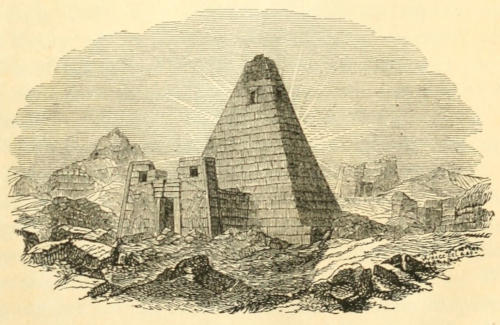

![[Three small upward-facing curls joined in a row
across the top, with a curved stroke descending from the right-hand end
and forming a rounded loop at the bottom.]](images/amchu.jpg) about the
pronunciation of which I am still in the dark.
about the
pronunciation of which I am still in the dark.
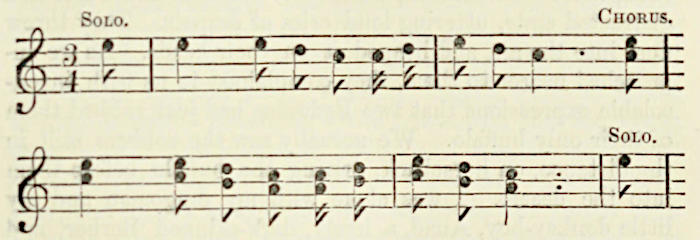
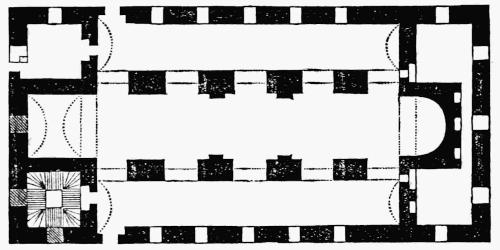

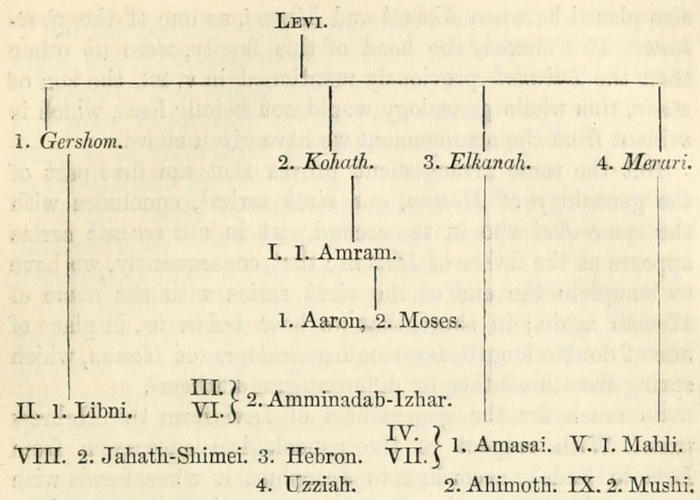
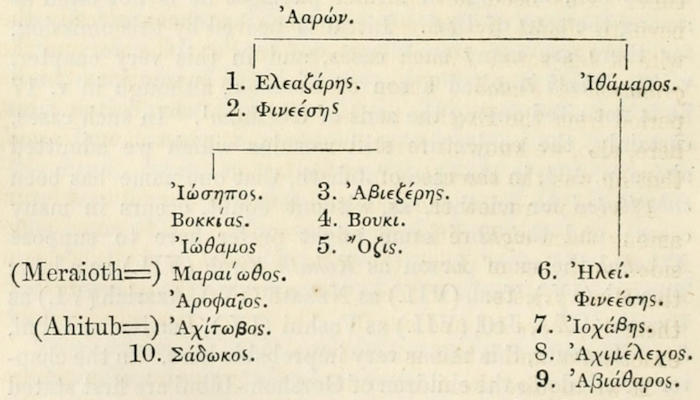
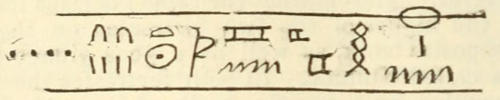
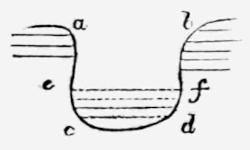
![[A double rectangular border encloses a rectangular shape with,
at each short end, a mirrored inward-pointing notch. An inscription
could go inside this shape.]](images/diagram3.jpg) might lead us to
infer that another still older inscription might still exist
here. Unfortunately I was unable to bring a ladder to the
spot to examine the stone more accurately. It is to be
hoped some future traveller may accomplish this.
might lead us to
infer that another still older inscription might still exist
here. Unfortunately I was unable to bring a ladder to the
spot to examine the stone more accurately. It is to be
hoped some future traveller may accomplish this.