

| CHAP. | PAGE | |
|---|---|---|
| I. | The Pilot who did not Return | 1 |
| II. | The Damsel of Lyme | 11 |
| III. | Captain Hannibal Cleat | 23 |
| IV. | Jack Staynton | 33 |
| V. | Captain Cleat in his True Colours | 44 |
| VI. | A Pirate in spite of Myself | 55 |
| VII. | Catching a Tartar | 67 |
| VIII. | Captured! | 75 |
| IX. | Don Iago D'alvarez | 93 |
| X. | Aboard the San Josef | 103 |
| XI. | The Inquisition | 119 |
| XII. | In the Torture-Chamber | 139 |
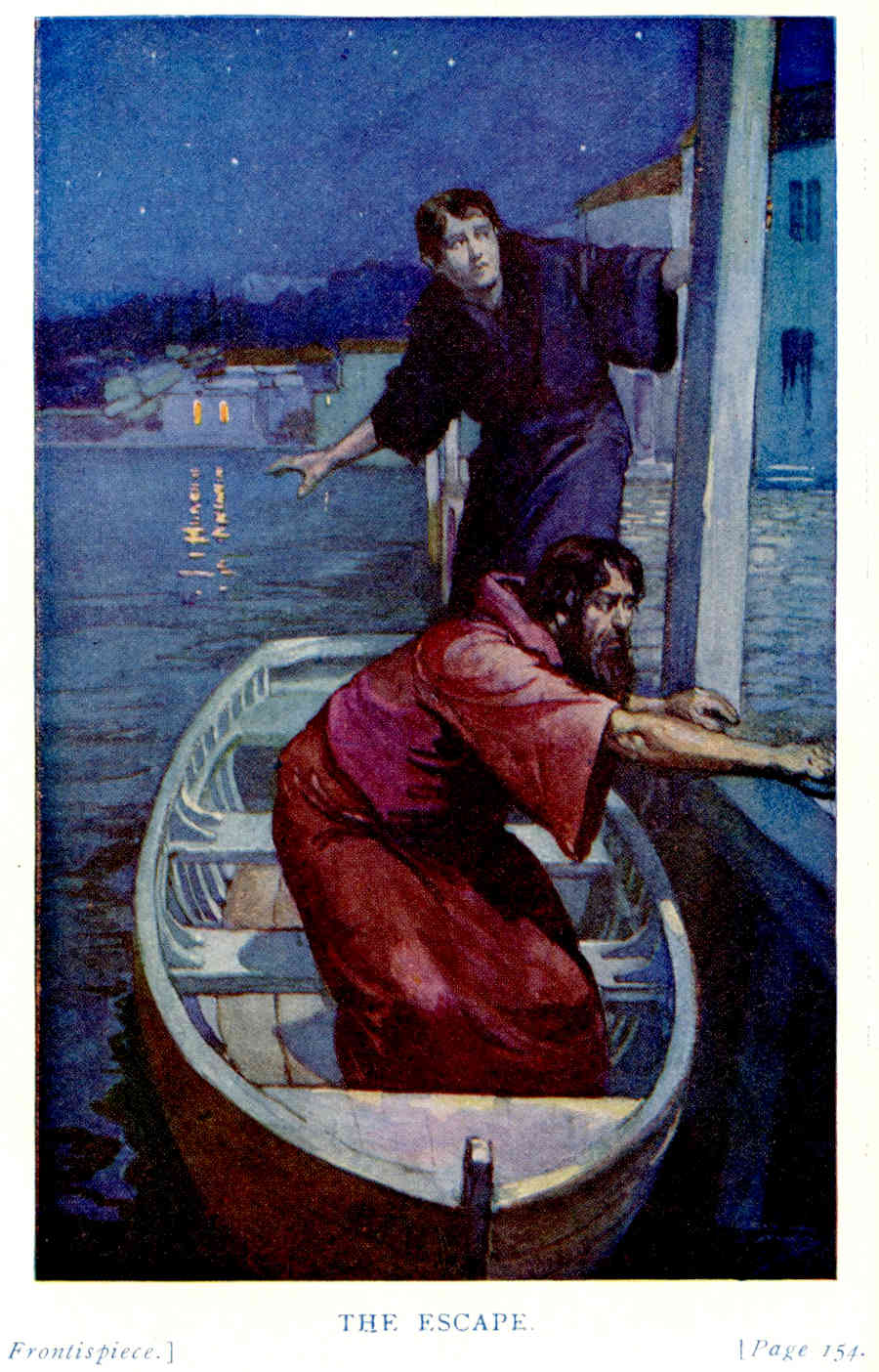
| XIII. | The Escape | 145 |
| XIV. | A Timely Rescue | 159 |
| XV. | Off to the Spanish Main | 171 |
| XVI. | The Mountain Pass | 181 |
| XVII. | Bringing back the Silver | 192 |
| XVIII. | At Bay | 205 |
| XIX. | The Taking of the Galleon | 217 |
| XX. | Bringing in the Prize | 231 |
| XXI. | The Great Armada | 242 |
| XXII. | English Dogs and Spanish Bulls | 266 |
| XXIII. | The Fireships | 274 |
| XXIV. | The Last of the Damsel of Lyme | 285 |
| XXV. | In the Queen's Presence | 298 |
| The EscapeColoured Frontispiece |
| "The Twenty-Ninth Day of June!" he exclaimed impatiently Facing p. 48 |
| My Jailers halted before a Small Oaken Door" 122 |
| Four Masked and Hooded Familiars entered" 128 |
| Thus we spent a Horrible Night" 176 |
| "Have the Spaniards landed?" I asked" 240 |
| We had Played our Part" 288 |
THE PILOT WHO DID NOT RETURN.
I WAS born on the 6th day of July in the year of grace 1568, in the parish of Crofton, in the county of Southampton.
My father, Richard Roy, was one of the Queen's pilots, and no man knew the tides, currents, and hidden dangers of the Channel 'twixt Scilly and the Forelands better than he.
Fourteen years before I was born, he being then but twenty-five, my father brought into Southampton the ship that bore the heir to the throne of Spain—the same Philip whom all England abhorred till the time of his death. 'Twas on the occasion when this prince came to wed our Queen Mary. Even then the haughty Spaniard was unpopular, and my father roundly detested the task which had been entrusted to him. Yet, since 'twas his duty, he did it right well, bringing the prince's ship safely into Southampton, despite a thick sea-fog.
At length, wearying of staying in home waters, my father engaged in several ventures on the Spanish Main. Here he met with varying fortunes, having been twice cast ashore on the coast of Yucatan. On the second occasion he formed an acquaintanceship with a Spanish grandee, Don Iago d'Alvarez. Friendship I will not term it, as events proved; yet since necessity knows no law, 'twas in my sire's interest to work with this Spaniard.
Together, with the assistance of the Indians, they found and worked a rich mine in the mountains that, like a backbone, traverse the Spanish colony of Mexico—or New Spain, as they would call it.
With many mules laden with silver the adventurers journeyed towards the coast, and losing heavily both in men, beasts of burden, and precious metal, they succeeded in coming within sight of the shore somewhere in the neighbourhood of the city of Vera Cruz.
That night Don Iago made excuse to go into the city, and in his absence my father learned from one of the Indians that a rupture had occurred 'twixt England and Spain. This might or might not have been true, but the rest of the Indian's tale was of far greater import as far as my sire was concerned. In short, Don Iago had gone to obtain the aid of one, Don José da Silva. My father was to be treacherously slain, and his share of the hard-gotten booty was to be divided 'twixt the two rascally Spaniards.
Black rage entered into my father's heart. Vowing that neither of the villains should set eyes on the treasure, he dismissed the Indians, and having taken possession of the map of the mine, without which it was well-nigh impossible to find the spot again, he drove the baggage mules with their precious burdens over the edge of a deep ravine, through which the Rio del Foy gains the sea. Thus having thwarted his treacherous companion, my sire fled southwards, casting about him to find a means whereby he could leave the inhospitable shore of Mexico.
This he succeeded in doing, and after divers adventures, perils, and hardships, again set foot in his native land in the year 1566.
The same year he married, and settled down once more to his calling as a pilot, though the restless spirit of adventure sorely tempted him again to seek for the vast treasures of the silver mine of San Luis. Yet, held by home ties, he remained at Titchfield Haven, making a modest living by piloting vessels within the limit of a line drawn 'twixt Lepe and Alverstoke Point.
In my younger days I regarded my parent as a giant, though I have since outstripped him in height. He could, I remember, by standing on tiptoe touch the crown of the arch of Crofton Church door with his head, and 'tis seven feet less a bare four inches. Moreover, he was broad in proportion, with massive chest and limbs, and muscles corded like the trunk of an oak. On one occasion I remember seeing some deep, curiously-shaped scars upon his back, whereat he made such ado to conceal them that I forbore to ask him concerning them. That night I asked my mother, but she firmly and gently bade me wait till I was older ere I learnt the cause of those healed wounds.
One night, when I was twelve years of age, it fell, as frequently happens, a flat calm. My father had returned, saying that, as no ship was in sight and none likely to arrive this tide, he would retire to rest.
I well remember that evening. It was hot and oppressive. The sun had sunk behind a high bank of deep copper-coloured clouds, while the lead-tinted sea rolled sullenly without any breeze to cause the commotion. The sea-gulls, with plaintive cries, flew landwards, as if the unnatural calm disturbed them, while away to the south-east I noticed the distant flashes of summer lightning.
It was so hot and uncomfortable that I could not sleep, but lay in my bed listening to the dull roar of the ground-swell upon the sand flats that encumbered the mouth of our haven, for as such we invariably spoke of the entrance to the tidal Titchfield River.
Shortly after midnight—for I remember hearing the great clock of Place House chime the hour of twelve—there came a loud summons at our door, and a voice exclaimed:
"Does Richard Roy, the pilot, dwell here?"
"Ay," assented my father. "What's amiss? Marry! I know most men hereabouts, but I cannot recognise the sound of your voice."
"That can abide, pilot. But the pinnace Speedie, of Brixham, would fain enter the haven."
"I'll be with you, gossip; but i' faith you must have caught a favouring breeze, for at sunset there was naught in sight and no wind withal."
A few minutes later my father, having bidden my mother farewell, with the assurance that he would be home ere morning, unbarred the door.
I heard the footsteps of my sire and his companion crunching on the shingle, then the sound of oars being thrown into the boat, and the creaking of the thole-pins as the little craft put off to the pinnace.
Shortly afterwards I must have fallen asleep.
I awoke with a start, to find the red glare of the rising sun shining on my face. The sky was heavy with swiftly-moving masses of ragged clouds, while seawards the white-crested waves were lashing themselves furiously on the flat shore.
It was now low tide. The haven was dry, but no vessel lay on its muddy bed. Looking landwards up the level valley of the Meon River, I could see as far as the towers of Place House and the little hamlet of Titchfield. Lying alongside the quay abreast of my Lord Wriothesley's mansion were two vessels, but since I knew them well by sight, 'twas certain that neither was the Brixham pinnace.
Seaward no ship was to be seen, either at anchor within the shelter of Calshot Castle or under way towards the distant Wight.
The Speedie, if such she were, had vanished as mysteriously and as unseen as she had arrived off the haven overnight.
So fierce was the storm that I made much ado to keep the casement from being blown to by the force of the wind, while the loose, dry sand above high-water mark was being blown landwards in great eddying clouds. Ashore the full-leaved trees were bending greatly to the wind, some of them having already been uprooted by the fierce blast; the like I had never before seen.
Going downstairs, I found my mother sitting at the window, pale and weary with watching, for 'twas ever thus whenever my father was at his work in a storm.
"Oh, Ralph, what has befallen your father?" she exclaimed. "He went off to some ship yesternight, and has not returned."
"Naught, I trust," I replied bravely, for I had unbounded confidence in my sire's resolution and seamanship. "Perchance the tide fell overmuch before the Speedie could enter the haven, and he has taken her to Southampton."
"You talk like a full-grown man, Ralph," she exclaimed, comforted, no doubt, by my reply. Then her curiosity got the better of her distress. "How came you to know that the ship was the Speedie?" she asked.
"I heard the man call my father soon after midnight."
"Tell me, Ralph," she continued anxiously, "did he talk like—like an Englishman?"
"Ay, though not like the people of these parts. He said he was of Brixham; and where might Brixham be, mother?"
"I thank Heaven he was a Devon man," said my mother, ignoring my question, and then, as if speaking to herself, "Oh, Dick, why did you put off to that ship?"
Slowly the day passed. The gale abated almost as suddenly as it had sprung up, and once more the fishing boats that had lain snugly in the sheltered harbours and creeks of the Isle of Wight began to run for home.
To our anxious inquiries the fishermen could give no news. No strange craft named the Speedie had been met with.
Late that afternoon I trudged into Southampton, but though my father was well known in the port, he had not been seen there, neither had any ship put in that bore the name of the Brixham pinnace.
An anxious night succeeded a trying day, but still no news. Two small traders had been cast ashore, one at Stone Point, the other off Warsash, and in both cases their crews contrived to reach land safely; but neither vessel was the Speedie.
The days ran into weeks, till blank despair that had succeeded the period of anxiety gave place to the strange calm of resignation.
At length, at the invitation of some of her relatives, my mother sold up her home and moved into a small house at Portsmouth, having enough to keep us in comparative comfort.
Thus in my fourteenth year I found myself about to be bound 'prentice to learn the art and mystery of a mariner, and it is at this point that my narrative begins.
THE DAMSEL OF LYME.
ONE afternoon I was sitting on the beach close to the iron chain that crosses the mouth of the Portsmouth Harbour—the same chain that had been wrought at great expense by the order of King Henry, the father of our gracious sovereign Lady Queen Elizabeth, for the purpose of keeping out hostile ships, though many would have it that 'twould not avail 'gainst a man-of-war standing in with wind and tide.
With me was my boon companion, Jack Staynton, a lad two years my senior, and son of the selfsame Roger Staynton who had been disfranchised under strange circumstances during the late reign.
The elder Staynton was a man of uncommon ideas, who firmly believed in taking stern measures to redress his grievances when milder actions failed.
Nearly thirty years before he was master-gunner of the town of Portsmouth, and received an offer to be made a burgess. But being accused of having unlawfully taken possession of an iron gun belonging, 'tis said, to the town and not to Her Majesty, he took umbrage, and promptly told the Mayor that the burgess-ship was not worth a clout to wipe his dirty shoes, and that he would not accept the so-called honour.
Smarting under the insult, the Mayor "presented" Roger Staynton for not giving up the gun, and the master-gunner was ordered to surrender the piece of ordnance by a certain date. Staynton appealed to Her Majesty in vain. Thereupon, with a score of boon comrades he hauled the cannon to the Mayor's house, and calling his worship forth, had him placed astraddle of the piece, chaining his ankles together so that the unfortunate chief magistrate could not release himself. All that night the Mayor remained in possession of the town's gun, and in a far different manner than he bargained for; but ere morning Roger Staynton was on the high seas, bound for the coast of Flanders, where he served bravely with the Dutch 'gainst their Spanish oppressors.
These doings occurred in the reign of Bloody Mary, but on Her Most Gracious Lady Queen Elizabeth's accession Roger hastened to return home, and was reinstated in his office of master-gunner.
Jack Staynton showed fair promise of inheriting his sire's impetuous bravery and hot-headed disposition. Withal he was good-hearted and of a pleasant manner, save when thwarted in what he considered to be his rights. Though two years older than I, he was full three inches shorter in stature, his body being over broad in proportion to his height.
From his cradle his father had taught him to hate the Spaniards, and that doctrine, being akin to mine own, strengthened our mutual friendship.
"By Kit! yore's a strange rig," exclaimed Jack, pointing to a long, rakish-looking pinnace that was standing in towards the harbour. She was about fifty feet in length, with a deep sheer amidships, her poop being well raised, though not so lofty in proportion to many of the Queen's ships. She had both fore and aft masts, raking well aft. Her mainyard had been lowered, for her crew were shortening sail, but from her foreyard a huge square sail was drawing to the following breeze.
"Ay, 'tis not a craft of these parts," I replied. "Yonder sail was not cut in the ports of Hampshire or Sussex. Mark well the tumble home of her sides, and her long, lean bows. She must be a wholesome vessel for hard weather, and swift withal."
"Well spoken, young master!" exclaimed a fisherman who was standing close by. "'Tis the Damsel of Lyme, and hath been arrested by the Vice-Admiral Horsey on a charge of piracy on the high seas."
"Is that so?" asked Jack eagerly. "And what will come o' it?"
"They will take her into the Camber Quay. If so be the charge is proved, 'tis the halter for her crew," replied the man. "Perchance you would like to see the pinnace moored; that being so, I'll put you across in my boat."
We eagerly assented, and accompanying the fisherman along a narrow tongue of shingle that separated the harbour from the vast extent of mud that at high tide served as the Camber, we crossed to the quay.
Here many of the townsfolk had already assembled. There was Master John Highfield, the Mayor, with Master Owen Tottye, who had held the office two years before. They were holding close converse with a short, rotund man whose white hair and grey pointed beard contrasted strangely with his deep red complexion.
"'Tis Sir Henry Radclyffe, the Governor of the town," whispered Jack, as we clambered up the worn stone steps of the quay. "A right worthy gentleman, and a brave soldier. My father has served under him in times past, and has nothing but praise for him."
"Yet he seems to have continual differences with the Mayor," I replied.
"'Tis but natural, when a town has two masters," remarked Jack sagely. "Dost not remember last Monday before Michaelmas, when the same Mayor was elected, how that my father had orders from Sir Henry concerning the discharge of ordnance from the platform for the Mayor's salute, and that this Master Highfield had words with the Governor regarding the number of guns that were to be fired? 'Tis even the same, and perchance 'twill always be."
Jack was right, for at that moment a dispute was in progress as to who should have charge of the prisoners—five evil-looking cut-purses who had been caught in the very act of robbing a Shoreham trader off the Isle of Wight. The Mayor claimed the culprits under the jurisdiction of the town, while Sir Henry Radclyffe insisted that they should be the prisoners of the State.
"Well met, Master Staynton!" exclaimed the Governor, as Jack's father, the master-gunner, came up and saluted his superior. "I would have your advice on this matter."
Thereupon Sir Henry proceeded to give his version of the affair, while the Mayor and his councillors, knowing the master-gunner of old, drew long faces at the obvious decision of the old war-dog.
"Of a truth, Sir Henry, you could not do better than follow the example of your predecessor, the worthy Sir Adrian Poynings," replied the master-gunner. "With him right was might and might was right; so, saving your presence, I will send for the guard."
"Excellent!" exclaimed the Governor. "You hear, Master Mayor? I will have and hold these caitiffs. You can hold the pinnace and dispose of her as you think fit. 'Tis but dividing the spoil."
Under the circumstances the Mayor could but submit. The prisoners were removed to the guardroom, while the Town Clerk and his assistants proceeded to take an inventory of the confiscated pinnace.
No one saying us nay, we mingled with the burgesses and townsfolk who were wandering all over the little craft, inspecting with evident curiosity the vessel that had earned such an infamous notoriety in the Channel.
On board I was surprised at her roomy appearance. Save for the break of the poop, I found she was flush fore and aft, a low bulwark for'ard giving slight protection to a couple of small iron sakers, while on her poop an iron culverin was mounted on a swivel, so as to command a wide range on both sides of the ship.
Abaft the foremast was a large hatchway giving access to the hold, while betwixt the mainmast and the poop a smaller opening led to the main cabin, the space under the poop-deck being entirely open save for a low bulkhead rising to a height barely two feet from the deck.
This, then, was the Damsel of Lyme, a vessel that had kept the sea in all weathers for more than two years, during which period it was known that she had taken much booty both from the Spaniards and our own countrymen, disposing of it at a handsome profit in the ports of Brittany.
All at once my attention was directed towards a tall, bearded man clad in a jerkin and trunks of blue serge, while around his neck hung a silver whistle on a chain of the same metal. Round his waist was a broad belt of undressed leather, in which was thrust a short sheath-knife, counterbalanced by a bulky wallet.
His head was closely cropped, revealing a high forehead. His eyebrows, instead of being arched, seemed to form one continuous straight line, while his deep-set eyes had a grave expression. His nose was straight and inclined to broadness. Beyond that the rest of his face was hidden by his reddish-hued beard.
That he was a stranger to the town I had no doubt, for I knew nearly every one by sight. None of the other persons on board spoke to him, though many were the inquisitive glances that were thrown towards the tall seaman—since seaman he must surely be.
Presently he straightened himself—for being 'tween decks he had been unable to stand upright—till his head and shoulders appeared above the coamings of the hatch.
"Sink me," I heard him mutter, "this craft ought to suit me right well." Then, seeing us, he said:
"Tell me, shipmates, is there a decent, well-conducted inn where I may obtain good accommodation?"
"There is the Star hard by the Town House, in the High Street," I replied, flattered to think that the stranger should condescend to address us as shipmates.
"A fig for the Star," he bellowed, heedless or ignorant of the fact that Giles Bickley, the host, was within earshot. "The sack was sour and the mulled ale as flat as a duck pond. I tarried there overnight, and this morning my head was as thick as this carline."
"Then there are the Dragon, the Lyon, the White Hart, and the Rose, all standing close together just off St. Nicholas Street," quoth Jack. "'Twould be hard if a veteran salt like you, good sir, did not find one of these to his liking."
"Cleverly said, my young haul-the-bowline; but, tell me, is the law long-winded in this town? When is the matter concerning the disposal of the Damsel of the Lyme likely to be settled?"
I shook my head. Such things were beyond me.
"'Twould not be amiss to ask my friend's father," I remarked. "Yonder he stands. He is called Roger Staynton, and he is master-gunner of this town."
"What! Do I hear aright? Old Roger Staynton? Grammercy!"
And springing upon the deck without deigning to make use of the ladder, the stranger leapt upon the quay and made his way towards Jack's father.
Curious to know more of this remarkable personage, we followed, and were surprised to see the master-gunner wring the stranger's hand with unwonted vehemence.
"Holá, comrade!" he exclaimed. "Only to think that I should see Hannibal Cleat again! Man, methought you had gone down in the Venture, when I saw her with mine own eyes founder off the Texel."
"'Tis a long story, Roger, and 'twill keep. But——"
"Nay, stand not talking here. Do me the honour of staying at my abode, Captain. What I have is at your service. Jack," he added, "hasten and inform your mother that I am bringing an old friend, Captain Hannibal Cleat (of whom she has ofttimes heard me speak), to see her. Ralph, you can go with him, and await our coming. No doubt the Captain will make you yearn for a life on the salt seas."
CAPTAIN HANNIBAL CLEAT.
IT was quite a sumptuous repast that Mistress Staynton had provided, and Captain Cleat did full justice to it. During the meal he spoke little, saying that 'twas his custom to do one thing at a time, and that right well.
But after dinner was over and the last bumper of sack drained, Master Roger Staynton led the way to the garden. It was a delightful spot, cool even in summer. Seven or eight large oak trees spread their branches over the springy turf of the lawn, that on three sides was enclosed by a lofty stone wall partially garbed in ivy.
Betwixt the trees could be seen the tower of the Church of St. Thomas, but beyond that there was nothing to show that the master-gunner's garden was in the midst of a town. Even the rumble of the carts over the rough streets and the noise and bustle of the townsfolk seemed unable to penetrate the seclusion of this walled-in place; and here in his hours of leisure Master Staynton forgot even his oft-recurring bickerings with the Mayor and his associates.
Here, sprawling at his ease on an oaken bench, Captain Hannibal Cleat made up for his reticence at table, and tale after tale he told of the Spanish Main, of the Caribs, of tempest and calm, of battles against Dons, Turks, and infidels, till I almost forgot I was in the master-gunner's garden.
"The sea! There is naught like it for a sturdy English lad!" he exclaimed. "It passes my understanding why the youth of this country hang back, when so much profit and adventure await them in foreign parts. What say you, young master? Your name has again slipped my memory."
"Ralph Roy," I replied. "And soon I am to be bound 'prentice to learn the art and mystery of a mariner."
"So? To whom?"
"Perchance to Master William Terge, who commands the good ship Loyalty, or else to Master Dionysius Savage, of the Ark. But 'tis the amount of the premium that is to be considered, since my mother can ill afford to give much."
"Hast no father?" asked the Captain.
"My father was a Queen's pilot. Richard Roy his name. He was lost off this coast in a great storm. His name, perchance, is known to you, good sir?"
"Roy?" exclaimed the Captain reflectively. "I verily believe I can call him to mind. Have we not met him in the course of our wanderings abroad, Roger?"
"Nay, I cannot recall it, comrade," replied the master-gunner. "I have only made Mistress Roy's acquaintance since she came to dwell in Portsmouth."
"Then let it pass. But should I be able to buy the Damsel of Lyme in open market, wouldst be willing to be bound 'prentice to me?"
"'Tis a small craft to adventure yourself in, Hannibal!" exclaimed Roger Staynton; "and a boy would find it go hard with him in a gale of wind."
"Tut, tut! I mean to have two 'prentices. They would be as happy as sandboys. As for the Damsel of Lyme, she is small, yet well found. Which is to be preferred, Roger—a sweet, wholesome craft of little tonnage, with sound gear and well manned, or a lubberly ship with rotten tackle, such as is oft to be seen at sea in all weathers?"
"You already speak as if the pinnace were yours, comrade," remarked the master-gunner with a grim smile.
"Roger, I thought you knew me of old. Hast ever seen me to be bent from my purpose?"
"Ay, once," replied the elder Staynton, laughing. "Dost remember that little affair at Aix in '63?"
"Let that pass," interrupted Captain Cleat, in obvious confusion; then, recovering his composure, he continued: "Well, Master Roy, we'll put off the answer to my question for a while, but should you care to broach the subject to your mother, with the deepest respects of Captain Hannibal Cleat, 'twould not come amiss. Tell her that the premium is of little moment, provided that the 'prentice is able and willing. 'Obey orders unquestioningly': that's my advice to all lads, whether they be budding seamen or mere land-lubbers."
However, I did not mention the matter to my mother that night, preferring to see whether Captain Cleat did succeed in purchasing the pinnace. I had also made up my mind to ask Jack Staynton some questions concerning his father's old comrade; so after breakfast on the following day I made my way to the house in Hog market Street.
Jack was already out, having gone down to the quay with his fishing-line. Thither I hurried, only to find him standing outside the gate, where a broad-sheet had been fixed to a notice board on the wall.
"What do you make of it, Roy?" he asked, being an indifferent scholar. At that time I was only a little better, but by dint of much puzzling and cudgelling of my brains I deciphered the crabbed writing.
It was as follows:--
"An Invitory taken ye XXI day of June in ye XXV yeare of our soveraigne ladye Elizabeth by the grace of God of Englande, ffrance and Ireland, Quene defender of the fayth, etc., of all such goods as are in ye Damsell of Lyme of ye burden of XXI tunns.
Imprimus a pinnace wth ye mayne and fore masts and yards to ye same.
Item on grapnell wth an olde Cable con XIV vadom.
Item on iron pott wth a well kettell.
Item ij longe oars ij bowes, on hand-sawe and ij hatchetts.
Item on ax, on compas, on olde sworde, ij sakers and on culverin.
Item a water barrell and a stoupe.
Item a mayne sayle wth a topp sayle.
Item a tilt sayle of VIIj brethes of clothe to the houps.
Item a ship cheste and in the same two remnants of whyte wulley clothe of IIj elles on littell vynager bottell a qrt can a virkyn of salt.
Item three hogshedds of powder whereof one is spoylt XXIV shott of yron XXX shott of stone.
By Mr. John Highfield esquire maior it is appointed that ye Damsell of Lyme be sold in open courte on ye twenty-nynth daie of June, 1582 at ye houre of XI in ye forenoone."
"So the pinnace is to be sold in eight days' time," remarked Jack. "Captain Cleat will have to wait awhile. But the charge against the crew was soon proved."
"Ay, up to the hilt. They are to be chained to posts on the foreshore, so that the rising tide will drown them," I replied. "Master Jennings told me of the sentence this morning. But what think ye of your father's guest?" I asked bluntly.
"A hearty sea-dog, nothing more or less," replied Jack. "True, he's given vent to many strange oaths and has played havoc with the mulled ale and sack, but he is ever most devout in all religious exercises, which pleases my mother mightily."
"Is he," I continued anxiously, "a man who would prove a just and honest master? I am in no mind to be bullied and browbeaten by any man."
"I trow you will have to put up with plenty of hard words and harder knocks ere you come to man's estate," replied Jack sagely. "But I would I were with you in this matter, Ralph. Did not Captain Cleat say he would want two 'prentices?"
"Would your father say yea?" I asked eagerly.
"I can but ask him. But here comes the Captain."
"Good morrow to ye, lads," was Captain Hannibal's gruff yet hearty greeting. "I heard it said that the announcement of the sale is out."
"Ay," announced Jack, after he had returned his salutation. "'Tis on the other side of the quay gate."
"By my beard, I can make nought on't," grumbled the Captain, after he had stood in front of the notice, had inclined his head to the left and to the right, and had walked backwards for several paces in his efforts to read the crabbed writing. "Canst read, shipmate?" he bellowed in my ear.
"I'll try, sir," I replied; and, having already deciphered the Town Clerk's manuscript, I proceeded quickly with my task, the Captain gripping my shoulder heavily in his eagerness.
"The twenty-ninth day of June!" he exclaimed impatiently. "What long-winded lubbers they are! Master Jack, your good father will tire of his old comrade ere then."
"Nay, I can answer for that, Captain Cleat," replied my companion. "But if Ralph goes as your 'prentice, could I not go also? I remember you said you wanted two."
"Nay, lad, 'tis not to be thought of. Many a long-standing friendship has been wrecked upon the rocks of enmity through the like. I am too much beholden to your sire to take upon myself the care of his son. 'Twould also capsize the proper feeling 'twixt master and 'prentice were I to have you aboard. Therefore think no more of it, my lad."
Then, observing our crestfallen looks, he clapped each of us on the back. "Cheer-ho! 'tis for the best. Perchance you'll both be shipmates on the same craft ere another seven years are spent. Did you say aught to your mother, Ralph?"
"Nay," I replied. "I waited——"
"Waited for what?" demanded Captain Cleat peremptorily. "Did I not tell you to ask?"
"I thought 'twas a request," I faltered.
"Request? Sink me! I never request—I order. Mark it well."
And, turning on his heel, Captain Hannibal Cleat lurched away in true nautical style, leaving me to wonder at the varying moods of the man who might by mine own choice become my master.
1) Taken from a contemporary record.JACK STAYNTON.
ACTING on Captain Cleat's so-called order, I told my mother of his proposal to take me as 'prentice. Although glad of the offer, since the question of a premium was a weighty one, she did not at once give her consent, but made inquiries of Master Roger Staynton concerning his old comrade.
"'I faith, Mistress Roy," he replied, "what would ye have me say? Captain Cleat has been my boon companion divers times past, and though he is rough in manner and speech, I wot that he is good-hearted and just withal. Certainly he is a man of many parts and many peculiarities, but I would not tarry to send mine own son to sea with him. Yet—and I look upon it as one of the Captain's whims—he straightway refused him."
With this qualified recommendation my mother sought fit to accede to Captain Hannibal Cleat's demand, and it was decided that, should the Captain put to sea in the Damsel of Lyme, I was to be bound apprentice to him for six years, to learn the art and mystery of a seaman in consideration of the sum of five pounds.
At length the day appointed for the sale came round, and early in the morning Jack and I went aboard the Damsel of Lyme, where, in company with about a score of other lads, we swarmed up the rigging in spite of the efforts of the tipstaffs to dislodge us.
Beneath we could see Captain Cleat as he paced the deck with a self-confident manner, as if he were already in command; yet we noticed that he shrewdly took stock of each newcomer, viewing in him a possible rival for the possession of the Damsel of Lyme.
Just before the hour of eleven the Mayor, his assistants, and a score of burgesses arrived on the scene, attended by the sergeant-at-mace, the town clerk, two scriveners, the crier, and a guard of javelin men.
At the quay-side they waited, the Mayor looking with ill-concealed annoyance in the direction of the Governor's house, for ere the sale could commence, being partly a State affair, 'twas necessary that the Governor or his representative should attend in person.
It was quite ten minutes past the hour when the roll of drums announced the arrival of Sir Henry Radclyffe. Attended by a half-company of archers and pikemen, with several captains, the master-gunner and master-bowyer in his train, the Governor strode with measured step to the quay-side, where he gravely received and returned the salute of the representatives of the borough.
Then at a sign from the Mayor a tall, gaunt man, dressed in sober russet, mounted upon a rostrum, and proceeded to give a voluminous description of the confiscated pinnace.
"Cut it short! Cut it short!" I heard Captain Cleat mutter impatiently. Several of those whose business it was to bid for the Damsel of Lyme began to cough, with the same idea of curtailing the speaker's verbosity, but all to no purpose. The man was not to be gainsaid, and though he undoubtedly heard the muttered interruptions, he sonorously continued his discourse.
At length the bidding began, Captain Cleat taking no active part during the first five offers. Then the bids seemed to hang fire, in spite of the official's urgent appeals to the sound judgment of his audience.
Planting his legs firmly apart, as was his wont, Captain Hannibal Cleat tapped his well-filled wallet, then folded his massive arms across his chest.
"Enough of this child's play, my masters!" he exclaimed. "I mean to bid and bid hard, so if there be a man worthy to be called a man let him bid against me. Only mark well lest I let him have the pinnace at a long price," and straightway the Captain bid a pound more than the last offer.
The challenge was taken up by a ship-master of Poole, but after a while, fearing that the Captain would avail himself of his threat, and leave the pinnace on his hands at a high price, the Dorset man fell out, leaving Captain Cleat to buy the Damsel of Lyme for the sum of thirty-four pounds.
For the next three days the Captain worked from morn till night on his new purchase. He had shipped two hands—rough-looking men they seemed to me—and the task of refitting the pinnace proceeded amain.
Yet he found time to accompany my mother and me to the house of Master Owen Tottye, a former mayor and magistrate of the town. By him I was formally bound 'prentice to Captain Cleat, and a copy of the indenture handed to my mother.
This done, Master Tottye gave me a short homily on the necessity for obedience, and exhorted me to strive to make my way in the world.
The magistrate was in truth well qualified to give advice, for he had risen himself. When first he came to Portsmouth he set up as a glover, but "not being free," had been presented and fined eleven times. Yet in spite of persecution—for 'twas nought else—Master Owen Tottye succeeded in being elected a burgess. Nor was he content to remain such, for ere long he became mayor's assistant and finally mayor. 'Tis said that he hoped again to receive the honour of being elected mayor at the hands of his fellow-townsmen.
Nor did Master Tottye's kindness end with words of cheer, for ere we left his house he gave me an order on his neighbour Jennyns for two ells of russet cloth and three ells of blue serge, so that I might be suitably apparelled in my new condition in life.
I now entered upon my duties as Captain Cleat's 'prentice, and was soon well acquainted with the tar-brush, the caulking-iron, the serving mallet, and divers other implements used by seamen when refitting their craft. But though the Captain worked me hard, I had no cause to complain, since he himself worked as hard as any of us.
At length the day appointed for the departure of the Damsel of Lyme came round. She was bound for the Coast of Guinea, there to trade with the negroes or blackamoors, and on this account the pinnace was well armed. Certain busybodies went so far as to say that Captain Cleat's close friendship with the master-gunner stood him in good stead, but of the truth of the report I knew nothing. But many expressed their opinion openly and freely that the Damsel of Lyme was undermanned for such an enterprise. This coming to the ears of Captain Cleat caused him to swear so roundly that even I, knowing his failings in that direction, was mightily astonished.
The Damsel of Lyme was to sail at tide-time, which happened to be at three in the afternoon, so that full advantage of the down Channel stream could be taken.
At noon, the Captain having gone ashore for dinner, and the two hands being below, I saw Jack Staynton standing on the edge of the quay.
"Hist!" he exclaimed in a low voice, for he was aware that the hatch of the forepeak was open, and that the two seamen were below, "I want to speak with you, Ralph."
Without waiting I crossed the gangplank, and stood beside him. I must have looked a fine scarecrow, being unkempt, in my rough clothing and smothered with iron rust and tar, while he was neatly attired in white doublet, plum-coloured breeches, and dark blue hose, with pinch-beck shoes mounted with polished steel buckles.
"Has Captain Cleat taken another 'prentice yet?" he asked.
"Nay, nor is he likely to," I replied.
"Then, Ralph, I'm coming with you——"
"Gracious——"
"Nay, give not vent to wonderment, but rather give me your help. The coast is clear let me hide in the hold, and then, Ralph, we'll still be comrades together."
Overjoyed at his proposal, and counting not the cost of our ill-advised action, I led Jack down the after-companion. But to my surprise the hold was battened down, and secured by an iron padlock. Why that should be so was beyond my understanding, since I knew that 'twas only partly filled with sea-stores, it being the Captain's intention to lower three hogshead of flour into it ere we set sail.
"I have it," I whispered. "I'll stow you in the Captain's cabin. When he finds you 'twill matter little once we are at sea, since he is so beholden to your father."
To this Jack agreed, and treading softly aft we gained the cabin without interruption.
Here we cast about to find a safe hiding-place, but without success, till I espied a ring-bolt set in the floor betwixt the table and the stern window. By our united efforts we succeeded in raising a trap-door, that at first sight looked like part of the deck, disclosing a dark opening.
"'Twill be the very thing," whispered Jack.
"But be careful, it may be deep down," I added, as my companion prepared to lower himself into the hole. "Stay while I procure a lantern."
"There is no need," he replied. "My feet already touch the bottom. 'Tis sand or something of that sort. Now, Ralph, put the cover on."
"But you will die for want of air," I objected.
"Needs be as needs must," he replied nonchalantly. "Should it be necessary I'll heave my back against the cover and raise it."
I had hardly hidden my daring friend and returned to my task—which was that of tarring the dead-eyes—when I saw Captain Cleat returning across the quay.
He had several heavy packages under his arm, and declining my offer to help him, bore them into his cabin. There he remained for some considerable time, while I waited in fear and trembling lest the Captain should place his chair on top of Jack's place of concealment, and thus unwittingly cause him to die of suffocation, or at least compel him to make himself known, and so frustrate our plot.
Presently Captain Cleat reappeared, glanced at the wind-vane, and gave orders for sail to be set. 'Twas a full hour before high water, but the breeze was favourable. Unfortunately for me this hurried departure prevented me from seeing my mother, who was to have come down to the quay to bid me God-speed. There was one consolation: I had already bidden her farewell in the privacy of our own home.
Nimbly the two seamen sprung aloft and set the foresail. Captain Cleat at the tiller shouted to me to haul first on one sheet then on another, till in the confusion I was unaware that our voyage had really commenced.
But 'twas so, and soon the Damsel of Lyme was curtsying to the short steep waves, with my fellow-voyager, Jack Staynton, still undiscovered in his cramped and dismal retreat.
CAPTAIN CLEAT IN HIS TRUE COLOURS.
UNFORTUNATELY, the wind that had served us so well in clearing the harbour soon fell light, and barely drifting with the tide, the Damsel of Lyme stood slowly down the Solent.
I now had time to ponder over recent events, for Captain Cleat, roundly cursing the faint breeze, had retired to his cabin, leaving one of the seamen, a red-faced, curly-headed lout with a vile temper—as I soon found out—at the tiller. This seaman rejoiced in the name of James, but whether 'twas his Christian name or otherwise I could never find out. When he was not spluttering with rage he was peevish, often complaining like a spoilt child; and looking back, I cannot call to mind which mood was to be preferred. From my first day afloat I got to loathe my shipmate, while he took every opportunity to make my lot uncomfortable.
The other seaman, known as "Old Garge," as a tall, sparsely-built man of about forty. He, too, roundly detested his shipmate, but since James was in petty authority, being regarded as first mate of the pinnace, he thought fit to keep in with him. Nevertheless, Garge was of a kindly nature, despite his rough exterior, and, when out of James' sight and hearing, did not hesitate to show me a deal of consideration.
The pinnace still carried way, being borne rapidly westward by the strong tide. We were abreast of Lymington River, when I heard Captain Cleat bellow out for James to come aft. It was such a roar that the Captain gave—though he was always shouting when on shipboard—that even the surly seaman showed signs of surprise and ran aft in no leisurely manner.
Presently up the after-hatchway appeared the head and shoulders of Captain Hannibal Cleat. Then he paused to give vent to a string of curses, and with a heave, assisted by his man, he brought into view my friend Jack Staynton.
Even I could scarcely recognise him. His face and hands, being moist with sweat, were smothered with a charcoal-like substance, while his smart clothes were soiled and discoloured by the same gritty stuff.
To the accompaniment of a liberal dose of handcuffs and kicks, my unfortunate companion was dropped upon the deck like a sack, where he lay entreating the Captain to forbear and hear him, while I stood by helplessly looking on at the inhuman treatment bestowed by a man who had been Master Staynton's guest for weeks past.
At last the lad contrived to make Captain Cleat understand that he was Jack Staynton. Thereupon he withheld his hand.
"Then what are you doing aboard the Damsel of Lyme?" he demanded with an oath. "Sink me, I took you for a stowaway! How did you get here?"
"I hid," replied Jack. "You said you wanted another 'prentice——"
"In the face of what I told you, you tried to fool me, eh?" interrupted Captain Cleat. "Now, you couldn't have got down that hatch by yourself. Who helped you? that leather-livered cub, Roy, I'll swear."
Jack did not reply; thereupon the Captain called me.
"Here, you lying son of a sea-cook; what made you try and play the fool like this?" Then in a softer tone he added: "Jack, dost know what's on your clothes? 'Tis gunpowder, so stand aside and shake the grains clear to lee'ard."
I trembled in spite of myself, for I remembered having offered to light Jack's hiding-place with a candle lamp.
"I'm not to be thwarted," continued my master. "To that end I'll put you aboard the first vessel we meet. Unless mine eyes deceive me, there's a shallop standing in past Hurst Castle. Think of your parents' anxiety, Jack."
Somehow or other I did not think that these last words rang true, and there was a strange expression in the Captain's eye that boded no good for me when once my comrade was clear of the ship.
"Nay, sir," quoth Jack. "Concerning my parents, they have already decided to send me to sea; moreover, I have told Master Ridge to let them know ere nightfall. That being so, why cannot I remain? You need not fear to treat me as the others, and, grammercy, I've had a full share already, methinks."
"Nay," replied Captain Cleat shortly. "'Tis useless to think of it."
With that he walked over to where James had resumed his place at the tiller, and bade him steer towards the little craft we had sighted. She was a fishing-boat, and the wind being light and contrary, they had taken to their oars, and were attempting to take advantage of the counter eddy that swirls past the walls of Hurst Castle.
"'Tis not to be, Ralph," said Jack, "so the best of friends must part. But the Captain seems of a strange nature—far different from when he was at our home. Methinks you will find him a hard master."

"He dealt brutally with you," I replied.
"Ay, I wot I am one mass of bruises. But, there, 'twas done in a temper, and he knew not who I was. Now, Ralph, I want you——"
My companion's request was interrupted by the Captain shouting for him to come aft, for the shallop, in reply to a hail, had rounded-to and lay alongside our quarter.
"In you jump, young master," ordered the Captain. "These men will land you at Portsmouth as soon as can be done; 'twill cost thy father a mark; but do you present him with my compliments and say 'tis a sum well spent."
With that, and before Jack could bid me farewell, Captain Cleat lifted him clear of the low bulwarks and dropped him into the arms of one of the fishermen.
For a long time I watched the distance slowly lengthen between the two vessels, till a beam wind springing up that was favourable to both, the shallop was lost to view in the haze.
Suddenly I was interrupted by the Captain's strident voice:
"Boy, come aft—I want you."
I hastened to obey, and standing bareheaded before him, was cowed by the malevolent expression upon his bearded face.
"Now, you insubordinate young whelp, I would have words with you. First tell me, why did you break into my cabin, being contrary to my orders?"
"I knew of no such order, sir, neither did I break into the place."
"You lying, prevaricating young sea-lawyer!" he stormed. "I'll teach you to obey. Take off your doublet."
Slowly I did as he ordered. My senses were numbed, yet I knew that I was to be soundly whipped. I remember looking longingly at the shore, and had it been nearer I would have sprung overboard and made an effort to reach it. Captain Cleat must have read my mind, for he shouted, "Wouldst add the crime of breaking ship to your other villainies? Oh that a youth so wholly wicked should have been palmed off on me!" and he seized me by the arm.
I remembered his grip when outside the quay gate. 'Twas vice-like then, but now 'twas like to snap my arm. Then tearing my doublet from my back, he called to James to trice me to the mast.
Taking his place at the tiller, the Captain watched the proceedings with a fiendish leer, while his assistant was not one whit less eager to carry out his orders.
'Twas over at last, and with my back torn and bruised with the savage rope's ending, I was cast loose and told to make myself scarce. Blindly I groped my way to the forepeak, where Old Garge, who had heard the noise on deck, but had not thought it prudent to show himself, washed my wounds with fresh water, and told me to lie down in my bunk.
Early next morning I was awakened by the tramp of feet on deck. "Up with you," said Garge; "they're changing watch, and 'tis your trick."
Painfully I gained the open air. Away on our starboard hand was a long line of lofty rugged granite cliffs fringed with a line of white foam, while seaward the skyline was unbroken.
But 'twas not the land that attracted my attention; on deck were six ferocious-looking rascals besides Captain Cleat and his minion James. I vaguely remembered having seen the men before, till, like a flash, the truth came to me. They were the former crew of the Damsel of Lyme, who, being convicted of piracy, were to have been drowned at the foreshore this very day!
Observing my unrestrained look of surprise, Captain Cleat called me over to where he stood.
"Well, sirrah! cannot I ship a number of new hands without causing you to gape like the mouth of the bottomless pit? Know you that these new shipmates of ours were transferred from the barque Nonsuch during the night, they having had good and just cause to take up their discharges from that ship?"
"But they are the same men as I saw marched off under guard from this——"
I stopped suddenly, for the Captain's look of surprise at my announcement gave place to a grim smile.
"Sink me, young Roy!" he exclaimed, "you are far smarter than I thought. Ay, you are right, and being a sensible lad, you will keep your own counsel—and mine—in this matter. There's a quick fortune to be made upon the sea, my hearty, and we are going to do it. A fair share for each of the crew, but 'twill mean hard work and no shrinking at trifles. When Captain Hannibal Cleat means to do a thing he is not to be turned from his purpose. Thus, for example, 'twas I who secured these men's release and brought them safely aboard, here to follow once again their calling. But, mark you, one unguarded word, and you are food for the sharks. E'en if you give us the slip you are doomed, for be it a score or more years hence the end will be sure and certain. More, you are even now one of the crew of a pirate ship, and if captured will assuredly be hanged in chains, for who would take your word, being caught red-handed? Now for'ard you go, and learn your trade at the hands of the crew."
Quickly I went, for I had good cause to remember the rope's end. I was well-nigh stunned by the startling news, yet the fact was plain enough. Captain Hannibal Cleat had shown himself in his true colours.
A PIRATE IN SPITE OF MYSELF.
'TWOULD have needed a strong-minded man with plenty of supporters to have defied Captain Cleat. Much as I longed to be able to refuse flatly to serve him, I felt that such a course was inadvisable—nay, 'twould be sheer madness. Moreover, I had such faith in my master's word that I was convinced that he would have his revenge should I contrive to break out of the pinnace.
Whatever happened I must submit—reluctantly all the same—and trust to Providence to deliver me from the meshes of the net that had been cast about me.
The nine desperate ruffians on board the pinnace lost no time in preparing to attack the first helpless ship that stood across their path, and hours were spent in practising the management of the little craft in action.
Two of the crew manned each of the sakers, and three worked the long culverin. Captain Cleat had charge of the helm, James was stationed for'ard, while my duty was to bring powder from the magazine.
To my surprise this magazine was not the place in the Captain's cabin where Jack had hidden himself, but in the midship hold, where the powder was stored in huge casks, one barrel only to be opened at a time as required. This being so, I thought, to what purpose was that quantity of loose powder kept under the floor of the after-cabin?
After practice with the cannon, the men were exercised with their arquebuses and long-bows, followed by drill with the cutlass, pike, and boarding-axe; and the whole of the forenoon passed so rapidly that I had little time to ponder over my distasteful position.
Meanwhile the breeze had held true, and the Damsel of Lyme was well on her way down Channel. Late in the afternoon the cry of "Sail-ho!" brought the watch below tumbling up on deck.
The pinnace's course was altered to intercept the on-coming ship, while the Red Cross was hoisted to her peak.
"What d'ye make of her?" asked Captain Cleat of his minion James, as the pair of rascals stood upon the poop.
"Not too big for us to tackle," replied the mate. "A Hollander by the cut of her bows."
"We could do with a leavening of Dutchmen," continued the Captain reflectively. "Give 'em plenty of spirits and they'll fight for any one save a Don. Bid our men lie hidden, and lay us alongside."
Nearer and nearer came the strange craft, the water hissing sullenly from her bluff cutwater. Then just as James was about to lay the pinnace across her path, the lofty sides were lined by full twoscore men, whose breastplates and steel morions showed above the bulwarks, while from her hitherto unseen ports a tier of brass muzzles were thrust aggressively forward.
"Where are you coming to, you lubberly rascals?" roared a hoarse voice. "Heave-to and give a fair account of yourselves."
My heart bounded for joy, for caught redhanded, ere the rascally crew had time or opportunity to communicate with their friends ashore, it was more than possible that I might escape their clutches and their threatened revenge.
Motioning his armed crew to remain hidden, Captain Cleat came to the gangway.
"Golden Cross ahoy!" he shouted. "I bear letters for the worthy Captain Amyas Thorrogood."
"This is not the Golden Cross," replied the officer on the Queen's ship for such she was; "who and what are you?"
"The Mary of and from Weymouth," replied Captain Cleat. "Chartered by Sir John Granville to bear letters to Captain Thorrogood."
"Then make sure 'tis the Golden Cross ere you stand across the bows of another Queen's ship. Get you on your way."
Laboriously the yards of the pinnace were swung round, and she stood off on her former course, the overjoyed rascals still lying hid till the cause of their alarm was well-nigh hull down.
"'Twas a near thing, Cap'n!" exclaimed James, with a mirthless laugh. "But for your ready wit——"
"Avast flattery," replied Captain Cleat shortly. "It served its purpose."
All that night and the following day passed without incident, but just as it was getting dusk, the granite cliffs of Land's End showing a league or so on our starboard quarter, another sail was reported.
This time 'twas a small sloop manned by four men and a boy. Unsuspectingly they allowed us to approach to within half a cable's length, but on Captain Cleat hailing to them to heave-to they took alarm, put their helm hard down, and attempted flight.
We immediately stood in pursuit, the wind being well on our beam, and now the Damsel of Lyme showed her speed. Yet the chase was no bad sailer, and all but held her own.
James was for letting her have a dose from the culverin, but to this Captain Cleat objected, saying that the noise of the firing would bring some of the large armed fishing luggers out of Penzance to see what was amiss.
"Then we stand to lose her in the darkness," objected the mate.
"Peace, fool," replied the Captain, giving a swift glance shorewards. "Keep her as she is till I give the word, then see to it that you put the tiller hard over."
Onward tore the sloop in search of shelter or succour, while at her heels raced the Damsel of Lyme, with her ferocious crew ready to cast grapnels and board the moment 'twas possible to come within reach.
"Down helm!" roared Captain Cleat, having caught sight of a peculiar swirl in the water ahead of the two vessels.
Round swung the Damsel of Lyme, but ere the pursued could realise the meaning of this sudden change of course the sloop struck with terrific force upon a submerged rock. For a brief instant she pounded heavily, her mast going by the board with a crash, then gradually sank till she settled upon the reef.
Hastily the pinnace was hove-to, her longboat swung out by means of tackles from her yard-arms, and into it swarmed James and four of the men, all armed to the teeth.
Being but a short distance on, I could follow their movements with ease. Ignoring the entreaties of the master and crew of the sloop, the villains plundered all that was of value in the cabin. 'Twas but little, and this served to exasperate the pirates.
"Shall we finish the business?" shouted the mate, passing his forefinger lightly across his throat.
"Stave in their boat--'twill suffice," replied the Captain; and in an undertone he added, "'Tis not the first time that the Runnelstone has served me well—I pray 'twill never be otherwise."
Promptly the pirates carried out the Captain's orders. The only boat carried by the sloop—and a frail cockle-shell at that—was shattered across keel and garboards by a few heavy blows with an axe.
Already the waves were beginning to break asunder the planks on the weather side of the doomed sloop, and her utter destruction would be the matter of about half an hour. Mutely the crew watched with despairing eyes the double work of the sea and of the scum who infested it. They knew the significance of the mate's question, and, realising that 'twould be useless to beg for mercy, could only wait, trusting in some chance of fate whereby they might escape.
Their diabolical act having been accomplished, the pirates prepared to re-embark in the longboat that was moored bow and stern on the lee-side of the shattered sloop. As they did so Old Garge suddenly seized the boy, and, in spite of his cries of terror, bore him to the side and dropped him upon the boat's bottom boards.
I could see James grumblingly protest at this act of mercy, but the old seaman for once stuck to his point, and soon the longboat was alongside the pinnace as she tossed and pitched in the short steep seas. By dint of great exertion and no little risk the boat was hoisted in, and the work of retrimming the sail was proceeded with.
Ere the Damsel of Lyme had covered half a league no traces of the wrecked sloop remained, the seas sweeping over the dreaded rock. One act of wanton cruelty had been committed, and the pirates were no better off, save to the extent of a few barrels of stale provisions, some trivial objects from the cabin, and a terror-stricken boy.
"The snivelling youngster may be the cause of our undoing," grumbled James. "'Twould be well to toss him overboard."
"He'll come in handy to help serve the guns, sir," remarked Garge. "Besides, he'll soon knuckle under."
"I'll warrant he will," replied Captain Cleat grimly, "or I shall have something to say in the matter. You, Roy, take this blubbering boy for'ard, and see to it that he mends his ways, and that quickly."
Ere long I succeeded in quieting the lad, who was not ten years of age, and gained his confidence sufficiently to hear his story. It was his first voyage, the sloop being the Jane of and from Padstow, and bound for Ipswich.
Beyond that he could tell me little, having been down with sea-sickness during the voyage round Land's End. It was a matter of some trouble to understand all he said, for he spoke in a quaint Cornish dialect, many of the words being beyond my comprehension.
After a while I told him of the circumstances under which I had been bound 'prentice to this villainous Captain Cleat, and impressed upon him the necessity, for his own sake, of obeying the pirates' orders, since he might plead compulsion if good fortune delivered him from this accursed ship.
With that he brightened up, and began to tell me—as they say Cornishmen are fond of doing—all his family's history, bringing in names of people whom I never expect to meet. Yet I gleaned that the lad's name was Dick Buzza, his father being a fisherman of Padstow. The Jane was not manned by any of the lad's relations, but every member of her crew was an acquaintance of the elder Buzza, so that the ruthless abandonment of the hapless men told heavily upon the sole survivor.
For the next month our cruise was full of incident. Hardly a day passed without some vessel or other being spoken. In some cases Captain Cleat thought fit to maintain the role of harmless trader; in others he did not hesitate to cripple the stranger with gun-fire, and complete the work by boarding and cutting down every member of the crew. Then, having plundered the prize, he would send her to the bottom.
Soon our booty became so large that the Damsel of Lyme, deeply laden, was compelled to put into an obscure port of Brittany, where unscrupulous persons were ever ready to purchase the ill-gotten cargo without troubling how or whence it came.
Even though I made up my mind to break away from these lawless ruffians at the first available opportunity, it seemed as if I was doomed to exist in a state of bondage, for while in port I was not allowed to set foot ashore. Even my actions while on deck were subjected to a strict watch. This, in a measure, was a kind of consolation, for had Captain Cleat had confidence in the effect of his threat he would not have been so jealous of my liberty while in port.
In any case I knew full well that my life was in peril on board the Damsel of Lyme--be it at the hands of the pirates or their antagonists. This thought prompted me to cast about to find some means of freeing myself from the toils of Captain Hannibal Cleat, but ere long my deliverance was effected in a very unsatisfactory manner.
It was, indeed, a case of out of the stock-pot into the fire. But of that anon.
CATCHING A TARTAR.
ONE bright morning the Damsel of Lyme cast off from the quay at Plougastel and headed for the open waters of the vast Bay of Biscay.
The number of our crew was now increased by two, the new hands being two drunken Breton fishermen who had been induced to serve aboard the pinnace under no false pretences. Fishermen they were termed, yet I'd wager that they were wreckers.
With stores replenished and the men flush with money—for the Damsel of Lyme had weighed directly the proceeds of the booty had been apportioned—the pinnace sailed with a definite object in view.
A rich convoy was expected at Corunna from the Indies, and, since 'twas almost certain that the merchantmen would straggle, Captain Cleat hoped to be able to cut off one of the deeply-laden craft without much chance of being discovered. So a course was shaped towards Cape Finisterre, where more express news might be obtained as to the expected arrival of the Hispaniola Fleet.
For five or six days the Damsel of Lyme cruised off the north-west Spanish coast. Several small coasting craft were judiciously questioned, for Captain Hannibal Cleat was a born play-actor, and adopted the role of a pilot of the Douro River to perfection. Thus, without causing alarm, he was able to obtain all the information possible, though 'twas not sufficient nor definite enough to please him.
At length, above the long regular rollers of the Atlantic appeared the topsails of a large fleet, straggling over more than ten miles of sea.
The wind was north-west, and the ships were sailing as close to the wind as possible. This was to our advantage, since those that made the worst leeway tailed off the farthermost from their escort.
"'Tis the silver fleet, sure enow!" exclaimed the Captain. "We'll lie close, and ere morning yonder caravel will be ours."
He pointed to a cumbersome-looking high-sided vessel that, unable to sail within a point of the next worst ship, had already drifted a good league from the rest of the convoy.
A look of malevolent joy passed over the features of the rascally crew. There was determination written on their faces; they meant to take the marked ship at all costs. Some of their number might fall and could ill be spared, but, after all, what mattered? The larger would be the share of the spoil.
Running well before the wind the Damsel of Lyme passed a good two leagues from the caravel, and, as darkness set in, turned her course towards the twinkling poop-lanterns of the unsuspecting Spaniard.
Captain Cleat's plans were well laid. The three pieces of ordnance were crammed to their muzzles with scraps of iron, the arquebuses were carefully charged and primed, while every man, stripped to the waist, had decorated his bronzed face and body with weird designs in red ochre and white chalk.
"Mark well what I say, boys," ordered the Captain; "when we board do you remain here. Recharge all three cannon and keep your matches ready for instant use."
Although the pinnace was a pirate ship the Spaniards are our natural enemies; thus I had no compunction in carrying out my instructions with a good grace.
At about two hours after midnight the pinnace crept within pistol-shot of the caravel, yet not a sound betrayed our presence to the careless watch on deck.
We could see her tall masts and faintly-drawing canvas standing out against the darkness of the night, the phosphorescent swirl from her rudder, and the curling bow-wave from her bluff entry. Occasionally we could hear the quick chatter of a pair of quarrelsome sailors, or the twang of a mandolin, while through her brilliantly-lighted stern-gallery windows came the clatter of the dice, for her officers were playing far into the night.
Motioning the helmsman to keep an even course, Captain Cleat sprang into the main chains on the larboard side. For a few moments he watched, then his stentorian voice awoke the stillness of the night.
"Surrender, you Spanish dogs!"
He spoke in English, knowing full well that the officers, as well as most of the common seamen, would readily understand the stern summons.
'Twas all confusion. Men rushed hither and thither, but for the most part they clustered in the bulwarks, ready to repel with pike and sword any attempt at boarding.
This was exactly as Captain Cleat wished, for when the crush was at its height he gave orders to open fire.
The iron hail tore gaps in the dense mass of men, then ere the survivors could recover from their surprise, the two vessels were rubbing sides, and every man aboard the pinnace discharged his arquebus, then leapt for the lofty bulwarks of the caravel.
All this while we were not idle, for we placed double charges into the culverin and the two sakers, filling up their gaping muzzles with a mixture of death-dealing missiles.
Just as we had completed the task I suddenly became aware of a strange lull in the conflict. Then, with a yell of rage and pain, Captain Hannibal Cleat's enormous body leapt from the bulwarks of the Spanish craft right on to our narrow deck.
"Let 'em have it!" he shouted to me, at the same time running forward with an axe.
The blinding flash of the culverin and the death-dealing storm of iron checked those of the Spaniards who would have jumped aboard us. The first saker cooled their ardour still more, and, ere I could bring the match to the third piece, Captain Cleat had severed the rope that held us to the caravel, and instantly the gap betwixt us began to widen.
"Bravely done, lad!" shouted my master, as he came aft for the tiller. 'Twas the only sentence of admiration he had ever addressed to me since I set foot aboard the Damsel of Lyme, and the pleasure of hearing him speak thus made me forget that I was aught but an Englishman fighting 'gainst the might of Spain.
Once more another irregular volley whizzed around us, but the pinnace was already slipping through the water, and beyond a few splinters and the severing of a rope or two no great damage was done. This discharge was followed by a desultory fire till the last report echoed across the sea.
The Damsel of Lyme was lost to the sight of our foes in the blackness of the night.
Beyond the few words Captain Cleat had uttered when he regained the deck of the pinnace not a word had been spoken. He remained at the helm, his huge body leaning heavily upon the massive oaken tiller and his head slightly inclined as if lost in thought. Owing to the darkness I could not distinguish his features, but the exertion had evidently told upon him, since I could see his broad shoulders heaving regularly in the effort to recover his breath.
'Twas certain that the Damsel of Lyme had met her match. The attempt to board had been repulsed, and, with the exception of Captain Cleat, every man of her crew who had set foot upon the Spaniards' deck had either been captured or killed.
CAPTURED!
NO sooner were we well away from the Spanish ship which we had so rashly attacked than I bethought me of young Dick Buzza.
I looked around for him, but he was nowhere to be seen. Mustering up courage, I braved the Captain's displeasure, and thrice called the lad softly by name. Still there was no answer.
As Captain Cleat did not call me to silence, but remained at his post, I went for'ard, thinking the lad was down below.
My voice echoed in the empty space of the fo'c'sle, but there came no reassuring reply. Then the thought flashed across my mind that perhaps the boy had been struck by a chance shot; yet I had heard no cry of pain on board the pinnace.
It did not take me long to complete the round of her decks, but no body lay upon her planks.
There were splinters, shattered blocks, and several ropes, while here and there a gaping hole in the bulwarks testified that some of the caravel's shot had told. Presently I came across a dark stain upon the deck. Close to it was another, and more leading in a well-defined path, till they reached the tiller, where the Captain still remained in his attitude of seeming ease.
"You are wounded, sir!" I exclaimed, in alarm and anxiety. An hour or so previously I would have welcomed the fact, but now, under different circumstances, I felt sincerest compassion towards the Captain.
"Ay, Roy," he replied, in a deep voice. "They've done for me. The rascally caravel was packed with soldiers, and we ne'er had a chance."
"Perchance 'tis not a mortal wound," said I. "Can I wash and bind it up? I am not used to so doing, yet I'll do my best."
"All the binding in the world will do no good," he replied. "'Tis bleeding inwardly. See," and, tearing open his doublet, he disclosed a small wound in the right breast, from which the blood welled slowly.
"Tomorrow you and the Cornish lad will be alone," he continued. "See to it that you save the pinnace from the Spaniards. Steer nor'-nor'-east, and, perchance, you'll be picked up by an English craft. Make good your case, and all will be well. But if——"
Here he broke off and begged for water. This I procured, and at the same time told him of the disappearance of Dick Buzza.
"Frightened out of his wits, I'll warrant," quoth he. "You'll doubtless find him down below in the hold. Now leave me and get you a decent rest, for by to-morrow you'll have your hands full, yet keep within hearing, lest I call."
To this I demurred, but Captain Cleat insisted with such vehemence that I instantly obeyed, wondering why he should, when at the point of death, show such unwonted consideration for the 'prentice he had so harshly ill-used.
I lay down upon the deck close to the foremast, with a coil of rope for a pillow and a piece of canvas over me to keep off the heavy dew. For a long while I could not sleep, for the excitement of the conflict, Dick's disappearance, and the Captain's injuries were constantly in my mind; but at length I fell into a troubled slumber.
Suddenly I was awakened by hearing the Captain shouting my name. I started to my feet and looked around, hardly able to grasp the situation.
It was broad daylight; the sun's rays glanced upon the long swell of the ocean, the crests of which were ruffled by a faint southerly breeze. Not a sail was in sight, which was much to be thankful for.
"Come hither, boy!"
The strength of the Captain's voice astonished me. Surely a man at the point of death could scarce shout like that? Then, as I drew near, I perceived a strange look in his eyes.
"Hasten," he continued. "Look around. We are in the midst of the Spanish ships. They lie thick around us; but, sink me, they'll not take the Damsel of Lyme!"
He paused for a moment to take his breath, then, speaking rapidly in short, almost incoherent sentences, he continued:
"Quick, lad. Under the cabin floor lies the powder. You know of it full well. Young Staynton was hidden there. Take this pistol, fire right into the thick of it, and we'll make one last journey together. Stop not to think—obey."
I stood still, trembling like a leaf. The Captain was in the grip of delirium.
"What ho, there! Mutiny? Sink me! James! George! come hither, and toss this rascal overboard. Where are you? A murrain on all of you, then; I'll fire the mine myself."
Silently I crept behind him and placed myself betwixt the cabin and the tiller. At all events, I must prevent Captain Cleat from putting his insane resolve into execution.
"Ha, there you are, you young rogue! Now, for the last time, wilt do it? Nay? Then take this, for Captain Hannibal Cleat was never known to miss."
Flourishing the heavy pistol, the demented Captain aimed full at my head and pressed the trigger. I could hear the wheel rasping 'gainst the flint, and saw the powder splutter in the pan. Then, moved by a sudden impulse, I threw myself flat upon the deck. The weapon exploded with startling report, the bullet passing through the low bulkhead a foot or so above my head.
I picked myself up and scrambled over the breastwork, determined to do my utmost to keep the madman at bay.
Then it was that his tone of command turned to one of entreaty.
"Hearken, Roy, and use discretion. Wouldst prefer the slow, lingering tortures of a Spanish prison to the swift, sharp ending that would come if we fire the powder?"
"You are mistaken," I replied. "There are no Spanish ships in sight."
With that he broke into a storm of cursing, and, leaving the tiller, he lurched, knife in hand, towards my place of shelter.
I saw that I must act, and that quickly. Seizing a musquetoon and wielding it clubwise, I stood on the defensive. The odds were with me, since he was already reeling with exhaustion.
Three steps did he take, then, without any apparent warning, his knees bent, and he fell in a heap upon the deck.
Throwing down my now needless weapon, I hastened to where he lay. One brief glance was sufficient. Captain Hannibal Cleat was no more.
I was now free to search for Dick Buzza, so, dragging the Captain's corpse into the shade of the poop, and covering it with an ensign, I hastened to take a lantern and examine the two holds. I hoped that in his fright the lad had rushed below and had fallen asleep through sheer weakness, but a thorough search revealed nothing. His fate was a mystery. I could only conjecture that, a prey to an irresistible terror, he had leapt over the side.
On returning upon deck I found that the pinnace had run up in the wind, and was lying hove-to.
Using my very scanty knowledge of seamanship, I contrived to lower the maintopsail, square the foresail, and thus sail easily before the wind.
By lashing the tiller I was enabled to leave the helm for long periods, in order to attend to the preparation of my meals and to make a thorough examination of the ship.
Ere leaving the Brittany ports she had got rid of the bulk of the booty, but there was enough money and valuables to make a man rich for life. 'Twas ill-gotten, truly, but that was not of my doing, so I prepared to return to England according to Captain Cleat's instructions ere his fit of madness came over him.
I therefore heaved the Captain's body over the side, having first attached a piece of ballast to his feet. Then, gathering all the gold pieces I could find, I placed them in a canvas sack and stowed them in the limbers of the ship, so that only by the most minute search would they be likely to be discovered.
I next proceeded to make all shipshape as far as possible, clumsily splicing all the ropes that had been shot away, and clearing the splinters and fragments from the deck.
Fortunately, the pinnace was well provisioned, and there was water in abundance.
The wind, too, held true, and my spirits rose. Given fine weather and no interference from hostile ships, I hoped to sight the English coast within seven days. There I would run the pinnace ashore, taking the bag of gold, and leave her to her fate. Next time I ventured afloat I would exercise more discrimination in the choice of a vessel, for though I hated my lot aboard the pirate ship, my desire to take to the sea remained as strong as ever.
In this way, musing on the bright future, I continued to indulge in pleasant day-dreams that, as each hour passed, seemed to approach nearer to their realisation.
As night came on I lashed the helm and turned in to a comfortable bunk in the after-cabin, trusting that the wind would hold during the hours of darkness. Worn out and absolutely overdone with the succession of exciting experiences, I fell into a sound, refreshing sleep, awaking when the sun was high in the heavens.
My first thought was to wonder whether the horizon was clear of other vessels. Truth to tell, I was not anxious, under present conditions, to meet even an English ship, while the thought of coming across an Algerine or a Spaniard filled me with keen anxiety.
As far as I could see there appeared no cause for alarm, but the broiling heat of the sun had caused a slight haze to lie in thin banks of fleecy mist upon the sea. Yet the breeze still held, and the ship was keeping fairly on her course.
Knowing the speed of the pinnace under ordinary conditions, and making due allowance for her reduced speed, I guessed that I was about a hundred leagues north-north-west of Cape Finisterre, and every hour my chance of falling in with a Spanish vessel was most surely diminishing.
So, having seen that the Damsel of Lyme held fairly on her course, I kept the helm lashed, and went to prepare a meal. This occupied the best part of an hour, and when I came on deck again I fancied I saw a sail away down to the south-west.
Filled with apprehension, I made my way aloft, and from the maintopmast head looked in the direction of the object of my suspicions.
They were only too well founded. Visible above the bank of mist were the topsails of a large galleon, though her hull was as yet partly concealed by the haze.
"A Spaniard without doubt," I muttered; then taking courage in the fact that, perchance, those on deck might not have observed my small craft, I swarmed down on deck and proceeded to hoist the maintopsail.
It was a hard task for one pair of hands, but by the aid of tackles I succeeded in getting the heavy yard up chock-a-block, and squaring the drawing canvas.
Nobly the pinnace responded to the increased call upon her speed, and, leaving a long wake astern, she slipped swiftly through the waves.
This continued for about an hour, and, to my unbounded satisfaction, the gap between the two vessels began to widen appreciably.
Suddenly I noticed a dark line ruffling the waters astern. The mist disappeared as if by magic, disclosing every detail of the pursuing craft. Almost at the same time I saw men swarming up her rigging to shorten sail.
I knew full well what it meant. It was a squall approaching, and I was helpless to act. Already the way of the pinnace was too great to allow one to leave the helm. One instant's neglect to grasp the tiller would have caused her to broach to, with disastrous results. It must be a case of holding my course and trusting to Providence.
On board the galleon they were barely in time ere the squall overtook her. For a moment her bluff bows sank deep in the water, then, as she gathered an increased way, the foam flew in cascades from her stem.
This much I was able to discern by taking hasty glances over my shoulder, and, apprehensively, I waited for the powerful gust to overtake me.
Bracing myself at the tiller, I endeavoured to keep the Damsel of Lyme straight before the wind. I could hear its moaning, yet dared not face the on-coming danger. Then, with a loud groaning and straining, the braces began to tauten, and the canvas to belly out as the first puff struck the pinnace; but ere she could gather sufficient way, the main squall swooped down.
I felt the water swirling up to my knees, while in the midst of a deafening crash the mainmast snapped off three feet from the deck, the wreckage wrenching the foreyard from its slings. Then, as the little craft broached to, the vicious green seas swept clean over her, and it was as much as I could do to save myself from being swept overboard.
Within ten minutes the squall had passed, and the weather was calm again, though the sea still ran high. The pinnace still floated, and, in spite of the trailing wreckage, seemed fairly buoyant.
I looked around for the Spanish ship. During the squall she had considerably overrun the Damsel of Lyme, but had backed her mizzen-topsail, with the evident intention of sending a boat.
My dreams of reaching England with the pinnace were doomed to be rudely shattered. I could think of no satisfactory plan to evade capture. If I hid below, it was unlikely that the Spaniard would be content with an informal search, and being discovered would add to my troubles. Neither could I hope to pass for a Frenchman, or, in fact, anybody but an English lad.
The Spaniards' longboat was hoisted out, and two officers and half a score of seamen tumbled into her. With the exception of the officers, who wore rapiers and pistols, the boat's crew were unarmed. The blades of the oars fell into the water with alacrity, and quickly the boat headed towards the Damsel of Lyme.
When within a short distance of the pinnace, one of the officers stood up and hailed me, but, being ignorant of the language, I could only shake my head.
Thereupon he tried again, apparently in another tongue, and meeting with the same result, tried yet again, this time in fair English:
"What ship is that?"
"The Damsel of Lyme, armed trader."
"Then throw me a rope."
I heaved with more vigour than precision, for the coil flew straight at his head. Only by raising his arm was the officer able to avoid a blow on the head, and even then his velvet cap fell from his closely-cropped hair.
He muttered angrily in his beard, and disdainfully threw the rope to the bowman, who quickly brought the boat alongside. The crew, led by the officers, swarmed over the side, and the Damsel of Lyme was in the possession of the hated Spaniards.
"Where is the Captain?" demanded the officer who had before spoken to me.
He was a man of about fifty years of age, tall and slender, with a bronzed face, narrow, beady eyes, and, as I mentioned before, short black hair and pointed beard. His olive complexion was rendered still more swarthy by constant exposure to the salt breezes and the glare of the sun, but I noticed that his hands were long and thin, the well-cared-for fingers being heavily jewelled.
Knowing it was of no use to mince matters, I told him of our encounter with one of the ships of the Hispaniola Fleet, and how Captain Cleat had met his end.
"This, then, is not a ship belonging to the heretic Queen of England? Where are the ship's papers?"
I could not enlighten the haughty officer concerning the second question. The first I preferred to ignore. Thereupon he gave orders to the boat's crew, who immediately went below to search the vessel. The two officers remained on deck, the one questioning me closely, while the other smiled complacently, and stroked his beard as his companion translated my replies.
"What is your name, you piratical young dog?" he asked, after a while.
I told him.
"Roy? Are you, perchance, a relative of one Richard Roy, aforetime pilot to His Most Gracious Majesty King Philip?"
"He was my father, sir," I replied eagerly. "Why do you ask? Is he still alive? Do you know where he is?" and a string of similar questions delivered with the impatience of youth, and with the keenness for information respecting my long-lost parent.
To all this my questioner seemed absolutely indifferent, and with an exasperating languidness entered into conversation with his fellow-officer, though at times they gesticulated with their hands, after the manner of the people of southern climes.
Presently one of the seamen returned, and made a voluble report, while in a few moments he was joined by another, who bore a bejewelled crucifix that Captain Cleat had taken from a Spanish vessel many years ago, and had kept on board in an iron-bound trunk.
Both officers had crossed themselves at the sight of this silent witness to rank piracy, and, after giving several orders, the one who had spoken with me got into the longboat.
Thereupon two of the sailors motioned me to follow. Since my arms were not bound nor any attempt at ill-usage had been made, I began to feel more at ease, though I knew full well that I was a prisoner, and a member of the crew of a pirate to boot.
As the boat pushed off I could see that the Spaniards who had been left on board the pinnace were hard at work cutting away the wreckage, so that it was evident that they meant to stand by the prize, and not remove the booty and scuttle her. No doubt they had found out that the Damsel of Lyme was thoroughly seaworthy as far as her hull was concerned, and that she was built on good lines for swift sailing. Properly handled, she would prove a valuable asset to any fleet.
As I looked back at her, I felt that another chapter of my life had come to a close. It had not been a pleasant one, 'tis true, but it might well have been worse. I was now face to face with captivity in the hands of the hated Spaniards.
Many and fearsome were the stories I had heard of their cruelty to heretics, and as I turned and gazed at the vast bulk of the galleon I prayed for strength to bear my tribulations with the fortitude of a true-born Englishman.
DON IAGO D'ALVAREZ.
THE galleon was at least four times the length of the Damsel of Lyme, and carried two tiers of guns, with additional ordnance under her poop. Even at her waist she was full twenty feet above her waterline, while fore and aft she towered to almost twice that height.
She was painted black, with two broad yellow bands, while her stern was finished off with two wide galleries richly gilded. She had three masts, with a short one at her bowsprit, each of which carried a circular top, whence bowmen and arquebusiers could seriously annoy an enemy at close range.
Over her taffrail, which was fitted with three enormous lanterns with elaborately decorated ironwork, floated the red and gold flag of Aragon and Castile, with its embellishments too numerous to describe.
As the boat swept past her stern, I read the name San Josef.
Directly we came over the side my captor had me led to the quarter-deck, where stood the Captain, a man even more haughty in manner and dignified in appearance than the officer who had me in his charge.
It was a lengthy report that the latter made, but when he had finished, the Captain gravely inclined his head without saying a word.
"Boy, you are to be my prisoner," announced his subordinate. "Yet, 'tis in your hands to decide what your treatment shall be. Give us no trouble, and answer me well and truly, and 'twill go easy with you. Now go forward and get food and drink. Yon seaman will provide you in that way. Then see to it that you are well washed, and don clean apparel. This done, you will be brought to my cabin, for I have much to say to you."
With that I was led away, wondering mightily at the condescension of my captor, and more concerning his knowledge of my father.
It was about high noon when, having carried out my instructions, I was taken aft. As I passed along the upper deck I could see that the San Josef had resumed her course, and was steering approximately due east.
Something compelled me to walk to the leeside, and though the seaman who accompanied me followed close at my heels, he made no effort to prevent me. I was not mistaken. Wallowing half a cable's length astern was the Damsel of Lyme, towed by a huge hempen hawser, while the men who had been left on board were still busily engaged in rigging a jury mast. I could not help wondering whether they had discovered my secret hoard of gold, or whether the limbers of the pinnace still guarded my easily gotten wealth.
A smart touch upon my shoulder recalled me to my position. My guardian pointed significantly towards the companion-ladder, and, descending a semicircular flight of steps, I gained the maindeck. Here the space seemed immense, for I could actually stand upright under the deck-beams, while betwixt the rows of ordnance there was a clear space of full ten paces. The galleon was a veritable floating castle.
Still aft we went till the sailor stopped short before a door over which was a plate of brass engraved with the words Tiente Po, which I afterwards learnt signified First Lieutenant. Here he knocked, and, on being answered, carefully opened the door and beckoned me to enter.
I found myself in a spacious cabin, well lighted by the windows in the stern gallery. The place was splendidly furnished, the table and chairs being of walnut. Rich hangings covered the walls, while on the floor a thick green and gold carpet deadened every sound of one's feet. Through the windows I caught sight of the Damsel of Lyme still yawing as she laboured through the green rollers in tow of the huge galleon.
Seated at the head of the table, and idly toying with a massive silver goblet, was the officer who had brought me from the pinnace. Without speaking, he motioned me to stand at the foot of the table. This I did, and he remained for some moments looking fixedly at me with his small, sharp eyes, till I began to feel ill at ease.
"Well, Señor Ralph," he began at length, "I trust you will, for your own sake, answer me fully and truly. Has your father ever said aught to you concerning one Don Iago d'Alvarez?"
"Nay, sir," I replied, which was the truth, since my father had said little to me relating to his adventure, which I have heretofore mentioned.
"Art quite certain? Then I am Don Iago d'Alvarez, and a friend of your father. Now, has he ever said aught about a certain mine in New Spain?"
"Ay," I replied. "But of that very little."
"'Tis well. Now listen. Many years ago he and I discovered a rich mine. Unfortunately, we were—shall I say—separated? Consequently the locality of the mine remains a secret. Now, if I give you safe conduct through France to your home, will you lay hands on a certain chart, somewhat like this one, and bring it to me? That done, I swear by my patron saint that you will be set free, and, moreover, a fair portion of the proceeds of the mine will be yours."
"Before I answer, Don Iago, where is my father? Is he still alive?"
For a half instant the Spaniard's brows contracted.
"He is; but, you may regret to hear, he is—shall I say—detained? To put it briefly, he is a prisoner. Yet he is my comrade. Years ago we swore everlasting friendship; that friendship still exists. Now, if you can lay your hands on the chart, the profits of the mine will go partly towards the payment of your father's fine and partly to me, while both parties will, I know, contribute towards the share that you will have well and truly earned.
"Now consider; the time is short. Ere tomorrow morning we shall reach Vigo, make over the prize, and put to sea again. If you have not then decided, there will be no other course open than to hand you over to the Governor of the town as a pirate. Agree to my terms, and you will be shipped to Bordeaux or Nantes, whence you can travel overland to Le Havre, and so to England."
There was something about d'Alvarez's manner that caused me to hesitate. In spite of his professions of friendship, there was a veiled menace in his speech.
"I'll go right willingly," I replied, "provided that I first see my father and obtain his permission."
Again Don Iago contracted his brows, then, discarding his haughty calmness, he exclaimed impatiently:
"That is impossible. Your father cannot be seen by anybody save the officers of Government and the members of the Holy Office."
"Then how am I to know whether he is alive; and what pledge have I that, should the plan be found and the mine rediscovered, my father will obtain his release?"
"You have the word of one of the hidalgos of Spain," he replied grandiloquently. "Let that suffice."
"'Twill not suffice for me," I rejoined with English bluntness. "Until I see my parent and obtain his free and full permission to do what you ask, the matter must remain as it is."
"Consider, my boy!" he exclaimed angrily.
"I have considered," I replied shortly.
"You refuse?"
"I do."
"Then on your head be the consequences. Your fate as a pirate will be sure and swift; as a heretic 'twill be none the less sure, but long-drawn, since 'tis not the custom of the Holy Office to send heretics to the stake without first inflicting pain upon their bodies to purge their stubborn souls. Now choose quickly; my terms or the tender mercies of the Inquisition."
'Twould be vain to pretend that I was aught but horribly frightened. To fall into the hands of the Inquisition was ever regarded as the most awful fate that could befall a hapless prisoner, and the memories of the cruelties inflicted upon free-born Englishmen during the last reign still rankled in the hearts of my fellow-countrymen. Therefore it was not surprising that I tried to temporise.
"'Tis a strange way to show your friendship for my father, Don Iago. I pray you, think more of the matter. Without the plan all hope of finding the mine is, I take it, lost. With both my father and me kept prisoners you will not gain anything. All that I ask is to see my father and obtain his permission."
"By my head!" he exclaimed in a passion. "Am I to be talked to thus by a mere boy? Terms, forsooth! 'Tis I who hold the stakes. Your doom is sealed, young fool!"
Before I had time to say or do more he clapped his hands, and immediately two soldiers entered the cabin.
Don Iago snapped his fingers and thumb expressively, the men stepped beside me, and laid their hands heavily upon my shoulder. I glanced at the Spaniard. He had resumed his seat, and was again toying with the goblet, as if unmindful of my presence. Thinking it useless to say more, I preserved silence, and, unresistingly, was led from the cabin.
Down in the bowels of the great ship I was taken, till forward in the gloom of the orlop deck I was thrust into a small prison-like den, lighted only by a horn lantern swinging from the low deck-beam.
Here, with the dexterity acquired by long practice, the soldiers clapped me in bilboes, so that I could scarce move a yard in any direction. Then, having made sure that the padlock was properly secured, they left a pannikin of water and a crust of rye-bread by my side, removed the lantern, and left me.
I heard the oaken door creak on its hinges and the dismal sound of the rusty bolts being shot. Then, in utter darkness, I lay a helpless prisoner. 'Twas my first taste of captivity in the cruel clutch of Spain.
ABOARD THE SAN JOSEF.
FOR a long while I lay motionless, too much overwhelmed with the horror of my position even to think. The darkness was so intense that it actually seemed to have weight. It pressed, as it were, upon my eyes as I strove to discern my surroundings.
To add to my discomfort, the peculiar motion of my prison, totally different to the heave of the deck that I was so accustomed to, told upon me. The jerky swaying caused my manacles to chafe my wrists and ankles, while the chains rattled dismally with every roll of the ship.
Not so very far beneath the rough flooring the noxious bilge-water surged incessantly, while through a seam in the stout planking a thin stream of water trickled, to join the confined liquid in the hold. Ever and anon came the thud of a wave as the galleon lifted her bluff bows to the billow, while the timbers groaned and creaked complainingly at the tremendous hammering of the angry sea.
At length I bestirred myself, and began to grope as far as my fetters would allow. The men had left me half lying, half sitting, upon a massive timber or rib, to which my chains were fixed. This rib was about eight inches in width and the same in thickness, curving abruptly in an upright direction just beyond the part on which I lay. By placing my hand downwards I could touch the moist and slimy planking, betwixt which and the floor was a gap of nearly a palm's breadth, through which every abnormal heave of the ship caused the bilge-water to sluice upwards and over the floor.
Still groping, I found my hands come in contact with the after-bulkhead. 'Twas so solid that by knocking upon it only a very slight sound was produced. The other bulkhead was equally thick, while my scope of chain was insufficient for me to try the door.
Then I tried my fetters. They fitted so closely that there was certainly no possibility of being able to slip them off, while, being without a file, I could not sever the links. Otherwise I believe I would have freed myself, waited till the door was unbarred, made a dash on deck, and thrown myself into the sea.
But calmer counsels prevailed. I resolved to bear my troubles manfully, but to let slip no opportunity whereby I could effect my escape.
Presently I began to get hungry, and, remembering that the soldiers had placed bread and water on the floor close to the timbers on which I was sitting, I felt cautiously till my fingers came in contact with the bread.
Instead of the hard crust the bread was soft and clammy. The bilge-water had spoilt it utterly. Even as I grasped the food I felt something glide over my hand. It required no one to tell me that the intruder was a rat.
Quickly withdrawing my hand, my elbow struck the pannikin, and ere I could prevent it the whole of the water was spilt with the exception of, perhaps, half a gill. This I drank, so as to make sure of it, and my thirst being somewhat assuaged, I felt better. Ever and again I would shake my fetters violently for the purpose of scaring off the rats, for, attracted by the ryebread, others had joined the first, and were scampering all over the place.
As the time slowly sped the rats grew bolder, and even the most violent rattling failed to keep them off. They even jumped over me, and more than once I was badly bitten by their sharp teeth, till I began to be afraid that ere long my strength would give out, and, from sheer exhaustion, I would fall a prey to the loathsome creatures.
Suddenly there was a cessation to the rats' attentions, and I was left alone. Then it was that I became aware that the wind and sea were increasing, for the galleon heeled and floundered till I was well-nigh thrown from my precarious perch. Moreover, the bilge-water began to increase in volume, and although for some time I comforted myself with the thought that 'twas owing to the increased list of the ship, I was at length bound to come to the conclusion that the galleon was leaking badly and the water was slowly and surely gaining.
Above the now frequent buffeting of the waves against the planking I could distinguish the clank of the pumps and the subdued sounds of the men rushing hither and thither on deck.
More and more sluggish became the motion of the San Josef, till in my feverish brain I imagined that the huge vessel was already plunging to her ocean grave. Then she heeled till the floor seemed nearly vertical, and the bilge-water surged and frothed furiously through the aperture betwixt the planking and the stringers.
'Twas then that I gave myself up for lost, yet the sense of self-preservation was not lacking. I tore at my chains till the leg-irons cut into my ankles and the manacles lacerated my wrists; yet I felt no pain, though my injuries were severe. My body was numbed, but my anguished mind was fully alive to the gravity of my condition.
It seemed hours ere the galleon recovered her normal heel, and even then, in the darkness, I felt none too sure of it. But in a measure I was reassured. The San Josef still remained afloat.
Still, the disquieting knowledge came home to me that the vessel was leaking badly. Already, during the intervals of the galleon's recovery, the water lay a foot deep over the floor of my prison, while, as she heeled to the blast, the depth increased till, sitting upright on the rib, I was submerged up to my waist.
Then it was that I raved and shouted, but in vain. Even had my captors been inclined to show pity, the roar of the elements and the thick walls of my prison effectually deadened every sound. Presently, numbed with the cold and terrified into a state bordering on madness, I fell into a kind of stupor.
Of how long I continued thus I have not the faintest recollection, but after awhile I was compelled to stand as upright as the height of the deck beams would permit to prevent the water washing over my face. Bracing myself as firmly as possible, I strove to keep my feet, the strain upon my manacles serving to steady me, save when a heavy roll threatened to pitch me into the deepest part of the accumulated bilge-water.
Hope seemed dead, for I felt that I would be unable to withstand the strain for long. Already I imagined myself sliding inertly into the water that was fast filling my pitch-dark prison.
Soon the sickening list to starboard gave place to a succession of short, steep pitches, while the San Josef seemed to be sailing more upon an even keel. She had, without doubt, altered her course, and was running over shallow water before a heavy sea.
Then, without warning, came a dull, grinding crash, and I was thrown violently sideways till brought up by my fetters. With the shock the bilge-water surged forward with such irresistible force that some of the oaken planks of my prison were wrenched from their fastenings. Like a foaming torrent the flood continued till, standing with my head and shoulders 'gainst the deck overhead, it reached above my chin.
Almost as suddenly the water subsided, the motion of the vessel became comparatively easy, and I heard the hempen hawser rush through the hawsepipe.
The San Josef had gained a harbour of refuge and had anchored in sheltered waters. This knowledge, even though it might be but a brief respite to my miseries, was comforting, and, overcome by the sudden change, I fell senseless across the oaken timber to which I was fettered.
When I opened my eyes I was at first unable to think where I was or what had happened. After a while I found myself lying on the quarter-deck with my head supported by a coil of rope. My doublet had been opened, and my chest and forehead had been sprinkled with vinegar.
The sun was shining brightly in a cloudless sky; the galleon had taken in her canvas and now rode head to wind. Lying on my back I could see the truck of her tapering main t'gallant describing a swinging motion across the sky as the ship rolled slightly to the ground-swell within the harbour.
Then my upward vision was interrupted by a man bending over me, and in an instant I recognised Don Iago d'Alvarez. There was a strange, almost indescribable, look in his eyes. 'Twas as if he feigned compassion, though he meant it not. Behind the mask of kindness lurked implacable cruelty; avarice prompted him to adopt the guise of benevolence.
For a few moments he stood regarding me, then, speaking to some of the seamen, he indicated a part of the deck where the mainmast threw a deep shadow athwart the glistening snow-white planks.
Thither I was taken, and a tankard of wine poured down my throat, while a chirurgeon placed some bandages round my chafed and bleeding wrists and ankles. These attentions eased both my body and mind, and, greatly comforted, I lay still, watching the seamen attend to their duties.
My field of vision was restricted to a portion of the quarter-deck, the poop, and the main and mizzen masts. The tall bulwarks hid the view of the land, so that I could not see what manner of place it was. 'Twas certain that the harbour was nearly landlocked, for though the breeze whistled through the rigging aloft, the huge galleon hardly responded to the combined pressure of the wind and the ground-swell.
Evidently the San Josef had been sorely damaged in the gale. The men were handing down the maintopsail, which was rent from the gore-cloth to one of the clews. The running gear had suffered considerably, while a portion of the larboard bulwarks had been swept away. This had caused some of the ordnance to break loose, for there were two falcons and a long brass saker lying overturned 'gainst the starboard poop-ladder. The pumps, too, were working incessantly, showing that the leaks had jeopardised the galleon.
Then my thoughts turned towards the Damsel of Lyme. I wondered whether she had been safely towed into port, or whether, in the height of the gale, her captors had been compelled to cast her adrift. Once or twice I attempted to struggle to my feet and look over the bulwarks to see if the pinnace had also gained the harbour, but the effort was beyond me. Each time the chirurgeon hastened to my side, giving me far more attention than a prisoner, and a pirate to boot, ought to expect.
This puzzled me greatly. The sudden change from mental and bodily torture to careful consideration seemed so unreal that my misgivings increased.
Presently four seamen approached, and, lifting me in their arms, carried me to the gangway. Here a shore boat was lying alongside, and into it I was placed. Without delay the boat pushed off and rowed rapidly towards the shore.
Now I could see about me. On all sides save the harbour entrance the land rose abruptly from the waters of the harbour. Ahead clustered the houses of a town of considerable size, the place being strongly walled and protected with several forts. Two castles also guarded the mouth of the harbour. Several vessels of all sizes were lying at anchor, and I looked in vain for the graceful outlines of the Damsel of Lyme.
Smartly the boat was run alongside a stone quay fronting the water-gate. The latter was so narrow that scarcely three men could enter abreast, while a horseman would have to stoop to pass under the pointed arch. Above the gateway was a coat-of-arms carved in the white stone, while yet higher were three rows of narrow slits for musketeers and bowmen.
Awaiting us on the quay was the captain of the guard and a file of pikemen, all accoutred with breast and back pieces, steel morions, long swords, and, in the case of the men, pikes nearly twenty feet in length. The officer had, in addition to a long glistening rapier of exquisite steel, a dagger slung at his right hip from a richly embroidered belt.
The boat was immediately challenged, but, on the coxswain producing a letter, the guard fell back and allowed us to pass. I could not repress a shudder as I was led beneath the frowning battlements. But, to my surprise, it was not a prison or a castle to which my guards brought me. We passed along a steep, narrow street, flanked by low stone houses, either flat topped or roofed with brown-red tiles. The absence of timber in the walls gave the town a totally different aspect to the houses at home, while the white stonework almost dazzled me.
Well-nigh choked with the dust that whirled in dense clouds through the streets, the sailors held on their way, surrounded by a throng of townsfolk—men, women, and children—all eager to see the English lad who had been taken by the great galleon. Here and there stalwart soldiers, bronzed with campaigning in New Spain, would pass some jesting remark to my guards, who would as readily reply, and raise a peal of merriment from the onlookers. What they said I knew not, though by their gestures 'twas evident that I figured as the object of their jests.
Since I was still in charge of the seamen and had not been handed over to the military guard, I began to think that, after all, my destination was not to be the gloomy dungeons of the castle. In a way I was right, for after traversing the crowded market-square and another long street, my captors halted before a large stone villa, standing in extensive grounds enclosed by high stone walls.
The gate was opened by an old manservant wearing a livery of black velvet, and, led by him, we passed through an orange grove to the house.
Here I was placed in a small room, evidently a kind of study, for quaint maps hung on the walls, a huge globe stood in one corner, while several leather-bound books were ranged on shelves. On the table were drawing instruments, an astrolabe, and a mariner's compass.
Without a word or a sign my captors left me, locking the door as they did so.
Left to myself, I made a tour of the room to see if there was any possibility of escape.
There were three windows to the room, each filled with stained glass. The first opened without difficulty, but I found that 'twas placed in a deep recess, the walls being quite two feet in thickness, while at the other end a strong iron grille prevented any egress by this way.
It was the same with the other windows. Nothing but a strong file would have enabled me to break out of my place of detention.
Nevertheless, I had an uninterrupted view on three different sides. The room was apparently one of the lower storeys of a tower forming an angle of the house. To the eastward I could see over a thick forest of olives to a range of blue hills that stood out clearly 'gainst a cloudless sky. Southward lay a portion of the town, a maze of red and white stonework, while westward another part of the town sloped steeply towards the harbour. Far beyond the castle-guarded entrance I could see the horizon, dotted with the sails of a large fleet.
Then I turned my attention to the maps, thinking they might give me some idea of the surrounding country. Most of them were Spanish, and unintelligible to me, both as to locality and the names written thereon; but presently I found a chart of Southampton Water, drawn by one Duns Vincent at the sign of the Antelope at Cheapside. Across it were several notes written in Spanish, while, to my surprise, I read in the bottom left-hand corner the words, "Ric: Roy, his Mappe. A.D. 1552."
It was my father's chart. How, then, could it have been brought hither?
Beneath it were others of English draughtsmanship, mostly at various portions of the Channel, the approaches to the Thames, and the Essex coast. On every one were marginal notes in Spanish, with unintelligible markings at various points.
Then I turned my attention to the table. Thinking some of the instruments might serve me to some useful purpose at no distant date, I selected a long steel pair of compasses with two fine points. These I was about to conceal in my hose when a voice exclaimed:
"That will not serve, rascal!"
Turning suddenly, I found myself confronted by Don Iago d'Alvarez.
THE INQUISITION.
UNOBSERVED, the Spaniard had turned the well-oiled lock and silently gained the room. How long he had been there I knew not, but, caught fairly in the act of attempted concealment, I could only look at him in blank dismay.
"Ah, Señor Ralph!" he remarked at length, "'tis a sad failing with lads. They are always prying into other people's business, and helping themselves to anything that meets their eye."
"Since some of the charts are my father's," I retorted, "'tis meet and proper that his son should be allowed to examine them."
Don Iago's face betrayed no surprise at my reply.
"These charts seem to interest you as much as others interest me. To come to the point: You are now in my house, a fact that proves to you that I am able to control your immediate future. You have had a foretaste of what may happen if you obstinately refuse to accept my conditions."
"I refuse to accept your word," I replied. "How can you place reliance on my promise to return with the chart when once I am safe at home?"
"To be blunt with you, your father will be a hostage for your safe return. He knows the position of the mine without having to make use of the plan, but, like you, he is obstinate."
"Then I, too, will be obstinate," I rejoined doggedly.
"My lad," said d'Alvarez softly, "I am sorry for you. There is no alternative but to hand you over to the Holy Office. More, you will be employed to compel your mulish sire to disgorge the secret. 'Tis a last resource, but 'twill not fail."
For a few moments he eyed me keenly, as if to detect any sign of wavering, but I maintained a resolute silence.
Seating himself at the table, Don Iago leisurely took pen and paper, wrote a few lines and sprinkled them with sand.
"Here is the order delivering your body and your soul to the jurisdiction of the Holy Inquisition," quoth he. "Yet, 'tis not too late to change your mind."
"Nay," I replied. "My conditions are simple enow. I ask but to see my father, obtain his free consent, and your desire will be gratified. Otherwise, I refuse, and you can do your worst."
"By the Virgin!" he exclaimed vehemently, "you shall see your father, but not in the way you wish."
Thereupon he folded and sealed the missive and rang a bell. The summons was answered by two powerful-looking men dressed in the same sombre livery as the servant who had admitted me into the house.
Seizing me by the shoulders they marched me forth into the courtyard, where a file of pikemen stood waiting as if anticipating the use of their services. My arms were secured behind my back, and, surrounded by the soldiers, I was marched down the street towards the harbour.
Having traversed the marketplace, the pikemen, instead of taking the road that led to the water-gate, turned off to the left and skirted the water front of the town for a considerable distance.
At length I saw before me a formidable-looking fortress, which I rightly guessed to be the prison wherein heretics and other offenders 'gainst the Popish faith were confined.
It consisted of a lofty eight-sided keep, surrounded by a high embattled "curtain," without which was a double moat crossed by drawbridges, each of which was defended by a barbican. The outer moat appeared to be tidal, but the inner one was filled with stagnant water.
At the outer gateway we were met by an officer and a guard of fully-armed soldiers. The order for the delivery of my body was presented and duly signed, and the pikemen handed me over to the care of half a score of arquebusiers.
By them I was taken across the first drawbridge and placed in a low stone chamber with a heavily-groined roof.

Here four stalwart men, clad in leathern jerkins, seized hold of me. In a few moments I was stripped to the skin, while to prevent the possible concealment of a weapon or tool of any sort they ran their fingers through my hair and even forced open my mouth.
Having satisfied themselves on this point, they made me don a loose garment not unlike a friar's gown, and fastened fetters to my wrists. The end of a rope was placed round my neck, one of my jailers holding the other end, and in this manner I was marched across the inner drawbridge into the castle itself.
Within all seemed ominously quiet. Here and there were a few monks with clasped hands and downcast eyes, as if unaware of their surroundings, some austere-looking priests, and several brawny men clad similarly to my new custodians.
Passing through the triple gateway of the principal tower, I bade farewell to the open air and the direct sunlight for many a long day. Through a sombre passage I was led slowly and silently, as if the dignified progress were calculated to fill me with awe and terror.
Presently my jailers came to a halt before a small oaken door studded with nails. It was so low that it was necessary to descend three more steps ere a man could pass beneath the flattened arch.
Back swung a heavy door, disclosing a stone-vaulted passage, from which a dank, unwholesome odour emanated. Taking a torch from an iron rack, one of the men lit it and preceded me the others following almost on my heels, after the hindermost man had kindled another torch and carefully relocked the door.
I counted twoscore paces ere the men halted before one of the double row of iron-bound doors that flanked the passage. Over it was the number nineteen, and so long as I remained in the prison I was to be known by that number.
Within the cell, which was barely seven feet by five, the furniture consisted merely of a wooden bench at a height of about two feet from the ground, an earthenware basin and platter, a small bundle of straw, and a coverlet of sackcloth.
One of the thick stone walls was pierced by a small aperture that admitted both light and air—though there was little indeed of the former, for my hasty look around was possible only by the flicker of the torches.
It was a prison wherein a miserable captive had not the remotest chance of escape, but even this did not satisfy my jailers; they must needs fasten a chain round my left ankle ere casting loose the fetters that bound my arms.
Then, having filled my pitcher with water and placed a small brown loaf upon the platter, they left me to my own resources.
I waited till the last sound of their departing footsteps died away, and then mounted upon the bench and raised myself to the aperture. This I accomplished with difficulty, for although the length of the chain permitted me to move thus far, I had to raise its weight in addition to my own.
Owing to the thickness of the walls and the narrowness of the opening in the stonework my range of vision was greatly restricted, but I made the discovery that my cell was partly below the surface of the water in the inner moat. A rise of a foot in its level would flood the prison.
On the farther side of the moat a wall rose sheer to a height of quite twenty feet, the masonry being so smooth that even a rat could not obtain a foothold, while on the summit a musketeer was slowly pacing to and fro.
Eager to learn whether the adjoining cells were tenanted, I dropped back to the floor and knocked upon one of the intervening walls with my platter, putting my ear to the stonework to catch the faintest sound of a reply to my signal. But 'twas in vain; it was the silence of the tomb.
Then I tried the opposite wall, but my ear detected the sound of a most dismal groaning that I was glad to abandon my efforts in that direction. Evidently my neighbour had been the victim of excruciating torture, and had been carried back to die—or to survive solely for the purpose of being put to the rack again.
By degrees my eyes grew accustomed to the gloom, and ere nightfall I could discern objects in the cell with as much ease as I had in the torchlight. Strangely enough it was not the fear of what was going to happen that troubled me; it was the deadly monotony that threatened to reduce me to the lowest depths of despair.
Then day after day went by till I lost all count of time. Save for the regular visits of my jailers when they came to supply me with food and water, and an occasional glimpse of the sentry on the wall of the moat, I saw the face of no human being.
After many days I began to realise that my strength was failing me. This I knew to be due mostly to my meagre fare, but 'twas also owing to a lack of exercise. Over the former I had no control, but hereafter I made it part of my daily business to work my arms and legs till the muscles once more began to resume their wonted strength and suppleness.
At length—it must have been some months after the San Josef brought me into harbour—I was startled by the entry of a number of men, whose heads were hidden under long, black, cone-shaped hoods, with holes for their eyes and mouths. They were the "familiars" of the Holy Inquisition.
They filed in silently till the little cell was filled to overflowing. Without speaking a word, they seized me and stripped my cloak-like garment from my shoulders till it served only as a loin-cloth. Into the dismal stone passage I was thrust, then, preceded and followed by the "familiars," was made to traverse a portion of the tunnel-like shaft till further progress was stopped by a blank wall.
Stooping down, one of the men raised a circular slab disclosing a spiral staircase. Descending, I found myself in another passage even more foetid than the other, for the walls were green with slime, and moisture trickled 'twixt every joint in the masonry, causing the torches to splutter and give forth thick smoke continually.
Presently the procession stopped abreast of a deep recess. Here, covered with a sheet, lay a man, so grievously mishandled that his groans were terrible to listen to.
Some of the "familiars" seized the litter on which he lay and bore it joltingly along the passage I had traversed; whilst the others, now numbering but four, compelled me to resume my way.

At the end of the subterranean gallery its whole width and height were taken up by a double door. This could be opened only from the remote side, and in reply to a thunderous knock—to enable those within to hear, so thick was the timber—the door was flung back.
For an instant I was almost blinded by the sudden glare, and ere I had time to take in the scene I was pushed forward into a large room and the doors fastened behind me.
The place was nearly a score paces in length, and almost the same in breadth. The walls, floor, and ceiling were of stone, the latter being heavily groined, with a double row of massive rounded pillars to bear the weight of the roof. At one end of the central aisle, if I may term it so, was a raised daïs hung with crimson cloth, above which was a large crucifix.
Seated on the daïs were three men clad in crimson gowns and wearing masks. These were the Chief Inquisitor and his two assistants.
In front and slightly below the daïs was a long table, covered with books and bundles of parchment, while two scriveners were waiting to set down whatever the Inquisitors thought fit to dictate.
Away on the left glowed a brazier of coals, by the side of which a hooded "familiar" was ostentatiously heating a pair of long-handled pincers. Hard by stood the rack, with its complication of pulleys and levers, ready to wring from some unhappy sufferer a confession to a crime he had never committed.
The only officers of the court who were not masked were two pikemen, clad in breast and back pieces, and steel caps somewhat resembling the "pot" of our train-bands.
Standing betwixt two pikemen, with the "familiars" behind me ready to carry out the behests of their masters, I faced the three Inquisitors.
With neither undue haste nor unnecessary delay, one of the scriveners read an indictment in Latin. What it was about I was totally ignorant of, and for the first time in my existence I regretted having refused the offer of old Master Ridge, the apothecary, to teach me that tongue. However, when the reading was completed, the scrivener translated it in very fair English.
It was formidable enough in all sooth. I was charged with being concerned in a heinous crime against the Holy Church, to wit, the theft of a jewelled crucifix identified as having been taken from the cathedral of Carthagena. Furthermore, I was a heretic. These crimes brought me within the arm of the Inquisition. As for the charge of piracy, that had been waived by the Spanish civil courts in order to let the Holy Office wreak its vengeance upon me.
On the first charge I battled desperately for my life, vehemently protesting that I knew nothing of the church ornament till a seaman of the San Josef found it in Captain Cleat's chest.
As to being a heretic, I admitted I was such according to the Popish tenets, but stoutly maintained that I was a member of a religion established by the laws of the realm of England.
Whether the scrivener translated all I said I know not, but within ten minutes my sentence was pronounced.
As a sacrilegist and a heretic I was to be burned at the stake.
Although I had secretly expected it, the actual pronunciation of my fearful sentence made me reel as if stricken with a club. I turned faint and dizzy, my knees shook, and but for the support given by the two soldiers I would have fallen to the ground.
They made no attempt to remove me. As I cowered and trembled the Inquisitors seemed to be taking an unholy delight in watching my misery and despair.
Then the Chief Inquisitor spoke. He had a sweet, melodious voice, the sound of which made me marvel how a man who delighted in inflicting torture and death could speak in such a tone.
When he had finished, the scrivener who acted as interpreter told me that for the time being the execution of my sentence would be deferred or even mitigated. On the earnest supplication of the right worthy Don Iago d'Alvarez mercy might yet be shown me. If, on the other hand, I was obstinate and stiff-necked, torture would be inflicted ere the final punishment took place. In the meantime I was to be removed and allowed the ministrations of a priest to prepare my stubborn mind for the fruits of the true Church.
With that I was marched off—not back to my cell, but to another on the opposite side of the passage.
My jailers kept their torches without, so that at first I could not discover my limited surroundings, but soon I was aware that the cell possessed another occupant. A man was crouching on the low wooden bench, his hunched shoulder denoting complete apathy as to what was going on. I could see that he was of massive frame, though his flesh was shrunken till his cheek-bones protruded under his waxen complexion. A tangle of long dark hair and beard nearly concealed his features.
Somehow or other my instinct told me that it was none other than my father, yet I kept silence till the door closed upon us. Then I called him by name.
Instantly he started, drew his hand across his forehead as if to collect his wits, then springing to his feet with an alacrity that seemed surprising, he grasped me by the shoulder.
"Who are you?" he demanded; then looking earnestly into my face he exclaimed, "Ralph, my son, what evil chance has brought you here?"
For some time after the first few moments of surprise we were deep in conversation, question and answer following in quick succession; then he besought me to tell him of the circumstances under which I was made a prisoner of the Inquisition. We talked in low tones, fearful lest an unseen listener was lurking to trap us into some diabolical snare.
When that ended, he told me the whole story of his dealings with Don Iago d'Alvarez, of the finding of the mine, of the Spaniard's treachery, and of the loss of the silver in the Rio del Foy. "As for the chart he seeks, Ralph," continued my father, "it still remains hidden in our house at Crofton. Without it even I would be unable to find the spot, and it is certain that I cannot commit the secret of the mine within my breast."
"But my mother left the house soon after you disappeared," said I.
"Then if we ever escape from this grave danger the plan can easily be obtained. Something seems to tell me that we may yet be delivered from these fiendish toils. Were I sure it would be otherwise, Ralph, I would as lief strangle you with mine own hands and beat my brains out against this wall, rather than suffer the tortures these incarnate fiends love to inflict."
"Tell me," I said presently, "what happened on the night you were called away and did not return?"
"It is a long story, Ralph. Briefly, it was the doing of d'Alvarez and his crafty companion José da Silva. Knowing where I lived, and wishing to gain the coveted information—thinking, possibly, that I kept the chart ever on my person—they obtained an audience with Philip of Spain and suggested the great importance of securing the person of an English pilot well acquainted with the Channel. I know not whether 'tis now common knowledge at home, but ere long—though it may be years hence—Spain will try her utmost to bring England once more under her yoke. Here it is well known that a large fleet—the largest that the world has ever yet seen—will be built for that purpose, and having use for skilled pilots, the King of Spain did not hesitate to give his ear to the counsels of d'Alvarez and his craven friend.
"So when I was called upon that night I went, mistrusting no one, and on boarding the ship that lay off the haven, 'twas no Speedie of Brixham, but a swift galeas of Cadiz. I discovered the trap ere their longboat ran alongside, but 'twas too late. Several of the rogues had broken pates to remember me thereby, but by weight of numbers they secured me.
"When the vessel reached Spain I was taken to the Escurial into the presence of King Philip. I was offered much gold and plenteous rewards should I take service under him and the expedition prove successful—though the Dons had few doubts as to the latter.
"'Heretofore I was your Majesty's pilot,' I replied. 'And though 'twas by order of my sovereign, 'twas the worst bit of work I ever did for my country. Rest assured, sire, that 'twill not occur again.'
"With that I was hastened off to prison, tortured all to no purpose, for I swore that nothing would make me play the traitor.
"Then it was that d'Alvarez interposed, claimed my person from the King, and obtained his consent to do with me as he would. Now, indeed, he has, through you, hit me hard, but as I hope for eternal salvation, I believe in my heart that you and I will see Old England again."
"And I, too, will be resolute, hoping for a happy issue out of our misfortunes," I added.
At length, by the dimming of the light that filtered in through a narrow grated opening, we knew that evening was drawing nigh. Still we talked in undertones, happy in our reunion in spite of the miserable conditions under which we had met.
Suddenly the door of our cell was opened and the four masked and hooded "familiars" entered. Ghostlike they indicated that I should accompany them. My father clasped me in his arms to take possibly a last farewell, but roughly we were separated, and with a long despairing look I was led forth.
Stripped as before to my waist they brought me to the torture-chamber; then, having placed me between the two pikemen, the "familiars" departed.
IN THE TORTURE-CHAMBER.
ALL this while the three Inquisitors sat on the dais, immovable as if carved in stone, while I stood trembling, yet striving to be brave.
Presently the "familiars" returned, haling with them my father, who was scantily attired in much the same manner as I was.
He was placed slightly in advance of me, a pikeman on either side of us, while the four "familiars," like foul birds of prey, grouped themselves in the rear, ready to obey the injunctions of their superiors.
The Chief Inquisitor addressed my sire in Spanish—a language with which he was well acquainted, though to me 'twas quite unintelligible. Then ensued a passage of arms betwixt the two, the ecclesiastic calm and dignified since he held the upper hand, my father alert yet stern in his manner of reply. Evidently his stubbornness began to wear the patience of the Inquisitor, for he pointed to the rack once or twice, then as significantly pointed to me.
Like a flash the meaning of the gesture came home to me. I was to be tortured in order to wring a confession from my father. For him the rack had little terrors; his indomitable courage had carried him through the ordeal beforetimes; but the diabolical design of striking at him through me was more than he could bear.
Stepping backwards a pace he hissed in my ear, "Hold the door if you can, Ralph."
Before I could comprehend the meaning of his words the soldiers seized him by the shoulders.
'Twas their last act upon this earth, for, with a sudden impetuous heave, my father shook himself clear. His huge, powerful hands gripped each of the astonished pikemen by the throat, their heads crashed together with tremendous force, and without so much as a groan they sank lifeless to the ground.
'Twas done in the twinkling of an eye. Then, with a bound, my father sprang towards the rack, wrenched one of the levers from its socket, and threw himself upon the four "familiars."
They were not lacking in courage and strength, and, like dogs baiting a bear, they set upon my parent.
Over and over they rolled, my father's head and shoulders momentarily appearing out of the tangle of struggling black forms, while I stood by, hardly knowing what I was to do, though my father's injunction rang in my ears.
As the fierce struggle continued, I saw the torturer quit his place by the brazier and, with a pair of glowing tongs in his hand, creep stealthily to aid his fellows.
Now was my opportunity to be up and doing. Drawing the sword of one of the dead pikemen, I struck so shrewd a blow that the dog died without even a cry; then, turning my attention to the struggling throng on the stone floor, I sent two of the "familiars" to their last account.
Well-nigh breathless, my father arose and loosened his grip from the windpipe of another. The fourth lay with his back broken, groaning horribly.
"The door!" shouted my father.
I was barely in time. Like a sly fox one of the scriveners had darted under the dais, crept round the farthermost wall, and made a rush for the door. Once without, the alarm would have been raised; but e'en as he fumbled with the bolts my blade pierced his shoulder-blades and he fell.
Then ensued a terrible pause. Dropping the handspike, my father stooped and took possession of the second pikeman's sword. Then he waited to regain his breath, his eyes fixed upon the three Inquisitors, who sat almost transfixed with terror upon the dais. They read in his eyes the denial of mercy that they had so often decreed.
As he advanced, the Chief Inquisitor started to his feet, imploring, raving, and shouting for the help that was not to be forthcoming, for the well-nigh sound-proof room now served another purpose.
But I had my work cut out. The remaining scrivener, taking his courage in his hand, seized a pike and ran at me with the fury of despair, as I stood before the door.
I guarded the savage pike-thrust only too well, for the keen blade sank deep into the ash, and with a sudden wrench I found my weapon torn from my grasp.
The next instant we were at hand grips, the scrivener heavy and stout, I tall, lithe, and somewhat weakened by the meagre fare. Thus we were pretty evenly matched, and over and over we rolled, I trying to grasp his flabby throat, while he strove to thrust his pointed ink-horn into my eyes.
Thus we grappled for, I should think, a full five minutes, till I felt his breath come in laboured gasps. Then, with all my force, I smote him on the temple with my clenched fist, and, kneeling upon his body, I pressed his throat till he ceased to breathe. 'Twas a fearful thing to do, but it was a question of life against life.
I rose to my feet and looked around. Two of the Inquisitors had given up the ghost, but the chief was backing slowly round the chamber, my father, looking like a veritable avenging fury, thrusting savagely with his blade, yet forbearing to strike home.
The doomed man was shrieking like a cornered rat, all to no purpose, while my father, uttering maledictions in English and Spanish, prolonged the torture that served as the Inquisitor's just retribution. At length a quick, merciful thrust completed the ghastly business, and my father spurned the body with his foot.
"Thanks be to Him who has given us the victory!" he exclaimed; then with the same breath he added, "We're in grievous peril still, Ralph. We must needs think what had best be done."
THE ESCAPE.
AS my father spoke, the gravity of our position came home to both of us. Here we were, penned up in the torture-chamber in the innermost recesses of the castle, likely at any moment to be surprised by the garrison or some of the officers of the Inquisition, while every exit was strongly guarded with armed troops.
Even should we escape from the precincts of the fortress we knew not whither to flee. The very name of the town wherein we were was unknown to us.
For the time being we were safe. We could hold our own 'gainst tremendous odds in the strongly-walled chamber, but ere long hunger would compel us to succumb. Therefore it was useless to remain inactive: we must take steps to find a way out. But how?
"Roy, my son," exclaimed my father, "I have it. 'Tis hazardous, but there are chances in our favour. We will don the garments of these slain dogs, and take upon us the role of officers of the Inquisition. 'Tis now night, which is also in our favour."
"And whither? To the mountains?" was my question.
"Nay, lad, the sea—ever the sea. Thereon lies our salvation. Now, quickly."
Without more ado we stripped the bodies of two of the slain members of the Holy Office, girded a sword and dagger apiece beneath the cloaks, and enveloped our heads with the hideous cowls and masks.
"This will not serve," commented my father, as we surveyed each other. "Is it meet that two officers should thread dark passages without a link-bearer? Cast off your attire, Roy, and take this garb. You must be one of the hooded varlets, and bear a torch to light the way."
In a few moments I was dressed in the garb of a "familiar." We then prepared to cover our retreat, for should any one without gain easy entrance, the alarm would be raised ere we could obtain a fair start.
Accordingly we dragged the rack across the floor and placed it at a pike's length from the door. This required great effort, for the massive frame could only be moved inch by inch. But 'twas done at last. We then unbolted and partly opened the door, resting the butt ends of the pikes 'gainst the lowermost portion of the rack and their heads 'gainst the door, so that when 'twas shut the pikes would fall to the ground, forming a wedge that would defy the efforts of half a dozen strong men.
Then, having taken a torch, we sallied out, walking with measured tread, and my father inclined his head over a breviary. Yet I wot we both kept one hand upon the hilts of our daggers, ready to strike a swift blow should occasion arise.
Unseen we traversed the lowermost passage, ascended the spiral stair, and gained the upper corridor. At the end I knew was the low doorway communicating with the courtyard, and the door itself would be closely locked and bolted.
But as we approached, in fear lest our progress should be hindered, a dark form glided from a recess that had escaped my notice when I was brought hither, and a hooded and cloaked servant threw open the door with obsequious mien.
My father bestowed upon him a blessing—though in his mind I doubt not that he would rather have given the dog a dagger-thrust—and the next moment we were under the light of the stars, breathing in the pure air that had for so many long days been denied us.
But the most difficult part was yet to come. We were clear of the prison itself, with its pitiless and cruel guardians, but now we must reckon with the soldiers at the postern and the two barbicans. Should they demand a password we should be undone.
'Twas folly to hesitate. With outward boldness, though I felt my heart beating rapidly, I led the way, holding the torch well above my head, while my father followed three paces in the rear, still ostentatiously engaged with his breviary.
Now we were within a score paces of the postern, the guards were preparing to receive us, when a hooded figure advanced and spoke to my father with much the same tone of servility as his fellow had done.
With admirable composure my parent replied, imitating the voice of the Chief Inquisitor to perfection, while I walked slowly backwards till I stood behind him, so that the flicker of the torch threw his hooded and masked face into shadow.
After a short conversation my father turned, and, with the "familiar" slightly behind him, walked in a totally different direction to that leading to the postern. Whither the pair were going I had not the slightest idea, whereas, in my capacity of link-bearer, I ought to have preceded them. Neither dare my father give me directions or any explanation of the conversation; so, helplessly, I trailed behind the quasi-Inquisitor and his subordinate.
Our conductor came to a halt before an arch, within which was apparently a stone wall, though screened from observation from the courtyard by two flying buttresses connected with a trellis fence of iron, over which the roses grew in profusion.
What he did I could not see, but a large portion of the masonry swung round on a pivot, easily and noiselessly, disclosing a yawning cavity.
While the man was thus engaged my father found an opportunity to bid me enter fearlessly. This I did, and found myself on the topmost of a short flight of steps. I descended, my sire following. The next instant we were alone.
"Providence is with us," quoth he. "This is the secret passage to the Chapel of San Thomé, and is used by the principals of this accursed place. Yon rogue, who has served us so well, told me that the second drawbridge was raised, owing to some mishap."
"Then how can we gain our way from the chapel?"
"Methinks 'tis easier to escape from a chapel than from a castle, my son. Courage! Did I not say that 'twould end well for us?"
With that we relapsed into silence, walking swiftly through the subterranean passage, our footsteps echoing and re-echoing along the invisible tunnel; every moment was precious.
We must have traversed a good four hundred paces when our passage was barred by a door as strongly constructed as those in the castle.
Cautiously and carefully we examined the door, but no sign of a lock or bolt was visible on the side on which we stood. It seemed as if we were fairly trapped. At any moment our flight might be discovered and the shouts of our pursuers fall upon our ears. Moreover, the torch was rapidly burning out, and in a few minutes we should be in utter darkness.
"Stand to your dagger," said my father. "We must take the hazard," and as he spoke he knocked loudly and peremptorily upon the oaken door.
With mingled feelings of doubt and hope we heard the bolts being shot back; the door was flung open, and we found ourselves in the dimly-lighted chapel of St. Thomé.
A lay-brother who had opened for us bent low in deep abasement, while my father, still retaining his marvellous presence of mind, bestowed a benediction upon him.
Then louting to the altar as he passed—though I knew 'twas greatly against the grain to do so—he made instinctively towards a similar portal in the northern wall of the building.
Once more we found ourselves in the open air. We were evidently in a priory garden. In the closely-cut turf—well kept in spite of the hot climate—cypress and olive trees were planted, while against one of the walls a huge vine extended its branches.
Even in our flight we paused to taste of the grapes, and never did fruit seem sweeter to our parched throats after our strain of mind and body, following months of miserable captivity. As we ate we conferred as to the best course to pursue, or, rather, my father deliberated and gave his opinion, and I unhesitatingly accepted it.
"We must not risk passing through the dormitories or other domestic buildings," said he. "We dare not tempt fate too much. Methinks beyond yon wall we'll find a street or lane."
So saying, he climbed a tree growing close to the vine-covered wall, and clambering along one of its branches, allowed his weight to bend it till he could with ease drop upon the wide coping of the stonework.
"'Twas as I said," he whispered. "Haste, follow."
'Twas soon done, and we found ourselves in a narrow lane with houses of a superior kind facing the long wall we had just scaled.
I had extinguished and dropped the torch ere making the climb, so keeping well in the deep shadows, we glided rapidly along the narrow streets in the direction we supposed the harbour to lie.
Once or twice we lay close, as a half-drunken soldier or a belated townsman passed, but without interruption we came to an alley, at the end of which we could just distinguish the starlit sea.
"Oh for a vessel of sorts, be it but a cock-boat!" muttered my father, as we reached the brink of a little quay littered with nets and other gear pertaining to the fisherman's craft.
Grinding their sides against the piles were several small boats, none of which contained oars, masts, or sails; but farther out were moored some ten or fifteen larger craft, evidently sea-going fishing-boats, some of which had their masts shipped, while others had them lying across their broad transoms.
Seizing a painter, my father tried it; then swung himself nimbly and softly into one of the little boats, steadying her alongside while I joined him.
Then bidding me steer for the nearest craft at anchor, he took hold of one of the bottom boards and paddled rapidly, grumbling softly under his breath at the phosphorescent swirl that followed each stroke of his unwieldy paddle.
Following his instructions, I steered, but on approaching the nearest vessel my eye caught the outlines of a craft that seemed familiar to me. I looked again, hoping against hope; but there was no mistaking the vessel, though her rig had been altered. 'Twas the Damsel of Lyme!
Eagerly I whispered the news of my discovery. My father ceased paddling, and shaded his eyes as he took stock of the pinnace.
"She is much of a handful," he whispered dubiously.
"But I know her well. She is one of the swiftest boats that ever sailed upon the sea," I added.
"If that be so," he replied, "lay us alongside as softly as you can."
Within another minute I was treading the familiar deck. My father dropped silently into the after-cabin and also explored the fo'c'sle to make sure that no one was aboard. Having satisfied himself on that point, he turned the cock-boat adrift and proceeded to set sail.
In place of the huge spread of square sails two long, unwieldy yards lay athwart her deck, their halyards still bent. Her new owners had converted her rig into that of a felucca, possibly intending to use her on the Mediterranean, since that form of sail is somewhat rare on the north-west coasts of Spain and Portugal. Whether her speed would be thus affected we knew not.
Swiftly, yet deliberately, we set to work to make sail. I was sent aloft with a leather bucket half full of water, with instructions to thoroughly douse the blocks lest the squeaking of the tackle would betray us. Then slowly but surely the foreyard was hoisted, the cable cut, and with scarce a ripple the pinnace heeled and glided towards the fort-guarded entrance to the harbour.
It must have been betwixt midnight and the early hours of the morning that we set sail. Behind us lay the dark outlines of the town, with ne'er a light visible, backed by the dark, tree-clad hills. Not a sound was to be heard save the howl of a dog. Otherwise 'twas like a city of the dead.
But ahead lanterns twinkled on the buttresses of the two castles, showing that their garrisons kept watch and ward. Even with her dark brown sails and sombre hull the Damsel of Lyme would run great risk of discovery as she ran the gauntlet.
My father stood at the tiller, his feet placed wide apart and his hands lightly grasping the curved wood. His old facility had come back to him, and already he had gained the feel of the vessel's helm, while he critically watched the huge sail, ready to order me to tend the sheets the moment the wind veered as little as half a point.
Satisfied with the speed of the pinnace, we made no attempt to set the mainsail till clear of the harbour. To do so would require our united efforts, and with the helm left unattended in that narrow waterway the consequences would be fatal to our enterprise. So we held on, praying that our bid for freedom would be successful.
As we swept past the fort on the larboard hand a hoarse voice hailed us, to which my father promptly replied.
Evidently the reply did not satisfy the vigilant sentinel, for he hailed again, ordering us (so I was afterwards told) to heave-to while a boat put off to make the customary examination.
"Lie down, Ralph; their bullets will be singing past us ere long," he cautioned, and directly afterwards the report of a musket echoed in the still night, a shot whistling betwixt our masts.
The firing was taken up on both sides of the harbour, bullets striking the water or passing overhead; though several cut through our foresail the damage was but slight, and the pinnace still held on her course.
Then to the bark of the small pieces was added the deep roar of the heavy ordnance, the weighty missiles singing blithely as they skimmed above our heads, knocking up showers of spray as they struck the water.
But already the Damsel of Lyme was slipping away rapidly from the forts, and their shots began to fall short, though for a long time afterwards the flashes of the ordnance were plainly visible.
"Blaze away, you Spanish dogs!" shouted my father gleefully. "Ralph, my boy, we're out of it at last, so yo ho! for Old England."
A TIMELY RESCUE.
ERE long the loom of the land was lost to sight in the darkness, and with a freshening wind the pinnace tore seawards. Should the breeze hold we feared no danger of pursuit, for the Damsel of Lyme could show a clean pair of heels to any bluff-bowed Spanish craft, and even outstrip their swift galleys, for the sea was too high to allow their oars to be used to advantage.
"Nevertheless, Ralph," quoth my father, "we'll hold westward till daybreak, so as to get a good offing. If those rascals come after us they will take it for granted that we are hugging the shore so as to make the shortest track to England. Now, since you know the ins and outs of this staunch craft, do you make an examination below deck, and let me know what water and provisions are aboard. After that you had better turn in, for by sunrise I'll warrant I can do a sound sleep."
Taking a lantern, I first explored the great cabin. 'Twas much in the same state as when Captain Cleat used it, though the rich hangings and silver vessels had vanished. Evidently the pinnace had been made ready for a long voyage, for there was wine in plenty, besides newly-made bread, so that without troubling about the stores in the hold there would be ample for our sustenance.
Then I bethought myself of the little magazine under the floor. Setting the lantern down at a safe distance, I whipped off the hatch, and, lying full length, groped with my hand. The powder had gone, but the place was nearly chock-full of seemingly long bundles of oiled canvas. One I pulled out, and, stripping off the wrappings, disclosed a brand-new arquebus. I tried another, with the same result. The cuddy contained a veritable armoury.
I next turned my attention to the after-hold. As far as I could make out by the aid of the lantern, this was also full of munitions of war, for there were steel headpieces, breast and back plates, pikes, swords, partisans, and halberds, the metal being carefully coated with tallow to preserve it from rust.
The forehold, besides containing plenty of provisions in casks, held quantities of pressed fodder, several ladders, mattocks, shovels, and other implements for use in siege work, and at least a dozen barrels that, from being painted red, I concluded contained powder.
Thence I made my way to the forepeak, wherein I had heretofore spent so many unhappy days and nights, which now, compared with the horrors of the prison of the Inquisition, seemed easy to be borne.
The place was much the same as before: the stove of sea-coal in the centre, and a double row of bunks on either side.
Whilst I stood, lantern in hand, a loud snore made me start so that I nearly dropped the light. Yet I took courage, and looked again.
In one of the bunks lay a soldier, fully accoutred even to his leathern hip-boots. He was sprawling on his back, his head thrown back and his mouth wide open; one hand trailed over the side of the bunk, while on the floor lay his steel helmet and an overturned leathern jack, from which the liquor had run to leeward owing to the heel of the ship. He was apparently the ship-keeper, and had been indulging in a heavy carouse, for his slumber was that of a man deep in drink.
Hastily I returned, and informed my parent of my discovery.
"Do you take the helm," said he. "I'll have him triced up soon enow. But stay," he added, "'tis best to make certain of him. I'll lash the helm, and do you come with me."
Taking up a coil of fine rope and a short iron bar, my father went for'ard, while I, having set down the lantern, stood by ready to give assistance should it be required.
But the Spaniard gave no trouble. He was still sleeping heavily. Without difficulty his legs and arms were securely pinioned, while, to make doubly sure, we shackled a short length of chain round his waist, fastening the other end to a pig of iron.
This done, we left him to be astounded, on awakening, at his change of fortune. In a way 'twas fortunate for him, for had he been discovered by his captain he would assuredly have been hanged, whereas we spared him his life.
Worn out with my exertions, I soon fell asleep. It was nearly high noon when I awoke, for my father, in spite of his fatigue, had forborne to waken me at daybreak.
"A few hours' slumber will set me right," he replied, when I reproached him for not rousing me before. "Meanwhile do you keep the pinnace due north. Methinks we have already made sufficiently to the westward to shake off pursuit."
Ere I had been two hours at the tiller, the wind, hitherto steady and true, began to pipe down, till the pinnace barely answered her helm. Oft the great lateen sails would flap idly, then as a puff struck them they would draw so quickly that the mast and cordage groaned under the sudden strain. Again the breeze would head us a little, so that I frequently had to put the vessel off her course.
This continued for some time, till the sea subsided somewhat, and thus eased the strain upon the tiller, for with the light breeze and the tumble of the waves, my arms were aching as I continuously checked the tendency of the rudder to fly hard over.
Being left more at my ease I happened to glance astern. To my surprise I saw a vessel barely two miles away on our starboard quarter and heading straight for us.
Instantly I called to my father, and as promptly he roused and came running on deck. One look was sufficient.
"'Tis a Spaniard sure enow; and a galley to boot!" he exclaimed. "And where has the wind gone?"
Just then another stray puff gave us steerage way, and the Damsel of Lyme heeled gracefully to the welcome draught. But it did not last, and soon the pinnace was wallowing helplessly in the long, oily swell.
Being useless at the helm, I assisted my father to load the culverin and the sakers, putting a heavy stone ball cased in lead in the former, and a double charge of slag in the latter. Then behind the rudder head we raised a pair of stout hatches, so as to protect us from the fire of the arquebuses, which ere long would begin to sing around our heads, while the loading of a score of wheel-lock pistols completed our preparations for defence.
"We'll hold out till the last, Ralph," said my father resolutely. "They must never take us alive. But oh for a good breeze!"
The galley was now within range. Urged by fifty oars she was rapidly overhauling us, though the breeze had again sprung up sufficiently for our sails to draw. Ahead a dark patch upon the water denoted a strong wind, but with remorseless obstinacy the belt of light air still enveloped us.
Calmly my father sighted the long cannon, directing me with a motion of his hand to ease the pinnace till the muzzle pointed straight at the Spanish craft.
With a deafening roar the charge was fired, and we watched the shot travel straight for the galley. But to our disappointment it passed a span or so above the poop, though we were not sure that it had not struck some of the soldiers who were gathered upon the sloping deck.
With the utmost haste another charge was rammed home and fired.
This time the shot pitched fairly upon the bank of oars on the larboard side, breaking the ash poles like straws. Amid a roar of rage the galley swung round, till the shipmaster could prevail on the slaves who manned the starboard bank to desist from rowing.
Ere they could adjust their oars we had gained a good half-mile, but still the wind held provokingly light.
Then, hand over hand, the galley began to make good her lost ground, while we prepared to try another shot at our pursuers. But this time the missile fell short, and, throwing up a tall column of spray, rebounded well over the oncoming vessel. They were now within musket range, and instantly gave us a volley.
Crouching behind the improvised mantlet my father held the pinnace on her course, while I, having little hope yet praying for a fresh wind, lay flat upon the deck, sheltered by the sheer of our poop.
"Ralph," shouted my father, "stand by. The pinnace carries way. When they come nigh I mean to down helm and ram the galley amidships. Can we but hold our own 'gainst those who clamber on our fo'c'sle all may go well with us."
This plan seemed feasible, for the galley, instead of running straight under our quarter, was drawing abeam at the distance of a pistol shot, so that we had sufficient room to swing round and strike her fairly in the waist.
But my father's resolve was doomed to failure, for an unlucky shot cut through the sling of our mainyard, and the long, heavy spar came crashing upon our deck, the folds of the canvas trailing in the sea on both sides.
A roar of exultation came from the Spaniards; but their joy was short-lived, for my father loosed the contents of one of the sakers at them.
The heavy charge, spreading like a fan, well-nigh cleared her fo'c'sle, and, profiting by this diversion, we drew clear under foresail alone.
"A breeze!" shouted my father.
Astern the water was being churned into the little white-crested waves. Down swooped the wind, and before it fled the Damsel of Lyme like a wounded sea-bird.
There was little need to tend the helm. Regardless of the bullets, that even now began to fall short, we gathered in the trailing canvas that threatened to check the vessel's way. Meanwhile the galley sternly continued the pursuit.
Speeding aloft with a coil of rope under his arm, my father prepared to haul down the main halyard block so as to bend it to the fallen spar, but while thus engaged I heard him shout, "A sail! Right ahead!"
Desisting in his work, he gained the deck and came aft.
"Heaven forfend it be a Spanish ship!" he muttered. "She's right in our course, and a vessel of no mean size."
With a still rising wind we held our own against our pursuers, but momentarily we were drawing rapidly nearer to the stranger.
She was a barque of about 200 tons, yellow hulled, with towering fo'c'sle and poop, though not so lofty as the majority of Spanish ships. She had struck her t'gallants, and under topsails and courses lay close-hauled on the starboard tack.
"What do you make of her?" I asked anxiously. "She shows no ancient."
"I know not; but we will show ours," replied my father. "Run below to the flag locker and see if an English flag is therein."
Amidst a medley of bunting I found one stained and ragged, yet 'twas the Cross of St. George, in spite of its woebegone state. Quickly it was hoisted to the fore-truck, where it fluttered out bravely in the strong breeze.
In reply the stranger hoisted her colours, but owing to her canvas it was at first impossible to distinguish them. But as the ancient drew clear above the topsail-yard we both cheered madly with sheer thanksgiving. It was the Cross of St. George.
The galley saw it too, and, sheering off, began to make for the shelter of a friendly port. But against the now heavy sea and with her oars greatly undermanned her progress was but slow.
Round swept the barque in pursuit, her double row of ordnance run out for action. As she passed us a voice hailed us in stentorian tones:
"Lay to, friend; we'll be with you ere night."
Then as she thrashed her way through the foam we saw written on her stern the words: "Nonsuch of Dartmouth."
OFF TO THE SPANISH MAIN.
BEING unable to lay to, in response to the Nonsuch, we lowered the fore lateen sail and drifted with the wind. Then, having rove a fresh sling to the mainyard and made good sundry defects, we paid a visit to our prisoner below decks.
The man had been aroused by the noise of our guns, and, to his surprise and terror, had found himself securely bound and under heavy fire; for though the danger of his being hit was slight, several of the arquebus balls had embedded themselves in the planking of the pinnace.
But when my father spoke to him, promising him quarter on the understanding that he gave no trouble, the soldier recovered his composure. He had reasons to be thankful for his change of circumstances, for, he told us, he was a Majorcan who had been compelled to join a newly-raised levy for service in Flanders.
When my father asked him straightly if the munitions on board were not intended for an invasion of England, the man shook his head. Whether he was really ignorant or deliberately so we could not decide.
"And mark my words, Ralph," observed my father, "if I tell them at home of these preparations for invasion I shall only be laughed at. Yet 'twill come ere long. The King of Spain merely waits to draw to himself the sympathies of the English Papists—then he will move. Yet methinks these English Papists would vastly prefer a Protestant English Queen to an arrogant Romish Prince."
Meanwhile our rescuer, the Nonsuch, and her chase were well-nigh hull down, but by the dull rumble of an incessant cannonade we knew that they were hotly engaged. Of the issue we had no doubt, for with the strong wind the barque could manoeuvre well enough to prevent the troop-laden galley running alongside, while her ordnance ought soon to send the Spaniard to the bottom.
As night fell the wind dropped. All sounds of firing had ceased. We hoisted the most powerful light we possessed to the mainmast, then, dog-tired, we sought slumber.
Just at sunrise we were hailed by the welcome sound of a gruff and hearty English voice.
Lying a cable's length off our quarter was the Nonsuch, her sides pitted with musket balls and her sails holed in many places, showing how fierce had been the resistance of the Spanish arquebusiers.
Hanging to our main-chains was a longboat filled with bronzed seamen, while in the stern sheets was one whom I instantly recognised as my old companion, Jack Staynton. By him was seated his father, the doughty master-gunner, now clad in a serviceable garb of russet brown, with a silver whistle slung from his neck.
"What cheer-ho, shipmate!" shouted the latter, as he swung himself nimbly over the side. "Right glad were we to drive off those rascally Dons. But, by Christopher! I've seen you before, my lad!"
"Ay," added Jack, who had followed his parent. "What manner of chance brings you here, Ralph?"
In a few words we explained the circumstances under which we found ourselves on board the Damsel of Lyme, not forgetting to mention the end of Captain Hannibal Cleat.
"Sink me if I should have thought it!" exclaimed Master Staynton. "The cap'n was ever a sorry rogue, a stickler at nothing to gain his ends, yet I marvel that he turned pirate. Had he contented himself with taking Spanish ships 'twould have been a right proper course, and I would have sent my son with him."
"And how came you, sir, to take to the sea?" I asked.
"Envy of some of my fellow-countrymen, and hatred and malice towards the Dons," he replied. "Since several gentlemen of Devon have adventured themselves to good account, methought 'twas time I followed their example. I could not find zest enough even to enter into another passage of arms with the rascally Mayor, so I sold my appointment as master-gunner, raised all the money I could, and fitted out the Nonsuch. It has not been a prosperous voyage, though we have cleared our outlay with a bit to spare, not to speak of the excitement and the experience gained thereby. Now we return to refit, so, an ye will, I'll send half a score of stout seamen to lend a hand to get the Damsel safe home. How say you?"
My father was pleased beyond words with Master Staynton's offer, and soon the two vessels were sailing in company, though it was necessary to check the way of the pinnace, otherwise she would easily have outstripped the barque.
Without further incident we drew within sight of Old England, but when off the Lizard a tempest drove us to take shelter in the harbour of Fowey, where for nearly three weeks the vessels rode storm-bound.
Thus Jack and I had ample opportunities for renewing our friendship (if it can be said 'twas ever severed). He was serving aboard the Nonsuch as his father's 'prentice, and had—though he told me not—done right well in several stiff fights.
Old Roger Staynton, too, was a frequent visitor to the Damsel of Lyme. No doubt he found that the Madeira and Alicante stowed aboard the pinnace was much to his liking; but, at the same time, he conceived a strong attachment towards my father.
"Dick," quoth he, one evening, as the pair sat over a right royal repast, "I've a mind that you sail in company with me; share and share alike. Now, look you. The scurvy Poole man whose ship was to be my consort has basely failed me. With more men I could do much. Since the year draws to an end I mean to lay up till Lady Day, so you can sit at your ease at home till then. Say not that you're loth to have another fling at the Spanish dogs?"
"Nay," replied my father grimly. "Give me the chance, and I'll do my best 'gainst the murderous Dons. But there is the question of money."
"Pshaw!" ejaculated Roger. "The Damsel is yours by right of conquest. Of recompense for services rendered to you by the Nonsuch we'll say nothing. The Queen will claim her per centum, but a tithe of the store of the munition of war aboard the pinnace will serve.

I'll see to that, for my old patron, Sir Henry Radclyffe, has the ordering o' it. The Damsel of Lyme is a sweet little craft, Dick, of which you may justly be proud. Come now, clench the nail on the head and say yea."
"But the men?"
"Men? Bless me! One has only to beat a drum at Point and thrice as many Portsmouth seamen as ye lack will be at your bidding, willing to be paid by the profits or not at all. If you have no better objection, gossip, you had as lief say yea straightway."
"Whither would you cruise—the Indies?"
"A profitable ground."
"Have you given a thought to the Spanish Main?"
"Did I know it well I would go willingly, but 'tis strange waters."
"But not to me, Roger. Listen."
And forthwith my father proceeded to give Master Staynton the story of his adventure in the uplands of Mexico.
"You could lay your hands on the silver?" demanded the master-gunner.
"Enough to ballast both ships. Eighty well-armed men would suffice. Twelve days' marching, with scant possibility of armed resistance, and we can gain the spot."
"Twelve days from the sea is a hazardous journey," objected Master Staynton reflectively. "And how is the silver to be brought to the coast?"
"There are slaves to be had in plenty," replied my father. "Moreover, there are few armed Spanish ships off that coast, seeing that they are wanted to escort the Hispaniola fleets. The Spaniards would never expect a descent upon the mainland."
"Then 'tis a bargain, Dick?"
"It is, comrade."
And, leaning over the table, the two adventurers shook hands, thus sealing the compact that was to lead us into strange adventures upon the Spanish Main.
The winter passed quickly, for what with the joy of my father's return after many years, and of mine own after many months of captivity, and the preparations for our next venture, and divers other circumstances, we had scarce time to look around ere spring was upon us.
Thanks to the good offices of the Governor of Portsmouth, Her Majesty's permission for us to adventure in the Indies was obtained without difficulty. With her natural caution the Queen forbade us to molest the Spaniards in any way yet we knew full well 'twas an empty order, for had not Drake and Hawkins done likewise, to the outward displeasure and with the secret approbation of their Royal mistress?
Of the munitions of war found on board the Damsel of Lyme we retained sufficient to more than fully equip the crews of the Nonsuch and the pinnace, handing over far more than the customary tithe to the Governor of Portsmouth. The residue was sold at a low rate—though 'twas all profit—to the train-bands of Portsmouth and Chichester.
Meanwhile, my father had repurchased our old home at Crofton, and the precious plan of the silver mine of San Luis was discovered after having lain undiscovered for years in its hiding-place. When I saw the intricate markings on the map, and the complicated directions how to take this and that path or such and such a mountain pass, I could well understand that the mine was beyond finding save by means of the plan.
At length all our preparations were complete. The two vessels had been breamed and tarred, all stores were on board, and 120 men—good seamen all and trained to the use of arms—were signed on.
Captain Roger Staynton—to give him his new title—was to be in supreme command, with my father as his immediate subordinate. There were two mates to the Nonsuch--Tom Harvey and Will Sutton—both Portsmouth men, and one mate—John Coombes, a native of Bosham—appointed to assist my father on board the Damsel of Lyme. Jack Staynton and I again served as 'prentices, though by now we were fairly capable in the art and mystery of seamanship.
Thus it came about that on the morning following Lady Day in the year 1584—it being my sixteenth birthday—the two vessels weighed and set sail for the distant Spanish Main.
THE MOUNTAIN PASS.
OUR outward voyage was slow. Tempests and provoking calms delayed us so much that 'twas not until the twenty-eighth day after leaving Spithead that we sighted Yucatan. Thence, without espying any other craft, we ran into the great bay of Campechy, where we encountered a storm known as El Norte for the space of three days, which drove us out of our course and into a hazardous position on a lee shore.
Finally we came to a secure anchorage at the mouth of a little river some twenty leagues from the city of Vera Cruz. As far as we could see, the district was uninhabited. There might be Indians dwelling in the forests, but there were no signs of any Spanish settlements, for which we were indeed thankful.
We then held a council of war, and, after much careful deliberation, decided to land seventy men under the orders of my father to make the expedition to the mine.
The Damsel of Lyme was therefore dismantled and anchored in a secluded creek, while the Nonsuch, under Captain Staynton, was to cruise in the offing, putting into the river at certain fixed times on the chance of picking up the expedition on its return.
At first we hoped to be able to ascend the river in boats, but at less than a league from its mouth we found it so encumbered with rocks and so rapid in its course that such an expedient was impossible.
It was on the last day of June, every man heavily laden, the expedition set out on its hazardous enterprise, Jack Staynton, at his earnest request, accompanying us.
On the second day we fell in with a party of Indians who, on being offered payment, and finding that we were not the dreaded Spaniards, readily provided us with men and mules, for though 'twas less than a hundred years since the first horse was seen in this part of the world, both horses and mules were to be had in plenty.
On and on we toiled, for the sun was broiling, but every day found us higher above the sea, till in the evening of the ninth day we saw a range of snow-capped mountains, from some of the peaks of which thin columns of smoke were issuing.
"Yonder is the burning mountain they call Huitzel!" exclaimed my father, pointing to the loftiest of the smoking peaks. "We have done well, for almost under its shadow lies the mine of San Luis. Courage, men; all being well, every one of you will have enough and to spare for the rest of your lives."
With that the seamen took heart, for the long journey into the unknown and the thought of being separated from the sea had tried them sorely. But, on the other hand, the Indians showed signs of fear at the burning mountain, and nothing would induce them to go farther.
Finding threats and promises equally useless, we had no course but to leave them behind. They readily consented to wait till our return; so, taking the baggage animals with us, we entered on the final stages of our outward journey.
Now 'twas up and up, passing through grim defiles, so narrow that save for a brief two hours the sun's rays never shone upon the arid path, while any of the boulders that hung menacingly over the edges of the precipice on either side would assuredly seal us up in a fearful trap should they topple from their precarious bases.
Anon the way would trend round the face of a tremendous cliff, midway 'twixt summit and base. Often the path was barely two feet in width, and a false step would have sent us headlong for a distance of thirty fathoms. At some of the narrowest parts a man would crawl carefully with a rope round his middle, and on gaining more secure foothold would steady the cord whilst his comrades trod the dizzy path in fear and trepidation. Yet the mules, heavily laden as they were, traversed the hazardous way with seeming ease, their unshod hoofs finding a safe foothold on the slippery rock.
"'Twill be but another hour to sunset," remarked my father, as we halted at a wide recess that cut deep into the mountain. "Now comes another perilous journey, much like the last. 'Tis half a league in length. What say ye, men? Shall we push on and gain the level ground ere night, or camp here?"
"We'll push on, sir, if you give the word," shouted several of the seamen, for they were right glad to have done with the dizzy path, e'en though they were used to going aloft in a gale of wind.
"So be it then," replied my father. "'Tis the last difficult portion of our journey."
Slowly the men who formed the advanced guard filed along the awesome path. Next came the mules, with my father, Jack and I, and the rest of the men bringing up the rear.
Presently the train of mules came to an abrupt halt. One of their number, being unable to pass the projecting ledge by reason of its package slipping to one side, obstinately refused to move, nor could we get to it on account of the other animals, whose baggage hung well out over the edge of the abyss.
At length the mule knelt down, and the others walked carefully over it, till we were able to come up to the spot where it had been stopped.
"The baggage must go!" exclaimed my father. "Do you, Jenkins, cut the bundle adrift."
With that one of the seamen lashed a rope round him, and gave the other end to his comrade to hold. Then, knife in hand, he crept cautiously along the narrow ledge to free the animal of its burden.
He had all but succeeded when the mule, starting to its feet, lashed out with its hind legs, striking Jenkins full in the chest. The next instant man and mule disappeared over the edge of the precipice.
With a jerk that well-nigh capsized the men who were holding it, the rope tautened, having fortunately caught in a small projection at the brink of the chasm. Twenty feet below us our unfortunate comrade was swinging helplessly at the rope's end, his breath well-nigh knocked out of his body by reason of the kick and the fall.
'Twas, indeed, a desperate situation. At any moment the rope might slip over the rock that held it, and, running back, would jerk from their precarious foothold the men who had hold of it.
"Can you climb, Jenkins?" asked my father, leaning cautiously over the edge of the cliff.
"I've not the strength to raise my hand, sir," panted the man. "Can you lower me to the bottom?"
"There's not enough rope. Besides, how could we draw you up again? We'll have you with us in a trice, never fear."
It was an easy matter to encourage the unfortunate seaman, but a difficult one to extricate him from his plight.
Crawling along the ledge till he came to the knob of rock that held the rope, one of the seamen made the discovery that there was a deep, narrow cleft in the path close to the base of the cliff that rose above it on our right. Into this he drove his dagger till only the hilt was visible.
"Can you pass another rope for'ard, sir?" he asked. "We'll reeve a bight, and lower that to Jenkins as well."
In a few minutes another rope, passing round the hilt of the dagger, was lowered to the now well-nigh exhausted man. Then, gripping the hilt of the weapon firmly with his hands, the seaman gave the word to haul away handsomely. But barely had the others taken the strain when they were called upon to stand by.
"The rock will cut the rope through like a knife," said the seaman. "We must needs put something down to ease the chafe."
So saying, he stripped off his coat and doublet and, wrapping them in a bundle, placed them under the rope where it grated against the sharp edge of the rock. Once again the others hauled slowly, and to every one's relief we saw Jenkins' head and shoulders appear over the ledge.
But the task of assisting him upon the path was one of extreme difficulty, since a man had barely room to brace himself for the effort. Yet 'twas done, greatly to our joy, and the rescued man lay stretched upon the narrow ledge, weak and helpless, but safe.
By this time it was dusk, and in a very few minutes the short tropical twilight would give place to intense darkness. With the utmost dispatch we proceeded on our way, crawling and worming along the dangerous path.
Suddenly a loud noise like the exaggerated whirr of an axe against a grindstone smote on our ears.
"Lie down, every man of you!" shouted my father, and immediately we all obeyed, wondering what would happen.
Then, like the rush of escaping waters, a fearful whirlwind swept along the face of the cliff. Had we been standing we should have been inevitably swept off the narrow path. As it was, we could only lie close, wondering how the advance party and the mules were meeting these conditions.
For full five minutes the blast continued, bringing with it thick clouds of dust from the arid valley below, till our eyes were smarting painfully with the irritating grit.
Then, almost as suddenly as it had come, the wind ceased, and all was perfectly still. It was now pitch dark, and willy-nilly we were compelled to stay where we were till dawn.
Presently the dull rumble of distant thunder echoed through the gorge, and ere long lightning began to illumine the sky at frequent intervals.
Then the wind rose again, but no rain fell. Vicious flashes of lightning played across the face of the cliff. At one moment we could see everything around us with startling clearness; at another we were enveloped in the inky blackness, while the rock under us vibrated with the deafening crashes of the thunder.
Thus we spent a horrible night, and were greatly rejoiced when the storm passed away, and the distant snowclad peaks grew rosy under the rays of the rising sun.
We found the rest of the expedition safe and sound, with the exception of a mule that had been struck by lightning. They were awaiting us on a gently sloping platform at the far end of the pass, having gained this more desirable camping-place while we had been engaged in effecting the rescue of the seaman Jenkins.
After breakfast the march was resumed, my father heading the column, since it was necessary to take the right track out of many divers turnings. The road was now comparatively broad, so that four men could comfortably walk abreast, but at almost every half-mile there was a fork, so that without the aid of a map one could easily have taken twenty wrong turnings; while everywhere the road was ankle-deep in sand and dust.
Yet with the utmost confidence my father led the way. On the return journey there could be no difficulty, since the forks ran in the direction we were taking.
Presently we came abreast of a long cleft in the rock, so narrow that a man would have trouble to edge his way through without turning sideways.
"Unpack the mules, my lads!" exclaimed my father in a loud voice. "Here is the mine!"
BRINGING BACK THE SILVER.
WITH the utmost eagerness the men fell to unloading the baggage from the mules, which were then turned out to graze on the rich pastures that grew in these high altitudes. Then, armed with mattocks and spades, a score of lusty seamen followed my father, Jack, and me into the mine, leaving the remainder standing to their arms lest the Spaniards should, by any possibility, follow and attempt to surprise us.
It was a matter of some difficulty to traverse the narrow winding defile, the rocks on either side being worn smooth by the action of the moving sand. The alkali-like dust lay thick on the path, and as we wormed our way, edgewise at times, the cloud of disturbed sand well-nigh choked us.
With us we trailed a long rope, twice the length of the defile, a stout snatch-block, and a long narrow bag made of the strongest canvas, for the use of these articles formed the only practical way of removing the precious metal.
Presently the natural cutting opened up into a vast circular pit, the brink of which seemed more than a thousand feet above us. Even in the subdued daylight, for the sun was not high enough to shine into the pit, we could see the rocks gleaming with the virgin silver.
Lustily we fell to work, cutting and hacking at the mineral, and placing it in the canvas sack. As fast as the latter was filled it was hauled through a defile, emptied, and pulled back to be replenished. This we continued for two hours, till, caked with dust and sweat, we were glad to desist and allow our places to be taken by another relay of seamen.
Long before nightfall we had taken enough silver to more than load our mules, so leaving twenty men to continue the work of mining, we started at daybreak to traverse the mountain pass once more.
This we successfully accomplished, and, having hidden the load, returned with the unladen animals well before dusk.
On the following morning the mules were again laden, and as much of our baggage as could be dispensed with was thrown aside and carefully hidden lest any wandering party of Spaniards or Indians should find the mine.
Then for the fourth time we negotiated the fearsome pass, though, strangely enough, elated by our success and hardened by familiarity with the dangers of the mountains, we pursued our way with fair speed and no little confidence.
At length we came to the end of the defile, and below us swept the vast tree-covered plain. The want of fresh water urged us to reach the banks of a stream we knew of ere night, so, leaving the mules under the care of a party of seamen to follow more leisurely, the rest of us pushed on to find a camping-place for the night.
Eager to leave the arid sands around us, Jack Staynton and I hastened ahead. Just as we gained the first outlying tree--'twas little better than a stunted thorn—we espied what appeared to be a broad series of furrows running athwart our path. As we approached we found that 'twas the hoofprints of many animals still fresh in the dust.
"Let us hasten back, Ralph!" exclaimed Jack. "There's something strange about these marks—horses, it may be, and if so, it means that the Spaniards are nigh."
Swiftly, yet cautiously, we regained our main body, which, fortunately, remained in a shallow depression betwixt the mountains and the forest, though screened from the latter by the ridge of low rocks.
My father looked grave at the news.
"We must await the coming of the mules," said he. "Then, if it comes to the worst, we can make a good stand on yonder ridge. Do you, Coombes, make haste back to the baggage train and bid them come up to us hot foot."
While the mate had gone on his errand, three men, swift of foot, were sent on to explore the ridge, having been given strict orders not to fire their pieces or unnecessarily show themselves unless discovered and attacked by the Spaniards.
Just as the mule train came up with us one of the scouts returned with the news that everything seemed quiet in front. Accordingly, the order was given to continue the march, and three hours before sunset the whole of our little force occupied the crest of the rocks abutting on the forest.
Here we made preparations to spend the night, piling up big stones to form loopholes for the musketeers, and hedges of prickly thorn to keep off a charge of horse. Of water we had barely enough to go round, but in spite of the heat and their thirst the patient mules, tethered in the centre of our fortifications, maintained almost perfect silence.
An hour later we were startled to hear the sound of heavy firing proceeding from the direction of the forest, and presently we espied our Indian bearers streaming in flight towards us. Evidently their terror of the brutal Spaniards was greater than their dread of the smoking mountain.
The fugitives ran with almost incredible swiftness, their feet skimming over the sand, while a hundred paces in the rear floundered some threescore Spanish horsemen. They had, for the most part, discarded their steel plates, and wore the thick but light cotton clothing adapted from the conquered Mexicans. They had slung some musketoons across their backs, and, lance or sword in hand, were hard in pursuit of the Indians. With cries of "San Iago!" they rode eagerly with loose rein.
Now, as luck would have it, the pursued headed almost straight towards our fortalice, keeping slightly to our right. Unperceived by friend or foe, we lay still, with arquebuses at the ready, awaiting the signal to fire a volley.
"Let 'em have it!" shouted my father.
The hiss of the smouldering matches was drowned by the crash of twoscore pieces, and when the smoke had cleared away a fearsome sight met our eyes.
The ground about our right front was littered with dead and wounded men and horses. Of the survivors some of the more dauntless still pressed forward; others, irresolute in the face of new danger, reined in their steeds, cursing in impotent rage, while a few turned tail and rode away from the scene of the ambush.
Although no order had been given to that effect, our men had almost invariably aimed at the riders, and when they fell, their steeds, trained to superb discipline, remained standing by their dead or dying masters, save where, maddened by wounds, the horses followed the fugitives from the field.
There were not sufficient survivors to offer much resistance. Throwing down our discharged weapons, we fell upon them with our swords. One or two fought bravely till pulled from their horses; but those who did not seek safety in flight were soon prisoners in our hands.
"Would we had netted the lot," said my father, gazing towards the rapidly vanishing Spaniards. "They'll make trouble for us ere we see the Damsel of Lyme once more." Then turning to one of the prisoners, evidently an officer of rank, he addressed him in Spanish.
But the man obstinately refused to reply, and though my father appeared to threaten him, not a word would he utter, merely scowling with black rage upon his captor.
Nor were we any more successful with the other prisoners—seven in number. With the utmost resolution they kept silence, although threatened with death should they withhold the required information.
"'Tis not my purpose to do them hurt," said my father in an undertone. "Yet must we find out whether our retreat is threatened."
By this time the fugitive Indians, seeing that their pursuers themselves had been put to flight, began to return. In reply to our inquiries, one of their number, who spoke Spanish fairly well, told us that they had been surprised in the woods by the Spaniards, but had managed to get clear with the loss of seven killed and wounded by the first discharge of the Spaniards' arquebuses.
"Threaten to turn 'em over to the Indians, sir," counselled one of our men, who had himself been a prisoner of the Dons, and had suffered accordingly.
Acting upon this advice my father again addressed the Spanish officer, and, at the mere threat of such a fate, the prisoner gave the desired information.
It was startling enough in all sooth. News of our expedition had filtered through—possibly by means of the Indians we had engaged—and a strong force, of which the party we had overcome was the advance guard, was on its way from the city of Vera Cruz to intercept us on our march to the sea.
On this we held another council of war. Some proposed that we should hide the silver and march light, taking another route to the coast; others that we should hold what we had, and trust to Providence and our own strength to fight our way to the sea; while others even more daring suggested that we should retrace our steps, cross to the great ocean that lies on the west side of the Spanish Main, and there build a ship large enough to take us round the great cape that lies towards the cold unknown ocean of the south.
After much deliberation it was decided to adopt the middle course, holding to the hard-gotten silver at all costs; and at daybreak, having ordered the beasts of burden, and shared their loads with the Indian carriers, we resumed our march, keeping strict military formation on our return to the sea.
Unmolested, though worn out with ceaseless vigilance, we progressed till within a day's march of the haven where we had left the Damsel of Lyme. Here, instead of following the left bank of the turbulent stream, we crossed and followed the opposite bank, thus putting a river that increased in size and strength as we descended betwixt our foes and ourselves.
Now we came in touch with the Spaniards once more, for strong bodies of musketeers and archers appeared on the foreside of the river and opened a heavy fire whenever they caught a glimpse of us through the thick brushwood.
We now thought it advisable to release our prisoners, with the exception of the officer, for they greatly hampered our movements by reason of the men required to guard them.
That night we encamped, lighting huge watch-fires, but before midnight we were once more on the move, leaving the fires to delude the enemy into the belief that we were halting till daybreak.
'Twas well that we did so, for barely had we covered two leagues when we heard the sounds of firing. The Spaniards had contrived to cross the river, and had made a surprise attack upon our abandoned camping-site.
In a measure this was fortunate, for we had diverted their march from the direction of the creek in which the pinnace lay hidden; but, at the same time, we were separated from her by an arm of the sea nearly three miles in breadth.
At length we came in sight of the ocean once more, for on emerging from the dense scrub we found ourselves on a narrow neck of land surrounded on three sides by low cliffs, and forming one of the arms that enclosed the estuary of the river.
Here we immediately proceeded to entrench ourselves, for there was no time to be lost. A shallow ditch was dug, and a low breastwork was thrown up across the narrowest part of the projecting land, while on the farthermost side of the ditch a wall of thorns was constructed that would greatly hamper a charge of horse, but at the same time would offer no impediment to our bullets.
Then, having finished with the Indians and the mules, we dismissed them, knowing that the former could make good their escape with ease ere the Spaniards were upon us. At the same time, we promised good payment to the Indians should they be able to furnish us with supplies of food before we were closely beset.
Acting upon a prearranged plan, we made three separate fires, damping the wood so that it threw up a dense smoke. This was for the recall of our consort, the Nonsuch, although we knew not whether she was still in the offing.
Water there was in abundance, there being several springs close to the sand at the edge of the sea; yet, though separated from the salt ocean only by a few paces, the liquid was perfectly sweet and wholesome.
"Courage, my lads!" exclaimed my father. "Here we can hold out for weeks, if needs be."
"I'd rather that we had the pinnace to fall back upon, sir," observed Coombes. "I would make an essay to bring her across."
"But how so?" asked my father. "She is dismantled, with no sails aboard. And, moreover, how are we to get across the mouth of the river?"
"I'll swim for it, sir, if three others are willing to make the attempt. Then trust me to get her across somehow."
"Then go, and God speed you, Coombes," replied my father.
Had he needed them, the mate could have had a score of men to accompany him, for all who could swim well were ready to make the attempt, though they knew the dangers, both from the reptiles that infested the river and from sharks that came in across the bar.
Undeterred by these terrors, Coombes selected his three comrades and made ready for the swim.
AT BAY.
AMID the heartfelt encouragements of their comrades the four swimmers, having divested themselves of their clothing, slipped into the sea. It now wanted nearly an hour to dead low ebb, so that for half the time allowed to cover the distance the intrepid men would be swept seawards, while the young flood would bear them shorewards once more.
Long we watched them, as, swimming with easy yet powerful strokes, they cleft the muddy waters of the estuary till to the keenest eye only four black dots were visible above the cream-coloured breakers.
Yet we were not idle, for we strengthened our defences, overhauled our stores, arms, and ammunition, and sent men out to bear us word at the approach of our foes.
Some of the Indians came in during the morning, bringing with them native fruits and baskets woven with rushes containing a dark, sticky mess. What this was composed of we knew not, but 'twas pleasant to the taste, and satisfying to boot, in spite of its appearance. Thus on the score of hunger and thirst we had no fear, and, confident of being able to withstand thrice our number of Spaniards, our hopes ran high.
It was almost an hour before midnight when our outposts brought in the exciting news that the Spaniards were close upon us. Instantly every man was at his post, handling his piece with the utmost coolness.
The moon was on the point of setting. Its deep yellow disc was just visible above the distant treetops, thus bathing us in its light, while the forest was in the most sombre darkness.
Although we lay low the Spaniards espied us. But they forbore to close, remaining at a distance, and keeping up a straggling fire with their arquebuses, the bullets singing well over our heads or burying themselves in the sand.
"They mean to play with us," remarked my father. "Then, when we are weary with long watching, they'll attempt to carry our position by assault."
"But they'll not do it, sir," added a seaman resolutely. "All our spare muskets are loaded with swan-shot. At close quarters that will be more than they can stand."
"We may as well encourage them," said my parent. "Do you order the men to gradually diminish the firing. Then, if they think our ammunition has run low, perchance they'll try to rush our defences."
Well can I recall that night. Behind their defences our men were laughing and talking as if in a peaceful camp, except the few who, at intervals, thrust their arquebuses through the rough embrasures, and aimed at the spluttering flashes of their foemen's muskets. On the high-lying open ground in our rear the three beacon fires burned furiously, throwing a ruddy glare upon the distant forest. The fires served a double purpose: they called our comrades on board the Nonsuch, to our aid, and also gave us timely warning should any of the Spaniards leave the edge of the forest.
Yet we did not come off scathless. A musketeer, just as he was in the act of aiming, had his trigger-finger shattered by a ball, and I call to mind how lustily he railed at his foes as comrades applied rough bandages to his severed member. Another seaman had his temple seared by a bullet, yet, when he had recovered from his temporary swoon, he insisted on again taking his place in the defence.
At length, as my father had predicted, the Spanish musketeers' fire burst forth most furiously, and at the same time a strong troop of horse bore down upon our left flank. These never had a chance, for ere they could close they became entangled in our barricade of thorns, and as the horses reared and plunged we fired charges of small shot into the struggling press. A few of the riders dismounted and forced their way through the hedge, only to be shot down or thrust through by push of pike; and in the utmost disorder the survivors fled to the shelter of the forest, pursued by the taunts and gibes of our exultant men.
Almost immediately an attack was made upon our right by a body of infantry, composed of both musketeers and pikemen. Had both attacks been delivered at once things might have gone badly with us, for the infantry came on with the utmost steadiness in spite of the hail of shot we poured into them.
Twice they gained a lodgment on our low breastwork, and each time we bore them back with musket, pike, and sword, till, finding that they were unsupported by their horse, the infantry gave back, leaving us with five dead and seven badly wounded men to show how fierce had been the conflict.
With that they left us in peace for a while, and as the sun rose we cast long and anxious glances, both to seaward, whence we expected the Nonsuch, and also across the estuary, where the pinnace had lain hidden and dismantled.
Seaward the horizon was unbroken, but, labouring heavily across the bay, we could see the slender masts of the Damsel of Lyme swaying to and fro like a giant pendulum. The four gallant men had succeeded in extricating the pinnace from her retreat, and were sweeping her across the estuary, since there was not a sail left on board. Fortunately, the weather was calm, though the ebb ran strongly athwart the vessel's course, thus driving her far to seaward.
"Let us hope that it does not come on to blow!" I exclaimed. "Without canvas the pinnace would be unmanageable, and our own position worse than before."
"They'll fetch in all right on the flood," said one of the men encouragingly. "After all, what's the hurry? We are enjoying ourselves right royally."
The words were hardly out of his mouth when a dull boom came from the direction of the forest, and with a rush and a roar a round shot ploughed away part of the top of our rough breastwork, scattering the earth and stone in all directions.
The Spaniards had contrived to bring up a piece of ordnance and had commenced to open fire.
"Tut! This is more than we bargained for," quoth my father, plucking at his beard, as was his wont when annoyed. "'Twill be hazardous for the pinnace to be brought to land, and equally so to us while we embark. Now, lads, who'll follow me and drive those dogs from their gun?"
Every man within hearing signified his willingness to take part in the sally, but young Jack Staynton took upon himself to utter a protest.
"'Tis hardly right that you should go, sir, craving your pardon. If ill betide, who can worthily take your place? Moreover, 'tis better if the men chosen for this affair are young, active, and fleet of foot. Therefore I beg of you that I may take charge of the party."
For a few moments my father looked astonished at such a proposal coming from a lad, e'en though he were nearly full grown.
"You speak with sense, young master," he replied. "But you forget one thing—that your sire will hold me answerable for your safety."
"That safety must give place to the safety of the whole expedition, sir," said my comrade. "Therefore give me permission to lead the onfall."
In the end Jack gained his point, another shot rebounding from the earthworks hastening my father in his consent. It was my wish to accompany my companion, and since Jack had been allowed to face the risk I, too, obtained leave. From the crowd of volunteers we selected five young and active men, used to give and receive hard knocks, and zealous in their work.
Our preparations were soon made. Throwing off most of our apparel so as to permit the freest use of our limbs, we armed ourselves with a brace of pistols and a hanger apiece. One of the men also carried a hammer and half a dozen spike nails.
Crouching behind our breastwork, we made our way to the extreme right, where the cliff was about a score feet from the water's edge.
Fortunately the tide, though now on the flood, was still low, leaving bare a narrow track of mud and sand, sufficiently firm to allow us to walk without fear of sinking above our ankles.
Along the shore we crept cautiously, one after another, for by this means we could place ourselves within fifty paces of the position of the ordnance. The gun was partly screened by the trees that terminated almost at the water's edge, but with astonishing laxity the Spaniards had neglected to guard the base of the line of low cliffs. Had they advanced to the attack by this way, and taken us on the flank, things might have been different, but they had thrown away the opportunity, and we were making use of it.
When as close to the battery as we durst go without being perceived, we halted to recover our breath, for the climbing and wallowing through the ooze had somewhat tired us. Then, tightening our belts and looking once more to the priming of our pistols, we waited till Jack gave the signal.
Suddenly the gun thundered again.
"Now have at them!" shouted my comrade, and ere the white cloud of smoke had drifted from before the piece of ordnance we were tearing pell-mell across the intervening stretch of ground.
With a loud "Hurrah!" we burst upon the dumbfounded Dons, snapping our pistols full in their faces and falling upon them with our keen hangers. Not knowing our numbers, they gave back, shouting to their comrades for aid.
Meanwhile Skelton, the seaman entrusted with the task of spiking the gun, did his work right well, driving in the long nail right to its head, so that the metal, bending inside the bore of the piece of ordnance, could not be removed save by dint of much time and labour.
Our work completed, we turned and raced back to our comrades, heading straight for our defences instead of taking the way by the foot of the cliffs.
Now, the Spanish musketeers, guessing the nature of our errand, and seeing that we were not of their party, opened a furious fire upon us as we ran; while our men behind the breastwork lustily replied in order to keep down the enemy's fusillade.
It was a race for life, each man for himself, for the swiftest soon outstripped those who were slower of foot.
Thus far we had come unscathed, save for a few slight injuries, during our assault upon the Spanish cannoneers; but when about half-way across I suddenly felt a most terrible pain in my left leg, as if 'twas seared with a hot iron.
I staggered a few paces, then, in spite of my efforts to keep my feet, I rolled over like a felled ox.
In so doing I must have cried out, for Jack Staynton, who was but a few paces ahead, turned and ran back to me. Others in front also returned, while those behind crowded round, till the group offered a fine target for the musketeers.
"Tarry not!" I exclaimed feebly, but the others took scant heed of my words. Kneeling with his back to me, Skelton called to them to hoist me on his shoulders, and in a trice we were once more lessening the distance between us and safety, Staynton keeping behind me with drawn hanger as if to shield me from the chance of another shot.
Every stride of Skelton's long legs sent a dull aching pain through me, but even as he ran I could not help turning my head in the direction of the enemy's position.
"Put me down and run, Skelton," I almost shouted. "They come! They come!"
From the corner of the forest spurred half a dozen horsemen, all superbly mounted, and with fierce shouts rode furiously at us. As well might a palsied rat seek to 'scape a trained whippet.
"Nay, young master!" exclaimed the brave seaman. "To me, comrades; we'll drive these rascals off!"
Nevertheless he did set me down, and drawing his hanger stood over me. Jack likewise took his stand at Skelton's sword arm, while the others turned grimly like bears at bay in the baiting-pit.
Like a whirlwind the horsemen were upon us, seeking to ride us down. Skelton's hammer, hurtling through the air, ended the career of one of them, but ere he could properly guard himself he went down before another's sword.
Even as I saw him falling something struck me on the head. Thousands of red and white lights flashed before my eyes, and my senses left me.
THE TAKING OF THE GALLEON.
WHEN I came to myself I was lying in the small state-room or cabin of the Damsel of Lyme. I lay on a mattress placed on the floor, and noticed the oak beams over my head.
For awhile I pondered, trying to recall my thoughts, and wondering how I came to be lying there. Then the incidents of our stand 'gainst the Spaniards on the isthmus came back to me, and, anxious to know what had taken place since I was stricken down, I attempted to rise. But the effort was beyond me, and with an involuntary groan I sank back once more upon my pillow.
Then it was that I became aware that my head was swathed in bandages, while a sharp stinging pain in my leg told me that that was also bound so tightly that it seemed as if I were lashed to the floor.
There was no one else in the cabin, but overhead there was much scurrying and trampling of feet, while the slight list told me that the pinnace was once more under way.
For a while I lay thus, longing for some one to appear, while, in addition to the pain of my injuries, my throat burned like a limekiln.
Then the agonising thought came across my mind: Had the pinnace been taken, and was I a prisoner? If 'twas so, it was unlikely that I should be placed in the cabin; yet the doubt haunted me, and I strained my ears to catch the shouts of the men on deck.
After awhile I heard a voice, which I recognised as that of Coombes, the mate, shout, "Hard over; let her come round," and then, with an inexpressible feeling of relief, I knew that I was safe in the hands of my friends.
But even then doubts arose in my mind. How had my father fared in the final stages of the fight—and Jack Staynton too? I remembered seeing him waiting to receive the charge of the Spanish horse. And Skelton also; he, I knew, went down as he strove to defend me; yet I survived, and why not he?
In the midst of my suspense the door was softly opened and Jack's head cautiously appeared. Seeing me awake, he stepped in, with mingled joy and anxiety written in every line of his face. As he did so, I saw that his left arm was in a sling.
"How fares it, Jack?" I asked.
"Hist," he replied, holding up a finger warningly. "You must not speak yet awhile. Your father will be right glad to see you have —awakened," he added after a brief pause.
"Is he hurt?" I asked, in spite of my comrade's injunction.
"Nay, sound as a bell; and all's well with those of us who are left. Now, rest easy, Ralph. Later I'll tell you of the whole matter."
"Water," I begged.
Thereupon he held a pannikin to my lips 'Twas water mingled with some sour compound, such as the Spaniards use in cases of fever, and, parched as I was, I took a deep draught, e'en though I would have vastly preferred the liquid without the drug it contained.
Thereupon Jack left me to acquaint my father of my recovery. But on my parent's arrival he was even more uncommunicative than my comrade, for he forbade me to speak, and, holding my hand, told me to try and slumber. In a very few minutes, overcome with weakness, I slept.
From that time my progress, though slow, was steadily maintained, and within a week I was able to sit up for an hour or so and engage in conversation.
Jack soon told me all concerning the last stages of the defence. So well did our little party defend themselves that ere the Spaniards could achieve their object several of our men left the shelter of the breastwork and drove them off with the loss of three of their number. Skelton and I, the only two members of the sallying party who were badly hurt, were carried in. Skelton's injuries consisted of a nasty cut across the head, caused by the partly parried stroke of the Spaniard's sword, and a broken rib, for one of the horses had trodden upon him as he lay on the ground. As for me, I had received a musket ball that grazed the muscles of my left leg, and a blow across the head that all but fractured my thick skull.
Soon after the return of the sallying party the pinnace had been brought in close to shore. Safe from the fire of the Spaniards' heavy ordnance, yet galled by the fire of the arquebuses, our men contrived to ship the whole of the silver by means of a whip and tackle betwixt the ship and the shore. Then, those on board covering their comrades' retreat, the remainder of the defenders gained the decks of the Damsel of Lyme.
Fortunately, what little wind there was came off shore, and by the aid of the sweeps the pinnace was taken beyond the range of the enemy.
There they drifted, under bare poles, and had it come on to blow things might have gone badly with us, being helpless in a dismantled ship. But on the morning of the following day, to our joy the Nonsuch bore up to us, and the work of transhipping the pinnace's gear was put in hand immediately.
Within twenty-four hours the yards were sent aloft, the sails bent, and the proper quantity of stores and ammunition placed on board; and, having achieved the object of the expedition, both vessels set a course towards Old England.
During this time I had lain unconscious, and it was not until the sixth day following my injury that I came to myself.
Fearing to make the Windward Passage, or, indeed, any of the straits betwixt Hispaniola and the adjacent islands, since the Spanish ships of war were known to be thereabouts, we stood north-eastwards, passing between the dangerous cays of the Bahamas.
Thereafter, having navigated this part of the Indies successfully, we stood northwards, intending to put into one of the ports of the newly-founded settlement of Virginia to replenish our fresh provisions.
Here we found that the poor planters whom Sir Walter Raleigh had sent over to form the colony were in a most distressed condition, for sickness, mortality, and the ravages of the Indians had reduced the survivors almost to starvation. Some of them implored us to give them a passage home, and Captain Staynton consented to receive a score of them. After remaining here for nearly two months, for the weather during this time was most unpropitious, we again set sail, having left a goodly store of powder, of which we had plenty, for the use of those of the planters who were still determined to maintain the struggle for existence in that ill-starred land.
By this time I had quite recovered from my wounds, though at times the muscles of my calf twinged painfully. Yet, in general, the use of my limbs was not impaired, nor was my health adversely affected by reason of my hurts and the long period of my recovery.
On the third day out the wind, hitherto fair, shifted nor'-east, and at length blew so hard that we were compelled to scud under close-reefed fore courses only. Four days it continued thus, finishing with such a tempest the like I wish never to see again.
With morning 'twas almost a calm, though the sea ran high by reason of the vexed condition of the waves during the gale. But when we looked around for our consort, the Nonsuch, she was nowhere to be seen.
"She'll have weathered it, sir," observed Coombes. "What the pinnace'Il go through the barque'll make light of. We'll pick her up sure enow in a day or two."
The day wore on, and though a sharp look out was kept no signs of our consort were visible; so at night we hove-to, firing a gun at every quarter of an hour in the hope that the Nonsuch might hear the report and bear up to us.
Early on the following morning the look out reported a sail hull-down on our larboard bow. Our course was thereupon altered, and soon we perceived the vessel which had apparently hove-to.
"That's the Nonsuch sure enow," said Coombes confidently, as he made his way down from aloft. "She's heard us, and is waiting for us to come up."
But the mate was wrong, for as we rapidly approached, the wind being fresh and steady, we perceived the vessel to be a large galleon. She had evidently suffered severely in the gale, for her topmasts had gone by the board, leaving only her fore and main lower masts standing, the mizzen having also carried away. She had sent her lower yards up, and under courses only was she scudding before the breeze.
"A Don, sure enough," remarked my father. "We'll nab the rascal."
"Let us hope that she is not crowded with soldiers," said I, bearing in mind the lesson Captain Hannibal Cleat had learned to his cost on board this very craft.
"That we must guard against," he replied. "Meanwhile see to it that guns are fired, and our own ancient dipped repeatedly as if we are calling upon our consort."
Though the Nonsuch might be leagues away, or perhaps at the bottom of the sea, we might reasonably expect to profit by the trick. Then, as we approached within range, we let fly with our culverin, aiming wide so as to show that we had no wish to provoke should the Spaniard have a mind to surrender.
But the galleon held resolutely on her course, making no signs as to her preparations for defence or otherwise, although I felt sure that I saw the sun glint upon polished steel morions just above the weather bulwarks.
Rapidly we came up with her, for she being partially crippled, we could sail three leagues to her one. On her gilded stern we could discern the name Sol del Esto.
Presently she altered her course, and began, by reason of her small spread of canvas, to edge more off the wind. As she did so, she exposed the whole of her broadside—twenty-five demi-cannons.
Swiftly we altered helm, till the pinnace placed herself in the same relative position as heretofore—namely, fair in her wake. This was sufficiently easy to do, since the galleon durst not lay too close to the wind with her scanty canvas, and we were thus able to rake her with our culverin and sakers, while in reply she could but use two falcons that projected through ports on either side of her rudder.
"Now let her have it right royally," shouted my father, and in obedience to his orders we kept up a steady fire, sending shot after shot crashing into her towering stern.
The Dons were not slow in replying, but the range of the falcons was not enough to do us harm, the balls plunging finally into the sea at a hundred feet or more from the pinnace.
Every time the galleon yawed the watchful Coombes had the pinnace about with the utmost swiftness, so that ere the Spaniard's broadside guns could be brought to bear, the Damsel of Lyme was once more dead astern of her gigantic antagonist.
Soon the graceful stern of the galleon resembled a woodseller's booth. Splinters of timber were flying at almost every shot.
"Stick to it, my lads!" shouted my father. "'Tis more than they can stomach. Another ten rounds and we'll make them cry halt."
This seemed likely to be the case, for the Spaniards, finding that their stern-chasers did not avail, had ceased firing. Yet they had not surrendered, for when one of our shots carried away the ancient from the staff another was instantly hoisted on a pole, and lashed to the stump of her mizzen-mast.
Suddenly there was a tremendous crash, accompanied by the shattering of woodwork and cries of pain, while I felt myself hurled to the deck by an irresistible rush like a whirlwind.
Yet I was little hurt, for almost instantly I sprang to my feet and looked around. The first I saw was my father lying in a pool of blood and two others slain by his side.
His face was set and drawn with pain, and as I ran to him I saw that his left foot had been carried away at the ankle.
"Tell Coombes to carry on with the matter, Ralph!" he exclaimed. "The rascals have crippled me. Bring Cox to me——"
The sentence remained unfinished, for, overcome by the pain and the loss of blood, he swooned.
There was no time for useless lamentations. Giving the first mate my father's orders, I ran to fetch Cox, who was a skilful leech as far as seamen went. Together we carried my father below, and, having been reassured that the wound would not be likely to prove mortal, I returned to my duty.
The Spaniards had dragged aft an enormous serpentine, and by the simple expedient of blowing out a portion of their already shattered stern, were able to train the formidable piece of ordnance upon us with disastrous effect.
Again they fired, the heavy shot whizzing through our topsail, but doing no other damage.
"Mark you whence that came?" asked Coombes of the gunner at the culverin. "I pray you, as you value your life, clap a shot immediately below it."
Calmly the veteran gunner sighted his piece, whilst his assistant applied the linstock.
Anxiously we watched the course of our shot, and to our great joy saw the missile land home fairly beneath the jagged hole that served as a gun-port. When the flying fragments had fallen, a huge rent extended from the improvised port almost to the upper rudder-brace. Our shot had dismounted the long gun, causing it to plunge into the sea.
With that down fluttered the Spanish flag. We cheered lustily, but in the midst of our exultation we realised that our task was still no light one. How could we, with our few men, hope to take possession of a prize carrying perhaps fivescore soldiers in addition to her crew?
BRINGING IN THE PRIZE.
'TWAS certainly a most perplexing problem, for we dared not board, neither could we send a boat to take possession, for had we done so, the Dons could have held our men as hostages and defied us to fire. Moreover, my father was the only one aboard the pinnace who could speak Spanish, and he lay unconscious in the hold, whither he had been taken to be well out of the way of any chance shot that might strike us.
Finally, we decided to send a boat, and lay hold of the galleon's quarter. We were then to hail her in English, for we hoped that amongst her complement some might understand us. Then, if the surrender was made in good faith, we were to desire the Spanish captain and three of his officers to board the Damsel of Lyme, and with these important hostages it would be fairly safe to take possession of the prize.
"Master Roy, 'tis you who must see this through," said Coombes. "If the officers come off, you must board the prize and take steps to secure her. Ten men only can be spared."
"Very good," I replied joyfully. "But what can I do with the galleon?"
"We'll bear you company with the pinnace under shortened sail. If so be we fall in with another Spaniard, you must leave the prize and get aboard the pinnace as best you can. Our cargo is too precious to risk."
Having obtained leave to take Jack Staynton with me, I obtained nine volunteers to man our cock-boat. Then pulling well out of the direct line betwixt the two ships, so that we would not impede the fire of the pinnace should the Dons act treacherously, our men rested on their oars when within pistol shot of the shattered stern of the Sol del Esto.
For a while there was no audible reply to my hail, though the bulwarks were lined with olive-skinned faces. Presently an officer replied that the galleon had indeed surrendered.
"We would that your captain come aboard us," I shouted.
"That, señor, is impossible. Our captain is slain."
Thereupon I asked that five of her officers should be rowed off to the Damsel of Lyme to prove the sincerity of the declaration of surrender.
To this the officer demurred, saying that the word of a hidalgo was sufficient pledge.
"Nay, señor," I replied. "'Twill not pass in England. Personal security we ask, and must have, otherwise it is my order to tell you we must open fire once more."
Thereupon the Don promised compliance, and we waited while the officers were taken in their own boat to the pinnace. Then, having received a hail from Coombes that we might proceed, we ran alongside the towering galleon and, making fast our cock-boat, climbed on board.
It was a strange sight that met our eyes as we gained the deck. Ranged in lines four deep on the larboard side of the waist were some of the best veteran soldiers of Spain, for, we afterwards learnt, they were returning to Flanders, after having been sent thence to engage in a war with the Indians of New Andalusia.
Dejection, hatred, mortification, and rage were writ plain upon their faces; yet like lines of polished steel they stood, with their arms laid before them on the planks, awaiting their captors ten Englishmen under the orders of a youth of sixteen!
"Roberts," said I to one of the men, "do you go below and examine the hold. See carefully to it that there be not more than one hatchway." For most of these galleons have a clean run in their holds from the cable tier right aft, with only a long hatchway amidships.
The man departed on his errand, and in the meanwhile we made the remaining officers retire to the great cabin, into which we locked them, leaving but one, who could speak English passably, to give the necessary orders to the soldiers and mariners.
Presently Roberts returned with the news that there was but one exit from the hold, and that there was half a fathom of water over the ballast. Accordingly, we set the Spanish seamen to work to man the pumps, and when they had drained the hold, we told the officer to order his men to go below.
'Twas a harsh course to have to pursue, but 'twas stern necessity. Had we confined them to the orlop and lower decks the prisoners would have been a source of trouble to us, since they might have clambered out of the lower deck ports and attempted—with every chance of success—to retake the ship.
Ere we secured the troops and seamen under hatches we trained two pieces of ordnance, crammed with small shot, upon the hold, so that the prisoners could see that we meant to do our work thoroughly. Here we stationed a sentry with a lighted port-fire, placing a second at some distance from him, so that the former could not be surprised and cut down without the latter being able to raise the alarm.
We then set the ship on a north-westerly course, the Damsel of Lyme keeping well on our quarter. Several times the handy pinnace closed in, hailing us to make sure that all was well. I learnt that my father had recovered from his swoon, and was still low from loss of blood, but otherwise was well on the road to recovery, unless gangrene or some other disease set in.
Of the nature of the galleon's cargo we could only hazard a guess. Her papers showed that she carried much treasure, but of what it consisted or where it was stored we as yet were ignorant. The damage done by our ordnance was considerable, for in addition to the almost total destruction of her stern—a circumstance that now caused us great uneasiness, since a heavy sea would assuredly cause her to founder—our shot had raked her repeatedly.
Besides the captain, two lieutenants, and the master, twenty-four soldiers and seamen were slain, while the colonel, two captains, and an ensign of the terzae--for such the Spaniards term a regiment—twoscore and five of the common troops and seamen were wounded.
Those who were slightly wounded we passed below, after having attended to their hurts. The others, many of whom were sore smitten, were placed forward on the maindeck and secured under lock and key.
On the third day following the capture of the prize the wind dropped, and by midday it was a flat calm. I therefore took the opportunity of going on board the Damsel of Lyme, leaving Jack Staynton in charge.
I found my father, looking very pale and weak, lying in his bunk in the cabin.
"Ralph, my son!" he exclaimed, "my sea days are over. An old hulk with a wooden leg is of no further use 'gainst the Queen's enemies, so I must be content. If we gain port in safety, there is more than enough to keep me in comfort. Some day you will benefit by what is left; but meanwhile, lad, stick to the sea. In spite of its hardships and perils 'tis a grand life. And now concerning the galleon; what is the name of her captain?"
"I never found out," I replied. "He was slain in action. Yet I'll see to it that they hail the prize and ask."
Having asked Coombes to communicate with the Sol del Esto, I returned to my father's side.
"We have done exceedingly well," he continued; "that is to say, as far as wealth goes. It is in my mind to refit the Damsel on our return and offer her to Her Majesty, for I am convinced, as I have been for years past, that the day is nigh when every available vessel and every able-bodied man will be needed to strike a blow for the lives and liberties of Englishmen. You are now full grown, and mature for your years, Ralph, and 'tis meet that you should take command of the pinnace in my stead. You are not lacking in courage and judgment, and with an old seaman, on whom you can rely, to act as your mate, the task will be quite within your powers."
At that moment Coombes came into the cabin with the intelligence that the name of the late captain of the galleon was Don José da Silva.
"As arrant a rogue as ever trod a deck," quoth my father. "Why, 'tis the rascal whom Don Iago d'Alvarez persuaded to treacherously slay me at Rio del Foy. Well, there is one villain gone to his account. Once I should have rejoiced to have had my fingers at his throat, but time softens old hatreds. I am glad that he fell in fair fight, and not by any vengeance of mine. Now get you gone, Ralph, for you have been absent from your post long enough. Keep sharp watch and ward, for you have a troublesome handful under hatches."
Shortly after my return on board the prize the wind freshened, so that even under her scanty canvas the galleon maintained a fair pace.
Yet 'twas an anxious time, for the care and maintenance of three hundred prisoners and ceaseless vigilance, both within and without, left us no peace.
At length, by observations we reckoned that the Lizard ought to be sighted on the following day. When daylight dawned there was a rush for the foretop of the galleon. We were right, for less than ten miles away on our larboard bow lay the rugged granite cliffs of Cornwall.
Almost simultaneously there was a cry of "Sail ho!"
"Whither away?" I asked anxiously.
"On the starboard quarter," replied the look out. "A large vessel bearing down on us."
Meanwhile the Damsel of Lyme, which had been leading by nearly half a mile, backed her topsail and waited for us to come up.
"Do not bear away from the shore," shouted Coombes. "If yon vessel is a Spaniard you must run the galleon aground and shift for yourselves. We'll hold her in play as long as we can, then we'll run for Fowey or Plymouth."
Accordingly I gave directions for the helm to be put up, and a course shaped for the iron-bound coast, while the pinnace stood away across the track of the oncoming stranger.
At all events, I vowed, should she prove a Don, the Spaniards should never retake their lost galleon.
Presently I saw the Damsel of Lyme fling about and stand in pursuit of us.
"As you were, Master Roy, as you were!" Coombes shouted, as the pinnace came within hail. "Steer due east. Yon vessel is the Nonsuch." In less than a couple of hours our consort had fallen into line.

Strange to relate, nearly thirty days had elapsed since the gale that separated us. All that time the Nonsuch and the Damsel of Lyme were shaping a course for home, but had not sighted each other till within the chops of the Channel.
Two days later our three vessels dropped anchor in Portsmouth Harbour.
THE GREAT ARMADA.
DURING the next few years I took the Damsel of Lyme on several cruises, all more or less adding to her fame as a swift and daring privateer, and to the exchequer, both of our Gracious Sovereign and of our house.
It was a cause of sore regret that my father was compelled to live ashore, and his active mind chafed under the restraint. Yet, every time the pinnace returned to port, he would come into Portsmouth and busy himself with matters concerning her ordering and well-being.
And now at last the danger my sire had long ago foreseen began to take shape, and the people of England had perforce to recognise that the danger of a Spanish invasion was no dreamer's fancy.
Thus it came to pass that early in the spring of 1587 Sir Francis Drake was sent to cruise off the coasts of Spain and Portugal, and much damage did he do to the ships lying in Cadiz Harbour and the mouth of the Tagus.
In this expedition I was unable to have a part, greatly to my regret, for, having offered the service of the pinnace to Her Majesty's Council, I was ordered to attend a convoy sent from the Thames to the aid of the Netherlands.
At length, in the month of May 1588, I being then twenty years of age, news was brought to us that the Great Armada, the outcome of years of preparation on the part of the King of Spain, had at length left the Tagus.
Well do I remember the evening on which the portentous news reached the town of Portsmouth. We were then lying alongside the quay, having but newly arrived from a lengthy cruise off the Channel Islands. Our stock of ammunition had been hardly touched, for luck had been against us, few Spanish ships bound for the Low Countries having fallen into our hands. But provisions and fresh water were well-nigh exhausted, and 'twas for the purpose of renewing these necessaries I had put into the harbour.
Jack Staynton had been my faithful comrade ever since he had been transferred from the Nonsuch to the expedition in search of the silver mines of San Luis. He was now a strapping young fellow, not as tall as I was, but of great breadth of shoulders and as powerful as an ox.
That evening he and I were pacing the little deck talking of many things. Our arrival had been unexpected, but, according to custom, I had dispatched a mounted messenger to Crofton to announce the fact to my father. Jack had spent the greater part of the forenoon at his home, and had come on board to superintend the shipment of the stores that we had been promised ere midnight.
Suddenly our talk was interrupted by the clanging of the great bell of St. Thomas's—not the usual call to Divine Service, but a wild tocsin that portended something of great moment.
We could see the townsfolk issue from their houses and hasten towards the Guildhall.
"Master Matthews will not deliver the provisions while this excitement lasts," quoth Jack. "Let's ashore, and see what it is about."
"A fire, perchance, or a riot in the High Street," I replied cautiously. "Still, if you are of a mind to go, I am with you."
Accordingly we stepped on to the quay and followed the direction taken by the crowd.
We had not reached the Sign of the Blue Anchor when we were well-nigh capsized by a stout, red-faced man, who, puffing and blowing, ran as hard as his short legs would carry him.
"What's amiss, friend?" asked Jack, bringing him up with no light hand.
"The Spaniards! The Spaniards!" he shouted as loudly as his shortness of breath permitted. "The murdering villains have landed at Plymouth, and are marching hither. Let me go, young sir, for I——"
"'Tis bad news, Ralph," said Jack, releasing him. "Once they set foot in the country our work will be tenfold more difficult."
"Let us hope the news be false," I replied. "But here is the High Street, and methinks the news has already been announced."
As we entered the crowded street we found knots of white-faced, excited people discussing the news. Some were wending their way homewards, but, for the most part, the townsfolk were standing in groups all across the narrow thoroughfare.
"Tell us, comrade. Did we hear aright? Have the Spaniards landed?" I asked, addressing a burly man dressed in the uniform of a captain of the train-band.
"Landed, forsooth! Nay, lad, but 'tis bad enough. They say the great fleet has at last left the Tagus. The Governor's orders are that every ship that can carry even the smallest piece of ordnance is to haste to a rendezvous at Plymouth."
"Of that you are certain?"
"Ay. I was in the foremost of the throng when the Mayor read the proclamation. See, there is Master Long, the owner and captain of the armed barque Minx. He is losing no time in the matter."
'Twas no time for ceremony, and Jack, who knew Master Long as an old townsman, ran after him.
"Ay, lad. Every ship, barque, and pinnace in this port must clear the harbour ere to-morrow morn, unless they be craven or false to their country. So fare thee well, Staynton, lad; may we meet in Plymouth Sound ere Friday night."
"Come on, Ralph!" exclaimed Jack. "We must have the flour and the water somehow. We'll turn out the crew and fetch it ourselves."
So, returning to the pinnace, we ordered ten of our men to follow us. The news of the impending danger had preceded us, and the utmost enthusiasm prevailed amongst the seamen in the ships lying in the Camber.
"Flour, my masters!" roared Smith, the miller. "Ay, sacks of it, but ne'er a man to carry it forth. Your men are outside? Well, then, let them come in and take what they want. Concerning the payment, that matter can well wait till you return. What, four hundred sacks for the Enterprise? Ay, good Master Brazenose, I have that and much more, but, as I have just been telling these gentles, it must be fetched, for I have none to carry. And you, gossip? Seventy sacks for the Pearl?"
Thus and thus was the worthy miller beset by ship captains eager to replenish and be off; and 'twas much the same with the other millers and sellers of food-stuffs in the town.
Such was their loyalty and patriotism that they allowed their stocks to be cleared out on the understanding that their accompts would be settled by the Mayor in the case of ships fitted out by private enterprise, and by the Governor where Her Majesty's vessels were concerned. I heard afterwards that not a sack nor a quintal had been charged for but what had actually been taken.
However, we helped ourselves, the seamen staggering back to the pinnace under the weight of the sacks of flour. The whole town was in a commotion. Pikemen and musketeers living in private houses were hastening to their respective posts, buckling on their armour as they ran, for the rumour that the Dons had landed outpaced the actual facts. Seamen, escorted by their wives and relations, were rejoining their ships, and masters of ordnance were serving out powder with a reckless disregard of danger. Indeed a tumbril of powder on its way to Quay Gate was exploded by a spark from a torch, causing great commotion but little damage beyond slaying the three men accompanying it and the horses drawing the cart.
Never was the work of stowing the cargo of the Damsel of Lyme carried out quicker, for the wind was fair, being from the north-east, and the tide would serve till after midnight. We all toiled incessantly, looking upon it as a matter of honour and duty that the pinnace should clear the harbour almost as soon as any of the vessels that lay therein.
In the midst of this scene of bustle and excitement a young man of about twenty years of age, magnificently attired and mounted, rode up to the edge of the quay and dismounted, a train of nearly twoscore horsemen, armed with musketoons, following him. By the dust that enveloped the party from head to foot they had evidently ridden from afar.
"One hundred pounds! One hundred pounds will I give to the shipman who will give me and my men a passage," he shouted.
"A passage—whither, sir?" replied the master of a small coaster. "There be none that sail save for Plymouth."
"Nay, I have made myself misunderstood," said the stranger. "I have ridden from Winchester to Southampton to find a ship wherein we can be of service. 'Twas of no avail, so we rode hither. Good marksmen all, and eager to strike a blow for Queen and country. Come, sirs, are not a staunch vessel and crew to be hired?"
The stranger made the request in vain. Not a craft was to be obtained. For days past gentlemen from the neighbouring countryside had flocked in to serve as volunteers both on the Queen's ships and those provided by loyal merchants and others, and every available craft had her full complement.
"We could, at a pinch, do with a leavening of good musketeers," whispered Jack.
"Ay, but these men—are they not landlubbers?" I replied. "They would be lying on their backs ere we cleared Spithead."
"We can but ask," continued my comrade. "'Twould be close quarters——"
"Do so, then," I replied, for I was in no mood to be hampered with a crowd of landsmen, e'en though they could handle a musket well. "We can but take five at the most."
Without waiting to give me time to retract my words, Jack sprang ashore and spoke to the stranger.
"Only five, sir? Grammercy! Well, 'tis better than nothing at all. Nevertheless, the sum I have mentioned shall be——"
"Nay," interrupted Jack. "'Tis not a question of money. We are gentlemen privateers, having the Queen's licence, and are loth to take payment for a service of this kind. But time presses, sir. If you are of a mind to adventure yourself with us, you must aboard within the hour."
The stranger saluted Jack gravely, then bidding his troop to remount, led the way to the stables of the Three Crowns, which had been pointed out by one of the bystanders. In less than a quarter of an hour he was back, attended by four of his musketeers.
"My name, sir," said he, as he held out his hand to me, "is Tom Slingsby, of Bramdean, near the city of Winchester. These four men I have brought are good marksmen, and have journeyed upon the sea aforetimes. Spare us not in any good service, for it is a joyful thing to be able to attain one's end after so many rebuffs."
"And the rest of your men, Master Slingsby?"
"I have told them to ride on as soon as their horses are refreshed to Southampton, where my brother has raised a troop of horse. 'Tis a pity that I had to leave them behind, but one must be thankful for small mercies, saving your presence."
So saying, Slingsby hurried off to where some of the crew were stowing the stores in the hold, and, in his doublet and trunks only, he was soon as hard at work as the rest of us. At length everything was in order. The ropes were cast off, and half an hour later the Damsel of Lyme was threading her way westwards, slipping past the larger and slower vessels with a speed that gave us the liveliest satisfaction.
The pinnace was certainly crowded, yet men were wanted, and, in spite of the discomforts, their spirits were high at the thought of the struggle before them. But the new hands, in spite of their master's assurance, soon succumbed to seasickness, while even Slingsby's face wore a ghastly pallor when he sat at table with us.
It so happened that 'twas Jack's turn to keep the first watch, and our new comrade insisted on sharing the duty, vowing that he could not sleep through excitement, though I shrewdly suspected 'twas for another reason. However, having had a last look round, and noting with great delight that ours was almost the leading vessel of the fleet, though some had had two hours' start of us, I went below and was soon sound asleep.
When I went on deck to relieve my comrade we were well on our way down Channel, the Isle of Portland being on our starboard quarter.
"Ralph, old fellow," said Jack in a low voice, "dost know we have a baronet aboard the pinnace? This Slingsby is in truth Sir Thomas Slingsby, of Bramdean. Methought the name was familiar when first he told us; afterwards I taxed him with it."
"There are many such afloat at this time," I replied. "But how fares he?"
"Bearing himself gallantly 'gainst fearful odds," replied Jack, laughing. "Yet he'll be on his back ere we weather the Start, I trow."
But my companion was in the wrong, for, in spite of the long rolling motion that we got off that dangerous headland, Sir Thomas Slingsby contrived to keep up and about, though it cost him a shrewd effort.
When abreast of the Mewstone we overhauled the foremost of our consorts, and half an hour later the pinnace anchored in the Catwater, with scarce room to swing, for the anchorage was crowded with craft of all sizes, from the lordly Triumph, of 1100 tons burthen, down to armed pinnaces of half our size.
Immediately on our arrival Jack and I went ashore to gather tidings of the state of affairs, for thither the Lord High Admiral, Howard of Effingham, had repaired to hold a council with his captains and the Governor of the garrison of Plymouth.
A snow had put into Plymouth that morning from the westward with the pleasing intelligence that the Spaniards had in truth put to sea, but a great storm had done them such incalculable damage that the Armada was compelled to put back, and that all danger for the present was at an end. Accordingly, a mounted messenger was dispatched to London to acquaint the Queen's Majesty of the tidings, and to await her orders.
Thus the scare that had brought us pell-mell from Portsmouth fizzled out, and the combined fleets lay inactive in the Sound and in the Catwater. Many of us wished that the catastrophe that had overtaken the Spaniards had not taken place, for, filled with the utmost ardour, our men were longing to fly at their hated foes.
"I trust, gentlemen, that I may be permitted to remain on board the Damsel of Lyme," said the baronet, as the news of the dispersal of the Spanish fleet was told him, "for she is a sweet, wholesome craft, and of such speed that I could not wish to serve aboard a better."
"Since you think thus of her, Sir Thomas," I replied, flattered by his praise for the little craft that had served me so well, "we are only too willing——"
"Nay, nay," he interrupted. "Not Sir Thomas, and it pleases you. Plain Tom Slingsby I must be so long as we ship together. Now, 'tis not to be supposed that I will suffer my men to be kept here without full and proper payment——"
"'Tis my turn to call 'nay,' Tom," I exclaimed. "Since we are on a joint enterprise, not for our private advantage, but for the public weal, I trust you will forbear to mention such a thing."
"But, on the other hand, 'twas I who begged a passage. Had I been your guest 'twould have been different. Therefore I must insist on bearing my share of the expenses——"
"Nay, then," said I impatiently, "you must needs find another craft."
"Grammercy! Dost mean that?" asked Slingsby in dismay.
"In truth I do. Once I take money from you—and I tell you plainly, 'tis needless and distasteful—I become beholden to my paymaster, in a manner of speaking.... Therefore the matter must end, as I have said."
"Pardon, Ralph!" exclaimed the baronet, extending his hand. "I meant no offence. So let us cease quarrelling over this affair of honour. I'll be your man, and be content to abide with you."
Thus it came about that Sir Thomas Slingsby became one of the crew of the Damsel of Lyme, and a better and braver shipmate we could not have wished to have.
At length, after days of inactivity, orders came from the Queen that, since danger of immediate invasion was at an end, the fleet was to disband, for the drain upon the exchequer was beginning to be severely felt.
Great was the consternation at this order. The veteran Effingham, the cool and calculating Raleigh, the dashing fire-eater Drake, and nearly all the captains of the fleet were perilously near to mutiny, and, after a council of war, it was decided that the ships should be maintained by private enterprise, rather than let the Dons take us unprepared.
Money poured in from all parts of the country, the London merchants especially providing handsomely towards the upkeep of the fleet, upon which so much depended.
Sir Francis Drake even went so far as to suggest that, rather than remain inactive in port, the fleet, or, at least, a goodly portion of it, should attack the disabled Armada in its native ports, and to this the Lord High Admiral agreed.
As the Damsel of Lyme's prowess as a swift sailer had already spread, we had no difficulty in obtaining permission to accompany the squadron, and before a fresh northerly wind we bore out of Plymouth Sound, bound for the Tagus.
But luck was against us, for on the very day on which we caught sight of the dark outlines of Finisterre, the wind, hitherto fair, backed to the south'ard, and, fearful lest the Spaniard might take advantage of the breeze that served us so scurvily, and so slip past us unobserved, the Lord High Admiral gave orders for an immediate return to Plymouth.
Early in July, owing to conflicting reports concerning our enemies, Lord Howard divided the fleet into three parts. Twenty good-sized ships and a complement of pinnaces were to cruise off Scilly under the veteran Hawkins, the same number under Sir Francis Drake were to lie off Ushant, while the bulk of the fleet, under the Lord High Admiral in person, took up a position midway betwixt the two subdivisions, for, to use Effingham's own words, "The Channel is another manner of thing than it was taken for; we find it by experience and daily observation to be one hundred miles over; in all truth, a large room for us to look unto."
It was to Drake's division we were attached. In common with the other pinnaces, we were to cruise well to the south'ard, keeping anxious watch and ward. Should we descry the Spaniards, we were to make all sail and return to the main division with the news.
Thus day after day and night after night went by in irksome, yet necessary, watching, with never a sail to be seen save those of our consorts. Vague rumours that the Spanish ships were still unable to set sail, and that sickness was making havoc with the crowded crews, came with persistent regularity, till our Admiral, thinking that, after all, there was truth in these reports, gave orders for the fleet to return to Plymouth, leaving five or six swift pinnaces to patrol the sea betwixt Ushant and the Lizard.
To this tedious yet important duty the Damsel of Lyme was detailed, and, under the blazing sun, in flat calms and in summer gales, we kept the sea, watching and waiting, for there was keen rivalry amongst the scouting craft as to who should be the first to sight the Great Armada.
On the morning of the 19th of July I had just gone below to snatch a few hours' rest, when I was called on deck.
The sun had just appeared beyond a bank of dark clouds, but 'twas not in that direction that my attention was called. Away to the south-west the horizon was broken by a close line of bellying topsails, covering a distance of at least seven miles.
"'Tis the Spaniards!" exclaimed Slingsby and I in the same breath.
"Ay," added Jack Staynton. "And mighty close in shore too. They were to have kept to the French coast, I heard."
"'Tis our luck, and the Raven's and the Speedwell's misfortune," I replied, for I knew that our consorts who lay towards Ushant were confident that theirs would be the honour of bearing news to the Admiral.
"Clap on all sail!" I shouted, and, in obedience to the order, our men ran hither and thither, swarming up the ratlines and lying along the yards. Swiftly the huge spread of canvas was sheeted home, for hitherto the pinnace had been cruising under easy sail, and, responding to the call like a sagacious animal, the Damsel of Lyme cleft the waters on her way to Plymouth Sound.
An hour later, and the topsails of our enemies' ships were lost to sight beyond the horizon; but the fact remained that they were in our wake, and that in another few hours they would be within view of the land that it was our purpose to defend with the last drop of our life's blood.
Soon the familiar outlines of the Lizard stood out clearly against the cloudless sky, while halfway across Mount's Bay we perceived a long, low-lying craft heading eastwards under a great press of sail.
"What do you make of her?" I asked, anxiously. "She is not one of our pinnaces?"
"Nay, she is not of English build," replied Jack. "Yet she is of fair speed, for we do not seem to shake her off."
"Methinks she gains on us," observed Slingsby. "Yet for our sakes I hope I am mistaken."
With that we relapsed into silence, keeping our eyes fixed upon the strange craft. Apparently she had caught a favourable current, or the wind was stronger nearer in shore, for in spite of my pride in the speed of the Damsel of Lyme, I was bound to admit that my pinnace had found her match.
Nevertheless I hoped, since both vessels were converging on one another, that the Damsel would soon be in a position to show her superiority.
Whatever the strange craft might be, I had determined to take no risks, so the arms were served out and the ordnance loaded.
"Saving your presence, sir!" exclaimed one of the men, a wiry old seaman from Bosham, who had only served on board the pinnace for a month, "I know yon craft. If she carries on she'll put her master's head into a noose."
"How so?" I asked.
"She's a pirate, sir, commanded by one Thomas Fleming, a Scotsman, of the port of Leith. She has long been a scourge to our shipping, though of late years she has taken herself farther off. Yet there is a price set upon this Fleming's head."
"Perchance he would try conclusions with us," remarked the baronet, not ill-pleased.
"I would be right willing to oblige him on that matter were it not that I had more pressing work in hand. But we gain somewhat, I trow."
Both vessels were now abreast and about half a mile apart, but the favouring breeze that had helped the Scotch vessel to overhaul us had abated, and we were slowly yet surely forging ahead.
The red Cross of St. George was proudly displayed, yet with apparent sullenness the long black craft held doggedly on her course.
A round of cheering burst from the throats of our men as the pinnace drew ahead; but our triumph was shortlived, for with an appalling crash our maintopmast snapped off close to the hounds, bringing with it the yard and a jumble of torn canvas and tangled cordage.
Now 'twas the turn for the rogue Fleming to crow, and lustily the Scots jeered at us. Then, to add to our discomfiture, they hoisted the St. Andrew's Cross as they crossed our bow.
Stifling my chagrin, I gave orders for the raffle to be cleared away, but we were hopelessly out of it. Doing a bare league an hour, we were soon left hull down by the pirate vessel.
It was dark ere we were off Rame Head, for the wind had fallen light.
Suddenly a gleam of fire burst from the bold headland, throwing a ruddy glow upon the oily sea.
"There's a poor farmer's hayrick gone, I trow!" I heard one of our men exclaim.
But, as we watched, within a few minutes another blaze shot up, this time towards the heights above the fishing port of Looe. Then from the distant Wembury Point a glare illumined the sky, while farther eastwards a regular chain of fiery points seemed to spring up as if by magic.
"We are forestalled!" exclaimed Jack. "The news has already reached home."
"Let us rather rejoice that the tidings have been delivered so promptly," added Sir Thomas Slingsby.
As we rounded Penlee we espied the lights of six large ships standing out of the Sound. Already the gallant Effingham was sallying out to give battle to his formidable antagonists. Instinctively we felt that this England of ours was about to pass through the greatest ordeal she had ever yet known, and, pray God, will ever have to undergo.
ENGLISH DOGS AND SPANISH BULLS.
IT was nearly one o'clock ere we entered the Catwater and tied up to one of the quays.
All was bustle and excitement, a constant stream of ships clearing the port in order to join the half-dozen vessels that the Lord High Admiral had taken to sea.
I was almost on the verge of despair, for it seemed impossible to have the repairs executed while the fleet was putting to sea, and more than once I thought of sailing the pinnace with her topmast missing, till Jack reasoned with me that 'twas speed on which our value to the rest of the force depended.
Meanwhile we learnt that 'twas indeed the pirate Fleming who was first with the news, and that the Admiral had straightway pardoned him for his past offences 'gainst our shipping, and had in addition bestowed upon him a suitable reward. For these Scots, though they look upon us as bad neighbours and their privateers are ever ready to despoil us at sea, were evidently alive to the fact that the threatened invasion of England was also a menace to themselves.
The Spaniards, indeed, had proposed that the Scots should ally themselves 'gainst us and send a force across the Border, while the Duke of Parma was landing a vast army on the shores of Kent; but the shrewd northerners would have none of it. On the contrary, they put their kingdom in a state of defence, and their King wrote to our Sovereign Lady offering her his aid, not as a foreign prince, but as a fellow-countryman and a kinsman of near degree.
All this I heard later, but the pressing needs of the pinnace were foremost in my mind; for I was loth to lie idle in port when our comrades were joyously on their way to join battle with their abhorred foes.
Dawn was breaking, yet, though we were ready to fit a new topmast, none was to be had. Presently an old man, greybearded and bowed in his legs, came to the edge of the quay and desired to speak with me.
"I am the owner of the pinnace Pride of Saltash," he began, speaking in broad Devonshire. "She lies in the inner basin, having had four of her planks strained through touching on the Shagstone a few weeks back. Though I am too old to serve afloat, being sadly crippled with rheumatism, my son and the crew of my pinnace have gone with Drake. But, perchance, I can still be of service to my country and to you. Take the Pride's topmast if 'twill serve your purpose. If so be you return hither you can unship it at your leisure; but if 'tis lost in fight, well, I know it could not be in a better cause."
Hurriedly pouring out my heartfelt thanks, I called a score of my men to follow me. Taking an unattended longboat, and assisting the partly-crippled sea-dog into the stern sheets, we pulled in the direction of the Pride of Saltash.
For the next two hours we worked like men possessed, unreeving the rigging, sending down divers spars and shrouds till the topmast was stripped and ready to be taken away. 'Twas a fine piece of timber, somewhat longer, perhaps, than the one we had lost, but that mattered little.
Ere six in the morning the topmast was towed alongside the Damsel of Lyme. Whips and tackle were already in position to send the new topmast aloft, and by ten, having worked for nearly seven hours incessantly, without having slept at all the previous night, the pinnace was once more ready for sea.
At five in the afternoon we joined the fleet, now amounting to 120 sail of all sizes, and, keeping well together, we bore westward.
Soon the Armada, in full sail, and keeping the formation of a half-moon, came slowly into sight.
Their Admiral, the Duke of Medina Sidonia, had been strictly enjoined to keep to the French coast till he had effected a junction with the huge fleet of flat-bottomed boats that Parma had gathered together at the Flemish ports to transport his army across the narrow strait of Dover, but, hoping to surprise and destroy our fleet as it lay in the Sound, the Duke had deliberately disregarded his Royal master's orders.
When, at length, he saw our fleet lying prepared athwart his path, the Spaniard, being then off the port of Fowey, gave directions for the original orders to be adhered to, and the vast Armada, a veritable array of floating castles, stood out towards mid-Channel.
Our Lord High Admiral suffered them to pass, greatly to the disgust of many of his captains and seamen. Hot-tempered men there were who were willing and anxious to run their ships alongside their lofty antagonists and board. But to these counsels Lord Howard turned a deaf ear, knowing full well that the Armada bore an army on board, whereas we had none.
Thus the Armada bore onwards, till, having the weather gauge, our ships followed—at a respectful distance—for night was approaching, and we were loth to commence an engagement at so late an hour.
We were up betimes on the morning of Sunday, the 20th of July, having found an opportunity of snatching a few hours' much-needed repose. We then donned our armour, little knowing that for ten long days we were to remain so clad, and, going on deck, took a swift survey of our surroundings.
During the night the enemy's line had been somewhat broken, for his left had fallen astern, while the top of the right horn, if I may term it, extended far to leeward. Our fleet, on the other hand, had kept well together, the Lord High Admiral's ship, the Ark Royal, leading the van.
At nine o'clock we perceived the Defiance, a pinnace of about the same size as our craft, clap on sail and overpass the flagship. Swiftly closing on the rearmost of the Spanish ships, she hauled to the wind and discharged her ordnance into the stern of the gigantic St. Matthew. Then, flinging about ere the Spaniard could reply, the Defiance sped back to rejoin the fleet, while the firing was taken up by the Ark Royal and the nearmost of the opposing fleets.
Then the fight became general, and through the dense masses of smoke that enshrouded the fleets we steered the Damsel of Lyme, our men pouring in a fire as fast as they could load into the lofty floating castles.
"'Tis hot work!" exclaimed Jack, as a splinter grazed his morion. "Yet methinks we more than hold our own."
"Ay," I replied; "but how fares it with us? Are many of our men hit?" for so thick was the drifting smoke above our decks that I could scarce see the mainmast.
"None, I rejoice to say," replied Jack. "Though their shots are thick as hail, for the most part they carry well overhead. Much of our top hamper is cut away, I fear."
For several hours the cannonading continued, our proportionately smaller craft hanging tenaciously to every ungainly Spaniard that fell out of line. 'Twas like a pack of English bulldogs dragging down a hull, with his fellows standing by, yet forbearing to come to his assistance; for though in a few cases the Duke of Medina Sidonia sent aid to those of his ships that had dropped astern, the majority were left to their fate.
Already the battle had become a running fight, for the Spaniards, hotly assailed and unable to turn to windward with ease, crowded on all possible sail. The wind had now risen, partially dispersing the smoke, and with it the sea was beginning to run high, the regularity of the waves being broken by the presence of so many ships.
Suddenly Slingsby, who was in command of our little fo'c'sle, shouted that we were bearing down upon a large Spanish galleon.
THE FIRESHIPS.
ALTERING the helm, we shot past the battered wreck that the baronet had descried through the smoke.
Her stern galleries had been well-nigh swept away, and her lofty poop well-nigh battered out of existence. Her fore and mizzen mast had gone by the board, while her mainmast was tottering, all in spite of great and well-pitched cables that had been woolded from deck to tops for their protection against our ordnance. Her planks were pitted by our shot; in many cases two portholes had been knocked into one; while as she rolled we could discern several shot-holes 'twixt wind and water.
She had apparently been deserted by her crew, so, deeming it needless to take possession of her (since she was bound to be picked up or drift ashore unless she sank), we let her go by, as did likewise the rest of the fleet nearest to her.
All night the combat continued, and the following day found us still hard at it.
"The Admiral is signalling us!" exclaimed Jack, for the pinnaces of the fleet were given orders to keep well within call of the flagship, so as to be available for any detached duty.
Running under the stern of the Ark Royal, we were told to stand away to the eastward, whither Sir Francis Drake had gone with three ships to make certain of two great galleons that had been disabled but were still offering resistance.
The five vessels were hotly engaged about three leagues to windward, and, though badly cut about aloft, our pinnace made short work of the beat up. But barely had we covered half that distance when we found that the crippled galleon we had suffered to drop astern on the previous evening was not, after all, deserted. Her crew were engaged in rigging jury-masts, with the evident intention of slipping away from capture. By the time we came up with Sir Francis the fight that he was conducting was over, and the red cross floated proudly over the Spanish colours.
Having reported ourselves and given the Lord High Admiral's message, we informed Sir Francis of the happenings aboard the supposed deserted galleon. Drake himself came to the entry-port of the Revenge.
"Do you stand over and bid them surrender, Master Roy," said he. "Tell them that if I myself am put to the trouble of attending to this matter they will be sorry for it."
So away we went, hoisting a white flag topmast high, and, ranging up within pistol shot of the disabled galleon, demanded instant surrender.
In answer to my summons a tall, gaunt figure clad in complete armour, standing at the head of the shattered poop-ladder, replied:
"I am Don Pedro Valdez, an hidalgo of Spain, and I deem it a slur upon mine honour to surrender, since I have five hundred men on board."
"So be it," I replied. "You may yield or not, as you choose, but I give you fair warning that I bear my message direct from the mouth of Sir Francis Drake."
I had barely mentioned that famous Admiral's name ere there was a rush to the after end of the galleon, and ere I could grasp its significance the banner of Castile and Leon fluttered down from the staff.
With that we returned to the Revenge with the news that the very name of the Vice-Admiral had been enough to make the Spaniards strike their flag.
Smiling grimly at this flattery, Sir Francis thanked us, and thereupon ordered three boats to take possession of the galleon and send her into Plymouth. This time we bore away and regained the main fleet.
Meanwhile our ships were performing unparalleled feats of valour 'gainst the might of Spain's Armada. Still holding towards Calais, the would-be invaders of our shores continued to keep us at bay, though, according as opportunity offered, we cut off and either captured or sunk every Spaniard that lagged behind the rest of the fleet.
Thus day after day went by with almost incessant cannonading, till our ships had expended nearly all their powder. So the Damsel of Lyme was one of the pinnaces detailed to put into Portsmouth and procure ammunition to replenish the fleet.
How we were surrounded and eagerly questioned as we moored alongside the well-known quay! But there was scarce time for conversation, important though the news was, for the dangerous yet precious stuff had to be taken aboard with all haste.
Ere night we had rejoined the fleet, and were instantly beset with boats clamouring for powder for their parent ships.
On the twenty-seventh day of the month, the Spaniards being then near the Goodwins, we perceived a large Venetian ship in difficulties near the western portion of those dreaded shoals. Thereupon the Admiral ordered three pinnaces to stand in and cripple her ere she could extricate herself from her dangerous position.
This was our opportunity, and, supported by the Defiance and Alarm, we stood into shallow water, putting the stranded vessel betwixt us and the rest of the Armada.
"Do you shoot away her rudder," I ordered the gunner at our culverin, knowing that if she floated on the rising tide she would then be still helpless.
Our sakers were to fire at her quarter, for owing to the slight heel nearly six feet of the bulging hull below her water-line was visible. Sir Thomas Slingsby and his musketeers, aided by as many of our crew as could be spared, were to maintain a steady fire at any of the Spanish soldiers who showed themselves above the bulwarks.
Without receiving a single shot in return, all three pinnaces began pounding the hapless ship of Venice, till 'twas certain that she would never float more.
"This is butcher's work," quoth Slingsby disdainfully. "A fair exchange of shot would be more to my liking."
As he spoke there was a rush and a roar like the burst of a thunderclap, and amidst a hideous clatter our gear aloft rattled down upon our deck. In the midst of the confusion I saw the baronet clap his hand to his shoulder, spin round twice, then fall heavily across the carriage of the culverin.
The Spaniards, waiting till we were well within range—for, gaining confidence at their apparent timidity, we had run in fairly close —let loose a whole broadside at us, ignoring almost entirely the Defiance and the Alarm, that, farther out, were directing their fire at the enemy's fo'c'sle.
Two seamen lifted the baronet from the gun-carriage and placed him under the shelter of the bulwarks. More they could not do, for 'twas a case of plying our ordnance and clearing away our wreckage if we were to save ourselves from drifting down upon our formidable antagonist.
"Let her have it, men!" I shouted to the gunners, while others of our crew, scorning the hail of shot, great and small, that flew all around us, swarmed up aloft to free the pinnace from the tangle of top-hamper; for the mainmast, shot away twelve feet from the deck, had carried the foretopmast with it, the latter still remaining attached to the lower mast by a network of twisted ropes.
In spite of our efforts I saw that the pinnace was slowly yet surely drifting down upon the Spanish ship. Gallantly the Defiance stood in to attempt to tow us off; but she, too, sustained such a punishment, losing her bowsprit and having her foreyard cut asunder, that she was compelled to sheer off to avoid sharing the fate that threatened us.
Then the Alarm bravely dashed in, and succeeded in passing a hawser to us, but ere she could gather way and take us in tow a heavy shot cut the stout rope in twain.
There remained but one course open to us. We must anchor under fire and trust that no hostile ship might sever our hempen cable. Smartly the anchor was let go, and our men once more stood to their guns, hoping that the Admiral would send some of the larger ships to beat down the fire of our gigantic foe; otherwise we resolved to fight to the last.
Suddenly from beyond the stern of the Venetian ship a long galley leapt forward upon us. She was crowded with soldiers, who were preparing to board us. Unable to alter our position, we were fairly trapped.
The discharge of our sakers checked the oncoming vessel for a brief instant, then, regardless of the fire of our consorts, the other two pinnaces, the galley ran alongside us, and threescore pikemen and musketeers of Spain, discarding their unwieldy weapons for swords and pistols, sprang upon our decks.
Several of our men went down before the determined rush, and, seeing the impossibility of resistance, the sorry remainder of us sought refuge in the hold, where we maintained a sharp fire whenever a steel casque or an iron pot appeared above the coamings.
In my rage and frenzy, for I was bleeding from a sword cut over the head, I was for firing the powder and sending friend and foe to a common destruction, but my men were all against this, saying that even yet we might be rescued by the larger ships. Even at that moment of distress, with the hated Spaniards in possession of the deck of the Damsel of Lyme, I could not help recalling my refusal to execute Captain Cleat's order to destroy the pinnace; yet here I was for doing the very thing that in that instance I steadfastly declined to do.
"Very well, then," said I. "Here we'll stand and fight to the last."
Finding that they were unable to dislodge us by discharging their arquebuses and petronels into the hold, and losing many men in the attempt, the Spaniards desisted, and by the sounds on deck I knew they were about to slip the cable and tow the pinnace away.
Therein they were foiled, for so hot was the fire from the other pinnaces that no man durst make his way for'ard to let go the restraining rope.
With that they returned to the attack upon the hold, throwing down burning tow with the idea of smoking us out. The air grew so foul that we were soon gasping for breath, and we called to one another to sally out and die like men rather than be smothered like rats in a hole.
This we were about to do, when above the thunder of the ordnance rose a hearty English cheer. Pistols cracked, and the crash of muskets added to the din. As we dashed frantically from the smoke-laden hold we saw the Spaniards flying headlong to their galley, while over the side of the Damsel of Lyme poured a crowd of resolute English seamen. In the very nick of time the Admiral had sent six longboats to drive off our attackers.
This much I saw, then, reeling from the effects of my wound and the stifling smoke, I fell senseless upon the deck of the craft which I had all but lost.
THE LAST OF THE DAMSEL OF LYME.
WITHIN an hour or so I was up and about, though feeling faint and dizzy from the result of the struggle. My head was swathed in a bandage, while a stiffness in my leg revealed the fact that 'twas bruised from thigh to knee.
Jack Staynton had come off lightly, though an arquebus ball had ploughed a furrow through his close-cropped hair, and a pike-thrust had rent his sleeve from elbow to shoulder, where his back-plate had stopped the steel. Jack had promptly spitted his antagonist with a rapier, but, as he said, 'twas close enough to suit him.
As for Sir Thomas Slingsby, he fared the worst of all three, for in addition to the petronel ball that had lodged in his shoulder, a musket bullet had expended itself against his steel casque sufficiently hard to render him senseless.
While lying thus, one of the boarders, seemingly out of sheer lust of cruelty, had run him through the body with a sword. Yet in spite of these injuries the baronet still breathed, and the Admiral's own chirurgeon, worthy Master Green, expressed his opinion that Slingsby, being a hard and clean living man, he stood a fair chance of recovery. Of the crew of the Damsel of Lyme only nine remained unscathed. Eleven had fought and died with their faces to the foe, while the rest of us, all more or less badly wounded, had been transferred to the already crowded cockpit of the Ark Royal.
Then I bethought me of the pinnace. "Jack, where is she?" I asked, fearful lest he should be compelled to tell me that she had sunk.
"But half a league astern," he replied. "Bear on me and let's on deck, and you will see her with your own eyes."
With this we made our way over and betwixt broken gear and dismounted guns that encumbered the deck and gained the shot-shattered bulwarks.
The running fight had ceased. To leeward, sheltering in Calais roads, lay the bulk of the Great Armada, the large galleons and galeases at anchor nearest to us, like strong castles fearing no assault, with the galleys in the middle ward and the pinnaces and flat-bottomed craft, that were to ferry Parma's army across the Straits, lying close in shore.
We could see their crews busily engaged in making good the damage aloft, for we knew that 'twas Medina Sidonia's intention to put to sea to attack us as soon as this work was done, and that while we were thus held in play, the Spanish army of well-disciplined veterans would be embarked and taken across to Dover or Sandwich.
Well to windward of our fleet I perceived a group of small vessels with their masts shot wholly away, others in a more or less damaged state, and amongst them I recognised the Damsel of Lyme.
The heavy mauling she had received had not marred the graceful sheer of her hull, but, withal, she was so cruelly punished that I knew she would never be fit to take her place in action for many a long day, and I communicated my fears to my trusty comrade.
"Nay, Ralph," he replied, "you'll never stand on her decks again, I trow. This night the Admiral sends her on her last voyage."
"What say you?" I asked anxiously. "Is she unseaworthy, and must be got rid of as an encumbrance to the fleet? Alack-a-day, Jack, 'tis hard."
"She'll be sunk, sure enough, Ralph, but in the midst of the enemy. Lord Howard has chosen these vessels you see yonder to carry fire into the midst of those Spaniards yonder. The wind is fair. Each of these six craft will be smothered in pitch and tar and crammed to the hatchways with oil, brimstone, sulphur, and what else will take fire with ease. Captain Young, assisted by Captain Prowse, will steer them as close to the enemy as they durst, then, setting their vessels on fire, will trust to wind and tide to bear them into the midst of the Spaniards' ships."
"Then the Damsel of Lyme is well spared, Jack," I replied.

For a few moments I remained lost in thought, then, turning suddenly, I exclaimed:
"I must take my own pinnace on her last voyage, Jack."
"Nay," he replied, "'tis impossible. You can scarce stand. Besides, the Lord High Admiral has made all arrangements for the crews of these vessels."
With that I left him, and, pulling myself together so that my weakness should not be apparent, I made straight for the cabin of my Lord Howard of Effingham.
At the door I was met by an officer, who demanded my name and business, and after a short delay I was ushered into the presence of the Lord High Admiral.
I found him seated at a table which was covered with charts and plans and the remains of a hasty meal. Bending over a chart of Calais Roads were Vice-Admiral Hawkins and Captains Young and Prowse, the two latter being chosen as first and second in command of the fireships.
"Your business, sir?" asked Lord Howard, for I had only stated to the officer outside my name and rank.
Briefly I expressed my wish, but to my chagrin the Admiral stopped me with a gesture.
"Nay, young sir, the matter is already planned out."
"But, my lord!" I exclaimed, "the Damsel of Lyme is my own craft——"
"Your own craft, sirrah? Know you that in time of war there is no such thing as So-and-so's ship? If, for example, I, as Lord High Admiral, chose to destroy one of the ships of the Free Companies of London for the well-being of the realm, who would dare to say me nay? Much as I admire your devotion and duty and your proper love for your command, I cannot go back upon my orders."
With that I thanked my Lord of Effingham and withdrew, sorrowfully enough in all conscience, for already another was without requesting an audience.
"'Tis of no avail!" I exclaimed dismally, as I rejoined Jack upon the quarter-deck.
"Said I not so?" he replied; then, consolingly, he added: "Well, Ralph, perhaps 'tis for the best, and in any case we can watch and see how nobly the Damsel of Lyme bears herself to the end."
We remained talking for the space of about five minutes, when a messenger came up to us requesting me to instantly repair to my Lord Howard of Effingham's cabin.
"Methinks you may have your wish, Captain Roy, after all," said the Admiral. "Master Welsh, who was to take the Damsel of Lyme, has been gravely injured whilst engaged in preparing the pinnace for this night's work. See hither," tapping the chart that lay open before him, "do you know the approach to Calais Roads?"
"My father was a Royal pilot, my lord——"
"Nay," he exclaimed irritably. "Forbear to discuss the virtues of your family. Do you know this port?"
"And 'twas he who taught me much concerning the Channel," I continued, determined not to detract from my parent's knowledge. "I can truly claim to have a sound cognizance of this coast."
"'Tis well," replied Lord Howard; but far from taking my word alone, he straightway questioned me concerning the Banc a la Ligne, the Rouge Riden, the Dunkerque shoals and other dangers lying off the port of Calais, as well as to the set of the tides at various hours betwixt the two consecutive high tides.
"That will do, Captain Roy!" he exclaimed. "You can proceed aboard the Damsel of Lyme--your pinnace, mark you—and take your orders from this gentleman, Captain Prowse."
Overjoyed, I thanked the Admiral and withdrew, feeling almost my former self already. Ere Captain Prowse left the flagship I sought his permission to take three of my crew in place of the men already on board, since they knew the vessel, and would the better carry out my orders. To this he consented willingly.
"I trust that I may be one of the three," said Jack. "We have been together in times of storm and danger these five years, so it is meet that I should share this venture with you."
Without a word I gripped his hand, then, having selected two tried and trusted men from the survivors of my crew, we entered the longboat that awaited us.
On board the Damsel of Lyme all preparations for the daring attack had been completed. She was a veritable floating oil-store, while, in addition, her three guns were loaded and crammed to their muzzles with pieces of iron, short lengths of chain, steel bars, and, in fact, any metal that could be rammed home.
At two hours before midnight we slipped our cables, and, having passed through the English fleet, formed into a single line, eight ships in all. Each carried but its foretopsail, except the Damsel of Lyme, which, having lost her topmast, set her fore course only. Having the wind dead astern and a rising tide, it mattered little whether the vessels were steered or not, since with this canvas they kept straight towards their goal.
Ahead we saw the gleam of our foes' poop-lanthorns like the lights of a vast floating city, for, deeming themselves in perfect security, the Spaniards took no precautions either to screen them or to send out row-boats to patrol outside their crowded lines.
Nearer and nearer we drew, still unperceived by our antagonists, till we were within culverin shot of the outer line of ships.
Just as I was remarking to Jack that 'twas time we were discovered, a vivid flash leapt from the side of one of the galleons, so that the rest of the ships were visible as if in the gleam of lightning. The shot fell wide, passing betwixt us and the pinnace on which was Captain Young.
Instantly the firing was taken up by the remaining ships that were lying in a favourable position to use their broadsides, and a storm of missiles flew all around us, churning up the water and knocking splinters from our already shattered sides.
To this I paid scant heed, keeping my eyes fixed upon the pinnace Daisy, from which Captain Prowse was to give the signal to fire the ships of his command.
"There it goes!" I shouted, as a red light was shown above the bulwark of the Daisy, which during the last quarter of an hour had forged somewhat ahead of us. "Into the boats, lads."
Smartly the two men dropped over the poop into a boat that was being towed astern. Jack waited till I had lighted a brand from a concealed lanthorn in the cabin. I gave one last look at the place that had been my home, then, running to the main-hatch, I dropped the flaming torch into the hold.
For a few rounds it spluttered, the oily tow caught, and a flame shot up nearly a score feet into the air.
We had played our part. It now remained to save ourselves—if we could.
Down into the waiting boat we dropped, the painter was severed, and the four of us, taking an oar apiece, pulled for our lives.
Shots fell thick around us, till the boat was well-nigh filled with the water they threw up. A roar of exultation burst from the Spanish ships, for our foes concluded that they had succeeded in setting fire to their attackers. But ere long their shouts of triumph changed to cries of terror, when they perceived that the burning was not their doing, but that eight floating pillars of fire were drifting down upon them.
We were now fairly safe from the falling shot, so, resting on our oars, we allowed ourselves to gaze upon the scene of destruction. The glare of the flames made night as clear as day. The Spaniards, huddled together so that scarce a vessel had swinging room, were trying to clap on sail, slipping or cutting their cables as they did so, at the same time shouting, yelling, and crying out in their terror like men possessed.
Even in that, to us, magnificent scene I felt impelled by some irresistible desire to follow the course of the Damsel of Lyme. Sheeted in flame from stem to stern, she bore on as steadily as if guided by the helm, till her shattered foremast, wreathed with tongues of fire, went by the board.
Then, filling broadside on to the wind, she dropped alongside two huge galleons which, in the act of unmooring, had fouled each other. I could see their frenzied crews trying to ward off the impending danger, till, scorched by the flames, they withdrew. I seemed to hear above the roar of the floating furnaces the dull grinding crash as the pinnace brought up against her victims. There she lay, glowing fiercely, till the flames had taken full hold upon her giant victims. Then amid a lurid flash, a smother of sparks, and a dense column of smoke, the gallant pinnace sank beneath the waves, two proud galleons of Spain serving as her funeral pyre.
The Damsel of Lyme had made her last voyage.
IN THE QUEEN'S PRESENCE.
UTTERLY worn out, we returned to the Ark Royal. As in a dream I heard the Lord High Admiral bestow words of praise upon us, after which we went below and slept soundly, even though the combat was fiercely renewed, for finding the Spaniards in hopeless terror and confusion, orders were given for the whole of our fleet to be let loose upon them.
During the next and the following day the fight raged, till, beaten from pillar to post, for the Hollanders sent a large fleet to aid against our mutual foes, the Spaniards bore away northwards in full flight.
But our work was not yet done. Doubtless the Spaniards hoped to find shelter for their shattered fleet in the waters of the Firth of Forth, and confidently hoping that he might entrap and destroy them, the Lord High Admiral decided to press on in pursuit with the main body of our ships.
It was after the council of war at which the plan was adopted that Lord Howard of Effingham sent for me.
"Captain Roy," quoth he, "it is my purpose to send a swift vessel into the Thames to bear the tidings of our victory to Her Most Gracious Majesty. You I have chosen for that mission. Here is a letter to be delivered into the hands of the Queen's Most Excellent Majesty. Now get you gone."
Here was good fortune indeed. I was to be spared the tedious chase of a beaten foe, and, instead, was to be the harbinger of victory to the Queen in person.
Right joyfully I boarded the Distaff a swift armed merchantman, which immediately set sail for the Thames.
As soon as we were fairly on our way I stripped off my armour and powder-blackened clothing, and eased my limbs in a hot bath, for I was so stiff that I could scarce move without giving vent to a groan.
Then a skilful leech, who had himself been wounded on board the Nonpareil, rubbed me with a sweet-smelling oil, that greatly eased the stiffness. The owner of the Distaff--a silk mercer, who had thrown aside his ell-rod to take up a sword in the defence of his country, and served on board his own ship—most kindly provided me with a complete change of raiment, so that I looked more like a court gallant than a seasoned and hard-handed mariner.
With our pennons and streamers spread bravely to the breeze, the Distaff passed Tilbury, where we saw the tents of the army that had been raised for the defence of the capital, and I thanked God that the soldiers had not been called upon to fight. For, although they were brave and resolute, I am not sure whether they would have held their own against the highly disciplined veterans of the Duke of Parma. However, 'twas over, and we had seen the last of the Spanish galleons off our shores for ever and aye, I trust.
Having picked up a favouring tide off Gravesend, and a free wind aiding us, we quickly sailed up to London Pool.
Although we had lost no time, the news of our glorious victory had preceded us, and the City was one blaze of colour flags and gay hangings being displayed everywhere—while the streets were thronged with joyous crowds, cheering and singing to the strains of music, till it seemed as if Bedlam had been let loose.
Making my way through the crowd that lined the wharf for, knowing that we had come direct from the fleet, and anxious to gather more tidings, they pressed around till they were in danger of pushing each other into the water—I obtained a horse and rode to Whitehall.
Though 'twas yet early, being but ten o' the clock, Her Majesty had already received Burleigh, Walsingham, and others in audience; and, on announcing my errand, I was ushered into the Royal presence.
The Queen almost snatched the letter as I knelt before her, and thrust it under the nose of the aged Lord Burleigh, bidding him read it forthwith. But the veteran minister, being at pains to decipher the Lord High Admiral's crabbed fist, halted so much that Her Majesty, in her anxiety to hear the tidings, tore the parchment from him and gave it to Walsingham.
The moment Secretary Walsingham began to read all signs of emotion vanished from the Queen's face. Stern, almost masculine in appearance, she sat, rigid as if graven in stone, till Walsingham had completed the reading of the letter; then, calling upon the Dean of St. Paul's, she bade him straightway offer up a prayer of thanksgiving for the glorious victory over her enemies.
Then the wave of impetuosity returned, and with many strong expressions, more befitting a war-worn veteran than a Queen, she bade one write to her cousin of Scotland, bidding him take proper measures to guard his shores; another had to draft a letter to the Stadtholder of Holland, thanking him for the assistance rendered by the fleet of the Republic, and another to the Lord High Admiral, expressing her gratification at the good news.
"And, beshrew me, what of the army at Tilbury? How can I suffer them to remain there, eating off their heads in idleness? Give orders that they be forthwith disbanded, for 'tis a great drain upon the revenue of the State. And the fleet, my Lord of Burleigh? Seeing that the danger is now past, is it not meet and right that most of the ships should return to be laid up forthwith?"
Thus the Queen fell to giving orders with a most scrupulous regard for the public chest, though I could not help thinking 'twas a somewhat hasty and parsimonious proceeding, for though the Spaniards were in full flight northwards, we knew not but what they might rally and make another attempt upon the flat, unguarded shores of Lincolnshire or Norfolk.
However, that was a matter on which I could form an opinion yet durst not voice it; so after I had delivered up the Admiral's letter, I withdrew to a corner of the council-chamber, although I dared not take my leave until I was dismissed.
At length Walsingham spoke again.
"Madam," said he, "there is a postscript from my Lord Howard of Effingham, desiring to bring to your notice one Captain Ralph Roy, by whose hand these presents were brought hither," and he straightway read the Lord High Admiral's version of my small achievements couched in words that made my ears tingle with pride.
"Then let us see this doughty sea-captain," exclaimed Her Majesty. "Desire him to stand forth."
As in a dream I advanced once more, and knelt before my Sovereign.
"Beshrew me!" she exclaimed. "Is this the captain of whom he speaks? Methought 'twas a gilded popinjay, one of Effingham's fawning minions, who brought us the news. A mere youth clad like a court gallant! Have I heard aright?"
The Queen spoke tartly, with such an expression of scorn that I felt my knees tremble as I knelt, and I bemoaned the fact that I had discarded my harness and soiled clothes.
"May it please your Gracious Majesty," I exclaimed desperately, "but these are indeed borrowed garments. For days past I had lived without change of raiment, my clothes reeking with powder, and in my armour, dented and rusty with hard knocks and the stain of the salt seas."
Then, speech failing me, for I was never apt with my tongue, I knelt, wondering what would happen next.
"Your Majesty, might I be permitted to testify to this young man's bravery?" exclaimed a voice that I recognised as that of Sir Henry Radclyffe, the Governor of Portsmouth, who, though I knew it not, had lately been created Earl of Sussex.
"Say on, then, Sussex," commanded the Queen, and straightway my champion related how I had assisted in bringing in the great galleon Sol del Esto, and that previous to the sailing of the Great Armada I had rendered good service against the Spaniards.
"An excellent record for one so young," quoth the Queen, and, taking a sword from the hands of one of her courtiers, she forthwith tapped me across the shoulder, saying, "Arise, Sir Ralph Roy."
Here my story ends, though I continued to sail the salt seas, having gotten a wholesome little craft, larger than the Damsel of Lyme; but withal, I had not the same pride in her as I had in the brave little pinnace that had served her country so well. Of the expeditions to the Groyne, Cadiz, and the Bay of Cezimbra I could say much, having taken a part in all three, but there is time and place for all things.
As for my staunch comrade, Jack Staynton, he, too, bore himself right valiantly in the after issues 'gainst our natural foes. At length, his restless spirit prompted him to engage upon an expedition to the vast and almost unknown Pacific, and though I have had no tidings of him these two years, I doubt not that his courage and natural sagacity, combined with the firm belief in the workings of a Divine Providence, will in due time bring him safely home.
Sir Thomas Slingsby—Tom, as he insisted upon my calling him—recovered from his wounds, though not in time to take a further part in the chase of the Armada. When at rare intervals his heavy duties in London Town permit him to journey to his country seat at Bramdean, I always seize the opportunity of visiting my old comrade-in-arms, and we fight our battles o'er again.
But one incident must I relate ere I bring my story to a close.
Having occasion to put into the port of Bordeaux, I was invited by a courteous captain in the service of King Henry IV. of France to inspect a new galley under his command. He showed me how the miserable slaves were ordered merely by a gesture and the notes of his silver whistle. There were, I should say, nearly a hundred of these wretches, having their heads shaven close, and wearing only a pair of canvas drawers apiece. They were doubly chained about their waists and legs, in pairs, the fetters being fastened to the thwarts on which they sat, lived, and slept, while up and down a narrow gang-plank walked a stalwart seaman, armed with a cruel-thonged whip, which he did not hesitate to use, often without the smallest provocation.
Suddenly I caught sight of a face that seemed familiar, and, in spite of his shaven head and toil-racked frame, I recognised the villainous Captain Don Iago d'Alvarez.
The recognition was mutual, but such a piteous look of appeal did he give me that my compassion went out to him, hardened rogue that he was. I learnt afterwards from the French captain that the rascal had been captured in the act of despoiling a harmless merchantman of Nantes, and had been straightway condemned to the galleys for life.
Before I took my leave I obtained a promise from my entertainer that the hard lot of Don Iago would be lightened as far as 'twas in his power to do so.
Thus are the high and mighty put down from their seats, and the meek and humble exalted; and so it is with princes and kingdoms.
So, too, I rejoice to think that this England of ours has been raised above the perils and dangers that beset her in those bygone days, when I bore my small share in the struggle 'gainst the might of Spain.
A Tale of Nelson and the Baltic. With Illustrations. Imperial 16mo, cloth boards, olivine edges, 3s. 6d. [Third Edition.
Morning Post.--"The reader obtains a good idea of Nelson's character, while the condition of the eastern counties of England at a time when smuggling was rife and the pressgang won men for the Navy is described with accuracy. The story itself goes with a swing and dash which make it excellent reading, and if the young hero's promotion to the quarter-deck is rapid, he certainly won it manfully."
Nautical Magazine.--"While the historic narrative of the Battle of the Baltic is carefully adhered to throughout, the story lends an element of excitement and charm which makes us forget we are reading history. The book is a splendid one for boys."
A Romance of the Sea. With Illustrations by J. W. Charlton. Imperial 16mo, cloth boards, olivine edges, 3s. 6d. [Second Edition.
Daily Telegraph.--"A mutiny, an abandoned ship, the discovery of a pirate's hoard of treasure, and many exciting episodes, go to make up a story after the British boy's own heart, and one that fully maintains its author's reputation as a writer of stirring and exciting tales."
A Tale of the Days of Drake. Illustrated by J. Ayton Symington. Imp. 16mo, cloth boards, olivine edges, 3s. 6d.
Guardian.--"Boys should, and will, be grateful for an excellent story of peril and adventure."
Methodist Recorder.--"We can hardly imagine the boy to whom its stirring pages will not appeal."
Illustrated by Saville Lumley. 6s.
Standard.--"There is plenty of sensation, but it is of a healthy kind, and the detective interest is very skilfully managed. We should not be surprised if the book were to be one of the favourites of the season."
A Romance of the Devon Smugglers. With Six full-page Illustrations by H. L. Shindler. Imperial 16mo, cloth, olivine edges, 3s. 6d. [Second Edition.
St. James's Gazette.--"Everything that a boy's book ought to be, and seldom is."
Expository Times.--"From beginning to end it is exciting, and the hairs-breadth escapes of its hero will delight all its readers."
A Tale of Boys' Adventures in Benin. With Six full-page Illustrations by Cecil Scruby. Large imperial 16mo, cloth boards, olivine edges, 3s. 6d. [Second Edition.
"A delightful story, which has, too, a geographical and historical value."--Daily Telegraph.
With Six full-page Illustrations by J. Ayton Symington. Imperial 16mo, cloth boards, 3s. 6d.
"A clever story, interesting throughout, and wholesome in tone." --Record
"Such a story as this is all too rare."--Spectator.
"There is not a dull page in the book."--Newcastle Chronicle.
A Tale of the Spanish Armada. Illustrated by Paul Hardy. Imperial 16mo, cloth boards, 3s. 6d. [Second Edition.
"A rattling story, quite one of the best of the year." --Daily Chronicle.
"The story is told with great spirit, and is full of excitement and interest."--Standard.
An historical Romance of the Mediterranean. With Illustrations by Maynard Brown. Imperial 16mo, cloth boards, 3s. 6d. [Third Edition.
"It is a stirring story, and well told."--Speaker.
A Story of Panama, 1698. By John Bloundelle-Burton, Author of "The Hispaniola Plate," etc. With Illustrations by Maynard Brown. Imperial 16mo, cloth boards, 2s. 6d.; paper covers, 6d. [Third Edition.
"Few will lay down the story without feeling that they have for a time been completely carried away into a stirring world and into contact with vigorous passions."--Times.
A Personal Narrative of a Year's Voyage as Apprentice in a British Clipper Ship. By Ernest Richards. Profusely Illustrated. Imperial 16mo, cloth, gilt top, 3s. 6d.
Pagenumbers are omitted in the 'plain-text'-version. In the 'HTML'-version they are present, but virtual, which has the advantage that you can search text-fragments without regard for pagenumbers. This only works like that when pagenumbers are shown in the text, not aside of it. If they are used in the book, the same applies to rownumbers and footnotes.
Pagenumbers are shown at the beginning of the pages. You can search for pagenumbers: by typing, for instance, p.20.
If you prefer to see the pagenumbers in the right margin, use your text editor and search in the <style> tag for the CSS-classes [.blznr] (for pagenumbers) and [.hyphen] for hyphens.
In chapter III there's an "invitory" containing superscript characters. In the 'plain-text' version this is simulated by surrounding the superscript characters with curly braces.
Probably not a misprint or spelling error, but still worth mentioning: [an olde] / [on olde] Both 'spellings' occur two times in a text-fragment that should represent the writing style of the 16th era.