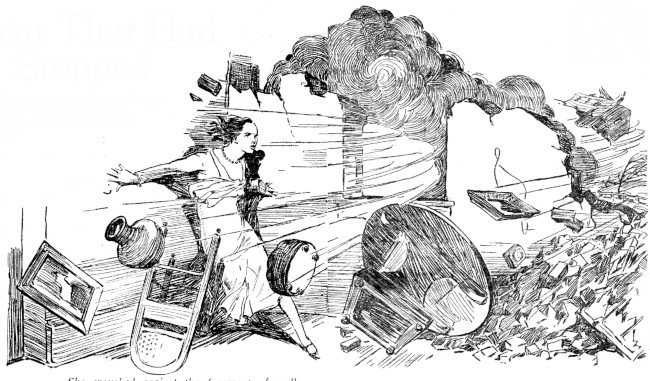
She crouched against the fragment of wall that still remained standing.
By MURRAY LEINSTER
Sequel to "The Darkness on Fifth Avenue"
and "The City of the Blind."
Novelette—Complete
Preston, evil genius of Science, defies
America's war weapons as he hurls Nature's
malignant forces against his blinded attackers.
[Transcriber's Note: This etext was produced from
Argosy All-Story Weekly, March 1, 1930.]
On the morning that saw the beginning of the Storm That Had to be Stopped, Police Inspector Hines had his life saved by an amateur driver who drove a second-hand flivver into his roadster. It was pure accident, of course. Hines's left mudguard, his left front wheel, and his front bumper were all wreckage when the amateur driver stared wildly about, assured himself that he was still alive, and then burst into tears.
The amateur driver passed forthwith from history. He had nothing more to do with the affair. He merely kept Hines from driving up into the Catskills in the very early morning of August 5, when, as all the world knows, the Storm began.
You will remember that morning. There had been a heat wave over all the Atlantic States for two weeks or more. The cities sweltered. The beaches were crowded. In New York, Central Park was opened to any one who chose to sleep in the open air instead of the stifling tenements.
Those who could leave the city did so. The Catskill and Adirondack hotels were packed. The seashore resorts swarmed with people.
Kathryn Bush was up in the Catskills, and Hines had started up to be with her until Monday. The fact that his car was wrecked in Yonkers almost certainly saved his life, and quite positively determined the events that followed. If he had been up in the storm-center, he would have been utterly helpless.
It was curious that the storm seemed to start so gently. Kathryn Bush wrote an account of the beginning, for the New York Star. It was her vacation-time and she was staying in the house of Heracles Tribble, at Rosedale Farm, North Weddensdale, Greene County, New York. She expected Hines to come up, and had risen early. A room was reserved for him at the farmhouse, where there were four other boarders. She may have been sentimental, or she may have been restless. In any event she was looking out of her window when the sun rose.
While birds began to sing abstractedly in the mountain-shadows, long streaks of golden light became visible on the flanks of monster hills. The invisible sun was gilding their sides. Later, a long time later, the red disk of the storm appeared.
The sunlight was gratefully warm after the dawn-chill, though even in the first rays she thought regretfully of the blistering, terrific heat that would come at midday when this same sun would be a ball of intolerable fire, hanging overhead in a brazen sky. Irrelevantly, she remembered the weather forecast—fair and warmer.
And then, quite suddenly, the warmth seemed to go out of the sun's rays.
It was as sudden, as abrupt, as the turning off of a light, as the closing of a furnace door from which a fierce glare had poured forth. The sun was no darker, however. It seemed to shine as brightly as before. It did not give off heat.
Kathryn stared about her. She looked back at the sun. It glowed vividly, but it seemed obscurely to have changed color. She held out her hand to it to catch the warmth of its rays. There was none.
A cloud over its face? No. The sky was wholly clear. There was simply no more heat coming from the sun.
Puzzled, but quite unalarmed, it seemed to Kathryn that the sun's ruddy tint had vanished very suddenly. It even seemed as if instead of a normal gold, the great disk had taken on a faint bluish or greenish tint. The change—if it was a change—was so slight that she could not be sure.
The seeming lack of heat was so extraordinary that, instead of turning away, she gazed and gazed, and presently took a tiny reading-glass and focused it on a bit of paper. The paper should have turned brown and burned luridly. Nothing happened.
More curious still, now, she focused the light upon her hand; then upon the sensitive skin of her forearm. A vivid spot of light formed at the focus of the lens. The speck of flesh seemed white-hot. But there was not the faintest, not the tiniest sensation of heat.
It was at just this time she noticed that a wind was blowing far away. Where she stood at her window, looking eastward, the air was utterly calm. Her window, as a matter of fact, was open wide. But she suddenly saw trees, a long distance off, bending and tossing furiously as if in a gale of wind. There was a long straight stretch of white road reaching far away toward infinity. A cloud of dust was racing along it.
"It's wind!" said Kathryn vaguely.
Still she stared. Then she saw something rolling crazily across a distant pasture. It was a smother of dust and débris. But there was one gigantic, darker object that rolled and rolled. She saw suddenly that it was the top of a tree, sheared off from its trunk in some freak of wind-pressure, and rolling like a monster ball.
The wind struck a farmhouse three miles down the valley. Kathryn saw a cowshed open and vanish. She saw a fence-line disappear. The dwelling leaned and leaned.
It sank quite gently to a sloping mass of wreckage, save that its roof went ballooning off insanely and mowed down a lane of trees through a planted orchard before it crashed against an upward-jutting outcrop of granite and was torn to bits about it.
When the wind struck the house from which Kathryn had watched it, the windows were all down. She had shouted of a storm approaching. Clouds, too, began suddenly to appear in writhing, ominous masses. The house had been closed tightly by the agitated Mr. Heracles Tribble, who hastened out to his hen-houses to see to their security before the storm came, and did not come back.
Kathryn watched from the window. The rolling cloud of dust that was the forefront of the wind drew nearer with incredible speed. As it drew close, the monstrous size of the disturbance became apparent. It was hundreds of feet high, and it was rolling over and over upon itself like a monstrous comber.
There seemed even to be striations in it like those the stranding of a rope will make. But there were objects carried in the smoke-colored rolling cloud. Dark objects, of all shapes and sizes. Kathryn, staring and almost paralyzed by sheer astonishment, saw the tree-limbs and it seemed even whole trees caught up in the monstrous turmoil.
Somehow her eyes swept to the hen-houses at the rear of the house. Mr. Heracles Tribble was standing in the open, peculiarly puny and ineffective, staring incredulously at the thing that bore down upon him. He was small, and rotund, and bald. He wore silver-rimmed spectacles, and he stared at a rolling wave of smoke and dust and utter destruction, hundreds of feet high, that swept toward him irresistibly.
Mr. Heracles Tribble turned suddenly, and fled toward the house. Kathryn saw his mouth dropped open in horror. His fat little legs twinkled. He ran with incredible speed. But the rolling cloud of dust and débris had reached the pasture-lot. It touched the hen-houses and they vanished as if blown to atoms.
Unpausing, the monstrous thing came rolling up. Its bellying edge was over the house while its base had still not yet touched the running little fat man. But then Kathryn saw smoke-like dust envelop him. She saw—or thought she saw—that he rose crazily from the ground. And then the wave of wind struck the house.
It was absurd, but Kathryn was not frightened even the instant after she knew the wind had struck. Her first conscious thought was that the house had been lifted away from around her, leaving her untouched.
Then she realized that the house still stood. There was no roof over her head, to be sure, but the walls remained intact. The feeling of being in the open air came from the fact that without warning or a sound that could be heard above the deafening uproar of the wind, the windows had ceased to be. The glass panes broke out of them with no more disturbance than so many breaking bubble-films would have made.
Kathryn had been at one moment safely housed, behind glass panes. The next instant she was merely sheltered behind a thick brick wall while a dense fog of dust blotted out even the farther side of the room.
She crouched against the fragment of wall that still remained standing.
Something crashed into that farther wall and kicked feebly. It was a pig, picked up no one could guess where and carried no one can guess how far. Then a tree-trunk thrust itself through the brick wall, horribly splintered, and heaved upward, tearing the wall apart, and then somehow went reeling off into the thick dust-cloud.
Kathryn put her hand to her throat. Sheer professional training alone saved her from panic. The newspaper woman's acquired instinct said:
"What a story! I've got to get to safety. It will be a big story when the wind stops—and I saw it!"
She dropped to the floor and began to crawl past the window toward the stairway. Once she ventured a little distance away from the wall, and a solid stream of air—as solid as a board—that came through a window, rolled her over and over until she struck with a crash against the leeward wall.
It held her there, then she battled her way on hands and knees down the stairs. The wind beat at her terribly, trying to fling her up again. It came in through the smashed lower windows.
She saw the dining room table flat against the wall. Its top covered a window and it was held in place by the wind-pressure. It was very probably that measure of protection which enabled her to pass so close to the leeward wall without being picked up and hurled off into nothingness.
She heard a terrific crash upstairs, in the room she had just left. Fragments of brick came down the steps. She reached the cellar stairs, tumbled down them, and heard more terrific crashes still.
Then there was darkness, while the wind roared by overhead. The noise the wind made was not a hum, not a whistle, not a shriek. It was a steady, a terrible, deep-toned roar. That roaring of the wind was characteristic, throughout, of the Storm That Had to be Stopped.
Hines had started out at five o'clock in the morning, in hopes of getting away from the city before the heavy traffic began. But, of course, he turned out to be only one of many thousands who had the same idea. The heat wave in New York had been terrific. It is recorded that the traffic had piled up as early as 3 A.M., and when Hines started at five he was promptly swallowed up in a long lane of cars going up-State at a bare crawl.
His accident happened just out of Yonkers at a little after six, but it was nine before his wheel was replaced and a new mudguard in position. By that time the Storm had begun.
Down there, quite sixty miles from the storm-center, its development was less spectacular. Up among the mountains it is fairly certain that the wind began at a very few minutes after six. Watches found on victims of the first terrific rush of wind were almost invariably stopped at that hour, and clocks in houses, overturned and crushed, corroborate the figures. But it was nearly half past six when a strong wind began to blow from Yonkers toward the mountains.
The sun was just up. Hines was seething over the delay. He was engaged to Kathryn, and he resented anything that kept him away from her. The Catskills had been his suggestion in the first place. Kathryn, as a feature writer on the Star, didn't want to get too far from New York anyhow.
Other matters aside, there was a man named Preston who was rather definitely dangerous and who was still at large. Not less than twice, with his artificial darkness, he had set the whole city of New York by the ears, to his own enormous profit.
Hines, and Schaaf—now up in the Catskills, too, making some abstruse experiments with very short Hertzian waves for the research department of the American Electric Company—Hines and Schaaf had managed to checkmate him each time.
Each time Kathryn had been in at the death, and each time the Star had scored a newspaper triumph. With Preston still at large, and both Hines and Schaaf convinced that sooner or later he would try to strike again, Kathryn had not wanted to get too far away even on her vacation. She wanted to handle the next battle with Preston for the Star as she had the first two.
Hines moved restlessly about the garage, or scowled at the never-ending but often pausing line of cars that went crawling, crawling, creeping away from the heat of the city.
Those cars were leaving a sweltering city behind them, to steam upon sweltering roads in an atmosphere of exhaust-fumes, but at least they had hopes of reaching the hills and coolness. Instead, only too many of them reached the hills and disaster.
Hines noticed a breeze at twenty after six. At half past it was a wind. At seven, it was half a gale, blowing under a clear sky with a brazen sun already sending down a blistering heat.
Hines swore under his breath, but it was no use trying to hurry the mechanics. He was an inspector of police in the city of New York, but at a roadside garage he was merely a customer, and the traffic outside promised plenty of customers before the day was over.
It was shortly after eight that Hines saw the top of an ancient touring car torn to ribbons by the wind. Before nine o'clock came, he had seen dozens of them.
The traffic began to thin, abruptly. Cars headed for the mountains turned aside. They began to fight their way into storage garages, battling a terrific, solid mass of air.
Some of them stopped where trees on a side-road promised some measure of protection from the wind. Others were wiser and parked themselves in swarming masses wherever deep cuts or valleys ran across the prevailing direction of the wind.
The galvanized garage roof was a drumming tumult, now, rattling and booming from the wind that went sweeping across it. The mechanics finished Hines's car and very reluctantly opened the doors—closed a half hour before—to let him out.
He came out into a rather incredible world. Trees were leaning toward the mountains. The roads were nearly clear. The traffic had lessened almost to nothing. The noise of the wind was a distinct deep booming sound, to which the tortured trees added shrill whistles and shriller screams, and now and then sharp cracking sounds as limbs or trunks gave way under the intolerable pressure.
Hines turned toward the mountains and shifted gears. They clashed, horribly. It was seconds before he realized that the wind had pushed his car ahead of the motor-speed. He had to race the engine to get into second, and race it again to get into third.
The car seemed to be possessed of unlimited power. It sped toward the mountains like a mad thing. Every man comes to know his motor, but Hines found his own car acting like a thing possessed. With his foot off the accelerator it made forty-five miles an hour. The barest touch on the gas-pedal sent it leaping to sixty, seventy miles.
He saw an ancient flivver turned over, at the side of the road. There were no people near it. He braked, instinctively, and found his brakes nearly useless. His car flashed past, and he heard the brakes squealing, but felt hardly any diminution of his speed.
There was a ripping sound behind him. His back curtain had blown in. The split upper half of the windshield opened out, and wind poured from behind him out over the front. Another wreck. Two more.
He saw a car coming toward him and passed it with the speed of light, but in the instant of his passing saw the man at the wheel of that other vehicle working frantically at gas-lever and throttle, and it seemed to him that for the fraction of a second he heard the roaring of a motor laboring horribly in low gear, battling against the wind alone.
The road shot into a deep cut, and the abnormal acceleration of the car diminished. Hines jammed on the brakes and stopped with difficulty. The ripped fragments of his back curtain were flapping about him and he got out his knife to cut them away.
Now he felt the wind as a savage, gusty pressure. It was terrifically strong, even down here in a cut some thirty feet deep. Something was stirring in Hines's breast, just then, which he was grimly refusing to recognize. After all, there have been storms and storms. Kathryn, up in the mountains, would be safe enough.
The thin tooting of a horn came to him. A car had drawn aside from the road, some fifty or sixty feet ahead. A man in it was waving to him to come on ahead. Hines merely released his brakes and his car moved sluggishly for twenty feet and stopped. He put it in gear for the rest of the distance.
Here, remarkably, the air was calm. The man in the other car was smoking placidly. Overhead the wind rushed past with its deep, ominous roaring sound. At just this point between the sides of the cut there was a perfect lee, where no wind-currents of any sort were noticeable.
"I thought I'd tip yuh," said the man in the other car. "This is the best place I've hit yet. Pull over off the road an' you'll be all right. Better get off the road, though. A car come through here like a bat out o' hell. Turned over at the end of the cut, yonder. The wind's near cross-wise there."
Instinct made Hines ask: "Anybody hurt?"
The man spat.
"Hell! They fell out an' the wind picked 'em up an' carried 'em off somewhere. Ain't it a wind, though? What y' call a hurricane, I guess."
Hines was staring, oblivious. Far, far away, a cloud was forming, but unlike any cloud Hines had ever seen before. Something, the sheer distance of the formation perhaps, told him that it was higher than any cloud he had known. It rose as a vast, incredible column, and then it spread out as a mushroom might spread above its stalk.
"Yeah," said the man in the other car. "It's been like that for half-an-hour, now. Looks like a volcano cloud, but it ain't. No earth shocks. Just wind. I reckon that's the storm-center. It's a peach, this storm. That cloud 'll be over the Catskills, somewheres."
Hines started, and then he turned grimly to his car-top. He slashed at it, wrenching away the cloth and flinging it away.
"I'm going on," he said, rather absurdly.
The man in the other car shrugged.
"I ain't stopping you," he observed. "But you better stay here. That wind is a hell-cat. If you want your car to stay on the road an' you're bound to go, load 'er down with rocks. Plenty of 'em. I mean that wind 'Il blow you clean to hell and gone if you don't."
Hines's brain was busy with a real, an acknowledged terror now, but something in the suggestion jerked at his mind.
"Right," he said suddenly. "Thanks. I'll do it. I believe it's needed."
The other man unfastened his car-door and stepped out.
"I'll help," he said amiably.
In silence they worked. The empty seat beside the driver was filled with bowlders and smaller rocks. All the floor-space filled up. Hines flung up the back of the rumble seat and they filled it with stones of smaller size.
"One more tip," said the other man thoughtfully. "Some flat rocks alongside your hood 'll help."
They found two huge stones, loosened by the dynamite that had made the cut. They wedged them in between the mudguards and the hood. Hines held out his hand. There was a bill in it.
"Go to hell," said the other man cheerfully. "Me, I'm a socialist and a proletarian, an' judging by your car you're a damn' capitalist—a bourgeois anyways. But one guy can help out another one, can't he?"
Hines put away the bill and shook hands instead.
"My girl's up there in the mountains," he said briefly. "I'm going up to see if she's all right."
"Good luck!"
Hines's car, with its top gone and its windshield laid flat before it, went into low gear with a vast groaning. It was burdened with over half a ton of stone. It went into second with a little difficulty. Then the wind began to make itself felt. Despite its added weight, the car went into high gear quite normally. It was rolling along at twenty miles an hour when it came out of the cut into the full blast of the wind again.
Hines was flung against the side door. The car shuddered horribly. Gasping for breath, with his head bent over, his hat gone instantly, Hines fought to keep it on the road. There was a curve here, and for two hundred yards he went squarely across the wind. Without the rocks, no vehicle ever built would have stayed on the road in such a blast.
Then the road turned again and the wind was behind him once more. Instantly the car picked up speed. Thirty, thirty-five, forty miles an hour. Forty-five miles—fifty—
The landscape flashed past, a mass of wrecked trees and débris. Hines saw the body of a motor truck a full hundred yards from the road, smashed against a rocky hillside. He saw two, three, a dozen cars overturned—always on the side of the road to which the wind would have flung them. He came to a town which was nearly obliterated. Wreckage littered the streets. He jammed on the brakes, raced his motor, got it into second, and slowed by the braking action of the engine. He raced it again and got into first and turned off his switch.
He was going no more than fifteen miles an hour when the car careened over a heap of rubbish which once had been part of a building, swung about insanely and crashed where splintered planks had piled up against a massive stone wall.
It was part of a road-tunnel underneath a railroad track.
Then Hines saw a man crawling on the pavement before him. The man had a rope about his waist, which was evidently tied to something. A paint-pot slopped white paint about as he pushed it ahead of him. He was painting huge letters on the concrete roadway.
HINES STOP!
HINES STOP!
HINES STO
That was as far as he had gone. He was painfully working on the last letter of the third "Stop" when Hines opened the side door of his car. Hines slid out, gasping for breath, and dropped flat on his belly on the road. He went crawling about the splintered planks to windward until the man saw him. Then he shouted, uselessly, while the man stared.
It was not until Hines had pointed repeatedly to his name and then to himself that comprehension slowly dawned on the crawling man's face. The fellow waved and shouted an order across the ten feet of intervening space, then hauled himself along the rope in the very teeth of the wind to a doorway in the side of the road-tunnel. Seconds later he was out again with another rope. He flung it into the air, and the wind stretched it taut.
Hines crawled, knotted it about his body, and felt himself hauled across the road.
For the second time he was in a blessed calm. He stood up, panting. The man who had been painting on the road made a peculiarly absurd salute.
"You're Police Inspector Hines, sir?" he asked woodenly.
Hines nodded, still unable to speak.
"Corporal Woodford of the State Police, sir," said the man who had pulled Hines across the road by a rope. "All wires are down, sir, but every broadcasting station that hasn't been wrecked has been broadcasting orders to every possible agency to stop you from going into the storm.
"Professor Schaaf managed to get a message out by radio, sir, from a spot very near the storm-center. He says that the storm is caused by Preston's darkness-apparatus, and that you are the only man able to stop it. And the storm, sir, simply has to be stopped. Will you step inside and give your instructions?"
Hines blinked, and then the meaning of the message came to him. Rage filled him, consumingly. And then he went sick with helplessness. Because, of course, he could have no instructions to give for the stopping of a storm.
Under ordinary circumstances, it is probable that the little room in which Hines found himself would have seemed extraordinarily cramped and crowded.
It was perhaps eight feet by ten, certainly no more, and it was inset in a railroad fill which here was pierced for a vehicular roadway. A door opened upon the curbstone, and from the narrow doorstep it was no more than ten feet to the painted white line which normally marked the center of the road.
On the farther side of the railroad embankment there was another concrete highway, which explained the presence of the room. Here was a dangerous crossroad, and this little cubby-hole was a shelter for the State policemen.
There was a tiny stove, and a bench along one side of the wall, and a cupboard and a table. There were nails, from which a slicker, a belt with a holster attached, and a patched motorcycle inner tube depended. On the table a tiny radio blared forth intermittent sounds from an even tinier loud-speaker.
"To all authorities in New York State," said a voice crisply. "All traffic must be stopped where the wind has now reached a velocity of forty miles an hour. The storm is expected to increase in intensity until four o'clock this afternoon. Wherever possible the population must be warned of this fact. The storm will lessen markedly at about sunset and may have ceased entirely by morning.
"It is imperative also that Inspector of Police Hines be reached and warned not to enter the storm area. Where practicable, signs should be painted on stone walls or the pavement. 'Hines Stop!' will be enough to cause Inspector Hines to stop and make inquiry. He will probably travel on one of the following roads—"
Hines turned to his companion, who was busily raking together a heap of wires from the drawer of the table and twisting them together into a single long strand.
"I'm getting a buzzer signal ready," said the State trooper woodenly, "to use the railroad rails overhead. The radio said half an hour ago that all State troopers were to use buzzer signals and railroad tracks where they couldn't report otherwise. Not many, of us left, sir, and very few of us can report, anyhow. I didn't bother with that until I'd put up signs to stop you, sir."
The radio had finished a long list of highways. It began again, repeating the previous message word for word, while wind roared overhead in a deep-toned bellow which did not seem to vary by the fraction of a semitone. It was rising slowly in pitch, as a matter of fact, but so slowly that Hines's ears could not follow the change.
"This is an emergency means of communication, sir," said the trooper, joining wires together with painstaking care. "It's the old buzzer line that used to be used in the Army. I take an induction coil, the one from my motorcycle, sir, and put the secondary into the rail up overhead. The rail's iron, sir, and it isn't insulated, and it's not very efficient, but they can pick it up with amplifiers at the other end."
He bent two wires and fastened them to the storage-battery which ran his radio. He was busy for a minute or more, improvising a make-and-break contact.
The trooper put it down, satisfied, and tied a rope about himself.
"We have ropes here, sir, for towing," he observed. "I'm going out with the wire, sir, and try to fasten this to the railroad rail. If I'm blown away, sir, will you try to haul me back?"
"Wait a bit," said Hines shortly. "I'm going to do that. I don't know Morse code; and you're needed for signaling. I'll make the connection.... It's my order," he added sharply as the trooper shook his head.
Reluctantly, the trooper gave him the rope-end.
Hines knotted the rope tightly about his body and stepped out of the door. Wind struck him, and took his breath away. But that was the wind that blew through the relatively sheltered traffic way. He was crawling on his belly when he came out on the lee side of the railroad fill, and a monstrous eddy of wind lifted him six inches off the ground and flung him crashing ten feet away. He gasped, and began to crawl desperately up the incline toward the rails.
The wind, here, had formed a monstrous whirl over the slight obstruction. The dried cinders, dust, and small stones which once had covered the side of the embankment had long since been sucked up and flung madly away. It was naked damp clay that smeared him as he crawled toward the tracks.
He seemed to be weightless, as the wind-whirl tried to lift him upward. Hines had been in the European war, and he thought that he had learned to hug the ground, but never before in his life had he clung so desperately to the earth as he did now. He was blinded, strangled.
There was a vast, malevolent force pulling and tugging at his body. And then quite suddenly his fingers scraped concrete, and he fought the wind that strove to push his exploring hand aside and found a steel signal-post that must be beside the track.
It was that post that really made it possible for him to reach the rails. The blast that came over the top of the embankment was as fierce, as savage, as nearly irresistible as a flood of swiftly-flowing water. Nobody knows what velocity the wind ultimately attained in the Storm, but it had reached a hundred and forty miles an hour when the self-registering anemometer in the Burton observatory was wrecked.
Hines faced that wind, and fought his way inch by inch by means of the steel bands connecting the signal-post to the rails. An outstretched arm caught the wind. The sleeve ballooned out and burst. A flapping end was seized by the wind and the rest of the garment was literally peeled from him.
Here, of course, the wind was at its worst as far as Hines was concerned. He was protected by no more than the four-inch steel rail from its full force, and constantly there poured over him dust, smaller fragments of débris, and above all and over all the overpoweringly dense and solid wind itself.
When the connection was made, Hines was sobbing with sheer exhaustion. He slid back down the incline, an inch at a time. And then suddenly the wind caught him, and he felt himself lifted up. The rope about his body tightened and hurt intolerably, and then he felt a crash and lost consciousness.
When he came back to himself he was lying on the floor in the little eight-by-ten room again, and the State trooper was working the buzzer signal steadily. He stopped, and came over to Hines.
Hines stirred, and the trooper nodded to himself. He went back to the buzzer and worked it again.
The radio broke off in the midst of its tediously repeated message.
"Corporal Woodford!" said the loud-speaker crisply. "Since Inspector Hines has recovered consciousness, we will give him the message from Professor Schaaf. He is in communication with the American Electric Company by means of a short-wave set, and we will rebroadcast it to you."
There were clickings. One or two curious crashing noises. Then a re-enforcement of the roaring of the storm, only this extra roaring came from the speaker. It was evident that wherever Schaaf was speaking into a microphone, the storm was there too.
"Hello, Hines," said the placid voice of Schaaf. "This is a fery pleasant situation, I dondt think. Now I giff you der works, and you use your head. Here is what I haff found out.
"At six this morning der sun changed color. From where I am, I obserfe with a spectroscope that der infra-red part of der sun spectrum is completely gone cuckoo. I haff examined electric lights in der same manner, and der infra-red spectrum is missing there, also.
"Der air where I am no longer transmits radiant heat. Der air, in other words, is opaque to heat-wafes, as our friendt Breston has been able to make it opaque to light. I think he is up to some more of his deffilment. As you remember, he was able to make der air absorb and neutralize light, producing his infernal darkness.
"I conclude that he has contrifed to make der air absorb heat instead of permitting it to come on down to der ground, and in consequence der air within range of his sending-apparatus is getting hot as der deffil because it is absorbing all der heat that should pass through it to warm the earth. Getting hot, it expands and rises. More cool air is rushing in underneath. That, in turn, is getting excited and rushing to der upper stratosphere.
"Der result is der Storm, that is raising hell. From der communications I haff received from der American Electric Company, der storm-center is fifty miles across, which makes it a hell of a storm. Der aferage for a typhoon is ten to fifteen miles.
"Der information I haff for you is that it is definitely Breston who is making this storm. He has a sending-apparatus with a range of twenty to thirty miles in efery direction. Where his verdammt short wafes reach, der air is no longer transparent to heat-wafes and all der heat of der sun is being used to heat der atmosphere, instead of der earth. There is bractically a chimney fifty miles across, full of hot air which is rising toward heafen and raising hell.
"You can locate der sending-station with apparatus like we used to line up der source of der darkness, before. I will be in communication with der Electric Company for some time to come. You can reach me, of course. But be careful as der deffil how you talk. Breston is no doubt listening in.
"I don't know what you are going to do, or how you are going to do it, but you haff got to do something. Der chimney of hot air will stop working, of course, at sunset. But it will probably begin again at sunrise, and in der meantime there will be der deffil of a storm all night long because of der hell that was raised all day. Good luck, Hines. I sign off now."
There were more clickings and the storm-roar from the loud-speaker stopped. Then the crisp voice of the announcer came once more.
"Mr. Hines! I hope you received Professor Schaaf's message. Woodford's communications are coming through quite clearly. It is not yet known just where you are. If you will send word, every effort will be made to reach you. In the meantime, will you give what orders you can about preparations for stopping 'this storm?"
The trooper, with his improvised key poised, looked expectantly at Hines.
"My messages are getting through, sir," he said woodenly. "And I imagine that they can't be read by anybody except at the other end of the rails. Before you recovered consciousness, the commissioner of police in New York City broadcast a message giving you full authority. The State authorities have done the same. What shall I tell them you want done?"
Hines's hands were clenched tightly. Kathryn was up in the mountains somewhere, somewhere near the center of the storm which was Preston's work. Preston's work!
She was probably dead by this time. Few buildings could stand the blast that blew outside. There was nothing to do, now, but get Preston.
Preston was the one man on earth that Hines unfeignedly hated. He had seen the man once. He had fought him twice, with the scientist Schaaf's aid. Preston should have been one of the greatest scientific geniuses on earth, but instead had now made himself the most cold-blooded murderer in history.
Preston found that certain short Hertzian waves produced a state of fluorescence in the air[1] so that the visible waves of light were absorbed by the ions of the atmosphere, and an utter darkness was produced.
Once, some months before, he had sent a beam of those waves down Fifth Avenue, in New York. In fifteen minutes of utter blackness the forewarned underworld of the city reaped a harvest of which Preston received his share.
With every resource of science and courage, Hines and Schaaf had fought him then, and had won. His apparatus for producing darkness was destroyed, and he seemed to have been killed. It was that success that had won Hines promotion to an inspectorship of police.
Preston, however, was not dead. Three months since, he had reappeared with a new and larger apparatus for the broadcasting of his short waves. He filled the whole city with the unbelievably high-frequency broadcast, and the air above the whole metropolitan district absorbed all visible rays and transformed them into invisible heat. The whole city was immersed in an ocean of oblivion.
Again Hines had fought him, with Schaaf's assistance. That bulky blond German scientist had invented instruments for locating the source of this radiation which had an almost catalytic effect in producing darkness. The effect of the waves was out of all proportion to the power used in producing them.
By Schaaf's instruments and Hines's courage, again the menace to the city had been nullified; but Preston had gone scot-free, and had become a millionaire through the panic in the stock-market his horrible weapon had caused.
He remained undiscovered and at large, and his captured apparatus had been destroyed by the explosion of an evidently prepared bomb before it could be examined.
Now he was again at work. He had prepared apparatus which could send over a circle from fifty to sixty miles across. Wherever that station maintained a field of force of the extremely short radio waves, there the effects of the unholy radiation were evident.
He seemed to be using now a slightly different wave-length than had caused all light radiation to be absorbed by the air. Now it was that all heat was arrested by the atmosphere. The warmth of the sun did not reach the earth. The air itself became heated instead. Heated, it rose, and created a cyclonic storm beyond all parallel.
Preston, in the midst of that storm, was as safe from any danger save that of the storm as if he were protected by armies. No man could reach him, alive. He was invulnerable, protected by the sheer destruction he had invoked.
Hines clenched his hands in the cubby-hole dug in the railroad embankment. His eyes narrowed. Kathryn was very probably dead, and Preston still lived. Preston would have to be killed for the sake of humanity alone; yet Hines would kill him to avenge her only.
"First," said Hines in a cold and utterly bitter tone, "I want everybody who's sold stocks short for a week past to be checked up. Preston will be operating in terms of millions. I suggest that the stock-market be closed, because when it's closed he can have no motive to continue the storm. And then—"
He paused to marshal his thoughts, while rage pumped in every artery and an almost insane hatred maddened him.
"Then," he said harshly, "I want the biggest tanks in the United States Army to be sent up here as soon as the wind dies down a little. They'll have to travel under their own power, because the roads and railroads alike are useless. I want the big forty-ton ones. I want at least two gun-carrier tanks with six-inch guns and a supply of gas and high explosive shell. And I want some bombs."
He went on to list cables, more bombs, and airplane photo maps of all the Catskills.
Meanwhile the Storm increased in force. It had been unbelievable before. Now the wind reached an intensity hitherto unknown upon the earth.
When sunset came and the Storm died down temporarily, it had left its marks all over a circle of territory a full thousand miles in diameter. The damage done ranged from a mere blowing-down of signs at the edge of that circle, to the absolutely unparalleled devastation of the territory immediately about the storm-center.
In the center, of course, the damage was terrific. Forests, houses, hamlets, towns, all were leveled to the ground. Yet, there were survivors. Cellars protected some, as did valleys and hollows. Probably four or five thousand people lived through it.
The fifty-mile circle of the storm-center was devastated, but it was not destroyed. And beyond the storm-center, where the wind had not reached its ultimate velocity, the amount of damage was neatly proportioned to the distance from the focus of the storm.
But about the edge of that central area—the space Schaaf had spoken of as the chimney—there was a ringlike strip of utter desolation, five to fifteen miles wide.
Every particle of vegetation had been swept away by the sheer force of the wind. The fields were bare even of grass. In spots apparently even the topsoil had dried to dust and gone sweeping away into oblivion in the storm-wind. The forests were shattered areas of splintered stumps. The houses had left as traces only small mounds of masonry, or else no signs at all.
The storm died down at sunset and for half an hour there was almost peace. But the vast chimney of sun-heated air which shot upward for miles had acted as a vacuum, drawing to itself air from every direction with terrific speed. When the vacuum abruptly ceased to be, the winds continued to blow for a time from sheer momentum, and piled up a colossal high-pressure system which was as intolerable as the previous storm-center had been.
Over all the North Atlantic States, then, there was atmospheric chaos. Dense clouds formed at nightfall. Rain in unexampled volume fell, while electric storms wrought havoc. In the Catskill section mountain streams, choked with the débris of the wind's creation, became flooded with falling water and abruptly turned to inundations.
In that terrible strip of desolation about the storm-center itself, the bare, stripped earth turned to a vast morass of mud. And that morass claimed victims when survivors in the central area tried to cross it during the darkness and the rain.
At nine o'clock, rain was falling in sheets, in columns, almost in solid masses. Lurid, unbelievable bolts of lightning leaped from one horizon to the other.
There were no electric lights, of course, in two thousand square miles of New York State that night. Beneath monstrous clouds which poured floods upon the earth, there was only blackness, save at one spot. There, pencil-beams of light stabbed futilely at the falling rain, where twelve huge tanks rocked and lurched and slid on up toward the mountains.
They had stopped in their advance and picked up Hines. He sat up in the control-room of the largest of all of them, and asked dreary questions and dully gave instructions which organized the attack.
The tanks would go on up toward the site of the storm-center. They would gather, presently, and Hines would give instructions which would be final. Then they would scatter to their several strategic points.
With dawn, when the Storm That Had to be Stopped began again, they would use the instruments Schaaf had originally designed for determining the point of origin of certain other short waves. They would find Preston's station. It would probably be a dugout, underground, for safety from the storm he could create at will. The tanks would bomb that station mercilessly. Or if he had intrenched himself upon a mountain peak, the gun-carrying caterpillars would come into action. Six-inch guns would assail a solitary man who essayed to devastate the earth.
Only colossal things such as they were—weighing forty tons each—could hope to exist and move in the atmospheric turmoil that would begin with sunrise.
The tanks rumbled and lurched as they made their way in a sedate long line toward the hills. Rain poured in rivulets from their steel sides. Sheets and masses of falling water scattered the beams from the searchlights mounted upon them. From the control-room it was possible to see perhaps twenty feet with some clarity, and dimly for thirty feet more. But after that even the searchlight glare was dissipated by the rain.
Hines looked weary and worn and haggard. All day long he had been in communication with New York, giving orders which men leaped to obey.
The State had given him full authority. He had shown his ability. Besides, the scale, the scope of this disaster was one to induce panic. The leadership of Hines, who had twice defeated Preston, would restore some confidence in a public otherwise more than inclined to be panic-stricken.
These were army tanks, shipped on flat-cars as far as the rails were undamaged, drawn by a locomotive that had crept on and on, as far as it dared, while the Storm still blew in the daytime. They had come at full speed immediately darkness fell.
Now they went lurching and pounding up toward the hills. The clanking of their mighty treads was thunderous in their reverberating interiors. The roaring of their motors was deafening.
They were full of the smell of hot oil and exhaust-gases and fuel, but up in the control-room the lightning and thunder blotted out all sights and sounds, and the sheer desert of mud over which they traveled toward the hills made it impossible for any man who saw it to think of anything else.
Hines, alone, thought of Kathryn. The awful desolation over which the tanks traveled had been covered with farms and houses and forests only twelve hours before. People had lived here—people who now were torn and draggled corpses flung haphazard amid the other débris of the Storm.
Hines had been cooped up for twelve hours knowing his helplessness, knowing that Kathryn was either dead or desperately in need of help. Now, he was sure, she was dead. The desert of mud over which the tanks passed was enough to convince him of her death.
The radio had told them that over most of the United States the wind had reached gale intensity.
The weather bureau in Washington was working like mad to predict the unpredictable, but from the one day's storm alone weeks of chaotic weather could be foreseen.
Already meteorologists were speculating upon the effect of the Storm upon the climate of Europe. California, it was certain, would be visited by subsidiary hurricanes, and from Texas on north there would be cyclonic whirls of terrible intensity as the air of the earth moved to fill up the vacuum Preston could create at will.
What news there was of the loss of life was so monstrous as to have lost all meaning. The record of towns destroyed, of villages wiped out, became monotonous. From the standpoint of property destroyed the Storm was one of the major catastrophes of history; and if the death toll was lighter than certain plagues and earthquakes, it was only because the larger cities were fortunately far from the circles of highest wind-velocity.
The feel of slippery mud beneath the tanks' great treads changed subtly. The earth became curiously more solid. A great bowlder appeared not far from the leading tank's track, glistening and running with rain. The tank changed course to avoid it. Hines looked back. Despite the falling water, he could detect a long lane of white glows, which were the searchlights of the following tanks.
The tanks still went on. They were in what seemed to be a semi-solid mass of water, intermittently made into a greenish universe of light by lightning-flashes which were blurred by the rain to mere indefinite illumination. In the periods of darkness between those flashes, the searchlights gleamed brightly ahead. And water poured from the tanks in floods.
D bris appeared, water-soaked and shredded. The stumps of wind-whipped, obliterated Indian corn began suddenly to the left. The treads of the tanks clanked suddenly on concrete. There was a road beneath the leading tank.
A speaking-tube whistled in the leading tank.
"Headquarters," came up thinly to the control-room, "orders you to try to locate yourself by road signs or any other evidences of position."
The officer in command of the tank snorted and made no answer.
The tank went on. There was concrete under the left tread only. The tank wallowed around and climbed back on the road. It went rumbling blindly on in the rain. Presently bare concrete was visible. Mud had not washed across it here.
"There!" said Hines sharply. "A road-sign bent over by the wind! It's in place!"
An unearthly hooting set up. The tank stopped with a grinding noise. Hines peered out of the little vision-slits and saw a dripping man with a flash light bent over something by the side of the road. It was one of the cast-iron road signs one finds in the Catskills. They are set up on wrought-iron posts, which are fixed in concrete.
Originally the sturdiness of construction was made necessary by the vandal habits of a motoring populace, but it served a useful purpose now. Set facing the wind, the cast-iron plate had caught the full blast. And the wrought-iron shaft had bent slowly but definitely until the sign lay nearly flat, facing upward.
The dripping soldier came sprinting back into the tank. The speaking-tube whistled again,
"The sign says 'North Weddensdale Corporate Limits,' sir."
Hines clenched his hands. This was the village where Kathryn had been staying! He strained his eyes desperately through the rain.
A rectangular hole to the left of the concrete caught his eye. It was a cellar. The house had been taken cleanly away from above it. Nothing was left. Nothing.
"Go on," he said hoarsely.
The tank ground into motion again. Rain poured from its sides. Its searchlight ray stabbed into the darkness and was dissipated by falling water.
Then the searchlight ray went out.
Almost instantly thereafter the speaking-tube whistled. "All the tanks, sir, report their searchlights have gone out."
The officer commanding the leading tank swore to himself. "All right. Everybody stop and repair them."
Hines heard his voice speaking hoarsely:
"It's the Darkness. The metal walls of the tank act as shields, so we can see inside, but it's the Darkness—the same darkness Preston turned on in New York. If you send a man outside to make sure, keep up a noise so he can find his way back."
Hines went, himself, to the exit door of the tank. He heard two men moving about outside. The interior of the tank was brightly lighted, and the door was opened wide, but the light from inside did not strike upon the earth beneath the tank. It seemed to be absorbed by some solid black substance which surrounded the metal monster and stretched solidly almost with an inward bulge, across the open door.
Thunder shook the earth. There was a crashing and crackling of electricity. From the violence of the report, the lightning-flash must have struck somewhere near by. But there was no faintest flickering of light.
Then, in a peculiarly ghastly fashion, a groping hand came out of the solid wall of blackness across the tank's exit door. It seemed disembodied, detached from any body. It caught at the edge of the door. A man came, wild-eyed and staring, out of the apparently solid opacity. His teeth chattered as he swung into the illuminated tank.
"The—the flash light don't work," he gasped. "I held it up to my eyes and it just glowed, but it don't give any light. See?"
He pressed the button. A brilliant gleam shot from the flash light. His jaw dropped open. But Hines nodded his head very bitterly.
The Storm had been made by the broadcasting of very short Hertzian waves which caused the atmosphere to be opaque to heat; a mere variation of a device that Preston had used before. Now he had gone back to the use of his first device again.
Now, from somewhere within a thirty-mile radius, he was broadcasting short waves differing perhaps by the fraction of a millimeter in length from those that had produced the Storm. And these tiny ripples in the ether caused the absorption of all that band of frequencies which made visible light.
There was darkness outside the tanks so dense as to be tangible, so complete as to constitute utter blindness, so thick that it caused the perfect absorption of even the ten thousand candle-power searchlight beams within a distance of three feet.
Hines thought grimly, staring at the apparently solid wall of darkness without the door. The metal walls of the tanks, of course, absorbed and grounded the waves that impinged upon them. The darkness could not invade the tanks themselves. But it blinded the drivers beyond the possibility of a remedy.
The engines of the tank stopped suddenly. The officer in command swung down from the control-room, his lips twisted wryly.
"I reported to headquarters," he said briefly, "and received orders to stop my motors and wait for dawn. It is believed that the darkness will be lifted when the Storm is started up again."
Hines did not hear him. He was listening with his ears strained to their utmost. In the near-silence that came with the engine's stopping, the sound of the rain and thunder outside seemed to redouble. The rain was invisible, the lightning unseen, but there was a tumult without the tank that was terrifying. Yet in the midst of that tumult Hines thought he heard a faint cry.
It was repeated. Again, and again. And cold sweat came out upon Hines. He could not believe his ears, yet he dared not disbelieve them. Out there in a storm such as would have been called a tornado if the Storm itself had not given a new meaning to the word, he heard a voice which he could swear was that of Kathryn!
The storm itself was violent enough to make venturing into it madness—and he would have to go into it as a blind man.
The cry came once more. It was fainter, this time.
Two members of the crew of the tank volunteered to go with him. They went out as Alpine climbers travel, tied together with a long strand of wire that paid out behind them. It would insure that they returned to the tank, or would lead them to any of their number who was injured.
Hines went first, groping over unfamiliar ground, unable to guess where his next step would bring him. He had broken out the glass of a pocket compass proffered by one of the tank's company and steered by the feel of its needle, with the tank hooting dismally behind him at regular intervals for his better orientation.
He went on into the blackness which seemed almost familiar. His flash light bulb glowed dimly when three inches from his eyes. Farther away, its light was absorbed by the opaque air, and he seemed to swim through it as a diver might swim through a sea of ink.
A fall into a ditch crammed with débris corrected the sensation of swimming, however, and he blundered on and gashed his leg against the splintered stump of a tree whose knife-edged fragments were in nowise softened by the rain.
Rain pelted downward through the darkness. It poured from him in streams. He had to bend almost double to protect his open compass from the falling water while he felt of the needle.
The tank hooted behind him. He went on. The wire attached to his waist dragged. It jerked, and he halted to allow the following man to move forward and give him slack. He shouted, and the beginning of his shout was loud, and the end of it was drowned out by thunder. He listened, and heard only the terrible drumming of miles of rain.
Then a cry in answer. He shouted again, and plunged forward and stumbled ten feet on and gashed his forehead horribly, and went on again with warm blood mingling with the rain that beat down on his face. Suddenly he was sprawling on hands and knees on a monstrous heap of broken bricks and field-stone.
A cry came up almost below him. He cursed the darkness then, and called once more; and Kathryn sobbed.
"I—I'm all right, only some brick-work fell on me and I can't get up," she said unsteadily a moment later.
"I'm coming down to you," said Hines hoarsely.
"Be careful! There's an open space just above me, where the floor broke in, but there's loose rock there. You may fall."
Hines gritted his teeth and fumbled here and there with infinite caution. Loose rock above a hole over Kathryn's head meant not so much danger to him as to her.
He tore his hand on splintered planks. A figure came blundering nearby. He heard it gasping, but he saw nothing, anywhere.
"Fasy!" snapped Hines. "We're here! Stand still!"
Kathryn said steadily from below:
"You're nearly above me. I think you're at the edge of the hole in the flooring."
He found it, and called quietly to the other man.
"Our belts," he said briefly. "We'll put 'em together and you lower me. Then you can haul her up, and after her, me."
He went down, dangling in the blackness with no more knowledge of his whereabouts than a blind man would have had. He landed in a foot and a half of water.
"Here," said Kathryn unsteadily. "B-but be careful of the m-masonry."
He stumbled against her shoulder before he realized that she was trapped near the floor. The cellar was filling with the drainage of the rain. Hines was two men then, for an instant. One felt coolly until he had located the mass of brick and mortar that pinned her down, and had envisioned its position and its size. The other man was sick with horror at the thought of the death that had awaited her as the cellar slowly filled with water.
He had more than two men's strength as he wrenched at the mass of stone, though. It fell with a turgid splashing that was louder than the drumming of the rain and the constant splashing of water that came down into the stone-lined depression.
He lifted her and held her close, there in the unbelievable blackness. He sent her up, by the linked belts. And he carried her himself, the long, stumbling, rather terrible way back to the hooting tank, which slowly hauled in the wire as he advanced. The other men blundered on ahead of him to take any falls there might be while he carried Kathryn.
Her arm was broken, and she was badly bruised, but that was all. Hines set the arm himself, while she smiled at him gamely in the smelly, machinery-crowded war-engine.
Then Hines turned to the commander of the tank with a new and more savage grimness. He had gained a new motive from Kathryn's injury. Oddly enough, he had felt defeated in advance while he believed her dead, but a new and throbbing rage swept over him because of her injury, a fiercer passion than the hopeless hatred her death would have caused.
"Look here," he said savagely. "You've had orders to take directions from me. Preston's turned on the dark, outside. He thinks we're helpless. You radio headquarters and tell them I order you to go on. I take all responsibility."
The officer grinned.
The ordnance department maps of the Catskills leave some things to be desired, to be sure. There are errors, in spots, and they are not wholly up to date. But every road and bridle-path and every grade and hollow is shown upon them.
With a concrete road under their treads and the North Weddensdale corporate limits sign for a position-sign, the tanks could very nearly go to any spot in all the mountains, blinded though they were.
Men had walked about each of the tanks, with flash lights held close to their eyes. They discovered that for a short distance beyond the tank, in the direction away from the sending-station of the waves of darkness, there was a lee, a "shadow"—a relatively small and cone-shaped shielded area, in which the air was protected from the Hertzian waves that made it opaque to light. In those shielded areas lights could be seen. And those small spaces of transparent air gave a bearing—rough, to be sure, but still a bearing—on the station that was sending the short waves.
The darkness was being transmitted from a spot nearly north-northeast of the steel monsters. A man swung up in top of each one with a flash light and a hammer. He worked himself around the central turret until he had the turret between himself and Preston's transmitter of darkness. His flash light gave him proof of his direction. He rapped on the turret-plates. One rap for each division of the compass to the east of north, and two for each division to the left, was the agreed signal. He would transmit the bearing of the source of darkness whenever the turret was pounded on from within.
"One more thing," said Hines crisply. "Arrange with the other tanks to navigate by whistle-signals instead of radio. Preston will be listening in, you can be sure."
Then through the sound of thunder and of rain, there came the multitudinous hoots of many whistles. There was a whirring and the roaring of engines. Then with a monstrous grinding, the tank set off.
Hines and the tank-officer bent over the map of this locality. Kathryn looked on, though her eyes rested most often upon the haggard, draggled figure that was Hines.
"The road curves here," said Hines quietly. "That will place us definitely."
The officer laid his finger on a certain spot.
"A bridge," he observed, "all of sixty feet high in the middle. We'll be crossing it—blind. And it may be blown out."
Hines shrugged. The tank rumbled on, and on.... Its whistle hooted, and was answered from behind. Then a long line of blind monsters hooted one after the other as they swam through obscurity as black as the blackest ink.
Concrete under the treads. They were steering the monster by compass, now, and the sound of the treads.
Quite suddenly, the tank wallowed off the concrete. It lurched, careened, swung about and then found the way again.
"That's the curve," said the officer. "We're located all right."
From this time on the navigation of the monster vehicle was confident and crisp. A modern tank records its course and distance so accurately that even in the densest fog it can retrace its way for miles without a landmark.
From the map a forecast of the course to be followed was being made and the tank lumbered on through oblivion. Utter darkness filled the world without its steel walls, save where one man sat in a terrific downpour in a triangular small space of transparent air, and watched a dripping compass by the light of a flash light.
From time to time he pounded savagely on the steel deck with a hammer, signaling to those within. From time to time, too, there were vast hooting noises, feet only from his head, and there were other dismal hootings behind him in the utter blackness.
The feel of the concrete underneath changed subtly. The forty-ton weight of the tank was making the huge bridge sway slightly. The tank's whistle howled, in a succession of long and short blasts.
"They'll wait until we're across the bridge," said the officer shortly. "One at a time is load enough."
The leading tank ground on. The bridge quivered and shook. Presently the earth was solid under it again. It halted and seemed to bellow into the surrounding bedlam of rain and wind and thunder. An answering hoot came faintly. There was stillness, and presently the earth-quivering that told of the near approach of another monster. More hootings of whistles. Another great tank, and another.
The fifth tank was on its way across the narrow causeway which the map said spanned a ravine some sixty feet above the mountain stream. Suddenly, there was a wild screaming of its whistle, a terrific crash, and then a deafening detonation. The waiting tanks trembled from the concussion that ensued.
"It fell off the bridge," said the officer of the tank in which Hines rode. He spoke very calmly. "I suppose the rest of us weakened the bridge in passing over it. Maybe the Storm helped, too. It gave way and the bombs went off when the tank crashed."
He looked at Hines.
"We'll go on with those that are here with us," said Hines grimly. "Signal the rest to hunt for shelter from to-morrow's wind."
The hooting, dismal cavalcade of four tanks began again to fumble its way along the narrow ribbon of concrete that wound among the mountains. Twice the treads crunched shrieking metal beneath them. Cars, wrecked and, it was to be hoped, abandoned. Half a dozen times, in one relatively sheltered valley, the leading tank crushed a way through splintered masses of limbs and foliage that were heaped up in monster windrifts.
The half-drowned men out in the flood of rain pounded regularly their signals of the source of the waves of darkness. The tanks had gone five miles in all in a little over an hour, when the poundings on the outside became frantic. A new signal of direction came through. Hines said shortly:
"Stop the whole line. Check with all of them."
The tanks had been boring their way through the blackness by map. The darkness-producing ether-waves demonstrably had been coming from the north-northeast. Now, abruptly, they were proved to be coming from a little south of west.
Hines studied the map and the line that had been drawn to indicate the tank's ultimate destination. The sending-station was no longer there. It had changed position.
"Either," said Hines harshly, "Preston's moved his sending-apparatus, or he has two or more of them. He turns one off and another one on. We haven't a burglar's chance of locating them if they turn off as we draw near them."
They were playing a deadly game of blind-man's-buff with Preston. Now Preston showed an unexpected resource. He had more than one outfit for producing darkness. When the tanks drew near one, that ceased to operate and another took up its task.
It seemed as if Preston had Hines beaten.
Heavily, laboriously, clumsily, the tanks crawled on through the darkness. They were blind and they were fumbling. They went clanking through a blackness as of the Abyss, with the peculiar confidence of things that have long been sightless, while rain beat upon them and thunder roared about them.
Hines and the tank-officer were again bent over the map.
"Schaaf's experiment-station was here," said Hines shortly, touching a spot on the engraved sheet. "It was more or less a secret, but he was trying to work out how to make these same darkness-producing waves. He was trying, in fact, to duplicate Preston's results in hopes of finding some way to neutralize them. That accounts for his short-wave set and the experimental license that enabled him to use it."
The tank-officer received a cross-bearing from the tanks they had left behind at the wrecked bridge, and drew a line on his map.
"This is the third darkness-transmitter Preston's brought into use," he said quietly.
"And he's using underground a rials," said Hines shortly, "because anything above ground would have been blown away by the Storm. We can't locate the transmitters closer than within a quarter of a mile, by cross-bearings, and we can't count on destroying them even with explosives unless we locate them more closely than that. Poison-gas will be useless in the wind that will be blowing by dawn."
"We're licked, then," said the tank-officer.
"Not yet," said Hines grimly. "We've got the bearings now. Let's go on. I've still got one hope. Schaaf's a smart man."
The tanks crawled on blindly, like gigantic eyeless slugs creeping along the bottom of the ocean's deepest deep, while within a vast irregular circle fifty miles across, the drenched, shivering, hysterical survivors of the Storm itself went closer to madness from the terror of the dark.
At one o'clock in the morning, while all over the United States people sat up by their radios and listened fascinatedly to the never-ceasing broadcasts of news and orders, reports and fragmentary pleas for help, there was the first direct word from the man who had caused the Storm That Had to be Stopped.
Radio broadcasting was, of course, the next most important factor, after Hines's activities in lessening the damage Preston did to the earth.
All the first night of the storm a warning was broadcast to the isolated folk who hastily turned to the radio as their sole link with the outside, that the wind was to be expected to begin again at daybreak. By broadcasting the location of the few hamlets protected by fortuitously placed mountains, much good was done.
Mostly, though, the radio served to make all the world realize the extent of the catastrophe. It is to the credit of the people of America that trains loaded down with supplies for the devastated area were already on their way while the Storm still raged on its second day.
The radio enabled all the continent to share in the horror of the Storm, and also the radio was the means of communication with Hines and the blinded tanks in the storm-center, so that a hundred million people shared in his adventure, in his attempt to stop the Storm.
Perhaps the most spectacular feat the radio performed that night was an accident. It was at one o'clock. The tank-officer in charge of Hines's tank was communicating with headquarters. The Red Cross had arranged for half a dozen sentences from him, describing the devastation the tank had passed through on its way to the mountains. If rehabilitation was to take place, vast sums would be needed, and money could best be got while the catastrophe was fresh in peoples' minds.
The tank-officer spoke curtly into the microphone to headquarters. His words were amplified and rebroadcast and sent over the nation-wide chains of radio stations. A hundred million people heard his voice and even the noise of the machinery of the tank, crawling through the darkness where the Storm was made.
But he had spoken no more than a dozen words when another voice cut in. This other voice was harsh, metallic; an abominally cocksure and arbitrary voice. It spoke with a studied insolence.
"This is Preston speaking," said the voice arrogantly, and instantly folk all over the United States stiffened in their chairs as the unexpected tones came from their loudspreakers.
"I have been much amused by the accounts of the efforts made to find and kill me. I have been listening in, of course, from my entirely secure retreat in the storm-center, and I am speaking on the same wave-length the tanks have been using. I hear my own voice in another speaker, being rebroadcast as the lieutenant's voice was supposed to be. I think it about time that the people of the United States should know with whom and what they deal."
Preston's voice stopped, and millions of people waited breathlessly. Static interrupted his words, and whole phrases were sometimes obliterated by the crashings made by the lightning, but on the whole his message was clear.
"I have made this storm for my own private purposes. I can continue it for days, for weeks, even for months. In one week, I am informed, I will have so deranged the normal atmospheric conditions in the United States that the crops of this fall will be practically ruined.
"In two weeks, by drawing down the colder air from the Arctic Circle, I will have brought on winter in Canada. In three weeks there will be four feet of snow in London, Germany will be frozen in, and all the north of France will have a semi-arctic climate, while the United States will face a famine. I invite the meterological experts of the world to verify my statement.
"I shall continue the storm I have created until the governments I have mentioned make it worth my while to stop it. In the meantime, I assure you that the tanks that are trying to locate me have no chance of success. The Storm will continue until I wish it to stop. I will stop it only when I am sufficiently paid for my trouble."
The arrogant voice ceased. Announcers' voices, quivering with excitement, followed with a statement that radio compasses had picked up the message before its cessation and that it had actually come from the Catskills, from the storm-center.
The United States began to be afraid. The Boards of Governors of the Stock Exchanges of New York and Chicago began to arrange, quietly, for the closing of those exchanges. Cables began to carry long messages in diplomatic code across the ocean-beds.
Suddenly another broadcast, as widely distributed as the first, came from Schaaf, in his tiny laboratory set in a hillside. He had a national reputation, now, as an associate of Hines, and he was frantically called upon for a statement to nullify the panic that Preston's announcement would cause.
Schaaf's speech, repeated in the same ten million receiving sets, was entirely characteristic of him.
"I haff heard Breston's speech," he said dryly. "I remark that my friendt Hines is on the way to join me in a little Schrecklichkeit party, to be bractised on Breston. I consider that as imbortant as anything Breston has said. We will haff him in a matter of hours. As for his threats to mess up der weather of two continents, I say one thing: No matter how thin you slice it, it is still boloney."
Schaaf's speech had just the tone necessary to restore confidence without lessening the public's sense of the real urgency of the situation. There were speculators in food-stuffs and other necessities, of course, who immediately grasped the opportunity Preston's threats created. They, by the way, suffered considerable losses by their enterprise as things turned out.
But on the whole the public reacted in highly favorable fashion to Schaaf's dry reassurance. Americans will always pay more for a good joke than a pathetic story, and Schaaf raised more money by the last line of his speech than all the tear-jerking efforts of radio spellbinders during the rest of the night.
Schaaf did not listen in and hear himself eulogized on the ether-waves, the details of his scientific career sandwiched in between casualty lists and weather predictions. He was placidly unaware of his sudden celebrity.
In fact, until the restored mail-services brought him sacks of admiring and begging letters, and an astounding number of proposals of marriage from female admirers, he was not aware that he had done anything out of the ordinary.
He was busy. He turned from the microphone with a grunt of disgusted relief. His experiment-station was a tiny stone-walled building half sunk in a mountainside. It consisted of four rooms.
The laboratory alone was of use to him now. Experimenting as he had been with short radio waves, he had needed a workshop in which the only etheric disturbances would be those he made himself. The walls of the workshop were lined with copper sheeting and the windows covered with heavy copper gauze, all of which was grounded. The interior was insulated from all Hertzian waves from without.
Now that laboratory glowed brightly with electric light, though he had, only to open a door to see the apparently solid mass of no longer transparent air which resulted from Preston's devices.
He took down a screen from a window. Instantly the blackness seemed to pour, to stab, into the brightly lighted laboratory. Through the opening in the grounded shielding, Preston's short-waves penetrated, depriving the air of its ability to permit light to pass through it. A long cone of darkness, so definite as to seem a solid substance, projected into the room—more powerful than the shielding because of the nearness to Preston's headquarters.
Schaaf grumbled and measured it, carefully making his measurements from accurately marked points. He wrote down his figures and replaced the screen. The seemingly tangible cone vanished with much the effect of magic.
Schaaf sat down at a little table and began to calculate absorbedly. He scowled as he worked, and mumbled irritatedly as he took down a book of logarithms and ran his fingers down its columns.
The table trembled, from time to time, with the violence of the thunder without. There was a very slow leak in the roof over in one corner, and now and again a drop fell glittering to an enlarging puddle on the floor. The wind howled outside. The rain drummed on the roof.
Schaaf finished his calculations, leaned back and absently combed out his luxuriant yellow whiskers with his fingers, then filled and lighted his pipe. Its poisonously strong odor filled the air.
The thunder was deafening and nearly continuous. The shrieking of the wind was daunting. The drumming sound of the rain was unspeakably depressing. Schaaf smoked comfortably for a space, and picked up the remnant of a half-eaten sandwich. He bit into it, stopped, and listened keenly.
There was a thin and dismal hooting above even the tumult from the skies. Schaaf beamed, and then growled impatiently, He swathed himself in oil-skins, muttering something about "Der verdammt Breston!" and took a huge reel of cord from the wall. It looked like the extra-strong braided cord that is used for scientific kite-flying—or for getting a kite aloft that is to carry up a temporary a rial. He fastened the end inside the door, knotting and double-knotting it. He went out, unreeling the cord behind him, and fought the door shut again.
There was no longer any movement or any activity in the laboratory. A loud-speaker made nasal noises in one corner, which the booming of thunder and of wind and rain drowned out to inarticulateness. The lights burned steadily.
An open fire alternately leaped madly upward and died down to nothing beneath an improvised damper closing off most of the chimmey-space above it. Rain made rattling noises on the windows, and wind screamed overhead, and always, always, always, the thunder boomed and crashed.
Then the door burst open and Schaaf came in again, fumbling his way back along the cord. He was soaked. Behind him, guiding themselves by the cord, came three other people. Hines was one of them, tattered and ragged and with a great gash on his forehead. He carried Kathryn lightly, in spite of the storm. She was wrapped in an oil-skin, one arm in improvised splints.
Hines set her down carefully and blinked with the air of a man whose sight has suddenly been restored. The third person was the officer in command of the leading tank.
Schaaf put his whole weight against the door and closed it.
"It was not bad work," he observed comfortably. "You stopped on der concrete road where der big tree had blown down, as I told you by radio. I came down, blundered into you, and banged on der door. Here we are. Now, where is der map?"
The tank-officer produced a sheet he had carried under his slicker. Schaaf began to unroll it.
"I haff sworn—Gott! How I haff sworn!—because I didt not haff a map of der locality. Miss Bush, go ofer by der fire and get warm. Now, Hines, show me my bresent location and tell me der scale of der map."
The tank-officer, instead, obeyed both orders. Hines was settling Kathryn comfortably by the fire. And Schaaf took dividers and a pencil and calculated feverishly, grumbling in guttural German at the absurdity of calculating distances in feet and inches instead of meters. Eventually he measured with painstaking accuracy, drew six lines from the location of his laboratory to very precise and exact lengths, and put large dots at their ends.
"There," he said decisively. "That is der best I can do. I have watched der verdammt darkness. Look!" He pulled out a window-screen and a black cone of opacity stabbed across the brightly lighted room. He replaced the screen and it vanished. "Der wafes that destroy der transparency of der air," he said briskly, "can come in der window-opening when I remofe part of der copper insulation inside. They interfere with each other, dissipate, and generally lose der original effectifness. Which gifes me my information. By der shape of der cone of blackness, I haff calculated der direction and distance of six different points from which Breston has transmitted darkness. At these six spots he has sending-stations."
The tank-officer said warmly:
"Splendid, sir! We took bearings as we came along—see my pencil-lines, Sir?—and they intersect your lines at just the spots you indicate! It looks as if you are correct."
"Of course I'm correct! And if I had had der intelligence of an angle-worm I would haff made der same measurements of der wafes that made der storm and we would know where Breston is. He is not at all of those places, certainly."
"No," said Hines. "But what I'm hoping for, Schaaf, is some way to see in spite of the darkness. Once—"
"Gott in Himmel!" cried Schaaf angrily. "Haff I not kicked myself forty-sefen times? Before, when we fought Breston in New York, his wafes made der air opaque to fisible light, but not to ultra-fiolet, and we did tricks with that to find our way about. But now, he has juggled his wafe-lengths to make der air absorb der ultra-fiolet rays also. I am as blind as a bat at der bottom of der sea, Hines, and I am mad! I am mad as der deffil, Hires!"
Hines frowned at the map.
"He'll keep the darkness on, even after daybreak," he said coldly. "He'll shoot the storm-producing waves out as an addition. And since he turns off his sending-stations when a tank draws near—"
"Maybe he has microphones in der ground," said Schaaf gloomily. "Der sound of a tank is unmistakable. Or maybe he switches them on and off for der mere purpose of being confusing. In any efent I haff done all I can. I tell you abbroximately where his sending-stations are. But you cannot find them without seeing them or tracing der wafes home, and he turns them off when a tank comes near. It is like trying to catch a mouse that is in six holes at once."
Hines smiled faintly.
"But we have lots of cats," he observed, "Lieutenant, I want these orders given."
Schaaf listened critically, then appreciatively, and then he beamed as Himnes's voice went on.
"Hines," he said comfortably, "if your brains were dynamite and they went off, der report would be like Vesuvius. We got der son-of-a-gun!"
Even the tank-officer grinned confidently as he prepared to make his way back to the tank by the guiding cord.
Rain drummed on the roof and clattered on the windows. Wind shrieked outside the little stone building. A mountain-flank had protected it from the blast of air that Had blown all the day before, and the storm that raged during the night was merely a gale such as uproots trees and sinks ships at sea. But it was uncomfortable to listen to, with thunder making the tumult of a bombardment.
The smoke of Schaaf's pipe floated about the room. The loud-speaker had been turned off, Hines turned it on with an air of impatience.
"The lieutenant's been gone a long time. Do you suppose he was blown away?"
Schaaf grunted.
"Of course not, Hines. He is a smart young man. He got to his tank, and he has been gifing orders by radio to der other tanks that were left behind when der bridge gafe way. Breston will see that there is a cat at efery mouse-hole, in a little while."
"Preston probably has more than the six you marked down," said Hines shortly, "but we have eleven tanks."
He was worried, though. Abominably worried. All but four of the tank-force had been left behind early in the night, when one tank was destroyed as a bridge gave way under it. Those land-warships had now been ordered, separately, to make wide detours and somehow get to the six spots Schaaf had indicated.
They would approach the stations from which Preston was transmitting his darkness-waves. If the station did not cease to transmit, the tank could ride it down and crush it, or bomb it with heavy bombs and destroy it utterly.
Preston had undoubtedly planned to alternate in the use of his transmitters for the precise purpose of preventing their location. But if every station he had ready to transmit had a tank waiting to pounce upon it—It was exactly like the posting of a cat at every mouse-hole. If the mouse showed his head—if a known station emitted the waves that produced the opacity of the air—the tank would pounce. But Hines was worried. Preston was clever.
"I am thinking, Hines," said Schaaf placidly, "that it should be near sunrise. I go and look."
For the third time he unfastened and opened a screen. For the third time a seemingly solid mass of blackness stabbed into the room. Schaaf disappeared into the tangible darkness. The noises of the outer air were suddenly magnified as he opened a window.
And the outer noises were changing markedly. Rain still fell and thunder still boomed. But the rain diminished. The drops became fewer and less regular. Then the thunder dwindled.
The listeners in the laboratory realized that a steady, even wind was blowing. It was a strong wind when they first noticed it. It gave forth a low hum whose pitch rose in minutes. It became a scream, and then a whistle that grew more and more shrill until human ears could not detect it. And then a steady, regular roaring noise took its place. It was the wind of the Storm That Had to be Stopped. On the second day of the Storm it rose much more rapidly than on the first.
Hines and Kathryn looked at each other. Kathryn was pale, but she smiled at Hines.
"We've got to get out to the tank!" he said harshly.
Schaaf popped magically out of the blackness.
"Of all der double-barreled imbeciles!" he said bitterly. "We haff to reach der tank, and it is impossible! Der wind already is as strong as it was at its worst yesterday. Nobody could liff in it a second! Der laboratory nearly went yesterday! It will not stand another half hour if der wind increases!"
The wind did increase. Shielded though the laboratory was by a mountain-flank, and thick stone as its walls were, the beams that upheld the roof began to creak. The walls quivered. Plaster fell from the ceiling. Windows burst outward, suddenly, and all light and movable things leaped toward them and vanished. Hines seized Kathryn and bore her to the mountainward side of the laboratory.
"We haff," said Schaaf calmly, "maybe fife minutes. Maybe less. I am sorry as der deffil, Hines, that we did not get that verdammt Breston."
Then there was a vibration which seemed to shake the very flooring. And suddenly a wall reeled and caved in, and a section of roof tore out. Then, quite incredibly, the monstrous beak of a tank thrust its way delicately into the laboratory and stopped. A door slid aside and the tank-officer stood beckoning in the opening.
"I figured it was the only thing to do," he shouted above the wind-roar as they struggled inside the tank. "The wind's unbelievable outside, and if you were kept from blowing away, you'd strangle."
"As der poet says," observed Schaaf calmly, "you said a libraryfull. What do we do now?"
"I've been getting reports from the other tanks," said the officer cheerfully. "Three of them have reached position. They know they're within a quarter of a mile of a darkness-transmitter, but each time it has turned off. The others are going on. We'll carry out the rest of the plan. All ready?"
The tank lurched backward. The laboratory collapsed, and instantly there was a savage bombardment by the wind. Beams, sections of roofs, stones, articles of furniture—everything the wind could wrench from the shattered building it flung with maniacal fury upon the tank.
The metal monster shuddered and clanged and reeled, and then turned about and slid on downhill with a ponderous clanking of its mighty treads. But the noise of the wind sounded even above the internal roaring of the tank's machinery.
There were hootings, unbelievably faint, and the tank-officer shook his head. He spoke curtly into a speaking-tube, and turned apologetically to Hines.
"Sound-signals are useless, sir. We are having to use radio again. We'll have quite a time of it anyhow. Better find seats of some sort. Or you can come up in the control-room."
The control-room was a tiny cubby-hole. There was room for the man who steered the cumbersome war-engine, and normally there was bare space for the commander of the tank. Now Hines squeezed in between them for the second time, and there was only the light of the dimly-lit instrument-board and a curious fuzzy appearance about the vision-slits where the darkness came a little way into the tank's metal interior.
"Six of the tanks are going to their posts. The other four are following us," said the officer in Hines's ear. "We're going to try to keep hundred-yard intervals, but we're all blind."
And the tank went crawling on.
The instruments gave their varying indications. The wind roared without. In the dead blackness the air had assumed not only the appearance but the solidity of a substance. It pressed upon the forty-ton tank with such force that even the monstrous engine was edged steadily to one side.
The line of tanks, crawling through blackness, was following a concrete road by map and the feel of the treads.
There was no one in the tanks who did not think in shuddering horror of what the blinded monsters might be doing as they lurched and swayed across a place that had been inhabited. There might be people yet living who would be crushed beneath the tanks' broad treads.
But they went on. Their destination was a spot which Hines had chosen. The located transmitters of darkness formed an irregular circle, and Hines guessed that the form was not an accident. And if it were intentional, and if the transmitters were governed by remote control, then sheer efficiency would dictate that the controlling spot should be in the center of the circle. If anywhere, Preston would be at a spot nearly equidistant from all his transmitters.
Hines watched the vision-slits of the control-room. They were narrow slits in a bullet-proof steel wall. Wind came in them so fiercely that it stung exploring fingers. And the darkness crept in. The walls near the vision-slits looked fuzzy on the side nearest the darkness-transmitter then in action. A man outside could have taken the station-bearing accurately, while this method was rough at best; and no man could live outside now.
Hines craned his neck suddenly to look behind. The blurry little bands of darkness had vanished before him. Now they reappeared at the back of the control-room.
Hines clutched at the tank-officer's arm.
"A transmitter, behind us!" he barked in the officer's ear. "Have that last tank turn back and try to smash it!"
A snapped order went down the speaking-tube. The trailing tank turned about. Its steersman had but little to do save keep a certain disgusting fuzzy appearance at vision-slits exactly before him. The tank went blundering into heaps of still-standing masonry where the town had been. It surmounted or destroyed them. It careened and teetered upon the edge of a cellar, plunged boldly into it, crashed blindly to the other side and reared upward clumsily to crawl out.
The officer in command of the trailing tank saw that the fuzziness had vanished from the control-slits ahead. It had reappeared behind. As near as this, even the roughest of observations would serve. He yelled an order down below. A monstrous, misshapen egg went rolling down from the back of the tank. The monster went blundering on.
Thirty seconds, forty. There was a concussion which drowned out even the roar of the storm. Vast fragments of masonry struck the tank.
Suddenly there was a light outside the vision-slits. There had been a transmitter of darkness in the destroyed town. Deep in a sub-cellar, evidently, and sending out darkness from a buried a rial. Two hundred pounds of TNT had gone off above it. The transmitter might be destroyed, or it might be merely jammed. But for a space, there was light.
Those in the tank could see that there was a valley all about, and hill-sides rearing up on either hand. Except for the inevitable motion of objects past the tank, and four slug-like monsters crawling up a ribbon of concrete road, the tank-officer's main impression was that of utter deadness and lack of motion.
Wind blew upon his own machine with an unbearable, terrible force, but there was no sign of movement outside. There was no dust, no flying débris; there were no clouds. The wind blew with an awful force which had already demolished all things that could be destroyed, and now it kept up a horrible steady pressure that held all things immovable.
The sun shone down from a brazen sky, giving forth no heat, and wind blew and blew and blew.
Utter blackness fell again. Another transmitter of darkness had taken up the work of the one destroyed. And the wandering tank swung about and went crawling after the others on the now-blotted out concrete road.
Hines grinned savagely, up in the control-room.
"We got one of them!" he said grimly. "We got it by accident, maybe, but we got one of them!"
The speaking-tube whistled. The tank-officer answered, then turned to Hines.
"Tank Number Four thinks it has located another station. It is going ahead. The moment of light helped."
Grinding, pounding, roaring progress, with the wind a terrific pressure all about. One minute passed, two, three...
Light again. The leading tank was at the crest of the hill-road. Desolation was all about. Far away—miles and miles away, it seemed—there was a smother of white which would be a lake, with a dark spot upon it which would be a rocky islet.
Again the speaking-tube whistled.
"Number Four reports it set off two bombs. Light came on after the second."
Hines's jaws were clamped tightly.
"Every one destroyed," he said coolly, "helps to get the others. That's two of them, and we've got cats at the mouse-holes now!"
Again utter blackness. Mountains, the long straight stretch of white road descending, the frothing lake and the island at the end of the valley, all were blotted out. There was only the clanking of machinery and the bestial roar of the wind that thrust with a terrible force at the tanks.
Down the long road which no man could see. Despite the wall of wind without, the green mountainsides had seemed strangely inviting. And the sunlight had seemed brighter than ever the sun had seemed before. The deadly blackness was the more intolerable because weary eyes had looked upon the light again.
The machinery clanked and rumbled.
"Number Three tank reports—Number Seven also, that they have located transmitting stations—"
"One of them is wrong, maybe," said Hines coolly, "but let them both try."
The man at the steering-bar said quietly:
"We're nearly out of gas, Lieutenant. I just noticed it. Enough for two more miles, maybe."
The speaking-tube again.
"Number Three tank reports it exploded two bombs. Its station ceased to transmit, but the darkness still holds. Number Seven is letting go now.... Number Two has located a station.... Seven reports its station has ceased to transmit darkness. Number Two is bombing now.... Five has found its station."
"That completes the list," said Hines steadily, "if none of them made a mistake."
Again the voice from below.
"Two has put its station out of action.... Five fell into some sort of excavation. Can't get out at the moment. Asks for orders."
"If the ship can stand hand-grenades," said Hines savagely, "have them tossed out of all ports and see what happens."
Darkness. The pressure of the wind and its terrible steady roar. The noise of the machinery of the tank—
Light!
Again sunlight. Again the mountains. Again the smother of white which was the lake ahead. The leading tanks advanced heavily until the concrete road divided into two, and one went along each shore-line. This lake had been a summer resort once, but now the trees were splintered and blown away. The houses were utterly destroyed. There was only the uncannily blue sky and the still-green grass carpet of the shores, and a rocky small island half-smothered in foam.
The tank came to a cumbersome halt. Schaaf popped his whiskers through the companionway that led up to the control-room.
"Ha!" he said exuberantly. "We haff der son-of-a-gun! Hines, I haff to take some observations! I think and I suspect, but I haff to be sure where der last of der excitement takes place."
Hines-stared about, and then pointed. A stony cliff reared upward some hundreds of yards to the right. It was forty or fifty feet high, and a heap of débris beneath it was proof that it created a lee. He indicated it in silence. The tank crawled heavily, smashing a way into the heaped-up trash.
Its engines coughed and stopped.
"Out of gas, sir," reported some one from below.
"It is no matter," said Schaaf blandly. "I haff a hunch. Der island ofer yonder is a charming place. One could establish a residence there and put in a power-house."
"Get a range-finder reading on it," said Hines curtly. "Have all the tanks range it."
Schaaf was cautiously opening the tank-door. He put one hand cautiously outside.
"Me a rope around me," he said comfortably, "and I take a chance. There is a wind, but not such a hell of a wind. Der bank makes a lee."
He stepped outside with an electric-light extension and a square sheet of iron. It seemed peculiar, even futile, to be carrying an electric bulb in the overpoweringly bright sunshine. Schaaf balanced himself precariously.
Radiant heat could not be felt from the electric bulb; only in contact with the glass could its heat be detected. It was an exact parallel with the light-waves that Preston could neutralize, but with a metal plate between the bulb and the source of the neutralizing short waves.
A gun went off not ten feet above his head. Schaaf swore and sat down violently. His necktie flopped about his face, blinding him for an instant. Then he heard the dull concussions of other guns. Every tank was firing madly with every gun it could bring to bear. And Schaaf swore bitterly as he saw what they were firing at.
There was a little rocky island out in the lake. The lake itself was a smother of white foam. But projecting upward above the water there was a mass of dark-brown rock some fifty or sixty feet high. There were traces of grass still upon it, but if there had been trees they were gone, and if there had been a summer residence that also had long since vanished in the Storm. But now, quite insolently, there was visible a signal of Preston's presence and of his defiance.
A globular mass of darkness had formed about the islet's peak. It looked as if Preston had turned on a transmitter of darkness and had deliberately begun to transmit the short waves with an absolute minimum of power. The fraction of a watt, perhaps, was being put into a hidden or a buried antenna. An irregular, amoeba-like globule of darkness hovered about the islet's tip.
Shells were bursting in and about it. A section of rock split outward from the island's side and fell into the foaming water. Instantly, it seemed, the globule of darkness expanded. From feet, its size could only be measured by hundreds of yards. The tanks were firing into a vast expanse of nothingness, and one by one they ceased to fire. There was nothing to aim at.
Then, very swiftly, the darkness increased in size. Preston was putting more power into his transmitter. And quite suddenly the world was dark again.
It had been a gesture of pure insolence. Tanks could not reach the island. He had seen the gray monsters gathered on the shore, and Preston had blanketed the world in darkness after showing the only men to reach his stronghold the utter futility of further effort to reach him.
He was protected by the deep waters of a mountain lake from attack by tanks, by hills and the Storm from all other means of attack, and by the unthinkable blackness of his own creation even from assault by projectiles.
Up in the control-room, the tank-officer swore bitterly and turned to Hines.
"I think we're done, sir," he said savagely. "We can't wade out through the lake to him, and of course the Storm—"
Hines's eyes were slits.
"Let's look at the map," he said shortly. "We might as well get the other tanks alongside us, by the way. In the lee of this cliff, we can go from one to the other."
He had taken figures from the map before Schaaf came back inside the tank, cursing mightily in German. Hines was asking curt questions and giving even curter orders, and when the other tanks came clanking into place men went out into the alleviated storm beneath the cliff and made demands of gasoline and wire cable and bombs.
Two tanks only had fuel for a run of another two miles. The rest supplied cable and bombs, and men gingerly unscrewed the fuses of the monster bombs and emptied four of the huge cases of all their contents. Then they labored terrifically to bind four still-loaded cases to the emptied ones, and fastened wire cable to the clumsy mass.
All this was done in darkness with the Storm roaring overhead, and while Schaaf was calculating feverishly at Hines's demand and the tank-officer was writing out his results in terms of formal orders, according to the customs and ordinances of the United States Army.
Then the ground quivered as two huge tanks moved away from their fellows. Now was the moment of greatest tension. The bombs had to be dragged over soft earth, and if they exploded with their loads of two hundred pounds each of T. N. T.—eight hundred pounds in the four loaded bombs—then the tank-force would be wiped out and Preston would win his single-handed war against the world. But the fuses had been changed, and they had hopes.
There were still three people up in the control-room of the tank that had carried Hines. One was Hines, of course, and one was the tank-commander, and Kathryn was the third. Hines knew the chance he was taking. If the tanks were wiped out, he wanted to be near Kathryn when the end came. Schaaf was down by the wireless transmitter, biting at his nails and growling guttural profanity at the intervals between reports.
"Both tanks have reached their first position," came the report up the speaking-tube. "They're reeling in the cable."
Hines held Kathryn protectively close. But it was rather useless. They had combined four depth-bombs with four empty depth-bomb cases to make a monster floating bomb. They had fastened it in the center of a long, spliced-together steel cable, with a tank hauling at each end.
Those tanks were now posted where the shores of the lake began to curve together. They were reeling in their lines. When the lines tightened, the bomb would be dragged away from the now fuelless remnant of the tank-force and out into the water of the lake. With luck, the bombs would not go off. But if luck were bad, and a purposely insensitized fuse struck a rock or stone or bit of débris—
Long minutes went by. The speaking-tube whistle was a blessed sound.
"Reeling completed, sir. The cable is taut."
Two tanks now went crawling through the blackness down the opposite shores of the little lake. Between them stretched the cable with the monstrous floating bomb.
It is well known that fifty pounds of T. N. T. will shatter the walls of a submarine, and that a torpedo carries a hundred and fifty, and that the effect of an explosion varies as the square of the amount of explosive present. Eight hundred pounds of T. N. T. in one blast would sink any ship or shatter any rock.
But against the massive walls of even a small island—well, it would produce a concussion. It might shake down fifty tons or a hundred tons of rock. It might do impressive local damage, to be sure, but the damage would be strictly local, The rest of the island would feel nothing worse than a sharp concussion. And that was all Hines could hope for.
Schaaf had assigned arbitrary coordinates and positions for the tanks' reports. When their treads had covered so much ground in such-and-such directions, the cable should be out so much....
"Second position reached," said the speaking-tube briefly. "All figures are as anticipated."
Hines's hands clenched fiercely. The range-finders had given the distance of the island. The map had given the outline of the lake. Down the center of the turmoil of frothing water a bomb of colossal destructive power was moving with two straining tanks towing it from the shore, and all for an absurdly trivial physical effect which was all that could be looked for.
"Third position reached," said the speaking-tube. "All figures seem correct. The tanks await orders."
"Tell them to go ahead," said Hines. His voice was hoarse. On this everything depended.
There was no movement inside the tank. There was no sound except the deep, deep roaring of the Storm overhead. But then, quite suddenly, the tank quivered all over. It was as if the ground had slipped, had quivered suddenly; as if it had been struck an abrupt though far from dangerous blow. It was just enough to bring Hines's elbow sharply into contact with the steering-bar.
But suddenly the tank-commander was snapping orders.
"Open fire! All guns!"
And the whole inside of the tank resounded with the sledge-hammer blows, the terrific impacts of guns firing at their highest rate.
For perhaps the last time, it seemed to Hines, the island was again in view. It was already the center of a storm of bursting shells. There was a colossal wave of water yet subsiding from beside it, and a huge column of rock was topping soundlessly and very deliberately into the lake, and every tank on the lake-shore was pouring shell after shell after shell upon the mass of stone that remained.
Hines had made his last gamble. The destruction of the other darkness-sending stations by concussions seemed to him to show one possible weakness in Preston's preparations.
It was not likely that in every case the dropped time-bombs that had put the other darkness-transmitters out of action, had made direct hits upon the apparatus. It seemed most probable that Preston, like all other experimenters with radio waves, had used vacuum tubes for his oscillators. And vacuum tubes are made of glass, and they are thin, therefore concussion will break them.
Hines had not expected the shock of the explosion against the island's rocky shore to destroy Preston's apparatus. Not at all. He had only hoped for a single sharp shock, a single smart snapping effect.
As a matter of fact, on the island itself there had been exactly the impression of a sudden and terrific earth-shock. And it was sudden enough to make the glass vacuum tubes of the short-wave transmitter shiver to atoms in their sockets. The transmitter was quite unharmed, but it was thoroughly useless after that!
Watching, with the flashes of high-explosive shells breaking about every portion of the island, Hines saw a sudden thick cloud of smoke arise. It was too dense, too thick, to be dissipated even by the wind which still blew madly. And great cracks appeared in the rocks of the island, and steam poured forth.
Schaaf went out of the tank with his hands over his ears. He held up his face to the sun and abruptly began to dance with a wholly elephantine lack of grace. Because the sun's rays were warm!
Gradually, slowly, the tanks ceased firing. They exhausted their ammunition upon their target, and the surface of the island was a mass of splintered rock and steam poured in dense clouds from its interior.
Then it was possible to hear Schaaf bellowing.
"Der storm-wafes are off! Der storm-wafes are off! We got der son-of-a-gun! We got him!"
And very abruptly, it seemed, clouds were forming overhead, and the wind of the Storm began to change from a monstrous steady blast to something no worse than a mere tornado, and in an hour it was hardly more than a terrific gale.
Before nightfall thunder was rolling over a circle two thousand miles across, and rain was falling in torrents only precedented by the night before. Two weeks or more of chaotic weather conditions were being predicted by the weather bureaus, but after that the air conditions would again become normal.
Schaaf was the first man on the island, and his gloomiest predictions were verified. Preston's apparatus had been destroyed by explosions from below. Not only had explosives been placed by Preston to ruin the apparatus and prevent it from being examined, but great masses of thermit had been placed here and there to complete the destruction. Apparently, Preston had intended to destroy his devices when their use was completed, and so had been prepared, by accident, for the disaster that came upon his plans. No notes, no diagrams, no single article of any value to Schaaf was ever found, on which account he swore bitterly. But a human skeleton was found charred and half-consumed in the ruins of the underground workshop. It was assumed to be Preston, but Schaaf regarded even this hopeful thought with disfavor.
He expressed his bitterness after a complete round of the six other transmitting-stations showed them all destroyed with thermit and explosive, apparently by some contrivance which would act automatically when they were no longer operable.
"Der verdammet scoundrel," he said bitterly to Hines. "He gifes me a pain in der duodenum. If I had der information he had, I would be der greatest benefactor of der world! I haff an idea, and if I can only find out how he did his tricks, I show you der Golden Age again! Ach, Gott! Why is it that fillains haff der best brains?"
He was smoking furiously in Hines's apartment when he made his plaint. The telephone rang. Hines spoke into it, smiling. When he had ended, Schaaf said suspiciously:
"That was Miss Bush. She is clefer, Hines. But—is she too clefer?"
"Did you see how she wrote up the whole business for the Star?"
Schaaf nodded, and puffed at his pipe.
"She made you a hero, and me a hero, and she threw enough flowers at der tank-men to make der worldt see how brafe and courageous and altogether der cat's-whiskers you are, Hines. Yes. She is clefer. But as your friend I ask it; is she too clefer?"
Hines was standing up, now, and absently looking at his hat on a nearby chair.
"Too clever?" he repeated abstractedly, but smiling nevertheless. "What is too clever?"
"A woman," said Schaaf shrewdly, "that makes eferybody see how clefer der man she lofes is, is clefer. But when she sees that she has brains also, and that when she marries she will haff to take der back seat, and she sees that she is a darned fool to do it—then she is too clefer."
"She's not," said Hines blithely. "She's going to marry me. In fact, we're going down town now to pick out some rings and such things." He added perfunctorily: "Want to come along?"
"Nix," said Schaaf cynically. "You don't want me now. But I come in, Hines, ach, I come in when it is time to buy der teething-rings and der baby-mugs. Then I won't be in der way!"
END.
[1] The fluorescence of atmospheric air under the influence of certain wave-lengths of radiation was described as long ago as 1911 in a lecture before the Royal Institution of Great Britain by Professor R. W. Wood of Johns Hopkins University. The very short rays discovered by Schumann were demonstrated to produce fluorescence in air. The experiments and a photograph of the phenomenon may be found reprinted in the Report of the Smithsonian Institution for 1911, which is available in many public libraries. See page 165 et seg.