*** START OF THE PROJECT GUTENBERG EBOOK 79089 ***
Transcriber’s Note:
New original cover art included with this eBook is granted to the public domain.
ST BALDRED OF THE BASS,
AND
OTHER POEMS.
SAINT BALDRED OF THE BASS
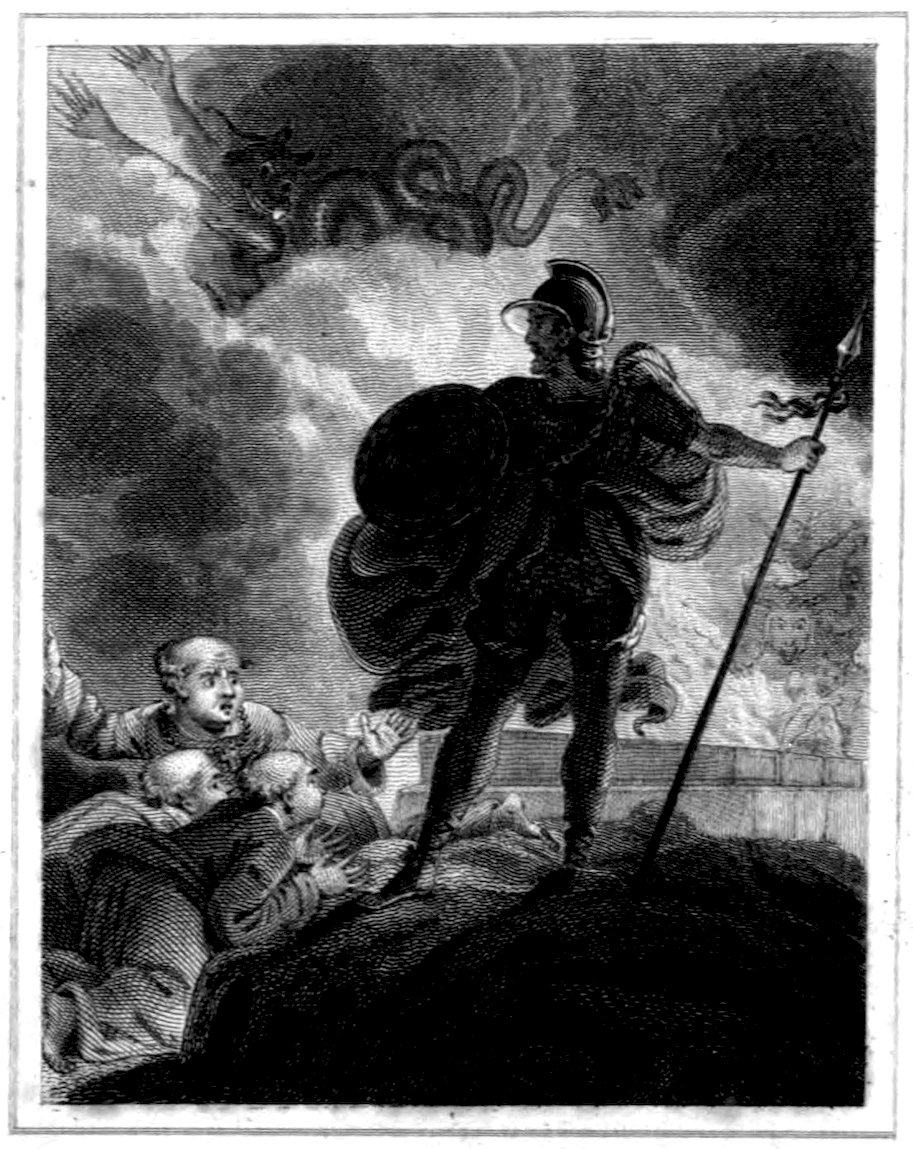
As starting from their fearful swoon The astonished friars leap to their feet; The stoled biers look wildly on, And deem the vision is complete:
EDINBURGH.
DRAWN AND ENGRAVED BY W.H. LIZARS
1824.
ST BALDRED OF THE BASS, A Pictish Legend; THE SIEGE OF BERWICK, A Tragedy; WITH OTHER POEMS AND BALLADS, FOUNDED ON THE LOCAL TRADITIONS OF EAST LOTHIAN AND BERWICKSHIRE.
By JAMES MILLER.
EDINBURGH:
SOLD BY
OLIVER & BOYD, TWEEDDALE-COURT;
AND
GEO. B. WHITTAKER, LONDON.
1824.
EDINBURGH,
PRINTED BY OLIVER & BOYD,
TWEEDDALE-COURT.
TO
THE RIGHT HONOURABLE
CHARLES, EARL OF HADDINGTON,
BARON OF BINNING AND BYRES, &c.
THIS VOLUME
IS RESPECTFULLY INSCRIBED,
BY
THE AUTHOR.
Haddington,
November 1, 1824.
vii
CONTENTS.
SAINT BALDRED OF THE BASS,
A PICTISH LEGEND.
IN TWO PARTS.
3
SAINT BALDRED.
Saint Baldred, the venerable subject of the following
poem, was the disciple of Kentigern or St Mungo,
the tutelary saint of Glasgow. According to Boece, he
was of Scottish descent; and, during the reign of
Brudeus, king of the Picts, held his pastoral charge in
East Lothian, which then formed part of the kingdom
of Pictland. His instructor in the faith was the reputed
son of Thametis, a Pictish princess,[1] who was
cousin to the reigning monarch; it is probable, therefore,
from this circumstance, that he enjoyed the smiles of
royal patronage and favour.
“The Breviary of Aberdeen,” says Dr Jamieson, in
his History of the Culdees, “contains some particulars
with respect to Baldred, which I have not met with
4any where else. ‘This suffragan of St Kentigern
flourished in Lothian, in virtues and in illustrious
miracles. Being eminently devout, he renounced all
worldly pomp, and, following the example of John
the Divine, resided in solitary places, and betook himself
to the islands of the sea. Among these he had
recourse to one called Bass, where he led a life, without
all question, contemplative and strict, in which, for
many years, he held up to remembrance the most
blessed Kentigern, his instructor, in the constant contemplation
of the sanctity of his conduct.’”—Hist.
Culdees, p. 190.
“In this work,” continues the doctor, “we find a
miracle ascribed to the worthy Baldred, that must have
rendered him an inestimable acquisition to a people
living on a rocky coast.—‘There was a great rock
between the said island and the adjacent land, which
remained fixed in the middle of the passage, unmoved
by all the force of the waves, giving the greatest hinderance
to navigation, and often causing shipwrecks.
The blessed Baldred, moved by piety, ordered that he
should be placed on this rock. This being done, at his
nod the rock was immediately lifted up, and, like a
ship driven by a favourable breeze, proceeded to the
nearest shore, and henceforth remained in the same
place, as a memorial of this miracle, and is to this day
5called St Baldred’s Coble or Cock-boat.”—A small
rock, at the mouth of Aldham bay, still bears the
name of Baudron’s Boat.
If personal safety merited consideration from the
ascetic, who was all but adored in that rude age, and
who lived a life of patriarchal innocence and simplicity,
we may suppose that he retired to the “strong castle”
of the Bass from prudential motives; for, at this
period, an exterminating war raged between the Scots
and the Picts, at the instigation of Ethelfrid, the pagan
prince of Northumberland, who sought his own aggrandisement
in the destruction of the contending nations.
While residing in this solitude, Baldred died 6th
March 607–8.—See Boece’s Chron. and Keith’s Cat. He
was held in such veneration by the natives, that on his
demise, the three neighbouring parishes of Aldham,
Tyningham, and Preston, laid claim to his remains.
It being impossible to satisfy the multitude without
supernatural agency, the enraged embassy were on the
point of deciding their right by blows, when a Pictish
sage judiciously advised them to spend the night in
prayer, that the bishop of the diocese might have an
opportunity of settling their dispute in the morning.
“When day dawned,” says Holinshed, “there were
found three biers with three bodies decently covered
with clothes, so like in all resemblance, that no man
6might perceive any difference. Then by commandment
of the bishop, and with great joy of all the
people, the said several bodies were carried severally
unto the said three several churches, and in the same
buried in most solemnwise, where they remain unto this
day, in much honour with the common people of the
countries near adjoining.”—Holin. Chron. vol. i.
The same legend assumes a more warlike attitude in
the English Martyrology.
“The people waxing wroth took arms, and each of
them sought by force to enjoy the same; and when the
matter came to issue, the said sacred body was found
all whole in three distinct places of the house where he
died: so as the people of each village coming thither,
and carrying the same away, placed it in their
churches, and kept it with great honour and veneration
for the miracles that at each place it pleased God to
work.”[2]
In the Breviary of Aberdeen, before quoted, we are
informed, that “the inhabitants of the three parishes
7which were under his charge, as soon as they knew of
his death, assembled in three different troops at Aldham,
where he breathed his last, severally begging his
body. But, as they could not agree among themselves,
they, by the advice of a certain old man, left the body
unburied, and separately betook themselves to prayer.
Morning being come (as aforesaid) they found three
bodies perfectly alike, and all prepared with equal
pomp for interment. Each of the companies, of course,
departed well pleased; and each parish erected a
monument over that body of the saint which had fallen
to their share.”
“Such was the credulity of these times,” concludes
the doctor, “that it was believed, that the body of the
saint was in all these places; and this, of course, afforded
an irrefragable proof of the doctrine of transubstantiation.
Camerarius gravely says, that, ‘for the
termination of the dispute between these parochial
churches, it was at length effected, by the prayers of
the saint himself (for nothing is impossible with God)
that each of them should enjoy this treasure.’”—Major
asserts the doctrine as supported by this fact.—See
Hist. Culdees, pp. 191, 188.
According to the learned Chalmers, a Saxon monastery
of St Baldred was established at Tyningham,
at an after period, whose diocese comprehended the
8whole of East Lothian, and whose lands, says Simeon,
the monk of Durham, extended from Lammermoor to
Inveresk. “Et tota terra quæ pertinet ad monasterium
sancti Balthere, quod vocatur Tyningham a
Lambermore usque ad Escemuthe.”
Two elegant Saxon arches, the remains of the old
chapel, still ornament the beautiful domain of Tyningham,
where the principal scene of the poem is laid.
9
SAINT BALDRED OF THE BASS.
Introductory Stanzas.
I.
The pilgrim views on Lothian’s eastern shore,
(Whose fields are waving far with golden grain,)
Like giant’s fabled tower, sublimely hoar,
The Bass, majestic, rising from the main:
Here ocean’s waves usurp the rural scene,
And the blue waters gird the mountain’s zone,
Where spread of yore the verdant blooming plain,
As sage geologists have deftly shewn,
In times to topographic lore, alas! unknown.
10II.
The muse has deem’d this crag, in fancy’s hours,
The prototype of monster huge and tall,
That having left Zahara’s citron bowers,
Dips his proboscis in the Senegal;
While round his rugged sides the waters fall,
His stately form frowns awful o’er the tide,
Gleams on his back the castellated wall,
As erst by Porus led, in Indian pride,
The tower-crown’d elephant, by green Hydaspes side.
III.
The pious Baldred scoop’d his hermit cell
Upon the sunny summit of the rock,
Whence issued forth a fountain’s crystal well
Which o’er the cliffs in showery spangles broke;
The sea gulls, charm’d to tameness, round would flock,
Bringing their finny offerings to his cave;
While as the Pict skimm’d by in light carrock,
He paused, a holy benison to crave,
Then push’d his little skiff undaunted through the wave.
11IV.
And oft at dead of night, when howl’d the storm,
The anchorite left his couch his beads to tell;
And press’d the cold bare rock in prayers till morn,
For vessels drifting near the Inch Cape’s bell,
Which rung, between each gust, the seaman’s knell;—
And evermore he closer claspt his hands,
As burst upon his ear the water’s swell,
For the lone wretch who shudd’ring, drowning stands,
Waist-deep, and lock’d in Tyne’s deceitful sinking-sands.
V.
When rosy-finger’d Flora from her urn
Strew’d earth with flowers, and pearl’d the azure deep,
While the red sun in Leo fierce did burn,
At depth of noon, the saint his limbs would steep
In the transparent waves, where breezes creep
O’er Fidrey’s sacred isle; meanwhile, the fry
Sported around in shoals, as glad to keep
Their summer sabbath:—the sea-calf roll’d by,
Forsook her briny pool, and lick’d the patriarch dry.
12VI.
He was a star in reason’s dawning day,
That led the savage hordes of human kind,
Ere Learning pour’d her intellectual ray
Like light from heav’n upon the vacant mind:
Then God was heard in thunder or the wind,
While meteor forms did aerial conflict wage;
As tattoo’d groups upon the shore reclin’d,
Listen’d the mystic lore of Runic sage,
Cull’d from the Scandinavian’s darkest pagan page.
VII.
He travell’d paths untrod, o’er mountains bare,
To preach the gifted creed to barbarous men;
His food alone the jetty juniper
That blossom’d on the steeps of Lammer’s glen;
He dragg’d the savage from his gloomy den,
In silken chains his wayward passions bound,
While Hope’s bright rainbow glitter’d o’er the fen,
And Mercy scatter’d pearls upon the ground,
Where erst dark Odin’s chiefs in blood-stain’d garments frown’d.
13VIII.
Yet deem not that the lonely orison
Was life’s sole business; for he also taught
To rear the rustic dome, which, form’d of stone,
Fair Architecture to perfection brought;
The oaken wall—the roof ingenious wrought,
Pictur’d the Gothic arch with willow wand,
In embryo modelling those shrines of thought;
Such as by Doric Tweed do sculptured stand,
Whose cloisters seem as carved by Nature’s sylvan hand.
IX.
And, oh! if e’er he felt that gentle flame,
Which, born in heav’n, on earth like vapour dies,
’Twas sigh’d in secret (and was he to blame?)
For pious Breda,—beautiful as wise,
Who left the pomp of gilded canopies
In regal lands, for the lone convent’s cell.—
And, fair, her house of prayer was seen to rise,
Where the Cistertian sisters loved to dwell
Beneath the mighty shade of Lothian’s Alpine hill.
14X.
Of Baldred’s lineage little we may learn,
Whether of princess born or lowly swain,—
Suffice, that he was bred by Kentigern
What time St Colme to Iona came;
And cleans’d the church from her Pelagian stain,
And royal Brudeus to the faith subdu’d;
Who, haply, left the world’s tumultuous scene
To meditate in sentimental mood,
And hold high converse in the Bass’s solitude.
XI.
Methinks oft gazing o’er Bodotria’s tide,
King Brude and Baldred sat in cavern’d shade,
The prince’s robes the leopard’s spotted hide,
Thrown o’er his brawny shoulders, which display’d,
Deep painted in his skin, in fierce parade,
The milk-white buffalo and the tusked boar;
And evermore the saint some truth convey’d;
Anon he shook his beard all silver’d o’er,
And talk’d of pilgrimage on Judah’s distant shore.
15XII.
The prince, wrapt in astonishment, would ask
Of foreign climes, their manners and array;
Now burn’d to crush the Persian basilisk,
Reserved for the crusades of latter day—
Now sought to know if the world’s barriers lay
Where Alps lie pillow’d till they prop the skies!
And much he long’d to pierce the milky-way,
Even as an eagle; while, before his eyes
Fair pictured in the sand, the zodiac’s splendour lies.
XIII.
Philosophizing thus, the hours were lost,
Till war’s horn blew, and Brudeus graspt the spear;
For valiant Arthur’s Bacchanalian host
Have left their Christmas-pie for rougher cheer;
The Scot and Pict invading warfare bear,
And drive the Table-knights to Humber’s flood;—
Their monarch slain, the Britons yield through fear,
While the sun shone at noon array’d in blood,
And York’s esculent herbs gleam’d crimson from the bud.
16XIV.
Too soon to these leagued warriors omens told
Of broken friendship, desolating woe;
For the Northumbrian prince with treacherous gold
Seduced the Pict to hold the Scot his foe;
Grief for their strife brought saintly Baldred low;
Upon the Bass he pined away, and died,—
When o’er a rainbow-bridge, in robes of snow,
Upborne by angels, he was seen to glide;
As erst St Idan rose from Leader’s pastoral side.
17
SAINT BALDRED OF THE BASS. PART I.
The Funeral.
I.
The requiem rises loud, but drear,
Within the Bass’s rocky isle;
Where watchful round St Baldred’s bier
The monks await the morning’s smile;
While torch-light reddens the lone cave,
And brightens every paler face,
Till in each feature, darkly grave,
Sorrow her gentle tear may trace.
II.
That day from Preston’s holy fane,
Three friars came the priest to claim;
For there, in Modred’s gloomy reign,
Before the Saxons were subdued,
18His foster-mother was a dame
Supposed the heir of high-born blood.
Three friars came from Aldham’s shrine
In quest of the revered man;
For there, among the Pictish line,
His pastoral charge at first began.
Three friars came from Tyningham
To claim the Saint’s much-hallow’d clay;
For there, enshrined in folds of balm,
His saintly predecessors lay,
The church-light of an earlier day.
III.
Th’ assembled friars stood amazed,
Speechless, and swollen with rage they gazed,
Till arms in angry mood were raised,
And crosier-staffs were broke;
When ripe for vengeance and for war,
They rent the cross-woven scapular,
And tore the scanty cloak;
From grasp and squeeze they pass’d to blows,
One took his neighbour by the nose,
Another by the hair;
Nor ceased to ply the dangerous art,
Till each could shew a wounded part,
And every back was bare!
19IV.
Alarm’d by the tumultuous roar
The solan left her rocky nest,
And travelling to the Fifean shore,
Like snowy curtains deck’d the west;
While monsters in the Forth were seen,
Disporting in the waters green,
With crested head, like horned owl,
O’erspread with film like Carmelite’s cowl;
Then all look’d ominous and drear
As if some great event was near;
And many saw pale Loda’s form,
Gleam in his meteor-clad array;
While others only heard the storm
As grief or terror held their sway.
V.
Dark grew the Warden’s cheeks of bloom,
Like wizard started from the tomb;
He blest each saint he knew!
And as his ruddy face grew pale,
His lips shook, quivering as the gale,
And pass’d from red to blue.
20By good St Mungo’s soul he swore,
(As evermore his locks he tore,
And fierce his blood did boil,)
That “ere they moved the old man’s bones,
“As easily they’d move the stones.
“Which propp’d the lofty isle!”
VI.
When, lo! a vessel near, they spy,
That proudly heaves in sight;
Fair blows the wind, serene the sky,
“Ho! boatmen, o’er the waters fly,
“And reach the land ere night;—
“To favouring breeze your canvass stretch,
“To Holy Island speed;
“And bid the Bishop cease to preach,
“And leave his miracles unwrought,
“And bring him here as swift as thought,
“To aid us in our need!”
VII.
Meanwhile a host upon the shore
Await the embassy’s return;
But when the herald struck his oar,
Their souls for vengeance burn:
21While gathering far, on Aldham’s height,
The rival parishes advance;
Now mingle in the deadly fight—
And hurl the sounding lance.
When forward rush’d an aged man,
So venerable in years,
That silence through the warriors ran,
And nerveless fell their spears;—
And thus, the Priest of Garmilton
Loud spake, while from his eyes there shone
Radiance, like lightning from a cloud,
Which backward awed the dusky crowd:—
“O mock not the decree of Heaven,
“In angry strife, to madness driven!
“But let the calm of peace prevail,
“Till supernatural powers be given
“To bless your deep excess of zeal.”
VIII.
But, frowning still in angry mood
Unmoved, the men of Aldham stood;
A hardy race nursed by the sea,
In manners haughty, fierce, and free;
22Again the smother’d murmur rung,
While they were seen to seek the shore;
For on their backs the corrock hung,
And in their hands the oar,
When rose the Priest of Garmilton,
With his prophetic eye,
“I swear by Hadda-Chuan’s stone,
“That storms are in the sky!
“Yes, by the tempest-saint I swear,
“Of green Iona’s isle!
“That to the depths of hell ye steer,
“Debarr’d from heaven’s smile!
“Backward St Baldred’s rock shall roll,
“And choke your navigation up,
“While fires shall riot on your soul,
“And sea-wolves on you sup,
“If ye despise my warning now!”
Thus spake the priest, and smote his brow.
While back the trembling men return,
As if the curse begun they feel;
And silent for that vengeance burn
Which they dare not reveal.
23IX.
The friars in the lonely isle
Like guards their watches keep;
Till most of them, o’ercome with toil,
Go piously to sleep;
While others, chatting o’er the bowl,
Simper beneath the monkish cowl
To see their fellows weep,
And quaff, in horns, from mountain still,
The liquor brew’d from heather-bell—
So changing is man’s wayward mood
From false to fair, from smooth to rude.
X.
O death! thou art a fearful thing,
Although ’tis said relief thou’lt bring,
The wretch without a friend or home,
Condemn’d in hungry rags to roam,
Will life’s last bitter chalice drain,
Sooner than mingle with thy train!
Thou strik’st the hermit in his cell,
Who long has bid the world farewell;
Thou strik’st the warrior in the field,
While charging squadrons round him yield;
24And rosy youth, and wrinkled age,
And motley fool, and cunning sage,
Alike before thy arrows fall,
Whose quiver has a barb for all.
XI.
Each left the corpse, save that dark man
Cormac, from Aberlady’s shore,
Who, deem’d a cunning artisan,
Had left Kilspindie’s cells at dawn,
Yet landed not till twilight hour.
Two black-hoods follow’d in his train,
Like shadows on the rock,
Who only deign’d to breathe amen!
As low their master spoke:
“Refugium peccatorum,
“Consolatrix afflictorum,
“Ora pro nobis.”
XII.
Yet, thought the soldiers of the Bass,
As slow the midnight moments pass,
Some demon horrid rites preferr’d,
To rend the rock asunder,—
For evermore they, shuddering, heard
Deep buried sounds like thunder;
25While underneath the waters boil’d,
As if Leviathan had coil’d
His monstrous shape around the base
The castellated isle to raise;
While started in the unfathom’d deep
The coral tenants from their sleep!
XIII.
At morning’s dawn the Bass appear’d,
Half hid in ocean’s mantle fold,
Shining as magic wand had rear’d
A mountain pearl in bed of gold.
Afar, impervious to the sun,
The woad-dyed groups, in shadows dun,
Along the summits steal;
While glad the Bishop’s barge they hail,
Seen, swan-like, urged by favouring gale
Westward the port of Bele.
Where high Tantallon’s castle stands,
Like vet’ran set to watch the deep,
Gleam’d nodding heads, and waving hands,
Wherever human foot might creep;
And rocky cave, and ocean bay,
Bore the loud shoutings far away,
That hail’d the monk of Lindisfarn
In friendship free—in virtue stern.
26XIV.
Chiming o’er Lothian’s sunny shore,
The chapel bells began to ring,
And still was echo’d more and more,
“Hail to the holy man ye bring!”
The sails are struck—the oars are plied—
The barge moor’d by the Bass’s side;
And as the Bishop trod the strand,
They forward press’d to kiss his hand:
Enough of worldly bliss for them
To see him ere they die;
To touch that garment’s hallow’d hem
Which he did sanctify.
XV.
Down to the castle’s caves they wend,
With hesitating steps and slow,
And, fearful, one by one descend,
As if Vesuvius yawn’d below;
The first sent up a horrid sound,
His glaring torch fell to the ground;
Another, and another fell—
Some vow’d to heav’n, some thought of hell;
And as the smouldering flame upbroke,
They shudder’d as they saw
27The devil tow’ring o’er the smoke,
Seize Baldred, and, with agile bound,
Leap o’er North Berwick Law!
That hill, which in a latter day,
By witchcraft near was borne away,
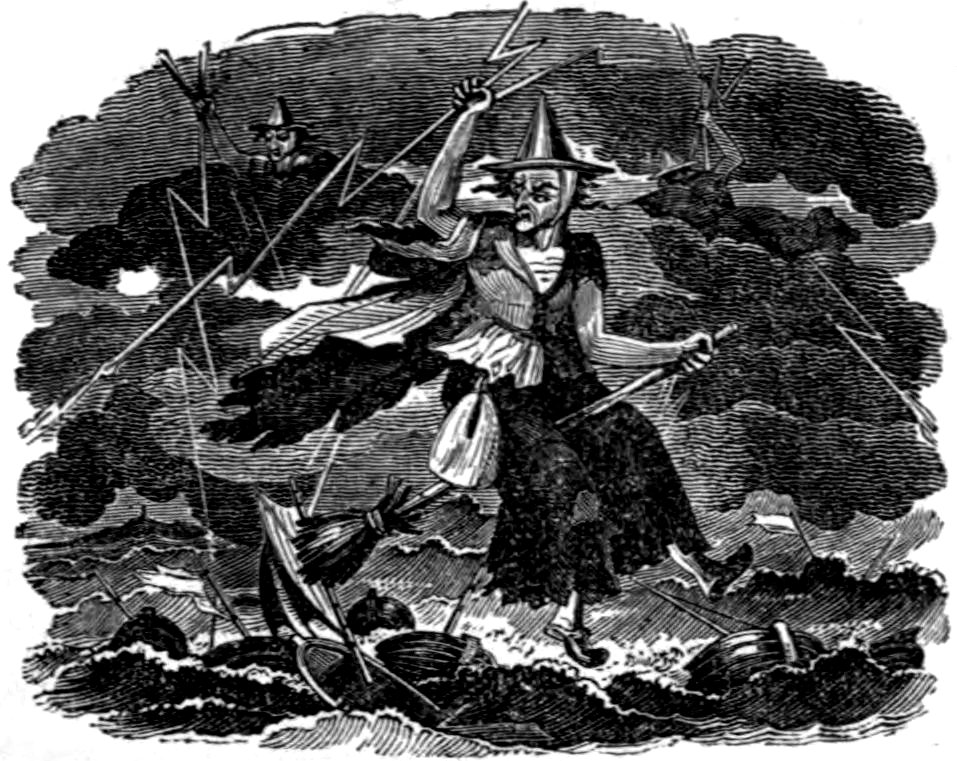
When the Gyre Carling strode the mast,
And, like a huntress, rein’d the blast.
Retreated all as best they might,
Each sought to save himself in flight;
Nor did the Bishop stoop to kneel—
Unlike St Serf, the church’s keel,
Who with his prayers the dragon slew,
St George eclipsing—if ’tis true!
XVI.
Surprise upon each brow had striven,
As dread conjecture ran,
When they beheld, as dropt from heav’n,
That lone Aemonian,
The hermit of Inch-Colme’s isle,
Whose face ne’er lighten’d with a smile;
Yet was his temper framed so mild,
In innocence he walk’d a child;
The untamed tenants of the moor
Roam’d in his daily haunts secure;
28For brute and man alike were shewn
That mercy claim’d this priest her own;
But him they question’d not,
So scriptural his answers were,
Long prefaced by a tedious prayer,
The subject he forgot;—
Ere the proeme had been begun,
Another day had seen the sun!
XVII.
The Warden stood in fierce array,
Like savage of St Julian’s bay,
By nature form’d for martial fray,
In stature towering high;
As trunk of oak his massy limb,
Though muscular, yet moulded trim;—
His visage pointed, long, and grim,
Lank cheeks and hollow eye.
Unlike the carpet-race we boast
The soldier’s jest, though fashion’s toast,
Who leave Castalian springs for wine,—
Whose greatest glory is—to dine!
XVIII.
Men often show least signs of fear
When certain danger hovers near:
29The Pict conceal’d his wrath—
He craved the Bishop’s benison,
Then went like Roman denizen
To victory or death!
His zone with iron hoops was braced;
His buckler on his arm was placed,
Made of the buffalo’s hide;
While, punctured, on his breast appear’d
The monster, fierce as when ’twas spear’d;
Now raising high his sounding lance
He bade the trembling crowds advance,
And march’d with martial stride;
But none durst follow in the van
With that gigantic-bodied man!—
XIX.
Then fell an awful pause, as when
The Indian striplings fearless run
To slay the tiger in his den,
In caves that never saw the sun:
Meanwhile the Warden had his fears
When he beheld the friars dying,
And, side by side, survey’d three biers
Whereon the saint in state was lying.
Each load was borne most pompously,
Deck’d with its cross and rosary;
30While, one by one, three corpses lay
Like twin-brothers transform’d to clay,
Moulded so nicely like each other,
The eye no difference might discover;
And as the tapers flicker’d dim,
The features look’d uncouth:
Each countenance appear’d more grim,
And seem’d to ope its mouth.
Recovering soon, the Warden raised
His voice, to urge them on, who gazed:
They forward press—they kneel and pray—
While, lacking faith, some steal away,
As starting from their fearful swoon
The astonish’d friars leap to their feet;
The stoled biers look wildly on,
And deem the vision is complete:
Till by a glimpse of reason’s beam
They wake to a substantial dream!—
XX.
“Mother of God!” the Bishop cried,
“Thy aid is never sought in vain!
“To crush the paynim in his pride,
“Thy spirit walks on earth again!—
“Where’er thy dove-like presence strays
“Among the bowers of human wo,
31“O teach our harps to sing thy praise
“In strains that seraphs only know!”
XXI.
They raised the sheet from Baldred’s face,
They turn’d the corpses where they lay,
In each his features clearly trace,
Crown’d with a tuft of silvery gray.
They deem’d his bright ethereal flame
Which mortal form could not control,
From heav’n had held a trio frame
To suit his zealous warmth of soul;
That he might stray in paynim lands,
A pilgrim lone in Palestine;
Now tread the desert’s burning sands—
Now preach the faith by Pictish Tyne;
With that sweet angel for his guide,
Who led St Serf by Bosphorus’ strand,
Attendant duteous by his side,
Like earth and heaven hand in hand!
XXII.
But, hark! the Bass’s chapel bell
Again its mournful music plies,
And Aldham’s chimes the breezes swell,
And Tyningham as soft replies.
32While o’er the lake in dark parade
The painted chiefs are seen to glide,
From verdant Tyne’s green holly shade
To dwarfish Peffers’ sandy side.
XXIII.
Afar upon the spangled deep
The barges move in solemn show;
The oars their regular cadence keep,
As ’twixt each pause a sob of wo
Bursts from the sailor, and a tear
Falls down unseen on ocean’s breast;
While, in their gloomy livery drest,
The sable nodding biers appear
Reflected in the waters clear,
Like plumes upon a silver crest!
XXIV.
The seal lay on the scarry shore,
As charm’d to hear the distant oar;
The tarrock left Craig Leith’s rough breast,
To crown the isles like feathery crest;
And every rock that gemm’d the deep
Was peopled like the grassy steep;
Some launch the skiff, while others brave
The swelling surface of the wave;
33Anxious to join the funeral train:
And, but for weeds that pictured pain,
’Twas like a festive holiday,
When princes short-lived visits pay,
And the high rulers of the earth
A jubilee give to lowly mirth.
XXV.
Soon reach’d the pebbly-studded strand,
The oars are struck—the mourners land
In Aldham’s pleasant bay;
Upon the beach three chieftains stood,
With litters form’d of laurel-wood,
And crown’d with rosemary;
On these St Baldred’s relics laid,
With other honours duteous paid,
They forward march’d in sad parade;
Where all were willing—those were blest,
To whom were given the high behest
To bear the corpse away;
Preceded by six vestals fair,
Who tore the long dark glossy hair
That fell upon their shoulders bare
As clouds on mountain snow;
Anon their lily hands they wrung,
And mournfully the requiem sung
In plaintive notes of woe.
34Hymn.
Spirit of bliss! a cup of joy
Awaits thee in the halls of Thor,
Where earthly sorrows ne’er destroy,
Where heavenly hearts are never sore.
Did thy mother, in midnight dreams,
Call thee from this land of care,
To sail on heaven’s transparent streams
With Jhules, the angels of the air?
Save us from pale Loda’s power,
When in the gale his form appears;
Cheer us in affliction’s hour,
And shield us in the strife of spears.
Spirit of bliss! a cup of joy
Awaits thee in the halls of Thor,
Where pleasure charms without alloy,
Where tempests never wreck the shore.
XXVI.
Up Aldham’s flowery steep the biers
Ascend, in a long dusky line,
Where, tow’ring o’er their dark compeers,
The warriors’ glancing helms shine;
35And golden mitres lustre shed
Upon each bishop’s ancient head.
First solemn walk’d, behind the pall,
Conwal, that priest austere and tall,
Who dwelt by Clutha’s winding stream;
His loins were girdled round with hair:
For such like penance he did deem
Useful to fit his soul for prayer.
He was St Baldred’s friend in youth,
St Mungo train’d them both to truth;
And ne’er do tears sincerer flow
Than those which early friends bestow,
When weeping o’er some parted shade
In life’s luxuriant prime decay’d.
Ah! who would wish to linger here
When those who made life sweet are gone,
When loves and friendships disappear
Beneath the dark sepulchral stone;
And all we know of sage and fair,
Is the dull record that—they were!
Upon his right, with martial brow,
Appeared the young Prince Derili,
Who wept in Baldred’s relics now
A lost preceptor, and did sigh
36While running o’er instructive hours—
Which now, alas! too quick had sped—
As oft in Dirleton’s ivied towers
He listen’d to the honour’d dead,
And heard truths morally sublime,
That purified his soul from crime,
And bade him afterwards atone
For errors that were not his own;
And in Loch Leven’s lonely isle
To heaven bequeath a holy pile.
St Conwal, on his left, was led
By Asaph—soon to suffering bred,
A zealous man, who did adorn
The holy church, for which he’d borne
The martyr’s faggot-blaze;
Unburthening his soul of guilt
Three hundred times a-day he knelt
In silent deeds of praise;
So oft he’d paced the altar’s bound,
His steps had worn the marble ground!
He was supported by that sage,
Who ’midst the others shone
So venerable in his age,
The Priest of Garmilton.
37Idan came next of Lindisfarn,
In demon-conflicts bold,
Who, on the gloomy rocks of Fern
Did secret vigils hold,
And afterwards, upon that shore,
The bishop’s pastoral crosier bore.
While Eta, abbot of Melrose,
The bishop’s stoled ranks did close.
Then follow’d those of less degree,
Yet not less famed for sanctity;
There stalk’d Dricthelmus the austere,
Who one dread night in death’s arms slept,
And saw Heaven’s mystic visions fair,
As o’er the golden walls he crept,
When, lo! a weight of earthly sin,
Like Eden-cherub’s flaming brand,
Just as he leap’d to enter in,
Drove him to this terrestrial land!—
There also walk’d those monks profound,
With eye devout upon the ground,
The followers of St Benedict,
In sanctimonious manners strict.
While wander’d in the rabble’s van,
That sadly lone Aemonian!
Where’er this gentle hermit went
Still followed him a sacred cow,
38Whether he trod the sandy bent,
Or clomb the mountain’s heathery brow.
XXVII.
For those who sail’d on Forth’s green wave,
It was a splendid sight to view
The cavalcade, as dark and grave
It gave the cliffs a chequer’d hue;
While evermore the torches threw
A sparkling glare among the crowd,
As stars will hide their eyes of blue
In dawning morning’s dusky cloud;
Then first by Aldham’s holy shade
The solemn pageant paused the while,
As in the church’s holy pile
One body of the Saint was laid
Beneath a yew’s undying bloom,
Emblem of tenant of the tomb.
This tree a holy calm diffused
O’er passing strangers, as they mused
Upon the nicely sculptured scroll,
That told its moral to the soul.
XXVIII.
Low chanted in the house of God,
On high the choir’s full measure flow’d,
39While the soft echo of a sigh,
Dimm’d the bright lustre of each eye.
Requiem First.
1.
Be hallow’d the place of thy rest,
O soft be thy bed in the tomb!
Thou’rt gone to the land of the blest,
With the souls of the happy to roam:
As planets in loveliness roll,
And light the lone wanderer’s way,
Thou beam’d on the night of the soul,
And left us at dawning of day.
2.
With bay we’ll embroider that stone,
That tells us of glory and thee!
While the changes of seasons roll on,
Thy memory unfading shall be.
Though fled on the seraphim’s wing,
And left us in darkness to mourn,
With earliest blossoms of spring
We duly will garland thy urn.
40XXIX.
O who is he, with locks of grey,
That bids the pressing crowds recede,
As backward rolls the ocean’s spray,
Where canvas-crowned galleys glide?
A scallop-shell the stranger wears,
St Peter’s keys in red he bears
Wrought in his scapular;
The Pictish lances rattling sound,
And far the waving pennons float,
The bishop’s palfreys paw the ground,
And startle at the war-horn’s note,
While mingling voices loud exclaim,
“Ho! pilgrim, with your cross of flame!
“Come ye for peace or war?
“Or why upon our march intrude,
“In humble guise, but forward mood.”—
XXX.
“O let short-breathing space be given,”
The way-worn stranger cried:
“Three moons have scarcely waned in heaven,
“Since Baldred, in Loretto’s shrine,
“Was kneeling at my side.
41“Before the virgin and her son,
“Where silver lamps for ever shine,
“He drank the Eucharistal wine,
“And said—‘My earthly task is done!’
“I turn’d to bid the old man hail—
“And saw his face was waxing pale
“As monumental bust—
“I turn’d; but, lo! the priest was gone,
“And I fell humbled in the dust!”
XXXI.
“Beloved of heaven!” the bishop cried,
“Mary! maiden-mother, fair!
“Who lovest to crush the paynim’s pride,
“And hear the lowly pilgrim’s prayer,
“Again to thee on earth be given,
“That homage which ascends to heaven!
“Holy pilgrim! speed the while,
“Rest thee in the rocky isle,
“Till the morning’s purple light
“Gilds Dumpender’s verdant height;
“Onward then, Heaven be your guide,
“As it has ever been;
“When wafting o’er the western tide,
“O tell by lone Iona’s side
“The mysteries you have seen!”—
42XXXII.
’Twas noon, when o’er the Thistly Moor
The funeral held its mazy route,
When roused by sounds unheard before
The wily fox was on the scout;
The woodcock plied his jetty wing,
The red deer made his lofty spring,
A moment view’d the dark array,
Next fleetly bounding shot away,
Just stopp’d to slake his thirst in Tyne,
Then, arrow-like, straight onward flew,
Till on the horizon’s farthest line
His antlers pierced the heaven’s blue!—
XXXIII.
Eastward of Binning’s beauteous wood
Stood Baldred’s mossy cell,
Where in communion deep with God
The patriarch loved to dwell,
What time the summer breezes bland
Were wafting perfume o’er the land;
And so serene the ocean lay,
It pictured headland-rock and bay;
And heaven’s veil of azure hue
Was only speck’d by grey curlew.
43Here often, tame as Rylston’s doe,
The chase-driven deer would stand,
And lick the hermit’s palm of snow,
And eat from gentle hand.
And here, before the altar’s mound,
Which time-worn hieroglyphics graced,
His canonized bones they placed,
And sanctified the ground;
And holily they sprinkled o’er
His grave, as sung the pious choir.
Requiem Second.
1.
When death meets the chieftain ’midst victory’s hum,
His fall is deplored by the trumpet and drum;
But softer the music, and warmer the sighs,
That waft pious soul’s to their throne in the skies.
2.
O drear were our walks in the shadow of death,
Till the star of Balclutha illumined our path!
Like the planet of Bethel it gilded the night,
Till it set in a halo of heavenly light.
443.
Let bay deck the turf where the saint lowly lies,
Like the symbol we scatter, his leaf never dies;
For his fame in its innocence beauteously ’ray’d,
Like the rose-bud of Jericho, never will fade.
XXXIV.
The dying sounds had scarcely ceased,
The prayer, half-mutter’d by the priest,
When round, the congregated crowd
Was parted like the thunder-cloud;
Some grasp the sword, some couch the lance,
Backward recoil, or firm advance;
Then quiver’d as with earthquake’s shock
St Baldred’s cradle in the rock,
And Whitberry’s rugged point was broke;
And, lo! (as old traditions’ say)
That boat of stone in Aldham’s bay,
Yclept the Saint’s, was seen to sail
As chaff before the mountain gale;
And all beneath fair Preston’s fane
The Tyne began to boil amain!
Until it foam’d o’er Linton linn,
Whence rose that loud horrific din,
45As if another Tityus lay
Chain’d with the vulture at his heart,
Wailing his soul in groans away
O’er agonies that must ne’er depart!
XXXV.
A knight comes on a lofty steed,
With spear reversed and helmless head,
A branch of olive in his hand.
The bishop bids the mourners stand,
When lighting by St Baldred’s side,
“A boon! a boon!” the warrior cried,
Craving to see the illustrious dead,
As if affiance he might trace
In the old man’s pale ghastly face;
Then roll’d his eyes from earth to heav’n,
Swore, as he hoped to be forgiven,
That, lately, on the Flemish shore,
He met the saint in Antwerp’s choir,
What time the vesper prayers were said:—
“Nay, father! do not doubt my word,
“I do not deal in gasconade,
“But wear a still untainted sword,
“That ever is unsheathed for God,
“Aye ready at the church’s nod;
46“Behold my doublet’s lightsome sheen,
“It once was dervise-pennon green,
“Hard won in Canaan’s holy land,
“When combating the Jews accurst;
“To mount the breach with sword or brand
“St Baldred knew I was the first!
“And thrice he blest me where I stood,
“And thrice he sign’d the holy rood;
“Then press’d my hand—it felt like flame—
“Behold! it left his hallow’d name!
“And now I come this boon to crave,
“That I may lower him in the grave,
“That some last relic you’ll bestow,
“’Twill bear me foremost ‘midst the brave,
“’Twill raise me when my arm is low!”
The bishop waved his hand on high,
And gave propitious reply—
“Gentle knight, thy claim is won;
“Priests and mourners! onward, on!”
XXXVI.
The sun, beyond the Pentland’s ridge,
Had given the skies a rainbow hue,
When crossing Tyne on osier bridge
The crowd the funeral’s march pursue;
47The evening dews are falling chill,
The mountain cock with crimson eye,
And jetty wing, has sought the hill
Where mists are shadowing far the sky;
While in the skirts of Lammermoor
The tod peeps from his den secure,
And sees afar the dusky crowd
Move on, like summer’s passing cloud,
In slow and stately majesty,
When scarce a breeze is wafting by;
And as they pass near ancient Cnolle,
Fair Preston’s bell begins to toll,
For they have almost reach’d the goal
Of this eventful day;
And, as by winding Tyne they turn,
Clearer the funeral torches burn,
Seen through the twilight’s grey.
XXXVII.
They have made St Baldred’s grave
Under Preston’s sculptured nave,
Where forgotten ’scutcheons wave
Of those who’ve pass’d away!
Gentle space, and mossy stone,
Tell of him who dazzling shone
The meteor of his day!
48He, whom nations could not bound,
Lies in a few feet of ground!
And he, whom kings wou’d bleed to save,
Will lie forgotten in the grave!
They have borne the saint’s last pall,
And placed his statue in the wall;
Dust to dust the bell is tolling,
As it must toll for all;
While through the aisles the anthem’s rolling,
Lovely in its dying fall,
Fanning, with melodious breath,
The solitary house of death!
Requiem Third.
1.
The waves lie smooth when storms have fled,
Beneath St Abb’s high rocky head;
The green-capp’d islands of the deep
Are lovely when the breezes sleep,
Viewless upon their beds of balm;
But, ah! this is a treacherous calm!
For here the dove no rest can find
While storms are lingering in the wind.
492.
The fairest scenes of earth’s dull round
Trail their dark shadows on the ground;
The thorny rose—the honied sting—
The winter’s cold—the blight of spring:—
While Love’s chill frown, and Hope’s deceit,
And Friendship changing oft to hate,
Prove that the dove no rest can find
Where man to man still proves unkind.
3.
Beyond yon bright cerulean skies
Elysium’s land of promise lies:
Her sun no clouds are ever shading;
Her fruits and flowers are never fading;
Her hearts are pure as those that bear them,
The blight of sin cannot come near them:
Oh! there the dove its rest may find,
And taste that heaven at least is kind.
XXXVIII.
Thus closed the quire their lyric strain,
In sounds that oft were woke again;
For still the requiem’s notes were sung,
The echoes of the aisles still rung
50The chanted dirge—the fervent prayer
For him who lay embalmed there.
Since then these shores have never seen
So much funereal pomp and show,
Save when the priests of holy mien,
Wander’d o’er Soutra’s chilly brow,
In fair Melrose’s shrine to place
The relics of the great De Vaux,
To sleep with many a nameless race
Till Heaven’s own awful trumpets blow!
XXXIX.
Still on the Hebrew’s purim day,
(That day that tells of Haman’s fall)
In after ages, blithe and gay,
Was held St Baldred’s festival.
At earliest morn the swains would go
To deck his loved and hallow’d shrine,
With blooming bay and misletoe,
Cull’d from the daisied banks of Tyne.
The chapel’s Saxon windows dight
So artfully with boughs were drest,
That tuneful birds, decoyed, would light,
To build their temporary nest.
51But now the yellow crocus flower
Sprouts blooming on the breast of Spring,
And blithe in every shady bower
The minstrels of the forest sing;
While, Tyningham! thy chapel bell
Is heard no more these shades among;
For, Time, alas! has ceased to swell
The saintly Baldred’s funeral song!
END OF PART FIRST.
53
SAINT BALDRED OF THE BASS. PART II.
The Pilgrimage.
They dug his grave e’en where he lay,
But every mark is gone;
Time’s wasting hand has done away
The simple cross of Sybil grey.—Sir W. Scott.
I.
’Tis Autumn—golden Harvest crown’d
Upon his throne of sheaves sits smiling;
The farmer’s feast goes gaily round,
His summer’s ardent toils beguiling:
When tired of the world’s bustling scene,
I seek the flowery fields again,
To snatch a pleasant holiday
Before their lustre die away;
54To tread once more by rural Tyne
A pilgrimage to Baldred’s shrine;
Another votive wreath to shed,
Like hapless poet’s, soon to fade!
II.
In Tyningham’s delicious woods
Her early song the milk-maid sings,
While from the deep’ning solitudes
The spotted plover upward springs;
The woodlark, on the lofty spray,
Pours forth the soul of harmony;
The shrill-toned linnet, in the bush,
Chimes music with the mellow thrush;
And nameless birds of speckled wing,
And golden hues, their offerings bring,
To hail the pilgrim as he gleams
By coppiced woods and shaded streams;
And as I blithely pace the mead,
Fresh with the morning dew,
The flowery carpet which I tread
Glistens with glassy hue;
Enamour’d of the cloudless day
Each floweret woos the sunny ray:
Here, gleaming through its mossy hair.
The wild-rose waves in scented air,
55While blue-bells hang their star-like gems,
And pinks and cowslips scatter’d near,
In nature’s varied colours clear,
Gleam lovely on their dewy stems.
Above, arcades tower o’er my head
Like sculptured arches wove on high,
Which round a solemn grandeur spread,
Veiling with clouds of leaves the sky.
III.
Where, shining through the flowery glade,
The mouth of Tyne translucent streams,
Within a lilac covert’s shade
St Baldred’s shrine romantic gleams.
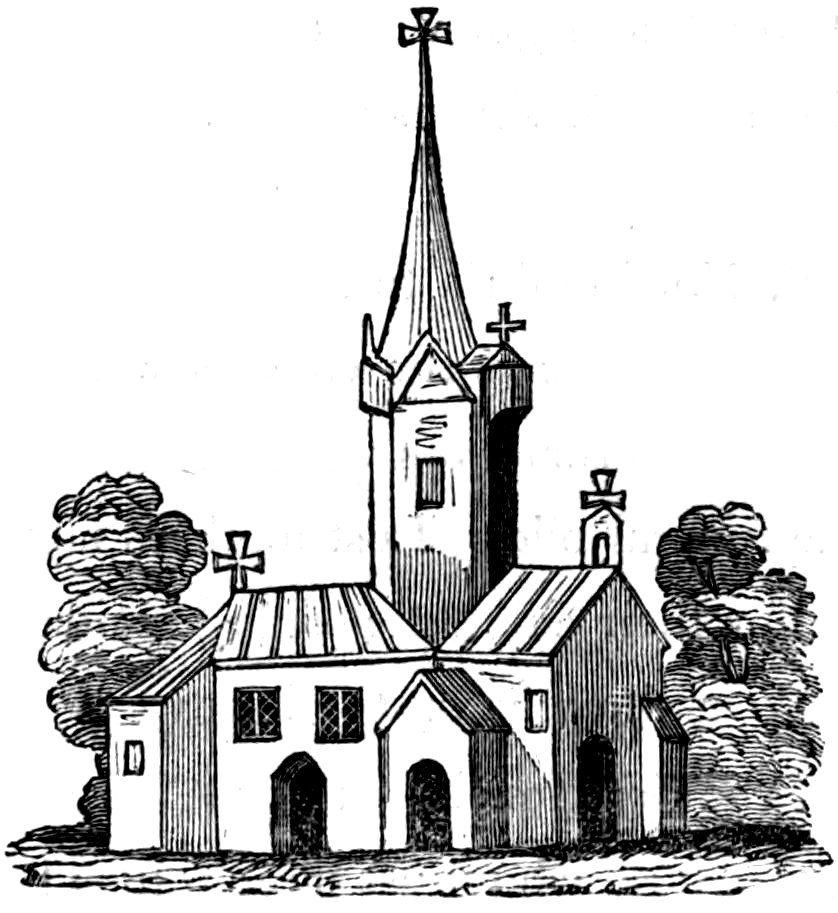
Two Saxon arches still remain;
But, Time, alas! with viewless hand
Completes the labours of the Dane,
And triumphs o’er the brand:
For thou didst feel the shock of war
When fiery Anlaf storming came,
And horrid shrieks were heard afar
As church and town were given to flame.
Alas! that vengeance did not fall
Upon the minstrel-muffled Dane,
When harping bold in Brunsbury hall
He stood before King Athelstane:
56Had the snake been crush’d in its gilded fold,
The tide of war might have backward roll’d.
IV.
In this fair mansion of the dead,
Where rests illustrious Hamilton,
’Neath arched niche, with pillowed head,
A statue lies of sculptured stone,
The image of a lady fair,
Whose hands are claspt in silent prayer.
The blessed lamb kneels at her feet—
The lady of Tyningham we greet;
Or, borrowing tradition’s tale,
Shall we the form of Baldred hail?
V.
This were the sweetest spot below
For saint or anchorite to repose;
So mild the morning breezes blow,
So calm the summer evening’s close;
Here, seated in mosaic grot,
With scrip, and book, and rosary,
Devotion, by the world forgot,
Might charm the leaden hours away,
Could man, to reason’s dictates true,
His wayward passions e’er subdue!
57VI.
Old Tyningham! thy nut-brown ale
In reaming bumpers flowing,
Once roused the woodman’s sober tale,
And set his heart a-glowing;
Around yon elm, with nimble feet,
They danced—conversed—where green-boughs wave;
The tree which screen’d from summer’s heat,
Now shades their viewless grave!
Thy ancient village, stone by stone,
Removed—its rural inmates gone!
But oft a mossy stone appears
Amidst the leafy solitude,
That marks, where met in other years
The aged tenants of the wood.
VII.
The cheering sea-breeze fans my cheek,
As o’er the thick-strewn furze I seek
A pathway to the glorious ocean,
Whose waters glow in peaceful motion;
Spreading wide her whit’ning wings
The startled seagull soaring springs,
And mingles in the clouds away
As morning melts into the day.
58And now I stand on Whitberry’s steep,
And gaze upon the mighty deep,
Where trembles ’neath the wild wave’s shock,
St Baldred’s cradle in the rock;
On which his venerable form
Once rode the billows of the storm.
VIII.
Far, in the blue haze, dimly seen,
I view the beacon-beaming isle,
Stretching its sides in waves serene,
Like a gaunt rugged crocodile
Bathed in the waters of the Nile;
While farther on the horizon’s line
The Fifean shores in shadows shine;
And as through tansied meads I fly,
New images burst on mine eye;
For, hark! the wild bee leaves the flower,
And pilots me to Aldham’s tower.
IX.
Aldham! the wall-flower’s scented bloom
Gleams lovely on thy turrets grey,
And, like the rose strewn on a tomb,
A fragrance sheds around decay.
59No more before thy gates is heard
The herald’s trump; thy stable-yard
Is empty now, and netted o’er
With weeds, and hingeless stands each door;
No harps are murmuring in the hall;
No armour glittering on the wall;
For gone are knight and seneschal,—
The voice of man is dumb!
And nought but ghosts, so gaunt and tall,
At dreary midnight come,
Denouncing vengeance on the spade
That gave to levelling Time its aid;
For Aldham church is gone!
Nor bust nor cipher left to show,
Where death has laid the mighty low.
Time does not spare the mundic urn,
The ruthless ploughshare robs the worm,
O man to fortune blind!
Despite what power and art devised,
The saint whom nations canonized
Is scatter’d by the wind.
But let me leave this darker scene,
And seaward hold my course again,
While brighter scenes before me rise,
Where yon high rock in grandeur lies.
60X.
Proud Bass! amidst the crystal sea
Thou’rt like a fairy-haunted isle,
Now echoing blithe the sportsman’s glee,
Now bright with Beauty’s radiant smile.
Upon the wave right glad we hail
Thy rugged face, and strike the sail;
And land upon thy rocky shore,
Stunn’d by the breakers rising roar.
Escap’d the perils of the deep,
We almost kneel to kiss thy steep.
Alas! we may not mark the spot
Where stood the hermit’s holy cell;
Its sacred precincts are forgot,
And if we find his crystal well,
’Tis but the stubborn truth to tell
That streams and rocks remain the same—
Man rather makes the change of scene
Than nature; for she shineth now
With birds in many a snowy flock,
As bright as when the priest did bow
Before the altar of the rock!—
61XI.
Here Pleasure steers her painted barge—
Joy smiling on the prow;
And soon her votaries roam at large
On thy romantic brow;
Now gazing o’er the dark-blue sea,—
Now seated on the ground,
The cold collation circles free,
While every heart is big with glee,
And jests are passing round;
And as the malt foams by in tides,
Droll Humour holds his shaking sides;
While on their feet, a joyful band
Tread lightsome measure, hand in hand,
To the violin’s dancing voice,
Mellow’d with the flute’s deep tone,
That bids them, while they may, rejoice,
For Pleasure’s blossoms soon are blown.
XII.
Here, oft the boatman rests his oar,
While o’er the rock the fowler hung,
Like the bold youth of Kilda’s shore,
Descends to seek the solan’s young.
62That bird, which on gigantic wing,
Like Cormorant, delights to soar,
Then downward makes her deadly spring,
Unfathom’d waters to explore.
Wo to the silvery shoals that lie
’Neath the bright lustre of her eye,
When, like a shark, she cleaves the wave,
To make—but not to find a grave.
Where fissures in the rock are riven,
Birds cluster thick as stars of heaven.
The tarrock shines, like snowy speck;
The pewit gleams with dusky neck;—
The puffin with her crimson bill,
Deem’d sacred by the lone Kurile,
Beholds the fishers shooting by,
And mimics man with mournful cry.
Till, hark! explodes the thund’ring gun,
And feathery myriads veil the sun;
Unnumber’d as the flakes of snow,
When drifting gales o’er Soutra blow.
XIII.
This rock! where Pictish chiefs held sway,
Was patriots’ boast of latter day;
63Men, who, by Freedom’s watch-word led,
With Wallace for their country bled;
First to oppose tyrannic laws,
The last to leave their sovereign’s cause.
Would’st thou inquire the honour’d name
For whom the muse her meed would claim?
Go to North Berwick’s aisles elate,
And read of Lauder good and great!
These ancient lairds did long retain
The Bass. The solan was their crest,—
And much they loved her lofty nest,
Which kings had coveted in vain.
“I’ll hae my auld crag back again!”
Said Lauder to his lord’s request:
“But come ye here in weal or woe,
“My sword is ready for your foe;
“As erst, in treason’s gloomy hour,
“On faction’s billows wildly driven,
“My holde did shelter Scotia’s flower,
“When from its parent stem ’twas riven.”
XIV.
Proud rock! thou’st seen a motley race,
Since here St Baldred rear’d his cell;
Like shadows o’er thy rugged face,
I see their forms around me swell:
64There gleams the Pict a warrior brave,
And Covenanter plodding grave;
And murderous Pirate, bath’d in gore,
Frowning defiance on the shore;
Where silken-streamer’d barges flock,
Plied dusky chiefs in light carrock;
And where the modern villa glows,
Huts like the Indian wigwam rose;
And lands were bleak where tempest’s scowl’d,
And monsters ‘mid the brushwood prowl’d;
In marshes deep the otter play’d,
Lit by the vapour’s deadly shade;
Till culture on the ploughshare smiled,
And gardens glitter’d in the wild!—
Ere Meikle, with inventive mind,
Abridged the labours of mankind.
Man also changed;—’twas but in name
His selfish passions were the same!
With more of specious shew and art
He bore conceal’d a savage heart!
Was there in Goran’s gloomy reign
A darker page, of redder stain,
Than that which British annals show’d,
When persecution’s torches glow’d,
And men were at their altars shriven,
Because, as conscience bid, they worshipp’d heaven!
There are some ingenious observations on the sea-coast, in the
appendix to the Agricultural Survey of East Lothian, wherein the
writer supposes that the ancient fortress of Tantallon, which is now
nearly insulated, once stood at a considerable distance from the sea.
He imagines that the perpendicular shore on each side of the castle,
which consists for the most part of soft earth, and upwards of two
hundred feet in height, leads the mind back to the time when this
shore ended in a gentle slope, and extended greatly beyond the Bass.
As early as the reign of William, a chapel stood on the isle of
Fidrey, near the shore of Elbotle, (now forming part of the parish
of Dirleton,) dedicated to St Nicolas. The ruins still remain.
Forsook her briny pool, and lick’d the patriarch dry.
Bede relates of St Cuthbert, that when on a visit to the Abbess of
Coldingham, one of the monks having discovered that the saint
left the monastery in the night, had the curiosity to trace his
steps, when he discovered him on the sea-shore, standing up to the
74neck in water, where he spent the hours in prayer till the time of
the morning devotions. Having retired from the waves, two sea
calves came forth from the sea, and, approaching the saint, warmed
his feet with their breath, and wiped them dry with their skins,
after which, on receiving his benediction, they retired to the deep.
Fenan, the successor of Aidan at Lindisfarn, built a church in the
Scottish fashion, of beams and planks of oak, covered with reeds,
which in those times was judged fit for the seat of a bishop.—See
Bede, book iii. chap. 25. The splendid cathedral of York, which
is esteemed the largest and most magnificent in Europe, owes its
origin to a church built hastily of wood about the time of this
poem, and dedicated to St Peter. These rustic houses of prayer
were held in such veneration, that afterwards, as was the case with
York Minster, when churches of stone began to be built, they
commonly comprehended the old fabric within their walls. From
various passages in Bede, it appears that the monks employed their
leisure hours in the cultivation of agriculture and of the arts.
Easterwin, colleague of the abbot of Weremouth, though a man of
noble birth, and who had been the minister of King Egfrid, yet
having abandoned secular affairs, he sought not to be distinguished
from the other brethren, but would fan, grind, milk cows or sheep,
guide the plough, beat out iron, work in the bakehouse, &c., and
employ himself in any business relative to the monastery as an example
to others.—See Border Hist. Scot.
Beneath the mighty shade of Lothian’s Alpine hill.
The ruins of the Cistertian nunnery of North Berwick stand on
an eminence south-west from the town, and command a delightful
75view of the sea, the shores of Fife, the Bass, and an immense
conical hill, called North Berwick Law, which rises at least 800
feet above the level of the sea. Of this nunnery there are three
views in Grose’s Scottish Antiquities. It was consecrated to the
Virgin Mary, and founded by Malcolm, son of Duncan, Earl of
Fife, in 1216. Besides the patronage of the church of Kilconchar,
granted to this place by the Earls of Carrick, and other advowsons,
Dame Isabel Home, daughter to Alexander Home of Polwart,
prioress of this nunnery, gave to her kinsman, Alexander Home,
in feu, the teind sheaves of Largo church in Fife, in 1532; and
Dame Margaret Home, her successor, and daughter to the same
family, gave a tack of the parsonage-teinds of Logie, in the diocese
of Dunblane, to Sir Patrick Home of Polwart and his heirs, in
1555.—See Spotswood’s Acct. Religious Houses. But Sir James
Dalrymple states, that the elder Earl Duncan, who died in 1154,
was the founder, whose father gave to the monastery the lands of
Muthritht in Fife, and other lands, which were confirmed by
King William, as also those of Kirkamstown, and of two hospitals.
The church had been originally the cell or kirk of a religious
person, called Campston.
At the Reformation the revenues of the nunnery were converted
by operation of law into a lordship for Sir Alexander Home, a favourite
of James VI. At this epoch the nunnery was inhabited
by eleven nuns, who had each L.20 a year.—See Caledonia, vol. ii.
p. 506.
A picturesque ruin stands on a sandy eminence, near the harbour
of North Berwick. The adjacent ground seems to have been a
burial place, from the number of human bones scattered around.—Grose.
At Elbotle and Golyn there were also convents of Cistertians;
but what may appear remarkable, these cells belonged not to North
Berwick, but to South Berwick.
Boece describes the Bass as “ane wounderful crag, risand within
the see, with sa narro and strait hals (passage) that na schip
nor bait may arrive bot allanerlie at ane part of it. This crag is
callit the Bas; unwinnabill be ingine of man. In it ar coves, als
proffitable for defence of men, as they were biggit be crafty industry.—Bellenden’s
Boece, vol. 1. cap. xxxvii.—The ruins of the castle,
or rather of later fortifications, still remain.
“Ane multitude of fische was sene in Forth, the tane half of thame
above the watter, na thing different fra the figour of man; callit,
be the pepil, Bassinatis. Thir fische hes blak skinnis hingand on
thair bodyis, with quhilk, sum time, thay covir thair heid and
thair cragis, evin to thair schulderis. Quhen thir fische fletis in
our seyis, thay signify gret infortuniteis to mortal pepill.—Ibid,
vol. ii. 179.—These monsters were probably seals, or sea-dogs,
which frequent the mouth of Tyne; but which now come and go
without either breeding terror to man or murrain to cattle.
The priest of Garmilton, or Garleton, is an imaginary character;
but from the writs of Garmilton it appears, that there was a chapel
of St Mungo existed there in 1457.
1. “Foundation of William Tours and his spouse in honour of
the altar of St Mungo, of an annual of ten merks yearly, out of
certain lands in Haddington, January 3, 1457.
2. “An indenture betwixt Sir James Tours, and Walter Henderson,
chaplain of the chaplainry of his chapel of Garleton, founded
of St Mungo, May 26, 1534.
3. “Charter granted by Alexander Tours of Innerleith of the
chaplainry of St Mungo, situate in Garleton-Noble, in favour of
Finlay Hunter, of all and hail, a tenement of land in Haddington,
dated last January 14.”—Heads of the Writs of Garmilton.
Near the chapel was a mineral spring, called, from the virtue of
its waters, the Vertur Well. It was much resorted to by persons
afflicted with scrofulous disorders.
Anciently there were two villages or hamlets at Garleton, called
Garmilton-Noble (from William Noble,) and Garmilton Alexander
(from Alexander II.) or Mid Garleton, now East and West
Garleton. In 1507, the Garletons passed from Lindsay of the
Byres to the celebrated Sir David Lindsay of the Mount, poet,
78and Lord Lyon King at Arms, during the reign of James V.; from
him it was conveyed to John Tours, next to George, Earl of Winton;
in 1720 to Sir Francis Kinloch, and in 1724 to the Earl of Wemyss.—The
original name is evidently derived from Gar-mull-ton, the
bare rocky town, which is applicable to its situation.
There was an old song in praise of Garleton, which Mr Skirving,
author of the fine satirical song on the battle of Prestonpans, and
the father of the celebrated painter of that name, was wont to sing,
but I never heard more than the two first lines, printed in italics;
the other lines I have added, to give some meaning to the verses:
The bonny parks o’ Garleton,
Their name ye ken, their name ye ken,
That lie beneath the Hanging Crags,
Where Cogtal’s gentle waters rin.
The bird that soars frae dawning morn
To pensive e’ening’s twilight fa’,
Beholds nae fairer fields than these
On a’ the earth’s terraqueous ba.’
O! meet me on the Lady’s Koowe,
When day glides o’er the Ochils hie;
Then crowns may deck the monarch’s brow,
While Love and Beauty stray wi’ me.
It is more than probable that St Kentigern or Mungo resided
in this neighbourhood, as the chapel of Garleton is the only one
which I have discovered, dedicated to St Mungo in East Lothian;
and about a mile and a half from its site is a place still called
Mungo’s Wells. I may conclude in the words of Chalmers, that
“at the romantic foot of the Garleton hills stands the house of
Garleton, which shows in its present ruins its ancient magnificence.”—For
a strange story of an apparition, connected with
this decayed mansion, see my notes on witchcraft, appended to
the “Lost Drave,” in this volume; and for an account of the
remains of a Pictish town or fort near this place, see notes to the
“Vision of Hungus.”
While on this subject, I may be pardoned for introducing another
ballad to the notice of the reader, of more importance.
David Lindsay, third son of Patrick, fourth Lord Lindsay
79and Byres, was killed at the battle of Flodden. Some of his tenants
probably accompanied him to that fatal field, since the old song
says,
“For a’ that fell at Flodden field,
“Rouny HOOD of the Hule cam hame.”
It were devoutly to be wished that more of this ballad could be
recovered. The Hule now consists of a few cottages on the farm of
Prora, in the parish of Athelstaneford. The epithet rouny seems
here used as a term of reproach. Old Scottish nicknames commonly
terminated with that syllable; as, custroun, a poor pitiful
fellow, &c.—See Sibbald’s Glossary.
There was a chapel dedicated to St Columba in the isle of Troda,
near the northernmost point of Sky, called Hunish. In Hadda-Chuan
also, that is, Hadda of the Ocean, which is about two
leagues distant from Hunish Point, there is another chapel dedicated
to the same saint.
“It has an altar in the east end; and there is a blue stone of
a round form on it, which is always moist. It is an ordinary
custom, when any of the fishermen are detained in the isle, by
contrary winds, to wash the blue stone with water all around,
expecting thereby to procure a favourable wind, which the credulous
tenant living in the isle, says, never fails, especially if
a stranger wash the stone. The stone is likewise applied to
the sides of people troubled with stitches, and they say it is
effectual for that purpose. And so great is the regard that they
have for this stone, that they swear decisive oaths on it.”—See
Western Islands, p. 27, and Hist. Culdees, p. 184.
80
6.
Stanza xi. p. 24.
Each left the corpse, save that dark man
Cormac, from Aberlady’s shore,
Who, deem’d a cunning artisan,
Had left Kilspindie’s cells at dawn.
It has been conjectured that the Culdees had a cell near Aberlady.
There are still visible the vestiges of a small chapel on the
north-west corner of the church-yard. “Kilspindie, the place of
their settlement, near Aberlady, (observes Chalmers,) is supposed
to have derived its name from the Culdees; Cil-ys-pen-du, signifying,
in the British speech, the cell of the Black Heads.”
Cormac, as regards the poem, is a fictitious personage; but while
St Columba resided at the court of Brudi, King of the Picts, he
met with the Regulus, or petty prince of the Orkneys, whose protection
he solicited for Cormac, one of his disciples, whom he foreknew
was on his way to the Western Islands.—Hist. Culd. p. 179.
I may add, with respect to this monk’s being deemed a cunning
artisan, that in a monastery which St Mungo founded in Wales,
“there were daily entertained six hundred three score and three
persons, of which number three hundred were kept at some
manual work within the monastery; other three hundred did
labour in the fields, and practise husbandry; and the rest being
appointed for divine service, had the day and night divided
among them, so that there were some always in the church
praising God.”—Spotswood, p. 11.
The introduction of the Bishop of Lindisfarn may in part be considered
an anachronism; as, according to Chalmers, the epoch of
this bishoprick did not exist till 30 years afterwards, when it extended
over the ample range of Lothian, and continued till the
81decline of the Northumbrian kingdom. Tyningham belonged to
this bishoprick, saith Hoveden.—Caledonia, vol. ii. p. 501. In King
Duncan’s charter of grants to St Cuthbert, (who was successor to
Aidan,) the following four places are mentioned: Tyningham,
Aldham, Scuchale (Scoughal) and Cnolle (Knowes,) with Hetherwick
and Brocesmouth.—Ibid.
The legend of St Serf is a specimen of the absurd tales that
amused the ignorant in the early ages.
“In dovyn of devotyoune,
“And prayere he slwe a fell Dragowne.”
Wyntown’s Cronykil, book v. chap. 12.
St Mungo was the disciple of St Serf. The long conversation
between St Serf and the devil in a cave at Dysart, is a valuable specimen
of the theology and logic of that age: When Satan found
he could not subdue the Saint,
“He sayd than,
“He kend hym for a wys man;
“For he wan at hym na profyte.”—Ibid.
Amongst other miracles related of St Serf, when he landed in
Fife, on his way to Culross,
“Thare oure the wattyr he kest his wand,
“That suddanly grewe in a tree,
“And bare of appylys gret plente.”—Ibid.
82The story of his favourite ram must not be passed over: On the
thief being brought into the Saint’s presence,
The abbey of Inch-Colm was founded by Alexander I. about the
year 1123; but it was dedicated to St Columba, abbot of Iona,
and had formerly been possessed by one of his followers. Veneration
for the memory of Columba is assigned as the reason of the
royal foundation. It is said, that the king, when attempting to cross
at the Queen’s Ferry, being overtaken by a violent storm from the
south, urged the mariners to run into the isle Aemonia, where at
that time lived a certain hermit, who, devoted to the service of St
Columba, diligently attended to the duties of religion, contenting
himself with such slender support as the milk of one cow and the
shell fishes on the sea shore afforded. The king and his company
being confined here for three days by the storm, were supported
by these means; and, because from his youth he was attached to
St Columba, and had vowed to him, when in danger of perishing
by the storm, that, if he arrived safely at this island, he would
erect some monument worthy of his memory, he afterwards founded
and endowed the abbey here.—Vide Regist. Inch-Colm, 56.—See
Hist. Culd. p. 187.
“The Pict (says Herodian) has generally no use in apparel,
howbeit the nobler sort of them do wrap their heads and wombs
83“in hoops of iron, esteeming this kind of attire, in such as wear
the same, to be a token of wealth and riches. Besides shaving
their nether lip, they painted over their bodies with the image
of all kinds of beasts. They esteemed it a great glory to have
these paintings seen, instead of other armour, with a short lance
and narrow target or buckler. Their swords were tied to their
naked sides with a thong; and as for jack, shirt of mail or helmet,
they made no regard of them, because they would trouble
them in swimming, or when compelled to wade.”—Holinshed’s
Chron. The end of the Pictish lance contained a hollow bullet of
brass, filled with small pieces of iron, which made a great noise
when shaken.
Jhules, a particular species of genii, which the northern nations
worship on certain festivals: they are supposed to inhabit the air,
and to have great power over human actions, yet are without form
or substance. As the Picts are considered to have been a colony of
Scandinavians, or more northern nations, it seems not out of place
to introduce the objects of Teutonic superstition.
A clerical friend of mine is of opinion, that we may trace the
etymology of Dirleton from Derili king of the Picts. If so, it
establishes this beautiful domain as a royal residence of great antiquity.
As the principal seat of the Pictish kings was situated on
the Tay, on the opposite coast, its proximity to the shores of Fife
might render it a desirable residence for a young prince, when it
was more safe and expeditious to travel by sea than over a barbarous
country.
Derili was the son of Brudeus, the patron of Kentigern, who
84was the instructor of Baldred. In the year 700, Brude V., the son
of Derili, bestowed the island of Lochleven on St Serf and the
Culdees residing there.—See Hist. Culdees, p. 131. According to
Winton, there was another of this sirname, called Nectan Derly,
who reigned in 716:
Conwal and Asaph were both disciples of St Mungo.—Keith’s
Cat. p. 232. The latter, like Baldred, was bishop and confessor,
a title only given to those who, in spite of persecution, had adhered
to the faith. Those who may be credulous of the self-inflicted
mortifications I have ascribed to these early saints, may
consult Swift’s Jocelin’s Life of St Patrick, p. 244. Their master,
St Mungo, after he came to the years of understanding, never tasted
flesh nor drank wine, but slept on the cold ground, with a stone
for his pillow.—See Spotswood, p. 11.
Aldham church was situated on the sea-cliff west from the village.
Its ruins were visible in 1770, but have since been removed
to make room for agricultural improvements. This church was
said to be founded by Baldred. At Scoughall, a short distance
eastward from Aldham, were also the remains of a chapel.
The church of Tyningham was founded by St Baldred in the
sixth century. This chapel had the privilege of sanctuary; for
Malcolm IV. granted to the monks of Kelso the church of Inverlethan,
with the same privileges of that kind as Tyningham and
Stowe enjoyed, both of which belonged to the see of St Andrews.—Chalmers’
Cal. vol. ii. p. 545.
The ruins of the church, which still remain, will be noticed in
the subsequent pages.
At Whitberry point, near the mouth of the Tyne, a deep fissure
formed between two rocks, is called St Baldred’s Cradle, which tradition
says elegantly, is “rocked by the winds and the waves.” A
small rock at the mouth of Aldham bay is called Baudron’s
(Baldred’s) Boat. See Introduction to the poem, p. 5.
Cnolle (Knowes) is one of the places mentioned in the charter
of King Duncan to St Cuthbert. As a living proof that it stands
on holy ground, a field adjoining to the present farm house is called
the Bishop’s Garden. Some years ago, the workmen of Mr
86Hunter, while giving a deep furrow to a field south from the house,
came upon the remains of an ancient cemetery. It contained, in
coffins, formed of stone flags, a number of human skeletons, placed
in regular rows, with their feet to the east. From the ground occupied,
it was calculated that six or seven hundred bodies may
have been thus interred. As the teeth of those examined were entire,
and the skeletons measured from four feet four to more than
six feet, it was reasonably conjectured that they were the victims
of a battle. This conclusion is strengthened from the circumstance,
that, in a park, about half a mile distant, on the farm of Kirkland-hill,
is one of those rudely sculptured perpendicular stones, which
are commonly supposed to mark the scene of contention of an early
period. A similar rude monument stands on the north side of
Pencraik-hill; as also several in Athelstaneford parish, which I shall
have occasion to notice in my notes to the “Vision of Hungus.”
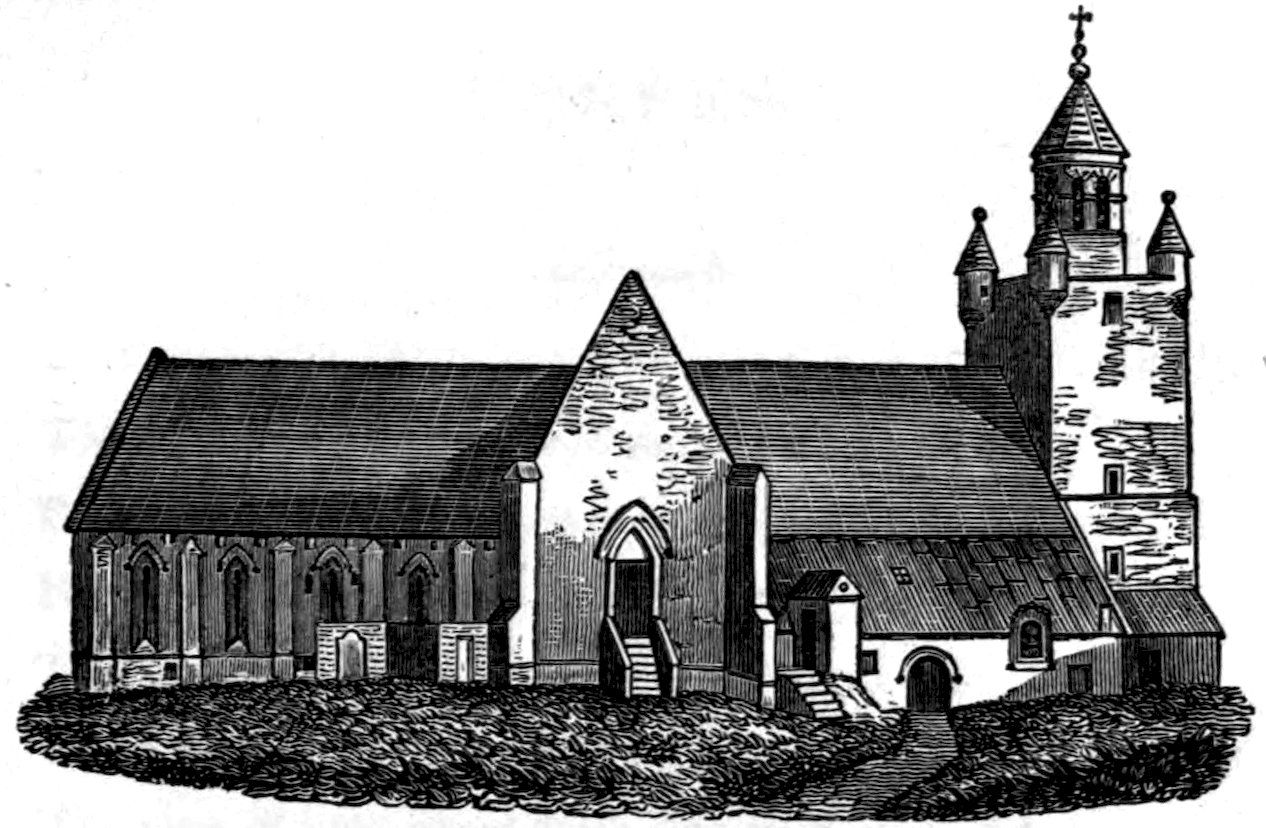
The church of Prestonkirk is supposed to have been originally
built for St Baldred; part of the ruins still remain contiguous to
the modern fabric, which was built in 1770. The late Sir George
Buchan Hepburn observes, in a letter to the author of Caledonia,
that “Baldred’s statue lay long in the church-yard; and he had
intended to have got it built into the church-wall; but, during
his absence, an irreverent mason ignorantly broke it in pieces.”—Caledonia,
vol. ii. p. 541.
An old intelligent carpenter told me, that this statue was similar
to the one now lying in Tyningham church. It was called St
Baudron’s; but was supposed to be the figure of some one who had
left large endowments for ecclesiastical purposes.
The church, and the old village of Tyningham stood on the west
side of the Tyne, about half a mile below the site of the present
village. The latter terminated on the east by the side of an elm
tree, and was removed for domestic improvements. The ruins of
the church still remain, and consist of two beautiful Saxon arches,
which are tastefully shaded with shrubbery, and have a picturesque
appearance. This spot is now the cemetery of the noble family of
the domain. Within the interior of the church there is a small
niche, where three shields are sculptured in relievo. Below its arch
a detached figure reclines, habited in a close gown, with hands
claspt in the attitude of prayer. At the feet of this figure lies the
symbolical lamb, originally holding the cross, which is broken
away. The old carpenter formerly mentioned, told me that this
statue, like that of Prestonkirk, was called St Baudrons. This,
however, is evidently the statue of a lady.
Anlaf, the Dane, spoiled the church, and burnt the village of
Tyningham, in 941, which, Chalmers observes, is a very early notice
of the kirk-town of this place.
“The fierce Dane
Upon the eastern coast of Lothian landed,
Near to that place where the sea-rock immense,
Amazing Bass, looks o’er a fertile land.”—Home’s Douglas.
While the workmen of the Earl of Haddington were, a few years
ago, clearing the ruins of the church, they dug a considerable way
in search of relics. About five feet below the niche formerly mentioned
something like burnt ashes were turned up, but nothing
further discovered. If the relics of the saint were, however,
spared by the fiery Dane, while in search of plunder, it is not likely
they escaped the mania of the early centuries for this precious merchandise,
when the tooths, legs, and arms of the saints were enchased
in silver, and bartered at a high rate.
The Isle of May, like the Bass, forms a conspicuous object in
the Frith of Forth. David I. founded a monastery on the island,
for the monks of Reading, in Yorkshire, to whom it originally belonged,
and dedicated his benefaction to all the saints. It was afterwards
consecrated to St Adrian, who, along with Glodian, Gaius,
(or, as others write, Monanus,) archdeacon of St Andrews, and
Bishop Stolbrand, were martyred here by the Danes. It was afterwards
purchased by William Lamberton, bishop of St Andrews,
from the Abbot of Reading; who, notwithstanding the complaints
89of King Edward, bestowed it upon the canons regular of his cathedral.—See
Holinshed. Like Whitekirk, it was of old much
frequented by barren women on pilgrimage.
This island was next granted in feu by Charles I. to Cunningham
of Burns, for the purpose of erecting a lighthouse for the benefit
of mariners. A tower of forty feet was built for that purpose.
The first builder was cast away, in a tempest raised by
witchcraft, while returning from thence to his house in Fife, for
which some unfortunate old women were executed.—See Keith’s
Cat. p. 238, and Grose’s Scot. Ant. vol. i. p. 81.
A lighthouse, upon an improved plan, with revolving burners,
has recently been erected.
This picturesque rock rises with a bold and rugged sweep, at
least four hundred feet above the surface of the waters, and in the
month of July looks like an enchanted island, where web-footed
birds come to hold a jubilee. It is situated in the mouth of the
Forth, about two miles from the shore, and is inaccessible except
by a narrow passage in the west. The base of the rock is computed
to be an English mile in circumference. From the depth of
the water, extending from thirty to forty fathoms, its entire height
may be estimated at six hundred feet. A cavern runs through
the rock from east to west, which may be traversed at ebb-tide.
It is dark in the centre, where there is a deep pool. While sailing
on the south side of the rock, opposite the opening of this cave,
it was truly delightful to contemplate its sublime scenery. The
rock here appeared piled in tremendous masses, frowning over our
heads, and scattered the restless waves as they rose against its rugged
summits or washed its everlasting foundations, while myriads of
sea birds sat secure and undisturbed on their lofty perches.
Besides the solan geese, which are its principal inhabitants, the
Bass contains pasture for at least twenty sheep, celebrated it is said
in the annals of gluttony; it has also a small warren of rabbits.
90The best season for visiting the Bass is during the incubation
of the geese, in the months of June and July. The most propitious
time is shortly after sunrise, when the waves are calm, and
the greatest variety of birds to be seen. An easterly breeze must
be avoided, otherwise the visitor may expect a good ducking if he
sails round the north side of the rock.
About half way up the rock, a little below the old garden, is the
remains of a chapel pretty entire, where the ammunition of the
garrison was kept when the island was used as a state-prison for
the Covenanters. The niches for the holy fonts show that it must
have been built prior to the reformation of the church.
The Bass pays annually twelve geese to the church of North
Berwick as part of the minister’s stipend.
The solan are commonly taken in the month of August. This
is effected by hoisting the fowler over inaccessible places of the
rock, by a rope fastened to a girdle. The young birds are killed
by striking them on the head, while the boatmen below are ready
to receive them. This perilous employment is often attended with
danger from the falling of loose stones. Some years ago one of the
fowlers would have been buried under a ton-weight of fragments,
had he not had the presence of mind to swing himself under a
jutting crag, where he remained in safety till the mass rolled over
his head.
The solan resembles the cormorant and pelican, both in its
manner of fishing, by diving from a great height, and the method
of securing its prey in a dilatable pouch, of sufficient size to contain
four or five herrings. The gannet or solan goose (the Pelecanus
Bassanus of Linnæus) was supposed to breed no where in Europe
save on the Bass, and the isle of Ailsa in the frith of Clyde; but
they are also found on the Stark of Suliskerry, a holm or uninhabited
island, a little to the south-west of the Orkney isles, and
at St Kilda in the Hebrides.
The gannet also resembles the cormorant in its quickness of
sight. It has a transparent membrane under the eyelid, with
which it covers the whole eye at pleasure, without obscuring the
sight, which seems a necessary provision for so weighty a creature,
whose method of seizing its prey is by darting down headlong
from a height of at least a hundred feet into the water. “They
have a crane’s neck, and a strong sharp bill, about the length of
one’s middle finger, with which they strike through their prey
with such violence, that it often sticks in a board, baited with
herring, so as they cannot pull it out again, and are catched by
the inhabitants.”—Journey through Scot. 1723. Mr Pennant
relates a similar story of one of these birds, which, when flying
over Penzance, in Cornwall, saw some pilchards lying on a fir
plank, upon which, darting down for the purpose of seizing them,
it struck its bill through an inch and quarter plank, and was killed
on the spot.
Holinshed observes, “Certes, there is nothing in this rock that
92is not full of admiration and wonder: therein is also great store
of solan geese, (not unlike to those which Pliny calleth water
eagles, or, as we say, sea herons,) and no where else but in Ailsa
and this rock. At their first coming, they gather such great
plenty of sticks and boughs together for the building of their
nests, that the same do satisfy the keeper of the castle for the
yearly maintenance of his fuel. Within the bowels of these
geese there is a kind of grease to be had of singular force in medicine,
and flaying likewise the skin from their bodies with the
fat, they make an oil very profitable for the gout, and many
other diseases in the haunches and groins of mankind. In this
crag more there growth a herb very pleasant and delicious for
sallads, but if it be taken up and planted elsewhere, it either
groweth not, or utterly loses its virtues.
“There was some time a stone found here, much like to a water
sponge or pumice, hollow on the one side, and of such a nature,
that if any salt water had been poured thereunto, and suffered
to run through, it would forthwith lose the natural saltness,
and become very fresh and pleasant unto the mouth and taste.
We hear in these days that this stone is to be seen in Fast Castle,
whither it was brought after it had passed many hands for
the trial of this matter.”—See Holinshed’s Chron. vol. i. introd.
This remarkable bird is also a native of the Bass, and commonly
goes by the name of the Tommy Nora. It is found, however,
in greater plenty on the isle of Craig Leith, near North Berwick,
where it takes up its abode in the rabbit burrows. When sailing
round the rock on the summer evenings, the bird is heard to
make a mournful noise, like a person crying Ah! ha! Its voice
has been compared to a dumb person attempting to speak, or to
the hum of a large spinning-wheel. This humming sound had a
very pleasant effect, when, from the top of the Bass, we looked
93down on the myriads below, and heard it mingled with the chattering
of the guillimot or skout, and the screaming of the sea-gulls.
The puffin is most celebrated for its bill, which is large and flat,
with its edge upwards, partly ash-coloured and partly red, of a triangular
shape, not unlike the coulter of a plough, hence the bird
gets the name of Coulterneb. The Kamtschadales and Kuriles
decorate their necks with the bill, which the priest puts on with
an appropriate ceremony. While in possession of this amulet, they
consider good fortune will attend them.
The Bass was an ancient possession of the family of Lauder, who
sprung originally from Lauder of that ilk, or Lauder Tower.—Nisbet’s
Heraldry, vol. i. p. 344. According to Henry the Minstrel,
Robert Lauder accompanied Wallace in many of his exploits.
This family continued in a lineal descent till the reign of Charles
I., when it merged into that of Lauder of Beilmouth. In the
aisle of the lairds of the Bass, in the old church of North Berwick,
a tombstone bears the following inscription, in Latin Saxon characters:—“Here
lies the good Robert Lauder, the great laird of
Congalton and Bass, who died May 1311.”
The Bass sheltered James, the infant heir of Robert III., in
1405, when it was judged expedient to send the young prince to
France, to secure him against the dark intentions of the Duke of
Albany. Henry Sinclair, Earl of Orkney, was appointed chief attendant
94in this voyage, and a ship was ordered to the isle of Bass
to receive the young prince; but they had only proceeded to
Flamborough-head, when they were captured by the English.
Nineteen years elapsed before James saw the end of his captivity.
While confined in Windsor Castle he wrote his poem of the King’s
Quair.
The Bass was the last place that held out for James VII. in
Great Britain. It was defended by a gallant officer, David, third
son of James Blair of Ardblair, who afterwards went to France to
his royal master, where he died.—See Douglas’ Baronage, p. 191.
After the Revolution a desperate race of pirates got possession of
it, who had a large boat, which they hoisted down at pleasure, and
committed several piracies. Their boat being at length seized or
lost, and not receiving their accustomed supply of provisions from
France, they were compelled to surrender.
The Bass was purchased by the Crown from Sir Alexander
Ramsay, soon after the Restoration, 1671, for £4000 Sterling, and
converted into a state-prison during the reign of Charles II. and
his brother James, where the western Covenanters, called Cameronians,
were confined for being in arms against the king.—Trans.
Scot. Ant.—It now belongs to Sir H. D. Hamilton, Bart.
Amidst a multitude of prisoners the most remarkable were,
1. Alexander Peden, of prophetic memory. While Peden was
prisoner in the Bass, “one sabbath morning, being about the public
worship of God, a young girl, about the age of fourteen years,
came to the chamber-door mocking with loud laughter; he said,
Poor thing, thou laughest and mockest at the worship of God,
but ere long God shall write such a sudden and surprising judgment
on thee, that shall stay this laughing, &c. Very shortly
after that, as she was walking on the rock, a blast of wind swept
her off to the sea, where she was lost.”
95Another day, while Peden was walking on the rock, some soldiers
passing by, cried, “The devil take him.” He said, “Fy,
fy! poor man, thou knowest not what thou art saying; but
thou shalt repent that. At which the soldier stood astonished,
and went to the guard distracted, crying aloud for Mr Peden,
saying, The devil would immediately come and take him away.
Mr Peden came, and spoke to and prayed for the soldier, and
next morning came to him again, and found him in his right
mind, under deep convictions of great guilt. The guard being
to change, they commanded him to his arms, but he refused;
and said, He would lift no arms against Jesus Christ, his cause,
and his people; I have done that too long. The governor
threatened him with death to-morrow by ten o’clock. He confidently
said, three times, ‘That though he should tear him in
pieces, he should never lift arms that way.’ About three days
after, the governor put him forth of the garrison, setting him
ashore, and he, having a wife and children, took a house in East
Lothian, and became a singular Christian.”—See Biog. Scoticana.
2. Thomas Hogg, minister of Kiltern.—Having contracted a severe
dysentery, he petitioned the council for liberation, which
Sharpe opposed, declaring that the prisoner was in a capacity to do
more hurt in his elbow-chair, than twenty others travelling through
the country; and if the justice of God was pursuing him, the clemency
of government should not prevent it. Hogg was carried to
a low, nasty dungeon, and in a short time recovered. When
speaking of the arch-prelate afterwards, he jocularly said, “Commend
him to me for a good physician.”—See Wodrow, vol. ii.
and Hogg’s Mem. in Scots Worthies.
3. Gilbert Rule, minister at Alnwick. After the Revolution he
became Principal of the University of Edinburgh, and colleague
of Dr G. Campbell, professor of divinity. Dr Rule sat late at his
studies, and Professor Campbell rose early, so that the candle of
the one was often lighted before the other had finished his lucubrations.
Their lodgings being at a little distance with opposite
windows, the one went by the name of the Evening Star, and the
other of the Morning Star.—Crichton’s Mem. Blackadder.
964. Alexander Gordon of Earlston, who was incarcerated in 1683.
His father was slain when on his way to join the Covenanters at
the battle of Bothwell Bridge. He is supposed to be the hero of
the ballad written in commemoration of that fray.—See Minstrelsy
Scot. Border, vol. ii. p. 89.
After the battle, Earlston narrowly escaped being taken by the
ingenuity of one of his tenants, who, knowing him when he was
pursued through Hamilton, made him dismount, and having hid
his horse’s furniture in a dunghill, dressed him in female attire,
and set him to rock the cradle. On the 22d August, 1684, he was
removed from the Bass and ordered for execution; but through
the intercession of his friend the Duke of Gordon, his life was
spared. He was thrown into Blackness Castle, where he remained
till the Revolution.—See Scots Worthies, Fountainhall, Minstrelsy,
&c.
And, lastly, John Blackadder, a lineal descendant of the house
97of Tulliallan, who died in 1685, after five years’ confinement. He
was buried in North Berwick church-yard, where a handsome
tombstone, with a suitable epitaph, has been erected to his memory.
His Memoirs, by Crichton, have lately been published.
Tantallon castle stands about two miles and a half east from
North Berwick, on a high rock, overlooking the sea, which surrounds
it on three sides. The greater part of the building remains
in a ruinous state. The only approach is from the west,
which was defended by batteries. It is said to have been built by
the Douglases, when the overgrown power of the earls of Dunbar
had awakened their jealousy.
The following curious etymology of the place is noticed in
Blaeu’s Atlas, vol. i. p. 41. Two superintendents of the building,
called Thomas and Allan, got permission from the lord of the castle
to inscribe their names on a prominent part of the walls in
Latin, which stood Tom et Allan: hence the country people called
it the castle of Tam ’t Allan.
In 1528 this castle was held for some time against James V.
The particulars of the siege may be found in Lindsay of Pitscottie’s
Chronicle of Scotland.
John Rolland, author of a pedantic poem called the Seven Sages,
resided here about 1544 or 1547. The time and place of composition
are thus mentioned in the Epilogue:—
“So in seven weeks this quair was clene compleit,
Out of plaine prose, now keiping meters feit:
Within the fort and towre of Tamtalloun,
When the English fleat besyde Inchkeith did sleit,
Upon the sea in that great burning heate.
Both Scottis and Inglisch of Leith lay at the toun,
With scharp assiege, and garneist garisoun,
On ather sort quhair sundrie lost the sweit,
That same tyme I maid this translatioun.”
Sibbald’s Chron. vol. iii. p. 287.
98During the protectorate of Cromwell, General Monk was detached
with three regiments of horse and foot to reduce Tantallon.
As the garrison held out, he caused the mortar-pieces to play for
forty-eight hours; but these did little execution, till six battering
guns being planted, they were so well managed, that the governor
was compelled to submit. It was on the high ground, south from
St Baldred’s well, where it is said the artillery was planted.
The following letter of General Monk is preserved in the burgh
archives of North Berwick, which, on account of the singularity
of its style, is worthy of being transcribed:—
“For my very loving friends the Magistrates of the Burgh of
North Berwick.
“Gentlemen,—Having a call from God and his people to
march into England to assert and maintain the liberty and being
of Parliament, our antient constitution, and therein the freedom
and rights of the people of these three Nations from Arbitrary
and Tyrannical usurpations uppon their considering persons
and Estates, and for a Godly ministry, I do therefore expect
from you, the Magistrates of the Burgh of North Berwick,
That you do preserve the peace of Comonweal in yr Burgh, and
I hereby authorize you to Suppress all Tumults, stirring and unlawful
assemblies, and that you hold no correspondency with
any of Charles Stewart’s party, or his Adherents, but apprehend
any such as shall make any disturbance, and send them to the
next Garrison, and do further desire you to assert, countenance,
and encourage the Godly ministry, and all that truely
fear God in the Land, and that you continue faithful to owne
and assert the interest of the Parliamentary Government in yr
several places and stations. I hope my absence will be very
short. But I do assure you that I shall procure from the Parliament
whatever may be for the good Government and relief of
this Nation, and doubt not but to obtain abatements in your
Assess and other public burthens, according to the proportion
of England; and what further services I may be able I shall
not be wanting in, what may promote the happiness and peace
99of this afflicted people. I shall not trouble you further but beg
yr prayers, and desire you to assure yrselves that I am
Your faithful Friend,
And humble Servant,
George Monck.”
Edinburgh, 15th November, 1659.
“I desire that what is behind of the four months of the twelve
months Assess may be in aread in sse against it be called for by
the twelfth of December next.
I desire you to send me word to Berwick under your hands,
how far you will comply with my desires.”
The parish of Whitekirk was anciently called Hamer, which in
Saxon signifies the greater Ham; and may have obtained this appellation
in contradistinction to Aldham. The church and manor
of Hamer were granted during the twelfth century to the Monks
of Holyrood-house. This Church was dedicated to the Virgin
Mary, and from the whiteness of its appearance was called Whitekirk.
During the seventeenth century, the parish was augmented
by the annexation of Aldham; and in 1761 it was farther augmented
by the annexation of the adjoining parish of Tyningham.—Chalmers’
Cal. vol. ii. p. 547.
100Hither many pilgrimages were made. It was under pretence of
a pious expedition to Whitekirk, in order to perform a vow which
she had made for the safety of her son, that the Queen-mother
cozened Crichton, the Chancellor, and carried off James II. in a
chest to Stirling.—Hist. Culdees, p. 188. Tradition says, that
Whitekirk was of old a celebrated place for the fattening of barren
wives, who generally returned home (in one sense,) “as women
wish to be who love their lords.” Immediately behind the
church is a large house, now converted into a granary, where the
unfortunate Queen Mary is said to have passed two nights.
On the hill above Whitekirk, a cairn of stones marks the grave
of two persons who were slain at a conventicle, by a party from the
Bass. This was probably the meeting held here in May 1678,
which was dispersed by Charles Maitland, deputy-governor, when
James Learmont and his brother, with one Temple, (from Dunbar,)
were pannelled, 11th September 1678, for the murder of
John Hay, who came with the King’s forces.
To the sylvan taste of Helen, sixth Countess of Haddington,
East Lothian is indebted for some of the finest plantations in Scotland.
The horticulturist may consult “Treatise on the manner
of raising Forest Trees,” Edin. 1761, or Douglas’ Peerage, vol. i. p.
683, for an interesting letter, dated Tyningham, Dec. 22, 1733,
from Thomas, sixth Earl of Haddington, to his grandson, giving a
history of the progress of these plantations, which arose under the
cultivated taste of his lady.
This excellent person was only daughter to John Hope of Hopetoun,
and sister to Charles, first Earl of Hopetoun. She died at
Edinburgh in 1768, in her 91st year.
101
THE SIEGE OF BERWICK; OR, THE MURDERED HOSTAGE. A Tragedy. IN FIVE ACTS.
103
PREFACE.
The dramatic sketch of The Siege of Berwick, is
founded on a disputed passage of Scottish history, respecting
the barbarous policy of Edward III. in putting
a hostage to death. The silence of the English
historians has been advanced as an argument against
a deed, which was calculated to stain the chaplet of
their favourite hero; a silence which must have arisen
from obvious motives, and cannot be brought to bear
against the testimony of Fordun and Winton, who lived
at a period near enough to the time of action to have
ascertained its truth.
Lord Hailes took considerable trouble to clear up
the mystery that hung over this transaction; and the
following extract, which he found in the Scala Chronica,
besides bringing several curious circumstances to light,
seems to establish the fact.
“The besieged entered into a treaty with the besiegers,
and agreed to surrender the town, unless succoured
before a certain day, and to that effect they
104gave hostages. Before the day thus limited, the whole
power of Scotland, in astonishing numbers, crossed the
river of Tweed one morning at day-break, at the Yareford,
and shewed themselves before Berwick, on the
south side of the river, towards England, in full view
of the King and his army. They conveyed some men
and provisions into the town, and remained on their
ground all the day and the night following; and next
day before noon, they removed into the territories of
the King in Northumberland, burning and ravaging
the country.
“The King’s counsellors required the town to be
given up, as the term stipulated for their being succoured
had elapsed. The besieged made answer, that
they had received succours both of men and of provisions;
and they shewed that there were new governors
in the town, and also knights, who had been sent from
their army. Sir William Keith was one, and there
were others besides. It was the opinion of the English
council that the Scots had forfeited their hostages, and
therefore they caused the son of Sir Alexander Seton,
governor of the town, to be hanged.”
“The narrative of Scala Chronica (observes his
Lordship) appears in general to be authentic. From
it we discover the solution of that difficulty in the accounts
given by the Scottish historians, which hitherto
105has been inexplicable; namely, how Sir Alexander
Seton could have been governor of the town of Berwick
in July 1333, while it appeared from record, that at
that very time Sir William Keith was governor.
“That parties contracting may agree to give some
of their own number as hostages, to be put to death if
the treaty is violated on their part, appears to be a proposition
of more difficulty than is generally apprehended;
but, that they may agree to give their children as
hostages under such condition, is repugnant to every
notion of morality; and therefore I neither pretend
to justify Sir Alexander Seton for exposing his child
to death, nor Edward III. for killing him.”—Lord
Hailes’Annals Scot. vol. ii. p. 384. 8vo edit.
While this tragedy was enacting, Seton felt all the
compunctions natural to a father placed in such a horrible
situation, where his duty to himself and to his
country were both at stake; and, but for the heroic
speech and conduct of his wife, whom Bellenden calls
“a wise woman, above the spirit of man!” he would
have surrendered the place. This lady acted quite in
the spirit of a Spartan mother; but indeed this was
the age of heroic ladies. Besides Christian Bruce, the
defender of Kildrummy, and Agnes Randolph, the protector
of Dunbar; Philippa, Queen of England, the
Countess of Salisbury, and the Countess of Montfort,
106were all distinguished by those warlike exertions, which,
we opine, might have been happily transferred from
themselves to the rougher sex.
The mistake into which some historians have fallen
in sacrificing two of the sons of Sir Alexander Seton,
may have arisen from the circumstance of one of them
being killed in an attack on the English shipping:
Williame of Seytown fawcht sa fast
Amang the schyppys, qwhill at the last
Hys fadyre, than cheftane of the towne,
Into the sea there saw hym drown.
Wyntown’s Cronykil, book viii. chap, xxvii.
Tradition, which delights to magnify objects, points
to “two human sculls in the poor-house of Tweedmouth,
which the oldest inhabitants of the village affirm to
have been handed down from generation to generation,
as the sculls of Sir Alexander Seton’s sons.”—See
Fuller’s Hist. Berwick, Edin. 1799.
The eminence, where the execution took place, is
situated on the south side of the river, about a hundred
yards distant from a fishing water, formerly called the
Pool, but since that event termed Hang-a-dyke Nook.
107
THE
SIEGE OF BERWICK;
OR, THE
MURDERED HOSTAGE.
108
DRAMATIS PERSONÆ.
Scottish.
Patrick Dunbar, Earl of March, Governor of Berwick Castle.
Sir William Keith, Governor of the Town.
Sir Alexander Seton, Deputy-Governor.
Master Thomas Seton, one of the Hostages.
Sir Alexander Ramsay.
William de Prendergest.
The Mayor of Berwick.
Friar Adam.
Turnbull, a Champion.
Golding, } Soldiers of the Garrison.
Aubery, }
Alan, and other Hostages.
Ambrose Carmichael, Town Fiddler, &c. &c.
Officers and Sergeants-at-Mace, Friars, Flemings, Old Man, Messengers, &c.
Scene—Berwick, the English Camp at Tweedmouth, and the Lands adjacent.
109
THE SIEGE OF BERWICK.
ACT I.
SCENE I.
The Council Chamber in Berwick Castle.
[Flourish of drums and trumpets, and shouts heard without.
EnterLord Dunbar, Sir William Keith, andSir Alexander Seton, with attendants.
SETON.
The assault continues, and the gallant Ramsay
Fills up each deadly gap with volunteers,
Mocking all masonry.
KEITH.
Ne’er doth battle shew
A fiercer front, than when her gallant yeomen
110Marshal in proud array to meet th’ invader,
And die or conquer for their church and homes,
Their wives, their children, and their loved firesides.
DUNBAR.
Well said! and, with the purest hospitality
To give the audacious foe an earthly bed
Cover’d with crimson drapery. What now, sir?
EnterLieutenant.
LIEUTENANT.
My lords, the Mayor doth crave an audience.
DUNBAR.
Usher him in. He is an upright man,
A good, devout, and worthy citizen:
A person fitted for important matters;
But rather kind of heart for scenes like these.
Enter theMayor of Berwick, withAmbrose Carmichael,
his body servant, [whom the Officer in
waiting interrupts,] accompanied also by four Sergeants-at-Mace.
OFFICER.
Back, fellow! How dare you intrude here?
AMBROSE.
Ambrose Carmichael, town-musician, town-crier, and
grave-digger, at your service, sir; attendant on his
111honour, the Mayor. Respect the bear’s livery, and be
civil. [TheMayormotionsAmbroseto stand back.
MAYOR.
My lords, I almost dread to make my suit,
Because, before ’tis made, I read too well
Refusal in your looks.
DUNBAR.
Then, pray, good sir,
Let the said suit be made to fit the wearer.
MAYOR.
The city is in flames: The trembling burghers,
Upon their knees, intreat me to implore
That ye this fated city will surrender
Before their families fall beneath the butchery
Of the rude soldiers; and their little ones
Perish of hunger, or of worse disease.
DUNBAR.
My precious gormandizers, thus you come;
Oh! cannot your Pie-powder Court supply ye.—
(I’ve heard that ye will fatten on a bell-rope,) [Aside.
Has corporation dinners eat all up,
That thus you beard us in the face of war
With dread starvation, ere the fight’s begun?
[TheMayor, who is a tall slender-looking man,
standing erect.
112MAYOR.
My lord, I surely do not look like that!
[Ambroseadvancing, who is a plump little man.
AMBROSE.
Nor I, my noble lord, for my fatness comes from
my mother, rest her soul. My red complexion and
dumpling body to boot, comes from drinking nourishing
waters, as the parish clerk was wont to say, rather
than by eating gross meat from the shambles.
DUNBAR.
I suspect, fellow, thou hast not lived upon the Spittal
Spaw;[4] but be silent. Fools should not come here.
AMBROSE.
Fools will venture, my lord, where wise men dare
not enter, my lord! [Retires.
[To theOfficer.] Why do you devour me with your
greedy eyes: didst thou ne’er see an honest man before?
MAYOR.
May’t please your lordship, ’tis no time for jesting;
O save the city ere it be too late!—
Not for myself I plead, but hapless wretches,
That run like bedlamites across the streets,
Shrieking for help; yet scarce know what they seek!
As they behold their all devour’d by fire
113Lit by the glare of Ruin. For myself,
Could I shake off the manacles of age
That rivet every sinew, ye should see
Me first to mount the walls—the last to leave them.
Heard ye that shout without? I do beseech you,
With skill united, meditate our safety,
While I retire to keep the mob in order,
Lest, like the flames, they do destroy themselves.
Eternal Heav’n, why didst thou poise the world,
To hang it on such human wretchedness!
DUNBAR.
Retire, good man! and rein the brawling burghers,
While we delib’rate here, in secret council,
What best may suit the purpose of events!—
[ExitMayor.
AMBROSE (aside.)
What a ravenous, rascally thing is war!—It pays
no respect to persons, gentle or semple, lord or clown.
In battle, as in the grave, we are all upon an equal
footing at a short notice: so run, Ambrose, and keep
at the tail of your master; as for poor Maggy, she
must shift for herself, as the forester did when the
bears devoured his wife and three sons, and he was left
alone to cry out a Bare Week.[5]
[ExitAmbrose.
114DUNBAR.
To council now, my honoured governors!
I move that we do seek a gentle truce,
Wer’t but to earth our dead; and for this purport
Seton goes envoy to the English camp,
To ask delay, while we await the issue:
Should the proud monarch grant this small request,
Keith goes to Bamburgh, to consult the Regent
What may be done.
SETON.
And on what terms shall I crave a truce,
Since haughty Edward will not grant delay,
Unless ’tis bought with obvious advantage?
DUNBAR.
That town and castle shall be render’d up,
Unless within six days we meet with succour;
But should two hundred men at arms succeed,
To cut a passage through the English host,
We stand relieved, and meet them man for man.
KEITH.
O sage in council as renown’d in war!
We shall abide, my lord, by your decision;
Plans wisely laid, must in maturity
Bear goodly fruit; meanwhile, remember, Seton,
To seek safe-conduct to Northumberland. [ExitKeith.
115SETON.
Farewell, my lord, while I proceed to Tweedmouth
Upon this desp’rate mission. Heaven forfend
That it may meet the success its importance,
Big with the fate of Scotland, doth deserve;
God and St Andrew be our country’s help!
[Exeunt severally.
SCENE II.
Inside of a Hovel.
AMBROSE (solus)
Thank Heaven! there’s peace again since the blessed
parley was sounded. Thrice blessed be the manes of
the man who invented parleys; for they speak pleasantly
to the ear of the soldier that has been long deafened
with the din of war. They are like a sweet word
from Maggy after a violent scolding. Why do you
cry, Mag?
EnterMaggy.
MAGGY.
Woes me! they’re leading the poor lads down the
Western lane like sheep to the slaughter, while their
fathers are sobbing and their mothers are crying.
116 AMBROSE.
What poor lads, Maggy?
MAGGY.
The young hostages. Devil take that English tyke,
and make a haggis of his bladder! I wonder if he has
bairns of his own—and how he would like to see them
led forth like two-month-old lambs. No doubt every
body thinks their own crow the fairest!
AMBROSE.
Hush, Maggy, and shut your mouth, and talk lowly.
There’s no doubt kings and emperors come into the
world and go out of it like other folk, but they don’t
care so much for their bairns as we do: seeing they
get others to keep them, and teach them, and so forth.
But it does not become either you or I to speak evil of
authorities. Let us mind our own concerns. Do you
hear that noise, honey?
MAGGY.
Let us run, Ambrose, and hide ourselves in the peat
cellar, where we may pray in safety!
AMBROSE.
Get you there, while I seek the tail of my master;
since, doubtless, the greatest savages in Christendom
will respect the bear’s livery, and do no harm to the
Mayor of Berwick. [ExitAmbrose.
117 MAGGY.
Then I’ll e’en go with you; since it is not meet that
man and wife should be separated. [Exit.
SCENE III.
A Room in the Castle.
EnterLord Dunbar.
DUNBAR.
I do not like the feature of this war,
That in the shadow of my mind appears
Too like the sun that rose on fatal Duplin,
A day to be deplored in Scottish annals.
This puppet Baliol is too well supported
By that baronial faction, that do serve
The side that suits their purpose. Honesty,
Alas! has been too long estranged from Scotland.
Am I not blamed for serving England too?
Why not?—The dazzling gewgaw of a crown
Seem’d once within my grasp; my claim as good
As Bruce and Cumyn; ay, and many more.
Was not my father’s grandam sister-in-law
To Henry Fourth of England? was not Bruce
118My father’s cousin? Now for once I strive
To emulate the soul of glorious Randolph,
And serve my country with a duteous love:
Edward is in my debt! Did he not hire
The monk, that, like another Saxon Coppa,
Administer’d medicine in the shape of drugs
To the regent, Thomas Randolph, my wife’s brother,
Who yielded his dear life through this assassin,
When Scotland needed most his gracious aid;
I shall requite the king; but, hark! who comes?
EnterKeithandSeton.
Sir knights, so soon returned?
SETON.
Even so, my lord.
DUNBAR.
How speeds the mission?
SETON.
I’ve succeeded well,
But rather for the mission than myself;
Since a short truce is bought at a high price
For my soul’s comfort. England, as surety,
Demands eight hostages, ’mongst which my son
Is honour’d with a sorry precedence
In the devoted list. Three short, short days,
The utmost limits of this puny truce.
Heaven waft Sir William on the eagle’s wing,
119And bring the Regent here with early succour;
For many a parent’s heart will throb till then.
DUNBAR.
I feel for thee, sir knight; but thy devotion
For this lost land by Heaven will be rewarded.
The deadly blast of war will soon blow o’er,
Then shall our warriors fill the goblet high
In honour of the chiefs who saved their country;
And our fair daughters, when to grandames grown,
Shall tell their children of their great grandsires
Who fought and fell at Berwick.
KEITH.
Be comforted, dear friend! what man can do
To bring relief in this sad strait shall I.
I’ll spur my steed, even to its utmost strength,
Until its coal-black sides are white with foam.
I only crave your pious dame’s best prayers
To aid me in my absence—time is short,
But summer days are long, and willing hearts
Travel like Mercury: my good lords, adieu!
[ExitKeith.
DUNBAR.
There goes as brave a knight as ever wore
A pair of gilded spurs, or e’er partook
The peacock’s royal feast.
120SETON.
Yes! and I promise him two spurs of gold
Should he return in time to save the city
And those within its walls.
DUNBAR.
He reins a steed
Fresh from the desert, footed by the wind;
So, Seton, be of cheer.
SETON.
Time wears apace.—
I go to muster the young hostages,
For England’s monarch will not brook delay. [Exeunt.
SCENE IV.
A Room in the Governor’s House.
Sir Alexander Seton, Lady Seton, Master
Thomas Seton, with other eight of the Hostages,—theMayor of Berwick, and Ambrose Carmichael.—Guards
appear in waiting in the back-ground.
YOUNG SETON.
Don’t weep, my dear father and mother. I shall
soon, very soon return. Edward is a great and a good
121prince, and will not hurt us; and then I am not afraid
of the English, for they wear no beards, and look ladylike.
AMBROSE (aside.)
Neither does the vulture; but it is best to keep out
of the vulture’s claws; and I don’t like those hungry
Welshmen, with their large knives.
SETON.
We shall hope the best, my dearest boy!
YOUNG SETON.
Then we’ll have such a fine view of the English camp,
and those whiskered Hainaulters, and the Yorkshire
bowmen. O what sport the other boys and I will have!
Won’t we, Alan?
ALAN.
O yes! and we will learn to play at shuttlecock, and
wrestle like big men.
THE MAYOR.
Grant Heaven may protect the poor innocents!
AMBROSE (aside.)
Amen!—For the tender mercies of the wicked are
cruel!
SETON.
Take a father’s blessing with thee, my dear Thomas.
[Embraces him.
122 YOUNG SETON.
I can take nothing better with me, my dear father.
LADY SETON.
Kiss me, my dear boy!—Be brave like your brothers.
Remember always that you are a Seton, and part with
your life rather than with your honour. Kneel to no
earthly power; but bow to the Majesty of heaven
evening and morning, and God will protect thee.
Again, before you go, remember that your uncle was
the bosom-friend of Wallace; and, that the whole of
the Tweed will not wash the Bruce’s blood out of your
veins, in whose cause you now embark. Farewell.
[Kisses him.
YOUNG SETON.
I will remember all, my dear mother! adieu, adieu.
EnterLieutenant.
LIEUTENANT.
My lord governor, the boats are ready.
AMBROSE (aside.)
We may thank the rascally English that the young
lads must walk upon water, and be indebted to the
prayers of the Trinity friars for a safe passage.
YOUNG SETON.
Lieutenant, we are ready; being as impatient to go as
you are to fulfil your duty. [Exeunt severally.
123 AMBROSE.
Thank Heaven I am neither a burgess, nor the father
of a family, else my children might have had the honour
of a tramp to the enemy’s camp! [ExitAmbrose.
SCENE V.
A Hall in the Castle.
EnterAubery.
AUBERY (sings.)
Farewell! farewell! sweet day, adieu!
The sun that’s fading fast to view,
And sinks so lone in Arran’s wave,
Will rise to gild the patriot’s grave.
Yes! fare-thee-well! sweet day, farewell!
The evening chimes so softly swell:
Those silver chimes the patriot hears
Will be the last he lists in tears.
EnterGolding.
How goes it, Golding? you look very sad.
GOLDING.
The prisoner died
Last night of hunger, after he had gnaw’d
124His hand off, save what dangled in the chains.
Poor man! three weary days he was forgotten;
’Tis horrible—most horrible, and proves
Our cannibal nature. For, alas! I’ve heard,
That in the flowery vale of Annandale,
In ancient times, there dwelt a savage people
Call’d Ordovitians, who devour’d their prisoners;
And that the monstrous wives of such sad husbands
Slew them, if they forsook the battle-field,
Or were defeated.
AUBERY.
Tush, man! the event
I could have prophesied. Last night, on guard,
A little bird came flirting in my ears,
Like that thou bearest now. Bethought me, then,
The soul of man will enter into birds;
And it were heaven to the poor wretch who pines
His better part of life in the damp Keep
Half rotten above earth; yes! it were heaven
To leave his chains behind, and fly away,
And mingle with the mountain breeze, and be
A thing of liberty. I often wish
I were a tuneful linnet, that might fly
Unknown, to nestle on the shady Pease,
And serenade my Flora when she goes
To milk the kye on those romantic banks.
125GOLDING.
Pshaw, Aubery, away with love-sick nonsense!
But, ha! I feel a tear start in mine eye,
What of the bird?—
AUBERY.
I turn’d and gazed; and, lo! the Fleming’s tower
Appear’d on fire, (even as that beauteous chapel
Seen in the wayward walks of Hawthornden
When Roslin’s lords do pay the debt of nature;)
While I distinctly heard the clash of chains
And pond’rous armour.
GOLDING.
Probable, most probable!
The armourers were at work; yet, ’tis most sad
To be pent up within these walled towns,
And fed on horse-flesh, till the leprosy
Do rot us out. Oh! for that glorious time
When, led by Douglas ’gainst Osmyn the Moor,
I first adventured in the Holy Land:
Then I was young, and burn’d for scenes of arms,
And deem’d the soldier’s life a pleasant pastime
For gallant, generous hearts that loved adventure,
Its darker parts conceal’d in the back-ground.
Then at our tinel we had spice and wine,
Trumpets and timbrels, while the choicest flowers
Of chivalry sat round the warrior’s banquet;
126Graced with those dark-eyed dames, nearer allied
To Sol than those our frigid climes produce;
Beautiful, mellow, yielding as their fruit,
With hearts as cheerful as their cloudless skies;
Yes! Aubery, then the poorest sentinel
Fed like a prince, glutting the raven War
With choicest cookery.
AUBERY.
Pshaw! kickshaws and trifles;
My bag of oatmeal now would bring content,
Could I enjoy it in a peaceful shade
With Flora, and her sister Innocence.
My light iron girdle, now it lacketh flour,
Is like a body parted with the soul,
Or like our hide-form’d cauldrons void of venison.
GOLDING.
O Aubery! Aubery!
Your wit is like St Bothan’s crystal spring,
That never fogs or freezes! always pure.
AUBERY.
Heavens! for the festival of good St Cuthbert,
That we might hamstring the five harts of Selkirk
Upon their march to holy Coldingham,
To feed the greasy monks, who lacketh not.
GOLDING.
Oh! some of those fat beevies were delightful,
127Which we took up in our Northumbrian raid,
And left upon the south banks of the Wear,
To feed the glutton English. But the Douglas
Liked better to destroy than eat their cattle.
Had we such leaders now, we would not starve,
While the poor burghers, Nebuchadnezzar-like,
Feed on the grass. I have not had a morsel
Free from loath’d putrefaction this bless’d month.
What boots it, then, in hungry times like these
To rear up popinjays? I’ll teach an art,
Taught by an English archer, for that bird;
Wrestle a fall with thee; and he who wins
Shall banquet on the prize.
AUBERY.
’Twere better not,
Perhaps the bird contains the prisoner’s soul!
GOLDING.
So much the better; double meals are sweet
In hungry times like these. A portly priest,
A flesher, or a tapster; each were good;
Now, for the glorious attitude of man.
[Goldingplaces himself in the wrestler’s first
position. While they wrestle, the bird is put
below a cap.Auberyis thrown.
The prize is mine! There, Aubery, thou liest
Flat as a flounder on thy spacious back,
128Which might serve Thimble for a shaping-board.
[Takes up the bird, squeezes it, and while retiring
exclaims,
’Twill make a precious meal! [ExitGolding.
AUBERY (recovering.)
Marry, it will.
I did intend it for another purpose;
To stuff it for my Flora. Devil choke thee,
No good will come of such begotten gear.
[ExitAubery.
EnterAmbrose, (who had observed them unseen) in
the costume of one of theTown Waits; viz. a large
blue cloak, faced with gold lace, and a cocked hat
trimmed with the same embroidery.
AMBROSE.
Precious fools! thus to wrangle for jackdaws, when
perhaps a piece of winged iron next moment brings
their billet of reckoning. The true saying, that every
bullet has its billet, supports me amidst the cracking
of culverins, and the pouting of battering-rams, that
shake the masonry of our ramparts like an earthquake;
but I must not forget the purport of my ambassadorship.
Ambrose Carmichael, town fiddler, town crier,
and grave-digger, at your service, has the honour to
129be the bearer of a billet to the governor; herein shewing,
that ambassadors are but letter-carriers, and letter-carriers
but pigeons. Hush! May not these important
services of mine in canny moments, hitch me into a
captaincy of the town-guard. My mother was a sensible
woman in her day and generation: she always
said Ambrose would either be a little man or a great
man; so, guess ye to which my prepondering genius
has a tendency. [ExitAmbrose.
130
ACT II.
SCENE I.
The Council Chamber.
Lord Dunbar, Sir Alexander Seton, andSir
Alexander Ramsay, in conversation. Attendants
in waiting in the back-ground.
[Flourish of Drums and Trumpets.
EnterHerald.
HERALD.
In name of puissant Edward, King of England,
The Lord of Ireland, Duke of Aquatine,
I summon thee to render town and castle,
Ceded to us by John of Scotland, king,
In recompense for ancient services
Done to your country by our gracious sovereign.
131DUNBAR.
We know no services your king has rendered
To this devoted land, unless ’tis service
To stir her factious nobles up to strife,
Then slay them in detail. Call ye this service?
We own no prince but David; here we stand
Receiving daily succour, and determined
To hold out while we may.
HERALD.
Enough, great baron!
Who estimatest an action by its success,
Not by its moral worth. Whence blows the wind,
The wavering wind of thy state politics? [Aside.
My purport is to tell thee, England’s king
Has sworn procrastination’s at an end,
He hates thy evasive measures. In the name
Of England I defy thee; as a token
I throw my gauntlet thus upon the ground.
[Ramsay, unable to conceal his rage, kicks it away.
Thank ye, sir knight! We will not starve you out,
But beat you out by force. Should still your gates
Remain shut up against our monarch’s mercy,
Wo be within your walls.
RAMSAY.
Sooner than yield,
132I’ll fight until the walls become my monument;
Sooner than starve, I’ll plough the unpaved streets,
And wait till spring shall whiten them with grain.
SETON.
Peace, gentle Ramsay!
RAMSAY.
No!—war to the hilt!
O for the Douglas now to lead you on!
[ExitRamsay.
SETON.
My worthy Herald, tell your puissant lord,
We crave delay, in terms of the truce,
Till Sir William Keith’s return.
DUNBAR.
’Tis meet we wait despatches from the Regent.
HERALD.
Wo be within your walls—wo to your matrons;
For high in air, like scarecrows, each young hostage
Shall teach obedience to my royal master.
SETON.
If heavenly truth remains the brightest gem
In the king’s crown; (for prince’s words are sacred,)
I crave delay in terms of the truce.
O tell your master, as he hopes for mercy
In the great day, so he will spare our feelings!
133DUNBAR.
Tell king Edward,
Should not two hundred men by break of day
Break through the English host, we pay him homage.
HERALD.
Again I give defiance, and take leave,
For in my person ye’ve insulted England;
The ultimatum is, lend ears and hear,
Should ye hold out till vesper-bell be rung,
Sir Alexander Seton’s son is hung. [ExitHerald.
DUNBAR.
There goes a puppet! I should like, by heaven,
To have him in my castle’s massy Keep;
I’d wring politeness from him. Let us now
Prepare for war; but, Seton, be of cheer,
For Heaven will help, and Keith will soon be here.
[Exeunt.
SCENE II.
A Room in the Governor’s House.
SETON (solus.)
This fearful conflict, with paternal love
And duty to my country, is most dreadful;
Sure my poor heart will break, or burst the steel
134That laces it. I’ve somewhere read of men
Who died for friendship; of a judge who pass’d
Sentence on his own son; but I have ne’er
Heard of that man who sacrificed his child
To save his country. It is horrible!
Bury me, earth; for what were fame, promotion,
To live the murderer—is there in our language
A term so unnatural—live the murderer
Of one’s own child! Good Heaven! I’d better live
A life of wo, an outcast from society,
Than be the death of one so young and gentle,
Who holds a charter, drawn on me by nature,
Of preservation. Ha! I see even now
My boy down on his knees, begging his life!
Asking his father not to shed his blood.
I am a monster, that with sad delay
Pass sentence on my son. These eyes behold
His tongue choked up and palsied with the halter;
That tongue—whose parting accents blest its father!
Here comes a sorry comforter, poor lady!
She walks like Melancholy; and I dread
The sternness of her dull perturbed look.
EnterLady Seton.
Hail, gentle Christian! I am sick at heart;
The want of sleep, and fearful dreams, have thrown
A languor o’er my spirits.
135LADY SETON.
What news from Tweedmouth?
Does the royal tyrant, with his gilded banners
That mock the sun, intend to blast our sight,
Till Scottish mists do rot his silk pavilions,
Or Scottish earth receive his rotten heart?
SETON.
I fear thy first surmise resolves to truth,
Unless kind Heaven doth send us speedy aid;
He is no idle, no inglorious foe
Goaded by youth, ambition, rival factions;
And like his father, whom that faction duped,
Too lofty-minded for his subjects’ weal.
Had not rich France, the lion lured aside,
He’d mounced us long ere now. Alas! alas!
I can unfold no more.
LADY SETON.
Alas! I know
What ye would say. Heaven’s sovereign will be done!
But oft when storms look darkest on the Cheviot
A wandering sunbeam cheers the face of nature.
The event lies hid in dark futurity;
Whate’er the issue, Seton will not violate
His country’s trust—its safety—and his honour!
Though every pledge of mine were naked laid
136Before the sabre’s edge! our weakness ne’er
Shall shade the rising glories of the war.
SETON.
O woman! to such fate canst thou abandon
The fruit of thine own womb,—that fed upon
The juices of your breast,—whose little eyes
Beam’d pleasure when they first beheld thy face!
Can ye abandon him whose latest accents
Lisp’d a farewell with tears, and blest his mother
For her maternal love; and can ye now
Forget the dearest part of woman’s nature?
Speak but the word: I render up the town.
LADY SETON.
Nay, talk not thus; let Heaven’s will be done,
Since we must suffer ill that good may follow.
God gave us children, and the Lord shall take
His own in his good time. The blessed book
Tells me of many saints in ancient times,
(When faith was nurtured on a richer soil
Than in these latter days,) who gave themselves
A sacrifice to God; and next to God’s
Our native land. “Did not the prophet Daniel
“Banquet with lions, and escaped unhurt
“From out their hungry maws, while the poor heathen
When men need Roman hearts. What news from England?
KEITH.
My gallant friends,
The siege is raised at Bamburgh, and the Regent
141Comes with a powerful host in aid of Berwick,
That he may lure the royal beast aside,
And save us from his claws.
DUNBAR.
’Tis well!—[Aside.] I fear
That this manœuvre will exalt his rage
To some rash act.
SETON.
O God! I dread, I fear
My boy will suffer. Oh, ’tis very sad
To be a father in the day of sorrow,
And lose a favourite child. It makes a gap
In life, which fate or time can ne’er restore.
KEITH.
Be firm, while I, De Prendergest and Gray,
Try what yet may be done. I leave this place
In noble hands, the brave Dunbar and Ramsay.
[ExitKeith.
SETON.
My Lord Dunbar, I stand in need of counsel;
Edward, I dread, will execute his threat,
Unless we render this fair town and castle;
Alas! alas! my gentle boy has fallen
In the sea-fight, and now I dread his brother,
Before another sun shall shine on Berwick,
Will be hung up to appease the tyrant’s rage!
142DUNBAR.
’Twere barbarous!
But since too much approved in time of war
Men are not nice in means to serve their purpose,
I have a varlet here who owes me service,
And he will render it in gratitude,
Seeing my lady’s brother saved his life
At Roxburgh’s bridge, and gave himself in lieu
Rather against his will. This soldier, school’d
In deeds of stratagem by the Black Douglas,
Will beard the royal lion in his den,
And stay or mar his purpose.
SETON.
Be it so!—
Although in calmer hours my soul would shrink
From such an act; but being thus pursued
I can but strike, be the blow foul or fair;
And, surely, if in jeopardy the drowner
Destroys the arm that saves him, well may I
Strike down the monster who devours my flesh.
DUNBAR.
It does not merit thought; ho, Golding, here!
EnterGolding, in a Minstrel’s Habit.
GOLDING.
I wait your lordship.
143DUNBAR.
Thank thee, valiant man;
Speed, Golding, speed, and in thy minstrel habit
Sue for admittance to the royal tent.
Tell that there’s treason here; that ere the morrow
The castle is surrender’d; should ye fail
Signal of smoke shall show; so may ye save
The beardless hostages; so Berwick’s wives
Will bless and glad reward thee.
GOLDING.
With a kiss!
But, by the rood, should this same emprise fail—
Should I return without a draught of vengeance!
I forfeit life, and at St Mary’s Port
Dub me a traitor; your reward reserve,
As I shall prosper, so shall I deserve.
[ExitGolding.
DUNBAR.
There goes a resolute soldier—would to Heaven
My Agnes had a dozen such at present.
Dunbar too soon will feel the brunt of war! [Exeunt.
144
SCENE V.
The Interior of a Hovel.
EnterAmbroseandMaggy.
AMBROSE.
Well, Maggy, it’s just what I said: these great people
care no more for their children than a he-cat. The
governor will not open the gates to the English to save
his own son, and the upshot will be, that all the young
lads will be hanged without benefit of clergy. Ay, ay,
I dread much all will soon be over; for no doubt the
young king carries his father’s bones in his doublet,
and wherever the old rascal’s bones are, the Scots will
be defeated, if we may believe the soothsayers.
MAGGY.
Woes me! and there’s my lady ranging about the
town like a mad-cap, encouraging the men to fight.
It were more wise that she were down on her bare knees
like me in the peat-cellar.
AMBROSE.
’Tis very savage-hearted, Maggy, but every one is
145no gifted with the treasure of humanity like you and
me. They are just like the cannibal Romans, who
were never so happy as when their children were massacred
in battle.
MAGGY.
You are deep learned, Ambrose; but I often praise
God that you are a town-fiddler and not a general!
AMBROSE.
But an officer of the town-guard, Maggy, were both
safe and honourable, except on extraordinary occasions.
Sieges do not happen every day.
MAGGY.
If you set your heart to that, Ambrose, I will not
oppose you. I’ll neither advise you for or against it,
since I know my advice would not be taken.
AMBROSE.
Then the salary is so handsome, Maggy; and you
would go drest like a lady!
MAGGY.
I’m not envious, Ambrose; “for pride gangs before,
and shame follows;” but we cannot help good luck if
it comes to us whether we will or no.
AMBROSE.
I’m not ambitious, Maggy; every man is not born
with a silver ladle in his mouth; but if a man is gifted
with talents, it were sinful to abuse them and not
146use them. Ye know that old Rome was saved by the
cackle of geese.
MAGGY.
And if Rome was saved by the cackle of geese, may
not Berwick, haply, be saved by the town-fiddler?
AMBROSE.
Doubtless, Maggy; but I have a secret which I
may not venture to tell you.
MAGGY.
And why would you keep a secret from me, Ambrose?
AMBROSE.
Because I promised on my honour not to divulge it.
MAGGY.
O, in that case, all’s right!—I’ll not press ye, Ambrose;
but was I, who am your born wife, included in
the bargain?
AMBROSE.
All, and every one, Maggy.
MAGGY.
Then seeing, that being part of thee, I am consequently
nobody, do please tell me.
AMBROSE (whispering.)
I’ve been with a billet from the Mayor to the Governor.
Lady Seton is afraid of the vengeance of the
147King of England, and wishes to make her escape in disguise.
MAGGY.
Oh, Ambrose! try and get me included in her train,
were it only to carry her farthingales off the causeway;
for I long to leave this place; and might be useful
to my lady as a maid of honour.
AMBROSE.
It were desirable, Maggy. I shall proffer your services,
which, if accepted, may hitch us both a yard
higher up the ladder of preferment. Meanwhile clap
your thumb on what I have told you. Keep your eyes
open, but your mouth shut, as the cook said to the
careless scullion.
MAGGY.
As I am a woman, so shall I keep your secret: but
I must go, for the pork is frying, and I don’t wish the
hungry neighbourhood to smell it. [ExitMaggy.
AMBROSE.
Well thought; for they would fight like racoons to
devour it; and would make as much fuss about it as
Symy and his lad Lowrie did for Cowkelbie’s sow.
Oh! I long to see Ambrose Carmichael, town-fiddler,
promoted to a captaincy in the town-guard, for important
services rendered to his king and country.
[ExitAmbrose.
148
ACT III.
SCENE I.
The Council Chamber.
Lord Dunbar, Sir Alexander Seton, with Attendants, grouped in consultation.
EnterOfficer.
OFFICER.
My lords, the herald.
HERALD.
The King of England, merciful as brave,
Doth once more summon thee, to render up
The town and castle to your rightful liege,
King Edward Baliol, who is now at Tweedmouth.
Should ye resist the royal mercy still,
The hour of vespers, which approaches near,
Shall see each hostage quivering high in air;
149As token of the truth, behold, even now,
The gibbets rise before the walls of Berwick.
SETON.
Down, down, proud heart! [Aside.
In terms of the truce, we yet do crave
Delay till Keith’s return. Speak to him, March.
DUNBAR.
Tell proud Plantagenet, king of haughty England,
That I, Patrick Dunbar, the earl of March,
Will hold this castle till its stubborn walls
Be levell’d with the ground; and if I render,
Ungird my sword, cut off my knighthood’s spurs,
And let me live degraded. When ’tis ta’en
The prince may breakfast with my lady, Agnes,
Who’ll give him warm toast in her family house,
A few leagues distant.
HERALD.
My lord, we lack not toast,
Although your lady were a noble toast
To grace a conqueror’s banquet. Here I breathe
Defiance in the name of England’s king!
Our veterans burn to kiss your yielding maids;
The gibbets are impatient; at the toll
Of vespers, mercy on each youthful soul!
[ExitHerald.
150DUNBAR.
Seton, prepare for war; for in the camp
There’s mighty movements; but I do not deem
That Edward’s royal mind will stain his chaplet
By such a deed.
EnterOfficer.
OFFICER.
My lord, on the horizon
We see the troops advancing. Helm on helm,
Banner on banner, glittering in the sun;
While the far spears gleam like a silver forest
Gilded by lightning.
SETON.
Now Heaven be praised; for Keith will soon be here!
DUNBAR.
I guard the castle—Seton, to the town;
Send gallant Ramsay to protect the ramparts;
Let Prendergest and Gray close up each avenue;
This is the time when England’s arm will strike;
Ring the alarum, till the Bell Tower shakes
To its foundations, and with one voice cry
God for our country, David and St Andrew! [Exeunt.
151
SCENE II.
The Governor’s House.
EnterSir Alexander SetonandLady Seton.
LADY SETON.
Whence is this haste, my lord?
SETON.
Love, to the castle,
Where ye may rest in safety as the dove
Sits in the clefted rock when tempests rave.
Oh! know ye not the assault’s again begun!
The magistrates implore us to surrender,
Alarm’d as I am for their hapless children.
LADY SETON.
What! will your coward hearts, without a blow,
Deliver up the place?
SETON.
What can we do?
For sack or storm I care not; no, not I,—
But, Heaven! my boy, my boy!
LADY SETON.
O wavering man!
152Would ye give up your country’s precious trust?
By Bruce’s royal blood that warms your veins,
I conjure you to pause. Think not the tyrant
Will keep his perjured word, though ye surrender.
Ah! no; and these poor minions all too late
Will see their temples spoil’d,—their infants slain—
Chopp’d from their mothers’ breasts, virgins deflower’d,
And hoary headed men, and sickly wretches,
Piled dying on the streets; war’s red arm bared
Till Tweed run blood; the burghers crucified
By the accursed Jews let loose to plunder;
And would ye ope your adamantine gates
To such a horrid scene?
EnterOfficer.
OFFICER.
My lord governor,
In a sortie led by the gallant Ramsay,
Your son is taken by the enemy. [ExitOfficer.
SETON.
Here I stand, like Job,
Beneath the blasts of Heaven! ay, like the gourd
Smit in the wilderness. Alas! alas!
My children falling round me, one by one.
I can support no more. My son, even now,
Like his lost brother, doom’d to execution.
153Heaven’s scourge falls heavy. Shall my stubborn heart
Refuse submission, that the tyrant’s vengeance
May make me childless.
LADY SETON.
My dear lord, don’t faint!
Bear yourself like a man, and comfort me,
For I had need of it. The cunning Edward
Must not betray us thus. What boots his word?
Remember thy brave brother Christopher,
Who was betray’d, beheaded, like his friend
The glorious Wallace! If they gave themselves
Martyrs for Scotland, oh! shall we refuse
Our sons, who both are young, and Heaven will sure
Reward our sacrifice with plants as fair
As those we’re doom’d to lose,—if plants as fair
May be.
SETON.
O might I perish in their stead!
But Heaven requite the tyrant’s broken faith—
Kings promise, are absolved, and die reputed
For what would damn the meanest wretch that lives.
LADY SETON.
And would ye take the tyrant at his word,
And render town and castle, fame and honour,
To be the victim of credulity,
And afterwards derided as a traitor?
154Rather than homage thus Plantagenet,
Had I a thousand lives I’d lose them all;
Rather bear children daily for an age,
Than buy their lives at such a doubtful price!
While I, your lady, love, like Buchan’s countess,
Will be perch’d up upon the castle’s turrets,
Throned like a wild beast in an iron cage,
For Scorn to point at, and cry Ha! ha! ha!
SETON.
Nay, Christian, it must be, whate’er the event,
For nature now, in silent eloquence,
Even as a voice sent from the opening heavens,
Urges parental duty. What is Fame?
’Tis sound!—a bubble floating in the air;
Painted with rainbow colours, by the sun
Of dazzling honour, and as false as they;
Which men, like grown-up children, seek to catch,
Yet find it nothing,—Oh, my son! my son!
Time flies; ho! messenger! [ExitSeton.
LADY SETON.
Now all is lost. [Exit.
155
SCENE III.
The English Camp at Tweedmouth.
King Edwardseated under a Royal Canopy, surrounded
byBaliol, Lords Montague, D’Arcy, Percy,
John of Hainault, and other Generals. Guards
in the back-ground.
[Flourish of Trumpets.
KING EDWARD.
See that the caitiff be secured, and led
To instant execution!
OFFICER.
It shall be done, my liege. [ExitOfficer.
KING EDWARD.
These damned Scots,
Nursed in the school of Douglas, practise well
The arts of stratagem; but in the field
Are arrant cowards, else they would not shun
My chastisement. Thanks to my trusty doublet
Well temper’d, else that minion’s thirsty dagger
Had done its office. It is shameful thus
156To tarry, lords, while royal blood is spilt
On such occasion.
D’ARCY.
My most gracious liege,
We wait your orders to chastise the foe.
[They all grasp their swords.
KING EDWARD.
’Tis like the game they play’d at Stanhope Park,
When I was rescued by my gallant chaplain;
Those priests fight well; remember the brave Chapter
Of Mitton, led on by th’ Archbishop of York
Against the mob, who perish’d, every soul,
And saved the queen! these, these were noble men,
To teach my warriors valour!
D’ARCY (aside.)
I, by Saint Patrick, that was well-fed mutton
For the poor hungry Scots.
KING EDWARD.
I burn to whet my faulchion on these Scots,
That fly like game pursued, and ever mock
Our generalship. We march,—they fly—retreat—
Till night returns, and burning villages
Tell where the base outlaws have fix’d their camp;
Next morn beholds the ravaged plains deserted,
Smoking with refuse of luxurious spoils
Stolen from our wealthy yeomen; even as those
157Swart vagabonds that banquet on the heath,
Beneath the blasted tree; and fly at dawn,
Lest the fair day reveal their hellish deeds.
BALIOL.
They dread to meet your highness in the field;
But, like the assassin, strike you in your tent
When asking charity.
EnterSir Richard Benhale.
KING EDWARD.
Is the caitiff hung
BENHALE.
Yes, gracious liege! and died a horrid death;
For, when upon the scaffold, from his breast
He drew a roll of flax, which, waved in air,
Sent up a rising smoke; he thrust it down
His throat,—it did the executioner’s office;
For when his entrails were taken out, they boil’d
As might become a traitor’s.
KING EDWARD.
Precious rogue!
Useful in death: He must have been a spy,
And this a signal given.
BENHALE.
Even so, my liege!
For now, seen high, upon the walls of Berwick,
The white flag’s hoisted.
158KING EDWARD.
’Tis all a trick! but I am ripe for vengeance.
Hell rot their flags! my purpose now is vengeance!
Lead forth the hostages unto the ramparts,
And hang them in the very teeth of Berwick!
Let Seton’s son be strung above the rest
To rot like carrion in his mother’s face.
Let it be done in silence, that their cries,
Wafted across the Tweed, may ring i’ their ears
Through every future age the wrath of England!
Meanwhile, my warriors, Percy, John of Hainault,
And gallant D’Arcy, be upon the watch.
PERCY.
My sword will be an earnest, for the lands
I hold of Scotland; and that sword will punish
Those chiefs who sought to cheat me of my own.
[ExitPercy.
JOHN OF HAINAULT.
My heavy horse shall crush their spears to atoms!
[ExitHainault.
D’ARCY.
By good St Patrick, if they escape me now
I ne’er shall see your highness face again;
For I will choke with grief; then drown myself
In the bottom of Loch Neagh! [ExitD’Arcy.
KING EDWARD.
And, ye young galliards! signalize yourselves.
159Who first discovers where the coward Scots
Have fix’d their camp, shall from our royal bounty
Receive a pension of one hundred pounds.—
Montague sack the town; nor sex, nor age,
Nor suckling babe spare not, until the Tweed,
Swollen high with blood, o’erflows its fertile banks;
Hence shall the haughty burghers learn obedience,
Hear but the name of Edward and submit! [Exeunt.
SCENE IV.
A plain on the English side of the Tweed, fronting the
Ramparts of Berwick, where a Gibbet is erected, surrounded
by Men-at-Arms. The English Bugles are
heard at a distance, and the Troops are seen marshalling
in the back-ground. The eight young Hostages
are led forth to Execution, with their hands pinioned,
and halters tied round their necks.
Young Setonand the other Hostages, Executioner, Guards, &c.
EXECUTIONER.
Come forth, my pretty boy! you are the first
Upon the roll.
160YOUNG SETON.
Thanks for the precedence!
I’m ready;—but I weep that these poor youths
Should suffer. Would that I might see the king
To intercede for them. Oh! would that I
Might feed the tyrant’s rage. Don’t weep, my lads!
For we’ll be happy soon. I envy not
The conqueror who gluts his puny vengeance
On harmless heads like ours. We die to serve
Our country, while he lives but to destroy
The innocent. I have but one request
Of thee, stern man!
EXECUTIONER.
’Tis foolish prattling;
I must make haste to do my duty.
YOUNG SETON.
O yes! make haste; I hear a parley sounded,
I see the white flag hoisted. Haste, make haste!
And tarry not, lest they give up the town
To save our lives; alas! of little moment.
But if you have a mother, stern man! hear,
Oh! hear my last request.
EnterMessenger.
MESSENGER.
The boys are all reprieved, except young Seton;
161Be quick, and execute the law on him:
The guards are murmuring at your delay.
YOUNG SETON.
My friends, farewell! as thus I kiss you all.
[Setonembraces the Boys, who shed tears, interrupted
with sobs of joy, at being so unexpectedly
delivered, exceptAlan, who looks
melancholy, and takesSetonby the hand.
Since this cruel man will hearken not to me,
Alan, I pray thee, give this lock of hair
To my poor mother; tell her that I died
As her son ought to die. This silver bell
Give to my sister Margaret for her falcon;
[The Jailer, unseen bySeton, takes it fromAlan.
And tell my father to be comforted
Since we will meet in Heaven.—(Kneels.) Almighty God!
Receive my sinful soul.
[Then looks up unconcernedly into the face of the
Executioner, and exclaims,
Sir, I am ready,—
Now God for Scotland, David, and Saint Andrew!
[A shout is heard without. “A rescue! a rescue!”
while the curtain falls.
162
SCENE V.
A Room in the Governor’s House.
LADY SETON (sola.)
I dread the blow is struck! O Heaven forfend!
The stroke be not too heavy for my lord,
Whose feelings are acute, since it may urge him
Over the fatal precipice of death;
I’m wondrously supported at this time—
Heaven sends afflictions, but it also sends
A supernatural strength to bear them out.
EnterMessenger.
MESSENGER.
O that the night had never grown to day
When I was born, to be the messenger
Of such sad tidings!
LADY SETON.
Well, then, speak them out!
Since what has happen’d cannot be undone.
MESSENGER.
Lady, your son has yielded his fair life,
Innocent as the flower hid in the bud.
163LADY SETON.
Was there no spark of feeling in their breasts?
Were they not men cast in a fleshly mould,
That thus they did outrage both God and man?
MESSENGER.
The men-at-arms look’d grim, and many hearts
Felt warm beneath the icy steel that braced them;
And married men shed tears. Perhaps the youths
Reminded them of home, and of their young ones
By Ouse’s side. I can no more, good lady.
[ExitMessenger.
LADY SETON.
Monster! for once revenge shall be a virtue!
My son has died to win immortal fame,
To bloom like laurel on the shield of Cheyne,
And be a stain for aye on Edward’s chaplet.
Sound the war-slogan now—“Set-on,” to the siege,
Let the red crest spit fire—Revenge, revenge!
[ExitLady Seton.
164
ACT IV.
SCENE I.
The front of Berwick Walls at Port St Mary.—Ramsayis seen on the Ramparts, flying from Post to
Post, and filling up the gaps made by the Assailants,
who keep up a constant discharge of Arrows.
The English Pioneers attempt to break the
Barrier, and at last succeed in burning it down.
They shout, whileLord Montagueleads the Assault.
MONTAGUE.
On, on, my men of England! to the breastwork.
St George! St Edward! ho!
[The English pull down the Drawbridge, cross
it, and fire the Gate.
Well done, my gallants, every man a hero!
165Now for the plunder; see that ye spare none.
[The Gate being consumed, Ramsaycalls down
the Guard from the Ramparts, rushes through
the flames, and attacks the Assailants sword
in hand.
RAMSAY.
Back, varlets as ye are! ye shall not pass here
Until you cut a passage through our bodies;—
Charge, gallant Scots, remember Bannockburn!—
Remember how a handful of your fathers
Annull’d these braggadocios—show yourselves
Their true descendants, and don’t shame your mothers!
Charge yet again, refresh the parched earth
With the invaders’ blood—The Bruce—the Bruce!
[After a desperate conflict, the English are beat
back, and the Scots retire within the Walls.
Thanks, gallant friends; we’ll now refresh ourselves
With what the morning’s bivouac afforded.
PRENDERGEST.
The sun has set upon a bloody day,
But it must shine upon a bloodier morrow.
RAMSAY.
And cursed be the coward heart that shrinks from
A life of honour, or a death of glory! [Exeunt.
166
SCENE II.
The King’s Pavilion in the English Camp.
KING EDWARD (solus.)
The Persian wept, when he beheld his hosts
Array’d in all the pomp and strength of war;
He wept to think, that in one hundred years
The soul of life that stirr’d a million men
Should be extinct, and all their warrior forms
Resolved to dust. I weep for other cause!
I weep to see so many chosen men
Wasting their prime in an inglorious ease,
While they might combat on the fields of France,
And dictate laws to nations.
EnterLords Arundel, Montague, D’Arcy, Percy,
and other Nobles, withJohn of Hainault, andSir Richard Benhale.
MONTAGUE.
Gracious king!
Keith has rejoin’d the Scots, with many knights,
Prendergest, Ramsay, Gray—th’ assault has fail’d,
As we knew nought of this superior force.
167Inflated now, like frogs who sought a king,
With new-come succours, they refuse surrender;
Treating your summons with insulting scorn;
And say, in terms of truce they stand relieved,
And that their hostages should be given up.
KING EDWARD.
Hah! there I have them, tantalizing rogues!
St George! my nobles, hear ye this, and pause?
ARUNDEL.
Even as the sleugh-hound burns to dip its tongue
In blood of game, we burn to meet the Scots
In deadly conflict.
EnterRokesby.
ROKESBY.
My liege, the Douglas, with a powerful host,
Comes to the aid of Berwick, and has cross’d
The Tweed beneath the skirts of Halidon.
KING EDWARD.
My gallant Rokesby, ye shall be rewarded
At our royal leisure. Nobles, hear ye this?
Montague, D’Arcy, to the field prepare,—
[ExeuntMontagueandD’Arcy.
Percy and John of Hainault, marshal quick
Your numerous troops,—and let the traitors feel
The strength of English spear and English bow.
[ExeuntPercyandHainault.
168Scots, if ye cheat me now, like Vortigern
I’ll tear the plaited mail from off my shoulders,
And rush upon destruction!
EnterLieutenant.
LIEUTENANT.
My liege, already from the Scottish camp
Defiance has been given. A giant Scot,
Who turn’d aside the bull from Robert Bruce,
Challenges England’s stoutest knight to combat.
KING EDWARD.
Hah! St George! I feel the elixir
Of life shoot through my veins, to think that I
For once shall meet these rascals in the field:
Speak any?
BENHALE.
I am young, and but the least
Of English knights, yet I accept the challenge,
And in the front of both the armed hosts
Will slay or turn the bull!
[All exclaim “Bravo!”]
[ExitBenhale.
KING EDWARD.
Nobles, unto the camp. [Exeunt.
[Flourish of Trumpets, &c.
169
SCENE III.
A Plain between the front of the two Armies at Halidon-hill.
[Martial Music heard at a distance.
EnterSir Richard Benhale. Turnbullcomes
from the opposite side of the Stage, attended by a
huge Mastiff.
BENHALE.
I came to fight with men and not with dogs.
TURNBULL.
I came to fight a man and not a pup!
BENHALE.
Were thy hide like the mail’d rhinoceros;
Thy brawny arms like Hercules’ strangling serpents;
Thy ample shoulders like gigantic Atlas
With the globe on his back, I would not shrink,
But with this little arm and trusty sword
Teach thee to temper speech with more politeness.
TURNBULL.
Foam not nor fret not thus, thou baby knight,
The champion of some whorish dame of Norfolk
Fed upon turkies by some foolish housewife.
170Ho! Towser, seize him: shake his silken doublet,
And dine upon his brains,—if brains there be
Within his egg-shell skull.
BENHALE.
Down with thee, brute!——
[The Dog attacks the Knight, who, with one
blow across the loins, severs the hinder-legs
from the body.
Thus will I chop your ruffian of a master. [They fight.
TURNBULL.
Thou art a well-built piece of painted clay,
With bones and sinews in thy dext’rous arm;
Now feel my mountain-strength, that crushes thee
Like a cobweb, since you’ve destroy’d my idol,
My precious dog!
BENHALE.
Not, ruffian, till you feel
The venom of my sting unto your marrow!
[Benhale, with skill and dexterity, avoids the
blows of his antagonist, who nearly overturns
himself by a false stroke; the Knight, improving
the opportunity, cuts off his opponent’s
left arm.
What think ye, braggart! of our English pups,
Now that ye feel their claws?
[Shouts from the English.
171TURNBULL (recovering.)
Thou wicked one,
Nursed by some imp of hell; hence musket-proof,
With Satan’s phiz embroider’d on your vest!
Confess yourself a fiend, nor urge a strife
Unequal. [They both rest on their swords.
BENHALE.
Hadst thou met me as a knight,
With courtesy of arms, on equal ground,
Nor sought to brute and worry me with dogs
Too like yourself, I should have spared you now;
But thou must die: the army has decided
The fate of him whose vanquish’d—St George for England! [They fight.
TURNBULL.
I did but sport with thee, thou baby knight!
And thus I dash your maggot soul to atoms.
[After a fierce combat, Benhaleis nearly
worsted, when, by a dexterous pass, he stabs
his opponent, who falls.
H! hast thou master’d me? I scorn thee still;
Oh! that my voice might rouse my murder’d mastiff
T’ avenge my death!—I but regret to perish
By such a puny hand. Revenge me, Scots! [Dies.
BENHALE.
Ye Scots! behold your champion slain, and tremble:
172As the bull’s head, when set at baron’s banquet,
So nicely deck’d with garlands and rosemary,
Foretells assassination to the guest;
So this gigantic head upon my spear,
Which as a garland on my crest I’ll wear,
[He cuts off his opponent’s head, and places it on
his spear.
Foretells defeat, destruction to your army,
God save the king!
[Shouts from the English, accompanied with
execrations from the Scots. The armies now
mutually engage, and the scene closes.
SCENE IV.
A Council Chamber in the Castle.
EnterLord Dunbar, Sir Alexander Seton, Sir Alexander Ramsay, &c.
SETON.
The messenger return’d, says, All is lost!
The Regent mortally wounded; aged Lennox,
With the Earls of Ross, Monteith, and Sutherland,
Carrick and Athole, with the gallant Stewart,
173And knights unnumber’d, (what a fearful catalogue!)
With fourteen thousand commoners, are slain!
O, would to Heaven, that we had render’d sooner,
It might have saved my son; now God preserve
My wife from Edward’s vengeance.
DUNBAR.
My nobles, now, we must go strike the flag
Ere ’tis pulled down! and by capitulation
Seek to secure our rights, if not too late,
And save the city from the mercenaries!
RAMSAY.
Scotland is like a mighty cataract,
That bears the weight of navies on its bosom,
And hurls them to destruction. When divided
In many petty streams, it frets, and foams,
And wastes itself away like idle spray,
And does no execution. Were thy nobles
United, they might brave the power of Edward;
But thy proud barons leagued against each other,
Destroy their country and defeat themselves,
The victims of extremes. I will not stay
To bow to Edward; but, with a few friends,
Will cut my way through the victorious hosts,
Were they thrice doubled, and shall meet the war
That soon must burst upon thy towers, Dunbar!
174DUNBAR.
Go, faithful Ramsay, aid my noble wife
In this most perilous time; for though the blood
Of Randolph warms her veins, she’s but a woman
Who needs thy manly counsel—warriors arm
To aid defensive measures; since the traitor
Too often lurks beneath a friendly mask
In these sad times, to aid the cunning foe.
If possible, escort the Lady Seton
To place of safety.
RAMSAY.
’Tis impracticable!
Since I must take the high road to Dunbar;
But were her ladyship at Colbrand’s path
I’d guarantee her safety.
DUNBAR.
See to this,
Good Seton; seek the aid of Prendergest.
RAMSAY.
The soldier, Aubery, knows each secret path
By shady Pease.
SETON.
Well thought! sir knights, I speed;
For time, alas! has turn’d an arrant racer,
And flies with winged speed towards his goal.
[ExitSeton.
175DUNBAR.
My gallant Ramsay, tell my noble wife
To be of cheer, her castle is impregnable,
Which if she cannot keep, let her destroy!
Tell her to hold out though her lord may yield
To suit occasion; so may we deceive
Edward, and trick the treacherous.
RAMSAY.
Trust me, my lord.—I go; for, hark! these shouts
Announce the foe. [Exeunt.
SCENE V.
Port St Mary, and Front of the Walls of Berwick.
The Scots Army being totally defeated at Halidon-hill,
the English renew the Siege of Berwick. While one
party is engaged at the Barriers, another, by means
of a huge machine, escalades the Walls. The Scots,
thrown into confusion, retire into the Castle. A
Female, pursued by an Archer, runs across the stage;
he discharges his arrow, upon which she falls on her
knees in the attitude of supplication.
ARCHER.
Yield thee, my buxom maid! if thou art maid,
176And art not mad; else, shall thy stubborn soul
Become the forfeit; which ’twere sad to lose,
Seeing thy sinful person’s better fitted
For me!—
[The Female’s Cap and Scarf falling off, discovers
the bald head of a Dominican Friar.
FRIAR ADAM.
O misericordie! help, St Dominic! Would that I were
hid in the Pigeon’s Cove.
ARCHER.
Nay, down, old poltron, down! unto the death;
Since I must take your life for your deceit.
Ecclesiastics always come between
The soldier and his heaven!
FRIAR ADAM.
Help, Dominic!
It were not worth thy while to kill a friar,
Since thou may’st profit by his safe condition.
ARCHER.
How, fellow, say; I cannot brook delay,
My comrades fast advance to share the booty.
FRIAR ADAM.
Spare me, and I will purchase absolution
For your sad soul by penitence and prayer.
ARCHER.
Old poltron, damn your church’s absolution!
177What ’vaileth that to me at such a time!
Since all the holy waves of Christendom,
With thy long hypocritical prayers to boot,
Won’t purchase my salvation. During peace
You fatten on a country; may not we
In time of war pick up some prize-money,
Seeing that killing in our trade’s no murder!
Give me substantial stuff, or die, old rogue!
[The Friar drops a Purse, and appears to swoon;
the Archer passes on. The Friar makes his
escape as a Storming Party comes up.
SCENE VI.
The Flemings’ Tower.
Enter aStorming Party.
CAPTAIN.
Heavens! these brave fellows, in that lofty tower
Have entrench’d themselves admirably.
LIEUTENANT.
These are Flemings,
Merchants of Flanders, tenants of the tower;
Here must be gold in store!
178CAPTAIN.
We might as well
Besiege the heav’ns, as seek by physical force
To conquer these. We must make bees of them
For their rich honey-combs, and smoke them out.
LIEUTENANT.
Even so; but first we speak them a fair chance.—
Ho! in the name of England’s king surrender!
Open your gates; so shall your lives be spared,
Your goods protected!
A FLEMING.
We have proved you well:
Too well, alas! to take you at your word:
Here, loyal subjects of King David Bruce,
We do defend this tower—with it ourselves;
While blood is in our veins, heads on our shoulders,
Strength in our arms, we do defy you here.
CAPTAIN.
Then we shall roast you out, ye churlish knaves;
Even as ye would the bear upon your pennon,
Were he eatable!
A FLEMING.
We do not lack provisions,
Nor ammunition neither; on the moment
When you apply the torch we blow this tower
To heaven, and you to hell.
179CAPTAIN.
Come! fire the gate,
And smoke these vermin out!
[The Soldiers’ fire the Gate, while the Flanders
Merchants spring a Mine, which blows up the
Tower, and scatters destruction in every direction.—The
Soldiers run.
Ha! there they go,
Like rockets to the skies! Let’s save ourselves. [Exeunt.
Enter anOld Manwith hisDaughter.
OLD MAN.
Nay, leave me here, dear Anna! life is sweet
To one so young as thee, but not to me,
Laden with age, infirmity, disease.
Leave me, and save your person and your honour;
I hope the lady’s safe?
ANNA.
She is, thank Heaven!
Hid in a friar’s disguise she pass’d the army;
’Twill not be well for Edward if he meets her;
She wears a sharpen’d dagger in her bosom,
As I do now, which I too soon may use.
[A Soldier comes up and seizes the Female, while
theOld Mangrapples with him.
180SOLDIER.
Nay, greybeard, do not seek to grapple youth;
As well might ivy wrestle with the oak
To be thus crush’d,—down! down!
[TheOld Manis thrown.
OLD MAN.
Oh! spare my daughter!
And I forgive thee. [Dies.
SOLDIER.
There, thou hoary rogue!
Green trees will often snap before old trunks;
But I have master’d thee.—Come, pretty maid!
[While he gazes on theOld Man, she stabs him
behind.
ANNA.
There, monster! take thou that; I joy to see
Thine agonies, thou murderer of my father!
He wings to heav’n, while you descend to hell!
SOLDIER.
Oh! thou hast murder’d me, thou cruel maid!
Hear me before I die: I am a Scot,
Though drest (I blush to say’t,) in English garb.
Take this last token; and, if e’er you meet
With Anna Harrison give her this ring;
Say ’twas bequeath’d her by a dying sister!
I die, die! [He dies.
181ANNA.
My sister’s husband! damned, damned war!
That thus destroys consanguinity!
I never can survive this horrid deed,
But bare my breast to the first spear I meet.
[Weeps over her Father’s body.
Poor, aged man! how cold and stiff art thou! [Exit.
EnterLord Montaguewith another Party.
MONTAGUE.
Hurra! brave men! on to the citadel;
The town is won, and now our task is done;
The stubborn Scot at last beats the chamade,
And sounds a parley.
D’ARCY.
They deserve no quarter!
I would not bet a groat, that they do wear
The heads they wear, even now another day. [Exeunt.
182
ACT V.
SCENE I.
The King’s Tent.
King Edward, attended by theArchbishop of Durham,
theEarl of Arundel, Lord D’Arcy, and
other Nobles, &c.
[Flourish of Trumpets
KING EDWARD.
Heaven fought for us! therefore, in gratitude,
Let every prelate offer public thanks
In every nook of England where a church
Points its white spire, while at our royal leisure
I progress make to Becket’s holy shrine.
ARCHBISHOP OF DURHAM.
It shall be done, my liege.
KING EDWARD.
And in St Margaret’s church, near Halidon,
Let there be rear’d a costly gorgeous altar,
183In token of our reverence for that virgin,
Who, on her eve, made victory lit on us.
ARCHBISHOP OF DURHAM.
’Twill be a sad memorial for the Scots,
Where they will pause before they dare to meet
Your mighty warrior arm, most puissant prince!
[ExitArchbishop.
KING EDWARD.
It is incredible!—so great a victory,
Bought with so small a loss! one knight, one esquire,
And twelve foot soldiers! Heaven fought for us!
EnterMontague.
MONTAGUE (kneels.)
Berwick, my liege, is rendered
KING EDWARD.
We appreciate
Thy services, Montague. They’ll be rewarded
At our royal leisure.
MONTAGUE (Kisses the King’s hand, then rises.)
Thanks, my generous liege!
When I was but a boy I served your father;
And Heaven will bless me, if my youthful locks
Grow hoary in thy service. The Earl of March
Awaits to do thee homage. Seton, Keith,
And the Mayor of Berwick to give up the keys
Held so unworthily.
184KING EDWARD.
Usher them to our presence.
[ExitMontague.
This Earl Dunbar is but a crafty chief,
But I must mould him to my politics; [Aside.
The others pay the forfeit of their lives.
Speed, noble Arundel, with Montague,
(While we deliberate here in secret council,)
Pursue the fugitives, and push the war,
Till England’s ensign floats above Dunbar.
ARUNDEL.
My liege, we’ll follow up the victory,
With the effect such victory deserves. [ExitArundel.
D’ARCY.
Your highness, when we’ve muzzled these fierce barons,
And caged their ladies, we shall sue for grace.
KING EDWARD.
Ha! D’Arcy, ye’ve refresh’d our memory
With thine own worth. I mark’d in the pursuit
The dreadful havoc made by your bold Kernes.
EnterMontaguewithLord Dunbarand theMayor
of Berwick, attended byAmbrose Carmichael,
with the Keys of the City.
MONTAGUE (whispers the King.)
My liege, my Lord Dunbar. [ExitMontague.
185KING EDWARD.
Proud lord! ye might have saved some traitors’ lives
Had ye surrender’d sooner.
DUNBAR.
Good, my liege!
I must regret, that while such royal mercy
Exists in monarch’s breast, that I was up
In arms against it. Judgment often errs,
And stupid heads make often aching hearts.
KING EDWARD.
Even so, my lord; but, ha! thou lean-faced man,
When did you dine?
MAYOR.
When Edward could not eat,
Because so many wretches in the city
Grappled with hunger.
KING EDWARD.
Keep your taunts, old man!
Kings love not jests unless they jest for love;
A soldier’s free of speech; but, mark me, Mayor!
He’s also free of hand. Give up the keys.
MAYOR.
My liege, most willingly, and yet unwillingly;
Willingly, since it ’vaileth not to keep them,
And yet unwillingly, since with these keys
We give our liberties. [Percytakes the keys.
186KING EDWARD.
Ha! braggart, think you this a Roman senate,
And do ye come like some obstreperous Cato
To beard a Cæsar, flush’d with victory?
Guards, load the caitiff with his weight of chains;
Keep him in durance till each separate item
That’s mentioned in the treaty be fulfill’d:
Percy, see the twelve hostages secured—
The city now is given to your charge.
[ExitPercy, with the Hostages.
MAYOR.
The Guards approach.] Young prince, I crave respect to these grey hairs;
Rather more white with grief than length of years!
Since me, nor mine, have ne’er borne arms against you.
Spare also the poor boys; so shall the mothers
Of Berwick bless you.
AMBROSE.
Nor I neither; I did ne’er bear arms against your
majesty, most excellent! save when I could not help it.
[TheMayormotionsAmbroseto stand back.
KING EDWARD.
Mothers of Berwick! ha! these Scottish women
Are amazons in battle, and might teach
Their sons a lesson of good soldiership.
187D’ARCY.
During the siege old women and young children
Aided the men with stones and ammunition.
MAYOR.
They did but emulate the maids of England,
When they repulsed the Scotsmen at Carlisle.
[They lead off theMayor.
AMBROSE (aside.)
Hold your tongue, master; hold your tongue; for ye
ought to know that two black corbies will not make a
white crow.
KING EDWARD.
My lord, Dunbar,
Where’s your friend Seton and his noble wife?
Let her be caged;—and, Benhale, let that caitiff
Be strung up to the nearest gibbet, since
He is not worthy of a soldier’s death!
[Pointing toAmbrose.
DUNBAR.
My liege, Sir Alexander waits your message,
His lady has escaped!
KING EDWARD.
Gads blood! escaped!
D’Arcy, pursue, pursue! I’d rather lose
The victory than the lady! Oh, revenge
Will want its zest without her!
188AMBROSE (kneeling.)
Spare, spare my life! O king, most excellent! and I
will guide your captain where he will find the lady;
yea, though my poor wife may be taken in the snare.
KING EDWARD.
D’Arcy, speed, see to this! and should the rogue
Be making dupes of us to save himself,
Give him a sudden death!
AMBROSE.
Even so, may it please your majesty, most excellent!
but if I prove successful, I expect you will reward me
with your royal bounty and promotion.
[ExitD’ArcywithAmbrose.
KING EDWARD.
My lord, Dunbar, I speak with thee alone. [Exeunt.
SCENE II.
The Press Moor.
EnterIrish TrooperswithAmbrose Carmichael.
FIRST TROOPER.
By the blood of St Patrick, my ould fellow! where
have those stray sheep gone? Arrah! now, if thou misleadest
us, boy, by the souls of the thousand saints who
189danced on the point of a needle! Arrah! I say, boy,
if thou misleadest us, we shall put ourselves right by
hanging thee on the first tree we meet with in this bare
rascally country, where no trees are to be found.
AMBROSE.
For once in my life I shall speak truth; my grandam
always said it stood longest; and no wonder, seeing
it stands upon two legs, while falsehood may not
balance itself upon one. If we go much farther we
shall meet some of Dunbar’s troopers. We must cross
the Moor of Aldcamus; for I guess their path lies
by the windings of the Pease.
SECOND TROOPER.
Marry, ould boy! if we take the right path of your
directions, we will assuredly go wrong; so, to go right,
we will take the road before us. We proceed onwards
to yon hovel where the blue smoke rises.
AMBROSE.
If you won’t believe my veracity, believe the vision
of your own eyes, and behold yonder white forms gliding
among the green trees. If I speak false, duck me
as a witch in Coldingham Loch.
FIRST TROOPER.
We do believe our ogles, by the powers! and are
off like a shot.
[While they are absent, Ambrosemakes his escape.
They return withMaggy, Ambrose’s Wife.
190 MAGGY.
If your mother was a woman, spare me, good gentlemen!
My lady has taken the path of Pease; and, forsooth,
because I could not keep up with their hard trot
and gallop they left me behind.
SECOND TROOPER.
I suppose, ould one, your bulky hinder-parts were
not made for a horse’s back.
MAGGY.
Surely not, good sirs! the town-fiddler’s wife cannot
ride like a lady. I slipt over the mare’s tail, and
there they left me. Oh, Ambrose! we have driven
our hogs to a bad market!
FIRST TROOPER.
Well, my good crature! since your husband is a
notable liar, and has just escaped from Murphy Slabberdash,
by the powers! we keep the path onwards,
and bind thee to the trunk of the first shadow of a tree
we meet with, till we return, if we e’er return. [Exeunt.
191
SCENE III.
The Hostel of Aldcamus.
Friarssitting drinking, Aubery, &c.
FIRST FRIAR.
Come, drink and make merry, my masters! it is not
every gale that wafts us a young friar with a purse,
and a soldier with a song.
SECOND FRIAR.
Why dost thou not sing, thou comely anchorite, with
the cowl nailed to your head? Surely thou mayest doff
it out of courtesy to our order?
YOUNG FRIAR.
Beshrew me, friend! it is not from want of reverence
to those to whom reverence is due, that makes me wear
the cowl; but I have a disagreeable ache in my head
from an accidental sore; I shall, however, sing as well
as I can to please my kind brethren. [Sings.
Weep not, because the patriot’s sword
Awhile is sheath’d in sadness;
That sword will from its scabbard leap
To trumpet notes of gladness,
When he who forges freemen’s chains,
This earth no more shall cumber,
When blood that sleeps in freemen’s veins
Shall wake no more to slumber.
192It is but the fragment of a song; but you must take
the will for the deed.
FIRST FRIAR.
Well sung, young one! but very mournful. Come,
soldier! free of speech, give us a song, and let it speak
to the occasion. I can give a joke, and take a joke in
good fellowship. Let the song be trite and terse with
a little of the nutmeg.
SECOND FRIAR.
No! no! let the song be modest. True humour
looks best in a natural dress. Strike up, my boon
companion!
AUBERY.
I can’t sing, but I will give you a rant, while my
friend seeks relief in a short repose. Gudewife, see to
the lady—to the friar I mean. [Sings.
Song.
Tune,—Kenmuir’s on, and awa, Willie.
CHORUS.
I redd you beware o’ Friar Adam, gudeman;
I redd you beware o’ Friar Adam, gudeman;
He’s first at a feast, but he’s last at the cann—
I redd you beware o’ Friar Adam, gudeman.
The gudewife can bake, and the gudewife can brew,
Can dress up her board with the famed barbecue;
Can eke out a table where bishops may dine,
And baffle the drawer wi’ hamen-made wine.
193The gudewife on Sundays is bonny I trow,
Her golden-laced bonnet sits light on her brow;
In her fine furred cloak at the preachings she’s seen,
And looks like Diana in mantle o’ green.
Friar Adam is learned in Latin and Greek,
With his eyes and his fingers he also can speak;
’Tis whisper’d, the priest has a magical e’e,
And kens the black art that’s taught over the sea.
Mine host and the baxter grew bright o’er the cann,
Till they first miss’d the gudewife, then Friar Adam;
The quegh being empty, for liquor they bawl,
But nothing but echo replies to their call.
They sought for our Friar by the windings of Tweed,
Where they found him laid low like a wind-shaken reed;
They found him, O beastly! asleep, sitting squat,
Enjoying the dream of a Cardinal’s hat.
They search’d for the gudewife by thicket and loan,
Till they found the gay lady a-making her moan;
While milking her quey, popp’d a wasp on its tail,
When the brute gave a kick, and upset the milk-pail.
FIRST FRIAR.
Ha! ha! ha! well sung, and passing humorous.—
Hark! who craves admittance? [Noise without.
FIRST TROOPER.
Hollo! ho! open the door.
SECOND FRIAR.
First say who wishes to be admitted.
194 SECOND TROOPER.
Open the door, in the king’s name, else we fulfil our
warrant to the very letter, and enter thus. [Pushes up the door.
FIRST FRIAR.
Friend, your manners need polishing.
FIRST TROOPER.
If thou say’st so, by the powers! I will polish your
face, you ugly crature, by levelling the huge bridge of
thy nasal organ, which glitters with rubies.
FIRST FRIAR.
I crave pardon, my brave man of speech! I meant
no offence.
SECOND TROOPER, (taking up a glass.)
Here’s to my native land and her pretty daughters!
What say ye to that, you black sheep?
FIRST TROOPER, (to the Gudewife.)
Where’s the host?
GUDEWIFE OF ALDCAMUS.
In Heaven as I hope; but I am his substitute.
SECOND TROOPER.
And a goodly one truly; we must search you.
GUDEWIFE OF ALDCAMUS.
Heaven forfend!—I hope you mean no evil towards
me, as these holy men shall witness.
195 FIRST TROOPER.
No! no! we shall not so much as harm the mole upon
your chin, plump one!—But you know, that in these
times many a pretty face and wicked heart is hid under
the shadow of the monkish cowl, and a pair of handsome
limbs under the clumsy buskin: Now, by the
powers! to the search. Here, ould fellow! (Examines
the firstFriar.) Thou art too ugly to mess with any
one but the devil;—here, boy, (Examines the other.)
and thou art his brother.
SECOND TROOPER.
A pack of filthy knaves! and why should we dirty
our fingers with them. Ha! whom have we got here?
AUBERY.
One with whom thou hast no concern, and whom
thou hadst best let alone.
FIRST TROOPER.
In the king’s name resist not, but deliver up your
sword.
AUBERY.
To what king? Not till its strength be tried, which
is of good Damascus steel.
[While they fight, theLieutenant, with others
of the party, enter, and seizeAuberybehind.
Against such odds it were folly in me to combat.
(Aside.) I bide my time.
196 SECOND TROOPER.
Whom have we in the chamber? Ha! another friar!
[Lady Seton, (in the disguise of the young
Friar,) alarmed, comes forth: the Cowl off,
and her long flowing locks dishevelled.
LADY SETON.
Not a Friar! but an unfortunate lady, who has lost
her all at Berwick.
LIEUTENANT.
I presume, madam, you are the lady we are in search
of.—If so, you had better announce yourself, that you
may be treated as an honourable prisoner.
LADY SETON.
What, sir, are you a soldier, and don’t know that all
women should be treated with equal courtesy by brave
men? We are all branches of the same great tree, and
all one in the eye of God.
LIEUTENANT.
Doubtless, fair lady! but we came not here to preach;
our business is too short and summary for detail,—your
name, sweet lady?
LADY SETON.
It is a name which has often made the English
tremble—Seton!
LIEUTENANT.
For once it shall not, fair lady! In the name of
King Edward, ye are our prisoner.
197 LADY SETON.
I accompany you through necessity; but, by the
courtesy of your nation, who, though blunt, are brave;
forward, yet civil; I entreat you to unbind my servant:
you have already disarmed him.
LIEUTENANT.
In this, lady, you cannot be obeyed. We must proceed
quickly; for the way is long, and the paths of
Pease intricate.
LADY SETON.
Then I do make a virtue of necessity, and bear my
burden rejoicing; farewell, good woman, and holy men.
LIEUTENANT.
To the door, soldiers, and bind the prisoner.
[ExitTrooperswithAubery.
GUDEWIFE OF ALDCAMUS.
Fareweel, gude lady! and gif ye cum this way again,
an’ it no be far out o’ your way, just spier for the Gudewife
o’ Aldcamus, and it will be an especial favour
to your humble well-wisher, keeping warldly concerns
in the way of business out o’ the question.
LADY SETON.
Thank ye, old lady, for your hospitality; and if, in
happier times, you ever come to the palace of Seton,
on the high road to Edinburgh, ask for Christian
Cheyne, and ye shall be rewarded. [Exeunt.
198
SCENE IV.
The King’s Pavilion in the English Camp.
King Edwardseated, with Attendants.
EnterD’ArcywithLady Seton.
KING EDWARD.
Whom bring you now to grace our presence?
Some rebel’s lady by her port I guess.
D’ARCY.
Even so, my liege; the Lady Seton.
KING EDWARD.
I’m glad to see thee, dame, the foe of England,
In Edward’s power.
LADY SETON.
What follows that, your highness?
KING EDWARD.
Ye are a scion of that poisonous tree,
That bears us deadly fruit. The Setons league
Forever ’gainst our royal will and pleasure.
LADY SETON.
A Seton, seeks to serve her lawful king;
If this is treason, may I die a traitor;
’Twere sweeter thus to die than live in bondage.
199KING EDWARD.
Say, is not Edward Baliol your liege lord,
And have ye not rebell’d ’gainst him and England?
LADY SETON.
I ask the proof,—we own no king but David,
The lawful husband of your sister Joan.
King! is it fair to use your brother thus?
If to be up in arms ’gainst a usurper
Be called rebellion, then, I am a rebel!
KING EDWARD.
And but for thy sweet sex, obstreperous dame,
You’d die a rebel’s death!
LADY SETON.
In such a cause,
It were my earnest wish. Have ye not slain
My children? and ye now would blast my honour!
But this a king shall not deprive me of.
KING EDWARD.
Proud amazon of women, since ye deem
Death but a lightly thing, ye shall not die
Till scorn shall have a merry jubilee!
Coped in an iron cage, on Berwick’s turrets,
Thoul’t be enthroned to reign through irksome life,
(Like Buchan’s countess, that audacious rebel,)
To ornament the walls which ye preserved,
And be the queen of laughter to the city.
200LADY SETON.
I’ll perish sooner!—
[Attempts first to stab herself, then theKing;
but is prevented by the Guards; upon which
she throws away the dagger, and sobs more
in anger than in grief.
Oh! Heaven! forgive the deed!
Misfortune thus makes cowards of us all.
KING EDWARD.
Woman! I do forgive thee.
We took one life from thee, you owe me one!
Be sorry for the past, and crave our mercy.
LADY SETON.
Alas! that I should be in Edward’s debt!
The murderer of my son. I will not bend
Nor own allegiance to my country’s foe.
KING EDWARD.
Then, since ye do despise our royal mercy,
Away with her, ye laggards! do your duty.
LADY SETON.
Support me, Heaven! support the rights of Scotland!
[Exit withGuards.
Maggy Carmichaelis brought in as a Prisoner.
KING EDWARD.
Whom have we now? what bedlamite is this?
201LIEUTENANT.
This woman’s husband, liege, gave us the slip.
We crave to know if she should pay the price
Of his delinquency, most gracious sovereign!
KING EDWARD.
Don’t trouble us
With such low matters. Give her to the beadle;
Let her be whipp’d, unless her husband comes
Ere set of sun to bear the stripes himself.
MAGGY (to the Guards, as they go out.)
He come!—the earth will leap to the moon ere he
come! and the gun-brigs sail through the Needles ere
he come! and King Arthur return from fairy-land ere
he come! A murrain on him, to betray his wife into
the hands of the Philistines!
EnterDunbarandSeton, with eight Hostages.
KING EDWARD.
My lords, I’m ready to receive your fealty:
Have ye prepared the deed that guarantees
The future conduct of our Berwick lieges!
DUNBAR.
In these long instruments, your majesty
Will find each item noted as agreed;
To which our names as witness are appended;
These pretty boys must answer the fulfilment;
With these I bring Sir Alexander Seton
To do you homage.
202KING EDWARD.
It is well, my lord!
Fair youths of promise! beauteous smiling boys,
Were Englishmen your fathers? Do not frown:
Seton, you have a devil of a wife!
SETON.
I hope your highness will forgive her rudeness;
She smarts beneath the sorrows of the war;
A woman’s roused feelings rend her heart!
Else she would not despise that clemency
That falls like dew from heaven upon the earth.
KING EDWARD.
An arrant rebel! Seton, call her in;
For I will not forgive her till she kneels
To bless the name of Edward!
SETON.
Gracious prince!
That is impossible; no human power
Will bend her stubborn heart.
KING EDWARD.
Then she must live
Disgraced, or die a death—a death of torture!
SETON.
Spare her, most gracious prince! upon my knees
I beg this boon, who never knelt before.
BALIOL.
Forgive her, king, she knows not what she does.
203KING EDWARD.
Nay, I forgive her not, until she kneels,
And does due homage to her prince and me.
[Lady Setonis brought in.
Lady, come bless the puissant arms of England,
And swear allegiance to your sovereign, Baliol,
Who intercedes for thee.
LADY SETON.
I am resolved!—
I cannot bless the murderer of my sons!—
I cannot own ought prince but David Bruce!
KING EDWARD.
Then if thou wilt not bless our clemency,
Thou now shalt feel our rigour!
[Motions to one of the Guards, who comes forward,
but in place of seizing the Lady, throws
off his disguise, and discovers himself to be
her Son.
LADY SETON.
My son, my son! [Embraces him, then kneels.
For once, high Heaven, I bless the name of Edward,
Who has restored my long-lost sheep to me!
KING EDWARD.
Lady, if justice did demand that one
Of thine should pay the price of others’ treason,
We now repent us of it, and restore
204A lawful prisoner to his mother’s arms!—
I combat not for vengeance, but for glory.
LADY SETON.
Eternal Heaven reward you! one boon more
I crave, great prince! that you will spare that woman,
Whose hands are innocent of her husband’s fault.
KING EDWARD.
By deeds of policy I thus subdue
These Scots unto my purpose. [Aside.
My lovely suitor, that cannot be done;
These vagrants must be kept in due subjection
By wholesome discipline!
EnterLieutenantwithAmbrose.
Ha! here’s the caitiff!
The fellow now must suffer for himself.
AMBROSE.
May’t please your majesty, most excellent! unto
the Irish troopers I appeal, if I did not set them on the
right scent, as my loving wife knows to her great cost
and narrow escape,
LIEUTENANT.
My liege! this fellow was a trusty guide,
Who did betray his loving wife and mistress;
But, like a treach’rous rascal, in the sequel
Took leave of us, and left his counterpart.
KING EDWARD.
Bring her unto our presence!
205EnterSoldierwithMaggy.
MAGGY.
Oh, Ambrose! Ambrose! you’ve done for us both
now. “Pride gangs before, but shame follows as fast
behind,” as I told you. Here we stand, fine exemplifications,
like condemned criminals.
AMBROSE.
Hush, Maggy, till ye hear our lord the king’s decision.
If shame follows pride, so much the better, for
it will work repentance!
KING EDWARD.
Come forward, sirrah! your excess of zeal
To worry others has mounced up yourself;
But since you’ve done us some small loyal service,
It is our royal pleasure to reward you:
Speak your desire.
Ambrose (meditating.)
Whatever your most excellent majesty may please;
any thing but Mayor. Captain of the Town-guard.
KING EDWARD.
Excellent! kneel, thou chubby one!
[He kneels on both knees. The Courtiers laugh.
Rise up, Ambrose Carmichael, captain of the town-guard,
with all the honours!
AMBROSE.
Heaven bless your majesty! for I’ll go crazy with
206joy. O Maggy! oh, my old mother! what would you
say to this?—Captain of the town-guard!
DUNBAR.
I fear, my liege, the town-guard will not accept of
this fellow as their captain.
KING EDWARD.
Why not?
DUNBAR.
Because he belongs to the Waits, and not to the
town-guard.
KING EDWARD.
Waits!—what are those?
DUNBAR.
Those wandering minstrels of the night, who lull the
love-sick maids of Berwick asleep with amorous airs.
KING EDWARD.
What say you to this, Ambrose?
AMBROSE.
An’t please your majesty, to grant me the pension, I
willingly resign the captaincy, as, although I am not
envious, yet am better bred than to refuse your majesty’s
bounty.
KING EDWARD.
So shall it be!—Now, nobles, to the camp,
Since we must follow up this victory
With greater conquests! [The curtain falls.
END OF THE SIEGE OF BERWICK.
207
ALAN OF WINTON, AND THE HEIRESS OF SETON.
208[In 1336, Alan of Winton forcibly carried off the young heiress of
Seton, which produced a feud in Lothian, as some favoured the ravisher,
while others sought to bring him to punishment.—Hailes’ Annals, vol. ii.
The Prior of Lochleven states, that William Murray, then lying in
Edinburgh castle, was the chief aid and support of Alan of Winton in
the feudal war to which this riot gave rise. Further, that after Margaret
Seton bore him two children, he went beyond seas, and died in the Holy
Land. This lady was the only daughter of Sir Alexander Seton, who is
celebrated in the Siege of Berwick.]
The palace of Seton was demolished about thirty years ago, and a
modern heavy-looking chateau built near its site. Two views are
preserved in Grose’s Scottish Antiquities. The family at different
times entertained royalty: Mary, on her return from France, held
her court here; the apartments of state were on the second floor,
and were very spacious, nearly forty feet high, superbly furnished,
and covered with crimson velvet, laced with gold. Here also
Charles I. and his court reposed, when on their progress through
Scotland. The palace had two large galleries filled with pictures,
which, on Lord Winton’s attainder for adhering to the interests
of Charles Stuart, were sold, by the commissioners of inquiry, or
stolen by the servants.—Journey to Scot. 1723.
The old baronial castle of Winton probably stood on the site of
the present edifice, where a house was built by George Lord Seton
in 1493, about the time the collegiate church of Seton was erected.
To this he added a garden, the wonder of the times, “erecting
about the knots of flowers five score tores of timber, two cubits
high, with two knops on their heads, the one above the other,
each of them as great as a rouch bouel, over-gilt with gold, and
their shanks painted with divers oiled colours.”—MS. Harl.
See Pinkerton’s Scot. vol. ii.
The present house is situated on a gentle eminence, rising from
the Tyne, and was erected for Lady Winton in 1619, at the advice
230of a favourite of hers, an architect, when, on the earl proposing
to her the alternative of an addition to her house or a jointure,
she chose the former.—Statist. Acct. Scot.
In consequence of George, fifth Earl of Winton, taking part in
the rebellion of 1715, the whole of his estates were forfeited to the
crown. The house was permitted to fall into decay till the beginning
of the present century, when two additional wings were
added by Colonel Hamilton of Pencaitland, who had purchased the
estate.
The exploit of destroying the Boar of Saltcoats was reserved for
a youth of the name of Livington; for which, it is said, he acquired
an ample grant of lands as a reward, extending from Gullan
Point to North Berwick Law. It must have happened considerably
before the middle of the fifteenth century; for, about 1459,
Livington of Saltcoats had a daughter, Sophia, married to Walter
Lindsay, third son of Alexander, second Earl of Crawford, which
shews that at that period the family had arrived to some degree of
consequence.—Douglas’ Peer. vol. i. This formidable monster is
said to have been slain by Livington’s thrusting his arm, which
was protected by a glove of a peculiar construction, down the animal’s
throat, while he despatched it with a sword or spear. Tradition
says the glove was as long as his arm, and was stuffed, or
quilted, with feathers from the wrist upwards. It was sold for a
mere trifle at the roup of the last Lady Saltcoats. About thirty-five
years ago the helmet, said to have been worn on the occasion,
hung in the aisle belonging to the Saltcoats family in the church
of Dirleton. It was removed while the church underwent repair,
when, like the enchanted visors, it disappeared. About the beginning
of the last century the estate was acquired by John Hamilton
of Pencaitland, who married Margaret Menzies, heiress of
Saltcoats.
At the mouth of the Peffer, a small rivulet goes by the name of
Livington’s ford, where it is said the boar was slain.
231The story of the boar has no connection with the historical part
of the poem farther, than at that period an intimacy existed between
the lords of Dirleton and the rising family of Seton, which
I thought a good opportunity for introducing the brindled monster
to the reader, when my heroine was on a fanciful visit to Dirleton’s
towers.
A story similar to the above in some circumstances, is related
of the ancestors of Lord Somerville, in the Border Minstrelsy,
vol. iii. p. 22; but the champion took a more cautious way of destroying
the serpent or dragon, by affixing a wheel bedaubed with
pitch, rosin, and burning peats, on the point of his lance, which
at a full gallop he thrust down the monster’s throat, and killed it
on the spot. He was knighted by King William for the exploit,
and afterwards carried for a crest a wheel and a dragon. In like
manner, the family of Saltcoats carried a boar’s head; which shews
the importance of such services in those times, when brindled
“monsters roamed the gloomy wild.”
James I. was particularly anxious to establish the use of the
bow, and ordered frequent assemblies near the parish-churches for
the exercise of archery:—but after his death the national propensity
for the spear prevailed; and among a hundred attendants
of a baron, hardly six archers could be found.—Pinkerton’s Hist.
Scot. vol. i. p. 163. James V., who was also fond of this warlike
pastime, frequently visited Gosford, for the purposes of golfing and
archery; but it was supposed, that three favourite ladies, Sandilands,
Weir, and Oliphant, (one of whom resided at Gosford, and
the others in the neighbourhood,) were the secret magnet of the
royal visitor, which occasioned the following satirical, but witty
advice to his Majesty, from Sir David Lindsay of the Mount,
Lyon Herald:—
Seton church still remains in a very entire state. It stands east
from the mansion, and seems to have been an elegant building.
The roof is arched and covered with flag stones. The spire appears
not to have been finished. Part of the present edifice probably
existed before the time of Sir Alexander Seton, who figured at
Berwick in 1333, as he was buried in the parish church of Seton.—George,
second Lord Seton, made it collegiate.
Katherine Sinclair, the wife of William, first Lord Seton,
“biggit ane aisle on the south side of the paroch kirk of Seton, of
fine estlar, pendit and theiket it with stane with ane sepulchar,
thairin where she lies, and founded ane priest to serve thair perpetually.”—Mait.
MS.
George, third Lord Seton, who was slain at Flodden in 1513,
was buried in the choir. Besides paving and embellishing the
church he gave it a complete suit of cloth of gold.
Jane, daughter of Patrick, Lord Hepburn, his widow, “biggit
the northern aisle of the college kirk, and took down that built
by dame Katherine Sinclair on the south side.” This lady gave
an eucharist of silver, a chalice over-gilt, fine woven arras to the
altar, a stand of purple velvet flowered with gold, and many other
suitable ornaments, to the church.
In 1544 the English burnt and destroyed the castle of Seton
and the timber work of the church, and carried away the bells,
organs, and other moveables.
After the battle of Pinky, it is said the English also destroyed
the church, and carried off the fine choir of bells to Durham. The
present bell of Tranent church belonged to the parish church of
Seton. Their own being broken, this was brought to supply its
place, which is large, and of fine workmanship. It was cast in
Holland, 1587, with the name of George Lord Seton inscribed on
both sides.
233
THE VISION OF HUNGUS.
The King of the Saxons, with wrath in his hand,
Gives the land of the Pict to the sword and the brand;
He seizes their horsemen encumber’d with spoil,
And gives horse and rider to manure the soil.
“O wo to King Hungus!” he swore in his wrath,
“His foot-marks have left us a desolate path;
“But while a true Saxon remains in the land,
“He shall weep that he trod upon Mercia’s strand.
“Remember your altars, down cast and profaned!
“Remember your virgins, their purity stain’d!
“Then onward, ye sons of the field and the flood,
“Till Vengeance be drunk with your enemies’ blood!”
234Thus spake the fierce chief, as to Heaven he vow’d,
While around him his warriors hung grim as a cloud;
“Go, glut your red sabres, till pyramids piled
“Arise on these plains, built with women and child!
“Already the bards of your country prepare
“To waken their harps to the conqueror’s air;
“Already their chords vibrate bold in the hall
“To Athelstane’s glory and Hungus’s fall!”
Meanwhile, in his tent, Hungus courted repose,
Sleep came to his couch, though surrounded by foes;
As sunk on his mattress, all silent and lone,
On his slumbers a vision celestial shone.
St Andrew, the patron of Picta, appear’d,
His cross, sheathed in glory, triumphantly rear’d;
His star-studded band did a motto display,
Where “victory” shone in a red golden ray.
O bright was that token!—it set in despair;
For the shouts of the Saxons are rending the air;
The soldiers of Hungus are scatter’d and broke,
And leave him alone, as the tide leaves the rock.
235He shew’d them his vision—it was but a dream!
The souls of the bravest did wavering seem;
When, lo! in the firmament blazing on high,
The cross of St Andrew illumined the sky.
Each arm now was nerved that was feeble before,
They rush like the torrent that bursts on the shore;
As the scythe of the reaper the stubble lays low,
So the lances of Hungus are sweeping the foe.
As the proud hosts of Pharaoh aghast did recede,
When the ocean divided, closed over their head,
So the soul of the Saxon was palsied with fear
When he saw the red sign in the heavens appear.[7]
236“King Athelstane, yield; for thou shalt not depart!”
Said a voice, as the Pict pierced the prince to the heart;
And the spot, where the chief fell, ’neath Alpine’s broad sword,
Is still in our annals call’d Athelstane-ford.
Kneeling low in the dust, princely Hungus was laid,
While vows to his patron were reverently paid;
To the church he bequeathed a fair service of gold,
As we read in the chronicle Holinshed told.
“Now joy to the Pict, and defeat to the foe!
“In his banner triumphant St Andrew shall glow;
“While the bards and the sanachies tell in the hall
Kneeling low in the dust, princely Hungus was laid,
While vows to his patron were reverently paid;
To the church he bequeathed a fair service of gold, &c.
In gratitude to St Andrew, Hungus rebuilt the church of that
name, in St Andrews, in a magnificent style; and, besides many
valuable gifts in commemoration of his success, gave the tithes of
his domains in support of the clergy, and ordained that the cross
should be adopted as the Pictish ensign armorial, which the Scots
assumed as theirs, when, by right of conquest, they succeeded to
the Pictish kingdom.—See Maitland’s Hist. Scot. It is worthy of
remark, that part of the lands of Markle, on the estate of Gilmerton,
still belongs to the church. These lands were transferred
from the monks of St Andrews to the abbey of Holyrood-house,
and from their rental the stipends of the three deans of the chapel
royal are still paid. Tradition says, that the cross was seen immediately
above Markle, from whence the place has its etymology
from miracle. This is absurd. The name, as spelt in old charters,
is Merkhill; even as places which formerly paid duty to the
sovereign or superior were called Merk-lands. The situation,
however, is in the vicinity of the conflict, which must have extended
over many miles. In 1782, the head of a hatchet of polished
yellow marble was turned up by the ploughshare in a field
of Gilmerton. It was in length about nine inches, and sharpened
at both ends. Now it is well known that missiles of stone carry
us back to a very barbarous period.
About a mile northward, on the farm of Muirhouses, a rude
monumental whinstone is erected; and at Dingleton, a few furlongs
farther, are the fragments of a large pillar, which some idle
238Goth has splintered. Both of these are supposed to mark the scene
of Hungus’s conflict. Still a few furlongs westward, there is a
pillar of white freestone, called the Boar Stane,[8] seemingly of
more recent erection, (though not in the memory of man) situated
in a field on the farm of Prora, called Bluidy Side. In the names
of many places in this district we may trace their Celtic or Gaelic
origin. A spot called Fingal-street shews where stood Fingal-ton;
Dingleton is a corruption for Dongal-ton; and Congal-ton is still
the name of a mansion and of an estate.
But the most remarkable thing in this neighbourhood is the
seeming remains of a Pictish town or fortlet, in the barony of
Drem. The zealous antiquary has traced the separate foundations
of at least forty houses, which are of a circular form, in the manner
of the Danes or Scandinavians. The camp is surrounded by
three strong circumvallations, called the Rings—the stones of which
have been partly removed for building agricultural enclosures.
The space occupied consists of at least four acres. There appears
to have been only one chief entrance, which is in the east. An
eminent antiquary, who lately visited the spot, declared, that the
remains of Berigonium in Lorn, the ancient capital of Scotland,
do not present so valuable a picture of antiquity as those of Drem.
These circumvallations are situated at Drem-hills, and go by the
name of the Chesters (from Anglo-Saxon Ceaster, a fort or castle.)
In Forest’s map this name is applied to a hill that lies immediately
above this ancient fortification. Besides numerous circular encampments,
which are seen on the skirts of Lammermoor, the
parishes of Oldhamstocks, Innerwick, Spott, Bara, and Bolton,
each have their Chesters. From the etymology of these places, we
may conclude that they are nearly as old as the end of the sixth
century, when the Saxons formed an alliance with the Picts to aid
them against the Scots and Britons.
This poem is founded on the following calamity, recorded
in the Session Minutes of Dunbar:
July 27th, 1712, the minister (Thomas Wood) had been
ordaining elders, when, says the minute, “The elders are
exhorted to walk exampelary in their good behaviour before
the people, and to be carefull to delete scandallous
persons, or such as break the Sabbath-day. Morover he
(the minister) read to them a minute left be his predecessors,
mentioning how dreadful a disaster had fallen upon
the people of this place for breaking the Lord’s day; ordains
the same to be Regarat. Qch is as followeth:
“Mr Simpson, minister at Dalkeith,[11] son to Mr Andrew
250Simpson, minister at Dumbar, in his exposition of
the XXXIId. Psalm, hath these words:—‘A fearfull judgement
of God fell furth at Dumbar about the year of God
1577, qrof I was an eyewitness. My father, Mr Andrew
Simpson, of good memory, being minister thereof, qho,
going to the church, saw a thousand boatts setting their
netts on the Sabbath. He weeped, and feared that God
would not suffer such contempt. It being a most calm
day as ever was seen at that season;—at midnight, when
they went furth to draw their netts, the wind arose so fearfully,
that it drowned eight score and ten boatts, so that
there was reckoned in the coast side fourteen score of widdows!”
From another account of the same calamity, found written
on the leaf of an old Bible, and said to have been copied
from the Armenian Magazine, it appears, that at this period
Dunbar was the station for the Dutch as well as for the
Scotch fishery.
251
THE LOST DRAVE OF DUNBAR.
Soft blew the gales of autumn on thy cliffs,
Dunbar! and fann’d the beauteous glowing Forth,
While vessels bounded o’er the spangled waves,
And shoals of herrings skimm’d below the keels,
Like silver fishes ’neath the crystal floor
Of eastern palaces, when prosperous years
Had brought a vast assemblage to thy shores
From Holland and the Isles: a greedy race,
Who riches sought despite of God and man,
And lured thy sons to death with tenfold horror!
On Sabbath morn, the church’s early bell
Call’d pious men to solemn deeds of prayer,
When the ungodly fishers launch’d their drave
Upon the shining sea. A thousand boats
Spread their brown oars, and darken’d all the strand,
As when the Indian chiefs, in fierce canoes,
Come forth to battle;—and ’twas sad to see
The fishers cast their black nets in the brine,
252While godly men were journeying to church.
Out spake the zealous priest, with warning voice,
Against such mark’d and foul contempt of God,
And his most blessed holy ordinances;
But, mocking the old man, they turn’d away
Their ears from his rebuke, while some exclaim’d,
“Delays are dangerous,” others: “We make hay
“In sunshine;” thus, in vulgar witticisms,
They sneer’d at the good man’s prophetic words.
That morning’s calm was like the meteor’s glare,
That dazzles to destroy its wareless victim;
For when the boatmen, at night’s lonely hour,
Return’d to draw their nets, loud roar’d the gale,
As if from Greenland’s cold unfathom’d caves
Winter had come with all his host of storms.
The seaman’s face turn’d pale, as boats on boats
Rush’d fearfully o’er yawning vortices;
While, like a monster, lash’d the sea around,
Now gorging and next vomiting her prey,
And shoals of scaly fry, sheer upward thrown,
Came down like sheeted hail upon the decks!
Prows split on prows—the splinter’d oars were slipt;
And shiver’d sails flew from the shatter’d masts
In dread confusion, as when horror stalks
Amid the thunder of the British line!
Despairing groans and bursting hearts were there,
253And parting spirits spoke most horrid things,
Lisping the name of Jesus!—others plunged,
Breasting the roaring wave, and swearing sank
Into the dark abyss, while shadowy forms
Rung words of dreadful import in their ears!—
But, chief amid the demons of the storm,
High soar’d, pre-eminent, the Witch of Keith,
Clear seen by her own lightnings, as she strode
The quivering mast, and trill’d this wayward song:
The Witch’s Song.
Cummer, go ye before, cummer, go ye;
If ye will not go before, cummer, let me!
The child fed on milk like a floweret on dew,
In the dread hour of trial its purpose may rue;
While through the red levin we wrestle the storm,
And give the lost drave to the fish and the worm!
The tempest has thicken’d, since merrily we flew
O’er the deep glens of Humbie, ere chanticleer crew.
By the green skirts of Lammer we rallied our host,
And dug the morass where the pedlar was lost:
A charm we found hid, in the pit’s central cell,
’Twill conjure a legion of devils from hell!
254Haste! haste! where yon skipper is lab’ring in vain,
In his crazy old shallop the helm to regain,
Take Rutterkin, mewing, and plunge her below,
Where the mermaid is rinsing her visage of snow;
Then a shout will be heard, rising slowly and loud,
That will make the bones rattle that rot in the shroud.
There’s fire in his bosom that never will drown;
For the baby is strangled that no one will own;—
There’s cattle a-hungering though pasture be near;—
There’s hypocrites praying in fervour and fear!
Cummer, go ye before, cummer, go ye;
If ye will not go before, cummer, let me!
Thus sung the Witch of Keith; anon she sat
Revelling with Satan; and, with eldriche glee,
Laugh’d loud to see the drowner’s agony!
There shone the Sorcerer, Fein of potent power,
(The key-keeper of the air’s artillery,)
With the accursed crew, that ofttimes held
Unhallow’d meetings in North Berwick’s fane,
Plotting destruction ’gainst the royal James;
Wretches that pilfer’d church-yards, and would cut
The wedding-ring from off the putrid finger!
O heavens! it was a soul-subduing sight,
Where those of nearest kin were doom’d to perish!
255The father spurn’d the son—brother the brother—
Each push’d the other down, as wild he strove
To catch the floating wreck, while the stout youth
Triumph’d above his old grey-headed sire!
Amid these fearful scenes some seamen gain’d
That ridge of rocks that stretch ’neath March’s Dyke—
Short was their respite—headlong on the rocks
The coming wave dash’d out their dizzy brains!
While hollow groans came echoing to the shore.
At these appalling sounds, the deer was roused
In Broxmouth’s shades: thence, bounding up the hill,
He dripping stood in Thurston’s lonely glen.
Wo to the hapless beast; for from their lair
He roused a gang of witches,—in revenge
A fearless hag assumed the greyhound’s form,
And chased the frighten’d stag o’er hill and glen,
Till, ere he wist, in Bransley’s fatal moss
He found a sepulchre, watery and deep!
Returning thence, for safety, the elf took
The colley’s shape; and singling from the herd,
That clad the hills, the sleekest milk-white ox,
Drove the astounded creature passive on
To where the sisters held their rites profane.
Muttering a spell, they took the lusty steer,
And bound him limb to limb, and then baptised
A brindled cat; which done, they buried both
256Deep in the earth alive: a sovereign charm
’Gainst rank disease:—then mincing signs they tore
Three shrivell’d fragments from a dead man’s hand,
And pounded them to powder!—precious stuff!
To work the hest of Satan. Noxious clouds
Rose from the cauldron as the faggots blazed,
When gathering, round and round, “Aroynt!” they cried
Sweeping the welkin with their winged brooms,
Oceanward, bent on hell-imagined deeds.
Amongst this train, there was a youthful quean,
Comely, dark-featured, called Isobel Young,
Who vow’d revenge on one, whose scandalous tongue
Had done her injury, named “Crazy George!”
Bell, lighting on his boat, grasp’d firm the helm,
And dash’d him pellmell through the broken waves:
Then, with a grin, she leer’d in George’s face,
And mutter’d “Grist!”—next onward reckless steer’d
Towards the shore, nor stopt, till, grazing, shook
The little shallop on the rutted rocks;
When, smarting, like a living thing it veer’d,
And sought once more the bosom of the storm:
But when the shatter’d mast fell overboard
With its torn drapery, the poor man roar’d!
Clasping the gunwale.—Bell, again, cried “Grist!”
George gnash’d his teeth, and pray’d that Christ would save
257His soul from Satan!—sovereign talisman
Was in these words; for ‘mediately the fiend
Vanish’d in flame, still muttering, “Grist, grist, grist!”
Now ’midst the dismal pauses of the storm
The seaman’s wail was heard, echoing among
The Castle’s caverns, (like the hopeless groan
Of wretch in its lone dungeons,) as he call’d
On God to bless his wife and helpless boys!
But still these awful words rung in his ear,
Darkening portending fate: “Ye would not come
“When mercy waited on thee; now, when floods
“Of mighty waters rush upon thy soul,
“The Lord forsakes thee!”...
The beacon blazes high on Trowness Point,
Tinging the ruins of St Dennis’ church,
That seem in flames, while gleaming wide and far,
Like thickening stars upon the robe of night;
The lights are gathering, and the sea-fowl’s scream,
(Roused from her aerie nest on lone St Abbs,)
With noisy flapping wings, and mazy flight,
Deepens the mournful music of the storm!
Matrons—and maids—and lovers—crowd the strand!
And hands are wrung, and silken tresses tore;—
And swollen hearts choke up the power of speech;—
And children seek their fathers—who have none!—
258And wives their husbands—who are husbandless!—
And sires their sons—who now must beg their bread!—
And maids their lovers—wed away to death!—
The Angel of Destruction stalks abroad,—
And who can stay his arm, or bound his course?
When morning shone upon the troubled sea,
Like gleams of gladness on the face of horror,
Unnumber’d images of death appear’d
To catch the aching eye. A firm-built boat,
That braved the stormy night, drew near the harbour,
With two lorn men on board, (the rest had died
Through dire fatigue, worn at the faithless oar;)
But Hope, alas! smiled only to betray;
For a voracious wave, with ruthless fury,
Shiver’d their skiff on that lone rock, where now
An Iron Pole the sailor’s beacon stands!—
A vessel, laden, drifted to the shore,
Below the Washing Rocks, and met the waves,
As vaulting up, in clouds of foam, they lash’d
The weeping heavens. O, it was pitiful
To see the trembling Dutchmen how they raved
In terror at the gale, and inly sigh’d
For the cold breeze that fans the Zuyder Zee;
As evermore the rock-chafed breakers fell
With roaring deafening noise.—Forth on the deck
259A gallant youth appear’d, and wound a rope
Around his manly waist, then fearless plunged
Amidst the boiling surf, and sought the shore.
Long, long, he buffeted the waves, and sunk;
Till, like a sea-bird, rising from the depths
Of ocean’s coral beds, again he held
His fearless course, and near exhausted landed
Amidst glad shouts, upon the pebbly strand;
When, from his panting sides, a rope unwove,
Was firmly braced upon the strand, and form’d
A smooth-declining angle from the vessel,
Whereon a cott was slung, which glided soft
Piloted to the shore, and from its bosom
Leap’d forth a lady, veil’d in silvery foam,
Like Agenor’s royal daughter when she stood
On the Dictean coast. None ever knew
For what, or whence, these sea-beat wanderers came,
(Perchance some Danish princess, tempest-tost!)
The seamen answer’d all interrogatories
Forbiddingly.—The strangers went away
In mystery,—and their secret went with them!
Pale Desolation sat upon the beach
Weeping o’er human woe—a gloomy picture!—
Like the grim after-scenery of a battle,
(Where fiends joy o’er the havoc fools have made.)
260Boats lay keel up, beating among the rocks,
And splinter’d spars lay thick as harvest stubble;—
While ghastly corpses drifted to the shore,
Clench’d in the sand, or ’tangled in the weeds;—
And many push’d to gain the ocean’s edge,
Gazing, knee-deep, in silent breathless horror,
Trembling lest the next wave should waft a friend;—
And wretched women, with their screaming babes,
Delirious sought their husbands’ lifeless forms!
There stood an old man by the sea and wept,
And tore his hoary locks, and raved, and swore—
His sole support, his only son was drown’d!
And by yon Castle’s cliffs, a virgin bride
Beheld her lover’s bloated carcass floating;
She spoke not, but, wild gazing, madly sprung,
And made her bridal-bed on the green billow!
How various are the hues that tinge the mind,
So nicely shaded, that philosophy
Might spend eternities and never trace them,
A novice in the school of vain conjecture!
Cold, cold, and gentle was the icy grief
That chill’d the bosom of forsaken Mary!
Losing itself in settled melancholy.
Long on that rock, where art, with curious skill,
Has scoop’d a cave, and wells a crystal spring,
261She sat on that dread day in musing sorrow;
And oft, in after times, she sought that spot,
Where, robed in many colours, she would braid
Her hair with sea-weed, and with varied shells
Picture the perish’d drave—and sob—and sing.
A buxom matron had six gallant sons
In this sad enterprise. She slumbering lay
In morning dreams, and saw them all return
Laden with treasures from the gorgeous deep;
Each held a foaming jar in his glad hand,
Filling a silver cup with rosy wine,
To pledge their mother’s health. With joyous face
They bade her drink.—She raised herself in bed,
Stretch’d forth her hand to grasp the proffer’d cup—
It fell—she woke!—when, horrors! one by one
Their death-cold forms were brought into her cottage:
Henceforth her senses in wild mazes wander’d,
And she was seen, a broken-hearted woman,
Singing for evermore these plaintive rhymes.
Song.
My heart is on the faithless wave,
That bore my love away:—
The sun that gilds both tree and tower,
Brings me no happy day!—
262The ways of life are dimly seen,
They shine through sorrow’s tear;
When all is bright with pleasure’s beam,
Misfortune’s shades appear.
My creel hangs in a corner now,
That leapt with silver fry;
And I, whose maurlain aye was full,
In poverty must sigh!
O friendship’s a deceitful gleam,
That gilds our happy years;
But, like the sunshine of a dream,
It leaves us in our tears.
Yon castle bows its lofty head,
Where gilded turrets shone;
Now that it lies in ruin’s bed,
Its fate is like my own!
The lads who’d bleed to save it still
Are pillow’d on the deep;
Their winding sheet the ocean’s brine!—
Their monument its steep!
The violin’s mute in Jeanie’s cot,
Its master’s now at rest!
263The wave, when dewy evening falls,
Is curling o’er his breast.
My cheerful hearth is desolate;
My children all are gone!
And in a weary world I’m left
To struggle through alone.
Some say, there’s joy in weeping long,
That gladness springs from grief;
To me, nor weary day, nor night,
Can ever bring relief!
The ways of life are dimly seen,
They shine through sorrow’s tear;
When all is bright with pleasure’s beam
Misfortune’s shades appear.
From dark Northumbria to the Orcades,
Echo’d in Scotland’s bays the voice of wo,
Like that wild yell that rises when th’ Hindoo
Ascends the funeral pile. Lost mothers mourn’d
Like Niöbe for their children; pining maids
Wander’d like Suilmatha on the beach,
In search of the dear lonely bark that bore
Their absent lovers, who must ne’er return!
The bud, unblossom’d then, was doom’d to shed
Its earliest tears while listening to this tale;
264And the cold Dutchman, leaning on his oar,
Would smooth his rugged brow, distend his soul,
Then bless his dank canals, and doff his pipe,
When he was told his kinsman’s fearful fate
On thy rough shores, Dunbar! And princes too
Might weep the fate of those whose toils obscure
Enrich’d a nation; even as Charles wept
Beside the fisher’s tomb where Beuckel slept!
END OF THE LOST DRAVE.
265
NOTES TO THE LOST DRAVE; WITH AN ACCOUNT OF THE WITCHES OF EAST LOTHIAN.
“If any of you have a sheep sick of the giddies, or a hog of the mumps, or a horse of
the staggers, or a knavish boy of the school, or an idle girl of the wheel, or a young
drab of the sullens, and hath not fat enough for her porrage, or butter enough for her
bread, and she hath a little help of the epilepsy, or cramp, to teach her to roll her eyes,
wry her mouth, gnash her teeth, startle with her body, hold her arms and hands stiff,
&c. And then with an Old Mother Nobs hath by chance called her Idle Young Housewife,
or bid the Devil scratch her; then no doubt but Mother Nobs is the Witch, and
the young girl is owl-blasted!”—Harsenet’s Declar. p. 131.
The manner in which this fishery is carried on is similar to the
plan of the old Dutch fishery, which renders it extremely beneficial
to the country. The boats belong partly to fishermen, (who
employ the rest of the year in catching white fish,) and partly to
landsmen, who build and equip them in the way of adventurers.
An adventure of this kind is called a Drave.
In ancient times a certain quantity of herrings was taken for
the king’s kitchen. This was afterwards commuted into a tax of
ten shillings upon every sizeable boat. There was also a duty paid
to the High Admiral’s deputy, who presided over the fishery.—Camp.
Sur. vol. i. p. 419. This has fallen into desuetude. The
fishers, however, appoint one of their number, whom they style
Admiral, to arrange the order of sailing, &c. and two chancellors,
to whom all their disputes are referred.
266
A CONCISE ACCOUNT OF THE WITCHES OF EAST LOTHIAN.
To avoid crowding so small a poem with a mass of notes, which
might be multiplied ad infinitum, I shall, as briefly as possible,
notice those mysterious personages, whose deeds once formed the
evening’s tale and the morning’s debate of our ancestors.
The first apparently belonging to this county is the Gyre Carling,
queen of the fairies, the Great Hag or Mother Witch of the
Scottish peasantry. The subjoined fragment, copied from the
Bannatyne MS. into the Border Minstrelsy by Sir Walter Scott,
and more recently transcribed by Mr David Laing into his Select
Remains of the Ancient Popular Poetry of Scotland, is presented to
the reader, as descriptive of the abode and other properties of that
monstrous lady.
The Gyre Carling.
In Tiberius tyme, the trew Imperiour,
Quhen Tinto hills fra skraiping of toun-henis was keipit,
Thair dwelt ane grit Gyre Carling in awld Betokis bour,
That levit upoun Christiane menis flesche and rewt heids unleipit;
Thair wynit ane hir by, on the west syde, callit Blasour,
For luve of hir lauchane lippis, he walit and he weipit;
He gadderit ane menzie of modwartis to warp doun the Tour;
The Carling with ane yren club, quhen that Blasour sleipit,
Behind the heill scho hatt him sic ane blaw,
Quhil Blasour bled ane quart
Of milk pottage inwart,
The Carling luche, and lut a fart,
North Berwick Law.
The king of Fary than come with elfis mony ane,
And sett ane sege, and ane salt, with grit pensallis of pryd;
And all the Doggis fra Dumbar was thair to Dumblane,
With all the tykis of Tervey, come to thame that tyd,
They gnew doune with thair gomes mony grit stane:
The Carling schup her on ane sow, and is her gaitis gane,
Grunting our the Greik sie, and durst na langer byd,
For bruklyng of bargane, and braking of browis:
The Carling now for dispyte,
Is mareit with Mahomyte,
And will the doggis interdyte,
For scho is Quene of Jowis.
267Sensyne the Cockis of Crawmound crew nevir a day,
For dule of that devillisch dem wes with Mahoun mareit.
And the Henis of Hadingtoun sensyne wald not lay,
For this wyld wilroun witch thame widlit sa and wareit;
And the same North Berwick Law, as I heir wyvis say,
This Carling, with a fals cast, wald away careit,
For to luk on quha sa lykis, na langer scho tareit;
All this langour for luve before tymes fell,
Lang or Betok was born,
Scho bred of ane accorne;
The laif of the story to morne,
To you I sall telle.
In another burlesque poem, entitled, Ane Interlude on the Laying
of Lord Fergus’s Gaist, Bettokis Bower again occurs:—
“Listen, lordis, I sall you tell,
Off ane very grit mervell,
Off Lord Fergussis gaist,
How mekle Sir Andro it chest
Unto Beittokis bour,
The silly sawle to succour.
The “little gaist,” besides committing other misdemeanors,
“It ran to Pencatelane,
And wirreit ane awld chaplane.”
Another of the Gyre Carling’s popular appellations was Nicnevin.
Montgomery, in his Flyting, describes her array and her elriche
company on All-hallow even:
“Nicneven with her nymphes, in number anew,
With charms from Caitness and Chanrie of Ross,
Whose cunning consists in casting of a clew.
These “venerable virgins, whom the world call witches,” continues
he,
“Backward raid on brod sows, and some on black bitches;
Some, on steid of a staig, oure a starke Monke straide.
Fra the how to the hight, some hobles, some hatches;
With their mouthes to the moone, murgeons they maid.
Some, be force, in effect, the four windes fetches;
And, nyne times, withershins, about the thorne raid.
Montgomery’s Poems, p. 117. Edit. 1821. 8vo.
Sir David Lindsay, in his Introductory Epistle to his “Dream,”
tells the Kingis Grace, how he had “fenyit mony fabill” to comfort
him when he was sorry;
“And of mony uther plesand history,
Of the reid Ettin, and the Gyre Carling.”
268From such a character the transition is easy to the
——Accursed crew, that oft times held
Unhallow’d meetings in North Berwick’s fane,
Plotting destruction ’gainst the royal James.—P. 254.
Agnes Sampson, or Symson, called the Wise Wife of Keith, (in
Humbie parish,) was one of those who confessed having dealings
with his satanic majesty, before King James VI., in the winter of
1590. She is characterized by Archbishop Spotswood, as “a woman
not of the base and ignorant sort of witches, but matron-like,
grave and settled in her answers, which were all to some purpose;”
and Sir James Melville informs us, that she was a renowned midwife.
Agnes was accused by the Holyrood-house tribunal of having
renounced her baptism, and of having received the devil’s mark; of
raising storms to prevent the queen’s coming from Denmark; of
being at the famous meeting of witches at North Berwick church,
&c. where the devil presided, not “in the shape of beast,” but,
most uncourteously, in the habit of a priest!—Arnot’s Crim.
Trials.
At first Agnes denied the accusations brought against her by the
king’s majesty and the lords assembled, but being ordered to
prison to undergo the torture, she returned to her judges in a
frame of mind suitable to make the following confession, which I
shall give in the words of Glanvil:—
Confession of Agnes Sampson to King James, then of the Scots.
“Item, Fyled and convict for sameckle as she confessed before
his majesty, that the devil in man’s likeness met her going out
in the fields from her own house at Keith, betwixt five and six at
even, being alone, and commandit her to be at North Berwick
kirk the next night. And she past then on horseback, conveyed
by her good-son, called John Cooper, and lighted at the kirk-yard,
or a little before she came to it, about eleven hours at even. They
danced along the kirk-yard; Geilie Duncan plaid to them on a
trump; John Fien mussiled led all the rest; the said Agnes and
269her daughter followed next. Besides, there were Kate Grey,
George Moilis’s wife, Robert Greirson, Katherine Duncan Buchanan,
Thomas Barnhil and his wife, Gilbert Macgil, Joh. Macgil,
Katherine Macgil, with the rest of their complices, above an hundred
persons, whereof there were six men, and all the rest women.
The women made first their homage and then the men. The
men were turned nine times widdershins about, and the women
six times. John Fien blew up the doors, and blew in the lights,
which were like mickle black candles sticking round about the
pulpit. The devil startit up himself in the pulpit like a mickle
black man, and every one answered “Here.” Mr Robert Grierson
being named, they all ran hirdie girdie, and were angry: for
it was promised he should be called Robert the Comptroller, alias
Rob the Rower, for expriming of his name. The first thing he
demandit was as they kept all promise, and been good servants,
and what they had done since the last time they had convened.
At his command they opened up three graves, two within, and ane
without the kirk, and took off the joints of their fingers, toes, and
neise, and parted them amongst them: and the said Agnes Sympson
got for her part a winding-sheet and two joints. The devil
commandit them to keep the joints upon them while they were
dry, and then to make a powder of them to do evil withal. Then
he commandit them to keep his commandments, which were to
do all the evil they could. Before they departed they kissed his
breech; the record speaks more broad, as I noted before. He
had on him ane gown and ane hat, which were both black; and
they that were assembled, part stood and part sate: John Fien
was ever nearest the devil, at his left elbock; Graymaical keeped
the door.”—Glanvil’s Sadducismus Triumphatus, p. 399.
Agnes having confessed many miraculous and strange things to
his majesty, he branded her and her gang as a body of “extreme
liars,” when, taking him a little aside, “she declared the very
words which passed between the king’s majesty and the queen
at Upslo, in Norway, on the night of their marriage; whereat
the king wondered greatly, and swore by the living God that
he believed all the devils in hell could not have discovered the
same, and gave the more credit to what she afterwards declared.”—Newes
from Scotland.
270The above confession had its natural effect upon a weak mind.
James, who before wavered in his belief, now became an advocate
for the truth of the damnable doctrine of witchcraft; and in the
third chapter of the second book of his Dæmonologie, has made a
kind of paraphrase on the above deposition.
Cummer, go ye before; cummer, go ye;
If ye will not go before, cummer, let me!—P. 253.
These are the words said to have been sung by Agnes Sampson
and two hundred of her associates, when they landed from their
riddles or cives, and danced a reel on the shore of North Berwick,
when on their way to hold their unhallowed meetings in the church.
Take Rutterkin, mewing, and plunge her below
Where the mermaid is rinsing her visage of snow.—P. 254.
“Moreover, Agnes confessed, that at the time his majesty was
in Denmarke, shee being accompanied with the parties before specially
named, tooke a cat and christened it, and afterward bound
to each part of that cat the cheefest part of a dead man, and several
joyntes of his bodie; and that in the night following the said cat
was convayed into the middest of the sea by all these witches, sayling
in their riddles or cives, as is aforesaid, and so left the said
cat right before the town of Leith, in Scotland; this doone, there
did arise such a tempest in the sea, as a greater hath not bene seene.
At another time John Fien, attempting to catch a cat for that purpose,
she proving too nimble, he was carried about in the air after
her in a wonderful manner.”—Newes from Scotland.
Thus sung the Witch of Keith; anon she sat
Revelling with Satan.—P. 254.
Glanvil thus continues his relation. Agnes sailed “with her
fellow-witches in a boat to a ship, where the devil caused her to
drink good wine, she neither seeing the mariners nor the mariners
her. But after all, the devil raised a wind whereby the ship perished.
Her baptizing, and using other ceremonies upon a cat,
with other witches, to hinder the queen’s coming into Scotland.
Her raising of a spirit to conjure a picture of wax for the destroying
of Mr John Moscrope.”
271There shone the sorcerer Fien, of potent power,
The key-keeper of the air’s artillery.—P. 254.
John Fien (alias Cunningham, alias Doctor Fian,) master of the
school of Saltpans in Lothian, belonged to the aforesaid company.—“That
which is observable in John Fien,” says Glanvil, “is,
that the devil appeared to him not in black, but in white raiment;
but proposed as hellish a covenant to him as those fiends that appear
in black. As also lying dead two or three hours, and his spirt
tane (as the phrase in the record is); his being carried, or transported
to many mountains, and, as he thought, through the world,
according to his own depositions. His hearing the devil preach
in a kirk in the pulpit, in the night by candle-light, the candle
burning blue. That in a conventicle, raising winds with the rest,
at the king’s passage into Denmark, by casting a cat into the sea,
which the devil delivered to them, and taught them to cry Hola
when they first cast it in. His raising a mist at the king’s return
from Denmark, by getting Satan to cast a thing like a football (it
appearing to John like a wisp) into the sea, which made a vapour
or reek to arise, whereby the king’s majesty might be cast upon
the coast of England. His hearing the devil again preach in a
pulpit in black, who after pointed them to graves, to open and dismember
the corps therein; which done, incontinently they were
transported without words. His opening locks by sorcery, as one
by mere blowing into a woman’s hand while he sate by the fire.
His raising four candles on the luggs of an horse, and another on
the top of the staff of his rider in the night, that he made it as
light as day; and how the man fell down dead at the entering
within his return home,” with several other charges similar to those
mentioned in Agnes Simpson’s indictment.
Geillies Duncan, who was his accuser, confessed that he was their
clerk or register, and that no man was allowed to come to the
devil’s readings but he. “After thrawing of the doctor’s head
with a rope, whereat he would confess nothing, he was persuaded
by faire means to confesse his follies, but that would prevail as
little,” till, at length, by dint of exquisite torture, he was compelled272to confess any thing; and was then strangled and burned
on the Castlehill of Edinburgh, Jan. 1591.
“Most of the winter of 1591,” says Spotswood, “was spent in
the discovery and examination of witches and sorcerers. Amongst
these Agnes Samson, commonly called the Wise Wife of Keith,
was the most remarkable.” She confessed that the Earl of Bothwell
had moved her to inquire what should become of the king, &c.
Richard Graham, another notorious sorcerer, who was apprehended
at the same time, made the like accusation against Bothwell.—Spotswood,
p. 383.
Barbara Napier was convicted, May 8, 1591, for consulting
Agnes Simpson, to give help to Dame Jean Lyon, Lady Angus;
for which she was worried at a stake, and burned to ashes!—MS.
Just. Rec.
“The tricks and tragedies the devil played then among so many
men and women in this country (says Sir James Melville,) will
hardly get credit by posterity! the history whereof, with the whole
depositions, was written by Mr James Carmichael, minister of
Haddington.[12] Among other things, some of them did shew, that
there was a westlandman, called Richard Graham, who had a familiar
spirit, the which Richard (Graham,) they said, could both
do and tell many things, chiefly against the Earl of Bothwell.
Whereupon the said Richard Graham was apprehended and brought
to Edinburgh; and, being examined before his majesty, I being
present, he granted that he had a familiar spirit, which shewed
him sundry things; but he denied that he was a witch, or had
any frequentation with them. But when it was answered again,
how that Amy Simson had declared, that he caused the Earl of
273Bothwell address him to her, he granted that to be true, and that
the Earl of Bothwell had knowledge of him by Effie Machalloun
and Barbary Napier, Edinburgh women. Whereupon he was sent
for by the Earl of Bothwell, who required his help to cause the
king’s majesty his master to like well of him. And to that effect
he gave the said Earl some drug or herb, willing him at some convenient
time to touch therewith his majesty’s face. Which being
done by the earl ineffectually, he dealt again with the said Richard
to get his majesty wrecked, as Richard alleged; who said he could
not do such things himself; but that a notable midwife who was
a witch, called Amy Simson, could bring any such purpose to pass.
Thus far the said Richard Graham affirmed divers times before
the council; nevertheless he was burnt, with the said Simson, and
many other witches. This Richard alleged, that it was certain
what is reported of the fairies; and that spirits may take a form,
and be seen, though not felt.”—Melville’s Memoirs, p. 388.
Edit. 1752.
Amongst this train, there was a youthful quean,
Comely, dark-featured, called Isobel Young,
Who vow’d revenge on one, whose scandalous tongue
Had done her injury, named “Crazy George!”—P. 256.
The next to be introduced to the reader is Isobel Young, spouse
to George Smith, portioner in East Barns, (near Dunbar,) who
was tried for witchcraft in 1629. She was accused of having
stopped by enchantment George Sandie’s mill,[13]twenty-nine years
before; of having prevented his boat from catching fish, while all
the other boats at the Herring Drave, or herring-fishery, were
successful; and that she was the cause of his failing in his circumstances,
and of nothing prospering with him in the world; that she
threatened mischief against one Kerse, who thereupon lost the
power of his leg and arm; that she had the Devil’s mark, &c.
Some articles of the indictment are curious:—“Item, she went
in a very tempestuous night, when the milne horses were scarcely
274able to ride it, over the water to her house, and fra her house back
againe to the milne, when there was no bridge neither of stone
nor timber over the water, unwet. Item, she destroyed the cattle
of William Meslet, in great suddainty, and that by taking off her
curch at the barne-door, and running about thrice within the barne
widdershins. Item, she resett Christian Grinton, a witch, in her
house, whom the pannel’s husband saw one night to come out at
ane hole in the roof, in the likeness of a cat, and theirafter transform
herself in her own likeness; whereupon the pannel told her
husband, that it should not faire weill with him, which fell out
accordingly; for next day he fell down dead at the pleuch, and
was brought hame by the pannel in William Meslet’s chair. Item,
she took a sickness off her husband, and laid it on his brother’s son,
who came to the barne, and saw the firlott running about, and the
stuff popling on the floor; and he ran upon the pannel with a sword
to kill her for bewitching him, and strak the lintell of the door in
following; the mark whereof is to be seen yet, and that he died
thereof. Item, her apparition was seen in John Bryson’s stable,
under night, riding on ane meir, seen by David Nisbet, servand;
and since, by her sorcerie, the meir cast her foal, and died. Item,
for thir forty years, for curing of hir bestiall, she has been in use
to take a quick ox, with a cat, and a great quantity of salt, and to
burie the ox and cat quick with the salt, in a deep hole, as a sacrifice
to the devil.”—“The truth of this article,” observes the abridger
of the Criminal Record, “was, that their bestiall being diseased of
the routting evil, the pannel’s husband was going to the Laird of
Lee to borrow his curing-stane; whereupon their servant, James
Nisbet, told them that he had seen bestiall cured by taking a quick
ox, and burying him in a pitt, and by calling the rest of the bestiall
over that place; whereupon they practised it once or twice, and
were not the better; on which they went to the said Laird of Lee’s.
The ladie refused the stone, but gave flaggons of water wherein it
was steiped, which giving the bestiall to drink, in their apprehension
it cured them. And for using the foresaid remedy, her husband,
(but never the pannel,) was ordained by the Presbytery of
Dunbar to make satisfaction for the scandalous fact, and to divest
others theirfra. It is the ordinar practice of husbandmen of the
275best sort, who were never suspect nor dilated of witchcraft, in many
parts of the kingdom.”—See Sharpe’s Pref. to Law’s Memorialls.
“Mr Laurence Macgill and Mr David Primrose appeared as
counsel for the prisoner. They pleaded, that the mill might have
stopped, the boat catched no fish, and the man not prospered in
the world, from natural causes, &c.; but the counsel for the prosecution
replied, that these defences ought to be repelled, and no
proof allowed of them, because contrary to the libel. The prisoner
in her defences contradicted what was charged by the public prosecutor
in the indictment. Her defences were, therefore, overruled,
and she was convicted, strangled, and burnt!”—See Arnot’s
Crim. Trials, p. 396.
I must now introduce a different personage into this unsanctified
company, who appeared in our horizon about 1653. When Cromwell’s
“iron brigade of disciplined independents” passed through
Dunbar, conquering and to conquer, a prophetess appeared in the
person of Hannah Trapnall, as we learn from the following document:
“Jan. 16.—A Brevate of Hannah, whom some call a Prophetess,
in Whitehall.
“There is one Hannah, a maid that lives at Hackney, near the
city of London, the same that was formerly at Dunbar, a member
of Mr John Simpson’s church (as is said) who lives at one Mr
Robert’s, an ordinary in Whitehall, to whom many hundreds do
daily come to see and hear, who hath now been there about a fortnight.
Those that look to her, and use to be with her, say she
neither eateth nor drinketh, save only sometimes a toast and drink,
and that she is in a trance, and some say that which she doth is
by a mighty inspiration, others say they suppose her to be of a
troubled mind, and people flocking to her so as they do causeth her
to continue this way, and some say worse, as every one gives their
opinions as they please, but this is visible to those that see and hear
her. Her custom is to pray sometimes an hour, and sometimes two
hours, and then sings two hymns, in two several tunes, and then
prays again, &c. Her matter is various, full of variety, for the
Lord Protector, that God would keep him close to himself, as he
hath hitherto, so still to have his heart set upon the things of the
276Lord, not to be vain, nor regard earthly pomp and pleasure, and
things below, but the things of God and his people; that he may
be delivered from carnal councils, and being seduced to please the
men of the world, and those that seek unrighteousness; that he
may not leave the council of the godly, to hearken to them who
are worldly wise, and earthly politicians, but wise in the wisdom
of God.”
“Hannah, the maid that prayed at Whitehall, of whom you
have the particulars before, this day (Jan. 16.) rose and went from
Whitehall home, speedily and lustily.”—See Several Pro. in State
Affairs in Cromwelliana.
About this time a warlock drove a lucrative trade, called Sandie
Hunter (alias Hamilton,) whom it is said the devil nicknamed
Hattaraick. He was originally a knolt herd in East Lothian, and
was famous for curing diseases both in man and in beast, by words
and charms. Wherever Hattaraick went, none durst refuse him
an alms. One day he came to the gate of Samuelston, when some
friends after dinner were taking to horse. A young gentleman,
brother to the lady, switched him about the ears, saying, “You
warlock carle, what have you to do here?”—whereupon the fellow
went away grumbling, and was heard to say, “You dear buy this
ere it be long.” After supper the gentleman took horse and departed,
and crossing Tyne water to go home, he passed through a
shaddy piece of a haugh called the Allers. What he saw there he
would never reveal; but next day he was in a high state of delirium,
and had to be bound. The Lady Samuelston hearing of this
said, “Surely the knave Hattaraick is the cause of this trouble;
call for him in all haste.” When the warlock came, “Sandie,”
says she, “What is this you have done to my brother William?”—“I
told him,” replied he, “I should make him repent his
striking of me at the yait lately.” She giving the rogue fair words,
and promising him his sack full of meal, with beef and cheese, persuaded
the fellow to cure him, which was speedily effected. When
Hattaraick came to receive his wages, he told the lady her brother
would shortly leave the country never to return; upon which, she
caused him make a disposition of his property to the defrauding of
his brother George. After the warlock had pursued his lucrative
277calling for some time, he was apprehended at Dunbar, taken to
Edinburgh, and burnt on the Castlehill.—Satan’s Invisible World.
Sinclair, from whom the substance of the above is copied, says,
that he had the information from the gentleman’s brother.
The lands of Samuelston were so much infested by the “weird
sisters” in 1661, that John, Earl of Haddington, to appease his
tenants, was under the necessity of presenting a petition to his
majesty’s commissioner for the purpose of getting them tried by
a court of judicature. The following extract from this commission
shews, that the arts of darkness continued to be practised by numerous
bodies, to the no small terror of the lieges:—
Edr. 3d Apryll, 1661.
COMMISSION FOR JUDGEING OF WITCHES, &c. IN SAMUELSTON.
To the Right Hon. His Maties Commissioner, his Grace, and the
Lordis, and Others of the Parliament appoyntit for the Articles.
The humble petitioun of Johne Earl of Hadintoun,
Sheweth,—That upon severall malefices committit of late within
and about my landis of Samuelstoune, thair being severall persones
suspect of the abominable sin of witchcraft, apprehendit and
searched, the markes of witches wer found on thame in the ordinarie
way. Severallis of thame haif made confessioun, and haif
dilatit sundrie others within the saidis boundes, and haif acknowledged
pactioun with the devile. Thair names are these, Elspet
Tailyeor in Samuelstoune, Margaret Bartilman, Mareoun Quheitt,
Jonet Carfrae. These haif maid confessioun alreadie. Otheris
they haif dilatit as partakeris of the same cryme with thame, viz.
Christiane Deanes, Agnes Williamsone. Thes are dilatit be the
former, and the markes ar found on thame, quha ar lykwayes apprehendit,
otheris ar lykwayes dilatit by thame, namelie, Helene
Deanes, George Milnetowne, Patrik Cathie, Anna Pilmure, Elizabeth
Sinclair, Margaret Baptie, Jonet Maissone, and Margaret
Argyile, Elspeth Crawfurd. Thes ar dilatit be the former confessing,
278bot ar not as yet apprehendit nor searched. And trew it
is, that throw the frequencie of the said sin of witchcraft, in the
saidis boundes, my haill tenentes there threatnes to leave my
ground without justice be done on thes persones. And becaus
the lawes ar now silent, this sin becomes daylie more frequent.
Also, thair (ar) two otheris persones apprehendit for thift in the
foresaide boundes, quhom I haif intertained in prisone, within the
tolbuith of Hadingtoun, upon my awin chairges thes ten weikis
bygane; and other two ar apprehendit for robberie committit be
thame within my boundes and landes of Byres thes twentie weikes
bygane; within the tolbuith of Edinburgh, upon my own chairges.”
The Lord Commissioner and Lords of the Articles, after hearing
the petition, granted a commission for putting to death such
of the above persons as were found guilty of witchcraft by confession,
and for trying the others, which, if we may credit tradition,
was put into execution. The field in Samuelston where they
were burnt was called the Birlie Knowe, and was situated on the
south side of the village, between the Tyne and the mill-dam,
where, within these few years (it being now ploughed up,) kimmers
bleached their linens clean, and found it a very useful spot,
unhallowed as it was.
A few years had only elapsed, when, to appease the ravings of
superstition, another race of ill-fated women were doomed to the
faggots. In 1677, Elizabeth Moodie, a poor hypochondriac servant-woman,
in Haddington, was imprisoned as a witch, and
(as usual) made confessions, and accused others. The account of
her imprisonment is mentioned in the council records of the
burgh.—20th April, 1677. “The whilk day, John Sleich,
younr. being commissionat to consult with my Lord Advocat
anent Elizabeth Moodie, imprisoned as a witch, judged it convenient
that the prisoner should confess before a fenced court, and
to subscribe before two notars and four witnesses, whilk accordingly
is done,—and she having delated oyrs, the councill ordaines
them to be apprehended and (examined,) and refers the way thereof
to the magistrates.
“The counsell appoints John Sleich, younr. to be their commissioner
to go to Edinburgh with the confessions and delations of
279the witches, and obtain from the secret councill commissions for
trial and assisse.
The concluding part of these barbarous proceedings are detailed
in Lord Fountainhall’s MS.—“There is one Margaret Kirkwood,
(says he) in Haddington, that hangs hirselfe; some say she was
so strangled by the devill and witches. The same happened on
a Sunday, in the afternoon: shee hes a serving woman in the
church, called Elizabeth Moodie, who makes some disturbance
and noise during the sermon, and numbers till shee reach fiftynine,
which was her mistresse’s age, and then cryes, the turne
was done, which was found to be the very instant in which her
mistresse was making away hirselfe; upon this being apprehended
and examined, shee denied till shee was searched and
pricked; and after the alledged marques were found upon hir,
shee confessed hirself to be a witch, (shee was burnt for it in the
beginning of June, 1677!) and the particular circumstances of
it, as I heard her acknowledge them. The said Margaret Kirkwood,
who hanged herselfe, being wealthie, there were severalls
who put in for the gift of her escheat, amongs others the toune
of Hadington,” &c.—Lord Fountainhall’s MS. In Satan’s Invisible
World there is a further account of Elizabeth Moodie,
agreeing in most particulars with the preceding.
The year following, (Sept. 1678) eight or ten miserable-looking
women were brought before the criminal court from Sir Robert
Hepburn of Keith’s lands, and from the parishes of Ormiston,
Crichton, and Pencaitland. They were accused by two witches
who had suffered at Salt-Preston in the month of May. These
miscreants (probably with a view to avoid exquisite torture)
“were ready to file, by their delation, sundry gentlewomen and
others of fashion; but the justices discharged them, thinking it
either the product of malice or melancholy, or the devil’s deception,
in representing such persons as present at their fieldmeetings,
who truly were not there.”—Fountainhall’s Decisions,
vol. i. p. 15. They also affirmed that Mr Gideon Penman, curate
of Crighton, was present at their unhallowed meetings. Kirkton,
in his secret and true History of the Church of Scotland, p.
190, gravely says, “Mr Giden Penman, curat at Creighton, was
well known to be a witch; divers eye-witnesses deponed they
280had many times seen him at the witches’ meetings, and that the
devil called him ordinarily, Penman, my chaplane. Also upon
a time, when Satan administered communion to his congregation,
Penman sat next his elbow; and that when their deacon
had served the table with wafers in the popish fashion, when
their remained two wafers more than served the company, the
deacon laid down his two wafers before the devil, which two the
devil gave to Penman, and bid him goe carrie these to the papists
in Winton.” Penman narrowly escaped punishment, and
lost his kirk.
“Sept. 11th, 1678.—Catharine Liddel exhibited a complaint
against one Rutherford, baron bailie to Morison of Preston-grange,
and against David Cowan in Tranent, bearing that they
had seized upon her an innocent woman, and had defamed her
as a witch, and detained her under restraint as a prisoner; and
that the said Cowan had pricked her with long pins in sundry
places of her body, and bled her and tortured her most cruelly.
The defences were, that she was delated by other witches, and
was therefore apprehended;—that she was kindly used and kept
in a private house; that she and her son-in-law consented that
she might be searched for the vindication of her innocence, &c.;
that the pricker learned his trade from Kincaid, a famed pricker;
2d, That he never came unsent for, because he was either called
by sheriffs, magistrates of burghs, ministers, or bailies of baronies;
3d, The trade was not improbat or condemned by any
law; 4th, All divines or lawyers who write on witchcraft, as
Perkins, Delrio, &c. acknowledge there are such marks, called
by them stigma sagarum. In the defence it was urged, that
consent was denied;—that the pricker was a cheat, who abused
the people for gain; and the Chancellor remembered that he had
incarcerated Kincaid the pricker at Kinross, for abusing the
country there. The Lords of Privy Council declared the woman
innocent, and ordained it to be publicly intimated in her
parish church the Sunday following. They reproved Rutherford,
the baron-bailie, for his rashness, and ordered the pricker
to prison to remain during their pleasure. Prohibited in future
any inferior judge or baron-bailie from incarcerating the lieges
on suspicion of witchcraft, without a warrant from Lords of
281Privy Council or Justiciary; as also found they might not use
any torture by pricking, as by withholding them from sleep, &c.
but reserved all that to themselves and the justices, and those
who acted by their commission.”—See Fountainhall’s Decis.
vol. i. p. 16.
A more salutary decree could not have been issued by the Privy
Council. It appears from the deposition, that Kincaid had abused the
innocent for gain, under the sanction of the clergy and magistracy;
and here, though we must make allowance for prejudice and ignorance,
yet he imposed on the candid Fountainhall himself, as we
have seen in the trial of Elizabeth Moodie.
In 1698 we find the following notice in the session records of
Spott.—“The session, after a long examination of witnesses, refer
the case of Marion Lillie, for imprecations and supposed witchcraft
to the presbytery, who refer her for trial to the civil magistrate.
Said Marion, generally called the Rigwoody Witch;”—and,
in 1705, we learn from the same register, that many witches
were burnt on the top of Spott Loan, which was probably the last
execution for this imputed crime in East Lothian.
In a MS. volume of sermons, preached in the parish of Stenton,
at a communion in 1702, during the incumbency of the Rev. Mr
Stark, the following passage occurs in debarring unworthy communicants:
“I debar all witches and warlocks; all who have renounced
their baptism, and who are in compact or contract with
the devil.”
The very name of witch was now regarded with so much abhorrence
and dread, that Dec. 21st, 1707, Margaret Rankine was cited
before the kirk-session of Pencaitland, merely for calling Margaret
Nicolson witch! This Rankine stoutly denied; but as she had
been frequently before the same tribunal for other offences, she
was considered a person incapable of church discipline, and remitted
to the civil magistrate, with a request, that “the minister
and elders of Winton may inform Bailie Smith, the Earl of
Winton’s bailie, thereof, that he may take a course with her.”—Sess.
Rec. Pencait.
I may close these remarks with an anecdote of Helen Sharpe,
who lived in Haddington about fifty years ago. My informant,
when a girl at the school, remembers the terror she spread among
282old and young. Helen was seen stalking about, decked in her
linsey-wolsey gown, checked worsted apron, blue hood and cloak,
with her crooked headed staff. One dark winter night the midwife
was sent for to one of the wives of Clerkington. After vaulting
with howdie suppleness behind Ralph at the Custom-stone,
she knew not where she was, till she and her companion stood at
the miller’s door. It appeared as if they had been whirled rapidly
through the air in a wonderful manner. Helen’s next exploit was
bewitching Provost Dudgeon’s kye, in consequence of having been
refused sour milk by his lady. Next morning not a drop of milk
would come from the witch-struck udders. In future they took
care to be more bountiful. When Helen died, several candles
were found in her chest, supposed to be kept for midnight meetings,
and no hallowed purpose.
The ages are happily now passed, when a convent of pretty nuns
run the risk of being metamorphosed into a bevy of squirrels; and
perhaps the finest apology for witchcraft on record, and that which
is most applicable to modern times, is that of Furius Cresinus,
who, when accused of magic, because he had better crops of corn
than his neighbours, brought before them for his defence his heavy
ploughs and spades, and sun-burnt daughters, and said, These
were the charms that he made use of!—Pliny’s Nat. Hist.
Nearly allied to witchcraft is the theory of ghosts and apparitions.
There are few who have not read “The Wonderful and
True Account of the Laird of Cool’s Ghost,” which appeared to
Mr Ogilvie, minister of Innerwick, about a hundred years ago.
Mr Maxwell, the laird of Cool, had been a very wicked man; and
as he could not get rest in his grave, till some reparation was made
to those whom he had wronged upon earth, sundry conversations
took place between his apparition and Mr Ogilvie, near Brandslee,
for this very proper purpose. The ghost came commonly mounted
on horseback, which horse, gentle reader, was the redoubtable
Andrew Johnston, one of his tenants, who had departed this life
forty-eight hours before his master! The conversations that
took place, which are mixed up with more arguments than these
spiritual visitants are commonly understood to use, were found
amongst Mr Ogilvie’s papers after his decease, and were too valuable
to be withheld from the world. We can scarcely conceive
283that they were dictated by malice, but rather that they were flesh
and blood confessions and opinions, thrown into a ghostly form.
The next and last story of this kind which I shall intrude upon
the reader, is one which I picked up when in search of matter of
a different nature; and which, but for its remarkable termination,
might be easily explained away.
A Tale of Garleton.
Rather more than fifty years ago, an old maiden lady,[14] of good
family, was the tenant of one of the now decayed wings of the
mansion-house of Garleton. She is described as a tall thin figure,
who wore a black silk cloak and bonnet, and walked with a large
cane, ornamented with a gold chain and tassel. She had also a
great deal of eccentricity in her conduct; for she often walked at
dead of night and early dawn, till she was so wetted by the dews
and the long dank grass, that, on her return home, she had to
shift her clothes or go to bed. Add to this, that she had the misfortune
to be a papist, and was very ostensible in her devotions;
so that we need not wonder that she was regarded by the superstitious
of the neighbourhood with no small degree of terror and
aversion.
Having sauntered out one morning till near sunrise, she sat
down on the Craggy Hill, when “an odd-looking man,” as she
termed him, approached her. She waved her cane to keep off the
intruder, who, after muttering something, went away. The lady
immediately returned home; but, during the day, could not banish
the unwelcome visitor from her thoughts. At night, after locking
the outer door, and placing the key below her pillow, she went
to bed, as usual, at a late hour. In vain she endeavoured to compose
herself to sleep, and to dissipate the troublous thoughts that
rose in her mind; at length she heard the outer door open, and a
heavy foot come tramping up the creaking stairs; something opened
the door, and entered the room adjoining to her bed-closet; the
door of the latter next opened, and she again beheld the unwelcome
visitor—the spectre of the morning.
She was only able to articulate, “Who comes there?” when
284the stranger replied, “This is my native place, and I have a long
history to tell you!” The lady, thinking the intruder was a robber,
pointed to a small box containing her keys, and bade him
take what he wanted, and begone. The mysterious personage
still wished to speak; but as she waved her hand, and inclined
not to listen, he disappeared. As he retired, she again heard the
heavy foot tramping down the creaking stairs, till the slashing of
the outer door announced his exit.
Although the lady passed a sleepless night, she was unwilling
to disturb the inmates of her house, which consisted only of a
maiden lady and a domestic. Next morning, when the servant
came for the key of the outer door, she told her what had happened,
and that she imagined robbers had been in the house.
The maid had also the imperfect recollection of some noise; but
it was like the noise of a dream. At her lady’s desire she immediately
went to the press where the family plate was deposited, but
found it unmolested; the silver wine-cup stood on the mantlepiece,
below the crucifix, untouched, and the outer door remained
fast: in short, every thing stood in its place, as on the preceding
evening.
It was the impression of the less superstitious part of the neighbourhood,
that the old maiden lady was superannuated, and that
the ghastly visitant was the creature of a dream. Be this as it
may, on that very day twelvemonth, the Lady of Garleton was
seized with a convulsive fit in the evening, and expired about the
same hour at midnight that she had had an interview with the
unwelcome visitor. I have only to add, that the person from
whom I had the preceding story is of unquestionable veracity;
and that she had often heard it from the lady’s own lips.
The ruins of the mansion-house stand at the foot of Garleton
hills, a fine miniature specimen of Highland scenery. Amidst
scenes like these, the author of Douglas poured forth his immortal
strains to the midnight air. Upon a sequestered dell, nearly opposite
Kilduff, called Ravensdale, or, more familiarly, Watty’s
Howe, Mr Home pursued his declamatory studies, to the no small
terror of the benighted traveller, who hence conjectured that the
place was haunted.
285
THE VICAR OF GOLYN.
Gif evir my fortune wes to be a freir,
The dait thereof is past full mony a yeir;
For into every lusty toun and place,
Off all Yngland, from Berwick to Calice,
I haif into thy habeit maid gud cheir.
William Dunbar.
286The ruins of the ancient church of Golyn (now called Gullane) still
remain, which served that place and Dirleton till 1612, when the church
was translated to the latter parish, of which Gullane now forms a part.
The last Vicar of Golyn is said to have been deposed by King James VI.
for the high crime of smoking tobacco—a weed which his majesty deemed
only fit for diabolical fumigations.—See Grose’s Scots. Ant. vol. i. p.
71, where there is a fine view of the church.
287
THE VICAR OF GOLYN.
In James’s pedant reign, so famed for schooling,
There dwelt a Vicar at the church of Golyn;
In friar’s weed, like Will Dunbar, he’d preach’d;
In friar’s weed the ladies he had fleech’d,
For he was fond of amatory fooling.
At golf, or archery, or football match,
Like Indian juggler, he the game would catch;
At cards, or dice, or chess, he had no equal,
With other items, noted in the sequel—
A motley priest as e’er the church did hatch.
His cheeks were reddish brown, like colour’d brandy;
His neck look’d stiff and starch’d, like modern dandy;
His belly round and full: this oily glutton
Would gobble at one meal a leg of mutton—
A man that’s overfed is most unhandy!
288His lips were parch’d with an eternal drouth;
His lusty tongue was larger than his mouth;
So, when he minced tobacco’s scented quid,
The noxious slaver down his bosom slid:—
He was a man in figure most uncouth!
To crown his face he had a bottle nose,
Which with his chin was like to come to blows,
They look’d as if they’d eat up one another:
His eye was round and red unlike its brother;
His face shaped as full moon we may suppose.
His knees against each other idly knockit,
As if they long’d to burst their clumsy socket;
Beneath his heavy carcass, worn and spent,
His shins were like twin cross-bows when they’re bent;
His arms were like a hat when it is cocked.
Now I’ve described his person; for his mind
It show’d the very dregs of humankind;
Debauch’d with endless round of fraud and folly,
His private hours were spent in haunts unholy,—
His parallel on earth I scarce may find.
289His lying tongue was veil’d in eloquence,
Which preach’d up sophistry for common sense;
His smile satanic mask’d a wicked heart;
His manners shew’d the polish’d man of art,
That wins too often the world’s recompense.
His name became a by-word, disrespected—
His flock by Satan worried, were neglected!
He was, indeed, a very sinful Vicar,
Who barter’d holy water for his liquor;
Yet he look’d merry aye, and ne’er dejected.
At Beltane-time he made the riggings ring,
And songs profane for holy lilts would sing;
At Lenten-time a perfect Epicurean,
In secret capons with his fish devouring;
While his liege paramour did aqua bring.
Indeed, so many ways he tortured fish,
Each Lent supplied him with a favourite dish;
On Fridays he had pickled salmon ready,
And mack’rel from the wives of Aberlady—
Our Vicar never went about the bush.
290And much he loved to guzzle precious wine,
That once had blush’d in vineyards on the Rhine;
Fresh fragrant claret too from joyous France;
That which he prized was Angiers and Orlance—
Liquor on which the gods of Greece might dine.
How the lean curate crouch’d to his command,
When like the bust of famine he would stand!
With tatter’d gown, and under-raiment rent,
Thin jaws, that pictured an eternal Lent,
Stretching, to catch a crumb, his skinny hand.
The Vicar too, of tithes and cattle greedy,
Would fix his ugly talons in the needy;
When the poor cottar sought his humble grave,
His fattest cow, for prayers, the priest must have,
Changing his church and creed to serve his calling;
Like weathercock, that waver’d with the wind,
To all but pettifogging interest blind,
He sneak’d wherever fortune’s rays were falling.
Then came that vice of great abomination,
As ever visited a sinful nation;
Which set our prince’s pendant pen a-railing:
Our Vicar, most unlucky, caught the failing,
And to the devil smoked his congregation.
Our Vicar having learn’d this art of smoking,
Which (as I’ve said) the parish set a choking,
The king, still mindful of his people’s weal,
Wrote Tracts against Tobacco and the De’il!
Swearing the vice was sinful and provoking.
Then swore the monarch, “This same fumigation
“Will, doubtless, bring a curse upon the nation;
“I’ll send for Tycho Brahe from Copenhagen;
“I’ll send my smoking clergy to the begging—
“Those tickle-snouts must mind their flock’s salvation!”
294O ye who love to feed your nasal ducts!
Chewing tobacco till your stomach pukes,
I beg you’ll take a lesson from the Vicar,
Behind the door you’d better bend the bicker!
What think you of this case, my pretty bucks?
For now-a-days there’s not a little dandy,
But wears a box so fanciful and handy,
Brimful of Maccaba or Princes Mixture,
Tickling his lady, when he’s sitting next her;—
And then his bridge-like organ looks so sandy.
Ye fools! when Christmas brings the huge sirloin,
And tables groan ere knives in carnage join,
Ye do not feel that kitchen-scented flavour,
That makes the impatient mouthful sweeter savour—
O fy! that for such plant you sport your coin!
Digressions we must leave, and seek the Vicar,
Who’s seated snugly o’er his favourite liquor;
For once his Holiness has studied deep,
For o’er the Litany he’s gone to sleep,—
With reverence, I do think he’s getting sicker.
295Our hero now, in secret, fed his nose,
An ounce of snuff he gobbled at a dose,
Till tired, his evil genius took to smoking,
And set the neighbourhood again a-choking,
Who forthwith sallied like a host of foes.
This deed his frousy neighbours wish’d to hush up,
But for a saint who wish’d to nibble fish up,
Yclept in prose, assistant and successor,
A brainless fellow, but a great professor,
Who went post-speed, and told it to the bishop.
The bishop told the king to curry grace,
Which pleased so well his heaven-anointed face,
He gave a puff as fierce as the sirrocco,
Issued his Counterblast against Tobacco;
And call’d the Vicar up with little space.
“Item, our pleasure is, on heavy grounds
“To purge the church of fumigating hounds;
“Therefore, that this said Vicar may not fool us,
“In other words, with quirks and quibbling gull us,
“We banish him beyond our church’s bounds.”
296The Vicar heard his sentence, and was wroth.
He did not value much the Lutheran cloth;
But, O! to leave the Links and football match,
The Golyn cummer’s glee, and merry catch;
At leaving these he tarried, and was loth.
Raising his voice to an obstreperous pitch,
“Go tell!” cried he, “that ugly Lutheran bitch!
“That I will snuff while I have got a nose;
“That I will smoke while my stout windpipe blows;
“And when I fail, go brand me for a witch!”
The Vicar took a trip beyond the sea,
To Calais first, and next to Italie;
Again became a servant to the Pope,
Yet never gain’d preferment’s dizzy top,
But died, despised, among the Lazzaroni.
’Twas said a shape unearthly oft was seen,
Playing at football match on Golyn green;—
’Twas said, at dead of night, on Golyn steeple,
The Vicar smoked, and hallo’d to the people;
Such sights were strange—but yet such sights have been.
297
THE GUDEWIFE OF TULLOSHILL, AND THE LORD OF LAUDERDALE.
Every bannock had its maik, but the bannock o’ Tulloshill.”
Old Proverb.
298This ballad is founded on a traditional story, which I have gathered
from different sources, and put into a connected form. The
hero was John the second Earl, and afterwards Duke of Lauderdale,—a
nobleman as famous for his loyalty to the wavering interests
of Charles II. during the sway of the “immortal rebel,”
Cromwell, as he was afterwards notorious for his political power
and rapacity. The heroine was Margaret Lylestone, wife to Thomas
Hardie, tenant in Tulloshill. There were anciently three farms
of Tullos in Lammermoor, and from her abode, by way of distinction,
she was called Mid-side Maggy. The adventure noticed
in the following Ballad, must have occurred after the battle of
Worcester, in 1651, where the Duke of Lauderdale was taken
prisoner, and suffered a confinement in the Tower for nine years,
till liberated by General Monk in 1660; when repairing to the
Hague, he returned with the king at the Restoration.
299
THE GUDEWIFE OF TULLOSHILL, AND THE LORD OF LAUDERDALE.
The force of manhood, and the depth of age.—Thomson.
312Lethington House is situated on the south banks of the Tyne,
rather more than a mile from Haddington. This fortalice was built by
the Giffords, and was purchased from Sir John Gifford by Sir Richard
Maitland, about the end of the fourteenth century. It was in this “fortress,
large and lang,” in its “arbour, and orchard green,” where Lord
Lethington, the blind baron, dictated his poetical pieces, after he had retired
from public business, at an advanced age, to his daughter Mary,
the partner of his studies, and herself a writer of verses, who was celebrated
for her “fleing fame,” and her “trew virginitie,” by the “unknawin
makars” of that period.—See Pinkerton’s Ant. Scot. Poems.—In
process of time Lethington became the jointure house of the Duchess
of Lauderdale, formerly Countess of Dysart. Her daughter, Lady Lorn,
afterwards Duchess of Argyle, resided here during the time of her father-in-law’s
forfeiture.—It was from a window in the uppermost storey of
the house that John, Duke of Argyle, fell when an infant, and escaped
unhurt.—Dr Barclay, Trans. Ant. Scot. I have only to add, on the
authority of Sir Walter Scott, that this happened on the very day on
which the duke’s grandfather was beheaded at Edinburgh.
The following verses, addressed to Lethington, which are so descriptive
of an ancient chateau of that period, were copied from
the Maitland MS. (preserved at Cambridge,) by Mr Pinkerton,
and published in his collection of Ancient Scottish Poems. The
poem appears to have been written by an “unknawin makar,”
who, in gratitude for the “treitting and gud cheir” which he met
with at Lethington, could “nae mair silence hauld, but put furth
his mynd to rehers the joy” which he found in the castle. We
shall confine ourselves to the descriptive parts, as being most interesting
to posterity, leaving out the introductory similes respecting
Virgil’s Mantua and Catullus’s Verone.
While, through the copsewood, Coalston’s turrets gleam,
And still remind us of her Margaret’s ominous dream.
The Enchanted Pear of Coalston, which was considered a sufficient
dowry for a lady, was the gift, it is supposed, of Hugh Gifford, the
magician of Yester. “The heiress of his family,” says Sharpe,
“married Sir William Hay of Locharret, ancestor of John, third
Lord Hay of Yester, whose daughter Jean became the wife of Mr.
Brown of Coalston. This lady’s dowry consisted of a single pear,
probably enchanted by her ancestor, which her father declared to
be invaluable; assuring the Laird of Coalston, that while the
pear was preserved in the family, it would certainly continue to
flourish. This palladium is still carefully treasured up; but there
is a mark on one side, made by the eager teeth of a lady of Coalston,
who, while breeding, longed for the forbidden fruit, and was
326permitted to take one bite by her too-indulgent husband; in consequence,
some of the best farms on the estate very speedily came
to market. Crawford, the peerage-writer, thus mentions the superstition
in his MS. account of the Browns of Coalston:—‘They
had a pear in their family, which they esteemed yer palladium;
it’s reported, that Betty Mackenzie, when she married George
Brown of Colstoun, the first night she came to the house of Colstoun,
dreamed that she had eat the pear, which her father-in-law
looked on as a bad omen, and expressed great fears that she should
be an instrument in the destruction of the house of Colstoun.’”—See
Sharpe’s Prefatory Notice to Law’s Memoriallis, p. 14. Notwithstanding
these predictions, the house of Coalston still flourishes
in the female line, in the person of Lady Dalhousie.
With Charles fair Lennox might have shared the throne;
For o’er his heart she held despotic sway.
Frances Teresa, Duchess of Lennox, was daughter to the Hon.
Walter Stuart, M.D., son of Walter, first Lord Blantyre. This lady
was of exquisite beauty, which, if justly represented in a puncheon
made by Rottiere, engraver of the Mint, exhibits the finest face that
perhaps ever appeared.—Mem. Gramont, vol. i. p. 272. Charles II.
was desperately enamoured of her, and it was said there was a design
on foot to get him divorced from the queen, that he might marry
this lady;—but to his great indignation, and to her honour, she
espoused Charles, sixth Duke of Richmond and Lennox. Bishop
Burnet says, the king disgraced Lord Clarendon for not preventing
this marriage. Charles’s romantic regard is evident from his ordering
a coinage, as mentioned above, whereon her portrait was represented
as Britannia on the reverse.—See Fenton’s Notes to
Waller. There is a portrait of this celebrated beauty in the Memoires
de Gramont, and in Pinkerton’s Iconographia Scotica; as
also a fine full-length painting in Lethington-house. The latter
likewise contains, among many other fine family-likenesses, excellent
portraits of Queen Mary, the Marquis of Montrose, Lord
Belhaven, and the Admirable Crichton.
327
THE MURDER OF SIR JAMES STANFIELD. In Two Fits.
——Blood will have blood:
Stones have been known to move, and trees to speak;
Augurs, and understood relations, have
By maggot pies, and choughs, and rooks, brought forth
The secret’st man of blood.
Shakspeare.
328Sir James Stanfield, the subject of the following ballad, held the
rank of Colonel in the parliamentary army. After Cromwell’s victory at
Dunbar, he came to Scotland, and established a woollen manufactory at
Newmills (now Amisfield,) in the neighbourhood of Haddington, under
the immediate patronage of the protectorate. At the Restoration, Parliament
granted certain immunities and privileges to Colonel Stanfield,
on whom Charles II. conferred the honour of knighthood.—Sir G. B.
Hepburn’s View Agri. His prospects were, however, soon blasted; for,
in 1687, he was found murdered, as was supposed, by his eldest son
Philip, whom he had disinherited for his debauchery. This unfortunate
person was tried, condemned, and executed for the murder 24th February
1688.—Fountainhall’s Dec. vol. i. p. 484.
Of Philip Stanfield, Wodrow observes,—“This profligate youth
being at the university of St Andrews, a good many years
before he committed this barbarous murder, came to a sermon in
Kinkel-close, about a mile from St Andrews, where Mr John
Welch was preaching, and in his spite and mockery in time of
sermon, threw somewhat or other at the minister, which hit him.
The minister stopped, and said, ‘He did not know who had put
that public affront on a servant of Christ; but be who he would,
he was persuaded there would be more present at his death than
were hearing him preach that day, and the multitude was not
small.’ This was accomplished, and Mr Stanfield acknowledged
this in prison after he was condemned, and that God was about to
accomplish what he had been warned of.”
The account of this dreadful case is thus given by Lord Fountainhall,
a contemporary judge.—“1687, 14th Dec.—Sir James
Stanfield being found dead some few days before, beside his own
house of Newmills, some thinking he had drowned himself in some
melancholy fit, to which he was incident; the fame of the country
did run that he was strangled by his sons or servants; for he had
disinherited his eldest son for his debauchery, and disponed his fortune
to his second son, and failzieing of him to Commissar Dalrymple.
On this suspicion there was an order directed from the Privy
346Council to Muirhead and Crawford, chirurgeons in Edinburgh, to
visit his body and report; for they had very hastily buried him,
pretending that they would not have his body to be gazed upon
and viewed by all comers: And they having reported that they
saw signs of strangulation, and that his head bled when Philip his
eldest son touched it, he was apprehended and imprisoned, as likewise
two of Sir James’s servants, and a woman, which three last
were brought in, 8th December, before the Privy Council, and
tortured with the thumbikins, but confessed nothing.—Yet the presumptions
were very pregnant against Philip.—He had attempted on
his father formerly, which his father had declared to several; and
he declined to concur with the King’s Advocate in a pursuit against
the murderers; and was found to have much money, (though he
gave in a bill seeking an aliment,) and did hastily bury him; and
bruised blood was found about his throat; and the mother had
the dead clothes all ready; and the minister, (Mr John Bell,)
heard great noise that night. And now to get favour, he had declared
himself Papist; upon which grounds a criminal indictment
being raised against him, as also for drinking the King’s confusion,
and for cursing his father, &c.”
In his defence, it was urged that he was intoxicated when he drank
the king’s confusion, with whom he linked the pope’s, the chancellor’s,
and the devil’s; yet the justices found it treason! 2do,
That with respect to cursing his father, that they were afterwards
reconciled—the justices also repelled this defence. 3tio, That
the presumptions libelled against the parricide were not relevant.
His lordship goes on to state “the chirurgeon’s attest, that he was
not drowned but strangled; the miraculous providence of the two
children discovering the truth against their parents, the one a boy
of 13, and the other a girl of 11 years, who were not sworn, not
knowing the importance of an oath; but only declared that they
heard their parents telling one to the other that the turn was done;
and that Philip carried very stoutly, and that they should have
put a stone about his neck to make him sink.”
It was also proved, in extenuation, that Sir James was once
mad, and thereafter hypocondriac. “That he used to tell, himself,
that in one of these fits he rode towards England with a design
347never to have returned, but that his horse stopped at ——,
and would not go forward, which he looked upon as the finger of
God; and that once he was throwing himself out at a window at
the Netherbow, if Thomas Lendall had not pulled him in by the
feet; and that the very week before his death, he desired George
Stirling to let blood of him, because his head was light,” &c.
The following circumstance, mentioned in the indictment, seems
to have had great weight with the jury:—“That (the deceased’s)
nearest relations being required to lift the corpse into the coffin,
after it had been inspected, upon the said Philip Stanfield
touching of it, (according to God’s usual mode of discovering
murder,) it bled afresh upon the said Philip; and that thereupon
he let the body fall, and fled from it in the greatest consternation,
crying, Lord have mercy upon me!” The assize
finding him guilty, “the Lords of Justiciary decerned him to be
hanged on the 15th February, at the cross of Edinburgh, and
his tongue to be cut out for cursing his father, and his right
hand to be cut off for the parricide; and his head to be put upon
the East Port of Haddington, as nearest to the place of murder;
and his body to be hung up in chains betwixt Leith and Edinburgh,
and his lands and goods to be confiscated for the treason.”
All this was rigorously put in execution. “Some thought,”
continues his lordship, “if not a miraculous, yet an extraordinary
return of his imprecations, the accident of the slipping of the
knots on the rope, whereby his feet and knees were on the
scaffold, which necessitated them to strangle him, bearing therein
a near resemblance to his father’s death: and a new application
having been made, that they might be allowed to bury
him, Duke Hamilton was for it, but the Chancellor would not
consent, because he had mocked his religion; so his body was
hung up, and after some days being stolen down, it was found
lying in a ditch among some water, as his father’s was; and by
order was hung up again, and then a second time was taken
down. This is a dark case of divination, to be remitted to the
great day, whether he was guilty or innocent. Only it is certain
he was a bad youth, and may serve as a beacon to all profligate
persons.”—Fountainhall’s Dec. Lords Ses. vol. i. p. 484.
348
SONNET ON VISITING BARRA CHURCH-YARD.
Deem not the spot unblest, though the church pile
Be moulder’d to decay; three mossy stones
Mark cells as hallow’d as the sculptured aisle,
Where villagers repose their weary bones;
The winds of heaven sigh moaning o’er their graves,
Where the long grass in mournful billows waves;
And when the moonlight sleeps upon yon knoll
The swain will pause, and think upon his soul!—
But most I love the blue-flower gleaming there,
Sprung from the ashes of some village maid,
Who blossom’d in life’s spring, chaste, young, and fair,
Till in Death’s arms she shrunk into a shade.
I’ll take a seedling from this lonely flower,
To be the moralist of my summer-bower.
349
VERSES IN MEMORY OF DUNBAR COLLEGIATE CHURCH.
There is a Temple in ruin stands,
Fashion’d by long-forgotten hands.
Out upon Time! it will leave no more
Of the things to come than the things before!
——What we have seen our sons shall see,
Remnants of things that have pass’d away,
Fragments of stone, rear’d by creatures of clay!—
Byron.
350The first notice we have of the church of Dunbar is in the Taxatio
of Lothian, in 1176, where Ecclesia de Dunbar cum capella de Whytingeham
is assessed at 180 merks.—Chalmers’ Cal. From the earliest
times, the Earls of Dunbar appear to have been proprietors of the whole
parish, and patrons of the church and its subordinate chapels. In 1342,
during the reign of David II., Patrick, fifth of that name, and tenth Earl
of Dunbar and March, converted the parochial church into a collegiate
form.—It was confirmed by William, bishop of St Andrew’s, and besides
being the first establishment of that kind known in Scotland, was
anciently the richest in the deanry of Lothian. With its subordinate
chapels, it was valued at 180 merks, a greater valuation than any other
could bear at the same period. At the Reformation, when the church
ceased to be collegiate, the archpriestry of Dunbar was stated at £80.
On the forfeiture of the earldom of March, in 1434–5, the patronage
of the church fell to the crown. During the reign of James III., it was
enjoyed, with the earldom of Dunbar, by the Duke of Albany. It again
fell to the king, on the forfeiture of his traitorous brother in 1483; and
now belongs to the Duke of Roxburgh, as principal heritor of the parish.
The interior of churches, as well as of domestic buildings, having been
much improved within the present century, the collegiate church had
long been found inconvenient for a modern audience, accordingly this
venerable fabric was condemned, and a handsome new church, from a
plan of Gillespie, erected on its site, in 1819.
351
DUNBAR COLLEGIATE CHURCH.
353
VERSES.
Thou tempest-stricken veteran! must thou fall
Beneath the weight of years?—Time long has smooth’d
His scythe on thy grey front; and thou hast braved
The gusty whirlwind, and the thunder-crash,
Through many a stormy hour; and thou hast seen
The sons of men come forth like flowers, and fade,
Four sluggish centuries; yet thou must fall,
And, like the Architect who plann’d thy fane,
Be gulf’d and lost in the Lethean stream.
O thou! who in thy ample arms enfold’st
The unnumber’d charters of the human race,
Come from thy mountain-heap of chronicles,
Thou meditative goddess! and declare
To thy devoted son, whate’er thou knowest
Of this fallen fabric, that, by thee inspired,
My song may be most mournful, yet most true:
354Then will I weave a wreath of evergreens,
And place it on the lofty brow of Fame,
To mock the spoiler Time, and tell the world
The faded glories of this ancient church.
First the proud Catholic, with his pompous forms,
Worshipp’d within these walls. For ages rung
The lofty aisles to the deep organ-peal,
While from the silver censers incense blazed
Before the altar, and the mass was sung:
Peace to the souls of that noble race,
Who form’d this fair and goodly place;
The Holy Spirit will gild their path,
While wandering through the caves of Death;—
And the Mother of God, like Etham’s fire,
Will lead them to the heavenly choir.
This life is but a passing dream,
Where all is false, but the things unseen—
Those glorious visions of the sky
That wake Devotion’s midnight sigh,
When the heart communing with its God,
Longs for its last—its blest abode!
This life is like a story told,
That in the telling waxes old;—
355A breath—a bubble on the stream,—
Verily life is but a dream!—
Peace to the souls of that noble race,
Who form’d this fair and goodly place.
Illustrious March! who rear’d this ancient fane
A gift to heaven—it has outlived thee long!—
Where are thy honours now? They only swell
The herald’s chronicle!—Thy wide domains
Are in the hands of strangers; and thy church
Moulders beneath the giant-crush of Time!
But long ere Time had wrought this church’s fall,
Its worshippers had changed the despot-creed
That bound their fathers; for a learned race,
Nursed in the polemics of Germany,
Had caught a ray from Heaven, and boldly launch’d
Their legal thunders ’gainst the papal throne;
And then, Dunbar, within thine ancient walls,
The Presbyter, in sober vestments stood,
Best fitted for his office, and declared
The simple doctrines of the Man of Grief!—
Ere England’s naval arm had smote the Dutch,
Swarm’d with a pirate horde these fertile shores:
Then sigh’d the matron o’er her infant charge,
Lest the war-whoop at midnight roused his sire,
While on the turrets of thine ancient pile,
356The drowsy sentinel held his weary watch,
And as the morning broke, with searching eye
Scann’d the horizon, fearful lest the shades
Of night had veil’d a foe.——
Nor be thy pulpit-dignities forgot,
Though differing in their creeds, one common lot
Awaits them now before their awful Judge.
I see them rise, in sacerdotal robes,
With meditative eye “that loves the ground.”
First sage Dunbar, of Moray’s noble house,
Deck’d in his gaudy Romish garb appears,
Avowedly zealous;—next walks Manderston,
The advocate of Mary’s hapless cause;
And next, in humbler weeds and solemn state,
The presbyterian Simpson, whose keen eye
Glanced deep into the murderer’s wounded soul,
And dragg’d the horrid secret from its den.
His mighty mind read deep that mystic page
Graved with the characters of future fate;
Foretold the sabbath-breaker’s fearful end,
Saw the mad mother raving o’er her child,
And the lost drave strew’d on the stormy shore.
Then follow Stevenson, the wise and good,
Edina’s ornament, and learning’s pride;—
And Wood, his prince’s favourite, he who won
The mitre of the Isles, and preach’d the cross
357To the lone dwellers of the western main;—
And last, Carfrae, whose native eloquence
Has never been surpass’d within these walls.
But, lo! a Spirit rises from yon towers,
(Whose ruins tremble on the wave-worn cliff;)
Veil’d in the mist of years, it stretches forth
Its viewless arm, and strikes the solemn pile.
The temple trembles to its deepest base,
And its rent fragments strew the hallow’d ground.
And, see! the work of ruin has begun
Within the sanctuary,—a motley crew
Have ta’en possession of the sacred place.
The house of prayer is now an antic stage,
Where boys delight to sport the idle hour;—
And, lo! exalted ‘midst his mad compeers,
An urchin mounts the rostrum, while the crowd
Pick up the fragments of the broken pews,
And pelt their comrade in his pulpit chair.
How changed, since, in the sunny morn of life,
I sat amidst these dear-remember’d pews,
Nor thought the service long! The Roman youth
Hung not with more delight when Cicero spoke,
Than I have listen’d to the holy man.
Returning to these scenes, but late I saw
A crowd of stranger-faces worship there,
And I was left alone.—Where have ye fled,
358Ye dear companions of those pleasant days,
When hope was young like you, fair as the blooms
Before the wintery wind has sear’d their bud?—
Ye rosy-cheeked host, where have ye fled?—
There, in that corner pew, demurely sat,
With scented ’kerchief and a sprig of thyme,
A Frigid Maid, in antiquated state.
Wo to the luckless youth, whom woman’s smile
Had lured astray;—we to the hapless maid
Whom man’s seductive voice had won to vice,
And blighted the red roses on her face;—
It was this Gorgon’s food to feed upon
The strife of others; in her gossip chair
She sat a demon in a woman’s form;
And though ’twas said, that fifty circling years
Had shed a natural whiteness on her head,
With artificial curls and deep-laid rouge,
Still with the changing dresses of the times
Most awkwardly she mimicked the young.
Beneath the middle arches of the church
I’ve seen the Superannuated Fop,
With plaited ruffle and huge periwig,
Smart spectacles and golden-headed cane,
The pleasant dandy of an earlier school,
Sit pompously. ’Twas said, and it was true,
Cards, chess, and draughts, at intervals amused
359The heavy burden of his useful life.
He roll’d in plenty,—but his wines were sour,
His viands tasteless. When he would enjoy,
Avarice was scowling by, foreboding want.
Thus Providence, all-righteous, balances
The fate of mortals,—and the man who seeks
To hoard up human comforts, hath a blight
Within that blasts enjoyment, and amidst
The bowers of paradise he pines a slave.
There sat, with lengthening phiz, The Hypocrite;
“All things to all men,” was his favourite text.
He scoff’d at the profane,—yet never shunn’d
Their company when a foaming bowl went round:
He vilified the lecherous,—yet would “lip
A wanton” in the dark. He was your friend—
Sat at your board; but if on slight occasion
His interest clash’d with thine, then ‘mediately
He stood estranged.—He was a backbiter,
The old man’s contumely—the maiden’s curse!
Religion, politics, were still his theme;
While pliant as the ash that shades the stream,
Grew his opinion, wavering with the times—
The basest were anointed while they ruled,
But out of place, detested by this wretch!
Yet deem not that within these sacred walls
None bore the image of their Maker’s face.
360Because amidst a bed of flowers upsprings
A host of weeds—O, yes! a multitude
Of innocent, honest, upright characters,
Worshipp’d within these walls, that practised all
The shining virtues of a Christian life.
There might be seen the Honest-hearted Man,
Whose tongue was still the echo of his mind,
In sober vestments, listening earnestly
To hear the word of life. He was not free
From early prejudices, cherish’d long,
That look’d like bigotry. New psalmody
Was his abhorrence, tinkling itching ears
With its vain sounds; and innovations all
He could not brook; yet still he was a man
That loved his God, and sought to serve mankind.
Near to the pulpit sat the Simpering Maid,
Wafting her soul in pleasant sounds to heaven,
The toast of half the parish. She, alas!
Long since eclipsed, has hung her beauteous head,
Like flowers that wither in the noontide ray;
For Beauty, like the hues that colour life,
Has but its passing tribute. Novelty
Delights the soul, and yonder blue expanse
Seems not so fair as evening’s changing clouds,
That shape their varied colours in the sky.
Now, arm’d, destruction’s satellites advance,
361And like a stream long pent, at once bursts forth,
O’erwhelming all. The lofty rafters fall,
And roofs, in crashing masses, tumble down,
While the foundation shakes as if the ground
Was struggling with an earthquake’s hot embrace.
Spare, vandal! spare, that splendid monument,
Where lie the ashes of illustrious Home!
Else shall each mailed warrior start to life,
And with his stony gauntlet strike thee down.—
Yes! thou shalt spare that honour’d sepulchre,
And it will stand a princely ornament
To grace the new-born church, that, Phœnix-like,
Shall spring forth from the ashes of its sire.
And spare! O spare! that tablet in the wall,
That marks where Stevenson all lowly lies.
It is too late!—the massy pickaxe falls,
And the stone, graved with letters of renown,
In splinters mixes with ignoble heaps.—
And, see! the busy workmen have begun
To clear the old foundations of the church.
Now in its dark and secret sepulchres
The spade makes devastation, and turns up
The bones of those who long have slept in state.
Go tell Nobility, that he’s a fool,
And wastes his wealth in vain! I’d rather sleep
In yonder green-arch’d cell, with nature’s shroud
362Above my breast, where morning’s smiles might fall,
Or evening’s tears bedew my lonely bed,
Than be twice-buried in these graves of stone,
To prop the basis of some future church.
See, where the labourer turns a precious load
Uncourteously. That little heap of earth,
Once thought—and breathed—and lived—and felt like me!—
’Tis the last relic of an only child,
A doting mother fondled at her breast.
The miniature, image of herself.—
His morn was cloudless—Spring’s delicious breath
Was deem’d too keen to kiss his baby face,—
His walks were in the garden’s shades at noon;
His food was fruits and cream, and choicest sweets;
His bed was roses, like the Stagyrite’s,
Music and Painting cheer’d his leisure hours,
While Poetry’s soft voice beguiled his youth,
And his fond parents only lived for him.—
Alas! how would the foolish woman weep
To see her darling’s ashes toss’d aside
Beside some beggar’s brat,—some untamed boy
Who fed on charity,—to whom, at eve,
A barn or byre was choicest luxury.
Now myriads crowd, like pilgrims on a march,
To take a last look of their early Friend!—
363Yes! midst the many chequer’d scenes of life
The church was still their Friend. When blithe and young,
The lessons taught within her hallow’d walls
Reform’d their manners and improved their heart.
In active manhood, when love’s gentle thrill
Beat in the bosom, and the stripling paid
His marriage-tithes, and to the altar led
The lovely object of his youthful choice,
(Blushing like virtue at her own applause,)
This church then hail’d him as a worthy Friend.—
And when the circling months had blest the bed
With fruit in season, sponsor-like it gave
The child a name.—Nor less in grief, than joy,
Has this fallen fabric acted friendly part;
Administering consolation in distress,
And wafting prayers for thee when hope was gone.
No more the sailor, homeward bound, will hail
Thy well-known turrets, shining on the steep,
A blessed sea-mark. Oft at sight of thee,
How nimbly slipt the cordage through his hands,
For he was near his home;—and wife, and friends,
And social canns of grog were flowing fast,
In fond anticipation ere they came.
Upon thy towers, it was a pleasant sight
To view the varied landscape, hill and dale
364Promiscuous mingling, stretching far away.
Eastward St Abbs his promontory dips
In the blue wave. Behind the dusky lines
Of Lammermoor extend in mountain-pride,
While Doon Hill, sloping, bares its reddening sides
To meet the ploughshare, glittering on the steep.
Beneath it lies the haunted glens of Spot,
Where Hecate’s children held unhallow’d feats
Around the rowan-tree,—the cauldron smoked,
While the Rigwoody Witch, with horrid oaths,
Startled the bird of night.—But sweeter spread
The glen of Ossydean, at morn or eve,
Where patient angler, by the winding stream
Secures his prey; and Broxmouth’s tufted woods,
Fann’d by the sea-breeze, stretching to the sea,
Where the Protector, with his fierce brigade,
Subdued the Covenanters. Peaceful now
Sails on her gentle lake, among the trees,
The downy cygnet, gazing at herself
In the clear waters. Nearer, through the shades,
Rural Lochend, in pensive beauty stands;
There spreads the Latch, a pleasant rendezvous,
Where it was sweet, at Sabbath’s morn, to hear
The church bell’s melody, as through the copse
We saunter’d to the Common’s daisied walk;
Southward Dunpender rears his verdant head;
365Far west the Pentlands hide their pointed tops
In the ethereal sky; and Fife’s dark shores
Bound the wide-swelling Forth; the hermit May
Stands with his torch; and Berwick’s lofty Law
Shines isolated; and the craggy Bass
Shows its white cliffs; while, underneath, is seen
Dunbar’s grey towers, that tremble on the steep;
Her harbour snug—her battery, picturesque;
Her rocky caverns, and her pebbly shores!
Yon setting sun, that gilds the watery west,
Sheds on the glories of that fallen church
His farewell rays. Another morn, and then
There’s not a sculptured fragment left to tell
Where stood a temple. I will stand and gaze
A last adieu!—and then return, and gaze,—
’Tis parting with a loved familiar friend,
Endear’d by early, long, and sweet acquaintance;
For every stone of hers is chronicled
Deep in my memory, there to bloom for ever;
More lovely in the shade of future years,
When mellow’d by the softening hues of time.
Poor pilgrim of a day! thou too must fall,
Like art’s strong works, amidst the waste of years;
But the Great Architect who plann’d thee first,
Will model thee again more beauteously,
When his own Zion he builds and repairs.
366The Church-yard Soliloquy
Ye sepulchres, and sculptured monuments!
Whose uncouth rhythmes often wake a smile
Where Pity’s tear should fall,—I come to muse
Upon the silent tenants you enshrine;
And, lo! like peopled mists in highland glens,
They live before me in their earthly shapes.—
Whose is that cherub-form? Pale roseate hues
Bloom on her faded cheek. Her little hands
Are stretch’d toward me.—Ha! she flies—she flies!—
I start entranced, as from a waking dream,
And kneel upon my sister’s viewless grave.
She died in infancy,—and I have wish’d
That we had closed our pilgrimage together;
Then had I ’scaped a world of guile and wo,
And fallen, like her, upon the lap of heaven,
Pure as a snowdrop on a virgin’s breast.
Ah! little did I think, when late I dew’d
Thy mossy dwelling with a brother’s tears,
That my poor heart should feel a deeper sting;
That with a father’s feelings I should weep
A darling child, nipt in the bud of life,
Gone, ah! too soon, to mix his dust with thine!
367Unnumber’d figures float, in dim review,
That wear the form of images forgot,
Wash’d from the mind’s eye by the flood of time
Like lines upon the sand; yet I have seen
These forms and faces breathe and act like me,
Smile at a jest, or melt at tales of wo;
Warm with the glow of hope, exult in joy;
Grow pale with rank disease, and waste with sorrow;
Now they have paid life’s ruthless creditor,
Nor left a trace to mark their path behind.
There walks the bridegroom with his pensive bride,
Whom I saw church’d in yon dismantled pew,
In all the dazzling glow of health and beauty,
Blushing with roses.—Ah! how faded now
Her nameless beauties and bewitching smiles;—
No ringlets wanton on that horrid face,
Those cheeks are sunk, that swell’d with sweet expression;
Those eyes are dim, that beam’d like shining stars
Before heaven’s gates, and tenantless their sockets;
While on that breast, where Love delighted dwelt,
The loathsome worm has made a gorgeous feast!
Death strikes the coward swain; the warrior bold
He smites amidst his bright career of honour!
So Ramsay fell, the noble and the brave,
When life was big with promise; here, behold!
368Maternal love has rear’d a monument,
And the green turf becomes a hallow’d spot,
When water’d by a mother’s holiest tears.
And, haply, in these burial solitudes,
Some wo-struck youth, at eve, may meditate,
What time the moon, in pensive loveliness,
Leads forth her blue-eyed sisters, and from heaven
These lines allude to a visit paid to the Forth by that noted
marine-adventurer, Paul Jones, in September, 1779. His squadron
lay at anchor for some days off Dunbar, during which period the
town was inundated with soldiers, and the people were busily employed
throwing up batteries on the kirk hill, &c. In consequence
of a vessel called the Rodney, (afterwards one of the Greenland
ships belonging to the port) running into Dunbar harbour for
shelter, a brig of the enemy’s weighed anchor, and nearly run on
shore in pursuit of her. The squadron, having stood up the
Forth, were seen nearly opposite Leith on the 17th, when a violent
south-west wind arising (aided, as was said, by the prayers of
a goodly minister of Kirkcaldy,) fortunately drove them rapidly
back again, and laid them alongside his Majesty’s ships the Serapis
and Countess of Scarborough, near Flamborough-head, which
Jones captured after a desperate engagement. They had the Baltic
fleet in convoy, which luckily escaped during the conflict. The
enemy carried their prizes to the Texel, having on board 300
prisoners, whom they had taken during their cruise in the North
seas. For these exploits the king of France rewarded Paul Jones
with the military order of merit, and a gold-hilted sword.
In May, 1781, Captain Fall, another, but less noted adventurer,
appeared off Dunbar, under peculiar circumstances. A small
privateer had been fitted out from that port, which, after a long
absence, appeared one morning, to the indescribable astonishment
370of the inhabitants, not with a prize, but followed by a huge privateer
in chase! Having run snugly on shore, under shelter of the
haven, she opened her broadside on the enemy, whom she provoked
to send a few shots into the town, one of which struck a log of
wood near the castle. It is even said that the volunteers of those
days pelted her with musquetry from the pier! This insufficient
mode of warfare against so formidable an enemy might have been
attended with serious consequences to the town, had not a veteran
seaman sent a well-directed shot from a heavy carronnade which
lay on the island, and nearly carried away the pirate’s mast.
This had the desired effect of making him sheer off.
John Manderston was canon of the college church of Dunbar
in 1567, and was one of those appointed by the Archbishop of St
Andrews to attend the court on a divorce sued for by Lady Jean
Gordon against the Earl of Bothwell, while Queen Mary was detained
at Dunbar.
Andrew Simpson was master of the school of Perth, and taught
Latin with much success. He had sometimes under his charge 300
boys, many of them sons of the principal nobility. He left Perth at
the Reformation, 1560, and became minister of Dunning and Cargill,
from which he was translated, in 1564, to Dunbar, where he
371sustained the double office of master of the grammar school and
minister of the parish.
In 1570, Mr Simpson was called to attend the Rev. John Kello,
minister of Spot, in his sickness, who was shortly after convicted,
and executed for the unnatural murder of his wife. This unhappy
man having related a remarkable dream he had had to Mr Simpson,
the latter had no hesitation in retorting upon him, as Nathan said
unto David,—Thou art the man!—This struck so deep into the
culprit’s heart, that he made instant confession, and, when afterwards
on the scaffold, he ascribed the disclosure of this horrible
deed to the soul-piercing discernment of this pious priest, in these
memorable words:—
“Ther was not small support in the mouth of some faythfull
brethren, to bring me to this confessione of my awin offence. Bot,
above all, Mr Andro Symsone, minister of Dumbar, did so lyvlie
rype foorth the inward cogitationes of my hert, and discover my
mynd so planelie, that I persuaded myself God spak in him; and
besydis vtheris notable coniecturies which he trulie dedvced befoir
my eyes, he remembrit me of ane dreame, which in my grit seikness
did appearandlie present the self ... at this tyme did God
move my hart to acknowledge the horror of my awin offence, and
how far Sathan had obteinit victorie ower me.”—Bannatyne’s
Trans. Scot. p. 47.
Andrew Wood, Bishop of the Isles, was son to David Wood, a
minister, by Miss Guthrie, sister to John Guthrie of Guthrie. He
was first minister of Spot, and then of Dunbar, and was created
Bishop of the Isles in 1678. He received a dispensation from the
king to hold the benefice of Dunbar together with the said bishoprick.
He was translated to the see of Caithness in 1680, where
he continued till the revolution in 1688. He died at Dunbar in
1695, aged 76 years.—Keith’s Cat. p. 129.
Sir George Home was created Earl of Dunbar[22] by James VI.,
and died at Whitehall, Jan. 29, 1611. “His body,” says Crawfurd,
“being embalmed, and put into a coffin of lead, was sent
down to Scotland, and with great solemnity interred in the collegiate
church of Dunbar, where his executors erected a very
noble and magnificent monument of various-coloured marble,
with a statue as large as life.”—Crawfurds Officers of State,
vol. i. p. 399. This superb monument was situated in the east
aisle of the collegiate church, and as that part of the old wall
against which it stood was incorporated with the modern building,
it still retains its original situation in the new edifice.
This tablet was situated on the right of the door, leading into the
south-east aisle. Of the elaborate inscription, the name of Stevenson
alone was legible; but it may be seen in full in “Monteith’s
Theatre of Mortality.” He was 30 years professor of philology
and philosophy in Edinburgh, and 25 years minister of Dunbar.
Cromwell entered Dunbar on Sunday, 1st September, 1650, the
day preceding the battle of Dunbar, and encamped in the neighbourhood
of the church, taking up his quarters in Broxmouth-house.
Tradition says, that he fortified the church-yard.
373
ORMISTON YEW TREE; WITH A LAMENT FOR THE EARL OF HOPETOUN.
This luxuriant tree ornaments the Earl of Hopetoun’s garden at
Ormiston-hall. Dr Walker, in his Essays on Natural History,
says, that on the 10th May, 1762, the yew measured ten feet three
inches in circumference; in 1799, the trunk measured eleven feet,
and twenty-five in height; and now (1824) it measures thirteen
feet in circumference, and twenty-eight in height: the diameter
of the ground covered by its branches being about 64 feet, or 190
in circumference. The tree flourishes in full vigour without any
symptoms of decay; and in the autumnal months, when covered
with its red berries, has a magnificent appearance. The author
of the Statistical Account of the Parish ascertained that the yew
had existed for at least two centuries.
In the north-west side of the garden wall, part of the gable remains
of one of the wings of the old family mansion of the Cockburns,
which contains the grated window of a chamber from
whence, it is said, the unfortunate George Wishart was taken in
1546, previous to his suffering martyrdom at St Andrews.
Tradition says that Wishart frequently preached beneath the
yew tree, when on a visit to the hospitable Laird of Ormiston.
John Cockburn, of Ormiston, was celebrated both as a statesman
and a patriotic representative of his country in the Unionparliament.
379He contributed to erect the first bleachfield in Scotland,
and it was by his example and influence that improvements
were made on the high-roads in the neigbourhood. For some
time he was one of the Lords of the Admiralty.
The family burial vault of the Cockburns is situated a few yards
from the present garden, and marks the site of the old church,
which was dedicated to St Giles, and was granted, with its pertinents,
to the hospital of Soltre, in the 13th century.
The late Mrs Cockburn of Ormiston, relict of John Cockburn,
whose father was Lord Justice Clerk, was daughter to Mr Rutherford
of Fairnalie, in Selkirkshire, and wrote the second part of the
beautiful song entitled the Flowers of the Forest.
John, fourth earl of Hopetoun, who, after a life devoted to the
service of his country, died at Paris in August, 1823, whither he
had gone for the benefit of his health. Our limits will not permit
us to detail the many public acts of his lordship; suffice to say,
that he accompanied Sir Ralph Abercrombie as brigadier-general
in the Egyptian expedition, in 1800; and was wounded in the
hand at the battle of Alexandria, which deprived the army a
while of his services. In consequence of the death of Sir John
Moore, and the wounds of Sir David Baird, at the fatal battle of
Corunna, the command devolved on Lord Hopetoun, then Lieutenant-general
Hope, “to whose zeal and valour was attributed
the success of the day, when the enemy were repulsed at every
point of attack.” A handsome monument to his memory is presently
erecting at Byershill, East Lothian, by his tenantry.
380
SONNET TO DIRLETON CASTLE.
Time’s giant-arm has laid thy turrets low,
No more the archers crowd thy broken wall,
Thou ancient castle of the great De Vaux;
But thou art fair and mighty in thy fall,
Shrouded with ivy, like the chequer’d plaid
Of some grim warrior, resting on his shield,
Stricken, but not subdued, in battle-field,
Above the trees thou rear’st thy lofty head.
Where gilded banners stream’d, and bugles sung,
Nature, her yellow drapery has flung,
And, with the wall-flower, sheds an eastern grace
O’er the dark features of thy rugged face.
Stern Time! whose touch is sharper than the spear,
O spare these turrets ‘midst thy endless waste!
That long this tower, like monument, may grace
The lands that shine with Nisbet’s chasten’d taste,
And charm th’ admiring wanderer lingering near.
381
THE WRECK OF THE JOHN AND AGNES SLOOP OF NEWCASTLE, AT TYNE SANDS, NEAR DUNBAR, ON THE NIGHT OF SATURDAY THE 9TH NOVEMBER, 1816.
The moon has reach’d her midnight watch in heaven,
And veils her pensive face, afraid to view
The gathering tempest, while upon my couch,
Listening the hollow cadence of the storm,
I count the lazy hours; and meditate
Upon the sailor’s dark and wayward lot.
O ’tis a fearful night for those whose friends
Rock on the stormy wave. Winds howl—seas roar!
And the lone maid, in weeping solitude,
Pines for her lost Palemon on the deep;
Who, ‘numb’d with cold, hangs on the pulpy shrouds,
And thinks how grateful were his Anna’s arms
In such an hour. Then musing Fancy strays
To some drear mansion, tott’ring near the beach,
Where the wind, howling through the gaping chinks,
Startles the babe upon its mother’s breast!—
The mother wakes—and closer clasps her husband!
382Then lisps a prayer of silent thankfulness
That he is not a sailor. ’Tis a night
Might freeze the stoutest heart. Such was the gale
When gallant Beaver, on these iron shores,
Beheld his warriors perish, as the day
Closed fearful o’er them, and the rough rocks sawed
But should foreign ranks ever tread the Tweed’s banks,
Or a hostile Flotilla in Forth ever lie,
You will rush to the shore as your fathers of yore,
And like patriots conquer, or patriots die!
399
GEORGE THE FOURTH’S WELCOME.
August, 1822.
Sweet, Sir, for your courtesie,
When ye come by the Bass, then;
For the love ye bear to me,
Buy me a keeking glass, then.—Old Ballad.
Come, list the pibroch’s martial strain,
That ca’s the clans to Lothian’s plain;
For Scotland’s got her king again,
She welcomes royal Geordie!
Chorus.
O, ye’ve been lang o’ coming,
Lang, lang, lang o’ coming;
O, ye’ve been lang o’ coming,
Welcome, royal Geordie!
O blaw, ye breezes! favouring blaw
Around North Berwick’s lofty Law,
And gently on the squadron fa’,
That brings us royal Geordie!
400The king has pass’d St Abb’s rough head,
Now loyal laird of Spott mak’ speed,
Your guns and bonfire quickly feed,
And welcome royal Geordie.
Dunbar, your ancient fort prepare,
(In a’ that’s guid you tak’ a share,)
Your burghers to the beach repair,
And welcome royal Geordie.
The cannon’s voice is heard afar,
The royal fleet has pass’d Dunbar;—
Upon his breast he wears a star,
A stately lad is Geordie!
Thou ancient crag, romantic Bass!
Salute the squadron as they pass:
Let Janet get her keeking glass,
And busk her braw for Geordie.
North Berwick’s lads your sweethearts bring,
Your idle violins blithely string,
Till Fidra’s isle and Craig Leith ring
A blithe salute to Geordie.
401He leaves his royal rich domains,
That stand so beauteous by the Thames,
To see our blooming nymphs and swains,
A courteous lad is Geordie.
And, O! amang our mountains blue,
Dwell loyal chiefs, to valour true;
And beauteous dames, may wind a clue
Around the heart o’ Geordie.
Thrice welcome to green Albyn’s shore,
As Bruce and Wallace were of yore;—
Our ancient kings the lion bore,
And sae does royal Geordie!
Auld Holyrood again looks gay,
Her martial files, in bright array,
Are glitt’ring in the gouden ray,
To welcome royal Geordie.
And Calton’s terrace-walks so green
Are fringed with tents and culverin;
On Sal’sbury’s craigs the same is seen,
To welcome royal Geordie.
402From hill to hill the tidings fly,
Proud Arthur’s crest is blazing high,
Trapren glowers up, and lights the sky,
To welcome royal Geordie.
Dunedin’s streets are in a blaze,
As when great Nelson ruled the seas!
Is Wellington upon the breeze?—
O, no! it’s royal Geordie!—
Come, Scotia! tune your aiken reed,
Sir Walter’s blithely ta’en the lead;
And blaw your chanters till they screed
To welcome royal Geordie!
The wine-cup, flowing, pass around,
A flourish let the trumpets sound,
While ships and castle’s cliffs resound
A blithe salute to Geordie!
403
SONG, WRITTEN FOR THE OCCASION, AND SUNG AT A DINNER GIVEN IN THE ASSEMBLY ROOM, ON THE HADDINGTON ST JOHN’S KILWINNING LODGE LAYING THE FOUNDATION STONE OF THE EARL OF HOPETOUN’S MONUMENT ON BYRES-HILL, 3D MAY, 1824.
While nations enjoy the glad blessings of peace,
We meet in the hall to remember the brave,
Who bought with their blood bonded Europe’s release,
And fought for their country’s repose or a grave.
Then charge, brethren, charge, a full bumper is due
To Abercrombie’s name
And his comrade in fame,
Great Hopetoun, in battle so val’rous and true.
O bright were the laurels they won on that strand,
Where the battle is raging ’mongst sabres and shot.
While Scotia weeps on Corunna’s sad shore
The fate of her warriors, Iberia mourns,
And hallows the memory of glorious Moore,
Who died like a soldier in victory’s arms!
As lone on the field her Baird wounded lay,
Great Hopetoun when crost,
Of himself was a host,
And led his brave comrades triumphant away.
Then high raise the cairn upon the green hill,
To valour ’twill rouse as we gaze on the pile,
Though the eyes of the veteran with tears it may fill,
And cloud as she passes young beauty’s fair smile.
Now peace be to Hopetoun, who rests with the brave,
While Ramsay and Hay
Must contend for the bay,
Should the tempest of war in our valleys e’er rave.
405
MASONIC SONG. WRITTEN AND SUNG ON OCCASION OF MR WILLIAM FERME’S PORTRAIT (PAINTED BY WATSON) BEING PLACED IN THE MASONIC LODGE OF HADDINGTON, 1823.
O Willie is a canty chiel!
The mason-art he kens sae weel,
To raise a laugh or—raise the de’il—
It’s just the same to Willie, O!
We’ve had him lang, we’ll haud him fast,
This night auld Fame shall blaw a blast,
While far away our cares we cast,
And drink success to Willie, O!
Our sacred art, by Heav’n refined,
That joins and blesses all mankind,
For such as Willie was design’d,
Wha counts each man his brither, O!
Wi’ mystic lore, and humorous art,
He steals sae o’er the craftsmen’s heart,
That when we meet we scarce can part—
Sae blest wi’ ane anither, O!
406Immortal be great Hiram’s name,
And Solomon’s undying fame!—
We hail their bright united flame,
Reflected in our Willie, O!
The rule and square is still his badge;
Nor orient seer, nor Tyrian sage,
Could ever handle plumb or gauge
Like our great master, Willie, O!
How oft our little social band
Has met beneath his high command,
While beauteous order round did stand,
Supported aye by Willie, O!
No faction e’er our lodge divides,
Where truth and friendship still abides;
Nor ever shall, while here presides
Our gude auld master, Willie, O!
407
THE GARDENER’S SONG.
A garden was the blest retreat
Where love at first began,
When Eve was queen of womankind,
And Adam, king of man;
And ever since the garden’s been
The sacred bower of love,
Where youth and innocence convene,
In friendship’s paths to rove.
Then, brethren, round the goblet crown
With draughts of rosy wine,
And drink the memory of our sire,
Who rear’d the purple vine.
To Noah, that aquatic lord,
A bumper next be given;
The second gard’ner on record,
The favour’d child of heaven;
’Twas he at first distill’d those sweets
That cheer our social hours,
And strew’d the darker paths of life
With artificial flowers.
408Then, brethren, round the goblet crown
With draughts of rosy wine,
And drink the patriarch’s memory
Who first distill’d the vine.
And, lastly, toast the Hebrew sage,
Who sat on Judah’s throne,
Surrounded by his harem fair,
So blest to look upon.
Oh, when he sought the garden’s walk!
Its flowery pomp to see,
The virgin lily, on its stalk,
Was richer far than he!
Then, sons of flowers, the goblet crown,
And toast our art divine!
’Tis meet that we should quaff the grape,
Who rear the purple vine.
The world, since creation’s dawn,
Has own’d the gard’ner’s skill;
We paint with flowers the sunny lawn,
And shade with groves the hill.
Physicians borrow from our stores
The glory of their art;
We feed the hungry, cleed the bare,
And balm to life impart.
409And woman, Nature’s darling child,
Looks never half so fair,
As when the rose-bud decks her breast,
And garlands crown her hair.
Our friendship like the ivy spreads,
But, grafted as the oak,
Secure it stands in sun and storm,
Against each random shock.
Our hearts are as the snowdrop pure,
That dips in crystal wave,
But, like the thistle of the hill,
Oppression’s blast we brave;
And he that’s false in heart or hand,
Oblivious may he sink,
May hemlock be his laurel-crown,
And wormwood be his drink!
O! may the flowery paths of youth,
Where weeds too often glow,
Conduct us to those green retreats
Where fruits autumnal grow;
And when the blighting dews of age
Have chill’d our drooping wing,
May He, who heavenly Eden keeps,
Give us a second spring.
410Then, brethren, round the goblet crown
With draughts of rosy wine,
’Tis meet that we should quaff the grape,
Who rear the purple vine.
THE HAMMERMAN’S SONG.
WRITTEN AT THE REQUEST OF A HADDINGTON HAMMERMAN.
You may talk of your gard’ners and masons so fine,
Their craft is so ancient, ’tis all but divine;
But where were their tools or their implements made
Till old Tubal Cain the grand hammer display’d?
Like barbarous nations, with wood and with stone
They work’d in the dark till the hammerman shone,
Then the plough and the trowel on the anvil had birth,
And fair Cultivation descended to earth.
Descended to earth—descended to earth—
Then fair Cultivation descended to earth.
411He curbs the fierce steed in its fiery career,
Gives the bit to the bridle—the point to the spear;—
When the thunder-charged leven terrific doth play,
His magnetic rod leads it harmless away.
The hammerman’s art is both nice and sublime,
He tells to a moment the marches of Time;
Yes: the hour-telling watch, let them match it who will,
We owe to the hammerman’s glorious skill.
When Bell and her tabby sit down by the fire,
And a cup of Souchong is her pleasant desire,
As the nice-shining kettle its melody hums,
In fancy her sweetheart, the hammerman, comes!
May the sons of the anvil, the vice, and the file,
Have hearts pure as gold, and untainted with guile.
Whether on the earth’s surface, or deep in its mines,
Success to the hammer wherever it shines!
412
THE COUNTRY LAIRD’S COURTSHIP.
O far hae I wander’d through frost and through snaw,
My mither aye tauld me that I was to blame
In courting the lasses sae flirtish and braw,
So I’ll just tak’ my staff and I’ll haud awa’ hame.
CHORUS.
And it’s hooly, hooly, up the brae side;
And it’s hooly, hooly, haud awa’ hame;
My neighbours wad think that I was nae John Rue,
Kenn’d they the errand that I had gane.
This morning I met the sun high in the muirs,
But now in the wave he has dipt his red chin,
While I’ve waited on Janet, and counted the hours,
Exposed to the sneers o’ the hale o’ her kin.
To buy a new cledin’ I sald my auld cow,
In the eyes of the lassie to mak’ me look fine,
While I’ve just got ae kiss, hauf an inch frae her mou,
Though I bribed her auld dad wi’ the wale o’ my swine.
413He took up his staff, made a bow wi’ his bannet,
(Thinks he we’ll no meet in a hurry again:)
He gave a bit sigh when he thought upon Janet,
He dighted his een, and was better again.
As down the fir plantin’ he gaed to the mill,
O wha did he see but young Jenny, I ween?
Wha lean’d on the auld doitit laird o’ the hill,
A body that weel might her grandfather been.
“Now deil tak’ the lassie, an’ deil tak’ the laird!”
John jumped and roar’d as he was na himsel;
He cross’d like a maukin down Lizzy’s kail-yard,
Nor stopt till he plunged in the baker’s draw-well.
O, love it is warm—but water is cool!
And a frost-bitten body is ill to endure:
The lasses had led Johnny Rue like a fool,
Yet for ance in his life he has met wi’ his cure.
But, waes me! wee Johnnie’s been couthie of late,
Which maks the auld wife shake her head by the fire;
For he casts a sheep’s-ee on his young cousin Kate,
And goud often warms up a lassie’s desire.
414
MY AULD MAIDEN AUNTY
I’ve naething to do but to sit and to spin,
And crack wi’ my auld maiden aunty;
Our gossiping neighbours come dribbling in,
And aye keep a body fu’ canty, fu’ canty,
And aye keep a body fu’ canty.
But our thoughts, like the weather, are given to change,
I sigh’d day and night to get married;
And I’m sure gif there aught like a man had made love,
His suit wi’ me soon he had carried—had carried—
His suit wi’ me soon he had carried.
My aunty’s sae peevish, her temper’s sae sour,
She wearies us a’ wi’ inspection;
She frowns at the mark o’ a prin on the floor,
Our neighbours a’ ca’ her Perfection—Perfection—
Our neighbours a’ ca’ her Perfection.
The hale o’ her pleasure is snuff and green tea,
And her auld-fashion’d satins to number;
Ae day she wad try how her hoops fitted me,
And ne’er squeezed my body asunder—asunder—
And ne’er squeezed my body asunder.
415She sneers like the fox when I speak about men,
I wonder what she makes a wark at—
For I’m sure if her mother’s example she’d ta’en,
She never had stood in the market—the market—
She never had stood in the market.
But wha but our neighbour’s son Johnny’s come hame
Since the wars were so happily ended?
He tells me my beauty has kindled a flame—
My aunt wad gang daft if she kenn’d it,—she kenn’d it—
My aunt wad gang daft if she kenn’d it.
’Twas only yestreen like a statue I sat,
When to hand me the kettle he hurried,
He trod on the tail o’ my aunt’s tabby cat,
She raved sae, I wish’d the brute worried—brute worried—
She raved sae, I wish’d the brute worried.
To-morrow she’ll scandal the hale o’ the sex,
And ca’ me the vilest o’ ony;
For I’ll bid her guid day ere the sun’s in the east,
And aff to the Highlands wi’ Johnny—wi’ Johnny—
And aff to the Highlands wi’ Johnny.
416
TO ——.
Give me, sweet Maid! before we part,
One beauteous curl of thine;
And I will wear it next my heart,
Twined in a wreath of mine;
And should the gaudy world e’er wring
A moment’s sigh from thee,
That gentle ringlet, love, will bring
Thy memory back to me.
When gazing on that amulet dear,
Thou’lt bless my raptured sight,
As when thou beauteous did’st appear
In hours of soft delight.
Though homage only is thy due,
Thou first of womankind,
Thou’lt never meet a heart so true
As his thou leav’st behind.
THE END.
PRINTED BY OLIVER & BOYD.
1. Thametis was daughter to Loth, king of the Picts, who gave his
name to Lothian.—Spotswood.
2. We meet with a similar legend of a Welsh saint in Williams’s History
of Monmouthshire. Teilo, “when slain at the altar, devotees
contended with so much virulence for the reputation of possessing his
body, that the priest, to avoid scandalous divisions, found three miraculous
bodies of the saint, as similar, according to the phrase used on the
occasion, as one egg to another; and miracles were equally performed at
the tomb of all the three.”
3. An old woman in Dunbar has a flag, which is said to have been borne by the Covenanters
at Bothwell Bridge. Its texture is light-blue silk. The inscription on one
side, in gilt letters, “For Christ and his truth,” and on the reverse, in red, “No
quarter for ye active enemies of the Covenant.” The motto is surmounted by a Hebrew
inscription, in gilt letters, signifying, “For the covenant of Jehovah.” This flag belonged
to Henry Hall of Haughead, who took an active part in the transactions at that
time, and held a command in the army from the skirmish at Drumclog to their defeat
at Bothwell Bridge. On his death the flag of course fell to his son. Young Hall, on
his death-bed, bequeathed it to James Cochran, shoemaker in Greenlaw, a noted Cameronian,
who presented it to Michael Naismyth, Edinburgh. It was destined to return
to Cochran’s family again; for, at Naismyth’s death he bequeathed it to James Raeburn,
late cabinet-maker in Dunbar, the son-in-law of Cochran, and it is now held most sacred
by his widow.
5. Tradition derives the name of Berwick from this strange etymology;
also from being a rendezvous of bears, which are blazoned in the town
arms.
6. The lines distinguished by inverted commas, are a literal paraphrase
of the oration ascribed to Lady Seton by Boece.
7. At the siege of Bayonne, by the Counts de Foix and de Dunois,
in 1450, there was a similar vision seen, or imagined to have been
seen, to serve a similar purpose. “On Friday, the 20th August,
a little before sunrise, the sky, bright and clear, a white cross
was seen in the heavens by the king’s army, and even by the
English in Bayonne, for half an hour. Those in the town, who
were desirous of returning to the French, took the red crosses
from their banners and pennons, saying, that since it pleased
God they should become Frenchmen, they would all wear white
crosses!”—Montstrelet’s French Chron. by Johnes, vol. ix. p. 188.
8. The stone in which the English standard was fixed at Bannockburn was called the
Bore Stane; but this appears in nowise applicable to the present subject, except by
name. The epithet Boar was often applied to those who carried the emblem of this
animal on their shield; hence, in the poem on the Battle of Floddenfield, Richard III.
is distinguished as “the raging Boar, who, at Bosworth, with all his host, was over-thrown.”
We must conclude, that the person who fell here either went by this uncouth
epithet, or had a boar for his device.
9. St Abb’s-head, a well-known promontory on the coast of Berwickshire,
where are the remains of a chapel, is said to have
derived its designation from Ebba, only daughter to Edelfrid, King
of Northumberland, who, on her father being slain in battle by
the East Angles, made her escape in an open boat, as narrated in
the poem, and landed on that point of land to which she gave her
name.—See Holinshed’s Chron.
11. Playfair, a notable warlock, on being taken prisoner in Dalkeith
steeple, whither he had fled for refuge, made several confessions to Mr
Archibald Simpson, minister there;—amongst others, a remarkable story
respecting the family of Newbattle must not be omitted:—“Mark, the
commendator of Newbottle, had by his wife, the Lord Herries’s daughter,
thirty-one children. His lady always kept in her company wise
women or witches, and especially one Margaret Nues (F. Innes), who
fostered his daughter the Lady Borthwick, who was, long after his death,
burnt in Edinburgh for that crime; and my Lady Lothian’s son-in-law,
Sir Alexander Hamilton, told one of his friends, how one night lying in
Preston-grange, pertaining to the said abbey of Newbottle, he was pulled
out of his bed by the said witches and sore beaten; of which injury,
when he complained to his mother-in-law, and assured her he would
complain thereof to the council, she pacified him by giving him a purse
full of gold. That lady thereafter, being vexed with a cancer in her
breast, implored the help of the notable warlock before-mentioned, who
condescended to heal her, but with condition, that the sore should fall
on them which she loved best; whereunto she agreeing, did convalesce;
but the earl, her husband, found the boil in his throat, of which he died
shortly thereafter; and the said Playfair, being soon apprehended, was
made prisoner as above.”—Scot of Scotstarvet’s Staggering State of the
Scots Statesmen.
12. Carmichael was the second presbyterian minister of Haddington, and held his pastoral
charge betwixt the years 1568 and 1628. The Presbytery Minutes are preserved so
early as 1587; but, as it was not their province, contain no reference to these depositions.
In the Civil Records, which are preserved anterior to this date, I have not been able to
discover any reference to the arrest or imprisonment of Agnes Sampson, as in the case of
Elizabeth Moodie and others in 1677.
The wood cut, p. 264, represents the old church of North Berwick; and is copied from
a design prefixed to a black-letter pamphlet, entitled “Newes from Scotland,” which, I
presume, contains the depositions written by the minister of Haddington.
13. An old malt-barn and kiln stood upon the site of the Antiburgher meeting-house in
East Barns, 1820.
14. Miss Janet Hepburn, sister to Colonel Hepburn of Luffness and Congalton.
16. When on a pilgrimage lately to the scenery of this Ballad, I saw
the far-famed silver belt or chain, now in the possession of a respectable
farmer in Berwickshire, a maternal descendant of the gudewife. It does
not appear, however, to have been a female ornament, but rather the
band for girding the sacerdotal robes of a portly bishop. The chain is
four feet eight inches long, and capable of being contracted, with a circular
plate in the middle, marked with the initials B. C.
17. The old tower of Lethington, we have observed, was built by the Giffords.
Hugh Gifford de Yester, who died in 1267, was esteemed a notable
magician, and formed by magic art, a capacious cavern in his castle
of Yester, called in the country Bohall, (i. e. Hobgoblin Hall.)—Fordun,
vol. ii. p. 105. This spacious room, with a vaulted roof, still remains
entire.
18. “On Thursday, in the night, the 13th of March 1572, was the
place of Lethington taken by them of Edinburgh, (some men of Captain
Home’s having the charge of it;) but upon the Sunday, early in the
morning, before they got provision, the Lord Lindsay took it again.”—Bannatyne’s
Journal, by Dalyell, p. 333.
19. An old pathway, skirted by a holly hedge, east from the castle, is
still called the Politician’s Walk.
20. The park of Lethington, which contained nearly 400 acres, surrounded
by a wall twelve feet high, was built by John, Duke of Lauderdale,
on the Duke of York’s telling him, before his first journey to Scotland,
that he heard there was not a park in the country!
22. “Sir George Home was in great credit with king James, after his going to England,
and by him was created first Lord of Berwick, then Earl of Dumbar. He got all these
offices erected in his person, and was made treasurer, comptroller, and collector, and
was sent many times to Scotland, as the king’s commissioner, to execute justice on the
Borders, which he did with great rigour; but, by the hatred of some of the courtiers
there, he was not suffered long to enjoy that extraordinary favour; for with some tablets
of sugar, given him for expelling the cold by Secretary Cecil, he was poisoned; which
was well known by the death of Martin Sougir, a doctor, who, by laying his finger on
his heart, and touching it with his tongue, died within a few days thereafter; and by the
relation of his servant of his chamber, Sir James Bailie, who saw him get the tablets
from the said secretary, and who having eaten a small parcel of them himself, struck all
out in blisters; but by strength of body he escaped death.”—Sir John Scot of Scotstarvet’s
Staggering State, p. 34.
23. “In a storm on the 14th November, the Fox man-of-war, Captain
Beaver, was cast away near Dunbar, and all on board perished.”—Scots
Mag. 1746. The last time the ship was discovered was to the
eastward of the May. It is probable that she struck on the rocks west
from the castle, as most of the corpses were found there. The wreck afterwards
drifted and moored in Tyne Sands, where part of the rigging
has at times been seen by aged persons.
24. Witness that part of the crew of the Pallas and Nymph frigates,
who were saved by his exertions, and those acting under him, on the 18th
December, 1810, when the Pallas was stranded on the rocks a little east
from Broxmouth, near Dunbar; and the Nymph below Skateraw, both
in the same night.
25. Dunpender Law, now called Trapren Law, is a rocky isolated
hill of an oval form, situated in East Lothian, which rises about 700
feet above the level of the sea.
26. North Berwick Law, a beautiful isolated conical hill, on the shore
of East Lothian.
27. The False Alarm is supposed to have arisen from what is called
a house-heating, which stood in a conspicuous situation in the neighbourhood
of Dunse. Hounamlaw, in Roxburghshire, mistook the
lights for the beacon of Dunselaw, and she in her turn lighted up when
she saw the former in a blaze. Owing to some delay or negligence,
Blackcastle did not give the alarm, otherwise the whole of the Lothians
would have poured forth their patriot steel. The Berwickshire yeomanry
came to Dunbar, and the Dunse volunteers to Haddington. The
emphatic prayer of an old woman, when the yeomanry were on their
march through Dunse, shews the spirit of a country when threatened by
invasion: “Lord, grant that ye may return victorious, or return no
more!”
28. Hay, Marquis of Tweeddale, and Ramsay, Earl of Dalhousie, both
officers, also engaged in the peninsular war.
TRANSCRIBER’S NOTES
Fixed typos; non-standard spelling and dialect retained.
Renumbered footnotes and moved them all to the end of the final chapter.