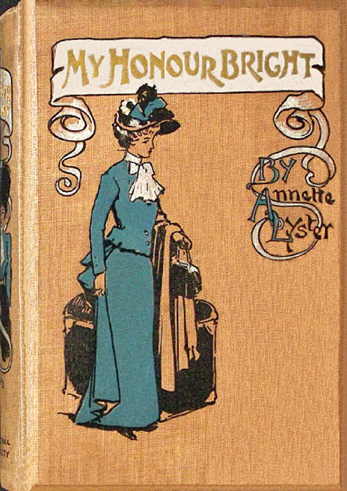
Transcriber's note: Unusual and inconsistent spelling is as printed.
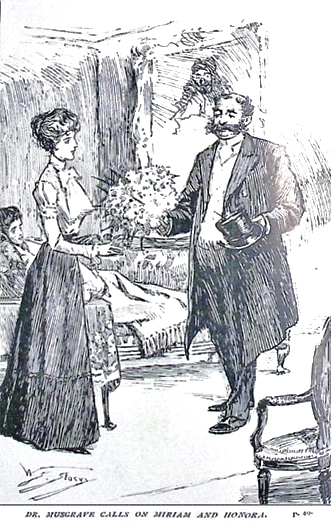
DR. MUSGRAVE CALLS ON MIRIAM AND HONORA.
BY
ANNETTE LYSTER
AUTHOR OF
"THE FORTUNES OF PEGGY TREHERNE," "THE WHITE GIPSY," ETC.
WITH TWO FULL-PAGE ILLUSTRATIONS BY
W. S. STACEY.
LONDON
NATIONAL SOCIETY'S DEPOSITORY
BROAD SANCTUARY, WESTMINSTER
NEW YORK: THOMAS WHITTAKER, 2 AND 3, BIBLE HOUSE
[All rights reserved.]
LONDON:
PRINTED BY WILLIAM CLOWES AND SONS, LIMITED
STAMFORD STREET AND CHARING CROSS.
CONTENTS.

CHAPTER
III. MISS VANDELEUR OF S. CANICE
IX. THE FIRST MARRIAGE IN THE FAMILY
XI. HOW THEY ALL LEFT S. CANICE
LIST OF ILLUSTRATIONS

DR. MUSGRAVE CALLS ON MARIAN AND HONORA (Frontispiece)

MY HONOURBRIGHT

THE OVERTURE
ON the west coast of Cornwall, not many miles from Truro, there is a small village, inhabited almost altogether by fishermen and their families. It lies in a little bay, and is completely sheltered from the east wind by high cliffs. Ten minutes' walk along the road which goes toward the south, following the coast-line for some miles, there is a very curious house called S. Canice Castle, the village being S. Canice. From the village the house was not seen, as it was built on a great cliff which here rose from the sea to a considerable height, and the house was about halfway up the cliff, and on a level with the road.
S. Canice Castle had been uninhabited for a long time, as the owner had a fine property in Ireland and lived there. But the Irish property melted away by degrees, as Irish property has a perfect genius for doing, and the last Irish Mr. Vandeleur found himself completely ruined. He was no longer a young man, and with the small remnant of his fortune which had been saved in the general wreck, he retired to S. Canice, where two hundred a year was considered riches. But then those who thought so did not reckon on his marrying pretty Anne Elliott, the daughter of the clergyman of the village. And seven little girls were born to him. And when the eldest was about ten years old, Charles Vandeleur died of a lingering decline, and his wife, very soon afterwards, of a broken heart. And—perhaps fortunately—the baby died soon after its mother.
Mrs. Vandeleur's father was dead, but Mr. Wilkinson, the rector at that time, exerted himself to provide for the six orphans. One was adopted by a Mrs. Cooke, who had been a Miss Vandeleur, her husband being a solicitor in Dublin. She asked Mr. Wilkinson to send her a pretty child. And he gladly packed off the third girl, Frances, who had a very odd temper, and gave him and Stasy Ridd, the much-tried servant at the castle, more trouble than all the rest put together.
Another Vandeleur cousin, the widow of Sir Simon Barker, in his day a distinguished officer in the Navy, wrote from Dinar, a town in the south of France, where she lived, to say that Mr. Wilkinson had interested her greatly in the poor children, and that she would take one of them and educate her well, for which she had great facilities at Dinar. She would prefer one not less than six years old, and Mr. Wilkinson decided on sending Honora, the fourth girl, who was exactly six. So little Honora, wailing loudly, was delivered over to a respectable Englishman, sent by Lady Barker, and carried off to France.
Violet and Daisy, the youngest two, were admitted to an orphan asylum in Leeds. Marian, the eldest, was sent to Exeter, to a distant relation of her mother, who had a home for sick or crippled children which she maintained at her own expense, and who offered to take this poor child at a very small charge, as she had in some way been injured by perpetually carrying babies when not much more than a baby herself.
So there was only one left. And Mr. Wilkinson said that as he had only sons, and a girl would be useful, he would take her home himself.
And so the six little Vandeleurs were scattered east, west, north, and south, and for fifteen years they never met.
Marian wrote regularly, though not frequently, to all of them. And some of them wrote once in a way to her, Honora more frequently than either Annie or Frances.
A brief sketch of their fortunes during those fifteen years will make my story easy to follow.
The Wilkinsons had left Cornwall very soon, Mr. Wilkinson having been offered a small living in Yorkshire. Here his wife died, and Annie Vandeleur did her best to fill the empty place. The boys grew up and left home one by one, and Mr. Wilkinson married again. Annie easily got a situation as housekeeper in a ladies' school, as in spite of her youth, she was a clever manager. She had a small salary and very hard work, and was not very happy.
Frances, the damsel with the temper, still remained in Ireland, and was generally with the Cookes. She sometimes quarrelled with them, and insisted on leaving them to "do for herself," but she as often came back again. She had tried governessing, typewriting, millinery, and nursing, and the end of the fifteen years found her in one of the Dublin hospitals training as a nurse.
The elder of the two who had been admitted to an orphanage was now nursery governess in a family in Leeds, and the younger was still in the orphanage.
Honora had been in some respects the most fortunate of the family; for Lady Barker was a sensible, good woman, and gave her a really good education. Not being rich, she could hardly have done this but for the girl's own good sense and cleverness. From her sixteenth year, her education cost nothing, as she taught English and German to the junior classes in Madame André's "pension," and received lessons in other branches in return. Lady Barker, had died about a year before this time, and Honora lived in the great school, Madame André being very fond of her. Lady Barker left her all her possessions, and about thirty pounds a year, which she had husbanded carefully for her.
Honora was not unhappy with Madame André. Lady Barker had many friends among the English colony at Dinar, and the girl was of a very contented nature—a girl who found a keen interest in her life, though quiet, and enjoyed her work.
"I shall stay with Madame André till I have saved enough to begin life in that line myself; then perhaps some of my sisters will join me. If nothing happens, that is my plan."
This is what she wrote to an old schoolfellow now married in Germany. Who can say what girlish dreams lay under the words, "If nothing happens"?
Just as her twenty-first birthday arrived came a letter from Marian.
"She did not forget my birthday, then. It is long since I had a letter from her."
And in her very tiny bedroom, in the great big house, she opened her letter.
"MY DEAR HONORA,
"I fear I am selfish in telling you of my trouble, but you always write
so kindly, and I do really want kindness. Annie would be kind, but I
think you can advise me better.
"For a long time now my back has been getting worse, and now I can only
walk a little with help. And I am ill in other ways, and shall not long
be a burthen to any one, but I am a burthen here to Miss Drury.
"Mrs. Elliott has failed very much, and Miss Drury is her cousin,
and came here to help her when I got too ill for my work. Now, Mrs.
Elliott's mind is quite weak, and Miss Drury says I ought to leave the
home; she would be able to do the work if I were gone. What I am to do,
I know not. Mr. Wilkinson tells me he can only send me thirty pounds
a year, which he has paid for me ever since I came here. He cannot
give any of us the principal until the youngest is of age. Annie says
she does not know what to advise; Frances did not answer me. I am so
frightened and so unhappy. Do write, Honora dear. I could wish to hear
the waves against the big rock at S. Canice, and just shut my eyes
and die, but I may live some time yet. I must go to the poor-house, I
suppose.
"Your affectionate sister,
"MARIAN VANDELEUR."
That evening Honora left Dinar in that most wretched of vehicles, a diligence.
Madame André was horrified, but said, "Those English—ah, but those English!" and saw her off with tears and good wishes. She would have been even more unhappy had she not jumped to the conclusion that "my eldest sister" was a "person of mature age."
Honora, between diligence, train, and packet-boat, reached Folkestone safely without having stopped anywhere.
Of what did the girl think as she was carried along? Of the scenery, she would have said with truth, but also at times of a memory, a little wonder, round which shy thoughts hovered, never put in words even mentally. They concerned a tall, pleasant-looking young English doctor, who had come to Dinar to see his mother, an old friend of Lady Barker. Would Madame André remember to tell Mrs. Egerton where and why she had gone? Would he be there when she returned? She would be sorry not to see him again.
From Folkestone to Exeter, still without a pause in her journey. And she reached Exeter so utterly tired and sleepy that she fell an easy victim to a brisk young man, who popped her into an omnibus which conveyed her to a small inn, fortunately kept by a very good-natured and honest woman.
"D'ye mean to tell me this baby is travelling alone? And a foreigner, too, poor thing!"
Honora, looking a mere child in her half-asleep condition, was conveyed to a room and put to bed, and never moved a finger till ten o'clock the next day, when she found herself exceedingly hungry.
The landlady opened the door presently and peeped in.
"So you're awake at last, mam'selle?" she began.
"Yes, I am awake; and I am English," replied Honora, rather hurt at being taken for a foreigner.
"Well, now, my dear young lady, you was so dead asleep, walking in on your feet with your eyes open, but yet asleep, that I could get nothing out of you, and so I just put you in here, next to my own room. But you'll get lodgings, dear, if you're going to stay in Exeter; for you're not the sort of young lady to stay at an inn like mine, which commercial gents are more in my line."
Of this speech Honora only understood that she must get lodgings. So when she had eaten a very hearty breakfast, she asked the good landlady where she would be likely to find them.
"A cousin of mine has very nice rooms, miss, and her parlours are empty. I'll show you the way, and my man shall carry your box there if you like them."
"You are very kind, madame."
The woman laughed. "Most people will be kind to you, honey," said she, as she left the room.
Honora privately thought the "parlours" dark and dismal, but it would be for only a few days, so she engaged them. She asked that a second bed should be provided, and this was arranged, but only after a further payment had been promised. Then, having got directions for finding her way, Honora set out in search of Mrs. Elliott's "Home for Suffering Children."
She had some way to go, and as she walked along, her blue eyes, which looked so short-sighted and were so very much the reverse, took note of everything within their ken in this the first English town she had seen. And she used her ears, too, but did not understand one word in six.
At last, she reached Bishopsgate Green, a curious three-cornered patch of grass with good, old-fashioned houses, each standing in a garden, modestly retiring behind tall iron railings badly in want of paint. Looking along the line of houses, she easily found Mrs. Elliott's, as "Home for Suffering Children" was engraven on a brass plate on the gate. But the gate was locked. However, there was a bell. She rang, and the gate opened as if of itself. Honora entered, and went up to the house. Here she met a servant.
"Can I see Miss Vandeleur?"
"Be you her sister? Yes, you are, for you favour her. Poor Miss Marian! She was crying only this morning because there was no letter, but now—This way, miss. Shall I tell her you're come?"
"I will go in, if you permit." And passing in, she shut the door.
Marian, a tall, painfully thin creature, with hollow cheeks and great, over-bright eyes of the same pure azure as Honora's own, was lying on a narrow couch with some needlework before her, but she was not working. Hastily drying her eyes, she said—
"Miss Drury is out. Can I—Oh dear, who are you? You're like mother; you're one of my sisters."
"Yes. Oh, Marian!" And the new-comer was on her knees beside the couch, and the pair were clasped tightly in each other's arms.
"Which are you?" Marian gasped at length. "And oh! But it's good to be hugged and kissed. I'd forgotten how good. Which are you, dear?"
"Honora. When I had your letter, I came at the moment. The holidays were about to begin, and you seemed so sad, Marian."
"Sit on that stool, close to me, that I may see your face. Yes, you are like mother; you have her eyes and hair just like hers. Yet there's a difference. It is the mouth; yet it's a dear, pretty mouth, too. Do you remember, Honora, the day they took you away—how we all roared, and you set up a piteous cry?"
"I do not remember quite well. I thought you had dark hair, Marian."
"That is Frances; mine is more like yours, or used to be. And do you remember—"
They talked away, Marian reminding Honora of this and that in their old home—of father and mother and the other sisters, and Stasy, the faithful servant, who had nursed them all.
"I do not remember much," Honora said, "but I remember that you were always caring for us all, and defending us from—was it Frances?"
"Ah, poor Frances! But you remember Annie, surely, and—"
"No; I only remember you."
And Honora got up to kiss the poor pale face again; and was thus engaged when a lady, in a severely plain dress and bonnet, walked in.
"Oh, Honora! Miss Drury," said Marian, nervously.
Honora raised herself, turned round, and curtsied, as she had been taught to do for Madame André's benefit. For some unknown reason, this annoyed Miss Drury, who looked sourly at the slight, graceful girl, and nodded her head somewhat fiercely.
"Well, Marian," she said sharply, "I hear your sister's been with you an hour or more, so I suppose you've settled between you what you're going to do."
Marian flushed painfully, and said, "It did not seem an hour, and we were so glad to meet."
Honora drew from her pocket a great big watch which had been Lady Barker's, and said—
"It is not quite half-an-hour, mademoiselle, and we had not met for fifteen years."
"What has that to do with it, child? I am afraid you are as unpractical as Marian. You left the gate open, and I found two dogs in the garden."
"I am sorry." And turning to Marian, she said, "What do you wish to do, dear?"
Marian began to cry. Miss Drury said crossly—
"There, child, don't begin at that work again or I shall begin to think you're getting silly. You—" pointing at Honora—"listen to me, and I'll make it plain to you if you've any sense. My good old cousin is quite laid aside, and needs an attendant day and night. As long as your sister could see after her, I could manage the six poor children under treatment, and the two hopeless cases she kept, because she must have sent them to the poor-house. But Marian has ceased to be able to give any help, and requires attendance; and as she has friends and a small income, I think she ought to turn out."
"Mrs. Elliott always said—" began Marian.
But Miss Drury stopped her. "It's with me you have to do—neither with Mrs. Elliott nor Dr. Elliott."
"Oh, if Dr. Elliott were at home!"
"Well, he is not at home."
"Oh, what am I to do?" cried poor Marian.
"The first thing to do," said Honora, her voice sounding sweet and low after Miss Drury's strident tones, "is to get away from this house. I have taken a lodging in Bath Street. Will you come, Marian?"
"Honora, to be a burthen on you?"
"But we are sisters. Between us we have enough. And—do not cry, Marian—but it seems to me that we have no choice."
"You haven't, Marian, not a scrap of a choice, unless you prefer the poor-house," said Miss Drury.
Honora rose from her seat at the side of the couch and faced the speaker, her eyes, usually so sweet and shady, all ablaze with wrath.
"It is unnecessary to insult us, mademoiselle. Pray remember that. How can we get to Bath Street? I fear she cannot walk."
Miss Drury looked with real admiration at the indignant girl.
"You've some spirit in you," she said; "and when you come to think, you'll see the justice of what I say."
"It may be so. But for the manner of it—'Va!' It would be 'convenable' for a Hottentot. How can we get to Bath Street?"
"Go and get a fly, and I'll pack her things before you return."
"Not so. Do you get your fly—a carriage, I suppose—and I will pack. I do not leave Marian with you."
"Oh, get along with your airs, child. Hard words break no bones."
"They make hearts ache instead. Come, Marian. Show me where your clothes are, and I will pack up for you."
Marian, who was crying sadly, rose with evident pain and difficulty, and the sisters left the room together. Miss Drury stood for a moment gazing after them.
"I've got my orders, if I never did before," said she, with a snort, probably meant for a laugh; and she went out.
Marian had few belongings, and no trunk. Honora made a tidy bundle, and pinned it up in an old shawl.
Then Marian said—
"Honora, will you help me to go to Mrs. Elliott's room? She is asleep, and I will not wake her, for she would not understand, and she might fret. But I must see her just once more. She has been everything to me."
Honora helped her, and waited at the door for her. She heard Marian say—
"This is good-bye till we meet in Heaven, but it was you that taught me the way, and I will not forget it. We shall be glad to meet."
The girls were in the sitting-room when Miss Drury came back.
"Well, you pretty vixen, I've done your bidding—the fly's at the gate."
"Thank you, Miss Drury. What is this?"
"Marian's money. The quarterly payment came yesterday."
"Pray keep it," said Honora, gravely.
"Not I. Here, Marian; now I've put it in your pocket. Miss Honora, remember this—my bark is worse than my bite."
"But why bark?" said Honora.
"Well, shake hands. We part friends, don't we?"
Marian took the offered hand, but Honora took up the bundle in both hers, and only curtsied.
"Hoity-toity!" remarked Miss Drury. "Well, never mind, I bear no malice."
It was very hard to get poor Marian into the fly, and she plainly suffered terribly during the drive. Even when she was safely laid on one of the beds in the little lodging, she seemed spent with pain.
Between agitation and severe pain, Marian was really ill before night. She even wandered, and then her talk was all about S. Canice, and she took Honora for her mother.
"It's been long, long, mother, but let me hear the sound of the sea, and then I shall sleep."
Towards morning she slept, and was quite herself when she awoke.
Honora brought the breakfast-tray to the bedside, and they had their first meal together, for Marian had been so ill the day before that Honora had taken no regular meal.
"Why, Marian, a robin would eat more than that."
"I never care about breakfast. Honora dear, what are we to do?"
"Eat more at dinner," replied Honora.
"Ah, you know what I mean. What was your plan when you came to me?"
"To take you with me to Dinar. I know a dear old French lady who will let us have a room for you—quite near Madame André's school. I shall be with you every day. It will be so happy to have a sister to visit. Do you feel able to go, Marian? Not to-day—you must rest all to-day—but soon."
Marian was silent.
Honora tried again. "Dinar is a beautiful old town. Your room will look over the country, for it is in a house built on the old town wall. There are vineyards, and always lots of fruit and flowers, and the sun and air will make you strong and well."
Still no reply.
And, to tell the truth, Honora was disappointed and half frightened. Poor Honora! The strange place, the people, the very language, all puzzled her, and she longed to be back in Dinar, where she felt at home. She could not imagine why Marian, instead of talking to her as she did yesterday, lay silent, following her about the room with wistful eyes.
"Marian, I have made you sorry?" she said at last.
"My dear, no, indeed. But I should be very glad to see Dr. Elliott. He has always attended me, and he knows, and he is very kind. He has been away for a holiday, but I am sure he is coming home soon. You know he is related to us, and my dear Mrs. Elliott was his cousin's wife. Will you go and ask him to come here? Leave the address and a message if he has not come yet. When I have spoken to him, I shall know what to say to you."
Honora at once put on her hat. Marian watched her admiringly.
"You're a pretty darling, Honora, and you do look such a little lady."
"But I ought so to look, for surely we are ladies, we Vandeleurs?"
"I suppose we are. Do not stay away long, dear, for I grudge every moment that I cannot see you."
Honora easily found the doctor's house, and learned that he had returned the day before, and was at home. She sent Marian's message, and was halfway down the street when the servant ran after her.
"The doctor wants to speak to you, miss. Please come back."
DR. ELLIOTT
HONORA was shown into the doctor's library, and he rose from his writing-table and came to meet her.
"What does this mean?" he said. "Why has Marian—" Here he had come near enough to see his visitor; he was short-sighted. "Who are you? But I need not ask. You must be one of Marian's sisters. Which?"
"Honora."
"You ought to be Annie."
"Why, sir?"
"Because you are my cousin Anne over again. Eh, child, I never saw such a likeness! But about Marian?"
He put her gently into a chair, and she told him exactly what had happened, and how Marian wanted to see him.
He was silent for a little while. At last he took Honora's little hand in his, opened her glove, and laid his finger on her pulse.
"Little girl," he said, "your plan won't do."
"Why not, please?"
"Because Marian would never reach Dinar alive. The railway would be bad enough; the diligence won't do."
"She 'did' seem in great pain in the fly yesterday," Honora answered.
She had tried once or twice to release her hand, but now she forgot all about it. And in a few moments, he let it go, and said—
"All right here. Can you keep counsel, Annie—Honora, I mean?"
"Keep counsel?" she said.
"Keep silence, you know. If I tell you something, will you tell Marian the moment you go back?"
"Not if you say be silent."
"Well, then, you must know that Miss Drury spoke to me about Marian, and I saw that it would be better to remove her. Miss Drury is not really unkind—the children there find her very good to them, and are not at all afraid of her—but for a timid, sensitive girl like Marian a worse companion could not be found. I told Miss Drury that I would see about getting a home for her. But it is not a thing that can be done in a moment, and so she took her own way when I was away—of which she shall know my opinion presently."
"She knows mine," said Honora, quietly.
"Well, coming home, I chose a steamer which left me in Falmouth. I have been interested in a middle-class school that Mr. Heyward of Plymouth is opening in Cornwall, and I thought I would see about an idea of mine—that if Marian could go to S. Canice, or anywhere on the coast there, it would be her best chance of prolonged life. I do not think she would have lived a year longer in the home."
"Not with Miss Drury."
"I visited the College, as they mean to call it—the lady principal is an old acquaintance of mine. I went on to S. Canice—for a light railway goes on from the junction to the coast—but there is no one there who could take charge of Marian. The rector has a delicate wife, and the doctor is unmarried. There are no other gentlefolks there. But I found a lady at Truro—I wish it were on the sea, but it is not very far inland—and she will take Marian, and, I think, will be kind and careful, for sixty pounds a year."
"Did you see our old home, Dr. Elliott?" asked Honora.
"Yes; and a strange old place it is. But this is what you must not tell Marian. You have no idea how strong her feelings are about it. Always, if in pain or unable to sleep, she speaks of the sound of the sea with an actual longing. I did not finally arrange with this lady, for I hoped I might find some one as suitable on the sea-shore somewhere."
"But you think S. Canice would make her well?" asked Honora.
"I did not say that. No, my dear; your sister will never be well, but I think she would suffer less. And she would be better if she were happy, poor child!"
"Tell me about the College, Dr. Elliott?"
"I haven't time now; I will tell you when I see you this evening. Stay! I have a lot of pamphlets about it. You will know all about it if you look through these. But I must send you away now, as I have an appointment."
"One word. How did you mean to get the money for Marian? She has but thirty pounds a year."
The doctor laughed. "Get away, little girl; that is my secret. We are cousins, remember."
Honora gathered up the pamphlets, and said "Au revoir" thoughtfully and absently. She walked home in very pensive mood, and spent all the rest of the day in reading the various papers about Heyward's College.
And at six o'clock, Dr. Elliott walked in.
"Well, Marian, I'm glad to see you were able to get up. I have been to the home, and seen Miss Drury. I'm told you're a bit of a spitfire—" nodding to Honora.
"Oh no!" cried Marian.
But Honora remarked equably, "To me she said vixen."
"I was told you ordered her to go out for a fly. Nay, I was told that she obeyed, but I didn't believe it."
"She was so obliging as to go. I was not going to leave Marian alone with her."
"Oh, I see! What is it, Marian?"
Marian, with her lips quivering and her hands trembling, contrived to tell of Honora's plan for her. "Could" she go?
"No, my dear girl; you could not stand the journey," the doctor said gently.
Marian burst into tears. "I knew it! I was afraid you'd say so. But it is hard to bear; for I cannot live long, and to die among strangers, when I have known what a sister is!"
"But for her sake, Marian, you must be wise."
"If it was only me, I would go. But I must not be selfish."
"No, child. And if I can find a suitable home for you, where you can have sea air and be much out-of-doors, you will get a little better, and this enterprising little traveller will come to see you when she can. How long are your holidays, you terrible vixen?"
"Only ten days, beginning to-morrow."
"Well, I will inquire. If I do not find a suitable place in time, you might go to the home, on a different footing, for a few days."
"No, monsieur; that is all past and gone by. Marian will go there no more. Miss Drury is too affrighted—I mean frightful."
"Eh, here's the bit of a spitfire again! But be a charitable spitfire, Honora. Miss Drury is—"
"She is impossible!" was all Honora would say.
That night, Marian having at last fallen asleep, Honora wrote a long letter to Madame André. With it, she sent a few sheets from one of the Heyward papers. And when she had sealed and addressed it, she sat and looked at it with great bright drops gathering in her eyes. "Good-bye, good-bye," she murmured; and a great tear fell on the letter.
"I am ashamed of you, Honora," she said. "Go to bed. Do your duty—you see it; now do it—and have no dreams any more, ever."
She posted her letter next morning, and having no work with her, she bought enough of a pretty grey stuff to make a dress for Marian, whose dresses she pronounced "only fit for Noah's ark." At this dress she stitched away, keeping up a cheery conversation all the time.
Marian was so happy; the only misfortune was that she remembered how soon this pleasant time must be over.
Madame André lost not a day in answering the letter.
"Who is your letter from, Honora?"
"Madame André. I wrote to her to ask if she thinks me able to teach French, and she sends me quite a fine paper, praising me much, and counting up all the things I know and can do. And really, if it is all true, I ought to be a very valuable teacher! And she will get another English and German teacher for the junior classes; and I, if I can, will get a—an employment here. And we will keep together, Marian."
Poor Honora! Never again did she blurt out news, good or bad, to Marian, who tried to speak, but very nearly fainted. Honora sprang up, dropped the almost finished dress, and in her hurry walked upon it. And it was not for some little time that Marian was able to say—
"Oh, Honora, is that true? Shall we be together, you and I? Can we manage it? I will not have you injure yourself for me."
"What is to injure me, my dear sister? Oh, your dress! Just look what I have done to it! It is none the worse, however, though I have walked all over it. Marian, even if I do not get employment as a teacher, you and I will get needlework to do. But together we will stay; for remember, I have sixty pounds a year, and you have thirty, and in Dinar we could live like two princesses. England, I do not know, but we will try. I will never leave you, Marian, lest you find another Miss Drury."
Marian was crying helplessly.
"I am sorry you think me worse than Miss Drury, Marian," Honora said meekly.
"It is too much—too much," said Marian.
"Here is a person who has five sisters, and one of them wants to live with her, and she cries, 'Too much,' and yet I am not an immense sister. All the same, I am not little; I am five feet and six inches in height. Therefore, why do so many people call me little Honora? Answer me that, Marian."
By chattering away about everything or nothing, she succeeded in calming Marian, and certainly she had no reason to complain that Marian was not happy.
"I am going now to see Dr. Elliott, Marian. If he would write a letter to his friend Mr. Heyward, and to the lady principal of this school, perhaps I may get the place there of French teacher. And there must surely be a house in the neighbourhood where we could get rooms. The air there would be something like your native air, and you would be better than in a town."
"What school are you talking of, dear?"
"Heyward's College—somewhere in Cornwall. I shall go now and talk to the doctor."
She did not find the doctor at home, but she waited patiently till he came in. At first, he was inclined to be amused at her offering herself for the post. But having read Madame André's letter of recommendation, he changed his mind. For Madame André spoke not only of Honora's knowledge of French and German, but of her natural ability as a teacher.
"Her classes are always attentive, and she is one of the best teachers
I ever had," madame concluded.
The interview ended in his promising to write at once to Mr. Heyward, and to Miss Webb, the lady at the College.
"And, Dr. Elliott, if Mr. Heyward will allow me to try for the place, I will go to the College and see Miss Webb. And you must make this seem quite necessary to Marian; for I will go to S. Canice and see if I think that Marian and I could live in our old home. It belongs to her. We should not have to pay rent, and so would be quite rich."
"But, my child, you cannot manage all this alone, and I cannot leave home again so soon."
"I can do perfectly by myself, Dr. Elliott. Will you, when I am going, give me a note to the doctor there? You said you knew him. He will be able to say where I may find our old servant, who has the keys of the house. Or the 'curé'—clergyman, I mean—he would do."
"I don't know him; Musgrave I do know."
"And not a word of S. Canice to Marian, please; I go just to see Miss Webb, and find a lodging. It does not do for Marian to be made nervous."
"It would not be easy to make you nervous, little girl?"
"I do not know what nerves mean," said Honora.
The letter to Mr. Heyward did its work better than any one expected. It had been found very difficult to find a Frenchwoman with sufficient knowledge of English and other things, such as writing business letters, dictated in English, into intelligible French. But one or two had been offered the place and had refused it. The salary was small, and the success of the College uncertain; and Miss Honora Vandeleur had better see Miss Webb as soon as possible, and come to some understanding with her on certain minor matters, as Madame André's recommendation had decided Mr. Heyward to engage her.
So there was great excitement on Marian's part in getting a few things packed for the journey, for Honora could hardly hope, she said, to return until the third or fourth day. After she had departed, Marian, thinking matters over, felt that there had been a slight shadow over Honora for some few days. Perhaps she was a little nervous about her interview with Miss Webb. Yet she did not seem nervous.
"If I find that she is unhappy at leaving Dinar, what shall I do?" And Marian tormented herself with this question until something happened which gave a turn to her thoughts.
Two whole days and nights Honora was away, and Marian had just concluded that "something had happened" to her, and that she must send for Dr. Elliott, and get him to find out what the something was.
It was a wet day; it had been raining all night, and that such rain as surely seldom falls except in Devonshire. Marian had just finished dressing, and got out into the front room for breakfast, when what did she see but Honora's slender figure running past the window. And in a moment she was in the room; and her sweet face was surely without a shadow now!
"Oh, Honora dear, here you are at last; and half-drowned, dear child! But oh, you do look so bright; it is good to see you!"
"Kiss me then, instead of feeling my dress. Yes, I am wet, but there was not a drop all the time I was—all the time it mattered. I will just get on a dry dress; it is lucky I brought a second one with me. Give me my key, dear. What did I bring? Oh, this old white thing! But it was a nice dress once. Marian, I have so much to tell you that I am afraid I shall be quite hoarse before I have come to an end."
"You must have some breakfast first. I hope they know that you are come."
"Yes, Mrs. Smith let me in. And here comes breakfast. I am so hungry. You extravagant girl—a mutton chop for me! Quite like you English, so very unfrugal."
"You are as English as I am. Eat it up; and tell me truly, when did you take your last meal?"
"I dined at Heyward's College yesterday, and at Plymouth I had tea and a bun, it was called. But I am very hungry. Ah, Miss Vandeleur, if you knew where I last had tea, before that Plymouth cup, and who made it, you would open your eyes wide!"
"If you knew what is locked up in your trunk, Miss Honora Vandeleur, you would look brighter than you do, if that's possible. Honora, do you remember that father used to call you Honourbright? And so will I, for the name suits you."
"What is locked up in my trunk, Marian? I saw nothing new when I took out my old piqué dress."
"Eat your breakfast, and then I will tell you."
"I have eaten all I possibly can, and you have pecked a crumb or two. I suppose that is all you mean to take? Then I will ring the bell."
When the tray was removed, Honora brought a footstool and sat down by her sister's knee, against which she leaned her sunny head.
"Now, then, which of us is to begin? It had better be me, because all this news makes me uncomfortable."
"Begin then. What is Miss Webb like?"
"Like a very handsome woman, say forty years of age, and very nice, and oh, so kind!"
"Well, go on. What is the College like?"
"A great grey building, very long one arm and the other not so long. It is the only house in sight when you leave the train, and you go up a hill, and there it is. There are grand schoolrooms—classrooms they call them. The teachers who mean to live there have rooms upstairs, and the dormitories are upstairs. Miss Webb had much to say to me about the scholars, who will not be ladies, all of them, and who must learn to speak French for business purposes. Then she said that if I chose to teach writing to those who did not write well, I could increase my salary, so I increased it at the moment. For the two, I shall have fifty pounds a year. Think of that, Marian."
"That is grand! We shall do very well. And lodgings, Honora—what will they cost?"
"There is a cottage—a farmhouse near the College, where I shall lodge, if you get proud and turn me out-of-doors. Do you know, the light railway by which I reached Heyward's College was made for the use of some mines newly begun by Mr. Heyward, and it goes on to S. Canice for—fish!"
"Does it? Then some day I may see the dear old home, and hear the sea roar and sob, as it used to do when we were children. Oh, Honora, if I had been you, I must have gone on to S. Canice!"
"I did go."
"Oh, go on! Do tell me everything."
"But you are so easily overcome, Marian, that I am afraid to tell you all."
"No, no; I will be quiet. You do not take me by surprise this time. To think that you have seen the dear old place! Begin at the beginning, and tell me everything."
"I stayed with Miss Webb all that day, and was able to help her a good deal. I slept there that night, and went on in the morning by a train which reaches S. Canice at about half-past eight. I had a letter from Dr. Elliott to the doctor there, for I thought he would know where our old servant, Stasy Ridd, lived, and you had told me that she had your keys."
"My keys?"
"The keys of your house, or castle, as they call it there. I wanted to see the house before I looked for lodgings," she added cautiously, looking up into Marian's face.
For a few minutes both were silent.
Then Marian whispered—
"It must be too far from the College."
"A quarter of an hour or twenty minutes by train. And I could come and go by train, or I could walk over the moor if I wished to be back before five."
"Oh, could we do it?"
"Well, I will tell you all, and you must decide. Dr. Elliott's letter only had 'S. Canice' on it, so I had to ask where the doctor lived. It is at the end of the village furthest from the castle, a pretty cottage and a garden so full of flowers—daffodils and snowdrops and every spring flower. And Dr. Musgrave was kind enough—a queer man, I should think, and very fat, but loves flowers. I asked about Stasy Ridd, and it seems she is his servant. But he is going away, having got a better 'opening,' he called it, and so Stasy can do as she likes. He called her, and she came to the room he had taken me to.
"She screamed when she saw me, and she hugged me, and said, 'My own darling Miss Marian!'
"I told her I am only Honora."
"Think of her caring about me after all this time."
"I told her that I wanted to see the house, and I told her why.
"She said, 'I'm thankful I have lived to see this day. Miss Vandeleur of S. Canice Castle is coming back. Has she come into a fortune, Miss Honora?'
"So I explained our present condition, and Stasy and I talked it over, and quite forgot poor Dr. Musgrave, who had to listen to everything, poor fat man! And Stasy knew all about the furniture that is packed away in one of the big rooms. She has gone very often and opened the shutters for a day, and seen that no one has got in. So we set off, all three—for the doctor came too—and we walked through the village, and just as I was wondering where the castle could be, we got round a high, ragged rock, and there it was."
"Did you go in?"
"Yes. And was it not curious? When I saw the window over the hall door, I remembered that we all stood there and watched our mother's funeral go away, and we all cried. Well, we went in. You know the house, Marian, so I will lose no time describing it. It is not a bit damp, which surprises me, but the sea air has blackened all the mirrors in the rooms—the big ones in the walls, I mean. And the furniture, thanks to Stasy Ridd, is in good order, though old and, to my eyes, ugly—so heavy and big.
"Dr. Musgrave was very kind. He lifted things and pulled things about that we could not have managed. There is furniture enough and to spare. But I think the great big rooms would be very desolate for two people. I thought the turret by which you enter would be quite a house to itself for us. There are, you know, four rooms on the ground floor, and Dr. Musgrave measured them for me. They are not too small. You and I could sleep in one, and have the one to the front for a parlour, and on the other side of the passage we must make one into a kitchen and one into a bedroom. For the kitchen is at the far end of the middle part of the house, and the fireplace is very old, and oh! so big, one would need much coal for it."
"But the fireplace in the turret-room will not do for cooking, I fear," said Marian.
"No, but Stasy says we must get a small stove or range put in. Dr. Musgrave said he would be in Plymouth in a day or so, and would give our order for one, and have it put in for us. And Stasy will get all the windows mended: the panes, you know, are little diamond-shaped things, and will cost very little.
"And a few planks in the floors want to have new ones put in, and she said, 'John Carpenter shall do that cheap for me.' And the chimneys she said must be swept. And all only await the orders of Miss Vandeleur of S. Canice Castle, who must also send a little money.
"I said, 'Do you think, Stasy, that you know a girl who would like to be our servant?'
"And she looked really angry. 'No one on earth shall be servant here but Anastasia Ridd, and that's me.' And about wages you must speak to her, for she would not talk of that to me."
"Honora, I can't believe in all this. Why, all my life I have been longing for home, dreaming of it, seeing it so plain, and hearing the sea. Oh, the lovely blue sea! And to live there and to have you, and old Stasy, too, and no noisy streets. I can't manage to feel that it is true."
"In some ways, you might be more comfortable in that farmhouse, and less lonely."
Marian's countenance fell. "My dear," she said, "it's for you to say. If you feel that you would be happier at Heyward's, I will not say a discontented word."
"Then the question is settled," said Honora, gaily, "for I am just longing to be at S. Canice. The only fear I have is that we have not money enough to make ourselves quite comfortable at first, and can you bear that?"
"I am not used to much luxury, you know. Oh, Honourbright, when can we go there? How good God is to me! My fear was that I should die among strangers that cared nothing for me."
"What you are to do is to live and get well with me and good Stasy. And you will have Dr. Elliott's advice always. He told me we must write to him."
"But the doctor there?"
"He is going away, you know." Here Honora sprang up and went to the window. "The rain is over at last. Dr. Musgrave told me that his successor is to be a Dr. Egerton, the son of my old friend, Mrs. Egerton, at Dinar. And I met him there sometimes, so he will not be a stranger. But, Marian, a very sad thing is that the bedsteads at S. Canice were all made for the big rooms—all that are left. The little ones were sold, and all the bedding. And between that and the cooking-stove and the journey, we shall have but little money left; it is but for a time, but I am sure we cannot afford carpets or lamps. And Stasy said we must have lamps. But beds, that is indeed 'must.' Perhaps we may get them more cheaply than I think."
She came back now and sat again at Marian's feet.
"At what do you laugh, Marian?" she asked, getting a little pink.
"Turn your face to me. Now, attend to me, Honora. We will stop in Plymouth, and there we will—that is, you will—buy carpets, and lamps, and stoves, and a fur cloak for you to wear in cold weather going to the College, and beds, and all things that we shall want. What do you say to that, please?"
"That all my news has got into your brains, my sister."
"I have not told you my news yet. I had a visit from Miss Drury yesterday."
"What an escape for me!" said Honora, wickedly.
"Now I'll make you ashamed of yourself. She told me that she had been obliged to search dear Mrs. Elliott's desk for some bills which she believed had been paid, and which had been sent in again. And she found a parcel, a big, strong envelope, with my name on it. She brought it to me at once. It had a book in it, a bank book, Miss Drury said, and some papers which I thought were cheques, but they are not. And what do you think, Honora? Mrs. Elliott had put ten pounds of my thirty that Mr. Wilkinson sent her, five every half year, all the years I was with her, into Boake's Bank, in my name, on what are called deposit receipts. One year she missed, because I was very ill, and she had to spend more for me. But fourteen years, ten pounds each year, and there it is, and is really mine; Dr. Elliott says so."
Honora stared at her for a few moments, then springing to her feet, she began to dance round the room, doing the most surprising steps and waving her arms to imaginary music. Marian thought she had never seen anything prettier, yet she was a little shocked all the same. At last, with a splendid curtsey, the girl dropped on the floor before her sister.
"And you can make our little home both comfortable and bright. You shall buy curtains as well as carpets. I did not speak of them, for it seemed useless, but they told me the wind is very high sometimes, and heavy curtains are wanted. And—yes, I know what you want to say, 'Am I ashamed?' No, I am not ashamed. I never thought that Miss Drury was a thief. She is honest—there, I have said it! But Mrs. Elliott—she was good. That was so kind and loving of her. I made a list, with Stasy, of things that we ought to get, and I quaked to think of what they would cost. I must do just one more little dance. Do you know this step? I do think I am a little silly. Oh, Marian, do you know this step?"
"No; and no steps. I don't think I ever saw any one dance before, except a girl in the street. How came you to know all those dances?"
"My dear, we had a professor of dancing every winter, and I was said to be his best pupil. Oh, how very, very happy we are going to be!"
"Yet when you left me, I almost thought you did not feel happy about it."
"I am now. I know all about it now, you see."
"Come here, darling. Stop dancing. I did not think you were so excitable. Kneel here beside me, Honora, and let us thank God with all our hearts. That is the best way to accept happiness, which all comes from Him."
And when that simple thanksgiving was over, Honora gazed at her sister with absolute reverence.
"You 'are' good, Marian!" she whispered softly.

MISS VANDELEUR OF S. CANICE
DR. ELLIOTT came that evening to see if Honora had returned. He found the sisters busy making lists and discussing plans.
"We must go off as early as ever we can," Honora declared, "and have a few hours in Plymouth. Marian can rest, and I must get these things."
"Not so fast, you rash child. Do you think I am going to let Marian travel all that way with only you? Not that I don't consider you a host in yourself, Honora, but it would not do. I mean to take her the whole way myself. Now, don't say a word against it, for on no other terms shall I let her go. And the rooms you mean to furnish ought to be ready for her when she gets there. She is not fit for roughing it. You, Honora, might go and get this servant to meet you in Plymouth. Buy what you want and go to S. Canice, and when you are settled, I will bring Marian to Plymouth, and, if you like, you can meet us there. But I would advise you to stay at home and be ready to receive her."
Both the girls looked quickly at him, Marian with evident relief and gratitude, Honora half grateful, half startled.
"You are always kind, Dr. Elliott," said Marian. "I was a little frightened for Honora."
"I will go to-morrow," Honora said, rather low. "The sooner I can be ready the better. I will telegraph to Stasy to meet me."
"But poor Dr. Musgrave, Honora. Stasy is his servant, you must remember."
"Oh, Stasy said she would get her brother's daughter Hephzibah—she is Stasy's favourite niece—to come in her place at once, and that nice fat man was quite content. He said I was very welcome to her, 'and Hephzy will do very well.'"
"Don't make fun of my learned 'confrère,'" said the doctor, laughing. "Have you no reverence about you, you saucy child?"
"I shall never make fun of you," she said, with a bright look of gratitude.
Honora left Exeter the next day, taking all her own and most of Marian's belongings, and leaving very little for the latter to do when the time came for her to leave the lodgings.
And in a week from the day of her departure, she wrote to say that all was now ready. She added,—
"If you can come at once, we shall have ten delightful days before the
College opens. It is lovely here now."
So in two days more the doctor was ready, and Marian was taken to the station in his carriage. Here they were joined by a stout woman who was introduced as "Mrs. Prothero, who is going to Cornwall." And Marian did not suspect that Mrs. Prothero was the best nurse on the doctor's list.
The journey was most successful as far as Plymouth. Marian lay on a mattress which Mrs. Prothero was taking with her, and the movement did not hurt her much.
At Plymouth, Honora ran up to the window and looked anxiously in.
"Oh, you are all right," she said. "And have you room for me?"
"Yes, yes; plenty. Get in, child. Would you like a cup of tea, Marian?"
"Oh no, Dr. Elliott, it will not be very long till we are at home. What is that in your hand, Honora?"
"A newspaper. I was looking at it in the waiting-room, and I saw a piece of news which I thought might interest you. It is the 'Plymouth and Saltash Mercury.' Read this."
Marian looked. Behold, in "Local Items," it was announced that Miss Vandeleur of S. Canice Castle was about to take up her residence at her ancestral abode; and the two girls laughed gleefully.
"I little thought," said Honora, "when I heard Stasy desiring our parcels to be directed to 'Miss Vandeleur, the Castle, S. Canice,' that this would be the consequence. Stasy talks about you always by your full title, Marian, except to me. Then you are 'My missy.'"
On they went again, and Marian, though tired, was not in any pain. But when they left the train at Penbrasil Junction, and got into the slightly built, narrow carriage of the light railway, there was a very different story. Her suffering was terrible, and poor Honora was terrified almost beyond bearing.
Mrs. Prothero whispered, "I have chloroform in my basket, doctor."
And Honora said piteously, "Oh, do try the chloroform, Dr. Elliott. She will surely die unless you—"
"I dare not give chloroform, child. How much longer have we to go?"
"This is the last stop—about fifteen minutes now."
When S. Canice was reached, Stasy was there waiting. And Marian, being laid on a large thick railway-rug, was carried by willing hands—the only difficulty was to prevent too many helping at once—and in a few minutes was safe in the house she longed for. But she did not know that she was there, for she was almost unconscious.
Dr. Elliott made them put her to bed as comfortably as they could. He then gave her a few drops of some soothing medicine, and she was soon asleep.
"Stasy, get Dr. Elliott and—the lady—where is she?—get them some dinner. I will sit by Marian."
"Mrs. Prothero's gone," said Dr. Elliott; "she has to get on, you know—she came to oblige me. Marian will be much better to-morrow, you poor, frightened child."
"Oh, Miss Honora, is she often like that?" cried Stasy.
"I never saw her so bad before, not even the day I took her to Bath Street."
"I must have a talk with you before I go, Honora. I will not leave you till to-morrow. But I think and hope that she will be all right by that time."
But Honora was far too much alarmed to go to bed.
Stasy reported that she had made the doctor very comfortable in the bedroom next to the kitchen, and she herself would occupy a "real nice shake-down" in the kitchen.
But when left to her own devices, Honora brought the easy-chair she had purchased for Marian's use to the side of the bed, and wrapping herself in shawls, she sat down to watch. But Marian slept very quietly, and Honora fell asleep, too, after a time.
It was quite late, nearly nine o'clock, when Marian awoke. At first she could not imagine where she was, but by degrees she remembered, and turning her head, looked eagerly round. Close to her, fast asleep, sitting in a very luxurious easy-chair, was Honora. No doubt that was the new chair of which she had written that it was just the thing for Marian. But oh, how oddly familiar other articles of furniture looked! The table—that used to stand in father's study; those spindle-legged chairs were in her mother's sitting-room. Here she bethought herself of looking towards the window, and then she saw the sea, and knew that the sound to which she had been dreamily listening was the old, old lilt of the waves so sorely longed for many a time.
"Oh, Honora, wake up and listen! I hear the sea."
"What is the matter?" Honora said, only half awake.
"The sea, child—the grand blue sea, and the waves going up and down just as I remember them."
"It 'is' lovely," Honora said, now wide awake. "Think of having it always there, instead of the dirty, noisy street."
"Or even Mrs. Elliott's garden. There is nothing like the sea; it is good to look at, and music to listen to, and never the same. Look at the green line in the blue—see the breeze scurrying over it! Oh, my dear old sea!"
"But I am afraid it is very late, and Dr. Elliott—Ah, here is Stasy bringing a cup of tea for you! Good Stasy."
"Oh, Stasy, I should have known you anywhere!" cried Marian. "Come here and kiss me."
"My missy, you're more like what you used to be to-day. Ah, but it is good to see even two of ye!"
"Two are quite enough to begin with," said Honora. "I must wash and dress as fast as I can, and give Dr. Elliott his breakfast. You are not to get up, dear, till he has seen you."
"I am quite content," smiled Marian.
"May I tell him that you are free from pain, Marian?"
"Not quite free, but very nearly; and so happy."
Honora dressed herself, and went into the sitting-room, where she found Dr. Elliott waiting for her. He was looking with interest at the room and its furniture. Honora had ransacked what she called her Enchanted Cave—the room in which all the old furniture was stored—and had selected such articles as seemed most suitable to this rather small apartment. The walls were painted, and had been so well done that a good washing had made the pale grey look very nice once more. The sofa and the few chairs she had chosen were covered with much faded embroidery done by ladies of the house of Vandeleur long before, yet still beautiful—perhaps not the less beautiful because faded.
Stasy had exclaimed when Honora insisted on having these brought out and thoroughly dusted. She said they had been left in one of the turret-rooms all the time Mr. Vandeleur lived at S. Canice, being the only furniture he found in the castle, and even then too old and shabby for use. But his daughter greatly preferred them to the heavy, crimson-covered things which had been the pride of her mother's heart. And with these, some bookcases, and a new carpet and curtains, Honora had made the room look homelike and pretty.
She and the doctor had breakfast together. And he told her that he had felt very doubtful the night before whether he had done right in allowing Marian to take the journey. But now, he said, she would be just as usual, and he had no doubt whatever that perfect quiet, happy homelife, and the fine sea air would make her life one of less suffering than it had been lately.
"You see, she never complains, and so I had no idea that Miss Drury made her unhappy. And either exertion of any kind, or being fretted and mortified, are very bad for her. I do think that gratifying her strong desire to be here will make a great difference in her—happiness."
"Will she get well?" said Honora, looking up at him. "Tell me the very truth, please."
"No, my child. And there is nothing to be done for her. I kept her lying flat for a long time, and did all that I possibly could. She was injured beyond remedy before I saw her. But she may live for many years; and you can do much to make that likely."
He then gave into her keeping such remedies for pain and faintness as he had found to be the best. And he said he would see Dr. Musgrave, and put the case into his hands.
"I shall write it for him, and he can leave my notes with this Dr. Egerton who is coming in his place. But you can always write to me, Honora, and I hope you will, and, if necessary, I will come to you."
Dr. Elliott left them that day, and it was not till the following morning that Marian saw the pretty parlour where her quiet days were to pass. Her delight in it was great, but her pleasure was too keen for words when, the day being fine and sunny, she was established in her easy-chair on the rocky platform on which the castle was built, there to bask in the sunshine and listen to the sea, and to look so utterly peaceful and full of joy that Stasy declared she was more like an angel than anything else.
"I fear you will soon find that I am not very like an angel," Marian said, laughing.
"At all events, you do not look like the poor, sad Marian I found in that dingy little room at Miss Drury's."
"Ah, I was not unhappy there in the old days—but oh, this is different!"
Later in the day, Dr. Musgrave came to see them, bringing a great bunch of daffodils of every known variety except the old yellow double, which he rather despised.
"Oh, Dr. Musgrave," cried Honora, "are those for us? How very kind of you, for I suspect you are not fond of cutting your lovely flowers!"
"Now, how did you know that?" he said, getting very red.
"Ah, I'm very discerning! Marian, this is Dr. Musgrave—Miss Vandeleur. And sit down and talk to her while I put these in water. Then I will give you a cup of tea, and I hope it will be as good as the tea you gave me the day I first came here."
Dr. Musgrave sat down, but to Marian's amusement, he seemed unable to take his eyes off Honora as she moved about putting the flowers into glasses. But when she left the room to see about tea, his broad face took such a deserted expression that Marian very nearly laughed out. But it seemed to dawn upon him that he ought to talk, so with an effort he remarked—
"Fine day, Miss Vandeleur."
"It is indeed," she answered. "I was out by the cliff there for two hours or more."
"Very good for you. Here's your sister!"—as Honora returned, followed by Stasy with the tea-tray.
She brought a small table and set it before Marian, who poured out the tea.
Honora expected the doctor to get up and hand her her cup, but on the contrary, he waited till she handed him his.
"Well, Dr. Musgrave, when do you desert us?" she inquired.
"Not so soon as I thought. Egerton's in a peck of trouble and can't come."
"What is the matter with him?" Marian asked, as Honora did not speak.
"His mother's ill—very ill, she is. He couldn't leave her. And I see by the notice of her illness in the paper that she's Mrs. Egerton of Eltringham, poor woman! Hope he's a good son to her, for she's had a dreadful bad husband."
"Was he so bad? Will you have another cup of tea?"
"Yes, thank you. He was a perfect beast; he turned her out of his house, I believe. There's an elder son—takes after the father. This one stuck to the mother and gets not a penny piece from Mr. Egerton."
"Indeed? But if you are to be delayed, I fear you will be sorry you let Stasy leave you," Honora said.
"No; glad to do it—for you. Hephzy isn't too bad, either. Good-bye. I must be going. I'll see you again."
Marian held out her hand, but the poor man did not see this, and with a nod to Honora and a second nod to Marian, he stole from the room. And in a moment, a tremendous bang of the hall door proved that he had departed.
"What is the matter with him?" said Honora, laughing.
"I suppose he is shy," replied Marian.
"That great, big, not young and very fat man, shy! Oh, he could not be so silly! He is only 'gauche.'"
"I hope the new one will be different," said Marian.
"He 'is' different; he is quite pleasant," said Honora, sedately.
The days passed only too quickly, for the College was to open on the first of May, and then Honora would be away all the day. They enjoyed everything, even the terrible scarcity of forks and spoons, of which Honora had bought only two or three, because in her trunks which Madame André was forwarding to her from Dinar, she had those which had belonged to Lady Barker; also many other things which would be very useful.
But the trunks were in no hurry, whatever they might be, and for a month or more they had to manage as best they could, and found out at last that the trunks had been most of that time at Plymouth railway station.
Long before that time, Honora had begun her work at Heyward's College. She could always come and go by train, but the five-o'clock train was later than she need be, if she was free at three o'clock, as she was on most days. So she ventured to walk home across the moor, getting down to the sea-level by a very primitive system of zigzag paths and wooden ladders, with some steep steps cut in the rock to help them out. It was a good three miles, but a lovely walk in fine weather. And there was a curious crag which rose suddenly from the turf about half way, where she often rested for a few minutes, finding a snug seat in a hollow place at the side, whence a lot of stone had been quarried long before. S. Michael's Stone the crag was called. But she knew that she must give up crossing the moor in winter, for it was very lonely, and the road, hardly more than a footpath, was very rough.
As to her work, she found it difficult at first, and always much more arduous than she expected. Many of her scholars were about her own age. Some of them did not care to learn to speak French, only to write and read it easily. But those who intended to be nursery governesses, milliners, copying clerks, ladies' maids, etc., were very anxious to speak it well.
After a little while, she divided her great class into two, and found that all got on much better. From nine o'clock till two, when the girls dined, and Honora employed herself in correcting exercises, she taught French, and from three to four writing. Very often this class was only over in time for her to race down the hill and catch the train. But on some days, she was free at three, and on Saturday at one. And the Sunday rest was very welcome.
But the work did her no harm, and as she was a very capable girl, she gave Miss Webb great satisfaction. Miss Webb became quite fond of her, and often came to S. Canice for an hour or so. And how pleasant it was to have a home and a sister, and to enjoy every moment of the long quiet evenings! Marian was wonderfully well, and as to Honora, she was brighter than ever. It was a lovely summer, not so much as a capful of wind, and very little rain; and Marian sat out-of-doors for hours at a time—she never wearied of it.
It was late in July when Dr. Musgrave came to tell them that Dr. Egerton was coming at last. His mother was dead—this they already knew; he was to have Dr. Musgrave's cottage and Hephzy, and he would no doubt call on them.
A few days afterwards, Dr. Musgrave came to say good-bye. He was very awkward and distracted, and when at last he rose to go, Honora went with him to the hall door, which she generally did, as otherwise he banged it with considerable noise. He held her hand and gazed at her for a moment. Then he said hurriedly—
"I'll be late for the train. Miss Honora, have I a chance?"
She raised her blue eyes to his very expressionless face, for his voice sounded to her rather unusual; but no, he "looked" quite as usual, and she said—
"I think you will catch it easily. Good-bye!" And with a bright smile, she shut the door.
"She didn't understand," he said, and walked off in a dismal frame of mind.
This took place on Wednesday evening.
On Sunday Honora went to church, as she always did, at S. Canice's Church, a wee little grey building, very old, and in such an exposed place that even ivy would grow only on one side. North, west, and east it was all grey stone; on the south side it was closely covered with green. Honora overtook Mr. Glynn, the rector, about halfway up the hill.
"How's Miss Vandeleur?" he said. "Does she like our new doctor? He seems a very nice fellow."
"She has not seen him yet. I have met him in France. We did not know that he had arrived."
"Oh yes; he came on Wednesday night."
Honora went into the church and took her usual place. Presently she heard a footstep that she knew. And after a while, she knew that Piers Egerton was sitting a little way off. And when she left the church, she met him in the porch.
"Miss Vandeleur! How strange that we should meet here!"
"We live here," she answered, giving him a quick, shy glance. "Did not Madame André tell you? I thought she would."
"I have not seen her since my dear mother's death. She told me that you were in Exeter."
"I was so sorry to hear of your grief, Dr. Egerton."
"My poor mother, she was getting better when we heard of my eldest brother's death, from an accident; she never held up her head again."
"It was very sad. I had not heard about your brother. I go this way, Dr. Egerton. We live at the other side of that great cliff."
"I have seen the house—castle, I mean. A curious place—unique, I should think. Dr. Musgrave told me to be sure to call there, and gave me a letter from some other doctor, but I have not had time to read it yet."
"Dr. Elliott. It is about my sister."
"I will call on her. Good-bye, Miss Honora."
"Good-bye," she said, and walked on.
He looked after her. She held herself very upright, and her pretty head thrown back a little. He turned and went home. He had taken off his hat when saying good-bye, and he carried it home in his hand without knowing it.
As to Honora, she sat down on a big stone close to her own gate, and was very quiet, and very unlike Honourbright.
"He is not the same. I was a fool. I did not understand—I did not understand. I must forget all silly thoughts. I 'will' forget them. Oh, I am ashamed!"
Her cheeks burned, and her eyes ached. But she would not let a tear come. She rose and went home, told Marian about the sermon, and added—
"Dr. Egerton is come. He walked down the hill with me."
"Why did you not ask him in?"
"I did not think of it."
And Marian perceived nothing.
Honourbright had plenty of courage, but her young heart was sore. Contrary to her usual custom, she went out for a walk that evening.
"I see how it was," she told herself; "he was pleasant because I was English, and he does not speak much French; and he thought we should never meet again. It was no mere fancy of mine. He 'did' make me foolish, but he did not really care. Well, I will forget my silly fancy, and easily, for he is not what I thought him. It was my folly, but his fault. I did not fancy it. Now—it is over!"
Dr. Egerton called the next day while Honora was at Heyward's. Marian liked him, and he came pretty often, but Honora was generally absent. And if she did not forget her pleasant dream, neither he nor any one else found out her poor little secret.
August brought holidays, and Miss Webb came for a month or so to be a "paying guest" at S. Canice. She liked it so well that she remained for all the holidays, and she and Honora had delightful walks together. Bathing was new to Honora, but Miss Webb was a good swimmer, and Honora learned from her, and enjoyed it highly.
FAMILY CARES
ABOUT a year passed without any change, unless the change which made the girl Honora into a woman—graver, perhaps, than before, but not with Marian. For her sake, all was gay and cheery when she came home. And her work was as well done as ever. She became a most valuable teacher as she grew well acquainted with the real requirements of the girls she taught. Having plenty to do, and a real home, she was not unhappy, and loved the place in spite of the winter storms which made her daily journey rather hard to accomplish.
Marian, poor girl, had never been so happy in her life since her mother's death. She and Stasy kept house after a fashion; and as they were neither of them clever at it, that is all I can say for them. Honora bought a cookery book, and often prepared little dishes for Marian; for herself she did not take that trouble, and perhaps Stasy's cooking accounted for the fact that Honora was very thin.
Being thus fully occupied, Honora left all the correspondence with the rest of the family to Marian, who indeed had always been the connecting link between them all. Since they had come to S. Canice, Frances had never answered her letters. But as she was a very irregular correspondent, Marian was not alarmed. But she was alarmed about Annie, who was by no means given to grumbling, and who wrote now that she was far from well, and that the "Misses Simpson" were very hard upon her, and "really, I may say, unkind." And just as spring was making S. Canice lovely, there came a letter from Annie which distressed Marian greatly.
When Honora came home, bringing a bunch of primroses from a sheltered spot near the College, Marian said—
"I'm very uneasy about Annie, Honourbright."
"Have you had a letter from her?"
"Yes. And only think, Miss Simpson told her that morning that if she had such constant headaches, they must look out for another housekeeper!"
"Horrid people!" cried Honora. "They half work her to death, and then threaten to dismiss her for being ill. Marian, write to her to leave them at once and come here for a good rest. A summer here would make her quite strong again, and we can well afford to have her as a visitor for a few months. She will not make much difference in our weekly bills."
"I was wondering if you would object to my doing this," said Marian.
"My dear Miss Vandeleur, the castle is yours. How could I presume?"
"My dear Miss Honora, you earn what makes it possible to have her here, for the poor thing has not saved a penny, or she would have left them sooner."
"But how is that? She has thirty pounds a year and her salary. One would say she could not well spend it."
"If she had a hundred a year, it would all go. I am going to tell you, Honora, though Annie will be angry, but I feel you ought to know before we ask her here. It is Ernest Wilkinson; you know they grew up together. I fear he is an idle fellow, but Annie says that he is only heedless and unfortunate. But he loses one situation after another, and his father won't help him any more. He is married again, and—"
"And cares no more for his first wife's children," put in Honora. "There ought to be a law against marrying again. People who do ought to be hanged, I think. But maybe that is too severe. Flogged twice a year. Marian, is she engaged to this heedless and unfortunate youth?"
"I think so. But Annie has never told me so."
"And her money goes to him? But he must be a 'fainéant—a poor, poor creature!"
"I believe there is no harm in him," said Marian.
"He would be worth more if there were. I suppose the truth is, there is nothing in him. But we need have nothing to say to him. I think we ought to ask Annie to come."
"Suppose he comes after her?"
"Oh, dear, that would never do! But surely, Marian, you could say that he must 'not.' Say that we are unprotected females, and that while she is here, he must be perseveringly elsewhere."
"Oh, Honourbright, I could never say that!"
"Not in that way; you must wrap it up nicely—thus: there is no inn here where people could stay, and so she must tell her friends not to come to see her, as though your house is large, it is almost unfurnished. And indeed, as it is, we must get another bed. You say that, and she will understand."
"I might try to say that," said Marian, doubtfully.
"You must not only try, Miss Vandeleur, but you must say it, and you must let me see that you have said it; for I suspect that soft heart of yours might soften these very mild and necessary remarks quite too much. And imagine a long-legged, idle young man marching in and eating up our week's provisions in a day! So write to Annie, and I will post it at once. Poor, dear Annie, we must be very good to her!"
The letter found Annie in just the mood to accept the invitation, for she was feeling "run down" and over-tired, and was naturally hurt that those for whom she had worked so long and so faithfully had no sympathy with her when she felt so ill. Moreover, she had money enough for the journey. Ernest had kept a place for the unexampled term of four months, and she would see him as she passed through London. So she forthwith informed Miss Simpson that she wished to leave her, to the dismay and wrath of all the Simpsons, who had been under the impression that she had no choice but to remain where she was.
Mr. Wilkinson, however, came to Annie's help, and obliged them to give her a very good character, which they knew she deserved, but had declined to write.
Mr. Wilkinson put her into the train for London, and his parting words were—
"Take a good long rest, my dear child, and let me hear how you get on. And now, Annie, make Ernest distinctly understand that he is not to go to Cornwall. I wish I could persuade you to break with him altogether for a time; he would do better if he knew he had no one to fall back upon."
"He is doing very well now, father—" Annie had always called Mr. Wilkinson father—"and he will not go where he would not be welcome."
"What! Do you mean to tell me that Marian said she would not have him? She has more sense and courage than I gave her credit for."
"To tell you the truth," said Annie, laughing, "I suspect that sentence came from Honora. But I know she is right. I shall tell Ernest."
Ernest met her at the station in London in a state of virtuous self-content about his steady conduct, and he was indignant at the hint about going to Cornwall.
"As if I could get leave to go travelling about," said he. "I think you might have spared me this, Annie. But maybe you, like my father, wish to hear no more of me."
"Your father does not wish that, Ernie, but he wishes you to learn to stand alone like the other boys. As to me—well, I am not going to defend myself."
"If I keep on at this place for a year, Annie, I do think you might—think things over. It's being so lonely that does it. If I had you, dear, I should be as steady as Bob himself, or any of them. If you really care to keep me steady, just marry me out of hand."
But though Annie was really rather silly where this long-legged Ernest was concerned, she had some sense, and only shook her head in reply.
She reached Heyward Station by the five-o'clock train, and there on the little rickety platform, stood a younger, fairer, brighter presentation of herself, for she and Honora were very like each other and Marian.
"Are you Annie?" asked this young lady at the window. "Here, Steve, open this door for me, please. Dear Annie, I am so glad to see you. I am Honora, you know. You look very tired, but we shall be at home soon, and Marian and Stasy will have some dinner ready. Marian is longing for you."
"It is very kind of her and of you to ask me here. I really want a rest, and I will not stay too long. It makes such a difference to me being made to feel that I have a home."
"And such a pleasant home! I feel that too, Annie. And it is good for even three of us poor waifs and strays to know each other. Here we are at S. Canice. Where is your trunk?"
The trunk being produced, the stationmaster, who was also the ticket-collector, the traffic manager, and the porter—being, in fact, in charge of this primitive terminus (Honora called him the "conglomerate")—promised to "fetch it to the castle when he was through with the fish." And the girls went off together.
"Surely, Honora, the village was not so large when we lived there?
"I do not know, for I do not remember it at all."
"But Marian must remember."
"Marian—she has never seen it. You know it was dark when we arrived, and she was too ill to notice anything. She does not leave the castle, but I hope some day she may, for she is certainly stronger."
"Oh, Honora, what a sad life!"
"Wait a few days before you say that. Marian is the happiest person I ever knew. I sometimes think what a very dreadful woman that Miss Drury must have been to make my dear Marian so miserable."
"But it seems impossible, Honora."
"You will see for yourself; and she will tell you why it is so better than I could. But, Annie, be very careful never to startle her, nor to let her move—walk, I mean—without help. The least exertion hurts her back, and the terrible spasms of pain increase the weakness of her heart. Now, here we are at the gate, and there is Marian waiting for us."
Annie proved a very pleasant addition to the little family. She and Marian were soon happy together, and she took the housekeeping off Marian's hands as soon as she discovered that it would be a welcome change. And she was a splendid housekeeper and a very clever cook; she spent less money than Marian and Stasy had found necessary, and she gave them all simple, well-cooked food. Stasy set herself to learn her methods, but I cannot say that the dear old soul ever became a good cook.
As Annie grew stronger, she and Honora had many pleasant walks together, and at a very early hour in the morning, they used to go to what they called their bathing-creek, to reach which they had to scramble over rocks and stones, just where the road that ran past the castle left the shore-line and went up to the moor. Beyond this place, there was a nice sheltered nook and safe bathing, which they could not have close to their home.
Summer came, and the College, which promised to be a great success, was very full, and Honora very busy. Sometimes she could not get home until quite late, and as there was no train that suited her, she got leave from the stationmaster at Heyward's to walk back by the railroad. There was a narrow path at one side, and the distance was much less than by the moor. Annie used to meet her about halfway sometimes, when her household cares permitted. But one evening when the sisters met, Annie had a letter in her hand.
"There will be no train till nine o'clock," she said. "Let us climb up the bank and sit down; I want to tell you something."
Honora scrambled up, and found a stone to sit upon, for she declared she was so tired that if she sat on the ground, Annie would never get her up again.
"What is it, Annie?"
"A letter from Mr. Wilkinson about Daisy and Violet. I have not told Marian yet, for I'm afraid she will be worried."
"Are they ill? I did not quite hear what you said."
"They're not ill. That noise is only some one on a bicycle coming along the path. It is Dr. Egerton, I think. Why, Honora, I did not know that you were nervous."
"I am not—not in the least, but I am very tired."
Here Dr. Egerton came just opposite them, and suddenly sprang off his bicycle and climbed up the steep bank.
"I hope nothing has happened," he said. "Are you hurt, Miss Honora?"
"Not at all, thank you. My sister and I came here to rest a little."
"But," he said anxiously, "you are surely very pale."
"I have been since nine this morning getting up my classes for the examination, and am very tired," Honora replied.
And Annie added, "Don't say anything to Marian about thinking Honora pale. She is very easily made anxious, and I must tell her something about our younger sisters that will vex her."
He looked inquiringly, but Honora said quietly, seeing Annie about to reply to his glance—
"It would not interest Dr. Egerton in the least, Annie. And we must be getting home, for I think there's going to be a heavy dew."
With this she rose, sprang lightly down the few feet up which they had climbed, and waited on the path for the other two.
"Good evening," said she, and walked off towards S. Canice.
Dr. Egerton mounted his iron horse, and fled along the straight path towards Heyward's.
"Why, Honora, you were very stiff with the poor young man; and he is so very kind and friendly with Marian and me when he comes to see her."
"Yes, but you see, I am not there at those times. Now, about the children?"
"The difficulty is that they are no longer children. Mr. Wilkinson says that he has not been to York since the time that Violet left the orphanage; she is nearly three years older than Daisy, and now Daisy must leave, being sixteen. And he got a letter from the committee saying that she is quite unfit for even a nursery governess, and in fact, must go out as nursery-maid or sewing-maid. He was luckily able to leave home, and he went at once to York; and there he discovered that the orphanage is not what it used to be, and has had an inferior person as both schoolmistress and manager, instead of two very competent ones. And he finds Daisy is very ignorant, and she is not at all clever. Violet is better as to education, but for some reason which he has not discovered, Mrs. Armstrong will not keep her. What are we to do?"
"Why did not Mr. Wilkinson let Marian know that the girls were not being well educated?"
"He did not know it himself."
"But he ought to have known."
"Well, remember, when we were all left helpless, he took endless trouble about us all, and to me was like a father. And the York orphanage used to be a first-rate place, but the funds have been falling off, he says."
"But still, I think— Oh, well, there is no use in going back to that. We must tell Marian, for we cannot let our sisters sink into being servants without a struggle for them."
"But poor Marian, she—"
"We can do nothing, you and I, without her. The house is hers, and if our income is insufficient, it will run away with her reserve fund—not that she will grudge that. My only fear is that her life will not be so quiet, and quiet is so good for her. You and I must do our part, Annie. I must give more towards the housekeeping, and you must stay with us, for I could never leave Marian alone with such young things. Besides, you do manage so well. But I don't think either of us will grudge trouble or expense for our sisters."
"No, indeed; and I should be very sorry to leave you now. We are so happy together. And, remember, the girls will bring their little income with them."
"Yes, of course; I did not think of that. And they can, if they like, attend classes at Heyward's. I'll speak to Miss Webb about it. And you will see that Marian will be eager to have them."
Annie, knowing how dear the quiet of her home was to Marian, was inclined to doubt this, but Honora was right. And the matter was settled in a very few days.
And the girls arrived safely at S. Canice one Saturday afternoon. Honora met them and accompanied them home, and Marian took them to her heart all the sooner because they were very shy, and apparently in great dread of their elder sisters. Violet was tall and awkward and rather plain, save for her eyes. Daisy was a little creature, with a pretty, innocent, round face—very pretty, but not at all intellectual-looking. Both spoke with a most horrible accent, and neither of them looked like a lady.
"Oh, Honourbright," Annie said, a day or so after their arrival, "what 'is' to be done with these children?"
"I have been thinking about them. If they begin attending classes now, they will never improve; for you know the girls at Heyward's are not ladies. And it must mortify the poor things to feel so different from their sisters. I really think we had better keep them at home for a time, and you might take them in hand and teach them all you can in the time. Being with you and Marian will do a good deal for them. 'Did' you hear Violet say,—
"'Oi thought Oi should doy!'
"And then the poor thing got quite red, and did not speak again all dinner-time."
"I did not remark that. It is funny, for Daisy never seems aware of any difference. Marian was trying to get her to say I, not Oi, and she declared she did not understand."
"You see, Violet has a good ear; she sings very sweetly."
The little family settled down very harmoniously, Annie giving the girls lessons in various branches of learning, and finding that they were about as advanced as most girls of eleven or twelve, and that Daisy was so idle that there was no teaching her anything. They were both very obedient. I do not know whether it was experience or native wit that made Honora fancy that they obeyed from long habit, and that they had not yet opened their eyes to the fact that their elder sisters neither could nor would enforce their authority.
After a while, Annie declared that she gave Daisy up as a hopeless case, so far as her pronunciation was concerned.
Honora remarked—
"I'll cure her for you. I cured a girl—English girl—at Dinar, who 'could' not hear any difference between her French and Madame André's."
"Oh, Honora, what did you do to her?" asked little Daisy apprehensively.
"Oi caned her, moy dear! She gave up all her mistakes between 'eu' and 'u' in a week; and never asked for 'pang' when she meant bread. Oi felt proud of her after a toime."
Violet laughed, and Daisy reddened.
"Voy—let, what are you laughing at?" inquired Honora.
And in a week, Daisy knew the difference between I and Oi.
August brought holidays, and Miss Webb came for a couple of weeks to S. Canice before going abroad. She thought that Honora wanted a change, and asked her to go with her, promising that her share of the expenses should be very small. But Honora said—
"Do not say a word about it to Marian or Annie; I could not afford it, really. These poor children have no clothes fit to be seen, and I want them to look nice when they begin to attend classes at Heyward's. And I must do most of the making up, for Annie is only a good worker; she cannot cut out. I am going to Plymouth when your visit is over to buy materials."
One day, towards the close of Miss Webb's visit, she and Honora indulged themselves in a long walk together. And as they walked, Honora said—
"Miss Webb, those two girls puzzle me. They never seem much pleased, and they never object to anything. It was quite by accident that I discovered the other day that Annie's favourite breakfast dish, oatmeal porridge, makes Violet almost sick. She took it, and ate it without a word."
"I always think that in orphanages and places of that kind, the necessary discipline is likely to make machines of the girls. They are all treated exactly the same, they are never given a choice or asked to express an opinion, they are dressed all alike. And really, unless a girl is very clever, she is only one of the crowd. Be on your guard, Honora. Do not think me unkind, but I doubt if Violet is as submissive as she seems, or as simple. Daisy is a good little thing, but I fear you may have trouble with the other."
"It is very odd, but I have the same feeling myself. Well, we must do our best. But when Marian and I set up together, we little expected to have the cares of a family on our shoulders. As long as it does not hurt Marian—Oh, Dr. Egerton, I did not see you coming!"
"It is not because of the crowds on the road," Egerton replied, "for I have come from a farmhouse near Redruth, and I have not met a human being until now."
"We may as well turn now, Honora," said Miss Webb, "and give Dr. Egerton the benefit of our company."
Honora turned at once. She had been rather startled by Annie's observation that her manner to Piers Egerton was cold and stiff, and had ever since been longing for an opportunity of being gay and careless in talking to him. So she was specially bright and pleasant; and when they reached the castle, she invited him in to tea.
And the little room was gay with girlish chatter and laughter. Once even the two girls laughed at a story Dr. Egerton told—a sudden, nervous laugh, quickly silenced.
When every one had had tea, Marian beckoned to Dr. Egerton to come to her, where she sat at her post at the little table.
"It's hardly fair to trouble you," she said, "but please tell me, is it good for a person to bathe when it makes them as cold as a stone, and they cannot get warm again all day?"
"You've not been bathing, Miss Vandeleur? I hope—"
"I don't bathe; I could not get so far as the bathing-place. It is my sister Violet. They were all bathing this morning, and she has been quite shivery all day. I never remarked it before, but she says it is always so."
"Miss Violet, you must resign all idea of being a mermaid. Some people never ought to bathe, and it is by no means safe to go on if it does not agree with you."
"I like bathing," Violet said; "it's very good fun."
"It might be very poor fun for you," the young doctor said, quietly taking the girl's hand in his. He let it go after a minute, saying, "No bathing for you, young lady. Forbid it, Miss Vandeleur."
"Why, of course she won't do it again," said Marian. "Thank you very much, Dr. Egerton."
Here Honora came in with a tiny brown teapot in her hand.
"I caught this sinful Marian at her old tricks, not one drop of tea had she had—just lavished it all away, and brought herself to penury." And going to the table, she poured out a perfect cup of tea. "Drink that, Miss Vandeleur, and eat some bread-and-butter. You've no idea what a wicked creature she is, Dr. Egerton! I spend my life in bullying her."
"Bullying her?" he said, laughing.
"Yes. You are surprised at my proficiency in English, are you not? I did not know that beautiful word when I met you in dear old Dinar."
"No, you spoke very pure and prim English in those days," he answered.
Honora felt satisfied that she had quite done away with any remembrance of the evening when she had been stiff.
And Piers Egerton thought, "I was right. I may make my mind easy about it. But—the time will come."
He rose to go. Generally Honora went with a visitor to shut the hall door, but on this occasion she asked Daisy to go. Altogether she was pleased with herself that evening.
"I am so glad Dr. Egerton happened to come here to-day," said Marian, "for he says that Violet must not bathe again. Don't forget, Violet dear, you must not do it."
"Very well, Marian," replied the girl in her usual expressionless voice.
"But I may, I suppose?" said Daisy.
"Yes, if you feel warm and well afterwards," said Annie. "I think I was very dull not to see that it did not agree with Violet."

THE BEAUTY OF THE FAMILY
MISS WEBB stayed with the Vandeleurs for a fortnight, and before she left Cornwall she had a little business to arrange at Heyward's College. She proposed to Honora that they should walk over by the moor, and return by the five-o'clock train.
"Yes; that will be very pleasant," said Honora. "The moon is lovely now; the heath is so bright. I collected five different varieties the last time I crossed it."
"May I go with you?" said Daisy, suddenly, without looking up from her breakfast.
"Of course, dear. Will you come, Violet?"
"No; I hate walking," said Violet, sulkily.
So after breakfast, Honora established Marian in her favourite place close to the house, and facing the sea. Here she would sit for hours, knitting or working, reading her Bible, and gazing at the wide ocean which she loved so well. This Marian called "taking exercise," and was perfectly contented and cheerful, though she had never been out through the big gate since she came to the castle.
When the walking-party set out, Annie was busy in the kitchen. Presently she came out.
"Violet! Oh, I thought she was with you, Marian! I suppose she went with the rest, after all."
"No, she did not. I have not seen her."
"She must be in her room, then. I must go to the village for one or two things Stasy and I want, and she may as well come with me. She 'is' so sulky, poor thing, about the bathing. We never go but she wants to go with us."
"If you are going out, please give me Honora's little bell, and tell Stasy to come if I ring."
Annie soon came out again with her hat on, and the bell—another relic of Lady Barker—in her hand.
"I can't see Violet anywhere," she said, "and I cannot wait for her; so good-bye for the present."
And Marian turned back to her book; she was a woman of one book, I may truly say. For though she liked to be read to, and enjoyed any reading, she used her own dim sight for only one book.
After a while, she laid aside her book and took up her knitting. She worked away at soft woollen stockings for her sisters in winter, and was busy turning the heel of the one in hand when she heard steps. Not Annie returning, for they were heavy and slow. A man's steps, and they stopped at the gate. Marian turned to look, but could only see that there was a man at the gate with something in his arms.
He leaned against the gate, and called out hoarsely—
"Don't be frightened, Miss Vandeleur, it's Dr. Egerton. Call some one to open the gate."
Marian seized the little bell, and rang and rang again. Stasy came running out.
"Missy dear, what's the matter? Is that fellow frightening you?"
"It's Dr. Egerton, and I fear he is hurt or ill. Run, Stasy; open the gate."
Stasy obeyed. The gate creaked in its usual way, and Dr. Egerton said hastily—
"I don't want to frighten Miss Vandeleur, but you must help me; I'm not able to go further. It is Miss Violet. Can we pass behind Miss Vandeleur without her knowledge?"
"What has happened to the child? Is she dead?"
"Hush! Tell Miss Vandeleur—Ah, too late!" And he went forward to meet Marian, who was coming feebly towards them leaning on her stick.
He laid Violet on the ground and went forward.
"It is Violet. What has hurt her?"
"She has fainted. I don't think she is injured in any way. Call your sisters."
"They are all out. Can you and Stasy carry her in?"
"Oh yes! Let me put you back in your chair again, and—"
"No, I must go in. Bring her to my room, for the turret stairs are narrow and steep."
Egerton and Stasy lifted the unconscious girl, and carried her in. Even for two, Violet was no light weight, for she was very tall and strongly built. How the doctor had carried her from the place where he found her, Stasy afterwards declared she did not know. Marian reached her room before they did, and the bed was ready.
"Lay her down on the bed," said Marian.
"Her hair is all wringing wet, missy. She's been bathing, poor lamb."
"Oh no, she must have fallen into the water. But never mind her hair. No, don't lay her on the floor, but on the bed."
They obeyed, and Egerton staggered over to a chair and sat down. Marian sent Stasy for water, nothing stronger being at hand. But he recovered himself almost immediately.
"Let me see this foolish child," he said. "I'm afraid she has been bathing, for she had her bathing dress and towels with her. I left the bundle on the road, for it was wet and heavy. Ah, she's better already. Stasy, get a blanket hot, and some towels, and get her undressed and wrapped in the hot blanket, and dry her hair. I will go to the dispensary and get a draught made up for her. Well, young lady, I dare say you will remember my advice for the future. There is no use in being reproving, for she cannot take it in just yet. So I may as well go."
He came back in about half-an-hour with a little bottle, the contents of which he administered to Violet as she lay wrapped up in her blanket. She said she was getting warm.
"Your sister has been very much frightened about you. If I were she, I should be very angry with you."
She half smiled, and looked round the room, saying—
"Where is she?"
"She went away."
"Is she angry? I'm not a child."
"No, only a very foolish girl. Oh, here you are, Miss Annie. Do not disturb her now. Shut your eyes, Miss Violet, and sleep soundly until I come to see after you in the evening. Where is Miss Vandeleur?"
He opened the door that led into the parlour, and then he saw Marian lying on the floor.
"Don't frighten them. I did not exactly fall; I had to lie down. Do not try to lift me; tell them not. I will lie here for a while, and then go to the sofa."
He obeyed her, but got a pillow and a shawl to make her comfortable.
"Here's a telegraph boy coming after me," he said. "They are never done having slight accidents in the mines." He went to the door, and came back, saying, "It's for you, Miss Vandeleur, not for me."
"For me? Oh, who—Oh, Annie, be quick—read it! Has anything happened to Honora?"
But at that suggestion, Dr. Egerton tore the yellow cover, and flung it away.
"Francis Vandeleur to Marian. Meet me at S. Canice Station at five this
evening."
He read it aloud, and then looked up blankly.
"Frances!" cried Annie. "And Honora not here! And she'll be in the same train. Oh, I wish Honora knew!"
"What can we do?" Marian said faintly. "I do want Honourbright so much."
"Well, I am going to Heyward on my bike, and I will take the telegram to Miss Honora if you like. I shall come in the evening to see my patient. She will most likely sleep till then."
And he left the house, wondering who Francis Vandeleur might be. Both the sisters had looked scared, he thought, and both immediately wanted Honora.
Now, had either of the sisters seen the telegram, they might have remarked that the name was written Francis, not Frances. But it would not have puzzled them, because they knew it could only be from their sister Frances. But Dr. Egerton did not know that, and some feeling was excited in him which he did not exactly enjoy. He hastened to mount his bicycle, and sped along the railway path at his best speed.
Leaving his machine at the station, he rushed up the hill to the College. On the broad steps of the porch sat a picnic of three, happily discussing a frugal luncheon. Miss Webb looked up at him.
"Why, Dr. Egerton, you look very white and tired. What brings you here? Will you have a cup of coffee?"
"Gladly, thank you. I came to tell Miss Honora of an adventure, and to bring her this."
Honora took the paper, spelt it out, and then sat gazing at the others. Miss Webb laughed.
"What is it, Honourbright? What's your news?"
"It is a blessing there are no more of us," was Honora's reply. "It is from my sister Frances. She is coming to S. Canice."
"Your 'sister?'" cried Egerton. "I thought it was from a brother."
"I see they've dotted the 'e.' But we are all sisters. We just fall short of Wordsworth's silly little maid, for we are six, and Frances is the sixth. No, Daisy is the sixth, Frances is the third. She has been in Dublin all these years. Well, I wonder—I must get home."
"Indeed," said Egerton, "you are very much wanted there, I must tell you. That silly girl—forgive me—Miss Violet, she—"
He paused, for Daisy, who was sitting opposite him, suddenly flushed rose pink, and then grew pale. Her pretty round face expressed consternation, and it was the first time that any of them had seen it express anything.
"Then she did it, after all!" the girl said. "I thought she would give it up when I was not with her."
"Give up what?" asked Honora.
"She was—she said—"
"She bathed this morning after you all left home, and I found her insensible on the road on her way home. She had come to herself before I left them. Then this telegram came, and altogether, I fear that Miss Vandeleur is a good deal knocked up. She said she wanted you."
"Yes; I will walk by the railway path, and—Was Annie at home?"
"Yes, and she wanted you too," said Egerton, smiling.
"There will be a good deal to do," Honora said, as she drew on her gloves.
"Wait a moment, Honora. I am going to-morrow, you know, and it will make your preparations easier if I sleep here to-night, and then your sister can have my room. Send me my trunk by the evening train. What about Daisy? She is very tired."
"I will see her home," said Egerton.
And Daisy cried out, "Oh, but you'll scold me!"
"What for?"
"Not telling. But I thought she would be afraid alone."
"You would have been wise had you spoken out. Had she become insensible in the water, she would not be alive now. Even as it is, we cannot be sure that there are no bad consequences to follow. I have a patient to see at the farm, Miss Webb, but I will return in time for the train."
Honora thanked Miss Webb and bade her good-bye, told Daisy to look out for Frances, and to bring her home if no one came to meet her, which was possible. Then she ran lightly down the steep hill, and was soon out of sight.
When Daisy and Dr. Egerton reached the station, they found that the second-class carriage was full, but there was room in the first-class. There was a difference in the fare; none, observable to unofficial eyes, in the accommodation. There was a lady in the carriage, and Egerton knew at a glance that it was Frances Vandeleur, and knew also that he had seldom seen so beautiful a girl.
He whispered to Daisy as he helped her in, "This must be your sister."
"Oh, let me out," she said, trying to pass him as he followed her in.
"No, no; sit down, and I will manage it for you." Then aloud, "Have I the pleasure of speaking to Miss Frances Vandeleur?"
"If it is a pleasure," the stranger said, laying down her book.
"Then I have to tell you that this is one of your sisters."
"It is Daisy, I am sure. I remember her little round face. Come here and give me a kiss, Daisy, and introduce me to your friend."
"Do you mean Dr. Egerton?" Daisy said shyly.
"There is but one person here besides our two selves, my dear child."
"I promised to see Miss Daisy home, and shall have great pleasure in showing you the way. There may be no one to meet you at S. Canice, for something that might have been a disaster occurred to-day, and I am sure that your sisters are very busy."
"A disaster?" she said.
And he told her the whole story, and she was deeply interested, asked intelligent questions, and made herself very pleasant.
Daisy need not have felt shy, for if she had been in her own room at home, she could not have been less noticed. There was no one at the station, so they walked on, followed by a man with a truck, on which were piled three trunks and two bandboxes.
At the door Honora and Annie met them.
Frances kissed them, saying—
"Which is Marian?"
"I'm Honora—this is Annie. Marian is longing to welcome you. But, Dr. Egerton, we were afraid to move her. She's lying as you left her still. She is in such pain, not since we came here has she been so bad."
"May I go in?" he said, and went in, followed by the rest.
He knelt beside Marian, who did not open her eyes.
Annie said—
"She is worse, I'm afraid."
"We must get her to bed. Call Stasy. We shall want her help."
"Violet is in her bed," said Honora, "but I got mine ready for Marian."
Stasy came at once; Annie and Honora were willing, and did exactly what they were told. Daisy began to cry, and Egerton quietly put her aside. But the most efficient help came from the magnificent traveller, who tossed her plumed hat on a chair, dropped her handsome cloak, and showed not only strength beyond the common, but also that she knew how to use it. Yet, gently and skilfully as it was done, Marian could not repress a scream, echoed by Daisy and by Violet.
"Be quiet," said Honora, with a gasp for breath. "There, it's done at last. Dr. Egerton, I have a bottle of drops that Dr. Elliott gave me for her, but I was afraid to give them. Could they be good still?"
"Let me see. It is all right; the sooner you give it, the better. Make her as warm as you can, and shade the light. As to you, Miss Violet, you had better wrap up well, and run up to your own room. Go to bed at once, and stay there till I see you to-morrow."
He went into the parlour, and the three sisters busied themselves about Marian.
Violet and Daisy disappeared.
After a time, Annie went to the kitchen, and came back to say—
"Dinner is ready, Honora, and you and Frances must be starving. I'll stay with Marian until you come, Honourbright."
Honora and Frances went into the parlour, where they found Dr. Egerton.
"Dr. Egerton, you must be more than ready for some dinner. I hope you will join us. We dine in the kitchen to avoid a dinnery smell in our one sitting-room," Honora said.
The little kitchen was beautifully clean and neat, and the table nicely set forth. Stasy, having welcomed Frances, somewhat to that fair lady's amusement, attended fairly well, and the dinner, though simple, was well-cooked. Honora was actually too tired to eat, or even to speak. But if she was silent, there was no lack of conversation.
"Miss Frances," said Egerton, "confess. You have been at least partially trained as a nurse?"
"Yes, partially. I have been in one of the Dublin hospitals for some time. Now they want me to go to Edinburgh, and to complete my training as a surgical nurse; I have such nerve, they say. How did you know?" And Frances turned to him with a smile—a smile so brilliant as to be almost dazzling, but it did not creep into her eyes as did Honora's.
"It was easy to detect a skilled hand," he replied. "You would be an ideal nurse, for you are wonderfully strong."
"Yes," she said. "I rather like it, too. Yet I don't know. Are you going, Honora?"
"Yes, I want to send Annie and Daisy. I forgot Daisy."
"I cannot think why they call her Honourbright," said Frances, as the door closed, "for she is as pale as a ghost, and looks extinguished."
"She has been walking all day. I dare say she feels extinguished." Then he saw that she took this as a compliment, and added, "I wish she could rest."
"Oh, make your mind easy. I shall send them all to bed and see after both patients all right. I am not the least tired, for I slept in Plymouth last night. Well, Annie, is all quiet?"
"Marian is asleep; she seems better," said Annie, taking Honora's place. "What a day this has been! I feel as if it were a month long. Dr. Egerton, you must wish you had never heard the name Vandeleur."
To which he replied rather earnestly, "I never was further from wishing that."
And again Frances smiled.
Egerton coloured, and took refuge in a purely professional manner.
For some days, Marian was unable to leave her bed, and Violet was really ill and very feverish. Dr. Egerton had a very anxious time of it, and Frances was a tower of strength to the two less experienced nurses, and she certainly never spared herself. Neither did they, and Honora grew thin and white, and Annie looked fagged and weary; while Frances never lost her exquisite carmine colour, vivid yet not too bright, nor looked tired, no matter how often she sat up all night.
Her training, too, enabled her to move Marian without hurting her, and she could rule Violet by a glance when the girl was feverish and excited. And she was wonderfully beautiful. Her eyes were of a blue so dark that they seemed almost black, her hair was dark and abundant, her forehead broad and fine, her lips were very red, but her mouth had a rather straight, cold look when closed. When she spoke and smiled, she was quite beautiful, and Daisy did nothing but stare at her, and followed her about like a little dog.
Naturally, Frances became Dr. Egerton's principal assistant during his attendance on Violet. Marian did not require his help long.
And Honora became less deserving of her pet name every day—in appearance, that is, for her bright and pleasant manner did not change.
The vacation passed. Miss Webb was back at Heyward's, and Honora was glad that she would soon be fully occupied, and no longer forced to sit looking on. At what, she did not tell herself.
"I have to go to Heyward's this afternoon to help in arranging the classes," said Honora at breakfast.
"Do take Daisy with you; she is a perfect nuisance to me just now. She is a stupid monkey, of no earthly use, and she is always at my heels. I really must be rid of her; my patience will not stand this kind of thing."
Perhaps it was not wonderful that poor little Daisy began to cry, and leaving her half-eaten breakfast, ran up to her own room, there to confide her woes to Violet.
"You did not see that Daisy was here," said Honora. "Poor Daisy! And she admires you so heartily."
"I saw her plain enough, and a pretty little doll she is, but I doubt if she has intellect enough to learn a business—not nursing, at all events, for she cannot be trusted to remember anything. And to tell you the truth, I had to make my meaning pretty plain, for she has declined to take a quiet hint, and she is more in my way than you can imagine. Things are going very nicely; they are in a very fair way, if Daisy did not always play gooseberry."
"What does that mean?" Honora asked.
"Oh, being always there when 'two are company,' etc. I little thought when I came here that I should light upon so very eligible a person. He is the only son of Mr. Egerton of Eltringham, who comes to hunt with the Ward hounds sometimes. And with Daisy out of my way, you shall see—what you shall see. My nurse's training has stood me in good stead, for he is somewhat shy. But he admires me greatly,—" looking over her shoulder to admire herself in a dim and doubtful mirror which filled the space between the windows, and with which the sea air had played sad tricks.
Honora took Daisy with her. And after a long consultation with Miss Webb, the girl chose to study with a view to getting a clerkship in the post-office.
A good many of the pupils had arrived, and there was nothing for them to do all the evening. Honora offered to teach them to dance, another teacher volunteered to play for them, and after some skirmishing about and many mistakes, the girls were all dancing vigorously and with great enjoyment, if not with grace. Honora, very tired and with her feet somewhat the worse for being trampled on, went and sat down beside Miss Webb in the deep bay window.
"Honora, do you know that you are looking far from well?" said Miss Webb. "Shall I close the window, my dear?"
"No, no; the air is lovely. You know we have had a very trying autumn. I have had no rest; and besides, there is something that worries me. I wish I could ask for your advice, but I do not want to say more than a little."
"Say that little, my dear girl. I will ask no impertinent questions."
Under cover of the music and dancing, and in the comparatively secluded place, Honora managed to say—
"If you—if any one knew that a person—of whom you—ought to be fond—was being made believe that—some one—was in love with her, and would ask her to marry him, and if you knew that—he was most likely amusing himself and would never do it, ought one to warn her?"
"One must be very certain, Honora."
"I am certain. He did—just the same to another girl—long ago."
"Did what?"
"Pretended. Made a girl think, as this girl thinks now. And when they met again, there was nothing."
Miss Webb did not even glance towards the speaker. She said quietly—
"It would be kind to give her a hint. One need not say much, probably a hint would be enough."
"Thank you," whispered Honora.
A few minutes later, Dr. Egerton walked into the room. The girls were dispersing to the dormitories, Daisy among them, for she and Honora were to sleep at the College.
"I just came up from the station to welcome you back, Miss Webb. You here so late, Miss Honora?"
"I am not going home to-night. What a pity you did not come in time to see the dancing! Will you have some lemonade?"
Still Miss Webb did not look at her. But, curious to say, she was somewhat short in her manner to Dr. Egerton when Honora had left them, saying that she must see after Daisy.
This was rather hard upon Dr. Egerton. He looked at her with a half smile, and said—
"I came to tell you a piece of news; but I see that you are longing to be rid of me, Miss Webb."
"Well, I am tired, so good-night," was her reply.
"Good-night," he replied. "Do the French classes begin to-morrow?"
"No, to-morrow will be taken up in forming classes."
"And will Miss Honora go home?"
"She can if she likes. She did not speak about it."
He departed, Miss Webb looking after him vengefully.
"And I thought so well of him!" she muttered. "But all men are much alike in some things."
A RUBY RING
HONORA stayed with Miss Webb until the classes were all formed and the time-table arranged. Then telling Daisy to come home by the five-o'clock train, she left the College, and set out to cross the moor. She said to Miss Webb—
"I must get home before it is dark, for Annie does not know that I mean to walk, so she will not meet me."
And she walked steadily, not pausing here and there, as she usually did, until she reached S. Michael's stone, which stood on the highest ridge of the moor, and from which there was a gradual slope till one reached the cliffs that hid S. Canice as it nestled below. There was a zigzag path, with here and there a wooden ladder or a few rough stone steps, by which the sea-shore was reached.
Honora, walking with bent head and unelastic step, went round the great rock to the quarry, in which she could find shelter from the somewhat blusterous wind. Here she sought her accustomed seat, on which she often rested, and she now sat down without looking round.
"Now," she muttered, "I am alone at last, and the battle must be fought out."
So preoccupied was she that she never perceived that there was already some one in the quarry, though not near her seat. She covered her face with her hands, and was very still. The intruder stole softly away and disappeared.
Soon afterwards, some one was heard whistling a tune—some one coming from S. Canice, not likely, thought Honora, to come round this way. But still, it was as well to be prepared. So she let her hands fall into her lap, gave her skirts a shake, and fondly thought that she looked "just as usual," which I may as well confess she did not.
The whistle ceased. And in a moment, Dr. Egerton sprang down into the quarry.
"Why, who would have expected to meet you here, Dr. Egerton? I was resting after my struggle with this high wind. But I suppose I had better go on, and get down the cliff before it gets dusky."
"I came here in hopes of meeting you if you came this way," replied Egerton.
"Has anything happened at home?" she asked hastily.
"Nothing that I know of. Sit down again for a few minutes, if you are not too cold."
"It is cold, and—"
"I won't delay you long. I want to tell you a story—my story—and to tell you why I did not do so before. Listen. When I left Dinar, after my dear mother's death, I went home, intending to make some arrangement with my father; for I am now his only son, and I have very little income but what I make by my profession. By the way, I find I am taking it for granted that you know my mother's story?"
"Dr. Musgrave told me that—that dear Mrs. Egerton had been a very unhappy wife."
"That's putting her case very mildly. Well, would you believe that I found my father on the point of marriage? He actually married before the woman whose heart he had broken was a month in her grave. He and I parted without my having said a word to him about my own affairs. I really could not ask anything of him after the insult to my mother. Do you think I could?"
"Certainly not. I quite agree with you."
"But that's not all I have to say to you. Why are you in such a hurry?"—as she seemed about to rise.
"I hate going down the cliff when it is dusk."
"I'll see you safely down the cliff. My father has already greatly impaired his estate. I suspect it is mortgaged for every penny it is worth. And now, after this, I feel sure that I shall never be a penny the richer from being his heir."
He waited for a minute or so, looking at her gravely. At last, he added—
"Don't you care to know why I never told you all this long ago?"
"Why should you tell me at all, Dr. Egerton?" she said, and looked him bravely in the face, with her pretty head well up and a flash in her eyes.
His answer was prompt. "Because I love you, Honora. Because I want you to promise to be my wife when I can earn enough to let me marry. I told mother, and she was glad. I loved you from the very first, and she said you were the very girl she would have chosen for me. Do you remember her ruby ring—the only jewel she had kept, as it was her mother's before her? She gave it to me to give to you, if you could care for me. If not, I shall never give it to any one, I think. But, you see, when things turned out as they did, I knew that I might be a long time before I could make a decent income; and when I remembered how young you are, and how sure to be sought by others, I thought I ought not to speak. Waiting is sad work, and to bind you when the waiting might be so long seemed to me cruel. I really, honestly, thought that you were too young to have seen how things were with me."
"I shall be twenty-three next spring," she said.
"I know that. But I thought that if you had not begun to care for me, you would learn to care for some one else, and be a happy wife before I could make a home for you."
Honora sprang up, and faced him with crimson cheeks.
"And why," said she, speaking very slowly and carefully—"why, Dr. Egerton, do you tell me now?"
"Because I find that I shall not have to wait so long; because I am going away, and I could not leave you till I knew the truth. Honora, I never loved any one but you. I never gave any one reason to think I did but you. And had I gone away without speaking, you would have had good reason to—forget me as fast as you could."
She looked out over the sea, where little squalls were chasing each other like children at play. Not that Honora saw the tumbling waves or anything else.
He drew out his pocket-book, and from it he took his mother's ring—a hoop of splendid rubies, which made a flash of red light in the shadowy corner. He took her hand in his, and pulled off her little glove; then he rose and looked at her, saying—"May I put it on, Honora?"
But he did not play fairly, for he did not wait for an answer.
"Oh, stop!" she cried. "Take it back! Wait a moment! I want to think! How can I tell you? I—was—told—that you were trying to make—another girl like you."
"Well, Honora, I believe I never told a lie yet. And I tell you solemnly that whoever told you so was mistaken. I am utterly innocent of such treachery—I swear it to you! Do you believe me?"
She glanced up at him, raised her hand, and kissed the ring.
"I do believe you," she said; "and—I love you, Dr. Egerton."
Whereupon, I believe he kissed her, and there ensued a long silence.
"Where are you going?" she whispered presently.
He put her back into her seat, and perched himself on the stone which formed a kind of arm to it.
"To London. The man under whom I studied has offered me a post in the hospital of which he is the head. And I am to assist him in his private practice. It ensures me success, if I can please him. And I'll work like a dozen men—for Honourbright."
"And when do you go?"
"To-morrow. I was very lucky in making arrangements quickly. Your old friend Dr. Musgrave is coming back."
"Will you do something to please me without asking why?"
"I think I may safely say yes."
"Then, see. I put the ring on this chain; it is my watch-chain, but the watch will not fall out of my pocket. And I clasp it round my neck—so, and hide it in my dress. And you are to come to our house, to say good-bye, and nothing more. And I may keep this secret for a while."
"For how long? I am not fond of secrets."
"But you promised, and I am very anxious about it."
"Well, don't wrinkle your forehead over it. Will you tell Marian?"
"Oh yes, indeed I will."
"Then for a little while, I consent. But the first time I get a holiday, I fear the secret will come out. Honora, it is very pleasant here, but the light is going fast."
"What 'have' I been thinking of? Daisy will have got home, and they will think I am lost."
"We must go. I believe it is cold, too, but I'm quite warm. Are you cold, Honourbright?"
"Yes, but I do not feel it. Oh, Dr. Egerton, it 'was' bitter to think that you had—had made me think of you only for amusement."
"And now just let me say one word, and don't flash blue lightning at me, you—"
"Spitfire; that's what Miss Drury called me, you know."
"What a discerning woman she must be!"
"I was very angry, Dr. Egerton."
"Do you not know my Christian name, my dear?"
"I believe it to be Piers. And tell me what you were going to say."
"Just this, and I venture on it in fear and quaking. There is no one in your home, dear, who will be in the least grieved by hearing of our engagement. There may be annoyance, but not sorrow, and the sooner you make it known the better."
"I will tell Marian everything. And I do not understand you in the least."
"Honourbright! Take care, you rash child. The idea of jumping down those steps with that sheer descent before you! My hair will be grey before we get to the bottom."
Honora laughed, and she had not laughed like that for a long time. The descent was made safely, and near the bottom thereof they met Annie coming up.
"Oh, Honora, what delayed you? Who is that with you?"
"It is I, Miss Annie. I have been telling your sister that I am coming to the castle to-morrow to say good-bye for a time, as I have got an appointment in London which may be a great thing for me. I have to go by the five-o'clock train, so may I run in at four?"
"I'm very sorry you are going," Annie said. "We shall all miss you; but I suppose some one is coming in your place? Oh, that sounds so rude, but you know, with Marian so weak, we should be afraid to be without a doctor."
"Dr. Musgrave will be here in a day or so. Well, good-bye. I must run home, for I have all my books to pack up."
The two sisters walked on.
"Honora," said Annie, "Frances will be vexed."
"Do you think so?" said Honora.
"Yes, but to tell you the truth, neither Marian nor I ever saw the least sign of anything but common politeness on his part. However, we shall know to-morrow."
"How?" said Honora, with a start.
"Why, if he wants to speak, he will speak to-morrow."
"Oh yes, I suppose he would."
"You don't think he cares for her, do you?" Annie asked.
"No, I do not indeed."
"I expect she has quarrelled with poor Mr. Cooke, and— Help me to close the gate. How it does blow! It is well the old house is solid."
They were soon in the safe shelter of the thick old walls. In the sitting-room they found Marian and Frances. The latter sat by the fire, with the lamp conveniently behind her, reading a newspaper which had come to her by post from Dublin. Marian, in her easy-chair, was knitting by the dim light that fell to her share, as Frances held her paper so as to act as a screen. They both looked up, and Marian cried—
"Oh, Honourbright, what have you been about?"
And Frances, though she said nothing, acknowledged to herself that the name was well chosen. "Wrestling with a high wind across the moor. I can recommend it for the complexion."
"We met Dr. Egerton," said Annie, "and he told us that he has got an appointment in London, and is going away at once. He is coming to-morrow at four o'clock to say good-bye."
"And Daisy and I will be at the College," said Honora, as she left the room to get ready for dinner.
So when the next day brought four o'clock in due time, Marian, Annie, and Violet were in the parlour. Frances was out, Violet said, adding, "And I sha'n't offer to go with her again in a hurry."
Annie laughed, and at that moment the big gate creaked, and from the window they saw two figures coming up to the house.
"Why, it's Frances!" cried Violet. "Well, if she had told me 'that' was what she wanted, I would have understood."
"Hush, Vio! Take care," said Annie.
And Dr. Egerton followed Frances into the room, he looking just as usual, she with a slightly raised colour, handsomer even than her wont.
"Tea not ready," she said, "and Dr. Egerton has but a few minutes to stay. Moreover, I am, as usual, very thirsty. I think the salt air makes you thirsty."
"Tea is ready," Marian said, ringing her little bell. "I suppose you are glad to go, Dr. Egerton, but we are very sorry to lose you. And I'm sorry that Honora and Daisy are not here to say good-bye."
"It is not good-bye for ever," he said—"at least, I hope not. I shall have an occasional holiday, and run down to see you."
He looked at Marian, but she did not look at him. He concluded that Honora had not yet told her secret.
"My stay at S. Canice has been made pleasant to me by your kindness, Miss Vandeleur."
"You have been very kind to us," Marian said.
"Do you know that Dr. Musgrave is coming back? He finds Taunton has so much work for a doctor that he has no time for gardening. Miss Violet, will you remember that no matter how hot the weather may be next summer, no matter how well you feel, you must not venture to bathe?"
"I'm not likely to forget this illness," said Violet. "I shall not be so foolish again."
"That's right. Now I must go. Say good-bye to your sisters for me."
"You may meet them at the station," said Frances, carelessly.
There was a chorus of good-byes, and Dr. Egerton departed.
Violet went to the window to watch him going down to the gate, a trick of which she declined to break herself.
"Exit Dr. Egerton!" said Frances, with a laugh which was rather angry than mirthful. "He thinks his appointment came just in time; things were getting serious, and he is wondrous shy. Wait a bit, my young Esculapius—we'll see."
"What shall we see?" asked Violet from the window. The big gate creaked just then.
"Tiresome chit! I thought she had left the room. Oh, we shall see wonders, Violet, if we keep our eyes open."
"I shouldn't wonder a bit if we saw more than we expect," Violet answered, with a laugh. "You ought to do as I do, Frances, and look out of the window."
"As you have been told before, it is a very unladylike trick," Frances replied.
The girl laughed again, and said, "Oh, he did not look back."
And as she spoke, Daisy came in, followed by Honora.
"We met Dr. Egerton at the gate and bade him good-bye," said Daisy, "and he set off running as hard as he could, and left us to shut the gate."
"Well, there is no wind to-day. I dare say the train will wait a little for him," remarked Honora.
And no more was said just then.
The next day was marked by an event which was only a wonder because it had not happened before—Annie received a letter from Ernest Wilkinson. He had been, he said, an extra clerk, and was not wanted any longer; he found that there were no situations to be had, and he had a great mind to enlist. He remarked casually that he had not a penny.
Annie—poor Annie, believing in him in spite of countless failures, sent him a couple of pounds which she had laid by for her dress expenses, and begged him piteously to do nothing rash. To her sisters she said that Ernest would soon get work again, but when alone she wept hot tears of fear and pity.
Honora had kept her word, and the evening giving her a good opportunity of being alone with Marian, she had told her her secret. Marian was very glad; she said that now she had no fears for Honora whatever happened. But she was also frightened as she thought of Frances, and her fears told upon Honora's courage, and she put off the idea of telling of her engagement publicly. She did not quite understand Marian's very evident fear of Frances, which she saw was shared by Annie.
Dr. Egerton wrote urging her to put an end to the concealment.
But Frances had told Marian that she found S. Canice "deadly dull," and Marian hoped that she would soon depart, and begged for a little delay.
So far as Marian, Annie, and Honora were concerned, Frances was civil and even pleasant. But then, they were careful not to annoy her in any way. With the two younger girls, it was different. She ordered them about, ridiculed them unmercifully, and was so disagreeable that she drove them into open rebellion. Honora, in trying to make peace, said to Daisy—
"But why are you so angry at her laughing at you, little one? I laughed at you, do you remember, and you were not a bit angry."
"I don't know; there's a difference," said Daisy.
And Violet added, "'You' looked kind all the time, Honourbright. 'She' looks as if she'd like to walk on you!"
At last, during the short Christmas holidays, Frances announced that she had determined to go to London to complete her training as a nurse. She spoke to Marian, for Annie, Honora, and Daisy were out. Violet was there, however, an interested listener.
"It does seem hard," Frances said, "that I should be obliged to leave you, Marian, when my care may be so necessary to you. But as you have burdened yourself with the girls, who are incapable of doing anything for themselves, and will live on you as long as you will let them, and as I really cannot submit to their insolence, I must give up the idea of living with you, and I have been inquiring about the best course to take."
"Daisy and I have as good a right to be here as you have; and as to insolence, we'd be civil if you would," Violet remarked.
Frances took no notice of her. "Dr. Egerton says there is a vacancy for a probationer in the Children's Hospital in — Street," she continued, "and I mean to offer myself."
"No vacancy in Hammond's Hospital?" inquired Violet.
"Vio, be quiet," said Marian, nervously.
"Won't it be lovely to be rid of her?" answered Violet. "Here come the others. And Honora's looking at that big warming-pan that she calls a watch. And I wonder why she wears it to a ribbon now, and has the chain round her neck? I just tell you this, Frances, that before you go to London, you'd better find out what Honora wears on that chain, and who gave it to her."
"Violet, I do beg of you to hold your tongue," cried Marian. "You have no right to—to say things like that."
But Violet, between a keen desire to mortify her enemy, and joy that she was about to leave the house, was reckless, and quite determined, as she afterwards said, "to see Frances's face when she knew." So she replied to poor Marian's appeal with a laugh.
"It's a beautiful ring, Marian."
"You know nothing about any ring," said Marian.
Annie and Honora came into the room. Violet flew past them, seized upon Daisy, who was about to shut the hall door, pushed her out into the cold, and followed her, without so much as a shawl, though one lay on a chair near the door. A whisper, a giggle, and the pair were peeping into the parlour in great glee.
"We have had a lovely walk," said Honora. "It feels frosty, but frost never lies here, I perceive."
"Not often," Marian said, with a nervous tremble in her voice, "but I remember one great frost when I was a child."
If she hoped to divert Frances from what Violet had said, she failed, poor thing.
"Honora, you used to wear a thick old-fashioned chain to your watch. Why do you wear it round your neck now?"
Honora caught a despairing glance from Marian and a somewhat frightened one from Annie, then she looked at Frances. Judging by the black wrath expressed by the beautiful face and Marian's evident terror, she divined that something had betrayed her secret, and that Frances was very angry. And she made up her mind that bold measures were the best; it was not easy to frighten Honora. There was hardly a perceptible delay before she answered—
"I have fastened my ring to it. I am glad you have asked, for I feel that it is not kind to keep Annie and you in the dark. I told Marian quite lately that I must tell my secret."
"Well, tell it then, without more speechifying," said Frances. "You've told us nothing yet."
"It is my engagement ring," said Honora.
"Who gave it to you?"
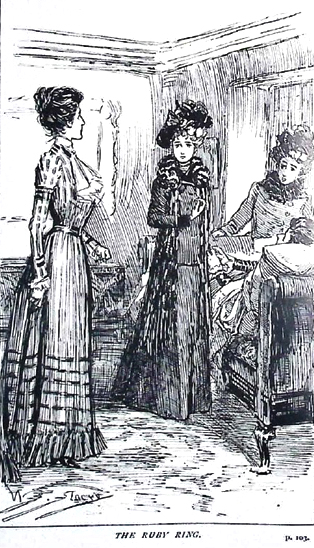
THE RUBY RING.
"Piers—Dr. Egerton."
"I don't believe you," said Frances, furiously.
Honora looked surprised. "It is, however, true. Perhaps it would have been better to make it known at once, but it makes no difference for the present. Piers must work his way for a time."
"Ah, what an innocent you wish to be thought! You know, for I told you, that this man is the only son of Mr. Egerton of Eltringham."
"I know it. I knew it before you told me. I knew Piers first in Dinar. His father was a very extravagant man, and behaved most cruelly to his wife, who had to leave him, and he married again before she was dead a month. Piers says that the property will be utterly ruined, and that he will never inherit a penny from it."
"Is that really true? Oh, well, then, I wish you joy of your engagement. You have behaved most deceitfully; you deserve just the kind of life you are likely to lead with the son of a man like that. I know you concealed your engagement in the hope of getting me into an embarrassing position, but in that you have failed. I hope devoutly that you'll be as happy as you deserve. Let me see that ring."
"Don't!" whispered Annie.
Honora heard, but did not like to refuse. She unclasped the chain, and let it and the ring fall into her lap. Annie uttered a cry of admiration as the red rays flashed out. Frances, who had risen from her chair, made a rapid movement, seized both ring and chain and flung them towards the blazing fire. But the ring slipped off the chain and fell on the rug.
Honora had it in her hand in a moment; and for a moment, too, she thought that Frances would try to take it again.
Annie had seized poker and tongs, and with difficulty rescued the chain, a good deal the worse for its adventure. The door opened, and in walked the two girls.
"We came in just to see that you didn't pitch Honora after her ring," said Violet.
And they both went into a fit of laughter.
"It was great fun!" cried Daisy. "Oh, take care, Vio—I do believe she's mad!"
It really seemed doubtful what would happen next, when Marian seized the little brass bell and rang it loudly. Stasy's not very light step made itself heard in a moment.
"Stand out of my way," Frances said in a hoarse tone.
The girls made haste to obey, being a good deal frightened. And Frances passed Stasy in the hall, and locked herself into her own room.
"Did you ring, missy?" said Stasy at the door.
Marian was too much frightened to reply.
Honora said, "Yes, Stasy, but we did without you."
Stasy looked at them all thoughtfully, and went back to her kitchen, murmuring—
"She's the old Miss Francie yet. I'll make tea. They're scared, the creatures."
"Where were you two?" asked Annie.
"At the window. I knew she'd have it out with Honora. But I do hope that lovely ring isn't hurt. I saw it on your bed the other morning, Honora."
Honora, now that the battle was over, was in far too shaky a condition to give Violet the lecture she deserved. And poor Marian was literally speechless. The two young sinners scampered upstairs to their room, and only the unusual thickness of the walls prevented their hilarity from being heard.
"I don't think you were surprised," said Honora in a minute or so, "but I was."
"You don't remember her. Besides, that poor, good-natured woman, Mrs. Cooke, used to appeal to Mr. Wilkinson sometimes. When she's angry, I just think she isn't right in her head. She smashed a plate-glass window once with a poker. Mr. Cooke wanted to send her back then, but they made it up somehow. Marian and I thought it better to say nothing of her temper when she came. I do wish she would go away, for she does the girls harm."
"She is going," Marian managed to say—"going to London—to a children's hospital. She wrote to Mr. Egerton about it."
"Well, if she says no more about this, let us say nothing. Annie, do you think you can get those two geese to be quiet? But I will wear my ring now," and she put it on. "And here's that dear Stasy with tea. Stasy, will you tell Miss Frances?"
But Frances appeared no more that day.
And the two girls, running hilariously down to tea, received such a lecture from gentle Marian as no one imagined her capable of giving.
"It was unkind, unsisterly, unladylike, and unwomanly," was the conclusion, "and I hope you will be ashamed when you come to think of it."
Daisy stared, round-eyed, but Violet looked abashed.
THE OTHER MISS VANDELEUR
NOTHING more was ever said about the affair of the ring. Frances came to breakfast the next morning, not a pin the worse for her performance. Honora even thought that she had forgotten all about it, but this was not the case. She wrote, after a day or so, to tell Dr. Egerton that she would gladly take the place offered her in the children's hospital, adding,—
"If I had known when I last wrote that you are to be my brother-in-law,
I should have been less unwilling to ask a favour of you. But from a
child, Honora was always fond of a secret—" a remark which gave Piers
Egerton the keenest amusement.
It was a little after Christmas when Frances went to London. And it was early in February that she returned, which she did without giving any notice of her intention. She said that she really could not stand children, she must try for a regular hospital. The matron's account to Dr. Egerton was that, though she had many qualifications for a first-rate nurse, she was not easy to manage, and the children were afraid of her.
She was in a rather trying temper when she reached S. Canice, and did not add to the comfort of home. The girls, who were both attending classes now, kept out of her way, and Marian was unfeignedly afraid of her.
Poor Annie had no heart to think of Frances or of any one else. Ernest had enlisted, and been sent to the depot of a regiment then in India.
"Did you call for letters, Daisy?" inquired Honora one evening in March, for there was no evening delivery at S. Canice.
"I did; and I have one for you. What will you give me for it?"
"I'll tickle you till you give it up," said Honora, seizing upon her small sister.
Squeaks from Daisy, laughter from Violet, when Frances quenched the harmless amusement by saying—
"Pray stop that awful noise, girls. Honora, you 'do' surprise me!"
Honora picked up her letter, which had fallen, and ran off with it to read in peace.
"Light the lamp, Annie. I can't read any longer."
"Not there by the fire," said Annie. "Come over to the window; there's plenty of light here."
"And paraffin oil is 'quite' eightpence a gallon!" said Frances, contemptuously. "Such nonsense! Dear me, what is the matter now, Honora?"
For Honora had flung the door wide open, and entered with an excited look.
"Oh, Marian! Oh, everybody! Such an extraordinary thing! Did you know that we have a relation, a Miss Vandeleur, whose family came from S. Canice, and who is a very great lady, very rich and grand, and Piers has met her—at least, so she declares?"
"Declares that Piers has met her?" said Annie. "Why, was your letter from her?"
"No, no—declares that she is one of our family. And that is not all. Have I light enough to read this to you? Let me in there beside you, Daisy. Yes; I can see quite well.
"'I have had quite an adventure, all owing to going to a great
dinner-party at my cousin Mrs. Sydney's house. I had hardly time to
shake hands with Selina when "Miss Vandeleur" was announced, and in
came a very handsome woman, magnificent in ruby velvet and diamond
ornaments; and Selina welcomed her with an alacrity which a rising
M.P.'s wife bestows only on a somebody. She has dark eyes, very
brilliant and piercing, dark hair—in fact, she is dark altogether, and
the very image of the picture that Violet and Daisy got hold of in your
Enchanter's Cave, and that was a little like your sister Frances. It is
more like this Miss Vandeleur.
"'She sat down near me, and when Selina had to receive a fresh arrival,
she turned to me and said, "I saw you start when you heard my name. I
suppose I have met you somewhere?"
"'I said no, I had not had that honour, but that the name was so
familiar to me, as I had just left a place in Cornwall where I knew a
family of the same name.
"'On which she said, "Was it S. Canice? I did not know there were
any of my family there now. My great-grandfather was Vandeleur of S.
Canice."
"'I said, "There is a picture there which might pass for yours."
"'Just then my cousin came within reach, and Miss Vandeleur touched her
arm.
"'"Mrs. Sydney, introduce me to this gentleman, and let me go down to
dinner with him; I am interested in something he is telling me."
"'Selina looked put out, but obeyed. I suspect I had not been thought
of for the honour conferred on me.
"'"Dr. Egerton," said my new friend. "I knew your mother very well; you
are like her. Now tell me about these Vandeleurs."
"'So I told her how you had all been dispersed about the world when
you lost your parents, and that now you were all at S. Canice, which
belongs to your eldest sister. And she asked more questions than I
could answer, though I told her all I knew. She cross-questioned me
like any lawyer. I got hardly any dinner—really had no time to eat.
"'When the ladies left us, she said, "Come to me by-and-by, Dr.
Egerton; I should like to ask you a question or two," which, as I had
dined on questions, I thought a rather cool thing to say.
"'I asked Sydney about her before we went upstairs. She has spent her
life in travelling, and is, he said, very eccentric, but enormously
rich. She seems not to know what to do with her money, and whenever she
chooses to reappear in society, she is quite a personage.
"'I joined her again after a while, and she said, "I am interested
in these girls, for, so far as I know, they are my only relations. I
remember when their father was ruined, and I tried then to meet him,
but I was not of age, and was not allowed to do what I wished. Then
he married, and I forgot all about him. I never heard that he left
a family. But I should like to see these girls and the place, and I
suppose from your account that there must be plenty of room for me. Of
course I shall arrange with Miss Vandeleur, and send down furniture
and servants. Now, which of the girls interests you particularly, Dr.
Egerton?" And she laughed, as I suppose I coloured a little.
"'So I said quietly, "Honora, the fourth girl, and we are engaged."
"'"Is that the beauty?" said she.
"'Don't quarrel with me, Honourbright. I said, "No; the beauty's name
is Frances."
"'She nodded. "That's my name, too." Then she got up. "I'm going," said
she. "I live at 10, St. James' Gate. Come to see me if you like."
"'But I do not think I shall go. They say she has been so run after for
her money that she thinks every one will bow to her, and is a bit of a
tyrant, and a very capricious one. She shall not say I hunt her because
she could make my Honora a rich woman. I'll do that myself some day,
perhaps.'"
The sisters had listened in breathless silence, but when Honora ceased reading, exclamations began, then came questions. Except Frances, none of them had ever heard of the English Vandeleurs. But Mr. Cooke, who was a solicitor, had told her the story of the division of the property, the heir of the house taking the Irish property and old Mr. Vandeleur's children, by a second marriage, getting all his money.
Frances said she believed that their money had been made by great mines in the neighbourhood of the castle, and that these having ceased to be profitable, the castle was abandoned, and had at one time been used by smugglers as a rendezvous and storehouse. Mr. Cooke had known nothing of the fortunes of the family in England. But what Frances could remember of his account of the separation in the days of their great-great-grandfather, made it easier for them all to believe in the existence of a strange Miss Vandeleur.
The picture was brought out to show to Marian, who said it reminded her of their father.
Nothing was talked of for some days but the wonderful cousin in ruby velvet and diamonds. The only one who said little was Frances, but I can safely assure you that she thought more about the matter than any of the others. But as nothing more occurred, the subject died out, and seemed forgotten.
Even Frances grew tired of waiting. She began many letters to the lady in question, but she burned them all. She considered Piers Egerton a fool for not going to see her and stir up her interest in her young relatives. Finally, when May came and no further step had been taken, Frances determined to go to London and seek an opening in some hospital. What else she meant to seek she did not say.
But on the day before that fixed for her departure, a letter came which made her change her mind. It was to Marian, from "the other Miss Vandeleur," as the girls called her. The writer explained very simply who she was, and that she was the last of the younger branch of the family as they were the last of the elder.
"I should like to become acquainted with you all," the letter went on,
"and as I know from your friend, Dr. Egerton, that you inhabit only
part of your house, I propose to take the rest of it, for this summer
at least. If we suit each other, I may keep my rooms there, and come
to you occasionally. I will send furniture, and will bring my own
servants, and will put you to as little trouble as possible. Let me
know how many rooms you can spare, and what you consider a fair rent
for them, and when I may take possession. Can you have them ready by
the tenth? And to aid you in arranging about rent, as I suppose you
have no experience in that line, I may say that a friend of mine has
rooms in an unfurnished house in a remote corner on the coast, and she
pays seven guineas a month for five rooms and the use of a kitchen.
Lose no time in answering, for I want to get away from London, which I
am tired of."
The girls were all sitting near the house in the grey spring twilight. Daisy had just brought the letter from the village. They first looked at each other solemnly, and then such a burst of sweet girlish laughter rang out. But when they were tired of laughing, Marian said—
"I'm sure I don't know what we're laughing at."
And all replied at once, but with a difference.
"I laughed at the way she asks you to arrange things and then does it herself," said Honora.
"I laughed at the notion of a fine lady in our shabby rooms," said Annie.
"I laughed because it's great fun," said Violet.
"I laughed because you all did," said Daisy.
"I laughed to think how nearly I had gone to London," said Frances.
"Do you mean that now you won't go?" said Daisy, her round face assuming a look of dismay.
Frances took no notice of her.
"Marian, what shall you say to her?" asked Honora.
"I should like to say 'No,' but I know I ought not—for your sakes—" looking round at them.
"It would be the act of an idiot," said Frances. "No one can say what may come of it. We, with our miserable pittance, are nobodies, and she is a great lady. And I maintain that we ought to make the house ready and her stay here as pleasant as we can."
"I think," said Honora, "that as this house is Marian's, the matter ought to be left in her hands. She came here for quiet, which she needs for her health's sake; and if she feels that all this would make her less happy here, I, for one, hope she will not consent."
"So do I," said Daisy.
But no one else spoke.
Marian folded up the letter with a sigh, and the sigh was echoed by Annie—poor Annie, who was thinking, not of herself, but of the luckless Ernest.
"I need not write till to-morrow," Marian said. "Indeed, there's a good deal to think of before I can write at all. I have hardly seen the large rooms, but surely they are in a terrible state—hardly habitable."
"These rooms of ours looked just as bad when I first saw them," said Honora. "I thought we should have to paper them. But, you see, they are painted, not papered, and Stasy got a ladder and washed them all over."
"I forget—are the large rooms painted, too?" asked Marian.
"I don't know. They are tapestried with cobwebs, embroidered in dust."
"But," said Annie, "we'll find out the first thing to-morrow. It's getting cold, Marian. Had you not better come in?"
This brought about a general move, and no more was said. But Annie and Honora arranged to be up at cock-crow in the morning and examine the central rooms and the seaward tower.
When the two met in the early dawn, Honora said—
"This matter must be settled quickly, Annie. Marian has not slept all night, and looks quite ill, and yet she refuses to say no once for all."
"I don't think she ought to refuse, Honora. Think of those girls—indeed, of all of us."
Here Stasy made her appearance, much surprised to see them. But when they told her why they were there, she laughed and said—
"You might be getting your morning sleep, dearies, if that's all. Every room in the castle is painted. Them big ones over the sea are grey, with a pattern of leaves, and the ones at the back are white; the very ceilings are painted."
Still, as they were up, they thought they might as well have a look for themselves. So having with difficulty opened the heavy shutters, they proceeded to clear a small space on the wall, and found that Stasy's memory had served her faithfully. And so well had the work been done that, although faded and in some places a little scratched, they found the paint in good repair.
"Three big rooms, which we must measure; and on the other side of the passage, the kitchen and four small rooms, besides the one we must keep for storing all the old things in. It is wonderful how good the woodwork is! Everything used for this house must have been of the very best."
"Why, Miss Annie, the wood's all oak—at least, so my people say. And do you see how dry the house is in spite of the sea so close? That's because the stone was cut out of S. Michael's Stone, and brought all that way. Not a bit of sea-rock was used, they used to tell."
"Then that queer little quarry where I rest so often is where all this came from," said Honora. "To think that none of us knew that."
"Was ye thinking of moving into these rooms, Miss Honora? They'd be pleasant in the warm weather."
Honora told her what had occurred, and Stasy fell into a state of excitement, crying—
"I shall see you every one heiresses yet!"
"Put that out of your head, Stasy. Miss Vandeleur is not old, and is not likely, I should say, to part with her money. But she may be kind to the young ones, and the rent will be a great help to Miss Marian."
"Miss Honora, your sister's Miss Vandeleur of S. Canice."
"Oh, what matter about that?" said Annie. "Do not put absurd notions into people's heads, Stasy. There's no doubt but that this lady may be a great help to us all, and what matter what we are called when we are all beggars?"
"Not beggars until we beg," said Honora, with her little nose in the air; "and I am not going to beg, Annie."
"I feel very like a beggar when I cannot help any one. Stasy, can you tell me what state the sea tower is in? I've never been in it."
"Well, miss, the sea tower is the worst part of the castle. It was there the smugglers lived, and they tore down a lot of the woodwork. Your father, when he came here, employed my father and a lot more to build up a passage to the sea that was used in old times for the mines. The Vandeleur mines ran out under the sea, and the sea has took them back now. And he built up the passage, and destroyed the steps, and locked the tower up. I never was in it myself."
"Come along," said Annie. "She can't possibly want more room than the main part of the house gives. And you and I must get ready for breakfast, Honora; and you look more like a sweep than I have ever seen you until now."
"But, Annie, does it not make you feel strange to think that we live in this house and yet there is a place just the same as our part of it, into which no one now living has ever been? If I let myself think of it, I could be nervous."
"Then don't think of it, dear," said Annie, who was not imaginative; "and whatever you do, not a word to those two girls."
Honora and the younger girls went off in due time to Heyward's. The girls were to return by train, but Honora was to walk across the moor, and Annie was to meet her at S. Michael's Stone. And there they met accordingly.
"Well," said Honora, "what is it, Annie? Why did you want me to meet you here?"
"I have something to say to you, and I did not wish to be overheard. Really, Honora, I don't know what to do. You know what pains I take with the housekeeping, and how we never have owed a penny."
"I do know, and I never can think how you manage it. Because Marian and I spent more in proportion to our numbers, and we never had anything eatable."
"I'll teach you, if you like. But what I want to tell you is this—Frances has been getting things at the shop I deal with in Plymouth, and not paying for them."
"Oh, that's not fair!" said Honora. "She must not do that."
"Who will prevent it? I spoke to her, and she was so angry, and I'm afraid of her, if the truth must be told. I don't think she knows what she's doing when she gets angry. And I must tell you, she has never given me a penny towards the housekeeping. She says she is only a visitor, and I think she gets money from the Cookes, but she never says a word of it."
"Did you ask her for money?" asked Honora. "Did you tell her that we all pay something?"
"Yes, but I gave in, for she declared she was going, and I didn't know then of these debts. But you know she said last night that now she means to stay."
"What has she been getting?"
"Adams sent the bill with mine for the tea that came yesterday. Oh, she has had candied fruits, and biscuits, and cakes, and Devonshire cream, and I never saw one bit of them. I don't know how she gets her parcels into the house, for you know if she brought them in through the hall door, we must see them."
"Puts them in through her window," said Honora. "You know she has often gone to the village in the evening. But this must be stopped. I can pay this bill if she will not, but she ought, and I shall tell her so."
"Indeed, I don't think you will. You've no idea—"
"Yes, I have. But this time I shall be on my guard. Get rid of Violet and Daisy after dinner, Annie. Violet would not help me much."
"Marian wants to consult us about her letter; she'll send the girls away. But when you say all that to Frances, I'll believe it, not till then."
"Why are you and Marian so afraid of her, Annie?"
For all answer, Annie pulled up the sleeve of her dress and showed a mark on her arm.
Honora turned pale. "Not Frances!" she cried. "Oh, Annie, surely she did not do that? Was it a dog?"
"It's sixteen years since she did it," Annie said, "but to this day I feel sick when I think of it. It was after you had gone to France. She struck Marian for interfering to save Daisy, and Marian fell down the six last steps of the turret stairs, and I am very sure that the bad illness she had soon after she went to Exeter was brought on by that fall; before that, Marian was not so helpless. I ran to drag Frances away, and she turned on me, and—well, she almost bit the piece out. And I know from the Cookes' letters to Mr. Wilkinson that she is often very violent. I 'am' afraid of her, I must confess. But all the same she must be spoken to, and if you 'can' do it, I won't run away. Only, let us keep between her and Marian."
Honora did not now feel quite so sure that she could do it, and yet she knew that she ought. And with her ought meant must. She employed her spare time in considering how best to approach the subject. Dinner over, Marian told the two girls to go out for a walk and to call for letters. And when they had somewhat reluctantly departed, she read to the others the letter she thought of sending.
It began by saying that they had not known that they had a relation in England until Piers Egerton met her, that they felt it was kind of her to wish to know them. She then described the state of the rooms, and said that there was no furniture in them except some mirrors which the sea air had quite spoiled, but which formed part of the walls and could not be moved. There was a kitchen, which they did not use; there was no second entrance to the house, but there was a double door which shut off the turret in which she and her sisters lived. Marian ended with—
"I should like very much to ask you to come here first as our visitor,
that you might see the place, but I cannot afford to do so. We think
the rent you propose very fair."
"I would not say that about not affording it," said Annie. "All the rest is very nice."
"But I do not see that," said Marian. "I must make her understand that I cannot do more than get the rooms cleaned and the windows mended."
"Stacy knows about getting that done," said Honora; "and we may as well have it done at once, so that we can keep the rooms open to get rid of the shut-up smell."
"I will tell her to-night, then. And we are all agreed that we accept the offer?" said Marian.
"Of course we do," said Frances. "Indeed, I think you are rather cold, all things considered. But when she is here, she can judge for herself."
"We should not like it to come to her ears that we owed any money," said Honora, quietly. But I cannot deny that she looked pale.
"But we never do, thanks to Annie," said Marian.
"Just now we do. This bill was sent with ours from Adams, in Plymouth, and Annie cannot pay it. Did you order these things? And will you pay the bill?"
Frances gave her a look which ought to have withered her up, but it only steadied her by making her a little angry. Turning to Annie, Frances said—
"Why did you speak of that to Honora?"
Annie quaked, but Honora stood to her guns. "Because I have a little spare money, and if you will not pay it, I will."
Frances sprang up, and so did Annie. Honora did not move. But the alarm was only momentary.
Frances turned and left the room. She was absent for nearly ten minutes, during which the matter was explained to Marian.
Frances came back with her purse in her hand. She was very pale, and her eyes were gleaming strangely, but she was quiet, and her voice was low.
"Give me that bill. Yes, it is correct. Pay it." And she laid the money on the table. "I am vexed that it was sent to you, Annie, but really I was driven to get some few things. No one could live as plainly as you do."
"Yet we do live, and even feel well," said Honora. "And as we are on the subject of expense, I will say plainly that it seems unfair that you do not pay as we do towards the housekeeping. Even Violet and Daisy are paid for—twenty pounds a year. Annie pays the same, and Marian and I make up what is wanted. We know that Annie's good housekeeping is everything to us, and we all agree that we ought to help Daisy and Vio. But if you mean to stay with us, we think you ought to do as we do."
Frances had walked across to the window over the sea. Keeping her back to them, she said—
"I suppose you are right. I did not think of it, as I meant to leave you so soon. But I want to see this Miss Vandeleur. Annie, I'll give you ten pounds now, and the rest if I stay on."
She flung two five-pound notes on the table, and was out of the room like a whirlwind. Annie drew a long breath.
"Honora, you're a heroine. Oh, but I was frightened!"
"She controlled herself wonderfully," said Marian.
"We might have mentioned the matter to Miss Vandeleur," said Honora, drily.
"Oh, Honourbright, we never would do that!"
"No, 'we' would not," Honora answered. "Never mind me, Marian; I am wicked."

UNDER OBSERVATION
MARIAN received an answer by return of post.
"Your letter, my dear cousin, makes me more anxious than ever to know
you all. I shall see about furniture, etc., at once, and when M— and
Co. announce that the rooms are ready, I shall soon join you. Do not
give yourself any trouble beyond the thorough cleansing and airing you
promise me. The walls will do very well, and if you will order in a few
tons of coal for me, M—'s men and my own people will see to all the
rest. I like your letter, and am sure I shall like you."
"I'm sure I hope we shall like her," said Marian, with a sigh, "for we are making a great change. We know nothing about her, and just suppose we don't get on? How are we to end it?"
"Do not fret over that, dear," said Honora. "I'll send her away if she annoys you."
The rooms were scoured, walls and floors and all, and in three days, they were ready. Which, as matters turned out, was as well; for on the evening of the third day, three huge vans rumbled up to the gate, having come to Saltash by train and the rest of the way with horses. A small army of workmen accompanied them, and the foreman came to the house to ask leave to bring his vans inside the gate. He then left two men to look after them, and the rest disappeared.
All the next day the sound of hammering and the dragging about of heavy articles might be heard. Frances spent the day in looking on. Violet and Daisy only regretted that they could not do the same. The excitement was great, but it was soon over. The foreman and his army departed, and that evening, while Marian was sitting in her favourite place looking over the sea, the gate opened, and in walked two well-dressed women, followed by a truck laden with boxes.
"If you please, 'm, is this S. Canice Castle?"
"It is. I suppose you come from Miss Vandeleur?"
"Yes, 'm—cook and housemaid. But I was not prepared for 'quite' such a wild spot as this."
Marian rang her bell, and asked Stasy to show Miss Vandeleur's servants the way to her rooms. Stasy grinned when she saw the fashionable get-up of the new arrivals, but she led the way through the tower, and helped to carry in their many boxes.
"You're the servant here, I suppose?" said the cook, condescendingly. "What's your mistress's name?"
"My mistress is Miss Vandeleur of S. Canice Castle: Your mistress is her cousin."
"Such a wilderness!" moaned the housemaid.
"You'd best keep your complaints for your mistress," said Stasy.
"Here's a door won't open," said one.
"Because it's locked—that's why," said Stasy. "Miss Vandeleur—I mean, Miss Vandeleur of S. Canice Castle—has a lot of furniture she don't use in there. She told her cousin she'd keep that room."
Stasy walked to the double door in the passage. "This here door is your affair, d'ye see? On that side of it you does as you like. The tower is my business. You see, there's a bell."
There certainly was, but Stasy omitted to add that it did not ring. She shut the door, and marched into her kitchen, saying aloud—
"Stuck-up monkeys! But they did not make much out of Anna Stasier Ridd." This was Stasy's version of her name.
From her distant and slightly contemptuous attitude, Stasy refused to move. No one should think little of Miss Vandeleur of S. Canice Castle if her one domestic could help it.
The next day was Saturday, and a half-holiday at the College. Honora, Annie, and the two younger girls repaired to the garden, the gate of which was at the side of the road opposite their entrance gate; and there made themselves very busy, dirty, and tired, over some rather futile and unsuccessful gardening. For none of them knew anything about it, but the ground being there, it seemed a pity not to use it. They had only Saturday, and how the weeds did grow!
When Stasy rang the bell for tea, the whole party rushed out, meaning to return when they had had their tea. Annie was struggling with the garden gate, Violet with the other, Honora and Daisy were shaking the earth from their skirts, when a lady came round the corner, and seeing them, hastened forward and joined them. She was dressed in a perfectly fitting tweed travelling-dress, with a cap to match, and though she had travelled from London, she looked as if she had just stepped out of a bandbox. She was tall and dark, with dark eyes and hair—the latter glossy and abundant, the eyes remarkably brilliant; in features she somewhat resembled Frances, without being quite so handsome. Here, no doubt, was the other Miss Vandeleur.
Violet flung the gate wide and ran off to the house, followed by Daisy. Annie stood where she was, the picture of dismay, but the undaunted Honora stepped forward to greet the new-comer without a moment's pause.
"You must be our cousin, Miss Vandeleur," said she. "If we had known you were coming, we would have met you at the station, but we were gardening."
"It is but a step. Nay, never mind the earth on your hand; we must shake hands. Is this another cousin? What a fortunate woman I am! I thought I had not a relation in the world, and behold, I have found a nest of cousins. Tell me which you are?"
"Honora; and this is Annie, and the two who fled, conscious of earthy skirts, were Violet and Daisy."
"And there are two more," the stranger said—"Marian and Frances. And I was informed that Frances is the beauty of the family." And she looked at Honora's sweet face with a smile.
"Oh, there is no doubt as to that, as you will soon see. Come up to the house, for you must be tired, and I know tea is ready."
They were presently in the sitting-room, where Marian received her guest in her usual gentle, quiet way.
"This is Violet, and this is Daisy," said Honora. "Marian, you must not stand. I will go for another cup."
Just then Frances entered the room.
Honora said, "Frances, Miss Vandeleur has come." And as she spoke, she looked back at Miss Vandeleur and nodded, as much as to say, "You see, I was right."
Frances had very good manners when she chose to be pleasant—manners with that little careless air which is part of an Irishwoman's charm, and by her help, there was no awkwardness or lack of conversation. They had tea, and then Miss Vandeleur said to Honora—
"Will you take me to my room, for I am tired, and will lie down till dinner-time?"
As they went along the passage, she said—
"Your friend did not say too much about your sister. She is very beautiful. Yet he chose you?"
"He had known me at Dinar. I hope you will like your rooms; they look lovely to me, but I am no great judge. This double door shuts you in. And that's the door of the room we have put our old furniture into; and this—"
"Oh, what a lovely room! And such a view of the sea! I love the sea. Can one hire a boat here?"
"I do not know. I will tell your servants that you are here. This is the dining-room door, and the bedroom is just beyond it, but the door is in the passage. Now I must leave you, for we left our garden unlocked."
But she found the hall in a commotion, owing to the arrival of Miss Vandeleur's luggage, and two more servants, her footman and her maid—the latter a very fine lady indeed. When the double door had closed upon this last arrival, the girls looked at each other and laughed.
"I do hope she will be well-taken care of," said Annie. "Four servants!"
"All for one person!" cried Daisy.
And Honora said, laughing again, "That's on one side of the double door. On the other, six persons and one—Stasy; but then Stasy is worth a dozen others. Come and help me to gather up our things. We shall get no more gardening to-day."
The other Miss Vandeleur made herself very much at home, and was very pleasant. She said she enjoyed the lovely air and the perfect quiet, the bathing, and the scenery. The idea of a boat she gave up, for there were none but fishing-boats to be had, and she was told that the coast was not a very safe one.
She sat with Marian on the terrace. This was her name for the rocky platform that lay between the tower and the road, and which overhung the sea. On fine days they sat there, on windy days either in Marian's little parlour or in the large drawing-room. Frances was generally one of the party, and sometimes Annie, but her household cares were many, and besides, she was in wretched spirits.
Marian was amused and pleased with her new companion, and talked to her quite freely when she had got over her first shyness. Much of her somewhat sad little family history was told to Miss Vandeleur, who seemed anxious to know all about the six cousins she had found.
Frances all this time was delightful—so gay, so good-tempered, so obliging—that her sisters were quite surprised. Violet and Daisy admired their new cousin with a great admiration; they even considered her far more beautiful than Frances, which she really had not been, even in her youthful days. Fortunately, they kept their opinion to themselves, and were content to admire Miss Vandeleur in silence, and to gaze in wide-eyed wonder at her dresses, etc., of which they never wearied talking to each other.
The only one of the family who kept a little aloof, and who, though always pleasant, was never more familiar than at first, was, strange to say, Honora.
For many weeks, Miss Vandeleur was content to go on thus. She had come to S. Canice to inspect her cousins, and she inspected them at her leisure, and formed her own opinion about each of them. She had been a traveller for many years, and there was no lack of subjects for conversation. Frances, in particular, was always anxious to hear about all the strange parts of the world that she had visited. So the time passed quickly. May, June, and July went by, and August brought the holidays near once more.
One day, Frances was in her own room altering one of her dresses; she was even more clever at dressmaking than Honora. The sun grew too hot for Marian, and she consented to go to Miss Vandeleur's cool sitting-room until there should be a little shade outside. Thus it happened that Frances did not join them, for none of the girls ever passed the double door except by invitation.
Miss Vandeleur wanted a talk with Marian, and was glad to be alone with her.
"Marian, you have told me many things about all of you, but there must be something you have not told me about your sister Annie. Among you all, she alone looks sad."
"I do not know that she would let me tell you," answered Marian.
"Then there is something? I should like to know, because I may be able to help her. It is a love affair, of course, although such things have never been in my line. I know the signs and tokens. These Wilkinsons among whom she grew up—is it one of them? And they cannot marry until he gets a living. I suppose he's a clergyman like his father?"
"No, I wish he was," said Marian, incautiously.
"In the army?" queried Miss Vandeleur, who abstained from a smile, but was reminded of poor David Copperfield when he likened himself to a "tender young cork." "And till he gets his company—that's the right word, I think—they are separated?"
"Will he rise to be an officer? Do tell me if you know, for poor Annie would be so glad to hear it. I did not think that a man who enlisted would become an officer."
"Why did he enlist? It was a very foolish thing to do, you know."
"I was afraid it was. He is very good and nice, but very unfortunate. There are five brothers all doing well, but 'he' lost his clerkship, and enlisted because he could get nothing to do. And I do fear that poor Annie will be ill, she frets so. And now he is so wretched, and he is to be sent to India soon."
"What regiment is he in?"
"The — Lancers. Annie wouldn't mind going to India, but it is out of the question—she sees that."
"Oh dear me, quite! But what could you do without Annie? Tell me, did not you and Honora live here without her at first?"
"Yes. But with the girls, we could not manage without her."
"Could not Frances take her place?"
"She means to complete her training as a nurse," said Marian.
"Yes, I forgot that. And the two girls, Marian? How are they getting on at Heyward's?"
"They are learning as fast as they can, and mean to get employment in the post-office. But Miss Webb says they are so backward; and how can we let two such young girls go and—But never mind, all that cannot interest you. I wonder where Frances is?"
"It does interest me, Marian. You, all of you, are my only relations, and I am greatly interested in you. These girls are by no means fit for the life they are training for."
"But what can we do?" poor Marian said sadly.
"You and the others have done the very best you could, my dear girl. Tell me, Marian, if you were under surgical care, do you not think you would get over this terrible weakness?"
"No, I do not think so. I was under Dr. Elliott's care for a long time, and he told my dear Mrs. Elliott that nothing could be done for me. When I came here first, I felt stronger, but of late I know I am losing strength. I do not think it will be very long now."
"Well, when the holidays begin, I am going to town for a few days, and I want to take Violet and Daisy and Honora; they deserve a 'real' holiday, I think. I will bring them back in a fortnight or so."
"Oh, how they will enjoy it!" cried Marian. "How kind of you! I often wish that they could have a little change. Honora works so hard."
"And Annie and Frances will take care of you?"
"I wish," began Marian, but checked herself—"I wish Frances would come, for I should like to go out again."
"I don't think that is what you were going to say," remarked Miss Vandeleur.
But whatever it was, Marian did not say it.
"I have some letters to write, Marian, so I will help you to your seat out there, and send Frances to you."
They found Frances on the terrace, and Miss Vandeleur went in, and having written several letters, she stepped out and posted them herself.
When she came back, she found the others all assembled, and having tea in the open air. She accepted a cup and a chair, and sat listening to the bright talk that never seemed to flag when Honora was of the party. Presently she said—
"I am going to town for a fortnight, do you know, young people?"
"No," said Honora, "at least, I did not know. Are you going at once?"
"As soon as the holidays begin. I want to give you and Violet and Daisy a little change, for you all work very hard. Will you come with me?"
The immediate consequence of this speech was such a babel of exclamations and questions from Violet and Daisy that nothing else could be heard.
"Do you mean me?"
"Oh, did you say London?"
"A whole fortnight!"
"Hush, hush!" said Marian, gently. "You'll deafen us all at this rate. It's quite plain that you are delighted, but you have not thanked Miss Vandeleur yet."
"Oh, but we do thank her; you know we do, don't you, Miss Vandeleur?" said little Daisy, looking up into her cousin's face. She was seated on the ground at her feet.
"I do, my dear; and I am very glad to be able to make you so happy. Now, suppose you and Violet go and take a little walk, just to work off your excitement."
They sprang up with alacrity, and Frances also rose.
"I shall be glad of a walk too," she said.
She was very white, and her voice sounded thin and constrained. Honora got up, and stood so as to screen her as much as possible from Miss Vandeleur, beginning to put the scattered cups and saucers on the tray.
"Do," said she. "Listen to Vio and Daisy—the chatter they are making. And when they came here first, they seemed to care for nothing, and to have no opinions of their own. They seem to have come to life."
"You have not accepted my invitation yet, Honora?"
"And though I am very much obliged to you for thinking of me, I cannot accept it. I have a great deal to do during the holidays, and so I must ask you to excuse me."
"Oh, Honora, you're not to stay on my account!" said Marian earnestly. "I have Annie, you know; and you would see Piers."
"He is coming here soon, you know. Do not urge me, Marian, for I really cannot go."
Miss Vandeleur looked annoyed. "I wish you would reconsider this," she said; and her voice was somewhat cold.
"I am sorry, but I cannot go," answered Honora, quietly.
Miss Vandeleur bowed, rose from her seat, and went into the house.
"Why will you not go?" whispered Marian. "It would be so good for you, and I fear she is annoyed."
"I really cannot go," was all the answer she could get.
Next day, Miss Vandeleur asked Frances to take her sister's place.
"I did not mean to ask you during the holidays," she said, "for London is not at its best at this season, and you are not tied to the College, but if you will come and help me to look after those two children, we will take our pleasure some other time."
Frances looked radiant after that. And as soon as the College closed, the party of four set out on their journey. Marian had wished to get the girls new dresses, but Miss Vandeleur stopped her.
"Leave them to me," she said; "I want to make them 'very' happy."
Honors was in the window recess, behind the speaker, working away at a great rate. Miss Vandeleur turned quickly as she spoke and looked at her, the little head was up and a slight smile on the red lips. She laughed.
Honora looked up, but no explanation was offered.
"Honora," Violet said one day, "I wish you were coming instead of Frances."
"How should you like me to tell that to Frances?" inquired Honora.
"Don't care; she knows it well enough. Daisy and I cannot think why you won't come."
"But that is very sad," said Honora, with a lift of her delicate eyebrows.
"What is?—That you would not come?"
"Oh no, but that Daisy and you can't think why. Never mind, Vio; enjoy yourself, and be civil to Frances, and you will find her pleasant enough."
Neither Daisy nor Violet wrote to any one at home during that visit, but Frances did so once or twice. She spoke of pretty dresses, etc., being procured—"really so lavishly, that we shall not need to buy a dress for years to come."
Dr. Egerton, she said, did not think he could get away at all, certainly not for more than a day or two. He was very attentive and kind, but had so little leisure.
Annie looked at Honora, who gave her head that little lift which did not amount to a toss, and said—
"Do not be alarmed, Annie; I am not."
THE FIRST MARRIAGE IN THE FAMILY
THE party came back from London after a stay of nearly a month. Annie and Honora met them at the station. With them came a gentlemanlike man, who was introduced as "My friend, Mr. Stanhope." The girls looked very happy; Frances looked her very best.
"Have you heard from Piers, Honora? We have not seen him for at least a week. He is so busy."
"You could not easily see him, for he has been here since Saturday week; and he is very well, and likes his new life."
"Oh, I am glad he contrived to get away! He came every day for a time, and then he did not think that he could leave London. Miss Vandeleur, Dr. Egerton is here."
"Yes, I know he is," was the reply.
"Here he comes," said Annie. "He was at Dr. Musgrave's."
When they got into the lighted parlour, no one could look at any one but Violet. That young lady, who had hitherto worn her hair hanging over her shoulders in an untidy mass, now had it piled up in artistic waves high on her head, and it was exceedingly becoming to her. So was a soft, dark dress, which softened the angles of her girlish figure. As for Daisy, she was always pretty, but she looked lovely now.
Much talk went on, but through it all the stranger, whom Dr. Egerton had greeted as an acquaintance, sat in a quiet corner and watched Marian. Piers glanced at him in an anxious way until he saw that Honora observed him. Later, when he was about to leave them (for he was nominally on a visit to Dr. Musgrave), Mr. Stanhope said he was accompanying him as he wanted to smoke.
Next day, as the sisters sat together chatting, Miss Vandeleur came in.
"Annie," she said, "will you come to my room for a few minutes? I want to confess my sins. I have taken what Honora would consider a liberty with you, and I want to talk to you."
Poor Annie, who between fretting and anxiety looked so worn that she might have been forty instead of six-and-twenty, followed listlessly. As soon as they were both seated, Miss Vandeleur said pleasantly—
"Your sister Honora is so fiercely independent that I should be quite afraid to confess to her that I have been meddling in—in 'your' concerns, Annie. I wish sincerely to give you all a helping hand. I coaxed Marian to tell me your difficulty, and I appealed to a friend in the army. I have purchased Ernest Wilkinson's discharge, and—"
But poor Annie had sprung up, her face suddenly losing the listless look.
"Oh, have you done that? Have you saved him? I shall bless you as long as I live. I've been so miserable! I couldn't bear to think of him; he was so unhappy. You have made me—" Here her voice was lost in sobs.
"You are very fond of him, Annie?"
"Any one would be fond of him," was the answer.
"I do not think that I should, I must confess. If he were able to support a wife, would you marry him?"
"If he—asks me—again, when that time comes."
"Well, I have a friend who, as secretary to the governor of Brisbane, requires the services of a clerk. He is in England, but goes back next month. He has promised me to give Ernest Wilkinson this chance. The salary is a hundred and fifty pounds a year, and the appointment is permanent if the man behaves well. Men are difficult to get out there, and as long as he gives satisfaction, he is pretty sure of his place. Young Wilkinson knows of this, and he will be here to-morrow. I would advise you to let him go alone, if I thought you would listen to me; conscience compels me to say this."
Annie laughed and said, "I have heard that advice pretty often. But Ernest is very fond of me, and is always quite content and steady as long as he is with me. He is one who cannot do without a home, and if he asks me, I will try to make a home for him. I always told him he must ask me when the time came; I never would be engaged to him. And whether he does, or does not, I shall be thankful to you for giving him this chance, the best he ever had."
"Do not thank me. I am doing this for reasons of my own. I have plans, which do not affect you."
"I must go and tell Marian," cried Annie.
Early next day, Piers Egerton came to the castle, and found Honora waiting for him at the gate. They walked on together.
"Piers, tell me about Mr. Stanhope. He was brought here to see Marian, I think."
"You little witch! I was afraid you guessed. Yes, Miss Vandeleur asked me to name the best man in cases such as hers, and I named Stanhope. If anything can be done, he is the man to do it. Do you think Marian would be frightened about herself if he spoke to her?"
"She has Dr. Elliott's opinion—we write to him, you know—and she has yours. We do not need Miss Vandeleur's help. For Marian, one would perhaps accept it, but it is not altogether for her. And he can do nothing for her. Oh, Piers, you know that!"
"Stanhope is wonderfully skilful; and as he is here, do you think she would be frightened?"
"Do you know her so little as to fear that? Marian knows—what we all know, and as her favourite hymn says, she 'dreads the grave as little as her bed.' And why is she to be annoyed because of Miss Vandeleur's plans?"
"Honora, you don't like Miss Vandeleur, but be just to her. Come now, Honourbright."
"You are mistaken; I 'do' like her. She is very pleasant always. But I have known ever since she came here that she has some plan in her head about us. She has now got to know us all, and I think her plan has taken shape; and you will see that she will settle everything about all of us to suit that plan. She has made Vio and Daisy all her own; she has got rid of Annie. Oh, I know she did it kindly, but all the same Annie will be gone! She wants to know for certain about Marian. There remain Frances and me."
"You! Oh, you belong to me."
"I do, Piers; and I therefore have your honour in my keeping, and so I will not be a pawn in Miss Vandeleur's game. I have held a little aloof from the first, because I belong to you."
"You're a darling! But, Honora, mind you, she is immensely rich. She could provide for you all, and never feel it. I feel I ought to tell you to consider, for rich I shall not be for years—rich as she is rich, I shall never be."
"Should you like me to pay the price she may demand, Piers? Should you like me even to bow down before her, like Vio and Daisy, who think her the best and loveliest of women, and from whose minds she has blotted out what Marian and Annie and I did for them? And honestly, Piers, tell me true. Would you rather take me as I am, or with my hands full of gold given me in return for years of—"
"Years! I won't wait years. Years of what, Honora?"
"Answer my question, dear. Which would you rather take—me as I am, or what she might make of me?"
"You as you are, Honora, for I don't think you can be improved. As to riches, if God spares me my health, I believe my career is no longer a matter of doubt; and I would fifty times rather take you as you are in that matter too, than owe wealth to any one save God and my own right hand."
Honora was a rather shy, undemonstrative girl in her ordinary manner to her lover, but when he ceased to speak, she bent towards him and kissed him.
"You have spoken as I knew you would. Oh, Piers, what a happy woman I am!"
They had reached the little creek where the girls always bathed, and were sitting side by side in a sheltered nook.
"If you are ever less than happy, dear, I only pray that it may not be my fault."
"I think it will not be your fault. We can't expect to go through life without some trials, but so long as we can trust one another, we can face them. Poor Annie! I wish I felt more confidence in 'her' future. Miss Vandeleur has taken upon herself to play Providence; and only fancy, she told Annie that she did it for a reason of her own. I said, 'I could have told you that,' and Annie was really vexed. She asked what reason she could have except kindness. I said I could not tell her."
"Can you tell me, O reader of hearts?"
"No," she said, laughing; "you would make fun of me. Well, we have lost Annie, and I will speak a prophecy for your benefit. In no long time, Marian and I will be here alone, as when you came."
"Oh, you know, this won't do. Time for me to escape. I didn't bargain for a prophetess."
"Piers, one thing which I like in you is your good sense. Take care."
"Honora, one thing which I like in you is your very great impertinence."
"So glad, for I do not fear a failure in the supply." She rose as she spoke. "That young Wilkinson is to be here presently; we had better go home."
"But, look here. Will you speak to Marian about Stanhope? As he is here, she might as well see him. I promised to arrange with you if possible."
"I will speak to her, for I will not have her urged if she objects. She is far too weak to be worried. Here comes Daisy. Well, little one, where are you going?"
"I was looking for you. Mr. Wilkinson has come. I thought he was Miss Vandeleur's visitor."
"So he is."
"Well, he and Annie are in the parlour, and Marian's on the terrace and wants you."
"Well," said Piers, "I expect I should be in the way, so I'm off for a walk. I will come back in time for tea."
The two sisters opened the gate, and went to join Marian and Violet.
"Well, Marian, what news have you?"
"None, as yet. A fine, handsome young man—pleasant-looking."
After a long stare and some meditation, Daisy presently said gleefully—
"I do believe he is Annie's lover."
"Nonsense! He is too young," cried Violet. "Is he, Marian?"
"I forget his exact age."
"But I mean, what brings him here?"
"No one can tell what Annie may say," remarked Honora, "so we ought to wait patiently."
But when Annie and Ernest Wilkinson came out after a time, there was little doubt about the matter. Annie looked tearfully happy, and the tall, well-drilled young man was beaming with triumph.
"I think," said Honora, "that you and I may shake hands, as those two are so busy with each other. Besides, we remember each other, don't we?"
"Wish me joy," he said boyishly. "She says she will. I asked her five times before, and she would not."
"Better late than never," said Honora, laughing. "And I do wish you joy, and think you very fortunate."
It presently became known that Ernest must sail with his new employer on the first of October, which left but a fortnight or so for preparation. Miss Vandeleur simplified matters by taking Annie to Plymouth and providing her with a most complete outfit. The banns were duly published in the little weather-beaten church.
Mr. Wilkinson came to perform the ceremony, the Rector of S. Canice gave the bride away, and every one said—all the village and all the denizens of Heyward's College being there—that the four bridesmaids, in their simple white dresses and blue ribbons, were well worth going further to see. And Annie and her husband were a good-looking couple, people thought.
Before they left the castle, Miss Vandeleur took the bride aside and gave her a sealed envelope.
"This is my wedding present, Annie. Keep it carefully. I have settled one hundred a year upon you, payable only to yourself, and only for your life. I felt that I ought to make certain that you cannot come to want."
"You need not have done this, but it is very kind of you. Ernest and I will never forget your great kindness to us, Miss Vandeleur, though I cannot say it as I feel it."
"I hope you will be very happy," said Miss Vandeleur. "Good-bye, my dear."
When left alone, Miss Vandeleur looked thoughtful for a time. Then she said aloud—
"But Annie was impossible—a mere household drudge, and no advantage to the others with this long lad on her hands. Violet I do not like; Daisy is a dear little goose. My choice lies between Honora and Frances. Poor Marian, she is one of the best and sweetest of women, but even if she were strong and well, she has so little education. No, Honora is the flower of the flock, and worthy of the position I can give her. With her, I shall have a home."
During the fortnight of fuss and preparation, Honora had asked Marian to see Mr. Stanhope, telling her what Piers said of him. Marian was not very willing, but as Miss Vandeleur had brought him there on her account, she consented at last.
"I will answer all his questions, but I will not let him touch me. He would only hurt me, and do me no good. But he will not want more than to talk to me."
She proved very nearly right. Mr. Stanhope, gentle and tactful as most clever doctors are, talked to her for a while, and finally took out a stethoscope.
"This will not hurt you," he said, with a very kindly smile. "You need not even move. That will do."
"You don't ask about my back," she said, with the smile that was like a faint reflection of Honora's.
"After so long a time, I do not see the use of annoying you. Elliott is a good man."
"And did nothing, because there was nothing to be done," she answered. "Run, Honora, and bring me those letters from Dr. Elliott. Here is the key of my desk."
Honora went to the sitting-room, leaving the door between the two rooms open.
Marian laid her thin hand on the great surgeon's arm.
"I know the truth," she said. "Tell me, quick—will it be much longer? Answer, please; I am not afraid."
He looked into the gentle, steady eyes, and obeyed her.
"Not long, my child, and probably painless."
"Then I may keep Honourbright," she said gladly. "I couldn't expect Piers to—"
Here Honora came back. She had heard and understood, but she gave no sign of having done so.
"Piers," Marian said to him that evening, "will you write to some stationers in London and get them to send you one of those printed forms for making a will which I see advertised? I want to make mine, and you and Dr. Musgrave will witness it for me. You will manage for me, won't you? I do not want any one else to know."
"Anything that you want, Marian, you've only to tell me."
And he managed so well that, before his holiday was over, the will was written and signed and placed in Marian's desk.
On the morning of the last day of his stay, Miss Vandeleur sent for Piers Egerton, and had a long conversation with him. He was to go by the last train. And though it was a blusterous night, Honora declared that she must go to the station with him, or he would lose his way, he was so heedless.
Frances laughed at her, but quite pleasantly. Frances had grown wonderfully pleasant of late.
"Piers, are you not going to tell me what Miss Vandeleur wanted to say to you?" Honora said as they went along the rough road.
"First, you must clear up the poignant doubts of you, madam, which have been implanted in my confiding heart."
"Dear me! Who implanted them?"
"Dr. Musgrave."
"Nice old donkey! What are these doubts, pray?"
"I asked you once if you had ever—well, I haven't time to put it nicely—been made love to by any one but myself, and you said, 'No, never.' And during my stay at his house, poor Musgrave told me that he did not come back here altogether for the sake of his garden, but because he found he must try again to win you.
"'For,' said he, 'though she refused me once, she might have listened to me in time.'
"And no sooner had he arrived than he found that you were no longer an unappropriated blessing."
"He dreams, this excellent fat man. He never put me in a position to refuse him. He was making fun of you, my poor boy. His jokes are rather inscrutable."
"It was no joke to him. It was—we shall be late for the train—it was the day he bade you good-bye, and you opened the door for him, and he asked you 'if he had a chance,' and you said he had time to catch the train, which was, my dear girl, a very vague way of replying to an offer of marriage."
"I do not remember it in the least. I suppose if he said that, I thought he meant a chance of the train. I must tell Marian. How she will laugh!"
"You hard-hearted little wretch! Laugh! If you had only heard poor Musgrave's sigh."
"Like a furnace!" said she, solemnly. "Confess, Piers—you invented all this?"
"No, truly, but I think it was a shame to tell you. However, he said he wished you to know. Hullo! Here's that walking conglomeration looking for me. Good-bye, my darling—good-bye."
"How about the doubt?" she called after him.
"Better go home and repent."
She went home, but she did not repent. On the contrary, when it struck her that Piers had never answered her about Miss Vandeleur, she came to a halt, and said—
"Just talked all that nonsense to put me off. I detest Piers!"—in a tone which was as good as a caress.
A DISAPPOINTED BENEFACTOR
A DAY or two later, Miss Vandeleur came into the little parlour where Marian, Frances, and Honora were sitting at work. It was too cold now for the verandah.
"I want a little talk with you, Marian, on business. S. Canice is getting too blusterous for me, and I think of going to London, if not further, for the winter. Will you come to my rooms?"
"No," said Honora; "Frances and I are just going out. I have to see Miss Webb, and Frances comes for the walk, and will come back at once. I may have to stay for an hour or two. Marian is not up to walking about to-day."
"I will take care of her till one of you returns, so do not hurry," replied Miss Vandeleur.
"I am sorry you are leaving us, Miss Vandeleur," said Marian, when they were alone, "but it is wild here in winter. I do not think I shall see you again, even if you come next year. And you have been very kind to us all—to me particularly."
"I have been very happy here. Ah, Marian, if I had been so fortunate as to be one of half-a-dozen sisters, I should never have been known as 'the eccentric Miss Vandeleur.' But I was an only child, and my father and mother were only children, so that I was singularly without relations. I may say I had none but your father. And my guardians were so afraid that my gold would go to re-establish his fortunes that they were careful that I should never meet him."
"But he must have been married long before you were grown up," said Marian.
"No, I am older than I look. Has Dr. Egerton told you anything of my past life?"
"Nothing, but that you liked travelling."
"Ah, it is more than that! But first, let us settle our business. I wish to keep my rooms permanently, and to come occasionally to see you. I will send an old servant of mine to take care of them; and I should be glad to think that I shall spend many summers here."
"Why not, if you wish it?"
"It depends on circumstances. Now, to get on. I know that you are anxious about Violet and Daisy; do not be so any more. I mean to make them independent, and to give them a chance like other girls. I have not spoken to them yet, but I am pretty sure they will consent to go with me."
"Oh dear!" cried Marian, nervously. "I wonder—Oh, ought I to let them go?"
"My dear, I do not think it rests with you. I spoke to Mr. Wilkinson and have his consent. I do not suppose you have any power in the affair, unless they ask you to let them stay here; and that would mean to refuse a life of ease and such things as girls love, and I do not think they will do that, for they are quite fond of me."
"I know they are. You have been so kind to them, I don't know why I feel anxious."
"Only because you are weak and ill. A very little care will make them thoroughly presentable, and they will probably marry. Well, that is settled. Now I come to what is nearer my heart. But first, do you know what is meant by a globe-trotter, Marian?"
"Yes; like Miss Bird and Miss Cumming," said Marian.
"That is what I have been. Only I write no books, and I don't consider myself a benefactor of my species because I amuse myself in my own way. I get weary of the civilized world, and disappear. But the last time I did so, I was very near not reappearing. I had fever, lost my head, was robbed and neglected, and nearly died. It was in Africa, and I made up my mind, first, that I would never go into the unknown wilds alone again; secondly, that if I could find some one—some woman—for whom I could really care, I would take her to me, go to my place in Surrey, and give domestic life a chance. And I have met that person."
"Daisy?"
"No, Honora. If Honora will give herself to me, I will make her my heir."
"Piers Egerton!" gasped Marian.
"Must wait. I spoke to him."
"And he consented?"
"Yes, he will not interfere. Honora is young, and she has no idea of the wonderful charm she possesses. I don't suppose Dr. Egerton could marry for years, and by that time, Honora will be a personage in society. She can, of course, marry him then if she likes. But she might, with her prospects, marry almost any one. However, I like Dr. Egerton, though he will never quite satisfy me for Honora. Oh, he understands; he will not interfere."
"But Honora—oh dear!—Honora would not like travelling in savage places."
"I shall not ask her to do so. I tell you, Marian, for the first time in my life I shall have a home. I shall have some one to care for, to be proud of. She suits me as no one else ever did. I lost my heart to her the first time I saw her. I am never weary of looking at her, watching the play of her countenance and her pretty gestures. Oh, Marian, you must give me Honora! Frances will stay with you; you know what a nurse she is. I shall promise to provide for her handsomely, but I must have Honora."
Marian tried to speak, but only gasped. The next moment, she had fainted.
Miss Vandeleur summoned her maid, and with her help recalled Marian to consciousness, and persuaded her to take a glass of wine—"For you must not look like a ghost when they come home, or they will be frightened."
"I am quite well now. But I should like to be alone a little, to think what I shall say."
"Marian, if you say what would influence Honora to refuse, you will be acting very selfishly, and she will think so in the days to come. I offer her a place, a life, that any woman with her powers would find delightful."
Marian looked at her with her sweet, dim gaze. "I do not think I am selfish," she said; "I do not mean to be."
"If you say to Honora that you cannot—"
"I shall not say that. It will not be for long. I think I will do as Piers did, say nothing, but let her decide for herself. Please leave me now."
Miss Vandeleur dressed herself and went out. She presently met Frances with Violet and Daisy. So utterly occupied was her mind with Honora that she was abrupt in her manner to them, asking—
"Where is Honora?"
"She stayed with Miss Webb. But she will be home by the train."
"At five? And it is three now."
"Where are you going, Miss Vandeleur?" said little Daisy.
"Nowhere in particular."
"This will be our last term at the College," said Daisy, "and I'm sorry, for though I don't like college, I—"
Miss Vandeleur looked at the child's pretty face and smiled.
"Don't look so sad, little one. You will not go to the College any more—neither you nor Violet, unless you prefer it to coming with me. I have settled it with Marian, and you belong to me for the future. You will spend this winter in London, taking lessons and enjoying yourselves. You will have no need to work for yourselves, for I shall at once place you beyond want. What a pair of eyes, Daisy!"
"Miss Vandeleur," said Violet, with a strange sob, "do you mean that?"
"Why, of course, child. Do you consent?"
The girl seized Miss Vandeleur's hand and kissed it.
"If you knew how I have dreaded going away by myself. I know what it is. Oh, Daisy, do you understand?"
"No," said Daisy, "I don't. Is it that she's going to give us money so that we need not be clerks? Is it that we are to be with her as when we were in London?"
"For a time, yes. And you will be quite independent, Daisy."
"That means you won't have to work," explained Violet.
Daisy rushed at Miss Vandeleur, and flung her arms round her, crying—
"I love you! Oh, I do love you! No one ever was so good as you!"
Miss Vandeleur was touched. She kissed the pretty, tearful face, and accepted the thanks graciously. Yet, judged by the standard of the widow's mite, perhaps Marian's and Honora's generosity exceeded hers.
When Honora came home, a pencilled note was handed to her by Miss Vandeleur's maid.
"Come to me after dinner, dear Honora."
"What on earth am I wanted for?" Honora said, looking up from the note.
She looked at Marian, who only shook her head in reply.
"She wants you to tell Miss Webb about the girls and the classes, I dare say," said Frances.
"Ah, I dare say that is it," said Honora. "But I need not go until after 'her' dinner, I suppose? Violet, if you are to have lessons in London, ask for singing lessons; I am sure you have a voice worth training."
Having had dinner, the five sisters sat by the parlour fire and talked. Marian so often was content to listen that no one observed how silent she was. Even when Honora rose to depart, she did not speak, but caught the girl's hand as she passed her, and kissed her. Honora looked keenly at her, but Marian contrived to smile, and still said nothing.
A moment later, Honora was in the great dining-room, having found the drawing-room empty. As she walked up the room to the round table near the fire where Miss Vandeleur lingered over dessert, the latter looked at her with keen appreciation.
"So graceful," she thought; "so free and quiet in every movement! Frances may be the beauty of the family, but Honora is the distinguished-looking one. I shall be able to make her very happy."
It must be said, in Miss Vandeleur's justification, that she had from the first taken up the idea that Honora's very quiet and undemonstrative manner meant that she did not feel any very warm love for those among whom her lot was cast. She accounted for this by remembering how completely the sisters had been separated—that they were almost strangers to each other.
"I fear I have come too soon, Miss Vandeleur."
"No, not at all. Sit down, and let me give you some grapes; they are really fine ones."
"Grapes are a temptation to one who grew up among vineyards," said Honora, taking some. "Violet and Daisy are very happy to-night."
"And you are not much delighted, I perceive. Why, Honora?"
"If Marian was a healthy woman, I would tell you why; or if I were a rich woman, I would tell you why. But as I cannot do much for them, and know that they are ill-fitted to do much for themselves, I shall say nothing."
"You do not doubt that I shall make them happy? In what way, Honora, do I fall short of being a good guide for your sisters?"
"There is something that Marian has and you have not which would be good for them, if they could learn it."
"Well, Honora, whatever good thing Marian has, I am sure you have it too. I will not pretend not to understand you."
"I am not sure," Honora said thoughtfully. "My dear Lady Barker had it, and she taught me carefully. I dare say I 'know' more than Marian does, and I think Lady Barker was a larger-minded Christian than Mrs. Elliott. But for all that, I have learned much from Marian, though, as you know, she is no talker. I wish you would leave the two girls with us—while Marian is here."
"I could not do that for two reasons: first, that it is bad for such young creatures to be saddened; and secondly, because I want them to spend the rest of this winter in lessons and attending lectures that will be an advantage to them. And as to them, Honora, you have the matter in your own hands. Come with me—not on the same terms, indeed, for I will make you my heir. I have learned to love and admire you. You shall have the girls in your own keeping; only give yourself to me."
"And Marian?" said Honora, indignantly. "And Piers Egerton? I think you forget that I have promised to be his wife."
"But when? My dear, it will be years before Piers Egerton would be justified in asking you to marry him, and I ask you to give those years to me. If after all, you marry him, it shall make no difference in what I offer you. But you are not a girl to be wasted on such a fate. I spoke to him. I told him what I meant to do. I said plainly that I could, of course, do for you as for the others, and enable you to marry at once. But I also said that I would not, and that partly for your own sake. You are a girl who could enjoy to the uttermost the position and the power that money gives. All I ask is that you will be as my daughter until you marry—Piers or another. He gave me his word that he would not interfere. He said you should be free to do as you thought best."
"Yes; he trusted me. And Marian? Did you make her promise not to interfere?"
"She did promise. Of course, they saw that it would be very selfish of either of them to say a word to prevent you from accepting; for I do not hesitate to say that I offer you a career for which nature has fitted you, and which will make you happy. You will one day look back and thank them for having released you."
"But I understood that I was to marry Piers if I liked?" said Honora.
"Yes, if you liked."
"I understand. You have taken me by surprise, Miss Vandeleur, and I hope you will believe me that I do not intend to vex you by anything I say; for I am sure you mean kindly by me, and by my younger sisters. But I cannot accept your offer, and I only wonder how you can have any feeling of liking for a woman who seems to you capable of accepting it. I will neither leave Marian nor be false to Piers."
For a few moments, Miss Vandeleur was silent. Then she said, speaking very low—
"I will not ask you to leave Marian. I will wait—though, you know, Frances—But I will wait. And as to Piers, that would be in your own hands."
"I will not run into temptation. If I allowed myself to be made a fine lady, he would not want me, nor perhaps should I want him. But," she added, as Miss Vandeleur was about to speak, "I feel I ought to give you a franker, truer answer than that. If I had never seen Piers, I should still say no. We should not suit each other."
"Honora, you are mistaken, you suit me perfectly; no one ever suited me, satisfied my taste and pleased my fancy, as you do. I do not want a plaything; I want a woman with a mind and a will of her own—an independent woman, who will contradict me when she differs from me. I do not say I could bear that from every one, but I could from you. Honora, I want you, I need you."
"I am sorry; I should be more sorry, but for your heartless treatment of Marian. You know what she is, you know how she clings to me, yet you try to take me from her, and you bound her by a promise not to interfere. As to Piers and 'his' promise, I wonder that he did not laugh."
Now, as Piers 'had' laughed, this was annoying.
"I think you need not have said that."
"Forgive me. I only meant that he knew very well what I should say. He trusts me."
"To be a fool," said Miss Vandeleur, with a flash in her eyes; "and it seems that he was right. Oh, Honora, I cannot give you up! I cannot believe that I shall fail!"
"I think," said Honora, rising, "that I will leave you now. And I hope that we shall not talk on this subject again."
"Stay one moment. I will ask you to consider all this as strictly between ourselves."
"I cannot do that. I must tell Marian and Piers, and I will tell Frances, but no one else. Good-night."
Honora escaped, and Miss Vandeleur, to whom disappointment was new, and who generally found her will accepted as law, went off to bed feeling dazed and wretched.
Next day, she had a violent headache, and would see no one. But on the second day, she came among them as usual, allowing no difference to be visible in her demeanour. Before night, she asked Frances to come with her, promising to provide for her as for the two younger girls. Frances accepted with alacrity. Having expressed her delight, she added—
"I cannot understand Honora."
"You quite understand that I am not offering you what I offered her?" said Miss Vandeleur. "It is better to be quite plain."
"Oh, much better. Yes; I quite understand," Frances replied. Mentally she added, "It will be a duel between me and Daisy, but I shall conquer!"
But this part of the conversation she did not repeat to her sisters.
"She has asked me in your place," she said to Honora, "and I am very glad to accept."
"So I perceive," said Honora. "Well, I hope you will never repent, Frances. I shall not, in any case."
"But I wish I was sure you did not refuse on my account," said Marian, not for the first time.
"No, Marian. If I did not know you, and had Piers, I should refuse. Indeed, if I had neither you nor Piers, I should most likely have still refused. I am not—as Frances has left us, I may say it—I am not a tame cat. Nor even a cat who wishes to be tamed. Poor Frances! I see now that she 'can' control her temper, but it will be a life of self-repression. I must write to Piers that my prophecy has come to pass."
"Your prophecy?"
"Yes; I prophesied when he was here in September that before long you and I would be alone at S. Canice, just as we were at first. You will miss them, Marian, I fear."
Stasy came into the room with the tea-tray, but neither of them noticed her. Marian was speaking, and Honora watching her face.
"I shall miss the two girls, for they have been so much on my mind, and I was teaching them a little. But to tell you the truth, I am a little afraid of Frances, remembering things that happened long ago, and about your ring."
"But that was the only thing, and long ago she was a child. Children outgrow being so passionate. I think she does her best, for when any one annoys her now, she goes away to her room. But you and I and Stasy will get on very well. Stasy is very kind and careful."
"Miss Honora, who would I care for, if not my own missy?"
"Oh, Stasy, we did not hear you come in! Do not think of what we were saying."
"I needn't, Miss Honora, nor you needn't mind that I heard. But as to what you said, I'll tell you a story. Once a fine young gentleman wanted a wife, and he knew two sisters that he liked so well that he couldn't choose between them. Well, he bought two big skeins of soft silk, and he tangled both of 'em very careful till he couldn't find the ends. And he gave one to each of the sisters, and they were to wind them for him.
"And one worked away cheerful, and she'd say, 'Such a tangle!' and 'It will never be done!' But she went on and got it done somehow.
"The other said never a word, but sometimes she laid the silk down and went away.
"Well, he married her because she was so quiet and patient, and before they was a week married, she boxed his ears for him.
"Says he, 'When you wound that silk for me, I thought you was very patient.'
"'No,' says she; 'I went away and gnawed the bed-post.'"
And with a nod, Stasy departed.
Honora laughed, and said, "'The meaning of this lays in the application of it,' as Cap'en Cuttle remarked."
Miss Vandeleur and her party left for London the next day.
HOW THEY ALL LEFT S. CANICE
"GREAT peace," was Marian's answer, when Honora, coming home on the first day of the term, asked how she had got on all alone. "And Stasy is so kind," she added. "And Dr. Musgrave called, and so did Mr. Glynn, and Mrs. Glynn is coming to-morrow. People are so very kind."
The rest of the winter passed quietly and peacefully. "Great peace" continued, but Honora was sorrowfully certain that strength waned. In May there came the time Honora had been expecting. She had to tell Miss Webb that either she must resign her post in the College, or that a substitute must be found for a time.
"For the rest of the term," she said, with a quiver in her voice; "for I must stay at home while Marian is so weak."
"Stay with her, my dear. I will write to London about a temporary teacher, but till she comes I will take your work myself."
"That is very kind of you. Marian would not let me give up until now, but I told her this morning that I could 'not' go on any longer."
So from that day, Honora left her sister no more.
And in a few days, she telegraphed to Piers and to Frances.
Piers answered,—
"Early train to-morrow."
But no answer came from Frances. For this, however, she was not to blame, as she and Miss Vandeleur were from home, and the telegram did not reach them till the evening.
"Now," said Honora, when Stasy and she had made Marian comfortable for the night—"now sleep, dear heart, and remember I am here close to you. Call me if you wake. Promise."
"I will, really. Ah, my dear, it was a happy day for me when you came over from France to me. It was so sad not to know even one of my sisters, and now I know them all. And what you have been to me, Honourbright, who can tell you that? You must give Frances my love; and the children—tell them I hope to see them again—and Miss Vandeleur. She meant kindly. And tell Piers I know he'll make you happy. Oh, I have been so happy here! Do you hear the sea—my own dear sea? It makes me sleep."
"But, Marian, I want to tell you what you have been to me. I knew before, but from you I learned to love."
"My darling," murmured Marian, half-asleep.
And when Honora crept to her side a little later, she was in a sweet sleep.
And when, waking up early, Honora crept to her side again, she slept well indeed. Without pain or struggle, she had been carried over the dark river, in arms even more loving than Honora's—poor Honora, whose grievous wail brought Stasy to her side in a moment.
"Oh, look, Stasy—look! It's wrong to cry, but I must."
It was a very pale and tremulous Honora that Piers found all alone in the little parlour—very quiet, and thankful to leave everything in his hands.
Frances came by the two-o'clock train, and Honora felt more drawn to her than ever before, for her grief was evidently sincere, and she was kinder than Honora had thought she would be. She told Honora that the two girls had wished to come, but that Miss Vandeleur would not hear of it.
So sweet Marian Vandeleur was laid to rest beside her father and mother, in the little churchyard over which the salt wind rushed, and where the sound of the sea, which she had loved, was never silent.
When Piers was about to return to London, he told Honora that Marian had made a will not very long ago, and had put it in her little desk; and there they found it. To her sister Annie, she left her little income; to Honora, the old house and garden, and what remained of the money Mrs. Elliott had saved for her. There was very little of it left.
"I shall come down again very soon, Honora, for I will not torment you now. But do not settle upon any plans until I see you again."
"I shall stay here quietly for a while," she answered, "and Frances will stay with me. Then I must get back to my work at Heyward's."
But Frances had a letter from Miss Vandeleur recalling her in rather peremptory fashion.
"I hate leaving you and S. Canice, Honora, but you see I cannot help myself."
"I do 'not' see it, dear Frances. I seriously think it would be better for you to write and say that you are a good deal knocked up, and that you do not like to leave me. Do not be her slave, I entreat you. You may believe me, she would like you all the better for doing as I say."
"My dear, you don't know her as I do. She would never put up with it. I tell you honestly I am not like you; I never could have refused her offer as you did. I mean to be her heir, and for that it is worth while to bear a little unpleasantness. Besides, I enjoy my life with her; I never was so well off before."
"I have not spirit enough to argue," Honora said, "but I would give much to convince you that you do not understand her. Why do you think she chose me first? Simply because I never tried to please her."
This view of the matter rather startled Frances, and she went to bed in doubt. Yet in the morning, she packed up and departed.
"It might do for you, Honora, because you began so, but if I changed now, she would be angry. It would end in our parting, and I should be no better off than Violet and Daisy. I mean to be her heir."
So she went; and Honora spent a very quiet time all alone with Stasy.
But one day as she sat by a small fire in the parlour, late in the evening, she saw some one at the gate, and as the figure came towards the house, she knew that it was Miss Vandeleur.
"I have come, you see," she said. "I felt I must see you, Honora."
"Come in. I will tell Stasy to get ready Frances' room for you, for your own would want airing."
She led the way into the parlour, and then went to tell Stasy to bring some tea.
"It is not warm enough yet to do without a fire," she said. "It is a cold year, I think."
Marian's chair stood in its old place by the fire, and Honora had been sitting near it. But now she pushed it back to the wall, and brought the little tea-table to her own old corner, where she placed her guest. Stasy brought in the tea, and a couple of eggs for the traveller; and Honora did the honours of the simple entertainment, but she asked no questions as to what brought Miss Vandeleur to S. Canice. Indeed, she was very silent. Miss Vandeleur provided the conversation. She told how greatly Daisy had improved in many ways, and that Violet proved to have a very good voice. They talked for a while, and then Miss Vandeleur looked at her watch.
"Half-past seven," she said. "Honora, you are looking very pale and thin."
"I have had a trying time of late. I shall be glad to begin work again."
"Too soon, my dear. You need a longer rest."
"I am too lonely. If you had let Frances stay with me, I could have rested."
"I wanted to see you alone. Honora, I want to tell you that there is no change in my wishes. I repeat the offer I made to you. Dr. Egerton may not be in a position to marry for years. What are you to do? You are indeed too lonely. And why condemn yourself to years of work when—"
"Stop, Miss Vandeleur. You forget that I have been working ever since I was sixteen. And I refused your offer when you were free to make it. What should induce me to accept it now? You owe it to Frances to go on as you are. Nothing shall make me interfere with her, even if there were no other reason for my refusal, but there is. I told you before. You would not find me what you wish, and I prefer work to dependence."
"Let me tell you that you do not owe such good faith to Frances. From the first—"
"That is enough. I owe it to myself, and you owe it to her. I fear that I am hardly fair to you, for we are so unlike that I sometimes think I cannot understand you. But from the time you came here, I have thought that you were carrying out a plan; that Annie and my dear Marian were in your way; that the younger girls, being unfit for better employment, annoyed you. I did not quite know what you wanted, but I was quite aware that you determined to get rid of Annie, and that your conduct to Marian was most selfish and unkind, all because you were in haste to get your own way. I do not think your kindness to Violet and Daisy was real, unselfish kindness, but that you did not choose to have cousins employed as sorters in the post-office. I may have misjudged you—I may have no right to judge, but with these thoughts, I could not do as you wish, even if Frances were out of the question, and Piers did not exist."
"There is no more to be said, then. Honora, you are right enough in some things. From the first I wanted you, and I maintain that I had a perfect right to clear the way of obstacles. Yet I have done much for them, and can do nothing for you."
"Because I do not want anything. I am sad now, and lonely, but glad, too. And I think I shall be a happy woman."
"Honora, if I had not taken Frances when you first refused, would you have listened now?"
"No. But I think none the better of you for not standing to your agreement."
"Then there is nothing before me but to be, as long as I live, what I have been. Well, good-bye. I shall go back to town by the late train."
Honora let her go. The words "clear the way of obstacles" had hardened her heart.
"I hope she will be fair to Frances. If not, I shall really find it very difficult not to hate her. My Marian, nothing but an obstacle in her path! She could not even wait till you were gone! Oh no; to be here at the last would have been 'so' painful!"
In the morning, Honora had just breakfasted, and was preparing to go to the College to see Miss Webb, when in walked Piers Egerton.
"Oh, Piers, how glad I am to see you! Have you had breakfast?"
"No. If Stasy will get me some, I shall be glad to have it, but I will not eat a scrap if you leave me to get it ready."
"I will tell Stasy. Oh, she can do very well now; Annie drilled her well."
When she returned from the kitchen, she said, "I had a visitor yesterday."
"Miss Vandeleur? I saw her in the station at Exeter, but kept out of her way. What brought her here?"
"The old story. I think she is crazy at not getting her own way. However, she will not ask me again."
"Why? Plain speaking on your part? Tell me what you said."
She told him, adding, "Was I too plain-spoken, Piers?"
"Do her good," said Piers. "My Honourbright, my own and only possession, I cannot quite forgive her for trying to steal you from me. I promised her not to interfere, but then I knew I was very safe. But I don't pity her for your plain speaking. She had no business to come here again, when she knew that you were feeling low and lonely. You did not ask her what she proposed to do with Frances, did you?"
"She would no doubt have given her money and 'cleared her out of the way.' No; I did not ask her. Poor Frances! I wish she was not likely to be carried off to no-one's land, so that we can do nothing for her."
"I do not think you need fear for Frances. She thoroughly enjoys the ease and wealth in which she lives, and I know no one better able to take care of herself. I wish she had been here with you all this time. You look but white and weary, Honora."
"I shall be the better for getting back to my work."
"You would be the better for a thorough change and a good rest, my darling. I came here to-day to make you see that, if possible. I never would have said a word about our marriage while dear Marian was with you. But I am quite in a position to marry now; and a doctor ought, I think, to be a married man. I am not offering you riches, Honora; if you want to be rich, you must try Miss Vandeleur. But I can take a house, and furnish it, and have a home; and I long for a home, for I am very lonely, and so are you; you here alone, and I there alone; and why should we wait when there is nothing to wait for?
"I want us to be quietly married the day after to-morrow. I'll get a license; you get Frances to come to you. You can get your things afterwards, if you want any, quite at your leisure. We'll take Stasy with us, put an end to Miss Vandeleur's tenancy, put in a caretaker, and—Honora, I don't know what you feel, but 'I' feel that I deserve a reward for having waited so patiently. And you may as well say 'Yes,' for I mean to get my own way. And our wedding trip shall be to that quaint old town where I first saw you, and said to myself, 'That little girl shall be Mrs. Piers Egerton.'"
"Oh, Piers, you take my breath away! And—"
"Listen! Marian said to me, the last time I saw her, that she hoped you would leave S. Canice, even if you only lived at the College. I told her what I wanted, and she was very glad."
"Was she? But it seems too soon."
"It is better so, believe me. Honora, you'll have to obey me some time or other, you know. Why not begin now?"
She turned to look at him, with a gleam of her old spirit on her little pale face.
"And you will take 'your' turn afterwards? That is a very fair arrangement, but I am sure that I shall never ask you to—to be—in such a hurry."
Then she suddenly began to cry softly, and said, "Yes, Piers; I will. We are two lonely people, and—I will."
Then she dried her eyes, and smiled at him. "But, Piers, I will ask Miss Webb to be with me that day. I do not like to ask Frances, and I think Miss Vandeleur would either refuse to let her come, or would come with her; and perhaps she would say that you were an obstacle that must be got rid of."
"And the sea so handy, and very deep under the windows. Oh, Honora, you'll never get over that unlucky speech of hers! I will fly off to Exeter, get a license, buy a ring. Lend me the ruby for a moment. Yes; a tight fit for my little finger. You have the most ridiculous little digits. And I will come back as soon as I can, and do you be ready. Next morning, we'll walk up to the dear wee church, and—" He finished his sentence by putting the ruby ring on her finger again. "Now," said he, "was I not good that time?"
"How were you good?"
"I wanted badly to kiss you, and I did not."
Again a little flash of sauciness crossed her face, and she said—
"What a disappointment for me!"
Well, he made up for it.
"That will do. Be quiet, you foolish fellow! I do think Marian would rather I—did this."
"I know it. Marian was a rare good Christian, Honora—so unselfish, so anxious to do right, so perfectly contented, though one was inclined to think her lot a sad one, so ready to go, yet contented to wait. You'll have a better husband, little girl, because he knew and loved your sister Marian."
"You cannot say too much of her. And it was not that she was strong—Frances has more strength by far, both mental and bodily—and she was very timid. But from the first, I began to see that I had no right to feel stronger or wiser than she was; for her way of thinking always of God, and of His will, was strength and wisdom. I never knew any one so quietly happy."
There they sat and talked, and the day seemed quite short. In the evening, Piers left her, having first written a note to Mr. Glynn and one to Dr. Musgrave, which he sent by the railway man.
When he was gone, Honora went in search of Stasy, and told her what was about to happen.
"I guessed what he was here for," said Stasy. "And the very last talk I had with my darling missy she told me that it was her hope there'd be no delay about your marriage, for she said you couldn't be here alone, and that he had been so good leaving you with her. But, Miss Honora, don't ye be married in black; I think she might ha' been vexed."
"But I have not time to get a dress, Stasy."
"You have one—the one you made for Miss Annie's wedding. Take the blue bows off it, and give it to me. I'll wash it to-night, and iron it beautiful to-morrow, and it will look lovely—and missy would like it."
"I dare say Piers would rather I did not wear black, and all my coloured dresses are shabby. I will get the dress. And I have some white satin ribbon that I got for Miss Annie, who did not use it, and I will make bows to replace the blue. And when we come back from France, Stasy, you must come to me in London. Dr. Egerton says so."
"What are you going to do with the castle, Miss Honora?"
"Put in a caretaker. We mean to come here sometimes."
"Miss Honora, let me be the caretaker. I could not live anywhere but here; I couldn't leave my missy. I'll take care of the graves that belong to you as long as I live. I never was ten miles from S. Canice in my life, and I won't go now, as you mean to be here again. I would never make a servant fit for London town, but you'll find all things in order for you here always."
Honora argued, but nothing altered Stasy's decision.
"No; I sha'n't be lonely," she declared. "How could I be lonely when my people all live here? I'll have plenty to do. And I'll get a cat, and I'll do right well. I can't leave my darling missy."
Eventually she was persuaded to have her widowed sister and her son to live with her, as Piers did not like her being there alone.
Next day, Honora went over the moor to the College, and spoke to Miss Webb of her change of plan.
"It is the right thing to do, my dear; and your successor is fairly efficient, and anxious to remain. It will not be like having you, child, but I couldn't expect such luck twice. I will meet you to-morrow at the church, my dear."
"Oh no; come home with me if you can. Piers will only come for a few minutes, and I do want a friend."
Piers Egerton looked in at a late hour to say that he had made all arrangements, and that Mr. Glynn would have the church open at eight o'clock.
"And I brought you this, my dear—" laying a small basket on the table. "Never mind it now. Only tell me, have you any objection to Musgrave giving you away? I never thought of bringing any one, and he asked if he might."
Poor Honora! Her spirits were indeed at a low ebb when she had not a word or a smile at this. She merely assented, quite forgetting all that made poor Dr. Musgrave feel that he was performing an heroic action.
The basket was found to contain some sprays of orange-blossom, white gloves, and a great bunch of violets. And the few who were present at the wedding thought that they had seldom seen a sweeter-looking bride.
As to Dr. Musgrave, most unlucky of men, his action was not as heroic as his intentions; for when the expected question came, instead of replying, he choked precipitately, and coughed so terribly that he had to hasten from the church. And Miss Webb, with great presence of mind, replied, "I do."
From Dinar, Honora wrote to her sisters. But when she reached London, she found that Miss Vandeleur and the three girls had gone abroad, leaving no address.
But later in the year she had a letter from Frances.
"MY DEAR HONORA,
"You must not blame me for not writing until now. I have leave to do
so, and to tell you all the news. Daisy and Violet were both married
yesterday—Daisy to Captain Bruce, whose regiment is in India, where
they are to go at once; Violet to a German gentleman named Erckhart,
who lost his heart to her voice, which he declares is something
wonderful, or will be when he has trained it. He is music mad, but
seems a pleasant kind of man. I send you her address and Daisy's. Write
to them (this is a message from them), and they will write to you.
"Miss Vandeleur, having now married the two girls, is about to travel
extensively, and I am to go with her. She will not return to England
for years. I do not think she has decided on her route, but I will
write to you when I can, and tell you where a letter may find me. But
we shall be in very distant places. This is what I was to tell you. I
wish I could see you.
"Your affectionate sister,
"FRANCES VANDELEUR."

MISS VANDELEUR'S HEIR
IT was a long time before the Egertons heard from Frances again, or even knew where she and Miss Vandeleur were. About three years later, Honora had a letter from some town in Russia, in which Frances said that she was well, and begged for news of all her sisters.
"If you write at once I may get the letter."
The same thing happened several times at long intervals, and Honora always wrote.
Violet wrote pretty regularly, and seemed very happy in her German home, where music seemed to be the thing most thought of.
Daisy and her husband came home after a time, but went out again. She had no children, and candidly said she thought they would be a great bore. Her talk was all of balls and picnics and races, her husband's riding and polo playing. There had never been much in common between Daisy and Honora, and there was less now. Daisy was nearly as childish as when she left S. Canice. Honora thought of Marian, and tried to make Daisy think of her too.
"Oh yes, dear Marian, she was so good! But you know she was very ill; she knew she could not live. So it was natural." And Daisy yawned.
"And I didn't shake her," Honora said when telling this story to her husband.
Annie wrote constantly. She had a houseful of children, and if she had trials, she said nothing about them. But she was evidently very happy.
And so, after those two or three years together, the Vandeleurs drifted apart again, and the years went on. Went on and on, and Honora's slight figure was not so slight as of old, nor her vivid blush so pink or so frequent. But the beauty of her eyes and her smile was unchanged, and her husband found her lovely still, which was enough for her.
Her boys—she had five—adored her. Piers got on steadily in his profession, and all went well. The one grief was the loss of her two little girls, the youngest of her children. The boys were all happily at school, save one; all at home had scarlatina, and the boy lived. But little Marian and Honora lie near their grandparents, in the churchyard of S. Canice.
It was not very long after this loss that Honora heard again from Frances, who announced that at last they were coming home. Miss Vandeleur had been seriously ill, and was advised to put herself under the care of a certain London specialist.
Honora ran down to the consulting-room and knocked. Piers was alone for a wonder.
"Oh, Piers, only think! Frances and Miss Vandeleur are coming home. Read the letter. I must not stay, I suppose?"
"There's no one waiting, but I expect a patient in a few minutes. What a time they have been wandering about! Fifteen years, I think."
"More, a little. Piers Van is fifteen, and he was not born when they left Florence."
"Yes; that's true. Honora, tell me true—you've had much work and little play, and you've never had much money to spend as you like. Have you ever thought how different your life would have been if you had gone with Miss Vandeleur?"
"I have, frequently," she said, with a whimsical laugh. "Don't be a donkey, sir. When I reckon up my blessings, and cry a little over our sorrow, do you think I wish myself a second edition of the 'other Miss Vandeleur'? Poor Frances! I wonder what she is like now?"
"And the 'other Miss Vandeleur.' You know, Honourbright, that's a bad account of her."
"I thought so. And she was not the kind of person one can fancy being very ill. I wonder, has she forgiven me yet?"
Miss Vandeleur never reached England. She was advised to travel by sea, and at Ceylon, on her homeward voyage, she died. Frances wrote to say that she would come on by the next mail, "and could Honora take her in for a few days?"
The sisters met at the railway station, whither Honora was escorted by her eldest son, Piers Van (short for Vandeleur), a fine-looking lad, the image of the elder Piers. The pair ran briskly along the line of carriages, and presently Honora stopped and jumped actively into one, crying—
"Oh, Frances, I'm so glad!"
"Honora, I could not believe that that was you, running along like— And don't tell me that this tall youth is your son?"
"Yes; the eldest. Come out and let me see you. Are you quite well, Frances?"
"Quite. I have had a very trying time of late, that is all."
"Here's the brougham. Piers Van, get all your aunt's things—have you a list, Frances?—and bring them home in a cab."
"Thank you; here is my list. I am glad to be at home again. I think I shall never care to travel any more."
Frances was still a beautiful woman, but her lovely complexion was utterly lost. She was somewhat sunburnt, and, save for that, very colourless.
"Now," said Honora, when Frances had had some refreshment and had changed her dress—"now I've given orders to say that I am engaged, and I've told the boys not to come near me; and you and I will have a good talk. Oh, Frances, do you remember our talks round the fire at S. Canice, and dear Marian's quiet smile at our chatter?"
"I do remember. But I was a discontented girl in those days. I am not one to whom poverty comes easy to bear. It will suit me better to be the rich Miss Vandeleur. I shall not marry; a rich woman, no longer a mere girl, is a fool if she marries. Single women are so independent now that there is no temptation to marry. I mean to be what Miss Vandeleur might have been—'would' have been but for your declining her offer—a great lady, a personage—a real influence in society. I shall enjoy all that, and I have plenty of time before me, for I am perfectly healthy and very strong."
"I shall be begging from you for some of Piers' poor people," Honora said pleasantly.
"I shall have plenty of people coming on that errand. Honora, are you in mourning, or do you dress in black by choice?"
"Last summer—a year ago, we lost our two dear little girls. It was scarlatina. Hugh had it too."
"I am sorry I asked that question, my dear. I thought your mourning might be for old Mr. Egerton, or for Miss Vandeleur, though we were very distant relations."
"Mr. Egerton has been dead these five years. He left all he could to his widow and young family, and we had to let Eltringham. When Piers Van is of age, it will be sold."
"Have you—were there only two girls?"
"Only two. I have five boys."
"Yes, but I don't want a boy."
"Want a boy?" Honora echoed.
"No. I thought I should like to adopt a girl of yours, call her Vandeleur, and, if possible, secure a third Miss Vandeleur to succeed me."
Honora gave her head a little shake, and Frances smiled and said—
"I don't believe you are as silly now as when you lost your own chance. And at all events, Piers would not be such a fool. Honora, will you sell S. Canice?"
"Sell it? Oh no; we all love it. We spend a little time there whenever we can."
"Well, I should like to be Miss Vandeleur of S. Canice. But I can keep the place Miss Vandeleur never would live in. But I shall live principally in town. What an oddity she was, to be sure! From the first, I was aware that she was odd, but you've no idea how it increased. She became very hard to live with. One had to give in to her in everything great and small, and I really think she used to say things that she knew would annoy me on purpose to make me angry. And so reckless about danger to life and limb, and utterly careless of her health. More than careless, in fact; one would almost think she wanted to kill herself."
"A sad, sad life," said Honora.
Frances as usual was thinking only of her own share of it. She replied—
"It was, indeed. But it is all over now, and I am sure I earned all she could give me. I must go into mourning for her, I suppose? In any case, I want some clothes. But the first thing to be done is to see Miss Vandeleur's man of business. He has her will."
"Oh, Frances, I took it for granted that you had seen the will."
"Did you? Why?"
"You seemed so certain. But I suppose she would keep her promise to you."
"Nonsense!" said Frances, sharply. "There was no need for a promise; we never spoke of one. The will was made just before we went to India after the two girls were married. And when she was sending home directions to this lawyer, she said to me, 'If you remain with me, you will find yourself handsomely provided for. But if you leave me, you will always have the two hundred a year which I shall pay you from this time."
"But did she never say definitely that you were her heir, for that is what she said to me?"
"What she said meant that. She always said she was quite done with Violet, Annie, and Daisy; she never spoke of you, for she never forgave you. To whom could she leave it, then, but to me?"
"I do hope you are right, but people do such strange things. Quite lately an old lady, a patient of Piers', died. She was very rich, and had a granddaughter who lived with her. She left the child five hundred a year, and the rest to different charities."
"Miss Vandeleur cared nothing for charities. Oh, believe me, I am all right. Every one, wherever we went, always spoke of me as her heir, and she never contradicted it."
"Spoke to her of it?" asked Honora.
"No, the papers; and I know she saw them."
"Tell me, Frances, did she know that she was dying?"
"Yes. She told the doctor she consulted in Calcutta that she would not live to reach England, if he was right in his opinion. And she said to me, 'Remember, where I die, I am to be buried.'
"I think she suffered a good deal, but one did not dare to ask. She gave me the key of a fire-proof closet in the City, where she left her jewels. She gave them to me, and a list of them, with a few lines to prevent my having to pay legacy duties on them."
Honora made no further remark. But in telling Piers all that had passed, she said—
"I cannot think that this present looks as if Frances was the heir; and I always thought Miss Vandeleur was fond of Daisy."
"Ah," said Piers, "only to think that but for your obstinate independence, I might now be—it does not go so far as a millionaire—but a rich man!"
Honora laughed. "Don't get grasping in your old age, Piers. It would not make us happier, it would not bring back our little girls, or even cure the ache in our hearts. I often say that you and I are a shocking example to the boys, for we took our own way and married when we were by no means well off, and we've never repented either."
"Let me catch you repenting," said Piers.
Next day Honora and her husband went with Frances to the chambers of Miss Vandeleur's solicitor, Mr. Attwater. They were all strangers to him, but Piers introduced himself, and then Frances.
"And Miss Vandeleur, my sister-in-law, tells me that you have Miss Vandeleur's will in your keeping."
"Yes," he said; "and a large part of her fortune is under our charge still. It is a great pity that my client should have spent such immense sums of late in her curious love of remote travelling. I suppose you know that she sold all her landed property, and of the sums thus realized nothing remains? Indeed, she does not leave behind her such a fortune as she inherited. Still, no doubt her heir—" here he bowed to Honora—"will be a rich woman."
"I am Mrs. Egerton," said Honora. "This is Miss Vandeleur."
"Yes. Ah, here comes my clerk with the will. Shall I read it to you, Mrs. Egerton, or shall I tell you briefly the contents?"
"I have nothing to do with it," Honora said hastily.
"Excuse me, madam. You inherit everything except a handsome legacy to Miss Frances Vandeleur, if she were still with Miss Vandeleur at the time of her death."
There was a moment's perfect silence. Then Frances turned to her sister and said, in a low tone of concentrated fury—
"You knew this all the time."
"Oh no, Frances! Indeed, I do not believe it even now. Mr. Attwater, there is some mistake. I vexed my cousin, refused her offers, and we parted in anger. Frances has been with her for years, nursed her, and—"
"Hush, Honora," Piers said gently. "This is quite useless. Read it, Mr. Attwater."
Yes; everything was left to "my cousin Honora Egerton, formerly Vandeleur;" ten thousand pounds to Frances, and no conditions or restrictions of any kind.
Honora looked frightened and confused. Mr. Attwater stared at her in unaffected amazement. Frances had walked to the window, and Piers rather hated himself for remembering Stasy Ridd's story of the girl who gnawed the bed-post. After a few moments, she came back to the table.
"You cannot deceive me," she said. "This was what you meant by your warning. You knew this all the time."
"Frances, I did 'not!' I never imagined such a thing for a moment!"
"Mrs. Egerton could not possibly know," said Mr. Attwater. "I never saw her before, and no one on earth knew the contents of this will but myself and the testatrix. I was bound to secrecy."
"Oh, you don't know her! She is very clever—very clever. Honora, I will never see your face again."
"When the first shock has passed, Miss Vandeleur will see that Mrs. Egerton—"
"Never mind defending my wife, Mr. Attwater. No one who really knows her—who is 'capable' of knowing her—will suspect her of a word that is less than utterly true. Be reasonable, Frances, and don't make a public show of yourself."
Frances made for the door. "Don't follow me," she said.
"Oh, Piers, run after her! Tell her—"
"Quiet, my darling. Let her go; she will come to her senses better alone. And remember, too, that you'll make a far better use of all this than she meant to do. You have five boys, and now we can educate them to the uttermost, and let them choose their professions. You can help Annie about that genius of hers; you can set my consumptive hospital going. And Frances is very well off, and if she made sure of being the heir, she was not deceived into thinking so. Mr. Attwater, did any man but myself ever have to work so hard to console his wife for being made rich?"
"It may help you if I tell you that the late Miss Vandeleur told me that she had been careful to let her cousin Frances understand that she did not take the place once offered to you. She meant then to leave you nothing, but the last time I saw her, she said, 'It will have to be Honourbright or a hospital for cats.' She was really fond of you, Mrs. Egerton."
The Egertons went home, to find that Frances had hurriedly packed up her things and left the house. She went that night to Dublin, where she has lived ever since. After many kind letters had been written by Honora, all correspondence was dropped, as Frances never answered them.
But after some years, she wrote to say that she forgave the Egertons. And I do not think Piers had ever been seen in a passion till he read that letter.
Of the good that Piers and Honora have done and are doing with the money which had brought so little happiness to either of the Frances Vandeleurs, I cannot linger to tell you. And, save the loss of her baby girls, Honora has known no great sorrow.
Anxiety! Who that has boys escapes anxiety? But for the little girls, there can be none. They were dear; they were lovely; they are safe. And they live in their mother's heart, and yet she is still "Honourbright." Piers calls her by no other name.

FINIS.