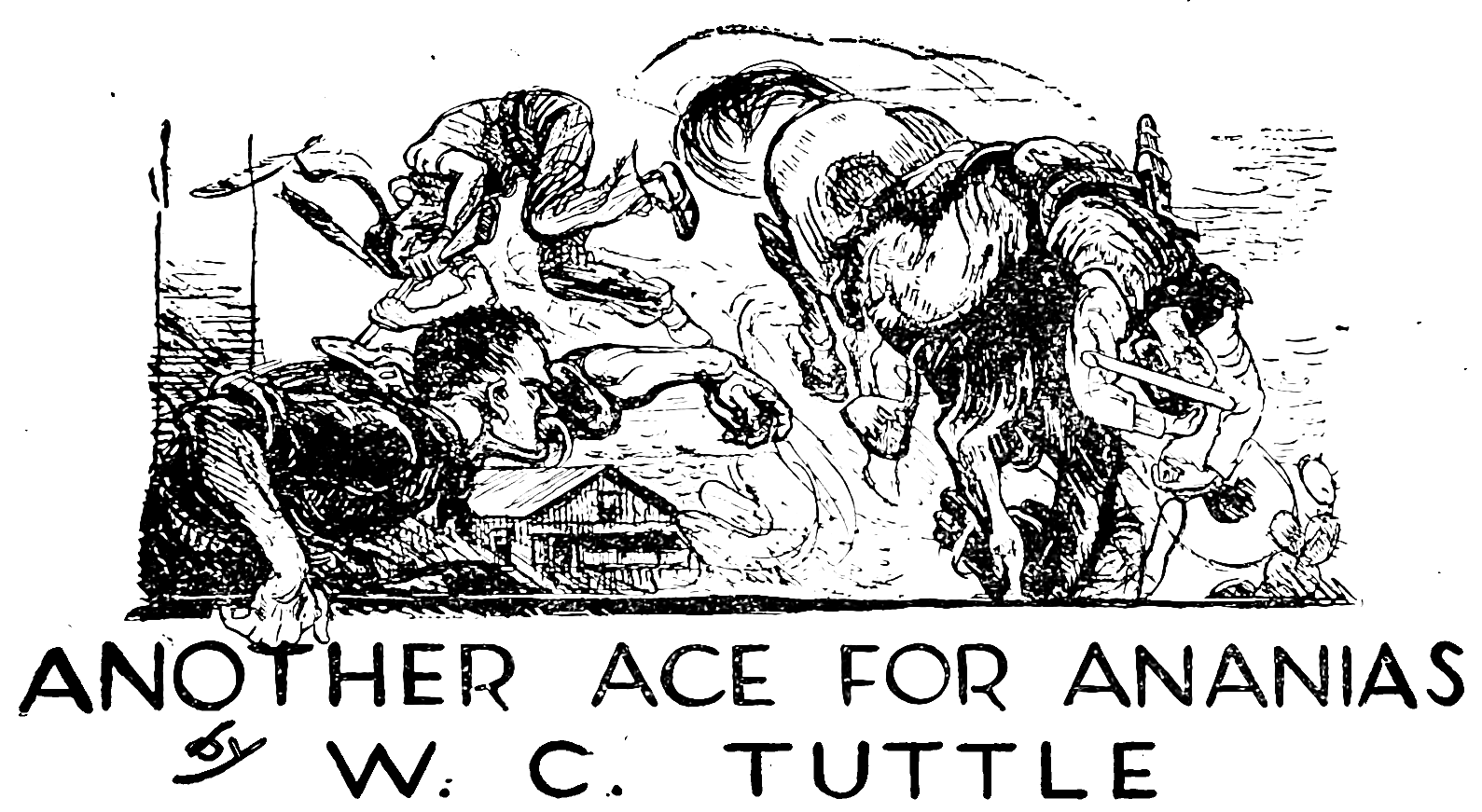
“It’s an art, like playing a jew’s-harp, turning a jack in a seven-up game or changing a Bar D brand to a Triangle P,” explains “Chuck” Warner. “You and George Washington runs a dead heat, ‘Telescope.’ It’s natural that he beats you out, ’cause in his time the world was very young and the sheriffs were few and far between.
“You don’t need go kiootin’ around about your honesty. You’ve got to be good, ’cause you ain’t got the ability to lie. Sabe? Honest to gosh, tall-feller, you’ll never have nothing in this vale of tears.
“You ain’t got no imagination like me and Henry and ‘Muley.’ We can hang the Injun sign on you any old time, ’cause you trusts humanity.”
“I’ve got a conscience,” states Telescope, looking up from a three-months-old magazine. “I can sleep nights. Sabe? Even at that I have lied—some.”
“Sure—and got caught at it,” grins Chuck. “Your mouth gets so dry you can’t spit.”
“Honesty is the best policy,” argues Telescope.
“Uh-huh—sure,” snorts Chuck. “Teacher used to keep me in after school and make me write it a hundred times. She looks good in print, but as a working policy she don’t assay a trace. Man has got to lie.
“Why, Telescope, a feller even lies with his face when he plays poker. You look like three aces when you’ve got a bob-tail, and then you expresses a bob-tail when you’ve got three aces. Sure it’s a art.”
“I hate a liar,” declares Telescope. “Hate ’em like ——!”
“All right, cowboy,” grins Chuck; “go to it. Pick yourself a high hill and just set there and hate mostly everybody what amounts to anything or has amounted to anything since the Old Testament was revised by the stone-cutters.
“Everybody is entitled to their own ideas, but don’t chide us because we appreciate our art to the extent that we inaugurates an emblem of superiority. She ain’t gaudy but she’s neat and expressive.”
Chuck holds up a little bronze figure which a storekeeper in Paradise gets with a supply of cigaret tobacco, and lets the sun glisten on its horns.
“I swear,” says Chuck solemn-like, “to defend thee with my honor.”
Telescope snorts and goes on reading. Such is art appreciated. I don’t chide Telescope Tolliver, ’cause I think it’s all right to have one honest man among us. I don’t figure none on winning that emblem, ’cause I don’t think there’s a man living who can beat Chuck at the prevaricating pastime, but as old “Hip Shot” used to say—
“Knowledge is a powerful good thing, but there never was a man wise enough to know which way a dill pickle is going to squirt.”
“Oh-h-h-h-h-h-h!” wailed Telescope. “Oh-h-h-h-h-h, ——!”
Then he sets down on the sidewalk so hard that his bronc pulled back and broke a perfectly good head-stall. Telescope sets there paying no attention to anything while me and Chuck herds that fool bronc into a corner.
Muley leans against a porch post and wastes several cigaret-papers trying to roll one one-handed while we ties up that bronc, and then we all sets down with the suffering Telescope.
“Taking the exclamation into due consideration and observing the extreme pallor of the patient, I’d say he’s been affected by mail,” observes Chuck.
Telescope licks his lips and takes a deep breath.
“Somebody died?” asks Muley, fussing with a cigaret-paper. “Dang it all, I wish I knowed how to roll ’em one-handed. ’Pears that she’s a cowboy accomplishment, but I can’t do it.”
“You ain’t no cowboy,” says I. “You’re too young, Muley. Remember you’ve only been punching cows for twelve years. Forty years from now you’ll be able to keep your rope from tangling, and if your thumbs don’t wear out you’ll be able to roll a cigaret—two-handed.”
“Where does it hurt yuh, Telescope?” asks Chuck. “Tell yo’ li’l buddie.”
“Gas on his stummick,” declares Muley, opening a fresh package. “Turn him across your lap and pat him over the kidneys. Don’t jiggle him on your lap, ’cause that causes colic.”
“Better take him over to Doc Milliken, I reckon,” grins Chuck. “He acts like a calf what had absorbed too much green clover. He’s got awful pains, Muley.
“Look at that face, wouldja? Nobody ever gets a expression like that unless they’re one whoop from a graveyard.”
“A-h-h-h-h-h——!” groans Telescope.
“It talks!” whoops Chuck. “By grab, I know just how Edison felt when he cut loose his first phonygraft record. Speak again, Horatio.”
“Sing for us,” pleads Chuck. “You’re be-yu-tiful when you sing, Clementine.”
Telescope jams that letter down in his chaps pocket and walks across the street to a saloon.
“Something has went crosswise with our first tenor,” says Muley. “Did any of you see that envelope?”
“I think it was from Kentucky,” says I.
“Ah!” grunts Chuck. “That clears up the mystery. Somebody has died and left him a million. He hates money.”
“Just like I do my two legs,” says Muley. “Betcha four bits he’s over there buying a drink for himself. Henry, did you notice what town in Kentucky it was from?”
“I said I thought it was from Kentucky.”
“Oh—you thought so, eh? You didn’t see the letter?”
“Do you know if he got a letter, Muley?”
“Chuck,” says Muley, “some day I’m going to kill Henry Peck.”
“That’s a good thought,” admits Chuck. “You do think of the cutest things to do, Muley. Call me in time to hear his last words, will yuh?”
Telescope Tolliver says that he’s from Kentucky. According to our code of honor a feller has a right to any birthplace he wants, as long as it don’t conflict with anybody else’s.
Chuck Warner never remembers where he was born the last time. If anybody says, “I was born in California,” Chuck wiggles his ears and says, “So was I.”
Maine, Michigan or Mexico is all the same to Chuck. Telescope brags that his relations are all rich—so does Chuck. Telescope claims that he’s coming into a fortune some day; Chuck claims he went through one.
Me and Muley sets on Chuck’s wish-bone one day to try and make him admit that he lied about going through that fortune, but he wouldn’t admit that he lied. Swore he went through the Bunker Hill and Sullivan mine, and if that wasn’t a fortune—what was it?
Chuck is an undersized puncher with a Roman-nosed face and such perfect control of his ear-muscles that we all believe in the transmigration of souls—of jassacks.
Muley Bowles is f-a-t. He’s about three ax-handles across, writes poetry, tries to sing and cusses in a high-pitched voice.
I’m a twig on the Peck tree. My folks handed me Henry Clay along with a good set of brains, and I eventually growed up to be one of the best cow-hands on earth.
The four of us work for “Jay Bird” Whittaker, who owns the Cross J. He’d likely object to my statement regarding “work,” but you can’t expect too much from four talented hired hands. He can cuss for five minutes and never say the same thing twice and hates women almost as bad as he does sheep.
Now that I’ve written a description which would be worth money to any sheriff, I will proceed with this woful tale.
Telescope came out of that palace of vice and drifted homeward. We also drifted homeward and finds him setting on a bunk, looking like he’d lost his last friend. So far as we know, Telescope ain’t got no best friend. When it comes to telling about his family and past history, Telescope Tolliver is some futurist. At times he brags a heap about Kentucky and admits he was born there, but nobody on the ranges of Yaller Rock County ever heard him say anything about his family history.
We surrounds him, pounces upon him from three sides and then sets upon his carcass while we secures that letter. Muley reads her out loud:
“Mister James Valiant Tolliver, Cross J ranch, Montana.”
“My hero!” squeaks Chuck. “Go ahead with the disclosure, Muley.”
“Ouch!” yelps Muley. “You hold the top end of the critter, Chuck—he bit me!”
“Aw-w-w-w, hurry up before you gets hydrophoby.”
My Dear James:
Your success has been a source of great satisfaction to us, and we are looking forwards to seeing you this Summer. We will leave for a Western trip this week, and will wire if we decide to come that far north.
Your letters about your many acres, lowing kine and waving grain read like a passage from “Evangeline.” It makes us mighty proud to feel that a Tolliver was able to build a place in the boundless West. Robert joins me in sending our congratulations. We feels that Clarice must be a wonderful wife, and I am proud to know that your firstborn was named after your affectionate aunt,
Alicia.
Chuck slid gently to the floor and sets there, wiggling his ears, while Muley grabs the post of a bunk and wipes away his tears. Telescope sets up, tears up that letter and then tries to scratch a cigaret on his boot while he puffs on a match.
“My ——!” gasps Chuck. “His firstborn! Lowing kine and——”
“You lied to me!” squeaks Muley. “You said you was sing-g-g-g-ul!”
“Liar!” I hisses. “You betrayed our trust, Valiant. You built without telling us. And we tr-r-r-r-usted you!”
“Oh-h-h-h, —— the whole bunch of you!” wails Telescope.
“Hear him?” yelps Muley. “He curses us. You long, hungry, prevaricating son-of-a-prairie-dog, ain’t it enough for you to deceive us without adding profanity to your many crimes? You he-vampire!”
Muley swallers hard, shakes his fist at Telescope and recites:
Chuck fumbles in his pocket and produces the little bronze emblem.
“Take it, James Valiant. For lo, these many moons have I been the prize liar of Yaller Rock County, and defeat cankers my soul. It irks me sore, but I recognizes a peer. Be good to the little bull.”
Chuck flaps his arms weary-like and sets down.
Just then Jay Bird comes up to the door.
“Say, you alleged cow-hands, can you mismanage this place for a while? I’ve got to go over to Billings.”
He looks us over.
“What’s the matter with the human rake-handle? Sick?”
“Yeah,” nods Telescope. “Sick.”
“Sure we can run the place,” admits Muley.
“You can run it,” says Jay Bird. “Anybody can run it; but I wants to feel that I’ll at least have a branding-iron left when I come back.”
“I’ll hide one where nobody can find it,” grins Muley.
“You might get busy on that new corral fence while I’m gone.”
“We might,” nods Chuck, “but chances are we won’t.”
“Well, anyway, you fellers are honest about it. See yuh later.”
“Honest?” says Chuck after Jay Bird leaves. “Eh, Telescope?”
“I didn’t think it of you, Telescope,” says Muley sad-like. “You sure——”
“Let him tell it,” says I. “He’s dying to get a load off his chest.”
“Well,” says Telescope, “I never amounted to anything in Kentucky——”
“Why designate any certain locality?” asks Muley.
“Wait,” says Chuck. “Hen, you get your banjo and play something soft and low. We gotta do this right.”
“Shut up!” howls Telescope. “Dang it all, I can’t tell nothing unless you act right. Make Chuck quit wiggling his ears. Now. My folks died when they was young. No, I died when they——”
“Now quit lying,” advises Chuck. “You’ve hit a —— of a gait, Telescope, but no use busting all records.”
“Well, blast it, my folks died when I was young; so I sort of hooks up with relatives. They said I was the black sheep of the Tollivers. They told me I was no good and that I’d land in the pen. They——”
“They was able to peek into the future all right,” says I.
“Then I dug out. Sabe? I figured that some day I’d show ’em all up. I was going to hook a big pot some day and go back there, but seems like any time I got into a big pot I had three clubs and a pair of spades.
“They sort of gets to writing to me; so I decides that I’ll string ’em by mail. Maybe I went too strong. I told ’em about getting me this cow-ranch, and they said I ought to get married.
“Next time I wrote I added marriage. Little later on they gets to talking about kiddies; so I adds a kid. Could ’a’ got a kangaroo or a elephant just as easy, but they didn’t suggest it.”
“And they’re coming out to see everything,” says Chuck.
“Oh-h-h-h-h-h, ——, yes!”
“Thy sins have found thee out,” pronounces Muley.
“My relatives will, too,” groans Telescope. “I’m going to pack my war-sack and hit the trail.”
“How old was you when you left there?” asks Chuck.
“Thirteen or fourteen, I reckon.”
“Look like you do now?”
“Naw. Everybody said I was going to be a runt. Pshaw, they’d never know me now, but that don’t make me no never mind. All they’ve got to do is ask questions.”
“They got any money?”
“Gobs of it. Old man owned one of the biggest distilleries in the State. Yuh see, I figures that if I’m a success I’ll get a cut of that roll some day—that’s why I write to ’em. But now—blooey! I’m going.”
“Say not so, James,” grins Chuck. “You can lie, but you ain’t got no imagination. Let me handle this, will you? Hen, are you and Muley willing to help?”
“I ain’t going to impede you none,” says I, and Muley nods.
“Whatcha aiming to do, Chuck?” asks Telescope.
“Make your lie look like Gospel. Trouble with you ordinary liars, you don’t see ahead. You don’t hear me contradicting myself, do yuh? I’m a able liar—which is a rare bird, and helpful in times like these.”
“I ain’t got no ranch,” objects Telescope.
“I have,” grins Chuck, “while the old man is away. I’m James Valiant Tolliver, a runt what never growed up. I don’t know what in —— them lowing kine are, but I’ll get some if there’s any laying around loose.”
Chuck beats it for the corral, and the rest of us sets there.
“He—he said he was me, and—and—” stammers Telescope.
“He will be,” admits Muley. “That hump-nosed truth-juggler is wound up again, and if I was you I’d——”
“What?”
“Hide that little bronze bull, Telescope—if you want to keep it.”
A little later we wanders up to the ranch-house and watches Chuck fog off down the road.
“I didn’t figure they’d want to come plumb up here,” wails Telescope. “That kid must ’a’ caused it all. They didn’t whoop when I told ’em about the ranch, and they didn’t blow off no roofs when I told ’em I was married, but when they hears about that kid—whoo-o-o-ee!”
“I never did see a poor liar that had any nerve,” says I. “They always weaken.”
“Weaken! Who wouldn’t? I had a chance to cut in on the family roll, and now I’ll get nothing but abuse.”
“Well,” says Muley, “you do deserve scolding, Telescope.”
Chuck came home that night and busts right into the bunk-house just as I’m cutting a jack off the bottom to win six bits, and spoils the whole scheme. I only needed one point to win, and I had that cinched.
“Got her all fixed,” says he, grinning. “All hunky-dory. Telescope, you can hang around and count your inheritance.”
“You might tell a feller—” begins Telescope.
“Nothing,” declares Chuck. “You kicked a hole in the boat, and it was up to me to mend it before you got swamped. You took the honors away from me, tall cowboy, but I’m right on your trail.”
Chuck pikes up toward the house with Telescope following behind like a hound pup, hankering for a bone of information. Me and Muley went down to the corral, where we puts in our spare time trying to induce a bad bronc to get used to a saddle.
We’re enjoying the spectacle when we happens to glance up and see “Old Testament” Tilton climbing the fence. He’s got on his Sunday clothes and is packing a boiled collar in his hand so it won’t get dirty. We desists in our labors and climbs up to him.
“Howdy, Henry. Howdy, Lemuel,” says he. “Sort of ungodly and wicked animile you’re fussin’ with, eh? Broncs are like men’s souls thataway. They r’ars and tears against religion somethin’ scandalous but once you gets ’em used to packing a load of Gospel, and bridlewise to Christianity, they’re plumb docile for life.”
“Reckon you’re fairly well saddle-marked thataway, Testament,” observes Muley.
“I dunno. Sometimes I reckon I’m the top-riding sinner of the outfit, Lemuel, and again I gets danged awful meek and lowly. I plays the system the best I can and coppers no bets. Where’s Chuck?”
“Up at the house, I reckon.”
“Primpin’ up a little, eh?” grins the old sky-pilot. “Well, it only comes once in a man’s life, unless he gits him a de-vorce. Glad I’m able to be of assistance.”
He slides off the fence and weaves toward the house while me and Muley sets there and stares at each other.
“Unless he gets a de-vorce,” says Muley foolish-like. “What in thunder does he mean, Hen?”
“I ain’t no wee-gee board. How do you expect me to know? Anyway I’m follering a hunch that Chuck has lied again.”
“Yet,” corrects Muley, “just the same I’m going to go up there. I can look on, even if I don’t feel like asking questions. Come on.”
We finds Old Testament setting on the porch, and in the old man’s rocker, filling it plumb full, is Hulda Hansen, the Triangle outfit’s Swede cook. If you ever hear anybody speak of a “shapeless mass”—that’s Hulda.
She blushes when we walk up.
“Hello, Hulda,” says Muley. “How’s all your folks?”
“Ay got von brudder over on de Vagon Veel o-outfit, and Ay got von onkle vich is dead, t’ank you.”
“You’re welcome. Did he die easy?”
“He vors powder-monkey on railroat, unt—unt smoked his pipe.”
“Nothing easier,” admits Muley, and just then Chuck and Telescope comes through the house and out on to the porch.
“Howdy, boys,” says Old Testament, shaking hands with Chuck. “Miss Hansen didn’t seem to sabe just when this was to be pulled off; so she asks me to come up here with her.”
“Huh?” gasps Chuck, wiggling his ears. “Whatcha say?”
“Your marriage to Miss Hansen,” says Testament. “She told me——”
“Lucky dog,” says I, shaking hands with Chuck. “You sure——”
“Thank—aw, go to ——!”
Chuck yanks his hand away and grabs for his collar. Telescope starts to set down on the top step, but catches his heel and lit half-way down. Chuck gulps and stares at Hulda.
“Say something, Testament,” gasps Chuck. “I—I don’t think I heard you the first time.”
“Ay coom oop to ved mit you,” explains Hulda, and you could ’a’ lit a match on her ears. “You say, ‘Hoolda, Ay vish you to be my vife,’ unt Ay say to you——”
“O-o-o-o-o-oh, mamma mine!” wails Chuck. “Who-o-o-o-o-o-a! Come in the house a minute while I talk to you.”
She yanks loose from that chair after Muley put his foot on the rocker, and the rest of us sets there and stares at nothing.
“Has Chuck been settin’ up with her much?” asks Testament.
“O-o-o-o-o-o-o-o-o-ow!” comes a shriek from the house. “Whoopee!”
Smash! Crash! Bang!
Hulda Hansen comes out of the front door with her hat down over one eye and the lone feather sticking straight up and half of Chuck’s vest in her hand. She snorts at us, climbs a barb-wire fence, the same of which takes toll from her skirt, and goes off across the field, talking Swedish to herself and waving that piece of a vest like it was a flag of victory.
We watches her fade out of the picture and then we turns to the door, where Chuck is down on his hands and knees, peering around the corner. He’s got a red scratch down the length of his nose, and around his neck is the frame that once held a picture of Dewey at Manila. He looks up at us like a bashful pup, and backs out of the frame.
“Ha—has she gone?” he asks.
Muley nods, and Chuck looks cross-eyed at his scratched nose.
“From what I’ve done observed,” remarks Testament, “I’d opine that there ain’t no pressing need of a marriage service around her.”
“For a preacher,” says Muley, “you has a lot of perception.”
Testament wanders down to his buckboard and drives homeward.
“It don’t pay to lie,” says Muley, easing himself into the rocker. “Naw, sir, it sure don’t. I knowed a feller once——”
“Aw, I didn’t lie to her!” wails Chuck. “I explained to her that I wanted her to be my wife for a week. She acted like she knowed what I was driving at—dang her, but I reckon she never got anything but the proposal.
“When I took her back into the house I tries to explain the joke to her, but she—she——”
“Broke down and cried?” asks Muley.
“Yeah! Oh, yeah, like ——! She grabbed me and slammed me so hard against the wall that a picture fell down, and then she framed me with it.”
“She’d make a durable wife for somebody,” nods Telescope.
“Wife!” snorts Chuck. “She’d make a body-guard for the Regular Army.”
“Shucks, I reckon I’ll pack my war-sack and drift,” says Telescope.
“Set down!” howls Chuck. “One swaller don’t make a Summer.”
“Whatcha want to annex a wife like Hulda for?” asks Telescope. “Can’t yuh pick a good-looker to hang the name of Tolliver on to?”
“Don’t be finicky, cowboy,” says Chuck. “Here comes Ricky Henderson. Maybe he’s got an idea.”
“Maybe,” admits Telescope. “Maybe he’s just found out about your putting emery-dust in that sheepherder’s whiskers. It plumb ruined every razor Ricky owned; and he swears he’ll kill the man who put the kerosene in his bay-rum bottle.”
“I’m a little messenger boy,” grins Ricky, hunting through his pockets. “Gotta telegram for James Valiant Tolliver. Me and the agent reads it, and then opines it must be for Telescope. You got any relation what is liable to visit yuh, Telescope?”
Ricky hunts through some more pockets and shakes his head.
“Had the darned thing when I started. Must ’a’ lost it. Anyway it said something about arriving Saturday morning, and it was signed by—uh—uh—lemme, see——”
“A-a-alicia?” mutters Telescope.
“That’s it. Alicia. Been looking for ’em, tall-feller?”
Telescope stares at Ricky foolish-like, and Ricky nods, “Honest to grandma, Telescope,” and then he turns to us.
“What’s the joke?”
Telescope starts for the bunk-house, waving his arms and talking to himself, while Ricky sets there on his bronc and grins. Muley tells him all about it, and Ricky is as pleased as a pup with a bone.
Ricky is a little dark feller who cuts hair for a living. He’s one of them smooth-fingered hombres who keeps his hair greased until she looks like patent leather, and a joke on somebody else is meat and drink to his soul.
He listens to the whole tale and then hugs himself.
“I’ve got the idea,” says he. “You never can get a female to play the part, but I know a male what can.”
“Meaning which?” asks Muley.
“Ever see yours truly impersonate a female?”
“Good night!” yelps Muley. “Fare-thee-well, Molly darling.”
“Think I can’t do it? You watch my smoke, feller. I’ve got a yaller wig which was part and parcel of a defunct opery troupe, and if I can get me some female clothes—mamma mine! Get your bronc, Chuck.”
Them two schemers rides away while me and Muley sets there and listens to the suffering of Telescope Tolliver.
“Cod-liver oil and axle-grease properly mixed will cure any ills that mankind is heir to,” orates Muley, “but it takes experience, bitter experience, to cure a liar. A feller can pack his gun handy and lie about his friends, but any old time he lies about himself——”
“Shut up!” howls Telescope. “Ain’tcha got no feelings?”
“Feel of me,” grins Muley. “Wait until you see Chuck impersonating you, and Ricky, wearing a yaller wig, impersonating your female wife; you’ll——”
“My ——!”
Telescope looks at us wide-eyed.
“Ricky—going—to—be—my—wife?”
“In name only,” says Muley. “You’ve got to have some wife, ain’t you?”
Telescope groans and settles back. Muley squints at him, and recites:
“Muley,” says Telescope soft-like, “I’m going to kill you—some day.”
“Hear him, Hen?” sobs Muley. “Ain’t he the awful example? Going to add murder to his other crimes, eh? Liar, horsethief, card-sharp, tenor singer, and now—murderer!”
A feller ain’t always to blame for poor marksmanship, especially when he’s laying down, but that didn’t excuse Telescope. I was on the opposite side of the room from Muley, and Telescope never can make me believe that the boot-jack slipped out of his hand.
I dreamed that a little feller with a peaked cap and a long nose comes along packing a lantern. He shuffles up to me, peers into my face and shakes his head sad-like.
“Who you looking for?” I asks.
He shakes his head sad-like some more and says——
“I search for an honest man.”
“Good hunting to you,” says I. “You’ve got some chore.”
Then I hears Muley’s voice saying.
“Holy henhawks, I reckon I’ve got to make another trip. Danged if I’ll mop up the place.”
“Where’s the little feller, Muley?” I asks.
“Telescope? He pulled out for town.”
“Naw, I mean the little feller who looked for a honest man.”
“Man, you must ’a’ got hit hard. I never seen no little feller.”
“You didn’t need to dump half a bucket of water on me,” says I, feeling of my wet self.
“Half a bucket? Blame your hide, Henry, I made three trips to the well. I had to anchor you to keep you from floating out of the door.”
I doctored that lump on my head until she ain’t bigger than a baseball, and then me and Muley spent the rest of the day resting—as usual. About ten o’clock that night we hears somebody ride in, and a little later Telescope’s hat sails in the window and rolls into a corner. We don’t say a word, and then we hears Telescope saying—
“Well, they didn’t shoot at it nor kick it out, so I reckon I’ll take a chance.”
He comes in and sets down on a bunk.
“Chuck home yet?”
“Nope,” says I.
“Mad at me, Henry?”
“Uh-huh.”
“It slipped, Henry—tha’s all. Muley made me mad. He’s a mean son-of-a-gun.”
“Yes,” says I, “you both are. Tomorrow I’m going to buy me a steel helmet and a life-preserver. It’s bad enough to have one of you slough me over the head without having the other step in and try to drown me.”
I beat Muley and Telescope out of seventy dollars, conversation money, and then we went to bed. Must have been along about two o’clock when we hears voices singing; so I lights the lamp.
“No-o-o-o-o-bod-e-e-e-e-e knows how dry I a-a-a-a-a-a-am.”
There is silence for a minute, and then another voice—
“I soaked my sho-o-o-o-o-o-es for drink ’f boo-o-o-o-o-o-ze.”
And then both voices in barber-shop harmony—
“No-o-o-o-o-bod-e-e-e-e knows how dry I——”
I yanked the door open, and Chuck and Ricky, with their arms around each other’s necks, falls inside. They blinks at the light for a moment, and then—
“A-a-a-a-a-a-a-am.”
I blew out the light and left them on the floor. After a while I hears Chuck singing soft and low:
“Swee-e-e-e-e-t A-a-a-a-a-a-de-e-e-line, Swee-e-e-e-e-e-t A-a-a-a——
“Ricky! Ain’tcha goin’ t’ help me? No? All ri’, feller.”
I got that whole gang up at five o’clock ’cause I knowed the train was due early. Chuck and Ricky are sore-headed, but they had enough left to make the world look brighter.
“I’m going away,” declares Telescope. “Nobody can ever tell me that Ricky Henderson can make up like a female and fool anybody. I washes my hands of the whole thing. Sabe? If anybody asks me what I know about it I’ll swear I don’t know a thing.”
“Sure you’ll stay away,” grins Chuck. “Think we want a big boob like you around to ball up things? You don’t appreciate what we’re doing for you, feller. All we ask is that you stay out of sight. Sabe?”
Telescope saddles up and drifts toward town ahead of us. We talks it all over and decides that Muley and Ricky are to stay at the ranch, while me and Chuck go down to meet the relation.
Ricky don’t dare to go down there in his make-up, so Chuck says he’ll tell ’em his wife is too frail to stand the bumping of a wagon. Ricky does look frail.
We went to the depot and found out that for once in its existence the train was on time. Mostly always you can go to town tomorrow and be in plenty of time to catch today’s train.
“Say,” says Paddy Wilkins the depot agent to me, “is Telescopic Tolliver foreman for Whittaker?”
“Say he was?” I asks.
“Yeah. Telegram comes for Whittaker, and I asks Telescope to take it out to him, but he says the old man is away, and, being in charge, he asks me to read it to him. When does the old man come back, Henry?”
“Cannon Ball comin’!” yells Chuck, and I don’t get a chance to answer Paddy’s question.
Chuck has borrowed Jay Bird’s swaller-tailed coat and beaded vest, and we stands there like a reception committee with our hats in our hands. It’s too early for any Paradisers to be on hand.
“Where did you get a dress for Ricky?” I asks.
“We robbed the clothes-line at the Seven A,” chuckles Mr. Warner’s little son. “Annie Schmidt’s clothes, Henry.”
I nodded weakly and watches the train roll in. Ricky won’t weigh over a hundred and twenty, and Annie Schmidt is at least two-fifty.
The first one to get off is a old pelican wearing thick glasses and a hard hat. Behind him comes a female of the vintage of sixty-three, and behind her comes one swell-looking female—young. Words fails me when I try to sing her charms.
The old man might ’a’ owned one of the biggest distilleries, but I knowed at a glance why he didn’t have it any more—he drank it all up. He sure has a nose that shows.
The old lady is one of them haughty old females who are too proud to look at their feet, and her neck is so long that she could wear a fur muffler and a sweater and still be low-necked.
We stumbles up to them as the train pulls out. The old man peers at us and says——
“I am looking for James——”
“Yessir,” grins Chuck. “I’m him.”
“You!” says he. “Well! I wouldn’t ’a’ knowed you at all.”
“James,” says the old lady, “I’m pleased to meetcha. You may kiss me on the cheek.”
Chuck was game.
“This is your cousin Molly,” says the old lady. “You’ve likely never even heard of her, James, but she’s a lovely girl, and we know you’ll like her.”
“Y’betcha,” grins Chuck.
Molly was more human than auntie, and Chuck kisses her.
“Well, James, I’d have never knowed you,” says uncle. “Of course it has been a long time since we were together. You’ve done well, eh? Surprized to see us, eh?
“Never expected to see you, James. Molly, here, is Polly’s girl. You remember Albert Benefield, don’t you?”
“Al Benefield? Sure I do. Is that son-of-a gun alive yet?”
“He is my father,” says Molly.
“Oh!” gasps Chuck, and almost falls over a valise. “Here, Henry, you rustle these valises out to the wagon.”
And then he says—
“Just wait until you see my wife.”
“James!” exclaims auntie. “Where is she?”
“She’s home. You see, she’s too delicate to bounce around in a wagon.”
They all rambles for the wagon, all talking at once, and I’m glad I don’t have to answer any questions.
Telescope got lit up. I reckon the strain was too much; so he gets his skin full of weeping-water. While we climbs into the wagon he comes out of the Happy Days, lets out a war-whoop and tries to lean against a post of the saloon porch.
That part of it was all right. A feller has a perfect right to lean against a post if he wants to, and maybe it’s nobody’s business if the post ain’t there—but it looks bad.
“How perfectly ridiculous!” exclaims Cousin Molly. “He’s so tall.”
“Sh-h-h-h-h-h!” cautions Chuck. “That’s ‘Hell-Fire’ Jones, the worst horsethief unhung.”
“Oh, a real Western bad-man?”
“The worst,” nods Chuck. “Jesse James was an evangelist beside him. He ain’t got no honor at all. Why, that hombre will—uh—lie.”
“By gad, the law should deal with the likes of him,” says uncle.
“Law? Shucks, what can they do? He won’t admit any crimes. Get right up on the witness stand and lie out of everything.”
Just then I happens to think of something. I kicks Chuck on the ankle.
“The baby!” I hisses in his ear.
“Oh, yes, I forgot about the baby,” says he foolish-like, out loud.
“The baby,” echoes auntie. “The——”
“Sus-some kid,” says Chuck. “Yessir, Clarence is some baby.”
“A boy baby?” asks uncle, and I kicks Chuck again.
“N-n-no,” stammers Chuck. “You see, it’s thisaway: We—uh—calls her Clarence for short. Sabe?”
“Why?” asks auntie.
“You see,” says Chuck, staring over where Telescope is sitting on the sidewalk, “my wife is crazy about boy babies. She ain’t a bit well, and she wanted a boy baby so danged bad that we frames up on her, and names it Clarence and so, you see, she don’t know——”
“Do you mean that your wife thinks it is a boy?” gasps auntie.
“Dog-gone it, we had to do something,” wails Chuck. “You see, she ain’t just right in the head, and we thought we’d let her think——”
“Well,” says Cousin Molly, “I think it was awful good of you.”
“Thanks,” sighs Chuck. “I’m glad somebody appreciates it.”
“I feel sure that she must be a lovely girl, and it’s nice of you men to see things in that light. Is she a little woman?”
“Yeah. Pretty as a picture. Got yaller hair. Doc Milliken has done all he can, but you can’t expect much help from a horse-doctor.”
“She ought to have a long rest,” opines uncle.
“Uh-huh,” agrees Chuck. “That’s what the sheriff said.”
“Well,” says uncle, “I suppose we may as well proceed to the farm. I feel sorry for you, James, and more sorry for your unfortunate wife, and I wish you better luck in the selection of an offspring next time.”
“The idea!” snaps auntie. “He had nothing to do with it.”
“No,” says Chuck. “Gawd knows that’s the truth.”
They sure knows how to ask questions.
“Do you own all this country?” asks auntie, indicating everything from the Canadian border to Wyoming.
“Uh-huh,” admits Chuck. “Going to fence it some of these days and see if I can keep track of my lowing kine.”
“Lowing kine?” asks auntie, looking around. “Where are they?”
Chuck turns and wiggles his ears at me.
“Where are they, Henry?”
“Don’t pass the buck to me,” says I. “I ain’t got ’em.”
Just then we sees an Injun coming down the road. It’s old Two-Sleeps, riding his pinto to a frazzle. He skids up in a cloud of dust, throws up one skinny arm and yells:
“Hyah! Tenas tsolo! Wah!” And away he goes, off down the road.
Chuck wiggles his ears at me and brushes some dust off his nose.
“What in the world did he say?” asks auntie.
“He said,” says Chuck, “he said that the Aparejo Indians were on the war-path again.”
“Is he one of them?” asks uncle anxious-like.
“Him? Naw; he’s a Tapidero. Reckon we better get to the ranch.”
“Does it—it hurt to get scalped?” asks uncle as we bounce along.
“Not after you get used to it,” says I. “Very few people ever complain about the pain.”
I didn’t quite sabe what the Injun said, but it was something like “small lost,” whatever that might be. We drove up to the front of the ranch-house and begins unloading the plunder.
“You’ve a comfortable-looking home, James,” admits auntie.
“Uh-huh; I sure have. I spent a lot of—my——!”
I looks at the door and blinks my eyes three times, but it won’t go away. There is Muley Bowles with a yaller wig on his fat head and one of them polky-dot Mother Hubbard dresses on. In one fat hand he’s got a peacock-feather fan.
Chuck’s knees wabble and he kneels right down at the foot of the steps and looks up at her—him—like one of them pictures of a Buddha-worshiper.
I leaned on a wheel and slid flat on the ground, while the relation sure got both eyes full. I’d tell a man that Muley is some female.
“Well!” gasps auntie, who beats us all out on vocal vitality. “Is—is—this——”
“Uh-huh,” says Muley in a high voice. “It is.”
“By gad!” I hears uncle gasp. “If she’s frail——”
“So this is James’s wife,” says auntie awed-like, fanning herself with her hand. “I—I—It must be the heat.”
“Well, anyway, we are glad to meet you,” says Cousin Molly, shaking Muley’s hand. “James said that you——”
“Don’t mind him,” says Muley. “He’s the dangdest——”
“You folks better go inside,” says I. “It’s too hot here in the sun.”
Ricky slips in beside me and whispers in my ear—
“That dress was about seven feet too wide for me, Hen, and Muley had to be her.”
“Were you joking about your wife?” asks Molly, shaking her finger at Chuck.
“Well,” says Chuck weak-like, “let your judgment be your guide.”
“Now,” says auntie, “I want to see that wonderful child.”
“Child,” parrots Chuck. “Oh, ye-e-e-e-s, the child. Uh—uh——”
“Coming up,” says Ricky soft-like, pointing at the door to the kitchen.
Chuck wets his lips and rubs his hand across his face. I don’t blame him.
Standing there in the door, sucking at the top of a battered molasses can, is a dirty little Injun kid about three years old. Right then I remembers old Two-Sleeps’s words, “Tenas tsolo.” He meant “Lost kid.” Them snake-hunters have kidnapped his papoose.
“How—how old is—uh—it?” asks uncle foolish-like.
“Th-three mum-months,” breaths Chuck.
“By gad, they mature young!”
“Uh-huh,” grunts Chuck, wiggling his ears real fast. “Don’t you think he looks like her mother?”
“Haw! Haw! Haw!” roars Ricky. “Don’t he look——”
But I kicks him on the ankle and rushes him outside.
“Ain’t you got a lick of sense?” I inquires. “Muley looks about as much like a female as a humming-bird looks like an elephant. That was one fine idea, swiping that Injun kid.”
“Aw, that’s nothing, Hen. Old Two-Sleeps has so many kids that he won’t miss this one for a week. Seen anything of Telescope?”
“Soused in Paradise.”
“Muley got three bird-shot in his knee when we swiped that dress. Of course we had to stop and sing a song, and some fool at the Seven A dusted us with a shotgun. It was a cinch to swipe that kid.”
I don’t say a word, but just the same I wonders how Ricky’s patent leather hair is going to look hanging up in a teepee.
Then uncle comes out and pilgrims down to us.
“By gad, I like this place of James’s,” says he. “Like to own one like it.”
“Maybe you could buy it,” says I.
“Yes, I might. James has offered to sell me half interest.”
“Half?” I gasps, and then me and Ricky gawps at each other.
“Yes, sir, and at a bargain, too. By the way, you mentioned something about the Indians being on the war-path.”
“War-path?” says Ricky. “Injuns?”
“Uh-huh,” says I. “Two-Sleeps went past us like a bat out of —— and yells, ‘Tenas tsolo!’”
Ricky sabes Chinook. He revolves the statement over in his mind and blinks his eyes fast.
“By the way,” says uncle, “is it—er—true that James’s wife is—er—a bit touched in the head?”
“Bit!” snorts Ricky. “She’s crazy as a shepherd. Her heart is all right, but she sure is rickety on top.”
“Don’t you think she’s sweet?” I asks.
“Well,” says uncle slow-like, “I am not a corner sewer so I’d hate to answer. Anyway I believe in letting every one have their own opinions.”
“Neither do I,” says Ricky, and just then Chuck and the two women come out of the house.
“We are going to look around the farm,” says Cousin Molly.
“Ex-cuse me,” says I. “I’ve got work to do.”
“I do not think we need the services of the hired help,” says auntie haughty-like.
Ricky thinks he’s smart. He makes a motion like he was throwing a rope, stoops over, makes a few more motions and then throws up one hand. Chuck grabs out his watch, snaps it back into his pocket and wiggles his ears.
“A world’s record!” he gasps. “One second flat.”
He meant I had been roped and hog-tied in one second.
“Gracious!” exclaims auntie. “What does that mean, James?”
“That?” gulps Chuck. “Why that’s the—uh—sympathy sign of the Sacred order of Slingers. Henry is the High Priest of the Hemp-Handlers.”
I takes off my hat to Chuck with four fingers outspread and the thumb to the rear, and then I wanders back toward the house, where Hop Louey the Chink cook is watching the sight-seeing bunch.
“Where them folks come flum?” he asks.
“I don’t know, Hop.”
“How long stay?”
“Maybe all Summer.”
“Goo’-by!”
Hop wipes his face on his sleeve.
“No good. Too much flemale, you sabe? I no cook fo’ flemale—too much kick. Maybe I go San Flancisco—goo’-by.”
“I guess you won’t!” snaps a voice behind us, and we turns to see Muley.
For once in his life that Oriental shows emotion. He stares at Muley for a moment and then starts backing away. His lower jaw seems to joggle every time his heels hit the ground, and as soon as he figures he’s got a chance he whirls and runs, with Muley right behind him.
Muley is handicapped by that skirt, but I figures that Hop is too blamed shocked to make it a long race. They went right through the inspection party at the corner of the corral and off into the mesquite like a Great Dane chasing a cotton-tail.
It sure was some shock to the sightseers. They seems to talk it over a bit, and then uncle strides up to me.
“Has she had a turn for the worse?” he asks.
I starts to say something when here comes Muley. He’s got his hand wrapped in the slack of Hop’s panties and is packing him like he was a valise. He stands Hop on the porch and gives him a shove.
“Inside!” he roars. “You —— fool, we’ve got company!”
Hop didn’t argue. His pigtail don’t no more than disappear when we hears him whanging tinware to beat four of a kind. I can see Chuck talking with both hands, while Ricky leans against the corral fence and seems to nurse cramps in his stummick.
I’ve had about enough. When they comes my way I circles the herd and climbs to safety on the top pole of the corral. I sure feels sorry for the little feller with the lantern.
I’ve been there long enough to smoke two cigarets when here comes uncle. He’s got a black eye, and the rest of his face registers revolution.
“Did you see where he went?” he asks, peering up at me.
“Did he have a lantern?” I asks.
“Lantern?”
Uncle rubs his eye.
“He—he did not.”
“To me you are speaking of which?” I asks.
“That Henderson person. I—I apprehended him in the act of hugging James’s wife!”
“My——!” says I. “He must be crazy.”
“Crazy? By gad, I think the whole country is crazy. I told James about it and he actually grew hysterical. I pointed out the enormity of it all, and he cried—actually cried, by gad!”
“And then he busted you in the eye?”
“James? No, the—I could see that James’s nerves were in no condition to uphold the honor of the family; so I took it upon myself. I went to this Henderson person and I said to him—
“‘Sir, in the name of my family I demand satisfaction.’”
“He said—
“‘Sorry, but we haven’t any today.’
“I said—
“‘You have offered an insult to my brother, and I resent it.’”
“Then you had a fight?”
“I said to him, ‘Only blows can wipe out the stain,’ and he said, ‘Uncle, I’m sorry, but if you insist——’
“And then he embraced me and bumped me twice in the eye. I had no chance to retaliate, but by gad I am not yet hors de combat.”
“Stick with that razor-rassler and you will be, old-timer,” says I as I watches him toddle back to the house.
There’s something familiar about that old coot, but I can’t figure out where it is.
Then I sees Chuck sneaking around the corner of the fence. He wiggles his ears at me, peers at the house and then climbs up to have a quiet smoke.
“James,” says I, “you’ve rised—and put a chunk under it.”
“Uh-huh.”
“Ricky hit the old gent in the eye.”
“Yeah, with his head. The old coot wanted to fight a deathly doodle. He caught Ricky and Muley hugging each other. Haw! Haw! Haw!
“Aw, Henry, it’s one awful mess. There’s only two beds in the house. See what I mean? Uncle and auntie in one; Cousin Molly in the other, and no place for Chuck and his wifie.
“Can’t sleep in the bunk-house with the riffraff. Molly says that I can sleep with the boys.”
“Well,” says I, “it ain’t night yet. Lots of things can happen.”
“They likely will, Henry.”
“Just about what do they think of your wife and child?”
“Think? They think that my wife is loco, and they’re humoring her to beat ——, while that blamed Piegan kid talks infant Injun to all of them. If I had Telescope here I’d bust his wish-bone.”
“Zasso? Zasso?”
We turns and looks down at Telescope.
“Would, eh? Try it, feller. I’m a uncurried wolf and I’ve come to howl.”
I can see that he’s suffering from a doubleloaded jag. He must ’a’ got good and full and then sobered half-way, after which he built up another one. It’s like putting both loads in one barrel of a muzzle-loading gun. It sort of leaves an air-space between, and when she goes off—something busts, sure as ——.
“Aw, have a little sense,” grunts Chuck. “Get meek, feller; get meek.”
“Zasso? Zasso? You don’t shay. Well, well!”
“Aw, go soak your head!” snaps Chuck, “Crawl into a hay-stack and get sober.”
“Zasso? Who’re you to order me round? M’ conscience hurts me. Goin’ up to th’ house. Sabe? Go ’head and stop me, feller. Got conscience, y’betcha.”
“He’s got a conscience, Chuck,” says I. “Let him go. Somebody’s got to spill the beans pretty soon anyway.”
Telescope nods foolish-like and weaves toward the house.
“Good night,” sighs Chuck. “Muley may as well put on his pants.”
Telescope is almost to the house when he stops.
“Look!” gasps Chuck. “My ——, he’s got the shotgun!”
Uncle steps through the door and yells at Telescope:
“Stop, Hell-Fire Jones! Stop, or I’ll fire.”
Telescope stops and rocks on his heels.
“Fire, will yuh?” he wails. “Zasso? Well, well!”
“Indeed I will, sir.”
“Good,” grunts Telescope. “Fire when ready, ’cause I may do little shootin’ myshelf.”
Telescope was too drunk to hit anything. He saw three men and forgot to shoot at the one in the middle. The first barrel of that shotgun tore a hunk out of the eaves of the porch, and the next one pattered shot on the bunk-house window.
Telescope’s first shot went through the kitchen stove-pipe and the next one busted a window in the kitchen. I seen Hop Louey go out of the back door with the slack of his pants in one hand and a fry-pan in the other, while Telescope took his gun in both hands and shot four holes in the ground between him and the porch.
“Zasso?” he yelps when his gun is empty. “Goin’ to fire, eh? How do you like it as far as you’ve gone, eh?”
Just then Muley walks out to the door, leading that dirty-faced Injun kid by the hand. They walks up in front of Telescope and stops.
“Look out, Clarice!” howls uncle. “That’s Hell-Fire!”
Telescope seems to swaller hard, and then shakes his head.
“Tha’s all right,” says he. “Tha’s all right. Gawd knows I’ll welcome pro’bishun with open arms. Oh, I cer’ly will, believe me.”
“I am Mrs. James Valiant Tolliver, and this is little Alicia,” states Muley.
“Oh, tha’s all right,” says Telescope. “Per-fec-lee all right. I’m goin’ to try and get out before anybody sees me, ma’am. Had nice time at your party, and I wish thee a fond fare-thee-well. Adios, klahowya and so-long.”
Telescope turns and walks like a man asleep. He goes right down to the horsetrough, where he tries to get a drink. It’s perfectly all right for a man to lean over and drink out of a trough—if he’s a contortionist, but Telescope wasn’t.
We fished him out and put him on his bronc.
“You ought to quit drinking,” says Chuck sad-like.
“Zasso?” splutters Telescope. “Your advice came too late, feller. I quit jus’ before the boat went down.”
Then cometh auntie. It’s a cinch she’s got something on her mind. “I won’t stand for it another minute!” she wails. “Such goings-on I’ve never seen before, James. That friend of yours hit your uncle in the eye when he accused him of kissing Clarice, and now this unmentionable Jones person fires upon us. It is awful!”
Auntie stands there and pants with indignation.
“James, I fear you did not tell us all in your letters.”
“Well,” says Chuck, wiggling his ears, “you’re entitled to your own opinions, but I’d say that you’ve been told too —— much.”
“James,” says she severely, “how old is little Alicia?”
“Old? Th-three or four months, I reckon.
“You reckon, do you? She has all of her teeth.”
“Yes’m,” weakly. “She’s a careful child.”
“James, you are lying to me. That child is at least three years old.”
“Yes’m.”
“How long have you been married?”
“Three or fuf-four months.”
“Great Heavens! James!”
“Honestly,” says Chuck, wiggling his ears.
“Honestly! Oh, this is awful!” and auntie fades back toward the house.
“Chuck,” says I, “you’ll have to admit that you got your dates mixed that time.”
“Temporarily,” admits Chuck. “I’m going to need your help, Henry.”
“You won’t get it. I’m going to town. Sabe? Telescope is my beloved friend and all the trimmings, but I still got too much respect for my immortal soul to put it in hock forever.”
“Aw-w-w-w! Ricky quit me, and now you renegs. He said he was willing to do anything for Telescope’s sake, but said he can’t forget the emery-dust and the kerosene.
“Well, go on. I’ve still got a wife and a child, and duty makes me stay.”
He flops his arms resigned-like, and watches me fade toward town.
I finds Telescope draped over a bar, trying to tell something to Jay Bird Whittaker, who ain’t supposed to be there at all.
“Henry,” says Jay Bird soft-like, “what is Telescope talking about?”
“I don’t read minds in the daytime,” says I. “I was educated in a night school.”
“He’s begged my pardon ten times,” wonders Jay Bird, “and his wau-wau is so mixed that I can’t find out why. Where’s Muley?”
“I don’t know. He ain’t been himself since you left.”
“Ain’t, eh? Where’s Chuck?”
“Oh, he’s lying around some place.”
“That’s a cinch. What have you done since I left?”
“Me? Huh, I—I been watching that branding-iron.”
Jay Bird takes a deep breath and gets tears in his eyes. He sure does appreciate things.
“Thanks, Henry,” says he. “You sure look after my interests.”
“Ain’t you back sooner than you expected?”
“How long do yuh think I want to stay in the wicked city? Believe me, Henry, I get back as soon as possible; back to the open country, where men’s souls are clean and their hearts are pure. Yeah? Back to honest men—men you can trust. I hope you ain’t forgot where you hid that branding-iron.”
“Going out to the ranch?”
“Just as soon as I can hitch up.”
I grabbed my bronc and got away ahead of him. I figures to tell Chuck and Muley and let them use their own judgment, but my bronc hits a gopher-hole when I’m cutting corners and I has to lead it the last mile.
I went into the back door just as Jay Bird drives up in front. The whole gang is in there, and I hears Chuck gasp:
“Holy henhawks! Here comes Jay Bird. Get ready to sing.”
“Sing?” says auntie. “Sing what?”
“Anything, anything!” groans Chuck. “Music hath charms to soothe the savage beast.”
“Is—is he savage?” asks uncle, leaning over toward that shotgun.
“Worst yuh ever seen,” whispers Chuck. “Don’t even think of a gun.”
Jay Bird stamps up on to the porch and pokes inside the door, where he stares at the assemblage. Jay Bird ain’t much older than the rest of the Cross J outfit, but he’s fiercer-looking by several fierces.
From uncle’s throat comes, soft and low— “The-e-e-e sun shines bright on my o-o-o-old Ken-tuck-e-e-e-e-e ho-o-o-o-o-me.”
“I’m co-o-o-o-o-o-ming, I’m co-o-o-o-o-m-ming, and my head is bending lo-o-o-o-o-w,” wails auntie with her nose in the air.
“I am no-o-o-o-o-o bod-e-e-e-e-e’s dar-r-r-r-r-r-ling, nobody cahares for me-e-e-e-e-e,” adds Chuck sad and low, hanging on to the notes like a hungry pup to a dish-rag.
Jay Bird stares at everybody and then scratches his head.
“We-e-e-e-e-p no more my lady,” wails uncle, hooking his immortal soul on to them words.
“I hear the angel voices ca-a-a-a-a-lling, O-o-o-o-old Black Joe,” weeps auntie, plumb off the tune by this time.
“Gol A’mighty!” gasps Jay Bird, wide-eyed. “Gol A’mighty, it must be me. It’s more reasonable to reckon that I’m crazy than to think all that bunch is.”
He looks us over again and then gets mad.
“Shut up that howling! For ——’s sake, shut up! If I’m crazy I’m crazy, but I ain’t dead yet! Gol dingle dang——”
Then he gets a good look at Muley with the papoose on his lap.
“Go ahead and sing,” he croaks. “What the —— do I care?”
“Ay am O-o-o-olaf,” states a voice behind him, and there stands a big hombre with a taffy-colored mustache, little blue eyes and a pair of hands that look like prize hams.
“Ay am O-o-o-olaf,” says he again.
“All right,” says Jay Bird hoarse-like. “If I’ve got to listen to a Swede song I reckon I can. Man in my condition can stand anything.”
“Ay don’t sing—Ay fight,” announces Olaf.
“Oh,” says Jay Bird. “Bull, booze or prize?”
“Ay am fighter, you bet your life. Ay coom har to knock —— out for somebody. My seester Hoolda say somebody say to her—
“‘Hoolda, I like for marry you.’
“Hoolda say—
“‘Sure.’
“Den Hoolda coom to marry das reiler, and he say to her:
“‘You mistake about das. Ay vish to have you, but no’ting doing mit preachers. Ay am har to knock —— from dat man—me.’”
“Jay Bird,” says Jay Bird, “you’re crazy or asleep. Pretty soon you’ll wake up and——”
“The redskin!” yelps uncle.
Right at the bottom of the steps stands Two-Sleeps with his war-bonnet down over one eye and a mean look on his face. He’s been taking patent medicine or vanilla extract until he’s flavored from stem to gudgeon, and in his hands is an old Sharps buffalo gun. He stands there teetering in his old moccasins with his lower jaw hanging loose.
“Ay vish to see de man Ay coom to fight,” states Olaf.
“Very peculiar,” says Jay Bird foolish-like, looking from the Injun to the Swede and then at us. “Singers, fighters and war-whoops.”
“Pollatch nika tenas!” whoops Two-Sleeps, which means, “Give me my kid.”
He shoves his war-bonnet back on his head and scowls at us.
“Yatso tl’klope wau-wau!”
“My ——!” breathes Chuck. “The Hair Cut told him. Dang Ricky!”
Two-Sleeps jams his bonnet down over the other eye and takes a good grip on that gun.
“Nika mamook memaloot!” he whoops, which gently informs us that he’s going to kill somebody.
“What he say?” asks Olaf. “Da Inchun.”
“He says he didn’t intend to marry Hulda,” replies Chuck.
I read once about the Vikings roaring into battle—and I believe they did. Olaf lets it percolate into this thick head, lets out a lung-busting yell and gallops straight for the poor Indian.
Two-Sleeps belies his name. I’ve never seen a sober Injun that had anything on him when it comes to speed. That aborigine sure hit the back trail, whooping his discomfort every time he hit the earth, and right behind him comes the avenger.
They gallop straight for the bunk-house corner. I seen Olaf stoop in his stride and pick up a wagon-spoke, and just as the Injun is about to cut the corner Olaf sticks his heels into the dirt, raises the spoke and lets it go.
It was a mighty heave. Opinions differ as to how far a human being could throw a wagon-spoke, but I think that Olaf’s would stretch into first place if nothing had interfered; but just then Telescope rides around the corner humped up in the saddle, and when the Injun ducked under the bronc the spoke hit Telescope between the bridge of his nose and the brim of his hat.
Telescope is hit so hard that he don’t even shiver. The bronc goes into the air, whales away at the Injun with both hind feet and then bucks straight for Olaf.
Olaf beat them to the fence, where the bronc whirls and bucks back toward the house, but Olaf didn’t know that. In his mind was stamped a picture of that outfit coming at him, high and handsome, and he forgot his sister’s honor; forgot everything except self-preservation, and keeps right on galloping.
It took that animal about two hops and a snort to get back to us. I threw my hat at it and hit Telescope in the face with it as he comes over the porch-rail. The bronc took one post with him and bucks out of sight behind the corral.
Telescope came among us on the wing, knocks uncle’s feet out from under him and left him hanging over the railing like a blanket. Telescope came to a full stop with his back against the wall and his mind far, far away.
Uncle hangs there and stares at Telescope wondering-like.
“Hell-Fire!” he gasps.
“And damnation,” adds Jay Bird foolish-like.
Then he turns to us.
“Muley, you danged fool, take off that wrapper and put on your pants!
“Who in —— brought that dirty Injun kid up here?”
“Muley? Injun kid?” says auntie awed-like. “Why—why——”
“Just—wait—a—minute—please,” says uncle, taking lots of time between words. “Who is that man?”
“Your nephew,” says I. “Telescope Tolliver. It—it was a joke.”
“Joke? I see. I have no nephew named Tolliver.”
“You—you wired him,” argues Chuck. “You said——”
“I—I sent a telegram to James B. Whittaker,” says uncle. “I——”
“Whoa!” yelps Jay Bird. “Who are you?”
“I am Robert Todd. I——”
“My uncle Bob?” squeaks Jay Bird. “Why, dog-gone——”
An hour later four cow-punchers, out of work, and a barber walked into Abe Mason’s blacksmith shop at Paradise. Abe was putting toe-calks on a pair of shoes, and the fire was hot.
“Abe,” says Chuck, “can we perform a little sacrifice in your fire?”
“Sacrifice?” asks Abe. “Mebby. What’s the joke?”
“No joke,” says Chuck. “Jokes are ancient history.”
“No more emery-dust or kerosene?” asks Ricky.
“Never,” says Chuck. “Now, how did it happen, Telescope?”
“Aw, I found an old letter to Jay Bird from Todd, and he said he was figuring on coming up here, and then Paddy told me about that telegram, and—and—you danged snake-hunters was too smart. Sabe? I got Ricky to write that letter and we framed up on the telegram. I left it mostly to Ricky, ’cause I—I don’t know nothing about lying.”
“No,” admits Muley. “No, that’s a fact, Telescope; but may the Lord have mercy on the rest of us if you ever learns how.”
“Give me that little bronze critter, Telescope,” says Chuck.
“It’s mine, ain’t it?” wails Telescope. “Won it fair, didn’t I?”
“Gimme that animal!” snaps Chuck. “Hand it to me, feller!”
Telescope digs it out of his pocket and hands it to Chuck, who drops it into that forge and pumps the bellows.
“Hats off,” commands Muley. “Attention, prevaricators, and listen:
And the little feller with the long nose and the lantern must ’a’ grinned to himself.