*** START OF THE PROJECT GUTENBERG EBOOK 79115 ***
ii
The Book-Lover’s Library.
Edited by
Henry B. Wheatley, F.S.A.
iv
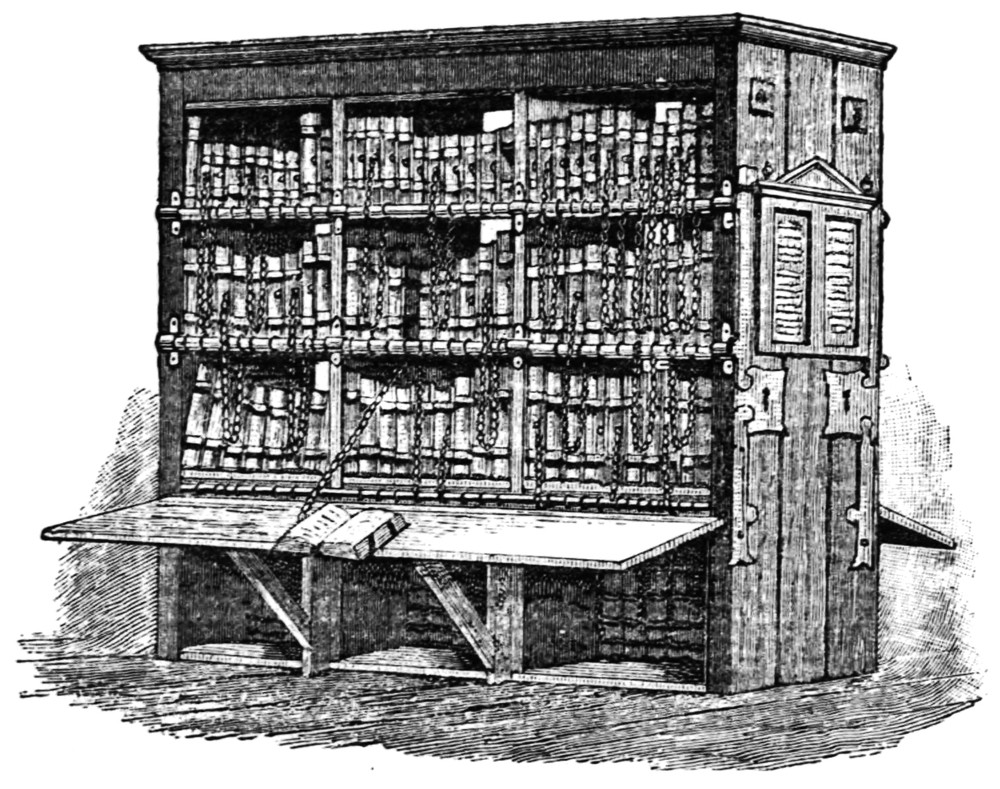
BOOK-CASE OF CHAINED BOOKS IN HEREFORD CATHEDRAL.
v
BOOKS IN CHAINS
AND
OTHER BIBLIOGRAPHICAL PAPERS
BY THE LATE
WILLIAM BLADES
Author of
“The Life and Typography of Caxton,”
“The Enemies of Books,”
etc., etc.
LONDON
ELLIOT STOCK, 62 PATERNOSTER ROW
1892
vii
PREFACE.
It has been thought that a collection
of some of Mr. Blades’s
Fugitive Pieces would form a
volume acceptable to the readers of the
Book-Lover’s Library, as a companion
volume to that distinguished bibliographer’s
Enemies of Books.
A selection of these papers is now
therefore presented to the public in a
more permanent form, and an Introduction
containing a general notice of
Mr. Blades’s life-work has been added.
ix
INTRODUCTION.
The life of William Blades was an
uneventful one so far as the production
of incidents that make a
memoir interesting, but it was none the
less a full life and one that may with
advantage be taken as an example. In
passing judgment upon his literary work
it is necessary to bear in mind that he was
a hard-worked business man, and that the
work which has made his name renowned
was undertaken in his hours of relaxation.
Another remarkable feature of his literary
work is to be found in its complete unity.
Mr. Blades only dealt with those subjects
respecting which he had a perfect and
practical knowledge. He was born at
Clapham on December 5th, 1824, and
after a comparatively short attendance at
xthe Clapham Grammar School he, at the
age of sixteen, entered the office of his
father, Joseph Blades, a well-known printer
of Abchurch Lane. Although he thus
early learnt the trade of printing, he did
not commence to teach others through
the press until he had reached the age of
thirty-four. In 1858 he contributed some
introductory remarks and notes to a reprint
of Caxton’s edition of The Governayle
of Helthe, which was printed in imitation
Caxton’s type. At this time he was in the
midst of his researches on the life and
labours of Caxton, which were soon to
result in the production of his monumental
work The Life and Typography
of William Caxton, the first volume of
which appeared in 1861 and the second
in 1863. This work exhibits an early
instance of the new scientific method in
literary research, and it marks an epoch
in English bibliography. It is sufficiently
strange that it was not until the middle
of the nineteenth century that an accurate
record of the life and press of England’s
first printer was produced. In taking
xicredit to the country for Blades’s laborious
work it should not be forgotten that no
bibliographer has yet arisen to follow his
brilliant example. Will no one arise with
the necessary technical knowledge and a
painstaking devotion to his subject to do
for Wynkyn de Worde and for Pynson
what Blades did for Caxton?
The value of the work of Ames and
Herbert need not be minimised, but too
much has been discovered since their
time to allow us to remain content with
the researches of a former generation.
It is to be hoped that the discredit of
lacking a full and accurate account of
the whole of our early printed literature
will not continue much longer. Blades has
set us a bright example, and his successor
cannot do better than follow in his steps.
Blades was ever active, and he has left a
large number of fugitive pieces, a selection
from which is now presented to the
public in this volume. His contributions
to our knowledge of bibliography range
themselves under the following headings:
I. Caxton; II. Invention of Printing;
xiiIII. Types; IV. Miscellaneous, such as
Signatures, Books in Chains, Numismata
Typographica, etc. A few remarks may
be made here upon his works on these
several subjects.
I. Caxton.
The study of Caxton’s press was the
chief work of Blades’s life and that by
which he gained distinction. Allusion has
already been made to The Life and Typography
of William Caxton, 1861-63, and
it may be noted here that in 1865 he
published “A Catalogue of Books printed
by or ascribed to the press of Caxton, in
which is included the press mark of every
copy contained in the British Museum.”
In 1869 he printed fifty copies of a fac-simile
of a small tract from Caxton’s press,
Ars Moriendi, which had shortly before
been found in the Bodleian Library. In
1870 appeared the useful little handbook
entitled How to tell a Caxton, with some
hints where the same may be found.
Blades was the moving spirit in the
management of the very successful Caxton
xiiiExhibition of 1877. As Mr. Talbot Reed
writes, “It was due to him that the
solecism of celebrating the Fourth Centenary
of the Introduction of Printing
into England three years before its time
was avoided. When the true anniversary
came Mr. Blades threw himself heart and
soul into the movement. What was his
part in the success of the celebration is
already on record. He suggested both
the form the festival should take and the
methods by which it might be carried
out. He undertook the collection and
arrangement of the unique display of
Caxtons and early English printed books
which were brought together—perhaps
the most complete collection ever seen
at one time. He organised and superintended
the arrangement of the large
miscellaneous collection of books, specimens,
autographs, portraits, medals, and
curiosities, to which he himself contributed
the lion share.”[1] He wrote the Preface to
xivthe first section of the Catalogue devoted
to “William Caxton and the development
of the art of Printing in England and
Scotland.”
The Life and Typography was an expensive
book, and in the year of the
Caxton Exhibition Mr. Blades did the
bibliographer who was unable to purchase
this work a great service by
producing a condensed edition in one
octavo volume, entitled The Biography
and Typography of William Caxton,
which forms a most useful guide to the
student of the history of Printing in England.
A second edition of this work was
issued in 1882. No one who has consulted
these important works can doubt the
immense labour which the author devoted
to his task, but it may be mentioned in
passing that Mr. Blades is said to have
inspected four hundred and fifty Caxtons
during the course of his researches.
xv
It was in connection with Mr. Blades’s
work on Caxton that the writer of this
notice had the privilege of first making
his acquaintance. In the year 1868 it
occurred to me that it would be possible
by means of a society to reproduce in
fac-simile the whole of Caxton’s works,
as a monument to the memory of our
first printer. Before proceeding in the
matter I sought an interview with Mr.
Blades. He invited me to his house near
the Crystal Palace to talk the matter over,
and he naturally showed the greatest
interest in the scheme. Although he was
not very sanguine of success, he entered
pretty fully into calculations, and the
result of our consultation was that the
cost of reproducing the whole of the
works would be £20,000, a sum which
might be met by the subscriptions of five
hundred members at two guineas a year
for twenty years. I received many promises
of support, but eventually the scheme
was abandoned as too risky an undertaking,
more especially as the great object
to be attained was completeness, and
xvithere was no possibility of guaranteeing
the interest of five hundred subscribers in
the work for so long a period as twenty
years. This may appear a mad scheme
to many, and I hope I shall be excused
for introducing a mention of it here, on
the ground that Mr. Blades’s consideration
of the proposal evinced his judgment,
patience, and kindliness of character, and
so helps to show my readers what manner
of man he really was.
II. Invention of Printing.
The burning question as to which
country—Germany or Holland—the invention
of printing by movable types is
due, was one which always interested
Blades, and in 1876 he published at
his own cost a translation of Dr. Van
der Linde’s Haarlem Legend by Mr.
Hessels. In the previous year, before
Dr. Van der Linde’s essay appeared in
an English version, Mr. Blades set forth
his view of the question in an article in
Berjeau’s Book-worm, which is printed in
this volume. He here suggested the
xviipossibility of an independent invention
in the two countries, and remarked that
if Coster never lived yet Costeriana
certainly exist. He further showed that
the Caxton printing pedigree must be
traced to a Dutch rather than to a
German source.
In 1887 he returned to the subject in
a paper read before the Meeting of the
Library Association at Birmingham, and
in 1888 he contributed to the Book-worm
a clear statement of the very complicated
question under the title of De Ortu
Typographiæ, which was placed before
readers in its two aspects of Coster v.
Gutenberg and Gutenberg v. Coster.
Between the dates 1871 and 1887 a great
change had occurred in the field of the
controversy. When Mr. Hessels translated
Dr. Van der Linde’s Haarlem
Legend he was at one with the author, but
when he came in 1879 to criticise Van
der Linde’s Gutenberg he found strong
reasons for doubting that author’s conclusions,
and his doubts were expressed
in a remarkable book published in 1882
xviiiand entitled Gutenberg: was he the Inventor
of Printing? Mr. Hessels continued
his destructive criticism on Van
der Linde’s great work on the Invention
of Printing in the Academy, and his
articles were reprinted in December 1887
under the uncompromising title of
Haarlem the Birth-place of Printing, not
Mentz. Unfortunately this controversy
has been carried on with considerable
heat on both sides, and Mr. Blades
endeavoured in his articles to place the
matter before his readers in a clear and
practical way, and he succeeded in giving
a satisfactory statement of the present
condition of the controversy. He again
returned to this matter in his posthumous
work entitled The Pentateuch of Printing,
and here he gives his judgment as
follows: “Thus we float along the stream
of gradual development, until we reach
movable types properly termed Typography.
This was never an invention
pure and simple which suddenly enlightened
the mind of Gutenberg (as stated
by Van der Linde and echoed by Theo.
xixde Vinne), but an end successfully accomplished
after numerous efforts and gradual
advances.”
III. Types.
Mr. Blades’s researches on the varieties
of types used by Caxton and other early
printers led him to investigate the history
of specimen books, and he collected much
interesting information respecting these.
In 1881 he contributed to the Antiquary[2]
an article on “The First Printing-Press at
Oxford,” in which he refers to the much-disputed-over
Expositio of 1468, a date
which he supposes to be a misprint for
1478. This Oxford press appears to have
existed for eight years (from 1478 to 1486),
during which period sixteen books that
have come down to us were produced.
Blades divided these eight years into three
sections:—
1. 1478-1479: three books printed by
one unknown printer, probably Theodoric
Rood.
xx
2. 1480-1483: seven books printed by
Theodoric Rood.
3. 1483-1486: six books printed by
Rood and Thomas Hunte.
S. W. Singer published a pamphlet in
1812 in which he supported the opinion
that the date 1468 was the correct one,
but as early as 1735 Conyers Middleton
made the very probable suggestion that
in printing an X had been accidentally
dropped out.
In 1860 Mr. Blades printed a pamphlet
entitled Some Account of the Typography of
St. Albans in the Fifteenth Century (1480-1486),
which however went no further than
half a dozen proofs. This contains a collation
and description of the type of each
of the books printed by the printer of
St. Albans. Mr. Blades writes: “Seven
different works printed at St. Albans about
the close of the fifteenth century have
descended to modern times. From the
colophons of these we learn that the Press
there produced two Works in 1480, two in
1481, one in 1486, and two without dates,
one of which, however, must have been
xxiprinted after 1483, which was the year of
its compilation. From this it seems very
probable that several works may have
been printed at St. Albans between 1480
and 1486, of which not a single copy is
now preserved. The fact that these seven
Books present us with four different Founts
of Type leads to the same conclusion,
which also receives some confirmation
from the colophon to the Essay on Rhetoric
by Laurentius de Saona. Laurentius
wrote his work in the University of Cambridge
in 1478, and the fame of the St.
Albans Press would seem to have reached
there so early as 1480, as in that year his
compilation was printed at St. Albans.
But who was the St. Albans Printer?
Not one of his productions affords the
slightest information. That he must have
been connected with the Abbey, or protected
by the Abbot there, seems almost
certain, as the undertaking otherwise would
have been too perilous.”
An interesting article appeared in 1878
in Macmillan’s Magazine on the Plantin
Museum at Antwerp, which was translated
xxiiinto French. Mr. Blades made his first
visit before the old printing-office was
purchased in 1875 by Town Council
for £48,000. This will seem a large
sum to those who have not the privilege
of knowing this interesting relic of the
past, with its many and varied treasures.
Mr. Blades describes (1) the Mansion;
(2) the paintings and engravings—18 oils
by Rubens; (3) the Library; (4) the
Archives; and (5) the Printing Offices.
Among the collections are fine specimens
of Sevres, Chinese, and Japanese porcelain.
“Some years ago a well-known amateur,
distracted by the beauty of six cups and
saucers in porcelaine verte de chine, offered
Mr. Moretus 15,000 francs for the set, but
in vain, and these cups, which £50 each
would not buy, still grace the Plantin
Museum.” In conclusion, we are told of
some of the most precious of the stores
in this wonderful place: “But what have
we here in all these curiously carved old
cabinets, a single one of which would render
a Soho dealer famous? Shelves upon
shelves of wood-cuts, over 15,000, illustrating
xxiiithree centuries of the engraver’s art.
All sizes of floriated initials, ‘blooming
capitals’ as the Dutch called them; an
infinity of head- and tail-pieces, vignettes,
printers’ marks, and what the French style
culs de lampes. One magnificent set of
large illuminated initials, probably designed
for a great Missal, is quite fresh from the
hand of the engraver, having never been
used; while numerous designs, although
beautifully drawn upon the wood, have
still to wait for the skilled hand of the
engraver. Not wood-cuts only, but about
8000 copperplates are also carefully preserved,
including many splendid title-pages
and other illustrations used in bygone
ages. In a specially designed and beautifully
carved closet are kept all the punches,
matrices, and moulds which performed no
small part in enhancing the fame of the
‘Plantin Press.’ Probably nothing like
it can be seen in Europe, the major part
having come from the graceful hands of
Guillaume le Bé and Claude Garamond.
Close by, packed up in papers ready for
immediate use, are a ton or two of types
xxivof all sizes, brand-new, covered with a
hundred years of dust.”
It is remarkable that a great house
should have lasted for so many years, and
have remained in the possession of a
single family. “One of Plantin’s two
daughters married John Moretus, the
chief associate of her father in his typographical
labours, to whom he bequeathed
the mansion and the business. From him
through seven generations of printers it
has descended unchanged to Edward
Joseph Moretus, the last of his race, who
has lately transferred it to the safe custody
of the city of Antwerp.”
In 1875 Mr. Blades contributed to the
Printers’ Register a useful account of “Some
early Type Specimen Books of England,
Holland, France, Italy, and Germany,”
which was reprinted as a pamphlet. “The
first positive notice we have of type-founding
in England is the fount of Saxon cut
by John Day for Archbishop Parker and
used in 1567. The next is found in a
Decree of the Star Chamber in 1637,
restricting the foundries in England to
xxvfour, and further restricting each master-founder
to two apprentices and one boy
‘to pull off the knots of metal hanging at
the end of the letters when they are first
cast, and no more.’ The first dated type specimen
is a sheet of Moxon’s, who was
the earliest English writer on the practice
of type-founding and printing. His sheet
is headed thus:—
Proves of several sorts of Letters cast by Joseph
Moxon, Westminster. Printed by Joseph Moxon
in Russel Street at the sign of the Atlas, 1669.
“English type-founding was in a very
depressed state until an accidental circumstance
induced the first Mr. Caslon to try
his hand at punch-cutting. This was in
1720 upon a fount of Arabic for the
Society for Promoting Christian Knowledge,
and his complete success in this
determined his future life. He started an
infant foundry, cutting his punches with
his own hand, and in 1734 published the
following as a Large Post Broadside:—
A specimen by William Caslon, Letter Founder,
in Chiswell Street, London.
xxvi
This sheet is very interesting, as showing
from what a small commencement this
celebrated Foundry took its rise.”
Mr. Blades proceeds to give an account
of American Specimen Books, and then
describes specimens published in various
parts of the Continent. The earliest book
with a date which he found has this
title:—
Typorum et Characterum Officinæ Chalcographicæ
Georgii Leopoldi Fuhrmanni ... designatio.
Nurimbergæ, 1616. 4to.
“In 1743 the Haarlem firm of Isaac and
John Enschedé originated the plan of presenting
their patrons with a well-bound and
well-printed volume, in which their types
were advantageously displayed.” In 1870
Mr. Blades communicated to Berjeau’s
Book-worm an interesting article on this
Type Foundry. He writes: “The elegant
volume which has suggested these remarks
is a newly published Specimen Book of all
the old types anterior to the year 1800 now
in the Enschedé Foundry, or which is the
same thing, now extant in Holland. Great
pains have been taken to show them off to
xxviiadvantage by excellent press-work; while
to add additional interest to the volume,
the engraved title-pages which ornamented
the early specimen books of the same firm
more than a century ago, are here reproduced
from the original plates.”
Mr. Blades contributed to Berjeau’s
Book-worm in 1869 a short article on some
Early Greek Types belonging to the Royal
Printing Office, Paris, which the University
of Cambridge wished to purchase in the
year 1700. This article is printed in the
present volume.
IV. Miscellaneous.
A short notice of some of Mr. Blades’s
numerous contributions to Bibliography
which do not range themselves under the
previous divisions must be given under
the somewhat unscientific heading of
Miscellaneous.
When I started the Bibliographer in
1882, I naturally asked Mr. Blades to let
me have an article for the opening number,
and he was good enough to send a curious
xxviiilittle query, “Who was Bercula?” The
name of Thomas Bercula appears as the
printer of Vulgaria Whitintoni, 1520 and
1525, and Mr. Blades asks if he was a
sleeping partner with Pynson, as his name
is not otherwise known. Shortly after
the appearance of the number of the
Bibliographer I met the late Mr. Henry
Stevens, who said he could answer the
question and would send me a note for
a coming number. Mr. Stevens, however,
on account of his full employment
and also from ill-health, was unable to
fulfil his promise. His solution of the
difficulty therefore did not appear until
after his lamented death, when his son
sent his note to the Athenæum (May 8th,
1886). Mr. Stevens suggested that
Thomas Bercula stood for Thomas
Berthelet, the English diminutive being
represented by the Latin cula.
The article on “The First Printing-Press
in England as pictorially presented,”
which Mr. Blades contributed to Berjeau’s
Book-worm in 1869, and which is reprinted
in the present volume, contains
xxixan interesting account of the technical
errors and anachronisms which artists
have introduced into their representations
of Caxton’s first printing-press.
In 1883-85 Mr. Blades defended in
the Printers’ Register the claims of John
Nicholson to the honour of being the
original inventor of the Steam Press. His
advocacy of the unfortunate Englishman
lost him the friendship of Herr Goebel of
Stuttgart, who would not allow any of the
glory of this great work to be taken away
from Frederick Koenig. Blades puts the
matter clearly in his Pentateuch of Printing
(p. 86), where he shows that Nicholson
took out a patent in 1790 “for printing
by machinery, in which he specified those
very principles of action which have been
the basis of every successful printing
machine since made.” At the beginning
of the present century Koenig, a young
German, came over to England, and was
greatly assisted by Bensley the printer
during the period of his attempt to construct
a printing machine.
“From 1806, when he came to London,
xxxto 1811, Koenig made two complete
machines (not including his first wooden
trial), but both were unsuccessful because
they were founded on the false principle
of the old hand-presses, viz., impressions
from a flat surface or platen. Disheartened
by failure, and, as he himself
confessed, at his wits’ end what to do next,
an accidental occurrence put him on the
right road. Bensley, his partner, by chance
visited Nicholson to obtain from him
some information concerning those patent
laws with which a long and sad experience
had rendered him familiar. He
found him in a debtors’ gaol, and then he
heard for the first time of Nicholson’s
patents. Fluttered and anxious, Bensley
took Koenig straight off to read the particulars....
He at once set about constructing
a new machine, in which all his
previous plans of impression were thrown
aside, and ... Nicholson’s method of
pressure by means of a cylinder beneath
which the type ran was adopted.” Koenig
himself acknowledged fifteen years later
that he had read Nicholson’s patents, but
xxxiwith great contempt for their crudeness,
and that he immediately forgot all about
them. Herr Goebel, his biographer, believes
this very improbable statement of
Koenig’s.
Mr. Blades made an interesting collection
of medals connected with printing,
and in July 1867 he contributed to the
Numismatic Chronicle an article on the
subject entitled “Numismata Typographica.”
In 1869 he printed twenty-five
copies of “A List of Medals, Jettons,
Tokens, etc., in connection with Printers
and the art of Printing,” and in the following
year he issued a privately printed
pamphlet—“A List of Medals struck by
order of the Corporation of London, with
an appendix of other medals struck
privately or for sale having reference to
the same corporate body, or the members
thereof.” In 1872 he compiled a “List
of Medals connected with Printers and the
art of Printing, exhibited at the opening
of the New Library and Museum, Guildhall,
London,” and in 1877 a list of the
collection of medals shown at the Caxton
xxxiiExhibition. In 1878 he commenced in
the Printers’ Register a “Numismata
Typographica,” which was reprinted as a
volume in 1883 under the title of Numismata
Typographica; or, the Medallic
History of Printing; being an Account of
the Medals, Jettons, and Tokens struck in
commemoration of Printers and the art of
Printing.
He commenced a “Bibliotheca Typographica”
in the Printer’s Register in 1875,
but the completion of this list of publications
in the English language treating of
printers and printing was suspended, and
the materials which he had collected were
placed at the disposal of the compiler of
the Bibliography of Printing, published
by Messrs. Wyman.
Mr. Blades contributed to the Athenæum
in January 1872 a valuable article on
“Common Typographical Errors, with
especial reference to the text of Shakespeare,”
in which he pointed out the
corruptions in the text that might be
attributed to errors in composition. This
was reprinted in his interesting volume
xxxiiientitled Shakspere and Typography; being
an attempt to show Shakspere’s personal
connection with, and technical knowledge of
the art of Printing, which contains the
ingenious and half-serious suggestion that
Shakspere spent some time in a printer’s
office.
The popular little work entitled The
Enemies of Books, which first appeared
in 1881, was very successful, having passed
through five editions in all, and being
honoured by translation into French. As
this book forms one of the “Book-Lover’s
Library,” it is not necessary to describe it
further in this place.
Mr. Blades presented to the English
reader in 1885 a very interesting volume:
“An Account of the German Morality-Play,
entitled Depositio Cornuti Typographici,
as performed in the seventeenth
and eighteenth centuries, with a rhythmical
translation of the German version of 1648.
By William Blades, Typographer.... To
which is added a literal reprint of the
unique original version, written partly in
Plaat-Deutsch by Paul de Vise and
xxxivprinted in 1621.” In this work the
author brought together much fresh matter,
and illustrated his subject with great
learning. He added a chapter in which
it was shown that a survival of a similar
practice, though in a greatly mutilated form,
still exists in English printing offices.
In 1889 Mr. Blades sent three letters
to the Athenæum[3] on the subject of
“Watermarks.” He pointed out that
watermarks are but fallacious evidence as
to the place and date of books, but he
laid great stress on their importance as
fixing their size notation. After explaining
the make of hand-made paper and
the position of the watermark, he enunciated
the following three laws:—
Law 1. In any old book, if the chain-lines
run down, and the watermark is
found about the centre of the page, that
must be folio.
Law 2. If the chain-lines are across,
and the watermark is found in the
middle of the back of a book, that book
must be quarto.
xxxv
Law 3. If the chain-lines are down,
and the watermark is found at the top
edge of a book, that book must be octavo.
Mr. Blades considered that in dealing
with this very difficult question of size
notation the year 1800 should be taken
as the dividing line. Before that date
the rules that he laid down were to be
observed; but for the later period, when
machine-made papers had become common,
the bibliographer might adopt any
system of nomenclature that he found
most convenient.
Early in the year 1890 Mr. Blades
commenced a series styled Bibliographical
Miscellanies, which promised to
be of great value and interest, but soon
after No. 1 had been published the
author was called away from this world.
He left, however, some materials ready
for the press, and Nos. 2 to 5 were
published after his death. All these
Miscellanies, which relate to the Signatures
in Books and to Books in Chains, are
reprinted in this volume, so that it is not
necessary to do more than commend
xxxvithem to the reader as containing a large
amount of useful information on two
very interesting bibliographical points.
The ever-busy printer and author was
taken all too soon from his labours on
April 28th, 1890. Although he was not
an old man, he had enjoyed a long life
of work, and his jubilee as a printer was
about to be celebrated when his last
illness came rather suddenly upon him.
He left ready for publication a popular
work on the history of printing, to which
he had given the fanciful title of The
Pentateuch of Printing. This was published
in 1891 under the editorial care
of Mr. Talbot Reed, who added a memoir
of the author and a full list of his published
works as well as his contributions
to periodicals.
Sufficient has been said of Mr. Blades’s
literary work, but in conclusion a few
words must be added as to the man himself.
He was not one to put himself
forward, and to appreciate his real worth
it was necessary to know him in private
life. Although his name at once took
xxxviihigh rank, he can scarcely be said to have
received sufficient honour during his lifetime
for the important work which he did,
and this may have been partly owing to
his quiet and unobtrusive disposition.
He was a student who did his work for
the love of it, and not to be praised of
men.
He took great interest in the Library
Association of the United Kingdom, and
was a constant attendant at the annual
meetings. The writer of this notice well
remembers his presence at the most
delightful of these meetings, which was
held at Cambridge, when that model
bibliographer and distinguished man, the
late Henry Bradshaw, proved himself a
model President and Chairman as well.
At this meeting, when the members
visited the library of Corpus Christi
College, he took up his parable and
discoursed about the Caxtons. At the
dinner which was given by the members
to the President, Blades appeared in a
new character, for he added to the
harmony of the evening by standing up
xxxviiiand singing with good effect the old song
of “Down among the dead men.” In
going over the work of this true student
and enthusiastic lover of his profession,
it is impossible not to feel the highest
admiration for a man who did so much
to foster the same tastes in those around
him and to clear away difficulties in the
path of those who were to follow him.
In this our great Babylon where,
in the arena of trade and mammon-worship,
every morning sees
the renewal of fierce competitive contests,—where
the fight is to the strong and
clever, and where every night looks down
on the vanquished, dead or wounded on
the field,—there are not a few, even among
the combatants, who, when the day’s toils
and anxieties are over, find both refuge
and recreation in the soothing society of
their favourite books. And this may be
noticed as a general tendency among all
book-lovers—that whatever complexion a
thoughtful man’s first literary love may
assume, whether historical or poetical,
4whether the phases of religious thought
or the metaphysical subtleties of the
schoolmen, his studies are almost sure to
develop within him a love for the books
of bygone ages; and that not merely for
their old-world wisdom, but for them
simply as old books, as the very paper
and print over which our wisdom-loving
ancestors pored,—streamlets of thought,
which, in their onward course, have developed
into those mighty rivers of knowledge
which now fructify the whole nation.
Doubtless there is an element of sentimentality
in loving a book just because
it is old; but the feeling is akin to that
which makes all of us interested in knowing
who our ancestors were; for, after all,
the Shakespeare-works we love and the
Darwin-theories we admire would never
have existed but for the long chain of
books behind them, of which indeed they
are but important links. These feelings
are natural, and they grow by what they
feed on.
Some such sympathies stirred within me
when looking, last spring (1889), upon
a photograph of the chained library
5at Wimborne Minster; and, occasion
offering, I paid a visit or two to the
grand old church in that interesting
town—visits which prompted the present
remarks.
Single books chained in churches were
quite common in the Reformation days,
and may, even now, be seen occasionally.
In this very town of Wimborne a copy of
Foxe’s Book of Martyrs was, in bygone
days, chained to a desk in the dissenting
chapel,—a rather unusual occurrence,—nor
are there wanting records which tell
of whole collections, where each volume
was chained in its place as it stood on
the shelf. Such libraries are, however,
now very uncommon, and, with the exception
of the remarkable old library
in Hereford Cathedral, the writer is not
aware of any collection in England approaching
in interest and extent that at
Wimborne Minster.
Who can look at that old building
without emotion? The grand Norman
arches, with the Gothic additions of later
centuries, are, of themselves, an abridged
History of England; and, as a pre-Reformation
6study, form no inappropriate
introduction to the post-Reformation
collection of volumes, generally the last
object of interest in the whole building
to which the visitor’s attention is
directed.
Let us enter the Abbey; and, without
waiting to discuss the changes which
generation after generation made in the
appearance and architecture of the building,
let us wend our way with reverential
footsteps towards the sacristy, over which
is the library. We cannot pass quite
without notice the tomb of the Duke
and Duchess of Beaufort, parents to
the well-known patroness of all that
was good in art and literature, the Lady
Margaret, Countess of Richmond, mother
of Henry VII., and patron of our proto-typographer,
William Caxton, whom she
employed to print the Fifteen Oes. She
it was who founded the adjacent seminary
(now the endowed school), built a chantry,
and conferred many other benefits on the
town of Wimborne.
We just glance at the three old wooden
benches occupying the place of the altar-rails,
7and covered with a white eucharistic
cloth, at which, before the Reformation,
the laity received the Sacrament—a
custom kept up to this day. Let us enter
the sacristy. The room appears to be of
15th-century workmanship, has two Gothic
windows, and must have had an altar at
the east end in bygone times, for the
piscina is there still. In one corner is a
door which opens upon a spiral stone
staircase, every step of which demands
foresight on the part of the visitor, so
worn and hollow are the stones with the
feet of many generations.
At the top of this we reach the chamber
over the sacristy, and find ourselves in
the midst of many books, nearly all of the
16th and 17th centuries. ’Tis here we
can realise the wide gulf which separated
the great leaders of pre-Reformation
thought, who, through long dim centuries,
worked to express their creed and ideas
in buildings of sculptured stone and marble,
from the still greater leaders, who,
by their fervent writings, conquered the
creed of whole nations, and elevated
the aspirations of mankind by means
8of that greatest of all inventions—the
Printing-press.
Formerly this chamber was the treasure-house
where the sacramental plate and
other valuables were preserved, among
them being two pieces of the real cross,
the thigh of St. Agatha, a portion of the
crib used by our Saviour when an infant,
some hairs from His head, a piece of the
alabaster box of Mary Magdalene, a tooth
of St. Philip, a bone of Melchizedek, a
thorn from our Saviour’s crown, and
numerous other relics, of which, if the
reader wants to learn more, let him refer
to Hutchins’s History of Dorset. The
Rev. William Stone, a native of Wimborne
and a minister of the church, gave numerous
books to form a foundation for the
parochial library. He appears first in the
church records as an “official” (now
called a “surrogate”) in the year 1637.
He took the degrees of M.A. and LL.D.,
was Principal of New Inn College, Oxon.,
and died in 1680 at Wimborne, where a
long epitaph in Latin commemorates his
acquirements and virtues. Another minister,
the Rev. Thomas Ansty, who was
9appointed in 1661 and died in 1668, is
mentioned as the donor of eight books.
The names of Taylour and Constantine,
whose autographs occur in some of the
books, are also in the list of Ministers of
Wimborne. The autograph of the Rev.
Samuel Conant, whose books formed
probably part of the Stone collection, is
found in several volumes.
Against the walls of this old treasure-house
are erected shelves. Nearly all
the books are chained. The chains are
formed of rod-iron bent into a figure
of 8, with one end twisted round the
middle for strength. We know the
date when the library was founded, and
therefore of these rude chains—it was
1686. Each chain is about 3 feet
long, and has at one end a ring like
a curtain ring, which, running along
an iron rod, allows considerable play.
Thus you can take any book from its
place to a desk at a little distance and
there consult it, but you cannot take it
away. There must have been some advantages
in this plan, or it would not have
been generally adopted; but, apparently,
10great disadvantages must have been experienced
also. If the chains were a
check upon stealing the books, they were
certainly no preventive against damage
and mutilation, as many of the volumes
unfortunately prove. To lug out a heavy
volume by the cover does not tend to preserve
the binding. The present shelving
is modern (1856), the old boards having
become too rotten for safety. The old
desks, too, which afforded a resting-place
for the volumes when consulted, have
disappeared, so that for purposes of reference
it would be very inconvenient to
really use a single book without unchaining
it. Several volumes have been unchained
and are displayed in a glass case. The
Church Committee in 1885 effected this
change. The desk and chair had been
abolished long before: the glass case was
simply placed over the table and unprotected
books. This I think is a mistake:
it modernises its aspect, and gives the
chamber a cramped show-room appearance,
very different from its old aspect.
The exposed books, too, really answer no
useful purpose: they teach nothing; people
11look and stare for a second, say “Dear
me!” and pass on without the gain of a
single idea.
The books themselves form an exceedingly
interesting and uncommon collection;
they represent very fairly the literary taste
and religious bias of the 17th century.
There are about 240 works in number,
many incomplete, and many badly wanting
the attention of a binder to preserve
them; but with all their deficiencies they
include several works very seldom seen,
even at the best book-auctions, and with
many of which, it may safely be said,
bibliographers are little acquainted. The
old fathers of the Church are well represented:—Ambrosius,
Anselm, Aretius,
Augustine, Bernard, Basil, Chrysostom,
Clemens, Cyril, Cyprian, Gregory, Herodianus,
Hilary, Ignatius, Isodore, Macarius,
Tertullian, Theophylactus, and others.
Classical writers make a poor show with
only Cicero, Plato, and Pliny, although a
large proportion of the whole collection is
in Latin. In general and ecclesiastical
history there are Bede, Camden, Daniel,
De Serre, Dugdale, Eusebius, Grimstone,
12Raleigh, Ross, and Trussell. Works on
Divinity and Sermons are too numerous
to mention, and include the chief Elizabethan
and Caroline Divines. Lexicons
are numerous, and the Eastern tongues
well represented. Among the authors
which are now seldom met with are
Abraham, Aretius, Carion, Cassianus,
Espencœus, Estius, Euthymius, Fabius,
Facundus, Gorranus, Haymo, Heresbachius,
Musculus, Optatus, Pintus, Sennertus,
Spondanus, Trelcatius, Weinrichius, and
Zonaras.
In Bibles the collection, where one
would expect riches, is poor. The Septuagint,
a Hebrew Old Testament of 1635,
the celebrated Polyglot of 1657, Junius
and Tremellius, 1617, and the Bishops’
Bible of 1595, often called the Breeches
Bible, exhaust the list.
There is one early manuscript only, but
that has the advantage of a clear date
(1343). It is on vellum, and was written
for the use of priests; its title is Regimen
Animarum, and it contains a few prettily
illuminated initials.
We must not forget to notice that all
13the books, having the chains fixed to the
fore-edge, are placed back first on the
shelves, and are released by pulling the
chain.
Several volumes have, or rather have
had, beautifully embossed designs on their
sides. Such were the quarto Pupila Oculi,
now nearly destroyed; also a Theophylactus
on the Gospels, the binding of
which is in excellent preservation, and a
treat to the eyes. The tone of the leather
is a rich brown, and on one side are represented,
in clear relief, all the instruments
of the Crucifixion surrounding a
central cross, with “Redemptoris Mûdi
Arma” beneath in old black letter. The
reverse is a large Tudor rose, with a legend
difficult in some parts to decipher. The
arms of the City of London appear in one
of the corners. An exactly similar binding
from the old church library at King’s
Norton, near Birmingham, has recently
excited much attention, and was described
by Mr. Brassington in the fifth number of
The Bookbinder.
A catalogue of the books, made in 1725,
exists in manuscript, under lock and key.
14Another, made in 1863 by William George
Wilkinson, was printed, and a copy is kept
in the library. From the latter, the list
of books at the end of the guide-book
was taken. A copy of the preface to the
1863 edition may appropriately close these
remarks.
“This library was catalogued in July,
1725. There were then 200 works in the
library. There are now 185 works (in 240
vols.). Ten of these are not mentioned
in the old catalogue. Consequently, since
1725, twenty-five works have been lost or
stolen. Of these missing works, five had
a price attached to them in the margin of
the old catalogue in pencil. Others had
titles more likely than many to attract the
purloiner, e.g., Markham’s Way to get
Wealth, Period of Human Life, History
of a Private Life, Venner’s Via recta ad
Vitam longam (Way to Health and Long
Life).
“In the first column of the catalogue
now issued will be found, arranged alphabetically,
the titles of all the works in the
library, at sufficient length for identification.
15
“In the second column the number of
volumes is stated when more than one,
and the size of the book when other than
folio. This is necessary to enable any one
to find a book in the library, as though
the books of each letter are placed together
on the shelves, yet a further alphabetical
arrangement was found impracticable
from the diversity of the sizes of the
volumes.
“In the fourth column will be found
the names of the donors; of these the
most munificent were the Rev. Thomas
Ansty, 1697, and the Rev. Sam. Conant
“Lastly, it has been thought as well to
give a list of the names of former owners
of the books, as it is possible that among
them some may be of interest to present
inhabitants of Wimborne. These will be
found in the fifth column, together with
remarks on the present condition of the
volumes. In some cases considerable
depredations have been committed with
a sharp pen-knife, on the title-page and
tables of contents, apparently for the purpose
of supplying missing portions in other
copies of the work. Dugdale’s History
16of St. Paul’s and Loniceri Chronicon
Turcicum may be taken as examples.
“Those books which are valued in the
margin of the old catalogue are marked
‘val.’ Below each letter will be found
an account of the differences between the
present catalogue and that of 1725.”
17
BOOKS IN CHAINS.
Part II. England and Abroad.
Why chain books? It
is certainly a distressing as
well as a suggestive sight to see
books in chains. Distressing, because a
good book is like a strong man, and when
chained is as shorn Samson among the
Philistines. No one nowadays would
think of chaining books to desks or
library shelves, for our ideas about such
matters have indeed altered from those
prevalent when such a custom obtained;
so that the mere sight of a single survival
of this rude practice is strongly
suggestive, not only of national advance
in education and literary enlightenment,
but also of the power of the printing-press,
through whose influence alone her
18offspring—as well as her parents, the
manuscript books—have been redeemed
from their chains.
Before the invention of Printing, books
were scarce and dear, and it was the
custom of the College authorities to lend
single volumes to students for one year,
to be then returned with evidence of their
having been profitably studied. No doubt
positive loss was one result, and injustice
to non-favoured students another; but
books borrowed have always been proverbial
for not coming home to roost,
and chaining seemed a natural way of
securing them for general use. This
appears to me more likely to have been
the object of chaining than the prevention
of theft.
The custom of fastening books to their
shelves by chains was common at an
early period throughout all Europe. When
a book was given to a mediæval library it
was necessary, in the first place, to buy
a chain, and, if the book was of especial
value, a pair of clasps; secondly, to
employ a smith to put them on; and,
lastly, a painter to write the name and
19class-mark across the fore-edge. Large
collections of chained books were for the
use of particular bodies of students; but
when religious zeal made many people
feel the want of spiritual food, it led to
the chaining of single volumes in churches,
where any parishioner, able to read, could
satisfy his soul. The Bible was, of course,
one of the most common, and among others
were Foxe’s Book of Martyrs, the various
works of Bishop Jewel, and other Divines.
The old records of various Colleges
have numerous entries concerning the
cost of chains, of rods, of rings, and of
wages paid for enchainment. In 1444
great inconvenience was felt from the
overcrowded state of the library at Oxford
University, where, all the books being
chained, the students were continually
jostling one another. So a petition was
got up to Humphrey, Duke of Gloucester,
a book-lover whose name is always green
in the memory of bibliophiles, that he
would assist in obtaining an enlargement
of the library.[4] The petitioners state
20their grievance very tersely in good Latin,
and complain that “should any student
be poring over a single volume, as often
happens, he keeps three or four others
away on account of the books being
chained so closely together.”[5] Perhaps
the most complete account of the whole
process of erecting the shelves and desks,
and chaining the books, will be found in
the archives of Eton College for the years
1519-20 et seq. These chains were all
removed exactly two centuries later. In
the reign of Henry III. the whole library
of Oxford University consisted of only a
few books, some of which were chained,
and some locked in chests in St. Mary’s
Church.
In 1519-21 the Eton Library was rearranged,
and the books rebound. The
cost, and all particulars, are entered in
the “Audit Book.” The following is extracted
from Willis and Clark, III., 431:—
“In the first year, 24 dozen chains of
three sorts (explained in the next year’s
account to mean of three different lengths)
are bought; 48 iron bars for the rings to
21play upon; 12 locks, with a corresponding
number of hasps (claustra) to secure the
bars, and 4 keys; and lastly, a pair of
pincers to cut the strips of brass or copper
required for the attachment of the rings
to the boards.”
The following is the text of this portion
of the account:—
“Et pro xxiv duodenis cathenarum
trium generum ad libros in bibliotheca
cathenandos iiijli. Et pro pari forpicum
ad laminas eneas secandas ad fixuram
dictorum librorum, xvjd. Et Roberto
Oliuere fabro ferrario pro xlviij vectibus
ferreis ad chatenas continend’ pondere iij
c et di cli lvijs ijd. Et idem pro xij seris
et totidem claustris et iiij clanibus precij
capitis, xxs xxd.”
In the next year a bookbinder named
Andrew Lisley is employed for 199 days to
bind and repair the books. He receives
fourpence per day in wages, and one
shilling per week in commons. The Bursar
buys for his use 20 calf skins, 36 white
sheep skins, 3 large and 3 small doe skins,
5 pig skins (pro quinque pellibus de la
soure), and 28 red skins, 100 plates of
22horn, 5000 copper nails (to be set round
the edge of the boards, like bosses, to
protect the binding), 10 pounds and a
quarter of strips of brass, 7 pounds brass
wire, 27 pairs of clasps, and a quantity of
green and red thread, glue and needles.
At Pembroke College, Cambridge, the
books were reported by Dr. Matthew Wren
(1616) to have suffered severely, partly
from the sloping form of the desks upon
which they were placed for perusal, and
partly from the weight of the chains
(ex inepta mole catenarum).
1491. From the University accounts:—
Item pro cathenacione vij librorum et howsing ac clasping ut patet per billam M. Wodelark
ijs
xd
1574. From the same:—
Item for 27 chaynes for the newe bookes in the librarye
vijs
vjd
For 34 rynges
xxijd
To John Sheres, setting on 72 chaynes
ijs
To Hillarye, helpyng hym
viijd
1506. Bishop Fisher, of Christ’s College,
in the same University, directs:—
In order that no scholar may be ignorant of the
Statutes of the College, we desire that two copies
23
of them may be fastened by a small iron chain to
a stall in the Chapel, so that every scholar may
be enabled to have access to them.
1554. At Corpus Christi, Cambridge,
it was ordered that the books bequeathed
by Peter Nobys, D.D., who was Master,
1516-23, should be better taken care of
for the future; and, if the chains were
broken, that they should be repaired at
the expense of the College.
1563. From St. John’s, Cambridge,
College accounts:—
Item to Philip Stacyoner, for cornering, bossing, and chayninge Anatomiam Vessalii
iijs
Item for twoe chaynes for the bookes given by Mr. Hollande
xijd
Item for 2 hookes for them
iijd
1580. At Jesus College, Cambridge,
is recorded:—
Cheynynge xii bookes with staples to them in the chapell
vjd
1600. From the accounts of Trinity
College, Cambridge:—
Item receaved of Mr. Peter Shawe towards the cheyninge and desking of his bookes
vli
24
1683. The library of King’s College,
Cambridge, was in chains, and among the
rules for the guidance of the scholars was
this:—
For the rendering his business about the library
more easy, each person that makes use of any
books in the said library is required to set them
up again decently, without entangling the chains.
This entanglement must have been very
incommodious, as it was a fault easily
committed when the chains hung so close
together.
The Statutes of the College were, about
the same period, also chained in the
Chapel, as were those of Queen’s College.
The Statutes of St. John’s College, Cambridge,
were chained in the Vestry.
In 1555 Robert Chaloner, of Gray’s
Inn, gave 40 shillings for chains to fasten
his gift of books in the library there.
In 1659 John Selden’s books which
were sent by his executors to the University
Library, Oxford, were chained. In 1757
the chains were all removed.
In the Foreigner’s Companion through
the Universities of Cambridge and Oxford,
written in 1748, the inconvenience of
25chaining books is noticed, and about this
time the abolition of chains began, and,
by the end of the century, very few
chained collections remained. At King’s
College, in 1777, a man was paid £1 7s.
for nine days spent in taking the chains
off the books. Not a single chained book
is now to be seen in any of our Universities.
There are, however, a few chained collections
still left in the United Kingdom,
viz.: Hereford Cathedral, about 2000
volumes; Wimborne Minster, 240 volumes;
All Saints’ Church, Hereford, about 300
volumes; Bolton School, about 50
volumes; Grantham, 286 volumes; and
Turton, 42 volumes.
Nichols, in his Illustrations of Manners
and Expenses, says that when Selden’s
books were sent to the Bodleian Library,
Oxford, the sum of £25 10s. was paid for
new chains. Taking the chains at a cost
of sixpence each, they would serve for
1120 volumes. This was in the year
1659.
The University Library at Leyden was
formerly in chains. A representation of
it is given in a curious copperplate, which
26occurs in a history of the University, published
in 1614.[6] It will be seen that the
books there were placed on single shelves,
and not, as in England, shelf over shelf—an
arrangement which, although occupying
considerably more room, was much
more convenient. The same arrangement
has been adopted at Florence.
Probably the largest collection of chained
books in existence is in the Laurentian
Library at Florence, where they rest, large
and small, upon richly carved wooden
desks.
The interior of this magnificent Library
is rich, not only in books, but in architecture,
wood-carving, ceiling decoration, and
stained glass windows. There is only one
row of books in each compartment, and
all are kept covered up, except when in use.
This building, designed by Michael
Angelo, was begun in 1525, by desire of
Pope Clement VII. (Giulio dei Medici), to
contain the collection of books associated
with the name of his ancestor, Cosmo dei
27Medici. The book-cases were probably
designed by Antonio di Marco di Giano,
called il Carota, and Gianbattista del
Tasso. The material is walnut wood.
In the church of St. Wallberg, at Zutphen,
in Holland, there is a large collection
of books, originally unchained, but which,
being all of a religious tendency, excited
the animosity of the Devil, who, on several
occasions, gained admittance and stole
the best of them. The evidence was indisputable,
for the marks of his cloven
feet upon the flagstones showed plainly,
not only the personality of the thief, but
the very course he had taken in his sacrilegious
visits. The matter was serious,
for no one could tell where the depredations
would stop; so a consultation was
held, and the determination taken to secure
the whole of the residue with chains
sprinkled with holy water, after which his
Satanic Majesty discreetly kept at a distance;
and there the books have remained
ever since undisturbed, except by the
ubiquitous tourist. There are 268 chained
books, and 75 unchained ones lying by
them, now in the Library.
28
The chaining of single books in churches
doubtless originated in the Injunctions
given by Edward VI. to “the Clergie and
the Laietie” in 1547, and printed by
Grafton, in which they are ordered “to
provide within three moneths next after
the visitacion one boke of the whole Bible
of the largest volume in English, and
within one twelve moneth after the saied
visitacion, the Paraphrasis of Erasmus,
the same to be sette uppe in some convenient
place within the churche.”
This Injunction was repeated by Queen
Elizabeth in 1559, and, although nothing
was mentioned about chains, it seems
very probable that the Churchwardens
would, for their own sake, adopt that plan
of protecting their property.
The mention of “casks” in the cost of
carriage occurs in several instances, as
at Gorton, where the carriage of the cask
from London cost 16s. 4d. These casks
were the usual mode of conveyance for
books both in Holland and England. No
safer way than packing books in a large
cask, and filling the spaces with sawdust
or paper-shavings, could be devised.
29
The following list of books now in
chains in the United Kingdom is compiled
in every case from direct information
recently obtained. To all who have
kindly replied to his inquiries, the Compiler
tenders his best thanks. He must
also confess how greatly he has laid under
contribution the admirable work by Willis
and Clark, upon the Architectural History
of Cambridge University, and for the
Lancashire Libraries the exhaustive contribution
by Mr. Chancellor Christie to
the Chetham Society’s publications.
That the list is nearly complete is not
for a moment imagined. That every reader
who can correct or add to it will kindly do
so is the urgent request of the Compiler.
A LIST OF BOOKS NOW IN CHAINS.
Abingdon, Berkshire. St. Helen’s
Church.
The Vicar writes:—
The books are mainly in very bad condition. In
old days they were chained to the seats in one of
the five aisles, which had a defective roof.
30
The Holy Bible. (Black letter.) Printed by
Robert Barker. 1611.
Foxe, John. (Black letter.) Book of Martyrs.
(Imperfect.)
Harris, Robert. Works. 1635.
Hall, Jos. (Black letter.) Contemplations. 1620.
Rogers, Richard. (Black letter.) A Treatise,
etc. 1604.
Babington, Gervase, Bishop of Worcester.
(Black letter.) 1615.
Liturgy, A, in answer to Dissenter’s Objections.
1683-84.
The same. 1684-86.
Rogers, Richard. (Black letter.) Sermons upon
the Book of Judges. 1615.
Hall, Jos. (Black letter.) Sermons Preached
at Court. 1611-12.
Jewel, John, Bishop of Salisbury. (Black letter.)
A Treatise preached by. 1570.
Appleby, St. Laurence. Westmoreland.
Communicated by Charles Robert
Rivington, of Castle Bank, Appleby:—
There are three chained Black letter volumes
of Foxe’s Book of Martyrs in Appleby Church,
which have lately been restored, and are now in
a fairly perfect condition. The chains are missing,
but the rings for the chains on one of the volumes
are preserved. These books were presented by
Richard Moore (or More), “Citizen and Stacioner”
31of London, to Appleby Church in 1632. Moore
was the son of an Appleby tailor, and, in 1598,
went to London and was apprenticed to Matthew
Lownes, a well-known printer. He afterwards
set up for himself in or near Fleet Street, and
carried on a successful business between 1608 and
1636. At the latter date Moore joined with fifteen
other members of his Company in printing the
seventh edition, in three volumes, of The Book of
Martyrs, and a copy of this edition he presented
to his native parish.
Arreton, Isle of Wight. Parish
Church.
The Vicar says:—
I cannot discover any trace of a chained book.
Some old volumes of Foxe’s Book of Martyrs are
carefully preserved in the church, which may
possibly have led to the surmise.
Venables’ Guide to the Isle of Wight,
p. 181, refers to the chained books at
Arreton, where, “on a desk in the south
chancel, are preserved copies of Foxe’s
Book of Martyrs, but of a comparatively
modern edition.”
Barber-Surgeons’ Hall, Monkwell
Street, London.
The following extract is from The Annals
of the Barber-Surgeons of London. Compiled
32by Sidney Young. 4to. London,
1890:—
In 1747 Mr. Whiston (the eminent Bookseller)
was employed by the Barbers’ Company to make
a catalogue and valuation of the Library and MSS.
“A learned Physician” had offered the Company
twenty-five guineas for the Library, together with
a skeleton and some other curiosities, but the
Court of the Barbers “being desirous to manifest
their esteem for and preserve the friendship of the
Surgeons,” gave them the refusal of the Library
and skeleton, etc., for twenty-five guineas. “And
that, in case of their acceptance thereof, the rich
and ancient pall belonging to this Company should
be at their service as a free gift.”
The Surgeons would not accept this offer, but
said (for the first time after a two years’ separation
and division of the property) that they considered
the Library belonged to them under the provisions
in the Act of Parliament.
Various attempts were subsequently made by
the Barbers’ Company to sell the Library, and in
1751 it was disposed of to Mr. Whiston for £13!
It is greatly to be regretted that the Surgeons’
Company did not purchase it, and so preserve to
the Royal College of Surgeons what must undoubtedly
have been a most curious and unique
collection. Dozens of these old books had bosses
and chains attached to them, and in the old days
were guarded with a jealous care. In 1701 Dr.
Tyson made some proposals to the Company for
the regulation of its Library, and a Committee of
33the Court being thereupon appointed drew up a
great many rules, all of which are set out in the
Barber-Surgeons’ Minute Book of that date. No
list of the books is now known; there were two
in MS., but they have both disappeared.
The following extract is from the United Company
of Barbers and Surgeons’ expenses for
1638-39:—
1638-39. The charge and settinge
upp or bookes and auntient Manuscriptꝭ
in or new Library.
Paid for 36 yardꝭ of chaine at 4d
the yard & 36 yards at 3d ob.* the
yard cometh to
xxijs
vjd
Paid to the Coppersmith for castinge
80 brasses to fasten the
Chaines to the bookes
xiijs
iiijd
To porters at sev’all tymes to carry
these bookꝭ
ijs
Paid to the bookebynders for new
byndinge 15 bookꝭ
xlviijs
vjd
Paid for Claspinge 19 large & small
bookꝭ & fasteninge all the brasses
to the iron chaines to Threescore
& foure bookꝭ in the Library,
new bosses for two great bookꝭ 8s
setting on old bosses js mending
ould Claspes ijs
xxxjs
viijd
Paid for makeinge Ringes swiffles &
fittinge all the iron chaines
xijs
Som is
vjli
xviijs
* Ob. = obolus, a halfpenny.
34
Barcheston, Warwickshire. Parish
Church.
The Curate-in-charge supplies the following:—
Erasmus, Rot: (Black letter.) The Paraphrase
on the New Testament. (Imperfect.) Part of the
oak-bound covers is gone, and the leather is greatly
worn by age and decay, but the chain is still
attached.
Musculus, Wolfgangus. Common Places of
Christian Religion. 4to. London, 1578. (Translated
from the Latin by Iohn Man.) In oak
boards covered with leather, with chain attached.
Jewel’s Works are also here, but evidently never
had a chain.
The Chained Bible has disappeared. The desk
has decayed and been removed; the books being
now placed upon what, previous to the restoration
of the church, was the Altar Table in the Wellington
Chapelry.
Bingley, Yorkshire. Parish Church.
Communicated by A. W. Irwine:—
No chained Bible.
In Notes and Queries for 1853 it is
stated that “Bingley had a desk and
chain, but The Book of Articles had given
place to some more modern volume.”
35
Bolton-in-the-Moors, Lancashire.
Parish Church.
In 1651 Humphrey Chetham left by
will certain books to be chained in the
church. It was not, however, until 1668
that the library was completed. In the
minute book of the feoffees are many
entries concerning them. These mention
chains.
Also pd. for chains, claspes, carriedg, caskes, &c.
03.10.00.
The books have now been placed in
the Grammar School Library.
Bolton Grammar School, Lancashire.
In his account of the old Church and
School Libraries of Lancashire (Chetham
Society), 1885, Mr. Chancellor Christie
thus describes this Library:—
“The books of which the library at present consists
are in an old oak chest or book-case, which
stands upon legs, about three feet from the ground.
The chest contains two shelves divided down the
centre, with iron rods running along the front of
each shelf, evidently for the purpose of chaining
36the books, and has folding doors opening at the
centre. Along the outside, above the doors, runs
this inscription carved in wood, ‘The Gift of Mr.
James Leaver, Citison of London, 1694.’”
Of a list of 44 works catalogued as belonging
to the School in 1735, 18 remain
(in addition to the volumes transferred
from the Parish Church Library, referred
to above), of which the following still
retain their chains:—
Foxe’s Acts. Folio. 1684. 3 vols.
Johannis Arndtii de Vero Christianismo—libri
quattuor. 8vo. London, 1708. 2 vols.
Collection of Psalms.
Borden, near Sittingbourne. Parish
Church.
The Vicar writes:—
There is a Book of Martyrs, but I do not know
if it was ever chained.
“Esta,” in Notes and Queries for 1853,
says:—
In the Parish Church of Borden a copy of
Comber On the Common Prayer is chained to a
stand in the Chancel.
Erasmus, Rot: (Black letter.) The Paraphrase
upon the Gospels. 1516-20.
The chain is gone, but the iron ring to which
it was attached still remains on the cover.
Jewel, John, Bishop of Salisbury. A Defence of
the Apology for the Church of England. (Black
letter.) Folio. London, 1611 (? 1561). (Imperfect.)
Book of Homilies. (Black letter.) 1543. (Imperfect.)
The last two in one cover.
Bridlington, Yorkshire. Priory
Church.
The senior Curate writes:—
There are four Books in the Priory Church
which formerly were chained; but they have been
rebound (a pity), and the old clasps are gone, but
the chains are there yet.
Heylin, Peter, D.D.De jure parentalis Episcoporum;
or, a brief Discourse asserting the Bishops’
Right of Peerages. Folio. London, 1640. (Perfect.)
Comber, Thos., D.D.On the Prayer Book.
London, 1684. (Imperfect.)
Jewel, John, Bishop of Salisbury. A Defence of
38the Apologie of the Church of England. Folio.
London, 1611. (Good copy.)
Hooker, R., D.D. Ecclesiastical Polity. Folio.
London, 1682. (Good copy.)
Bristol, Redcliffe Church.
The Vicar states:—
The Bible has long disappeared, and no one
remembers having seen it. The desk is still in
the church.
R. W. Elliott, writing to Notes and
Queries in 1853, says:—
In Redcliffe Church, Bristol, there is a small
mahogany lectern supported by a bracket with a
brass chain attached, near the Vestry, on the north
side of the Choir.
Bromsgrove, Worcester. Parish
Church.
The Vicar writes to this effect:—
Bishop Jewel’s Defence of the Apology for the
Church of England, 1609, is chained to a desk in
the Church, and is in good preservation.
Canterbury. The Cathedral.
The Bishop of Dover writes:—
There is no chained Bible in Canterbury Cathedral.
In the north aisle of the choir we have an
old wooden desk let into the wall, on which
39(possibly) in the reign of Henry VIII. a Bible
was chained. I have put there a copy of the
second edition of the Bishops’ Bible from our
library.
Cartmel, Lancashire. Parish Church.
There are 294 books in this library,
which is one of the most ancient and
perhaps the most interesting of our church
libraries. It was in existence in 1629, for
in that year the churchwardens ordered
“That the books given unto the church
may bee more convenientlie laid and
chained, according to the directions of
the donors.”
The Vicar writes:—
There were certainly two chained volumes of
Foxe’s Book of Martyrs in Cartmel Church until
comparatively recent times. The books now exist
in the library, with the rings for chains on the
covers. Their date is 1610. I cannot find that
any other volumes in the library were chained at
any time.
Cheddar, Somerset. Parish Church.
The Vicar states:—
There is no chained book now here. I have
always heard that there was one in former times,
40but I have not been able to learn what has become
of it.
Chelsea, Middlesex. Parish Church.
The Perpetual Curate writes:—
The five chained books in my Church are:—
The Vinegar Bible. Folio, 1716-17.
Book of Common Prayer. 1723.
The Homilies. 1683.
Foxe’s Book of Martyrs. 1681.
Foxe’s Book of Martyrs. 9th edition, 1684.
Chesterton, Cambridgeshire. Parish
Church.
The Vicar says:—
I am very sorry to say that the book you refer
to has not been in the church since my incumbency,
and I have never been able to trace it.
R. W. Elliott, writing to Notes and
Queries (Vol. VIII., 1853), says:—
In 1851 I noticed the upper part of a lectern
in Chesterton Church with a book lying upon it
very much torn and wanting the title-page.
Chew Magna, Somersetshire. Parish
Church.
The Sexton (in default of the Vicar)
states:—
There is a chained book in this church, entitled
41The Defence of the Apology of the Church of
England, 1560.
Chirbury, Shropshire.
In the Parish School-room there are
207 books, ranging in date from 1530 to
1684. Originally, they were all chained
on much the same model as those in
Hereford Cathedral. At the present time
the chains remain upon 110 only, although
the plain signs are upon all the others,
showing that they were affixed to the
upper and outer corner of each book.
(See Journal of Brit. Arch. Assoc., 1883,
Vol. IX., p. 394, where a catalogue of the
books is printed.)
Cirencester, Gloucestershire. Parish
Church.
The Vicar states:—
I am sorry to say that I have been told that the
chained books disappeared from our Parish Church
at the time of its restoration in 1867. Nothing
remains but the old desk, now in the choir vestry,
and a large hook still in the wall of one of the
chapels, which was used to hold up, when required,
the lid of the desk.
42
Cumnor, Oxfordshire. Parish
Church.
The Parish Clerk (in default of the
Vicar) writes:—
There is a chained Bible here with the original
chain. It has lately been restored, and is now
in perfect condition. It is situated near the reading-desk,
though not used for service. The date
is 1611.
Denchworth, Berkshire. Parish
Church.
The following communication is from
the Vicar:—
There are only two books in the Vicar’s library
still chained, and both in good condition.
Ball’s Power of Godliness. 1657.
Cartwright’s Commentary on the Proverbs of
Solomon. Amsterdam, 1638.
All the books were originally chained, though
of course this does not apply to a few recent
additions by later Vicars. They were in a room
over the church porch,[7] which, when Geo. Street,
the architect (as a young man), restored the
church, he swept away, bringing the books over
to the Vicarage.
43
There was a Caxton’s Golden Legend, which an
erring Vicar sold to the Bodleian.
There is a beautiful copy of Thos. Aquinas, the
earliest volume of which is dated 1485; and a
Cranmer’s Bible of 1541, wanting the title-page.
The old chains are still in existence, and lie on
the library floor as a relic.
Durnford, Wilts. (SeeGreat Durnford.)
Easton-in-Gordano, Bristol. Parish
Church.
The Rector writes:—
I have never heard of the existence of a chained
book in this Parish. In 1822 our old Church was
pulled down, and I fear hardly any care taken as
to ancient things.
We have a board monument to Captain Samuel
Sturmy, who, circa 1720 (says the inscription),
left a book on Navigation to the care of the Churchwardens,
to be lent to the seamen in the parish.
I do not know that it was chained, nor has any one
now living here any recollection of hearing about
it—it has quite disappeared. Swift, in Gulliver’s
Travels, quotes, I believe, verbatim without acknowledgment
from it in his description of the
Storm at Sea and how they escaped.
In Rutter’s Somerset, p. 258, is the
following:—
Against the north wall of the old nave was a
44curious old tablet, dated 1669. At the top was
the portrait of Captain Samuel Sturmy, of this
parish, who published a mathematical treatise, in
folio, entitled The Mariner’s or Artisan’s Magazine,
a copy of which he gave to the parish, to be chained
and locked in the desk, until any ingenious person
should borrow it, leaving £3 as a security, in the
hands of trustees, against damage, etc.
East Winch, Norfolk. Parish Church.
I am indebted to Mr. W. H. Smalley
for the following:—
The Holy Bible. (Black letter.) Folio, 1611.
It is imperfect, wanting the title-page, and has
a MS. note on a fly-leaf at the beginning: “This
holy volume, interesting for its antiquity as well
as pre-eminently for the truths it reveals, I have
repaired with my own hands and fastened with a
chain, as was often done when Bibles were first
ordered to be set up. It is placed upon a portion
of the ancient Rood-screen. This Bible, and
other books, I found some years since amongst
various discarded articles of furniture, altar cloths,
etc., in the old church chest.—E. J. Alvis, Vicar,
September, 1884.”
Ecclesfield, Yorkshire. Parish
Church.
The Vicar writes:—
The books are altogether removed. This was
done in 1860, when the Chancel was restored.
45The books were in a very dilapidated condition,
and I think there were about three short rusty
chains. Two or three of the imperfect books have
been bound, and are kept in the Vestry Safe.
The following was contributed to Notes
and Queries for 1852, by J. Eastwood.
The accompanying list (remains of which, more
or less perfect, with chains attached, are still
extant) will probably be interesting.
From Ecclesfield Church Accounts: Books
chayned in the Church, 25th April, 1606:—
Dionysius Carthusian upon the New Testament,
in 2 vols.
Origen upon St. Paul’s Epistle to the Romans.
Origen against Celsus.
Lira upon Pentathucke of Moses.
Lira upon the Kings, etc.
Theophilact upon the New Testament.
Beda upon Luke and other parts of the Testament.
Opuscula Augustini.
Augustini Questiones in Nouū Testamentū.
The Paraphrase of Erasmus.
The Defence of the Apologye.
Prierius Postill upon the Dominical Gospells.
Frampton Cotterell, near Bristol.
Parish Church.
The Rector sends the following:—
The chained book is still in the Parish Church.
When I was instituted, in 1886, I found an old
46wooden lectern of rude construction, with a chained
book upon it, against the east end of the wall of
the south aisle. Considering that no care seems
to have been taken of the book all this century—as
is shown by the dog-eared condition of its leaves,
and the frequent inscriptions of parishioners’ names,
from 1760 to 1879—and by the book having
been always open and uncovered—for it is so
chained that it cannot be closed—I think it is now
in fair condition. In 1886 I had it carefully
covered over with strong paper, and on the top
I placed a great folio Bible; and since then, this
lectern and Bible—with the chained book covered
under the Bible—have been used in a Chapel, in
the south aisle, at Daily Prayers on week-days. I
uncovered the chained book to-day; it is a small
folio, nearly perfect, and bound in leather. Title
and pp. 1-4 lost.
The Church also contains the following Works:—
Correspondence between John Bishop of Sarum
and Dr. Cole.
Jewel’s Sermon at Paul’s Cross.
Jewel’s Defence of the Apology.
Treatise de private Messe and on the Holy Scriptures,
in 1 vol.
Gorton, Lancashire.
Clause in the Will of Humphrey
Chetham, Esq., dated 16th December,
1651:—
“Also I do hereby bequeath the sum of £200
47to be bestowed by my Executors in Godly English
books ... most proper for the edification of
the common people, to be, by the direction of my
said Executors, chained upon desks, or to be fixed
to the pillars, or in other convenient places, in the
Parish Churches of Manchester, Bolton-le-Moors,
and in the chapels of Turton, Walmsley, and
Gorton.”
In June, 1658, the Library at Gorton
was completed; and it was agreed at a
meeting of the feoffees and executors:—
That ffor the ffixing there bee allowed for and
towards the shelveing and chaining the said books
30s. for every £20 worth of books.
At the end of the feoffees’ list of books
occurs:—
The Chaines 14 shillings, and the carriage of
Caske from London 26s. 4d., and claspinge of
bookes 12d.
The Vicar of Gorton Church writes
that:—
There are no books chained in the Church, but
there is what may be termed a whole library of
chained books, comprising about 48 vols. belonging
to the parish. This library, in its original oak
case, is in the Committee Room of the schools,
and the books are in a good state of preservation.
The gift of Humphrey Chetham.
48
Grantham, Lincolnshire.
In 1598 a chained library was presented
to the Parish Church of Grantham, in
Lincolnshire, and placed in a room over
the south porch, approached by a circular
stone staircase out of the Church. (Willis,
III., 432.)
The Vicar writes:—
The chained library still exists over the south
porch of Grantham Church. The room was new
floored and ceiled with oak about eight years ago.
The old book-cases were also repaired, for they
had fallen into great decay. The chains are on
the books, and the other ends of the chains are
fixed to an iron rod on the book-case. The books,
which are mostly the work of 17th-century divines,
are in fair condition. There are 268 books, of
which 74 have chains still attached to them.
Great Durnford, Wiltshire. Parish
Church.
There is an imperfect copy of Jewel’s
Defence, in a wooden chest in the nave,
having a chain attached; and in the
chancel is an old double lectern, to which
it may have been chained.
49
Hales Owen, Worcestershire. Parish
Church.
The Rector writes:—
There are no chained books in Hales Owen
that I am aware of.
The following is an extract from the
Will of Sir Thomas Lyttleton, 1481, quoted
in Testamenta Vestuta:—
I wull and bequeth to the Abbott and Convent
of Hales-Oweyn a boke of myn called Catholicon
to theyr own use for ever, and another boke of
myn wherein is contaigned the Constitutions Provincial
and De gestis Romanorum and other treatis
therein, which I wull be laid and bounded wyth
an yron chayn in some convenyent parte within
the said Churche at my costes, so that all priests
and others may se and rede it when it plesith
theym.
Hanmer, Flintshire. St. Chad’s
Parish Church.
The four chained books perished in the
fire of February 3, 1889, when Hanmer
Church was burnt out. They were Foxe’s
Martyrs, 3 vols., 1608, and Jewel’s Apology,
1570; all without title-pages.
50
Archdeacon Weir, in 1855, reported:—
In the Church was a copy of Foxe’s Book of
Martyrs, in 3 vols. One was chained to a desk
at the east end of the south aisle, and the other two
to a desk at the west end. (Notes and Queries,
XII., 479.)
Hereford. All Saints’ Parish
Church.
The chained library in this Church is
one of the most interesting in England.
It occupies three shelves along two sides
of the vestry, the total number of volumes
being 285. It is interesting, too, as a
survival of an obsolete custom, for the
books were bequeathed to the Parish by
William Brewster, M.D., so late as 1715,
a period at which, in most instances, the
custom had been abolished, so that this
may be considered as the last known
instance of chaining books.
It is not unlikely that the number of
books in the neighbouring Cathedral, all
chained, was the moving cause of these
being so treated. The chains are evidently
made in exact imitation of those in the
Cathedral library. The narrow escape,
51too, that this collection had from being
sent en bloc to America, as narrated below,
increases our interest in it.
The following anecdote has been told
me by Mr. Stibbs, bookseller, of Oxford
Street, London:—
About twenty years ago I was in the vestry of
the Church of All Saints’, Hereford, in which
there are about two hundred chained volumes of
old Divinity. One of the Churchwardens accompanied
me, and I remarked to him, “How useless
these old books must be without any one to look
at them!” “That’s true,” he said; “they are quite
useless.” “Well,” I replied, “why not let me
have them? I will give you £100 for them, which
will obtain for the use of the parish a really useful
lot of books.” “Well, that’s a good offer, and
I’ll lay it before the Vestry,” was his reply. A
short time after, I was informed that the Vestry
meeting had been held, and my offer accepted. I
went down to Hereford, paid the £100, took
possession of the books, chains and all, and brought
them up to London. I immediately made a catalogue
of them, but had hardly finished, when I
received an urgent request from one of the Churchwardens
not to part with one of them on any
account, for that the Dean of Windsor, whose
consent ought first to have been obtained, had
positively refused to sanction the sale. Having
52been at considerable expense in travelling to Hereford
three times, besides time wasted in cataloguing,
I declined to deliver up the books; but, as considerable
ill-blood, and probably legal proceedings,
would have ensued, I at last sent them back, upon
payment of all expenses, and they are now restored
to their original position. I will only add, that
arrangements had been partially made for the sale
of the whole to an American dealer.
Hereford Cathedral.
The collection of books in Hereford
Cathedral is an exceptional instance of
a genuine Monastic Library. It contains
about 2000 volumes, of which about
1500 are chained, being probably the
largest chained collection in existence.
There are five complete book-cases, and
the ruins of two others, each being 9 ft.
8 in. long, 8 ft. high, and 2 ft. 2 in. wide.
The books are for the special use of the
Canons in residence, who, however, cannot
find it very convenient to consult chained
volumes. The Catalogue, also chained,
classifies the books in eight divisions, of
which the manuscripts are by far the
most interesting as well as the most valuable.
The printed books are ranged
53under the following heads:—Bibles and
Concordances; Fathers of the Church;
Ecclesiastical History; Civil History;
Theology; Law and Education; Miscellaneous.
The collection, formerly in the
Lady Chapel, was removed, chains and all,
in 1862, to the Archives Chamber. Each
chain is between 3 and 4 feet long, with a
swivel in the centre which is useful in preventing
entanglement. Many books are,
notwithstanding the chains, missing; and
all are more or less injured by the rough
usage which chains necessitate, thus
strongly confirming the evidence afforded
by the Wimborne Minster Library.
The following from Willis and Clark
describes the method of chaining:—
To attach the chain, a narrow strip of flat brass
is passed round the left-hand board and riveted
to it in such a manner as to leave a loop in front
of the edge of the board, wide enough to admit an
iron ring, 1¼ inch in diameter, to which one end
of the chain is fastened. The book is placed on
the shelf with the fore-edge turned outwards, and
the other end of the chain is fastened to a second
ring rather larger than the former, which plays
along an iron bar.
54
Hull, Yorkshire. Holy Trinity
Church.
W. Sparrow Simpson, writing to Notes
and Queries in 1853, states:—
Until within a very few years, a desk, with
Foxe’s Martyrs lying upon it, was in this Church,
affixed to one of the pillars in the Nave.
Impington, Cambridgeshire. Parish
Church.
The Vicar states:—
On my accession to the charge, in 1882, being
aware that some chained books were said to exist,
and not seeing them, I made inquiry for them.
I was told by the Sexton, who well remembered
seeing the books chained up, as described in Notes
and Queries, that in consequence of the books
being subject to constant mutilations, they were
removed from the Church by the Clerk, who for
many years had charge of them in his own house.
At the time of my inquiry, the Clerk had been
dead some years, and the books had found their
way into an old granary on a farmstead, in close
proximity to the Church. I secured their remains,
and after removing the cobwebs and filth to which
they had been exposed, they presented a very
dilapidated appearance. Happily there still remained
a few links of the chains, and other metal
ornaments used in the binding, which stimulated
the idea to rebind the tattered fragments.
55
Through the kindness of the Squire of the
Parish, W. B. Caldwell, Esq., Impington Hall,
these remains have been rebound with the links
and other ornaments attached as nearly in their
original position as could be judged. The volumes
are now carefully preserved in a very handsome
church chest made of yew, and presented by the
Squire.
Kettering, Northampton. Parish
Church.
Mr. Wrigley writes:—
I am sorry to say that the two books which
were in the church on the old desk have been
destroyed, either by visitors or children, and there
is nothing left but the chains and the two covers.
Kidderminster, Worcestershire. Parish
Church.
The Vicar states:—
We have in the Vestry of our Church a Defense
of Jewel’s Apology, with a chain attached to it. It
is in a very decayed state. I had a box made for
it some years ago.
King’s Lynn, Norfolk. St. Mary’s
Church.
The Vicar writes:—
There is a chained Bible in a chest in my Church,
which I am sorry to say is in a very dilapidated
condition.
56
Kinver, Staffordshire. Parish
Church.
Communicated by the Vicar:—
Here there is an oak desk, about 7 ft. long,
within which were chained the undermentioned
books, which are now kept in the iron safe, and
for the chains of which there are holes in the
desk:—
Actes and Monumentes of Christian Martyrs and
Matters Ecclesiastical passed in the Church of Christ
from the primitive beginnings to these our days, as
well in other countreys, as namely in this Realme
of England, and also of Scotland, discoursed at
large. Newly enlarged by the author John Fox.
Folio. (Black letter.) 1583. Printed by John
Day, dwelling over Aldersgate.
Has been rebound, and now has no chain or
link.
The Works of John Jewel, late Bishop of Salisbury.
London. Printed by John Norton. Folio
1609.
Has an iron link, but no chain.
The Whole Duty of Man. London. Printed by
William Norton for E. Pawlet, at the sign of the
Bible in Chancery Lane, near Fleet Street. Folio.
1703.
Has brass chain and link, clasps and boss centre,
with corners to the covers.
Expository Notes ... on the New Testament ...
endeavoured by William Burkitt, M.A., late Vicar
57and Lecturer of Dedham, in Essex. The sixth
edition, carefully corrected. London. 1716.
Has brass chain, link, clasps, boss centre, and
corners to covers.
Lessingham, Norfolk. Parish Church.
The learned antiquary, Dawson Turner,
wrote to the Gentleman’s Magazine in
1846 (Part I., p. 151) about a copy of the
Book of Martyrs, which was chained to
what he calls a “hutch” of unpainted and
almost unshapen boards, with a narrow
shelf at the top to serve as a lectern,
placed by the north wall of the Chancel,
adjoining the Communion rails.
The Vicar of Hempstead (now united
with Lessingham) writes:—
While Lessingham Church was in use there was
an old copy of Foxe’s Martyrs with a portion of a
chain attached to it. The Churchwarden had a
box made for the book some few years ago and
took it to his house. It is now in my keeping.
The Church is in ruin, but we are hoping to get it
restored. The book is much torn and imperfect.
Leyland, Lancashire. Parish Church.
Communicated by the Curate:—
There are four folio volumes, each secured by
a chain to a thin iron bar, which at some time
58was fastened into the masonry. At present the
volumes lie in the window within the Chancel, but
just outside the Communion rails. I am sorry to
report that the books are in a very poor condition,
owing to the damp having reduced the pages to
tinder, and so to dust. The village people talk of
them with bated breath, as “Latin Bibles used in
the Church service when the Church belonged to
the Catholics.” In spite of all explanations, this
ridiculous statement is held to, and the ignorant
Romanists (as it appears to me) have carried off a
piece now and again when unobserved. The books
are as follows:—
A Preservative against Popery in several select
Discourses upon the principal heads of Controversy
between Protestants and Papists. 2 vols. Folio.
London, 1738.
[This is by Edmund Gibson, successively Bishop
of Lincoln and London. There should be 3 vols.]
Foxe’s Book of Martyrs. (Black letter.) Folio.
(In very bad state.)
Controversies between Cole, Harding and Jewel.
Folio. London.
Certain Sermons by the Bishop of Sarum. Folio.
London, 1611.
Lincoln Cathedral. The Chapter
Library.
An old desk preserved here, having two
shelves, one below broad and one above
59narrow, shows evidence of books having
been at one time chained to it.
The Vicar says there are no chained books in
the Church, nor has he heard of any having been
there.
J. M. G., in Notes and Queries for
1853, states:—
In a case in the Vestry of the Mother Church of
Llanbadarn, there were many volumes about 150
years old which had been chained; but they were
in a very dilapidated condition, arising from the
dampness of the room.
London. All Hallows’, Lombard
Street. Parish Church.
Outside the Vestry door and within the
Church is placed a glass case which contains
the following volumes. Folio.
The first tome or volume of the Paraphrase
of Erasmus vpon the newe testament.
Enpriented (sic) at London in Flete-strete at
the signe of the Sunne by Edwarde Whitchurch
the last daie of Januarie Anno
Domini 1548.
60
The second volume is dated “the ii
daye of June, 1552.” They are both in
good preservation, in original binding,
rebacked, with clasps and bosses. On
Vol. I. is a rude chain of 16 links, each
about 1¼ inch long, and attached to the
top of the left-hand cover. A similar
chain is attached to the bottom of right-hand
cover of Vol. II.
The third volume is The Holy Bible,
1613 (Black letter), being the second impression
of the 1611 edition. Both titles
are well preserved, but all is wanting at end
after Rev. xviii. 12. The binding is comparatively
modern and there are no signs of
chaining. Upon the middle of one outer
cover is a label let in, upon which is “St.
L. E., 1696,” and the names of the Churchwardens,
while a label on the other side
has “St. B. G., 1696.” All Hallows is
now the Parish Church of four parishes,
including St. Leonard’s, Eastcheap, and
St. Bene’t Gracechurch. The three books,
according to a descriptive slip attached,
originally were chained to a desk in St.
Leonard’s Church, Eastcheap. They were
saved when, in 1666, the Church was
61burnt, and the parish after the Great Fire
having been united to St. Bene’t Gracechurch,
they were deposited there, until
St. Bene’t’s in its turn was, in 1864,
destroyed and united to All Hallows,
when they were sent to occupy their
present position.
London. St. Andrew Undershaft,
Leadenhall Street. Parish
Church.
Chas. Robert Rivington states:—
There are preserved in a book-case in
the Vestry the following folio (Black letter)
volumes:—
John Foxe’s Book of Martyrs. Fifth Edition.
Printed by P. Short, London, 1596.
The Paraphrases of Erasmus, 1551 (?)
Sir Walter Raleigh’s History of the World.
Printed by W. Jaggard for W. Burr. London,
1621.
The Works of John Jewel, Bishop of Salisbury,
1611.
One volume in a sadly dilapidated condition has
attached to it a chain about three feet long with
a swivel in the centre. The other volumes were
some years ago “restored” by a zealous churchwarden,
who discarded the original bindings and
encased them in stout but inappropriate coverings
62which it is painful to behold. The chains which
were attached to the old covers are preserved.
London. St. Clement’s, Eastcheap.
Parish Church.
Two books, once in chains, are preserved
here.
Pearson On the Creed, 1st edition. The
title-page and preface (4 leaves) are from
the reprint of 1715. The original volume
having become much dilapidated, the
present Rector, Rev. W. J. Hall, supplied
a title-page and three leaves. It is perfect
at the end. A portion of the original
chain is still attached to a loop on the
back of the book, which is held in position
by strong iron anchors, one on each
side of the volume, let into the boards.
The anchor is the symbol of St. Clement.
This copy was presented by the author
himself, who preached the substance of
his work in a series of lectures at St.
Clement’s, of which Church he was rector
for many years.
The other book is Comber’s Companion
to the Temple. Several leaves damaged
at the beginning, but perfect at the end.
63On the binding are the initials T. H.,
1706. It has been rebacked. The remains
of a chain are attached to the right-hand
cover. These two volumes and four others,
more modern and without any signs of
chains, are deposited on a long slanting
shelf in the Choir. Near to them is a
plain wooden double lectern, upon which
are evident remains of the places where
chains once were.
Luton, Bedfordshire. Parish Church.
Communicated by the Vicar:—
The Bible was chained to the S. Choir bench,
and Foxe’s Book of Martyrs to a lectern, formerly.
The staple and one link of the chain are still in
the bench. The staple was a few years ago in the
lectern, but has been removed. Both books are
in the chest in the Vestry, but in a partially
mutilated condition.
Lynn, Norfolk. (SeeKing’s Lynn.)
Malvern, Worcester. The Abbey.
One of the officials, failing the Vicar,
states:—
There is a chained Prayer-book, of about the
year 1670, in the Abbey Church.
64
Cuthbert Bede, in a letter to Notes and
Queries, 1853, says:—
In Malvern Abbey Church is a stand to which
two books are chained: one is a Commentary
upon the Book of Common Prayer, and the other
is a treatise on Church Unity.
To this the Rev. H. T. Griffith, of Hull,
adds at the same date:—
In Malvern Abbey Church is a copy of Dean
Comber’s Companion to the Temple, chained to a
desk, and bearing a written inscription to the
effect that it should never be removed out of the
Church, but should remain chained to its desk for
ever, for the use of any parishioner who might
choose to come and read it there.
Another correspondent says:—
The inscription is signed “H. Clements, 1701.”
The book is in rough calf binding. Age and damp
have done their work upon it, and it is fast dropping
to pieces.
Mancetter Parish Church. Warwickshire.
The Vicar supplies the following information:—
Books chained, with the original chain, on a
desk in the Church:—
65
Foxe’s Book of Martyrs, without title, but otherwise
in good condition. 2 vols.
Erasmus Rot. Paraphrase. Without title, but
in good condition. 2 vols.
Jewel’s Apology. 1 vol. 1560.
These books were rebound some years since,
and are now in a glass case.
These are probably the books given in 1651 to
the Church by Humphrey Chetham.
Manchester. Chetham Library.
The gift of books by Humphrey
Chetham, in 1651, was by his will ordered
to be chained.
“And my Will and Mind is that the Books be
fixed or chained as well as may be within the sd
library.” And they were so chained (although no
signs of it are now left), as is evident from the old
account books.
Manchester. Jesus Chapel Collegiate
Church.
According to the will of Humphrey
Chetham, dated 1651, 202 books were
placed and chained in the Jesus Chapel.
Their disappearance, says Mr. Chancellor
Christie, is one of the most discreditable
chapters in the history of the Wardens
and Fellows. In 1830 the books were
66sent to the Chetham Hospital, but nothing
appears to have remained save the desks,
a few old tattered books, and remnants of
loose chains. Soon after, they (about 100
volumes) were sold to a bookseller of the
town.
Margate, Kent. Parish Church.
The Vicar sends the information:—
There are three old Bibles at St. John’s Church,
one being a “Great Bible.” They are not now
chained. They are imperfect, but have been
rebound and placed in a glass case.
Minster in Thanet, Kent. Parish
Church.
When Margate Church was restored in
1876, there were four old Bibles which
had been chained. One of these was
sent to the Mother Church at Minster,
whence an old Bible had been lost or
stolen previously.
In Notes and Queries for 1853, J. W.
Brown writes:—
In Minster Church, Kent, there is an oak cover
to a Bible chained to a desk, temp. H. VIII. The
whole of the letterpress has been taken away (by
small pieces at a time) by visitors to the Church.
67
Montgomery Castle.
A chained library was placed here in the 17th
century by that celebrated Divine and Poet,
George Herbert. It exists no longer. (See Walton’s
Life of Herbert.)
Newport Pagnell, Buckinghamshire.
Parish Church.
The Vicar writes:—
There are two books with chains attached to
them in one of the cupboards of the Church. They
are much dilapidated; the title-pages and many
other leaves are missing. One book is The Defence
of the Apology of the Church of England; and the
other the history of some early persecutions, and
articles on persons and things of Reformation
times. (? Foxe’s Martyrs.)
Northwold, Norfolk. Parish Church.
The Rector writes:—
No information respecting a chained Bible
belonging to this parish. There is no book of the
kind in the Church.
Mr. Hart, author of Ecclesiastical
Records, saw a copy of Foxe’s Book of
Martyrs in Northwold Church. (See
Gentleman’s Magazine, 1846.)
68
Oxford. St. Mary’s Church.
In 1300 there were a few Tracts chained
or locked in chests in the choir.
Prestwich, Manchester. Parish
Church.
The Rector says:—
I have never heard of any chained book in the
Parish Church.
A letter to Notes and Queries in 1853,
p. 273, signed John Booker, says:—
In Prestwich Church the desk yet remains,
together with the Book of Articles, bound up with
Jewel’s Apology, 1611; but the chain has disappeared.
Quatt, Shropshire. Parish Church.
The Rector states:—
Although there is a circular reading-desk of very
ancient date in Quatt Church, supporting two
volumes of Foxe’s Ecclesiastical History and Foxe’s
Book of Martyrs, I can discover no trace of a
chain, nor could my friend Canon Creighton, of
Worcester.
Rochester, Kent. St. Nicholas’
Church.
The Vicar supplies the following information:—
69
There is one book chained here—A Collection
of Cases and other Discourses lately written to
recover Dissenters to the Communion of the Church
of England. By some Divines of the City of
London. London, 1717.
Salford, Lancashire. Church of the
Sacred Trinity.
Humphrey Oldfield, by will dated April
30th, 1684, left his Divinity books to be
placed in the Chancel, with three pounds
for the wood-work and chains that they
might not be stolen. They became much
dilapidated, and early in the present century,
says Chancellor Christie, many were
rejected and cast out as waste paper.
The remnant, 72 volumes, are now safely
housed in the Salford Free Library.
Salisbury Cathedral.
The books here were chained long
before printing was invented. One of
the Canons named Thomas Cyrcetur, who
died in 1452, gave some books to the
Cathedral Library. In two of them occurs
the following memorandum, written in a
15th-century hand upon the inside of the
cover: “Cathenādꝰ in libraria noua eccłie
ad dei honorē.”
70
Sittingbourne, Kent. Parish Church.
The Vicar states:—
The only book here is a large one of Foxe’s
Martyrs, bound in wood, with leathern back.
Very imperfect. It is now in a church chest, and
has been there for many years. There are no
signs of chains having been attached to the binding.
Southampton, Hampshire.
St. Michael’s Parish Church.
The Vicar has sent the following statement:—
Foxe’s Martyrs. (Black letter.) 2 vols. Folio.
With curious wood-cuts.
The Book of Martyrs (1583), which was chained
to the pulpit at Standon, has this inscription:—
William Lovatt gave this book to the Church of
Standon, there to be kept to the use of the parishioners
to read in before and after prayers, on Sundays,
holidays, and other convenient times. That they
may see the great happiness they enjoy in having
the free exercise of religion. And ifGodgives them
grace to rise it is to his glory they will be happy
whilst they live here; to all eternity. That so they
might do was the hearty prayer of W. L.
Lovatt was Churchwarden in 1685.
Stratford-on-Avon. Parish Church.
The Assistant Curate supplies the
following information:—
We have a large folio (Black letter) Bible with
brass corners, chased and embossed, brass clasps
and leathern hinge, one clasp gone. A brass plate
near the top of the outer cover has the following
inscription:—
“William Wright and Iohn Noble
Chvrchwardens for ye Bvrovgh Stephen
Bvrman and Rich: Gibes Chvrchwardens
for ye Parish. Anno Dom̄ 1695.” A chain is
attached to the outer cover near the back. It has
19 links, each about 2 inches long.
The book is in fair condition except that the
title-page to the O. T. and Dedication are wanting,
72and all after Revelations, ch. xx., which is
supplied in (Black letter) MS. on vellum leaves.
The date is 1611, being the first edition of the
authorised version. There is a remarkable misprint
in St. Matt. xxvi. 36. where the text reads “Then
cometh Judas with them,” instead of Jesus. The
Bible is usually kept in a cupboard, but the
lessons on Harvest Festivals are read from it.
Suckley, Worcestershire. Parish
Church.
The Rector states:—
There is no chained book in Suckley Church.
(See Notes and Queries, 1st Series, VIII., p. 596.)
Tavistock, Devonshire. Parish
Church.
The Vicar says:—
Our chained book is Erasmus’ Paraphrase of the
New Testament. Done into English by Nicholas
Udall. (Black letter.) Vol. I. Folio. London,
1548. The Churchwardens’ Accounts show that
it was purchased for 15s. in 1561-62.
We have also a black letter volume of Jewel’s
Works, 1560; now, like the Erasmus, in a very
dilapidated condition. This was also once chained
(though there are no signs of it left). There was
also an old Bible, as in the Churchwardens’
Accounts for 1588-89 we have:—“Item. Paide
William Trenaman for Three chaynes of Ire with
73plates and for the fastenynge of the Bible,
Paraphras of Erasmus and Mr. Juell’s Booke in
the churche ... iijs ijd.”
Jewel’s book is now kept locked up in a box
and Erasmus in a glass-covered case, also locked.
Extract from the Parish Registers
1588:—
“Item. Paide for a chayne and settinge in
thereof, for the fastenynge of the Dictionarrie in
the Schole House ixd.”
No longer in existence.
Turton, Lancashire. Parish Church.
In 1651 Humphrey Chetham, who
frequently resided at Turton Tower, in
the immediate neighbourhood, left by will
certain books to be chained in the chapel
of Turton.
The original Catalogue of the Chetham
feoffees still exists, at the end of which is
the following respecting the cost of chaining,
etc.:—
ffor carriedg, casks, &c.
02 08 00
7 dossin and 10 chains and clasps, and fixing
01 03 07
There now stands in the Church of
74Turton an oak case, with shelves and
folding doors, fitted with two iron bars, to
which are chained the books; above the
folding doors runs this inscription, “The
Gift of Humphrey Chetham, Esq., 1655.”
In the year 1855, through the instrumentality
of Gilbert J. French, Esq., of Bolton,
who personally superintended the work,
the books were restored (by rebinding) as
nearly as possible to their original state,
the chains being fixed, cleaned, and the
oak case polished. It now stands in a
conspicuous place near the chancel. Size
of the chest, 7 ft. 6 in. long, 3 ft. 3½ in.
high, 14 in. wide.
None of the books bequeathed to the
Parish Churches of Manchester or Bolton
can now be found, nor does any trace
remain of book-cases corresponding with
those still in use at Turton and Gorton.
The old chapel at Walmsley, about
three miles north of Bolton, was rebuilt
in 1839; but long before that time the
Chetham books had been dispersed and
lost, and all that remained of the oak case
was a portion bearing the inscription: this
was removed to Manchester, and now
75forms part of an oak sideboard in the
Chetham Hospital there.
It is supposed that about 20 vols. have
been lost or removed from Turton, among
them, probably, “a great Bible.”
This is inferred from the circumstance
that just so many additional volumes could
be conveniently placed in the book-case.
The length of the chains admits of the
books being placed on the flat top of the
oak case, which forms a desk where they
may be conveniently read; but no book
can be removed without the use of considerable
violence.
It may be remarked as somewhat
curious that the works of John Preston,
D.D., a voluminous and exceedingly
popular author of his time, though suggested
for purchase by Chetham to his
Executors, do not appear to have found a
place in the Libraries of Turton, Walmsley,
or Gorton.
Walmsley, Lancashire. Parish
Church.
In 1651 Humphrey Chetham ordered
76certain books to be chained in the chapel,
but the Vicar states:—
There are no chained books in this Church,
which was built in 1839.
(See under Turton.)
Wantage, Berkshire. Parish Church.
The Vicar:—
No chained books in Wantage that I know of.
The Vicar of Cirencester says:—I remember,
as a boy, the chained books in Wantage Church.
Wells Cathedral, Somerset.
The Dean sends the following remarks:—
Our Cathedral Library was a chained one, and
many of the chains are still hanging on the shelf,
and one or two on the bar over the book-shelves,
but no book is at present in chains. I am not able
to inform you when the chains ceased to be used.
Whissonsett, Norfolk. Parish
Church.
The Clerk, failing the Rector, says:—
He has been 60 years in the parish, and has
never known of any chained books.
The antiquary Dawson Turner, writing
77to the Gentleman’s Magazine in 1846
says:—
My friend Mr. Hart, author of the Ecclesiastical
Records, tells me that ... he has seen Jewel’s
Apology in Whissonsett Church, chained.
Whitchurch, Little Stanmore,
Middlesex. Parish Church.
The Parish Clerk says:—
There are not any chained books here now;
but there are many chains on the pews where, at
one time, people used chained books.
Many of the Prayer-books given by the Duke
of Chandos still remain chained to the Pues, for
the use of the poorer Parishioners. (Sperling’s
Church Walks in Middlesex, p. 104.)
Wiggenhall. St. Mary the Virgin.
In Notes and Queries for 1853 W. D. B.
states:—
In this Church the following books may be seen
fastened by chains to a wooden desk in the
Chancel:—
Foxe’s Book of Martyrs, in 3 vols., all chained to
the same staple.
Book of Homilies.
The Holy Bible.
The Works of Bishop Jewel, in 1 vol.
The title-pages are lost from all; in other
respects they are in a fair state of preservation.
78
Wigtoft, Lincolnshire. Parish
Church.
The Vicar writes:—
There is no book chained here, nor has been
for 20 years.
Extracted from the Parish Accounts, 1549:—
Payd for the paraphrase of Erasmus
0 7 0
Payd for a cheyne
0 0 4
Wimborne, Dorset. The Minster.
A copy of the Bible was formerly affixed
by a chain in Wimborne Abbey; now
removed to the Library.
About 240 books are chained in a room
over the Vestry, being the largest collection
of chained books in the United
Kingdom, except that at Hereford Cathedral.
The volumes occupy three sides
of the chamber. See p. 3 for account of this library.
Windsor. St. George’s Chapel.
The Dean writes:—
I suppose the report to which you refer has
reference to a large copy of the Bishops’ Bible,
which has been placed by me in the niche of St.
79George’s Chapel, formerly occupied by a chained
Bible; and at an earlier date by some book or
books of devotion, as recorded in an interesting
inscription below the niche.
R. W. Hackwood, writing to Notes and
Queries in 1857, says:—
There is a black letter Bible chained in St.
George’s Chapel, Windsor. Originally, in an arch
opposite the Tomb of Richard Beauchamp, Bishop
of Salisbury, a Breviary of the Catholic Church
was deposited by his order for the service of both
clergy and laity. The Bible now supplies its place
and the original inscription remains.
Wisbeach, Cambridgeshire.
The late Dawson Turner mentions four
or five volumes, all chained, but reduced
by time to covers, and nothing but covers.
(Gentleman’s Magazine, 1846, I., 151.)
Wolverley, Kidderminster. Parish
Church.
The Vicar writes thus:—
We have in the Vestry of our Church A Defence
of Jewel’s Apology, with a chain attached to it. It
is in a very decayed state. I had a box made for
it some years ago.
The following books are chained, and placed
on a desk in the Church for reading:—
Bishop Andrews’ XCVI Sermons. 1632.
Bishop Jewel’s Works. 1611.
Homilies. 1673.
Book of Common Prayer. 1683.
Marlorat on St. Matthew. 1570.
Calvin’s Institutes. 1573.
Topsell on Joel. 1599.
In one vol.
Dod and Cleaver on the Commandments. 1612.
Byfield on St. Peter. 1617.
Vicars, John. God on the Mount. 1641.
In one vol.
Sermons before the Commons. 1641-42.
Hammond’s Practical Catechism. 1646.
All rebound and in good condition.
The books were given to the parish by George
Dunscombe, Fellow of King’s College, Vicar, who
died 1652, but not chained till 1693.
Worcester. All Saints’ Parish
Church.
The Schoolmaster writes:—
There is a chained Bible in the Parish Church,
81imperfect at beginning and end. It is dated 1603.
It was rebound some years ago, retaining,
however, the two original covers, embossed knobs,
with centre one for chain.
Wrington, Somerset. Parish Church.
The Rector gives the following information:—
I send you a list of the books now in the Vestry,
which were once attached by chains to a desk in
the South Chapel of the Choir. The chains are
still affixed to the backs.
When the Church was restored in 1857, they
were removed from the Church and placed on a
shelf in the Vestry.
The Bible. (Black letter.) (James I.) 1617.
(Imperfect.)
The Church of St. Crux has been
removed, and the old lectern is preserved
in the neighbouring Church of All Saints’
Pavement. It has chained to it the old
edition of Jewel’s Reply to Harding, which
is in fair preservation.
85
THE USE AND DEVELOPMENT
OF SIGNATURES IN BOOKS.
Signatures are the sign or mark which Printers
place beneath certain pages for the convenience of
the Binder, and to distinguish the sequence of the
sections (sometimes styled quires or gatherings)
which they print.
The doctrine of development and
the survival of the fittest has
thrown floods of light upon
many dark places in the natural history of
plants and animals, and I believe the same
doctrine may be made equally useful in
the study of bibliography. The halfpenny
newspaper of to-day, with its rotten material
and blurred impression, seems, at first, to
have nothing in common with the beautiful
vellum manuscripts of the middle ages;
and yet the one is the true descendant of
86the other, and it was only by slow degrees
that the printer’s progeny parted with their
family likeness to the aristocratic products
of the professional scribe.
The survival of the fittest is plainly
shown in the development of signatures.
The simple consecutive number which is
used by modern printers to indicate the
sequence of the sheets, is the true survivor
of various ways of signing books from the
9th to the 19th century. It has been
customary among bibliographers, especially
the older writers, to consider the idea of
signing sheets at all as the invention of
printers. M. de Marolles says that signatures
were first used by the printer Jean de
Cologne in 1474; and that among all the
ancient MSS. which had passed through
his hands, he had not found one with
signatures. He declares that many other
bibliographers, even more conversant with
MSS. than he was, were of the same
belief.[8]
87
De la Serna corrects Marolles, but only
as to date, which he takes back to 1472,
in which year he says that J. Koelhoff, of
Cologne, first used signatures.
Meerman runs wild in his Origines
Typographicæ; believes in Corsellis, the
first Oxford printer, and that he was earliest
in using signatures, referring to the well-known
Expositio of 1468-(1478) as a
proof.
Fischer, in his Beschreibung typographischen
Seltenheiten, devotes forty-two
pages to the question, coming to the same
conclusion as De la Serna, and, like him,
was quite unacquainted with the use of
signatures before the invention of printing.
In England, Conyers Middleton, T.
Hartwell Horne, and others discuss at
length their origin and first appearance.
Middleton, indeed, describes a copy of
Baldi lectura super Codic., in the University
Library of Cambridge (of which he was
chief), in which there are no signatures to
the first half of the book, but regular signatures
through the second half. Although
the worthy librarian was sadly out in considering
this volume as showing the earliest
88use of signatures, the fact that we here
find the first instance of printers removing
signatures to a place close up to the text
is a curious instance of the transition from
one custom to another, and adds great
bibliographical interest to the book. Its
teachings will be still further considered
later on.
The chief use of signatures was and is
for the binder. Binding is certainly as
old as books. Signatures are certainly as
old as binders. It is conceivable that the
early monastic scribe, who made his own
parchment, concocted his own writing-ink,
copied leisurely, with his own hand, the
Bible or Psalter, and, lastly, bound them
propriâ manu, might complete his work
without wanting any signatures to help
him; or, at any rate, might be satisfied
with placing a catchword at the end of
each section as a guide to their sequence.
But when the manufacture of books passed
from the monk’s scriptorium into the hands
of trade guilds, and the increased demand
for books caused a great subdivision of
labour; and when, instead of one, a
manuscript would pass through a dozen
89workmen’s hands before completion,—then
signatures became a necessity, as much
for the scribe as for the binder, as necessary
for the collation of the early MS. as
for the steam-printed novel of to-day.
Let us then begin with the professional
scribe, and consider the use of signatures
to him. In commencing a book he had
first of all to calculate how many pieces of
parchment or vellum he would require,
which he would then get from the “parchmenier,”
who made it his business to cure,
dress, sort according to quality, and cut
up skins to size ready for his customers.
The next process was to rule the down
margin lines and the cross lines, between
which the text was written, allowing for
two pages on each side of the vellum
sheet, and leaving space in the middle,
between the pages, for the folding. He
would then determine how many pieces
should go to a section, and counting out
his vellum sheets in fours or fives, he
would sign each piece at the extreme
bottom edge of the right-hand corner. If
in quaternions, his signatures were a j for
the first, a ij for the second, a iij for the
90third, and a iiij for the fourth sheet, and
so on with every four sheets, through the
alphabet. Everything being now ready,
the scribe would take the piece marked
a j, and having written that page and its
verso, would lay it aside, and do the same
with a ij; and not until he had passed the
middle of the section would he return to
and complete the earlier written pieces,
the signatures on which would guide him
as to sequence. Thus proceeding from
signature to signature, he would finish his
manuscript, and hand it over to the binder,
whose first duty would be to carefully fold
each piece in the centre, and then, having
got all his sections in order, he would
scrupulously check the sequence by the
signatures before beginning to sew them
on the bands.
The intention of writing the signatures
at the extreme edge of the paper was that,
being unimportant to the bound book,
and impertinent to the text, they might
disappear under the knife of the binder.
All the workmanship of that period being
honest and thorough, the binding was
expected to last as long as the book itself,
91so that the possibility of a book being
rebound and requiring the signatures a
second time was never thought of. This
position of the signatures is why so few
manuscripts show them plainly; although
they are still to be found, half cut away,
in many books, if the student knows how
to look for them.
It is by no means uncommon to find in
early books, both manuscript and printed,
which have all the rough edges, and have
certainly never been under the binder’s
plough, that the signatures have altogether
or partially disappeared. This, at first, is
very puzzling, but, in fact, both parchment
and paper varied somewhat in size,
and often when the sheets were sewn on
the bands by the binder, the irregularity
of the edges would be so obtrusively ugly,
that the shears were used freely, and the
redundancy, often including a part or the
whole of a signature, disappeared; yet, to
the eye, the volume appears uncut. Uncut
by the binder’s plough it certainly was,
for although the exact date when the
plough first came into use is unknown,
there is evidence that it was not used in
92the 15th century. In Jost Amman’s Book
of Trades (Frankfurt, 1534) we have the
earliest representation of a binder at work.
He has a book securely fastened between
two strong pieces of wood, by means of
screws, and holding it between his knees, he
is “ploughing” with a sharp knife through
the edges. This, of course, would make
the leaves perfectly even, a characteristic
never, I believe, found in any “fifteener”
which retains its original binding.
In a splendid copy of an early 15th-century
Missal at the Mazarin Library,
Paris, the scribe has adopted the unusual
plan of placing all the signatures in the
very back of the sheets, where they could
not offend the eye; but, as the binding
is loose, they can be collated with little
trouble throughout the volume, each signature
consisting of four sheets or eight
leaves, the first four having bold signatures.
Dr. Ginsberg tells me that signatures
are common in early Hebrew MSS. and
printed books, although, of course, they
run the reverse way.
When printing was invented, no new
method of signatures was at first adopted.
93The Mazarin Bible, for instance, which is
a large folio, was printed page by page,
and signed by the pen at the foot of the
first four rectos of each signature, just as
if it had been a manuscript. In the
Perkins copy these signatures are visible
throughout. When the first printers
wanted a smaller size than folio they treated
their paper at first just as the scribe treated
his skins, cutting it up in half sheets and
printing their quarto pages one at a time.
We must remember that the first printing-presses
were very small in the “platen,”
which is the flat surface lowered by the
screw to squeeze the paper upon the
type; so small, indeed, that although a
whole sheet was put in the press, only
half could be printed by the first, and
half by a second “pull.” Moxon, who in
1693 wrote the first book on the Mechanics
of Printing, gives the size of the platen
in his “improved” presses as 14 inches
by 9 inches, which is much smaller than
a sheet of foolscap. This double pull
was the source of much bad printing, and
made it easier to print single pages than
two pages by a double pull.
94
Returning to the manuscript signatures
on printed books, we note that Caxton’s
early books show the same treatment.
The first book from his Bruges Press, The
Recuyell of the Histories of Troye, a fine
copy of which is in Her Majesty’s library
at Windsor, is signed throughout at the
very foot of the pages. So is another book
from Caxton’s press, the Quatre Derennieres
Choses, and a fine copy of Gulielmi de
Saona Rhethorica in the Upsala library.
Before me is a Cologne-printed book,
Eusebius de morte sancti Jeronomi, from
the press of Ulric Zell, circa 1470, and
here the signatures are in MS. throughout,
although many of them are half cut away
in binding. Perhaps the most interesting
instance is the work at Cambridge, already
mentioned as quoted by Middleton, who,
while noticing the printed signatures,
which are not used till the work was partly
printed, seems entirely to have overlooked
the manuscript signatures, which are all
at the foot and run through the work, the
MS. signatures being correct, when those
that are printed are occasionally wrong.
Perhaps nothing will be found to show
95the transition more forcibly than this; for
the printer blundered over the plan of
printing the signatures, which was new to
him, and had to fall back on the old
system. We must here note that the
printers could not, without difficulty, copy
the custom of the scribes, and print their
signatures at foot, because two or three
types at a distance from the body of the
page would certainly be broken off by the
pressure; so finding the MS. signatures
troublesome and often hard to read, they
tried the plan of stamping them in with
types by hand at the extreme edge, nearly
always at foot, though sometimes at the
fore-edge. This development was scarcely
an improvement, and is only found in a
few books from the Italian press of the
years 1475-76. Then the printers, instead
of hand-stamping, tried printing them at
the very foot, and by the same pull of the
press. This plan had no life in it, and it
was then that the bright and bold idea
struck a Cologne printer to ignore the
ugliness and place his type signatures
close up to the solid page. The custom
soon spread and became general, and
96curious it is to notice how this slight
development has given rise to numerous
mistaken arguments on the so-called “invention
of signatures.”
We may now safely conclude that the
idea of books without signatures is a bibliographical
delusion.
The following is a list of books in several
of our public libraries, by which the reader
may, if he so please, verify for himself
the foregoing statements. They show the
various steps in signature development.
CLASS I.
MSS. WITH WRITTEN SIGNATURES AT
FOOT OF THE PAGE.
1.—Latin Theological Treatise. XIII cent.
(Bod. MSS. No. 1840.)
In quaternions. The sections are all numbered
at foot of last page, but have nearly all
been cut away. The leaves were all numbered
i to viij in each section; see especially for a
plain instance section 8. This plan is also seen
in Bod. MS. 1841 and others.
97
2.—Bible in Latin, with French illuminations.
Early XIV cent. (Bod.
MSS. No. 1848.)
A small thick volume, made up in quinternions.
The illuminations are all deficient in the ornamental
flourishes, which are cut off at foot. The
sections were all numbered on the first recto,
but some are gone. The first rectos of each
section are signed at foot a, b, c, d, e.
3.—Wicliff’s Commentary on St. Luke.
English MS., XIV cent. (Bod.
MSS. No. 1913.)
The sections are all signed on the first folio, at
top, in red numerals, and signatures, letters with
numerals, appear throughout, at foot.
4.—Prayers, etc. Small vol., XIV cent.
(Bod. MSS. No. 1851.)
Cut in binding, but some signatures left,
which appear thus, the top numerals showing
the sequence of the sections, and the bottom,
the first four rectos of the section, the former
changing, and the latter the same in every signature:—
5.—Poor Caitiff. English, XIV. cent.
(Bod. No. 1843.)
All the quaternions signed on first four pages
at extreme bottom corner.
98
6.—Hannapes, N. de. Exempla Virtutum.
Small volume, written about 1400.
(Bod. No. 1860.)
Signatures throughout at extreme bottom
corner.
7.—The Old Testament and Apocrypha.
Englished by John Wicliff. Written
about 1420. (Sion Coll., London.)
Signatures nearly all cut away, but plainly
visible at signature g and onwards, when the
following notation is adopted:—
8.—Psalterium. Large folio, dated 1327.
(Sion Coll., London.)
This splendid XIV cent. MS. is now nearly
deficient in signatures, although they are still
visible at s and t.
9.—Biblia. 2 vols. large folio, dated 1360.
(Guildhall Library, London.)
A beautiful MS. with a few of the signatures
remaining in the second volume. All those in
the first volume have been cut away in the
rebinding.
99
10.—Albertus Magnus. Large vol., XV
cent. (Bod. No. 1897.)
Signatures throughout at extreme bottom
corner.
11.—The Chronicles of England. Folio,
XV cent., on vellum. (Lambeth
Palace.)
Sections in quaternions, signed in MS. at
bottom right-hand corner.
12.—Speculum Vite Cristi. Folio, early
XV cent. (Brit. Mus., Arundel,
112.)
Sections in quaternions, signed in MS. with
Arabic figures, at extreme edge of bottom right-hand
corner. On the first recto of each section
the number of the quaternion is also given thus:
ij q, iij q, iiij q, and so on, q meaning
“quire” (?).
13.—Boethius de Consolatione Philosophiæ.
Translated into English. Vellum,
XV cent. (Brit. Mus., Harl.,
2421.)
Sections in quaternions, signed in MS. on the
first four rectos, at bottom right-hand corner.
14.—Oriental Manuscript. “Markemath
Pettrī,” “Making wise the simple.”
100Arabic, vellum, XI cent. (Brit.
Mus., No. 2568.)
Each quaternion is signed with letters and
Arabic figures on the first four leaves.
15.—
Opus Bedæ, and other pieces. Vellum
MS., IX cent. (Brit. Mus.,
15 B xix.)
The sections, but not the leaves, signed with
the Greek alphabet.
16.—Joh. Scolastici Scala cœli. MS. on
Vellum, dated 1473. (Sold at
Sotheby’s, Feb. 25, 1889.)
Signed throughout, at the extreme foot of the
page, and often thus, 1 d, 2 d, 3 d, 4 d, instead of
d j, d ij, d iij, d iiij.
CLASS II.
MANUSCRIPT SIGNATURES IN EARLY
PRINTED BOOKS.
17.—Biblia (Fust and Schœffer). Large
folio. Mentz, 1462. (Bod. Show
Case.)
Signed throughout in plain MS. at the extreme
corner of the first five rectos in every section.
101
18.—Plinius Secundus. Historia Naturalis.
Jenson, Venice. Large folio, 1472.
(Bod. Auct., N. 1, 2.)
Signed in MS. at extreme edge all through.
A copy at the University Library, Cambridge,
is the same.
19.—Platea, F. de. De restitutione. Large
4to. Venice, 1472. (Bod. Douce,
147.)
MS. signatures throughout at extreme corner,
although many have been cut away.
20.—Plinius Secundus. Historia Naturalis.
Large folio. Rome, 1473. (Bod.
Auct. Q. I 1.)
Much ploughed, but remains of MS. signatures
plainly visible.
21.—Gerson, J. Super Magnificat. (Types
of Fyner, Esslingen.) Folio, 1473.
(Bod. Auct. VI Q. III 43.)
MS. signatures throughout at extreme bottom
corner.
26.—The Recuyell of the Histories of Troye.
Folio. Printed at Bruges by
Caxton, c. 1475. (H.M. Lib.,
Windsor.)
In quinternions, with MS. signatures at foot
of every first five rectos.
27.—Les Quatre Derennieres Choses. Folio.
Printed at Bruges by Caxton, c.
1476.
Signed throughout at foot in MS. (Sold at
Messrs. Sotheby’s a few years ago, where I
examined it.)
28.—Epistola Sācti Jeronomi Presbiteri
... de Libris Salomonis. Folio.
103No place or date, but with the types
of C. de Homberch of Cologne, c.
1475. (Cam. Univ.)
Volume II only in the library, which begins
at Proverbs. In quinternions, the book beginning
with signature JJ, written at the extreme
bottom corner. A peculiarity worth noting,
although by no means uncommon, is the use of
a + upon every fifth recto, to show the middle
of the section. Another peculiarity, not noticed
by me in any other book, is the originality displayed
by the scribe who added the signatures.
They run through the alphabet of double capitals,
then follow the double small letters, as usual, up
to zz, ⁊ and ꝰ; but instead of then commencing
the alphabet afresh, with another series, the
scribe beat his brains as to what he should do
next. ZZ (which was really a duplicate) did for
one, and then a sign like the Greek letter ξ, thus:
| ξj | | ξij | etc.,[9] followed by the words
“est” and “per.” His imagination now exhausted,
he bethought him of the Lord’s Prayer,
the use of which I should never have imagined,
till the sequence of the words forced itself upon
me. It is used thus, with contractions: p’ter j—p’ter
ij—p’ter iij—p’ter iiij—four leaves unsigned;
qui j—qui ij—qui iij—qui iiij—four
leaves unsigned; and so on through—es—Jn—celis—sāficet’—nomē—tuū—adūerat—r’gnū—tuū—fiat—volūtas—tuā—sicut—and
104here the
book ends.
29.—Aristotelis Ethica. Folio. Louvain,
1476. (W. B., from the Klemm
Sale.)
Plain MS. signatures through every quaternion.
30.—Platea, F. de. De restitutionibus. 4to.
Venice, 147-. (Bod. Auct., Q. inf.
I 15.)
In Roman type. Signed throughout in MS. at
extreme bottom corner. Many cut away.
31.—Quatuor Novissima. Folio. Cologne.
P. de Olpe, n.d. (Cam. Univ.)
Signed at extreme corner in plain MS.
32.—Legenda Sanctorum. Large folio.
Printed at Toulouse about 1480.
(Sion Coll., London.)
Signed throughout in bold MS., beginning
with a, and ending at mm.
33.—Historia Scholastica. Folio. Sine
ullâ notâ. Types of Homberch,
Cologne (?), no date. (Cam. Univ.)
In double columns, signed in MS. throughout
at extreme foot. The leaves are also numbered
105in MS. in a peculiar way. The first 100 folios
are numbered 1 to 100; the second lot a1 to
a100; the third b1 to b101, which ends the
volume. Another copy has MS. signatures also,
but well up on the page.
35.—Balbi de Janua Catholicon. Folio.
Gutenberg. Moguntiæ, 1460. (Sold
at Sotheby’s, Feb. 25, 1889.)
About half an inch having been ploughed off
the foot, only portions of the signatures are here
and there to be traced. In the original state a
bold MS. signature, at the bottom right-hand
corner, went through every section.
36.—Calderini, J. Filii Consilia. Folio.
A. Rot, Rome, 1472. (Sotheby’s,
Feb. 25, 1889.)
MS. signatures throughout at extreme foot.
37.—Joh. de Imola. Folio. Venice. J.
de Rubeis, 1475.
MS. signatures throughout at extreme foot.
106
CLASS III.
MS. AND PRINTED SIGNATURES IN THE
SAME BOOK.
38.—Aquinas, Thos. Summa Angelica.
Per Albert Standael. Folio, 1473.
(Bod. Auct. I Q. IV 30.)
Ploughed, but MS. signatures at b 1 and b 5.
On c signatures stamped in by hand begin.
39.—Horatius Flaccus. Folio. Milan,
1474. (Brit. Mus. C 3, b 3.)
Up to d the signatures are all inserted by the
pen, after which printed signatures are used,
both being at the extreme edge. There are
manuscript catchwords.
40.—Panormitanus. Folio. Venice, 1475.
(Cam. Univ.) Printed by Johannes
de Colonia.
Both MS. and printed signatures run on together
through the volume, and their capricious
character must have troubled the binder. The
printed signatures are close up to the text, and
the MS. signatures quite at the foot of the paper.
The printed signatures have Arabic figures, thus
a 2, and the MS. signatures Roman numerals,
thus + ij. The two sorts run together thus:—
107
Printed Sigs.
MS. Sigs.
a
+
b
a
c
b
d
c
e
d
f
e
g
f
h
g
i
h
k
i
l
k
m
l
Printed Sigs.
MS. Sigs.
n
m
o
n
p
o
q
p
r
q
s
r
t
s
u
t
w
u
x
w
y
x
z
y
Printed Sigs.
MS. Sigs.
aa *
z*
bb
⁊
cc
ꝰ
dd
∴
ee
est
ff
amē
gg
aa
hh
bb
ii
cc
kk *
dd*
ll
ee
mm
ff
* = wanting
Note the curious custom often seen in manuscripts,
where, instead of sig. z being followed
by a series of capitals or duplicated small letters,
certain contractions and signs are interpolated,
and then the new alphabet is begun. The most
common are ꝰ the contraction for “us,” ∴ an
algebraical mark, and “et” or “est,” both very
common words in Latin books. The abnormal
use of the letter w in both, as a manuscript and
printed signature, is certainly against typographical
custom, which has always followed the
Latin usage.
41.—Baldi, Ubert. Lectura super 123
Cod. Folio. Venice, J. de Colonia
108et J. Manthen de Gherez, 1474.
(Sold at Sotheby’s, Feb. 25, 1889.)
Manuscript signatures A to J; K to N have
normal printed signatures; O to U have signatures
in MS.; while X, Y, Z, ⁊, ꝰ, aa, and so on
to nn, which is the last, have printed, with
occasional MS. signatures.
42.—Augustinus. Cita d’ Dio. Without
place, printer, or date, but c. 1478.
(Bodl. AA. c 7.)
Normal signatures throughout, but supplemented
by MS. signatures, which are placed at
extreme foot.
CLASS IV.
SIGNATURES STAMPED IN WITH SEPARATE
TYPES.
43.—Platea, F. de. De restitutionibus
Usurarum et Excōicatorum. Folio.
Venice, 1473. (Bod. Auct. II Q.
inf. I 40.)
The signatures to De restitutionibus are
stamped in by hand with single types. They
are at the extreme edge of the sheet and always
close on the “point holes,” the position of which
109at that time was always at the extreme top and
bottom of every folio, making four holes for each
sheet. At signature g the plan is altered, and
signatures written in by hand, in the same place,
supersede the hand-stamp. Many signatures
have been cut away.
44.—Horatius Flaccus. Folio. Milan,
1474 (?) (Brit. Mus. C 3, b 3.)
Here there are MS. signatures up to d, where
the stamping begins at the extreme edge of the
paper, many having disappeared under the
binder’s knife.
45.—Seneca. Tragœdiæ. (Ferrariæ), Per
Andream Gallicum. Large Folio.
1474 (?) (Cam. Univ.)
Stamped signatures at the extreme edge of the
bottom corner, rugged, uneven, sometimes upside
down, and plainly stamped in by hand. Signature
a is all there; b is all cut away; c is omitted;
d, which follows b, is all there; e is signed 2 d on
the first recto, and dd on the third recto; e all
cut away; f all there; g all there, and so on up
to n. Upon n 3 for the first time the signature
is raised up to the line beneath the text, and so
continues to u, which is the last. Brunet notices
the copy in the National Library, Paris, thus:
“Nous y avons remarqué, à l’extrémité inférieure
des feuilles des 12 premiers cahiers, et d’une partie
110du 13me cahier, des signatures qui y ont été
apposées après l’impression, avec des caractères
d’imprimerie.”
46.—Propertius. Folio. Milan, 1476 (?)
(Brit. Mus. C 19, a 9.)
Signatures plainly stamped in.
47.—Horatius Flaccus. Folio. Venice
(impensis P. de Lavagnia civis
Mediolanensis), 1476. (Bod. Auct.
O. 2. 2.)
The signatures begin with cap. A, stamped
in, and this plan is pursued through all the
quaternions. The signatures are at various
distances from the foot of the text, and all at
extreme edge, many being cut off.
48.—Aquinas, T. de. Summa Angelica.
Per Albert Standael. Folio. No
place. 1473. (Bod. I Q. IV 30.)
The volume has been ploughed, but MS.
signatures remain at signatures b and b 5. On
signature c the signatures are stamped in by
hand, many, however, being cut away.
49.—Conradus de Allemania. Concordantiæ
bibliorum. Folio. Strasbourg.
Mentelin. No date. (W. B.)
111
This volume is very peculiar in its method of
signature, and shows in an interesting manner
the transitional period between the manuscript
and printed methods of signing. The book is a
large folio, and the sections are quinternions.
On the margin, at the foot of the first recto of
each section, the number of the section is written
boldly in black ink, thus: 1us, 2us, 3us, etc.
= primus, secundus, tertius, etc. Lower
down, in Arabic numerals, is the number of the
sheet, which runs from 1 to 5 in each section,
there being five sheets to each section. Thus,
the first sheet of each section has its specific
place plainly marked upon it, while the succeeding
four sheets have a figure only, and nothing
to identify them with any particular section.
There are type signatures also, but these do not
assist in this respect, for they are all stamped in
by hand at the extreme edge of the paper, and
consist of four varieties only. Thus all the
first quarter of the Concordance, occupying 12
sections, are stamped a 1, a 2, a 3, a 4, a 5,
leaving five leaves unsigned; all the second
quarter, from 13 to 24, are b 1, b 2, b 3, b 4, b 5;
the third quarter, from 25 to 32, are all c; and
the fourth, 33 to 42, all d. These stamped-in
letters are not true signatures, for, with the
exception of the first sheet of each section, which
bears its rotation number, there is nothing to
discriminate them. The type-letters are stamped
very carelessly, often quite omitted, often so close
to the fore-edge that there was no room for
112them on the sheet, varying in position with every
leaf, and sometimes half an inch and sometimes
two inches from the bottom line. This irregularity
may account for the sheets having MS.
numbers, identical with what are, or should be,
the type numbers. Occasionally, at the extreme
foot, is also a third repetition of the numbers in
bright red ink, evidently added by the rubricator.
It is difficult to perceive what particular use
either the MS. or type numbers could serve in
this instance. There is certainly no difficulty
in concluding that the printer’s plan was useless,
in case the sheets became mixed, to himself as
well as the binder.
CLASS V.
SIGNATURES NOT STAMPED IN BUT PRINTED
AT THE SAME TIME AS THE TEXT, A
LONG DISTANCE BELOW IT, LIKE THE
MS. SIGNATURES.
Every one practically acquainted with
Typography will see the difficulty of printing
one or two letters standing alone at a
distance from the page of type; they were
certain to be battered from want of support
and the wonder is that any printer ever
tried the plan.
113
Text.
Sig.
50.—Uberti, Fazio degli, etc. Folio.
Vincent. (Lyons?) 1474.
(Brit. Mus. C 6, b 7.)
There are type signatures throughout,
but all at the very bottom of the page,
and at the distance from the text here
given. The exactitude of the distance in
consecutive pages points to the signatures
being printed at same time as text.
51.—Catullus. Opera. 4to. Venice, 1475.
(Brit. Mus. C 19, d 9. Cracherode
copy.)
The third book in this volume is Propertius,
and here, although they might easily escape the
eye, are bold signatures, printed so near the
corner that only a few have escaped the binder’s
knife. They are B 1, B 2, B 3, C 1, C 3, D 2,
D 3, D 4, E 1, E 2, E 3, and F 1. In the first
two and last books there are no signatures
remaining.
The signatures are all printed at this
distance from the bottom of the text, and
all at the same distance. If they were
stamped in, they would certainly show
some variation.
53.—Nider, J. de. De contractibus. 4to.
Homborch, Cologne. No date.
(Bod. 2 Q. VI 25.)
Signature a j is blank; a ij is without signature;
a iij is signed in type, but at a distance
of two full lines below the text. Type signatures
also appear at signatures b j, and b iij. The
volume has been ploughed.
This is a copy of the same book noticed
above, and agrees in all respects with it;
the distance of the signatures from the
bottom line of the page being always the
same.
CLASS VI.
THE NORMAL SIGNATURE, PRINTED IN THE
LINE JUST BENEATH THE TEXT.
55.—Mamotrectus. Folio. Printed at
Ergow (Switzerland), 1470. (Bod.
Auct. V Q. V 41.)
A book quoted as the earliest known instance
of printed signatures; but this is a mistake, for
the numeration of the various columns of text
116by a series of letters under each column has
nothing in common with signatures. The MS.
signatures, if any, have been cut away.
56.—Nider, Johann. Expositio Decalogi.
Folio. Lubeck. Printed by John
Koelhoff, 1472. (Brit. Mus. C 14,
b 2.) Also in the Bodleian.
This is a puzzling book, for it is at least two
years earlier than any other book so signed. In
this city, too, many works were issued with MS.
signatures with a later date than this. It is
dangerous to assert that a book is wrongly dated
because you cannot make it fit into a bibliographical
theory; but I feel inclined, from the
general aspect of the book, to date it as 1482,
rather than 1472.
57.—Platea, F. de. Folio. Cologne, 1474.
(Brit. Mus. 1275, d 5.)
Here the signatures are printed close up to
the text in the usual way.
58.—Lucan’s Epigrams. Folio. Venice,
1475. (Brit. Mus. C 16, i 9.)
Here the signatures are printed close up to
the text in the normal way.
From these examples, it appears that
(1) the scribes, who made books before
117the rise of printers, used signatures; that
(2) the printers began by signing like the
scribes, at the very foot of the pages;
that (3) for some years they used both
MS. and stamped signatures; which (4)
gave way to stamping the signatures in
by hand; then (5) by printing them in at
extreme corner; and, lastly, in 1474, by
placing them up close to the page, where
they have remained ever since.
We have seen how every book had its
signatures, and that the law was to sign
the leaves of the first half of every section.
We will now trace the development of
signatures caused by printing more than
one page at a time, and its effect upon
the size notation of books.
Paper, although invented many centuries
before the discovery of printing,
was little used for library books, being
looked down upon as inferior in every
way to vellum. It was used for school-books
such as Donatuses and Cato’s
distichs, but not for good books. With
the advent of the press this was soon
changed. Even if the expense had not
been too great, all the skins of Europe
118could not have supplied the rapacious
jaws of the new giant book-maker. So it
is that the use of paper for standard books
is synchronous with the invention of printing.
But with sheets of paper a new
development arose: the scribe writing on,
page by page, section by section, required
his vellum already cut to size, and in this
the early printers followed suit—from
necessity where the pages were large, and
from old custom where small; but paper,
being made in moulds, differed from
parchment in being always regular to
certain fixed sizes; and being easily folded,
a new nomenclature for the various foldings
became necessary.
Until the invention of printing there
appear to have been no particular names
for the sizes of books. There are numerous
catalogues extant of large manuscript
libraries, especially those of Burgundy
and France in the 14th and 15th centuries;
but although the catalogue writers
are minute as to certain particulars, such
as the character of writing and the ornamental
binding, there is never any mention
of size beyond the vague “ung grand
119liure” for a big History of the World, or
“ung petit liure” for a diminutive Horæ.
With the use of paper, however, subdivision
came in the natural course of
events, and sheets folded in half were
called folio, in half again, quarto, and in
half again, octavo,—a nomenclature as
precise as it was novel. Another development
was printing two pages at a time,
followed soon by four pages. This was
done by an arrangement which allowed
one half of the sheet to be printed by a
first pull, and the other half by a second
pull, without lifting the sheet from the
press. It also required a special arrangement
of the pages of type, which had to
be placed head to head, in order to make
them read aright when folded.
We have seen how, with folio books,
the various sheets were placed inside one
another like a quire of paper, and now
with the printing in quarto a system of
signatures arose which has puzzled bibliographers,
viz.: where the first recto of a
section is signed a j, the second recto
blank, and the third signed a ij, with all
the rest blank. Let the reader take two
120sheets of common note paper, and folding
each, separately, in half, make a representation
of quarto. Now mark on the first
recto of the first sheet the signature a j,
leaving three leaves unmarked, and on
the first recto of the other sheet a ij, and
then place the second sheet inside the
first, and at once you have a quaternion,
with the following series: sig. a j—none—sig.
a ij—none—none—none—none—none.
This was really an excellent plan:
it answered all the purpose of the binder
in collating, and was a natural development
It did not, however, take deep
root, and the old plan of signing the first
four leaves prevailed long after its usefulness
had vanished. The octavo size was
treated in a similar manner. It is common
to find 16th and 17th century books printed
in the whole sheets octavo, and signed
like the folios and quartos on each of the
four first rectos. We may here just notice
another peculiarity of signing, and that is
where, although the sections have eight
leaves only, they are signed upon the fifth
as well as the first four rectos, leaving only
three rectos unsigned. This had a slight
121use in telling the binder which was the
central sheet of each section, and that he
need look no further. It was also a distinct
imitation of the scribes, who used a
+ mark for the same purpose, as already
noticed. The Aldus family did not print
smaller than 8vo, but the Elzevirs and
Plantins used 16mo and 32mo abundantly,
the old custom of signing still
surviving, and the small alike with the
large sections consisting of eight leaves,
of which four were signed and four not
signed.
The tendency to print small books
developed another practice which ought
to be understood. Say that it is decided
to print a volume in 24mo; this, of course,
is 24 pages on one side of the sheet and
24 pages on the other. Take now a sheet
of any size, a sheet of note paper will show
the working of it as well as any: folded
once it is folio, making 4 pages; now fold
carefully across into three, that makes 6to,
with 12 pages; fold into half again, and
that is 12mo, with 24 pages; and again
in half is 24mo, with 48 pages. Here the
back is too thick and clumsy for binding,
122so cut the paper into three even parts
where you made the second fold, and then
treating each third part as if it were a
distinct sheet, and signing each on the
first four rectos, you have 16 pages to each
third. Thus, three complete signatures
were printed on one sheet, and then cut
up into thirds when bound, with the result
that the 32mo book, if judged only by the
visible signatures, ought to be classed as
8vo, all the signatures having four signed
and four unsigned leaves.
We now see that all sizes being signed
alike, the signatures cannot with early
printed books be any guide as to size.
So much for signatures. There are
many other peculiarities which might be
noticed, but when the above are understood,
other variations explain themselves.
125
THE EARLY SCHOOLS OF
TYPOGRAPHY.
The celebrated cause of “Mayence
v. Haarlem,” which has occupied
more or less the attention of all
the literary courts in Europe for the last
three centuries, has still to wait for anything
like a unanimous verdict. German
writers listen with contempt to any argument
in favour of Coster’s claims; and,
shutting their ears, keep shouting, like the
Ephesians of old, “Great is Gutenberg of
the Germans.” On the other hand, our
Dutch friends hold fast to their “beloved”
but shadowy Coster, and, while admitting
that Gutenberg’s efforts were successful,
raise after him the cry of “Stop thief!”
Let me, then, as one who claims neither
nationality, suggest that it may be just
possible—nay, probable—that the invention
126was truly but independently made in
both countries.
With regard to the claims of Haarlem,
it appears to me that Dutch bibliographers
place too much reliance upon the external
testimony, such as the historical evidence
of Junius and the old bookbinder, the
occurrence of the name of Coster in old
records, old portraits, et hoc genus omne.
All these are open to doubt, or even to
denial. It is possible that the story of
Junius is entirely fictitious: there is certainly
no evidence to establish the identity
of the Coster who figures in certain contemporary
documents with Coster, the
asserted inventor of movable types. In
fact, the denial of Coster’s very existence
may be accepted, even by his friends
without any real damage to the claims of
Holland, because the internal evidence,
as it seems to me, is unassailable. Some
one printed those early specimens of the
Speculum and Donatus, and printed them
with Dutch-cut letters, in the Dutch language,
and with a rudeness which no one
who had learnt in the far superior school
of Gutenberg would have adopted. Whatever
127his name may have been, the relics
of his workmanship remain; so, if only
for the sake of precision, let us call him
Coster.
One of the earliest towns in the Low
Countries to receive the printing-press
was Bruges; there is strong evidence that
Colard Mansion was at work there so
early as 1471-72, and there are so many
evidences (slight in themselves, but very
convincing to a practical eye) in his earlier
books of customs more primitive and
technical practices more rude than can be
found in any of the productions of the
German school of printing, that the careful
observer is driven to one of two conclusions.
Either the Bruges printer learnt
the art in an advanced school, such as
that at Cologne, and then, returning to
his own town, adopted purposely primitive
customs which he had never been taught,
returning in after years, by slow degrees,
to the advanced stage of his original
tuition; or he found the art established
already in his own country by the successors
of Coster, just emerging from its
rude infancy, and ripe for any improvements
128that might be suggested by the far
superior productions of the German school,
which by that time had become scattered
throughout Europe. I need not state
what must be the conclusion, and will
here only describe one of the internal
evidences which to a practical man will
amount to a demonstration that they were
two distinct centres from which the art
originally spread.
The flat piece of brass called by compositors
a “setting-rule” appears to have
been unknown to the first printers in both
schools, and up to the time of its adoption
the lines of type (except in the case of
large letters) varied in length like the lines
of MSS., because the workman was unable,
without frequently breaking the line, to
shift the words in order to increase or
decrease the normal space between them.
But when the “setting-rule” was devised,
it so eased the operations of the compositor,
and, by making all the lines of an
even length, so improved the symmetrical
appearance of the pages, that no printer
after once trying it ever recurred to the
old plan. In 1467 Ulric Zell, of Cologne,
129was unacquainted with this improvement;
but as, out of the numberless works which
issued from his press, it is a great rarity
to find one with lines of an uneven length,
we may safely conclude that he adopted
it about 1468-69. Of course all who
learnt the art in the Mayence school would
adopt it also, as in fact we know they did
by their works. But Colard Mansion at
Bruges did not until 1478, ten years later;
while it took nearly two years more for
the improvement to cross the sea to
Westminster, where our Caxton[10] adopted
it in 1480.
Other peculiarities tending to the same
conclusion have convinced me that the
school of typography, as shown in the
works issued from the Bruges and Westminster
presses, was more archaic than,
and entirely distinct from, the German
130school. Whence, then, did Mansion
obtain his knowledge of the art? I know
not, unless it were from the successors of
Coster, who had struggled on through the
intervening period, until the superior
school of Germany by degrees raised
them up to its own level.
Before concluding I will draw attention
to a fact which I believe has hitherto
received no notice. The type-moulds
of Holland, Flanders, and England are
alike, but very dissimilar to, and not so
complicated as, the moulds used in Germany
and France. Here, again, the existence
of two schools is suggested to the
mind. It would also be well worth noting,
before they die out, the various names of
tools, trade terms, and customs used by
typefounders in the above countries;[11] as
I have little doubt that the division into
two distinct schools would here be plainly
seen, even after the lapse of four centuries.
133
ON THE PRESENT ASPECT OF
THE QUESTION, WHO WAS THE
INVENTOR OF PRINTING?[12]
It has occurred to me that, as a
great deal has been written since
the year 1870 upon the Origin
of Printing, and that as the whole subject
is upon a much more definite foundation
than it was twenty years ago, it would not
be uninteresting to those, whose profession
is to deal scientifically with volumes
of all ages, to discuss the latest views as
to the genesis of the printed book.
Next to religion, there is perhaps no
subject that has excited more personal
animosity and hatred than this—Who
invented movable types? The seeds of
134the dispute were sown in 1499, nearly 400
years ago, when the celebrated Cologne
Chronicle was published, but did not spring
into active life until 300 years ago, when
in 1588 Junius’s Batavia was issued,
thirteen years after the author’s death.
There a definite shape to the claims of
Coster, of Haarlem, to the invention of
printing was given, and from that period
onward the question of Coster or Gutenberg
has been fiercely debated by the
rival factions among the bibliographers
and literary antiquarians of Europe.
Passing over the periods of acute warfare,
namely, 1740, when Europe celebrated
the tercentenary of the invention; 1823,
Holland’s mistaken Coster quarcentenary;
1836 and 1840, Germany’s Gutenberg
celebrations; at all of which periods
Europe was flooded with books and essays,
we will review the state of general opinion
in 1870, and then show how the fight was
renewed in that year, with more fierceness
than ever, upon quite new ground, giving
a short notice of every work of any importance
issued since then, and concluding
with a summing up of the present aspect
135of the question. Pardon me for introducing
so warlike a subject into a meeting
with aims so peaceful.
The whole question, however, needs
no apology for its discussion. It must
always command the attention, even the
deep interest, of every person who loves
literature, and at the same time realises
that in England, as in all civilised countries,
a power has arisen mightier than Queen,
Lords, and Commons, more potent than
the pulpit and stronger than the bar—the
fourth estate—The Press.
As already noticed, the rival camps are
those of Coster and Gutenberg.
In 1870 the Costerians were never
stronger, nor were they at all an ignoble
band. On their side were Bernard, a
host in himself, Ottley, Holtrop, Campbell,
Berjeau, Noel Humphreys, myself, and
others. They accepted Junius’s account
of the Invention of Printing as veritable
tradition, even if in some parts inaccurate,
and they sided with the Dutch writers
Köning, De Vries, and Noordziek, to the
extent of believing that Holland was the
birth-place of types. Some years, however,
136before that period, it was known to
a few that certain damaging revelations
concerning the entries of Coster’s name
in the Haarlem Archives were certain
sooner or later to be made public: but
the many were in the dark, and when, in
1870, Dr. Van der Linde, himself a native
of Haarlem, published a masterly series of
letters in the Nederlandsche Spectator, in
which the documents in favour of Coster
were declared to be false, and the arguments
in his favour without any historical
or bibliographical support, the consternation
among Costerians was great; they
threw down their arms, and their rout
was considered complete and final. Van
der Linde was master of the field; his
friends exclaimed, “Exeunt Coster, Haarlem,
Holland, and all their followers, never
to reappear,” and enter triumphantly, with
a full brass band and kettle-drum, the
statue of Gutenberg, crowned by Dr.
Anthon Van der Linde and surrounded
by all Germany, crying “Lou is dood!
Lou is dood!” (Coster is dead.)
The real good done by Van der Linde
in his Haarlem Legend was to draw
137attention to the frauds of Köning and Dr.
Abr. de Vries, who, wishing to support
the story of the invention of types as
narrated by Junius, quoted the Haarlem
Registers in a thoroughly deceptive
manner, extracting only what seemed to
favour their purpose, and ignoring most
important entries which would upset their
theories; while, as side supports, some
minor forgeries were unscrupulously perpetrated,
and issued to the public in a
distorted or garbled fashion as pieces of
evidence. Starting with this advantage,
Van der Linde brought great acuteness
and clever ridicule to bear upon all other
evidence in favour of Holland, and it
must be confessed that for a few years
the current of opinion ran all in his
favour.
The real harm done by Van der Linde
to history and to bibliographical research
is that his unequalled powers of argument
and of sarcasm have not been used wisely
nor fairly. Had he been satisfied with
exposing the frauds of the guilty ones,
and re-stating the evidence pro et contra,
the question might have been debated
138without acrimony. Instead of this, he
has exhausted his vocabulary of abuse
indiscriminately upon all supporters of
the claims of Holland, who are, according
to him, without exception, rogues and
liars. He has no medium place for mistaken
writers who honestly believe in
their erroneous opinions. Especially is
he fierce against his own countrymen:
the anathemas, the torrent of abuse, and
the biting sarcasm which he, a born
Dutchman, although now a naturalised
German, delights to throw upon them,
creates a suspicion that his invectives
proceed from some other motive than
his love of truth; at the same time their
repetition wearies and annoys the reader,
who feels that the subject should be
treated from a higher standpoint, and in a
graver and more judicial manner.
The only rejoinder to Dr. Van der
Linde’s articles in the Nederlandsche Spectator
worth noticing was a brochure by
Dr. P. Van Meurs, who, taking his stand
on the Cologne Chronicle of 1499, claimed
that as Holland’s all-sufficient evidence.
The defence, however, though well argued
139and well worked out, fell flat upon the
minds of people who had just been deluded
by writers on their own side; and so then
as now Dutch bibliographers seem afraid:
they turn their backs to the smiter and
open not their mouths.
Very shortly after the appearance of
the articles in the Nederlandsche Spectator,
they were reprinted, with additions, in an
octavo volume, entitled De Haarlemsche
Costerlegende, 1870, which in 1871 was
translated by Mr. Hessels into English.
So impressed was I with the importance
of this work, that, at some expense, I
printed it, so that English readers might
keep abreast with the new learning. This
was issued with the title, The Haarlem
Legend of the Invention of Printing critically
examined.
In 1876 Theodore de Vinne, the well-known
printer of New York, published an
excellent and comprehensive work, called
The Invention of Printing; a collection
of facts and opinions, etc. In this book,
which has had a large circulation, he
adopts all the conclusions of Van der
Linde, and, of course, condemns the
140Costerians and all their works. American
writers, however, unless they visit Europe
for the purpose, are under a serious
disadvantage, as they must depend upon
fac-simile plates instead of a personal inspection
of the originals.
About this time Mr. Madden, of
Versailles, in a series of contributions to
the trade organ of the Parisian printers
(La Typologie Tucker), wrote some interesting
articles on Gutenberg and his successors,
which should be read in evidence,
and which were reprinted in the volumes
entitled Lettres d’un Bibliophile, 1868-1878.
In 1878 Dr. Van der Linde produced
a companion volume to his Haarlem
Legend. Its title is Gutenberg; Geschichte
und Erdichtung aus den Quellen
nachgewiesen. There is little that is
new in this work except its increased
bulk. The story of the legend is retold,
and, if possible, with more bad taste than
before. Great ability is shown in his
treatment of the subject, and the author
argues throughout like a clever barrister
whose fame and future depended upon
141success. This book, indeed, may be
described as rewarded by the German
government, who, impressed with the
service rendered by him to the national
pride in Gutenberg, appointed Dr. Van
der Linde “Oberbibliothekar” of the
Royal Library, Wiesbaden. After this
we know him no more as Van der Linde,
but as Dr. Antonius Von der Linde, more
German than the Germans.
We must now enter upon another and
the reverse side of the subject. Mr.
Hessels, also a native of Haarlem, and
equally at home in the English, French,
and German languages, is well-known as
the author of a remarkable work upon the
Lex Salica, for which, in combination
with his work on Gutenberg, to be
mentioned presently, the University of
Cambridge conferred upon him the
honorary degree of M.A. His long apprenticeship
in palæotypography under
the late Mr. Bradshaw, and his studies
of the incunabula in the chief libraries of
Europe, made him well acquainted with
the subject of early printing, and, as already
mentioned, he translated the Haarlem
142Legend into English. In 1879 he undertook
to review critically the Gutenberg of
Dr. Van der Linde, which had appeared
the previous year. He had not read far
into the work before he found strong
grounds for doubting the good faith of
the author, and the result of his labours
was not a mere criticism, but a re-statement
of the whole Gutenberg question in a
work called Gutenberg: was he the Inventor
of Printing? 1882. Mr. Hessels
declares that Van der Linde is not at all
trustworthy; but I had better quote from
his preface:—“He takes all his documents
at second, third, or fourth hand, rarely
telling his readers upon what authority he
himself prints any single document; and
from not investigating a single point in
the whole question, his book presents a
more complete chaos on the subject than
any of its predecessors” (p. 99).
Mr. Hessels took nearly three years to
examine, at their sources in the various
cities and towns of Germany, all the
documents connected with the history of
Gutenberg. It was known already that
several falsifications and forgeries had
143been made by Schœpflin and Bodmann
in the Gutenberg interest, and Mr. Hessels
goes so far as to say, “In the case of
Gutenberg far more forgeries have been
perpetrated than in that of the Haarlem
inventor.” For instance, the letter of
March, 1424, is a forgery; the celebrated
breach of promise case between Gutenberg
and Anna zu der Iserin Thüre, about
which so much romantic nonsense has
been written, is a forgery; the relic of
Gutenberg’s press, accepted by a good
many Germans, is a palpable forgery; the
Notarial Act of July, 1453, is a forgery,
as is the letter of 1459; so is the MS.
rubric of 1463 which mentions Gutenberg,
and which Van der Linde accepted. But
why go further? The scorn with which
these forgeries, and they are now admitted
as such by Van der Linde himself,
would have been treated had they been
made by a Costerian is altogether wanting
in Van der Linde’s narrative; and why?
because the forgers are Germans, and the
forgeries made in the cause of Gutenberg.
The result of Mr. Hessels’ researches
144was more negative than positive. He
says: “I have not found anything which
enables me to answer the question, Was
Gutenberg the Inventor of Printing? with
either a Yes or a No. Of the three principal
documents, one is lost entirely, and
the other two only preserved in transcripts.
In ordinary cases transcripts may be
safely relied on, but, considering the
extraordinary forgeries and frauds perpetrated
on this subject, caution is more
than ever necessary. But even if we
accept these transcripts, and base ourselves
on what we have, I can only see that
these documents point to Gutenberg as a
printer, but not as the inventor of printing,
and that is the main question. The
Incunabula, which are usually ascribed to
Gutenberg, tell us nothing about him; and
what is still more remarkable, they may,
with the utmost facility, be ascribed to
other printers, and have actually been so
ascribed.”
Following the list of books chronologically,
it is quite a relief to take up Mr.
Conway’s book The Wood-cutters of the
Netherlands, issued in 1884. This book
145has a direct bearing on the early history
of printing, not in any way on account
of the author’s opinions, for he advances
none, but because of the numerous
personal observations and facts about the
block-books and the earliest typographical
wood-cuts, all taken from actual inspection.
The work is a storehouse of useful
information arranged on a scientific basis
for the use of students.
Again we must devote some space to
Dr. Van der Linde, who, the German
government having consented to bear the
cost, issued last year (1886) an enormous
work entitled Geschichte der Erfindung der
Buchdruckerkunst. It is in three large
volumes, and is a notable piece of book-making,
sheet after sheet being occupied
with mere padding. There is nothing
except luxurious printing and a lot of
unimportant plates to distinguish it from
his former work Gutenberg. We need,
therefore, notice it no further than to
express a strong opinion that the only
person in connection with this work to
receive praise should be the printer. One
of the author’s outcries against Costerians
146was, that they issued “works of luxury,
the mere appearance of which imposed
upon the unlearned.” This puts one in
mind of the old proverb “Curses often
come home to roost.” These “Livres de
luxe” of Van der Linde had not been out
long before Mr. Hessels began in the
Academy a series of letters on the Invention
of Printing, with especial reference
to the position held by the “Costeriana.”
They were continued through the months
of April, May, and June of the present
year, and deal severely and efficiently
with the blunders and erroneous readings
of Van der Linde, who, professing to have
studied the originals, did no such thing,
but depended upon other writers for his
quotations. Mr. Hessels enters minutely
into the early manufacture of MSS.,
block-books, and type-books, showing
how certain signs prove an earlier or
later date. The early works ascribed to
Gutenberg are then examined, and most
of them attributed to Pfister. He disproves
the dates 1471-74 as the period
when the “Costeriana” were printed, and
shows how very out of place, typographically
147speaking, these “Costeriana” would
be at so late a period, and urging with
a great show of likelihood that 1446-74
would be a period much more in consonance
with their typographical aspect.
Several reasons are adduced for attributing
to Haarlem the earliest attempts at
types.[13]
Turning now from the heated controversy
of opposing authors, let us honestly
and seriously consider the facts, so far
as we can get at them, which are adduced
by each side, and weigh their evidence.
Omitting all reference to documents
connected with Gutenberg which bear
only upon his personal history, and have
nothing to do with typography, the first
we find is a lawsuit, in 1439, between
Geo. Dritzehen and Gutenberg. The
authenticity of this document is doubtful.
Schœpflin, who forged two or three other
documents, was the first to publish this,
and it was partly seen by De Laborde.
148Dr. Dibdin, who, about 1820, saw one of
the three volumes which contained them,
doubted their genuineness, and all chance
of verifying them is now gone, for in the
siege of Strasbourg two of the volumes
were burnt, one having been already
destroyed in 1793 during the French
Revolution. The suit was to define the
rights of partnership in a certain business:
polished stones are mentioned; secret
arts known to Gutenberg; implements;
four pieces laying down in a press; while
one witness speaks of work connected
with “printing,” and another of polishing
mirrors. This seems to point to trials at
some kind of printing, though the evidence
of a witness that the partnership had been
profitable points strongly the other way.
Printing from blocks was, of course, known
before 1443; but our question is as to
printing with movable types, about which
the document says nothing. Again, in
1455, we find Fust, who had lent money
to Gutenberg, bringing an action to recover
wages, rent, vellum, paper, and ink.
He gained the action, and Gutenberg had
to yield up all his material. There is
149little doubt that this is genuine, and that
the work in hand was type printing.
These two seem the only documents that
can be produced as to Gutenberg’s connection
with the new Art.
The general consent of all nations in
ascribing the honour of the invention of
printing to Gutenberg seems at first sight
a very strong argument in his favour; but
if Gutenberg were not the first to invent
and use movable types, but the clever
man who brought to perfection what
already existed in a crude state, we can
quite imagine his fame to have spread
everywhere as the real inventor. As a
master in the art of printing, Gutenberg’s
name was known in Paris so early as 1472.
This interesting fact will be found in the
admirable work of M. Jules Philippe on
the Origin of Printing in Paris, published
in 1886. Examining carefully all the
known copies of Gasparini Pergamensis
Orthographia, printed at Paris about 1472,
M. Philippe tells us that, in the copy preserved
in the Heylin Collection at Basle,
there is a unique Prologue by Guil. Fichet,
printed with the same Sorbonne types
150that were used for the rest of the volume.
This was originally discovered by Dr.
Sieber of Basle. The portion which
interests us reads thus: “I imagine that
the friends of literature will receive great
benefit from the Art invented by the new
sort of Printers, who in these our days
have (like the warriors from the Trojan
Horse) issued from the womb of Germany
and scattered themselves abroad. In this
country (France) the story is, that a
certain John Gutenberg, not far from
Mayence, was the first inventor of the
Printing Art, by means of which books
are made, not with a reed as of old, nor
with a pen as in our days, but with metal
letters, and that rapidly, evenly, and elegantly.”
This is a plain testimony, but
proves nothing more than we knew before,
viz., that Gutenberg invented a more perfect
method of printing than he had found
to his hand in Holland. Fichet, indeed,
distinctly mentions Gutenberg as celebrated
for inventing “a new kind of
printing.” This Association will remember
an interesting Paper read on this
subject by Mr. Pullen, Keeper of the
151Printed Books at the British Museum, at
our Dublin meeting. Numerous other
writers and chroniclers bear the same
witness, just as in all our biographical
dictionaries Watt is spoken of as the inventor
of the steam engine, which we know
he only greatly improved.
Still another and very important witness
is the writer of the Cologne Chronicle,
who in 1499, while praising Gutenberg
and attributing the discovery to him,
adds, “Although the art was discovered
at Mentz in the manner as it is now generally
used, yet the first idea (vurbyldung
= voorbeelding) was found in Holland in
the Donatuses, which were printed there
before that time. And from these Donatuses
the beginning of the said art (as
used by Gutenberg) was taken. And it
was invented in a manner much more
masterly and subtle than this, and became
more and more ingenious.”
This evidence, which it should be remembered
was taken direct from the
mouth of Ulric Zell, the first printer at
Cologne and disciple of Gutenberg, is very
strongly in favour of Holland, and can
152hardly be explained away by saying that
the writer meant the Netherlands or
Flanders, or meant by “Donatuses” engraved
blocks of wood, as maintained by
Van der Linde and his followers. A
reference to block-books would be contrary
to the whole tenor of the remarks.
The writer is speaking of movable types
as used by Gutenberg, and states, if words
mean anything, that the very badly type-printed
Donatuses of Holland excited in
him the desire to print in the same way,
only more masterly: this he certainly did.
But then comes the natural question,
Are there such Donatuses known? I
need only refer you to the list in your
hands of the Costeriana, as catalogued
by Mr. Hessels. While Donatuses printed
in Holland in a rude manner were almost
unnoticed by bibliographers, there were
some grounds for throwing doubt on the
meaning of Zell. Now that at least
twenty editions of early Dutch-printed
Donatuses, as well as many similar works,
are known, the reference of the Cologne
Chronicler has much greater weight.
We must note, too, that Gutenberg’s
153name does not appear on a single production
of his press, nor does any one of
his associates or patrons, not even the
Archbishop or his money-lender, Doctor
Homeyr, connect him with the original
invention.
To what then does the evidence so far
point? This—that Gutenberg was a
famous printer, who was the first to bring
his art to that perfection which we trace
in the Mazarin Bible and in the beautiful
Mayence Psalter printed by his associates
and successors, Fust and Schœffer.
Turn we now to the Costerian view of
the subject; and here, to start with, we
must rid our minds of the cobwebs and
falsifications imported into the question
by partisan writers.
There is no need to tear one’s hair, as
Dr. V. der Linde does, over the misdeeds
of the Haarlem archivists and antiquarians:
he is silent enough over the German falsifications.
Let us take the Dutch evidence
as we know it now, since the investigations
of Holtrop, Campbell, Hessels, and others.
Junius was a learned man of high
character, and respected throughout all
154Europe. As his account is very distasteful
to Dr. Van der Linde, a foolish attempt
is made to discredit both the good name
and talents of Junius. In 1588 he gave
an account in his Batavia of the Invention
of Printing at Haarlem by Coster.
This account, which must have been
written about 1568, he had heard as a
tradition handed down to his time, and it
is corroborated in part by documents, the
existence of which was unknown to him.
He gives the name of the inventor as
Laur. Janszoon Coster, and Coster’s name
is found just at the right date in the
Haarlem Registers. He mentions an old
man—Cornelis, and sure enough modern
writers have turned up the name as a
bookbinder in the town archives. We
certainly are not bound to take the whole
of the narrative as true,—Junius gives it
as a tradition,—but wherever unexpected
confirmation turns up it gives a stronger
support to the whole. Mr. Hessels, indeed,
believes that the Coster mentioned in the
archives as living in Haarlem, 1436-83,
was the inventor of types, and that, taken
as a whole, the story as told by Junius is
155substantially correct. Personally I should
like to wait for more evidence.
There is no doubt that the back-bone
of the Dutch claim lies in the pieces and
fragments of old books discovered for the
most part in the last few decades, and
which give support to, at the same time
that they receive support from, the Cologne
Chronicler. As you will see by your list,
these now amount to forty-seven different
works. Their number is being added to
continually now that the attention of librarians
has been strongly called to the importance
of noting and preserving them.
They have been catalogued with profound
insight by Mr. Hessels, and for the first
time classified by internal evidence into
their various types and classes. But, it may
well be asked, what evidence is there that
all these books were not printed long after
Gutenberg’s press was at work? The first
printed date which appears in any German
document is on an indulgence dated 1454,
and if the opinion of Dr. Van der Linde
is right, all these “Costeriana” rank
naturally at least twenty years later. The
earliest book of Dutch printing bears
156date 1473, and not a single edition out
of all the so-called Costeriana has any
printer’s name or place or date. To this
the reply is, that these small pieces were
school-books or absies and such-like works,
in the production of which there was
nothing to boast of, as there would be in
a Bible. Such things were at all times
“sine ullâ notâ,” and certain to be destroyed
when done with, so that the wonder
would be to find them so dated, and the
very fact of their bearing a date would go
far to prove them not genuine. These
fragments have been nearly all discovered
in 15th-century books, printed mostly in
various towns of Holland. One indeed—a
Donatus—was extracted from the binding
of an account book of 1474, belonging to
the Cathedral of Haarlem, an entry in
which shows that the book was bound by
Cornelis, the very man mentioned by
Junius as having been the servant of
Coster. Another was found in an account
book of 1476, belonging to the same
Cathedral, and bound also by Cornelis.
Several other fragments of these Costerian
Donatuses have been used by this same
157Cornelis in strengthening his bindings for
the Cathedral. All these are now duly
preserved at Haarlem. This points at
any rate to Costeriana “waste” being in
Haarlem when the books were bound.
Mr. Hessels quotes forty-seven different
books as “Costeriana,” which include
four editions of the Speculum, nineteen
of Donatus, and seven of Doctrinale.
The Donatuses are in five different types,
probably from five different Dutch presses.
Compared with the earliest dated books
of 1473 onwards, printed in Holland,
they have nothing in common, while their
brotherhood to the Dutch MSS. and
block-books of about thirty years earlier
is apparent.
Just as astronomers have been unable
to explain certain aberrations of the planets
without surmising a missing link in the
chain of their knowledge, so is it with
early typography. That such finished
works as the first editions of the Bible
and Psalter could be the legitimate predecessors
of the Costeriana, the Bruges,
the Westminster press, and others, I cannot
reconcile with the internal evidence
158of their workmanship. But admit the
existence of an earlier and much ruder
school of typography, and all is plain and
harmonious. Side by side, the weakest
gave place and the fittest survived, and
soon, as in all survivals, the existence of
the former became traditionary.
It is impossible in the short space of
a lecture to adduce more than a portion
of the evidence which could be brought
forward—evidence which each year grows
more and more strong. The onus of
further research lies with the Germans.
They have done very little as yet in
this field, although they have many old
libraries, the contents of which have never
been examined with an eye to the ancient
bindings where the evidence for or against
is most likely to turn up. Other countries
also have treasure-houses of old 15th-century
books. To mention one only,
Sweden: who has thoroughly examined
the numerous incunabula in the great
libraries at Lund, Upsala, and Stockholm?
The more these are examined the longer
will be the list of “Costeriana,” and it is
quite probable that somewhere will be
159discovered a date or a fact which will
turn the probability, that Holland was the
birth-place of printing, into an acknowledged
historical fact.
In conclusion, we must admit that, however
strong the circumstantial evidence in
favour of Holland may be, the verdict
cannot be given positively to either party,
although I have little doubt as to which
side all future evidence will tend.
A LIST OF BOOKS PUBLISHED UPON
THE SUBJECT SINCE 1868.
Holtrop, J. W. Monuments Typographiques
des Pays-Bas au quinzième Siècle.
Collection de Fac-simile d’après les
originaux conservés à la Bibliothèque
Royale de la Haye et ailleurs. xiii
pp. + 126 pp. + 12 pp. of Table + 180
fac. Plates + 1 Map. Folio. La Haye,
1868.
This is the most important book ever
published for the study of Dutch incunabula,
as the fac-similes are most excellent and
represent many of the very books and fragments
of books upon which Costerians rely.
160
Linde, Dr. A. Van der. De Haarlemsche
Costerlegende wetenschappelijk onderzocht.
Tweede, omgewerkte Uitgaaf.
8 + 352 pp. and 1 plate. 8vo. ’sGravenhage,
1870.
The first edition appeared in the Nederlandschen
Spectator, Dec., 1869, to May, 1870.
Meurs, Dr. P. Van. De Keulsche Kroniek
en de Costerlegende van Dr. Van der
Linde. 8 + 65 pp. 8vo. Haarlem, 1870.
A criticism upon Van der Linde’s treatment
of the Cologne Chronicle.
Linde, Dr. A. Van der. The Haarlem
Legend of the Invention of Printing, by
Lourens Janszoon Coster, critically examined.
From the Dutch, by J. H.
Hessels, with an introduction and a
classified list of the Costerian Incunabula.
xxvi + 170 pp. 8vo. London, 1871.
Vinne, Theo. L., De. The Invention of
Printing. A collection of facts and
opinions descriptive of early Prints and
Playing Cards, the Block-books of the
Fifteenth Century, the Legend of Laurens
Janszoon Coster of Haarlem, and the work
of John Gutenberg and his associates.
Illustrated with fac-similes of early types
and wood-cuts. Frontispiece and 556 pp.
8vo. New York, 1876.
161
Madden, J. P. A. Lettres d’un Bibliographe.
6th series. 8vo. Paris, 1868-78. Atlas
separate.
Contains many interesting articles on
Gutenberg and his school, and adopts entirely
the conclusions of Van der Linde.
Linde, Dr. A. v. d. Gutenberg. Geschichte
und Erdichtung aus den Quellen nachgewiesen.
x + 583 + xcviii pp. 8vo.
Stuttgart, 1878.
Hessels, J. H. Gutenberg: Was he the
Inventor of Printing? An historical investigation.
xxviii + 201 pp. 8vo.
London, 1882.
Conway, William Martin. The Wood-cutters
of the Netherlands in the Fifteenth
Century. In three parts:—I. History of
the Wood-cutters. II. Catalogue of the
Woodcuts. III. List of the Books containing
Woodcuts. xx + 359 pp. 8vo.
Cambridge, 1884.
Philippe, Jules. Origine de l’Imprimerie à
Paris, d’après des documents inédits.
viii + 256 pp. + 19 facs. 8vo. Paris,
1885.
Contains the earliest known notice of
Gutenberg as a Printer.
162
Linde, A. von der. Geschichte der Erfindung
der Buchdruckerkunst. 3 Vols. 1020 pp.
Large 4to. Berlin, 1886.
Reed, Talbot Baines. A History of the
Old English Letter Foundries, with Notes,
historical and bibliographical, on the rise
and progress of English Typography,
xiv + 379 pp., and 17 plates. 4to.
London, 1887.
Has an introductory chapter on “The
Types and Type-founding of the First
Printers.”
Hessels, J. H. The History of the Invention
of Printing. A series of articles in
The Academy, April to June, 1887.
Hessels, J. H. Haarlem the Birth-place of
Printing, not Mentz. Title + 78 pp.
8vo. London, 1887. (Elliot Stock.)
165
DE ORTU TYPOGRAPHIÆ.
Part I. INTRODUCTION.
“Still achieving, still pursuing,
Learn to labour and to wait.”
“For Time will teach thee soon the truth.”
I heartily welcome the new
serial, The Book-worm, and I see
in the words of the American
poet quoted above the very “image” (to
use Hooke’s word in Micrographia) of
a Book-worm, whether belonging to the
genus homo or anobium. In fact the
anobium has the advantage of man: he
pursues, he labours, he waits, and knows
naught beyond the restricted boundary of
his paper tunnel, until time in due course
develops the winged truth to him. Alas
for us human worms! we too grub, we
achieve (sometimes), we pursue, we wait,
and we call time and history to help us;
166and at every turn, instead of eating wholesome,
natural truths, we feed perforce
on adulterated documents, loaded with
fibreless gypsum and historical pipe-clay.
“Anything,” cried Walpole, “but history,
for history must be false,” and if Walpole
could say this of history in general, what
pungency of satire would have escaped
him had the bent of his mind led him to
study the most deceitful of all—Typographical
history.
For 300 years have writers of all nations
in untold abundance been contradicting
and vilipending one another; and still the
wordy war goes on. Time has, however,
in the last few years, taught us some truths
and exposed many fables concerning
the origin of printing. So many Dutch
figments and falsities about Coster and
the Haarlem press have lately been swept
away by the trenchant pen of Dr. A.
von der Linde of Wiesbaden; and so
many German forgeries and fallacies about
Gutenberg and Mayence have been exposed
in the more efficient, if less brilliant,
publications of Mr. Hessels of Cambridge,
that a much clearer battlefield is now left
167for the opposing forces. One excellent
result of the exposures on each side is that
we can afford to ignore the bulk of the old
writers on printing, as the data upon which
they trusted were incomplete or fallacious.
This reduces the books necessary for the
study of the subject to a number which
can be reckoned upon one’s fingers.
One cause, and perhaps the chief one,
why so little progress was made by the
older bibliographers in any true criticism
of the subject, was the great difficulty of
judging from actual inspection of either
the original historical documents or the
original productions of the press. Dispersed
in various libraries throughout
Europe, and separated from each other
by long distances, the time and money
necessary to personal inspection were
prohibitory; so that any one wishing to
study the origin of printing had to satisfy
himself with an examination of the few
specimens within his reach, and with
adopting the arguments and conclusions
of former writers, who in their turn had
already done the same.
Thus the subject became encrusted with
168crude notions and legendary ideas, most
of which have been consigned to oblivion
by modern criticism. Nowadays the comparative
facilities enjoyed by travellers,
the ease and speed with which libraries
widely separated can be visited, and
the greatly developed interest taken by
the librarians of all countries in the “incunabula”
under their charge, render the
examination of any bibliographical treasures
both pleasant and easy. Again, the
extreme accuracy of the best modern
fac-simile plates is another advantage possessed
by the present generation over
their predecessors, though no plates, however
good (and certainly no photographic
plates), can ever be to the critic what the
originals should be.
The new school of criticism was started
in 1870 by Dr. A. van der Linde, who
since his German naturalisation has altered
the “van” to “von.” In that year appeared
De Haarlemsche Costerlegende,
which was issued the next year in an
English translation as The Haarlem Legend
of the Invention of Printing. This was a
heavy onslaught upon the very existence
169of printing or printers in Haarlem anterior
to 1483. De Vinne followed on the same
lines in 1876 with The Invention of Printing,
published in New York. M. Madden,
of Versailles, in his Lettres d’un Bibliophile,
1868-78, is also a disciple of the same
school. In 1878 Dr. Van der Linde
issued a work of nearly 700 pages upon
Gutenberg, in which he again treats the
Dutch claims with extreme contempt.
Nor was this enough, for in 1886, under
the patronage of the German Government,
he again sent out three prodigious volumes
on the same subject, entitled Geschichte
der Erfindung der Buchdruckerkunst.
These works contain the very latest pleadings
on the Gutenberg side. Meantime,
the first shock of Dr. Van der Linde’s
attack having been overcome, Mr. Hessels
opened the case for Coster with a clever
introduction to the Haarlem Legend, in
which a very useful list of Costerian Incunabula
were classified under their various
types. Having discovered many blunders
and inaccuracies in Van der Linde’s dealing
with his subject, he issued in 1882
Gutenberg: was he the Inventor of Printing?170which was followed by a series of articles
in the Academy for 1887 on the same subject,
in which the writer stoutly maintains
that not only was Holland the birth-place
of printing, but that Coster invented it
at Haarlem. These have been enlarged
and reprinted under the title, Haarlem,
not Mentz.
Italians, and Italians only, maintain
that their countryman, Panfilo Castaldi,
of Feltre, was, about the year 1450, the
originator of cast movable types; and that
his pupils were Gutenberg and Fust, who
carried to Germany his ideas, and there
perfected them. But the claim rests upon
no foundation, and need only be mentioned
and then dismissed as unworthy
of serious examination.
I do not propose, even were it possible,
to discuss the origin of printing in the
short space of this article, but will as
curtly as is compatible with a clear understanding
of the subject state the position
now held by each of the opposing camps,
giving in the next two articles the case of
“Coster v. Gutenberg,” and in the following
one “Gutenberg v. Coster.”
171
DE ORTU TYPOGRAPHIÆ.
Part II. COSTERv.GUTENBERG.
The ebb and flow of opinion, even
upon the most important questions,
upon which one would
suppose everybody would agree, is a
remarkable psychological fact. Upon no
question has this alternation of opinion
been more noticeable than “On the Origin
of Printing.” Indeed, from the earliest
times up to now there have been divergent
opinions. That movable types were used
in Holland before the earliest specimens
of the Gutenberg school appeared has
been maintained with more or less success
ever since 1499, when the author of the
Cologne Chronicle published his important
history. And that belief was held by
172many learned bibliographers when Dr.
Van der Linde in 1870 issued his remarkable
book, known in England as The
Haarlem Legend. The vigour of his attack
in that work upon the Dutch claims, and
his wonderful skill in the use of his
materials and the marshalling of his arguments,
made his readers shut their eyes
to the savage personality of his warfare
and the gross unfairness of his statements.
Nevertheless, he did good by sweeping
away many literary cobwebs and erroneous
ideas by which former writers had been
entrapped, and by placing the facts of the
debate upon a firmer basis. In stating
the case for either Holland or Germany,
theory must to some extent be introduced,
but theory must always be grounded on
a good substratum of fact, and then the
reader must judge for himself whether the
facts are sufficiently strong to support the
superstructure.
The first fact adduced in favour of
Holland as the birth-place of printing is the
Cologne Chronicle for 1499. This evidence,
coming as it does from a writer who lived
and wrote in the 15th century, and who
173obtained his information from “Master
Ulric Zell,” a celebrated Cologne printer
of the Gutenberg school, demands the
most serious consideration. Unfortunately
there are certain discrepancies in his
narrative, which, however, are not in that
portion which concerns the positive invention,
so much as in the sequence of
the places in which the art was introduced.
We must remember, too, that
the account was written at a time when
criticism or bibliography was unborn.
The passage, which is quoted from The
Haarlem Legend (1871), page 8, is as
follows:—
“When, where, and by whom was found out
the unspeakably useful art of printing books?
“Here we have especially to observe that of
late the love and ardour of mankind have decreased
very much, or have been polluted, at one time by
vain glory, at another time by covetousness,
idleness, etc., particularly reprehensible in the
clergy, who are more watchful and anxious to
gather temporal good, and to seek the enjoyments
of the flesh, than the salvation of the soul; whereby
the common people fall into great error, for they
and their leaders seek only temporal good, as if
there were no eternal good or eternal life hereafter.
In order, therefore, that the negligence of
174our leaders, and the evil example and corruption
of the Divine Word by all preachers in general,
who cause their immoral covetousness to be heard
and observed, at the same time might not be too
great an impediment and injury to good Christians;
and in order that nobody might excuse himself,
the Eternal God has produced out of His impenetrable
wisdom the present excellent art, whereby
books are printed and multiplied, so that every
person himself is able to read, or hear read, the
way to salvation. How should I attempt to write
or to relate the praise, the advantage, and the
bliss which arise, and have arisen, from this art?
for they are inexpressible. Let all who love
letters testify it. God gives it to laymen who are
able to read German, to the learned who make
use of the Latin language, to monks and nuns, in
short to all. Oh, how many prayers, what unspeakable
edification, is derived from printed
books! How many precious and wholesome
exhortations are given in preaching! All this
arises from this noble art. Oh, how great an
advantage and blessing proceed, if they choose,
from those who either make, or are instrumental
in making, printed books. And he who wishes
to read about this may peruse the little book,
written by the great and celebrated Doctor Joh.
Gerson, De laude scriptorum, or the book of the
spiritual father and abbot of Spanheim, Joh. von
Trittenheim. This highly valuable art was discovered
first of all in Germany, at Mentz, on the
Rhine. And it is a great honour to the German
175nation that such ingenious men are found among
them. And it took place about the year of our
Lord 1440, and from this time until the year
1450 the art, and what is connected with it, was
being investigated. And in the year of our Lord
1450 it was a golden year (Jubilee), and they
began to print, and the first book they printed
was the Bible, in Latin. It was printed in a
large letter, resembling the letter with which at
present missals are printed. Although the art, as
has been said, was discovered at Mentz, in the
manner as it is now generally used, yet the first
pre-figuration (die erste vurbyldung) was found in
Holland, in the Donatuses, which were printed
there before that time. And from these the
beginning of the said art was taken, and it was
invented in a manner much more masterly and
subtle than this, and became more and more
ingenious. One named Omnibonus wrote in a
preface to the book called Quinctilianus, and in
some other books too, that a Walloon from
France, named Nicol. Jenson, discovered first of
all this masterly art; but that is untrue, for there
are those still alive who testify that books were
printed at Venice before Nic. Jenson came there
and began to cut and make letters. But the first
inventor of printing was Junker Johan Gutenberg.
From Mentz the art was introduced first of all
into Cologne, then into Strasbourg, and afterwards
into Venice. The origin and progress of the art
was told me verbally by the honourable Master
Ulrich Zell, of Harran, still printer at Cologne,
176Anno 1499, by whom the said art came to
Cologne. There are also some confident persons
who say that books had been already printed
before; but this is not true, for we find in no
country books printed at that time.”
We have here the account of a writer
who is eminently German in his sympathies,
and is proud of the position held by
his countrymen in the early stage of printing.
He lived in the midst of an extensive
book manufactory—Cologne—and his
ideas are large and biblical. When he
speaks of Gutenberg’s art, he refers to
Bibles and Psalters and Classics, books
of literary and religious importance, and
not to school-books for boys. His account
reads thus: “This highly valuable art
(that is, the perfected state of which he
had been speaking) was discovered first
in Germany, and the first book printed
was the Bible, in Latin. But although the
art was discovered at Mentz in the manner
now generally used (the manner of the first
great Bible), yet the first pre-figuration
was found in Holland, in the Donatuses,
which were printed there before that time.
And from these the beginning of the said
177art was taken, and it was invented (by
Gutenberg) in a manner much more
masterly and subtle than this (viz., the
Holland school-books), and became more
and more ingenious.”
Surely this is easy to understand, notwithstanding
the learned mists by which
it has been enveloped. The Donatuses
referred to, says Dr. Van der Linde, were
block-books, engraved on, and printed
from, wood. But a block-printed Donatus
of Dutch make does not exist, while early
Dutch Donatuses in movable types are
among the most common on the list of
“Costeriana.” It is to me plain that
Gutenberg could not have taken the idea
of separate types from a Dutch block-book
which did not exist, while German
ones were within his reach; but that
seeing a type-printed Donatus which had
come from Holland, he was struck with
the novel process, saw that it was capable
of great improvement, and after years of
trial and experiment, produced books in
a manner “much more masterly and
subtle” than the poor Dutch Donatus.
This argument formerly was much less
178complete, because the type Donatuses
were then unknown. Now, there are at
least twenty editions in various types all
belonging to Holland. The only question
is, Are there reasons for believing that
these Donatuses, or some of them, are
products of the Dutch press anterior to
the first German-printed dated piece, viz.,
the Indulgence of 1454? This and other
arguments we will discuss in a future
article.
179
DE ORTU TYPOGRAPHIÆ.
Part III.
COSTERv.GUTENBERG.
In Mr. Hessels’ last work,
Haarlem the Birth-place of
Printing, not Mentz, he gives a
most interesting list of forty-seven books
and fragments of books, all connected
together typographically, and all without
doubt printed in Holland at a very early
stage of the art. For these, eight different
founts of type were used, and the proofs
of their origin are in the language of
some, which is Dutch; in the shape of
the t and r, a form peculiar to Holland,
and especially peculiar to Dutch MSS.
of the first half of the 15th century;
and in the typographical treatment. All
180are rude in workmanship, though not
contemporaneous, and twenty-one out of
the forty-seven are editions of the school-book
known as Donatus, the very book
which the Cologne Chronicler refers to
as having suggested to Gutenberg the idea
of improved movable types.
Forming as these do a group of books
having similar peculiarities all their own,
we want a general title by which to speak
of and identify them; and the word
“Costeriana,” by which already some of
them are known, seems a fit designation
for the whole class.
Of these forty-seven “Costeriana,”
thirty-five are printed on vellum and
twelve only on paper. Now, this great
prevalence of vellum over paper undoubtedly
points to an early period of
printing.[14] Seven editions of the Alex:
Galli Doctrinale, another well-known
school-book, are also among the “Costeriana.”
Being all in Latin, they would
181be equally useful as school-books in other
countries, and would naturally travel away
from the seat of their production. It is
therefore nothing extraordinary to find
them in towns outside Holland. When
they became injured by use, or, in the
course of time, obsolete, they naturally
fell into the hands of the book-binders,
who, according to a well-known custom,
cut them up and used them to strengthen
the backs and sides of any books they
had to bind. Thus the great bulk of
“Costeriana” have been rescued from
the sides and backs of old books, and
from the covers of a variety of 15th-century
works. They have turned up at
Haarlem, Delft, Deventer, Strasbourg,
Reutlingen, and even at Cologne. Haarlem
supplies five varieties, all found in
the town or cathedral archives, the earliest
of which is a manuscript volume begun in
1474, which belongs to Haarlem Cathedral.
Of course a book which begins in 1474,
and is partly made up of fragments of a
utilised book, must have been bound
earlier and with material already old.
How far back this would take us must
182remain a matter of conjecture: if we
reckon it as twenty years, we should just
precede the Indulgence of 1454-55 attributed
to Gutenberg.
Reverting to the eight varieties of type
found in the forty-seven “Costeriana,”
there are no data at present by which to
determine their sequence. They ought
all to be studied side by side by an expert
in early types,—apparently an impossibility,
as they are scattered through various
libraries in Europe,—for, if their typographical
peculiarities were carefully and
scientifically observed, I feel sure that
they would yield very important data, and
probably supply us with evidence of a
true chronological sequence. There is
no certain evidence of their issue from
one press, or even from one town. They
are, however, in one way or another closely
related. When two sorts of type, as
happens with types 1 and 2, are used in
the same book, we may safely attribute
them, as is the case with others, to the
same printing-office. Types 3, 4, 5, and 6
are in like manner closely related, and
with the same Gothic peculiarities as
183Nos. 1 and 2; while types 7 and 8, though
distinct, are plainly of the same class, and
with the others form an interesting family
group.
Again, we must note that not one of
these “Costeriana” has catchwords, or
signatures, or headlines, or hyphens.
Four editions of the Speculum Humanæ
Salvationis are printed by using the
“froton,” and therefore upon one side
only of the paper, in a manner similar to
that used by our modern wood-engravers
when they want to prove their work.
These rank among the “Block-books.”
Certain pages in these books are entirely
cut in wood, certain others have
a wood-block printed separately in the
upper part of the sheet, while the text
beneath is printed at a press, and with
movable types. It would be absurd to
place these typographical customs anywhere
in Germany so late as 1470—a
period when books printed with types
were being sold in every capital of
Europe.
But suppose that an early date is admitted
for these “Costeriana,” can we
184then place them before 1454, which is
the date written upon an Indulgence admittedly
of German printing? Honestly
speaking, I think the direct proofs insufficient;
but if we study the typographical
evidence by the light of the Cologne
Chronicle, the probabilities seem to me
quite on the side of the “Costeriana.”
Time, however, will show. Mr. Hessels,
reckoning the Donatus editions backwards
from 1471, thinks that the demand which
necessitated so many as twenty-one editions
must have been spread over a series
of years long enough to bring back the
earliest edition to a period before the
Indulgence of 1454. I am afraid this is a
weak argument; and I would rather rest
upon the fact that these early Dutch prints
fit in exactly with the allusion to them
in the Cologne Chronicle—that is, before
1450; that, try as much as you like, you
cannot place them in any other period,
or with any other group of Dutch typography.
Bring them up to 1470, or near
it, and they are anachronisms; leave them,
or some of them, anterior to Gutenberg,
and they “fit in.”
185
We should also remember that the
evidence is not, and cannot for many
years to come, be complete. There are
many collections in Europe which have
never been searched for “Costeriana,”
and it is not often that bibliographers can
boast of a good “hunter,” who unites will,
knowledge, and devotion to the search.
Several “Costeriana” have been discovered
within the last few years, and
looking at the spoils already snatched
from the hands of time, we may well
exclaim—
Quanta fuisti si tanta sunt reliquia!
We must now refer shortly to the account
of Coster, given by the historian Junius.
This writer’s character and work have
been most unfairly treated by Dr. Van
der Linde. Junius narrates the story of
the Dutch invention of printing as it was
current in Holland in 1568, and because
his account overthrows Dr. Van der
Linde’s pet theory, he is accused of every
base artifice and historical deceit. Now,
who was Junius? The Dutch form of
186his name was De Jonghe; but as he lived
in a scholarly age and wrote mostly in
Latin, and as the fashion in his time was
to Latinise surnames, he was universally
known as Junius. Few men had a more
extended fame in the latter part of the
16th century than he. Wherever throughout
all Europe men of culture and learning
congregated, his name was known and respected;
and in any collection of letters
from and to literary men of that period,
you are sure to meet with his name. His
career was brilliant, and it has been left
for one of his own countrymen to bolster
up a weak cause by attributing base
motives to him after the general consent
of 300 years had agreed to yield him
honour. Junius, writing in 1568, the
true date of his Batavia, gives a rather
lengthy account of the origin of printing
in Haarlem—not as a proved historical
narrative, but as reported to him on
trustworthy testimony. He states the
general belief of the Dutch people at
that time, which was that a native of
Haarlem, named Laurens Janszoon Coster,
about the year 1440, discovered the means
187of printing from separate wooden types,
which shortly afterwards led to the use
of metal types, and that he printed small
books with them. This is the pith of
the story; for whether he was a tallow-chandler
or Custos of the Cathedral,
whether he had children and grandchildren,
or whether his types were years
afterwards cast into wine-pots, is of no
moment whatever. What is of moment
is this: When Junius wrote the story of
Coster, he depended upon what had been
handed down through three or four generations
to his time, and was quite unaware
that the Town Registers of Haarlem sustained
his account in some important particulars.
For instance, Junius gives the
name of the man who invented printing as
Coster of Haarlem, and sure enough, between
1436 and 1483, the name of Laurens
Janszoon Coster appears frequently in the
Haarlem Town Records. Coster there is
a tallow-chandler, and of course the occurrence
of such a name is no evidence
that the Coster of Junius was the Coster
of the Haarlem Records. Still it is worth
remembering. Again, Junius says Coster
188had a servant named Cornelis, and here
again is a curious agreement in name,
for the Cathedral Records of Haarlem
mention several times the employment
of “Cornelis, the book-binder.” Here,
too, we must remember that several
fragments of “Costeriana” have been
extracted from volumes bound by this
very Cornelis. Many minor arguments
and coincidences might be adduced to
show that if the story of Coster has
not been handed down with that accuracy
of statement we so much desire
in old history, but which, alas, we so
seldom get, there is nevertheless a
foundation for it stronger than mere
rumour, and in it a history free from intentional
misrepresentation.
Turning now to Gutenberg, we have
much firmer ground to stand upon. We
have, to begin with, abundant evidence
of his existence, and of his having been
a printer. We have the general consent
of Germany, Italy, and France as to the
art, as practised by them, having been
derived from him, and the natural tendency
is to attach greater weight to this evidence
189than upon critical examination it will bear.
Workmen whose tuition had come more
or less directly from him, and book-buyers,
who were naturally in ignorance of the
steps which led up to Gutenberg’s success,
attributed to him, not only priority in producing
the books which called forth their
admiration, but believed him to have
been the first to use movable types. And
yet, as we have seen, the testimony is not
given with that perfect assurance of its
truth that one might expect if they spoke
of things within their own knowledge.
The weak part of Gutenberg’s case is that,
notwithstanding several opportunities, he
never claimed the invention, although
others around him were taking the honour
to themselves; that there is not a single
piece bearing his name; and that the
earliest efforts attributed to him may with
just as much probability be put down to
Pfister, the first printer at Bamberg. Not
indeed until 1472 do we meet with a
direct mention of Gutenberg’s name in
connection with the discovery, and then
(it is Prof. Fichet, of Sorbonne, who is
writing) the statement is not positive;
190“ferunt enim illic,” which may be rendered
by the French “on dit.” In the sense
that he improved so far on his Haarlem
originals as to enable him to print grand
instead of unimportant books, Gutenberg
was an inventor; but had the question
been put to him, “Had you any idea of
movable, separate types before you saw
a Dutch Donatus?” his answer would, I
believe, have been “No!”
Perhaps the best verdict upon the
whole question has come from the pen
of M. Madden, of Versailles. This biographer
is a strong adherent of Dr. Van
der Linde, yet this is the conclusion of
an article in the February number of La
Typologie Tucker:—
“Sans les humbles Donats de Haarlem
nous n’aurions pas l’admirable Bible de
Trente-six lignes, et sans les persévérants
et féconds efforts de Gutenberg pendant
dix ans, de 1440 à 1450, l’humanité ne
jouirait pas de l’art que son génie créateur
a élevé à une perfection qui laisse très
loin en arrière les premiers et nécessairement
très imparfaits produits des essais de
Laurent Coster. En un mot: Coster nous
191a donné Gutenberg, et Gutenberg nous a
donné la Typographie.”[15]
192
DE ORTU TYPOGRAPHIÆ.
Part IV. GUTENBERGv.COSTER.
Coster of Haarlem the inventor
of Printing? ’Tis a mere figment
born of national vanity. There
is not an atom of real evidence to prove
that a man named Coster ever existed as
a printer. “Stat nominis Umbra,” and
very shady is the whole story, being
nothing more than empty theory, supported
by phrases such as “in all probability”—“irresistible
deduction”—“must
have been,” and similar empty words,
which sound big to the ear, but which
added all together = 0. Applying the
usual laws of evidence to the arguments
of Costerians, there is simply “no case.”
The evidence of the Cologne Chronicle193is twisted and strained to support the
claims of Holland. The writer of that
work had no idea that his words would
in future ages become a battlefield for
nations, or he would have taken good care
to have made himself better acquainted
with the early chronology of the art.
Costerians admit that he is wrong in his
account of the towns to which the art was
first taken; why then do they insist so
strongly on his verbal accuracy just where
it tells in their favour?
It is now admitted that on each side
various documents have been forged or
falsified. More’s the pity, for they have
confused and mystified the question
greatly. Mr. Hessels says that “in the
case of Gutenberg far more forgeries have
been perpetrated than in that of the
Haarlem inventor.” But supposing this
absurd dictum to be true (which it is not)
the character of such forgeries is very
different in the two cases. On the one
side they are unimportant as regards the
invention—on the other, vital. The false
documents concocted by Bodmann, the
Archeviste of Strasbourg, and others, in
194the Gutenberg interest, concern points
of family history only, with scarcely the
remotest interest typographically. They
would add materials, if true, to his biography,
but would not add an iota to his
claim to be the first printer with types.
On the other hand, the Coster typography
rests entirely on a padded legend, cooked
up for the national palate by Junius—on
the Costerian pedigree concocted by
Gerrit Thomaszoon and the bare-faced
falsifications of Meerman, De Vries, and
others. Compare such an impostor with
Gutenberg! a real man of flesh and blood
about whose existence there is no doubt;
and whose abilities as a printer even Mr.
Hessels does not deny, although he dates
them later than his opponents. He uses
some clever arguments to show that the
early books hitherto attributed to Gutenberg
were printed at Bamberg by Pfister;
but here he is evidently conscious that his
argument proves too much, for, carried out
consistently, it would prove that Gutenberg
never printed at all. This would be
such a flying in the face of universally
received evidence, that he wisely if
195illogically stops in his destructive career.
It would indeed be a difficult task to explain
the spread of Gutenberg’s fame, not
only as a printer, but as the first printer,
if we eliminate from his history the
Donatuses in the Bible type, the Indulgences,
and the first Bible. But as an
historical fact, we find his name and his
fame spread through Germany, Italy,
France, England (see Caxton’s Chronicle),
and we may say all Europe, a
century before any one ever heard of
Coster. Mr. Hessels pretends that Gutenberg
himself spread the rumours about
himself; but the argument is very weak
and untenable, for surely if Gutenberg
had wished at all to uphold his fame, a
simple claim at the end of his great Bible
would have been much more efficacious
than a roundabout plan of getting his
friends Ivo Wittig, A. Gelthus, and others,
to proclaim him the inventor of printing.
Two words, “Gutenberg fecit,” at the end
of any of his works would have served the
purpose. His omission to do this was
probably owing to his pride, which persuaded
him not to boast of what all the
196world knew, and for which all the world
at that very time gave him credit. Mr.
Hessels’ whole argument is here weak—weak
in the extreme—especially in supposing
that debt would make him reticent.
Here, too, we must note the difference
of tone in the earliest notices of the
invention. The Cologne Chronicle mentions
Holland, but not a word of
Coster—Gutenberg is the hero. For a
century and a half no record mentions
Coster, but after Junius wrote his
Batavia the legendary figure fills Dutch
literature. On the other hand, there is
no doubt as to Gutenberg’s first appearance.
A good deal of his biography
unconnected with printing is known, and
when as a printer he is first spoken of, we
find his name and fame the common
property of the nation.
The earliest positive notice connecting
Gutenberg by name with typography
appears in an interesting Latin preface
to a special copy of Gasparinus, printed
by Gering, at Paris, in 1472. It was
written by Prof. Fichet, of Sorbonne,—he
197who with Jean Heynlin started the
first printing-press on French soil. He
there speaks at great length of the immense
importance to mankind of the newly
invented art which had been discovered
in Germany. The important part is thus
translated: “People say[16] in these parts
(i.e. Paris) that a man named Gutenberg,[17]
not far from Mayence, was formerly the
first inventor of the Printing Art, by
means of which, with rapidity, precision,
and elegance, books are made by means
of metal letters, and no longer by means
of a reed-pen as of old, nor with a quill as
in our days.... Gutenberg has discovered
the way of engraving letters by means of
which all that can be said or thought is
at once reproduced, so that it descends
to posterity.” When these words were
printed, the Sorbonne printers, Gering,
Friburger, and Crantz, had been at work
about two years. They were pupils from
the German school of typography, and we
198can hardly resist the conviction that they
gave Fichet his information, and that they
had personal knowledge of its accuracy.
The expression, “people here say,”
which has been taken to prove hearsay
only, does not mean that the writer had
any doubt of the truth of his information—it
was simply a colloquial phrase for
“the general belief.” This discovery,
therefore, of Fichet’s evidence is of great
interest and importance in the history of
the invention. Mr. Bullen plainly showed
this in the interesting paper read by him
on the subject at a meeting of the Association
of Librarians.
After Fichet in 1472, the next notice of
Gutenberg is found in the Chronicon
of Lignamine dated 1474. He mentions
Gutenberg as a printer, and from that
time onward there is an unbroken
testimony in every age and in every
country to the same effect.
Examining critically the earliest remains
of the German press, we get into great
confusion if we dethrone Gutenberg.
Who could have printed the early Indulgences,
one of which bears the year 1454,
199if Gutenberg did not? His efforts there
and upon the large type Donatuses, of
which several fragments have been preserved,
would be a fitting and useful
prelude to such grand works as the Bible
and Psalter, and they afford a complete
reply to those who say that these magnificent
specimens could never have been
the first efforts of any infant press.
Depend upon it, if time, as Costerians say,
is to prove so much in favour of their
theory, it is still more likely to unfold new
Donatuses and unknown editions of the
Speculum in the types of Gutenberg, and
possibly with his name or some note of
their origin. It is a weak cause that takes
unknown discoveries for evidence.
No! Gutenberg is king. Mr. Hessels
may spin out his fine-drawn and prolix
arguments—may arrange his regiments of
“must-have-beens” and probabilities; but
“an ounce of fact is worth a ton of probabilities,”
and fact and history and general
belief down to the present day are all
against him. His shady Costeriana will
never be supported by a real date, and
in spite of him and them Gutenberg will
200reign through all ages as the great inventor
of Typography.
And now, as the writer of the foregoing
articles, I feel that, having stated the arguments
on each side with as much fairness
as I can, a personal opinion may be
expected from me, and without hesitation
I will give it.
The evidence on each side may be
enlarged in the course of years, but so far
as it goes at present it is strongly in
favour of a first rude invention of movable
types in Holland by some one whose
name may have been Coster. The claim
of Gutenberg upon the respect of
posterity rests on his great improvements—so
great as to entitle him in a sense
to be deemed the inventor—foremost in
excellence if not first in time.
203
EARLY GREEK TYPES OF THE
ROYAL PRINTING OFFICE,
PARIS, AND THE CHANCELLOR
OF CAMBRIDGE UNIVERSITY.
Francis I. was perhaps the most
literary monarch of which the
French nation can boast. It
was he who, in 1540, promoted the printing
of Classic and Hebrew Authors, by
appointing special printers for each language,
and bestowing upon them personal
protection and numerous privileges. Thus
the celebrated Robert Estienne was appointed
by Letters Patent “Greek Printer
to the King.” The better to carry into
effect the King’s wishes, he determined,
with assistance from the royal purse, to
204cut entirely new founts of various sizes.
For this purpose he engaged the services
of Claude Garamond, who was the most
skilful engraver in France, to cut the
punches, the designs being contributed
by a young Cretan in the King’s employment,
celebrated for his beautiful Greek
handwriting. The result was a great success;
and, ever since, these types have
been known as “the Royal Greek.” They
derived their fame from the picturesque
beauty of their outline, and their curious
varieties of ligatures, each fount having a
minimum of 536 matrices.
In the year 1700, the Chancellor of the
University of Cambridge opened negotiations
with the Court of France concerning
the terms on which a complete set of
these matrices might be obtained; engaging
on his part, not only to pay all
expenses, but to acknowledge in the Prefaces
of the first works for which they
might be used the favour conferred. The
arrangements made satisfactory progress
on both sides until the matter came before
the Warden of the King’s Library,
who had the custody of the punches,
205when he stipulated for a new and stringent
condition, as follows: “The Chancellor
of Cambridge shall engage to place
the following notice in the Title-page of
every work for which the type is used:
Caracteribus græcis e typographio regio
Parisiensi.” All French printers who
used these types were compelled to conform
to this condition; it was too much,
however, for our English “amour propre,”
and so the negotiations were broken off
and never after renewed. These interesting
punches formed part of the earliest
material of the French Imperial Printing
Office, but at the present day they are
not to be found, nor does any record
remain of their fate.
209
THE FIRST PRINTING-PRESS IN
ENGLAND, AS PICTORIALLY
PRESENTED.
There have been, I believe, only
three attempts to treat in a pictorial
manner that interesting
subject, the introduction of the Art of
Printing to England; of these, two may
be dismissed with a brief notice, while
the third, as issuing from the brain, and
illustrated by the genius of, a very popular
artist, will be discussed more at length.
I.—A Painting in oil, by James E.
Doyle, 1848. Engraved by W. Walker:
entitled, “Caxton submitting his Proof-sheet
to John Esteney, Abbot of Westminster,
in 1477.”
In this the aim of the artist has not
210been high; there are in all but four
figures, viz.: Caxton, who stands leaning
upon an old wooden press; Abbot Esteney,
who is sitting upon a stool examining the
fresh-pulled proof of a half-sheet of quarto
(4 pp. on one side of the sheet); Earl
Rivers, one of Caxton’s patrons; and,
in the background, Wynken de Worde,
Caxton’s successor. A Gothic door and
window, and part of some stone groining
in the roof, are intended to represent a
portion of Westminster Abbey. All accessories
are omitted, the artist depending
upon his figures only for effect, feeling
probably that, as very little of the subject
was accurately known, the details might
be left to imagination. With this idea
the types, inking apparatus, and a large
portion of the press, are either entirely
hidden from view, or placed very indefinitely
in the dark. The figure of Caxton
is drawn too young by some ten or fifteen
years; as, if born in 1412, he was at
least sixty-five years of age when he began
printing at Westminster.
II.—A Painting in oil, by E. H. Wehnert.
211Engraved by F. Bacon: entitled,
“William Caxton examining the First
Proof-sheet from his Printing-press in
Westminster Abbey, 1474.”
This is much bolder in design than the
former. We can see Caxton as the central
figure, wearing the conventional cap and
streamers invented for him about the year
1750 by Bagford, who was the first to
draw his likeness. He is seated before
an old-fashioned wooden press, Wynken
de Worde looking over his shoulder at the
printed sheet which has just been pulled
and placed in the hands of his master.
Three workmen—Machlinia, Pynson, and
Lettou—are eagerly looking on, while
others are variously employed. The stone-pointed
roof of a long Gothic aisle denotes
the scene to be placed in the Abbey.
The artist has evidently paid attention to
the technical details of early printing—the
press is well designed, only the bar-handle
should be a fixture, and not made
to take in and out like a binder’s press.
The types are placed as they should be:
not in an iron chase, but in an oblong
212wooden coffin, only one page at a time
being put to press. The compositor’s
case, too, is correct, the boxes in Caxton’s
time being all of one size. All these
minutiæ are good, and show careful research.
III.—A Painting in oil, by D. Maclise,
R.A. Engraved by Fred. Bromley:
entitled, “Caxton showing the First Specimen
of his Printing to King Edward the
Fourth, at the Almonry, Westminster.”
This large and grand picture was exhibited
at the Royal Academy in 1851,
where it attracted daily crowds of admirers.
The critics were unanimous in praising
its poetical composition, its accurate anatomy,
and its wonderful colouring. The
artist, however, has aimed at perfection,
not in these qualities alone; but by
the extraordinary care he has taken to
present in detail all the mechanical operations
and every tool in use by the workmen,
he has challenged the criticism of
the artisan as well as the connoisseur.
This, indeed, is almost stated in the Exhibition
213Catalogue (1851, No. 67), where
the following remarks are appended:
“The designer, the illuminator, the wood-engraver,
and the bookbinder, all worked
at their several trades in the office of the
First English Printer; combining with
the Compositors and Pressmen to achieve
the first complete book published in
England”; and with reference to it the
Art Journal critic pronounced the drawing
of the tools to be “fastidiously careful”
and “exquisitely rendered,” ending
by the declaration that “the subject
never could be treated in a manner more
masterly.”
Accepting, therefore, the challenge, not
at all as an art critic, but simply as an
artisan who has paid some attention to
the antiquities of his craft, I beg to submit
the following remarks:—
“This scene, so memorable in the history
of English literature, took place in
the Almonry at Westminster,” says the
Catalogue. No doubt the fancy of a royal
visit adds great life and interest to the
subject, but the fact is purely imaginary,
without the slightest historical basis. The
214Almonry, too, I take to have been a place
outside the consecrated walls but inside
the abbey precincts, where almshouses and
other tenements were. In one of these
houses, the “Red Pale,” Caxton was
placed, as he himself states in the handbill
upon the side of the press. Permission
to carry on a trade, and that
often a very dirty trade, within the walls
of any consecrated building, would never
have been asked of, nor granted by, the
Abbot.
Upon approaching the painting, the
first thing that attracts the eye is the great
wooden press, which occupies a large portion
of the canvas, thus striking at once
the key-note to the whole subject. On
the further side of the press are grouped
the principal characters, an arrangement
admirably adapted to show their features
and action. Caxton has just raised the
tympan, upon which is a sheet of paper
bearing the impression of two folio pages,
which the title to the engraving informs
us is “The first specimen of his Printing.”
The King and Queen with three young
princes are looking at it with interest.
215Behind them is the Earl of Clarence, to
whom Caxton, when abroad, had dedicated
the First Edition of his Chess-book,
and by their side in full armour is Earl
Rivers, a constant patron of Caxton, who
has brought in his hand a roll of paper,
upon which is revealed part of a title-page,
displaying in a bold 19th-century hand
the word “Dictes.” This is plainly
“copy” which, with an eye to business,
the Earl has brought with him, and which
Caxton actually put to press the next
year, viz., 1477. Two fly-boys (or Printers’
Devils) are waiting by the tympan to hand
up and take off the sheets—they are
beautifully painted with delicately clean
hands and faces, and with snow-white
linen shirt-sleeves, their hair carefully
brushed and parted, and with spotless
lay-down collars. To the right are four
compositors—one, an old man, is puzzling,
spectacles on nose, over a crabbed piece
of copy; one is composing; one correcting;
and the fourth moving a galley. To
the left is a table, at which a multiplicity
of operations are going on: one man has
a paint-brush, and is taking colour from
216a pretty white enamelled tray of saucers,
keeping his hand in as future “rubrissher”
to the forthcoming sheets; another is
binding a book; while a third and fourth
are engraving “illustrations on wood-blocks.”
Tools of all kinds are placed
here and there. The Abbot, fat and
stolid (the conventional stage monk),
stands with crossed hands near the wall,
his shadow hiding and darkening a copy
of the Bible, which, with a block-book or
two, he has had chained to a shelf for the
use of the workmen. Six soldiers keep
guard at the door. In a niche behind is
an image of the Virgin and Child, before
which a lamp is burning.
Such is the best account I can give of
this clever and ambitious composition.
Where much that is excellent exists the
task of fault-finding is not agreeable; yet,
looking at it from a common-sense point
of view, I confess that the painting not
only disappointed but pained me. Every
artist should feel that his mission is to
instruct the mind as well as gratify the
eye; and that, above all things, truth—not
truth of colour and drawing only, but
217truth historical and mechanical—truth in
small as well as great things must be
sought for. With a feeling, apparently,
that he possesses intuitive knowledge, and
with a lofty disregard of possibilities, Mr.
Maclise paints anachronisms and mechanical
untruths, which must always prevent
any one who has the least practical
acquaintance with the subject enjoying
the work. In more than one instance it
puts me in mind of the Dutch painter,
who depicted Isaac bound upon the altar,
and Abraham, in baggy Dutch costume,
firing a blunderbuss to kill his son, a
catastrophe prevented only by a naked
angel, who, in a very natural way, is wetting
the powder in the touch-hole. As
some of the most evident untruths and anachronisms
take the following:—First, as
to the tools, etc. The compositor to the
right is using a brand-new steel composing-stick,
with latest improvements. The
oldest “sticks” we know of are of wood,
intended to hold one line only. Such
may still be found in the rural towns of
both Germany and France. Then the
compositor is placing his types face downwards218in the stick![18] Another workman
is correcting a page of loose matter upon
a galley, and the galley is laid flat upon
the stone!—alas, for the pie! it is unavoidable.
The earliest representation of a Printing-press
is that of Ascensius, 1508. Several
writers have given fac-simile copies of it,
and it is the nearest approach we have
to presses of the 15th century. Mr.
Maclise makes Caxton use the press with
iron screw instead of wood, with the
platen “slung,” and not fixed,—in fact,
the press, as improved in the middle of
last century by Blaew, which, after superseding
the old wooden press, was in its
turn superseded by the iron Stanhope.
But what can we say of the “forme” upon
the press? the first “forme” worked by
the first English printer? Chronology
and the laws of mechanics are equally
violated. The chase is iron,—and cast
iron too,—the first invention and introduction
of which are in the memory of many
219still living. The painting of this chase is
so good, that the peculiar grain of cast
iron is easily recognised, if the fixed cross
and strengthened corners did not unmistakably
betray the fact. It is, in fact, an
admirable copy from a cast-iron folio
chase as seen in any modern printing-office.
With such a chase the quoins, of
course, would be at each side and foot;
but our artist, probably copying blindly
from an octavo form with double cross,
has put quoins at the head and foot too,
making the pages lock up all round the
chase—truly a mechanical puzzle. After
this, minor untruths seem hardly worth
remark—though there is no lack of them.
The foot-block of the pressman is on
the wrong side, and quite useless unless
fastened down in its proper position. The
little fat bottles with ground-glass stoppers,
used in modern times for holding coloured
inks in powder, were as unknown to Caxton
as the electric light.
Leaving the mechanical aspect of the
painting, let us now look for a minute at
the literary—or rather the bibliographical—information
offered for public acceptance.
220The sheet just pulled is, as the
Catalogue says, “a proof of that famous
production, The Game of Chesse.” A
fine copy of this First Edition is openly
shown in the British Museum, where any
one who cares can examine it. Why,
then, does Mr. Maclise give us the Second
Edition? The printed sheet on the
tympan shows a wood-cut of a man in a
state chair, with the chess-board before
him: this is the third folio of the edition
of 1480, the first edition being entirely
without wood-cuts. How absurd to see
the King and Queen, their children and
courtiers, looking with admiration at a
book which did not exist till the majority
of them were in their graves! Looking
further, so many similar anachronisms
occur, that I begin to think they must be
intentional, and meant to convey an abstruse,
hidden meaning, not to be understood
by matter-of-fact men. I will,
therefore, without remark, note a few
others. The well-known handbill about
the sale of “pyes of Salisbury use,”
printed in 1480-81, is pasted on the cheek
of the press. Numerous specimens of
221future works are hung upon a rope,
stretched from one pillar of the Abbey
to another, while upon the pillar itself is
seen a sheet bearing the device of Wynken
de Worde, who succeeded Caxton in
1491-92. No artist can be expected to
know the peculiarities of every trade; but,
if not too self-contained to ask, he can
always obtain the opinion of a sensible
workman, who would certainly have
pointed out most of the above blunders.
Some of the anachronisms last mentioned
may, perhaps, be justified by the conventional
rules of Art; but surely truth is of
more value than any amount of sentimental
painting.
FOOTNOTES:
[1] Memoir by Talbot B. Reed prefixed to The
Pentateuch of Printing, by William Blades, 1891,
p. xv. The Dictes and Sayings of the Philosophers,
1477, was the first book printed in England.
The Recuyell of the Histories of Troye,
1471, although the first printed English book, was
really printed at Bruges, where also was printed
The Game and Playe of the Chesse, 1474.
[6]Illustrium Hollandiæ et Westfrisiæ Ordinum
Alma Academia Leidensis Icones. Lugduni Bavatorum,
1614. 4to. B. M. (Acad.), 731, g. 16.
[7] Built for the purpose in 1693, when the
chained books numbered 100. (Notes and Queries,
Ser. VI., Vol. IV., p. 304.)
[8] “Je n’ai vu les signatures dans aucun ancien
manuscrit, et plusieurs personnes bien plus familiarisées
que moi avec les manuscrits, m’ont assuré
la même chose.”
[9] This is found as a signature in one of the early
Block-books.
[10] In Vol. I. of The Life and Typography of
William Caxton, I have given the evidences of
Caxton’s connection with the Bruges Press. It is
a great mistake to suppose that Caxton printed
his first book, The Recuyell of the Histories of
Troye, in 1471; that is merely the date of translation.
It was not till about 1474 that Caxton
learnt the art, Colard Mansion being his instructor.
[12] A Paper read at the meeting of the Library
Association of the United Kingdom, at Birmingham,
September 20-23, 1887.
[13] These Academy letters were revised with
additions, and published by Elliot Stock in 1887
under the title of Haarlem the Birth-place of
Printing, not Mentz.
[14] This is used as an argument for the antiquity
of the two or three Donatuses printed with the
types of Pfister or Gutenberg, and therefore is
equally good when applied to Dutch Donatuses.
[15] Without the humble Donatuses of Haarlem
we should never have had the wonderful Bible of
thirty-six lines; and without the persevering and
fruitful efforts of Gutenberg during the ten years
from 1440 to 1450, mankind would never have
been blessed with that art which his creative genius
has raised to a perfection which leaves far behind
the first and necessarily imperfect attempts of
Coster. In a word: Coster gave us Gutenberg,
and Gutenberg has given us Typography.
[16] The Latin is “ferunt enim illic,” which M.
Philippe translates “on rapporte dans cette
contrée.”