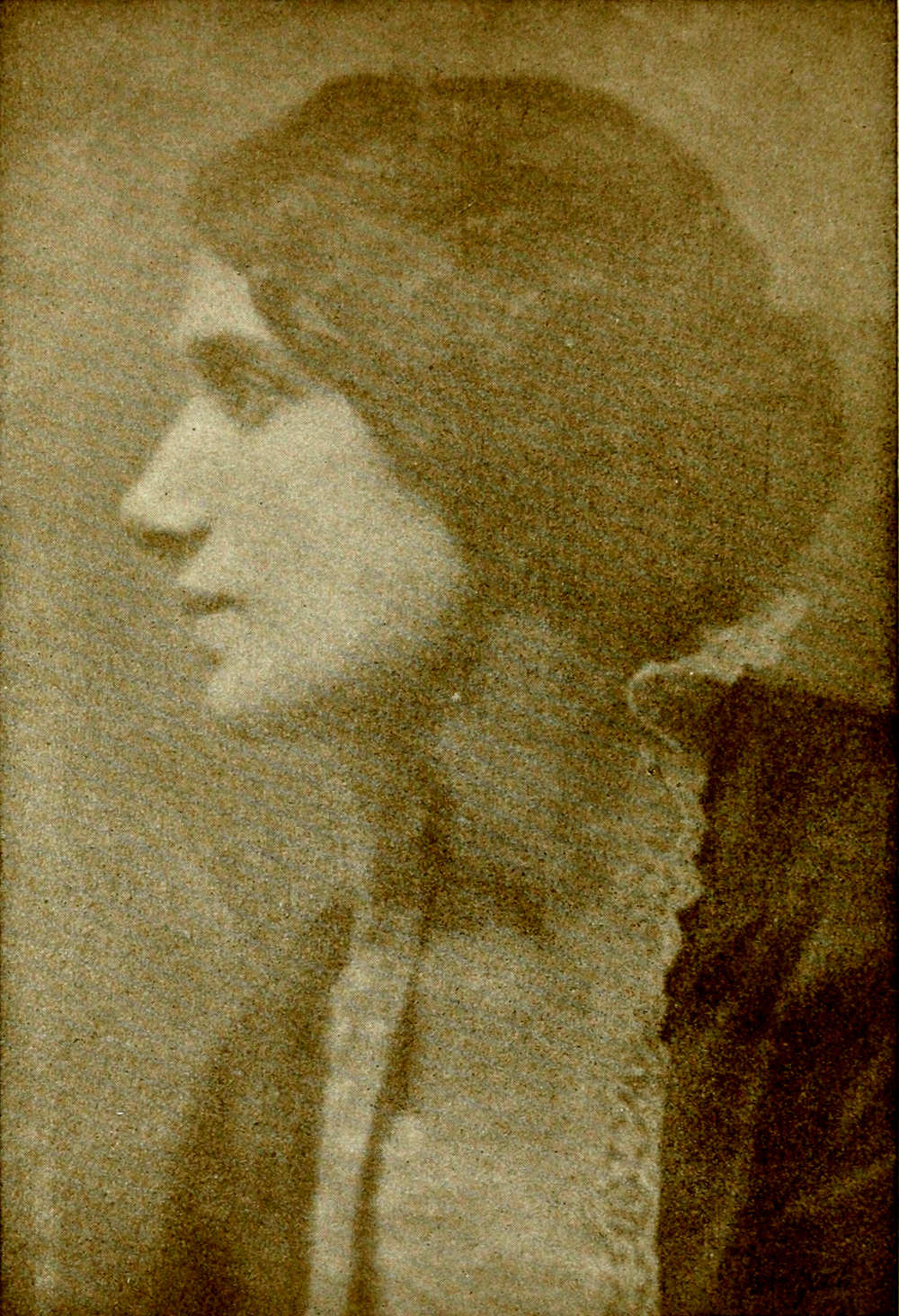
MARIE SUKLOFF

| LIST OF ILLUSTRATIONS | ix | |
| CHAPTER I | 03 | |
| CHAPTER II | 34 | |
| i | 34 | |
| ii | 36 | |
| iii | 44 | |
| iv | 48 | |
| CHAPTER III | 57 | |
| i | 57 | |
| ii | 61 | |
| iii | 67 | |
| iv | 76 | |
| CHAPTER IV | 86 | |
| i | 86 | |
| ii | 103 | |
| iii | 106 | |
| iv | 113 | |
| CHAPTER V | 125 | |
| CHAPTER VI | 131 | |
| CHAPTER VII | 166 | |
| i | 166 | |
| ii | 170 | |
| iii | 173 | |
| iv | 188 | |
| v | 193 | |
| CHAPTER VIII | 198 | |
| CHAPTER IX | 229 | |
| PAGE | |
| Marie Sukloff | Frontispiece |
| Miss Sukloff’s Birthplace | 6 |
| The Village of Borovoi-Mlin as it looks now | 15 |
| Peter Lavrovich Lavroff | 40 |
| Lieutenant Peter Petrovich Shmidt | 53 |
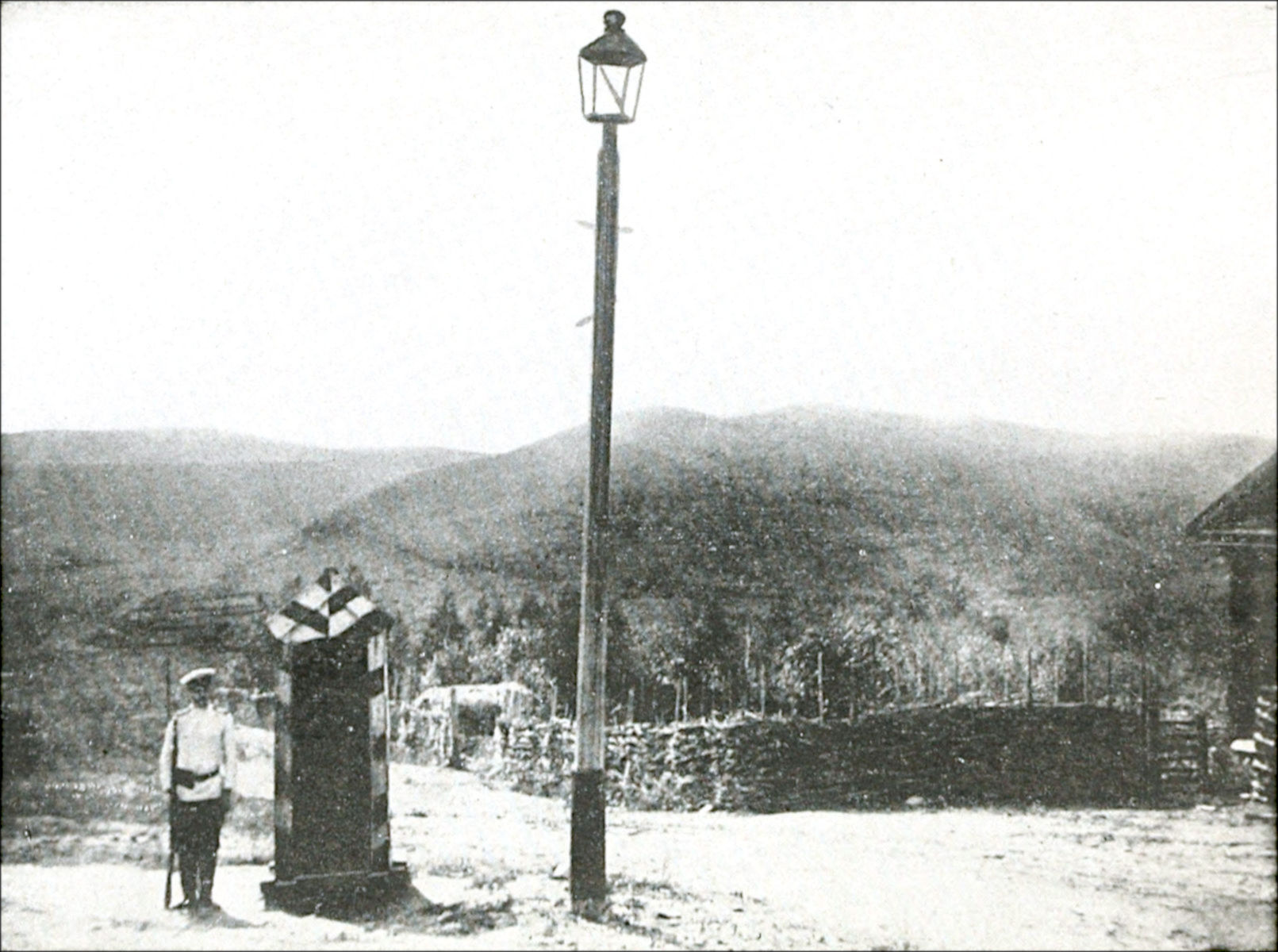
| Guarding the road to the Akatúi prison | 74 |
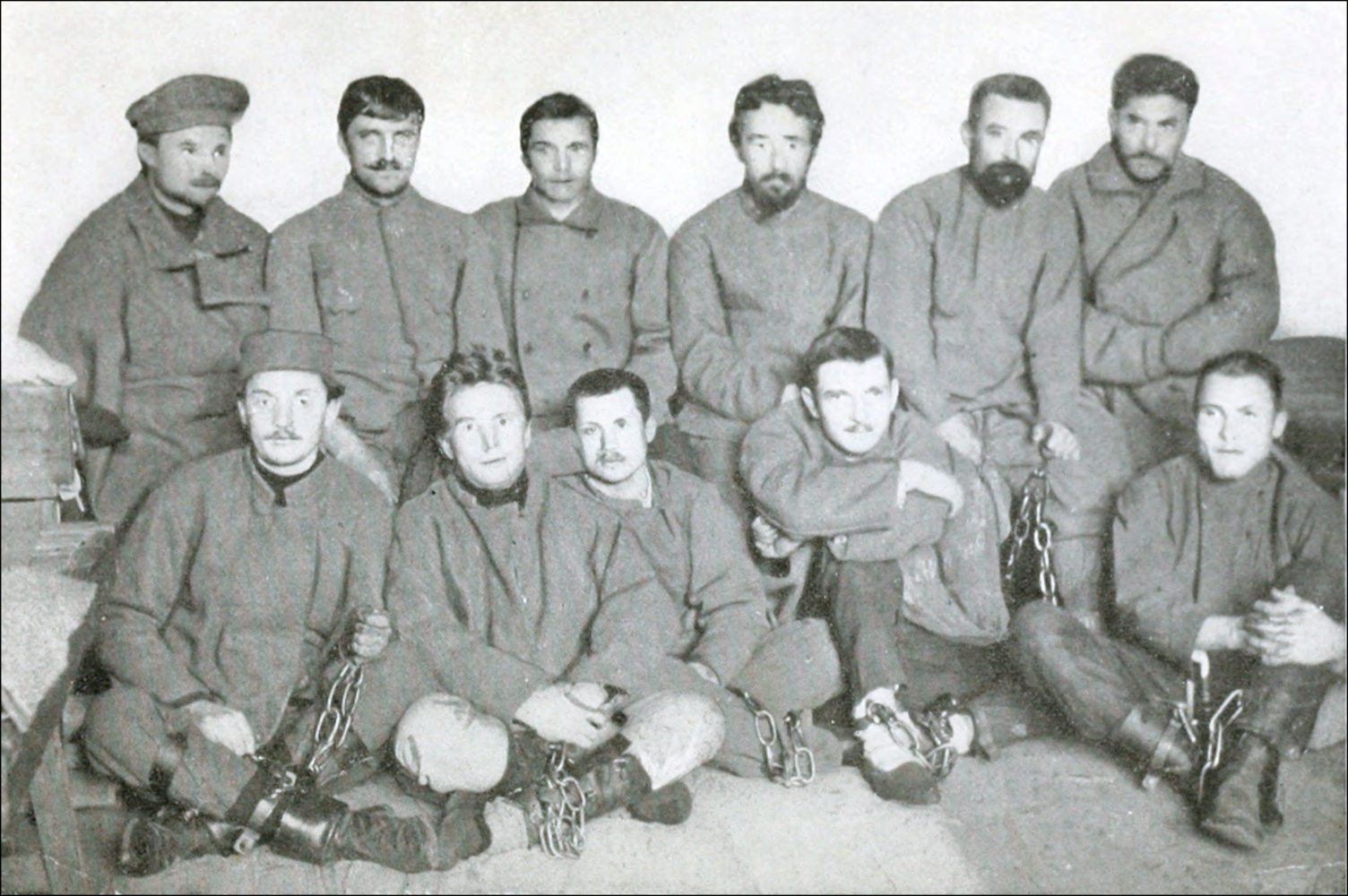
| Six political prisoners and their guards resting at the étape in their march to Akatúi | 91 |
| Miss Sukloff reading in her cell | 98 |
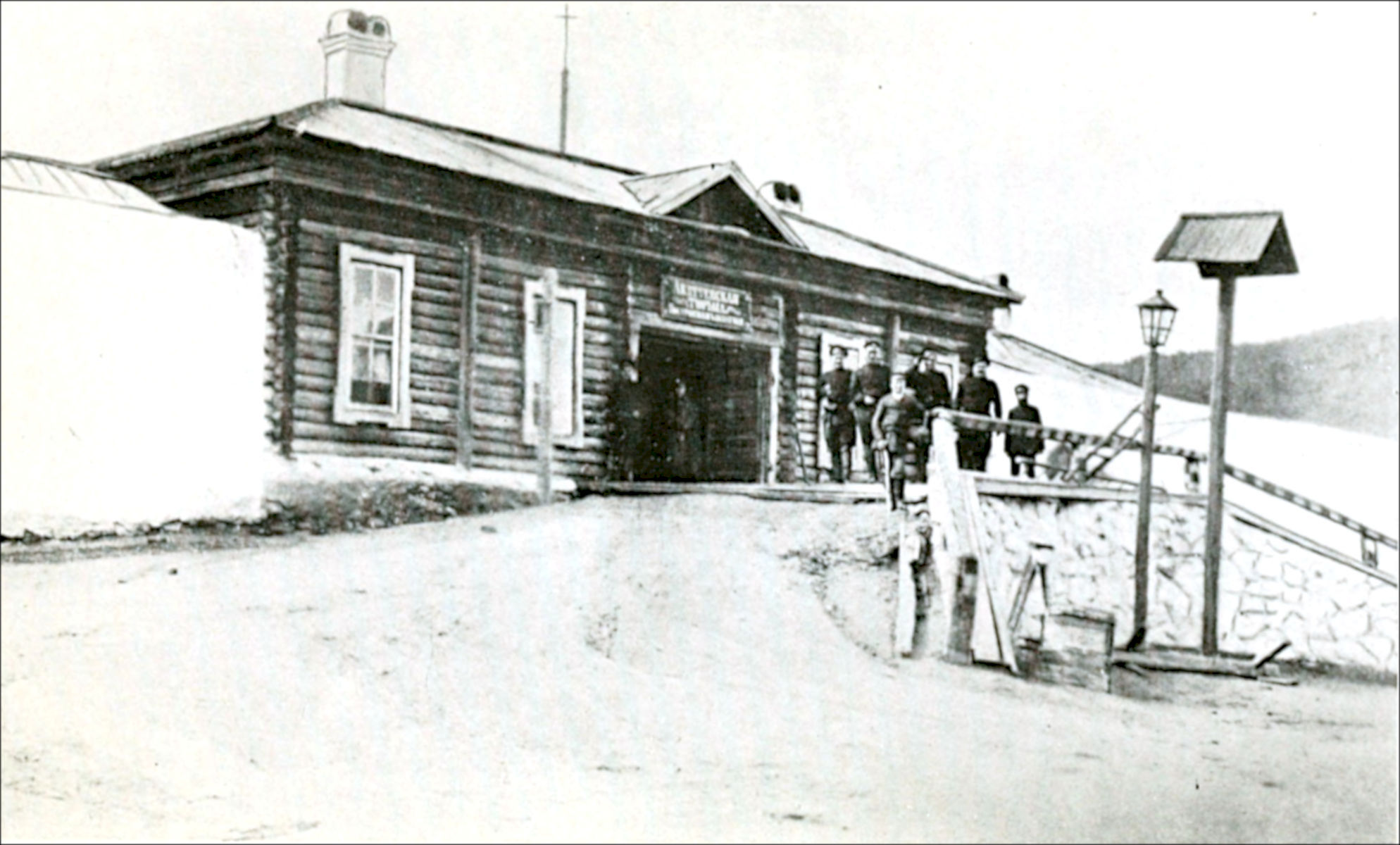
| The entrance to the Akatúi prison | 107 |
| Ivan Kalyáev | 134 |
| The prison wall from the outside | 143 |
| A group of political women prisoners in the yard of the Akatúi prison | 154 |
| Another group of political prisoners in the Akatúi stronghold | 163 |
| Marie Spiridonova | 186 |
| Peter Karpovitch | 203 |
| General view of the Maltzev hard-labor prison | 222 |
| The prison yard and gate | 239 |
THE little village of Borovoi-Mlin, in which I was born, consisted of about thirty huts—low wooden structures with slant thatched roofs. The walls, both inside and out, were plastered with mud and whitewashed. All the huts stood in a row which formed the only street in the village. A wide dusty road passed in front—the meeting place of the cackling, quacking, and barking members of the community. Farther down, the communal pasture, a long and narrow strip of land, ran along the high bank of the rivulet Okena below. In the rear were small kitchen-gardens surrounded by low wattle fences, back of which rye fields stretched as far as the eye could see.
4Our hut stood at the very entrance to the village. It was old and rickety. The two little windows were low, near the ground. In the severe winter months the snow piled up high in front of them, shutting out the feeble light that penetrated the double windows. During the greater part of the year the broken panes were replaced with cardboard, as a protection against the clouds of dust which drifted into the house every time a vehicle passed. The thatch on the roof was black with age. It was broken in several places. When the rains were heavy the water leaked through and formed a puddle on the mud floor.
As in all peasant dwellings, a dark passage divided it into two parts. One was the living-room, the other served as a barn where the horses, cows, agricultural implements, and provisions were kept. The living-room was large and square. One corner was screened off by a long, red curtain. It was the parents’ bedroom. Two beds and a cradle stood there. The furniture of the rest of the room consisted of a large table and benches along the walls. Another table, much smaller in size, held a large brass samovar and a pair of silver candlesticks, the only articles of value in our home. An enormous 7brick stove occupied a conspicuous place in the room. Besides doing its regular service, it provided a warm bed in the cold winter nights. The children often fought for the privilege of sleeping on it. In this room I first saw the light of day in September, 1885. In this house I passed the first fourteen years of my life.
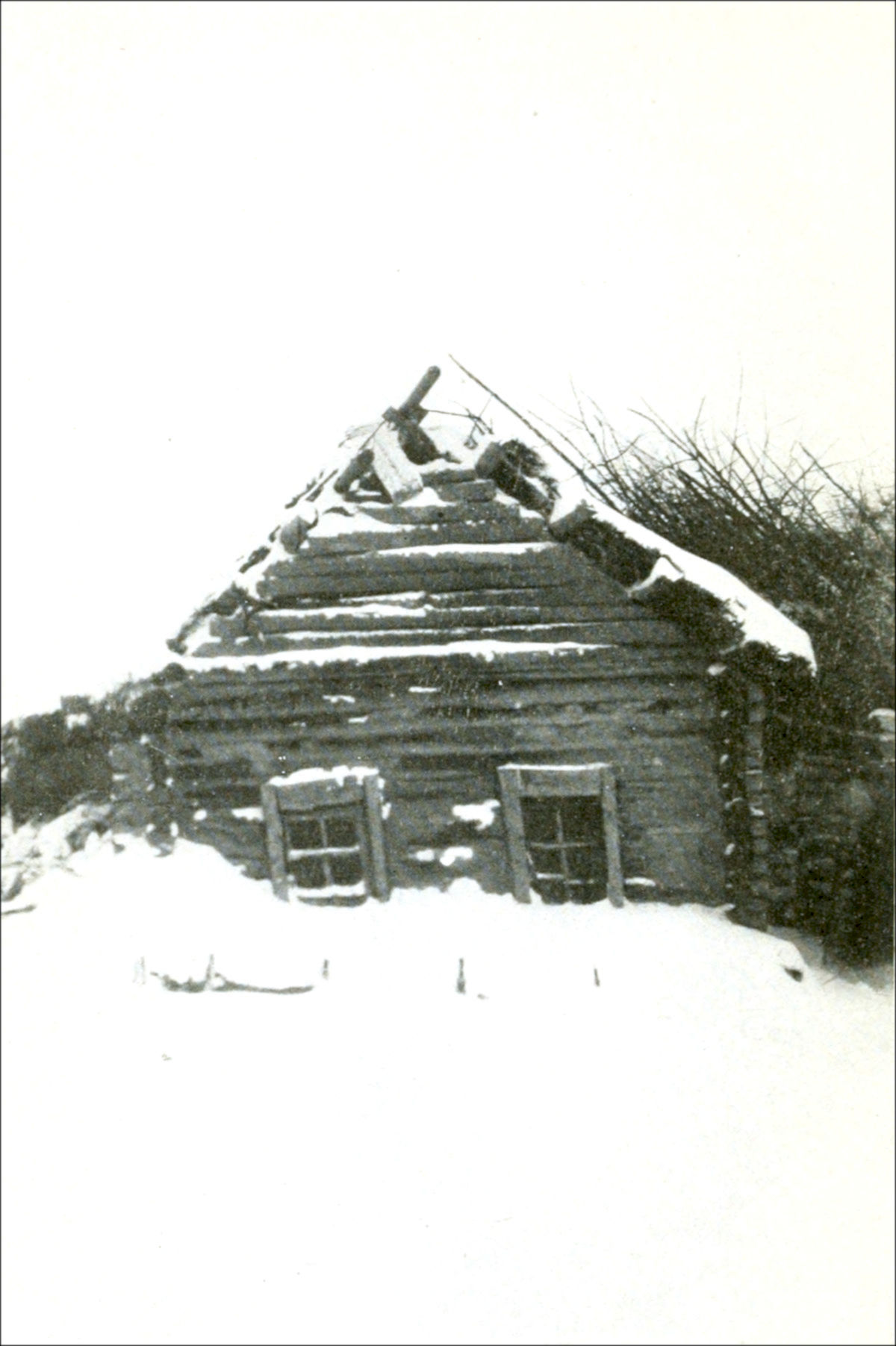
MISS SUKLOFF’S BIRTHPLACE
In this house Miss Sukloff passed the first fourteen
years of her life
Sixteen dessiatines (a little over forty-three acres) of poor soil, mostly clay, and a thatch-covered hut—this was all the property left by my grandfather to his five sons and two daughters.[1] I do not know how the heirs to this rich inheritance settled it among themselves; but in the end my father and one of my uncles remained the sole proprietors of the sixteen dessiatines, they being the eldest sons and already married. At the later division of the property eight dessiatines and the house went to my father.
Our estate, besides the land, consisted most 8of the time of a couple of cows, one or two horses, and a dozen or more chickens. When the crops were good, the eight dessiatines yielded grain and potatoes enough to last the whole year round. But either because of my father’s primitive methods of agriculture, or because of insufficient fertilizing, or because of droughts which are not infrequent in our parts, good crops were rather the exception than the rule. I remember a prayer which I learned when I was four years old: “O God, give us rain for the sake of the little children.” Every morning before eating our modest breakfast, we folded our hands and repeated this prayer. But God seemed cruel at times. Severe droughts burned our fields, and famine threatened the whole district. Then father drove our favorite cow to the nearest town and sold her. The same fate befell the second one, and then we were without milk.
But the cost of necessities was so high that money thus realized was not enough. Then father went to look for work, and stayed away from home the whole week. Friday evening the family eagerly awaited his return. The room assumed its holiday appearance; the table was covered with a snow-white cloth, the candles lit, 9and the samovar, freshly polished, shone in the corner. But father took his place without saying a word; his face did not wear his usual cheerful smile and we understood that he had not earned anything and was therefore sad. Silently we took our seats around the table, while mother served the supper. But unlike any other Saturday there was no meat....
Indeed it was absolutely necessary to earn some extra money to meet the modest expenses of our household. The few acres of land owned by a Russian peasant do not yield enough to feed a large family and pay the taxes. Our village was situated about a mile from the little town of Smorgon, where there were leather factories, tailor shops, and other enterprises. Among us a child of eight years was considered of working age and sent to work in town. He was apprenticed to a tailor or a shoemaker, and sometimes even sent to the factory. Few could afford to send their children to school. The parochial school, which was to spread knowledge among the inhabitants of four villages, could boast of but ten pupils. These were taught by the village priest, who was but little versed in educational matters. Besides, he was busy with other, more important duties, 10and could not devote much of his time to instructing the young. At the end of a four years’ course, therefore, they could neither read nor write. But that was amply compensated by their ability to chant psalms, which they knew by heart. Our village boys went to a Hebrew school, beginning at the age of four or five. My brother Wolf “finished” his education when he was eight years old. Girls were not taught at all. I was illiterate until the age of thirteen. But more of this later.
The peasants in the neighboring country lived in still greater poverty than ours. Their grown sons and daughters did not go to live in town, but remained with the family; nor did they send their children to the shop; and their small parcels of land, which were taxed very heavily, could not feed so many “souls.” Close to their land was a large private estate. It covered many hundreds of dessiatines, most of which was uncultivated. The peasants were thus deprived of a chance to earn even a little money as farm hands.
One circumstance, I remember, greatly puzzled me, notwithstanding that I was very young at the time. The grazing land of our village was small, and the herd often returned home 11hungry. Bordering on ours was an immense pasture belonging to a priest who had long left the church and did not even live on his estate. The meadow was always guarded by a man who lived literally at our expense. He collected from us a ruble for every horse or cow which strayed over on his land. If the money was not paid, he locked the beast in his barn and left it without food. Once it happened that he starved to death one of our herd. When winter came the fine grass in the priest’s meadow was covered with snow, while our barns were empty.
A dense forest surrounded the villages, but we did not have enough firewood to heat our huts. The forest belonged to the Government. The peasants had to choose between freezing and stealing wood from the forest. As a result, the jail in the near-by town was always full. Some stayed there as long as two years—all for attempting to steal a log with which to warm their cold huts.
When I was six years old a terrible misfortune befell our family. My mother fell down from the garret and fractured her skull. She was ill for almost a year. For four months she lay in a semi-conscious condition. She did not 12recognize anybody, and drove us away when we came to her bed. I don’t know what would have become of us if it had not been for our sister Revecca. She looked after us like a mother, and saw that we were fed and clothed. She was eleven then.
Mother’s illness ruined us completely. She was the only one in the family who knew how to manage things, to make ends meet, as they say. Father lacked that ability. Besides, her illness added a large item to our expense. To meet the doctor’s and druggist’s bills, the cows and horses had to be sold. Even the land was mortgaged.
It was summer, and father worked in the field. Revecca and I kept house and looked after the one-year-old baby. We got up at daybreak and worked hard the whole day. Revecca milked the cows (they were sold only towards winter), and I drove them to the pasture. I remember with what a serious face I answered my companions when they asked me to play with them:
“I have no time to play. My mamma is sick.”
One incident during my mother’s illness left an impression on my memory that remains to this day. It was the haying season. Father 13was in the field, mother was lying in bed, and Revecca and I were sitting on the doorstep, resting after our hard morning. A large wagon drawn by two horses suddenly came into view. We recognized it immediately, and knew that the tax collector was coming. He had a wooden leg and a long black beard, and was the terror of all the children. The periodical appearance at our village of this tax collector who was nicknamed “the one-legged devil,” was always a source of much unhappiness. He stopped in front of our house. We were terribly afraid of him, and at any other time would have run away and hid in the barn, but that happy period of our life was past. We felt a great responsibility resting upon us, so we remained. We stood up, and met the intruder bravely. “There is nobody home,” said Revecca, when the collector approached. But he paid no attention to her, and went straight into the house, making an awful noise with his wooden leg all the while. We followed him. Having examined the contents of the room, he stopped before the table on which the samovar and the candlesticks stood. We watched his movements with breathless intensity. Suddenly he knocked on the window with his cane. A young 14man came in, carrying a large bag. Before we could grasp the meaning of it all, our samovar, the pride and ornament of our house, had disappeared into his dirty bag. Next went the candlesticks. We were dumfounded. We stood gazing at the bag, and could not utter a word. Unable to move, we saw them turn to the door and walk out of the room. When we recovered from the shock, the rattle of the passing wagon was heard near the house. Revecca sat down near the empty table and began to cry. After a few minutes I joined her. Without a samovar and the candlesticks the room looked gloomier than ever.
In the fall father called a doctor from Vilna, a large city sixty miles away from the village. His visit cost us fifty rubles. This doctor, however, really helped our mother, who began to recover slowly.
When my mother recovered from her illness, Revecca was sent to work in a tailor’s shop in town, and I became the chief help in the house. In the long winter nights I plucked feathers for pillows which were to form a part of Revecca’s dowry; she was then in her thirteenth year.
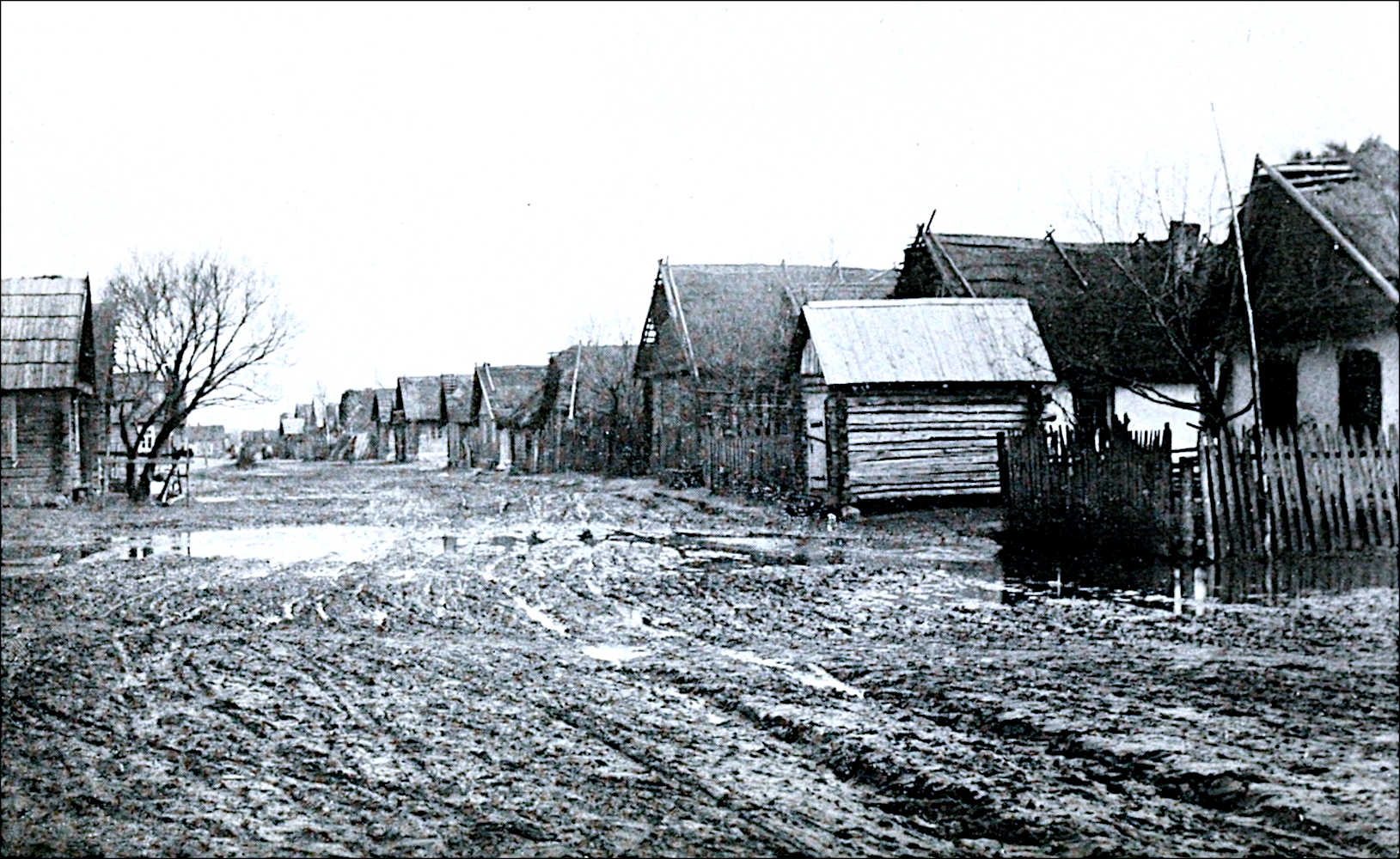
THE VILLAGE OF BOROVOI-MLIN AS IT LOOKS NOW
Miss Sukloff was born here
Thus two years passed. Our poverty at that 17time was indescribable. All the earnings went to pay debts and the interest on the mortgage. To earn a little money, mother decided to sell vegetables at the town market. Every morning she went to town and returned home in the evening. I took charge of the house and looked after the eleven-months-old baby-boy.
One event which set me thinking about conditions in general was the death of my aunt, a young married woman of thirty-four. It was harvest time, and my aunt went to a near-by village to hire some farm hands. She started out before sunset. Hours passed, it grew late, and she did not return. About midnight the horse came back with an empty wagon. We raised an alarm, went to the village, but the peasants there who all knew my aunt well, maintained that she had not been to their village that day. At last, after a whole night’s search, she was found buried, yet still alive, in a pit near the road. Her face was unrecognizable. Her whole body was bruised and bore traces of violence. The police arrived and began an investigation. Our yard was crowded with peasants, young and old, from the neighboring villages. Each one of them was led to the bed on which my aunt lay with an unspeakable expression on 18her mutilated face. She could not speak, but her eyes were full of suffering and mute reproach. Each time a peasant approached the bed she shook her head gravely. The ordeal lasted two days. All that time my aunt tried to say something, but all of our efforts to understand her were futile. The police lost all idea of discovering the author of the horrible crime. My aunt was sinking fast, and the doctor could not hold out any hope. Suddenly she clearly uttered the word bartchuk[2] and died. Bartchuk! The peasants passed the word along, and made the sign of the cross. They knew who committed the crime.
A short distance from the village where my aunt had gone was a landowner’s estate. The proprietor had a son who spent his summers in the country. He was the curse of the neighborhood. The peasants hid their daughters whenever he appeared in the village, but he managed to insult them with impunity. He it was whom my aunt named as her assailant. He was arrested. All the peasants testified against him. And yet after three months he was freed. The landowner had bribed the investigating magistrate, and the affair was hushed up.
19As I have said before, I was not sent to school. When I reached my eleventh year, my mother found a place for me in a grocery store in town. The store was so small that if two customers happened in at the same time one had to wait outside, where the greatest part of the goods was laid out. I performed a great many duties. I carried the goods in and out, swept the store, delivered purchases, and ran similar errands. My salary was fifteen rubles for the winter. There I made my first acquaintance with figures and learned addition and subtraction. My position as a clerk required some little knowledge of arithmetic. At first my mistress taught me. After this my brother Wolf instructed me in this science, which was one of his strong points.
But months passed, and I did not show any promise of becoming an efficient grocery clerk. My mistress was very much dissatisfied with me. She often reproached me for my inability to meet customers in the approved fashion, and called me a “rustic.” I did not know what was wanted of me, and that worried me terribly. But I took great pride in the fact that I was a clerk and earning money.
Every evening I went home to sleep. There 20was a tavern in town where the workmen from our village gathered, usually at about nine o’clock. I always found there company to go home with. One evening my mistress kept me very late. When I came to the tavern, all my village folk had gone. I thought for a while, and decided to go home alone. It was in December. The night was still and cold, and the fields were covered with dazzling-white snow. The road to our village shone like silver. I stepped into the road, and ran. I did not stop until I came to our house, although I was not a bit afraid. After that I always walked home alone, without even so much as looking into the tavern.
Before the Easter holiday my mistress discharged me. She had found another girl, who could approach customers in the right way. It was a terrible disappointment to me, but my mother tried to console me. “Don’t worry. I shall apprentice you to a tailor next fall, like Revecca. That’s settled,” she concluded.
The summer passed. When it began to grow cold my mother took me to town, and I entered upon my new career as a tailor’s apprentice. The shop had no particular attraction for me. I was used to the free, pure air of the fields. 21The severest frosts and storms could not keep us children in the house. We never took cold, although not dressed according to the season. And here I had to sit the whole day in a close, ill-smelling room. At times my duties kept me there till midnight. My master did not even think of teaching me to sew. Most of the time I was busy with his two little children, whom the mistress always left in my care.
I was apprenticed for two years. It was agreed that I was to be allowed to go home for the field-work season. The understanding was that I should work one year without pay, and get twenty-five rubles for the second year. But fate played me one of her tricks. Toward the end of the second year, when I constantly thought of and counted the money I was to get, unexpected events occurred, and I never saw my hard-earned twenty-five rubles.
In the spring of 1898 the workmen of Vilna were striking for a ten-hour work-day. The “Bund,” a secret organization of working-men which was formed shortly before, conducted the strike. It published an “illegal” pamphlet, entitled “Eight-hour Day” and distributed it in all the cities and towns round about. One 22of these pamphlets found its way into our shop.
The workmen at our shop discussed it in undertones. A secret meeting of several shops took place, where it was decided to declare a strike before Easter, demanding a ten-hour day. I was not taken into the secret, either because I was too young, or because they did not consider me a real shop worker, as I passed the summers in the village. But I succeeded, without much difficulty, in finding out all their schemes. With extreme impatience I waited for the strike. Returning home after work, I related to my girl-friends all the great things that were expected in town. At last the appointed day arrived, and the working-men of Smorgon struck. I, too, refused to work, much to the surprise of our shop people.
The strike lasted only several hours. The employers wisely decided to yield, as it was a week before Easter, the busiest season of the year. They conceded all the workers’ demands. But after Easter they were all discharged, and had to return to work on the old terms. I, however, was not taken back. This circumstance created quite an impression among the working-men, who regarded me as a sufferer. 23When I think of it now and to what it subsequently led, I am deeply grateful to fate, although it is true that, from that time, I became a source of worry and torture to our family. My brothers and sisters were married, had children, and were happy in their own way, while I spent my young years in Russian and Siberian prisons. But to return to Smorgon.
The working-men, disappointed at the unsuccessful strike, began to look for new means of reducing the hours of labor. They organized secret educational circles, where they read about the lives of working-men in foreign countries and their struggles for rights and liberty. I was admitted to one of these circles.
One day the daughter of the rabbi from Smorgon called at our house. The rabbi, it must be explained, was considered a rich man and of aristocratic lineage. His children received their education in Vilna, and were known in the village as “free-thinkers.” Naturally, the daughter’s visit to our humble dwelling aroused the curiosity of our village inhabitants; the windows of our house were immediately beleaguered by a crowd of inquisitive folk; the neighbors suddenly missed various kitchen utensils and came to us to borrow, stopping for a while to 24have a good look at the rabbi’s daughter whose hair was short and who wore pince-nez. Her name was Hannah. When the neighbors were busy discussing her appearance, she whispered to me:
“Come to our house next Saturday after dinner. Don’t tell anybody about it.”
Impatiently I waited for Saturday to come. “What will I see there?” I kept asking myself, and my imagination drew fantastic pictures, one more beautiful than the other. At last the much-desired day arrived. With my shoes thrown over my shoulder, I set out at a rapid pace. When I neared the town, I put on my shoes, without stockings, and continued at a slower gait. To my great shame I must confess that when I approached the rabbi’s massive dwelling, my heart began to beat violently and my courage left me. And the pictures in which I saw myself as the heroine of the day vanished. My friend Hannah, who must have been waiting for me, saw me through the window. She came out and conducted me into a poorly-lighted room, where several girls were already assembled. The window blinds were lowered and the door locked. The room became still darker.
“Sisters,” began Hannah, “the first thing you 25must know is that you must not tell anybody what is going on here.”
All were silent. Hannah took out a thin pamphlet and began to read: “Once upon a time there lived four brothers....” This pamphlet, entitled “Four Brothers,” is a forbidden publication. It tells the story of four brothers who were born and lived in a forest. They decide to travel, and start out in different directions. When they return, they recount the many acts of cruelty they have seen and met with in the world, and discuss measures to bring about justice and equality.
After the reading we went away, having arranged to meet the following Saturday. These Saturday readings opened up new worlds to me. I had never thought of large cities and how people lived in them, and my desire to learn grew with every week.
Besides reading forbidden literature, Hannah taught us history and geography; that is, she read while we sat and listened, frequently interrupting her with questions. It all was so sudden and wonderful that I made up my mind to study at any cost, that I might be able to read those wonderful books myself. I told Hannah and she undertook to teach me. Every Friday 26evening I walked into town, and Hannah taught me to read and write. I kept my studies secret even from my father, because among us it was considered a mortal sin to write on Friday evening. I was progressing in my studies when new developments made it necessary for me to give them up for some time.
A strike of the stocking-weavers in Vilna had been declared. Their conditions of labor and pay were such that they could not continue on the old terms. They did not earn enough for the bare necessities of life. But the employers flatly refused to grant any increase in pay. They had stocking-machines in every little town in the province, and were getting the goods made at even lower price than they had to pay to city employees. The “Bund,” the secret organization mentioned before, decided to organize a strike of all the stocking-weavers in the district. With this purpose in view a young woman agitator came to Smorgon.
One evening, when all the family were gathered round the supper table, Hannah and the new-comer called on us. My father was greatly flattered by their visit, and received them very cordially. The samovar was put up—a thing we seldom did for ourselves. Mother even procured 27some jelly and cake. They sat and chatted for a while. No one knew the object of their visit. When they were leaving and I showed them to the door, Hannah said to me:
“What do you think? Will it be possible to hold a secret meeting in your house? How would your parents look upon it?”
After considering for a moment I suggested that it would be better to meet in the forest. I knew all the secret paths there. They agreed. There and then, standing in the dark passage, we worked out a plan for the morrow’s meeting. We decided to meet in the morning, when the inhabitants of the village were away in the field.
On the following morning the large oak trees hid from view a few young girls who were cautiously making their way through the forest. The oldest of them, Hannah, was seventeen years of age.
The place chosen for the meeting was familiar to me. Yet a short time before I had played hide-and-seek there with my village companions. But how different it had all become!
The organizer made a speech. She spoke of the life of the stocking-weavers in Vilna. Some were starving, others had been imprisoned. Their only demand was an increase of one kopeck 28on a pair of stockings. But she not only pictured to us the miseries of their existence, she also spoke about the coming victory.
“There will come a day,” she said, “when there will be neither rich nor poor: all will be equal. We will make it come. Only we must unite for the struggle.”
She uttered these words with almost religious fervor. Their impression upon me was tremendous. My faith in all she said was so great that I already pictured to myself our humble village changed beyond recognition. The huts disappeared. In their places stood magnificent dwellings in which happy people lived a happy life. To make that change seemed to me a very simple thing to do.
“We must unite and take the land away from the rich proprietors,” I thought. “They hold it and do not use it, so it will be all the same to them. But we need it very badly.”
I was so absorbed in the plan of converting our village into a veritable paradise on earth that I did not hear how the girls had decided to send agitators to the cities of Slonim and Oshmiany to call a strike of the local stocking-weavers. My thoughts were interrupted by Hannah, who asked me if I wanted to go with her and 29help her organize a strike there. “Yes, of course,” I hastened to reply. Towards noon we dispersed, and I promised Hannah to come to her on the next day.
Hannah, evidently, did not understand what it meant to me to stop work in the middle of the week, leave my home, and go to the city. I did not even know where that city was. I had never been farther than Smorgon. But the impression made upon me by the girl’s speech was such that I did not stop to think how I would go away and what I would say to my parents.
“What does it matter!” I thought afterward. “Anyway there will soon be an end to our poverty!”
When, on my return home, mother reprimanded me for being away from the field, I answered her:
“Oh, Mamma dear, if you knew what a grand time we will soon have. There will be neither rich nor poor!”
“What nonsense are you talking?” cried my mother. “Where did you get all these stupid notions? I suppose that philosopher is teaching you all this trash.”
Mother meant Hannah. It was very painful to me that mother was so ignorant and could not 30understand such a simple thing, but I consoled myself with the thought that she would understand when the time came. I did not venture, however, to mention anything about going to the city.
Morning came. My parents went away. I hastily dressed myself in my best, and said to my sisters: “Tell Mamma that I went to Hannah.” And I ran out of the house, fearing that somebody might come and detain me. A conveyance was waiting in the rabbi’s yard. The old nag, urged on by a long whip in the hands of our driver, pulled at the wagon lazily, and we started.
Our wagon lurched and jolted on the rough road. Clouds of dust rose from under the horse’s hoofs. The sun was burning fiercely. I looked at the unmown fields, and a feeling of sadness filled my heart.
“How uneasy Father will feel when I shall not come to sleep,” I thought, but I did not share my thought with Hannah. I did not want to lower myself in her estimation. She evidently considered me more independent, and I derived great satisfaction from her opinion of me.
Four days we traveled thus, stopping overnight 31in peasant huts. About noon of the fifth day we arrived in Slonim where we stopped at an inn. Having instructed our driver to wait for us there, we went to look over the city. Our plan of action was a very simple one. We decided to look into every house through the windows, and go in wherever we saw a stocking-machine. Hannah walked on one side of the street, and I on the other. After a long search I saw a girl sitting at a machine. I went in. Women and children crowded around me and began to question me who I was and what I wanted.
“I have been sent by the secret organization, the ‘Bund,’ to organize a strike of the stocking-weavers,” I said. And I immediately began to describe that wonderful rich time which was to come soon. “There will be neither rich nor poor!” I concluded solemnly. I sincerely believed in what I was saying, and my hearers were carried away by my enthusiasm. They asked me to take off my things, and gave me to eat. Hannah also came in, having grown tired of waiting.
We sent a girl to call the other stocking-weavers. In about an hour the house was filled. I mounted a chair and, unexpectedly to myself, 32exhorted them to strike for the abolition of the unjust system. “Let there be neither rich nor poor! Let there be equality!” I shouted. The girls were much impressed by my speech. It was arranged to call a meeting of all the stocking-weavers in the city.
In the evening Hannah and I were conducted to the meeting-place, a large, old structure. It turned out to be a Jewish synagogue. It was in semi-darkness, and crowded with girls of all ages. Hannah explained to them the demands which they were to submit to their contractors the next morning, and I was getting ready to make a speech, when some one cried, “Gorodovoi!”[3] Terror seized everybody. Some one wisely put out the candles. Great confusion ensued. Pushing and jostling each other; all made for the door. Some fell. But all were silent. Only the heavy breathing of the frightened girls could be heard in the darkness. Gradually the room was cleared. Hannah took me by the arm, and we went out.
“We had better leave this city immediately,” she said to me, “otherwise we shall be arrested.”
That very evening we left for Oshmiany. This city made a great impression upon me. I 33had never before seen such nice houses and well-lighted streets. “This is a real paradise,” I thought to myself.
Hannah had a number of friends there and matters were arranged quickly. Soon all the stocking-weavers joined the strike. Having accomplished our purpose, Hannah and I returned to our homes. With a beating heart I approached our village. The broken panes of our cheerless hut greeted my eyes, and filled me with longing for the beautiful houses of the city.
THE few days which I passed away from home and my first glimpse of the city gave rise to very definite ideas in my mind: that there was a better life than ours, and that this better life could be found only in a large city, in those tall buildings and well-lighted streets. These thoughts pursued me wherever I went and whatever I did. My mother beat me; she burned the books which I read by stealth—she was illiterate and considered reading a waste of time—but I bravely bore the persecution of my mother and elder sister, and nothing could kill my desire to learn about that life. I could hardly read on week-days, because the work tired me out to such an extent that I used to fall fast asleep early in the evening, but on Saturdays I spent the whole day reading. I called my girl-friends together and we locked ourselves in the barn. I read to them the “Four Brothers,” the only book I knew well, and which I 35could almost recite from memory. I also shared with them any ideas which I picked up in my association with Hannah.
My brother Wolf and I resorted to all sorts of tricks in order to gain more time for reading. He liked books of travel and romance. After reading a book of this kind, he imagined himself the hero and acted accordingly.
On Friday evening, for economy’s sake, mother poured little kerosene into the lamp. It was considered a great sin to put out the light on that evening, and the lamp had to burn itself out. Wolf and I waited until all fell asleep. Then we poured in more kerosene, seated ourselves so that the light should not be seen, and read till late at night. No one in the house knew of our scheme. But once my father got up quite unexpectedly and saw us seated on the table with books in our hands. Without saying anything about the dreadful sin we had committed, he remarked:
“You will ruin your eyes reading by such a light. You had better go to sleep.”
We complied, having left off at the most interesting passage.
One night we were all awakened by the neighing and tramping of horses near our house. We ran to the windows and saw about a dozen mounted gendarmes and police riding into our yard.
“What can this mean?” asked my father, with a tremble in his voice.
I immediately ran to the back of the stove and snatched a bundle of pamphlets from under it. These were forbidden works given to me by Hannah for safe keeping. I pressed them to my bosom. I was sure that the gendarmes had come to take the pamphlets away from me, and was ready to defend them with all my strength.
“What have you there in that bundle?” my father asked me.
“Books.”
“Give them to me. I will hide them.”
Father put the pamphlets in his coat-pocket and looked again out of the window.
“They have gone,” he said, “but their horses are tied in our yard.”
In about an hour the gendarmes returned, mounted their horses and galloped away without 37going into our house. When they had gone, father took my bundle of pamphlets out in the field, back of our kitchen-garden, and buried them deep in the ground.
On the following morning we learned that the gendarmes had arrested the son of the synagogue president, who shortly before had come from Vilna, for his connection with a secret organization. This event kept our village in a state of turmoil and excitement for several months. My mother, who repeatedly told my father that I would become a “nihilist,” that I was keeping company with “nihilists,” now felt perfectly convinced that she was right. She began to watch all my movements. The persecution to which I was subjected for my reading and my frequent excursions to town became still more severe.
One day when father and I remained alone he said to me:
“Maria, you must be a good girl. I know that you will not do anything wrong. But you had better give those books back to the people from whom you got them. They must not be kept in the house.”
“Papa, dear Papa,” I began excitedly, “let me go to a large city. I want to study and become—” 38Here I stopped, as I did not know myself what I wanted to become. Father looked at me with his kind, bright eyes, and stroked my head. “I cannot bear to see our poverty any longer,” I continued. “I will go and learn how we might live better. You will see what a learned girl I shall return. Then we shall not be poor any more.”
Father paced up and down the room, listening to me in thoughtful silence.
“You have an uncle at Odessa. He is a good and learned man. I shall write to him about you and, if he agrees, then I will send you to Odessa. He is my favorite brother,” father added, “and to him I will trust my child. But you must be a good girl and obey him.”
The news that Mordecai’s daughter Maria was going to Odessa spread like wild-fire; our house was constantly filled with women. My mother showed them the long brown dress—my first long dress—which was being made for the occasion, and also three pillows. Three pillows and a feather-bed were the traditional part of a girl’s dowry.
“Although she is yet very young,” mother remarked to every new-comer, “who can tell? Maybe she will not want to return home so soon, 41and will grow up there, and find her happiness there: the city is a large one.”
The train was leaving at four o’clock in the afternoon, but I was ready early in the morning. I put on my new brown dress, and tied a red ribbon in my hair. The three pillows, a few coarse towels—the work of my mother—and a piece of homespun linen were packed in a large valise, and my preparations for the journey ended.
With a heavy heart I walked about the field and forest, bidding good-by to every nook, to every little shrub along the paths. “Will I ever see you again?” I thought, looking at the green meadows.
All went to the railroad station at Smorgon to see me off: My parents, my brothers and sisters, our neighbors, and even strangers. Hannah, too, came and brought me a letter to one of her friends at Odessa.
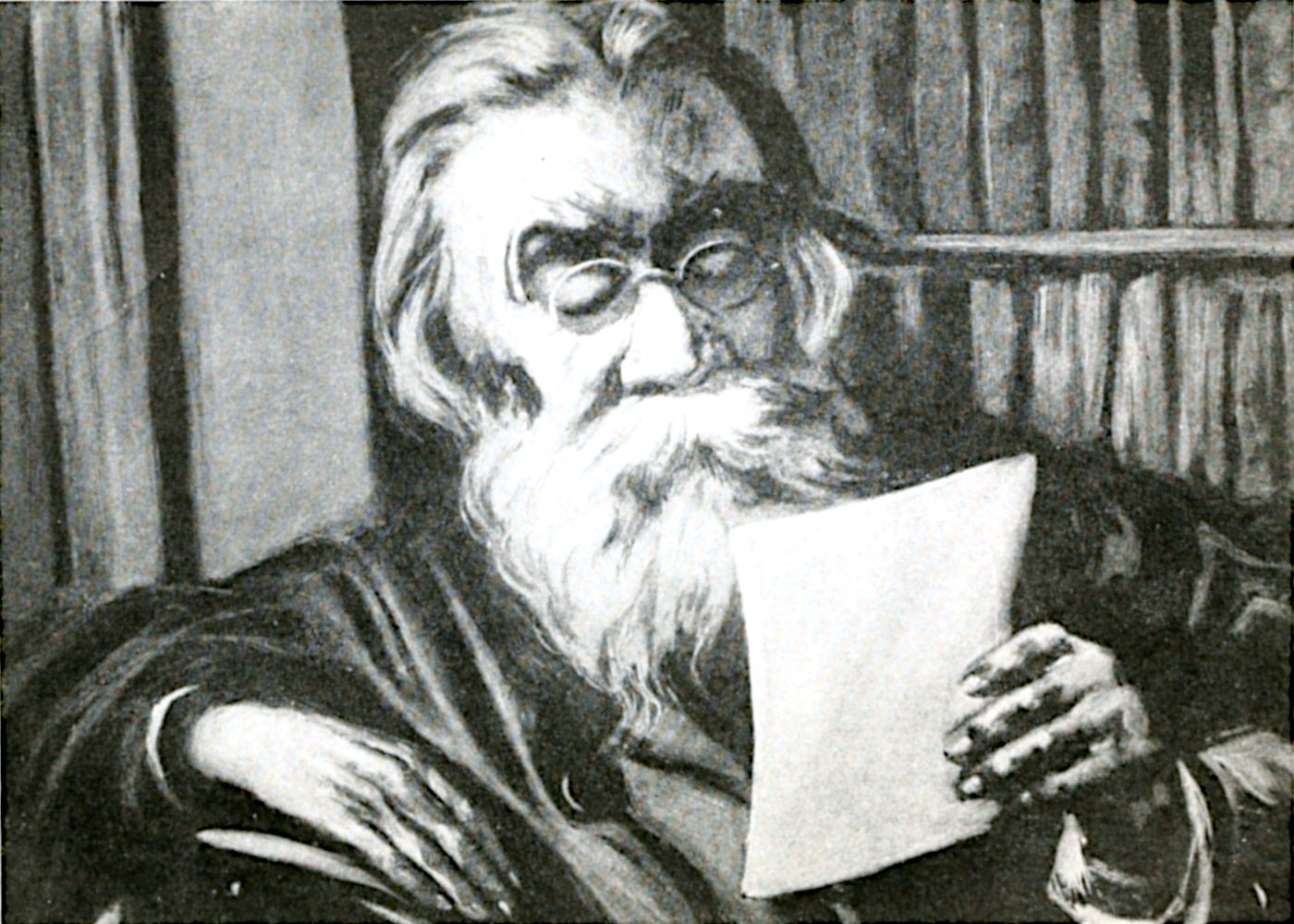
PETER LAVROVICH LAVROFF
Scientist and philosopher. Born 1823, sentenced in 1867 to exile in Siberia,
escaped, lived in Europe, died 1900
When father was bidding me good-by, he said:
“I believe, Maria, that you will be happy.”
My mother wept, and kissed me a long time. My elder brother Noah, who was home on leave of absence,—he was serving in the army—gave me his last fifty kopecks.
At last the third bell rang, and the train 42slowly pulled out. Soon everything disappeared in a cloud of smoke. Seeing nothing but strange faces around me, I sat down in a corner and cried bitterly.
On the third day I arrived in Odessa. When I went out of the station and saw the long line of izvoshchiks[4] with their shining top hats, my heart filled with gladness. “Everybody dresses so nicely here,” I thought.
I approached one of them and said:
“Please take me to my uncle, Mr. Sukloff.”
“Sure, Miss,” he replied, with a twinkle in his eye. “Got his address?”
I was rather surprised that he did not know where my uncle lived. I took out of my dress pocket a slip of paper and handed it to him.
“All right, Miss,” he said, and with a motion of the hand invited me to climb into his carriage. When we started, he asked me where I came from. I told him why I had come to Odessa and he, turning sideways in his seat and listening to me, nodded his head approvingly.
After a long ride we stopped in front of an old four-story brick building.
“This is where your uncle lives,” the izvoshchik said.
43Disappointed, I stared at the dirty, weather-beaten structure. As I learned later, my uncle lived in the poorest section of the city, called Moldavanka.
I climbed three dark and filthy flights of stairs, followed by the izvoshchik carrying my valise. On the fourth floor I saw a card on one of the doors. It read: “Samuel Sukloff, Tutor.” I rang the bell. A man of above middle height, thin, with a long beard and sparkling eyes, opened the door. For a moment I thought it was my father, so greatly did this man resemble him. It was my uncle. He greeted me very warmly and, having paid the izvoshchik forty-five kopecks, led me into his apartment. My aunt and cousins surrounded me and regarded me with evident curiosity. Noticing that I was bareheaded, my aunt remarked:
“We must buy a hat for you.”
My uncle was a teacher of Russian at a Hebrew school. He earned sixty rubles a month. But notwithstanding this small salary, he managed to give his children—six sons and a daughter—a good education. One of his sons was a civil engineer, the others were attending the gymnasium. Of course, the children paid their own way through school, otherwise it 44would have been absolutely impossible. But their earnings were not regular, and often the whole family lived on those sixty rubles.
The secret society at Odessa, at the time I came there, in 1909, had gained a firm footing among the working population of the city. It was headed by Social Democrats. The work of a secret society at that time consisted chiefly in forming educational circles among the working people and in printing and distributing prohibited literature, chiefly proclamations. Their distribution was accomplished in many ways. Late at night, when all were fast asleep, dozens of young men and women posted them on lamp-posts, telegraph-poles, houses and fences. They scattered them in the streets where workmen passed on their way to their labor, and threw them into the yards surrounding the mills and factories. At the theaters, when the performance was at its height, showers of leaflets would fall from the gallery, from several parts simultaneously. It was a reign of paper terror, and the police were powerless against it. Before they could gather up and destroy the proclamations, the public read these uncensored 45words with avidity, despite the governor’s order forbidding it under penalty of six months’ imprisonment. It was hardly necessary to say that the proclamations bitterly assailed the autocratic régime, explaining to the working-men that no changes in their economic condition were possible under a political system which forbids strikes, which denies the right of free speech and free assembly.
The letter which Hannah gave me when I was leaving home was to one of the leaders of the secret society, a Social Democrat. When I came to him and told him that I wanted to study, he immediately gave me a number of proclamations and promised to send somebody to teach me.
When I returned to my uncle’s I gave him and my cousins several proclamations. I was sure that my uncle, as well as my cousins, shared the views expressed in them, and how great was my astonishment when these people, whom I regarded as very learned, turned in horror from my secret leaflets.
“These things lead to Siberia,” they cried in chorus.
My uncle tore the proclamations across, and thus addressed himself to me:
46“This is not the village. Don’t look for the truth here, because it will get you into prison.”
I was at a loss how to understand my uncle’s words.
“What do you mean?” I said. “I left my father and my mother, I left my native village, and came here to learn the truth and you forbid me. How can I agree to such a thing?”
“You are a child yet and understand little in these matters,” he said. “I have grown sons, and you must not bring such things into my house. Besides, you came to me and I am responsible for your well-being. There is no one else here to look after you. We all like you and wish for your happiness. Although I am a poor man, I am willing to help you. But you must be very careful.”
A couple of days after this conversation a girl sent by the socialist leader came to call me to a secret meeting, which was held at night. Without saying anything to my uncle I went with her.
The circle to which I was thus admitted consisted of nine workers and one intelliguént who read political economy to them. I felt proud and happy at having been received into their gathering. This circle, in later days, played an 47important part in the revolutionary movement at Odessa.
It was very late when I came home from the meeting. My uncle was not yet asleep and evidently waiting for me.
“Where have you been?” he asked me. I told him everything.
“You must not have anything to do with those people,” he said. “And if you go on like this, I shall be forced to send you back home.”
I found myself in a very difficult position. I could not renounce my books and the people who taught me, but, on the other hand, I did not want to go back home, not having learned anything. For several days I went about undecided what course to take. Finally I found a way out of the difficulty: I decided to leave my uncle’s house. I told this plan to one of the girl members of our circle, and she suggested that I come and stay with her, promising to find work for me at the factory where she was employed. That very day I secretly removed some of my things from my uncle’s house and went to live with the girl.
The candy factory of “Krakhmalnikoff Brothers,” where my friend was employed, had several departments, and work was found for me in the “wrapping department.” Several hundred girls were engaged there in putting candy into ready-cut pieces of paper. The work was very simple, and after a couple of hours I learned to do it.
Toward the end of the day the tips of my fingers became so sensitive that the contact of the stiff paper caused me terrible pain. Drops of blood oozed through the thin skin. I looked helplessly at my hands, not knowing how to continue the work. The girls tried to comfort me:
“Don’t be afraid, it is always like this the first days. It will pass.”
The working-hours at the factory were from seven in the morning to seven in the evening, allowing one hour for luncheon. The girls were paid by the pood[5]—fifteen kopecks. There were girls who could wrap up two and one-half poods, and thus earned thirty-seven kopecks. This was considered a big wage, and very few could work so fast and earn so much.
49Before seven o’clock all carried their work upstairs to be weighed. To my great surprise I had wrapped up only half a pood. When leaving the factory we were searched. I found it a very embarrassing experience. This search was conducted every evening. If any girl was found to have some candy, she was immediately discharged.
For over six months I worked in this factory. The tips of my fingers became as hard as leather. The searches no longer embarrassed me. There were days when I wrapped up two and one-half poods and earned thirty-seven kopecks, to the great delight of our circle.
There were six of us living in a sort of commune,—Zhenia, a factory girl of twenty-two, who was a most ardent agitator and strike organizer; David, a clerk; Grigory, a bookbinder, who had already been in prison for distributing prohibited literature; Nicholai, a painter, who became a socialist and joined our circle after his release from prison, where he was put for preaching Tolstoyism; Ivan, the only intelliguént in our circle; and myself. It seldom happened that we all had work; sometimes the whole circle lived on the earnings of one or two. There were days when none of us had anything to do, 50and we waited for the evening when Ivan would come and lay his last coppers on the table. Then we ate our “breakfast.”
But such trifles did not trouble the people of our circle. They were all engaged in revolutionary activities, and entirely taken up by their work. They established secret printing-offices, and printed and distributed proclamations by the thousands. They organized new educational circles, and were doing propaganda work among the mill and factory workers. Of course, each one of them knew that prison, solitary confinement, and exile were their inevitable lot, but this did not deter them in the least. Although they awaited arrest at any hour of the day or night, they spent their spare time as merrily as if nothing special were going to happen to them.
I did not long remain “green” among these people. They soon opened my eyes to the realities of life. I still dreamed of a better life, but I saw that its realization was a possibility of the distant future.
With youthful ardor I began to agitate among the factory girls to strike for higher pay. The foreman soon found it out, and discharged me. I found work in an envelope factory, but as I 51continued my agitation there also, I soon had to look for another place.
Thus, in constant changing from one factory to another, two years passed. Our little circle had grown considerably, and became known in the revolutionary movement as the “Southern Group.” Of the old members, besides myself, only David remained. Zhenia and Ivan were in prison, Grigory was exiled to Siberia, and Nicholai was sent to serve in the army.
In the meantime a new revolutionary organization came into existence in Russia, the “Socialist-Revolutionists’ Party.” Its aims and ideals were similar to those of the Social-Democratic Party, but it differed from the latter by its program and the methods it adopted in its struggle against the tyranny of the Government.
One of the most fundamental planks in the new party’s platform was, “Land for the Peasants.” Although my life and interests were no longer those of the village; although I was entirely absorbed in the struggles of a city worker, deep down in my heart I still remained a peasant, and my sympathies were with them. I remembered the misery in which my own kinsfolk and millions of other peasants lived and I joined the new party. Nearly the whole “Southern 52Group” followed me into the fold of the new organization.
My first act of allegiance to the party almost led to my arrest. We received a trunkful of proclamations from the Kief headquarters of the organization, and about twenty people undertook to distribute them. I and several others went to the theater. We sat in the gallery, in different corners, and waited for the end of the performance. As soon as the curtain was lowered, each of us threw down two bundles of proclamations. The whole parterre floor was covered with them. The policemen who were stationed in the building immediately ran to the gallery. One of the theater ushers, who was standing at the door, saw me throw the proclamations. He grabbed me by the shoulders and called for the police. But the gallery was thronged with working-men and students who all sympathized with us. A dozen hands seized me and tore me away from his grasp. A fight started. Some one threw a large kerchief on my head. When the police reached our floor, they locked the door and began to look for the culprits. The fight became general. The usher, accompanied by a policeman, vainly looked for me. I was already seated at the other end of 55the gallery, looking quite unconcerned. The gray kerchief saved me from his detecting eye.
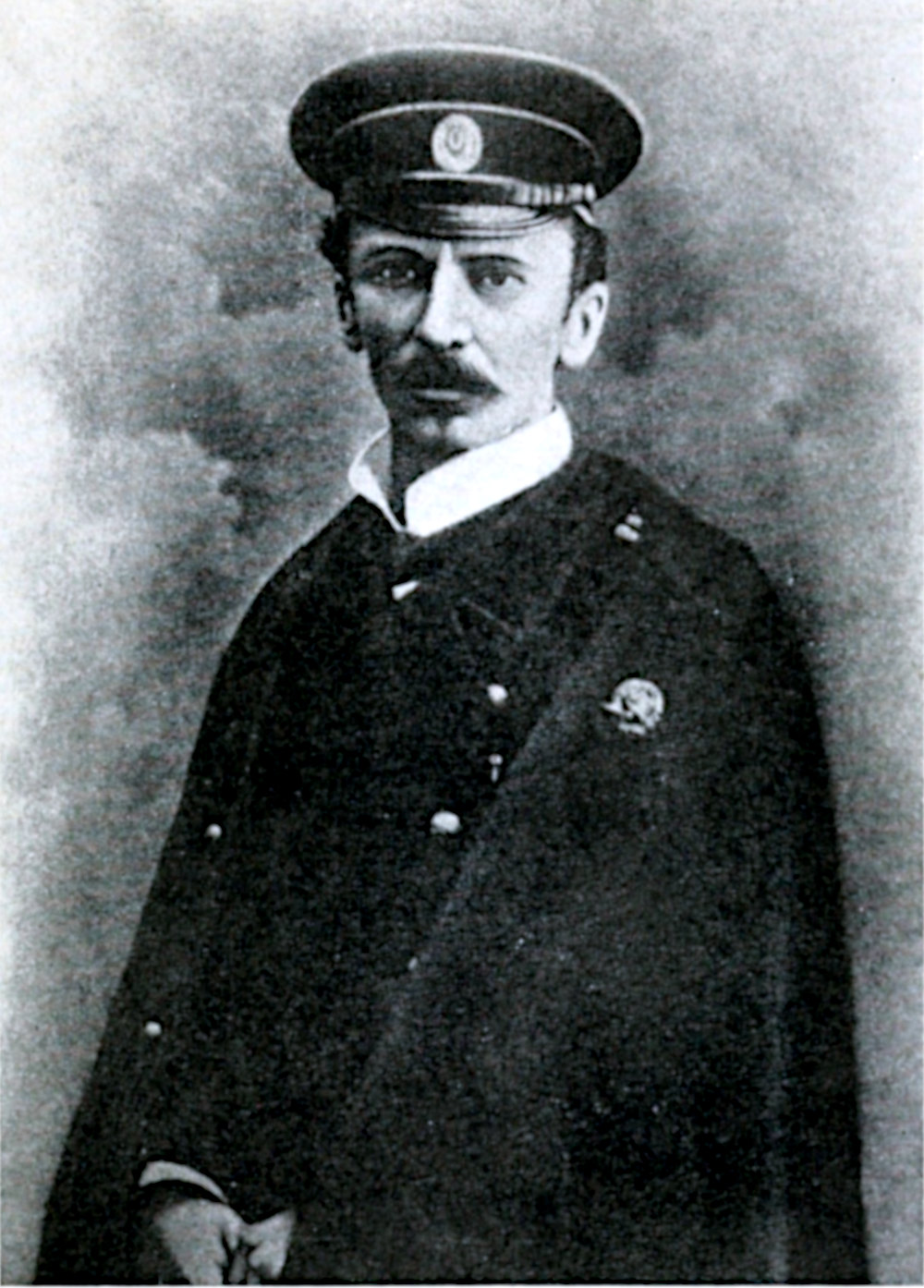
LIEUTENANT PETER PETROVICH SHMIDT
Implicated in the Uprising of the Sevastopol fleet, executed in 1906
One of the most pressing needs of our group was the establishment of a secret printing-office. The shipments of literature from Kief were, of necessity, very irregular and attended with great risks. It was found impossible to establish one at Odessa, as the gendarmes were on our track. Several members of our group had already been arrested. It was, therefore, decided to do our printing at Kishinev, which city is several hours’ ride from Odessa. I do not know what inspired them with such confidence in me, but I was chosen by the executive committee for this responsible undertaking. Naturally, I was very proud of their high opinion of my abilities as a conspirator.
With a suit-case filled with type and various typographical paraphernalia, I came to Kishinev and settled in a quiet little lane. A new sign with a boot painted on it, bearing the inscription “Repairing neatly done,” was placed over the front door. Inside a cobbler’s bench with a complete set of instruments bore testimony to our honorable occupation. A local comrade spent there a couple of hours every day mending my old shoes. Under this cloak I kept 56my suit-case containing the typographic outfit.
I found work as a seamstress. Not wishing to remain alone at night, I slept at the house of an old couple whose daughter was one of my Odessa friends. She had written them about me, and they were glad to accommodate me. They lived with their granddaughter, a little girl of eight.
Thus I established myself, and waited for the promised compositor and “copy” to arrive. But days and weeks passed, and they did not come. I wrote letter after letter, without getting any reply. Finally I decided to go to Odessa myself to investigate. But a very unfortunate circumstance prevented me from carrying out my decision.
ON the night of February 8, 1902, all the four of us were awakened by thunderous knocks on the door. Then we heard the words, “In the name of the law: open!” But before the old man had time to unlatch it, there was a crash, and the door flew wide open. The room filled with gendarmes and police. Without saying a word to us, they looked about the house,—there were two rooms and a kitchen—and began a long and careful search. Everything in the house was turned upside down. They cut pillows and mattresses, they tore the lining of old hats, they even examined the backs of pictures on the wall. But nothing suspicious was to be found: there were not even any books in the house. The disappointed gendarmes were on the point of departing, when one of them picked up my dress which lay on a chair. He fumbled in its pocket, and drew forth a few pieces of type. These were capital letters which 58I had borrowed from a type-setter, an acquaintance of mine, intending to add to my supply, but had forgotten to put them in my suit-case. The faces of the gendarmes instantly changed. Each of them closely examined the unfortunate letters. They handled them with as much care as though they were not mere metal type, but dynamite bombs.
The gendarme officer sat down and began to write a protocol.[6] He only asked me:
“Does this dress belong to you?”
“Yes.”
“You are arrested. Dress yourself.”
Much to my terror, he turned to the old man with the same words. The old woman and the little girl began to cry. In great agitation I tried to explain to the officer that the old man knew nothing about the type found in my pocket, but he rudely interrupted me:
“No use of talking. This question will be settled later. It is not our business to decide who is right and who is wrong.”
At the officer’s command the gendarmes closed around us in a circle and we were led out of the house. The old woman wept. The little granddaughter, who ran crying after her grandfather, 59was roughly pushed aside. I had only time to call out to my hostess, “Forgive me!” when the door slammed behind us.
The night was dark and cold. Surrounded on all sides by police and gendarmes, we walked in the middle of the road, with our heads lowered. The old man was silent, and his silence was terrible to me. I could not see clearly what was my guilt before him, but the feeling grew in my heart.
“O God, this is how I have repaid these good old people for their kindness,” I thought as I walked along.
I absolutely forgot that I was being marched to prison. The sight of that gray head bowed before the gendarmes had made me oblivious of my own plight.
At last we arrived, and the heavy gates of the prison swung open before us. We were led to the office. There we were searched. The governor at the prison wrote down our names, and ordered one of the guards to put us in cells. I dared not look at the old man, but he extended me his hand and said:
“Be brave. Don’t be afraid.”
A lump rose in my throat, and I could not utter a word. Afterward I could not forgive 60myself that I had not asked this good old man’s pardon.
Occupied with these thoughts, I did not even notice where I was being led. I only remember climbing a narrow staircase. The guard stopped in a long, dimly-lit corridor and opened one of the doors. I entered, and he immediately closed the door after me and turned the key in the lock. I remained standing near the door, listening to his retreating steps.
Through a little hole in the door I could see the hanging lamp in the corridor. This lamp also lighted my cell. I looked about me. The cell was about nine feet by six. It contained a small table, a stool, and a wooden cot. A narrow window, with double iron bars, was high in the wall.
I stood in this dark cage, having no desire to move. The only thought in my mind was that the door was locked, and that I could not go out of that place.
Suddenly footsteps were heard. My heart began to beat with hope: Maybe they are going to release me! But the guard came, put out the lamp in the corridor, peeped into the door-hole, and calmly walked away.
The feeble light of the approaching day penetrated 61the double bars, and I could see the bare stone walls of my cell which were painted black half-way from the floor. The light seemed to have roused my energies.
My first thought was to look out of the window. I approached it, but it was high above my head. I dragged the stool over and climbed upon it. Opposite me, at a distance of about twenty paces, I saw a row of narrow iron-barred windows. The gray stone wall which surrounded the prison did not seem high from my point of observation.
“I will escape from here,” I decided immediately. “I can’t remain in this hole.” But days, weeks, months passed, and I still sat within those walls.
In the morning a guard entered my cell and brought me black bread and hot water.
“Tell me,” I asked him, “how long do you think I shall be kept here?”
The guard looked at me in surprise.
“And how are we to know?” he answered, and went out.
A few days later I was called to the examination. It was necessary to cross the prison yard to get to the office.
62“Comrade!” I heard several voices issuing from somewhere. I raised my head and saw hands with white handkerchiefs, which fluttered in the wind, thrust out between the window bars. They greeted me.
“Good-morning!” I shouted cheerfully. But the heavy arm of the guard was on my shoulder.
“You must not speak to them, otherwise I will put you in the kartzer.”[7]
But it was too late: I already knew that I was not alone there.
The gendarme colonel met me very cordially. His broad face was smiling, and his little gray eyes looked at me insinuatingly.
“Be seated.” He pointed to a chair near his table. “What is your Christian name? Surname? What is your age?”
I told him.
“Well, how do you like to be in prison?” he asked me in a free manner.
“Oh, it’s terrible!” I said.
“Well, you see, you are too young yet to be in prison, and I shall be glad to release you. It all depends on you, though.”
“How?” I asked, surprised.
63“You have only to tell—” here the colonel took from the table drawer the unfortunate pieces of type which were found in my pocket, “who gave you this, then I will immediately release you.”
“I cannot tell,” I said.
“It would be very imprudent on your part not to tell. You will fare badly, and regret it.”
“But if I should name the person who gave me these letters you will arrest him. How can I do such a thing?”
“Oh, he is already in prison, anyway, and we know who he is.”
“Then why do you ask me to name him?”
“That is only a little formality which the law requires for your release. Sign this paper, and I will let you free.”
He shoved a paper over to me. I looked at the paper upon which my release depended, and doubt rose in my mind. Is it really so? Does he not fool me? And suddenly I remembered a little book I had read in Odessa, entitled: “Comrades, decline to give evidence!” In this booklet, published by the Socialist-Revolutionists’ Party, it was explained that the gendarmes took advantage of the inexperience of young political prisoners and obtained from them incriminating 64evidence by false promises of release, etc.
“I decline to give evidence,” I said.
The colonel took from the table drawer a little book and handed it to me.
“Have you read this book?” he asked.
It turned out to be the very same booklet.
“Yes.”
“Where did you get it?”
I was silent.
“Don’t be afraid,” the colonel went on. “I ask this as a private person, not as the gendarme colonel. I am simply curious to know who could have given you this booklet.”
The colonel’s tone was so simple and so sincere, and in general he was not as I had pictured to myself a gendarme colonel ought to be. I hesitated. The colonel, evidently guessing my thoughts, put his plump hand on mine and said:
“We are not such bad people.”
“Then why do you keep this old man B——?” I asked. “If you are a nice man, you must release him, because you know that he is not guilty of anything.”
“That does not depend upon me,” the colonel answered.
“Then I don’t believe you,” I cried. “You 65merely want to get a confession from me, so that you might arrest several more innocent people.”
“The worse for you,” the colonel said, changing his tone sharply. He got up, opened the door, and summoned the guard.
“The examination is over. Take the prisoner to the secret division.”
I was led out by another passage, and soon found myself in a low, circular cell. A heavy smell of dampness filled the air, as in a grave. The tiny window was on a level with the ground. Only the lower part of the prison wall could be seen from it; not a bit of sky or anything which might cheer the prisoner’s eye.
But I did not think of comforts then. A feeling of gladness that I had not fallen into the gendarme’s trap filled me. The thought that they had not discovered the house where I kept the type was a great relief to me. And the knowledge that I was not alone in prison, that all around me were comrades who were also fighting for liberty and justice, raised my spirits still more.
“If they only should let the old man out,” I thought.
I paced my half-dark cell, not knowing how to give vent to my feelings.
66“It is impossible they should keep me long here,” I thought to myself.
I was then not quite seventeen. Life was just beginning to unfold before me. It was still shrouded in mystery. Everything in the world seemed so beautiful and attractive. Suddenly the stone walls of the prison had shut out everything from my view.
For many days I could not believe that I was there to stay. From morning till night I dreamed how my door would open and the guard would say: “You are free!”
Three times a day he came to my cell bringing me food, and every time I heard his footsteps near the door my heart filled with hope that he would utter those magic words: “You are free!” But days, weeks, months passed, and the guard, instead of freedom, brought me bread and kasha.
My dreams faded, and the thought that they had forgotten me in this grave occurred to me more and more frequently.
“Why am I not called to the examination?” I asked the governor, who sometimes came to the evening roll-call.
“That is not our affair,” was his invariable reply. “Write a petition.”
67The darkness and dampness of my cell began to have their effect upon me. I began to suffer with insomnia. The twenty-minutes’ daily walk in the prison-yard became a torture to me. The sun shone so brightly without the prison walls, and here I was shut up, deprived of its rays, deprived of my freedom, without which I felt I could not live.
Easter came, my second one in prison. Easter had been my favorite holiday in the village, but here it made me still more sad. The church bells which toll so solemnly and joyfully outside, in liberty, here in the prison, sounded like the ringing of bells at a funeral.
There is no holiday for the prisoner. On such days he feels still more keenly that he is not free and is deprived of the possibility of being with those dear to him. The longing for my folks at home and the desire to know something about them almost drove me insane. My enforced solitude on those days became unbearable.
On the second day unusual sounds reached my ear; now loud, now subdued, they seemed to crowd into my cell from all sides. Guards ran past my door more and more frequently. I became 68uneasy. What can it mean? In alarm I paced my cell, like a caged animal, seeking to escape from those sounds which filled me with a strange foreboding. I knocked on the door, and the guard came.
“What is going on?” I asked him. He only motioned with his hand, and went away. But I felt that those sounds would drive me mad. I knocked again, and the same guard came.
“I cannot stand it any longer,” I began, greatly agitated. “I shall go mad if you don’t tell what are these cries. For God’s sake, only one word!” I implored him.
The guard looked at me for a few seconds, and said in a whisper:
“It was ordered to kill the Jews, that’s what it is.”
All my blood rushed into my head at these words. I remained standing near the door, unable to take a step.
An hour or so later the door of my cell opened, and the governor entered.
“Collect your things. You are transferred to another cell.”
His words made no impression upon me. It was all the same to me whether I was to remain in this hole or go to a better cell, or even be released. 69I heard nothing, I was conscious of nothing but the cries of the Jews who were being killed.
A strange sight greeted my eyes when I was led out of my cell. The whole prison yard was covered with feathers which the wind brought from town. These were from the Jewish pillows and feather-beds torn by the rioters.
Soon the prison filled with Jews who sought protection within its walls, but this did not enter into the plans of the authorities, and an order was issued not to let any more Jews into the prison.
For two days and two nights the massacre of the Jews continued, and their agonizing cries were heard in our prison. Only on the third day they began to arrest the rioters, who were so drunk that they could not walk, and the police carried them into the cells.
Several days after the pogróm I was called to the examination. The procureur and the same gendarme colonel met me with very solemn faces. The procureur said to me:
“You are accused of belonging to a secret society which has for its object the overthrow of the existing form of government, and of conspiring against the sacred person of his Imperial 70Majesty. With this aim in view you took part in the establishment of a secret printing-office and the distribution of forbidden proclamations which instigated a pogróm in the city of Kishinev. Are you guilty of the criminal offenses?”
I was dumfounded.
“How is that?” I protested when I had regained my power of speech. “I have been in prison since February 8, 1902, so how can I be accused of instigating the pogróm which took place only a few days ago?”
“The point is,” said the procureur, “that the letters which were found in the pocket of your dress are of the same identical type with which the forbidden leaflets were printed. As to your plotting to overthrow the existing form of government, this can be seen from your letters to Nicholai Shpeizman. In one of them you say: ‘I shall not rest until I shed the blood of the vampire.’ Do you admit that these letters—” here he took out of a portfolio a bundle of my letters to Comrade Nicholai, who was serving in the army,—“found on Private Shpeizman, and which are written in Yiddish, are yours?”
“Yes,” I replied, “but these letters were written a year ago, and I do not remember having used the expression you attribute to me.”
71“This will be the business of experts to determine,” he said. “And now, the preliminary inquest in your case has been terminated, and by order of his Excellency, the Minister of the Interior, Plehve, you will be put on trial.”
The examination was over, and I was led back to my cell. After this examination it became clear to me that I would not be released so soon. The letters which were found on Comrade Nicholai were ample evidence against me, as I spoke in them, in no uncertain tones, about the tyranny of the government. The thought that my comrade must have been arrested and, being a soldier, would surely be court-martialed, darkened my existence still more.
In the meantime the prison was being filled with politicals and anti-Jewish rioters. The latter were being arrested because they declared that they had been ordered to “kill the Jews.” Small cells built for one now sheltered two or three people.
One night a woman carrying a little baby in her arms was brought into my cell. She was arrested, together with her husband and servant. Her husband, one Alexander Orloff, was one of the leading spirits of the Social-Democratic Party, and at his house was found a secret printing-office 72where the first issues of the well-known, forbidden journal Iskra (The Spark) had been printed.
The presence of the woman and her nine-months-old baby completely changed my prison life. My own sufferings seemed to me as nothing compared to those of the mother and child. This child later played a great part in my life.
A few weeks after their arrest, Mrs. Orloff chanced to see her husband through the window, and called out to him, “Good-morning!” Just at that moment the governor of the prison was crossing the yard. He immediately ordered to put her in the kartzer. When the guard came to take her she refused to go, saying that she could not leave the baby. Then the governor ordered that she be taken by force. Hearing this, I shouted to Mr. Orloff: “Your wife is being taken to the kartzer.” He began to knock on the door of his cell, calling for the governor. Several guards came into his cell, gave him a terrible beating, and tied him hand and foot. On learning of it, all the politicals began to make a terrific noise, knocking on the doors with their feet, throwing the furniture on the floor, and shouting for the governor to come. He came, but with a company of soldiers. He lined them 75up in the yard, and himself with several soldiers came into our cell. Mrs. Orloff held the baby in her arms, pressing it close to her breast.
“Soldiers,” she addressed herself to them, “is it possible that you will have the heart to tear me away from my little baby?”
She cried and the baby, frightened by the sight of strange men, screamed at the top of its voice. The soldiers were taken aback, and did not dare come near her. Then the governor himself approached her, seized her by the arms, and began to squeeze them above the elbows. After a struggle which lasted a few minutes the arms of the mother relaxed, and the baby fell to the floor. A pitiful moan filled the cell.
“Take him,” shouted the governor to the soldiers, “and get him out of here.”
I seized a log and threw it at the governor’s head, but he jumped aside. He ordered to take me also to the kartzer.
When Mrs. Orloff and I were led to the kartzer the whole prison was in an uproar. The noise of falling furniture, knocking, and shouting was deafening. The common-law criminals had seen the soldiers carrying somewhere a half-naked child and joined the politicals in the protest.
76Soon the procureur arrived. He visited every cell and assured the prisoners that the child had been restored to its mother, and that the mother had been released from the kartzer. The common-law criminals quieted down, but the politicals, knowing from past experience that his word could not be trusted, continued the noise. Then they were all tied, and lay helplessly on their cots.
In the meantime Mrs. Orloff, locked in the dark cell, was frantic with anxiety over her child’s condition. After several hours we were let out from the kartzer, and the baby was brought to the mother. Happily it was not injured; only bruised in some parts of the body.
As we learned later, Mr. Orloff, on hearing that the soldiers forced their way into his wife’s cell, decided to commit suicide. He managed to break a window, and with a piece of glass began to cut an artery in his arm. A guard happened to open his door at that time and frustrated the attempt. When this had been reported to the governor, he ordered to release us from the kartzer.
Because of the crowded condition of our prison it was impossible to maintain a régime of 77strict isolation. The politicals who had relatives in town were allowed interviews with them. Notwithstanding that these interviews took place in the presence of gendarmes, they succeeded in sending verbal messages to friends outside, and also found out what was going on without the prison walls. The news that the Orloffs, their servant, and I would be put on trial reached the outside world.
In those years politicals had not been tried in any court. Since the seventies they had been exiled in the “administrative order,” which means that any one suspected of “political unreliability” was sent, after a more or less protracted stay in prison, to some remote northern province, or to Siberia, for as many years as the Minister of the Interior, the chief of the gendarmes, or any gendarme general, or colonel saw fit. This was a new move against the politicals by the all-powerful Plehve. The advantage it offered was the possibility of sending them to hard labor, whereas under the old order they were “only” exiled.
This departure from the time-honored “system” aroused great interest in the liberal circles of Russian society, particularly among the members of the legal profession. Several prominent 78St. Petersburg lawyers, Maklakoff, Pereverzeff, Kalmanovitch, and others, wrote to the procureur offering their services to us free of charge.
At last copies of the indictment were delivered to us. The crime with which I was charged was punishable by from eight to twelve years’ hard labor. The main evidence against me were my letters, of which the strongest passages were quoted in the indictment.
The trial was set for October 15, 1903. A few days before the trial I was called to the prison office. Instead of the gendarmes I had expected to meet, I saw two gentlemen in civilian clothes. The guard told them my name and went out, leaving me alone with them. This was the first time since my imprisonment that I was alone with free people, without the company of gendarmes.
The two gentlemen regarded me for some time in surprise, and then one of them said:
“I am Maklakoff, attorney-at-law, and this is my colleague, Mr. Ratner. We came to defend you. Are you really the author of the letters which are quoted in the indictment?” he asked, again looking me over in surprise.
“Yes, of course,” I replied.
79“How old were you when you wrote those letters?” asked Mr. Ratner.
“Sixteen.”
They laughed heartily, and shook my hands.
“That’s clever, very clever!” exclaimed Maklakoff. “Eight years’ hard labor for letters written at sixteen! Fine!”
He began to pace up and down the room, somewhat agitated. Suddenly he stopped, as if remembering my presence, and said:
“But you needn’t worry. We will see that you are acquitted.”
“No,” I said, “it will hardly be possible to acquit me. You know when I wrote those letters, I really had no serious intentions. But after they have kept me in these stone walls for over nineteen months, my mind is made up, and nothing, nothing can ever change it. I hate this despotic government with all the fibers of my soul, and I will fight it to the last drop of blood in me. And I intend to tell this openly to the czar’s court.”
They remained silent for some time.
“We understand you,” they said, “and this makes us wish still more to be of help to you.”
They bade me good-by in a very friendly manner and went away, having promised to see me 80again before the trial. After this interview a beautiful bouquet was brought to me every morning, together with my bread and water. I learned later that these bouquets were sent by my lawyers, who had obtained special permission from the procureur.
At last the long-awaited day of the trial arrived. On the fifteenth of October, early in the morning, I was led out of the prison gate. The autumn sun greeted me from a cloudless sky. The air was cool and fragrant. My eyes, which for many months had seen nothing but gray walls, bathed in the green grass. The open space before the prison fascinated me.
“To escape,” an inner voice whispered to me.
A carriage was waiting near the gate. I entered it, and two gendarmes with drawn sabers took their seats on each side of me. The carriage rolled fast over deserted streets, and after a short ride stopped in front of a massive brown-brick structure. It was the court-house.
“Here we are!” said one of the gendarmes. They led me into the prisoners’ room and locked me in there. But soon the door opened, and the lawyers, counsel for the defense, came in one by one, six of them. They were more agitated than I, because they already knew the verdict which 81had been ordered by Plehve in advance, and felt the futility of their efforts to save us.
At ten o’clock two gendarmes in brand-new uniforms, with drawn sabers, took me to the court-room. The immense hall was empty. Only in a corner, opposite a long table covered with a green cloth, sat my comrades. Gendarmes, with drawn sabers, stood in front and back of them, but before I reached their bench I noticed, amid a sea of vacant chairs, the bent figure of an old man. He sat with his head bowed low. “Father!” The thought struck me like an electric shock. Instantly I ran to him, and before the gendarmes had time to recover from their surprise, I was near him. “Father, dear!” I had time to say. The trembling arms of my father were torn from my neck, and the gendarmes led me to the prisoners’ bench, holding me fast with their free hands.
“The Court enters! Rise!” called out the court príestav in loud tones.
The judges entered, took their seats, and the farce of a trial began. The secretary read the indictment. All of us were charged with having established a secret printing-office and published the forbidden journal Iskra. I, in addition, was charged with having uttered threats against the 82czar’s life. The usual questions were asked. In answer to the presiding justice’s question:
“Do you acknowledge yourself guilty?” I replied:
“No. From the letters it will become clear to you that I had no connection with the publication of the Iskra, which is a Social Democratic organ. I say this, not because I want to clear myself, but because I am a convinced Socialist-Revolutionist, and as such have been and always will be an enemy of the existing form of government. I do not expect mercy from anybody.”
The witnesses gave favorable testimony, with the exception of the official translator of my Yiddish letters. He maintained that one of my expressions was, “I shall not rest until I shed the blood of the vampire,” while another translator, not official, said that the sentence read: “I shall not rest until the blood of the vampires is shed.” While admitting that my Jewish was poor and ungrammatical, he asserted that this particular sentence was written clearly and correctly, and that he had translated it exactly. May heaven forgive him! He was simply afraid of the gendarmes.
On the second day the speeches of the prosecution and the defense were made. The procureur 83demanded the maximum sentence of twelve years’ hard labor, saying there was no question of my guilt, as I had acknowledged in my speech that I was a Social Democrat. My counsel, Mr. Ratner, said in his speech:[8]
“Private letters cannot serve as evidence before any court, particularly in a case which concerns general idealistic convictions. Such letters always bear the stamp of a subjective mood and therefore cannot have the value of exact evidence. But if letters are to be believed, how is it possible to pick out one at will and to discard the other? to believe one and not to believe the other? We must believe Miss Sukloff that she is a Socialist-Revolutionist, and the repeated statement of the procureur that she is a Social Democrat is utterly incomprehensible. Between the Socialist-Revolutionists and the Social Democrats there is a great difference.... The labor organ which Miss Sukloff says in her letters she wants to publish can by no means be the Iskra. Everybody knows perfectly well that this organ is published abroad, and was being issued long before Miss Sukloff wrote her letters, consequently she could not have in 84view the Iskra when she wrote about the intention of herself and her friends to issue a paper....
“As regards the word ‘vampire,’ to consider it, particularly in view of the doubtful conscientiousness of the translator, a deliberate intention to commit a definite terrorist act, is juridically impossible. It is simply a poetical expression of the terrorist mood which agitates now, by force of circumstances, not one young heart in Russia. Whether it was written ‘vampire’ or ‘vampires’ is, after all, of no import to us, because in the letter is expressed only an abstract intention, and to punish for such intentions no court has ever attempted.... The substance of the accusation is that the accused had definite opinions, convictions, and general intentions, and all this is quite comprehensible, if one will be more attentive to her manner of life. A worker since fifteen, vivid and bright, she ponders over the strange contrast between her own and her chums’ position on the one hand, and that of, let us say, their customers, while her own mental superiority to those bedecked ladies could be no secret to her. Reasoning logically, not hampered by prejudices which did not fasten upon her, her thought came to 85certain conclusions. Meeting with people of greater mental development, she, under their influence, adopted at first the Social Democratic teachings; but her mind, being of wider scope, did not stop there, and thanks to her militant temperament, she, having become acquainted with the views of the Socialist-Revolutionists, joined them.... We ourselves in her place would undoubtedly thirst as much as she for emancipation and the possibility of a better life for herself and others. It must be noted that, notwithstanding the specifically Jewish persecution she was subjected to, the accused did not engage in a narrow-nationalistic struggle. She had a broader outlook, and the interests of all humanity are dearer to her. This is a talented nature, responsive to all good; in some other country she might have been happy, but here, among us—alas! This is not possible. The court may, of course, convict her, but it will hardly be a triumph of justice; it will be another ill-considered, unjust verdict, of which history knows not few.”
After two days of anxious waiting the verdict was announced: We were sentenced “to be deprived of all rights and exiled to Eastern Siberia for life.”
THE thought that I would be exiled to Siberia did not frighten me in the least. The desire to escape from those odious walls was so great that I would have been glad to be led not only into exile, but even to the gallows. But day after day, month after month went by, and I still sat in the Odessa prison, whither my comrades and I were transferred several days after the trial, impatiently waiting to be transported to Siberia. To all my protests and insistent requests to send me there the prison authorities made one reply:
“We are awaiting special instructions from St. Petersburg with regard to you and your comrades.”
“What more can they do to me?” I frequently asked myself. A feeling of rage filled my heart more and more often as the months passed. I could no longer speak calmly with the authorities. At their very sight my blood began to boil.
87“How much longer will you torture me within these walls?” I cried whenever the prison governor appeared.
Conflicting rumors about the war with Japan penetrated into our cells, but they could not hide from us that Russia was being defeated by the Japanese. With every Japanese victory the prison authorities relaxed the severe discipline more and more. This relaxation of the prison régime, bought at the price of thousands of Russian people slain in battle, made our life a little easier. The hope that the Japanese might help us free ourselves from the despotic government gave us new strength to bear and wait.
In July, 1904, the minister of the interior, Plehve, that pillar of reaction who had boasted that he would “wipe out the revolution in Russia,” was killed by a bomb thrown at his carriage by Yegor Sazonov, a member of the “Fighting League” of the Socialist-Revolutionists’ Party. This happy news was brought to us by the prison authorities themselves who were greatly elated at the death of their chief. Plehve was cordially hated not only by the people, but even by his own subordinates. The appointment of Prince Svyatopolk-Mirski as minister of the interior put an 88end, for a short time at least, to the sufferings and hardships, which political prisoners were forced to endure.
Soon after the assassination of Plehve, my comrades and I were unexpectedly included in a party of convicts who were being exiled to Eastern Siberia. Before leaving the prison we learned what it meant to be “deprived of all rights and exiled to Siberia for life.” We were summoned to the office and told to put on convict garb. The dress of a female convict consists of a coarse gray linen shirt, a skirt made of the same material, a pair of black kotí, or slippers, with square linen foot-wrappers in lieu of stockings, a long gray khalát[9] with a yellow diamond-shaped patch in the back between the shoulders, and a gray kerchief. This dress changes a person beyond recognition. When we were led back to our cells our comrades did not recognize us. I was frightened by my own reflection in the mirror when I saw myself in this garb for the first time. There is something terribly degrading in it.
“What have I done? what have I done?” I repeated in great agitation. I paced my cell, with difficulty dragging my feet dressed in enormous, 89ugly kotí. And the feeling of hatred toward my oppressors grew in my heart and I could not overcome it.
On the next morning my comrades and I were lined up with a party of convicts who were being transported to Siberia for robbery and murder. Our wrists were chained to theirs, and in this fashion we were marched four abreast, in the middle of the dusty road, to the railroad station.
For the last time I looked at the big city to which I had come in quest of knowledge and happiness.
“Oh God!” I thought to myself, “I left my father and mother, sisters and brothers; I left my native fields, and came to this great city to find the key to a better life: and this is what I found!”
“Farewell, farewell, my native land ...” began the prisoners in a chorus when the train started. Their plaintive tones accompanied by the jingling of the chains made an indelible impression upon me.
The convict car was filthy and crowded to its utmost capacity. The prisoners were making themselves comfortable, and their familiarity with the surroundings suggested to me that they 90were not making this dreadful journey for the first time.
The stárosta, or head-man, elected by the convicts figured out with the help of the under-officer of the convoy the amount of kormovíye[10] for the party. Ten kopecks was the sum a convict received for his daily subsistence. For this money one could buy on the road one and one-half pounds of bread. But peasant women meet the trains, especially in Siberia, and give alms to the hungry, unfortunate convicts—bread, milk, pies, and other eatables.
After an agonizing ride which lasted about two days, we arrived in Kief. There we were placed in the forwarding prison. A forwarding prison differs from a regular one in that the former is, in most cases, wholly unfurnished, and the only article a cell contains is a large wooden tub called parásha. We slept on the dirty floor with nothing under us but our overcoats.
For two days we were kept there, and were not even let out for the daily walk. There were fifty people in our kámera,[11] twenty-five women and as many children. Some of the children became sick, and their unhappy parents lived in 93constant fear that they would die from lack of pure air. Mrs. Orloff begged the prison governor to permit her to take her sick child out in the yard for a few minutes, but his only answer to the distracted mother was:
“Peresýlni[12] are not supposed to be let out for a walk in the forwarding prison. To-morrow you will leave here.”
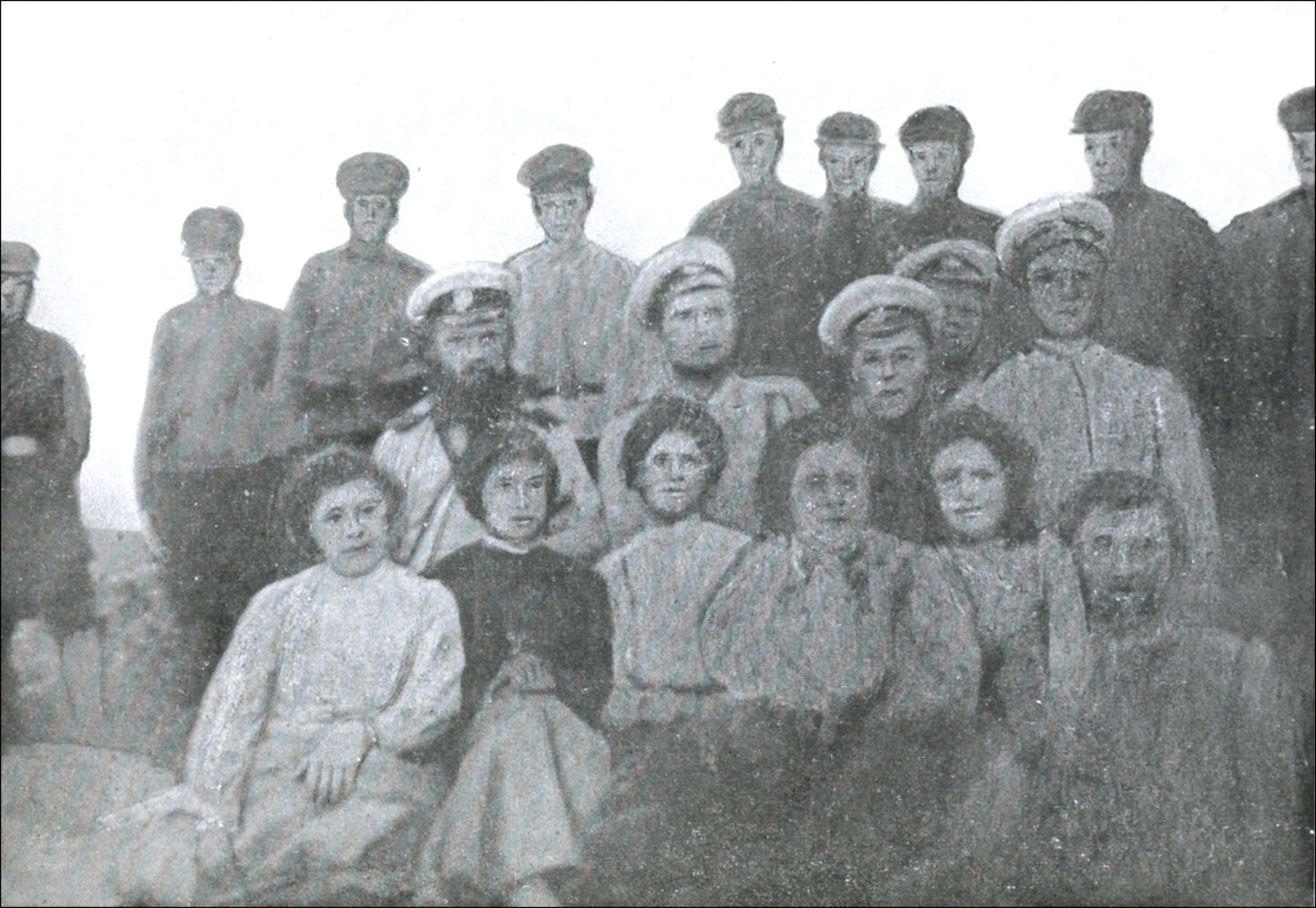
SIX POLITICAL PRISONERS AND THEIR GUARDS
Resting at the étape in their march to Akatúi. Miss Sukloff is second from the left
From Kief we were taken to Kursk, and after spending two days in the forwarding prison went on to Voronezh. And thus changing from the crowded convict car to the forwarding prison and from the forwarding prison to the convict car, and stopping in every large city, we finally crossed the Urals and reached the town of Tyumén, in Siberia, after three weeks’ travel. The Tyumén forwarding prison is located at a great distance from the city, and the muddy road over which we were marched came near becoming a grave-yard for some of us.
George Kennan, the well-known American writer, describes this prison in these words:[13]
“I looked around the cell. There was practically no ventilation whatever, and the air was so poisoned and foul that I could hardly force 94myself to breathe it. We visited successively in the yard six kámeras, or cells, essentially like the first, and found in every one of them three or four times the number of prisoners for which it was intended, and five or six times the number for which it had adequate air space. In most of the cells there was not room enough on the sleeping-platforms for all the convicts, and scores of men slept every night on the foul, muddy floors, under the nari,[14] and in the gangways between them and the walls....”
In these germ-infested barracks we were kept for three long months. Typhus fever and other epidemic diseases carried off two or three people every day, and we escaped death only through some miracle.
Winter had already set in when we started out again. In a blinding snow-storm we were lined up by the soldiers of the convoy, and began our journey to Krasnoyarsk. The convict car was even more filthy and crowded than in European Russia. The severe Siberian frosts did not add to our comforts. There were the usual stops for a day or two in a forwarding prison, and marching to and fro, in half-torn shoes, over roads covered with ice and snow.
95Tormented with hunger and cold, exhausted by the hardships of Siberian travel in winter, and extremely fatigued we dragged ourselves into the forwarding prison at Krasnoyarsk after sixteen days of travel. Here at last we learned to which places we were to be banished.
One morning the prison governor brought in a bundle of official papers. These contained our several destinations. To my inexpressible terror I was to be sent alone to the village of Aleksandrovskoye, in the province of Yeniseisk, about three thousand miles from my native province of Vilna. I stood before the governor, listened to his words, but could not believe that I was to be parted from my friends, taken to a remote, lonely village, and left there to pass my days alone.
“How is that? how is that?” I kept repeating the meaningless words, knowing perfectly well that the governor had nothing to do with designating the place of exile and could not change anything.
From Krasnoyarsk we were taken to Kansk. The Kansk forwarding prison, which was the last étape of our memorable journey together, almost became the grave of the whole party. We came to the prison in the evening. The barrack 96in which we were placed had evidently not been heated for a long time, as ice and snow lay on the floor all along the walls. We asked the head-keeper for some wood, and made a fire in the stove. After the fire had burned out, we closed the chimney and went to sleep. At night a child began to cry. Some of us heard his cries, but could not move from our places. Attracted by the child’s cries, a keeper came and called to us, but seeing that we did not respond, opened the door. Then he understood the cause of our silence. The cell was filled with fumes of charcoal, and we all lay in a stupor. He immediately summoned a number of soldiers who carried us out on the snow and rendered first aid. As soon as we had fully recovered we were taken to our respective destinations. The Orloffs were sent to the village of Ribinskoye, in the province of Yeniseisk, about thirty miles from Aleksandrovskoye. They went first. Then two guards came and took me.
From Kansk we had to travel on foot. Before starting the exiles on their march the prison doctor examines them, and if any are found to be weak or infirm telyégas[15] are provided for them to ride in. To my great luck the doctor decided 99that I was too sick to walk, and I was allowed to ride in a cart.
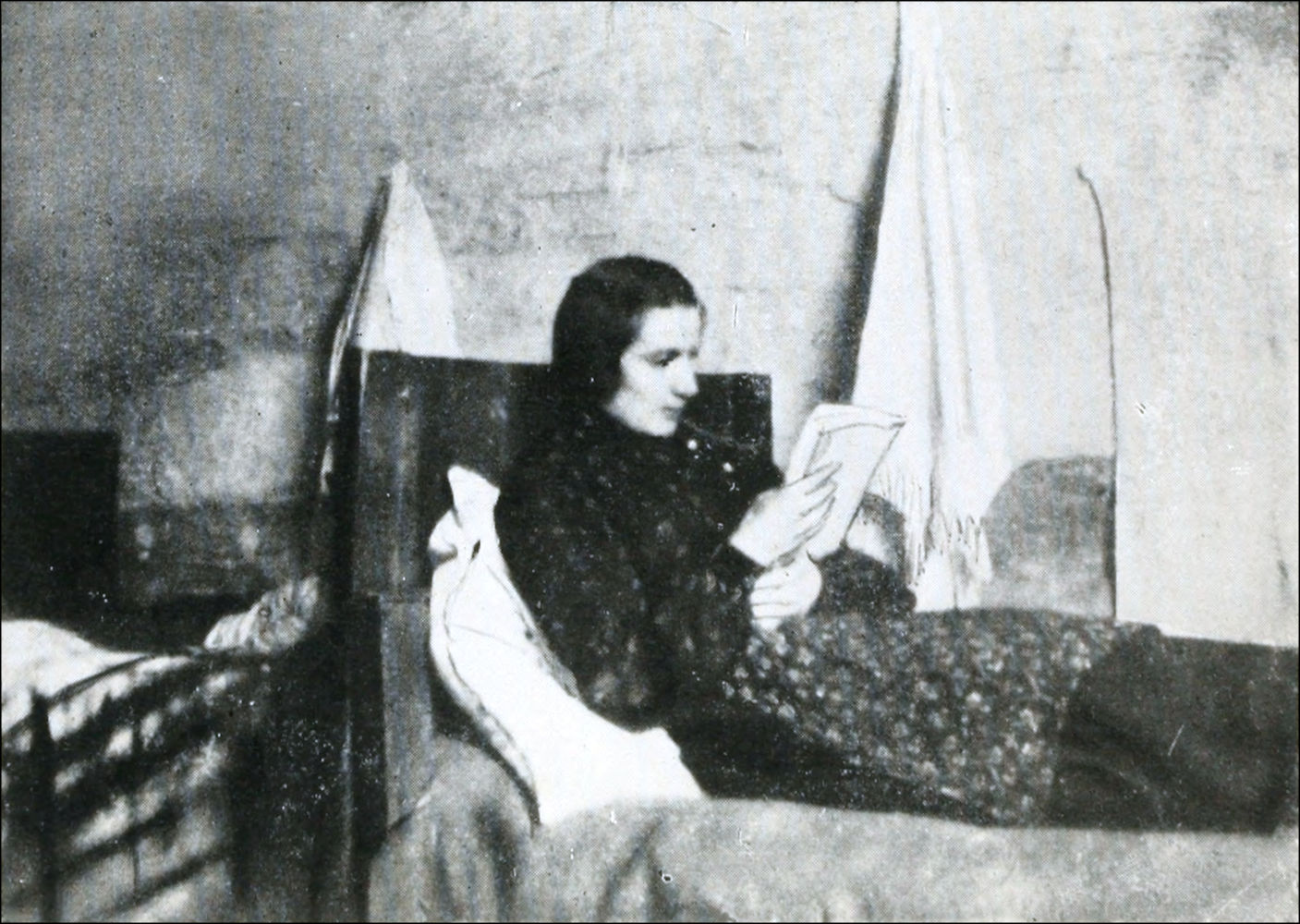
MISS SUKLOFF READING IN HER CELL
Two guards escorted me to the first étape and delivered me under signature to the uryádnik.[16] The uryádnik summoned the head-man of the village and ordered him to procure a horse. After a long dispute the peasants found an old nag, and I, under the escort of the village constable, proceeded to Aleksandrovskoye. In every settlement which we passed on the way the peasants, and particularly the women, regarded me very curiously. On learning that I was an exile they fed me, and in one village the women even gave me a pair of high felt boots, as I suffered terribly from the extreme and continuous cold.
Finally we arrived at the vólost, or rural district, to which Aleksandrovskoye belonged. Here the uryádnik and the vólost scribe opened the papers which the constable had carried all the time in a sealed envelope.
“There are special instructions with reference to you,” said the scribe to me.
“What are those special instructions?” I asked.
“It is stated here that you are a political offender 100and must be guarded very closely,” he replied.
I slept that night at the scribe’s house, and on the next day he took me to the village of Aleksandrovskoye, which was about eighteen miles from the vólost. The village consisted of perhaps thirty huts, and was inhabited mostly by Russian colonists. At the house of the stárosta,[17] to which I was first taken by the scribe, women and peasants gathered and began to consider what should be done with me. The women, folding their arms on their breasts, stood shaking their heads compassionately and saying in melancholy tones:
“Poor girl, poor girl! Your parents must have shed bitter tears when you were taken from them in such tender years.”
Some of them offered to take me to their homes. One old peasant who stood thoughtfully stroking his long, white beard thus settled his doubts:
“It means, then, that she was sent to us for life and we may do with her whatever we want. Did I understand you rightly?” He turned to the scribe who was explaining to the peasants how to treat me.
101At last, after a long discussion, it was decided that I would stay at the house of the church watchman. The uryádnik ordered the constable to come every morning to my house to see if I was still there. At parting he warned the peasants:
“Remember that you are all responsible for her.”
The peasants made the sign of the cross, and in a body led me to the house of the church watchman.
Yet for a long while the women continued their expressions of sympathy and shed tears, repeating, “You poor, unfortunate orphan,” before I was finally left alone. When they cried and called me “orphan” I really felt that I was alone, alone in this whole great world. I sat helplessly looking about myself, and a feeling of pity for myself filled my heart. But the immediate environment did not give these feelings a chance to grow. The people would not let me rest for a minute.
My host, an old man white as snow, soon came in and asked me:
“Can you read?”
After receiving an affirmative reply, he extracted a letter from his pocket. It was from his son, a soldier in the Manchurian army.
102The news that I could read traveled fast. All the peasants gathered all printed and written matter they could find in the village and brought me to read to them. They surrounded me on all sides and listened to me with respectful attention. The desire to know about the war with Japan was not mere curiosity on the part of the illiterate peasants. They had a blood interest in it, as nearly every one of them had a son, a husband or a brother on the battlefield, from whom they had not received word for months, and despaired of ever hearing from them.
On the morrow the women came to me carrying bowls of milk, plates of butter, and various other gifts, and begged me to write to their sons and husbands. Listening to the tales of woe of these old mothers and young wives, who desperately clung to the last hope that their loved ones had not been killed, but only wounded and crippled for life; looking at the little orphans who already knew that they were to see their fathers no more, I forgot my own grief and thought only of what I should do to lighten their terrible burden. But to my great sorrow I had no means of being useful to them, and all I could do was to write letters to people whom I believed to be dead.
103A few days after my arrival the village priest came to see me. He was a robust man of a very cheerful disposition and liked to drink a great deal. He spoke to me in a fatherly manner.
“Only do not get discouraged. There is nothing eternal in this world,” he said in answer to my statement that I had been sent there, not for a term of years, but for life. “My daughter is going to be married,” he continued, “and there is no one here to make dresses for her, so you had better come to live with us and help her with the sewing.”
I consented, as I was very glad to do something to earn my bread.
I was no longer in prison, I saw no more the prison walls, but I did not feel myself free. The purposeless life in a remote Siberian village seemed to me worse than a prison. The peasants, together with the priest, drank for two or three days during the week. They spent all their money at the Government liquor shop, and when they had no ready cash they pawned anything they could conveniently carry out of the house. It seemed that only the vódka gave them the possibility of forgetting the miseries of their 104wretched existence. In those “drunken” days I hid myself in some corner that no one might see me, and sat looking at the heaps of snow which separated me from the rest of the living.
“You must escape, you must escape from here,” an inner voice grew more and more insistent within me.
The scribe, the uryádnik, and the constable were the only people supposed to keep watch over me, and they seemed neglectful of their responsibility. They may have supposed that the dense forest which surrounded the village was the best guard.
“To escape, to escape,” I repeated to myself in the long, sleepless nights, staring into the darkness and making plans, each one more fantastic than the other.
In the meantime the news of the “Bloody Sunday” reached our village. With trembling hands I held the paper and read to the peasants how the working-men of St. Petersburg, led by Father Gapon, had gone to petition their Czar to better their conditions of life; how they had marched with their wives and children, carrying icons and the portrait of the Emperor, and singing patriotic hymns; how they had suddenly, without warning, been shot down, trampled by 105Cossack horses, and beaten with sabers and nagáikas;[18] how the streets of St. Petersburg had been turned into a battlefield where hundreds of dead and dying lay.... Here the peasants stopped me.
“Is it possible,” they asked, “that the czar, in whom we believe, could do that? Is it possible that he it is who takes our children and sends them to the Japanese to be killed? Is it possible that he does all this, and not his ministers?”
They took the paper from me, turned it in their hands, and made me read it all over again, from the beginning. On that day their faith in the czar was shattered, and they openly showed their sympathy with me, a direct victim of his despotic rule.
To me the fact that the St. Petersburg working-men had gone to petition the czar for a better life had another significance. I saw in it the awakening of the toiling masses, and regarded it as the fore-runner of that great revolution which was to shake the throne from its foundation.
“It can not be that the blood of the innocent children slain in the streets of St. Petersburg on 106the ninth of January should remain unavenged,” I thought. I saw that the Russian people could no longer suffer the yoke of czarism, that Russia must be free, and I firmly decided to escape and join, weapon in hand, in the great struggle towards liberty and justice for my oppressed and down-trodden country.
The vólost scribe was an intelligent and kind man, and he openly showed his sympathy with me. I made up my mind to ask him to get from the uryádnik permission for me to go to Kansk. I hoped to find there comrades who would help me with money and a passport.
“Yes,” said the scribe in answer to my request, “I can get for you the desired permission. But if you should run away the responsibility would fall upon me, because I am sure the uryádnik will prove in some way or other that I conspired with you. You know that I am the father of four children,” he went on, “but if you give me your word of honor that you will return, I will persuade the uryádnik to let you go to Kansk for a few days.”
His proposal was difficult for me to accept. If I should give him my word of honor I would 109have to return, and my only aim in asking for leave was to escape. For two days I went about trying to find a way out of the difficulty, but finally decided to agree to his condition. It was absolutely necessary to go to Kansk and procure money and a passport, without which I could not even think of escaping.
We went to the uryádnik, and after considerable questioning he consented to let me go to Kansk for a few days.
On the first of February, 1905, I left the village, riding in the cart of a peasant who was going to town on business. I had no addresses, and did not even know if there were any political exiles in Kansk. The peasants of Aleksandrovskoye had assured me that there were many “nobles” there. As I found later, the politicals were known there as “nobles.”
After two days’ travel we reached Kansk. For the sum of two kopecks a ragged boy drove me to the blacksmith’s shop. A tall man in a blue blouse, his hands and face covered with soot, greeted me with a cordial smile. I told him my name, and he led me to his house. There I was met by a pale, frail-looking young woman who held a sickly baby wrapped in rags. Having overcome the feeling of embarrassment I experienced 110at the sight of their wretched poverty, I told them the object of my visit.
“I am very sorry,” said Mr. M——, the blacksmith, “but I don’t think you will get anything in this town. There are only six politicals here, and they are all starving. The only thing we can do for you is to give you letters of recommendation to our Irkutsk people. There are a great many of them there, and they will surely help you.”
A few hours later the whole exile colony of Kansk gathered at the house of Mr. M——. They held a consultation and decided that I must go directly to Irkutsk. They bought me a railroad ticket to that city out of their last money, and that very evening I boarded a train, carrying in my pocket a letter of recommendation. As I was dressed in a mixture of civil and convict garb, the passengers stared at me, and I did not feel quite at ease.
After two days’ travel I came to Irkutsk. When the cab stopped in front of a rich house on the main street of the city I hesitated for a few seconds. “What if they will not let me in?” I rang the bell. A beautiful young girl opened the door. I handed her the letter of recommendation, and she invited me to sit in the 111waiting-room. Directly an old man of short stature entered. He asked me who I was and what I wanted. Having convinced himself that I really was the person I claimed to be, he shook my hand and invited me to meet his wife and children.
This man, Mr. K——, was an old revolutionist, exiled to Irkutsk many years before. But notwithstanding his “past” he now held a high Government position. That same day he handed me a hundred rubles and a passport on which he wrote in his own hand that I was a “merchant’s daughter.” Such a passport was as good as a real one in Siberia, because the príestavs and the uryádniks who endorse them are so ignorant that they can hardly read Russian. Mrs. K—— helped me put on her daughter’s clothes, and presented a watch to me. In short, I was made unrecognizable.
It was necessary to return to Aleksandrovskoye. I knew that the scribe would feel uneasy about my long absence. I did not want to think how I would escape after my return: the difficulties seemed insurmountable, but I had given my word of honor, and had to return.
With sorrow in my heart I bade good-by to 112those kind people. One of Mr. K——’s sons went with me to Kansk, as they were afraid that I might be arrested on the road.
In the railway compartment—we traveled in the second-class—were two army officers. They made friends with my companion and treated him to vódka and cigars. There was nothing in their appearance to arouse our suspicions.
When night came I lay down on my cot. I could not sleep. The thought that I was going back to that lonely village would not let me rest. Suddenly I felt that somebody was tugging at the chain which supported my watch. I opened my eyes, and to my great terror saw the same officer who had been so amiable with me several hours before. In one hand he held my bag which contained the hundred rubles and the passport. I emitted a terrible shriek. The officer seized me by the throat, and began to choke me. I became unconscious....
When I had regained consciousness my first thought was that the money and passport were gone. I heard people talking near me, but had no desire to look at them.
“Why didn’t they let me die?” I thought. “What will I do without the money and the passport?”
113I could not move my head, and the fingers still seemed to be choking me.
At the first station I was carried into the gendarme office. The two officers were already there. They turned out to be escaped Sakhalien convicts masquerading as army officers.
“Why did you want to kill me?” I asked my assailant. “Didn’t you see that I am not rich?”
“Why did you cry out?” was his reply. “I had to save myself. After all I did not choke you to death.”
The bag with the money and the passport was returned to me. I owed my life to Mr. K——’s son, who was the first to reach my side when the robber choked me.
After an absence of ten days I returned to Aleksandrovskoye. The scribe and the uryádnik were delighted to see me.
“And we already thought that you would not come back,” said the uryádnik, smiling.
The question how to escape did not leave me for a moment. The only people from whom I hoped to get the necessary information were the Orloffs, who lived in the village of Ribinskoye, 114the nearest to ours, and I decided to make my way in that direction. I was afraid to ask the peasants for aid, notwithstanding their sympathetic attitude. Besides, I knew that if the authorities found out that somebody had driven me to Ribinskoye the poor peasants would be held responsible for my escape. There was one way left to me, and that was to walk the distance of twenty-eight miles which separated the two villages. The road to Ribinskoye I knew well enough.
On the second day after my return from Irkutsk I got up at daybreak, dressed as warmly as I could, and with a few pieces of bread tied in a handkerchief set out in the direction of Ribinskoye. The whole village was fast asleep, but the very huts seemed to watch my steps. Every sound made my heart beat faster, and I looked around expecting to see somebody running in pursuit. Soon I came to the end of the village. The smooth, silvery road stretched before me. I straightened up, drew a full breath of clear, frosty air, and quickened my pace. My fear had disappeared. Calmly I looked at the snow-covered forest which stood on both sides of the road, and I walked faster and faster, dreaming of freedom for myself and my country.
115I don’t know how long I walked thus. I only remember that a sharp pang of hunger interrupted my dreams, and I began to consume one piece of bread after another, without slackening my pace. Suddenly I heard the clatter of horse’s hoofs behind me. Without stopping to think for a second, I turned to the forest, but the sleigh was near me before I had time to get under the cover of the trees.
“Where are you going?” a voice called to me. I turned around. It was a peasant who lived in a neighboring village. He knew me well.
“I am going to Ribinskoye,” I replied indifferently, “and have no money to hire a sleigh.”
“Get in,” he said. “I am going there, too, and will give you a lift.”
A few hours later I was at the house of the Orloffs. The tiny arms of their child embraced me.
“I won’t let you go away from us no more,” he said, patting my cheek.
The cold in the house was fearful. The wretched poverty in which the Orloffs lived astonished even me. A rickety table, two broken chairs, and an ancient wooden bed which squeaked and lurched every time one sat down on it made up all their possessions.
116When I told them that I had decided to escape they were glad for me.
“I don’t see how we can live here,” said Mrs. Orloff. “The child is growing; he will soon be three years old. We can not earn anything here. The money which I get from home is hardly sufficient to pay rent and buy fire-wood.”
She looked haggard and worn, and it seemed to me that tuberculosis had already laid its stamp on her beautiful face.
Mr. Orloff hastened to change the conversation.
“Yes,” he said, “now, after the ‘Bloody Sunday,’ we must give up the delusion that we can bring about better conditions by peaceful propaganda. We must fight tyranny with its own weapons. Such outrages of the Government can be responded to only by bombs and bullets. Eh, if we could only get out of here!”
He paced the room, hardly able to control his emotion.
“How can you escape with the child?” I said. “You will be recognized immediately.”
“Yes, this is the only thing which keeps us back,” answered Orloff dejectedly.
I looked sorrowfully at these young people who were deprived of everything in life and 117whose only child hindered them from making an attempt to regain their freedom. A slow death from hunger and cold awaited them. I looked at the innocent little child who was slowly wasting away before the very eyes of his parents, and a happy thought struck me.
“Listen,” I turned to the Orloffs. “I will take your child with me, and you will escape later. The police will look for me alone and for you with a child, and this change of parts will save us all.”
For a moment their sad faces brightened with hope.
“Bória,” I said to the boy, “do you want to go to Grandma with me?”
“Yes, I do,” he replied with a determined look. “I shall go, and Mamma shall go, and Papa shall go. I don’t want to be here; it’s cold here.”
In a few hours the affair was settled. I was to take the child to its grandparents in Vilna, and the Orloffs were to escape after receiving word from me that everything was “all right.”
In the evening Mr. Orloff found a peasant who agreed to drive me to the next village, a distance of forty miles, for three rubles. The following day we spent in making warm clothes 118for the child and preparing for the long journey. As soon as it grew dark the driver came to call me.
The mother embraced her child and me for the last time.
“I entrust him to you,” she said, weeping bitterly. “He is all I have in this life.”
“Mámotchka, don’t cry. I don’t want you to cry. Better come with me to Grandma. I don’t want to leave you here.”
He brought his mother’s coat and tried to put it on her.
“Hurry up, hurry up,” urged the driver. Mr. Orloff took the child in his arms, kissed his weeping wife, and we went out. The night was still and cold. Heaps of snow covered the ground. We walked rapidly, and the frost squeaked under our feet. At the end of the village stood our sleigh. The horses impatiently dug the snow with their hoofs. I sat down, Mr. Orloff put the child in my lap, kissed him once more, gave my hand a tight squeeze, and we started.
The sleigh glided swiftly over the smooth road. The horses ran, and the driver hummed a tune. I pressed the child in my bosom, and listened to his regular breathing. Soon the driver got out of the sleigh and ran alongside the horses 119trying to warm himself. I did not move, being afraid to disturb the child, who was sound asleep.
At four o’clock in the morning we arrived in the village, and knocked on the door of a peasant hut. We were admitted. To all questions where I came from and where I was going, I replied in a plaintive voice that the child had been left an orphan and I was taking him to his grandparents in Russia.
After an hour’s stay in the hut, during which I warmed my frozen limbs and fed the child, I decided to go farther. My plan was to drive as far as Krasnoyarsk, to hide in that city so long as it was necessary for the hue and cry caused by my escape to subside, and then proceed to Vilna by railroad. My host readily consented to take me to the next village.
“Give three rubles, and I’ll drive fast,” he said.
At six o’clock I sat again with the child in my lap, and we renewed our journey over the endless road which ran through the Siberian taigá.[19] In the afternoon we came to the village. From there an old peasant drove me farther. He charged me only one ruble, saying that I was going far and needed the money.
120For two days and three nights we rode thus, stopping only to warm ourselves and change horses. I hardly slept all this time. Sitting in the sleigh and listening to the roar of the wind in the taigá I wondered if we would ever reach Krasnoyarsk alive.
In the morning of the third day the child became sick. He cried, and complained of pain in his body. The severe cold, lack of warm food, and constant sitting in the sleigh had proved too much for him. I had to stop for a whole day. My anxiety knew no bounds. To the worry over the child’s sickness was added the fear that the police might overtake me. Toward evening the child felt better, and we set out again.
At last there remained only about ten miles to Krasnoyarsk. I was beginning to think myself out of danger, when in the middle of the day, on the road to Krasnoyarsk, I heard behind me the voice of our uryádnik. “Stop, stop! Whom are you driving?” he shouted to my driver. My blood grew cold. Instinctively I hid my face behind the child’s back. I heard the footsteps of people near me, but saw nothing.
“A woman with a child,” said one of them. “Go ahead!”
121I hugged and kissed the child who had saved me from certain arrest. I promised the driver na vódku[20] and he let the horses go at full gallop.
Finally we arrived in Krasnoyarsk, and stopped at a hotel. I felt sick. All my body was aching from the long ride. The child had grown terribly thin, and his dear little face showed traces of hunger and cold. Both of us needed a good rest, but I had spent more money than I had intended, and owing to lack of funds, I could not stop at Krasnoyarsk for long. Having paid all the money I had for a second-class railroad ticket to Vilna, I left the city after a twenty-four hours’ stay at the hotel.
The long journey from Krasnoyarsk to Vilna passed without any serious incidents. The child proved the best protection from the searching eyes of the police and gendarmes. The spies who swarmed at every big station did not pay the least attention to me. They evidently could not think of such a combination. When we came to Chelyabinsk—the border line between Siberia and European Russia—and had to change trains, our car was suddenly locked, and the passengers were let out singly and their passports 122examined. I held the child in my arms, and the gendarmes passed me without a question.
On the fifth of March I came to Vilna, and delivered the child to its grandparents. I sent a telegraphic message to the Orloffs telling them that their child was safe. Being only a short distance from my home, I decided to see my parents. I ran a terrible risk, as my parents must have been shadowed by the secret police, but my love for them proved stronger than all considerations of prudence and safety. That very day I despatched a comrade with a letter to my parents, and in the evening they came to me. The joy of our meeting seemed to make us forget all the past sorrows and sufferings.
“I will not give you any more to them,” mother repeated over and again, without even attempting to dry the tears which ran in streams down her face.
Father took out fifty rubles and said to me:
“This money I borrowed. Take it and go abroad. There you will be safe from all the horrors which you have lived through.”
“Father, I can not do that. The thing which was done to me and thousands of others can not go unpunished. I can not let it go.”
123My father took my head in his hands and looked with his soft eyes straight into mine.
“O, God! what have they made of you? You do not even cry, and there is so much hatred in your eyes, even at the sight of your old parents.”
“I can not, I can not,” I kept saying. The hands of my father tenderly pressed me closer and closer to his breast.
“Look,” he said with tears in his voice, “how gray the three years of your imprisonment have made me. What will become of us if you are imprisoned again?”
“Father, dear Father, listen to me. It is beyond my strength to endure the suffering and persecution to which you and millions like you are subjected. I can not bear it. And to put an end to it we must be strong, and must fight. I will go and kill the murderers and tyrants, and hundreds will follow my example. And if I die....”
My father drew back, and stood staring at me in speechless terror. My mother ceased crying. Unable to stand the ordeal any longer, I threw myself on the bed, hid my face in a pillow, and wept for a long, long time, sobbing like a child.
On the next day Father and Mother went to 124the railroad station to see me off. I boarded a train for Minsk. From there a Jewish contrabandist directed me to the Austrian border. After hiding for three days in a small frontier town, I safely crossed the border into Brody.
I HAD decided to go abroad, because I had learned that the leading spirits of the “fighting league” of our party were just then living at Geneva. It was my intention to join the league and become a terrorist. My own life and that of my friends had taught me that peaceful methods of struggle with tyranny were no longer possible. Terrorism at that time was not only the mood of individuals in Russia, but all classes of society were pervaded with the spirit of active struggle. The masses were waiting only for a signal to rise in open revolt against the despotic régime.
To become a member of the terrorist organization was a matter of considerable difficulty. Only people with an established revolutionary reputation were admitted. With doubt in my heart I arrived in Geneva. Luckily, I found there Comrade Nicholai, who had escaped from Siberia a few weeks before me, and had already succeeded in forming the acquaintance 126of people who stood close to the league. Thanks to his efforts, I obtained an interview with the leaders of the organization several days after my arrival in the city.
By their keen sympathy and thoughtful attitude these people made a profound impression upon me. With great circumspection they tried to dissuade me from the course I had chosen, but it was of no avail. I knew too much about the life of my unhappy country to change my resolution and turn from the path to which I had been driven.
The executive committee finally decided to admit me into the organization. My first mission was to be the assassination of General Trepov. He was the St. Petersburg Governor-General. He it was who issued the famous order to the local garrison “not to spare cartridges.”
The first and foremost condition of the life of a terrorist is the complete severance of all intercourse with relatives and friends. A terrorist may not even correspond with anybody. The sole purpose of this is to safeguard innocent people against governmental persecution in the event of arrest of a member of the organization. There have been cases when people were exiled to Siberia or sentenced to long terms at hard 127labor for having written to or received a note from a terrorist.
This isolation and constant dwelling on one thought have a very peculiar effect upon one. The whole universe no longer existed for me. Trepov’s photograph represented to me a symbol of all of Russia’s ills, and his death the only cure for them. Now, when I think of the weary weeks which I passed in a little village, I know that only fanatical faith gave me the moral strength to prepare myself for such an act. My thoughts could not clearly picture that to which I was inevitably drawn. The fact that I was going to sacrifice my own life had absolutely no influence whatever upon me. I never even thought of my own death. But his death, the death of one whom I considered the cause of thousands of deaths, was constantly in my mind.
At last, after a month of weary solitude, a comrade brought the disappointing news that General Trepov had found out in some way about the intention of the “fighting league” and had taken extraordinary precautions: he did not receive anybody and scarcely left his house. The committee deemed it best to postpone the attempt until another way was found.
The “fighting league” always had a list of 128high government officials whose activity was most injurious to the liberal movement, and upon such officials the league, in conjunction with the central committee of the Socialist-Revolutionists’ party, pronounced sentences of death. Next on the list was Governor-General Kleigels at Kief, who by indiscriminate suppression of all manifestation of dissatisfaction among peasants, students, and workingmen and cruel persecution of the Jews had made himself hateful to all who had the welfare of Russia at heart. General Kleigels was warned by the Kief committee of the party that he would be assassinated if he did not cease his atrocities; but he continued his policy of suppression, and took measures to guard against an attempt on his life.
Comrade Nicholai and I undertook to execute the sentence pronounced upon Governor-General Kleigels. It was planned that we should settle at Kief, Comrade Nicholai as a street peddler and I as a flower-girl. These occupations gave us the possibility of being in the street all the time without arousing suspicion.
From seven o’clock in the morning till eight in the evening I sat on a stone at the corner of the street where the general lived. Comrade 129Nicholai had a stand on the opposite corner. A week passed, and then another, then a third, but Kleigels would not leave his house. One day two Cossacks galloped past me, followed by a closed carriage with two Cossacks riding in the rear. The carriage stopped before a church. I hid myself around the corner. At last Kleigels appeared, but his wife and son were with him. My eyes fell at that moment on my comrade, who stood at the entrance of the church. Despair was written on his face. I understood his thoughts. Had this cowardly general heard that Kalyáev had twice risked his life, but would not kill the Grand Duke Sergius because the duchess was with him, and so used his family as a shield? To us they proved an insurmountable barrier. It was no part of our policy to shed the innocent blood of women and children. We strictly adhered to this rule, sometimes at great cost to ourselves.
So my second mission was doomed to failure. Soon after my last unsatisfactory conference with M. Azeff, a prime mover in the league (whom I later knew as an infamous traitor to our sacred cause), a bomb hurled by Ivan Kalyáev ended the life of Grand Duke Sergius, then governor-general at Moscow.
130Crazed with fear, the czar locked himself in his palace, which was filled with soldiers. But the revolutionary propaganda in the army had weakened even this bulwark of czarism, and the soldiers could no longer be trusted.
In the meantime the political agitation in the country was assuming unheard-of proportions. Partial strikes on railroads and other public and private enterprises united into one country-wide general strike. The whole mechanism of the great empire came to a standstill. The authorities completely lost their heads, and for several days the very capital was virtually ruled by the “council of labor deputies” elected by the workmen of St. Petersburg.
This open and general revolt forced the czar to yield, and on the seventeenth of October, 1905, he issued the famous manifesto granting a constitution to Russia.
ON the day following the issue of the manifesto, the “black hundred,” which consisted chiefly of the riffraff of the city population, with an admixture of secret police agents, disguised gendarmes, and spies, took possession of Kief. They robbed and murdered the defenseless inhabitants of the city before the very eyes of the soldiers and police, and were even helped by these in their work of pillage and slaughter.
To resist the attacks of these hooligans, the young people formed self-defense leagues. I became a member of one of these leagues, and with a revolver in hand fought off the drunken mob. After two days of such activity my position in the city became insecure. I was under surveillance, and arrest threatened me at any moment. Then I decided to leave. I changed my appearance somewhat, and went to Moscow. I stayed in Moscow for some time, and, having learned that agitators were wanted in the province of Tchernigoff, went there. I had a letter to a certain 132Mr. B——, who was well known for his revolutionary propaganda among the peasants.
When I came to him and declared my intention of doing propaganda work in the villages, he said to me:
“I am very sorry you came to us at such a bad time. Governor Khvostoff has been ‘pacifying’ the peasants, and the village now presents a dreadful sight.”
He introduced me to two comrades, a middle-aged man and a young girl, and we three started out the next day. We were dressed in peasant garb, and in our wallets, which we carried on our backs, were prohibited pamphlets. Toward evening we came to the nearest village. We entered a hut, and the host welcomed us very cordially.
“Put up the samovar,” he said to his wife, who was rocking a baby in a cradle suspended from the ceiling.
“Well, Vania, why didn’t you come around to us for such a long time?” the host asked, turning to my comrade.
“I was in Moscow,” Vania answered.
“What have they decided there?” asked the host. But suddenly his cheerful, smiling face darkened, and not waiting for an answer, he 135said: “Did you hear what happened to us here?”
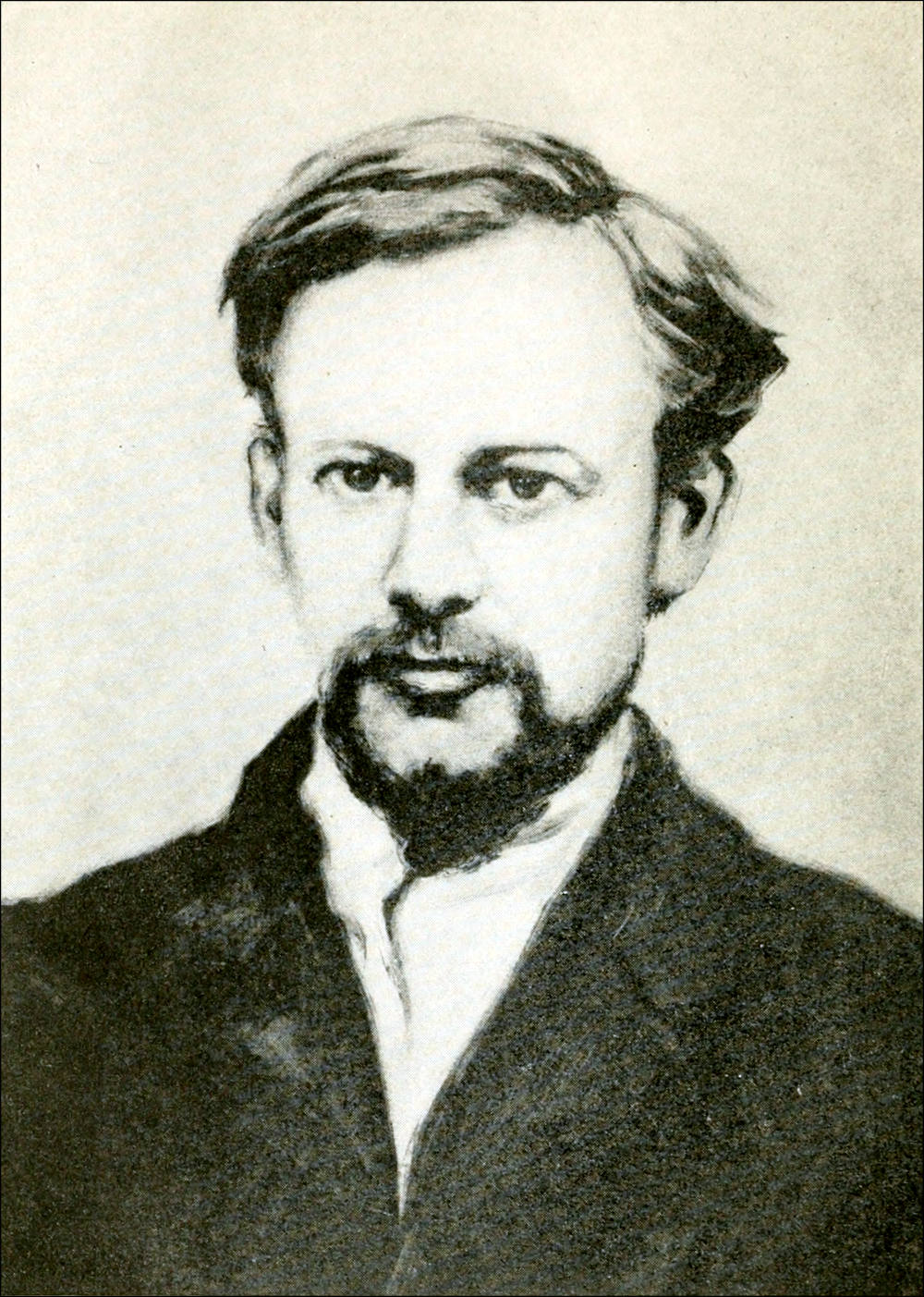
“Yes, I did,” my comrade replied; “but I want to hear the whole story from you.”
“Wait, the boys will come, and we will talk it over,” said the host. “Did you bring any books?” he asked.
We untied our wallets and laid out on the table all the pamphlets we had brought. The host reverently picked up every one of them and read the titles aloud.
Soon the hut filled with young and old peasants. There were even women with infants in their arms. They all knew Vania well, and greeted him in a friendly manner.
“See how many of our people are missing!” said an old peasant with a white beard. “That’s after the manifesto.”
“Tell Vania everything,” several voices said at once.
The old peasant laid his hands on the table, crossed them, and began:
“When we heard that the czar had issued a manifesto and had given us liberty,—and the year had been a bad one, and there was nothing in our barns,—we understood by the czar’s favor to us that we might take the superfluous 136grain from the landowners. We gathered the whole village, came to the house of the landowner, called him out, and said to him:
“‘The czar’s favor gave us a manifesto that we might take your grain, there being none in our barns. Give us the key. We will divide fairly, and shall not forget you.’
“The landowner began to yell at us, and went back into the house. We waited, but he didn’t come out. Then we decided that he had heard nothing about the czar’s manifesto. So we broke the lock, divided the grain among ourselves, and went home. That was in the morning. Toward evening we heard a noise, and the dogs were barking. We went out and saw an important official coming. All about him were Cossacks. We thought that he came to read to us the czar’s manifesto, so we fetched bread and salt and met him, bowing low. He ordered us to gather in the village square. We came in good order, and he swore at us in the worst language. Then he shouted:
”‘Those of you who first thought of rioting and going against the landowner step out.’
“We all answered in chorus:
“‘Your high Nobility, we did not riot, but there was a manifesto from the czar that we 137might take the grain from the landowner, there being none in our barns.’
“‘I’ll show you!’ he shouted, striking us with a nagáika. ‘I’ll show you what the czar’s manifesto means! Let us have rods, rods!’
“They seized Andrei first, and flogged the poor fellow so that he remained lying on the spot. His hapless wife was weeping, and the Cossacks hit her in the face with their nagáikas and swore at her. The women and children began to cry. The Cossacks surrounded us on all sides and did not let us get away. They flogged ten people, and after that the official—it was the governor—said:
“‘And now take the grain back to the landowner’s barn.’
“‘That, your high Nobility, we cannot do,’ we answered. ‘There was a manifesto from the czar that we might take the grain for ourselves.’
“‘Shoot these dogs!’ he shouted to his Cossacks, and they fired a volley. Eight were killed and many wounded. After that the Cossacks went to the houses and began to rob us. They insulted our wives and daughters, and Savitch’s girl they crippled for life.”
As he spoke his white head was shaking, and his withered hands were trembling. Every 138word of his sounded terrible in the dimly lighted hut. He finished, and rested his head on his hands. For a long time no one dared to disturb the silence which reigned in the room. It seemed to me that a whole eternity had passed since he began his woeful tale.
About ten o’clock the gathering broke up. We remained there for the night. I did not sleep. That night a resolution ripened in my mind. In the morning I refused to go farther and returned to the city. I went to a member of a local committee of the Socialist-Revolutionists’ party. He was a well-known revolutionist who had spent a great many years in prison and in Siberian exile. To this man I confided my secret.
“Very well,” he said; “I will communicate with the committee.”
On the same day he delivered to me the following decision:
“The committee deems the assassination of Governor Khvostoff necessary at this moment, as a response to all the atrocities he has committed in the villages. It has also become known to the committee that the governor is trying to organize a Jewish pogróm in the city of Tchernigoff. In consideration of all this the committee 139accepts your proposal, and authorizes you to make the attempt.”
Mr. V—— also gave me money for necessary expenses and some information about the governor.
He lived at one end of Tchernigoff. His house stood on a hill, and was surrounded by a garden. Fortunately, the third house from his was vacant, and I immediately rented it. The house was rather too large for one person, and to avert suspicion I told the landlady that I expected my mother and sister from Warsaw. I sent my passport—that of a Polish school-teacher—to the police station, and in a few days it came back safely. Then I telegraphed to Comrade Nicholai. He had shortly before left the hospital, having been wounded during a pogróm that occurred on the day after the issue of the manifesto. Comrade Nicholai arrived in Tchernigoff in a few days, and took lodgings opposite the Noblemen’s Assembly. As we had learned, the governor sometimes visited there.
Sitting at my window, I studied the governor’s daily routine. I learned when he got up and when he went to sleep. I learned when he received and whom. I even knew his dinner-hour.
For a whole week the governor did not leave 140his house except for a walk in his garden. Slowly the days and sleepless nights dragged by. Alone with my thoughts, I paced the deserted house. I spent most of the time making up a list of the governor’s victims. I treasured the names of those who had been shot or flogged to death by him. I read and re-read for the thousandth time the simple narratives of the peasants about his terrible crimes, and my heart bled for them. Hopefully I looked in the direction of the shelf on which the bomb lay.
Finally it became positively known to us that the governor would drive on New-Year’s day, at twelve o’clock, to the Noblemen’s Assembly, and we decided to assassinate him on his way back.
It was New-Year’s eve. I sat near the window and looked at the snow-covered road. There was only one thought in my mind: he must die. All doubts had disappeared. I knew, I felt that it was going to happen.
At midnight I carefully removed the tube from the bomb, dried the powder, and reloaded the bomb. I put the four-pound tin box in a fine hand-bag specially bought for the occasion, and again read over the list of the peasants murdered by the governor. I set everything in order, 141wrote a letter, and left money for the landlady. Then I went to bed.
“I must sleep,” I repeated to myself, and I actually fell asleep.
A knock at the door roused me. I opened my eyes, and the consciousness of what was going to happen on that day filled my soul. My heart began to beat faster and faster. There was another knock at the door. I slipped on a morning gown, and looked out of the window. A group of masked children stood at the door. I understood that they must have come to congratulate me, and, according to custom, throw millet-seeds all over the house. For this they get a few kopecks.
I admitted them, and in feverish haste began to hand to them anything I could lay my hands on. An uncontrollable desire to remain a little longer with these innocent children seized me, and I begged them to take off their masks and have tea with me. They hesitated; but when one of the elder boys took off his mask, all followed his example. I made tea, and seated the children about the table. They were becoming bolder and bolder, and soon they were chatting carelessly and curiously regarding me and everything in the house.
142The samovar was steaming merrily on the table, the children were laughing noisily, the sun shone brightly in my window. For a minute I forgot what was going to happen in a few hours. Suddenly a Cossack galloped past, followed by a carriage. I recognized the carriage. The children continued to laugh, but I no longer heard them.
“Go, go, children! it is time!” I exclaimed. “But first let us bid good-by.”
They looked at me in surprise. Their cheerful little faces clouded with regret, and their thin, unwashed hands extended to me.
“Don’t forget me, children!” I said.
They made the sign of the cross, wished me a happy New-Year, and quietly went away. I dressed hastily, took my hand-bag, and went into the street.
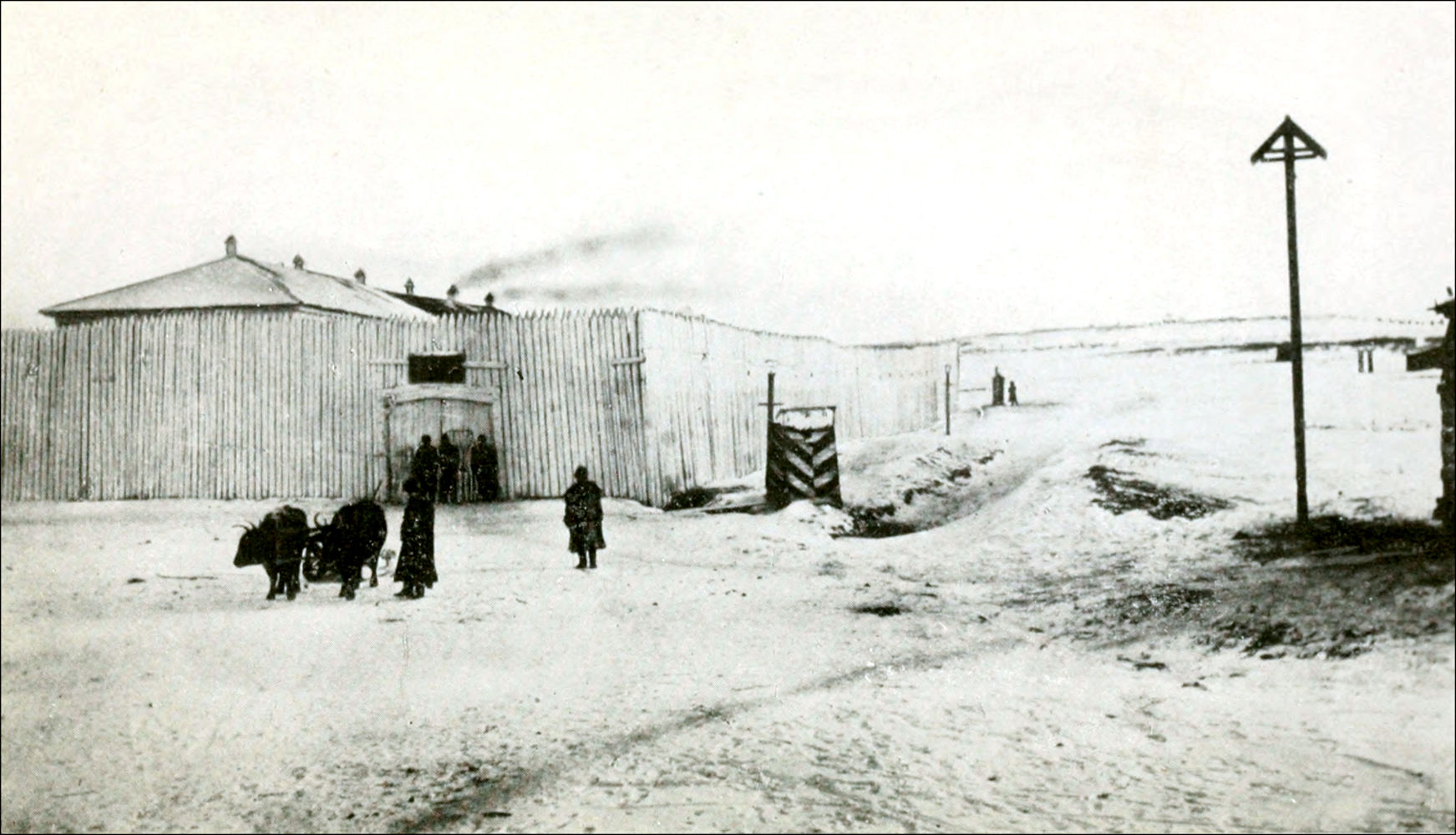
THE PRISON WALL FROM THE OUTSIDE
The day was bright and cold, the sky cloudless. The street was almost deserted, with only now and then an occasional passer-by hurrying to church. Four blocks from my house was a bridge on which a gorodovoi stood on fixed post. Holding the bag in my hand, I passed him, and he bowed low and wished me a happy New-Year. Soon, however, I came back, and began to walk up and down not far from my house. A few 145minutes later I saw from afar Comrade Nicholai walking with slow and measured steps toward me. In his hand he held a box tied with a red ribbon: that was a bomb. He crossed the bridge, and stopped about seventy or eighty feet from me. I knew then that he would throw the bomb from there. It was our understanding that he would throw the bomb from where he stopped. I continued to walk back and forth in the direction of the governor’s house. Comrade Nicholai overtook me, and whispered while passing:
“I saw him. Remember, keep farther away from me, lest an accident should happen to your bomb when mine explodes.”
“All right,” I whispered in reply.
“Good-by!” said Nicholai, and quickly went to his former place.
I followed him with my eyes, hardly moving. The street still remained deserted. Suddenly a mounted Cossack appeared, and behind him a carriage. Comrade Nicholai immediately stepped down from the curb. At that moment the carriage approached him. He raised his hand, and threw the bomb under the carriage. The bomb fell softly on the snow and did not explode. A police officer who was riding behind 146the governor sprang at Nicholai, and I heard the report of a pistol. The carriage stopped for an instant; but evidently taking in the situation, the coachman began to whip the horses, and drove at full gallop straight in my direction. I stepped into the middle of the road, and with all my might hurled the bomb against the carriage window. A terrific force instantly stunned me. I felt that I was lifted into the air.
When I regained consciousness and opened my eyes there was nobody around. I lay on the road amid a heap of debris. Blood was streaming down my face and hands. I tried to lift my head, and lost consciousness.
When I came to the second time I was standing near a cab, supported by a strange woman. She was telling something to the cabman, but I could not hear her. She put me into the cab, and the driver started. He drove past my house, across the bridge, where a gorodovoi had always stood, but where there was none now. We rode through the whole length of the street without meeting a human being.
“What does this mean? Where are all the people?” I thought to myself.
The cab turned into some street, and stopped in front of a house. The name of a hospital at 147once brought me to my senses. I understood that through some miracle I had been saved from destruction, and that I had been brought, not to the prison, but to a private hospital. I paid the cabman, waited until he disappeared around the corner, and then went. At every step blood streamed down my face, blinding me. I walked and walked, utterly unaware of where I was and where I was going. I felt that my strength was leaving me, and that I would soon fall in the middle of the street. I chanced to see an open gate. I went into the yard, and sat down on the snow. The thought that I was saved did not console me. I knew that whoever should undertake to hide me would perish together with me.
“Where, where shall I go?”
To stop the flow of blood, I put some snow in my handkerchief and applied it to my head. This refreshed me a little. Then I took off my fur coat and lay down on it. Gradually my hands and feet began to grow numb with cold. The snow about me became red. Drops of blood froze on my face and hands. It grew dark. I felt a strange weakness in my whole body, and a deadly drowsiness seized my benumbed limbs. I do not know how long I had lain thus when I 148felt that some one was tugging at my sleeve. With difficulty I opened my eyes. A youth stood near me. He bent down close to my ear, and I distinctly heard: “Is that you who killed the governor—you?”
His words lighted up my dying consciousness.
“Yes, it is I.”
The youth straightened up, looked once more at me and the blood-stained snow, and went away without saying another word. Hardly five minutes had passed when he came back, followed by a hunchbacked old man. They raised me in their arms, and carried me into a house. The warm air and cold water applied to my head brought me to full consciousness. I realized that these poor Hebrews were imperiling their lives.
“I must go away from here,” I said to the old hostess who was coaxing me to lie down on their only bed.
“But the young man asked us to take care of you,” she replied.
The youth returned from somewhere greatly agitated, and said that the police were following me by the blood trail, and would probably soon be there.
149“Oh, oh!” groaned the old woman, and in great terror began to circle about the room. I ran to the door, intending to go out, but the woman cried to me:
“What are you doing? They will see you, and we shall perish.”
Suddenly she opened the wardrobe, pushed me in, and locked it. Humiliated and exhausted, I leaned against the door of the wardrobe, not daring to breathe. A far-away noise reached my ear. It came nearer and nearer. I heard the tramping of many feet near my hiding-place. My knees bent under me, and I lost consciousness.
Late at night I found myself sitting at a table. The room was lighted by a candle. The old woman was whispering in my ear:
“Thanks to God! I succeeded in fooling them.”
I could not understand what she was saying. I felt sharp pain in my head, and my whole body was burning. I cared about nothing, and wished only for quiet and rest.
The youth came in, holding in his hands a soldier’s coat and cap. They put it on me, and holding me under the arms led me into the yard. They seated me in a sleigh, with the youth beside 150me, and we drove away. We rode aimlessly through the city, passing everywhere patrols of soldiers and police. This eighteen-year-old youth evidently did not know where he was taking me. Bewildered by his discovery, and not wishing to deliver me into the hands of the infuriated authorities, he tried to save me at the risk of his own life.
At last we safely got out of the city, and after driving the whole night came to the town of Gorodnia. In this little town, where the youth hoped to put me on a train, we were stopped by a police captain with a group of soldiers. They took us to the police station and kept us there until a company of Cossacks arrived. I was separated from the youth, put in a closed carriage, and rushed back to Tchernigoff. We came there toward evening.
There was no furniture whatever in the filthy cell at the police station where they first put me, and I lay down on the floor. I was so weak from the loss of blood that I could not stand on my feet. A gendarme with a drawn saber stood near me. The door was not locked.
For several days I was in a semiconscious state. I remember only that my cell was always crowded with officials, high and low, who came 151to look at me. Whenever I began to fall asleep, the gendarme roused me and demanded:
“Who are your accomplices? What are their names?”
Weak and exhausted as I was, this question always brought me back to consciousness. I knew perfectly well why the gendarme asked me this, and silence was my only answer.
This inofficial torture continued for two weeks, but the consciousness of duty was so strong in me that all the physical pain and misery they inflicted upon me did not produce the desired effect, and all the subtle contrivances of the gendarmes to wring a confession from me were futile. All that they could think of doing to me was in a vast degree milder than what I had done to myself. My tormentors understood this, and seeing that their inhuman methods did not bring the desired results, they often let me sleep. During these two weeks the procurator and the examining magistrate came to see me a couple of times. But as I did not at all think of denying that I had thrown the bomb at Governor Khvostoff, they lost all interest in the case, and conducted the investigation with cold indifference. They did not even succeed in learning my real name, and I appeared before 152the court as “Unknown.” By not revealing my identity I hoped to spare my parents the cruel agony for a daughter who must die on the gallows.
On the sixteenth of January, late at night, I was transferred to the military prison, and told there that I would be tried by court-martial the next day. At ten o’clock in the morning Comrade Nicholai, the youth who was guilty of nothing but not having betrayed me to the police, and I appeared before the military court. When we were led into the court-room it was crowded with gendarmes and police. In a corner sat the unfortunate old parents of the youth. They were the only outsiders.
The ceremony of the trial lasted about half an hour, because we did not deny the fact, and there remained only to render the verdict, which they as well as we knew beforehand. We were offered to say our “last word.”[21] Comrade Nicholai rose and said:
“Gentlemen of the court: I went openly to fight the enemies of the people. I knew beforehand that for this death awaited me. But the 155belief that only by this means we can free Russia gave me the strength to sacrifice my young life. And now, before my death, I swear to you, my enemies, that this youth is innocent, and that I see him for the first time in my life.”
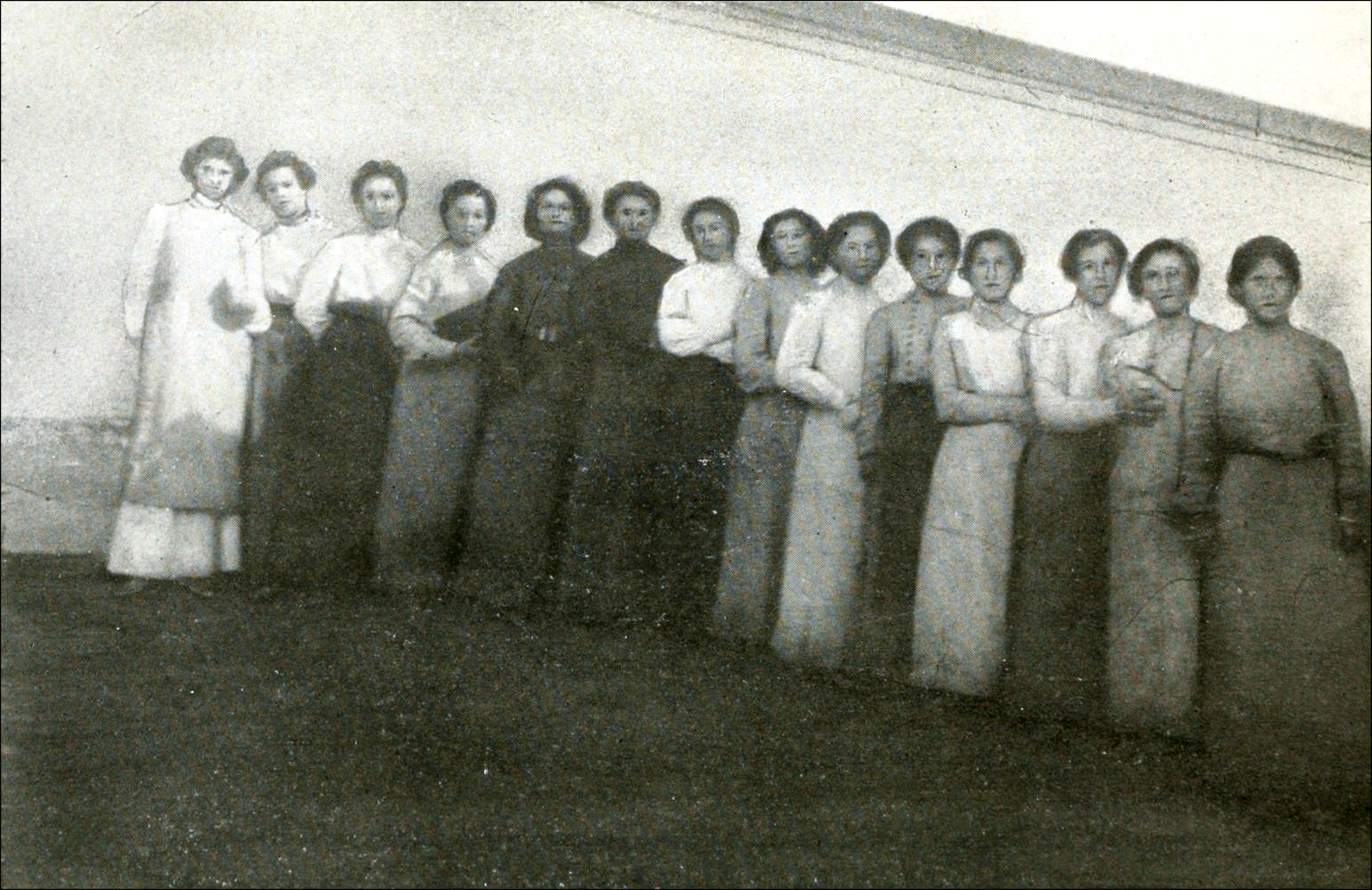
A GROUP OF POLITICAL WOMEN PRISONERS
In the yard of the Akatúi prison. Miss Sukloff is seventh from the left
“Gentlemen of the court,” said the youth, “I do not ask for clemency for myself, although I do not consider myself guilty. But I beg you to look at my old parents and take pity on them.”
It was my turn to say my “last word,” and I rose.
“Gentlemen of the court: I swear to you by my sacred belief that Russia will be free, for in this belief I went to my death; I swear to you by the name of the ‘fighting league,’ to which I have the honor of belonging, that this boy is innocent. Look at me. I am young, and I love life. I never knew Khvostoff, and had nothing against him personally. I went to assassinate him for the terrible atrocities committed by him in the villages, and after he had proved to be a real enemy of the people. I knew beforehand that I should die for this, but the thought of death did not terrify me. I went openly to my aim, and never lied even to my enemies. Perhaps I have only twenty-four hours to live, and you are the only people I see 156before my death. At this minute I want to forget that you are my enemies, and, as before God, I swear that this youth is innocent.”
I sat down, and the procurator rose and said:
“Gentlemen of the court: Although the accused produce a favorable impression, I, in the name of the law, must demand a death-sentence for all three.”
After this the court retired to deliberate upon the verdict, and we were taken to our cells.
Terror seized me at the thought that they might hang this strange eighteen-year-old boy. I paced my cell for hours. The sun set, it grew dark, and the judges were still deliberating. Oh, if only they would not hang him!
The clock struck midnight. Some one stealthily opened my door.
“To the court-room, please!”
The gendarme spoke in a whisper. The corridor was half dark. There was a clinking of spurs and sabers and the noise of hurried footsteps. Gendarmes and police were everywhere. The court-room was empty. The faces of the judges looked tired and haggard. The procurator did not look at us. At the sight of their expressions the torturous thought, “They will hang him! They will hang him!” passed in my 157mind. Everything grew cold within me. I could hardly stand on my feet. At last the president of the court, an old general, read the verdict.
“Nicholai Shpeizman is sentenced to death by hanging. ‘Unknown’ is sentenced to death by hanging. B—— A—— is sentenced to ten years at hard labor.”
I felt as if a heavy load had fallen off my shoulders. We congratulated the youth and bade him good-by.
“Ten years at hard labor!” I said aloud. “You will not have served a year when Russia will be free.”
The judges looked in surprise at our animated faces, and one gendarme whispered to the other:
“They probably did not hear their own sentences.”
We were led back to our cells.
“Is this a death-sentence?” I asked myself when I was left alone. “But why is my heart so light? Why don’t I feel what is going to be in twenty-four hours?” I searched all the recesses of my soul, I watched its innermost thoughts and movements, but there was no sign of death.
I saw no longer the walls of my solitary cell. 158I heard no more the stealthy footsteps of the gendarmes. I no longer looked at the indifferent faces of my jailers. There was no death, there were no longer the cruel chains which bound Russia. I was rising higher and higher, supported by thousands of arms. Where am I? Where am I? “Russia is free, free!” some one whispered in my ear. “You did not assassinate any one. That was all a nightmare, a horrible nightmare.”
“Dress yourself, dress yourself!”
This voice at once roused me to consciousness.
“Is it possible that the twenty-four hours have already passed?” I involuntarily asked the gendarme. “What time is it?”
“It is six o’clock in the morning,” he replied.
“Isn’t it all the same,” I thought to myself, “whether they will hang me a few hours earlier or later?”
The sun had not yet risen. And how I wanted to see the sun!
“Where will it be?” I asked the gendarme, but he only looked at me with a confused expression and did not answer. Suddenly I remembered the letter I had prepared for my parents. It was my last word to them. I looked around; there was no one but this gendarme.
159“Listen,” I said to him. “I cannot go to the gallows at peace with myself not having sent this note to my parents. This is the last wish of a woman who goes to die, and you cannot refuse her. Whoever you are, you have or had parents and must understand their terrible grief.” And I pressed the note into his hand. He looked about him, concealed the note, and said:
“All right; I will send it. But now I am taking you not to the execution, but to the prison.”
“They will hang me there,” I assured him.
Later I found that my parents never received this note. But, after all, he was a kind gendarme, because the thought that the parents would receive my last words of consolation gave me much strength, and I would have died happy.
In a closed carriage, surrounded on all sides by mounted soldiers, I was taken to the city prison. I was locked in a dark and filthy solitary cell. “I shall have to wait here a whole day,” I thought to myself. The day passed quickly, and night came. I lay down on the cot without undressing. In alarm I listened to the footsteps of the gendarmes in the corridor. 160“Why don’t they take me?” I thought. The hours slowly dragged by. Footsteps were constantly heard; frequently they approached my door, but passed it every time. Finally I fell asleep.
When I woke, the sun was high. An uncontrollable joy of life seized me. I felt my hands, my limbs, and the happy consciousness that I was alive, young and strong, was stronger than the death-sentence which hung over me. Every sound I could catch gladdened me. The tiny bit of blue sky I saw through the bars enchantingly drew me toward itself. I paced my cell, and my dreams carried me far beyond the prison walls. A great feeling of love of life, love of all living, grew more and more within me, and it vanquished death.
“They will hang you to-night,” I tried to argue with myself, but the words seemed meaningless. They could not conquer my belief in life, in all living. My jailers no longer irritated me. There was no more hatred in my heart toward these misguided people. They seemed so far, far away from me.
The whole day I was in a state of exaltation, and in the evening I again prepared for death, and waited. Without undressing, I lay down, 161but could not keep awake and fell asleep. Six days passed thus in the expectation of death. Every morning I looked in surprise at the bit of sky, which calmly regarded me from its azure height.
“What is it, then? Is it possible that this is death?” I wondered.
On the seventh day there came a knock on the wall. My heart began to beat joyfully: so I had a neighbor!
“Who are you?” I knocked immediately, and there came an answer, clear and unmistakable, “Shpeizman.”
“O God!” I exclaimed, “how is that? He is here, and they did not hang him yet!”
Soon we were deeply engrossed in conversation. It appeared that he had spent all the time in the military prison, and had just been brought here.
“This is the last day,” he knocked.
“Yes, I am sure,” I answered.
We hastened to share all our thoughts and feelings, all that we had lived through in the years of our friendship, unbroken by prison and exile.
“I don’t want you to die,” Nicholai knocked, and the feelings which had been hidden deep in 162his heart were at this hour of death freely expressed in words.
I could no longer stand near the wall. In utter exhaustion I fell on my cot. Hour passed after hour. Night came. There was an unusual noise in the corridor. I held my breath, and pressed my hands close to my heart. I heard the door of the adjoining cell open “They are taking Kolia,” I thought. I listened. Some one approached my door.
“Farewell, my beloved! Farewell, my dear! Be happy!”
“Kolia! Kolia!” I cried, but the thick walls drowned my feeble voice. I crouched in a corner and listened. The noise of footsteps grew fainter and fainter and died away. The strokes of a hammer were heard. “They are finishing the gibbet,” passed in mind. I leaned against the wall through which Kolia had talked; he was there no more. My heart was painfully compressed, and in the stillness of the night I could hear his dying sigh.
Some one stealthily opened my door and entered the cell. “At last!” I thought, and, straightening up, turned to face my executioners. It was beginning to dawn, and the little lamp which lighted my cell had grown faint in 165the light of breaking day. The governor approached and looked in my face without uttering a word. There was something evil in his look. I understood that he had come from the execution. He stood for about five minutes and went away.
I lay on my cot with my eyes open. A snow-storm was raging outside and knocking at the window-bars. The prison clock struck ten. The door of my cell was thrown wide open, and a high official entered.
“I have brought you imperial clemency. Your life has been granted to you,” he said and went out.
Slowly the hours passed. I lay motionless on my cot, trying to grasp the enormous significance of the fact. But a sudden void had formed within me, and there was nothing but emptiness in my soul. The thread of my inner life had broken, and I now vainly tried to gather the lost ends.
MY new life so graciously granted to me by the czar soon began. I was summoned to the office, and the governor asked me to sign a paper which stated that my death sentence had been commuted to penal servitude for life. Then he announced to me that I should be put in fetters. The solemn face with which he made this announcement appeared ridiculous to me. What meaning could fetters have to me now?
The doctor, for form’s sake, examined me and said that I was “well fit.” Nearly all the handcuffs and leg-fetters there could be found in the enormous prison were brought into the office and tried on me, but all proved too large and fell off. They were made for men, and feminine wrists and ankles did not measure up to their standard. Finally the governor found a way out of this exasperating difficulty. A blacksmith was called, my wrists and ankles were measured, and on the following morning new 167fetters were ready. Whether by mistake or intentionally, I don’t know, but they were made so tight that on the second day my hands began to swell. This caused me excruciating pain. I tried my best to conceal this circumstance from the governor, as I was sure that the fetters had been put on me at his personal wish, and my suffering would only gladden him.
On January 27th I was taken to the railroad station and put on a train for Moscow. On the road the soldiers of the convoy—there were four of them—risking their own liberty, took off my handcuffs. In the same car, in a separate compartment, sat the officer in charge: he could come in any minute and see that my handcuffs were off. I asked the soldiers to put them back on me, but they would not hear of it. And only a short distance from Moscow they handcuffed me again.
When I was brought into the office of the Moscow forwarding prison, Butírki, the governor was greatly surprised to see me in fetters. He exchanged significant glances with the secretary, and whispered something to him. He ordered to place me in a solitary cell. Three days later the fetters were taken off, after seventeen days of pain and humiliation.
168Soon after my arrival there were brought to Butírki five other young women revolutionists: Aleksandra Izmailovitch, the daughter of a general who had not yet returned from the battlefields of Manchuria. She had attempted the life of the Minsk chief of police during the Jewish pogróm in that city. For this she was sentenced to death, which was commuted to a life term at hard labor.[22] Anastasia Bitzenko, a school teacher, who shot General Sakharov at Saratov, one of the five generals personally sent by the czar to suppress the peasant revolt. She was sentenced to death, which was commuted to a life term at hard labor.[23] Lydia Yezerskaya, the wife of the Mayor of the city of Mohilev, who attempted the life of the Mohilev Governor Klingenberg for his active part in the Jewish pogróm in that city. She was sentenced to thirteen years at hard labor. Revecca Fialka, a dressmaker, who was arrested at Odessa in charge of a bomb factory and sentenced to ten 169years at hard labor. And lastly Marie Spiridonova, a school teacher, who shot Governor Luzhenovski of Tambov when he was returning with his Cossacks from a punitive expedition to the villages. She was sentenced to death, which was commuted to a life-term at hard labor.
The forwarding prison was terribly congested. In cells which were built for twenty-five were seventy-five and even a hundred people. Every day 200 or 300 politicals were sent away to different parts of Siberia, but as many, if not more, were daily brought to Butírki. It seemed as if all Russia were being exiled. But notwithstanding that the revolution was crushed, the prisoners so deeply believed in the speedy liberation of Russia that they went to hard labor and exile with a light heart.
“You may laugh at your life sentence,” comrades shouted to us through the window bars. “You will not have stayed there long when a free nation will carry you in their arms back to free Russia.”
In the middle of June, at night, the governor of the prison came into my cell and told me to get ready for the journey. A few minutes later I learned, through the window, that all the six of us women hard-labor convicts were to be 170transported somewhere. About twelve o’clock we were led to the office and told that we should be sent to Akatúi. There, in this office, I first met Marie Spiridonova. She looked so young and frail,—she was only twenty—and her beautiful face was so pale that I thought she would not live long. She tried to smile to us, but her eyes remained sad.
All the six of us were conveyed to the railroad station in a closed carriage, and put in a separate car attached to the Siberian express. Accompanied by twelve soldiers and an officer, we left Moscow for the distant prison of Akatúi.
When we were sent to Siberia the revolutionary movement there had not yet been crushed by the government. The Krasnoyarsk “republic,” which had lasted about forty days, was still fresh in the memory of the people. The revolutionary committees in the various cities we had to pass learned in some way about our coming and organized demonstrations in our honor. A particularly striking demonstration occurred at Omsk. The Omsk workingmen knew from their railroad comrades the day and hour of our arrival there, and impatiently waited for us at the 171station. When this reached the ears of the local authorities they met our train at some distance from the city, uncoupled our car, and put it on a side track, evidently hoping to take us through Omsk at night. But some one on the train divulged their trick to the people at the station. A number of workingmen seized a locomotive and started out to look for us, followed by a crowd of several thousand people on foot.
Our car was sidetracked about five o’clock in the morning, and at noon the workingmen located us. When the officer in charge of our convoy saw the crowd approaching he showed us a paper he received at our departure from Moscow. It instructed him to shoot us at the least attempt to escape or to be released by a mob. The soldiers were in a state of terror. They had become our friends during the long journey from Moscow, and did not feel capable of executing such an order.
“We will rather die ourselves than shoot you,” they said to us.
The workingmen seized our car, fastened it to their locomotive, and brought us to Omsk. Thousands of people met our approach with shouts of delight. Rich women took off their jewelry and threw it in our windows. All 172loudly demanded our appearance on the platform. For a moment the situation was rather critical. The people were getting more and more insistent, and threatened to take us out by force. In the meantime Cossacks and soldiers were surrounding the crowd. The inevitable tragedy with all its dreadful consequences rose before us. We began to implore the officer to let us out on the platform for just a second, that we might induce the crowd to disperse. Fortunately the officer, seeing that the affair was assuming a very serious aspect, permitted us to go out and address the crowd. As soon as we appeared on the platform all became quiet. We asked the people not to attempt our release as we did not wish to witness any bloodshed; we told them we did not believe we should stay long at hard labor, and they finally consented to let us proceed on our way.
For many miles the crowd followed after our train, waving red flags and singing revolutionary songs. Peasants left their work in the field and ran to see the unusual sight. They threw flowers at us, and soon our car was covered with them.
It was late in the evening when the last shouts of farewell died away in the distance. 173Similar demonstrations were repeated at Krasnoyarsk, Irkutsk, and other places.
At last we reached Stretinsk. From there we had to proceed by étape. It took us nine days to cover the distance of 130 miles, and in the middle of July, 1906, we reached our destination.
The Akatúi prison is located in the little village of Akatúi, in the Trans-Baikal, near the Mongolian border. It is famous in the history of the revolutionary movement in Russia. Yet the Decembrists[24] were confined in it. Chained to wheelbarrows they worked in the mines guarded by soldiers with fixed bayonets. One of them, Lunin, died there a hard-labor convict, and his lonely grave is the only evidence of generations of political prisoners who were slowly tortured there to death by the Russian czars. The Polish insurgents of 1863 were sent there. The prison had been abandoned, but again rebuilt in 1889 and has since held within its dreary walls a great number of political offenders.
When we were brought to Akatúi the régime 174there was not very strict. The wave of reaction which swept Russia soon after the October manifesto had not yet reached this God-forsaken place, and the local administration still believed that a new political era had dawned in Russia. We were treated fairly well: we were permitted to wear our own clothing, to receive books, and enjoyed similar little privileges. When out for the daily walk we freely conversed with other prisoners, and argued about affairs in far-away Russia. But month passed after month, and news from there reached us less and less frequently, and what did reach us was far from hopeful. The country was being crushed by the triumphant reaction, and the chains of autocracy were becoming heavier and heavier. Our prison régime grew worse and worse, until, by the end of 1906, we were deprived of all the privileges and treated like ordinary hard-labor convicts.
Our position in this living grave was intolerable. We were young, and the fire of struggle was still burning in our breasts. We no longer hoped for the speedy liberation of Russia, and could not reconcile ourselves to a life of idleness and degradation. And we began to cast about for a way to escape. A group of comrades commenced 175to dig a tunnel. The digging had continued for over a month and the outer wall had already been reached when the authorities discovered it. Within several months five tunnels were begun, and each time it was discovered when near completion. In the end we had to give up the thought of gaining freedom in this way. Seeing that escape in a body was impossible, the group of Socialist-Revolutionists headed by Grigóri Gershuni[25] decided to find a way to escape singly. Gershuni, as the more useful and capable member of our party, was chosen to go first.
For many years it was the custom among the prisoners at Akatúi to make sauerkraut for the winter. The cabbage was brought into the prison, the convicts cleaned and cut it, after which it was put in a barrel and taken to the cellar, outside the prison gate. It occurred to Gershuni to escape in this barrel, and we set about executing the plan. We punched two little holes in the bottom, and inserted long 176pieces of thin rubber pipe: these Gershuni was to hold in his mouth, and they were his only source of air. He sat down in the barrel, bending almost double, as it was not large enough for such a tall, stout man. On his head we laid a metallic plate to protect it from the bayonet of the sentry at the gate who always thrust it into the barrel to ascertain that no contraband was being taken out of the prison. We stretched a cloth over him and nailed it to the walls of the barrel. On the top we threw cabbage, and fastened the cover.
At eleven o’clock in the morning everything was ready. The comrades who had to cart the barrel to the cellar announced to the head-keeper that the cabbage was done, and he gave the order to open the gate. Breathless we stood and watched how the sentry stuck his bayonet into the barrel in which our most respected and beloved comrade lay. At last it was without the gate, and the comrades with the help of the soldiers lowered it into the cellar. A tunnel leading into an open field had already been dug from there, and horses were waiting in the forest near by.
To conceal his absence for a day or two and thus give him an opportunity of getting away 177as far as possible from Akatúi, we made a dummy, dressed in Gershuni’s clothes, and put it on his cot. Its head was made of Holland cheese specially imported from Chitá and painted by one of our comrades, an artist. When the keepers came in the evening to count the prisoners a comrade spoke to the dummy, and they went away satisfied that Gershuni was in his place.
When the keepers came into our cell and we saw their calm faces we knew that everything was well. Our joy was indescribable. We already pictured to ourselves the triumph of the Party, and warmly discussed the question where Gershuni would be by the morning count. But scarcely an hour had passed when we heard a noise in the yard. A number of keepers ran excitedly into our cell and began to look under the beds. We understood that some of the prisoners must have reported Gershuni’s absence, as the authorities could not have found it out themselves before the morning count.
In great trepidation we awaited Gershuni’s capture. But as the days passed our fears were set at rest. We knew that if he had not been caught on the first day of his escape the authorities had small chances of getting him. He possessed 178wit and courage, and had money enough to pay his way to the nearest seaport and cross to Japan.
Gershuni’s escape led to still further restrictions. But as it was impossible to maintain a severe discipline in the overcrowded prison—it was built for 80, but there were 150—the authorities transferred 50 prisoners to Gorni Zerentúi, about 128 miles away.
We were the only women in Akatúi. We were sent here because in the whole Nertchinsk mining district there was not a decent prison for women. But in order to subject us to the full rigors of the hard-labor régime the higher administration decided to remove us from Akatúi. The government again felt its power over the bleeding country, and the first on whom it avenged itself were its political captives.
In February, 1907, the chief of kátorga,[26] Mehtus, telegraphed to the governor of the Akatúi prison, Zubkovski, that the women politicals must be immediately transferred to the Maltzev prison, about 130 miles from Akatúi. Marie Spiridonova, who had not yet recovered from the effects of the tortures to which she was subjected at the time of her arrest, was not well. 179I, too, was sick, having contracted inflammation of the lungs. For us to undertake a midwinter journey over the frozen mountains of Akatúi was to court death. The étapes which were built in the thirties of last century were in ruins, and to spend a night in them was just like sleeping in the street. We knew it all, but it was utterly useless to struggle against the decision. There, within the walls of the dreary prison, thousands of miles away from Russia, they could do with us whatever they chose. It must be noted here that had the authorities waited another month our lives would not have been put to such a risk: in March the frosts are not so severe, and there happens even warm days.
When the comrades learned the intention of the administration to transfer us immediately their indignation knew no bounds. Even the governor and the prison doctor were unwilling to send us. Zubkovski telegraphed to Mehtus that the two of us were sick and that the doctor thought our lives would be endangered if we should have to travel by étape at this time of the year. Several days later, on February 12th, the governor ordered four of us, Bitzenko, Izmailovitch, Yezerskaya, and Fialka, to get ready. 180With a heavy heart we bade them good-by. It was a sad parting, as we did not expect to see them any more.
Alone in our deserted cell we lay thinking of our friends. It was late at night, but we did not sleep. Spiridonova felt very bad after the day’s excitement. Soon she began to toss about and talk in a delirium, and I went over to her cot. With great difficulty I succeeded in rousing her.
“Dear, dear, look at me! There is nobody here but myself.”
She sat up on her cot, and embraced me.
“Do not sleep, my dear, do not sleep,” I begged her, fearing that the terrible fit would again seize her if she should fall asleep.
In a close embrace, clinging to each other, we sat in silence, seized with the consciousness of our utter loneliness and defenselessness. The prison clock struck two.
“Oh, how long it is yet till dawn!” sighed Marie. Suddenly she began to listen.
“Do you hear?” she asked me.
“No, I don’t hear anything. It is the wind roaring in the mountains,” I tried to quiet her.
But soon footsteps were heard outside, and our gate was opened.
181“Oh, they are coming!” I cried involuntarily.
We heard the door of our corridor open. We covered ourselves with our blankets, embraced each other still closer, and waited. Heavy footsteps filled the corridor. They kept coming and coming, and it seemed there would be no end to them. Several people approached our door. We held our breath. The door was violently opened, and an officer with a paper in his hand stood near our bed.
“I am the governor of Algatchí prison, Borodulin. Have been sent here by the chief of kátorga, Mehtus, to transfer you immediately to the Maltzev prison. I will do that even if I have to take you naked and to shoot down the whole prison. At the least resistance on your part I will employ force,” and he pointed in the direction of the corridor where armed soldiers stood in readiness.
I looked at his ferocious face, at his white gloves, and a tremor passed through my whole body. Marie closed her eyes, and I thought that she would again become delirious.
“Very well,” I said to Borodulin. “Let us dress ourselves, and when we are dressed you will be able to do your business.”
Borodulin turned to the wall.
182“Dress yourself.”
“No,” I answered, “this is absolutely impossible. We cannot dress when you are in our room.”
He thought for a moment, and went out, closing the door after him. We dressed hastily, and opened the door. Borodulin entered.
“Are you ready? I will not wait any longer.”
At this moment there came a knock on the wall. Our comrades had heard Borodulin’s loud voice, and were uneasy. The whole prison was awake. The knock was repeated.
“Wait!” I knocked to them.
“Listen,” Marie suddenly turned to Borodulin, “they will not let us go, and you will have to shoot down the whole prison. But if you will permit us to explain to them the situation they will agree for our sake.”
“This is against the law, and I cannot do it,” Borodulin answered.
“Then call our governor,” I suggested.
Zubkovski, who was in the yard at that time, was called in.
“What can I do for you?” he asked. He knew what a tragedy would inevitably follow Borodulin’s attempt to take us by force.
“Induce Borodulin to allow us an interview 183with Sazonov and Karpovitch.[27] They are the only people here who can prevail upon the comrades not to raise a riot.”
Borodulin stood right there when I spoke to Zubkovski and calmly examined his white gloves.
“Come,” said Zubkovski to him, and they went out. A few minutes later Sazonov and Karpovitch were led into our cell. Sazonov was pale as a ghost, and could not utter a word. He seized Marie’s hands, and held them, looking at the soldiers all the time. Karpovitch was all in a tremble.
“You shall not go, you shall not go,” he repeated, grinding his teeth and shaking his powerful fists. His eyes were bloodshot, his face assumed a bluish hue, and his whole body trembled with excitement. For a moment I thought that he would attack Borodulin who retreated a few steps, seeing him in such a terrible state.
“Leave them for a minute,” said Zubkovski to Borodulin, and they went into the corridor.
When we were left alone Marie said to them:
184“You must let us go, otherwise we shall not live it through. We shall not be able to bear the thought that you will perish and that we shall be the cause of it. What will be with us if the whole prison will be shot down?”
They remained silent. Borodulin and Zubkovski entered, and Borodulin announced to us in much milder tones that he would take a féldsher[28] along and that we would not stop in the étapes. Zubkovski looked questioningly at our comrades.
“We are ready,” said Spiridonova. Sazonov took Karpovitch by the arm, and they went towards the door. Before going out they turned back and looked at us, evidently still unwilling to leave us in the hands of the heartless Borodulin.
It was about four o’clock when we, dressed in heavy sheepskin coats and supported by the soldiers, went out into the prison yard. The frost was so severe that we could hardly catch our breath. Sleighs were standing at the gate, and we started, accompanied by Borodulin, a féldsher, and several soldiers.
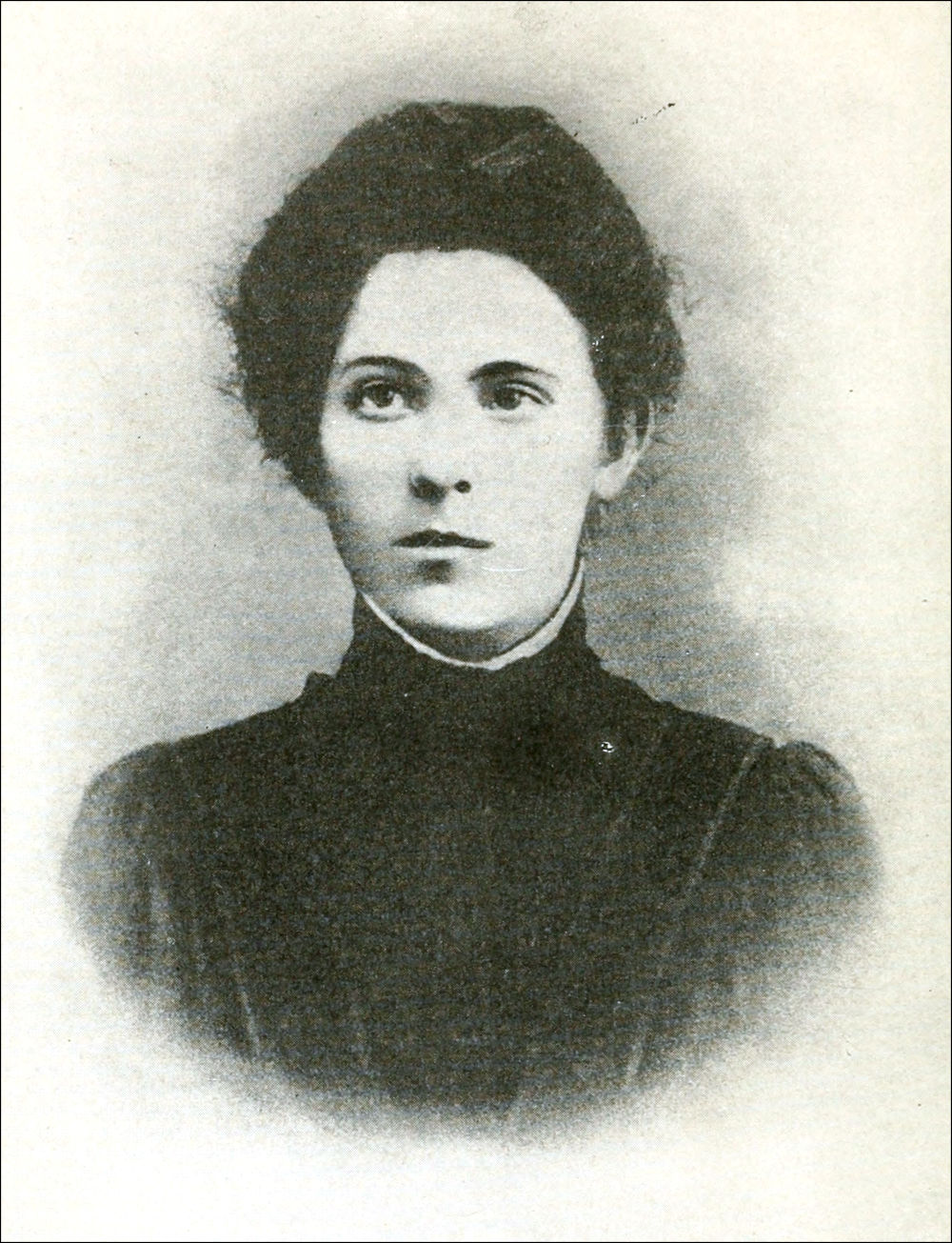
MARIE SPIRIDONOVA
Assassinated General Minn, the famous torturer of revolutionists
It was twelve miles to the first étape, the Aleksándrovski Zavód.[29] Borodulin stopped a 187couple of times on the road, came over to our sleigh, and asked ironically:
“Well, are you not yet frozen?”
Early in the morning we arrived at the Aleksándrovski prison. In the semi-dark barrack where we were led in lay our friends, muffled up in their khaláts. A look of terror came into their eyes when they saw us. They were sure that we had been spared this dreadful journey. In a few words we related to them the events of the previous night, and told them that Borodulin had come with us.
We passed the whole day in this cold, unheated barrack without seeing any one of the authorities. During the evening roll-call the governor of the prison announced to us that Borodulin had gone back to Akatúi and that he had left orders to send us early in the morning by the regular étape. All protests were of no avail. At six o’clock in the morning we started out, accompanied by twelve soldiers. The féldsher did not go with us.
We traveled seven days, stopping for the night in the hideous holes called Siberian étapes. Marie Spiridonova was so weak that she had to be carried to and from the sleigh. Although the cracks in the walls admitted air freely the atmosphere 188in them was unspeakably foul, poisoned by the filth and the parásha which had evidently not been washed for years. When we at last reached the Maltzev prison we were more dead than alive....
The old Maltzev prison was built exclusively for women, and had a capacity of fifty. But in reality the number of prisoners there was never less than 100, and sometimes reached 120. We were the first politicals sent there.
The six of us were put in one cell. It was about fifteen feet long and ten feet wide. Six beds covered with coarse, gray blankets, a long table, and two benches on the sides were all its contents. It had two windows, from which we could see the stone wall.
The cold, the dampness in our cell, and the food which consisted of black bread, balandá,[30] and tea without sugar, were not conducive to good health, and Spiridonova felt worse and worse. There was no hospital in the prison, and we prevailed upon the governor to summon the doctor from Gorni Zerentúi, about four 189miles away. He came, and only looked at us sorrowfully.
“What can I do?” he said. “Everything depends upon the chief of kátorga, Mehtus. Send for him, and ask him to transfer the sick to solitary cells: they are warmer and drier.”
We immediately sent a petition to Mehtus, who lived in Gorni Zerentúi. A couple of weeks later he arrived. He entered our cell without a greeting, and stood without looking at us. In answer to our request to transfer Spiridonova to a solitary cell he made a curt and coarse reply, and went out. After this we never asked him for anything.[31]
Time passed slowly in the Maltzev prison. Days, months, years stretched into one long and weary monotony. At first we were only six politicals there, but gradually our number increased 190by new arrivals from all parts of Russia, and soon we were forty. Their arrival was the only break in the monotony of our existence. But the news which they brought and their own spirits soon faded in the atmosphere of the prison, and they, in turn, waited for others to come and revive their dying hopes.
The first few years after the revolution Russia yet remembered her sons and daughters who were immured in the prisons of remote Siberia. But the constant persecution and misfortunes at home made them forget the living corpses who were buried in the frozen wilderness. Communications and financial assistance came less and less frequently, and finally ceased altogether.
Those who were sentenced for a term of years counted the days and months. They knew that if only they should be able to serve out their sentence they would see a glimpse of freedom—as much as one can see in Siberian exile.[32] But what awaited us, sent here for life?
The belief in the speedy liberation of Russia was being slowly crushed by the overwhelming grief which filled our souls. “How many such 191years will pass, one as dreary as the other?” I often asked myself. Whether I circled aimlessly our small prison yard on our daily walk or tossed about on the hard bed in the long sleepless nights, these thoughts tormented me unceasingly. Lying awake of nights I often heard the whispered conversation of my comrades in the corners of the semi-dark cell. They could not bear the oppressive silence of the prison, and would begin to speak of their past life, of their dreams and wishes. But to me it seemed that what they were dreaming about would never return, that all was lost in this abyss of misery and degradation.
Bad as our position was, that of the common-law convicts was still worse. The Siberian administration is to a certain extent afraid to do to the politicals what they do to these unfortunate women. There was a barrack just outside the prison wall in which women ex-convicts lived. Half of this barrack was occupied by soldiers, who, following the example of their superiors, perpetrated most atrocious acts of violence upon these defenseless women. During the last year of my stay there two died almost simultaneously from the effects of such mistreatment. There were cases when women were 192killed when they resisted. A young Tartar woman with a two-year-old child was strangled on the first night after her release from prison.
I do not know of a single instance when the administration or the soldiers were punished for these crimes. We reported these cases to the governor, but he never investigated, and I am sure that our reports never left his office. These horrors made our life there a perpetual torment, and we lived under their constant impression.
The most trying time we experienced when the higher administration came to inspect our kátorga. Their inspection did us no good, and only added to our suffering. To show that discipline was strictly enforced in his prison our governor used to put us in chains—those of us who were sentenced for life—and keep us thus for weeks. The only advantage we derived from their occasional visits was that for a few days previous to their arrival our food was somewhat better than ordinarily, as the local authorities were then afraid to appropriate the money which the government allowed for the maintenance of the prison. The robbing of the convicts in Siberian prisons has become a tradition, and is practised on a large scale. 193The governor of the Maltzev prison, Pokrovski, sold not only cloth and linen which the convicts were supposed to wear, but even foodstuffs and firewood. Large sums of money were sent from St. Petersburg to repair the building, but we continued to freeze because the governor preferred to pocket the money than use it for repairs.
There was only one bright spot in our dark and cheerless life, and this was our warm friendship for one another. This friendship fed our sorrowing hearts, and sustained us in the hours of trial and affliction.
In the summer of 1910 I fell sick. The doctor from Gorni Zerentúi was summoned, and he found that I suffered with appendicitis. My comrades began to send petition after petition to the chief of kátorga, asking him to do something for me, but received no reply. My condition seemed hopeless. I could not eat the coarse food, and a slow death from starvation threatened me. Just then the chief prison inspector, Semenkovski, came from St. Petersburg to inspect our prison. When he asked my comrades if they had any requests to make they all answered 194that the only thing they asked for was that I should be transferred to a hospital. Several days later the governor announced to us that Semenkovski had ordered to transfer me to Gorni Zerentúi. We could hardly believe it. During the three and one-half years of our stay in the Maltzev prison there were many cases of sickness, but we never succeeded in having the patients removed to a hospital.
Four soldiers came in, and laid me on a stretcher. My comrades stood around me in a circle, and each one of them tried to say a few words of encouragement. But their eyes and faces were sad, and told me something different. They bade me good-by, hardly able to restrain their tears.
The gate opened, and the soldiers carried me out. Yet for a long time I could see the group of comrades who stood in the prison yard and waved their handkerchiefs to me.
The soldiers walked briskly, and soon we came to Gorni Zerentúi. I was placed in a narrow, half-dark, solitary cell—this was the hospital. I lay there for several weeks. The prison doctor, who was drunk most of the time, could not help me. After a great deal of official correspondence the authorities at last summoned another 195doctor from Algatchí, and the two decided to perform an operation. For two days they cleaned some cell which was supposed to be the operating-room. Then the doctor went to the Nertchinsk Zavód to get the necessary instruments. But when everything was ready, and they were preparing to take me to the operating-room, our drunken doctor refused to operate upon me.
For two and one-half months I was kept in Gorni Zerentúi. I do not know what would have become of me if not for Comrade Sazonov.[33] He prevailed upon the governor to get for me permission to summon a private doctor from Chitá or Irkutsk. Money for this purpose he had received from his parents. When this request was telegraphed to the governor of Chitá he ordered to transfer me to the Irkutsk prison.
It was the beginning of October, and the cold weather had already set in. I was exhausted with constant fever and hunger. To travel to Irkutsk in my condition seemed altogether impossible. But I welcomed this decision of the 196higher authorities, considering it the best way out of my misery.
“Now the end will come sooner,” I thought to myself. “And it will not be so hard for my comrades when I shall be far away from them.”
On the 22d of October, early in the morning, I was carried out of my cell and put in a sleigh. Two soldiers, a matron, and a féldsher accompanied me. The farther I went from the prison the greater my desire to live grew. I breathed the clear, frosty air of the mountains, I enjoyed the sights of nature, and my strength gradually returned to me. I felt better every day. I passed ten happy days, and on the eleventh I came to Irkutsk, and the heavy gates of the prison again closed upon me. But without these gates there were neither the black forests of Akatúi nor the bare mountains of Maltzev: I heard the bustle of city life outside, and the possibility of escape from here gave me new hope.
For eight months I struggled with my illness. The prison hospital was filthy and had no facilities for an operation. The doctor could not perform it alone, and private physicians refused to operate under such unsatisfactory conditions. The authorities were already contemplating 197sending me back when a happy idea occurred to me. I wrote secretly to an Irkutsk doctor asking him to perform the operation. I told him in my letter that it would be easier for me to die at once than meet a slow and lingering death from starvation. He understood my position. He came with two of his colleagues, bringing instruments and everything else necessary. I went to the operation firmly believing that I would get well and escape.
NINE days after the operation I found out, quite accidentally, that after two days I would be sent back to Akatúi. I was too weak to stand the journey which awaited me—marching with a batch of prisoners from one town to another until we reached our destination. Consequently, it was necessary to make up my mind to escape. The thought “two days, two days” did not leave me for a moment. And I resolved to make an attempt to escape. I knew what would follow. But could the most terrible death compare with being buried alive in that grave in which my best years had been spent, with no hope of ever getting out into the light of day? I thought: “Has cruel fate released me from that dungeon, only to throw me back into it? I cannot; I haven’t the strength to go away from the living sounds of the city.”
I felt hatred toward the people about me. They made me lie. They all thought that I was going back to hard labor. They washed my things and were getting everything in readiness 199for the journey. I was watched closely. The least misstep on my part, and all would have been lost. My comrades who were at liberty had planned to liberate me by means of a tunnel that had been dug from outside, but the authorities discovered the plot, arrested the people, and confiscated the money which had been kept for me. I was placed in a solitary cell, from which I was let out only for a few minutes during the day.
In my pillow I had a man’s outfit hidden; only shoes were missing. I decided to wear my own. I made up my mind to escape by crawling through under the gate.[34] The board could easily be removed. At first I could not believe myself. “Is it possible,” I thought, “that in this prison, where every crack is so carefully filled, the board under the gate could be removed, thus leaving an opening large enough for a grown person to crawl through?” But I convinced myself that it was so. The gate was located in the middle of the wall, and was always guarded by a soldier. Besides, the wall itself was guarded by two more soldiers.
I sent a note to my friends in town, asking 200that a carriage might be waiting for me on Saturday from nine to ten in the morning, the hour when I was let out for a walk in the prison yard. “But will it be there? Have my friends received my note which was entrusted to not very faithful hands?” were questions that I asked myself over and over again. But I was going to escape; I was determined. I knew that success depended upon my self-control. The problem before me was very simple, but the least error might prove fatal. It was necessary to act with mathematical precision. I paced my cell up and down, rehearsing under my breath: “I have to remove the board noiselessly, and crawl through without making a sound. I have to do all this before the guard has time to turn his face to me. Then I have to walk ten steps in a straight line, and turn to the right. I must walk slowly.” But deep down in my heart there was a creeping sensation, and a stealthy thought, “Will you do it? will you have the courage to put your head at the very feet of the sentry?” lurked in my mind. And I had a feeling as if somebody were trying to choke me....
Thus passing from hope to despair I spent Thursday and Friday. The evening roll-call was over, and I was locked up for the night. 201Only at night I was alone, in the daytime a guard was always with me. Oh, how I loved the night! At night I felt free. I did not see the dreary walls or the guards. In my dreams I soared into space, I dwelt in the skies, I performed miracles. The walls of the prison crumbled under my touch, bullets did not strike me, and I could defeat all the czar’s legions. But the first glimmer of day scattered my dreams, and I, chained, was again in the hands of my enemies.
It was midnight. Everything was asleep and quiet, only the measured steps of the sentry under my window could be heard. Quietly, without rising from my cot, I ripped my pillow open and took out my masculine garb. I was afraid to move, because the soldier peeped into my window every minute. With trembling hands I cut my long tresses. I put a kerchief on my head, and on the top of my masculine attire I donned the prisoner’s gray coat. And thus, fully dressed, I lay. I could not sleep, and I did not want to sleep. There were only a few hours left for me to live, I thought, and I was willing to fall from the soldier’s bullet outside the prison wall rather than go back to Akatúi. At six o’clock I got up. The sun was rising over my 202window, bright and smiling as ever, but in my heart there was no response to its smiles, no reflection of its rays—only darkness and uncertainty were there. Minutes and hours passed. My heart was growing cold, and at times almost ceased beating. When I came out into the yard for my last walk the regular strokes of a hammer reached my ear. Through crevices in the wall I could see two prisoners at work; they were building a staircase to the watchman’s tower. They were guarded by a soldier. All grew dark before me. There was no more hope. Another soldier at the gate!
The clock struck ten. I stood near the wall where the sounds came from, and it seemed to me that with every stroke of the hammer they nailed down the cover of my coffin. But a sudden thought flashed through my mind. I asked the guard who watched me to fetch my book in the cell, and he went on this errand. I knocked on the wall. The strokes of the hammer ceased.
“Brother, hello, brother!”
“What do ye want?” asked a gruff voice.
“Where is the soldier that is watching you?”
“He went away for a minute. He isn’t afraid of us—we shan’t run away. We have got only three days more to serve.”
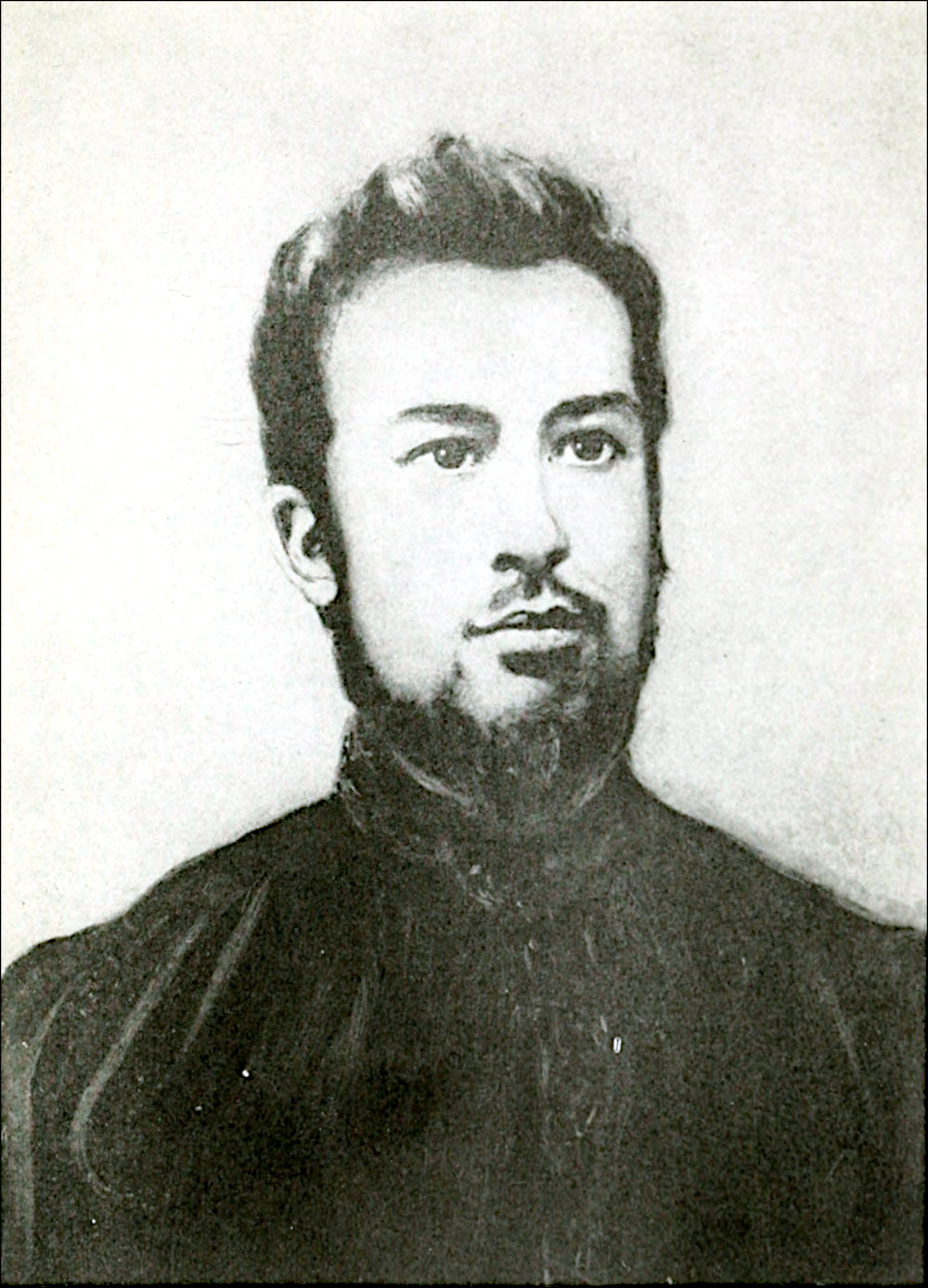
PETER KARPOVITCH
Assassinated minister Bogolyepov, sentenced to solitary
confinement in Shlússelburg fortress in 1906,
sent to Akatúi, escaped
205My heart fairly leaped with joy. With one jump I was near the gate. I threw down my prisoner’s coat. I removed the board from under the gate without making the slightest sound, and crawled through. I rose from the ground, and at that moment the soldier on guard, having come to the end of his beat, turned his face to me. I saw the carriage standing on the corner. I knew that I had to make just ten steps. But seconds seemed eternities to me, and the short distance between me and the carriage turned into interminable space. It seemed to me that I was not moving at all, but standing as if chained to the spot by the bewildered look of the sentry. Suddenly a shot rang out, and the bullet whizzed over my head. But before the smoke had cleared away I was already in the carriage. Bullets were falling about us in a shower. I shot aimlessly into the air, to scare off our pursuers. Soon we were lost from the view of the pursuing soldiers in a thoroughfare of Irkutsk. A feeling of utter happiness, the happiness of freedom, filled my whole being. I inhaled the dusty air of the street, and it seemed to me to be permeated with the odor of roses and violets. I saw no more the prison walls, and the narrow thoroughfare appeared to 206me a limitless expanse. My carriage was going at a terrific speed, and carrying me farther and farther away from the prison. I was ready to die right then, being happy with the thought that I saw the streets and the people on them not through the gray walls of my prison, but face to face, a free being. My head was like in a whirl. I saw as through a mist the faces of passers-by, and it seemed to me that they were smiling to me and celebrating with me my great victory over the walls of the dreary prison.
Our carriage stopped in front of a sumptuous residence, which was shaded by a row of trees. I jumped out and rang the bell. An old lackey opened the door. To my question, “Is so-and-so at home?” he replied that all had departed and would not be back before evening. My carriage was gone, and I knew that I could not lose a moment’s time, because the soldiers who were pursuing me would find me there. I did not know the city, and besides I could not appear in the streets in my attire without arousing suspicion. “I must enter this house,” I thought, “otherwise I am lost.” I looked at the lifeless face of the old lackey who stood before me at the door and kept on repeating that nobody was at home.
207“Listen,” I began in a feminine voice, “I must get in here, I cannot go away from this house in this attire. And you must help me.”
I stepped into the hall, closed the door, and took his hands. “We must hurry, because the police and the soldiers may come here at any minute.”
The old lackey stared at me in utter bewilderment and did not say a word. I thought that he had lost his power of speech from fright. He led me through the rooms, opened the bureaus and closets, and burned my masculine garb. Suddenly the door-bell rang. I understood that the police must have come after me.
“Dear, good man,” I said to the lackey, “you must take me out by the back door, and not say a word about what has taken place here, otherwise it will be all over with you.” And I ran in the direction he pointed without breaking his silence.
Here I was in the street, walking with none too firm steps and trying to remember the plan of the city. After about an hour’s search I found a house the address of which I had with me. I was admitted by a man of thirty or thirty-five. I told him my name. He grasped my hands, squeezed them hard, and kept on repeating 208like a madman: “Oh, what a miracle! what a miracle! In the middle of the day, before the very eyes of all the guards!” I had never seen this man, but his voice was firm, and I was beginning to hope that he would help me.
It was twelve o’clock then, only two hours having passed from the moment of my escape. Mr. N—— locked me in his cabinet and went out to see what was going on in the street. Only then I clearly saw what a problem I had before me. When I was in prison my only thought was, how to get out of it. I could not bring myself to think of the difficulties which would confront me when once out of it, and at liberty. “How shall I hide, where shall I go?” were questions that demanded immediate answer. I knew that all my comrades would be arrested immediately, and that to accept their aid would be giving myself into the hands of the gendarmes.
Mr. N—— came back and brought me new dresses.
“I think,” he said, “that it is best for you to leave this house. The house in which you have just been hiding is surrounded by the police, and we cannot depend upon the lackey. He may tell everything. I have a very good plan, but 209the road over which we shall have to go leads past the prison. Can you make up your mind to pass there?”
“And you,” I asked,—“Do you know what awaits you if you should be arrested with me?”
I knew that N—— sympathized with the revolution, but I also knew that he had never taken an active part in it, and besides he had a wife and two children.
“Don’t think of that,” he answered.
“All right, we will go.”
I dressed all in white, and put on a blond wig. The day was fine, and the sun again smiled to me. We neared the prison, and I could see the hospital, the cot on which I had lain eight months. There was the operating table. I recalled the faces of the doctors, who were the only people dear to me, dear because they were from the outside world, were free men. Even the prison guards then looked at me with a soft expression in their eyes, because they were sure that I would not survive the operation. I recalled the hard labor-prison where I had spent five years, five terrible years. My friends were still there, in that living grave. And I swore by all that was sacred to me that 210I would not forget them, and would devote my life to them. The carriage passed the prison, and in a minute left it far behind. But I could not free myself from the thought of that prison. I felt that all that I had lived through in those six years had tied me to that place where thousands of lives were chained. I was free, but it was only an external freedom, for I never could free myself from the thought of those people who were left within those dark walls.
We arrived at the house. It stood on the outskirts of the city and was surrounded by a large park. The family that occupied it was of very noble descent and immensely rich. With the revolutionary movement they had no connection whatever, but the mother of the family was a highly intelligent and progressive woman, and always regarded with extreme disapproval the treatment which the government accorded its political prisoners. My identity was to be kept secret from all the members of the family, except the lady of the house, who alone knew who I was. I was to be hired as a chambermaid, and thus allay all suspicion and avoid any possible questions. I hoped that the rôle of a chambermaid would render it possible for me to remain in that house for a time. I put on a servant’s 211dress and assumed the duties of my position.
The sun sank below the horizon, and it grew dark. The skies were wrapped in the mysterious covers of night. Stars began to twinkle here and there. I stood absorbed in the sight of the approaching night. Six years I had not been under the open sky in the evening. But there was no joy in my heart, only fear. I was afraid to move. Something unknown was in the darkness of the night, and it threatened me on all sides. Suddenly soft arms embraced me and some one began to kiss me. I felt hot tears falling on my hands. It was the lady of the house. This woman, a total stranger to me, tried to comfort me like my own mother, and relieve the burning anguish of my heart.
At eight o’clock in the evening the whole family and a number of guests, most of whom were high government officials, went into the dining-room and took their seats. I brought the soup. The son of my hostess, a student at St. Petersburg University, who was home on his vacation, was reading an evening newspaper. When I handed him his plate he looked at me and exclaimed, “Mama! Mama! Our maid resembles—” He did not finish the sentence, for he noticed that his mother had turned 212ghastly pale. All the guests began to examine the picture reproduced in the newspaper and compare it with me. There could be no doubt of my identity as there were several photographs of me printed in different positions. Besides my features were described in detail, and there was even a photographic reproduction of my hands. I, without showing the least concern, continued to serve the soup, which the hostess passed to me with trembling hands. Her eyes looked at me with maternal tenderness, but she was helpless to defend me. I was recognized. Nobody asked me any questions. But a dead silence reigned in the room during the whole dinner. At last the torture ended, and I, thoroughly exhausted, went to my room.
It was twelve o’clock. The guests had departed. I was sitting in my room with my hostess and awaiting the return of her son, who had gone to town to look for a place for me to hide. He came and brought terrible news; the neighboring house was surrounded by the police, who had a bloodhound with them. He had found a room, but if we should leave the house right then we would surely be stopped by the police. It was necessary to act quickly, for I did not want those good, innocent people to suffer 213with me. I decided to leave the house. It was one o’clock at night. I dressed myself in black, and wanted to go to a near-by wood which was at a distance of about two miles from Irkutsk. It could be reached by walking over a field and thus avoiding the streets.
“But, mama,” said the student, “can a man, no matter what his political opinions are, turn a woman out into the street at night? I cannot do that! I will go with her.”
It was futile to argue with this man the risk he took in accompanying me, for he was firm in his determination to share my fate with me. We started out, walked a great distance over fields, and entered the city from the opposite side. I was so exhausted that I could not walk any more, and he carried me in his arms into a house where we were expected. Two days I lay in a semi-conscious condition. I remember only one thing: whenever I opened my eyes, I saw the face of a student. I tried to recall who he was, but in vain. His face would grow bigger and bigger and resolve itself into many faces of the prison doctors and guards, and I would again fall into a stupor. The people at that house did not know who I was; they only knew that I had to be in hiding. They were 214plain townspeople, greedy for money, and knowing that the man who brought me to their house was of a rich family, expected to get a large sum for keeping me.
On the third day I felt much better, and got out of bed. My hosts were still ignorant of my identity. I was beginning to hope that all had quieted down. But at noon my aristocratic friend came to see me. She was greatly excited. She told me that the city was in a state of terror; that the police had searched all the houses in some streets and had arrested absolutely innocent people; that the authorities had released a number of criminals who knew my face—some of them had yet to serve eight months of their sentences—and sent all over town to look for me; that the government had announced a large reward for my capture, and even the prison administration offered 1,000 rubles for any information that would lead to my arrest. She was not sure that she was not being shadowed by the secret police and therefore thought that the best thing for her to do was to leave town for some time. She gave me money and bade me good-by with tears in her eyes.
On the fourth day of my stay with those people, I noticed that they looked worried. They 215began to suspect that I was the woman about whom the newspapers printed all sorts of sensational stories. Those miserable newspapers almost led to my being discovered again. Without saying anything to me, my landlord, in the simplicity of his heart, solved the matter in a very simple and rather unexpected way. He invented a fictitious name, and, having entered it in his housebook as that of his boarder, went to the police station to register me. By this means he hoped to avert all suspicion from himself. I was sitting in my room and did not suspect anything. Suddenly my landlady rushed in and told me in very excited tones what her husband had done. My first impulse was to flee. But where? There was no time to deliberate, because I did not at all know what sort of man my landlord was, and the landlady was in such great trepidation that she could not be depended upon. I dressed myself, and was going down the stairs when I met the landlord.
“Where are you going?” he asked in a very calm voice.
“Well, did you register me?” I inquired.
“No, there wasn’t anybody in the station. It is a holiday.”
That was great luck. I went back into my 216room. But scarcely half an hour passed when the door-bell rang and my landlady, pale as a ghost, ran in to me, shouting: “Police, police, flee!” I ran to the kitchen and into the back yard and hid in the building where firewood was kept. I stood breathless in a corner, with my revolver ready in my hand. A feeling of shame and humiliation filled my heart in that filthy place. A voice within me whispered: “Ah, you wanted freedom! You wanted to escape from life-imprisonment! But have you the strength to do it? Why don’t you shoot yourself?” And my long-formed resolution to die rather than fall into the hands of the gendarmes came to me. I nervously clutched the pistol in my hand and opened the trigger guard. Many times during my revolutionary life have I experienced the proximity of death, and every time, at those moments, pictures of my whole life flashed through my mind like lightning. And what I can’t understand is, that those pictures always looked so attractive and so cheerful! There was no trace of sufferings and persecution, no memory of the terrible years of my imprisonment.
The door of the building opened and my landlord’s aged mother entered.
217“The gorodovoi[35] is gone, thank the Lord. He came to find out what my son wanted in the police station and we didn’t tell him anything about you.”
It was plain to me that I could not remain any longer with these people. They could betray my presence in their house through sheer stupidity and fear. But where was I to go?
In an apartment at the same house several men were playing cards at that time. My landlord, in the excitement caused by the visit of the policemen, told those people that, to his mind, the woman who had escaped from prison was hiding in his house. His story excited the curiosity of the company, and they came down to have a look at me. One of them, a man of about forty, expressed his willingness to help me.
“Don’t worry,” he said; “I am an honest man, although I lead a disreputable life. Nobody will ever suspect that you are hiding in my home. I live with my boy, and often bring women to my house.”
I told this man frankly what awaited him if I was arrested in his house. But he insisted that there was no danger. When it grew dark 218I went with this man, who was a total stranger to me. We climbed up several flights of filthy, slippery, and badly lighted stairs and knocked. The door was opened by a boy of about 15, who had a very pleasant face.
“Make yourself at home,” said my host. “You see, the rooms here have not been cleaned these last four months. There was a woman here last week, but she only brought more filth.”
He slept with his boy in one room, and gave me his bedroom, in which the whole furniture consisted of a broken couch. In the morning he told me to be quiet, so that my footsteps should not be heard by the tenants of the apartment below. I could stay there three or four days, and no one would know that there was a woman in the house. He went away, having locked the door of my room from the outside, and I was left alone. In the evening he came back drunk, but he talked sensibly, and did not forget his rôle. He began to tell me about himself:
“I am a civil engineer and a good mechanic, and have ‘golden hands,’ but one must bow one’s head and obey superiors, and I just can’t do that. It is already a year since I have been out 219of a job. I have sold everything there was in the house. The rent has not been paid, and my boy wears tatters and cannot go to school. I have two more children in the village, and the old woman who boards them threatens to send them back because I have long stopped paying their board-bill.”
While telling me his story, he kept on drinking, now beer, now vódka from a large glass, and at about twelve o’clock became violent, and began to hit the boy. He ordered him to say some nonsensical words, and when the boy hesitated, he beat him mercilessly. I was in agony, and tried to shield the unfortunate child with my own body. Suddenly the thought of the drunken man turned on me.
“Do you see,” he cried to his son, “this woman is a saint; she is not like those you have seen here before. And if you will ever think of betraying her, you will answer me with your own head.” And he made the boy swear to something.
At two o’clock I succeeded in putting him to sleep. I lay awake the whole night. On the following morning he apologized to me, and in the evening the same story was repeated. I knew I had to leave that house, that I could not 220remain under such conditions; but I knew of no place where I could go.
On the third day my host went away and locked me in as usual. At twelve o’clock I got up from the couch, intending to make some tea. I moved about the room with great caution, as I was afraid the neighbors might hear there was somebody in the locked apartment. On the floor near the window, over which a curtain hung, stood a spirit-lamp and a bottle of alcohol. While striking a match, I overturned the bottle with my elbow, and the alcohol momentarily flamed up. I hardly had time to jump aside. The curtain caught fire, and the red flames could be seen from the street. The room filled with smoke, and the door of my room was locked. For a moment it seemed to me that my end was near; for I thought that if people came before I was burned to death, I should be recognized, and in that case I was going to die by my own hand. But suddenly remembering, I began to throw on the fire everything I could get in my room, and by a supreme effort I managed to extinguish the flames. My fear that the people down-stairs may have heard the noise of my struggle was great, and I waited in extreme suspense. At last the boy came, and I decided 223to send him with a message to my friends. The idea to enlist his services had long occurred to me; but it was a terrible risk to intrust my life into the hands of a child. Besides, it was imperative that I should leave the house without his father knowing my destination, as I felt I could no more rely upon the drunkard. But before I had time to despatch the boy, his father came. He was so drunk that he could scarcely stand on his feet. He did not even notice the traces of the fire. He went to the window, opened it, and began to shout to the people in the street, accompanying his words with most dreadful oaths: “I know who you are. You are spies—spies, all of you.”
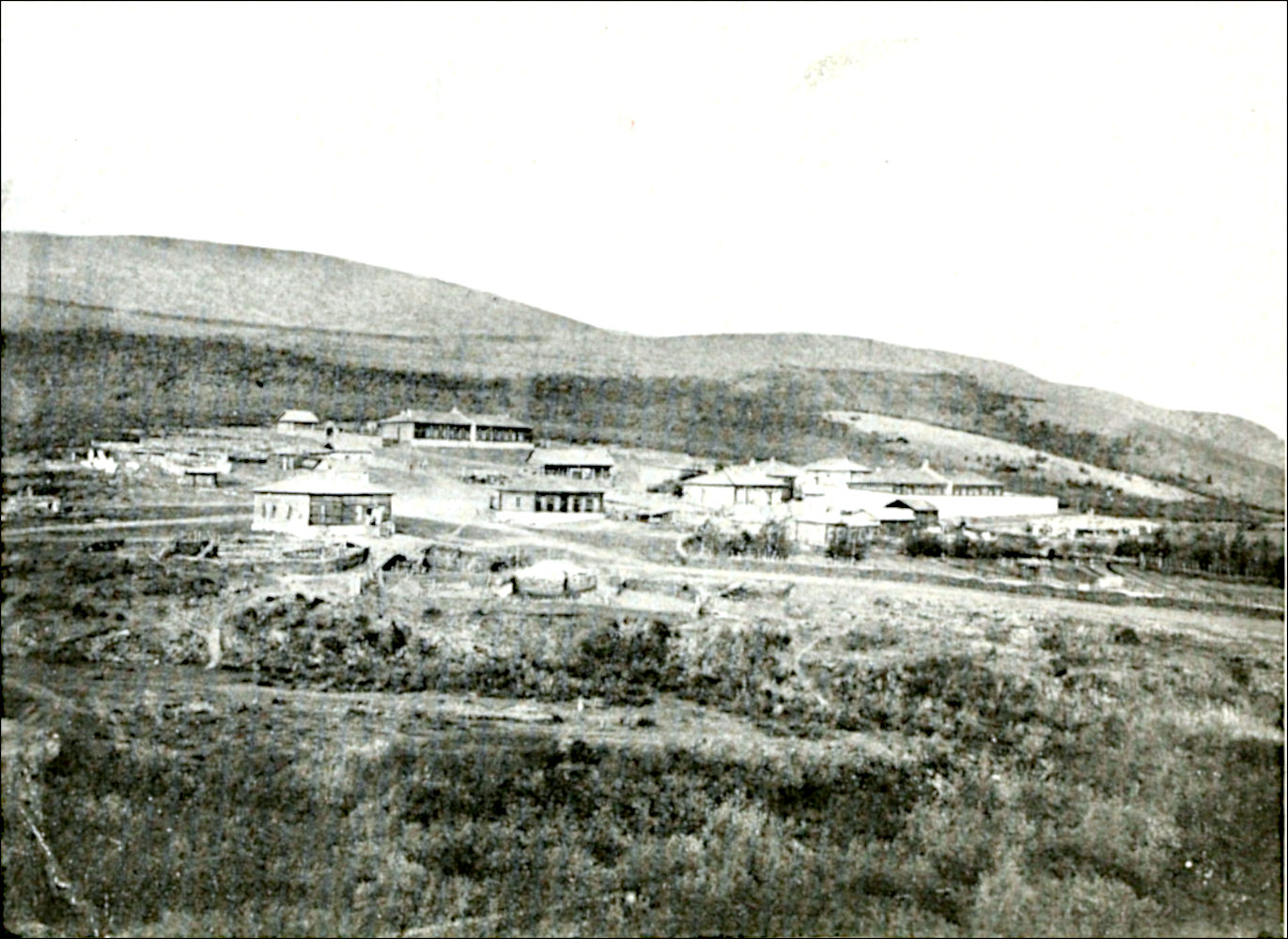
GENERAL VIEW OF THE MALTZEV HARD-LABOR PRISON
I dragged him away from the window. Then he sat down close to me, and I felt his hot breath on my cheek. His eyes were bloodshot. I saw that the man was quite out of his senses. I got up, he seized my hands, and began to kiss them. I tried to free myself, and there began a struggle with a drunken man. I was not afraid. I knew that I had only to free one hand for a second, and pick up my revolver, which lay right near under the touch. The noise of the scuffle was heard in the other room, and the boy ran in. His sudden appearance surprised the drunkard, 224who released his hold upon me and began to beat the boy. It was a horrible spectacle, and all my efforts to tear the boy away from his father’s grasp were in vain. At last, exhausted by his exertion, the drunkard fell to the floor and was soon asleep, to the great relief of myself and the poor boy. I did not sleep the whole night, and at sunrise I awakened the boy. He looked at me with an expression of childish pride in his eyes. He understood the seriousness of the mission he was to take upon himself. Before departing on his errand, he looked at his sleeping father, and with downcast eyes asked me, “Are you not afraid to remain here alone?”
After a few hours of anxious waiting I received word that an officer would come to fetch me. Soon a colonel of the Russian army arrived. I thought it was one of my friends dressed up like an officer, but he turned out to be a real colonel, of the local garrison.
“You see,” he tried to explain, noticing my look of astonishment, “I do not agree with your ideas, but as a man I highly value heroism in people, particularly in women. I am an army officer, and I was in the Japanese War. I saw and took part in most bloody battles. But we are men and soldiers, and you!”
225I considered it unnecessary to argue with him that I did not at all think my act was heroic.
“Your bold escape has excited my warmest admiration,” he continued, “and I, as an officer, appreciate it, and wish to help you slip out of this city. I and my comrades found out by chance where you were, and we will all be awfully glad to meet you. You know the police are searching for you very energetically and bending every effort to find you. They even imported the famous bloodhound ‘Rex’ from Kief. In general, there are all sorts of interesting rumors about you in town. They say that on the first day of your escape you were hiding in the governor-general’s house.”
He spoke with great enthusiasm, evidently forgetting what awaited him in case I was found in his company. I went with him, and after several minutes’ walk was at his house. He lived with his man-servant, a soldier of his regiment, who managed all his household affairs. A little later three more officers of his regiment came. Among them I felt like a prisoner; their epaulets, sabers, and clicking spurs reminded me of the gendarmes and the prison officials in whose power I had been for so many years. They joked, laughed, and their manner was free 226and careless. But I was grieved at the thought that perhaps on the morrow these servants of the czar would blindly obey the command of some half-witted general and shoot down innocent people. It was hard to reconcile what they were doing in my case with their every-day mission. But they were far from having any principles. To them I was only a young woman who was being persecuted, and they did not associate the fact that they were hiding me, a political offender for whose head a large reward had been offered by the Government, with the general conditions of life in Russia. At twelve o’clock at night all went away, leaving the whole house to me.
I spent six uncomfortable days in the society of these officers, stopping now with one, now with another. It was not safe to remain longer with them, because each had a servant, a soldier. These soldiers apparently obeyed their masters, but in reality they did as they pleased. Despite the strict orders not to speak to anybody about the “lady from Vienna” who was stopping at their houses, despite their ever-ready reply, “Yes, sir,” they were not to be trusted; the temptation to share the interesting news with their fellow-soldiers was too great. So the 227colonel arranged with some musicians from St. Petersburg to give me shelter for two days.
The risk of hiding in Irkutsk was becoming greater and greater. The police and gendarmes kept up the search untiringly. The railway station was watched by dozens of spies. According to rumors, people who knew my face were sent to the Manchurian and Chinese borders. It was necessary to leave the city, but it was impossible to find a free exit.
On the second day of my stay with the musicians the colonel came to see me.
“Did you hear?” said he. “They say that you have already gone to Switzerland.”
He related to me that after I had left his house he had paid a visit to the colonel of gendarmes on the pretext of some fictitious case, and had started a conversation about me.
“How do you explain the fact,” he asked the colonel of gendarmes, “that Miss Sukloff has not been apprehended?”
“For a very simple reason,” replied the colonel of gendarmes. “She is long in Switzerland, and we expect to receive a report about her from our agents abroad.”
Thus the time was ripe for me to leave the city. The colonel found a room for me with an 228old woman, to whom I was introduced as a university student. At last, by the tenth of September, everything was ready for my departure. Money was collected, a man was found who undertook to accompany me to Manchuria and China, and passports in the name of a “Sister of Mercy” were procured.
I was to go on the eight o’clock train. I dressed like a “Sister of Mercy,” dyed my black hair a golden brown, and from a slim young girl was converted into a stout, middle-aged woman. I arrived at the station a few seconds before the train started, and went straight to my car without looking at the people. The few seconds seemed eternities to me. At last the signal to start was given, and the train rolled past the platform, past the gendarmes and spies who scanned the faces in the car windows, and was soon in the open field. With a sigh of relief I sat down at a window and looked in the direction of the city, which I would see no more.
A FEW moments after the train left Irkutsk I began to feel sick. I lay helpless on my cot, and melancholy thoughts passed through my mind. “O God! O God! when will all this come to end?” I asked aloud. When I heard my own voice it seemed to me that I was going mad. The pain I felt was so severe that I bit my lips in order not to cry aloud.
Suddenly my eyes fell on my traveling bag. I remembered that it contained drugs and other things which I, as a “Sister,” had to carry with me. With unsteady hands I opened the bag, and found a bottle of opium. I took several drops and lay down again. I must have fallen asleep soon after. When I opened my eyes the train guard was standing near my cot.
“Miss,” he said, “there is something the matter with a woman in the next car. Won’t you be so kind and take a look at her?”
Day was beginning to dawn, and sky and earth were shrouded in a bluish mist. At first I did not know where I was, but gradually my 230thoughts cleared. I felt my head, my hands, as I did not believe that I, the being who was to be immured in a remote Siberian prison for life, was now actually riding in this train, and absolutely free.
Springing up from my cot, I put my burning forehead to the wet window-pane. The thought came to me: I can open the window! And I repeated aloud: “I can open the window!” Rejoicing like a child, I hastily pulled up the window and thrust out my head. The cool morning air blew in my face.
The train was moving at great speed, and the very wheels seemed to grind out the words: “You-are-free! You-are-free!”
Peering into the bluish mist I saw a wide field covered with drops of golden dew. From afar came the singing of peasant women on their way to work in the field. All at once I recalled the words of the train guard. What about the woman? Picking up several drugs, such as peppermint drops and bromide, I went into the next car, which was of the third class.
The sight that greeted my eye there made me forget all the wonderful beauties of nature. Amid a multitude of dirty bundles of all sizes and descriptions, there sat and lay Russian 231peasants, men and women together. They had emigrated from European Russia and were going to their new homes, somewhere near Vladivostok. Most of them were fast asleep. In a corner a woman sat. She was swaying to and fro and moaning in a subdued voice.
“What is the matter with you, my dear?” I asked.
The woman stared at me with a far-away look and said nothing. Her expression frightened me.
“What is the matter with you?” I repeated. But she was silent, and only looked at me with dull eyes. Then, upon observing her figure closely, I understood, and everything grew cold within me. Cold drops of perspiration stood out on my forehead. What shall I do? I asked myself. I went back into my car and examined the time-table. It was still about six hours to the nearest town. There was nothing for me to do but to take the woman to my compartment. I hastened back to her.
“Can you come with me?” I asked her.
She got up and leaned heavily on my arm. Then we slowly moved into my car. Before I left the Irkutsk prison, I had learned to assist women in child-birth. The prison nurse lived 232far away in the city and as the women-prisoners in most cases gave birth to their children at night, the child was generally born before the nurse could be summoned. Willy-nilly, we had to become practical midwives. There I was not alone; there were other women there who knew far more about it than I did, but here all the responsibility for the life of the unfortunate woman and her unborn child rested on me.
The groans of the woman made my heart bleed, and I felt as if I were committing some heinous crime. I tried my utmost to remain outwardly calm, to encourage the patient. I undressed her and, in the absence of warm water, washed her with alcohol and put her on the cot.
“Have you had any children?” I asked her, when the paroxysm of pain subsided.
“Four,” she replied. I felt relieved, as I knew it would then be easier for her.
“And who attended you in all those cases?”
She smiled feebly and answered:
“Dear Miss, it is very simple with us peasants. We give birth whichever way it pleases God.”
In my bag I found cotton, gauze, obstetric scissors and thread. I knew theoretically all 233that had to be done in such cases, but would I be able to apply my knowledge satisfactorily? And what if everything might not go well? These questions greatly worried me. I kissed the woman and patted her, but she shrieked more and more frequently. Suddenly she uttered a terrible cry. If I could only pray, I thought. If I had only believed, as in my childhood, that God would hear me, I would have fallen on my knees and implored Him to help me now.
The cries of the woman continued to grow louder and louder, and her voice did not seem human. And then something happened. I don’t know how it came about. My brain began to think clearly only when I heard the feeble squeak of the infant. The mother quieted down, and began to cross herself.
Soon we arrived at the station, and summoned a cab. I held the newly-born baby, wrapped in my underclothing. It was suddenly hard for me to part with that child. An unfamiliar feeling had awakened in my heart. Never before had I thought of a mother’s feelings. I hardly slept the following night, and whenever I dozed off, I heard the cries of the woman and the whole picture of the birth passed through my 234memory. It made me forget my position for awhile.
On the next day at four o’clock we arrived at the station Manchuria, on the Manchurian frontier. I went to the appointed place and met there my friend, a young woman. She had come earlier and was waiting for me. I returned to her the passport, which she was to deliver to its owner, and narrated all that had happened to me on the road. She was greatly amused and laughed heartily.
We bade each other good-by, and I went to the lodging which had been prepared for me. In that little town I had to wait for my comrade who was to help me cross the border into Manchuria. He had to get a passport and money. I stopped at the house of a Polish woman, who knew nothing about me. My friends had invented a very romantic story for her benefit, telling her I had run away because I wanted to marry a man of whom my parents did not approve. She sympathized with all such cases, because she herself had run away from home and secretly married her present husband. She held whispered conversations with me, offering advice as to how best to have the ceremony performed and where to go afterwards.
235“Are you quite sure that your fiancé will come?” she asked me on the second day.
“Oh, yes,” I assured her.
At last my comrade came, and we began to lay our plans. It is very difficult to get across the border, and our task was not a light one. When a train arrives at the frontier station the gendarmes lock all the cars and examine the passports. I had reason to fear such an examination, as among the gendarmes there might be disguised spies who knew me. Moreover, the passport procured by my comrade was a forged one. He had not succeeded in getting a suitable document.
It was necessary to invent some scheme whereby we could lessen the risk of being recognized. The Polish woman with whom we were stopping helped us. She went to the railroad station and reserved for us a first-class coupé. I and my comrade dressed up as though for a wedding. My face was covered with a white veil which reached far down my back, and my dress had a long train. This costume made me look much taller and slimmer than I really was. Two splendid carriages came to take us to the station. In one I sat with my comrade, and in the other the Polish woman with her husband.
236At the station the porters cleared the way for us with a show of great respect, and in a few seconds we were seated in our coupé. But the main difficulty was yet to be overcome. There remained about fifteen minutes before starting. We heard the noise of closing doors and the clinking of spurs. My heart began to beat violently, and I thought: What if I should be recognized! My comrade would pay dearly for his effort to help me. He, too, had run away from his place of exile, and for his escape he would have been sentenced to four years of hard labor. The fact that he would have been caught in my company would aggravate his offense. This man had known me in Odessa, when I was only seventeen. He, as is not unusual among revolutionists in Russia, sacrificed a great deal for me. He gave up a lucrative position with a gold-mining concern in Siberia, which he did not expect to get back, and left his wife whom he dearly loved. She, too, had known me in Odessa, and gladly consented to let her husband accompany me on this dangerous journey.
My comrade held in his hand the necessary documents—the passport, certificates of birth, and the certificate of marriage, all forged by 237himself a few hours before. I stood with my face to the window and my back to the door. There came a knock, and the door opened. An officer of the frontier guards entered, accompanied by several gendarmes. My comrade answered in a calm voice all the questions put to him by the officer.
“We are on our honeymoon trip to Japan, and expect to be back in three months,” I heard him say.
The officer turned the bundle of documents in his hands, evidently not knowing what to examine first. The time was limited. Casting a hasty glance around our coupé they went out, without having examined a single document. When the door closed after them, I looked gratefully at my comrade, and he shook my hands with great feeling. A few minutes later the train started.
After thirty-six hours of travel we arrived at Kharbin. I was not well enough to continue our journey without a rest. My health was growing worse and worse, as the result of my early start after the operation. Having rested two days in that city, we went to Dairen, formerly the Russian city of Dalny. I did not have sufficient funds to go on to Europe, and we 238waited three weeks in Dairen, until we received money from Russia.
In those three weeks my health improved remarkably. Manchurian scenery greatly impressed me with the splendor of its wonderful colors. For days I sat on the shore of the Yellow Sea enjoying the sight of the sparkling waters. When the air was hot I bathed in the sea, and every touch of the mighty waves added vigor to my regenerated body. In those wonderful days, when the sun of the Orient warmed me with its soft rays, I thought there could not be a being happier than myself. I was free, free from so many chains. And it seemed to me that the stormy sea alone had it in its power to penetrate into the depths of my soul and heal all my bleeding wounds. Only at the sea I found absolute peace. Never before had I felt so much love. There was no hatred in my heart: I loved each and all. The feeling of love was stronger than myself. I couldn’t understand what was going on within me. In sheer paroxysms of delight I would throw myself on the ground, which was covered with soft grass. My body trembled from the contact with the soil. In those moments I forgot everything, and through my memory passed the pictures of my native hills 241and fields, in the midst of which I was born and raised.
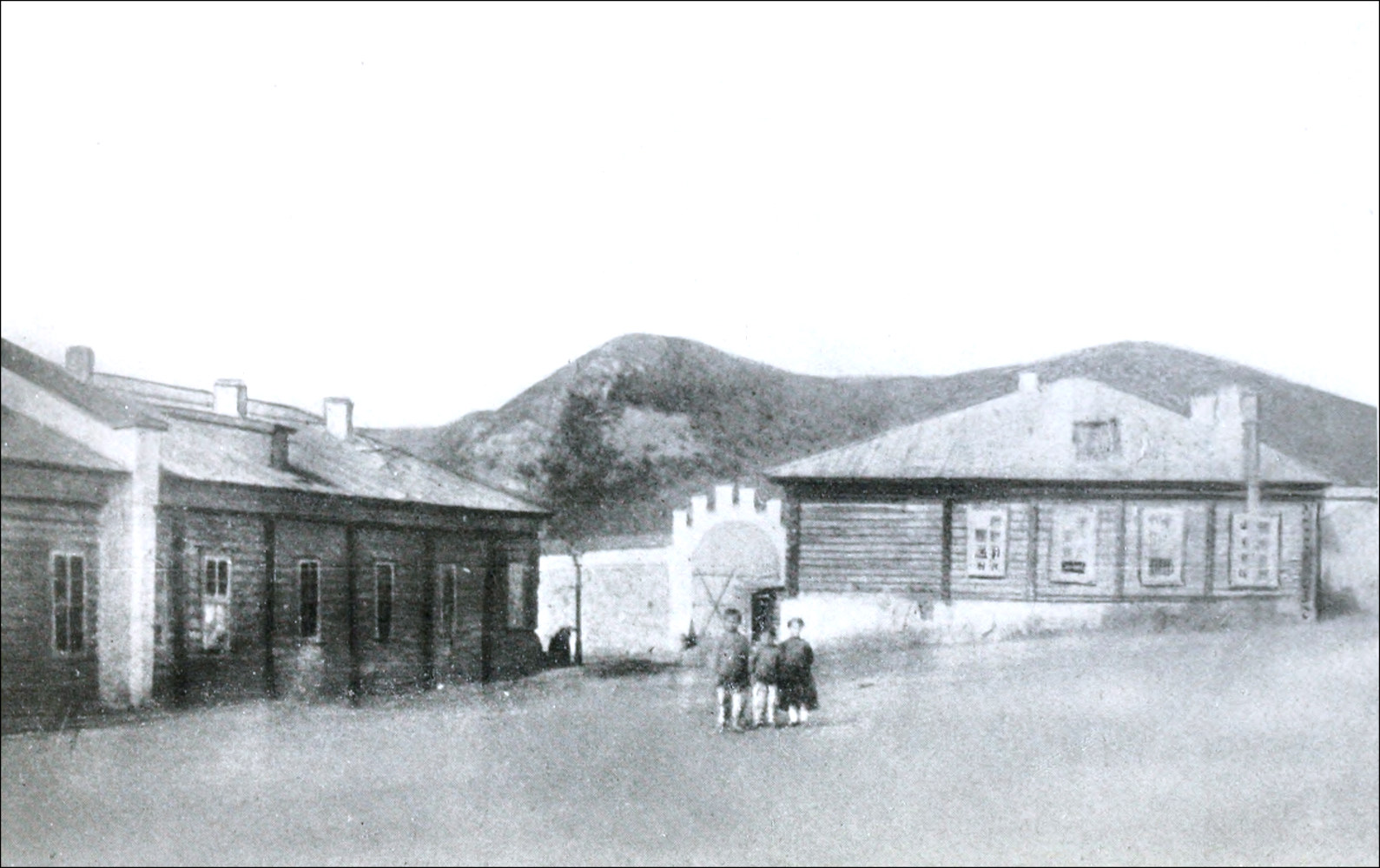
THE PRISON YARD AND GATE
We received the money we were expecting, and decided to go to Shanghai, China, where I could get a steamer direct to Europe. At eleven o’clock in the morning of a sunny day we sailed from Dairen on a Japanese steamer. Soon the strains of a march reached our ears. It was the call for lunch. When I, with my companion, came to the dining-room all the passengers already were at the table. Directly opposite me sat an old woman who tried to explain something in German to a Chinese waiter. I do not know until now in what way she resembled my mother, but as soon as my eyes fell on her gray hair I had a vivid recollection of my mother. I felt happy when, during the meal, I could guess her wishes and satisfy them. “My mother is just as old and just as gray, perhaps,” I thought, looking at the old woman, and my heart filled with love for the stranger.
Without finishing her lunch she retired to her cabin, as the steamer was beginning to rock quite perceptibly and she felt sick. In the afternoon the sea became stormy. Big waves rolled so high that our little steamer at times disappeared in the foam. It grew dark, and almost 242all the passengers went to their cabins. I was not sea-sick, and seeing the sufferings of my comrade and others I greatly pitied them. I remembered the old woman, and asked a Chinese steward to take me to her. She was in bed and suffering intensely. She wept like a child and prayed to God to take her to Heaven. I knelt near her bed and held her head in my hands. I don’t know how long I remained in that posture. The voice of my comrade roused me from my stupor.
“Where in Heaven are you, Marie?” he called to me in dissatisfied tones. “Go to your room. You will fall ill yourself. Don’t forget your own situation.”
I obeyed, but returned in ten minutes and directed them to put a cot for me in the woman’s room. I stayed with her the whole night. In the morning the sea quieted down and she felt better. She looked at me with a very grateful expression in her eyes, and asked who I was and where I was going. I told her that I was traveling with my husband after our marriage.
When the steamer neared Shanghai, the woman found me and said:
“You have been like a daughter to me, and I want to be of service to you. I live in a fine, 243large house, and would be very glad to have you and your husband stop with me.”
I mentioned something about a hotel.
“Why go to a hotel?” she interrupted. “That will cost you a lot of money. If you don’t want to stop with me because I will not accept money from you, you may pay me.”
I agreed, disregarding the protests of my comrade. I could see nothing suspicious in her inviting me to her house. On the way there we found that a German steamer would be in Shanghai two weeks later, and we really could not spare much money for hotel accommodations.
The room in which we were put up was on the same floor with the woman’s own apartment. Only a small hall-room separated us. To one side of the door stood a bed and to the other a table. A couch, on which my noble and unselfish companion was to spend the night, stood in a corner. We hung up our things on the door, and on the table we put my hand-bag containing my diary and some money, my comrade’s watch and some other articles. The door was locked.
In the morning when my comrade got up he found that all our things had disappeared. The door as well as the window remained locked. 244How was the theft to be explained? There could be no doubt that our things were stolen by some one of the household. I was in great fear lest my identity should be discovered from my diary. We knew that while in Shanghai we were not safe, as the Chinese police could deliver us into the hands of the Russian Consul the moment our presence in Shanghai was discovered.
I dressed immediately and summoned the woman to my room. My comrade questioned her about the mysterious theft in her house.
“You are inventing it!” she fairly shouted at him. “There could be no such thing as a theft in my house. I know who you are and what your business is,” she shrieked in angry tones.
My comrade grew pale. Before I could realize it, he had grabbed her by the shoulders and threw her out of the room. She fell heavily on the threshold. I placed myself between them and begged my comrade to calm himself. The woman lay on the floor yelling and cursing him in most violent language. She threatened to go to the Russian Consul and denounce him as a “white slaver.” My comrade was a powerful man and of a very excitable temper, and I saw that if the woman did not leave immediately, he 245could choke her to death. I dragged her away from the threshold and closed the door.
“I shall come to you presently,” I tried to quiet her. “For God’s sake, don’t go to the Consul.”
“Well, we got in here mighty bad,” remarked my comrade to me when I returned to our room. “And we must get out of this hole without losing a moment’s time.”
“What if the woman should report us to the Consul and we should be arrested?” I asked myself. I had not the slightest idea what she meant when she shouted to my comrade that he was a “white slaver.” My mind was busy with the thought of how to regain possession of my diary which was a direct proof of my identity. I decided to talk it over with the woman myself.
Without saying anything to my comrade of my intention I went to her. She evidently was waiting for me. She led me through many rooms, and finally we came to a luxuriously furnished drawing-room. She locked the door and put the key in her pocket.
“Well, dearie,” she began in a very soft voice, “you must remain with me. You needn’t go where he sends you. You will be getting much more money here.”
246These dreadful words frightened me.
“You are greatly mistaken in what you think of me,” I said. “I am an honest girl, and nobody sends me anywhere.”
“Don’t deny it,” she insisted. “I can see that in your eyes. You —” she began to speak very warmly— “you yourself don’t understand your charms. You are a real treasure, and I will give you all the money you may wish. You will live here like a queen. You see, all this will be yours.”
She opened a wardrobe and began to pile on the floor expensive dresses of different colors and design. She looked at me so queerly that I began to tremble. I felt as if she were undressing me.
“Still better, if you are an honest girl. I watched you, and I know that you are honest, and the better it will be for you; the more money you will get.”
How shall I escape from here? I asked myself. Will I be able to take the key from her by force, or shall I break the window and jump from the second story? Or would it be better, perhaps, to cry out so that my comrade can hear me? I hesitated, not knowing what means of escape to choose.
247At last a happy idea struck me. I took out all the money I kept in my corsage. There must have been about four hundred rubles. “Look here,” I said, “all this money will be yours.”
Her eyes began to sparkle.
“I swear to you,” I continued, “that before you will have a chance to sell my body, I shall kill myself. You are an old, gray-haired woman, and you have lived a great many years in this world. Is it possible that you can’t tell me from those unfortunate women with whom you have had to deal? Give me back my papers. I know that they are of no value to you, but to me they are everything. And let me out of your house.”
The woman stood silent, but her face showed signs of hesitation.
“I can’t report you to the Consul,” I went on, “because I am a ‘political’ and have no real passport. Consequently you do not risk anything by letting me go.”
“Give me the money,” said the woman without looking at me.
“Give me first my papers. I don’t trust you,” I ventured.
She unlocked the door, and we went into the same room where I had found her. She returned 248to me my bag with all the papers in it intact, and I gave her all the money I had with me.
My comrade was beginning to feel uneasy at my long absence. He was pacing up and down the room when I opened the door. I entered and, without saying a word, showed him my diary. He felt greatly relieved. We hastily packed our things and went to the railroad station. There we changed our cab and drove to a hotel in another part of the city.
After four weeks of anxious waiting we succeeded at last in getting some more money from Russia, but not sufficient to pay for second cabin passage, and I had to travel in the steerage.
The impressions of those four weeks in China are still fresh in my memory. I have seen and experienced all sorts of misery in my life, I have suffered much want and privation, but what I saw there was worse than anything I could imagine. It is not enough to say that the Chinese live in poverty. To understand the awful conditions of their life, one must see them with one’s own eyes. I used to go to the market and see what food a Chinese woman buys for a family of five or six for a whole day’s supply. A 249little rice, a few nuts, and a couple of tomatoes, that’s all. For all this she spends three cents.
Their houses are not any better than dog-kennels in Russia. There are hundreds of families who live on floats, where they work and sleep, and where their children are born and raised. Nowhere else have I seen so many beggars. On some streets they sit in companies of a dozen and more. Labor in China is terribly underpaid. For a whole day’s work a Chinese laborer sometimes receives four cents; a jinrikisha-man drives you the greatest distance for five cents; and he runs faster than a horse. The Chinese go about almost naked, and the only thing they work for all their lives is a piece of bread, of which they never have enough. And yet the load that a Chinaman can carry on his back is beyond description. The hotel in which I stopped was located near the port, and day and night I could hear the heart-rending groans, called singing, with which the “longshoremen” enliven their task. Prostitution is practised without restraint in China, and women are traded like horses.
I was glad to leave that country. Having bid good-by to my comrade, I sailed on a German steamer bound for Genoa. As I spoke nothing 250but Russian—but understood a little German—all the steerage passengers, most of whom were Germans, were greatly mystified by my silence. “Who is this girl with the pale face and sparkling eyes who looks all day at the sea?” they used to ask the stewards and one another. And every one of them stared insolently at me. Oh, how I hated them for their curious stares! But whenever they forgot about my presence, I remained alone with the sea and listened to the wonderful music of the waves. For days and days I sat looking on the water, and only then I realized that I was free, that my freedom was a living reality, not a dream.
But as soon as I felt that I was free, the old wounds re-opened in my heart. Memories of the past, day after day and year after year, rose in my mind and whispered to me: “There can be no freedom for you after all that you have gone through, after all that you know. There can be no freedom for you when all your best and dearest friends have remained in the world of shadows and stone walls, in the world of torture and humiliation. There can be no freedom for you!”
A sudden change came over everything. The melodious music of the calm waves turned into a 251storm, it grew dark, and our gigantic steamer was thrown about like a shell by the storming seas.
“Go back, go back there whence you came!” roared the sea. “Your life no more belongs to you. You have saved yourself not for your own sake. You must either free them all, or be with them....”
I ran about the deck. My face burned. Where am I going, and why? I asked myself.
The sea and skies became red like the blood of my martyred comrades. The music in my heart ceased, and the thought of my freedom no longer agitated me. The decision to go back to them and continue that for which they perished was slowly forming in my mind. And all through the rest of the journey it was uppermost in my thoughts. The jungles of India, the Red Sea, the green coasts of Africa and the bare desert of Arabia, the Suez Canal, and the beautiful skies of Italy—all those wonders of nature did not for a minute change my resolution, did not weaken my desire to go back and throw myself again into the unequal struggle.
1. My grandfather settled in Borovoi-Mlin, in the province of Vilna, in 1851. The Government granted certain privileges to Jewish agricultural colonists, exemption from military service for a period of twenty-five years being one of them. Military service in Russia at that time lasted twenty-five years, and the life of a soldier was terribly hard. Few ever returned to their native places. To save his sons from military duty, my grandfather decided to become a peasant.
2. Young gentleman.
3. Policeman.
4. Cabmen.
5. A little over thirty-six pounds.
6. Report.
7. A dark, windowless cell, in which prisoners are kept on bread and water.
8. Quoted from the Revolyutzionnaya Rossiya, the organ of the Socialist-Revolutionists, No. 37.
9. Overcoat.
10. Provision-money.
11. Cell.
12. Convicts who are being transported.
13. Siberia and the Exile System, Vol. I, p. 87.
14. Sleeping-platforms.
15. Springless wooden carts.
16. Chief of village police.
17. Head-man.
18. Cossack whips.
19. Forest.
20. Drink-money.
21. It is a general practice in Russian courts to allow the accused to address the court before the judges retire to deliberate upon the verdict.
22. Her sister Yekaterina shot at Admiral Tchukhnin at Sebastopol after his summary execution of soldiers and sailors of the Black Sea fleet and slightly wounded him. She was shot without trial immediately after the attempt, in the yard of Tchukhnin’s residence, and the admiral personally gave the command to fire.
23. She said at her trial: “General Sakharov suppressed the peasants and I suppressed him.”
24. So called after the military insurrection of December 1825.
25. One of the organizers of the “Fighting League.” He was accused of having planned the assassination of Minister Sipyagin, Governor Bogdanovitch of Ufá, and the attempt on Governor Obolenski of Kharkof, and sentenced to death, which was commuted to penal servitude for life. He was brought to Akatúi from the fortress of Shlússelburg, in 1906.
26. Penal colonies.
27. Karpovitch shot Minister Bogolyepov in 1897. He was brought to Akatúi from the fortress of Shlússelburg, in 1906. After completing his hard-labor term he was exiled to a little village in the Trans-Baikal, and escaped from there.
28. A male nurse.
29. Alexander Works.
30. A kind of soup.
31. Mehtus was sent to the Nertchinsk kátorga with the special mission to “discipline” the political prisoners. The régime which he established was beyond human endurance. For the least trifle they were beaten, put in chains, and kept in the kartzer for weeks. He was the first in recent years to order the flogging of politicals. Both he and Borodulin were later assassinated by the order of the Party. Mehtus was shot at a restaurant at Chitá by a woman whom the crowd hid from the police. Borodulin was shot near his house at Algatchí. After this the régime in the hard-labor prisons changed somewhat for the better, and continued so until 1910.
32. Hard-labor convicts, after completing their term, spend the rest of their life in Siberian exile.
33. When, several weeks later, the new prison governor Vysotzki issued an order to flog the political prisoners Sazonov committed suicide by drinking poison. Nine others failed in their attempt to end their lives.
34. A gate in Russia does not reach to the very ground, and the narrow space left is covered with a board.
35. Policeman.