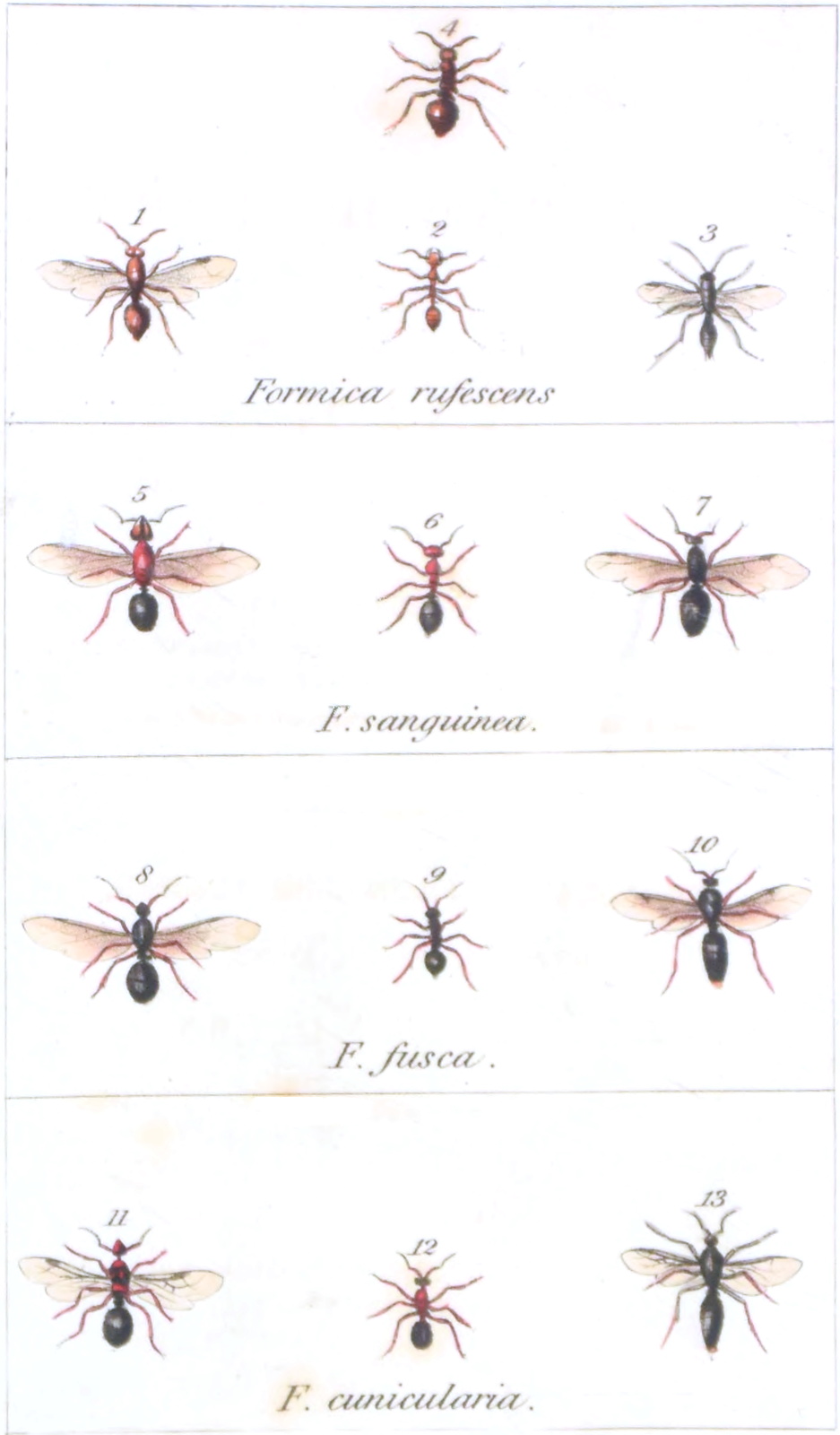
Pubd. by Longman & Co. Pater Noster Row, May 2nd. 1820.
THE
NATURAL HISTORY
OF
ANTS;
BY
M. P. HUBER,
MEMBER OF THE PHYSICAL AND NATURAL HISTORY SOCIETY OF
GENEVA, AND CORRESPONDING MEMBER OF THE NATURAL
HISTORY SOCIETIES OF TARNE AND GARONNE, &c.
TRANSLATED FROM THE FRENCH,
WITH ADDITIONAL NOTES,
By J. R. JOHNSON, M.D., F.R.S., &c.
LONDON:
PRINTED FOR LONGMAN, HURST, REES, ORME, AND BROWN,
PATERNOSTER-ROW.
1820.
Printed by A. and R. Spottiswoode,
Printers-Street, London.
TO
HIS FATHER,
JAMES JOHNSON, Esq. F.S.A.
THIS VOLUME
OF INTERESTING FACTS AND OBSERVATIONS,
IS,
IN TOKEN OF FILIAL RESPECT,
INSCRIBED,
BY
THE TRANSLATOR.
[Pg v]
ADVERTISEMENT.
Since the following pages were put to the press, the Translator has been favoured with a letter from the Author, of which the following is an extract:—
“Since the publication of my ‘Researches into the Natural History of Indigenous Ants,’ I have frequently re-witnessed what I there describe; so that I can truly affirm, I have neither been led aside by a fertile imagination, nor by a love of the marvellous.
“Some of these facts appear to many of so romantic a nature, that I am happy in not being the only person who has [Pg vi]noticed them; not only are there several enlightened observers in this country (Switzerland), but a number of other Naturalists, who, since the publication of my work, have also observed the same occurrences. What has afforded me peculiar satisfaction, is, that of having learned, vivâ voce, from M. De Latreille, one of the most distinguished Naturalists of Paris, Member of the Institute or Academy of Sciences, that he had witnessed, on an extensive scale, and had shown to several of his colleagues, the wars and pillages of my Amazon Ants.
“You will find another proof in a work of this great Naturalist, entitled, ‘Mémoires sur divers sujets de l’Histoire Naturelle des Insectes, &c.’ and particularly in that memoir, entitled, ‘Considerations nouvelles et generales sur les Insectes vivans en Societé. Discours lu a la Séance publique de l’Academie des Sciences, le 17 Mars, 1817.’
[Pg vii]
“The Author of these Memoirs, after having mentioned in a summary way, the facts I published upon the manners, &c. of the Rufescent Amazon Ant, says, ‘I observed, in 1802, an army of these Ants in one of their military excursions. They were traversing one of our great roads, covering the whole of its breadth, and advancing in a column of about two feet in width. I attributed this movement to a forced emigration. I suspected, however, from the form of this species, before M. Huber had published any account of it, that it had particular habits. I found this Ant in the woods, in the neighbourhood of Paris. The whole of the facts related by this Naturalist (Huber) have been fully confirmed.’
“M. De Latreille told me, that he had shown this singular phenomenon to a skilful English Naturalist, whose name I think is Leach.
[Pg viii]
“These, Sir, are the proofs by which I hope to obtain the confidence of a great number of those readers, who are unable to ascertain the truth of my assertions.”
[Pg ix]
PREFACE,
BY THE TRANSLATOR.
The favourable critique of these Researches (Recherches sur les Mœurs des Fourmis, &c.), in the Edinburgh Review, for July, 1812, led me to entertain little doubt, that, long ere this, a translation would have been presented to the public.
Disappointed in this expectation, and desirous of filling up agreeably a portion of my leisure time, I engaged in the translation, although aware of the little merit attached to so humble an office. [Pg x]If the reader, however, experience the same pleasure in the perusal of this work, as I did in transcribing it for the press, both parties will be satisfied, and I shall have the gratification of knowing that my labour has not been unavailing, or my time misemployed.
The additional notes are not what I was desirous they should be. I hoped to have made some addition to the History of Ants, or at least to have confirmed some of the very remarkable facts recorded in the present volume, particularly that of the female ants voluntarily depriving themselves of their wings after impregnation; but I lament that continued ill health prevented my making those exertions necessary to attain this object.
I regret that, during my residence at Geneva, I was not personally acquainted with our author, who resides in the neighbourhood of that city, and who would doubtless have felt much pleasure in supplying me with additional information. [Pg xi]I then had no idea of putting the following pages to the press, or I would have obtained an introduction through the medium of my kind friends, Professor Pictet or Monsieur de Luc.
It were much to be wished that monographs on the smaller animals, like the one now before us, were more frequently published in this country, since it would have the effect of removing, in some degree, the ridicule attached to those who attend to the minuter objects of creation, and of placing this department of Natural History, on a more extended and firm basis.
That entomology is neither a trifling nor an useless study, it will be enough to mention—to say nothing of the national advantage Sweden derived from the entomological knowledge of Linnæus—the very great services rendered to medicine and the arts, by the introduction of the silk-worm, the cochineal insect, and the Spanish fly.
[Pg xii]
But, waiving these advantages, and others equally great would doubtless arise, if this branch of Natural History were more generally cultivated, let us only consider it in the light of an amusement,—still is it an amusement not without its charms.
The amusements of the Naturalist are attended with no great expense; his employment in the open air contributes to the preservation of his health; his frame becomes robust from constant exercise, and the spirit of enquiry is awakened as he contemplates the several objects by which he is surrounded: whether he climbs the lofty mountain, confines himself to the smiling valley, crosses the brawling stream, penetrates the entangled forest, or breaks out into the open plain, a thousand beings sporting in the air, measuring the ground, or skimming the surface of the liquid element, arrest his steps, and claim his attention; his pulse beats high with enjoyment, [Pg xiii]and his heart, warmed with the kindlier emotions, throbs with unutterable delight; moreover,
Crabbe’s Borough, p. 110.
Bristol, Feb. 6, 1820.
[Pg xv]
PREFACE,
BY THE AUTHOR.
Much has been written upon Ants: their form of government, and their labours, excited the admiration of the ancients equally with the moderns; but it is only in the present day that just observations have taken place of the fabulous recitals of Pliny and Aristotle.
The Naturalists of the last century attended to their transformations, discovered the sexes, and cleared up many essential points of their history. Learned anatomists, also, described their organs, classed the different kinds of Ants, and pointed out their generic characters.
[Pg xvi]
To the individual who wishes to be acquainted with the history of these insects, it is no slight advantage, to be enabled to designate the species, without lying under the necessity of entering into long and minute descriptions; he can then devote himself entirely to the study of those laws by which these various tribes are governed, undertake new researches into their habitudes and industry, and have his attention solely occupied with the phenomena their instinct presents.
If I have made any progress in the History of Ants, I stand, in a considerable degree, indebted to the extensive works of M. Latreille, who, independent of the excellent descriptions, and complete classification he has given us of these insects, has, by his observations, contributed to remove several popular errors.
One of our contemporaries, trusting to a fertile and brilliant imagination, has been pleased so far to honour these little [Pg xvii]insects as to dress them out in all the virtues, excusing them the vices that so much disgrace the human species.
The History of Ants being yet incomplete, I have been induced to join my own observations to those of my learned predecessors, trusting that the perseverance with which I have studied the economy of Ants for several years has enabled me to fill up a portion of that void which still remains in this branch of science.
Animated with the desire of following the steps of the celebrated guide nature had placed near me, I undertook, under his auspices, works similar to those in which he had been distinguished, and found in this occupation the double pleasure, of interesting him and instructing myself.
I published in early life, some observations upon humble-bees, insects that live in a republic. These first attempts having been received by Naturalists more favourably than I had reason to expect, I flattered myself that I should be enabled [Pg xviii]to disclose some of the secrets in the History of Ants, whose societies, although much more extensive, present greater difficulties, in the investigation, from the diminutive size of the individuals composing them, and the obscurity in which most of their operations are enveloped.
These researches, which I am aware are still very imperfect, present so remarkable an assemblage of facts, that I am induced to lay them before the amateurs of Natural History, hoping they will meet a favourable reception.
Not to interrupt the course of my observations by anatomical details, I have placed in the introduction all that relates to the external organization of Ants. I have also added an abridged notice of facts collected by other Naturalists, whose writings may be easily procured, should the reader feel desirous of obtaining further information.
In these researches I have followed no methodical arrangement, having adopted [Pg xix]the plan I considered the best adapted to elucidate the subject. I therefore commence, by giving an account of the art with which Ants construct their habitation.
These insects inhabit, for the most part, the bottom of their subterranean residence; hence there was a necessity of my being provided with an apparatus that would enable me to follow them in their domestic occupations. After describing the one I employed, I mention the great care which these little creatures take of the eggs, larvæ, and pupæ of their numerous family.
I devote an entire chapter to the history of the females; I describe their amours, and state the manner in which new colonies are established, and ancient ones preserved. Passing from the relation of Labourers with the winged individuals, to that of the Labourers among themselves, I accompany them in their migrations and excursions, notice their individual conduct, and then describe [Pg xx]the combats in which they engage.
In the course of this work, several questions are discussed that may appear bold to those who do not see in insects any thing but organized machines, but they will not astonish the Naturalist, accustomed to distrust his own opinions. There are few individuals who have not perceived how absurd is the supposition of a blind instinct, and for some time past we have granted to animals, at least so it to me appears, a greater degree of knowledge than formerly.
If we reflect a moment on the complicated nature of that mechanism, we must put in place of a spark of that light in which we all participate, to enable it to accommodate itself to circumstances, to provide for the several necessities of a numerous colony, and to direct a multitude of springs in such a manner as to concur in the same end, we shall be tempted to prefer an hypothesis the most simple,—that which accords to insects a [Pg xxi]sufficient degree of intelligence for the conduct of their domestic affairs, to that which considers them as mere automatons.
But Ants, living as they do in society, and entering upon labours that require some degree of unanimity—have they no means of understanding, and of making known their wants and their situation to their companions? What are the connecting bonds of this numerous family? Have they chiefs, a government, a police? Do we find among them any proof of that subordination so boasted of by their panegyrists, and of that economical foresight which they present us as an example for our imitation?—These important questions would have alone engaged my attention, had I been able to follow any regular plan in my observations: but when we advance on an unknown region, we cannot trace before-hand the boundaries of our journey; and Natural History offers more than one proof, that to make new discoveries we must now and then quit the main road.
[Pg xxii]
I was, however, far from expecting those extraordinary facts that presented themselves in the course of my researches; among them those of the Ants with their pucerons, which I have already published, and to which I have made several additions. But there are facts still more singular connected with the Ants of different species. The history of the Amazon Ants presents a phenomenon so opposed to what the manners of insects and other animals have hitherto offered us, and recalls so prominent a feature in the history of man, that I have given up a great portion of my time to its elucidation, and have considered it my duty to devote several chapters to it, with the view of making it known in all its detail, and of putting the reader in the way of judging or verifying the truth of my assertions.
I conclude the work by some general considerations which my observations have suggested to me, and by comparing the habits of Ants with those of other insects that live in a republic.
[Pg xxiii]
The title I have given to these researches is not to be taken in its fullest extent, since I have not studied the manners of all the indigenous ants. I know twenty-three species of which I have not equally learned the history; but if the facts I have noticed, excite the attention of Naturalists, and induce them to fill up the outline I now lay before them, it will be the sweetest recompense for the labours to which I have been devoted.
[Pg xxv]
INTRODUCTION.
My design in this Introduction, is to take a rapid review of the facts collected by several writers relative to the History of Ants. The descriptive part, better known than that which refers to their manners and habits, still presents some doubts which I shall attempt to remove. De Geer, among the ancient, Fabricius and Latreille among the modern naturalists, are those to whom I shall have recourse for their classification.
Systematic authors have placed Ants in the class of insects with four naked wings—with Bees, Wasps, Andrenæ, &c. from which they differ essentially in the composition of their families, where we [Pg xxvi]find the males and females furnished with wings, and the workers without them.
The characters given by M. Latreille, to distinguish them more particularly, are that of having “the peduncle of the abdomen surmounted with a scale, or knotty; the abdomen of the workers and females ejaculating an acid, or armed with a sting; the antennæ filiform, or slightly enlarged at their extremity, bent or fractured in the middle, composed of twelve or thirteen joints; the second conical, of the same length as those that follow; a tongue, spoon-shaped, entire; the upper lip effaced; the palpi filiform unequal, anterior of five, posterior of four joints. The first of these characters furnishes two very distinct families, the one, composed of all those ants that have the peduncle surmounted by a scale, the other, of all those in which it is formed of two knots. The characters of the first family, are—having the antennæ filiform, or pointed at the extremity; no sting; a simple venom-bag; the abdomen [Pg xxvii]more elongated, and composed in the females and workers of five rings.”
The ants of the second family have the antennæ moniliform, and considerably enlarged at their extremity; a sting; the abdomen short, and composed of four rings in females and the workers.
The males have, in general, the antennæ longer, and of thirteen joints; the abdomen is composed of one ring more than in other individuals of their species; they possess neither a sting nor a venom-bag. As we shall treat in this work of none but indigenous ants, all of which find place in this general division, I shall not enter into greater detail relative to their classification.
Let us examine separately all the parts of the body of ants in order to know their external organs. Their head is triangular, oblong, and terminates in a point more or less obtuse; it is thick at the top, thin at the opposite extremity, and terminated by two large teeth, termed mandibles; underneath is the mouth, properly so called. On each side are [Pg xxviii]large reticulated oval eyes; above, we commonly notice three more, very small, and placed so as to form a triangle. In the fore-part of the head are the antennæ, and underneath the lower jaws the palpi.
The mandibles of the females and the workers are of a horny structure, concave, curved, denticulated, moveable, and serve for several purposes: those of the males are very slender, terminate in a point, and are covered with hair. Besides these organs with which the mouth is externally furnished, we also remark an upper lip, slightly projecting, two inferior jaws, very small, which play from right to left, and a lower lip, hidden entirely underneath; we are not yet agreed as to their composition.
Fabricius gives to Ants of all kinds, for their principal character, that of having a mouth destitute of a tongue (os absque Lingua); Latreille, on the contrary, grants them one, expressing it under this form (Langue en cuilleron entière); “the [Pg xxix]lower lip,” he says, “is formed of a conical furrow, coriaceous, with an elevated ridge in the middle, and terminated in a point, and of a tongue, or membranous portion, lodged in this furrow, and spoon-shaped.”—I beg leave to add some few observations to those of these great naturalists. When the ants wish to drink, we see proceed from their lower jaws, which are much shorter than the upper, a little conical, fleshy, and yellowish tubercle, which performs the office of a tongue, advancing and retiring alternately; it appears to proceed from what we term the lower lip, which serves as the base, and perhaps a sheath to this tongue, and which is so small, that it is only from analogy with other insects we have given it this name. This lip is capable of advancing conjointly with the two lower jaws, and when the insect wishes to lap, the whole apparatus makes a progressive movement, in such a way, that the tongue, which is very short, has no need of much extension to enable it to accomplish its [Pg xxx]object. The jaws are elongated, enlarged at their extremity, slightly concave underneath, of a horny substance, and, compared to the mandibles, extremely slender and weak. In the centre, externally, we notice palpi of six rings each, and two more may be also perceived at the base of the tongue; the latter are much smaller and composed only of four rings: we are as yet unacquainted with their use.
The antennæ, as we have before stated, are bent or fractured, situated in the fore-part of the head, more or less near the middle of the forehead; they lie in a small longitudinal furrow, and are composed of twelve or thirteen joints; the first being about half their length. The antennæ of those ants that have a scale upon the fillet of the abdomen are filiform, and are composed of rings of the same size, or terminate slightly in a point. The ants of the second family have the antennæ, on the contrary, enlarged at the extremity; those of the males are setaceous [Pg xxxi]in the first species, more granulated in the latter species, and in all are formed of one ring more than in the workers and females.
The head is connected to the thorax or corslet by a thin, short, and narrow neck, of a fleshy substance, and furnished with muscles, by which all its movements are regulated.
The corslet of the winged individuals is very large comparatively to the head; that of the workers is much narrower; that of the former is convex, entire, composed of several horny pieces, of different forms, retained by proper membranes: the superior is separated from the sternal portion by a furrow, in the middle of which the wings are implanted. The wings are placed in the back part of the corslet, whilst, in other insects of the same kind, they are situated more in front of the body. Another remarkable character respecting their insertion is,—that the corslet has none of those instruments (Cuillerons) destined to moderate [Pg xxxii]the movements of the wings, and which are situated at their base in the other hymenopterous insects.[1]
[1] These observations were communicated to me by Professor Jurine, and are a proof of the distinguishing glance of this able naturalist.
The corslet of the workers is gibbous, divided equally, and composed, according to De Geer, of three pieces; the first—that nearest the head, is thick and round; the second is of less size, extends to the under part of the abdomen, and appears divided in two transversely; the third, much thicker than the second, is truncated and obtuse. We cannot well define the form of the corslet, since it varies according to the species; it has four stigmæ, two of which rest in a slight lateral depression (which seems to divide the corslet), one on each side; the other two are situated near the posterior extremity, to the right and left of the fillet.
The wings, which are four in number, are transparent, large, and sleek; the posterior are shorter than the anterior, their nervures are slightly coloured, and [Pg xxxiii]the stigma is yellow or brown. These wings are hooked when the insect flies; they form but one horizontal surface by means of a series of little hooks disposed at their margin.
To each of the three lower parts of the corslet are attached a pair of legs. They are connected by a moveable piece, long and conical, which we may term the hip. The posterior legs are the longest; they are each divided into three principal parts—the thigh, the leg, and the foot or tarsus; the latter is formed of five conical pieces, of unequal length, articulated together, and more or less hairy; the tarsus is terminated by two hooks, between which lies a round substance, which we may regard as the sole of the foot. We remark, at the extremity of the leg, properly so called, a spine or spur, straight, strong, and smooth; that on the anterior feet is slightly curved, and covered with stiff hair, where it is connected to the foot. The first piece of the tarsus, which is opposite the spur, presents a considerable curvature. It is [Pg xxxiv]furnished with a fringe-work of strong hair, cut regularly. This constitutes the brush which the insect employs when cleaning its antennæ, head, and corslet; it has also other uses, but to these I shall allude on another occasion.
The vertical scale is heart-shaped, with the point turned downwards. It is traversed at its origin by the abdominal fillet; its form varies, and it furnishes very distinct characters. Latreille remarks that it is provided with two stigmæ, which are situated at its base on the posterior side.
The abdomen or belly of the ant is always larger than the corslet, of an oval form, swoln, and more or less pointed at the posterior extremity. It is composed of demi-rings, which are of a horny substance; the superior are connected with the inferior by means of a flexible membrane, which allows of their separation and approximation at will. It is easy to notice this when the insect has taken a full meal, since each of these horny pieces [Pg xxxv]appears then to be separated from the rest by a little whitish band, which is nothing more than this membrane. The abdomen is composed of four or five rings, the last of which gives passage to the sexual organs and the sting.
Latreille regards the scale as characteristic, which rests on the fillet of the abdomen, and takes the place of a ring, which, without that, would be wanting in the abdomen of these insects. These are his words:—“Naturalists,” he says, “have not considered that this scale or these knots on the peduncle of the abdomen of ants are only the first rings shaped in this way. Several wasps have also the first segment of the abdomen formed like a knot. To decide this point, let us count the number of rings of which the abdomen of ants is composed; we know, and it is a constant rule with respect to insects of this order, that there are seven rings in the abdomen of males, and six in that of females. Let us see if, after taking away the scale and [Pg xxxvi]the knots of the peduncle, we shall find this number. We do not:—for the abdomen of the females or workers, which has a scale or single knot in the fore-part, possess but five rings, and that of the males only six. The abdomen of those ants whose peduncle is formed of two knots, will have still one ring less; that is to say, four in some, and five in others.”—We have already remarked, that the workers and females of some species are provided with a sting; this consists of a little short, horny substance, straight and conical, formed of two filaments, and accompanied with two other little pieces, conical, smooth, compressed, one on each side. “There exists,” continues M. Latreille, “the greatest resemblance between the exterior organs of generation in single females and workers; the resemblance indeed is so close, that on the most severe examination we can scarcely perceive any sensible difference.” He regards the workers as impotent females, whose organs have not received their full [Pg xxxvii]development. In truth, if we consider the form of their head and their teeth, the number of the joints or articulations in their antennæ, the number of their rings, the presence of the sting, or that of the venom-bag which replaces it, we shall be struck with the similarity existing between these two orders. The workers are much smaller than the females; they also differ in the form of the corslet, in the absence of wings, and in colour. Some of the males are smaller, others larger than the workers of their species; their corslet is shaped like that of the females; the scale or knots are of great similarity in all the individuals of each family: the males are commonly of a blackish hue.
Our knowledge of the manners and habits of ants is extremely limited, consisting only of a small assemblage of detached facts, and of a few assertions, sufficiently vague, which I shall discuss in their proper place. In the list of modern authors who have contributed to [Pg xxxviii]the history of ants, we find naturalists of the greatest celebrity.
Leeuwenhoeck is the first who seriously attended to the metamorphoses of ants, and proved that what had been hitherto regarded as their eggs were the real larvæ; indeed from their magnitude this should have been previously known, the eggs of these insects being exceedingly minute.
Swammerdam confirms, by profound researches and admirable descriptions, the observations published by his predecessor:—he notices the several changes ants undergo, and shows the pupa to be the same individual that under the form of larva possessed neither limbs nor any distinct features. He points out the distinction between the males and females, which, he says, are furnished with wings, and remarks, that the common ants are labourers or neuters, as obtains in bees. He also describes some of the domestic occupations in which ants are engaged, and informs us, that the larvæ of some [Pg xxxix]species spin a silken envelope, in which they undergo their transformation, and then gives us excellent descriptions of several species of ants.
Linnæus comes next:—he describes seven species of ants met with in Sweden;—treats of the large conical ant-hills abounding in fir-forests; finds the female ants, as well as the males, furnished with wings; which, he says, they lose a little time after birth, and is of opinion they never return to their original habitation.
Geoffroy adds nothing to the facts brought forward by these excellent naturalists: he falls, on the contrary, into several errors, which, as they have been combated by De Geer, I shall pass over in silence.
This last author (De Geer) informs us, that the young ants cannot extricate themselves from their silken envelope without the assistance of the labourers; and that the larvæ of the shining black ant do not always spin, since we find in their [Pg xl]nest pupæ both naked and enclosed. He also observes that the larvæ of certain species pass the winter in that state, and that those of the Yellow Ant are closely invested with hair in the month of April, &c.—Passing from the infant to the adult state of the ant, he notices their amours in the air, believes that the females return to their nest to deposit their eggs, in this respect opposing the opinion of Linnæus, who was, however, better informed on this subject than himself. This justly celebrated naturalist, notwithstanding, gives us more information upon the history of ants than the whole of his predecessors.
Charles Bonnet was in his turn occupied:—he was of opinion that ants are directed in their migrations by the scent. He notices a small family-establishment of these insects on the head of a thistle, of which he gives us an interesting account. Had he, however, opened it, he would have, with admiration, discovered the motive which drew them thither, and [Pg xli]would no longer have been astonished at their living there without touching the provision he tendered them. He saw these ants engaged in carrying each other, and describes their proceedings in his usual lively and agreeable manner, although unaware of the purport for which these insects had assembled.
M. Latreille confirms the facts brought forward by other authors. He notices two species of ants destitute of eyes, but does not describe their manners. He also advances some conjectures to which we shall refer hereafter.
It appears from all the observations made to the present day, that we are not agreed as to the fate of the males and females; that we know not why certain larvæ should, others should not, spin; why among some species we should find pupæ both naked and enclosed; that we have not sufficiently attended to the spirit which reigns in the interior of ant-hills, nor to the relation existing between the labouring ants and their females; [Pg xlii]that we have not discovered whether they possess the means of understanding each other; that we have not sufficiently described the construction of their abode, nor the manner in which they establish it, nor do we know whether these insects do or do not form colonies, &c. The number of questions not yet solved is endless; it is, however, time to fill up some of the numerous sketches which our predecessors have left us upon this subject, and place, if possible, the history of ants on a more solid and secure foundation.
[Pg xliii]
CONTENTS.
| CHAP. I. | |
| Page | |
| The Architecture of Ants | 1 |
| 1. The Architecture of the Fallow Ants | 2 |
| 2. —— —— —— —— Mason Ants | 16 |
| 3. —— —— —— —— dark Ash-coloured Ants | 35 |
| 4. —— —— —— —— Ants that inhabit timber | 47 |
| 5. —— —— —— —— Ants that form their residence of saw-dust, &c. | 58 |
| CHAP. II. | |
| Of the Eggs, Larvæ, and Pupæ of Ants | 60 |
| CHAP. III. | |
| Of the Fecundation, &c. of Ants | 94 |
| 1. Of the departure of the Winged Ants | ib. |
| 2. —— —— History of the Winged Ants after impregnation | 108 |
| 3. —— —— conduct of the Labourers towards the pregnant females | 127 |
[Pg xliv]
| CHAP. IV. | |
| Of the relation between Ants | 142 |
| 2. Of the manner in which Ants are guided in their several excursions | 151 |
| 3. —— —— migrations of the Fallow Ants | 157 |
| 4. —— —— affection of Ants for their companions | 168 |
| CHAP. V. | |
| Of the wars of Ants, and some other particulars | 178 |
| CHAP. VI. | |
| Of the Relation of Ants with the Pucerons and Gall Insects | 205 |
| 1. Of the Antennal Language | ib. |
| 2. —— —— intimacy of Ants with the Pucerons | 210 |
| 3. —— —— Relation of Ants with the Gall Insects | 219 |
| 4. —— —— almost human industry of Ants | 222 |
| 5. —— —— resources of the Ants during winter | 237 |
| 6. —— —— eggs of the Pucerons | 239 |
| CHAP. VII. | |
| First historical sketch of the Amazon Ants | 248 |
| CHAP. VIII. | |
| Researches into the origin of mixed ant-hills | 264 |
[Pg xlv]
| CHAP. IX. | |
| Further information on the Amazon Ants | 288 |
| CHAP. X. | |
| The Establishment of a mixed Ant-hill, in a glass apparatus | 310 |
| CHAP. XI. | |
| History of the Sanguine Ants | 329 |
| CHAP. XII. | |
| Observations on those insects that live in Republics | 346 |
| Appendix | 379 |
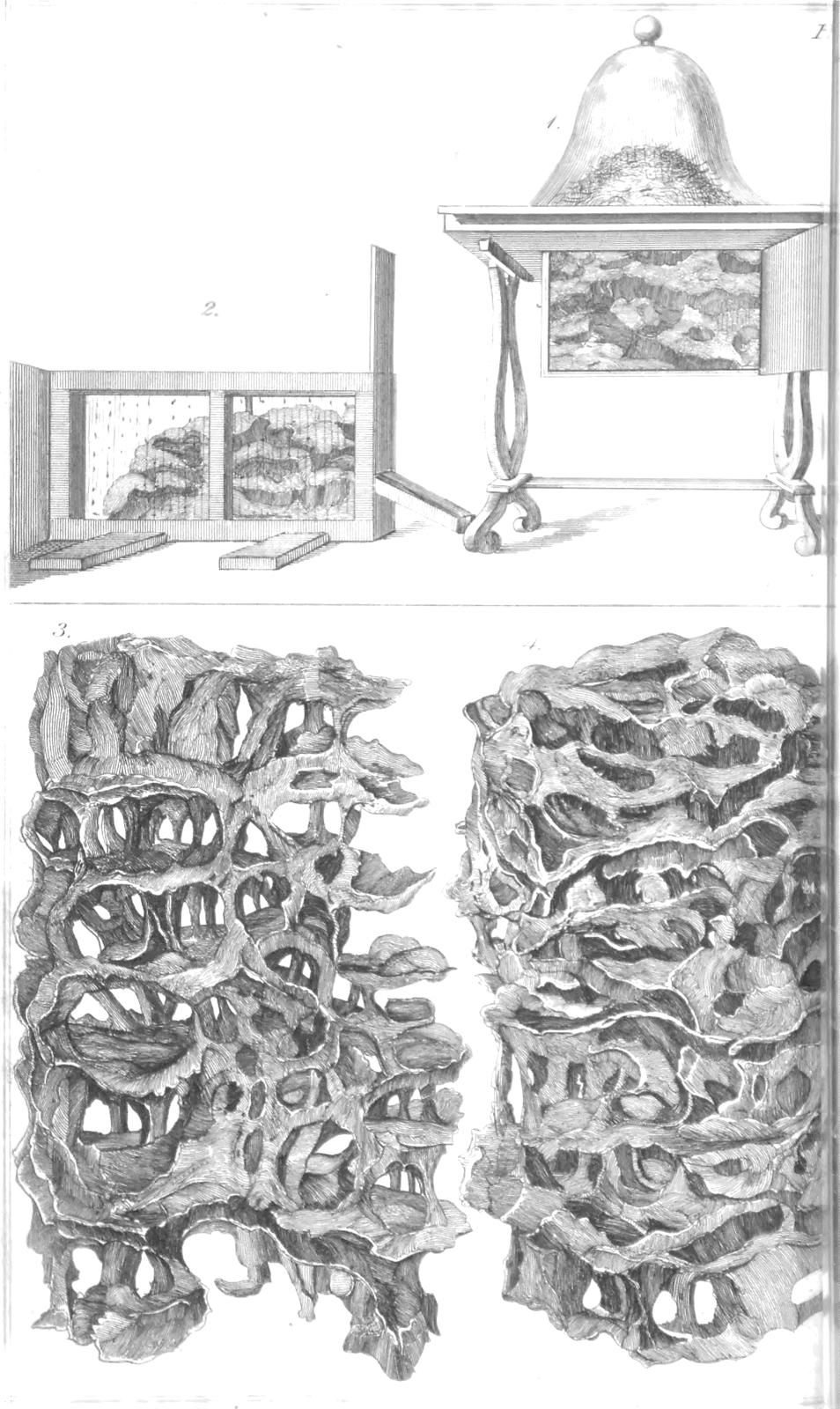
Pubd. by Longman & Co. Pater Noster Row. May 2nd. 1820.
[Pg 1]
THE
NATURAL HISTORY
OF
ANTS.
CHAP. I.
THE ARCHITECTURE OF ANTS.
The first objects which strike the attention in entering upon the study of the history of ants, are the art with which they form their habitations; their variety, and the manner in which they respectively answer the wants of the species who construct them. They are sometimes fabricated with earth, sometimes hewn out in the trunk of the most solid trees, or simply composed of leaves and stalks of plants collected from all quarters. They are of an astonishing size, when compared with their diminutive architects.
[Pg 2]
I hope, in the course of the present work, to bring the reader to conceive what degree of intelligence we may grant these insects, whose faculties, police, and sagacity, have been, by some authors, as much over-rated as by others not duly appreciated.
The three modes of building, of which I have just spoken, admit of numerous modifications, each species of ant being endowed with some peculiar talent. I shall mention in what they differ, after describing the general outline of their architecture, if we may express, by the same term, the simple and rude work of an insect, and an art brought to perfection by the hands of man.
1. ART OF BUILDING AMONG THE FALLOW ANTS.
The fallow ant is that ant which forms in the woods those hillocks so remarkable for their extent. It admits of easy observation, from its being above the middle size, from its operations being carried [Pg 3]on in open day, and from the simplicity of the work in which we find it engaged. It is very common in every part of Europe, and has, therefore, occupied the attention of Linnæus, De Geer, &c., but these learned men, having noticed it under a point of view different from mine, and my plan not permitting me to mention what they say upon this head, I shall, after briefly describing these insects, commence by explaining the construction of their abode, at the same time noticing the very exact police ants of this species observe.
The working fallow ants are from three to four lines in length, and stand high upon their legs. Their head, which is larger than the corslet, is of a pale red or fallow colour at the extremity, and blackish at the top. The mouth is armed with two very strong mandibles, denticulated and hooked at the point, which they generally keep apart, and make use of, not only for attacking their enemies and tearing their prey, but in carrying burthens, [Pg 4]and performing the labours and reparations of the ant-hill. The antennæ are black and filiform. The corslet is protuberant, raised anteriorly, compressed and truncated posteriorly, often marked with a black stain above, the rest being of a clear fallow colour. The peduncle of the abdomen is of the same colour, and bears a large scale, which is scolloped and blackish on its superior margin. The abdomen is brown or ash-coloured, slightly invested with hair, globose, composed of five rings, not counting the scale, wanting the sting, but armed with a venom-bag. The feet are brown, and the thighs, at their origin, of a reddish tint. I have described, in the Appendix, two varieties of these ants; one with a black back, another with a back of the same colour as the rest of the corslet. This difference, which scarcely affects the habitudes of these insects, separates, however, those who inhabit the woods from those who live along-side hedges, and in meadows. It is the latter only, [Pg 5]that have the corslet stained with black and the scale on its upper margin[1] brown. They both collect, near their habitation, fragments of straw, pieces of wood, little stones, leaves, and all other objects within reach, that may be of service in increasing its height, not neglecting even moths, minute shells, corn, oats, and barley, which doubtless gave rise to their ancient renown. But if this foresight, which we supposed them to possess, has not for its object to preserve them from famine during the winter, a time in which ants eat but little, especially grain, it is not the less worthy of our regard, when we consider its real purport.
That little mound which seems at the first glance only an assemblage of materials confusedly scattered, is, however, an invention as ingenious as simple to carry off the waters from the ant-hill, to defend it from the injuries of the air, and from hostile attacks, and to regulate the heat [Pg 6]of the sun, or retain it in the interior. The mass of the different materials of which it is composed, always presents a circular dome, whose base, often covered with earth and pebbles, forms a cone, above which the wooden portion of the building is erected in the form of a sugar loaf. But this is simply the exterior covering of the ant-hill; the most considerable portion is hidden from our sight, descending to a depth of greater or less extent. Avenues constructed very carefully of an irregular funnel shape conduct from the roof to the interior. Their number depends upon the population of the nest and its extent. The entrance to the nest is more or less considerable. We sometimes find a spacious aperture at the top, but more frequently, several apertures of nearly equal size, around which are many narrow passages, symmetrically and circularly disposed, which extend even to the base of their habitation.
These several apertures were necessary [Pg 7]to give a free egress to the vast multitude of labourers of which their colony is composed. Not only do they work continually on the outside of their nest, but differing very essentially from other species who willingly remain in the interior sheltered from the sun, they prefer living in the open air, and do not hesitate carrying on, even in our presence, the greater part of their operations.
In the habitations of the yellow ant, the dark ash-coloured ant, the sanguine ant, the brown ant, &c. we never observe the entrances of sufficient width to allow their enemies easy access, or permit the introduction of the rain. They are covered with a dome of earth, closed on all sides, and have no outlet but near the base, which is by a long and tortuous passage that winds to the distance of several feet in the grass. The diminutive size of these apertures, at all times diligently guarded within, prevents the entrance of any insects or reptiles that may happen to arrive there.
[Pg 8]
The fallow ants, collected in crowds during the day on their nest, have no fear of being disquieted in the interior, but when, in the evening, they retire to their quarters, no longer perceiving what passes without, how are they screened from the accidents with which they are menaced? or how happens it that the rain does not penetrate their abode, open as it is on every side to its introduction? These questions, simple as they are, do not appear to have engaged the attention of naturalists. Have they not then foreseen the dangers to which these insects would have been exposed, if that wisdom which regulates the universe had not provided for their safety? Struck with these reflections, when I first noticed the fallow ants, I directed my entire attention to this subject, and soon acquired the information I wanted. I remarked that their habitations changed in appearance hourly, and that the diameter of those spacious avenues, where so many ants could freely pass each other during the day, was, as [Pg 9]night approached, gradually lessened. The aperture at length totally disappeared, the dome was closed on all sides, and the ants retired to the bottom of their nest.
In further noticing the apertures of these ant-hills, I fully ascertained the nature of the labour of its inhabitants, of which I could not before even guess the purport; for the surface of the nest presented such a constant scene of agitation, and so many insects were occupied in carrying materials in every direction, that the movement offered no other image than that of confusion.
I saw then clearly that they were engaged in stopping up their passages; and for this purpose, they at first brought forward little pieces of wood, which they deposited near the entrance of those avenues they wished to close, they placed them above the aperture, and even sunk them in the stubble; they then went to seek other ligneous fragments which they disposed above the first, but in a different direction, and appeared to choose fragments [Pg 10]of less size in proportion as the work advanced. They at length brought in a number of dried leaves, and other materials of an enlarged form, with which they covered the roof. Is not this in miniature the art of our builders when they form the covering of any building? Nature seems every where to have anticipated the inventions of which we boast. This is doubtless one of the most simple.
Our little insects, now in safety in their nest, retire gradually to the interior before the last passages are closed, one or two only remain without, or concealed behind the doors on guard, whilst the rest either take their repose, or engage in different occupations in the most perfect security.
I was impatient to know what took place in the morning upon these ant-hills, and therefore visited them at an early hour. I found them in the same state in which I had left them the preceding evening. A few ants were wandering about on the surface of the nest, some [Pg 11]others issued from time to time from under the margin of the little roofs formed at the entrance of the galleries: others afterwards came forth who began removing the wooden bars that blockaded the entrance, in which they readily succeeded. This labour occupied them several hours. The passages were at length free, and the materials with which they had been closed scattered here and there over the ant-hill.
Every day, morning and evening, during the fine weather, I was a witness to similar proceedings. On days of rain, the doors of all the ant-hills remain closed. When the sky is cloudy in the morning, or rain is indicated, the ants, who seem to be aware of it, open but in part their several avenues, and immediately close them when the rain commences. It would appear from this they are not insensible of the motive for which they form these temporary closures.
To have an idea how the straw or stubble roof is formed, let us take a view [Pg 12]of the ant-hill at its origin, when it is simply a cavity in the earth. Some of its future inhabitants are seen wandering about in search of materials fit for the exterior work, with which, though rather irregularly, they cover up the entrance; whilst others are employed in mixing the earth, thrown up in hollowing the interior, with fragments of wood and leaves, which are every moment brought in by their fellow-assistants; and this gives a certain consistence to the edifice, which increases in size daily. Our little architects leave here and there cavities where they intend constructing the galleries which are to lead to the exterior, and as they remove in the morning the barriers placed at the entrance of their nest the preceding evening, the passages are kept entire during the whole time of its construction. We soon observe it to become convex; but we should be greatly deceived did we consider it solid. This roof is destined to include many apartments or stories. Having observed the motions of [Pg 13]these little masons through a pane of glass which I adjusted against one of their habitations, I am enabled to speak with some degree of certainty upon the manner in which they are constructed.
It is by excavating or mining the under portion of their edifice that they form their spacious halls, low indeed and of heavy construction, yet sufficiently convenient for the use to which they are appropriated, that of receiving at certain hours of the day the larvæ and pupæ.[2]
[2] The terms of Larva and Pupa are employed to designate the intermediate states of existence in the insect, on its passage from the egg to its becoming a perfect animal, endowed with all the powers of its race, the former being commonly known under the appellation of Grub or Caterpillar, the latter of Chrysalis or Aurelia. The ant remains, according to Gould, in the first or larva state of existence nearly a twelvemonth, in the state of pupa about six weeks, and as a perfect insect 16 months. The time, however, they remain as larvæ and pupæ is, no doubt considerably influenced by variations in the temperature, and other causes. M. Reaumur hastened the disclosure of the butterfly by keeping the aurelia or pupa in a warm room, and retarded it by placing it in an ice house. Mr. Kirby once kept one of the aphidivorous flies—the whole term of whose existence, according to this intelligent entomologist, does not, in the summer, exceed at the very utmost six weeks—several months in the state of larva; and, paradoxical as it may seem, by simply neglecting to give it food.—T.
[Pg 14]
These halls have a free communication by galleries made in the same manner. If the materials of which the ant-hill is composed were only interlaced, they would fall into a confused heap every time the ants attempted to bring them into regular order. This, however, is obviated by their tempering the earth with rain-water, which afterwards hardening in the sun, so completely and effectually binds together the several substances as to permit the removal of certain fragments from the ant-hill, without any injury to the rest: it, moreover, strongly opposes the introduction of the rain. I never found, even after long and violent rains, the interior of the nest [Pg 15]wetted to more than a quarter of an inch from the surface, provided it had not been previously out of repair, or deserted by its inhabitants.
The ants are extremely well sheltered in their chambers, the largest of which is placed nearly in the centre of the building; it is much loftier than the rest, and traversed only by the beams that support the ceiling: it is in this spot that all the galleries terminate, and this forms, for the most part, their usual residence.
As to the under-ground portion, it can only be seen when the ant-hill is placed against a declivity; all the interior may be then readily brought in view, by simply raising up the straw roof. The subterranean residence consists of a range of apartments, excavated in the earth, taking an horizontal direction.
That part of the architecture of fallow ants, which equally obtains with the mason-ants, and of which I shall soon have occasion to speak, I shall not now stop to describe, but pass on immediately to [Pg 16]the labours of the latter, which will be found to merit our attention.
2. ARCHITECTURE OF THE MASON-ANTS.
I term those mason-ants, whose nests, on the exterior, have the appearance of hillocks of earth, without admixture of other materials, whilst in the interior they present a series of labyrinths, lodges, vaults, and galleries, constructed with great art.
There are several species of mason-ants. The earth, of which their nest is composed, is more or less compact. That which ants of a certain size, such as the ash-coloured and mining ants employ, appears to be less selected, and forms a less fine paste, than that of which the brown, microscopic, and yellow ants form their abode. It is, however, sufficiently adapted to their use, and to the nature of the edifice they intend erecting.
To form a correct judgment of the interior arrangement or distribution of an ant-hill, it is necessary to select such as [Pg 17]have not been accidentally spoiled, or whose form has not been too much altered by local circumstances; a slight attention will then suffice to show, that the habitation of the different species are not all constructed after the same system. Thus, the hillock raised by the ash-coloured ants will always present thick walls, fabricated with coarse earth, well-marked stories, and large chambers, with vaulted ceilings, resting upon a solid base. We never observe roads or galleries, properly so called, but large passages, of an oval form, and all around considerable cavities and extensive embankments of earth. We further notice, that the little architects observe a certain proportion between the large arched ceilings and the pillars that are to support them.
The brown, one of the smallest of the ants, is particularly remarkable for the extreme finish of its work. Its body is of a reddish shining brown, its head a little deeper, and the antennæ and feet [Pg 18]a little lighter in colour. The abdomen is of an obscure brown, the scale narrow, of a square form, and slightly scolloped. The body is one line and two-fifths in length.[3]
This ant, one of the most industrious of its tribe, forms its nest of stories, four or five lines in height. The partitions are not more than half a line in thickness, and the substance of which they are composed is so finely grained, that the inner walls present one smooth, unbroken surface. These stories are not horizontal: they follow the slope of the ant-hill, and lie one upon the other to the ground-floor, which communicates with the subterranean lodges. They are not always, however, arranged with the same regularity, for these ants do not follow an invariable plan; it appears, on the contrary, that nature has allowed them a certain latitude in this respect, and that they can, according to circumstances, modify them to their wish:—but, [Pg 19]however fantastical their habitations may appear, we always observe they have been formed by concentrical stories. On examining each story separately, we observe a number of cavities or halls, lodges of narrower dimensions, and long galleries, which serve for general communication. The arched ceilings covering the most spacious places are supported, either by little columns, slender walls, or by regular buttresses. We also notice chambers that have but one entrance, communicating with the lower story, and large open spaces, serving as a kind of carrefour, or cross-road, in which all the streets terminate. Such is the manner in which the habitations of these ants are constructed. Upon opening them, we commonly find the apartments, as well as the large open spaces, filled with adult ants, and always observe their pupæ collected in the apartments, more or less near the surface. This, however, seems regulated by the hour of the day, and the temperature; for in this respect these [Pg 20]ants are endowed with great sensibility, and know the degree of heat best adapted for their young. The ant-hill contains sometimes more than twenty stories in its upper portion, and at least as many under the surface of the ground. By this arrangement the ants are enabled, with the greatest facility, to regulate the heat. When a too burning sun overheats their upper apartments, they withdraw with their little ones to the bottom of the ant-hill. The ground-floor becoming, in its turn, uninhabitable, during the rainy season, the ants of this species transport what most interests them to the higher stories, and it is there we find them more usually assembled with their pupæ and eggs, when the subterranean apartments are submerged.[4] Having ascertained [Pg 21]the internal arrangement of their habitations, it was still an object of discovery, how ants, working with a substance so hard, could trace out and finish works so extremely delicate, with the assistance only of their teeth, how they could soften the earth, for the purpose of mining, kneading, and building with it, and what cement they employed to unite its several particles into one mass. Did it depend upon a sort of mucilage or resin, or some other liquid furnished by the ants themselves, similar to what the mason-bee employs in building the nest to which it gives so much solidity? I ought, perhaps, to have analysed the earth of which these ant-hills are composed, [Pg 22]but I was fearful of engaging in difficulties that did not come within my immediate province, and therefore kept to the slow but sure method of observation, by which I hoped to obtain the same result.
[4] De Azara informs us, that during the inundation of the low districts in South America, when the ant-hills, which are usually about three feet in height, are completely under water, the ants avail themselves of an ingenious contrivance, to prevent their being carried to any distance from their habitation. With this view, and for their greater security, they collect into a compact mass, and keep firm hold of each other, previously attaching one of the extremities to some neighbouring plant, or fixed point of support, leaving the other end free and floating on the surface of the water, as long as the inundation (which usually lasts a few days) continues.—T.
I hastened, then, to observe one of these ant-hills, until I should perceive some change in its form.
The inhabitants of that I had selected kept within during the day, or only went out by the subterranean galleries, which opened at some feet distance in the meadow. There were, however, two or three small openings on the surface of the nest, but I saw none of the labourers pass out this way, on account of their being too much exposed to the sun, which these insects greatly dread.
This ant-hill, which had a round form, rose in the grass at the border of a path, and had sustained no injury. I soon perceived that the freshness of the air and the dew invited the ants to walk over the surface of their nest; they began [Pg 23]making new apertures; several ants might be seen arriving at the same time, thrusting their head from the entrances, moving about their antennæ, and at length adventuring forth to visit the environs.
This brought to my recollection a singular opinion of the ancients. They believed that ants were occupied in their architectural labours during the night, when the moon was at its full.[5] This idea was not, perhaps, without some foundation, and although the moon had doubtless no kind of influence on their conduct, yet I perceived something true in the observation.
[5] Aristotle affirmed, that ants worked in the night, when the moon was at its full; Hist. Anim. l. ix. c. 38. Pliny also alludes to their nocturnal labours. “Operantur et noctu plena lunâ; eadem interlunio cessant.” Gould states that they employ each moment by day and night, almost without intermission, unless hindered by excessive rains; and the author of a Memoir in the Transactions of the French Academy, remarks, that the ants, he observed, were so incessantly occupied during the night, that it seemed as if they never slept!—T.
[Pg 24]
Having then noticed the movements of these insects during the night, I found they were almost always abroad and engaged about the dome of their habitation after sun-set. This was directly the reverse of what I had observed in the conduct of the fallow ants, who only go out during the day, and close their doors in the evening. The contrast was still more remarkable than I had previously supposed, for upon visiting the brown ants, some days after, during a gentle rain, I saw all their architectural talents in full play.
As soon as the rain commenced, they left, in great numbers, their subterranean residence, re-entered it almost immediately, and then returned, bearing between their teeth pellets of earth, which they deposited on the roof of their nest. I could not, at first, conceive, what this was meant for, but at length I saw little walls start up on all sides with spaces left between them. In several places, columns, ranged at regular distances, announced [Pg 25]halls, lodges, and passages, which the ants proposed establishing; in one word, it was the ebauche of a new story.
I watched with a considerable degree of interest, the most trifling movements of my Masons, and found they did not work, after the manner of wasps and humble-bees, when occupied in constructing a covering to their nest. The latter sit as it were a-stride (se mettent pour ainsi dire à cheval) the border or margin of this covering, and take it between their teeth to model and attenuate it according to their wish. The wax of which it is composed, and the papier which the wasp employs, moistened by some kind of glue, are admirably adapted for this purpose; but the earth (often possessing but little tenacity) of which the ants make use, must be worked up after some other manner.
Each ant, then, carried between its teeth the pellet of earth it had formed, by scraping with the end of its mandibles, [Pg 26]the bottom of its abode, which I have often witnessed in open day. This little mass of earth, being composed of particles but just united, could be readily moulded as the ants wished: thus, when they had applied it to the spot where it was to rest, they divided, and pressed against it with their teeth, so as to fill up the little inequalities of their wall. The antennæ followed all their movements, passing over each particle of earth as soon as it was placed in its proper position. The whole was then rendered more compact, by pressing it lightly with the fore-feet. This work went on remarkably quick. After having traced out the plan of their masonry, in laying here and there foundations for the pillars and the partitions they were about to erect, they gave them more relief by adding fresh materials. It often happened that two little walls, which were to form a gallery, were raised opposite, and at a slight distance from each other. When they had attained the height of four or five lines, the ants busied themselves [Pg 27]in covering in the space left between them by a vaulted ceiling.
Quitting, then, their labours in the upper part of the building, as if they judged all their partitions of sufficient elevation, they affixed to the interior and upper part of each wall, fragments of moistened earth, in an almost horizontal direction, and in such a way, as to form a ledge which, by extension, would be made to join that coming from the opposite wall. These ledges were about half a line in thickness; and the breadth of the galleries was, for the most part, about a quarter of an inch. Here several vertical partitions were seen to form the scaffolding of a lodge, which communicated with several corridors, by apertures formed in the masonry; there, a regularly formed hall, the vaulted ceiling of which was sustained by numerous pillars; further off might be recognised the rudiments of one of those carrefours of which we have before spoken, and in which several avenues terminate. These [Pg 28]parts of the Ant-hill were the most spacious; the ants, however, did not appear embarrassed in constructing the ceiling to cover them in, although they were often more than two inches in breadth.
In the upper part of the angles formed by the different walls, they laid the first foundations of this ceiling, and from the top of each pillar, as from so many centres, a layer of earth, horizontal and slightly convex, was carried forward to meet the several portions coming from different points of the large public thoroughfare.
This busy crowd of Masons, arriving from all parts with the piece of mortar they wish to add to the building, the order they observe in their operations, the harmony which prevails, and the eagerness with which they avail themselves of the rain to increase the height of their abode, present to the contemplative observer a scene of considerable interest.
I sometimes, however, laboured under [Pg 29]an apprehension that the building could not possibly resist its own weight, and that such extensive ceilings, sustained only by a few pillars, would fall into ruin from the rain which continually fell upon them;—but I was quickly convinced of their stability, from observing that the earth, brought by these insects, adhered at all points, on the slightest contact; and that the rain, so far from lessening the cohesion of its particles, appeared even to increase it. Thus, instead of injuring the building, it even contributed to render it still more secure.
These parcels of moistened earth, which are only held together by juxtaposition, require a fall of rain to cement them more closely, and thus varnish over, as it were, those places where the walls and galleries remain uncovered. All inequalities in the masonry then disappear. The upper part of these stories, formed of several pieces brought together, presents but one single layer of compact earth. They require for their complete [Pg 30]consolidation nothing but the heat of the sun. It sometimes, however, happens that a violent rain will destroy the apartments, especially should they be but slightly arched; but under these circumstances the ants reconstruct them with wonderful patience.
These different labours were carried on at the same time, and were so closely followed up in the different quarters, that the Ant-hill received an additional story in the course of seven or eight hours. All the vaulted ceilings, being formed upon a regular plan, and at equal distances from one wall to the other, constituted, when finished, but one single roof. Scarcely had the ants finished this story than they began constructing another; but they had not time to finish it: the rain ceasing before the ceiling was fully completed. They still, however, continued their work for a few hours, taking advantage of the humidity of the earth; but a keen north wind soon sprung up, and hastily dried the collected fragments, [Pg 31]which, no longer possessing the same adherence, readily fell into powder. The ants, finding their efforts ineffectual, were at length discouraged, and abandoned their employment; but what was my astonishment, when I saw them destroy all the apartments that were yet uncovered, scattering here and there over the last story, the materials of which they had been composed! These facts incontestably prove, that they employ neither gum, nor any kind of cement to bind together the several substances of their nest, but in place of this avail themselves of the rain, to work or knead the earth, leaving the sun and wind to dry and consolidate it.[6] In the [Pg 32]simplicity of these means, I recognised the hand of Nature: however, I still thought it necessary to make an experiment to be convinced of the correctness of these results. A few days after, I endeavoured to excite them to recommence their labours by an artificial shower. With this view, I took a very strong brush which I plunged in water, and passing my hand backwards and forwards over the hairs, produced upon the surface of the Ant-hill a very fine dew. The ants perceiving from the interior of their dwelling, the humidity of the roof, [Pg 33]came out and passed rapidly over the surface; the sprinkling was continued; the Masons were deceived. They went to the bottom of the Nest to provide themselves with little masses of Earth, which they afterwards brought and deposited on the roof; they then constructed walls and chambers; in a word, a complete story was erected in the course of a few hours. This experiment I frequently repeated, and always with the same success. It is in the Spring more particularly, that the Mason Ants avail themselves of the rain when they wish to enlarge the boundaries of their nest. Night even does not arrest their progress. I have often noticed in the morning stories that had been completely erected during the night.
[6] I was in the habit of visiting, almost daily, for a month, an extensive nest of Red Ants, of which a large flat stone formed the roof.—During my visits for the first three weeks, scarcely a drop of rain had fallen, and the nest seemed to be considerably injured by the continual falling in of loose earth, which these little creatures with amazing industry removed, whenever it happened any of the avenues were blocked up. No attempt was ever made towards reparation; but what was my surprise on visiting my little friends, after a two days’ heavy rain, to find, that the repairs were already completed, and that the upper surface of their habitation presented as smooth a surface as if a trowel had been passed over it; yet all their work they had industriously effected by kneading with the rain-water, the loose earth into a sort of paste. From the nest being situated in the midst of an extensive heath, where there could be no supply of water, and from its remaining unrepaired during the dry weather, it amounts to a full conviction, that Ants employ no other cement than water, in the construction of their varied habitations.—T.
The ants, not content with giving additional elevation to their abode, hollow out, in the earth, apartments still more spacious; the materials thus obtained, are, as before stated, employed in the exterior construction. The art of these insects, [Pg 34]therefore, consists in their executing, at the same time, two contrary operations, the one of mining, the other of building, making the former subservient to the latter; and what is still as singular, the same talent is manifested in these excavations, as in that portion of the building above ground. The humidity which penetrates to the bottom of their nest, is doubtless of great assistance to them in these labours.[7]
[7] It may not be uninteresting after this account of the labours of the Mason-Ants, to give a sketch of the manner in which the Termites, or what have been termed by travellers, White Ants, so abundant in Africa, construct their dwelling. Compared with the Architects, their habitations are of an astonishing magnitude; they frequently exceed twelve feet in height, and are so firmly cemented as to bear the pressure of several men at the same time. It often happens that, whilst a herd of wild cattle are quietly grazing below, one of their body is stationed on them as sentinel, to give timely notice of approaching danger. The Termites begin constructing their habitations, by raising, at little distances from each other, several turrets of compact clay in the shape of sugar-loaves: upon these they erect others; those in the centre run to the greatest height: they afterwards cover in the spaces between them, and then take down the sides of all the inner turrets, leaving only the upper portion to form the cupola or dome, making use of the clay they thus procure, in the formation of the several chambers intended for magazines, nurseries, &c. The nurseries are entirely composed of wooden materials, enclosed in chambers of clay, usually half an inch in width, ranged around, and as close as possible to the royal apartment. The royal chamber, which, with the rest, are arched over, occupies as nearly as possible the centre of the building, and is on a level with the surface of the ground; it is at first only an inch in length, but increases in size with that of the Queen, until it extends to six or more inches. In this chamber the King and Queen are retained close captives; it is impossible they can ever quit it; the entrance only allowing of the passing and repassing of the Soldiers and Labourers (the Queen, in the last stage of her pregnancy, is 1000 times the weight of the King, and equal in bulk to about 20,000 Labourers, although, on her first appearance as a winged insect, she equalled only in bulk about 30 Labourers,—her abdomen increases from half an inch to three inches in length, and she lays, according to Smeathman, as many as 80,000 eggs in the course of 24 hours: hence the necessity for the numerous attendants by whom she is continually surrounded.) In an Ant-Hill of such extensive size, and where there is such an infinity of chambers to accommodate its numerous inhabitants, there must be of necessity a vast number of subterraneous and winding passages. These passages, which conduct to the upper parts of the dome, are carried in a spiral manner round the building, for the Labourers find it extremely difficult to ascend in a less circuitous direction. Very frequently, however, to shorten the distance to the upper nurseries, where they have to take the eggs, they project an arch of about ten inches in length, and half an inch in breadth, grooved or worked into steps, on its upper surface to allow of a more easy passage. When these insects quit their nest on any expedition, they construct covered galleries of clay which sometimes run to a considerable distance, and under this they continue their extensive and highly dreaded depredations.—T.
[Pg 35]
3. ARCHITECTURE OF THE DARK ASH-COLOURED ANTS.
These Ants, which are fully described in the Appendix, are distinguished, according [Pg 36]to Latreille, by their having the body, head, and abdomen, of a shining dark ash-colour, the base of the antennæ and the feet reddish, the scale large and nearly triangular, and three small ocelli or simple eyes.
The Ash-coloured Ants build in a manner very different from the Brown Ants. [Pg 37]We have already seen from the description of their dwelling, that, in comparison to the latter, it is exceedingly simple and heavy in its construction. This simplicity, however, was better adapted to my object,—that of examining, if possible, how many ants could concur in the execution of the same design, and how far they appeared to understand each other in the general progress of their labour;—that of discovering also, if they acted in concert, or independently of each other; of their own accord, or from some general impulse. I do not flatter myself that I have solved these important questions, but the facts I am about to adduce, will, at least, serve to elucidate this subject.
When the Ash-coloured Ants seem desirous to give greater elevation to their dwelling, they commence, by placing over the roof a thick layer of earth, which they bring from the interior. It is here they trace en creux et en relief, the plan of a new story; they, at first, form here and there little dykes more or less close to [Pg 38]each other, and of a breadth proportioned to the use for which they are designed: they give them nearly equal depth, for the most part equalling their breadth: the masses of earth left between them, serve afterwards, for the foundation of the inner walls. Having removed all the useless earth from the bottom of each chamber, and reduced to their proper thickness the foundation of the walls, the architects have nothing more to do, than to increase the height of their building, and cover over with a ceiling the several apartments.
After witnessing the manner in which these ant-hills are constructed, I was aware that the best and only mode of attaining a correct knowledge of their organization, was that of following individually the conduct of the Labourers engaged in erecting them. My journals are filled with observations of this nature. I extract a few that seem to possess some interest. I shall at present describe the operations of a single ant that I observed [Pg 39]sufficiently long to satisfy my curiosity.
One rainy day, I observed a Labourer digging the ground near the aperture which gave entrance to the ant-hill. It placed in a heap the several fragments it had scraped up, and formed them into small pellets, which it deposited here and there upon the nest. It returned constantly to the same place, and appeared to have a marked design, for it laboured with ardour and perseverance. I remarked a slight furrow, excavated in the ground in a straight line, representing the plan of a path or gallery. The Labourer, the whole of whose movements fell under my immediate observation, gave it greater depth and breadth, and cleared out its borders; and I saw, at length—in which I could not be deceived—that it had the intention of establishing an avenue which was to lead from one of the stories to the under-ground chambers. This path, which was about two or three inches in length, and formed [Pg 40]by a single ant, was opened above, and bordered on each side by a buttress of earth: its concavity en forme de gouttiere was of the most perfect regularity; for the architect had not left an atom too much. The work of this ant was so well followed and understood, that I could almost to a certainty guess its next proceeding, and the very fragment it was about to remove. At the side of the opening where this path terminated, was a second opening to which it was necessary to arrive by some road. The same ant engaged in and executed alone this undertaking. It furrowed out and opened another path, parallel to the first, leaving between each a little wall of three or four lines in height.
Those ants who lay the foundation of a wall, a chamber, or gallery, from working separately, occasion now and then a want of coincidence in the parts of the same or different objects. Such examples are of no unfrequent occurrence, but they by no means embarrass them. [Pg 41]What follows proves that the workman, on discovering his error, knew how to rectify it.
A wall had been erected with the view of sustaining a vaulted ceiling, still incomplete, that had been projected from the wall of the opposite chamber. The workman who began constructing it, had given it too little elevation to meet the opposite partition upon which it was to rest. Had it been continued on the original plan, it must infallibly have met the wall at about one-half of its height, and this it was necessary to avoid. This state of things very forcibly claimed my attention; when one of the ants, arriving at the place, and visiting the works, appeared to be struck by the difficulty which presented itself; but this it as soon obviated, by taking down the ceiling and raising the wall upon which it reposed. It then, in my presence, constructed a new ceiling with the fragments of the former one.
When the ants commence any undertaking, one would suppose that they [Pg 42]worked after some preconceived idea, which indeed would seem verified by the execution. Thus, should any ant discover upon the nest, two stalks of plants, which lie cross-ways, a disposition favourable to the construction of a lodge; or some little beams that may be useful in forming its angles and sides, it examines the several parts with attention, then distributes with much sagacity and address parcels of earth, in the spaces, and along the stems, taking from every quarter materials adapted to its object, sometimes, not caring to destroy the work that others had commenced; so much are its motions regulated by the idea it has conceived, and upon which it acts, with little attention to all else around it. It goes and returns, until the plan is sufficiently understood by its companions.
In another part of the same ant-hill, several fragments of straw seemed expressly placed to form the roof of a large house; a workman took advantage of this disposition: these fragments lying [Pg 43]horizontally, at half an inch distance from the ground, formed, in crossing each other, an oblong parallelogram. The industrious insect commenced, by placing earth in the several angles of this carpentering work, and all along the little beams of which it was composed. The same workman afterwards placed several rows of the same materials against each other, when the roof became very distinct. On perceiving the possibility of profiting by another plant, to support a vertical wall, it began laying the foundations of it; other ants having by this time arrived, finished in common what this had commenced.[8]
[8] I have often been surprised at the ingenuity of these little creatures, in availing themselves of contiguous blades of grass, stalks of corn, &c., when they wish to enlarge the boundaries of their abode. As these are usually met with in the erect position, they are admirably calculated for pillars; they, therefore coat them over with a fine paste of earth, giving them, by additional layers, the solidity they judge necessary for the work on which they are engaged: they then leave them to be consolidated by the wind, and afterwards spring a number of arches, from pillar to pillar, and thus form an extensive saloon. Should they be, at any time, in want of small apartments, they have only to prepare a quantity of moistened earth, and by placing this between the pillars, and carrying it up to the roof, leaving here and there an aperture for entrance, their object is completely attained.—T.
[Pg 44]
From these observations, and a thousand similar, I am convinced that each ant acts independently of its companions. The first who conceives a plan of easy execution, immediately gives the sketch of it; others have only to continue what this has begun, judging, from an inspection of the first labours, in what they ought to engage. They can all lay down plans, and continue to polish or retouch their work as occasion requires. The water furnishes the cement they require, and the sun and air harden the materials of which their edifice is composed. They have no other chisel than their teeth, no other compass than their antennæ, and no other trowel than their fore-feet, of which they make use in an admirable [Pg 45]manner, to affix and consolidate the moistened earth.
These, then, are the material and mechanical means which they employ in their building. In following an instinct purely mechanical, they might execute with precision, a geometrical and invariable plan, construct walls of equal length and breadth, vaulted ceilings, whose curve would only require a servile obeissance, and we should have been but moderately surprised by their industry: but to form these irregular domes, composed of so many stories; to distribute in a convenient, yet varied manner, the apartments they include, and to seize the most favourable time for their labours, but especially to vary them according to circumstances; to profit by the points d’appui that may present themselves; and to judge of the advantage of such and such operations, is it not necessary they should be endowed with faculties closely approaching intelligence, and that, far from considering them as automatons, Nature allows them to perceive the intention [Pg 46]of those labours in which they have been engaged?[9]
[9] For several curious particulars relative to the instinct of insects, I refer to the Introduction to Entomology, by Messrs. Kirby and Spence, vol. ii. p. 465.—This work I cannot too strongly recommend to the notice of my readers; since it abounds in a variety of interesting information, and possesses the no small advantage of being equally amusing as instructive.—T.
I could readily bring forward numberless examples of the industry of ants, in still mentioning after what manner several other species construct their abode; but, not to abuse or weary the patience of my readers, I shall not enter into a detail of the labours of the Field Ants, who build little chambers, one above the other, along the stems of plants, and who can, in time of need, connect grains of sand, by juxta-position alone, or by the admixture of a little moistened earth; nor of those of the Sanguine Ant, who are enabled to form from earth, dry leaves, and other materials, a compact tissue, difficult to break, and impenetrable to water; nor of those covered [Pg 47]galleries, which the Brown Ants construct with earth, conducting from their nest to the feet of trees, and sometimes even to the origin of the branches, for the purpose of arriving with greater security at the places where they find their food.
4. ARCHITECTURE OF ANTS THAT FORM THEIR HABITATION IN TIMBER.
[10][10] “Some ants” says Kirby, “form their nests entirely of the leaves of trees. One of these was observed by Sir Joseph Banks in New South Wales, which was formed by glueing together several leaves as large as a hand. To keep these leaves in a proper position, thousands of ants united their strength, and if driven away, the leaves spring back with great violence.” Latreille speaks of an ant which is met with at Cayenne (F. bispinosa) that forms its nest of a great quantity of down, which it removes from the seeds of a species of the cotton-tree. Madame Merian, in her “Insectes de Surinam,” speaks of an ant, which, in Tobago, is called the parasol ant. They are in the habit of cutting out circular pieces from the leaves of trees and plants (in this respect resembling the apis papaveris), and carrying them off to their nest. When thus engaged, they bear some resemblance to individuals walking with parasols, hence their name. Smeathman informs us, that one species of the Termites, or what are commonly known under the name of White Ants (T. arborum) builds its nest among the branches of trees; and we learn from M. de Laubere, that in that part of Siam which is exposed to inundations, all the ants construct their habitations in trees.—T.
Is it not a matter of astonishment, that Nature should have given to insects of [Pg 48]the same genus, manners so varied, and an industry so widely different? Ants furnish us with one of the most striking examples of this kind. We have just completed a sketch of the several species of Mason-ants; each building in a different manner, and offering some striking peculiarities in the style and mode of their architecture. That of the Fallow-ants is founded upon different principles, and the industry of those who excavate their dwelling in wood, has no point of resemblance with that of the species of which we have lately treated. This tribe of ants includes several species; and we still observe in their architectural labours very sensible shades of difference: all these insects enter into the first of the nine divisions into which [Pg 49]Latreille has distributed ants, it includes the Brown, the Ash-coloured, the Fallow, the Mining, the Sanguine, the Fuliginous, and the Yellow Ant, &c. These ants possess the same exterior organs, a similarity of the means employed in constructing their dwellings, and resemblances in figure, which have occasioned them to be placed under the same division; their instinct, however, places them at a considerable distance from each other, plainly showing that we cannot always form a correct judgment of the manners and customs of insects from analogy.
The labours of those ants that inhabit trees, or what we may term Timber Ants, are less open to general observation than those already described, and have, in consequence, received but little attention from naturalists.
The ant holding the first rank in this division, is, the Fuliginous, so called on account of its colour. It is of a shining black, and is two lines in length; its republics, [Pg 50]composed of a great number of individuals, are less common than those of which we have hitherto spoken.
Let us figure to ourselves the interior of a tree entirely sculptured or hollowed out, consisting of numberless stories, more or less horizontal, whose floors and ceilings are at five or six lines’ distance from each other, and as thin as a card, supported at one time by vertical partitions, forming an infinity of chambers; at another time, by a series of small slender columns, allowing us to observe between them the extent of an almost entire story; the whole, composed of a blackish, and as it were smoked wood; and we shall have a just idea of the cities of these ants.
The greater number of the vertical partitions, which divide each story into compartments, are parallel; they follow the course of the ligneous layers, and are always concentrical, which gives to their work some degree of regularity. The floors, generally speaking, are horizontal. [Pg 51]The little columns are from one to two lines in thickness, more or less round, of a height equal to that of the story they support, larger above and below than in the middle, a little flattened at the capital and base, and ranged in regular lines, since they have been worked out in the parallel partitions. What numerous apartments! What a series of lodges, halls and corridors do these insects not form by their own unsupported industry; and what labour in so great an undertaking does it not cost them!
The wood, in which ants of this species excavate these labyrinths, takes a blackish hue:—does this arise from the extravasated fluids of the tree entering into combination with the external air, or from the emanation of the ants themselves, the odour of which may perhaps have some influence; or do the layers of wood, exposed by these insects, undergo any decomposition from combining with the formic acid? I cannot decide this question; but I rest well assured, that the [Pg 52]wood hewn by these insects, is always blackish externally, and even takes the same colour internally, provided it be very thin, preserving only its natural colour when it has any degree of thickness. It appears that the oak, willow, and other trees in which these ants establish themselves, equally take these colours. I have often observed several other species of ants lodged in the interior of trees, but the wood never presented the same appearance. I have also often noticed at the foot of those which were inhabited by Fuliginous Ants, a very abundant and blackish liquid:—to what must this be attributed? The vegetation of these trees does not appear in the slightest degree affected by the labours of these insects.
It would be a highly interesting sight, could we observe ants occupied in carving the wood in which they fix their residence, we might then learn the origin of the black tint with which it is imbued; but the labourers of this species working [Pg 53]always in the interior of trees, and desirous of being screened from observation, precludes every hope, on our part, of following them in their several occupations. I tried every expedient I could devise to surmount this difficulty; I endeavoured to accustom these ants to live and work under my inspection, but all my efforts were unsuccessful; they even abandoned the most considerable portion of their nest to seek some new asylum, and spurned the honey and sugar I offered them for nourishment. I was now, of necessity, limited to the inspection alone of these edifices; but by decomposing some of the fragments with care, I hoped to acquire some knowledge of their organization. Here, we perceive horizontal galleries, hidden in great part by their walls, which follow the circular direction of the ligneous layers; there, parallel galleries, separated by extremely thin partitions, having no communication except by a few oval apertures. Such is the nature of these works, remarkable for their delicacy and lightness.
[Pg 54]
In other fragments we notice avenues, opened laterally, including portions of walls and transverse partitions, erected here and there, within the galleries, so as to form separate chambers. When the work is further advanced, we always observe round holes, encased, as it were, between two pillars, cut out in the same wall. These holes in course of time become square, and the pillars, originally arched at both ends, are worked into regular columns by the chisel of our sculptors. This, then, is the second specimen of their art. This portion of the edifice will probably remain in this state.
But here are fragments differently wrought, in which these same partitions, pierced now in every part, and hewn skilfully, are transformed into colonnades, which sustain the upper stories, and leave a free communication throughout their whole extent. We can readily conceive how parallel galleries hollowed out upon the same plan, and the sides taken down, [Pg 55]leaving only from space to space what is necessary to sustain their ceilings, may form an entire story; but as each has been pierced separately, the flooring cannot be very level: this, however, the ants turn to their advantage, since these furrows are better adapted to retain the larvæ that may be placed there.
The stories constructed in the great roots offer greater irregularity than those in the very body of the tree, arising, either from the hardness and interlacing of the fibres, which renders the labour more difficult, and obliges the labourers to depart from their accustomed manner, or from their not observing in the extremities of their edifice the same arrangement as in the centre: whatever it be, we still find horizontal stories, and numerous partitions. If the work be less regular, it becomes more delicate; for the ants, profiting by the hardness and solidity of the material, give to their building an extreme degree of lightness. I have seen fragments of from eight to ten inches in [Pg 56]length and of equal height, formed of wood as thin as paper, containing a number of apartments, and presenting the most singular appearance. At the entrance of these apartments, worked out with so much care, are very considerable openings; but, in place of chambers, and extensive galleries, the layers of the wood are hewn in arcades, allowing the ants a free passage in every direction. These may be regarded as the gates or vestibules conducting to the several lodges.
Fig. 3. and 4., Pl. I., give but a very imperfect idea of the labours of these insects. The first represents a fragment taken from the trunk of an oak inhabited by Fuliginous Ants; the second, a small portion of their nest, taken from the roots of the same tree. To judge properly of these fragments, we should place them in every position, we shall then better observe their singular organization.
The Red Ant, a little larger than the preceding, forms a lodging in trees, very [Pg 57]analagous to the above, but upon a much smaller scale. Their dwelling consists of stories more or less developed; some divided into little chambers or lodges, the walls of which are remarkably thin; others sustained by an infinity of little columns, resembling, in size and colour, those of which we have already spoken. The wood, however, is not blackened, as is the case with that excavated by the Fuliginous Ants, but retains its original colour. It is commonly less hard, and of the consistence of cork.
But what is most remarkable in the history of Red Ants is, that they are not only carvers, but even skilful masons. They more frequently fix their residence in the earth. This is not, however, the only species that can, in time of need, display more than one talent in this department. We are about to notice two kinds of ants which also enjoy this privilege, the Ethiopian and the Yellow Ant. They have also an art peculiar to them, of which I have not [Pg 58]yet treated, and which must be regarded as belonging to the architecture of ants.
5. ARCHITECTURE OF THOSE ANTS THAT FORM THEIR RESIDENCE OF SAW-DUST, DECAYED TIMBER, &C.
The Ethiopian Ants, thus named, on account of their jet-black colour, hollow out extensive lodges and long galleries in the oldest trees; but if their works are proportioned to their size, which is greater than that of other ants, they scarcely represent the infancy of the art by the manner in which they are executed. What is most remarkable in their industry is, the use they make of the wood fallen into powder at the foot of the tree they inhabit, to stop up every chink in the flooring of their houses, to close useless passages, and to make compartments in those labyrinths which are too spacious.
The Yellow, one of the mason ants, shows great skill in the employment of this substance, when it establishes its residence [Pg 59]in a hollow tree; it constructs entire stories with decayed wood, selecting the finest particles, which, on being mixed up at the bottom of the tree with a little earth and spider’s web, forms a mass of the consistency of papier mâché. This industry recalls to mind that of wasps, as the labours of the Mason and Timber Ants bring to our recollection those of the Mason and Timber Bees.
The class of hymenopterous insects, the richest of all in varied industry, in original manners and customs, in curious instinct, offers, continually, similarities and contrasts; connections between genera the farthest removed, and striking differences between species the most approximate. The moral condition of these insects does not appear to follow their physical condition; a truth of some importance to animal physiology.
[Pg 60]
CHAP. II.
OF THE EGGS, LARVÆ, AND PUPÆ OF
ANTS.
The exterior of ant-hills, their form and construction, have hitherto entirely occupied us: it was, however, necessary to commence by establishing the ants in their abode previous to describing the rest of their labours. The object which will now evidently create some interest, is that solicitude the workers evince for the object of their charge, and the maternal attention they bestow upon them from the period of their quitting the egg to that of their complete developement.[1] [Pg 61]Although several naturalists have studied the metamorphosis of ants, and described the principal circumstances connected with it, yet we are about to examine, under new relations, the developement and education of these insects in their different states. The history of the egg had entirely escaped their researches, as well as several particulars in the history of the pupæ and larvæ.
[1] It would be perhaps more regular to speak of the fecundation of ants, before making known the care and affection they evince for their young. This plan, from which we could not well depart, in speaking of insects that lead a solitary life, is not so natural, when treating of numerous and permanent republics, such as those of ants. It would have been difficult to have mentioned every circumstance connected with the reproduction of the species, before describing the interior of their habitations, and the method I found the most successful in my observations. The education of their young, being the chief end of all their labours, offers, in part, a picture of the manners of these industrious insects. It is for this reason, the plan I now follow appeared the best to elucidate subsequent remarks.—A.
My predecessors, not having made use of a glazed apparatus to observe what passed in the interior of ant-hills, had but very rarely seen these insects engaged in their household occupations; and this was not so [Pg 62]easy of accomplishment as it at first appeared.
These insects, although possessing so little timidity, and regardless, as it concerns themselves, of the several changes in the weather, evince the greatest concern for their little ones. For beings, so delicately formed, they dread the slightest variations of the atmosphere, are alarmed at the least danger which threatens them, and seem particularly anxious to withdraw them from our notice.
I was in my first attempts continually disappointed, from the great repugnance they manifested in allowing the light to penetrate their abode: whenever I attempted to glaze their apartments, or to lay open to view any of their halls or passages, if they did not completely abandon them, they at least prevented me from following them in their in-door labours. At one time they would darken, by a heap of different materials, all the halls which admitted the light; at another time, as if conscious that the glass, notwithstanding [Pg 63]its transparency, could guard them from the external air, and that nothing was wanting to render it a true wall, but the power of excluding that glaring light, at all times so disagreeable to them, they preserved entire all the galleries contiguous to it, taking the sole precaution of covering it over with a layer of moistened earth, which effectually hindered further observation.
Thus disappointed, I employed a method more simple, though more effectual:—I removed a portion of the ant-hill, and then placed over the remainder a thin flat board inclined to the south; the ants, attracted by the heat brought their little ones to this place. By removing this outside shutter or contrevent, I could ascertain the progress in their growth, although the workers, on being disturbed, hastened to convey them to their under-ground quarters.
I was often obliged to vary the means I employed; for the ants, soon wearied by my visits, still baffled all my efforts, [Pg 64]by making a true wall of earth behind the contrevent. After having for some time attended to the manners and habits of these insects, I found that we might accustom them by degrees to suffer the entrance of the light in their abode; but it was necessary, notwithstanding, to use much caution. What succeeded with me the best, was that of forming an oblong opening in the middle of a table, and affixing underneath, a double frame, glazed on its two longest sides, and opened only at the upper part, which communicated with this aperture. These frames (fig. 1. Pl. I.) being furnished with shutters, permitted me, either to observe the ants, or to favour them in their taste for obscurity. This done, I scattered all the materials of a nest of Fallow Ants upon the table, and left them at liberty to arrange them at the bottom of the glazed box, which they did in such a manner, that it was easy to observe all their galleries, and the apartments to which they led. I at length covered over the whole [Pg 65]of the materials with a large bell-glass, in order that I might witness the movements of my prisoners, as well inside as on the outside, and at the same time guard against their escape. But when I saw they were accustomed to their fate, and did not seek to leave their prison, I allowed them free issue from under the bell-glass, and the liberty of running over the platform upon which it rested, taking only the precaution of plunging the feet of the table in vessels filled with water, to arrest the ants in their passage, should they attempt to escape.
This apparatus, and several others of which the explanation would be long and tedious, had all the success I wished. I observed, with much pleasure, that the ants continued to take care of the larvæ, which proved, that in taking them, in some respects, from the state of nature, I had not too much disturbed them. This gave me reason to hope, that I should observe, in its greatest extent, all the care they took of the rising generation.
[Pg 66]
I did not, however, always keep to these artificial means. I compared, as often as possible, the conduct of my prisoners, with that of those ants inhabiting and ranging about the fields, and as I never remarked any sensible difference in their manner of acting, I concluded I could trust the results obtained by means of my glazed apparatus.
Let us now open the shutter which conceals from us the interior of the ant-hill, and let us see what is passing there.
Here, the pupæ are heaped up by hundreds in their spacious lodges; there, the larvæ are collected together, and guarded by workers. In one place, we observe an assemblage of eggs, in another place, some of the workers seem occupied in following an ant of a larger size than the rest;—this is the mother, or at least one of the females, for there are always several in each ant-hill:—she lays as she walks, and the guardians, by whom she is surrounded, take up her eggs, or seize [Pg 67]them at the very moment of her laying them; they collect them together, and carry them in little heaps in their mouths.[2] On looking a little closer, we find that they turn them continually with their tongues; it even appears, they pass them one after the other between their teeth, and thus keep them constantly moistened. Such is the first aperçu which my glazed apparatus offered.
[2] The eggs of ants are so remarkably minute, that there would seem an absolute necessity of their being held together by some glutinous matter, otherwise, it would render the removal of such small bodies in the mandibles of ants almost impossible; the mandibles being so constituted as not to be brought into that close contact necessary for this operation.—T.
Having directed my close attention to these eggs, I remarked they were of different sizes, shades, and forms. The smallest were white, opake, and cylindrical; the largest, transparent, and slightly arched at both ends; those of a middle size were semi-transparent. In holding them up to the light, I observed a sort of white oblong cloud; in some, a transparent [Pg 68]point might be remarked at the superior extremity; in others, a clear zone above and underneath the little cloud. The largest presented a single opake and whitish point in their interior. There were some whose whole body was so remarkably clear, as to allow of my observing very distinctly the rings. In fixing my attention more closely upon the latter, I observed the egg open, and the larva appear in its place.
Having compared these eggs with those just laid, I constantly found the latter of a milky whiteness, completely opake, and smaller by one-half; so that I had no reason to doubt of the eggs of ants receiving a very considerable increase in size; that in elongating, they become transparent, but do not at this time disclose the form of the worm which is always arched.
To be convinced of the truth of this statement, I viewed these eggs with the microscope; I also measured them, and having separated them from each other, [Pg 69]found the longest to be those only in which the worms were disclosed in my presence. If I removed them from the workers, before they had attained their full length and transparency, they dried up, and the worms never quitted them.
Is it, then, to the care which the workers take in passing them across their mouths, that we must attribute the secret of their preservation? Do these eggs require this humidity, or do they absorb a part of it, to furnish nourishment to the little worms they contain? It appears at least highly probable; and the observations of M. Reaumur give weight to this opinion. I have discovered in his writings, that there are other eggs, which also increase in size,—as those lodged in the galls of different trees, which are occasioned by Cynips[3], or other insects of the same kind.
[3] To these insects we are indebted for that valuable article of commerce, the gall-nut. The Cynips is furnished with a finely-pointed instrument, with which it wounds the leaves and other parts of the tree, for the sake of depositing its eggs. The puncture of the leaves, &c. gives rise to those excrescences termed galls, which not only form the habitation, for a considerable period, of the infant insect, but serve it the whole time of its imprisonment for food. On examining the galls, some will be found to have an opening in them; these are they, from which the fly has escaped: others, that want this aperture, will be found to contain the insect, either in its larva, pupa, or imago state; for it appears these several changes, at least with some of the species, take place within the body of the gall.—T.
[Pg 70]
“It ought not,” says this exact and judicious observer, “to be passed by in silence, that the egg which I found in the gall appeared to me considerably larger than the eggs of the same species, when they proceed from the body of the fly, or even when they are taken from the body of the impregnated or mother-fly, near the time of their being laid. The whole of those I took from the abdomen of the flies I killed were remarkably small; it therefore appeared certain, that the egg would have increased, and indeed had increased, in the gall.”
We are only in the habit of observing eggs surrounded by a covering incapable [Pg 71]of extension; but why is it that those eggs, which nature has enclosed, in a flexible membrane, do not increase? The envelope of the egg may, in this instance, be compared to the membrane which includes the human fœtus, and those of quadrupeds.
Nature has formed the eggs of some other insects in such a manner, that they are also capable of increase: such are, according to M. Vallisnieri, the eggs of the Tenthredo, which produce those larvæ that feed upon the rose.[4]
[4] Latreille alludes to this increase in the size of the eggs, both in these insects, and the Cynips.—T.
These remarkable examples authorise me in admitting an increase in size, in the eggs of ants, as fully proved; although it may not be exactly under the same circumstances as those of which the philosopher I have just quoted speaks; but if they are not surrounded with a liquid, or preserved from the influence of the external air, their pellicle, moistened every instant by the workers, may preserve a [Pg 72]certain degree of suppleness, and the faculty of extension, according to the developement of the worm they enclose.
At the end of fifteen days, the little worm is seen to quit the shell: its body is then perfectly transparent, and presents only a head and rings, without any rudiment of feet or antennæ. The insect, at this period, is completely dependant upon the workers.
I have been enabled to observe, through the glasses of my artificial ant-hill, the great care taken of these little worms, which bear also the name of Larvæ. They were generally guarded by a body of ants, who, raised upon their feet, with their abdomen brought between these members, were prepared to cast their venom upon all intruders, whilst, here and there, other workers were engaged in clearing the passages, by removing the materials which were out of place; a great number of their companions taking at the same time their repose, and appearing to be fast asleep: but a busy scene occurred at the moment [Pg 73]of transporting their little ones to enjoy the warmth of the sun. When the sun’s rays fell upon the exterior portion of the nest, the ants, who were then on the surface, descended with great rapidity to the bottom of the ant-hill, struck with their antennæ the other ants, ran one after the other, and jostled their companions, who mounted at the moment under the bell-glass, and redescended with the same speed, putting in their turn the whole colony in motion, so that we could observe a swarm of workers, filling up all the passages; but what proved still more their intention by these movements, was, the violence with which the workers sometimes seized, with their mandibles, those who did not appear to understand them, dragging them forth to the top of the ant-hill, and immediately leaving them, to go and seek those still remaining with the young.
As soon as the ants had intimation of the appearance of the Sun, they occupied themselves with the larvæ and pupæ; [Pg 74]they carried them with all expedition above the ant-hill, where they left them exposed to the influence of the heat. Their ardour suffered no relaxation; the female larvæ (which are heavier, and much larger than those of the other cast) were carried, with some difficulty, through the narrow passages, leading from the interior to the exterior of the ant-hill, and placed in the sun, by the side of those of the workers and males. After remaining there a quarter of an hour, the ants again took them up, and sheltered them from the direct rays of the sun, by placing them in chambers, situated under a layer of straw, which did not entirely intercept the heat.
The workers, after having fulfilled the duties imposed upon them in regard to the larvæ, did not forget themselves; they sought, in their turn, to stretch themselves in the sun, lay upon each other in heaps, and seemed to enjoy some repose, but it was of no long duration. I observed a great number constantly [Pg 75]employed on the surface of the ant-hill, and others engaged in carrying back the larvæ, in proportion as the sun declined. The moment of nourishing them being at length arrived, each ant approached a larva, and offered it food. “The larvæ of ants,” observes M. Latreille, “resemble, when they quit the egg, little white worms, destitute of feet, thick, short, and in form almost conical; their body is composed of twelve rings; the anterior part is slender and curved. We remark at the head two little horny pieces or hooks, too distant from each other to be regarded as true teeth; under these hooks we observe four little points or cils, two on each side, and a mamelon, or tubercular process, almost cylindrical, soft, and retractile, by which the larva receives its food.”[5]
[5] What a world of wonders is there not opened to our view, in the transformations the insect tribe undergo, from the period of their birth, to the full and complete development of their several organs. Unless well assured of the fact, how could we imagine the feeble helpless worm just described would ever become the industrious, enterprising ant, furnished with organs of motion and of flight. How devoid of probability would appear the statement, did we not possess evidence to the contrary, that the magnificent butterfly we see hovering from flower to flower, ever drew its origin from the creeping caterpillar. But these changes, surprising as they are, are yet equalled by other circumstances connected with the metamorphoses of insects, for with these changes in appearance, the animal alters its habits and mode of life. The butterfly in its first or larva state of existence eats voraciously, and in a manner greatly disproportioned to its size, devouring twice its weight of leaves in a day; in its second or pupa state, this inordinate appetite ceases, and all its active powers are suspended; in its third, imago, or perfect state, no longer bound to the spot that gave it birth, it takes a wider range, cleaves the regions of the air, and sips the nectar of flowers. That beautiful silver-winged insect (Libellula) now crossing our path, passed the first part of its existence as a water insect, and that little creature (Ephemera) we see sporting in the sun-beam, whose existence as a winged insect is limited only to a few hours, and seemingly with no other view than that of continuing its kind, has also passed the first period of its life in the same element. The common gnat, that so much annoys us in our evening walks, was originally an inhabitant of some stagnant pool. The beetle that flits along at even-tide, lay in a worm-like state for a considerable period, locked up in the caverned chambers of the earth, and—but why proceed, when the whole insect tribe, generally speaking, undergo such developements.—T.
[Pg 76]
The ants do not prepare for their larvæ provisions de bouche, as happens with [Pg 77]several species of bees and other insects, which provide before-hand for the wants of their little ones; they give them every day the nourishment best suited to their condition; the instinct of the larvæ is sufficiently developed, to enable them to demand and receive their repast, in the same way as the young of birds receive it from their parents. When hungry, they erect their body, and search with their mouth that of the workers, who are appointed to nourish them. The ant then separates its mandibles, and allows them to take from its very mouth the fluids they seek.
I know not if these fluids undergo any change in the body of the workers, but I am far from believing it to be the case, since I have often seen the ants [Pg 78]offer them nourishment, almost immediately after they had themselves taken it; perhaps honey and sugar dissolved in water. I presume, however, that the regimen is proportioned to the age and sex of each individual, that the aliment is more substantial the nearer the time of their metamorphosis, and that more is given to the larvæ of females than to those of the workers and males; but the questions which have reference to the quality and quantity of these aliments are of difficult solution: however, as it is of some importance to ascertain if the nourishment which the larva takes has any influence upon the development of the sexes in the females of ants, as obtains in bees, I purpose making some experiments by nourishing myself the larvæ of different species. Let us at present follow the workers in the last care they bestow upon the larvæ; it is not sufficient to lay them in the sun and give them food; it is still necessary to keep them remarkably clean. These insects, [Pg 79]therefore, who in point of tenderness to the young committed to their charge, do not yield to any of the females of the larger animals, pass their tongue and mandibles continually over their bodies, and thus render them perfectly white.[6] The [Pg 80]ants have also another occupation; that of extricating them from their cuticle, which becomes distended and soft at the period of their transformation.
[6] As these insects evince so much attachment to the charge committed to their care, I was desirous of ascertaining if they would show equal concern for the offspring of another species. For this purpose, I visited a nest inhabited by the little black ant, where there were only larvæ, and removed a few to a nest occupied by the yellow ant, containing only pupæ. Here they lay for a time unnoticed. At length, one or two of the ants took them up, with the intention of carrying them away, when another, who appeared stationed as centinel, ran violently against and overthrew them, thus occasioning them to relinquish their hold: this part of the nest was at length deserted, the larvæ were left where first deposited, and the centinel retired. At this time not a single ant was within view. In about five minutes a little troop sallied forth, and, as if acting under some general impulse, carried off their unwelcome visitors to one of their underground apartments. Visiting this nest from day to day, I never afterwards saw these larvæ, and therefore, conclude they had been set apart, where, from neglect, they had perished. Had the larvæ been brought up in common with those of their own family, I must have known it; for, as I before said, the nest contained pupæ only. In an after-visit to this nest, I reversed the experiment, by carrying away some of the pupæ, and placing them in the nest from which I had before taken the larvæ. This done, a similar scene took place. The pupæ were at first regarded with indifference. Some of the inhabitants then attempted a removal, to which there was, for a time, strong opposition. In a few minutes, however, they were carried off to the subterranean chambers. In these experiments, there was this slight difference: in the former instance, the ants retired, as it would seem, to deliberate; in the latter, they remained the whole time within sight, a little distance from the pupæ. Had the larvæ or pupæ been suffered to remain where first placed, this would have greatly embarrassed the ants in their daily operations, this being the spot where they were in the habit of bringing their young to enjoy the sun’s warmth. But why they should take them under-ground, in preference to carrying and depositing them beyond the nest, is a question I can only answer by supposing they there conveyed them to insure their certain destruction, and thus prevent further molestation.—T.
Previous to changing this skin, the [Pg 81]larvæ spin themselves a silken covering or cocoon, (as is the case with many other insects,) in which in the form of pupæ, they prepare to undergo their last metamorphosis. This cocoon is of a cylindrical form, elongated, of a pale yellow colour, and very smooth and close in its texture. A remarkable circumstance for which no cause has been yet assigned is, that there are ants whose larvæ never spin; but this exception only holds with those species that possess a sting and two knots on the peduncle of the abdomen. Thus, there are some larvæ which undergo their change in a silken envelope, and others which become pupæ, without lying under the necessity of spinning or weaving one.[7]
[7] Among the spinning larvæ, there are some whose web is marked with a black point at one of the extremities, which has been taken for the remains of the skin of the pupæ, which they reject in their preceding state; but as I have found the cocoons, thus stained, before the larvæ they contained had undergone their metamorphosis, this supposition falls to the ground. I am fully convinced it is nothing more than the residue of the aliment, which these insects discharge a little time before their change.—A.
Gould is of our Author’s opinion; but Sir Edward King, who published a memoir on ants in an early number of the Philosophical Transactions conjectures, that it is a secretion cast out by the larva in its transformation.—T.
[Pg 82]
The larvæ of some ants pass the winter heaped up in the lowermost floor of their dwelling. I have found, at this period, very small larvæ in the nests inhabited by the Yellow Ant, the Field Ant, and some other species, but none, in those of the Fallow, Ash-coloured, and Mining Ants. Those that are to pass the winter in this state are covered with hair, which is not the case in summer; affording another proof of that Providence at which naturalists are struck at every step. We do not find the larvæ of males and females but in the spring; their transformation takes place in the beginning of summer.
The insect, in the state of pupa, has acquired the figure it will always preserve; nothing seems wanting but strength [Pg 83]and a little more consistence: it is also as large as it will ever be; all its members are distinct, one single pellicle envelopes them. The ant, under this form, continues to move for some moments after its quitting the state of larva, but it soon becomes immoveable: it afterwards changes gradually in colour, passing from a fine white to a pale yellow; then becoming red, and in several species, brown, almost verging to black. The rudiments of wings may at this time be seen in those which are destined to fly. The pupæ have still many attentions to receive from the workers; the greater part are enclosed in a tissue spun by themselves before their metamorphosis; but they cannot, like other insects, liberate themselves from this covering by effecting an opening in it with their teeth. They have scarcely the power of moving; their covering is of too compact a texture, and formed of too strong a silk, to allow of their tearing it without the assistance of the workers. But how do these indefatigable [Pg 84]attendants ascertain the proper moment for this process?—If they possessed the faculty of hearing, we might imagine they knew the fit time, from some noise produced in the interior of the prison by the insects whose developement has commenced; but there is no indication favouring this opinion; it is probable they have a knowledge of it from some slight movements that take place within, which they ascertain through the medium of their antennæ; for these organs are endowed with a sensibility, of which it would be difficult to form a just idea: whatever it be, they are never deceived.
Let us still follow them in that labour, wherein are displayed, as it regards their charge, a zeal and an attachment which would justly merit our attention, even were they the real parents of these insects; how much greater then must be our astonishment, when we consider that they bear no further relation to them, than that of being born under the same roof. Several males and females lay in [Pg 85]their enveloping membrane in one of the largest cavities of my glazed ant-hill. The Labourers, assembled together, appeared to be in continual motion around them. I noticed three or four mounted upon one of these cocoons, endeavouring to open it with their teeth at that extremity answering to the head of the pupa; they began thinning it, by tearing away some threads of silk where they wished to pierce it; and at length, by dint of pinching and biting this tissue, so extremely difficult to break, they formed in it a vast number of apertures. They afterwards attempted to enlarge these openings, by tearing or drawing away the silk; but these efforts proving ineffectual, they passed one of their teeth into the cocoon, through the apertures they had formed, and by cutting each thread, one after the other, with great patience, at length effected a passage, of a line in diameter, in the superior part of the web. They now uncovered the head and feet of the insect to which they were desirous of [Pg 86]giving liberty, but before they could release it, it was absolutely necessary to enlarge the opening; for this purpose, these guardians cut out a portion in the longitudinal direction of the cocoon, with their teeth alone, employing these instruments as we are in the habit of employing a pair of scissars. A considerable degree of agitation prevailed in this part of the ant-hill; a number of ants were occupied in disengaging the winged individual of its envelope; they took repose and relieved each other by turns, evincing great eagerness in seconding their companions in this undertaking.[8] To effect its [Pg 87]speedy liberation, some raised up the portion or bandalette cut out in the length of the cocoon; whilst others drew it gently from its imprisonment. When the ant was extricated from its enveloping membrane, it was not, like other insects, capable of enjoying its freedom, and taking flight: nature did not will it that it should so soon be independent of the labourers. It could neither fly, nor walk, nor without difficulty stand; for the body was still confined by another membrane, from which it could not, by its own exertions, disengage itself.
[8] Among those ants I kept in confinement, I observed that considerable bustle prevailed when any of the pupæ were about to quit the cocoon. For the most part, two or three stationed themselves on or near each cocoon. From seeing, more than once, two engaged in the operation of extricating the imprisoned ant from its envelope, I was desirous of ascertaining whether a single worker could accomplish this operation. I therefore placed in a wine glass with a little moistened earth one of the Yellow Ants with three or four pupæ; the first object with this little creature, was that of excavating a chamber for the deposition of its treasure. The pupæ were then brought up, and laid on the surface of the earth, from day to day, to receive the sun’s warmth. In a few days, I saw the scattered remnants of one of the cocoons, and the worker with his assistant engaged in giving liberty to the remaining ants. I did not, at the time, notice whether the pupæ were or were not capable of effecting their own liberation; but according to the statement of De Geer, the pupa dies when neglected by the workers.—T.
In this fresh embarrassment, the labourers did not forsake it; they removed the satin-like pellicle which embraced [Pg 88]every part of the body, drew the antennæ gently from their investment, then disengaged the feet and the wings, and lastly, the body, the abdomen, and its peduncle. The insect was now in a condition to walk and receive nourishment, for which it appeared there was urgent need. The first attention therefore, paid it by the guardians, was that of giving it the food I had placed within their reach.
The ants in every part of the ant-hill were occupied in giving liberty to the males, females, and young labourers, that were still enveloped. On being dispossessed of their coverings, the remnants were collected and placed aside in one of the most distant lodges of their habitation; for these insects observe the greatest order and regularity. Some species of ants remove these shreds to a distance from the ant-hill, others, cover the exterior surface of their nest with them, or collect them in particular apartments.[9]
[9] M. Latreille has remarked, as well as De Geer, that, among the Ash-coloured Ants, there are some pupæ which are naked, others enclosed in a cocoon; but he does not know if there are any that undergo their metamorphosis without spinning, or if the workers tear off their enveloping membrane; however he leans to this latter opinion. I have often made the same remark. I have even confirmed the conjecture he had advanced, and often seen the ash-coloured labourers opening the cocoon of the pupæ, a short period after their transformation. The Mining Ants act the same: but for what purpose do they hasten to liberate them, and of what advantage is it to the larvæ to spin, if the workers so soon destroy the tissue they have woven? It cannot be for the sake of unfolding their members from the last envelope in the state of pupæ, for the ants do not render them this service until they are capable of motion, and have acquired their full strength: they even know the precise moment when to remove them. Are not these cocoons of essential service to the larvæ at the time of passing to the state of pupæ? I have frequently drawn from their cocoons, larvæ which had just spun, and which were not yet metamorphosed: some days after, they began rejecting their larva-skin, but could not disengage their limbs, which, with the abdomen, remained attached to it. The ants offered them no assistance. These pupæ were never well developed, and they soon perished. It appears that these cocoons offered them a point of support, enabling them to free themselves from the skin which they are under the necessity of rejecting. It will be objected, perhaps, that the larvæ of several species never spin, and they would of course experience the same inconvenience as those I drew too hastily from their cocoon. To this I answer, that nature has provided for this case in another manner:—the body of these Ants is very different from that of others, their elongated peduncle gives greater liberty to the abdomen, to move, bend, and extend itself, than the peduncle of the first, which is closely attached to the corslet. They have, in addition, a sting, which may also facilitate their developement, for the pupæ at first possess much strength and vivacity, although they soon after pass into a state of lethargy.—A.
[Pg 89]
The labourers we have seen in charge of the larvæ and pupæ evince the same solicitude [Pg 90]for the ants, freshly transformed: they lie for some days under the necessity of watching and following them; they accompany them in their excursions, point out to them the paths and labyrinths of their habitation, and nourish them with the greatest care; they also perform the difficult task of extending the wings of the males and females, which would otherwise remain folded up, and acquit themselves with such address, as not to injure these frail and delicate members.
At one time, they bring together, in the same apartments, the males they find rambling; at another time, act as guides [Pg 91]in conducting them from the ant-hill. In short, the labourers appear to have the complete direction of their conduct, as long as they remain there, and neglect not to discharge the several duties, connected with these insects (whose strength is not yet developed) until the period of their taking flight for the purpose of continuing their kind.
How can we sufficiently admire the assiduity which the labouring ants evince for the little ones whose safety is confided to them!—By what bond has nature attached them so strongly to the progeny of another mother! This question having a reference to the different families composed of three sorts of individuals,—the labourers, charged with educating the young, fabricating, and provisioning the nest; and those upon whom the office devolves of multiplying the species,—deserves to be treated at greater length, and with greater attention, than our confined knowledge permits. But we have a glimpse, however, of the secret of this [Pg 92]singular constitution, in the resemblance the labourers have with the female ants, relatively to their external sexual organs. The connexion which exists between ants, and hive and humble bees, throws additional light upon this subject, by showing us labourers demi-fecund with the one[10], and little rival females, abundant enough with the other.[11] That solicitude also which the labouring ants evince for the larvæ, whose birth they have witnessed, clearly discovers their sex, and would be sufficient to prove that they are neither neuters nor males, even if the conduct of the males towards them did not indicate that they belong to the class of females. This observation, which I have several times made, (the details of which I suppress,) leaves me in no doubt upon this point. I shall here only add, that I have never known the [Pg 93]labouring ants produce eggs, and have constantly found the approach of the male attended with the sacrifice of their lives.
[10] Nouvelles Observations sur les Abeilles, par F. Huber.
[11] V. Linn. Trans. vol. vi. Memoir upon Humble Bees, by the Author of these researches.
But with what view does nature permit as many sterile females among ants as among wasps and bees? Is it not in order to increase the number of individuals, in the same family, without producing a population that would be more than proportioned to it?—In reserving a certain number of females for conception, she has appointed others to take care of the infant generation. She has even deprived the latter of the faculty of flying; but in return for this, they enjoy a sweet recompense, either (as we have no reason to doubt) by their being inspired for their charge with the sentiments of mothers for their young, or by their having an unlimited power over the other orders of the society in which they live; a truth which I hope to establish in the course of this work, and which differs widely from the received opinion, that these republics are governed by several chiefs.
[Pg 94]
CHAP. III.
OF THE FECUNDATION, &C. OF ANTS.
1. Departure of the Winged Ants.
Were we unable to determine the sexes of ants from the appearance of those light and membranous wings with which some are furnished, and others totally unprovided, we should still conclude, that the former were destined to change their place of abode, the latter to remain on the spot where they receive their birth. That prerogative which distinguishes the males and females from the workers, has not been granted them for the advantage of the colony in which they pass the first period of their existence. [Pg 95]They are neither called upon to provision their abode, nor to seek, afar off, materials for its construction. Nature has endowed them with instruments of flight, for the well-being and continuance of the species, and for the purpose of establishing ant-hills in every situation, and forming numerous colonies. But how are these new colonies established? What particulars do the amours of these winged ants offer us? Do the males and females live in common? Have they the same instinct as the workers? What a variety of questions could we not propose on this subject; a subject hitherto but slightly touched upon, and by comparatively few authors, and whose importance, as it regards the economy of ants, merits the closest attention.
Having observed these insects in the interior of the ant-hill, remarked their education, and the cares bestowed upon them, to the period when they are in a condition to walk or fly, we shall now [Pg 96]follow them out of the nest, and, as far as possible, in their aërial excursions.
Let us lose sight for one moment of the glazed ant-hill. Let us retire to a meadow, on a fine summer’s day, at a time when they first make use of their wings, and take a survey of their habitation, on the surface of which we shall observe walking to and fro many of its winged inhabitants. These are the males and females of the Field Ants; they climb all the plants which surround their residence, and are every where accompanied by a multitude of workers, who follow their steps with ceaseless solicitude. Some, however, attempt to retain and reconduct them to the ant-hill; but the greater part content themselves with simply escorting them. They offer them nourishment for the last time, and render them the last token of their care and affection.
The dome of the ant-hill does not afford the winged ants a sufficiently ample field for the display of their amours; [Pg 97]the crowd by which they are constantly surrounded seems to embarrass their movements; they soon come to the determination of taking flight, and seeking in the air a wider theatre, in which they can accomplish the wish of nature. But what are those dazzling objects we see on that little hillock rising above the grass? They are the male Ants who come forth by hundreds from their subterranean residence, and display their silvery and transparent wings as they wander over the surface of their nest. The females, who are in much smaller number, soon join their paramours, proudly displaying their big and highly bronzed abdomen, and occasionally extending their glittering wings, whose ever-varying lustre adds much to the beauty of this interesting assemblage.
Disorder and agitation are now manifest in the ant-hill; the bustle increases every moment, the winged insects climb with great briskness the neighbouring plants, followed by a numerous retinue [Pg 98]of workers, who are continually running from one male to another, touching them with their antennæ, and offering them food.
The males, at length, quit the paternal roof and take flight, as from one general impulse, in which they are quickly followed by the females. The winged tribe soon disappear. The workers retrace for some instants the steps of these highly favoured beings, to whom they have shown such extreme care and attention, and whom they are never destined to see more.
Many pleasing pictures are exhibited by the variety in colour and form of this assemblage of insects. In some, the whole body is of one uniform colour; the workers being yellow, the males black, and the females flaxen. Their wings display all the brilliant hues of the rainbow. In others, the body of the workers is of a dark ash-colour, stained with red upon the corslet; the males, whose body is a deep black, have the feet of a fine yellow, and the wings whitish; the females have the corslet and abdomen [Pg 99]brown, ornamented with orange-coloured spots; the wings are transparent and blackish at their extremities.
It is requisite that the temperature of the air should be at the 15° or 16° of Reaumur (67° Fahrenheit), to allow of our witnessing the departure of the males and females: unless this be the case, they continue within the nest, sheltered from the wet and the cold air. When the weather is favourable, the labourers, who seem to be aware of it, form several apertures in the ant-hill, to give a ready passage to the crowd that are about to quit it. The males and females may be then seen coming to take the air at the entrance. The hour of departure arrives: they all take flight. The workers alone re-enter the nest, and close the entrances.
But let us continue our course, and still follow the winged ants in their flight. A shower of these insects soon arrests the attention. They fall from some height in the air, by pairs, roll themselves in [Pg 100]the dust, and sport in the grass. With some, the junction takes place previous to their reaching the ground; with others, it is effected upon the plants where they rest; some few disengage themselves from their companions, and, mounting in the air, rejoin a cloud of other winged ants, collected near the top of a tree, around which they make continual evolutions. A little further off, I perceive other assemblages of these winged insects, but of a different species; they appear at a less height than the former, and somewhat resemble the swarming of bees. The term of swarm, however, does not strictly apply to this concourse of insects, who have no further object than that of meeting each other, and effecting their union in the air, and who do not assemble for the purpose of founding a new colony. I shall, notwithstanding, use this expression, when speaking of a numerous assemblage of ants, who fly about with a buzzing sound, without separating. I presently perceived I was surrounded by [Pg 101]winged ants: several females were in the midst of this swarm; and these are they who, doubtless, draw together all the males of which it is composed. The swarm takes no particular direction, neither removing from, nor approaching the ant-hill they had left; but, in place of this, raise and lower themselves alternately, about ten feet from the surface of the ground. Whilst this general movement takes place, which is effected with considerable slowness, all the males forming the main body of the swarm, fly in a zig-zag direction, with considerable rapidity: the females, on the contrary, remain suspended, like balloons; they face the wind, and seem in a state of immobility. They continue, however, to ascend and descend with the swarm, until the males dart upon them, separate them from the crowd, and impregnate them, even in mid-air.
I have often noticed, in the month of September, similar swarms. These insects admitted of easy observation, since [Pg 102]they were unembarrassed by my presence. The sound produced by myriads of these insects did not equal that of a single wasp. In every part of the meadow, these assemblages might be witnessed: a zephyr was sufficient to disperse them, but they quickly reformed a compact body. It often happened several swarms were so intermingled as to constitute but one. I have seen very considerable swarms, but ascertained nothing particular respecting them.[1]
[1] Assemblages of winged ants have been also witnessed in this country, as is evidenced by the following quotation:—“In the beginning of August, 1812, I was going up the Orford river, in Suffolk, in a row-boat, in the evening, when my attention was caught by an infinite number of winged ants, both males and females, at which the fish were every where darting, floating alive upon the surface of the water. While passing the river, these had probably been precipitated into it, either by the wind, or by a heavy shower, which had just fallen. Captain Haverfield, R. N., gave me an account of an extraordinary appearance of ants observed by him in the Medway, in the autumn of 1814, when he was first-lieutenant of the Clorinde, which is confirmed by the following letter, addressed by the surgeon of that ship, now Dr. Bromley, to Mr. Mac Leay:—‘In Sept. 1814, being on the deck of the hulk of the Clorinde, my attention was drawn to the water by the first-lieutenant (Haverfield) observing there was something black floating down with the tide. On looking with a glass, I discovered they were insects. The boat was sent, and brought a bucket full of them on board; they proved to be a large species of ant, and extended from the upper part of Salt-pan reach, out towards the great Nore, a distance of five or six miles. The column appeared to be in breadth eight or ten feet, and in height about six inches, which, I suppose, must have been from their resting one upon another.’ These ants were winged. Whence this immense column came was not ascertained. From the number here agglomerated, one would think that all the ant-hills of Kent and Surrey could scarcely have furnished a sufficient number of males and females to form it. When Colonel Sir Augustus Frazer, of the Horse Artillery, was surveying, on the 6th of October, 1813, the scene of the battle of the Pyrennees from the summit of the mountain called Pena de Aya, or Les quatre Couronnes, he and his friends were enveloped by a swarm of ants, so numerous as entirely to intercept their view, so that they were glad to remove to another station, in order to get rid of them.”—Introduction to Entomology, by Kirby and Spence, Vol. II. p. 53.—T.
[Pg 103]
When a large body of these insects were hovering immediately over my head, it would seem that I alone possessed the power of inducing them to change their station, and of uniting them to others I [Pg 104]observed in the meadows. To effect this, I had only to walk slowly, the swarm by which I was surrounded following and accompanying me in all my movements, which I attribute either to my drawing after me the column of air in which they were flying, or to their regarding me as the base above which they were elevated, and, therefore, not aware of their removing from the point of departure. I have never witnessed any of those extensive swarms, of which M. Gleditsch has given us an account, in the Memoirs of the Academy of Berlin. “He observed,” he says, “an immense swarm of ants, which, viewed at a distance, produced an effect very much resembling an aurora borealis, when, from the border of the cloud, appear by jets several columns of flame and vapour, attended with a variety of luminous rays and lines, forming no unapt resemblance to forked lightning, although destitute of its brilliancy. Columns of ants, but less distinct, were seen moving here and there, with inexpressible swiftness, continually [Pg 105]elevating, so that they at length appeared to soar above the clouds. Arrived at this point, they so far from totally, or even in part disappearing, seemed to form a more compact body, becoming darker, from time to time. Other moving columns, but more dilatory in their progress, followed the first, rising, in like manner, occasionally darting forth, or mounting after each other with equal swiftness. These several columns continued in motion during the space of half an hour. Each column presented a species of close net-work, and had an intestinal or undulating movement. On regarding them a little nearer, I found them to consist of a numerous body of flying insects. These insects, of small size, entirely black, and winged, preserved the form of an unbroken column, continually ascending and descending with great regularity.”[2]
[2] Bomare, Dict. d’Hist. Nat.
One would be inclined to believe, that these winged ants, whose aërial excursions [Pg 106]are completed, and whose impregnation has taken place before us, recalled to the ant-hill, by an instinctive impulse, would return to increase the population of their nest; that the males, now useless, after consuming a part of the provisions of the large family of which they are members, would experience the cruel fate attending those of bees, and that the females would commit their eggs to the charge of the same individuals who protected them in their infancy. Several authors entertain this opinion, (among others De Geer); but they advance nothing in support of it. It will be therefore expedient to discuss the question which naturally arises from these facts.
The male and female ants, when they take a long flight from the ant-hill, do not show that singular instinct which guides bees, wasps, and other insects, in again finding their habitation. This instinct consists, in their knowing how to move in every direction around their abode, without straggling, in order to examine its position, and the several [Pg 107]places in its vicinity. We may be soon convinced of this by displacing a hive. The first day the bees never venture abroad, unless they have previously visited all the neighbouring objects: they turn round on all sides, keeping an eye upon their dwelling, without which, it may be readily conceived, it would be impossible they could return. The Queen Bee does the same when she goes forth to meet her paramour in the air.[3] But our winged ants, on the contrary, when they quit the ant-hill, keep their back continually towards it, and go off in a right line to a distance, from which it would be no easy matter to perceive it. We might from this infer, that they would never return to it. But I did not confine myself entirely to this observation; for I kept sentry, from the time of their departure until night, and even several days in succession, to be fully assured they did not return to the ant-hill. In this way I have [Pg 108]arrived at the conviction, that their return is one of those fables with which we have been a long time amused. What, then, becomes of these insects, accustomed as they have been, to live in a convenient spacious abode, sheltered from every inclemency of the weather, and receiving every attention from the labourers, suddenly relying upon their own guidance, deprived of all these advantages? This we shall learn in the following section.
[3] Vide Observations upon Bees, addressed to Ch. Bonnet.
2. History of Winged Ants after Impregnation.
The history of males, after they have discharged the only office to which they appear destined, neither offers any proof of that courage we should expect from their sex, nor of a laborious industry. We know that in the class of insects with four membranous wings, the males are destitute of offensive weapons, and do not possess that admirable apparatus which the greater part of females put in use in the establishment of their family; they have neither chisel-shaped teeth, nor stings, nor [Pg 109]ovipositors (tarières). The several arts we remark among the greater number of bees and wasps, ichneumons and tenthredines, &c. are exercised by the females alone, or by the labourers, their representatives. The defence of the nest is also confided to them: the males, after attending to the office of reproduction, become useless to the family of which they are members. The life of male ants cannot be of long duration; deprived of their attendants, incapable of providing their own subsistence, and returning no more to the ant-hill that gave them birth, how can it possibly be of any long continuance? Their life is either naturally limited to a few weeks, or hunger will speedily terminate it: whatever it be, they disappear in a little time after the period of their amours; but they never fall victims, as happens with bees, to the fury of the labourers.
At the period when the career of males is terminated, that of the females is scarcely commenced: they bear the germs of future generations, and these [Pg 110]germs are fecundated. Their history is closely connected with the history of ant-hills, and embraces several curious, and hitherto unknown, particulars. Let us at first pass in review those authors who have treated of it.
Swammerdam, to whom we are indebted for many excellent memoirs on the metamorphoses of insects, and who was one of the first to point out those which ants undergo, had never seen among them any winged females; he, however, describes some of the species; he speaks of the males being provided with four wings, and mentions several facts in their history. Geoffry has witnessed wings upon females, but he denies their ever being deprived of them. There are individuals who still believe, as in the time of antiquity, that ants, at a certain age, acquire wings. Linnæus, De Geer, Latreille, and other modern naturalists, agree in stating, that the females of ants have wings, as well as the males, and that in a little time after copulation, some are seen destitute of these organs. This observation, repeated [Pg 111]by so many learned naturalists, is well entitled to our confidence. Swammerdam must, therefore, have been deceived. By means of the glasses in my artificial ant-hill, we have traced from its first commencement the developement of their wings; we have seen the ants take flight, unite in the air with the males, and hover in the midst of the swarm, which is almost entirely composed of male insects. It would be difficult to be mistaken in facts of this nature.
It has also been stated, that there are females without wings. Indeed, every time I have opened ant-hills, I have found some entirely destitute of these organs. Are these the females that are at one time in the number of flying insects, and at another time reduced to the condition of labourers? For what end, and how do these insects lose their wings? In the following observations will, I think, be found the solution of this problem.
One day, with the view of ascertaining the precise condition of the females, I visited certain ant-hills, which I knew [Pg 112]to be filled with winged ants, of both sexes, and whose departure could not be very distant. Scarcely had I reached the spot, when I saw pass over my head several female ants, bearing the males behind them. I seized a few, without injuring them, and found they belonged to the Brown Ant. Having then approached the ant-hill, from whence I had seen them depart, I observed several take flight, and quit their natal abode. The males preceded them, and the labourers, as far as they could, accompanied them. These females took a direction perpendicular to the horizon, and were soon lost to sight. When they encountered the males sporting in the air, they re-descended with their light burthen, and alighted upon some shrubs. These couples soon separated.
I took eight females, still united with the males, and placed them in a box, to observe them on my return; but a violent rain, which came on at this moment, offered me a sight, as singular as unexpected. As soon as the shower had [Pg 113]passed, I saw the earth strewed with females without wings. They were most likely the identical females I had seen traversing the air. They were of the same species and colour as the first. I had not quitted the place in which the ants had alighted. Some still retained their wings; it was, therefore, an easy matter to compare them.
On my return home, I placed my eight prisoners, with some moistened earth, in a garden vase, covered with a glass receiver. It was nine o’clock in the evening; at ten all the females had lost their wings, which I observed scattered here and there, and had hidden themselves under the earth. I had allowed the occasion to pass by, of witnessing the separation of these fragile members, and of determining, if possible, what had produced it.
On the following day, I procured three other females in union with their males, and this time I observed them with the greatest attention, from the moment of their fecundation, until nine in [Pg 114]the evening; a period of five hours. But during this time nothing was done to denote the approaching loss of their wings, which remained still firmly affixed. These females appeared to be in excellent condition: they passed their feet across their mouths, then glided them over the antennæ, and rubbed the legs one against the other. I could not conceive what could retard the fall of their wings, whilst the other ants had lost them so readily. It is true, that I placed those of which I am now speaking, in a very strong box, completely closed, whilst the former were deposited in a transparent vault, offering not the slightest appearance of a prison, and upon a ground more natural than the bottom of a sand-box, where there was no earth. I had no idea that a circumstance so trifling would have any influence upon these ants; however, having learned that it was necessary to place them as the first, I took some earth, and strewed it lightly over the table, and [Pg 115]then covered it with a bell-glass. I yet possessed three fecundated ants, one of which I introduced under the recipient. I induced her to go there freely, by presenting to her a fragment of straw, on which she mounted, and upon this I conveyed her to her new habitation without touching her; scarcely did she perceive the earth which covered the bottom of her abode, than she extended her wings, with some effort, bringing them before her head, crossing them in every direction, throwing them from side to side, and producing so many singular contortions, that her four wings fell off at the same moment, in my presence. After this change she reposed, brushed her corslet with her feet, then traversed the ground, evidently appearing to seek a place of shelter; she seemed not to have the slightest idea that she was confined within a narrow enclosure. She partook of the honey I gave her, and at last found a hiding-place under some loose earth, which formed a little natural grotto.
[Pg 116]
If I was surprised at seeing this female strip herself of her wings voluntarily, I was even more so, on finding that she did not appear to suffer from it, and that, after an act which would seem to us any thing but natural, she delivered herself peaceably to her appetite, and sought a retreat, as if nothing out of the ordinary course had happened. This fact merited confirmation.
I introduced a second female under the bell-glass about two hours after the first, and with the same precaution, adding to the dry earth, strewed over the table, a little water, in order to allow these insects to undertake any labour to which their instinct might prompt them. When she perceived that she stood upon moistened earth, she advanced a few paces, then stopped to touch the ground with her antennæ. This done, she took a position to facilitate the dispossession of her wings; resting on her abdomen, she opened them in disorder, extended them in every direction, passed her legs behind [Pg 117]them, and pressed them closely towards the ground. When she had succeeded in disembarrassing herself of these organs, I observed her walk about tranquilly in her enclosure, and begin constructing a grotto in the earth: thus, this second experiment had all the success of the first.
I still possessed one pregnant female, which I reserved for the following morning; she had not lost her wings before the experiment. I introduced her under the recipient fifteen or sixteen hours later than the others: she appeared to be in excellent condition, and apparently had not suffered by this delay. Scarcely had she touched the ground, than she hastened to get rid of her wings, employing the method already described. I repeated the like experiment on several females of different species, and always obtained the same result.[4]
[4] For the discovery of the female ants voluntarily depriving themselves of their wings, after impregnation, we are certainly indebted to our present author; but, as far as regards the simple fact of these insects losing their wings, Linnæus, De Geer, &c. were fully acquainted with it; to which indeed our author alludes. Gould himself conjectured, that the females which fell under his notice once possessed wings. After a few remarks on the condition of what he terms ant-flies, he says, “If you strip a large ant-fly of its wings, when a week old, or more, which is very easily done, for they will come off by the most gentle touch imaginable, and then place it in a microscope with a queen, you will perceive no manner of difference as to their frame; the like indented places, or little hollows in the breast where the wings commonly lie, will be found in each; from whence, there is great reason to believe the queen was originally adorned with such gaiety, and appeared in the character of a fly. It is also observable, as a strong confirmation of this sentiment, that abundance of the large ant-flies, just before or soon after leaving the colonies, actually drop their wings, and, except a small difference in complexion, which has not yet attained its true gloss, are not to be distinguished from the queens. You may, the latter end of July, and great part of August, often meet with these unwinged ants, travelling about, as it were, at random. If you place a number of large ant-flies in a box, the wings of many of them will, after some time, gradually fall off like autumnal leaves. This circumstance is peculiar to the large sort; for if you confine the small ones ever so long, their wings will continue fixed, and cannot be separated without some difficulty.” In another place, he observes, “the casting of their wings is an instance peculiar to the large ant-flies. These are to other insects their highest decorations, and the want of them lessens their beauty and shortens their life. On the reverse, a large ant-fly gains by the loss, and is afterwards promoted to a throne, and drops these external ornaments as emblems of too much levity for a sovereign.”—T.
[Pg 118]
We see, then, that the females of ants lose their wings, but we little expected [Pg 119]they would themselves be the voluntary authors of it. Would it not appear that nature takes delight in sporting with our judgment in the variety and superiority of her plans, in the detail as well as in the aggregate? We only judge from known facts; but nature does not follow, and indeed is under no necessity of following, any invariable rule: the fruitful source from which she receives her laws knows no limits: every species has its own manners, every individual its own particular constitution; hence arise the innumerable errors into which we fall, [Pg 120]the moment we leave the high-road of observation to be guided by what appear to us general rules. But let us return to the history of ants, which furnishes us many examples of the inefficiency of our conjectures.
What will be the destiny of those ants who have been united with the males in the air, and who have just mutilated themselves? We already know they never return to their natal abode.
As soon as they have lost their wings, we observe them running over the ground seeking an asylum. It would be extremely difficult at this time to follow them, on account of the several turnings and windings they make in the fields, and among the grass. I have not succeeded in tracing them at the moment of their first establishment, but I rest perfectly assured, from some experiments, that those females who are not called upon to discharge any duty in the natal ant-hills, and who appear incapable of acting by themselves, animated by maternal love, [Pg 121]and the need of putting in use all their faculties, become industrious, and take care of their little ones with the same sedulous attention as the common labourers.
I enclosed several pregnant females in a vessel full of light humid earth, with which they constructed lodges, where they resided; some singly, others in common. They laid their eggs and took great care of them; and, notwithstanding the inconvenience of not being able to vary the temperature of their habitation, they reared some, which became larvæ, of a tolerable size, but which soon perished from the effect of my own negligence.
I afterwards placed some other females in a similar apparatus, and delivered to them some pupæ (labourers), to ascertain if their instinct would teach them to open the covering in which they were enclosed. Although these females were virgins, and provided with wings, they laboured so well, that I found, on the following morning, three workers [Pg 122]among them. Some days after I saw them occupied in delivering other labourers from their last envelope: they acted in the same way as ordinary ants, and did not appear embarrassed in the part which they now performed for the first time.
It is, therefore, evident, that females, in case of necessity, are enabled, unassisted, to educate their family. If I have endeavoured to assure myself of this fact by proofs still more positive, it was less to remove any doubts on this point, than to satisfy my curiosity on the composition of these new colonies.
After long researches, I discovered the retreat of these females, and the nascent ant-hills they had established. They were situated at a little depth in the earth. A small number of workers were seen by the side of the mother, and some larvæ which they nourished. I have seen two examples of these newly established colonies. One of my friends, M. Perrot, of Neufchatel, a very excellent naturalist, [Pg 123]whose observations claim my greatest confidence, discovered, one day, in a little underground cavity, a female ant, living solitarily with four pupæ, of which she appeared to take great care.[5]
[5] “Upon frequent opening of mole-hills,” says Gould, “amongst them, I met with three, in each of which was a cluster of large female ants, amounting to six or seven in a cluster. They lay near the surface, but had no regular apartment. Upon examining, and comparing them with a queen, there was an exact agreement in colour, form, and structure. Upon dissection, several of them had parcels of eggs in their insides. I deposited one of the clusters in a box with some earth, under which they concealed themselves, and united together, but did not work any lodgement. Some time after, three or four of these females laid a few eggs, but did not seem to take any great notice of them. For curiosity, I placed in the box a cell of workers of the same species; and it was surprising to observe what fondness was expressed. The common ants immediately surrounded the females, took care of the eggs, and, in a short period, made an apartment in the earth fit to receive them. It may also be observed that there were no common ants in the hills where I found the above clusters. In all probability they were originally large ant-flies, which, having been expelled their colonies, and not falling victims to their adversaries, associated together in this manner, and survived the winter.”—There is no doubt but these mole-hills were fixed upon by the females for the establishment of new colonies; and from their consisting of loose earth, and presenting several cavities, the labour of these insects in constructing a dwelling must be considerably lessened. It is highly probable, they had lately arrived there, and, therefore, had no time to commence their architectural operations, it being remarked they had no regular apartment. It would seem, by the above statement, that the females go in small parties to found new colonies, as well as singly; which must have happened with the female which fell under the notice of M. Perrot. The female which this gentleman saw, was engaged in tending her young. This certainly appears, on a first view, at variance with Gould’s remark, that the females which laid eggs “did not seem to take any great notice of them.” But it must be recollected, that the females were not placed under similar circumstances: the former having been discovered with her young in her own residence; the latter having produced their eggs in confinement, and doubtless fully conscious of it.—T.
[Pg 124]
There still remains another important question to solve—Would those females, who had not received the addresses of the male also deprive themselves of their wings, or would they continue to use them?
[Pg 125]
I took, at the end of April, from a nest of Yellow Ants, several young females; their wings were unfolded, and of a whitish hue, like those recently removed from their envelope. They enjoyed full liberty in their habitation; which proves, as we shall presently see, that they were still virgins. We know, moreover, that it is a very rare occurrence should the males impregnate them in the interior of the nest. I enclosed them in a glazed ant-hill, with some labourers of the same family, and observed their conduct during several months. The labourers were far from evincing the same degree of interest for them as for pregnant females: they appeared to treat them with indifference; and this was the more natural, as these females had adopted the manners and character of the neuters. Their timidity had disappeared, and given place to a sort of boldness, or rather irascibility, which I perceived every time I opened the door to give them nourishment; they darted forth upon my hands, [Pg 126]and even pinched me more strongly than the labourers: they knew, also, how to follow and catch the flies I introduced into their nest; and did it with much promptitude and dexterity: but they did not lose their wings, notwithstanding the long proof to which I subjected them.
At another time, I placed several female virgins of the species of Brown Ants, with a portion of their nest, under a bell-glass. They remained there peaceably without taking up the choleric disposition of the preceding; but these also preserved their wings.
I also placed ten other ants, equally virgins, in a vase, where I left them six weeks. During this long captivity, they did not even attempt to dispossess themselves of these members, which were still left to fulfil the object of their destination.[6]
[6] I kept in captivity, upwards of a month, four female ants, two of the Yellow and two of the Brown species: they still retained their wings. These members would seem to be employed on no other occasion than when they seek the males in the air, and search for a situation favourable to a new establishment. I have often endeavoured, in their natal residence, by irritating them, to induce them to take flight; but never could succeed. It was, however, in this instance, scarcely to be expected, since the amor patriæ would restrain them. I have removed them to a distance from the ant-hill, and placed them in the sunshine; but all to no purpose. It, therefore, appears, they neither dispossess themselves of these members until their impregnation has been effected, nor make use of them, unless for the sole purpose of meeting their paramours in the air, and seeking a place for the establishment of a new colony.—T.
[Pg 127]
It appears to me, then, certain, that the females do not reject their wings, but after fecundation; and that this act is, on their part, completely voluntary, when they are to change their mode of life, and withdraw to take all due care of the colony of which they bear the future germs.
3. The Conduct of Labourers towards the Pregnant Females.
All the females do not quit the metropolis: it is necessary some few should remain [Pg 128]to keep up the population. We shall now see in what manner nature guards against that desertion of females with which the ant-hill is threatened.
In speaking of the swarms of ants, I avoided making an observation, which required some developement, and which comes in now in its proper place. It is this: that the union of the sexes does not always take place at a distance from the ant-hill. It ordinarily happens, that the males, before setting off, leave in the ant-hill a few impregnated females. The labourers, as if fully aware of the importance of preserving females capable of maintaining the population of the republic, carefully retain these valuable depositaries of a future generation. Of this remarkable feature of their foresight or instinct, I have been a frequent witness; not only on natural ant-hills, but even in my glass apparatus, where I observed it under more detail. I removed the bell-glass which was placed over them, because I perceived it concentrated the [Pg 129]rays of the sun upon the nest to that degree, that its inhabitants could not support it, and removed my glazed ant-hill to the garden, where I could observe the winged ants as if they were in full liberty. The greater number of the females quitted the nest, and never returned to it. A few remained upon the nest, and were there impregnated. One, after copulation, was about to take flight, when the labourers retained her by her feet, kept her down by main force, tore off her wings, and conducted her back to her residence, where they obstinately guarded her. Several others were seized by the labourers, even in the very act of copulation, and immediately carried off to the bottom of the frame, where I saw them mutilated, and retained in captivity.[7]
[7] De Geer observed in a nest of Red Ants that the workers compelled some females, that were come out of the nest, to re-enter it. I visited twice or thrice a day, for some time, a colony of Red Ants, and never observed any male or female in it. The workers were engaged in taking care of the pupæ, which were in considerable number. What was my surprise, to observe, at length, a mass of eggs apparently just laid, which the workers, on my disturbing their abode, carried off with amazing expedition. It does not seem likely that any female, after her excursion in the air, should have alighted on their dwelling, since they generally go and found new colonies. It is more probable this was one of the females born in the nest, and, at the time of the males and females taking their departure, had been retained by the workers, in one of the lower apartments, for the sake of maintaining its population.—T.
[Pg 130]
It is more especially with the Fuliginous Ants, that we can the more readily observe this proceeding, since the departure of the winged individuals of that species does not take place for a very considerable period; previous to which the male and female insects go out each day from their labyrinths, from two or three o’clock in the evening, until the middle of night, walking along the trunk of the tree they inhabit. The movement of those insects whom the labourers lead out of the nest, progressively increases, and resembles a national fête, [Pg 131]in which all the individuals of the ant-hill take an active part: it is destined to favour the rencontre and union of the sexes. I have often seen, in those numerous gatherings, females retained by the workers, mutilated in my presence, and carried back to the interior of the trunk; and, although I have not surprised them in their embraces, I have no doubt their imprisonment took its origin from their fecundation, which I conjecture must have taken place, from the other ants remaining perfectly free, from analogy with those ants of which I have before spoken, and from my having several times seen the males follow the females to the surface of the tree.
We see, then, that this numerous cortège of labourers, which we have often observed, without knowing their purport, is not a homage they render the winged ants, but is destined to favour the seizure of those females whose impregnation takes place upon the very nest.
The females that become prisoners [Pg 132]from the moment of their fecundation, and are conducted into the interior of the nest, commence by being entirely dependent upon the workers. The latter, hanging to each of their legs, guard them with assiduity, and never permit them to go out. They nourish them with the greatest care, and conduct them into quarters whose temperature appears the best adapted to them; but they do not abandon them an instant. Each of these females loses, by degrees, the desire of quitting her abode. Her abdomen increases in size: at this period, she no longer experiences constraint. She has still a constant guard; a single ant accompanies her every where, and provides for her necessities. The greater part of the time the worker rests upon its abdomen, with its posterior legs stretched out upon the ground. It appears to be a sentinel stationed to survey the female’s actions, and to seize the first moment when she begins to lay, to carry off the eggs. It is not always the same ant [Pg 133]which follows her; this is relieved by others, who succeed it without interruption; but when the maternity of the female is well known, they commence by rendering her that homage which the bees evince for their queen. A court of from ten to fifteen ants continually follow her; she is unceasingly the object of their cares and caresses; all are eager to collect around her, offer her nourishment, and conduct her in their mandibles, through difficult and ascending passages. They also lead her through all the different quarters of the ant-hill. The eggs, taken up by the labourers, at the instant of their being laid, are collected around her. When she seeks repose, a group of ants environ her. Several females live in the same nest; they show no rivalry; each has her court; they pass each other uninjured, and sustain, in common, the population of the ant-hill; but they possess no power; which, it would seem, entirely lodges with the neuters. However, as they receive the same honours [Pg 134]as queen bees, I shall sometimes give them the titles of queens.[8]
[8] “In whatever apartment,” says Gould, “a queen ant condescends to be present, she commands obedience and respect. An universal gladness spreads itself through the whole cell, which is expressed by particular acts of joy and exultation. They have a peculiar way of skipping, leaping, and standing upon their hind-legs, and prancing with the others. These frolics they make use of, both to congratulate each other when they meet, and to show their regard for the queen. Some of them gently walk over her, others dance round her, and all endeavour to exert their loyalty and affection. She is generally encircled with a cluster of attendants, who, if you separate them from her, soon collect themselves into a body, and inclose her in the midst. However romantic this description may appear, it may easily be proved by an obvious experiment. If you place a queen ant, with her retinue under a glass, you will, in a few moments, be convinced of the honour they pay, and esteem they entertain for her.” In reference to no rivalry being experienced, he says, “You may sometimes expect to find two Yellow Queens in the same colony. I have once or twice met with three. They most usually reside in the same lodgment, and live together in perfect harmony and union.”—T.
To give a better idea of that species of interest which the females excite in the labourers, and the attention the [Pg 135]latter bestow upon them, I shall enter into some details which will sufficiently prove their instinct.
Stopping, one day, near one of those bands of ants, who were advancing in file, I saw a female carried by a labourer, hanging to, and suspended by its mandibles; their teeth were crossed, and the body of the female was rolled up, like the trunk of a butterfly. It seems a matter of astonishment that a labourer should carry a female; but the latter possesses the art of rolling herself up into so small a compass, as not to restrain the movements of the former. We are fully aware that the strength of ants is not proportioned to their diminutiveness. I seized the female and its companion, and found them to be of the species of Fallow Ants. Having placed them immediately in liberty, in the midst of their companions, several surrounded the female, and caressed her with their antennæ. At length one of the labourers, after giving her several gentle blows with [Pg 136]the antennæ over the head, took her up gently by its mandibles, when she laid hold of them, and rolled herself into a ball, under the corslet of the worker, who commenced his route, charged with his heavy burthen, proceeding at a quick pace, followed by the other ants, who came, from time to time, to touch the object of their solicitude. When the bearer was fatigued, it turned round; the female then unrolled her body, and, in place of being carried, was dragged along by the worker, who moved in a retrograde direction, with very little effort. Sometimes the queen stopped, for the purpose of changing her conductor: all her court then surrounded and offered her every mark of attention. In witnessing this scene, I was brought to the entrance of the ant-hill, where I lost sight of the female and her retinue.
At another time, I took some Yellow Ants from their nest, with one of their females, and many small larvæ. I enclosed them in a glazed box, giving them [Pg 137]earth, and supplying them with food. This box remained in my chamber during the whole of the winter. The ants were by no means benumbed; they appeared to follow, in every respect, their instinct, which was most remarkable, near the female, who, every time she attempted to move, was surrounded by so great a multitude of workers, that it was only by their very slow movement I could be assured of her existence. On my too frequently visiting the chamber in which she commonly rested, her guardians prepared for her another, at a little distance, and conducted her to it, enticing her forward by offering her food.
I preserved this family from the month of November to the end of April. I then removed it to another apparatus. In lieu of a glazed box, I took a large glass, in the bottom of which I placed a little earth. I then covered it over with a little piece of wood, which entered about midway into the vessel; and on the [Pg 138]outside of this wood or plank, in which an opening had been made, I placed a variety of plants, chosen from among those which afford nourishment to the pucerons. We know that ants are very friendly to these insects, since they furnish them with their principal subsistence. It was in the superior part of the vessel that I placed the ants, their female, their larvæ, and their pucerons. They gathered together a little earth, which they found scattered over the leaves, and constructed with it a little lodge, between the branches, where they conducted their queen. In a few days they discovered a narrow passage between the glass and the border of the plank, and finding some moist earth underneath, they lost no time in constructing, in this place, lodges, paths, and vaulted chambers. They transported thither the greater part of the larvæ; but they could not so easily introduce the female. She had descended to the border of the plank very willingly, and endeavoured [Pg 139]to pass the opening which lay between it and the side of the glass. She placed her head almost every moment at this opening, making every effort to enter, as if she were aware there was a space underneath, where she would be more conveniently lodged. She at length found a place of sufficient width to thrust in the whole of her head. The ants in the lower story, rubbed her with their mandibles, and caressed her with their antennæ, as if to invite her to follow them. Some seized her by their mandibles; others, mounting upon the plank, drew her by her legs towards the lower apartment. She several successive times vainly attempted to insinuate her body. The ants collected around her, licked her, and seemed desirous to repair the injury her unfruitful efforts had occasioned. I now seconded the wish of these insects. Slightly moving aside the plank, the workers were enabled to lead the female to the bottom of her abode, without further obstacle.
[Pg 140]
We see by these details of the conduct of the workers in regard to females, that if they have deprived them of their liberty, and their wings, it is with no other view than that of insuring the population of the ant-hill, and that the condition to which nature destines them yields, in no respect, to that of queen bees.[9]
[9] The attachment of the labourers to the females would appear to extend even beyond the existence of the latter; for, when a pregnant female dies, five or six labourers rest near her, and, during several days, brush and lick her continually, either in token of lasting affection, or that by these means they hope to reanimate her.—A.
Nature has provided, then, in two ways for the preservation of the several species of ants; by allowing females to quit the place of their birth to form in all places numerous establishments; and permitting the labourers, in these communities, to retain some females, to be assured of the continuance of each society. The communities of wasps and humble-bees, on the contrary, are dissolved every year, [Pg 141]and reproduced every spring. It is thus she has created annual plants, whose species is only preserved by seeds, whilst others subsist entire ages, producing seed every year, which multiplies in its turn. May we not extend this comparison to the republic of bees, whose colonies are renewed by swarming? We know, by these great facts, that the same hand has created both the vegetable and the insect; but it would be wandering from our present subject to follow up these considerations, to which we are led even by the most trifling detail.
[Pg 142]
CHAP. IV.
OF THE RELATION BETWEEN ANTS.
Of those insects that live solitary, their generation, their private habits, the metamorphoses they undergo, and their mode of living under each variety of change, their artifices in attacking their enemies, and the art with which they construct their habitations, forms their whole history. But the history of insects, living in extensive societies, is not limited to any remarkable proceedings, or to the display of any particular talent; it offers us a series of links depending upon common utility, equality or superiority [Pg 143]of rank, and the part each individual is called upon to perform in the society of which it is a member. These several links denote a bond of union between the different members, that could not be preserved without the intervention of language. Under this term I include, whatever means they possess of expressing their desires, their wants, and even their ideas, if we may be allowed to give this term to the impulse of instinct. It would be difficult to explain in any other manner, that centering of all wills to one purpose, or that species of harmony which so universally reigns in their institutions.
We have already made known several facts, proving the sociability of ants, whilst speaking of the education they give to the little ones of another mother; of their conduct towards the males and females; and of the labours they undertake in common in the construction of their abode. But these are only to be regarded as isolated facts, which do not show in [Pg 144]what the true secret of this harmony consists; and it is, doubtless, only by examining their conduct under this point of view, and with much greater attention, that we can hope to acquire any knowledge of the manner in which these diminutive republics are constituted. For this end, we shall first study, daily, the relations of ants one with the other; relations under which we have not yet considered them, and which will merit a few moments’ consideration. Let us take, for this purpose, the most simple and ordinary traits in the life of these insects. The guard or sentry of the ant-hill will furnish us with the first proof of their social relations.
We could, without doubt, irritate ants on the surface of the nest, without alarming those in the interior, if they acted isolately, and had no means of communicating their mutual impressions. Those who are occupied at the bottom of their nest, removed from the scene of danger, ignorant of what menaces their companions, [Pg 145]could not arrive to their assistance; but it appears, that they are quickly and well informed of what is passing on the exterior. When we attack those without, the most part engage in their defence with a considerable degree of courage: there are always some, who immediately steal off and produce alarm throughout their city; the news is communicated from quarter to quarter, and the labourers come forward in a crowd, with every mark of uneasiness and anger. What, however, is highly worthy our remark is, that the ants, to whose charge the young are confided, and who inhabit the upper stories, where the temperature is highest, warned also of the impending danger, always governed by that extreme solicitude for their charge, which we have so often admired, hasten to convey them to the deepest part of their habitation, and thus deposit them in a place of safety.
To study in detail the manner in which this alarm spreads over the ant-hill, we [Pg 146]must extend our observation to the individuals of the largest species: the Herculean Ants, who inhabit hollow trees and who quit them only in the spring, to accompany the males and females, have very much assisted me in this object.
The labourers are from five to six lines in length; the winged individuals are also proportionably large: they may be frequently seen running about the trunk of an oak, at the entrance of their labyrinths. When I disturbed those ants that were at the greatest distance from their companions, by either observing them too closely, or blowing upon them lightly, I saw them run towards the other ants, give them gentle blows with their heads against the corslet, communicating to them, in this way, their fear or anger, passing rapidly from one to the other in a semicircular direction, and striking several times successively against those who did not put themselves in instant motion. These, warned of the common danger, set off immediately, describing [Pg 147]in their turn different curves, and stopping to strike with their heads all those they met on their passage. In one moment the signal was general, all the labourers ran over the surface of the tree with great agitation, those within receiving notice of the danger, and probably by the same means, came out in a crowd and joined this tumult. The same signal which produced upon the workers this effect, caused a different impression upon the males and females; as soon as one of the labourers had informed them of their danger, they sought an asylum, and re-entered precipitately the trunk of the tree;—not one thought of quitting its temporary shelter, until a worker approached and gave them the signal for flight. The solicitude of the labourers in their favour, is manifested in the activity they display, in giving them advice or intimating to them the order for their departure; they redouble then the above signals, as if conscious of their understanding their intent less readily [Pg 148]than the companions of their labours: the latter understand them, if I may use the expression, at half a word; however, there are cases, where there is a necessity for their repetition, as the following example will prove. Its detail may appear minute, but as it is demonstrative of the ants possessing some kind of language, I hope to ground my excuse on the importance of the subject.
The feet of the artificial ant-hill, or ruche, were plunged in vessels constantly filled with water; this expedient, originally adopted to arrest the passage of the ants, proved to them a fruitful source of delight, for they there slaked their thirst (like butterflies, bees, and other insects), during the great heat of summer. One day, whilst they were assembled at the foot of the ruche, occupied in licking up the little drops which filtered between the fibres of the wood, (which they preferred to the taking it from the bason itself,) I amused myself in disturbing them. This trifling experiment [Pg 149]gave rise to a scene which appeared conclusive. The greater part of the ants immediately ascended the leg of the ruche; a few, however, remained, whom my presence had not alarmed, and who continued carousing. But one of those who had regained the ruche, came back and approached one of its companions, who appeared fully absorbed in the pleasure of drinking; it pushed it with its mandibles several times successively, raising and lowering its head alternately, and at length succeeded in driving it off. The officious ant then reached another, who was engaged in the same office, and endeavoured to drive it off also, by striking the abdomen behind; but seeing that it did not appear to, or would not, understand its meaning, it approached the corslet, and gave it two or three blows with the end of its mandibles. The ant, being at length apprised of the necessity of withdrawing, passed precipitately to the bell-glass; a third, warned in the same manner, and [Pg 150]by the same ant, quickly regained its habitation; but a fourth, who remained alone at the water’s edge, would not retire, notwithstanding numerous proofs of the solicitude of which it was the object:—it appeared to pay no attention to the reiterated blows of its friendly monitor, who at length seized it by one of its legs, and dragged it away rather roughly. The toper, however, returned, keeping his large pincers extended with all the appearance of rage, and again stationed himself to quaff the delightful beverage; but its companion would give it no quarter; coming in front, it seized it by its mandibles, and dragged it very rapidly into the ant-hill.
These observations show us in what manner the ants are understood, when they wish to give friendly notice of the danger with which they believe themselves threatened. Let us now pass on to the means they employ for directing their course in their journeys and emigrations.
[Pg 151]
2. Of the Manner in which Ants are guided in their several Excursions.
An ingenious idea, offered by a man of celebrity, is sometimes sufficient to fix the opinion of naturalists, who would rather adopt his idea than take the trouble of examining for themselves. It is thus, that M. Bonnet, in comparing the odour from ants to those threads which caterpillars, living in a republic, leave after them, has concluded, that these insects are guided only by smell. He remarked, that he could arrest the passage of ants, by passing his finger occasionally across their path; but he had not perhaps reflected, that the odour from his hand was a sufficient barrier to their progress: this experiment, however, is not always attended with the same success. Some ants are stopped at the moment, by the new sensation they experience, but the greater part pass boldly the space, where we should have imagined the invisible traces of their passage interrupted. [Pg 152]I put them to a more difficult trial, by digging around their nest a ditch several inches in depth. They appeared at first to hesitate as to their movement, but they did not forget the direction of their ant-hill, knowing the way of returning to it, although the road in this part was completely destroyed. When they had traversed this furrow, they often returned behind, exploring the ground, as if to observe their route for the purpose of again remembering it.
Why exclude sight, touch, and memory, from the part they take in regulating the conduct of ants? Objects, which by us would be passed unnoticed on account of their diminutiveness, may be very remarkable with respect to them. We may be convinced by what follows, of the fidelity of their memory, and of the subtilty of their senses.
If ants had nothing to direct them in their journeys but the odour they leave after them, how could they possibly ascertain [Pg 153]their route when continued rains have soaked the ground they are to run over, and effaced the traces of their steps, or when violent winds have dispersed their emanations. One would think they would be thrown in disorder; this however is not the case: they find again the places they before frequented, go considerable distances to seek provisions; and know every route which leads to the ant-hill.—I do not deny that the sense of smelling may be one of the means they possess in tracing their route, but there are circumstances in which sensations in that way would throw them into the greatest perplexity. We well know that several wild deer will deceive the best dogs of chace, by retracting their steps in their several turnings and windings;—the ants would be deceived in like manner by the emanation from their companions, if they possessed not the knowledge of places, from the inspection of objects, the memory of localities, or from other resources, to us unknown.
[Pg 154]
I have often amused myself by dispersing in my chamber the fragments of one of their nests. I expected to see the ants follow each others’ track, and move in one unbroken chain (as we find to be the case with caterpillars) to seek a place of shelter; but this was not the plan they followed; they diverged on all sides and took a thousand different routes: each pursued his own way. They encountered each other at different points without appearing to have the slightest idea of any clue that might direct them. I saw them for a long time wandering about at random before they found a place where they could all assemble. One of them having discovered in the flooring a little chink through which it could glide into a darkened cavity, returned to its companions, and, by means of certain movements with its antennæ, imparted to them the joyful intelligence. It even directed some by accompanying them to the entrance of this aperture, and these, in their turn, served as guides [Pg 155]to the rest. Every time they met, they stopped and struck each other with their antennæ in a very remarkable manner, and appeared fully instructed of the route they should take. In this way, the whole of this busy group were securely lodged in the same place.
If we could remove an ant at the moment of her discovering a repository of confectionary, &c. none of her companions would be able to arrive there; since it is not her traces that conduct them to the spot, she is under the necessity of returning to the ant-hill and bringing off her companions.[1] What difficulty has she not in [Pg 156]finding her route? how many times does she not stop in going to, or returning from this land of promise? She endeavours to discover the places that lay in her former route; she is seen to halt almost every instant, until she happens to meet with some visible or palpable clue, as the extremity of a road, or the [Pg 157]base of a wall, which she can follow without hesitation. Should she fall in with any of her associates from the nest they put her in the right way by the contact of their antennæ.—This method of guiding their companions is not practised by every species of ants; for some employ, under certain circumstances, a process more mechanical and less rapid than the fugitive signs of which the antennæ are the organs. This is the subject upon which we shall now touch in speaking of their migrations.
[1] Dr. Franklin, upon discovering a number of ants regaling themselves with some treacle in one of his cupboards, put them to the rout, and then suspended the pot of treacle, by a string, from the ceiling. He imagined he had put the whole army to flight, but was surprised to see a single ant quit the pot, climb up the string, cross the ceiling, and regain its nest. In less than half an hour several of its companions sallied forth, traversed the ceiling, and reached the depository, which they constantly revisited until the treacle was consumed. The Doctor was therefore of opinion, that ants were enabled to communicate their ideas to each other.—In a memoir, published in the Transactions of the French Academy, an account is given of a solitary ant that was taken from its nest, and thrown on a heap of corn: it was observed, after surveying this treasure, to hasten immediately back to its residence, where it doubtless communicated to its associates this intelligence; for the granary was very soon filled with visitors, and the corn taken away. The fallacy of the statement respecting ants laying up a store of provision for their winter consumption, particularly corn, is now very generally admitted; it has been ascertained that ants, (at least those of this country,) during that season, lie in a state of torpor, and therefore require no food. Gould, who published a memoir on these insects in 1747, pointed out this error; and since his time, it has been fully confirmed by the most experienced entomologists.—T.
3. The Migrations of the Fallow Ants.
Ants are now and then induced to change their residence. Should it be too much in the shade, too humid, too exposed to the attacks of passengers, or too contiguous to an enemy’s quarters, thus rendering it unsafe as well as unpleasant, they leave it to lay the foundation of another in some other place. [Pg 158]This I have denominated migration, the term colony offering no sufficiently just idea, since we do not speak, in this instance, of a portion of the metropolis, but of a whole nation removing to a new city. However, I shall occasionally employ it under the same acceptation. Do ants determine upon the propriety of removing to another abode after general deliberation? How do they appoint the place of rendezvous, and the day of departure? These questions, and the facts connected with them, have hitherto escaped the attention of naturalists; although several (Bonnet, Latreille, Bomare) have sufficiently spoken of a practice common enough among ants,—that of their carrying each other; yet they were ignorant if they should attribute this conduct to the sickness, infancy, or old age of those ants that were borne by their companions.
I was equally ignorant of their intention in this respect; but having one day deranged the habitation of a colony of [Pg 159]Fallow Ants, I perceived they had changed their domicile. I saw, at the distance of ten paces from their nest, a fresh ant-hill, which communicated with the old by a path struck out in the grass, along which the ants were passing and re-passing in great number. I remarked that all those going towards the new establishment were loaded with their companions, whilst those moving in a contrary direction were running one after the other[2]: [Pg 160]these were no doubt returning to the old nest, to seek inhabitants for the new. This proved an additional source of knowledge.
[2] Having kept a considerable time in captivity a colony of Red Ants, I was anxious to observe their proceeding on being placed at liberty. I therefore dug a hole in the garden, in which I deposited their nest. The first day but very few quitted it, as they had been liberally supplied with provision; the second day, they left the nest in great numbers to visit the environs; the third day they remained within, being detained by the rain; the fourth day, they visited as before the neighbourhood, but towards the evening, I was greatly surprised to see all those quitting the nest carrying their companions, whilst those returning to the nest, came unattended; the latter, however, lost no time in bearing away in their pincers their associates. This scene was continued without interruption, on the following day, when the emigration was complete, and a new establishment formed.—T.
From that period, I put several of these republics to the same proof. I destroyed so often the roof of their underground city, that I completely succeeded in driving them from their residence. The first and second time they repaired the breaches I had made; at the third they began seeking an asylum less exposed to such accidents. I then observed one of the labourers leave the nest, carrying one of its companions suspended by its mandibles: I followed it until it reached the border of a subterranean cavity, in which it deposited its burden.
The number of these carriers or porters, at first but trifling, increased each moment. I only noticed, at the commencement, two or three in the path; but, after they had carried off several others to begin their operations at the new ant-hill, [Pg 161]one part of the colony went, in their turn, to the ancient nest, and thence drew, as from a nursery, subjects for the new city. To judge with what ardour they were occupied with their colony, it was only necessary to watch the arrival of new recruits to the natal ant-hill. They approached in haste several ants, caressed them individually with their antennæ, drew them forth by their pincers, and actually appeared to propose to them the journey. When they saw they were disposed to set off, I observed them seize them by their mandibles, and whilst the one destined to be the porter or carrier turned about to take up the other it had brought over to its views, the latter rolled itself up, suspended from the neck of the former. All this took place in the most amicable manner, passing and repassing the antennæ over the head of each other, with movements little varying from those when they are about to take their food. It sometimes, however, happened, that those who were desirous of the change [Pg 162]seized the other ants by surprise, and dragged them out of the ant-hill, allowing them no time to offer resistance; they bore them off with great rapidity, and when they had nearly arrived to their new habitation, the ants suspended by their mandibles unrolled themselves, and quitted their conductors.
The number of recruits increases always in rapid progression; the path communicating with the two cities is filled; the natal ant-hill is covered, and its surface is the theatre of their excursions and their enlevemens: they never return to the new colony, without bringing back some pledge of their dispatch or address.
My glass frames often permitted me to see what occurred in the interior of ant-hills during the emigration, for when the labourers espied any issue that had escaped my vigilance, they profited by it to seek another asylum. They spread themselves at first separately over the floor, and observed all the corners of my study, hoping to discover an asylum in [Pg 163]which they might be sheltered: this obtained, they began to recruit. That ant which had found a place of safety, went immediately to seek its companions, one after the other, on the floor, then in the ant-hill: but it was sufficient, by simply taking away at the time the first recruit, to stop the emigration, at least until some other ant had discovered an equally convenient retreat.
The recruiting continued several days; but when the whole of the labourers knew the route to their new habitation, they ceased to carry each other. They had by this time constructed large vaulted chambers, avenues, and lodges; they first brought off their pupæ and larvæ, then the males and females. When the removal was complete, they for ever abandoned the artificial ant-hill, and the road which led to it.
But upon opening the shutter of my ruche whilst the emigration on the exterior was in full activity, all appeared tranquil within; those recruiting, arrived [Pg 164]at the very gate of the ant-hill, but the ants, who were not immediately the object of their search, paid no attention to their proceedings; they continued, as usual, their ordinary avocations, and did not appear to suspect what was going forward so near them. Thus, these enlevemens produce no sensation but in the very spot where they take place, which proves, that the ants do not take counsel of the whole republic when they feel inclined to change their abode. That ant which discovers a situation favourable to the establishment of an ant-hill, conducts its companions to it, and these, in their turn, go and seek new inhabitants. It now and then happens that several workers undertake at the same time to found a new city, and conduct there the whole colony, which gives place to a temporary existence of several ant-hills; but these insects are soon aware of this division, and do not delay, in the last recruiting, bringing the whole colony into one nest.
[Pg 165]
When the ants are displeased with the city they have chosen, they quit it for a third, and pass sometimes even to a fourth, where they definitively fix. We even see them very frequently return to the ancient nest before being fully established in the new. The recruiting then takes place in a contrary direction, and the couples meet each other in the same road, but the last has always the advantage over the preceding emigrations.
When the new ant-hill is at a considerable distance from the old, the ants commonly establish some intermediate residence, in which they deposit the recruits, the larvæ, the males, and the females, which they are unable to carry in one journey to their proper destination. I have seen several of these relays established upon the same route; they consisted of cavities pierced in the earth, containing sufficiently spacious apartments, generally covered with fragments of straw, and resembling small ant-hills. We might [Pg 166]there observe some sentinels doing daily duty, that is to say, opening and closing the gates of the ant-hill morning and evening; sometimes these asylums become little colonies, which maintain a close connection with the principal ant-hill; they are different habitations, common to the same ants, serving them for places of refuge on any derangement of what we might term their capital.[3]
[3] Mr. Kirby mentions a similar circumstance. In speaking of a colony of that species, termed the Hill Ant (F. rufa): he informs us, that their nest was one of considerable magnitude, and that at certain distances from it, they had established six or seven smaller settlements.—T.
I have often seen in fir-forests, very large ant-hills contiguous to each other, communicating together, like cities of the same empire, by regular tracks:—these tracks are sometimes as much as a hundred feet in length, and several inches in breadth; they are not produced by the passing and repassing of the ants, several thousands of whom are in motion each day from one ant-hill to the other, but are excavated by the ants [Pg 167]themselves. I have often seen these insects occupied in establishing them, or in giving them greater breadth. This art belongs exclusively to the Fallow Ants; but the recruiting is common to them, with the Herculean, Ethiopian, Ash-coloured, the Sanguine, and the Mining Ant. That very valuable gift of being directed in their movements by means of the antennæ, of which we have before spoken, is in use among the Brown, the Yellow, the Fuliginous, and several other ants.
We have one word to say respecting Field Ants, which take a middle place between the two genera we have described, inasmuch as they sometimes conduct themselves peaceably towards each other, and regulate their movements by signs; but what is very remarkable is, the manner in which they take off their recruits; in place of carrying them rolled up and suspended under their neck, they hold them in a contrary direction; they also take them up by their mandibles, but [Pg 168]with their head below, and their body raised in the air.[4] It never happens, as had been supposed, that the labourer who wishes to be carried fastens himself by force upon one of its companions. The Brown and Fuliginous Ants, who are not in the habit of carrying each other in their migrations, have recourse, notwithstanding, to this expedient with regard to the males, females, and labourers, lately transformed; which amounts to the proof, that these do not well understand their language, and could not be their own directors.
[4] M. Bonnet was inclined to believe, that they are treated in this way only, when their companions are irritated or out of temper; that they then dart upon each other, and when one of the champions has seized its adversary on the upper part of the neck, it maintains an obstinate hold.—A.
4. Of the Affection of Ants for their Companions.
The affection between members constituting one and the same family is, without doubt, the just basis for harmony [Pg 169]and public good. Even were we not accustomed to regard the actions of insects as mechanical, we could not possibly explain the order so conspicuous among bees and ants, without supposing them endowed with an attachment to their fraternity, which inspires them with that great zeal for the well-being of the colony, with that attention and that devotedness, of which they offer striking examples every instant of their life. With us, intimacy results from some decided preference; with them, this affection has nothing exclusive, offering rather an idea of the patriotism which accords with republican states. Their friendship is never destroyed by the shock of contending passions; there is not to be found amongst them either hatred, rivalry, or dissension. What individual is not acquainted with the devotedness of bees for their republic! The females, even of the larger animals, do not defend their little ones with more spirit and obstinacy. Ants yield in no [Pg 170]respect to bees: it is well known, that we may divide ants in the middle of their body, without taking from them the desire of defending their domicile, that the head and corslet, although separated from the abdomen, still continue in motion, and that, in this state, the ant will convey the pupæ to their asylum.[5] Thus the great secret of the [Pg 171]harmony we admire in these republics rests in their reciprocal affection. It will be enough to bring to remembrance what M. Latreille has mentioned, respecting some ants, who, upon witnessing the suffering of their companions, whose antennæ he had cut off, dropped from their mouth, upon the wounded part, a little transparent liquor, of which they knew, perhaps, the full virtue. I have no equally affecting instances to relate. I shall, however, mention two, which prove the lasting attachment of members of the same republic, and the desire that their associates might also participate in their pleasures.
[5] This can scarcely be adduced as an instance of the affection of this insect for the young confided to its care; for had it been engaged in any other operation, it is most likely it would have continued it until its strength totally failed. It is well known that many insects, after the loss of their principal members, still continue their customary avocations. I have myself seen a wasp walking (seemingly unconcerned), about a sugar-hogshead, three hours after its abdomen had been removed. Fothergill, if I mistake not, threw his hat at a dragon-fly (Libellula), and by accident separated its body. It made several efforts, but ineffectually, from want of its proper counterpoise, to take flight. Whilst it was in this state a fly was presented to it, which it devoured very greedily. The common caterpillar (Melolontha vulgaris) will continue to walk about even when deprived of half its entrails. Dr. Arnold, after transfixing an insect (Scolia quadrimaculata) with a pin, placed it in a box with other insects, where it afterwards got loose, and notwithstanding its previous impalement, actually destroyed another insect (Sphinx stellarum) in the same box, which usually constituted its food.—T.
I took, in the month of April, an ant-hill from the woods, for the purpose of populating my large glazed apparatus; but, having more ants than I had occasion for, I gave liberty to a considerable [Pg 172]number in the garden of the house where I lived. The latter fixed their abode at the foot of a chesnut tree. The former became the subject of some private observations. I noticed them four months, without allowing them to quit my study; at this time, wishing to bring them nearer to a state of nature, I carried the ruche into the garden, and placed it at ten or fifteen paces from the natural ant-hill. The prisoners, profiting by my negligence of not renewing the water which blockaded their passage, escaped, and ran about the environs of their abode. The ants, established near the chesnut tree, met, and recognised their former companions; fell to mutual caresses with their antennæ, took them up by their mandibles, and led them to their own nests: they came presently in a crowd to seek the fugitives, under and about the artificial ant-hill, and even ventured to reach the bell-glass, where they effected a complete desertion, by carrying away successively all the ants they [Pg 173]found there. In a few days the ruche was depopulated. These ants had remained four months without any communication. I placed some Fallow Ants in another artificial ant-hill, the frame of which, in place of lying perpendicular with the table, as in figure 1. was inclined some degrees. This disposition displeased the ants (I know not why), and they established themselves underneath the bell-glass in the materials of their nest, which had been brought with them. It was, however, necessary, to allow of my making any observations, they should remain in the frame, and I hoped to retain them there, by the attraction of heat. For this purpose I brought a flambeau close to the frame, and kept it in the same position, until the glass had acquired a sufficiently high temperature. There were some ants in this place; as soon as they perceived the heat, they began to be animated, manifested their comfort by brushing their head and antennæ with their feet, and ran over, with [Pg 174]rapidity, the warm space. When they saw other ants, they approached them, moved about their antennæ with singular quickness, and then immediately left them. They appeared desirous to remount under the bell-glass; they went even to the border of the table, but retained, without doubt, by the mild temperature they experienced in the frame, they often returned to it; they took, at length the measure of mounting into the upper story. I knew enough of the habits of ants to be well aware they were only gone to intimate to their companions this heat, to which they attached such value. In short, I presently saw two descend into the frame, carrying in their mouths two labourers, whom they deposited in the warmest place; they then returned immediately into the upper part of the ruche. The new arrivals, after having warmed themselves, mounted also under the glass, when, in a few minutes after, I saw the whole four re-descend, each bearing another ant suspended [Pg 175]by its mandibles. This transport continued in rapid progression, until there arrived, by hundreds, the recruits, with their living burthens, and there remained no longer any ants in the superior part of the ruche. When I ceased warming the frame, the ants regained the glass, but as often as I approached the flambeau, this social proceeding again took place.[6]
[6] That ants will occasionally avail themselves of the heat supplied by other sources besides the sun, is sufficiently evident from what follows: “M. Reaumur, in refuting the common notion of ants being injurious to bees, tells us, that societies of the former often saved themselves the trouble of removing the larvæ, &c. from place to place, by establishing their colonies between the exterior wooden shutters and panes of his glass hives, where, owing to the latter substance being a tolerably good conductor for heat, their progeny was, at all times, and without any necessity of changing their situation, in a constant, equable, and sufficient temperature. Bonnet observed the same fact. He found that a society of ants had piled up their young to the height of several inches, between the flannel-lined case of his glass hives and the glass. When disturbed they ran away with them, but always replaced them. I am persuaded that, after duly considering these facts, you will agree with me that it is impossible consistently to refer them to instinct, or to account for them without supposing some stray ant, that had insinuated herself into this tropical crevice, first to have been struck with the thought of what a prodigious saving of labour and anxiety would occur to her compatriots by establishing their society here; that she had communicated her ideas to them; and that they had resolved upon an emigration to this newly discovered country—this Madeira of ants, whose genial clime presented advantages which no other situation could offer. Neither instinct, nor any conceivable modification of instinct, could have taught the ants to avail themselves of a good fortune, which, but for the invention of glass hives, would never have offered itself to a generation of these insects since the creation; for there is nothing analagous in nature to the constant and equable warmth of such a situation, the heat of any accidental mass of fermenting materials soon ceasing, and no heat being given out from a society of bees when lodged in a hollow tree, their natural residence. The conclusion, then, seems irresistible, that reason must have been their guide, inducing a departure from their natural instinct; as extraordinary as would be that of a hen which should lay her eggs in a hot-bed, and cease to sit upon them.”—Introduction to Entomology, by Kirby and Spence, Vol. II. p. 518.—T.
[Pg 176]
These observations, and many others, which I shall not now mention, by showing [Pg 177]what interest the ants take in the welfare of their companions, bring to mind those ideal republics in which all wealth should be general, public interest serving as a rule of conduct for the citizens. It belonged only to nature to realize this chimera, and it is only among insects, exempt from our passions, that she thought she could establish this order of things. She has given to ants a language of communication by the contact of their antennæ; with these organs they are enabled to render mutual assistance in their labours, and in their dangers; discover again their route when they have lost it, and make each other acquainted with their necessities. We see, then, that insects which live in society are in possession of a language. In consequence of enjoying a language, in common with us, although in an inferior degree, have they not greater importance in our eyes, and do they not embellish the very spectacle of the universe?
[Pg 178]
CHAP. V.
OF THE WARS OF ANTS, AND SOME OTHER
PARTICULARS.
The scourge of war, is it inseparable from the state of society? Ants, whose civilization appears more developed than we had reason to expect, whose manners announce harmony, reciprocal attention, regard for their females, union and perfect equality between the several members of their republic, do they present us an example of that law, which ordains, that species too abundant should be their own destroyers? Nature has so willed it! It was necessary that ants should still have with us this relation, the necessity for which rests upon plans too elevated for our feeble conception.
[Pg 179]
That kind of aggression which is practised by considerable armies, and is manifested in frequent combats, widely differs from the artifices of those insects that take their prey by surprise;—some by means of nets which they spread, others by the aid of those ingenious snares into which ants themselves unconsciously fall.[1] It is only to the wars in [Pg 180]which we engage that we can compare those of ants; we may, therefore, tolerate, [Pg 181]in favour of this resemblance, expressions a little too pompous for the heroines whose history I am writing: we cannot invent a particular language for these insects, we must therefore make use of the terms employed when speaking of war.
[1] There are some animals, that from living almost entirely on ants, have obtained the name of ant-eaters, (Myrmecophaga). On paying its accustomed visit to the ant-hill, this animal makes a considerable disturbance, and then extends its long and tapering tongue on the ground. The ants, coming out to see what is the matter, unaware of the nature of the trap laid for them, pass on the tongue in great numbers, where they are retained by a thick viscous fluid. The Woodpecker occasionally adopts a similar plan, and thus procures an abundant repast; but the most ingenious contrivance to entrap ants, is that practised by a little insect termed the Ant-Lion, (Myrmeleon Formicarius). This insect in its larva state, can walk no other way than backward; it is therefore evident, that its prey must come immediately within its reach, since it is unprovided with the means of advancing to secure it. To effect this, it forms a conical cavity of about two inches in depth in a loose, dry, sandy soil. It commences its operations by describing a circle in the sand, it then takes its station within, and moving in a retrograde direction, shovels up the sand with its fore-feet on the back part of its head, which is flat and square, from which, by a sudden jerk, it is projected to the distance of several inches. As its work proceeds it describes smaller circles within the first, until they are reduced to almost a mere point. On its meeting any impediment to its labours, such as small stones, &c. it places them one by one on its head, and, if possible, jerks them beyond the mouth of the pit; failing of this, it endeavours to deposit its load at the entrance of the cavern, by mounting backward with cautious steps. Its efforts are often unsuccessful, for the instability of the ground over which it is obliged to pass renders this a task of extreme difficulty. It does not, however, forego its object, nor is it at all discouraged by two or three failures, but when every probability of success is withdrawn, it abandons its employment, and seeks another situation, where it, with wonderful patience, enters upon another excavation. Its residence finished, it occupies the lower part, concealing its body by a coating of sand. Here it quietly remains until some stray ant, passing this way, and venturing to cross the sides of the pit, is carried by the sliding sand within the grasp of its oppressor. It may be that the ant, on perceiving its danger, endeavours to scramble up the embankment; but our wary friend, unwilling to be deprived of his long-expected meal, shakes off his usual inactivity, and by a timely shower of sand, seldom fails of bringing down its victim. Like most insects that lie in wait for prey, the Ant-Lion is capable of enduring very long abstinence.—T.
I shall not now describe the kind of chase which ants give to those insects they find in their journies; the whole of their art being then limited to their assembling together for the purpose of assailing and dragging them to the ant-hill. The ants of southern countries, more warlike than ours, attack little quadrupeds and destroy rats and other noxious [Pg 182]animals, while the beetle and caterpillar are the largest insects upon which the ants of Europe make war: they will, however, dissect very neatly lizards, and other dead animals. Ants make their attack openly; cunning is not in the number of their arms; those of which they make use, are the same pincers they employ for carrying the materials of their nests, a sting resembling that of bees, and the venom which accompanies it, an acid liquor contained in their abdomen, which produces a slight irritation on the skin. These arms, as before stated, are only possessed by the females and workers, to whom nature has confided the several interests of the colony. The males take no part in its preservation, except in the reproduction of the species. The females, doubtless too valuable to allow of their exposing their lives, always make their escape on the slightest danger. The workers are those only destined to defend their habitation.
Several species are unprovided with a [Pg 183]sting, but they supply its place by biting their enemy and pouring into the wound they inflict with their teeth, a drop of venom, which renders it exceedingly painful. They bend, for that purpose, their abdomen, which contains the venomous liquor, and approach it to the wounded part, at the very same moment they tear it with their pincers. When their adversaries keep only at a distance, and they are unable to reach them, they all raise themselves on their hind feet, and, bringing their abdomen between their legs, spurt their venom with some degree of force. We see ascend, from the whole surface of the nest, a thick cloud of formic acid, which exhales an almost sulphureous odour.
Of all the enemies of the ant, those most dreaded are the ants themselves; the smallest not the least, since several fasten at once upon the feet of the largest, drag them on the ground, embarrass their movements, and thus prevent their escape. One would be astonished at the [Pg 184]fury of these insects in their combats; it would be more easy to tear away their limbs and cut them in pieces, than compel them to quit their hold. It is nothing uncommon to see the head of an ant suspended to the legs or antennæ of some worker, who bears about, in every place, this pledge of his victory. We also observe, not unfrequently, the ants dragging after them the entire body of some enemy they had killed some time before, fastened to their feet in such a way as not to allow of their disengaging themselves.
Supposing the ants to be of equal size, those furnished with a sting have an advantage over those who employ only for their defence their venom and their teeth. The whole of those ants whose peduncle has no scale, but one or two knots, are provided with a sting; the Red Ants, which are said to sting more sharply than the rest, possess both these sorts of arms. In general the ants furnished with a sting are, in our country, some of the smallest. [Pg 185]I know but one species of middle size; but it is very rare and only inhabits the Alps.
The wars entered into by ants of different size bear no resemblance to those in which ants engage who come to combat with an equal force. When the large attack the small, they appear to do it by surprise, most likely to prevent the latter from fastening upon their legs; they seize them in the upper part of the body and strangle them immediately between their pincers. But when the small ants have time to guard against an attack, they intimate to their companions the danger with which they are threatened, when the latter arrive in crowds to their assistance. I have witnessed a battle between the Herculean and the Sanguine Ants; the Herculean Ants quitted the trunk of the tree in which they had established their abode, and arrived to the very gates of the dwelling of the Sanguine Ants; the latter, only half the size of their adversaries, had the advantage in [Pg 186]point of number; they, however, acted on the defensive. The earth, strewed with the dead bodies of their compatriots, bore witness they had suffered the greatest carnage: they, therefore, took the prudent part of fixing their habitation elsewhere, and with great activity transported to a distance of fifty feet from the spot, their companions, and the several objects that interested them. Small detachments of the workers were posted at little distances from the nest, apparently placed there to cover the march of the recruits and to preserve the city itself from any sudden attack. They struck against each other when they met, and had always their mandibles separated in the attitude of defiance. As soon as the Herculean Ants approached their camp, the centinels in front assailed them with fury; they fought at first in single combat. The Sanguine Ant threw himself upon the Herculean Ant, fastened upon its head, turned its abdomen against the chest of its adversary or against the lower [Pg 187]part of its mouth, and inundated it with venom. It sometimes quitted its antagonist with great quickness; more frequently, however, the Herculean Ant held between its feet its audacious enemy. The two champions then rolled themselves in the dust and struggled violently. The advantage was at first in favour of the largest ant; but its adversary was soon assisted by those of its own party, who collected around the Herculean Ant and inflicted several deep wounds with their teeth. The Herculean Ant yielded to numbers; it either perished the victim of its temerity, or was conducted a prisoner to the enemy’s camp.[2]
[2] I retained in close captivity in the same box, nearly a month, about an equal number of Red and Yellow Ants. It would seem that a general feeling of compassion for their unfortunate imprisonment had given birth to a suspension of hostilities, and that rankling animosity had been exchanged for good-will and social order. During this period I seldom witnessed any affray on the exterior of the nest, and on breaking it up, the interior gave me no room to suppose it had been the scene of much contention; but scarcely were they liberated, scarcely did they feel the fresh breeze passing over them, than their animosity rekindled, and the field of their liberty became the theatre of sanguinary combat. For a few moments each party seemed engaged in discovering a place of retreat, and it was only on returning to the ruins of their original prison, to bring off the rest of their companions, that they encountered and waged war upon each other. What was as singular as unexpected, they fought in pairs, in no one instance en masse; indeed, it only twice happened, although the ground was strewed with combatants, that a third came to the aid of its companion, and even then, as if conscious of the unequal contest, one immediately retired. It was inconceivable with what desperate fury, and with what determined obstinacy they fastened upon each other. With their mandibles alone they often succeeded in effecting a complete separation of the body of their antagonist, of which the ground exhibited many proofs when I revisited it.—T.
[Pg 188]
Such are the combats between ants of different size; but if we wish to behold regular armies, war in all its form, we must visit those forests in which the Fallow Ants establish their dominion over every insect in their territory. We shall there see populous and rival cities, regular roads passing from the ant-hill as [Pg 189]so many rays from a centre, and frequented by an immense number of combatants, wars between hordes of the same species, for they are naturally enemies and jealous of the territory which borders their own capital. It is in these forests, I have witnessed the inhabitants of two large ant-hills engaged in spirited combat. I cannot pretend to say what occasioned discord between these republics. They were composed of ants of the same species, alike in their extent and population, and were situated about a hundred paces distance from each other. Two empires could not possess a greater number of combatants.
Let us figure to ourselves this prodigious crowd of insects covering the ground lying between these two ant-hills, and occupying a space of two feet in breadth. Both armies met at half-way from their respective habitations, and there the battle commenced. Thousands of ants took their station upon the highest ground, and fought in pairs, [Pg 190]keeping firm hold of their antagonists by their mandibles: a considerable number were engaged in the attack and leading away prisoners. The latter made several ineffectual efforts to escape, as if aware that, upon their arrival at the camp they would experience a cruel death. The scene of warfare occupied a space of about three feet square; a penetrating odour exhaled from all sides; numbers of dead ants were seen covered with venom. Those ants composing groups and chains, took hold of each other’s legs and pincers, and dragged their antagonists on the ground. These groups formed successively. The fight usually commenced between two ants, who seized each other by the mandibles, and raised themselves upon their hind-legs, to allow of their bringing their abdomen forward, and spurting the venom upon their adversary. They were frequently so closely wedged together that they fell upon their sides, and fought a long time, in that situation, in the dust; [Pg 191]they shortly after raised themselves, when each began dragging its adversary; but when their force was equal, the wrestlers remained immoveable, and fixed each other to the ground, until a third came to decide the contest. It more commonly happened that both ants received assistance at the same time, when the whole four, keeping firm hold of a foot or antenna, made ineffectual attempts to gain the battle. Some ants joined the latter, and these were, in their turn, seized by new arrivals. It was in this way they formed chains of six, eight, or ten ants, all firmly locked together; the equilibrium was only broken when several warriors, from the same republic advanced at the same time, who compelled those that were enchained to let go their hold, when the single combats again took place. On the approach of night each party returned gradually to the city, which served it for an asylum. The ants, which were either killed or led away in captivity, not being replaced [Pg 192]by others, the number of combatants diminished, until their force was exhausted.
The ants returned to the field of battle before dawn. The groups again formed; the carnage recommenced with greater fury than on the preceding evening, and the scene of combat occupied a space of six feet in length by two in breadth. Success was for a long time doubtful; about mid-day the contending armies had removed to the distance of a dozen feet from one of their cities, whence I conclude some ground had been gained. The ants fought so desperately, that nothing could withdraw them from their enterprise; they did not even perceive my presence, and although I remained close to the army, none of them climbed upon my legs; they seemed absorbed in one object, that of finding an enemy to contend with.
This devotion for their country, is it not astonishing in such little insects? Can we conceive how nature, has inspired them with such interest for the colony [Pg 193]in which they equally labour? These wars offer something still more surprising—the instinct which enables each ant to know his own party. How and by what sign do they distinguish their compatriots, in a contest, in which thousands of individuals of the same colour, of the same size, of the same odour, and even of the very same species, meet, attack, or defend themselves, inundate their adversaries with venom, and lead away prisoners? They march with defiance; even at the time they are approaching their companions they keep their mandibles wide asunder. They sometimes attack those of their own party; but on recognising them, immediately relax their hold. It often happens that those who are the object of this temporary error caress their compatriots with their antennæ, and readily appease their anger. What an idea does not this give us of the bond of union between these insects, and of the subtlety of their senses.
The common operations of the two [Pg 194]colonies were not suspended during this warfare: the paths, which led to a distance in the forest, were as much thronged as in a time of peace, and all around the ant-hill order and tranquillity prevailed, with the exception only of that side on which the battle was raging. A crowd of these insects were constantly seen to be setting off for the scene of combat, while others were returning with their prisoners. This war terminated without any disastrous results to the two republics; long continued rains shortened its duration, and our warriors ceased to frequent the road which led to the camp of the enemy.
I have witnessed many such combats; but I shall not now relate them, under the fear of fatiguing my readers by too frequent repetition. I ought, however, to give them an idea of those which take place between the Fallow Ants and Sanguine Ants, since they differ much in character from those I have [Pg 195]mentioned, approaching nearer the wars in which we ourselves engage.
The Sanguine Ants, when they are attacked by the Fallow Ants, go and await the enemy in little troops, at some distance from the nest: they advance in a body, without separating, and seize all those of their enemies who venture too far from their camp. These slight skirmishes are very amusing: the two parties place themselves in ambuscade, and suddenly attack each other in turns; but when the Sanguine Ants perceive that the Fallow Ants are advancing in force against them, they inform those at the ant-hill of the need in which they stand of their assistance. Immediately, a considerable army leaves the Sanguine city, advances in a body, and surrounds the enemy. Nothing more, I conceive, is wanting to prove the existence of a language between these insects. I have witnessed instances of this kind every day for several weeks. These combats were constantly renewed between the [Pg 196]two ant-hills, which lay at some distance from each other, but were situated in the same hedge; so that the paths proceeding from each led to the adverse territory. Is not this sufficient to excite war between the greatest empires![3]
[3] In perusing the travels of M. Malouet, in the forests of Guyana, we shall be speedily convinced that ants are not always, even to man, contemptible enemies. We have reason to be thankful that those of our own country are so innocent, and that nature has reduced them to such different dimensions. “I crossed the river,” he says, “with M. de Prefontaine, for the purpose of visiting the woods. In the midst of a savannah, extending beyond the visible horizon, I observed a hillock, which had the appearance of being the work of man. He told me that it was an ant-hill. ‘What!’ said I, ‘is that immense structure the work of an insignificant insect?’ He proposed to take me, not to the ant-hill, where we should have been devoured, but towards the route of the labourers. In drawing near the wood, we saw several columns of these insects; some were going to, others returning from, the forest, carrying pieces of leaves, different seeds, and roots. These Black Ants were of the largest species; but I had no desire to take a close survey of them. Their habitation, to which I approached within forty paces, appeared to be from fifteen to twenty feet high, and from thirty to forty broad; its form was that of a pyramid, truncated at about one-third of its height. From M. de Prefontaine, I learned, that when a native had the misfortune to meet one of these dreaded fortresses in turning up the earth, he was obliged to abandon his establishment, provided he could not lay a regular siege to it. This circumstance occurred to him, on his first encampment at Kouron; he then encamped at a little distance, but shortly perceived a hillock like that before us. He dug a circular trench, and filled it with a large quantity of dry wood, and when he had fired it in several places, he attacked the ant-hill with cannon. The shaking of the earth, and the bursting forth of the flames, left the enemy no means of escape, for they were obliged to traverse, in their retreat, the trench filled with matter in a state of combustion,” &c. &c.—A.
[Pg 197]
I shall now offer a few observations, to which I shall give no definite term, since they relate to scenes that I dare not qualify with the title gymnastic, although they bear a close resemblance to scenes of that kind. It is to the Fallow Ants I am indebted for these details; they have already furnished me with several remarkable particulars. Do they not owe to the immense population of their nest those differences which [Pg 198]their industry and character present; it is at least highly probable, but I will not positively affirm it. I visited, one day, one of their ant-hills, exposed to the sun and sheltered from the north; the ants were heaped one upon another in great numbers, and appeared to enjoy the temperature on the surface of the nest. None of them were at work. This immense multitude of insects presented the appearance of a liquid in the state of ebullition, upon which the eye had some difficulty in resting; but when I examined the conduct of each ant, I saw them approach each other, moving their antennæ with astonishing rapidity. With slight movements of their fore-feet they patted the lateral parts of the head of the other ants. After these first gestures, which resembled caresses, they were observed to raise themselves upon their hind-legs by pairs, struggle together, seize each other by a mandible, foot, or antenna, and then immediately relax their hold to re-commence the attack. They fastened on [Pg 199]the thorax or abdomen, embraced and overthrew each other, then raised themselves by turns, taking their revenge without producing any mischief. They did not spurt forth their venom, as in their combats, nor retain their adversary with that obstinacy which we observe in their serious quarrels. They presently abandoned the ants they had seized, and endeavoured to lay hold of others. I saw some who were so eager in these exercises, that they pursued successively several workers, and struggled with them a few moments, the combat only terminating, when the least animated, having overthrown his antagonist, succeeded in escaping and hiding in one of the galleries.
I frequently visited this ant-hill, which almost always presented me the same spectacle: sometimes this disposition was general; groups of ants were seen here and there struggling together; but I never saw any quit the ant-hill wounded or maimed.
[Pg 200]
The inhabitants of other ant-hills but rarely engage in this amusement, half-warlike, half-social. If the manners, however, of ants of the same species are essentially alike, their habitudes offer very distinct shades of difference in the several colonies. These republics, from having no communication with each other, contract particular habits in the different circumstances under which they may be placed: abundance or scarcity, the proximity or distance from whence the ants draw their materials, the labours to which they are called, the neighbourhood of an antagonist ant-hill, or other accidental circumstances, considerably influence their actions. The colony of which we are speaking was one of those remarkable for its harmony; the insects of which it was composed did not cease offering their companions nourishment, caressing them with their antennæ, and carrying them from place to place. I am induced to believe this friendly disposition originated from the situation of [Pg 201]the ant-hill, which was contiguous to the source whence they obtained their food, inclosed between a ditch full of water and a very thick hedge, which preserved them from the visits of strange ants and other enemies. What contributes to strengthen me in this opinion is, that I have observed the same exercises in my glazed ant-hill, when the ants were abundantly supplied with nourishment, when they were perfectly reconciled to their abode, and under the influence of a mild temperature.
Other ant-hills presented me some particulars a little different from the above. I often saw on the surface of the nest workers that appeared affected with vertigo; they made several evolutions in the sun with convulsive movements, opening their pincers and running in every direction over the ant-hills. Shortly after, some, affected in the like manner, began to frisk about, and then entered the first gallery they found on their passage. These ants deranged every thing about [Pg 202]them; but this disposition continued only two or three minutes, and was, I think, occasioned by the heat of the sun, never having observed it to take place but when the sun was high in the horizon. Several of those I noticed, after having whirled round some moments, fastened on the other ants by a leg or antenna, then relaxed their hold to run after others; sometimes carrying them off, but doing them no injury. In one place two ants appeared to be gambolling about a stalk of grass; they turned alternately to avoid or seize each other, which brought to my recollection the sport and the feigned combats of young dogs, when they rise on their hind-legs, attempting to bite, overthrow, and seize each other, without once closing their teeth.
To witness these facts, it is necessary to approach the ant-hills with much caution, that the ants should have no idea of our presence; if they had, they would cease at the moment their plays and their occupations, would put themselves [Pg 203]in a posture of defence, curve their abdomen and ejaculate their venom. So much is their attention occupied, when making preparations for war, that they lose sight of all other objects.
The ants then are acquainted with labours, combats, I was about to say, pleasures[4]; they possess signs which are [Pg 204]of use to them as a language, give proofs of their affection for each other, and of devotedness for their colony, and take care of the females and their little ones. These are well-known traits of civilization; and if ants were only of the size of beavers, we should think we could not sufficiently admire them.
[4] They have also their diseases. I have noticed one extremely singular. The individuals who are attacked, lose the power of advancing in a straight line; they cannot proceed but by turning in a very confined circle, and always in the same direction. A virgin female that was enclosed in one of my sand boxes was suddenly seized in this way; she described a circle of an inch in diameter, making about a thousand turns each hour. She turned constantly during seven days, and when I visited her in the night, I saw her engaged in the same practice. I gave her some honey, of which I have every reason to believe she partook. I once discovered three labourers performing these evolutions, one of them still possessed the faculty of occasionally moving in a straight line. I took it up and placed it on my hand; it continued its gyrations, stopped a moment to taste some honey, and recommenced its circular journey. The second labourer, which was of the Ash-coloured species, had one of its antennæ cut; it however escaped, before I had made upon it the experiments I proposed. The third labourer, belonging to the Fallow Ants, had suffered no external injury. I am unacquainted with the cause of this malady; the only one I have observed ants to be affected with.—A.
[Pg 205]
CHAP. VI.
OF THE RELATION OF ANTS WITH THE
PUCERONS AND GALL INSECTS.
1. Of the Antennal Language.
Let us return to the important question, relative to the language of ants. If they have a language, I cannot give too many proofs of it; if I labour under an error, the following facts, in whatever manner they may be explained, will plead my excuse.
Imagining that I have not presumed too much upon the justness of my conclusions, I have been under the necessity of admitting, that ants possess the means of communicating their different impressions, and I think this faculty consists, [Pg 206]in the striking with their head the corslet of their companions, and in the contact of their mandibles; but these are the common signs of which they make use. The antennæ, the organs of touch, and, perhaps, of some other sense which is unknown to us, are the principal instruments connected with the language of ants: their situation in the fore-part of the head, their flexibility, their construction, which presents a series of articulations, endowed with extreme sensibility; their close connection with instinct, added to the observations I made, whilst speaking of the conduct of these insects, in reference to the females, males, and labourers, induce me to believe that the antennæ perform the most important office among ants. We have seen insects frequently use them on the field of battle, to intimate approaching danger, and to ascertain their own party when mingled with the enemy; they are also employed, in the interior of the ant-hill, to warn their companions of the [Pg 207]presence of the sun, so favourable to the development of the larvæ; in their excursions and emigrating, to indicate their route; in their recruitings, to determine the time of departure, &c. Let us still see of what further service they are to these insects. As ants do not possess the art of constructing magazines, and filling them with provisions, they cannot, like bees, draw their supply from the cells; they are, therefore, obliged to quit their habitation: those, who remain at home, expect their food from the labourers, who are gone abroad to procure it; the latter bring back small insects, or the bodies of such as they have dismembered. When they fall in with ripe fruit, or animals of tender flesh, as worms, lizards, &c. and are not able to convey them to the ant-hill, they feed upon their juices, and on their return to their habitation, their stomachs being filled with the liquid provision, they disgorge it in the mouths of their companions, which is effected in this manner:—the ant, who [Pg 208]experiences hunger, begins striking with both its antennæ, with an extremely rapid movement, the antennæ of the ant from whom it waits its supply; it then draws closer, with its mouth open, and its tongue extended, to receive the fluid, which is observed to pass from the mouth of one to that of the other: during this operation, the ant who is receiving aliment, does not cease caressing its kind friend, by continuing to move its antennæ with great quickness; it also plays upon the lateral parts of the head of its benefactor, with its fore-feet, which are furnished with very thick brushes, and which, from the delicacy and rapidity of their movement, yield in no respect to the antennæ. The ant, who returns from foraging in the fields, is well acquainted with the mode of informing its companions of the necessity under which it lies, of discharging a part of the fluid with which it is provided, and by the aid of its antennæ, appears to invite them to come and take their portion; but it [Pg 209]does not, in this case, make use of the fore-feet. This language is well understood by these insects; even the larvæ, who know how to demand their nourishment, (by raising their head, as we have before remarked,) erect themselves, and present their mouths, as soon as they perceive the ant striking with its antennæ the upper part of their body.
The antennal language would require, without doubt, deep study, should we be desirous to ascertain every impression which it is susceptible of communicating. It is, like all the other signs I have observed amongst ants, founded not upon visible gestures, but upon the contact or approximation of certain parts; since it was necessary it should prove of utility in the interior of the ant-hill, where the light of day never penetrates: hence it happens, that an ant can only be understood by one of its companions at the same time, but the information which it conveys, passes from one to the [Pg 210]other with extreme rapidity. If it so happen, that we can prove they know how to impart information to insects, not of their own species, we must conclude they have been singularly favoured by nature.
2. The Intimacy of Ants with the Pucerons.
We know that a great number of vegetables furnish provision to the Pucerons or Aphides. These insects fix themselves upon the leaves, or small branches, and insinuate their trunk or sucker between the fibres of the bark, where they find the most substantial nourishment. A portion of this aliment, shortly after being taken, is expelled, under the form of small limpid drops, either by the natural passage, or by two horns, that we commonly observe on the posterior part of the body. This fluid constitutes the principal support of the ants. We have already noticed, that they wait the moment when the pucerons eject [Pg 211]this precious manna[1], upon which they (the ants) immediately seize; but this is the least of their talents, for they know how to obtain it at any time they wish.
[1] This substance may be frequently seen on the leaves of the oak, lime, and other trees. It has a glossy appearance, and is remarkably sweet to the taste. The Abbé Boisier de Sauvages states, that bees will occasionally wage war with ants, to obtain possession of this honied secretion.—T.
I observed a branch of a thistle, covered with Brown Ants and pucerons, and noticed that the latter regulated the time when they discharged this secretion; but I remarked, that it very rarely passed at the natural period, and that the pucerons, stationed at some distance from the ants, scattered it afar off, by a movement somewhat resembling the kicking or wincing of a horse. How happened it, then, that the ants, wandering upon the branches, displayed bellies remarkable for their size, and evidently filled with some kind of liquid. This is what I learned, by watching closely a single ant, whose [Pg 212]movements I am about to describe. I saw it, at first, pass, without stopping, some pucerons, which it did not however disturb. It shortly after stationed itself near one of the smallest, and appeared to caress it, by touching the extremity of its body, alternately with its antennæ, with an extremely rapid movement. I saw, with much surprise, the fluid proceed from the body of the puceron, and the ant take it in its mouth. Its antennæ were afterwards directed to a much larger puceron than the first, which, on being caressed after the same manner, discharged the nourishing fluid in greater quantity, which the ant immediately swallowed: it then passed to a third which it caressed, like the preceding, by giving it several gentle blows, with the antennæ, on the posterior extremity of the body; the liquid was ejected at the same moment, and the ant lapped it up. It then proceeded to a fourth; this, probably already exhausted, resisted its action. The ant, who in all probability [Pg 213]knew it had nothing to hope for by remaining there, quitted it for a fifth, from whom it obtained its expected supply. It now returned, perfectly contented, to its nest.[2] A small number of such repasts [Pg 214]will satisfy an ant. I still observed those which remained upon the thistle; they presented me the same scene. From that period, I always found, that the arrival of the ants, and the striking with their antennæ, preceded the gift of this liquid, and that the attitude of the pucerons (their head being lowered,) appeared destined to favour this object. I have a thousand times witnessed these proceedings, which ants always employ with success. If, however, they neglect for a long time visiting them, they (the pucerons) deposit the honey upon the leaves, where the ants find it on their return.
[2] The more we contemplate the works of nature, and observe the means she employs in her ordinary operations, the more will our admiration be excited. Who, for one moment, could suppose, that, as in the instance before us, what is used as food by one animal, should, on its passage through the body, become the food of another, and thus discharge a double office! Who could suppose that excrementitious matter, of whatever kind, after supporting myriads of living beings, should, on undergoing decomposition, and being separated into its primary elements, enter into those several combinations, that diffuse a charming variety around us! How wise is this provision! how admirable this contrivance! Were it otherwise, we should be perpetually breathing an atmosphere, charged with noisome effluvia, and living in the very charnel-house of destruction. In the hands of nature nothing is lost; all is life and activity: even the death of one being, is but a commencement of the existence of another. Vapours raised from the sea, and floating in the upper regions of the air, collect into clouds; these, on a reduction of temperature, yield their contents to the thirsty earth: the waters, after fulfilling their appointed office, pass from the mountains by a thousand rills, into the plains; here, by their junction, they form rivers, which, taking a circuitous course, empty themselves into the ocean. Thus we see nature engaged in running a perpetual round, and the waters, after cooling the atmosphere and refreshing the earth, return to that source whence they originally sprung.—T.
When the ants come frequently to these insects, the latter appear to accommodate themselves to their wish, by [Pg 215]shortening the period of their evacuations, which may be ascertained by the size of the drops they produce; and, in that case, they never eject it to a distance. We might even say, they are very careful in retaining it, for the purpose of placing it within their immediate reach. It sometimes happens, that the ants are too abundant upon the same plant, and, therefore, exhaust the pucerons that cover it. Under this circumstance, they vainly attempt to play with their antennæ upon the body of these insects; they are obliged to wait until the pucerons have replenished themselves by a further ration drawn from the branches. The pucerons are not avaricious, and never resist the solicitation of the ants, when in a state to satisfy them. I have often seen the same individual grant, successively, several drops of this fluid to different ants, who appeared extremely anxious to obtain it. The Brown Ant is not the only ant endowed with this art, although it is certainly one of the most [Pg 216]skilful in procuring, in this way, its subsistence. The Fallow, the Ash-coloured, the Red, and several other ants, possess, in different degrees, the power of inducing these insects to deliver over to them this secretion. The Red Ant displays a singular address in receiving this little drop. It employs its antennæ, the extremity of which is a little enlarged, to convey it to its mouth, as if they were real fingers.
It does not appear that it is by importunity ants obtain from the pucerons their nourishment. I observed some Fuliginous Ants upon the branches of an oak, which were loaded with large black pucerons. The latter were walking backward and forward, and appeared to live in the best intelligence with the ants: they provided them with honey, but did not attempt to escape, although they were much more nimble than those of which I have already spoken. I saw one, in this assembly, that possessed wings: its wings, which were black, ornamented [Pg 217]with two white rays, together with its size, made it very conspicuous amongst its companions. I saw several ants very busy and restless around it, because it approached the other pucerons, from whom they were about to demand their repast. They proceeded toward it, in great haste, gave it a few blows with their antennæ, and stationed themselves near the former. I was, at first, of opinion, that the winged pucerons embarrassed them; but, in a favourable moment, I observed it to be struck or caressed by the ants, when it yielded to them the food they solicited. I have often noticed, since that period, other winged pucerons delivering to the ants, without restraint, this valuable liquid; they allowed themselves to be touched by the antennæ of those insects, remained upon the branch where their companions who were destitute of wings were stationed, and did not appear to avoid the ants, whose number one would suppose would inconvenience them. This proves that the neighbourhood [Pg 218]of the ants is agreeable to the pucerons, since those who might easily withdraw from their visits, prefer resting among them, bestowing upon them what is superfluous of their nourishment.
I have noticed the same occurrence with respect to the greater part of the ants of this country. The largest pay their visits also to the pucerons. One would be astonished to see how they treat them, and with what delicacy they invite them with their antennæ (which are different from those of the Red Ants, and more slender at the extremity than elsewhere) to deliver over the honey.[3] I am not acquainted with any ants, to whom the art of obtaining from the pucerons their subsistence, is unknown: we might even venture to affirm that these insects have been created for their use.
[3] We know that these ants which have two knots on the abdominal fillet, have their antennæ enlarged; in those of the other classes, they are filiform and setaceous.—A.
[Pg 219]
3. Of the Relation of Ants with the Gall Insects.
We know that the gall insects as well as the pucerons, station themselves on the leaves and branches of trees, to suck their juices. The mouth and the sexual parts are applied against the tree; the orifice, destined to reject the excess of their nourishment, is placed on the back. The ants are attracted by the gall insects as well as the pucerons: I am not the first to have observed it. It has been long known that the kermes, and the cochineal insects, which are generally allied to our gall insects, are always accompanied by ants, but we were unacquainted with the reason for this intimacy. It had never been remarked, that the gall insects delivered over to them, like the pucerons, a considerable portion of the fluids they extract.
M. de Reaumur himself believed, that the puncture made upon the tree by the gall insects, continued to pour forth a fluid after they had withdrawn their [Pg 220]sucker, and that the ants came up immediately to lap the juice which transuded; but this conjecture, however probable it then appeared, has not been verified. These insects, which had for so many years escaped our notice, were at all times known by the ants to be beings endowed with life and sensation. I was very much astonished when I saw, for the first time, an ant approach a gall insect, and perform with its antennæ, on its lower extremity, the same manœuvres, which it executed in respect to the pucerons. After having a few moments caressed this insect, I saw proceed from its back, a large drop of fluid, which the ant immediately lapped up. I observed the same occurrence, with reference to other gall insects on the same tree, during several seasons. They were stationed in great number upon an enlarged part of the trunk. The ants came there constantly to receive their provisions, which was fully confirmed by my observing these insects upon an orange tree, [Pg 221]where I saw the ants obtain from them their food in the same manner. We can only compare the movements of ants upon this occasion, to the play of the fingers in a shake upon the piano-forte.
The kermes, like the pucerons, eject this fluid to a distance when the ants are not present to receive it; this, however, but rarely happens. The gall insects of the vine, the peach, and the mulberry-tree, never failed presenting me with the same spectacle; which gave me some general ideas respecting the relation which exists between the instinct of these insects and that of ants. That the pucerons and the gall insects experience pleasure, when caressed in this way by the ants; that it is an advantage to them to be earlier rid of their secretions; or that there really exists between each, some kind of language, is still one of those questions upon which we cannot well decide: but we shall not the less admire the manner in which ants procure their subsistence. This fluid is to them an inexhaustible [Pg 222]treasure. It will be enough, to be convinced of this truth, to station one’s-self near an oak covered with these insects, where we shall, soon after, observe thousands of ants ascending and descending the trunk. All those ascending have small bellies, and walk nimbly; those, on the contrary, descending, have their abdomen swoln, transparent, full of the fluid obtained from these insects, and do not move but with difficulty.
4. The almost Human Industry of Ants.
There are ants that scarcely ever quit their abode; we neither observe them moving towards trees or their fruit; they do not even go in chace of other insects; they are, notwithstanding, extremely common in our meadows and orchards. I allude to the Yellow Ants, called by the common people Red Ants, and which would merit the surname of souterraines. They are two lines in length, their body is of a pale yellow colour, slightly transparent, and covered with hair.
[Pg 223]
I knew where all the other ants sought and obtained their nourishment; but I could not ascertain what these did to exist, and what aliment they could furnish themselves with, without quitting their habitation; when, one day, having turned up the earth of which their nest was composed, to discover if they had any provision, I found it to contain the pucerons. I saw them at the roots of the grass which surrounded the ant-hill. They were assembled in considerable numbers, and were of different species: the most common, were of a flesh colour and of a round form; others were white, and had the body more flattened; but they were of the same genus. There were also some that were green and violet coloured, others with black and green rays; the latter stood higher upon their legs, and were much longer. Some were removed to a great depth, attached to the deeper part of the roots; others were wandering about in the midst of the ants, either in the upper or under-ground chambers. [Pg 224]The ants appeared to seize the favourable moment for taking their food; they acted in the ordinary manner, and always with the same success. This clearly explained, why the ants of this species did not quit their abode, since they had, without leaving it, all that was necessary for their support.
I was anxious to verify this discovery, by looking into several nests of the Yellow Ants, where I always found the pucerons. They may be readily seen after warm rains; for they at that time keep near the surface of the ground: the plants upon which they are stationed may be then readily plucked up by the roots, without crushing these insects, which happens when the earth is too dry. I soon found that the Yellow Ants were extremely jealous of these insects; they took them often in their mouths, and carried them to the bottom of the nest; at other times, they brought them up among them, or followed them with much solicitude. I profited by the [Pg 225]information I had acquired of their way of life, so as to nourish, at my own residence, one of their colonies. I placed the ants in a glazed box, with their pucerons, leaving in the earth I gave them the roots of some plants, whose branches vegetated without. I watered from time to time the ant-hill, and in this manner, the plants, the pucerons, and the ants themselves, found in this apparatus abundant nourishment. The ants made no attempt to escape; they appeared to have nothing to desire; they took care of their larvæ and females, with the same affection as in their own nest; they also paid great attention to the pucerons, and never injured them. The latter did not seem to labour under the slightest fear; they allowed themselves to be carried from place to place, and rested in the spot chosen by their guardians. When the ants wished to displace them, they began caressing them with their antennæ, hoping thereby, to induce them to abandon the roots, or to [Pg 226]withdraw their trunk from the cavity in which it was inserted; they afterwards took them up gently in their mandibles, and carried them with the same care as the larvæ of their own species. I witnessed the same ant remove, successively, three of these insects, much larger than itself, and convey them to a darkened chamber.[4] There was one which made [Pg 227]a long resistance, probably by not being enabled, at the moment, to withdraw its trunk, which might have been buried deeply in the wood. I was much amused in observing the various attempts made by this ant, to induce it to quit its hold; it caressed and seized it alternately, until it at length yielded to its wishes. The ants do not employ this gentle method, when they labour under an apprehension that these insects may be taken away from them by the ants of another species, living near their habitation, or when we happen to tread too heavily on the grass under which they are concealed, for they then seize upon them directly, and carry [Pg 228]them off to the under-ground chambers. I have seen the ants of two neighbouring nests disputing about their pucerons; when the ants of one nest were enabled to enter the habitation of their neighbours, they purloined these insects, which were, after a time, often recovered by their original possessors. The ants know full well the value of these little animals, which, it would appear, had been created for them;—they constitute their sole wealth, an ant-hill being more or less rich, as it is more or less provided with pucerons; they are in fact their cattle, their cows, their goats, &c. Who could have imagined that the ants were a pastoral tribe! But a question here presents itself of some interest:—Do the pucerons, which I have constantly found in nests of this species, come of their own free will to reside there, or are they brought thither by the ants? the latter appears to me most probable, for the ants are in the habit of carrying them continually from place to place, and are the individuals [Pg 229]who receive all the advantages attending this relation.
[4] I have often been surprised at the strength, as well as address, occasionally displayed by ants. At the entrance of a nest of Red Ants, I placed a large house-fly; several ants came out from time to time, to examine it. But what was my surprise, to see a solitary ant attempt the removal of so large a body: it caught hold of one of the wings forcibly by its pincers, and exerted all its strength to drag it along. This it did with apparent ease, where the ground was not uneven; but on meeting any obstruction, and finding the dragging system useless, it quitted its post for the opposite station, and overcame the resistance by pushing. In this way it removed the fly to a considerable distance. A difficulty at length presented itself, which I thought insuperable. The ant, however, did not relax in its exertions: after attempting to drag it for some time, it endeavoured to push it forward, going alternately to the several parts of the body. All these efforts were useless. In this emergency it seized the fly in its mouth, and by a sudden jerk lifted it from the ground, and thus overcame the impediment.—“The Mahometans hold, on the relation of Thevenot (as mentioned by Messrs. Kirby and Spence), that one of the animals in Paradise is Solomon’s Ant, which, when all creatures, in obedience to him, brought him presents, dragged before him a locust, and was therefore preferred before all others, because it had brought a creature so much bigger than itself.”—T.
I am strongly inclined to believe, that the Yellow Ants, and all those who are endowed with the same industry, go in search of these insects through the subterranean galleries they have formed between the roots; that they find them scattered among the grass, and bring them to the nest. I cannot conceive, if this be not the case, why there should be so many of these insects in ant-hills, for they are not equally common elsewhere. I have seldom discovered them under the grass, but they were surrounded by Yellow Ants, who arrive at their haunts by subterranean passages, and who, probably, convey them to their nest in the autumn. They often seized upon them in my presence, and withdrew with them by some obscure path, which proves that these insects are at their complete disposal.
It is more particularly during the bad weather, that they assemble them at the [Pg 230]bottom of the nest. In the summer, we more frequently find them at the foot of the plant, contiguous to the ant-hill, where the plants suffer less from drought than when growing upon the very nest; but this is nearly the same as if they were enclosed with the ants, since their habitation extends more within the earth than without.
Four or five species of ants keep pucerons in their abode; but less constantly, and in much smaller number, than the Yellow Ants, as they obtain a portion of their subsistence from those inhabiting trees. There are some, who reach the branches, loaded with these insects, under a covered way of earth, leading directly from their nest. Here the ants are as well furnished with food as if they kept the pucerons in their own dwelling; and as often as they wish to bring these insects to their nest, they can accomplish it without the knowledge of other ants, and without incurring any risk. The Red, the Brown, the Turf Ant, and another [Pg 231]species, excessively small, are always, during Autumn, Winter, and Spring, in the possession of pucerons. The latter, which we might name the microscopic ant, for it is only half a line in length, equally finds pucerons proportioned to its size: they are of a white colour, and a little larger than the ant itself. The pucerons then are the domestic animals of the ants: the latter collect these insects around them, as we collect those animals which administer to our wants, near the habitation in which we reside. The animals which are subject to our controul, know the voice of man; the pucerons and the gall insects understand, as it should seem, the language of ants, and furnish them with their aliment, unconstrained. There are several other insects which live among ants, although they do not appear to be of any service to them; these are, woodlice, earwigs, and certain larvæ of the scarabæi. The ants, from being accustomed to their sight, permit their residence among them; [Pg 232]they never do them any injury, which is the more singular, as ants pass in general for beings of an irritable disposition.
But what is invariable, what I have always witnessed respecting the Yellow Ants, and what it is of some importance to know, is, that they have pucerons in their nests, and that they never destroy them: they, on the contrary, bring them together, to enjoy more conveniently, the fluid which these insects furnish them.
If these ants display, in this respect, an industry worthy of man, there are others, whose proceedings are not less remarkable, and who appear to take possession of the pucerons, which feed on the branches of trees, and the stalks of herbaceous plants. The ants, extremely jealous in preserving these insects, and especially those who reside near them, will not suffer any strangers to come and dispute with them the nourishment they offer. They drive them off with their mandibles, become uneasy and restless, and pass over the branch with every [Pg 233]mark of anger. They sometimes take these insects in their mouths, to guard them from the attacks of other ants: more frequently, they station a guard around them; and when they are enabled to do so, they put them out of the reach of their rivals, by a very ingenious method, of which I have seen many examples.
I observed one day on the stem of a thistle, a little sphere or lodgment, which the ants had fabricated with earth; they quitted it by an extremely narrow aperture formed in the bottom, descended along the stalk, and passed into a neighbouring ant-hill. I destroyed one part of this tent, constructed almost in air, to see the interior, which consisted of a little hall, whose sides of a vaulted form, were smooth and compact. The ants had availed themselves of the form of the plant, to sustain this edifice; the stem passed through the centre of the apartment, and its leaves composed the whole of the carpentry. This retreat [Pg 234]contained an extensive family of pucerons, from whom the Brown Ants peaceably received their food, sheltered from the rain and sun, and safe from the invasion of foreign ants; no insect could disturb them, and the pucerons were not exposed to the attacks of their various enemies. I admired this trait of their industry; but I soon observed it on a more extensive scale, and with greater interest, among ants of a different species.
Some Red Ants had constructed around the foot of a thistle a cylinder of earth, two inches and a half in length, by one and a half in breadth. The ant-hill lay below, and communicated directly with this tunnel. I took the branch, with its contents, and found that portion of the stem comprised in the tunnel, furnished with pucerons. I presently saw go out, by the opening which I had made at its base, a few ants, who seemed much astonished at the light appearing in that place. I perceived they were living [Pg 235]there with their larvæ; they transported them in a hurry, to the upper part of the cylinder, which had not been injured. It was here they kept at their disposal, their joint stock of pucerons, and here they nourished their little ones.
In another spot, several stems of a thistle, loaded with pucerons, rose from the very centre of an ant-hill, inhabited by Brown Ants, who, availing themselves of the particular disposition of the leaves of this plant, had constructed around the branches, several little oblong houses, where they came to procure their food. On my destroying one of these houses, the ants carried off immediately into their nest the little animals they so much valued. A few days after, I saw it repaired, and the cattle brought back to their paddock. These houses are not always constructed close to the ground: I saw one once five feet above the surface, which merits being described; it consisted of a short blackish tunnel, which surrounded a small branch of a [Pg 236]poplar-tree, at that place where it quitted the trunk. The ants arrived at this spot by passing through the interior of the tree, which was hollow, and thus screened from observation, they reached their pucerons by an opening at the beginning of the branch. The tunnel was formed of decayed wood, and of the earth about the tree. I saw several ants engaged in bringing pellets in their mouths, to repair the breaches I had made. These proceedings are by no means of common occurrence; we cannot attribute them to an habitual routine.
There are some ants who receive their nourishment from the pucerons inhabiting the common plantain: they are generally stationed under the flower; but when this falls to the ground, and the stem withers, which happens about the end of August, they retire for shelter under the radical leaves of the plant; the ants follow, and enclose them, by walling up with moist earth all the space between the ground and the margin of [Pg 237]the leaves; they afterwards excavate the ground, to have more room to approach these insects, and pass from thence to their habitation, by covered galleries.
5. Resources of the Ants during Winter.
I am naturally led to speak in this place, of the manner in which ants subsist in winter, since we have relinquished the opinion that they amass wheat and other grain, and that they gnaw the corn to hinder it from germinating. We have endeavoured to explain their preservation, by supposing them to fall into a state of torpor at this period. They, in fact, become torpid during the intense cold, but when the season is not very severe, the depth of their nest guards them from the effects of the frost: they do not become torpid, unless the temperature is reduced to the second degree of Reaumur under the freezing point, (27° Fahrenheit.) I have occasionally seen them walking upon the snow, engaged [Pg 238]in their customary avocations. In so reduced a temperature, they would be exposed to the horrors of famine, were they not supplied with food by the pucerons, who, by an admirable concurrence of circumstances, which we cannot attribute to chance, become torpid at precisely the same degree of cold as the ants, and recover from this state also, at the same time: the ants, therefore, always find them when they need them.
Those ants that do not possess the knowledge of the mode of assembling these insects, are, at least, acquainted with their retreat; they follow them to the feet of the trees, and the branches of the shrubs they before frequented, pass at the first degree of frost along the hedges, following the paths which conduct to these insects, and bring back to the republic a small quantity of honey; a very little sufficing for their support in winter.
As soon as the ants recover from their torpid state, they venture forth to procure [Pg 239]their food. The aliment contained in their stomach is, on their return, equally distributed to their companions. These juices scarcely evaporate, during this season, owing to the thickness of the horny rings investing the body. I have known ants preserve, during a considerable time, their internal stock of provisions, when they could not impart it to their companions. When the cold increases in a gradual manner, (and this is commonly what the ants experience who are screened from it by a thick wall of earth,) they collect and lie upon each other by thousands, and appear all hooked together. Is this done, in order to provide themselves a little heat? I presume this to be the case, but our thermometers are not sufficiently delicate to indicate if this be really the fact.
6. Of the Eggs of the Pucerons.
The pucerons, which are viviparous in the summer, are oviparous during Autumn. This very remarkable fact is here [Pg 240]most fully confirmed.[5] One day, in November, anxious to know if the Yellow [Pg 241]Ants began to bury themselves in their subterranean chambers, I destroyed, with care, one of their habitations, story by story. I had not advanced far in this attempt, when I discovered an apartment containing an assemblage of little eggs, which were for the most part of the colour of ebony. Several ants surrounded, and appeared to take great care of them, and endeavoured, as quickly as possible, to convey them from my sight. I seized upon this chamber, its inhabitants, and the treasure it contained.
[5] Although these insects are both oviparous and viviparous, yet this is not the greatest singularity in their history, for they will produce, as fully confirmed by Bonnet and other celebrated naturalists, several young in succession, without intercourse with the male insect. The common gnat, it is asserted, will produce young, and these, in their turn, will give birth to others, down to the sixth generation, without further intercourse with the male. Huber, the father of our present author, so well known to us from his extensive discoveries in natural history, thinks, that one impregnation is sufficient to render fertile all the eggs which a queen bee may produce in the whole course of her life, usually about two years. And Mons. Audibert has known a female spider produce young, for several successive generations, from one single impregnation of the male. The circumstance of the Aphides, or Pucerons, being oviparous or viviparous, seems to depend upon the prevailing temperature. Mr. Curtis having remarked the same species to be oviparous in the open air, which when sheltered from the wind, in a green-house, was viviparous. The wood-louse, it has been remarked, sometimes produces its young in the state of an egg, sometimes brings them forth perfectly alive. Redi also mentions a similar circumstance, in his work on the generation of insects, in reference to some of the flies he describes.—T.
The ants did not abandon these eggs to make their escape; a stronger instinct retained them: they hastened to conceal them under the small dwelling, which I held in my hand, and when I reached home, I drew them from it, to observe them more attentively. Viewed with a microscope, they appeared nearly of the form of ants’ eggs, but their colour was entirely different; the greater part were black; others were of a cloudy yellow. I found them in several [Pg 242]ant-hills, and obtained them of different degrees in shade; they were not all black and yellow; some were brown, of a slight, and also of a brilliant red and white; others were of a colour less distinct, as a straw colour, greyish, &c. I remarked they were not of the same colour at both extremities.
To observe them more closely, I placed them in the cover of a box faced with glass; they were collected in a heap, like the eggs of ants; their guardians seemed to value them highly; after having visited them, they placed one part in the earth, but I witnessed the attention they bestowed upon the rest: they approached them slightly separating their pincers, passed their tongue between each, extended them, then walked alternately over them, depositing, I believe, a liquid substance as they proceeded. They appeared to treat them exactly as if they were eggs of their own species; they touched them with their antennæ, and frequently carried [Pg 243]them in their mouths; they did not quit these eggs a single instant; they took them up, turned them, and after having surveyed them with affectionate regard, conveyed them, with extreme tenderness, to the little chamber of earth I had placed at their disposal. They were not, however, the eggs of ants; we know that these are extremely white, becoming transparent, as they increase in age, but never acquire a colour essentially different.[6] I was, for a long time, unacquainted with the origin of those of which I have just spoken, and by chance, discovered they contained little pucerons; but it was not these individual eggs I saw them quit, it was other eggs, which were a little larger, found in the nests of [Pg 244]Yellow Ants, and of a particular species. On opening the ant-hill, I discovered several chambers, containing a great number of brown eggs, the ants were extremely jealous of them, carrying them away, and quickly too, to the bottom of the nest, disputing and contending for them with a zeal which left me no doubt of the strong attachment with which they regard them.
[6] Gould has taken notice of these black eggs, which he considers to be the female eggs of ants: here, however, he labours under a mistake, for they are evidently the eggs of the Aphides, or Pucerons. We learn from Mr. Kirby, that in a nest of yellow ants, which fell under his observation, he saw near the surface a parcel of the eggs of the Aphides, and these he knew by their black colour.—T.
Desirous of conciliating their interests, as well as my own, I took the ants and their treasure, and placed them in such a manner that I might easily observe them. These eggs were never abandoned. The ants took the same care of them as the former. The following day I saw one of these eggs open, and a puceron fully formed, having a large trunk, quit it. I knew it to be a puceron of the oak: the others were disclosed a few days after, and the greater number in my presence. They set immediately about sucking the juice from some branches of the tree I gave them, and the ants now [Pg 245]found, within their reach, a recompense for their care and attention.
The ant-hill, whence these eggs had been taken, was situated at the foot of an oak, which readily accounts for their existence in that place. I discovered them in the spring; the pucerons which quitted them were very large, for insects just born, but they had not yet obtained their full size. M. Bonnet, to whom we are indebted for many important discoveries upon the pucerons and their generation, speaks of their eggs, which he has often seen affixed to the branches of trees; he believes that the insect, in a state nearly perfect, quits the body of its mother in that covering which shelters it from the cold in winter, and that it is not, as other germs are, in the egg, surrounded by food, by means of which it is developed and supported. It is nothing more than an asylum of which the pucerons born at another season have no need: it is on this account some are [Pg 246]produced naked, others enveloped in a covering. The mothers are not then truly oviparous, since their young are almost as perfect as they ever will be, in the asylum in which Nature has placed them at their birth. M. Bonnet vainly attempted to preserve these kind of eggs in his chamber until the spring; he imagines, that to have attained this end, they should have been kept in a certain degree of humidity, which would have happened to them in a state of nature.
It appears, then, that ants know every thing that is necessary to the preservation of these eggs; they pass their tongue constantly over them, and invest them with a glutinous matter, which retains them together. They, in consequence, are preserved until the period when the pucerons quit them: they employ then the same means to preserve their covey, if I may use this expression, that M. Bonnet supposed would preserve these eggs, and secure their disclosure [Pg 247]in the spring. We have reason to believe that this celebrated man would have admired with us this part of their industry, if natural history had not lost in him her most worthy contemplator.
[Pg 248]
CHAPTER VII.
FIRST HISTORICAL SKETCH OF THE AMAZON
ANTS.
We have hitherto treated only of labouring ants, of societies composed of three sorts of individuals, of operations equally divided among the labourers, and of transient wars, without any fixed purpose, or having only for their object common defence. The Amazon Ants present us manners and habits totally different,—republics peculiarly constituted and organised,—character dissimilar,—wars regularly instituted,—in a word, a separate history; and of which no author has yet given any account.
On the 17th June, 1804, whilst walking [Pg 249]in the environs of Geneva, between four and five in the evening, I observed close at my feet, traversing the road, a legion of Rufescent Ants.[1]
They moved in a body with considerable rapidity, and occupied a space of from eight to ten inches in length, by three or four in breadth. In a few minutes they quitted the road, passed a thick hedge, and entered a pasture ground, where I followed them. They wound along the grass without straggling, and their column remained unbroken, notwithstanding the obstacles they had to surmount; at length they approached a nest, inhabited by dark Ash-coloured Ants, the dome of which rose above the grass, at a distance of twenty feet from the hedge. Some of its inhabitants were guarding the entrance; but, on the discovery of an approaching army, darted forth upon the advanced guard. The alarm spread at the same moment in the [Pg 250]interior, and their companions came forth in numbers from their underground residence. The Rufescent Ants, the bulk of whose army lay only at the distance of two paces, quickened their march to arrive at the foot of the ant-hill; the whole battalion, in an instant, fell upon and overthrew the Ash-coloured Ants, who, after a short, but obstinate conflict, retired to the bottom of their nest. The Rufescent Ants now ascended the hillock, collected in crowds on the summit, and took possession of the principal avenues, leaving some of their companions to work an opening in the side of the ant-hill with their teeth. Success crowned their enterprise, and by the newly made breach the remainder of the army entered. Their sojourn was, however, of short duration, for in three or four minutes they returned by the same apertures which gave them entrance, each bearing off in its mouth a larva or a pupa; they retraced the route by which they had arrived, and proceeded one after another, without [Pg 251]order or regularity.[2] The whole army might be readily distinguished in the grass, by the contrast afforded by the Rufescent Ants, and the white eggs and pupæ they had captured. They repassed the hedge and the road, in the place they had previously crossed it, and then directed their course through a field of ripened corn, where I experienced the regret of not being able to follow them.
[2] The tactics of these marauders vary with the enemy they have to contend with; in this instance, conscious of carrying off their booty, without further opposition from the Ash-coloured Ants, the army no longer keeps in rank, but separates into straggling parties, each hastening by a different route, to deposit their spoil in the common treasury; but, when these intrepid adventurers attack a nest of mining ants, and return successful, they are then obliged, from the known spirit and courage of the latter, to keep close order, and march in a body to the very gates of their citadel; as it not unfrequently happens, they are followed and harassed the whole way by the mining ants, who leave no exertion untried to recover their treasure.—T.
I now retraced my steps towards the scene of the recent assault, and there [Pg 252]found a small number of Ash-coloured labourers, perched upon the stalks of plants, holding in their mouths the few larvæ they had rescued from pillage; these they shortly carried back to their former station.
This feature, so prominent in the history of Rufescent Ants, of whose real name I was then ignorant, induced me to give them the appellation of Amazon or Legionary Ants, as being most analogous to their martial character; these denominations I still retain; therefore, when I speak of Rufescent, Amazon, or Legionary Ants, it will be understood that I am treating of the same species.[3]
[3] To avoid the too frequent repetition of the same word, I shall take the liberty, when speaking of the dark Ash-coloured Ant, occasionally to use the appellation of Negro, or Negro Ant; a term not inapplicable, when we consider the dark colour of this species, and the situation it holds in the colony, of providing for and administering to, the wants, &c. of the Amazons.—T.
I returned the following morning at the same hour, by the route I had [Pg 253]observed the Amazon army take, in the hope of acquiring some knowledge of the phenomenon of which I had been a witness, when I discovered the habitation of one of these martial hordes.
I observed on the right of the road a large ant-hill, covered with ants of that species. They formed into column, set forth in a body, and fell upon one of the habitations of the Ash-coloured Ants, in which, experiencing little or no opposition, they entered. One party immediately returned, bearing in their pincers the purloined larvæ; another party, less fortunate, quitted the scene of attack, without reaping any advantage from their expedition:—the former took the road to their own citadel; the latter marched in a body upon a second ant-hill, tenanted by the same species as the first, where they made ample booty. The whole army, now forming two divisions, hastened to the spot from which it had taken its departure. I reached the garrison a little before them; but what [Pg 254]was my surprise to observe all around, a great number of that identical species they had gone forth to attack. I raised up a portion of the building, I still saw more; this induced me to regard it as one of the habitations that had already been pillaged by the Amazons, when my suspicions were removed by the arrival of the Amazon legion at the entrance, charged with the trophies of victory. Its return excited no alarm among the Negro Ants, who, whilst the Legionaries were descending with their booty, so far from offering opposition, were even seen to approach these warriors, caress them with their antennæ, offer them nourishment, as is the custom with those of their own species, take up some of the larvæ, and carry them into the nest. The Amazons remained within the rest of the day: the Negro Ants kept their station some time without, but retired before night.
No enigma ever raised my curiosity so high as this singular discovery; and I had the satisfaction of finding near my own [Pg 255]residence several ant-hills of the same kind, not a little astonished at being the first to notice their existence.
Conscious of the great advantage of having them so near me, I determined to devote the whole of my time to them. As I was extremely impatient to ascertain the nature of the connexion between these different species, I opened one of their dwellings, and there observed a great number of Rufescent mingled with Ash-coloured Ants, which gave me some general idea upon this head. The latter were busily engaged in re-establishing the several avenues, hollowing out galleries, and carrying below the exposed larvæ and pupæ. The Amazons, on the contrary, passed over the larvæ, &c. with indifference, not once deigning to lift them, or take any part in the labours going forward; they wandered for some time over the surface, and then retired to the bottom of their citadel.
But at five in the evening, the scene undergoes a complete and almost immediate [Pg 256]change. The Amazons leave their retreat, become restless, and assemble on the outside. They are all in motion; none, however, move but in a curved line, and in such a way, as quickly to return to the outer wall of their garrison; their number increases each moment, they describe greater circles, a signal is communicated, they pass from one to the other, striking as they proceed with their antennæ and forehead the breast of their companions; these, in their turn, approach those advancing, and communicate the same signal; it is that of departure; the result satisfactorily proves it. We see those receiving the intimation, put themselves at the moment in march, and join the rest of the troop. The column becomes organised, advances in a straight line, passes over the turf, and removes to a considerable distance. Not a single Amazon is any longer to be seen near the garrison. The advanced guard sometimes halts until the rear-guard comes up, and then diverge to the [Pg 257]right and left without advancing; the army forms anew, and again moves forward with rapidity. There is no commander-in-chief, every ant is in turn first, each seeking to be foremost; some, however, move in a different direction, pass from the front to the rear, then retrace their steps and follow the general movement. There are always a small number constantly returning to the rear, and it is probably in this way the movement of the whole army is governed.
At a little more than thirty feet from their own residence, they stop and explore the ground with their antennæ, much in the same way as dogs when searching for game. They soon find a subterranean Negro ant-hill, to the bottom of which its inhabitants have retired. The Legionary Ants, unopposed, penetrate an open gallery; the whole army enter, seize upon the pupæ, and return through the several apertures, immediately taking the road to their garrison. It is now no longer an army disposed in [Pg 258]column, it is an undisciplined horde. The Amazons run after each other with rapidity, and the last comers from the stormed city are followed by some few of its inhabitants, who endeavour to wrest from them their prize; an effort in which it but rarely happens they are successful.
I return to the garrison to be once more a witness of the reception given to these plunderers by the Ash-coloured Ants, with whom they dwell. I observe a considerable number of pupæ heaped up before the door; each Amazon on its arrival deposits its burthen, and then returns to the invaded ant-hill;—their auxiliaries suspend their labours in masonry, and come forward to the pupæ, which they carry one by one into the interior. The Negroes are also frequently seen to unload the Amazons, after having amicably touched them with their antennæ, when the latter yield to them, without opposition, the pupæ they have purloined.
[Pg 259]
Let us still follow this army of plunderers on their return a second time, to the attack of the nearly ruined ant-hill. Its inhabitants, however, have had time to recover themselves, and to station a strong guard at each of the entrances. The Legionaries, who are in small numbers at first, take flight as soon as they perceive the Negroes in a state of defence; they return to the main body of the army, and advance and retreat several times successively, until they are in sufficient force; they then throw themselves en masse upon one of the galleries, driving away and putting in confusion its inhabitants. The whole army now enter the subterranean city, and seize upon the larvæ, which they carry off in great numbers, and in great haste. They never take any of the parent ants prisoners, their sole object being the possession of their offspring. Upon their return to the garrison, the most friendly reception is still given to the Amazons, who—their associates having arranged the produce [Pg 260]of their first harvest,—either deposit their load at the entrance, or consign it to those in attendance, who hasten to place it in the interior.
Could one for a moment suppose, that these intrepid warriors would return a third time to the pillage? This time, however, they had to undertake a siege in regular form, for the individuals, from whom they had twice successively taken larvæ and pupæ, had lost no time in throwing up trenches, barricading the several entrances, and reinforcing the guard of the interior, as if fully aware of this third attack from their adversaries. They had, moreover, brought together all the little pieces of wood and earth within reach, with which they had blocked up the passage to their habitation, in which they were posted in force. The Legionaries at first hesitated to approach, but rambled about or returned to the rear, until sufficiently reinforced; they then, upon a given signal, rushed forward en masse with great impetuosity, and began [Pg 261]removing with their teeth and feet, the many obstacles that opposed their progress. Having succeeded, they entered the ant-hill by hundreds, notwithstanding the resistance of its inhabitants, and carried off their prize to the garrison. But this time, in lieu of remitting to their associates their plunder, they carried it into the under-ground chambers themselves, where they remained the rest of the day.
On the 23d June, at half-past three, when the sun was extremely powerful, a few of the Amazons quitted their abode, and after taking a survey of the environs, re-entered; a moment after, others, but in trifling number, came to take the air at the entrance of one of the galleries, where they seemed to await the favourable moment for commencing their expedition. At a quarter before five they sallied forth in crowds, and appeared extremely restless; some advanced into the meadow, whilst others remained on the ant-hill; but a few, returning to the [Pg 262]rear, by the effect of that tactic we have elsewhere noticed, arrived at the garrison and gave the signal for departure, by approaching in turn, and striking with their antennæ all their compatriots, who immediately put themselves in march to join the army. This warlike phalanx took a direction different from that of the preceding evening, but soon stopped in their course, and separated in search of some ant-hill, but experiencing no success, they again formed and continued their march, until they alighted upon one hidden in the grass, at about fifty paces from their own dwelling. The Ash-coloured Ants, frightened at the unexpected arrival and number of the Amazons, took flight, leaving the latter to make ample booty of larvæ and pupæ, which they carried off to their own abode.
Another army infinitely more numerous than the first, now issued from the garrison, and took a different direction in their march, which was somewhat tedious; they passed untouched several ant-hills [Pg 263]inhabited by a different species, but finding, at length, a nest of Ash-coloured Ants, they attacked it with their usual fury, and returned laden with pupæ and larvæ. I was a witness every day during the summer to these invasions, of which I shall have frequent occasion still to speak.
[Pg 264]
CHAPTER VIII.
RESEARCHES INTO THE ORIGIN OF MIXED
OR COMPOUND ANT-HILLS.
The discovery of societies composed of different species, apparently living tranquilly together, was of but trifling consideration; an object of by far higher interest was, to ascertain the real nature and intent of this association, and to decide to which of the two casts the ant-hill appertained. The most effectual method of acquiring this information, was undoubtedly that of inspecting the interior of their common abode, and of thus coming to the fact, whether there were males and females of the two species, or of one only; as a previous [Pg 265]step, it was however necessary to institute a comparison between the allied and rival ants, the Amazons, and the peaceable Ash-coloured Ants, and the latter intermixed with those of the same species, in simple ant-hills. The comparison, I would even say the confronting, of the Ash-coloured Ants in compound, with those inhabiting simple ant-hills, daily repeated, and often with the microscope, left me no doubt of their identity.
The Rufescent Ant, denominated by M. Latreille, Fourmi roussâtre, in every point answers the description of those that fell under my own observation. This author, having made, not only a genus apart, but a distinct class of these insects, from the simple inspection of their form, had, without knowing their manners, given the best proof of the distance which separates them from the dark Ash-coloured Ants. In the notes at the end of this work, a description is given of both species; I shall here, however, briefly describe them to prevent the trouble [Pg 266]of recurrence. The former (Fourmi roussâtre) is one-third larger than the latter (Fourmi noir-cendrée); its head is of a square form, its abdomen short and globose, terminating in an obtuse point. It carries its head close to the ground, stands high upon its legs, and moves by a succession of jerks. The latter has a triangular-shaped head, which it carries in an horizontal position; its abdomen is an elongated oval, its feet are short, and its progressive movement more equal and uniform. The Rufescent Ant is of one uniform colour, from the antennæ to the extremity of the abdomen, of a red more or less falling into yellow, and more or less passing into a brownish tint according to its age; the whole of its body is, as it were, invested with a rich glossy varnish. The dark Ash-coloured Ant is sufficiently well described in its denomination; the rings of its body vary in colour from black to grey, the rest of the body is of an unpolished black, but that part lying between the thorax and abdomen [Pg 267](l’etranglement) is more frequently of the same colour; now and then it presents a yellow tinge, the feet are in colour a little paler. The mandibles or pincers of the Rufescent Ant, are very slender, arched, destitute of teeth, and present no concavity; those of the Ash-coloured Ant are large, broad, hollowed like a spoon, shaped as a gouge, and furnished with teeth on the margin. The eyes of the former species are very small, black, and round; those of the latter, rather large and oval. The scale is large and rounded in the one, large and triangular in the other; the Rufescent Ant is moreover provided with a sting, of which the dark Ash-coloured Ant is destitute. We see from this description how much these species differ.
Let us now pass on to the important research of the males and females, to determine who are the original tenants of the ant-hill, the Amazons, or the Negroes, for we must look upon those born there as the first occupants. From an inspection [Pg 268]of the interior of one of these mixed ant-hills, I came to the knowledge of the singular composition of these republics. The Negro labourers, by far the most numerous, occupied the upper story of the building; they were guarding a multitude of pupæ, which appeared to be of two different species: some resembled those of the Negro Ants (probably what the Amazons had brought thither), others exhibited the perfect mould of the Martial Ants; these were larger than the preceding, their mandibles were slender and arched, their eyes small and black; added to this, they had every character of that species. There was also under the guard of the Negro Ants, a considerable number of larvæ, belonging to different species, admitting of easy distinction, from the curvature and thickness of the body. Descending another story, I perceived the Amazons collected in numerous groups, mingled with the Negroes; but what most interested me, and fully satisfied my curiosity, was, the finding among them [Pg 269]little males, entirely black, with glittering wings, bearing no resemblance to those I had hitherto met with. At length I observed females of a large size, of an orange colour, whose similitude to the Rufescent Ants, clearly denoted their origin. The greater part possessed wings; in their body, eyes, and teeth, they closely resembled the Warrior labourers, but were of greater size. The males were not so large as those commonly found in simple Negro dwellings, and were unlike them, in not having either the feet or antennæ yellow.
In further examining the interior of this nest, which was of great depth and extent, I remarked that the Negroes were alone occupied in watching over these males and females, who allowed themselves to be conducted from place to place, as if they looked upon them as their natural parents. The Amazons, on the other hand, took not the slightest notice of them, but retired and hid themselves as quickly as possible. [Pg 270]On looking around, I could see no traces of destruction, nor indeed any thing to justify a suspicion that the Legionary ants were endowed with a ferocious instinct, although one would be inclined to this belief from their martial disposition.
It seems sufficiently demonstrated by what we have seen of the contents of a mixed ant-hill, that it belongs to the Amazons, and that it is composed of three sorts of individuals of that species, and of Negro labourers. With all my care, I could perceive neither males nor females of this latter cast, but only young Negro working ants, and these I recognised by their colour. But whence does this proceed? Are the larvæ and pupæ taken away from the Negro Ants by the Amazons developed in the enemy’s encampment, and do they afterwards become house-stewards, and auxiliaries to the warlike tribe with whom they are associated? Every circumstance seems to prove that here rests the great mystery [Pg 271]of their association with the Amazons: brought up in a strange nation, not only do they live sociably with their captors, but bestow the greatest care upon their larvæ and pupæ, their males and females, and even evince the same regard for them, transporting them from one part of the ant-hill to another, going in search of provisions for them, building their habitation; forming, as occasion requires, new galleries, and fulfilling the duties of sentinels, by guarding the exterior of their common abode, not once suspecting that they live with those very insects who have expatriated them.
Whilst the Negro Ants are thus engaged, the Amazons tranquilly wait at the bottom of their subterranean abode, the hour of departure, reserving their strength, their courage, and the tactic they so well know how to put in use, for the purpose of bringing in, from some neighbouring ant-hill, hundreds of larvæ, which they confide to those in charge of the household establishment; these, in [Pg 272]their turn, are destined to become useful to the community.
The ants, whose habitation I had deranged, had already furnished me with some traits leading to a conjecture of these truths. When the Amazons, deceived by the strange appearance of their nest, were wandering over the surface, unable to find a retreat, the Negro Ants, who were incessantly occupied in forming new galleries, and who knew better than they the new localities of the ant-hill, drew them from their embarrassment by taking them up gently in their mandibles, and conducting them to the galleries already pierced. An Amazon was frequently seen to approach a Negro, and play upon its head with its antennæ, when the latter immediately seized it in its pincers, and deposited it at one of the entrances. The Amazon Ant then unrolled itself, caressed once more its kind friend, and passed into the interior of the nest. It now and then happened that a Negro Ant, engaged in carrying an Amazon, [Pg 273]lost all knowledge of its route, wandering here and there without finding any entrance.
I observed one, after several ineffectual windings, take the precaution of laying on the earth the Amazon, who remained in the same spot until the Negro returned to its assistance, who, having well ascertained and examined one of the entrances, resumed its burthen, and bore it into the interior. If the entrance to any gallery was unluckily obstructed by a mass of earth, and the Negro Ant wished to introduce by that way one of the Amazons, it quickly deposited its load, and began clearing away the impediment; this was no sooner effected, than the Amazon was again taken up, and carried triumphantly into the nest.
If individual facts prove the harmony which reigns between these two species, living under the same roof, general facts fully illustrate what has been already stated.
We may readily see, from the appearance [Pg 274]of mixed ant-hills, they are the sole work of the Ash-coloured Ants, although they are of greater extent than simple ant-hills, inhabited by that species, arising from their double population, and the prodigious number of auxiliary ants they contain. Their form, the architecture displayed in their construction, the substance of which they are composed, the interior arrangement, is altogether alike. I have frequently seen the Negro Ants of compound ant-hills take advantage of the rain to construct new stories upon their original domicile; they also often increase the extent of it by forming halls and chambers on the exterior margin; so that in three or four days they form, as it were, a new dwelling around the first enclosure.
The Legionaries never venture abroad, like the Ash-coloured Ants, during the rain, nor do they even, during that period, advance so far as the outer gallery; nor are any seen, as one would suppose, presiding over the masons, in their work; [Pg 275]indeed, the Negroes require neither an inspector, nor the excitement of the sting, to induce them to labour; for they are eager to build whilst the rain continues, and their work advances rapidly, on account of their number being infinitely more considerable than that of the labourers in a simple ant-hill. Their operations being finished, they are extremely solicitous the Legionaries should enjoy the advantage; to this end, they lose no time in transferring the colony from the old to the new habitation. But if we are desirous of witnessing a still more curious spectacle, we must observe them when they are about to change their domicile for one more convenient, it being upon them alone the office falls of deciding the urgency of an emigration, and of choosing the situation best adapted (usually one where the soil is loose, admitting of greater facility of mining) for a new establishment. We see them at first engaged in carrying each other to the place destined to this [Pg 276]object, where each Negro Ant either begins immediately clearing away the earth, or returns to bring away more of its comrades. When the new habitation is sufficiently advanced, they transport thither all the Amazons. We now see, in the road of communication between the old and new city, a file of Negro Ants, carrying the Legionaries, whose colour strikingly contrasts with that of their conductors. By these faithful guardians, the males and females are afterwards brought away in the same manner, and on their arriving at the entrance of the lodge prepared for them, are placed successively before the door, when other Negro labourers come forward and take them into the nest. The larvæ and pupæ are now taken away in their turn, and safely deposited in the new habitation.
In the morning these trusty servants go in search of provisions for the whole colony; at one time they bring back little dead animals, at another time return [Pg 277]with their stomachs full of the liquor furnished them by the pucerons. They may be constantly seen going and coming on the road to the ant-hill. This is not the case with the Legionaries, for they never go in quest of the pucerons, and it is a rare circumstance should they venture forth during the early part of the day.
We have now taken a view of the Negro Ants or auxiliaries in the several offices of, procuring provisions for the republic, constructing a common abode, and conducting thither its varied inhabitants; the Amazons, a colony of soldiers, have, on the contrary, no other occupation, and no other talent than that for war; their manners are altogether distinct. They seldom leave their retreat, unless the temperature be above the 16th degree of Reaumur (67° of Fahrenheit) when placed in the shade. The general rendezvous commonly takes place a little before five in the evening: I have, however, sometimes seen them [Pg 278]take their departure earlier, but never before two, nor later than five. They always return at six or half past six. They never quit their abode, unless the weather be fine.
These insects have but one object in their excursions, that of stealing the young from an industrious race, and making slaves of them; and these are the very individuals, who, after a time, labour for this Amazon colony, rear their young, and furnish them with provisions. This being the sole aim of the Amazons, they never seize any but larvæ and working pupæ, for the males and females would be useless. Nature would not assuredly allow the destruction of the habitations of Negro Ants, since this would be to involve in equal ruin those of the Amazons.
These warlike ants are sufficiently well acquainted with all the nests inhabited by Ash-coloured Ants in their neighbourhood, to each of which, in turn, they pay a visit. The route is every day varied, [Pg 279]and, as already stated, the same nest is often pillaged several times successively; but they never destroy those ant-hills from which they have carried off the young. In the combats, that almost invariably take place, but very few Negro Ants perish, since their adversaries have no desire of making them prisoners, or of disputing the possession of their invaded city. I have sometimes seen the Amazons, when disposed in column, take one direction, then suddenly return to the garrison, and again proceed in a contrary direction. I have also witnessed their army, but very rarely, separate into two divisions, each taking a different route. The smallest division, however, on perceiving it is not in sufficient force, falls back, and rejoins the other; but when their force is nearly equal, each party goes to pillage separately, and returns to the garrison laden with booty. It is not so much by their real force, as by their impetuosity, that they succeed in spreading dismay among [Pg 280]the Ash-coloured Ants; for I have seen an army, composed, at the most, of only one hundred and fifty Amazons, penetrate one of their habitations, and afterwards safely convey the purloined pupæ to their own citadel. What motive can possibly influence the Amazons in taking a certain route, or falling upon one ant-hill, in preference to another? To this I can give no direct reply. I once witnessed a Legionary Ant leave the nest before the hour of departure, apparently on a journey of discovery; I watched its movements for some time in the grass, and found it to visit every dry situation, and every place which seemed to announce the existence of an ant-hill, but I lost sight of it before its return. I have also seen a few return alone from a distant spot, and enter precipitately the garrison, when the army put itself in motion, and commenced a line of march precisely in that direction by which the couriers had arrived; however, I can, by no means, affirm this was the reason of their departure.
[Pg 281]
The signal they adopt is extremely varied; sometimes they strike against each other with their forehead or mandibles previous to the commencement of their march; at other times they appear to excite, by the play of their antennæ, a warlike ardour among their companions; it would appear that in this way a knowledge of their route is communicated, for it seems to be fixed at the moment of departure, since the army proceeds straight to its purpose. What is remarkable in the arrangement is, that none of the ants composing the troop move constantly in the same direction; on their arrival at the head of the column, they make a little circuit en forme de boucle, and re-enter the main body, then, as before noticed, return to the rear-guard, for the purpose of giving instruction to those behind. Eight or ten of the Amazons seek every opportunity of outstripping their comrades; these form the front of the battalion, but this they scarcely attain before they fall back into the [Pg 282]general mass, and thus the advanced guard sustains a continual renovation.
I have never seen Amazon females in these armies: the neuters alone, as in all the other species, subject themselves to the chances of war. They do not march by groping or feeling their way, but run after their companions in arms, without any fear of straggling, and even should they do so, which is rarely the case, they are then brought back to the ant-hill by some of the Negro Ants, who, upon discovering them, seem sufficiently to understand the nature of their situation.
I was once present when the whole army appeared to be deceived in its route. It commenced its march after the ordinary manner; in place, however, of following a straight line, it described a curve, and reached a distance of about fifty paces, halting several times. After diverging on all sides, without discovering any of the usual objects of attack, they fell again into column, and returned [Pg 283]by the same road to their garrison, reaping no advantage from their expedition. The decision they took of returning would furnish ample matter for reflection. I shall not now, however, enlarge upon this subject, but limit myself to the question, how can this fact be explained on the supposition of a blind instinct?[1] But here is a fact still more [Pg 284]extraordinary. Upon their return our Amazons met with no flattering reception from the Negroes in the mixed ant-hill, who individually assailed, buffeted and dragged them to the outside of the nest, where they even obliged them to act on the defensive: this hostile disposition, however, continued only a few moments, when the Amazons were allowed to re-enter their citadel. Are we to conclude that the Negro Ants were surprised at seeing them arrive without their accustomed booty, or did the larvæ, &c. serve in their eyes as passports for those with whose fate their own was so intimately linked?
[1] There are few terms of more extensive signification than that of instinct. In its ordinary acceptation, it implies that principle which determines the conduct of animals in their several operations. Admitting, however, all their ordinary operations to be regulated by such a power, what have we to say touching those instances (and many such are on record) where, from existing circumstances, the habits of the animals have undergone a complete change, and recourse has been had to certain means to attain certain ends. Man fondly arrogates to himself an active principle pervading his nature, denominated mind: that he should feel justly proud of this distinction, of that intellectual superiority which places him so high in the scale of animal existence, excites little surprise; but let him have the candour to imagine, that he, perhaps, is not the only being thus gifted; let him but allow a small portion of the same influence upon the lower order of beings, and we shall then have a rational theory to account for those occasional deviations from their natural habits that are inexplicable on the ground of instinct alone.—T.
The Legionaries never take animal food. I have often cast among them living insects, such as caterpillars, worms, &c., but never observed they touched them. I have also placed before [Pg 285]them small pieces of meat, raw and roasted, from which they turned away with equal indifference, the Negro Ants seizing upon it at the moment.
Another experiment, which I frequently repeated, was that of placing my hand before the army when in march; the Amazons passed between my fingers, unalarmed at my presence; none attempted to pinch or sting me. We could not put to the same proof, with impunity, all other species of ants.[2]
[2] The Red Ants of this country, on being disturbed, become excessively angry, and fasten upon the hands and uncovered parts of the body, where they produce an almost intolerable itching, not much unlike that occasioned by the stinging nettle. From Perceval we learn, that the large Red Ants of Ceylon, which live on trees, and build their nests among the branches, bite very severely. This seems, also, to be the case with a black ant found in the same island, which, according to Knox, “bites desperately; as bad as if a man were burnt by a coal of fire.” Anderson, in his account of the natural productions of Van Diemen’s Land, states, among other insects, he met with two that were excessively troublesome, the mosquito, and a large black ant, whose bite, he observes, occasioned very severe pain. Sir Joseph Banks notices a green ant, which he saw in New South Wales, that produces a pain equal to the sting of a bee; and Stedman informs us, that, at Surinam, the Fire Ant (so called from the burning sensation it occasions) greatly annoyed the soldiers, making them leap about, as if scalded with boiling water.—T.
[Pg 286]
I have never seen the Amazons take nourishment but from the mouth of the Negroes. I have presented to them honey and fruit, which they left untasted. When hungry, they approach their auxiliaries, and these disgorge in their mouths the juices they have obtained in their daily intercourse with the pucerons.
An experiment that I tried upon the Legionaries convinced me of their dependance upon their humble companions, both for nourishment and habitation. I enclosed thirty of these ants, with several pupæ and larvæ of their own species, and twenty pupæ belonging to the Negroes, in a glass box, the bottom of which was covered with a thick layer of earth: I placed a little honey in [Pg 287]the corner of their prison, and cut off all association with their auxiliaries. At first they appeared to pay some little attention to the larvæ; they carried them here and there, but presently replaced them. More than one-half of the Amazons died of hunger in less than two days. They had not even traced out a dwelling, and the few ants still in existence were languid, and without strength. I commiserated their condition, and gave them one of their black companions. This individual, unassisted, established order, formed a chamber in the earth, gathered together the larvæ, extricated several young ants that were ready to quit the condition of pupæ, and preserved the life of the remaining Amazons. This result needs no commentary: I leave to each the liberty of drawing his own conclusions.
[Pg 288]
CHAP. IX.
FURTHER INFORMATION ON THE AMAZON
ANTS.
If any proof were still wanting of the origin of auxiliary ants in mixed ant-hills, the discovery of other habitations of this kind would, doubtless, throw much light upon this subject. I had not long been occupied, before I discovered such, in which the Amazons were the same, but the auxiliaries different, being of that species denominated Mining Ants.
The Mining Ants (Fourmi mineuse), who build after the manner of Negro Ants (of which I have already treated in the chapter on architecture), are a little larger than the latter, from which they [Pg 289]also differ in the colour of the breast, which is of a bright red. The feet and antennæ are also of a reddish cast; in regard to the rest of the body, there is a close resemblance: but for the real distinction between these two species, we must look to their character. The Mining Ants possess great vivacity, are very courageous, and live upon animal food. The Negro Ants are, on the other hand, timid and pacific. It was not, therefore, without astonishment, that I saw, for the first time, an ant-hill, composed of Legionary and Mining Ants; it was at least thrice the size of the simple Miner ant-hills, and contained a vast number of inhabitants of the two casts. Among the individuals of this society, the same kind of intelligence seemed to reign as among those which had fallen under my previous notice.
The Mining Ants go forth in a crowd, from morning until evening, for the purpose of foraging in the neighbourhood, and thus providing for the wants of the [Pg 290]colony: on their return they share the fruits of their industry with the Amazons, who are as idle in this community, as in that of compound Negro ant-hills. The Mining Ants, moreover, are alone employed in establishing a new domicile, and transporting thither the Rufescent Ants, their pupæ, their larvæ, and the rest of the colony, whenever they wish to change their abode; in a word, they are equally excellent labourers as the Negro Ants, and display much more zeal in defending their nest.
If compound ant-hills owe their existence to the pillage of the pupæ, the object of the Amazon Ants in their excursions would be, to attack the dwelling of Mining Ants, when their associates were of that cast, and of Negro Ants when they lived with ants of that species.
In the neighbourhood of the mixed ant-hill of which I have just spoken, comprising a circumference of more than fifty paces, there was no habitation of [Pg 291]Negro Ants: but, of the Miner ant-hills there was great abundance. This, therefore, was a sufficient reason for believing, that the ants of that species, living with the Amazons, drew their origin from these several colonies. To be assured of this, I visited a compound Miner ant-hill, between four and five in the evening, a time when the army usually commences its march: the Amazons were already assembled on the nest, and ready to set forth; they proceeded like a torrent along a deep dyke, and marched in a more compact body than ordinary. In a short time they reached the nest they proposed to attack, which was inhabited by Mining Ants. As soon as the Legionaries began entering the subterranean city, the Miners rushed out in crowds, and whilst some fell upon the invaders with great spirit, others passed through the scene of contest, solely occupied in bearing off to a place of safety their larvæ and pupæ. The surface of the nest was for some time the theatre of war. The [Pg 292]Legionaries were often despoiled of the pupæ they had seized by the Miners, who darted upon them with amazing spirit, fighting body to body, and disputing the ground with an exasperation I had never before witnessed. The Amazon army was, notwithstanding successful, and recommenced its march in good order, laden with pupæ and larvæ: instead, however, of proceeding in file, it now maintained close rank, forming a compact mass, a precaution the more necessary, as the courageous insects upon whom they had made this attack, hastened in pursuit, and even harassed them, to within ten paces of their citadel.
During these combats the pillaged ant-hill presented, in miniature, the spectacle of a besieged city: hundreds of its inhabitants were observed to quit it, carrying here and there the pupæ, larvæ, and young females they were anxious to preserve from the fury of their enemies. The major part mounted the neighbouring plants, bearing the young between [Pg 293]their teeth; others deposited them under the thick bushes. When the danger was entirely gone by, they brought them back into the city, and barricaded the gates, near which they posted themselves in great number to guard the entrance. All was calm, however, in the mixed ant-hill; the Amazons had entered quietly their abode, and had been received by the auxiliary ants as the real proprietors.
Immediately after, the Legionaries again departed, and proceeded towards a Miner ant-hill of considerable extent, considering themselves in sufficient force to cope with the guardians of that habitation: they threw themselves en masse upon one of the galleries indifferently guarded; but their number not permitting them to enter all at once, the Mining Ants that were without, immediately precipitated themselves upon the invaders: and whilst they were engaged in desperate combat, their fellow-citizens in considerable number, losing, perhaps, every hope of [Pg 294]defending their abode, and the little ones confided to their care, left the nest with the pupæ, larvæ, and youngest ants, took flight in every direction, and literally covered the ground to a considerable distance. The contest became every moment warmer: here the Amazons were endeavouring to seize the pupæ, which the Miners were removing from the seat of war; there the besieged were observed to wrest from the conquerors the fruit of their rapine. Confusion was at its height; Legionaries and Miners attacked each other impetuously, and often in the excess of their fury, deceived as to their object, fell upon their companions, whom, however, they immediately released. This commotion was confined to the rear-guard of the Legionary army; the main body, richly freighted, left the devastated city, and forming into square battalion, retraced their steps to their own citadel, constantly assailed by the Miners, who, for some time, continued the pursuit. It is only by their address, [Pg 295]the rapidity of their movements, and the use of their sting, that the Legionaries are enabled to disengage themselves. I have often remarked, during these combats, the females of the Miners take flight, bearing off the pupæ in their mouths, acting in this respect like simple workers; but have never known them to take any share in defence of their nest. The pillage and skirmishes are not of long continuance; for in less than a quarter of an hour, we find the Amazons on the road to their garrison. Notwithstanding the courage and exasperated state of both parties, but a trifling number of ants perish.[1]
[1] If, according to our author, but few ants perish on the field of battle, I am inclined to think, that a considerable number die of the wounds and injuries they receive, shortly after their return to the nest.—T.
This scene, brilliant for its extent, was renewed as often as the Amazons found the temperature friendly to their departure. The purloined pupæ are soon [Pg 296]developed: and not knowing their real family, (like the Negro Ants in mixed ant-hills,) bestow all their care upon the offspring of the Amazons.
Here then are two distinct species of auxiliary ants, in whose form and character we trace no resemblance, affording a favourable opportunity for solving the question, relative to the composition of these ant-hills. If in compound Negro ant-hills, and in compound Miner ant-hills, we find males and females of but one species, we must, of course, conclude, they have no relation to the auxiliary ants, but only to the Amazons; indeed those which I saw carried on several occasions by the Mining workers, in their emigration from one nest to another, in every respect resembled the little males and large females, met with in mixed Negro ant-hills: and I have looked in vain for others in the same habitation. I have even been present at the time of their leaving their abode, and can affirm, notwithstanding researches the most assiduous, [Pg 297]attention the most unwearied, I never yet perceived any which were not in every respect like those I have described. Their departure and the circumstances attending it is by no means a point of indifference. For several successive days they come to the surface of the nest, surrounded by the Mining Ants, who form their escort, and take the same care of them as the workers in simple ant-hills, of the males and females of their own species. At length they quit the nest and commence their aërial excursions.
On the 31st July, at half-past ten in the morning, I saw several little black males issue from a compound Negro ant-hill, accompanied by a considerable number of Negro Ant labourers. The number of males were continually increasing; several Amazons on this occasion also left the nest, and came among them, although it was to them an unaccustomed hour; they approached the males and licked them after the manner of the [Pg 298]Negro Ants. At length the large females came forth from the citadel, climbed the neighbouring plants, and in their turn received from the Negro Ants and the Amazons, the same attention as the males. At eleven o’clock the males became extremely restless, ran against and overturned each other, beat the air with their wings, and finally finished their gambols by taking flight. The females followed their example. More than fifty females, and four times as many males, quitted the nest. I kept guard for some time thinking they would return; but I never saw them more.
The appearance of this ant-hill was both satisfactory and pleasing; the contrast of females of a fine yellow colour, with little males entirely black; of winged insects with neuters destitute of wings; and of Amazon labourers, living in friendly union with such a number of Ash-coloured Ants, presented a picture full of interest, notwithstanding the trifling size of the objects that composed it.
[Pg 299]
In compound ant-hills I have now and then observed some very remarkable individuals which may be seen delineated in Pl. 2. fig. 1. These are Rufescent Ants, equalling, in size, females of the same species, differing only in the form of their thorax, which is not enlarged, and destined to bear wings; it resembles that of the labourers. These individuals are, from their size, classed with females, but they do not possess wings. I should have assigned them a place among the labourers, had I ever seen them take part in their excursions.[2] Here then is [Pg 300]another example of those transitions we have remarked between the females and labourers of some insects of the same genus. Among bees there are several modifications of queens; there exist, also, among humble bees fecund labourers of different degrees of size, resembling, in almost every respect, females. This fact comes in support of those already given, and must convince us, that females and labourers are originally of the same order, and do not owe their form and real character, but to the more or less complete developement of their organs. I know not if the individuals, of which I have just spoken, are capable of laying, nor can I state the purport of their creation; be this as it may, they are extremely rare, and have no relation with the Ash-coloured and Mining Ants, in mixed ant-hills, where we equally find them.
[2] “It is remarkable,” says Gould, “of common yellow and hill-settlements, (alluding to the nests of F. flava and F. rufa,) that you will find two sizes of workers in most of them, the larger exceed the less about one part in three; but there is no apparent difference as to contexture or other circumstances. They are mutually interspersed all over the colony, and carry on the same offices of labour and employment.” This observation of Gould is confirmed by specimens in the cabinet of Mr. Kirby. This gentleman informs us, that he saw them labouring in the colony, and that the large workers of F. rufa are nearly three times, and of F. flava twice the size of the small ones.—T.
Let us now return to the winged females. A little time after quitting their natal abode, they lose their wings like the ants of other species, traverse the ground, [Pg 301]and seek a place of shelter. I could have wished it were possible to follow them; for their history, especially that part of it which relates to their new progeny, strongly excited my curiosity. To ascertain how these several colonies exist on their first formation, is a task of extreme difficulty: how, at this period, can they associate themselves with auxiliary ants, not being in sufficient force to make the necessary incursions to procure them? How, under these circumstances, do they act or can they do without them? Not being able to answer these questions, I shall adduce some proofs, showing that the Amazons are more skilful in the domestic arts than idlers, or those habituated to a life of ease.
Monsieur Latreille, more fortunate than myself, found one of these newly formed ant-hills. After giving a description of the Rufescent Ant, (of which we have been accustomed to speak under the name of Legionary or Amazon Ant,) he observes, “This species is exceedingly [Pg 302]rare; I never observed it in society but once, and this society consisted only of a few members. It runs remarkably quick, and makes its nest, I believe, in the earth.” Had there been any association with the auxiliary ants, this careful observer would doubtless have noticed and been much struck with it.[3] I look upon it, therefore, as an almost certain fact, that the Rufescent Ants, before they are accustomed to the services of the Ash-coloured and Mining Ants, can put in use faculties which lie dormant when they become associated with these auxiliaries. It even happens they will sometimes assume their office, that is, change parts with them: a fact of which I have been once, and once only, a witness.
[3] Since this passage was written M. Latreille has frequently witnessed these mixed societies, or the association in one common abode of the Rufescent Ants with its auxiliaries, (the Ash-coloured and the Mining Ant). He takes the opportunity of paying a high compliment to our Author for this discovery.—T.
[Pg 303]
A compound ant-hill was established a short time since, on the terrace of the house in which I resided. I carefully observed the excursions of the Amazons, and one day remarked, they directed their route to a deserted ant-hill: the ants who had previously occupied it, pillaged doubtless too often by their so much dreaded neighbours, had taken the precaution of decamping with arms and baggage. The Amazons, who were perhaps badly lodged, profited by this circumstance. After having visited it, they returned, took up in their mouths the Negro Ants of the mixed ant-hill, and transported them to the new habitation. This operation lasted some hours, and the emigration was completely effected in this manner.
In this instance I saw the inverse of what I had hitherto observed, but never experienced the gratification of witnessing a repetition. The Amazons carried the Ash-coloured Ants as the latter usually carry them. The whole colony [Pg 304]being transferred to the new lodging, they there rested, and each species again returned to their ordinary duties.
We see, from this example, that it is highly probable the Amazons know more than they would seem to know; and if we have seen them perish of hunger rather than take the trouble of providing for themselves, we must attribute it to the custom of their receiving nourishment immediately from the Ash-coloured Ants, and never going themselves in search of it.
Those who live in small numbers with their maternal parent, not being as yet accustomed to an idle life, do not, probably, confine themselves to the sole occupation of war, but engage in domestic duties; for during a certain period, the ant-hill is entirely composed of Amazons. But when their number shall have given them confidence, they are then seen to sally forth to procure the pupæ of the Ash-coloured and Mining Ants; which, under their management, become auxiliaries and useful companions. These are [Pg 305]only conjectures, and perhaps very distant from the truth. I know, however, of none more plausible to explain the formation of new Amazon ant-hills.
As to the preservation of compound ant-hills, I believe it consists, as in all other ant-hills, in reserving some pregnant females to keep up the population. I have often seen in these habitations, and in all seasons, females destitute of wings. I opened, in the middle of April, some of these dwellings, where I found a considerable number of eggs, agglutinated together, assiduously guarded by Negro Ants. I also noticed some Amazon females, surrounded by the same guardians. They inhabited the most elevated part of the building, and the eggs were collected near them. In the month of June I first perceived the male pupæ in their enveloping membrane; their larvæ being in the number of those that spin: the female pupæ were rather later in appearing. They were liberated from their envelope, by [Pg 306]the Negro labourers, in the same manner as the pupæ of Ash-coloured and Mining Ants, a little time before their last transformation. It is only in the month of July they pass into that state which puts them in a condition for flying. The pupæ of the Amazon Labourers were at that time very numerous in all their nests, but I no longer found there the pupæ of Ash-coloured and Mining Ants. The pupæ which the Legionaries had purloined the preceding year, were developed before autumn; their last invasions occurring in September. These warrior ants have only two months and a half to collect all the pupæ of which they stand in need. The temperature is often sufficiently high in May and the beginning of June to allow of their departure; they do not, however, venture abroad until their males are on the point of undergoing their transformation: they sometimes leave the nest individually, and are then always stopped by the Negroes, who bring them back to the ant-hill. [Pg 307]I know not from what motive this conduct on the part of the auxiliaries arises; I have often remarked it, and it is a certain fact, that the Legionaries never go to pillage before that period. If they began earlier to purloin the larvæ and pupæ belonging to the Negro Ants, they would make great booty; it would, however, be in a great degree composed of the pupæ of males and females, and these it seems, they are not permitted to seize. Nature, aware of the serious inconveniencies that would arise from an attack made at this time by the Amazons, particularly guards against it, by producing the males and females of those ant-hills destined to pillage at a much earlier period than the males and females of the martial ants, and in not permitting the latter to be engaged in acts of rapine, until the metamorphosis of the winged insects has taken place.
The Ash-coloured and Mining Ants, are to be considered then as the negroes of the Amazons; it is from among them [Pg 308]the latter procure slaves; they kidnap them at an age when their instinct is not developed; and these insects, on being brought up by the Amazons, divide with them the fruit of their industry. Can we sufficiently admire the prudence and wisdom these insects display in the establishment of such an institution! We here trace neither servitude nor oppression, nor do the ants themselves, taken from perhaps twenty different dwellings, entertain the slightest suspicion of their being in a foreign nest: they live under the same roof in brotherly and sisterly union, and if they regard the Amazons, it is but to show them greater attention. Nature, profound in her combinations, seems fully aware that old ants would never live sociably with those of another species, but that young ants may, especially if they have been accustomed in early life to see and receive from them some attention. She seems, also, aware, that no aversion is excited in the breasts of those who witness their [Pg 309]birth. It is in this way, she has instituted mixed or compound ant-hills: it is on this account the Amazons in their expeditions never carry off adult ants, only larvæ and pupæ; for the same reason, they never seek the destruction of their enemies, their only aim being to steal from them their little ones.
An important truth relative to the moral condition of these insects, rests upon these facts—that their instinct is capable of receiving several modifications. Ants, carried away in their youth, may become familiar, and even live with an hostile species; it is in the first period of their life those impressions are formed which they always preserve. The very same objects that would naturally have excited their hatred, now only inspire them with a sentiment of love.
[Pg 310]
CHAP. X.
ESTABLISHMENT OF A MIXED ANT-HILL
IN A GLASS APPARATUS.
I had often established, with success, artificial ant-hills, and am indebted to them for several interesting observations on the Fallow, Yellow, and other ants. I now resolved upon making the attempt of fixing, in an apparatus of the same kind, a colony of Amazon Ants, with their auxiliaries. The knowledge I had already acquired upon mixed ant-hills greatly facilitated my views. In describing the particulars of this experiment, the manners of these two species will be completely developed.
I constructed an apparatus, to which, for the sake of abridgement, I shall, as [Pg 311]formerly, give the name of ruche. It consisted of a double vertical frame, twenty inches in length, by ten in depth, glazed on both sides; the distance between the two frames was only ten lines. I found this, however, too great, and, therefore, lessened it by placing a sheet of tin, drilled in numerous places, parallel with the two glasses. On the fore-part of the ruche was a vertical portcullis, which could be raised or lowered at will, thus answering as a door. (This apparatus should not be raised upon feet, like those I have before described, but should be so constructed as to rest immediately upon the earth, by means of two very strong liteaux, inserted in the bottom of the ruche, and projecting, on each side.) Two wooden shutters excluded the light, and several holes, drilled in the upper part of the apparatus, allowed of my presenting honey to the ants, or pouring water into the interior, as often as it should be judged necessary. It was in this ruche, of which we may see [Pg 312]a figure in Plate 1. that I thought of establishing a mixed ant-hill; and was desirous the ants should settle there of their own accord. To render them less sensible of the singularity of their abode, I filled the lower half of this apparatus with fine and slightly moistened earth, and deposited honey in several places.
These preparations being finished, I chose one of the most populous mixed ant-hills, in which were many males and young Amazon females. I removed a great part of this nest, placed it in a large linen bag, and then carried it to my study.
I established between my prisoners, and the lodging they were to occupy a free communication by means of a little canal of wood glazed on its upper surface, having one of its extremities inserted into the bag, and the other into the door of the ruche. This done, I left the ants to themselves. On the following morning I saw some of the Ash-coloured Ants leave the bag and enter the ruche through the glazed canal. In [Pg 313]the evening more passed. The second day they commenced carrying each other into the apparatus. Their number augmented hourly. At length the canal scarcely sufficed for the crowd of insects going and returning; it was obstructed by the recruits, and these were, for the most part, engaged in transporting the Legionary Ants from the bag to the ruche.
Having this glazed conduit, I was not obliged to open the shutters to see what was passing. The advantage of this arrangement was, that of not alarming the ants, whilst it assured me of their forming an establishment in the artificial ant-hill, preparing lodgings there, and removing the useless materials, such as flints or pebbles, and pieces of earth too dry to be put in work. I found from this, that it was necessary to moisten the earth in the interior, and, therefore, poured water through the holes in the upper part of the apparatus, which completely answered (as will be presently seen) all my wishes.
[Pg 314]
By the fourth day, the whole of the ants appeared to know the road, and had ceased to carry each other. But as I observed many re-enter the bag, I was fearful they might take the whim of fixing themselves there: I, therefore, obliged them to return into the ruche. With this view, I separated the bag from the glazed canal, and scattered gently all the earth it contained upon the floor near the artificial ant-hill. I constructed all around a brick wall, and reduced between my fingers the several clods; so that the ants could not conceal themselves. I then re-fixed one end of the glazed canal to the door of the ruche, placing the other end on the ground; forming an inclined plane, in such a way that the ants could go out and find their companions roving in the enclosure. The Ash-coloured Ants actually descended by this passage, and immediately brought back into their new abode the stragglers. They looked for them in [Pg 315]every corner, visited the smallest clod of earth, examined scrutinously the remains of their former nest, and thence drew their companions of both species, taking them up in their mouths and transporting them immediately to the ruche. This operation finished, I went out to find the rest of the nest which I had left in the field, and then dispersed it in my study; a few of the Ash-coloured, or Negro Ants, in the ruche, perceiving fresh arrivals wandering about the floor, came out, and carried them into the new habitation. I was much astonished on seeing several ants leave the apparatus at the same time, as if they had been told there were many ants still to bring in. They immediately put themselves to work, constantly arriving with their companions of both species suspended by their mandibles, or setting off in file to seek those who still remained unsheltered: whilst these were thus engaged, their companions constructed galleries in the heap of earth I had [Pg 316]brought in, and disengaged a great number of labourers, larvæ, and pupæ, which were there imprisoned. They worked with indefatigable activity. I was struck by their zeal. They brought to my recollection those famous dogs, who appear associated in charity with their masters, for the purpose of extricating from underneath the snow of the Alps engulphed travellers.
The Legionary Ants took no active part in this interesting scene: the Negro Ants were particularly careful of them, often conducting them into the interior of the nest, but sometimes contenting themselves with laying them down at the entrance of the glazed canal, going immediately in search of others. The Rufescent Ant, in this case, remained, for a moment, curled up, without movement; it then unrolled itself, and looked around, on all sides, without knowing where it was, or what direction it should take. I saw it, then, approach the Ash-coloured Ants, and implore their [Pg 317]assistance, by the aid of its antennæ, until one that had little to do, seized and carried it into the nest.
In eight days the ruche was completely peopled, and I was in hopes I had acquired a sure means of observing what passed in the interior of these singular republics. I hastened, then, to submit it to the proof. For this purpose, I carried out my ruche, and placed it upon the grass, allowing its inhabitants the full liberty of leaving it. I confess this was not done without some degree of apprehension; for I might thus lose, in one moment, the fruit of all my care; but I was encouraged by the hope that the Ash-coloured Ants attached to their work, would not abandon it so readily.
The first day, the Negro Ants, availing themselves of their liberty, visited the environs of their abode. They returned, just as I could wish. Some individual Amazons, also, went out, but were quickly brought back by their auxiliaries. [Pg 318]On the day following, the Ash-coloured Ants guarded their door very assiduously; they heaped up many pieces of stone, &c. to narrow it, and thus oppose the entrance of certain ants attracted thither by the odour of the honey. They went, also, in search of the pucerons.
In the evening, the air being extremely warm, and the sun shining upon the ant-hill, I saw the Amazons prepare for an expedition. The whole army descended by means of the glazed canal. The signal being given, they set forward in an entire body, and fell upon a nest of Ash-coloured Ants, situated a few paces from the ruche. The Amazons returned with the success usually attending these incursions. Each disposed of his load at the door of the artificial ant-hill, into which the Ash-coloured Ants immediately introduced it. The warlike ants returned directly to carry off the rest of the larvæ; and, as it was only a trifling distance to the scene of pillage [Pg 319]an uninterrupted chain of Amazons was established; some going to seek the pupæ, whilst others were bearing them away. At length they re-entered their own habitation, but came out in a quarter of an hour, and made their last attack upon the ant-hill, purloining, this time but a very few larvæ, and retiring tranquilly to the ruche.
I was greatly pleased on seeing the Amazons return to the artificial ant-hill, and confide their booty to their auxiliaries. This was a flattering omen for the success of my experiment, and from this period I indulged the hope of seeing the manners and habits of these insects fully developed. That I might not alarm them by the introduction of a strong light before they had fully established themselves in the ruche, the shutters were kept, for some time, completely closed. I was, however, extremely impatient to witness the interior, and it was now time to ascertain the extent of their labours, and observe the immediate consequences [Pg 320]attending the capture of the pupæ. When I opened the shutters, I was agreeably surprised in viewing, at one glance, the whole of the interior of the ant-hill. The ants had mined the entire mass of earth. The glass, on one side, and the sheet of tin on the other, served as walls to the several chambers they had excavated. All their passages, their halls, even to the smallest apartments, were distinctly visible. They constituted irregular stories, some larger than others, the former were of greater elevation, the latter more elongated or narrowed. It was evident the ants had mined, and not masoned, or worked up the earth: what they had drawn from the interior, was heaped up upon the last ceiling or roof. The walls were rendered so compact and solid as to run little risk of being thrown down by the weight of the materials they supported.
Here the pupæ and larvæ were collected in the large chambers. There the Amazon army was stationed. In another [Pg 321]place, the main body of auxiliaries were assembled. I had scarcely time to make these observations, the ants being much alarmed by the sudden introduction of the light. The Amazons left their garrison, and ran over the glass, but re-assembled, in a short time, in the most elevated part of the building, and formed themselves in groups close to the vault or roof. The Negro Ants, at the same moment, seized the larvæ and pupæ, carried them to the darkest places, passed through the holes in the sheet of tin, and reached the side opposite to that where I was taking my observations, the shutter of which had not been opened. By degrees, I was enabled so to manage the light that it should no longer alarm these insects, or at least so triflingly, that tranquillity might be speedily restored. I could thus follow them in their operations (which was absolutely necessary) at my ease.
The Amazons always grouped on or affixed to the ceiling of their underground [Pg 322]chambers[1], did not quit their position, but to approach the Ash-coloured Ants, whose assistance was a point of vital importance. I saw none of them approach the larvæ or pupæ, or touch the provisions I had placed within reach; nor did meat and honey ever tempt them. I witnessed, in its fullest extent, the great care with which the auxiliaries treated them; the latter were constantly occupied in nourishing and brushing them; carrying them from one quarter of the ant-hill to another; conducting them where the temperature was highest, reassembling [Pg 323]them with their companions, &c. I also observed a large body of the auxiliaries surrounding a Rufescent female without wings, for whom they expressed great solicitude; the rest of the males and females were on the outside of the ant-hill, attended by a numerous cortége of Ash-coloured Ants, and by some Amazons; they soon took flight and were never seen to return.
[1] The ceiling or roof of the chambers in which these insects are lodged, appears to constitute their favourite residence. This I found to be the case with some female ants I kept in confinement. It is highly probable this position against gravity is maintained by means of an apparatus similar to what Sir Everard Home has observed in regard to the house-fly, of which he has given a full description, in the Philosophical Transactions, for 1816. It is, no doubt, upon this principle, that ants are enabled to walk perpendicularly up walls, bearing in their pincers insects (of which we have many instances) considerably larger and heavier than themselves.—T.
Every day the Legionaries made fresh incursions on the neighbouring ant-hills, and thus considerably increased the number of their pupæ: but when once placed within the ruche they were no longer the objects of their attention. It was now the business of the auxiliaries to attend and convey them to the different chambers, which is regulated by the hour of the day and direction of the sun. Some of the pupæ were still enveloped in their cocoon; others had been extricated from them: the Negro Ants often came, notwithstanding my presence, to liberate them from their imprisonment. The cocoon [Pg 324]of the Amazon pupæ, consisted of a browner silk than that of the Ash-coloured pupæ, and was also one third longer; but their number did not equal those of the pupæ of the other cast. The larvæ of both species were placed in different apartments, for they had, without doubt, wants relative to their age; but the Ash-coloured Ants alone took care of and nourished them, &c. I once, however, saw an Amazon engaged in removing the last pellicle from one of the Ash-coloured pupæ; the Amazon took it up with the same delicacy as other ants, and the labourer, the object of its care, evinced no symptom of fear on its being so close to this warrior, who did it no injury, and left it as soon as it was liberated. This affords another instance, that the Amazons are not absolutely unqualified for labour.
The ruche exhibited a greater population every day, and a considerable number of Ash-coloured Ants was developed there: these I recognised by their grey [Pg 325]colour. I also saw young Amazon Ants, which were a little paler in colour than the old of the same species; both received every attention from the auxiliaries. Tranquillity and unanimity reigned in this mixed colony. The ants appeared perfectly happy in their abode, yet thought, however, of quitting it. The Ash-coloured species, wearied perhaps by the frequent opening and closing of the shutters, began to emigrate, and formed a little cavity in the turf, a few paces from the ruche. I deranged their operations and suspended their emigrations, by placing the ruche in another situation; but some days after they discovered another dwelling, and recommenced their recruiting, when I took the precaution of closing the door, and bringing the artificial ant-hill back to my study. I there kept it a considerable time, and the confirmation was greater, from day to day, of what I had hitherto acquired. When the weather was favourable, (between the hours of three and five), I took [Pg 326]it out and placed it on the grass, and always observed the Legionaries pay a visit to the neighbouring ant-hills. At length, expecting no further information, I resolved upon trying an experiment I had frequently meditated, and as often dismissed, on account of my close attachment to my prisoners: this was to bring into immediate combat two Legionary armies.
With this view I waited till I saw the Amazon Ants, inhabiting another mixed ant-hill, which was situated in the garden, quit it; when I hastened to place my artificial ant-hill full in front of their advancing column. After a trifling combat, which took place at the door of the ruche, those in the interior went out in force, when the enemy’s column appeared desirous to avoid battle, taking at first another direction, then returning and re-entering their nest. Several ants from the ruche put themselves in pursuit: some went even as far as the enemy’s garrison, where they were retained; two [Pg 327]or three only escaped, and these I observed returned in great haste. The entire army now left the ruche, and proceeded to the mixed ant-hill; I looked forward to a general battle, but when the column had arrived to within a few paces of the entrance, it fell back, with the exception of a small body, composed of about three hundred Legionary Ants, who continued their route, until they reached the ant-hill. The Amazons assembled on the surface appeared extremely agitated, as if they had foreseen the attack with which they were threatened. The combatants fought body to body; but the strangers threw themselves into a gallery with so much impetuosity, that the others could not restrain them. This courageous incursion did not succeed; they all perished, not however, without making great havoc; for when I saw the Amazons of the natural ant-hill resume their expeditions, I found their army reduced to one half its original [Pg 328]number. The ruche had not suffered so great a diminution. I replaced it upon the grass, and allowed the Ash-coloured Ants the liberty of emigrating, which they did, in the manner we have already described.
[Pg 329]
CHAP. XI.
HISTORICAL ACCOUNT OF THE SANGUINE ANTS.
The Sanguine Ants present us compound ant-hills of a different kind. From their analogy to the Legionary Ants, they will be found to corroborate the preceding facts, and will still elucidate this subject, by the contrast of their conduct with that of the Legionaries, who pass from a state of combat to a state of ease.
They owe the name they bear to the colour of the head and thorax: the abdomen is ash-coloured and slightly bronzed; the feet of a blood-red. These ants are larger than the Legionaries, whom they [Pg 330]resemble only in manners. In the general form of the body they have a greater similarity to Fallow Ants, than to those of any other species.
If I attribute the discovery of the Amazons entirely to chance, I owe the knowledge I have acquired of the manners and customs of the species now under consideration to observation alone.
In examining, one day, the interior of their nest, with the view of observing its arrangement, I noticed Ash-coloured mingled with the Sanguine Ants; they were, however, much less numerous than in Legionary ant-hills. The same intimacy appeared to exist between them and the Sanguine Ants, as between the auxiliaries and Amazons in mixed colonies. There is no difficulty in verifying this remark, since these ant-hills are more common than those of the Legionaries; they are also more within view, the Sanguine Ants coming to the surface of their nest more frequently than the mason ants of any other species. These habitations [Pg 331]are, for the most part, situated near hedges which have a southern aspect. The earth of which they are composed, is mixed up with fragments of leaves, stalks of plants, moss, and little stones, which form a species of mortar difficult to break. This composition of the ant-hill, and its varied form, would have soon convinced me it was not the sole work of the Ash-coloured or Negro Ants, even had I not seen the Sanguine Ants, like them, occupied in going out during the rain, and profiting by it, in giving greater extent and elevation to their abode.
The Sanguine then take a share in the labours of the Negro Ant; they go out also, at times, in search of pucerons, but this duty principally devolves upon the auxiliaries; and upon them also the office rests, on their leaving the ant-hill in the morning, of re-opening the several doors that lead to it; for in this species, particular care is taken to close every evening, all the avenues, by blocking them up with [Pg 332]whatever materials they find proper for the purpose.
One of the ordinary occupations of the Sanguine Ants, is the going in chase of certain little ants, which constitute their food. They never go out alone; they assemble in little troops, lie in ambuscade near the ant-hill, wait until some unwary inhabitant quits it, and then dart forth and secure their prey. The insects they meet on their road experience a similar fate, whenever they fall in their power.
In the Sanguine, as in other mixed ant-hills, we find neither males nor females belonging to the auxiliaries. The females of the Sanguine tribe are conspicuous for their varied colour; they have the head and thorax of a brilliant red, inclining to scarlet; the abdomen brown, the feet of a dark red. The males are black, with the exception of their feet, which are yellow; they closely resemble the males of the Ash-coloured Ants, but have a larger body; they leave their habitation at the same time as the females, accompanied, [Pg 333]like those of the Legionary Ants, by a double cortége. There are so many points in which these ants agree, that I was led to suspect they procure the Negro Ants, much in the same way as the Legionaries. I watched their movements from day to day, and was, at length, a witness to several of their expeditions, which differ, in many respects, from those described in the preceding chapter. The following will convey a just idea of their tactics.
On the 15th July, at ten in the morning, a small division of the Sanguine Ants was dispatched from the garrison, and arrived in quick march, near a nest of Negro Ants, situated twenty paces distant, around which they took their station. The inhabitants, on perceiving these strangers, rushed forth in a body to attack them, and led back several prisoners. The Sanguine Ants made no further advance; they appeared to be waiting for some reinforcement. From time to time, little companies of these insects came [Pg 334]from the garrison to strengthen the brigade. They now advanced a little nearer, and seemed more willing to run the risk of a general engagement; but in proportion as they approached the Negro dwelling, the more solicitous did they seem to dispatch couriers to the garrison, who arriving in great haste produced considerable alarm, when another division was immediately appointed to join the army. The Sanguine Ants, although thus reinforced, evinced little or no eagerness for combat, and only alarmed the Ash-coloured Ants by their presence. The latter took up a position in front of their nest of about two feet square, where nearly their whole force was assembled to await the enemy.
Frequent skirmishes take place all around the camp, the besieged always attacking the besiegers. The Negro Ants, judging from their number, announce a vigorous resistance; but distrusting their own strength, they look to the safety of the little ones confided to [Pg 335]their care, and in this respect show us one of the most singular traits of prudence of which the history of insects can furnish an example. Even long before success is in any way dubious, they bring the pupæ from the subterranean chambers, and heap them up on the side of their nest, opposed to that where the Sanguine army is stationed, in order to carry them off with the greater readiness should the fate of arms be against them. Their young females escape on the same side. The danger becomes more imminent; the Sanguine Ants, sufficiently reinforced, throw themselves in the midst of the Negroes, attack them on all points, and arrive to the very gates of their city. The latter, after a brisk resistance, renounce its defence, seize upon the pupæ deposited on the outside, and convey them to a place of safety.[1] The Sanguine [Pg 336]Ants pursue, and endeavour to steal from them their treasure. The whole body of Negro Ants are in flight; some few pass through the enemy’s rank, and at the hazard of their lives, enter once more their habitation, and expeditiously carry off the larvæ, that would otherwise remain devoted to pillage. The Sanguine Ants descend into the interior, take possession of the avenues, and appear to establish themselves in the devastated city. Little bands of troops continually pour in from the garrison, and begin taking away the remainder of the larvæ and pupæ, establishing an uninterrupted chain from one ant-hill to the other: thus the day passes and night comes on, before they have transported all their booty. A considerable number of Sanguine Ants [Pg 337]still remain in the Negro residence, and on the following morning, at break of day, recommence the transfer of the rest of its contents. When they have taken away all the pupæ and larvæ, they then carry each other to the garrison, a few only remaining behind.
[1] Is it not surprising that the Ash-coloured, when attacked by the Sanguine Ant, should follow a different line of conduct to what they pursue, when they have any engagement with the Legionaries. The impetuosity of the latter allows them no time for defence. The tactics of those besieging being different, those of the besieged will always be so. But can we form any idea how Nature has taught them to take precautions proportionate to the danger?—A.
But I perceive some ants moving in a different direction; their number increases; a new resolution has doubtless been taken by these truly warlike insects; a considerable recruiting takes place on the compound ant-hill, in favour of the pillaged city: and in this they at length establish their residence. Every thing is transported thither with the greatest promptitude; pupæ and larvæ, males and females, auxiliaries and Amazons; indeed, every thing the garrison contains, is removed to the habitation acquired by conquest; and the Sanguine Ants renounce for ever their natal abode. They establish themselves on the spot, and in place of the Negro Ants, and from thence undertake new incursions.
[Pg 338]
I was a witness to several such scenes, but shall content myself with describing one only. I established a Sanguine compound ant-hill in a glazed apparatus, such as that described in the preceding chapter. This I one day placed at a little distance from a Negro dwelling, which soon became the object of a regular siege. After the Sanguine Ants had driven away its inhabitants, and conveyed to their glazed habitation or ruche, a part of the pupæ, they came to a sudden decision of changing their domicile, and in a few hours removed the whole of its contents, and established themselves with their auxiliaries in the enemy’s habitation. They do not, however, change their abode on each invasion of a Negro ant-hill; but it is of rare occurrence if they quit not in the course of the year the one they occupy.
One of the principal features of the wars levied upon Ash-coloured Ants, seems to consist in exciting fear; and so effectual does this prove, that the Negro [Pg 339]Ants on no occasion return to their besieged capital, even when the oppressors have retired to their own garrison; they, perhaps, well know they could never remain long in safety, and would be continually liable to the attacks of their unwelcome visitors. This new species of Amazon, almost invariably follows the same route; hence, it happens, that on the least signal, they know what direction they are to take. They sometimes go a hundred and fifty paces distance, in search of a Negro habitation, and their attacks are always made by small divisions; which, as before stated, succeed and assist each other by means of couriers, evidently sent off for that purpose to the garrison.
The invasions of the Sanguine Ants, although so destructive to the peace of their enemies, are yet, happily, less frequent than those of the Legionaries. They pillage only five or six ant-hills in the course of a summer; and the time appropriated to this object, is much more [Pg 340]limited; for they must, in the period of one month, bring in all the pupæ they may want. The Sanguine Ants, endowed with a considerable share of activity, are content with a much less number of slaves or domestics than the Rufescent Ants. The pupæ, purloined by the Sanguine Ants, are developed some time in August: and at that period we find in their nest a greater number of auxiliaries. The Sanguine Ants could scarcely do without them; occupied continually in the chase, and now and then called upon to go forth in an entire body, to the assistance of their compatriots, they would be obliged to leave their little slaves at home unattended; moreover, the Negro Ants are better qualified than they to take care of the larvæ; to them, therefore, is entrusted this important duty.
When the Sanguine Ants change their domicile, they take especial care to convey with them their auxiliaries; for whom, when their dwelling is attacked by other ants, they evince the strongest affection. I have seen the Sanguine, when besieged [Pg 341]by the Fallow Ants, carry off, in haste, to the subterranean apartments their auxiliaries; when the latter, on being left, seemed to fulfil the intention of their protectors, by closing and barricading with care all the avenues, making use of such materials as were immediately within reach.
I shall now give an instance of their prudence and foresight, upon which I slightly touched in the chapter on war. In case of disaster, they always take care to provide a retreat, and whilst one party is engaged in defending the colony, another party bear away the Negro Ants or auxiliaries, who immediately begin constructing a new dwelling, at a considerable distance from the scene of combat.
We have noticed, among Rufescent Ants, two species of auxiliaries—Ash-coloured and Mining Ants. The latter are also highly useful to the Sanguine Ants, who attack their habitations in the same way, and much under the same circumstances [Pg 342]as the nests inhabited by Negro Ants. But what is highly worthy of remark is, that there should exist ant-hills composed of three different species of ants—the Sanguine, the Ash-coloured, and the Mining Ant. This has been fully confirmed by my having observed an army of Sanguine Ants form into two divisions, when the one attacked a Mining and the other a Negro ant-hill.
I shall now bring these observations to a close by stating a fact, which fully demonstrates the influence of habit upon the natural disposition of ants. I placed, in a box, a few pupæ of the Sanguine and Rufescent Ant, under the guard of some Ash-coloured labourers. These pupæ became adult ants, and although Amazons, lived together in great amity under the same roof, thus corroborating the facts formerly mentioned.
The history of Amazon Ants and their auxiliaries still proves, that if education can efface the hatred existing between different species, and consequently enemies, [Pg 343]it effects no change in their instinct and character, since the Amazons and their slaves, brought up with the same care, and under the management of the same nurses, live in the mixed ant-hill under very different laws.
My readers are, perhaps, inclined to believe, that I have been led aside by a love of the marvellous, and that, to give more interest to my narrative, I have added something, by way of embellishment, to the facts I have observed. But the more I am attracted by the wonderful display of nature, the less am I inclined to alter it by any mélange of the imagination.
I have endeavoured to cast aside every illusion, prejudice, or ambition of saying any thing new, prepossessions in favour of cursory observations, love of systems, &c. holding to that disposition, which I may term neutral; ready to admit every fact of whatever nature it be, provided it be confirmed by close observation.
[Pg 344]
If the facts adduced afford ample proof that ants are endowed with higher faculties than we have hitherto granted them, we must attribute it to the subject itself; hence the necessity under which I have laboured, of employing many terms and comparisons, that, on a first glance, appear rather bold, although founded on the close connection between the human race and the insect living in society.
Among those I have taken to witness the discovery of mixed or compound ant-hills, I may mention the learned professor Jurine.[2] This gentleman had the kindness to identify their existence, by examining, separately their contents.
[2] This celebrated naturalist, who resided at Geneva, has within these few weeks breathed his last. His writings, together with his splendid cabinet of insects, furnish ample proof of his talents and industry.—T.
To this honourable testimony I shall add but one more—Nature herself! who is ready to answer every doubt, every objection; it is easy to interrogate her: I [Pg 345]have put my reader in the way, by describing my means of observation, and I dare assure naturalists, who will deliver themselves over to this study, they will meet a full recompense for the trouble and time they devote to it by the inexhaustible pleasure of discovering new truths.
[Pg 346]
CHAP. XII.
OBSERVATIONS ON THOSE INSECTS THAT
LIVE IN REPUBLICS.
Although we have yet much to learn respecting the manners and habits of insects; we may still, I think, from the observations which have been brought together, attempt their distribution according to the developement of their instinct, so as to be enabled to rectify mistakes, when subsequent discoveries shall have adduced fresh information.
This classification does not exactly answer to the chain in which Bonnet has ranged all living beings, by tracing resemblances between their organization: still less does it correspond with [Pg 347]those systematic divisions, established by distinguished naturalists; it, however, serves to show us the true plan of nature, in proving, that she is not always subject to that material order which strikes our senses; that she has varied ad infinitum her combinations; and that there are general rules founded upon moral characters, divisions and subdivisions in the intellectual, as well as in the physical part of creation, which, I hope, one day, fully to demonstrate. I shall detach from this plan only a few opinions, having reference to those insects which live in society; they form a separate class, of which we have not yet well ascertained the nature and the relation. Pre-eminence, if such exists between these republics, cannot be determined, until we have compared with much care and attention, the spirit, labours, character, and laws of each.
To assign as nearly as possible, the place they occupy in the class of insects, let us set aside those animals, whose size, [Pg 348]strength, usefulness, and even ferocity, impose upon our judgment; let us suppose for a moment, that man himself did not exist, and let us see what part these different colonies would then act upon this globe, (whose members are associated for one common interest,) in the midst of that crowd of isolated beings, which display only a limited instinct, having habitudes rather than manners, subjected to rules rather than laws, and unconscious of either country or family.
In the first rank would appear those societies of industrious flies, which are established in hollow trees, and in the crevices of our rocks: they feed upon the nectar of flowers, and secrete honey and wax; they never employ their arms but to defend their country, the treasures they have accumulated, and the young they are rearing; the outside of their habitation presents nothing grand or imposing, but the interior is formed upon a regular plan, uniting elegant proportions with the most rigid œconomy.
[Pg 349]
That family whose colouring is more brilliant, lives by carnage and rapine: its empire extends over every insect it can pierce with its sting, and every kind of fruit that its teeth enable it to penetrate; its dwelling, like to a balloon, is sometimes suspended in the air, from the branches of a tree; at another time, resembles a fortress, of which nothing indicates the existence without, hidden in the earth, and tenanted by a highly dreaded race.
At length come those colonies which cover the surface of the earth, and whose republics are so numerous, that the globe would not suffice them, had not Nature set just limits to their production. A multitude of insects become their prey. The small size of the individuals is compensated by their number; but force is not their principal reliance. Neither the flowers nor fruits furnish them with their ordinary food; this is the object of a taste more refined. The colonies of which we are now speaking, go and collect [Pg 350]it from certain pacific beings, which live in societies, and bestow upon them, unconstrained, the juices they extract from plants. These colonies possess the art of making themselves understood, of assembling these insects in their habitation, and of defending them against the attacks of their enemies.
Those insects which live in republics, yield doubtless to many others in size, strength, and swiftness. Nature, in a lower degree, produces its monsters: the spider, dung-chafer, rove-beetle, scorpion, like so many ferocious beasts, retired to their covert, await the passage of flies, worms, butterflies, caterpillars, which they attack and destroy, experiencing no kind of resistance. Our astonishment is again excited at the gigantic proportions of those dung and stag-beetles, whose peaceable dispositions strongly contrast with the arms with which they are provided. Here the diversity of the production arrests our attention; this insect lives in corrupted [Pg 351]matter, that insect dwells on the body of another animal; these have but an ephemeral existence, those pass their life in idleness, flitting by thousands from flower to flower, without being conscious either of an habitation or a single relation. Shall we compare to insects, organised in a republic, those processionary caterpillars, whose sole talent consists in their knowing how to spin, in common, a web, in which they undergo their transformation, and in their leaving behind them in their march, threads which serve to guide their companions, or those swarms of crane-flies, collected in the air, by the sole attraction of the sexes, or those myriads of ephemeræ, which have but one day, one hour, to quit the waters, congregate, and die? Or shall we place in the same rank those clouds of locusts, without laws, without police, whose assembling appears to have no other object than the devastation of the countries they traverse, and those regular societies that know how to establish a common abode, adapted [Pg 352]to the rearing of their young, and their own safety? If these wandering insects inspire us with any interest, it cannot be by placing at their side objects, whose comparison would be disadvantageous to them; let us, therefore, return to the parallel of those, whose manners and habits announce a certain degree of civilization.
Can we sufficiently admire the skill the bee displays in the distribution of that ductile substance, with which it constructs its combs, in forming that double rank of hexagonal cells with pyramidal bottoms, (the base of which serves as a partition for three other cells,) those parallel streets, and those magazines, which it fills with provision for the winter, &c.? This is the insect which amasses real provision, inclosing it and guarding it with care.[1]
[1] We have, at all times, admired the structure of the combs of bees: the angles of the cells have been measured by skilful geometricians; but we are yet ignorant of the manner in which these industrious insects construct them. My father, after assiduous researches, has at length discovered the secret of their architecture, and will, ere long, present to the public a very extensive memoir upon this subject.—A. I need scarcely add, that this memoir has been since published, and contains much interesting information on the subject; indeed, it is very generally known in this country, and merits the highest commendation.—T.
[Pg 353]
The wasp, by a particular art, is enabled to avail itself of the oldest and driest wood, in the formation of a substance similar to the finest pasteboard, with which it fabricates its nest: the cells which it constructs, are placed horizontally, suspended from each other: less skilful than the bee in measuring the angles of these cells, it does not form them in double rank, although the substance it employs is of much less value. It envelopes these cells in a common covering, which it can enlarge commensurate with its wants. By means of a juice or liquid, that proceeds from its mouth, it is enabled to unite and glue [Pg 354]together the several particles of which its habitation is composed.
The nests of humble-bees present different appearances: here, we find these insects dwelling under a roof of moss; there, under a vault of wax. Their provisions are not collected to any extent, and are so exposed, that any may go and obtain refreshment when they like; but what is singular, the cells which contain their honey, have not been fabricated expressly for this purpose; the webs which they spin, in the first state of their existence, serves for this new use, and the coarse wax they elaborate, is employed in narrowing or lengthening these reservoirs, in constructing new cells for their young, and in forming an envelope which preserves the nest from humidity.
Let us now approach that hillock of straw, which we observe in the midst of the forest; under that inclined roof, a numerous republic finds an asylum against the injuries of the air. By a well-regulated police, the gates are closed during [Pg 355]the night, and guarded through the day; several avenues lead to the bottom of this subterraneous city; it is found to contain numerous stories, both above and underneath the surface of the ground, and is so constructed that the water can never gain admittance.
Farther off, I observe a crowd of masons (ants) occupied in raising a building of immense size for insects so diminutive; they neither employ in its construction, like the bee, a valuable material which they have themselves formed, nor a light and thin substance resembling the finest pasteboard, such as that the wasp uses in the formation of its nest; its mortar is already prepared, the earth, rain-water, and the benefit of the sun, is all that is required in their masonry. The foundations of a new story are laid, walls are raised, ceilings are constructed, and their abode is arranged, with a view rather to convenience than regularity.
Here I observe, proceed from the trunk of a tree, a file of ants; they have hewn [Pg 356]out in the solid wood vast chambers, a multitude of lodges and stories, corridors and colonnades, to which the air has free access.
On removing to another country, I observe a certain species of ant, availing itself of the down of a cotton-plant to shelter, more warmly and commodiously, the little ones confided to its care. No insect, indeed, presents such a variety in their dwellings; a particular talent seems to be displayed in the labours of each, indicating to them the nature and use of the several substances within reach.
Let us pass from their architecture to the cares they bestow upon the rising generation. What a contrast is there not afforded between the social insects, and those that lead a solitary existence; the latter are, for the most part, unacquainted with their family; they provide for their necessities, establish their dwelling, but very few will see the egg to which they give birth. This affixes its eggs around a branch; that trusts them [Pg 357]to a fragile leaf; another abandons them to the current of the waters: some place them in the sand, like the ostrich, leaving them to be brought to perfection by the heat of the sun; others, the isolated mothers, prepare themselves (before laying) the food for the larvæ which will proceed from their eggs; some, furnished with an instrument for this purpose, deposit them in the body of a living fly, in the larvæ of other insects, or in the skin itself of the larger animals; others, by means of a double saw, lodge them in the bark of trees. These form subterraneous caverns, in which they arrange caterpillars near their offspring, who, on quitting the egg, find the food they require; others form a chamber in the earth, which they adorn with rose and poppy-leaves: they prepare for the nourishment of their young a paste, composed of honey and the pollen of plants; they deposit their eggs; their task is finished; they die.
The greater number of solitary insects, [Pg 358]guided by a blind instinct, assure themselves of the existence of the succeeding generation, but they do not live sufficiently long to see the developement of their young; we cannot, therefore, refer their conduct to motives of affection.
Those insects which live in society are devoted to the care of their family; there reigns between them an intimate bond of union, from which result relations that cannot exist among the former. What an interesting scene is there not offered to us on viewing this hive of bees, that nest of humble-bees, those wasps, and, particularly, these ants. I see the humble-bee prepare a cell for its young, which it partly fills with the food necessary for their preservation, under a fear, perhaps, of not being able, alone, to satisfy their wants: if their provisions are exhausted, the mother nourishes them herself; she visits the flowers, and then returns to her nest, bestowing upon the larvæ which are disclosed the most [Pg 359]assiduous attention: she enlarges their cell, and watches over their safety, until they become themselves real workers, capable of assisting her in taking care of those to whom she is about to give birth. A society is established between the mother and her young: each day the circle of her relations is extended, and the union is rendered more perfect.
Among bees, properly so called, an innumerable crowd of workers are produced from a single mother. If, however, maternal feelings and the delights of love are denied them, they do not the less evince their affection and solicitude for the young of their common mother; they nourish them, and defend them with a zeal and disinterestedness truly praiseworthy.
The ants carry still further this devotedness for their charge: they take care of and nurture them, even in the state of eggs, and give them mouth-provision in that of larvæ: when the latter are become pupæ, they procure for them [Pg 360]an agreeable temperature, and when they are ready to undergo their transformation, these are the common parents, who extricate them from their cocoons, taking care of them until they are in a condition to fly, or discharge the duties to which they are respectively called.
In consequence of these attentions to them in their infancy, there arises a reciprocal affection between these insects. Hence the nature of the society which we observe among them. Thus what principally distinguishes them from those insects which live in solitude, is the attention they bestow upon the education of their young.
But what a prodigy is that in nature, of being able to receive advantage from sterility itself, to ensure the preservation of the species; of inspiring the labourers with unbounded affection for the offspring of another mother, and confiding to them the charge of their education. The mother, too fecund to rear, unassisted, all her young, finds in [Pg 361]her society, a number of assistants, who take upon themselves the several labours: these are endowed with the highest degree of industry, activity, zeal, and courage: fecundity alone is denied them.
In what rests the secret of this organisation, incomplete as to sex, perfect as to industry? Admirable combination of an incomprehensible nature! It has been fully proved, that bees can, in time of need, elect a queen from among the youngest larvæ; that the education, nourishment, and size of the cell destined for her, give rise to her being endowed with amazing fecundity, devoted to a state of repose, and receiving the homages of a numerous republic. Had it, however, been reared, like the other larvæ, it would have participated in the labours and dangers which fall to the lot of the workers. Can we conceive how means so simple should produce such powerful effects?
From such an institution arise those [Pg 362]intimate and mutual relations, those assiduities which the education of the young requires, that assemblage of labours, that love for the country, that language, &c. we so much admire in these colonies. Every where else, each female lives separately. The only relations between solitary insects are occasioned by difference of sex; but, regarding those who live in society, we observe, a family more or less numerous, more or less powerful; all the members of which, of whatever order they be, understand each other, and yield mutual assistance; living, in common, upon the provision the workers bring in. This constitution is one of the wonders of nature; thus has she been pleased to establish several kinds of republics upon the same principle.
Among bees and ants, a multitude of workers are born each year; but in these republics there are but a small number of females. Let us now attend to those astonishing circumstances with [Pg 363]which their impregnation is accompanied.
The mystery of the fecundation of the queen bee, has, from time immemorial, excited the attention of naturalists; it has, therefore, been the subject of the most profound researches; their respective authors passing from error to error, from conjecture to conjecture, came to doubt of the queen’s having sexual intercourse with the male. It was reserved for a mind eminently endowed with all those qualities which constitute the philosopher and naturalist, that penetration, that logic, that extension of thought, so uncommon, of interrogating nature by the organ of another[2], of, at length, decyphering those lines of [Pg 364]the great book, which contain the surprising phenomenon, of which bees offer the only example.
[2] I rather think the author here alludes to the distressing state of his father, who has, for many years, laboured under the greatest of bodily privations—loss of sight. His ardour in the investigation of his favourite subject, suffered no diminution. A faithful domestic attended, and gave him information of what was passing in the interior of his glass-hives.—T.
At this period we observe a vast number of males in the hives; they quit them in a large body, and disperse. The young queen alone, without followers, leaves her abode, goes forth to be impregnated in the air, and returns to her numerous family, bringing back not only titles to the consideration of her subjects, but the indisputable proof, that the favoured male has lost his life in performing this last duty. A thousand curious circumstances attend this brilliant discovery.
Shall we at present speak of the combat of the queens; of their imprisonment; of the expulsion of the supernumeraries? Let us rather leave to the reader the pleasure of learning these astonishing truths in the original, and let us see what passes, under the same circumstances, with ants. In this instance, the males and females are distinguished from the unprolific race, [Pg 365]by the faculty of flying. When the day of their departure arrives, they quit the nest in a crowd, accompanied by a numerous retinue of workers, who cannot follow them to any distance. They take flight, complete their junction in the midst of the swarms they form in the air, and never return to their original abode. The males in a short time perish; for they know not how to provide for their necessities; but the females are destined to extend the republics of their species; they are, therefore, under the necessity of going and establishing the foundations of them alone, and unassisted. One would be inclined to believe that the wings, with which they are provided, would be of advantage to them in their labours; but Supreme Intelligence has ordered it otherwise; for as soon as they are impregnated, they renounce that prerogative, which no longer agrees with their new condition, and tear away of their own accord, and with effect, those members which appear to us a gift from Heaven.
[Pg 366]
For what purpose has Nature required from them this sacrifice? Did she wish, in this way, to render them more sedentary? Or was it not rather in order to prevent their return to the natal ant-hill? This latter conjecture seems to me the most plausible. What would have happened did they possess the power of returning to their original family? That the ant-hills would not have been scattered, that they would have constituted but one immense habitation, which would soon have exhausted the resources of its neighbourhood. This inconvenience would have existed with bees, who do not reject their wings, had not that wisdom which regulates the universe, guarded against it, by inspiring the queens with mutual aversion and insurmountable dread of each other; so much so, that the oldest quits her abode, and leads off with her a part of her subjects, to found a new colony.
Humble-bees and wasps have not the power of re-assembling for the purpose of [Pg 367]forming one entire colony. Nature, without depriving them of the use of their wings, guards against their abuse by dissolving every year their republics.
What admirable variety in her productions, and in her laws! What resources! With what care does she avoid repetition! It appears, that every possible combination exists at the same time. There, the republics are permanent; here, they are renewed every year. One of these nations sends off, each year, several colonies, and the numerous swarms go to tenant the woods and rocks; the other never divides; it rests entire; allowing the departure of only a few individuals, who go forth, separately, to found new societies. It was not sufficient to multiply these societies, it was still necessary to provide for their duration. These, then, are the means employed to sustain their population, from age to age. In the case of bees, one single female reigns over a numerous colony; [Pg 368]her size, and especially her remarkable fecundity, secure her the homage of her subjects. She keeps up the population of the hive, and suffers none to dispute her authority. However, at the period when she gives birth to males, the bees, who are aware, perhaps, that she bears also the germs of females, prepare royal cells: in these she deposits her eggs; and the larvæ, when disclosed, become queens. The mother does not regard, without aversion, these individuals, who may contend with her for pre-eminence: she endeavours to destroy the objects of her anger; but the workers prevent her reaching those cells which contain their forthcoming chiefs. The queen, agitated with the fear of seeing them quit their cells, abandons the hive, accompanied by a numerous colony, leaving behind her several females destined to be her successors, who, after having disputed the empire, or induced one part of the inhabitants to desert with them, resign to one of their rivals, the sovereignty, or, [Pg 369]at least, the right of depositing her eggs alone, in the hive which witnessed their birth.
A constitution, widely different, obtains with ants: several females equally divide the important functions of procreation; they do not evince that hatred, nor do we perceive any of that jealousy, of which we have an example in bees; they also receive, in common, the homages of the other casts. When the young females depart, for the purpose of founding new states, the inhabitants of each city, endowed with admirable prudence, retain some few to supply the place of those about to terminate their career. It is thus the population of each republic is sustained and increased.
The terms of Queens, of Subjects, of Constitution, of Republics, must not be taken according to the strict letter. The unity or plurality of females presents but a poor image of our different forms of governments: in truth, each of these [Pg 370]orders follows the laws of its own instinct, without being conscious of any subordination; it, notwithstanding, happens, that some few possess over the rest a certain degree of influence, independent of any authority, properly so called.
The Termites, inhabitants of southern climates, also effect their union in the air, fall upon the ground, and lose, as we are informed, their wings. But who can teach us the secrets of their astonishing society? why nature has produced amongst them four sorts of individuals?—one single mother, who, when pregnant, becomes a hundred times more bulky than at first; winged males; apterous neuters, appointed to the household management, and the construction of their gigantic edifice; and others, instructed only in the arts of war. Reaumur, De Geer, Bonnet, &c. found without going any distance, subjects worthy of exciting their attention. All our riches in this department have not been yet explored. The wars of bees, [Pg 371]already sung by a great poet,[3] would furnish their historian with a rich and brilliant subject. Hitherto, we have not been enabled to compare those in which ants engage, to those of any other species of animals.
[3] Vide Virgil’s Georgics, 4th Canto. These combats have been described with great accuracy by the poet.—A.
If it be true, that war is one of the consequences of social order, what shall we be induced to think, on perceiving regular armies issuing from the gates of two rival cities, and going to the rencontre upon an eminence, where battle is given, and where equal courage and carnage are displayed on each side? What shall we say of those bodies of troops, who only wait the signal of danger, to come to the assistance of the advanced guard? of those champions, which struggle in pairs? of those chains of wrestlers, who balance their strength, and seize the favourable moment to destroy the equilibrium? of those prisoners led [Pg 372]away to the enemy’s camp, &c.? Is not this a strong image of our serious quarrels?
But how strikingly does it contrast with our manners, that the arms, courage, military skill, should, in these republics, rest with the female sex[4]; whilst feebleness, idleness, and exile, fall to the lot of the males. Those of bees, still worse treated, are put to death, as soon as they have fulfilled their only functions. With wasps and humble-bees, they are also destitute of arms, and show no industry; but they are not the object of the fury of the workers: the severity of the winter, as they know not, like the females, how to shelter themselves, produces, generally speaking, their death. By what art are the workers charged with the defence of the republic, enabled to reconnoitre, understand, assist, and succour each [Pg 373]other? The subtlety of their senses, or rather that unbounded affection which exists between them teaches them to distinguish, in their contests, their companions from their enemies: a language, significant and extremely rapid, informs them of the danger of their companions, or the success of their enterprise. This language is the bond of that union, you remark in this numerous family; it is not by sounds, or visible signs, but by contact alone, that it is manifested, more particularly by the antennæ, those organs which distinguish insects from all other living beings: these serve, in those species collected in societies, the noble purpose of communicating, from one individual to another, the impressions, situation, and necessities of each: the antennal language is, without doubt, imperfect, if we compare it with our wants, but amply suffices for those of ants.
[4] It must be remembered that the workers are not neuters, but females, whose moral, if I may use this expression, has been developed at the expense of their physical condition.—A.
Bees also make use of signs, although they are no strangers to sounds. When the queen wishes to lead away some part [Pg 374]of the metropolis, to found a new city, she passes from rank to rank, striking and exciting each worker she meets, to accompany her: the movement is, at length, general through the whole hive, and the swarm rush into the open air.
Should any strange animal, or insect, attempt to enter their abode, the alarm is in an instant given, and a thousand lives are ready to be sacrificed; but when their queen, as yet a prisoner, emits a shrill, piercing cry, a general stupor immediately pervades the whole of the bees, they all incline their head, and seem as if paralysed.
Wasps are also acquainted with the mode of imparting information to their companions. When a single wasp discovers a strong-hold of sugar, honey, or other article of food, it returns to its nest, and brings off, in a short time, a hundred other wasps; but we are yet ignorant, if it be by visible, or palpable signs, they are mutually informed of this discovery.
It was in the nature of things, that all [Pg 375]those beings living in society, should have a language; but ants, who appear, in several respects, to merit the pre-eminence over other insects, extend this faculty even to the pucerons, from whom they obtain their nourishment. The art, still more surprising, of rendering them domestic, has nothing analagous in the other republics of which we have spoken: this prerogative appears to touch upon the domain of man. But the Author of all things has limited the power of these petty republics, in not permitting them to make use of other arms than those with which they are naturally provided; the inventive faculties have been denied them, notwithstanding we have witnessed a few traits, which seem to announce some species of combination. Their wants and their means have been calculated beforehand, so that their instinct is not susceptible of being brought to higher perfection.
In the number of those magnificent views of creation, which it is permitted [Pg 376]us to observe, we perceive man, so placed in the general scale, that under the guidance of his own genius, and proud, perhaps, of his brilliant faculties, he does not see any of those minute chains by which he is surrounded. If delivered over, in some degree, to himself, he sometimes meets in his institutions, and in his arts, with the laws and proceedings nature has dictated to animals; it amounts to a certain proof of his relation with disposing Intelligence: the works of the latter, however, bear the impress of Infinite Wisdom, and the conceptions of man, the seal of imperfection. In regarding those colonies, which exist at our very feet, and where so much harmony and order prevail, I think, I perceive the Author of nature, tracing with his all-powerful hand, the laws of a republic exempt from abuse, or framing the model of those compound societies, where servitude is allied to a common interest.
The Author of nature has so willed it, [Pg 377]that certain ants should associate in their labours other workers of an industrious species, upon whom is to devolve the office of rearing their young, and providing their subsistence; whilst they themselves, abandoned to warlike enterprise, and passing from a state of combat to one of ease, are to enjoy the industry and share the affection and attention of these strange ants. This institution, wisely combined, fulfils every desirable condition. The slaves of the Amazons, carried away in their infancy, perceiving no change in their country, attach themselves to their captors, display their usual natural activity, and, unacquainted with forced labours, and subject to no kind of oppression, have even, as we have seen, a sufficiently extensive authority in the city which has adopted them.
This great trait, in which is displayed unbounded wisdom, in calling to our mind the abuses to which a similar institution is subject, among several civilised nations, induces us to admire the mildness of those laws, by which Providence [Pg 378]rules these colonies, of which, she has reserved to herself the entire direction; and shows us, that, in delivering man to his own guidance, she has subjected him to a great and heavy responsibility. If natural history had only served to prove this truth, it would have attained the most dignified end of which the sciences may boast—that of endeavouring to ameliorate the human species, by the examples it lays before us.
[Pg 379]
APPENDIX.
[Pg 381]
NOTES
RELATIVE TO THE SPECIES.
The manners and habits of ants are so extremely varied, that it is necessary to know, to what species we must refer each trait of their industry,—each particular of their history.
With the view of distinguishing them more particularly, I have transcribed several descriptions from Latreille; some extracted from his Essay, upon the History of the Ants of France, “Essai sur l’Histoire des Fourmis de la France;” others, from his Natural History of Ants, “Histoire Naturelle des Fourmis.”
I feel proud in being able to add to this work the observations of my esteemed friend and fellow citizen, Professor Jurine, so well known to Naturalists, by his Memoirs upon Insects, “Méthode nouvelle de classer les Insectes,” &c. and by his fine collection.
[Pg 382]
Not relying on my own judgment for a classification of ants, I begged this gentleman would have the kindness to describe several species, hitherto undescribed, concerning which it was necessary, more particularly, to know the characters.
To these descriptions I shall add a few remarks, which my experience has suggested.
[Pg 383]
DESCRIPTION
OF
THE SEVERAL ANTS
MENTIONED IN THESE RESEARCHES.
The Herculean Ant.
(F. Herculanea, Linn.)
W.[1]—Black. Thorax, base of the abdomen, thighs of a blood-red. Length, five to six lines.
F.—Black. Sides of the thorax, scale, base of the abdomen of a bay-red. Superior wings, entirely of a smoky black.
M.—Very black. Superior wings, smoky black. Scale, thick, emarginate. Tarsi and knees ferruginous.
Latreille, Essai sur l’Hist. des
Fourmis de la France.
[1] The Males, Females, and Workers, are here designated by their initial letters.
[Pg 384]
The Ethiopian Ant.
(F. Nigra.)
W.—Elongate, very black, shining. Mandibles and legs of a blackish brown. Abdomen hairy. Length, three to five lines.
F.—Very black, shining. Mandibles and legs of a blackish brown. Scale, nearly cordiform. Abdomen, short, oval, hairy. Wings white, a marginal point in the superior.
M.—Very black. Scale, truncate, emarginate. Abdomen pubescent. Wings white, a marginal point in the superior.
Latreille, Essai, &c.
Obs. Both these species inhabit hollow trees, where they form shapeless grooves, or furrows; they also make use of the worm-holes in the wood.
The Fuliginous Ant.
(F. Fuliginosa, Lat.)
W.—Short, very black, shining. Antennæ, at their geniculation, knees and tarsi of a testaceous brown. Head, large, emarginate posteriorly. Scale, small. Abdomen, [Pg 385]globose. Length, one line three-quarters.
F.—Very black, short. Mandibles, antennæ, and feet, rufescent. Wings and scale, as in the male.
M.—In colour like the worker. Scale entire, nearly oval. Superior wings, obscure at their base.
Latreille, ibid.
Obs. This species constructs admirable labyrinths in trees.
The Brown Ant,
(F. Brunnea.)
W.—Deeply ferruginous. Eyes, summit of the head, and abdomen blackish. Scale, quadrate, almost bidentate. Length, one line two-fifths.
F.—Brown, blackish. Mandibles, antennæ, and feet, ferruginous. Scale, bidentate. Abdomen, large. Wings, long, some obscure nervures upon the base of the superior.
Latreille.
[Pg 386]
M.—Size of the worker, of a blackish colour, passing to brown. Wings extremely diaphanous; their nervures scarcely visible; their point slightly yellowish. Scale, quadrate, almost bidentate.
Jurine.
Obs. This is the most skilful of the indigenous Mason Ants.
The Yellow Ant,
(F. Flava, Lat.)
W.—Of a reddish yellow. Eyes, black. Scale, small, nearly quadrate, entire. Body, slightly pubescent. Length, one line three-fifths.
F.—Testaceous, obscure (deep reddish brown), relucent. Antennæ and feet, pallid. Scale, emarginate, quadrate, hairy. Abdomen, large; margin of the rings yellowish, more shining. Superior wings, slightly obscure at their base.
M.—Blackish, shining. Antennæ and feet, pallid. Scale, slightly emarginate. Abdomen, feebly tomentose. Wings, transparent.
Latreille.
[Pg 387]
Obs. This species constructs hillocks of earth.[2]
[2] I shall here add an observation, which I omitted to insert in the chapter on Architecture, which was communicated to me by the inhabitants of the Alps.
Those little Yellow Ants, that are in possession of the pucerons or aphides, serve the purpose of a compass to the Mountaineers, when they are enshrouded in thick fogs, or have lost their way during the night. Their habitations, which are more common, and more elevated in mountains than elsewhere, take an oblong and almost regular shape. They lie in a direction east and west. Their summit, and the greatest slope, always faces the east: but they incline also on the opposite side. I have verified, upon thousands of these ant-hills, this observation of the shepherds. I found a trifling number of exceptions; but only in those instances, where these hillocks had been deranged by men, or other animals. They do not preserve this form in the plains, where they are more exposed to such accidents.—A.
The Fallow Ant, (black back,)
(F. Rufa, Linn.)
W.—Of a fallow red, smooth. Antennæ, posterior part of the head, back of the thorax, superior margin of the scale, and abdomen, black. Three small ocelli. Scale, nearly oval. Length, three lines.
F.—Colour of the worker. Scale, entire. Abdomen, short, swoln, red at its base. Superior wings, smoky black.
[Pg 388]
M.—Of an unpolished black. Extremity of the abdomen and feet, fallow. Scale, thick, truncate. Exterior margin of the superior wings, blackish.
Latreille, Essai, &c.
I thought it proper to make of the Fallow Ants two species, as they are distinguished from each other by very remarkable characters, and by a difference in their habitations; some being infinitely larger than others: the former, are situated in forests; the latter, alongside hedges and meadows. To the second species, I shall give the name of the Fallow Ant with the red back, (Fourmi fauve, dos rouge) which dwells by preference in the woods.
The Fallow Ant, (red back,)
(F. Rufa, Linn.)
W.—Of a blood-red. Upper part of the head, eyes, antennæ, abdomen, and feet, blackish. Scale, slightly emarginate.
F.—Of a blood-red. Upper part of the head, eyes, antennæ, superior thoracic plate, and abdomen, blackish. Scale thick, oval, entire. Wings very smoky at their base. The first segments of the abdomen have a slightly reddish tint.
[Pg 389]
M.—Black. Last segment of the abdomen testaceous. Feet, reddish. Thighs, slightly blackened at their base. Wings, slightly smoky.
Jurine.
It appears to me, that M. Latreille has described an individual of this species, or, if you please, variety, in his History of Ants, “Histoire des Fourmis,” whilst speaking of the female. A very remarkable difference between them, is, that the rings of the female of this latter species have infinitely more lustre than those of the former. The fallow colour is also more bright. The denominations of dos noir and dos rouge have been given from the colour of the worker.
The Red Ant,
(Myrmica Rubra, Lat.)
(Formica Rubra, Linn.)
W.—Reddish, slightly shagreened. Thorax, armed with two points, traversing the first knot. Upper part of the abdomen, blackish. Length, two lines and a half.
F.—A little larger than, and closely resembling, the worker. Summit of the head, some lines upon the back of the thorax, [Pg 390]base of the superior wings, upper part of the abdomen, blackish. Spines moderate.
M.—As large as the worker. Head and thorax, black, slightly shagreened. Mouth, base of the antennæ, knots, abdomen, feet, for the most part piceous. Rest of the rings and tarsi, obscurely testaceous. Spines of the thorax, short. Wings, blackish at their base. Feet, hairy.
Latreille, Essai, &c.
This species constructs its nest in the earth, or in trees. It emits a very pungent odour, and lives by rapine.
The Turf Ant,
(F. Cæspitum, L.)
W.—Of a blackish brown. Antennæ, thorax, sometimes feet, of a lighter colour. Thorax, entirely shagreened. Spines short. Two tubercles at the insertion of the abdomen: the latter shining.
F.—Black, brown, hairy. Antennæ at their geniculation, feet, testaceous, obscure. Thighs and legs, a shade deeper. Spines, short. Wings, white, marginal point slightly marked. Abdomen, shining.
M.—Black, brown, nearly bare. Antennæ and feet, palish yellow. Head, rounded posteriorly. Back part of the thorax, obtuse. [Pg 391]Wings, white, without any point. Abdomen, shining, feet, elongate.
Latreille.
This ant constructs its nest, sometimes, in the grass, sometimes on the naked ground, sometimes in the sand.
The Dark Ash-coloured Ant,
(F. Fusca, Linn.)
W.—Of a shining dark ash-colour. Base of the Antennæ, and feet, reddish. Scale, large, nearly triangular. Three small ocelli.[3]
In shape it resembles the Fallow-Ant. The body is black, of a slight ash-colour, shining, nearly smooth, and elongate. The first joints of the antennæ, and the two or three following joints, are of a deep reddish colour. The fore-part of the head is carinated. The three small ocelli are visible.
The scale is large, between an oval and triangular form. The middle of the superior margin is slightly elevated, slightly concave. The abdomen is nearly globular, feebly covered with hair at the extremity. The feet are of a deep reddish colour, with the base of the thighs, of an obscure brown. Vide Pl. II. fig. 9.
[Pg 392]
F.—Of a shining black: by reflection slightly bronzed. The first joint of the antennæ is of a blackish brown, the second black. The scale, large, nearly quadrate, the superior margin straight, slightly concave. Feet, the same as in the worker. Wings, slightly obscure, with the nervures and the marginal point of the superior, blackish. Vide Pl. II. fig. 8.
M.—Black, very shining, nearly smooth. Antennæ, commonly black, sometimes of an obscure yellow, or half black and half fallow. Scale thick, nearly quadrate, the superior margin longer, almost straight, slightly concave. Anus and the feet a palish yellow, haunches black. Superior wings, slightly obscure, with the nervures deeply yellowish, and the stigma blackish. Vide Pl. II. fig. 8.
[3] I give a more extended description of the Auxiliary and Amazon Ants, on account of the importance of the subject.—A.
The male and female are figured of the size represented in the Plate, but larger than Latreille has them. This Author speaks of a variety in which the brown parts are much more fallow than in the above. This he has described in his little work, under the name of the Black Ant. (Fourmi noire.) The Fourmi noiratre of his monograph appears to me to be the same.
Be this as it may, these three varieties, whose manners and habits are precisely the same, ought [Pg 393]to be comprised under the denomination of noir-cendrées.
They build after the same manner. They open the cocoons of their pupæ a few days after they have spun, under the form of larvæ, and are all equally exposed to the invasions of the Amazon Ants.
Latreille, Hist. Nat. des Fourmis.
The Mining Ant,
(F. Cunicularia, Lat.)
W.—Head and abdomen, black. About the mouth, upper part of the head, first joint of the antennæ, thorax, and feet, of a pale fallow. Vide Pl. II. fig. 12.
It resembles the worker of the Fallow Ant. The antennæ have their first joint yellow, and the second of a blackish red. The head is black, with the parts surrounding the mouth; the inferior part reddish. The forehead bears an impressed line. Three apparent ocelli. Thorax, of a much paler yellow than in the Fallow Ants, and no black upon the back (on this account they closely resemble the Fallow Ants, with the red back). The scale is fallow, nearly oval; having the middle of its superior margin retuse, as if truncate. The abdomen is of a black ash-colour, pubescent. [Pg 394]The feet are fallow. Length, two lines and a half.
F.—Body, elongate, about three lines and a half, much resembling that of the Fallow Ant. Antennæ and head, same form and colour as in the worker. Thorax, fallow, with three marks or stains upon the back. Scutellum, and the mark upon each side, under the wings, black. Scale, fallow, cordiform, strongly emarginate. Abdomen black. Feet, fallow. Wings, diaphanous, with the nervures of a yellowish brown, and the stigma deeper in colour. Length, three to four lines, sometimes even four and a half. Vide Pl. II. fig. 11.
There is a variety of this female, in which the fore-part of the abdomen is fallow; the back is black, with two red rays. Length, three lines.
M.—About three lines in length. It has the carriage of the male of the Fallow Ant. The body is black, more shining, slightly sericeous on the abdomen. The scale is strongly emarginate. Anus, of an obscure reddish brown. Feet, blackish. Wings slightly obscure; the nervures of the superior of a yellowish brown; the stigma black. Vide Pl. II. fig. 13.
M. Latreille brings under the denomination of [Pg 395]mineuse, the effacée of his monograph, which is only a variety. These ants, like the Ash-coloured Ants, tear the cocoons spun by the larvæ, as soon as the latter have undergone their transformation.
The Rufescent Ant,
(F. Rufescens, Lat.)
Fourth family. Fourmi ambigue: thus called, because it holds an intermediate rank between two other families.
W.—Of a pale red. Mandibles, slender, arcuate, scarcely denticulate. Ocelli, three, small. Thorax, elevated posteriorly. Length, three lines.
The body is elongate, of a pale red, nearly smooth, having only a few hairs upon the head, scale, and abdomen. The antennæ are inserted near the mouth, the part between them is not elevated, as in the ants of the former families (like the preceding.) The head is rather large, nearly quadrate, rounded posteriorly. The mandibles are arched, slender, scarcely denticulate, terminating in a point, much resembling those of the Tiphiæ. This character is unique in the indigenous ants. The middle of the forehead bears a small [Pg 396]impressed line. The eyes are small and black. The three small ocelli are very apparent. The thorax is narrow, gibbous, and rounded anteriorly, sinking in the middle of the back, and afterwards terminating in a rounded elevation. The scale is large, very thick, rounded at the superior margin, shaped like the segment of a circle, whose extremity is truncated, serving as the base. The abdomen is small, globose, conical. The sting very evident. The tarsi are slightly hairy.
F.—It closely resembles the worker. The thorax is nearly cylindric, elevated, and rounded at its posterior extremity, which is separated from the rest of the back, by a transverse furrow. The scale is of the same form as in the worker. The abdomen a little larger.
The wings were wanting in the individual our author possessed. This excellent description agrees, in every respect, with our Legionary Ants. M. Jurine describes the individuals I presented him, as follows.
W.—Reddish. Last segment of the abdomen more pale. Eyes, black. Vide Pl. II. fig. 2.
F.—Larger than the worker, of a deeper red. [Pg 397]Thorax extremely round posteriorly, and projecting. Scale, large, thick, and rounded. Abdomen, oval, shortened. Wings, slightly smoky. Vide fig. 1.
M.—Size of the worker; black. Abdomen oval, elongate. Sexual parts, testaceous. Thighs, black; whitish at their base and extremity. Legs and tarsi, pale. Scale, moderately thick, emarginate. Wings, extremely diaphanous. Vide fig. 3.
Apterous female. Blood-red. Anterior part of the thorax, reddish brown. Scutellum, projecting, rounded. Scale, thick, oval entire, much resembling the female of the Rufescent Ant, (F. Roussâtre) and equally large. Vide fig. 4.
The Sanguine Ant,
(F. Sanguinea, Lat.)
F.—Blood-red. Eyes and abdomen, black. Upper part of the head, slightly tinged with black. Scale, oval, less emarginate than in the worker. Wings, strongly smoky towards their base. Vide fig. 5.
M.—Black. Feet, reddish. Wings, smoky black towards their base. Scale, emarginate. Vide fig. 7.
[Pg 398]
W.—Like the female, but the head of a deeper red; and the thorax more contracted. Vide fig. 6.
Jurine.
M. Latreille only describes the worker, and in the following terms. Of a blood-red. Eyes and abdomen, black; very small ocelli. Scale oval, slightly emarginate.
FINIS.
Printed by A. and R. Spottiswoode,
Printers-Street, London.
Transcriber’s Notes
Minor typographical errors have been corrected.
Inconsistent spelling and hyphenation have been corrected only when one form is overwhelmingly dominant; otherwise inconsistencies have been retained.
Inconsistent Chapter and Section titles have been retained.
Period spellings have been retained.
Placement of Plates has been retained.
(Descriptive or Alt text) has been added for each Plate.
Footnotes have been moved to immediately follow the paragraph from which they are referenced, and have been marked with numbers rather than an asterisk.