Large-size versions of illustrations are available by clicking on them.

THE CAMAROONS MOUNTAINS.
Frontispiece, vol. ii.
ABEOKUTA
AND
THE CAMAROONS MOUNTAINS.
An Exploration.
BY
RICHARD F.
BURTON,
VICE PRES. ANTHROP. SOC. OF LONDON; GOLD
MEDALLIST, GEOG. SOCS., PARIS AND LONDON;
F.R.G.S. LONDON; M.A.S.; M.A.S. BOMBAY; M. ETHNO. S. LONDON.
“Geography, though an earthly study, is a heavenly subject.”—Burke.
IN TWO VOLUMES.
VOL. II.
LONDON:
TINSLEY BROTHERS, 18 CATHERINE STREET, STRAND.
1863.
[The right of Translation is reserved.]
LONDON: PRINTED BY W. CLOWES AND SONS, STAMFORD STREET AND CHARING CROSS.
[iv]CONTENTS.
| CHAPTER IX. | ||
| PAGE | ||
| Diplomacy; Departure, and Return to Lagos | 1 | |
| THE CAMAROONS MOUNTAINS. | ||
| CHAPTER I. | ||
| Preliminaries of Exploration | 25 | |
| CHAPTER II. | ||
| We Encamp at ‘Mann’s Spring’ | 75 | |
| CHAPTER III. | ||
| First Ascent of Pico Grande | 133 | |
| CHAPTER IV. | ||
| Subsequent Ascents by Messrs. Calvo, Saker, and Mann | 162 | |
| CHAPTER V. | ||
| The Final Ascent | 182 | |
| CHAPTER VI. | ||
| Return to Fernando Po | 218 | |
| [v]APPENDICES. | ||
| I. | Mr. Grazilhier’s Description of the Ambozes Country | 235 |
| II. | Mr. Merrick’s Tour in West Africa | 238 |
| III. | Flora of the Camaroons Mountains, of Clarence Peak, Fernando Po, and of the Peak of San Thomé | 270 |
| IV. | Notes on the Fauna of the Camaroons Mountains | 278 |
| V. | Reports and Letters touching Ambas Bay | 286 |
| VI. | Meteorological Observations | 294 |
| VII. | Hypsometrical Table | 303 |
| ILLUSTRATIONS | |
| VOL. I. | |
| Facing page | |
| [Portrait of the author] | Frontispiece |
| THE PRESENTATION AT COURT | 140 |
| VOL. II. | |
| THE CAMAROONS MOUNTAINS | Frontispiece |
| [Map of] THE CAMAROONS MOUNTAINS | 1 |
| LITTLE CAMAROONS, FROM BLACK CRATER | 128 |
| VIEW FROM THE TOP OF MOUNT HELEN | 136 |
THE
CAMAROONS
MOUNTAINS
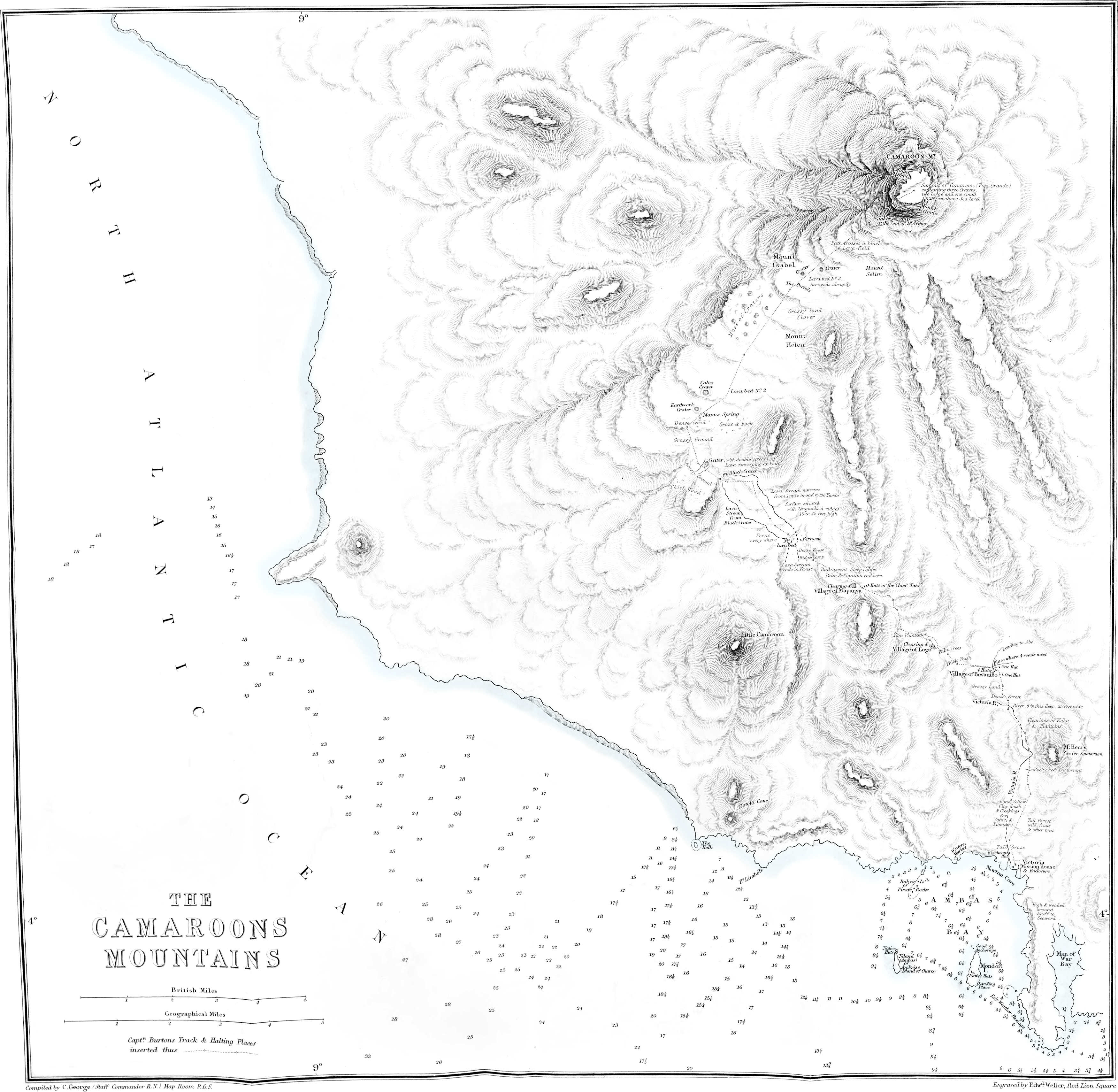
London, Tinsley, Brothers, Catherine Street.
[1]ABEOKUTA
AND
THE CAMAROONS MOUNTAINS.
![[Decoration]](images/decor1.jpg)
CHAPTER IX.
DIPLOMACY; DEPARTURE, AND RETURN TO LAGOS.
‘The Captain’ advanced swimmingly in his diplomatic movements, much to his own satisfaction. But this is a race equally regardless of the past and reckless of the future, with whom the present is ever all in all, and actual life the ‘be-all and end-all of all things:’ their brains are in matters of novelty marble to receive and wax to retain: nothing, if to be permanent, can be done in a hurry, or, rather, without a long delay: they forget all that has not been impressed upon them by many repetitions, and they regard what Englishmen call a ‘business-like manner’ with a supreme contempt. ‘He does half who does quickly,’ should be the Anglo-African’s rule.
Wednesday was a holiday; Thursday had its work. About 10·30 A.M. we proceeded to the ‘palace,’[2] where we were to be honoured with a private interview. This time we came ‘in mufti’ as friendly visitors; the demands of dignity had been satisfied; it was no longer necessary to keep us waiting or to send us back. Passing, as before, under the main entrance into the great patio, we entered the smaller and interior court, and sat down in the verandah where former audiences had been held. The hangings and draperies having been removed, we saw certain daubs like hatchments on the walls, placed to show where the Alake’s father and mother reposed: they were apparently intended for the human form divine, but they were too blurred and smoked to be readily distinguished. After sitting for a short time we were summoned into the interior. We dived under the verandah, and after a moment of demi-jour we emerged into a room where the Alake was waiting to receive us.
The room was a complete Roman atrium—a style of architecture for which I can assign no reason in these climates. The hypæthral portion, where the mid-ceiling might be expected, was garnished with a large inverted cone of mat and thatch, which would direct the rain into the rude impluvium, a parallelogram sunk in the clay. Beneath it various doors opened into other minor rooms, and the walls were painted with the usual mixture of horse or cow[3] dung and indigo. Above the great man’s place were hung ten Tower muskets, and a leopard’s skin so pale and pink that it might be mistaken for an ounce’s.
The Alake lay upon a plain carpet in an alcove at the head of the room, and four scattered feathers dangling to a bit of twine above him appeared to be his protecting fetish. There were no hangings, and his elbow rested upon a common bolster. He was more plainly and comfortably attired than usual, in a red fez without beads, with blue and red chequered cloths round his middle, the rest of the body being exposed to the abebe, or hide-fans of his wives. Besides the interpreters, four chiefs were present, namely, the two Akpesi, a stout personage called Okolomo, and a gray senior, the Lemo of the Ikporo township—each dirty little village has here its own dignitaries, and the number of titles seems endless. The great men, such as Somoye the Ibashorun, Osho the Oja’a or General, and Akodu the Balogun, were at the camp: these dignitaries, when not consulted upon public measures, especially foreign affairs, can, and probably will, object to everything done without their leave. The principal ministers—the ‘setters up and pullers down of kings,’—such as Ogubonna, Shokeno, and Ogushaye the Anaba, are, alas! no more.
The conference was manifestly intended to be private—for a good reason, it might afterwards,[4] when necessary, be ignored. It began with much mystery, and all who entered were dismissed with some indignity. Presently, however, it was gradually broken into by women, children, and confidential slaves. It reminded me of the confabulations of the Sindh Ameers, who on such occasions of haute politique stationed guards round their council-chamber to keep off eaves-droppers, and soon becoming excited, bawled so loud that they could be heard a mile off.
The talkee-talkee lasted about two hours. When the palaver flagged a deal table was brought in, and Abeokuta Williams, the pedagogue, indited, under dictation, a letter of apology to the acting governor of Lagos. The new treaty was then copied out in triplicate and signed with all formality. Commander Bedingfield wrote the names and marks, whilst the Alake and the two Akpesi, grinning as if on a funny occasion—were I in their waist-cloths no grin would have come from me—touched the pen’s end with the finger tip, and thereby legalized an instrument couched as follows:—
Treaty.
‘In consequence of the representations of Commander Norman B. Bedingfield, R.N., Senior Officer of the Bights Division of H.M.’s ships, the Alake[5] and the chiefs of Ake express their regret that there should have been occasion for the complaint of their want of faith in keeping the treaty made between them and H.M.’s Government by Capt. Forbes in 1852.[1]
‘They now solemnly declare that the three articles mentioned below, and to which they have now affixed their names, shall be strictly enforced for the future, and be at once made public.
‘1st. With a view of strictly enforcing the 1st Article of the above-mentioned treaty, the Alake and chiefs hereby promise to stop the roads leading to Okeadon and other places by which slaves are sent to the coast for exportation against such export as far as it is in their power; and they will also punish severely any of their own people against whom it can be proved that they have broken this law.
‘2nd. The Alake and chiefs also solemnly declare that now and after this date no human being shall be sacrificed either by them, their people, or others inside or outside the walls of the town, or anywhere else in their territory.
‘3rd. It having been fully explained to the Alake and chiefs by Commander Bedingfield the injury caused to legal commerce by shutting the road between Lagos and Abeokuta, out of friendship to the[6] Queen of England they are willing to promise that this road shall never again be stopped on any pretext whatever, without the consent and approval of H.M.’s Governor at Lagos: provided always, that when it is deemed expedient to prevent the Egbas from going to Lagos, the merchants must provide themselves with canoe men from that place.
‘Signed at the King’s Palace, this seventh day of November, 1861.
| (Signed) | ‘The his+mark. Alake. |
| (Signed) | ‘Apesi his+mark. Kemeta. |
| (Signed) | ‘Lemo his+mark. Trocu. |
| (Signed) | ‘Apesi his+mark. Erunoon. |
| (Signed) | ‘Okolomo his+mark. |
| (Signed) | ‘Norman B. Bedingfield, |
| Commander, R.N., Senior Officer for the Bights Division of H.M.’s Ships. | |
| (Signed) | ‘Richard F. Burton, |
| Captain, H.B.M.’s Consul, Fernando Po. | |
| (Signed) | ‘Henry Eales, |
| Surgeon, H.M.’s Ship “Prometheus.” | |
| (Signed) | ‘David Williams, |
| acting as Secretary to the Alake, witness to the above signatures. | |
| (Signed) | ‘S. Williams, |
| Interpreter.’ |
[7]It would hardly be believed that within the week after our return to Lagos a letter was received from Abeokuta confessing that a human sacrifice had taken place in broad daylight, and that some women had been kidnapped from the house of a Mr. King. The reason of the Alake and chiefs reporting these breaches of faith was their conviction that the news would go abroad, and the transaction be discovered,[8] if not communicated by themselves. The misdeeds were not punished. The fact is, the subjects are too powerful for the sovereign.
Note.—The following is a copy of the original treaty concluded with the chief of the Egba nation, 5th Jan. 1852, and abridged from ‘Hertslet’s Commercial Treaties,’ vol. ix.:—
Frederick Edwyn Forbes, Esq., Additional Commander of H.M.S. ‘Penelope,’ on the part of Her Majesty the Queen of England, to the chiefs of the Egba nation and of the neighbourhood, on the part of themselves and of their country have agreed upon the following Articles and Conditions:—
I. Prohibits export of slaves to foreign countries under severe punishment.
II. No slave-traders to reside in territory of the king or chiefs of Lagos, and no buildings to be erected for the purpose of slave-trade; with permission to British officers to destroy such if the king consents.
III. Boats engaged in such slave-trade may be seized by British officers.
IV. Slaves for exportation shall be delivered to British for conveyance to British colonies, where they shall be liberated.
V. European slave treaty to be respected, and slave factories if not converted to lawful purposes within three months to be destroyed.
VI. British subjects may buy and sell throughout dominions, and have favours and privileges of most favoured nation.
VII. Abolishes human sacrifices for religious purposes, and prisoners taken in war not to be murdered.
VIII. Affords complete protection to missionaries; allows houses, schools, and chapels to be built by missionaries or ministers, and sets apart places of sepulture.
IX. Power reserved to French Government to become party to the treaty, agreeably with provisions contained in Art. V. of the convention between Her Majesty and the King of the French for the suppression of the traffic in slaves, signed at London, May 29, 1845.
In faith of which we have hereunto set our hands and seals at Abe, 5 Jan. 1852.
| (L. S.) | F. E. Forbes, | ||
| Sagbua. | Obasaron. | Ogubonna. | Sikeno. |
| Presidents of Abeokuta, or the Egba race. | |||
| Tambala, Bulagon of Ikerehu. | Akionme for Arroba, Egba Agorra. |
| Imemunu, Owu. | Lagemo, Owe. |
SUPPLEMENTARY TREATY.
Art. I. That Sierra Leone emigrants, natives of whatsoever country, are not allowed to be kidnapped.
Art. II. That we will not attempt to hinder the advance of missionaries, merchants, or others into the interior.
In faith of which we have hereunto set our hands and seals at Abe, 5 Jan. 1852.
Signed and sealed by the same parties.
We then took formal leave. I can scarcely, however, quote on this occasion,
In good sooth we all seemed heartily glad to get rid of one other and of the whole business. In return for some little presents the Alake presented ‘the captain’ with a horse, which was supposed to be rather a superior animal. It was afterwards taken to Lagos, and sold. With due deference to superior[9] judgment, I cannot but think that this part of the proceedings was a complete mistake. A present of provisions from an African chief or king must often be received, as its rejection would be deemed an insult, and an equivalent is easily sent back. But the rule which applies to all gifts of horses, arms, and jewellery in India ought equally to be carried out at the native courts in this part of the world. And, at all events, the sale of such present would be looked upon, not as a slight to the donor, but as a mark of bad breeding in the donee.
We had entered Abeokuta on Friday, the 1st, and Friday, the 8th of November, 1861, was to witness our departure—bad days both. The captain had, or fondly supposed that he had, succeeded in the principal objects of his mission, the three points of the new treaty, viz., the opening to Lagos of the Ogun River—which presently became tightly closed; the cessation of human sacrifice—which will not cease till the ‘screw’ is ‘turned on’ much more tightly; and, lastly, the abolition of the export slave trade—which requires to rest upon a much stronger basis than the mere marks of a petty barbarian prince and his chiefs.
‘L’homme sensible en voyage,’ says M. Boiste, ‘est tenté de s’arrêter chez les premières bonnes gens qu’il trouve: chaque départ lui devient un supplice.’ This[10] was not quite our case, for Abeokuta was becoming of an almost intolerable dulness: we took regretful leave, however, of our hospitable entertainers. At 9 A.M. Commander Bedingfield and I walked—without cavalcade—to the Aro Gate, accompanied by Mr. Hughes, and closely followed by Mr. Eales and Messrs. Harrison and Wike. The luggage had been sent down in the morning, and the first and second gigs had been drawn up from midstream, where they had anchored, to the landing-place. A wild beast of a Yoruba pony charged down upon me, and the umbrella with which the attack was received nearly put my eye out: considering, however, that it was Friday, I congratulated myself upon a very pretty escape. A final libation to Bacchus was poured out, and after another shaking of hands we found ourselves once more upon the broad bosom of Father Ogun.
The stream is essentially a rain river, filling gradually and uniformly, without freshets. During the last week, though there had been three heavy down falls, it had sunk several inches, a sure sign that the ‘dries’ were setting in. The deeper pools were like the beads of a chaplet connected by a thread of shallows, and the boat, though drawing barely a foot, touched bottom on each middle ground as we crossed the sandbanks joining the salient and the[11] re-entering angles. Almost within sight of Aro we shot a little rapid, a clear way in a ridge of rocks, which seemed to rise under both bows. At 11·30 A.M. we dropped past Agbameya, the lower port or landing-place of Abeokuta: the ferry, where people are sometimes drowned, was in full activity, and the market-wives left their blies and baskets of maize and manioc, kankie and fufu, to stare at the departing strangers. Another hour, and we were alongside of Moroko, where on the up voyage we had halted for a pleasant breakfast. Another brought us to Takpana, where the naked nigger boys would bathe with their mammas and sisters, who apparently do not believe that
Our Krumen found it necessary to lie upon their oars, and to ‘chop water’ every half-hour, which rendered progress slow. Down-stream, however, was very different ‘challing’ from up-stream. We reached Baragu about 7·30 P.M.; it was black dark, and the number of cross ropes rendered the navigation of the river peculiarly troublesome after the short twilight had been extinguished by the gloom.
We spent a right merry evening at Baragu, where the head-man cleared out for us the verandah of a large fetish-house, which showed through the bamboo[12] walls the usual number of ugly little dolls, enshrined in a large bare room. The Baraguans, however, must be a somewhat bigoted race. They would not allow us to set foot within the sanctuary, an unpleasant contrast with the Rationalists of Mabban. The male population squatted round to see ‘the captain’s’ hammock-lines made taut, and the fairer sex, which still displayed the vis superba formæ—in figure, not in face—formed an outer ring. A drum soon made its appearance, and after we had passed round a social glass of toast, rum, and gin, the merriment waxed fast and furious. There was singing, feasting, and dancing; in fact, quite an African ‘swarry,’ only lacking the mutton and caper sauce. Our hosts were perfectly civil and obliging, and so were our hostesses—rather too much so I could prove, if privileged to whisper into the reader’s ear. But what would Mrs. Grundy say? The night was soft and balmy; after the reeking sunny day, we enjoyed the refreshing season of rest, and the verandah floor, though not without knots, was more satisfactory than a feather bed in the best bedroom of ——. Upon the whole, our trip was decidedly ‘jolly.’
On Saturday, the 9th, we arose betimes, and left Baragu at 5·30 A.M., before any of the revellers were awake: these people have the good sense to sleep as long as they can. The river-fog was as dense and[13] clammy as ever; the snags were numerous; so were the ropes, and we were obliged to row carefully for fear of an upset. About sunrise we halted for a few minutes at Illugu, where the ill-fated Sancho (pronounced Sanco) had strayed from his mourning owner. The Krumen went up to the village, and inquired concerning that amiable but mangy animal—in vain; our pleasant companion had probably found a living grave in the bread-basket of some hard-iliac’d Illaguan—the canine salmi is relished by these races—and we left the fatal spot with spirits sadly depressed.
Halting for breakfast at Igaon, we had the satisfaction of finding Mr. and Mrs. Johnson in the very best of health. The head-man brought us a fowl, for which he demanded rum or a head of cowries; he then begged for something to eat, and was told that it was his duty to take in, not to let in the stranger. He was also warned that sundry complaints against him had been sent to Lagos, and that he must no longer levy ‘black mail’ upon travellers and canoe-men going up the river. Our stay was short; the rum was ended, and the claret running very low; we were naturally anxious to arrive at a place of plenty—Lagos. There is one advantage in these excursions. Although the jeunesse dorée of Abeokuta looks upon that sea-port much as the English young woman from[14] the country-house regards the season and the great matrimonial bazar of London, I had hitherto held it to be the last and lowest of created places, save and except only Fernando Po. Twelve days of sweltering at ‘Understone’ had so modified my views, that it now rose before the mental eye as the home of comfort and luxury. Thus Saadi’s philosopher cured his slave of howling with terror in the boat by throwing him for a few minutes into the sea.
We left Igaon at 8·40 A.M., and after passing sundry settlements, which were not exactly like
we halted off the mouth of the Agboi Creek to await Mr. Eales in the second gig. Commander Bedingfield and I determined to inspect the longer route, viâ the main stream, and the ‘doctor’ was equally resolved to reach head-quarters with the least possible delay.
At 10·30 A.M. we parted, and struck in the first gig down the lower Ogun. It rapidly narrowed, and in places widened out again. The banks on both sides were thickly forested, and we judged from the number of the paths abutting upon the water that many villages must be scattered through the bush. The river appeared, however, almost deserted; hardly a canoe was upon its waters, and the windings at[15] times threatened a return to ‘Understone.’ The fishing-ropes also were many and troublesome; being thinner than those in the upper stream, they more than once unshipped our rudder. About half-way we passed on the right a wretched fishing-village—six huts, mere wattlings, thatched with palm-leaves, raised on piles above the inundation, redolent of squalor, and surrounded by filth and fetid mud. We asked its name, and were told ‘Ojogu.’
Advancing, we found that as we neared the mouth the river narrowed. Such is frequently the case in these regions, where the beds of streams want slope, and where the soppy ground, half-reclaimed from the waves, absorbs the greater part of the down-flow. For the reverse reason, the head or upper waters are, for the most part, mill-torrents. We were fortunate enough to meet a canoe at a critical point where the Ogun falls; the left appeared to be the larger branch, but it terminated in a cul de sac. Taking the right, we bade leave to forest trees, in which the long-tailed monkeys were disporting themselves, ascending the topmost boughs for the benefit of their health, and cautiously and curiously walking along the horizontal branches, to enjoy, as we went by, a better reconnoitre of their ‘big brothers.’ Presently we entered the mangrove forest, whose aërial roots, a conework of props converging where the trunk springs,[16] must often have been upwards of fifteen feet high; it is not improbable that they suggested to the first African the idea of the first hut. In some places, especially at the bifurcation of the river, the trees were so high and thick that they suggested the idea of a raised bank—a frequent formation near the courses of West African creeks and rivers. It is probably caused by the vegetation being based upon a firmer soil, not upon the soft mud in which the smaller and more scrubby mangrove delights.
We came to the conclusion that the line of the main river was considerably longer than that of the Agboi Creek, and the eastern sweep of the former, compared with the regular northing of the latter, justified it. Presently the mangroves lessened in size, and the stream narrowed to a few yards: it was so thickly banked with tall, light-green grasses and aquatic plants that the oars could hardly work, and we anticipated the pleasing task of turning back. A short furlong, however, exposed the broad and well-known face of the Ikoradu water, which we greeted as if it had been a firm friend, instead of a fierce enemy, to the white man. According to all local authorities, Father Ogun, until quite lately, boasted of a broad and open mouth, such as becomes a sacred stream; of late years it has apparently been blocked up by its own growth. This must greatly reduce[17] its value; none but the smallest of river tugs could plough a way through the tangled entrance; and thus communication on an extensive scale between Lagos and Abeokuta will be confined to canoes, roads, tramways, and eventually the rail.
Exactly at noon we found ourselves in the lagoon. The coast here forms a deep, narrow bight, with a comparatively high and a densely-wooded point, extending far out on each side. To our left, or westward, lay the market-place or bazar, where the bushfolk and the citizens of Ikoradu meet every eight days. There were a few tattered huts, all at that time deserted. They are about half an hour’s walk from the town. The way is a deep rut in the red clay, forming during the rains a rivulet unmanageable to any nag but a Yoruban, and at all times tiresome to English feet and ankles. The land is a mass of impenetrable vegetation, where no umbrella is wanted till within a few yards of the habitations. On a subsequent occasion I visited it with Mr. M‘Coskry, and found it to be the normal Yoruba settlement, girt with clay wall and dry ditch, and gates like bungalows for the accommodation of the guards. The interior was a rus in urbe, containing much more jungle than house. The only semi-civilized being seemed to be a native teacher stationed there for propagandist purposes. Formerly it was committed to[18] the charge of M. Flad, a German missionary. The people were by no means startled by the weird apparition—and none but the smallboys showed emotion—and we were allowed to saunter into and about the open Ogboni lodge, whose inmates we inspected with that nonchalant stare peculiar to Britons and to the higher order of savages. ‘Produce me,’ said Mr. Jollins, ‘a respectable inhabitant of an English country town, and I will match him in the matter of solid and silent staring against any man over the whole surface of the world.’ On another and a subsequent occasion, however, the burghers of Ikoradu town were not so civil to a party of more dignified visitors, and if rumour speak truth, their town somewhat narrowly escaped a summary bombardment.
Return we to the first gig, which was in no pleasant plight, as she emerged from the embrace of Father Ogun. The sea-breeze blew steadily in our faces, and the tide ran strong against us. We were still seven miles from Lagos, and our progress was painfully slow, chiefly owing, said ‘the captain,’ to the size and the obstinacy of my umbrella. As we progressed, a new appearance was noticed in the water, which was verdant with a substance apparently floating up with the tide. The material was disposed in clots, lumps, and balls, varying in size from a pin’s head to a grape-shot, which when taken in the hand,[19] proved to be slimy and soft, like agglomerations of decayed vegetable matter. We afterwards found the beach at Lagos pea-green with several inches of the deposit, which, after drying in the sun, emitted a most peculiar and offensive odour.[2] The thermometer showed 6° (Fah.) higher than usual, and the sea breeze, which usually sets in at 11 A.M., delayed till the afternoon: there was no change in the barometer. The deposit was first remarked on November 8th, and the merchants lost no time in removing it from their ‘beaches.’ The old hands, however, began to presage evil, and their predictions were accomplished but too well. Out of ninety-eight English crew, H.M.S. ‘Prometheus’ had lost during twenty-three months only two men from fever, and during the last third of the year, when she had been lying off Lagos, exposed to all its evil influences, there was only one decidedly febrile case on board. But these climates are treacherous beyond description. Immediately after the appearance above noticed, the sick began to flock in apace; we heard first of one death, then a second,—whilst twelve bad cases were reported. Before the end of December there were one[20] hundred and seven fevers, intermittent, remittent, and continued: between 14th of November and December 3rd, no less than forty-eight were on the sick list. Finally, after a few weeks, except one old quartermaster there was not a ‘Promethean’ who had not had fever; and it was only by removal to Ascension Island, where fifty-seven men were sent, that the lives of the crew were saved.
At 1 P.M. we sighted the second gig emerging from the Agboi creek. We flattered ourselves that her course would be a hypothenuse, and much we prayed that she might ground or stick; but Jupiter turned a deaf ear—she beat us by a good half-hour. Doubtless that umbrella! Our Krumen were urged to exertion by an awful-looking cloud, a purple black pall, with a broad, white arch, that seemed to open a gateway for the coming blasts, and the mass rose steadily against the wind, which presently fell to a calm. At 5 P.M. we landed, after twelve days’ absence, at Lagos, somewhat wiser if not better men. After passing—
all on a very small scale, I reinstated myself with a lively sensation of pleasure in the old quarters at the house of my kind and hospitable friend, M‘Coskry, where it was easy to forget the minute discomforts and inconveniences of our Flying Visit to Abeokuta.
[21]L’ENVOI.
Yoruba, as the list of its trade articles proves, may in time become a valuable possession, and its sole important port, Lagos, is now in our hands. The seaboard will supply large quantities of palm oil; the interior is rich in shea butter, ivory, and, if due encouragement be given, a certain amount of cotton. The gossipium, even wild, is, and I believe always will be, better than the best crop ever grown in India. The transit is shorter, and should be less costly. At present, however, there is a want of population, resulting from three causes—human sacrifice, slave exporting, and petty wars.
Human sacrifice does not absorb much of the population; but it points to habits of destruction, and to a moral degradation which cannot but be prejudicial to the increase of a birth rate. Slave export still thrives in the Bight of Benin: the Ijaye are said during the last two years to have lost 20,000 of their number, partly kidnapped for domestic slavery, partly exported to Cuba. Petty wars are at present the normal condition of the land, and the causes are so complicated, that nothing but main forte can put them down. The Moslems of the Sudan, or Upper Nigerian regions, are pressing heavily upon the peoples of the South. The Yorubas, or non-maritime[22] races, removed sixty miles from the seaboard, are fighting for free transit. The Egbas, or tribes lying between Yoruba and the coast, especially the Abeokutans, under pretence of recovering their ancestral homes, are contending for the monopoly of the road, and are aspiring to change honest labour for the lazy life of brokers or middlemen, like the townsmen at the mouth of the Oil Rivers in the Bight of Biafra. It is evident that, under such circumstances, regularity, which is the first requisite of the cotton crop, cannot be expected.
The remedy for these various evils consists in stationing at Lagos a military force sufficiently strong to impose terms upon obstinate breakers of the public peace. As bygone details have proved, no extensive establishment is required; the force need not exceed six hundred men. At present, the people require a lesson: they own the superiority of the English by sea, but—the error is excusable—they still hold themselves to be on land the greatest warriors in the world. To consult economy rather than efficiency at Lagos, is—quoting an old saying—‘to throw good money after bad.’ The object of such a colony should be economy; to diminish the expense of a squadron which, including head-money for captured slaves, and other minor items, can hardly amount to less than one million of pounds sterling per[23] annum.[3] As the West African coast comes more directly under our command, this disbursement may be reduced to one-tenth.
We have now an excellent opportunity of trying a novel and modern experiment in colonization, and I sincerely hope that experience will have enabled us to steer clear of the errors and misconceptions that have operated so fatally upon our settlements at Bathurst and Sierra Leone. The latter is, indeed, a warning. If the exact reverse of everything that was done in the early part of the present century had been done, we might have seen a thriving and extensive colony of liberated negroes where now there is a wretched and degraded population of hucksters and idlers.[4]
There need no longer be any objection to stationing European officials at Lagos. A future page will show that, within two days’ steam of that dangerous port, there is a mountain range which, with little[24] labour, may be made a sanitarium for the whole coast of Western Intertropical Africa. Camaroons Mountain, where snow falls at times all the year round, and upon whose glorious summit the mercury sinks at night below zero at all seasons, is thus more easily and effectually connected with Lagos than the Mahabuleshwar Hill Station is with Bombay.
I need hardly repeat the phrase publicâ trita manu, that if my exertions tend in any way to develop the resources of the West Coast of Africa, my expenditure of time and trouble will have been amply repaid.
[2]It appears at uncertain intervals about June, lining the beach and extending for some yards from the water. Mr. Eales found by the microscope that it was composed of animal and vegetable in different stages of decomposition, and gas was evolved, most probably sulphuretted and carburetted hydrogen.
[3]A thoroughly efficient blockading squadron would consist of at least 13 steam-cruisers, besides a provision-ship, and a frigate for the Commodore’s flag, viz.:—
| For the North Coast | 3 | The Bight of Biafra | 1 |
| The Bight of Benin | 4 | The South Coast | 5 |
This is not more than the squadron which the French Government stations off Goree and St. Louis de Senegal, but I am convinced that the prevention of slavery would be more easily effected by land than by sea. The mere capture of slavers exasperates the evil by rendering other shipments necessary. The encouraging and supporting commerce, induces the people to turn their attention from illicit to licit traffic.
[4]N.B.—This was written in 1861.
[25]THE CAMAROONS
MOUNTAINS.
AN EXPLORATION.
CHAPTER I.
PRELIMINARIES OF EXPLORATION.
There are few spots on the earth’s surface where more of grace and grandeur, of beauty and sublimity, are found blended in one noble panorama than at the equatorial approach on the west coast of Africa. The voyager’s eye, fatigued by the low, flat, melancholy shores of Benin and Upper Biafra, rests with inexhaustible delight upon a ‘Gate,’ compared with which Bab el-Mandeb and the Pillars of Hercules are indeed tame. To his right towers Santa Isabel, the Peak of Fernando Po, marked in the chart as 10,700 feet above sea-level: on his left is a geographical feature more stupendous still, where the Camaroons Mountain, whose height is popularly laid down at 13,760 feet, seems to spring from the wave, and to cast its shadow half-way across the narrow intervening channel, whose minimum breadth does not exceed nineteen miles. They are evidently sister formations, these giant pyramids;[26] they wear a family look; their shoulders, clad in flowing garments of evergreen vegetation, converge gradually, and almost continuously, at an angle of about 12°, till they meet at a neck upon which a superimposed conical head denotes the great central spiracle.[5] In the island, however, superior humidity prolongs the woody region, whilst the continental mountain, some 3000 feet more elevated, shows a greater expanse of grassy surface clear of high trees. Remarkable also is the variety of the scene, which is rarely beheld under the same aspect. Now, through the thin grey haze of the fair season which paints all Nature with its own hues, they rise like spectres from the ‘vapour foot’ below, the umbras of mountains in the shadowy realm. Then they disappear mysteriously behind a dense, dark loom, affording at times a glimpse through the festoons and hangings of mist and cloud that are caught and held by the rough, tree-clad surface. Then, especially after tornado-rains, profile and fold stand out with a marvellous distinctness that brings them within a quarter of their real distance. Their waists, where the North-east Trade and the South-west[27] Rain-winds meet, are often girt with a sharply-defined, delicate zone of sea-cloud, cumuloni-rollers, snow-white when shone upon by the sun, below in strata, which, forming a new base for the upper half, show an Ossa piled upon many a Pelion: a lower girdle of land-cloud is also not unfrequent, while fleecy little cirri dance like aërial sprites over the Peak. And sometimes upon the further summit of the Camaroons Mountain, a broad sheet, distance-dwarfed to a mere fleck, of a dead and absolute white, which cannot be confounded with cloud, lava, or dolomite, tells of snow within four degrees of the equator. But the time to behold it is when there is a cloudless sky: in the soft and misty air its hues are so fresh, so melting, so tender, that it is a sensual enjoyment to gaze upon them. Then the channel, crisped and freshened by the remnants of the Northern Trades, winds beautifully blue between them; and the monarchs of West African mountains throned in sapphire, all gorgeous purple below, passing into the lightest azure above, raise toward the empyrean their heads jewelled with the gold of a tropical sunshine. Such a picture can never fade from the memory of man.
And there are marvels and wonders connected with them, especially with the unexplored Camaroons.[6][28] This is the only point of the West African coast still presenting the same features described in the log-book of Hanno the Carthaginian—the admiral, general, historian, and first of lion-tamers.
For long centuries navigators have sailed along its base, but no foot has ever ventured to tread that little hump, which, as in the Pico of Tenerife, denotes the apex. Portuguese and Spaniard, Dutch, English, and French, have all been contented to wonder and to admire from afar this great landmark of the western shores. The coast-people declare that they have seen fire bursting out of the ground; and from Clarence Town in Fernando Po smoke has been observed more than once to issue from the summit of the ‘Mount of Heaven,’ as they call the Theon Ochema, upon which, 600 years before our era, the old Carthaginians gazed in fear. In the pages of a contemporary writer upon the West Coast of Africa, its uplands narrowly escaped being garnished with a race of Dokos and Kimos, dwarfs and pigmies, and hommes à queue, the mysterious Ding-Dings and Nyam-Nyams.
Having left pestilential Lagos on the 21st November, 1861, in H.M.S. ‘Bloodhound,’ Lieut.-Commander Dolben, R.N., after visiting the dull and deadly Brass and Bonny rivers I determined to refresh myself with a nearer view of the Camaroons Mountain,[29] and to prospect the chances of carrying out a long-cherished project of exploring it. As we approached the goal on the dawn of the 10th December, a jealous cloud, like the vapour which further north invests Madeira and the Canaries, seemed resolved to hide its majesty from our eyes. Before sunrise, however, every stain of mist had, as frequently happens, disappeared. For a distance of ten miles a huge blue silhouette stood before us, the upper heights gilt by the yet unrisen sun, and the lower expanse still blue-black with lingering night. The dorsal swell was everywhere so regular that it gave to the whole the appearance of one vast mountain rising from a single base. Every quarter of an hour, however, brought a change in the magnificent spectacle. Presently the south-western profile was broken by three serrations; the highest is the uppermost of a group, to which we afterwards gave the name of the Three Sisters; below it was an extinct Vesuvius, the Little Camaroons of old sailors, surging apparently impracticable and perpendicular from a rolling sea of vegetation; lower still was the Botoki cone, a small but independent feature, clearly seen from Fernando Po; and in the maritime region hummocky hills and dromedary’s backs here formed headlands, heaving out in accumulative grandeur from the Atlantic, whose mighty swell, slow and measured, broke at their feet, there sank blended with[30] the winding, waving shore, that dipped below the misty horizon. With the increased clearness of morning, we began to understand that what we had supposed to be a plain surface of tropical forest in the lower basal half, is a succession of long striated ridges, with intervening barrancas, valleys, and ravines; whilst the dots, which had before puzzled us, were wooded protuberances,—‘parasitic’ cones they are called by those who would quiet their consciences with a technical word.[7] Higher up we could distinctly trace the line where the forest region yields to that of grass and shrubs: there again appeared a multitude of little lumps, an eruption of warts upon the epidermis of the giant; they looked like mole-hills from below; above they will become sugar-loaves, bosses, and ‘volcanic blowing cones,’ like the ‘hornitos’ or oven-shaped hillocks speckling the Mal Pais plain of Mexican Jorullo. And the terminal domelet, evidently bald and bare, wore, when the first delicate rays of the rosy sun had faded from it, a brown-black, tempered by the intervening blue, but contrasting strongly with the reddish-yellow which winter, or rather the dry season, had already strewed upon the grass-slopes beneath it. As we steamed into the beautiful Ambas, or Victoria Bay,[31] with its protecting islets on our right hand, all admired, after the mangrove-haunted river, the sublimity and the passing loveliness of the scene; above our heads the noble pile capped with its fissured cupola; before us the dwarf earth-banks and the beetling cliffs that margined the mirrory sea, and the forest with its infinite tintage, here ruddy, there almost white, now dark as spinach, then of the lightest leek-green. Some compared it to Navarino Bay, others to the once young and charming Sierra Leone, as she appears in pictures, before fire had wasted the now deadly land. It is fortunate that the devils of this paradise have not yet learned, like the Timni and their brethren the ‘colonists,’ to disforest the soil; when the operation of bush-clearing is carried out, care should be taken to leave all the finest trees standing.
Running with an easterly course, we passed a detached rock which we called ‘The Hulk’—prosit! Beyond it, at the foot of the Botoki cone, where Capt. Allen places his Batoki village,[8] appeared the Point Limboh of our maps, a rugged, forested head, forming the north-west buttress of Ambas Bay. We then[32] fronted a green and shaggy amphitheatre, which apparently had no break nor outlet, and soon afterwards we found it composed of two shallow rocky waves in the coast, the further cove being our destination. On the port-bow rose, needle-like, from the waves, sheer and steep-to, the Bubyá Islands, ridiculously enough called the Pirate Rocks; the distinctly columnar shape of these pinnacled ‘inches,’ the fornos, souffleurs, or blowing-holes, in their bases and their water-worn arches revealed a basaltic formation. Continuing our course in ¼ less 10 fathoms, we left on the starboard bow Ndami, miscalled Ambas, or Amboize Island, a long, narrow chine of black rock, partially greened over and dotted at the northern and western ends with about a dozen huts; a violent surf, urged by the south-west winds, breaks around it during the rainy season. We then passed northward of ‘Mondoleh,’ or rather ‘Mondori,’ Island, which is defended in this direction by outlying rocks and reefs. It is an egg-shaped rock, woody and shady, bluff towards the north, and sloping seawards in the south. It appeared to all of us the best preparatory position for a sanitarium, and as such I shall revert to it.
Presently, at 11 A.M., we anchored in three fathoms water off the mouth of Morton Cove, so called from a certain patron of the Baptist Mission. This north-eastern[33] and innermost recess of Ambas Bay, being completely land-locked towards the weather, must offer, one would suppose, at all seasons an excellent station to boats. The southern part is shoal and sandy, and the bottom is dotted with diabolitos with basaltic points, sometimes covered by the tide, and making it a dangerous anchorage for ships. In the Hydrographic Chart the dimensions of the chord of Morton Cove are unduly reduced. It supplies an abundance of the purest water: a little perennial stream falls into the centre of the arc; the heights are covered with noble timber; there is an abundance of building material, stone being as common as in Madeira and Tenerife; whilst specimens of coralline brought up by the fishermen show that here, as at San Thomé, the growth of madrepore would supply the settlement with lime. And there is a walk round the cove over a soft dark sand, formed, like that of Fernando Po, by a detritus of basalt about a mile and a half long and, at low water, fifty yards wide.
The good ship lay about eight hundred yards W.S.W. of the Missionary station Victoria, and thus commanded a fine view of the site where the future town will be. The position is a broken uneven ledge, formed by alluvium from the mountains almost immediately[34] behind it, and extending from one to two miles towards the sea bounding it on the south. Within an easy walk of two hours, and bearing 65° E.N.E. from the Mission House, is a rounded tree-clad cone, called by the Baptists Mount Henry; this would be the second step towards the upper sanitarium, to which—suddenness of change often induces a relapse of fever in these exceedingly tropical lands,—patients should not be conveyed too rapidly. Immediately behind the settlement is a gorgeous and gigantic growth of equatorial forest, which would require to be cleared or thinned before aught else could be done; at present it is almost impassable during the rains, and at all seasons it breeds swarms of sandflies and mosquitos. The dwarf enclosure which backs the houses runs about half a mile each way, and might grow to half a dozen times the size. At present there are ten habitations, two of iron and the rest of timber. The three of superior appearance fronting the sea command a fine view of the bay-islets, the densely wooded promontories, and the rival peak of Fernando Po, springing gnomon-like from the bosom of the ocean. Opposite the principal abode, the Mission House, are scattered rocks, forming a natural breakwater, which could easily be converted into a pier. This was proposed some twenty years ago, but Africa moves even more slowly than England—not a stone[35] has been laid. The walls are dry lines of basaltic blocks and boulders, which everywhere strew the surface; there is also good clay for bricks. About three-quarters of a mile from, and appearing to command the settlement, is Mount Helen, a finely wooded cliff, admirably fitted for the site of a convict prison; it is a dangerous rocky point in windy weather, and at all times the surf is bad. On the sandstrip below, and east of the mission establishment, are long cadjan’d sheds, used as boat-houses and places of barter; in the Admiralty Chart the place is marked ‘Plantain market on Fridays.’ Here on every third day the islanders and the savages from the upper slopes meet to change their fruits and vegetables, chiefly cocoas and yams, palm-nuts and bananas, for salt, tobacco, small wares, and dried fish of various kinds, the chief demand of the interior. About two miles to the eastward is a second hamlet, which can be reached either by footpath or by canoe; it is also held every third day, and the articles of ‘round trade’ are the same. A local feud—one is prevailing now—often breaks off the ‘bazar’ for weeks; faction-fights with stones are not uncommon; and when the Bimbia people from the east kidnap a woman or two the upper clans fear to descend. In the best of times only a few pounds of provisions are procurable at these markets. It is evident that a colony landing at Victoria should be[36] supplied with frame houses and rations[9] until with reasonable industry it could support itself. The reader must not readily credit the various assertions recklessly made touching the quantity of provisions at Victoria. On the other hand, as freight is easily brought from the neighbouring rivers Bimbia and Camaroons, it is not likely that the Victorians, like the tars of the Elizabethan navy, are always raising, as their rivals declare, the pitiful cry, ‘Vittels! vittels! vittels!’ As will presently appear, there is great fierceness between the two rival settlements; though the battle for bread does not rage fiercely in these bilious lands, yet the only amity lies in community of interests, and none but a stranger—like myself—would attempt to speak out the truth.
Lieutenant Dolben and I, embarking in the first gig, despised the fine-weather passage leading towards the site of the future pier. We crossed in safety the little angry bar, and landed on a shingly beach, narrow as usual: on this part of the African coast there are none of the broad yellow sands that beautify the edges of the Asiatic seas. Then we walked a few yards to the rock-garnished mouth of a second little[37] river which bounds the missionary clearing on the west. It is a mountain-burn, the drainage of the uplands, but a few yards wide, and barely chin-deep; it is, however, perennial, and extraordinarily sweet; ever cool in the hottest season, and overarched with shady trees, which require nothing but clearing. The bottom is neatly spread with pebbles of black basalt, all more or less porous; red volcanic stones and scoriæ, well rounded and water-rolled. It is a delightful bath for those who can despise threats of fever, and it is the model of a trout stream, although we saw in it only the smallest of fry.
After bathing and giving orders to fill casks, we walked towards the settlement, which is not more than three hundred yards from the stream, and were presently met by Messrs. Diboll and Mann, who showed us the narrow path through the bush. The Rev. Mr. Saker was then at his head-quarters on the Camaroons River, of which this establishment is an outpost; we therefore paid a short visit to his amiable family, and then departed.
I had arrived, however, at an apparently auspicious moment for my long-cherished project. M. Mann in 1860 had ascended a few hundred feet of the Camaroons mountains, but having lacked time, and perhaps having overestimated the difficulties, he had returned unsatisfied to Fernando Po, and he was now girding his loins for[38] a second attempt to scale a mountain whose glorious pinnacles had never felt the foot of man.[10] He is a young man of twenty-five, a native of Brunswick, a gardener from the Royal Gardens, Kew, to which he was recommended by the Court of Hanover. Originally attached, in 1859, to Dr. Baikie’s Niger expedition in place of the lamented Dr. Barter, he has been continued as Government botanist in West Africa by the Admiralty, with the ostensible motive of inspecting the timber. The ‘Amabilis scientia’—whose votaries, however, can at times be as cross as poets—appears still at a discount in public opinion. Whilst in these days the geologist holds his head high, one rarely reads of a detached ‘botaniker;’ as a rule the ‘poor herbalist’ is attached as a decent appendage to some Government expedition. Economy is often made to entrench upon utility. And why should the collector, after bearing the heat and burden of the day, lose his reward? Why should not ‘Hooker’s Niger Flora’ be known as ‘Vogel’s Herbarium described by Hooker’? And yet another point. Why should not the[39] collector be allowed to reserve a certain percentage of new plants to study and to name after his friends? We are certainly afflicted in this century with a terrible thirst for small fame, but it is a pity that justice should be sacrificed to it; for which reason, and not invidiously, I venture upon these remarks. If the practical English public ask the cui bono of a botanist beyond the mere science, it may be answered that, setting aside the question of timber, the soil of these regions is capable of being made a mine of wealth when science shall have decided upon what it is best capable of producing.
Meanwhile M. Mann, after visiting the Bagroo river, near Sierra Leone and Barracoon Point, on the Niger, made, after twice failing, two ascents (in April and December, 1860) of Fernando Po Peak, where he was guided by a Spanish official, M. Pellon, the Special Delegate of Public Works. Their visit was the second ever made to the summit, the late Mr. Beecroft’s being the first. He subsequently ascended to the summits of Prince’s Island and San Thomé, and visited the Gaboon and other African rivers. He has been indefatigable in collecting and in preserving his collections, and has supplied one of the greatest desiderata in botanical geography.[11] The[40] results have been to establish: ‘1. An intimate relationship with Abyssinia, of whose flora that of the Fernandian Peak is a member, and from which it is separated by 1800 miles of absolutely explored country; 2. A curious relationship with the East African Islands, which are still further off; 3. An almost total dissimilarity from the Cape flora.’[12] With the West African Islands again, contrary to expectation, there is no marked relationship whatever.
M. Mann had once more left Fernando Po on the 4th December, 1861, and, landing at Victoria, had begun his preparations without delay. There were the usual difficulties to be encountered; the bush people would give no guide, and the chiefs refused passage. Two days after his arrival he was ready to revisit the terminus of his last year’s march, which he knew by the name of Mapanya. A ‘Mokwiri,’[13][41] however, at Victoria, informed the traveller that the real Mapanya still remained unvisited, and offered to act as guide, requiring for himself and his five boys each five ‘big tings,’ here equivalent to five pounds. This exorbitant demand of thirty pounds for a mere preliminary lasted two days, when M. Mann definitely refused, and the fellow disappeared. At the next market Mr. Pinnock, a native missionary of the Baptist establishment, and his colleague, Mr. Johnson, enabled the botanist by great exertion to engage a guide. The man was a native of Mapanya, but living at a lower settlement: he was charged with presents for the chief of Kombi, a hostile village on the way; these naturally enough he took to his own ‘boss,’ and kept the stranger waiting three days for the return-message. Nor was this when it came particularly favourable. Every hour was precious,[42] yet the traveller was told ‘Sit down for you’ three more days till ‘palaver’ had ‘set,’ i.e. been decided, after which guides and bearers might perhaps be forthcoming. Affairs, however, appeared to be opening up; and as my presence was required in the Camaroons River, M. Mann agreed to break ground as soon as possible, to botanize on the way, and to await my arrival before attempting the Peak. I must, however, do him the justice to say that he set out without delay and did his best of bests to be Number One; he failed, however, and failed signally, as the sequel will show.
The afternoon was devoted to inspecting the islands, which were accurately described by Messrs. Allen and Thompson.[14] Ndami, erroneously called Dameh, or Ambas, the outer or westernmost island, some two and a half miles distant from the northern mainland, possesses but one, and that a difficult, landing-place at the inner end. This rocky, tongue-shaped ridge, with a bold head of 150 feet fronting the sea, which foams and rages outside, whilst the Cove, or inner harbour, lies smooth as a mill-pond, is clear of trees, but shows on the lower slopes a little garden-ground about the huts of the inhabitants. It[43] breeds goats and pigs in plenty; water, however, must be brought from the mainland when the people set out on fishing excursions. Separated from Ndami by a channel one mile and a half broad, stands its eastern neighbour Mondori, which Captain Allen calls Mondoleh, and others Mondoli,[15] a much more interesting place. About two miles distant from the northern shore, it is separated from the bold headland forming the eastern arm of the bay by a fair broad channel. The Victorians declare that it is accessible whilst the sauciest sea runs outside, and that, when the rest of the bay is a sheet of foam, vessels can ride snugly under the lee of its northern point; they assert that it has an excellent holding bottom of dark tough clay, and that it is superior in many points to the celebrated Clarence Cove, Fernando Po. The formation of the island, according to Mr. Roscher,[16] is amygdaloid basalt in the lower parts, and in the upper a more solid stone with shiny cleavage, evidently the result of different epochs of cooling; on the western side, where the greatest heat was, the older deposits are destroyed. Mondori rises about 200 feet from the sea, with the profile of a lumpy[44] dome; it is steep on all sides, except at the south-east, where the landing is. Magnificent trees, hung with llianas and festooned with orchids, crown the summit and creep down the flanks. After repeated attempts, we failed to scale the bluff northern side, foiled by the impenetrable bush; we heard, however, the voices of the people above us, and we were told that it contains a few households, who add to the gifts of their nets the produce of the richest soil formed by decomposed basalt. Their huts are hidden from the sea and the bay, and a spring, it is said, supplies them with excellent water. Like Ndami, Mondori is claimed by one Nako, a Bimbia chief, as an inheritance from his father, ‘old Nako:’ there would be no difficulty in purchasing it. The place would be useful as a storehouse and a preliminary sanitarium; and should Government determine to send out convict-hulks or a coal-ship for this station, there is no better mooring-place than under its lee. A hundred negro workmen, gardeners, and lumberers, would easily clear and prepare it during the six months of the dry season.
The other islands alongshore are the Bubya, Bobbi, Abobbi, or Pirate Rocks, whose formation, like Point William at Fernando Po, reveals to us the original connection between the two mountains. Urged both by N.E. and S.W. winds, a violent sea must have[45] beaten upon the low neck of land which in past times attached the bases of the sister peaks. The land was gradually dismembered, leaving fragments of islands, which are still being sliced away by successive inroads. Gradually the water began to roll deeper between them; the channel, however, is still shallow, and there is a subaqueous ridge extending from N.E. to S.W.[17] Presently the same surf, ever perforating and degrading, washed from Ndami the Bubya Rocks, and these in their turn, after being greatly curtailed in size, are nodding to their fall. The group numbers ten to fifteen, according to the state of the tide, which here rises eight[18] feet; the line, separated from the main by a sea-arm about one fathom deep, sets off the shore in a general north and south direction. The largest and the sole inhabited island is the second from the coast; it is a mass of ejected ashes, with volcanic dykes. There is but one landing-place; a sandy hole in a confusion of rocks, immediately below the highest ground. The only path is up the narrow edge of a basaltic vein, leading to a dwarf level, and here a natural bridge about three yards wide, with a sheer drop on either side, affords adit to the[46] steepest acclivity, where the people fly when necessary. Though there is no ground for cultivation, and the grazing for beasts is scanty, the miserable huts swarm with children and dogs, pigs and goats. The people live mostly on fish, and when their rain-pools are exhausted they must seek supplies from the mainland.
Upon all the islands of Ambas Bay there may be 300 souls, who, perfect African Bedouins, are on bad terms with one other, and generally at war with their continental neighbours. They have, with but a solitary exception, received Englishmen well, and we have requited their kindness by attaching to them the odium of piracy. The ‘Lords of the Isles’ are, as their language proves, allied with the Bakwiri, the principal tribe upon the opposite coast; thus probably Fernando Po was also peopled, but at a much earlier epoch, from the mainland, by a tribe doubtless long extinct. The Camaroons tribes named in the chart are the Batongo to the south-west, the Bakwileh (for Bakwiri) south of the mountain, and the Bamboko to the south-east; all terms, except one, unknown to the people. Proceeding from the east, we find the Dualla, by English called the Camaroons people, the Isubu or Bimbia—the latter a name given by the older travellers—the Bakwiri or Bojesmans, and the Rumbi. The latter is also a European word. I could not discover[47] what the tribe calls itself; possibly, like the Bube of Fernando Po, it has no (general) name. The people of Bubya are stout, independent fellows, with abrupt manners, the result of secluded and seafaring life; every visitor has remarked their robust and healthy aspect, which can be accounted for only by the superior salubrity of, and the freedom from malaria in, their island home.[19]
The history of European connection with this part of the coast is briefly told,—but first of foreign nomenclature. According to Mr. J. Grazilhier, who, as related by Barbot,[20] made a voyage to Old Calabar in A.D. 1699, the land was called by the Portuguese Alta Tierra de Ambozes—the highlands of Ambozes. The latter word, not being Lusitanian, may probably be the name of some extinct tribe: here and elsewhere the maritime African races rapidly disappear. It has been corrupted to Amboizes, Amboize, and Ambas, which latter appears in the Hydrographic Chart. The[48] trivial English names of the mountains and the river to their east—Camaroons, further debased to Cameroons, and by the Jonesian writers to the yet more meaningless Kameruns—comes from the Portuguese Camaráõ, or the Spanish Camaron, a shrimp or prawn, of which there is a great variety from Lagos southwards.[21] I have retained the name, although to call this stupendous pile and the broad estuary beyond it ‘Shrimp Mountains,’ or ‘Prawn River,’ sounds somewhat absurd. Captain Allen, instructed by some Bimbia man, in his map gave to the highest peak the name of Mongo má Lobá, which means in Isubu ‘Mountain of Heaven,’ i.e. the starry expanse. The natives acknowledge this word: they usually, however, call the whole upper region Mongo mo Ndemi, literally the Mountain of Greatness, which is also Dr. Krapf’s translation of the words Kilima-njáro, applied to the Ethiopic Olympus in Eastern Africa. But to the lower eminence—the smaller hump of the camel’s back, which was formerly called ‘Camarones Pequeños,’ or ‘Little Camaroons,’ and ‘Gibraltar Rock,’ and which the Baptist missionaries have lately baptized ‘Mount Trestrail,’—Captain Allen has assigned the name of Mongo ma Etindeh, the ‘Mountain of Separation,’ that is to say, ‘the separate mountain,’[49] which the natives do not recognize. I should prefer to call the highland region and bay Ambozes, the two peaks Larger and Lesser Mongo, and the settlement Victoria: it would only, however, confuse those who have learned Camaroons and Ambas to unlearn the terms.
The adjoining country was formally discovered towards the close of the fifteenth century, by the noble Portuguese Fernaõ de Poo, who voyaged during the reign of D. Affonso V.; his name still survives in the Island of Fernando Po. About A.D. 1700 an active trade appears to have been carried on here and in the adjoining river. In the early part of the present century, to judge from Captain Adams, it seems to have fallen out of notice. In 1826 Captain W. F. Owen, R.N., the laborious surveyor of the two African coasts, explored the shore when homeward bound, and accurately laid down its geography. In 1833 ‘Kokliko,’ i.e. Colonel, now General, Sir Edward Nicolls, R.M.,[22] visited it in the ‘Quorra’ steamer, and the people of the islands, who had never been visited before except by kidnappers and buccaneers, fled. In 1837, Billeh, Chief of Bimbia, who also claimed Ambas Bay and its islands, conceded the best part of[50] the country to Colonel Nicolls, on condition that he should be recognized as King William of Bimbia.[23] In 1842 the harbour was surveyed by Captain W. Allen and Commander Ellis, H.M.S. ‘Soudan.’ Two years afterwards, Lieut.-Commander Earle, H.M.’s brig ‘Rapid,’ made a treaty with King William and the Bimbian chiefs, abolishing slavery for a consideration of 1200 dollars in goods. In 1847, Mr. Merrick, a member of the Baptist Mission then settled at Bimbia and in the Camaroons River, made the first recorded trial to ascend the mountain:[24] according to the people he succeeded in emerging from the forest country, but presently water failed him; his escort suffered from cold, hunger, and thirst, and he was compelled to return. He died two years afterwards of a confirmed teetotalism: in these lands the habitual water-drinker is even more shortlived than the habitual drunkard.[25] In 1848 King William and his chiefs[51] agreed with Mr. Beecroft to abolish the custom of human sacrifices at the funerals of great men; and in 1850 they bound themselves by a more stringent commercial treaty, settling their ‘comey,’ and affixing penalties to those who injure or stop trade. In 1855 H.M.’s Acting-Consul, Fernando Po, visited Ambas Bay in H.M.S. ‘Antelope,’ Lieut.-Commander Young, to settle an old ‘bob’ which had lasted a score of years. The people of the ‘Boobee Islands’ had defied King William and other Bimbian traders, they had openly seized his slaves, canoes, and goods, and they had refused to come on board the steamer. Fire was opened upon the wretched heap of huts; and when they were destroyed, the proprietors signed a paper ‘acknowledging King William of Bimbia rightful king and ruler of all the mainland and islands extending from Bimbia to Rumby;’ while the king and chiefs of Bimbia promised in their turn not to molest the ‘Boobees.’ In 1856 the late Mr. M. Laird strongly advocated in opposition to Fernando Po a British settlement at Ambas Bay, which had been greatly neglected on account of a supposed want of safe landing: he showed its superiority as a convict station to Ascension, and he also maintained, what had apparently been forgotten, viz., that a great part of the actual seaboard had been ceded to H.M.’s Government.[26]
[52]Victoria was first settled in 1858. In May of that year the Spanish Government, formerly so incurious touching its West African possessions, suddenly bethought itself of making Fernando Po not only a strategic position, but a source of wealth. Hoping by means of emancipados from Cuba to raise the Ilha Formosa to the rank of Madeira and Tenerife, Prince’s and San Thomé, they formally resumed possession after it had been virtually in English hands for nearly half a century. D. Carlos Chacon, Commander of H.C. Majesty’s squadron in the island and its dependencies, at once issued a proclamation forbidding any but Roman Catholic schools; and ordering ‘those who prefer any religion which is not the Catholic, to confine their worship within their own private houses or families, and limit it to the members thereof.’ This announcement fell like a shell amongst the black people of Clarence Town, alias Santa Isabel, who numbered some 800 souls, many of them creoles born in the colony. Having settled here in 1827, when Captain Owen was king, they considered themselves under British protection, and had since 1840 sat at the feet of Baptist ministers. On the 1st January, 1841, the ‘Golden Spring’ landed Mr. J. Clarke and Dr. G. K. Prince at Fernando Po. They returned home in the autumn of the next year; meanwhile, Mr. and Mrs. Sturgeon had arrived, and were followed in September,[53] 1843, by Dr. and Mrs. Prince, Mr. and Mrs. Merrick, and Alexander Fuller. In December of the same year Mr. Clarke left Jamaica with a total of forty-one whites and negroes, amongst whom was Mr. Saker, the present head of the mission. In 1844 the Baptists attempted to settle at the mouth of the Bimbia River: they found the land beautiful, but deadly; and in 1850 they left it for Camaroons River, which has proved but little better. They then preferred Fernando Po. The Baptist converts, seeing the danger that threatened their pastors, memorialized H.M. of Spain, but obtained no redress.[27]
[54]In August, 1858, Mr. Saker and his family left Fernando Po, where he had been allowed to reside only on sufferance, and emigrated to Ambas, which he called Victoria. He was accompanied and followed by sundry negro communicants, who have since, I believe, repented the step. Having obtained 1500l. damages—an exorbitant sum—from the Spanish Government, and apparently ignoring the antecedents of the country, he bought for 2000l.—in kind, however, and in local valuation, which greatly reduced the sum—the most valuable part of the location from King William of Bimbia, Dick Merchant of Dikolo, and Prince Nako of Dualla. The grant of ‘prime cuts’ was bounded southward by the sea; north, by a line of compass-bearings somewhat indefinite; eastward, by a stream of water flowing into Man-of-War Bay—an adjoining inlet; and westward, a point nearly[55] opposite Bubya Islands: a total coast length of twelve miles, which Mr. Consul Hutchinson makes eighty. It includes, as will be observed, Ambas Bay and Victoria Harbour. The first habitation, not to speak of the tents erected on landing, was a small iron-framed cottage, put up in September 1858, and still used by Mr. Saker and his family; it has wood, not metal, outside, and is habitable and tolerably healthy, no small contrast to the iron coffins, called Consular Residences, at Lagos and Fernando Po.
Then began a dispute which has lasted to the present day, and which could easily have been settled in six months. The jealous Fernandians naturally hated and feared the settlement on the mainland. The Spaniards held aloof, but the English shopkeepers and others locally interested were loud in their abuse. They declared the natives dangerous, and the prospect of the settlers to be starvation. Unable to deny the salubrity of a place to which many of them had often repaired for health, they represented that it possesses no safe anchorage, and cannot be entered without imminent risk during the rains. Commodore Wise, of H.M.S. ‘Vesuvius,’ was directed to visit Ambas Bay in 1859. Unhappily he was accompanied by an official who, according to the missionaries, had desired, but had failed, to become a partner in the land speculation. Captain Wise, who remained there only a few[56] hours, is believed to have reported against the position; and Mr. Hutchinson (‘Ten Years’ Wanderings among the Ethiopians,’ chap. xviii.) gravely informed the public that ‘at one important part of the bay, described in the Rev. Mr. Saker’s chart as having four to six fathoms of water, it was found by Mr. Bowen, Master R.N., who had charge of the soundings, to have only from six to nine feet.’ The chart was copied from Captain Allen’s, and the statement caused considerable indignation; yet in 1862, Commodore Edmonstone, who had never even approached within sight of Ambas Bay, objected upon the mere theoretical grounds of its being a lee shore—as if all West Africa were not a ‘lee shore’—to its capabilities as a naval station.
On the other hand, Mr. Saker, and those who were with him, contended that the native tribes were few, scattered, and not dangerous; that the country can be made highly productive, and support fine cattle, which the island cannot; that building material everywhere abounds; that the north-east tornadoes, which do so much damage at Fernando Po, are here warded off by the mountain background; that mosquitoes and mangrove swamps are unknown; that the sea-breeze is pure and healthy in the lower levels, and that by ascending the high lands any temperature can be obtained; that the islands are fit for lighthouses and coal depôts, and the level strand for sheds and slips;[57] that the eastern sea-arm is open even to the largest ships at all seasons, and that, however rough may be the sea outside, it is ever smooth under the lee of Mondori; that the position lies in the very track of the mail steamers, which must now diverge to Fernando Po; that the tenure of land would not be arbitrary, as must ever be the case in a military station; that Victoria offers complete religious toleration, and, finally, that the Camaroons generally would be the key of the valuable Oil Rivers, whose export trade to England is calculated at not less than a million and a half of pounds sterling per annum.
Virtually all this, and perhaps more, had been expressed by previous authorities. Captain Allen, R.N., after ample experience on the coast, found at Ambas Bay ‘palpable evidence of the superiority of the climate;’ where he enjoyed ‘a pure and prolonged sea-breeze or a cool land wind every night, ensuring a calm and refreshing sleep.’ He ends by declaring (vol. ii. chaps. viii. ix.) that ‘there are few places on the coast of Africa more suitable for a settlement’ than the lands at the base of Camaroons. Captain Close, R.N., does not hesitate to prefer Ambas Bay to Clarence Cove—a cruel dig—where the wind setting in prevents sailing vessels emerging from the gap without the aid of steam, and where at times the tornadoes are so violent that ships risk being stranded.[58] Mr. Milbourne, master of the missionary schooner ‘Wanderer,’ has asserted that, ‘after giving a good deal of attention to this spot’ (the anchoring-ground under Mondori Island) ‘during the different seasons of the year, he found the water always smooth;’ moreover he was never detained in the bay, even when the mouth of the Camaroons River was inaccessible to small craft.
Here then we have Captains Allen and Close—of whom the former has repeatedly visited and surveyed the place—versus Commodores Wise and Edmonstone, who either saw it for a few hours, or who did not see it at all. A ‘plain man’ would hold that this decides the point pro against con. I confess, however, that, all things considered, it would be necessary to run in and out of it some dozen times during the worst seasons, between September and November, before one could be certain of its capabilities as a naval station. Its fitness for a convict or settler establishment I hold proven: even were the surf at times heavy, it would be no greater objection than the bar to Lagos or the rollers to Ascension. Of the superior salubrity of the climate there is also ample practical evidence. Mr. Saker has for four years used his house on the seaboard as a sanitarium, when prostrated by the malaria-poison of the Camaroons River; and when the young negresses at Fernando Po wish to ‘make nyángá,’ as[59] they call a peculiarly junketing picnic, they repair to Victoria.
I now proceed to consider the geography of this interesting region. The Camaroons Mountain is strictly in the African terra incognita, whose limits are now 5° N. lat. to 5° S. lat., with a depth into the heart of the Continent,[28] rising about the centre of the Bight of Biafra in the Gulf of Guinea, where the western coast—after that long easterly sweep which, hollowed out by wind and water, caused geographers, until some five centuries ago, to shear off the vast triangle whose base is the Equator, and whose apex is the Cape of Good Hope—bends almost at right angles towards the Austral Pole. It is not an insulated pinnacle, an isolated feature, as some have supposed: its prolongation to the N.E. and S.W. (from 33° N.E. to 33° S.W.) cannot be estimated at less than 50°.[29] In the former direction it seems to be connected by the Rumbi and the Kwa Mountains[30] with that long Fumbina line[60] placed by Dr. Barth between the coast and Lake Chad.[31] Its position, with respect to the main ranges of Africa, has not been determined, and will require a special expedition. It may anastomoze with the meridional Sierra del Crystal, those West African ghauts which approach within a hundred miles of the Gaboon River’s mouth, and which from that point run parallel with the Ethiopic Ocean. On the other hand, it may connect with the latitudinal range known, for want of better name, as the ‘Kong Mountains,’ which, beginning N.E. of Sierra Leone, pass along the south of the Kwara (Quorra), and form Mount Patta to the west and the Bassa Hills to the east of the great stream, where, after collecting the waters of the Binue, it turns to the south. So far as is known, it does not run parallel with the main axis of the interior mountain chains, ‘as though the convulsions which have elevated the inactive mountain ranges corresponded in direction with those which have produced the fissures in the earth’s crust, along which we find the active instances of volcanic action.’
[61]The south-westerly prolongation of the Camaroons Mountains is even more remarkable. If the edge of a parallel ruler be placed on a Mercator’s map, nearly in the usual direction of the wind, viz. from about 33° N.E. to 33° S.W., it will align, besides Mount Alantika and the mountains of Fumbina, the Kwa, the Camaroons, Fernando Po, Prince’s Island, San Thomé, Annobom, and St. Helena, with an offset of 90° to Ascension. This observation, made by Captains Owen and Midgley, shows the strike of the elevating volcanic action. It may also be remarked that, omitting the Fumbina and other ranges, concerning which little is known, that the centre of disturbance was upon the coast, as is proved by the diminution of the more distant altitudes. Thus in charts the apex of the Camaroons is 13,760 feet, Fernando Po 10,190, Prince’s Island 3000, San Thomé 7500-8000, Annobom 2000, St. Helena (Diana’s Peak) 2693, and Ascension (Green Mountain) 2870.
In 1826 Captain Owen laid down the diameter of the true Camaroons buttress at nearly 20 miles from east to west, and the height at 13,000 feet. Captain Boteler, an officer under his command, gave more than 20 miles to the base, 13,250 feet to the greater, and 6000 feet to the lesser peak. The Hydrographic chart allows 13 geographical miles direct from Ambas[62] Bay to the summit, to which it assigns an altitude of 13,760 feet. We reduced the 13 to a little less than 10 habitable miles, and the altitude to 13,130 feet. Allowing 6 miles for the more abrupt counterslope, and 10 miles of breadth from the eastern foot (not including the Bimbia Hills) to the summit, and a similar extent for the western side, which is rather understated, we obtain an area of 380 square miles—about one-third larger than Madeira and the Isle of Man. It is bounded on the north by the Rumbi Mountains, on the south by the Atlantic. The eastern limit is a creek flowing from N.E. to S.W. into the Bimbia River, or Camaraõ Pequeno, a stream probably discharged by the mountain;[32] and the western boundary is a branch of the Rio del Re, known to us as the Rumbi, and heading, it is believed, still further east than the Bimbia. Thus the Camaroons Mountain forms a parallelogram contained within 4° 20′[33] and 3° 57′ of N. lat., and 9° 1′ to 9° 25′ of E. long. We may roughly assume it to be within 4° of the Equator.
A sanitarium is sorely wanted for this portion of Africa. During the present year (1861) Lagos has become a British colony, with the usual amount of[63] civil and military establishments. The only escape from the deadly malaria is to Tenerife or Ascension: the former distant, under the most favourable circumstances, three weeks; the latter ten days of steam by the aid of an accidental cruizer. On the other hand, the Camaroons are distant barely fifty-five hours. Its area is little less than the inhabited portion of the Neilgherry Hills in Western India. It has every range of climate—a tierra caliente, temprada, fria. The negro can flourish in the lower, the white man can sojourn in the upper part, where within 4° of the Line nightly frosts prevail throughout the year, and stores of ice and snow can be collected. The country is scantily inhabited, and only in parts, by a timid and feeble, though a wild and treacherous people. Land may be bought for a nominal sum; and the soil, as this narrative will show, is everywhere fitted for cultivation. With less than the Spaniards have expended upon Fernando Po, or than that which we have lavished on the splendid but useless Zambezi River, these mountains might in a few years be made a solid benefit to the coast of Western Intertropical Africa. I have seen the marvellous effects of removing naval invalids from their ships to a few hundred feet above sea-level at Fernando Po; here, by judicious management, even greater benefits might be expected. And for the future we must provide[64] against another and even a greater evil of climate: the vomito, or yellow fever, which, of late years confined to the lands about the Gambia and Sierra Leone, is, whilst I write, advancing with giant steps towards the Equator. Its extreme elevation is known to be 2500 feet.
The age is agitating a movement in the right direction—one most important to a nation which, like Great Britain, requires expansion, and of which may be said, ‘non progredi est regredi.’ The mixed Anglo-Saxon race wants those cosmopolitan powers of acclimatization which scatter pure races, like the Chinese and Turanians, the Jews and the Gipsies, unscathed over the habitable world. The ‘people living between the Four Seas’ cannot, it is true, rear families in the tropics: the superior race may not descend into an inferior ethnic centre, though the reverse operation has many instances. Our melancholy task appears to be that of smoothing the way for a future and higher type of the initial genus and species—man. Emerson’s dictum may be extended to ourselves when he declares, ‘The German and Irish millions, like the negro, have a great deal of guano in their destiny. They are ferried over the Atlantic, and carted over America to ditch and to drudge, to make corn cheap, and then to lie down prematurely to make a spot of green grass on the prairie.’ We must abandon[65] the Utopian idea that we are destined to people the earth.[34]
But all the world over there are scattered isolated positions; hills rising like islands from the plains, mountain-masses, and rocky ridges, where Anglo-Saxon life and labour can—if incapable of propagation and perpetuation—at any rate be greatly prolonged. During the last half-century by deaths of British soldiers in India—not including casualties or the average loss of healthy stations—the nation, it is calculated by economists, has lost some ten millions of pounds sterling. Sir Ranald Martin, a strong advocate for the change, asserts that the third generation of unmixed Europeans is nowhere to be found in Bengal,[35] that the English soldier cannot be maintained in health and vigour upon the lowlands, and that the selection of suitable hill-stations has now become a state necessity. Health is strength, and strength is moral power, especially in[66] the East. Sir Charles Metcalfe removed the garrison from the seaboard to the hills of Jamaica, and since its establishment at Newcastle and Maroon Town the mortality—excluding cases of disease contracted in the plains—was reduced to about one-third. In the Himalayas, 6000 feet above sea-level, on an average of five years (1850-1854) the mortality is hardly more than 3 per cent.—which is little higher than that of the civil population in France—against at least 10 per cent. in the low lands. At Poonah the English regiments have been healthier than those stationed in London barracks. When railroads shall have been established in India, no Minister will think of exhausting the soldier’s health and energies by confining him to the febrile zone; but keep him fresh and vigorous to throw upon the enemy wherever and whenever required. And our sons will marvel at the folly of their sires, who for the flimsiest of reasons, for a mere vis inertiæ—insist upon destroying Governors-General by binding them to the deadly Lower Bengal.
On the 11th December I set out in H.M.S. ‘Bloodhound’ to visit the Camaroons River, where the traders were calling lustily, as is their wont, upon Hercules. It is one of the ‘trust rivers,’ meaning thoroughly untrustworthy: the white seller, expecting a return of 100 to 150 per cent., gives on credit goods which the black purchaser takes, firmly resolving to delay payment[67] as long as possible, and, if he can, not to pay at all. The Camaroons has at least three head-men, called ‘kings’ in the African sense of the word—monarchs much like all the kings, thirty and one, whom Joshua bin Nun smote with the edge of the sword—two hulks, three or four ships, and perhaps a dozen European agents, who, to collect some poor 1700 puncheons of palm-oil and to settle their endless grievances, require the presence of at least one ambassador and one commodore. The natives are not without unpleasant practices and habits. If a chief, for instance, ‘boys’ another, the ‘boy’ at once sets out in his war-canoe to show ‘he be man,’ slaughters some unoffending wretch belonging to the insulter’s tribe—an African succedaneum for the duello’s: the victim’s clansmen retaliate upon the ‘man’s,’ and so on ad infinitum. Like all Africans, having no confidence in, and expecting nothing like justice from, one another, they flock to the nearest European official, and beg him to act as arbitrator. If he consents, a regular ‘palaver’ must ‘come up,’ and words cannot express its weariness, its damnable iteration. Each speaker not only ventilates his eloquence even unto nausea, he also begins as near the days of Adam as he can, lest aught be wanting to proper comprehension; and for fear of the strong points being forgotten, he dins them a dozen times into the hearer’s[68] ears. I persuaded, not without a little gentle violence, Bonny Bell, Priso Bell, and King Kwa or Acqua, the three kings—individuals clad in a total of red-yellow bandanas and tall black or sky-blue tiles—to abolish, under pain of removal from the river, such ‘facinorous practices,’ and, convinced that they would return to them at the first opportunity, I bade temporary adieu to the haunt of fever and iniquity, mentally exclaiming
An advantage, however, had been secured by this visit to the Camaroons. Mr. Saker, long anxious to explore ‘the mountain,’ volunteered to accompany us, and his intimate knowledge of the Dualla dialect, and his long experience in the Bimbia country side, rendered him a valuable acquisition.
Of the ‘Bloodhound’ 13 out of 55 whites, besides the commander and the chief engineer, were prostrated by fever—such is too often the effect of a ‘Tour round the Rivers;’ and the medical officer protested against an intended visit to Old Calabar, the Kom Toro, and the Rio del Re, the last two of which I was anxious to open. The night of the 13th December saw us off the coal-shed Fernando Po, and four days sufficed to collect the outfit necessary for a month in the jungle.[36]
[69]The usual croaking followed the announcement of an intention to explore the mountain. The four or five fierce wild tribes holding the lower regions were represented as being able to turn out 5000 muskets—perhaps they may have 50. The forest swarmed with ‘tigers,’ hyænas, and other bugbears, the fevers[70] were mortal in the lower regions, the cold would be intense, snow having just been seen in the upper heights,[37] and the Krumen—the only servants in these regions—would certainly die or desert, perhaps do both.
I cannot, however, but plead guilty to a modified fatalism. Purely retrospective, it has many advantages. ‘We could not have helped it,’ obviates all regret for the past however regretful, and bygones become doubly bygones; whilst the present so soon becoming the past is hardly more valuable, and the future, which must inevitably merge with present and past, is even less important:—
Prospective fatalism in practice appears absurd. When the Turk sits in an embrasure under a volley of musketry,[71] and refuses to move—by-the-by, I emphatically never saw this often-heard-of incident—because Allah knows when he is to die, it ought to strike that benighted personage that Allah may also know he is to escape death by a little more activity. Fatalism, however, like all modifications of faith, is mainly the effect of climate. In the cold, bustling, and energetic north, amongst the elbowing Anglo-Saxons, where,—contrary to what the Italian says,—
fatalism is at best a sickly exotic. As you approach the Mediterranean it grows into a kind of creed: every one has known Southrons,—Italians and Spaniards,—who, fatalists by nature, yet broken by habit to the orthodox theological Catholic doctrine of Freewill, have subsided into a mixture of both, which they cannot define nor explain to themselves nor to others.
But although I had heard the cry of wolf too often to give it ready ear, solid difficulties presented themselves. A fortnight’s march up a pathless, densely wooded, and possibly waterless mountain, with bad tribes in rear and a desert in front, where all supplies must be carried by Krumen—poltroons who at the appearance of a fancied danger fling themselves into the bush, mutinous dogs whose one invariable tactic under difficulties is to make progress so hard and so dangerous,[72] by bumping the master’s hammock against stub and stone, by inducing sore feet, or by diminishing the provisions, that the march must perforce be given up in disgust—may appear at home as feasible as a run through the Himalayas or the Andes: it wears, however, quite another aspect at Clarence Town.
During my brief delay on the island another volunteer presented himself for the exploration, which assumed the air of a little international expedition. M. Atilano Calvo Iturburu, assessor or assistant judge, was as weary as myself of ‘palavers’ and Fernando Po: he obtained a month’s leave of absence, and zealously prepared to outfit himself. The reader must not confound him with certain venerable beings in wigs and gowns, owning to that style and title in England, but rather think of him as a fast young pig-sticking Anglo-Indian magistrate. Although we had looked into the craters on the summit of Ilha Formosa, I almost feared—not knowing him to be a Vascongado on the mother’s side—lest, after many fevers, he might break down upon the frozen heights of the Camaroons, and explained to him the conditions of exploration, namely go ahead at all risks, even if one or more be left behind, and to send on the stores, ‘the tools to him who can handle them.’ He responded cheerfully, and, so far from ‘caving in,’ he devanced me on one occasion, and when the party was[73] laid up he preserved his health. I found him throughout an amiable and not unphilosophic man, whose society round the camp-fire added greatly to the pleasures of an evening in the wild.
Betimes on Wednesday the 18th December, Judge Calvo and myself found ourselves off Ambas Bay in H.M.S. ‘Bloodhound,’ Lieut. Stokes commanding. As Morning, habited in her well-known russet mantle, walked over the beautiful Camaroons, we could distinguish the features of the scenery, which, viewed from the south-eastern entrance, are even more enchanting than when seen from the western approach. The immense height of the wooded curtain behind dwarfed the several islands that sentinel the bay to mere patches of a darker hue; presently they stood out with a beautiful distinctness, and relieved the sea of any appearance of monotony. Already the hand of Autumn—I should rather say the dry season—had besprinkled the many-hued foliage with red and yellow, whilst others, beautiful in their new coats, were decked with large masses of flowers, some white, others resembling the peony. Rising from the ruddy cliffs that wall in the harbour, the land sloped upwards to 5000 feet within about three miles; thin curls of blue smoke rose here and there, evidencing settlements, and the little canoes of the fishermen flitted over the milky blue waters. We steamed through the[74] eastern channel, a clear entrance 880 yards wide with 5 to 6 fathoms of water, under Mananga Point, the high terminal bluff separating Ambas from Man-of-War’s Bay, and defending Victoria Harbour from the violence of the south-western winds.
Landing at the Missionary establishment, we found Mr. Saker up and ready: M. Mann had set out in advance, and we agreed to follow him next morning. On the same evening the ‘Bloodhound’ left us for Lagos, where she was to convey her ex-commander Lieutenant Dolben, and whence she was to proceed under Lieutenant Stokes to the much-desired South-Coast station. With regret I saw her leave. The Russian saying touching houses may be applied to ships in these regions: ‘Build the soundest imaginable, and the cockroaches will be in them before the owners.’ She was certainly very ‘roachy.’ But her comfortable dimensions made her a great contrast to the fast and narrow ‘screws’ which are now fashionable upon the West African Coast; she had been my home for well-nigh a month; and to one whose usual tenement is his hat, a good lodging and pleasant society are not to be lost sight of sans serrement de cœur.
[5]Smaller volcanoes like Vesuvius ‘change almost imperceptibly from the steepest incline at which the outermost ashes and rocks will hang together, to a curve which ultimately sweeps away into a horizontal direction.’ But in those the cone bears a far greater proportion to the whole than in such features as the Camaroons and Fernando Po, consequently the angle of the culminating line appears excessive.
[6]Fernando Po Peak was ascended as early as 1843.
[7]As far as volcanic action is known, the different crater-vents communicate by ducts with the same central cause—very distinct from all idea of parasitism.
[8]‘The river Camaroon with the Ambas Islands,’ by Capt. W. Allen, H.M.S. ‘Wilberforce,’ 1842, with additions by Mr. V. F. Johnson, H.M.S. ‘Philomel.’ The soundings and positions of the Hydrographical Chart are of course tolerably correct; the names of tribes and places are all more or less wrong.
[9]The Spanish colony that landed at Fernando Po in 1858 attributed the greater part of its losses to the inhumanity of the black people, who made a combination not to lodge them, and agreed to ‘cut their chop’—anglicè, to starve them.
[10]Writing from Fernando Po, May 31st, 1860, to Sir Wm. Hooker, M. Mann says:—‘I heard that you had inquired if it were possible to ascend the mountain of Bimbia or Camaroon. You will hear shortly that it is quite impossible, and only killing men to send them up there; this, however, was also told me before I went up Clarence Peak. It is, no doubt, very difficult, but it is possible; only too much must not be expected from the first trip.’ (From the ‘Journal of the Proceedings of the Linnæan Society,’ vol. vi.)
[11]‘A knowledge of the temperate flora of any spot on the West Coast of tropical Africa has long been one of the greatest desiderata in botanical geography, not only on account of the intrinsic interest that must attach to the plants of the extremely few isolated points so elevated as to possess a temperate climate in that vast humid and torrid area, but also from the light such lights might be exacted to throw on the floras of St. Helena, the Cape de Verd, and the Canaries, all of which (and especially the former) contain peculiar endemic genera, whose nearest allies might be expected to exist in the mountains of the neighbouring continent.’—‘Journal of the Proceedings of the Linnæan Society,’ vol. vi.
[12]Loc. sup. cit.
[13]Meaning a man of the Bakwiri tribe or bushmen, from kwiri, a bush. The word is Isubu. This small échantillon will suffice to show that the dialects of East and West Africa are as closely connected as their flora. Here also there is a slight European importation; I particularly remarked ‘bwámo,’—good!—and suspected the Spanish bueno.
Despite the dicta of Dr. Beke (‘On the Mountains forming the Eastern Side of the Basin of the Nile’—a paper full of good and borrowed but unacknowledged information), who on this point follows Mr. E. Norris’s edition of ‘Prichard’s History of Man,’ I still deem it advisable to retain these ‘terse and concise African prefixes,’ which, if abandoned, would necessitate a weary redundancy of words. They can hardly, as Mr. Norris says, ‘occasion puzzlement to the readers of African intelligence,’ unless intelligence be sadly wanting in the readers. Mr. Norris and Dr. Beke omit the Kafir prefix ‘when it has not become part and parcel of the English appellation,’ deeming it ‘not only awkward, but positively incorrect.’ With due modesty I venture to opine that they have substituted for a fancied awkwardness a real blunder. To call ‘Unyamwezi’ and ‘Usumbara’ ‘Nyamwezi’ and ‘Sumbara,’ is about as correct as to term ‘Britain’ and ‘Britons’ ‘Brit’ or ‘Brits.’
[14]‘Narrative of the Niger Expedition in 1841,’ by Capt. W. Allen, R.N., and T. R. N. Thompson, Esq., M.D., London, Bentley, 1848. It was written some time after the return of the authors from that disastrous attempt, and is a valuable work.
[15]The Bakwiri, who are erroneously called Bakwileh in the chart, use R for L, opposed to the tribes about Batanga, who use L for R; here, moreover, there are neither sibilants nor aspirates. Their speech, like the Kisawahili, abounds in K, a letter avoided in the Dualla or Camaroons dialect.
[16]MS. Geological Journal, Niger Expedition.
[17]Captain Allen (vol. ii. chap. vii.) distinctly asserts that this submarine ridge exists; on the other hand, there are shipmasters at Fernando Po who declare that the water rapidly deepens from the shore to 80 fathoms.
[18]Others say nine: the chart gives six feet of rise at full and change.
[19]‘In the latter half of the day I was much refreshed by the constant sea-breeze, which in Fernando Po we seldom enjoy, and which renders Victoria such a pleasant and agreeable residence for Europeans.’—M. Mann, ‘Journal of the Proceedings of the Linnæan Society of London,’ Botany, vol. vii.
[20]From this old author I extract (Appendix I.) an accurate and truthful description of the region, which is not noticed by his contemporary Bosman, who yet alludes to the De El Rei and the Camaroons rivers. The reader will not fail to remark how greatly the islanders have changed since those days.
[21]‘Camaroon’ in the Mauritius means crawfish.
[22]This gallant officer succeeded in 1830 to the government of the settlement formed at Fernando Po by Capt. Owen in 1827; he also has left his mark in Nicolls Island at the mouth of the Bimbia river.
[23]This assertion rests upon the direct authority of Capt. Allen (vol. ii. chap. vii.).
[24]In Appendix II. I have republished Mr. Merrick’s narrative from the Baptist Magazine of 1845.
[25]The faculty begins quietly and gingerly to confess this belief. ‘The evidence that intemperance in drinking exerts a particular influence in the production of hepatitis is by no means conclusive;’ and ‘the occurrence of hepatitis, on the other hand, in its severest form, is not an unusual event in persons of temperate habits—a statement which practitioners in India generally will, I am sure, amply confirm,’ says Dr. Morehead (‘Diseases of India’). He might have instanced the case of M. Jacquemont, who, deriding the English consumption of beef and beer, scientifically Hinduized himself with rice and water, and died at the end of the year of an invincible dysentery.
[26]I have reprinted Mr. Laird’s letter in Appendix V.
[27]It must, however, be owned that, beyond the expulsion order, the Spanish authorities have shown great toleration; in fact, if their rule has a fault, it is over lenity. A French commandant would certainly have billeted his men upon the negro townspeople when they refused to let lodgings and they ‘cut chop.’ The negro Baptists tried hard to enjoy a little persecution: during their private prayer meetings, or when ‘sitting under’ an occasional missionary from the mainland—churches are not permitted—they pretended great fear, closing doors and shutters whenever they inflicted injury upon the sweet songs of Zion. The Spanish wisely ignored all these little fooleries. The people are of some 30 to 40 nations, originally from Sierra Leone, with a few emancipados from the Oil Rivers. They are justly described by Capt. Allen as ‘a lazy population of liberated Africans,’ who neglect the advantages of one of the richest soils in the world. They are now perfectly contented; many boast of being Spaniards, and they will probably all come over to the old Church, where, however, they will be no acquisition. There is probably not a soul amongst them that can distinguish a Protestant from a Catholic sermon. The a’mighty dollar is slowly but surely working its way. The salaries being defrayed by Cuba are liberal at Fernando Po, and considerable sums are spent in the island. The governor, who reports directly home to the President of Council (Minister of War and of Colonies), besides pay and allowances of 8000 dollars per annum, may dispose yearly of 25,000 dollars for local improvements. If we had sanctioned even this much in the Gold Coast and other outlying provinces, they would not now be in ruins. One million of reals was assigned for the immigration of colonists during the first year, and the Jesuit Mission has been allowed 6000 dollars per annum. Whilst the British consulship is worth 500l., the Spanish Secretary to the Civil Judge receives 3000 dollars, and the interpreter 2000 dollars. Besides which there is the expenditure of the naval and military establishments; two hulks, one steam gun-vessel, and a picked company of 150 infantry, each paid 10 dollars per mens., with two captains and a similar number of lieutenants, sub-lieutenants, and surgeons.
Prices of course became exorbitant; three shillings were paid for a lean chicken smaller than an English pigeon; the negroes, however, made merry and lived in a congenial idleness, which has more than compensated for the loss of their ‘morning (and evening) privilege.’
[28]A glance at Mr. Keith Johnstone’s latest map of Africa will show that the only purely white paper is bounded by the limits above assigned.
[29]As a rule, the lines of volcanic disturbance run in a diagonal to the direction of the earth’s rotation—suggesting some tidal action in the gas or fluid underlying the earth’s crust—from N.W. to S.E. along the western side of the great terrestrial areas of Europe, Asia, and America; they may be traced again along the eastern side almost as continuously, trending in transverse lines from S.W. to N.E., as from Mexico to Greenland, and from Sumatra to Behring’s Straits; hence a general parallelism of coast, inland mountain, and axis of volcanic action is inferred.
[30]Capt. Owen saw the Rumbi Mountains from a distance of 60 miles, and made them 44 miles N.E. of Camaroons Peak. The Kwa (Qua) Mountains, which are visible from the Cross or Old Calabar River, are placed both by Captains Owen and Boteler (chap. xiv. vol. ii. ‘Narrative of a Journey of Discovery,’ Bentley, 1835) 64 miles N., 16° 15′ W. of the Camaroons, and were seen from nearly 80 miles.
[31]In this range is Mount Alantika, to which the Hamburg traveller assigns an altitude of eight to ten thousand feet.
[32]Mr. Beecroft ascended the Bimbia, but I am unable to find an account of his trip.
[33]The northern limit is at present doubtful.
[34]The reader will consult upon this subject the able paper on Ethno-Climatology, or the Acclimatization of Man, by Dr. Jas. Hunt (‘Trans. Ethnological Soc.,’ vol. ii., New Series). I differ with the author only in suspecting that he has attached too much importance to the danger of dysentery, hill-diarrhœa, and other bowel complaints in the altitudes above the malarious tropical regions. Altitude must not be our sole guide in sanitaria and hill stations; they can be judged only by actual experience, and a height which here is healthy is there found to be distinctly the reverse.
[35]Somewhat similar was the opinion of the late Duke of Wellington, not to mention a cloud of competent observers and writers. Mr. Crawfurd (‘Trans. Ethnological Soc.,’ vol. i., New Series, p. 89) considers this ‘an hypothesis unsupported by facts,’ although every fact tends to prove it.
[36]I had determined upon that period by an inspection of the chart. From Ambas Bay the direct distance is 13 miles, which must be multiplied by two for détours, and in such places an average of a mile per diem is fair progress. The following is a list of necessaries for a party of seven men:—
| £ | s. | d. | ||
|---|---|---|---|---|
| 7 | blue shirts | 2 | 5 | 6 |
| 7 | serge trousers | 3 | 10 | 0 |
| 7 | pr. boots | 3 | 10 | 0 |
| 12 | red woollen caps | 0 | 6 | 0 |
| 2 | dozen matchets | 1 | 0 | 0 |
| 2 | hatchets | 0 | 2 | 10 |
| 2 | (water) breakers | 0 | 8 | 8 |
| 452 | lbs. rice | 7 | 10 | 8 |
| 200 | lbs. pork | 7 | 10 | 0 |
| 14½ | gallons rum | 3 | 2 | 10 |
| 5 | pieces blue baft | 3 | 5 | 0 |
| 2 | ditto satin stripe | 0 | 17 | 4 |
| £33 | 8 | 10 |
For private stores the best guide is any Alpine book, and even ‘Zouave leggings’ are not to be despised. Explorers in these regions must not forget that they are their own doctors, nor neglect caustic and diachylum; the reader will presently see how dear this little experience cost me.
All the belongings should be carefully watched. Krumen will steal anything and everything they can. If the water-breakers be provided with lock and key they will, unless stopped by the stick, try the trick of breaking them, and all cutlery will rapidly disappear, knives being most useful as offerings of gallantry to the native belles.
The prime difficulty here, as in other parts of Africa, is the chaussure. It is almost impossible to keep boots in order. The natural precautions are to procure the best and strongest articles that London makes—especially avoiding elastics—to use a little neats-foot oil instead of any vegetable unguents, and to keep them out of the reach of air and damp as much as possible. Even then two or three new pair will yield to the lava and other influences within the month.
[37]The usual snowy season is the tornado period, in our spring and autumn, with occasional falls during the rains. From May to July, and from September to October, the appearance is common, at other times rare. Yet in February, 1860, Messrs. Saker and Mann, after a heavy storm, saw from Victoria the topmost cone sheeted with white; on the next day a few stripes remained, and on the 3rd all had disappeared. On the 14th February, 1862, Capt. Perry, H.M.S. ‘Griffon,’ and all on board, when steaming up Camaroons River, saw the whole main peak covered with snow.
[75]CHAPTER II.
WE ENCAMP AT ‘MANN’S SPRING.’
Precisely at 6 A.M. on the next day we arose, despite the ravages of mosquitos and sand-flies—pernicious little wretches, midge-sized, but capable of raising lumps as large as billiard-balls upon man’s exposed epidermis—bade adieu to Mrs. and Miss Saker, and fifty minutes afterwards found ourselves en route, with a hurrah. The party consisted of four heads and eighteen tails. Mr. Saker was attended by two men, who carried his bedding, water-breaker, and a locked box of necessaries, such as rice, tea, cocoa, sugar, boiled ham, salt pork, sweet cake, soft bread, salt, chilis, and a pocket-pistol of cognac, which we emptied, and the veteran voyager never took his eye off the commissariat. He was temporarily accompanied by Mr. Johnson, a native of the Susu country, near Sierra Leone, above thirty years a resident in these parts: he had begun life as factotum to Mr. Beecroft, and[76] had settled down in his old age as a teacher in the Camaroons Mission. By his inducement, ‘Money,’ alias Muni, a Dimbia runaway from King William, who had previously deserted M. Mann, on pretext of his mother’s illness, but who in reality feared capture for debt by the villagers, accompanied us as guide.
Judge Calvo travelled with four Krumen, all hopeless convicts from the cuartel of Fernando Po, and his body servant, a youth named Eyo, who had succeeded in escaping the customs which followed the death of his patron, young Eyo Honesty, King of New Calabar. My party consisted of six men, under Black Will, a consummate ruffian,—these, brought to a sense of their duty, often make the best travellers. Despite, however, a sound preliminary dressing on board the ‘Bloodhound,’ and the vigorous applications of my excellent steward, Selim Aga, Black Will soon managed to sprain his ankle, and to return to Victoria. The tail was completed by four Krumen, who had been sent down from the mountains by M. Mann, to convoy a fresh supply of provisions. Not having ‘beef’ enough, we carried with us arms, surveying instruments, bedding, and rations for a week, leaving the remainder at Victoria till we could find hands.
The young sun glinting through that ‘cathedral of immensities,’ the bush—Americans call our rivers creeks, and such is the magnificent Anglo-African[77] term for a forest of trees some 100 to 150 feet high—saw us threading the little clearing behind the settlement. In this lower part, under the outlying hills, the vegetation consists of palms—the cocoa, confined to the immediate seaboard,[38] the Raphia vinifera, called, from its uses, the bamboo and the wine palm,[39] the Elæis Guineensis, or oil palm—and a variety of other trees, known only by scientific names to Europe. A forest at home is often composed of one genus, some of two or three, oak, elm, and beech; in the tropics they must be numbered by dozens. The monarch of all trees is the mighty Bombax. Of little inferior size are the scrubby oak of Sierra Leone (Lophira alata Banksii, the light-red wings of whose fruit ‘the lady-natives wear in their hair and ears’[40]), the African ‘oak’ (Oldfieldia Africana, also called teak and mahogany, but neither this, that, nor the other), the sulphur-tree (Morinda lucida Benthami), also called[78] brimstone-tree,—the latter three affording superior timber for house and ship-building. Of inferior size are the African cork (Musanga Smithii), the Kolu tree (Sterculia acuminata), and a variety of acacias and fici. The moss-streamers, so common in the Southern States of the late Union, and which gave a name to ‘Barbadoes,’ here appear upon the extremities only: at 7000 feet they will clothe the trees from boll to branch, and, by killing the smaller branches, render the forest somewhat unsafe during tornadoes. Where clearings have been made the Cardamom (an unknown Amomum—Danielli?), and large grasses, principally the broad-leaved panicum and the narrow saccharum,—which do not, however, cut like the sugar-cane,—extend from the shore to 4000 feet above sea-level, where smaller species take their place.
However beautiful the forest may be, it is ever a melancholy sight in these lands, this riotous nature, against which man’s force has hitherto been unable to prevail. One’s principal thought is how best to fell it, and as there is little underwood the land cannot be difficult to clear. The natives usually hew down the trees about November, after the rains, lop off the branches, which are fired for manure at the end of the dry season, or about the last of February, leave the trunks to decay, and plant their crops,[79] yams and koko (C. esculenta), ground-nuts and cassava, maize and batatas, before the wet season begins.[41]
In these lower lands it would be necessary to corduroy a road. During the rains the traveller must slip from the stones to sink waist-deep in mire, and often when crossing over the mud his feet must hook in the tree-roots. The whole of this land, extending from the shore to 1500 feet above sea-level, is a rich yellow loam, admirably fitted for sugar-cane, tobacco, and cacao. The latter is far better for these idle races than coffee, which requires slave labour.[42] The seed should be procured, unboiled,[43] from Prince’s Island or San Thomé, set in prepared patches, and weeded round when young. After twelve months it keeps its own ground clear, and bears fruit after the third year. The only labour is that of gathering the produce, breaking the husk, removing the seed, sun-drying for two or three days, and carrying to market: the sole objection to ‘theobroma’ is that it will not keep.[80] The plaintain, which grows luxuriantly, might be made a source of wealth.[44]
[81]After a thirty minutes’ walk we found the tall grasses beginning. A little further we passed the path leading through the Batongo to the Bimbia country, here distant about ten miles, and from that point twenty miles of creek passage places the traveller[82] in the Camaroons River. Beyond it the line became steeper, and we saw, through a thin screen of trees, the conical head of Mount Henry rising high to eastward of us. We twice forded the black bed of a pure and purling little stream, which seemed admirably adapted for water power. It varied in breadth from twenty-five to eighty feet, and in depth from two feet to six inches, and the dark stones both in the stream and on the banks were covered with the snowy flowers of a small aroid. The general course was to the S.S.W., and it was either the main stream, or a feeder of the rivulet which flows into the sea close to Victoria. The dense wet scrub now completely excluded the sun, and beyond the second fording began a steep and rocky ascent of degraded basalt.
Here we met villagers seemingly on their way to market. The dress of the many was a cotton pagne or wrapper; the poorer were clad in the simple attire of the Fernandian Bube,[45] and of the Eastern Wagogo. A grass string was fastened round the waist, and a strip of cloth was made to act as T-bandage, an isosceles triangle, sometimes tight, and two inches broad at the base, at other times with ends depending in front. The original costume was, I[83] believe, a kilt of plaintain-leaves. The stuffs were the common English cloths of barter, satin stripe, blue baft, turkey-red cheques, and a few silk bandanas. The ornaments were the small red and yellow, blue and white porcelain beads general in the Camaroons River; the incisors of the porcupine tied by a thread round the neck, and a multitude of ‘Lobo’-armlets[46] of brass, copper, and iron, especially the ‘manilla,’ a form now well-nigh obsolete. The head was mostly bare, and the shaving, as usual, highly fanciful. A few had calottes of blackened bamboo-splints inside and goatskin outside, and one young person wore a cap of some animal’s intestines. They walked with alpenstocks, between five and six feet long, in shape not unlike the Galician fungueiro. The extreme slipperiness of the clayey soil after rain—I have seen many an old mountaineer on his back both here and at Fernando Po—renders this third leg a necessity. It is sometimes neatly carved, and provided with a round bulge for a snuff-box at the handle. The men carried weapons, old muskets with greasy rags wrapped round the rusty locks, or long broad blades[84] in skin sheaths, ending in a leathern disk, like the daggers of the Somal. Those who could not afford such costly sorts had common ‘matchets,’ thin choppers of base metal fitted with wooden handles. The women were evidently the bees of the social hive; almost all of them were laden with large black panniers of bamboo cane shaped and strapped to the back, except when the place was already occupied by the baby, clinging racoon-like to the parental person, and supported by a foot square of grass-cloth, with shoulder braces. There was little of beauty among the fair and faithless Bakwiri; some of them, however, had firmly-made lower limbs, like the mollets of the constitutional-loving Englishwoman. The elders were ‘bales of cadaverous goods,’ the juniors had the grotesque prettiness of the baby gorilla, and some wore their faces blackened in sign of mourning, a practical illustration of sending coals to Newcastle, lily-painting, or gold-gilding. They were wonderfully tattooed with a blue, produced, it is said, by the soot of some root and a resinous gum picked up on the shore. The patterns were fanciful sévignés, perpendicular lines down the forehead, artificial eyebrows,—the natural being shaven,—wedges between the optics and temples, circles and wheels upon the cheeks and chin, and similar efforts of high art. The eyelashes[85] were plucked, with the usual unpleasant effect, making the organ look bleared, fixed, and beast-like. The operation is an infallible preventive to
All, even children three or four years old, were clamorous for a prise. In these countries both sexes sensibly use tobacco, which in Europe has mostly been monopolized by the wrong sex. It is placed between the lip and teeth,[47] and even the common powder made by Krumen is preferred to the best smoking leaf. They appeared healthy. A few cases of ulcers and hydrocele were seen, but on the whole they were freer from disease than our party of Krumen.
As we advanced a single woodman’s hut appeared upon the roadside, the scattered plantations showing a tolerable population; and loud musket reports were heard rumbling and echoing through the hills. Mr. Johnson accounted for them by some recent death. The wood was vocal with the hoo-hoo-hoo of the touraco, which a stranger might mistake for a dog’s[86] bark. The palm-birds fluttered round their nested tree; and the widow-bird perched upon the spray. At times a brown kite (F. chilla) lay on the wing, the sole sign, except the sand-fly, of animal life. After an ugly pull up rocks and roots, dotted with grass, and bewildered by a labyrinth of paths—our carriers were compelled to rest every half-hour—we entered the district of Bosumbo, and found three scattered tents tenanted by Bakwiri. These people do not, like the Fernandian Bubes, congregate in towns: the scarcity of water and petty feuds keep them separate. They do not inhabit the immediate seaboard for fear of kidnappers; nor do they extend up the mountains higher than the banana and the oil palm. Their habitat is therefore, as is the case with the Bubes, between 1000 and 3000 feet above sea-level. Mr. Johnson insisted upon leading us to the tenement of the chief, Myombi, who lives, probably for safety, like most of his fellows, in the centre of his district. At 10·30 A.M. we reached the place, two blocks, each of two huts, surrounded by plantains, and separated by a hundred yards or so. It lies between N.N.E. and N. of Victoria, distant about 4½ miles;[48] and the altitude is 1055 feet. Presently Myombi himself made his[87] appearance in the glazed hat of a British tar—these people must make themselves ridiculous in some way—and showed us a little civility, which time proved to be not wholly disinterested. We halted at his place for breakfast: water threatening not to last, we experimented upon the banana-stalk, and found its porous and cellular tissue to contain a refreshing supply of wholesome drink, with a faint flavour of cucumber. Some of the natives have not, it is said, any other potable; and it forms excellent fodder for cattle, keeping fresh for three weeks. Mr. Johnson mentioned succulent herbs and water-bulbs, like those of the South African karroos; none, however, were met with.
Noon saw as again on the footpath way. A short distance out of Bosumbo took us to a quadrivium, of which the north-east branch led down the hill-slopes, through a country of scattered settlements, to the populous town of Abo;[49] the south and east to the sea; and the west, our direction, up the mountain.[88] Myombi had been persuaded, by the gift of a pair of matchets, to lend us a guide. The sun’s heat was overpowering in the lanes of grass that here opened out, and there strangled the road. It was a fine place for snakes. They are rare, however, in these dank regions; the only specimen seen was a fine asp (Cerastes), hanging outside one of the cottages. The bearing of our path somewhat perplexed me; we struck nearly due west; and instead of ascending from, we seemed descending to, the sea. Presently the cause appeared in a few scattered huts, called Turu,[50] whose chief came forth and forbade passage till presented with a cloth and a matchet. We then resumed the road, which dwindled to a hardly perceptible by-path, crossing from east to west, with other ramifications leading, it was said, to Bimbia. Here the face of the country was wrinkled with prisms of jagged trachytic rock, separated by chasms, cloughs, and ravines, which must roll torrents during the rains, and by pick and spade might easily be made to supply water throughout the year. We passed many old clearings, or rather fallows, denoted by high grass and plantains run wild, and a few fresh cuttings, a hundred feet each way, in the dense bush. The rocky, rooty ground rendered walking difficult,[89] and condemned us to look more often at our feet than at the features of the country. On the dank, miry surface, unseen by the midday sun, the ants were unusually troublesome; and we found a few millepedes and land-shells, which were secured for transmission home. Llianas, which here extend from 2000 to 7000 feet high, ‘romped upon the trees.’ There were asclepiadæ, gardeniaceæ, convolvulaceæ, and cucurbitous plants, whose fruit, like the cocoa, forms a convenient water-dipper. The dry season is in these regions the flowery period. The ipomæa, a bright blue convolvulus, and momordica with red-yellow flower and little prickly gourd, invested the bush where it was more than usually open. The clematis was beautiful with its spangles of white bloom; and we especially remarked a geranium; a papilionaceous bean-like blossom of vivid scarlet; a perfumed flower, not unlike a honeysuckle; and the large yellow malvacea, popularly called hibiscus. There were orchids in numbers; but these epiphytes in Africa lack the beauty of the American. The conspicuous tree of the forest was the enormous eriodendron; the anthocleista and monodora were remarkable for their foliage; whilst the sterculia, though leafless, glowed with carmine-coloured fruit.
After three miles of hard labour, which made us tremble for our loaded Krumen’s feet, and halt frequently[90] to recruit exhausted nature with anizado and water, the guide suddenly exclaimed, ‘Mboka Botani!’ (Botani’s town). It had an ominous sound; and we were afterwards justified in terming it Botany Bay. The district is called Mapanya. Here every place appears to have two names, its own and that of its head-man. Presently tall shredded plantains appeared rustling in the now cooler breeze, which was odorous with a salvia bearing a fair blue flower. An African stile, three transverse rungs for steps—sometimes there is a notched palm-trunk—in the dwarf but solid palisade, introduced us to a settlement of two huts, from which the unarmed tenants sallied forth with horrid din, to gaze upon us with absorbed stare. During our few minutes’ séance the judge descried a horn, probably ivory, and proposed adding it to his collection: the owner, however, modestly demanded only a hat, a coat, and a shirt; in fact, he wanted to become a ‘gentleman.’ The warning of the guide, who pointed to a sinking sun, brought us to our feet again; and after sundry rises and sinkings of ground we saw upon the summit of a grassy and flowery hill a figure in wide-awake and blanket-suit, which proved to be M. Mann. He had spent the day—as his first words informed us—in rest, having returned but yesterday evening from the summit. The announcement caused us to ‘tie a[91] face,’ as the Africans say. Soon, however, I reflected that, considering the distance and the height, it was some mistake on his part; and this it proved to be. The enterprising botanist, so far from having scaled the summit, had never even seen it. Meanwhile he led us into a hut which he had cleared out and occupied, supplied us with some bad green water, which he had purchased at the rate of three tobacco-leaves per breaker,[51] and an excellent pepper-pot of yam and fowl.
We had hardly seated ourselves, and removed from our continuations the hamated burrs of the hedysarum,[52] before Botani, a buxom chief, made his appearance, and M. Mann introduced him as ‘an unusually polite person, quite different from those he had previously seen.’ He was a short thickset individual, aged about thirty-five, with a well-turned, hillman’s leg. His complexion, like that of his wives—many of whom had ‘taken venues under their girdles’—and his children, who were numerous, was a sallow yellow, a tint rare about the Camaroons River: the contrast with the dark brown of his followers would suggest in Eastern Africa a difference of descent. His brown eyes were bare of lash and brow; his long[92] fat upper lip was clean shaven; his beard was the Yankee goatee; and he had a regulation whisker, tattooed in bright blue. Not less laughable than his personale was this Soulouque’s costume: a lofty black beaver, a scanty breech-cloth of chequed cotton, and a full-dress coatee, all red and yellow—‘devil’s livery’—of the old Royal Marines. Thus attired en roi, he progressed towards the hut-door; and whilst the vulgar squatted upon the ground, shouting a song and beating time, he performed a solemn pavane, ending in a lavolt, a turn-about, a wheel-about, and a jump Jim Crow, in right royal African style. A frantic pushing of palms, as if he would prostrate each new-comer friend, and an accolade, right breast to right breast, were the signs of absolute welcome which our Polichinelle vouchsafed to us. The judge roared with delight; but I felt grave. When the negro king dances he expects the white man to pay the piper somewhat heavily.
The edifying exercise concluded, M. Mann told us the tale of his troubles. On the 13th December, after a ‘dash’ of ten ‘little’—pronounced lill—‘tings,’ each worth a shilling,[53] to Myombi and Nangasika, the first and second head-men of Bosumbo, he[93] had left Victoria with Mr. Pinnock, Money his interpreter, six Krumen, and a Mokwiri guide, with seven followers, who had received, as fee for safe conduct to Mapanya, four pieces, i.e. goods worth 4l. Arrived in the evening at the Bosumbo, which he called ‘Bassumba,’ village, he gave the chief his present—an assortment of ‘lill’ tings’ worth about thirty shillings. The next day was a compulsory halt; the natives, pleading fatigue, refused to proceed, and Mr. Money, having drawn payments to the amount of 2l. in kind, naturally ran away. Thus the traveller was reduced to employ as interpreter a boy seven or eight years old, a Bimbia orphan in the service of Mr. Pinnock, and rejoicing in the name of ‘Poor Fellow.’ This was the first mishap. Everywhere in Africa the interpreter should be a man of weight and wealth. On the 15th, Myombi again refused passage till dashed to the extent of 2l. in a coat, a keg of powder, and minor articles. Here was a decided mistake, which patience would have prevented. The only return gift was a small black porker, a wretched fowl, and two yams. M. Mann, however, starting at 8 A.M., reached in four hours his Meta Incognita, Mapanya. On the 16th, Botani, who had left home ordering a hut to be cleared for his visitor, returned without pomp or dancing, and received his ‘dash’—one musket, one keg of powder, matchets and knives, snuff-box, mirror,[94] rum, tobacco, and silk and cotton kerchiefs, worth in toto about 2l. 10s., for which he agreed to supply an escort. On the 17th the chief brought eleven men, and demanded for them each one head of tobacco and one fathom of cloth, besides extra blackmail for himself, a musket, sundry kerchiefs, rum, and tobacco, in value, perhaps, thirty shillings. M. Mann set out at 7 A.M., reached the water, which he afterwards christened by his name, at 5 P.M., and nighted a little beyond it. On the next day, the natives having disappeared, he was accompanied by two Krumen only to a Cone, where he left his maximum and minimum thermometers, and whence he returned—persuaded that he had reached the Peak, which was under a cloud—arriving at Mapanya on the 18th December.
It is evident that ten guineas will not pay the expenses of a vacation tour to the Camaroons Highlands, as it has been made to do in Switzerland.
After the ‘stagnant air and leaden sky, the livid clouds and rain-torrents, heavy, prone, and broad,’ in the oil rivers, the ‘dissolution and thaw’ of Fernando Po, and the ‘simmering upon a damp mattress’ in the regions below, we enjoyed a pleasant soirée in the soft, light, hazy air. At 6 P.M. the thermometer showed 69° Fahr., in the Camaroons River it rarely sinks below 73°, and ranges from that to 82°. The Krumen, being sadly tired, asked, after their fashion, leave to[95] play, and sang and danced through half the night. Mr. Saker and I slept in M. Mann’s tent, composed of three blankets, two for the pent-roof, and one for the boot and entrance. The judge and the botanist preferred the hard-knobbed floor of the tent.
My heart fell at the prospect before us. We had four sets of Krumen, the most disorderly of their unruly herd. All were apparently to be masters; it was the old query—
They entered the tent and impudently took whatever they inclined to, rum and tobacco, pork and white rice. We had set apart a breaker of pure water; they pushed in and helped themselves ad libitum. The savage instinct readily returns upon this race. I have heard old man-of-war’s Krumen tell their Captain that in the bush all men are equal. They contributed not a little to the failure of the Niger expedition in 1857. The members, supersaturated with Exeter Hall influences, treated their forty-seven negroes like rational beings. A little ‘prigging’ began; first a few leaves of tobacco, then a mirror, a knife, a matchet: after a few weeks the supercargo found that he had lost goods to the extent of 240l.
My resolution was taken during that cool pleasant night, which was succeeded by a delightful morning,[96] the mercury showing 64° Fah. at 5 A.M., and the small birds singing with all their throats. At the break of day we arose, banished the thoughts of the sand-flies with strong green tea, and saw our breath—What a pleasure to the Englishman in the tropics! My companions were persuaded to place the Kruman party under my charge, and I made them over to Selim Aga with an order that no man should enter the tent or touch the rations without leave. The fellows listened with a smile, and instantly disobeyed, a proceeding as readily noticed by the soundest external application. ‘He be debbil man,’ was the remark with which my ears were gratified. This, however, was the beginning of amendment; the fustigations were afterwards more ceremoniously conducted, and at the end of a fortnight my rascals were in fair working order, sighing for ‘Nanny Po,’ which at other places they regard with horror.
The 20th December was a Friday, and a halt. Mr. Johnson and Money, whose services were no longer required, returned to Victoria, and seven Krumen under Selim Aga accompanied them, with orders to bring a fresh relay of provisions. We had ample time to cast a look around Mapanya and at its population.
The clearing lies W.N.W. of Victoria, and N.N.W. of Bosumbo. It is distant from the sea about 7½ miles,[54][97] and the altitude was laid down at 2650 feet. The site is a dwarf platform, and the enclosure is 1100 feet across. Curious to say, in this land of chronic skirmish there are no stockades, the use of which is so well known to Africans. As early as 1562 Sir John Hawkins had 6 men killed and 40 wounded, out of a total of 150 men, before one of these ‘Pahs’ near Elmina. It is surrounded by a dense bush, in which the saccharum grows ten to eleven feet high, and the plantain, the cork-tree, and that locally called gamboge (Psorospermum alternifolium), forming a background. A little below the entrance is the last Elæis, that typical tropical type, here stunted to about thirty feet. The natives, I have said, cannot live without this tree: they tap it for their drink every morning, leaving an empty calabash for the next day’s draughts, and during the operation they make the peculiar laughing, crowing cry, which, echoed by the hills, sounds weird and strange in the wild. They prepare a modicum of oil for household use, and carry to market the fresh nuts removed from the spike. Where the wood opens there is a lovely view. Thousands of feet above us, bearing N. ¼ W., and emerging from the shaggy folds of the mountain, are three ‘nicks,’ as they are called in the North Country, one wooded, the two upper bare. M. Mann informed us that we should find water behind the highest and boldest[98] Cone, which can be seen from Fernando Po, and we named them the ‘Three Sisters.’ The background, dense with eternal forest, which shuts in the higher cones, is clear and sharp between 8 and 9·30 A.M., and again an hour before sunset: during day, however, it is hid at this season by a veil of muslin-like vapour. Below us we sight, as though through the small end of a telescope, the blue and misty ocean, with its edge, not rising in the lowlands like a wall on the horizon, but ill defined and melting into sky; and by walking a few paces we see a bird’s-eye view of Mondori Island, the Bimbia Hills, hung in middle space between firmament and ocean, and the Camaroons River, winding, like a dull white thread, through an abyss of brownish blue.
The settlement consists of two parallel lines of huts, four on one side facing three on the other, as near the Camaroons and Gaboon Rivers, forming the nucleus of a single street, which runs into a steep grass-lined by-path, leading up the mountain. There are also little tracks and passages through the bush to the adjoining villages. The only objects of remark are a few large grindstones, the dwarf trellises for gourds growing at the entrance, and in the centre, propped by other stones, a small basaltic block, hollowed out like a shallow mortar. Before our arrival M. Mann had seen the principal men busy in ‘making Fetish’[99] to ward off bad luck and to keep the peace. They poured water from a dipper over a small broom placed upon this embryo altar, and offered similar libations on all the roads leading out of the villages. It is a race
but this time their Fetish was not ‘strong.’
The huts are oblongs, with pent-roofs of palm-thatch, and the walls are wattled posts of the strong and fibrous tree-fern, covered with sheets of bark to keep out the wind. Near the outside lie stones and logs, used as chairs, and the experienced eye notices the ominous drum. It is shaped like a large keg, with two parallel slits in one of the long ends, leaving between them a solid bar for handle;[55] the reverse side, upon which it stands, is flattened, and the sticks are a pair of little cudgels. The huts have a single door, but neither window nor chimney. The interior is divided into three: at one end is a dark chamber, serving, I presume, for the father and mother that make the family; the centre is the hall, &c.; and the other extremity may be called the kitchen, containing a rough hearth and an upper platform, below which meat is smoked in a hanging tray, and above which fuel is stored. Furniture there is none; the[100] beds are coarse hatchet hewed planks four feet long, and placed upon cross-blocks. Cleanliness is the last thing thought of; the ceiling looks as if painted with coal-tar, the air reeks with smoke, and the floors show that sheep, goats, and poultry pass the night with their owners.
Under such circumstances life is necessarily simple. These gymnosophists have no want but food and drink, fuel and tobacco. Of course they will not labour, and, if they did, they would be fools. A few hours’ work in the year enables them to burn some square yards in the bush and to plant their banana-stems, after which climate does the rest. The Bakwiri rise with the dawn, and shiver till the fire is lit. The men then hasten to their palm-trees, and to assist them in their ascent, carry a hoop made of many kinds of creepers. It is an oval, of three feet conjugate; the part intended for behind the back is broad, that which touches the tree is twisted, and the ends are hooked and knotted together.[56] In the rainy season it is necessary to cut little steps in the trunk. The women, shouldering their panniers, go forth for food and water. About the latter article there is a mystery. When we ask where they find it, the reply is, ‘too far off;’ they refuse to show it. We[101] observe that the people grease themselves with palm-oil instead of washing—imagine the consequences!—and that the animals are not allowed to drink. They return after some time from various directions, bearing calabashes corked with leaves, and the contents are turbid or green. We conclude, therefore, that their wells are probably stagnant pools, soon exhausted, and that they are then reduced to squeezing ferns, grasses, and dewy plants for their beverage. Presently the little flocks, which have kept up a concert of cries, are driven out by the boys to graze. The goats, like the Camaroons ‘Egbo,’ are superior to those of the coast; the sheep are of the lanky, hairy, thin-tailed kind, resembling dogs rather than Southdowns. These animals are greatly valued by the people, who will not sell them except for exorbitant sums; they are better treated than the children, and are used chiefly to pay ransoms, to settle palavers, or to serve as stock when ‘trust’ fails. They are never milked, and when we applied for a little of the article the answer was, ‘King he no will!’ The poultry is plentiful and good, but hardly to be bought. I saw amongst them the short-shanked African variety, black and yellow game-birds like those of Tenerife, and a breed of hens with spurs like cocks. Each village contains half a dozen long-legged pigs, somewhat like the black hogs of China, which are as familiar[102] to the hut and as foul to the street as the Irishman’s best friend. A few prick-eared curs are also bred for the table and for hunting purposes. The children are numerous, and the high birth-rate amongst savages is the best test of prosperity, as increased infant mortality is the surest sign of civilization.
At 8 A.M. the villagers break their fast. The food is ‘fufu’ of plantain, pounded and made into paste with water; it is eaten with a kind of ‘palaver sauce,’ palm-oil, yam, hibiscus (Corchorus olitorius, the Egyptian mulukhiyah), and, when they can get it, ‘bush-meat.’ The women work through the day; the men pass their time chatting, smoking, and taking snuff, sleeping, brawling, and drinking—when rum is not to be had—palm-wine, which is boiled for greater strength. At 3 P.M. the flocks are folded, and at 4 there is a dinner like the breakfast. Wood and water are again brought in, and at 8 P.M. the village is as silent as the grave. Thus—
‘What a wretched existence!’ the European reader will exclaim.
I vehemently doubt this. The so-called reflecting part of Creation will measure every other individual’s happiness or misery by its own; consequently it is[103] hoodwinked in its judgment. Considering the wisdom displayed in the distribution and adaptation of mankind, I venture to opine that all are equally blessed and cursed: both sexes and every age, the great and lowly, the rich and poor, the robust and the confirmed invalid. Some temperaments enjoy more acutely, and suffer in proportion; others are less sensitive; both, however, it appears to me, have the same sum total of felicity. The Lawgiver of the Hebrews must have so believed when he made this world the sole scene of human existence, requiring no future life to restore the fancied unevenness of the balance. ‘If it were not for the assistance of artificial madness, false lights, refracted angles, varnish, and tinsel, there would be a mighty level in the enjoyments of mortal man,’ said one of the wisest of our modern humourists. The Anatomist of Melancholy somewhere remarks that the two greatest enjoyments are meeting the ‘object of one’s affections’ and the intermission of severe sickness: thus explaining why those hug life who live in what the healthy deem tortures. I am convinced that my dull and half-fossilized Bakwiri are not a whit less happy or less miserable than any prince, millionaire, or philosopher in Europe.
The chief Botani had shown himself most eager for his ‘hansel,’ and we persuaded him with difficulty to[104] wait till 11 A.M. He then appeared in great hurry, armed with what the Chinese call the ‘divine utensil,’ his symbol of chieftainship, his throne—a stool. We presented him in due form with his ‘dash,’—one mirror, two knives, two cutlasses, two heads of tobacco, one cotton kerchief, one silk bandanna, and a 10-lb. keg of powder, the latter here worth as many shillings. Though accompanied by his confidant, whose eyes expressed infinite greed, he appeared satisfied, emitted sundry ‘meditative grunts of much content,’ and in sovereign self-satisfaction retired with his easily-won, ill-gotten gains to speechify about his grandeur as protector of all the whites, and to get tipsy.
The consequence was a lively scene. Botani had been ‘fresh’ in the morning, and unpleasantly civil. In the bonhomie of his early drink, not having the fear of Allah before his eyes, but being moved thereto and seduced by the instigation of the Shaytan, he had offered me—not en tout bien et tout honneur—his daughter, a small yellow child, about twelve years old, and seemed thunderstruck by my refusal. Continence, everywhere a rare and difficult virtue, is regarded by barbarians—despite what Dr. Livingstone asserts—rather with contempt than with respect. He had been treated like a great Mogul, and with a few glasses of rum he became a Great Mogul. About[105] 2 P.M. he rushed out of his hut, with drawn dagger, and began the war-dance. After a long brawl he laid forcible hands upon the small interpreter ‘Poor Fellow,’ and swore that he would seize him for Money’s debts. When in this state, and only then, these negroes, losing their sense of fear, become dangerous; at other times they are not more formidable than hyænas. M. Mann, though unarmed, pluckily enough pulled away the boy and drew him into a hut. Botani then rushed to the war-drum, and commenced a frantic pas de charge; the women—ominous sign!—slunk into the bush, and the men provided themselves with knives and muskets. Mr. Saker and I had taken up quarters for the day in a hut opposite that occupied by our companions. He began to harangue the people in Isubu, a language which the Bakwiri, who intermarry with the Bimbias, understand, and the rest of us had recourse to our revolvers. Presently a diversion in our favour arose. An old hunter, who had led the botanist up the mountain—we called him ‘Balmat’—came forth, armed like the rest, and addressed furious reproaches to his chief, who was running to and fro like a vicious madman, hoping that we might bolt, but fearing to begin the fray. After much of this display, Botani’s brother, i.e. confidant, addressed us civilly, and, after a long speech, split a plantain-leaf into three pieces, which he severally[106] deposited in ‘Poor Fellow’s’ hand,—a kind of memorandum of how much ‘trust’ was owing to the village. Botani then pressed palms with all around, once, twice, and thrice, as men about to be hanged are wont to do; the strangers, who had flocked from the neighbouring settlements at the sound of the war-drum, departed, and the women reappeared. Our doughty chief then retired to sleep off his rum. When all was over, we pulled out our revolvers from our breeches-pockets, and made signs that next time their use should be made manifest.
Liquor was the primal cause of this trouble; there were, however, others. The Judge, wild with delight at escaping Fernando Po, had been a little overintimate with the people, dancing with them, and making them laugh, under the erroneous impression that it would win their good graces. Familiarity breeds contempt in Africa as well as in Europe, and the fun ended in horseplay, chiefly beard-pulling. It was a misfortune, but inevitable, that we had a child for our interpreter. But it was a great mistake to encamp in a central village; we should have followed the East African plan, and either have bivouacked outside, or at any rate at the further end of the enclosure.
A profound calm succeeded this tempest. We passed a pleasant night listening to the bush-dog[107] calling for ‘fire ’tick,’[57] the murmurs of the wind, the growling of thunder down south, and the rustling of the tattered plantain-leaves, which sounded like raindrops. ‘Poor Fellow’ spent the time in fear and trembling, whilst the Krumen armed themselves with matchets, and begged for candles, which we refused; they retired doggedly, and probably spent hours in calculating whether in case of desertion they could steal a boat and make some ship, where they would have been thankfully received.
At 10·15 A.M., on the morning of the 21st December, Selim Aga returned with his small command from Victoria. Unhappily he was accompanied by the chief Myombi, who had behaved badly to M. Mann, and that chief was moreover ‘sprung.’ He began by demanding a glass of bilám—rum—and when refused he retired in dudgeon to some hut, where he apparently found it. The beery Botani was this morning as tame as one when liquor is dying within him; he was sitting upon the stool of repentance with a very hangdog look. Shortly after our breakfast a gathering of the clan took place upon the logs and stones outside the tent, at whose door he was squatting.[108] Something evidently was in the wind. Presently ‘Poor Fellow’ was sent for, and ordered to ask us our intentions on the morrow.
Our reply was brief, but explicit. On the morrow we were to ascend the mountain with nine or ten guides, whom we offered to fee, and we expected in return for our ‘dashes’—which had not provoked any retaliation—kindness and civility.
Botani, the dipsomaniac, was then put forward by Myombi, who sat ostentatiously in the background. After a long consultation, ‘Poor Fellow’ was directed to inform us that the price of ascending the mountain was 500 ‘big tings,’ i.e. 500l., otherwise that we might return whence we came. Yesterday Botani had shown the normal African dread of our leaving his village whilst we had cloth and food, and now he was urged to desperation by the villain Myombi. The demand provoked a shout of laughter, and we asked them if they could not take something less. In another half-hour they brought it down to 300l. But we had now seventeen Krumen besides our five selves—a force too strong for the Bakwiri: ‘ultimate sovereignty resides in the right arm of man;’ the mollia tempora fundi had passed by; ‘defiance not defence’ became our motto. Despite the excited remonstrances of M. Mann, who, desiring to make a depôt at Mapanya, urged the suaviter in modo, which infallibly would[109] have led to other and greater troubles, I resolved by Mr. Saker’s advice to try the fortiter in re. ‘Poor Fellow’ was told to say that we were tired of this ‘fool talk,’ that we would not pay another farthing, but advance by foul, if not by fair means. The reply was, that we should not have carriers nor guides. We rejoined that ‘it was nothing to Bacchus,’ that we would go alone; and pointing to Myombi, who frequents the market at Victoria, we made him understand that he should answer for this ‘palaver.’
Whilst Mr. Saker spoke to the people, I was pleased to find how much could be done by one wholly ignorant of the language, with the assistance of signs learned amongst the North American aborigines. Gestures have been well defined as the hieroglyphics of speech. If fate ever lead me back to Europe, and lend me leisure, I hope to make a further study of the subject in surdo-mute establishments, and to produce a system which may prove generally useful, especially to those beginning a foreign tongue. A hundred words easily learned in a week, 200 signs, and a little facility in sketching, would enable, I believe, a traveller to make his way through any country, even China, a few days after arrival.
But as neither eloquence nor gestures appeared to produce the least effect upon the mule-like Bakwiri, we suited the deed to the word, arose, and prepared[110] for departure. It was now a treat to see the avidity of the savages as they peered over our shoulders into bag and box.[58] Botani and Myombi had many confabs.; many too were the confabs. of their followers. The great men at last retired under a plantain clump at the side of the village, and, eyeing our proceedings with the superiority of sarcasm, declared that we should never find the way, and that if we did our valuables must be abandoned. Our loads were for twenty-five men, of whom we had only fourteen. Presently all departed, leaving only the women, children, and four-footed animals in the village. Their conduct was eminently childish—African. They knew, poor worshippers of St. Belly, that they gained, and greatly gained, by being in our good graces; but they wanted more—in fact all—and not being able to get all, they would take nothing. We debated upon the propriety of recovering our ‘dashes;’ presently we resolved to leave them no ground for complaint. But before Europeans can travel about this country, the people must be taught to expect pay for service only, and be severely punished if they attempt their avanies.
A little after midday we sent forward up the Hill[111] of Difficulty our first detachment under Messrs. Calvo and Saker, ordering the Krumen to return after finding a camping-place in the bush. The rest of us waited below with the remnant, doing watch and ward, and straining our eyes for the reappearance of the carriers. The distance was little more than a mile.[59] Yet 2 P.M. passed—then three—then four—we were beginning to fear some accident, and to dread the delay of a day; Dante himself could not walk in the Cimmerian night of an African selva oscura—when at 5 P.M. our truants heralded their approach with the Swiss-like Kru-cry ‘Ohyo! Ohyo! Hyo! Hyo-o-o!’ and presently appeared with flourishing matchets, skipping down the hill-path. They had lost the road when ascending, and had had a weary time.
Twenty minutes were consumed during the second loading; it reminded me of bygone hair-whitenings in East Africa. Only nine Krumen had returned, five having shirked duty. The strongest insisted upon loading most heavily the weakest: we reduced all the weight we could, still two loads lay hopelessly upon the ground. At that time, however, some of the humbler sort of villagers began to show, and amongst them ‘Balmat.’ The Grison professed inability to carry; he found for us, however, two youths, who, after the usual futilities—retiring to consult friends,[112] demanding ‘ready-money’—and ‘cabbaging’ a finger’s length in the measurement—consented to accompany us, moyennant two fathoms of satin stripe. One did his work manfully, and was rewarded with rum and extra pay; the other, who had prudently left his hire in his tent, resolutely refused after a few hundred yards to advance, nor did the muzzle of a gun thrust against his breast induce him to ‘budge an inch.’
‘Man,’ says the Arab proverb, ‘eats you; the desert does not.’ With a light heart, although the sun was casting shadows of portentous length, we stepped out of Botany Bay; ascended the grassy slope; passed sundry outlying huts, the highest human habitations on this part of the mountain; and crossing a tall stile found ourselves once more in the bush. The road was a copy of that leading to Mapanya; steep pitches, ladders of root and rock, ridges, hollows, and scrambling places, girt by tall grasses, and with a slippery moss-grown surface, where biting ants attacked us, and held on even after decapitation. The plantain-clearings presently ceased, and we saw the succulent tree no more. The nettles, so troublesome on Fernando Po Mountain, began in real earnest. There was one vegetable wonder, a giant of the forest, raised high above the earth upon aërial roots, like the conical spindles of the red mangrove. Several trees, the[113] African cork for instance, affect a similar formation; but this surpasses them all in stature and exaggeration. The road was like Jordan, ‘a hard one to travel.’ As darkness was imminent, we saw a real light after having often been mocked by the fire-flies; we heard shouts above us, and presently the rested came down to assist the weary. I arrived at 6 P.M. Selim Aga and M. Mann put in an appearance shortly afterwards. Only one bag of rice had been left behind, and old ‘Balmat’ had promised to forward it on the morrow.
The camp was pitched with a refreshing ignorance of encamping. Its site was a steep, narrow ridge, with a slope of 15° and a chasm on both sides. Some twenty-four human beings were huddled together on a few square feet. The fire was built to leeward, and, as the cool night set in, fuel became scarce. It was too late to re-form. My attention was confined to the water-breaker; we had but one; the inhospitable villagers had refused to fill our others; and the nearest, indeed the only known spring, could not be reached before the evening of the morrow, if then. During the evening I made a chair of the precious breaker, and at night a pillow, determined that on such a vital occasion as this there should be no pilfering. Krumen, inhabitants of a maritime country where water abounds, are uncommonly impatient of thirst; some[114] of them actually preferred a drink of the element to a dram, but these had probably been making free with our rum. They did not, however, neglect to ‘play’ in their usual style. An individual dances and addresses, in black man’s English, French, and Spanish, the circle of squatters, who reply in roaring chorus ‘Bateo’—‘Give way!’—and ‘O-e! O-e!’ These people suffer much from nostalgia; a drum and a horn should always accompany them on expeditions. Often when they are unable to perform a heavy task, one of their number dancing before them and singing a home ditty has surprised them into renewed exertion. The snorting and snoring of the Krumen, a ripping and rag-tearing noise, which awoke with awful echoes the stillness of the night, combined with a cup of strong green tea, whose pleasant intoxication is as exciting as that of ague and fever, caused me a sleepless night that told heavily upon the next day’s hard march.
Before dawn on the 22nd December we arose and addressed ourselves to our tasks. The Krumen received a ration of pork and biscuit and a mouthful of water each; they were unable to boil their rice, without which they rarely do a good day’s work. Hands being short, we determined to place some loads in deposit. The first detachment set out at 7·15 A.M., and soon returned to fetch the packs still lying in[115] camp. After a quarter of an hour’s walk we deposited them in a hollow, marked by two dwarf parallel palisades of sticks with a heap of stones between, showing that large game had been killed there, a practice also common amongst the Fernandian Bube. We left behind two breakers, four heavy bags of rice, a case of liquor and coffee, and sundry tin specimen-boxes containing sundries. Such a câche would not have baffled a Sioux for five minutes; here, however, we found it answer, and when safely encamped on the mountain we recovered all by sending down detachments of Krumen.
The march began at 8 A.M., up a rugged rise, wooded, with forest rather than with bush, and presently we debouched upon the fern region. It was fern, fern, everywhere. The valleys were filled with cyatheas, tree-ferns like palms, from ten to thirty feet high, surpassingly graceful and beautiful, especially when their delicate tracery was viewed from above, picked out by the golden rays of the sun. Others were little epiphytes (Trichomanes and Dicksonia Selinifolia) springing like moss upon the stems—miniature things hardly a foot long. There were beds of ferns resembling the common English variety, and others running creeper-like up the trunks, contrasting with the broad-leaved orchids based upon the boughs. Never has ‘rambler in search of ferns’[116] seen a more beautiful fernery, set off as it was by the grand tropical growth around. My companions were less struck; they had familiarized themselves with the spectacle at Fernando Po; moreover, on Camaroons Mountain the best sites are occupied by clearings and plantations, which is not the case with the Sister Peak. At this season, however, the asparagus of the Himalayas was too old for eating. The view was charming—
but the path was vile, wet and muddy. After a good hour’s march we passed under an archway formed by cross trees, supported by others still standing. It was at once called Fern Gate. And beyond it we fell into a new country.
The bush and forest suddenly disappeared, as though by the work of woodmen, and, O joy! we emerged from the region of the clammy, dewy grasses that imprisoned us. The eye revelled over a broad field of lovely green, a dense mass of small moss and thick fern of a single species, T. nephrolapis, so called from its fructification. The base was a bed of old and degraded lava, much more modern, however, than any in Madeira, or even in the valley of Orotava. We were destined to trace this stream to its source, and it was palpably the oldest formation of[117] the kind. We called it Lava Bed No. 1. The direction is from north to south, gradually bending at the end towards the E.S.E.; in fact, nearly fronting the north-east wind, which appears to be that prevalent upon the mountain. I conjectured that by following this bearing we could hardly fail to make the main source by the nearest line, and was not disappointed by my rude analogy. The breadth where we struck the outflow might be half a mile; below that point, however, the discharge, finding scantier slope, thinned out, spread, and possibly ceased to flow; at least we guessed so, from its ending in a forest which conceals from sight the sea, to which it extends. It is girt on both sides by a dense belt of trees, springing from a stiff yellow clay, the portions of the slope which the lava did not overflow. A B. P. observation gave us an altitude of 4535 feet, about 1000 feet above Snowdon and the Reeks of Kerry, and 800 feet higher than Vesuvius.
A hunter’s path was easily found; but careful stepping was required. Off the ‘spoor’ it was easy to sink up to the thighs. At 8·45 A.M. we had crossed the bed from S.S.E. to N.N.W., and we sat down under the farther skirting of wood. There we saw for the first time a blackberry, common at Fernando Po. This Rubus apetalus is enumerated among the plants common to Abyssinia, the Mauritius, Bourbon, and[118] Madagascar. Its fruit remarkably resembled the common English hedge growth.[60] Salvia scented the air; and the green surface was thinly spangled with blossoms; two species of fair white gnaphalium, and a shrub with scarlet brackets, unknown to our ‘botaniker.’ There was also heath, but rather of Madeiran than of Scottish dimensions; an ericanella, 15 feet high, thin and rugged as the tamarisk of Sindh. The lava, where very old, was thinly clad with a cryptogam, which we afterwards found extending to the very base of the grand peak.
The bees already began to make themselves felt. They are as abundant as in the upper regions of Fernando Po. Already, at Mapanya, we had seen in the hands of the villagers a dark and dirty comb: the savages ignore hives, even to the extent of the East African log. In the upper regions, where clover abounds, like the Retama (C. nubigenes) of Tenerife, to which the hives are yearly removed, the honey is excellent. The animals build in hollow trees, producing, after four days’ labour it is said, a delicious white honey, which is easily taken from them, even in the daytime. Our camp was infested by them: they seek moisture, and disappear in swarms before cold or wind, mist or night. The busy insect appears here, as at Fernando Po, unusually amiable, sociable,[119] and stupid; and its rare stings were little more painful than those of the horse-fly. It is different in the plains of Africa. Mungo Park, in his last expedition, twice saw his caravan dispersed by swarms, and seven beasts killed. In the Eastern Regions I lost in one day three asses, and witnessed the capture of a village, by bees.
After a little food, of biscuit and ‘Europe mutton,’ the Band of Hope resumed its march at 9·50 A.M., under a sun becoming painfully hot. The fern presently waxed rare, and the surface became a mass of detached boulders, between whose treacherous sides leg and ankle easily came to grief, and lava-blocks thinly sprinkled with lichens, and dry grass. The path zigzagged across the old fire-stream, which was disposed in prismatic striated dykes, some a quarter of a mile, others a few yards, long, running parallel to the course; bluff towards the north, and tailing off southward. Many of these long, narrow axial ridges were sharp tipped, hardly a foot broad; and the highest might be 15 feet above the general level of the matrix. The appearance of these longitudinal markings suggested unequal cooling of the molten matter. The outer coating, exposed to the air, would naturally lose caloric, whilst the melted matter gravitates down the pipe or tunnel below. The roughness and angularity must also be the work of water and wearing down, the smoothing[120] and rounding off of ice action being wholly wanting. Expecting to find at the edge of the stream a smoother path, made by the washings of the clay banks, I was disappointed: in that direction it was almost impassable. As we advanced we exchanged the miry boulders for bare and naked rock, which hardly showed the hunter’s trail; and the labour was greatly increased by repeatedly ascending and descending the ridges. The direction began towards the N.W., gradually winding to N.E. The wind was easterly; and as the great puffy clouds, half nimbus, half fog, and apparently pregnant with rain, sailed up from the S.W., where the horizon was obscured by inky cumulus, only the ragged ends passed over our heads, diffusing brief coolness, and shedding the priceless fluid in stingy drops, which one might have counted. Mr. Saker, who had taken charge of the water-breaker, prudently refused all applications. The Krumen, whose feet were scorched by the midday sun, began to lag behind: they had been provided with ammunition-boots, but, not having become by habit solidungulate, they could not use them without risking broken legs. Selim Aga remained to bring up the rear; and the party in advance now consisted of four Europeans and two bearers. There was no evidence of animals at this time, save man. A loud clamour in the nearer woods, followed by what seemed to be the[121] tramping of men, caused me to draw my revolver and to make ready. After yesterday’s scene we certainly should have had an attack in East Africa. My companion’s posed look told me that it was a false alarm. It proved to be the chattering of monkeys, and their retreat among the tree-branches. I presently mistook some gaps in the vegetation for snow; and Mr. Saker once complained of a complete deafness. The fiery reflected heat was robbing us of our senses. Perhaps it was aided by the rarefied air. We were not, however, astonished throughout the exploration that we suffered so little from the inconvenience of which most travellers complain on Mont Blanc and the Rocky Mountains. Some would explain our immunity from mountain-sickness, or ‘puna,’ upon the Great Peak, only by the constant blowing of the violent east wind, which supplied our lungs with the requisite quantity of oxygen as fast as they could consume it.[61] I believe, however, the disease to be, like sea-sickness, merely[122] the effect of disordered liver or stomach, often aggravated by stimulants, and by sudden and violent exertion.
Gradually we had edged towards the eastern side of the lava river, where in the high thick vegetation of the banks large black mossy stones appeared. Persuaded by the presence of a small bird—like the monkeys, they require drink—that the element must be near, I sent two Krumen to scrape the ground. It was wet immediately below the surface; and during the rains there must be a full gutter on each side of the lava-bed. The slope, however, is steep, and the drainage rapid. ‘No find water?’ we cried: the answer was, ‘Yes, sa!’—‘Yes,’ in Kruman’s English, being an affirmative confirming your negative, when the Englishman would say ‘No.’ Although our botanist had despaired of finding aught potable in the absence of succulent plants, Selim Aga, wiser by experience, squeezed from the moss half a gallon of dew, sufficient to boil water for the boys during the night.
After midday the march became, in the glaring, scorching, solar rays, a mere stumbling; we halted at least as much as we walked, and the alpenstock had a heavy burden to bear. In vain we shouted to the Krumen behind; not a sound was heard. The party was ‘hopelessly disintegrated.’ The seething heat seemed to wax more and more terrible; shoes showed[123] signs of giving in,[62] and so did the wearers. At 2 P.M. we halted for a little refreshment—a crust of bread and a cup of water—what quintessence of nectar it was! We then resumed our way, which became even more rugged and precipitous as we neared the crater: it almost irks me to write about it. A mural precipice seemed ever to stand before us, and the figures in the van regularly disappeared as they topped the heights. The last third is rather a field than a bed; it was probably the latest gush, that had not power to flow on, but remained to cool and be weathered and degraded in jagged blocks, all realism and ugliness.
The sleepless night had told upon me. I found it impossible to keep my eyes open; something feverish and fiery ran through my veins. A sound sleep upon a lava-block till 4 P.M. relieved this sensation. On awaking, the prospect was not pleasant; not a soul was in sight. I had lost the trail, and nothing appeared around me but a tumbled sea of lava rising in front like a mountain wave. A bivouac seemed imminent. There were green spots under natural dry walls, where the gathering of water had produced a scanty growth of herbage. But without fire such a night would have ended in a very disagreeable[124] morrow, which might have been called by the ‘cold name of accident.’
Fortunately, the surgeon of H.M.S. ‘Bloodhound’ had given me a ‘snake mixture,’ labelled ‘forty drops to be taken in water.’ Even without the element they enabled me to pass over the tangled surface of the stone-billows forming the ominous frontal wave of the stream, and to surmount the final overfall—a high abrupt transverse sea surging in massive rollers, and shutting out the view beyond. Looking from above, not usually a good point de vue in hill countries, I could see the torrent of once fiery stone meandering down the hill between its banks of green, with here and there a step or ridge, transverse features in the longitudinal arrangement, as if the viscid mass had gathered at, before overflowing, some obstacle of ground. Of such places we counted in the ascent six. Beyond the seventh and last consecutive wrinkling of the lava deluge, distant about half a mile, and at the foot of a dwarf bowl, which, from its peculiar colour, we presently named Black Crater, stood my friends. They called to me—the voice travels far in these regions—that water was still distant an hour’s march, and they were requested to passer en avant. Presently M. Mann, accompanied by a Kruman bearing a breaker, disappeared behind the hills, and Mr. Saker disposed himself upon the ground. Their desire to[125] advance under such circumstances appeared simple madness. They might have reached the water, but they would have left behind them Krumen and rations, tent and bedding, and slept in a wood more than 7000 feet above sea-level. M. Mann, acclimatized, and now accustomed to ascending West African mountains, had outwalked the whole party. He subsequently suffered severely for this evidence of superior vigour.
Beyond the last horrid lava-ridge of broken blocks, bristling up in all directions, the aspect of the land suddenly changes. Boulders and striæ disappear; the surface is a bed of scoriæ comminuted by the fierce action of the elements, and overgrown with moss and tussocks of dwarf grass, which showed signs of a late firing. After the continuous ascent since 8 A.M. a stretch over the smooth hollow was refreshing. I sketched on the way the Black Crater, whose outfall had caused us so much trouble. It is a truncated cone of considerable antiquity, not unlike the Montañeta do Frayle, near the town of Orotava, opening towards the south where the wall was broken. The altitude of the western or highest lip is 200 feet, or 356 along the slope. The circumference of the base is 600 yards, and the diametér of the bowl about 100. The outer surface is fine cinder, here bare, there dotted with tufts of grass and wilted shrubs; from a distance[126] it looks exceptionally dark, from which circumstance it obtained a name. The interior contains a sparse green growth, and the internal northern wall shows scaurs of reddish rock. In places the lava appeared magnetic. Mr. Saker, who carried his ship’s compass in hand, remarked that on one occasion, when placed between the rocks, the north pole of the needle pointed to the south, and I noticed, besides a decided dip to the north, curious deflections in my own pocket-instrument. Our ascent of the lava had lasted from 10 A.M. to 4·30 P.M., 6 h. 30 m., of which half were spent in rest, and the distance little exceeded two miles,[63] which, however, we set down as, at the lowest estimate, five. The road was infamous, and worse for descent than for ascent; yet nothing could be easier than to make a highway as practicable as any street in Madeira. All the material is there, and a little zigzagging would render the slope easy. The height of our camp was found to be some 7000 feet, about that of Ootacamund, in the Neilgherry Hills.
We had pitched, however, again in a vile place, a dwarf plateau, brown and mossy, a few yards broad, and S.W. of Black Crater. Between the latter and a grassy neighbour on our north was a narrow gorge,[127] that acted as conductor to the fierce north-east wind. The place was open to the west, where lightning flashed, and was exposed to all ‘skyey influences.’ By slow degrees the wearied Krumen began to drop in, bringing tent, bedding, and cooking-gear. Selim Aga, however, remained in charge of five lag-behinds, who had been too heavily loaded.[64] During twilight—it is longer here than in the plains, and the sun seems to set (a common mountain phenomenon) at a point 20° higher than one expects—M. Mann returned with a full breaker, which restored jollity to the camp. We ate the traveller’s supper, but we did not sleep the traveller’s sleep. At 5·45 P.M. the thermometer fell to 60° (Fah.), ruddying nose and hand. At 6·15 P.M. it showed 50°, and during the night it sank to 40°,—a severe trial to the constitution after 76° to 78° in the lowlands. It was a hard, dry, piercing cold, that seemed to mock at clothing. The bitter north-east gusts coursing restlessly down the ‘wind-loved’ gully caused cramps and shivering; the stony ground, sharp and sloping, made hip-bones ache. The fires were of course allowed to die out during the smaller hours, and the dew filtered into the waterproofs. There were points, however, in favour of the place; the air was pure, the water was deliciously cool,[128] and the sand-flies, no longer measling our hands and faces, had remained below.
A lovely morning, the ‘Smile of God,’ when the wondrous disc of light
made ample amends for the deficiencies of the night. Before us, bearing S.W. ½ W., beyond a grassy hollow, about one mile broad, sinking with graceful slope into the lower forest, and then rising nearly to our level, the awful form of Little Camaroons rose to a point, without rival or neighbour. From this distance we could distinguish the platform which divides its height. The atmosphere around us was sweet and pure; we felt that we were breathing a purer æther, a diviner air. As the upper limb of the red light of day, apparently so large, flashed leaping up over the cinder-coloured head of Black Crater, it painted with every variety of its own hue, pink and red, orange and yellow, the pure fleecy clouds, whose huge volumes, at first white as cotton, and infinitely subdivided, soared up from the west. Most comfortable was their warmth as the rays bathed us. At 6 A.M. the thermometer had shown 48°, which is felt severely in these elevated tropical regions. Presently the globular balls of ‘woolpack’ began to surge up from the base of the blue giant in front of us, and[129] twist like the smoke of a conflagration puffed up from the south-west, till all became broad plains of barren cloud. Around, everything was calm, serene, heavenly, except where three white men were sitting, journal in hand, and the shuddering Kruboys were bringing fuel from the lately charred trees. Again we sent forward the empty breaker to the spring, and received it full at 7·20 A.M.

LITTLE CAMAROONS, FROM BLACK CRATER.
Page 128.
Whilst awaiting the estrays, we walked over the grassy hollow, and mentally surveyed the future Sanitarium. This would be the best locality for the highest part of the establishment. As has been seen, the road could easily be made practicable for mules and asses. The place itself is well sheltered from the wind, water is not distant, and timber begins a few yards below it. Comfortable quarters would of course be necessary during the raw and cold wet season that lasts from 1st May to the beginning of November: as will be presently seen the rains cannot be heavy, and I doubt not, indeed, that they are lighter than those of the Himalayas and Neilgherry Hills. From this height to nearly the base of the summit-cone all is clear and grassy, without gashes or ravines, except in the lava-beds, and a few hill-paths, as in the Neilgherry Hills, would make riding easy. The Camaroons Mountain has thus a grand advantage over the Fernando Po Peak, whose thick and tangled[130] vegetation extends almost to the topmost crater. Clover also growing wild here, as at Fernando Po, where there are two species, cattle might be bred in abundance; and I have no doubt that most European vegetables, cereals, and fruits—apples, for instance, which grow 3000 feet above sea-level in San Thomé—could be made to flourish. The land is rich with its annual dressing of fallen leaves or decayed grass, and where the soil is a foot deep it is of the most fertile description.
As Selim Aga did not appear at 2 P.M., we left water and a Kruman guide, and proceeded towards our proposed camp. The path was a mere rut; the walk was pretty round the grassy shoulders and folds of various hills: above all was grass and rocks, below us a dense dark wood. We passed on our right a high broken crater, whose double effusion of lava from the N.N.E. to the S.S.W. converging at the base, enclosed a clump of emerald trees. In many places patches of a livelier green showed where water sinks during the rains. A few birds were seen, a kite sailing high in the air, and two butterflies, one white, the other yellow—it is astonishing the power of flight, in height as well as distance, which these frail creatures seem to possess. There was unmistakeable ‘sign’ of hyænas, which must be numerous. And here we saw for the first time the earths and hills of a rat (Euryotis irrorata,[131] sp. nov.[65]), which cover the upper heights almost to the summit of the Great Cone. These animals dig long galleries, which appear to have two entrances. They were afterwards easily caught with the usual ingenious trap of the Krumen—like the Fernandians they show judgment in choosing the best positions—a flexible branch, bent to the ground by a cord with a terminal noose, well covered by leaves, and a trigger which is started by the tread when the animal steps inside to eat the grass or grain within the noose. The bodies are sometimes found suspended in the air and clenched so tightly round the middle that extravasated blood appears beneath the skin when stripped.
After forty-five minutes the path plunged into a wooded dell, a glade 2000 feet long, not unlike those about the Buenos Ayres ridge at Fernando Po, where we enjoyed cool shade, and an air perfumed by a garden of blue labiates and clematites hanging from lofty trees at the extreme end of large vegetation. Another quarter of an hour brought us, after a total march of 1⅔ miles,[66] to ‘Mann’s Spring,’ and we felt grateful for the happy discovery: without this supply all our water must have been carried from below. Doubtless there are many similar formations, but the difficulty would be to find them. It is a pure cool[132] runnel issuing from peaty earth at the foot of a small rock, and sinking into the dark brown humus beyond. It is embowered in flowering shrubs and nettles, with foliage narrower than the English species, that will supply us with a Scottish spinach.
A few yards of ascent beyond the water led to our camp, where the Krumen had cleared a slope for us, and had built for themselves leafy tabernacles. Shortly after our arrival we heard shouts and shots, and had the satisfaction of receiving Selim and his five ‘slow coaches’ safe and sound. The evening sped pleasantly at this altitude, about 7300 feet above the sea, and the night was comfortable. I had expected a heavy dew, and to my surprise a newspaper left out in the air showed in the morning no traces of damp. The atmosphere was cold, clear, and still, except after midnight, when furious gusts from the N., the N.E., and the N.W. swept round the cone (we called it Earthwork Crater), at whose base we were encamped, and after a turmoil of five minutes overhead, departed, leaving all as still as the grave.
[38]It produces two crops per annum, each of twelve bunches, and every bunch fifteen nuts—a total of three hundred and sixty: so in India it is said the cocoa produces one nut a day. To show the value of the tree, each nut being worth five cents, it produces 18 dolls. = 3l. 6s. per annum.
[39]It extends about 700 feet above sea-level, and has many uses, being employed especially in building.
[40]Letter from M. Mann, in ‘Journal of the Proceedings of the Linnæan Society,’ above alluded to.
The brief notices of the flora of this interesting region are, I repeat, either borrowed from the paper above cited or collected in conversation with M. Mann. The extremely interesting nature of the subject must be my excuse for introducing so many ‘crackjaw names.’
[41]It is to be hoped, however, that future colonists will not, after a usual fashion, alter the place by wanton felling and burning from a forest dense to the other extreme—a bare and barren waste.
[42]So San Thomé, where servitude will expire after twelve years, expects nothing but ruination.
[43]It is a local habit to plunge the seed into boiling water. I bought a sack when ignorant of the practice, and was astonished to find it rotting in the ground. Curious to say, it is not to be had from the seedsmen in London.
[44]At present the plantain is almost as bad as the potato, formerly of so many uses; it supplies the people with food and drink, wine and water, cloth, thatch, rope, fuel, fodder, and perfume; and it can supply them with writing materials. I republish from the ‘Cavalla Messenger,’ the Missionary paper printed at Cape Palmas, an excellent description of plantain-planting:—
‘Mr. Editor,—I take the liberty, in the following communication, to call the attention of your readers to the growth of the plantain for its fibre.
‘In the first place I would remark that it is easily cultivated. In preparing the ground for a crop in this country, we meet with one grand difficulty—the want of the plough and team. Yet this is less felt than in many parts of the world. The constant fall of rain in the growing seasons softens the ground, and conveys to the roots of plants the soluble parts of the decaying vegetable and mineral matter composing the soil as perfectly and thoroughly as if ploughed and otherwise cultivated by a team. But in the growth of the plantain we are less dependent on plough and oxen for success than in the management of most other crops. This is a fact very strongly recommending it to the attention of the farmer.
‘To put out a field of plantains the ground should be prepared much as it is for cassada-roots. The ground then should be laid out in rows about twelve or eighteen feet apart each way.
‘At the point crossed by these rows the soil should be thoroughly dug up, and a healthy root set in the centre. The plant usually does best when laid down so as to sprout from the side. This will give from three to four hundred plants to the acre.
‘For the first year or two, cassada, cotton, pepper, ginger, corn, arrowroot, sugar-cane, or some other crop, should be grown with it.
‘The third year will give seven suckers to each plant, which will make 2400 to 2800 stalks, with as many bunches of delicious, healthy, nutritious fruit. This gathered when fully ripe may be easily preserved for food or export. In England it takes the place of dried apple, and commands a price that will richly pay the farmer all the labour of cultivation and curing for market.
‘The process of drying is simple. The ripe fruit is laid in the hot sun on mats elevated from the ground. After it becomes wilted it is taken from the skin and replaced upon the mats till dry, when it is coated with sugar, like figs. This process might be shortened by kiln-drying.
‘The fruit when full grown, before the process of ripening commences, is very rich in starch, and when dried and ground makes an excellent meal. To make plantain-meal the plantain must be gathered when full grown. The skins must be removed with a bamboo-knife, so as not to discolour the fruit. Then cut in thin slices and dry in the sun, or on a kiln, which is better. When brittle grind into meal.
‘The fact that the fruit for home consumption or the foreign market will richly pay for cultivation is an item of importance. For this purpose is the plantain chiefly raised. The stalk is by many regarded valueless. Yet it is by the addition of a little labour worth 3d. a stalk.
‘An acre of well-matured thrifty plants will produce 6000 lbs. of fibre, at a cost in labour of 3l. per ton; and with an additional cost of 7l. per ton may be placed in an English market.
‘Plantain-fibre, after patient, varied, and repeated experiment, has been proved to be equal to hemp for all the purposes of cordage, and now commands the same price as good hemp, say from 30l. to 35l. per ton, giving a clear profit to the grower of more than 20l. the ton.
‘To convert the stalk into fibre, it is cut into lengths of three feet long and quartered. This should be done as quick as may be, so as not to black the fibre with the iron instrument used in cutting.
‘Furnished with a mill like a horizontal sugar-mill, having wood rollers four feet long and one foot in diameter, turned by horse-power, the quartered stalks are passed between the rollers longitudinally so as not to stain the fibre. Then the crushed stalks are washed thoroughly (which process separates the fibre from the pulpy matter of the stalks), and the fibre is hung on poles under a shade to dry. The sun discolours it.
‘When dry, it is combed or hackled, as flax or hemp, when it is fit for the market.
‘The tow or waste from the combing is beaten and prepared as half-stuff for paper at a cost of about 8l. per ton, and is worth as much as linen rags for paper, say from 16l. to 20l. per ton.’
[45]In Fernandian ‘Bube’ means a man, and ‘E Bube!’ is an address as favourite as the Spanish Hombre. Hence strangers undeservedly called the race ‘Booby.’
[46]The Dictionary of the Isubu language informs us that these charms, of which there are many with distinct names, are worn ‘to keep off evil spirits.’ As I have repeatedly explained, they are worn to keep them in, and they hinder them from wandering about doing harm, as the seal of Suleyman prevented the Jinn from leaving his prison-pit.
[47]So Garcie du Jardin says that certain American Indians placed snuff and pills of lime ‘entre la lèvre de dessous et les dents;’ in fact, where it most excites the salivary glands. Like the coffee-balls eaten by the Gallas of South Abyssinia, it prevents thirst and fatigue. These people have none of the succedanea for tobacco used by different wild races—potato-leaves, datura, solanum, hyoscyamus, belladonna, &c.
[48]More correctly 23,420 feet: the distances were taped on my return. In Appendix VI. I have given the elements of our observations for each altitude, which were calculated by Mr. George, of the Royal Geographical Society.
[49]This must not be confounded with Abo at the head of the Nigerian Delta. It is described as a congeries of townlets, like Abeokuta, under a powerful king, containing some 25,000 inhabitants, and having a radius of 4 miles: its direct distance from this point might be 45 miles. It is most easily reached by the ‘Yabiang’ water, a western influent of the Madiba ma Dualla or Camaroons Creek, and from the highest factory in the river it is distant 29 miles, including 4 of walking. In 1841 Captain Allen attempted to visit it, but failed. In 1849 Messrs. Saker and Pinnock succeeded; they were robbed, however, by the Yabiangs, at the instance of the Camaroons people, and escaped only with their lives.
[50]There is another settlement of the same name behind Mount Henry. I was unable to discover the exact meanings of this and other terms, but conjectured from analogy with other wild parts of Africa that they are the names of districts, not of chiefs, tribes, or villages.
[51]The head of tobacco, here worth about 6d., contains from ten to twelve leaves.
[52]The Galium aparine, a small rubiaceous plant, will vex us in high altitudes.
[53]‘Little things’ here means matchets and mirrors, kerchiefs and blue baft, rum and tobacco. The fathom of cloth is also equal to 1s. At Fernando Po the musket costs 15s.
[54]40,720 feet along the very winding path.
[55]The shape was unknown to me; I found it, however, figured and described in the Muata Cazmbe of Captain Gamitto.
[56]This hoop shows the connection of the Fernandian ‘Bube’ with the coast tribes opposite. Other races, like the Krumen, ignore such means of ascent, and fell the tree.
[57]The bush-dog is I believe a small hyæna. The Krumen have a tradition that he and the house-dog are brothers. The latter preferred to the forest the society of man and the comforts of the hut, whilst the former, ever wandering over the hills, calls plaintively upon his relation to supply him with fire.
[58]Boxes are always bad, but botanists cannot do without them. M. Mann had seven tin cases, 20 inches long by 17 broad and 15 deep—about one-third less would have been better—and they were very heavy, containing wire-frames for India, packing-paper, and stout brown paper for drying specimens.
[59]Measured by tape along the road 6200 feet.
[60]When returning I observed that all the fruit had disappeared.
[61]According to Dr. James Hunt (‘Acclimatization of Man’) the European cannot live at a great elevation for any length of time in the Northern hemisphere; the natives of the Southern can. The highest inhabited spot in Europe is the Théodule Pass, between Wallis and Piedmont: it is temporary, and only 10,000 feet high; whereas Peruvians thrive permanently at 7000 to 12,000 feet of altitude. ‘This difference between the North and South hemispheres is caused perhaps by the difference in attraction at the North pole. In the Northern hemisphere the ascent of a high mountain causes a rush of blood to the head, and in the Southern there is an attraction of blood to the feet: hence the cause of the sickness felt on ascending a mountain in that hemisphere.’
[62]For this lava-walking the boots should have wooden soles. Mr. Mann completely destroyed two pair in as many days. For grass-walking on the upper heights, the Pyrenean spartelle, or the Spanish soldiers’ alpargetas, would be best.
[63]Measured it proved 11,570 feet. The total distance from Mapanya to the Black Crater was 20,080 feet, under 4 miles, and from Black Crater to Victoria 60,800 feet, under 10 miles.
[64]In such places 30 lbs. should be the maximum for fast walking, whereas many of the men carried 40 lbs.
[65]A specimen of it was sent to the British Museum, and described by Dr. Gray, Appendix IV.
[66]9594 feet.
[133]CHAPTER III.
FIRST ASCENT OF PICO GRANDE.
Before dawn on the next day, which was ‘Noche Buena,’ we were up and anxious to be doing; we had agreed to visit the cone, which had the temporary honour of being held the highest of Camaroons. Setting out at 6 A.M., after a scanty breakfast—what execrable stuff that essence of coffee is!—we retraced our steps through the wooded gorge, and passed out of the sweet forest into the open, where grass occupied the surface between bits of degraded lava. The ascent began eastward, up a black slope garnished with thin tussocks and rat-holes; here we first saw the beautifully green leaves of the Hypericum, whose colour would be a fortune to a dyer, and its rich blossoms, which at a distance resemble yellow dog-roses.[67] The appearance of the hills and craters[134] all changed so much that M. Mann, who already showed signs of indisposition, asked his Kruboys ‘where dem glass ting (i.e. the thermometers) lib?’ and a ‘no sabby’ was the only reply. We saw kites, a few violets, and large footprints, apparently of kudu, dating from the last rains: during the ‘dries’ the beasts are driven by thirst into the lower forests. But one deer was seen in this region; huntsmen are common; there are remains of huts near our camp, and about three quarters of a mile to the north-west are caverns where freshly plucked leaves show the presence of man. We crossed sundry Devil’s Backbones, and a path spanning the mountains from north-east to west. From the depth to which the path was worn, it was probably a regular line of communication for the people.
At 8 A.M. we reached the foot of a tall sugarloaf, conspicuous in this direction—not from the north—by the symmetry of its conformation, perfect amongst the tossed and truncated forms around. After halting for a few minutes in a tree-grown cavity at the base, where water sinks, and where we found a souvenir in the ‘forget-me-not’—the myosotis, which the French prettily call plus je te vois, plus je t’aime,—and a fine leucothoë, we began the ascent with long elbows to[135] the north-east and the north-west. On the occidental slope, defended from the wind, were a few wilted inclined trees, so aligned that they presented a sharp edge to the gales. The surface was the usual dark vegetable mould, which varies from a few inches to a foot in thickness, bearing grass already withered to a reddish yellow. Two spots showed curious charrings, apparently natural, and overgrown with slippery lichens, amongst which were found some deserted birds’ nests. The whole aspect was rather that of St. Isabel Peak on Fernando Po than anything on the Camaroons.
M. Mann, despite his sufferings, preceded us. Mr. Saker, the Judge, and I formed line and ascended together. Thick mists began to veil the mighty form of Little Camaroons. We stood now about mid-way between it and the summit,[68] and we hurried on, breathing quickly in the morning air, lest even at this early hour the Mongo might begin to ‘smoke his pipe.’ The furious north-easter almost took away our breath, and gave our hands a wintry look. After an hour, frequent halts included, we passed rapidly along a narrow chine winding with gentle ascent over ground flattening out to the summit; looked northwards, and stood enchanted with the grandeur and the novelty of the view.
[136]A wondrous confusion reigned around; a volcanic perspective of Pays brûlé which forced back thought through myriads of years, to the time when all was a desolating flood and a sheet of ‘whirling, roaring, bursting, blasting, thundering flames.’ One glance at the immediate van-ground, a long grassy shelf, ribbed with black, and further still where an immense circle of volumed white cloud, iridized by the sun, formed a setting of opal for the tumbled mass of ‘parasitic’ cones; and on the left hand, vast spillings of black lava, a burned ridge, streaked and bordered by the liveliest green. Then every eye turned northwards, where clear and distinct,—too near Heaven it appeared for any fleck of mist,—calm in the hurlyburly around, and dwarfing with its giant proportions all the subject mountains, rose in dark blue profile the grand Presence of the Peak.
When our nerves had recovered their tranquil tone, we proceeded to use glasses. Even the naked eye could see that the vertex of the cone had, like Etna, two distinct summits, which at this distance presented a considerable angle. That to the right was named by acclamation Victoria; that to the left, Albert Mountain. At the time we were ignorant of the melancholy event which but two days before had plunged a whole nation into mourning. The deep metallic blue that invested Pico Grande, compared[137] with the green-brown hue of the nearer mountain parallels, suggested the idea that a chasm separated fore from background. Happily for us, it was not so.

VIEW FROM THE TOP OF MOUNT HELEN.
Page 136.
After the first naming we proceeded to distinguish the others by Christian appellations; even strict geographers cannot blame the act in a place which has absolutely no terminology; besides which, by precising our several points, the bearings and altitudes may be subsequently corrected, and future travellers will more easily trace out our route. The cone upon which we were standing—it proved subsequently most useful as a landmark—was named by Mr. Saker, after his wife, ‘Mount Helen.’ I contented myself with a glorious mass, looming high in the limpid air to the N.N.W. (magnetic), and with similar marital dutifulness called it Mount Isabel.[69] The ceremony was concluded with a seemly libation; we could not dine here as Britons ought, but we compounded with the assistance of the B. P. apparatus a bowl of punch. M. Casella’s policeman’s lantern and new zeometer proved useful in the strong wind, when the old shaving-pot occupied a long time in collecting wood and charring it, to get rid of the smoke.[70] The extreme difference[138] between the two results, after five readings, was only 0·6, and the mean 0·5. The summit of Mount Helen was found to be 9223 to 9383 feet, and the base of the cone was 7932 feet above sea-level.
Thus exhilarated by our morning’s work we prepared at 10 A.M. to descend the cone, which we effected after the fashion of visitors to Vesuvius,—not on our feet. An observation from Mount Helen had given the bearing of Earthwork Crater, near our camp, W.S.W.; we resolved to follow the chord instead of the arc which we had taken during the ascent. At the foot of Mount Helen we fell into a weathered lava-bed, which we named No. 2. The breadth varies from 100 yards to a mile. It issues from a neighbouring crater in a S.E. direction, bending to the S., where, like No. 1, it terminates abruptly; and it is manifestly a much newer formation than the field up which we had travelled in the earlier morning. It is observable that, though the craters open in all directions, the course of the lava-rivers is invariably southerly. I leave the consideration to more expert volcanists than myself; but may not the violent N. and N.E. gales—the constant land-breeze from the cold peaks to the warm sea—that twists the trees[139] upon these mountains, have determined the direction of their liquid outflow?
Our road lay along a crater breached on the S.E. side, to which we gave the name of our friend Judge Calvo; it lay nearly due north of Earthwork Crater, and was another landmark. As we flattered ourselves that breakfast was near, an ocean of white mist-cloud, dense but not dark, overwhelmed us, and we wandered from east to west till after a long delay we hit upon a hunter’s trail. This led us over deep black gashes in the subsoil lava, and along the steep flank of Earthwork Crater into camp. We arrived at 11·45 A.M., after a walk of nearly six hours.
Christmas-day was somewhat sad to those who could not prevent
winging her way to far-off regions which the heavy clay cannot reach. In such wild scenes, with wilder work before them, men are too apt to think regretfully of merry gatherings round the Yule log, the leche de almandras, and the Christmas-tree, forgetting the inevitable worries of ‘home,’ and the pains and penalties of civilization, so terrible to endure after the life of liberty in the desert; besides, if we lose the revelry at night, do we not also escape the headache next morning?
By way of occupation on Christmas-day, in the[140] morning I accompanied Mr. Saker to the summit of Earthwork Crater. It lies about thirteen miles[71] from Victoria, and five from the summit of the Peak. It is here a typical formation, so it may be described at some length. From a distance it resembles nothing so much as half an egg-shell with a broken top; we named it from the regularity of its smooth grassy slopes, already reddened by the change of season. No glacis, no work of ‘navvies,’ could appear more artificial. It is impossible not to see in this shape the hand of Neptune; and we conjectured that from Mount Helen to the shore all must have been formed in quick rise from a quiet sea—submarine opposed to the subaërial above. This, however, must be settled by the presence or absence of fossils, such as those which have been discovered on Monte Somma. The southern base is clothed with the forest of tall trees in which we have pitched our camp. Measured from the bottom of the slope, the total height and length are 640 feet, including 340 feet for the upper or grassy portion. The aneroid showed 162 feet of direct height.[72] The circumference of the upper rim is 522 feet, and the periphery of the bowl is complete except at the W.S.W., where, broken by a lava-stream trending[141] southwards, it assumes from above the shape of a horseshoe. The internal depth is one hundred perpendicular feet; it has long burned out, and during the rains water sinks in its cup, attracting small birds. Three distinct ridges of lava may be traced in the inner wall. The highest part of the basin-rim is the N.W., where another liquid stream from the N.E., butting up to the crater wall, has sliced away the slope into a perpendicular cliff, and has circled round a portion of the S.W. base. As in many similar formations, the gradual slipping of the side soil under the influence of sun and rain has formed a small clean flat margin at the base, like a shallow saucer supporting an inverted cup.[73] The Phlegethon once issuing from Earthwork Crater is nearly embedded in earth, and partly overgrown with shrubs; there are little pitholes and rocks with diminutive ledges, which at times must supply the beasts of the wild with drink.
Nothing could be more beautiful than the slanting rays of the sun, sharply bisecting the inner crater with yellow light, that refused to blend with the purple shades below. We stood upon the topmost crest and waved our caps, to see if the action would be reflected as in the Hartz Mountains—without result as at[142] Tenerife. The summit fully explained the ant-hill-like appearance which the highlands wear when viewed from Fernando Po and Ambas Bay. Besides the eruptive ‘lapilli’ craters, hidden to the eastward by mist and lava-bed, we counted eleven distinct forms in the north, to the south nine, and eleven to the south-west—a total of thirty-one, within a radius of perhaps two miles, literally undermining the whole land. They are of two distinct formations. Those under 6000 to 7000 feet are montecules, covered with dense forest, but still betraying their origin by their conformation: those above that altitude are smooth, grassy, regular, and uniform. From this point we could distinctly see the half-way platform of Little Camaroons.
After breakfast Mr. Saker left us for Camaroons River, promising to return early the next month. We made up for him a party of six armed men, who were directed to bring stores from our depôt at Victoria. The child ‘Poor Fellow’ also accompanied him. Five days afterwards we heard with pleasure that this first descent, through a region which might be called hostile, had been effected without accident, except to boots. Mr. Saker descended, at some pain to his crural muscles, Lava Bed No. 1 in two hours twenty minutes, not including halts, and reached Victoria on the next day. It was not the fault of his escort, however,[143] that the return did not end tragically. Krumen have no relish for the ‘bitter sweets of war.’ Passing the outlying houses of Mapanya at early dawn, the party was heard by an old man, who challenged them, and, receiving no answer, shouted for help. Off at the sound like startled deer went my acting head-man, a great burly fellow called Tom Bushman, followed by Messrs. Seabreeze, Nyanyi, and others—they were subsequently punished by half rations—nor did they stop till they had reached the Mission Station, and had reported that, after a deadly fight, the white man had been slain, and the rest of his escort made prisoners. Mrs. Saker, knowing the men, was incredulous. Mr. Johnson at once sent a message to King William of Bimbia, after which he and Mr. Pinnock started up the hill. After a ten minutes’ walk they met Mr. Saker coming towards them. He had suffered no damage beyond losing his way for a couple of miles, and paying a head of tobacco for guidance to a Bushman. The letter containing these details further informed us that our late companion had found a direct path from Mapanya to Bosumbo, and that the down-journey from our camp to Victoria could be made in twelve hours, allowing two hours for the Lava Bed No. 1.
We did our best to honour Christmas Day. Kind Mrs. Saker had given us a plum-pudding, which fared badly in the encounter, and we had beef, but a trifle[144] salt. A forest of Yule logs lay around us—I wished it had been my property within easy carriage of Paris—and a giant fire lighted up the camp. We spent a merry evening, telling old tales around our hearth, and, cognac being deficient, we roughed it on a bowl of anizado. During my wanderings I had found an as yet undetermined species of wild mint, whose flavour when bruised is tolerable,[74] and we pronounced the julep to be far from unpalatable. At this venerable season, when good works as well as good living are expected from us, I contribute my quotum by offering to my English fellow-countrymen the following recipe for a mint beverage à la Virginie:—
Recipe.
Take of mint quant. suff.; soak in brandy or other spirit for fifteen minutes; sweeten according to taste. Cool the minted liquor with smashed ice. Shake till the mixture is homogeneous. Add a sprig for ‘the garden,’—and imbibe.
Before undertaking other expeditions we resolved to re-form the camp, and thus employed the whole 26th of December. The Krumen were banished to a certain distance, where their brawling voices and horseplay could not offend, and were ordered to bring in daily a certain amount of firewood, under penalty of[145] ‘no chop.’ The Judge and I sallied out pick and axe in hand. We improved our Acis, Mann’s Spring, by clearing away the turf, deepening the basin, and embanking the precious lymph: after half an hour the Naiad of the rill would not have known her own home. Then the encampment was provided with a variety of comforts. Herbaceous stalks and young branches compacted with ‘tie-tie,’ or the tender withies of the clematis and various barks—rope is never wanted in an African forest—formed chairs and fauteuils, couches, bedsteads, tables, and benches, a platform for drying botanical specimens, a canopy to shelter us from the sun, sleeping boothies, and a store hut. All was rural in the extreme, but the general appearance was decidedly cosy. We looked like anything but ‘castaways on a lee-shore.’ That our coin du feu might be the more comfortable at night, the Judge constructed a Turkish lantern, a cylinder of red cloth round a framework of splinters, and the effect was a pleasant glowing light. We cut away the boughs which might be brought down upon our heads by violent winds, the wild squalls, and fierce puffs, here as common as on the Peak of Tenerife, and had no reason afterwards to regret this precaution. A Pelourinho, or whipping-post, was erected in terrorem. Finally, we cleared decent entrances, and we laid down tasks for lazy men to be done each day.
[146]M. Mann was still suffering; he feared an attack of dysentery, ever risky at these altitudes. The internal cold had disappeared before the usual adhibitions—a little cognac internally, and externally plenty of flannel. He was not, however, well enough to walk: the Judge and I therefore resolved to make a reconnaissance of Pico Grande, and to place a store of water-breakers on the way in readiness for a general expedition to the summit.
After a fine night, when grave-like silence was interrupted only by the wind thundering at times over our heads, and bringing down dry twigs upon our dormitories, causing the trees to creek and groan—a sad sound in the forest during storms—we arose at 5·30 A.M. on Friday, the 27th December, and prepared for the undertaking. The party consisted of Judge Calvo and myself: three Krumen—Messrs. Two-Glass, Kharabu, and Jack Brass—carried water-breakers and provaunt; whilst ‘King Eyo,’ who claimed all the right royal to do wrong, or to do nothing, brought up the rear. The dawn was cloudless, windless, and clear, as the last night’s Venus—we used to watch her as one would a barometer—had promised; the morning haze was cool and pleasant; and we enjoyed the sun as we wound along the clover-grown sides of Earthwork and Calvo Craters, and up the rugged Lava Bed No. 2. The distance was[147] about a mile and a quarter, yet it was two hours before we threw ourselves down to rest under the trees at the sheltered western foot of Mount Helen—we found it necessary to treat the Krumen as the Chinamen do their ducks—beat the last that enters the boat-house—and at 8·45 A.M. the thermometer in the grass at the halting-place showed 57° Fah.
Resuming our way after fifteen minutes’ stretch, we entered upon the grassy and rocky mountain-slope separating us from Mount Isabel. Having crossed by a natural bridge a small deep and narrow crevasse, whose sides were overgrown with vegetation, we turned northwards, wound over three distinct folds of hill, where a few dry herbaceous plants lingered, and where the bright hypericum already showed a stunted growth. Sign of deer was numerous: not a quadruped, however, large or small, met our eyes. We thought that we had detected a village at a distance, but it proved a heap of rocks. Traces of natives, however, showed here and there in a Robinson Crusoe-like footstep and in sundry fireplaces. Leaving on the right a jagged broken cone, crowning an earthwork-like eminence which I called Mount Selim, and on the left four montecules of the usual broken-egg shape, we ascended a steep outlying cone. At the summit, about half-way up Mount Isabel, we found a sheltered terrepleine, which we[148] judged fitted for a water depôt, and we sat down to breakfast and to a draught of the carminative anizado. The distance was about a mile and a half, and the hour 10 A.M.
From the apex of the sub-range, looking back, we could have enjoyed a grand panorama of craters, sweeping in vast semicircle. Northwards, however was a spectacle that absorbed all our attention. Straight before us rose in ineffable majesty those glorious peaks, tangible, as it were, in the morning æther, high towering over all the subject land and dwarfing the craters and cones below. No chasm separated us from them. Beyond the base of Mount Isabel the ground swelled gently upwards to the feet of the King of all the Cones. I marked at once our path,—a broad meandering lava-bed, which had been confined to certain limits by dwarf spiracles dotted on both sides. The colour of Pico Grande’s radial lines was peculiar. A faint, dull green seemed to streak the coal-coloured eastern slopes, which were far less abrupt than the western; a long perpendicular sweep of blue parted most sensibly Victoria from Albert Mountain; and whilst the latter showed a distinct but small crater, the former was beautified with descending stripes of red and yellow—remnants of once-glowing heat—falling from a cliff or scaur a few yards below its apex, and the foreground wore its usual coating of[149] red-yellow grasses. Nothing more vivid and pure than the lights, nothing darker and more transparent than the shadows.
I seized the Judge’s arm, and pointed to the colossus, and swore that we would play Jack the Giant-Killer that day. He meekly shook his head, opined that we would do our best, and referred me to my breakfast, which stuck in my throat.
Our Kruboys had shown even more than usual laziness, and King Eyo, who carried only a gun, usually loitered half a mile behind. The party was weeded by leaving the latter and Two-Glass, a noted shirker, to supervise the remainder of our day’s provision. The breakers intended for the future expedition were deposited in a safe place, and at 10·30 A.M. we set out with uncommon elation of spirits, ‘Excelsior!’ being now the word. Mountain-climbing was now over, and with it the exhilaration which the succession of distant obstacles to be overcome excites; but was not Pico Grande before us?
The path ran along the steep side of a kind of gate, formed by two cones with a little hollow between, and we were forced to tread on the edges of our feet. After a quarter of an hour we had passed the right-hand staple, and descended by a gentle slope, not destitute of pit-holes, into a shallow gorge that screened us from the strong north-easter. Hence we[150] debouched upon the bed of lava which we had sighted from Mount Isabel, and named it No. 3. From this position we could better distinguish its source,—a crater on the left or westward of the great cone. It flows from north-east to south-west, bending to due south. Striking the end of the stream, which here has been suddenly arrested by a rise of ground, we followed the smoothly bevelled rim of a hill—an edging like the ‘ice-foot’ of the Polar regions—on the proper right, and then struck across the bed towards another buttress on the left of the old coulée. We afterwards regretted having preferred this course, thinking that we might have saved ourselves distance and toil by taking the other bank. Subsequent experience, however, proved the contrary. The passage occupied half an hour. We spent the first twenty minutes walking 800 feet over an erupted matter overgrown with dry green moss, and crumbling like pumice[75] beneath the tread. The last 400 feet lay over a ridgy bed of ruddy black clinker, hairy with burnt cryptogams; its detached stones, without intermediate débris, sharp-angled and sun-polished, made progress slow and painful. The contrast of this hard, dark, unweatherworn vein with the spongy green coating was curious; and I noticed in the different gashes, sections,[151] and chasms formed by unequal cooling and floods, that the former everywhere underlies the latter after a depth of three or four feet. Judging from the position, both have been produced by the same outflow, which, however, could not have been the work of a very remote epoch.
At 11·30 A.M., after walking about a mile and three-quarters, we reached the cone on the proper left of the stream, wound along its edge, which was clean cut as if smoothed by art, and encumbered by strong, thick tussocks, which it would be a misnomer to call grass. The Great Peak was sensibly neared,—a circumstance which not a little increased our élan. After a ten minutes’ walk we found ourselves again condemned to cross, at right angles too, the frontal ridges of the same lava-bed to the north-east, where, being higher up, it was more broken but narrower. The features were the same,—old and green, new and black.
This passage led us to what appeared two grassy cones outlying the base of the Pico Grande. In a little hollow at the foot of the nearest we found a clump of shrubby trees, which was marked out as the resting-place of the future expedition. They rose in front of us with a central depression, and, not knowing that they were separated from the Peak with which they seemed to be connected, we judged it advisable[152] to ascend the hollow between them. The incline was unusually steep, and the surface disconnected tussocks of the Deschampia cæspitosa, a graminea, which forms masses of three feet diameter and two feet high, and which sinks a cubit beneath the tread; its hard blades sound in the wind like the flow of water, and its stiff points pierce the clothes like thorns. In little patches there were finely-ground coal-black scoriæ, scorching in the sunbeams, and raising the heat to Black Hole temperature. The ground sounded hollow under the tread, but I listened vainly for ‘Bramidos.’ Having reached the summit, we found that the supposed two cones were but the double head concealing the rim of a beautifully formed crater, an inverted cone, circular, and with narrow edge-like lip, about 300 feet in circumference. The regular internal slope shelving down from the aperture was clothed like the external, with grass, to the very floor, which has a jetty pavement of fragmentary lava. I called it Mount Milnes, after a very good friend.
After that waste of labour in the merciless rays of the flaming sun—we could easily have rounded this abutment of the Peak—we allowed ourselves a quarter of an hour’s rest, and abandoned ourselves to the charm of the situation. We were the first Europeans certainly, perhaps the first men, who have ever stood within gunshot of that tall solitary pile.[153] We made eternal silence vocal with a cheer,—there was no one to deride our demonstrativeness.
A nearer scrutiny explained some points which we had misunderstood from afar. The main Peak was entirely isolated, with a long sloping chine on our right (eastward), and a more abrupt descent in front and on the left. The faint green hue of the former was produced by a scanty crusting of lichen. The long sweep of blue was a slide—a herbless rift—of fine black comminuted cinder; and the red and yellow scaurs were fire-tinged scoriæ. The long eastern shoulder would have been the easiest, the difficult loose slide of lava-dust the shortest. I preferred a mezzo termine, and chose a ridgelet running up Victoria Mountain.
At 1 P.M. we addressed ourselves to the task of walking round the crater of Mount Milnes. Here, however, the Judge stopped; having slightly sprained his right ankle, he decided, looking at the task before him, that it was beyond his powers; and advised me to reserve it for another day. Subsequences almost made me regret that I had not followed his counsel. But on second thoughts—No! To be first in such matters is everything; to be second, nothing. Besides, the announcement made to us at Mapanya had rendered the affair a kind of steeple-chase; there was perhaps a little ‘malice’ in my wish to win.
[154]Descending the tufted cone, between which and the great Peak there was no débris, I began to breast the ascent. Jack Brass, who carried my warm clothing, had sat down in some secluded spot where he was doubtless dozing in the warm midday sun, and Kharabu only remained to accompany me. The good Judge lent me his flask of spirits and water: having detected my companion neatly ‘tiefing’ the contents, I took the bottle under my especial charge; and twice when Kharabu’s glazed eyes and cracked lips showed symptoms of defaillance, it served to keep him alive. These Krumen are not hill-men. Their iron bones and leathery muscles are not to be tired with rowing and paddling, but on the mountain they soon weary.
I first made a long elbow towards an isolated clump of basaltic arêtes springing from the lava and pumice slope on the left. We will call them ‘Half-way Rocks.’ The walking was easy enough, and the angle gentle; but no lava-stream here existing, and the small cinders slipping down with the foot, it was somewhat fatiguing. From these little ‘Grands Mulets’ I turned to the right, and, keeping the topmost red and yellow scaur in sight, followed the ragged edge of a small ridge, whose mossy lava-lumps afforded hold to the tread. The only remarkable feature of the ascent was a sprinkling of coarse quartzose stone, which we had not seen elsewhere. At times the all-fours position[155] became preferable to the usual and more dignified; but in presence of such a sun as then glowed upon us, with far fiercer radiation than below, I had no shame in prostrating myself.[76] As we neared the summit the steepness and looseness of the material was increasing; Kharabu sank down nearly fainting from the sun’s arrowy beams, and was allowed to remain behind. At 1·30 I stood upon the summit of the Peak, where new and unexpected objects met my sight.
Victoria Mountain now proved to be the shell of a huge ‘double crater,’ opening to the south-eastward, where a tremendous torrent of fire had broken down the weaker wall. The whole interior and its accessible breach now lay before me, plunging sheer in vertical cliff. The depth of the bowl may be 250 feet; the total diameter of the two, which are separated by a rough partition of lava, 1000 feet. The interior slope is a highly irregular cliff, which drops horizontally, streaked and ribboned with igneous matter, red and yellow, whose bands of colour indicate horizontal stratification, and comminuted scoriæ standing[156] at an angle of 45°. Not a blade of grass, not a thread of moss breaks the gloom of the Plutonic pit, which is as black as Erebus, except where the fire has painted it red and yellow. To the north-west appeared a ridge overtopping the rest of the two-headed cone which we had called Albert Mountain, and a bluff wall or dyke, which I had not time to visit.
To record my claim I heaped up a small cairn of stones, and in it placed a fragment from the facetious pages of Mr. Punch, perhaps the greatest traveller on record, and certainly one of the traveller’s best friends. When Kharabu rejoined me with the B. P. apparatus, an attempt was made to boil. But Jack Brass had prudently kept with him the blanket intended to shelter the match; the furious nor’-easter[77]—it left its mark upon me for a fortnight afterwards—charging and eddying round the cone at the rate of thirty miles an hour, threatened to sweep us away from the lip of the crater’s gap like flies; and after a few attempts I desisted, promising myself success at another and more favourable time.
In such doings, 2 P.M. had sped. There was a reverse to the medal, Success—the prospect of a night[157] to be spent in the open; and the doctrine of inevitable Compensation taught me to expect some evil, which came, however, in another form. The ascent had occupied seven hours, and there remained barely four till sunset, for five miles to camp. I tried again the Vesuvian style of descent, and narrowly escaped, so loose is the surface, gaining a momentum which would have dashed me against the boulders that studded the base. Under the black cinders lies a stratum of grey ‘ceneri,’ which looks white by contrast; at the base of the cone our line of descent appeared a thin glistening thread. When half-way down, the Judge waved a signal from Mount Milnes for me to take the western side of the lava-bed, which we had twice crossed on the up-march. I preferred, however, encountering known rather than unknown troubles. The descent of the Great Peak occupied thirty minutes.
A few words will describe the hurry homewards over the dry and weary land. Skulking Jack Brass was found snugly curled up in a sunny form on a hillside, and received a present which he will not forget. He appeared to be terribly lame, but when time pressed he forgot all his ailments, and devanced the rest of the party. Arrived at Mount Isabel, we awoke King Eyo, who apparently had been hybernating ever since; loaded Two-Glass, and rested ten minutes; a wind was blowing that shrank the mercury to 40°,[158] and made our extremities feel deadly cold. A cloud-bank like a dust haze, 20° deep, was all we could see in the west, and, as we passed our beacon and guide, Mount Helen,
and utter darkness, too, before 7 P.M. It is bad enough to be benighted on a rutty English road. What was it here with a surface of grass tussocks and lava-blocks, deep falls and jagged crevasses? We lighted the wax-ends used for the B. P. They soon burned out, and what was worse they melted the solder of the water-cup. After a heavy fall or two, and shocks enough to break a Town man’s tendon Achilles, or to rupture his diaphragm, we were compelled to halt. The Kru-cry, however, brought a response, and presently we saw firesticks—the excellent Selim being as usual to the fore—dancing in the darkness like Will-o’-the-wisps. The cold night-wind threatening pleurisy kept us moving till we were able to reach camp. We entered at 8·30 P.M., after full twelve hours occupied in getting over ten miles. The Krumen and Eyo all arrived safely, and Kharabu, besides a promise from his master, received a present of cloth in consideration of his good conduct. The day of hard work was followed by a wakeful night, caused by cramp and[159] spasmodic contractions of the lower limbs;[78]—already retribution had begun.
I was astonished by the extreme regularity of the mountain, and by the almost complete absence of those accidents of ground which distinguish Vesuvius, Etna, Stromboli, Pico de Teyde, Popocatapetl, and other volcanoes. Considering the magnitude of the pyramid, its surface is nearly as smooth as it can be up to the crowning vent. Nor is it, as will afterwards appear, an ‘epitome of globe vegetation,’ Alpine types being very rare; whilst the absence of snow deprives it of glaciers, couloirs, debâcles, and moraines, Rigi Kulms, and Monte Rosas. I remarked, however, with pleasure that there were no large watercourses in the upper regions, showing the rains to be scanty; if heavy, meteoric denudation would have stripped the cones of their thin coating of soil. In many places, also,[160] water, confined by higher ground, sinks; these might be converted into tanks, as in Persia and Sindh.
The specimens forwarded to the Geological Museum proved to be all of volcanic origin; scoriæ, lavas, bombs, trachytic traps, sands apparently with an admixture of magnetic iron, and a few crystals of augite and olivine.
In the morning the travellers were distinguished by the looped and windowed raggedness of their dress, and by hobbling about like cheap ‘screws’ after a long hunting-day. Beyond sun and wind-burned hands and face, my companion suffered nothing, and speedily recovered from his sprain. But in an evil hour I had set out in a pair of loose waterproof boots, which began by softening and ended by half-flaying the feet. It was a spectacle next morning when they were removed. This is the fourth recurrence of a similar annoyance, the three others having happened at Meccah, at Harar, and on the hills of Usumbara. Caustic and diachylum were both wanting for some time, till at last a little of the latter was brought up from the lowlands. Presently supervened another African consequence of cold, wet, and over-exertion—swollen feet. To this also I had been a martyr in the Eastern region. In the lowlands the disease is dangerous; it may last three months, and end in the worst consequences of inflammation—ulcerations that cripple the[161] limb. It has little acute suffering. This absence of pain is typical of African disease, as anæsthetic death is of India—in both places the exhaustion of nervous energy may be the cause—and when feeling comes on recovery approaches. The natives, who are equally ignorant of Dr. Allopath’s powder and Dr. Homœopath’s pill, treat it with hydropathic bandages. I first tried arnica plaster, in the absence of diachylum, and then dressings of rum and water, in the want of spirits of wine.[79] My case concluded with a little ague and fever, and I was unable to walk for a week, a fortnight, a month, thus losing thirty days out of forty-six. Thus the exultation of the day was succeeded by the depression of the morrow, and unusual pleasure brought its own penalty.
[67]This Hypericum (angustifolium) is described as one of the links between Fernando Po, Camaroons, Abyssinia, and Bourbon: it is common on the Peak of Tenerife, above 2000 feet high, and it ranges on these hills between 7000 and 10,000 feet above sea-level, where, however, it dwindles to a shrub. The smaller stems are as good as rose or cherry sticks for pipes.
[68]In the chart the direct distance between the two peaks is nine miles.
[69]Others were named Mount Emily, bearing N.N.E. ¼ E., and Mount Eliza (one of the three sisters), bearing S. by E.; but they were not in the line of road.
[70]M. Casella’s instrument, which I believe is now greatly improved, was a policeman’s lantern, with the thermometer protruding from the side of the water-cup. It had two great disadvantages, the fragility of the tube and the effect of the wind upon the mercury. The cup, moreover, was soldered instead of being made of block tin.
[71]Measured 70,394 feet.
[72]Little importance can be attached to an aneroid observation at this altitude.
[73]This is on a small scale the Cañada of the Tenerife Peak, a flat strip of ground, more or less broad, silted up with fine pumice.
[74]The same species flourishes in the upper heights of Fernando Po, and there is another which grows in the lowlands.
[75]Neither here, however, nor elsewhere, did we find pumice properly so called.
[76]Solar exposure or radiation is the opposite of temperature. On clear days, when the latter is lowest in the shade the former is highest, and vice versâ. Every traveller has felt this, and yet the presence of snow, which merely proves its non-conducting powers upon the highest mountains, has given rise to the popular idea that the nearer we approach the sun the less heat we feel.
[77]The wind, despite the greater rarity of the air, blows with much greater violence at 13,000 than at 5000 feet high. This increase of velocity with height is probably due to our approaching the centre of the aërial current.
[78]This African plague is accounted for by the faculty in various ways. Dr. Clarke of Sierra Leone attributes it to the presence of acrid substances internally, whereas it is most frequent ‘upon an empty stomach.’ Others derive it from inequality of evaporation or radiation from the body, from derangement of the liver, from bad circulation, and from cold producing undue contraction of the muscles. As usual with the obscure nervous disorders, where the scientific can do little, every one has a remedy of his or her own. I have been recommended to sleep with a tub of cold water under the bed, to hold a mutton-bone in the right hand, to stand and stamp when unable to move, and to kick out with the heel when the limb is as rigid as wood. A tight ligature above the afflicted part, like the Arab Hibas, sometimes removes extreme pain. The only remedy, however, is thoroughly to heat the offending member by spirit frictions, hot foot-baths, and swathes of flannel.
[79]The maximum proportions are one part of spirits to five of cold water. Mr. Saker, whose prescription it is, obtained the former by two distillations from trade rum, of which a gallon produced about one quart of rectified alcohol, the rest being water, and a residuum too offensive and poisonous to be endured. A pleasant offering of Europe to her sister Africa!
[162]CHAPTER IV.
SUBSEQUENT ASCENTS BY MESSRS. CALVO, SAKER, AND MANN.
For a week we led a tranquil life, free from the care of cities, and beyond reach of the barbarous Bakwiri, in this Paradise of wildernesses. ‘O Corte, O Cortejo,’ says the Spanish proverb; it speaks the truth, like Sancho Panza. There are no azure fiends here. Even the Judge felt no disposition to ‘caer la paletilla.’[80] Not a soul approached us; the natives feared a rough reception by day from white men, who were doubtless collecting the vast stores of cloth with which the mountains are supposed to be covered;[81] and at night[163] the jungle is not a favourite walk with them. We rose with the sun, whose beams, passing through a thicker atmosphere than that of the plains, were but faintly warm, comforted ourselves chatting round the bright wood-fire, wrote our journals, and, after breakfast at 8 A.M., proceeded to the business of the day. The Judge made sundry excursions, with a view to short cuts. M. Mann set out with his wire frames, and returned only to dry his specimens, a process which must be repeated every day in these damp regions, and which cannot be committed to natives. The Krumen, not having been allowed to ‘wax fat and kick,’ and tamed by the discipline of the pelourinho, laughed and sang whilst they worked at the camp and felled trees. I was experimenting upon the time it would take one man to make cultivable ground of an acre of bush—an operation at which, as it involves destruction, they appear proficients. Selim sallied forth with Black Beggar, the cook,—who is also my instructor in the Kru tongue, and a first-rate shot with an old rattletrap musket,—in search of specimens of small beasts and birds. As the dried nests showed, the season of nidification was passed, and the juveniles were already on the wing. Unhappily, our shot was too large; the arsenical soap would not come up from Victoria before Mr. Saker, and many of the birds were too young for good preservation. The little barbarians[164] were so wholly unacquainted with rice that when placed upon the ground as bait they paid no attention to it. Insects are remarkably scarce at these altitudes, whereas in the lowlands every dead tree’s bark contains a swarm. Only two land shells were found, and none appeared in the grassy region above the woods. Besides the field-rat before alluded to, no fewer than three animals new to science were secured, and duly forwarded to the British Museum—a mus, a crocidura, an anomalurus, and, the most interesting of the series, a ‘beautiful new species’ of Sciurus, which Dr. Gray was kind enough to name Sciurus Isabella.[82] Some of these were shot, others were caught in the Kruman trap. A fine hawk or eagle haunted us for days, but never trusted himself within reach of Black Beggar’s unerring ‘scattering-iron.’ We also rigged up a musket in the usual way, baited with a bit of meat attached to the trigger. After salt pork had been tried in vain, we supplied its place with fresh meat, but met no success. The larger animals appear very wary on the mountains. More than once, especially at early dawn, antelope were sighted from afar, grazing in the open, but never allowed a shot. Selim also saw two hawks attacking a deer which was apparently maimed. It made the bush, however, before he could reach the[165] spot. The Krumen were often frightened at night by the loud breathing and the laughing of the hyæna close to our huts—once they met it during the day, when both parties fled precipitately in opposite directions—and lay close under their blankets, the only way to invite attack from the cowardly beast. After sitting up for several nights, we abandoned the hope of securing a skin of this animal, which did not fail, however, to strip our springes of their ‘small deer,’ rats and mice.
The forest wore a European look, but with dyes so limpid and tender that the eye never wearied in contemplating it. This is here the ‘sweet of the year,’ and the deadliest season at Fernando Po and upon the coast. The days are those of the Tuscan Apennine in spring and autumn; the morning is still, and ‘clear as the eyes of Christabel,’ and we hear the distant murmurs of the restless waves upon the sounding Æthiopic shore. During the day a mist-cloud, which the wind cannot rout, sweeps round Earthwork Crater, bringing a refreshing change, and the evenings are mild and serene. At times it threatens rain, but the downfall is never more than a few drops. The daily wind is the north-easter, not a Trade, the tyrant of the sub-tropical seas, but a land breeze, increased I believe, by induction through the mountain-tops, and drawn with steady and ceaseless force, as if from an[166] endless reservoir, towards the regions of damp heat below. The return current, or south-wester, was rare; perhaps we had not attained its height. The clouds are torn to pieces by it, and we sometimes see them travelling, as at Madeira, in three several directions; when they meet, fierce and furious are the battles. We meet once more at 3 P.M. for food, and after that we keep our minds from starving with a book, or we ‘imp feathers to the broken wings of Time’ with sketching. Thus the day walks on lanei pedes, and after 6 P.M., when the sun is about to set through the lowland mists, we collect round the blazing hearth of basalt blocks—there is no better company to the wanderer than a fire[83]—and while away the last hours with chat and drink. The deep, dark forest is as silent as the grave, except when the screech-owl, most melancholy if not most musical, throws her note into the shades, or the hyæna whimpers in the distance, ghostly as the shade of some ancient denizen of the wild, or a mighty rushing wind from the north sweeps high over the tree tops, hardly causing the flame below to flicker. An avenue cut along the side of Earthwork Crater shows the Evening Star smiling upon us with her soft and lovely light,—I watch her as a lover when she sinks[167] to rest behind the curtain of moonlit cloud. We separate at 8 P.M., and enjoy sparingly the pleasures of memory, which, methinks, the careful mental husbandman should reserve like cards, in case of such accident as old age, when all the passions, except that of eating, shall have been extinguished. During night the grumbling of thunder far beneath our feet is our rude lullaby. Once, and only once, I heard a cracking in the underwood, which my ears, now familiar with the sounds of the backwoods, at once recognized as the effect of a human visitor, perhaps of two. Selim brought my revolvers, and we debated upon the propriety of firing a shot over the spot, as a caution to spies. It is well we did not; we should only have disturbed some harmless hunter visiting the spring. After a cool and comfortable night—the mercury stands at 50°—unblemished by a single mosquito, or without an atom of perspiration on the proboscis, we are awakened at earliest dawn by the small brown birds, some tapping like woodpeckers the hollow tree-trunks, others singing with might and main tutu-pigi-tutu-pigi-tutu-pi. Who was it that said birds have no song in the tropics? Any ear can hear that they are singing, and a good ear, when familiarized with the novel music, can detect as much melody in it as in that of any others. I presume, however, that association has more to do with the pleasure derived[168] from the singing of birds than with most other human enjoyments.
The expedition, Krumen and all, save myself, being now in a high state of preservation, it was judged advisable to make a second reconnaissance. Mr. Saker had written to us on the 26th, telling us not to wait for him. The letter, by-the-by, did not reach us till the evening of the 29th, showing that our lazybones who had escorted the returner had spent four days upon a two days’ march. Knowing that the ‘book’ which they brought up would probably mention their desertion, they prudently left it with one of their number in the rear, and the rest pressed on to receive a glass of rum. At 10·25 A.M., on the 2nd January, 1862, Messrs. Calvo and Mann set out, accompanied by six Krumen and King Eyo, with provisions for four days. I despatched about the same time six other ‘boys’ to Victoria, in case Mr. Saker might wish to return, and remained on the hill-side with Selim Aga and the four fellows that completed the party.
Messrs. Calvo and Mann suddenly returned before sunset two days after they had started. The latter had brought on a relapse, and looked weak and weary; besides which they had allowed the Krumen to finish their water and their stores. Moreover, they had forgotten to furnish themselves with liquor; and the coldness of the mountain water had begun to tell upon[169] them. They had marched, after leaving camp, in an hour and three quarters, to Mount Helen; and after resting thirty-five minutes had reached in another hour and a half Mount Isabel, where they found the water-breakers safe but rather leaky. Whilst their Krumen prepared a roosting-place in an old crater, a grassy hollow, promising defence from the alpine violence of the night winds, they ascended to the summit, and with great difficulty. The azimuth compass had no stand, and their ‘tropical hands’ were dead with cold. They took bearings of the principal points in the glorious sub-range of southern mountains over which they had passed; and they found the dormitory anything but unpleasant.
At six A.M., on the 3rd January, the reconnoitrers arose, breakfasted, fed their men, and were en route before the hour was ended. They followed the west—not, as we did, the east—of Lava Bed No. 3, and found it, contrary to what had been expected, by far the longer and rougher of the two. After about an hour and a half of marching they reached the grass-grown hills at the foot of the Pico Grande, and M. Mann named the tallest, on the left hand or westward, ‘Mount Hooker.’ Passing round its western flank, they found in the northern base a tolerably sheltered nighting-place, where they deposited their luggage, under the charge of three Krumen. Accompanied by[170] Messrs. John, George, Clipper, and Tom Pepper, whose activity was stimulated by hopes of cloth, after an hour’s rest they reached the base of the great cone at 11 A.M. As had been agreed upon in camp, they turned towards the left, or Albert Crater, instead of ascending the front, and, rounding the western side, they wound up the slope, which, overlaid with fine black scoriæ and ashes, often caused them to ‘sink two steps backwards for one forwards.’ They also found the wind so strong that it nearly blew them down. When near the summit, they caught sight of a huge depression, distant about four miles, and separated from the mountain by a long slope of cinder. They described it as an ‘effondrement,’ a vast chasm in the earth, oval or horse-shoe shaped, with a longer diameter of not less than three miles; the sides, sparsely clad with shrubs and plants, fell sheer down. The depth they placed at the enormous figure of 3000 feet; and the cavity appeared large enough for the Peak to fit into it.
At 1·45 P.M., after nearly four hours’ climb, the explorers stood upon the high back wall of Albert Crater, which commands a view of the whole summit. They stayed there for half an hour; hung up the self-registering thermometers, and left the top, too much benumbed by cold—the mercury sank to 45° 50′—for further observations. The violent north-easter[171] seemed to pierce through them, and they descended the south-western slope, between Albert and Victoria Craters, where they found what M. Mann called ‘a wall of granite in huge blocks.’ At 2·30 P.M. they descended as rapidly as possible; and at 3·10 P.M., after forty-five minutes of slipping and sliding, they reached the rendezvous. King Eyo, Black Beggar, and the handsome Ire—so called because he was probably the ugliest nigger ever invented—having finished the whole breaker of water, Sio, alias Tom Pepper, was sent to fetch another from Mount Isabel. Not relishing a solitary walk, he persuaded Clipper and King Eyo to accompany him. The precious two started, and were seen no more that night. The travellers did not raise the tent; they spent the hours of darkness under la belle étoile, at the foot of the grassy cone, and found the air exceedingly cold.
On the 4th January the reconnoitrers were delayed till 7·30 A.M. for water, of which two breakers came instead of one. The idle Krumen had suffered as they deserved: one half with thirst, the other with cold. King Eyo, the sablest of youths, looked almost white, and threw himself about as one with a colic. M. Mann’s relapse necessitating immediate return, the party moved at 9·30 A.M.: reaching Mount Isabel, they saw a strange apparition. On the opposite side of the crater stood a native hunter, with his two[172] small prick-eared curs, adorned with bell necklaces. The man was habited in a rug round the loins, and held nothing in his hand but a staff or spear. These tribes ignore the bow and arrow. The poor wretch halted, spell-bound, which is not to be wondered at, by the sight. Evil spirits in Africa are white and ugly, by the same rule that they are black and ugly in Europe; and he must have thought himself in dire proximity to what we should term the Devil. Perhaps he saw before him the Great Pale Face, who haunts the big water, guarding the treasures of the mountain.[84] M. Mann, wishing a sketch, motioned him to approach: he waved an emphatic negative, tossed his arms, and simultaneously shouted, with a peculiar wild cry, to his dogs, who were drawing near the strangers, making them turn to the right-about, like a file of soldiers. After this he fled wildly down the hill-side, and was seen no more. The Bwea people, on the east of the mountain, and the mountaineers generally, travel high up. Perhaps this phenomenon accounts for the crashing of the wood which I had heard on the previous night.[85] It is[173] lucky that the country people are not less cowardly than the Krumen. Of these, four out of the five, all armed with matchets, ‘bolted’ from one naked hunter; John being the only brave that stood his ground. They were not found till near the camp, when, mendaces in excelsis, they declared that they had run away to warn their masters, who had remained behind making collections, of the danger that threatened the party.
I had been suffering from ague on that afternoon, and it much resembled the pleasant inebriating attack at Lagos. It is, I have said, a highly intellectual complaint; it heightens all the faculties; the memory becomes most acute; visions of past things flit before the mental eye with startling vivacity; flattering hopes of the future bubble from the brain. You sing, sketch novels, compose ariettes, and spin verse like an Italian improvisatore. In this state of wide-awakeness to all around, I fancied, about 5 P.M., that a Kru cry was sounding in the distance, and ordered those in camp to answer it. They obeyed, but manifestly thought me[174] exalté. However, at 5·30 P.M. we saw a line of bearers winding along Earthwork Crater, a few yards above our heads, and I had the pleasure of finding that there had been no accident. M. Mann had been somewhat disappointed. He brought home some fine specimens of ranunculus, monica, senecio, and leucathoë,[86] besides gramineæ, helichrysum, veronica, cytisus, and others, inhabiting the lava-fields which surround the highest mountain. But he had found only six species not growing in the temperate region; the rest were the lower forms, stunted and wilted by wind and cold. He discovered no Alpine types. The conifer which he had met at San Thomé, 5000 feet above sea-level, is absent from these mountains even at double that altitude. The evening passed pleasantly in recounting past adventures. The four fugitive Krumen were duly punished; the ringleader received three dozen; the others were at once sent back with full breakers to Mount Isabel, and all forgot for a week the taste of pork and grog.
On the next day our party upon the hill-side received another accession. At 8 A.M. the usual[175] shouts and answers in the Victoria road announced the return of Mr. Saker, who was accompanied by Mr. R. Smith, a coadjutor of the Camaroons Mission, six Krumen, and three Camaroons men, who deserted en masse on the third day. Their ascent presented few novelties. Myombi and Botani had been harangued by Mr. Johnson upon the folly of ill-treating white men who could close the market to them: and this threat of what is to an African the worst of penalties, made both chiefs and people exceptionally civil. They had persuaded two Bosumbo men to carry part of the loads to Mapanya, and a few leaves of tobacco had induced old ‘Balmat’ to accompany them to ‘Ridge Camp.’ They had also found a short cut between Bosumbo and Mapanya, enabling them to avoid the long eastern détour over bad ground which we had made during our ascent. They had performed the journey in fifteen hours and fifteen minutes of actual marching, and Mr. Saker estimated the distance at twenty-three miles.[87]
We now became a thoroughly dilapidated party,[176] ‘a pitiful company for mountain research.’ Mr. Saker took sights all day, and had fever every night; Mr. Smith worked out a two months’ tertian which he had caught in the Camaroons River; my foot was still painful; and M. Mann suffered so much from an old dysentery that it was thought better for him to try change of air. It is frequently the effect of the hill climates in India, and even of a return from the tropics to England, to draw forth a disease whose seeds are latent in the system, after which crisis the sufferer may expect a complete return of health.
Active steps were also rendered necessary by the state of our provisions. The twenty-five hungry Krumen had got through 1000 lbs. of rice in a fortnight, no stores had arrived in the adjoining river from England, and Victoria market supplied nothing but yams and kokos, the latter of which were sold at eight per leaf of tobacco. ‘Balmat’ made his appearance in camp, accompanied by two youths equipped with sword and musket, and hung round with little gourds containing their ammunition. They brought a present of provisions, and, by way of securing a larger return gift, they declared, in their loud and barking voices, that a neighbouring ‘king,’ hearing of white men being upon the mountain, had declared war against them for allowing us to pass,—a[177] campaign that may terminate in the loss of a goat. They promised to hunt the neighbourhood for ‘bush-beef’[88] and to supply us with meat, but we could not place faith in their words.
The Krumen were sent under Black Will to bring up the remainder of our stores from Victoria on the 6th of January, and four days later M. Mann, with ten others, took with him sixteen dollars, cloth, and matchets, to tempt the people to sell stock. He was accompanied by the Judge, who had reasons for wishing to reach Fernando Po before the next mail departure, and who, though the only sound man amongst four sick, found his position the reverse of pleasant. He took with him King Eyo, whose departure was a relief; the little rascal’s extreme idleness was really painful to contemplate. A manchila was rigged up for the invalid, but the shaking and jolting of the inexperienced bearers soon rendered it unendurable. The travellers left at 10 A.M., and with great difficulty reached Victoria that night. Their men shirked as usual, lagged behind, and, when urged on with the stick, threatened to desert.
On the 13th of January, Mr. Smith still remaining unwell, Mr. Saker set out with four Krumen to effect[178] his ascent. Starting at 7·30 A.M., he made for Mount Isabel, and boiled thermometers. After halting there two hours, he entered upon Lava Bed No. 3, and, warned by Judge Calvo’s and M. Mann’s experience, followed its eastern side. Another two hours placed him at the foot of a small grassy cone, which he named Mount Arthur, and he camped in the rim or hollow; round the base were blocks of lava, rising eight or ten feet from a bed in front and forming a kind of shelter. The night was most enjoyable, the mercury at dawn showing 33° Fah.
On the next day Mr. Saker left his camp at 6 A.M. and ascended the long south-eastern ridge, where lava-lumps and stunted tufts of grass afforded a superior footing. After three hours and ten minutes of hard climbing, the party stood on Mount Victoria, about 150 feet below the highest summit. The day was favourable and windless. A single B. P. observation was made, 188° (Fah.), temperature 59°. As will presently appear, much importance cannot be attached to this, the first of observations. Water cannot be overboiled, but it is fair to suspect the lower estimate of underboiling. The descent of the cone occupied him one hour and a half. He left his camp at 2·10 P.M. on the same day, and reached us a little before dark. Mr. Smith had already commenced the descent; on the next day he was followed by[179] Mr. Saker. After ten hours of actual walking they arrived without accident at their home.
The following is the only account of this third ascent which has yet appeared; it was first printed in some missionary paper, and bore date 10th February, 1862:—
‘In company with M. Mann and Mr. Consul Burton we reached an elevation of pure air, and stayed there some days. After a careful survey of the high region where we were encamped, I left to explore the peak, and ascended from the south side. During my absence M. Mann had ascended the north side, and Consul Burton had attempted the west face.[89] After a day’s weary toil over beds of lava, we reached the foot of a small mount somewhat sheltering to weary travellers. There I spread my blanket and passed the night. It was a glorious evening, but somewhat cold; at early dawn I found the glass at 31° Fah. But the sun rose: a cloudless morning, and it soon grew warm. At 6 A.M. I began the ascent, and at 10 reached the southern summit or ridge. By this time it was very warm, and the wind that sweeps so fearfully in these regions seemed hushed, and light, fleecy clouds ever and anon shut in the surrounding scenery. Towards the east I saw a range of mountains[180] that I had never before observed, and took their bearings, but the attempt to secure the angles of summit towards the west was not so successful; as, ere I could bring two points together, one would be obscured. At this point I found the water boil at 188°, thermometer 58°. This gives an elevation nearly the same as our charts give it from trigonometrical survey below. My attempt to explore the crater was a failure; the whole was enshrouded in cloud. The crater must be of enormous extent; the two most prominent peaks we named Victoria and Albert (little did we think then, in December, that the nation and our beloved Sovereign were then being plunged into irreparable grief); and those peaks present a large angle at seven miles’ distance. I regret I did not previously take it, and my failure to take angles leaves me in much ignorance of what I wished to ascertain. After a long delay I began the descent, and at two reached my nightly place, and after rest and refreshment set out on return to our camp. Here I found the Consul a little better, but still unable to walk much. As I had stayed on this second run up the mountains ten days, I was compelled to leave for this place and for Cameroons.
‘It is only needful to mention here that in those visits to the highest regions we have ascertained that[181] there are now native towns at about 3500 feet elevation, that cultivation extends but little further, and that beyond these heights there is every inducement to seek a temporary home for invalids and wearied missionaries.’
[80]A popular Spanish phrase for home-sickness, from which the soldiers at Fernando Po suffer severely. The idea is that the shoulder-blade falls and the arm loses strength. The remedy is very Oriental; I have seen it at El Medinah. The patient lies upon the ground, a friend walks over and tramples upon him, and he recovers.
[81]In the East hidden treasures consist of gold and jewels, and the magical methods by which they are brought to light are applied to milk by the pastoral Somal and the Irish, and to cotton cloth and copper-rods by the trading West Africans. The only explanation to the natives of our ascending the mountain was the existence of these treasures.
[82]See Appendix IV.
[83]Even at Fernando Po I find a stove absolutely necessary in mornings and evenings for health and comfort; but it is only the old African who thinks of so apparently unnatural a procedure.
[84]The reader will find this explained in Appendix II.
[85]On the 1st February M. Mann, when collecting plants sheltered in a hollow from the strong wind, had a similar rencontre. ‘I suddenly,’ he says, ‘observed a native close by, who, without seeing me, had unwittingly dropped upon me. When I addressed him he stretched out his hand, and after a few minutes pronounced the word “tobacco.” I called to him to come nearer, which he was unwilling to do, and when I went towards him I saw that he trembled with fright. He was a head taller than I, and nearly twice as stout, without any clothes except a small piece of thin cloth about his loins: he had arms and a cutlass. I made him understand that he should bring me a hyæna and a gazelle, which he promised, and slowly went away, looking back as though afraid that I should lay hands upon him.’
[86]In this region the temperate zone, botanically speaking, would extend from 5000 feet to the summit. In more northerly mountains, Etna for instance, the zones are usually reckoned to be five, viz. lowland or cultivated, wooded, shrubby, grassy, and of cryptogams. For sanitarial purposes the torrid would extend from the shore to 1500 feet above sea-level, the temperate from 1500 to 7000 feet, and the frigid to the top.
[87]This is about double the true figure, 13 geographical miles. I made a practice of asking each member of the expedition his estimate of every march, registered the lowest, and found on comparing it with actual measurement by the cord that it was usually twice too long. When instruments are not used this must ever be expected. But it is no objection to the general credibility of a book if its 300 miles of distance are reduced to 120. This sounds like a truism: apparently, however, it is not generally acknowledged to be true.
[88]Formerly there were wild cattle upon the Peak of Fernando Po; but they were probably let loose there by Spaniards in the last century. We heard of none on Camaroons Mountain.
[89]Mr. Saker knew perfectly the facts of the case, which he here ‘pretty considerably’ misstates.
[182]CHAPTER V.
THE FINAL ASCENT.
In the lower regions the ‘smokes,’ or hazy season, last from early December to the end of January, and they seem gradually extending up the mountain. On the 12th January the clouds rose for the first time overhead. On the 19th, after a still, clear morning, the mist settled upon us, and a few heavy drops, heralded by the smell of rain mixing with the nutty odour of the forest, fell at 4·30 P.M., and between 5 and 6 P.M. Then a double bank of clouds, lightning cumuli, with flesh-tint lights and steely-blue shades upon a grey ground, forging up portentously from the S.E. to the zenith, showed us for the first time a mountain storm.
On beginning, the thunder growled as usual far below our feet; frequently it seemed to ascend, and the low continuous rumbling of the distance was broken by rattling peals, seemingly around us. The lightning flashed bright from N. to S., veering to the S.W., and lastly to the N.W.; it was mostly globular,[183] shooting like Roman-candles through the lower air, whilst in places a web-work of vivid zigzag flame played, darting into groups, over the mountain and the dwarf crater near us. The wind, at this time usually northerly, blew heavily from the west, and the storm once more worked round to the S.E., with occasional coruscations from the N.W. and due N. Little Camaroons appeared to be the centre of attraction; the head was covered with a thick cap of cumuli, dense and grandiose, that moved gradually eastward. As the loud thunder died away in the several gradations of distance—sheet-lightning still appeared in the north—a cold wind set in from the east, and, freshening to a gale, brought with it an hour’s heavy rain from the tumultuous rollers around. After two hours of atmospheric commotion all was again quiet, and a clear moonlit night induced sound sleep.
The savage appearance of the lightning upon these Acroceraunian Hills made me guard against possible accidents, by planting upon the southern lip of Earthwork Crater directly above our camp a young tree with a matchet lashed to the top. It was ‘strong medicine’ to the dejected Krumen, who disliked the appearance of fire-globes shooting across the path at least as much as their master did. Our rude paratonnère, however, was not struck, although it had the best of opportunities.
[184]The 22nd January was to me a dies mirabilis. At 8·30 A.M. there was another bad storm, lightning volleying, and thunder cracking and pealing in unpleasant proximity. The phenomenon wore the usual aspect of Tornado,—the Turner: beginning in the N.W., it veered round through the S.E., and returned to its original direction, often dying away and presently resuscitating. At 10 A.M. a high north-easterly gale brought with it large scattered gouts, which presently thickened to a close shower. I was afterwards informed that those below saw the north-eastern flank of Pico Grande sheeted with snow.
At noon the weather had improved, and the tonic of oxygen developed by the storm enabled me to leave my leafy bower, after nearly four weeks of not unpleasant prison. Selim reported that Fernando Po was in sight for the first time. I crept a few yards along the south-western slope of Earthwork Crater, and, armed with sketching materials, sighted a peculiar view. The mists, at first thickly rising from the south-west, thinned out and floated northwards. They met and tussled, wearying themselves in the fray, now rendering everything invisible beyond ten yards, then opening out a prospect of twenty miles. At length the sickly sun became victorious. The horizon seemed raised high above its proper place, and in the dark grey abyss below purple-grey masses of cloud[185] floated over a sea undistinguishable from the misty sky, whilst on the extreme line of sight rose Fernando Po, a ghastly form, like one of Ossian’s favourite mountains. The Peak, which was apparently double, bore 229° 15′ (M.), and Clarence, or Sta. Isabel, a darker dot at the base, was 225°.
The change of air and scene worked miracles for me: the next day and the next saw me on foot in picnicking guise, attended by my factotum and two Kruboys, laying down a base to check the distance of Mount Helen, and sketching the several craters that lay upon our line of ascent.
At 1·30 P.M. on the 25th of January, M. Mann returned with three Krumen; he had made a gallant march, having left Victoria but yesterday morning. His health had been restored by a diet of iron-rust burned in brandy or rum, and cold arrowroot tempered with chalk,[90] the prescription of the good Mr. Johnson. The traveller had procured little in the way of provision, only forty kokos were forthcoming: for his scarlet blanket he had been offered, in ascending series, a pig, a fat goat, a small boy, and a large girl; but he could not afford to part with it.
The next day was one of rest. M. Mann botanized[186] in the woody region, and I visited some caves which the Judge had reported to be three miles off; actual measurement placed them at 3400 feet. It was a beautiful morning after a stormy night and a misty dawn; clouds like a congeries of white balloons lay against the blue empyrean, and caught the radiance of the golden shower from the east. The path lay to the west, along Earthwork Crater; and presently it plunged into a perfumed wood spangled with the yellow marigolds of the senecio, the pretty heath Blæria spicata, one of the seventeen plants already found to be absolutely peculiar to Abyssinia and Fernando Po, a red and yellow seed-casting impatiens,[91] somewhat like a ‘lady’s slipper,’ and a honeysuckle-like plant unknown to the herbalist. A clearing in the forest showed us a hunter’s old hut, with evidence of modern tenure; and a little beyond it we found, in a hollow tree, a deserted bee-hive. Presently we saw the caves: two holes under a heap of lava, in a little barranca, a segment of one of those arched tunnels or galleries found under lava currents in Iceland, Bourbon, and elsewhere. The direction of the larger is from N. to S., and the dimensions are 24 feet long by 7 broad, and 2½ high.[187] Water deeply deposited in the soil trickles into it from above; the drops fall with a ceaseless tinkle upon a slimy floor, into which the water apparently sinks, and thus—perhaps a Cueva de Yelo may eventually be found—it may become useful to settlers.
Monday, the 27th January—exactly a month from the day of my accident—was appointed for our final ascent, and for the ceremony of taking possession. The party consisted of M. Mann and myself, Selim and half a dozen Krumen carrying water, provisions, and sleeping tackle. We started at seven o’clock on a fine clear morning, soon emerged from the weald, and sighted, beyond the ascending foreground of dry white clover, spangled with gentian, dwarf heaths, little white bells (a Wahlenbergia?), and a sechorium not unlike the wild aster of the Western Prairies, Mount Helen, our Carmel. From that point we pursued a more direct course than we had yet made, passed to the left of Mount Selim, and after a short tough pull we reached the first nighting place, a deep grassy hollow in the northern counterslope of Mount Isabel. The Krumen straggled in long afterwards, pretending that they had missed the way: as they had not turned a hair, it is more probable that they had sat down and anathematized us in some quiet corner.
On the topmost lip of Mount Isabel we now lingered long to enjoy the view behind us, which, though[188] not so grand, was fully as peculiar as that before us. Use, which lessens marvel, now enabled us to keep our eyes off the Pico Grande. The southern horizon was a broken line of numerous cones, each grisly with its own crater, some acute hills, others truncated hillocks—the smallest thing of the lot was named Mount ‘Wood’—all gashed and broken in every direction, mostly grassy, but in some places showing tufts and scatters of trees in their hollows on their lee side: and they rose from a manner of plain, whose crevasses showed it to be an old bed of degraded lava. After sketching this subrange of the main line, we ascended Mount Isabel, and found another ‘vacuity obscure,’ whose north-western rim formed an excellent position for a surveying pole: here we took a round of angles. On the north the main spiracle of the great central fire rose splendid, steely blue and sun-gilt; the strong east wind, sweeping the right side, kept clear the deep azure against which its form stood sharply out. On the west of the cone, the mist clouds,[92] gathering thick and heavy, melting away, but, immediately renewed, as if spread by the hands of genii, formed by their lightness and mobility a charming contrast with the fixed gigantesque forms below.
Long before sunset we were forced to vacate our eyrie, which was nearly the height of Fernando Po[189] Peak. The thermometer showed only 45°, but the cold dry gusts cut our hands. We retired before dark to our more genial resting-place, where food and fire, and waterproofs, and hanging rocks of basalt and conglomerate helped us through the evening and the dreary night. From Mount Helen to Mount Isabel the tape showed 8648 feet, and the total distance from camp was 16,462 feet. The crater in which we slept was 10,187 feet, and the summit 10,590 feet above sea-level.
The next morning broke red, dull, and raw, with a high and gusty east wind, which was an inducement to activity. At 7·30 A.M., after passing the Gateway, we crossed Lava Bed No. 3 to a grassy crater, which Mr. Saker had named Mount Leopold. We walked along its side, and then resumed the passage of the stream of extinguished fire till we reached the eastern base of a similar formation, Arthur Crater. As experience on Mount Etna, at Madeira, and at other places proves, decomposed lava makes a fruitful soil; it is, however, of slow growth, rarely attaining any depth before 2000 years.[93] Altitude and latitude would greatly modify calculations; excessive humidity and fierce sunshine would, of course, accelerate the operation. In the dry atmosphere of Tenerife, above[190] the lower clouds there is little decay. The black cascades of stones on the more northern Peak, though probably outpoured before the age of man, appear to be the exudations of yesterday: the contrary must be the case here. This bed, then, must be very modern; in the artery, green with small mosses, and in the sheltered nooks and clefts were found stunted ferns, thyme, a lovely red mint, large yellow immortelles, and the delicate blue Veronica Mannii.
Not feeling disposed to tempt the cold hollow under Mount Hooker, where Messrs. Calvo and Mann had passed the night, we left this lava-bed and turned to the right, rounding the eastern selvage of Mount Arthur, which in this direction is greatly elongated. We then crossed another lava-stream, which encircles the cone, and anastomozes with No. 3: it is composed of a soft green artery, rather more rugged than the former, and a hard black vein. The unlovely surface was lit up with the red bloom of the viscid Blæria spicata, and a chrysanthemum (?) with large golden flowers and long glaucous leaves doubled with silvery white. The chief arborescent plants were the leucothoë and monica, which attained a height of twenty feet, but grew only in sheltered bottoms. There was a beautiful gorse-like cytisus,[94] covered with yellow[191] bloom, or short black pods: it brought to mind the old lines:
Here it is a stiff, round-topped tree, not more than six feet high; the last shrub found in the midst of the main cone had been dwarfed to six inches. The hypericum also occurred only as a shrub, not taller than eight feet.
After a two hours’ march, during which we had accomplished 6937 feet, ‘Black Beggar,’ who had accompanied Mr. Saker, pointed out to us a kind of form in which the reverend gentleman had passed the night: we called it Saker’s Camp. The position is a natural fosse between the slope of Mount Arthur, which defends it from the angry north-easter, and the last traversed lava-bed, which can supply a modicum of fuel. By B. P. thermometer the height proved to be 10,595 above sea-level, about the altitude of Mount Isabel’s summit, and five hundred feet more elevated than Mount Etna.
The main cone rose temptingly near; we breakfasted hurriedly, and, sending back three Krumen for water and other stores, we set out at 11 A.M. towards[192] the south-eastern ridge of Victoria Mountain. Forty-five minutes of stumbling over the rough lava placed us at the base of the mighty spiracle, and in the depression forming a grassy rim round the foundation we boiled the thermometer, and found that it showed 10,530 feet. We then impatiently resumed the path, thinking that, as the Pico of Tenerife is not three geographical miles in circumference, we might easily encompass the head of Camaroons, and obtain a view of a new country towards the north. M. Mann pressed forwards from S.E. to E., and through a gap in the clouds now fast rolling up the side he caught sight of the lower platform, which he described as a ridge trending to the N.E., and looking like a plain patched with white and dark green. I espied a way northwards towards a dark chasm which afterwards proved to be the mouth of Victoria Crater. Selim and Seabreeze had remained in rear packing up the B. P. We were now scattered, and hallooing was of no avail.
After making another tack, and walking over a true Mal Passo of lava ridge and loose scoriæ, I reached Victoria Crater at 2 P.M., and sat down to await the gathering of the party, which would inevitably be attracted by the aspect of the spot. The position upon the highest crest reminded me of the Chinese poet who celebrated the cataract of Leu Shan:—
Northwards was the dividing ridge separating Victoria from Albert Crater. Southwards the former was burst by an eruption of once fiery matter, whose greenish course ‘like a river manifold’ swept down the cone’s side towards the wooded region below. The site was broken and uneven, cumbered with huge débris, and at the point of efflux stood a ‘Lot’s Wife,’ a solitary pillar of honeycombed black basalt conspicuous from the camp below. At 3 P.M. we met in the crater, and after remaining for some time in the mist—unhappily I had no hygrometer—we hastened down the south-western slope, reached the foot of Mount Milnes at 4 P.M., and after another hour found ourselves in camp.
Over-eagerness had spoilt this day’s work. M. Mann had found the eastern side more interesting than the western; it was more or less covered with vegetation up to the crater, though completely exposed to the north-east wind. He brought a few shrubs, ericanella, cytisus, the helichrysum, a senecio which he was kind enough to name S. Burtoni, an anthospermum, and a ‘petty rerect lycopodium,’ whose flowers, red in the lower regions, here became a light pink. I added to my collection only some specimens of the coarse quartzose stone before seen in Victoria[194] Mountains. We had both seen traces of deer, which seem to visit the highest regions; but our guns had not once occasion to break the silence.
The night was raw, the clouds threatening; and although the hill-shoulder defended us from the cutting squalls, the hoar-frost bit our hands and faces. At 2 P.M. the thermometer showed 37° (Fah.), and the aspect was that of a thunderstorm, which, combined with snow, would not have been pleasant to hutless men. Towards morning a gradual improvement took place, and we enjoyed a wonderful dawn. The tall black Piton, partially white, and powdered with congealed dew, rose sharply in the dull morning air with a peculiarly ghostly effect. The atmosphere kindled with a beautiful glow, soon quenching the stars and widening the horizon, which half an hour before seemed to be closing upon us. Then a flood of ruddy light poured over the eastern side of the Mount of Heaven, leaving the other still cold and grey, and lastly the large red sun arose, bringing in his train a bevy of rushing white clouds. The appearance was that of a dry day, for which we had reason to be grateful.
We started early. M. Mann had agreed to ascend Victoria Mountain by the long south-eastern ridge, which forms a natural road. I undertook the steely-blue slope of burnt scoriæ between Victoria and Albert Mountains: all had deemed the passage not[195] feasible, but ‘è impossibile, signorino’ had in early youth sent me over the crumbling natural arch at Sorrento. After an hour’s slow walking we—factotum Selim and three Kruboys—had crossed at 8 A.M. the 4000 feet of broken lava and rugged ground separating us from Mount Milnes. Here we halted for breakfast, lit our fire, and leisurely prepared for work. A measurement from the base to the apex of Victoria Mountain gave 3300 feet along the slope, not quite the dimensions of Stromboli; the perpendicular height by B. P. was 2166 feet.[95]
After forty-five minutes we resumed our march, working towards the ‘Half-way Rocks’ that rose from the slope of Victoria Mountain. Here, after measuring a base, I halted to impress upon my mind the features of the wild scene. Looking southwards no great extent of country was visible from this point, and the breadth of the plateau shut out the sea from sight: the atmosphere, however, was so clear that all the minutiæ of scenery rose vivid and distinct. There was a perfect view of the first or loftiest range—a Puy de Dôme highly magnified, and the vast torrent[196] of black lava surging and re-surging, winding, dividing, and joining again between and around a ‘plaine bombée’ of cinder cones and vent-hills, tall and short, naked and grass-clothed, perfect and truncated, buttressing ridges, pit-craters, high flues, chimney-pots and mamelons, Monteneros, Maladettas, Campi Phlegræi and clinker-fields—in fact a compilation of volcanoes the slow growth of countless ages, that fell off in long perspective towards the horizon, appeared for the first time to flow from, not towards, my feet. The shape of the ‘Katakaumen’ before us seemed to be an immense Plutonic triangle whose apex was the majestic Mount Isabel—in this direction it appeared pierced with many a crater—which here completely shut out the view of the sub-ranges. On the right, or westward, was a ledge, with a clean cut, as if made by the hand of man, and beyond it nothing showed but clouds surging up from the void below, giving it the appearance of resting on air. On the left Mount Eliza and the Three Sisters proved themselves by blurred outline and green tinge a connecting link between the Mal Pais and the Regione Culta of the lesser altitudes. The further distance exposed undulations of the fire torrent, rivers of black and green lava, and plains, here black and bare, there untouched by oxidating influence, there tawny with shrubs, mosses, and lichens, which flourish in 70° N. lat. in[197] Europe. The immediate foreground was worthy of the rest,—a rapid slope of black scoriæ, loose, finely powdered, reeking in the fiery sun, exposing under every footstep an under-crust of greyish ashes, and in rare places held together by a block of lava or a bunch of lichens.
Viewed from this point the whole platform ground between Mount Isabel and the Pico Grande resembles the vast and far older ‘Crater of Elevation’—according to the soulèvement theory of the great ‘upheavalists’ Baron von Buch and M. Elie de Beaumont, or submarine according to Mr. Jukes—eight miles in diameter, with walls like giant mountain ranges, and 7000 feet above sea-level, which characterizes the Pico do Teyde. If such be the case, the central cone or crater of eruption does not stand in the midst of the ‘cirque,’ but has last broken out at the northern edge of the plateau. Thus the present Peak would be the Vesuvian as opposed to the ancient Monte Somma cone.
After Half-Way Rocks it was necessary to cross the blue slide of comminuted scoriæ stretching between Victoria and Albert mountains; and this was done by treading on the edges of our feet, at times condescending to crawl when the mass under us appeared, from its extremity of steepness, likely to slide down to the base. This occupied but a few minutes, and[198] we all reached in safety the slope of Albert Mountain, where a tolerably regular ridge-line of blocks and boulders formed stepping-stones, and pointed out a stable path to the summit of the Ash cone. Having measured a second base, we began the ascent seriously. Again I noticed the utter absence of all suffering from the subtilty of the air. The height is considerable, though not sufficient of course to cause the effusion of blood which according to Humboldt burst from his ears and lips on the Andes, or the sufferings of M. Gay-Lussac in his balloon. The effects of sudden change from an equatorial climate to an altitude which showed many of the features of Hecla, were however mitigated probably by the high east wind. In half an hour after leaving Half-Way Rocks I sat down upon the terrepleine to await the arrival of the Krumen.
The Regione Deserta had a wild and weird aspect. Due north of the boulder upon which I reposed rose a V-shaped dyke of close-textured grey stone, apparently a jaspidified or altered schist, piled in cyclopean blocks, as large as the Titanic stones in the unfinished quarries of Baalbak, to the height of about twenty-five feet above ground. It separated like a wall Victoria from Albert Crater; the longer or western arm descended from the high rim of the latter, and the shorter bordered the margin of the[199] former. When the party reassembled our first visit was to a smaller ‘caldera,’ which when seen from below looked like a chink or gash in the neck of the cone, whose apex is the wall behind Albert Crater. This escape-valve by which the ‘topping process’ was effected, was found to be a deep and precipitous cavity opening southwards, and separated from its E.N.E. neighbour, Albert Crater, by a thin rugged wall of black trachyte. The next visit was to Albert Crater, a bowl about 1000 feet in circumference, and whose greatest depth, viewed from the S.E., is fifty yards: it also discharged to the south, and on the N.E. and E. it is bounded by the V-shaped dyke before alluded to. The form is a regular inverted cone, with a slope varying from 45° to perpendicularity: the colours are red, white, and yellow where stone occupies the surface, a deep metallic blue shows the slides of scoriæ, and the sole is a floor of lamp-black. The north-western wall rises high above the lower rim of the bowl, and when the eye is acquainted with the details of the scene, it easily distinguishes from below this hog-shaped back which is the loftiest portion of the Camaroons Mountain. Albert Crater is at first view recognized as a more modern formation than Victoria: whilst the latter, though exposed to the furious N.E. wind, which everywhere renders vegetation poorer and scantier, has an abundant growth of[200] cryptogams, the former is almost bare. As in Stromboli, the main axis of the cone’s ellipse appears to have been shifted, here, however, the mountain has grown by subsequent eruptions, not by accumulated ejections upon the north-eastern flank.
Meanwhile M. Mann had ascended this ‘Furnster Punkte,’ and found to his regret one of the self-registering thermometers hanging only on one hook, with the bulb uppermost. The wind had broken down the frail stand, and thus the result of a month was lost. The spirit also had changed from the usual red to a pale straw-yellow. Having re-arranged it and enjoyed a good view of the unvisited mountain-chain to the N.E., he met us below. We turned to the E.S.E. and ascended the tufty slope leading to the head of Victoria Mountain. The distance was short, and we presently gazed into the depths where brooded
Having thus reached our goal, Selim hoisted on the ‘very lip of the volcanic lion’ the Union Jack, and our last bottle of champagne was emptied in honour of the day. As a token of our visit we left a slip of sheet-lead upon which our names were roughly cut, and two sixpences in an empty bottle—rather a bright idea, not emanating from my pericranium. Mongo ma Loba, Theon Ochema is now ours. The B. P. showed[201] Victoria Mountain to be 12,700 feet above sea-level.[96]
After the ceremony we separated. M. Mann determined to return to camp, collecting specimens on the way. I was by no means satisfied with what had been done, and still felt that restlessness with which the good Genius should inspire his protégé. So, leaving one Kruman to rest, and taking with me Selim and Seabreeze, I climbed without difficulty the V-shaped dyke which runs up the background of Albert Mountain, narrowing and diminishing in height as it ascends. Then striking due north, we fell into a kind of depression between the outer walls of the two craters, a short, smooth valley of scoriæ, scantily dotted with stunted herbage, and with dun-coloured butterflies, whose ill-fated bodies the violent oblique wind had urged up from below. I have read of such things in ascents of Mont Blanc; Richard Lander found these lepidopters exceptionally numerous in the Nigerian regions; and in the ‘Elevation Crater,’ Tenerife, Mr. Piazzi Smyth found drowned butterflies (Polyommatus[202] Webbianus) like floating spots of purple in a little pool. A walk of about a quarter of a mile placed us at the further end of the gorge; the cold mist-clouds had cleared away, and the unknown land lay before me like a mappamondo. I felt as joyful as if my eyes had gazed upon ‘all the kingdoms of the world, and the glory of them.’ An inverted arch of volcanic substance formed our foreground; on the right it was striated with lines of green; on the left the slope showed barren strata, hardly tinged with verdure. Over the key of the arch, and at the base of the Peak upon which we stood, rose a small hillock, a parasite showing verdant spots in the dreary waste of brown. Beyond it, on the further side of a deep but gradual fall, began the background, stretching far to the N.E., from 50° to 75°, bounded by a quoin-shaped range of hill bluff to the eastward, and falling, with serrated back, to the west. The lowlands at its base were white-yellow with dark streaks, like the formation which we had seen looking southwards from Mount Isabel, and the extreme distance of the hilly background might have been five miles—in these misty regions the near appears far. Such was my first glance at the ‘Rumbi Hills;’ they did not, as has been shown, appear at all ‘towering in rude and rugged masses, like the tombstones of a past earthquake.’[97] The counter-slope[203] northwards was a perfect copy of that over which we had passed to ascend the Peak. But Capt. Owen saw them from a distance of many miles at sea, and the same phenomenon appears to the voyager as he coasts along the Gaboon shores, whilst the traveller in the interior finds the mountains assume entirely different forms.
Finding an offset to this gorge from the north-west, we resumed our way, winding through the hills, and were encouraged to persevere by the sight of deep cracks and longitudinal fissures, with corresponding indentations in the rock. These evidences, on a small scale, of modern volcanic action, which are usually considered the preliminaries to the formation of a crater,[98] were from one to two feet broad and from four to five feet deep, with a clean cut hardly weathered; they proved, however, to be extinct, nor could I detect in them any empyreumatic odour. At this place, too, appeared extensive deposits of a fresh lava, and curiously ropy filamentous basalt—Mr. Scrope compares it to barley-sugar[204]—which appeared at first sight, from its long vesicular grain, to be the remains of a fossilized or imperfectly petrified forest. The colour was sometimes ochreish by oxidation, more often a dull black with the slightest admixture of green. In this form of lava exudation Professor Smyth discovered obsidian on the Peak of Tenerife. Somewhat disappointed by finding no vapour in the fissures, I crossed them, and, bending round to the S.S.E., ascended the slope upon whose crest M. Mann had placed his thermometers. It was about half a mile due north of the Victoria Mountain, and the B. P. thermometers showed 180°·2 (Fah.), temp. 62° = 13,129 feet, or 435 feet higher than Victoria Mountain.[99]
The summit of Camaroons is thus eighteen statute miles of indirect, and thirteen geographical miles of direct, distance from Victoria.[100] Assuming its altitude[205] in round numbers at 13,000 feet, it is 3000 feet higher than Etna, the highest volcano in Europe, and 3300 feet below Mont Blanc, the highest European mountain. Situated in 4° N. lat., it is 3000 feet below the line of perpetual congelation, which, between the equator and 10° of N. or S. lat., is usually laid down at 16,000 feet. It must be observed that African mountains, like those of North America, are stunted in comparison with the gigantic size of the continent, and of its other geographical features—rivers, cataracts, lakes, and prairies. The peaks of Abyssinia, once so grossly exaggerated, have been reduced to 13,000 feet; and Miltsin, the loftiest of the Atlas, is now assumed at 11,400. According to those who distribute mountains into ten classes according to their heights—25,000 to 30,000 feet being No. 1, and 1000 to 3000 being No. 10—Camaroons Mountain occupies the sixth place, viz. those ranging from 12,000 to 14,000, as the Peak of Tenerife (12,180), the Jungfrau (13,730), and Ophir in Sumatra (13,840). Finally its phase is paroxysmal, neither permanently eruptive nor in a condition of moderate activity.
Meanwhile Selim continued his course to the N.E., attracted by the glaring colours of the neighbourhood, a tricolor of white, red, and yellow, disposed in streaks along the perpendicular faces of dwarf cliffs, and conspicuous[206] in the brown and russet hues of its entourage. As my B. P. observation was ended, he appeared in hot haste, as he had seen something which justified even our risking a night, without any to assist in ‘a finding,’ in the open. Hurriedly I descended the chasm, climbed up the gay-tinted cliffs, and, turning a little eastward, emerged upon a Solfatara in full action.
The site is on the northern counterslope of the high wall above Albert Crater—unfortunately the B. P. apparatus struck work for want of candle—a few feet below the summit, and in sight of the lower regions to the N.E. The surface of the soufrière is a convexity striated with alternate bands of bright green moss, white lime, and sulphurous marl, red and yellow. It was soft and yielding to the tread, and regular lines of smoke-jets and puffs rose in rings and curls from the stripes, somewhat like the Steamboat Springs in the Californian Sierra Nevada, or the vapour from the ‘narix’ of the Pico de Teyde. The flues smelled strongly of sulphur, and, though the wind blew cold and hard from the north-east, the thermometer, raised four feet above the ground, showed 52°, and many small birds, attracted by the genial heat, were hopping upon the green ground.[101] When there is much moisture[207] in the atmosphere the vapour must raise its fitful breaths in considerable volumes, and perhaps exhibit at night flashes of lambent flame.
Here, then, was a discovery. Camaroons Mountain is so far banale that it follows the rule of other volcanoes in action, and rises in immediate proximity to the sea. On the other hand, it has the high distinction of being the only mountain on the body of the great continent whose fires have not wholly been extinguished, which still
Nor is there any cause to doubt that it will in some future time break out again. Though it lacks its pristine vigour of destructiveness, the vital principle is not extinct. It knows as yet none of those varieties of form and character which denote permanently-burnt out, or even of temporarily-quiescent volcanoes.[102]
This Burning Field, with its escapes of volcanic breath, explains many a doubtful point. ‘From the present condition of the mountain’s surface,’ says Capt. W. Allen,[103] writing in 1842, ‘it must have been for ages in a condition of repose, though there is reason to[208] think it sometimes betrays its latent fires. Mr. Lilley, a trader who resides near the Camaroons River, says that he has seen flames near the summit. This might have been accounted for by the practice of the natives, who set fire to the grass in the dry season for the purpose of catching wild animals; but several of the principal natives of Bimbia declare that, about the year 1838, “fire came out of the ground.” They said “God made it,” in contradistinction from that caused by the burning of the grass.[104] They all saw it, and at Mongo they felt the earth shake like a steamboat. The people feared that it would kill them all.’
Africa suffers sadly from want of all classic associations; like America, she is yet sadly prosaic. No poet has sung the glories of this ‘pillared prop of heaven;’ no Proserpine has wandered over the Ennian fields below; Vulcan has no temple here, where he and his associates—
are revered by man; no Ennosigæus shakes earth with infernal force; no Enceladus confined by Jupiter
[209]Neither Plato nor Pliny ever visited our grand volcano, and the ‘fears and reverence of ages’ have yet to be expressed. It is not, however, wholly barbarous, having an antiquity of its own; and it is something for us to boast that we have carried out a discovery, initiated, I believe, by Hanno the Carthaginian in B.C. 600, and neglected until the present day.
The following are the words of the Periplus (chap. xvi.):—Τέτταρας δ’ἡμέρας φερόμενοι, νυκτὸς τὴν γῆν ἀφεωρῶμεν φλογὸς μεστήν. Ἐν μέσῳ δ’ἦν ἠλιβατόν τι πῦρ τῶν ἄλλων μεῖζον ἁπτόμενον, ὡς ἐδόκει, τῶν ἄστρων. Τοῦτο δ’ἡμέρας ὅρος ἐφαίνετο μέγιστον θεῶν ὄχημα καλούμενον. ‘After a run of four days, by night we saw the land full of flame. And in the midst of it was a kind of lofty fire, bigger than the rest, touching, it appeared, the stars. This by day showed itself a very high mountain, called Theon Ochema’—i.e. the Vahana, or Vehicle of the Gods. There is absolutely no other mountain on the West Coast of Africa between Capes Spartel and Good Hope that suits this description, and, despite the discrepancy of the distance and the number of days which it occupied, the proximity of the Gorilla country determines the spot.
And may not Dante—who, it will be remembered, distinctly described the Southern Cross—have borrowed from the Periplus of Hanno? Ulysses when[210] tired, as might be expected, of the highly respectable but elderly Penelope, set out once more on his travels to become wiser in the wisdom of the world, of man’s vices and his virtues. He passed through the Pillars of Hercules, leaving the morning sun right astern; and made wings of his oars for the idle flight, always gaining upon the left: i.e. he started westward and turned to the south-west. He beheld all the stars of the other pole, while their own was so low that it arose not out of the sea-floor: i.e. he was somewhere near the Equator. ‘Five times,’ he says, ‘the night had arisen underneath the moon, and five times fallen, since we put forth upon the great deep, when we descried a dim mountain in the distance which appeared higher to me than any I had seen before.’ We rejoiced, and as soon mourned, for there sprung a whirlwind from the new land (our N.E. wind?) and struck the foremost frame of our vessel, and
Thus the adventurous explorer found himself in the Place paved with Good Intentions, where doubtless he met many of the confraternity of Master Shoe-tie.
Before taking final leave of the Solfatara, I sketched the scene outstretched in wild magnificence, all desert[211] as the burnt-up moon, before us. Below my feet the counterslope fell rapidly, the angle being much more abrupt than the slope—hence the difficulty with which Messrs. Calvo and Mann had ascended it. On the right, looking to the E.N.E., the horizon was a vast conglomeration of peaks, and waves of ground already purpling in the obliquer rays of the sun. Beyond, the western end or left shoulder of this range, showed a long perspective of mountains rising in the distance; but their intervening depths and distances were concealed by volumes of fleecy cumulus. At the western foot of the main range, and far below the summit, rose a remarkable pyramidal formation, with well-defined faces, which M. Mann afterwards called Mount Dorothy. The hollow between Pico Grande and this south-western face of the Rumbi Mountains justifies Captain Owen’s description: ‘a plain, with several conical hills rising abruptly from the surface, and giving to the scene a novel and extraordinary appearance.’ And on the extreme left, looking to the N.W., and distant about half a mile, yawned a tremendous crevasse, or voragine, not unlike that immense ‘caldera’ which in fine weather appears upon the north-eastern side of Fernando Po Peak, a little below the clear ground capping the region of forest. Suboval in shape, it seemed to shelve down rapidly, and in places precipitously, from the plain in which it was sunk;[212] and clouds issued from the ground seething and springing from its dark bosom like the smoke of a conflagration. Having now seen three sides of the Pico Grande, I was able to make a conjecture touching the local periphery of the compilation forming the main cone, which may be assumed to be about equal to that of Pico de Teyde, Tenerife.
But the shadows deepening in the livid air warned us away. We hurried back to camp: in half an hour we found shelter under the lee of Mount Milnes, and at 6 P.M. we were seated before a blazing bivouac-fire, where the immediate adhibition of hot porridge and grog effectually expelled the cold. M. Mann regretted that his precipitancy had prevented his seeing the Solfatara; he promised himself, however, a visit to it on the next day, when ascending the mountain to remove his thermometers. He probably missed the place, as he says, ‘I visited the chinks[105] to ascertain the temperature in them, which I found to be lower than outside; no smoke issuing from them.’ It is hardly necessary to say that I had collected some of the burning sand and sulphur, of which a canister full was forwarded to the Geological Museum in Jermyn Street.
[213]The night was cross and noisy. A furious N.E. wind swept round ‘Arthur’s Seat,’ and in its teeth, quaintly-shaped, ever-varying clouds—England, flying elephants, sitting children, spectres, saurians, and other monsters, vomiting many a flash of lightning—rose from the S.W. invading the sky. I had expected to find unusual whiteness and brilliancy in the heavenly bodies, to see each star shining like a planet, each planet like a little moon; on the contrary, they were exceedingly dim, though earth looked painted with Indian ink, and the peak shot up like a shadowy silhouette. Presently the umbral mass passed away from above our heads, and left exposed a canopy of open indigo-blue and black sky, the fittest for the formation of heavy dew. Our night was excited and disturbed, despite the soothing influence of ginger and rum. When we awoke the thermometer showed 32° 50′ (Fah.), and when we arose 37°. The white blankets were stiff, and our darker travelling rugs showed in places a thick icy deposit. When it is remembered that our lair was 2500 feet below the summit, it is clear that rain must on the peak often become snow, and that frost must prevail there all the year round.
On the morning of the 30th January we parted. M. Mann returned in light marching order to recover his thermometers; I resumed the road to camp,[214] and took charge of the Krumen, promising to station some of them in readiness for my companion, with requisite necessaries, at our old nighting place on Mount Isabel. Setting out at 9 A.M., I occupied two hours in crossing little more than a mile;[106] so cutting was the lava-bed, and tedious the operation of taping. After breakfasting on Mount Isabel we resumed our weary way—the advance on such occasions has its pleasures, the return is irksome. I had resolved to make a bend eastwards from Mount Helen, and to ascend the various peaks which range between that cone and the Three Sisters. But the weather pronounced an emphatic—No! Hardly had we passed Mount Selim than the storm from the S.W. was upon us: it broke with heavy thunder, drops the size of my thumb-nail, a sheet of water when the wind ceased; and lastly, as it veered round to the north, with hail the size of buckshot, which made us happy to take refuge under a natural grot of basalt.
It was the worst day we had experienced upon the mountains. The surface became muddy and soppy, and in the myriad little pits formed between the grass tussocks, water stood in ankle-deep puddles. After a truly mauvais pas arriving at Mount Helen, and sorely longing for a ‘sketch’ of ‘something,’ I sought the[215] Kruboys, but did not find them. The villains had taken leave from the clerk of the weather, and, privileged by the storm, had bolted for camp. Two-Glass was sent to recall them: meanwhile, wet—soppy wet,—cold and hungry, I waited vainly for two hours, and gave up all hopes of further exploration that day. Hardly, however, had we descended half a mile than the sky cleared, the sun shone fiery till we perspired, and the face of the country opened with beautiful distinctness. But it was now too late. Presently my three recreants were found about half way down the hill, stretched luxuriously before the hearth of heaven, and probably contrasting their wisdom with their master’s stupidity. But ah!—let them laugh who win. After an energetic scene, their lighter loads were placed on those who had not deserted me, and they were sent back to M. Mann for the night. They suffered more severely than I had intended. Not meeting M. Mann, and prevented by darkness from returning, they had passed the night without fire, and returned in the morning blue as nitrate of silver could have made them. They shook the head of contrition when asked—What cheer? and promised not to do it again, which promise they will keep until the very first opportunity of breaking it.
A hot walk led us to camp: there is nothing more triste than a return home in Africa. All was foul[216] with a smell of decayed vegetation, which promised no good. Tom Bushman, the fellow in charge, pleaded sore feet—he had improved a little hurt till it became serious—for not sweeping; and the grass huts unexpectedly leaking, all our belongings were as wet as the forest. As more rain rose from the N.E., Selim and I lighted a fire. The Krumen sat perseveringly on their ‘hunkers:’ they were told—‘no work, no food;’ they were hungry, those inexplicable beings! yet all, except Black Beggar, the cook, went to bed supperless rather than bring in a few logs of wood.
I was beginning to think that
and to feel for M. Mann, when his voice was heard in camp, which he had prudently preferred to the bivouac in the wilderness. He had removed his thermometers from Albert Mountain, fixing the maximum temperature 55°, the minimum 27°; and at the time of his return 35°. He had also boiled his thermometers at the base and on the summit of Mount Hooker, which he found to be 10,875 and 11,725—a good check to our altitude-observations of the Cone. On the exposed N.E. of that mountain he found only a graminea; the sheltered S.W. side, however, was entirely clothed[217] with hypericum, ericinella, cytisus, and other shrubs. He had also passed a place where water stands for nine months in the year—a rare thing in these anhydrous formations where there is an utter absence of argillaceous substrata; and he had seen a beautiful white antelope pacing leisurely away from him at the distance of sixty or seventy yards.
[90]In the Old Calabar and Camaroons Rivers the boys are fond of eating a greyish clay brought up from under the water; I know not whether it contains organic remains.
[91]Four species of this herbaceous plant have been found at Fernando Po. The Proceedings of the Linnæan Society inform us that it is common in the hill regions of tropical Africa, and that only one species is known from Abyssinia and one from South Africa.
[92]They must have been upwards of 14,000 feet high.
[93]Observations made on the well-known lava-beds of Mount Etna give about 1 inch of soil per century, 8 inches in 450 years, and 1 foot in 600.
[94]According to the Proceedings of the Linnæan Society, this and two other leguminous plants (Trifolium subrotundum and sinense) found by M. Mann on Fernando Po Peak, are all essentially temperate forms growing upon the Canary Islands, but ‘hitherto unknown in tropical Africa, and known by one species only in Abyssinia.’
[95]The observation at the base, however, was taken on the previous day at the very bottom of the cone, a much lower position than the place from which we taped. Stromboli, the type of a permanently active volcano, is an elliptical cone of nearly 3000 feet, rising from deep water with a crater at the summit, breached upon its weakest side; from this vent a plain steeper than the other sides of the mountain runs to the sea.
[96]Capt. Owen’s altitude of Camaroons Mountain is 13,760 feet; Mr. Saker’s (46 feet more), 13,806; mine (641 less) 13,119. Mr. Saker’s boiling point at a place 150 feet below the summit was 188° (Fah.), temp. 59°. On the summit of Albert Mountain mine showed at 189°·2, temp. 62°. I prefer my own for this reason: M. Mann made the foot of Mount Hooker 10,875 feet, I the base of the Great Peak 10,530 feet, and taping up the slope found the cone to be 3300 feet long, thus rendering 13,800 feet too great an altitude. All, however, are mere approximations.
[97]Capt. Owen, vol. ii. chap. xxviii.
[98]Mr. Scrope (‘Volcanoes,’ Longman and Co., 1862) clearly explains how these fissures, injected by gas, steam, and lava from beneath, burst open at the weak points and thus form the circular or elliptical volcanic vent. The expansion and explosion of the pent-up steam, when coming in contact with the external air, is like the ignition of powder in a gun-barrel. The rocks, which are the walls of the fissure, are broken up and yield by the equal pressure on every side, and the character of the surface thus becomes approximately circular and elliptical where the sides of the fissure offer more resistance than its length.
[99]The regular gradation of the altitude observations speaks favourably for the correctness of my B. P.
[100]The stages are:—
| 1. | From | Victoria to Bosumbo | 23,420 | feet. |
| 2. | „ | Bosumbo to Mapanya | 17,300 | „ |
| 3. | „ | Mapanya to Ridge Camp | 6,000 | „ |
| 4. | „ | Ridge Camp to Black Crater | 14,080 | „ |
| 5. | „ | Black Crater to Spring Camp (Earthwork Crater) | 9,594 | „ |
| 6. | „ | Spring Camp to Mount Helen | 7,814 | „ |
| 7. | „ | Mount Helen to Mount Isabel | 8,648 | „ |
| 8. | „ | Mount Isabel to foot of Main Cone | 10,232 | „ |
| 9. | „ | Foot to summit of Main Cone | 3,300 | „ |
| Total | 100,392 | „ |
This would be a little upwards of 19 statute miles, but it involves a détour to Saker’s Camp.
[101]Similarly on Tenerife the expiration of steam tempers the sharpness of the air and attracts a population of swallows, linnets (Fringilla Teydensis), bees, flies, and spiders: ‘a remarkable little colony,’ says Mr. Piazzi Smyth, ‘an oasis of life and activity in the midst of an elevated desert of lava.’
[102]Thus Vesuvius in the dormant period between 1139 A.D. and 1306 A.D. showed chestnut groves and standing pools on the sides and at the bottom of the crater. These hanging woods are also to be seen in the largest crater of Fernando Po.
[103]Vol. ii. chap. ix.
[104]This accident also often takes place. On the 2nd February M. Mann saw the north side of the mountain on fire, and the conflagration became extensive.
[105]As has been seen, there were no chinks in the Solfatara. M. Mann probably alludes to the deep cracks in the lava-bed, where I had vainly sought for vapour.
[106]More exactly, 6937 feet.
[218]CHAPTER VI.
RETURN TO FERNANDO PO.
My Christmas holidays were now done, and time was flying fast; the visit had been for a fortnight; it had lasted six weeks. After collecting some bouquets and pipe-sticks I apportioned the loads to the Krumen, who had been limping about camp like dogs on three legs, and looking as wretched as Lascars in the snows of London. By way of experiment Selim remarked audibly that the lame might stay till well with M. Mann, whilst the others returned to ‘Nanny Po.’ The effect was magical. Every back straightened; jarrets tendus were the rule; there was a forgotten elasticity of gait and movement; one would have said they had been ‘gingered’ for the occasion. We laughed at them and with them about their rascality. The African, whose paralysis of the moral sense seems to exceed that of the American, will always enjoy, if you do, the detection of a trick.
[219]At 11·50 A.M., on Friday the last of January, 1862, after thirty-nine days from the 23rd December comfortably enough spent there, I left Spring Camp, and struck due north through the dense wood that flanked our late home. Taping delayed us till 3 P.M., and when we reached our nighting-place the Krumen had again been busy with the water: they were sent back to refill. In the evening I scaled Black Crater, ascertained that it was 7328 feet high, and was nearly swept from the summit by the furious wind. It afforded, however, a good view of the irregular group, the isolated masses above and around, especially Mount Eliza, one of the Three Sisters, which at the conjunction of the lava-field from above, and the forest clothing the mountain-flanks to the sea, was half above and half in the wood, the southern part and the crater being overgrown with dense trees. This comparatively open ground to the north would be highly advantageous for a settlement. Selim and I then revisited the little plain immediately below the volcanic platform, which had recommended itself to us as a sanitarium. The sharp wiry tussocks that covered the colder regions had here disappeared, and the continuous grass carpet promised a more genial temperature. Having visited the southern edge of the small plateau, where it bends towards the base of Little Camaroons, we retraced our steps with a profounder[220] conviction of the capabilities of the spot. On return we found that the Krumen had built their fire and had pitched my waterproof tent on the ledge below Black Crater, where our first hard night in high latitudes had been passed. The wild easterly gale, dashing itself in little whirlwinds against the dark cone, and eddying round it in furious gusts, soon saved them the trouble of striking; and presently we found below a sheltered spot with a few trees, more proper for a bivouac. The bees swarmed, probably attracted by the moisture under the cinders and scoriæ. In these milder regions they are fiercer than at Spring Camp. ‘Where there are bees there is honey,’ says the Asiatic proverb. We sought, however, but we did not find.
Shortly after we had turned in the wind fell almost to a calm. Exactly at 7·29 P.M. a flash passed through the crystal sky, and we saw a fiery ball crossing the heavens from south to north, leaving behind it a brush of light like the tail of a comet. Remaining distinctly visible for half an hour, after which its luminosity faded before the young moon, it enabled me to measure its angle with a sextant, which gave 30° 20′. It was the only example of the meteors which attracted Dr. Brydone’s attention on Mount Etna.
We arose betimes on the next day; there was hard work before us. The dew was heavy in the ‘nest,’ and[221] in the cool clear dawn the thermometer showed 46° (Fah.). Setting out at 6·30 A.M., we walked painfully over 2800 feet of the most rugged formation, broken and tossed about in chaotic masses, immediately at the vent of Black Crater. After passing the head of the fire current an easier descent began. We recounted six distinct ridges, breaks in the stream, with ‘drops’ sharper than elsewhere; but there may be sixty, if viewed from different points. In some places the torrent, strangled by its banks, was not more than 100 feet; then, with all the accidents of a river, it would widen to 100 yards. The heat overhead became painful, and the black charred wood and ashes under foot (the Krumen during their various journeys had burnt the bush) formed an excellent reflecting instrument. Lower down there were signs of rain in the soppiness of the soil; and the thick warm mists surging up from the caldron below rendered taking bearings anything but satisfactory. We crossed the stream, and rested at our old breakfasting place about 11 A.M. After boiling thermometers at Fern Gate, we bade adieu to the open fernery and plunged into the dense forest, bending to the S.S.E. The descent here was detestable: slides of clay, drops and falls, a cordage of llianas, and a network of tree-roots, made it longer than the ascent. It was 9·30 before we entered Mapanya.
[222]Old Balmat and the valiant Botani—we called him Sángo á Lobángo, ‘Lord of Lies’—met us in the grass lane outside the settlement, and seemed not to know what countenance to assume. I had made up my mind to night there, but, singer-like, required no end of friendly pressing, which was duly administered. My consent was given coyly, and only on condition that provisions, fuel, and water should be supplied reasonably. There was an attempt to extract cloth by means of firewood from the Mokárá:[107] this, however, failed, and soon we saw at our feet a fowl, together with kokos and a large plantain-branch for the Krumen. The hut formerly occupied supplied us with ‘a refuge and a Bethel’ for the night. The air was cold, the hens would force their way to the wonted roosting-place, the hungry sandflies were unendurable to any but a pachyderm, and the bossy dirty floor caused hours of insomnie, which were devoted to eliminating the idea of a portable bed, chair, and table, all in one. It is offered gratis to travellers.[108]
[223]On Sunday the 2nd February I left Mapanya early, escorted honoris causâ by the chief Botani. Our pace was sharp, and after the sun had risen a spear’s length the air was something between the atmosphere of a Turkish bath and a London ballroom. The inhabitants of the several settlements on our way behaved very differently. Tátá, the chief of a little hamlet below Mapanya, actually ‘dashed’ me a fowl, which was carried off in triumph for Mrs. Saker at Victoria. At ‘Logo,’ a large clearing with nine huts near the Turu district, I found the Krumen, who had preceded us, standing with their loads at the edge of the bush. A fellow, armed with a musket and a sword, had levelled at them and caused the halt. His object was of course to make them cast their packs and fling themselves into the bush, under which circumstances the whole village would have turned out, and the matter would have become serious. By this time the Bakwiri had found out the Krumen to be perhaps greater cowards than themselves. They were, however, disappointed. My gang knew that the danger of being shot was problematical, but the punishment of desertion was certain. Selim and I travelled from[224] that place to nearly the foot of the mountain with cocked revolvers; and whenever a naked gentleman began to execute a war-dance, or to raise any more than justifiable clamour, he was easily persuaded to ‘make himself scarce.’ There were greedy looks as the line of bundles defiled past the settlements, and I thought it necessary to make special arrangements for M. Mann’s safe descent.[109]
Near Logo we passed on the right a little hut neatly built of new bamboos, and the doors were adorned with inverted T’s of white chalk. It was probably a meeting-house or lodge for the Dyengo, an initiation like the Jengo of the Camaroons River, which admits the Konja, or free-born, of both sexes.
At 9·45 A.M. we made Bosumbo, where the drunken chief Myombi received us with a civility bordering upon servility. The water of the rivulet near this settlement was delicious after the moss-juice of Mapanya, which tainted even green tea. Resuming our[225] march, we met in the lower slopes—it was market-day—long lines of women carrying on their backs and heads panniers and baskets of the produce of the bay, which had a very ancient and fish-like smell. The atmosphere of the forest became close and fœtid after the pure æther of the highlands; and the dense vegetation excluded even the searching ‘doctor,’ as the sea-breeze is called in these latitudes. The road was strewed with tonto, a red fruit eaten by monkeys, but not by Krumen. Thence we forded the little river, and at 2·30 P.M. we passed through the double palisade of tree-trunks which defends the new colony of Victoria Junior. My first steps were directed towards the Ethiopic Ocean, where, without the ceremony of disrobing, I walked straight in, compelling the Krumen to do the same.
Mrs. Saker, who would not leave the place till she had seen us all return ‘safe and sound,’ received me with her usual kindness, and provided us with a boat for the Camaroons River. I left Victoria on the 4th February, 1862, with a sigh.
Farewell, Camaroons! Farewell, beautiful heights! where so many calm and quiet days have sped without sandflies, or mosquitoes, or prickly heat. Adieu! happy rustic wilds! where I have spent so many pleasant weeks, even in West Africa. Adieu! and may adieu in this case bear all the significance of au revoir!
[226]And now Victoria is shut in by the high hill-shoulders, the sentinel islands fade in the distance, the peaks wax more aërial, less earth-like,—
whilst a huge purple mist, belted with a fantastic zone of fleecy white cloud, drops its mysterious curtain upon the scene of my latest adventure.
[107]Mokara, plur. Bákárá, in the languages of this mountain and river means white man. May it not be the origin of the American negro’s Buckra man?
[108]Its form is this: two pieces of usual deal plank 4 feet × 2—the sleeper’s legs need no care—connected by hinges of canvas, which are better than leather in these humid lands, with a batten crosswise under each end to raise it from the ground, and a hollow wooden pillow at one extremity. Thus placed upon the floor it is chair and bed. When acting as table it stands upon a strong St. Andrew’s cross, turning on central pivots and capable of being lashed to the plank when on the road. Those who object to its hardness as a couch have only to try the salient points of an African hut floor.
[109]The botanist left Spring Camp for Ridge Camp on the 13th of February, and at the latter place spent four days, of which two from heavy rain were lost for collecting. On the 14th thunder lasted from 5 A.M. to 5 P.M., and ‘in the middle of the day it was so dark that the screech-owls and large bats left their hiding-places and announced their presence by their unpleasant cries.’ On the afternoon of the 17th, when descending, he met Messrs. Smith and Johnson, who had kindly ascertained that Botani had no unfriendly intentions. The next day he found Mapanya without trouble, reached Victoria at noon, left it on the 24th for Camaroons River, and returned to Fernando Po safely by the next steamer.
[227]CONCLUSION.
The preceding pages will, I believe, have convinced the reader that the Camaroons Mountain is, unlike Fernando Po, highly adapted for a colony of liberated Africans, and for the Sanitarium now urgently required by Lagos and the Bights.[110]
The means of preparing the country for human habitation are ready to our hands. From the 45,000 refugee negroes in Canada, an ever-increasing pauperdom, it would be easy and economical to raise 300 or 400 men with a suitable proportion of families. Instead of sending such persons by subscriptions to Yoruba, where, the ground being everywhere private property, they will meet with all disfavour, and where the climate is deadly, the emigrants can be settled, with equal benefit to themselves and to the white race, at Camaroons, whose native chiefs, few and far[228] between, are ever ready to sell ground for reasonable sums.[111]
After long thinking upon the subject and consulting with others, I venture to lay down—not dogmatically it is hoped—the conditions of success in such an undertaking.
The classes preferred should be mechanics and artificers, lumberers and labourers; and even if a small sum per annum were given to each male by way of salary for the first year or two, the expenditure would not be wasted. But the best inducement would be a grant of land on the conditions that fair labour should be expended upon it, and that after the fifth year of residence and free tenure it should be liable to a small quit-rent for municipal purposes. The lots should not be extravagant, as they were in the old days of that Father of Failures, Sierra Leone. Three acres would suffice for a single man, five for husband and wife, and seven to ten for a family.
The healthiest season for landing in this part of Western Africa is about May, at the beginning of the rains. As this would entail enforced idleness for six months, the colonists might be brought to Victoria between June and September, and placed in hulks in[229] Ambas Bay, with light preparatory work during favourable weather till early November, when the dries are set in, and the labours of bush-clearing and road-making might begin. Thus it would be possible to avoid the terrible sickness that destroyed the pioneers at Sierra Leone and Bulama, and which gave to those places a permanent bad name.
The colonists would require medical comforts and rations—rice and biscuit, beans and peas, salt pork and beef—for at least nine months: they would find fish in abundance and sometimes a few vegetables in the market. The superintendent should be furnished with a stock of cloth and knives, matchets and tobacco, to pay the natives of the country for service and supplies. Salt[112] should here, as throughout the Bights of Benin and Biafra, be made one of the great staples of trade. The sale of arms and ammunition and the purchase of slaves even for the purpose of manumission should be forbidden under pain of deportation. And there should be some limit to the introduction and the consumption of ardent spirits.
The first work to be done would be to secure shelter ashore. The mainland contains, as has been shown, stone and wood only too plentifully, whilst the sea[230] offers coralline and madrepore for lime. But framehouses should be brought out from Europe or America, or there will be the same amount of sickness as that caused at Fernando Po by the refusal of the negroes to lodge the Spanish new-comers.
The best position, I have shown, for the first settlement would be Mondori Island, at the mouth of Ambas Bay. The second would be Mount Henry, about two hours’ walk N.N.E. of Victoria Mission Establishment,[113] and about 1000 feet high. The third and last would be the clear and grassy country about Black Crater, 5000 to 7000 feet above sea-level, and distant not more than ten miles. The great requisite at present is a corduroy road, practicable at all times of the year—the path is now a mass of swampy mud during the rainy season.
After erecting the first habitations, the bush would be cleared after the fashion of the aborigines, by cutting down the underwood and thinning the trees,[114] leaving the largest standing for shade and to break the force of the winds. Before the rains the clearings would be burned, and 400 acres roughly prepared for[231] yam and koko, cassava and sweet potatoes, ground-nuts and Indian corn, bread-fruit and plantains, which produce after the first year. The palm-oil tree and the cocoa-nut are found growing wild in the lower altitudes; the only difficulty would be to protect them. European vegetables will thrive.[115] After a time cacao might be made a source of wealth to the colony, and prepare the way for tobacco, coffee, and sugar. Live stock could be purchased in small quantities for herding purposes from the people, or it might be sent from England. Bullocks are fine animals upon these mountains, goats are excellent, sheep are tolerable, and ‘the impure’ abound. Poultry and pigeons are easily reared. The highlands, above 7000 feet, are capable, as the footprints of large deer show, of becoming cattle-runs, and above that altitude they are admirable warrens, awaiting only rabbits. Asses and mules, when required for the sanitarium, could be procured at a moderate price from Tenerife.
Thus the colonists, leaving the bleak and barren north, would soon be enabled to dwell under their own roof-trees in their own land. It is methinks erroneously said that Africa, who sends forth streams of population, vetoes by the deadliness of her climate[232] the reflux of the West upon the East. The experiment is, however, worth trying, under favourable circumstances, and the success of the native establishment would be followed by a sanitarium equal to that of the Mahabaleshwar or the Neilgherry Hills in Western India. The colonists would enjoy full religious liberty and the means of normal education: the head-quarters of the Camaroons Mission are within an easy day’s boating, and there are already two native teachers at Victoria. By degrees the mail-steamers would visit once a month the new settlement—it is directly in their way between the Calabar and Camaroons Rivers, whereas they must make a détour to the island of Fernando Po. And, finally, the coal-depôt and the consulate would be removed from the starving Cove of malarious Clarence to a place of health and plenty. With which I conclude.
[110]During the winter of 1863 I was permitted by the ‘Times’ to show the advantages of Camaroons Mountain as a convict station, a Batavia, or a Loanda for English criminals. Here the place will be considered mainly with a view to a sanitarium.
[111]Above a certain altitude, certainly not exceeding 3500 out of 13,000 feet, the land is uninhabited and uncultivated; though claimed by King William of Bimbia, it can be bought for a nominal sum.
[112]It is the most licit article of African commerce, its use causes an additional and increasing demand, and it benefits the people instead of demoralizing them, as the gunpowder, the muskets, and the pestilent rum of the trade have ever done.
[113]This settlement should be surrounded by a deep ditch and a strong palisade like Capt. Phil. Beaver’s at Bulama. The best form of house is lumber upon stone pillars, which admit a free current of air under the inhabited rooms.
[114]The present expense of felling a large trunk is 18 pence. A small and moveable saw-mill worked by steam-engine or water-power would make plankage worth only the price of labour.
[115]The reader will conceive some idea of the Fernandian colonists when informed that there is not a kitchen garden—to say nothing of a flower garden—in the place. Selim, my factotum, found no difficulty in growing endive, onions, beans, cress, mustard, and a variety of European vegetables.
![[Decoration]](images/decor2.jpg)
![[Decoration]](images/decor2b.jpg)
[235]APPENDIX I
![[Decoration]](images/decor3.jpg)
Mr. Grazilhier’s Description of the Ambozes Country.
[Extracted from Barbot, A.D. 1678-1706.]
The territory of Ambozes, which I said before is situated between Rio del Rey and Rio Camarones, is very remarkable for the immense height of the mountains it has near the seashore, which the Spaniards call Alta-Tierra de Ambozi, and reckon them as high as the Peak of Teneriffe. The coast runs from Rio del Rey to south-east; the little river Camarones Pequeno[116] lies about five leagues from Rio del Rey; from it to Cape Camarones, the northern point of Rio Camarones Grande, the coast is low and woody—much more than it is from Little Camarones to Rio del Rey. This Little Camarones River is properly a branch of Great Camarones River,[117] and divides itself coming out from the latter into three branches, all three running through the lands of the Ambozes, into the Great Æthiopick Ocean; the principal of which, being the third river south-east of Rio del Rey, is called Old Camarones by the English. This third branch divides itself again into two other branches at a distance from each other, running to S.E. and S.S.E. into the Great Camaroon[236] River; and thus with the ocean form three islands in the territory of the Ambozes, wherein are the highest mountains, which extend near to the north point or head of Great Camarones; and at west and south-west of Old Camarones River are three round islands off at sea, two or three leagues[118] from the main, as lofty and high land as the opposite Ambozes hills. These islands are called by the Portuguese Ilhas Ambozes; the channel betwixt them and the main is seven fathoms deep, though from some distance off at sea they seem to touch the opposite continent, which is properly the effect of the immense altitude of the hills on either side of the channel; so that the biggest first-rate may sail through it with safety, the tide there running as the wind sets. The most northern island of the three lies four leagues from the Pescaria or fishery of Rio del Rey, and the most southern of them five leagues to the north of Cape Camarones, being the highest land of them all, and the largest; the other, which is the smallest, lies betwixt the two former. Though these little islands look but like large lofty rocks at a distance, yet they swarm with people,[119] and are so fertile—especially in palm-wine and oil—that the soil produces enough to subsist the inhabitants. It is surprising to find there such abundance of palm-trees, when there is not one to be seen on the opposite continent.[120] The sea about the islands abounds in many sorts of good fish, which is of great advantage to the islanders. The road for trading-ships is east of the most southern island. The inhabitants, for the most part, understand Portuguese pretty well, but are the worst Blacks of all[237] Guinea.[121] They form a sort of commonwealth of the three islands, making continual descents with their canoes on the territory of Ambozes on the main, and get from thence in their incursions a vast quantity of provisions, and have no other commerce with those people. The territory of Ambozes comprehends several villages on the west of Cape Camarones, amongst which are those of Cesgis, Bodi, and Bodiwa, where there is a little trade for slaves and for accory.[122] The Hollanders trade there most of all Europeans, and export slaves for the same sorts of goods they use to import at Rio del Rey. The Blacks there have the same names for numbers as those of Camarones—one is ‘mo;’ two, ‘ba;’ three, ‘melella;’ four, ‘meley;’ and five, ‘matau,’ &c.[123]
The country of Ambozes is very fertile in all the sorts of plants and fruits of Guinea, except palm-trees, of which not one is to be seen, as I have already hinted; and to supply the defect of palm-wine they make a liquor for their usual drink of a certain root called Gajanlas, boiled in water, which is not disagreeable, and is, besides, a remedy for the cholic. They have great stores of poultry and other eatable animals, for which reason many European ships take provisions and refreshments there.[124]
[116]Now called the Bimbia River.—R. B.
[117]I doubt this, and believe them to have an independent origin.—R. B.s
[118]Read miles.—R. B.
[119]Now reduced to some 3000 souls.—R. B.
[120]All this is changed. There are more palm-trees on the continent than on the islands.—R. B.
[121]The same was said by Bosman of the poor timid Bubes of Fernando Po, and with equal justice.—R. B.
[122]Aggri or Popo beads?—R. B.
[123]In the Isubu or Camarones dialect one is eoko or yoko; five, bitanu, subject to an alliterative concord.—R. B.
[124]All this is also changed.—R. B.
[238]APPENDIX II.
Mr. Merrick’s Tour in West Africa.
[Extracted from the ‘Baptist Magazine’ for 1845.]
Mr. Merrick has lately visited the Camaroons Mountains, exploring a district of which very little was known, in order to ascertain facts respecting the state of the country and the condition of the inhabitants which might be of service in directing future operations. Believing that his account of his tour will be interesting to many of our readers, we abridge it but slightly:—
‘Early on Tuesday morning, the 23rd April, Smith and I left our abode for John King’s Town, from whence we started with our travelling-party at half-past six for the Bwengga market.[125] Our band consisted of eleven men and boys as attendants and carriers: Copper, my interpreter; John King, my principal guide; Smith, and myself.[126] We were to have walked all the way, but, at the request of John King, I agreed to go as far as the Bwengga market by sea, with the understanding that, if spared, we should return by land. The passage to the market lies through a creek a short distance from King William’s Town, in a north-westerly direction; and the market is called Bwengga, after the district in[239] which the people reside whose goods are sold at the market. We arrived at nine o’clock, and met a number of people from Bimbia and its vicinity. Not many of the people had yet come down from the interior, but several of those who had, resorted to the canoe in which I sat, and gazed on me with wonder and amazement. At twenty minutes to eleven I heard a rush, and, looking round, saw the people coming down to the market in a body. They approached with a trot, and hastened down the cliff to the canoes for the purpose of bartering their goods. The chief article was plantains, which were brought down in conical baskets fastened to the back by means of strings round the arms and forehead. I need hardly say that women were the principal carriers. About 200 came to market, among whom there were not more than about 20 men who carried loads; and those who did, had a much smaller proportion than the women. The plantains were bartered for a few dried shrimps and fishes. Having disposed of their goods, the people came up the cliff about twenty minutes after eleven, and, resorting to the spot where I was sitting, viewed me with perfect amazement. The simplicity of their manner formed a striking contrast to the proud bearing and mien of the Camaroons and many of the Bimbia gentlemen. It was with great difficulty that I obtained silence, which being done, I made known in a few words the object of my intended visit to the interior. I had spoken only a few sentences when one of the gentlemen remarked that the majority of the people who had come to market were very ignorant, that it was useless for me to speak to them, and that I had better wait till I reached the Bwengga district, and then speak to the gentlemen, who would listen attentively to all I had to say. I replied that, if they were ignorant, the good word which I intended to speak would make them wise. As soon as the poor women heard[240] this, they manifested their approbation by loud applause, and shortly after proceeded homeward, while I accompanied John King to his farm, which is in the vicinity of the Bwengga market. At a quarter after three our party left John King’s farm for the Bwengga district, and, after walking a short time along a track, reached the main road. This path—though walked over every five days by hundreds of people—is very narrow, and in many parts is a mere track. It runs for the most part through a thicket by which the clouds are frequently obscured, and as a walk is entirely devoid of interest. At five minutes before four we ascended a very steep hill, from which time the country became rather hilly. Five minutes after four we took a short rest, and proceeding on our journey ascended another steep hill at half-past four, from which we had a view of the sea, and, had it hot been for the mist, should, I understand, have seen Cape Camaroon.[127] At five o’clock we came in sight of a river, which John King informed me empties itself in the sea near his town. Here our whole party refreshed themselves with a good draught of water, which was very cool and pleasant. During our journey we passed two or three farms near the road, on which plantains are chiefly cultivated. I was informed by John King that a few people are living in the bush near the farms.
‘At six o’clock we arrived at a group of houses, called by John King a town, when I discovered that Bwengga was not a large town or city, as I had all along imagined, but a district or a sort of county, in which are many towns.[128] Our party sat down at this town to rest. Soon many of the children were around me, while some, afraid of a white face, remained at a distance with their eyes riveted on me.
[241]‘After being regaled with a draught of palm-wine, our party proceeded onward, and, passing another town which consisted of four or five houses, arrived at our resting-place for the night at a quarter past six. The chief or master of this town is called Ebore, and, according to John King’s account, is his brother; but, during our journey, John claimed brotherhood to so many that it is difficult to say who are really related to him.[129] I, however, think that, if not his father’s or mother’s child, Ebore is a near kinsman. We met Ebore sitting on a stone near the door of his house, in conversation with one of his wives, who appears very fond of him, and for whom, I think, Ebore entertains much affection. Such reciprocal affection between husband and wife was to me very gratifying, as in my few short tours in Africa I have seldom seen it exhibited. The women are, for the most part, regarded and treated as the slaves of their husbands, who possess unlimited power over them, and do with them just what they please. When I was informed, on my arrival at Ebore’s town, that he was king of the place, I at first thought he was the ruler of the whole Bwengga district; but I soon discovered my mistake, and found that he was only king and ruler over his own wives and children. The mode of government in this part of Africa is strictly patriarchal. I was kindly received by Ebore, and, having seated myself near him, he began to expatiate on the great joy and pleasure which he experienced in being visited by a white man—an honour which he never expected, and which his father, though much more wealthy than he, never enjoyed. He admired also my fearlessness, and said that my heart must be very big, or I would never have come where a single white man had never before set foot. Shortly after[242] my arrival I was saluted by the firing of muskets, not only at Ebore’s place, but at some distant town whose inhabitants must have concluded that I had arrived from the report of guns which they heard from Ebore’s town.
‘After dinner—which consisted of palm-oil and fish and plantains, of which I ate heartily after my unusually long walk—I addressed the people, and endeavoured to point out as plainly as I could the way of salvation by Christ. My auditors listened patiently for a long time, and while I spoke Ebore frequently exclaimed, “Toto—mene! toto—mene!”—“True! true!” When I alluded to the folly of trusting to charms for deliverance in times of danger, he remarked that what I said was quite correct, for several men who had received charms to preserve them from danger and death had, to his knowledge, been shot, and that God alone could protect and save. At the close of my address, I sang, “Jesus shall reign,” &c., and concluded with prayer. When I was ready to go to bed, I was conducted to a room about 10 feet long, 5½ feet wide, and 7 feet high to the top of the roof. As my bed was placed across the room, my head lay against one side of the wall, while my feet reached the other side; yet I slept comfortably, and hope I felt grateful to God for having provided for me a shelter among the heathen.[130] Ebore accompanied me to the room, and remained while I read a portion of Scripture and prayed, and during prayer knelt down. On rising from my knees, I told him my reasons for reading the Word of God and praying to Him before retiring to rest. As I found Ebore disinclined to leave the room, I undressed myself before him. He was quite surprised at the number of garments I wore, and viewed me from head to foot till I got into bed.[131]
[243]‘Wednesday, April 24.
‘As soon as the door of my room was opened this morning, Ebore came to pay his respects, and addressed me “Sanggwosu”—the term used by servants when speaking to their masters. Before breakfast I read and explained to Copper and John King, both of whom speak and understand English, the second chapter of Matthew. Ebore came in while I was reading, and heard from John King and Copper what I communicated to them. After explaining the Scriptures, I showed Ebore the views of our Jamaica chapels, and told him of the affection which the people of God in Jamaica entertained for the African race. He listened with much attention and astonishment when I told him of the vast sums of money subscribed by the Christian world for the benefit of Africa, and said that if the people of God did not love them they would never act in that manner.
‘After breakfast John King and Copper, Smith, and I, proceeded to the town of a man called Futa, and sometimes Madiba—a short distance to the south-east of Ebore’s place. On our arrival we learnt that he was not at home, but would soon return. I afterwards discovered that he was at the back part of his house, and directed John King to tell me he was out, intending while we walked a little way to dress himself. After a short walk to another town, where Mundere, the brother of Madiba, resides, we returned to Madiba’s house, when he made his appearance in a cloth round-jacket, a pretty wrapper, and a blue gossamer-hat. He was rather reserved and formal, but listened with attention to the truths which I declared. From the appearance and mien of Futa, I concluded that he was a man of influence and generally respected, and have since discovered that my conclusion was quite correct. Madiba’s town is situated on a beautiful plain on the top of a hill. One of his houses is a[244] large one compared with the houses of the other chiefs, and is very well constructed. He is evidently an ingenious man, and with a little instruction would make an excellent carpenter.
‘While at Madiba’s house I tendered my hand to a man who refused to shake it, and, on inquiring the reason, learnt that the man had recently lost one of his relations, and that the people in the interior never shake hands with their dearest friends for a certain time after the death of a near relative. John King asked a question to-day which shows the necessity of explaining figurative language when employed in instructing the people. He inquired whether by giving the heart to God I meant a man was to cut out his heart. He next inquired whether God had a wife, and while I was speaking of the blessedness of Heaven, he asked how it could be a “good good” country when the people who lived there did not eat?[132] I explained to him that the spirit was not supported by food—that the body alone required food for its sustentation, and that after death the spirits of those who believed in Christ would live in the enjoyment of the knowledge and love of God. In returning to Ebore’s town we walked another way, and passed the town of an old man named Dume, who appeared very glad to see me. My soul was distressed when I thought that he would probably die before the Gospel could be fully and properly explained to him.
‘I saw several women at Ebore’s town engaged in making palm-oil to-day. The palm-nut, or fruit, is first boiled, after which the part which contains the oil is separated from the kernel, and rolled up in small balls, from which the oil is extracted by twisting it with the fingers. A great deal of oil[245] is left in the husk, which, with suitable machinery, might be entirely extracted. We were to have proceeded on our journey to-day, but Ebore would not allow us to do so. In the evening I conversed again with the people about Christ and his salvation, when Ebore remarked that he believed God had sent me among them to teach them good things, and that he would willingly sit up all night to hear me. Before retiring to rest I made Ebore a present of cloth and other things, for which he expressed himself very grateful. Ebore is about forty years of age, of the middle stature, but appears short, in consequence of a bend in the back. His appearance is not calculated to command respect, but there is in him a great deal of real kindness, connected with humility, which cannot fail to excite the affections of those that may become acquainted with him. There is, I fear, but little firmness in his character, which would render him an unfit person to depend upon in times of trouble or danger.
‘Unlike Ebore, Futa seems a man of great firmness and decision of character. His manner and bearing, though the reverse of pride, are much calculated to call forth respect, and, with his property (for he is considered wealthy), will render him influential wherever he goes. Futa is about the same age as Ebore, perhaps a little older; of the middle stature, and rather slender, but well made.
‘Thursday, April 25.
‘We were to have proceeded this morning to the Sofo district, but yesterday evening we heard that an influential and wealthy old man in the Moriko district, named Manja, had made grand preparations for my reception, and sent to say he hoped I would not fail to call on him. As John King thought it prudent for us to visit Manja, we left for his place at twenty-five minutes after six this morning.
[246]‘Shortly after leaving Ebore’s we passed three small towns, and crossed a small stream called Waugge, running from the west. Indeed, all the rivers which we saw and crossed in our journey flowed from the north-west. At a quarter after seven we crossed a beautiful stream about thirty yards wide, called Ben-yua, in which a large artificial basin was formed of stones, for the purpose of securing fishes. Our road at this point lay through a thick bush, and is evidently an unfrequented path. At fifteen minutes to eight we entered the Bore-pamba district, and passed Mbumbo’s town. Three minutes after eight we passed another stream, called the Ndunggu, and shortly after saw a small farm, on which maize, cocoa,[133] and peas were growing; passed the towns of Korame, Mukwure, Malape, and Monyunggo, and entered the Bakuku district; passed the town of Masu, and at five minutes after nine arrived at Manja’s town, in the Moriko district,[134] and seated myself under a tree, where old Manja in a short time came to see me. He was dressed in a large great-coat, which would have sat much better on a man twice his size. His hand was quite hidden by his large garment, so that when he presented it to me I had to shake his sleeve. I had not been seated long before I was informed that two gentlemen from Bwea,[135] one of the last districts on the way to the Camaroons Mountains, had come down to see me, having understood that I had come for the purpose of visiting the mountain. I exceedingly regretted that, whenever the people asked John King the object of my visit, he always informed them that I[247] was going to the mountain, which led them to think I was in quest of treasures. Indeed John King himself did not believe that the sole object of my visit was to make known the Gospel of Salvation and find out the most eligible districts for establishing missionary stations.[136] After a few minutes’ conversation with Manja he left, but soon returned with a goat as a present. I directed John King to have it killed for our party, and began to declare the Gospel to the people who surrounded me; but they seemed more desirous to gaze upon me and make a noise than to listen to the solemn truths I was declaring. At breakfast I endeavoured again to engage the people’s attention, but could not get them to listen for any length of time. They were, however, quite delighted with an Isubu lesson, which I took with me for the purpose of teaching the children as I passed along, and were exceedingly astonished when I exhibited my watch.
‘Many people from other districts resorted to Manja’s place to see me; some, I learn, from a distance, to whom I explained the object of my visit. In the afternoon Copper and I walked to the town of Junge, a short distance west of Manja’s place, where I conversed for some time about the Great Salvation, and instructed the people from my Isubu lesson. They called my watch the moon, and said I was indeed a God-man, for I had gone up to God, and brought down the moon with me. On my return from Junge’s place Smith and I took a long walk, and spent a sweet season in conversation about the universal dominion of Christ. Since my arrival in Africa, nothing administers more joy to my soul than reflection or conversation respecting the entire subjugation of the nations of the earth to our Divine Redeemer. Indeed, if[248] missionaries would be strengthened for their work, they must at all times keep the cheering truth before their minds. John King informed me this afternoon that the men who came from the Bwea district said they would not conduct me to the town without being well paid; but on finding that I evinced no anxiety for going thither they left, with promise of meeting me at Manja’s town early in the morning. African travellers must pay little attention to the talk and noise of the people, but act with kindness, firmness, prudence, and justice. Before going to bed I made old Manja a present of cloth, &c., with which he was quite pleased. I also distributed some needles among the women and girls, and clothed three of Manja’s children, who were not a little delighted with their new garb.
‘Both at Ebore’s and Manja’s place I distributed some English peas, which were kindly sent me by the St. Albans friends. When at Camaroons I also distributed some of the same peas, and have no doubt that by this time many of the Diwalla people have reaped a crop.[137]
‘Friday, April 26.
‘We were to have left Manja’s town early this morning, but were detained by heavy rains till twelve o’clock, when we proceeded on our journey. At twenty-five minutes after twelve we entered the Bokwei district, and at the same time passed the town of Mamunde. Shortly after we passed Morio’s town. At one o’clock the country became very hilly. We arrived at Dickenye’s town at half-past one, which is situated in the Bwea district. I was kindly received by Dickenye, who appeared very happy to see me, and, like Ebore, dwelt for a long time on the great honour bestowed on[249] him by the visit of a white man. I, however, soon discovered that great suspicions were entertained respecting my intended visit to the mountain; and John King, in order to learn the real object of my visit, took Smith aside, and questioned him closely on the subject. Shortly after my arrival Dickenye told John King that there were immense treasures on the mountain; that on the death of any influential person in the Bwea district they had frequently seen cloths of every description spread out on the mountain; that there was a great deal of gunpowder, salt, and dollars on the mountain;[138] and they thanked John King for bringing me to show them how to obtain the treasures. There was also a “large water” on the mountain, where a white man was often seen, and which no black man could pass; that they sometimes heard the report of guns fired by the white man; that that white was my brother, and I had come to see him and fetch him down from the mountain.
‘In vain I endeavoured to persuade them that the sole object of my visit was to impart the knowledge of the true God, and to learn whether they were willing to receive religious teachers. During the day I embraced every opportunity of declaring the Gospel, but, like those of Manja’s town, the Bwea people were more desirous to sing and dance and make a noise than attend to what I had to say. In the afternoon several chiefs came to see me. After they had listened to the truth a short time, Dickenye, who is an incessant talker, began to address the people, after which he danced[250] about, and endeavoured to appear very great. He was followed by another man, who wore a sort of tippet made by himself. He also delivered an address, and, like Dickenye, danced and sung, and capered about amidst the applause of the surrounding multitude. As evening approached, John King informed me that all the gentlemen of the district were to assemble after dark, in order to come to some decision respecting the charge they were to make for allowing me to visit the mountain. Accordingly we had a meeting in one of Dickenye’s houses in the evening, when all the gentlemen strenuously maintained that there were incalculable treasures on the mountain, and that John King had brought me to obtain them. I replied that many of them would on the morrow accompany me to the mountain, and would have an opportunity of seeing all it contained, and that whatever I might bring down they were at perfect liberty to retain. During my short life I have met many great talkers, but never before heard so garrulous a man as Dickenye. He seems never tired of chatting, and will scarcely allow any one else to speak a word. None but those who have been engaged in an African palaver[139] can form a correct idea of its tediousness. When you imagine that the subject in debate has been brought to a close and about to be settled, all on a sudden you find yourself at the point from whence you started, and the objections which you had before answered, again brought forward as if they were entirely new. This was the ordeal through which I had to pass at Dickenye’s place; and what rendered it more trying was my ignorance of the language, and consequent dependence on John King and Copper for an interpretation of all that was said. The palaver[251] being closed, I returned to rest, after commending myself and our party to the Divine protection, and as usual slept well.
‘Saturday, April 27.
‘We were to have started before daylight, but could not manage to get away before fifteen minutes before seven. It is very difficult to get an uncivilized African band to travel early. On my arrival at Dickenye’s I was informed that his town was the nearest to the mountain in the Bwea district, and I discovered this morning that my information was not correct. Shortly after leaving Dickenye’s we passed three towns, all near each other, and arrived at the last town on the way to the mountain at a quarter after seven. At this time we saw a road to the south, which I was informed leads to Rumby. At fifteen minutes to eight we arrived at a river flowing from the north-west, in a south-westerly direction. At this point there was a sensible change in the atmosphere. I drank of the water of the river, whose bed was very rocky, and found it delightfully cool. Near the river is a small abandoned farm, which was formerly cultivated by some of the Bwea people. Before visiting the interior I thought the people spent a great deal of their time in agricultural pursuits, but was surprised during my journey to see so few farms, and those so much neglected. All the plantain-farms I saw were covered with grass and bush. Like those on the coast, the people in the country live a life of almost absolute idleness. They do not set the smallest value on time, and prefer spending days and weeks in hunting (though they not unfrequently return home as empty as they went out) to cultivating the soil. May they soon come under the influence of that Gospel which so strongly condemns idleness, and inculcates the necessity of industrious habits! But to resume our[252] narrative. At eight o’clock the Bwea men who had accompanied me stopped to perform a ceremony called Mosere.[140] Dickenye’s brother Bunggome, with a mug of water in his hand, delivered an address to the following effect:—“That the Moriko and Bwengga men were unwilling that the Bwea people should engage in trade with Bimbia, but that John King had kindly brought a white man to see them, who he hoped would open a communication between the coast and the Bwea district.” After the address a libation was poured out on the ground, and the remainder of the water in the mug drank by all who had engaged in the ceremony. I requested John King to say to them that the good word which I had spoken to them was calculated to unite all people in one common bond; and if they and the Moriko and Bwengga people attended to it, instead of opposing each other in trade, they would live as brethren, and do all in their power to promote the welfare of one another. They appeared quite pleased with my remarks, and proceeded on the journey with smiling countenances.
‘A few minutes before the Mosere ceremony was performed we crossed a fine stream, whose water was very cold. At twenty minutes before ten we arrived at another river-course, destitute of water, except a small portion (rain-water, I suppose) in hollows of rocks, and which reminded me of the pools of rain-water from which the Israelites were wont to refresh themselves in their journeys to the Holy City. Our whole party took a long draught of water here, as we were given to understand that we should meet with no more during the remainder of our journey. Ten minutes before ten we had an excellent view of the sea. Perhaps it is necessary to[253] observe that the whole district through which we passed is very well furnished with hard wood. The wood is so hard that the Bwea men, not possessing proper axes, are unable to fell the trees for the purpose of making farms. Eight minutes after ten we passed the last farm of the Bwea people on the way to the Camaroons Mountains. On this farm is growing the finest piece of cocoa I have seen since my arrival in Africa. I was rather surprised that the Bwea people should cultivate farms so far from their towns, and thought they must have good reason for doing so; and on inquiry found that they were in the habit of spending whole weeks in the woods hunting the ngika, or buffalo, and during that time cultivated the soil in the vicinity of the chase. Twenty-five minutes before eleven the brother of Dickenye, perceiving that we were drawing near the mountain, broke a small bush, and, holding it in his hand, prayed aloud to his dead father and mother to protect him from danger in approaching the mountain. I directed John King to tell him that Obassa Luba[141] (the name by which the Deity is called) alone could afford him help, and that his petitions should have been presented to him. On hearing this he began to cry to Obassa Luba for help. The evident fear of the people as they drew near the mountain led me to conclude that they had never before travelled so far, though they wished to make me believe that many of them had before ascended the mountain. At twenty minutes before eleven, we arrived at a beautiful plain extending along the base of the mountain a considerable way. This plain is covered with a fine wing-grass, some of which I brought down as a memorial of my visit. A quarter before eleven we had an extensive and splendid view of the sea, rivers, and lowlands from the plain[254] at the base of the mountain. We saw very distinctly Balimba point and river, and a little eastward the Bakuku, Munggo, and Bunji rivers and country.[142] At ten minutes after eleven our band sat down on the grassy plain to hold a consultation as to whether they should ascend the mountain, at whose height and majestic aspect they were manifestly alarmed. While with wonder and awe they gazed upon the grand and lofty fabric, Smith observed that, if they were so alarmed at beholding the works of the Almighty, what would be the state of their mind when they beheld the Almighty himself on the Judgment-day? John King, who had all along spoken of his determination to go to the very apex of the mountain, declared that he could not proceed further; while the Bwea men said it was useless to accompany me if no treasures were to be obtained. I reminded them that I had agreed to pay them to go with me, and, if they broke their engagement, they could not expect payment. At length ten of the Bwea men made up their minds to accompany me, and with Smith, Copper, and myself, started for the much-dreaded Munggo,[143] as the mountain is called in the Isubu tongue. With much difficulty we ascended about a third of the mountain at six minutes after one, where it was so cold that I judged it unwise to proceed higher with men who had only a piece of cloth around their loins. This, with other reasons, induced me to descend the mountain before reaching its apex, though I must confess I did so very reluctantly. At the elevation on which I stood I experienced all the sensations produced by an English winter. My nostrils ran copiously, my eyes were much affected, and my fingers stiff. The faces of my attendants were covered with a sort of white incrustation,[255] such as may be seen on the skins of black men in England during winter. Their eyes were also much affected, and Dickenye’s brother had a fit of ague, and trembled like an aspen-leaf. The mountain after a certain height (perhaps from about the sixth of its altitude from the base) is entirely covered with a fine and beautifully green grass, with here and there a few shrubs. The soil is composed of small pieces of soft stone, which have evidently been subject to the action of fire, and which frequently crumbled or resigned their places as the weight of our bodies rested upon them in ascending. From the point on which we stood we had an excellent view of the lowlands and the different rivers in the Bight of Biafra. We began to descend the mountain about a quarter after one, and arrived at the grassy plain at ten minutes before three, from whence, though much fatigued, we immediately proceeded homeward. When we had nearly reached our resting-place the Bwea men assembled, and agreed to tell the people on their arrival that there were immense treasures on the mountain, but that I had resolved on not taking them till my return, when I would bring another white man with me. On hearing this I requested John King to undeceive the people, and let them know the truth. At fifteen minutes after five we arrived at the last town on the way to the mountain, and eight minutes after six reached Dickenye’s town, our resting-place. In returning the Bwea men sang the greater part of the way, and seemed very glad that no harm had befallen them on their way to the mountain. One of their songs was to the following effect:—“The white man cut down the grass,[144] and told it to stand up. The grass replied, How can I stand? you have cut me down.” My feet ached so much at my long and difficult journey that I could hardly[256] stir, but a good night’s rest refreshed my wearied frame, and rendered me strong again for duty.
‘Lord’s day, April 28.
‘I spent a pleasant time this morning in instructing several children and young people from my Isubu lesson. They exhibited considerable pleasure in spelling the words of their language, and, though they spent more than a quarter of an hour at their lesson, did not appear tired. Finding that the adult people were more inclined to drum and dance than listen to the Gospel, I left Dickenye’s town after breakfast and, accompanied by John King, went to see a very old man named Ibungge, who had been sick for a long time, and intelligence of whose death arrived at Bimbia a few days ago. I endeavoured to preach salvation by Christ to him and his people, but fear the old man did not comprehend what was said to him. I saw a woman this morning with her face besmeared with dirt, and a band of the fibre of the plantain-tree round her forehead, which I learn is the usual badge of mourning of the people of the district. The Bimbia women do not wear the band round their foreheads, but besmear their faces for several months with a mixture of dirt, lampblack, and palm-oil.
‘About two o’clock to-day a man from the Boba[145] district came to see me, and listened very attentively to the truths which I declared to him. Dickenye introduced him to me, and sat for a short time. I had not, however, spoken long before he began to interrupt me; but finding that I would not attend to him, and was determined to go on conversing with the Boba man, he left the hut, and called away his friend, but he would not go. As the Boba man defended the practice of[257] polygamy, I dwelt much on the evils of it, and assured him it was very offensive to God. After the departure of the poor man I learnt that he had recently shot a man for seducing one of his wives, and had in consequence to desert his house, and hide himself in the woods. According to a rule or law, called Dibumbe, every man from Bimbia to the Camaroons Mountains, and also on the Mungo and Bunge rivers, and I believe at other places, who commits murder, is given up by his townspeople to be hanged.[146] While speaking to the Boba man, little did I think I was pointing out the evils of the very sin which had compelled him to leave the few comforts of his home to wander in the woods.
‘As in South Africa, there are men in the Bwea district and in other parts of the country who profess to be able to produce rain. John King firmly believes in the pretended power of the rain-makers, and strenuously maintained that they did possess the power, notwithstanding all I could say to convince him to the contrary.
‘I understood this afternoon that the chief men of Bwea, and especially Dickenye, are entertaining large expectations respecting the presents they are to receive before my departure. They told John King that he, King William, Dick Merchant, and the other traders of Bimbia, had received large presents to allow me to visit the interior, and now I had seen their mountain, John King did not wish me to give them anything. The covetousness of the people is exceedingly trying and distressing, and, with vainglory, exhibits itself in[258] almost every word and action. Oh that the time may speedily come when their selfishness will be subdued, and their hearts renovated by the Divine Spirit!
‘About three o’clock Smith and I sang a hymn, read a portion of Scripture, and engaged in prayer, in which we specially implored the Lord to visit the dark places of the earth with the light of His glorious Gospel. Smith and I conversed much with Copper to-day about the necessity of a change of heart. It is very gratifying to me to be able to state that light seems gradually shining upon this man’s mind. He has already abandoned a few of his country practices, and will, I hope, be given to us as the first-fruit of our labours. When I resolved on visiting the Camaroons Mountains, I fully expected difficulties in the way. True, I did not entertain the slightest apprehensions of personal danger, yet I by no means imagined that my path would be a smooth one. Indeed from the day of my arrival at Bwea, I plainly foresaw that we should meet with opposition before our departure. It was not to be expected that Satan would sit quietly and see one of his strongholds attacked without retaliation. But greater is He that is for us than they who are against us. The prey of the enemy will yet be plucked from his teeth, and the kingdom of Christ established where Satan’s empire now raises its proud and lofty head.
‘Monday, April 29.
‘I arose unusually early on Monday morning, and spent a sweet season in prayer. My soul was much drawn out in behalf of the heathens in general, but more particularly for Africa. I felt, while supplicating the Mercy-seat, that the Lord was preparing my mind and strengthening my spirit for some trial. When our baggage had been packed up, and we were ready to leave, I presented Dickenye and three of the[259] chief men at Bwea with cloth, garments, and other things; but they were quite dissatisfied, and said they would not allow our boxes to be taken away unless I gave them more cloth. I knew well that, if I yielded to their unjust exaction, instead of being satisfied, they would be encouraged to make other demands, and consequently declined giving anything else. On hearing this they made a great noise, and seemed determined to detain us. Several of the men were armed with cutlasses, and during the palaver flourished them about (not however in a threatening manner), but the Lord graciously preserved me from fear, and kept my mind in perfect peace. Oh what a blessedness to be able to rest on the arms of Him who is powerful to save! Not one of our party had a weapon of any description. On leaving Bimbia, I strictly enjoined John King not to carry guns, swords, or cutlasses, assuring him that God, whom I loved and served, and whose truth I was going to declare, would protect and preserve us; and I have no doubt that our defenceless state tended more to disarm the Bwea people than anything else.[147] I do hope that all our missionaries who may come to Africa will be members of the Peace Society. After a long and noisy discussion, in which John King, Copper, and a few others of the men who conducted me, nearly talked themselves out of breath, the Bwea men withdrew and held a private consultation. At this juncture Smith became alarmed for our safety, and on my return from the mountain told Mr. Ducket that he was just waiting to know the result of the conference of the Bwea men, and, if they had resolved on killing us, he intended to request them to destroy him first, that he might not endure the pain of seeing me put to death. Smith’s fears were, however, quite groundless. I do not think that[260] the people had the remotest intention of hurting a hair of our heads. All they wanted was the contents of our boxes, and, not being able to frighten me into submission, they withdrew to come to some decision respecting the mode of bringing the palaver to a close. They soon returned, and said that, as I was unwilling to give them more cloth, they would be satisfied with a book (certificate) stating that I had visited the mountain from their district, in order that they might show it to any white man that might come after me. I very soon furnished the ‘book,’ when our carriers were permitted to leave, but we had only walked a short distance when one of our people was stopped by Dickenye’s brothers, because he said he had not received a shirt. The fact is, this man took a fancy to Smith’s flannel shirt, and requested me to give him one like it. On leaving I borrowed Smith’s flannel, and gave it to him, but after receiving it he was quite dissatisfied, and said he wanted a shirt similar to those the other chiefs had received, but, as all of that description were distributed, I could not comply with his request. He was, however, determined to get a shirt, and therefore followed us after we left his brother’s town, and stopped one of the boxes; Copper directly drew off his shirt and gave it to Bunggome, but took good care to secure for himself the flannel shirt, which is of more value than the one with which he parted.[148] We left Dickenye’s town at twenty-five minutes before eight, and after passing a town in the Bwea district entered the Bokwei district at half-past eight; and after leaving the towns of Morio and Namunde, entered the Bakuku district at five minutes before nine, and arrived at Junge’s town at two minutes before nine. We again reached Manja’s place at seven minutes after nine. The old man[261] appeared happy to see me, and pressed me to remain over the night, expecting no doubt another present in the event of my doing so; but I told him I could not by any means stop, as I was anxious to get down as early as possible.
‘After breakfast our party prepared to leave Manja’s town, but one of his men, who had accompanied us to Bwea, stopped our boxes, because he had not in his opinion been sufficiently remunerated for his services. This man was not at all engaged by us, but, contrary to my desire, was sent by Manja to accompany us to Bwea. On my return to his town I made him a suitable present, but he would not allow us to proceed till he had received some cloth. During my journey I had to protest against people following me from different towns, who desired to do so, without at all being required, for the purpose of getting something. Unless the African traveller is watchful, he will at the end of his different journeys find many more servants in his employ than he set out with. Manja did all in his power to prevent Singga from stopping us, but such is the small influence and power of the old chief that he could not succeed.
‘At twenty minutes before two we left Manja’s town, and, travelling through the Bakuku district, passed Mokeba’s town at five minutes before two, and at two crossed a small stream. It is perhaps necessary to note here that all the streams which we crossed to-day were small. Crossed a stream at twenty-eight minutes after two. At half-past two left Pende-Dikoba’s town. Crossed a stream twenty-five minutes before three, and another at twenty minutes before three, called Wangge, and entered the Bunjoku district.
‘At five minutes after three passed Ekanye’s town, and shortly after that of Ebisa. There is a small house a few yards from the latter town. The road in this district is much better than any I have travelled over since I left Bimbia.
[262]‘At ten minutes before four entered the Bunjumba district, and passed the town of Ipike. At three minutes before four passed in sight of Dibesse’s town, near which is that of Matande.[149] Crossed a stream called Wende at five minutes after four. At ten minutes after four passed in sight of Ngake’s town, and entered the Minyarri-Munggo district. Eighteen minutes after four we passed three towns together. The names of the chiefs are Dikri and Ngande. A short distance from these towns we passed in sight of the house of Ekuba-Kuba, and a few minutes after passed the town of Musio.
‘At half-past four arrived at a town whose chief, Dibutu Lanja, had died three days ago. The usual funeral ceremonies were being performed when we arrived, which were exceedingly ill adapted to the occasion. From five to six hundred people were assembled on an oblong piece of ground, and, amidst the noise of drums and the greatest confusion, danced up and down in the most ludicrous manner. A group of ten met together, and raising up their right hand struck it against the hand of each other till the ceremony of striking hands had been performed throughout the whole group.
‘On my arrival I was conducted to the house of a man called Foke, a short distance from the scene of the funeral ceremonies, lest, as I was told, my presence should attract the attention of the people, and thus put an end to their mirth. Many followed me, to whom I showed the letters of the alphabet, and my Isubu lesson. My watch as usual was quite an object of wonder and amazement. Unable to obtain a sight of me, some of the boys, Zaccheus like, climbed on trees to gratify their curiosity. Being anxious to see the whole of the funeral ceremony, I got up to walk to the place[263] where the people were dancing, but Foke would not allow me to go. However, shortly after, Madiba, whose town I visited before going to the Camaroons Mountains, and to whom I have already alluded, came up, and, taking me by the hand, conducted me to the scene of action, and thus afforded me an opportunity of seeing all that was going on. I had not sat long before the man who was to succeed the deceased chief made his appearance in a soldier’s coat. A man held an umbrella over his head, and followed wherever he went. In a stooping posture the new chief ran among the crowd amidst the caressing of several young women, striking hands with all who presented theirs to him.
‘After a great deal of noise and dancing, silence was commanded, when Madiba, being master of the ceremonies, arose to speak, but before he commenced his address he picked up a pebble, and spitting upon it, placed it under his foot, and then walked up and down the avenue, speaking as he walked along. He said that Dibutu Lanja had died three days ago, and had left so many pieces of cloth (I do not recollect the number), pigs, sheep, and goats, and that during his illness two of his goats had been killed for him. Madiba having finished his address, several of the people exclaimed, “He, he,” yes, yes; shortly after which the party began to disperse.
‘I understand that on the death of a chief or master of a town, all his property, which generally consists of cloth, pigs, goats, and sheep, is distributed among his relatives and friends, and nothing is thought so honourable to a man as to be able on his death to leave a great deal of property for distribution. All the cloth which Dibutu Lanja possessed was on his death exhibited to the public for inspection, but was taken in before my arrival. I, however, saw his pigs, sheep, and goats, all of which were tied to stakes placed in the ground for the purpose.
[264]‘At the close of the ceremonies, Copper, Smith, and I left for Ebore’s town, where we intended to sleep. Madiba on his way home walked with us a part of the road, and was very attentive and affectionate. On leaving us he inquired whether I did not intend to come and see him on the morrow. I promised to do so, and told him, in Isubu, as I best could, that I hoped he would love God, and give Him his heart. As I walked along, I began to think that the kindness and affection manifested by Madiba that evening (so contrary to his reserve and apparent sullenness when I visited his town a few days ago), proceeded from God, who I thought was moving his heart to favour us. I there resolved, if I saw it my duty, to ask him for some land on which to establish our first missionary station at Bwengga, which is a well-populated district, and where the inhabitants are not so widely scattered as in other parts of the country. The attention of our missionaries, as soon as they settle in the interior, must be directed to the concentrating of the population, or their work will be considerably increased. It will of course be a work of time, but with perseverance will I hope be effected.
‘We left the town of the deceased man at fifteen minutes before six, and, after crossing a stream and passing three towns, arrived safely at Ebore’s place at about half-past six. Our dinner consisted of ripe plantains, palm-oil, and palm-nuts, after which we retired to rest thoroughly wearied.
‘Tuesday, April 30th.
‘The selection of a place in the Bwengga district for the establishment of a station pressed much on my mind all the morning. Ebore is very willing to give land, and would be glad to see a missionary settled at his place; but his town is situated on an unfrequented spot, and is therefore ill adapted for a missionary. On the contrary, Madiba’s town is near[265] the highway which leads to the Bwengga market, and consequently is the resort of many people.
‘After making Ebore another present, our party left his town at fifteen minutes before one, and proceeded to Madiba’s. On our way we crossed the stream which we passed last evening on our return to Ebore’s place. This stream supplies Madiba’s town and the adjacent ones with water; it is very small, and I was fearful that during the dry season it ceased to flow, but Copper informed me that it never dries.
‘I met a very warm reception from Madiba on my arrival, and, after a short conversation respecting the object of my visit, I gave him an excellent wrapper and a child’s garment. I then stated that I was desirous, if agreeable to him, to establish a missionary station near his town for the purpose of imparting to him and all the people of the district the knowledge of the true God, for I well knew that unless they became acquainted with God, and served Him with their hearts, they could neither be happy in this life nor after death. I then inquired whether he would give me land on which to build, &c. He most readily assented to my proposition, and, requesting me to follow him, showed me the land which he would give when we were ready to settle. I suppose he walked over ground about the sixth of a mile in length, and, pointing to the right and left, said, “This is yours—this is yours.” On our return to Madiba’s house I requested Copper to tell him plainly that he and his people were not to expect presents from the God-men who might come to reside at his town—that we did not intend to trade, but that our sole object was to impart religious instruction. Madiba replied that he heard what I had said, and would communicate the intelligence to all the people. Shortly after, he asked John King whether, like some of the white[266] men who came to Bimbia to trade, I was in the habit of beating black men; and on being told I was entirely different from such men, he said he believed so, or I would not have brought them such good news respecting a future state.
‘With earnest longings for the enlightenment and conversion of Madiba, we left his town at three minutes before five, and eleven minutes after five entered the Bunjo district, and passed the towns of Bepingge and Bomani, which are very near each other. Seventeen minutes after five we arrived at Mekwalle’s town. This man is the father of Bepingge and Bomani, and is the most healthy individual in that part of the country. He is advanced in age, and according to the course of nature cannot be far from the gates of death. I explained to him the objects of my visit, and requested him to assemble his people, which he readily promised to do after dinner. At the appointed time about eighty people assembled, and listened very patiently to the solemn truths of the Gospel, but would not at all believe that Christian teachers would in time settle among them. I am not at all surprised at their incredulity, for, unacquainted as they are with the benevolence which the Gospel inculcates, it cannot but appear an anomalous thing that people should leave their country and come to reside among them, not for the purpose of gain, but only to do them good.
‘Wednesday, May 1.
‘Early this morning Madiba came to see me, and evinced much affection. May the Lord move his heart to favour the missionaries who may settle in his district, and not only so, but renew his mind, and adopt him into His family!
‘At seven o’clock our party left Mekwalle’s town. Five minutes after eight we passed a large farm in the Bunjo district. Indeed, from this time till half-past nine, we[267] passed a number of farms, some of them rather extensive. The country in this district is well wooded.
‘Ten minutes before nine we entered the Mobeta district. Seeing one of our carriers with a few plantains, and knowing that he had taken them from the farm through which we were passing, I mentioned the circumstance to John King, in order that he might speak to the man about the impropriety of taking what was not his; but learnt that any person in passing a farm may, if hungry, take a few plantains, or canes, or any other edible, without being regarded as a thief.
‘At fifteen minutes before ten we came in sight of a large stream running in a south-easterly direction, called Kumbe. The river and country in its vicinity reminded me much of the Bog Walk River in Jamaica, and induced a few thoughts respecting my dear native country. Twenty-five minutes before eleven we crossed the stream just alluded to, which is about forty yards at the fording. A splendid settlement might be formed on the banks of this river. The country is well wooded, the soil excellent, and there is abundance of water.
‘Ten minutes after twelve we crossed a stream. Near the fording was a beautiful waterfall. The fall is about twenty feet, and at the landing of the water there is a basin about sixty yards in circumference.
‘Twenty-five minutes before one we entered the Gijanga district, and crossed a small stream called Musunggu. Ten minutes before one we came in sight of another creek, and crossed a small stream which flows into the creek. We arrived at Bupe’s town in the Gyangu[150] district at eight minutes after one. There are three towns near each other in this district, whose chiefs are called Bupe, Ngeke, and[268] Ekeme. Shortly after entering the Mobeta district I discovered that John King, in order to arrive home to-day, had passed through a wood; so that from the time we left Mokwelle’s town in the morning, we did not see a single person till we arrived at the Gyangu district, which is situated on the coast, a short distance north of King William’s town. The sea being too high to enable us to walk along the beach to Dick Merchant’s town, from whence there is a road or tract to King William’s place, our party got into a canoe, and returned home by sea.
‘We arrived safely at King John’s town about half-past four, where I met Mr. Ducket on his way to Macko’s town to instruct the people, and was thankful and happy to find him in good health and spirits. On reaching King William’s town the children ran from all directions to greet me, and seemed very glad that I had returned in safety. I assembled them in the house, sung one of their school-songs, and dismissed them with prayer.
‘Thus, my dear sir, I have endeavoured to furnish a brief, and I fear an uninteresting, account of my tour. The grand object of my visit has, however, been attained, and with that I am satisfied. I have discovered that the way is opened for the introduction of the Gospel from Bimbia to the Camaroons Mountains, and, I have no doubt, much further in the interior. Land has been received for the establishment of our first station, where I hope myself to settle in a short time, and from whence the glorious Gospel will yet diffuse itself far and wide, not only among the Isubu tribes, but among other nations of Africa. May the great Head of the Church qualify us for our work by imparting every necessary grace and gift! I need hardly tell you that much devolves on our dear friends in England, Jamaica, and other parts of the world, where they know and experience the blessedness[269] of the Gospel. Oh, that the Church may always be found at her post, and daily become more diligent and zealous in this best of all works! I cannot too strongly press upon the Christian public the necessity of furnishing garments for distribution in Africa. Our female friends in England and Scotland have already exerted themselves nobly in this benevolent work, but I hope they will continue to send other supplies from time to time.
‘I must not forget to mention that one of the most pleasing facts which I learnt in my journey was, that there were very few slaves in that part of the country. When the people were at one time very noisy at Manja’s place, I requested John King, if possible, to command silence. His reply was, “Oh, what a pity all the people in the bush are free!—we cannot get them to be quiet when we like.” The information made my heart leap for joy, and rendered the noise far less disagreeable than I at first considered it.
‘The districts I have visited are to the north-west of Bimbia. I expected before now to have seen several others to the south-west, but the arrival of dear brother Clarke on the 1st instant, with the house which was given him by the Jericho people, and which is being erected here, has hindered me from carrying my intention into effect, my time being now occupied in looking after the building.’
[125]Up the Bimbia or Little Camaroons River, turning to the left (ascending) on the mountain-side.—R. B.
[126]Every soul dead—after twenty years or so!—R. B.
[127]It is on the left or west of Victoria Bay.—R. B.
[128]The same is the case with Bosumbo, Mapanya, &c.—R. B.
[129]In Africa, as in India, any fellow-tribeman is a brother.—R. B.
[130]Polite to his hospitable hosts!—R. B.
[131]So the Morocco women say of their European sisters that they dress in rags.—R. B.
[132]These two questions are most characteristically African. They can hardly believe in a non-eating or non-marrying being, which to them becomes a nonentity.—R. B.
[133]I presume the Colocasia esculenta.—R. B.
[134]‘The Moriko and Bakuku district is the same, but is called by two names.’ [I much doubt this.—R. B.]
[135]It is high up and to the east of the mountain, which the Bwea people, who are now on bad terms with those of Mapanya, cross to the west. M. Mann’s cowardly Krumen ran away probably from a Bwea man.—R. B.
[136]During our ascent the report was that we were finding silks, cloth, wire, beads, &c.—gold and silver are unknown here—on the Camaroons. Thus only could the people explain our visiting it.—R. B.
[137]They probably never took the trouble to sow them.—R. B.
[138]Note by Mr. Merrick.—‘Whenever an Isubu (Bimbia) man dies, all the cloth he possesses is spread out on the housetop and exposed to public view. In accordance with this custom the Bwea men think that the genii of the mountains entertain so much respect for their chiefs as on their death to exhibit a variety of cloths.’
[139]Conference.
[140]It is a wild custom not known to the Duallas of the Camaroons River.—R. B.
[141]Obásí, God—plur. Báobásí—á, of; and Lobá, heaven.—R. B.
[142]There are also towns of this name on the east of the mountain.—R. B.
[143]Prop. Moonggo, plur. Mionggoo.—R. B.
[144]‘Alluding to the plants which I brought down with me.’—M.
[145]‘This district is some distance to the north of Bwea.’—M.
[146]Dibombe is an Isubu statute, which originated a few years ago in a dream. One Mfá má Ile, a man of the Ekombi district inland and north of Bimbia, saw a vision in which many dead men warned him of the evil of murdering or maiming, and that the bush people were to hang or wound the criminal only, not his innocent relations. The wholesome law is now, I fear, in abeyance.—R. B.
[147]Our party found it very different.—R. B.
[148]The shirt is still a favourite present: it makes a gentleman.—R. B.
[149]This shows the size of the ‘towns.’—R. B.
[150]Generally called Jángí.—R. B.
[270]APPENDIX III.
Enumeration of the Mountain Flowering Plants and Ferns collected by M. Gustav Mann, Government Botanist, during his various ascents of the Camaroons Mountains, of Clarence Peak, Fernando Po, and of the Peak of San Thomé. By J. D. Hooker, M.D., F.R.S. and L.S., &c.
- The figures denote the elevations at which the species were found.
- F. signifies Fernando Po.
- C. „ Camaroons Mountains.
- S. T. „ Peak of San Thomé.
| Clematis simensis, Fres. | F. C. 4-8,000 | |
| Thalictrum rhyncocarpum, A. R. | F. C. 7-10,000 | |
| Ranunculus pinnatus, Poir. var. | F. 8,000 | |
| Stephania hernandifolia, Wall. | F. C. 3-7,000 | |
| Cardamine hirsuta, L. | F. C. 7-10,000 | |
| „ Africana, var. | F. 7,500 | |
| Viola Abyssinica, Steud. | F. C. 7-1,000 | |
| Pittosporum Mannii, n. sp. | F. C. 8,500 | |
| Polygala tenuicaulis, n. sp. | C. 7,000 | |
| 10 | Silene Biafræ, n. sp. | C. 8-10,000 |
| Cerastium vulgatum, L. | C. 8,000 | |
| Stellaria drynarioides, n. sp. | C. 7,000 | |
| Arenaria Africana, n. sp. | C. 7-10,000 | |
| Sagina Abyssinica, Hochst. | F. C. 8-11,000 | |
| Drynaria condata, Willd. | C. 7,000 | |
| Hypericum angustifolium, Lamk. | F. C. 4-10,000 | |
| Radiola millegrana, L. | C. 7,000 | |
| Geranium Emirnense, Hils. and Boj. | F. 8,500 | |
| [271]Geranium Simense, Hochst. | C. 7,000 | |
| 20 | „ favosum, Hochst. | C. 7,000 |
| Oxalis corniculata, L. | F. C. 7-8,500 | |
| Impatiens Sakeriana, n. sp. | C. 7,000 | |
| „ filicornu, n. sp. | F. 4-5,000 | |
| Clausena inæqualis, Benth. | C. 7-7,500 | |
| Brucea antidysenterica, Mill. | C. 7-7,500 | |
| Gomphia micrantha, n. sp. | F. 5,000 | |
| Ilex Capensis, S. and H. | C. 4-7,500 | |
| Vitis cyphopetala, Fres. | C. 7,000 | |
| Schmidelia Abyssinica, Hochst. | C. 7-7,500 | |
| 30 | Adenocarpus Mannii, n. sp. | F. C. 7-12,000 |
| Trifolium subrotundum, St. and Hoch. | F. 9,000 | |
| „ Simense, Fres. | F. C. 7-8,500 | |
| Indigofera atriceps, n. sp. | C. 7,000 | |
| Desmodium strangulatum, W. and A. | C. 2-7,000 | |
| Shuteria Africana, n. sp. | C. 7,000 | |
| Dalbergia, n. sp. | C. 5,000 | |
| Rubus apetalus, Poir. | F. C. 4-9,000 | |
| Alchemilla tenuicaulis, n. sp. | F. C. 7-7,500 | |
| Pygeum Africanum, n. sp. | C. 7-7,500 | |
| 40 | Tillæa alsinoides, n. sp. | F. 7,500 |
| „ pharnaceoides, Hochst. | C. 7,000 | |
| „ pentandra, Royle | C. 8,000 | |
| Umbilicus pendulinus, D. C. | C. 7-10,000 | |
| Crassula Mannii, n. sp. | C. 6-10,000 | |
| Kalanchœ Ægyptiaca, D. C. | C. 3-7,000 | |
| Mukia, n. sp. | F. C. 7,000 | |
| Bryonia, n. sp. | C. ? | |
| Hydrocotyle, n. sp. | F. 7,000 | |
| „ Americana, L.? | F. 8,500 | |
| 50 | Sanicula Europæa, L. | F. C. 4-7,500 |
| Agrocharis melanantha, Hochst. | F. C. 7-8,000 | |
| Pimpinella oreophila, n. sp. | F. C. 10,000 | |
| Peucedanum Petitianum, A. R. | F. 9-9,500 | |
| Anthriscus Africanus, n. sp. | C. 4-7,000 | |
| Paratropia Mannii, n. sp. | F. C. 5-7,000 | |
| „ elata, n. sp. | C. 7,500 | |
| [272]Loranthus oreophilus, Oliv. | C. 6-8,000 | |
| Baconia montana, n. sp. | C. 7,000 | |
| Ixora | C. 5,000 | |
| 60 | Vignaldia occidentals, n. sp. | F. C. 7-9,000 |
| Anthospermum asperuloides, n. sp. | F. C. 10-12,000 | |
| Galium rotundifolium, L. | F. C. 7-12,000 | |
| „ aparine, L. | F. C. 7-10,000 | |
| Scabiosa succisa, L. | C. 10,500 | |
| Vernonia myriantha, n. sp. | F. C. 3-7,000 | |
| „ blumeoides, n. sp. | C. 4-7,000 | |
| „ Mannii, n. sp. | C. 7,000 | |
| „ Clarenceana, n. sp. | F. 7,500-8,500 | |
| Stengelia nobilis, n. sp. | C. 2-5,000-7,000 | |
| „ insignis, n. sp. | C. 3-7,000 | |
| Adenostemma viscosum, Forst. | F. C. 2-8,000 | |
| 70 | Mikania chenopodifolia, Willd. | C. 4-7,000 |
| Microglossa densiflora, n. sp. | C. 7,000 | |
| Dichrocephala latifolia, D. C. | C. 7,000 | |
| „ chrysanthemifolia, D. C. | C. 7,000 | |
| „ oblonga, n. sp. | F. 10,700 | |
| Blumea alata, D. C. | C. 7-8,000 | |
| Verbesina monticola, n. sp. | C. 5-7,000 | |
| Telekia Africana, n. sp. | C. 7,000 | |
| Helichrysum Mannii, n. sp. | F. C. 8-13,000 | |
| „ fœtidum, Cass. | F. C. 4-10,000 | |
| 80 | „ Hochstetteri, Sch. | F. C. 7-8,500 |
| „ chrysocoma, Sch. | F. C. 7-11,000 | |
| „ globosum, Sch. | F. C. 7-10,000 | |
| „ Biafranum, n. sp. | C. 7,000 | |
| Gynura vitellina, Bth. | F. C. 2-8,500 | |
| Senecio Clarenceana, n. sp. | F. C. 7-11,000 | |
| „ Mannii, n. sp. | F. C. 25-7,500 | |
| „ Bojeri, D. C. | C. 7,000 | |
| „ Burtoni, n. sp. | C. 8-12,000 | |
| Lactuca Capensis, Th. | C. 5-7,500 | |
| 90 | „ glandulifera, n. sp. | C. 7-8,000 |
| Sonchus angustissimus, n. sp. | C. 7-8,000 | |
| Anisoramphus hypochæroides, D. C. | C. 7-13,500 | |
| [273]Wahlenbergia polyclada, n. sp. | F. C. 7-8,000 | |
| „ arguta, n. sp. | F. C. 7-9,000 | |
| Cephalostigma Perottetii, A. D. C. | C. 7,000 | |
| Lobelia columnaris, n. sp. | F. C. 7,000 | |
| „ acutidens, n. sp. | F. 9,000 | |
| Leucothoe angustifolia, D. C. | F. C. 4-9,000 | |
| Blæria spicata, Hochst. | F. C. 10-10,700 | |
| 100 | Ericinella Mannii, n. sp. | F. C. 4-11,000 |
| Ardisiandra Sibthorpioides, n. sp. | F. C. 7-7,500 | |
| Mæsa Indica, A. D. C. | F. C. 5-7,000 | |
| Myrsine melanophlœos, Br. | C. 4-7,500 | |
| Anthocleista scandens, n. sp. | F. 5,000 | |
| Nuxia congesta, Br. | C. 7-7,500 | |
| Sebæa brachyphylla, Griseb. | F. C. 7-10,000 | |
| Swertia pumila, Hochst. | C. 8-10,000 | |
| „ Mannii, n. sp. | C. 7-8,000 | |
| „ Clarenceana, n. sp. | F. C. 6-10,700 | |
| 110 | Cynoglossum micranthum, Desf. | C. 7-8,000 |
| „ lancifolium, n. sp. | C. 7-8,000 | |
| Myosotis stricta, Link. | F. C. 8-10,000 | |
| Limosella aquatica, L. | F. 9-10,000 | |
| Veronica Mannii, n. sp. | F. C. 7-10,700 | |
| „ Africana, n. sp. | C. 7,000 | |
| Sibthorpia Europæa, L. | F. C. 7-7,500 | |
| Celsia densifolia, n. sp. | F. 8,500 | |
| Alectra Senegalensis, Roth. | C. 7,000 | |
| Bartsia Abyssinica, Hochst. | C. 7-9,000 | |
| 120 | Sopubia Madagascariensis, Roth. | C. 6-7,000 |
| Plectranthus glandulosus, n. sp. | F. C. 7,000 | |
| „ insignis, n. sp. | C. 7,000 | |
| „ ramosissimus, n. sp. | F. C. 5-7,000 | |
| „ decumbens, n. sp. | C. 7,000 | |
| Coleus glandulosus, n. sp. | C. 2,500-7,000 | |
| „ tenuicaulis, n. sp. | C. 7,000 | |
| „ Mannii, n. sp. | C. 5-6,000 | |
| Pycnostachys Abyssinica, Fres. | F. C. 6-7,000 | |
| Micromeria punctata, Br. | C. 7-10,000 | |
| 130 | Calamintha Simensis, Br. | F. C. 7-10,500 |
| [274]Nepeta robusta, n. sp. | C. 6-8,000 | |
| Stachys aculeolata, n. sp. | F. 9,000 | |
| Leucas deflexa, n. sp. | C. 7,000 | |
| „ oligocephala, n. sp. | C. 7-8,000 | |
| Solanum nigrum, L. | C. 7-10,000 | |
| „ Indicum, L. | F. C. 6-7,000 | |
| Discopodium penninervium, Hochst. | F. C. 4-7,000 | |
| Utricularia orbiculata, Wall. | C. 5,000 | |
| „ „ n. sp. | C. 4-6,000 | |
| Plantago palmata, n. sp. | F. C. 7-8,000 | |
| 140 | Rumex Abyssinicus, Jacq. | C. 4-7,000 |
| „ obtusifolius, L. var. | C. 7,000 | |
| Polygonum Nepalense, Meism. | F. 7,500 | |
| Achyranthes argentea, L. | C. 7,000 | |
| Cyathula cylindrica, Moq. | F. C. 7-10,000 | |
| Lasiosiphon glaucus, Fres. | C. 7-7,500 | |
| Peddiea parviflora, n. sp. | F. 5,000 | |
| Thesium tenuissimum, n. sp. | F. C. 8-9,000 | |
| Euphorbia ampla, n. sp. | F. C. 7-8,500 | |
| Phyllanthus, n. sp. | C. 7,000 | |
| 150 | Claoxylon Mannii, n. sp. | F. 5,000 |
| Parietaria Mauritanica, L. | C. F. 7-8,000 | |
| „ debilis, Forst. | C. ? | |
| Laportea alatipes, n. sp. | C. 7,000 | |
| Elatostemma monticola, n. sp. | C. 7,000 | |
| Pilea quadrifolia, A. Rich. | C. 7,000 | |
| Myrica salicifolia, Hochst. | C. 7-8,000 | |
| Lecanthus Wightii, Wedd. | F. 7,500 | |
| Urera „ n. sp. | C. 5,000 | |
| Peperomia Mannii, n. sp. | C. 7-8,000 | |
| 160 | „ monticola, n. sp. | C. 8,000 |
| Coccobryon Capense, Kl. | C. 7,000 | |
| Podocarpus Mannii, n. sp. | S. T. ? | |
| Liparis Capensis, Lindl. | C. 6-7,000 | |
| Bolbophyllum tenuicaule, n. sp. | F. 5,000 | |
| „ Mannii, n. sp. | F. 4-5,000 | |
| „ monticolum, n. sp. | C. 5,000 | |
| „ aurantiacum, n. sp. | C. 5-6,000 | |
| [275] „ bifarium, n. sp. | C. 5,000 | |
| „ „ n. sp. | C. 5,000 | |
| 170 | Angræcum arcuatum, Lindl. | C. 4-6,000 |
| „ „ n. sp. | C. 5,000 | |
| Polystachys Alpina, Lindl. | F. 6,000 | |
| „ „ | C. 5,000 | |
| „ „ | C. 5,000 | |
| „ „ | C. 5,000 | |
| „ „ | C. 5,000 | |
| „ „ | C. 5,000 | |
| Calanthe corymbosa, n. sp. | F. 5,000 | |
| Disa alpina, n. sp. | C. 7,000 | |
| 180 | Peristylus 3-dentatus, n. sp. | C. 7,000 |
| Habenaria debilis, n. sp. | C. 7,000 | |
| „ attenuata, n. sp. | C. 7,000 | |
| „ microceras, n. sp. | C. 7,000 | |
| „ præalta, Lindb. | F. 10,000 | |
| „ Mannii, n. sp. | C. 7,000 | |
| Trichonema bubocodium. | C. 7-9,000 | |
| Geissorhiza alpina, n. sp. | C. 9-10,000 | |
| Hypoxis villosa, L. | C. 7-7,500 | |
| Melanthium tenue, n. sp. | F. 9,000 | |
| 190 | Commelyna, n. sp.?. | C. 7,000 |
| Cyanotis Abyssinica, A. Rich. | F. C. 7-9,000 | |
| Juncus capitatus, Wieg. | C. 7,000 | |
| Lugula campestris, L. | F. C. 8-10,000 | |
| Cyperus elegantulus, Steud. | F. 8,500 | |
| „ ingratus, Kth. | F. C. 6-7,000 | |
| „ adœnsis, Hoch. | F. 8,500 | |
| Kyllingia macrocephala | F. C. 7,000 | |
| Isolepis capillaris, R. and S. | F. C. 8-10,500 | |
| „ schœnoides, Kth. | F. C. 7-9,000 | |
| 200 | Carex cruciata, var? | St. T. ? |
| „ Wahlenbergiana, Boott. | F. 8,000 | |
| „ Boryana, Schk. | F. 7,500-8,500 | |
| „ Æthiopica, Schk. | C. 7-10,000 | |
| „ Echinochlœ, Kunth. | C. 7,000 | |
| Panicum Hochstetteri, Steud. | C. 7,000 | |
| [276] „ acrotrichum, n. sp. | C. 7,000 | |
| „ monticolum, n. sp. | C. 7,000 | |
| „ pusillum, n. sp. | C. 7-8,000 | |
| Isachne refracta, n. sp. | C. 7,000 | |
| 210 | Pennisetum riparioides, Hoch.? | C. 7-8,000 |
| Vilfa montana, n. sp. | C. 7-9,000 | |
| Deyeuxia Mannii, n. sp. | F. C. 8-13,500 | |
| Microchloa setacea, Br. | C. 7,000 | |
| Deschampsia cæspitosa, P. B. | F. C. 9-12,000 | |
| Aira caryophyllea, L. | C. 7-8,000 | |
| „ pictigluma, Steud. | C. 9-13,500 | |
| Avena lachnantha, Hoch. | C. F. 7-9,000 | |
| „ Neesii, Steud. | C. 7-8,000 | |
| Loudetia elegans, Hoch. | C. 7,000 | |
| 220 | Danthonia streblochæte, H. | C. 8,000 |
| Poa nemoralis, L. | F. C. 7-10,000 | |
| Kœleria cristata, Pers. | C. 8-12,000 | |
| Vulpia bromoides, Pal. | C. 7-10,000 | |
| Festuca Simensis, Hoch. | F. C. 7-8,500 | |
| „ gigantea, Vill. | F. 8,500 | |
| „ Schimperiana, A. R. | F. C. 8-13,500 | |
| Tripogon major, n. sp. | C. 7-8,000 | |
| Bromus scabridus, n. sp. | C. 7-8,000 | |
| Brachypodium sylvaticum, Pal. | F. 7,000 | |
| 230 | Andropogon distachyus, L. | C. 7,000 |
| „ brachyatherus, Hoch.? | C. 8,000 | |
| „ Mannii, n. sp. | F. 8,500-9,000 | |
| „ Smithianus, n. sp. | C. 7,000 | |
| „ pusillus, n. sp. | C. 7,000 | |
| 235 | Arundinella elegantula, n. sp. | C. 6-7,000 |
Filices.
| Gleichenia dichotoma | S. T. from 7,000 |
| Cyathea, n. sp. | St. T. F. C.? |
| Adiantum Æthiopicum | C. 7,000 |
| Lonchitis glabra | S. T. C. F. 7,000 |
| Hypolepis pteridioides | C. 7,000 |
| [277]Cheilanthes farinosa | C. 7-10,000 |
| Pellæa hirsuta | C. 7,000 |
| Pteris quadri-aurita | C. 7,000 |
| „ flabellata | F. 7,000 |
| „ aquilina | C. 7,000 |
| Asplenium anisophyllum | C. 3-7,000 |
| „ erectum | F. C. 3-7,000 |
| „ monanthum | F. 8,000 |
| „ protensum | F. C. 7,000 |
| „ Serra | F. C. 3-7,000 |
| „ furcatum, var. | C. 8,000 |
| „ Adiantum-nigrum | C. 10,000 |
| „ Abyssinicum | F. C. 3-7,000 |
| „ brachypterum | C. 3-7,000 |
| „ Filix-fœmina | C. 7,000 |
| „ aspidioides | F. C. 5-7,000 |
| Aspidium aculeatum | F. C. 7-10,000 |
| Nephrodium crini-bulbon | S. T. C. 4-7,000 |
| „ filix-mas | S. T. 6,000 |
| „ inæquale | F. C. 7-10,000 |
| Nephrolepis tuberosa | S. T. C. 4-5,000 |
| Polypodium villosissimum | St. T. 6,000 |
| „ rugulosum | F. 7,000 |
| „ „ n. sp. | C. 7,000 |
| „ oppositifolium | S. T. 5,000 |
| Pleopeltis lanceolata | C. 7,000 |
| „ nuda | S. T. F. 3-5,000 |
| Gymnogramme Javanica | S. T. F. C. 3-7,000 |
| „ Totta | F. C. 1-7,000 |
| „ lanceolata | F. C. 3-7,000 |
| Elaphoglossum hybridum | F. C. 4-8,000 |
| „ splendens | F. C. 5-7,000 |
| Acrostichum sorbifolium | F. 5-7,000 |
| Ophioglossum reticulatum | F. 10,500 |
| Lycopodium crassum | C. 1-5,000 |
| Selaginella, sp.? | F. 8,000 |
| „ sp.? | S. T. 5,000 |
[278]APPENDIX IV.
Notes on certain Mammalia, Birds, Snakes, and Landshells collected on Camaroons Mountains, by Captain Burton, H.M. Consul, Fernando Po. By Dr. G. R. Gray, and Dr. Wm. Baird.
(Proceedings of the Zoological Society of London, 1862, p. 180.)
Crocidura Morio, sp. nov.
Uniform rather brownish black, rather paler and browner beneath. Teeth white. Feet very slender, weak. Tail nearly as long as the body and head, very slender, annulated, covered with very short closely adpressed hair.
Length of body and head, dry, 2¾ inches; tail, dry, 2 inches.
‘Mole from Camaroons Mountains, 7000 feet above the level of the sea, January 1862.’
Sciurus Isabella, sp. nov.
Yellowish brown, minutely grizzled, with four broad dorsal streaks—the two central from the crown of the head to the base of the tail, the side ones from the shoulder only; the underside whitish grey. Tail slightly annulated.
Length of body and head 7 inches; tail 5 inches.
‘Squirrel from the Camaroons Mountains, 7000 feet above the level of the sea, January 1862.’
I have great pleasure in naming this beautiful new species after Mrs. Isabel Burton,—her husband, the discoverer of it, having requested that any novelty that might be in the list should be so named.
[279]Anomalurus Beecroftii, Fraser.
‘A Flying Squirrel, shot in the Camaroons Mountains, 7000 feet above the level of the sea. Colour of the eyes dark grey. January 18, 1862.’
Mus Maura, sp. nov.
Fur very soft and silky; above black, slightly marked with brown from the minute brown tips of the hairs; beneath whitish—the hair of the underside black, white-tipped. Teeth very narrow, orange. Ears rounded, moderate. Sides of the nose and edge of the orbits black. Eyes covered with very short close-pressed hairs. Tail very long, slender, closely annulated with very slender, very short adpressed hair.
Length of body and head 4½ inches; tail 5 inches; hind foot very nearly 1 inch.
‘Camaroons Mountains, 7000 feet above the level of the sea.’
Euryotis Irrorata, sp. nov.
‘Rat from the Camaroons Mountains, 7000 feet above the level of the sea. January 1862.’
I am not certain about this species until I can compare the skull with those of the other species of the genus from Africa, as they are all very similar externally.
With these animals was sent the skin of a Chimpanzee without its skull, but with the bones of the hand and feet enclosed in the skin. This skin differs from all the other specimens of this species which I have seen, in being covered with much more abundant and softer fur, and in the fur of the back being of a brown colour from the large brown tips to the blackish hair. It would seem to indicate a distinct variety or species, which may be designated, until we receive better specimens and more particulars, Troglodytes vellerosus.
[280]Descriptions of a few West-African Birds.
By Dr. G. R. Gray.
(From the ‘Annals and Magazine of Natural History’ for Dec. 1862.)
To the Editors of the ‘Annals of Natural History.’
Gentlemen,
The following descriptions of a few birds, which appear new to the fauna of West Africa, may interest some of your readers. They were collected on the Camaroons Mountains, at an elevation of 7000 feet above the level of the sea. They were sent to Mrs. Isabel Burton, the estimable lady of the distinguished traveller and Consul, Capt. Burton, and kindly presented by her to the British Museum.
Pratincola Salax.
Pratincola salax, Verr., Rev. et Mag. de Zool. 1851, p. 307.
Cossypha Isabellæ.
Head black, with a shining white mark between the nostril and the middle above the eye; back olivaceous-black; wings black, each feather margined with olivaceous; beneath the body rufous-buff, deeper on the breast; rump and outer tail-feathers deep rufous, with the tips of the second, third, and fourth feathers, and tip and outer margin of the first feather, black; the four middle feathers black, with the outer margin of the fifth near the base deep rufous.
Total length, 6″; wings 2″ 11‴; tarsi, 13‴; bill from gape, 9‴.
This bird is named in compliment to Mrs. Isabel Burton.
Zosterops (Speirops) melanocephalus.
Mouse-colour, washed with olivaceous; head sooty black, with a spot on each side between the nostril and eye;[281] mentum and under wing-coverts white; beneath the body pale obscure grey, tinged with olivaceous; quills and tail fuscous-black, the former margined outwardly with grey. Bill and feet whitish horn-colour.
Total length, 4″ 9‴; wings, 2″ 5‴; tarsi, 9‴; bill from gape, 7‴.
Trichophorus tephrolæmus.
Yellowish-olive; head and throat slate-colour, darker on the head; abdomen yellow; breast, sides, and under tail-coverts olivaceous-yellow; quills fuscous-black, with outer webs olivaceous, the inner web margined near the base with buff; tail dull olivaceous, the end of the outer feather slightly tipped with yellow; bill black; feet plumbeous.
Total length, 7″ 6‴; wings, 3″ 3‴; tarsi, 10‴; bill from gape, 10‴.
Closely allied to Trichophorus canicapillus, Hartl.; but the throat is pale ash-colour.
Euplectes phœnicomerus.
Black; rump and wing-coverts pale clear yellow; under wing-coverts pale rufous-white; thighs pale brown.
Like E. xanthomelas; but the yellow on the rump and wings is paler, and the thighs are pale brown instead of black.
Total length, 5″ 3‴; wings, 2″ 10‴; tarsi, 11‴; bill from gape, 7½‴.
Ligurnus[151] olivaceus, Hartl.
Coccothraustes olivaceus, Fras., Proc. Z. S. 1842, p. 144.
Adult male yellowish-olivaceous; head and throat deep black; sides and a narrow band round the neck, rump, and[282] beneath the body bright orange-yellow; quills black, with the tertials and larger wing-coverts margined outwardly with bright yellow, and the quills inwardly with white; tail olivaceous-green, with each feather margined on the sides and tip with bright yellow; bill orange; feet pale.
The female agrees with Mr. Fraser’s typical specimen, said to have been obtained at Fernando Po, and which is now deposited in the British Museum. It is figured in the ‘Zoologica Typica,’ pl. 47, by Mr. Fraser.
Young.—Dull olivaceous-green; beneath the body dull olivaceous-yellow; bill and feet blackish lead-colour.
Strobilophaga Burtoni.
Fuscous, varied with pale olivaceous on the sides of the plumes; wing-coverts fuscous-black, tipped with white; quills and tail fuscous-black, margined narrowly with yellow; abdomen obscure white, spotted with fuscous-black down the shaft of some of the feathers; upper mandible horn-colour, lower mandible white; feet plumbeous.
Total length, 7″; wings, 3″ 6‴; tarsi, 9‴; bill from gape, 8‴.
The formation of this bird agrees in every respect with the genus Pinicola or Strobilophaga. A species of this genus has not hitherto been recorded as found in Africa.
To these may be added the
Cosmetornis Burtoni.
It is very similar to the Cosmetornis vexillarius (Gould), G. R. Gr., but differs in the white spot at the base of each quill being narrower, while the white at the tip of the second, third, fourth, and fifth quills is more prominent and slightly mottled with rufous on the outer web; the first quill longer than the second, fuscous-black, and partly margined with rufous on the outer webs; the sixth feather is rather longer than the fifth, the seventh rather longer[283] than the latter; both are fuscous-black, slightly mottled with pale rufous, having the bases of the inner webs white; the eighth is much longer than the first quill, and fuscous-black, slightly mottled with pale rufous, the base of the inner web white or pale rufous; the ninth feather (or, as it has been termed, ‘standard feather’) is the longest of all, measuring more than 17 in.; it is white at the base of both inner and outer webs, but passing into pale rufous, or rufous-white mottled with black, on the outer web, while the inner is only rufous-white for its entire length from the basal white.
The specimen is in an imperfect state, and only sufficient to afford the above description so as to distinguish it from the previously known species. The British Museum is indebted to the liberality of Capt. Burton, H.M. Consul, who has just sent it with other zoological specimens, all marked as from Fernando Po, and after whom I have the pleasure of naming this interesting bird.
Major Burton has also sent to the British Museum a new kind of viper (viperidæ). It is probably scarce, as only a single specimen was sent in the collection.
Dr. Gunther has thus described it in the An. and Mag. N. Hist. 1863, 25, and intends to give a figure of it in the Proceedings of the Zoological Society.
Pœcilostolus.
Head thick, broad, covered with strongly keeled scales; body compressed; tail prehensile, subcaudal shields. Entire.
This genus differs from Echis in its compressed body, prehensile tail, and bright colours. While Echis is confined to dry sandy plains, Pœcilostolus inhabits trees and bushes. Vipera chlorœchis Schegel probably belongs to the same genus.
[284]Pœcilostolus Burtoni.
Scales strongly keeled, in nineteen rows; upper row nine, none of which enter the orbit; rostral shield very low, linear, with other scale-like shields above. Entirely bright yellow, single scales green.
Inhab. Camaroons country.
Descriptions of two Species of Shells from Camaroons Mountains. By Wm. Baird.
1. Achatina Isabel, Baird, sp. nov.
Testa cylindracea, fulva, minute undulato-striata et parum decussata, anfractibus octo, ultima tumida, dimidiam totæ testæ æquante, suturis impressis, apertura semilunari, parva.
Longitudo, 1⅓ unc.—Latitudo maxima, ½ unc.
Habitat, Montes Camaroons dictæ, in Africa Occidentali.
This shell is covered with an epidermis of a dark fulvous colour, and its surface is marked by numerous fine longitudinal striæ, which are most distinct near the suture, are waved and impressed, while at the same time several indistinct transverse lines run across them, giving a somewhat decussated appearance. The whirls are eight in number, the apical ones blunt, the last tumid and about half the length of the whole shell. The outer lip is thin, and the interior of the semilunar aperture somewhat purplish. The sutures are distinct, and rather deeply impressed.
2. Achatina montana, Baird, sp. nov.
Testa parva, cylindracea, gracili, olivacea, nitida, prope suturas undulato-striata, anfractibus octo, ultimo tertiam partem testæ æquante, suturis impressis, apertura semilunari, parva.
[285]Longitudo, lin. 13.—Lat. max. lin. 3½.
Habitat, Montes Camaroons dictæ, in Africa Occidentali.
This species of Achatina is much more slender and smoother than the preceding, and is of a darker colour. The apex is blunt, and the last whirl is much less tumid than the corresponding whirl of A. Isabel, and is shorter, being only about one-third the length of the shell. The surface is striated, but the striæ are scarcely perceptible except near the sutures, which are well marked and impressed.
[151]Ligurnus rufobrunneus.—Rufous-brown, slightly darker along the shaft of each feather; wings and tail dull brown, margined with rufous-brown; beneath the body much paler, varied in some places with darker; bill and feet horn-colour.
Length, 6″; wings, 3″ 5‴; tarsi, 9‴; bill, from gape, 7‴.
This bird has been many years in the collection of the British Museum. It was brought to this country from Western Africa by Capt. (now Major-General) Sabine, R.A., and was presented by him to that institution.
[286]APPENDIX V.
Reports and Letters touching Ambas Bay.
No. 1.
59 Fenchurch Street, August 15, 1856.
My Lord,
I take the liberty of enclosing a memorandum on the High Land of Camaroons, the only position on the West Coast of Africa where immunity from tropical fever can be attained.
The great change that the suppression of the slave trade will make in our commercial relations with the Coast of Africa, adds greatly to the value of this position, as we have no port from Sierra Leone to the Cape, where, in case of war, a British vessel could find protection.
At present several British merchants have formed establishments at Fernando Po, as depôts for their trade with the mainland; but they are merely on sufferance, as the Spanish Government might at any time, by enforcing their tariff, render it impossible for them to continue.
I have no doubt that, if the British flag were hoisted at Amboises, it would, in a few years, be the Singapore of Western Africa from its position and climate.
I have, &c.
(Signed) M. Laird.
The Right Hon. the Earl Grey.
[287]No. 2.
Memorandum on the High Land of Camaroons, in the Bight of Biafra, as a site for a European Settlement, above the level of Tropical Fever.
1. The physical characteristic of the West Coast of Africa, and the principal cause of its unhealthiness to Europeans, is its slight elevation above the level of the sea. From the range of the Atlas to the Cape of Good Hope, a distance of nearly 6000 miles, with the exception of the high land of Camaroons, there is no land of sufficient elevation to secure immunity from the fatal African fever.
2. The high land of the Camaroons is situated at the extreme eastern point of the Gulf of Guinea, in longitude 8° 50′ E. and latitude 4° N., bounded on the W. by the Rio del Rey, and on the E. by the Camaroons River. The highest peak has an elevation of 13,700 feet; the Rumli and Qua mountains of great height are visible to the N., but no measurement of their elevation has yet been made: they all form apparently part of one great mountain-range stretching into the interior.
3. At the foot of the mountain of Camaroons, which abuts abruptly upon the sea, is the well-sheltered harbour of Amboises, capable of receiving the largest vessels, open to the sea-breeze, sheltered on the land side by nearly perpendicular cliffs of considerable height, and capable of being made a most complete naval station. The harbour was discovered in 1833, and surveyed by Captain Wm. Allen, R.N., of H.M.’s S.S. ‘Wilberforce,’ in 1842. A full description of it, with views of the surrounding scenery, is given in Captain Allen’s published narrative of the Niger Expedition of 1841. The land rises from the cliffs which form the landward side of the[288] harbour, and attains an elevation of upwards of 5000 feet within five miles of it.
4. This is the only point upon the West Coast of Africa, N. of the Cape Colony, where a European settlement could be formed above the fever-level, which is presumed to be 4000 feet above the sea.
Its advantages are:—A good open harbour, accessible at all times to ships of the largest class, and easily descended.
A rapid ascent to a temperate climate, where tropical fever could not propagate itself.
A small and peaceable native population, confined to the low grounds.
A central position for all the trading ports from Whydah to Camaroons, being within 100 miles of the Niger, Bonny, and Calabar Rivers, where the bulk of the palm-oil trade is carried on.
In case of war, a settlement at this point would command the embouchures of all the rivers in the Bight of Biafra, and be a key to the only entrance into the continent that seems practicable by land.
5. From the twentieth parallel of south latitude to ten north, and for an average breadth of 25° of longitude, covering a space of nearly 3,000,000 square miles, lies the terra incognita of Africa: to the modern as well as to the ancient world, the sources of the Nile, the Sharry, and the Congo, and the countries which for centuries have given out their people as slaves, are unknown; the deadly climate of the low ground has proved the impassable barrier to discovery.
It is possible that, from Camaroons, an expedition might reach in safety the elevated plateaus of Central Africa, and fill up the void that now appears in maps.
6. From the fifth parallel of north latitude to the Sahara and the plateau of Abyssinia in the east, the depression of[289] the African continent is very remarkable. The Niger, with its course of 3500 miles, is only 1600 feet at its source above the level of the sea, and no travellers have recorded any mountains or even hills of considerable elevation; the highest seen on the Niger did not exceed 1500 feet.
South of the fifth parallel a very different state of things exists, and there is strong presumptive evidence that a continuous tract of elevated land runs from Camaroons to the Indian Ocean, extending S. to the limits of Cape Colony. The late discoveries made by travellers from the Cape prove that, as far as the twentieth parallel, Europeans are perfectly safe in the centre of the continent, while descending on the same parallel to the coast is eminently dangerous. The discovery of a snowy range, if correct, on the East Coast, close to the Equator, a latitude at which the limit of perpetual snow exceeds 18,000 feet, and the high land which abuts upon the Atlantic at Camaroons, all tend to show that the southern division of the continent will, when explored, offer a marked contrast in its physical development to the northern, and probably contains vast stores of mineral wealth. Copper ore finds its way in small quantities now to the coast.
7. It is not to be expected that Europeans would settle at Camaroons to grow tropical produce—they will naturally prefer a healthy tropical country for that purpose; nor will Africans. The climate of the low ground does not injure them. Its advantages will be appreciated by the merchant, who could transact his business at the port during the day, and sleep in pure air at night. This, with its safe harbour, will make it the centre of a great trade, and, by the naval service, who could always command a temperate climate for their invalids, without leaving the station. A hospital above the fever-level would be the means of saving many valuable lives annually.
[290]The great value of this position to this country is undoubtedly its extraordinary adaptation for a penal settlement. Supposing, by that labour, a good road made to the superior land from the port, European prisoners might be kept there in perfect security; any attempt to escape would be defeated by the climate. They would displace no native population, for that is confined to the low ground. They would be completely isolated, and governed with greater ease than convict stations surrounded by white settlers. Employment could be found to any extent in cutting timber, making roads, and raising their own provisions.
As long as they remained in the high land they would be safe; the penalty for leaving it would be levied by nature herself. Ground could be allotted to the well behaved, and the great source of depravity would be removed by allowing intermarriage with the native women. A mixed race would be the result, which experience has found to be the most efficient way of improving mankind. As long as transportation continues, and the difficulty of finding a practical substitute for it is generally acknowledged, there is no part of the world where a convict can be placed with less injury to his fellow-creatures, and with greater chance of reformation for himself.
No. 3.
Rev. Mr. Saker to Mr. Consul Hutchison.
Clarence, Fernando Po, June 30, 1858.
Sir,
The bay of Amboises we entered at 11 A.M., at its N.E. angle; we found an interior bay hidden from a great part of the principal anchorage, and its entrance not distinguished[291] without a very near approach. The heavy headland that defends the great bay from S.W. storms, continues of the same elevation, and runs into the bay, forming its S.E. side, and terminates in a precipitous hill, shutting in the inner bay. Rocks run out from this point in the line of high land, and extend many yards towards the mainland, thereby narrowing the entrance to the bay.
On these rocks the surf beats heavily at times. On the mainland, too, a line of rocks extends in a direction to meet those spoken of above, thereby narrowing the entrance still more. These last rocks form a natural pier, on which may be built at small cost a platform for landing goods, &c. On the inner side of the pier, coal-ships and steam-vessels may be brought, and discharge or receive coal without delay or damage. Coals may be conveyed from the pier in carriages on an iron tramway into the sheds on the beach. The clear entrance to this inner bay is about half a mile wide, with five and six fathoms water. The shores of this bay are one continued line of sand, varying at low water from 50 to 100 yards in width, covered entirely with a tide which rises 9 feet on full and change. The water lies placid on the beach, and boats and small vessels can be brought to it at all seasons for examination and repair. This beach is covered by a level bank of two miles’ extent, on which may be built stores for coal and merchandize, sheds for artificers of all sorts, and slips for boatbuilding, &c.
The rocky pier forms the N.W. end of this bay, and from that point begins the N.E. shore of the greater bay, rocky and elevated. Beginning at the pier-end, a low table-land extends along the beach. Here can be built a town of large extent, open to the pure sea-breeze by day, and the mountain-air at night. This table-land is broken, at 330 yards from the pier, by a stream of pure water from the mountains,[292] here finding its outlet into the sea. Two other streams of fresh water empty themselves in the inner bay, but the one first named might be conveyed by pipe to the pier-head.
A harbour equal to Amboises Bay, a locality so healthy, and a position for opening a trade with the interior tribes on this mountain-range of Central Africa, does not exist. The supposed want of a safe landing has alone prevented it being brought into notice.
In this place we seek to establish a home for our friends, who are, in effect, expelled from Clarence. There are great difficulties in the way, but with the aid of our friends in England, especially with the countenance and support of our Government, we shall overcome them all. The work before us, besides forming a home for our friends, is the following:—To establish at the foot of the mountain of Camaroons an English colony, to be the foundation of an English city. To make that colony the centre of religious enlightenment, civilization, and commerce, to be a barrier to slavery, oppression, and cruelty. To succeed we need first the lawful possession of a tract of land. This I have limited to our immediate wants; but we need more for expansion and security. We need that the whole mountain seaboard be the lawful possession of the British crown.
Her Majesty is now the acknowledged sovereign, but an honourable purchase from the present chief, who has been raised to authority by English officers, would prevent all future disputes.
This would be readily effected, and the purchase of an uninhabited wilderness, as the greater portion is, would be but a trifle. We need that H.M.’s Government sanction and sustain the effort by making this English colony and bay their local depôt. And the naval officers would be but too[293] glad to make this exchange; as a sanitarium, and as a point of supply of provisions, Clarence cannot be compared to it.
The countenance and support of H.M.’s Government is so essential that, without it, I fear we shall fail; and I do trust that the objects we seek to accomplish will commend this effort to the favourable notice of H.M.’s Government and the Admiralty.
I have, &c.,
(Signed) Alfred Saker.
[294]APPENDIX VI.
Observations of Temperature below and upon the Camaroons Mountains, kept by M. Gustav Mann, Government Botanist, West Africa, and Selim Aga, between the 6th December, 1861, and the 24th February, 1862.
The instruments used were two Bath Thermometers, Negretti and Zambra, London (patent, Nos. 1064 and 1063, graduated to 110° and 180° Fah.), suspended near camp with a south-westerly aspect: one,—the first of the double observation—in the sun; the other, the second, in the shade; both 3½ feet above the ground. The maximum and minimum were Nos. 2697 and 1764 of Messrs. Negretti and Zambra. In the minimum the alcohol was at first red; it presently paled to a dull straw yellow. In the remarks I have used a small pocket thermometer (Fah.) by Messrs. Cary, London.
| The correction for No. 1064 (sun therm.) is | at 32° − 0·1 |
| „ „ | at 42° − 0·1 |
| „ „ | at 52° − 0·1 |
| „ „ | at 62° + 0·1 |
| „ „ | at 72° + 0·1 |
| „ „ | at 82° correct. |
| „ „ | at 92° − 0·2 |
| The correction for No. 1063 (shade therm.) is | at 32° − 0·1 |
| „ „ | at 42° − 0·4 |
| „ „ | at 52° − 0·5 |
| „ „ | at 62° correct. |
| „ „ | at 72° − 0·4 |
| „ „ | at 82° − 0·4 |
| „ „ | at 92° − 0·4 |
The maximum and minimum are correct.
| [295]Date. | 6 A.M. | Noon. | 6 P.M. | Wind. | Max. Self Regist. | Min. Self Regist. | Remarks. | |||||||
|---|---|---|---|---|---|---|---|---|---|---|---|---|---|---|
| Dec. 61. | ° | ′ | ° | ′ | ° | ′ | ° | ′ | ° | ′ | ||||
| 6 | { | 84 | 50 | 75 | 50 | } | 84 | 50 | M. Mann landed at Victoria. Base of the mountain. Cloudy day, strong sea-breeze. | |||||
| 96 | 77 | |||||||||||||
| 7 | { | 70 | 50 | 85 | 50 | 80 | } | 86 | 71 | 50 | Do. | |||
| 72 | 50 | 104 | 80 | 50 | ||||||||||
| 8 | { | 74 | 85 | 80 | } | 86 | 73 | Do. | ||||||
| 74 | 50 | 105 | 81 | |||||||||||
| 9 | { | 71 | 50 | 84 | 74 | } | 85 | 25 | 72 | Warm and sunny. | ||||
| 73 | 85 | 50 | 75 | 50 | ||||||||||
| 10 | { | 67 | 50 | 84 | 82 | } | 85 | 75 | 67 | 50 | Do. | |||
| 69 | 95 | 82 | ||||||||||||
| 11 | { | 70 | 50 | 83 | 75 | 82 | } | 86 | 50 | 70 | 50 | Do. Heavy thunderstorm, without wind, at night | ||
| 71 | 50 | 94 | 82 | |||||||||||
| 12 | { | 71 | 85 | 50 | 80 | 50 | } | 85 | 25 | 70 | 50 | First half of day cloudy, then clear. | ||
| 71 | 50 | 98 | 81 | |||||||||||
| 13 | { | 72 | 75 | 72 | } | 72 | At Bosumbo. Warm, clear day. | |||||||
| 73 | 73 | 75 | ||||||||||||
| 14 | { | 67 | 50 | 78 | 25 | 72 | } | 79 | 50 | 66 | 50 | At ditto. Rain. | ||
| 69 | 85 | 25 | 73 | 25 | ||||||||||
| 15 | { | 65 | 50 | 65 | 50 | } | 65 | At Mapanya. Sunny day. | ||||||
| 66 | 50 | 69 | ||||||||||||
| 16 | { | 59 | 50 | 76 | 75 | 65 | 50 | } | 72 | 50 | 59 | 50 | At do. Clear and sunny. | |
| 60 | 50 | 78 | 50 | 69 | ||||||||||
| 17 | { | 60 | 50 | } | 61 | On mountain. Hazy, smoky, and misty. | ||||||||
| 62 | ||||||||||||||
| 18 | Dies non. | On ditto. Cloudy as usual. At Victoria fine, clear, and warm. | ||||||||||||
| 19 | { | 77 | 50 | 64 | 75 | } | Sea-breeze. | Began by march up the mountain to Mapanya. Clear and hot. | ||||||
| 75 | 68 | 75 | ||||||||||||
| [152] | ||||||||||||||
| [296]20 | { | 60 | 75 | 69 | } | At Mapanya. Fine clear day. | ||||||||
| 63 | 75 | 71 | ||||||||||||
| 21 | { | 62 | 25 | 78 | } | Left Mapanya; reached Ridge Camp. Hot day; cold night. | ||||||||
| 62 | 76 | 25 | ||||||||||||
| 22 | 68 | 50 | E. | 40 | Ascended hill. At 8·30 Therm. 80°. Wet day. Cold wind from E. At 4·45 P.M. Therm. 60°. | |||||||||
| 23 | 48 | S.W. | At 8 A.M. mist from S.W., Ther. 68°. At 10 A.M., in sun, 92°; shade, 85°. At 11 A.M., cloud and wind, 72°. At noon, sun and cloud, 84°. At 1 P.M., misty, in sun 91°. At 4 P.M., in the forest, 66°. Night very pleasant. | |||||||||||
| 24 | { | 53 | 63 | 50 | 55 | 66 | } | N. & N.E. Strong. | Cloud at 8 A.M. On Mount Helen, Therm. at 8·30 A.M., 57° 5′-58° 5′, a few feet below. At 11 A.M., in camp, Therm. 66°. | |||||
| 53 | 25 | 60 | 75 | 55 | 66 | |||||||||
| 25 | { | 50 | 50 | 61 | 53 | 50 | } | Very fine day. | ||||||
| 51 | 50 | 60 | 25 | 55 | 50 | |||||||||
| 26 | { | 50 | 54 | } | N.E. & S.W. | At 2 P.M. very thick mist from W. like rain. Carried off by N.E. wind. | ||||||||
| 52 | 55 | |||||||||||||
| 27 | { | 48 | 66 | 50 | 54 | } | N.E. | At 5·30 A.M. Therm. 48°, very little dew. On Mount Isabel at 5 P.M., 40°. | ||||||
| 48 | 50 | 66 | 75 | 54 | 75 | |||||||||
| 28 | { | 49 | 50 | 61 | 50 | 52 | } | N.E. & S.W. | At 3 P.M. few drops of rain. Wet and misty day. At night Venus veiled. Cold night. | |||||
| 49 | 50 | 60 | 50 | 53 | 50 | |||||||||
| 29 | { | 50 | 50 | 60 | 53 | } | Do. | 64 | 49 | Misty morn and day. Threatened rain, none came. Loud thunder at night from W. and S., but below gusts of wind. Cold at times. | ||||
| 50 | 50 | 60 | 54 | |||||||||||
| 30 | { | 50 | 75 | 56 | 50 | } | N., W. & E. | 63 | 50 | 49 | 75 | Cold, raw morning, 54° at 8 A.M. Raw and misty till noon, then hot sun. Heavy cloud in W.; kind of[297] Harmattan day. Wind from all quarters. Clouds torn to pieces. | ||
| 51 | 56 | 50 | ||||||||||||
| 31 | { | 49 | 60 | 57 | 50 | } | E.S. & S.W. | 61 | 49 | 75 | Very cold wind all night. | |||
| 49 | 75 | 60 | 58 | 50 | ||||||||||
| Jan. 62. | ||||||||||||||
| 1 | { | 49 | 50 | 58 | 25 | } | N.E. & S.W. | 66 | 50 | 49 | 75 | Cold morning. Normal day. Misty day. | ||
| 50 | 50 | 58 | 75 | |||||||||||
| 2 | { | 52 | 60 | 75 | 56 | 25 | } | S.W. & N.E. | 52 | Thunder in morn. Day cool, misty and still. Even. fine, warm, and windless.[153] | ||||
| 52 | 75 | 60 | 75 | 56 | 25 | |||||||||
| 3 | 49 | 61 | 54 | Do. | Hazy morn. Dry hazy noon. At 2 P.M. misty, and a few drops of rain. Warm and clear at 3 P.M. Misty even. This and the next day’s obs. are with 1064 Therm. placed in sun. | |||||||||
| 1 P.M. | ||||||||||||||
| 4 | 48 | 50 | 66 | 55 | 25 | Do. | Misty morn. and even. Clear noon. | |||||||
| 5 | { | 47 | 57 | } | Do. | Cool, clear morn. Day misty. Fine and windless evening. At 3·40 P.M. little rain from W. | ||||||||
| 47 | 57 | |||||||||||||
| 6 | { | 49 | 64 | 55 | 50 | } | Do. | 72 | 5 | 45 | Fine, clear day. | |||
| 49 | 63 | 55 | ||||||||||||
| 7 | { | 48 | 70 | 54 | } | Do. | Day changing. Sun and mist alternately. Clouds heavy in W. From 3 P.M. till night clear and light. Night cold. | |||||||
| 51 | 75 | 64 | 75 | 53 | 50 | |||||||||
| 8 | { | 50 | 83 | 58 | } | Do. | Fine clear morn. Raw cloudy day. In afternoon hot sun. Beautiful even. | |||||||
| 51 | 68 | 25 | 56 | 50 | ||||||||||
| 9 | { | 50 | 50 | 59 | 25 | 55 | } | Do. | Clear morn. Heavy mist. At 11 A.M. few drops of rain (2nd time). Raw and cold. Weather seems breaking. | |||||
| 50 | 58 | 75 | 55 | 50 | ||||||||||
| 10 | { | 49 | 74 | 55 | 25 | } | Do. | 41 | At 5·30 A.M. 47°. Heavy thunder and lightning at night almost overhead. Morn. clear. Mist at 10. All night thunder and clouds from S.W. came overhead. | |||||
| 50 | 68 | 55 | 50 | |||||||||||
| [298]5·30 A.M. | 6·30 P.M. | |||||||||||||
| 11 | 47 | 58 | 52 | No wind. | Morn. cool and clear. Mist at 10 A.M. Thunder and lightning in S.W. At 4 P.M. mild and pleasant. Cold night. Therm. 1064. | |||||||||
| 12 | { | 47 | 68 | 55 | } | Land-breeze N.E. | Very fine still morn. Thunder below. Cold mists at 10 A.M. till 3 P.M.; warmer after noon. Cold, clear night. | |||||||
| 47 | 50 | 61 | 55 | 50 | ||||||||||
| 13 | { | 49 | 57 | 75 | 54 | } | N.E. & S.W. | Splendid morning. Cool, clear, and still. Raw mist 11 A.M. to 2 P.M. Still warm even. | ||||||
| 47 | 57 | 25 | 54 | 50 | ||||||||||
| 14 | { | 49 | 68 | 54 | 25 | } | Do. | Morn hazy and still. Mist 10 A.M. to 4 P.M. At noon few drops of rain. Fine clear even. Bright stars. | ||||||
| 51 | 50 | 65 | 50 | 54 | 75 | |||||||||
| 15 | { | 48 | 64 | 56 | 50 | } | N.W. & S.W. | N. wind about dawn; W. till 10 A.M., then S.E. sea-breeze. Meridian obs. taken at 1 P.M. Mist condensed by cold. Dull, but still even. Cold night; gusty near morn. | ||||||
| 50 | 61 | 50 | 57 | |||||||||||
| 16 | { | 51 | 50 | 62 | 56 | } | N.E. & S.W. | Misty day. Very calm in even. Fine night. Clear moon. Heavy dew. | ||||||
| 53 | 61 | 56 | ||||||||||||
| 5 A.M. | 1·30 P.M. | |||||||||||||
| 17 | { | 49 | 59? | 50 | 52 | 75 | } | Do. | Thunder in morn. Dull, misty day. In even. clouds. Stars obscured. Meridian obs. at 1·30 P.M. | |||||
| 50 | 58 | 50 | 53 | 75 | ||||||||||
| 18 | { | 49 | 25 | 70 | 50 | 55 | } | Do. | Morn. Thun., dry and fine. Wind S.W. at 8 A.M. Fine clear view of sea at 5·45 P.M. Leaves falling. Swarms of swifts. Hawks cry at night. | |||||
| 50 | 65 | 75 | 55 | 50 | ||||||||||
| 5 A.M. | 1·30 P.M. | |||||||||||||
| 19 | { | 51 | 50 | 75 | 55 | 50 | } | all round compass. | First heavy storm. See diary. Meridional observation at 1·30 P.M. | |||||
| 52 | 75 | 66 | 50 | 55 | 50 | |||||||||
| [299]20 | { | 50 | 67 | 50 | 59 | 50 | } | S.E. | Fine clear morn. Ditto day. Sharp cold S.E. wind till night. At 4 P.M. hot sun. Little mist. Clear moon. Bees swarming from east to west. | |||||
| 51 | 70 | 75 | 58 | 50 | ||||||||||
| 7 A.M. | ||||||||||||||
| 21 | { | 51 | 66 | 50 | 53 | } | N.E. & S.W. | Morn. obs. at 7 A.M. Fine, clear. Wind less. Italian weather. At 7 A.M. thunder from N.W. At 10 A.M. very heavy mist. 2 P.M. distant thunder clap from N.W. At 3 P.M. few drops of rain. Clearer in even. Night thunder from W. by N.W. Bees still swarming. | ||||||
| 52 | 65 | 50 | 53 | 50 | ||||||||||
| 22 | { | 50 | 50 | 52 | 50 | 54 | } | N.E. etc. | Bad thunder storm. See diary. Snow seen from below mountains. | |||||
| 52 | 52 | 50 | 54 | |||||||||||
| 5 A.M. | 45m. P.M. | |||||||||||||
| 23 | { | 50 | 50 | 59 | 53 | 50 | } | N.E. & S.W. | Morn. obs. at 5 A.M. Fine, clear, and cold till 10 A.M. Then mist from every direction. Thunder westward, 3 P.M. Therm. on ground near Calvo Crater, in sun, 82°, when mist came over, 74°. | |||||
| 51 | 50 | 58 | 54 | |||||||||||
| 4 A.M. | 2 P.M. | |||||||||||||
| 24 | { | 50 | 65 | 55 | } | E. strong. | Morn. obs. 4 A.M. Noon, 2 P.M. Dull morn. Little Camaroons clearly seen. Heavy mist from below. Cold, and hot sun. Threatened rain, but none fell. Calm even. Heavy thunder at night. | |||||||
| 50 | 50 | 62 | 25 | 54 | 75 | |||||||||
| 30 P.M. | ||||||||||||||
| 25 | { | 48 | 72 | 53 | 75 | } | N.E. & S.W. | Clear morn. Misty day and even. Thunder and lightning below. Fine cool night. | ||||||
| 49 | 69 | 50 | 54 | |||||||||||
| 5·30 A.M. | ||||||||||||||
| 26 | { | 49 | 65 | 53 | 50 | } | W. & S.E. | Thunder all morn. Day misty and fine by turns. Clear even. Thunder and lightning at night. | ||||||
| 49 | 62 | 50 | 54 | |||||||||||
| 2·30 P.M. | ||||||||||||||
| 27 | { | 48 | 50 | 80 | 50 | 43 | } | Do. | Slept on Mount Isabel. Morn. cold, dear. Mists at 10 A.M. Heavy clouds from E. At 4 P.M. therm. 45°. Rain-drops at 2 P.M. Heavy dew. At 5·50 P.M. 45° and 44°. | |||||
| 49 | 50 | 78 | 43 | |||||||||||
| [300]11 A.M. | ||||||||||||||
| 28 | { | 39 | 75 | 51 | 50 | 41 | 50 | } | Do. | Morn. and even. obs. in Isabel and Saker’s Camp. Noon on mountain. Dull red morn. Cold, and few clouds at sunrise. Slept at Saker’s Camp. | ||||
| 40 | 51 | 50 | 41 | 50 | ||||||||||
| 29 | { | 39 | 80 | 42 | } | Do. | Hoar frost in morn. At 2 A.M. 37°. Grey and cold. Sun not visible till high up. Slept at Saker’s Camp. | |||||||
| 39 | 60 | 42 | ||||||||||||
| 30 | { | 36 | } | Do. | Hoar frost on clothes. At 2 A.M. 32° 50′. Bad thunder from S.W. A vile day, with rain and hail. Descended to Mann’s Spring. See diary. New moon, bad omen. M. Mann’s maximum on summit of Albert Crater, 55°., minimum 27°. At time of inspection 35°. | |||||||||
| 36 | ||||||||||||||
| 31 | { | 52 | 75 | 57 | } | Do. | Left Mann’s Spring, and began the descent. At sunrise next morning, therm. 46°. | |||||||
| 53 | 67 | 58 | ||||||||||||
| I then left the mountain, and soon found myself in an atmosphere of 80° F. | ||||||||||||||
| M. Mann. | ||||||||||||||
| Feb. 62. | ||||||||||||||
| 1 | { | 49 | 56 | 50 | } | N.E. | Clear in morn. and noon. Even. very strong wind. Max. 71°. Min. 50°. | |||||||
| 50 | 5 | 57 | 50 | |||||||||||
| 2 | { | 48 | 56 | } | Do. | Morn. clear and still. 8 A.M. wind rose. Thunder. Clear afternoon. Max. 71°. Min. 48°. | ||||||||
| 49 | 75 | 57 | ||||||||||||
| 3 | { | 51 | 50 | 55 | } | Do. | Cloudy and warm. Max. 71°. Min. 50°. | |||||||
| 53 | 56 | 25 | ||||||||||||
| 4 | { | 50 | 52 | } | Do. | Wind light. Sunny and cloudy by turns. Max. 69°. Min. 49°. | ||||||||
| 52 | 54 | |||||||||||||
| 5 | { | 51 | 53 | } | Do. | Calm. Morn. and even. clear. Cloudy at midday. Max. 66°. Min. 48°. | ||||||||
| 52 | 54 | |||||||||||||
| [301]6 | { | 52 | 68 | 54 | } | Do. | 68 | 50 | 48 | Wind light. Distant thunder from sea. Cloudy and sunny day by turns. | ||||
| 53 | 65 | 54 | 50 | |||||||||||
| 7 | { | 49 | 84 | 52 | 50 | } | Do. | 63 | 50 | 49 | Wind light. Sunny and cloudy by turns. | |||
| 50 | 72 | 75 | 54 | 25 | ||||||||||
| 1 P.M. | ||||||||||||||
| 8 | { | 50 | 50 | 61 | 50 | 51 | 50 | } | Do. | 63 | 50 | 49 | Morn. clear and calm. Day and even. cloudy. | |
| 52 | 50 | 60 | 53 | |||||||||||
| 9 | { | 52 | 69 | 58 | 25 | } | Do. | 68 | 48 | Strong wind. Cloudy. | ||||
| 52 | 50 | 68 | 50 | 59 | 25 | |||||||||
| 10 | { | 50 | 50 | 73 | 50 | 59 | } | Do. | 72 | 50 | 51 | Sunny and warm. Very pleasant. Even. clear. Thunderstorm and rain at night. | ||
| 52 | 50 | 85 | 58 | 50 | ||||||||||
| 11 | { | 51 | 59 | 50 | 54 | 50 | } | N.E. | 67 | 75 | 49 | Foggy till 3·0 P.M. Then two hours sun. After 5 P.M. sky covered. | ||
| 52 | 25 | 60 | 55 | 50 | ||||||||||
| 12 | { | 52 | 62 | 52 | 50 | } | Do. | 64 | 90 | Rain and calm in morn. Clear and calm day. | ||||
| 52 | 50 | 62 | 53 | 50 | ||||||||||
| 13 | { | 51 | } | Do. | 48 | 50 | Clear morn. Calm and covered sky in day. | |||||||
| 52 | 50 | |||||||||||||
| 14 | { | 64 | 60 | } | all round. | 69 | M. Mann travelled to Ridge Camp this day. At 5 A.M. heavy tornado. Cloudy and rainy day. | |||||||
| 64 | 50 | 60 | 50 | |||||||||||
| 15 | { | 63 | 25 | 67 | 65 | 50 | } | Do. | 69 | 60 | Cloudy day. Dry at Ridge Camp. | |||
| 64 | 67 | 50 | 66 | 50 | ||||||||||
| 16 | { | 64 | 66 | 62 | 50 | } | Do. | 67 | 50 | 63 | 50 | Ridge Camp. Rain all day. | ||
| 64 | 50 | 66 | 75 | 63 | ||||||||||
| 17 | { | 63 | 67 | 67 | } | Do. | 71 | 50 | 61 | Day warm and sunny. | ||||
| 63 | 69 | 50 | 67 | 50 | ||||||||||
| 18 | { | 64 | 80 | } | Sea-breeze. | 63 | Descended to Victoria, where even. obs. taken. Day sunny and warm. | |||||||
| 64 | 81 | 50 | R.C. | |||||||||||
| 19 | { | 73 | 50 | 75 | 73 | } | Sea-breeze (strong.) | 78 | 50 | 70 | 50 | Rainy day. | ||
| 74 | 25 | 75 | 50 | 74 | 50 | |||||||||
| 20 | { | 66 | 88 | 50 | 78 | 50 | } | Do. | 87 | 67 | Day sunny and cloudy. Warm and dry. | |||
| 67 | 50 | 87 | 80 | |||||||||||
| [302]30m. P.M. | ||||||||||||||
| 21 | { | 69 | 100 | 81 | } | Sea-breeze strong. | 90 | 69 | 50 | Sunny and warm. | ||||
| 70 | 90 | 82 | ||||||||||||
| 22 | { | 73 | 95 | 79 | } | Do. | 88 | 50 | 72 | Morn. sunny. Afternoon cloudy. | ||||
| 73 | 85 | 25 | 79 | 50 | ||||||||||
| 23 | { | 70 | 75 | 100 | 80 | } | Do. | 90 | 71 | Day warm and sunny. Thunder in the mountains at noon. Cloudy for 1h. 30m. | ||||
| 71 | 75 | 86 | 50 | 81 | ||||||||||
| 24 | 74 | 50 | 73 | M. Mann left Victoria on his way to Camaroons. | ||||||||||
[152]Our camp below Earthwork Crater was in a thorough draught, the top of the forest conducting the wind. The prevalent were the N.E., which is almost constant in the upper regions, and is in fact the land-breeze rushing from the cold hills to the sea. During the day we had S.W. or sea-breezes, which brought up clouds.
[153]M. Mann left on Jan. 2nd for the crater, taking his maximum and minimum thermometers. He returned the 4th Jan., and on the 10th Jan. he left for Victoria, returning on the 25th Jan.
[303]APPENDIX VII.
Hypsometrical Table of Stations between Victoria Bay and Camaroons Mountains.
M. Mann’s instrument is a B. P. (Fah.) by Negretti and Zambra (no number). At sea-level, before starting, his readings were:—
| 212° | ·4 | Temperature 77° (Fah.). | |
| „ | ·5 | ||
| „ | ·4 | ||
| „ | ·3 | ||
| „ | ·3 |
The mean was assumed at 212°·4.
In the evening a series of five readings gave a mean of 212°·3. Temp. 88°·50 (Fah.).
On return to Victoria Bay (Feb. 23rd) five readings gave a mean of 212°·1. Temp. 82°·50 (Fah.).
The medium of M. Mann’s instrument was therefore assumed at 212° + ·3. The observations were corrected accordingly, and have been marked (M).
Mr. Saker had a French aneroid. I, one by Messrs. Cary, Strand, London, an expensive and most carelessly made article, whose hand could not even be screwed round for correction.
My B. P. was the zeometer, a new hypsometric apparatus made by Messrs. Casella, of 23 Hatton Garden, London. It answered tolerably, but, as has appeared, the cup was injured during the descent of the mountain on the 27th Dec. 1861, after which the glass tube was used in the ordinary way. Its observations are marked (B).
[304]The average temperature has been assumed at 78°·5, and the calculations have been made by Mr. George, of the Royal Geographical Society.
Observations.
| Date. | Station. | Observation. | Altitude. |
|---|---|---|---|
| 1861 | |||
| Dec. 14 | Bosumbo | 210°·1 (M). Temp. 71°. Mean of two Obs. |
1055 feet. |
| Dec. 19 | Bosumbo | 29°·6 Aneroid. Temp. 78°. |
|
| Dec. 15 | Mapanya | 28°·2 Aneroid. Temp. 79°. |
|
| Dec. 15 | Mapanya | 207°·3 (M). Temp. 66°. Morn. |
2610 „ |
| Dec. 15 | Mapanya | 207°·2 (M). Temp. 73°. Even. |
2683 „ |
| Dec. 21 | Ridge Camp | 27°·2 Aneroid. Temp. 68°. |
|
| 1862 | |||
| Feb. 1 | Fern Gate | 204° (B). Temp. 80°. |
4535 „ |
| 1861 | |||
| Dec. 23 | Black Crater | 199° (M). Temp. 63°. |
7328 „ |
| Dec. 24 | Mann’s Spring | 198°·7 (M). Temp. 58°. |
7466 „ |
| Dec. 24 | Mann’s Spring | 199°·2 (M). Temp. 63°. |
7221 „ |
| Dec. 25 | Mann’s Spring | 200° (B). Temp. 65°. |
6762 „ |
| 1862 | |||
| Jan. 27 | Foot of Mount Helen | 198° (B). Temp. 66°. |
7932 „ |
| 1861 | |||
| Dec. 24 | Top of Mount Helen | 195°·7 (M). Mean of five Obs. Temp. 58°·50. |
9223 „ |
| Dec. 24 | Top of Mount Helen | 195°·4 (B). Temp. 57°. |
9383 „ |
| Dec. 27 | Below Earthwork Crater | 24°·15 Aneroid. | Not worth calculating. |
| Dec. 27 | Above Earthwork Crater . | 23°·850 Aneroid. | Ditto. |
| [305]1862 | |||
| Jan. 28 | Crater of Mount Isabel | 193°·9 (M). Mean of five Read. Temp. 50°. |
10,187 „ |
| Jan. 28 | Summit of Mount Isabel | 193°·4 (B). Temp. 60°. |
10,590 „ |
| Jan. 28 | Camp Saker | 193° (B). Temp. 48°. |
10,595 „ |
| Jan. 28 | Foot of Victoria Mountain | 193°·5 (B). Temp. 60°. |
10,530 „ |
| Jan. 30 | Foot of Mount Hooker | 192°·7 (M). Temp. 48°. |
10,875 „ |
| Jan. 30 | Summit of Mount Hooker | 191°·2 (M). Temp. 45°. |
11,725 „ |
| Jan. 14 | Victoria Crater | 188°. Temp. 58° Obs. by Mr. Saker. |
13,806 „ |
| Jan. 30 | Summit of Victoria Mountain | 189°·7 (B). Temp. 51°. |
12,696 „ |
| Jan. 29 | Summit of Albert Crater | 189°·5 (B). Temp. 62°. |
12,948 „ |
| Jan. 29 | Highest Point of Albert Mountain | 189°·2 (B). Temp. 62°. |
13,129 „ |
In assuming 78°·50 (Fah.) as the mean temperature at sea-level, I have been obliged, for want of other comparison, to adopt the mean of M. Mann’s observations.
Before leaving Victoria Bay, he made, between the 6th and 12th of December, 1861, a series of thirteen maximum and minimum observations, whose mean is 79°.
After returning to Victoria Bay, he made five maximum and six minimum observations between the 19th and the 24th February, and their mean is 78°.
My friend Major Noeli, of the Spanish artillery, supplied me at Fernando Po with the following table. It will be seen that the mean of December, January, and February, 1859-60, are also 78°·50 (Fah.).
Observations of Temperature by Major Noeli, H.C.M.’s Army, at Fernando Po, 1859-1860.
Observations taken at 6 a.m., 8 a.m., 10 a.m., noon when possible, 3 p.m., 10 p.m.
Place:—Room facing N.E., and about 100 feet above sea-level.
| Date. | Thermometer. | Barometer. | Remarks. | ||
|---|---|---|---|---|---|
| Max. | Min. | Mean. | Mean. | ||
| Sep. 1859. | 81·0 | 69·0 | 75·44 | 29·66 | Only taken during last half month. Twelve days’ heavy rain. Frequent fresh breezes when there was no rain. |
| Oct. „ | 83·5 | 70·0 | 76·40 | 29·65 | Nine days’ rain. Sea-breezes when no rain. |
| Nov. „ | 85·0 | 70·0 | 78·05 | 29·61 | Sixteen days’ rain (less copious and shorter), chiefly in early morn. Five mild tornados. Frequent breezes. |
| Dec. „ | 86·0 | 69·0 | 78·90 | 29·59 | 9 A.M. 26th. Tornado and rain. Another rainy day, fine drops. Frequent breezes. |
| Jan. 1860. | 86·5 | 67·5 | 77·87 | 29·59 | One rainy day. Frequent breezes. Harmattan. Great heat on calm days. |
| Feb. „ | 88·0 | 69·0 | 78·73 | 29·54 | One day’s rain. Various tornados. Sometimes no sea-breeze till 3 P.M. Great heat. Therm. 88° only one day. |
| Mean of 6 months. |
85° | 69°·1 | 77°·56 | 29·612 | |
At Fernando Po the barometric wave is at its highest at 9·10 a.m. and 9·10 p.m., and at its lowest at 3·4 a.m. and 3·4 p.m.
THE END.
LONDON. PRINTED BY W.
CLOWES AND SONS, STAMFORD STREET
AND CHARING CROSS.
Transcriber's note:
- Page v, in Contents changed: "[Appendix] V." to: "IV.", and inserted "V. Reports and Letters touching Ambas Bay — 286"
- Page 38, Changed: "to Dr. Baikei’s Niger expedition" to: "Baikie’s"
- Page 46, Changed: "supplies from the mainand" to: "mainland"
- Page 77, Changed: "Mormida lucida Benthami" to: "Morinda"
- Page 82, Changed: "attire of the Fernadian Bube" to: "Fernandian"
- Page 83, Changed: "a form now well-nigh obselete" to: "obsolete"
- Page 89, Changed: "were ascepiadæ, gardeniaceæ" to: "asclepiadæ"
- Page 139, Changed: "along a crater brenched on the S.E. side" to: "breached"
- Page 239, Changed: "it was usless for me to speak" to: "useless"
- Page 257, Changed: "a rule or law, called Diburnbe" to: "Dibumbe"
- Page 270, Changed: "Sagnia Abyssinica, Hochst." to: "Sagina"
- Page 271, Changed: "Senicula Europæa, L." to: "Sanicula"
- Page 272, Changed: "[Lactuca] glanduligera, n. sp." to: "glandulifera"
- Page 272, Changed: "Anisoraniphus hyperhæroides" to: "Anisoramphus hypochæroides"
- Page 275, Changed: "[Carex] Echnochlœ, Kunth." to: "Echinochlœ"
- Page 277, Changed: "Selagenella" to: "Selaginella"
- New original cover art included with this eBook is granted to the public domain.