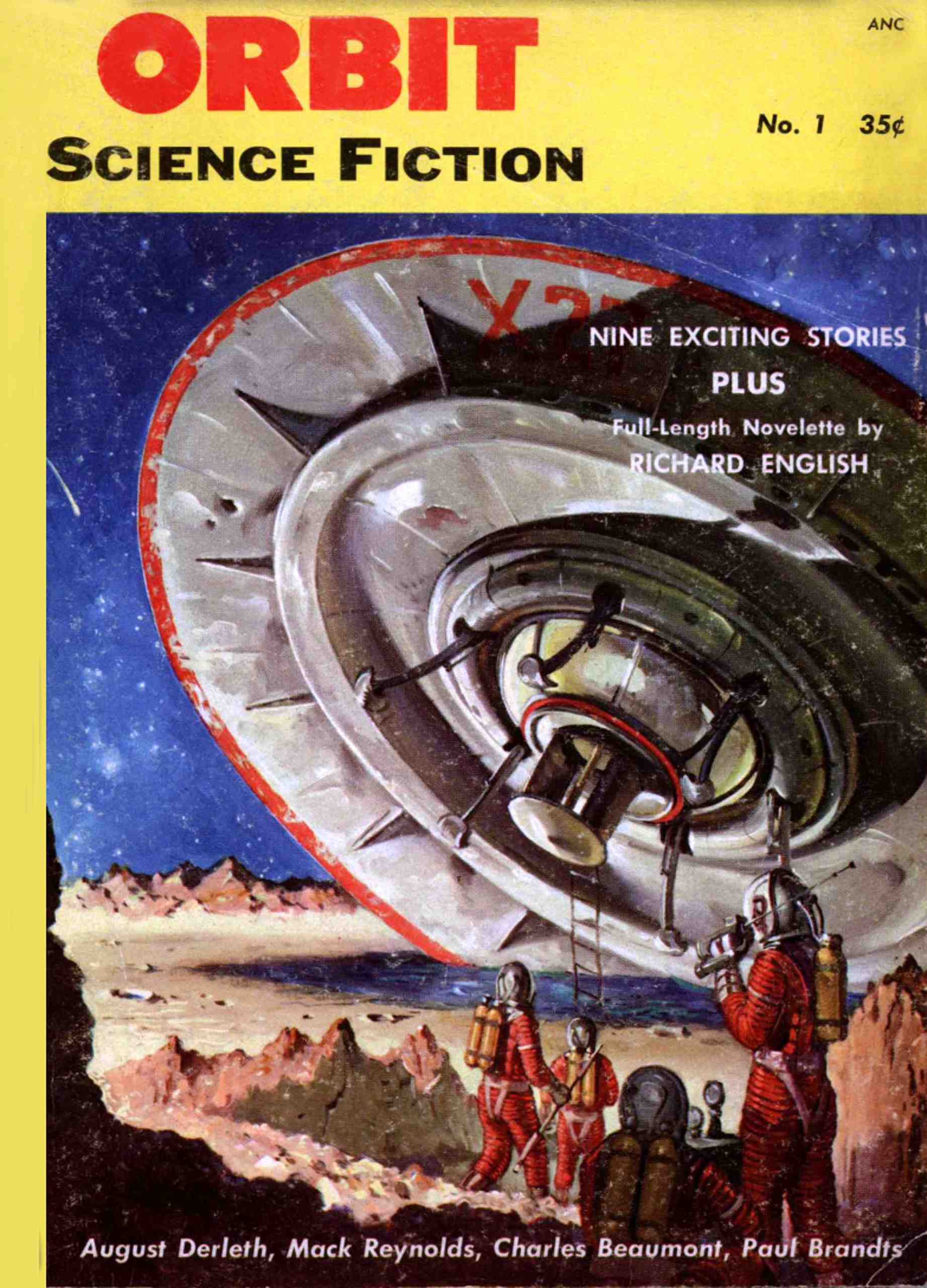
Transcribed from Orbit Science Fiction, September 1953 (Vol. 1, No. 1).
Transcribed from Orbit Science Fiction, September 1953 (Vol. 1, No. 1).
by Basil Wells
A lost handful of humans in the vastness of space, their fate was a nightmare of genetics gone wild!
The Starship was in trouble.
She was the first ship to span the void between solar systems. The voyage had lasted for hundreds of years, and the crew, and their grandparents, and their grandparents, had never set foot on a planet’s soil.
But the years had taken their toll. The shielding of the hull was imperfect. The jets cracked and their liners could not be replaced. The air conditioning broke down constantly and there was a constant seepage of precious oxygen into outer space.
For every normal birth among the thousand crew members there were five or six mutant young. The cosmic rays, filtering through the imperfect shielding, were playing havoc.
And the cereals and root crops, too, in the agricultural levels, were changing. Edible food was less plentiful. Sickness and vitamin deficiencies were wreaking havoc, as well.
Into the thin atmosphere of Ghakk, second of the three planets circling Rhebus IX, they drove the ship, braking as they swung in a tightening orbit about that desert world.
The jets crumbled swiftly and there was a flareback to the belly fuel tanks. The Starship plunged, in a long curving dive, down toward the ragged canyons and gray-dusted barrens of Ghakk.
The two escape craft still in commission quitted the stricken ship and dropped planetward on cushioning gouts of flame. And after them space-suited crewmen sprang into space and shook out their nested parachute vanes.
Only the commander and two of his faithful officers remained aboard to attempt a hopeless grounding on Ghakk.
The curving globe slid away beneath them, hiding the ship forever from the escaping crew members. And the arid deserts and wind-eroded hills came up to meet the dying ship’s frosted plates.
Almost they completed the circuit of Ghakk.
A hundred miles west of the canyons where most of the crew had landed the great ship plowed into the desert, jounced high into the air, and struck again. The three officers died with the first impact.
For eighty miles the mile-long cylinder, battered and gaping at a thousand rents, skittered along—to come to rest at last in the shadowy depths of a sunken lake.
So the years passed on Ghakk, and the mutant crew members banded together, like to like, in widely separate valleys. After a time the mutants bred true—true to their own warped species—and memories of the distant system they had never seen were forgotten, quasi-religious fantasies.
And, with the centuries, the broad lake where the Starship lay submerged grew shallow and choked with the fine gray dust of Ghakk. In time, like a stranded whale she lay exposed.
The long-legged monster turned his back on the familiar green canyon depths, far below now in the great valley’s shadows. He knew that he had seen for the last time the canyon of his people, and the barren little side-canyon where his parents, who had loved him in spite of his outlandish legs, had kept him hidden until he was grown.
He hoped they would not be punished too severely for their refusal to destroy him at birth. One of the Cru having discovered his refuge while hunting pelfs, warriors of the Cru would by now be hot on his trail.
“Let no monster live in the Valley of Cru.” That was the grim law of the legless “men” of the canyon. And already a miniature blot of moving dust lay far below in the depths.
For an hour or more he trotted steadily westward through the broken splinters of dead rocky ridges and across narrow arid flats of fine-ground grayish dust. He twisted and weaved in and out, the better to confuse his trail, and where he could his rough leather sandals traversed trackless bare rock.
He passed greasy-leaved clumps of bluish growth. Pale yellowish cactii thrust grotesquely from the sun-seared soil. And the dust-smothered, toppled wall of some long-forgotten Ghakkan building reared unexpectedly in his path at intervals.
Now the native lizard race of Ghakk which had built these buildings was grown weak and degenerate, and the Cru had taken over their choicest canyon. Or so the boasting tales of the Cru ancients would have it. The lizard people’s cities and roads were swallowed by the encroaching desert, and their ancient culture was passing with the dwindling water supply....
Something moved in a waist-high thicket close by. He drew his only hand weapon, a long, chip-sharpened dagger of red igneous stone, and he freed the stout, short bow across his shoulder the more easily to reach it.
The clump of brush was less than five feet in width. He stooped, scooped up a handful of the gritty dust, and flung it into the growth.
The flesh of a hairy pelf would be good ... if this was a pelf. Alert and ready, he sheathed his knife even as his bowstring snapped into its nock.
A coughing, choking sound came from the little copse—a strangled, despairingly human cry—and then a bronze-skinned, four-limbed creature burst out opposite him.
Two great leaps and he had it.
He felt soft flesh, and the beast resisted fiercely. He released it quickly after a moment. For he saw that he had captured a female, clad as was he in a brief g-string of furry pelf-hide, a short vest of the same material, and coarse, cracked sandals.
But—and his stomach rebelled with the horror of it—she too was a monster, like himself!
Instead of the two huge, muscular arms with which true Crus walked, ran, and worked, she had ungainly, tapering, long legs. And her arms, like his, were short and almost dainty, so soft was their appearance.
Like the lower animals of Ghakk, she used four limbs rather than two. She was atavistic—a throwback to the days when the Cru’s ancestors were little better than beasts.
And yet it was comforting to know that another shared his own terrible deformity. Perhaps they could become friends and his ever-present sense of loneliness and self-loathing could be forgotten.
“Who are you, female-who-hides?”
The woman—and now he could see that her dark, dust-caked hair had hidden a dusky, even-featured face; a rather attractive face for a monster to possess—had stopped sneezing. Her teeth shone.
“I am Vanna. I come from the Valley of Jaff.”
“Jaff?” He scratched thoughtfully at his gray-caked chest. “Never heard of it. Did they drive you out from among the Cru who dwell there?” He tugged at a lock of sandy hair.
“In a way.” She laughed, and he liked the sound. He had never heard his mother laugh—but she had cried often enough, at the sight of him. “A Cruman and his three wives drove me out.”
“How do you mean, er—Vanna?” He paused awkwardly. “By the way, I am Malan.”
She bobbed her head pertly. “Well, you see, Malan, Jaff, who rules the Valley of Jaff, wanted me for his sixth mate.”
“A Cruman wanted you—an ugly monster—for his mate?” Malan laughed scornfully. “It is a story you make up.”
“I like that! I’m no more monster than are you.”
“What I said. A monster like you and me. We should both have been destroyed.”
The girl tapped her forehead. “Aren’t you slightly off up here?” she asked, smiling. “But then, who isn’t? I suppose I do look like a harpy.”
“Are you being pursued, Vanna?”
“I expect so. Jaff and three of his five wives were hot on the trail last evening. But I traveled at night to throw them off.”
“Through the cold?” The thought made Malan shiver. He had a single ragged blanket of pelf strapped on his back under which he would huddle in some warm cave nest.
Vanna tugged out two pelfskin robes that she had been sleeping on inside the little thicket’s shelter, and showed them to Malan. She had laced them together to form a sort of furry nightshirt that reached to her sandals.
“It was cold,” she admitted. “But better freeze than be beaten and abused by Jaff.”
Malan twitched an eyebrow. The customs of the Crumen in her native canyon and his own obviously must differ widely. In the Valley of Cru even the mightiest warrior possessed but one mate. Nor would they consider allowing a monster in the valley, even as a slave.
He shrugged and hoisted the female monster’s blanket to his shoulder. He could not stand here wondering and talking.
“Come,” he said, turning and starting off. “We must not be captured.”
Vanna stared after him, with anger, her slender little fingers caressing the dark wooden handle of the knife thrust through her g-string. She stood glowering, while he put a dozen paces between them.
“Why, that rock-headed brute!” she muttered to herself. “Never even asked me if I wanted to go that way!” She took a hesitant step.
Malan stopped, grinned back at her and waited. “Your voice carries well,” he said. “I think you’re not really angry, are you?”
Vanna flashed a reluctant smile and shook her head....
The last crimson streamers of Ghakk’s ancient sun revealed the pursuing knot of warriors from the Valley of Cru.
The two fugitives were quitting a desolate dust flat, hill-rimmed and wide, and turned to look back. They saw ten of the Crumen come bounding, on tireless long arms, across the flattened gray expanse but a mile behind them.
Short they were, less than four feet in height, but broad of shoulder and long of arm. They were legless—only vestigal pads of feet with tiny nailless digits supported their humanoid trunks—but their upper limbs carried them along at a fast pace.
They carried throwing spears, bows, and short, metal-bladed swords. And most of them bore small packs in addition to the pouched harness about their bodies.
“We’ll lose them among these rocks ahead,” Malan promised doubtfully.
“What horrible-looking things they are, Malan.”
Malan was thunderstruck. Had she never seen Crumen? He stared at her. “But they are Crumen,” he said. “The Cru. We, you and I—are monsters.”
“You poor gulpin,” Vanna said. “Is that what they tried to tell you? In our valley we know the truth. True Cru have legs.”
Malan made an expressive sound of disgust.
“Your people are mad,” he said shortly. “Come, let us turn to the north and escape them.”
They climbed for a time, the wind-rasped rock of the slope like coarse sandpaper under their clumsy sandals. They came to a ridge that angled northward, affording an easy path for a time.
The four tiny moonlets, racing close down to Ghakk’s surface, were hidden as the last light from the sun died, but a few moments later the first pale satellite pushed above the eastern horizon. Now they could see where their stumbling feet were placed.
A second, and a third moonlet appeared. Light flooded the time-worn hills and ragged canyons and crevices. They quit the ridge and crossed a wind-swept apron of creviced rock to a second ridge. But they did not follow the easy way along the crest. The pursuing Crumen could not have failed to see a moving dot, or two dots, silhouetted by the moonlight upon the skyline. Malan knew better than that.
Vanna fell behind, limping. After a time she stumbled and fell. Malan came back and helped her up. He, too, was sagging with exhaustion.
“A little farther, Vanna,” he whispered. “The canyon just below us is choked with huge boulders and fallen rimrock. Plenty of good hiding places—maybe caves.”
“I’ll make it, Malan.”
Malan put his arm around her waist. The naked flesh was satiny and warm beneath his touch, and for the first time he felt a strange yearning emotion.
He knew that she needed his help—that she accepted him as an equal—and he was content to serve her.
The pale moons sent blurred moving shadows racing before and beside them. They avoided sand and dusty patches of rock, trying to leave no spoor, as they struggled deeper into the rocky jumble.
It was bitterly cold, with their breath blossoming whitely in the thin air, when they found a rock-hidden tiny cave. There was sand on the floor, and into this they burrowed wearily.
Malan heaped the three robes over them and the female monster fell asleep with her head pillowed on his shoulder. A moment later and he, too, was dreaming.
Something was wrong. Malan was sure of it. He felt the coarse fluidity of the sand and the warmth of flesh other than his own. And his memory was dulled.... What had happened?
His eyes opened.
He was looking up into the face of a female—a long-legged, monstrous female. And her face was familiar. It seemed—then he remembered. Vanna!
Yet at the same time he could feel a warm, unconscious body at his side, the gentle pressure of its breathing on his flesh even and slow.
“You aren’t Vanna!” And he groped for his knife.
The girl-shape wavered and became something else. A Cruman! No! A monster, for his legs were long and muscular. And his hair was sandy and hacked-off roughly about his ears. He looked like—he was—another Malan!
Malan knew a sudden paralyzing fear.
“A Shape!” he gasped.
Vanna stirred. Awoke.
The monstrous, changeable entity standing before them in the cave grinned in a friendly fashion. His weirdly familiar face shifted like a reflection in a disturbed pool and then steadied. Malan shuddered. Now the Shape would pounce....
He fought at the confining robes and at the hampering clasp of the terrified girl’s hands. He felt the pelf-hide rending.
“Yes,” agreed the grinning duplicate Malan, “I am a Shape. I am Rhee, fugitive from my own kind. And I would be friends.”
Malan came surging up to his feet and grappled the creature. Rhee was unarmed and naked. But the body Malan seized was, at once, yielding and powerful. His arms were swallowed up, engulfed by the protoplasmic monster.
He was helpless. Vanna came at the Shape with her stone sliver of a knife bared. And all at once a whip of ropy flesh darted from the strange being’s chest, to strip away the blade in her hand. She staggered backward and to her knees.
“Sorry to get rough with you two,” Rhee said calmly. “But even a Shape takes little pleasure in having his flesh haggled by edged weapons.”
“Eat us and be done!” flared Vanna, tears making her eyes bright. “We do not fear you!”
“I am not hungry, you silly mutant,” the Shape said, chuckling happily. “I eat only vegetables, fruits, and fish. Are you any one of them?”
“Perhaps we were hasty,” admitted Malan. “You could have eaten us both by now. But, among the Cru, it is said that the terrible Shapes eat one another.”
Rhee released Malan. And behind the Shape the sun rode high in the heavens. Rhee squatted in the warm sunshine just inside the cave’s entrance. He examined his right hand curiously. A second thumb grew as he stared. “Oh, most of us are cannibalistic,” he admitted with a smirk. “Many of my people have devoured as many as twenty of their own kin, or their own offspring. The food supply is rather uncertain in our valley, you see.
“But it happens that I am allergic to animal flesh. Huge purplish pustules break out over my entire body if I indulge, unfortunately. And, being a variant from the other Crumen, or Shapes, I was naturally forced to leave the valley and hide in these hills.”
“Now,” sighed Vanna, relief in her voice, “I can sleep nights. Providing, of course, that you join us.”
“Never fear.” Rhee grinned horribly again and changed into a pouchy-breasted old hag with stringly white hair. “I’ll guard you from this forward young monster, dearie.”
“Don’t dearie me!” Vanna cried, her face flaming. “I’m not afraid of Malan. I just didn’t want you nibbling off a leg or arm.”
“My error, lovely mutant,” said Rhee gallantly, bowing and switching abruptly again to his masculine form.
In his haste he forgot the scraggly white hair of the old female. It dangled like a hood of serpents down upon his brawny shoulders.
“Look, Rhee,” said Malan uncertainly. “As long as a female is with us, and—well—Hadn’t you better hunt up a g-string or something?”
“Great jets, yes!” A gaudy reddish sash materialized, vanished, and was replaced by a hairy g-string. “I’d forgotten the silly regard you mutant monsters have for clothing.”
“I suppose you Shapes never bother with garments?”
Rhee shook his head jerkily. “Nuh uh. We Crumen need no such coverings. Our outer flesh adapts to any temperature. Of course, you mutants find that impossible.”
Vanna laughed scornfully. “You call yourself a Cru. And Malan calls the ugly legless ones Crumen, too. But my people, with our long legs and unchanging form, we are the real Crumen.”
“What’s the straight of it, Shape?” asked Malan, sorely puzzled. “Surely you must admit that we are all three monsters!”
Rhee scratched at his pale Medusa’s locks with a thoughtful set of fingernails. The hair shortened and grew sandy again.
“The female is wrong—but so are you. Only a true Cruman could adapt himself to any form or environment, as we Shapes do.”
A shadow, falling across Rhee’s body, cut off Malan’s possible reply. It was a short, compact shadow—legless!
“The Cru,” rasped Malan, reaching for his bow.
Rhee fell in upon himself. He became a shapeless blob of writhing flesh and protoplasmic jelly. He flung out a thin whip of colorless, muscular flesh, and the legless one came thudding into their midst.
Malan quieted him with a fragment of rock. The warrior went limp. Malan stripped off his weapons and flung himself out of the cave.
A second legless one bounded toward them, on massive arms. His mouth opened to voice a triumphant cry. And then Rhee’s whip of protoplasmic leathery flesh cut him down. Swift as Malan was, Rhee had preceded him out of the cave.
“Drag it out of sight,” said Rhee momentarily humanoid from the chest up, “and we’ll polish off the rest of them quickly.”
Malan dropped another rock against the bald brown skull and tugged the creature behind a huge boulder. There, with strips from the Cruman’s blanket, he bound the mighty arms together.
“Rhee,” he said huskily, “you’re an all-right Shape.” Swiftly he sprang back to the cave opening and ranged himself alongside his ally.
Malan, Vanna and Rhee were staggering under burdens of swords, water bladders and extra blankets as they climbed a ridge half an hour later. Behind them six weaponless, bound warriors chafed their bonds furiously against sharp rock edges. The Shape had roped them all very neatly.
“Without water,” Rhee said, “they can follow no further.”
“You know this country, Rhee,” Malan said. “Where can we find a deserted and fertile canyon?”
The Shape laughed.
“Nowhere.” He took up a fragment of chalky gray stone and knelt before a smooth, darker slab. “See, here is the Valley of Lizard Ones—the true Ghakkans, degenerate though they be. Directly north and west.
“West again from that is the double, U-shaped Valley of Shapes. And south of the Lizard Ones is the Valley of Giants—also mutant descendants of our race.”
“No other valleys or little canyons that are habitable?”
“Two or three.” Rhee nodded. “But monsters too horrible for the Cru or the other mutants to accept exist in them somehow. Hairy things, four, five—even eight—legged. Crawling blind things, yellow and slimy....”
“What would you suggest then, Rhee?”
“I say let us cross the great fissure that bars this cut-up section from the land west of us. We don’t know what lies beyond—desert or more badlands or fertile plains, or what kind of creatures—but it’s worth a try.”
Vanna nodded. “Sounds good to me. But how do we cross? Can you sprout wings and ferry us over?”
The Shape was amused. “I can glide for a short distance,” he said, “but not carrying a load. However, there is one spot, south of the Valley of Shapes, where the great rift narrows to perhaps a hundred feet. There three huge trees grow close together on the chasm brink.”
“A bridge, eh?” Malan studied the map thoughtfully, “But here, so close to your people’s valley, will we not be discovered?”
“It is a chance we must take, Malan. In the late afternoon we can risk it. Only in the morning do the Shapes hunt outside the barrier cliffs.”
“I’m for it, Malan,” Vanna cried out. “Once beyond the fissure, Jaff and his wives cannot follow us.”
“I agree also, Rhee.”
“Good,” the Shape said, absentmindedly blossoming a cuplike bright blue ear from his chin momentarily, before he rose to lead the way.
So it was that they headed northward for a time, almost to the Valley of Lizard Ones. Toward evening they surprised a hunting party of six grotesque, brownish-scaled, dwarfish saurians, but the sight of them sent the upright little lizard men scampering.
And with night they found a low-roofed cave, with a narrow entrance, within which they built a fire.
“The Hairy Beasts,” Rhee told them gravely, “may see the fire and come to attack us. However, as long as the fire burns the light will blind their weak pink eyes and restrain them.”
“Why worry, then?” yawned Malan, and was asleep.
A second later, or so it seemed, he was dreaming that a Hairy Beast sat astraddle his chest. He felt the coarse hair rasping his naked flesh, and the stench of bestial breath was foul and hot in his face.
The dream was very real. He had experienced these nightmares before. He groaned disgustedly and attempted to roll over.
Abruptly he was fully awake. The weight was still there, and thick legs wedged his blanket-swathed arms to his sides. His eyes popped wide....
In the dying flare of the ashes he saw the gleaming, dagger-like teeth of the Hairy Beast close above his unshielded throat. They dropped nearer.
And Malan exploded into action, rolling out from under the apish brute, his arms rending the pelfskin blanket.
A second blanket splashed down over his head and body. He tore it away, stumbling over Vanna’s sleeping body as he did so, and sprawling, headlong, into the embers of the fire.
He sprang upright again, cursing, and his eyes searched the shadowed cave for the misshapen brute.
The Hairy Beast had vanished. Rhee lay curled in his warm hides, his even breathing loud and undisturbed, and Vanna was sitting up, trembling. Perhaps he had injured her as well as frightened her! Her body was quivering in strange little spasms.
“Vanna,” he said anxiously, sitting down beside her, while his eyes ranged the cave and its entrance. “I didn’t hurt you?” He pulled her extra blanket up around her shoulders and put his arm around her to reassure her. But the ugly, broken paroxysms continued—even more violently than before.
“Now, Vanna,” he soothed. “Now, now!” And then, as his mother had infrequently done—when she could conquer her natural revulsion at touching her monstrous son—he tipped up her face and gently kissed her. She quieted. He kissed her again.
It was pleasant. He had forgotten what loneliness was like; he had forgotten that they were both monsters fit only for destruction. He held her close to him for a long moment.
Vanna pushed him away. Her shoulders started jerking again, and now he saw that she was laughing. And that she had been laughing all the time....
“You looked so funny, Malan,” she almost sobbed in hilarious agony, “when Rhee pretended he was a Hairy Beast!”
Malan gave her a disgusted shove. He started for Rhee’s nest of blankets. But the Shape was gone.
Growling under his breath at the two jokesters, he settled again into his blankets. Swiftly his chilled body warmed, and he grew sleepy again. His last thought was how well Vanna’s lithe body had fitted into his arms.
Vanna knelt beside him, her soft fingers caressing his eyelids. The morning sunlight shadowed her dark eyes and face as they shielded him from its flaming glow.
“I am ashamed of myself,” she said tenderly, “that I angered you by laughing. Forgive me.”
She bent lower. He flung aside the blankets and pulled her yet closer. Her lips parted....
“What’s—what’s all this?” a familiar voice cried out angrily from nearby. It was Vanna.
Malan sat up. And the Vanna that had melted so pleasantly into his arms, shifted, writhed, and became a laughing, toothless old crone with a twisted, warty chin. Malan swung a knotted fist at the drawn lips and jutting chin, and felt a satisfying jolt travel up along his arm.
“A joke is a joke,” said Vanna severely to the sprawled, but still cackling, Shape, “but there’s a limit. From now on you better stay a Cruman—and with dark hair, too.”
Rhee’s masculine form returned, a glorious, muscle-rippling, deep-chested, godlike shape that made Malan feel like a boy. And the Shape’s hair was a thick, tangled mop of black. He stood up.
“I’ll try,” he agreed, his strange new eyes shining like polished brass, “but I make no promises.”
And for the next three days, while they traversed the desolate reaches of desert and empty, rock-strewn canyons, Rhee kept his word. Only once did he forget himself, and extend a fragile pseudopod to whisk an arrow from Malan’s startled grasp.
As a consequence Malan was too late to down a shambling, bearlike pelf. And the slate-hued beast waddled hurriedly away among a cluster of eroded greenish boulders.
That was early in the third day, as they passed near the Valley of Giants, and well it was that they did not slay the pelf. For close on the heels of the clumsy brute came a score of the naked, hairy-headed giants.
Malan lay close beside Vanna in the shallow cup of sand-floored granite, with Rhee on her other side, and peered cautiously over the rim. A dead stub of cactus hampered full vision, but it also shielded his head from view.
Twice as tall as Malan were the pallid, elephantine monsters. Their heads were huge hairy masses of varied hues, from which only their tiny eyes and flabby red mouths and teeth gleamed. Many of them possessed extra rudimentary limbs, sprouting at random over their unlovely torsos, and two giants bore two fully-developed heads apiece.
All of them carried knotted clubs in their misshapen fists.
“That was close,” Malan muttered, after a long wait. “Did you see them or hear them coming, Rhee?”
“I should brag and say yes, Malan. The truth is, I was just being playful when I snatched that arrow from you.”
“That evens you up for the other morning,” said Vanna, still resentful.
“Malan hasn’t dared to try kissing you since, eh?” Rhee chortled. “Anyhow, we’d have lost an hour dressing the pelf. And we might have reached the fissure too late.”
“We must cross tonight?”
“Rather. The Valley of Shapes is too close at the point to take any chances. We might hide out until the following evening, but my people are skilled at scenting out any sort of edible flesh. Against more than one Shape we would be helpless.”
“What’s holding us back, then?” demanded Vanna, standing up and thunking her sandals into both their ribs. “Come on, you lazy ones!”
Three gigantic trees, white-boled and straight, with the rot of age hollowing-out living caverns at their roots. Three forest giants, balanced on the sheer rift’s brink, and lifting two hundred feet into the thin air of dying Ghakk....
Smoke, thin and pale, lifted from fires kindled on the chasm’s side against their massive boles. In theory, the side first burned through would be the direction of fall. In practice—anything could happen.
They had decided to fell the three trees together, thus preventing any possible emulation of their bridging feat by others.
Vanna and Malan peered down into the great crack while the flames licked hotly upward behind them. A thousand feet—two thousand feet—perhaps much further, the emptiness fell away below. Darkness shrouded the murky depths, but a rock fragment, after a long interval, sent back the faintest echo of a splash.
All the face of Ghakk was split and riven in this fashion. Ghakk was a chilling, ancient planet circling a dark-shadowed luminary, and in her dying convulsions her outer husk was shattered.
Rhee joined them. “The trees’ interiors are aflame now,” he warned. “Once they topple we must hurry across.”
Malan turned to watch the flames. He frowned doubtfully up at the growing column of heated air and smoke. Fortunately a stiff north breeze, from off the higher desert tableland they had quitted, caught it and ripped it apart. And the dust in the moving air merged with the smoke into a drifting haze.
“If we slip off the log,” Rhee warned, “the ugly water-lovers, who dwell in the depths, will feast well. It is they who bar any descent into the sunken voids as a way of escape from this island of canyons.”
“Are they, too, mutants?” Vanna wanted to know.
“No. When we Cru first came to Ghakk they were there. And long after we are gone the slimy amphibians will live on in their watery gulfs.”
The fires crackled loudly. And the sun was nearing the western rim of the encircling uplands. In a few moments the sky would flame briefly with dusty sunset, and then darkness would come.
With a sudden loud cracking and popping of fibers the largest of the three trees started toppling—squarely out over the void!
“Perfect!” cried Malan.
The vast trunk smashed down, its bushy upper branches crashing and splintering on the opposite lip of the crevice. And then, with the slow, inexorable movement of heavy hinges, it buckled in the middle, and slid smoothly into the depths....
Rhee grunted disgustedly, and his erect body slumped into something shapeless for one brief moment. Then he stood erect.
“Two to go,” he said.
A moment. Two moments. And then the ominous crackling of the flames was drowned by the snapping explosions of wrenched and tortured wood. And now the two remaining trees leaned outward, together, and thundered down.
Hastily, the three moved well away from the vast cleft. The upper limbs of the two trees meshed together and battled. The right hand tree revolved its fire-blackened bole and bounced toward the watchers. They dropped to the ground, cowering, and the ugly cylinder brushed across their prone bodies and was gone.
They saw the awesome bulk of it upending until it was vertical, as the crown plunged downward into the abyss. There was a rumble of sound and then nothing more.
The third tree remained, smoke curling from its rotten dry heart. And it seemed to be anchored securely in place.
“Still game, Vanna?” Malan’s hand was on the girl’s shoulder.
Vanna clung to his arm, put up her face to clear away the dark hair, and nodded. In the ebbing crimson twilight that had fallen he saw that her lips were thin over locked teeth.
“Take her over, Malan,” came Rhee’s urgent voice. “Those crashes may bring Shapes—or the tree may burn through.”
Malan wanted to protest. He should cross first to see if all was safe. And then Vanna could follow. But there was an undertone of recognized danger that Rhee’s voice revealed.
He helped Vanna up across the hot char to the white trunk. The bark was firm and free of scaly patches, but it was hot under their worn sandals. They hurried ahead, out over the emptiness. And now Malan was thankful for the growing dusk.
It was like running along a narrow, high-crowned road built above the level of a marsh or lake.
They reached the limbs, wriggled through and around them, and came at last to the solid rock beyond.
And when he had taken Vanna a safe distance from the mangled debris of the crushed limbs, Malan turned to go back to join Rhee. Only to see the Shape’s indistinct body come springing lightly from the tree top.
“The base of the tree was almost burned through,” he told Malan. “That is why I did not come with you. My added weight might have finished it off.”
They backed away from the entangling branches. It was almost completely dark by now, although two of the wan little moons of Ghakk were lifting above the distant hilltops. They could see the red glow of the tree’s blazing base.
The tree settled and crunched as though it was preparing for its fatal flight downward. Vanna cried out, pointing.
Four figures, monsters by the shape of them, were running toward them across the trembling bridge. The moons were waxing. Malan could see that one figure was that of a giant male and the others were females. And even as he watched the great bole shifted, sending a screaming figure gyrating madly into the depths below.
“Jaff and his mates!” cried Vanna, throwing herself into Malan’s arms. She was sobbing.
Malan tore away her clinging fingers and pushed her away, even while he unslung his bow and swung his quiver to a readier angle.
“Go back, Jaff!” he roared. “Vanna is my mate!”
A bull bellow of amused sound answered. The warrior waved muscular, hairy arms as he halted for a second.
“Not for long is she yours, dogson,” he jeered. “After I have crunched your skull and eaten of your heart she will be mine.”
“Keep him talking,” muttered Rhee. “The weakened trunk must break soon.”
“Back!” cried Malan. “Go back. The tree is ready to crash!”
“Fool!” said Rhee. “Now he will try to rush us.”
The warrior laughed derisively and came racing forward. Malan bent his bow and sent an arrow speeding toward that vague moving bulk. Another arrow—a third, and a fourth—and Jaff shrieked and went toppling through the branches he had but reached.
One of the females turned and went scampering back the way she had come, but the other came swiftly running toward them.
“Vanna!” she called out. “It is Nian!”
“She is not unfriendly,” Vanna said. “Of all Jaff’s mates she is the kindest—and the youngest.”
Malan lowered his bow. He was wondering, thankful that the decision was not necessary, whether he could have killed the female monster. In his brain now was a sense of the difference between Crumen and their mates, a sense that was new to him. The females were to be protected—as he would always protect Vanna....
Branches rasped across the bare rock. The ripping bark and leaves voiced a protesting groan, as the forest giant took its last plunge, and the female came catapulting out of the sky to the rocky ground before them.
The Shape dragged her limp body back from the brink of the chasm to safety.
It was noon, and the four who had crossed the crevice were entering the narrow entrance to a sparsely wooded valley. There was game here, and an hour before they had discovered a spring bubbling up through crystalline white sand.
All of them could live here, Malan was thinking. Here there need be no distinctions of monster or Cruman. His faith in the true Cru being the legless warriors from his home valley was badly shaken. Rhee, with his flexible adaptation to any shape and his ready wits, was certainly much superior to the legless ones.
And so, reluctantly, he was coming to regard the Shape as a Cruman, even as Rhee had claimed, while Vanna and Nian and he were obviously mutants. Vanna’s claim that her tribe were true Cru was patently false—Nian was proof of that.
Nian moved gracefully, almost bonelessly, in front of them. Her long, fleshless limbs were double-jointed and flexible. A second pair of tiny pale blue eyes were set close to her narrow blade of a nose, below her wide great eyes of deepest violet. She was long-faced, with tiny white teeth, and the orange-red of her hair sprouted in weird tufts.
There was the unhuman beauty of a wild creature about her....
They rounded a sweeping wall of reddish shale and rotten yellow rock, and looked across a dry-crusted swale to where a shallow, mile-wide lake opened. From the calm, dark waters a weird rounded mass loomed.
“The spassip!” Malan cried out.
He was dazed. The legend of the spassip that had brought the Cru to Ghakk, a legend he had scarcely believed, was suddenly to become reality. The vastness of the mile-long ship awed him. It was like a hill spanning the lake.
Just before them, a ready finger of mud extended outward toward the crumpled nose of the spassip. Already the Shape and the monster female, Nian, were racing fleetly across it.
Vanna and Malan followed.
Rhee was climbing through one of the rust-stained gaps in the ship’s upper hull. He paused long enough to lend Nian a ropy tentacle, and pulled her up after him. Then they both vanished into the interior.
A moment later Malan was assisting Vanna through the same opening into a twisted, dust-floored corridor with walls of distorted metal. The broken webs of fist—sized chedda spiders marked the passage of Rhee and Nian.
They followed. On either hand strange metal caves, dusty and choked with debris, opened. They saw strange furnishings of metal and sleek horn-like material.
They came at last to the dusty, dimly-lighted control room, where the three brave Cru of that age-old legend had died, and they reverently examined the corroded control panels and ruined equipment.
Rhee turned from a metallic drawer, a rounded metal plate in his hand, and stalked woodenly over to Malan. Wordlessly, he passed the little medallion to the monster.
Malan studied the raised figures and the odd lettering.
“Monsters,” he said, wonderingly, “like Vanna and me.”
Rhee shook his head, his features fluid and smoothly empty. And there was a listlessness in the motion that chilled Malan. The truth came flooding into his brain.
He saw the sprawled, dust-coated space suit in which a Cruman had died, and it had long separate legs. Another plaque of dull metal on the wall showed two long-legged creatures standing with clasped hands. In the background loomed a spassip, on which strange symbols were inscribed.
“The Second Ark.” Malan examined the cryptic, meaningless letters. But he knew the truth now. He knew at last that it was he, he who was a true Cruman, as was Vanna. They two alone were true descendants of the fabulous, brave people who had traveled from some distant planet to Ghakk in this ship. The Shape, the Giants, and the Legless Ones—all of them were mutants.
So now was Rhee to be considered a “monster”? A true comrade, with a wisdom beyond his own, who had treated him as an equal even though he had then been classed a mutant...?
He flung an arm around the Shape’s shoulder.
“All the monsters,” he said, “we left across the rift.”
And Vanna was smiling agreement. This time it would be different. Mutant and Cru would work shoulder to shoulder to build a life for themselves, to fashion a world where they might be happy and safe....
This etext was produced from Orbit Science Fiction, September 1953 (Vol. 1, No. 1). Extensive research did not uncover any evidence that the U.S. copyright on this publication was renewed.
Obvious errors have been silently corrected in this version, but minor inconsistencies have been retained as printed.
The following alteration has been made:
Vanna came at the Shape with her stone sliver of a knife bared.