
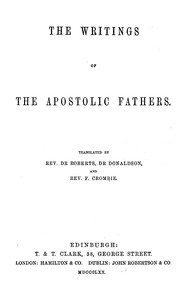
The writings of the Apostolic Fathers by Pope Clement I et al.
QR code
The First Epistle of Clement (Ancient Greek: Κλήμεντος πρὸς Κορινθίους, romanized: Klḗmentos pròs Korinthíous, lit. 'Clement to Corinthians') is a letter addressed to the Christians in the city of Corinth. The work is internally anonymous, but it is attributed to Clement I, the fourth bishop of Rome, which most scholars hold to be true. Based on internal evidence, some scholars say the letter was composed some time before AD 70, but the
most common time given for the epistle's composition is at the end of the reign of Domitian (c. AD 96). As the name suggests, a Second Epistle of Clement is known, but this is a later work by a different author. The letter is a response to events in Corinth, where the congregation had deposed certain presbyters. The author called on the congregation to repent, to restore the presbyters to their position, and to obey their superiors. He said that the Apostles had appointed the church leadership and directed them on how to perpetuate the ministry. In Corinth, the letter was read aloud from time to time. This practice spread to other churches, and Christians translated it from the original Greek into Latin, Syriac, and other languages. The work was lost for centuries, but since the 1600s various copies or fragments have been found and studied. It has provided valuable evidence about the structure of the early church. Part of the Apostolic Fathers collection, some early Christians treated the work as a sacred text. It was included in some Bibles, such as the Codex Alexandrinus and Codex Hierosolymitanus, but not in the 27-book New Testament canon that is shared across most modern Christian churches. Such works are known as New Testament apocrypha, and 1 Clement ranks Didache as one of the earliest, if not the earliest, of those that still exist. (This summary is from Wikipedia.)
Download for free
For your e-reader or reading app — Kindle, Kobo, Apple Books, Calibre etc.
Kindle → Use Send-to-Kindle
Kobo, Nook etc. → Transfer via USB
Phone, tablet or computer → Open in a reading app
Other formats & older devices
There may be more files related to this item.
About this eBook
| Author | Clement I, Pope, -100? |
|---|---|
| Author | Hermas, active 2nd century |
| Author | Ignatius, Saint, Bishop of Antioch, -110? |
| Author | Papias, Saint, Bishop of Hierapolis, -120? |
| Author | Polycarp, Saint, Bishop of Smyrna, 69-155 |
| Translator | Crombie, Frederick, 1827-1889 |
| Translator | Donaldson, James, Sir, 1831-1915 |
| Translator | Roberts, Alexander, 1826-1901 |
| Title | The writings of the Apostolic Fathers |
| Original Publication | Edinburgh: T. & T. Clark, 1870. |
| Series Title | Ante-Nicene Christian library ; vol. 1 |
| Note | Wikipedia page about this book: en.wikipedia.org/wiki/First_Epistle_of_Clement |
| Contents | The first epistle of Clement to the Corinthians -- The second epistle of Clement -- The epistle of Polycarp to the Philippians -- The martyrdom of Polycarp -- The epistle of Barnabas -- The epistles of Ignatius (shorter and longer) -- The epistles of Ignatius after the Syriac version -- The martyrdom of Ignatius -- The epistle to Diognetus -- The Pastor of Hermas, Bks. I-III -- Fragments of Papias -- Appendix: The spurious epistles of Ignatius. |
| Credits | David King and the Online Proofreading Team at www.pgdp.net. (This file was produced from images generously made available by The Internet Archive.) |
| Summary |
The First Epistle of Clement (Ancient Greek: Κλήμεντος πρὸς Κορινθίους, romanized: Klḗmentos pròs Korinthíous, lit. 'Clement to Corinthians') is a letter addressed to the Christians in the city of Corinth. The work is internally anonymous, but it is attributed to Clement I, the fourth bishop of Rome, which most scholars hold to be true. Based on internal evidence, some scholars say the letter was composed some time before AD 70, but the most common time given for the epistle's composition is at the end of the reign of Domitian (c. AD 96). As the name suggests, a Second Epistle of Clement is known, but this is a later work by a different author. The letter is a response to events in Corinth, where the congregation had deposed certain presbyters. The author called on the congregation to repent, to restore the presbyters to their position, and to obey their superiors. He said that the Apostles had appointed the church leadership and directed them on how to perpetuate the ministry. In Corinth, the letter was read aloud from time to time. This practice spread to other churches, and Christians translated it from the original Greek into Latin, Syriac, and other languages. The work was lost for centuries, but since the 1600s various copies or fragments have been found and studied. It has provided valuable evidence about the structure of the early church. Part of the Apostolic Fathers collection, some early Christians treated the work as a sacred text. It was included in some Bibles, such as the Codex Alexandrinus and Codex Hierosolymitanus, but not in the 27-book New Testament canon that is shared across most modern Christian churches. Such works are known as New Testament apocrypha, and 1 Clement ranks Didache as one of the earliest, if not the earliest, of those that still exist. (This summary is from Wikipedia.) |
| Language | English |
| LoC Class | BR: Philosophy, Psychology, Religion: Christianity |
| Subject | Christian literature, Early |
| Subject | Apostolic Fathers |
| Category | Text |
| eBook-No. | 77576 |
| Release Date | Dec 30, 2025 |
| Copyright | Public domain in the USA. |
| Downloads | 1061 downloads in the last 30 days. |
Project Gutenberg eBooks are always free!