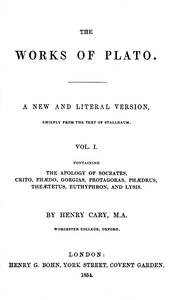
The works of Plato (Vol. 1 of 6) : A new and literal version chiefly from the…
QR code
The Republic (Ancient Greek: Πολιτεία, romanized: Politeia; Latin: De Republica) is a Socratic dialogue authored by Plato around 375 BC, concerning justice (dikaiosúnē), the order and character of the just city-state, and the just man. It is Plato's best-known work, and one of the world's most influential works of philosophy and political theory, both intellectually and historically. In the dialogue, Socrates discusses with various Athenians and foreigners the meaning of justice and
whether the just man is happier than the unjust man. He considers the natures of existing regimes and then proposes a series of hypothetical cities in comparison, culminating in Kallipolis (Καλλίπολις), a utopian city-state ruled by a class of philosopher-kings. They also discuss ageing, love, theory of forms, the immortality of the soul, and the role of the philosopher and of poetry in society. The dialogue's setting seems to be the time of the Peloponnesian War. (This summary is from Wikipedia.)
Download for free
For your e-reader or reading app — Kindle, Kobo, Apple Books, Calibre etc.
Kindle → Use Send-to-Kindle
Kobo, Nook etc. → Transfer via USB
Phone, tablet or computer → Open in a reading app
Other formats & older devices
There may be more files related to this item.
About this eBook
| Author | Plato, 428? BCE-348? BCE |
|---|---|
| Translator | Cary, Henry, 1804-1870 |
| Translator | Stallbaum, Gottfried, 1793-1861 |
| Title | The works of Plato (Vol. 1 of 6) : A new and literal version chiefly from the text of Stallbaum |
| Original Publication | London: Henry G. Bohn, 1849, pubdate 1851, pubdate 1854. |
| Note | Wikipedia page about this book: en.wikipedia.org/wiki/Republic_(Plato) |
| Contents | The apology of Socrates -- Crito or the duty of a citizen -- Phædo or the immortality of the soul -- Gorgias or on rhetoric -- Protagoras or the Sophists -- Phædrus or on the beautiful -- Theætetus or on science -- Euthyphron or on holiness -- Lysis or on friendship. |
| Credits | KD Weeks,The Online Distributed Proofreading Team at www.pgdp.net (This book was produced from images made available by the HathiTrust Digital Library.) |
| Summary |
The Republic (Ancient Greek: Πολιτεία, romanized: Politeia; Latin: De Republica) is a Socratic dialogue authored by Plato around 375 BC, concerning justice (dikaiosúnē), the order and character of the just city-state, and the just man. It is Plato's best-known work, and one of the world's most influential works of philosophy and political theory, both intellectually and historically. In the dialogue, Socrates discusses with various Athenians and foreigners the meaning of justice and whether the just man is happier than the unjust man. He considers the natures of existing regimes and then proposes a series of hypothetical cities in comparison, culminating in Kallipolis (Καλλίπολις), a utopian city-state ruled by a class of philosopher-kings. They also discuss ageing, love, theory of forms, the immortality of the soul, and the role of the philosopher and of poetry in society. The dialogue's setting seems to be the time of the Peloponnesian War. (This summary is from Wikipedia.) |
| Language | English |
| LoC Class | B: Philosophy, Psychology, Religion |
| LoC Class | PA: Language and Literatures: Classical Languages and Literature |
| Subject | Philosophy -- Early works to 1800 |
| Category | Text |
| eBook-No. | 78618 |
| Release Date | May 6, 2026 |
| Copyright | Public domain in the USA. |
| Downloads | 607 downloads in the last 30 days. |
Project Gutenberg eBooks are always free!